Jan 062016
 
 January 6, 2016  Posted by at 10:48 am Finance Tagged with: , , , , , , , ,  2 Responses »


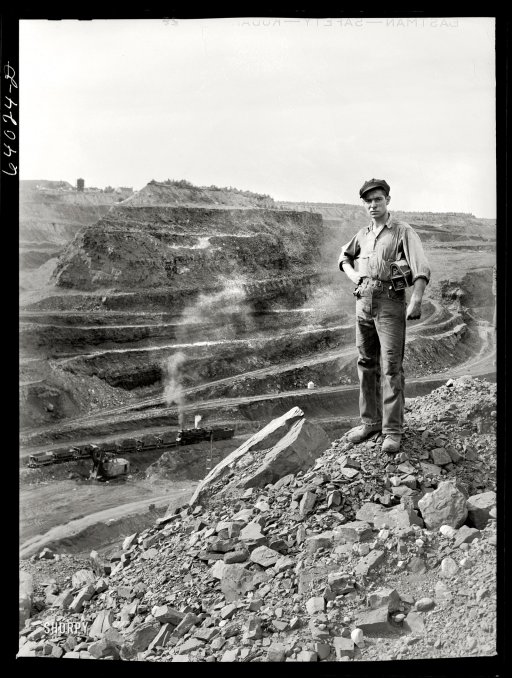
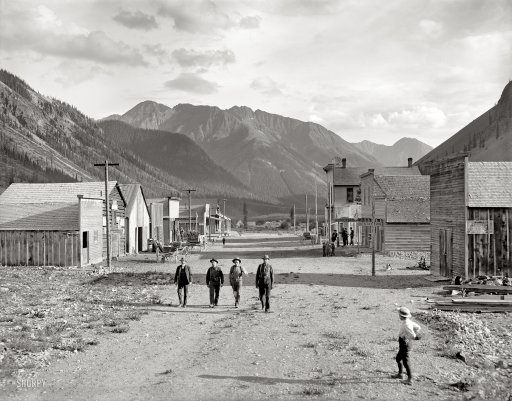
William Henry Jackson Eureka, Colorado 1900


• Contracting US Industrial Output Associated With Onset Of A Recession (WSJ)
• “We Frontloaded A Tremendous Market Rally” Former Fed President Admits (ZH)
• “It’s A Really Messy Start To The Year” For Markets (BBG)
• Saudis Slash European Oil Prices as Middle East Tensions Grow (WSJ)
• Saudi Arabia Hikes Domestic Gas Prices By 50% Amid Budget Cuts (CNN)
• Spread Between Onshore, Offshore Yuan Widest Since September 2011 (Reuters)
• Dow Futures Off 170 Points, Yuan Falls To 5-Year Low, PBOC Loses Control (ZH)
• China’s Terrible Start to 2016 Has Beijing Fighting Market Fires (BBG)
• China’s Strategic Reserve Board Is Buying Up More Copper
• Foreign Banks In China Could Face Curbs If They Snub Gold Benchmark (Reuters)
• UK Consumer Lending Growing At Fastest Rate In A Decade (Ind.)
• Sanders Vows To Break Up Banks During First Year In Office (AP)
• Note To Sanders: Forget The Octopus Arms … Go For The Head (Rossini)
• Volkswagen Struggling To Agree On Fix For US Test Cheating Cars (Reuters)
• Volkswagen’s American Nightmare (BV)
• My Financial Road Map For 2016 (Nomi Prins)
• December 2015 Was Wettest Month Ever Recorded In UK (Guardian)
• Refugees In Lesbos: Are There Too Many NGOs On The Island? (Guardian)
• Refugees: EU Resettles Just 0.17% Of Pledged Target In Four Months (Guardian)
• Turkish Authorities Find Bodies Of 34 Refugees, Search For Survivors (Reuters)

Not all numbers lie.

• Contracting US Industrial Output Associated With Onset Of A Recession (WSJ)

When the Federal Reserve announced in mid-December that it would begin raising short-term interest rates, Fed officials characterized domestic spending as “solid” and the risks to economic growth as “balanced.” They also said they were “reasonably confident” that inflation would move back up to the Fed’s 2% target over the next several years. Data released the past few weeks, however, underscore concerns about the economic outlook that were apparent even before the Fed’s announcement.

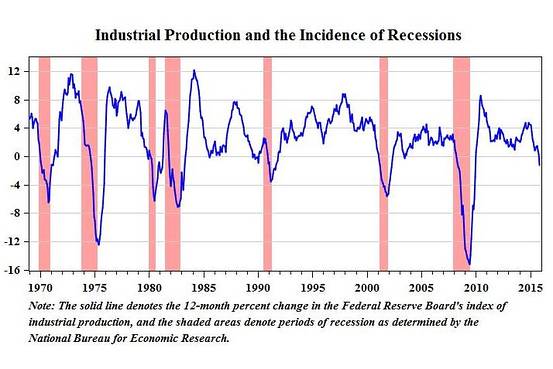
The same day it announced its monetary policy decision, the Federal Reserve released its latest measure of industrial production. As the chart below shows, the industrial sector contracted 1.2% in November from a year earlier. That contraction was initially played down as largely reflecting the effects of warm weather on utility production. But subsequent data point to a broader and more persistent contraction. In the manufacturing survey published Monday by the Institute of Supply Managers, the index of business conditions declined further in December; this index stands at its lowest level since 2009.
Turning to domestic spending, the term “solid” implies substantial strength and resilience. Yet recent indicators paint a gloomier picture. Shipments of core capital goods (that is, nondefense items excluding aircraft) contracted at an annual rate of nearly 2% over the three months ending in November. Private non-residential construction contracted about 4%. Meanwhile, growth in real personal consumption expenditures dropped from 4% last spring to 3% over the summer and slowed further, to around 2%, over the three months ending in November. In light of those readings, the Atlanta Fed’s current “now-cast” analysis indicates that real GDP barely increased during the fourth quarter of 2015.

These data reinforce the view that the U.S. economy may be operating at stall speed. Consequently, the possibility of falling into recession poses a much more significant risk than the prospect of economic overheating. As the first chart shows, every episode of contracting industrial output since 1970 has been associated with the onset of a recession. These downside risks make a compelling case for Fed officials to refrain from further monetary tightening and, instead, refocus on contingency planning for scenarios in which such risks materialize.

Read more …

A strange confession.

• “We Frontloaded A Tremendous Market Rally” Former Fed President Admits (ZH)

In perhaps the most shocking of mea culpas seen in modern financial history, former Dallas Fed head Richard Fisher unleashed some seriously uncomfortable truthiness during a 5-minute confessional interview on CNBC. While talking heads attempt to blame China for recent US market volatility, Fisher explains “It is not China,” it is The Fed that is at fault: “What The Fed did, and I was part of it, was front-loaded an enormous rally market rally in order to create a wealth effect… and an uncomfortable digestive period is likely now.” Simply put he concludes, there can’t be much more accomodation, “The Fed is a giant weapon that has no ammunition left.”

Must watch!!! A shocked Simon Hobbs (at 5:10) is a must-see… “Will The Fed come on and say ‘we’re sorry, we over-inflated the market’ when it crashes?” Fisher appears to be undertaking a major “cover-your-ass” episosde, proclaiming that he was against QE3 which is what has forced “valuations to be very richly priced.” “In my tenure at The Fed, every market participant was demanding we do more… “It was The Fed, The Fed, The Fed… in my opinion they got lazy.. and it is time to go back to fundamental analysis… and not just expect the tide to lift all boats… and as [The Fed] tide recedes we are going to see who is wearing a bathing suit and who is not”

Read more …

European markets now falling 3rd day in a row.

• “It’s A Really Messy Start To The Year” For Markets (BBG)

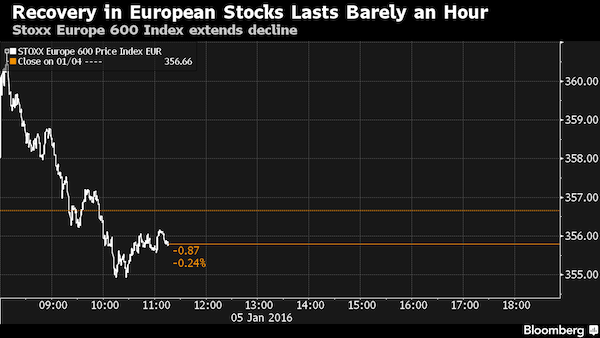
Stocks declined around the world for a second day and the yen advanced after China’s efforts to prop up its stock market failed to quell investor misgivings over the strength of the global economy. Investor optimism in Europe proved short-lived as shares in the region erased an advance of more than 1%, while U.S. equity-index futures pointed to further declines after the Standard & Poor’s 500 Index posted its sixth-worst start to a year in data compiled by Bloomberg going back to 1927. The yen strengthened against all its major counterparts on demand for the safest assets and gold gained a second day. Industrial metals advanced after China’s authorities succeeded in stabilizing that nation’s equities.

“It’s a really messy start to the year – everyone is really on edge,” said William Hobbs at Barclays’ wealth-management unit in London. “Not much is expected of the world in terms of growth, risk appetite is biased to the downside and weak data from China to the U.S. hasn’t helped at all. Plenty of people out there believe that the next global recession is imminent.” The declines come even after China moved to support its stock market with state-controlled funds buying equities and regulators signaling a selling ban on major investors will remain beyond this week’s expiration date, according to people familiar with the matter. A 7% slump in mainland China shares on Monday triggered a trading halt, and the rout spread throughout Asia, Europe and the U.S. as a report showing the fastest contraction in U.S. manufacturing in six years.
Read more …

In more ways than one: “The Saudis are preparing for Iran’s return..”

• Saudis Slash European Oil Prices as Middle East Tensions Grow (WSJ)

Saudi Arabia on Tuesday sharply cut the prices it charges for crude oil in Europe, a move that could undercut Iran as sectarian tensions escalate between the rival Middle Eastern nations. The Saudi move appears to pave the way for a competition over European oil markets later this year when Iran is expected to increase its exports after the expected end of western sanctions over its nuclear program. Italy and Spain relied on Iran for 13% and 16% of their oil imports before the European Union banned such purchases under sanctions related to its nuclear program in 2012. Although the country was replaced in the market by Saudi Arabia and other countries such as Russia, Tehran is counting on rekindling those ties when it resumes exports.

The price cut comes after a diplomatic chasm opened this week between Saudi Arabia and Iran, and by extension, the Sunni and Shiite Muslim worlds. Riyadh and a number of Sunni Muslim capitals have severed or downgraded diplomatic ties with Iran after the Saudi embassy was set on fire in Tehran following the execution in Saudi Arabia of Shiite cleric Nemer al-Nemer. Iran and Saudi Arabia are at odds elsewhere in the Middle East. In Yemen, Iran has supported militants fighting a Saudi-backed regime. In Syria, Saudi Arabia is supporting rebel groups trying to topple Iranian-backed President Bashar al-Assad. Saudi Aramco, the kingdom’s state-owned oil company, didn’t mention the conflict in its news release about the price cuts.

Aramco prices are set every month at a discount or premium to various regional benchmark prices, which go up and down based on supply, demand and other factors considered by the market. On Tuesday, Aramco said it was deepening the discount for its light crude by $0.60 a barrel to Northwest Europe and by $0.20 a barrel in the Mediterranean for February delivery. Iranian oil professionals interpreted the move as a way to compete with Iran returning to the oil markets. The European Union is set to lift an embargo on Tehran as soon as next month. “The Saudis are preparing for Iran’s return,” said Mohamed Sadegh Memarian, who recently retired as the head of petroleum market analysis at Iran’s oil ministry..

Read more …

Slash Europe prices, cut perks at home. Doesn’t even look like a short-term strategy.

• Saudi Arabia Hikes Domestic Gas Prices By 50% Amid Budget Cuts (CNN)

While the world’s attention is focused on Saudi Arabia’s latest flare up with Iran, many Saudis are concerned about the “economic bomb” at home. The government is slashing a plethora of perks for its citizens. The cash crunch is so dire that the Saudi government just hiked the price of gasoline by 50%. Saudis lined up at gas stations Monday to fill up before the higher prices kicked in. “They have announced cutbacks in subsidies that will hurt every single Saudi in their pocketbook,” says Robert Jordan, a former U.S. ambassador to Saudi Arabia and author of “Desert Diplomat: Inside Saudi Arabia Following 9/11.” Gas used to cost a mere 16 cents a liter in Saudi Arabia, one of the cheapest prices in the world. Many Saudis drive large SUVs and “have no concept of saving gas,” says Jordan.

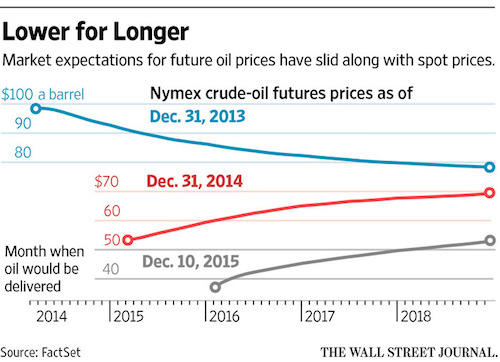
The gas hike is just the beginning. Water and electricity prices are also going up, and the government is scaling back spending on roads, buildings and other infrastructure. Those cuts might sound normal for any government that is running low on cash. But it’s especially problematic in Saudi Arabia because the vast majority of Saudis work in the public sector. About 75% of the Saudi government’s budget comes from oil. The price of oil has crashed from over $100 a barrel in 2014 to around $36 currently. Most experts don’t expect a rebound anytime soon. The Saudi government used its vast oil wealth to provide generous benefits to its citizens. When the Arab Spring rocked the Middle East in 2011, the Saudi king spent even more in an effort to subdue any discontent in the country.

Here are some of the perks Saudis receive:
-Heavily subsidized gas (It used to be 16 cents a liter. Now it’s gone up to 24 cents.)
-Free health care
-Free schooling
-Subsidized water and electricity
-No income tax
-Public pensions
-Nearly 90% of Saudis are employed by the government
-Often higher pay for government jobs than private sector ones
-Unemployment benefits (started in 2011 in reaction to the Arab Spring)
-A “development fund” that provides interest-free loans to help families buy homes and start businesses.

Now Saudi Arabia can’t pay for all those benefits. It ran a deficit of nearly $100 billion last year and expects something similar this year, if not worse. The IMF recently predicted that Saudi Arabia could run out of cash in five years or less if oil stays below $50 a barrel. “The Saudis have used their economic power to buy off their population,” says Jordan, who is currently serving as diplomat in residence at Southern Methodist University. He predicts Saudi Arabia may even have to start collecting an income tax or sales tax. “Part of the leverage the regime has had on their people is that they don’t impose taxes and therefore people don’t expect representation,” Jordan says. “But once they pay taxes, you’re likely to see an increase in political unrest.”

Read more …

Money flowing out.

• Spread Between Onshore, Offshore Yuan Widest Since September 2011 (Reuters)

The spread between onshore and offshore yuan hit its widest level in more than four years on Tuesday after the central bank was suspected to have intervened in the onshore market to support the currency. The People’s Bank of China set the midpoint rate at 6.5169 per dollar prior to the market open, weaker than the previous fix of 6.5032 and the weakest level since April 2011. In the onshore spot market, the yuan strengthened immediately after the opening. The spot rate is allowed to trade with a range 2% above or below the official fixing on any given day. “It’s quite obvious that the central bank has intervened in the market via big Chinese banks in the morning and trading was very active,” said a trader at a Chinese bank in Shanghai. Despite the interventions, the trader said his strategy was to continue shorting the yuan given China’s weak economic fundamentals.

The trader expected the Chinese currency to fall to 6.6 per dollar by the end of the year. China struggled to shore up shaky sentiment on Tuesday a day after its stock indexes and yuan currency tumbled, rattling markets worldwide, but analysts warned investors to buckle up for more wild price swings in the months ahead. “State-owned banks were offering dollar liquidity around 6.52 per dollar,” said a Shanghai trader at a major European bank. “They were apparently trading on behalf of the PBOC to help control the pace of yuan depreciation.” In the offshore market, where the central bank usually takes a hands-off attitude, the yuan hit 6.6488 in late afternoon trade, the lowest in more than four years. It was 2% weaker than the onshore yuan midpoint. The spread between onshore and offshore yuan widened to more than 1,200 pips, the highest level since September 2011.

Read more …

“China is going to have to dramatically devalue its currency..” Dramatically. 25% just for starters.

• Dow Futures Off 170 Points, Yuan Falls To 5-Year Low, PBOC Loses Control (ZH)

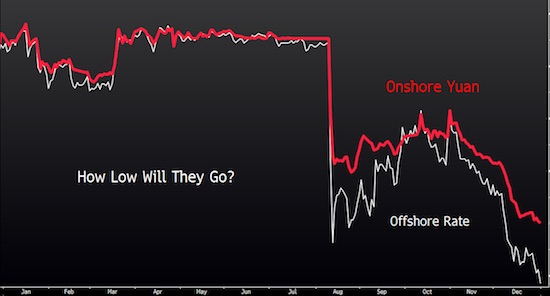
Dow futures are down over 170 points from the cash close, testing the lows of the day following carnage in the Chinese currency markets. Despite the biggest drop in onshore Yuan since August devaluation, Offshore Yuan has collapsed to its lowest since September 2010. What is more worrisome (or positive for Kyle Bass) is that the spread between onshore and offshore Yuan has blown out to 1250 pips – a record – indicating dramatic outflows and/or expectations of further devaluation to come.

Yuan is in free-fall… Offshore Yuan is down over 400 pips from intraday highs, testing 6.6800


CNH-CNY spread is now over 1320 pips – as it appears The PBOC is losing control.

And although Chinese stocks are "stable" thanks to some National Team play…


US equity futures are tumbling off the bounce close, trading back near the day's lows…


It appears Kyle Bass was right:

Given our views on credit contraction in Asia, and in China in particular, let's say they are going to go through a banking loss cycle like we went through during the Great Financial Crisis, there's one thing that is going to happen: China is going to have to dramatically devalue its currency."

And it is – sanctioned by The IMF…


Charts: Bloomberg

Read more …

Chinese can’t short the markets. We can.

• China’s Terrible Start to 2016 Has Beijing Fighting Market Fires (BBG)

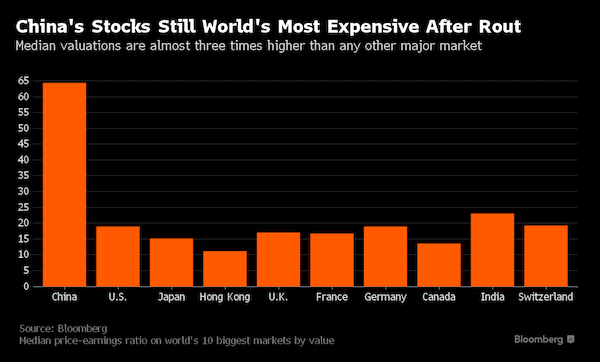
China has started 2016 in fire-fighting mode. After three months of relative calm in the nation’s $6.5 trillion stock market, a 7% rout to open the new year prompted government funds to prop up share prices on Tuesday, according to people familiar with the matter. The central bank injected the most cash since September into the financial system to keep a lid on borrowing costs, while the monetary authority was also said to intervene in the currency market to prevent excessive volatility. With Chinese shares and the yuan posting their worst starts to a year in at least two decades, the ruling Communist Party is being forced to scale back efforts to let markets have more sway in the world’s second-largest economy.

Private data this week showed the nation’s manufacturing sector ended last year with a 10th straight month of contraction, amplifying concern that the weakest economic growth in 25 years will fuel capital outflows. “There’s no doubt China wants to liberalize markets, but it’s happening at such a time that it’s very difficult to do in an orderly manner,” said Ken Peng at Citigroup in Hong Kong. While Chinese policy makers have said freer markets are integral to their plans to make the country’s economic expansion more sustainable, authorities are also concerned that sinking asset prices will weigh on business and consumer confidence. Capital outflows from China swelled to an estimated $367 billion in the three months ended November, according to data compiled by Bloomberg.

The stock market’s selloff on Monday was triggered by this week’s disappointing manufacturing data, along with investor worries that an expiring ban on stake sales by major shareholders would unleash a flood of sell orders at the end of this week. Those concerns eased on Tuesday as people familiar with the matter said regulators plan to keep the restrictions in place beyond Jan. 8. To support share prices, government funds targeted companies in the finance and steel sectors, among others, said the people, who asked not to be identified because the buying wasn’t publicly disclosed. The plunge on Monday triggered the nation’s circuit breakers on their first day, dealing a blow to regulatory efforts to restore calm to a market where individuals drive more than 80% of trading.
Read more …

They don’t understand. They can’t afford to buy enough copper to stabilize prices.

• China’s Strategic Reserve Board Is Buying Up More Copper

China’s State Reserve Bureau is seeking as much as 150,000 metric tons of domestically produced refined copper for its stockpiles amid a collapse in prices to six-year lows, according to people with knowledge of the situation. The state agency issued the tender, which closes Jan. 10, to multiple sellers including smelters at a meeting in Beijing on Tuesday, the people said, asking not to be identified because the information is private. The tender was reported late Tuesday by FastMarkets.com. Smelters in China, the world’s largest producer and consumer of metals, are contending with a collapse in prices as the nation’s growth slows to its weakest in a quarter century.

The SRB’s move to soak up excess supply follows industry pledges in December to cut output and sales, and lobbying of the government to step in to support the market. China’s refined copper surplus was forecast to narrow last year to 1.14 million tons as imports fell, according to state-run researcher Beijing Antaike Information Development Co. in October. At the same time, Antaike projected that domestic production would grow 7.7% to 7.42 million tons.

Read more …

Curious idea.

• Foreign Banks In China Could Face Curbs If They Snub Gold Benchmark (Reuters)

China has warned foreign banks it could curb their operations in the world’s biggest bullion market if they refuse to participate in the planned launch of a yuan-denominated benchmark price for the metal, sources said. The world’s top producer and consumer of gold has been pushing to be a price-setter for bullion as part of a broader drive to boost its influence on global markets. Derived from a contract to be traded on the state-run Shanghai Gold Exchange, the Chinese benchmark is set to launch in April, potentially denting the relevance of the current global standard, the U.S. dollar-denominated London price. China needs the support of foreign banks, especially those who import gold into the mainland, but they could be wary given the global scrutiny on benchmarks following the manipulation of Libor rates in the foreign exchange market.

Banks with import licenses will face “some action” if they do not participate in the benchmark, said a source who did not want to be named as he was not authorized to speak to media. “Maybe China won’t cancel the license but we won’t give them the import quota or will reduce the amount under the quota,” the source said. Banks with licenses must apply to regulators for annual import quotas. Banks had been told China would take “some measures” if they did not participate in the fix, a banking source said. “They passed on the impression that ‘maybe your quota will be limited or you cannot be a market maker for swaps or forwards’,” he said.

Read more …

It’s a death trap, it’s a suicide rap, we gotta get out while we’re young…

• UK Consumer Lending Growing At Fastest Rate In A Decade (Ind.)

Near-zero inflation and Black Friday discounts helped trigger the biggest pre-Christmas spending spree for nearly a decade in November, Bank of England figures showed yesterday. The Bank’s data showed consumer lending through personal loans and credit card debts up 8.3% year on year over the month – the fastest pace of growth since February 2006, back in the pre-credit crunch era. But along with another big surge in mortgage lending in November and more evidence of waning momentum among manufacturing companies, the figures fuelled concerns over the unbalanced nature of the UK recovery. In cash terms, £1.48bn in consumer credit was advanced, the most for a single month since February 2008. The data included both the Black Friday and Cyber Monday events, which ushered in a six-week price-cutting drive among retailers.

Shoppers are benefiting from cheap food and petrol, with the cost of living at just 0.1%. But recent real-terms pay increases have been largely fuelled by tumbling inflation rather than improved productivity, while the Bank has also voiced fears over the vulnerability of indebted households to an interest rate rise. The IMF has also highlighted the risk of deeply indebted people succumbing to “income and interest rate shocks”, with household debt still standing at around 144% of incomes. The pick-up in unsecured loans follows recent data from the Office for National Statistics showing that the household savings ratio dipped to 4.4% in the third quarter of 2015, equalling the lowest rate since 1963. “Consumers are borrowing more and saving less to finance their spending, which is likely a consequence of relatively high consumer confidence and extended low interest rates,” Howard Archer of IHS Global Insight said. Consumer credit lending has now topped £1bn for nine months in a row.

Read more …

Sounds noble…

• Sanders Vows To Break Up Banks During First Year In Office (AP)

Characterizing Wall Street as an industry run on “greed, fraud, dishonesty and arrogance,” Democratic presidential candidate Bernie Sanders pledged to break up the country’s biggest financial firms within a year and limit banking fees placed on consumers, should he become president, in a fiery speech on Tuesday. He coupled that promise, delivered in front of a raucous crowd just a few subway stops from Wall Street, with a series of attacks on rival Hillary Clinton, arguing her personal and political ties make her unable to truly take on the financial industry. “To those on Wall Street who may be listening today, let me be very clear: Greed is not good,” said Sanders, in a reference to Oliver Stone’s 1980s film, “Wall Street.” “If Wall Street does not end its greed, we will end it for them,” he said, as a cheering audience jumped to its feet.

Sanders has made regulating Wall Street a focus of his primary bid, with calls to curb the political influence of “millionaires and billionaires” at the core of his message. But the attacks on Clinton marked an escalation in his offensive against the Democratic front-runner. Clinton’s policies, he said, would do little more than “impose a few more fees and regulations.” “My opponent says that, as a senator, she told bankers to ‘cut it out’ and end their destructive behavior,” he said, to laughter. “But, in my view, establishment politicians are the ones who need to cut it out,” he said. Clinton responded at a campaign event in Sioux City, Iowa, on Tuesday evening, saying her policies would take on a wide range of financial actors, including insurance companies and investment houses that helped spark the 2008 recession. “I have a broader, more comprehensive set of policies about everything including taking on Wall Street,” she said. “I want to go after everybody who poses a risk to our financial system.”

[..] Sanders vowed to create a “too-big-to-fail” list of companies within the first 100 days of his administration whose failure would pose a grave risk to the U.S. economy without a taxpayer bailout. Those firms would be forced to reorganize within a year. Sanders also said he wants to cap ATM fees at two dollars and cap interest rates on credit cards and consumer loans at 15%. He also promised to take a tougher tact against industry abuses, noting that major financial institutions have been fined only $204 billion since 2009. And he promised to restructure credit rating agencies and the Federal Reserve, so bankers cannot serve on the body’s board. “The reality is that fraud is the business model on Wall Street,” he said. “It is not the exception to the rule. It is the rule.”

Read more …

…but does Bernie really get it?

• Note To Sanders: Forget The Octopus Arms…Go For The Head (Rossini)

Bernie Sanders is attacking Wall Street. He’s campaigning to break up the “too big to fail” banks. It’s easy to see why such an idea would get some fanfare. After all, there are many Americans that remember the great $700 billion heist during the George W. Bush administration…the one that bailed out the most-favored banking cronies. Sanders says: “We need a movement which tells Wall Street that when a bank is too big to fail, it is too big to exist.” Again, superficially, it makes sense as to why people would hitch their wagons onto such an idea. Sadly though, Sanders is taking a swing that can only end up as a major whiff. The American banking system is like an octopus. The head of the octopus is the central bank, known as The Federal Reserve. That is where the source of our problems originate.

It all starts and ends with The Fed. The banks are nothing but appendages. They’re like the Fed’s octopus arms. Sanders wants to attack the arms. That’s a poor strategy, and the results would be fruitless. The size of a bank doesn’t matter. In fact, how does Sanders know what the “right” size would be? At what point is a bank no longer “too big”? How can he know such a thing? The truth is, he can’t, and like most government decisions, such a move would be totally arbitrary. Even if Sanders were to succeed in breaking up the big banks, were the Federal Reserve to still exist, those new banks would retain their “lender of last resort”. The banks would still operate in an environment drowning in moral hazard. They would still have a call option on our purchasing power and would continue to loot us via inflation.

They would still be The Fed’s instruments in creating the illusionary booms that are followed by the bone-crushing busts. That’s why they call it The Federal Reserve “System”. It’s a “system” of enriching the few at the expense of the many. Sanders isn’t going to touch the “system”. In fact, with all the free stuff and new “rights” that he’s concocted, Bernie’s going to need The Federal Reserve around to finance them. Bottom line? Tangling with the Fed’s octopus arms would accomplish virtually nothing. The only change that must occur is to End The Fed. The Eccles Building needs to be turned into a museum where future generations can walk through and learn about one of the biggest mistakes that was ever made in America. Will Sanders call for an end to The Fed? Don’t count on it.

Read more …

Goldman estimates they’ll end up paying just half a billion?!

• Volkswagen Struggling To Agree On Fix For US Test Cheating Cars (Reuters)

Volkswagen is struggling to agree with U.S. authorities a fix for vehicles capable of cheating emissions tests, a VW source said on Tuesday, showing how relations between the two sides remain strained four months after the cheating came to light. The source said the German carmaker would hold further talks with the Californian Air Resources Board this week and with the U.S. Environmental Protection Authority (EPA) next week, and still hoped to reach a solution by a mid-January deadline. But finding a fix was proving more difficult than expected, in part because this involved producing new components which then required testing, said the person, who declined to be named as the talks are confidential.

The difficulties highlight the lack of progress VW has made in winning back the confidence of U.S. regulators and drivers almost four months after it admitted to cheating diesel emissions tests and promised to turn over a new leaf. On Monday, the U.S. Justice Department said it was suing Europe’s biggest carmaker for up to $90 billion for allegedly violating environmental law – five times the initial estimate of regulators. The move threw VW’s U.S. problems back into focus after it seemed to be recovering ground in Europe, sending its shares down more than 8% to a six-week low on Tuesday. “The announcement serves as a reminder/reality check of VW’s still unresolved emissions issues,” Goldman Sachs analysts said of the lawsuit.

VW Chief Executive Matthias Mueller is expected to meet EPA representatives and politicians in Washington next week after visiting the Detroit Auto Show, the VW source said, on what will be Mueller’s first trip to the United States since the scandal broke in September. VW declined to comment on the progress of talks with the EPA, on whose behalf the U.S. Justice Department filed the lawsuit, or on Mueller’s plans. The lawsuit claim of up to $90 billion is based on fines of as much as $37,500 per vehicle for each of four violations of the law, with illegal devices installed in nearly 600,000 vehicles in the United States, according to the complaint. U.S. lawsuits are typically settled at a fraction of the theoretical maximum. Goldman has estimated the likely costs at $534 million.

Read more …

“VW cannot afford to lose more time in the United States. It needs to ditch the ill-fated plan to repair the 580,000 U.S. vehicles. A swift buyback of all these would be far more effective, as it would end the extra air pollution at once.”

• Volkswagen’s American Nightmare (BV)

The United States is reversing Volkswagen’s recent progress in tackling its emissions scandal. The U.S. Department of Justice on Jan. 4 issued a strongly worded lawsuit against the German carmaker, upending a six-week rally in VW shares. Wolfsburg needs something big to stop American lawmakers wielding a scarily large stick. Last year ended on a relatively positive note for the battered company. German regulators rubberstamped an inexpensive and simple fix for the majority of the 11 million vehicles sold in the European Union. Suspected manipulation of fuel efficiency data uncovered by VW’s internal investigation turned out to be much less widespread and severe than initially feared.

Yet both precedent and the lawsuit’s content suggest the United States will be tougher. The Department of Justice accuses Volkswagen of four different violations of the Clean Air Act. Most strikingly, VW’s theoretical maximum fine if found guilty has more than quadrupled to $90 billion – almost 125% of its market capitalisation. Moreover, Volkswagen has done little to win the goodwill of U.S. authorities. It admitted wrongdoing in September 2015 only after months of stonewalling. The company still lacks a technical fix to lower toxic emissions of its affected U.S. diesels to pass the country’s more demanding emission regimes and effectively reduce exhaust fumes. And the complaint filed on Jan. 4 also accuses VW of continuing to impede and obstruct its investigations “by material omissions and misleading information” after the September confession.

VW cannot afford to lose more time in the United States. It needs to ditch the ill-fated plan to repair the 580,000 U.S. vehicles. A swift buyback of all these would be far more effective, as it would end the extra air pollution at once. These benefits would by far outweigh the initial costs Evercore ISI analysts see at €5.8 billion. More sweeping changes in Volkswagen’s governance are also important. Chairman Hans Dieter Poetsch should go. The former finance director was one of Volkswagen’s most senior managers during the emissions cheating era. A credible outsider, who is unburdened by the past and embodies a new culture, could then set about trying to limit the fallout across the Atlantic.

Read more …

Do read.

• My Financial Road Map For 2016 (Nomi Prins)

As a writer and journalist covering the ebbs and flows of government, elite individual, central bank and private industry power, actions, co-dependencies, and impacts on populations and markets worldwide, I often find myself reacting too quickly to information. As I embark upon extensive research for my new book, Artisans of Money, my resolution for the book – and the year – is to more carefully consider small details in the context of the broader perspective. My travels will take me to Brazil, Mexico, China, Japan, Germany, Spain, Greece and more. My intent is to converse with people in their respective locales; those formulating (or trying to formulate) monetary, economic and financial policy, and those affected by it.

We are currently in a transitional phase of geo-political-monetary power struggles, capital flow decisions, and fundamental economic choices. This remains a period of artisanal (central bank fabricated) money, high volatility, low growth, excessive wealth inequality, extreme speculation, and policies that preserve the appearance of big bank liquidity and concentration at the expense of long-term stability. The potential for chaotic fluctuations in any element of the capital markets is greater than ever. The butterfly effect – the flutter of a wing in one part of the planet altering the course of seemingly unrelated events in another part – is on center stage. There is much information to process. So, I’d like to share with you – not my financial predictions for 2016 exactly – – but some of the items that I will be examining from a geographical, political and financial perspective as the year unfolds.

Read more …

Wow! Beating ‘wetness’ records in Britain is quite the achievement. Britons might as well start walking around in wetsuits all day now.

• December 2015 Was Wettest Month Ever Recorded In UK (Guardian)

December was the wettest month ever recorded in the UK, with almost double the rain falling than average, according to data released by the Met Office on Tuesday. Last month saw widespread flooding which continued into the new year, with 21 flood alerts in England and Wales and four in Scotland in force on Tuesday morning. The record for the warmest December in the UK was also smashed last month, with an average temperature of 7.9C, 4.1C higher than the long-term average. Climate change has fundamentally changed the UK weather, said Prof Myles Allen, at the University of Oxford: “Normal weather, unchanged over generations, is a thing of the past. You are not meant to beat records by those margins and if you do so, just like in athletics, it is a sign something has changed.”

The Met Office records stretch back to 1910 and, while December saw a record downpour particularly affecting the north of England, Scotland and Wales, 2015 overall was only the sixth wettest year on record. The high temperatures in December would normally be expected in April or May and there was an almost complete lack of air frost across much of England. The average from 1981-2010 was for 11 days of air frost in December, but last month there were just three days. Across 2015, the average UK temperature was lower than in 2014, though globally 2015 was the hottest year on record. Allen said it has been predicted as far back as 1990 that global warming would mean warmer, wetter winters for the UK, with more intense rainstorms.

Read more …

What happens when the -overly- well funded EU, UNHCR and Red Cross don’t do what they’re supposed to.

• Refugees In Lesbos: Are There Too Many NGOs On The Island? (Guardian)

Moria refugee camp, on the Greek island of Lesbos, is full of volunteers who have come from all over the world to help displaced people. Burly Dutch men carry huge water tanks, Cypriot doctors erect a new medical tent at the foot of Afghan Hill and major organisations such as Médecins Sans Frontières and Action Aid make their presence felt. But locals are anxious – they’re worried this huge influx of international volunteers is creating more chaos on their small island rather than a coordinated response, resulting in refugees being given bad information and the Greek community’s needs going ignored. At last count there were 81 NGOs operating on the island, and local media say that just 30 have registered with the local authorities.

The island has a population of about 90,000, yet saw almost 450,000 refugees pass through during 2015. The mayor of Lesbos, Spyros Galinos, says he is heartened by the outpouring of generosity but the presence of NGOs and volunteers doesn’t always have a positive effect. “I am grateful to the ones that immediately responded to our first call for help addressed to the international community to help us cope with refugee crisis,” Galinos has said. “However, more recently I have seen many NGOs and individuals coming without official registration and showing no cooperation with our municipality. This causes everyone upset and these NGOs arouse doubt and mistrust among the residents of Lesbos. I would say their presence is disruptive rather than useful.”

One local fixer says that it’s “like a party for the NGOs”: some are working closely with the municipality, but many others “have no idea and are just doing their own thing”. Hotel owner Aphroditi Vati is one resident who has witnessed first-hand the recent spike in volunteers on the ground. Refugee boats have been landing on the beach right outside her hotel in Molyvos, in the north of the island, since April, and she says it was only in mid-September that more people who wanted to help started arriving. There were often seven boats arriving each day and while the hotel was in desperate need of the assistance, she says the NGOs brought their own problems, too.

“We had all these other people speeding onto the property, not respecting where they were, not respecting that they were in a business location, parking their cars wherever they wanted – reporters and photographers, yes, but mainly a lot of volunteers and NGOs,” she says. Vati says that the newcomers would rush into the water and try to pull refugees off the boats in a way that frightened the already distressed travellers. “You would have all this commotion that was not necessary, and we had people giving out wrong information, saying there were no buses when there were and telling refugees to walk [to the registration point],” she says.

Read more …

Europe’s politicians do not care.

• Refugees: EU Resettles Just 0.17% Of Pledged Target In Four Months (Guardian)

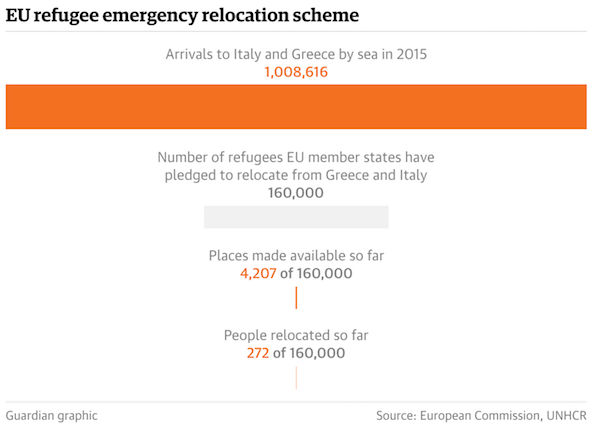
European countries have resettled just 0.17% of the asylum seekers they promised to welcome four months ago, it has emerged, in a revelation that campaigners say is the latest failure of Europe’s confused response to the continent’s refugee crisis. EU officials announced this week that just 272 Syrians and Eritreans have been formally transferred (pdf) from the countries on the frontline of the migration crisis, Greece and Italy, to countries elsewhere in the continent. It constitutes 0.17% of the 160,000 refugees that EU members pledged to share at a summit in September, and 0.03% of the 1,008,616 asylum seekers who arrived by sea in 2015. Europe’s slow response stands in sharp contrast to the accelerating nature of the crisis, with the daily arrival rate to Greece now 11 times higher than it was in January 2015.

On Tuesday, at least 34 people died in the Aegean sea between Greece and Turkey in the first such shipwrecks of 2016. Many of those who do reach Greece are nominally supposed to be shared between other countries in the EU, under the terms of the September agreement. But according to figures released this week, 19 EU countries have not relieved Greece and Italy of any asylum seekers, while those that have are largely the countries that are already bearing a significant share of the continent’s refugee burden, such as Sweden and Germany. European countries have also failed to provide the full quota of border guards they pledged to send to Greece and Italy in September – with just 447 guards provided out of a promised 775. Hungary, one of the loudest proponents of a more heavily fortified European border, has seconded just four guards to border duty in Greece and Italy.
Read more …

I have no more tears. How about you, Barack?

• Turkish Authorities Find Bodies Of 34 Refugees, Search For Survivors (Reuters)

Turkish authorities said they found the bodies of 34 migrants, at least three of them children, at two locations on the Aegean coast on Tuesday after they apparently tried to cross to the Greek island of Lesvos. The flow of mostly Syrian refugees and migrants braving the seas to seek sanctuary in Europe dipped towards the end of last year with the colder weather, but the total still reached 1 million last year, nearly five times more than in 2014. The migrants died after their boat or boats apparently capsized in rough seas. It was not known how many vessels were involved or how many people were on board. Twenty-four of the bodies were discovered on the shoreline in the district of Ayvalik, the Turkish coast guard command told Reuters. Ten others were found in the district of Dikili, a gendarmerie official in the local headquarters said.

Reuters TV footage showed a body in an orange life jacket lying at the grey water’s edge in Ayvalik, lapped by waves. The nationalities of those drowned were not immediately clear. “We heard a boat sank and hit the rocks. I surmise these people died when they were trying to swim from the rocks. We came here to help as citizens,” an unnamed eyewitness said. Increased policing on Turkey’s shores and colder weather conditions have not deterred refugees and migrants from the Middle East, Asia and Africa from embarking on the perilous journey in small, flimsy boats. “Migrants and refugees continue to enter Greece at a rate of over 2,500 a day from Turkey, which is very close to the average through December,” International Organization for Migration (IOM) spokesman Joel Millman told reporters in Geneva. “So we see the migrant flows are continuing through the winter and obviously the fatalities are continuing as well.”

IOM said 3,771 migrants died trying to cross the Mediterranean to reach Europe last year, compared with 3,279 recorded deaths in 2014. The coast guard and gendarmerie rescued 12 people from the sea and the rocks on the Ayvalik coastline. A coast guard official said three boats and a helicopter were searching for any survivors. In a deal struck at the end of November, Turkey promised to help stem the flow of migrants to Europe in return for cash, visas and renewed talks on joining the EU. Turkey is host to 2.2 million Syrians and has spent around $8.5 billion on feeding and housing them since the start of the civil war nearly five years ago. But it has faced criticism for lacking a longer term integration strategy to give Syrians a future there. Almost all of the refugees have no legal work status and the majority of children do not go to school.

Read more …


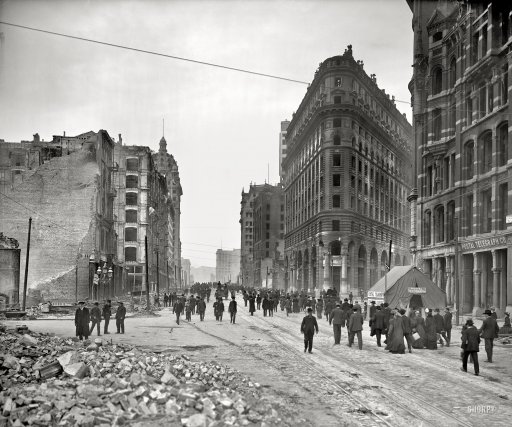
This little girl is one the 34 drowned refugees washed ashore on the Turkish Aegean coast. RIP sweetheart.
Dec 312015
 
 December 31, 2015  Posted by at 9:59 am Finance Tagged with: , , , , , , , , ,  1 Response »


DPC Market Street from Montgomery Street, San Francisco, after the earthquake 1906

• The Deadly Truth About the Great Boom and This “Recovery” (Dent)
• Asia’s Top Commodity Trader Ends a Turbulent Year With Cut To Junk (BBG)
• Mom And Pop Are The Greater Fools (ZH)
• Oil Ends 2015 In Downbeat Mood; Hangover To Be Long, Painful (Reuters)
• Impact Of Low Crude Prices On Oil Powers (Guardian)
• China’s Yuan Posts Biggest Annual Loss In 21 Years (BBG)
• China Fires a Warning Shot at Yuan Speculators With Bank Bans (BBG)
• China’s Financial Growing Pains Caused World of Hurt in 2015 (WSJ)
• Hong Kong Retail Slows as Mainland Tourists Stay Away (WSJ)
• Fannie and Freddie Give Birth to New Mortgage Bond (WSJ)
• The World’s Political And Economic Order Is Stronger Than It Looks (AEP)
• Derivatives vs Bank Deposits: Let the Bail-Ins Begin (Ellen Brown)
• It’s Every Snitch For Himself In Brazil’s Petrobras Scandal (BBG)
• For the Wealthiest, a Private Tax System That Saves Them Billions (NY Times)
• China Says Consulted Widely On Army Reform, Xi Closely Involved (Reuters)
• Turkey ‘One Step Away From A Civil War’ (NY Times)
• Greek Pension Cuts Back On The Table (Kath.)
• Greek House Price Drop Second To Worst In The World (Kath.)
• Merkel Urges Germans To See Refugee Arrivals As ‘An Opportunity’ (AFP)

“My forecast today: the stock market will start to crash by early February, if not sooner..”

• The Deadly Truth About the Great Boom and This “Recovery” (Dent)

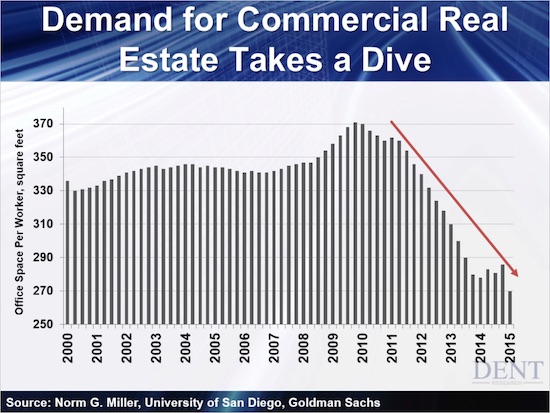
Below is a chart that shows the office space per worker in square feet. It shows a rise into the height of the financial crisis, after which it’s fallen like a rock! At first this could seem counterintuitive. Why did the square footage per worker go up into the worst of the recession into mid- to late-2009? That’s because companies were laying off workers going into that recession, meaning there were more workers per square feet. But the real story comes in the recovery from late 2009 forward.

Square footage per worker has declined very sharply from 371 square feet to 270, down a whopping one-third in just over six years as businesses have rehired a large portion of the laid-off workers – which means largely NOT creating new jobs. You should not look at this chart and assume that because less square footage per worker means more workers than in the past that everything is hunky dory. What’s more important is that the sharp decrease in square footage implies a lack of demand in commercial real estate. And that’s because commercial real estate is already way over-expanded! We overbuilt it in the great boom of 1983 to 2007, so even these hires have not filled up the available space.

Which means businesses aren’t expanding their office or industrial space! So while hiring more workers sounds fine out of context… it’s masking much more severe, deeper-set issues in our capacity to build for the future. This is the hard truth that no one is looking at: businesses are merely re-employing their past capacity, and not creating new plants and offices for future employment. All the 200,000-plus jobs numbers per month, if they are even fully real, are just catching up with the past. And we shouldn’t be investing in such new work space as we already have all we need for decades ahead. This is the reality of demographics that clueless economists just don’t get.

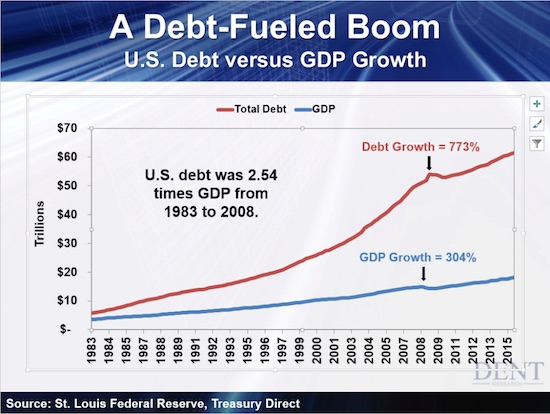
[..] Folks, this “recovery” isn’t working! And no one has expected it to given the over-expansion in the greatest debt bubble in U.S. history from 1983 to 2008. Inflation hasn’t risen due to excess capacity here and around the world, especially China… Money velocity continues to drop without lending and productive investment to expand it… Businesses are struggling with stagnant earnings because we already hit the peak of debt capacity and demographic spending growth in the great boom that finally peaked in late 2007, as I forecast two decades before. Debt was running at 2.54 times GDP for 26 years. It doesn’t take a rocket scientist or nuclear physicist to tell you that pretty much guarantees a massive period of deleveraging and depression – not continued expansion.

So since growth is all but impossible, corporations have resorted to financial engineering to keep the wagon rolling – all courtesy of the Fed, with near-zero short- and long-term interest rates. They’ve had two options: either increase stock buybacks to leverage their stagnant earnings with rising earnings-per-share on fewer shares, or increase dividends to compete with lower and lower yielding bonds (also courtesy of the Fed). And they’ve been milking both options for all they’re worth! But financial engineering does not result in real growth. And speculation does not expand the money supply. It is only a sign of decreasing money velocity, and a bubble that will only burst – like in 1929, 2000, and now again! [..] My forecast today: the stock market will start to crash by early February, if not sooner [..].

Read more …

There will be no recovery in commodities until the overcapacity is drained.

• Asia’s Top Commodity Trader Ends a Turbulent Year With Cut To Junk (BBG)

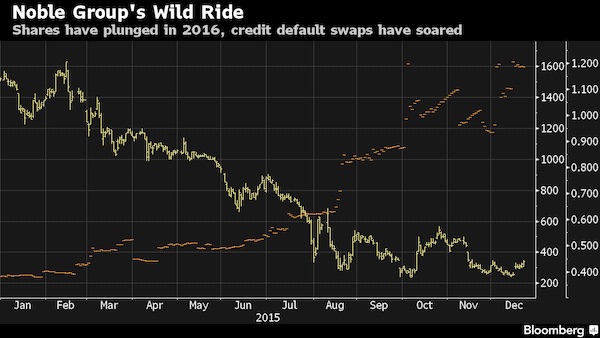
Asia’s top commodity trader exits 2015 in very different shape to how it began the year. Noble Group has lost almost two-thirds of its value, with its stock trading near the lowest since 2008, after a year of attacks on its finances by critics including the anonymous Iceberg Research and short-seller Muddy Waters LLC. The latest blow, amid a rout in raw materials, was the cut in its credit rating to junk by Moody’s Investors Service on concerns over its liquidity. It’s a downgrade that will test Chief Executive Officer Yusuf Alireza’s view that while an investment-grade rating is desirable, it isn’t required for the business, as Standard & Poor’s also reviews its assessment. Moody’s decision comes a week after the Hong Kong-based company agreed to sell the rest of its agriculture unit to Cofco for at least $750 million.

While the deal may help the company to cut debt, its liquidity will remain constrained, according to Moody’s, which expects a prolonged commodity slump. “They have had a really difficult year, not only fighting the commodity slump but also various allegations,” Bernard Aw at IG Asia said by e-mail. “Entering 2016, the performance of Noble will clearly hinge on the recovery in the commodity complex. Noble may continue to offload non-profitable assets, to improve its balance sheet and creditworthiness. These should help it better navigate the challenging landscape.” Noble Group stock fell 9.1% to end at 40 Singapore cents on Wednesday, and traded unchanged early Thursday. The shares are 65% lower this year and are the biggest losers in the Straits Times Index.

The company’s dollar bonds due in 2020, its most liquid, dropped on Wednesday to the lowest since they were issued in 2009. After the Noble Agri deal closes, Noble Group’s rating metrics will substantially exceed those required of an investment-grade credit, the company said in a statement on Tuesday. Noble Group still has its investment-grade ratings from S&P and Fitch Ratings, spokesman Stephen Brown said, referring to comments made on the company’s last earnings call. He added that its bank covenants aren’t ratings-dependent. “We are confident that the deal will be approved by our shareholders and will close before the end of February,” Noble Group said in a statement to the Singapore Exchange late on Wednesday. “The current environment is opportunity-rich and plays to our strengths.”

Read more …

Question is, what keeps markets at their high levels?

• Mom And Pop Are The Greater Fools (ZH)

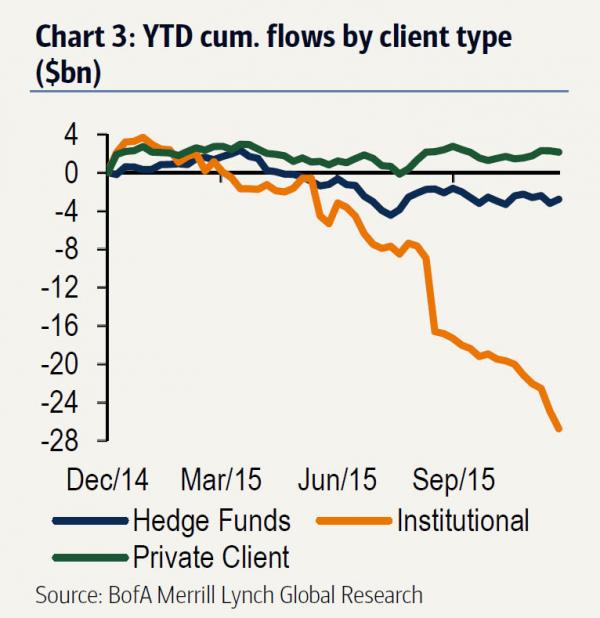
[..] while the market was surging last week, the smart money was selling. This comes at the same time as ICI reported major redemptions from both stock ($3.9 billion) and bond ($4.5 billion) mutual funds, even as corporate buybacks were decelerating, leading to the question of just who was buying stocks during the Santa rally of the past two weeks. But something even more surprising emerged when looking at the detailed breakdown of how the “smart money” has been flowing. As Bank of America clarifies, when explaining where its $0.7 billion in weekly outflows came from, “net sales were chiefly due to institutional clients last week” and adds that institutionals “have sold stocks for eight consecutive weeks”!

And then something even more surprising emerges when looking at the YTD breakdown of flows: while hedge funds and private clients (retail) have largely offset each other over the past year, the former selling $2.8BN and the latter buying $2.2BN in 2015, something odd has taken place at the institutional level: starting in early January, the largest financial institutions – mutual funds and various other asset managers – have unleashed an unprecedented selling spree for 11 consecutive months, which has brought their total outflow to $26.8 billion. Which leads to another question: if institutions are actively dumping stocks, perhaps mom and pop investors should show the following chart to their financial advisors, who directly or indirectly work for these institutions, and ask them: why should they be buying, when the counterparty they are buying from is, most likely, this very same financial advisor?

Read more …

“..global crude production exceeds demand by anywhere between half a million and 2 million barrels every day..”

• Oil Ends 2015 In Downbeat Mood; Hangover To Be Long, Painful (Reuters)

Oil prices remained in a downbeat mood during their final Asian-hours trading session of 2015 after record U.S. crude inventories reinforced concerns about a global supply glut that has pulled down prices by a third over the past year. Crude inventories in the United States rose 2.6 million barrels last week, the U.S. Energy Information Administration said. Analysts polled by Reuters had expected a draw of 2.5 million barrels. Crude prices held losses after falling more than 3% in the previous session, with U.S. West Texas Intermediate (WTI) crude futures trading around $36.70 per barrel at 0300 GMT on Thursday and Brent around $36.60 per barrel. Both benchmarks are down by around a third over 2015.

The immediate outlook for oil prices remains bleak, with some analysts like Goldman Sachs saying prices as low as $20 per barrel might be necessary to push enough production out of business and allow a rebalancing of the market. U.S. bank Morgan Stanley said in its outlook for next year that “headwinds (are) growing for 2016 oil.” The bank cites ongoing increases in available global supplies, despite some cuts by U.S. shale drillers in particular, as well as a slowdown in demand as the main reasons. “The imbalance in the global oil market has been diminishing in 2H15, but the hope for a rebalancing in 2016 continues to suffer serious setbacks,” the bank said, reflecting a market consensus that meaningfully higher prices are not expected before late 2016.

Traders expect some U.S. oil to be taken out of America and supplied into global markets, following the surprise lifting of a decades-old U.S. crude export ban in December, which ended a years-old discount in U.S. crude prices to international Brent. “At a time when U.S. shale is facing headwinds due to the collapse in crude oil prices… U.S. crude oil exports are likely to help reduce congestion concerns in the U.S.,” ING bank said. [..] Analysts estimate global crude production exceeds demand by anywhere between half a million and 2 million barrels every day. This means that even the most aggressive estimates of expected U.S. production cuts of 500,000 bpd for 2016 would be unlikely to fully rebalance the market.

Read more …

A painful graph. We smell unrest.

• Impact Of Low Crude Prices On Oil Powers (Guardian)

A glut of oil, the demise of Opec and weakening global demand combined to make 2015 the year of crashing oil prices. The cost of crude fell to levels not seen for 11 years – and the decline may have further to go. There have been four sharp increases in the price of oil in the past four decades – in 1973, 1979, 1990 and 2008 – and each has led to a global recession. By that measure, a lower oil price should be positive for the world economy, with lower fuel costs for consumers and businesses in those countries that import crude outweighing the losses to producing nations. But the evidence since oil prices started falling from their peak of $115 a barrel in August 2014 has not supported that thesis – or not yet.

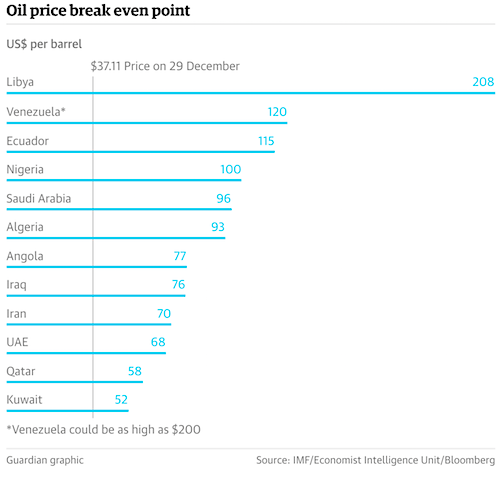
Oil producers have certainly felt the impact of the lower prices on their growth rates, their trade figures and their public finances butthere has been no surge in consumer spending or business investment elsewhere. Economist still reckon there will be a boost from a lower oil price particularly if it looks as if the lower cost of crude will be sustained. Dhaval Joshi, an economist at BCA, a London-based research company, said: “A commodity bubble has deflated three times in the past 100 years: the first was after world war one; the second was after the 1980s oil shock; the third is happening right now.” For the big producer countries, this is a major headache, the ramifications of which are only starting to be felt. Oil powers base their spending plans on an assumed crude price. The graphic below shows just how far below water their budgets are.

Read more …

How long before IMF starts complaining on behalf of US?

• China’s Yuan Posts Biggest Annual Loss In 21 Years (BBG)

There’s no need to panic, according to the yuan’s top forecaster, even as the currency posted the biggest annual loss in more than two decades and a majority of economists predicted a further depreciation in 2016. “While a weaker yuan could create fear initially, the market will realize it’s a natural consequence of a more flexible yuan and divergent U.S.-China monetary policy,” said Ju Wang at HSBC, which had the best estimates for the onshore yuan over the last four quarters as measured by Bloomberg Rankings. A more adjustable policy will allow for swift reactions to domestic conditions, which “would be structurally positive for China’s economy,” she said. The nation overhauled its foreign-exchange system in 2015, giving market forces greater say in setting the yuan’s reference rate, allowing more foreign participants onshore and doubling trading hours.

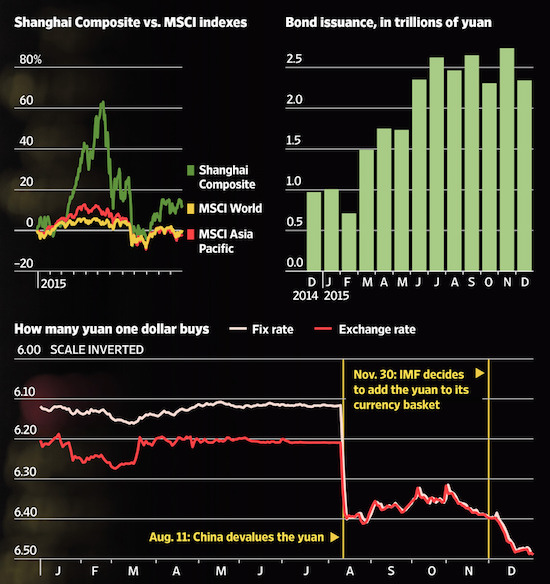
The central bank kept investors guessing as it supported the exchange rate from March to August, shocked global markets with an Aug. 11 devaluation, and then spent billions of dollars to prop up the yuan before winning reserve status at the IMF on Nov. 30. The currency tumbled 4.5% in 2015 to close at 6.4936 a dollar in Shanghai on Dec. 31, according to China Foreign Exchange Trade System prices. That’s the biggest decline in data going back to 1994. The central bank cut its daily fixing, which limits onshore moves to a maximum 2% on either side, by 6.1% for the year. The reduction was the most since 2005, when China unpegged its currency from the greenback and allowed it to fluctuate against a basket of exchange rates.

Read more …

Beijing is feeding speculation with its constant manipulations.

• China Fires a Warning Shot at Yuan Speculators With Bank Bans (BBG)

China has a message for currency speculators: the free lunch is over. The People’s Bank of China has suspended at least two foreign banks from conducting some cross-border yuan business until late March, according to people with direct knowledge of the matter. The clampdown comes as the growing offshore-onshore spread makes it profitable for those who skirt capital controls to buy the currency at a discount in Hong Kong and sell it in Shanghai. By closing loopholes in its regulations, China is trying to stabilize the yuan after a surprising revamp of its currency-valuation system in August led to capital outflows and prompted policy makers to tap $213 billion of foreign reserves to support the yuan. The risk is that discouraging arbitrage will cause the exchange rates to diverge further, undermining the goal of unifying the two markets.

“The market should see this as a warning shot across the bow,” said Douglas Borthwick at Chapdelaine, a unit of the British inter-dealer brokerage Tullet Prebon. Chinese regulators don’t want onshore trades to be speculative in nature and “in the short term this will likely lead to further widening of the spread,” he said. A three-month ban on settling offshore clients’ yuan transactions in the onshore market was imposed Tuesday, the people said. The central bank didn’t immediately respond to questions on the matter, and it was unclear how widely the ban has applied among foreign banks or which institutions are suspended. Spokespeople for Citigroup, HSBC and Standard Chartered, which are among the largest foreign dealers allowed in China’s interbank foreign-exchange markets, declined to comment on the ban and whether their operations were affected.

The offshore yuan, which is freely traded overseas, touched a five-year low on Wednesday before erasing losses on speculation the government was intervening to support the currency. It traded at 6.5810 a dollar as of 12:32 p.m. in Hong Kong, leaving it about 1.3% cheaper than the rate in mainland China. The gap between the two rates has widened since August when China’s devaluation, part of the move to a more market-determined currency regime, fueled expectations among overseas investors for further yuan weakness. The divergence is undesirable because it means companies cannot use hedging tools tied to overseas rates to protect their onshore exposure. By imposing the ban, China is seeking to prevent speculators from bringing money in illegally to arbitrage, even though it helps narrow the difference.

Read more …

It’s all in the choice of words, isn’t it? Growing pains sounds so much better than bursting bubble.

• China’s Financial Growing Pains Caused World of Hurt in 2015 (WSJ)

China’s long history of tempestuous trading spilled over its borders this year, signaling that a once-isolated market is moving to the center of global finance. Chinese volatility upended markets from Tokyo to London, and helped send some emerging-market currencies to their weakest levels in nearly two decades. Commodities including copper and aluminum plumbed six-year lows as China, one of the world’s biggest metals consumers, reined in buying. While a summer stock crash and the surprise devaluation of China’s yuan spooked investors world-wide, the repercussions also exposed the growing pains of a maturing financial market. With one trading day left in 2015, Shanghai’s stock market is still up 10.5% this year, despite losing more than 40% of its value over the summer.

That gain outpaces the 1% rise in the S&P 500 through Tuesday, and the 9.6% advance in Germany’s DAX and 7.35% gain in the Stoxx Europe 600 index through Wednesday. China’s smaller Shenzhen stock market is up 66%, one of the best-performing benchmarks globally. Japan’s Nikkei Stock Average is up 9.1% for the year, as the central bank’s two-year easing campaign weakened the yen. A weaker currency can help exporters by boosting profits repatriated from abroad. Meanwhile, China’s yuan is on track for its largest annual fall on record, down more than 4% so far this year. Goldman Sachs economists say China was “arguably the prime mover in global markets” this year, though foreigners hold less than 2% of the mainland’s $8 trillion stock market and less than 3% of the onshore bond market.

On Aug. 24, dubbed “Black Monday” by Chinese government media, the Shanghai Composite’s 8.5% fall sparked a global selloff that dragged U.S. stocks to an 18-month low. Yet the struggles have been felt most acutely in markets of China’s regional trading partners, where slackening demand from the world’s second-largest economy has put a chill on exports of commodities and gadgets, dimmed the corporate outlook and sent currencies into a tailspin. Investors have pulled money out of Asia’s emerging-market equities every month since July, with the exception of October, according to the Institute of International Finance. Investors put $47 billion into emerging-market Asia stocks and bonds this year through November, compared with $107.9 billion for the whole of 2014.

Read more …

Confidence in China is sagging.

• Hong Kong Retail Slows as Mainland Tourists Stay Away (WSJ)

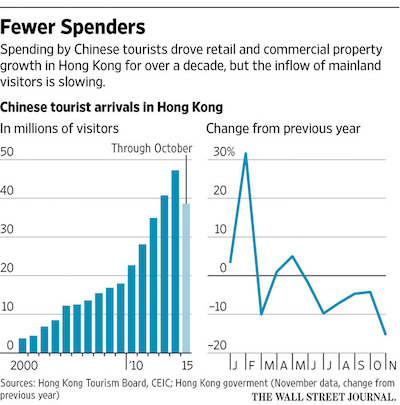
Hong Kong, once a shopping mecca for mainland Chinese seeking Swiss watches and luxury handbags, is expected to record its biggest annual decline in retail sales since the outbreak of severe acute respiratory syndrome, or SARS, in 2003. The city may also post the first annual decline in mainland tourists since visa relaxations allowed individual visitors from China, also in 2003, prompting calls for extensive diversification of tourism—a pillar of the city’s economy. Spending by Chinese tourists has been the main driver of retail and commercial property sectors in Hong Kong in recent years, as the number of mainland tourists rose. During the boom, long lines outside the city’s numerous Louis Vuitton, Chanel and Gucci shops were commonplace, as luxury goods sold in Hong Kong were up to 40% cheaper than in China.

Those lines have largely disappeared as inflows of Chinese tourists slowed. The number of Chinese tourist arrivals was 15.4% lower in November compared with a year ago, the steepest decline all year, extending the year-to-date fall in Chinese visitors. Hong Kong’s tourism commission says the city’s tourism industry has “entered a consolidation period” after a decade of growth, and says it is now targeting “high-spending overnight visitors” from other markets to help fill the city’s myriad shopping malls and hotel rooms. Meanwhile, retail sales in the formerly bustling shopping hub have fallen for eight straight months on lower tourist spending, with total retail sales down 2.7% year-over-year for the first 10 months of 2015. That is steeper than the 2.6% decline recorded in 2003, when tourists shunned Hong Kong for several months during the SARS outbreak.

In October, Hong Kong saw a 38.5% drop in sales of Swiss watches, said the Federation of the Swiss Watch Industry. Other brands, like Chanel, went the unusual route of slashing the price of an iconic bag by over 24% in Hong Kong, among other rare discount offers, in a sign of the trying times. [..] Luxury sales began to decline in late 2013 after Beijing started cracking down on corruption and conspicuous consumption. The slump spread to mass-market retailers this year as the Chinese economy slowed. Milan Station, a vendor of secondhand handbags, said revenue in its Hong Kong shops fell over 28% in the first half of the year, while cosmetic retailers Sa Sa and Bonjour reported revenue declines of 10.6% and 14.4% in the six months ended September and June, respectively.

Read more …

Washington needs to get out of the housing market.

• Fannie and Freddie Give Birth to New Mortgage Bond (WSJ)

Fannie Mae and Freddie Mac are turning to crisis-era tools to reduce their exposure to mortgage losses and spark a new market for financing home buyers. Beginning in 2016, the two government-controlled housing giants will ramp up sales of a new type of security that will transfer most of the cost of defaults on all but their safest mortgages to private investors. The securities will be based on the value of a pool of underlying mortgages—but only indirectly, making them a derivative similar to those that figured in the financial crisis seven years ago. The insurance-like products are called Connecticut Avenue Securities by Fannie Mae and Structured Agency Credit Risk by Freddie Mac. Standard-issue bonds from the housing giants protect investors from the risk that home buyers will stop making payments on their loans.

With the new securities, however, investors could lose some or all of their principal if the underlying mortgages default. The effort marks a notable return to financial engineering in housing finance—elements of which served useful purposes before bloating in the years leading to the crisis. The new securities ultimately could help reduce the government’s role in mortgages by persuading investors to take on the risk of default. Right now, the U.S. housing market relies almost entirely on guarantees from Fannie, Freddie or other government-backed entities. The companies, along with government agency Ginnie Mae, back most mortgages and issued 96% of all mortgage bonds in the first 10 months of the year, according to trade publication Inside Mortgage Finance.

Banks used to issue hundreds of millions of dollars worth of mortgage bonds that didn’t carry Fannie or Freddie’s guarantees, but that market dried up after the financial crisis. Proponents hope the new securities could help restore investors’ appetite for mortgage risk. If it works, backers think the securities could become a mainstay of the bond and housing markets over time, perhaps even getting included in the major indexes tracked by bond funds.

Read more …

Ambrose’s history lesson dissolves into confusion. Still worth reading, though. “Yes, the world is a mess, but it has always been a mess, forever climbing the proverbial wall of political worry even in its halcyon days. So let us drink a new year’s toast with a glass at least half full.”

• The World’s Political And Economic Order Is Stronger Than It Looks (AEP)

Readers have scolded me gently for too much optimism over the past year, wondering why I refuse to see that the world economy is in dire trouble and that the international order is coming apart at the seams. So for Christmas reading I have retreated to the “World of Yesterday”, the poignant account of Europe’s civilisational suicide in the early 20th century by the Austrian writer Stefan Zweig – the top-selling author of the inter-war years. From there it is a natural progression to Zweig’s equally poignant biography of Erasmus, who saw his own tolerant Latin civilization smothered by fanatics four centuries earlier. Zweig’s description of Europe in the years leading up to 1914 is intoxicating. Everything seemed to be getting better: wealth was spreading, people were healthier, women were breaking free.

He could travel anywhere without a passport, received with open arms in Paris, Milan or Stockholm by a fraternity of writers and artists. It was a cheerful, peaceful world that seemed almost untainted by tribal animosities. It was not an illusion, but it was only half the story. A handful of staff officers at the apex of the German high command under Helmuth von Moltke were already looking for their chance to crush France and Russia, waiting for a spark in the Balkans – it could only be the Balkans – that would lock the Austro-Hungarian empire into the fight as an ally. What is striking in Zweig’s account is that even during the slaughter of the First World War, Europe still had a moral conscience. All sides still bridled at any accusation that they were violating humanitarian principles.

Two decades later, even that had disappeared. Zweig lived to see his country amputated, cut off from its economic lifelines, and reduced to a half-starved rump. He saw Hitler take power and burn his books in Berlin’s Bebelplatz in 1933, then in stages extend the ban to France and Italy. He saw what remained of Austria extinguished in 1938, and his friends sent to concentration camps. As a Jewish refugee in England he slipped from stateless alien to enemy alien. He committed suicide with his wife in February 1942 in Brazil, too heart-broken to keep going after his spiritual homeland – Europe – had “destroyed itself”. Erasmus was also the best-selling author of his day, attaining a dominance that has probably never been challenged by any other author in history, expect perhaps Karl Marx posthumously.

More than 1m copies of his works had been printed by the early 16th century, devoured by a Latin intelligentsia in the free-thinking heyday of the Renaissance, chortling at his satires on clerical pedantry and the rent-farming of holy relics. But after lighting the fire of evangelical reform, he watched in horror as the ideologues took over and swept aside his plea that the New Testament message of love and forgiveness is the heart of Christianity. They charged headlong into the Augustinian cul-de-sac of original sin and predestination, led by Martin Luther, a rough, volcanic force of nature, or the “Goth” as Erasmus called him. Luther preferred to see the whole world burn and Christian Europe split into armed camps rather than yield an inch on abstruse points of doctrine. And burn they did. The killing did not end until the Treaty of Westphalia in 1648. By then the Thirty Years War had left a fifth of Germany dead.

Read more …

“In principle, depositors are the most senior creditors in a bank. However, that was changed in the 2005 bankruptcy law, which made derivatives liabilities most senior.”

• Derivatives vs Bank Deposits: Let the Bail-Ins Begin (Ellen Brown)

Dodd-Frank states in its preamble that it will “protect the American taxpayer by ending bailouts.” But it does this under Title II by imposing the losses of insolvent financial companies on their common and preferred stockholders, debtholders, and other unsecured creditors. That includes depositors, the largest class of unsecured creditor of any bank. Title II is aimed at “ensuring that payout to claimants is at least as much as the claimants would have received under bankruptcy liquidation.” But here’s the catch: under both the Dodd Frank Act and the 2005 Bankruptcy Act, derivative claims have super-priority over all other claims, secured and unsecured, insured and uninsured. The over-the-counter (OTC) derivative market (the largest market for derivatives) is made up of banks and other highly sophisticated players such as hedge funds.

OTC derivatives are the bets of these financial players against each other. Derivative claims are considered “secured” because collateral is posted by the parties. For some inexplicable reason, the hard-earned money you deposit in the bank is not considered “security” or “collateral.” It is just a loan to the bank, and you must stand in line along with the other creditors in hopes of getting it back. State and local governments must also stand in line, although their deposits are considered “secured,” since they remain junior to the derivative claims with “super-priority.” Under the old liquidation rules, an insolvent bank was actually “liquidated” – its assets were sold off to repay depositors and creditors. Under an “orderly resolution,” the accounts of depositors and creditors are emptied to keep the insolvent bank in business.

The point of an “orderly resolution” is not to make depositors and creditors whole but to prevent another system-wide “disorderly resolution” of the sort that followed the collapse of Lehman Brothers in 2008. The concern is that pulling a few of the dominoes from the fragile edifice that is our derivatives-laden global banking system will collapse the entire scheme. The sufferings of depositors and investors are just the sacrifices to be borne to maintain this highly lucrative edifice. In a May 2013 article in Forbes titled “The Cyprus Bank ‘Bail-In’ Is Another Crony Bankster Scam,” Nathan Lewis explained the scheme like this:

At first glance, the “bail-in” resembles the normal capitalist process of liabilities restructuring that should occur when a bank becomes insolvent. . . . The difference with the “bail-in” is that the order of creditor seniority is changed. In the end, it amounts to the cronies (other banks and government) and non-cronies. The cronies get 100% or more; the non-cronies, including non-interest-bearing depositors who should be super-senior, get a kick in the guts instead. . . .

In principle, depositors are the most senior creditors in a bank. However, that was changed in the 2005 bankruptcy law, which made derivatives liabilities most senior. Considering the extreme levels of derivatives liabilities that many large banks have, and the opportunity to stuff any bank with derivatives liabilities in the last moment, other creditors could easily find there is nothing left for them at all. As of September 2014, US derivatives had a notional value of nearly $280 trillion.

A study involving the cost to taxpayers of the Dodd-Frank rollback slipped by Citibank into the “cromnibus” spending bill last December found that the rule reversal allowed banks to keep $10 trillion in swaps trades on their books. This is money that taxpayers could be on the hook for in another bailout; and since Dodd-Frank replaces bailouts with bail-ins, it is money that creditors and depositors could now be on the hook for. Citibank is particularly vulnerable to swaps on the price of oil. Brent crude dropped from a high of $114 per barrel in June 2014 to a low of $36 in December 2015.

Read more …

What a story Brazil will be in 2016…

• It’s Every Snitch For Himself In Brazil’s Petrobras Scandal (BBG)

[..] all hail 2015, Brazil’s year of the snitch. Investigators in the city of Curitiba, where the so-called Operation Car Wash probe into corruption at Petrobras is based, have struck 40 such plea bargains, turning criminals into strategic witnesses for the prosecution. Negotiating reduced sentences is not new in Brazil. But until recently, most criminals preferred to gamble on the feeble court system and take their secrets to jail. Everything changed after 2012, when Brazil’s Supreme Federal Court sent two dozen moguls and political bosses to jail in a sweeping vote-buying scam. A rigorous anti-corruption law followed in 2013, and now criminals and cronies are lining up to cop their pleas.

Thanks largely to dishonor among thieves — not to mention financial trackers skilled in sniffing out hidden money — prosecutors have since secured 80 convictions of seemingly untouchable moguls and politicians, whose jail sentences total 782 years. So many criminals have been repurposed as state witnesses that police are running short on ankle bracelets. Brazilians would be forgiven for thinking that little has changed. By cutting deals with prosecutors, confessed criminals have managed to convert harsh jail terms into suspended sentences and house arrest. Yes, Fernando “Baiano” Soares, a lobbyist at the heart of the Car Wash cabal, had to forfeit a bundle of cash and two fancy vacation homes as part of his plea deal.

But when he left jail in November after agreeing to finger accomplices in the Petrobras scheme, he went home to his luxury apartment in one of Rio’s toniest beach districts. Pedro Jose Barusco Filho, sentenced last year to 18 years for turning his second-tier job at Petrobras into a bribe-collection counter, quickly signed an agreement with prosecutors and promised to return $615 million he’d skimmed from supply contracts. By Christmas, he was spotted kicking back at a luxury spa in the Rio hills. Two other guests reportedly left on the spot. Then there is Alberto Youssef, a shadowy money dealer who has been in and out of custody since 2005, when he first agreed to help authorities take down a money-laundering ring at a state-owned regional bank.

But he went back on his word and left investigators empty-handed. This time, the feds were cleverer. When, in early 2014, police again caught up to Youssef – now for helping high-rolling oil company executives and politicians on the take spirit their off-books earnings to offshore tax havens – they doubled down on the man known as “the black market’s central banker.” Jailed for breaking his earlier plea bargain, and with his name popping up in testimony from other state witnesses, Youssef buckled, agreed again to speak out, and led Brazil’s sleuths to the corner offices of Petrobras and beyond.

Snitch by snitch, the Car Wash case has made its way from the oil rigs to the Brazilian capital, where 54 senior politicians, former politicians and their associates are now under investigation. All eyes are now on Delcidio do Amaral, who is not only the first sitting Brazilian senator to be arrested but also a former Petrobras bureaucrat who served as a key dealmaker to the ruling Workers’ Party for the past 13 years. So far, Amaral hasn’t named any names, but the prospect that he might sing is roiling the political corridors. If anyone knows where the bodies in Brasilia are buried, it’s Amaral.

Read more …

Money must be separated from political power, or huge trouble lies ahead.

• For the Wealthiest, a Private Tax System That Saves Them Billions (NY Times)

The hedge fund magnates Daniel S. Loeb, Louis Moore Bacon and Steven A. Cohen have much in common. They have managed billions of dollars in capital, earning vast fortunes. They have invested large sums in art — and millions more in political candidates. Moreover, each has exploited an esoteric tax loophole that saved them millions in taxes. The trick? Route the money to Bermuda and back. With inequality at its highest levels in nearly a century and public debate rising over whether the government should respond to it through higher taxes on the wealthy, the very richest Americans have financed a sophisticated and astonishingly effective apparatus for shielding their fortunes. Some call it the “income defense industry,” consisting of a high-priced phalanx of lawyers, estate planners, lobbyists and anti-tax activists who exploit and defend a dizzying array of tax maneuvers, virtually none of them available to taxpayers of more modest means.

In recent years, this apparatus has become one of the most powerful avenues of influence for wealthy Americans of all political stripes, including Mr. Loeb and Mr. Cohen, who give heavily to Republicans, and the liberal billionaire George Soros, who has called for higher levies on the rich while at the same time using tax loopholes to bolster his own fortune. All are among a small group providing much of the early cash for the 2016 presidential campaign. Operating largely out of public view — in tax court, through arcane legislative provisions and in private negotiations with the Internal Revenue Service — the wealthy have used their influence to steadily whittle away at the government’s ability to tax them.

The effect has been to create a kind of private tax system, catering to only several thousand Americans. The impact on their own fortunes has been stark. Two decades ago, when Bill Clinton was elected president, the 400 highest-earning taxpayers in America paid nearly 27% of their income in federal taxes, according to I.R.S. data. By 2012, when President Obama was re-elected, that figure had fallen to less than 17%, which is just slightly more than the typical family making $100,000 annually, when payroll taxes are included for both groups. The ultra-wealthy “literally pay millions of dollars for these services,” said Jeffrey A. Winters, a political scientist at Northwestern University who studies economic elites, “and save in the tens or hundreds of millions in taxes.”

Read more …

Another example of why choice of words counts. Reform sounds much better than preparing for war.

• China Says Consulted Widely On Army Reform, Xi Closely Involved (Reuters)

China’s military consulted widely on its sweeping reform program, with President Xi Jinping closely involved by speaking with soldiers on the frontlines and hand-writing suggestions, the army’s newspaper said on Thursday. Xi unveiled a broad-brush outline of the reforms last month, seeking further streamlining of the command structure of the world’s largest armed forces, including job losses, to better enable it to win a modern war. He is determined to modernize at the same time as China becomes more assertive in territorial disputes in the East and South China Seas. China’s navy is investing in submarines and aircraft carriers and the air force is developing stealth fighters. The reforms, kicked off in September with Xi’s announcement he would cut service personnel by 300,000, have been controversial.

The military’s newspaper has published almost daily commentaries warning of opposition to the reforms and worries about lost jobs, and warnings that reforms are needed to win wars. In a lengthy front page commentary, the People’s Liberation Army Daily outlined the steps taken to listen to everyone’s opinions on the reforms, including Xi’s involvement. “Chairman Xi went into offices and visited colleges, went to the plateaus, visited the borders, sat in driving seats and cockpits, taking the pulse of reform with soldiers,” the newspaper said. The reform commission took opinions from more than 900 current and former senior officers and experts, issued questionnaires and received thousands of online suggestions, the report said.

There were more than 800 meetings about reform from March to October this year covering almost 700 military bases and units, the newspaper said. The article was also carried in the ruling Communist Party’s official People’s Daily. Xi “found time” to attend meetings on the feedback, saying he wanted to “listen to everyone’s opinion”, it said. “Every line, every word and every character – Chairman Xi earnestly reviewed every draft, putting forward many guiding suggestions, making many important changes with this own hand,” the report said. The enthusiasm for reform and willingness to listen to all sides meant the process was “ardently participated in” by soldiers throughout the ranks, it said.

Read more …

We still label the PKK terrorists?! Why?

• Turkey ‘One Step Away From A Civil War’ (NY Times)

A major Turkish military operation to eradicate Kurdish militants in Turkey’s restive southeast has turned dozens of urban districts into bloody battlefields, displacing hundreds of thousands of civilians and shattering hopes of reviving peace as an old war reaches its deadliest level in two decades. Over the past week, Turkish tanks and artillery have pounded Kurdish targets across several southeast cities, killing at least 200 militants and more than 150 civilians, according to human rights groups and local officials. Their descriptions of the fighting and mass destruction in populated areas, which are off-limits to journalists, depict war zones not unlike the scenes in neighboring Syria to the south. The Kurds are a geographically dispersed minority whose aspirations for autonomy date back decades.

The flaring of their conflict with Turkey represents a dangerous complication in a region already convulsed by the upheavals in Syria, Iraq and Yemen. About half of all Kurds live in Turkey, a NATO member and American ally. Several Turkish cities are under tight lockdown, and many residents have been trapped without food or electricity as clashes between Kurdish militants and Turkish security forces have intensified. Militants of the Kurdistan Workers’ Party have dug trenches and put up barricades and are using heavy weaponry and rocket launchers to repel the Turkish police, according to local officials. Turkey has been fighting a counterinsurgency campaign against the Kurdistan Workers’ Party since the group ended a two-year cease-fire in July.

Analysts said the renewed conflict initially appeared to have been a calculated political strategy by President Recep Tayyip Erdogan to strengthen support for his Justice and Development Party ahead of parliamentary elections in November. When Justice and Development won by a landslide – a result that Mr. Erdogan interpreted as the public’s demand for stability – many had hoped it would lead to the revival of peace talks. Instead, the violence has sharply escalated, stoking fears that it might spread. Mr. Erdogan has vowed to eliminate the Kurdistan Workers’ Party, considered a terrorist organization by Turkey, the United States and the European Union. Having carried out an insurgency against Turkey for three decades, the group, now emboldened by a radicalized youth branch inspired by the war in Syria, has declared autonomous regions and stepped up its fight for self-rule.

Read more …

One more red line fades.

• Greek Pension Cuts Back On The Table (Kath.)

The government’s proposal to Greece’s creditors for reform of the country’s ailing pension system is likely to foresee 50% of the savings coming from increases to social security contributions and the other half from cuts to pensions, chiefly through supplementary pensions. Though the government has consistently resisted calls by creditors for further cuts to primary pensions, it is likely to make some small concessions. Apart from reductions to supplementary pensions, it is expected that the government’s proposal will foresee reductions to the size of lump sums paid out to retirees. Government sources on Tuesday indicated that there could be some “adjustments” to primary pensions too but that these would only comprise small reductions and would only affect monthly pensions over €2,500 and cases where retirees receive more than one pension.

Authorities are also said to be considering the use of revenue from games of chance and from the state privatization agency to bolster the pension system. Further, ther is the possibility of a tax on bank transactions of more than 1,000 euros which Economy Minister Giorgos Stathakis on Tuesday confirmed was on the table. Members of the Government Council for Economic Policy (KYSOIP) met Tuesday under Deputy Prime Minister Yiannis Dragasakis and discussed the issue of pension reform as well as plans for social welfare initiatives aimed to helping poorer citizens. Sources indicated after the meeting that the government is committed to carry out a series of actions aimed at rebuilding the welfare state and fighting unemployment as well as boosting the health and education systems.

Read more …

And then the Germans buy them all up?!

• Greek House Price Drop Second To Worst In The World (Kath.)

Greece has the unenviable distinction of having the second to worst performing residential property market in the world this year, according to data up to the end of September. A Global Property Guide survey shows that the annual price decline in Greece came to 6.03%, second only to Dubai in the United Arab Emirates (-10.4%). Compared to the second quarter of the year, Greece’s price slide amounted to 2% in Q3. Among European Union member-states, Cyprus was a distant second behind Greece, with a 2.2% annual decline in home prices, while Spain was in third after seeing a small drop of 0.45%. As Bank of Greece data also show, pressure on the market prices of residential properties continues, albeit to a lesser degree that previously.

However, an Alpha Bank analysis revealed that after seven consecutive quarters of slowdown in the annual price reduction rate, the trend reversed in the second and third quarters of this year, when the decline accelerated again to 5% and 6.1% respectively, against a drop of 3.9% in Q1 on an annual basis. Apartments in particular saw a milder decline this year, suffering a 5% drop in prices in the first nine months against an 8.1% slump in the same period of 2014 and a 7.5% decline in the whole of 2014. Apartment prices have dropped 40.9% from 2008 up to end-September 2015. The central bank forecasts that the slide is unlikely to reverse in the coming quarters, as the factors that have led to it have not been eliminated.

Read more …

The problems will come in 2016.

• Merkel Urges Germans To See Refugee Arrivals As ‘An Opportunity’ (AFP)

Chancellor Angela Merkel in her New Year’s address on Thursday asked Germans to see refugee arrivals as “an opportunity for tomorrow” and urged doubters not to follow racist hate-mongers. The past year – when the country took in more than a million migrants and refugees – had been unusually challenging, she said in a pre-released text of the speech, also bracing Germans for more hardships ahead. But she stressed that in the end it would all be worth it because “countries have always benefited from successful immigration, both economically and socially”. With a view to right-wing populists and xenophobic street rallies, she said “It’s important we don’t allow ourselves to be divided.”

“It is crucial not to follow those who, with coldness or even hatred in their hearts, lay a sole claim to what it means to be German and seek to exclude others.” Merkel has earned both praise and criticism at home and abroad for her decision to open Germany to a record wave of refugees, about half from war-torn Syria. Germany took in almost 1.1 million asylum seekers this year, five times 2014’s total, the Saechsische Zeitung regional daily reported on Wednesday citing unpublished official figures. Merkel, faced with opposition in her conservative camp and popular concerns about the influx, has vowed steps to reduce numbers in 2016. Her plan involves convincing other European Union members to take in more refugees, so far with little success, and an EU deal with gateway country Turkey to better protect its borders.

Merkel said “there has rarely been a year in which we were challenged so much to follow up our words with deeds”. She thanked volunteers and police, soldiers and administrators for their “outstanding” accomplishments and “doing far, far more than their duty”. Looking to 2016, she said: “There is no question that the influx of so many people will keep demanding much of us. It will take time, effort and money.”

Read more …

Dec 112015
 
 December 11, 2015  Posted by at 9:40 am Finance Tagged with: , , , , , , ,  1 Response »


John Vachon Billie Holiday at the Newport Jazz Festival Jul 1954

• Warning: Half Of Oil Junk Bonds Could Default (CNN)
• Junk Fund’s Demise Fuels Concern Over Bond Rout (WSJ)
• Kinder Morgan – Poster Boy For Bubble Finance (Stockman)
• Oil Producers Offset Fall In Prices By Raising Output (Reuters)
• Zombies Appear In US Oilfields As Crude Plumbs New Lows (Reuters)
• What Went Wrong in Oil-Price Forecasts? (WSJ)
• China Has Officially Joined the Currency Wars (ET)
• China Yuan Falls To Lowest Since August 2011 Versus Dollar (CNBC)
• Let’s Just Hope Shipping Isn’t Telling the Real Story of China (BBG)
• How to Break the Wall Street to Washington Merry-Go-Round (DaCosta)
• Give Me Only Good News! (Grantham)
• First Government Plane Carrying Refugees Arrives in Canada (AP)
• Greece Struggles With Creditors To Keep Bad Loans From ‘Vultures’ (Reuters)
• EU To Sue Greece, Italy, Croatia Over Migrants (AP)
• Stranded Migrants Relocated in Athens Arena, Many Disperse (GR)
• Behind Angela Merkel’s Open Door for Migrants (WSJ)
• Four More Bodies Found In Aegean After Boat Sinks (AP)
• EU Plans Border Force To Police External Frontiers (FT)

“It’s so bad that a key Bloomberg index of commodity prices is now sitting at its lowest level since 1999.”

• Warning: Half Of Oil Junk Bonds Could Default (CNN)

Energy companies that loaded up on debt during the oil boom are likely to have trouble paying back those loans. Oil prices have collapsed over 65% since the middle of last year to below $37 a barrel this week and there’s no recovery in sight. It’s fueling financial turmoil on Wall Street with Standard & Poor’s Ratings Service recently warning that a stunning 50% of energy junk bonds are “distressed,” meaning they are at risk of default. Overall, about $180 billion of debt is distressed. It’s the highest level since the end of the Great Recession and much of it is in energy companies. “The wave of energy defaults looming in the wings could make for some very bumpy roads ahead in 2016,” Bespoke Investment Group wrote in a recent report.

The firm described the junk bond market environment as “pretty terrible” lately. That’s a dramatic change from recent go-go years, when the shale oil boom along with cheap borrowing costs allowed energy companies to take on loads of debt to fund expensive drilling operations. U.S. oil production skyrocketed, creating a gigantic supply glut that is currently pushing prices lower and hurting the ability of many energy companies to repay their debt. “The tide may be turning. Excess leverage during the good years has dented credit profiles,” analysts at research firm Markit wrote in a report published on Wednesday. Of course, it’s not just oil companies under financial duress. S&P said a whopping 72% of the bonds in the metals, mining and steel industry are now distressed.

That makes sense given the fact that prices for raw materials like copper, iron ore, aluminum and platinum have recently plummeted to crisis levels. It’s so bad that a key Bloomberg index of commodity prices is now sitting at its lowest level since 1999. No matter the sector, these financially stressed companies will be forced to cut costs by selling off assets and laying off workers. Corporate defaults are already on the rise. S&P said defaults recently topped 100 on the year, the first time that’s happened since 2009. Almost one-third of 2015’s defaults have come from oil, gas or energy companies. S&P warns the high level of distressed bonds is an indicator that more defaults are coming. The firm said being classified as “distressed” reflects an “increased need for capital and is typically a precursor to more defaults.”

At a time when oil and natural gas prices are super low, there’s more bad financial news for these companies – a change in the interest rate environment. The U.S. Federal Reserve is expected to raise interest rates next week for the first time in nearly a decade, a move that will likely hurt demand for risky assets.

Read more …

““Currently, though, the ability to sell a large position is especially poor…”

• Junk Fund’s Demise Fuels Concern Over Bond Rout (WSJ)

A firm founded by legendary vulture investor Martin Whitman is barring investor withdrawals while it liquidates its high-yield bond fund, an unusual move that highlights the severity of the monthslong junk-bond plunge that has swept Wall Street. The decision by Third Avenue Management means investors in the $789 million Third Avenue Focused Credit Fund may not receive all their money back for months, if not more. Third Avenue said poor bond-market trading conditions made it almost impossible to raise sufficient cash to meet redemption demands from investors without resorting to fire sales of assets.

Securities attorneys said Third Avenue’s decision to wind down the mutual fund without giving investors all their cash back could have significant repercussions for both the company and the mutual-fund industry, which for decades has thrived by promising to allow investors to take a long-term view of the markets while retaining the right to cash out shares at any time. While hedge-funds have occasionally prevented investors from taking out their money, such a move is uncommon for a mutual fund. The move is also a sign of how much the market for corporate debt is deteriorating following a long boom. Since the financial crisis, investors have sought higher-returning assets, and companies raised funds for business investment as well as for mergers, acquisitions and share buybacks.

High-yield bond assets at U.S. mutual funds hit $305 billion in June 2014, according to Morningstar data, triple their level in 2009. But investors have pulled money lately. Outflows in November were $3.3 billion, the most since June, according to Morningstar data. The yield spread between junk-rated debt and U.S. Treasurys narrowed to a multiyear low in mid-2014, reflecting investors’ confidence in companies’ business prospects. But spreads have since risen, reflecting lower prices, as the energy bust intensified questions about junk-rated companies’ ability to repay debts. All 30 of the largest high-yield bond funds tracked by Morningstar have lost money this year, reflecting price declines as investors shied away from risk.

“Investors have been dazzled that yields on bonds have climbed so high, even while default rates remained low,” said Martin Fridson, founder of Lehmann Livian Fridson Advisors and a longtime junk-bond analyst. “Currently, though, the ability to sell a large position is especially poor…. When that tension gets especially high, you can see something snap.”

Read more …

“In fact, it was just a momo stock on a borrowing spree.”

• Kinder Morgan – Poster Boy For Bubble Finance (Stockman)

The graph below belongs in the “what were they thinking category”. After Tuesday’s dividend massacre, it’s plain as day that Kinder Morgan (KMI) wasn’t the greatest thing since sliced bread after all. That is, a “growth” business paying rich dividends out of rock solid profit margins and flourishing cash flow. In fact, it was just a momo stock on a borrowing spree. During the 27 quarters since the beginning of 2009, the consolidated entities which comprise KMI generated $20.8 billion of operating cash flow, but spent $24.3 billion on CapEx and acquisitions. So the “growth” side of the house ended-up in the red by $3.5 billion. Presumably that’s because it was “investing” for long haul value gains.

But wait. It also had to finance those juicy dividends, and there was a reassuring answer for that, too. The payout was held to be ultra safe owing to KMI’s business model as strictly a toll gate operator in the oil and gas midstream, harvesting risk-free fees from gathering systems, transportation pipelines and gas processing plants. Accordingly, even when its stock price was riding high north of $40 per share, the yield was 5%. So over the last 27 quarters KMI paid out $17.3 billion in dividends from cash it didn’t have. It borrowed the difference, of course, swelling its net debt load from $14 billion at the end of 2009 to $44 billion at present. And that’s exactly the modus operandi of our entire present regime of Bubble Finance. Kinder Morgan is the poster boy.

Read more …

No other options.

• Oil Producers Offset Fall In Prices By Raising Output (Reuters)

The first response of commodity producers to a drop in prices is normally to increase production – ensuring price falls become deeper and more prolonged. Producers attempt to make up in volume what they have lost in prices. But what might be rational for one is disastrous collectively. Cuba’s top trade negotiator warned a conference as long ago as 1946: “We know from experience that sometimes a reduction in prices not only does not bring a reduction in production, but as a matter of fact stimulates production, because farmers try to make up by a larger volume in production the decrease in income resulting from the fall in prices.” He was speaking about sugar, but the same response has been true for other commodities, including petroleum.

In 2015, most oil producers have responded to the slump in prices by raising output, ensuring the market remains flooded and postponing the anticipated rebalancing of supply and demand. Russia, Saudi Arabia and Iraq have all increased production in 2015. Iran hopes to follow in 2016 once sanctions are lifted. Combined output from nine of the world’s largest oil and gas companies rose by 8% in the first nine months of 2015. Output from U.S. waters in the Gulf of Mexico was almost 19% higher in September 2015 than the same month a year earlier, according to the U.S. Energy Information Administration. Oil companies have said the Gulf of Mexico remains an attractive prospect even at low prices and they intend to continue increasing production there.

Even in the major shale-producing areas of the United States, production is not falling as fast as had been predicted. Companies have sought to maintain production volumes even as they slash costs. North Dakota’s oil output is down only 5% from the peak and has been surprisingly stable in recent months. Bakken producers even accelerated output and sales in October ahead of an OPEC meeting they feared would result in even lower prices, the state’s chief regulator told reporters on Dec. 9. In Texas, output from the Permian Basin, one of the oldest oil-producing areas in the country with particularly attractive geology, is still increasing.

Read more …

Walking dead pay interest from cannibalizing own assets.

• Zombies Appear In US Oilfields As Crude Plumbs New Lows (Reuters)

Drained by a 17-month crude rout, some U.S. shale oil companies are merely hanging on for life as oil prices lurch further away from levels that allow them to profitably drill new wells and bring in enough cash to keep them in business. The slump has created dozens of oil and gas “zombies,” a term lawyers and restructuring advisers use to describe companies that have just enough money to pay interest on mountains of debt, but not enough to drill enough new wells to replace older ones that are drying out. Though there is no single definition of a zombie, most investors and analysts consulted by Reuters say they tend to have exceptionally high debt loads and face the prospect of shrinking oil reserves.

About two dozen oil and gas companies whose debt Moody’s rates toward the bottom of its junk bond scale broadly fit that description. Investors and analysts mentioned SandRidge Energy, Comstock Resources, and Goodrich Petroleum as some of that group’s more prominent members. To stay alive, zombie companies have curbed costly drilling and are using revenue from existing production to pay interest and other expenses in a process some describe as “slow-motion liquidation.” Bankruptcies and defaults loom because the cutbacks in new drilling have been so deep that many companies risk getting caught in a vicious circle of shrinking oil reserves, falling revenue and declining access to credit, experts say.

As long as oil prices stay below the estimated break-even level of $50 a barrel, the zombie group is set to grow. In fact, so many oil companies are struggling that “zombies” are the topic of a keynote address at a big energy conference in Houston on Thursday. Thomas Califano, vice chair of the restructuring practice at the law firm DLA Piper, said banks that have loosened loan terms to avoid defaults might be just allowing companies to postpone “their day of reckoning.” “They can just be zombies. They can pay their interest, there’s no growth and they are cannibalizing their assets,” he said.

Read more …

What went wrong is who was trusted to do the forecasting.

• What Went Wrong in Oil-Price Forecasts? (WSJ)

This was supposed to be the year oil prices turned around. Ten banks surveyed by The Wall Street Journal in March predicted that U.S. crude would average $50 a barrel or better in the fourth quarter. December 2015 futures contracts were selling for $63.82 a year ago. Instead, oil is on one of its longest price routs in history, and it shows no sign of ending. Oil hasn’t settled above $50 in the U.S. since July. And in a reminder that energy busts often start out looking bad and then get even worse, analysts are rapidly ratcheting down their forecasts for 2016, and oil companies and investors are bracing for another year of pain. How did market watchers get this so wrong? Analysts say they forgot the lesson that supply-driven downturns can last a long time.

“We haven’t seen a lot of the supply-driven oil-price declines in recent history,” said Miranda Davis at Quintium Advisors. “I don’t think the world was prepared for that.” Unlike the demand-driven price drop in 2009, which markets partly rebounded from within months, this downturn could last for years, she added. OPEC surprised markets by increasing its output this year instead of cutting it. In fact, the group said Thursday that it pumped more oil in November than in any month in the past three years. Meanwhile, producers in the U.S. and Russia proved much more resilient than expected. U.S. production started falling in April but remains near multidecade highs. Canada, Russia, China and Norway all are expected to post annual production gains this year, according to the U.S. government’s EIA.

Oil prices fell again Thursday, with futures in the U.S. falling 40 cents to $36.76, and global benchmark Brent futures falling 38 cents to $39.73. Both contracts have lost nearly one-third of their value this year. The energy industry now is facing the possibility that oil prices in 2016 could be even lower, on average, than in 2015—a suggestion unthinkable even six months ago.

Read more …

The IMF was the enabler.

• China Has Officially Joined the Currency Wars (ET)

The only thing China had to wait for was the official inclusion into the IMF’s reserve currency basket. Now it can devalue its currency as it pleases—and it may not even have a choice. “A devaluation could be as much as 20% against the U.S. dollar because in real effective exchange rate terms the yuan is about 15% overvalued at the moment,” says Diana Choyleva, chief economist at Lombard Street Research. The Chinese currency has gained 15% against other major currencies since the middle of last year, according to an analysis by Westpac Strategy Group. On cue, China set the yuan at 6.414 to the U.S. dollar on Wednesday, Dec. 9, its weakest level since August 2011 and down 3.4% since the mini-devaluation in August.

Choyleva thinks the IMF inclusion may have even prevented a sharper one-off devaluation. “They would not be so keen to be a responsible citizen,” she says and expects further gradual devaluation. Macquarie analysts also believe Beijing now likely won’t “risk their credibility by devaluing the yuan sharply after that.” But while there is clarity as to how (gradual) and how much (15–20%) China will devalue, there is still confusion as to why they have to do it. Market observers usually cite exports as the major reason for a cheaper currency. In theory, prices for Chinese goods would become cheaper on international markets so volumes would pick up. In practice, this rarely works, as imports become more expensive, as China is a big importer too.

In addition, trade just doesn’t contribute that much to the Chinese economy anymore. “They were at the peak which was just a few years ago. Their net exports were 8% of GDP. Now it’s just a couple of% of GDP,” says Richard Vague, author of “The Next Economic Disaster.” Exports make up even less of GDP growth. Consumption and investment make up most of Chinese GDP growth. [..] It’s the combination of low growth and easy money that puts pressure on the currency. Because the regime created a debt bubble of epic proportions and investors now realize they won’t get the promised returns, capital is flowing out of the country at a record pace. Until the imbalances are fixed and China takes its losses, and stops the easy money policies, outflows will continue and the regime will face continued pressure to devalue.

Read more …

It ain’t done yet.

• China Yuan Falls To Lowest Since August 2011 Versus Dollar (CNBC)

China’s yuan dropped to its lowest level against the dollar in over four years Friday, as the central bank steadily guides the currency lower amid an economic slowdown and hefty capital outflows. The yuan, or renminbi as it’s also known, fell to 6.4550 against the dollar, its lowest level since August 2011. Earlier Friday, the People’s Bank of China (PBOC) had set the mid-point for the yuan at a new four and a half year low of 6.4358, down 0.2% from Thursday’s fixing. China’s central bank lets the yuan spot rate rise or fall a maximum of 2% against the dollar relative to the official fixing rate. Nomura’s Craig Chan said the moves are in line with policymakers’ repeatedly stated ultimate goal of a more market-determined exchange rate.

“There really isn’t much perceived intervention in the markets,” he said at a press conference Friday. Chan believes that the reason the yuan is being allowed to decline now, when the market mechanism shift was officially made in August was due to concerns over whether some debtors would struggle with external debt if the currency declined. In the intervening months, PBOC data has indicated substantial hedging activity and concern over external debt has subsided somewhat, he said. Even with the declines, “our view is the currency is still over valued. They want to move closer to fair value, which we perceive to be around 6.80,” for the dollar-yuan pair, Chan said. Nomura expects the currency pair will hit that level by the end of 2016.

Read more …

Add China’s raw material exports and the graph gets real ugly.

• Let’s Just Hope Shipping Isn’t Telling the Real Story of China (BBG)

Investors betting that China’s near-insatiable appetite for industrial raw materials will drive global economic growth may want to skip the shipping news. For the first time in at least a decade, combined seaborne imports of iron ore and coal – commodities that helped fuel a manufacturing boom in the world’s second-largest economy – are down from a year earlier. While demand next year may be a little better, slower-than-anticipated growth in 2015 has led to almost perpetual disappointment for shippers, after analysts’ predictions at the end of 2014 for a rebound proved wrong. The world has surpluses of everything from corn to crude oil, and commodity prices are heading for their biggest annual loss since the financial crisis.

With China’s economy expanding at the slowest pace since 1990 demand has ebbed from one of the biggest importers. The Baltic Dry Index of shipping rates for bulk materials fell to an all-time low last month, turning those who watch the industry increasingly bearish. “For dry bulk, China has gone completely belly up,” said Erik Nikolai Stavseth at Arctic Securities in Oslo, talking about ships that haul everything from coal to iron ore to grain. “Present Chinese demand is insufficient to service dry-bulk production, which is driving down rates and subsequently asset values as they follow each other.” China produces about half the world’s steel. The metal is made from iron ore in furnaces fueled by coal, which also is used to run power plants.

While domestic mines supply both raw materials, it isn’t enough, so the country must buy from overseas. As the economy surged over the past decade, imports of iron ore tripled, and coal purchases rose almost four-fold since 2008, government data show. The country accounts for two in every three iron-ore cargoes in the world, and is the largest importer of soybeans and rice. But this year, demand has slowed. Combined seaborne imports of iron ore and coal will drop 4.8% to 1.097 billion metric tons, the first decline since at least 2003, according to data from Clarkson Plc, the biggest shipbroker. A year ago, Clarkson was anticipating a 5.5% increase for 2015. The broker expects growth to increase just 0.04% next year.

Read more …

Take away the political power.

• How to Break the Wall Street to Washington Merry-Go-Round (DaCosta)

The revolving door that allows regulators to slide quickly into the same sector they oversee and vice versa is a common pattern across industries. It seems to spin with particular vigor, however, when it comes to Wall Street and financial overseers in Washington. The revolving door has not merely led to the impression of conflict, eroding public trust in an already troubled and meltdown-prone financial system and the institutions in charge of regulating it; it has also coincided with ethical scandals and even alleged crimes that have affected the credibility of many of the world’s leading central banks, including the Federal Reserve. It’s also a door that keeps on spinning. But it doesn’t have to: Simple reforms could prevent its most pernicious incarnations.

Lack of public trust in the Fed’s aggressive monetary easing may already have curtailed additional action to support the economy and arguably lessened the benefits of low rates and asset purchases for the economic outlook. That’s because consumers and investors were left thinking the central bank would pull back stimulus as soon as it possibly could. Indeed, many observers have erroneously come to equate the Fed’s monetary policies, which are aimed at the economy as a whole, with bank bailouts, which are direct cash injections to specific institutions.

The latest tour de porte came on Dec. 7, when the bond fund giant Pimco announced not one but three salient appointments of former leading government figures — former Federal Reserve Chairman Ben Bernanke, ex-European Central Bank President Jean-Claude Trichet, and Gordon Brown, former U.K. prime minister and, earlier in his career, its finance minister for a decade. Before that, on Nov. 10, the Federal Reserve Bank of Minneapolis appointed Neel Kashkari, a former Goldman Sachs banker, to be its new president. It was the third consecutive top Federal Reserve appointment to come from Goldman Sachs.

Kashkari’s story is, in many ways, typical. He has already taken a couple of spins through the revolving door. He first came into the public eye in late 2008, at the age of 35. Then-Goldman Sachs CEO Hank Paulson had been tapped by George W. Bush to become treasury secretary as the financial crisis deepened, and Paulson brought Kashkari, then a young confidant at Goldman, to work with him. Kashkari was appointed to manage the $700 billion taxpayer bailout of the nation’s largest banks. Given that role, he certainly possesses some experience in economic policy management. But the ease with which he has flowed back and forth between public and private jobs is disheartening.

Read more …

Finance and limits to growth. Never discussed. Long article, great graphs.

• Give Me Only Good News! (Grantham)

It takes little experience in the investment business to realize that investors prefer good news. As a bear in the bull market of 1999 I was banned from an institution’s building as being “dangerously persuasive and totally wrong!” The investment industry also has a great incentive to encourage this optimistic bias, for little money would be made if the market ticked slowly upwards. Five steps forward and two back are far more profitable. Similarly, we environmentalists were shocked to realize how profoundly the general public preferred to believe good news on our climate, even if it meant disregarding the National Academies of the world. The fossil fuel industry, not surprisingly, encouraged this positive attitude. They had billions of dollars to protect.

If the realistic information were to be widely believed, most of their assets would be stranded. When dealing with realistic limits to growth it is also obvious how reluctant everyone is to accept the natural mathematical limits: There simply cannot be compound growth in a finite world. A modest 1% growth compounded for the 3,000 years of Ancient Egypt’s population would have multiplied its economic output by nine trillion times! Yet, the improbability of feeding ten billion or so global inhabitants in 50 years is shrugged off with ease. And the entire economic and political system appears eager to encourage optimism on resources for it is completely wedded to the virtues of quantitative growth forever.

Hard realities in these three fields are inconvenient for vested interests and because the day of reckoning can always be seen as “later,” politicians can always find a way to postpone necessary actions, as can we all: “Because markets are efficient, these high prices must be reflecting the remarkable potential of the internet”; “the U.S. housing market largely reflects a strong U.S. economy”; “the climate has always changed”; “how could mere mortals change something as immense as the weather”; “we have nearly infinite resources, it is only a question of price”; “the infinite capacity of the human brain will always solve our problems.”

Having realized the seriousness of this bias over the last few decades, I have noticed how hard it is to effectively pass on a warning for the same reason: No one wants to hear this bad news. So a while ago I came up with a list of propositions that are widely accepted by an educated business audience. They are widely accepted but totally wrong. It is my attempt to bring home how extreme is our preference for good news over accurate news. When you have run through this list you may be a little more aware of how dangerous our wishful thinking can be in investing and in the much more important fields of resource (especially food) limitations and the potentially life-threatening risks of climate damage. Wishful thinking and denial of unpleasant facts are simply not survival characteristics.

Read more …

Canada turned on a dime when Justin was elected.

• First Government Plane Carrying Refugees Arrives in Canada (AP)

The first Canadian government plane carrying Syrian refugees arrived in Toronto late Thursday where they were greeted by Prime Minister Justin Trudeau, who is pushing forward with his pledge to resettle 25,000 Syrian refugees by the end of February. The arrival of the military flight carrying 163 refugees stands in stark contrast to the U.S., which plans to take in 10,000 Syrian refugees over the next year and where Republican presidential candidate Donald Trump caused a worldwide uproar with a proposal to temporarily block Muslims from entering the U.S. The flight arrived just before midnight carrying the first of two large groups of Syrian refugees to arrive in the country by government aircraft.

Trudeau greeted the first two families to come through processing. The first family was a man, woman and 16-month-old girl. The second family was a man, woman, and three daughters, two of whom are twins. Trudeau and Ontario’s premier welcomed them to Canada and gave them winter coats. Both families said they were happy to be here. “This is a wonderful night, where we get to show not just a planeload of new Canadians what Canada is all about, we get to show the world how to open our hearts and welcome in people who are fleeing extraordinarily difficult situations,” Trudeau said earlier to staff and volunteers who were waiting to process the refugees.

All 10 of Canada’s provincial premiers support taking in the refugees and members of the opposition, including the Conservative party, attended the welcoming late Thursday. Trudeau was also joined by the ministers of immigration, health and defense, as well as Ontario Premier Kathleen Wynne and Toronto Mayor John Tory.[..] “They step off the plane as refugees, but they walk out of this terminal as permanent residents of Canada with social insurance numbers, with health cards and with an opportunity to become full Canadians,” Trudeau said. “This is something that we are able to do in this country because we define a Canadian not by a skin color or a language or a religion or a background, but by a shared set of values, aspirations, hopes and dreams that not just Canadians but people around the world share.”

Read more …

They seek to force them into the hands of vulture funds? Wow!

• Greece Struggles With Creditors To Keep Bad Loans From ‘Vultures’ (Reuters)

Greece is aiming for a deal with international lenders on Friday on the next set of reforms to unlock additional aid, but differences remain over how to handle banks’ bad loans. Athens is struggling to keep non-performing loans to small business and consumers out of the clutches of so-called vulture funds that buy loan books of distressed debt at a discount and try to recover the money. Prime Minister Alexis Tsipras’ government started a new round of talks with euro zone institutions and the IMF this week on the bad loans, as well as splitting off the country’s power grid operator from dominant electricity utility PPC and making state sector wages dependent on performance.

After successfully completing the recapitalization of its four systemic banks and qualifying for €2 billion in bailout loans last month, Athens must enact this second set of reforms to qualify for €1 billion by the end of the month. Athens aims to pass the law by Dec. 18, parliament officials said. “Our effort is to conclude talks on Friday,” said a government official who participated in the talks with the heads of the EU/IMF mission at a central Athens hotel. “The main hurdle is non-performing loans. Our side is trying to exempt mortgages and small business and consumer loans from being transferred to private funds.” Talks were expected to drag on until late on Thursday and also cover the structure of a new privatization fund which Germany and other creditors insisted on to pay down debt.

Another government official said there was convergence on public sector wages and an energy ministry official said Athens was also likely to reach agreement on the power grid operator. Separately, the government submitted to the creditors an initial draft of a tough pension reform seen as the biggest political hurdle in the coming months for Tsipras’s leftist-led coalition, with just a three-seat parliamentary majority. The reform must be adopted in January prior to the first bailout review. After five years of austerity including 12 pension cuts, the government plans to increase social security contributions instead of slashing main pensions again. But the lenders have signaled reluctance, saying it could further damage employment. Greece has pledged to cut spending on pensions by 1% of GDP or €1.8 billion next year. It says it can cover most of this amount from a recent retirement age increase but still needs to find €600 million.

Read more …

Sorry, but it was Merkel who suspended the Dublin Regulation in August. She can’t very well hope to switch it on and off as she pleases. This is just harassment.

• EU To Sue Greece, Italy, Croatia Over Migrants (AP)

The European Union has started legal action against Greece, Italy and Croatia for failing to correctly register migrants. Tens of thousands of migrants have arrived in those countries over the last few months but less than half of them have been registered by national authorities. Greece has only fingerprinted around 121,000 of the almost half a million people who arrived there between July 20 and Nov. 30 this year, according to the European Commission. The Commission warned the three countries about the shortfalls two months ago, but said Thursday that these “concerns have not been effectively addressed.” The EUs executive arm said it sent formal letters of notice to the three, the first formal step in infringement proceedings.

Read more …

Moving to no man’s land.

• Stranded Migrants Relocated in Athens Arena, Many Disperse (GR)

Greek authorities finished transferring about 2,300 migrants from the Greece-FYROM border to a former Olympic sports arena early Thursday morning. Greek police used 45 buses to transfer a total of 2,300 migrants, mostly from Morocco, Iran and Soudan, from the Greece-Former Yugoslav Republic of Macedonia border. The migrants do not qualify for refugee status and they were denied entry to FYROM, as a transit point to western Europe. Thirty-four buses transferred most of the migrants to the former taekwondo Olympic arena, while 11 buses took a number of them to the former ice hockey Olympic arena. However, many of them dispersed and disappeared from the hospitality premises as soon as they arrived. Non government organizations and the Red Cross were there to accommodate the migrants as the living conditions are not ideal.

Deputy Migration Minister Yiannis Mouzalas spoke to reporters and said that on December 17 the migrants will be transferred elsewhere but it hasn’t been decided where yet. Regarding the conditions inside the arena, the deputy said that until yesterday these people were hungry and sleeping on the ground. Now they have an enclosed place to stay with meals and bathroom facilities provided. Mouzalas said that the migrants have 30 days to petition for asylum or return to their homelands. Otherwise, they will be deported. The taekwondo arena is guarded by the police and there is no access to reporters. The migrants, in general, do not want to stay in Athens or Greece. Now that the FYROM border is closed, some of them told reporters that they will try to cross to western Europe through Albania and then Croatia. They said there are traffickers who can accommodate those who want to reach the destination of their choice.

Read more …

“The Germans think they’re the Americans of Europe.”

• Behind Angela Merkel’s Open Door for Migrants (WSJ)

Angela Merkel had just returned to her apartment here after meeting critics of her policy of welcoming Middle East refugees, when aides phoned her with news of terrorist attacks in Paris. The German chancellor’s open door for people fleeing war in Syria, Iraq and elsewhere had already weakened her once-unassailable popularity. She knew, says a person familiar with her thinking, that immigration opponents in Germany and Europe would want to link the Islamist terrorist threat with refugees trekking to Europe and would demand a clampdown on the mainly Muslim migrants. Ms. Merkel’s response: to double down on her migrant policy. She emphatically reiterated her refugee-friendly stance, amping up the moral rhetoric that is infuriating many supporters and politicians of her conservative party. “We live based on shared humanity, on charity,” she told Germans the next morning.

“We believe in…every individual’s right to pursue happiness,” she said, “and in tolerance.” Catching the terrorists is Europe’s duty “also to the innocent refugees who are fleeing from war and terror,” she said at a world leaders’ summit in Turkey that weekend. Ms. Merkel’s insistence that Europe can absorb potentially millions of new residents is vexing her country and continent. Germans are questioning her judgment and her grip on power. Some other European countries bridle at Germany’s leadership, raising fears the crisis could cripple the European Union. Germany seeks to impose “moral imperialism,” says a senior official from Hungary, one of the EU countries critical of Ms. Merkel’s course. “The Germans think they’re the Americans of Europe.” The backlash against Ms. Merkel’s pro-refugee policy has become the biggest-yet test of her political skills and of Germany’s leadership in Europe.

Read more …

Many more today. A father lost his wife and 7 children. Saw another Tweet talking about 35 people from one boat.

• Four More Bodies Found In Aegean After Boat Sinks (AP)

Greek authorities have located four more bodies off the eastern Aegean Sea islet of Farmakonissi, a day after a boat carrying migrants sank there, drowning 12 people and leaving 12 more missing. The coast guard says the bodies of two men, a woman and a baby were located Thursday in the sea off Farmakonissi. It was not yet clear whether they were among those missing from Wednesday’s accident, in which a wooden boat carrying about 50 people sank. A further 26 people who had been on the boat were rescued.

Read more …

The madness intensifies. This is not what people want in Europe. But they get it anyway. Hence Marine Le Pen.

• EU Plans Border Force To Police External Frontiers (FT)

Brussels is to propose the creation of a standing European border force that could take control of the bloc s external frontiers – even if a government objected. The move would arguably represent the biggest transfer of sovereignty since the creation of the single currency. Against the backdrop of a crisis that has seen 1.2m migrants reach Europe this year, the European Commission will unveil plans next week to replace the Frontex border agency with a permanent border force and coastguard – deployed with the final say of the commission, according to EU officials and documents seen by the Financial Times. The blueprint represents a last-ditch attempt to save the Schengen passport-free travel zone, by introducing the kind of common border policing repeatedly demanded by Paris and Berlin.

Britain and Ireland have opt-outs from EU migration policy, and would not be obliged to take part in the scheme. European leaders have discussed a common border force for more than 15 years, but always struggled to overcome deep-seated objections to yielding national powers to monitor or enforce borders one of the core functions of a sovereign state. Greece, for instance, only recently agreed to accept EU offers to send border teams, after months of wrangling over their remit. Systemic weaknesses in the Schengen Area agreement were laid bare by this year s massive influx of migrants, many of them unregistered, into the EU through Greece and Italy. Concerns came to a head after last month s terrorist attacks in Paris, when it transpired that at least some of the assailants came to Europe from Syria via Greece.

One of the most contentious elements of the regulation would hand the commission the power to authorise a deployment to a frontier, on the recommendation of the management board of the newly formed European Border and Coast Guard. This would also apply to non-EU members of Schengen, such as Norway. Although member states would be consulted, they would not have the power to veto a deployment unilaterally. Dimitris Avramopoulos, who is responsible for EU migration policy, said: The refugee crisis has shown the limitations of the current EU border agency, Frontex, to effectively address and remedy the situation created by the pressure on Europe’s external borders.

Read more …

Dec 012015
 
 December 1, 2015  Posted by at 10:19 am Finance Tagged with: , , , , , , , ,  2 Responses »


John Vachon Hull-Rust-Mahoning, largest open pit iron mine in the world, Hibbing, Minnesota 1941

• 4 Telltale Signs The Credit Cycle Is Turning Now (Zero Hedge)
• This Chart Should Put Stock Investors On High Alert (MarketWatch)
• There’s a Big Drop in US Treasury Debt Supply Coming in 2016 (BBG)
• Perverse Incentives : Stock Buybacks Blow Up Corporate America (Lebowitz)
• IMF Approves Reserve-Currency Status for China’s Yuan (BBG)
• Euro to Bear Brunt of Yuan’s Inclusion in Reserve-Currency Club (BBG)
• No QE: Easy Money Is The Source Of China’s Problems, Not The Solution (Balding)
• China Manufacturing At Three-Year Low (AFP)
• The Debt Deadlines Faced By 5 Chinese Firms With Alarming Cash Problems (BBG)
• Sydney Home Prices Drop Most in 5 Years (BBG)
• Greek Debt Relief Talks To Focus On Net Present Value (Reuters)
• The War on Terror is Creating More Terror (Ron Paul)
• TPP Clauses That Let Australia Be Sued: Weapons Of Legal Destruction (Guardian)
• Why the US Pays More Than Other Countries for Drugs (WSJ)
• The Story Line Dissolves (Jim Kunstler)
• The Slow Death Of Hope For America’s Loyal Friends In Iraq (FT)
• Migrant Blockades Of Train Tracks In Northern Greece Hit Commerce (Kath.)

Otherwise known as deflation.

• 4 Telltale Signs The Credit Cycle Is Turning Now (Zero Hedge)

Earlier today, the FT wrote an article in which it found that “companies have defaulted on $78bn worth of debt so far this year, according to Standard & Poor’s, with 2015 set to finish with the highest number of worldwide defaults since 2009” which together with a chart we have been showing for the past year, namely the staggering disconnect between junk bond yields and the S&P500… has made many wonder if the credit cycle – a key leading indicator to economic inflection points and in the case of the last credit bubble, the Great Financial Crisis – has already turned. According to a recent analysis by Ellington Management, the answer is a resounding yes. [..] Ellington concludes: “once “fickle investors exit the market, high yield bonds and leveraged loan prices should settle at a supply/demand equilibrium well below today’s levels.”

Telltale Signs the Credit Cycle is Turning Now

We believe that we are now at the end of the “over-investment” phase of the corporate credit cycle in the US that has been playing out since the depths of the GFC. This view is supported by a number of telltale signs of a reversal in the credit cycle:
Worsening Fundamentals – Declining corporate profits, record levels of corporate leverage, and an elevated high yield share of total corporate debt issuance
Defaults/Downgrades – Credit rating downgrades at a pace not seen since 2009
Falling Asset Prices – Price deterioration in the lowest quality loans and the most junior CLO tranches
Tightening Lending Standards – Weak investor appetite for new distressed debt issues, declines in CLO and CCC HY bond issuance, and tightening in domestic bank lending standards

Read more …

Similar stocks vs junk bonds data. But do note the differences in the graphs too, in the 2012-14 period.

• This Chart Should Put Stock Investors On High Alert (MarketWatch)

The continued downtrend in the high-yield bond market is warning that liquidity is drying up, which could bode very badly for the stock market. When financial markets are flooded with liquidity, investors tend to feel safer about investing in riskier, higher-yielding assets, like noninvestment grade, or “junk,” bonds, and stocks. When the flow of money slows, the appetite for risk tends to decrease as well. That’s why many stock market watchers keep a close eye on the longer-term trends in the high-yield bond market. If money is flowing steadily into junk bonds, investors are likely to be just as willing, if not more willing, to buy equities.

When money is coming out of junk bonds, like the chart below shows, many see that as a warning that investors could start selling stocks. “High yield corporate bonds are thought by many to behave like the rest of the bond market, but they actually behave a lot more like the stock market,” Tom McClellan, publisher of the investment newsletter McClellan Market Report, wrote in a recent note to clients. “And when high-yield bonds start to suffer, that is usually a reliable sign that liquidity is drying up, and bad times are about to come for the stock market.”

Read more …

Oh, well, they’ll have to buy the ones China will be selling.

• There’s a Big Drop in US Treasury Debt Supply Coming in 2016 (BBG)

Lost in the debate over the U.S. Treasury market’s resilience as the Federal Reserve starts to raise interest rates is one simple fact: supply is falling – and fast. Net issuance of U.S. notes and bonds will tumble 27% next year, according to estimates by primary dealers that are obligated to bid at Treasury debt auctions. The $418 billion of new supply would be the least since 2008. While a narrowing budget deficit is reducing the U.S.’s funding needs, the Treasury has shifted its focus to T-bills as post-crisis regulations prompt investors to demand a larger stock of short-term debt instead. The drop-off in longer-term debt supply may keep a lid on yields, providing another reason to believe Fed Chair Janet Yellen can end an unprecedented era of easy money without causing a jump in borrowing costs that derails the economy.

“Longer-term yields will be slower to move up next year because the Treasury will be funding more with bills,” said Ward McCarthy, the chief financial economist at Jefferies, who has analyzed U.S. debt markets for over three decades and was a senior economist at the Richmond Fed. “There is also a global appetite for Treasuries as U.S. debt is one of the world’s highest-yielding and is among the most liquid markets.” Excluding bills, Jefferies forecasts net issuance of $404 billion in 2016, down from their $607 billion estimate for this year. Of the ten estimates compiled by Bloomberg, the Bank of Montreal was the lone primary dealer calling for an increase in 2016. Net issuance of interest-bearing securities, or those with maturities from two years to 30 years, has fallen every year since the U.S. borrowed a record $1.61 trillion in 2010, data compiled by the Securities Industry and Financial Markets Association show.

After the market for Treasuries more than doubled since the financial crisis to $12.8 trillion as the government ran deficits to bail out banks and support the economy, the U.S. has started to scale back supply. One reason is the narrowing budget gap. With the Fed holding its benchmark rate near zero since December 2008, the jobless rate has fallen by half from its post-crisis peak in 2009, to 5% today. As tax revenue increases, the Congressional Budget Office forecasts the shortfall will narrow to $414 billion in the fiscal year ending Sept. 30, 2016, from $439 billion in the previous 12 months and $483 billion in the prior annual period. To lock in record-low long-term borrowing costs, the government has also lengthened the average maturity of its debt to 5.8 years from 4.1 years at the end of 2008. One consequence is that the Treasury market’s share of bills has shrunk to about 10%, the smallest in Bloomberg data going back to 1996.

Read more …

Perverse incentives 101. How corporate America blows itself up.

• Perverse Incentives : Stock Buybacks Blow Up Corporate America (Lebowitz)

Vast swaths of the population in the United States are not enjoying the benefits of the so-called post-crisis recovery. Meanwhile, the top executives of major corporations are prospering in a way never before seen. This contrast between the rich becoming ultra-rich and the rest of the population stagnating at best, was a characteristic of the pre-depression “Roaring 20’s” as well. A report issued by the Economic Policy Institute on CEO pay highlights that in 2014 the CEO-to-worker compensation ratio was 303X compared with 58x in 1989 and 20X in 1965. The exponential rise in executive compensation has occurred in both relative and absolute terms. From 1978 to 2014, inflation-adjusted CEO compensation increased 997%, almost double the rise in stock market value.

When compared with other highly paid workers (defined as those earning more than 99.9% of other wage earners), CEO compensation was 5.84 times greater. The rate at which CEO compensation outpaced the top 0.1% of wage earners reflects the power of CEO’s to extract “concessions” rather than an outsized contribution to productivity. The composition of executive pay has gone from one predominately salary based with less than 15% stock and option rewards in the mid-1960’s to one heavily dependent on stock and option rewards averaging well over 80% in 2013. These stock-based incentives make executives highly motivated to keep their stock price elevated at all costs.

The compensation structure in conjunction with the rise in pressure from Wall Street and investors to keep stock prices elevated arguably leads to short-term decision-making that ultimately does not afford proper consideration of the long-term problems those decisions create. One of the most prevalent ways in which executives can carry out such a compensation-maximizing scheme is through share buybacks. Share buybacks as a percentage of corporate use of cash are at near-record levels and rising rapidly. In a market where all major indices and the majority of publicly-traded company shares are near all-time highs, the proper question is, why? As Warren Buffett wrote in his 1999 letter to shareholders, “Managements, however, seem to follow this perverse activity (buy high, sell low) very cheerfully.”

It is vital to give proper consideration to the improper liberties that are being taken by those with “unwarranted influence” and “misplaced power”. Value extraction has replaced value creation in pursuit of short-term, self-serving benefits at the expense of long-term stability and durability of corporate America and therefore the country as a whole.

Read more …

It’s going to be interesting to see what happens when China falls into recession. Will the IMF be inclined to pretend to believe Beijing’s ‘official’ numbers because otherwise it would look dumb? Or will it insist on real data and stifle Xi that way?

• IMF Approves Reserve-Currency Status for China’s Yuan (BBG)

The IMF will add the yuan to its basket of reserve currencies, an international stamp of approval of the strides China has made integrating into a global economic system dominated for decades by the U.S., Europe and Japan. The IMF’s executive board, which represents the fund’s 188 member nations, decided the yuan meets the standard of being “freely usable” and will join the dollar, euro, pound and yen in its Special Drawing Rights basket, the organization said Monday in a statement. Approval was expected after IMF Managing Director Christine Lagarde announced Nov. 13 that her staff recommended inclusion, a position she supported. It’s the first change in the SDR’s currency composition since 1999, when the euro replaced the deutsche mark and French franc.

It’s also a milestone in a decades-long ascent toward international credibility for the yuan, which was created after World War II and for years could be used only domestically in the Communist-controlled nation. The IMF reviews the composition of the basket every five years and rejected the yuan during the last review, in 2010, saying it didn’t meet the necessary criteria. “The renminbi’s inclusion in the SDR is a clear indication of the reforms that have been implemented and will continue to be implemented and is a clear, stronger representation of the global economy,” Lagarde said Monday during a press briefing at the IMF’s headquarters in Washington. Renminbi is the currency’s official name and means “the people’s currency” in Mandarin; yuan is the unit.

The addition will take effect Oct. 1, 2016, with the yuan having a 10.92% weighting in the basket, the IMF said. Weightings will be 41.73% for the dollar, 30.93% for the euro, 8.33% for the yen and 8.09% for the British pound. The dollar currently accounts for 41.9% of the basket, while the euro accounts for 37.4%, the pound 11.3% and the yen 9.4%.

Read more …

Sorry, but that’s not quite true. Sterling loses more, percentage wise. It goes to 8.09% from 11.3%, while the euro moves to 30.93% from 37.4%.

• Euro to Bear Brunt of Yuan’s Inclusion in Reserve-Currency Club (BBG)

The euro’s worst year in a decade is looking even grimmer after the Chinese yuan’s inclusion in the IMF’s basket of reserve currencies. The 19-nation currency’s weighting in the IMF’s Special Drawing Rights basket will drop to 30.93%, from 37.4%, the organization said Monday. The yuan will join the dollar, euro, pound and yen in the SDR allocation from Oct. 1, 2016, at a 10.92% weighting. The euro has tumbled 13% against the dollar this year, the most in a decade, and central banks have reduced the proportion of the currency in their reserves to the lowest since 2002. ECB Mario Draghi signaled on Oct. 22 that policy makers are open to boosting stimulus, after embarking on a €1.1 trillion asset-purchase program in March. “The euro will get the most impact from this weight adjustment,” said Douglas Borthwick at New York-based brokerage Chapdelaine. “The IMF is taking from euro to give to China; the other rebalancing amounts are largely negligible.”

Read more …

How you can write that without adding that this is true everywhere, I don’t get it. “..[a] yawning gap between capacity and demand is what’s driving the precipitous fall in prices..”

• No QE: Easy Money Is The Source Of China’s Problems, Not The Solution (Balding)

The first of the month means one thing in China: more gloomy numbers. On Tuesday, the official purchasing managers’ index fell to its weakest level in three years. If analysts aren’t panicking, that’s partly because the benchmark lending rate still stands at 4.35%. The central bank has plenty of room to juice the economy with rate cuts, as its counterparts in the U.S., Japan and Europe have done for years. That assumption, however, may be flawed. The People’s Bank of China has already slashed rates six times in a year, without producing any uptick in growth. To the contrary, deflationary pressures remain intense: Factory-gate prices have declined for four years running, falling 6% annually. Further easing might actually make the problem worse, not better.

This flies in the face of post-crisis orthodoxy. Since 2009, as inflation rates have converged to zero and growth slowed across the world, central bankers have almost uniformly sought to stimulate their economies using various loose-money policies. The Fed, Bank of Japan and ECB have all lowered interest rates and made more credit available in hopes of spurring investment and demand. Though inflation remains subdued in the major developed economies, the underlying logic behind quantitative easing hasn’t been seriously questioned. The consensus is that without these radical interventions, the world’s biggest economies would be in even worse shape than they are.

China is in a category of its own, however. Its reaction to the financial crisis – much praised at the time – was to launch a credit-fueled investment-and-construction binge. Using borrowed capital to build roads, airports, factories and homes at a frenzied pace has created massive overcapacity throughout the economy. To take just one example, China will install around 14 gigawatts of solar panels in 2015. Yet domestic panel-manufacturing capacity dwarfs this number: According to the Earth Policy Institute, in 2014 Chinese manufacturers produced 34.5 gigawatts of solar panels. The world as a whole only installed 38.7 gigawatts that year. In other words, Chinese manufacturers alone could meet nearly 90% of global demand.

This yawning gap between capacity and demand is what’s driving the precipitous fall in prices. A recent Macquarie report found that the Chinese steel industry is losing around 200 yuan ($31) per ton because its mills are churning out too much steel. One might think manufacturers would scale back production to bring things into balance. But as Macquarie notes, “mills are concerned about losing market share and having to spend fresh capital to resume operation if they stop producing now.” At the same time, Chinese “banks have been pushing mills to stay in the market so they don’t have to admit large bad loans.”

Read more …

Not going well.

• China Manufacturing At Three-Year Low (AFP)

A key measure of China’s manufacturing activity dropped to its weakest level in more than three years in November, underlining weaknesses in the world’s second-largest economy. The official Purchasing Managers’ Index (PMI), which tracks activity in the crucial factories and workshops sector, fell to 49.6, the government statistics bureau said. It was the fourth consecutive month of decline and the lowest figure since August 2012. Investors closely watch the index as a barometer of the country’s economic health. A reading above 50 signals expanding activity while anything below indicates shrinkage. The statistics bureau blamed the disappointing figure on weak overseas and domestic demand, falling commodity prices and manufacturers’ reluctance to restock.

“Facing downward pressures on the economy, companies’ buying activities slowed and their will to restock was insufficient,” it said. China’s economy expanded 7.3% in 2014, the slowest pace since 1990, the government says, and at 7% in each of the first two quarters of this year. Officials say it decelerated further to 6.9% in the July-September period, its slowest rate since the aftermath of the financial crisis. But those statistics are widely doubted and many analysts believe the real rate of growth could be several percentage points lower. The government has depended on monetary loosening to stimulate growth. In October it cut interest rates for the sixth time in a year and abolished the official cap on interest rates for savers.

Read more …

Can Beijing still bail them out now it’s in the SDR basket?

• The Debt Deadlines Faced By 5 Chinese Firms With Alarming Cash Problems (BBG)

A chemical producer, chicken processor, a sausage maker, a tin smelter and a coal miner have something in common. Surging losses and high leverage have prompted brokerages to put red flags on their debt. China International Capital, Guotai Junan Securities and Haitong Securities all flagged the five companies’ liquidity risks this month after China Shanshui Cement Group Co. became at least the sixth firm to default in the onshore bond market on Nov. 12. Corporate notes are suffering, with the yield premium for five-year AA- rated debentures over the sovereign widening 19.8 basis points this month, the most this year.

“One of the triggers for a financial crisis in China would be high-profile corporate defaults, which could change a deep-rooted mindset among investors that the government would always stand behind troubled companies,” said Xia Le at Banco Bilbao Vizcaya Argentaria“Then a panic would follow.” Premier Li Keqiang has pledged to weed out zombie companies to help restructure the economy while trying to prevent a hard landing amid the worst slowdown in a quarter century. A Chinese producer of pig iron, Sichuan Shengda Group said on Thursday it may not be able to repay bonds next month if investors demand their early redemption. Fertilizer maker Jiangsu Lvling Runfa Chemical is asking its guarantor to repay debt due Dec. 4. The following is a list of other companies wrestling with high debt and low liquidity, according to CICC, Guotai Junan and Haitong.

Read more …

The madness is far from over, though. It could be in a split second, mind you.

• Sydney Home Prices Drop Most in 5 Years (BBG)

Sydney home prices fell the most in five years in November as a regulatory crackdown forces banks to tighten lending and increase mortgage rates. Dwelling values in Australia’s largest city dropped 1.4% from a month earlier, data from property researcher CoreLogic Inc. showed on Tuesday. That was the biggest drop since December 2010 and the first decline since May. Prices across the nation’s capital cities declined 1.5%, with Melbourne leading with a 3.5% decrease. “The fact that mortgage rates have risen independently of the cash rate has, in all likelihood, become a contributor to the slowdown in housing market conditions,” Tim Lawless, head of research at the firm, said in an e-mailed statement. “Tighter mortgage servicing criteria across the board and affordability constraints in the Sydney and Melbourne markets are also having an impact on market demand.”

The drop in home prices is yet another indicator of the cooling Sydney property market after mortgage rates close to five-decade lows and buying by foreigners sent prices up 44% in the past three years. Sydney auction clearance rates, a measure of demand, have dropped for nine consecutive weeks and loans to investors climbed at the slowest pace in 14 months as banks raised interest rates to protect themselves from the risks of an overheated market. Buyers are hesitating after the price rise hurt affordability, and a regulatory clampdown prompted banks to raise rates for owner-occupiers for the first time in five years. Economists from Macquarie to Bank of America forecast a decline in prices over the next two years. Values in New South Wales state, where Sydney is the capital, are expected to climb 2.2% in 2016, a survey by National Australia Bank showed Monday.

“Supervisory measures are helping to contain risks that may arise from the housing market,” the Reserve Bank of Australia said Tuesday as it left its benchmark cash rate at a record-low 2%. “The pace of growth in dwelling prices has moderated in Melbourne and Sydney over recent months.” Still, Sydney home prices are up 12.8% in the past 12 months and Australia & New Zealand Banking Group Ltd. said in a note Monday “strong underlying demand” is likely to contain any price declines in the major capital cities to less that 10% in the absence of an economic downturn. On Saturday, 106 of 111 yet-to-be-built apartments worth about A$160 million ($116 million) in Chatswood, 10 kilometers north of Sydney’s business district, were sold in three hours, according to Domain, an online real estate website.

Read more …

In other words: no real debt restructuring. But didn’t the IMF label that highly important?

• Greek Debt Relief Talks To Focus On Net Present Value (Reuters)

Future talks on debt relief for Greece will focus on the debt’s net present value, Greek deputy central bank governor Ioannis Mourmouras told a business conference on Tuesday. Eurozone governments believe that forgiving Greece part of its debt – a “nominal haircut” – is not necessary, because thanks to very low interest, long maturities and grace periods, the net present value of the debt is manageable. “I estimate that the basis of the discussion will be the net present value of the debt,” Mourmouras said. He also said that once Greece completes reforms agreed with creditors under the first review of its bailout program, it could benefit from the ECB’s bond-buying program. “The participation in the ECB’s QE, after the first review, will be a catalyst for the Greek economy,” he said. “In the beginning the amounts will be minor, something like €3 billion.”

Read more …

Michael Moore had it oh-so right: “You can’t declare war on a noun”.

• The War on Terror is Creating More Terror (Ron Paul)

The interventionists will do anything to prevent Americans from seeing that their foreign policies are perpetuating terrorism and inspiring others to seek to harm us. The neocons know that when it is understood that blowback is real – that people seek to attack us not because we are good and free but because we bomb and occupy their countries – their stranglehold over foreign policy will begin to slip. That is why each time there is an event like the killings in Paris earlier this month, they rush to the television stations to terrify Americans into agreeing to even more bombing, more occupation, more surveillance at home, and more curtailment of our civil liberties. They tell us we have to do it in order to fight terrorism, but their policies actually increase terrorism. If that sounds harsh, consider the recently-released 2015 Global Terrorism Index report.

The report shows that deaths from terrorism have increased dramatically over the last 15 years – a period coinciding with the “war on terrorism” that was supposed to end terrorism. According to the latest report: “Terrorist activity increased by 80% in 2014 to its highest recorded level. …The number of people who have died from terrorist activity has increased nine-fold since the year 2000.” The world’s two most deadly terrorist organizations, ISIS and Boko Haram, have achieved their prominence as a direct consequence of US interventions. Former director of the Defense Intelligence Agency Michael Flynn was asked last week whether in light of the rise of ISIS he regrets the invasion of Iraq. He replied, “absolutely. …The historic lesson is that it was a strategic failure to go into Iraq.” He added, “instead of asking why they attacked us, we asked where they came from.”

Flynn is no non-interventionist. But he does make the connection between the US invasion of Iraq and the creation of ISIS and other terrorist organizations, and he at least urges us to consider why they seek to attack us. Likewise, the rise of Boko Haram in Africa is a direct result of a US intervention. Before the US-led “regime change” in Libya, they just were a poorly-armed gang. Once Gaddafi was overthrown by the US and its NATO allies, leaving the country in chaos, they helped themselves to all the advanced weaponry they could get their hands on. Instead of just a few rifles they found themselves armed with rocket-propelled grenades, machine guns with anti-aircraft visors, advanced explosives, and vehicle-mounted light anti-aircraft artillery. Then they started killing on a massive scale. Now, according to the Global Terrorism Index, Boko Haram has overtaken ISIS as the world’s most deadly terrorist organization.

Read more …

Signing these deals is going to be far more expensive than any nation can afford.

• TPP Clauses That Let Australia Be Sued: Weapons Of Legal Destruction (Guardian)

Andrew Robb, the Australian trade minister, was quick to defend the agreement from its detractors. He lauded Australia’s efforts to secure significant exemptions, which he said would make it impossible for foreign corporations to sue the Australian government for enacting environmental policy. “It’s a trade agreement which looks at issues relating to trade that can affect public policy in the environmental area … It does provide safeguards, the best safeguards that have ever been provided in any agreement in this regard.” Robb said critics were just the usual suspects “jumping at shadows”, “peddling lines they’ve been peddling for years without having a decent look at what’s been negotiated”. But George Kahale III is not one of the usual suspects.

As chairman of the world’s leading legal arbitration firm – Curtis, Mallet-Prevost, Colt & Mosle – his core business is to defend governments being sued by foreign investors under ISDS. Some of his clients are included in the TPP, and he says the trade minister’s critics are right: “There are significant improvements in this treaty, but they do not immunise Australia from any of these claims. If the trade minister is saying, ‘We’re not at risk for regulating environmental matters’, then the trade minister is wrong.” Speaking via Skype from his office in New York, Kahale thumbs through the investment chapter, pointing out the critical loopholes that leave Australia wide open. “The one where all the discussion should be focused is 9.15,” he says, referring to one of the “safeguards”.

“That’s a very nice provision, which I imagine the trade minister points to as, ‘We’ve really protected ourselves on anything of social importance.’ I think that’s nonsense, frankly.” Here’s what 9.15 says: “Nothing in this chapter shall be construed to prevent a party from adopting, maintaining or enforcing any measure otherwise consistent with this chapter that it considers appropriate to ensure that investment activity in its territory is undertaken in a manner sensitive to environmental, health or other regulatory objectives.” This entire provision is negated, says Kahale, by five words in the middle: “unless otherwise consistent with this chapter”. “So at the end of the day, this provision, which really held out a lot of promise of being very protective, is actually much ado about nothing.”

Read more …

“The U.S. is responsible for the majority of profits for most large pharmaceutical companies..”

• Why the US Pays More Than Other Countries for Drugs (WSJ)

Norway, an oil producer with one of the world’s richest economies, is an expensive place to live. A Big Mac costs $5.65. A gallon of gasoline costs $6. But one thing is far cheaper than in the U.S.: prescription drugs. A vial of the cancer drug Rituxan cost Norway’s taxpayer-funded health system $1,527 in the third quarter of 2015, while the U.S. Medicare program paid $3,678. An injection of the asthma drug Xolair cost Norway $463, which was 46% less than Medicare paid for it. Drug prices in the U.S. are shrouded in mystery, obscured by confidential rebates, multiple middlemen and the strict guarding of trade secrets. But for certain drugs—those paid for by Medicare Part B—prices are public. By stacking these against pricing in three foreign health systems, as discovered in nonpublic and public data, we were able to pinpoint international drug-cost differences and what lies behind them.

What we found, in the case of Norway, was that U.S. prices were higher for 93% of 40 top branded drugs available in both countries in the third quarter. Similar patterns appeared when U.S. prices were compared with those in England and Canada’s Ontario province. Throughout the developed world, branded prescription drugs are generally cheaper than in the U.S. The upshot is Americans fund much of the global drug industry’s earnings, and its efforts to find new medicines. “The U.S. is responsible for the majority of profits for most large pharmaceutical companies,” said Richard Evans, a health-care analyst at SSR LLC and a former pricing official at drug maker Roche. The reasons the U.S. pays more are rooted in philosophical and practical differences in the way its health system provides benefits, in the drug industry’s political clout and in many Americans’ deep aversion to the notion of rationing.

The state-run health systems in Norway and many other developed countries drive hard bargains with drug companies: setting price caps, demanding proof of new drugs’ value in comparison to existing ones and sometimes refusing to cover medicines they doubt are worth the cost. The government systems also are the only large drug buyers in most of these countries, giving them substantial negotiating power. The U.S. market, by contrast, is highly fragmented, with bill payers ranging from employers to insurance companies to federal and state governments. Medicare, the largest single U.S. payer for prescription drugs, is by law unable to negotiate pricing. For Medicare Part B, companies report the average price at which they sell medicines to doctors’ offices or to distributors that sell to doctors. By law, Medicare adds 6% to these prices before reimbursing the doctors. Beneficiaries are responsible for 20% of the cost.

The arrangement means Medicare is essentially forfeiting its buying power, leaving bargaining to doctors’ offices that have little negotiating heft, said Sean Sullivan, dean of the School of Pharmacy at the University of Washington.

Read more …

“It all looks like a feckless slide provoked by our side into World War III, and for what? To make the world safe for the Kardashians?”

• The Story Line Dissolves (Jim Kunstler)

Sometimes societies just go crazy. Japan, 1931, Germany, 1933. China, 1966. Spain 1483, France, 1793, Russia, 1917, Cambodia, 1975, Iran, 1979, Rwanda, 1994, Congo, 1996, to name some. By “crazy” I mean a time when anything goes, especially mass killing. The wheels came off the USA in 1861, and though the organized slaughter developed an overlay of romantic historical mythos — especially after Ken Burns converted it into a TV show — the civilized world to that time had hardly ever seen such an epic orgy of death-dealing. I doubt that I’m I alone in worrying that America today is losing its collective mind. Our official relations with other countries seem perfectly designed to provoke chaos. The universities have melted into toxic sumps beyond even anti-intellectualism to a realm of hallucination.

Demented gunmen mow down total strangers weekly in what looks like a growing competition to end their miserable lives with the highest victim score. The financial engineers have done everything possible to pervert and undermine the operations of markets. The political parties are committing suicide by cluelessness and corruption. There is no narrative for our behavior toward Russia that makes sense anymore. Our campaign to destabilize Ukraine worked out nicely, didn’t it? And then we acted surprised when Russia reclaimed the traditionally Russian territory of Crimea, with its crucial warm-water naval ports. Who woulda thought? Then we attempted to antagonize them further with economic sanctions. The net effect is that Vladimir Putin ended up looking more rational and sane than any leader in the NATO coalition.

Lately, Russia has filled the vacuum of competence in Syria, cleaning up a mess that America left with its two-decade-long crusade to leave a train of broken governments everywhere in the region. A few weeks back, Mr. Putin made the point before the UN General Assembly that wrecking every national institution in sight among weak and unstable nations was probably not a recipe for world peace. President Obama never did formulate a coherent comeback to that. It’s a little terrifying to realize that the leader of our former arch-adversary is the only figure onstage who can come up with a credible story about what needs to happen there. And his restraint this week following what may have been a US-assisted shoot-down of a Russian bomber by idiots in Turkey is really estimable. It all looks like a feckless slide provoked by our side into World War III, and for what? To make the world safe for the Kardashians?

Read more …

Yeah, Americans are your best friends…

• The Slow Death Of Hope For America’s Loyal Friends In Iraq (FT)

The phone calls in the past week were tearful. I spoke to two Iraqis, former colleagues who had risked their lives for Americans, to tell them I doubted they would ever be welcomed in my country. As France mourned murders by Islamist terrorists, and US politicians thousands of miles away spewed anti-refugee rhetoric, I realised my friends probably had no friends in Washington. For years after the 2003 invasion, Americans relied on Iraqis to navigate a country whose terrain we barely knew and whose sectarian loyalties it was vital to understand. Journalists could not have survived without them. Neither could the troops, aid workers or diplomats. The goodwill of those caught in the middle of these war zones — whether in Iraq or now perhaps in Syria — allowed us to stay safe and do our jobs.

The men I knew had been translators and drivers for the Chicago Tribune, then my employer. They reported through mortar attacks, even a car bomb. Then Sinan Adhem and Nadeem Majeed decided they wanted to live in the US. They applied 10 years ago for visas. As they waited, they became fathers, perfected their English and found better jobs. Sinan is now a security analyst for the UN. Nadeem works for Nissan Motors. Both live in Baghdad. Last year, both Sinan and Nadeem received emails from the US Citizenship and Immigration Services stating that they could not be trusted. No one disputed they had presented all the proper papers or that the visa applications were credible. Yet form letters dismissed Sinan, then Nadeem, with vague finality: “Denied as a matter of discretion for security-related reasons.”

“Are the Americans calling me a terrorist?” Sinan sputtered over the phone. I calmed him down; it had to be a clerical error by USCIS and the Department of Homeland Security. I was sure I could sort it and I knew we had to work fast. Neighbouring Syria was falling apart; my friends could soon be vying with thousands of desperate refugees. In the weeks that followed, though, I found few people in my government willing to help. No single bureaucrat wanted to accept responsibility.

Read more …

Huh?: “..losses in excess of around €1.5 million.” Is that the same as around in excess of?

Other than that: hey, it works. Let the 1500 refugees go and you can ship your holiday rush gadgets and trinkets. Easy.

• Migrant Blockades Of Train Tracks In Northern Greece Hit Commerce (Kath.)

Trainose, the company that manages Greece’s state-owned railway system, has said that a blockade of the tracks at the country’s northern border has led to losses in excess of around €1.5 million. Speaking to Skai on Tuesday, Trainose CEO Thanasis Ziliaskopoulos said that about 1,800 cars waiting to cross the border between Greece and the Former Yugoslav Republic of Macedonia (FYROM) have been affected by protests as an estimated 1,500 refugees and migrants remain stuck at the crossing as they try to make their way deeper into Europe.

About a dozen or so protesters have been lying or camping out on the tracks since November 18 in demand that FYROM relax its border controls, following its decision in the wake of the Paris terror attacks to bar entry to what it deems are “economic migrants.” Ziliaskopoulos said that Trainose has been receiving complaints from some of its biggest clients – including Cosco, Hewelett Packard and Sony – over the delays in shipments, adding that contracts may be at stake unless the situation is resolved, particularly given the pre-holiday rush to meet orders.

Read more …

Nov 302015
 
 November 30, 2015  Posted by at 10:26 am Finance Tagged with: , , , , , , , , , , , ,  4 Responses »


John Vachon Trucks loaded with mattresses at San Angelo, Texas Nov 1939

• COP-21 Climate Deal In Paris Spells End Of The Fossil Era (AEP)
• Oil’s Big Players Line Up for $30 Billion of Projects in Iran (Bloomberg)
• India Opposes Deal To Phase Out Fossil Fuels By 2100 (Reuters)
• Beijing Smog Levels So High They Move ‘Beyond Index’ (Bloomberg)
• World’s Biggest Pension Fund Loses $64 Billion Amid Equity Rout (Bloomberg)
• Iron Ore Falls Below $40 A Metric Ton For The First Time (Bloomberg)
• Fed To Take Up ‘Too Big To Fail’ Emergency Lending Curb (Reuters)
• Did the Yuan Really Pass the IMF Currency Test? You’ll Know Soon (Bloomberg)
• IMF Move Would Pressure China on Management of Yuan (WSJ)
• IMF’s Yuan Inclusion Signals Less Risk Taking In China (Reuters)
• VW Top Execs Knew Fuel Usage In Some Cars Was Too High A Year Ago (Reuters)
• BlackRock Spreads its Tentacles in Brussels (Don Quijones)
• The Silk Road Affair: Power, Pop and a Bunch of Billionaires (Bloomberg)
• The Strange Case Of Julian Assange (Crikey)
• Saudi Arabia’s 2015 Beheadings The Most In 20 Years (Al Jazeera)
• EU Split Over Refugee Deal As Germany Leads Breakaway Coalition (Guardian)
• European Union Reaches Deal With Turkey on Migration (WSJ)
• Tsipras Takes On Turkey’s Davutoglu On Twitter (AP)
• As the World Turns Away, Refugees are Still Drowning in the Mediterranean (HRW)

Ambroses say the darndest things. This Ambrose looks through rosy glasses. Probably drinks from them too. “..both countries have come to the realisation that it is possible to decarbonise without hurting economic growth..” Oh, for Christ sake.

• COP-21 Climate Deal In Paris Spells End Of The Fossil Era (AEP)

A far-reaching deal on climate change in Paris over coming days promises to unleash a $30 trillion blitz of investment on new technology and renewable energy by 2040, creating vast riches for those in the vanguard and potentially lifting the global economy out of its slow-growth trap. Economists at Barclays estimate that greenhouse gas pledges made by the US, the EU, China, India, and others for the COP-21 climate summit amount to an epic change in the allocation of capital and resources, with financial winners and losers to match. They said the fossil fuel industry of coal, gas, andoil could forfeit $34 trillion in revenues over the next quarter century – a quarter of their income – if the Paris accord is followed by a series of tougher reviews every five years to force down the trajectory of CO2 emissions, as proposed by the United Nations and French officials hosting the talks.

By then crude consumption would fall to 72m barrels a day – half OPEC projections – and demand would be in precipitous decline. Most fossil companies would face run-off unless they could reinvent themselves as 21st Century post-carbon leaders, as Shell, Total, and Statoil are already doing. The agreed UN goal is to cap the rise in global temperatures to 2 degrees centigrade above pre-industrial levels by 2100, deemed the safe limit if we are to pass on a world that is more or less recognisable. Climate negotiators say there will have to be drastic “decarbonisation” to bring this in sight, with negative net emissions by 2070 or soon after. This means that CO2 will have to be plucked from the air and buried, or absorbed by reforestation.

Such a scenario would imply the near extinction of the coal industry unless there is a big push for carbon capture and storage. It also implies a near total switch to electric cars, rendering the internal combustion engine obsolete. The Bank of England and the G20’s Financial Stability Board aim to bring about a “soft landing” that protects investors and gives the fossil industry time to adapt by forcing it to confront the issue head on. Barclays said ,$21.5 trillion of investment in energy efficiency will be needed by 2040 under the current pledges, which cover 155 countries and 94pc of the global economy. It expects a further $8.5 trillion of spending on solar, wind, hydro, energy storage, and nuclear power. Those best-placed to profit in Europe are: Denmark’s wind group Vestas; Schneider and ABB for motors and transmission; Legrand for low voltage equipment; Alstom and Siemens for rail efficiency; Philips, and Osram for LEDs and lighting.

But this is a minimalist scenario. While the Paris commitments suggest a watershed moment, they do not go far enough to meet the targets set by the Intergovernmental Panel on Climate Change (IPPC). The planet has already used up two-thirds of the allowable “carbon budget” of 2,900 gigatonnes (GT), and will have used up three quarters of the remaining 1,000 GT by 2030. Barclays advised clients to prepare for a more radical outcome, entailing almost $45 trillion of spending on different forms of decarbonisation. “The fact that COP-21 in itself is clearly not going to put the world on a 2 degree track does not mean that fossil-fuel companies can simply carry on with business-as-usual. We think they should be stress-testing their business models against a significant tightening of global climate policy over the next two decades,” it said.

[..] Mr Jacobs said a deal in Paris is highly likely. “You can never rule out a break-down. These meetings always go to the wire. But we have gone past the turning point in the US and China, and both countries have come to the realisation that it is possible to decarbonise without hurting economic growth,” he said. It will not be a legally-binding treaty, but it is expected to have the same effect as each country transposes the targets into its own law. In the US it will be enforced through the legal mechanism of the Clean Air Act, anchored on earlier accords, without need for Senate ratification. The sums of money are colossal. Macro-economists say this is just what is needed to soak up the global savings glut and rescue the world from its 1930s liquidity trap. There might even be a boom.

Read more …

End of the fossil era, Ambrose? Not everyone agrees.

• Oil’s Big Players Line Up for $30 Billion of Projects in Iran (Bloomberg)

Total, Royal Dutch Shell and Lukoil are among international companies that have selected oil and natural gas deposits to develop in Iran as the holder of the world’s fourth-largest crude reserves presents $30 billion worth of projects to investors. Total is one of the companies that have been in the forefront of discussions and Eni is also looking to invest, Oil Minister Bijan Namdar Zanganeh said. Shell, Total and Lukoil all specified fields they would be interested in developing in Iran, Ali Kardor, deputy director of investment and financing at National Iranian Oil Co. said in an interview in Tehran. “Many companies are interested. Europeans are interested, Asian companies are interested,” Zanganeh told reporters at a conference in Tehran on Saturday. “Total is interested, Eni is interested.”

Iran is pitching 70 oil and natural gas projects valued at $30 billion to foreign investors at a two-day conference in Tehran as the Persian Gulf country prepares for the end of sanctions that have stifled its energy production. All banking and economic sanctions will be lifted by the first week of January,” Amir Hossein Zamaninia, deputy oil minister for international and commerce affairs, said at the event. “We are interested to come back to Iran when the sanctions are lifted and if the contracts are interesting,” Stephane Michel, Total’s head of exploration and production in the Middle East said at the conference. “We have worked in this country for a long time, so we know specific fields on which we’ve worked.”

Read more …

Eh, Ambrose? “The entire prosperity of the world has been built on cheap energy. And suddenly we are being forced into higher cost energy. That’s grossly unfair..”

• India Opposes Deal To Phase Out Fossil Fuels By 2100 (Reuters)

India would reject a deal to combat climate change that includes a pledge for the world to wean itself off fossil fuels this century, a senior official said, underlying the difficulties countries face in agreeing how to slow global warming. Almost 200 nations will meet in the French capital on Nov. 30 to try and seal a deal to prevent the planet from warming more than the 2 degrees Celsius that scientists say is vital if the world is to avoid the most devastating effects of climate change. To keep warming in check, some countries want the Paris agreement to include a commitment to decarbonize – to reduce and ultimately phase out the burning of fossil fuels like coal, oil and gas that is blamed for climate change – this century.

India, the world’s third largest carbon emitter, is dependent on coal for most of its energy needs, and despite a pledge to expand solar and wind power has said its economy is too small and its people too poor to end use of the fossil fuel anytime soon. “It’s problematic for us to make that commitment at this point in time. It’s certainly a stumbling block (to a deal),” Ajay Mathur, a senior member of India’s negotiating team for Paris, told Reuters in an interview this week. “The entire prosperity of the world has been built on cheap energy. And suddenly we are being forced into higher cost energy. That’s grossly unfair,” he said. Mathur said India, whose position at climate talks is seen by some in the West as intransigent, was committed to the 2 degrees ceiling as a long-term goal and was confident a deal would be reached.

Read more …

If PM2.5 is the threat, what good is staying indoors? You’d have to live in a bunker.

• Beijing Smog Levels So High They Move ‘Beyond Index’ (Bloomberg)

Smog levels spiked in Beijing on Monday, highlighting the environmental challenges facing China as President Xi Jinping arrives in Paris for global climate talks. The concentration of PM2.5, fine particulates that pose the greatest risk to human health, went “beyond index” in the afternoon, according to a U.S. Embassy monitor. The PM2.5 level was 678 micrograms per cubic meter near Tiananmen Square, the Beijing government said. The World Health Organization recommends average 24-hour exposure to PMI of 25 or below. Public outrage over air pollution has been a catalyst for China’s transformation into a driving force for a breakthrough deal in Paris. Leaders including U.S. President Barack Obama and Chinese President Xi Jinping are scheduled to being discussions in the French capital Monday.

Beijing on Sunday raised its air pollution alert to orange, the second-highest level in its four-tier system, for the first time in 13 months. The heavy pollution in Beijing won’t clear up until Dec. 2, according to the environment bureau. The city will ask some factories to suspend or limit production and construction sites to stop transporting materials and waste while the orange alert is active, it said. Under the orange alert, people are advised to cut down on outdoor activity, while the elderly and people with heart and lung ailments should stay inside. Severe pollution was also reported in at least 17 other cities around Beijing, Tianjin, Hebei and Shandong, according to the Ministry of Environmental Protection. Shanghai’s air was also heavily polluted, the second worst level on a six-grade scale, with the PM2.5 reading at 170.4 micrograms per cubic meter as of 12 p.m..

Read more …

I warned this would happen the moment Abe pushed pension funds to prop up stock markets: they lose big. Japanese who read this will save even more, further crippling Abenomics.

• World’s Biggest Pension Fund Loses $64 Billion Amid Equity Rout (Bloomberg)

The world’s biggest pension fund posted its worst quarterly loss since at least 2008 after a global stock rout in August and September wiped $64 billion off the Japanese asset manager’s investments. The 135.1 trillion yen ($1.1 trillion) Government Pension Investment Fund lost 5.6% last quarter as the value of its holdings declined by 7.9 trillion yen, according to documents released Monday in Tokyo. That’s the biggest percentage drop in comparable data starting from April 2008. The fund lost 8 trillion yen on its domestic and foreign equities and 241 billion yen on overseas debt, while Japanese bonds handed GPIF a 302 billion yen gain.

The loss was GPIF’s first since doubling its allocation to stocks and reducing debt last October, and highlights the risk of sharp short-term losses that come with the fund’s more aggressive investment style. Fund executives have argued that holding more shares and foreign assets is a better approach as Prime Minister Shinzo Abe seeks to spur inflation that would erode the purchasing power of bonds. [..] GPIF had 39% of its assets in Japanese debt at Sept. 30, and 21% in the nation’s equities, according to the statement. That compares with 38% and 23% three months earlier, respectively. The fund had 22% of its investments in foreign stocks at the end of September, and 14% in overseas bonds.

Read more …

Overleveraged overcapacity will disappear no matter how powerful the interests.

• Iron Ore Falls Below $40 A Metric Ton For The First Time (Bloomberg)

Most-active iron ore futures in Singapore sank below $40 a metric ton for the first time on concern that the economic slowdown in China will cut demand as supplies from the largest miners climb. [..] The raw material has been pummeled since the start of 2014 as surging supplies from low-cost producers including BHP Billiton Ltd. and Rio Tinto in Australia and Brazil’s Vale combine with faltering demand in China to spur a glut. Losses in Singapore and Dalian could presage a drop in the benchmark price for spot ore in Qingdao, which will be updated later in the day. The latest sign of new supply came from Australia, with a vessel waiting offshore on Monday to load the first cargo from Gina Rinehart’s Roy Hill mine.

“Supply continues to rise while port inventories are starting to climb, weighing on iron ore prices,” analysts at Maike Futures Co. said in a note on Monday. “The overseas producers are still profitable and are greatly reducing costs.” The top miners are betting that higher output will enable them to cut unit costs and defend market share while smaller rivals shut. Mills in China, contending with overcapacity and depressed margins, will cut steel production by almost 3% next year, according to the China Iron & Steel Association.

Read more …

The Fed can elect to ignore the law, and Congress?

• Fed To Take Up ‘Too Big To Fail’ Emergency Lending Curb (Reuters)

The Federal Reserve Board will consider on Monday a proposal to curb its emergency lending powers, a change demanded by Congress after the central bank’s controversial decision to aid AIG, Citigroup and others in 2008. A proposed rule, to be considered by the Fed’s Washington-based board in an open meeting, would require that any future emergency lending be only “broad-based” to address larger financial market problems, and not tailored to specific firms. The 2010 Dodd-Frank financial reform law instructed the Fed to curtail emergency loans to individual banks and prohibited it from lending to companies considered insolvent.

While some at the Fed worry the new rules will hamper the central bank’s response in future crises, some politicians have said the proposed regulations are too imprecise, for example in defining insolvency, to prevent the types of deals done in 2008. As the financial crisis intensified in 2008, the Fed invoked its little-used emergency lending power to stave off the failure of AIG and Bear Stearns, and help other “too big to fail” companies including Citigroup and Bank of America. The Fed also enacted a series of more general emergency programs, in all providing $710 billion in loans and guarantees. Those programs were separate from the much larger Fed asset and bond purchases known as quantitative easing.

The loans have been repaid and the guarantees ended, ultimately earning the Fed a net profit of $30 billion, according to a September Congressional Research Service review. However the effort was criticized as overreach, arguably important in limiting the crisis but also not clearly in line with the intended use of the Fed’s emergency authority. The Fed routinely lends money to banks on a short-term basis to smooth the operations of the financial system. That is part of why it exists. But since the 1930s it has had the power to lend more broadly in a crisis.

Read more …

Can’t see Lagarde crushing the expectations she herself built up. Unless there’s a dirty game going on behind the curtain.

• Did the Yuan Really Pass the IMF Currency Test? You’ll Know Soon (Bloomberg)

IMF Managing Director Christine Lagarde and some two dozen officials on the fund’s executive board will gather Monday at headquarters in Washington for one of the most-anticipated decisions outside of actually approving loans for nations in crisis. The question inside the 12th-floor, oval boardroom: whether to grant China’s yuan status as a reserve currency by adding it to the fund’s Special Drawing Rights basket. The SDR, created in 1969, gives IMF member countries who hold it the right to obtain any of the currencies in the basket – currently the dollar, euro, yen and pound – to meet balance-of-payments needs. While there’s little suspense in the main thrust of the expected approval – Lagarde already announced that fund staff had recommended the yuan be included and that she supported the finding – the IMF is likely to give more details on how it arrived at the decision.

The IMF’s highest decision-making body is its board of governors, a group of mostly finance ministers and central bankers from its 188 member countries. The board of governors has delegated most of its powers to the executive board, made up of 24 executive directors who represent the membership. The meeting Monday has been classified as “restricted,” meaning no support staff will be allowed to attend. The executive board, which meets more than 200 times a year, usually makes decisions based on consensus, rather than formal votes. Mark Sobel, the U.S. executive director who answers to the Obama administration, wields the most power, with a 17% voting stake. Together, the Group of Seven countries control 43% of the vote, making them a formidable bloc. China, which holds a 3.8% voting share, is represented by former People’s Bank of China official Jin Zhongxia.

Read more …

Beijing’s hands will be tied.

• IMF Move Would Pressure China on Management of Yuan (WSJ)

The IMF is on the verge of labeling China’s yuan a reserve currency. Now Chinese officials will have to prove they can treat it like one. The IMF on Monday is widely expected to say that next year, it will add the yuan to the elite basket of currencies that comprise its lending reserves, a status enjoyed only by the U.S. dollar, the euro, the British pound and the Japanese yen. The inclusion would represent recognition that the yuan’s status is rising along with China’s place in global finance. Now comes the hard part. The inclusion puts new pressure on Beijing to change everything from how it manages the yuan, also known as renminbi, to how it communicates with investors and the world. China’s pledges to loosen its tight grip on the currency’s value and open its financial system will come under new scrutiny.

“We will have to build up confidence in renminbi assets from investors both at home and abroad and at the same time, prevent the financial risks associated with a more global currency,” said Sheng Songcheng, head of the survey and statistics department at the People’s Bank of China, the country’s central bank. “That calls for carrying out various financial reforms in a coordinated way.” Inclusion would also put pressure on the central bank to offer the same degree of clarity and transparency that the U.S. Federal Reserve, the European Central Bank and other vital institutions strive for. That could be difficult: In the past six months alone, the PBOC shocked markets with a surprise currency devaluation, stood mostly silent during a Chinese stock-market rout and confused investors by issuing a new proclamation that turned out to be months old.

Read more …

Is the SDR Xi’s Trojan Horse?

• IMF’s Yuan Inclusion Signals Less Risk Taking In China (Reuters)

When the IMF agrees on Monday to add the Chinese yuan to its reserves basket in the biggest shake-up in more than three decades, the IMF can afford itself a congratulatory nod. By acknowledging the yuan as a major global currency alongside the dollar, euro, yen, and pound, as is widely expected, IMF members will endorse the efforts of China’s economic reformers and by doing so hope that will spur fresh change in China. But Chinese policy insiders and international policymakers say reforms may not continue at the breakneck pace of recent months. In addition, Chinese sources suggest adding the yuan to the IMF basket leaves economic conservatives better positioned to resist further significant reform in a reminder of the period following China’s entry to the World Trade Organization (WTO).

A slowing in the pace has implications for those who bet that making the yuan a global reserve currency will give it a boost. The yuan has fallen almost 3% against the dollar this year, on course for its biggest annual fall since its landmark 2005 revaluation. The IMF decision will remove a key incentive – bolstering national pride – that reformers used to push otherwise reluctant conservatives to support reforms. More importantly, however, are worries in Beijing that the rickety economy can’t handle more aggressive reform that allows a freer flow of currency across China’s borders. Beijing is already rapidly losing a taste for more experimentation with capital flows, say the sources – economists involved in policy discussions who declined to be identified because of the sensitivity of the subject.

After the stock market buckled more than 40% in the summer – which many blamed on nefarious foreign capital – regulators have made it harder for money to leave China to counter yuan selling pressure and have intervened heavily in onshore and offshore currency markets. Not just conservatives, but more liberal economists are calling for a pause. “Our ability to control financial risk has yet to be improved,” said a senior economist at the China Centre for International Economic Exchanges (CCIEE), an influential Beijing think-tank. “Any rush to open up the capital account completely could be unfavorable for controlling financial risks … we will definitely be very cautious.”

Read more …

Which is why former CEO Winterkorn left in a hurry as soon as the scandal first broke.

• VW Top Execs Knew Fuel Usage In Some Cars Was Too High A Year Ago (Reuters)

Volkswagen’s top executives knew a year ago that some of the company’s cars were markedly less fuel efficient than had been officially stated, Sunday paper Bild am Sonntag reported, without specifying its sources. VW in early November revealed that it had understated the level of carbon dioxide emissions and fuel usage in around 800,000 cars sold mainly in Europe. The scandal, which will likely cost VW billions, initially centered on software on up to 11 million diesel vehicles worldwide that VW admitted was designed to artificially suppress nitrogen oxide emissions in a test setting. The Bild am Sonntag report contradicts VW’s assertion, however, that it only uncovered the false CO2 emissions labeling as part of efforts to clear up the diesel emissions scandal, which became public in September.

Months after becoming aware of excessive fuel consumption, former Chief Executive Martin Winterkorn decided this spring to pull one model off the market where the discrepancy was particularly pronounced, the Polo TDI BlueMotion, the paper cited sources close to Winterkorn as saying. The paper did not separately cite its sources for saying that top executives knew about the fuel usage problem a year ago, however. VW at the time cited low sales figures as the reason for the withdrawal. The paper said that VW did not inform Polo TDI BlueMotion owners of the high fuel consumption, which was 18% above the nameplate value.

Read more …

Goldman, BlackRock, they are the de facto executive rulers of the world. And it makes them filthy rich.

• BlackRock Spreads its Tentacles in Brussels (Don Quijones)

Much like Goldman Sachs, Blackrock is spreading tentacles across Europe at a startling rate. In a sign of its growing influence, the firm met EU officials to discuss financial market matters more times than any other company in the seven months to July, Financial Times reported this week. During that period the firm met Jonathan Hill, European Commissioner for financial services (and former City of London lobbyist), and his team five times — one more time than HSBC and two more times than Deutsche Bank. In fact, the only institutions that met the Commissioner as many times were London Stock Exchange Group, the British Bankers’ Association and Insurance Europe.

BlackRock’s lobbying efforts have worried some investors amidst concerns that the fund house, which offers traditional active mutual funds, passive funds and alternative products such as hedge funds, could have too much influence on European policy. By pure happenstance, the growth in BlackRock’s influence coincided with a 10-fold increase in the company’s self-reported lobbying spending in Brussels: in 2012 the firm spent €150,000; by 2014 that number had catapulted to €1.5m. That kind of money gets you a heck of a lot of access and influence in Brussels, the world’s second most important lobbying hub, especially when you’re already the world’s biggest asset manager.

According to EU Integrity Watch, BlackRock held meetings with Brussels officials over issues as far-reaching as the regulatory agenda in financial services by the EU and the US – a vital issue given the looming TTIP and TiSA trade treaties – capital markets union, Mr. Hill’s plan to boost business funding and investment financing, and money market funds. BlackRock’s most audacious coup to date took place in August, 2014, when the ECB announced its decision to hire BlackRock Solutions to provide advice on the design and implementation of the central bank’s upcoming purchase of asset-backed securities. In other words, just before the ECB embarked on one of the biggest QE programs in world history, it sought the advice of the world’s largest asset manager – i.e. the company most invested in the assets it intended to buy.

To ensure that there were/are no conflicts of interest, BlackRock’s contract stipulates that there must be an effective separation between the project team working for the ECB and its staff involved in any other ABS-related activities, which, as you can imagine, is an immense relief. So too is the fact that “all external audits related to the management of conflicts of interest would be made available to the ECB,” an institution famed worldwide for its blinding institutional transparency and accountability. To put all lingering fears to bed, a spokesperson for BlackRock told FT, “BlackRock advocates for public policies that we believe are in our investors’ long-term best interests.”

Read more …

Juicy story. Let’s do a movie.

• The Silk Road Affair: Power, Pop and a Bunch of Billionaires (Bloomberg)

Even in post-Soviet Uzbekistan, an ancient crossroads where torture and bribery allegations are endemic, Gulnara Karimova, the president’s Harvard-educated daughter, stood out for her ruthlessness. As the U.S. embassy noted in a secret dispatch from 2005 that was later published by Wikileaks, Karimova was viewed by most Uzbeks “as a greedy, power-hungry individual who uses her father to crush business people or anyone else who stands in her way.” These days the 43-year-old former globetrotting socialite who once publicly praised God for “my face” is confined to her homeland along the legendary Silk Road, watched over by the security services of her aging father, Islam Karimov, who has ruled for a quarter century.

Even in isolation, though, Googoosha, as she’s called herself in music videos, remains in the eye of a storm, the protagonist in a multibillion-dollar tale of alleged greed and graft unfolding across three continents. This story stretches back more than a decade, from the fringes of the czarist empire to the tidy streets of Oslo, via Gibraltar, Geneva and beyond. It touches companies owned by six of Europe’s richest men – five Russians and a native Norwegian – and thrusts the staid Scandinavian business world into a strange new light. It also offers a glimpse into a mercurial U.S. ally, a nation of 30 million that is ranked among the most repressive and corrupt in the world by Freedom House and Transparency International, even while providing occasional logistical support for American troops in neighboring Afghanistan.

[..] In Switzerland, where Karimova once lived in a Geneva mansion, prosecutors have widened their own probe into suspected money-laundering and fraud offenses related to her role in awarding telecommunications contracts in Uzbekistan. In August, they said they’d confiscated more than 800 million Swiss francs ($781 million) of assets linked to her, without elaborating, bringing the total amount seized to about $1.1 billion. Add the $900 million VimpelCom has set aside for potential liabilities and the amount tied up in the investigations is pushing $2 billion. And that’s not even counting the impact on the market values of VimpelCom, MTS and TeliaSonera or the future costs of litigation. VimpelCom’s market value has plunged 59% to $6.3 billion since March 12, 2014, when it disclosed the U.S. and Dutch probes…

Read more …

Good overview. No charges have ever been filed. No prosecutor wants to interview Assange.

• The Strange Case Of Julian Assange (Crikey)

Julian Assange faces very serious allegations, politicians like to say. That was the description from UK Prime Minister David Cameron’s office three years ago, defending the UK s determination to extradite him to Sweden. And that was the description early this year from then-UK deputy PM Nick Clegg, too – he should go to Sweden to face very serious allegations and charges of rape, said Clegg, not long before leading his party to annihilation in this year’s general election. Clegg, of course, was peddling the oft-repeated lie that there are charges against Assange. But for very serious allegations -sexual molestation, unlawful coercion, sexual assault- the UK and Swedish governments have displayed zero interest in investigating them. In fact, the history of the case against Assange is a history of increasingly bizarre efforts by authorities to avoid questioning him.

When Swedish prosecutors first examined complaints about Assange by two women in 2010, the Chief Prosecutor of Stockholm dismissed all but one of the allegations, including the accusation of sexual assault, saying there is no suspicion of any crime whatsoever. After speaking to prosecutors, Assange remained in Sweden for another week to be interviewed about the one remaining allegation (of molestation). However, after an appeal by former Swedish politician Claes Borgstrom, another prosecutor, Marianne Ny, reopened the whole case. Assange remained in Sweden and offered to be interviewed again, but, in the first of what would turn out to be a long litany of excuses, was told Ny was ill and unable to speak to him. Ny’s office then told Assange’s lawyer he was free to leave Sweden, but once Assange did so, an arrest warrant was issued for him.

Assange then offered to return to Sweden to speak to Ny and gave her a full week of dates in which he would do so. These were all rejected. This was all despite Swedish police having access to the texts of one of the alleged victims of Assange saying she did not want to put any charges on JA but that the police were keen on getting a grip on him , that she was shocked when he was arrested given she only wanted him to take an STD test, and that it was the police who made up the charges . Ny’s unwillingnness to interview Assange would become the pattern for the next five years: Assange repeatedly offered to speak to Swedish authorities by phone, by videolink, or in person at the Australian embassy. The Swedes refused all opportunities to do so and demanded Assange return to Sweden, issuing a European arrest warrant for him.

Eventually the EAW would be upheld by British courts under UK laws, which since then have been amended. Under current British law, a similar case to Assange’s would now be successfully appealed and the EAW rejected. Once he had sought refuge in the Ecaudorean embassy in 2012, Assange continued to offer Swedish authorities the opportunity to speak with him, and they continued to reject them. But while they regularly rejected Assange s offer to be interviewed, other suspects were treated very differently: during the last five years, the Swedes have on 44 occasions asked to travel to the UK to interview, or asked British police to interview, other people in Britain in relation to allegations including violent crime, fraud and even murder. Assange, however, couldn’t be treated the same way – he had to go to Sweden.

Read more …

Nice company to keep: “Saudi Arabia, Iran, China, the United States, and Iraq are the top five countries with the most executions.”

• Saudi Arabia’s 2015 Beheadings The Most In 20 Years (Al Jazeera)

Saudi Arabia has executed at least 151 people so far this year – the most put to death in a single year since 1995. The stark rise in the number of executions has seen, on average, one person killed every two days, according to the human rights group, Amnesty International. “The Saudi Arabian authorities appear intent on continuing a bloody execution spree,” Amnesty’s report released on Monday said, quoting James Lynch, deputy director at the Middle East and North Africa programme. It is the most people put to death in the kingdom in one year since 1995, when 192 executions were reportedly carried out. Most recent years have had between 79 and 90 people killed by beheadings annually for crimes including “nonlethal offences, such as drug-related ones,” according to the London-based rights group.

The large number of executions shed further light on what Amnesty referred to as unfair judicial proceedings, with a disproportionate imposition of capital punishment on foreign nationals. “Of the 63 people executed this year for drug-related charges, the vast majority, 45 people, were foreign nationals,” the report said. Khalid al-Dakhil, a Saudi political commentator based in Riyadh, challenged “the integrity” of Amnesty’s report, saying it failed to mention Iran’s execution record. “Iran executes far more people a year than Saudi Arabia, but it does not get the negative publicity Saudi Arabia has. This is something that must be addressed,” Dakhil told Al Jazeera. Saudi Arabia, Iran, China, the United States, and Iraq are the top five countries with the most executions. In total, 71 people executed so far in 2015 have been foreigners. The majority were migrant workers from poorer countries who are often sentenced to die without any knowledge of the court’s proceedings because they don’t speak Arabic and do not receive translations.

Read more …

These people are busy creating absolute mayhem in Europe.

• EU Split Over Refugee Deal As Germany Leads Breakaway Coalition (Guardian)

Months of European efforts to come up with common policies on mass immigration unravelled when Germany led a “coalition of the willing” of nine EU countries taking in most refugees from the Middle East, splitting the EU on the issues of mandatory refugee-sharing and funding. An unprecedented full EU summit with Turkey agreed a fragile pact aimed at stemming the flow of migrants to Europe via Turkey. But the German chancellor, Angela Merkel, frustrated by the resistance in Europe to her policies, also convened a separate mini-summit with seven other leaders on Sunday to push a fast-track deal with the Turks and to press ahead with a new policy of taking in and sharing hundreds of thousands of refugees a year directly from Turkey.

The surprise mini-summit suggested that Merkel has given up trying to persuade her opponents, mostly in eastern Europe, to join a mandatory refugee-sharing scheme across the EU, although she is also expected to use the pro-quotas coalition to pressure the naysayers into joining later. Merkel’s ally on the new policy, Jean-Claude Juncker, president of the European commission, said of the mini-summit: “This is a meeting of those states which are prepared to take in large numbers of refugees from Turkey legally.” But the frictions triggered by the split were instantly apparent. Donald Tusk, the president of the European council who chaired the full summit with Turkey, contradicted the mainly west European emphasis on seeing Ankara as the best hope of slowing the mass migration to Europe.

“Let us not be naïve. Turkey is not the only key to solving the migration crisis. The most important one is our responsibility and duty to protect our external borders. We cannot outsource this obligation to any third country. I will repeat this again: without control on our external borders, Schengen will become history.” He was referring to the 26-country free-travel zone in Europe, which is also in danger of unravelling under the strains of the migratory pressures and jihadi terrorism. Merkel’s mini-summit brought together the leaders of Germany, Austria and Sweden – the countries taking the most refugees – Finland, Belgium, Luxembourg, the Netherlands, and Greece. President François Hollande of France did not attend the mini-summit because of scheduling problems, but it is understood that France is part of the pro-quotas vanguard.

The nine countries include the EU’s wealthiest. The EU-Turkey summit agreed to pay Turkey €3bn (£1.4bn) in return for a deal that would see Ankara patrolling the Aegean borders with Greece – the main point of entry to the EU for hundreds of thousands this year. Ankara is also to resume its long-stalled EU membership negotiations by the end of the year and, according to the schedule agreed, is to have visas waived by next year for Turks travelling to the EU. In response, the EU will be able to start deporting “illegal migrants” to Turkey by next summer under a fast-tracked “readmissions agreement”.

Read more …

No there there, just hot air. “..EU leaders made it clear there would be no shortcut in Turkey’s long-stalled bid to join the bloc. [..] And the Turks couldn’t say how effective the agreement would be in reducing the number of the migrants and refugees entering the EU..”

• European Union Reaches Deal With Turkey on Migration (WSJ)

The EU on Sunday agreed with Turkey’s government for Ankara to take steps to cut the flow of migrants into Europe in exchange for EU cash and help with its bid to join the 28-nation bloc. EU leaders hailed the agreement as a key step toward substantially reducing the number of asylum seekers entering the bloc, while Turkey’s Prime Minister Ahmet Davutoglu said Sunday’s summit marked a historic new beginning in the often fraught relations between Brussels and Ankara. Yet the continued lack of trust on both sides remained evident, as EU leaders made it clear there would be no shortcut in Turkey’s long-stalled bid to join the bloc.

“The issue hasn’t changed,” French President François Hollande said after leaving the summit to return to Paris for global climate talks. “There is no reason either to accelerate or to slow it down.” And the Turks couldn’t say how effective the agreement would be in reducing the number of the migrants and refugees entering the EU via Turkey. EU officials have said cooperation with Turkey is the best way to reduce migrant flows, arguing that Ankara was very effective in previous years in preventing the outflow of refugees from the country. Alongside fresh efforts to tighten their external borders, EU officials hope the Turkey agreement can help turn the tide in the bloc’s migration crisis, the biggest since the aftermath of World War II.

[..] it appeared that substantial efforts would be required to turn Sunday’s agreement into reality. European Council President Donald Tusk said the EU will closely watch Turkey’s implementation of the deal and will review Ankara’s actions on a monthly basis. EU governments are also still at loggerheads over who would pay the €3 billion Turkey is to receive for its cooperation. Moreover, Turkey must complete dozens of EU requirements to win a recommendation for visa-free access to the bloc by autumn of 2016. Even then, a final decision will need backing of all 28 member states. Meanwhile, Mr. Davutoglu acknowledged he couldn’t promise the number of migrants heading into Europe via Turkey would fall. “Nobody can guarantee a drop,” he said of the refugees heading west from war-torn Syria.

Read more …

He’s simply right.

• Tsipras Takes On Turkey’s Davutoglu On Twitter (AP)

A highly unusual online exchange took place on Twitter between the prime ministers of Greece and Turkey late Sunday before the former deleted his tweets – but only from the English version of his account. The official English-speaking account of Greek prime minister Alexis Tsipras (@Tsipras_eu) posted four tweets addressed to his Turkish counterpart Ahmet Davutoglu, needling him about Turkey’s downing of a Russian jet and Turkey’s violations of Greek airspace. “To Prime Minister Davutoglu: Fortunately our pilots are not mercurial as yours against the Russians #EuTurkey” Tsipras tweeted. Both prime ministers attended an EU-Turkey summit on refugees in Brussels Sunday. Tsipras did not explain whether his tweets reproduced a conversation between the two or were written especially for Twitter.

“What is happening in the Aegean is outrageous and unbelievable #EUTurkey” Tsipras continued. “We’re spending billions on weapons. You -to violate our airspace, we -to intercept you #EUTurkey” Tsipras said in a third tweet, referring to intrusions of Turkish planes into Greek airspace, which Turkey contests, and Greek and Turkish pilots frequently buzzing each other. Tsipras said the two countries should focus on saving refugees, not on weapons. “We have the most modern aerial weapons systems–and yet, on the ground, we can’t catch traffickers who drown innocent people #EUTurkey,” the Greek premier said in a fourth tweet. Davutoglu chose to respond to only the first tweet and not engage in a detailed dialogue.

“Comments on pilots by @atsipras seem hardly in tune with the spirit of the day. Alexis: let us focus on our positive agenda,” @Ahmet_Davutoglu responded. Then, the @Tsipras_EU account deleted the four tweets, which have remained posted, however, in Tsipras’ Greek language account, @atsipras. The deletion sparked further furious tweeting, with comments such as “who is handling your account?” being the most common. Then, the English account posted further tweets, but less controversial this time. “Important Summit today for the EU, Turkey and our broader region #EUTurkey” A last Tsipras tweet obliquely referred to the deleted ones: “We are in the same neighborhood and we have to talk honestly so we can reach solutions #EUTurkey.”

Read more …

But the disgrace goes on. And it’s ours, you, me, everyone. Want to protest something?

• As the World Turns Away, Refugees are Still Drowning in the Mediterranean (HRW)

Her name was Sena. She was four years old. She was wearing blue trousers and a red shirt. She drowned in a shipwreck on November 18 in the Aegean Sea off Bodrum, Turkey. His name was Aylan. He was three years old. He drowned on September 2nd, along with his mother and his five-year-old brother. Like Sena, he was Syrian, dressed in blue and red, and travelling with his family on a desperate journey to reach safety and a future in Europe. The picture of his tiny lifeless body washed up on shore appeared to shake Europe’s—indeed, the world’s—conscience. Yet at least 100 more children, including Sena, have drowned in the Aegean in the weeks since. This year has seen an unprecedented number of asylum seekers and migrants—over 712,000 as of this week—crossing from Turkey to the Greek islands, most of them in overcrowded flimsy rubber dinghies.
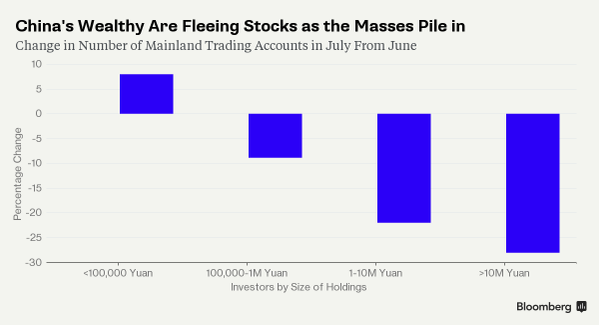
One-quarter of those risking their lives are children. We have witnessed an unbearable death toll this year, with at least 585 people missing or lost in the Aegean, most of them since Aylan’s death. War, persecution, geopolitics, dangerous smuggler tactics, the weather – all of these factors contribute to the surge in arrivals as well as the number of lives lost. The UN refugee agency, UNHCR, estimates that 60% of those coming to Greece by sea are Syrians, while 24% are from Afghanistan. The response of the European Union has to be multifaceted. It should include measures to reduce the need for dangerous journeys and tackle the root causes of refugee and migration flows in a way that respects human rights.

But the immediate imperative has to be to save lives. Turkish and Greek coast guard boats are out there every day patrolling the waters. And various EU countries have sent boats, personnel and other equipment to participate in Operation Poseidon in the Aegean, a mission of the EU’s external border agency Frontex. Combined, these actions have saved tens of thousands of lives. I’ve seen a burly Portuguese coast guard officer gently take a baby from her mother’s arms after a rescue. I’ve observed the professionalism of Norwegian police officers on patrol for Frontex. A colleague of mine was impressed by the way Greek coast guard officers handled two difficult rescues. But more needs to be done.

Read more …

Nov 172015
 
 November 17, 2015  Posted by at 10:26 am Finance Tagged with: , , , , , , , , , , ,  16 Responses »


DPC “Grant’s Tomb. Rubber-neck auto on Riverside Drive, New York” 1911

• Steel Is the Poster Child For Oversupplied Commodity Markets (Bloomberg)
• Oil Approaching $40 Deepens Investor Pessimism on Recovery (Bloomberg)
• The Saudis Are Stumbling – And May Take The Middle-East Down With Them (Hallina)
• US Approves Sale Of Smart Bombs To Saudi Arabia (Reuters)
• Yuan’s Offshore Discount Widens as IMF Nod May Curb Intervention (Bloomberg)
• India Exports Fall 17.5%, Imports Down 21.2% (LiveMint)
• France Swats Aside EU Budget Rules In Rearmament Blitz (AEP)
• Finnish Parliament Will Debate Next Year Leaving Euro Zone (Reuters)
• An Entirely Rigged Political-Financial System (Nomi Prins)
• Greece Reaches Deal With Lenders Unlocking Stalled Aid (Reuters)
• UK Inflation Stays Below Zero as Price Weakness Persists (Bloomberg)
• There Are No Safe Spaces (Jim Kunstler)
• A Most Convenient Massacre (Dmitry Orlov)
• ISIS Financed by 40 Countries, Including G20 Member States – Putin (Sputnik)
• Putin Confirms Egypt Plane Crash Due To Bomb, Offers $50 Million Reward (ZH)
• More Than Half of US State Governors Say Syrian Refugees Not Welcome (CNN)
• Paris Attacks Fuel Calls For Canada To Delay Taking In 25,000 Syrians (AFP)
• El Niño: Food Shortages, Floods, Disease And Droughts (Guardian)
• Greek Coast Guard Rescues 1,244 Refugees In Three Days (AP)
• Refugee Boat Overturns Near Greek Island, At Least Eight Dead (AP)

I’d say steel AND oil. And copper.

• Steel Is the Poster Child For Oversupplied Commodity Markets (Bloomberg)

The collapse in oil prices following the shale revolution has stolen the limelight for investors mulling the end of the commodities supercycle. But the real “poster child for problems in commodities markets is perhaps the global steel industry,” according to Macquarie analysts led by Colin Hamilton, the firm’s global head of commodities research. The front-month contract for U.S. hot-rolled coil steel futures traded on the New York Mercantile Exchange is down nearly 40% year-over-year/ Forecasts for a boom in Chinese consumption helped spur a rise in production that left the segment with a massive glut. The successful realization of economic rebalancing in China, meanwhile, necessarily entails a material slowdown in that nation’s demand for steel. Macquarie observes that global steel consumption has contracted on an annual basis throughout 2015.

“With 1.6 billion tonnes of consumption globally, steel remains the lynchpin of industrial growth,” wrote Hamilton. “However, the growth part of this equation is an increasing problem, and not only in China.” India, which has the potential to buoy demand for steel, is also contributing significantly to supply growth. Bloomberg Intelligence’s Yi Zhu notes that 37 million metric tons of production capacity in India are currently under construction or in planning to be added. “The only people who still seem to think there is significant upside in global steel consumption akin to the past decade are the major iron ore producers—for example BHP’s belief global steel consumption will hit 2.5 billion tonnes by 2030—just a further 50% upside required there!” Hamilton wrote in a separate note.

Arguably, overcapacity across the commodity complex is a perverse side effect of years of near-zero interest rates and asset purchases by the Federal Reserve. Lower input prices, however, can have a silver lining. For example, the collapse in oil prices, in simple terms, represents a transfer of wealth from major oil conglomerates to consumers. The largest positive effects accrue to lower-income households that spend a heftier portion of take-home pay on energy costs. “A world of cheap money not only sees new capacity built, it also means existing capacity doesn’t disappear,” explains Hamilton. “While most regions are well off their peak production levels over the last decade, permanent capacity closures have been few and far between.”

Read more …

Speculator pessimism.

• Oil Approaching $40 Deepens Investor Pessimism on Recovery (Bloomberg)

Hedge funds have turned more pessimistic on oil as prices flirted with $40 a barrel for the first time since August. “The speculators keep trying to pick the bottom and keep getting burned,” Michael Lynch, president of Strategic Energy & Economic Research said. Money managers’ short bets in West Texas Intermediate crude surged 21% in the week ended Nov. 10, according to data from the Commodity Futures Trading Commission. The net-long position dropped 16%. The release of the figures was delayed because of Veterans Day on Nov. 11. Oil inventories in developed countries have expanded to a record of almost 3 billion barrels because of massive supplies from both OPEC and non-OPEC producers, the International Energy Agency said in a report on Nov. 13.

WTI slipped to the lowest level since August before the CFTC release Monday. Thirty-nine oil tankers are waiting near Galveston, Texas, up from 30 in May, according to vessel-tracking data compiled by Bloomberg. “There’s been concern about excess supply in the market for a while now and that’s been strengthened by the IEA report,” Lynch said. [..] Oil inventories surged because of increased global production, OPEC said on Nov. 12. U.S. crude supplies rose to 487 million barrels as of Nov. 6, the highest for this time of year since 1930, the Energy Information Administration reported on Nov. 12. “We think the next few months will be very weak,” Sarah Emerson, managing director of ESAI Energy said by phone. “The market is focused on inventories. Prices shouldn’t rally in the coming year unless we have a disruption.”

Read more …

The regime puts itself in grave danger. This could blow up much faster than presumed.

• The Saudis Are Stumbling – And May Take The Middle-East Down With Them (Hallina)

When the Arab Spring broke out in 2011, Saudi Arabia headed it off by pumping $130 billion into the economy, raising wages, improving services, and providing jobs for its growing population. Saudi Arabia has one of the youngest populations in the Middle East, many of whom are unemployed and poorly educated. Some 25% of the population lives in poverty. Money keeps the lid on, but – even with the heavy-handed repression that characterizes Saudi political life – for how long? Meanwhile they’re racking up bills with ill-advised foreign interventions. In March, the kingdom intervened in Yemen’s civil conflict, launching an air war, a naval blockade, and partial ground campaign on the pretense that Iran was behind one of the war’s factions – a conclusion not even the Americans agree with.

Again, the Saudis miscalculated, even though one of their major allies, Pakistan, warned them they were headed for trouble. In part, the kingdom’s hubris was fed by the illusion that US support would make it a short war. The Americans are arming the Saudis, supplying them with bombing targets, backing up the naval blockade, and refueling their warplanes in midair. But six months down the line the conflict has turned into a stalemate. The war has killed 5,000 people (including over 500 children), flattened cities, and alienated much of the local population. It’s also generated a horrendous food and medical crisis and created opportunities for the Islamic State and al-Qaeda to seize territory in southern Yemen. Efforts by the UN to investigate the possibility of war crimes were blocked by Saudi Arabia and the US.

As the Saudis are finding out, war is a very expensive business – a burden they could meet under normal circumstances, but not when the price of the kingdom’s only commodity, oil, is plummeting. Nor is Yemen the only war that the Saudis are involved in. Riyadh, along with Qatar and the United Arab Emirates, are underwriting many of the groups trying to overthrow Syrian president Bashar al-Assad. When antigovernment demonstrations broke out there in 2011, the Saudis – along with the Americans and the Turks – calculated that Assad could be toppled in a few months. But that was magical thinking. As bad as Assad is, a lot of Syrians – particularly minorities like Shiites, Christians, and Druze – were far more afraid of the Islamists from al-Qaeda and the Islamic State than they were of their own government.

So the war has dragged on for four years and has now killed close to 250,000 people. Once again, the Saudis miscalculated, though in this case they were hardly alone. The Syrian government turned out to be more resilient than it appeared. And Riyadh’s bottom line that Assad had to go just ended up bringing Iran and Russia into the picture, checkmating any direct intervention by the anti-Assad coalition. Any attempt to establish a no-fly zone against Assad will now have to confront the Russian air force – not something that anyone other than certain US presidential aspirants are eager to do.

Read more …

Smart move. There is more sympathy for ISIS in Saudi Arabia than in any other country. And a lot of -private- Saudi capital goes towards funding it. And we sell them smart bombs.

• US Approves Sale Of Smart Bombs To Saudi Arabia (Reuters)

The U.S. State Department has approved the sale of thousands of smart bombs worth a total of $1.29 billion to Saudi Arabia to help replenish supplies used in its battle against insurgents in Yemen and air strikes against Islamic State in Syria, U.S. officials familiar with the deal said on Monday. The Pentagon’s Defense Security Cooperation Agency (DSCA), which facilitates foreign arms sales, notified lawmakers on Friday that the sales had been approved, the sources said. The lawmakers now have 30 days to block the sale, although such action is rare since deals are carefully vetted before any formal notification.

The proposed sale includes thousands of Paveway II, BLU-117 and other smart bombs, as well as thousands of Joint Direct Attack Munitions kits to turn older bombs into precision-guided weapons using GPS signals. The sales reflect President Barack Obama’s pledge to bolster U.S. military support for Saudi Arabia and other Sunni allies in the Gulf Cooperation Council after his administration brokered a nuclear deal with their Shiite rival Iran. The weapons are made by Boeing and Raytheon, but the DSCA told lawmakers the prime contractors would be determined by a competition.

Read more …

I brought this up the other day: how much control over the yuan does Beijing give up with its desired inclusion in the ‘SDR basket’? And how does that play out when things go downhill for China?

• Yuan’s Offshore Discount Widens as IMF Nod May Curb Intervention (Bloomberg)

The offshore yuan’s discount to the onshore spot rate widened to the most this month amid speculation the People’s Bank of China will rein in intervention now that the currency is on the cusp of winning reserve status. The difference between the yuan’s exchange rates in Hong Kong and Shanghai rose to as much as 417 pips on Monday, data compiled by Bloomberg show. It last exceeded 400 pips on Oct. 28, prompting suspected intervention by the PBOC the following day. [..] IMF Managing Director Christine Lagarde said late Friday that her staff have recommended the yuan be included in its Special Drawing Rights basked, as all operational issues including a sufficient gap between the onshore and offshore rates had been solved.

The Washington-based lender’s board will vote to approve inclusion on Nov. 30. “As the yuan’s inclusion is largely a done deal, we expect the PBOC to reduce foreign-exchange intervention and allow a wider spread between the onshore and offshore yuan,” said Ken Cheung, a Hong Kong-based currency strategist at Mizuho Bank Ltd. The central bank’s tolerance level may have widened to 500 pips from 400 pips before the IMF announcement and it will probably allow more depreciation via weaker fixings, he said.

Read more …

Wasn’t India supposed to pick up global growth where China left off?

• India Exports Fall 17.5%, Imports Down 21.2% (LiveMint)

India’s merchandise exports contracted for the eleventh consecutive month in October, as shipments of petroleum products continued to decline on lower crude oil prices, and external demand remained weak amid tepid global economic recovery. Exports contracted 17.5% from a year ago to $21.3 billion while imports shrank 21.2% to $31.1 billion, leaving a trade deficit of $9.8 billion, data released by the commerce ministry showed on Monday. In comparison, China’s October exports fell 6.9% from a year ago, down for a fourth month, while imports slipped 18.8%, leaving the country with a record high trade surplus of $61.64 billion. India’s dip in exports was driven mainly by a 57.1% drop in shipments of petroleum products to $2.5 billion.

The ministry has sent a cabinet note on the long-pending interest subsidy scheme for providing rupee credit to exporters at a subsidized interest rate. However, the cabinet is yet to take a view on it. India aims to take exports of goods and services to $900 billion by 2020 and raise the country’s share in world exports to 3.5% from 2% now. Exports in the past four fiscal years have been hovering at around $300 billion. India’s current account deficit (CAD) further contracted in the first quarter of 2015-16, as lower global crude oil prices helped rein in India’s import bill.

Read more …

Big deal: if budget rules are no longer applicable to France, they are to nobody. Schengen is gone, budget restrictions are gone; why still have an EU?

• France Swats Aside EU Budget Rules In Rearmament Blitz (AEP)

France has invoked emergency powers to sweep aside EU deficit rules and retake control over its economy after the terrorist atrocities in Paris, pledging a massive in increase and security and defence spending whatever the cost. President Francois Hollande said vital interests of the French nation are at stake and there can be no further justification for narrowly-legalistic deficit rules imposed by Brussels. “The security pact takes precedence over the stability pact. France is at war,” he told the French parliament. Defence cuts have been cancelled as far out as 2019 as the country prepares to step up its campaign to “eradicate” ISIS, from the Sahel in West Africa, across the Maghreb, to Syria and Iraq. At least 17,000 people will be recruited to beef up the security apparatus and the interior ministry, fast becoming the nerve centre of the country’s all-encompassing war against the ISIS network.

The new forces include 5,000 new police and gendarmes, 1,000 customs officials, and 2,500 prison guards. “I assume it will lead to an increase in expenses,” he said. The combined effect amounts to a fiscal stimulus and may ultimately cushion the economic damage of terrorist attacks for the tourist industry, but the “rearmament” drive spells the end of any attempt to meet deficit limit of 3pc of GDP enshrined in the Stability and Growth Pact. With France in open defiance, the reconstituted pact is now effectively dead. The European Commission expects the French deficit to be 3.4pc of GDP next year and 3.3pc in 2017, but the real figure is likely to be much higher and will last through to the end of the decade. The concern is that this could push the country’s debt yet higher from 96.5pc of GDP to nearer 100pc, made worse by the effects of deflation on debt dynamics.

Mr Hollande said France will invoke article 42.7 of the Lisbon Treaty, the solidarity clause obliging other member states to come to his country’s help by “all means in their power”. It would be beyond parody for Brussels to continue insisting on budget rules in such a political context. The French economy is slowly recovering as the triple effects of a weak euro, cheap oil, and quantitative easing by the ECB combine to create a short-term blast of stimulus, but it still remains remarkably depressed a full six years into the post-Lehman cycle of global expansion. Growth crept up to 0.3pc in the third quarter after stalling earlier in the year. Unemployment is still stuck at 10.7pc and has actually risen over recent months. “Momentum may fade in 2017 as tailwinds peter out,” said the Commission.

Read more …

France’s move opens whole new avenues for Finland, too, to finance debts.

• Finnish Parliament Will Debate Next Year Leaving Euro Zone (Reuters)

Finland’s parliament will debate next year whether to quit the euro, a senior parliamentary official said on Monday, in a move unlikely to end membership of the single currency but which highlights Finns’ dissatisfaction with their country’s economic performance. The decision follows a citizens’ petition which has raised the necessary 50,000 signatures under Finnish rules to force such a debate, probably the first such initiative in any country of the 19-member euro zone. “There will be signature checks early next year and a parliamentary debate will be held in the following months,” said Maija-Leena Paavola, who helps guide legislation through parliament. The petition – which will continue to gather signatures until mid-January – demands a referendum on euro membership, but this would only go ahead if parliament backed the idea.

Despite the initiative, a Eurobarometer poll this month showed 64% of Finns backed the common currency, though that is down from 69% a year ago. But the Nordic country has suffered three years of economic contraction and is currently performing worse than any other country in the euro zone. Some Finns say the country’s prospects would improve if it returned to the markka currency and regained the ability to set its own interest rates, pointing to the example of neighboring Sweden, which is outside the euro. The markka could then devalue against the euro, making Finnish exports less expensive. “Since 2008 the Swedish economy has grown by 8%, while ours has shrunk by 6%,” said Paavo Vayrynen, a Finnish member of the European Parliament who launched the initiative.

Read more …

Nomi is a fan of the Automatic Earth and our Debt Rattles, which she calls: “the most comprehensive daily rundown of main stream and alternative press articles out there!” Makes her an even smarter cookie.

• An Entirely Rigged Political-Financial System (Nomi Prins)

Too big to fail is a seven-year phenomenon created by the most powerful central banks to bolster the largest, most politically connected US and European banks. More than that, it’s a global concern predicated on that handful of private banks controlling too much market share and elite central banks infusing them with boatloads of cheap capital and other aid. Synthetic bank and market subsidization disguised as ‘monetary policy’ has spawned artificial asset and debt bubbles – everywhere. The most rapacious speculative capital and associated risk flows from these power-players to the least protected, or least regulated, locales. There is no such thing as isolated ‘Big Bank’ problems. Rather, complex products, risky practices, leverage and co-dependent transactions have contagion ramifications, particularly in emerging markets whose histories are already lined with disproportionate shares of debt, interest rate and currency related travails.

The notion of free markets, mechanisms where buyers and sellers can meet to exchange securities or various kinds of goods, in which each participant has access to the same information, is a fallacy. Transparency in trading across global financial markets is a fallacy. Not only are markets rigged by, and for, the biggest players, so is the entire political-financial system. The connection between democracy and free markets is interesting though. Democracy is predicated on the idea that every vote counts equally, and in the utopian perspective, the government adopts policies that benefit or adhere to the majority of those votes. In fact, it’s the minority of elite families and private individuals that exercise the most control over America’s policies and actions.

The myth of a free market is that every trader or participant is equal, when in fact the biggest players with access to the most information and technology are the ones that have a disproportionate advantage over the smaller players. What we have is a plutocracy of government and markets. The privileged few don’t care, or need to care, about democracy any more than they would ever want to have truly “free” markets, though what they do want are markets liberated from as many regulations as possible. In practice, that leads to huge inherent risk. Michael Lewis’ latest book on high frequency trading seems to have struck some sort of a national chord. Yet what he writes about is the mere tip of the iceberg covered in my book. He’s talking about rigged markets – which have been a problem since small investors began investing with the big boys, believing they had an equal shot. I’m talking about an entirely rigged political-financial system.

Read more …

Have they given in on foreclosures? Will tens of thousands more Greeks be thrown into the streets?

• Greece Reaches Deal With Lenders Unlocking Stalled Aid (Reuters)

Greece reached an agreement with its lenders on financial reforms early on Tuesday, its finance minister said, removing a major obstacle holding up fresh bailout loans for the cash-starved country. Athens signed up to a new aid program worth up to €86 billion earlier this year, but payment of part of an initial tranche had been held up over disagreement on regulations on home foreclosures and handling tax arrears to the state. “There was an agreement on all the milestones … whatever was required,” Finance Minister Euclid Tsakalotos told reporters after meeting representatives of European institutions and the IMF on aid disbursement.

Tsakalotos said the deal meant Parliament could now ratify the set of reforms to law, and that deputy eurozone finance ministers, known as the Euro Working Group, would on Friday endorse the deal. That would allow a €2 billion aid disbursement and about €10 billion in recapitalization aid to the country’s four main banks, he said. Greece has been keen to complete its first assessment under the new bailout package, its third since 2010, so it can start talks with lenders on debt relief.

Read more …

The levels of nonsense in the expert comments is priceless. Would that have a negative effect on prices too?

• UK Inflation Stays Below Zero as Price Weakness Persists (Bloomberg)

U.K. consumer prices fell for a second month in October, extending the weakest bout of inflation in more than half a century. The Office for National Statistics said prices declined 0.1% from a year earlier, matching the median forecast of economists in a Bloomberg survey. That’s the third negative reading this year and largely reflects weaker global commodity costs. Core inflation, which excludes volatile food and energy prices, accelerated to 1.1% from 1%. The Bank of England expects inflation to remain low into 2016 before picking up toward its 2% target. BOE Governor Mark Carney has highlighted core inflation as an important measure for policy makers as they weigh when to begin interest rate increases after keeping them at a record low for more than six years.

Consumer-price inflation has been below 1% all this year and less than 2% since the end of 2013. Britain last saw a sustained period of price declines in 1960, according to a historic series constructed by the statistics office. In forecasts published this month, the BOE said inflation is likely to reach its goal in late 2017 and accelerate to 2.2% a year later. Services inflation, a proxy for domestic price growth, was at 2.2% in October. “In the absence of sharp movements in global commodity prices, inflation is likely to accelerate quickly beyond October as the direct impact of past falls in oil drops out,” said Dan Hanson, an economist at Bloomberg Intelligence in London. “Evidence that this is happening is likely to be enough for the BOE to begin monetary tightening in May.”

Read more …

“The long emergency is showing signs of morphing into something like civil war.”

• There Are No Safe Spaces (Jim Kunstler)

One thing seems assured: hard-line governments are coming soon. Politically, the West had boundary problems that go way beyond the question of national borders to the core psychology of modern liberalism. When is enough of anything enough? And then, what are you really willing to do about it? The answer lately among the Western societies is to do little and do it slowly. The behavior of college administrators and faculties in the USA these days is emblematic of this cowardly dithering. Intellectual despotism reigns on campus and the university presidents roll over like possums. They don’t have the moral strength to defend free speech as the campus witch-hunts ramp up.

The result will be first the intellectual death of their institutions (brain death), and then the actual death of college per se as a plausible route to personal socioeconomic development. The financial racketeering that has infected higher education — the engineering of the gargantuan college loan scam in tandem with the multiplication of “diversity” deanships and tuition inflation — pretty much guarantees an implosion of that system. The cowardice in the college executive suites is mirrored in our national politics, where no persons of real standing will dare step forward to oppose the juggernaut of Hillary-the-Grifter, or take on the clowning Donald Trump on the grounds of his sheer mental unfittedness to lead a government. In case you haven’t noticed, the center not only isn’t holding, it gave way some time ago.

The long emergency is showing signs of morphing into something like civil war. The Maoists on campus apparently want to turn it into race war, too. So many forces are in motion now and they are all tending toward criticality. The European Union may not survive the reestablishment of boundaries, since it was largely based on the elimination of them. Spain and Portugal are back to breaking down politically again. The Paris bloodbath has discredited Angela Merkel’s plea for “tolerance” — of what is proving to be an intolerable alien invasion. The only political figure on the scene who doesn’t appear to be talking out of his ass is Vlad Putin, who correctly stated at the UN that undermining basic institutions around the world was not a good idea.

Read more …

“In order to qualify as a victim of a tragedy, you have to be each of these three things: 1. a US-puppet, 2. rich and 3. dead.”

• A Most Convenient Massacre (Dmitry Orlov)

What a difference a single massacre can make! • Just a week ago the EU couldn’t possibly figure out anything to do to stop the influx of “refugees” from all those countries the US and NATO had bombed into oblivion. But now, because “Paris changed everything,” EU’s borders are being locked down and refugees are being turned back. • Just a week ago it seemed that the EU was going to be swamped by resurgent nationalism, with incumbent political parties poised to get voted out of power. But now, thanks to the Paris massacre, they have obtained a new lease on life, because they can now safely embrace the same policies that a week ago they branded as “fascist.”

• Just a week ago the EU and the US couldn’t possibly bring themselves admit that they are utterly incompetent when it comes to combating their own creation—ISIS, that is—and need Russian help. But now, at the après-Paris G-20 summit, everybody is ready to line up and let Putin take charge of the war against terrorism. Look—the Americans finally found those convoys of tanker trucks stretching beyond the horizon that ISIS has been using to smuggle out stolen Syrian crude oil—after Putin showed them the satellite photos! Am I being crass and insensitive? Not at all—I deplore all the deaths from terrorist attacks in Iraq, in Syria, in Lebanon, and in all the other countries whose populations did absolutely nothing to deserve such treatment. I only feel half as bad about the French, who stood by quietly as their military helped destroy Libya (which did nothing to deserve it).

Note that after the Russian jet crashed in the Sinai there weren’t all that many Facebook avatars with the Russian flag pasted over them, and hardly any candlelight vigils or piles of wreaths and flowers in various Western capitals. I even detected a whiff of smug satisfaction that the Russians got their comeuppance for stepping out of line in Syria. Why the difference in reaction? Simple: you were told to grieve for the French, so you did. You were not told to grieve for the Russians, and so you didn’t. Don’t feel bad; you are just following orders.

The reasoning behind these orders is transparent: the French, along with the rest of the EU, are Washington’s willing puppets; therefore, they are innocent, and when they get killed, it’s a tragedy. But the Russians are not Washington’s willing puppet, and are not innocent, and so when they get killed by terrorists, it’s punishment. And when Iraqis, or Syrians, or Nigerians get killed by terrorists, that’s not a tragedy either, for a different reason: they are too poor to matter. In order to qualify as a victim of a tragedy, you have to be each of these three things: 1. a US-puppet, 2. rich and 3. dead.

Read more …

Can’t wait for Russia to publish the details.

• ISIS Financed by 40 Countries, Including G20 Member States – Putin (Sputnik)

Putin said at the G20 summit that Russia has presented examples of terrorism financing by individual businessmen from 40 countries, including from member states of the G20. “I provided examples related to our data on the financing of Islamic State units by natural persons in various countries. The financing comes from 40 countries, as we established, including some G20 members,” Putin told reporters following the summit. The fight against terrorism was a key topic at the summit, according to the Russian leader. “This topic (the war on the terror) was crucial. Especially after the Paris tragedy, we all understand that the means of financing terrorism should be severed,” the Russian president said. Russia has also presented satellite images and aerial photos showing the true scale of the Islamic State oil trade.

“I’ve demonstrated the pictures from space to our colleagues, which clearly show the true size of the illegal trade of oil and petroleum products market. Car convoys stretching for dozens of kilometers, going beyond the horizon when seen from a height of four-five thousand meters,” Putin told reporters after the G20 summit. The Russian president also said that Syrian opposition is ready to launch an anti-ISIL operation if Russia provides air support. “A part of the Syrian opposition considers it possible to begin military actions against ISIL with the assistance of the Russian air forces, and we are ready to provide that assistance,” the Russian president said. If this happens, the army of Syrian President Bashar Assad, on the one hand, and the opposition, on the other hand, will fight a common enemy, he outlined.

Russian President Vladimir Putin said Monday that the United States has shown a certain willingness to resume cooperation with Russia in several areas. “It seemed to me that, at least at an expert level, at the level of discussing problems, there was, indeed, a clear interest in resuming work in many areas, including the economy, politics, and the security sphere,” Putin told reporters. Vladimir Putin said that Russia needs support from the US, Saudi Arabia and Iran in the fight against terrorism. “It’s not the time to debate who is more effective in the fight against ISIL, what we need to do is consolidate our efforts,” president Putin added.

Read more …

“Assuming there were higher powers behind the Russian plane bombing than just a bunch of cave-dwelling a la carte terrorists, those arrested may just be tempted enough by the $50 million award to reveal who the mastermind behind this particular terrorist attack was.”

• Putin Confirms Egypt Plane Crash Due To Bomb, Offers $50 Million Reward (ZH)

The world may have moved on from the tragic terrorist attack that took place just three weeks ago above Egypt’s Sinai peninsula, which killed all 224, but for some inexplicable reason Russia refused to admit what was obvious to most from the first minutes since ISIS released a video clip of the midair explosion: that the crash was the result of a bomb set to go off shortly after take off. But no longer. Moments ago the Kremlin confirmed for the first time on Tuesday that a bomb did bring down a Russian passenger plane that crashed over the Sinai Peninsula in Egypt on Oct. 31, killing all 224 people on board. “One can unequivocally say that it was a terrorist act,” Alexander Bortnikov, the head of Russia’s FSB security service, told a meeting chaired by President Vladimir Putin.

Bortnikov added that during the flight, a homemade device with the power of 1.5 kilograms of TNT was detonated. “As a result, the plane fell apart in the air, which can be explained by the huge scattering of the fuselage parts of the plane.” This not the first time that Russia has faced “barbarous terrorist crimes, more often without apparent causes, outside or domestic, as it was with the explosion at the railway station in Volgograd at the end of 2013.” Bortnikov added: “We haven’t forgotten anything or anyone. The murder of our nationals in Sinai is among the bloodiest crimes in [terms of] the number of casualties.” Putin also spoke, vowing to find and punish the culprits behind the Sinai plane attack. “Our military work in Syria must not only continue. It must be strengthened in such a way so that the terrorists will understand that retribution is inevitable.”

“The murder of our people in Sinai is among the bloodiest crimes in terms of the number of victims. We won’t wipe the tears out of our souls and hearts. This will remain with us forever. But it won’t stop us from finding and punishing the perpetrators.” According to RT, Russia will act in accordance with Article 51 of the UN Charter, which provides for countries’ right to self-defense, Putin said. “Those who attempt to assist criminals should be aware that the consequences of such attempts will be entirely their responsibility,” he added. Finally, just to make sure Russia gets its blood debt repaid, The Russian Federal Security Service director also announced a reward of $50 million for information on those behind the terror attack on the A321.

Read more …

Obama can push this through, but would that be wise?

• More Than Half of US State Governors Say Syrian Refugees Not Welcome (CNN)

More than half the nation’s governors – 27 states – say they oppose letting Syrian refugees into their states, although the final say on this contentious immigration issue will fall to the federal government. States protesting the admission of refugees range from Alabama and Georgia, to Texas and Arizona, to Michigan and Illinois, to Maine and New Hampshire. Among these 27 states, all but one have Republican governors. The announcements came after authorities revealed that at least one of the suspects believed to be involved in the Paris terrorist attacks entered Europe among the current wave of Syrian refugees. He had falsely identified himself as a Syrian named Ahmad al Muhammad and was allowed to enter Greece in early October.

Some leaders say they either oppose taking in any Syrian refugees being relocated as part of a national program or asked that they be particularly scrutinized as potential security threats. Only 1,500 Syrian refugees have been accepted into the United States since 2011, but the Obama administration announced in September that 10,000 Syrians will be allowed entry next year. The Council on American-Islamic Relations said Monday, “Defeating ISIS involves projecting American ideals to the world. Governors who reject those fleeing war and persecution abandon our ideals and instead project our fears to the world.”

Authority over admitting refugees to the country, though, rests with the federal government – not with the states – though individual states can make the acceptance process much more difficult, experts said. American University law professor Stephen I. Vladeck put it this way: “Legally, states have no authority to do anything because the question of who should be allowed in this country is one that the Constitution commits to the federal government.” But Vladeck noted that without the state’s participation, the federal government would have a much more arduous task. “So a state can’t say it is legally objecting, but it can refuse to cooperate, which makes thing much more difficult.”

Read more …

Right wing Canada sees an opportunity, too, for political gain over the backs of people fleeing the very terror they’re now supposedly suspected of.

• Paris Attacks Fuel Calls For Canada To Delay Taking In 25,000 Syrians (AFP)

Canada’s prime minister Justin Trudeau has faced calls to delay bringing in 25,000 Syrian refugees by the end of the year due to security concerns prompted by the Paris terror attacks. While an online petition against fast-tracking Syrian asylum seekers’ bids to relocate to Canada gained steam, the premier of Saskatchewan province, Brad Wall, urged the prime minister to “suspend” the move. “I understand that the overwhelming majority of refugees are fleeing violence and bloodshed and pose no threat to anyone,” Wall wrote in an open letter. “However, if even a small number of individuals who wish to do harm to our country are able to enter Canada as a result of a rushed refugee resettlement process, the results could be devastating,” he added.

The Islamic State group has claimed responsibility for the bomb and gun attacks that killed at least 129 people in Paris on Friday. In another part of Canada, Quebec Immigration Minister Kathleen Weil said it was still ramping up to welcome the refugees, adding she is confident security will not be compromised. “I did get assurances from [Immigration Minister John] McCallum and [Public Safety Minister] Ralph Goodale that all the measures are being taken to ensure that the newcomers have been properly vetted.” Dueling online petitions for and against a delay, meanwhile, had amassed more than 55,000 and 25,000 signatures, respectively by midday Monday. One cited “national security” concerns in asking for a postponement, while the other blasted the first for stoking “despicable and inhumane xenophobic” attitudes.

Read more …

This won’t become a big story until and unless it hits a rich part of the world.

• El Niño: Food Shortages, Floods, Disease And Droughts (Guardian)

The UN has warned of months of extreme weather in many of the world’s most vulnerable countries with intense storms, droughts and floods triggered by one of the strongest El Niño weather events recorded in 50 years, which is expected to continue until spring 2016. El Niño is a natural climatic phenomenon that sees equatorial waters in the eastern Pacific ocean warm every few years. This disrupts regular weather patterns such as monsoons and trade winds, and increases the risk of food shortages, floods, disease and forest fires. This year, a strong El Niño has been building since March and its effects are already being seen in Ethiopia, Somalia, Kenya, Malawi, Indonesia and across Central America, according to the World Meteorological Organisation. The phenomenon is also being held responsible for uncontrolled fires in forests in Indonesia and in the Amazon rainforest.

The UN’s World Meteorological Organization warned in a report on Monday that the current strong El Niño is expected to strengthen further and peak around the end of the 2015. “Severe droughts and devastating flooding being experienced throughout the tropics and sub-tropical zones bear the hallmarks of this El Niño, which is the strongest in more than 15 years,” said WMO secretary-general Michel Jarraud. Jarraud said the impact of the naturally occurring El Niño event was being exacerbated by global warming, which had already led to record temperatures this year. “This event is playing out in uncharted territory. Our planet has altered dramatically because of climate change,” he said. “So this El Niño event and human-induced climate change may interact and modify each other in ways which we have never before experienced. El Niño is turning up the heat even further.”

In 1997, the phenomenon led to severe droughts in the Sahel and the Indian subcontinent, followed by devastating floods and storms, which killed thousands of people and caused billions of dollars of damage across Asia, Latin America and and Africa. The WMO said countries are expected to be much better prepared for a strong El Niño now than they were in 1997, but governments and charities are warning of serious food shortages and floods. “While difficult to predict, the El Niño this year looks set to be the strongest on record. This is a real threat to people’s lives, health and livelihoods across the world, which will see increased calls for humanitarian assistance as people struggle to grow crops, face water shortages and disease,” said a spokeswoman at Britain’s Department for International Development.

Read more …

And the beat goes on.

• Greek Coast Guard Rescues 1,244 Refugees In Three Days (AP)

Greek authorities say 1,244 refugees and economic migrants have been rescued from frail craft in danger over the past three days in the Aegean Sea, as thousands continue to arrive on the Greek islands. A coast guard statement Monday said rescuers responded to a total 34 incidents since Friday morning, near the islands of Lesbos — where most migrants head — Chios, Samos, Kos, Kalolimnos and Megisti. The count does not include thousands more people who safely made the short but often deadly crossing from nearby Turkey’s western coast.

Read more …

Four children, four women and one man. Can we mourn them the way we mourn the Paris victims?

• Refugee Boat Overturns Near Greek Island, At Least Eight Dead (AP)

Greece’s coast guard says a plastic boat carrying refugees or migrants has overturned near the coast of the eastern Aegean island of Kos, killing at least eight people. The coast guard said Tuesday it had rescued seven people and had located eight bodies, two of which were still trapped inside the overturned vessel. Crews were searching for between three and five more people listed as missing. It was not immediately clear how the boat overturned, or what the passengers’ nationality was.

Read more …

Nov 152015
 
 November 15, 2015  Posted by at 10:05 am Finance Tagged with: , , , , , , , ,  10 Responses »


Jack Delano Atchison, Topeka & Santa Fe train at Emporia, Kansas 1943

• Credit Bust In Rich Countries Caused Credit Boom In Emerging Markets (Economist)
• Irish President: Unaccountable Forces Are Running EU (IT)
• The Global Economy Slows Down. Is It Recession Or Protectionism? (Guardian)
• Yuan’s Rise Means World Economy Takes Step To Greater Stability (Bloomberg)
• Whistleblower At HBOS Bank Attacks ‘Ludicrously Bad’ City Regulation (Guardian)
• More Tough Measures Loom As Greece Eyes Bailout Loans (Kath.)
• ECB Demands Portugal’s Novo Banco Plug $1.5 Billion Capital Hole (Reuters)
• The Streets of Paris Are as Familiar to Me as the Streets of Beirut (Joey Ayoub)
• After Paris, Europe May Never Feel As Free Again (Guardian)
• What’s Next for Migrants After Paris? (Atlantic)
• Syrian Refugees In France Say Paris Terror Is The Terror They Fled (BuzzFeed)
• There Is Only One Way to Defeat ISIS (Esquire)
• Syrian Transition Plan Reached by US, Russia in Vienna (Bloomberg)
• Poland to Shun Refugees After Paris Attack, Future Minister Says (Bloomberg)
• After Mass Extinctions, The Meek (Fish) Inherit The Earth (WaPo)
• Two Refugee Children Die In Greece In Separate Incidents (Kath.)

Recipe for mayhem.

• Credit Bust In Rich Countries Caused Credit Boom In Emerging Markets (Economist)

The build-up of emerging-market credit began just as the rich world’s financial system started to creak in 2007. According to figures collated by JP Morgan, private-sector debt in emerging markets rose from 73% of GDP at the end of 2007 to 107% of GDP by the end of last year. These figures include loans made by banks and bonds issued by companies. Including the credit extended by non-bank financial institutions (so-called “shadow banks”) for the handful of emerging markets where such estimates are available gives a steeper rise and a higher total burden: 127% of GDP. The credit boom in emerging markets was in large part a response to the credit bust in the rich world. Fearing a depression in its richest export markets, the authorities in China brought about a massive increase in credit in 2009.


Meanwhile a flood of capital escaping the paltry yields on offer in developed economies pushed interest rates lower in developing ones. This search for yield by rich-world investors took them to ever more exotic places. A dollar-denominated government bond issued in 2012 by Zambia, a copper-rich country with an average GDP per person of $1,700 a year, offered just 5.4% interest; even so, it was 24 times oversubscribed as rich-world investors clamoured to buy. The following year a state-backed tuna-fishing venture in Mozambique, a country even poorer than Zambia, was able to raise $850m at an interest rate of 8.5%.

In contrast to the credit booms in America and Europe, where households were the main borrowers, three-quarters of the private debt burden in emerging markets is shouldered by businesses: corporate debt has ballooned from less than 50% of GDP in 2008 to almost 75% by 2014. Much of the lending was done in Asia, notably in China. But Turkey, Brazil and Chile also saw substantial increases in the ratio of company debt to GDP. Construction firms (notably in China and Latin America) increased their leverage a great deal. The oil and gas industry was a big player, too, according to the IMF’s latest Global Financial Stability Report.

Read more …

A point I’ve made 1000 times. “..a breakdown of trust between citizens and their institutions..”

• Irish President: Unaccountable Forces Are Running EU (IT)

Unaccountable forces removed from democratic control are today in control in the European Union, President Michael D Higgins has declared in one of the most pointed speeches of his term in office. “The present institutional structure of the European Union can be seen as reflecting the distribution of political power in recent decades, decades that have seen the emergence of a new financialised global order, where unaccountable agencies and forces removed from democratic oversight or control are in the ascendancy,” he said. He made the speech as he opened the Royal Irish Academy’s Centre for the Study of the Moral Foundations of Economy and Society. The anti-austerity street protests in many EU states, he said, could be seen as “not just the mechanical result of deplorable levels of unemployment and deteriorating material circumstances”, but also a reflection of a “breakdown of trust between citizens and their institutions”.

Deep injury has been inflicted on people’s moral outlook in recent decades by an extraordinarily narrow version of economics which had cut ties with its ethical and philosophical roots, Mr Higgins said. European leaders must remain “attentive and open”, he added saying, “a social view of Europe demands that our fellow citizens should never be seen merely as ‘consumers’ of public policies, driven by a sense of their sectional interests.” He was confident, he said, that the new educational centre “will contribute in an important way, over the years to come, in tackling the deep injuries inflicted upon our moral imaginations by the extraordinary ascendancy in recent decades of what is an extraordinarily narrow version of economics”.

This connection “of economy, ecology and ethics” and “of policy, theory and method”, had been at the centre of his presidency, “because I believe that they are essential to reading and understanding the current situation in which we find ourselves”. Referring to upcoming commemorations in Ireland, he said: “One can legitimately wonder, for example, what shape would our economy and society have assumed, had our fellow citizens kept alive, during Ireland’s recent economic boom, the cultural, philosophical, political and moral motivations which underpinned the Irish national revival, or the spirit of other historical movements for social and political reform such as the co-operative movement. “We neglected the contribution of the co-operative instinct to our social cohesion,” he said.

Read more …

Every country will want to protect itself when times get worse.

• The Global Economy Slows Down. Is It Recession Or Protectionism? (Guardian)

Goldman Sachs’s decision to close down its loss-making Bric fund was a symbolic reminder that the days are gone when the economic rise of Brazil, Russia, India and China (the four countries from which the fund drew its name) seemed guaranteed. Indeed, Brazil and Russia are both in recession. The US Federal Reserve’s plans to raise interest rates from near zero, which many experts now expect to happen next month, could deepen the agony of countries already struggling with plunging currencies and rising borrowing costs. The International Monetary Fund has warned of a flurry of bankruptcies in emerging economies as rates rise.

“A lot of these countries haven’t been helping themselves: Taiwan, Korea; they’ve all been cranking up their own credit growth,” says Russell Jones of Llewellyn Consulting, an economics advisory firm. But he too believes the world should escape a general slump. “I don’t think we’re on the cusp of a major downturn — probably more of the same.” Simon Evenett of St Gallen University in Switzerland, who collates detailed data for the thinktank Global Trade Alert, offers an alternative explanation for the recent slide in trade volumes. He calculates that about half of the fall, since exports peaked in September last year, has been caused by the commodity price rout; but the rest, rather than evidence of sickly global demand, has resulted from a creeping rise in protectionism.

His analysis suggests the declines have overwhelmingly taken place in just 28 categories of product. “That’s very concentrated; that makes me doubt that it’s a global downturn.” Eight of these categories are commodities; but the rest map closely on to areas where countries have taken protectionist measures. In the wake of the financial crisis, policymakers from the G20 countries pledged not to resort to the tit-for-tat protectionism that led to collapsing trade volumes in the wake of the Great Crash of 1929, and was ultimately seen as a contributor to the Great Depression. Since then, there has been little sign of anything with the scope of America’s Smoot-Hawley Act of 1930, which slapped import tariffs on more than 800 products.

But Evenett says there has been a flurry of more subtle manoeuvres: restricting public procurement to domestic firms, for example, or quietly tightening regulations to raise the bar against imports. “I think the China story is adding spice to it, but I think there’s more going on here,” he says. He is concerned that unless action is taken, politicians will continue to throw sand in the wheels of the international trading system. If he’s right, the downturn seen so far may not be sending a warning signal about global demand; instead, it would be best read as a measure of the fragility of globalisation.

Read more …

With China debt levels where they are, a curious idea.

• Yuan’s Rise Means World Economy Takes Step To Greater Stability (Bloomberg)

With China’s yuan taking the biggest step yet toward joining the dollar and euro as a top-rank reserve currency, the global economy may be approaching an era of greater stability. So say economists who highlight the dollar’s role in the biggest financial crises in recent decades. Drawn to the liquidity and security of the unit of the world’s biggest economy, investors and governments relied on the dollar and produced dislocations including historically low borrowing costs in the 2000s even as the Federal Reserve raised interest rates. Rushes toward the safety of the dollar challenged global policy makers in 2008 as money markets seized up, prompting the Fed to open swap lines with counterparts that remain in place today.

China responded in 2009 with a call for reducing reliance on the dollar, with central bank Governor Zhou Xiaochuan floating the idea of a “super-sovereign” reserve currency. While the proposal fell flat, Zhou and his allies began a campaign to win inclusion for the yuan in the IMF’s special drawing rights unit. The SDR, as it’s called, is a kind of overdraft account for members of the IMF, convertible into dollars, euros, pounds and yen. The fund’s staff said Friday that the yuan has now met the qualification terms for inclusion in the SDR. “The current configuration of the global monetary-financial system that is centered and increasingly dominated by the dollar is not a stable or a sustainable one,” Stephen Jen of SLJ Macro Partners, a former IMF economist, wrote with colleague Joana Freire last week.

Some 87% of foreign-exchange trading involves the dollar, the most recent survey by the Bank for International Settlements showed. “The role of the U.S. dollar as the world’s dominant vehicle currency remains unchallenged,” the BIS said in 2013, noting that the euro had declined in the wake of the European debt crisis. With the world’s second-largest economy and as the number-one trading nation, China may offer the global system a currency that can complement the dollar. For now, restrictions on the ability to take money in and out of China, and on what foreign investors can buy, mean the yuan’s role will be limited.

Read more …

“..I hope and pray I’m not going to have to fight for the next five years.”

• Whistleblower At HBOS Bank Attacks ‘Ludicrously Bad’ City Regulation (Guardian)

When the long-delayed official report into the near-collapse of HBOS is released on Thursday former bank bosses James Crosby, Andy Hornby and Lord Stevenson will be braced for a fresh round of condemnation. But if the report’s 500 pages are likely to revive painful criticism of their role in the demise of Britain’s biggest mortgage lender and savings institution, its publication also marks a crucial moment for a lesser known former executive at the bank: Paul Moore. Moore, 57, emerged some years ago as the whistleblower at HBOS. He said he was sacked as head of group regulatory risk at the end of 2004 – less than two years after joining – after warning that the then fast-growing bank was too strongly motivated by sales.

His views were first aired in public shortly after the bank had to be rescued by Lloyds in September 2008. The enlarged institution was later bailed out with £20bn of taxpayer money. On learning that the publication of the report by the Financial Conduct Authority and Bank of England – first promised in 2013 – has finally been scheduled for Thursday, Moore said: “I’m a bit nervous and a bit frightened and I hope and pray I’m not going to have to fight for the next five years.” His main fear now, he says, is that the report could turn out to be “a cover-up and a fudge”. If he was writing it, he says, he would refer the directors not just for banning orders but for criminal investigation, as well as demanding a proper judicial inquiry into the auditing of all the big banks and the conduct of the credit ratings agencies.

That is not all. “I would name and shame in the most rigorous detail the ludicrously bad regulators,” says Moore. Thursday’s report will be published alongside an analysis of the decision by the City regulator at the time of the collapse, the Financial Services Authority, to punish only one HBOS banker – Peter Cummings, who ran the bank’s commercial lending arm and has now been banned for life from the City and fined £500,000. Work on the official report only began after the enforcement action against Cummings, although in 2013 the parliamentary commission on banking standards, set up in the wake of the Libor-rigging scandal, published its own account of the collapse. It accused Crosby, Hornby and Stevenson of “colossal” management failures and questioned why it was only Cummings who had been censured by the City regulator.

Earlier evidence Moore had given to the Treasury select committee in 2009 had been so damning it led to a fresh examination of the role of Crosby, and forced his resignation as deputy chairman of the then City regulator, the Financial Services Authority. When Moore’s allegations were first aired at the select committee, Crosby had insisted there was no substance to them. A report – commissioned from the bank’s auditors, KPMG – concluded that he lost his job because of personality clashes inside the lender and not that Crosby sacked him because of warnings that HBOS was “going too fast”. Crosby has since handed back his knighthood and 30% of his pension, and keeps out of the public eye.

Read more …

The EU makes it impossible for Greece to leave its recession.

• More Tough Measures Loom As Greece Eyes Bailout Loans (Kath.)

The government is hoping to clinch the release of €2 billion in loan funding, and another €10 billion for Greek banks, after a tough round of negotiations with representatives of the country’s international creditors which has focused mainly on the issue of nonperforming loans and foreclosures of primary residences. The money is linked to a series of additional measures that Greece must legislate next week before turning to a second set of prior actions including even more contentious reforms such as higher taxes on farmers and an overhaul of the pension system. Greece is already running behind schedule on reforms. But authorities are hoping the creditors will show some flexibility so the process of recapitalizing Greece’s banks is not derailed.

Talks are already under way within the key ministries on the next round of reforms. Labor and Social Security Minister Giorgos Katrougalos, whose ministry is overseeing the difficult task of pension reform, aims to reach a “comprehensive” agreement with creditors and approve it in Parliament by early next month, according to sources. The hope is that the creditors will reward an active effort by Greeks to make up for lost time by making some concessions in the pension overhaul. Already Greek authorities are seeking to soften the impact of the pension overhaul by exploring the possibility of increasing the social security contributions of employers and workers instead of further reducing monthly payouts.

Other politically contentious challenges the government faces in the coming weeks include raising taxes on Greek farmers, creating a new tax system, creating a task force that will manage a new fund for privatizing state assets and drafting new measures to meet fiscal targets for the next two years. SYRIZA officials have expressed concerns about the impact on social cohesion of the bailout program’s austerity measures, which has already struck the leftists’ popularity, according to opinion polls.

Read more …

Europe’s next powder keg…

• ECB Demands Portugal’s Novo Banco Plug $1.5 Billion Capital Hole (Reuters)

The ECB has ordered Portugal’s Novo Banco to fill a €1.4 billion hole in its finances, possibly delaying its planned sale and hampering Lisbon’s efforts to draw a line under its biggest banking collapse. The request to repair Novo Banco, created from the failed Banco Espirito Santo (BES), presents a challenge for any anti-austerity, Socialist-led government that could come to power in coming weeks after a parliamentary vote this week. Of nine banks across the euro zone tested by the ECB as a follow-through on wider checks last year, only Novo Banco was found to be short of capital. It has two weeks to present a plan of action and nine months to plug the gap. The Bank of Portugal said in a statement that Novo Banco had already started working on a plan to raise capital through asset sales to meet the shortfall.

The plan will be presented in the coming weeks. The central bank failed to sell Novo Banco in September as the bids it received were seen as too low. The result of the ‘stress test’ means the sale can resume. “Preparation for the new phase of the sale process will be initiated immediately, now that one of the main factors of uncertainty hanging over the previous process is out of the way,” the Bank of Portugal said. The Bank of Portugal is in charge of the sale process under the terms of the €4.9 billion rescue plan for BES, which was carried out by a bank resolution fund that is formally the responsibility of Portugal’s other banks. The government lent part of the money to the fund used in the rescue and must be repaid.

Read more …

“The Human Body is not one. It sure feels that it should be by now. Maybe that in itself is an illusion.”

• The Streets of Paris Are as Familiar to Me as the Streets of Beirut (Joey Ayoub)

I come from a privileged Francophone community in Lebanon. This has meant that I have always seen France as my second home. The streets of Paris are as familiar to me as the streets of Beirut. I was just in Paris a few days ago. These have been two horrible nights of violence. The first took the lives of over 40 in Beirut; the second took the lives of over 120 people and counting in Paris. It also seems clear to me that to the world, my people’s deaths in Beirut do not matter as much as my other people’s deaths in Paris. We do not get a “safe” button on Facebook. We do not get late night statements from the most powerful men and women alive and millions of online users. We do not change policies which will affect the lives of countless innocent refugees. This could not be clearer. I say this with no resentment whatsoever, just sadness.

It is a hard thing to realize that for all that was said, for all the progressive rhetoric we have managed to create as a seemingly united human voice, most of us members of this curious species are still excluded from the dominant concerns of the “world”. And I know that by “world”, I am myself excluding most of the world. Because that’s how power structures work. I do not matter. My “body” does not matter to the “world”. If I die, it will not make a difference. Again, I say this with no resentment. That statement is merely a fact. It is a political fact, true, but a fact nonetheless. Maybe I should have some resentment in me, but I am too tired. It is a heavy thing to realize. I know that I am fortunate enough that when I do die, I will be remembered by friends and loved ones.

Maybe my blog and an online presence might even gather some thoughts by people around the world. That is the beauty of the internet. And even that is out of reach to too many. Never so clearly as now have I understood what Ta-Nehisi Coates wrote about when he spoke of the Black Body in America. I think there is a story to be told of the Arab Body as well. The Native American Body. The Indigenous Body. The Latin American Body. The Indian Body. The Kurdish Body. The Pakistani Body. The Chinese Body. And so many other bodies. The Human Body is not one. It sure feels that it should be by now. Maybe that in itself is an illusion.

But maybe it is an illusion worth preserving because without even that vague aspiration towards oneness on the part of some part of the body, I am not sure what sort of world we would be living in now. Some bodies are global, but most bodies remain local, regional, “ethnic”. My thoughts are with all the victims of today’s and yesterday’s horrific attacks, and my thoughts are with all those who will suffer serious discrimination as a result of the actions of a few mass murderers and the general failure of humanity’s imagination to see itself as a unified entity. My only hope is that we can be strong enough to generate the opposite response to what these criminals intended. I want to be optimistic enough to say that we are getting there, wherever “there” might be. We need to talk about these things. We need to talk about Race. We just have to.

Read more …

Interesting point of view.

• After Paris, Europe May Never Feel As Free Again (Guardian)

How long will it be before European liberalism cracks? The aftermath of a terrorist massacre is the worst time to make predictions. The extremity of the outrage pushes policy-makers and citizens to play with equally outraged responses. It is worth steadying yourself with the thought that until Friday night, Europe’s response to terrorism has not been extreme. Despite gruesome predictions to the contrary, European democracies have not turned themselves into police states. There have been no backlashes or pogroms against Muslims. EU countries, including Britain, have remained free and good societies overall; nations we can be proud of in our necessarily grudging way, for all the faults and abuses we must tackle.

People running from real terror know our true state better than we do. They flee to Europe, not from Europe. Callous though it may sound today to say it, the modest response to terrorism is the consequence of the modesty of the violence. Since al-Qaida’s assault on the World Trade Center and the Pentagon in 2001, the most striking feature of Islamist terrorism in Europe is how little of it there has been. You can give credit to police forces and intelligence agencies for arresting suspects before they strike. You can repeat the essential point that we are up against Islamism, not Islam, and most Muslims want nothing to do with totalitarian religion. Whatever the reason, the practical consequence remains that no one in power has felt the need to move towards anything resembling martial law.

Europe has “just” endured the attacks on Madrid and the 7/7 assault on London, and the actual and attempted murders of Jews, satirists, freethinkers in Paris, Brussels, Copenhagen and Marseille. Beyond that, there have been “lone wolf” killers of the type who did for poor Lee Rigby. I am not pretending that Europe has stayed the same. After Islamists sanctioned the murder of cartoonists who mocked Muhammad, a cowardly self-censorship spread across the arts and journalism, which was all the more cowardly for being unacknowledged. But it remains true that radical Islam has not forced a radical break with the past.

If you could travel in a time machine, you would see the continuities between our world and the Britain or France or Denmark of 20 years ago hugely outweigh the differences. I do not mean to minimise Islamist crimes when I say that Europe has been lucky. From Nigeria to Afghanistan, a clerical fascist doctrine that mandates mass murder and self-murder has pushed whole regions into civil war. Yet divinely sanctioned violence has failed to engulf our continent. Suspects are still innocent until proved guilty beyond reasonable doubt. The European convention on human rights remains in force. Terrorism is still subject to the rule of law, not martial law. In spite of all the provocations, we are what we once were.

Read more …

“What is clear is that there are 4 million people displaced by the crisis and, for them, a solution will need to be reached.”

• What’s Next for Migrants After Paris? (Atlantic)

After a terrorist attack killed more than 120 people and injured hundreds more on Friday, France imposed border controls and authorities discovered a Syrian passport on one of the attackers. While it’s not clear whether any of the assailants were migrants themselves, the attack has nonetheless reignited the debate over Europe’s migrant crisis. As Quartz notes, the attacks attributed to ISIS are anything but good news for migrants in Europe. Marine Le Pen, the leader of the far-right National Front party in France, told reporters on Saturday that “urgent action is needed” to “annihilate” Islamic fundamentalism. Le Pen went on to advocate that France regain control of its borders and expel “illegal migrants.”

In Poland, incoming Minister of European Affairs Konrad Szymanski announced today that the country will not accept migrants without security guarantees. In September, Poland agreed to accept 4,500 refugees as part of a European Union quota system. In the U.S., the role the country should play in this refugee crisis is a subject of continued partisan debate. President Obama announced in September that at least 10,000 Syrian refugees will be resettled in the U.S. over the next year. While this number might seem small compared to the 4 million total refugees created by the war since 2011, it represents a marked jump from the fewer than 2,000 Syrian refugees accepted last year. But some GOP candidates argued against the administration’s policy by suggesting that ISIS militants could infiltrate the country by hiding among refugees.

According to Vox, Ben Carson, Ted Cruz, Mike Huckabee, and Rick Santorum quickly cited the Paris attacks to justify closing the borders to more Syrian refugees. On the Democratic side, Hillary Clinton, Martin O’Malley, and Bernie Sanders have remained mostly quiet on the subject so far. All three have publically expressed their condolences for the victims and their families, but no one has yet made the leap to policy. Meanwhile, to the north, Canada has its own ambitious refugee agenda to assess. Newly elected Canadian PM Justin Trudeau committed to resettling 25,000 Syrian refugees by the end of the year — a number deemed unrealistic by some observers. [..] the Toronto Star reported earlier today that the country remains steadfast in its plan despite the Paris attacks. Ultimately, how the recent events will affect the debate surrounding migration in Europe and beyond remains to be seen. What is clear is that there are 4 million people displaced by the crisis and, for them, a solution will need to be reached.

Read more …

As should be obvious. But is not at all.

• Syrian Refugees In France Say Paris Terror Is The Terror They Fled (BuzzFeed)

Syrians who fled a brutal war and often undertook deadly sea journeys to settle in France reacted with horror to Friday’s terror attacks in Paris, and said they recognized the enemy all too well. “Syrians left Syria in dangerous ways to live in peace, but the killers followed them to Europe,” said Moaz Shaklab, a businessman from the Syrian city of Homs who settled in France two years ago as a refugee. The Paris attacks could spark new waves of Islamophobia in France and beyond — and with it fear of the refugees pouring into Europe from Syria and other countries. This is exactly what ISIS wants; the group has vowed to make it impossible for Muslims to exist peacefully in the West. Yet citizens in France share an ally against Islamic extremism in most refugees settling there.

Many newly arrived Syrians sought to escape the terror of ISIS and other jihadi groups, in addition to the brutal campaign being waged by Bashar al-Assad. Many worked against ISIS and other jihadi groups before leaving or have friends and family doing so now. “We’re united with the French people against terrorism,” Shaklab said. “And we don’t forget that they are united with us to get our freedom.” French police officials told the AP on Saturday that they had found a Syrian passport at the scene of an attack that they believed belonged to an assailant. But because of the refugee crisis, fake Syrian passports are now prevalent and easy to obtain.

Whether or not the passport is authentic, news of its discovery promised to help to fan refugee fears — which may have been the intent of the man who brought it to the scene. Sakher Edris, a journalist and political organizer who worked against both ISIS and the Syrian government before fleeing to France this summer, said he expected a backlash against refugees following the attacks. “We are really scared,” he said. “French people are kind, and it’s understandable to have some backlash, but we want them to know that we are with them against terror.”

Read more …

Stop our ‘friends’ from funding it.

• There Is Only One Way to Defeat ISIS (Esquire)

It’s not like this is any kind of secret. In 2010, thanks to WikiLeaks, we learned that the State Department, under the direction of then-Secretary of State Hillary Rodham Clinton, knew full well where the money for foreign terrorism came from. It came from countries and not from a faith. It came from sovereign states and not from an organized religion. It came from politicians and dictators, not from clerics, at least not directly. It was paid to maintain a political and social order, not to promulgate a religious revival or to launch a religious war. Religion was the fuel, the ammonium nitrate and the diesel fuel. Authoritarian oligarchy built the bomb. As long as people are dying in Paris, nobody important is dying in Doha or Riyadh.

Saudi Arabia is the world’s largest source of funds for Islamist militant groups such as the Afghan Taliban and Lashkar-e-Taiba – but the Saudi government is reluctant to stem the flow of money, according to Hillary Clinton. “More needs to be done since Saudi Arabia remains a critical financial support base for al-Qaida, the Taliban, LeT and other terrorist groups,” says a secret December 2009 paper signed by the US secretary of state. Her memo urged US diplomats to redouble their efforts to stop Gulf money reaching extremists in Pakistan and Afghanistan.

“Donors in Saudi Arabia constitute the most significant source of funding to Sunni terrorist groups worldwide,” she said. Three other Arab countries are listed as sources of militant money: Qatar, Kuwait and the United Arab Emirates. The cables highlight an often ignored factor in the Pakistani and Afghan conflicts: that the violence is partly bankrolled by rich, conservative donors across the Arabian Sea whose governments do little to stop them. The problem is particularly acute in Saudi Arabia, where militants soliciting funds slip into the country disguised as holy pilgrims, set up front companies to launder funds and receive money from government-sanctioned charities.

It’s time for this to stop. It’s time to be pitiless against the bankers and against the people who invest in murder to assure their own survival in power. Assets from these states should be frozen, all over the west. Money trails should be followed, wherever they lead. People should go to jail, in every country in the world. It should be done state-to-state. Stop funding the murder of our citizens and you can have your money back. Maybe. If we’re satisfied that you’ll stop doing it. And, it goes without saying, but we’ll say it anyway – not another bullet will be sold to you, let alone advanced warplanes, until this act gets cleaned up to our satisfaction. If that endangers your political position back home, that’s your problem, not ours. You are no longer trusted allies. Complain, and your diplomats will be going home.

Complain more loudly, and your diplomats will be investigated and, if necessary, detained. Retaliate, and you do not want to know what will happen, but it will done with cold, reasoned and, yes, pitiless calculation. It will not be a blind punch. You will not see it coming. It will not be an attack on your faith. It will be an attack on how you conduct your business as sovereign states in a world full of sovereign states… And the still, stately progress of the news from Paris continues. There are arrests today in Brussels, of alleged co-conspirators. The body count has stabilized. New information comes at its own pace, as if out of respect for the dead. In the stillness of the news itself, there is refuge and reason and a kind of wounded, ragged peace, as whatever rolled up from the depths of the sickness of the human heart rolls back again, like the tide and, like the tide, one day will return.

Read more …

Given the American desire for world dominance, what are the odds?

• Syrian Transition Plan Reached by US, Russia in Vienna (Bloomberg)

Seventeen nations, spurred on by Friday’s deadly attacks in Paris, overcame their differences on how to end Syria’s civil war and adopted a timeline that will let opposition groups help draft a constitution and elect a new government by 2017. As a first step, the United Nations agreed to convene Syria’s government with opposition representatives by Jan. 1, U.S. Secretary of State John Kerry and Russian Foreign Minister Sergei Lavrov said Saturday at a joint press conference in Vienna. A cease-fire between the government in Damascus and recognized opposition groups should be in place within six months, according to their statement. The terrorist attacks in Paris galvanized the diplomats, who at previous talks had been unable to resolve the discord within their ranks.

While Russia and Iran had sided with Syrian President Bashar al-Assad, the U.S. and its regional allies had insisted upon his removal. With diplomats bogged down over the question of Assad, terrorist groups like Islamic State, also known as ISIS or ISIL, grew and become more powerful inside Syria. “It is time to deprive the terrorists of any single kilometer in which to hide,” Kerry said. “There can be no doubt that this crisis is not Syria’s alone to bear.” Assad has “cut his own deal” with Islamic State, buying oil from the group and failing to attack militants, Kerry said. Assad’s allies have conveyed that he’s prepared to be serious and engage in talks, but the “proof will be in the pudding,” he said. In a statement posted on Twitter, Islamic State said the Paris attacks that killed 129 people and injured 352 came in retribution for French involvement in the Syrian civil war.

The conflict has so far cost about 250,000 lives, sent millions fleeing the region, and triggered Europe’s worst refugee crisis since World War II. Diplomats meeting in the Austrian capital also decided to place Islamic State, along with the al-Qaeda affiliated Nusra Front terrorist group, on a list of those subject to military strikes even when a cease-fire is in place. The list, managed by the Kingdom of Jordan, may later be expanded to include other groups in Syria, Kerry and Lavrov said. The Paris attacks “show that it doesn’t matter if you’re for Assad or against him,” said Lavrov, “ISIS is your enemy.”

Read more …

Many more countries will follow the example.

• Poland to Shun Refugees After Paris Attack, Future Minister Says (Bloomberg)

Poland’s new government won’t accept migrant quotas imposed by the European Union, as the terror attacks in France have exposed the weakness in the bloc, the nation’s future minister for European affairs said. “In the wake of the tragic events in Paris, Poland doesn’t see the political possibilities to implement a decision on the relocation of refugees,” Konrad Szymanski was quoted as saying on Wpolityce.pl website on Saturday. “The attacks mean there’s a need for an even deeper revision of the European policy regarding the migrant crisis.” Szymanski’s rejection of the EU quotas hours after Paris was rocked by terrorist attacks underscore the divide among governments in the bloc over the influx of Middle Eastern migrants.

His Law & Justice party will take power in Poland this week after winning last month’s general election on a campaign that tapped into concerns among the country’s conservative Catholic base that too many Muslims are arriving in Europe. Poland’s previous cabinet, led by the Civic Platform party, also opposed efforts led by German Chancellor Angela Merkel to force EU member states to take in more migrants. While incoming Foreign Minister Witold Waszczykowski said Poland will meet an commitment by the Civic Platform to shelter 7,000 refugees, prime minister designate Beata Szydlo referred to the deal as “blackmail.” She will be sworn in on Monday.

Read more …

Only the small make it through. It takes many millions of years for larger creatures to develop.

• After Mass Extinctions, The Meek (Fish) Inherit The Earth (WaPo)

A new study suggests that being a little shrimpy might come in handy when the going gets tough. A mass extinction called the Hangenberg event, which took place some 359 million years ago, led to a reduction in vertebrate size for around 40 million years afterward. The research, published Thursday in Science, adds support to the so-called Lilliput Effect, which suggests that mass extinctions cause marked shrinkage in the animal population. To study how fish fared after this devastating extinction, the University of Pennsylvania’s Lauren Sallen (along with Andrew K. Galimberti at the University of Maine) studied 1,120 fish fossils dating back 419 to 323 million years ago. She found that the ancient fish had been increasing in size over time — which is to be expected — but that body size plummeted after 97% of species were wiped out.

“Some large species hung on, but most eventually died out,” Sallan said in a statement. Before the extinction, some fish had grown to be as big as school buses. But in the unstable ecosystem of a post-mass-extinction ocean, only small fish — ones that could reproduce quickly and survive on less food — could thrive. That means an ocean full of enormous sea monsters gave way to an ocean full of sardine-like critters. “[T]he end result is an ocean in which most sharks are less than a meter and most fishes and tetrapods are less than 10 centimeters, which is extremely tiny. Yet these are the ancestors of everything that dominates from then on, including humans,” Sallan said. There’s a very good reason to look into these devastating extinctions of the distant past: Many scientists believe that Earth is on the verge of a sixth mass extinction — one caused by human activity.

Read more …

What Europe stands for.

• Two Refugee Children Die In Greece In Separate Incidents (Kath.)

Two refugee children died in Greece in two separate incidents on Saturday. A 3-year-old boy drowned off the coast of Chios, in the eastern Aegean, after an engine blast on a refugee boat that threw the passengers in the sea, coast guard officials said. Fifteen other people were rescued while officials arrested an 18-year-old Turk believed to be a trafficker. Meanwhile, a 5-year-old Syrian girl was killed by an oncoming train while she was walking on rail tracks near the town of Alexandroupoli, police said.

Read more …

Nov 142015
 
 November 14, 2015  Posted by at 10:11 am Finance Tagged with: , , , , , , , , , , ,  14 Responses »


Unknown Paris 1900

• Calm Broken as US Stocks Post Worst Week Since August Selloff (Bloomberg)
• Nomi Prins Warns: “It’s All Coming To An End” (KWN)
• Albert Edwards: The Global Economy Will Be Thrown Into Chaos (ZH)
• Ten Ex-Deutsche Bank, Barclays Traders Charged in Euribor Probe (Bloomberg)
• 3 Accused Euribor Rate Manipulators Members of ECB Crisis Focus Group (ZH)
• Central Bankers Are Heroes: OECD’s Gurria (CNBC)
• China’s Yuan Takes Leap Toward Joining IMF Currency Basket (Reuters)
• VW Said to Seek as Much as €20 Billion in Bridge Funds (Bloomberg)
• How GM’s Bailout Became China’s Bonanza (Bloomberg)
• Portuguese Revolution Falls Far Short (Paul Craig Roberts)
• EU Commissioner’s Dire Warning: “The Only Alternative To Europe Is War” (ZH)
• Greece Says Turkey Turning Blind Eye To Refugee Smugglers (AFP)
• Greece Warns EU To Hold Turkey To Account On Refugee Crisis (Kath.)
• World’s Largest Ocean Cleanup Operation One Step Closer To Launch (Guardian)
• Monstrous Wave Of Paris Attacks Underlines France’s Year Of Terror (RT)
• Let Mercy For Refugees Be The Response To The Paris Attacks (Margaret Corvid)
• The Annihilation Of Nature (Woods Inst.)

People still pretending there are functioning markets.

• Calm Broken as US Stocks Post Worst Week Since August Selloff (Bloomberg)

You have to go back to August’s selloff to find a week as bad as this one for U.S. equities. Catalysts that drove the S&P 500’s 12% summer tumble, from interest rate dread to a commodities rout, surfaced again after being sidelined during October’s surge. Signs of slowing growth from China to Europe rekindled concern that weakness could spread to America as the Federal Reserve prepares to tighten monetary policy. While equities are nowhere near their August lows, the weekly slump raised concern that the S&P 500’s six-week rally went too far, too fast. Volatility jumped after an October lull, with a measure of price swings surging 40%.

Bank of America says shares are more likely to decline before New Year’s amid weak consumer earnings and the specter of higher borrowing costs. “For the next month and a half I think there may be more downside than upside risk to stocks,” Savita Subramanian at Bank of America said by phone. “The market is going to be more skittish about seeing the first Fed rate hike. We’re not going to get there without a little more volatility.” The S&P 500 Index fell 3.6% in the five days, sliding below its average price for the past 100 days for the first time in three weeks. The decline snapped a run of six weekly gains, the longest rally of the year that included an 8.3% surge in October.

The Chicago Board Options Exchange Volatility Index jumped above 20 for the first time since August, when it touched a four-year high. For Subramanian, who in October lowered her year-end target for the S&P 500 to 2,000 from 2,100, the list of worries is tallying up. Weak corporate earnings and the prospect for higher rates will keep a lid on gains through the remainder of the year, she said in an interview with Bloomberg. “Earnings are not coming in particularly great for sectors like consumer stocks, and on top of that you’ve got the Fed in December,” Subramanian, head of U.S. equity and quantitative strategy, said by phone. “Those all kind of conspire against near-term gains.”

Read more …

“And so that keeps the artificial game in play through the middle or fall of 2016..”

• Nomi Prins Warns: “It’s All Coming To An End” (KWN)

Today Nomi Prins, the keynote speaker who recently addressed the Federal Reserve, IMF and the World Bank, warned King World News “It’s all coming to an end.” Eric King: “Nomi, we went through a round of terror in 2008, and certainly China just went through that again recently when their stock market crashed along with the emerging markets, but when does this whole global Ponzi scheme finally come unraveled?” Nomi Prins: “We are seeing small unravelings all the time. Brazil is doing badly, Mexico is struggling, currencies around the world relative to the dollar are hurting, which means relationships of imports to exports and money coming into those countries are hurting.

China has had problems but its central bank has been big enough and strong enough to boost it at least somewhat back up again. The United States is in complete denial in terms of what the economic indicators are said to be vs what they actually are and how the markets themselves are being continually buoyed either by the Federal Reserve or the Fed’s associations with some of the big banks in terms of continuing to buy Treasury bonds… “The ECB is still on a mission, and as of the November 12th announcement from Mario Draghi, an even stronger mission to continue to infuse those markets with artificial money and perhaps even enhance their quantitive easing program. So you ask, ‘When is this all coming to an end?’

It is all coming to an end, but you have all these actors trying to prop up different pieces of it (the global financial system) and so that’s why there is all this enhanced volatility and you have so many ups and downs (in global markets). (The end will come) when there are no more creative concepts on the part of these central banks to provide the artificial stimulus to the markets. And that could be the middle or the end of 2016, only because one big central bank in play has already committed to doing their part of it (with enhanced stimulus). And so that’s why we continue to have enhanced volatility to the downside in global markets that is also met with intervention, which is unprecedented. But it (the stimulus) does exist and we have to recognize that, as unprecedented and bizarre as it is, and there are indications that it will continue.

And so that keeps the artificial game in play through the middle or fall of 2016. But in the core of markets and economies things are not stable, which is why all of these (volatile) movements are happening. If anything was stable for real, the Federal Reserve would have raised rates years ago, the ECB wouldn’t have needed to come up with another round of quantitative easing, the People’s Bank of China wouldn’t need to reduce the reserve requirements to their financial institutions in order to give them more money to play with — none of that would be happening. So we are in a state of deterioration. The timing of an eventual implosion has to do with when the big banks have nothing left to counteract the artificial markets coming apart that they themselves have created.

Read more …

“The rotten fruit of the Fed’s seemingly innocuous inaction will now be clear to onlookers as it is ripped to shreds on the battlefield by the powerful credit monster.”

• Albert Edwards: The Global Economy Will Be Thrown Into Chaos (ZH)

SocGen’s permarealist, Albert Edwards, has been the one person who for the past decade has firmly held the belief that a “deflationary Ice Age” is upon the world – courtesy of an unmanageable debt load – no matter what central banks do. There is, of course, one way to short circuit said Ice Age, and it involves paradropping money in an act of terminal fiat desperation (the outcome is always hyperinflation) onto the general population, something which as we reported last Friday is already in the works courtesy of first Adair Turner and the IMF, and soon all other “very serious people”.

Keep an eye on Japan as this is where said paradropping will be attempted first as Ben Bernanke suggested back in 2003 when he said to “consider for example a tax cut for households and businesses that is explicitly coupled with incremental Bank of Japan purchases of government debt – so that the tax cut is in effect financed by money creation.” But before we get there, here is a snapshot of where, according to Edwards, we are now and why “there” is getting very close. In his latest note he says, quite simply, that it is now too late to put the “Orc-like monster” of excess debt and declining cash flows back in the bottle, and why “the global economy will be thrown into chaos.”

The deeply held wish of central bankers not to de-rail the fragile economic recovery is on display for all to see as they grasp at the slightest excuse for their continued inaction. The UK’s central bank governor, Mark Carney, exceeded all dovish expectations recently in his latest rate flip-floppery. But what is this? The Fed has finally summoned up its courage and looks set to raise rates next month. It is, however, already too late. Having delayed way beyond the point when it might typically have raised rates in previous cycles, it has allowed an Orc-like monster to incubate, hatch and emerge into the sunlight, snarling and ready to do battle.

Free Fed money has led to an unprecedented corporate credit binge of excess spending, especially on share buybacks. This is even bigger than it was at the time of the 2000 technology and telecom bubble. The rotten fruit of the Fed’s seemingly innocuous inaction will now be clear to onlookers as it is ripped to shreds on the battlefield by the powerful credit monster. The global economy will be thrown into chaos.

Read more …

And each single one is named…

• Ten Ex-Deutsche Bank, Barclays Traders Charged in Euribor Probe (Bloomberg)

U.K. prosecutors charged 10 former Deutsche Bank and Barclays employees with manipulating a benchmark interest rate, including high-profile trader Christian Bittar, with an 11th facing indictment as soon as next week. Six traders from Deutsche Bank employees and four from Barclays were charged with conspiracy to manipulate the Euribor benchmark, the Serious Fraud Office said in a statement Friday. Another trader listed anonymously in court documents may also be charged, according to three people familiar with the case. Alongside Bittar, those linked to Deutsche Bank are Andreas Hauschild, Joerg Vogt, Ardalan Gharagozlou, Achim Kraemer and Kai-Uwe Kappauf. Former Barclays employees Colin Bermingham, Carlo Palombo, Philippe Moryoussef and Sisse Bohart also face charges.

The SFO won the first conviction by trial tied to benchmark manipulation in August, when former UBS trader Tom Hayes was found guilty of rigging the London interbank offered rate and sentenced to 14 years in prison. Banks and other financial institutions have paid about $9 billion in fines tied to Libor and other key rates. One other person has pleaded guilty in the Libor probe. Lawyers for Bittar, Hauschild and Moryoussef said they will contest the allegations. Lawyers for the other eight either declined to comment or didn’t immediately respond to requests for comment. The nine men and one woman are scheduled to appear in a London magistrates court on Jan. 11.

Documents distributed in the case have listed an unidentified 11th trader that will be charged, according to people familiar with the matter who declined to be named because the prosecution isn’t public. The trader could be charged as soon as next week, one of the people said. Other than Bermingham, the 10 defendants named by the SFO all live outside Britain, according to an SFO spokeswoman. Bittar and Moryoussef live in Singapore, Bohart in Denmark and Palombo in the U.S. and Italy, while the remaining five are in Germany. All have been notified they face charges. No extradition requests have been made and all appearances will be voluntary at present, the SFO said.

Read more …

The riggers work for the ECB! Oh, what a tangled web.

• 3 Accused Euribor Rate Manipulators Members of ECB Crisis Focus Group (ZH)

[..] we find out that the ECB – the same ECB where policymakers like to meet with banks and asset managers before major policy meetings, actually had three of the traders accused of gaming Euribor by Britain’s Serious Fraud Office on Friday in a group that helped the the bank craft its response to the financial crisis! From Reuters:

The documents on the ECB website show that former Barclays euro money market desk head Colin Bermingham and Joerg Vogt and Ardalan Gharagozlou from Deutsche Bank – three of 10 people charged by the SFO on Friday – were part of the central bank’s Money Market Contact Group at the height of the crisis. The group regularly met and held conference calls as the central bank scrambled to stabilise markets that were threatening to push debt-strained Greece, Portugal, Ireland and even Italy and Spain out of the euro in 2010 and 2011.

Amusingly, the 10 people charged include Deutsche Bank’s Christian Bittar who can’t seem to get away from his title as rate rigger par excellence (although that’s not the term Anshu Jain used, that’s the spirit of a conversation the ex-Deutsche CEO once had about Bittar with a colleague back in the good ol’ days). Here’s Bloomberg:

U.K. prosecutors charged 10 former Deutsche Bank and Barclays employees with manipulating a benchmark interest rate, including high-profile trader Christian Bittar, with an 11th facing indictment as soon as next week. Six traders from Deutsche Bank employees and four from Barclays were charged with conspiracy to manipulate the Euribor benchmark, the Serious Fraud Office said in a statement Friday. Another trader listed anonymously in court documents may also be charged, according to three people familiar with the case. Alongside Bittar, those linked to Deutsche Bank are Andreas Hauschild, Joerg Vogt, Ardalan Gharagozlou, Achim Kraemer and Kai-Uwe Kappauf. Former Barclays employees Colin Bermingham, Carlo Palombo, Philippe Moryoussef and Sisse Bohart also face charges.

Ok, so the ECB was regularly communicating with three traders who are now charged with manipulating Euribor. Here’s what Francesco Papadia, head of market operations at the ECB during the financial and euro zone debt crises has to say about the group: “They helped understand what was going on beyond what you see on the screens.” If you follow financial markets and that doesn’t strike you as hilarious, then check your pulse. That is, we bet they did “help the ECB what was going on behind the screen”, after all, they were the ones colluding to fix the market! In any case, we’ll have to see what the time frames were here and if there was any overlap between when the allegations stem from and when this ECB committee operated (it’s probably a better bet that the manipulation took place before the euro debt crisis), but in any case, we’ll close with the following amusing quote for now: “The ECB plays no role in the setting of the Euribor rate,” the ECB said in a statement. Are you guys sure about that?…

Read more …

The lunatics and the asylum: “We’ve got to get all cylinders of the growth engine firing again. There is no room for complacency..”

• Central Bankers Are Heroes: OECD’s Gurria (CNBC)

“Super” Mario Draghi’s nickname is very much justified, according to Angel Gurria, the secretary-general of the Organisation for Economic Co-operation and Development (OECD), who has called on governments to do more to tackle the global growth slowdown. “Central bankers have been the heroes of this story since this financial and economic crisis hit in 2008, but the problem is they have run out of room. It’s time for the governments,” Gurria told CNBC Friday. The most influential central banks in the Western world, the U.S. Federal Reserve, European Central Bank (of which Draghi is president) and the Bank of England, have been running ultra-low interest rates and quantitative easing programs for years in some cases, to try and handle the fallout from the credit crisis.

With the Fed likely to become the first to signal a return to more normal monetary policy by raising rates, potentially as early as December, Gurria gave the central bank his blessing – although he said it should have started sooner. On Monday, the OECD cut its forecast for global growth to around 2.9% this year – well below its long-term average – citing a further sharp downturn in emerging market economies and world trade. Gurria, who was speaking at the G-20 summit of the heads of the world’s largest advanced and emerging economies, said: “The issue is about getting growth and trade back. It’s very ominous that trade is growing at about 2% when the world economy is growing at 2.9%. There’s only five years in the last 50 at which trade has grown at a rate lower than the world GDP and there has always been a recession following that.” “We’ve got to get all cylinders of the growth engine firing again. There is no room for complacency,” he added.

Read more …

How much of Beijing’s control over its currency will this take away?

• China’s Yuan Takes Leap Toward Joining IMF Currency Basket (Reuters)

China’s yuan moved closer to joining other top global currencies in the IMF’s benchmark foreign exchange basket on Friday after Fund staff and IMF chief Christine Lagarde gave the move the thumbs up. The recommendation paves the way for the Fund’s executive board, which has the final say, to place the yuan on a par with the U.S. dollar, Japanese yen, British pound and euro at a meeting scheduled for Nov. 30. Joining the Special Drawing Rights (SDR) basket would be a victory for Beijing, which has campaigned hard for the move, and could increase demand for the yuan among reserve managers as well as marking a symbolic coming of age for the world’s second-largest economy. Staff had found the yuan, also known as the renminbi (RMB), met the criteria of being “freely usable,” or widely used for international transactions and widely traded in major foreign exchange markets, Lagarde said.

“I support the staff’s findings,” she said in a statement immediately welcomed by China’s central bank, which said it hoped the international community would also back the yuan’s inclusion. Staff also gave the green light to Beijing’s efforts to address operational issues identified in a report in July, Lagarde said. The executive board, which represents the Fund’s 188 members, is seen as unlikely to go against a staff recommendation and countries including France and Britain have already pledged their support for the change. This would take effect in October 2016, during China’s leadership of the Group of 20 bloc of advanced and emerging economies. China has rolled out a flurry of reforms recently to liberalize its markets and also help the yuan meet the IMF’s checklist, including scrapping a ceiling on deposit rates, issuing three-month Treasury bills weekly and improving the transparency of Chinese data.

Read more …

Sales down 5.3%. Cash evaporating.

• VW Said to Seek as Much as €20 Billion in Bridge Funds (Bloomberg)

Volkswagen is working with banks to put together as much as €20 billion in short-term bridge financing to show that the automaker has adequate liquidity to weather the emissions cheating crisis, two people familiar with the matter said. VW does not need the money currently and is seeking extra funds to create a financial cushion, said the people, who asked not to be identified discussing private talks. The automaker will begin meeting with about a dozen prospective banks on Monday at its headquarters in Wolfsburg, Germany, to go over the proposed funding, which it aims to have in place before the end of the year, the people said.

“We have always considered that a well-diversified portfolio of funding tools gives us the necessary flexibility to offer appropriate and competitive financing options for our customers as well as our industrial investment needs,” Volkswagen said in an e-mailed statement. “It is perfectly normal that we are in a constructive ongoing dialog.” The scandal has spread since Volkswagen first admitted in September to cheating on diesel pollution tests. The carmaker will need to recall as many as 11 million diesel vehicles worldwide and admitted earlier this month that another 800,000 cars had unexplained inconsistencies in carbon dioxide output. By 2017, the price tag of VW’s emissions woes will probably reach about €25 billion, Barclays estimated on Friday.

“It makes perfect sense” to shore up financing, said Sascha Gommel at Commerzbank. “In order to protect their rating, they need to show that liquidity will never become an issue for them, because then you have a vicious circle. If the ratings agencies think you won’t have cash and they downgrade you, then your funding gets more expensive.” Volkswagen has the equivalent of €2.57 billion in bonds maturing this year, €14.3 billion next year and €13.5 billion in 2017. The company said earlier Friday it has put bond financing on hold because it needs time to update its documentation to reflect potential fines and penalties. Thus far, the automaker has set aside €6.7 billion to recall diesel cars and estimated the economic risk of the CO2 irregularities at another €2 billion.

Read more …

Bailed out by workers losing their jobs…

• How GM’s Bailout Became China’s Bonanza (Bloomberg)

During the 2012 election, President Barack Obama held up his bailout of General Motors as a model in the fight against China’s growing manufacturing dominance, telling voters that the auto rescue would reverse the industry’s multi-decade trend of outsourcing. A single election cycle later, the question of government support for automakers has all but disappeared from the political discourse, yet Detroit is back to sending jobs out of the industrial Midwest. And now GM is leading the way on Chinese outsourcing, announcing it will become the first U.S. firm to import a vehicle made in China to the U.S. It’s about time taxpayers ask what their $50 billion rescue really bought them. Starting next year, GM will import between 30,000 and 40,000 Buick Envision crossovers annually from a plant in Shandong Province.

That won’t make the Envision one of GM’s best-selling models, but it will greatly outsell the only other Chinese-import car on the market, the Volvo S60L. More importantly, GM’s pioneering Chinese import will likely help break down the consumer stigma attached to Chinese cars, leading the way for other automakers to follow suit. If a bailed-out company can get away with selling Chinese cars in the U.S., there’s no doubt that the rest will try too. The Envision is just the tip of GM’s Chinese iceberg: though the firm has not announced further plans to import other vehicles from Asia, it is increasingly making China a hub for new vehicle development and global exports. The next generation of GM’s small- and medium-sized vehicles will be offered with a new engine and high-tech dual-clutch transmission co-developed with its Chinese partner, the Shanghai Automobile Industry Corporation.

The two companies are also jointly creating an entire family of small vehicles to be exported from China to markets around the world. Taxpayers aren’t the only ones GM appears to be abandoning. The United Auto Workers is incensed by the Envision decision. As union vice president Cindy Estrada told the Detroit Free Press in August when the rumors of the plan surfaced, “after the sacrifices made by U.S. taxpayers and the U.S. workforce to make General Motors the profitable quality company it is today, UAW members are disappointed with the tone-deaf speculation that the Envision would be imported from China.” Yet given that the UAW has a new wage-raising contract nearing ratification, it can be argued that the union may have brought some of this disappointment upon itself.

But perhaps it is in Canada, where the government spent $10 billion rescuing G.M. and Chrysler, where anger is most justified. With GM’s “vitality commitment” – made to protect jobs in Canada as a condition of its bailout – expiring at the end of next year, the automaker has already decided to cut 1,000 jobs from its Oshawa, Ontario, plant when production of the Chevrolet Camaro ends there next week. GM has hinted that more outsourcing could follow. And as a new Liberal government is taking power in Ottawa, GM is pushing for “more amenable” subsidies than the $750 million in loans that had been offered by the outgoing Conservatives. If new Prime Minister Justin Trudeau doesn’t bow to GM pressure – turning those loans into grants that it need not repay – the automaker may well pull even more jobs from a country that stood by it at its darkest hour.

Read more …

“..the right-wing Portuguese president, Anibal Cavaco Silva, a creature of Washington and the big banks..”

• Portuguese Revolution Falls Far Short (Paul Craig Roberts)

The austerity imposed on the Portuguese people by the 1% has resulted in the election of a coalition government of socialists, communists, and a “left bloc.” In the 20th century, socialism and the fear of communism humanized Europe, but beginning with Margaret Thatcher the achievements of decades of social reforms have been rolled back throughout Europe as bought-and-paid for governments have given all preference to the One%. Public assets are being privatized, and social pensions and services are being reduced in order to make interest payments to private banks. When the recent Portuguese vote gave a majority to the anti-austerity bloc, the right-wing Portuguese president, Anibal Cavaco Silva, a creature of Washington and the big banks, announced that the leftwing would not be permitted to form a government, just as the senior British general announced that a Labour Government formed by Jeremy Corbyn would not be permitted to form.

True to her word, Anibal reappointed the austerity prime minister, Passos Coelho. However, the unity of the socialists with the communists and the left bloc swept Coelho from office and the president had to recognize a new government. The new government means that for the first in a long time there is a government in Portugual that possibly could represent the people rather than Washington and the One%. However, if the new government leaves the banks in charge and remains committed to the EU, the current president, previous prime minister, and previous finance minister, Maria Luis Albuquerque, will continue to work to overthrow the people’s will as occurred in Greece. The new Portuguese government cannot escape austerity without nationalizing the banks and leaving the EU. The failure of the Greek government to bite the bullet resulted in the Greek government’s acceptance of the austerity that it was elected to oppose.

Read more …

No, it’s the EU itself that means war.

• EU Commissioner’s Dire Warning: “The Only Alternative To Europe Is War” (ZH)

While the saying goes “good fences make good neighbors,” it appears the leadership of The EU is starting to get frustrated with the lack of acquiescence among some of the ‘union’s’ newer or more marginal members. In a somewhat stunning statement, following ongoing and contentious meetings to discuss solutions to the migrant ‘problem’, EU Commissioner Timmermanns appeared to warn disagreeable member states, “There is an alternative to everything. I believe in EU cooperation because of all other forms in history have been tried to help Europeans get on better, and with the exception of this one, all other forms have led to war – so let’s stick to this one.” As Elsevier reports (via Google Translate),

European leaders read the last few days the alarm about the survival of the European Union (EU). Prague said Commissioner Frans Timmermans (PvdA) Friday that the EU is only one alternative: war. “The only alternative to the EU is war,” said Timmermans Friday gave a speech at a conference in Prague, said a reporter for The Times of London who attended the speech. Timmermans is the way Europe responds to the migration crisis’ the biggest threat to the EU ever. The Commissioner underlined that countries should cooperate better when it comes to border controls. “Migration is part of life, but we must lead these movements together in the right direction,” said Timmermans.

Matching words Timmermans in the alarmist tone that European leaders were heard in recent days about the survival of the EU. Earlier this week, Timmermans at the House of Europe Lecture in Amsterdam that he fears for the survival of the EU. “I do not optimistic about doing that, because I’m just not.

The current migration crisis is the European ideal of free movement shaking on its foundations. EU President Donald Tusk said that the EU is engaged in “a race against the clock.” “But we are determined to win this race,” said Tusk. “As I warned earlier, the only way not to dismantle the Schengen ensure proper management of the external borders of the EU.” The EU appears to be unable to curb migration flows. Because the borders are not guarded, seeing more and more countries are forced to protect their own borders. Even the welcoming Sweden went on Thursday to intensive checks on the southern border.

Remember when Hank Paulson waved the “Mutual Assured Destruction” card in the face of the U.S. with his infamous “blank check” three page term sheet? Now, it’s Europe’s turn. What’s worse, however, for things to devolve this much, it confirms that the European ‘Union’ is rapidly disintegrating, much more than the recent surge in barbed wire fences around European nations will demonstrate, and as Timmermanns warns, that means war.

Read more …

Much more than a blind eye.

• Greece Says Turkey Turning Blind Eye To Refugee Smugglers (AFP)

Greece’s migration minister on Friday said refugee smuggling in Turkey was conducted in “broad daylight” as he called on the EU to step up relocation plans. “The entries (from Turkey) are happening in an organized fashion,” junior interior minister for migration Yiannis Mouzalas told a news conference. “It is happening in broad daylight, with villages gathering around to watch the refugees being put in boats by the traffickers. There is no secrecy in this,” he said, citing evidence from Turkish media and the Greek coastguard. Greek PM Alexis Tsipras will travel to Turkey next week to press the country’s leaders to take a stronger stance against refugee traffickers.

Turkey “is spending a lot of money, it is holding three million refugees on its soil, but we believe it has the ability and it must acquire the will to stop the flows from its coasts,” Mouzalas said. Greece has been overwhelmed this year by a migration crisis unseen in Europe since the Second World War. The United Nations on Friday said over 800,000 people have crossed the Mediterranean to Europe this year, with over 3,400 dying in the attempt. EU states put together a scheme to share out some 160,000 people inside the bloc, but fewer than 2,000 relocation places have been found so far. And the program is already threatened by undue inflexibility, Mouzalas said.

“One EU country said it was prepared to accept 12 people. We wanted to send 14 as they were a family, and the country did not accept the extra two. Such cancellations could cancel out the substance of relocation,” he said. Greece has pledged to find accommodation for 20,000 refugees by January. Another 20,000 will be temporarily housed in rented flats under a UN scheme, Mouzalas said. And registration centres on Greek islands created with EU funds, known as hotspots, will provide short-term accommodation for over 6,500 people, he said. “If (registration) procedures go smoothly people will stay 48-72 hours” before moving to the mainland, the minister said.

Read more …

The EU just throws $3 billion in taxpayer money at Erdogan and hope something sticks.

• Greece Warns EU To Hold Turkey To Account On Refugee Crisis (Kath.)

Greece has warned the European Union to obtain specific commitments from Turkey ahead of putting together a €3 billion fund for Ankara to help tackle the refugee crisis. The key role of Turkey in the process of stemming the flow of refugees and migrants was discussed on Friday during the second and last day of a summit in Malta. According to sources, Greek Prime Minister Alexis Tsipras stressed to his EU counterparts that Brussels has to make it clear what it will be getting in return for providing Turkey with emergency funding and assistance. For instance, Tsipras said that in return for receiving new equipment for its coast guard, Turkey should be made to prove that it is cracking down on human-trafficking gangs.

The Greek premier said that if the EU is going to provide money for the construction of reception centers on Turkish soil, then Ankara has to commit to allowing the relocation of refugees to take place directly from these camps. Also, Tsipras said that if the EU is going to lift visa restrictions on Turkish citizens, Ankara’s readmission agreement with Greece should be upgraded to a pact between Turkey and the EU. It is expected that these will be some of the key points that Tsipras will raise when he visits Ankara next week, ahead of an EU-Turkey summit in Brussels on November 29. Tsipras held a meeting with Foreign Minister Nikos Kotzias in Athens on Friday to begin preparation for the upcoming trip to Turkey.

Alternate Minister for Immigration Policy Yiannis Mouzalas said that Greece has no plans to create more spaces at relocation camps on the eastern Aegean islands beyond those needed as part of Athens’s commitment to the EU for the relocation scheme. Mouzalas said that those refugees who will be included in the transfer process would be moved on from the islands to the mainland. He said the government plans to have reception centers capable of holding 2,000 arrivals on Lesvos, 1,500 on Samos, 1,000 on Chios, 1,000 on Kos and around 800 on Leros.

Read more …

Of course private citizens have to do this. Governments are too busy.

• World’s Largest Ocean Cleanup Operation One Step Closer To Launch (Guardian)

A crowdfunded 100km-long boom to clean up a vast expanse of plastic rubbish in the Pacific is one step closer to reality after successful tests of a scaled-down prototype in the Netherlands last week. Further trials off the Dutch and Japanese coasts are now slated to begin in the new year. If they are successful, the world’s largest ever ocean cleanup operation will go live in 2020, using a gigantic V-shaped array, the like of which has never been seen before. The so-called ‘Great Pacific garbage patch’, made up largely of tiny bits of plastic trapped by ocean currents, is estimated to be bigger than Texas and reaching anything up to 5.8m sq miles (15m sq km). It is growing so fast that, like the Great Wall of China, it is beginning to be seen from outer space, according to Jacqueline McGlade, the chief scientist of the UN environmental programme (Unep).

“We have to admit that there has been a market failure,” she told the Guardian. “Nevertheless, we have to create a market success that brings in new forms of chemistry and technology.” The Ocean Cleanup project aims to do the technology part with a floating barrier as long as the Karman line that reaches from the sea to outer space. Sea currents and winds will be used to passively funnel plastic debris into an elbow made of vulcanised rubber where it can be concentrated for periodic collection by vessels. Sub-sea buoys at depths of up to 30 metres would anchor the contraption in depths of up to 4.5km. Sea currents flowing beneath its booms would allow fish to escape, while hoovering up 42% of the Pacific’s plastic soup. At least, that is the plan.

“Everything is unknown so everything is a potential problem,” said Lourens Boot, the programme’s chief engineer, who has previously worked on offshore oil and gas rigs. “The risk matrix is big, but one by one we are tackling those risks.” One of the biggest has been finance. Charles Moore, the racing boat captain who discovered the floating vortex in 1997, once said that the cost of a cleaning operation would “bankrupt any country”. But around half the scheme’s initial €30m (£20m) budget has now been raised through online donations and wealthy sponsors. In the long term, the project plans to finance itself with a major retail line of ocean plastic fashion wear.

Read more …

Quite a list.

• Monstrous Wave Of Paris Attacks Underlines France’s Year Of Terror (RT)

Waves of deadly attacks have held France in a constant state of stress, anger and grief over the past 12 months, as the country has faced a series of deadly assaults and terror acts by radicalized Islamists and jihadists. It all started just before Christmas on December 20, 2014, in the largest suburb of the city of Tours, in Central France, when an attacker of Burundian origin, shouted “Allahu Akbar” [God is great] before attacking officers at a police station with a knife. The assailant, identified as Bertrand Nzohabonayo, injured three policemen before officers took him down. The following day, on December 21, a man in the French city of Dijon run over 11 pedestrians in five areas of the city. The driver – who also shouted “Allahu Akbar” – was arrested. Authorities later stated that the attacker ploughed into passers-by because he suffered from severe psychiatric problems.

On the third day after the initial attack, a man in a white van rammed over ten pedestrians at a Christmas market in the French city of Nantes. The driver is said to have stabbed himself and officials said he appeared to be in an unstable metal condition. One civilian died in those attacks. The spate of attacks forced the French government to heighten security by deploying 300 soldiers onto the country’s streets. In early January, the French nation was in state of horror after a series of five terrorist attacks, which took place in and around Paris. The four attacks killed at least 20 people and wounded dozens more, before three of the assailants were killed by special forces. The fourth terrorist remains at large.

The intimidation of the French public began on January 7, after two gunmen, identified as Cherif and Said Kouachi, attacked the headquarters of the satirical newspaper Charlie Hebdo, over the publication’s depiction of the Prophet Mohammed. Twelve people, including two police officers, were killed in the onslaught, while eleven others were injured. The suspects fled the scene. Hours after the Charlie Hebdo attack, a third assailant, Amedy Coulibaly, shot a 32-year-old man who was out for a run in a park near Coulibaly’s home. On January 8, the same attacker shot and killed a municipal police officer in a suburb of Paris. A street sweeper was also wounded in that attack. The following day, on January 9, the Charlie Hebdo attackers, Cherif and Said Kouachi, attacked a signage production company in Dammartin-en-Goele, taking hostages on premises.

At the same time, Coulibaly, entered a kosher supermarket at Porte de Vincennes killing four people and taking the rest of the people in the store hostage. To neutralize the attackers, French special forces conducted simultaneous raids in Dammartin and at Porte de Vincennes, killing three terrorists. The fourth suspect, believed to be Coulibaly’s wife is still on the run. January’s atrocities became the deadliest act of terrorism in France since 1961, when a bomb on a Strasbourg–Paris train took the lives of 28 people. Following Charlie Hebdo attacks, the French government announced the creation of 2,680 new positions in the French military and intelligence agencies. The €425 million program was unrolled with the sole purpose to monitor a population of approximately 3,000 people with any possible connections to terrorist groups abroad. Furthermore, the government deployed some 122,000 police, military and gendarmes to provide security across France.

But terror in France did not stop there. On June 26, 2015 a French Muslim of North African descent, Yassine Salhi, decapitated his employer before driving his van into gas cylinders at a gas factory near Lyon. This caused an explosion and injured two other people. Prior to ramming his van in an effort to destroy the factory, Salhi placed his boss’s decapitated head on a fence along with two Jihadist black flags. The suspect was arrested after being taken down by the firefighters that rushed to the scene. That attack on the factory near Lyon coincided with a number of other Islamist terrorist attacks that have taken place in Tunisia and Kuwait. Finally, before the monstrous wave of attacks on Friday, a Thalys train traveling from Amsterdam to Paris via Brussels was attacked by an assailant who opened fire in a carriage before being subdued by off duty US servicemen aboard the train. Four people were injured but luckily none fatally.

Read more …

It’s one approach.

• Let Mercy For Refugees Be The Response To The Paris Attacks (Margaret Corvid)

There have been horrible, disgusting terrorist attacks in France this night, with over 120 dead already reported. In response, premier François Hollande has declared a state of emergency for the first time since the Second World War. The media are subject to state control, gendarmes can enter any private home, and the borders are shut. The borders that have been the last hope for so many refugees crowding the camps of Calais and elsewhere, the borders that are so important to the women, children and men shivering in the rain, their feet rotting, have been closed by a frightened France. Probably the rest of Europe will follow suit. I hope not. A handful of terrorists—maybe French nationals, maybe not—blew up a crowd in a stadium with grenades, killed diners and walkers and concert-goers with guns and suicide bombs, traumatizing Paris to its core.

And what Hollande has done in response is to close the borders, the lifeline to the many suffering people fleeing war in Syria—even before we know for sure who the murderers are, or what their aims were. Reports claim the terrorists fought in Syria’s name. But if they did, and if they were ISIS, then the tens of thousands of refugees shivering in camps hate and fear them as much as the friends and families of the dead of Paris do. The refugees huddling in France, Germany, Turkey, Greece, and elsewhere are not the terrorists. They are fleeing the same terrorists—fleeing death, torture and destruction, trusting their lives to crumbling boats, washing up on shore hated, beaten, half-dead—and we are forsaking them.

I am a member of a Facebook group where people organize aid for the refugee camp in the northern seafront town of Calais. Now a shanty town of a full 6,000 refugees, such aid has never been more needed. Shoes are rotting on the feet of the camp’s dwellers as the weather worsens, food and medical care are scarce, and graves are rapidly filling. The lifesavers in the camp are not the government or the UN refugee groups—they are ordinary people connecting with tiny charities to bring desperately needed wood, food, medicine, blankets, water. Closing the borders as the terrifying war continues in Syria will not punish the terrorists; it will only cause more needless suffering and death, including to innocent children.

Why is Hollande using the refugees as hostages, condemning them with his border closure to a death that is slower but no less certain than that of a head chopped by a guillotine, or that of a concert-goer blown up by a grenade? He only helps the terrorists. ISIS and those in the West who hate the refugees want the same thing: martial law, state control of discourse, the spreading of Islamophobia, and a global atmosphere of suspicion and discord. In such a world, ISIS gets its youthful cannon fodder—those disaffected by the climate of hate and brutal racism—and the Front Nationales, the Ukips, all the soft and hard white supremacists of the world, get their white utopia, where a refugee child cannot migrate but guns and money can.

Tonight, Paris mourns, and the world mourns with Paris. I mourn, and my anguish at needless death drives these words. Forsake vengeance. Open the borders, Hollande. Open them even further than the painful trickle that they allowed before, and let mercy be the response to horror. Open them, Cameron. Let those people fleeing for their lives through the borders—through all the borders—fly all the way through to peace and safety in whatever countries they wish to reach. Open the borders, Obama, and let those people through, those people just like us, just like the diners and concert-goers of Paris, who are trying to save their lives.

If they all die of illness and exposure in their tents, fighting starvation, sickness, fire, fear or hate, it will neither save a single life from terrorism, nor avenge a single soul. Even if terrorists slip in among the refugees, each one of them who dies, each day they are locked down, will make more terrorists, watered by the tears of grief of their families and friends. No high-security level can ever end the threat of terrorism. Only mercy can do that; only the mercy of refuge, of acting like the just countries we believe ourselves to be—rather than what the terrorists believe us to be—can make us safe.

Read more …

A thousand times faster than the natural rate. We’ll kill it all. Or at least enough to make the earth hostile to our own species.

• The Annihilation Of Nature: Human Extinction of Birds and Mammals (Woods Inst.)

This book shows us the face of Earth’s sixth great mass extinction, revealing that this century is a time of darkness for the world’s birds and mammals. In The Annihilation of Nature: Human Extinction of Birds and Mammals, three of today’s most distinguished conservationists tell the stories of the birds and mammals we have lost and those that are now on the road to extinction. These tragic tales, coupled with eighty-three color photographs from the world’s leading nature photographers, display the beauty and biodiversity that humans are squandering. Gerardo Ceballos, Anne H. Ehrlich, and Paul R. Ehrlich serve as witnesses in this trial of human neglect, where the charge is the massive and escalating assault on living things.

Nature is being annihilated, not only because of the human population explosion, but also as a result of massive commercial endeavors and public apathy. Despite the well-intentioned work of conservation organizations and governments, the authors warn us that not enough is being done and time is short for the most vulnerable of the world’s wild birds and mammals. Thousands of populations have already disappeared, other populations are dwindling daily, and soon our descendants may live in a world containing but a minuscule fraction of the birds and mammals we know today. The Annihilation of Nature is a clarion call for engagement and action. These outspoken scientists urge everyone who cares about nature to become personally connected to the victims of our inadequate conservation efforts and demand that restoration replace destruction. Only then will we have any hope of preventing the worst-case scenario of the sixth mass extinction.

Read more …

Aug 302015
 
 August 30, 2015  Posted by at 10:41 am Finance Tagged with: , , , , , , , , ,  Comments Off on Debt Rattle August 30 2015


Russell Lee Hammond Ranch general store, Chicot, Arkansas Jan 1939

• Why We Need To Lie To Ourselves About The State Of The Economy (Satyajit Das)
• Fed, ECB, BOE Officials All Say They See Inflation Rising (Bloomberg)
• Central Banks Can’t Save Markets From A Crash, And Shouldn’t Try (Guardian)
• On Second Thought, China Slowdown Will Hit Global-Growth Outlook (Bloomberg)
• How To Make Sense Of China (Elizabeth C. Economy)
• China Falters, And The Global Economy Is Forced To Adapt (NY Times)
• China Premier Li Says No Basis for Yuan’s Continued Depreciation (Bloomberg)
• For China, a Plunge and a Reckoning (WSJ)
• How Western Capitalism Laid China Low (Pettifor)
• Market Turmoil Means Capitalism Faces Systematic Crisis (Sputnik)
• We Are All Preppers Now (Mises Inst.)
• IMF’s Lagarde Says Restructuring Should Suffice For Greek Debt (Reuters)
• How 340.75 Drachmas Became 1 Euro (Yannis Palaiologos)
• UK Property Sales Down 15%, But Prices Are Up (BBC)
• The Evolution of America’s Energy Supply -1776 – 2014 (VC)
• As Tragedies Shock Europe, A Bigger Refugee Crisis Looms In Middle East (WaPo)

“For most people, the effect of these problems is unemployment, reduced job security, the deskilling of many professions and stagnant incomes. Home ownership is increasingly out of reach for many. Retirement may become a luxury for all but a few..”

• Why We Need To Lie To Ourselves About The State Of The Economy (Satyajit Das)

Like the characters in Samuel Beckett’s Waiting for Godot, the world awaits the return of wealth and prosperity. But the global economy may be entering a period of stagnation. Over the last 35 years, the economic growth necessary to increase living standards, increase wealth and manage growing inequality has been based increasingly on rising borrowings and financial rather than real engineering. There was reliance on debt-driven consumption. It resulted in global trade and investment imbalances, such as that between China and the US or Germany and the rest of Europe. Everybody conspires to ignore the underlying problem, cover it up, or devise deferral strategies to kick the can down the road.

Citizens demanded and governments allowed the build-up of retirement and healthcare entitlements as well as public services to win or maintain office. The commitments were rarely fully funded by taxes or other provisions. The 2008 global financial crisis was a warning of the unstable nature of these arrangements. But there has been no meaningful change. Since 2007, global debt has grown by US$57 trillion, or 17% of the world’s GDP. In many countries, debt has reached unsustainable levels, and it is unclear how or when it is to be reduced without defaults that would wipe out large amounts of savings. Imbalances remain. Entitlement reform has proved politically difficult. Financial institutions and activity dominate many economies. The official policy is “extend and pretend”, whereby everybody conspires to ignore the underlying problem, cover it up, or devise deferral strategies to kick the can down the road.

The assumption was that government spending, lower interest rates and supplying abundant cash to the money markets would create growth. While the measures did stabilise the economy, they did not lead to a full recovery. Instead, they set off dangerous asset price bubbles in shares, bonds, real estate and even fine arts and collectibles. Economic problems are now compounded by lower population growth and ageing populations; slower increases in productivity and innovation; looming shortages of critical resources, such as water, food and energy; and man-made climate change and extreme weather conditions.

Slower growth in international trade and capital flows is another retardant. Emerging markets, such as China, that have benefited from and recently supported growth are slowing. Rising inequality affects economic activity. For most people, the effect of these problems is unemployment, reduced job security, the deskilling of many professions and stagnant incomes. Home ownership is increasingly out of reach for many. Retirement may become a luxury for all but a few, reflecting increasing difficulty in building sufficient savings. In effect, living standards will decline. Future generations will bear the bulk of the cost as they are left to tackle the unresolved problems of their forebears.

Read more …

Empty rethorical lies.

• Fed, ECB, BOE Officials All Say They See Inflation Rising (Bloomberg)

Stronger growth will pull inflation higher in the U.S. and Europe, according to three top central bankers who voiced confidence that their regions will escape from headwinds that are keeping inflation too low. Fed Vice Chairman Stanley Fischer joined ECB Vice President Vitor Constancio and BoE Governor Mark Carney Saturday on a panel at the Kansas City Fed’s annual retreat in Jackson Hole, Wyoming, dedicated to discussing inflation dynamics. Their optimism has not been shared up until now by investors, trading in inflation-protected bonds shows. “Given the apparent stability of inflation expectations, there is good reason to believe that inflation will move higher as the forces holding down inflation dissipate further,” Fischer said in his prepared remarks.

“With inflation low, we can probably remove accommodation at a gradual pace,” Fischer said. “Yet, because monetary policy influences real activity with a substantial lag, we should not wait until inflation is back to 2 percent to begin tightening.” While Fischer has left open the option of an interest-rate increase when policy makers meet next month, he didn’t express a preference for acting that soon. “I do not plan to upset your rational expectation that I cannot tell you what decision the Fed will reach by Sept. 17,” he told the symposium Saturday. Price increases in the U.S. and Europe have been running well below levels targeted by the central banks, where officials are debating what slower Chinese growth and weaker commodity prices could mean for future inflation.

While U.S. officials are weighing the timing of their first interest-rate increase since 2006, and the Bank of England may tighten in early 2016, the ECB has heard calls to extend its quantitative easing program to provide more protection against potential deflation. “The link between inflation and real activity appears to have strengthened in the euro area recently,” the ECB’s Constancio said in a paper delivered at Jackson Hole. “Provided our policies are able to significantly reduce the output gap, we can rely on a material effect to help bring the inflation rate closer to target.” Investors may not share this optimism. 5-year, 5-year inflation swaps in the euro area – which reflect expectations for the five-year path of inflation five years from now – show that market-based inflation expectations slid to about 1.65%in August from about 1.85% at the beginning of the month. That’s almost as low as when the ECB started its quantitative easing program in March.

Read more …

But who says they’re trying? I often think they’re trying to cause crashes instead.

• Central Banks Can’t Save Markets From A Crash, And Shouldn’t Try (Guardian)

The meeting of the world’s most important central bankers in Jackson Hole, Wyoming, this weekend only confirmed the need for Britain, Japan, the eurozone and the US to keep monetary policy loose. Yet the palliative offered by the Fed is akin to a parent soothing fears with another round of ice-creams despite expanding waistlines and warnings from the dentist and the doctor. According to some City analysts, the stock markets are pumped with so much cheap credit that a crash is just around the corner. And they worry that when that crash comes, the central banks are all out of moves to prevent the aftershocks from causing a broader collapse.

Since 2008 the Fed has pumped around $4.5 trillion into the financial system. The Bank of England stopped at £375bn. The Bank of Japan is still adding to its post-crash stimulus with around $700bn a year and the ECB will have matched its cousin in Tokyo by the end of the year. In each case, the central bank has adopted quantitative easing, which involves buying government debt to drive up its price. A higher price lowers the returns and encourages investors to go elsewhere in search of gains. It has meant a big shift in the portfolios of fund managers in favour of shares. Apart from a few blips due to the Greek crisis, stock markets have boomed. This summer, the FTSE 100 soared past 2008 levels to top its 1999 peak.

But China, which has borrowed heavily to keep its economy moving, is running out of steam. Beijing has said it does not want to encourage another borrowing boom. But to prevent a crash, it is doing just that. In the last two weeks it has cut interest rates and loosened borrowing limits. It has even invested directly in the market, buying the shares of smaller companies. So we face the shocking prospect of central bankers, in thrall to stock market gyrations, making the world a more unstable place with promises of yet more cheap credit.

Read more …

Disregard everything Bloomberg has published on the issue over the past two weeks?!

• On Second Thought, China Slowdown Will Hit Global-Growth Outlook (Bloomberg)

China’s deepening struggles are starting to make a bigger dent in the global economic outlook. Moody’s Investors Service on Friday cut its 2016 growth forecast in Group of 20 economies to 2.8%, down 0.3 percentage point from the company’s call less than two weeks ago. China is projected to grow 6.3% in 2016, down from 6.5% previously, the credit-rating company said in a report. Citigroup Inc. last week pared its projection for world growth in 2016 to 3.1% from 3.3%, the third straight time the bank has cut the forecast. Recent Chinese data including numbers on credit expansion and fixed-asset investment suggest a sharper slowdown this quarter than Moody’s previously judged, while Citigroup said the worsening outlook was driven by “significant” downgrades for China, the euro area, Japan and several other major countries.

“We’re seeing evidence that the slowdown is broader than expected” in China, said Marie Diron, a London-based senior vice president at Moody’s and one of the report’s authors. “It’s long been clear that there’s a slowdown in the manufacturing and construction sector, but the service sector was more resilient. That’s still the case, but we’re seeing some signs of weakness in the labor market.” Efforts to boost growth by the People’s Bank of China, which eased its main policy rate this week, will only partly offset the slowdown, Moody’s said in the research report. Moody’s said it cut its global projection because of “information that has become available” since the Aug. 18 publication of its previous forecast. In addition to China, Moody’s lowered outlooks for nations including Brazil and Russia.

The depreciation of the yuan will probably be “fairly modest” in coming months, meaning the world’s second-largest economy won’t get much of a boost from a cheaper currency, Mark Schofield at Citigroup Global Markets, wrote in an Aug. 21 report. China shocked markets on Aug. 11 by devaluing the yuan and aligning its exchange-rate policy more with market forces. The currency is down 2.8% against the dollar this month, while the Shanghai Composite Index of stocks has plunged 12%. “We continue to believe that the greatest risks to our growth forecasts remain to the downside,” Schofield wrote. Actual growth is “probably even lower” because of “likely mis-measurement in China’s official data,” he wrote. Even with the weaker outlook, Moody’s dismissed the impact of China’s stock-market rout, saying it happened after a “long period of price increases” and will have limited effects on consumer spending and financial-industry profit.

Read more …

Newsweek finds this fit to print.

• How To Make Sense Of China (Elizabeth C. Economy)

Over the past month, there has been a lot of “China drama.” The volatility in the Chinese stock market, the yuan devaluation and now the Tianjin warehouse explosion have all raised China chatter to a new level of anxiety. Some of the anxiety is understandable. These events have real consequences—above all for the Chinese people. At the urging of the Chinese government, tens of millions of Chinese moved to stake their fortunes not on real estate but on the stock market—the most unfortunate used their real estate as leverage to invest in the market and are now desperate for some good news. The Tianjin warehouse explosion has thus far left 121 Chinese dead, more than seven hundred injured and over fifty still missing.

Globally, the yuan devaluation has triggered a rate rethink by central bankers in Europe and the United States and the stock market slide has contributed to steep drops in Asian and U.S. markets. Events such as these in any country would garner international attention. In the case of China, however, the noise around such events is amplified by the absence of three mitigating factors:

Transparency. A lack of transparency in China compounds the challenge of understanding what is going on. What, for example, is behind China’s devaluation of the yuan? Is it part of Beijing’s bid to push forward on its economic reforms by making the currency more responsive to the market? Is it an effort to persuade the International Monetary Fund that the yuan should become part of its basket of currencies before Beijing has to wait another five years for its currency to be considered? Is it an effort to prop up China’s ever-declining export numbers? Or is it a confluence of all three?

Context. While the human toll inflicted by the Tianjin warehouse explosion was devastating, no one should be surprised by the disaster itself or the political aftermath. The pattern of Chinese behavior—including the corrupt environmental impact assessment system that allowed for the placement of the factory so close to people’s residences, the lack of knowledge of what precisely the warehouse stored, the generosity of the Chinese people trying to help those affected and the attention paid by the Chinese government to assigning blame and shutting down information transmission and popular commentary via the Internet—is one that repeats itself frequently.

Perspective. Drama surrounding China is also heightened by the tendency of outside observers to lose a bit of perspective. The media, as well as China analysts—and those who play them on TV— are rewarded for bold statements and predictions. I looked back at what people were saying about the Chinese stock market at the end of 2014 and early 2015 when the market was surging. At that time, unsurprisingly, there was a lot of triumphalism punctuated by a few dark warnings. The Economist, for example, produced a piece, “Super-bull on the rampage,” that focused 95% of its attention on all the excitement the stock market was generating, with only 5% at the end mentioning some of the potential weaknesses underpinning the rise in the market.

Read more …

Everyone was part of the Ponzi.

• China Falters, And The Global Economy Is Forced To Adapt (NY Times)

The commodities giant BHP Billiton spent heavily for years, mining iron ore across Australia, digging for copper in Chile, and pumping oil off the coast of Trinidad. The company could be confident in its direction as commodities orders surged from its biggest and best customer, China. Now, BHP is pulling back, faced with a slowing Chinese economy that will no longer be the same dominant force in commodities. Profit is falling and the company is cutting its investment spending budget by more than two-thirds. China’s rapid growth over the last decade reshaped the world economy, creating a powerful driver of corporate strategies, financial markets and geopolitical decisions. China seemed to have a one-way trajectory, momentum that would provide a steady source of profit and capital.

But deepening economic fears about China, which culminated this week in a global market rout, are now forcing a broad rethinking of the conventional wisdom. Even as markets show signs of stabilizing, the resulting shock waves could be lasting, by exposing a new reality that China is no longer a sure bet. China, while still a large and pervasive presence in the global economy, is now exporting uncertainty around the world with the potential for choppier growth and volatile swings. The tectonic shift is forcing a gut check in industries that have built their strategies and plotted their profits around China’s rise. Industrial and commodity multinationals face the most pressing concerns, as they scramble to stem the profit slide from weaker consumption.

Caterpillar cut back factory production, with industry sales of construction equipment in China dropping by half in the first six months of the year. Smartphone makers, automobile manufacturers and retailers wonder about the staying power of Chinese buyers, even if it is not shaking their bottom line at this point. General Motors and Ford factories have been shipping fewer cars to Chinese dealerships this summer. It is not just companies reassessing their assumptions. Russia had been turning to China to fill the financial gap left by low oil prices and Western sanctions. Venezuela, Nigeria and Ukraine have been heavily dependent on investments and low-cost loans from China.

The pain has been particularly acute for Brazil. The country is already faltering, as weaker Chinese imports of minerals and soybeans have jolted all of Latin America. The uncertainty over China could limit the maneuvering room for officials to address the sluggish Brazilian economy at a time when resentment is festering over proposed austerity measures.

Read more …

After next Thursday’s military parade things may change.

• China Premier Li Says No Basis for Yuan’s Continued Depreciation (Bloomberg)

Chinese Premier Li Keqiang said there was no basis for a continued depreciation of the yuan after the central bank allowed the currency to devalue 2.8% this month. The yuan can remain “basically” stable on a “reasonable and equilibrium level,” said Li, according to a statement posted on the State Council’s website Saturday. Li made the comments at a state council meeting on Friday. The assurances came after the central bank on Aug. 25 cut interest rates for the fifth time since November and lowered the amount of cash banks must set aside to stem the biggest stock-market rout since 1996. Deflation risks, over-capacity and a debt overhang remain a cloud over the Chinese economy, which is forecast for its slowest expansion since 1990.

China will continue to carry out proactive fiscal policy and prudent monetary policy and will use “more precise” measures to cope with downward pressure on the economy, said Li in the statement. The government will prevent regional and systematic risks, according to the statement. Policy makers want to stabilize Chinese shares before a Sept. 3 military parade celebrating the 70th anniversary of the World War II victory over Japan, two people familiar with the matter, who asked not to be identified because the intervention wasn’t publicly announced, said Thursday.

Read more …

Long good read. Still too soft though.

• For China, a Plunge and a Reckoning (WSJ)

As China’s stock markets started nose-diving, the government almost immediately intervened, forbidding state-owned enterprises to sell shares, buying hundreds of billions of dollars worth of stocks and lowering interest rates to stimulate buying. It was a fatal decision: Their interventions immediately turned the markets into an institution they owned. Henceforth, the party’s reputation would rise or fall with those markets. And as the markets roil, as they undoubtedly will, the way that ordinary Chinese citizens see their leaders is likely to change significantly. The plunge was all the more unnerving because it belied the party leadership’s conceit that their superior formula of governance could safely guide the economy through just such cyclical shocks.

This pretension had not only helped create a mythology of can-do omnipotence and invincibility around party leaders but also helped silence foreign critics of the slow pace of economic reform and the complete absence of political reform. Worse, the market crash came alongside a rash of other unsettling news. Earlier this month, a key gauge of China’s nationwide manufacturing activity showed the lowest level in 77 months. Steel production and consumption are both notably off. Exports slid sharply in July. The renminbi has been devalued.

And on Aug. 12, a chemical warehouse serving the port city of Tianjin blew up in a devastating explosion that incinerated whole lots full of export vehicles, demolished thousands of apartments, killed some 140 people and spewed untold quantities of toxic chemicals into densely populated neighborhoods. The party suddenly no longer seemed infallible. For China’s leaders, the most profound problem with this string of events isn’t simply the monetary loss or the body count but the overall psychological effect. Because Mr. Xi’s China is such a brittle, tightly wound society, it is especially vulnerable to such shocks. Moreover, because the party leadership and central government purport to control so many aspects of Chinese life—from economics and financial markets to culture and politics—they get blamed first whenever anything goes awry.

Since China today already has a serious trust deficit, blame can be instant and uncompromising. And China’s leaders have been laid low by their own venture, not Western gunboats. The debacle was nothing that could be convincingly blamed on the outside world; it was made in China. The party would have been better off to have just left the stock markets alone. Party leaders could not have tangled with a more free-willed and insubordinate jousting partner. Markets answer to their own value-driven drummers. Unlike dissident Nobel Peace Prize laureates, who can always be silenced or jailed, there is no obvious way to bring a market to heel—something the party evidently remains ill-equipped to understand.

Read more …

Debt done it.

• How Western Capitalism Laid China Low (Pettifor)

After two days of trouble and strife in global stock markets, the Federal Reserve’s New York President William Dudley said in remarks to reporters that a September interest rate hike seemed “less compelling” now than in recent weeks. These two words alone calmed global financial markets, and pushed up the price of oil. So everything’s going to be all right then? That is what some would have you believe. “Relax. Its just a correction” say the analysts. “The stock market always goes up and up and up. Hang on in there.” However, I do worry. Where there’s volatility and instability, the causes are ultimately fundamental. Given this week’s events what can they be? Is it all to do with China?

I doubt it. When the governors of the People’s Bank of China announced a cut in interest rates – stock markets continued to fall. When a Fed governor uttered two words off the cuff – markets rallied. So when looking for a cause we need to look west, not east. Most agree that the panic was sparked by a slowdown in China. The question then becomes: why is China slowing down? Some put it down to China’s credit binge, and the rise in debt hobbling local governments and property developers. Demographic change is another. Others believe that China’s extraordinary investment levels will now dive lower.

I don’t buy these analyses as causal. Instead I see them as consequential, and would point the finger at the following: first an overhang of global debt, largely in Anglo-American economies ($57trillion has been added since 2009). Second, the deficiency in global demand for goods and services caused by austerity, low levels of investment and wage repression. Third, the glut of unsold Chinese goods (e.g. cars and rubber tyres) caused by falling demand for these goods, and resulting in falls in prices (disinflation or deflation). The deficiency of demand and resulting disinflation or deflation originates, I would argue, in the United States, the world’s biggest consumer but also one in which private debt levels remain high, and wages remain repressed.

Read more …

“Capitalism is dead. The markets have become too big to fail..”

• Market Turmoil Means Capitalism Faces Systematic Crisis (Sputnik)

The volatility sweeping world markets over the past week is a sign an impending global economic crisis and the imperfections of capitalism run amok, Trends Research Institute head Gerald Celente told Sputnik. “Capitalism is dead. The markets have become too big to fail,” Celente said on Friday. “It’s a rigged game.” Celente, who is also the publisher of Trends Journal, noted that markets behave more like a casino than a free market system. “It is like a casino that plays with two different sets of cards and in one of them it keeps putting its own new wild cards and jokers in the deck,” Celente, who is also the head of Trends Research Institute, continued. Stock market managers and major financial interests were rigging the market to protect their institutions and profits, Celente argued.

The expert said it was false to blame China for setting off the chain reaction through the volatility on the Shanghai stock exchange. He argued instead this was a symptom of the underlying problems, not their cause. “The US and Europeans are buying less products, so China has to export less and therefore its demand for raw materials from developing countries around the world falls,” he pointed out. “This is a response to global stagnation,” he argued. The US, China, Japan and other countries have tried to stave off multiple crises by printing vast sums of money through QE and other monetary policies, but they have been unable to jump-start growth, Celente observed. “This is a global crisis. It is a Ponzi scheme,” he said. He argued the global financial system and central banks tried to resolve the crash of 2008 by printing cheap money and the cracks in that policy are now revealing themselves.

Read more …

“We were close enough in 2008 and what’s coming is on 20 times that scale.”

• We Are All Preppers Now (Mises Inst.)

Damian McBride is the former head of communications at the British treasury and former special adviser to Gordon Brown, erstwhile Prime Minister of the U.K. Yesterday he tweeted some surprising advice in response to the plunge in global equities markets:

Advice on the looming crash, No. 1: get hard cash in a safe place now; don’t assume banks & cashpoints will be open, or bank cards will work.

Crash advice No. 2: do you have enough bottled water, tinned goods & other essentials at home to live a month indoors? If not, get shopping.

Crash advice No. 3: agree a rally point with your loved ones in case transport and communication gets cut off; somewhere you can all head to.

Evidently, McBride interprets the wipe-out of over $3 trillion in total global market cap during the three-day rout as a prelude to a much broader and deeper financial crash that will precipitate civil unrest. According to McBride,

“We were close enough in 2008 and what’s coming is on 20 times that scale.”

Read more …

Lagarde drops the ball several times in just a few sentences. Let’s hope her minions call her on it.

• IMF’s Lagarde Says Restructuring Should Suffice For Greek Debt (Reuters)

A form of debt restructuring rather than outright forgiveness should enable Greece to handle its “unviable” debt burden, the head of the IMF was quoted as telling a Swiss newspaper. The IMF has yet to make clear if it will participate in the third €86 billion international bailout that Greece signed up to in early August, having argued in favor of a partial writedown of a debt burden it considers unsustainable in its current form. Greece’s euro zone creditors, notably Germany, have ruled out a writedown but are willing to consider other forms of restructuring such as a lengthening maturities. Asked about those differences, IMF Managing Director Christine Lagarde told Le Temps: “The debate on cancelling the debt has never been open I don’t think it is necessary to open it if things go well…

“We are talking about extending maturities, reducing rates, (making) exemptions for a certain period of time. We are not speaking about cancelling debt.” The interview made no mention of whether the IMF will take part in the new bailout, which Lagarde has previously said it will make a decision on by October. Turning to China, Lagarde said she expected the country’s economic growth rate to remain close to previous estimates even if some sort of slowdown was inevitable after its rapid expansion. China devalued its yuan currency this month after exports tumbled in July, spooking global markets worried that a main driver of growth was running out of steam. “The slowdown was predictable, predicted, unavoidable,” Lagarde was quoted as saying. “We expect that China will have a growth rate of 6.8%. It may be a little less.” The IMF did not believe growth would fall to 4 or 4.5%, as some foresaw.

Read more …

Nice little history lesson.

• How 340.75 Drachmas Became 1 Euro (Yannis Palaiologos)

It was Saturday, March 14, 1998, when Theodoros Pangalos traveled to Edinburgh for an informal council of European Union foreign ministers. The top item on the agenda was negotiations for the accession into the bloc of 11 new candidate states, including Cyprus. Before he entered the meeting, Greek correspondents asked Pangalos whether Athens would resist pressure to link Cyprus’s EU accession to the progress of reunification talks. Once the meeting ended and that issue was resolved, to the benefit of both Greek and Cypriot interests, Pangalos was blindsided by a barrage of questions on an issue he knew nothing about: News has leaked from Brussels of the devaluation of the drachma and its entry into the Exchange Rate Mechanism (ERM).

The fact that the Greek foreign minister had not been briefed on this development is indicative of the government’s secrecy, aimed at thwarting speculation. Five years earlier, when Greece had been on the brink of a major exchange rate crisis, the ERM accession would have seemed impossible to achieve. Greece, however, had managed to overshoot the targets of the revised Convergence Program over four consecutive years from 1994 to 1997 both in the area of growth and in its fiscal deficit, which was reduced from 13.6% of gross domestic product in 1993 to 4% of GDP in 1997. Inflation dropped from 14.1% in 1993 to 9% in 1995, down to single digits for the first time since 1972, and then to 5.6% in 1997.

Prime Minister Costas Simitis had set a goal for himself to get Greece into the Economic and Monetary Union by 2001 at the latest – two years after the other states but before the euro was introduced in physical form. The former premier tells Kathimerini he expressed “our determination for accession to the euro” in all of his first meetings with the European Union heavyweights – Germany’s Helmut Kohl, France’s Jacques Chirac, Italy’s Romano Prodi and the UK’s John Major. While they all appeared positively inclined initially, they stressed that the Greek economy needed to be adequately prepared for such an important step.

Read more …

The new logic of the marketplace.

• UK Property Sales Down 15%, But Prices Are Up (BBC)

The number of homes being sold in England and Wales has fallen significantly, according to figures from the Land Registry. In May this year, there were 65,619 transactions in total, a 15% fall on the same month in 2014. However, prices in some property hotspots are still rising by up to 13% a year, due to lack of supply. The number of homes being sold for more than a million pounds dropped dramatically – down by 21%. The Land Registry figures include cash sales, as well as properties bought with mortgages. Some experts have welcomed what they see as a cooling of the market.

“Normality has returned to the market, with the panic that has driven it in the past no longer present,” said Guy Meacock, head of the London office of buying agency Prime Purchase. “It is more level and sensible, which is good news for buyers.” However, the fall in transactions appears to be putting further pressure on house prices. Earlier this month, the Royal Institution of Chartered Surveyors (Rics) reported that the number of homes for sale was at a record low. As a result it said demand was outstripping supply, and prices were likely to rise as a result. The Land Registry has already reported that house prices in England and Wales rose by 4.6% in the year to July 2015.

Read more …

Not terribly innovative, but nice graphics.

• The Evolution of America’s Energy Supply -1776 – 2014 (VC)

The Energy Information Administration (EIA) recently released data on the history of America’s energy supply, sorted by the share of each energy source. We’ve taken that data to create the chart associated with today’s post. The early settlers to North America relied on organic materials on the surface of land for the vast majority of their energy needs. Wood, brush, and other biomass fuels were burned to warm homes, and eventually to power steam engines. Small amounts of coal were found in riverbeds and other such outcrops, but only local homes in the vicinity of these deposits were able to take advantage of it for household warmth. During the Industrial Revolution, it was the invention of the first coal-powered, commercially practical locomotives that turned the tide.

Although wood would still be used in the majority of locomotives until 1870, the transition to fossil fuels had begun. Coke, a product of heating certain types of coal, replaced wood charcoal as the fuel for iron blast furnaces in 1875. Thomas Edison built the first practical coal-fired electric generating station in 1882, which supplied electricity to some residents in New York City. It was just after this time in the 1910s that the United States would be the largest coal producer in the world with 750,000 miners and blasting 550 million tons of coal a year. The invention of the internal combustion engine and the development of new electrical technologies, including those developed by people like Thomas Edison and Nikola Tesla, were the first steps towards today’s modern power landscape.

Fuels such as petroleum and natural gas became very useful, and the first mass-scale hydroelectric stations were built such as Hoover Dam, which opened in 1936. The discovery and advancement of nuclear technology led to the first nuclear submarine in 1954, and the first commercial nuclear power plant in the United States in Pennsylvania in 1957. In a relatively short period of time, nuclear would have a profound effect on energy supply, and it today 99 nuclear reactors account for 20% of all electricity generated in the United States. In more recent decades, scientists found that the current energy mix is not ideal from an environmental perspective. Advancements in renewable energy solutions such as solar, wind, and geothermal were made, helping set up a potential energy revolution.

Battery technology, a key challenge for many years, has began to catch up to allow us to store larger amounts of energy when the sun isn’t shining or the wind isn’t blowing. Companies like Tesla are spending billions of dollars on battery megafactories that will have a great impact on our energy use. Today, the United States gets the majority of its energy from fossil fuels, though that percentage is slowly decreasing. While oil is still the primary fuel of choice for transportation, it now only generates 1% of the country’s electricity through power plants. Natural gas has also taken on a bigger role over time, because it is perceived as being cleaner than oil and coal. Today, in 2015, wind and solar power have generated 5% and 1% of total electricity respectively. Hydro generates 7%.

Read more …

“We are only alive because we are not dead.”

• As Tragedies Shock Europe, A Bigger Refugee Crisis Looms In Middle East (WaPo)

While the world’s attention is fixed on the tens of thousands of Syrian refugees swarming into Europe, a potentially far more profound crisis is unfolding in the countries of the Middle East that have borne the brunt of the world’s failure to resolve the Syrian war. Those reaching Europe represent a small percentage of the 4 million Syrians who have fled into Lebanon, Jordan, Turkey and Iraq, making Syria the biggest single source of refugees in the world and the worst humanitarian emergency in more than four decades. As the fighting grinds into a fifth year, the realization is dawning on aid agencies, the countries hosting the refugees and the Syrians themselves that most won’t be going home anytime soon, presenting the international community with a long-term crisis that it is ill-equipped to address and that could prove deeply destabilizing, for the region and the wider world.

The failure is first and foremost one of diplomacy, said António Guterres, the U.N. High Commissioner for Refugees. The conflict has left at least 250,000 people dead in the strategic heart of the Middle East and displaced more than 11 million overall, yet there is still no peace process, no discernible solution and no end in sight. Now, the humanitarian effort is failing, too, ground down by dwindling interest, falling donations and spiraling needs. The United Nations has received less than half the amount it said was needed to care for the refugees over the past four years. Aid is being cut and programs are being suspended at the very moment when those who left Syria in haste, expecting they soon would go home, are running out of savings and wearing out the welcome they initially received.

“It is a tragedy without parallel in the recent past,” Guterres said in an interview, warning that millions could eventually end up without the help they need to stay alive. “There are many battles being won,” he added. “Unfortunately, the number of battles being lost is more.” It is a crisis whose true cost has yet to be realized. Helpless, destitute refugees are strewn around the cities, towns and farms of the Middle East, a highly visible reminder of the world’s neglect. They throng the streets of Beirut, Istanbul, Amman and towns and villages in between, selling Kleenex or roses or simply begging for change. Mothers clutching children sleep on traffic circles, under bridges, in parks and in the doorways of shops.

Families camp out on farmland in shacks made of plastic sheeting, planks of wood and salvaged billboards advertising restaurants, movies, apartments and other trappings of lives they may never lead again. “This is not a life,” said Jalimah Mahmoud, 53, who lives on handouts with her 7-year-old granddaughter in Al-Minya, a settlement of crudely constructed tents alongside the coastal highway in northern Lebanon. “We are only alive because we are not dead.”

Read more …

Aug 192015
 
 August 19, 2015  Posted by at 8:43 am Finance Tagged with: , , , , , , , , , ,  7 Responses »


Lewis Wickes Hine Newsies in St. Louis 1910

• Asian Shares Plunge To Two-Year Lows As China Stocks Continue To Fall (Guardian)
• Do Markets Determine The Value Of The Renminbi? (Michael Pettis)
• China’s Devaluation May Be Bad News For FX Industry (Reuters)
• China Shadow Banks Appeal For Government Bailout (FT)
• China’s Richest Traders Are Fleeing Stocks as the Masses Pile In (Bloomberg)
• US Lacks Ammo for Next Economic Crisis (WSJ)
• Abe Aide Says Japan Needs $28 Billion Economic Package (Bloomberg)
• Europe, Listen to the IMF and Restructure the Greek Debt (NY Times Ed.)
• The Hot Thing for Wall Street Banks: Capital-Relief Trades (WSJ)
• Oil Goes Down, Bankruptcies Go Up – The 5 Frackers Next To Fall (Forbes)
• Brace For More Dividend Cuts As Canada’s Oil Patch Runs Out Of Cash (Bloomberg)
• Brazil’s Political Crisis Puts the Entire Economy on Hold (Bloomberg)
• Immigration – Issue of the Century (Patrick J. Buchanan)
• Hungary Deploys ‘Border Hunters’ to Keep Illegal Immigrants Out (WSJ)
• Europe Struggles To Respond As Migrants Numbers Rise Threefold (Reuters)
• Germany May Receive Up To 750,000 Asylum Seekers This Year (Reuters)

Note: Shanghai plunge protection came in in late trading. It ended up 1.23%.

• Asian Shares Plunge To Two-Year Lows As China Stocks Continue To Fall (Guardian)

Asian shares on Wednesday struggled at two-year lows after Chinese stocks extended their fall, stoking fears about the stability of China’s economy. The Shanghai Composite Index retreated 3.9% a day after worries that the central bank could be in no hurry to ease policy further pushed it down 6.1%. The plunge dented hopes of Chinese share markets stabilising after Beijing effectively pulled out all the stops to stem the rout. Japan’s Nikkei fell 0.5% and South Korea’s Kospi lost 1.3%. “Investors care about these two things: China’s economy and the timing of a US rate hike. These two concerns dominate their minds now,” said Masaru Hamasaki, head of market and investment information department at Amundi Japan.

MSCI’s broadest index of Asia-Pacific shares outside Japan slid to a two-year low and was last down 0.1%. Australian stocks bucked the trend and climbed 1.2%. Shares of importers and firms with high US dollar-denominated debt have been under pressure following last week’s yuan devaluation. The spectre of a slowdown in China’s economic growth and a US interest rate hike has hit asset markets in emerging economies hardest. MSCI’s emerging market index fell to its lowest level since October 2011. It has dropped more than 20% from the year’s peak it hit in April. Wall Street shares also retreated overnight, with the S&P 500 sliding 0.26%, pressured by weak earnings from retail giant Wal-Mart.

Read more …

Must read from Pettis.

• Do Markets Determine The Value Of The Renminbi? (Michael Pettis)

One of the main questions being batted around is whether, under the new system, the value of the RMB is finally going to be determined by the market. If it is, it almost certainly means that the value of the RMB will decline. Why? Because the balance of payments, which is the sum of the current account surplus and the capital account deficit, is in deficit if we exclude PBoC interventions. At current prices there is more RMB selling than there is buying, and the PBoC has to sell reserves and buy RMB in order to keep the currency from depreciating. This, many people argue, proves that the RMB is overvalued. The “market”, they claim, has spoken, and it has told us that the RMB is overvalued. They are wrong. The “market” is not telling us that the RMB is overvalued.

It is telling us only that there is more supply of RMB than there is demand for RMB at the current exchange rate. Because “overvaluation” and “undervaluation” usually refer to the fundamental value of a currency, this excess of supply over demand would only imply an overvaluation of the RMB if supply and demand were driven primarily by economic fundamentals. Excluding central bank intervention, which is mainly a residual contributed automatically by the PBoC to balance supply and demand for foreign currency, all purchases or sales of foreign currency in China can be divided into current account activity, which mostly consists of the trade account, along with other transactions including tourism, royalty payments, interest payments, etc., and capital account activity, which consists of direct investment, portfolio investment, and official flows.

Imbalances in both the current account and the capital account can be driven by economic fundamentals, in which case it might make sense to say that the RMB’s “correct” exchange rate is broadly equal to the clearing price at which supply is equal to demand. In this case if the central bank were to purchase RMB, reserves would decline and it would be reasonable to assume that PBoC intervention would cause the RMB to become overvalued, while PBoC sales of RMB would cause reserves to increase and the RMB to become undervalued. But neither the current account nor the capital account is necessarily driven only by economic fundamentals. As an aside, most people, including unfortunately most economists, typically assume that the current account is independent and the capital account, if they think of it at all, simply adjusts to maintain the balance, but this is an extremely confused way to think about the balance of payments.

Read more …

“Her credit markets are fragile and they are unwinding what has been the world’s biggest ever credit boom, and capital outflows are meaningful..”

• China’s Devaluation May Be Bad News For FX Industry (Reuters)

China’s currency devaluation should give a shot in the arm to global foreign exchange volumes as traders take advantage of and protect themselves against the surprise surge in volatility, but its longer-term impact on market activity may not be so benign. Investors with longer-term horizons than a day’s trading profit, from pension funds seeking stable returns to companies considering expanding overseas, will be alarmed by the prospect of wild swings in exchange rates triggered by another round of “currency wars”. Former Brazilian finance minister Guido Mantega coined the term “currency wars” in 2010. It refers to countries trying to make their exports more competitive – and ultimately boost their growth – at the expense of rivals, by weakening their exchange rates.

Policymakers fear Beijing’s move could accelerate this race to the bottom, particularly as most countries, including those in the developed and industrialized world, have few growth-boosting policy tools left open to them. It’s a worry for a troubled foreign exchange industry. After years of rapid growth, which made it the world’s largest financial market and a money-spinner for big banks, trading volumes are slowly shrinking and jobs are being lost. Tighter regulation, increased automation, greater competition, and a global market-rigging scandal all suggest its glory days are over. The depressive impact on investment of a lengthy currency war would do little to restore its fortunes. “Any prolonged uncertainty in the market resulting from this, and real-money players such as pension and mutual funds will be less inclined to invest,” said Neil Mellor at Bank of New York Mellon.

As analysts at Morgan Stanley point out, China accounts for 21% of the trade-weighted dollar index used by the Federal Reserve. It is the biggest single component of the equivalent euro trade-weighted index at around 23%. So what happens to the yuan has a growing influence on dollar and euro flows. Analysts at Cross Border Capital say China’s credit markets have grown 12-fold since 2000 and are now worth around $25 trillion – roughly the same size as U.S. credit markets. “Her credit markets are fragile and they are unwinding what has been the world’s biggest ever credit boom, and capital outflows are meaningful,” they wrote in a report last month. “China remains the key risk and reward for global investors.” In that, the foreign exchange industry is no exception.

Read more …

The 800 pound blind spot in Beijing’s financial Ponzi politics comes back to haunt it.

• China Shadow Banks Appeal For Government Bailout (FT)

The collapse of a state-owned credit guarantee company in China’s rust belt has shone a new spotlight on risk from bad debt and moral hazard in the country’s shadow banking system. As China’s economy slows, concerns are mounting over rising defaults, especially on loans from non-bank lenders, which provide credit to risky borrowers at high interest rates. Eleven shadow banks have written an open letter to the top Communist party official in northern China’s Hebei province asking for a bailout that would enable the bankrupt credit guarantee company to continue to backstop loans to borrowers. If the guarantor cannot pay, it could spark defaults on at least 24 high-yielding wealth management products (WMPs).

Analysts worry that a series of bailouts in recent years has encouraged irresponsible lending by fuelling the perception the government will not tolerate default. The latest appeal for a bailout will again force officials to choose between ensuring short-term financial stability or imposing market discipline on investors, which should improve lending practices in the long term. Hebei Financing Investment has guaranteed Rmb50bn ($7.8bn) in loans from nearly 50 financial institutions, according to Caixin, a respected financial magazine. More than half of this total is from non-bank lenders, mainly trust companies, who lent to property developers and factories in overcapacity industries. The letter appeals directly to the government’s concern about social stability and the fear of retail investors protesting the loss of “blood and sweat money”.

The 11 companies sold 24 separate WMPs worth Rmb5.5bn. “The domino effect from the successive and intersecting defaults of these trust products involves a multitude of financial institutions, an immense amount of money, and wide-ranging public interests,” 10 trust companies and a fund manager wrote to Zhao Kezhi, Hebei party secretary. “In order to prevent this incident from inciting panic among common people and creating an unnecessary social influence, we represent more than a thousand investors, more than a thousand families, in asking for a resolution.” Most trust products are distributed through state-owned banks, leaving unsophisticated investors with the impression that the bank and ultimately the government stands behind them, even when the fine print says otherwise.

There has been a series of technical defaults on bonds and high-yield trust products in recent years, but bailouts have shielded retail investors from losses in most if not all cases, often following public protests by angry investors at bank branches. Trust lending has exploded since 2010 amid a pullback by traditional banks. Trusts sell WMPs to investors, marketing the products as a higher-yielding alternative to traditional savings deposits. They use the proceeds for loans to property developers, coal miners and manufacturers in overcapacity sectors to which banks are reluctant to lend. Trust loans outstanding rose from Rmb1.7tn in 2011 to Rmb6.9tn at the end of June. Hebei Financing stopped paying out on all loan guarantees in January, when its chairman was replaced and another state-owned group was appointed as custodian.

Read more …

Much of it is fleeing abroad.

• China’s Richest Traders Are Fleeing Stocks as the Masses Pile In (Bloomberg)

The wealthiest investors in China’s equity market are heading for the exits. The number of traders with more than 10 million yuan ($1.6 million) of shares in their accounts shrank by 28% in July, even as those with less than 100,000 yuan rose by 8%, according to the nation’s clearing agency. While some of the drop is explained by falling market values, CLSA Ltd. says China’s rich have taken advantage of state buying to cash out after the nation’s record-long bull market peaked in June. Investors with the most at stake are finding fewer reasons to own Chinese shares amid weak corporate earnings and some of the world’s highest valuations.

With this month’s devaluation of the yuan adding to outflow pressures, bulls have started to question whether there’s enough buying power to prop up prices once the government pares back its unprecedented rescue effort – a concern that contributed to the Shanghai Composite Index’s 6% plunge on Tuesday. “The high net worth clients are the ones who moved the market,” Francis Cheung, the head of China and Hong Kong strategy at CLSA, wrote in an e-mail. “They tend to be more savvy.” The median stock on mainland bourses traded at 72 times reported earnings on Monday, more expensive than any of the world’s 10 largest markets. The ratio was 68 at the peak of China’s equity bubble in 2007, according to data compiled by Bloomberg.

More than 62% of companies in the Shanghai Composite trailed analysts’ 2014 earnings estimates as the economy expanded at its weakest pace since 1990. Profits at Chinese industrial firms declined by 0.3% in June, versus a 0.6% gain in the previous month. “There is not a lot of fundamental support for the A-share market,” Cheung said. “Earnings are weak.” “This lack of a clear trend in the market causes overreactions by investors” The ranks of investors with at least 10 million yuan in stocks dropped to about 55,000 in July from 76,000 in June. Those with between 1 million yuan and 10 million yuan declined by 22%, according to data compiled by China Securities Depository and Clearing Corp. “Wealthy investors, who have been through bear markets, are better at exiting,” said Hu Xingdou, an economics professor at the Beijing Institute of Technology.

Read more …

From Fed mounthpiece Hilsenrath.

• US Lacks Ammo for Next Economic Crisis (WSJ)

The U.S. over the past quarter century regularly turned to the Fed to provide stimulus when the economy stumbled. In the most recent recession, short-term interest rates were pushed to near zero, then the central bank embarked on massive—and controversial—bond-buying programs to drive down long-term interest rates. The Fed also promised to keep short-term interest rates low for an extended period. The tactics were meant to make it easier for households to pay off debts, encourage new borrowing and promote risk-taking; officials hoped that would push investment and consumer spending higher.

The next downturn could further expand Fed bondholdings, but with the central bank’s balance sheet already exceeding $4 trillion, there are limits to how much more the Fed can buy. Mr. Bernanke said he was struck by how central banks in Europe recently pushed short-term interest rates into negative territory, essentially charging banks for depositing cash rather than lending it to businesses and households. The Swiss National Bank, for example, charges commercial banks 0.75% interest for money they park, an incentive to lend it elsewhere. Economic theory suggests negative rates prompt businesses and households to hoard cash—essentially, stuff it in a mattress. “It does look like rates can go more negative than conventional wisdom has held,” Mr. Bernanke said.

Others, including Sen. Bob Corker (R.,Tenn.), see only the Fed’s limits. “They have, like, zero juice left,” he said. Many economists believe relief from the next downturn will have to come from fiscal policy makers not the Fed, a daunting prospect given the philosophical divide between the two parties. Republicans doubt federal spending expands the economy, and they seek to shrink rather than grow government. Democrats, meanwhile, say government austerity hobbles the economy, especially in a downturn. At issue is how much the U.S. can afford to borrow and spend to goose the economy out of the next recession. The experience of the past recession has set off sharp disagreement among economists.

Federal debt has grown to 74% of national output, from 39% in 2008. To restrain short-term budget deficits, Congress and the White House agreed earlier this decade on a mix of spending cuts and tax increases. In all, total state, local and federal government spending, adjusted for inflation, shrank 3.3% since the recovery began in 2009, compared with an average increase of 23.5% over comparable periods in past postwar expansions.

Read more …

Sure, throw some more oil on the fire.

• Abe Aide Says Japan Needs $28 Billion Economic Package (Bloomberg)

Japan needs an economic injection of as much as 3.5 trillion yen ($28 billion) to shore up consumption and stave off a further economic contraction, said Etsuro Honda, an economic adviser to Prime Minister Shinzo Abe. “Households feel their income has been reduced,” Honda, 60, said in an interview Tuesday at the Prime Minister’s Office in Tokyo. “The negative legacy of the previous tax hike is waning, but increases in wages are lower than expected and prices of food and daily commodities are rising.” The world’s third-biggest economy shrank an annualized 1.6% in the three months through June as households and businesses cut spending and exports tumbled.

While the tailwind from the weaker yen and the Bank of Japan’s unprecedented monetary stimulus have helped propel stocks to an eight-year high, consumer confidence has slumped. Honda said a package of 3-3.5 trillion yen is needed to help lower-income households and pensioners. He suggested it should be delivered as subsidies such as child-care support or coupons, rather than spending on public works. Additional spending can be funded from higher-than-expected tax revenues, rather than issuing new government bonds, he said. Economy Minister Akira Amari said Monday he doesn’t expect to add fiscal stimulus, and Bank of Japan Governor Haruhiko Kuroda is counting on growth returning this quarter as he pursues a distant 2% inflation target with unprecedented monetary stimulus.

Honda said fiscal stimulus would be more effective than further central bank easing right now because it kicks in quicker. He said additional central bank easing wasn’t needed now, but didn’t rule it out later should inflationary expectations fall. “We should be on alert. There should be some possibility, of course, for the BOJ to pursue its next round” of easing, he said. Honda, a former Ministry of Finance official, has known Abe since they met at a wedding reception around 30 years ago. They played golf together at the weekend.

Read more …

Everyone knows what should happen, but that doesn’t mean it will.

• Europe, Listen to the IMF and Restructure the Greek Debt (NY Times Ed.)

The IMF is doing the right thing by not participating in a deeply flawed loan agreement that European leaders have negotiated with Greece. Years of misguided economic policies sought by Germany and other creditors have helped to push Greece into a depression, left more than a quarter of its workers unemployed and saddled it with a debt it cannot repay. The latest European attempt to bail out Greece will make the situation even worse by requiring the country’s government to cut spending and raise taxes while increasing the country’s debt to 200% of its GDP, from about 170% now. The IMF, which joined European countries in their first two loan programs for Greece, says it cannot lend more money because Greece’s debt has become unsustainable.

In a statement on Friday, the fund’s managing director, Christine Lagarde, said Greece’s creditors had to provide “significant debt relief” to the country. Last month, the fund said creditors needed to either reduce the amount of money Greece owes or extend the maturity of that debt by up to 30 years. This is a much tougher position than the IMF has taken before. In 2010, it did not insist that Greek debt be restructured. That was a big mistake because it left Greece with more debt than it had before the crisis and reduced the government’s ability to stimulate the economy. What Ms. Lagarde, a former French finance minister, says matters because European leaders like Chancellor Angela Merkel of Germany want the fund to be a part of the loan program since it has extensive expertise in dealing with financial crises.

European officials have said only vaguely that they might be willing to consider debt relief. Many lawmakers and voters in other European nations oppose providing more help because they think the Greek government has failed to carry out the economic and fiscal reforms that would make the country more productive. There is no question that Prime Minister Alexis Tsipras of Greece needs to do more to raise economic growth. But even if he does everything European leaders are asking him to do — a list that includes cutting pensions, simplifying regulations, privatizing state-owned businesses — the country will still not be able to pay back the €300 billion it owes. Rather than go through a messy default in a few years, it is in Europe’s interest to heed the IMF’s advice and restructure Greece’s debt now.

Read more …

There are still plenty instruments available to hide risks and losses.

• The Hot Thing for Wall Street Banks: Capital-Relief Trades (WSJ)

Faced with new global regulations requiring them to strengthen their capital, big lenders in the U.S. and Europe have turned to a trading tactic that flatters their positions without actually raising extra funds. Banks that have done such “capital-relief trades” include some of the largest in the world: Citigroup, Bank of America, Deutsche Bank and Standard Chartered. But the Office of Financial Research, a U.S. Treasury office created to identify financial-market risks, is suggesting the trades run the risk of “obscuring” whether a bank has adequate capital and pose other “financial stability concerns.” The Securities and Exchange Commission and the Federal Reserve also have also voiced concerns about the trades.

Capital-relief trades are opaque, little-disclosed transactions that make a bank look stronger by reducing its ” risk-weighted” assets. That boosts key ratios that measure the bank’s capital as a%age of those assets, even as capital itself stays at the same level. In a capital-relief trade, a bank can keep a risky asset on the balance sheet, using credit derivatives or securitizations to transfer some of the risk to a hedge fund or other investor. The investor potentially gets extra yield and the credit risk of smaller borrowers in a way it would be hard for them to get otherwise, while the bank gets to remove part of the asset’s value from its closely watched “risk-weighted asset” count. Banks say the trades help them manage their risk, even if they don’t go as far as a bona fide asset sale, and are just one tool among many they are using to meet new capital requirements.

Some say the Office of Financial Research is mischaracterizing the transactions, or that the trades didn’t significantly affect their capital ratios. Bank of America, for example, disclosed $11.6 billion in purchased capital protection in 2014 regulatory filings, but said the impact of the trades on its capital ratios was less than 0.01 %age point. Critics fear the trades can spread risk to unregulated parts of the financial system–just as similar trades did before the financial crisis. “It just seems like another repackaging of risk to mask who’s holding the bag,” said Arthur Wilmarth, a George Washington University law professor and banking expert.

Read more …

Pretty funny: “KKR and its partners might at least feel cold comfort that some of their cash is going to a good cause.”

• Oil Goes Down, Bankruptcies Go Up – The 5 Frackers Next To Fall (Forbes)

With West Texas Intermediate crude now below $42 a barrel, the edifice of America’s oil and gas boom is finally crumbling. The number of companies in bankruptcy or restructuring has increased, and the clouds will only grow darker in the months ahead. Declining revenues, evaporating earnings and shrinking values of oil and gas reserves will put the crunch on oil companies’ ability to refinance loans, let alone borrow new cash or sell shares. Last week two companies showed that having a heroic name is no defense. Hercules Offshore, a Gulf of Mexico drilling contractor, announced it had reached a prepackaged bankruptcy with creditors to convert $1.2 billion in debt into equity and raise $450 million in new capital.

While Samson Resources on Friday said it is negotiating a restructuring that will see second lien holders inject another $450 million into the company in return for all the equity in the reorganized company. Samson is the biggest bankruptcy of the oil bust so far, and a huge black eye to private equity giant KKR, which in 2011 led a $7.2 billion leveraged buyout of the company. The deal was a classic LBO: about $3 billion in equity backed by more than $4 billion in debt. It seemed like a good idea at the time. Tulsa, Oklahoma-based Samson, founded in the 1970s by Charles Schusterman, had grown to be one of the biggest privately owned oil companies in the nation. It held vast swaths of acreage in North Dakota, Texas and Louisiana seemingly ripe for redevelopment.

The sophisticated KKR team assumed it could squeeze a lot of value out of Samson, which since Schusterman’s death in 2001 had been run by his daughter Stacy. Charles would be proud of her for inking the deal of a lifetime, selling the family jewels at what turned out to be the top of the market for shale-y acreage. It didn’t take long for KKR and its equity partners to realize they had overpaid tremendously. The pain has been spread around. Japan’s Itochu Corp. put up $1 billion in the LBO for a 25% equity stake. Two months ago it sold back its shares to Samson for $1. KKR and its partners might at least feel cold comfort that some of their cash is going to a good cause. The Schusterman family, led by matriarch Lynn, contributed $2.3 billion of their windfall to the Charles & Lynn Schusterman Foundation, which is devoted to Jewish charities and education projects in Tulsa.

Read more …

Dying breaths?!

• Brace For More Dividend Cuts As Canada’s Oil Patch Runs Out Of Cash (Bloomberg)

Dividend cuts among Canadian energy producers are poised to accelerate as cost reductions fail to boost shrinking cash flow. Companies from Canadian Oil Sands to Baytex Energy are in line for deeper payout decreases, according to analysts, after Crescent Point Energy Corp. slashed its dividend for the first time last week as crude sank to a six-year low. Just 38% of the 63 energy companies in Canada’s Standard & Poor’s/TSX Energy index had positive free cash flow, defined as operating cash flow minus capital expenditures, as of Aug. 17. That’s down from 43% in 2013, data compiled by Bloomberg show. The dwindling cash flow comes even after Canadian companies joined some US$180 billion in global cutbacks this year, the most since the oil crash of 1986, according to Rystad Energy.

“There’s so much cash being spent on dividends,” said Greg Taylor at Aurion Capital Management in Toronto. “You can get increased cash flow by cutting costs but that’s not a sustainable model. The idea dividends are a sacred cow, that’s being put on the backburner.” Companies most likely to cut their dividends include Canadian Oil Sands, Baytex and Pengrowth Energy, said Sam La Bell at Veritas Investment in a telephone interview in Toronto. All three have already cut their dividends, though Baytex and Pengrowth will become more vulnerable if oil prices remain low as their hedges begin to roll off as soon as the second half of this year, La Bell said.

Canadian Oil Sands, which chopped its payout by 86% in January, may be better off canceling the dividend altogether as it struggles to generate cash, he said. “We know the dividend is important to our investors, but even more so is protecting the long-term value of their investment,” said Siren Fisekci, a spokeswoman at Canadian Oil Sands, in an e-mailed response. “We will continue to consider dividends in the context of crude oil prices and Syncrude operating performance.”

Read more …

Wile E.

• Brazil’s Political Crisis Puts the Entire Economy on Hold (Bloomberg)

In Brazil, General Motors has been halting factories and laying off thousands. Latam Airlines, the region’s biggest, is cutting flights. And the world’s third-largest planemaker, Embraer, is delaying its biggest new aircraft. In the midst of its deepest economic and political crisis in a generation, Brazil is contending with a business climate so punishing that major projects across numerous sectors are being frozen or shrunk, while small businesses slash prices and shift focus. “Political instability is enormous, and it’s paralyzing Brazil,” said Eduardo Fischer, co-CEO at homebuilder MRV Engenharia, in an Aug. 5 interview. In Brasilia, the nation’s capital, “decisions and actions that need to be taken are being delayed, questioned or defeated, and nothing happens.” Even luncheonettes are hurting.

Carambola’s, a juice and sandwich shop in Sao Paulo’s financial district, saw a 30% drop during lunch starting a couple of months ago. The corner store fired two employees, and closes earlier as customers stop coming in after-hours. “People are bringing lunch from home,” Rafael Bruno da Silva, the afternoon manager, said on a recent day as a lone customer sipped coffee. “We’ve lowered the prices of juice, but it doesn’t seem to be making much of a difference.” Opposition lawmakers and many in the public are calling for the resignation of President Dilma Rousseff, whose popularity has sunk to a record low. The senate and lower house presidents are being investigated in an alleged kickback scheme that funneled money from state-run Petrobras, the world’s most indebted oil company, to political parties in the biggest corruption scandal in history.

On top of that, inflation is above the central bank’s target and unemployment is at a five-year high. Moody’s Investors Service said in a report Monday the economy will contract about 2% in 2015. Brazil’s real is the worst-performing major currency in the world this year. The crisis is reminiscent of the 1990s, when clerks were hired to re-sticker prices at grocery stores throughout the day because of hyperinflation. For others, it is a new and frightening experience. “Younger generations haven’t lived through any volatility,” said Fernando Perlatto, a professor of sociology at the federal university of Juiz de Fora. “That contributes to uncertainty. People are cutting costs, not getting married, and such. At the university, we’re not booking any conferences, trips or academic events.”

Read more …

A view from the right.

• Immigration – Issue of the Century (Patrick J. Buchanan)

“Trump’s immigration proposals are as dangerous as they are stunning,” railed amnesty activist Frank Sharry. “Trump … promises to rescind protections for Dreamers and deport them. He wants to redefine the constitutional definition of U.S. citizenship as codified by the 14th Amendment. He plans to impose a moratorium on legal immigration.” While Sharry is a bit hysterical, he is not entirely wrong. For the six-page policy paper, to secure America’s border and send back aliens here illegally, released by Trump last weekend, is the toughest, most comprehensive, stunning immigration proposal of the election cycle. The Trump folks were aided by people around Sen. Jeff Sessions who says Trump’s plan “reestablishes the principle that America’s immigration laws should serve the interests of its own citizens.”

The issue is joined, the battle lines are drawn, and the GOP will debate and may decide which way America shall go. And the basic issues — how to secure our borders, whether to repatriate the millions here illegally, whether to declare a moratorium on immigration into the USA — are part of a greater question. Will the West endure, or disappear by the century’s end as another lost civilization? Mass immigration, if it continues, will be more decisive in deciding the fate of the West than Islamist terrorism. For the world is invading the West. A wild exaggeration? Consider. Monday’s Washington Post had a front-page story on an “escalating rash of violent attacks against refugees,” in Germany, including arson attacks on refugee centers and physical assaults.

Burled in the story was an astonishing statistic. Germany, which took in 174,000 asylum seekers last year, is on schedule to take in 500,000 this year. Yet Germany is smaller than Montana. How long can a geographically limited and crowded German nation, already experiencing ugly racial conflict, take in half a million Third World people every year without tearing itself apart, and changing the character of the nation forever? Do we think the riots and racial wars will stop if more come? And these refugees, asylum seekers and illegal immigrants are not going to stop coming to Europe. For they are being driven across the Med by wars in Libya, Syria, Iraq, Afghanistan and Yemen, by the horrific conditions in Eritrea, Ethiopia, Somalia and Sudan, by the Islamist terrorism of the Mideast and the abject poverty of the sub-Sahara.

According to the U.N., Africa had 1.1 billion people by 2013, will double that to 2.4 billion by 2050, and double that to 4.2 billion by 2100. How many of these billions dream of coming to Europe? When and why will they stop coming? How many can Europe absorb without going bankrupt and changing the continent forever? Does Europe have the toughness to seal its borders and send back the intruders? Or is Europe so morally paralyzed it has become what Jean Raspail mocked in “The Camp of the Saints”? The blazing issue in Britain and France is the thousands of Arab and African asylum seekers clustered about Calais to traverse the Eurotunnel to Dover. The Brits are on fire. Millions want out of the EU. They want to remain who they are.

Read more …

The ugly side of the response.

• Hungary Deploys ‘Border Hunters’ to Keep Illegal Immigrants Out (WSJ)

Hungary’s government said Tuesday it will deploy police units of “border hunters” at its frontier with Serbia to keep illegal immigrants out of the country amid a flood of refugees from the Middle East and North Africa. The head of the prime minister’s office said several thousand police will be placed along Hungary’s 175-kilometer border with non-European Union member Serbia, where most of the migrants enter the country. Hungary “is under siege from human traffickers,” Janos Lazar told a press briefing, adding that the police “will defend this stretch of our borders with force.” The government will also tighten punishments for illegal border crossing and human trafficking, steps aimed at “defending the country,” he said.

“[Migrants’] demands to be let in to then take advantage of the EU’s asylum system are on the rise, aggressiveness is increasing. Police have seen that on several occasions,” Mr. Lazar added. The majority of the migrants, whom the government labels as illegal immigrants, are refugees from war-torn Afghanistan, Syria and Iraq, according to human-rights groups. Hungary has registered some 120,000 asylum requests so far this year, an increase of almost 200% from last year. This year’s total could reach 300,000, the country said last week. “Hungary is joining Italy and Greece as the member states most exposed, on the front line” of migration, Dimitris Avramopoulos, EU commissioner in charge of migration, said Friday.

Last week, Hungary requested €8 million from the European Commission in emergency assistance to expand its capacities to house migrants. Brussels will treat the request without delay, Mr. Avramopoulos said. With an estimated 4,500 migrants housed in its overflowing immigration camps, Hungary is a transit country for the vast majority of the migrants. Once in Hungary—and thus within the EU’s Schengen zone where internal borders aren’t guarded—the migrants typically travel on to countries such as Germany and Sweden. Hungary is now building a double fence on its border with Serbia to reduce the number of migrants crossing the border through woods and meadows.

Read more …

Europe is in desperate need of leadership on the issue, but there ain’t none.

• Europe Struggles To Respond As Migrants Numbers Rise Threefold (Reuters)

More than three times as many migrants were tracked entering the European Union by irregular means last month than a year ago, official data showed on Tuesday, many of them landing on Greek islands after fleeing conflict in Syria. While the increase recorded by the European Union’s border control agency Frontex may be partly due to better monitoring, it highlighted the scale of a crisis that has led to more than 2,000 deaths this year as desperate migrants take to rickety boats. Italian police said they had arrested eight suspected human traffickers that they said had reportedly forced migrants to stay in the hold of a fishing boat in the Mediterranean as 49 of them suffocated on engine fumes.

Some of those traffickers were accused of kicking the heads of the migrants when they tried to climb out of the hold as the air became unbreathable, prosecutor Michelangelo Patane told a news conference in Catania, Sicily. The dead migrants were discovered last weekend, packed into a fishing boat also carrying 312 others trying to cross the Mediterranean to Italy from North Africa. It was the third mass fatality in the Mediterranean this month: last week, up to 50 migrants were unaccounted for when their rubber dinghy sank, a few days after some 200 were presumed dead when their boat capsized off Libya.

Greece appealed to its European Union partners to come up with a comprehensive strategy to deal with what new data showed were 21,000 refugees landed on Greek shores last week alone. A spokesman for the United Nations refugee agency UNHCR in Geneva said the European Union should help Greece but that Athens, which is struggling with a debt crisis, also needed to show ‘much more leadership’ on the issue. Greek officials said they needed better coordination within the European Union. “This problem cannot be solved by imposing stringent legal processes in Greece, and, certainly, not by overturning the boats,” said government spokeswoman Olga Gerovassili. Nor could it be addressed by building fences, she said.

Read more …

Merkel’s inaction now leads to her being completely overwhelmed. That’s her fault, her failure.

• Germany May Receive Up To 750,000 Asylum Seekers This Year (Reuters)

Germany expects up to 750,000 people to seek asylum this year, a business daily cited government sources as saying, up from a previous estimate of 450,000, as some cities say they already cannot cope and hostility towards migrants surges in some areas. The influx has driven the issue of asylum seekers high up Germany’s political agenda. Chancellor Angela Merkel has tried to address fears among some voters that migrants will eat up taxpayers’ money and take their jobs. The number of attacks on refugee shelters has soared this year. The interior ministry declined to comment on the figures reported in the Handelsblatt but is set to issue its latest predictions this week. Its previous estimate for asylum applications in 2015 was already double those recorded in 2014.

Germany is the biggest recipient of asylum seekers in the European Union, which has been overwhelmed by refugees fleeing war and poverty in countries such as Syria, Iraq and Eritrea. There is also a flood of asylum seekers from Balkan countries. Almost half of the refugees who came to Germany in the first half of the year came from southeast Europe. Along with a shortage of refugee lodgings in cities including Berlin, Munich and Hamburg, Germany also struggles to process applications, which can take over a year. Merkel has long said this must be accelerated.

On Tuesday, the finance ministry seconded 50 customs officials to the National Office for Migration and Refugees for six months to get through the backlog. After Germany, Sweden is the next most generous recipient of asylum seekers in Europe. In 2014, it recorded 81,200 application and anti-immigration sentiment is on the rise.

Read more …