
Feb 272016
 
 February 27, 2016  Posted by at 9:09 am Finance Tagged with: , , , , , , , , , ,  5 Responses »


Ben Shahn “Scene in Jackson Square, New Orleans” 1935


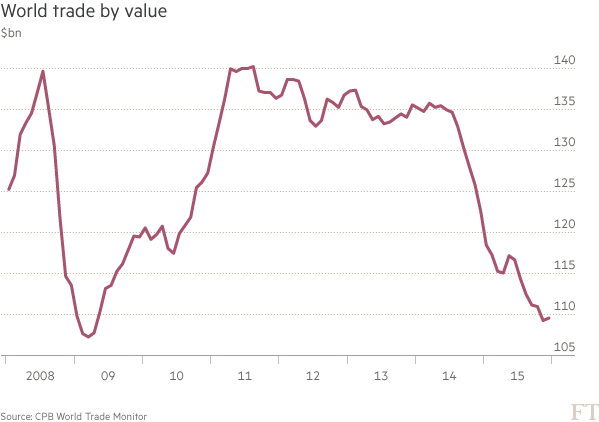
• World Trade Falls 13.8% In Dollar Terms (FT)
• Scepticism Rife Over G20 Move To Calm FX (FT)
• G20 To Say World Needs To Look Beyond Ultra-Easy Policy For Growth (Reuters)
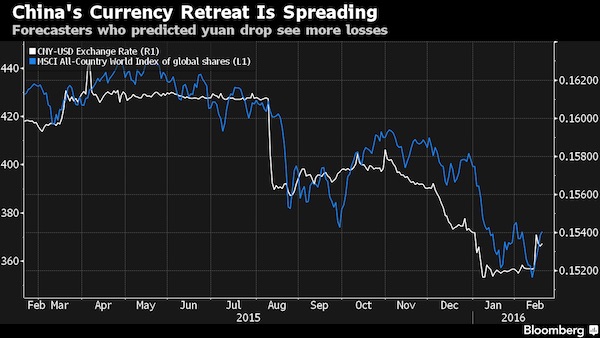
• As China’s Economic Picture Turns Uglier, Beijing Applies Airbrush (NY Times)
• Chinese Accounting Is ‘Highly Questionable’ (CNBC)
• China Commodities Industry Resists Cuts Despite Production Glut (BBG)
• Yuan Uncertainty Scares Funds Away From China Bond Market (BBG)
• Germany Lays the Foundations for a New Eurozone Debt/Banking Crisis (Fazi)
• Societe Generale Slashes Forecast For European Stocks (BBG)
• Japan Builds $124 Billion Cash Hoard Even as It Cuts Treasuries (BBG)
• “Peak Stupidity” – Where We Go From Here (Beversdorf)
• Bankers Have Not Learnt The Lessons Of The Great Crash (Tel.)
• Bank Of America Preparing Big Layoffs In Investment Banking And Trading (BI)
• UBS Accused of Money Laundering in Belgian Tax Case (BBG)
• With No Unified Refugee Strategy, Europeans Return to Old Alliances (NY Times)
• More Migrants Trapped In Greece As Balkan Countries Enforce Limits (Kath.)
• EU Med Countries Oppose Unilateral Actions On Refugee Crisis (AP)

Reality.

• World Trade Falls 13.8% In Dollar Terms (FT)

Weaker demand from emerging markets made 2015 the worst year for world trade since the aftermath of the global financial crisis, highlighting rising fears about the health of the global economy. The value of goods that crossed international borders last year fell 13.8% in dollar terms — the first contraction since 2009 — according to the Netherlands Bureau of Economic Policy Analysis’s World Trade Monitor. Much of the slump was due to a slowdown in China and other emerging economies. The new data released on Thursday represent the first snapshot of global trade for 2015. But the figures also come amid growing concerns that 2016 is already shaping up to be more fraught with dangers for the global economy than previously expected.

Those concerns are casting a shadow over a two-day meeting of G20 central bank governors and finance ministers due to start on Friday. Mark Carney, the Bank of England governor, was set to warn the gathering that the global economy risked “becoming trapped in a low growth, low inflation, low interest rate equilibrium”. His comments will echo the IMF, which this week warned it was poised to downgrade its forecast for global growth this year, saying the world’s leading economies needed to do more to boost growth. The Baltic Dry index, a measure of global trade in bulk commodities, has been touching historic lows. China, which in 2014 overtook the US as the world’s biggest trading nation, this month reported double-digit falls in both exports and imports in January.

In Brazil, which is now experiencing its worst recession in more than a century, imports from China have collapsed. Exports from China to Brazil of everything from cars to textiles shipped in containers fell 60% in January from a year earlier while the total volume of imports via containers into Latin America’s biggest economy halved, according to Maersk Line, the world’s largest shipping company. “What we are seeing right now from China is not only a phenomenon for Brazil; we are seeing the same all over Latin America, declining [Chinese export] volumes into all the markets,” said Antonio Dominguez, managing director for Maersk Line in Brazil, Paraguay, Uruguay and Argentina. “It has been going on for several quarters but is getting more evident as we move into the year [2016].”

Read more …

Currency war Mexican standoff.

• Scepticism Rife Over G20 Move To Calm FX (FT)

Scepticism is rife that the G20 gathering of finance ministers will agree to co-ordinate currency policy but there is some belief it could provide a short-term boost to risk appetite. Japan has led calls for the two-day meeting in Shanghai to bring calmness to an unstable market with a broad-based FX strategy, seen by some market commentators as a reprise of the 1985 Plaza Accord that succeeded in weakening a rampant dollar. But those hopes have been knocked back by China and the US, and market expectations have been subdued in the run-up to the G20 meeting that ends with a communique on Saturday. “A grand solution like the Plaza Accord feels far-fetched”, said Peter Rosenstrich at the online bank Swissquote.

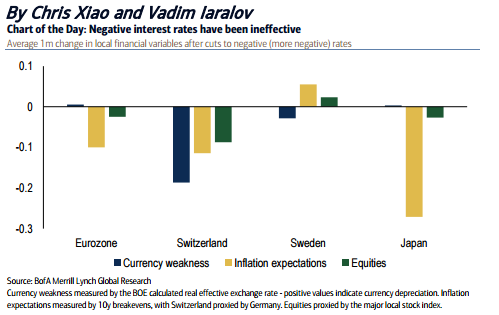
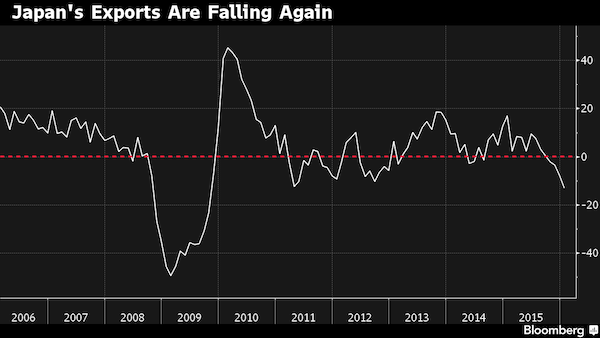
“G20 members were ‘too unique’ to agree which currencies were mispriced, while to decide who wins and who loses would be ‘far too complex'” , he said. Some FX strategists are braced for a negative market reaction to the G20 meeting, basing their fears on the experience of previous gatherings. “Our fear is that…there may yet be a sense of despondency, an ‘is that it’ moment, should the G20 be seen to be papering over some rather large cracks in an all too familiar fashion“, said Neil Mellor at BNY Mellon. Market turmoil has driven a sharp rise in the value of the yen against the dollar, causing alarm at the Bank of Japan and jeopardising the government’s Abenomics growth strategy.

Japan’s negative interest rates policy, which came under attack as the G20 meeting began, has failed to reverse the yen’s rise, leading to heightened expectation of unilateral FX intervention by the BoJ. David Bloom, head of FX research at HSBC, said that possibility had been put on hold in the build-up to the G20 meeting, given the potential backlash from other G20 members. “But once that peer pressure passes after the meeting, FX intervention could be back on the table, he warned”. “Any push in USD-JPY towards 110 could be enough to trigger the green light on direct intervention”, said Mr Bloom. The best that can be hoped for from the meeting, said Steven Englander at Citigroup, was a communique that convinced investors that global policymakers are ‘sufficiently on the same page to add to global confidence’.

Read more …

A whole lot of nothing. They -make that we- are going to regret this. But the political climate is not there to act.

• G20 To Say World Needs To Look Beyond Ultra-Easy Policy For Growth (Reuters)

The world’s top economies are set to declare on Saturday that they need to look beyond ultra-low interest rates and printing money if the global economy is to shake off its torpor, while promising a new focus on structural reform to spark activity. A draft of the communique to be issued by the Group of 20 (G20) finance ministers and central bankers at the end of a two-day meeting in Shanghai reflected myriad concerns and policy frictions that have been exacerbated by economic uncertainty and market turbulence in recent months. “The global recovery continues, but it remains uneven and falls short of our ambition for strong, sustainable and balanced growth,” the leaders said in a draft seen by Reuters. “Monetary policies will continue to support economic activity and ensure price stability … but monetary policy alone cannot lead to balanced growth.”

Geopolitics figured prominently, with the draft noting risks and vulnerabilities had risen against a backdrop that includes the shock of a potential British exit from the European Union, which will be decided in a June 23 referendum, rising numbers of refugees and migrants, and downgraded global growth prospects. But there was no sign of coordinated stimulus spending to spark activity, as some investors had been hoping after the market turmoil that began 2016. Divisions have emerged among major economies over the reliance on debt to drive growth and the use of negative interest rates by some central banks, such as in Japan. Germany had made it clear it was not keen on new stimulus, with Finance Minister Wolfgang Schaeuble saying on Friday the debt-financed growth model had reached its limits.

“It is even causing new problems, raising debt, causing bubbles and excessive risk taking, zombifying the economy,” he said. The G20, which spans major industrialized economies such as the United States and Japan to the emerging giants of China and Brazil and smaller economies such as Indonesia and Turkey, reiterated in the communique a commitment to refrain from targeting exchange rates for competitive purposes, including through devaluations. While G20 host China has ruled out another devaluation of the yuan after surprising markets by lowering its exchange rate last August, there still appeared to be concerns that some members may seek a quick fix to domestic woes through a weaker currency.

Japanese finance minister Taro Aso said late on Friday he had urged China to carry out currency reform and map out a mid-term structural reform plan with a timeframe. U.S. Treasury Secretary Jack Lew also encouraged China on Friday to shift to a more market-oriented exchange rate in “an orderly way” and “refrain from policies that would be destabilizing and create an unfair advantage”.

Read more …

“Data disappears when it becomes negative..”

• As China’s Economic Picture Turns Uglier, Beijing Applies Airbrush (NY Times)

This month, Chinese banking officials omitted currency data from closely watched economic reports. Weeks earlier, Chinese regulators fined a journalist $23,000 for reposting a message that said a big securities firm had told elite clients to sell stock. Before that, officials pressed two companies to stop releasing early results from a survey of Chinese factories that often moved markets. Chinese leaders are taking increasingly bold steps to stop rising pessimism about turbulent markets and the slowing of the country’s growth. As financial and economic troubles threaten to undermine confidence in the Communist Party, Beijing is tightening the flow of economic information and even criminalizing commentary that officials believe could hurt stocks or the currency.

The effort to control the economic narrative plays into a wide-reaching strategy by President Xi Jinping to solidify support at a time when doubts are swirling about his ability to manage the tumult. The persistence of that tumult was underscored on Thursday by a 6.4% drop in Chinese stocks, which are now down more than a fifth since the beginning of this year alone. The government moved to bolster confidence on Saturday by ousting its top securities regulator, who had been widely accused of contributing to the stock market turmoil. Mr. Xi is also putting pressure on the Chinese media to focus on positive news that reflects well on the party. But the tightly scripted story makes it ever more difficult to get information needed to gauge the extent of the country’s slowdown, analysts say. “Data disappears when it becomes negative,” said Anne Stevenson-Yang, co-founder of J Capital Research, which analyzes the Chinese economy.

The party’s attitude has raised further questions among executives and economists over whether Chinese policy makers know how to manage a quasi-market economy, the second-largest economy in the world, after that of the United States. Economists have long cast some doubt on Chinese official figures, which show a huge economy that somehow manages to avoid the peaks and valleys that other countries regularly report. In recent years, China made efforts to improve that data by releasing more information more frequently, among other measures. It also gave its financial media greater freedom, even as censors kept a tight leash on political discourse. But the party now sees reports of economic turbulence as a potential threat. The same goes for data. “Many economic indicators are on a downward trend in China, and economic data has become quite sensitive nowadays,” said Yuan Gangming, a researcher at the Center for China in the World Economy at Tsinghua University.

Read more …

Analysts are not ging to leave this alone anymore.

• Chinese Accounting Is ‘Highly Questionable’ (CNBC)

Financial reporting in China was back in the spotlight again Friday, with one strategist claiming Chinese businesses were using “accounting trickery” to mask underlying credit problems. China looks like it’s heading towards a credit bust, Chris Watling, CEO and chief market strategist at Longview Economics told CNBC on Friday, explaining that cash borrowed by mainland firms is primarily being used to service debts. “We’ve been looking a lot at Chinese accounting recently and it is highly questionable,” he said. The corporate sector is increasing borrowing to pay interest, while instances of fraud and default are on the rise, he added in a note published Thursday. He said there were many examples where operating profit has been high, while cash flow has been negative — a “classic sign” that firms aren’t generating a profit, he added.

Watling highlighted that the balance sheets of commercial banks were particularly worrying. “In an economy which has undergone a credit boom, all of the lending is not necessarily readily apparent from the top level data,” he said. “Accounting trickery is often at work,” Watling claimed. Chinese corporates would reject the accusations, but this isn’t the first time there has been speculation over the accuracy of Chinese figures. Back in September, the state’s statistics bureau announced it would officially change the way it calculated gross domestic product amid skepticism over the credibility of the numbers as the government sought to sooth reaction to China’s economic slowdown. Watling now claims lenders are using tricks like labelling loan collateral as revenue in their balance sheets, rather than as a creditor.

And it may be helping inflate banks’ balance sheets, which in aggregate have increased tenfold in 10 years to over three times gross domestic product at $30 trillion, he said. However, whether this will help lead to a devastating credit bust isn’t clear, Watling explained, saying that while the cracks are starting to show, the economy is managed so differently that normal market rules don’t necessarily apply. A current slowdown in Chinese growth comes at a time when the country’s leadership is stepping up regulation, curbing an overheated credit market and switching an export-focused economy into a consumer-driven one. After double-digit growth for the last decade, investors and officials in China are coming to terms with growth that has fallen below 7%, hitting a 25- year low.

Read more …

“China produces more than double the steel of Japan, India, the U.S., and Russia—the four next-largest producers—combined..”

• China Commodities Industry Resists Cuts Despite Production Glut (BBG)

China has had an overcapacity problem in its aluminum, chemical, cement, and steel industries for years. Now it’s reaching crisis levels. “The situation has gone so dramatically bad that action has to happen very soon,” said Jörg Wuttke, president of the European Union Chamber of Commerce in China, at a press conference in Beijing on Feb. 22, where a chamber report on excess capacity was released. That report’s conclusion: “The Chinese government’s current role in the economy is part of the problem,” while overcapacity has become “an impediment to the party’s reform agenda.” Many of the unneeded mills, smelters, and plants were built or expanded after China’s policymakers unleashed cheap credit during the global financial crisis in 2009. The situation in steel is especially dire.

China produces more than double the steel of Japan, India, the U.S., and Russia—the four next-largest producers—combined, according to the EU Chamber of Commerce. That’s causing trade frictions as China cuts prices. On Feb. 12 the EU announced it would charge antidumping duties of as much as 26.2% on imports of Chinese non-stainless steel. Steel mills are running at about 70% capacity, well below the 80% needed to make the operations profitable. Roughly half of China’s 500 or so steel producers lost money last year as prices fell about 30%, according to Fitch Ratings. Even so, capacity reached 1.17 billion tons, up from 1.15 billion tons the year before. With about one-quarter of China’s steel production coming from Beijing’s neighboring province of Hebei, excess production is a major contributor to the capital’s smoggy skies.

And with average steel prices likely to fall an additional 10% in 2016, fears of spiraling bad debts are growing. A survey released in January by the China Banking Association and consulting firm PwC China found that more than four-fifths of Chinese banks see a heightened risk that loans to industries with overcapacity may sour. [..] China will “actively and steadily push forward industry and resolve excess capacity and inventory,” the People’s Bank of China said on Feb. 16 after a meeting with the National Development and Reform Commission, the banking regulatory commission, and other agencies.

The government may find it hard to achieve that goal. The steel industry will lose as many as 400,000 jobs as excess production is shuttered, Li Xinchuang, head of the China Metallurgical Industry Planning and Research Institute, predicted in January. Hebei and the industrial northeastern provinces of Heilongjiang, Jilin, and Liaoning, home to much of China’s steel production, don’t have lots of job-creating companies to absorb unemployed steelworkers. “They are concerned about the possibility of social unrest with workers’ layoffs,” says Peter Markey at consultants Ernst & Young. “As you can see around the world, steelworkers are pretty feisty people when it comes to protests.”

Read more …

The big kahuna that should dominate the G20.

• Yuan Uncertainty Scares Funds Away From China Bond Market (BBG)

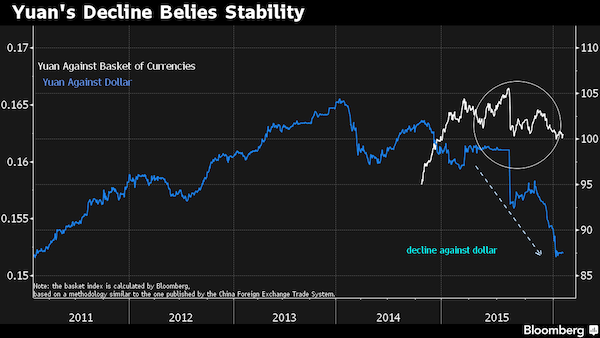
Yield versus yuan. That’s the crux of the investment decision now facing the global funds given more access to China’s bond market. While it offers the highest yields among the world’s major economies, PIMCO and Schroder Investment say exchange-rate risk is damping global demand for Chinese assets. Barclays said this week there’s a growing chance China will announce a sharp, one-time devaluation to change sentiment toward the currency and suggested such a move would need to be in the region of 25% to be effective. “Uncertainty around currency policy remains one of the larger hurdles for foreign investors,” said Rajeev De Mello at Schroder Investment in Singapore. “This should be resolved as the year progresses and would then be a signal to increase investments in Chinese government bonds.”

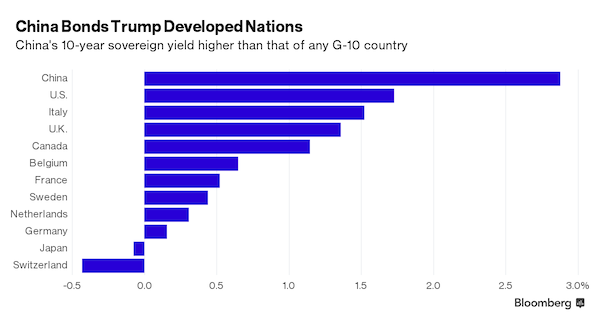
The People’s Bank of China said Wednesday that most types of overseas financial institutions will no longer require approvals or quotas to invest in the 35 trillion yuan ($5.4 trillion) interbank bond market, which had foreign ownership of less than 2% at the end of January. The nation’s 10-year sovereign yield of 2.87% compares with 1.74% in the U.S., which offers the highest rate among Group of 10 countries, and sub-zero in Japan and Switzerland. The yuan has weakened 5% versus the dollar since a surprise devaluation in August, even as the central bank burnt through more than $400 billion of the nation’s foreign-exchange reserves over the last six months trying to support the exchange rate amid record capital outflows.

China is opening its capital markets to foreign investors to try and draw money as the slowest economic growth in a quarter century drives funds abroad, pressuring the yuan. Freer access will help the nation’s bonds gain entry to global benchmarks, bolstering appetite for the securities as a restructuring of local-government debt spurs record issuance. Uncertainty on the currency is preventing investors from buying onshore assets now, according to Luke Spajic, an emerging markets money manager at Pimco, whose developing-nation currency fund has outperformed 82% of peers during the past five years. “If you buy these bonds, collect coupons, make some profits, how can you take the money out, are there any issues.” Spajic said in an interview in Shanghai on Thursday. “What we want to clarify is how this process works now, given the capital control environment.”
Read more …

“.. in the case of a country like Italy, where the banks own around €400 billion of government debt and are already severely undercapitalised, the effects on the banking system would be catastrophic.”

• Germany Lays the Foundations for a New Eurozone Debt/Banking Crisis (Fazi)

In recent weeks, Germany has put forward two proposals for the future viability of the EMU that, if approved, would radically alter the nature of the currency union. For the worse. The first proposal, already at the centre of high-level intergovernmental discussions, comes from the German Council of Economic Experts, the country s most influential economic advisory group (sometimes referred to as the ‘five wise men’). It has the backing of the Bundesbank, of the German finance minister Wolfgang Sch‰uble and, it would appear, even of Mario Draghi.

Ostensibly aimed at severing the link between banks and government (just like the banking union) and ensuring long-term debt sustainability , it calls for: (i) removing the exemption from risk-weighting for sovereign exposures, which( essentially means that government bonds would longer be considered a risk-free asset for banks (as they are now under Basel rules), but would be ‘weighted’ according to the ‘sovereign default risk’ of the country in question (as determined by the fraud-prone rating agencies depicted in The Big Short); (ii) putting a cap on the overall risk-weighted sovereign exposure of banks; and (iii) introducing an automatic sovereign insolvency mechanism that would essentially extend to sovereigns the bail-in rule introduced for banks by the banking union, meaning that if a country requires financial assistance from the European Stability Mechanism (ESM), for whichever reason, it will have to lengthen sovereign bond maturities (reducing the market value of those bonds and causing severe losses for all bondholders) and, if necessary, impose a nominal ‘haircut’ on private creditors.

The second proposal, initially put forward by Schaeuble and fellow high-ranking member of the CDU party Karl Lamers and revived in recent weeks by the governors of the German and French central banks, Jens Weidmann (Bundesbank) and François Villeroy de Galhau (Banque de France), calls for the creation of a eurozone finance ministry , in connection with an independent fiscal council . At first, both proposals might appear reasonable – even progressive! Isn’t an EU- or EMU-level sovereign debt restructuring mechanism and fiscal authority precisely what many progressives have been advocating for years? As always, the devil is in the detail.

As for the proposed ‘sovereign bail-in’ scheme, it s not hard to see why it would result in the exact opposite of its stated aims. The first effect of it coming into force would be to open up huge holes in the balance sheets of the banks of the riskier countries (at the time of writing, all periphery countries except Ireland have an S&P rating of BBB+ or less), since banks tend to hold a large percentage of their country’s public debt; in the case of a country like Italy, where the banks own around €400 billion of government debt and are already severely undercapitalised, the effects on the banking system would be catastrophic.

Read more …

“..in light of the downgraded U.S. economic outlook,..”

• Societe Generale Slashes Forecast For European Stocks (BBG)

The biggest bull on European stocks just buckled. Societe Generale, among the few firms that hadn’t cut 2016 estimates in response to global-growth concerns, now has the most bearish forecast. The bank sees the Euro Stoxx 50 Index ending 2016 at 3,000, up just 4.3% from Thursday’s close. It’s a far cry from only two weeks ago. Europe’s equities were at a 2 1/2-year low, yet the bank’s call for an year-end level of 4,000 translated to an almost 50% advance. Societe Generale also cut its estimate for the Stoxx Europe 600 Index to 340, indicating a 4.1% rise from the last close. “We trim our equity market forecasts in light of the downgraded U.S. economic outlook,” strategists led by Roland Kaloyan wrote in a report.
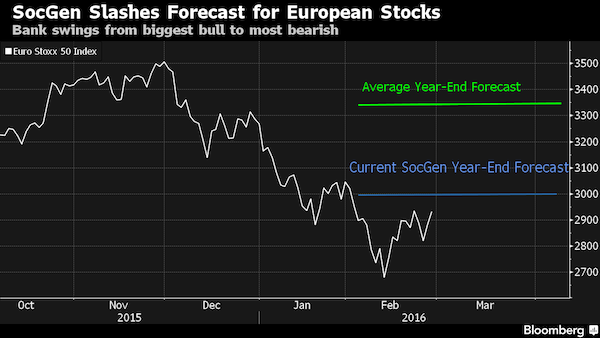
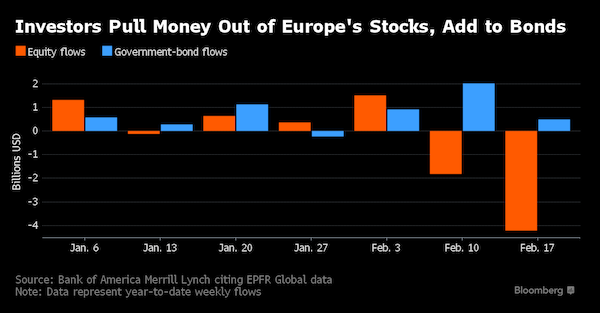
“We nevertheless maintain a positive stance on equities, as the recent correction already prices in this scenario to a certain extent. Equity indices should recover in the second quarter from oversold levels, followed by low single-digit quarterly declines in the second half of the year.” Societe Generale favors French and Italian stocks, citing “improving economic momentum,” while saying weakness in China will likely pressure the DAX Index. Along with the Swiss Market Index, the German benchmark is among the bank’s least-preferred markets in Europe. European equity funds had a third straight week of outflows, according to a Bank of America note on Friday citing EPFR Global data. Societe Generale analysts also expect the U.K. equity market to benefit from “rising Brexit fever.” It now expects the FTSE 100 Index to end the year at 6,400, up 6.4% from yesterday’s closing level.

Read more …

The power of the dollar.

• Japan Builds $124 Billion Cash Hoard Even as It Cuts Treasuries (BBG)

Japan has stockpiled a record amount of cash at central banks as part of its currency reserves, after selling Treasuries, as policy makers around the world adjust to rising U.S. interest rates and falling bond-market liquidity. Foreign-exchange deposits in the vaults of overseas institutions ballooned to $124.1 billion as of Jan. 31, from $14 billion at the end of 2014, according to data from Japan’s Ministry of Finance. That’s the most based on figures going back to 2000, and accounts for about 10% of the nation’s total reserves. While the figure isn’t broken down, it coincides with a surge in greenbacks held by global central banks at the Fed. Any shift away from Treasuries would protect Japan’s reserves from potential losses as the Fed extends monetary policy tightening and concerns rise over bond-market liquidity.
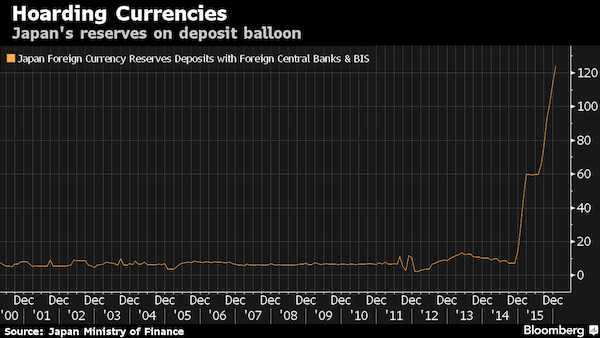
Dollar holdings kept in cash stand to benefit from higher U.S. interest rates and a stronger currency, even as monetary authorities in Japan and across Europe start charging banks for some deposits. “Everybody’s devaluing their currencies, everywhere across the planet, except the U.S. dollar,” said John Gorman at Nomura, the nation’s biggest brokerage. “People are more comfortable putting their reserves in a currency that’s appreciating rather than a currency that’s depreciating. An official in the office of foreign exchange reserve management in the Ministry of Finance declined to comment on the matter, saying it can affect markets. The increase in Japan’s cash at foreign institutions is a change in the composition of the country’s foreign-exchange reserves. The overall stockpile, the world’s largest after China’s, has fallen almost 3% to $1.19 trillion since it reached a record at the start of 2012.

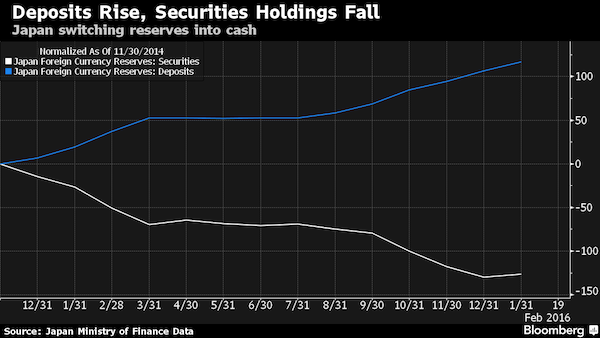
Japan, America’s largest overseas creditor after China, is cutting its Treasuries position. The stake among both government and private investors dropped 8.8% in 2015, the first sales since 2007, based on the most recent Treasury Department data. The reduction dovetails with a decline in foreign securities in Japan’s foreign exchange reserves. Since November 2014, bond holdings fell $126.4 billion, while deposits rose $116.9 billion. The strategy of selling Treasuries and holding dollars would allow investors to get out of older U.S. government securities that can be difficult to trade and may get even tougher to transact if the Fed raises rates further. Declining liquidity in the Treasury market is driving demand for the newest, easiest-to-sell securities. When policy makers increased benchmark borrowing costs in December, they indicated they will act four more times in 2016. Even so, the Bloomberg U.S. Treasury Bond Index has advanced 3.4% so far in 2016 in a flight from riskier assets.
Read more …

Something tells me we can always get stupider.

• “Peak Stupidity” – Where We Go From Here (Beversdorf)

A reminder of what the market actually represents is a good place to start.  The stock market is simply an asset with some intrinsic value based on an expectation of future free cash flows to equity holders.  Those cash flows are generated from revenues less costs of the underlying companies that make up the market.  Let’s use the Wilshire 5000 Full Price Cap Index as the proxy market for this discussion as it is the broadest measure of total market cap for US corporations.  It’s level actually represents market capital in billions.

Screen Shot 2016-02-25 at 8.29.51 PM

So the market has put a valuation on those expected future cash flows to equity holders (as of today) at around $19.7T (a 55% increase from Jan of 2012) down from around $22.5T (a 77% increase from Jan of 2012) at the market peak last summer.  So let’s take a look at the growth in cash flows of US corporations over that same period.  We should expect to find a growth pattern in free cash flows similar to the above growth pattern in the overall market valuation (the Wilshire is a statistically large enough sample to be representative of total US corporations).  Let’s have a look…
Screen Shot 2016-02-26 at 11.53.09 AM

The above chart depicts corporate free cash flows (blue line) indexed to 100 in Jan 2012.  It is obtained by taking the BEA’s Net Cash Flow with IVA and CCAdj adding back depreciation and net dividends and subtracting net capex.  (The actual definitions of these can be found here.) What we find is that while the current valuation of expected future free cash flows to equity holders (i.e. market cap of Wilshire) has increased by some 55% since the end of 2011, the actual free cash flows of US corporations have only increased by 4%.

This becomes a very difficult fact to reconcile inside the classroom.  Why would market participants be baking in so much growth when the actual data simply doesn’t support it?

Well there are plenty of potential explanations.  For instance, rarely are investors rational.  While buy low and sell high is rational investing behaviour, often market euphoria comes at the market top right before a major sell off, leading to a buy high and sell low strategy.  Another reason is that the Fed has been providing a free put to all investors for the past 7 years essentially significantly reducing naturally occurring risk factors.  But whatever the reason this dislocation between expected and realized growth begs the question, how long can it last?  So let’s explore this issue.

Below is a longer term growth chart of the Wilshire vs US corporate free cash flows to equity holders both indexed to 1995 (i.e. 1995 = 100).

Screen Shot 2016-02-25 at 7.31.21 PM

And so over the past 20 years we’ve seen this same type of dislocation three times.  That is, we see expectations of growth far exceeding actual growth of free cash flows to equity holders.  In the previous two dislocations we reached a peak dislocation (peak stupidity) followed by a reversion to reality (epiphany) where expected growth moves back in line with actual growth.

Read more …

“Whereas US banking sector assets were worth only 80% of its GDP, Britain’s were worth 500%..”

• Bankers Have Not Learnt The Lessons Of The Great Crash (Tel.)

Barack Obama used to talk about the audacity of hope. Mervyn King was Governor of the Bank of England during ‘the biggest financial crisis this country has faced since 1914’. Its lesson, he says, is that we now need ‘the audacity of pessimism’. Only when we fully understand how badly things went wrong – and why they are still wrong today – can we start to put them right. His new book suggests how. I meet Lord King in his modest office at the London School of Economics. Typically, he is just off to the West Midlands for a dinner for famous sons of Wolverhampton. He is a proud provincial boy, not a City slicker. I ask him to recall the moment he first understood the depth of the problem facing the world. Back in September 2007, when he ‘it was already clear that Northern Rock would need support’, King recalls, he was in Basel for a conference.

There was alarm in the United States because ‘sub-prime’ mortgages were collapsing. The central bank supervisors at the conference insisted that sub-prime failure could not bring down the system. But King talked to his friend Stan Fischer, then Governor of the Bank of Israel. They shared their fears: ‘If the only thing that goes wrong is sub-prime, ok. But what else could go wrong? What if the unimaginable happens?’ It did. Over the next two months, says King, he became obsessed with the need for more equity capital in the banking system. The banks resisted at first and ‘The politicians [Gordon Brown’s government] were susceptible to pressure from the banks’. But ‘we limped along till the bankruptcy of Lehman Brothers’ in September 2008. Then ‘the banking of the entire industrial world was at risk of collapse’.

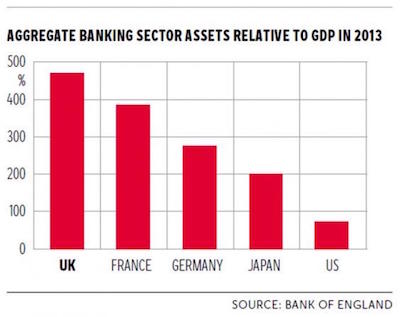
Britain – without a proper ‘bank resolution regime’ which, says King, ‘could have solved the problem of Northern Rock in a weekend, without fuss’ – was enormously vulnerable. Whereas US banking sector assets were worth only 80% of its GDP, Britain’s were worth 500%, a terrifying ratio. New Labour, having turned its back on nationalisation, had to revert to it: ‘It must have been galling for them.’ In Mervyn King’s mind, the credit crunch was brought about by something profoundly wrong. Bankers had been encouraged to take enormous risks with the customers’ money, enrich themselves and then dump the losses on the taxpayer. Huge pay increases for senior executives had produced a ‘very unattractive culture when clever people started to say to themselves: “I’m smart, I can make money out of people who don’t understand this”.’

Read more …

One by one they fall: “..the firm’s investment-banking revenues are forecast to be down 25% in the first quarter. Markets revenues are down 20% year-on-year..”

• Bank Of America Preparing Big Layoffs In Investment Banking And Trading (BI)

Bank of America is preparing for significant job cuts across its global banking and markets business, according to people with knowledge of the matter. Senior executives in the division were tasked with identifying potential job cuts a few weeks ago, and this week were asked to increase their size, according to people familiar with the situation. The cuts are likely to be over 5% of staff, the people said. Some business lines will face deeper cuts than others, and the details haven’t been finalized. Employees could be told of the cuts as soon as March 8, one of the people said, which is weeks sooner than managers were initially expecting. The people didn’t know the reasons the cuts had been pushed forward.

BofA is joining firms across Wall Street in paring back staff amid one of the worst quarters for investment-banking and trading revenues. Business Insider reported on Monday that Deutsche Bank was cutting 75 staff in fixed income, while Morgan Stanley and Barclays have also recently cut staff. Daniel Pinto, CEO of JPMorgan’s corporate and investment bank, said on Tuesday that the firm’s investment-banking revenues are forecast to be down 25% in the first quarter. Markets revenues are down 20% year-on-year, Pinto said, speaking at JPMorgan’s Investor Day conference.

Read more …

Their shareholders will pay the fine.

• UBS Accused of Money Laundering in Belgian Tax Case (BBG)

Belgian authorities accused UBS of money laundering and fiscal fraud over allegations it helped clients evade taxes, citing help from France where the Swiss bank is fighting similar accusations. The investigating judge also accused UBS of illegally approaching Belgian clients directly rather than through its Belgian unit, according to an e-mailed statement Friday from the Brussels prosecutor’s office. UBS said it will continue to defend itself against any unfounded allegations. The probe is continuing and the investigating judge will present his findings to prosecutors at a later date. The accusations are based on strong evidence of guilt uncovered by the investigative magistrate, said Jennifer Vanderputten, a spokeswoman at the prosecutor’s office. UBS will be given the right to access evidence supporting the allegations, she said.

The Belgian prosecutor cited “excellent collaboration” with authorities in France, where UBS is awaiting a decision on whether it will face trial for allegedly helping clients evade taxes. UBS is also accused in France of laundering proceeds from tax evasion. Investigating judges in France wrapped up their formal investigation earlier this month, turning the case over to the national financial prosecutor who will make a recommendation on whether it goes to trial. The bank, which has called the French allegations “unfounded,” was forced to post a bail of 1.1 billion euros ($1.2 billion). Friday’s decision came after the head of UBS’s Belgium unit was similarly accused in 2014 of money laundering and fiscal fraud as part of the probe. Marcel Bruehwiler was questioned for several hours before being released in June 2014.

Read more …

Yeah, like Middle Ages.

• With No Unified Refugee Strategy, Europeans Return to Old Alliances (NY Times)

Roughly five weeks ago, Donald Tusk, one of the EU’s most powerful political figures, issued a blunt warning to its 28 countries: Come up with a coherent plan to tackle the refugee crisis within two months, or risk chaos. Surprisingly, given the plodding pace of European Union policy making, three weeks before Mr. Tusk’s deadline, many of Europe’s national leaders are now moving swiftly, announcing tough new border policies and guidelines on asylum — even with three weeks remaining on the deadline set by Mr. Tusk, president of the European Council. The problem is that the leaders are not always adhering to European rules, possibly not sticking to international law and not acting with the unity envisioned by Mr. Tusk. In some cases, they instead seem to be reverting to historical alliances rather than maintaining the EU’s mantra of solidarity.

This week, Austria joined with many of the Balkan countries to approve a tough border policy in what some are wryly calling the return of the Hapsburg Empire. Four former Soviet satellites, led by Poland and Hungary, have become another opposition power bloc. All the while, a call for unity by Chancellor Angela Merkel of Germany is increasingly being ignored, even as she struggles to tamp down on a political revolt at home while searching for a formula to reduce the number of refugees still trying to reach Germany. “We are now entering a situation in which everybody is trying to stop the refugees before they reach their borders,” said Ivan Krastev, chairman of the Center for Liberal Strategies, a research institute in Sofia, Bulgaria. Mr. Krastev added, “The basic question is, which country turns into a parking lot for refugees?”

For many months, European Union officials, joined by Ms. Merkel, have tried to share the burden by distributing quotas of the refugees already in Greece and Italy to different member states. Many states have balked, and the program is largely paralyzed. European Union leaders also agreed to pay 3 billion euros, roughly $3.3 billion, to aid organizations in Turkey to help stanch the flow of migrants departing the Turkish coast for the Greek islands. But record numbers of migrants keep coming.

Read more …

What will this lead to?

• More Migrants Trapped In Greece As Balkan Countries Enforce Limits (Kath.)

The European Commission said Friday that it is putting together a humanitarian aid plan for Greece as Balkan countries placed further restrictions on the numbers of refugees and migrants that could cross their territories. As of last night, authorities in the Former Yugoslav Republic of Macedonia (FYROM) had not allowed any refugees to pass from Greece. Earlier, Slovenia, Croatia and Serbia said they would each restrict the number of migrants allowed to enter their territories to 580 per day. The clampdown comes in the wake of Austria last week introducing a daily cap of 80 asylum seekers and saying it would only let 3,200 migrants pass through each day. As border restrictions north of Greece have been stepped up, the number of migrants and refugees stuck in the country has increased.

The government is attempting to stem the flow of migrants to mainland Greece by asking ferry companies to delay crossings from the Aegean islands, but between 2,000 and 3,000 people are arriving in Greece each day. It is estimated that there are currently 20,000 to 25,000 in the country. Some of them are out in the open, having chosen not to remain in transit centers or other temporary shelters provided by Greek authorities. Several thousand have reached the village of Idomeni at the border with FYROM, where conditions were said to be deteriorating last night as a result of bad weather.

The government launched a hotline for people or companies who want to donate items that are in need at the moment, such as non-perishable food, sneakers, towels and plastic cutlery. European Commission spokeswoman Natasha Bertaud admitted Friday that due to the changing situation in Greece, Brussels is putting together an “emergency plan” to avert a humanitarian crisis in Greece. Speaking at an economic forum in Delphi yesterday, Migration Commissioner Dimitris Avramopoulos warned that the upcoming summit between EU members and Turkey on March 7 would be crucial to addressing the growing crisis. “If there is no convergence and agreement on March 7, we will be led to disaster,” the former Greek minister said.

Read more …

Is this the bombshell?!: UN’s Peter Sutherland says: “Any country that unilaterally rejects an EU law duly enacted on migration or otherwise cannot remain a member of the Union”

• EU Med Countries Oppose Unilateral Actions On Refugee Crisis (AP)

The rift over how to handle Europe’s immigration crisis ripped wide open Friday. As nations along the Balkans migrant route took more unilateral actions to shut down their borders, diplomats from EU nations bordering the Mediterranean rallied around Greece, the epicenter of the crisis. Cypriot Foreign Minister Ioannis Kasoulides — speaking on behalf of colleagues from France, Spain, Italy, Portugal, Malta and Greece — said decisions on how to deal with the migrant influx that have already been made by the 28-nation bloc cannot be implemented selectively by some countries. “This issue is testing our unity and ability to handle it,” Kasoulides told a news conference after an EU Mediterranean Group meeting. “The EU Med Group are the front-line states and we all share the view that unilateral actions cannot be a solution to this crisis.”

Kasoulides urged EU countries to enact all EU decisions on immigration so there “will be no unfairness to anybody.” Greek Foreign Minister Nikos Kotzias blasted some European nations for imposing border restrictions on arriving migrants, saying that police chiefs are not allowed to decide to overturn EU decisions. He said Mediterranean colleagues were “unanimous” in their support for Greece’s position on the refugee crisis and that there was “clear criticism to all those who are seeking individual solutions at the expense of other member states.” The Greek government is blaming Austria — a fellow member of Europe’s Schengen Area — for the flare-up in the crisis. Austria imposed strict border restrictions last week, creating a domino effect as those controls were also implemented by Balkan countries further south along the Balkans migration route.

Greece recalled its ambassador to Austria on Thursday and rejected a request to visit Athens by Austrian Interior Minister Johanna Mikl-Leitner. The United Nations secretary-general expressed “great concern” Friday at the growing number of border restrictions along the migrant trail through Europe. Ban Ki-moon’s spokesman said the U.N. chief is calling on all countries to keep their borders open and says he is “fully aware of the pressures felt by many European countries.” The statement noted in particular the new restrictions in Austria, Slovenia, Croatia, Serbia and Macedonia. Thousands of migrants are pouring into Greece every day and officials fear the country could turn into “a giant refugee camp” if they are unable to move north due to borders closures.

In Munich, German Chancellor Angela Merkel echoed the Mediterranean EU ministers in calling for a unified European approach to tackle the migrant crisis. Merkel, who has said that those fleeing violence deserve protection, said she was encouraged by the recent deployment of NATO ships to the Aegean Sea alongside vessels from the European Union border agency Frontex. “NATO has started to work in collaboration with the Turkish coast guard and Frontex. It is too early to see the effects of this measure. All 28 (EU) member states want to stop illegal immigration,” she said. But NATO Secretary-General Jens Stoltenberg said the ships would only be providing a support role. “NATO ships will not do the job of national coastguards in the Aegean. Their mission is not to stop or turn back those trying to cross into Europe,” he wrote.

Read more …

Feb 232016
 
 February 23, 2016  Posted by at 9:59 am Finance Tagged with: , , , , , , , ,  5 Responses »


Dorothea Lange “Men on ‘Skid Row’, Modesto, California” 1937

• Barclays Says Sharp Yuan Devaluation Needed (BBG)
• Standard Chartered Plunges 12% On Annual Loss, Loan Impairments (BBG)
• Financial Time Bombs Hiding In Plain Sight (David Stockman)
• Central Bankers On The Defensive As Weird Policy Becomes Even Weirder (G.)
• Foreign Central Banks Dump Cash At Federal Reserve (Reuters)
• Taxpayers Cannot Bank On An End To The Era Of Too Big To Fail (FT)
• That’s Not A Housing Bubble, This Is A Housing Bubble (BBG)
• The Fatal Flaw That Has Doomed Our Economy (Bonner)
• Cargo Ships Are Being Scrapped Faster Than They Are Being Built (BI)
• OPEC Doesn’t Know How To ‘Live Together’ With Shale Oil (BBG)
• S&P Cuts Rating On BP, Total And Statoil (Reuters)
• The Trickle of US Oil Exports Is Already Shifting Global Power (BBG)
• Crude Glut Could Take Years to Disappear: IEA (WSJ)
• North Sea Oil Investment To Slump 90% This Year As Losses Mount (Tel.)
• Canada PM Trudeau Drops Campaign Promises and Goes All In With Deficits (BBG)
• Number Of Refugees Trapped At Border, Piraeus Builds Up (Kath.)
• Greece Implores Macedonia To Reopen Border To Refugees (Guardian)
• Greek Police Start Removing Refugees From Macedonian Border (Reuters)
• Between Two Taps (Boukalas)

WIll there be a Shanghai Accord at the Feb 26-27 G20 summit?

• Barclays Says Sharp Yuan Devaluation Needed (BBG)

A sharp, one-off devaluation of the yuan is among options China’s central bank might consider to stem capital outflows and shift market psychology to appreciation from depreciation, according to Barclays. The risk of such a move, which Barclays says would need to be in the region of 25% to alter perceptions, is rising as China’s foreign-exchange reserves plunge, analysts Ajay Rajadhyaksha and Jian Chang wrote in a report. Based on the current pace of decline in those holdings, there’s a six- to 12-month window before they drop to uncomfortable levels and measures such as capital controls or monetary tightening may also have to be looked at to curb the exodus of money, they said. All those options carry elements of danger.

Another rapid yuan depreciation could spook investors just as concern about the state of the global economy is growing and other central banks would likely follow, countering the beneficial impact on Chinese exports, the analysts said. Strict capital controls won’t work in an export-driven economy, while a move to policy tightening could slow growth and cause credit defaults, they said. “A devaluation of this magnitude seems impossible to ‘sell’ to the rest of the world,” according to the analysts at Barclays, the world’s third-biggest currency trader. “The People’s Bank of China will probably have to take more aggressive measures to stem outflows,” said head of macro research Rajadhyaksha in New York and Hong Kong-based chief China economist Chang.

[..] Chinese policy makers are trying to counter record outflows and prop up the yuan, while opening up the capital account and keeping borrowing costs low to revive growth in the world’s second-biggest economy. The balancing act challenges Nobel-winning economist Robert Mundell’s “impossible trinity” principle, which stipulates a country can’t maintain independent monetary policy, a fixed exchange rate and free capital borders all at the same time.

Read more …

Not peanuts.

• Standard Chartered Plunges 12% On Annual Loss, Loan Impairments (BBG)

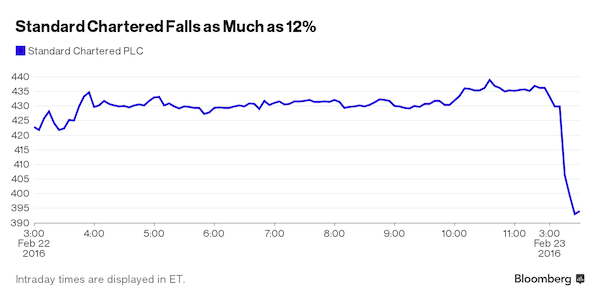
Standard Chartered dropped the most in more than three years after reporting a surprise full-year loss, as revenue missed estimates and loan impairments almost doubled to the highest in the bank’s history. The stock dropped as much as 12% as the London-based bank said its pretax loss was $1.5 billion in 2015, down from profit of $4.2 billion a year earlier. Excluding some one-time items, pretax profit was $834 million. CEO Bill Winters is attempting to unwind the damage caused by predecessor Peter Sands’ revenue-led expansion across emerging markets, which left the bank riddled with bad loans when the commodity market crashed and growth stalled from China to India.

Since June, Winters has raised $5.1 billion from investors, scrapped the dividend and announced plans to cut 15,000 jobs to help save $2.9 billion by 2018, while seeking to restructure or exit $100 billion of risky assets. “While our 2015 financial results were poor, they are set against a backdrop of continuing geo-political and economic headwinds and volatility across many of our markets,” Winters said in the statement. “We expect the financial performance of the group to remain subdued during 2016.”

Read more …

The decline in withholding taxes is significant.

• Financial Time Bombs Hiding In Plain Sight (David Stockman)

[..] Implicit in the whole misbegotten wealth effects doctrine is the spurious presumption that the Wall Street gambling apparatus can be rented for a spell by the central bank. So doing, our monetary central planners believe themselves to be unleashing a virtuous circle of increased spending, income and output, and then more rounds of the same. At length, according to these pettifoggers, production, income and profits catch-up with the levitated prices of financial assets. Accordingly, there are no bubbles; and, instead, societal wealth continues to rise happily ever after. Not exactly. Central bank stimulated financial asset bubbles crash. Every time.

The Fed and other practitioners of wealth effects policy do not rent the gambling apparatus of the financial markets. They become hostage to it, and eventually become loathe to curtail it for fear of an open-ended hissy fit in the casino. Bernanke found that out in the spring of 2013, and Yellen three times now – in October 2014, August 2015 and January-February 2016. But unlike the last two bubble cycles, where our monetary central planners did manage to ratchet the money market rate back up to the 6% and 5% range, by 2000 and 2007, respectively, this time an even more obtuse posse of Keynesian true believers rode the zero bound right to the end of capitalism’s natural recovery cycle.

Accordingly, the casinos are populated with financial time bombs like never before. Worse still, the central bankers are now so utterly lost and confused that they are all thronging toward the one thing that will ignite these time bombs in a fiery denouement. That is, negative interest rates. This travesty reflects sheer irrational desperation among central bankers and their fellow travelers, and will soon illicit a fire storm of political revolt, currency hoarding and revulsion among even the gamblers inside the casino. Besides that, they are crushing bank net interest margins, thereby imperiling the solvency of the very banking system that the central banks claim to have rescued and fixed.

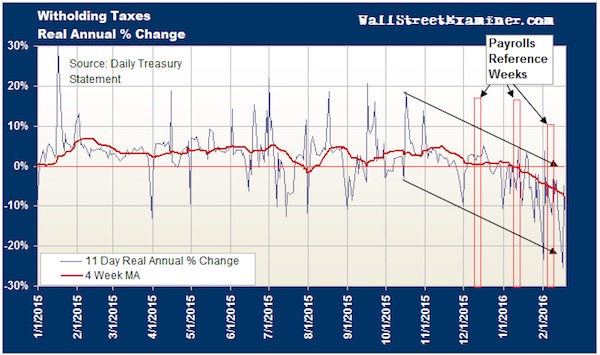
We will treat with some of the time bombs set to explode in the sections below, but first it needs to be emphasized that the third bubble collapse of this century is imminent. That’s because both the global and domestic economy is cooling rapidly, meaning that recession is just around the corner. Based on the common sense proposition that the nation’s 16 million employers send payroll tax withholding monies to the IRS based on actual labor hours utilized – and without any regard for phantom jobs embedded in such BLS fantasies as birth/death adjustments and seasonal adjustments – my colleague Lee Adler reports that inflation-adjusted collections have dropped by 7-8% from prior year in the most recent four-week rolling average.

Read more …

“..what is dressed up as a carefully calibrated policy response is really just blundering around in the dark..”

• Central Bankers On The Defensive As Weird Policy Becomes Even Weirder (G.)

As far as the OECD is concerned, monetary policy is being forced to take too much of the strain. Its chief economist Catherine Mann made the point that lasting recovery required three things: stimulative monetary policy; activist fiscal policy; and structural reform. The OECD wants the second of these ingredients to be added to the recipe in the form of increased spending on public infrastructure, something it says would more than pay for itself at a time when governments can borrow so cheaply.

The Paris-based thinktank says collective action by the world’s leading economies is needed because a go-it-alone approach will result in the effects of stronger demand being blunted by higher imports. It will make the case for higher investment spending at this week’s meeting of the G20 in Shanghai, almost certainly to little effect. Central banks will argue that they still have plenty of ammunition left, even though as the years tick by it becomes more and more apparent that relying solely on monetary policy is the equivalent of pushing on a piece of string. Central banks now have one last chance to live up to their exalted reputations. A prolonged period of low but positive interest rates carries the risk that it will create the conditions for asset price bubbles. That risk is amplified by quantitative easing.

All the dangers associated with low but positive borrowing costs apply to negative interest rates – but with some added complications. One is that it affects the profitability of banks, by squeezing lending spreads, at a time when many of them have yet to make a full recovery from the last crisis. Another is that central banks will overcook things and that the deeper into negative territory interest rates go now the higher they will have to go later. Perhaps though the biggest danger is to the reputation of central banks. Throughout the crisis, the assumption has been that the Federal Reserve, the Bank of England, the ECB, the Bank of Japan and all the other central banks are in control of a tricky situation. Central bankers give the impression that they can model the impact of interest rates and QE on growth and inflation; that is part of their mystique.

Now, it may be that it is simply taking time for central banks to get to grips with a protracted and complex crisis. Everything may work out well in the end, with inflation returning to target and interest rates back to more normal levels. The absence of supportive fiscal policy could be making an already tough job that much tougher. But the longer this goes on the more the suspicion grows that central bankers aren’t quite so clever as they think they are, and that what is dressed up as a carefully calibrated policy response is really just blundering around in the dark. Central banks have been conducting a gigantic experiment over the past seven years and Tyrie will want to know from Carney whether he actually knows what he is doing. It is a perfectly fair question.

Read more …

Come home to daddy…

• Foreign Central Banks Dump Dollars At Federal Reserve (Reuters)

China, Japan and other overseas central banks are leaving more of their dollars with the U.S. Federal Reserve as they have liquidated their U.S. Treasuries holdings to raise cash in an effort to stabilize their currencies, government data show. Foreign central banks’ reduced ownership of U.S. government debt, especially older issues, have bloated the bond inventories of U.S. primary dealers and kept U.S. money market rates elevated in recent months, analysts said. Primary dealers, or the top 22 Wall Street firms that do business directly with the Fed, held $113.5 billion worth of Treasuries in the week ended Feb. 10, the most since October 2013. As Wall Street holds more Treasuries, foreign central banks have piled more money into the Fed’s reverse purchase program where they earn interest income.

“They have been selling their Treasuries holdings and using more the Fed’s reverse repo program,” Alex Roever, head of U.S. interest rate strategy at J.P. Morgan Securities in New York, said on Monday. On Monday, the New York Federal Reserve’s executive vice president Simon Potter said the Fed’s repo program for foreign central banks has increased because “the constraints imposed on customers’ ability to vary the size of their investments have been removed, the supply of balance sheet offered by the private sector to foreign central banks appears to have declined, and some central banks desire to maintain robust dollar liquidity buffers.” On Feb. 17, overseas central banks held $246.65 billion in reverse repos, up from $129.78 billion a year earlier, Fed data released last week showed.

Read more …

The very suggestion is ludicrous. TBTF banks have gotten a lot bigger since 2007.

• Taxpayers Cannot Bank On An End To The Era Of Too Big To Fail (FT)

During Deutsche Bank’s share price meltdown a couple of weeks ago, Wolfgang Schäuble, the German finance minister, said he had “no concerns” about the health of Germany’s largest bank. But what could he actually do if he really were worried? Last year Mark Carney, governor of the Bank of England, proclaimed that the era of too-big-to-fail banks was over, meaning that politicians (via their taxpayers) will no longer be able to rescue banks. If Mr Carney is right about that, it would indeed be some achievement. It was in 1984 that Stewart McKinney, a US congressman, popularised the phrase “too big to fail” when he described the near collapse of Continental Illinois Bank, which at the time was the seventh-largest bank in the US. The issue came back to haunt policymakers in 2008 with the plethora of bank rescues.

But can taxpayers around the world really breathe a sigh of relief that next time it will not be down to them to pay for the bailout of their banks? Nobody knows. Indeed, just last week Neel Kashkari, one of the architects of the $700bn taxpayer bailout of US banks in 2008 and the head of the Minneapolis Federal Reserve, said that he thought “too big to fail” remained alive and well. We all know what the new rule book says; that when one of the world’s largest banks becomes close to going bust, then it is up to all of its debt and equity holders to pay for the rescue. That bit is clear. But financial history is littered with examples of rule books being ignored in the teeth of a crisis.

That is what happened in 2008, when governments trampled over rules that placed limits on deposit guarantees and refused to call on senior bondholders to suffer the losses that they were contractually expected to bear. Faced with contagion risk and fears of systemic failures, governments break rules. To some extent we can ask the markets to judge Mr Carney’s claim that “too big to fail” has really ended against Mr Kashkari’s scepticism. An April 2014 IMF report estimated that the too-big-to-fail subsidy — the lower funding costs enjoyed by the world’s largest banks — totalled up to $630bn per annum. If true, then removing that subsidy would destroy the profits of these big banks.

Yet the fact that share prices for most banks, whilst weak, have not totally collapsed suggests that markets, at least, either do not believe that the subsidy was ever that big, or that the age of “too big to fail” is still not over. There have always been two ways to address this too-big-to-fail challenge. One approach — the one which hitherto has been favoured by most regulators — is to place the cost of bailouts on the private sector and therefore to remove the cost of failure from taxpayers. Yet as Mr Kashkari makes clear, there remains considerable doubt over whether such a course of action will really work in practice. And until a major bank nears collapse, such doubts will inevitably remain.

Read more …

The painful world of Oz.

• That’s Not A Housing Bubble, This Is A Housing Bubble (BBG)

Insane. That’s how Jonathan Tepper, chief executive officer at research firm Variant Perception, described Australia’s housing sector in a word, painting the picture of a market that’s strikingly similar to that of the U.S. prior to the financial crisis. A local 60 Minutes segment that aired on Sunday titled “Home Groans” chronicled some of the eye-popping events in the nation’s real estate market, with amateurs owning (and under water on) multiple homes with no tenants, interest-only loans increasing in prominence, price-to-income ratios at elevated levels, and home auctions attended by the community and captured for the small screen.

Much of the clip centers on the coal town of Moranbah, which the narrator deems to be a canary in the coal mine for the nation’s housing market as a whole, and the financial and emotional plight of those who got caught up in the boom. According to an owner, the value of one property in the Queensland town has declined by roughly 80%. Perhaps the juiciest tidbit, however, is a claim that John Hempton, a hedge fund manager at Bronte Capital and long-time Australian property bear, and Tepper—who’s called housing busts in the U.S., Spain, and Ireland—put on Twitter:

Tepper later added that this offer came from a “major brand lender.” While most discussions of frothy housing markets focus on the low cost of credit (and central banks’ role in that), the ability to access credit is arguably more important. A borrower may be willing to take on a dangerous amount of leverage to be part of a seemingly can’t-miss opportunity, but in the end, the bank still has the final say on whether to provide the funds. Australia hasn’t had a recession since the early 1990s, but it’s tough to see the nation avoiding one in the event that Tepper’s prophesied 30% to 50% crash in home values comes to pass. Of course, investors have also been warning of an Australian housing bubble for almost as long.

Read more …

Bad money.

• The Fatal Flaw That Has Doomed Our Economy (Bonner)

We are searching for an insight. Each time we think we see it… like the shadow of a ghost in an old photo… it gets away from us. It concerns the real nature of our money system… and what’s wrong with it. Here… we bring new readers more fully into the picture… and try to spot the flaw that has doomed our economy. Let’s begin with a question. After the invention of the internal combustion engine, people in Europe… and then the Americas… got richer, almost every year. Earnings rose. Wealth increased. Then in the 1970s, after two centuries, American men ceased making progress. Despite more PhDs than ever… more scientists… more engineers… more capital… more knowledge… more Nobel Prizes… more college graduates… more machines… more factories… more patents… and the invention of the Internet… after adjusting for inflation, the typical American man earned no more in 2015 than he had 40 years before.

Why? What went wrong? No one knows. But we have a hypothesis. Not one person in 1,000 realizes it, but America’s money changed on August 15, 1971. After that, not even foreign governments could exchange their dollars for gold at a fixed rate. The dollar still looked the same. It still acted the same. It still could be used to buy booze and cigarettes. But it was flawed money. And it changed the whole world economy in a fundamental way… a way that is just now coming into focus. The Old Testament tells us that God chased Adam and Eve from the Garden of Eden with this curse: “By the sweat of your brow, you will earn your food until you return to the ground.” From then on, you worked… you earned money… you could buy bread. Or lend it out. Or invest it.

Dollars – or any form of real money – were compensation… for work, for risk taking, for accumulating knowledge and capital. Money is information. It tells us how much reward we’ve earned… how much things cost… how much profit, how much loss, how much something is worth… how much we’ve saved, how much we’ve spent, how much we need, and how much we’ve got. Ultimately, only a market-chosen money can be sound. The market chose gold as the most marketable commodity. There were no meetings or committees deciding on this, it happened spontaneously – governments simply usurped it. Money doesn’t have to be “hard” or “soft” or expensive or cheap. But it has to be honest. Otherwise, the whole system runs into a ditch. But the new money was a phony. It put the cart ahead of the horse.

This was money that no one ever had to break a sweat to get. It was based on credit – the anticipation of work, not work that had already been done. Money no longer represented wealth. It now represented anti-wealth: debt. So, the economy stopped producing real wealth. The Fed could create money that no one ever earned and no one ever saved. It was no longer the real thing, but a counterfeit. In this way, effort and reward were cut off from one another. The working man still had to labor. But it was the banker, gambler, speculator, lender, financier, investor, politician, or inside operator who made the money. And the nature of the economy changed. Instead of rewarding the productive Main Street economy, it rewarded insiders… and the financial sector.

Read more …

Globalization is a huge failure.

• Cargo Ships Are Being Scrapped Faster Than They Are Being Built (BI)

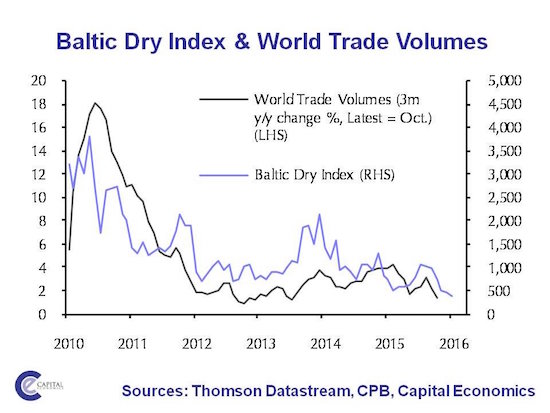
World trade is as bad as it has been at any point since the global financial crisis in 2008. The Baltic Dry Index, a measure of how much it costs to transport raw materials, in November dropped below 500 for the first time, and it has kept falling. The index was as high as 1,222 in August, and it has fallen 84% from a recent peak of 2,330 in late 2013. The index measures how much it costs to ship dry commodities, meaning raw materials like grain and steel, around the world. It is frequently used as a so-called canary in the coal mine for the state of the global economy and how well international trade is performing. If the price is low, it suggests trade is slowing.

Analysts at Deutsche Bank led by Amit Mehrotra have been watching the fall closely. The drop has been so bad that ships are being scrapped faster than they are being built. Here are the main points in a recent note:
• Total dry bulk capacity declined by almost 1M tons (net) last week as the pace of deliveries slowed and scrapping remained elevated.
• Around 16 ships were sold for scrap last week totaling 1.6M tons. This more than offset 9 new deliveries, translating to a net reduction of 7 vessels.
• Last week’s scrapping would represent an annualized pace of 11% of installed capacity, which is almost double the all-time high of 6.3% set in 1986.
• Year-to-date scrapping is up 80% versus same time last year.

It’s bad news, as it means that ship owners expect demand for cargo transport to remain weak long into the future. And they’re generally very good at predicting trends in global trade. This graph from Capital Economics shows just how closely the Baltic Dry index tracks world trade volumes.

Read more …

OPEC’s main problem is a collapsing world economy, not shale.

• OPEC Doesn’t Know How To ‘Live Together’ With Shale Oil (BBG)

OPEC and U.S. shale may need a relationship counselor. After first ignoring it, later worrying about it and ultimately launching a price war against it, OPEC has now concluded it doesn’t know how to coexist with the U.S. shale oil industry. “Shale oil in the United States, I don’t know how we are going to live together,” Abdalla Salem El-Badri, OPEC secretary-general, told a packed room of industry executives from Texas and North Dakota at the annual IHS CERAWeek meeting in Houston. OPEC, which controls about 40% of global oil production, has never had to deal with an oil supply source that can respond as rapidly to price changes as U.S. shale, El-Badri said. That complicates the cartel’s ability to prop up prices by reducing output.

“Any increase in price, shale will come immediately and cover any reduction,” he said. The International Energy Agency earlier on Monday gave OPEC reason to worry about shale oil, saying that total U.S. crude output, most of it from shale basins, will increase by 1.3 million barrels a day from 2015 to 2021 despite low prices. While U.S. production from shale is projected to retreat by 600,000 barrels a day this year and a further 200,000 in 2017, it will grow again from 2018 onward, the IEA said. “Anybody who believes that we have seen the last of rising” U.S. shale oil production “should think again,” the IEA said in its medium-term report.

Read more …

More to come.

• S&P Cuts Rating On BP, Total And Statoil (Reuters)

Standard & Poor’s cut its corporate credit ratings on BP, Total SA and Statoil ASA , citing the Europe-based oil and gas companies’ persistent weak debt coverage measures over 2015-2017. The ratings agency on Monday cut the long- and short-term corporate credit ratings on BP Plc to ‘A minus/A-2’ from ‘A/A-1’ with a stable outlook. S&P lowered the long- and short-term corporate credit ratings on Total S.A. to ‘A plus/A-1’ from ‘AA-/A-1 plus’ and assigned a negative outlook. The ratings agency also cut the long- and short-term corporate credit ratings on Statoil ASA to ‘A plus/A-1’ from ‘AA minus/A-1 plus’ and assigned a stable outlook. Standard and Poor’s had lowered its ratings on some U.S. exploration & production companies after price assumption revisions earlier this month.

Read more …

“The U.S. remains a net importer, but its demand for foreign oil has fallen by 32% since its peak in 2005.” A third in 10 years. That’s a lot. But it’s not only because of shale.

• The Trickle of US Oil Exports Is Already Shifting Global Power (BBG)

The sea stretched toward the horizon last New Year’s Eve as the Theo T, a red-and-white tug at her side, slipped quietly beneath the Corpus Christi Harbor Bridge in Texas. Few Americans knew she was sailing into history. Inside the Panamax oil tanker was a cargo that some on Capitol Hill had dubbed “Liquid American Freedom” – the first U.S. crude bound for overseas markets after Congress lifted the 40-year export ban. It was a landmark moment for the beleaguered energy industry and one heavy with both symbolism and economic implications. The Theo T was ushering in a new era as it left the U.S. Gulf coast bound for France.

The implications – both financial and political – for energy behemoths such as Saudi Arabia and Russia are staggering, according to Mark Mills, a senior fellow at the Manhattan Institute think tank and a former venture capitalist. “It’s a game changer,” he said. For the Saudis and their OPEC cohorts, who collectively control 40% of the globe’s oil supply, the specter of U.S. crude landing at European and Asian refineries further weakens their grip on world petroleum prices at a time they are already suffering from lower prices and stiffened competition. With Russia also seeing its influence over European energy buyers lessened, the two crude superpowers last week tentatively agreed to freeze oil output at near-record levels, the first such coordination in a decade and a half.

The political effects need not wait until U.S. shipments become more plentiful, Mills said. “In geopolitics, psychology matters as much as actual transactions,” he said. Meanwhile, the U.S. is also poised to make its first shipments of liquefied natural gas, or LNG, from shale onto world markets within weeks, about two months later than scheduled. Cheniere Energy Iexpects to have about 9 million metric tons a year of LNG available for its own portfolio from nine liquefaction trains being developed at two complexes in Texas. That’s enough to power Norway and Denmark combined for a year.

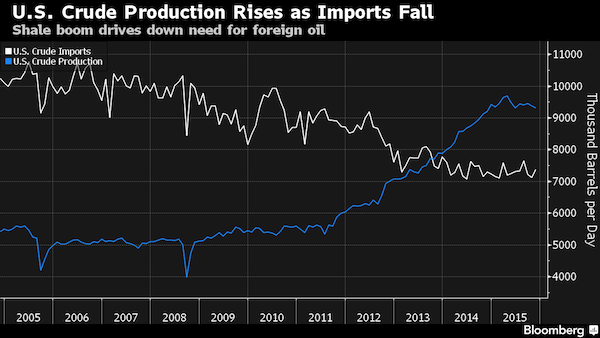
[..] Beyond corporations, the Dec. 18 lifting of the export ban by Congress and President Barack Obama created geopolitical winners and losers, too. The U.S., awash in shale oil, has gained while powerful exporters like Russia and Saudi Arabia, for whom oil represents not just profits but also power, find themselves on the downswing. The U.S. remains a net importer, but its demand for foreign oil has fallen by 32% since its peak in 2005. Meanwhile, plummeting oil and gas prices, driven in part by the U.S. shale revolution, have already eroded OPEC and Russia’s abilities to use natural resources as foreign policy cudgels. They are also squeezing petroleum-rich economies from Venezuela to Nigeria that rely heavily on crude receipts to fund everything from military budgets to fuel subsidies.

Read more …

Oh well, it’s only the IEA.

• Crude Glut Could Take Years to Disappear: IEA (WSJ)

Oil prices are unlikely to significantly rebound for at least a few years, the International Energy Agency projected on Monday, as a top official with the Organization of the Petroleum Exporting Countries said he wouldn’t rule out taking additional steps to stabilize the market. The new IEA projections and the statements by OPEC’s secretary-general, which came as oil ministers, executives and analysts gathered for the annual IHS CERAWeek conference in Houston made one point abundantly clear: No one is immediately coming to the rescue for struggling oil producers. Oil rallied Monday following the IEA’s projection that shale production is poised to fall this year by about 600,000 barrels a day, and by 200,000 barrels a day in 2017.

But Fatih Birol, the executive director of the IEA, which tracks the global oil trade on behalf of industrialized nations, and OPEC’s Abdalla el-Badri, who represents the cartel of major exporters, both agreed that market signals continue to point to depressed prices. “Everybody is suffering,” said Mr. el-Badri, noting that the rapid fall in crude had caught many member nations by surprise. “This is historical,” said Mr. Birol. “In the last 30 years, we have never seen oil investment decline two-consecutive years.” A preliminary agreement between Saudi Arabia and Russia to freeze output at January levels was a “first step” toward creating market stability, he said. Iran, whose oil exports have only recently been freed from Western sanctions, has yet to agree. “If this is successful, maybe we can take other steps in the future,” Mr. Birol said, declining to specify what those could be. He also asserted OPEC’s continued relevance on the world scale. “We are not dead. We are alive and alive and alive. You will see us for many years.”

Read more …

Asking for more government support.

• North Sea Oil Investment To Slump 90% This Year As Losses Mount (Tel.)

Investment in the UK’s embattled oil and gas industry is expected to fall by almost 90pc this year, raising urgent industry calls for the Government to reform its North Sea tax regime to safeguard the industry’s future. Oil firms have been forced to dramatically slash costs in order to survive a 70pc cut in oil prices since mid-2014, but the severe drop in investment threatens thousands of North Sea jobs, said Oil and Gas UK (OGUK). The trade group says that firms have forced down the cost of oil production from $29.30 a barrel in 2014 to just under $21 a barrel in 2015. But despite improving efficiency and cutting operating costs almost half of the UK’s oilfields will struggle to make a profit if oil prices remain at $30-a-barrel levels for the rest of the year.

The financial risk means many have axed or delayed investment decisions, and OGUK said that investment in new projects could fall as low as £1bn this year, compared with a typical average of £8bn a year. OGUK boss Deidre Mitchell said: “This drop in activity is being felt right across the supply chain, which contracted by a quarter in the last year and is expected to fall further in the coming year as current projects near completion. “With demand for goods and services falling, ongoing job losses are the personal cost to individuals and families across the UK.” North Sea job losses could reach a total of 23,000, and Aberdeen is expected to take the brunt of the economic hit. Securing the future of the region has already climbed the political agenda this year with both the Scottish and Westminster governments pledging hundreds of millions of pounds in support.

Read more …

Justin inherited a poisoned chalice. Didn’t he know?

• Canada PM Trudeau Drops Campaign Promises and Goes All In With Deficits (BBG)

In for a penny, in for a pound. With falling oil prices eroding Canada’s revenue base, newly elected Prime Minister Justin Trudeau is fully embracing deficits, with his finance minister hinting Monday the country will run a deficit of about C$30 billion ($22 billion) in the fiscal year that starts April 1. It’s one of the biggest fiscal swings in the country’s history that, in just four months since the Oct. 19 election, has cut loose all the fiscal anchors Trudeau pledged to abide by even as he runs deficits. The government’s bet is that appetite for more infrastructure spending and a post-election political honeymoon will trump criticism over borrowing and unmet campaign promises. “It looks like the Liberals want to front load as much bad news as possible in the hope when the election occurs in four years things will be better,” said Nik Nanos, an Ottawa-based pollster.

Trudeau swept to power in part by promising to put an end to an era of fiscal consolidation the Liberals claimed was undermining Canada’s growth, which has been lackluster since the recession in 2009. Still, he has tried to temper worries by laying out three main fiscal promises: annual deficits of no more than C$10 billion, balancing the budget in four years and reducing the debt-to-GDP ratio every year. On Monday, Finance Minister Bill Morneau indicated none of those three promises will be met. A fiscal update – released a month before the government’s first budget is due – showed Canada’s deficit in the year that begins April 1 is on pace to be C$18.4 billion, even before the bulk of the government’s C$11 billion in spending promises and any other stimulus measures are accounted for. The same document shows the nation’s debt-to-GDP ratio will be rising in the coming fiscal year, not falling. Morneau also reiterated that balancing the budget in the near term would be “difficult.”

Read more …

2800 more arrivals in Athens overnight.

“It’s not refugees that are the problem. The problem is bombs falling on their houses”- Spiros Galinos, Mayor Lesvos

• Number Of Refugees Trapped At Border, Piraeus Builds Up (Kath.)

Thousands of refugees and migrants gathered at Greece’s border with the Former Yugoslav Republic of Macedonia (FYROM) on Monday, heightening concern that they will become trapped over the coming days. Some 4,000 people were estimated to have congregated at the Idomeni border crossing after FYROM refused to allow any Afghans at all or Iraqis and Syrians who did not have passports to cross from Greece. Athens said it had launched diplomatic efforts to convince Skopje to allow the Afghans, who make up around a third of arrivals, through. But the FYROM government said its decision was triggered by actions to its north. Austria, which is not accepting more than 80 refugees a day has called a summit with Albania, Bosnia, Bulgaria, Croatia, Montenegro, FYROM, Serbia, Slovenia and Kosovo tomorrow to attempt to coordinate their reaction to the refugee crisis.

Slovakia’s Prime Minister Robert Fico expressed doubts about whether the EU’s plans to reach a deal with Turkey next month on limiting the flow of migrants and refugees would be effective. “If that does not work, and I am very pessimistic, and all of us in Europe will insist on proper protection of external borders, there will be nothing left but protecting the border on the line of Greece-Macedonia and Greece-Bulgaria,” he said. FYROM’s action on its border was already having a knock-on effect in other parts of Greece yesterday. Thousands of migrants arriving at Piraeus from the Aegean islands, where almost 8,000 people arrived between Friday and Sunday, were held back at the port to avoid further overcrowding at Idomeni. Some were taken to the new transit center at Schisto.

“Our biggest fear is that the 4,000 migrants who are in Athens head up here and the place will become overcrowded,” Antonis Rigas, a coordinator of the medical relief charity Doctors Without Borders, told Reuters. Despite the rise in arrivals over the weekend, bad weather cut the number of refugees and migrants arriving in Greece by 40% last month compared to December, the European Union’s border agency Frontex said. But the number was still nearly 40 times higher than a year before. Frontex said most of the 68,000 people that reached Greece last month were Syrians, Iraqis and Afghans.

Read more …

The lack of leadership in Europe is embarrassing. Why maintain a union at all?

• Greece Implores Macedonia To Reopen Border To Refugees (Guardian)

Greece has been making frantic appeals to Macedonia to open its frontier after a snap decision to tighten border controls by the Balkan state left thousands of people stranded. By midday on Monday up to 10,000 men, women and children had been trapped in Greece, with most marooned in the north. Another 4,000, newly arrived from islands off Turkey’s Aegean coast, were stuck in Athens’s port of Piraeus. The backlog came after Macedonia refused entry to Afghan refugees, claiming it was reacting to a similar move by Serbia. Amid rising tension and fears of the collapse of the passport-free Schengen zone,Greece lambasted the policies being pursued by countries to its north.

Speaking on state-run ERT television, the Greek migration minister, Yiannis Mouzalas, said: “Once again the European Union voted for something, it reached an agreement, but a number of countries lacking the culture of the European Union, including Austria, unfortunately violated this deal barely 10 hours after it had been reached.” Neighbouring countries along the Balkan corridor had in turn become enmeshed in “an outburst of scaremongering”. “The Visegrád countries have not only not accepted even one refugee; they have not sent even a blanket for a refugee,” he added, referring to the Czech Republic, Poland, Hungary and Slovakia. “Or a policeman to reinforce [EU border agency] Frontex.” Skopje said on Monday it had tightened restrictions after Austria imposed a cap on transit and asylum applications, triggering a domino effect down the migrant trail.

As officials scrambled to find accommodation for the newcomers, Athens’s leftist-led government was engaged in desperate diplomatic efforts to ease the border controls. Greece has become Europe’s main entry point for the vast numbers fleeing war and destitution in the Middle East, Africa and Asia. Last year, more than 800,000 people – the majority from Syria – passed through the country en route to Germany and other more prosperous EU member states. With the pace of arrivals showing no sign of abating – a record 11,000 people were registered on Aegean islands in the space of three days last week – Athens has been in a race against the clock to improve hosting facilities including ‘hot spot’ screening centres and camps.

Mounting questions over Turkey’s desire to stem the flow, and Greece’s ability to handle it, have fuelled fears that if nations take unilateral action to seal frontiers, hundreds of thousands will end up trapped in Europe’s most chaotic state. Battling its worst economic crisis in modern times, Athens is ill-equipped to deal with the emergency.

Read more …

There’s no place on the border.

• Greek Police Start Removing Refugees From Macedonian Border (Reuters)

Greek police started removing migrants from the Greek-Macedonian border on Tuesday after additional passage restrictions imposed by Macedonian authorities left hundreds of them stranded, sources said. The migrants had squatted on rail lines in the Idomeni area on Monday after attempting to push through the border to Macedonia, angry at delays and additional restrictions in crossing. Greek police and empty buses had entered the area before dawn, a Reuters witness said. In one area seen from the Macedonian side of the border, about 600 people had been surrounded by Greek police, the witness said. There were an estimated 1,200 people at Idomeni, in their vast majority Afghans or individuals without proper travel documents.

A crush developed there on Monday after Macedonian authorities demanded additional travel documentation, including passports, for people crossing into the territory. Some countries used by migrants as a corridor into wealthier northern Europe are imposing restrictions on passage, prompting those further down the chain to impose similar restrictions for fear of a bottleneck in their own country. But there are concerns at what may happen in Greece, where a influx continues unabated to its islands daily from Turkey. On Tuesday morning, a further 1,250 migrants arrived in Athens by ferry from three Greek islands. Some of them had bus tickets to Idomeni, but it was unclear if they would be permitted to travel north from Athens.

Read more …

Good description of what Greece finds itself in.

• Between Two Taps (Boukalas)

Thessaloniki Mayor Yiannis Boutaris is absolutely right: “Refugees don’t eat people.” We are not sure if the reverse is true, as current events do not allow for any kind of certainty in the matter. For many leaders and citizens in a number of countries, refugees have already proved expendable, ready for sacrifice. A mass whose feelings don’t count, whose hopes for a better life bring laughter to those already enjoying it. This mass only acquires any significance when incorporated into the strategies of geopolitical players. In order for these strategies to succeed, it is no longer necessary to sacrifice parts of the cronies’ powers, in other words the unknown soldiers, as is usually the case when it comes to typical confrontations between countries. Being foreign and often of a different religion, the refugees are a great substitute and are inexpensive.

They constitute hundreds of thousands of pawns being moved on the map by chess-playing marshals constantly launching threats and blackmailing each other. We see this happening in bilateral and multilateral summit meetings in Brussels, London, Geneva, Vienna and Ankara, where talks focus on reaching a truce in the Syrian conflict, the allocation of refugees in European states and Turkey’s obligations, not to mention the precise rewards for fulfilling these obligations. A crucial element is that one of the biggest taboos of the post-Nazi era, threatening references to a Third World War, are forfeited during these meetings. Greece is not among the big players. It never has been. It is nowhere near Turkey in terms of size, population figures or diplomatic cynicism, which during Recep Tayyip Erdogan’s dominance has increasingly acquired delusions of grandeur.

When it comes to the refugee-migrant issue, Greece is just a pipeline, in between two taps over which it has no control. In the east, the entry tap can be opened and closed as the Turkish government pleases, depending on what suits its interests at the time: from showing a bit of good behavior through a partial containment of flows to playing the tough guy, by turning a blind eye to the smuggling rings. At the same time, Greece has very little influence over the exit tap at the Former Yugoslav Republic of Macedonia border. The neighboring country appears to be treating the current situation as a major opportunity to promote its broader interests, hence offering its services to the so-called Visegrad Four and Western Balkan countries.

No matter what else is going on, Greece must continue to honor its agreements, making the absence of morals and justice in the international political arena even more painfully clear.

Read more …

Feb 222016
 
 February 22, 2016  Posted by at 9:54 am Finance Tagged with: , , , , , , , ,  4 Responses »


NPC People’s Drug Store, 11th & G streets, Washington DC 1920

• NYSE Short Interest Nears Record – And We Know What Happened Last Time (ZH)
• EU Chamber Urges China To Cut Excess Production (WSJ)
• Biggest Banks’ Commodity Revenue Slid to Lowest in Over a Decade (BBG)
• The Metals Crunch Is Forcing Miners To Reconsider Diversification (Economist)
• The World’s Biggest Miner May Be About to Toast Its Oil Drillers (BBG)
• New Market Storm Could Catch Eurozone Unprepared (Reuters)
• Traders Would Rather Get Nothing in Bonds Than Buy Europe Stocks (BBG)
• German Economy Takes a Blow From Weakening Global Demand (BBG)
• Germany Isn’t Investing the Way It Used to and That’s a Problem (BBG)
• China Yuan Bears Predict More Trouble Ahead (BBG)
• Kyle Bass, A Sharpshooting Short-Seller (FT)
• As US Shale Sinks, Pipeline Fight Sends Woes Downstream (Reuters)
• Chinese Military Ambitions Fuel Asian Arms Race Amid Slowdown (WSJ)
• Krugman and the Gang of 4 Need to Apologize (Bill Black)
• Greek Attempt To Force Use Of Electronic Money Instead Of Cash Fails (ZH)
• New Zealand Super Fund’s $200 Million Loss (NZ Herald)
• Long Way To Go: 5th Anniversary of the Christchurch Earthquake (G.)
• Macedonia, Serbia Close Borders To Afghan Refugees (AP)
• Shadowing The Hellenic Coast Guard’s Refugee Rescues (CCTV)

We’re getting closer.

• NYSE Short Interest Nears Record – And We Know What Happened Last Time (ZH)

In the last two months, NYSE Short Interest has risen 4.5%, back over 18 billion shares near the historical record highs of July 2008 (and up 7 of the last 9 months).

There are two very different perspectives on could take when looking at this data… Either a central bank intervenes, or a massive forced buy-in event occurs, and unleashes the mother of all short squeezes, sending the S&P500 to new all time highs, or .. Just as the record short interest in July 2008 correctly predicted the biggest financial crisis in history and all those shorts covered at a huge profit, so another historic market collapse is just around the corner. The correct answer will be revealed in the coming weeks or months… but we know what happened last time…

Read more …

Ask nicely. Prety pretty please. Look, China doesn’t want millions of unemployed workers. They’ll want to smear this out over years.

• EU Chamber Urges China To Cut Excess Production (WSJ)

The European Union Chamber of Commerce in China urged Beijing to do more to tackle excess industrial production, saying that failed attempts to do so have created a flood of excess goods that threatens to destabilize the global economy. The call comes as Chinese manufacturers, hit by an economic slowdown, are sending products–from tires and steel to solar panels and chemicals–overseas that they can’t sell at home. The EU Chamber, which represents more than 1,600 members across China, said Monday that excess production is plaguing industrial sectors, such as steel, cement and chemicals, but is also spilling over into the consumer economy, including consumer electronics, pharmaceuticals and even food and apparel.

The usage rate for China’s steel in 2014 dropped to 71% from 80% in 2008, the EU Chamber estimated, based on China’s official data. Production increased to 813 million metric tons from 513 million tons during that time, the industry group said. Representatives from Europe’s steel industry, reeling from competition from cheap Chinese steel, last week took to the streets in Brussels to protest alleged unfair trade practices that they claim will worsen if the EU grants market-economy status to China later this year. Such a move would make it more difficult for Europe to impose steep tariffs on Chinese goods. London-based Caparo initiated bankruptcy proceedings in October for 16 of its 20 steel businesses, which employed 1,700 people. Tata Steel of India blamed overproduction in China when it said in January that it would cut 1,050 jobs from its U.K. operations, adding to cuts announced in October.

In a briefing Monday, the EU Chamber, which released a study on China’s industrial overcapacity, said China must act immediately to restructure its economy and overhaul state-owned companies that are pumping out excess goods. It must reduce negative impacts in China, such as job losses and bad debt, and fend off a crisis that could reverberate globally, the chamber said. Chinese leaders have prioritized party reform and anticorruption, but it is time to shift that focus to the economy, said Jörg Wuttke, president of the European Chamber. “The time spent on economic reforms is way down on the priority list.” said Mr. Wuttke.” We believe they have to act now, not wait.”

Read more …

Are they betting against their own clients yet?

• Biggest Banks’ Commodity Revenue Slid to Lowest in Over a Decade (BBG)

Revenue from commodities at the largest investment banks sank to the weakest in more than a decade last year, laid low by a rout in prices for everything from metals to gas. Income at Goldman Sachs, Morgan Stanley and the 10 other top banks slid by a combined 18% to $4.6 billion, according to analytics firm Coalition. That was the worst performance since the London-based company began tracking the data 11 years ago, and a slump of about two-thirds from the banks’ moneymaking peak in 2008. Revenues are unlikely to return to the heights of $14.1 billion seen at the top of the market, according to George Kuznetsov at Coalition. “The competitive landscape is very different,” Kuznetsov said by phone.

“Financial institutions are now much more regulated. We have significantly less involvement of the banks in the physical commodities market, and banks do not take as much risk as they used to in 2008-09.” The Bloomberg Commodity Index, a measure of investor returns from 22 raw materials, slumped the most in seven years in 2015, led by a plunge in energy and metals. Banks including JPMorgan, Deutsche Bank and Barclays have also been scaling back commodities activity in the past three years amid rising regulatory scrutiny. Even as oil revenues improved last year on increased activity by corporate clients, U.S. curbs on proprietary trading meant banks couldn’t fully take advantage of a 35% plunge in crude by making speculative bets, unlike trading houses and big oil companies.

Last year was one of the best years of all time for trading oil and gas, BP Chief Financial Officer Brian Gilvary said this month. Trafigura’s oil-trading earnings surged to a record last fiscal year. A gauge of industrial-metals prices fell by 24% last year, the most since 2008. Income from energy markets also returned to normal levels after gains in 2014, according to Coalition. “A normalization of the U.S. power and gas markets and weakness in metals and investor products drove the overall decline,” the company said in a report released on Monday. Declining commodities revenues helped bring down the performance for banks’ overall fixed-income divisions, according to Coalition. The analytics company tracks commodities activities including power and gas, oil, metals, coal and agriculture.

Read more …

BHP Billiton looks to be in danger.

• The Metals Crunch Is Forcing Miners To Reconsider Diversification (Economist)

At the pinnacle of the mining industry sit two Anglo-Australian companies, BHP Billiton and Rio Tinto, which are to iron ore what Saudi Arabia is to oil: the ones who call the shots. Their mines in Pilbara, Western Australia, are vast cash cows; with all-in costs below $30 a tonne, they still generate substantial profits even though prices have slumped from $192 a tonne in 2011 to about $44. They have increased iron-ore production despite slowing demand from China, driving higher-cost producers to the wall—an echo of the Saudis’ strategy in the oil market. But whereas Rio Tinto has doubled down on iron ore, BHP also invested in oil and gas—in which it has nothing like the same heft—at the height of the shale boom. Their differing strategies are a good test of the merits of diversification.

The China-led commodities supercycle encouraged mission creep. Many companies looked for more ways to play the China boom, and rising prices of all raw materials gave them an excuse to cling on to even those projects that were high-cost and low-quality. Now the industry is plagued with debts and oversupply. On February 16th Anglo American, a South African firm that was once the dominant force in mining, said it would sell $3 billion of assets to help pay down debt, eventually exiting the coal and iron-ore businesses that it had spent a fortune developing. That would leave it with a core business of just copper, diamonds and platinum. The day before, Freeport-McMoRan, the world’s largest listed copper producer, was forced to sell a $1 billion stake in an Arizonan copper mine to Sumitomo of Japan, to help cut debts racked up when it expanded into oil and gas.

With Carl Icahn, an American activist investor, agitating for a shake-up, analysts say its energy assets could follow—if there are any buyers. When BHP reports half-yearly results on February 23rd its misadventure in American oil and gas will be of particular concern because it has put the world’s biggest mining firm in the shadow of Rio for the first time. Since BHP merged with Billiton in 2001, its share price has outperformed Rio’s; it made an unsuccessful bid to merge with its rival in 2007. Yet in the past year its shares have done worse. Analysts expect that next week it will cut its annual dividend for the first time since 2001, thereby breaking a promise to raise the dividend year by year. Though Rio ended a similar “progressive dividend” policy this month, it did not cut the 2015 payout.

Read more …

And this is its last desperate call.

• The World’s Biggest Miner May Be About to Toast Its Oil Drillers (BBG)

BHP Billiton’s shares began tracking oil prices more closely last year as they headed into the worst energy market downturn in a generation. It may not seem like it, but that could be good news for the world’s biggest miner. Unlike its rivals, BHP has a substantial petroleum unit, valued at about $25 billion by UBS. So while iron ore and most base metal prices are forecast to languish over the remainder of the decade as growth in China slows, the Melbourne-based company’s stock stands to benefit from a projected rebound in crude oil. BHP needs an edge. Its Sydney-traded shares sunk last month to the lowest since 2005 and it’s forecast to report a 86% drop in first-half earnings on Tuesday. On top of that, the producer’s ultimate liability for the deadly Samarco dam burst in Brazil late last year remains uncertain and it’s been warned by Standard & Poor’s that it may face a second credit rating downgrade this year.

An oil rebound could deliver a reboot with Schroders saying this month prices may rally almost two-thirds to as high as $50 a barrel in a few months. BHP has flagged it’s on the lookout for petroleum assets, and is likely to study adding more conventional assets, particularly in the Gulf of Mexico, if distressed competitors are forced to sell, according to Aberdeen Asset Management. BHP “follows oil a lot more closely than iron ore these days,” Michelle Lopez, a Sydney-based investment manager at Aberdeen, which holds BHP shares among the $428 billion of assets it manages globally, said by phone. “When you look at the forward curve, iron ore still looks like it’s going to be at these levels if not a bit lower, whereas there are expectations of a correction in the oil price.”

Read more …

Some people are still talking about a recovery. Get real.

• New Market Storm Could Catch Eurozone Unprepared (Reuters)

Distracted by an unresolved migration crisis and negotiations on keeping Britain in the EU, euro zone leaders could be caught unprepared by a new storm on financial markets. Global market turmoil since the start of the year has helped set warning lights flashing in euro zone sovereign bond markets. In early February, the premium that investors charge to hold Portuguese, Spanish and Italian government debt rather than German bonds hit some of the highest levels since the euro zone crisis that peaked in 2011-2012. European bank shares have been badly hit by concerns over their high stock of non-performing loans, new regulatory burdens and a squeeze on profits due to sub-zero official interest rates. New EU banking regulations that force shareholders and bondholders to take first losses if a bank needs rescuing are further spooking the market, notably in Italy.

All this comes at a time when public resistance to further austerity measures has surged all over southern Europe, producing unstable results at the ballot box. Furthermore, the storm clouds are gathering above a tenuous and slow euro zone economic recovery – growth is officially forecast to reach 1.9% this year versus around 1.6% in 2015. Southern periphery countries all face budget problems that are fuelling political tension with Brussels. Inflation is also refusing to perk up despite the ECB’s bond-buying programme and negative interest rates, making it harder for heavily indebted euro zone countries to pay down debt. Yet euro zone governments transfixed by differences over sharing out refugees, managing Europe’s porous borders and accommodating British demands for concessions on EU membership terms have a huge amount on their hands already. One French government adviser said the EU had never faced such an accumulation of crises in the last 50 years.

Read more …

Yeah, sure: “We’re still looking for some confirmations for the economic growth outlook.”

• Traders Would Rather Get Nothing in Bonds Than Buy Europe Stocks (BBG)

The cash reward for owning European stocks is about seven times larger than for bonds. Investors are ditching the equities anyway. Even with the Euro Stoxx 50 Index posting its biggest weekly rally since October, managers pulled $4.2 billion from European stock funds in the period ended Feb. 17, the most in more than a year, according to a Bank of America note citing EPFR Global. The withdrawals are coming even as corporate dividends exceed yields on fixed-income assets by the most ever. Investors who leaped into stocks during a similar bond-stock valuation gap just four months ago aren’t eager to do it again: an autumn equity rally quickly evaporated come December.

A Bank of America fund-manager survey this month showed cash allocations rose to a 14-year high and expectations for global growth are the worst since 2011. If anything, the valuation discrepancy between stocks and bonds is likely to get wider, said Simon Wiersma of ING. “The gap between bond and dividend yields will continue expanding,” said Wiersma, an investment manager in Amsterdam. “Investors fear economic growth figures. We’re still looking for some confirmations for the economic growth outlook.” Dividend estimates for sectors like energy and utilities may still be too high for 2016, Wiersma says. Electricite de France and Centrica lowered their payouts last week, and Germany’s RWE suspended its for the first time in at least half a century.

Traders are betting on cuts at oil producer Repsol, which offers Spain’s highest dividend yield. With President Mario Draghi signaling in January that more ECB stimulus may be on its way, traders have been flocking to the debt market. The average yield for securities on the Bloomberg Eurozone Sovereign Bond Index fell to about 0.6%, and more than $2.2 trillion – or one-third of the bonds – offer negative yields. Shorter-maturity debt for nations including Germany, France, Spain and Belgium have touched record, sub-zero levels this month.

Read more …

And Germany makes sure to transfer that blow to the rest of the eurozone.

• German Economy Takes a Blow From Weakening Global Demand (BBG)

The German economy took a hit this month from weak global demand, with a manufacturing gauge dropping to a 15-month low. Markit Economics said its factory Purchasing Managers Index fell to 50.2, barely above the key 50 level, from 52.3 in January. A services gauge improved slightly, but a composite measure declined to the lowest since July. “The German economy appears to be in the midst of a slowdown,” said Oliver Kolodseike, an economist at Markit. Manufacturing is “near stagnation,” he said. While Germany weathered global headwinds through 2015, maintaining its pace of expansion in the fourth quarter, business confidence has weakened recently.

China’s slowdown is weighing on exports while the equity selloff this year threatens a fragile recovery in the euro area, the country’s largest trading partner. The OECD cut its global growth forecast last week and said both Germany and the euro region will expand less this year than previously estimated. Markit said the slowdown in German output led to increased caution on hiring, with the rate of job creation at the weakest in almost a year. France’s composite Purchasing Managers Index slipped to 49.8 from 50.2 in January. In the 19-nation euro area, both the factory and services measures probably declined this month, according to surveys of economists. Markit will publish those numbers at 9 a.m. London time.

Read more …

Germany’s surpluses keep on bleeding its neighbors dry. That is the problem.

• Germany Isn’t Investing the Way It Used to and That’s a Problem (BBG)

All the pieces appear to be in place for a surge in corporate investment in Germany – except one critical element. While low borrowing costs, robust domestic consumption and capacity strains mean companies should be itching to spend, the confidence to do so is lacking. Market turmoil, signs of a weaker global demand and Germany’s own aging population are giving bosses plenty of reason to hold back, leaving capital spending as a share of output clinging stubbornly to a five-year low. That matters both for Germany, where the IMF says more capital spending is needed to ensure future growth, and the 19-nation euro area. The strength of the region’s largest economy could be key to whether the currency bloc’s fragile recovery can be sustained.

“Every year since 2013, most pundits including ourselves have been predicting that this is going to be the year that investment really picks up in earnest,” said Timo Klein, an economist at IHS Global Insight in Frankfurt. “But every year something unfolds that clouds the picture, from Ukraine to China, and investment is postponed again. The long-term consequence of this is a reduction in growth potential.” A report on Tuesday will shed more light on the role of investment in Germany’s economic expansion in the fourth quarter. Preliminary data showed gross domestic product rose 0.3%, matching the pace of the previous three months, with government and consumer spending leading the way.

While that’s unspectacular, France and Italy fared worse. The euro zone’s second and third-largest economies cooled, with the latter barely growing, increasing the burden on Germany to be the region’s engine. Yet investment as a share of German GDP fell to less than 20% last year from about 23% at the turn of the century, a Bundesbank study in January showed. Private investment slid to 11.5% from 13.4%, according to Eurostat. In its February bulletin, the Bundesbank said investment should increase because of an “above-average level of capacity utilization.” However, it also said a “key prerequisite” is that external demand picks up.

Read more …

One safe bet.

• China Yuan Bears Predict More Trouble Ahead (BBG)

Before China’s devaluation in August roiled global markets and spurred some of the hedge fund industry’s biggest names to bet against the yuan, a small cohort of researchers saw the whole thing coming. Now, some of those same forecasters are warning that there’s more turmoil in store – and it’s not just China they’re worried about. Asianomics’s Jim Walker, who predicted the yuan’s four-year advance would end a month before the currency peaked in January 2014, is forecasting a U.S. recession and says 10-year Treasury yields will plunge to all-time lows. Raoul Pal, publisher of the Global Macro Investor report and a yuan bear since 2012, says European bank shares will tumble by half. John Mauldin of Millennium Wave Advisors, who has argued since 2011 that the Chinese currency should weaken, sees the risk of heightened geopolitical instability in the Middle East as lower crude prices strain the budgets of oil-rich countries.

While all three forecasters see scope for further declines in the yuan, they’re also emphasizing risks outside the Chinese economy as the outlook for world growth dims and commodities trade near the lowest levels in more than 15 years. Their bearish stance has gained traction in global markets this year, with share prices from New York to Riyadh and Sydney sliding as investors shifted into gold and sovereign bonds. “There’s a storm of troubles coming,” Pal, a former hedge-fund manager at GLG Partners whose clients now include pension plans and sovereign wealth funds, said in a phone interview from the Cayman Islands. “The risk of a very bad outcome in 2016 and 2017 remains the highest probability.”

Read more …

“What we are witnessing is the resetting of the largest macro imbalance the world has ever seen..”

• Kyle Bass, A Sharpshooting Short-Seller (FT)

I’ve been to Beijing twice, I don’t care to go back,” Kyle Bass says. “I’m OK with that.” The subprime-shorting, sniper rifle-shooting, spearfishing hedge fund manager from Dallas, Texas, does not fear the ire of the Chinese authorities. He has a decade-long record of putting his mouth where his money is, and if his latest apocalyptic call — that the Communist government does not have the resources to prevent a banking crisis and a vicious currency devaluation — puts him at the centre of the angriest debate in financial markets, well, that is just fine by him. “Anyone who is invested in China, whether you are a pension fund or sovereign wealth fund or a large US or European institution — you better be thinking about this, and not with the reverence that people give to China,” he says.

“Everyone has this embedded belief that China can pull off the ‘triple lindy’ every time they want to do it,” says the former springboard diver, “but our view is they are going to have to have a reset.” Mr Bass is hardly the only hedge fund manager betting on a renminbi devaluation; when Beijing wanted to send a shot across speculators bows last month, it was George Soros who was singled out on the front of the People’s Daily, a government mouthpiece. Yet, thanks to a 12-page dissection of China’s banks, shadow banks and central bank reserves sent to investors in his $1.7bn hedge fund Hayman Capital last week, it is Mr Bass who has given the most strident, forensic and colourful voice to those who suspect China will be forced to revalue the currency sharply lower. “What we are witnessing is the resetting of the largest macro imbalance the world has ever seen,” he wrote.
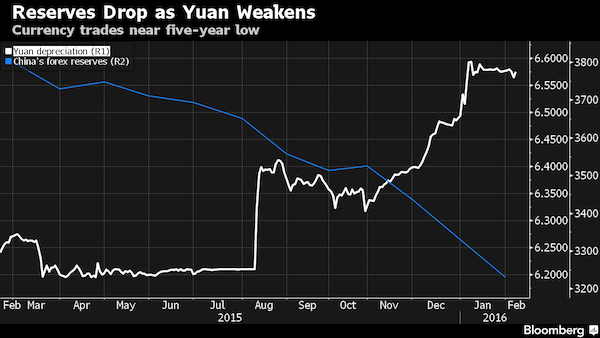
Banking system losses could be four times as big as those on subprime mortgages in the US during the financial crisis, and the central bank does not have the reserves to plug the hole and defend its currency. “China’s back is completely up against the wall today” and the country is “on the precipice of a large devaluation”. Economists and Beijing have challenged the alarming analysis; Zhou Xiaochuan, the People’s Bank of China governor, gave a rare interview to insist capital outflows were evidence of economic rebalancing rather than capital flight. This is all of a piece with previous declarations by Mr Bass. Since the Great Recession he has predicted sovereign debt crises in Ireland, Greece, Portugal, Spain, the UK, Switzerland and France.

He has compared the Japanese economy to a “Ponzi scheme”. Armageddon does not always come — he admits he was wrong on Switzerland and the UK; and Japan is notably still standing, though a devaluation of the yen meant his bet eventually made money overall there. Hayman’s returns since the financial crisis have been modest by the standards of the greatest hedge fund investors and 2015 was, by his own admission, one of his worst. But enough of Mr Bass’s predictions have come true to justify taking him seriously. One manager of a fund of hedge funds says investing with Mr Bass is like funding a “think-tank” on how to navigate the global economy.

Read more …

Creative bankruptcies.

• As US Shale Sinks, Pipeline Fight Sends Woes Downstream (Reuters)

Within weeks, two low-profile legal disputes may determine whether an unprecedented wave of bankruptcies expected to hit U.S. oil and gas producers this year will imperil the $500 billion pipeline sector as well. In the two court fights, U.S. energy producers are trying to use Chapter 11 bankruptcy protection to shed long-term contracts with the pipeline operators that gather and process shale gas before it is delivered to consumer markets. The attempts to shed the contracts by Sabine Oil & Gas and Quicksilver Resources are viewed by executives and lawyers as a litmus test for deals worth billions of dollars annually for the so-called midstream sector. Pipeline operators have argued the contracts are secure, but restructuring experts say that if the two producers manage to tear up or renegotiate their deals, others will follow.

That could add a new element of risk for already hard-hit investors in midstream companies, which have plowed up to $30 billion a year into infrastructure to serve the U.S. fracking boom. “It’s a hellacious problem,” said Hugh Ray, a bankruptcy lawyer with McKool Smith in Houston. “It will end with even more bankruptcies.” A judge on New York’s influential bankruptcy court said on Feb. 2 she was inclined to allow Houston-based Sabine to end its pipeline contract, which guaranteed it would ship a minimum volume of gas through a system built by a Cheniere Energy subsidiary until 2024. Sabine’s lawyers argued they could save $35 million by ending the Cheniere contract, and then save millions more by building an entirely new system. Fort Worth, Texas-based Quicksilver’s request to shed a contract with another midstream operator, Crestwood Equity Partners, is set for Feb. 26.

[..] So far, relatively few oil and gas producers have entered bankruptcy, and most were smaller firms. But with oil prices down 70% since mid-2014 and natural gas prices in a prolonged slump, up to a third of them are at risk of bankruptcy this year, consultancy Deloitte said in a Feb. 16 report. Midstream operators have been considered relatively secure as investors and analysts focus on risks to the hundreds of billions of dollars in equity and debt of firms most directly exposed to commodity prices. That’s because firms such as Enterprise Products, Kinder Morgan and Plains All American relied upon multi-year contracts – the kind targeted in the two bankruptcies – that guarantee pipeline operators fixed fees to transport minimum volumes of oil or gas.

Now, with U.S. oil output shrinking and gas production stalling, many of the cash-strapped producers entering bankruptcy will be seeking to rid themselves of pricey agreements, particularly those with so-called minimum volume commitments that require paying for space even if it is not used. “They will be probably among the first things thrown out,” said Michael Grande, director for U.S. midstream energy and infrastructure at Moody’s.

Read more …

Volatility writ large.

• Chinese Military Ambitions Fuel Asian Arms Race Amid Slowdown (WSJ)

The rapid rise in Chinese military spending and a greater assertiveness in its territorial claims is fueling an arms race in the Asia-Pacific region even though many of the countries involved have been hit by an economic slowdown, new research reports suggest. Of the 10 biggest importers of defense equipment in the past five years, six countries were in the Asia-Pacific region, the Stockholm International Peace Research Institute, or SIPRI, said in an annual report on arms transfers. India was the largest buyer of foreign equipment, with China in third position after Saudi Arabia, the think tank said. Although a country’s spending power is often tied to its economic strength, buyers in the Asia-Pacific region aren’t slashing military budgets even as their economies have come under strain from falling commodity prices and lower growth in China.

“The slight moderation in economic activity had little effect on regional military spending in 2015,” the International Institute for Strategic Studies, or IISS, said in a new report. China, Japan, South Korea, and Indonesia last year were among the countries to announce plans for higher military spending, the IISS said. Lower economic output has driven up Asian military spending as a percentage of GDP to 1.48%, the London-based research organization said, its highest level since at least 2010. China leads the way, accounting for 41% of the region’s military spending, well ahead of No. 2 India at 13.5% and Japan with 11.5%.

Read more …

William K. Black: always a pleasure.

• Krugman and the Gang of 4 Need to Apologize (Bill Black)

If you depend for your news on the New York Times you have been subjected to a drumbeat of article attacking Bernie Sanders – and the conclusion of everyone “serious” that his economics are daft. In particular, you would “know” that four prior Chairs of the President’s Council of Economic Advisers (CEA) (the Gang of 4) have signed an open letter to Bernie that delivered a death blow to his proposals. Further, you would know that anyone who dared to disagree with these four illustrious economists was so deranged that he or she was acting like a Republican in denial of global climate change. The open letter set its sights on a far less famous economist, Gerald Friedman, of U. Mass at Amherst. It unleashed a personalized dismissal of his competence and integrity.

Four of the Nation’s top economists against one non-famous economists – at a school that studies heterodox economics. That sounds like a fight that the referee should stop in the first round before Friedman is pummeled to death. But why did Paul Krugman need to “tag in” to try to save the Gang of 4 from being routed? Krugman proclaimed that the Gang of 4 had crushed Friedman in a TKO. Tellingly, Krugman claimed that anyone who disagreed with the Gang of 4 must be beyond the pale (like Friedman and Bernie). Indeed, Krugman was so eager to fend off any analysis of the Group of 4’s attacks that he competed with himself rhetorically as to what inner circle of Hell any supporter of Friedman should be consigned. In the 10:44 a.m. variant, Krugman dismissed Bernie as “not ready for prime time” and decreed that it was illegitimate to critique the Gang of 4’s critique.

In Sanders’s case, I don’t think it’s ideology as much as being not ready for prime time — and also of not being willing to face up to the reality that the kind of drastic changes he’s proposing, no matter how desirable, would produce a lot of losers as well as winners. And if your response to these concerns is that they’re all corrupt, all looking for jobs with Hillary, you are very much part of the problem.

The implicit message is that four famous economists had to be correct, therefore anyone who disagreed with them must be a conspiracy theorist who is “very much part of the problem.” Paul doesn’t explain what “the problem” is, but he sure makes it sound awful. Logically, “the problem” has to be progressives supporting Bernie. Two hours later, Paul decided that his poisoned pen had not been toxic enough, he now denounced Sanders as a traitor to the progressives who was on his way “to making Donald Trump president.” To point out the problems in the Gang of 4’s attack on Friedman was to treat them “as right-wing enemies.”

Why was Krugman so fervid in its efforts to smear Friedman and prevent any critique of the Gang of 4’s smear that he revised his article within two hours and amped up his rhetoric to a shrill cry of pain? Well, the second piece admits that Gang of 4’s smear of Friedman “didn’t get into specifics” and that progressives were already rising in disgust at Paul’s arrogance and eagerness to sign onto a smear that claimed “rigor” but actually “didn’t get into specifics” while denouncing a scholar. Paul, falsely, portrayed Friedman as a Bernie supporter. Like Krugman, Friedman is actually a Hillary supporter.

Read more …

Greece is a cash country. For one thing, there are still capital controls. People cannot get more than $420 a week or so out of their ATM. That is very limiting in many ways.

• Greek Attempt To Force Use Of Electronic Money Instead Of Cash Fails (ZH)

While the “developed world” is only now starting its aggressive push to slowly at first, then very fast ban the use of physical cash as the key gating factor to the global adoption of NIRP (by first eliminating high-denomination bills because they “aid terrorism and spread criminality”) one country has long been doing everything in its power to ween its population away from tax-evasive cash as a medium of payment, and into digital transactions: Greece. The problem, however, is that it has failed. According to Kathimerini, “Greek businesses are not ready for the expansion of plastic money through the compulsory use of credit and debit cards for everyday transactions.” Unlike in the rest of the world where “the stick” approach will likely to be used, in Greece the government has been more gentle by adopting a “carrot” strategy (for now) when it comes to migrating from cash to digital.

The government has told taxpayers that they will have to spend up to a certain amount of their incomes via bank and card transactions in order to qualify for an annual tax-free exemption. This appears to not be a sufficient incentive however, as a large proportion of stores still don’t have the card terminals, or PoS (Points of Sale), required for card payments, while plastic is accepted by very few doctors, plumbers, electricians, lawyers and others who tend to account for the lion’s share of tax evasion recorded in the country. Almost as if the local population realizes that what the government is trying to do is to limit at first, then ultimately ban all cash transactions in the twice recently defaulted nation as well. It also realizes that an annual tax-free exemption means still paying taxes; taxes which could be avoided if one only transacted with cash.

For the government this is bad news, as the lack of tracking of every transaction means that the local population will pay far less taxes: a recent study by the Foundation for Economic and Industrial Research (IOBE) showed that increasing the use of cards for everyday transactions could increase state revenues by anything between 700 million and 1.6 billion euros per year, and that the market’s poor preparation means that the tax burden has been passed on to lawful taxpayers. As a reminder, in Greece, the term “lawful taxpayers” is not quite the same as in most other countries. What is more surprising is that according to data seen by Kathimerini, PoS terminals in Greece amount to just 220,000, and that despite the fact these were effectively forced on enterprises with the imposition of the capital controls, an estimated half of all businesses do not have card terminals. Almost as if the Greeks would rather maintain capital controls than be forced into a digital currency by their Brussels overlords.

Read more …

Some things are just plain weird. They invest $150 million in Espirito Santo in July -when everyone already knew something was fishy, but that’s not even the gist-, and then lose it all one month later?! That’s not fish I’m smelling, it’s a rat.

• New Zealand Super Fund’s $200 Million Loss (NZ Herald)

Almost $200 million of taxpayer money invested through the Kiwi Superannuation Fund has been lost after a Portuguese bank where the money was invested, supposedly as a “risk free” loan, collapsed. The Super Fund, set up with public money to cover partly the retirement costs of baby boomers, has revealed it had been caught up in last year’s collapse of Banco Espirito Santo (BES) and a US$150m (NZ$198m) investment made in July had been completely wiped out. The investment was a contribution to a Goldman Sachs-organised loan to the Portuguese bank, but only weeks after the money was injected it imploded, with president and founder Ricardo Salgado arrested as part of a criminal investigation into tax evasion.

After disclosing billions of Euros in losses, and facing a run on funds by depositors, the bank collapsed in a heap and was broken up in August. Goldman Sachs, described by Rolling Stone as “the great vampire squid” for their sharp business practices in the run-up to the global financial crisis, today said it would “pursue all appropriate legal remedies without delay” in an attempt to recover the loans to BES. The company also announced that, alongside the Super Fund, they were suing the Central Bank of Portugal over their loans being excluded from the bailout of BES. Despite this legal action, Super Fund chief executive Adrian Orr conceded today the entire investment had been written off as a “conservative” precaution. Finance Minister Bill English, the minister responsible for the Super Fund declined to comment on the spectacular loss, but Green Party MP Russel Norman said Mr English should be demanding answers.

“They have to give some sort of explanation as to why they gambled US$150m in this case, and why it’s come unstuck,” he said. The episode also illustrated what the NZSF should try to avoid, Mr Norman said. “For a fund operating on behalf of the NZ taxpayer, taking these high-risk investments is probably not appropriate,” he said. Mr Orr denied the investment was high-risk and said the NZSF had been covered in the event of BES defaulting. “It was risk-free with insurance,” he said. However, an unusual retrospective rule change in Portugal had resulted in the insurance being voided. Orr added the Super Fund had withdrawn lending to banks in Portugal until the result was overturned. The Fund said the loss amounted to only 0.7% of the firm’s total pool of $27b in assets.

Read more …

“Christchurch, home to 366,000 people, who are still shaken daily by thousands of aftershocks..” (Nicole and I were there at the first anniversary)

• Long Way To Go: 5th Anniversary of the Christchurch Earthquake (G.)

It was as the clock struck 12.51pm that the last of the 185 names were read out. Then, the 1,000 people who had gathered in the city’s botanic gardens to mark the anniversary of the 2011 Christchurch earthquake fell silent for a minute to remember the moment, five years ago, that the 6.3-magnitude quake struck. Earlier, posies of flowers had been laid in road cones and taped to the safety fences that still litter the city centre half a decade after the disaster turned it largely to rubble.Once the memorial ceremony had finished, talk turned – as it usually does – to the rebuilding of this once-rich, agricultural hub – and what the new Christchurch will look like when it finally rises from the ashes. “There is still some way to go until Christchurch is truly reborn,” said the governor-general, Jerry Mateparae.

His is a sentiment widely shared in Christchurch, home to 366,000 people, who are still shaken daily by thousands of aftershocks – including a significant 5.9 rumble on Valentines day this year and a 5.0-magnitude quake that hit in nearby Blenheim on the anniversary itself. Despite years of clean-up and a recent boom in construction, Christchurch is still in a state of flux, with hundreds of people waiting for insurance payouts and widespread concern about the pace of the rebuild, especially in the heart of the city. The health of Christchurch residents has also fared poorly since the quake. Suicide and domestic violent rates have risen sharply – as has illegal drug use and the spread of sexually transmitted diseases.

Mental health problems are a persistent concern – particularly widespread are incidences of depression, anxiety and post traumatic stress disorder. Waiting lists for state-funded counselling in Christchurch are long, and last week it was reported the government would significantly cut funding to community mental health providers – from $1.6m in 2015 to $200,000 this year. Yet in tandem with the trauma of the quake’s aftermath has come a remarkable flourishing of the creative arts in the garden city. Rachael Welfare, operations director for Gap Filler, a charitable organisation filling the “gaps” of Christchurch with pop-up creative projects, said: “Before the quake, people thought of Christchurch as quite conservative, but now the opportunities have given people a blank canvas, if nothing else, and people are very open-minded about what the spaces could be.”

Read more …

Who told them to do this and say damn the Geneva conventions?

• Macedonia, Serbia Close Borders To Afghan Refugees (AP)

Former Yugoslav Republic of Macedonia (FYROM) closed its border to Afghan migrants early Sunday, Greek police said, slowing the admission of refugees to a trickle and leaving a growing bottleneck of people stuck at their shared border. A FYROM police spokeswoman denied there was any new prohibition regarding Afghans, blaming the problem on Serbia, the next nation along the Balkans migration route into Western Europe. By early afternoon, about 1,000 migrants were waiting at the Greek border camp in Idomeni – and at a gas station only 17 kilometers (11 miles) away, 80 buses with 4,000 more migrants were waiting to take them to the border. Greek police said FYROM refused to let Afghans through because Serbia made the same decision and officials feared the migrants would get stuck in FYROM.

“The authorities of the Former Yugoslav Republic of Macedonia informed us that, beginning at dawn Sunday, they no longer accept Afghan refugees because the same problem exists at their border with Serbia,” Petros Tanos, spokesman for Greek police’s Central Macedonia division, told The Associated Press. Despite the reports, about 500 migrants of all nationalities made the trek on foot from the gas station to the border Sunday. “I can no longer wait,” said 17-year-old Ali Nowroz, one of the trekkers from the Afghan city of Jaghori Zeba. “We have spent three nights in the cold, we are hungry. They told me that the borders have been closed to us. However, when I started from Afghanistan I knew borders were open for us. I am going to the Idomeni border crossing to find out and ask why they have closed it.”

Read more …

Every single day. Numbers are rising as borders are closing. Greece can’t be far away from becoming a failed state

• Shadowing The Hellenic Coast Guard’s Refugee Rescues (CCTV)

As Europe tries to deal with the biggest refugee crisis since World War II, improving weather means the pace of migrants and refugees reaching Greece from Turkey will pick up again. On Feb 15., over 4,500 people were rescued across the Aegean Sea in Greece. Since last year, the Hellenic Coast Guard has rescued almost 150,000. CCTV’s Filio Kontrafouri went on patrol with the Hellenic Coast Guard off the Greek island of Lesvos and witnessed what happens after those dinghies, usually loaded with women and children, enter the Greek waters. “For us, all these people are like they are condemned to death,” said Sub-lieutenant Kyriakos Papadopoulos of the Hellenic Coast Guard. “You’ll see when we get to that boat, about which some other colleagues in the area have informed us, even with everyone on board, there is panic. People could move from one side to the other, these boats are not suitable for travel at sea, their life jackets are not suitable and at any moment their life is in danger.”

Read more …

Feb 182016
 
 February 18, 2016  Posted by at 8:46 am Finance Tagged with: , , , , , , , , ,  2 Responses »


Russell Lee “Yreka, California, seat of a county rich in mineral deposits” 1942

• Negative Interest Rates A ‘Dangerous Experiment’, Warns Morgan Stanley (MW)
• Negative Interest Rates Are A ‘Gigantic Fiscal Failure’ (AEP)
• Japan’s Exports Drop Most Since 2009 as Sales to China Fall (BBG)
• Japan Shelves Plan to Let Pension Fund Directly Invest in Stocks (WSJ)
• China’s Banks May Be Getting Creative About Hiding Their Losses (BBG)
• China Central Bank Takes Another Step To Guide Interest Rates Lower (BBG)
• High Chance of China Hard Landing, Says Adviser to Japan’s Abe (BBG)
• Why the Chinese Yuan Will Lose 30% of its Value (CHS)
• China’s $600 Billion Subprime Crisis Is Already Here (BBG)
• Not Even a Wave of Oil Bankruptcies Will Shrink Crude Production (WSJ)
• Less Than 4% Of World Oil Supply In The Red At $35/b (Platts)
• Venezuela Lifts Gasoline Price by 6,200% and Devalues Currency by 37% (BBG)
• The Real Crisis is for Bank Bonds, Not Banks (WSJ)
• Fed’s Kashkari: 25% Capital Requirement May Be Right for Banks (WSJ)
• Banking Reform Is More Complex Than It Needs To Be (Chu)
• Italy Would Veto Any Cap On Banks’ Government Debt Holding (Reuters)
• German Central Bank Chief On Collision Course With Draghi Over QE (T.)
• Russia Sues Ukraine in London High Court Over $3 Billion Default (BBG)
• WikiLeaks Releases Classified Data On EU Military Op Against Refugee Flows (RT)
• European States Deeply Divided On Refugee Crisis Ahead Of Summit (Guardian)

“..the “ECB is ready to do its part” and would “not hesitate to act” to crisis-proof the eurozone.” You don’t crisis-proof by creating a crisis.

• Negative Interest Rates A ‘Dangerous Experiment’, Warns Morgan Stanley (MW)

After ECB chief Mario Draghi on Monday hinted more economic stimulus could be coming in March, expectations have risen that deposit rates will be pushed further into negative territory in a bid to fend off the impact from lower oil prices and world-wide economic jitters. While rate cuts usually are seen as a way to stimulate economic growth and weaken the currency, analysts at Morgan Stanley on Wednesday raised concerns that exactly the opposite would happen were the ECB to take rates even lower. Part of this is because investors already have rejigged their portfolios to account for the policy, they explained. Here’s the bank’s thinking:

“Further moves into negative rates will have much less of an impact on the euro, in our view, given that most of the portfolio adjustment is already complete. Rather, we are concerned it erodes bank profitability, creating other systemic risks,” they said in a note. “Could the most bullish ECB outcome be no rate cut?,” Morgan Stanley analysts asked. Calling negative interest rates a “dangerous experiment’, the economists argued such policy would erode bank profits 5%-10% and risk curbing lending across eurozone borders. European banks have already been off to a rough start to the year, down 21% on concerns about the fallout from negative rates, lackluster profits, tougher regulation and a slowdown in global growth. “The credit impulse has turned negative, new loan origination has slowed, and systemic stress in the financial system has risen,” the Morgan Stanley analysts said.

The comments come ahead of the ECB’s March 10 meeting, where investors increasingly are banking on some easing action. The central bank massively disappointed investors in December by introducing a smaller-than-expected rate cut and choosing not to pump more new money into the eurozone economy each month. But at the January meeting, Draghi opened the door for more easing if the economy and inflation showed no signs of improvement. Fast forward a few weeks, and markets have taken a serious beating as investors started to get really nervous about the impact of persistently low oil prices and a slowdown in the world economy.This didn’t go unnoticed by the ECB boss. At his quarterly hearing before the European Parliament on Monday he stressed the “ECB is ready to do its part” and would “not hesitate to act” to crisis-proof the eurozone.

Read more …

Negative rates and the war on cash.

• Negative Interest Rates Are A ‘Gigantic Fiscal Failure’ (AEP)

[..] negative rates are a creeping threat to civil liberties since the only way to enforce such a regime over time is to abolish cash, for otherwise people will move their savings beyond reach. Mao Zedong briefly flirted with the idea during the Cultural Revolution in his bid to destroy every vestige of China’s ancient culture, but even he recoiled. The eurozone already plans to eliminate the €500 note – allegedly to hurt organized crime – and from there it is a slide down the scales to notes in daily use and then to curbs on quasi-money. It is a step to FDR’s gold embargo and Emergency Banking Act of 1933, when Americans were ordered to hand over their bullion or face 10 years in prison. One policymaker in Davos this year let slip that drastic action to scrap cash would be needed to fight a decade-long war against “secular stagnation” once rates test the limits of -1pc or -2pc.

The Bank of England’s Andrew Haldane floated the idea in a speech last September, suggesting that central banks may have to take radical action to circumvent the constraints of the “lower zero-bound”. Mr Haldane said NIRP reinforced by electronic money is a safer course than going down the “most slippery of slopes” by printing money to cover government spending. Here he is wrong. As Lord Turner argues, there is nothing inherently more slippery about direct monetary financing of fiscal stimulus than any other crisis measure. “Everything we are doing is risky,” he says. One can hardly claim that chronic use of QE to inflate asset prices and to stoke more credit is sound practice, or socially just. A monetary policy committee can calibrate what is judged to be the proper level of debt monetisation needed to avert deflation in exactly the same way as the MPC or the FOMC calibrate interest rates.

The money creation must be permanent to avoid “Ricardian Equivalence”, where people anticipate that more spending now merely mean more debt in the future. All debt accumulated by central banks under QE should be converted to perpetual non-interest bearing debt, and preferably burned on a pyre in public squares to the sound of trumpets to drive home the message that the debt has been eliminated forever. This will pre-empt the panic that might occur among investors and politicians should public debt ever cross some arbitrary totemic level. Any New Deal should be funded in the same way – partly or in whole – with the same vow that the debt will never be repaid. The money creation should continue at the therapeutic dose until the objective is achieved.

There is no technical objection to this form of “fiscal dominance”, as monetary guru Lars Svensson told the IMF forum. All that is missing is political will. Needless to say, the eurozone cannot venture down this path. Maastricht prohibits the ECB from overt financing of deficits and any such thinking in Frankfurt would lead to a court challenge and destroy German consent for monetary union. This augurs ill, because they will need it. Thankfully, those of us with our own currencies, central banks and fully sovereign governments always have the means to prevent the collapse of nominal GDP and to avert debt-deflation. We can run out of wit: we can never run out of monetary ammunition.

Read more …

Japan exports to China down 18%. Japan imports also down 18%. World trade falls off a cliff.

More numbers:

January Exports from Asia’s Largest Economies

Singapore -9.9%
China -11.2%
Japan -12.9%
Taiwan -13%
Korea -18.5%
Indonesia -20.7%

• Japan’s Exports Drop Most Since 2009 as Sales to China Fall (BBG)

Japan’s exports fell for a fourth consecutive month and dropped the most since 2009, underscoring continued weakness in an economy that contracted in the final months of 2015. Exports to China, Japan’s largest trading partner, were down almost 18%, driving an overall decline of nearly 13% in the value of overseas shipments in January from a year earlier. Imports dropped 18%, leaving a 645.9 billion yen ($5.7 billion) trade deficit, the Ministry of Finance said on Thursday. Falling exports compound poor sentiment in Japan, where wage gains have stagnated, consumer prices are barely rising and households are reluctant to spend. This year stocks have plunged and the yen has gained more than 5% against the dollar amid concerns over China’s slowdown and U.S. growth.

This adds to worries about the seesawing nature of Japan’s economy between modest growth and contraction. “The environment for Japanese exports is looking bad as Japanese companies shift production abroad, the global economy slows and the yen strengthens,” said Yasunari Ueno at Mizuho. “It’s becoming clear that that there is no driver to support Japan’s economy.” While exports to China typically ease in the weeks before lunar new year holidays, and the break came earlier this year, shipments to Japan’s neighbor have dropped for six straight months. Part of the weakness in the export figure is also because Japanese companies received lower prices for sales of steel and chemical products amid the general downturn in commodity and energy markets, said Atsushi Takeda at Itochu in Tokyo.

By volume, exports fell 9.1% in January from a year earlier, the biggest drop since February 2013, while import volumes declined 5.1%. Earlier this week, GDP data showed the Japanese economy shrank an annualized 1.4% in the three months ended Dec. 31. After that, Nomura cut its forecast for Japan’s fiscal 2016 GDP to 1% from a previous projection of 1.4%. The firm sees a high chance that the Bank of Japan will expand monetary stimulus at its March meeting if the market turmoil continues. Itochu’s Takeda doesn’t think it is likely that Japan will fall into a recession though he said “there are growing downside risks to the economy.” “Should gains in the yen and declines in stocks continue, they may take a toll on capital spending, exports and consumption,” he said.

Read more …

A sign of Abe’s waning clout?!

• Japan Shelves Plan to Let Pension Fund Directly Invest in Stocks (WSJ)

Japan’s government has put off a plan to let its $1.1 trillion public pension fund buy and sell stocks directly, following criticism that the move could lead to excessive state influence on the market. The decision dashes the hopes of the Government Pension Investment Fund’s chief investment officer and some foreign money managers who believed that a direct role in the stock market could make the fund a more effective investor and improve corporate governance in Japan. A committee in Prime Minister Shinzo Abe’s ruling Liberal Democratic Party decided Tuesday to postpone consideration of the issue for three years, said LDP lawmaker Shigeyuki Goto, the committee’s secretary-general. “There won’t be any in-house stock investing, but it remains to be debated in the future,” Mr. Goto said. “The stock issue was the biggest sticking point for those involved in the discussions.”

The GPIF currently outsources decisions on its nearly ¥60 trillion ($520 billion) stock portfolio to more than a dozen outside asset managers. It handles domestic bonds in-house. Mr. Abe’s government has pushed to make the GPIF a more sophisticated investor in line with its overseas peers. The fund has moved more money into stocks and foreign bonds. Yet opposition from business and union leaders shows concern about allowing too much change at the GPIF, whose investment decisions ultimately affect how much Japan’s pensioners can receive. Recent market turmoil has made the fund a politically sensitive subject. The GPIF was criticized by opposition politicians after losing nearly ¥8 trillion in the third quarter of 2015 as global stock prices fell, and it is expected to post more losses in the coming months.

Mr. Abe was asked about the issue in parliament Monday and responded, “If expected returns aren’t met, that will of course impact pension payments.” Japan’s leading business group, Keidanren, as well as Rengo, an umbrella group for labor unions, both opposed letting the fund directly invest in stocks. They expressed concern about the GPIF being used to influence management at Japanese companies by using its voting rights as a shareholder. “It’s a very serious issue if the GPIF were to become a direct shareholder,” said Keidanren official Susumu Makihara at a meeting to debate the change in January. He said “a massive state organization would become a market player” under the proposal and it wasn’t clear how it would use its clout at companies.

Read more …

“We tend to think that the Chinese government is likely to provide support if there is any sign of a crisis.” Well, they would like to, but can they?

• China’s Banks May Be Getting Creative About Hiding Their Losses (BBG)

Chinese lenders are reacting to a regulatory crackdown on shadow financing by increasing activity in their more opaque receivables accounts, a practice Commerzbank estimates may result in losses of as much as 1 trillion yuan ($153 billion) over five years. Banks are increasingly using trusts or asset management plans to lend and recording them as funds to be received rather than as loans, which are subject to stricter regulatory oversight and capital limits. The German bank’s forecast is based on total outstanding receivables of around 11.5 trillion yuan. “Chinese banks haven’t provisioned for receivables and those are essentially riskier loans,” said Xuanlai He at Commerzbank. “The eventual losses will have significant impact on China’s economy because you could have contagion risk in banking sector.”

Official data show nonperforming loans at Chinese commercial banks jumped 51% last year to a decade-high of 1.27 trillion yuan amid a stock market rout and the worst economic growth in a quarter century. While Moody’s Investors Service doesn’t expect a banking crisis in China in the next 12 to 18 months, it said in a Jan. 26 note that it does see higher loan delinquencies, more defaults on corporate debt and some losses in wealth-management products. “The receivables portfolio in Chinese banks is opaque so we can’t make an assumption on the asset quality,” said Christine Kuo, analyst at Moody’s in Hong Kong. “Provisions for receivables are indeed very low compared to that for loans. We tend to think that the Chinese government is likely to provide support if there is any sign of a crisis.”

China CITIC Bank’s assets under receivables tripled to 900 billion yuan by June 30, from 300 billion yuan at the end of 2013, according to the bank’s financial statements. Concerns about Chinese banks’ creditworthiness are mounting with the cost of insuring Industrial & Commercial Bank of China’s debt against default reaching an all-time high of 199.5 basis points on Jan. 21. The bank’s 6% perpetual notes that count as Additional Tier 1 capital fell to a record low of 99.5 cents last Thursday. The securities traded at 102.5 cents on the dollar Wednesday. The yield spread on China CITIC’s $300 million 6% 2024 notes surged to a one-year high of 336 basis points over U.S. Treasuries Wednesday.

Read more …

How afraid is Beijing of deflation? Apparently enough to blow another bubble.

• China Central Bank Takes Another Step To Guide Interest Rates Lower (BBG)

China’s central bank took another step to guide interest rates lower, offering to reduce the medium-term borrowing cost it charges lenders in the second such move this year. The People’s Bank of China has told banks it can provide cash through its Medium-term Lending Facility at 2.85% for six-month loans, down from 3%, according to a person with direct knowledge of the matter. The one-year borrowing rate would be eased to 3% from 3.25%, according to the person, who asked not to be identified because the plans aren’t public. Such a reduction would amount to a kind of monetary easing outside of traditional tools such as lowering benchmark lending or deposit rates or the reserve-requirement ratio for the biggest banks.

Overuse of RRR cuts may add too much pressure on short-term interest rates and would therefore be bad for stabilizing capital flows and the exchange rate, PBOC researcher Ma Jun said in a China Business News report published last month. “The PBOC is trying to find ways for monetary easing without making a high-profile interest-rate cut,” said Louis Kuijs at Oxford Economics in Hong Kong. “There’re likely to be more following steps in a similar direction, since a single move will not be enough to turn around the momentum of the economy.” China’s consumer price index climbed 1.8% in January from a year earlier, the National Bureau of Statistics said on Thursday. That was below the medium estimate of 1.9%.

The producer-price index fell 5.3%, extending declines to a record 47 months. “The data show that the economy is pretty weak,” said Larry Hu at Macquarie Securities in Hong Kong. The central bank is attempting to square the circle of supporting growth without using up limited monetary policy space or putting more downward pressure on the yuan, said Bloomberg Intelligence economist Tom Orlik. “That means more use of low-visibility instruments like the MLF to guide rates lower, rather than cuts in benchmark rates,” he said. “The trade off for low visibility, is the confidence boosting effect on the market is reduced.”

Read more …

Very high.

• High Chance of China Hard Landing, Says Adviser to Japan’s Abe (BBG)

The chances are high China will have a hard landing, and it must undergo a severe adjustment period, an economic adviser to Japanese Prime Minister Shinzo Abe said. “There’s a high possibility of a hard landing in China” as its economy is oversupplied and adjusting demand and supply will cause a shock, Etsuro Honda said in an interview late Tuesday in Tokyo. The problem is more acute as “China can’t use monetary policy for quantitative easing as it has been used to stabilize its currency.” While officials from the IMF to the Bank of Japan have said China will avoid an economic crash, Honda’s comments echo concerns among investors about the direction of China’s economy.

A surprise currency devaluation, the slowest growth in a quarter century and perceived policy missteps are raising anxiety about the world’s second-largest economy. Unlike the idea of capital controls suggested by BOJ Governor Haruhiko Kuroda, Honda recommended China adopt a floating exchange rate system. Otherwise, China’s economy will suffer from a problem of oversupply for quite a while, he said. Honda, 61, is an academic and has been an adviser to Abe for the past three years. “I really don’t think that China’s economic fundamentals are good and it’s just real estate markets and stock markets that are panicking,” Honda said. “China has to go through massive structural reforms and its impact on other economies is quite large. That’s different from other nations.”

Read more …

The yuan has turned toxic.

• Why the Chinese Yuan Will Lose 30% of its Value (CHS)

The U.S. dollar has gained over 35% against major currencies since 2011. China’s government has pegged its currency, the yuan (renminbi) to the USD for many years. Until mid-2005, the yuan was pegged at about 8.3 to the dollar. After numerous complaints that the yuan was being kept artificially low to boost Chinese exports to the U.S., the Chinese monetary authorities let the yuan appreciate from 8.3 to about 6.8 to the dollar in 2008. This peg held steady until mid-2010, at which point the yuan slowly strengthened to 6 in early 2014. From that high point, the yuan has depreciated moderately to around 6.5 to the USD. Interestingly, this is about the same level the yuan reached in 2011, when the USD struck its multiyear low.

Since 2011, the USD has gained (depending on which index or weighting you choose) between 25% and 35%. I think the chart above (trade-weighted USD against major currencies) is more accurate than the conventional DXY index. Due to the USD peg, the yuan has appreciated in lockstep with the U.S. dollar against other currencies. On the face of it, the yuan would need to devalue by 35% just to return to its pre-USD-strength level in 2011. This would imply an eventual return to the yuan’s old peg around 8.3–or perhaps as high as 8.7.

[..] Here’s the larger context of China’s debt/currency implosion. From roughly 1989 to 2014 -25 years- the “sure bet” in the global economy was to invest in China by moving production to China. This flood of capital into China only gained momentum as the yuan appreciated in value against the USD once Chinese authorities loosened the peg from 8.3 to 6.6 and then all the way down to 6 to the dollar. Every dollar transferred to China and converted to yuan gained as much as 25% over the years of yuan appreciation. Those hefty returns on cash sitting in yuan sparked a veritable tsunami of capital into China. Now that the tide of capital has reversed, nobody wants yuan: not foreign firms, not FX punters and not the Chinese holding massive quantities of depreciating yuan.

This is why “housewives” from China are buying homes in Vancouver B.C. for $3 million. That $3 million could fall to $2 million as the yuan devalues to the old peg around 8.3 to the USD. Who’s left who believes the easy money is to be made in China? Nobody. Anyone seeking high quality overseas production is moving factories to the U.S. for its appreciating dollar and cheap energy, or to Vietnam or other locales with low labor costs and depreciated currencies. For years, China bulls insisted China could crush the U.S. simply by selling a chunk of its $4 trillion foreign exchange reserves hoard of U.S. Treasuries.

Now that China has dumped over $700 billion of its reserves in a matter of months, this assertion has been revealed as false: the demand for USD is strong enough to absorb all of China’s selling and still push the USD higher. The stark truth is nobody wants yuan any more. Why buy something that is sure to lose value? the only question is how much value? The basic facts suggest a 30% loss and a return to the old peg of 8.3 is baked in. But that doesn’t mean the devaluation of the yuan has to stop at 8.3: just as the dollar’s recent strength is simply Stage One of a multi-stage liftoff, the yuan’s devaluation to 8 to the USD is only the first stage of a multi-year devaluation.

Read more …

“China’s bad loans have grown 256% in six years even as their ratio to total lending dropped.”

• China’s $600 Billion Subprime Crisis Is Already Here (BBG)

Sorry, Kyle Bass, you’re a bit late to the game. The debt problem in China has already reached the proportions of the U.S. subprime mortgage debacle. Don’t worry, though: Chinese authorities are on the case – discussing reducing the required coverage for bad loans so that banks can keep booking profits and lending. Including “special-mention” loans, which are those showing signs of future repayment risk, the industry’s total troubled advances swelled to 4.2 trillion yuan ($645 billion) as of December, representing 5.46% of total lending. That number is already higher than the $600 billion total subprime mortgages in the U.S. as of 2006, just before that asset class toppled the world into the worst financial crisis since 1929.

The amount of loans classed as nonperforming at Chinese commercial banks jumped 51% from a year earlier to 1.27 trillion yuan by December, the highest level since June 2006, data from the China Banking Regulatory Commission showed on Monday. The ratio of soured debt climbed to 1.67% from 1.25%, while the industry’s bad-loan coverage ratio, a measure of its ability to absorb potential losses, weakened to 181% from more than 200% a year earlier. The news looks to have scared Chinese authorities into reacting. Note that they aren’t curbing the ability of Chinese banks to lend or asking them to write off bad credit. Instead they’re considering putting aside checks already in place that are aimed at ensuring the health of the financial system: by reducing the ratio of provisions that banks must set aside for bad debt, currently set at a minimum 150%.

Perhaps, they’re hoping banks will lend even more if they ease the rules. That’s one way to keep the ratio of nonperforming loans under control. As the denominator increases the ratio remains steady or even drops. The absolute number of bad loans, however, keeps swelling. Guess what? Banks are lending more. China’s new yuan loans jumped to a record 2.51 trillion yuan in January, the People’s Bank of China reported on Tuesday. Aggregate financing, the broadest measure of new credit, also rose to a record, at 3.42 trillion yuan. China’s bad loans have grown 256% in six years even as their ratio to total lending dropped. The true amount of debt that isn’t being repaid is open for debate.

One example of how the data can be distorted: Banks are making increasing use of their more opaque receivables accounts to mask loans and potential losses. Still, adding special-mention loans to those classed as nonperforming gives some measure of the size of the bad-debt problem. Unfortunately, the CBRC started to publish special-mention loan numbers only last year, so it’s hard to put them in historical context. The dynamic is clear. A splurge of new lending can help to dilute existing bad loans, but only at a cost. This is a game that can’t continue forever, particularly if credit is being foisted on to an already over-leveraged and slowing economy. At some point, the music will stop and there will have to be a reckoning. The longer China postpones that, the harder it will be.

Read more …

Selling at a loss is often preferable over not selling at all, because of sunk costs or expected restart costs.

• Not Even a Wave of Oil Bankruptcies Will Shrink Crude Production (WSJ)

More than one-third of oil and natural-gas producers around the world are at risk of declaring bankruptcy this year, according to a new report from Deloitte. Oil prices have plunged from more than $100 a barrel in mid-2014 to about $30 a barrel today. Yet just 35 so-called exploration and production companies filed for bankruptcy between July 2014 and the end of last year, Deloitte says. Most producers managed to stay afloat by raising cash through capital markets, asset sales and spending cuts. Those options are running out.

The only moves left for most producers are dividend cuts and share buybacks, Deloitte says. The firm estimates that 175 companies, or 35% of the E&Ps listed world-wide, are in danger of declaring bankruptcy this year. The conundrum for many investors is that a slew of bankruptcies won’t necessarily shrink the global glut of crude. Companies need cash to repay their debts, so their existing wells are unlikely to stop operating throughout the bankruptcy process. In fact, those wells will probably be sold to better-financed buyers, who can afford to keep production going or even increase it.

Read more …

“Given the cost of restarting production, many producers will continue to take the loss in the hope of a rebound in prices.” (h/t ZH)

• Less Than 4% Of World Oil Supply In The Red At $35/b (Platts)

Fears of a deepening non-OPEC supply crunch in response to the latest oil price slump may be overdone as many producers are absorbing short-term losses in the hope of a price rebound, according a new study by research group Wood Mackenzie. Citing up-to-date analysis of production data and cash costs from over 10,000 oil fields, Wood Mac said it believes 3.4 million b/d, or less than 4% of global oil supply, is unprofitable at oil prices below $35/b. Even the majority of US shale and tight oil, which has been under the spotlight due to higher-than-average production costs, only becomes cash negative at Brent prices “well-below” $30/b, according to the study.

For many producers, being cash negative is not enough of an incentive to shut down fields as restarting flow can be costly and some are able to store output with a view to selling it when prices recover. “Curtailed budgets have slowed investment, which will reduce future volumes, but there is little evidence of production shut-ins for economic reasons,” Wood Mac’s vice president of investment research Robert Plummer said in a note. “Given the cost of restarting production, many producers will continue to take the loss in the hope of a rebound in prices.” Even since oil prices began sliding in late 2014, there have been relatively few outright field production halts due to low prices, with only around 100,000 b/d shut in globally, according to the study.

Despite widespread fears of a major supply collapse, the US’ shale oil output since late 2014, sharp deflation in service sector costs and greater drilling efficiencies have seen shale oil output remain more resilient to lower prices than first thought. Wood Mac said falling production costs in the US over the last year have resulted in only 190,000 b/d being cash negative at a Brent price of $35/b. The latest study contrasts with a similar report from the research group a year ago when it estimated that up to 1.5 million b/d of output – focused in the US – was vulnerable to being shut in at $40/b Brent.

Read more …

Count the failed states the west has created.

• Venezuela Lifts Gasoline Price by 6,200% and Devalues Currency by 37% (BBG)

Venezuela hiked gasoline prices for the first time in almost two decades and devalued its currency as President Nicolas Maduro attempts to address triple-digit inflation and the economy’s deepest recession in over a decade. The primary exchange rate used for essential imports, such as food and medicine, will weaken to 10 bolivars per dollar from 6.3, Maduro said in a televised address to the nation. The government will also eliminate an intermediate rate that last sold dollars for about 13 bolivars and improve an alternative “free-floating, complementary” market that trades around 203 bolivars per dollar. The devaluation will ease the drain on government coffers by giving state oil company Petroleos de Venezuela more bolivars for each dollar of oil revenue, while higher gasoline prices will reduce expenditure on subsidies.

At the same time, the devaluation will probably force the government to raise the cost of staple foods such as rice and bread that most of the country now depends on to eat. “Faced with a criminal, chaotic inflation induced a long time ago, we must act with the power of the state to control and regulate markets,” Maduro said below a portrait of South American independence leader Simon Bolivar. While Maduro’s measures may fall short of fully addressing Venezuela’s ailing economy, the announcements may “bring some relief that it’s something after months (years) of nothing,” Sibohan Morden at Nomura Securities said in a note to clients published prior to Maduro’s speech. “It is also important that Chavismo shifts toward pragmatism and finally realizes that the Bolivarian revolution has failed.”

Something had to change after the bolivar lost 98% of its value on the black market since Maduro took office in 2013. The government was hemorrhaging funds as it struggled to meet international debt obligations and maintain the supply of essential items amid the collapse in oil prices. By long subsidizing the cost of fuel, the government has ensured that Venezuelans enjoy the cheapest gasoline in the world. Gasoline prices on Thursday will leap more than 60-fold to 6 bolivars a liter from 9.7 centavos. That’s equal to about 11 U.S. cents per gallon using the weakest legal exchange rate of 202.94 bolivars per dollar, up from about 0.2 U.S. cents per gallon. The price of 91-octane gasoline will increase to 1 bolivar a liter from 7 centavos. Even after these increases, Venezuela still has the lowest gasoline prices in the world.

Read more …

Then again, they’re not separate entities.

• The Real Crisis is for Bank Bonds, Not Banks (WSJ)

The fall from grace has been swift and hard. Buying high-yielding subordinated bank bonds that count toward Tier 1 capital was a hot trade in a world where investors were scrambling for yield. This is a case where markets have been their own worst enemy. European banks have been at the center of the recent market storm, with Deutsche Bank’s bonds particularly in focus. The move in prices has been big, even with a bounce in the last couple of days. Bank of America Merrill Lynch’s index of contingent capital bonds—popularly known as CoCos—has dropped 7.6% this year. Europe clearly has unresolved issues to address in its fragmented banking system. But this is hardly news. The issue lies more with the securities and the investors that hold them than the balance sheets of the banks that issued them.

The big risk that investors have woken up to isn’t that these bonds can be bailed-in if a bank hits trouble—it is that interest payments on them can be skipped under certain circumstances. In turn, falling prices have raised concerns that banks won’t exercise their option to redeem them at the first opportunity, requiring a further repricing downwards. That has upset the apple cart of what had become a so-called crowded trade—one that caught many investors’ imagination as central banks poured liquidity into markets. During the good times these instruments looked like more lucrative versions of safer, lower-yielding senior debt. But now their equity-like features have come to the fore. That is a big shift for holders to take on board and one that is unlikely to be reversed quickly.

In the meantime, it isn’t clear that there is a natural buyer for these securities. For those holders who wish to sell, that poses an immediate problem: there is no way out, and the turmoil may not be over yet. Longer term, the economics of these hybrid structures may depend on buyers seeing them as safe debt while issuers consider them as quasi-equity. If they are priced more like equity, they may not be so attractive to issuers. Regulators may have helped create an instrument that is only truly viable in fair-weather conditions.

Read more …

Kashkari seems to go mostly for the shock effect, and turns opaque as soon as he’s called on his words.

• Fed’s Kashkari: 25% Capital Requirement May Be Right for Banks (WSJ)

Q: You talk about higher capital requirements. How high should they be?

MR. KASHKARI: I don’t have a number in my head. I’ve seen some proposals for a 25% capital requirement. So leverage ratios, effectively, just to keep it simple, you know, 4:1. You know, I think that’s a place we could discuss. I don’t have that – I don’t have a magic number yet. And also, importantly, we’re not suggesting that we at the Minneapolis Fed necessarily have all the answers. What we’re trying to do is launch a process where we can bring all of these ideas out from across the country and give them the serious analysis and consideration that I feel like they deserve.

Because when I look at the Dodd-Frank Act – and I was – I had already left government by then – but from the outside, it appeared that the more transformational solutions were just taken off the table – like, OK, that’s too bold; let’s keep the financial system roughly in its current form, and let’s make it safer and stronger. And that’s not an irrational conclusion for legislators to have drawn at that time, because we were – the recovery was still so unclear. But here we are, six years later, the economy is a lot stronger than it was coming out of the crisis. In my judgment, we still have the problem of too-big-to-fail banks, and now feels like the right time to look at this again.

Read more …

That second graphic here is very scary. The UK banking sector is 480% of GDP. With a reserve requirement of 3%, tops.

• Banking Reform Is More Complex Than It Needs To Be (Chu)

“All that is necessary for the triumph of evil is that good men do nothing.” There’s some uncertainty over whether Edmund Burke actually made this observation. But, regardless of its provenance, the wisdom merits a tweak for our times. Today the necessary condition for vested interests to prevail over the public interest is that good men don’t understand what the hell is going on. Something has happened in the UK banking reform debate. Sir John Vickers, a central figure in the Government’s post-crisis financial overhaul, has questioned whether the Bank of England’s latest proposals to shore up the sector go far enough. Yet this debate is perfectly impenetrable to the non-expert. Read the exchanges between Sir John and the Bank and you will soon slip into a numbing bath of acronyms and jargon from which you will very likely not resurface any the wiser.

G-SIBs, D-SIBs, SRBs, RWAs, Tier 1, Basel III, CoCos … These names will float across your vision, like the members of the world’s most boring rap group. You will read about the appropriate threshold for the activation of “a risk-weighted SRB rate of 3%” and the relevance of “counter-cyclical buffers” and, you will, quite understandably, conclude there is something better you could be doing with your time. But ignore the detail. This complexity is the outcome of years, perhaps even decades, of horse trading between bank lobbyists, regulators and politicians from all around the world. As a non-expert you’re not supposed to be able to follow it. It hasn’t been designed to confuse ordinary people. That’s just a happy side-effect (as far as the banks are concerned).

So clear it from your mind. Focus, instead, on the essentials. Banks are not as complex as they are made out to be by bankers and regulators. A bank has a balance sheet just like any other business. On the asset side of the balance sheet are its loans to customers. On the liabilities side are the current account deposits of customers, plus borrowings from the wholesale capital markets and, most importantly of all, the equity of its investors. The liabilities of a bank fund its assets. Equity is what gets eaten into first when a bank makes losses. If the equity is all used up, the bank is bust. And as we saw in 2008, that can mean taxpayers forced to step in to stop these institutions collapsing and taking the entire economy down with them. That’s why regulators must make sure banks have a sufficiently large tranche of equity financing on their balance sheets.

In support of his case Sir John has chosen to cite the analysis of the respected independent expert in finance, Anat Admati of Stanford University. This is interesting. Ms Admati has recommended that a private bank’s equity cushion should be equivalent to between 20 to 30% of its assets. So what would you guess is the current level of equity for banks being targeted by the Bank of England? 15%? 10%? Try 3%. Or 4% at most. And even Sir John’s report, despite his complaints today, only wanted banks to hold equity worth a maximum of around 4% of assets. Consider what this means: it implies that a mere 3 or 4% fall in the value of a bank’s assets would bankrupt it – and government ministers and regulators would, once again, need to consider whether to step in. To state what should be obvious: that’s not very much. And that simple ratio – known as the “leverage ratio” – should be focus of debate.

Read more …

Bye bye banking union. Renzi’s clear: clean up Deutsche first.

• Italy Would Veto Any Cap On Banks’ Government Debt Holding (Reuters)

Italy would oppose capping banks’ holdings of domestic sovereign bonds, Prime Minister Matteo Renzi said on Wednesday, throwing down the gauntlet to European policymakers who are considering a cap to strengthen the euro zone banking system. The European Commission plans to review the current rules on banks’ exposure to their home countries’ debt as a way to reduce the risk that wobbly public finances might pose to a national financial system. “We will veto any attempt to put a ceiling on government bonds in banks’ portfolios,” Renzi told the upper house Senate. The European Central Bank’s chief supervisor has proposed a limit on national sovereign debt holdings at 25% of a bank’s equity, but the ECB vice president favours a risk-weighted approach.

Bond markets in Italy and Spain would likely see the biggest impact among major euro zone countries if a cap were imposed, as banks in both countries hold piles of state-issued bonds. Around €405 billion ($451 billion), or 21.6% of all Italian government debt, is owned by its banks. The 41-year-old prime minister said Italy would take a firm line on the issue, adding: “Rather than worrying about government bonds in the banks we should be strong enough to say that (banks elsewhere in Europe) hold too many toxic assets.” Renzi, who has recently taken several swipes at Germany’s banking sector, mentioned the case of Deutsche Bank, which said last week it would buy back more than $5 billion in senior debt.

Read more …

Plus ça change..

• German Central Bank Chief On Collision Course With Draghi Over QE (T.)

Germany’s powerful central bank chief has said quantitative easing is no longer appropriate for Europe, putting Berlin on a collision course with the ECB over expanding stimulus measures to revive the single currency area. Jens Weidmann, head of the Bundesbank and a member of the ECB’s governing council, said QE was “no longer necessary” for the eurozone, despite the widespread expectation that more stimulus will be announced as early as next month. However, Mr Weidmann defended the ECB’s bond-buying scheme – launched in March last year – at a hearing at the German Constitutional Court on Tuesday, arguing that it did not contravene the principles of the German constitution. But his resistance to expanding QE suggests the ECB’s hawkish members are hardening in their stance against expanding the stimulus programme from its current €60bn a month.

Crucially, Mr Weidmann will not be able to take part in the March vote under the ECB’s rotating voting rules. The Bundesbank chief’s position is in stark opposition to that of ECB president Mario Draghi, who has repeated the central bank’s willingness to “do its part” to revive inflation and growth in the bloc as turmoil has engulfed global markets this year. Draghi’s failure to ramp up QE in December sent markets into a tailspin and has helped European equities plunge by as much 13pc this year. Mr Weidmann was speaking as a witness in front of Germany’s powerful constitutional court in Karlsruhe on Tuesday. The court – which has the power to strike down EU laws it deems incompatible with Germany’s supreme federal constitutional law – was meeting to consider the legality of the ECB’s landmark Outright Monetary Transactions scheme (OMT), first announced in 2012.

Mr Weidmann has been a vociferous opponent of OMT, which acts as a financial backstop for the euro’s distressed debtors but has never been deployed, arguing that it represents the illegal financing of government debt. But he refrained from repeating his criticisms on Tuesday, saying only that the QE measures were less “problematic” than the more ambitious OMT. ECB board member Yves Mersch said OMT was devised to “confront an extraordinary crisis situation” when the future of the eurozone was in doubt. “This crisis situation was characterised by massive distortions of the government bond market that developed their own momentum,” said Mr Mersch. “This in turn led to a disruption of the monetary policy transmission mechanism, which posed a threat for price stability.” The German court is not expected to make a formal ruling until later in the year.

Read more …

Ukraine has been turned into a failed state. Even if Russia wins in court, what are the odds it will ever be paid?

• Russia Sues Ukraine in London High Court Over $3 Billion Default (BBG)

Russia said it filed a lawsuit against Ukraine in the High Court in London after the government in Kiev defaulted on $3 billion in bonds. Cleary Gottlieb Steen & Hamilton was hired to represent the government in Moscow in a case that will seek to recover the principal in full, $75 million of unpaid interest and legal fees, Russian Finance Minister Anton Siluanov said on Wednesday. The filing comes after Germany attempted to mediate talks between the two former-Soviet neighbors to try to reach an out-of-court settlement. “I expect that the process in the English court will be open and transparent,” Siluanov said. “This lawsuit was filed after numerous futile attempts to encourage Ukraine to enter into good faith negotiations to restructure the debt.”

The case brings to a head a standoff between the two countries after Russia declined to take part in a $15 billion restructuring that Ukraine negotiated with its other Eurobond holders last year. Siluanov reiterated that Russia was demanding better treatment than private creditors, which include Franklin Templeton, and wants to be treated as a sovereign debtor. Russia has to pursue legal action against Ukraine in the U.K. because the bond was structured under English Law. President Vladimir Putin bought the debt in December 2013 to bail out his former Ukrainian counterpart and ally, Viktor Yanukovych, just months before he was toppled and Russia annexed Crimea. The notes were priced to yield 5%, less than half the rate on Ukrainian debt at the time.

The filing poses another obstacle to Ukraine’s government as it faces political infighting that’s threatening to sink the ruling coalition and further stall a $17.5 billion IMF lifeline that the country needs to stay afloat. The IMF warned last week the aid package risked failure if the government doesn’t kick start an overhaul of its economy.

Read more …

The smugglers are by now better funded than the military.

• WikiLeaks Releases Classified Data On EU Military Op Against Refugee Flows (RT)

WikiLeaks has released a classified report detailing the EU’s military operations against refugee flows in Europe. It also outlines a plan to develop a “reliable” government in Libya which will, in turn, allow EU operations to expand in the area. The leaked report, dated January 29, 2016, is written by the operation’s commander, Rear Admiral Enrico Credendino of the Italian Navy, for the EU Military Committee and the Political and Security Committee of the EU. The document gives refugee flow statistics and details of performed and planned operation phases of the joint EU forces operating in the Mediterranean. The report also places pressure on the responsible EU bodies to help speed up the process of forming a “reliable” government in Libya, which is expected to invite EU forces to operate within its territorial waters, and later give permission to extend EU military operations onshore.

“Through the capability and capacity building of the Libyan Navy and Coastguard we will be able to give the Libyan authorities something in exchange for their cooperation in tackling the irregular migration issue. This collaboration could represent one of the elements of the EU comprehensive approach to help secure their invitation to operate inside their territory during Phase 2 activities,” the document states. Admiral Credendino writes that the task force is ready to proceed to phase 2B despite political and legal challenges: “…We are ready to move to phase 2B (Territorial Waters) where we can make a more significant impact on the smuggler and traffickers business model.” “However, in order to move into the following phases we need to have a government of national accord with which to engage.” “A suitable legal finish is absolutely fundamental to the transition to phase 2B (Territorial Waters) as without this, we cannot be effective.”

“Central to this and to the whole transition to phase 2B, is an agreement with the Libyan authorities. Ultimately they have the casting vote on the legal finish which will in turn drive the transition to phase 2B and the appetite for Member States to provide assets. As a European Union, we must therefore apply diplomatic pressure appropriately to deliver the correct outcome,” the document states. The leak comes less than five months after it was reported that Operation Sophia would consist of 22 member states and 1,300 personnel which would board and seize suspect vessels in the Mediterranean. However, the document notes that when the operation progresses into phases 2B and 3, “the smugglers will again most likely adapt quickly to the changing situation. The primary concern for smugglers will likely remain to avoid being apprehended so they can continue their illegal activities.”

The operation’s objective is primarily to disrupt smuggling routes by human traffickers, rather than to stop migration flows, according to the European Union Institute for Security Studies, which wrote in a document that the operation began on July 27, 2015. The Institute noted, however, that there is a “real uncertainty on whether the operation will ever be able – for either legal or political reasons – to get to the core of its mandate, i.e. neutralising the smuggling networks through deterrence or open coercion, both off the Libyan coast and onshore.” It went on to note that regardless of the operation’s support for EU member states, only “a very few” are likely to “have the skills and experience for such missions, let alone the will.” It also stressed that the operation cannot be a “solution” to the refugee crisis, and that “no one in Brussels is contending that it could.”

Read more …

They can talk for years and still won’t agree. Sticks and carrots galore, but those don’t keep the EU together.

• European States Deeply Divided On Refugee Crisis Ahead Of Summit (Guardian)

Europe’s deep divide over immigration is to be laid bare at an EU summit in Brussels on Thursday, with German chancellor Angela Merkel struggling to salvage her open-door policy while a growing number of countries move to seal borders to newcomers along the Balkan routes. A dinner debate on the migration crisis on Thursday evening will do little to resolve the differences, senior EU officials predict. Donald Tusk, the president of the European council, has avoided putting any new decisions on the agenda in an attempt to avoid fresh arguments. The leaders of four anti-immigration eastern European countries met in Prague on Monday and demanded alternative EU policies by next month.

Their plan amounts to exporting Hungary’s zero-immigration razor-wire model to the Balkans, sealing Macedonia’s border with northern Greece, and bottling up the vast numbers of refugees in Greece unless they are deported back to Turkey. Merkel, by contrast, is to lead a rival meeting of leaders of 10 countries on Thursday in an attempt to invigorate a pact with Turkey, which is aimed at trading money and refugee quotas for Ankara’s efforts to minimise the numbers crossing the Aegean to Greece. Merkel’s plan hinges on EU countries volunteering to take in quotas of refugees directly from Turkey. But even among her allies – a so-called coalition of the willing – support for the policy is fading. Austria, which is hosting Thursday’s meeting at its embassy in Brussels, announced much stiffer national border controls this week.

It has also told Brussels and Balkan governments that it could close its borders within weeks. France, also part of the coalition, announced that it would not participate in any new quotas system. “You can’t have 20 [EU] countries refusing to take in refugees,” said a European commissioner. But senior officials in Brussels admit that there is now a solid majority of EU states opposing Merkel. In a pre-summit statement to parliament in Berlin on Wednesday, Merkel stoutly defended the policies that are under fire at home and across Europe. Despite the problems, she said, 90% of Germans continued to support taking in people fleeing war, terror and persecution. “I think that’s wonderful,” Merkel said.

Her speech dwelt overwhelmingly on the faltering pact with Turkey, struck in November. Ahmet Davutoglu, the Turkish prime minister, is to attend the mini-summit in Brussels. The issue at the EU summit, Merkel said, will be whether to press ahead with the Turkey pact or whether to concentrate on the closed scenario of more fences and quarantining Greece.

Read more …

Feb 162016
 
 February 16, 2016  Posted by at 9:24 am Finance Tagged with: , , , , , , , ,  1 Response »


Byron On the streets after a New York blizzard 1899

• Central Bankers ‘Don’t Have A Clue’ – Jim Rogers (CNN)
• There Is Worse To Come As QE Loses Its Impact (FT)
• Markets Putting Faith in QE4? (WSJ)
• BOJ Launches Negative Rates, Already Dubbed A Failure By Markets (Reuters)
• China’s Problems ‘Just Gargantuan’ (CNBC)
• China Created A Record Half A Trillion Dollars Of Debt In January (ZH)
• China’s Bad Loans Rise to Highest in a Decade (BBG)
• Chinese Premier Faults Regulators’ Handling of Stocks, Yuan Rout (BBG)
• China Favors Flexibility in Managing Yuan (WSJ)
• Capital Flight Signals Investors Still Bracing For China To Devalue Yuan (MW)
• A Massive Banking Crisis Is Brewing In Singapore, Says Zulauf (SBR)
• Keiser: Deutsche Bank ‘Technically Insolvent’, Running A ‘Ponzi Scheme’ (RT)
• The Never-Ending Story: Europe’s Banks Face a Frightening Future (BBG)
• Low Oil Prices Claim New Victim, an Offshore Driller From Texas (NY Times)
• Sellers Of Auckland Houses Want $100,000 More Than They Did Last Year (Stuff)
• Repricing Reality (Jim Kunstler)
• German Minister Asks For Half A Billion To Create Jobs For Refugees (EA)
• Greek Minister: Hungary Has Sent Nothing, Not Even A Blanket (EA)
• Unknown Dead Fill Lesbos Cemetery For Refugees Drowned At Sea (Reuters)

Love the CNN side link: “Related: Rogers wants to buy North Korea.” Jim Rogers is so dead on.

• Central Bankers ‘Don’t Have A Clue’ – Jim Rogers (CNN)

Famed investor Jim Rogers is warning that financial Armageddon is just around the corner, and it’s being fueled by moronic central bankers. “We’re all going to pay a horrible price for the incompetence of these central bankers,” he said Monday in a TV interview with CNNMoney’s Nina dos Santos. “We got a bunch of academics and bureaucrats who don’t have a clue what they’re doing.” The Singapore-based American investor said central bankers are doing everything they can to prop up financial markets, but it’s all for naught. He predicts their unconventional monetary strategies will lead to a stock market rally in the near future, but deep trouble later this year and into 2017. “This is going to be a disaster in the end,” he said. “You should be very worried and you should be prepared.”

Central bankers around the world have been increasingly using negative interest rates to prop up inflation and support their economies, but Rogers said the moves aren’t working. He said they are simply trying to rescue stock markets and help brokers keep their Lamborghinis. “The mistake they’re making is, they’ve got to let the markets sort themselves out,” he said. “It’s been over seven years since we’ve had a decent correction in the American stock market. That’s not normal … Markets are supposed to correct. We’re supposed to have economic slowdowns. That’s the way the world has always worked. But these guys think they’re smarter than the market. They’re not.”

Rogers made his fortune several times over by investing where others feared to tread. He made a name for himself in the 1970s after co-founding a top-performing fund with George Soros. He has also penned a range of investment books and become a fixture on the international speakers’ circuit. Rogers set a Guiness world record between 1999 and 2002 by visiting more than 100 countries by car.

Read more …

“..It is an odd world where the failure of unconventional monetary policies leads to more rather than less of the same. There will be worse to come.”

• There Is Worse To Come As QE Loses Its Impact (FT)

Ahead of a recent appearance in Hong Kong, one minder for Ben Bernanke suggested the former chairman of the Federal Reserve be asked not about the cost of quantitative easing, but about the impact of the policy instead. For years, central bankers have been reluctant to suggest that unconventional monetary policies even had costs. But while developed markets plunge ever deeper into uncharted financial territory as a result of central bank actions, the drawbacks and the limitations of such policies are finally becoming apparent. The negative effects will become even more obvious over time. This will come as asset price inflation — the main consequence of central bank policies — goes into reverse, robbing financial engineering of its efficacy and flattening the yield curve.

Suddenly, the success of central bankers in lifting financial asset prices through unconventional monetary policies seems to be coming to an end. Those policies did little for the real economy on the way up, as most companies engaged more in share buybacks than in investing in capacity, and economic growth in the US never broke through a range of 2% to 2.5%, falling under 1% in the fourth quarter. The impact on the real economy on the way down will be greater. The Bank of Japan’s embrace of negative rates, dovish coos from New York Fed Chairman William Dudley, and carefully worded statements from Mr Bernanke’s successor, Janet Yellen, last week spooked markets rather than soothed them. The fallout is already being felt in stock and credit markets, and in sectors from the banks to tech companies.

The extent to which quantitative easing is losing effectiveness can be seen best in the drop in the share prices of the private equity firms. In the past few years, it is possible to argue that no single group of investors has been as big a beneficiary of QE as these large alternative investment firms. They could finance their deals with cheap debt, sell down their holdings of portfolio companies in stock markets which kept rising, and mark up the value of their privately held portfolio companies on the basis of their listed peers. Now those perfect conditions are going into reverse. That’s why last week both Apollo Global Management and Carlyle announced that they were planning on some financial engineering by buying back their own shares for the first time ever. They may be too late.

“The share buyback boom has peaked,” notes Christopher Wood, strategist for the CLSA arm of Citic Securities, citing “the dramatic underperformance of the S&P 500 Share Buyback Index relative to the S&P 500 itself. The stock market has been ignoring the clear evidence of deteriorating margins and profitability, a form of deception encouraged by the share buybacks.” Meanwhile, Blackstone’s Steve Schwarzman spent much of his recent earnings call with his investors talking up the dividend yield (11% as of January 28, the day of the call) and value of his firm’s shares. “Right now you’re getting Blackstone on sale,” said the eternal salesman. We are in a world where the yield curve is flattening and there is little demand to borrow other than to engage in financial engineering. Banks’ inability to earn money in that world dominated headlines last week. But it will leave other kinds of financial institutions in even worse shape, especially insurers that sold guaranteed investment contracts. And savers will earn even less on their savings.

In an election year in the US, it seems unlikely that the Fed will return to its previous pattern of purchasing more securities, given the fact that such policies are partly responsible for deepening income inequality. It is even more risky for the Fed to adopt negative interest rates policy (NIRP) as so many other developed nations now have given that the impact on huge money market funds is unknown. “The US is not close to considering NIRP,” concluded JPMorgan economists in a report. “However, if recession risks were realised, the need for substantial additional policy support would likely push the Fed towards NIRP.” However, disconcertingly, the Fed’s latest stress test includes just that scenario, Mr Wood says. Meanwhile, JPMorgan late last week predicted that both the Bank of Japan and the ECB are likely to ease more in coming weeks. It is an odd world where the failure of unconventional monetary policies leads to more rather than less of the same. There will be worse to come.

Read more …

Worshipping idols.

• Markets Putting Faith in QE4? (WSJ)

Since the medieval church clamped down on the sale of indulgences, it has been hard to put a price on religious faith. Not so with central banks. The value of trust in the world’s leading policy makers is calculated second by second, and stood at about $1,209 an ounce on Monday. The gold price is far from a perfect measure of belief—or lack of it—in policy makers. But its 14% rise supports one popular explanation for this year’s tumbling markets: Investors have lost faith that the central bankers know what they are doing. The supporting evidence seems pretty convincing. The most obvious comes from moves in currencies and from banks, which suffer when they cannot pass on negative interest rates to most of their customers.

Currencies haven’t moved as expected. Negative rates ought to weaken a currency by making it less attractive to hold, one reason that central banks in the eurozone, Japan, Switzerland, Sweden and Denmark are so keen on them. But when the Bank of Japan surprised economists by cutting to negative rates for the first time at the end of January, the yen had just one weak day before strengthening back to be worth more than it was before the cut. Against the dollar, it is now worth 4% more than before the cut. Sweden faced the same problem last week, as its central bank, the Riksbank, cut its main policy rate more than expected to minus 0.5%. By the next morning, the krona was in fact stronger than before the action.

Both cases seem to show that investors fear negative rates more than they respect their power to stimulate. Part of this is down to the effect on the banking system, particularly in Europe. Banks haven’t been able to pass on negative rates to customers, hurting their margins even as bondholders worry that corporate defaults are set to rise. If central banks were trusted to boost the economy, higher demand for loans and fewer bad debts should amply offset negative rates’ effects on bank profits. Bank shares suggest otherwise. In Japan, bank shares fell more than 40% in three months, before Monday’s nearly 9% rally. This is their third-worst three-month drop since 1983, behind only the postbubble crash in the early 1990s and the 2008 Lehman Brothers panic.

Read more …

We don’t see nearly enough on Japanese banks. “..Japanese bank shares have slumped by as much as 30%..”

• BOJ Launches Negative Rates, Already Dubbed A Failure By Markets (Reuters)

The Bank of Japan’s negative interest rates came into effect on Tuesday in a radical plan already deemed a failure by financial markets, highlighting Tokyo’s lack of options to spur growth as global markets sputter. The central bank, which announced the shock decision on Jan. 29, will charge banks 0.1% for parking additional reserves with the BOJ to encourage banks to lend and prompt businesses and savers to spend and invest. While the announcement briefly drove down the yen and buoyed Japanese share prices, markets quickly went into reverse. “It’s getting clearer that Abenomics is a paper tiger,” said Seiya Nakajima, chief economist at Office Niwa, a consultancy, referring to Prime Minister Shinzo Abe’s policy mix of monetary easing, spending and reform.

“The impact of monetary easing is similar to currency intervention. The first time they do it, there’s a huge impact. But as they repeat it, the impact will wane,” said Nakajima. Though senior BOJ officials were at pains to say they had calibrated only a minor impact on Japanese banks, their stock prices plunged, contributing to a global market sell-off, particularly in financial shares. The problem was partly bad timing, as global markets were already in a tailspin over concerns about China’s slowdown, U.S. rate hikes and tumbling oil prices. But the reaction leaves BOJ Governor Haruhiko Kuroda’s assertion that his policy is having its intended effects looking increasingly threadbare. “It seems as though the BOJ’s action triggered the market moves,” said Yoshinori Shigemi, global market strategist at JPMorgan Asset Management. “But a better explanation would be that concerns elsewhere overwhelmed the BOJ action.”

In the 11 days since the BOJ board’s announcement, the benchmark Nikkei index has fallen 8.5%, despite a sharp rebound on Monday, while the yen has climbed 6.5% against the dollar. Japanese bank shares have slumped by as much as 30% as they are unlikely to pass on negative rates to savers, who already get negligible interest on their deposits but would baulk at paying to save. Negative rates could push down bank operating profits by 8-15%, Standard and Poor’s said. The 10-year Japanese government bond yield nitially fell below zero on the easing – a first among Group of Seven economies. But it has recovered from minus 0.035% last week to 0.090% above zero, with Japanese markets becoming more unstable as investors are at a loss on how to reckon fair value.

Read more …

“This is the equivalent of drinking whiskey and taking aspirin at the same time..”

• China’s Problems ‘Just Gargantuan’ (CNBC)

Despite China’s yuan hitting its highest level this year against the U.S. dollar Monday, the country’s fundamental problems are “just gargantuan”, Stewart Paterson, portfolio manager at Tiburon Partners, told CNBC. “They (the Chinese) have deflation, they have a slowing economy,” said Paterson, “To say there is no downward pressure on the RMB (Renminbi) or no fundamental reason for it to weaken, I think is very disingenuous and symptomatic of the fact that the Chinese population themselves are starting to lose confidence in their own currency.” The Chinese authorities are bolstering the yuan, in part, by selling off chunks of their foreign currency reserves and dumping dollars in the market. Nonetheless, the money stock in China is growing about twice the pace of its economy, at about 14% year-on-year.

“If using your foreign exchange reserve is just a way of tightening monetary policy, as you support your own exchange rate… [then] the POBC (People’s Bank of China) are easing monetary policy by handing money out to the monetary market,” said Paterson. “This is the equivalent of drinking whiskey and taking aspirin at the same time… what you’re doing with one hand is counteracting the effects of what you’re doing with the other.” Paterson believes the yuan could devalue by a further 35%. However, economist George Magnus does not believe China will devalue the yuan in ways “that people think it will be forced or choose to.” “Instead, and if pushed by the capital flight that’s bleeding its reserves, China’s basic instinct will be to carry on tightening capital controls, and punishing those that try to breach them,” he wrote in a note on Friday.

And what is happening in China is having repercussions across the world, not least Europe, said Paterson. “If a country could just print as much money as it wanted, and at the same time, preserve the external purchasing power of its currency, clearly there would be no poverty in the world…we would have all done this,” he said. “The failure of Europe to generate nominal GDP (gross domestic product) growth is why the leverage is so damaging. The credit risk is rising in the risk-free sovereigns, which the banks are all up to their eyeballs in … and so a deflationary shock from China that makes nominal GDP growth in Europe an ever more distance prospect , of course that manifests itself in real stress in the European financial system,” he said.

Read more …

Diminishing returns. [That’s half a QE3 in one month]

• China Created A Record Half A Trillion Dollars Of Debt In January (ZH)

Yes, you read that right. Amid a tumbling stock market, plunging trade data, weakening Yuan, and soaring volatility, China’s aggregate debt (so-called total social financing) rose a stunning CNY3.42 trillion (or an even more insane-sounding $520 billion) in January alone. In fact, since October, China has added over 1 trillion dollars of credit… and has nothing but margin calls, ghost-er cities, and over-supplied commodity-warehouses to show for it… oh and even-record-er debt-to-GDP ratio. This is what the unprecedented addition of half-a-trillion dollars in one month looks like – Hyman Minsky called, he wants his chart back. [That’s half a QE3 in one month]

In the process of this gargantuan debt creation, China has smashed its recently record debt/GDP of 346% pushing it to even more ridiculous levels. Why is China doing this? Because as we showed three years ago, China needs ever greater stimuli to achieve the same effect: This is what else we said back in April 2013 which by now seems painfully (and plainfully) obvious: “What should become obvious is that in order to maintain its unprecedented (if declining) growth rate, China has to inject ever greater amounts of credit into its economy, amounts which will push its total credit pile ever higher into the stratosphere, until one day it pulls a Europe and finds itself in a situation where there are no further encumberable assets (for secured loans), and where ever-deteriorating cash flows are no longer sufficient to satisfy the interest payments on unsecured debt, leading to what the Chinese government has been desperate to avoid: mass corporate defaults.”

This could be the end as the last bubble standing (in China corporate debt) has begun to burst amid the over-supply of credit. What happens next?

Read more …

A) They’re lowballing. B) It’s not much use to look at China NPL without including shadow banks.

• China’s Bad Loans Rise to Highest in a Decade (BBG)

Soured loans at Chinese commercial banks rose to the highest level since June 2006 as the nation’s economic expansion slowed to the weakest pace in a quarter century. Nonperforming loans rose 7% from September to 1.27 trillion yuan ($196 billion) by December, the slowest quarterly increase in two years, data from the China Banking Regulatory Commission showed Monday. Including “special-mention” loans, where future repayment is at risk but yet to become nonperforming, the industry’s total troubled loans swelled to 4.2 trillion yuan, representing 5.46% of total advances. Concern over borrowers’ ability to service debt has weighed on Chinese lenders, with shares of the nation’s four largest banks trading at valuations at least 35% below a gauge of their emerging-nation peers. China’s economy grew last year at its slowest pace since 1990.

“The slower quarterly increase in NPLs are likely to be results of stepped-up efforts by banks to recollect loans, more aggressive write-offs, and some relaxation in their bad-loan recognition standards,” said Chen Shujin at DBS Vickers Hong Kong. “We don’t expect to see any turnaround of asset quality until the end of this year.” Separately, the People’s Bank of China reported Tuesday that new credit surged in January to a record 3.42 trillion yuan, almost double the amount in December and exceeding the median forecast of 2.2 trillion yuan in a Bloomberg survey of analysts. The increase was linked to a seasonal binge as banks front-loaded lending and Chinese borrowers refinanced foreign-denominated debt. The CBRC data comes amid speculation that soured loans could be much larger than indicated by official data.

Kyle Bass, a hedge fund manager who successfully bet against mortgages during the subprime collapse, said earlier this month that the Chinese banking system may see losses of more than four times those suffered by U.S. lenders during the 2008 credit crisis. That claim has been disputed by DBS’s Chen and analysts at China International Capital Corp and Macquarie. Should the Chinese banking system lose 10% of its assets because of nonperforming loans, the nation’s banks will see about $3.5 trillion in their equity vanish, Bass, the founder of Dallas-based Hayman Capital Management, wrote this month in a letter to investors obtained by Bloomberg. Larry Hu, a China economist at Macquarie in Hong Kong, said in a research note on Monday that Bass’s estimate could be too large as it implied a true bad-loan ratio for China banks at 28 to 30%.

Read more …

Scapegoats are easy to find in a central control system. But the system at the same time always points upward when it comes to blame.

• Chinese Premier Faults Regulators’ Handling of Stocks, Yuan Rout (BBG)

Chinese Premier Li Keqiang took the nation’s financial regulators to task for the way they handled a rout in stocks and the yuan, making him the most senior official to date to fault the response to the turmoil. Regulators didn’t respond actively to declines and some even have management problems, Li said in a State Council meeting on Monday, according to a Beijing News report carried on the government’s website. Li didn’t specify the regulators at fault and defended the decision to intervene in equity and foreign-exchange markets as necessary to head off systemic risks and “defuse some bombs.” “Looking back, the major responsible departments took inadequate actions and had internal management issues,” Li said.

The China Securities Regulatory Commission has drawn criticism recently over a series of steps such as as the circuit-breaker system that had to be rescinded just four days after it was introduced in January. The CSRC’s chairman, Xiao Gang, blamed factors including incomplete trading rules and an inappropriate regulatory system, and said officials will learn from their mistakes. The benchmark Shanghai Composite Index has tumbled more than 40% since a June high even after state funds spent billions of dollars to prop up equities. The government also tightened capital controls and spent almost $300 billion of its foreign exchange reserves in the last three months to prop up the exchange rate. The yuan posted its biggest advance in more than a decade on Monday in Shanghai after central bank Governor Zhou Xiaochuan voiced his support for the currency.

Read more …

Beijing tries to impress by showing it can raise the yuan. We are not impressed.

• China Favors Flexibility in Managing Yuan (WSJ)

China’s yuan had its biggest jump against the dollar in more than a decade on Monday, as Beijing keeps markets off guard with a shifting approach to managing its currency. The central bank is keeping its options open, swinging between its pledge to attach the yuan’s value to the currencies of its major trading partners and, when that works against it, repegging it to the dollar. Since mid-January, the People’s Bank of China has quietly rehitched the yuan’s value to a weakening dollar, despite vowing just a month earlier to use multiple currencies as the yuan’s reference points. For investors, China’s opportunistic approach sows confusion, which has led to volatile trading. On Monday, the central bank suddenly guided the yuan sharply higher.

Chinese officials and advisers close to the central bank said the move was aimed at shoring up dwindling confidence in the Chinese currency, also known as the renminbi, that has led businesses and individuals to rush to move capital out of the country. Analysts estimate China’s capital outflows ranged between $500 billion and $1 trillion last year. “The central bank wants to be flexible,” one of the officials said. “The goal is to reference the renminbi, instead of strictly pegging it, to the basket.” In published remarks over the weekend, China’s central-bank governor, Zhou Xiaochuan, gave a hint of Beijing’s desire to be opportunistic in remaking its exchange-rate regime. Speaking to Caixin, a prominent Chinese magazine, Mr. Zhou said China would proceed with the reform of referencing the yuan to the currency basket when there is “a window” of opportunity and will be “pragmatic and patient” when there is not.

“The direction is clear, but the path to reform won’t be a straight line,” Mr. Zhou said. Returning to what some analysts call a quasi-dollar peg has helped Beijing at a time when the dollar has weakened sharply against the yen and the euro as expectations for interest-rate increases in the U.S. fade. That has allowed the yuan to ride down with the dollar and discreetly depreciate against the currencies of China’s trading partners. “Things right now are working in the central bank’s favor,” said David Loevinger, a managing director and emerging-market sovereign analyst at TCW Group, with $180.7 billion of assets under management. “For the moment, that’s taken a lot of the pressure from the Chinese yuan. There’s less need for them to have the yuan depreciate against the dollar.” But it isn’t clear how long the favorable winds will blow for China. Monday’s currency movements gave an indication of the complexity of China’s gambit.

Read more …

We are not impressed. “The PBOC might like to flex its muscles by pegging the yuan higher but this has considerable costs if it continues to use up its reserves in the process.”

• Capital Flight Signals Investors Still Bracing For China To Devalue Yuan (MW)

While China’s currency had a strong jump after the lunar new year holidays, it is moves by capital, not moves by policy makers, that investors should pay attention to. At the weekend People’s Bank of China Gov. Zhou Xiaochuan ended his silence to make his first comments in a number of months, reiterating that there was no intention to devalue the yuan, while also ruling out imposing capital controls. He added that the PBOC would be cautious when using resources to fight international speculators, while also saying he supported a more flexible yuan. A slide in the dollar last week likely contributed to this more sanguine tone, with the central bank moving to set the yuan almost 1% stronger at 6.5118 to the dollar on Monday.

But any suggestion the troubled yuan is now at a turning point still looks decidely premature. For one thing, no central banker would decisively flag in advance an intention to move off an effective currency peg as this would be an open invitation to speculators. Indeed, some have commented that this was exactly the problem with the PBOC’s surprise and poorly explained devaluation last August. Further, China is still burning through its foreign reserves at an alarming pace to support the yuan after they fell another $99.47 billion to US$3.23 trillion in January. Hedge funds that have been targeting the yuan are betting that Beijing will eventually tire of intervention if currency outflows persist as it contracts the money supply and piles more pain on the economy.

The PBOC might like to flex its muscles by pegging the yuan higher but this has considerable costs if it continues to use up its reserves in the process. In a recent report, BMI Research explained that using reserves to backstop the onshore yuan market contradicts the policy goal of supporting economic growth and easing credit conditions. The key pain point is the extremely large stock of debt, which is becoming increasingly difficult for local governments and corporates to service as economic growth slows. This underpins their view that the central bank would eventually have to relent and allow the yuan to weaken. Societe Generale is also forecasting a weaker yuan and in a recent report looks at what will happen if Beijing succumbs to a one-off devaluation or moves to a free float by the end of the year.

Read more …

Anything close to China will see fallout.

• A Massive Banking Crisis Is Brewing In Singapore, Says Zulauf (SBR)

The three biggest banks are losing capital. A crisis of staggering proportions is looming in China, and tiny Singapore will be caught right in the middle of the storm once the disaster finally erupts. Speaking at the annual Barron’s roundtable, Swiss billionaire investor Felix Zulauf warned that Singapore’s largest banks are at risk of massive capital outflows if the Chinese economy experiences a hard landing, which he expects will happen this year. “We are in a down cycle that will end with crisis and calamity. China in today’s cycle is what US housing was during the financial crisis in 2008,” Zulauf warned. Zulauf warned that capital outflows in China will continue, prompting regulators to devalue the yuan by as much as 15% to 20% within the year.

When this happens, Asian economies which are heavily dependent on China—particularly Singapore—will suffer because Chinese corporates will cut their imports even more, while indebted Chinese companies will be placed at greater risk of default. “I expect the situation the deteriorate to a point where we will witness a banking crisis in Asia that will hit Singapore and Hong Kong particularly hard,” Zulauf said. “It is conceivable that Singapore, which has attracted a lot of foreign capital over the years because of its image as a strong-currency state, will be extremely exposed to the situation in China. Singapore’s banking-sector loans have grown dramatically in the past five or six years. Singapore is now losing capital, which means the banking industry is losing deposits,” Zulauf said.

He said that such a situation will cause carry trades to go awry, which will result in steep losses for heavily-leveraged traders. “I mentioned the potential for a banking crisis in Singapore. I don’t recommend shorting Singapore bank stocks, but rather the EWS, or iShares MSCI Singapore ETF. In this case, an investor will benefit from both declining local stock prices and a decline in the Singapore dollar against the U.S. dollar,” said the report.

Read more …

“You can’t just miss coupon payments. It’s called insolvency.”

• Keiser: Deutsche Bank ‘Technically Insolvent’, Running A ‘Ponzi Scheme’ (RT)

Max Keiser hit out against Deutsche Bank in the latest episode of his RT program Keiser Report, saying the bank was “technically insolvent” despite assurances from German Finance Minister Wolfgang Schaeuble that he had “no concerns” over his country’s biggest bank. Deutsche Bank shares are down 40% since the beginning of the year, falling below their price at the time of the 2008 financial crisis. The bank suffered record losses of €6.8 billion in 2015. With a balance sheet now eclipsing JP Morgan’s, Keiser warned that the bank will sooner or later have to admit to insolvency and say “we need either a huge bailout or we gotta close up shop.” However, German Finance Minister Wolfgang Schaeuble dismissed concerns over Germany’s biggest lender, telling Bloomberg he was not worried about its future.

Deutsche Bank CEO John Cryan also played down the concerns in a published letter to staff on February 9, describing the bank as “absolutely rock-solid” and “strong”. “On Monday, we took advantage of this strength to reassure the market of our capacity and commitment to pay coupons to investors who hold our Additional Tier 1 capital,” Cryan wrote. “This type of instrument has been the subject of recent market concern. The market also expressed some concern about the adequacy of our legal provisions but I don’t share that concern. We will almost certainly have to add to our legal provisions this year but this is already accounted for in our financial plan.” The bank’s contingent convertible (CoCo) bonds also plunged in value this year. CoCo bonds are designed to be converted to equity when the bank gets into trouble.

They have no maturity date and come with no promise to investors that they will get their money back. Coupon payments on the bond are contingent on the bank’s ability to keep its capital above certain thresholds. If the bank does not make a coupon payment, investors cannot call for a default. Deutsche Bank said last week that they would likely be able to make its coupon payment for 2016, after telling investors last month that it couldn’t make its 2015 payments. Keiser described the move as a ponzi scheme saying, “You can’t just miss coupon payments. It’s called insolvency.”

Read more …

“..European institutions are girding yet again for another round of restructuring. [..] So much so that analysts in London call them “building sites..”

• The Never-Ending Story: Europe’s Banks Face a Frightening Future (BBG)

If you had to pick the moment when European banking reached the point of no return, which would you choose? The July day in 2012 when Bob Diamond resigned as Barclays’s chief executive officer amid the Libor rigging scandal? Or the fall morning later that year when UBS announced it was pulling out of fixed income and firing 10,000 employees? How about Sept. 12, 2010, when Basel III’s raft of costly capital requirements started upending the economics of global finance? All signature events, to be sure. But try May 21, 2015. That’s when Deutsche Bank stockholders filed into the dome-shaped Festhalle arena in Frankfurt to take part in one of the most venerated and, let’s be honest, boring rituals in corporate life: casting a vote on management’s strategy and performance.

It wasn’t dull this time. Almost 40% of the bank’s investors gave co-CEOs Anshu Jain and Jürgen Fitschen a big thumbs down. While winning six out of 10 votes is a landslide in politics, it’s a crushing blow at a publicly traded company. By the end of June, Jain was out and Fitschen had agreed to leave the company by May of this year. Investors are running out of patience with European bank chieftains, and no wonder. Since the fall of Lehman Brothers in September 2008, eight of Europe’s biggest banks have announced layoffs adding up to about 100,000 employees, paid $63 billion in legal penalties, and lost $420 billion in market value. In 2015, Deutsche Bank lost a record €6.8 billion ($7.6 billion).

In mid-February the industry suffered an epic selloff as subzero interest rates, China’s slowdown, the oil crash, and looming regulatory and litigation costs triggered an outbreak of fear not seen since the fall of 2008. Just last year new CEOs took over at Barclays, Credit Suisse, Deutsche Bank, and Standard Chartered. Now they have to find a way to prosper in a marketplace that’s being reshaped simultaneously by strict new capital regulations and myriad financial technology startups that don’t have to abide by them. While American banks appear to have turned the corner since that gut-churning autumn nearly eight years ago, European institutions are girding yet again for another round of restructuring.

So much so that analysts in London call them “building sites,” Bloomberg Markets magazine reports in its forthcoming issue. Credit Suisse’s new CEO, Tidjane Thiam, is “right-sizing” the investment bank and pushing for a 61% jump in pretax income from his international wealth management unit over the next two years. At Barclays, Jes Staley wasted no time cutting 1,200 investment banking jobs and closing offices in Asia and Australia after taking charge in December. Meanwhile, John Cryan, the British executive who replaced the India-born Jain, is pursuing an unprecedented overhaul of Deutsche Bank’s entire information technology infrastructure to shore up shaky risk-management systems.

Read more …

Creatively broke.

• Low Oil Prices Claim New Victim, an Offshore Driller From Texas (NY Times)

Yet another oil company has filed for bankruptcy, as the energy industry and its lenders brace for a prolonged slump. Paragon Offshore, which operates offshore drilling rigs from the Gulf of Mexico to the North Sea, filed for Chapter 11 bankruptcy protection Sunday evening, the latest filing in a painful shakeout buffeting the oil industry. Over the last 16 months, about 60 oil and gas companies have filed for bankruptcy as commodity prices slide, and that figure is expected to double in the coming months if prices remain low. All told, analysts say as much as a third of the sprawling oil and gas industry in the United States could be consolidated as a result of the downturn. Paragon, based in Houston, was one of the more fortunate companies that has contemplated bankruptcy.

The company was able to negotiate a deal with its lenders — a mix of bondholders and banks — ahead of its bankruptcy filing. The so-called prepackaged bankruptcy agreement sealed last week allowed Paragon to cut its $2.7 billion of debt by about $1.1 billion and to keep operating. For other energy companies, the swift drop in oil prices from $100 a barrel in late 2014 to just around $30 last week has drained cash reserves so quickly they have not been able to agree on an out-of-court debt restructuring, which is likely to lead to a series of drawn-out and messy bankruptcies. Unlike other recent oil restructurings, which have all but wiped out equity holders, Paragon’s existing equity investors will retain 65% of the company.

Paragon, which traces its roots to the Great Depression and now employs about 2,900 people around the world, had not run out of cash when it filed, but company executives determined that it could not hold out forever, said Lee M. Ahlstrom, Paragon’s senior vice president for investor relations, strategy and planning. Paragon’s biggest customers for its drilling services, including the Mexican oil giant Pemex and Petrobras of Brazil, have been cutting back on new projects as the global supply remains high. In the shale oil fields of the United States, there are very few wells that are profitable to drill at current prices. With large producers like Saudi Arabia showing no signs of cutting back production and the global economy slowing, oil executives and investors expect the market to remain in turmoil until 2017.

Read more …

This is going to hurt. NZD=0.66USD

• Sellers Of Auckland Houses Want $100,000 More Than They Did Last Year (Stuff)

Auckland house-sellers now want more than $100,000 more for their houses than they did in January last year. Trade Me Property has released its data for the month, showing the national average asking price across the country fell to $541,900 in January, down 2% from December. But the average was still up 9% on the same time in 2015. The Auckland average asking price dropped 0.5%, to $801,400 – up more than $107,000 or 15.4% on January 2015. Head of Trade Me Property Nigel Jeffries said that over the past 18 months the average asking price of a property in Auckland had surged up in “an almost unbroken run” from $641,500 to $801,400.

“We’ve seen a staggering $160,000 added to the average asking price of a house in Auckland over the past year and half, which is an average rise of over $8,500 per month. And if we look back to January 2011, we’ve seen the average asking price up 60% or a shade below $300,000.” The Bay of Plenty continued to power ahead with average asking prices rising 12.2% over the past 12 months, edging closer to Auckland’s 15.4% increase. “While Auckland has started to take its foot off the gas, the Bay of Plenty remains solidly in overdrive. Outside these two, no other region is showing a double-digit rise. In the past 12 months the asking price in the Bay of Plenty has risen by $55,300 and pushed the five-year increase beyond 30% for the first time,” Jeffries said.

Read more …

“.. it appears for now that America is fixing to elect either a primal screamer or a road-tested grifter..”

• Repricing Reality (Jim Kunstler)

It ought to be a foregone conclusion that Mr. Obama’s replacement starting January 20, 2017 will preside over conditions of disorder in everyday life and economy never seen before. For the supposedly thinking class in America, the end of reality-optional politics will come as the surprise of their lives. Where has that hypothetical thinking class been, by the way, the past eight years? Don’t look for it in what used to be called “the newspapers.” The New York Times has become so reality-averse that the editors traded in their blue pencils for Federal Reserve cheerleader pompoms after the Lehman incident of 2008. Every information-dispensing organ has followed their lede: The Recovery Continues! It’s a sturdy plank for promoting the impaired asset known as Hillary.

Don’t look for the thinking class in the universities. They’ve surrendered their traditional duties to a new hybrid persecution campaign that is equal parts Mao Zedong, the Witches of Loudon, and the Asylum at Charenton. For instance the President of Princeton, Mr. Eisgruber, was confronted with a list of demands that included 1) erasure of arch-segregationist Woodrow Wilson’s name from everything on campus, and 2) creation of a new all-black (i.e. segregated) student center. He didn’t blink. Note: nobody in the media asked him about this apparent contradiction. That’s how we roll these days. Don’t look for the thinking class in business. The C-suites are jammed with people still busy buying back stock in their own companies at outlandish prices with borrowed money. Why?

To artificially boost share price and thus their salaries and bonuses. Does it do anything for the fitness of enterprise? No, in fact it makes future failure more likely. Why is their no governance of their insane behavior? Because they’ve also bought and paid for boards of directors composed of a rotating cast of praetorian shills, with fresh recruits entering the scene weekly through the fabled “revolving door” between business and government regulators. Oh, and then there’s government. Anyone viewing the boasting-and-defamation contests that the cable TV networks call “debates” knows that these spectacles are based on the opposite of thinking. They are not only reality-optional, they’re thought-optional. Hence, it appears for now that America is fixing to elect either a primal screamer or a road-tested grifter to preside over the epochal collapse of our hobbled, exhausted, way of life.

Read more …

Bit late perhaps?

• German Minister Asks For Half A Billion To Create Jobs For Refugees (EA)

Federal Minister of Labour and Social Affairs Andrea Nahles has called for €450 million to help integrate refugees into the labour market. EurActiv Germany reports. Nahles has asked for nearly half a billion euros from Minister of Finance Wolfgang Schäuble in order to provide better access to jobs, according to German media. Nahles told the Funke Mediengruppe that the current budget is not sufficient. In order to create 100,000 new jobs for new arrivals to Germany, she needs at least €450 million extra per year. “So far, people have had to sit around doing nothing for 12 months at a time,” she said. “This creates tension for everyone. We must act as quickly as possible, but I can only do this with the support of the Finance Minister.” However, Nahles warned against taking the money from the long-term unemployed, as this would “stoke the fires of fear” and create even more tension.

Negotiations with the Finance Ministry have started already. Nahles expects the number of recipients of unemployment benefits, under the so-called Hartz IV system, to rise to 270,000 this year. Of these, about 200,000 are fit for work. The arrival of over 1 million refugees last year has put a strain on nearly every aspect of German society, with the health, education and employment sectors all struggling to cope with the influx of people. Germany’s situation is paralleled In Turkey, where legislation has been passed to allow Syrians to work legally in the country. Turkish Ambassador Selim Yenel told EurActiv in an interview that this measure will have a knock-on effect for education, where Syrian teachers will now be able to work legally and help educate the significant number of Syrian children that have arrived in the country.

Read more …

How bad is this going to get for Greece?

• Greek Minister: Hungary Has Sent Nothing, Not Even A Blanket (EA)

Athens blamed Hungary for not contributing to the country’s efforts to tackle the refugee crisis and for its “political decision” to help Macedonia build a fence at the Greek border. In an interview with Hungary’s Népszabadsàg, Greece’s Alternate Foreign Minister for European Affairs, Nikos Xydakis, wondered why Budapest wanted to tell others what to do with the refugee crisis. “We have never criticized the policy of the Hungarian Premier, Victor Orbán,” Xydakis said. The leaders of the ‘Visegrad Four’ (also known as V4) are meeting today in Prague for a mini-summit ahead of the 18-19 February EU Council meeting. The Visegrad leaders seek a possible “plan B” in case of a collapse of the Schengen system and in particular an exit of Greece from the group. In particular, they want to make sure that the borders between Bulgaria and Greece and Macedonia and Greece are sealed and effectively stop the migration flows.

Earlier this month, the Greek government said that the Visegrad Four were pressing Athens not to abide by the international rules, and to stop rescuing refugees at sea. Athens, also, noted that the Visegrad leaders urged the EU to shut the Greek borders. “It’s weird that from Budapest – which is attacking Athens – we have not received a single blanket or a tent within the EU Civil Protection Mechanism until the end of January,” the minister said. The Civil Protection Mechanism was established in 2001 as a means of fostering cooperation among national civil protection authorities across Europe. The Greek official stressed that other EU member states helped and had already provided equipment to take care of the refugees. “Lithuania -which is quite far from the Mediterranean zone crisis, sent two patrol ships,” Xydakis said.

Read more …

“It doesn’t matter if it’s your job. It breaks your heart.”

• Unknown Dead Fill Lesbos Cemetery For Refugees Drowned At Sea (Reuters)

She drowned trying to reach Europe, but her headless body was never identified. Her tombstone will bear no name. Like others buried beside her in an olive grove on the Greek island of Lesbos, the marble plaque on her unmarked grave will proclaim the victim “Unknown”. Her epitaph an identification number, the date she washed ashore, and her presumed age: one. Sixty-four earthen graves have been dug in this land plot for refugees and migrants who drowned crossing the Aegean Sea trying to reach Europe. Just 27 of those are named. The others state plainly: “Unknown Man, Aged 35, No 221, 19/11/2015;” “Unknown Boy, Aged 7, No 40, 19/11/2015;” “Unknown Boy, Aged 12, No 171, 19/11/2015.”

[..] In 2015, the deadliest year for migrants and refugees crossing the Mediterranean, more than 3,700 people are known to have drowned or gone missing, the International Organization for Migration says. The actual number is believed to be higher. Hundreds have drowned in Greece since arrivals surged last summer. So many, in fact, that the section of one Lesbos cemetery designated for refugees and migrants has long run out of space. Locals conclude that entire families have drowned in the same shipwreck, leaving no survivors to identify the victims. They recall bodies found severely decomposed after days at sea, or dismembered from crashing against the rocks of the island’s long coastline. “It doesn’t feel right, seeing a child of unknown identity, an unknown child, a child of ‘roughly this age’,” said Alekos Karagiorgis, a caretaker who has transported hundreds of corpses from beaches across the island to the morgue since summer. “It doesn’t matter if it’s your job. It breaks your heart.”

[..] In October, following a nighttime shipwreck from which more than 200 were rescued but dozens died, the St. Panteleimon cemetery ran out of space to bury the dead and the island’s morgue had to bring in a container to keep the bodies. That prompted local authorities to set aside a plot of land in one village for burials. There Mustafa Dawa, a boyish-looking 30-year-old from Egypt in Greece since his 20s, has taken on the unofficial role of washing, shrouding and burying the dead, their heads faced towards Mecca. “I did 57 funerals in seven days. In one day I did 11,” he said, recalling spending a few minutes crouched in the grave of the headless child, weighed down by emotion. Dawa says it’s the least he can do. “I can’t stop the war there, I can’t make them cross (to Europe) legally. All I can do is bury them.”

Read more …

Feb 142016
 
 February 14, 2016  Posted by at 9:59 am Finance Tagged with: , , , , , , , ,  6 Responses »


Dorothea Lange Water supply in squatter camp near Calipatria CA 1937

• China’s Central Bank Says No Basis for Continued Yuan Decline (BBG)
• Why Kuroda’s ‘Bazooka’ May Be Out of Ammunition (WSJ)
• BoJ Deputy Says Japan Needs Bolder Measures To Unlock Growth (FT)
• Swedish Central Bank Move Creates a Global Shudder (NY Times)
• Bond Investors Looking Out for Stimulus Hint in Draghi Testimony (BBG)
• There Are Still a Few Tricks Seen Up Central Bankers’ Sleeves
• Former Dallas Fed President Calls Out Central Banks (CNBC)
• Nomura Drops to Pre-Abenomics Level as Japan’s Brokers Slump (BBG)
• Deutsche Bank Buyback Sparks Backlash From Newest Investors (BBG)
• This is How Financial Chaos Begins (WS)
• Pension Funds See 20% Spike In Deficit (AP)

A Debt Rattle largely filled with central banks and various opinions and assumptions about them. Just happened that way.

• China’s Central Bank Says No Basis for Continued Yuan Decline (BBG)

China’s central bank governor said there was no basis for continued depreciation of the yuan as the balance of payments is good, capital outflows are normal and the exchange rate is basically stable against a basket of currencies, according to an interview published Saturday in Caixin magazine. Zhou Xiaochuan dismissed speculation that China planned to tighten capital controls and said there was no need to worry about a short-term decline in foreign-exchange reserves, adding that the country had ample holdings for payments and to defend stability. The comments come as Chinese financial markets prepare to reopen Monday after the week-long Lunar New Year holiday.

The country’s foreign-exchange reserves shrank to the smallest since 2012 in January, signaling that the central bank sold dollars as the yuan fell to a five-year low. The weakening exchange rate and declining share markets in China have fueled global turmoil and helped send world stocks to their lowest level in more than two years. The bank will not let “speculative forces dominate market sentiment,” Zhou said, adding that a flexible exchange rate should help efforts to combat speculation by effectively using “our ammunition while minimizing costs.”Policy makers seeking to support the yuan amid slower growth and increasing outflows have been using up reserves. The draw-down has continued since the devaluation of the currency in August and holdings fell by $99.5 billion in January to $3.23 trillion, according to the central bank on Feb. 7.

The stockpile slumped by more than half a trillion dollars in 2015. China has no incentive to depreciate the currency to boost net exports and there’s no direct link between the nation’s GDP and its exchange rate, Zhou said. Capital outflows need not be capital flight and tighter controls would be hard to implement because of the size of global trade, the movement of people and the number of Chinese living abroad, he added. The country will not peg the yuan to a basket of currencies but rather seek to rely more on a basket for reference and try to manage daily volatility versus the dollar, Zhou said. The bank will also use a wider range of macro-economic data to determine the exchange rate, he said.

Read more …

By his own admission, no clue: “..what we have to do is to devise new tools, rather than give up the goal..”

• Why Kuroda’s ‘Bazooka’ May Be Out of Ammunition (WSJ)

Bank of Japan Gov. Haruhiko Kuroda once awed the markets. Now he looks like just another central banker running out of options. Mr. Kuroda took the helm of the BOJ in March 2013, vowing to do whatever it takes to vault Japan out of more than a decade of deflation. He fired one “monetary bazooka” and then another, seeming to bend markets to his will both times. Japanese stocks rose, and the yen sank, key developments for “Abenomics,” Prime Minister Shinzo Abe’s growth program. But the introduction of negative interest rates two weeks ago failed to impress—except in the minds of some as confirmation that what the BOJ had been doing for three years wasn’t working. Japan’s economy is sputtering and Mr. Kuroda’s primary target—2% inflation—is as far away as ever, heightening skepticism about the limits of monetary policy and the fate of Abenomics.

It is an ominous development for Mr. Kuroda. He sees Japan’s long bout of deflation as a psychological disorder as much as an economic disease. His job as BOJ chief has been part central banker, part national psychologist. It has been all about creating confidence. From the start, many said he was attempting the impossible. Deflation is notoriously difficult to escape, and had taken deep root in Japan after years of policy missteps. Last summer he invoked a fairy tale to describe his task. “I trust that many of you are familiar with the story of Peter Pan, in which it says, ‘The moment you doubt whether you can fly, you cease forever to be able to do it,’” Mr. Kuroda said in June last year. “Yes, what we need is a positive attitude and conviction.”

Answering questions in parliament Friday, Mr. Kuroda dismissed claims that the introduction of negative interest rates were to blame for the recent stock market selloff. He pointed to global market volatility, and said the negative rates have had their intended effects, driving down yields on short- and long-term government bonds. “I believe those effects will steadily spread through the economy and prices going forward,” he said. Mr. Kuroda has also repeatedly rejected the notion that the central bank is running out of ammunition, insisting that there is “no limit” to its policy options. “If we judge that existing measures in the tool kit are not enough to achieve the goal, what we have to do is to devise new tools, rather than give up the goal,” he said.

Read more …

Peter Pan rules.

• BoJ Deputy Says Japan Needs Bolder Measures To Unlock Growth (FT)

The deputy governor of the Bank of Japan has called on the country’s government to pull its weight, as the central bank strains to haul the world’s third-largest economy decisively out of deflation. Last month the BoJ embarked on its latest round of easing, saying it would start charging for excess reserves deposited at the central bank. At the time, it said it wanted to provide a shot of stimulus at a critical moment, just ahead of the annual Spring round of wage negotiations between companies and workers’ groups. In a speech in New York on Friday, deputy governor Hiroshi Nakaso said that the government now needed to do more to boost Japan’s growth potential. He referred to a joint statement on overcoming deflation, signed by the BoJ and the government in January 2013, a few months before the bank embarked on its first round of easing under the current governor, Haruhiko Kuroda.

In it, the central bank pledged to stimulate demand through ultra-aggressive monetary policy while the government promised to pursue ‘all possible’ supply-side reforms. Now that the Bank of Japan has taken monetary easing one step further … I think that the original third arrow of Abenomics, the growth strategy, must also fly faster, he said. The unusually candid speech comes as the success of the mix of the policies pursued by prime minister, Shinzo Abe, remains in the balance. After three separate bursts of monetary stimulus from the BoJ, inflation has gained some momentum while corporate profits have been boosted by a sharp drop in the value of the yen. However, Japan’s potential growth rate remains so low — around or slightly below 0.5%, according to the BoJ’s estimate – that any setback has the potential to tip the country into recession.

Economists at Goldman Sachs expect that the first reading of GDP figures for the fourth quarter, due on Monday, will show an annualised contraction of 1.2% from the third quarter, hit by a slump in consumer spending due to a mild weather and smaller winter bonuses. The BoJ now fears that many cash-hoarding companies are set to resist calls for higher wages, as they assume that inflation will be kept in check by a combination of weak demand, a lower oil price and a stronger currency. The national trades union group, Rengo, has already signalled a less aggressive stance in this year’s negotiations, saying it is aiming at an across-the-board increase of “around 2%” — less than the 2015 demand for “at least” 2%. That could threaten progress toward the BoJ’s sole policy target: an inflation rate of 2%. In December Japan’s consumer price index stood at 0.1%, excluding fresh food, and 0.8% excluding energy.

“The sluggish increase in nominal wages is thought to reflect low productivity growth and the strong deflationary mindset,” said Mr Nakaso. “My answer to what kind of policies are needed, is that both monetary and fiscal policies and structural reforms are indispensable.” Mr Nakaso is likely to make similar remarks during a speech to business leaders next month in Okinawa, according to people familiar with his thinking, imploring the government to take bolder measures to unlock growth. Takuji Okubo, managing director at Japan Macro Advisors, a research boutique, said that the government’s ‘third arrow’ record has been poor, citing a lack of true reform of the labour market, the service sector or the public pension system. He added that the sharp sell-off in the Japanese stock market since the beginning of the year, coupled with a renewed appreciation of the yen, seems strong enough to put an end to the Abenomics boom. “The expiry date has now come to pass,” he said.

Read more …

“What central bankers are doing now feels like a Jedi trick..”

• Swedish Central Bank Move Creates a Global Shudder (NY Times)

What if the bazooka is shooting blanks? Since the financial crisis, it has been gospel for many investors that some combination of actions by central banks — bond buying, bold promises or flirtations with negative interest rates — would be enough to keep the global economy out of recession. But investors’ distress over the latest volley by a major central bank, the surprise decision on Thursday by the Swedish central bank to lower its short-term rate to minus 0.50% from minus 0.35%, has heightened fears that brazen actions by central bankers are now making things worse, not better. Global stock markets sank, the price of oil plunged to a 13-year low and investors fled to safe haven instruments like gold and United States Treasury bills.

Markets generally embrace conviction and run away from indecision — which is what many see in the policy making of some of the large central banks these days. The Swedish central bank, the Riksbank, for example, has been criticized in the past for prematurely raising rates, and Thursday’s rate cut was opposed by two bank deputies. At the ECB Jens Weidmann, the head of the powerful German Bundesbank, remains at odds with the president, Mario Draghi, in terms of how loose the central bank’s policies should be. And in the United States, the Federal Reserve is seen by some market participants to be wavering in its commitment to higher rates in light of the market turmoil.

[..] “What central bankers are doing now feels like a Jedi trick,” said Albert Edwards, global strategist for Société Générale in London. “Everyone is in a currency war and inflation expectations are collapsing.” In other words, drastic steps by central bankers in Europe, Japan and China to keep their currencies weak and exports strong may not only be counterproductive in terms of stimulating global growth — someone has to buy all those Chinese and Japanese goods — but has other consequences as well. Negative interest rates, for example, are not only bad for bank profits and lending prospects, they can also make savers more fearful, hampering the central aim, which is to get people to spend, not hoard. All of which can lead to a global recession.

A perma-bear like Mr. Edwards is always in possession of a multitude of negative economic indicators to prove his thesis, which, in his case, is a fall of 75% in the S.&P. 500 from its peak last summer. Some are obvious and have been highlighted by most economists, like the increasing interest rates on corporate bonds in the United States — both investment grade and junk. But he also pointed to a recent release from the Fed that showed that loan officers at United States banks said that they had been tightening their loan standards for two consecutive quarters. “You tend to see that in a recession,” Mr. Edwards said. His prediction of a so-called deflationary ice age is still considered a fringe view of sorts, although he did say that a record 950 people (up from 700 the year before) attended his annual conference in London last month. Still, the notion that the global economy has not responded as it should to years of shock policies from central banks is more or less mainstream economic thinking right now.

[..] The well-known bond investor William H. Gross of Janus Capital took up this theme in his latest investment essay, arguing that there was no evidence to show that the financial wealth (and increased levels of debt) created by a long period of extra-low interest rates would spur growth in the real economy. As proof, he cited Japan’s persistent struggles to grow despite near-zero interest rates; subpar growth in the United States; and emerging market problems in China, Brazil and Venezuela. “There is a lot of risk in the global financial marketplace,” Mr. Gross said in an interview on Thursday. “It is incumbent on me to focus on safe assets now.”

Read more …

Debt is king, and Draghi its oracle.

• Bond Investors Looking Out for Stimulus Hint in Draghi Testimony (BBG)

Investors will look next week for a whiff of confirmation from Mario Draghi that they weren’t wrong to push bond yields to record lows in anticipation of fresh stimulus from the ECB. The ECB president’s speech to European lawmakers in Brussels on Monday will come after a turbulent five days in which global markets exposed a schism in the euro region’s debt markets. German 10-year bund yields approached their record low from April while Portugal’s jumped by the most since May 2012, before Draghi made his famous “whatever it takes” speech in July that year. Investor demand for havens at these lower yields faces a challenge on Feb. 17 when Germany auctions €5 billion ($5.6 billion) of 10-year bonds.

That’s followed the next day by France selling up to €8.5 billion of conventional and inflation-linked bonds. The offerings come while the prospects of slowing growth and depressed inflation are prompting investors to pile into the region’s safer fixed-income assets, driving yields down toward levels that triggered a selloff last April and May. “Investors will keep a close eye for any hints for what type of policy easing will be forthcoming,” said Nick Stamenkovic at broker RIA Capital Markets. “People are plumping for safety, core government bonds and demanding a higher risk premium on peripherals in particular, and also some semi-core bonds. The upcoming auctions outside of Germany will be a good test of sentiment.”

Read more …

“Pessimism is unwarranted.” Darn, and I though it was time to panic. Finally. They can’t even agree on that.

• There Are Still a Few Tricks Seen Up Central Bankers’ Sleeves

If one line of reasoning for the plunge in bank stocks is that monetary policy has lost its punch, investors would do well to recall a law of modern investing: “Don’t fight the Fed.” As the week draws to a close, some Wall Street economists and strategists say monetary authorities have plenty more tricks up their sleeve – even after more than 635 interest-rate cuts since the financial crisis by Bank of America’s reckoning and with central banks now sitting on more than $23 trillion of assets. “Time and time again policy makers have shown themselves to be bolder and more inventive than asset markets give them credit for,” Stephen Englander, Citigroup’s New York-based global head of Group-of-10 currency strategy, said in a report to clients late on Thursday. “Pessimism is unwarranted.”

His proposal is that officials focus their policy more on boosting demand rather than just increasing liquidity in the hope that consumers and companies will find a need for it. While he thinks targeted lending could help achieve that, he advocates what he calls “cold fusion” in which politicians would cut taxes and boost spending with central banks covering the resulting rise in borrowing by purchasing even more bonds. “The next generation of policy tools is likely to be designed to act more directly on final demand, using persistently below target inflation as a lever to justify policies that will be anathema otherwise,” Englander said. In a similar vein, Hans Redeker at Morgan Stanley in London, is declaring it’s time for central banks to begin using quantitative easing to buy private assets having previously focused on government debt.

“I would actually look into the next step of the monetary toolbox,” Redeker said in a Bloomberg Television interview. “We need to fight demand deficiency.” Critics say that’s the source of the problem. There’s little more bond-buying and rate cutting can do to stoke the real economy. And markets, they say, now recognize that. Part of this week’s pain in markets has stemmed from the concern that the negative interest rates increasingly embraced by the likes of the Bank of Japan and European Central Bank do more harm than good by hitting bank profits. That hasn’t stopped JPMorgan economists led by Bruce Kasman suggesting central banks could cut much deeper without any major side effects so long as they limit the reserves they are targeting. Citigroup said yesterday that Israel, the Czech Republic, Norway and perhaps Canada could also join the subzero club in the next couple of years.

Read more …

“Look, these are very smart people..”

• Former Dallas Fed President Calls Out Central Banks (CNBC)

Are central banks’ aggressive monetary policies to blame for the today’s economic woes? Former Dallas Federal Reserve President Robert McTeer says yes. Speaking to CNBC’s “Fast Money” this week, McTeer explained that while the Fedis comprised of smart and carefully minded individuals, they dropped the ball when it comes to their current approach. “[The Fed] waited too long to begin the tightening process,” noted the former FOMC member and 36-year veteran of the Federal Reserve system. The central banker’s critique echoed that of other economists, whom have argued that the trillions of cheap dollars flooding the system have exacerbated the current downturn, and made the market addicted to the liquidity.

Known for his prolific writing and plain-speaking style while at the Fed, McTeer has been a critic of the Fed’s ultra-loose monetary policy, which he previously argued stayed too low for too long. However, McTeer admitted that bad luck and unfortunate timing has compounded the current undesirable circumstances. He told CNBC that “as soon as they took the first step [to tighten], international developments overwhelmed the situation.” At that time, China’s slowdown became more pronounced, upsetting markets. McTeer further believes that the Fed’s delay enabled other central banks—from Japan to the European Central Bank—to enact negative interest rates, a policy move with which he disagreed. Now, with international markets in crisis, McTeer says Fed chair Janet Yellen needs to take a more proactive approach in addressing global concerns.

The former central banker advised that “she should probably show more concern [related] to recent market turmoil” when speaking in the future. On Friday, international markets saw a sell-off in Asia where the Nikkei dropped 4.8% to 14,952, its lowest close since October, 2014. Additionally, the yen ended the week down 11%, unwinding some of the massive flight to safety buying that has recently boosted Japan’s currency. The Dow Jones Industrial Average, S&P 500 Index and Nasdaq all posted big gains, and snapped a five day losing streak. At the same time, the market’s latest mantra has become negative interest rates, which have been introduced in Japan and Europe. Earlier this week, Yellen refused to rule out the policy move for the world’s largest economy, but acknowledged the issue needed more study.

Negative rates, however, is an idea McTeer does not endorse. The central bank “is not going to do it, but furthermore they can’t do it,” he noted, speaking of the Fed’s next potential move. In McTeer’s interpretation, negative rates are not an options because the Fed has adopted a new mechanical procedure for establishing the Fed funds rate, which is the interest rate that banks use to calculate overnight loans to other institutions. The rate currently calls for a positivity on bank deposits. McTeer believes that if the Fed tries to go negative, it would take years to re-work the system.

Read more …

Buybacks then! Solves everything.

• Nomura Drops to Pre-Abenomics Level as Japan’s Brokers Slump (BBG)

It’s as if Abenomics never happened for Japan’s biggest brokerages. Nomura and Daiwa Securities fell for an eighth straight day in Tokyo as the deepening stock-market rout continues to pummel investment banks around the world. Nomura is now trading below its price when Shinzo Abe became prime minister in December 2012, ushering in an economic-stimulus policy that sparked a stock-market rally and a profit rebound at Japan’s largest securities firm. The selloff may be overdone because brokerages remain stronger than they were before the Abe administration, according to SBI Securities analyst Nobuyuki Fujimoto. “Their fundamentals haven’t deteriorated that much,” Fujimoto said by phone. “The tide will turn as overseas investors in particular decide whether their profitability is really worse than it was before Abenomics.”

Shares of Tokyo-based Nomura closed 9.2% lower Friday, extending their decline to 33% since the company posted worse-than-estimated earnings on Feb. 2. At 446.6 yen, the price is the lowest since Dec. 21, 2012. Daiwa dropped 8.2% to 591.1 yen, the weakest since the month before Bank of Japan Governor Haruhiko Kuroda unveiled his first round of monetary easing in April 2013. An index of securities firms was the third-worst performer on the benchmark Topix, which slumped 5.4%. Investors continued dumping Nomura shares even after Chief Executive Officer Koji Nagai said this week that the company is considering buying back stock while it’s cheap. “The brokerage must also be advising Japanese firms to consider share buybacks, if the CEO’s remarks are any guide,” said Fujimoto. “I wouldn’t be surprised to see companies start announcing such plans soon, which will be beneficial to brokerages.”

Nomura has announced five share buybacks since May 2013, including two last year. The company is now trading at 0.57 times the book value of its assets, the cheapest since November 2012, according to data compiled by Bloomberg. Daiwa has a price-to-book ratio of 0.80 “We’re considering returning profit appropriately” to shareholders, Nagai said in an interview on Tuesday. “There’s no doubt that it’s better for us to do it when they’re cheap,” he said, declining to comment on the timing and size of any buyback.

Read more …

Oh wait, not everything…

• Deutsche Bank Buyback Sparks Backlash From Newest Investors (BBG)

Investors who scooped up bonds sold by Deutsche Bank last month are pushing for better terms in the bank’s $5.4 billion debt buyback plan, saying they were misled because the German lender failed to disclose its true financial position before the sale, according to people with knowledge of the matter. Some of the bondholders who participated in the $1.75 billion, two-part offering say the bank, which announced a fourth-quarter earnings loss less than two weeks after the sale, should’ve made that disclosure before selling the bonds, the people said, asking not to be identified as the discussions are private. Some investors are so upset that they may raise the issue with regulators, the people said.

The money managers are planning to hold discussions next week to explore their options on how best to challenge the bank, the people said. In addition to raising concern about disclosure, the bondholders are pushing for greater priority and better terms in the bank’s buyback offer announced Friday. Deutsche Bank’s buyback comes as the lender attempts to reassure investors who dumped European bank bonds and shares this week amid concerns over declining earnings and slowing global growth. The lender’s debt in a Bloomberg investment-grade bond index have dropped 2.7% in the past month compared with a 0.4% decline for all bank debt. The $750 million of 4.1% notes sold in January slumped 5.7%.

The firms that bought the biggest piece of the January offering at 100 cents on the dollar are now getting an offer to sell them back to the bank at as much as 97.3 cents, according to calculations by Bloomberg Intelligence analyst Arnold Kakuda. The securities traded at 95.6 cents on Thursday. Deutsche Bank, which unveiled the sale of the bonds on Jan. 8, said on Jan. 21 that it would post a €2.1 billion loss for the fourth quarter after setting aside more money for legal matters and taking a restructuring charge. Moody’s Investors Service cut its long-term debt rating on the bank to Baa1 from A3, citing structural issues that contributed to “weak profitability,” and the expense of maintaining a global capital-market footprint, the ratings firm said in a Jan. 25 statement.

Read more …

Junk bonds will be back.

• This is How Financial Chaos Begins (WS)

There are over $1.8 trillion of US junk bonds outstanding. It’s the lifeblood of over-indebted corporate America. When yields began to soar over a year ago, and liquidity began to dry up at the bottom of the scale, it was “contained.” Yet contagion has spread from energy, metals, and mining to other industries and up the scale. According to UBS, about $1 trillion of these junk bonds are now “stressed” or “distressed.” And the entire corporate bond market, which is far larger than the stock market, is getting antsy. The average yield of CCC or lower-rated junk bonds hit the 20% mark a week ago. The last time yields had jumped to that level was on September 20, 2008, in the panic after the Lehman bankruptcy. Today, that average yield is nearly 22%! Today even the average yield spread between those bonds and US Treasuries has breached the 20% mark. Last time this happened was on October 6, 2008, during the post-Lehman panic:

At this cost of capital, companies can no longer borrow. Since they’re cash-flow negative, they’ll run out of liquidity sooner or later. When that happens, defaults jump, which blows out spreads even further, which is what happened during the Financial Crisis. The market seizes. Financial chaos ensues. It didn’t help that Standard & Poor’s just went on a “down-grade binge,” as S&P Capital IQ LCD called it, hammering 25 energy companies deeper into junk, 11 of them into the “substantial-risk” category of CCC+ or below. Back in the summer of 2014, during the peak of the wild credit bubble beautifully conjured up by the Fed, companies in this category had no problems issuing new debt in order to service existing debt, fill cash-flow holes, blow it on special dividends to their private-equity owners, and what not. The average yield of CCC or lower rated bonds at the time was around 8%.

Read more …

Beware: “.. which would take their pension fund contribution rates from an average of about 18% of payroll to nearly 30%..”

• Pension Funds See 20% Spike In Deficit (AP)

Oregon Treasurer and Portland mayoral candidate Ted Wheeler issued a statement last week noting that the state pension fund’s investment returns were 2.1% in 2015. That beat the Standard & Poor’s 500 index and topped the performance of 88% of comparable institutional investment funds. What Wheeler’s statement didn’t mention was that investment returns for the year still fell 5.6 percentage points below the system’s 7.75% assumed rate of return for 2015. That’s terrible news for public employers and taxpayers. It means the pension system’s unfunded liability just increased by another 20% — growing from $18 billion at the end of 2014 to between $21 and $22 billion a year later. That will put renewed upward pressure on payments the system’s 925 public-sector employers are required to make.

Public employers had already been warned to expect maximum increases over the next six years, which would take their pension fund contribution rates from an average of about 18% of payroll to nearly 30%, redirecting billions of dollars out of public coffers and into the retirement system. In reality, those “maximum” increases could be a lot bigger. Milliman Inc., the actuary for the Public Employees Retirement System, told board members at their regular meeting Feb. 5 that the pension fund now has 71 to 72 cents in assets for every $1 in liabilities. That’s an average number across the entire system. Some individual employers’ accounts, including the system’s school district rate pool, are flirting with the 70% threshold that triggers larger maximum rate increases.

Here’s how it works: To prevent rate spikes, PERS limits the biennial change in employers’ payments to 20% of their existing rate. For example, if an employer is required to make contributions equal to 20% of payroll, the rate increase is “collared” to 20% of that number, or a 4 percentage-point increase. That 20% increase is what employers have been warned to expect every other year for the next six years. But when an employer’s funded status falls below 70%, that collar begins to widen on a sliding scale — up to a maximum of 40%.

Read more …

Feb 122016
 
 February 12, 2016  Posted by at 10:01 am Finance Tagged with: , , , , , , , , ,  1 Response »


NPC Ezra Meeker’s Wild West show rolls into town, Washington DC 1925

• Japanese Stock Market Plunges 5% As Global Rout Gathers Pace (Guardian)
• Asian Shares Slip As Bank Fears Add To Global Gloom (Reuters)
• Global Assault on Banks Intensifies as Investors Punish Weakness (BBG)
• Emerging Stocks Rout Deepens on Risk Aversion as Currencies Drop (BBG)
• Yuan Declines Most in Two Weeks as Global Selloff Saps Sentiment (BBG)
• Asia’s Rich Advised to Buy Yen as BOJ’s Negative Rates Backfire (BBG)
• Who Stole The Yen Carry Trade? (CNBC)
• If Credit Is Right, The S&P Is Facing A 40% Crash (ZH)
• How Much Further Could Stocks Fall? (BI)
• S&P Cuts Deutsche Bank’s Tier 1 Securities Rating To B+ from BB- (Reuters)
• The Week When Central Bank Planning Died? (MW)
• China Buys The World With State-Backed Debt (FT)
• China Turns a Glut of Oil Into a Flood of Diesel (BBG)
• 11.5% Of Syrian Population Killed Or Injured (Guardian)
• Greeks At Frontline Of Refugee Crisis Angry At Europe’s Criticism (Reuters)
• The Grandmothers Of Lesvos (Kath.)

I’ve asked the question before: how much longer for Abe? He demanded the GPIF moved its pension money into stocks.

• Japanese Stock Market Plunges 5% As Global Rout Gathers Pace (Guardian)

The global stock market rout has continued in Asia Pacific with Japanese stocks plunging nearly 5% as investors continued to dump risky assets amid uncertainty about the stability of the financial system. Tokyo was heading for its biggest weekly fall for more than seven years, after fears over a slowdown in the global economy and an overnight selloff in banking shares sent the Nikkei share average down by 4.84%. After 24 hours’ respite offered by a public holiday on Thursday, the Nikkei share index sank below 15,000 points for the first time in 16 months. The Nikkei has fallen 12% over the week, putting it on course for its biggest weekly drop since October 2008.

Markets across the region were caught up in the selling despite the promise of a better day when oil prices jumped 5% on comments by an Opec energy minister sparked hopes of a coordinated production cut. South Korea’s main Kospi index ended the day 1.4% while the Kosdaq index of smaller stocks was suspended after plummeting more than 8%. The Hang Seng index was off 1% in Hong Kong. In Australia, where shares entered bear territory earlier in the week, stocks closed down more than 1% led lower by the country’s huge banking sector. The sell-off came despite comments from the Reserve Bank governor Glenn Stevens that fears of global slump were “overdone” and that investors were panicking.

The sell-off on Friday prompted the value of the yen, gold and government bonds to soar as investors rushed to traditional safe-haven assets. The yen was 110.985 to the US dollar on Thursday – its lowest level since October 2014 – punishing Japanese exporters, whose overseas earnings will suffer further if the yen continues on its current trajectory. “The markets are clearly starting to price in a sharp slowdown in the world economy and even a recession in the United States,” said Tsuyoshi Shimizu, chief strategist at Mizuho Asset Management.

Read more …

Hmmm. We haven’t talked about Japanese banks much yet, have we?

• Asian Shares Slip As Bank Fears Add To Global Gloom (Reuters)

Asian shares slipped on Friday as mounting concerns about the health of European banks further threatened a global economic outlook already under strain from falling oil prices and slowdown in China and other emerging markets. The prices of yen, gold and liquid government bonds of favoured countries soared as investors rushed to traditional safe-haven assets. “The markets are clearly starting to price in a sharp slowdown in the world economy and even a recession in the United States,” said Tsuyoshi Shimizu, chief strategist at Mizuho Asset Management. “I do not expect a collapse or major financial crisis like the Lehman crisis but it will take some before market sentiment will improve,” he added.

MSCI’s index of Asia-Pacific shares outside Japan fell 0.5%. Japan’s Nikkei fell 5.3% to a 15-month low as sudden spike in the yen took most investors by surprise. “It is hard to find a bottom for stocks when the yen is strengthening this much. It is hard to become bullish on the market in the near future,” said Masaki Uchida, executive director of equity investment at JPMorgan Asset Management. “But the valuation of some (Japanese) bank shares is extremely cheap. So for long-term investors, it could be a good level to buy,” he added. Financial shares led losses in Australia and Hong Kong though their declines are still modest compared to peers in Europe and the US.

The strengthening yen touched 110.985 to the dollar on Thursday, rising almost 10% from its six-week low touched on Jan 29, when the Bank of Japan introduced negative interest rates. The currency last stood at 112.22 yen, hardly showing any reaction after Japanese Finance Minister Taro Aso stepped up his verbal intervention on Friday, saying he would take appropriate action as needed. MSCI’s broadest gauge of stock markets fell 0.6% in Asia on Friday, flirting with its lowest level since June 2013. It has fallen fell more than 20% below its record high last May, confirming global stocks are in a bear market.

Read more …

Banks are bubbles.

• Global Assault on Banks Intensifies as Investors Punish Weakness (BBG)

Credit Suisse Group AG shares plunged to the lowest in a generation and a one-year contract to insure Deutsche Bank debt against default surged to a record as a global rout in financial companies intensified. Theories abound as to what lies behind the selloff, with some traders fretting over falling oil prices, China’s slowing economy and negative interest rates. A pullback by some sovereign-wealth funds has also been blamed for lower asset prices. Whatever the cause, the hammering has been the worst in Europe, where concerns persist about the health of some of the biggest banks eight years after the financial crisis. “The market is aggressively penalizing banks,” said Nikhil Srinivasan at Assicurazioni Generali in Milan. “It’s going to be a challenging 2016, and I don’t see a short tunnel – this could go on for a while.”

Investors are fleeing lenders that show signs of weakness, as Societe Generale did yesterday when the Paris-based bank said it might miss its profitability goal this year. The stock plunged 13%, the most since 2011. Both Credit Suisse and Deutsche Bank published dismal fourth-quarter results in recent weeks that have sent shareholders and bondholders to the exits. U.S. lenders haven’t been spared. JPMorgan dropped to the lowest in more than two years after Federal Reserve Chair Janet Yellen said Thursday that the central bank was taking another look at negative interest rates as a potential policy tool if the U.S. economy faltered, a scenario some investors view as a possibility amid a darkening outlook for world growth.

Read more …

South Korea even halted its small cap trading for a while.

• Emerging Stocks Rout Deepens on Risk Aversion as Currencies Drop (BBG)

Emerging-market equities headed for the worst weekly drop in a month and currencies retreated as anxiety over the worsening outlook for global growth sapped demand for riskier assets. South Korea’s Kospi led declines on Friday, poised for its worst week since August, as benchmark indexes in the Philippines and Indonesia fell. Chinese shares traded in Hong Kong slumped while markets in mainland China, Taiwan and Vietnam remain closed for Lunar New Year holidays. Malaysia’s ringgit and South Africa’s rand weakened the most and a gauge of 20 developing-nation currencies was set for its first five-day drop since mid-January.

World equities descended into a bear market on Thursday amid growing skepticism that central banks can arrest the slide in the world economy, and as crude oil in new York closed at the lowest level in more than 12 years. Signals from central banks in Europe and Japan that additional stimulus is likely did little to ease concerns about growth. Investors ignored a second day of testimony from Federal Reserve Chair Janet Yellen, whose indication that the U.S. won’t rush to raise interest rates failed to stem a global selloff.

Read more …

Beijing is going to have a real exciting weekend.

• Yuan Declines Most in Two Weeks as Global Selloff Saps Sentiment (BBG)

The offshore yuan fell the most in two weeks, tracking Asian currencies and stocks lower as a global selloff eroded the appeal of riskier assets. Equity markets sank into bear territory amid skepticism central banks can arrest a slide in the world economy. The Bloomberg-JPMorgan Asia Dollar Index fell for a second day while stocks in Hong Kong headed for their lowest close in more than three years. Federal Reserve Chair Janet Yellen said this year’s global tumult was in response to a drop in the yuan and in oil prices, and not the U.S. central bank’s rate increase in December. A gauge of the dollar’s strength rose 0.1% on Monday, paring its decline from Feb. 5 to 0.8%.

The yuan traded in Hong Kong fell 0.16% to 6.5399 a dollar as of 11:50 a.m. local time, ending three days of gains, according to China Foreign Exchange Trade System prices. The currency is headed for a 0.4% advance for the week. China’s onshore financial markets will reopen on Monday, after a week-long holiday, with investors watching out for what the People’s Bank of China will do with the yuan’s reference rate. “There’s a tug of war right now as people are debating whether the dollar’s weakness and its effect on emerging-market currencies will be sustainable,” said Sim Moh Siong, a foreign-exchange strategist at Bank of Singapore Ltd. China’s central bank is likely to keep the yuan’s fixing stable on Monday, he added.

Read more …

The hilarious reaction to Kuroda’s, and Abenomics’, failure.

• Asia’s Rich Advised to Buy Yen as BOJ’s Negative Rates Backfire (BBG)

Money managers for Asia’s wealthy families are favoring the yen as it benefits from the turmoil in global financial markets. Credit Suisse is advising its private-banking clients to buy the yen against the euro or South Korean won because the Japanese currency remains undervaluedversus the dollar. Stamford Management Pte, which oversees $250 million for Asia’s rich, told clients the yen is set to strengthen to 110 against the dollar as soon as the end of this month. Singapore-based Stephen Diggle, who runs Vulpes Investment Management, plans to add to assets in Japan where the family office already owns hotels and part of a nightclub in a ski resort. The yen has outperformed all 31 other major currencies this year as Japan’s current-account surplus makes it attractive for investors seeking a haven.

Bank of Japan Governor Haruhiko Kuroda’s Jan. 29 decision to adopt negative interest rates has failed to rein in the currency’s advance. “All existing drivers still point to more yen strength,” said Koon How Heng, senior foreign-exchange strategist at Credit Suisse’s private banking and wealth management unit in Singapore. “The BOJ will need to do more to convince the markets about the effectiveness of its negative interest-rate policy.” The yen has appreciated 7% against the dollar this year to 112.32 as of 12:10 p.m. in Tokyo Friday. It touched 110.99 Thursday, the strongest level since Oct. 31, 2014, the day the BOJ unexpectedly increased monetary stimulus for the second time during Kuroda’s tenure.

That’s a drawback for the central bank governor. He needs a weaker yen to help meet his target of boosting Japan’s inflation rate to 2% and keep exports competitive. Stamford Management has briefed some of the families whose wealth it helps to manage about the firm’s “bullish stance” on the yen, said its chief executive officer, Jason Wang. “The adoption of negative interest rates reeks of desperation to me,” Wang said. “It’s akin to an admission by the BOJ that conventional monetary policy is ineffective in hitting their 2% inflation target.”

Read more …

Abe.

• Who Stole The Yen Carry Trade? (CNBC)

Japan’s descent into a negative interest rate policy should have weakened the yen, but instead it’s spurring a rally as appetite for using the currency to fund other bets wanes. The yen strengthened on Thursday to highs not seen since October of 2014, with the dollar fetching as few as 110.98 yen. That’s despite the Bank of Japan (BOJ) blindsiding global financial markets on January 29 by adopting negative interest rates for the first time ever – a move that should spur outflows of the local currency, not inflows. Instead, a confluence of factors – worries about banks’ profits, a commodities price slump and uncertainty over the Federal Reserve’s hiking path – is causing an old favorite, the yen carry trade, to fall out of fashion, which means the currency is moving in the opposite direction to that expected in the wake of the BOJ’s surprise rates move.

“The advent of negative rates is compounding concerns about underlying strains in the financial sector and bank profitability,” Ray Attrill, co-head of foreign-exchange strategy at National Australia Bank, told CNBC’s “Street Signs” on Wednesday. Japanese investors are repatriating funds in part because the BOJ’s move sparked concerns that other central banks could wage a campaign of competitive rate cuts in response. This in turn caused worries about global banks’ earnings because negative interest rates in Japan – as well as low interest rates globally – dents the banks’ net interest margins. That’s a driver of why bank shares have sold off particularly viciously in recent weeks amid a wider global market rout.

Read more …

“…and credit is always right in the end!”

• If Credit Is Right, The S&P Is Facing A 40% Crash (ZH)

…and credit is always right in the end! 1,100 is the target…

High Yield bond yields and Leveraged Loan prices are at their worst since 2009 as it seems the hosepipe of QE3 liquidity (its the flow not the stock, stupid) is slowly unwound from a buybacks-are-over equity market.

Read more …

The Doug Short graph comes with a ton of caveats, but stock valuations sure look high.

• How Much Further Could Stocks Fall? (BI)

A few months ago, I noted that stocks were so frighteningly expensive that they could fall more than 50%. I also noted that that would not be the worst-case scenario. Well, since then, stocks have fallen sharply, and they’re now down about 15% off their highs. So how much further could they fall? On a valuation basis, I’m sorry to say, they could fall much further. It would take at least another 30% drop from here – call it 1,200 on the S&P 500 – before stock prices reached even historically average levels. And that would by no means be the worst-case scenario. Why do I say this? Because, by many historically predictive valuation measures, even after the recent 15% haircut, stocks are still overvalued to the tune of ~60%. That’s better than the ~80% over-valuation of a few months ago.

But it’s still expensive. In the past, when stocks have been this overvalued, they have often corrected by crashing — in 1929, 1987, 2000, and 2007, for example . They have also sometimes corrected by moving sideways and down for a long, long time — in 1901-1920 and 1966-1982, for example. After long eras of over-valuation, like the period we have been in since the late 1990s (with the notable exceptions of the lows after the 2000 and 2007 crashes), stocks have also often transitioned into an era of undervaluation, often one that lasts for a decade or more. In short, stocks are still so expensive on historically predictive measures that they are priced to deliver annual returns of only about 2%-3% per year for the next decade. So a stock-market crash of ~50% from the peak would not be a surprise. It would also not be the “worst-case scenario.” The “worst-case scenario,” which has actually been a common scenario over history, is that stocks would drop by, say 75% peak to trough.

Read more …

Coco no more.

• S&P Cuts Deutsche Bank’s Tier 1 Securities Rating To B+ from BB- (Reuters)

Rating agency Standard and Poors on Thursday said it cut Deutsche Bank AG’s Tier 1 securities rating to B+ from BB- and also lowered Deutsche Bank Capital Finance Trust I perpetual Tier 2 instrument rating to BB- from BB. S&P said the bank’s €4.3 billion pro forma payment capacity for 2017 should be sufficient to enable continued Tier 1 interest payments, but its German GAAP earnings prospects are difficult to foresee amidst restructuring and volatile market conditions. The rating change with a stable outlook reflects the expectation that the Frankfurt-based bank will make steady progress during the next two years towards its financial and operational targets for 2020, S&P added.

Shares of Deutsche Bank have fallen about 40% since the start of this year as shareholders expressed doubts over the management’s execution of its two-year turnaround plan, announced last October. The bank, seeking to reassure investors, said on Monday it had “sufficient” reserves to make payments due this year on AT1 securities. Deutsche Bank is also looking at buying back several billion euros worth of its debt in an effort to reverse the falling value of its securities, the Financial Times said on Tuesday. However, S&P expects the German bank’s profitability to remain relatively poor in 2016-2017, due to restructuring charges and likely further litigation provisions.

Read more …

Close, yes.

• The Week When Central Bank Planning Died? (MW)

Has the “Yellen put” finally expired? Financial markets are in the grips of a global rush to safety. Central banks, whose flood of liquidity have been given much of the credit for the sharp postcrisis rise in stocks and other asset prices, seem unable to stem the tide. “This week may go down in financial history as the week when central bank planning died—the 2016 version of the fall of the Berlin Wall. It sounds worse than it is, as this was always coming,” said Steen Jakobsen, chief economist at Saxo Bank, in a Thursday note. Markets took little comfort in two days of testimony by Federal Reserve Chairwoman Janet Yellen. The S&P 500 and Dow Jones Industrial Average posted their fifth straight decline Thursday. The yen, meanwhile, has soared despite the Bank of Japan’s easing efforts.

It was the Bank of Japan’s surprise decision in late January to impose a negative rate on some deposits that appeared to rock investor faith. As MarketWatch noted at the time, the move was viewed by many economists as desperate. Moreover, with central banks continually undershooting inflation targets despite extraordinarily loose policy, there are growing fears that the ability of monetary policy to affect the real economy has been impaired. The ability of central banks to steer the market—or vice versa—was first dubbed the “Greenspan put,” then renamed the “Bernanke put,” and, finally, the “Yellen put.” A put option gives an investor the right to sell the underlying security at a preset strike price. In other words, bullish stock investors could count on central bankers to keep a floor under the market. That’s what some think is finally coming to an end.

“We have relied on central bankers to fix the world’s economic woes, when all they could really do was to get the global financial system back on an even keel,” said Kit Juckes, global macro strategist at Société Générale, in a note. “Keeping policy too easy, for too long and boosting asset markets in the vain hope that this would deliver a sustainable pickup in demand has meant that even a timid attempt at normalizing Fed policy has caused two months of mayhem.” Now, amid a growing realization that central banks’ powers are on the wane, investors are rushing for havens, he said. The Bank of Japan wasn’t the first major central bank to go negative. It joined the European Central Bank and the Swiss National Bank, as well as the Swedish and Danish central banks. But there are fears that negative rates will prove counterproductive.

Central banks have implemented negative rates in an effort to halt the hoarding of cash in a bid to fuel spending and push up inflation. But skeptics fear the strategy could backfire. “The increasing number of central banks adopting [negative interest rate policies] is weighing on the profit outlook for financial companies that now must pay to hold some of their reserves at the central bank and hurting the performance of the global financial sector.,” wrote Jeffrey Kleintop, global chief investment strategist at Charles Schwab, in a blog post. A main worry is that banks might have to push up lending rates to cover the cost of holding some reserves at the central bank. As a result, it’s the financial sector, not falling oil, that has been the leading driver of the fall in global stocks in 2016, Kleintop said (see chart).

Read more …

Now combine this with Kyle Bass’ assertion that FX reserves are already depleted. What exactly are they buying foreign companies with then?

• China Buys The World With State-Backed Debt (FT)

The warnings are clear for ChemChina. The company behind China Inc’s biggest outward investment bid will be hoping to avoid the unhappy experiences suffered by some of the country’s earlier trailblazers. The state-owned oil company Cnooc , for example, ran into problems after it paid a record $15bn in 2013 for Nexen, one of Canada’s largest oil firms. Cnooc began with good intentions, paying a 60% premium to Nexen’s share price, only to suffer from the prolonged slump in global oil prices. A huge pipeline spill and a retreat from promises to safeguard Canadian jobs — it fired senior Nexen executives and laid off hundreds of staff — have further dented goodwill around the deal. Investments by other Chinese stalwarts have also hit turbulence, falling at regulatory hurdles or unravelling for commercial reasons.

“Chinese investment overseas is a double-edged sword,” says Derek Scissors, of the American Enterprise Institute. The outward embrace of China Inc raises a series of challenges for target companies and countries, he adds. Common problems arise from a mismatch of regulatory systems, a clash of corporate cultures and commercial miscalculations. China is not alone in having deals that hit problems — it happens to US and European companies also. But increasingly the issue for Chinese deals is debt. Analysts say that a surge in the indebtedness of corporate China since 2009 has meant that many of its largest companies are looking for acquisitions abroad while dragging behind them mountains of unpaid loans and bonds. ChemChina, which is offering $44bn for Syngenta, the Swiss agrichemical giant, is a case in point.

Its total debt is 9.5 times its annual earnings before interest, tax, depreciation and amortisation (ebitda), putting it into the “highly-leveraged” category as defined by Standard & Poor’s, the rating agency. This, say analysts, highlights the nature of ChemChina’s planned acquisition before even a cent has been paid. The proposed deal is not between two commercial businesses but between the Chinese state and a Swiss company. “Bids like that by ChemChina are backed by the state,” Mr Scissors says. “There is no chance a company as heavily leveraged as this would be able to secure this level of financing on a commercial basis. “If your financials are out of whack with every commercial company on the planet then you can call yourself commercial but you are not,” he adds. The issue with debt is by no means confined to ChemChina.

The median debt multiple of the 54 Chinese companies that publish financial figures and did deals overseas last year was 5.4, according to data from S&P Global Market Intelligence. Many would be regarded as “highly leveraged”. Some companies are almost off the chart. Zoomlion, a lossmaking and partially state-owned Chinese machinery company that is bidding for US rival Terex, has a debt multiple of 83; by comparison Terex’s is 3.6. China Cosco, a state-owned shipping company, is seven times more indebted than Piraeus Port Authority in Greece, which it bought for €368.5m last month . The state-owned Cofco Corporation, which recently reached an agreement with Noble Group, the commodities trader, under which its subsidiary Cofco International would acquire a stake in Noble Agri for $750m, has debts equivalent to 52 times its ebitda.

Read more …

Wiping out the entire region’s oil processing industry.

• China Turns a Glut of Oil Into a Flood of Diesel (BBG)

Fuel producers from India to South Korea are finding that rising refined products from China are cutting the profit margins they’ve enjoyed from cheap oil to the lowest in more than a year. Worse may be coming. China’s total net exports of oil products – a measure that strips out imports – will rise 31% this year to 25 million metric tons, China National Petroleum Corp., the country’s biggest energy company, said in its annual research report last month. That comes after diesel exports jumped almost 75% last year.

“If China dumps more fuel into the market, international prices will crash,” said B.K. Namdeo, director of refineries at India’s state-run Hindustan Petroleum. “It will be similar to what happened to crude prices due to the oversupply. If international prices of oil products come down, then it will hurt margins of all refiners.” A common measure of refining profitability in Asia – the margin from turning Middle East benchmark Dubai grade into fuels including diesel and gasoline in the regional trading hub of Singapore – slid this week to the lowest level since October 2014, adding to mounting evidence that China’s exports are weighing on Asian processors.

Read more …

Let’s blame Russia.

• 11.5% Of Syrian Population Killed Or Injured (Guardian)

Syria’s national wealth, infrastructure and institutions have been “almost obliterated” by the “catastrophic impact” of nearly five years of conflict, a new report has found. Fatalities caused by war, directly and indirectly, amount to 470,000, according to the Syrian Centre for Policy Research (SCPR) – a far higher total than the figure of 250,000 used by the United Nations until it stopped collecting statistics 18 months ago. In all, 11.5% of the country’s population have been killed or injured since the crisis erupted in March 2011, the report estimates. The number of wounded is put at 1.9 million. Life expectancy has dropped from 70 in 2010 to 55.4 in 2015. Overall economic losses are estimated at $255bn (£175bn).

The stark account of the war’s toll came as warnings multiplied about Aleppo, Syria’s largest city, which is in danger of being cut off by a government advance aided by Russian airstrikes and Iranian militiamen. The Syrian opposition is demanding urgent action to relieve the suffering of tens of thousands of civilians. The International Red Cross said on Wednesday that 50,000 people had fled the upsurge in fighting in the north, requiring urgent deliveries of food and water. Talks in Munich on Thursday between the US secretary of state, John Kerry, and his Russian counterpart, Sergei Lavrov, will be closely watched for any sign of an end to the deadly impasse. UN-brokered peace talks in Geneva are scheduled to resume in two weeks but are unlikely to do so without a significant shift of policy.

Of the 470,000 war dead counted by the SCPR, about 400,000 were directly due to violence, while the remaining 70,000 fell victim to lack of adequate health services, medicine, especially for chronic diseases, lack of food, clean water, sanitation and proper housing, especially for those displaced within conflict zones. “We use very rigorous research methods and we are sure of this figure,” Rabie Nasser, the report’s author, told the Guardian. “Indirect deaths will be greater in the future, though most NGOs [non-governmental organisations] and the UN ignore them. “We think that the UN documentation and informal estimation underestimated the casualties due to lack of access to information during the crisis,” he said. In statistical terms, Syria’s mortality rate increased from 4.4 per thousand in 2010 to 10.9 per thousand in 2015.

Read more …

“Beyond commands, we’re human. We’ll lose heart, we’ll cry, we’ll feel sad if something doesn’t go well. There isn’t a person who won’t be moved by this..”

• Greeks At Frontline Of Refugee Crisis Angry At Europe’s Criticism (Reuters)

Some EU members have suggested Greece should be suspended from Schengen if it does not improve. But the criticism and threats have been met with anger in Greece. Prime Minister Alexis Tsipras on Wednesday said the EU was “confused and bewildered” by the migrant crisis and said the bloc should take responsibility like Greece has done, despite being crash-strapped. Most Greeks, including the coast guard, the army, the police were “setting an example of humanity to the world,” Tsipras said. For those at the frontline, foreign criticism is even more painful. “We’re giving 150%,” said Lieutenant Commander Antonis Sofiadelis, head of coast guard operations on Lesvos. Once a dinghy enters Greek territorial waters, the coast guard is obliged to rescue it and transport its passengers to the port.

”The sea is not like land. You’re dealing with a boat with 60 people in constant danger. It could sink, they could go overboard,” he said. More than a million people, many fleeing war-ravaged countries and poverty in the Middle East and Africa, reached Europe in the past year, most of them arriving in Greece. For the crews plying a 250-km-long coastline between Lesvvos and Turkey, the numbers attempting the crossing are simply too big to handle. It is but a fraction of a coastline thousands of kilometers long between Greece and Turkish shores. ”The flow is unreal,” Sofiadelis said. Lesvos has long been a stopover for refugees. Locals recall when people fleeing the Iraqi-Kurdish civil war in the mid-1990s swam across from Turkey. Yet those numbers do not compare to what has become Europe’s biggest migration crisis since WWII and which has continued unabated despite the winter making the Aegean Sea even more treacherous.

After days of gale force winds and freezing temperatures, more than 2,400 people arrived on Greece’s outlying islands on Monday, nearly double the daily average for February, according to United Nations data. Sofiadelis, the Lesvos commander, said controls should be stepped up on the Turkish side, while Europe should provide assistance with more boats, more staff and better monitoring systems such as radars and night-vision cameras. Greek boats, assisted by EU border control agency Frontex, already scan the waters night and day. By late morning on Monday, Captain Frangoulis and his crew – including a seafaring dog picked up at a port years ago – have been at sea for more than 24 hours. Each time his crew spot a boat that could be carrying migrants “our stomach is tied up in knots,” Frangoulis said.

”There’s this fear that everything must go well, everyone boards safely, no child falls in the sea, no one’s injured.” Though fewer than 10 nautical miles separate Lesvos from Turkish shores, hundreds of people have drowned trying to make it across. Patrol boats, as well as local fishermen, have often fished out corpses from the many shipwrecks of the past months, the bodies blackened and bruised from days at sea. After every rescue operation, a sense of relief fills the crews. Once the Agios Efstratios docked at the Lesvos harbour on Monday, Frangoulis’ beaming crew helped passengers disembark, holding up crying babies in their arms. ”There’s no room for sentimentalism. We execute commands,” Frangoulis said of the rescue operations. “Beyond commands, we’re human. We’ll lose heart, we’ll cry, we’ll feel sad if something doesn’t go well. There isn’t a person who won’t be moved by this,” he said.

Read more …

Real people.

• The Grandmothers Of Lesvos (Kath.)

Even as the high winds whip up the sea they still come. I spot two black dots far away on the horizon: rubber dinghies that have set off from the Turkish coast, overladen with men, women and children. If she could, 85-year-old Maritsa Mavrapidi would walk down the road from her front gate to the beach of Skala Sykamias and wait – as she has done so many times in the past – for the boats to land. After all, she knows exactly what it means to be refugee. “Our mothers came here as refugees from Turkey, just across the way, and they were just girls at the time. They came without clothes, with nothing,” she says. “That’s why we feel sorry for the migrants.” Maritsa prefers not to go out on cold days. Her cousins would also have liked to be at the beach to help the newcomers but they also avoid bad weather.

Efstratia Mavrapidi is 89 and Militsa (Emilia) Kamvisi 83. The latter was recently nominated for a Nobel Peace Prize along with a Lesvos fisherman as representatives of the islanders who have taken the refugees into their hearts and their homes. “Dear Lord, we never expected this: people coming through the storm,” says Maritsa. “As soon as they step off the boat they say prayers and kiss the ground; it’s unbelievable. They’re to be pitied. And there are so many babies, tiny little things. It breaks your heart to see the babies in such a sorry state, trembling with cold.” I sit with the three women in Militsa’s home. The village’s olive grove starts at the back of the house and from the front there’s a view to the sea. “I’ve moved downstairs because I have volunteers who help the refugees staying upstairs,” she says.

[..] They share roots and a hard life. Their mothers arrived on Lesvos on fishing boats from Asia Minor in 1922. They are reminded every time they see refugees landing on the island’s shores of the scenes of exodus their mothers had described. “My mother had three babies when she came from Turkey,” remembers Efstratia. “She had no clothes for the youngest and had to tear her underskirt to wrap it in.” Back in Turkey Militsas’s father had been engaged to a different woman. “He packed up his sewing machine and a trunk of clothes as they prepared to leave, but his fiancee and her mother were killed. He came to Lesvos alone and later met my mother.” They know from the stories they were told that the islanders were not particularly welcoming to the new arrivals from Asia Minor.

“The locals were scared that the refugees would settle here,” says Maritsa. “Eventually they did. They bought land and got married.” One of the places where many of the refugees put down roots was Skala Sykamias. Here, in this spot that was the birthplace of celebrated novelist Stratis Myrivilis, the refugees experienced poverty and suffering. “They led very sad lives and had many children, like the migrants that coming today,” says Militsa. “They made their homes in olive storage sheds. Four families could live in one room, separated by hanging carpets,” adds Efstratia.

Read more …

Feb 052016
 
 February 5, 2016  Posted by at 10:08 am Finance Tagged with: , , , , , , , , , ,  2 Responses »


Harris&Ewing “Congressional baseball game. President and Mrs. Wilson.” 1917

• Dollar Tumbles As Fed Rescues China In The Nick Of Time (AEP)
• SocGen: China Only Months Away From Depleting Its Currency Reserves (MW)
• China Foreign Reserves Head for Record Drop on Yuan Defense (BBG)
• Citi: ‘We Should All Fear Oilmageddon’ (BBG)
• Just 0.1% Of Global Oil Output Has Been Halted By Low Prices (BBG)
• US Running Out Of Space To Store Oil (CNN)
• Obama Proposes $10-a-Barrel Oil Tax (MW)
• IMF Honing Tools To Rescue EMs From China Spillover (Reuters)
• BOJ Board Among Those Surprised By Negative Interest Rate Plan (Reuters)
• US Banks Targeted By Activist Investors (Reuters)
• Two Anonymous Whistleblowers Are Pounding on the SEC’s Door Again (Martens)
• Europe’s Ports Vulnerable As Ships Sail Without Oversight (FT)
• Portugal’s Anti-Austerity Budget Provokes Brussels Showdown (FT)
• Saudis Say Cash Crunch Won’t Derail an Ambitious Foreign Agenda (BBG)
• World Food Prices Tumble Near 7-Year Low (CNBC)
• Julian Assange Should Be Freed, Entitled To Compensation: UN Panel (AP)

But that won’t last.

• Dollar Tumbles As Fed Rescues China In The Nick Of Time (AEP)

The US dollar has suffered one of the sharpest drops in 20 years as the Federal Reserve signals a retreat from monetary tightening, igniting a powerful rally for commodities and easing a ferocious squeeze on dollar debtors in China and emerging markets. The closely-watched dollar index (DXY) has fallen 3pc this week to 96.44 and given up all its gains since late October. This has instant effects on the world’s inter-connected financial system, today more geared to the US exchange rate and Fed policy than at any time in modern history. David Bloom, from HSBC, said the blistering dollar rally of the past three years is largely over and may go into reverse as weak economic figures in the US force the Fed to pare back four rate rises loosely planned for this year.

A more dovish Fed and a weaker dollar is a bitter-sweet turn for the Bank of Japan and the ECB as they try to push down their currencies to stave off deflation. Their task has become even harder. The euro has rocketed by more than 3pc this week to $1.12 against the dollar. In trade-weighted terms the euro is 5pc higher than it was in March, when the ECB began quantitative easing, showing just how difficult it has become for authorities to drive down their exchange rates. Everybody is playing the same game. Yet a halt to the dollar rally is a huge relief for companies and banks around the world that have borrowed a record $9.8 trillion in US currency outside the US, up from $2 trillion barely more than a decade ago. These debtors have faced a double shock from the rising dollar and a jump in global borrowing costs.

RBS calculates that more than 80pc of the debt of Alibaba, CNOOC, Baidu and Tencent is in US dollars, with Gazprom, Vale, Lukoil and China Overseas close behind. China’s central bank (PBOC) can breathe easier as it burns through foreign reserves to defend the yuan against capital flight. Wei Yao, from Societe Generale, said China’s holdings have fallen by $800bn to an estimated $3.2 trillion and are just months away from the danger zone. She warned that markets are likely to become “transfixed” on the rate of decline once reserves near $2.8 trillion, testing the credibility of the PBOC and raising the risk that Beijing will be forced to let the currency slide – with drastic global consequences. If so, only a change of course by the Fed can buy time for China to get a grip and avert a drift into dangerous waters.

Read more …

Luckily it’s Lunar New year now.

• SocGen: China Only Months Away From Depleting Its Currency Reserves (MW)

China is burning through its foreign-currency reserves at such a blistering pace that the country will run down its cushion in a few months, forcing the government to wave the white flag and float the yuan, says Société Générale global strategist Albert Edwards. “The market remains content that massive firepower remains to support the renminbi. It does not,” Edwards, a perma-bear with a propensity for doom-and gloom-prognoses, said in a report published Thursday. Société Générale, using the IMF’s rule of thumb on reserve adequacy, estimates that China’s foreign-currency reserves are at 118% of the recommended level. But that cushion is likely to evaporate soon on a combination of capital flight and the continuing effort by financial authorities to stem a dramatic drop in the currency.

China’s reserves totaled $3.33 trillion in December, according to official government data. Edwards estimated that China’s foreign-exchange reserves fell by about $120 billion in January, a trend that is likely to continue in the foreseeable future. “When foreign exchange reserves reach $2.8 trillion—which should only take a few more months at this rate—foreign exchange reserves will fall below the IMF’s recommended lower bound,” he said. That is likely to trigger a “tidal wave of speculative selling,” which in turn will force the People’s Bank of China to allow the yuan to freely float within six months. The yuan currently moves within a trading band set by the People’s Bank of China that the central bank can change at will.

“We estimate that if capital outflows maintain their current pace, the PBoC would be unable to defend the yuan for more than two to three quarters,” Wei Yao, Société Générale’s China economist, said in a report published earlier this month. “China’s reserves have already fallen by $663 billion from mid-2014, and a further decline of this scale would start to severely impair the Chinese authorities’ ability to control the currency and mitigate future balance of payments,” she said. Against this backdrop, Société Générale is projecting the yuan to sink to 7.5 against the U.S. dollar this year, significantly weaker than 7 yuan to the buck predicted by most economists. The dollar is currently at 6.56 yuan.

Read more …

Lowball du jour: “The economy itself cannot turn this around.”

• China Foreign Reserves Head for Record Drop on Yuan Defense (BBG)

China’s foreign-exchange reserves, already at a three-year low, are poised to post a second consecutive record monthly drop as policy makers intervene to support the yuan. The central bank will say Sunday that the currency hoard fell by $118 billion to $3.2 trillion in January, according to economists’ estimates in a Bloomberg survey. That would exceed a record $108 billion decline in December, which brought last year’s total draw-down to more than half a trillion dollars and capped the first annual decrease in the reserves since 1992. Policy makers are burning through billions of dollars to hold up a weakening currency amid flagging growth and $1 trillion in capital outflows last year. The yuan sank to a five-year low last month as the People’s Bank of China set the reference rate at an unexpectedly weak level, a signal that it’s more tolerant of depreciation as growth slows.

“China is facing a significant capital outflow problem,” said Krishna Memani at Oppenheimer in New York. “It’s an astounding reduction in their capital account position. This is an issue they’ve been aware of, and they have to find a way of managing it. The economy itself cannot turn this around.” The draw-down has accelerated since the central bank’s surprise devaluation of the currency in August. Reserves tumbled $94 billion that month, a record at the time. Another cut to the yuan’s reference rate last month spurred a stock sell-off that has helped push the Shanghai Composite Index down 21 percent this year and into a bear market.

Read more …

The benefits of low prices…

• Citi: ‘We Should All Fear Oilmageddon’ (BBG)

Markets are currently in a well-oiled “death spiral,” according to Citigroup analysts led by Jonathan Stubbs. “It appears that four inter-linked phenomena are driving a negative feedback loop in the global economy and across financial markets,” the analysts write, citing the resilient U.S. dollar, lower commodities prices, weaker trade and capital flows, and declining emerging market growth. “It seems reasonable to assume that another year of extreme moves in U.S. dollar (higher) and oil/commodity prices (lower) would likely continue to drive this negative feedback loop and make it very difficult for policy makers in emerging markets and developing markets to fight disinflationary forces and intercept downside risks,” the analysts add.

“Corporate profits and equity markets would also likely suffer further downside risk in this scenario of Oilmageddon.” Their case is bolstered by a collection of charts showing the linkages between the four factors cited above, including the importance of lofty oil prices to the ready supply of petrodollars circulating in the world economy and flowing to financial assets. Oil exporters have enjoyed more than $6 trillion flowing into their current accounts, according to Citi’s estimates, implying some $4 trillion of capital in sovereign wealth funds (SWFs).

“But, the collapse in oil/commodity prices and sharp fall in the pace of world trade means that these same economies will likely experience an aggregate current account deficit for the first time since 1998,” says Citi. “In turn, this is likely to put pressure on SWF and broader emerging market liquidity as governments and emerging market economies would need to ‘lean’ on reserves in order to maintain economic, political and social stability. This has clear feedback loops across emerging markets.” Accordingly, the impact of the feedback loop is being felt far and wide in financial markets, extending even to U.S. inflation expectations. Where once 10-year inflation breakevens had little relationship with the price of oil they have for the past two years moved in tandem.

Read more …

Pump and Jump.

• Just 0.1% Of Global Oil Output Has Been Halted By Low Prices (BBG)

After a year of low oil prices, only 0.1% of global production has been curtailed because it’s unprofitable, according to a report from consultants Wood Mackenzie that highlights the industry’s resilience. The analysis, published ahead of an annual oil-industry gathering in London next week, suggests that oil prices will need to drop even more – or stay low for a lot longer – to meaningfully reduce global production. OPEC and major oil companies like BP and Occidental Petroleum are betting that low oil prices will drive production down, eventually lifting prices. That’s taking longer than expected, in part due to the resilience of the U.S. shale industry and slumping currencies in oil-rich countries, which have lowered production costs in nations from Russia to Brazil.

The Wood Mackenzie analysis provides an estimate for the amount directly impacted by low prices – to the tune of 100,000 barrels a day since the beginning of 2015 – rather than output affected as new projects build up and aging fields decline. Canada, the U.S. and the North Sea have been affected the most by closures related to low prices. The International Energy Agency does estimate year-over-year change, and says global production in the fourth quarter was 96.9 million barrels a day. It forecast that outside OPEC, output will fall this year by 600,000 barrels a day, the largest annual decline since 1992. Last year, non-OPEC output rose 1.4 million barrels a day. “Since the drop in oil prices last year there have been relatively few production shut-ins,” according to the report.

The company, which tracks production and costs at more than 2,000 oilfields worldwide, estimates that another 3.4 million barrels a day of production are losing money at current prices, of about $35 a barrel. It cautioned against expecting further closures, because “many producers will continue to take the loss in the hope of a rebound in prices.” For major oil companies, a few months of losses may make more sense than paying to dismantle an offshore platform in the North Sea, or stopping and restarting a tar-sands project in Canada, which may take months and cost millions of dollars. “There are barriers to exit,” said Robert Plummer at Wood Mackenzie.

Read more …

China must have the same issue.

• US Running Out Of Space To Store Oil (CNN)

The U.S. now has nearly 503 million barrels of commercial crude oil stockpiled, the Energy Information Administration said on Wednesday. It’s the highest level of supply for this time of the year in at least 80 years. The sky-high inventories are the latest sign that the U.S. oil boom is still alive and kicking. U.S. oil production is near all-time highs despite the epic crash in oil prices from $107 a barrel in June 2014 to just $30 a barrel now. Sure, domestic oil production has slowed – but just barely. Oil stockpiles are so high that certain key storage locations are now “bumping up against storage and logistical constraints,” according to Goldman Sachs analysts. In other words, these facilities are nearly overflowing. Cushing, Oklahoma is the delivery point for most of the oil produced in the U.S. This key trading hub is currently swelling with 64 million barrels of oil.

That represents a near-record 87% of the facility’s total storage capacity as of November, according to the EIA. “There is a fear of tank topping in Cushing. We’re seeing it get to its brims,” said Matthew Smith at ClipperData. Cushing has had to ramp up its storage capabilities in recent years just to deal with all this oil. If this key hub ran out of room to stockpile oil, that crude would have to be diverted elsewhere – and that would hurt oil prices. “There would be a ripple effect across the U.S. that would impact prices everywhere,” said Smith. Global inventories also remain high, with the International Energy Agency recently saying the world is “drowning” in oil. The agency is bracing for oversupply of 1.5 million barrels per day in the first half of 2016.

Wall Street is nervously watching supply constraints since they can have dramatic repercussions on prices. More so than other commodities, oil is vulnerable to so-called “operational stress” due to the expensive and sophisticated infrastructure that is needed for storage. “Each time the market brushes up against infrastructure constraints, oil prices will likely spike to the downside to make oil supplies back off,” Goldman wrote. By comparison, it’s relatively easy to pile up unwanted metals in an open space like a warehouse. “Aluminum only needs a grassy field,” Goldman wrote. To put these storage issues into context, Goldman estimates $1 billion of gold would fit into a bedroom closet. Crude oil of the same value would require 17 supertanker ships that can hold about 2 million barrels of oil each.

Read more …

Timing, sir?

• Obama Proposes $10-a-Barrel Oil Tax (MW)

President Barack Obama is proposing a $10-a-barrel tax on oil to pay for clean transportation projects, the White House said Thursday. The tax, which will be part of the budget request Obama unveils next week, would be paid for by oil companies and gradually phased in over five years. It would apply to imported oil, not exported U.S. oil, White House National Economic Council Director Jeff Zients told reporters. Obama’s proposal lands in the midst of the 2016 election campaigns, and is likely to be harshly criticized by both Republican presidential candidates and lawmakers. In past years, Obama has proposed eliminating subsidies for the oil-and-gas industries. But those efforts have never made it through Congress. House Majority Whip Steve Scalise of Louisiana said the proposal could be Obama’s worst idea ever.

The tax would add roughly 25 cents to a gallon of gasoline, at current prices. The White House said Obama’s plan would boost investments in clean transportation by about 50%. Zients said the administration recognized oil companies would “likely pass on some of these costs” to consumers. But he added that the U.S.’s “crumbling infrastructure imposes a huge cost on American families,” by reducing competitiveness and by adding time and fuel costs to workers who are stuck in traffic. Brian Milne, energy editor and product manager at Schneider Electric, said the tax would “definitely” increase gasoline prices. “Maybe the president thinks because oil and gasoline prices are low, he can slip the tax through that will eventually be passed on to consumers without many realizing that they’re paying the government more to fuel their vehicles and warm their houses,” Milne said in an email. “However, I don’t think it will have enough support to move through Congress.”

Read more …

IMF sees great opportunities for power grabs. Pennies on the dollar. Or the SDR, rather.

• IMF Honing Tools To Rescue EMs From China Spillover (Reuters)

China can avoid a “hard landing” if Beijing pursues reforms to state enterprises and sticks to a more market-driven and well-communicated exchange rate policy, IMF Managing Director Christine Lagarde said on Thursday. But Lagarde said spillovers from China’s transition to a slower, more sustainable growth rate would continue to pressure oil and commodity exporters around the globe, increasing demands for financing help from the IMF and other international institutions. She told an online media briefing that the IMF wanted to be ready to handle any emerging market difficulties with new and improved financing tools.

“China is going through that massive, multi-faceted transition and we do not expect a hard landing of China as has been talked about for many years,” Lagarde said. She noted that China’s transition will still be difficult and create market volatility, however. Oil and metals prices, now two thirds below their most recent peaks in 2014, will likely stay low for some time. As a result, the international financial safety net “needs to be strong and needs to be readily available to face any circumstances,” Lagarde said.

The IMF will be working in coming months to improve existing financing instruments, such as credit and liquidity lines, as well as new instruments to address their situations. Lagarde’s remarks came as several oil and commodity exporters, including Peru, Nigeria, Angola and Azerbaijan, are in talks with the World Bank on financing to cope with widening budget deficits. In a speech earlier on Thursday at the University of Maryland, Lagarde said a larger and more robust financial safety net would reduce the need for many emerging market countries to hold large foreign exchange reserves, freeing up funds for investments in infrastructure and education.

Read more …

The smell of Abenomics in the morning. This kind of decision making kills so much trust it can’t possibly be worth the price paid. But Abe gets to kick the can a while longer…

• BOJ Board Among Those Surprised By Negative Interest Rate Plan (Reuters)

Just days before the Bank of Japan stunned financial markets with its radical adoption of negative interest rates, members of the central bank’s own policy board had also been taken by surprise by the move. Most of the nine board members were only told of the scheme in the week leading up to last Friday’s rate review, according to interviews with more than a dozen officials familiar with the deliberations. The startling speed and secrecy with which such a major policy shift was executed suggest its intent was more about delivering a shock to markets that would weaken the yen, than about maximising the stimulative impact of further easing. That would be in keeping with the single-minded style of central bank Governor Haruhiko Kuroda, people who know him well or have worked with him say, but could risk entrenching divisions between BOJ policymakers.

“If you’re a board member, you’re told about the plan at the last minute,” said a former board member, speaking on condition of anonymity. “It’s hard to argue against it or draft a counter proposal when there’s so little time left.” Kuroda had been saying for months that taking rates below zero was not a timely option, a position he had repeated as recently as Jan. 21. But the global market turbulence that greeted the start of 2016 had been threatening two planks of Prime Minister Shinzo Abe’s reflationary agenda – rising asset prices and a cheap yen. Before leaving for the annual World Economic Forum in Davos on Jan. 22, Kuroda instructed his staff to come up with options for further easing of the BOJ’s already ultra-loose policy, and report back to him when he returned to Tokyo three days later.

Expanding the bank’s massive asset purchasing programme, known as “quantitative and qualitative easing” (QQE), by 10-20 trillion yen ($83-$167 billion) was one option, sources said, though it was quickly ruled out as too weak to shock markets. Something more arresting was needed, and few investors were predicting negative rates. “The key was to show people that the BOJ will really do anything to achieve 2% inflation,” said a BOJ official. The complex plan, formulated by four top officials from the monetary affairs department, drew on studies of negative interest rate policies in Denmark, Switzerland and Sweden. By charging interest on just a fraction of banks’ deposits with the BOJ, they hoped to ease the pain on financial institutions and get around one of the big problems of twinning negative interest rates with QQE – that the central bank is force-feeding lenders cash it then penalises them for holding.

Read more …

Thinking bailouts?

• US Banks Targeted By Activist Investors (Reuters)

Activist investors are putting the U.S. banking sector in their crosshairs, betting that headwinds whipping through the industry will accelerate consolidation among lenders. While these activist hedge funds have already targeted some major financial companies, such as insurer AIG and auto loan lender Ally Financial, banks have historically stayed out of their sights. Activists launched 97 campaigns last year aimed at the U.S. financial sector, around triple the amount from 2009, according to Thomson Reuters Activism data. Of those campaigns, 22 were aimed at banks, up from eight in 2009, the data show. The number has increased every year since the 2008 financial crisis.

Hedge funds such as Ancora Advisors, Clover Partners and Seidman & Associates are buying up stakes in lenders across the U.S., from community banks to large regional lenders. Driving these investments is the view that ultra-low interest rates, lagging returns on equity and tough regulations will push more banks to merge, with buyers willing to pay a hefty multiple to a bank’s tangible book value. Activist investors interviewed by Reuters say another factor is exposure to energy-related loans, which is driving down the valuations of certain banks and making them all the more vulnerable to a takeover. “Bigger banks are back in the market doing deals,” said Ralph MacDonald at law firm Jones Day. U.S. bank mergers and acquisitions volume rose 58% last year to $34.5 billion, according to Thomson Reuters data.

Last week alone saw two mergers. Huntington Bancshares said it would acquire FirstMerit for $3.4 billion in stock and cash, combining two Ohio-based lenders. And Chemical Financial said it was merging with Talmer Bancorp in an all-Michigan transaction that will create a bank with $16 billion in assets. To be sure, activists’ bets on banks are not without risk – especially if they get the timing wrong. The S&P 500 Financials index is down 14% since mid-December on fears that the Federal Reserve will take longer than previously expected to raise interest rates, hurting banks’ profitability. Another worry is that oil prices drop further, making a bank’s energy loan book more of a liability than an opportunity.

A takeout by a larger rival is also never a guarantee, but that is a risk activists are willing to take. On Monday, Hudson Executive Capital, a New York-based hedge fund, announced it had acquired a $56 million stake in Dallas-based Comerica Bank, a lender with $71 billion in assets under management. Among the banks that could buy Comerica is North Carolina-based BB&T Bank, according to activist investors who spoke to Reuters. [..] Zions Bancorporation, a Salt Lake City lender with $60 billion in assets, is another bank that activists said is vulnerable to an approach.

Read more …

And will be ignored again.

• Two Anonymous Whistleblowers Are Pounding on the SEC’s Door Again (Martens)

Last night ABC began its two-part series on the Bernie Madoff fraud. Viewers will be reminded about how investment expert, Harry Markopolos, wrote detailed letters to the SEC for years, raising red flags that Bernie Madoff was running a Ponzi scheme – only to be ignored by the SEC as Madoff fleeced more and more victims out of their life savings. Today, there are two equally erudite scribes who have jointly been flooding the SEC with explosive evidence that some Exchange Traded Funds (ETFs) that trade on U.S. stock exchanges and are sold to a gullible public, may be little more than toxic waste dumped there by Wall Street firms eager to rid themselves of illiquid securities. The two anonymous authors have one thing going for them that Markopolos did not.

They are represented by a former SEC attorney, Peter Chepucavage, who was also previously a managing director in charge of Nomura Securities’ legal, compliance and audit functions. We spoke to Chepucavage by phone yesterday. He confirmed that two of his clients authored the series of letters. Chepucavage said further that these clients have significant experience in trading ETFs and data collection involving ETFs. Throughout their letters, the whistleblowers use the phrase ETP, for Exchange Traded Product, which includes both ETFs and ETNs, Exchange Traded Notes. In a letter that was logged in at the SEC on January 13, 2016, the whistleblowers compared some of these investments to the subprime mortgage products that fueled the 2008 crash, noting that regulators and economists were mostly blind to that escalating danger as well. The authors wrote:

“The vast majority of ETPs have very low levels of assets under management and illiquid trading volumes. Many of these have illiquid underlying assets and a large group of ETPs are based on derivatives that are not backed by physical assets such as stocks, bonds or commodities, but rather swaps or other types of complex contracts.

Many of these products may have been designed to take what were originally illiquid assets from the books of operators, bundle them into an ETP to make them appear liquid and sell them off to unsuspecting investors. The data suggests this is evidenced by ETPs that are formed, have enough volume in the early stage of their existence to sell shares, but then barely trade again while still remaining listed for sale. This is reminiscent of the mortgage-backed securities bundles sold previous to the last financial crisis in 2008.”

Read more …

If you look beyond the obvious play on fearmongering, this is still curious.

• Europe’s Ports Vulnerable As Ships Sail Without Oversight (FT)

As Europe’s politicians struggle to control a deepening migrant crisis and staunch the rising threat of Islamist terrorism on their borders, little attention is being paid to the continent’s biggest frontier: the sea. New data highlight the extent to which smuggling, bogus shipping logs, unusual coastal stop-offs and inexplicable voyages are increasing across the Mediterranean and Atlantic for ships passing through Europe’s ports — with little or nothing being done to combat the trend. There is currently no comprehensive system to track shipments and cargos through EU ports and along its approximately 70,000km of coastline — a deficiency that has long been exploited by organised criminals and which could increasingly prove irresistible to terrorists too, say European security officials.

“So far, the thing about maritime security, and particularly terrorists exploiting weaknesses there, is that it’s the dog that’s not barked,” says former Royal Navy captain Gerry Northwood, chief operating officer of Mast, a maritime security company, and commander of the counter-piracy task force in the Indian Ocean. “But the potential is there. The world outside Europe – North Africa for example – is awash with weapons. If you can get a bunch of AK47s into a container, embark that container from Aden then you could get them into Hamburg pretty easily. A whole armoury’s worth.” In January, 540 cargo ships entered European ports after passing through the territorial waters of terrorist hotspots Syria and Libya, as well as Lebanon, for unclear or uneconomic reasons during the course of their voyages.

The number of vessels using flags of convenience — using the ensign of a state different to that in which a ship’s owners reside to mask identity or reduce tax bills — is also rising. Of the 9,000 ships that passed through European waters last month, 5,500 used flags of convenience.

Read more …

“We have to be demanding and disciplined [over the budget], but Portugal is not a pupil. There are no professor-states or student-states in the EU.”

• Portugal’s Anti-Austerity Budget Provokes Brussels Showdown (FT)

Portugal’s new Socialist government faces an embarrassing rejection of its first “anti-austerity” budget by the European Commission on Friday after eleventh-hour talks failed to break a stalemate over additional cuts needed to bring Lisbon in line with EU deficit rules. Portuguese officials expressed confidence they would overcome objections from the commission, which last week warned Lisbon it risked “serious non-compliance” with the bloc’s fiscal rules. At the same time, they continued to show defiance, insisting they would not return to the spending policies of the previous centre-right administration. “We cannot continue following a path of blind austerity,” Augusto Santos Silva, Portugal’s foreign minister, told RTP television on Wednesday.

“We have to be demanding and disciplined [over the budget], but Portugal is not a pupil. There are no professor-states or student-states in the EU.” The commission announced it would hold a special meeting on Friday afternoon to decide whether Portugal’s 2016 budget — submitted three months late after protracted post-election coalition negotiations — would be rejected. If it is, it would mark the first time a eurozone government has had its spending plan vetoed by Brussels since the new crisis-era rules went into effect in 2011. Lisbon’s tussle with Brussels calls into question the government’s ability to deliver on election pledges to roll back years of austerity by cutting taxes and increasing public sector wages without running foul of the EU’s strict budgetary rules.

After Portugal emerged from its bailout in 2014, it was supposed to bring its deficit under the EU ceiling of 3% of economic output by 2015. But economic forecasts published by Brussels on Thursday, which take into account the government’s initial budget plan, show Lisbon with a 4.2% deficit in 2015 — and deficits above 3% in both 2016 and 2017. The 3.4% deficit projected for 2016 is in sharp contrast to the 2.6% Lisbon has forecast. Lisbon, however, said the commission’s forecasts do not take into account revisions to its budget proposals made over the past week. Under eurozone rules, a country that misses its deficit target must at least demonstrate it is undertaking significant economic reforms. But the Portuguese budget reins back such measures, prompting a warning from Brussels that its efforts were “well below” target.

Read more …

Desperate regime.

• Saudis Say Cash Crunch Won’t Derail an Ambitious Foreign Agenda (BBG)

Saudi Arabia won’t let the plunge in oil prices derail a regional agenda that includes waging war in Yemen and funding allies in Syria and Egypt, Foreign Minister Adel al-Jubeir said in an interview. “Our foreign policy is based on national security interests,” al-Jubeir said on Thursday at the Ministry of Foreign Affairs headquarters in the kingdom’s capital, Riyadh. “We will not let our foreign policy be determined by the price of oil.” The world’s largest oil exporter, traditionally a cautious actor on the Middle Eastern stage, has become more assertive during the 13-month reign of King Salman. Saudi Arabia is fighting in Yemen against Shiite rebels it says are backed by Iran. It’s also sending billions of dollars to Egypt, to fend off instability in the most populous Arab country, and arming the increasingly beleaguered rebels in Syria’s civil war.

That’s a costly agenda to finance with Brent crude at the lowest in more than a decade. The oil shock left Saudi Arabia with a budget deficit of about $98 billion last year, pushing the kingdom to cut spending on energy subsidies and building projects. It’s also considering selling sovereign bonds and shares in its giant state oil company. The return to world markets of Iran, Saudi Arabia’s regional rival, is set to add to global supply. Sanctions on the Islamic Republic “are being lifted and will be removed as long as Iran complies with the terms of the nuclear agreement,” al-Jubeir said. “We believe there is sufficient room in the market for countries who produce oil.” Tensions between the two OPEC members have undermined efforts to end the war in Syria, where Saudi Arabia supports mainly Sunni militant groups trying to overthrow President Bashar al-Assad, who’s backed by Iran.

The countries are also at loggerheads over Yemen, though Western diplomats have played down Saudi claims about Iran’s involvement on the Houthi rebel side there. The Saudi-led intervention in Yemen, which began with airstrikes in March last year and has escalated to include ground troops, “was a war that nobody wanted to wage,” al-Jubeir said. “This was a war to protect Yemen from collapsing and to protect the kingdom from the dangers of a militia that is armed with ballistic missiles and in possession of an air force that is allied with Iran and Hezbollah.” Saudi Arabia said this week that 375 of its civilians have been killed by missile strikes around the border with Yemen. The United Nations says about 6,000 Yemenis have died in the conflict.

While the U.S. has expressed support for the Saudi engagement in Yemen, in other areas the longstanding alliance between the countries has shown signs of fraying. Saudi officials have expressed concerns about last year’s U.S.-backed nuclear agreement with Iran, and were angered when the U.S. called for former Egyptian President Hosni Mubarak to step down in 2011.

Read more …

Deflation.

• World Food Prices Tumble Near 7-Year Low (CNBC)

World food prices fell to almost a seven-year low at the start of the year on the back of sharp declines in commodities, particularly sugar, according to the latest data from the UN. The Food Price Index, published by the UN’s Food and Agriculture Organization (FAO), averaged 150.4 points in January, down 16% from a year earlier and registering its lowest level since April 2009. The trade-weighted index tracks international market prices for five key commodity groups – major cereals, vegetable oils, dairy, meat and sugar – on a monthly basis. In January, the Sugar Price Index showed the largest declines having fallen 4.1% from December, its first drop in four months. The FAO said the drop was down to improved crop conditions in Brazil, the world’s leading sugar producer and exporter. The second largest declines were seen in the FAO’s Dairy Price Index which dropped by 3.0% in the same time period “on the back of large supplies, in both the EU and New Zealand, and torpid world import demand,” the FAO noted.

The Cereals and Vegetable Oils indices both saw declines of 1.7% in January from the previous month and the Meat Price Index fell 1.1%. The main factors underlying the lingering decline in basic food commodity prices are “the generally ample agricultural supply conditions, a slowing global economy, and the strengthening of the U.S. dollar,” the FAO noted. Food commodities are not the only ones suffering from demand failing to keep up with a glut in supply with oil prices suffering a similar fate with a steady decline since mid-2014. Signaling no let-up in production, the food agency raised its forecasts for worldwide cereal crops in 2016. “As a result of the upgraded production and downgraded consumption forecasts, world cereal stocks are set to end the 2016 seasons at 642 million tons, higher than they began,” the agency noted.

Read more …

Far from over. Pyrrhic.

• Julian Assange Should Be Freed, Entitled To Compensation: UN Panel (AP)

A UN human rights panel says WikiLeaks founder Julian Assange has been “arbitrarily detained” by Britain and Sweden since December 2010. The UN Working Group on Arbitrary Detention said his detention should end and he should be entitled to compensation. Swedish prosecutors want to question Assange over allegations of rape stemming from a working visit he made to the country in 2010 when WikiLeaks was attracting international attention for its secret-spilling ways. Assange has consistently denied the allegations but declined to return to Sweden to meet with prosecutors and eventually sought refuge in the Ecuadorean embassy in London, where he has lived since 2012.

Read more …

Feb 032016
 
 February 3, 2016  Posted by at 11:19 am Finance Tagged with: , , , , , , , ,  Comments Off on Debt Rattle February 3 2016


DPC Jai alai hall, Havana, Cuba 1904

• Recession Risks Warn Of ‘Severe’ Drop In The Stock Market (MW)
• Exxon Faces First Downgrade in 86 Years (BBG)
• Iraq Sells Oil At $22, Fiscal Cliff Looms (BI)
• Goldman Sachs Questions Capitalism (BBG)
• Eurozone Manufacturing & Service Industries Cut Prices (BBG)
• Plan To Increase The Yuan’s Trading Flexibility Gains Momentum (BBG)
• Spring Festival Travel A One-Way Journey For Many Chinese (CNBC)
• Buying A Home Is Overrated (MW)
• The Bank of Japan Is Selling Out Its People (Gefira)
• Hedge Funds, Wall Street not Happy with the New Spain (Don Quijones)
• Thousands Of Greek Firms Flee To Bulgaria (Kath.)
• Australian Asylum Ruling Paves Way For Deportation Of Infants (Reuters)
• Greek Military To Oversee Response To Refugee Crisis (Kath.)
• More Than 62,000 Migrant Arrivals In Greece Last Month (Reuters)
• UN Says One-Third Of Refugees Sailing To Europe Are Children (Guardian)
• Nine Migrants, Including Two Babies, Drown En Route To Greece (Reuters)

That graph feels so scary it gives me the shivers. And Deutsche sees ‘healthy’ growth return later this year? Who are they kidding?

• Recession Risks Warn Of ‘Severe’ Drop In The Stock Market (MW)

Another brokerage firm has used the “R” word on Tuesday, warning investors to wake up to the idea that rising risks of a recession could send the stock market over a steep cliff. Based on current valuations, the prices of most stocks don’t appear to have factored in a recession scenario, “hence the downside should we see a recession could be rather severe,” RBC Capital Markets’ global equity team wrote in a research note to clients. Applying a stress test to their coverage universe, using worst-case, price-to-earnings valuations seen during the 2008-to-2009 recession, RBC analysts said they believe the shares of most companies could still fall another 50% or more from current levels. The concern for RBC analysts stems from the recently volatility in the stock market, caused by macro weakness, softness in China and commodity market challenges.

On Monday, Deutsche Bank strategist David Bianco said the second-half of 2015 was “clearly a profit recession” for S&P 500 companies, and suggested it probably won’t be until the second half of this year that “healthy” growth returns. Nearly half of S&P 500 companies have now reported fourth-quarter results through Tuesday morning, and earnings-per-share is headed for a 5.8% decline on the year, according to FactSet, compared with an estimated 5.7% decline as of Friday. That’s the data provider’s blended growth rate, which combines those companies that have reported with the estimates for the rest. That would be the third-straight quarter of an EPS decline, the longest such streak since the Great Recession. Among Tuesday’s culprits for the earnings decline, Exxon Mobil reported a 58% profit plunge and Pfizer reported a 50% earnings drop. Royal Caribbean Cruises reported earnings that nearly doubled, but the stock plunged 16% after the company provided a weak first-quarter outlook.

Read more …

We write history.

• Exxon Faces First Downgrade in 86 Years (BBG)

Exxon Mobil, one of three U.S. companies with Standard & Poor’s highest rating, is facing its first downgrade in 86 years as the worst crude-market collapse in a generation strangles oil producers of cash. For Exxon, that would be a historic event: the global explorer that traces its roots to the 19th century and John D. Rockefeller’s Standard Oil Trust has been rated AAA by S&P since 1930. The oil giant was placed on credit watch with negative implications because its credit measures probably will remain weak through 2018, S&P said Tuesday.

“We get value from our AAA credit rating in our business,” Exxon’s Vice President of Investor Relations Jeffrey Woodbury said during a conference call with analysts before the credit review was announced. “Whether it be access to financial markets or access to resources, there is a benefit that we get from it, and we see it as being important.” The world’s five largest oil explorers had their credit ratings cut or threatened with downgrade as the market crash undermines their ability to pay debts, dividends and rig leases. For most of the oil industry, slashing drilling budgets and other cost-cutting “are insufficient to stem the meaningful deterioration expected in credit measures over the next few years,” S&P said.

In a sweeping review that also included many of the top U.S. shale drillers, Chevron had its rating cut by S&P, to AA- from AA, for the first time in almost 30 years, a day after Shell’s rating was reduced to the lowest since S&P began coverage in 1990. Exxon, Totaland BP may be next, the rating company said. S&P said it’ll decide whether to downgrade Irving, Texas-based Exxon within 90 days. If it does cut the rating, it’ll probably only be by a single notch, S&P said. Shell’s long-term credit rating was reduced on Monday by one level to A+, the fifth-highest investment grade, from AA-, and was placed on watch for another possible reduction, the ratings company said Tuesday. S&P also assigned negative outlooks to BP, Eni, Repsol, Statoil and Total.

Read more …

Bail out.

• Iraq Sells Oil At $22, Fiscal Cliff Looms (BI)

The plunge in oil prices is already having far-reaching effects on countries whose economies are dependent on oil exports. But in Iraq, the stakes of cheap oil are even higher than in Saudi Arabia, which is instituting unprecedented taxation and austerity, or in Nigeria, which is now asking for an $11 billion World Bank loan. What little remains of Iraq’s government and social order might collapse if oil remains in its current price trough — with dire consequences. According to a Monday AFP report, Iraq is now selling oil at half of the country’s apparent fiscal break-even price. Right now, Iraq is selling its oil at around $22 a barrel, half of what it would need to fetch for the country to be able to fund the upcoming year of government budgetary obligations, the report said.

But Iraq’s situation is actually even worse. As recently as the 2014 fiscal year, Iraq was formulating its national budget on the assumption that oil would remain at around $90 a barrel and that the country’s oil exports would continue to climb (which they have). Iraqi government revenue experienced dramatic annual increases between 2009 and 2013, almost entirely because of oil. That’s all over, now that oil is expected to stay under $40 a barrel through the end of the year. Though Iraqi oil is comparatively cheap to extract, it also contains unusually high levels of sulfur, meaning that it typically sells for around 10% less than Brent crude, the global price benchmark.

The Iraqi government is still making money pumping oil — just not nearly enough to fund the country’s anticipated national budget. Such a daunting fiscal cliff would be challenging for a stable or politically coherent country. But it’s potentially disastrous in a place like Iraq, where the majority of territory is split between the terrorist group ISIS and the Kurdistan Regional Government. Even the areas still under some semblance of federal control are fought over by a constellation of militia groups with ties to recognized political parties.

Read more …

Shouldn’t they question the Fed instead?

• Goldman Sachs Questions Capitalism (BBG)

One of the most heated debates among investors is the question of whether corporate profit margins can maintain their elevated level, or whether they will inevitably mean revert. Here’s a quick look at S&P 500 profit margins, for example, going back over 25 years. They remain high by by historical standards.

A new note from Goldman Sachs analysts led by Sumana Manohar looks at the bull and bear arguments for the profit margins debate. Manohar argues that profit margins have expanded thanks to three key trends: strong commodities prices, emerging market cost arbitrage (companies making things more cheaply in emerging markets), demand growth from emerging markets, and improved corporate efficiency driven by the use of new technology. Continuing one of its major analytical themes of recent months, Goldman also notes that the market has rewarded companies that have undertaken mergers and share buybacks, compared to companies that have invested internally, further bolstering margins. So will profit margins inevitably roll over?

Goldman goes through both sides of the argument. On the bull side, the bank says that ongoing consolidation in industries, cost deflation, and tighter purse strings help keep a floor under margins. Ultimately though, it thinks that the above trends, coupled with weak demand and general industrial overcapacity, mean that margins are likely to come down. But what if margins stay elevated? That too is possible, and the implications could be unsettling. Goldman writes: “We are always wary of guiding for mean reversion. But, if we are wrong and high margins manage to endure for the next few years (particularly when global demand growth is below trend), there are broader questions to be asked about the efficacy of capitalism.”

In other words, profit margins should naturally mean-revert and oscillate. The existence of fat margins should encourage new competitors and pricing cycles that cause those margins to erode while conversely, at the bottom of the cycle, low margins should lead to weaker players exiting the business and giving stronger companies more breathing space. If that cycle doesn’t continue, then something strange is taking place. Needless to say, it’s not every day you see a major investment bank say they might have to start asking broader questions about capitalism itself.

Read more …

Deflation’s in the driver’s seat, and there’s nothing anyone can do. Cutting prices is just one step in the process.

• Eurozone Manufacturing & Service Industries Cut Prices (BBG)

The euro area’s manufacturing and services industries cut prices at the fastest pace in almost a year in January, underlining concerns about weak inflation in the region. Markit Economics said its composite Purchasing Managers Index for January was “disappointing” and raises the prospect that the ECB will once again pump up its stimulus program. The PMI declined to 53.6 – a 4-month low – from 54.3 in December, and the measure of output prices dropped to the lowest since March. “Most worrying of all from a policy maker’s perspective is the intensification of deflationary pressures.,” said Chris Williamson, chief economist at Markit in London. “This raises the question of whether existing stimulus has simply been insufficient, or whether monetary policy is proving ineffective.”

ECB President Mario Draghi has said the Governing Council will review its stimulus in March amid signs that falling oil prices will push the euro region’s inflation rate back to zero. The Bank of Japan has already responded to the deteriorating outlook with negative interest rates and investors see a slower pace of tightening by the Federal Reserve. In the euro area, Markit said the PMI had some “mildly positive signs,” with rising levels of employment and backlogs of work. The headline composite number was also marginally better than the initial estimate, and it remains above the key 50 level that divides expansion from contraction. The services index slipped to 53.6 from 54.2, matching the preliminary reading. The composite report continued to point to divergences in the 19-nation economy, with Spain and Germany leading growth. France offered a disappointing reading, with the index at just 50.2, lower than the 50.5 initial estimate.

Read more …

They sent them a what? “The PBOC didn’t immediately reply to a fax seeking comment.”

• Plan To Increase The Yuan’s Trading Flexibility Gains Momentum (BBG)

A proposal to fix the yuan’s quandary is gaining momentum among some economists. The plan, put forward by at least three analysts, calls for China to let the yuan fluctuate freely against a basket of currencies within a trading band. Outside the range – which would be as narrow as 4% or as wide as 15% under different versions of the proposal – the central bank will intervene in the market. Similar to what Singapore has adopted, the plan could be China’s get-out-of-jail card after a slew of changes in its opaque currency policy since August whipsawed investors and cost the central bank more than $500 billion in reserves, said the economists, including a former central bank adviser and a visiting scholar from the IMF.

Under the current system, the yuan is allowed to trade 2% above or below a reference rate versus the dollar set by the People’s Bank of China. Critics say that the regime fixates investors’ attention on the dollar-yuan exchange rate, even as the authorities aim to break its tie to the strengthening U.S. currency. The lack of transparency on how it sets the reference rate, or fixing, keeps investors guessing about the intentions of policy makers. “They are sort of stuck, I don’t think the market knows what exactly the policy is,” Tamim Bayoumi, a senior fellow at Peterson Institute for International Economics and an economist at the IMF since 1988, said from Washington. “The proposal is one way out of that,” said Bayoumi, who pitched the idea in a blog in December, favoring a 4% trading band.

By targeting a broader range of currencies and a wider band, the proposed system attempts to give market forces more sway in determining the exchange rates, save foreign reserves while shifting investors’ focus away from the dollar and provide clarity on policy. The PBOC didn’t immediately reply to a fax seeking comment. Chinese policy makers have been struggling to restore calm in the yuan since August when it revamped its currency system to make it more flexible. While the authorities have repeatedly said they aim to keep the exchange rate stable against a basket of currencies even if it falls versus the dollar, they have had little success convincing investors. The onshore yuan’s 5.6% slide versus the dollar over the past six months fueled expectations for a further depreciation and boosted capital outflows.

Read more …

I see a lot of unhappy people in our future.

• Spring Festival Travel A One-Way Journey For Many Chinese (CNBC)

A giant annual human migration is underway in China, and it’s a bonanza for some but a painful process for others. Some 2.9 billion trips are expected to be undertaken between the start of China’s annual travel season on January 24 and the end on March 3, according to China’s transport ministry, with this week leading up to Spring Festival or Lunar New Year, which starts on February 8, being the busiest. [..] According to a real-time travel map by Chinese internet giant Baidu, the Beijing-to-Shanghai route on Wednesday afternoon in Asia was the most heavily traveled across all forms of transport, followed by Xian to Beijing and Shenyang to Beijing. For many migrant workers, however, this year’s journey home may be their final one, as slowing growth puts paid to their city dreams.

China’s factory activity skidded to a three-year low point in January, adding to gloom about the state of the world’s second-largest economy. Although growth in the service sector held above the key 50 expansionary level, the January official non-manufacturing purchasing manager’s index slowed to 53.5 from 54.4 in December. Restaurant workers Du Lijuan and Song Yaoguo told CNBC that they would not be among the crush of travelers this week. Both are waiting in Beijing for unpaid salaries of about $1,000 each before heading back home to the countryside, after losing their at a restaurant when it ran into financial difficulties in September. “We have no money to buy tickets, to buy gifts for our family or children,” Du said. “Normally, we spend $650 every Lunar New Year. I am not coming back [to Beijing].”

For years, migrant workers have been the backbone of China’s economic growth, by working in factories and constructing buildings, but many are considering new lives in the countryside after this Spring Festival, because they fear being unable to find jobs if they return to the cities. The migrant population fell by 5.7 million to 247 million in 2015, its first drop in about three decades.

Read more …

It’s the debt, stupid!

• Buying A Home Is Overrated (MW)

Is buying a house instead of renting really the best financial decision? It’s a question that’s frequently debated, with traditional thinking being that renting is akin to throwing money out the window. But there are some good reasons to believe that buying a home instead of renting isn’t as great of an investment as Americans once thought. “Housing is overrated as a financial investment,” according to economist Alex Tabarrok, an economics professor at George Mason University and a research fellow at the university’s Mercatus Center, which conducts research on financial markets. He addressed the question of what economists think about buying compared to renting on Marginal Revolution, a blog he runs with fellow economist and George Mason professor Tyler Cowen.

“First, it’s not good to have a significant share of your wealth locked into a single asset,” he wrote. “Diversification is better and it’s easier to diversify with stocks. Second, unless you are renting the basement, houses don’t pay dividends. Stocks do. You can hope that your house will accumulate in value but don’t count on it. Indeed, you should expect that as an investment your house will appreciate less than does the stock market.” Owning a home makes it harder for many people to change locations for new job opportunities, leading to homeowners holding onto homes even while prices fall, Tabarrok said. Still, Americans don’t seem to be giving up on homeownership yet. Sales of existing homes rose 14.7% in December, the biggest monthly increase ever recorded, after depressed sales in November. Sales in 2015 were the best since 2006, at 5.26 million.
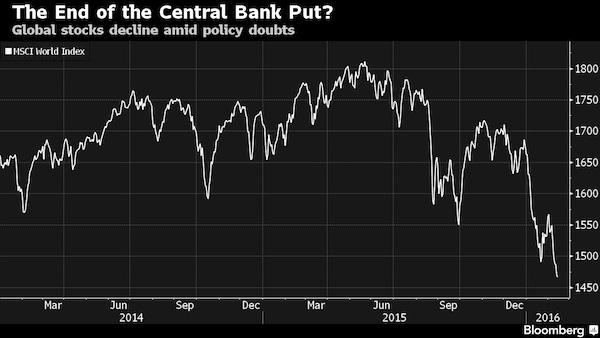
Americans are also buying homes that are larger and pricier; average home size was 2,720 square feet in 2015, up from 2,660 square feet in 2014. And the average price of new homes for sale in 2015 was $351,000, up from $100,000 in 2009. (Still, this doesn’t necessarily reflect the housing market’s strength, as new construction has mostly happened in the high-end market.) Of course, there are some benefits to homeownership, and they aren’t just avoiding unexpected rent hikes and unpredictable landlords. Many people simply enjoy interior decorating and entertaining, Tabarrok added. And perhaps more importantly, home ownership is often tied to access to better public schools. The U.S. tax code also subsidizes houses. Still, he cautioned against the seduction of a large home. “Behavioral economics tells us that we quickly get used to big houses, but we never get used to commuting,” he wrote. “So when you have a choice, go for the smaller house closer to work.”
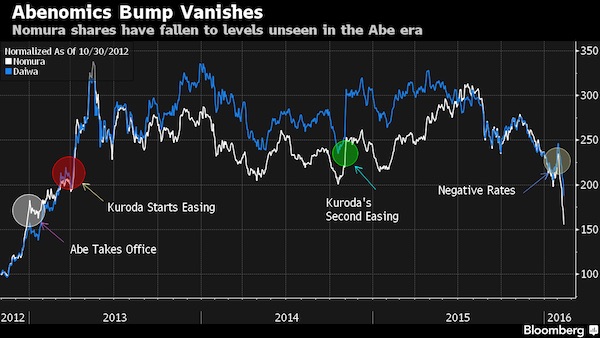
Read more …

h/t ZH

• The Bank of Japan Is Selling Out Its People (Gefira)

The Bank of Japan’s unexpected rate cuts to negative are a desperate attempt to help out the FED and to support the dollar at the expense of the aging Japanese population. The negative market reaction to the FED’s rate hike of December shows that investors do not believe an economic recovery in the US is underway. Two reasons make central banks start to raise interest rates. The first is that economy is doing well, and central banks have to prevent an overheated economy. But it is also a signal to investors everything is going well. In this situation, the first reaction of investors will be the opposite as central bankers planned they will and increase their investments and markets will go up. The second reason central banks raise interest rates is the defensive one; the moment the economy is out of control, investors are beginning to abandon the sinking ship.

The continually increasing interest rate has the task of keeping the investors aboard. Central banks in less developed economies raise rates to defend the national currency, thus preventing investors from fleeing. An increase in the interest rate can add fuel to the fire and in many cases has the opposite effect. Investors start smelling angst of the authorities and start abandoning the sinking ship. In such a situation stock markets are coming crashing down because investors withdraw from them. We saw this last pattern happening in the US economy after the December FED’s rate hike. As a result, the dollar-yen exchange rate is starting to decline, with the value of the dollar falling off as Japanese investors start panicking and fleeing the US market. Surely, Japanese investors know that a rate hike without an accompanying economic growth will erode every existing investment.

There is a general misconception according to which countries drive their currency down to generate growth. People adhere to the simplistic belief that a weak currency drives exports and helps the nation to prosper. The fact is that a cheap currency creates growth by giving away real goods in exchange for IOU (I Owe Yous) or paper debt obligations that will never be repaid. The US is the beneficiary or the receiving end of the weak yen policy. Because the US continues to maintain its world hegemony, it needs a strong dollar. A strong dollar makes everything the US empire buys in the world cheap. A strong dollar causes the world to be willing to exchange real goods for printed paper dollars that have no intrinsic value, and that are issued by a country that does not have the industrial capacity to ever repay what it owes its debtors.

The endless trade deficit the US has with Japan shows how the Japanese are prepared to provide the US with real goods without demanding tangible goods in return. Because the international press publishes trade data in dollars, the trade balance deficit seems to have been shrinking over the last years. The actual situation becomes apparent if we look at the trade deficit in yens. The US trade deficit with Japan is growing bigger and bigger year after year, as Japanese producers are giving away a big chunk of their production to US consumers in return for more and more US paper debt. By manipulating the yen, Japanese authorities are giving away a real part of their GDP that they take from their people to the US empire.

Read more …

Very good. Do read the whole thing. The socialists have been asked to form a government.

• Hedge Funds, Wall Street not Happy with the New Spain (Don Quijones)

Plunging shares, shrinking profits, and a spate of new regulations and court cases that could end up setting it back billions of euros – that’s what the Spanish banking sector is facing. But now, banks are also grappling with the complete absence of a friendly central government to insulate them from the cruel vagaries of the global economic downturn. And the strain is beginning to show. “The political parties must reach an agreement as soon as possible and form a government that is stable,” pleaded Francisco González, president of Spain’s second biggest bank, BBVA. Such a government must not “think about utopias, which only serve to create frustration,” must be “realistic” and (most important of all) must “continue with the policies of the last three of four years.”

González cautioned that foreign investors “are phoning less often” than before. Those “investors” probably include firms like Blackstone and Goldman Sachs, which made a fortune in the immediate aftermath of Spain’s real estate collapse and EU-funded bailout, by picking up publicly subsidized housing on the cheap and either flipping them or renting them at much higher rates. In those days, the city council was led by Ana Botella, the then Mayor and wife of Spain’s former President José María Aznar. One of the main brokers in the deals struck between the city council’s two housing agencies and international funds like Goldman and Blackstone was José María Aznar Botella – their son!

Despite his lack of investment banking experience, Aznar Botella served as an advisor and go-between at the Madrid-based real estate firm Gesnova Gestión Inmobiliaria Integral, which enjoyed close ties with firms like Blackstone subsidiary Fidere, Lone Star, Apollo, KKR, Goldman’s Madrid-based subsidiary Azora, and U.S. private equity firm Cerberus Capital Management LP, whom Aznar-Botella also serves as an advisor. Here’s how the scheme worked: in the aftermath of Spain’s real estate bust, the Rajoy government set up a bad bank by the name of Sareb, a public-private venture responsible for managing distressed assets transferred from the four nationalized financial institutions BFA-Bankia, Catalunya Banc, NGC Banco-Banco Gallego, and Banco de Valencia.

As soon as the bad bank was operational, global investment firms began flocking to Madrid to pick up the juiciest pieces at the best prices, part-subsidized by Spanish taxpayers. To get their hands on the really good stuff, however, investors needed someone on the inside, which is presumably where the Aznar-Botello mother & son partnership came in. But it’s one thing to sell tranches of unoccupied or foreclosed properties to foreign investors to help put a floor under Spain’s property market; it’s quite another when you start selling huge batches of social housing at a ridiculous discount to some of the biggest financial firms on the planet, in a country that has one of the smallest stocks of social housing in Europe. It didn’t take long before rents began soaring and the police began knocking doors down.

Read more …

The Troika making sure Greece will never recover.

• Thousands Of Greek Firms Flee To Bulgaria (Kath.)

According to the president of the Hellenic Confederation of Professionals, Craftsmen and Merchants (GSEVEE), some 6,000 Greek enterprises have emigrated to Bulgaria in the last couple of years alone. At the same time, the GSEVEE chief says, Greeks are behind about 60,000 new tax registrations and bank accounts in the neighboring country. Giorgos Kavathas on Tuesday cited the above figures from an ongoing survey by GSEVEE, adding that the interventions planned for the social security system can only be expected to lead to more Greek firms emigrating. The survey will be presented in the next few days, he noted.

He was speaking at a press conference held jointly by GSEVEE and the Hellenic Confederation of Commerce and Enterprises (ESEE) regarding their participation in tomorrow’s general strike against the government’s planned pension reforms. The two unions warned that manufacturers and merchants will not stop at this strike, and will escalate their industrial action further. “The social security matter is a major national issue and we agree there has to be a reform, although no actuarial study would lead to safe conclusions given the existence of 1.5 million jobless,” argued the president of ESEE, Vassilis Korkidis.

Read more …

Trying to rival the EU in inhumanity.

• Australian Asylum Ruling Paves Way For Deportation Of Infants (Reuters)

Australia’s High Court threw out a challenge to offshore immigration detention camps on Wednesday, clearing the way for the deportation of dozens of infants born in Australia to detained asylum seekers. The court rejected a legal test case brought by an unidentified Bangladeshi woman that challenged Australia’s right to deport detained asylum seekers to the tiny South Pacific island nation of Nauru. The detention centre on Nauru houses about 500 people and has been widely criticised by the United Nations and human rights agencies for harsh conditions and reports of systemic child abuse. The Bangladeshi woman was on a boat intercepted by Australian authorities in October 2013. She was detained on Australia’s remote Christmas Island and later sent to Nauru.

She gave birth to a daughter after she was transferred to Australia for medical treatment in 2014 and has remained there with her child. Other families with children born in Australia in similar circumstances are now in line to be returned to the camps. Lawyers from the Human Rights Law Centre (HRLC) acting for the Bangladeshi woman had argued it was illegal for Australia to operate and pay for offshore detention in a third country. “I hope that the immigration minister and the prime minister, just like other decent Australians, can see that there is simply no excuse to take 37 babies, to rip children from their classrooms, and warehouse them on a tiny island,” HRLC Director of Legal Advocacy Daniel Webb told reporters. “Now, the legality may be complex. The politics may be complex. But the morality is simple. It is fundamentally wrong.”

Read more …

It’s all aimed at streamlining the process to move refugees north. But that’s not what Europe wants.

• Greek Military To Oversee Response To Refugee Crisis (Kath.)

Defense Minister Panos Kammenos on Tuesday heralded the creation of a central body to oversee and improve Greece’s response to the migration and refugee crisis and ensure the country safeguards its position in the Schengen passport-free area, noting that the new body will be led by a senior military official. Greece’s military is to have the oversight of the “Central Coordinating Body for the Management of Migration” until the Migration Ministry and the Hellenic Police gain the necessary know-how and experience to tackle the problem independently, Kammenos indicated at Tuesday’s press conference.

The center, which is to be operational by February 15, is to be based at the Defense Ministry headquarters and coordinate with the Hellenic Police, Coast Guard, Migration Ministry and nongovernmental organizations working with migrants and refugees. The aim is to increase the efficiency of transferring migrants from the islands to the mainland, to improve the provision of food as well as medical and healthcare to migrants, and to monitor the creation of five screening centers, or hot spots, for migrants on the eastern Aegean islands of Lesvos, Chios, Samos, Kos and Leros. Referring to the growing pressure on the islands of the eastern Aegean that receive thousands of migrants daily from neighboring Turkey, Kammenos explained that the new plan aims to spread the burden.

The five hot spots to be set up on the islands are to accommodate migrants for only 24 hours while two relocation centers, on the outskirts of Athens and Thessaloniki, will host new arrivals for up to 72 hours. The screening and relocation centers are to operate in a similar way to the central body, under a local military official who is to coordinate with police and coast guard officers. As the European Union increases the pressure on Greece to manage its borders more effectively, French Interior Minister Bernard Cazeneuve is due in Athens on Thursday and Friday for talks expected to focus on the migration crisis.

Read more …

Wow! Imagine what spring will bring.

• More Than 62,000 Migrant Arrivals In Greece Last Month (Reuters)

The total number of migrants and refugees arriving in Greece in January topped 62,000, the International Organization for Migration said on Tuesday. “(It) is many, many times what we saw a year ago in the previous January,” IOM spokesman Joel Millman said. He added that there were more than 360 deaths among migrants in the waters off Greece, Turkey and Italy during the month.

Read more …

When are we going to get real about this?

• UN Says One-Third Of Refugees Sailing To Europe Are Children (Guardian)

Children now make up over a third of the people making the perilous sea crossing from Turkey to Greece, the UN has said, as two more babies drowned off Europe’s shores. For the first time since the start of the migration crisis in Europe, there are also now more women and children crossing the border from Greece to Macedonia than adult males, according to UN children’s agency Unicef. The figures emerged as Europe struggles with its biggest movement of people crisis since the second world war, with more than a million people fleeing war, violence and poverty risking life and limb to reach its shores last year. “Children currently account for 36% of those risking the treacherous sea crossing between Greece and Turkey,” the Unicef spokeswoman Sarah Crowe said.

“Children and women on the move now make up nearly 60%” of those entering from Macedonia, she added. The figures mark a significant shift since June, when 73% of refugees were adult males and only one in 10 were under the age of 18. Marie Pierre Poirier, Unicef’s special coordinator for the refugee and migrant crisis in Europe, said women and children were even more vulnerable to the dangers of trying to travel to Europe. “The implication of this surge in the proportion of children and women on the move are enormous,” she said in a statement. “It means more are at risk at sea, especially now in the winter, and more need protection on land.” Underlining her point, the International Organisation for Migration (IOM) said on Tuesday that one in every five who drowned last month while trying to sail from Turkey to Greece was a child, with minors accounting for 60 of the 272 deaths.

Including January, a total of 330 children have died in those waters over the last five months, many of them just metres from shore, the organisation said. The drownings continue a grim trend that accelerated last year when nearly 4,000 people died trying to reach Europe by sea. The plight of children was brought home last year when the body of Syrian toddler Alan Kurdi was found washed up on the shore close to Bodrum, Turkey, horrifying the international community. The bodies of two more babies were recovered by the Turkish coastguard in the Izmir province on Tuesday along with seven dead adults, just days after another 37 people drowned off another part of the coast.

Read more …

Europe will not be pardoned for this.

• Nine Migrants, Including Two Babies, Drown En Route To Greece (Reuters)

The bodies of nine people, including two babies, were found drowned off the coast of western Turkey on Tuesday, after a boat carrying refugees and migrants to Greece partly capsized, the Turkish coast guard said in a statement. The fiberglass vessel partially capsized at 0535 local time (0335 GMT) off the coast of Seferihisar in Izmir province, close to the Greek Island of Samos. Two people were rescued swimming to the shore, the coast guard said. A crackdown on illegal crossing and the dangerous winter conditions has failed to deter tens of thousands from boarding flimsy boats and attempting to cross the Mediterranean waves in the first few weeks of the year.

Read more …

Feb 012016
 
 February 1, 2016  Posted by at 9:50 am Finance Tagged with: , , , , , , , , ,  6 Responses »


Matson Aircraft refueling at Semakh, British Mandate Palestine 1931

• China Manufacturing Shrinks At Fastest Rate For Over 3 Years (Reuters)
• Mid-Tier Chinese Banks Piling Up Trillions Of Dollars In Shadow Loans (Reuters)
• US Hedge Funds Mount New Attacks on China’s Yuan (WSJ)
• China’s Steel Sector Hit By Growing Losses (FT)
• Athens And Rome Expose Europe’s Greatest Faultlines (Münchau)
• Euro-Area Factories Cut Prices as Deflation Risks Loom Large (BBG)
• Nigeria Asks For $3.5 Billion In Global Emergency Loans (FT)
• Why Miners Have it Worse Than Oil Producers (BBG)
• Saudis Told To Embrace Austerity As Debt Defaults Loom (Tel.)
• 1 Million Investors Lose $7.6 Billion In China Online Ponzi Scheme (Reuters)
• The West Is Reduced To Looting Itself (Paul Craig Roberts)
• US, UK-Backed Saudi War & Blockade Cause Mass Starvation In Yemen (Salon)
• Europe Chokes Flow of Refugees to Buy Time for a Solution (WSJ)
• German Police ‘Should Shoot At Migrants’, Populist Politician Says (BBC)
• UK Labour MP Compares Cologne Attacks To Birmingham Night Out (Tel.)
• The EU Must Reassert Humane Control Over Chaos Around The Mediterranean (UN)

No kidding: “It is quite concerning that the significant monetary and fiscal stimulus in 2015 has only managed to slow the rate of decline in China’s industrial activity..”

• China Manufacturing Shrinks At Fastest Rate For Over 3 Years (Reuters)

Activity in China’s manufacturing sector contracted at its fastest pace in almost three-and-a-half years in January, missing market expectations, an official survey showed on Monday. The official purchasing managers’ index (PMI) stood at 49.4 in January, compared with the previous month’s reading of 49.7 and below the 50-point mark that separates growth from contraction on a monthly basis. It is the weakest index reading since August 2012. Analysts polled by Reuters predicted a reading of 49.6. The PMI marks the sixth consecutive month of factory activity contraction, underlining a weak start for the year for a manufacturing complex under severe pressure from falling prices and overcapacity in key sectors including steel and energy.

The price of oil fell on the disappointing data, which was compounded by weak export figures from South Korea. Brent crude was trading at $35.54 per barrel at 02.00 GMT, down 45 cents, or 1.25%, from the last close. China’s stock markets also fell in morning trading, although the Nikkei in Japan and the ASX/S&P 200 in Australia both swatted away the gloom to remain in positive territory. Zhou Hao, an economist at Commerzbank, said: “The electricity production remained sluggish and the crude steel output continued the weak trend in January, reflecting an ongoing deleveraging process in the industrial sectors.” “In the meantime, China has started an aggressive capacity reduction in many sectors, which could add downward pressure on the bulk commodity prices over time.”

Meanwhile, the official non-manufacturing PMI fell to 53.5 from December’s 54.4, according to the National Bureau of Statistics (NBS). The services index remained in expansionary territory highlighting continuing strength that has helped China weather the sharp slowdown in manufacturing. With manufacturing decelerating quickly, services have been a crucial source of growth and jobs for China over the past year, and analysts have been watching closely to see if the sector can maintain momentum in 2016. Angus Nicholson of IG in Melbourne said: “It is quite concerning that the significant monetary and fiscal stimulus in 2015 has only managed to slow the rate of decline in China’s industrial activity. “The first quarter of activity is always the weakest in China due to the seasonal disruption of Chinese new year, and there is the possibility of global markets reacting very negatively when the quarterly data starts filtering out in March and April.”

The China slowdown was underlined on Monday by figures showing that South Korea’s exports suffered their worst downturn in January since the depths of the global financial crisis in 2009. The trade ministry in Seoul said sluggish demand from China helped exports to fall to a worse-than-expected 18.5% from a year earlier, extending December’s slump of 14.1% and marking the 13th straight month of declines. Shipments to China, South Korea’s largest market, tumbled 21.5% on-year in January in their biggest drop since May 2009, and the trade ministry said export conditions were worsening.

Read more …

There’s still not nearly enough scrutiny of the shadow banks. But that is where the real problems will be.

• Mid-Tier Chinese Banks Piling Up Trillions Of Dollars In Shadow Loans (Reuters)

Mid-tier Chinese banks are increasingly using complex instruments to make new loans and restructure existing loans that are then shown as low-risk investments on their balance sheets, masking the scale and risks of their lending to China’s slowing economy. The size of this ‘shadow loan’ book rose by a third in the first half of 2015 to an estimated $1.8 trillion, equivalent to 16.5% of all commercial loans in China, a UBS analysis shows. For smaller banks, the rate is much faster. This growing practice, which involves financial structures known as Directional Asset Management Plans (DAMPs) or Trust Beneficiary Rights (TBRs), comes at a time when some mid-tier lenders, under pressure from China’s slowest economic growth in 25 years, are already delaying the recognition of bad loans.

“These are now the fastest growing assets on the balance sheets of most listed banks, excluding the Big Five, not just in percentage terms but absolute terms,” said UBS financial institutions analyst Jason Bedford, a former bank auditor in China who focuses on the issue. “The concern is that the lack of transparency and mis-categorization of credit assets potentially hide considerable non-performing loans.” To provide a buffer against tough times, banks are required to set aside capital against their credit assets – the riskier the asset, the more capital must be set aside, earning them nothing. Loans typically carry a 100% risk weighting, but these investment products often carry a quarter of that, so banks can keep less money in reserve and lend more.

Banks must also make provision of at least 2.5% for their loan books as a prudent estimate of potential defaults, while provisions for these products ranged between just 0.02 and 0.35% of the capital value at the main Chinese banks at the end of June, Moody’s Investors Service said in a note last month. At China’s mid-tier lender Industrial Bank Co, for example, the volume of investment receivables doubled over the first nine months of 2015 to 1.76 trillion yuan ($267 billion). This is equivalent to its entire loan book – and to the total assets in the Philippine banking system, filings showed. Investment receivables may include such benign assets as government bonds, but increasingly they include TBRs and DAMPs at mid-tier lenders.

At Evergrowing Bank, investment receivables reached 397 billion yuan in September, surpassing its loan book of 290 billion yuan. The bank said last year practically all of its investment receivables were DAMPs and TBRs. China Zheshang Bank, another smaller lender, also saw its investment receivables double over the same period, the bank’s prospectus to sell shares in Hong Kong shows. Zhang Changgong, the bank’s deputy governor, said banks were increasingly becoming return-seeking asset managers, not mere lenders. “In the past banks (made loans and) held assets. Now banks manage assets,” he said.

Read more …

It’s game on. “When you talk about orders of magnitude, this is much larger than the subprime crisis..”

• US Hedge Funds Mount New Attacks on China’s Yuan (WSJ)

Some of the biggest names in the hedge-fund industry are piling up bets against China’s currency, setting up a showdown between Wall Street and the leaders of the world’s second-largest economy. Kyle Bass’s Hayman Capital Management has sold off the bulk of its investments in stocks, commodities and bonds so it can focus on shorting Asian currencies, including the yuan and the Hong Kong dollar. It is the biggest concentrated wager that the Dallas-based firm has made since its profitable bet years ago against the U.S. housing market. About 85% of Hayman Capital’s portfolio is now invested in trades that are expected to pay off if the yuan and Hong Kong dollar depreciate over the next three years—a bet with billions of dollars on the line, including borrowed money.

“When you talk about orders of magnitude, this is much larger than the subprime crisis,” said Mr. Bass, who believes the yuan could fall as much as 40% in that period. Billionaire trader Stanley Druckenmiller and hedge-fund manager David Tepper have staked out positions of their own against the currency, also known as the renminbi, according to people familiar with the matter. David Einhorn’s Greenlight Capital Inc. holds options on the yuan depreciating. The funds’ bets come at a time of enormous sensitivity for China’s leaders. The government is struggling on multiple fronts to manage a soft landing for the economy, deal with a heavily indebted banking system and navigate the transition to consumer-led growth.

Expectations for a weaker yuan have led to an exodus of capital by Chinese residents and foreign investors. Though it still boasts the largest holding of foreign reserves at $3.3 trillion, China has experienced huge outflows in recent months. Hedge funds are gambling that China will let its currency weaken further in a bid to halt a flood of money leaving the country and jump-start economic growth. The effort is a lot riskier, though, than taking on a currency whose value is set by the market. China’s state-run economy gives the government a number of levers to pull and tremendous resources at its disposal. Earlier this year, state institutions bought up so much yuan in the Hong Kong market where foreigners place most of their bets that overnight borrowing costs shot up to 66%, making it difficult to finance short positions and sending the yuan up sharply.

Read more …

Just the beginning. They don’t dare close too many mills and make large numbers of people unemployed. But they have, in my guess, at least 50% overcapacity.

• China’s Steel Sector Hit By Growing Losses (FT)

A sharp reversal in China’s steel industry has led to more than half of major producers reporting losses last year. Member companies of the China Iron and Steel Association suffered a combined loss of Rmb64.5bn ($9.8bn), compared with profits of Rmb22.6bn in 2014. The country’s steel industry, which accounts for more than half of global production, contracted for the first time last year, with raw steel production dropping 2.3% — the first fall since 1981. Steel demand is wilting as construction and heavy industry stutter, a slowdown highlighted on Monday when China’s official manufacturing purchasing managers’ index for January fell to 49.4, from 49.7 in December. PMI readings below 50 indicate a fall-off in activity.

Li-Gang Liu, China chief economist at ANZ, said the reading suggested “the contraction in the manufacturing sector became more entrenched”. Mr Liu noted that year-on-year steel output fell 12% in both December and early January. The National Bureau of Statistics attributed the steeper than expected fall on the government’s campaign to reduce industrial overcapacity, especially in the steel and coal sectors, as well as a spillover effect from the lunar new year holiday. The holiday begins on February 7 and firms often suspend activity weeks in advance. China’s economic slowdown hit domestic steel demand hard in 2015, with steel-intensive industries, including the once-resilient property sector, unwilling to launch new projects in the face of overhanging inventories.

CISA, blaming industry losses on plummeting domestic prices, said its price index fell more than 30% over the course of 2015. Mill closures remain unlikely despite the losses, however, in part due to fears that the subsequent mass job losses could lead to social instability. The closure of so-called zombie companies alone could mean 400,000 lay-offs, according to a recent speech by Li Xinchuang, head of the China Metallurgical Industry Planning and Research Institute. Faced with these issues, ramping up export volume remains the industry’s chosen palliative for overcapacity. China’s steel exports grew more than 20 per cent in 2015 to 112m tonnes. The flood of Chinese steel is stoking trade protectionism as companies in other parts of the world struggle to compete with Chinese prices. In 2015, 37 cases were filed against Chinese steel producers, most on anti-dumping grounds.
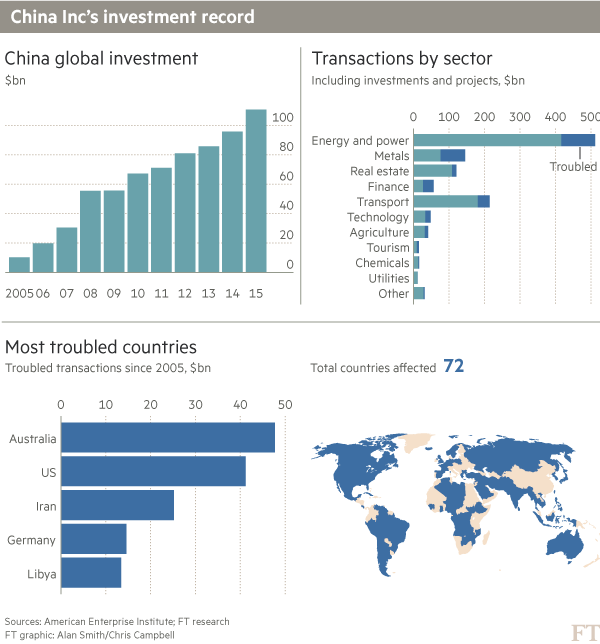
Read more …

Sure it’s not really Brussels where the deepest faultlines are?

• Athens And Rome Expose Europe’s Greatest Faultlines (Münchau)

How should we think about systemic risk in Europe today? The EU has been moderately successful at crisis management. But the ability to muddle through is reaching its limits when, as now, several crises intersect at once. You can see the problem most clearly in Greece — a country battling both an economic meltdown and a refugee crisis — with not much help from the rest of the EU. Last week when the European Commission issued a report criticising Athens over its failure to control its borders, Macedonia took the unilateral decision to close its southern crossing with Greece — leaving thousands of refugees in transit on the Greek side of the border. In Athens, meanwhile, parliament discussed pension reform, forced upon the country by their creditors as a quid pro quo for continued financial life support.


Greece may be the starkest example, but it is not the only country facing overlapping crises. It is not even the most important one facing this dilemma. That would be Italy. While Rome’s problems are different from those of Greece, the country’s long-term sustainability in the eurozone is just as uncertain, unless you believe that its economic performance will miraculously improve when there is no reason why it should. Italy was overwhelmed by the increase of refugees from north Africa last year. On top of that it faces unresolved economic problems — no productivity growth for 15 years; a large stock of public sector debt that leaves the government with virtually no fiscal room for manoeuvre; and a banking system with €200bn in non-performing loans, plus another €150bn of debt classified as troubled.

Then consider that its three main opposition parties have, at one time or another, all questioned the country’s membership of the eurozone. Even if none of them look like coming to power in the near future, it is clear that Italy only has a limited amount of time to fix its multiple problems. The struggle to repair the banking system is a good example of just how big the task is. Last week, the Italian government and the European Commission agreed a convoluted scheme to relieve the Italian banking system of some of these toxic assets. It uses all the dirty tricks of modern finance, including the infamous credit default swap, a financial product that mimics insurance against default on a bond, which was particularly popular during the pre-2007 credit bubble. These instruments allow investors to hedge against default risk. But more often than not, their true purpose is to conceal information, to fool investors, or to circumvent regulatory restrictions.

Read more …

Which of course deepens the deflation. Ergo: more price cuts on the way. Rock and an impossible place.

• Euro-Area Factories Cut Prices as Deflation Risks Loom Large (BBG)

Factories in the euro area slashed prices of goods by the most in a year in January, highlighting the deflationary risks that’s keeping alarm bells ringing at the ECB. In its monthly manufacturing report, Markit Economics said price pressures “remained on the downside” and output charges fell for a fifth month. In addition, all countries in its survey reported declines, the first time that’s happened in 11 months. President Mario Draghi said the ECB’s stimulus policies will be reviewed in March as the region’s inflation rate may drop below zero again because of oil’s slump. Price growth has been slower than the central bank’s goal of just under 2% for almost three years. “The euro zone’s manufacturing economy missed a beat at the start of the year,” said Chris Williamson at Markit.

“If the slowdown in business activity wasn’t enough to worry policy makers, prices charged by producers fell at the fastest rate for a year to spur further concern about deflation becoming ingrained.” Inflation in the 19-country region accelerated to 0.4% in January, according to data last week, with the core rate rising to 1%. Still, that may only be a temporary reprieve. Markit’s headline Purchasing Managers’ Index fell to 52.3 from 53.2, matching an initial estimate published last month. Among the region’s largest countries, growth slowed in Germany and Italy, stagnated in France and accelerated in Spain. Markit said its survey signals annual manufacturing output growth of just 1.5% at the start of the year. “The data are likely to add to pressure on the ECB to expand the central bank’s stimulus programme as soon as March,” Williamson said.

Read more …

Watch the dominoes go.

• Nigeria Asks For $3.5 Billion In Global Emergency Loans (FT)

Nigeria has asked the World Bank and African Development Bank for $3.5 billion in emergency loans to fill a growing gap in its budget in the latest sign of the economic damage being wrought on oil-rich nations by tumbling crude prices. The request from the eight-month-old government of President Muhammadu Buhari is intended to help fund a $15 billion deficit in a budget heavy on public spending as the west African country attempts to stimulate a slowing economy and offset the impact of slumping oil revenues. It comes as concerns grow over the impact of low oil prices on petroleum exporting economies in the developing world. Azerbaijan, which last month imposed capital controls to try and halt a slide in its currency, is in discussions with the World Bank and the IMF about emergency assistance.

Nigeria’s economy is Africa’s largest and has been hit hard by the fall in crude prices — oil revenues are expected to fall from 70% of income to just a third this year. Finance minister Kemi Adeosun told the Financial Times recently that she was planning Nigeria’s first return to bond markets since 2013. But Nigeria’s likely borrowing costs have been rising alongside its budget deficit. A projected deficit of $11bn, or 2.2% of gross domestic product, had already risen to $15bn, or 3%, as a result of the recent turmoil in oil markets. The $2.5bn loan from the World Bank and a parallel $1bn loan from the ADB, which would enjoy below-market rates, must still be approved by both banks’ boards.

Under World Bank rules its loan would be subject to an IMF endorsement of the government’s economic policies and bank officials say they would have to be confident the Nigerian government was undertaking significant structural reforms. But both loans would carry far fewer conditions than one from the IMF, which does not believe Nigeria needs a fully fledged international bailout at this point.

Read more …

Can we call it a draw for now? Bit early to call, we’re just getting off the starting line.

• Why Miners Have it Worse Than Oil Producers (BBG)

“Things’ll go your way, if you hold on for one more day,” vocal group Wilson Phillips once crooned. Mining companies seem to have taken those lyrics to heart, opting to maintain production as long as their cash reserves allow and in effect delay a long-awaited resolution in the supply and demand balance of dry commodities, according to a new note from Goldman Sachs. The nature of the metals and mining business—legal considerations combined with an ability to store excess supply for the long-haul—means the industry faces a longer shakeout than in the energy sector. “Many of the [mining] structures are no longer assets but rather liabilities due to environmental regulations,” write Goldman analysts led by Head of Commodities Research Jeffrey Currie.

“This suggests that, in order to delay the environmental costs of mine rehabilitation, the penalties associated with employee layoff and non-performance of commercial obligations, owners will operate the facilities until they run out of cash and are obliged to suspend operations.” The trend is particularly true of U.S. coal miners, according to the analysts, and underscored by recent failed auctions of mining assets. “[Last] week we saw Alpha Natural Resources cancel an auction of 35 coal mines at the last minute due to a lack of interest, illustrating the fact that some mining assets burdened with outstanding liabilities and negative margins are left without any residual value,” Goldman notes.

Fundamental differences between metals and energy businesses have resulted in lower volatility for prices of gold, aluminium and similar dry commodities compared to energy-related products such as natural gas, electricity, and crude, the Goldman analysts say. “Theoretically, once an energy market breaches storage capacity, prices need to collapse below cash costs to immediately re-balance supply with demand. In practice, however, operational stress in energy is a local, not global concept as breaching storage capacity happens most likely in landlocked locations, but it does whittle away at the global supply overhang,” the analysts write. “In contrast, metals can be ‘piled high’ in low-cost locations almost anywhere in the world with far greater density, i.e. dollar per square foot, than energy.”

To illustrate the point, Goldman calculates that $1 billion worth of gold would, at current spot prices, fit into a generously-sized bedroom closet, while $1 billion worth of oil would take up 17 very large crude carriers, each with a capacity of more than a quarter of a million deadweight metric tons. With an estimated 12 months of cash reserves left for some U.S. coal miners, financial stress needs to deepen before the supply-demand balance even begins to resolve itself.

Read more …

Saudi leaders have the same problem as the Chinese: they’re afraid of their people.

• Saudis Told To Embrace Austerity As Debt Defaults Loom (Tel.)

Saudi Arabia faces years of tough austerity as the worst oil price crash in the modern history forces the kingdom to make radical cuts to government largesse, the IMF has warned. The world’s largest producer of crude oil will need to “transform” its economy away from oil revenues, which make up more than 80pc of the government’s wealth, according to Masood Ahmed, head of the Middle East department at the IMF. The Saudi monarchy has already been forced to unveil the largest programme of government austerity in decades as oil prices have collapsed by more than 70pc in 18 months. “This will have to be part of a multi-year adjustment process,” Mr Ahmed told The Telegraph. He urged the kingdom to reform its generous system of oil subsidies and introduce a host of new taxes, including consumption levies such as VAT.

“There will have to be a major transformation of the Saudi economy. It is necessary and it is going to be difficult, but it is a challenge which I think the authorities have clearly laid out”, said Mr Ahmed. The warning comes as the world’s weakest oil producing nations could buckle under the pressure of the price rout. IMF officials have been in Azerbaijan this week amid fears Baku will need a $4bn international rescue package to stave off a debt default. During the world’s last major oil price crash in 1986, 17 out of 25 of the developing world’s major oil producers defaulted on their debts, according to research from Oxford Economics. Debt mountains in producer nations ballooned by 40pc of GDP on average.

“The 1980s precedents are alarming; producers that avoided sovereign defaults were the exception rather than the rule”, said Gabriel Sterne at Oxford Economics. Azerbaijan was forced to abandon its foreign exchange peg with the dollar in December, after speculators caused the currency to crash. The Saudis have been burning through their reserves at a record pace to protect the riyal’s fixed value against a soaring dollar, and should continue to preserve the peg at all costs, said the IMF. Mr Ahmed said it was “neither necessary nor appropriate” for Riyadh to move to a floating exchange rate, forcing it to undertake record levels of expenditure cuts instead.

Read more …

$7.6 billion in a year and a half. Eat your heart out, Bernie.

• 1 Million Investors Lose $7.6 Billion In China Online Ponzi Scheme (Reuters)

Chinese police have arrested 21 people involved in the operation of peer-to-peer lender Ezubao, the official Xinhua news agency said on Monday, over an online scam it said took in some 50 billion yuan ($7.6 bn) from about 900,000 investors. Ezubao was a Ponzi scheme, the Xinhua report said, and more than 95% of the projects on the online financing platform were fake. Among those arrested were Ding Ning, the chairman of Yucheng Group, which launched Ezubao in July 2014. It was not possible to reach Ezubao officials for comment and it was not clear if Ding had legal representation.

Ezubao’s website has been shut down and it appeared Yucheng Group’s Beijing office had been closed when Reuters reporters visited before Monday’s Xinhua report. Chinese police said they had sealed, frozen and seized the assets of Ezubao and its linked companies as part of investigations into China’s largest P2P online platform by lending figures. The Ezubao case has underscored the risks created by China’s fast-growing $2.6 trillion wealth management product industry. Many products are sold through loosely regulated channels, including online financial investment platforms and privately run exchanges.

Read more …

“The combination of propaganda, financial power, stupidity and bribes means that there is no hope for European peoples.”

• The West Is Reduced To Looting Itself (Paul Craig Roberts)

I, Michael Hudson, John Perkins, and a few others have reported the multi-pronged looting of peoples by Western economic institutions, principally the big New York Banks with the aid of the International Monetary Fund (IMF). Third World countries were and are looted by being inticed into development plans for electrification or some such purpose. The gullible and trusting governments are told that they can make their countries rich by taking out foreign loans to implement a Western-presented development plan, with the result being sufficient tax revenues from economic development to service the foreign loan. Seldom, if ever, does this happen. What happens is that the plan results in the country becoming indebted to the limit and beyond of its foreign currency earnings.

When the country is unable to service the development loan, the creditors send the IMF to tell the indebted government that the IMF will protect the government’s credit rating by lending it the money to pay its bank creditors. However, the conditions are that the government take necessary austerity measures so that the government can repay the IMF. These measures are to curtail public services and the government sector, reduce public pensions, and sell national resources to foreigners. The money saved by reduced social benefits and raised by selling off the country’s assets to foreigners serves to repay the IMF. This is the way the West has historically looted Third World countries. If a country’s president is reluctant to enter into such a deal, he is simply paid bribes, as the Greek governments were, to go along with the looting of the country the president pretends to represent.

When this method of looting became exhausted, the West bought up agricultural lands and pushed a policy on Third World countries of abandoning food self-sufficiency and producing one or two crops for export earnings. This policy makes Third World populations dependent on food imports from the West. Typically the export earnings are drained off by corrupt governments or by foreign purchasers who pay little while the foreigners selling food charge much. Thus, self-sufficiency is transformed into indebtedness. With the entire Third World now exploited to the limits possible, the West has turned to looting its own. Ireland has been looted, and the looting of Greece and Portugal is so severe that it has forced large numbers of young women into prostitution. But this doesn’t bother the Western conscience.

Previously, when a sovereign country found itself with more debt than could be serviced, creditors had to write down the debt to an amount that the country could service. In the 21st century, as I relate in my book, The Failure of Laissez Faire Capitalism, this traditional rule was abandoned. The new rule is that the people of a country, even a country whose top offiials accepted bribes in order to indebt the country to foreigners, must have their pensions, employment, and social services slashed and valuable national resources such as municipal water systems, ports, the national lottery, and protected national lands, such as the protected Greek islands, sold to foreigners, who have the freedom to raise water prices, deny the Greek government the revenues from the national lottery, and sell the protected national heritage of Greece to real estate developers.

What has happened to Greece and Portugal is underway in Spain and Italy. The peoples are powerless because their governments do not represent them. Not only are their governments receiving bribes, the members of the governments are brainwashed that their countries must be in the European Union. Otherwise, they are bypassed by history. The oppressed and suffering peoples themselves are brainwashed in the same way. For example, in Greece the government elected to prevent the looting of Greece was powerless, because the Greek people are brainwashed that no matter the cost to them, they must be in the EU. The combination of propaganda, financial power, stupidity and bribes means that there is no hope for European peoples.

Read more …

Humanity? Morals? Not us.

• US, UK-Backed Saudi War & Blockade Cause Mass Starvation In Yemen (Salon)

Mass starvation is ongoing in Yemen, the United Nations warns, calling it a “forgotten crisis.” The poorest country in the Middle East may be on the brink of famine, while it faces bombing and a blockade from a Saudi-led coalition, backed by the U.S. and the U.K. Approximately 14.4 million Yemenis — more than half of the population of the country — are food insecure, according to a new report by the Food and Agriculture Organization of the United Nations, also known as the FAO. The U.N. estimates there are 25 million people in Yemen. This means at least 58% of the population is food insecure. Hunger is growing. In the seven months since June 2015, the number of food insecure Yemenis has grown by 12%. Since late 2014, the number has grown by 36%. “The numbers are staggering,” remarked Etienne Peterschmitt, FAO deputy representative and emergency response team leader in Yemen.

Peterschmitt called the mass starvation “a forgotten crisis, with millions of people in urgent need across the country.” The FAO says “ongoing conflict and import restrictions have reduced the availability of essential foods and sent prices soaring.” What the FAO does not mention in its report, however, is that these import restrictions are a result of the Saudi blockade on Yemen. Since the war broke out in March, with the backing of the U.S. and U.K., Saudi Arabia has imposed a naval, land and air blockade on Yemen — which imports more than 90% of its staple foods. Because of the Saudi-led blockade and war, for more than six months, humanitarian organizations have warned that 80% of the Yemeni population, 21 million people, desperately need food, water, medical supplies and fuel.

The U.N. has insisted for over half a year that Yemenis are enduring a “humanitarian catastrophe.” Salon sent the FAO multiple requests for comment, inquiring as to why the agency did not directly acknowledge the Saudi blockade, yet did not receive a response. The U.S. media and government have devoted very little attention to the Saudi blockade, and the U.N. has not mentioned it much in its reports on Yemen. Journalist Sharif Abdel Kouddous has warned that “Yemen is now the world’s worst humanitarian crisis.” [..] The Obama administration has sold more than $100 billion in weapons to the Saudi absolute monarchy in the past five years. The Saudi military has dropped U.S.-made cluster munitions, which are banned in 118 countries, on civilian neighborhoods in Yemen, in what Human Rights Watch called “outrageous” and a “war crime.”

Read more …

The unholy union on its last legs.

• Europe Chokes Flow of Refugees to Buy Time for a Solution (WSJ)

Europe is bottling up migrants at the foot of the Balkans as its other plans for stemming the migration crisis flounder. EU member states have sent border guards, police vehicles and fingerprinting machines to Macedonia, which isn’t a member of the bloc. The goal: to squeeze the river of people still streaming north from Greece toward Germany into a trickle, turning away all but those from war-torn countries such as Syria and Iraq. The mounting restrictions are buying German Chancellor Angela Merkel time as she asks voters for patience and lobbies fellow EU leaders to implement what she promises will be a comprehensive solution to the migration crisis.

Ms. Merkel wants Turkey to dismantle smuggling networks that bring migrants across the Aegean Sea to Greece, and she wants Greece to set up large registration camps that would allow recognized refugees to be settled across the EU. But with the chancellor’s approach making little headway, many European policy makers say they have only until March to reduce the numbers from the Middle East, South Asia and Africa who are arriving in the Continent’s core, mainly Germany. Soon, spring weather on the Aegean is expected to accelerate the arrivals, just as Ms. Merkel’s conservatives face state elections in which an anti-immigration party is poised for unprecedented gains. Within Ms. Merkel’s ruling coalition, demands to shut Germany’s own border are multiplying. Support for her open-door policy is waning abroad too. Even her ally Austria has announced an annual cap on asylum places.

Mounting political pressure around Europe to cut the numbers arriving, coupled with security fears about potential terrorists using the migrant trail, is leading to measures that could effectively redraw Europe’s border at the Balkans. In Macedonia, a small, impoverished ex-Yugoslav republic, officials warn that European governments are discussing a Plan B that would have the Macedonian-Greek border sealed off entirely, with the help of EU and Balkan countries further north. “We aren’t three months away, but weeks” from cutting off Greece, Macedonian Foreign Minister Nikola Poposki said in an interview. “Actually, this is the second-worst option, because the worst option isn’t doing anything, and then each of the [EU] member states would be sealing off its own borders,” he said.

Read more …

“The last German politician under whom refugees were shot at was Erich Honecker..”

• German Police ‘Should Shoot At Migrants’, Populist Politician Says (BBC)

German police should “if necessary” shoot at migrants seeking to enter the country illegally, the leader of a right-wing populist party has said. Frauke Petry, head of the eurosceptic Alternativ fuer Deutschland (AfD) party, told a regional newspaper: “I don’t want this either. But the use of armed force is there as a last resort.” Her comments were condemned by leftwing parties and by the German police union. More than 1.1 million migrants arrived in Germany last year. Also on Saturday, German Chancellor Angela Merkel said most migrants from Syria and Iraq would go home once the wars in their countries had ended. She told a conference of her centre-right CDU party that tougher measures adopted last week should reduce the influx of migrants, but a European solution was still needed.

Police must stop migrants crossing illegally from Austria, Ms Petry told the Mannheimer Morgen newspaper (in German), and “if necessary” use firearms. “That is what the law says,” she added. A prominent member of the centre-left Social Democrats, Thomas Oppermann, said: “The last German politician under whom refugees were shot at was Erich Honecker” – the leader of Communist East Germany. Germany’s police union, the Gewerkschaft der Polizei, said (in German) officers would never shoot at migrants. It said Ms Petry’s comments revealed a radical and inhumane mentality. The number of attacks on refugee accommodation in Germany rose to 1,005 last year – five times more than in 2014.

Read more …

Not PC. “They” are the enemy, not “We”.

• UK Labour MP Compares Cologne Attacks To Birmingham Night Out (Tel.)

The Labour MP Jess Phillips is facing calls to resign after comparing the organised sexual assaults committed by gangs of migrants in Cologne to the regular harassment of women on the streets of Birmingham. The city’s residents and business owners have hit back, saying her comments were “irresponsible, highly inaccurate and misleading”. Ms Phillips, the MP for Birmingham Yardley, suggested this week that the recent attacks in Germany are no different to the situation women find themselves in the centre of Birmingham. Her remarks have incensed locals who have called on her to resign from her post and “identify the error of her ways in what she said”. Mike Olley, manager of the West Side business improvement district, said that Birmingham’s Broad Street is “not like the Wild West”.

Speaking on BBC Radio 4’s Today programme, he said that sexual harassment is “not an institutionalised part of what goes on there” On New Year’s Eve in Cologne, Germany, dozens of women found themselves trapped in a crowd of around 1,000 men, who groped them, tore off their underwear, and shouted lewd insults. German authorities have since said that almost all of the New Year’s Eve sex attackers have a “migrant background”. Superintendent Andy Parsons, Police Commander for Central Birmingham, said that Ms Phillips’ comments “aren’t born out certainly in terms of crime statistics”. He added: “But I also appreciate it’s not just about statistics. I’ve got recent experience myself policing New Year on Broad Street, it was extremely busy and the atmosphere was one of celebration rather than one of sexual overtones.

“In a night time economy …there will be activity that is alcohol fuelled – but is it fair to compare it to incidents in Cologne on New Year? I don’t think it is.” However, some acknowledged that sexual harassment is a problem in the city. Michael Mclean, chairman of Broad Street Pub Watch said that sexual harassment is “something that we see and if I turned round and said that we didn’t, I’d be lying”. He went on: “Does it happen? Yes it does. Is it true what people are saying relating it to the cologne sex attacks? Absolutely not. The correlation between the two is a massive over exaggeration.”

Read more …

Sutherland has consistently been that lonely civilized voice.

• The EU Must Reassert Humane Control Over Chaos Around The Mediterranean (UN)

by Peter Sutherland, UN’s special representative for migration

The European refugee debate reached a new nadir with a proposal to expel Greece from the Schengen zone and effectively transform it into an open-air holding pen for countless thousands of asylum seekers. The idea is not only inhumane and a gross violation of basic European principles; it also would prove vastly more costly than the alternative – a truly common EU policy that quells the chaos of the past year. Six countries have already reimposed border controls, and the European commission is preparing to allow them, and presumably others, to do the same for two years. The financial price of this alone is enormous – in the order of at least €40bn (including costs to fortify borders and those incurred by travellers and shippers). It would be much less expensive, financially and politically, to establish a common EU border and coastguard, and a functioning EU asylum agency.

This has proved to be, effectively, a zero-sum game. The rush by member states last year to seal their own perimeters left them unable to help shore up the EU’s external borders. They failed to send Greece the personnel and ships it had been promised. As such, the need for national border controls has become a self-fulfilling prophecy. A selfish, unilateral approach to borders constitutes a repeat of the tragedy of 2015, when EU member states individually spent about €40bn to address the crisis after it had reached European shores. In early 2015, the UN asked for a small fraction of that to feed, house and school the four million refugees in Turkey, Jordan, and Lebanon, but the international community and Europe failed to deliver (and many EU members still haven’t paid their share).

Unable to feed and educate their children, thousands of refugees ceded their savings to smugglers for a chance to reach Europe – precisely what you and I would have done had we been in their place. Europe cannot afford another such failure. The EU, working with the international community, must reassert humane control over the chaos around the Mediterranean. This entails immediate action on three fronts: first, raising the necessary tens of billions to allow refugees in frontline countries to live, work, and go to school there; states and the private sector must also help to create jobs both for refugees and natives through investments in the region and free-trade regimes.

Second, EU members must agree to accept several hundred thousand refugees directly from the region via safe, secure pathways and to match them to communities in Europe able to host them; failing to do this will alienate the frontline countries that bear most of the burden. Third, EU states must focus on creating a common-border regime, coastguard and asylum agency rather than return to the era of the Berlin Wall. The EU is hurtling towards disintegration, not due to some insurmountable challenge or outside force. It is instead succumbing to a self-induced panic that has paralysed its common sense. It is time to end the nightmare.

Read more …