
Jun 212016


NPC District National Bank, Dupont branch, Washington, DC 1924


• The Big Guns Are Out: Soros, Rothschild Warn Of Brexit Doom (ZH)
• When Brexit Has Come And Gone, The Real Problems Will Remain (ZH)
• IMF Calls On Japan To ‘Reload’ Abenomics (Nikkei)
• India’s Rockstar Central Banker Defeated As Modi Revolution Stalls (AEP)
• Yellen Makes ‘Uncertainty’ New Mantra (R.)
• “Whatever It Takes” Wasn’t Enough (Noland)
• The World’s Newest “Reserve” Currency Is Anything But (Balding)
• China’s Developers Can’t Stop Overpaying for Property (WSJ)
• China’s ‘Land Kings’ Return as Housing Prices Rise (WSJ)
• Energy-Related Loan Losses Rising (B.)
• California Power Grid Prepares For Heatwave, Power Outages (R.)
• Australia Whistleblower Loses Job After Speaking Out On Refugee Camps (G.)

Vested interests at stake.

• The Big Guns Are Out: Soros, Rothschild Warn Of Brexit Doom (ZH)

Just yesterday, we recounted the story of “Black Wednesday” when on September 16, 1992, the UK was forced out of the EU’s exchange-rate mechanism, or ERM, when the BOE tapped out and allowed the British pound to float freely, leading to 15% losses in the sterling. As we noted, this was George Soros’ infamous trade which “broke the Bank of England” and made the Hungarian richer by over $1.5 bilion. 24 years later Soros is back, and this time he is warning against the kind of devaluation that made him a billionaire and which he believes will be unleashed by Brexit, when in a Guardian Op-Ed he wrote that U.K. voters are “grossly underestimating” the true costs of a vote to leave the EU, saying that there would be an “immediate and dramatic impact on financial markets, investment, prices and jobs.”

[..] It is notable that Soros’ warning comes just days after that of Jacob Rothschild himself who said in another Op-Ed, this time for The Times, that leaving the EU could lead to a “damaging and disorderly situation” in the UK as he urged Britons to vote ‘remain’. Just like Soros, Lord Rothschild, suddenly exhibiting a rare strain of humanitarian concern, said readers should not “risk the wellbeing of our country”and European countries are “better off together”. He said that “at present we enjoy being a permanent member of the UN security council and we are essential to the G8 and Commonwealth. But diplomacy, defence, the environment and our values of being a liberal democracy will all be at risk” adding that “I can see no good reason why we should accept our playing a diminished role on the world stage,” especially if his own personal fortune would be jeopardized.

Finally, completing the doom loop, was none other than Chancellor George Osborne who, according to the Telegraph, “refused to rule out suspending trading on the London stock market if Britons vote to leave the EU on Friday morning… The threat from the Chancellor, made in an LBC radio interview on Monday evening, after the market had closed could force shares down in London as early as Tuesday morning.”

Read more …

Everyone’s broke.

• When Brexit Has Come And Gone, The Real Problems Will Remain (ZH)

In a few days, Brexit will come and go, and just a few days later it will be forgotten, as either outcome will be far less dramatic than has been widely predicted by the same fearmongering economist pundits who have been wrong about everything else for the past 8 years. Ironically, the better outcome for the market is precisely a Brexit as the panic selloff will prompt central banks around the globe to boost enough monetary stimulus to send risk assets to new all time highs. What will remain, however, are the real problems. Here is SocGen with a useful reminder of just what those are, and why the market may have already forgotten that just one week ago the Fed threw in the towel when addressing precisely these problems. From SocGen’s Andrew Lapthone:

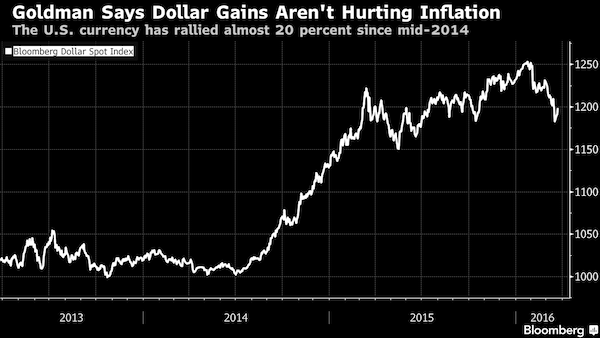
“Global equity markets continued to struggle last week, with the MSCI World index off 1.8% pushing the index back into red for the year. Big losses were seen in Japan with the Topix 500 down 6% and the volatile Mothers index crashing 18.5% over the week as the yen continued to strengthen. According to the BOE measure, the trade-weighted yen is now up more than 20% over the past year and back to where it stood three years ago. In the battle for the weakest currency, Japan looks to have thrown in the towel.

Whatever the outcome of the Brexit vote this week investors will still be facing the prospect of negative rates and negative yields on a huge range of bonds, massive corporate leverage with worryingly rising delinquencies and of course expensive equity markets and falling profits. To that extent these political events are a distraction from the main event, weak global economic growth and perverse asset markets. So whilst the market preference for the status quo might be celebrated in the short-term, actually when the fog clears all of the problems will still be there.”

Read more …

Forcing companies to raise wages?!

• IMF Calls On Japan To ‘Reload’ Abenomics (Nikkei)

Japan needs bolder income policies such as penalizing profitable companies that do not increase wages, the IMF said on Monday after concluding its annual economic assessment of the country. Despite initial success, progress under Abenomics, Prime Minister Shinzo Abe’s trademark economic policies, has stalled in recent months. The inflation rate has dropped to negative territory again, while economic growth has remained anemic.The IMF now expects Japan’s economy to grow by about 0.5% in 2016, before slowing to 0.3% in 2017, with potential growth sliding to close to zero by 2030, due to the declining demographic. “Abenomics needs to be reloaded,” the IMF said in its report and argued that income policies combined with labor market reforms should “move to the forefront” of the country’s fight against lagging growth.

“The government can introduce a ‘comply or explain’ mechanism for profitable companies to ensure that they raise base wages by at least 3% and back this up by stronger tax incentives or – as a last resort – penalties,” the IMF wrote. Promoting intermediate contracts that balance job security and wage increases will “reinforce income policies,” it added. “Our perception is that much of the stasis of inflation [in Japan] comes from the legacy, the history of having negative inflation,” said David Lipton, first deputy managing director at the IMF, in a press conference in Tokyo. “Certainly firms have at this point the cash flow and resource at hand to provide some wage increases. There are wage increases evident in a wide range of companies across this economy, so our thought is to suggest that this be a broader practice and that it be more uniform.”

Read more …

“..Mr Rajan has been an acerbic critic of zero rates and quantitative easing by the western central banks…”

• India’s Rockstar Central Banker Defeated As Modi Revolution Stalls (AEP)

India’s bid to become the ‘economic super-tiger’ of Asia is in serious doubt after an assault on the independence of the central bank and failure to deliver on promised reforms. The country has been the darling of the emerging market universe since the Hindu nationalist Narendra Modi swept into power in May 2014 promising a blitz of Thatcherite reform and a bonfire of the diktats, but key changes have been blocked in the legislature. The government has turned increasingly populist. Matters have come to a head with the de facto ouster of Raghuram Rajan, the superstar governor of the Reserve Bank of India (RBI), rebuked for keeping monetary policy too tight. It is part of a pattern of attacks on central banks by politicians across the world, and the latest sign that the glory days of the monetary overlords are waning.

Mr Rajan has been battling criticism for months but threw in the towel over the weekend, sending tremors through the Indian financial markets and provoking a flurry of warnings from global investors. “He has decided not to wait until he is refused a second term,” said Lord Desai from the London School of Economics. “This is ‘Rexit’ – India’s equivalent of ‘Brexit. It looks very bad for India and will not go down well in financial markets. He was defeated by the crony capitalists up against him,” he said. The government has dampened the impact with by relaxing barriers to foreign investment in the country, but it may have underestimated the totemic status of Mr Rajan outside India. He is seen by funds as the guarantor of good practice and market integrity. Mr Rajan is a former chief economist for the IMF, famed for warning that the US subprime debt bubble was out of control long before the Lehman crisis blew up in 2008.

[..] Mr Rajan has been an acerbic critic of zero rates and quantitative easing by the western central banks. He blames them for flooding the international system with excess liquidity that emerging markets could not easily control. This fueled dangerous boom-bust asset cycles. While QE might have ‘worked’ for the US, UK, and Europe – the jury is out even for them – Mr Rajan argues that the policy is a “Pareto sub-optimal” for the world as a whole, and ultimately increases the danger of a deflation-trap in the future. The Fed and the leading central banks of the West have never really answered his critique.

Read more …

I was going to say the Empress has no clothes, but I don’t want that image lingering on my retina.

• Yellen Makes ‘Uncertainty’ New Mantra (R.)

The U.S. Federal Reserve’s dwindling confidence in its own outlook and resulting confusion among investors are creating a policy problem that may require chief Janet Yellen to lay out her own views more forcefully. The Fed chair’s next communications test comes on Tuesday and Wednesday during her semi-annual testimony to U.S. lawmakers, less than a week after the central bank kept interest rates unchanged near record lows and lowered its projections for hikes in 2017 and 2018. A self-described consensus builder, Yellen sees her job as reflecting the whole committee’s views rather than setting an agenda for others to follow.

“I think that’s a very laudable intent, but sometimes that produces a lack of clarity,” said former Fed staffer and current partner at Cornerstone Macro LLC Roberto Perli. “Sometimes there is a consensus for one reason and then next time there is a consensus for a different reason so the story shifts and people get confused.” In fact, Fed policymakers’ deepening uncertainty about their own projections has resulted in the central bank sending mixed messages – repeatedly ratcheting up rate hike expectations only to tone them down later.

Read more …

Important point: “Whatever it takes” was orchestrated specifically to expel any market doubt with regard to the viability and sustainability of European monetary integration.

• “Whatever It Takes” Wasn’t Enough (Noland)

Back in 2012, Mario Draghi recognized how even the notion that a country might exit the euro could unleash market dynamics that would rather quickly place Europe’s markets and banking system in peril. “Whatever it takes” was orchestrated specifically to expel any market doubt with regard to the viability and sustainability of European monetary integration. On the back of a wall of liquidity and inflating securities markets, Draghi’s gambit held things together for a few years. That said, the ECB bet the ranch – and was compelled to ante up in response to market instability early this year. The outcome of the game is very much in doubt. While Britain is not even a member of the euro, Brexit provides a test of ECB policymaking. Is Europe robust or fragile?

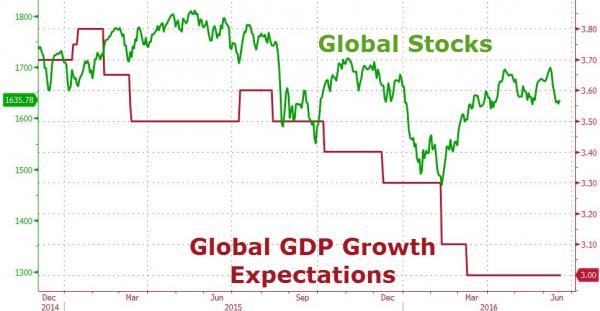
Has relative financial stability been nothing more than a brittle ECB-fabricated façade? Are the forces mounted against integration and cooperation too powerful to disregard? Is European integration – along with the euro currency – viable long-term? It’s an untimely test, with confidence in Europe’s banks already waning. It’s furthermore an untimely test because of faltering confidence in the ECB and contemporary global central banking more generally. Global market instability has again resurfaced and there will be no resolution next week. The FOMC has confounded Fed watchers with its abrupt pivot back to ultra-dovishness. There shouldn’t be much confusion. Global market fragility has reemerged, and the Fed’s rapid retreat has confirmed the seriousness of what’s unfolding.

Central banks have thrown everything at the problem, yet markets remain as vulnerable as ever. At least the world was not facing the downside of China’s historic Credit Bubble back in 2012. The Fed has never admitted that global concerns have been dictating U.S. monetary policy since 2012. It has now become clear, throwing the analysis of policymaking into disarray. The harsh reality is also increasingly apparent: global monetary management is dysfunctional and central bankers have become perplexed – without a backup plan. Such an uncertain backdrop is pro-currency market instability and pro-de-risking/deleveraging.
Read more …

Nobody has a reason to use the yuan.

• The World’s Newest “Reserve” Currency Is Anything But (Balding)

Last week’s decision by MSCI not to include Chinese shares in its primary emerging-markets stock index has been viewed – widely and rightly – as a blow to China’s hopes of internationalizing its financial sector. There’s worse news, though: Even the progress China’s made thus far is in danger of going into reverse. MSCI’s choice is a sharp contrast to the one made by the IMF last December, when it promised to begin including the Chinese yuan in its basket of “special drawing rights.” The move essentially conferred global reserve status on the currency, despite the fact that China arguably didn’t meet the conditions for inclusion: It was debatable whether the yuan could be considered “freely usable,” and in any case, it was hardly used. At its peak in August 2015, the yuan accounted for 2.79% of global payments, compared to 44.8% for the U.S. dollar.

The idea was that compromising now would encourage leaders in China to fulfill their pledges to liberalize the yuan fully by 2020. In fact, since the IMF’s decision, the yuan has if anything grown less international, not more. Since March 2015, yuan deposits in the three largest offshore centers – Hong Kong, Taiwan and Singapore – have fallen 16%, to a total of 1.24 trillion yuan or about $188 billion. The currency is being used in even fewer international transactions than before: Its share of global payments stood at 1.82% in April 2016. The fact that only a quarter of those international payments included a partner other than China or Hong Kong means that only about 0.5% of all yuan transactions are truly international in scope. This places the currency somewhere between those of Scandinavian powerhouses Norway and Denmark.

Read more …

Absolutely completely madness. The casino keeps adding new slot machines and crap tables.

• China’s Developers Can’t Stop Overpaying for Property (WSJ)

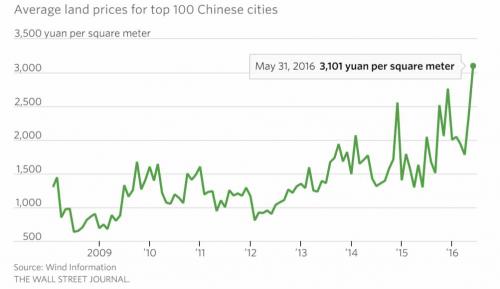
If the cost of flour is higher than the price of bread, what should a baker do? Chinese property developers are choosing to buy more flour. Prices for land, the main ingredient of the property world, have hit record highs in auctions this year in many Chinese cities. The average land price per square meter for the top 100 cities in the first five months of this year jumped nearly 50% from the same period last year, according to Wind Information. Some land prices are even higher than housing prices nearby.

State-owned developer Poly Real Estate, for instance, bought a piece of land in a Shanghai suburb for 5.5 billion yuan ($835.5 million) last month. This translates to roughly 44,000 yuan per square meter of buildable space. Houses in the region meanwhile go for around 40,000 yuan per square meter. After taking into account construction costs, taxes and other expenses, property prices would have to nearly double for the developer to make money. Prime land in the biggest cities always costs a lot, but increasingly the voracious buyers are showing up in less prime locations and smaller cities. In Suzhou, a city near Shanghai, with a population of 1.1 million, land sales in the first five months of this year have already exceeded the total of last year. And average prices have doubled.
Read more …

It’s the same they do with raw materials: “..After winning an auction, financial firms with access to cheap funding can apply for a loan with the land as collateral..”

• China’s ‘Land Kings’ Return as Housing Prices Rise (WSJ)

The “land kings” are back. That had been a nickname for Chinese developers paying sky-high prices for land parcels during China’s property boom earlier this decade, which left so-called ghost cities of unsold housing across China. Now, with housing prices in China’s larger cities again rising rapidly, frothy bids for land parcels are back. On June 8, Logan Property Holdings agreed to pay 14.1 billion yuan ($2.14 billion) for a piece of land in Shenzhen’s Guangming district, the largest-ever price tag in the southern Chinese city. Logan says it didn’t overpay, calling the price “relatively favorable” in a hot market. Earlier in June, a joint venture between two firms, one of which is backed by state-owned Power Construction Corp. of China, outbid 17 rivals with an 8.3 billion yuan offer for a plot in Shenzhen’s Longhua district.

The soaring land prices show the challenges facing the government as it tries to prevent property bubbles. Moves to stimulate China’s slowing economy and to trim excess housing in smaller cities across the country—such as interest-rate cuts and eased mortgage rules—have fed into speculative demand for homes in top-tier cities that are now scrambling to cool prices. Average housing prices in 70 Chinese cities were about 5% higher in May than a year earlier, the fifth straight month of increases. In top-tier cities, prices were up 19% to 53%. But land prices are shooting up not just in Shenzhen, Shanghai and Beijing, but also in lower-profile cities such as Hangzhou, Hefei and Zhengzhou. Officials face a dilemma in trying to tame land prices: Land is commonly used as debt collateral; a sharp drop in valuation could trigger defaults and produce a wave of bad loans, hurting the economy. On the other hand, runaway land prices make it harder for ordinary Chinese to afford apartments.

[..] There is also concern that financial firms with little experience as builders are viewing land as an opportunity for arbitrage. After winning an auction, financial firms with access to cheap funding can apply for a loan with the land as collateral, and use that to extend a construction loan at a higher rate to a partner, which is typically a property developer.

Read more …

“Like an oil lease, you’re easily disposable..”

• Energy-Related Loan Losses Rising (B.)

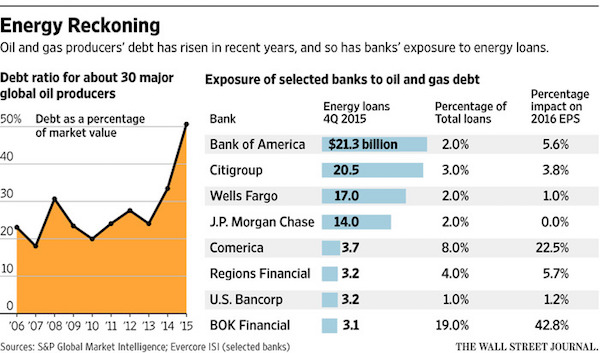
“Like an oil lease, you’re easily disposable,” the villainous J.R. Ewing quipped to his beauty queen wife in the 1970s television series Dallas. Readers of the latest edition of the Federal Reserve Bank of Dallas’s quarterly southwest economy publication might want to keep that quote in mind. News from the oil patch — the 11th Fed district that encompasses the shale heartland — is not encouraging, as it reveals a sharper rise in souring energy-related loans. “The persistence of relatively low oil prices has begun taking a toll on district bank customers,” the Dallas Fed said in its report.

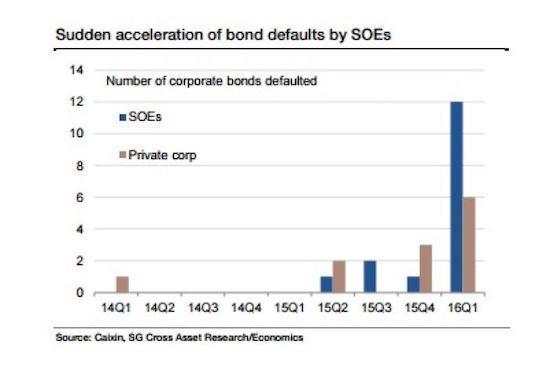
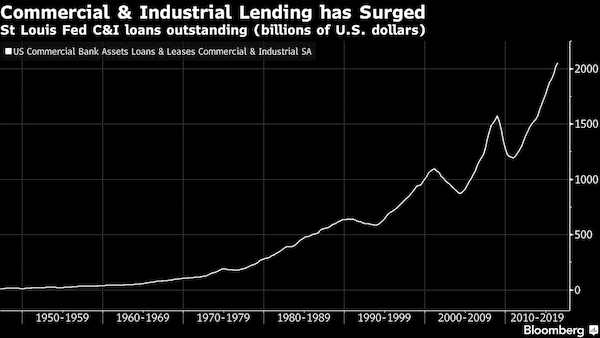
“Oil-price hedges become less effective the longer prices stay low, and the cushion built by energy firms during the good times gets thinner. Cash flow becomes stretched and collateral loses its value, further pressuring borrowers.” That forces them closer to default unless banks are able to keep their lending spigots open. Many of these loans fall under the umbrella of commercial and industrial (C&I) lending — a category which has been surging in conjunction with commercial real estate (CRE) lending in recent years. While regulators have kept a somewhat lazy eye on rising CRE loans since even before the 2008 financial crisis (and certainly after it), the boom in C&I lending has been met with far less scrutiny — resulting in charts which look like this:
Read more …

“..millions of electric customers in Southern California were warned they could suffer power outages of up to 14 days this summer..”

• California Power Grid Prepares For Heatwave, Power Outages (R.)

California will have its first test of plans to keep the lights on this summer following the shutdown of the key Aliso Canyon natural gas storage facility as temperatures in the Los Angeles area are forecast to hit triple digits this week. With record-setting heat and air conditioning demand expected in Southern California, the state’s power grid operator issued a so-called “flex alert,” urging consumers to conserve energy to help prevent rotating power outages – which could occur regardless. Electricity demand is expected to rise during the unseasonable heatwave on Monday and Tuesday, with forecast system-wide use expected to top 45,000 megawatts, said the California Independent System Operator (ISO), which manages electricity flow through the state.

That compares with a peak demand of 47,358 MW last year and the all-time high of 50,270 MW set in July 2006. That could put stress on the power grid, particularly with the shut-in of Aliso Canyon, following a massive leak at the underground storage facility in October. The facility, in the San Fernando Valley, is the second largest storage field in the western United States, according to federal data, and therefore crucial for power generation. All customers, including homes, hospitals, oil refineries and airports are at risk of losing power at some point this summer because a majority of electric generating stations in California use gas as their primary fuel. In April, millions of electric customers in Southern California were warned they could suffer power outages of up to 14 days this summer due to the closure.

Read more …

“The Border Force Act gives the Australian government the power to jail, for up to two years, anybody employed by the department..”

• Australia Whistleblower Loses Job After Speaking Out On Refugee Camps (G.)

The trauma specialist who condemned the treatment of asylum seekers and refugees in Australia’s offshore detention regime as the worst “atrocity” he has seen has had his contract to work on Nauru terminated. Psychologist Paul Stevenson, whom the Australian government awarded an Order of Australia for his work counselling victims of the Bali bombings, had undertaken 14 deployments to Nauru and to Manus Island in Papua New Guinea. He was due to return to Nauru on Thursday. But after he spoke publicly to the Guardian about his experiences working within Australia’s offshore detention regime – describing conditions in the camps as “demoralising … and desperate” – he was told his contract had been summarily cancelled.

PsyCare, the company through which he was employed to provide counselling to guards working in offshore detention, informed him by email his employment had been terminated. Stevenson said the news was not unexpected. “But the public needs to hear about the consequences people face for speaking out, and to understand the level they go to in minimising access.” [..] The Border Force Act gives the Australian government the power to jail, for up to two years, anybody employed by the department or its contractors who speaks publicly about conditions inside the offshore detention regime, including doctors advocating for better healthcare, or other workers exposing sexual and physical abuse of detainees.

Read more …

Jun 152016
 
 June 15, 2016  Posted by at 7:48 am Finance Tagged with: , , , , , , , ,  3 Responses »


Lewis Wickes Hine Workers stringing beans in J.S. Farrand Packing Co, Baltimore 1920

• A Lost Decade? We Should Be So Lucky (Das)
• NY Pension Fund Posts 0.19% Return In Fiscal Year (WGRZ)
• The Typical American Couple Has Only $5,000 Saved For Retirement (MW)
• Borrowing From ECB Shows Where Banks Are Most Vulnerable (BBG)
• How Low Can Bond Yields Go? Lower (ZH)
• China Devalues Yuan To Weakest Since Jan 2011 (ZH)
• China Stocks Denied MSCI Entry In Blow To Xi’s Ambitions (BBG)
• Fed Faces Battle To Escape World’s Low Interest Rate Grip (R.)
• Jeff Gundlach Says ‘Central Banks Are Losing Control’ (R.)
• London House Prices Up 14% In A Year (Ind.)
• Let’s Not Sleepwalk Into Economic And Geopolitical Catastrophe (T.)
• George Osborne: Vote For Brexit And Face £30 Billion Of Taxes And Cuts (G.)
• Bookies Are Still Pretty Sure Brexit Isn’t Going to Happen (BBG)
• The Law of Attraction (Dmitry Orlov)
• Putting A Price On Nature Is Wrong (G.)
• Avocado Shortage Fuels Crime Wave In New Zealand (G.)

“..Unfortunately, as Brazilian writer Paulo Coelho once observed, “Every time we repeat the same mistake, the price goes up.”

• A Lost Decade? We Should Be So Lucky (Das)

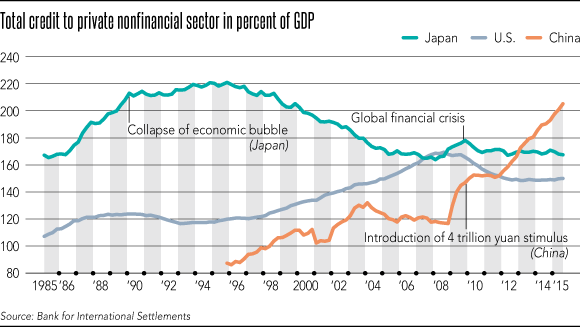
A growing number of economists seem convinced that the U.S., European Union and China are all headed for a prolonged period of sluggish growth — secular stagnation, in the words of former Treasury Secretary Larry Summers. A close parallel would seem to be 1990s Japan. There, too, the bursting of debt-funded asset price bubbles gave way to multiple rounds of fiscal stimulus, massive monetary easing and rock-bottom interest rates. Rescue efforts stabilized conditions but couldn’t spark a sustainable recovery, leaving the economy mired in low growth, low inflation and high debt. In some ways, this outcome might not seem so terrible. (One visiting English politician dazzled by Tokyo’s Ginza noted that if this was a recession, he wanted one too.)

When Japan entered its downturn, however, the country had several advantages both internally and externally that nations today don’t. For many, a Japan-style slump may be the best-case scenario. First and foremost, at the onset of its crisis, Japan enjoyed modest levels of government debt – around 20% of GDP – as well as strong domestic savings and an abnormally high home bias in investment. Even now, around 90% of government bonds are held by Japanese buyers. This has allowed successive Japanese governments to run large budget deficits and finance their spending domestically, assisted by an accommodative central bank that’s kept the cost of servicing debt low. By contrast, many problem economies today suffer from high levels of government debt – around 80% to 100% of GDP – as well as total debt. China’s official government debt is lower, around 55% of GDP.

But that number doesn’t take into account borrowing by large banks and other state-owned enterprises, which is backed up to varying degrees by the government. Some countries also have low domestic savings and are reliant on foreign capital, limiting their ability to finance budget deficits.

Read more …

The gall: “Despite weak equity markets, the fund’s diversified portfolio and our investment team delivered a positive return..”

• NY Pension Fund Posts 0.19% Return In Fiscal Year (WGRZ)

New York’s $178 billion pension fund posted a mere 0.19% return on investments for the fiscal year that ended March 31, the lowest return since 2009, Comptroller Thomas DiNapoli announced Monday. New York’s Common Retirement Fund includes 1 million active members and retirees, and the performance of the fund impacts how much local governments have to pay into the system each year – which influences property taxes. Pension costs soared after the recession in 2009 when the fund plummeted nearly 25%. But the fund has improved in recent years, leading to back-to-back years of a decline in contribution rates for municipalities. DiNapoli said the fund’s performance was the result of a weak year on Wall Street.

“Despite weak equity markets, the fund’s diversified portfolio and our investment team delivered a positive return,” DiNapoli said in a statement. “We continue to have confidence in our asset allocation for the long term. Our investment team is focused on ensuring we remain one of the best funded and top performing plans in the country.” The fund is the third-largest public pension fund in the nation, giving it pull with investors and companies. The pension plan has often been cited as one of the best-funded plans in the nation, avoiding pension shortfalls found in other states. But DiNapoli has repeatedly lowered the fund’s expected rate of return – from 8% to 7.5% in 2010 and then again last year to 7% to limit the fund’s volatility.

In August or September, DiNapoli will announce the contribution rates for local governments for the coming year. Currently, the average contribution rate for state and local governments to fund the pension fund is 18% of payroll. For police and fire officers, the governments contribute about 25%. In the early 2000s, local governments contributed nearly zero to the fund.

Read more …

Just wait till the recovery sets in. Everything will be just peachy.

• The Typical American Couple Has Only $5,000 Saved For Retirement (MW)

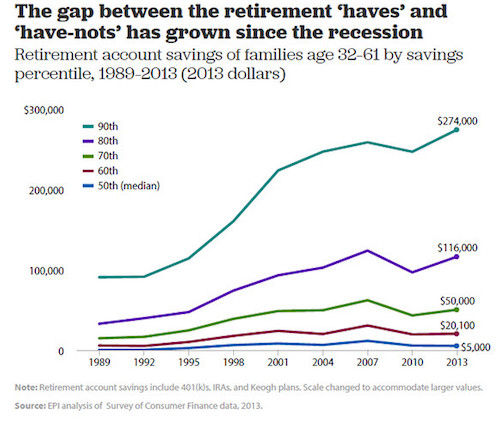
When American companies began switching from traditional pensions to self-directed 401(k)-like plans in the 1980s and 1990s, it was supposed to lead to a golden age of retirement security. No longer would workers be at the mercy of the company’s generosity or of Social Security’s solvency; workers themselves would be responsible for saving enough for a comfortable retirement. Some 30 years later, the results are in: The median working-age couple has saved only $5,000 for their retirement, according to an analysis of the Federal Reserve’s 2013 Survey of Consumer Finances by economist Monique Morrissey of the Economic Policy Institute. The do-it-yourself pension system is a disaster.

Even as the traditional company-funded pension has nearly disappeared and even as Social Security benefits are being slowly eroded, most workers haven’t saved enough to offset those losses to their retirement income. Seventy percent of couples have less than $50,000 saved. Even those on the cusp of retirement — the median couple in their late 50s or early 60s — has saved only $17,000 in a retirement savings account, such as a defined-contribution 401(k), individual retirement account, Keogh or similar savings account. How long does $5,000, or even $50,000, last? Until the first big medical bill? Morrissey figures that about 43% of working-age families have no retirement savings at all. Among those who are five to 10 years away from retirement, 39% have no retirement savings of their own.

Read more …

Not exactly news, is it?

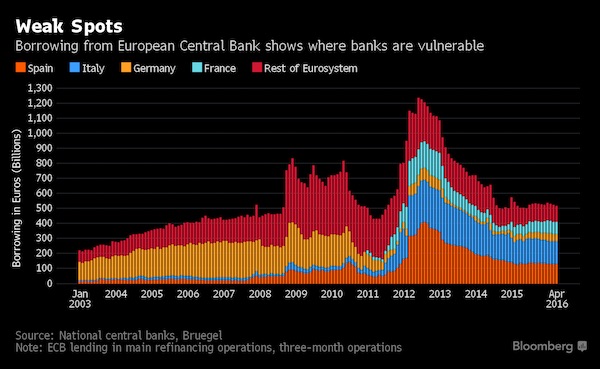
• Borrowing From ECB Shows Where Banks Are Most Vulnerable (BBG)

Spanish and Italian banks scoop up more than half of the money the European Central Bank provides in its regular refinancing operations, signaling that borrowing in financial markets remains difficult or unattractive for them eight years after the collapse of Lehman Brothers Holdings Inc. Banks’ balance sheets remain cluttered with non-performing loans and foreclosed assets just as revenue generation is damped by sluggish credit demand and low interest rates depressing margins. In addition to the weekly and three-months operations, the ECB will offer targeted longer-term loans next week that’ll mature in 2020.

Read more …

To phrase it differently: how crazy are central bankers?

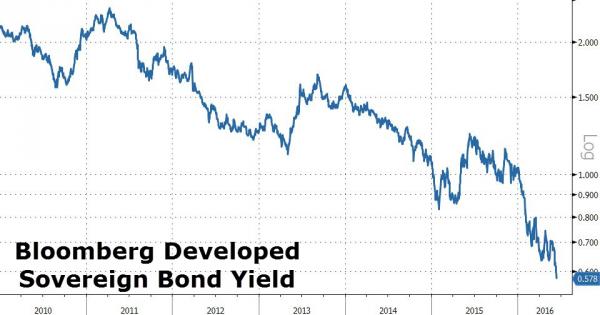
• How Low Can Bond Yields Go? Lower (ZH)

How low can bond yields go? Every day seems to provide fresh evidence that we really don’t know. But whatever your answer, between the gravitational pull of central bank debt purchases and a slowing global economy, the reality is: probably lower. Milestones include unprecedented 10-year yields in Germany, Japan and the U.K. British government debt has returned 8.1% this year and the spread between 10-year gilts and comparable Treasuries is at the widest since 2006 on concern the U.K. may vote to leave the EU. It may seem crazy that 11 sovereigns have negative-yielding five-year debt. Hard though it is to accept, bondholders aren’t playing the greater fool. Central banks are primed to push yields lower until they get results. “It’s a mad scramble for defensive positions,” said Jack McIntyre, a bond manager with Brandywine Global Investment Management. “We’re competing against the world’s central banks” for bonds”.

Trends in consumer prices haven’t acted as a brake. Inflation in advanced economies fell to 0.3% last year, the least since 2009 and down from 1.4% in 2014, according to IMF data. The U.K. vote has broader consequences. Recent polls have favored the Brexit camp, and should voters seek separation, others in the EU may try to follow. Should that happen, German 10-year yields could go more negative than -0.03%. Gilts have rallied without BOE purchases. A decision to depart may force its hand in lowering rates or resuming bond acquisitions, boosting gains in the process. McIntyre prefers Treasuries to gilts in either voting outcome. They’ll hold their value better should the U.K. remain, while Brexit may tarnish its standing as a top-tier issuer by introducing credit risk.

Read more …

Bunch of manipulators.

• China Devalues Yuan To Weakest Since Jan 2011 (ZH)

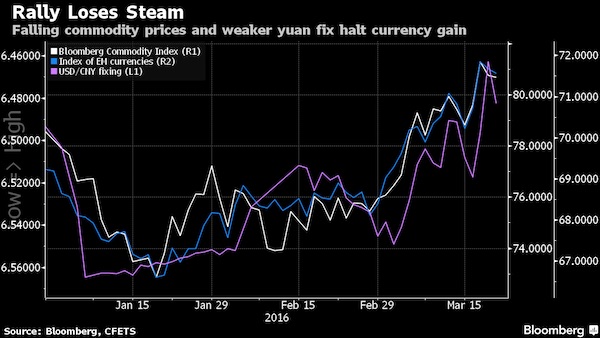
Just in case The Fed had any ideas of surprising markets with a “confidence-inspiring” rate-hike tomorrow, The PBOC just sent a message loud and clear to Janet as they devalued the Yuan fix by over 2 handles, above 6.60 for the first time since January 2011. This is the 3rd major devaluation step in the last 10 months (remember when China said August was a “one off”?)


Bear in mind this kind of currency turmoil has not ended well for US equities in the past…


Which may help explain why funding market stress is starting to appear in Libor/OIS and basis-swaps (demand for USDollars), and why US and European banks are tumbling…

Read more …

“..investors clearly indicated that they would like to see further improvements in the accessibility..”

• China Stocks Denied MSCI Entry In Blow To Xi’s Ambitions (BBG)

China’s domestic equities were denied entry into MSCI Inc.’s benchmark indexes for a third time, a setback for President Xi Jinping’s efforts to raise the profile of mainland markets and turn the yuan into an international currency. Policy makers need to make additional improvements to the accessibility of the A share market, according to a statement from the index compiler on Tuesday. MSCI, whose emerging-market index is tracked by investors with $1.5 trillion in assets, said it will reconsider inclusion in its 2017 review, while not ruling out an earlier announcement.

China was rejected despite a flurry of measures this year to address MSCI’s concerns, including curbs on arbitrary trading halts and looser restrictions on cross-border capital flows. The decision suggests international investors are still uncomfortable putting their money in the $6 trillion market after a botched government campaign to prop up share prices roiled global equities last year. While Chinese authorities have demonstrated a commitment to opening the market, “investors clearly indicated that they would like to see further improvements in the accessibility,” Remy Briand, MSCI’s global head of research, said in the statement.

Read more …

“..it could also force discussion of whether to raise the inflation target in order to try to push the entire rate structure higher.”

• Fed Faces Battle To Escape World’s Low Interest Rate Grip (R.)

Evidence that the U.S. neutral rate of interest remains stalled near zero may slow Federal Reserve rate hikes even more than expected, tying the hands of policymakers until a rebound in global demand or other forces raise that key measure of the economy’s underlying strength. Though difficult to estimate precisely, the neutral rate is the point at which monetary policy neither encourages nor discourages spending and investment, and is thus a key measure of whether a given federal funds rate is stimulating or restricting the economy. With the Fed still trying to encourage spending, investment and hiring, a low neutral rate means the Fed has less room to move before that stimulus is gone.

Fed estimates published online show little consistent movement in the neutral rate in recent years even as the labor market tightened and growth continued above trend, confounding expectations that it would move higher in an economy expanding beyond potential. Officials cite a variety of possible explanations, but the result is the same: until policymakers are satisfied that the neutral rate is moving higher, they face an effective cap of 2% or even less on the federal funds rate. Coupled with a 2% inflation rate, the Fed’s target, that would put the “real” federal funds rate at zero. If inflation remains below target, the ceiling on the Fed would be that much lower as well.

That is a far cry from the 3.5 to 4% that the Fed’s policy rate has averaged since the 1990s, and means the central bank will treat each move with particular caution, current and former Fed officials say. It also means the central bank would be stuck near zero, and more likely to have to return to unconventional policy in a downturn; it could also force discussion of whether to raise the inflation target in order to try to push the entire rate structure higher.

Read more …

“They’ve turned into the ‘Zombie Fed.'”

• Jeff Gundlach Says ‘Central Banks Are Losing Control’ (R.)

Jeffrey Gundlach, the chief executive of DoubleLine Capital, said on Tuesday investors are dropping risky assets and turning to safer securities including Treasuries and gold because they are losing faith in central banks. The man known on Wall Street as the ‘Bond King’ is one of the first heavyweight investors to publicly raise red flags about the credibility of major central banks, including the U.S. Federal Reserve, as countries struggle to manage economic growth. Last year, Gundlach correctly predicted that oil prices would plunge, junk bonds would live up to their name and China’s slowing economy would pressure emerging markets. In 2014, he forecast U.S. Treasury yields would fall, not rise as many others had expected.

“Central banks are losing control and they don’t know what to do … just like the Republican establishment and Donald Trump,” Gundlach told Reuters in a telephone interview, referring to the Republic Party’s unpredictable presumptive nominee for U.S. President. Safe-haven German Bund yields fell below zero on Tuesday for the first time and global equity markets slid for a fourth day in a row on intensifying worries about a potential British exit from the EU next week. [..] “The Fed is confused and their confusion spills into investor psychology,” said Gundlach. [..] “The Fed changes its tone so frequently, it seems every other week the message is different. They’ve turned into the ‘Zombie Fed.’ They say the meeting this week is ‘live,’ but investors all know it isn’t at all.”

[..] Gundlach also noted the dramatic “drawdowns” from the highs in several stock markets. Germany is down 22%, Japan is down 23%, China is down 45%, the United Kingdom market is down 15% and France is down 20%. “Negative rates do not prop up stock markets,” Gundlach said on the webcast.

Read more …

How to kill a city.

• London House Prices Up 14% In A Year (Ind.)

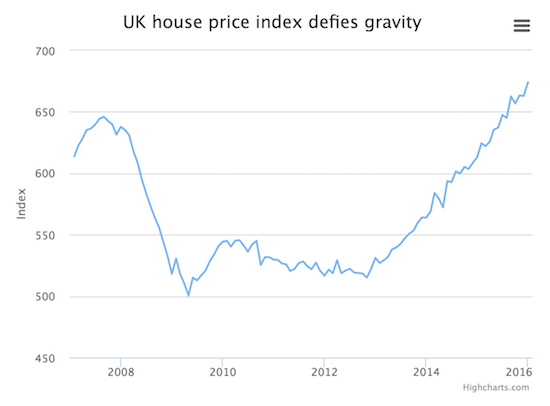
House prices across the UK continued to grow in April, with London prices leaping by more than 14% over the past year, according to official figures published on Tuesday. The average house price in the UK increased 8.2% year on year to £209,054, up 16,000 from the same time in 2015. In London, which continued to be far more expensive than anywhere else in the country, the average house price is now more than £470,000, up by nearly £60,000 on April last year. [..]

The average house price for England was £225,000, an increase of 9.1% on last year compared, with £139,000 in Wales, £138,000 in Scotland and £118,000 in Northern Ireland. The increase came despite clear evidence that housing market activity has slowed markedly following April’s Stamp Duty increase for buy-to-let investors and second home buyers. The possibility of the UK leaving the European Union following the referendum on 23 June has not dampened demand, the ONS said. “Despite the short term uncertainty of next week’s EU referendum, regional property markets are receiving a pre-summer swell, giving homebuyers more choices.

Read more …

You guys should have thought of that before creating your biggest ever housing bubble.

• Let’s Not Sleepwalk Into Economic And Geopolitical Catastrophe (T.)

If Europe’s political leaders awake on Friday June 24 to find that Britain has voted to leave the EU – which judging by the polls is looking ever more likely – they will know who to blame most: themselves. For many citizens, there are much greater issues of principle and interest at stake in this referendum than the economy. But for me, economic and political stability are the prime consideration, which is why, as regular readers of my columns will already have guessed, I will be voting to remain. Yet I do so with a deep sense of foreboding, for despite the benefits Britain has enjoyed in its 43 years of membership, the EU has become a dysfunctional Byzantium of paralysing political and economic complexity. It has not been possible for a long time now to be an enthusiastic European.

Much of what was good about the EU as a force for peace through trade and economic advancement has long since ceased to be true. Over the last eight years, the EU has faced two distinct but related, existential crises – the eurozone debt meltdown and the challenge of mass, cross border migration. On both counts it has failed miserably. Though very different in their characteristics, these crises essentially have the same genesis. Both result from the attempt to crunch together economies of widely different income, wealth and welfare support. Give Greece, Spain, Portugal and Italy the ability to borrow at a German interest rate, and they were always bound to be enveloped by an unsustainable credit boom.

Denied both the natural market adjustment mechanism of free floating exchange rates, and the policy flexibility to mount a nationally-determined response, these debt crises have been left festering and unresolved, with devastating consequences for growth and jobs. Similarly, if the inhabitants of a low income, developing country are given the right to live and work in a much richer one with far superior public services and social welfare, then nobody should be surprised by both the reality of mass migration and the now all too evident backlash against it. In this regard too, the single European market, with its founding “four freedoms”, has proved incapable of responding.

Read more …

Tune in next week and/or tomorrow for Hell Freezes Over.

• George Osborne: Vote For Brexit And Face £30 Billion Of Taxes And Cuts (G.)

George Osborne will warn that he would have to fill the £30bn blackhole in public finances triggered by a vote to leave the European Union by hiking income tax, alcohol and petrol duties and making massive cuts to the NHS, schools and defence. In a sign of the panic gripping the remain campaign, the chancellor plans to say that the hit to the economy will be so large that he will have little choice but to tear apart Conservative manifesto promises in an emergency budget delivered within weeks of an out vote. “Far from freeing up money to spend on public services as the leave campaign would like you to believe, quitting the EU would mean less money,” Osborne will say. “Billions less. It’s a lose-lose situation for British families and we shouldn’t risk it.”

The chancellor will spell out his concerns at an event where he will be joined by his predecessor, Alistair Darling. The Labour politician will say he is more worried now than he was during the 2008 financial crisis, arguing that a Brexit vote will result in not just one emergency budget but “one after another”. The pair will publish an “illustrative budget scorecard” comprising a long list of the sort of measures they say may have to be implemented.

Read more …

Or so they say.

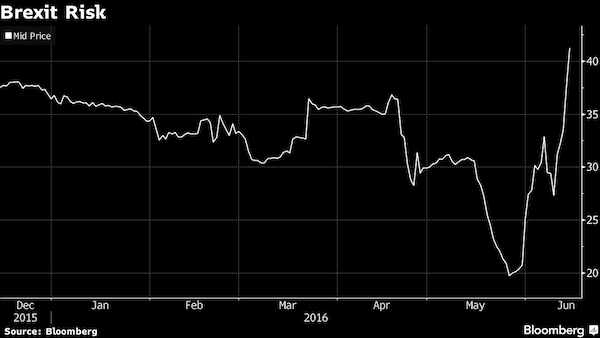
• Bookies Are Still Pretty Sure Brexit Isn’t Going to Happen (BBG)

While polls show the U.K.’s Brexit vote poised on a knife’s edge, bookies remain fairly confident the nation will stay in the European Union. Most of the biggest betting firms and exchanges in the U.K., Ireland and beyond place a 60% or better chance on David Cameron averting a so-called Brexit. That’s even after five polls published this week showed the “Leave” side ahead, with the latest survey giving it as much as a 7 percentage-point lead over “Remain.” “Pollsters ask people what they feel on a particular day; we are predicting what they will actually do on June 23,” said Jamie McKittrick, head of sports trading at Ladbrokes Plc. “Historically, we have seen a late swing to the status quo, especially among the undecideds.”

Analysts at firms like Danske Bank A/S and Investec Plc now routinely include gambling odds in client notes, with betting markets viewed as offering clues to the direction of political events. In March, for example, Paddy Power Betfair Plc, Ireland’s largest bookmaker, paid out 120,000 euros ($135,000) on Donald Trump winning the U.S. Republican presidential nomination, months before he won enough delegates to become the presumptive nominee. [..] As recently as last month, oddsmakers were placing a 20% chance on the possibility of the U.K. leaving the EU. While bookmakers like Ladbrokes this week slashed the odds on a Brexit, for now, they still make the U.K. staying in the EU the most likely outcome. That’s a pattern apparent across most betting firms and exchanges.

“The EU referendum market has exploded into life in the past week with an average of 1 million pounds traded every day, ” said Naomi Totten of Betfair, which also places a 60% probability on the U.K. opting to stay inside the EU. “Brexit has been backed heavily in the past 24 hours, although Remain is still clinging to favoritism.”

Read more …

Excellent Dmitry on Dunbar’s rule of 150.

• The Law of Attraction (Dmitry Orlov)

One unintended consequence of our current mode of living is that it has warped and perverted our interpersonal interactions. In order to be able to afford to simply inhabit the planet and satisfy our basic needs, we are required to play all sorts of contrived roles. Specifically, we are forced deal with each other according to arbitrary rules that are forced upon us. As employees we are expected to readily lie to customers to protect our employers’ profits. As salespeople we are expected to sell things we know better than to ever want to buy. Then there is a whole category of people who work as enforcers, and are specifically paid to disregard all humane considerations and to dole out punishments without any allowance for dire personal circumstances.

Vast social and financial hierarchies reward psychopathic behavior (which is regarded as professionalism) while punishing altruism and compassion (which is regarded as weakness or corruption). Co-workers arbitrarily thrown together by managerial whim often spend more time with each other than with their own families, trapped in a world of stunted, superficial relationships that gradually erode their humanity. Parents often have no choice but to pay strangers to raise their children for them. These strangers work for a wage rather than out of love for the children, and when their contract ends, so does the bond between the child and caregiver, undermining the child’s faith in humanity. When parents do get to see their children, they are often tired and distracted, conditioning the children to treat them no better than they treat the strangers who take care of them the rest of the time.

Growing up with a constant deficit of sensitivity, sincerity, security and warmth, once they reach adulthood these children expect their relationships to be either manipulative and abusive, or regulated by contract. Their humanity becomes reduced to a set of selfish and materialistic drives. Their misshapen psyches are balanced on a knife’s edge between a morbid fear of exclusion, which drives them toward mimicry and conformism, and an unnatural, hypertrophied competitive drive that destroys their instinct for spontaneous cooperation. When you take a step back from it all and look at it, the impression is one of a society-wide mental disorder.

Read more …

Good starting point, not great execution.

• Putting A Price On Nature Is Wrong (G.)

The paradox of environmental economics is that we feel compelled to price nature to make its loss visible on the balance sheet, but in doing so we legitimise its commodification and validate its critical overconsumption in an unbounded market system. No carbon market is yet designed to work within a precautionary limit on global emissions. That means that currently it would be possible to pay to emit the notional extra tonne of carbon that might push us over the edge into irreversible climatic upheaval. What price should that tonne of carbon carry? The more goods you pile onto a ship, the more likely it is to sink. You can price the relative risk of different levels of load, and insure it accordingly, and you can put a price on the economic cost of lost goods should the ship turn turtle.

But if your life depends on keeping the boat afloat, pricing ultimately becomes irrelevant. The point is to stay on the surface. That is why the Plimsoll safety line on the side of ships was introduced to prevent overloading (easy to spot, it looks exactly like the London Underground symbol). There are many economic and scientific problems in pricing nature and the environment, such as around offsetting, and there are philosophical ones too. In deciding whether or not to build a new road through a community woodland, how is the value of the woodland arrived at in any cost benefit analysis done by planners? Asking how much the community is prepared to pay to keep it would be constrained by ability to pay, but ask what amount would be needed to compensate for its intrinsic worth might, in theory, yield an infinite price.

Fiona Reynolds, former chief of the National Trust, is the latest to argue that we need whole other ways to assess the value of the natural world. When the economist Dieter Helm, chair of the Natural Capital Committee, wrote that: “the environment is part of the economy and needs to be properly integrated into it so that growth opportunities will not be missed,” he both gave the game away about pricing as a hostage to fortune, and made a category error. It is the economy that needs to be properly integrated into the environment so that its limits to growth can be understood.

Read more …

“These stolen avocados can carry risks,” he said.

• Avocado Shortage Fuels Crime Wave In New Zealand (G.)

Surging local and international demand for avocados is fuelling a crime wave in New Zealand. Since January there have been close to 40 large-scale thefts from avocado orchards in the north island of New Zealand, with as many as 350 fruit stolen at a time. Avocados are selling for between NZ$4-6 each (£2-3) across the country, after a poor season last year and increasing local demand. According to New Zealand Avocado in 2015 an additional 96,000 New Zealand households began purchasing avocados, and local growers – largely geared towards the lucrative export market – have been unable to keep up with the surge in demand.

The recent thefts have taken place in the middle of the night, with the crop either “raked” from the tree and collected in blankets or sheets on the ground, or hand-picked and driven away to pop-up road-side stallsgrocery stores or small-scale sushi, fruit and sandwich shops in Auckland. Sergeant Aaron Fraser of Waihi said there had been “spates” of avocado thefts during his time in the police but nothing as sustained as the current activity. “These stolen avocados can carry risks,” he said. “They are unripe, some have been sprayed recently and they may still carry toxins on the skin. But with the prices so high at the moment, the potential for profit is a strong inducement for certain individuals.”

Read more …

Jun 012016


Arthur Rothstein Steam shovels on flatcars, Cherokee County, Kansas 1936

• China’s Debt Bubble Bigger Than Subprime Bubble (MW)
• Yuan Tumbles As China PMI Miraculously Hugs Flatline (ZH)
• Double Blow for China Banks as Fed Worry Meets June Cash Crunch (BBG)
• Hong Kong April Retail Sales Fall 7.5%, 14th Straight Month (R.)
• Abenomics “Death Cross” Strikes As Japan PMI Plunges To 40-Month Lows (ZH)
• Pension Funds Pile on Risk Just to Get a Reasonable Return (WSJ)
• Germany: Draghi v the Banks (FT)
• The Most Powerful Man in Banking (WSJ)
• Central Banks As Pawnbrokers Of Last Resort (M. Wolf)
• Germany Considers Easing of Russia Sanctions (Spiegel)
• Elephants In Tanzania Reserve Could Be Wiped Out By 2022 (AFP)
• Mediterranean Death Toll Soars In First 5 Months Of 2016 (UNHCR)
• Frontex Denies, Prevents Help To Refugees: Witnesses (MEE)

“The problem is that the banking sector in China has been pushing out new lending aggressively, but with slowing economic growth many loans have not gone to create more factories and jobs but to financial assets that have been leveraged to boost returns..”

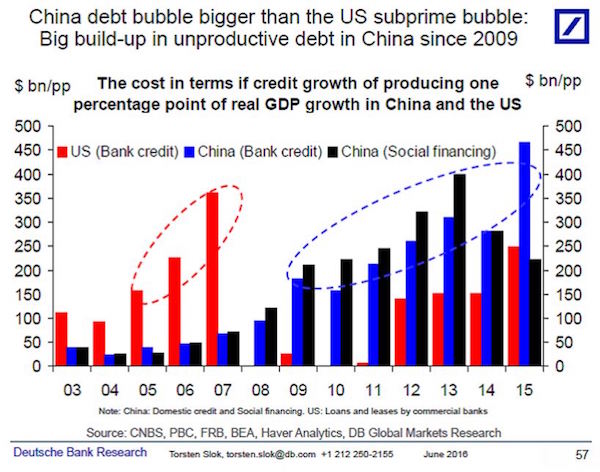
• China’s Debt Bubble Bigger Than Subprime Bubble (MW)

Unproductive debt in China—that is, debt that’s used to drive up asset prices—swelled in 2015, eclipsing the level seen in the U.S. in the run-up to the Great Financial Crisis, said Torsten Slok, chief international economist at Deutsche Bank, in a note to clients published Tuesday. Slok’s findings are illustrated in the chart below, where he compares the level of credit growth required in the U.S. and China to generate 1percentage point of GDP growth. (He notes that the red bar for 2015 also grew, suggesting more credit growth is now required in the U.S. to produce onepercentage point of GDP growth).

Chinese officials are partly responsible for the expansion of credit last year, analysts say, as the People’s Bank of China lessened requirements regarding the collateral lenders put up to borrow funds from the central bank, among other stimulus measures. The move was meant to spur economic growth, the pace of which slowed last year, stoking fears that it could precipitate a sharp global downturn. The world’s second-largest economy saw growth slow to 6.8% in 2015—missing the government’s target for 7% growth by a hair. In the first quarter of 2016, the country’s economy grew at an annual rate of 6.7%, its slowest pace since 2009.

It’s important to note, however, that many economists believe Chinese data overstates the strength of its economy. Over the past year, Chinese stocks, and more recently commodities like iron ore and steel rebar traded in China, have seen a series of dizzying rallies and frightening crashes as investors, emboldened by easy credit engage in speculation. “The problem is that the banking sector in China has been pushing out new lending aggressively, but with slowing economic growth many loans have not gone to create more factories and jobs but to financial assets that have been leveraged to boost returns,” Slok said.

Read more …

Everyone, US, Japan and EU too, needs that services PMI to flourish, but…

• Yuan Tumbles As China PMI Miraculously Hugs Flatline (ZH)

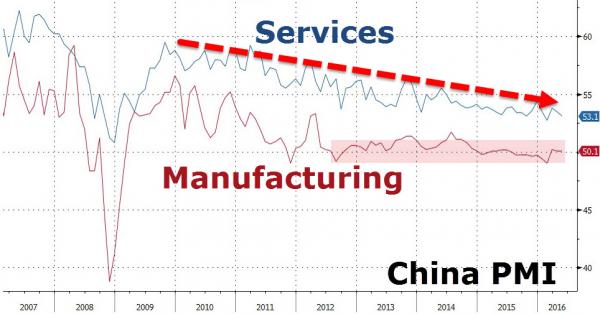
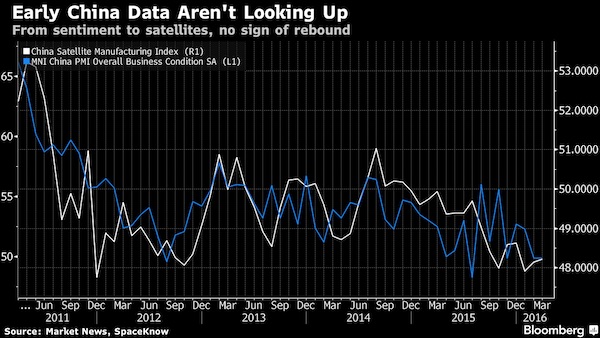
Since May 2012, China Manufacturing PMI has miraculously stayed within a 1 point range of the knife-edge 50 level between contraction and expansion. May 2015 just printed 50.1, the same as April with New Orders weaker and business activity expectations (hope) tumbling to 4 month lows. The Steel Industry PMI collapsed from 57.3 to 50.9 with New Steel Orders collapsing from 65.6 to 52.7 – the biggest monthly drop in record. And while non-manufacturing PMI remained in ‘expansion territory at 53.1, it fell back from a brief bounce in April with employment and business expectations both weaker. For now, equity markets are unreactive but offshore Yuan is tumbling on the news, not helped by a sizable devaluation in the official fix. The magic of manufacturing data… as non-manufacturing slowly catches down…

Disappointment triggering more offshore Yuan selling… Not helped by yet another devaluation by PBOC…
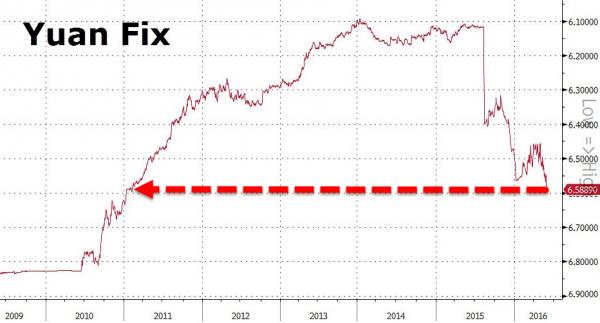
*CHINA SETS YUAN FIXING AT 6.5889 VS 6.5790 DAY EARLIER
*PBOC CUTS YUAN FIXING TO LOWEST LEVEL SINCE 2011 FOR THIRD DAY

Read more …

Refinancing is becoming a major problem.

• Double Blow for China Banks as Fed Worry Meets June Cash Crunch (BBG)

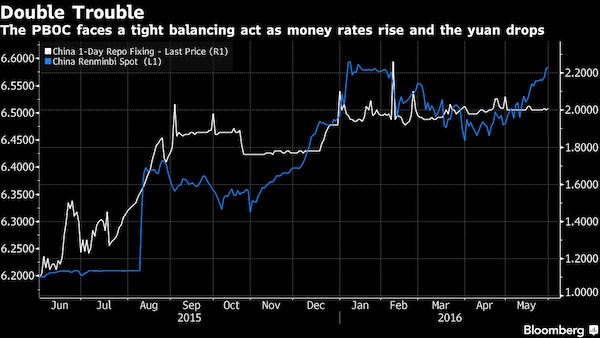
Shanghai’s money market is braced for higher borrowing costs as a credit-fueled economic recovery coincides with the prospect of higher U.S. interest rates in June, a month that has historically seen funding crunches in China. The overnight interbank lending rate averaged 1.99% in May, up from 1.18% a year ago, as Federal Reserve tightening weakened the yuan, spurring capital outflow pressures. That borrowing cost has climbed every June since 2011, as lenders hoard deposits ahead of quarter-end regulatory checks. The cost of fixing rates in the swap market is surging as data showed property leading a rebound in investment in the world’s second-biggest economy.

“The internal and external factors combined will certainly add pressure to the money market in June, driving interest rates higher,” said Liu Dongliang at China Merchants Bank, the nation’s sixth-largest lender. “We’re not optimistic about the bond market in the short term.” Any cash crunch would aggravate a rout in bonds that led to 190.6 billion yuan ($28.9 billion) in canceled sales this quarter, making it harder for issuers to refinance a record amount of maturing debt. The overnight money rate has been moving in tandem with the weakening currency in the past year after touching a six-year low, as estimated outflows reached $1 trillion in the past year, according to a gauge compiled by Bloomberg.

The yuan declined 1.5% in May as Federal Reserve Chair Janet Yellen said that evidence of strength in the U.S. economy means there could be an increase in borrowing costs in the coming months. The probability of Fed action in June has surged to 24% from 12% at the end of April, while the premium for China’s one-year sovereign yield over U.S. Treasuries has narrowed to a seven-week low. The People’s Bank of China has an incentive to keep monetary conditions relatively tight as it looks to control the yuan’s decline, rein in excessive lending by banks and keep a lid on inflation. The authority will create a neutral and appropriate monetary environment, it said in an article published in China Business News last week. The comments came after data showed the nation’s consumer price index maintained a 2.3% acceleration for the third month in April, a pace not seen since mid-2014.

Read more …

Mainland Chinese fail to appear.

• Hong Kong April Retail Sales Fall 7.5%, 14th Straight Month (R.)

Hong Kong’s retail sales fell for the 14th successive month in April, as a drop in tourists and weak local consumption deepened the pain for retailers in the city. Retail sales in April slid 7.5% from a year earlier to HK$35.2 billion ($4.5 billion) in value terms, less than a 9.8% slump in March. In volume terms, April sales dropped 7.6%, government data showed on Tuesday. “Many types of retail outlet still recorded notable falls in sales, reflecting the continued drag from the slowdown in inbound tourism as well as the more cautious local consumer sentiment amid subpar economic conditions,” the government said in a statement.

Hong Kong is struggling with mounting economic challenges from the prospect of rising U.S. interest rates, which has stepped up capital outflows, and from China’s economic slowdown. Mainland tourists are avoiding the city amid political tensions with China and growing calls from radical activists for greater autonomy from Beijing. “The near-term outlook for retail sales will continue to depend on the performance of inbound tourism,” the government added.

Read more …

“Output tumbled at the fastest pace in 25 months and new orders are the worst since Jan 2013. This is the death cross for Abenomics..”

• Abenomics “Death Cross” Strikes As Japan PMI Plunges To 40-Month Lows (ZH)

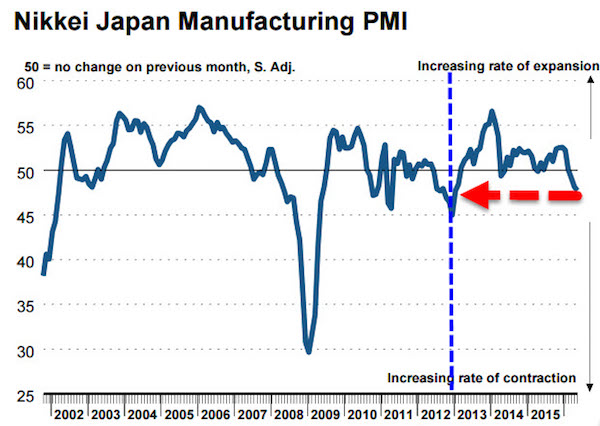
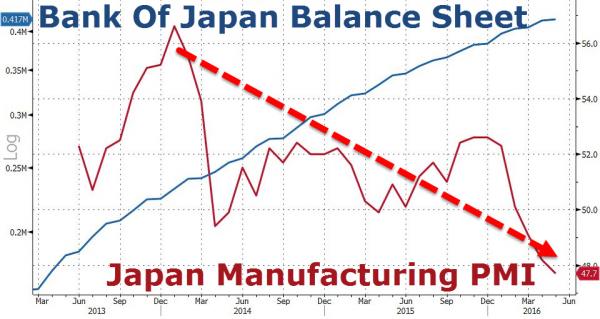
Since Abenomics was unleashed on the world (with QQE starting in April 2013), things have not worked out as the smartest men in the Japanese rooms predicted. In fact, with April’s final manufacturing PMI printing at 47.7, operating conditions in Japan worsened at the sharpest pace in 40 months… since Abe began his three arrows. Output tumbled at the fastest pace in 25 months and new orders are the worst since Jan 2013. This is the death cross for Abenomics… The weakest Japanese manufacturing PMI since the start of Abenomics…

Commenting on the Japanese Manufacturing PMI survey data, Amy Brownbill, economist at Markit, which compiles the survey, said: “The aftermaths of the earthquakes in one of Japan’s key manufacturing regions continued to weigh heavily on the manufacturing sector. Both production and new orders declined sharply midway through the second quarter of 2016. A marked fall in international demand also contributed to the drop in total new orders, as exports declined at the fastest rate since January 2013.” Flashing the “death cross” of Abenomics three arrows… As it is now clear that the massive expansion of the Bank of Japan balance sheet has done nothing… in fact worse than nothing… for the Japanese economy.

Read more …

Talk about a death cross…

• Pension Funds Pile on Risk Just to Get a Reasonable Return (WSJ)

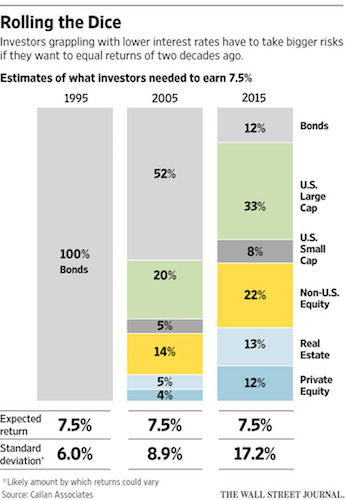
What it means to be a successful investor in 2016 can be summed up in four words: bigger gambles, lower returns. Thanks to rock-bottom interest rates in the U.S., negative rates in other parts of the world, and lackluster growth, investors are becoming increasingly creative—and embracing increasing risk—to bolster their performances. To even come close these days to what is considered a reasonably strong return of 7.5%, pension funds and other large endowments are reaching ever further into riskier investments: adding big dollops of global stocks, real estate and private-equity investments to the once-standard investment of high-grade bonds. Two decades ago, it was possible to make that kind of return just by buying and holding investment-grade bonds, according to new research.

In 1995, a portfolio made up wholly of bonds would return 7.5% a year with a likelihood that returns could vary by about 6%, according to research by Callan Associates, which advises large investors. To make a 7.5% return in 2015, Callan found, investors needed to spread money across risky assets, shrinking bonds to just 12% of the portfolio. Private equity and stocks needed to take up some three-quarters of the entire investment pool. But with the added risk, returns could vary by more than 17%. Nominal returns were used for the projections, but substituting in assumptions about real returns, adjusted for inflation, would have produced similar findings, said Jay Kloepfer, Callan’s head of capital markets research.

The amplified bets carry potential pitfalls and heftier management fees. Global stocks and private equity represent among the riskiest bets investors can make today, Mr. Kloepfer said. “Stocks are just ownership, and they can go to zero. Private equity can also go to zero,” said Mr. Kloepfer, noting bonds will almost always pay back what was borrowed, plus a coupon. “The perverse result is you need more of that to get the extra oomph.”
Read more …

How to destroy the euro from within.

• Germany: Draghi v the Banks (FT)

In Dillingen an der Donau, a small town in rural Bavaria, the local Sparkasse savings bank is providing an unusual service. For customers who live a long way from a branch, it is giving out free bus tickets. And for those who cannot get to the bank at all — the old or sick, for example — it offers to send a member of staff directly to their homes to deliver small sums of cash. The Sparkasse came up with the idea to compensate for the fact that it was closing several branches as revenues dwindled due to interest rates being at a record low and customers visiting less frequently. “If your revenues are shrinking, then you have to do something about your costs,” says an official at the bank. “You have to economise.” The pressure on Germany’s army of savings banks is just one example of the increasing strains on the country’s financial system caused by the ultra-loose monetary policy of the Frankfurt-based ECB.

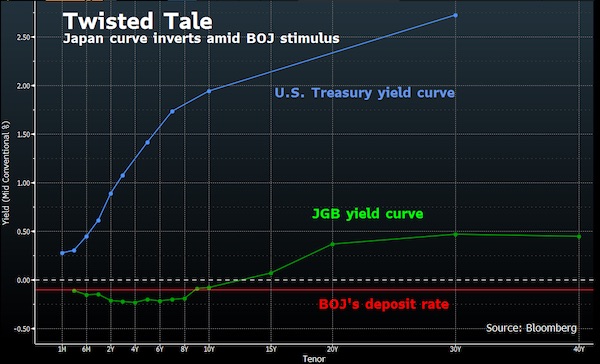
In a bid to jolt the eurozone’s lacklustre economy back to life , the central bank has, over the past five years, slashed interest rates to record lows and even pushed its deposit rate into negative territory. On top of this, it has launched a €1.7tn asset purchase programme, which has driven down bond yields across the continent. The measures have bought time for reform in the battered economies of southern Europe. Yet in Germany, they have met a blizzard of opposition. The country’s hawkish monetary policy establishment has always nurtured a degree of scepticism about the institution that succeeded the Bundesbank as the custodian of Germany’s monetary stability. But as savers, banks and insurers have been increasingly hurt by low interest rates — nominal yields on 10-year German bonds have fallen from about 4% in 2008 to less than 0.2% today — the criticism of the ECB has intensified.

The media has accused the central bank of fuelling a “social disaster”, while one bank has claimed that low interest rates will have deprived German households of €200bn between 2010 and the end of this year. Germany’s financial watchdog, BaFin, branded low rates a “seeping poison” for the country’s financial system. The most dramatic intervention, however, came from Wolfgang Schäuble, the hawkish finance minister, who blamed ECB president Mario Draghi for “half” the rise in support for Alternative for Germany, the rightwing, anti-immigration, anti-euro party. Mr Draghi hit back, archly noting that the ECB has a mandate “to pursue price stability for the whole of the eurozone, not only for Germany”, and argued that low borrowing costs were symptomatic of a glut in global savings for which Germany was partly to blame.

Read more …

“He’s judge and jury and everything else..”

• The Most Powerful Man in Banking (WSJ)

The most important person in the banking business isn’t a banker. To most Wall Street executives, that title goes to Federal Reserve governor Daniel Tarullo, a brusque, white-haired former law professor who has come to personify Washington’s postcrisis influence over how banks do business. Mr. Tarullo heads the Fed’s Committee on Bank Supervision. On paper—and in practice for most of the previous decades—the post isn’t a hugely powerful one. But the 63-year-old took office at the Fed in 2009 at a moment of broad public support for a more aggressive tack and has pressed that advantage ever since. Financiers privately call Mr. Tarullo “the Wizard of Oz” for his behind-the-scenes sway over everything from corporate strategy to how many billions of dollars banks must maintain in capital.

Through the stress tests he championed to evaluate how banks might fare in another market shock, the Fed wields control over whether banks can raise the dividends they pay to shareholders. For a big bank in 2016, getting a stamp of approval from Mr. Tarullo is an effort consuming thousands of employees. The industry’s lawyers pore over transcripts of Mr. Tarullo’s dense speeches to grasp the meaning of every word. When Citigroup and Bank of America stumbled on the stress tests in recent years, each bank said it spent at least $100 million to correct the problems the Fed had called out. Peter Conti-Brown, a historian and author of “The Power and Independence of the Federal Reserve,” called Mr. Tarullo’s influence extraordinary. One former bank executive put a finer point on it: “He’s judge and jury and everything else,” he said.

Mr. Tarullo in an interview attributed his power to his longevity at the Fed and consensus with other regulators. And, he said, the full impact of the regulatory changes made on his watch have yet to be felt. “I think it likely that firms are going to have to change in some cases their size, in some cases their business model, and in some cases their organization,” he said. Mr. Tarullo’s influence illustrates the outsize role that government regulation now plays for banks. For most of the modern era, regulators took a more hands-off approach, monitoring the industry for abuses but stopping short of injecting themselves into bank operations. But the near collapse of the financial system in 2008 brought widespread criticism of regulators for not being more vigilant and changed the equation.
Read more …

“..governments try to make finance safer and finance exploits the support to make itself riskier.”

• Central Banks As Pawnbrokers Of Last Resort (M. Wolf)

Will there be another huge financial crisis? As Hamlet said of the fall of a sparrow: “If it be now, ’tis not to come. If it be not to come, it will be now. If it be not now, yet it will come – the readiness is all.” So it is with banks. They are designed to fall. So fall they surely will. A recent book explores not only this reality but also a radical and original solution. What makes attention to this suggestion even more justified is that its author was at the heart of the monetary establishment before and during the crisis. He is Lord Mervyn King, former governor of the Bank of England. His book is called The End of Alchemy . The title is appropriate: alchemy lies at the heart of the financial system; moreover, banking was, like alchemy, a medieval idea, but one we have not as yet discarded. We must, argues Lord King, now do so.

As Lord King remarks, the alchemy is “the belief that money kept in banks can be taken out whenever depositors ask for it”. This is a confidence trick in two senses: it works if, and only if, confidence is strong; and it is fraudulent. Financial institutions make promises that, in likely states of the world, they cannot keep. In good times, this is a lucrative business. In bad times, the authorities have to come to the rescue. It is little wonder, then, that financial institutions have become so large and pay so well. Consider any large bank. It will have a wide range of long-term and risky assets on its books, mortgages and corporate loans prominent among them. It will finance these with deposits (supposedly redeemable on demand), short-term loans and longer-term loans. Perhaps 5% will be financed by equity.

What happens if lenders decide banks might not be solvent? If they are depositors or short-term lenders, they can demand their money back immediately. Without aid from the central bank, the only institution able to create money without limit, banks will fail to meet that demand. Since a generalised collapse would be economically devastating, needed support is forthcoming. Over time, this reality has created a “Red Queen’s race”: governments try to make finance safer and finance exploits the support to make itself riskier. Broadly speaking, two radical solutions are on offer. One is to force banks to fund themselves with far more equity. The other is to make banks match liquid liabilities with liquid and safe assets. The 100% reserve requirements of the “Chicago plan”, proposed during the Great Depression, is such a scheme.

If liquid, safe liabilities finance liquid, safe assets — and risk-bearing, illiquid liabilities finance illiquid, unsafe assets — alchemy disappears. Finance would be safe. Unfortunately, the end of alchemy would also end much risk-taking in the system. Lord King offers a novel alternative. Central banks would still act as lenders of last resort. But they would no longer be forced to lend against virtually any asset, since that very possibility must create moral hazard. Instead, they would agree the terms on which they would lend against assets in a crisis, including relevant haircuts, in advance. The size of these haircuts would be a “tax on alchemy”. They would be set at tough levels and could not be altered in a crisis. The central bank would have become a “pawnbroker for all seasons”.

Read more …

The US will need to pressure a lot harder to keep the sanctions going.

• Germany Considers Easing of Russia Sanctions (Spiegel)

As expected, G-7 leaders reiterated their hardline approach to Moscow in the Japan summit’s closing statement. Chancellor Angela Merkel complained last Thursday that there still isn’t a stable cease-fire in Ukraine and the law pertaining to local elections in eastern Ukraine, as called for by the Minsk Protocol, still hasn’t been passed. That, she said, is why “it is not to be expected” that the West will change its approach to Russia. What Merkel didn’t say, though, is that behind the scenes, her government has long since developed concrete plans for a step-by-step easing of the sanctions against Russia and that the process could begin as early as this year. Thus far, the message has been that the trade and travel restrictions will only be lifted once all the provisions foreseen by the Minsk Protocol have been fulfilled. 100% in return for 100%.

Now, however, Berlin is prepared to make concessions to Moscow – on the condition that progress is made on the Minsk process. “My approach has always been that sanctions are not an end in themselves. When progress is made on the implementation of the Minsk Protocol, we can also then talk about easing sanctions,” says Foreign Minister Frank-Walter Steinmeier. The Chancellery also supports the new approach. Thus far, it was the Social Democrats that were particularly vocal about rapprochement with Russia. Led by Economics Minister Gabriel, the SPD is Merkel’s junior coalition partner. While Steinmeier, also a senior SPD member, has never explicitly demanded the easing of sanctions, he has long supported Russia’s return to the G-7. Merkel, by contrast, had always maintained a hard line. Now, though, the Chancellery also appears to be changing course.

[..] more and more EU member states have begun questioning the strict penalty regime, particularly given that it hasn’t always been the Russians who have blocked the Minsk process. Despite Tusk’s apparent optimism, indications are mounting that getting all 28 EU members to approve the extension of the sanctions at the end of June might not be quite so simple. Berlin has received calls from concerned government officials whose governments have become increasingly skeptical of the penalties against Russia but have thus far declined to take a public stance against them. Members of some governments, though, have very clearly indicated that they are not interested in extending the sanctions in their current stringent form. Austrian Vice Chancellor Reinhold Mitterlehner is among the skeptics as is French Economics Minister Emmanuel Macron. So too are officials from Italy, Spain, Greece and Portugal.

Read more …

Time for the death penalty?! Time to put our armies to good use?

• Elephants In Tanzania Reserve Could Be Wiped Out By 2022 (AFP)

Elephants in Tanzania’s sprawling Selous Game Reserve could be wiped out within six years if poaching continues at current levels, the World Wildlife Fund warned. Tanzania’s largest nature reserve was in the 1970s home to 110,000 elephants, but today only 15,000 remain and they are threatened by “industrial-scale poaching”. The Selous “could see its elephant population decimated by 2022 if urgent measures are not taken,” the WWF said. More than 30,000 African elephants are killed by poachers every year to supply an illegal trade controlled by criminal gangs that feeds demand in the Far East. Tanzania is among the worst-affected countries with a recent census saying the country’s elephant population fell by 60% in the five years to 2014.

The Selous reserve is a tourist draw contributing an estimated $6 million (5 million euros) a year to Tanzania’s economy, according to a study commissioned by WWF and carried out by advisory firm Dalberg. It is named after Frederick Selous, a British explorer, hunter and real-life inspiration for the H. Rider Haggard character Allan Quatermain in King Solomon’s Mines. “By early 2022 we could see the last of Selous’ elephants gunned down by heavily armed and well trained criminal networks,” the report said. The 55,000-square kilometre (21,000-square mile) reserve in southern Tanzania was named a World Heritage Site by UNESCO in 1982. But it was put on a watch list in 2014 as poaching spiked, with six elephants killed every day and industrial activities including oil and gas exploration, as well as mining, threatening the delicate environment.

Read more …

The sadness just intensifies.

• Mediterranean Death Toll Soars In First 5 Months Of 2016 (UNHCR)

At least 880 people are believed to have drowned last week in a spate of shipwrecks and boat capsizings on the Mediterranean, the UN Refugee Agency said today. “For so many deaths to have occurred just in a matter of days and months is shocking and shows just how truly perilous these journeys are,” said UN High Commissioner for Refugees Filippo Grandi. UNHCR told a press briefing in Geneva that the latest figures were arrived at following new information received through interviews with survivors brought ashore in Italy.

“As well as three shipwrecks that were known to us as of Sunday, we have received information from people who landed in Augusta over the weekend that 47 people were missing after a raft carrying 125 people from Libya deflated,” UNHCR spokesperson William Spindler detailed. He added that eight others were reported separately to have been lost overboard from another boat, and four deaths were reported after fire on board another. “Thus far 2016 is proving to be particularly deadly. Some 2,510 lives have been lost so far compared to 1,855 in the same period in 2015 and 57 in the first five months of 2014,” Spindler added.

Read more …

“Everything started after the EU agreement,” he said. “These people are no longer refugees to them [the authorities]. They are prisoners and are being detained. But they have left the humanitarian aspect out of the story.”

• Frontex Denies, Prevents Help To Refugees: Witnesses (MEE)

Frontex denied aid to refugees including a baby and kept them floating in the sea off Greece for nearly two hours, according to aid workers. Eyewitnesses told MEE that Frontex officers prevented aid workers helping 50 people as they landed on the northern shore of the Greek island of Lesbos early on Monday. Their tactic was to take them directly into detention “without any aid, even the injured,” one aid worker said. Witnesses also told MEE that officers from the Maltese branch of the European border control police prevented a doctor tending to a baby that was “unresponsive”. In a written statement to MEE, Frontex said the crew on the Maltese ship had followed a Hellenic Coast Guard officer’s instructions and that none of the volunteers identified themselves as a doctor.

The reports come as the UN says that more than 2,500 people have died trying to make the perilous journey across the Mediterranean to Europe so far in 2016, a sharp jump from the same period last year. In the past week alone, at least 880 people are believed to have died in a series of shipwrecks – but thousands of people have also been rescued in the last seven days, with some 90 rescue operations launched. Frontex, supported by a series of national fleets and coast guards as well as several NGOs and some private volunteers, is charged with carrying out rescue operations in the Mediterranean. However, witnesses told MEE that the boat crammed with refugees was made to float out at sea until Frontex ground units came to take the passengers away in buses, after the Greek coastguard granted permission for the landing at the fishing hamlet of Skala Skiaminias on Lesbos’s north coast.

Esther Camps, from Spanish NGO Proactiva, which provides aid and rescue operations at sea, was at the scene. She said the incident took place at around 01:00 on Monday morning – the arrivals, she said, included around 10 children, as well as women who were crying out for help. “We were told to do nothing and to ‘stay away’,” she told MEE. “As they [the refugees and migrants] were disembarking, we saw there was a baby that was not making any noise. One of the officers said the baby was ‘fine’ and kept us away. We said, ‘how do you know it is OK? You are not doctors.'” Camps, who has been working with Proactiva since December, said that babies normally cry when they are brought ashore, but that in this case the child was not making any noise. MEE understands that a doctor from the aid organisation Waha was also at the scene but was denied access.


Handout photo released as courtesy by German humanitarian NGO Sea-Watch shows a crew member holding a drowned baby as dead bodies were recovered after a wooden boat transporting migrants capsized off the Libyan coast on 27 May, 2016 (AFP)

Read more …

May 242016
 
 May 24, 2016  Posted by at 9:40 am Finance Tagged with: , , , , , , , , , , ,  Comments Off on Debt Rattle May 24 2016


Lewis Hine A heavy load for an old woman. Lafayette Street below Astor Place, NYC 1912

• ‘Massive Bailout’ Needed in Debt-Saddled China: Charlene Chu (BBG)
• SOE Debt Could Easily Overwhelm China’s Banking System (Abc.au)
• China Takes Back Control Over Yuan (WSJ)
• Negative Rates Prompt Japan Banks to Opt Out Via Derivatives (BBG)
• Iron Ore Price Falls 27% In Past Month (BI)
• Deutsche Bank Ratings Cut by Moody’s (BBG)
• Greece Is Never Going To Grow Its Way Out Of Debt (Coppola)
• Austerity Means Privatizing Everything We Own (G.)
• US Court Opens Door Over Libor Claims (FT)
• Italy Helps Rescue 2,600 Migrants From Sea In 24 Hours (R.)
• Greece Starts Clearing Makeshift Refugee Camp On Border (R.)

Selling vehicles to vehicles: “The WMPs [wealth management product] used to be predominantly sold to the public, but now they’re increasingly being sold to banks and other WMPs.”

• ‘Massive Bailout’ Needed in Debt-Saddled China: Charlene Chu (BBG)

Charlene Chu, a banking analyst who made her name warning of the risks from China’s credit binge, said a bailout in the trillions of dollars is needed to tackle the bad-debt burden dragging down the nation’s economy. Speaking eight days after a Communist Party newspaper highlighted dangers from the build-up of debt, Chu, a partner at Autonomous Research, said she was yet to be convinced the government is serious about deleveraging and eliminating industry overcapacity. She also argued that lenders’ off-balance-sheet portfolios of wealth-management products are the biggest immediate threat to the nation’s financial system, with similarities to Western bank exposures in 2008 that helped to trigger a global meltdown.

The former Fitch Ratings analyst uses a top-down approach to calculating China’s bad-debt levels as the credit to GDP ratio worsens, requiring more credit to generate each unit of GDP. She’s on the bearish side of the debate about the outlook for China and has sounded warnings since the nation’s credit binge began in 2008. “China’s debt problems are large and severe, but in some respects a slow burn. Over the near term, we think the biggest risk is banks’ WMP [wealth management product] portfolios. The stock of Chinese banks’ off-balance-sheet WMPs grew 73% last year. There is nothing in the Chinese economy that supports a 73% growth rate of anything at the moment.

Regardless of all of the headlines and announcements about the authorities cracking down on WMPs, they have done very little, really, and issuance continues to accelerate. “We call off-balance-sheet WMPs a hidden second balance sheet because that’s really what it is – it’s a hidden pool of liabilities and assets. In this way, it’s similar to the Special Investment Vehicles and conduits that the Western banks had in 2008, which nobody paid attention to until everything fell apart and they had to be incorporated on-balance-sheet. “The mid-tier lenders is where these second balance sheets are very large. China Merchants Bank is a good example. Their second balance sheet is close to 40% of their on-balance-sheet liabilities. Enormous.”

Read more …

“Although contributing to less than one-third of economic output and employment, SOEs take up nearly half of bank lending..”

• SOE Debt Could Easily Overwhelm China’s Banking System (Abc.au)

Chinese banks are looking down the barrel of a staggering RMB 8 trillion – or $1.7 trillion – worth of losses according to the French investment bank Societe Generale. Put another way, 60% of capital in China’s banks is at risk as authorities start the delicate and dangerous process of reining in the debt-bloated and unprofitable state-owned enterprise (SOE) sector. Disturbingly though, debt is not only not shrinking, it is accelerating, making the eventual reckoning far worse. China’s overall non-financial debt grew by 15.2% in 2015 to RMB 167 trillion ($35 trillion) or almost 250% of GDP. That is up from 230% of GDP the year before and the 130% it was eight years ago before the global financial crisis hit.

The problem is largely centred on China’s 150,000 or so SOEs, which suck-up an entirely disproportionate amount of the nation’s capital. “Although contributing to less than one-third of economic output and employment, SOEs take up nearly half of bank lending (RMB 37 trillion) and more than 80% of corporate bond financing (RMB 9.5 trillion),” Societe Generale found. “While the inefficiency of SOEs is gradually dragging down economic growth, recognising even a small share of SOEs’ non-performing debt would easily overwhelm the financial system.” Despite their moribund financial performance, the SOEs still enjoy a considerable advantage in access to funding through the banking system than the private sector.

“To put things into perspective, a quarter of SOEs’ loans and bonds are equivalent to the entire capital base of commercial banks plus their loan-loss reserves, equivalent to 23% of GDP,” Societe Generale’s China economist Wei Yao said. On the bank’s figures, if just 3% of loans to SOEs sour, commercial banks’ non-performing loans would double.

Read more …

Wanting to control the yuan exchange rate is a threat to reserves.

• China Takes Back Control Over Yuan (WSJ)

Behind closed doors in March, some of China’s most prominent economists and bankers bluntly asked the People’s Bank of China to stop fighting the financial markets and let the value of the nation’s currency fall. They got nowhere. “The primary task is to maintain stability,” said one central-bank official, according to previously undisclosed minutes of the meeting reviewed by The Wall Street Journal. The meeting left little doubt China’s top leaders have lost interest in a major policy shift announced in a surprise move just nine months ago. In August 2015, the PBOC said it would make the yuan’s value more market-based, an important step in liberalizing the world’s second-largest economy.

In reality, though, the yuan’s daily exchange rate is now back under tight government control, according to meeting minutes that detail private deliberations and interviews with Chinese officials and advisers who spoke with The Wall Street Journal about the country’s currency policy. On Jan. 4, the central bank behind closed doors ditched the market-based mechanism, according to people close to the PBOC. The central bank hasn’t announced the reversal, but officials have essentially returned to the old way of adjusting the yuan’s daily value higher or lower based on whatever suits Beijing best. The flip-flop is a sign of policy makers’ deepening wariness about how much money is fleeing China, a problem driven by its slowing economy.

For now, at least, officials believe the benefits of freeing the yuan are outnumbered by the number of threats. Re-emphasizing the yuan’s stability would also bring a sigh of relief to trading partners who worried a weaker currency would boost Chinese exports at the expense of those produced elsewhere. Freeing the yuan, the biggest overhaul of China’s currency policy in a decade, was meant to empower consumers and help invigorate the economy. The negative reaction, from financial markets world-wide and Chinese who sped their efforts to take money out of the country, was so jarring that the top leadership, headed by President Xi Jinping, began to have second thoughts.

At a heavily guarded conclave of senior Communist Party officials in December, Mr. Xi called China’s markets and regulatory system “immature” and said “the majority” of party officials hadn’t done enough to guide the economy toward more sustainable growth, according to people who attended the meeting. To the central bank, there was only one possible interpretation: Step on the brakes.

Read more …

Turns out, it can still get worse.

• Negative Rates Prompt Japan Banks to Opt Out Via Derivatives (BBG)

Japanese banks reluctant to pay for the privilege of lending are opting out by using derivatives. The options set a floor on rates used to determine interest on loans, and the holder will be paid if the rates fall below that level, according to Aozora Bank and Tokyo Star Bank. The benchmark three-month Tokyo interbank offered rate has plunged to a record low of 6 basis points since the Bank of Japan announced it would start charging fees on some lenders’ reserves in January. Options with floors at zero% or minus rates have been traded recently, according to Aozora Bank. “There’s a need to hedge against money-losing lending that could happen if the Tibor falls to negative levels,” said Tetsuji Matsuka, the head of the ALM planning treasury department at Tokyo Star Bank.

“We think demand will increase” for such products, he said. Japanese banks are getting hurt as the negative-rate policy compresses their lending margins, with the top-three firms including Mitsubishi UFJ Financial forecasting this month that net income will fall a combined 5.2% in the year started April 1. The BOJ’s radical stimulus has already dragged yields on more than 70% of Japanese government bonds to below zero, meaning that investors will have to effectively pay a fee to hold such debt to maturity. In the yen London interbank offered rate market, where some rates are already below zero, options have been traded with floors as low as minus 1%, according to Nobuyuki Takahashi, the general manager of the derivatives sales division at Aozora Bank.

The three-month yen Libor was at minus 0.02% on Friday. Companies that borrow at floating rates may also be able to use floor options to ensure that interest-rate swaps they use to hedge against rising rates don’t end up costing them due to negative rates, Takahashi said. Actual trades of such derivatives are still not that common because the contracts are expensive to buy now, he said. “It will be hard to price these options unless we get more liquidity,” said Tateo Komatsu, a deputy general manager of global markets at Sumitomo Mitsui Trust Bank Ltd. “It will take time for the market to get used to minus rates.”

Read more …

Roller coaster in a casino.

• Iron Ore Price Falls 27% In Past Month (BI)

The iron ore price is imploding. Following the ugly lead provided by Chinese futures on Monday, the spot iron ore price followed suit, suffering one of the largest declines seen in years. According to Metal Bulletin, the spot price for benchmark 62% fines fell by 6.69%, or $3.67, to $51.22 a tonne, leaving it down 27.3% from the multi-year peak of $70.46 a tonne struck on April 21. The decline was the third-largest in percentage terms in the past two years, and left the price at the lowest level seen since March 3 this year. The losses in physical and futures markets followed news that Chinese iron ore port inventories swelled to over 100 million tonnes last week, leaving them at the highest level seen since March last year.

That followed the revelation that Chinese crude steel output contracted in April after hitting a record high in March, declining marginally according to figures released by the China Iron and Steel Association (CISA). Given the increasing correlated relationship between the two, it’s also clear that an unwind of speculative positioning in Chinese iron ore futures is also impacting prices in the physical iron ore market. After watching prices in many bulk commodity futures rally more than 50% in less than two months, regulators at both the Dalian Commodities Exchange and Shanghai Futures Exchange introduced measures in recent weeks to discourage excessive levels of speculation in these markets.

Read more …

Slow death?!

• Deutsche Bank Ratings Cut by Moody’s (BBG)

Deutsche Bank had its credit rating cut by Moody’s Investors Service, which said the German lender faces mounting challenges in carrying out its turnaround. The bank’s senior unsecured debt rating was lowered to Baa2 from Baa1, Moody’s said Monday in a statement. That left the grade two levels above junk. The firm’s long-term deposit rating fell to A3 from A2. “Deutsche Bank’s performance over the last several quarters has been weak, and substantial operating headwinds, including continuing low interest rates and macroeconomic uncertainty, will challenge the firm,” Moody’s said in the statement. CEO John Cryan’s planned overhaul of the bank, laid out in October, ran into an industrywide slump in trading and investment banking, as well as interest rates that have gone from low to negative in parts of Europe and Asia.

Net income fell 61% in the first quarter, leaving the company at risk of a second straight annual loss this year as it tries to resolve legal cases. Results so far and the challenges ahead, including a chance of further slumps in retail and market-linked businesses, will probably force Deutsche Bank to balance restructuring costs with the need to amass capital for stiffened regulatory requirements, Moody’s wrote. “The plan they’re trying to execute is a good plan for the bondholder in the long run, but they face some pretty challenging headwinds when you look at the current operating environment,” Peter Nerby, a senior vice president at Moody’s, said in a phone interview. “They’re working on it, but it’s tougher than it was.”

Read more …

“A whole generation will have been consigned to the scrapheap.”

• Greece Is Never Going To Grow Its Way Out Of Debt (Coppola)

The IMF has just released its latest Debt Sustainability Analysis (DSA) for Greece. It makes grim reading. Greece is never going to grow its way out of debt. And the 3.5% primary surplus to which the Syriza government seems hell-bent upon committing is frankly unbelievable: the IMF thinks sustaining even 1.5% would be a stretch. Banks will need another €10bn (on top of the €43bn the Greek government has already borrowed to bail them out). Asset sales are a lost cause, mainly because the banks – which were a large proportion of the assets up for sale – won’t be worth anything for the foreseeable future. Like it or not, debt relief will be necessary. If there is no debt relief, by 2060 debt service will soar to an impossible 60% of government spending. Of course, Greece would default long before that – but that would make the situation in Greece even worse.

None of this is news. The IMF has been saying for nearly a year now that Greece will need debt relief. This latest DSA is designed to shock the Europeans into giving it serious consideration. It is not surprising, therefore, that the debt sustainability projections are significantly worse than in previous DSAs. No doubt the European creditors will disagree with them, the Syriza government will side with the Europeans because the only alternative is Grexit, and the European Commission will claim there is “progress” when all that is really happening is that a very battered can is being kicked once again. But buried in the IMF’s report are some very unpleasant numbers indeed – the IMF’s projections for population and employment out to 2060. And I think the world should know about them. Here is what the IMF has to say about the outlook for Greek unemployment:

Demographic projections suggest that working age population will decline by about 10 percentage points by 2060. At the same time, Greece will continue to struggle with high unemployment rates for decades to come. Its current unemployment rate is around 25%, the highest in the OECD, and after seven years of recession, its structural component is estimated at around 20%. Consequently, it will take significant time for unemployment to come down. Staff expects it to reach 18% by 2022, 12% by 2040, and 6% only by 2060. So even if the Greek economy returns to growth and its creditors agree to debt relief, it will take 44 years to reduce Greek unemployment to something approaching normal. For Greece’s young people currently out of work, that is all of their working life. A whole generation will have been consigned to the scrapheap.

Read more …

Think Britain is bad? Try Greece.

• Austerity Means Privatizing Everything We Own (G.)

Almost everyone who gives the matter serious thought agrees that George Osborne and David Cameron want to reshape Britain. The spending cuts, the upending of the NHS, even this month’s near-miss over the BBC: signs lie everywhere of how this will be a decade, maybe more, of massive change. Yet even now it is little understood just how far Britain might shift – and in which direction. Take austerity, the word that will define this government. Even its most astute critics commit two basic errors. The first is to assume that it boils down to spending cuts and tax rises. The second is to believe that all this is meant to reduce how much the country is borrowing. What such commonplaces do is reduce austerity to a technical, reversible project.

Were it really so simple all we would need to do is turn the spending taps back on and wash away all traces of Osbornomics. Austerity is far bigger than that: it is a project irreversibly to transfer wealth from the poorest to the richest. It’s doing the job very nicely: while the typical British worker is still earning less after inflation than he or she was before the banking crash, the number of UK-based billionaires has nearly quadrupled since 2009. Even while he slashes benefits, Osborne is deep into a programme to hand over much of what is still owned by the British public to the wealthiest. Privatisation is the multibillion-pound centrepiece of Osborne’s austerity – yet it rarely gets a mention from either politicians or press. The Queen mentioned it in her speech last week, but the headline writers ignored it.

And if you don’t know that this Thursday is the closing date for consultation on the sale of the Land Registry, our public record of who owns what property, that’s hardly your fault – I haven’t spotted it in the papers, either. But without getting rid of prize assets, Osborne’s austerity programme falls apart. At a time when tax revenues are more weak stream than healthy flood, those sales bring much-needed cash into the Treasury and make his sums add up. The independent Office for Budget Responsibility has ruled that the only reason the chancellor met his debts target last year was because he flogged off our public assets. And what a fire sale that was, with everything from our last remaining stake in the Royal Mail to shares in Eurostar shoved out the door in the biggest wave of privatisations of any year in British history.

Read more …

And maybe sometime in the next century something will be done. But they’re all still too big to fail.

• US Court Opens Door Over Libor Claims (FT)

A US appeals court has opened the door for more claims against the big banks for rigging benchmark interest rates, by overturning a three-year-old ruling which threw out a host of private antitrust-related lawsuits. Monday’s decision by the 2nd US Circuit Court of Appeals in Manhattan could be a setback for the likes of Bank of America, JPMorgan Chase and Citigroup, which had hoped that most of the wave of post-crisis litigation was behind them. The decision reverses a lower court decision from 2013, in which US District Judge Naomi Reice Buchwald dismissed claims on the grounds that the plaintiffs had failed to plead antitrust injury.

The lawsuits had accused 16 major banks of collusion in manipulating the London interbank offered rate, or Libor, which approximates the average rate at which a select group of banks can borrow money. Beginning in 2007, the plaintiffs argued, the banks engaged in a horizontal price-fixing conspiracy, with each submitting an artificially low cost of borrowing US dollars in order to drive Libor down. At the time of her rejection, Judge Buchwald reasoned that the Libor-setting process was co-operative rather than competitive, and so any attempt to depress the rate did not cause investors to suffer anti-competitive harm. At best, she said, investors had a fraud claim based on misrepresentation.

But the appeals court on Monday disagreed and sent the case back to the lower court for further proceedings. A three-judge panel found that price-fixing was an antitrust violation in itself, and therefore needed no separate plea of harm. “The crucial allegation is that the banks circumvented the Libor-setting rules, and that joint process thus turned into collusion,” the panel said. The private suits are separate from the criminal and civil probes into Libor rigging, which have ensnared banks and traders around the world and drawn about $9bn so far in penalties.

Read more …

Do we even still notice?

• Italy Helps Rescue 2,600 Migrants From Sea In 24 Hours (R.)

Italian vessels have helped rescue more than 2,600 migrants from boats trying to reach Europe from North Africa in the last 24 hours, the coastguard said on Monday, indicating that numbers are rising as the weather warms up. Some 2,000 migrants were rescued off the Libyan coast from 14 rubber dinghies and one larger boat in salvage operations by the Italian navy and coastguard, the medical charity Medecins Sans Frontieres and an Irish navy vessel, the coastguard said. Another 636 migrants were rescued from two boats in Maltese waters, in operations involving Maltese and Italian vessels, it said. It gave no information about the nationalities of those saved. More than 31,000 migrants have reached Italy by boat so far this year, slightly fewer than in the same period of 2015.

Humanitarian organizations say the sea route between Libya and Italy is now the main route for asylum seekers heading for Europe, after an EU deal on migrants with Turkey dramatically slowed the flow of people reaching Greece. Officials fear the numbers trying to make the crossing to southern Italy will increase as conditions improve in warmer weather. More than 1.2 million Arab, African and Asian migrants fleeing war and poverty have streamed into the European Union since the start of last year. Most of those trying to reach Italy leave the coast of lawless Libya on rickety fishing boats or rubber dinghies, heading for the Italian island of Lampedusa, which is close to Tunisia, or toward Sicily.

Read more …

Peaceful until now.

• Greece Starts Clearing Makeshift Refugee Camp On Border (R.)

Greek police started moving migrants and refugees out of a sprawling tent camp on the sealed northern border with Macedonia on Tuesday where thousands have been stranded for months trying to get into western Europe. Reuters witnesses saw several bus loads of migrants leaving the makeshift camp of Idomeni early on Tuesday morning, with about another dozen buses lined up. It appeared to be mainly families who were on the move. Greek authorities said they planned to move individuals gradually to state-supervised facilities further south in an operation expected to last several days. “The evacuation is progressing without any problem,” said Giorgos Kyritsis, a government spokesman for the migrant crisis.

A Reuters witness on the Macedonian side of the border said there was a heavy police presence in the area but no problems were reported as people with young children packed up huge bags with their belongings. Media on the Greek side of the border were kept at a distance and a group of people dressed as clowns waved balloon hearts and animals as the buses drove past. “Those who pack their belongings will leave, because we want this issue over with. Ideally by the end of the week. We haven’t put a strict deadline on it, but more or less that is what we estimate,” Kyritsis told Reuters. At the latest tally, 8,199 people were camped at Idomeni after a cascade of border shutdowns throughout the Balkans in February barred migrants and refugees from central and northern Europe. More than 12,000 lived in the camp at one point.

Read more …

Mar 262016
 
 March 26, 2016  Posted by at 9:29 am Finance Tagged with: , , , , , , , , ,  1 Response »


Jack Delano Freight operations on the Indiana Harbor Belt railroad 1943

• US Q4 GDP Rose 1.4% As Corporate Profits Plunged (ZH)
• World Trade Collapses in Dollars, Languishes in Volume (WS)
• Bank of Japan’s Latest PR Move: ‘Negative Rates in Five Minutes’ (WSJ)
• Foreigners Dumped More Japanese Stocks This Week Than Ever Before (ZH)
• Yuan’s Fall Drags Down Chinese Companies (WSJ)
• Shanghai Rolls Out Tightening Measures To Cool Home Market (Reuters)
• Affordable Housing Crisis Has Engulfed All Cities In Southern England (G.)
• Radical Economic Ideas Grab Attention Amid Low-inflation Torpor (SMH)
• Modern Monetary Theory Has Ardent Proponents (SMH)
• Brazil Economic Woes Deepen Amid Political Crisis (WSJ)
• The River: America’s 40-Year Hurt (BBC)
• Hope Turns To Despair As Lesbos Camp Becomes Open-Air Prison (Ind.)

“The resilient consumer”. Sure.

• US Q4 GDP Rose 1.4% As Corporate Profits Plunged (ZH)

While the final revision to Q4 2015 GDP was so irrelevant it was released on a holiday when every US-based market is closed, even the futures, it is nonetheless notable that according to the BEA in the final quarter of 2015 US GDP grew 1.4%, up from the 1.0% previously reported, and higher than the 1.0% consensus estimate matching the highest Q4 GDP forecast. The final Q4 GDP print was still well below the 2.0% annualized GDP growth reported in Q3.


The figure marks a slowdown from the 2.2% average pace in the first three quarters of 2015. For all of last year, the U.S. economy grew 2.4% matching the advance in 2014. The reason for the change was largely due to upwardly Personal Consumer Spending, which rose from a contribution of 1.38% to the annualized bottom line to 1.66%. In CAGR terms, personal consumption rose 2.4%, following the 3.0% increase in Q3, higher than the 2.0% previously estimated.

Stripping out inventories and trade, the two most volatile components of GDP, so-called final sales to domestic purchasers increased at a 1.7% rate, compared with a previously estimated 1.4% pace.  The rest of the GDP components were largely unchanged, with Fixed Investment adding 0.06% to the bottom line, up from 0.02% in the previous estimate, Private Inventories contracting fractionally more than previously estimated (-0.22% vs -0.14%), net trade subtracting 0.1% less from growth (-0.14% vs -0.25%), and finally government spending largely unchanged and hugging the unchanged line at 0.02%.


But while the “resilient consumer” once again carried the US economy in the fourth quarter, largely due to an estimated jump in spending on Transportation and Recreational services, which added an annualized $13 billion to the US economy vs the prior estimate, more disturbing was the drop in profits which we already knew courtesy of company reports and is known confirmed by the BEA whose GDP report also showed that corporate profits dropped in 2015 by the most in seven years. As Bloomberg writes, the earnings slump illustrates the limits of an economy struggling to gather steam at the start of this year. Some companies, encumbered by low commodities prices and sluggish foreign markets, are cutting back on investment while a firm labor market and low inflation encourage households to keep shopping.

Pre-tax earnings declined 7.8%, the most since the first quarter of 2011, after a 1.6% decrease in the previous three months. The estimate of nonfinancial corporate profits was reduced by a $20.8 billion settlement, considered a transfer to the government, between BP and the U.S. after the 2010 oil spill in the Gulf of Mexico. Profits in the U.S. dropped 3.1% in 2015, the most since 2008. Corporate earnings are being weighed down by weak productivity, rising labor costs and the plunge in energy prices. Economists at JPMorgan had expected a 9.5% drop in pre-tax earnings in the fourth quarter. “The pace of growth slowed as we ended 2015, though consumer spending is still the primary underpinning of this economic expansion,” Sam Bullard at Wells Fargo in Charlotte, North Carolina, said before the report. “Any pickup we might see is still likely going to be capped given the overall global picture.”

Read more …

Globalization is ending.

• World Trade Collapses in Dollars, Languishes in Volume (WS)

The Merchandise World Trade Monitor by the CPB Netherlands Bureau for Economic Policy Analysis, a division of the Ministry of Economic Affairs, tracks global imports and exports in two measures: by volume and by unit price in US dollars. And the just released data for January was a doozie beneath the lackluster surface. The World Trade Monitor for January, as measured in seasonally adjusted volume, declined 0.4% from December and was up a measly 1.1% from January a year ago. While the sub-index for import volumes rose 3% from a year ago, export volumes fell 0.7%. This sort of “growth,” languishing between slightly negative and slightly positive has been the rule last year. The report added this about trade momentum:

“Regional outcomes were mixed. Both import and export momentum became more negative in the United States. Both became more positive in the Euro Area. Import momentum in emerging Asia rose further, whereas export momentum in emerging Asia has been negative for four consecutive months.” This is also what the world’s largest container carrier, Maersk Lines, and others forecast for 2016: a growth rate of about zero to 1% in terms of volume. So not exactly an endorsement of a booming global economy. But here’s the doozie: In terms of prices per unit expressed in US dollars, world trade dropped 3.8% in January from December and is down 12.1% from January a year ago, continuing a rout that started in June 2014. Not that the index was all that strong at the time, after having cascaded lower from its peak in May 2011.

If June 2014 sounds familiar as a recent high point, it’s because a lot of indices started heading south after that, including the price of oil, revenues of S&P 500 companies, total business revenues in the US…. That’s when the Fed was in the middle of tapering QE out of existence and folks realized that it would be gone soon. That’s when the dollar began to strengthen against other key currencies. Shortly after that, inventories of all kinds in the US began to bloat. Starting from that propitious month, the unit price index of world trade has plunged 23%. It’s now lower than it had been at the trough of the Financial Crisis. It hit the lowest level since March 2006:

This chart puts in perspective what Nils Andersen, the CEO of Danish conglomerate AP Møller-Maersk, which owns Maersk Lines, had said last month in an interview following the company’s dreary earnings report and guidance: “It is worse than in 2008.” But why the difference between the stagnation scenario in world trade in terms of volume and the total collapse of the index that measures world trade in unit prices in US dollars? The volume measure is a reflection of a languishing global economy. It says that global trade may be sick, but it’s not collapsing. It’s worse than it was in 2011. This sort of thing was never part of the rosy scenario. But now it’s here.

Read more …

‘Explaining’ what they don’t understand themselves.

• Bank of Japan’s Latest PR Move: ‘Negative Rates in Five Minutes’ (WSJ)

The Bank of Japan launched a charm offensive Friday to win over spooked members of the public who have reacted negatively to negative interest rates. The central bank issued a booklet offering a crash course in the basic implications of negative rates, a move that demonstrates the strength of unease created by the introduction of a policy in a nation largely unfamiliar with the concept behind it. Written in a question-and-answer format and in a somewhat casual Japanese, the three-page booklet aims to explain negative rates “in five minutes” by covering 18 issues that have grabbed public attention. Negative rates have become a political hot potato ahead of July’s national elections, with opposition lawmakers accusing the central bank of creating anxiety among consumers. Some ruling party politicians, perhaps feeling uncomfortable about the prospect of explaining the policy to their constituents, are also feeling the jitters.

Prime Minister Shinzo Abe acknowledged Thursday that negative rates have made households nervous and it will likely take some time before people understand them. The Bank of Japan decided to start charging interest on some deposits held by commercial banks at the central bank in January. The policy is part of broader efforts to defeat deflation and create a stronger economy, but the central bank was ill-prepared for the public backlash the policy generated. One of the most common concerns over the policy is whether individuals with regular bank accounts will be charged interest on their deposits at the commercial banks. Opposition lawmakers have frequently quizzed BOJ Gov. Haruhiko Kuroda on this issue in parliament.

“Although the measure is called negative rates, it only involves imposing negative rates on a part of the money deposited at the BOJ by banks,” the booklet says. “Individuals’ deposits are different.” While addressing concerns over the new policy, the central bank also tries to convey the message that Japan must get rid of deflation, a negative cycle of price falls, adding that it has taken the right steps to do just that. “If prices don’t rise because of deflation, this means companies’ revenues don’t increase, and that’s why salaries don’t rise,” the booklet says. Since company earnings have improved a lot during the past three years of monetary easing, firms have started increasing basic pay, it says, adding that salaries will keep rising each year if deflation is overcome.

Read more …

“..weakness means weak Japanese economy means sell Japanese assets.. and we will soon see capital controls in the world’s largest debtor nation…”

• Foreigners Dumped More Japanese Stocks This Week Than Ever Before (ZH)

USDJPY just had its best week in 2 months, funding bullish momentum and carry trades around the world in the midst of dismal economic data everywhere and tumbling earnings expectations. This "bullish" Yen strength, however, amid China's biggest weekly devaluation in almost 3 months, was ironically driven by drastic investment outflows – record sales of Japanese stocks by foreigners (sell JPY), and record purchases of foreign bonds by Japanese investors (sell JPY). Sooner, rather than later, it is obvious that the investment outflows will dominate the carry trades (see Thursday and Friday) and Kuroda and Abe will have a major problem.

Yen was dumped all week…


Which provided just enough juice for carry trades to lift Japanese stocks (despite the weakness in data and China's biggest weekly Yuan devaluation in almost 3 months)


But notice that the last two days have seen Japanese stocks decouple from USDJPY, perhaps the first glimpse of the investment outflows overwhelming any casino-based carry trades flows.

And this is why… Foreigners sold a record amount of Japanese stocks last week… (implicitly meansing Yen was sold)


And Japanese investors fled the insanity of record low yields in JGBs, buying a record amount of foreign bonds last week (implicitly selling Yen again)…


So the Yen weakness – which was so bullishly supportive of global equity markets via carry – was in fact a signal of massive investor anxiety fleeing the sinking ship. Peter Pan-ic indeed.

Abe and Kuroda will soon face a major problem as a weaker Yen will signal the exact opposite trade that has been so active since 2012 – weakness means weak Japanese economy means sell Japanese assets.. and we will soon see capital controls in the world's largest debtor nation.

And remember – the devaluation of The Yen has done nothing – NOTHING – to improve exports for Japan…

Read more …

It’s all about the dollar.

• Yuan’s Fall Drags Down Chinese Companies (WSJ)

A weaker Chinese currency has roiled global markets and heightened worries about the state of the world’s second-largest economy. Now, some Chinese companies are reporting they’ve taken a hit from a depreciating yuan. The yuan fell 5% against the U.S. dollar in 2015, plunging after China’s central bank surprisingly devalued the currency in mid-August. A weaker currency helps the country’s exporters but hurts Chinese companies that pay for raw material in U.S. dollars or need to pay off loans in U.S. dollars. Among those negatively affected are firms that source from outside China, such as milk or food companies, as well as real estate companies that hold a lot of dollar-denominated debt, says Herald van der Linde at HSBC.

This was the case with Hengan International, one of the leading makers of tissue paper in China. The company said in a statement it saw $55.3 million in foreign-exchange losses in 2015 because it pays for raw material in U.S. dollars, holds U.S.-denominated debt and has Hong Kong-based yuan-denominated assets, which dropped in value. This contributed to a decline in tissue sales, it said. Weaker currencies also hurt China’s heavily-indebted real-estate developers. Shanghai-based property developer Shui On Land reported its 2015 profit dropped to 1.77 billion yuan ($272 million) from 2.49 billion yuan ($382 million) a year earlier in large part due to the depreciation of the company’s USD- and HKD-denominated debt. Then there are companies that suffer losses from selling to countries whose currencies have weakened.

Sourcing and logistics giant Li&Fung said 2015 revenue dropped 2.4% on year. The main reason? Foreign-exchange losses from weak European and Asian currencies, it said, since 38% of the company’s business is in non-U.S. markets but it accounts in U.S. dollars. In order to tackle the problem, some companies are looking to shed yuan — or at least get it out of the country. Hengan, the tissue company, has remitted the equivalent of several billion Hong Kong dollars from mainland China to Hong Kong in 2015, and another HK$2 billion in the first quarter of this year, said CFO Vincent Loo in Hong Kong. It is also negotiating with sources to pay them in less time — from 30 to 60 days rather than 90 — just in case the yuan continues to fall.

Read more …

Beijing’s ‘vision’ is now limited to short term only.

• Shanghai Rolls Out Tightening Measures To Cool Home Market (Reuters)

Municipal authorities in Shanghai tightened mortgage down payment requirements for second home purchases on Friday, in a move to cool an overheating property market and reduce fears of a bubble. Senior Chinese leaders raised concerns about the country’s overheated housing market during an annual parliament meeting this month, and Shanghai is the biggest city to take action in the wake of the National People’s Congress, which ended a week ago. Under the new rules, home buyers will need to put down 50-70% of the price of a second home, compared to 40% previously, to qualify for a mortgage. “The new measure will have a big impact on market sentiment on both the primary and secondary market; new launches being sold out within one, two hours will not happen again,” said Joe Zhou, head of East China research at real estate services firm Jones Lang LaSalle.

With the new rules, Shanghai also made it harder for non-residents to buy homes in the city, according to a statement issued by the local government. Potential buyers who do not hold local residence permits, or hukou, must have paid social insurance or taxes in Shanghai for at least five years before they can purchase property. Previously the requirement was two years. Shanghai will also increase the supply of small- and medium-sized homes and crack down on property financing by informal financial institutions. Shanghai home prices gained 20.6% in February from a year ago, posting the second biggest gain in the country after the southern city of Shenzhen, where prices soared 56.9%, despite slowing economic growth.

Read more …

A world full of housing bubbles. Haven’t we understood how dangerous that is?

• Affordable Housing Crisis Has Engulfed All Cities In Southern England (G.)

There is no longer a city in the south of England where house prices are less than seven and a half times average local incomes, according to analysis by Lloyds Bank that reveals how the home affordability crisis now stretches far beyond London. “The housing affordability gap has widened to its worst level in eight years,” said the Lloyds analysis, noting that the last time prices were so high was at the very top of the boom in 2008, just before the financial crisis struck. The Lloyds analysis is unique in that it compares local house prices with local earnings rather than national averages. On this measure, the worst house prices are not in London but in other parts of the south-east. Oxford is again identified as the least affordable city in the UK, with average prices at 10.68 times local earnings.

Winchester is a close second at 10.54, with London third at 10.06. Cambridge, Brighton and Bath all have prices that are now nearly 10 times local earnings, while cities such as Bristol and Southampton have prices close to eight times earnings. Wage growth has fallen far behind the rise in house prices, said Lloyds, with affordability worsening for the third successive year. The average home in a city in the UK now costs 6.6 times average local earnings, up from 6.2 last year. In the 1950s and 1960s, buyers could typically find homes with mortgages of three to four times their income. But the Lloyds figures show that there is now just one city in the UK that fits that profile: Derry in Northern Ireland. House prices in the city currently fetch 3.81 times local incomes.

While most of the “most affordable” cities in the Lloyds rankings are in the north, Scotland and Northern Ireland, buyers will still be stretched to afford a home from the local salaries on offer. Hull is widely regarded as a low house price area, yet local residents face having to pay 5.11 times average local incomes to buy a home. Meanwhile, York has joined the ranks of cities in the south in the unaffordability tables, with prices at 7.5 times incomes.

Read more …

When crazy ‘conventional’ ideas fail…

• Radical Economic Ideas Grab Attention Amid Low-inflation Torpor (SMH)

Our economic guardians at Federal Treasury and the Reserve Bank sound increasingly uneasy about some policy choices being made offshore. Since the global financial crisis, quantitative easing has pumped trillions of dollars into major economies with limited success. More recently central banks in Europe and Japan have opted for negative interest rates in a bid to kick-start growth. On Tuesday the Treasury Secretary, John Fraser, pointed out that we’ve now been in an “experimental stage” with monetary policy for more than seven years. “A range of different interventions have been tried with, at least to date, mixed results,” he said. “Sadly, we will have to await the passage of years before we can pass final judgment.” What is clear, warned Fraser, is that these unusual policies “have had a pervasive and frankly quite worrying impact on the pricing of financial risk.”

Earlier this month the Reserve’s deputy governor, Philip Lowe, said it was “very rare” for central banks to worry that inflation is too low. “Yet today, we hear this concern quite often, and the ‘unconventional’ has almost become conventional,” he said. Lowe warned the abnormal monetary policies being adopted in some countries were “a complication for us” because they put upward pressure on exchange rate. But in a world where traditional economic remedies are proving ineffective a swag of other unorthodox policy suggestions are getting a hearing. One controversial option being canvassed by experts is for central banks to deliver “helicopter drops” of cash directly to citizens’ bank accounts in the hope they will spend it and revive growth. Even more radical is a proposal for governments to mandate an across-the-board pay rise for workers.

Olivier Blanchard, a former chief economist at the IMF, and Adam Posen, president of the Peterson Institute for International Economics, recently recommended the Japanese government try this approach to boost growth. The Bank of England’s chief economist, Andy Haldane, raised eyebrows last September when he argued abandoning cash altogether would make it easier for central banks to manage downturns. He warned that in future it might be necessary for central banks to opt for negative interest rates when depositors are charged for putting their money in the bank in a bid to encourage spending. One problem with that strategy, however, is that people are likely to convert deposits into cash. Eliminating cash and replacing it with a government-backed digital currency would remove that option. “This would preserve the social convention of a state-issued unit of account and medium of exchange… But it would allow negative interest rates to be levied on currency easily and speedily,” Haldane said.

Read more …

A second part from the article above.

• Modern Monetary Theory Has Ardent Proponents (SMH)

As central banks struggle to revive growth, attention has shifted to fiscal policy the way governments use taxation and spending to influence the economy. Even the hard-heads at the IM have advised governments, including Australia’s, to spend more especially on infrastructure. The fund’s most recent assessment of our economy said “raising public investment (financed by borrowing, thus reducing the pace of deficit reduction) would support aggregate demand, take pressure off monetary policy, and insure against downside growth risks.” Amid these debates about fiscal policy, a radical school of thought called Modern Monetary Theory, or MMT, has gained more prominence. Proponents of this theory have been on the periphery of mainstream economics for more than two decades but their profile has been raised by this year’s US presidential race.

Academic economist Stephanie Kelton , a leading advocate of MMT, is an adviser to presidential hopeful, Senator Bernie Sanders. Kelton calls herself a deficit “owl” rather than a deficit hawk or dove. The hawks, of course, have a straightforward view of government finances: deficits are bad. The doves say deficits are necessary when economic times are tough but they should be balanced by surpluses over time. But deficit owls like Kelton have a far more radical take: deficits don’t matter. The starting point for Modern Monetary Theory is that a currency issuing government can keep printing and spending money but never go broke, so long as it doesn’t borrow in a foreign currency. The Australian Commonwealth, for example, will never run out of Australian dollars because it is a monopoly issuer of that currency.

It can always create the money it needs and, therefore, will always be able to service debts. The MMTers claim that in the modern era of floating exchange rates and deregulated financial markets, governments can, and should, run deficits whenever they are needed. There is a strong moral case for this: in a modern economy, there’s no good reason to have unemployed labour or capital. For the MMTers mass unemployment is a great evil and its daily, human cost dwarfs other economic challenges. They acknowledge there are limits to government spending. Resources in the real economy can be constrained and taxes are an essential tool to ensure demand for the currency and to cool the economy if it overheats. But there’s plenty of scope for governments to print and spend money without causing inflation or triggering a financial crisis. MMTers say sophisticated modern economies like the US and Australia are in no danger of the hyper-inflation which plagued Zimbabwe last decade or Germany’s Weimar Republic in the 1930s.

Read more …

Barely functioning, politically nor economically.

• Brazil Economic Woes Deepen Amid Political Crisis (WSJ)

Brazil’s economic crisis is as bad as its political one. Latin America’s biggest economy appears headed for one of its worst recessions ever. It stalled in 2014, shrank 3.8% last year and now faces a similar contraction this year. Unemployment rose to 9.5% on Thursday as wages fell 2.4%, both trends forecast to worsen. One in five young Brazilians is out of work, and Goldman Sachs says Brazil may be facing a depression. The deteriorating outlook forms a dire backdrop for Brazil’s political straits. President Dilma Rousseff, deeply unpopular, faces impeachment proceedings in Congress amid a widening corruption scandal surrounding the state oil company, Petróbras. That situation is consuming so much energy from policy makers and Congress that the economic downturn isn’t getting the attention it needs, observers say.

“The gravity of the situation is this: We have the kind of problems where if nothing is done, things will definitely get worse,” said Marcos Lisboa, a former finance ministry official who is now president of the Insper business school in São Paulo. “Pretty soon we could be talking about the solvency of the federal government.” Brazil fended off the results of the 2008 global downturn with stimulus spending, and is trying to again inject money into the economy to spur demand. In January, the Rousseff administration unveiled some $20 billion of subsidized loans from state-owned banks such as the BNDES to boost agriculture and builders of big infrastructure projects.

But this time, the country has less leeway to fund stimulus measures. Brazil’s tax take is diminishing, and the Planning Ministry said Tuesday the government needs to cut around $5.9 billion of spending to meet its budget target. On Thursday, Finance Minister Nelson Barbosa asked Congress to loosen the target to allow a bigger deficit in 2016. Some investors say stimulus policies such as cheap credits from state banks haven’t done much long-term good, because they produced big deficits and the money was often poorly invested in money-losing dams and refineries.

Read more …

“..very few people understood that an epochal change had taken place in the American economy. GDP would grow. Income wouldn’t.”

• The River: America’s 40-Year Hurt (BBC)

Bruce Springsteen is coming to London with the River tour. At £170 for the cheapest pair, I can’t afford to see the Boss any more, even if my body could handle standing on Wembley Stadium’s pitch for three-and-a-half-hours in an early June drizzle. It’s interesting that Springsteen is re-exploring The River album again. Whenever the anger that simmers in America erupts and reminds the rest of the world that the country is troubled, he seems to be the cultural figure whose work offers an explanation. In late 1986, midway through Ronald Reagan’s second term of office, with the twin scourges of Aids and crack racing through American cities and New Deal ideas of economic and social fairness consumed by the Bonfire of the Vanities taking place on Wall Street, Britain’s Guardian newspaper ran an editorial that said, “for good or ill, [America] is becoming a much more foreign land”.

I had just celebrated my first anniversary as an ex-pat in London and wrote an essay trying to explain what America was like away from the places Guardian readers knew. I described the massive population dislocations that followed the long recession that had begun in the mid-70s. I referenced Springsteen. The piece ran under the headline “Torn in the USA”. Now America is going through even worse ructions. But there is nothing fundamentally new. What we are seeing is the continuation of a disintegration that began forty years ago around the time Springsteen was writing the title song of the album. The River, which came out in 1980, was very much about guys trying to kick back at father time and stave off the inevitable arrival of life’s responsibilities – wife, kids, job, mortgage – and the equally probable onset of life’s disappointments in wife, kids, job, mortgage, and in oneself.

The title track is a long, mournful story about that process and the narrator’s desire to reconnect to the person he was when younger and full of hope. “I come from down in the valley / Where mister, when you’re young / They bring you up to do/like your daddy done…” The key point is being brought up to be like your father. Work the same job, carry yourself in the same way, do the right thing. In the song this tie that binds is seen as restricting the choices you can make in life. Your daddy worked in a steel mill, you will work in a steel mill, or on the line at River Rouge, or down a mine. Today, what wouldn’t many of us give for the economic and social stability that gave resonance to Springsteen’s lyrics? A union job, 30 years of work, a pension. Sounds sweet. The narrator of the song goes on to tell us, “I got a job working construction at the Johnstown company / but lately there ain’t been much work on account of the economy.”

Springsteen based the song on the struggle of his brother-in-law to stay employed during the bleak days after the Oil Shock of 1973: a half-decade of inflation and economic stagnation. At the time this stagflation was seen as a cyclical event, the economy would rebound soon. It would be boom time for all. The economy did rebound, but then went into recession in 1982, and rebounded and went into recession at regular intervals, until the near-death experience of 2007/2008. But very few people understood that an epochal change had taken place in the American economy. GDP would grow. Income wouldn’t. Median salaried workers’ wages stagnated. Those working low-wage jobs saw their incomes decline. As for job security, a perfect storm of automation, declining union power, and free-trade agreements put an end to that.

Read more …

All the time I’m thinking someone must stand up and say ‘till here and no further’. But instead, Europe tumbles to new lows on a daily basis.

• Hope Turns To Despair As Lesbos Camp Becomes Open-Air Prison (Ind.)

Even before it became a holding pen, Moria was a pretty poor registration centre, unable to provide basic facilities and painfully slow to process the thousands of refugees and migrants who arrive on the shores of Lesbos every week. But since midnight on Sunday, when the new EU-Turkey migrant deal came into force, refugees have been picked up by the coastguard and transported directly to Moria by the Greek authorities. The camp has become an open-air prison, a compound of temporary buildings on a hill overlooking the coast of this island, not far from Turkey’s Mediterranean coast. It is to here that all arrivals must wait for the news their long struggle to reach Europe will almost certainly get them no further than the Greek islands.

They will be returned to Turkey, which the EU has now declared a safe country, in its bid to stem the biggest refugee crisis since the Second World War. The lightning fast implementation of the deal, signed last Friday, has stretched to the limit the capacity of the Greek government, which has no means to process the asylum claims that everyone who arrives has the right to make. Those who came looking for peace and a better life have instead found themselves locked up, and handed detention papers. In response, aid agencies have dropped out of their involvement at the centre one by one, refusing to be associated with the detention of migrants – among whom are more than 100 unaccompanied children. Oxfam this week said the development was “an offence” to Europe’s values.

“They have told us nothing,” says Naima Abdullah, 28, speaking through the chain link fence, her four-year-old daughter Mirna by her side. She paid $2,000 for herself, Mirna, and her one-month-old baby to cross the sea from Turkey after fleeing air strikes in rural Damascus three months ago. She arrived on Sunday, in the first boats after the deal came into force. But four days later, she still hadn’t been given an opportunity to register a claim for asylum. And as the numbers grow, observers worry the only possible outcome will be the mass expulsions Europe has promised to avoid. Nadine Abuasil, 25, said she came to Lesbos because life in Turkey since she fled Deraa in Syria a month ago was not worth living. Her family were blackmailed for money by local gangs, and there was no work in a country that is expensive to live in. “We cannot go back to Turkey,” she says simply.

She and her 23-year-old brother arrived on Sunday after a five hour boat journey during which two men died. They had apparently suffocated. She points to the ground of the detention centre. “We would rather die here than in Turkey.” Her brother, Mohammed, was no less emphatic when asked what he’d do if he was forced to return. “I don’t speak English,” he says. “But: kill myself, kill myself.” The deal has been decried by human rights groups and legal experts who question if Turkey can be considered a safe third country for the forcible return of migrants, and if Greece, which has floundered under the pressure of more than one million refugees arrivals in the past year, is capable of processing asylum claims – even with promised outside help.

“Greece has effectively been asked to build an asylum system in two weeks,” says Camino Mortera, a research fellow for the Centre for European Reform and a specialist in EU law. “The EU claims there won’t be returns en masse but if you are not able to process people in a regulated fashion, how else are they going to deal with this?”

Read more …

Mar 252016
 
 March 25, 2016  Posted by at 9:28 am Finance Tagged with: , , , , , , , , , ,  2 Responses »


DPC Shoppers on Sixth Avenue, New York City 1903

• Bubbles Spread Like a Zombie Virus (BBG)
• Junk Territory: US Corporate Debt Ratings Near 15-Year Low (CNN)
• Earnings Growth Based On Debt And Buybacks? Totally Unsustainable (SA)
• Everyone Is Worried That A Third China Bubble Is About To Pop (BI)
• Coming to the Oil Patch: Bad Loans to Outnumber the Good (WSJ)
• Traders Are Betting Heavily That The Pound Will Drop To 1980s Lows (BBG)
• Yuan Weakens For 6th Straight Day – Longest Losing Streak In 2 Years (ZH)
• Sweden Cuts Maximum Mortgage Term To 105 Years -The Average Is 140 (Tel.)
• Shenzhen is Home To The Planet’s Fastest Rising House Prices (Guardian)
• Hedge Funds Control Greek NPLs Anyway (Kath.)
• Who Will Speak For The American White Working Class? (Guardian)
• China ‘Detains 20 Over Xi Resignation Letter’ (BBC)
• Facing Life Sentence, Turkish Journalist Vows To Expose State Crimes (Reuters)
• Mass Extinctions and Climate Change (C.)
• Has James Hansen Foretold The ‘Loss Of All Coastal Cities’? (G.)
• Greece Pledges To Provide Shelters For 50,000 Refugees Within 20 Days (Kath.)

Bubbles are so prevalent people tend not to see them anymore.

• Bubbles Spread Like a Zombie Virus (BBG)

The leading academic theory of asset bubbles is that they don’t really exist. When asset prices skyrocket, say mainstream theorists, it might mean that some piece of news makes rational investors realize that fundamental values like corporate earnings are going to be a lot higher than anyone had expected. Or perhaps some condition in the economy might make investors suddenly become much more tolerant of risk. But according to mainstream theory, bubbles are not driven by speculative mania, greed, stupidity, herd behavior or any other sort of psychological or irrational phenomenon. Inflating asset values are the normal, healthy functioning of an efficient market. Naturally, this view has convinced many people in finance that mainstream theorists are quite out of their minds. The problem is, mainstream theory has proven devilishly hard to disprove.

We can’t really observe how investors in the financial markets form their beliefs. So we can’t tell if their views are right or wrong, or whether they’re investing based on expectations or because of changing risk tolerance. Basically, because we can usually only look at the overall market, we can’t get into the nuts and bolts of how people decide what prices to pay. But what about the housing market? Housing is different from stocks and bonds in at least two big ways. First, because house purchases are not anonymous, we can observe who buys what. Second, housing markets are local, so we can see what is happening around them, and thus have some sort of idea what information they are receiving. These unique features allow us to know much more about the decision-making process of each buyer than we know about investors in the anonymous national financial markets.

In a new paper, economists Patrick Bayer, Kyle Mangum and James Roberts make great use of these features to study the mid-2000s U.S. housing boom. Their landmark results ought to have a major effect on the debate over asset bubbles. Bayer et al. find that as the market overheated, the frenzy spread like a virus from block to block. They look at the greater Los Angeles area – a hotbed of bubble activity – from 1989 through 2012. Since they want to focus on people buying houses as investments (rather than to live in), the authors looked only at people who bought multiple properties, and they tried to exclude primary residences from the sample. They found, unsurprisingly, that the peak years of 2004-2006 saw a huge spike in the number of new investors entering the market. Here is the graph from their paper:

Read more …

It’s like when you start with a basket with a few bad apples: in the end, everything turns to junk.

• Junk Territory: US Corporate Debt Ratings Near 15-Year Low (CNN)

Red flags are rising on Corporate America’s debt. The average rating on U.S. corporate debt has hit nearly a 15-year low, according to a new report by Standard & Poor’s. “We believe corporate default rates could increase over the next few years,” according to S&P credit analysts Jacob Crooks and David Tesher. The average rating on companies that issue debt has fallen to ‘BB,’ or junk status. That is even below the average S&P rating for U.S. corporate debt during and in the aftermath of the financial crisis in 2008 and 2009. There are already concerns about energy companies defaulting on loans due to low oil prices. But new tech firms like Solera and media companies like iHeart too have had their credit rating downgraded this year, according to S&P. Since 2012, there’s been a surge in low-rated companies seeking cash.

In the past four years, S&P has assigned a single-B rating to 75% of companies accessing the debt markets for the first time. That rating is just one notch up from triple-C, a rating given to companies with a high probability of default. Companies with a single-B rating include PF Chang’s, Toys R US and Men’s Wearhouse (MW). That doesn’t mean they’re going to default: They’re just dangerously close to the territory where companies tend to default. The “rapid rise” in companies with low credit ratings accessing the bond markets can be traced to the easy availability of cash in recent years. How did this happen?

Here are a few key dominoes.
1. The Fed created a super low interest rate environment when it put rates next to zero in 2008.
2. Investors looking for more yield move away from safe assets like U.S. Treasury bonds and into higher-risk assets like bonds issued by lower-rated companies.
3. That makes it easier for low-rated companies to get cash at low rates from the capital markets.
Now, however, the tables are turning. The Fed is slowly starting to increase rates and investors’ appetite – and the cash available – for low-rated companies is on the decline. Add to that the gloomy outlook for the global economy and low commodity prices, and some companies may struggle to pay back what they borrowed.

Read more …

History rhymes.

• Earnings Growth Based On Debt And Buybacks? Totally Unsustainable (SA)

My grandfather was never rich. He did have some money in the 1920s, but he lost most of it at the tail end of the decade. Some of it disappeared in the stock market crash in October of 1929. The rest of his deposits fell victim to the collapse of New York’s Bank of the United States in December of 1931. I wish I could say that my grandfather recovered from the wrath of the stock market disaster and subsequent bank failures. For the most part, however, living above the poverty line was about the best that he could do financially, as he buckled down to raise two children in Queens. There was one financial feature of my grandfather’s life that provided him with greater self-worth. Specifically, he refused to take on significant debt because he remained skeptical of credit. And with good reason.

The siren’s song of “you-can-pay-me-Tuesday-for-a-hamburger-today” only created an illusion of wealth in the Roaring Twenties; in fact, unchecked access to favorable borrowing terms as well as speculative excess in the use of debt contributed mightily to the country’s eventual descent into the Great Depression. G-Pops wanted no part of the next debt-fueled crisis. Here’s something few people know about the past: Consumer debt more than doubled during the ten year-period of the Roaring 1920s (1/1/1920-12/31/1929). And while you may often hear the debt apologist explain how the only thing that matters about debt is the ability to service it, the reckless dismissal ignores the reality of virtually all financial catastrophes.

During the Asian Currency Crisis and the bailout of Long-Term Capital Management (1997-1998), fast-growing emerging economies (e.g., South Korea, Malaysia, Thailand, etc.) experienced extraordinary capital inflows. Most of the inflows? Speculative borrowed dollars. When those economies showed signs of strain, “hot money” quickly shifted to outflows, depreciating local currencies and leaving over-leveraged hedge funds on the wrong side of currency trades. The Fed-orchestrated bailout of Long-Term Capital coupled with rate cutting activity prevented the 19% S&P 500 declines and 35% NASDAQ depreciation from charting a full-fledged stock bear. Did we see similar debt-fueled excess leading into the 2000-2002 S&P 500 bear (50%-plus)? Absolutely. How long could margin debt extremes prosper in the so-called New-Economy?

How many dot-com day-traders would find themselves destitute toward the end of the tech bubble? Bring it forward to 2007-2009 when housing prices began to plummet in earnest. How many “no-doc” loans and “negative am” mortgages came with a promise of real estate riches? Instead, subprime credit abuse brought down the households that lied to get their loans, destroyed the financial institutions that had these “toxic assets” on their books, and overwhelmed the government’s ability to manage the inevitable reversal of fortune in stocks and the overall economy. Just like 1929-1932. Just like 1997-1998. Just like 2000-2002.

Read more …

Housing, stocks and now credit.

• Everyone Is Worried That A Third China Bubble Is About To Pop (BI)

First, China’s property bubble popped. Then, China’s stock market bubble burst over the summer, and investors lost a ton of money before the government took control of the system. Now the concern floating around the world of markets is that the third in China’s “triple bubble” is about to burst. That bubble is credit, especially corporate bonds, which have absolutely exploded over the past year as refugees from the other bubble bursts searched for yield. This one is going to be for a very straightforward reason, too — supply. Simply put, there are about to be too many bonds in China, and that could ultimately harm the weakest part of the Chinese economy, the debt-loaded zombie companies that helped form the property bubble and are now unable to turn a healthy profit.

Here’s how all of this happened. When the Chinese stock market went careening downward last summer, a ton of the money that was invested in the market ran into the credit market, specifically corporate bonds. “In our view, China is in the midst of a triple bubble, with the third-biggest credit bubble of all time, the largest investment bubble (proxied by the investment share of GDP) and the second-biggest real-estate bubble,” Credit Suisse analyst Andrew Garthwaite wrote in a note back in July. This was great for China’s debt-laden corporates. They could keep running on easy credit because demand was so high. Corporate-bond issuance increased 21% from 2014 to 2015, and by the end of last year their total stock made up 21.6% of GDP, as opposed 18.4% the year before, according to Societe Generale.

Chinese Treasury-bond supply is set to increase too, from 936 billion yuan in 2015 to 1.4 trillion yuan in 2016. At the same time, the government has been getting a move on an important project it has been working on for some time — turning local-government debt from the country’s infrastructure boom into a real municipal-bond market. We’re talking a lot of money here. In March alone the government allowed 1 trillion yuan ($160 billion) of local-government debt to be converted into local-government bonds (LGB). In 2016 analysts expect the government to issue another 6 trillion yuan in LGBs. That’s a lot of bonds.

Read more …

Denial continues.

• Coming to the Oil Patch: Bad Loans to Outnumber the Good (WSJ)

Bad loans are likely to outnumber good ones soon in the U.S. oil patch, an indication of the pressure on energy companies and their lenders from the crash in prices. The number of energy loans labeled as “classified,” or in danger of default, is on course to extend above 50% this year at several major banks, including Wells Fargo and Comerica, according to bankers and others in the industry. In response, several major banks are reducing their exposure to the energy sector by attempting to sell off souring loans, declining to renew them or clamping down on the ability of oil and gas companies to tap credit lines for cash, according to more than a dozen bankers, lawyers and others familiar with the plans.

The pullback is curtailing the flow of money to companies struggling to survive a prolonged stretch of low prices, likely quickening the path to bankruptcy for some firms. 51 North American oil-and-gas producers have already filed for bankruptcy since the start of 2015, cases totaling $17.4 billion in cumulative debt, according to law firm Haynes and Boone. That trails the number from September 2008 to December 2009 during the global financial crisis, when there were 62 filings, but is expected to grow: About 175 companies are at high risk of not being able to meet loan covenants, according to Deloitte. “This has the makings of a gigantic funding crisis” for energy companies, said William Snyder, head of Deloitte’s U.S. restructuring unit. If oil prices, which closed at $39.79 a barrel Wednesday, remain at around $40 a barrel this year, “that’s fairly catastrophic.”

Read more …

Against the USD is a safe bet if the term is long enough.

• Traders Are Betting Heavily That The Pound Will Drop To 1980s Lows (BBG)

As Britain ponders its future in the EU, investors are betting an amount almost the size of Iceland’s economy on the pound falling to levels last seen in the 1980s. At least 11 billion pounds ($16 billion) has been wagered this year on options that would profit if sterling fell to or below $1.3502, a 4.5% drop from current levels, after the June 23 referendum. More than half of the positions were placed since the date of the vote was set on Feb. 20. The figures give an indication of what’s at stake as investors weigh the possibility of the U.K. quitting the world’s largest single market, which accounts for about half its imports and exports. Even with opinion polls showing no clear lead for either side, the prospect of a “Brexit” has seen the pound fall more than any other major currency versus the dollar this year.

“There is a risk premium in sterling, both in terms of the spot rate and in terms of the volatility market, but this is one of those events where you have no way of calibrating how big it should be,” said Paul Meggyesi at JPMorgan Chase in London. “Few investors believe that sterling has fallen to levels where the risk-reward favors buying.” While tumbling to $1.3502 would barely exceed the pound’s decline so far this year, it would take the U.K. currency to the lowest level since 1985. Traders assign 54% odds to sterling reaching that level by the day of the referendum, according to Bloomberg’s options calculator. Meggyesi sees the pound falling to $1.38 by mid-year, from $1.4145 as of 4:45 p.m. London time on Thursday. Even forecasts of a drop to these levels may be optimistic if the U.K. actually ends up leaving the EU.

Read more …

In the shadows, China keeps devaluing.

• Yuan Weakens For 6th Straight Day – Longest Losing Streak In 2 Years (ZH)

PBOC fixed the Yuan at its weakest in 3 weeks, pushing the devaluation streak to its longest since early January. However, Offshore Yuan has now dropped over 1.1% against the USD, extending losses for the 6th straight day to 3-week lows. This is the longest streak of weakness in the offshore Yuan since April 2014.


It appears EUR and JPY took enough pain so the basket is reverting to the USD again…


What’s the opposite of passive-aggressive as a clear message is being sent to The Fed – tighten and we unleash the Yuan-weakness-driven turmoil…

Read more …

Now that’s a housing bubble.

• Sweden Cuts Maximum Mortgage Term To 105 Years -The Average Is 140 (Tel.)

Think there’s a housing affordability crisis in Britain, with low mortgage rates likely to drive house prices even higher? Take a look at Sweden where lending policies have been more generous, and where house price inflation has been (at least recently) more extreme. A number of banks and analysts have warned that Sweden’s housing market is overheating, with HSBC in January saying: “The pace of acceleration in the housing market points to a bubble.” House prices across the country were up 18pc last year. This compares to Britain’s house price rises in 2015 of between 5pc and 10pc, depending on which index is used. Now Sweden is dealing with its overheated housing market by reining in mortgage availability.

Regulators introduced restrictions which will mean mortgage terms – the time homebuyers have to clear the debt – will be drastically reduced to just… 105 years. The move comes because historically there has been no time limit on mortgage duration. So as prices rose and affordability became tougher, Swedish banks’ response was to extend terms, as had been the case in other high-cost property markets including Japan in the Eighties. The average term is reported to be 140 years. This meant many people who inherited property but who could not afford to take on the mortgage debt had to sell up. Swedish banks were quoted in the local press as opposing the move.

“It isn’t good for the finances of households as it will make mortgages more expensive and the terms not as good. And it isn’t good for financial stability,” the head of Swedish Bankers’ Association was reported to say. In Britain, there has been a move by some lenders to increase mortgage terms but only for younger borrowers. Even then, the maximum term tends to be 35 years, although some lenders – including Halifax and Nationwide – go up to 40, brokers say. The Mortgage Market Review introduced by British regulators in 2013 made it difficult for lenders to arrange loans which went into borrowers’ likely retirement.

Read more …

And here’s another one. How desperate must Xi be to let this happen?!

• Shenzhen is Home To The Planet’s Fastest Rising House Prices (Guardian)

House prices in Shenzhen, the city which is a hub for technology hardware and known as China’s Silicon Valley, soared by almost 50% last year – the fastest growth in residential property prices worldwide. A new survey puts two Chinese cities – Shenzhen and Shanghai – in the top five fastest-growing property markets despite the Chinese stock market tumbling in 2015. The research, by the estate agents Knight Frank (pdf), also shows the impact of last year’s debt crisis in Greece. House prices in the two biggest Greek cities – Thessaloniki and Athens – were both ranked among the worst six in the survey of 165 cities, falling 5.9% and 4.8% respectively. There were also significant drops in some Italian cities, including Rome, Trieste and Genoa. Nicosia and Larnaca in Cyprus were also among the worst performers.

The Global Residential Cities Index showed that house prices in cities worldwide went up 4.4%. Behind Shenzhen, Auckland was the second fastest growing market with rises of 25.4%, followed by Istanbul (25%) and Sydney (19.9%). Shenzhen has become a hub for the production of hardware used in electronics and has a permanent population of 10 million, rising to 15 million in the summer – autumn electronics season. Their average age is 30. The city bordering Hong Kong did not exist 30 years ago, sporting just a few fishing villages. In 1979, it was declared China’s first special economic zone and surrounded by an 85-mile long, barbed wire fence. Investment and migrant workers flooded the area and factories and housing were built from scratch. By the mid-90s, the population had climbed to 3 million.

In 2004, the first metro station opened and a decade later the network had grown to 131 stations. Two Turkish cities featured in the top 10 – Istanbul and Izmir – while Budapest recorded the biggest rise among European Union cities, with prices up 16.3%. Budapest is also the strongest performing capital city in the index, with demand fuelled by an investment immigration bond for Chinese nationals. Cities traditionally associated with high prices failed to feature prominently. London was ranked at 16 (11.4% growth) with New York at 89th (3.3%). The fast rising prices of Sydney, the fourth fastest rising market, has resulted in high rents and the same sort of concerns about the effects on the young population in the city as in London. In the US, Portland in Oregon and San Francisco were the highest risers, both with increases over the year of 10%. The fastest growing North American city was Vancouver, with prices up nearly 12% on an annual basis.

Read more …

Greece is ruled by the global finance squid.

• Hedge Funds Control Greek NPLs Anyway (Kath.)

Despite all the government talk about the nonperforming loans secured by borrowers’ homes being protected from falling into the hands of hedge funds, the latest recapitalization process has resulted in the entire credit sector now being controlled by foreign investors – hedge funds no less. Those foreign firms, the majority of which control high-risk portfolios, hold stakes of more than 50% in all of Greece’s systemic lenders, and in some cases far above that. Therefore, by extension, they control a loan portfolio which exceeds 200 billion euros and includes performing loans amounting to some 100 billion and bad loans that also add up to around 100 billion, and there is currently a negotiations battle under way for them not to be sold on to others.

It makes no difference to borrowers who owns their loans; it is the general legal framework and the legal moves they can make in case they are unable to fulfill their obligations that matter. The banks’ planning does not provide for the sale of bad loans, and there are strong indications that the existing stock of NPLs includes many strategic defaulters who have taken advantage of the crisis to avoid fulfilling their obligations. The Bank of Greece estimates that they account for 20% of all bad loans.

Read more …

“..an economic version of the Hunger Games.”

• Who Will Speak For The American White Working Class? (Guardian)

The National Review, a conservative magazine for the Republican elite, recently unleashed an attack on the “white working class”, who they see as the core of Trump’s support. The first essay, Father Führer, was written by the National Review’s Kevin Williamson, who used his past reporting from places such as Appalachia and the Rust Belt to dissect what he calls “downscale communities”. He describes them as filled with welfare dependency, drug and alcohol addiction, and family anarchy – and then proclaims: “Nothing happened to them. There wasn’t some awful disaster, There wasn’t a war or a famine or a plague or a foreign occupation. … The truth about these dysfunctional, downscale communities is that they deserve to die. Economically, they are negative assets. Morally, they are indefensible. The white American underclass is in thrall to a vicious, selfish culture whose main products are misery and used heroin needles.”

A few days later, another columnist, David French, added: “Simply put, [white working class] Americans are killing themselves and destroying their families at an alarming rate. No one is making them do it. The economy isn’t putting a bottle in their hand. Immigrants aren’t making them cheat on their wives or snort OxyContin.” Both suggested the answer to their problems is they need to move. “They need real opportunity, which means that they need real change, which means that they need U-Haul.” Downscale communities are everywhere in America, not just limited to Appalachia and the Rust Belt – it’s where I have spent much of the past five years documenting poverty and addiction. To say that “nothing happened to them” is stunningly wrong. Over the past 35 years the working class has been devalued, the result of an economic version of the Hunger Games.

It has pitted everyone against each other, regardless of where they started. Some contestants, such as business owners, were equipped with the fanciest weapons. The working class only had their hands. They lost and have been left to deal on their own. The consequences can be seen in nearly every town and rural county and aren’t confined to the industrial north or the hills of Kentucky either. My home town in Florida, a small town built around two orange juice factories, lost its first factory in 1985 and its last in 2005. [..] Over the past 35 years, except for the very wealthy, incomes have stagnated, with more people looking for fewer jobs. Jobs for those who work with their hands, manufacturing employment, has been the hardest hit, falling from 18m in the late 1980s to 12m now.

The economic devaluation has been made more painful by the fraying of the social safety net, and more visceral by the vast increase at the top. It is one thing to be spinning your wheels stuck in the mud, but it is even more demeaning to watch as others zoom by on well-paved roads, none offering help. It is not just about economic issues and jobs. Culturally, we are witnessing a tale of two Americas that are growing more distinct by the day.

Read more …

Crackdowns deflate economic confidence.

• China ‘Detains 20 Over Xi Resignation Letter’ (BBC)

A total of 20 people have been detained in China following the publication of a letter calling on President Xi Jinping to resign, the BBC has learned. The letter was posted earlier this month on a state-backed website Wujie News. Although quickly deleted by the authorities, a cached version can still be found online. In most countries the contents of the letter would be run-of-the-mill political polemic. “Dear Comrade Xi Jinping, we are loyal Communist Party members,” it begins, and then cuts to the chase. “We write this letter asking you to resign from all party and state leadership positions.” But in China, of course, and in particular on a website with official links, this kind of thing is unheard of and there have already been signs of a stern response by the authorities. The detention of a prominent columnist, Jia Jia, was widely reported to be in connection with the letter.

Friends say he simply called the editor of Wujie to enquire about it after seeing it on line. But now the BBC has spoken to a staff member at Wujie who has asked to remain anonymous and who has told us that in addition to Jia Jia another 16 people have been “taken away”. The source said they included six colleagues who work directly for the website, including a senior manager and a senior editor, and another 10 people who work for a related technology company. And a well-know Chinese dissident living in the US said three members of his family, living in China’s Guangdong Province, had also been detained in connection with the letter. Wen Yunchao said he believed his parents and his brother had been detained because authorities were trying to pressure him to reveal information. But he told the BBC that he knew nothing about the letter.

The letter focuses its anger on what it says is President Xi’s “gathering of all power” in his own hands, and it accuses him of major economic and diplomatic miscalculations, as well as “stunning the country” by placing further restrictions on freedom of speech. The latter is a reference to Mr Xi’s high profile visit last month to state-run TV and newspaper offices, where he told journalists that their primary duty was to obey the Communist Party. The letter first appeared on an overseas-based Chinese language website, well outside the realm of Communist Party censors, but the big question is how it then made its way onto Wujie. The idea that any Chinese editor of sane mind would knowingly publish such a document seems so unlikely that there has been speculation amongst some Chinese journalists, in private, that Wujie was either hacked, or had perhaps been using some kind of automatic trawling and publishing software.

Read more …

The backdrop of the refugee deal. Yes, we have no decency.

• Facing Life Sentence, Turkish Journalist Vows To Expose State Crimes (Reuters)

One of two prominent Turkish journalists facing life in prison on charges of espionage vowed to make the trial, which begins on Friday, a prosecution of official wrongdoing. Can Dundar, editor-in-chief of Cumhuriyet, told Reuters he would use his trial, which has drawn international condemnation, to refocus attention on the story that landed him in the dock. Dundar, 54, and Erdem Gul, 49, Cumhuriyet’s Ankara bureau chief, stand accused of trying to topple the government over the publication last May of video purporting to show Turkey’s state intelligence agency helping to truck weapons to Syria in 2014. “We are not defendants, we are witnesses,” Dundar said in an interview at his office, promising to show the footage in court despite a ban and at the risk that judges may order the hearings to be held behind closed doors.

“We will lay out all of the illegalities and make this a political prosecution … The state was caught in a criminal act, and it is doing all that it can to cover it up.” Dundar and Gul spent 92 days in jail, almost half of it in solitary confinement, before the constitutional court ruled last month that pre-trial detention was unfounded because the charges stemmed from their journalism. Both were subsequently released pending trial, although President Tayyip Erdogan said he did not respect the ruling. Erdogan has acknowledged that the trucks, which were stopped by gendarmerie and police officers en route to the Syrian border, belonged to the MIT intelligence agency and said they were carrying aid to Turkmens in Syria. Turkmen fighters are battling both President Bashar al-Assad’s forces and Islamic State.

Erdogan has said prosecutors had no authority to order the trucks be searched and that they acted as part of a plot to discredit the government, allegations the prosecutors denied. Erdogan has cast the newspaper’s coverage as part of an attempt to undermine Turkey’s global standing and has vowed Dundar would “pay a heavy price.” The trial comes as Turkey deflects criticism from the European Union and rights groups that it is bridling a once vibrant press. “We were arrested for two reasons: to punish us and to frighten others. And we see the intimidation has been effective. Fear dominates,” Dundar said.

Read more …

800,000 years and counting.

• Mass Extinctions and Climate Change (C.)

We now know that greenhouse gases are rising faster than at any time since the demise of dinosaurs, and possibly even earlier. According to research published in Nature Geoscience this week, carbon dioxide (CO2 ) is being added to the atmosphere at least ten times faster than during a major warming event about 50 million years ago. We have emitted almost 600 billion tonnes of carbon since the beginning of the Industrial Revolution, and atmospheric COC concentrations are now increasing at a rate of 3 parts per million (ppm) per year. With increasing CO2 levels, temperatures and ocean acidification also rise, and it is an open question how ecosystems are going to cope under such rapid change. Coral reefs, our canary in the coal mine, suggest that the present rate of climate change is too fast for many species to adapt: the next widespread extinction event might have already started.

In the past, rapid increases in greenhouse gases have been associated with mass extinctions. It is therefore important to understand how unusual the current rate of atmospheric CO2 increase is with respect to past climate variability. There is no doubt that atmospheric COC concentrations and global temperatures have changed in the past. Ice sheets, for example, are reliable book-keepers of ancient climate and can give us an insight into climate conditions long before the thermometer was invented. By drilling holes into ice sheets we can retrieve ice cores and analyse the accumulation of ancient snow, layer upon layer. These ice cores not only record atmospheric temperatures through time, they also contain frozen bubbles that provide us with small samples of ancient air. Our longest ice core extends more than 800,000 years into the past.

During this time, the Earth oscillated between cold ice ages and warm interglacials . To move from an ice age to an interglacial, you need to increase COC by roughly 100 ppm. This increase repeatedly melted several kilometre-thick ice sheets that covered the locations of modern cities like Toronto, Boston, Chicago or Montreal. With increasing COC levels at the end of the last ice age, temperatures increased too. Some ecosystems could not keep up with the rate of change, resulting in several megafaunal extinctions, although human impacts were almost certainly part of the story. Nevertheless, the rate of change in COC over the past million years was tame when compared to today. The highest recorded rate of change before the Industrial Revolution is less than 0.15 ppm per year, just one-twentieth of what we are experiencing today.

Read more …

“All hell will break loose in the North Atlantic and neighbouring lands..”

• Has James Hansen Foretold The ‘Loss Of All Coastal Cities’? (G.)

James Hansen’s name looms large over any history that will likely be written about climate change. Whether you look at the hard science, the perils of political interference or modern day activism, Dr Hansen is there as a central character. In a 1988 US Senate hearing, Hansen famously declared that the “greenhouse effect has been detected and is changing our climate now”. Towards the end of his time as the director of NASA’s Goddard Institute for Space Studies, Hansen described how government officials had on other occasions changed his testimony, filtered scientific findings and controlled what scientists could and couldn’t say to the media – all to underplay the impact of fossil fuel emissions on the climate. In recent years, the so-called “grandfather of climate science” has added to his CV the roles of author and twice-arrested climate activist and anti-coal campaigner. He still holds a position at Columbia University.

So when Hansen’s latest piece of blockbuster climate research was finalized and released earlier this week, there was understandable global interest, not least because it mapped a potential path to the “loss of all coastal cities” from rising sea levels and the onset of “super storms” previously unseen in the modern era. So what is Hansen claiming? Well, the first thing to understand is that Hansen’s paper, written with 18 other co-authors, many of them highly-reputable names in climate science in their own right, is far from conventional. Most scientific papers only take up four or five pages in a journal. Hansen’s paper – in the journal Atmospheric Chemistry and Physics – grabs 52 pages (although it’s hard to quibble over space when you’re laying out a possible path to widespread global disruption and the complete reshaping of coastlines).

Nor was the paper published in a conventional way. If you’re getting a faint sense of déjà vu about Hansen’s findings, then that could be down to how a draft version of the study was published and widely covered in July last year. The journal runs an unconventional interactive system of peer review where comments and criticisms from other scientists are published for everyone to see, as are the responses from Hansen and his colleagues. This is arguably a more transparent way of conducting the scientific process of peer review – something usually carried out privately and anonymously. None of this should really detract from Hansen and his co-author’s central claims. Firstly, Hansen says they may have uncovered a mechanism in the Earth’s climate system not previously understood that could point to a much more rapid rise in sea levels. When the Earth’s ice sheets melt, they place a freshwater lens over neighboring oceans.

This lens, argues Hansen, causes the ocean to retain extra heat, which then goes to melting the underside of large ice sheets that fringe the ocean, causing them to add more freshwater to the lens (this is what’s known as a “positive feedback” and is not to be confused with the sort of positive feedback you may have got at school for that cracking fifth grade science assignment). Secondly, according to the paper, all this added water could first slow and then shut down two key ocean currents – and Hansen points to two unusually cold blobs of ocean water off Greenland and off Antarctica as evidence that this process may already be starting. If these ocean conveyors were to be impacted, this could create much greater temperature differences between the tropics and the north Atlantic, driving “super storms stronger than any in modern times”, he argues. “All hell will break loose in the North Atlantic and neighbouring lands,” he says in a video summary.

Read more …

Europe is waiting for unrest in Greece to break out. Then it can send in it own police and military forces. or so it thinks.

• Greece Pledges To Provide Shelters For 50,000 Refugees Within 20 Days (Kath.)

The government said Thursday it will fast-track procedures to create new centers to accommodate 30,000 people within the next 20 days as it finds itself in a race against time to meet an obligation to provide shelter to more than 50,000 asylum seekers stranded in the country, and to prevent an imminent humanitarian disaster. The current capacity of shelters is 38,000. The decision came after a meeting of the government’s council of ministers, chaired by Prime Minister Alexis Tsipras, amid a growing sense of urgency surrounding camps around the country and the increasing realization that the existing infrastructure simply cannot cope with the huge refugee numbers. It also follows the worsening toll on migrants’ health after the withdrawal on Wednesday of aid agencies from camps in Greece to protest the recent EU-Turkey deal – which was activated last Sunday – to stem refugee inflows to Europe, which, they say, contravenes international law.

At the same time, the spokesman of the coordinating committee for refugees, Giorgos Kyritsis, said legislation facilitating the implementation of the EU deal will be tabled in Parliament on Wednesday. The government also said it will further empower the Immigration Policy Ministry to deal with increased obligations implicit in the deal, while temporary staff will also be enlisted. Kyritsis also announced the creation of a monitoring mechanism under the general secretary of the Defense Ministry, Yiannis Tafyllis. The government’s immediate priority, Kyritsis said, will be to provide relief to the sprawling and overcrowded border camp of Idomeni in northern Greece. He added that transport means will be made available over the next few days to transfer refugees to other centers affording more humane conditions.

The mayor of the nearby town of Paionia, Christos Goudenoudis, is calling for the camp’s immediate evacuation as the local community, he said, is feeling increasingly insecure as crime in the area has proliferated. Meanwhile the latest figures suggest a marked decrease in refugee flows into the country over the last few days, while none arrived Thursday – for the first time since the deal between the European Union and Turkey was struck. Authorities, however, have attributed this mostly to bad weather. On Tuesday, inflows were limited to 260 – a significant decrease from the several thousand a couple of weeks ago.

Read more …

Mar 242016
 
 March 24, 2016  Posted by at 9:28 am Finance Tagged with: , , , , , , , , , , ,  2 Responses »


John M. Fox National Peanut Corp. store on Broadway, NY 1947

• Goldman to Fed: Stop Worrying So Much About the Stronger Dollar (BBG)
• China Sends Fed A Warning: Devalues Yuan By Most In 2 Months (ZH)
• Pimco Sees 7% Drop For Yuan, ‘No. 1 Risk For Global Economy This Year’ (BBG)
• Kyle Bass Is Wrong On China: Policy Adviser Li (CNBC)
• China’s Debt Bubble Threatens Global Economy (Nikkei)
• China Online P2P Financing Firms Face More Regulation (WSJ)
• There’s No Sign of a China Rebound (BBG)
• China Exports Its Environmental Problems (BBG)
• Liquidity Death Spiral Traps Credit Suisse (BBG)
• Japan’s Bond Market Is Close to Breaking Point (BBG)
• US Oil Falls After Big Jump In Stockpiles (Reuters)
• Osborne’s Disability Cuts Are Devastating Families (G.)
• Trump Is Right – Dump NATO Now (David Stockman)
• Methane and Warming’s Terrifying New Chemistry (McKibben)
• EU Border Agency Has Less Than A Third Of Requested Police (AFP)
• Key Aid Agencies Refuse Any Role In ‘Mass Expulsion’ Of Refugees (G.)

Everybody knows a stronger dollar is inevitable. Priced in.

• Goldman to Fed: Stop Worrying So Much About the Stronger Dollar (BBG)

It’s time for the Federal Reserve to end its dollar fixation. That’s the takeaway from a Goldman Sachs report Wednesday that suggests the U.S. currency poses little threat to the Fed’s inflation goals, challenging policy makers’ comments to the contrary. That’s good news for dollar bulls who are betting on expanded monetary-policy divergence between the U.S., Europe and Japan. Inflation is at the heart of the Fed’s debate about the timing of interest-rate increases as officials look to normalize monetary policy after seven years of near-zero interest rates. With a stronger dollar not translating into significantly cheaper import prices, Goldman Sachs suggests the central bank faces fewer headwinds to hiking rates than markets are currently pricing in.

“The majority of the effects of a stronger dollar on import prices have already been realized,” analysts Zach Pandl and Elad Pashtan wrote in the note. “Inflation data to date appears to be more closely tracking a path with less dollar pass-through to core inflation” than implied by the Fed’s projections for consumer prices. Investors agree. The gap between yields on Treasury Inflation-Protected Securities and nominal 10-year notes, known as the break-even rate, climbed to the highest since August earlier this week. The measure indicates inflation will average about 1.59% over the next decade, compared with 1.2% last month. The Bloomberg Dollar Spot Index, which tracks the currency versus 10 peers, advanced 0.7% on Wednesday, extending its longest streak of gains since the period ending Feb. 16.

Read more …

Fed must hike?!

• China Sends Fed A Warning: Devalues Yuan By Most In 2 Months (ZH)

With the USD Index stretching to its longest winning streak of the year, jawboned by numerous Fed speakers explaining how April is ‘live’ (and everyone misunderstood the dovishness of Yellen), it appears that The PBOC wanted to send a message to The Fed – Raise rates and we will unleash turmoil on your ‘wealth creation’ plan. Large unexpected Yuan drops have rippled through markets in recent months spoiling the party for many and tonight, by devaluing the Yuan fix by the most since January 7th, China made it clear that it really does not want The Fed to hike rates and cause a liquidity suck-out again. The last 4 days have seen nearly a 1% devaluation in the Yuan fix with today’s drop the biggest in over 2 months…


And while everyone is quietly commenting on how “stable” the Yuan has been this year, the truth is that is only the case against the USD, the Yuan basket has been consistently devaluing since PBOC admitted it was more focused on that than the USD only…

The last time they sent a message, The Fed rapidly acquiesced and decided a rate hike was inadvisable due to global market turmoil… we wonder what happens this time.

Read more …

Only question is will it be voluntary.

• Pimco Sees 7% Drop For Yuan, ‘No. 1 Risk For Global Economy This Year’ (BBG)

The offshore yuan dropped to a one-week low after China’s central bank weakened its daily fixing and Pimco. said it sees further depreciation for the currency. The People’s Bank of China lowered its reference rate by 0.33%, the most since Jan. 7, following an overnight advance in the dollar on comments from Federal Reserve officials on the possibility of an interest-rate increase as soon as April. The yuan, “by far the single biggest risk for the global economy and markets this year,” is expected to depreciate 7% against the dollar over the next year, according to a Pimco report issued Wednesday. “If the Fed raises interest rates in April, the dollar will rebound sharply and pressure the yuan weaker,” said Gao Qi at Scotiabank, who sees a June move as more likely. “We expect the yuan to depreciate modestly to 6.7 against the greenback by the end of this year” as capital leaves, the economy slows and the dollar advances.

The yuan’s share of global payments dropped to the lowest since October 2014, according to the Society for Worldwide Interbank Financial Telecommunications, with data affected by the one-week Lunar New Year holiday. China’s growth will likely decelerate as a trend, with mini-cycles of weak recovery and slowdown led by policy swings, Morgan Stanley economists Chetan Ahya and Elga Bartsch wrote in a note. China won’t devalue the yuan to boost exports, and is confident that the nation’s economy will expand by more than 6.5% annually in the next five years, Premier Li Keqiang said in a speech in Boao, Hainan province, on Thursday. Although pressures for the yuan to depreciate do exist, the nation will be able to keep the exchange rate basically stable as long as the economy stays sound, PBOC adviser Huang Yiping said on Wednesday.

Read more …

Saying it does not inspire confidence.

• Kyle Bass Is Wrong On China: Policy Adviser Li (CNBC)

Many assumptions about China held by global market players, such as thinking Beijing wants a weaker yuan or that low oil prices are caused by the mainland’s slowing growth, are simply wrong, according to a leading Chinese policy adviser. Li Daokui, director of the Center for China at Tsinghua University and former member of the People’s Bank of China (PBOC) monetary policy committee, said prominent hedge fund managers, including the likes of Kyle Bass, have misunderstood the world’s second-largest economy. For one, focusing on the currency is “the biggest mistake in reading the Chinese economy,” said Li on the sidelines of Thursday’s Boao Forum for Asia conference. “There is no need for the Chinese economy to rely on a big boost of exports….the economy is still facing a big trade surplus.”

Ever since Beijing surprised the world by unexpectedly depreciating the renminbi in August, money managers such as Kyle Bass, David Tepper and Bill Ackman have ramped up bearish bets against the yuan. Goldman Sachs predicts the dollar will be fetching 7 yuan by the end of the year, from 6.5 currently, amid expectations for looser monetary policy and the government’s desire to boost sagging exports. But exports are no longer as important as before the global financial crisis, Li explained, adding that the sector now makes up 20% of GDP, compared with 35% previously. “The renminbi is already an international currency in the region, so when it devalues, everybody devalues. The net impact is almost zero,” he added.

Indeed, fears for an Asian currency war hit fever-pitch after August’s historic devaluation. Export-oriented economies, such as neighboring South Korea, are typically flagged as the most vulnerable to a weaker renminbi as their goods appear more expensive overseas, sparking worries that other central banks would weaken their own currencies to maintain trade competitiveness. “When the Chinese economy does devaluation, the momentum of financial markets will kick in to expect more devaluation. The game has no good ending for anyone,” Li said. Li’s views echo those of Premier Li Keqiang, who said on Thursday that depreciation would not help companies be more competitive, repeating that the government would not devalue the yuan to lift exports.

Read more …

Non-financial private debt is over 200% of GDP and counting. $21.5 trillion.

• China’s Debt Bubble Threatens Global Economy (Nikkei)

Excessive debt held by Chinese companies and households is highlighting a grave reality behind the country’s economy. In a sign that this debt is being regarded as a risk to the global economy, it became a topic of discussion at a meeting of G-20 finance ministers and central bank governors held in February. China even appears to be taking steps similar to Japan’s moves in its own post-bubble era. Total credit to the Chinese private non-financial sector stood at $21.5 trillion at the end of September 2015, accounting for 205% of the country’s GDP, according to the Bank for International Settlements. In Japan, the figure accounted for more than 200% of the nation’s GDP at the end of September 1989, when the country was in the late stage of its economic bubble.

After that bubble burst, the number shot up to 221% by the end of December 1995. Japan had fallen victim to its own excessive debt, and banks wrestled with bad loans for the next 10 years. In the U.S., the boom in subprime housing loans for low-income borrowers evolved into a global financial crisis in 2008. At the end of September that year, total credit to the U.S. private sector reached its peak, accounting for 169% of the country’s GDP. It took U.S. banks about four years to overcome their bad loan problems. And now in China, the outstanding amount of total credit to the private sector has surged 300% from the end of December 2008. After the crisis triggered by the Lehman bankruptcy in 2008, Chinese companies began borrowing money and increasing investment, thanks to the Chinese government’s introduction of economic measures worth 4 trillion yuan (around $586 billion at the time).

That stimulus has helped the country to account for half of the world’s crude steel production. Now, however, China is facing the difficult task of making production adjustments, which is putting deflationary pressure on overseas economies. At the opening session of the 12th National People’s Congress, which ended on March 16, Chinese Premier Li Keqiang announced that the country will accelerate the development of a new economy. He also stated that China will address overcapacity in steel, coal and other industries. Despite the positive stance, though, total credit to Chinese non-financial companies stood at $17.4 trillion at the end of September 2015, accounting for 80% of the total.

Read more …

Beijing has let shadow banking grow so big that regulating it is a risk to the economy.

• China Online P2P Financing Firms Face More Regulation (WSJ)

China’s online lending companies are bracing for an industry shake-up this year as competition heats up, the economy slows further and regulatory scrutiny tightens following a bevy of scandals. Operators of online lenders, a hot sector in Chinese finance just two years ago, bemoaned the tougher operating environment and the industry’s battered reputation. Speaking at a forum on Wednesday, executives cited rising credit risks and potential new government restrictions on their ability to accept public deposits. They said those firms that aren’t adaptable and lack proper risk controls will likely fail. “When these guys can’t get access to capital, what will they do?” Simon Loong of online financing platform WeLab said at the Boao Forum for Asia, a gathering of business and government leaders.

“They’ll slowly go bust,” and that in turn could rattle the financial system, Mr. Loong said without elaborating. Having made investing easy, major Chinese Internet companies are now competing to sell financial products. Here’s an introduction to some of the popular online investment platforms. Online lending boomed over the past half-decade. Peer-to-peer, or P2P, financing soared, raising capital from wealthier investors and routing it to smaller businesses and consumers often overlooked by commercial banks. P2P platforms numbered 2,595 at the end of last year, up from 880 at the start of 2014, while outstanding loans rose 14-fold to 440 billion yuan ($66.8 billion), according to data provider Wind Information. After the fast rise, however, business conditions deteriorated and some P2P platforms imploded.

Most spectacular was Ezubo Ltd., which collapsed last year, leaving investors short of $7.6 billion and causing regulators to vow to tighten supervision of the sector. While saying greater oversight is welcome, the online lenders at Wednesday’s panel said defended their business models. “The P2P word now seems to have a negative connotation now,” said Yang Fan, CEO of Iqianjin (Beijing) Information. “But P2P financing supplements the existing financial system. It can more effectively direct resources.” The executives said regulators should distinguish between shady operators and credible firms that are trying to manage the risks of loan default. “Those who were accused of illegal fundraising had just put on the hat of P2P” and weren’t genuine operators, said Zhang Shishi, co-founder of online platform Renrendai.

Read more …

But they’ll paint the rosy picture anyway.

• There’s No Sign of a China Rebound (BBG)

China’s monetary and fiscal stimulus have yet to spur a rebound in the world’s second-largest economy, according to the earliest private economic indicators for March. A purchasing manager’s index focused on small businesses, a gauge of corporate confidence and a new reading of the economy derived from satellite imagery all remained at levels signaling deterioration, though the pace of declines moderated. Sales manager sentiment was unchanged. The reports follow mixed official data showing investment and property sales recovered in the first two months of the year as trade plummeted and manufacturing remained weak. Meanwhile, the newest data show government reforms to slash industrial capacity and shift to a greater reliance on consumption and services haven’t been able to offset the slump.

“Confidence of companies is still slowly bottoming,” Jia Kang, director of the China Academy of New Supply-side Economics, said in a statement. “As long as the supply-side reforms can push forward, the effects will gradually show up.” That’s more unwelcome news for top officials who are gathered this week at the Boao Forum for Asia on the southern island of Hainan to discuss the challenges facing the economy and goals of the reform. Premier Li Keqiang will deliver a keynote speech Thursday and People’s Bank of China Governor Zhou Xiaochuan is scheduled to participate in a panel discussion with Commerce Minister Gao Hucheng and Foreign Minister Wang Yi.

Read more …

Obviously.

• China Exports Its Environmental Problems (BBG)

One of the best pieces of news in years is that China’s finally getting serious about cleaning up its environment. Renewable energy use is growing rapidly while coal use is declining. Air pollution targets are being tightened. Contaminated farmland is finally getting high-level attention. Yet all that good could be undermined if China simply exports its environmental problems elsewhere. A case in point is China’s campaign to protect its forests. For years, logging ran rampant as the country transformed itself into the world’s biggest buyer of timber and wood products, including everything from furniture to paper. Denuded hillsides contributed to massive floods in 1998 that forced millions to evacuate their homes. Fortunately, according to a study published last week in Science, stricter enforcement of localized logging bans has reversed the trend: Between 2000 and 2010, tree cover increased over 1.6% of Chinese territory (and declined over .38%).

This year, China plans to cut its commercial logging quota another 6.8% and will expand a ban on logging natural forests nationwide. Here’s the problem, though: As China has quieted its chainsaws, the country has become the world’s largest importer of timber; the government predicts that by 2020 it will rely on imports for 40% of its needs. And as buyers, Chinese companies aren’t terribly discerning. According to the London-based think tank Chatham House, China’s purchases of illegally harvested timber nearly doubled between 2000 and 2013, growing to more than 1.1 billion cubic feet. The damage extends across the developing world. China buys up 90% of Mozambique’s timber exports, around half of which were harvested at rates too fast to sustain the forest over the long-term.

In 2013, the World Wildlife Fund declared that illegal logging in the Russian Far East had reached “crisis proportions” after finding that oak was being logged for export to China at more than twice the authorized volumes. That same year, Myanmar tripled the volume of endangered rosewood exported to China (where it’s particularly valued for its use in furniture). At those rates, some of Myanmar’s rosewood species could be extinct by 2017. Despite a total ban enacted in 2014, rosewood exports to China surged last year to levels reportedly not seen in a decade.

Read more …

This does not bode well for TBTF banks.

• Liquidity Death Spiral Traps Credit Suisse (BBG)

Credit Suisse just got caught up in the same liquidity death spiral that has claimed a growing number of debt funds.Some of the bank’s traders increased holdings of distressed and other infrequently traded assets in recent months without telling some senior leaders, Credit Suisse CEO Tidjane Thiam said on Wednesday. This is bad on several levels. For one, it highlights some pretty poor risk management on the part of senior officers at the Swiss bank.But perhaps more important from a market standpoint, it exposes a trap in the current credit market: Traders are getting increasingly punished for trying to sell unpopular debt at the wrong time. The result has been a growing number of hedge-fund failures, increasing risk aversion by Wall Street traders and further cutbacks at big banks.

This all simply reinforces the lack of trading in less-common bonds and loans. At best, this spiral is inconvenient, especially for mutual funds and exchange-traded funds that rely on being able to sell assets to meet daily redemptions. At worst, it could set the stage for another credit seizure given the right catalyst – perhaps a sudden, unexpected corporate default or two, or the implosion of a relatively big mutual fund. To give a feeling for just how inactive parts of the market have become, consider this: About 40% of the bonds in the $1.4 trillion U.S. junk-debt market didn’t trade at all in the first two months of this year, according to data compiled from Finra’s Trace and Bloomberg. While corporate-debt trading has generally increased by volume this year, more of the activity is concentrated in a fewer number of bonds.

This has made it even harder for big banks to justify buying riskier bonds to make markets for their clients, the way they used to, because they could get stuck holding the bag. That’s what happened with Credit Suisse, apparently. The bank suffered $258 million of writedowns this year through March 11, and $495 million of losses in the fourth quarter, because of its holdings of distressed debt, leveraged loans and securitized products, including collateralized loan obligations [..] Credit Suisse is in a tough spot because it is trying to get out of its hard-to-trade assets at a bad time. It’s re-evaluating its business model under new leadership, higher capital requirements and the shadow of poor earnings. But it’s certainly not alone in feeling the pain from a brutal and unforgiving period in debt markets. JPMorgan Chase, Bank of America and Goldman Sachs are expected to report disappointing trading revenues in the first three months of the year, and Jefferies already reported its train wreck of a quarter.

Read more …

Abe’s run out of wiggle room. He can’t even turn around on a dime anymore.

• Japan’s Bond Market Is Close to Breaking Point (BBG)

Signs of stress are multiplying in Japan’s government bond market, which is crumbling under pressure from the central bank’s unprecedented asset-purchase program and negative interest rates. BOJ Governor Haruhiko Kuroda has repeatedly said his policies are having the desired effect on markets, including suppressing JGB yields. His success is driving frenzied demand for longer-dated notes as investors avoid the negative yields offered on maturities up to 10 years. And as buyers hang on to debt offering interest returns, the BOJ is finding it harder to press on with bond purchases of as much as 12 trillion yen ($107 billion) a month, sparking sudden price swings leading to yield curve inversions that have nothing to do with economic fundamentals. “We hold a lot, and we’re not selling,” said Yoshiyuki Suzuki, the head of fixed income at Fukoku Mutual Life Insurance, which has $59 billion in assets. “We can get interest income. If we sell, there are no good alternatives.”

Yields on 40-year JGBs dipped below those on 30-year securities Tuesday, and a BOJ operation to buy long-term notes last week met the lowest investor participation on record. Bond market functionality has deteriorated, with 41% of respondents last month rating it as “low,” the highest proportion since the BOJ began the quarterly survey more than a year ago. “It wouldn’t be surprising to see some BOJ operations fail,” said Yusuke Ikawa at UBS in Tokyo. “The biggest risk of that is in superlong bonds.” A dearth of liquidity has driven a measure of bond-market fluctuations to levels unseen since 1999.

Read more …

Back on the way to $30 and beyond.

• US Oil Falls After Big Jump In Stockpiles (Reuters)

U.S. oil prices fell in Asian trading on Thursday, adding to a slump in the previous session, after stockpiles rose for the sixth week to another record, sapping the strength of a two-month rally in prices. U.S. crude futures were down 10 cents at $39.69 a barrel at 0302 GMT, trading further below the important $40 level. It closed down $1.66, or 4%, at $39.79 a barrel on Wednesday. That marked the sharpest one-day drop for the front-month contract in U.S. crude since Feb. 11. Brent crude futures were up 7 cents at $40.54 a barrel, after trading lower earlier in the session. They finished the last session down $1.32, or 3.2%, at $40.47 a barrel. Earlier this week, both benchmarks had risen by more than 50% from multi-year lows that hit in January.

The U.S. government’s Energy Information Administration (EIA) said crude stockpiles climbed by 9.4 million barrels last week – three times the 3.1 million barrels build forecast by analysts in a Reuters poll. The continued rise in stockpiles is grinding away at the gains in prices that were largely driven by plans of major producers, including Saudi Arabia and Russia, to freeze production. “OPEC production is still high and Iran is expected to continue to ramp up,” said Tony Nunan at Mitsubishi in Tokyo. “I expect crude to come back down again and test the $35 level again if we continue to get builds,” he said. The market was also supported by a release showing crude stockpiles at the Cushing, Oklahoma, delivery hub – an important data point – fell for the first time in seven weeks.

Read more …

People die from austerity.

• Osborne’s Disability Cuts Are Devastating Families (G.)

A few stabbings in SW1, a couple of careers seriously injured. Politicians and pundits are frantically trying to shrink the implications of Iain Duncan Smith’s resignation down to Westminster size. So it’s about cabinet feuds and leadership hopes, George Osborne’s snottiness and David Cameron’s way with a swearword. What the welfare secretary’s exit is not about, you understand, is a busted austerity programme that has missed nearly every goal and deadline set forward by its creators. It’s not about a benefits system in chaos – economic chaos being so much uglier a prospect than a flat-pack “Tory civil war”. And it’s certainly not about the people who actually have to use that benefits system.

People like Paul and Lisa Chapman. They won’t pop up in the coverage of the “great social reformer” – yet their story takes you to the heart of what’s wrong with our welfare system. It starts a decade ago when Paul, at only 39, started getting a tremor in his right hand. “Just a small one”, but then his eyes would swell up and his sense of smell disappeared. The doctors guessed what was wrong well before the scans picked it up, but a couple of years ago the diagnosis was confirmed: Parkinson’s disease. Incurable. Evil. Now Paul’s body won’t do what his brain tells it to. Miss any tablets and he shakes “really bad”. Even having taken them cramps still seize his neck, legs and arms. “My speech is going,” Paul begins. “I know what I want to say, but … ” Lisa picks up: “The words come out back to front.”

We were in the Chapmans’ small front room, gazing out on the same Northamptonshire town where Paul had worked for years. “I used to be the quickest postman in Irthlingborough!” He could knock off a round in two hours that would take his colleagues four. Even before taking medical retirement, he was slowing down, sometimes forgetting where he was. Now the same route would take “seven or eight hours”. Anyway, Lisa points out, he no longer has the strength to lift a letterbox. We met two days after Osborne’s announcement of the cuts to the personal independence payment (PIP). Disabilities such as Paul’s cost a lot, – in extra kit, travel and care – and PIP is meant to help. The Chapmans were worried that they’d lose out.

This, famously, was the cut too far for IDS. But the Chapmans told me another story, which underlined how this government’s welfare mess is so much bigger than just one line in a red book. Last summer they were summoned for a medical assessment, to be conducted by Capita for the Department for Work and Pensions. Capita employees apologised for not making a home visit, but said the £4.4bn multinational didn’t have sufficient staff to do one soon (Capita says it initially offered a home visit, which was rescheduled). Lisa asked the assessor if he was a GP. Yes, he said – but on the report he is described as a nurse. [..] The assessor found that Paul wasn’t as disabled as previously thought. He immediately lost £49 a week -a huge blow for the Chapmans.

In front of me, Paul remembered what he told Lisa: “The best thing we can do now is you go round your mum’s. I’ll clear off and I won’t take my tablets or my insulin. And it ll be over then. I won t be here. You go back to work and live your life as normal.” Paul: “I couldn’t face this much aggravation. I felt that bad. I’ve got something which anybody could get and I’m so used to doing 70-80 hours at work.” And now he was reduced to this. [..] A government assessment is made, a brown envelope of bad news is put in the post, and in a terraced house in a small town a sick man is driven to consider suicide.

Read more …

NATO does a lot of harm. Which makes a lot of sense given that it’s now 25 years over it’s best-by date.

• Trump Is Right – Dump NATO Now (David Stockman)

If you want to know why we have a $19 trillion national debt and a fiscal structure that will take that already staggering figure to $35 trillion and 140% of GDP within a decade, just consider the latest campaign fracas. That is, the shrieks of disbelief in response to Donald Trump’s sensible suggestion that the Europeans pay for their own defense. The fact is, NATO has been an obsolete waste for 25 years. Yet the denizens of the Imperial City cannot even seem to grasp that the 4 million Red Army is no more; and that the Soviet Empire, which enslaved 410 million souls to its economic and military service, vanished from the pages of history in December 1991. What is left is a pitiful remnant -145 million aging, Vodka-besotted Russians who subsist in what is essentially a failing third world economy.

Its larcenous oligarchy of Putin and friends appeared to live high on the hog and to spread a veneer of glitz around Moscow and St. Petersburg. But that was all based on the world’s one-time boom in oil, gas, nickel, aluminum, fertilizer, steel and other commodities and processed industrial materials. Stated differently, the Russian economy is a glorified oil patch and mining town with a GDP the equivalent of the NYC metropolitan area. And that’s its devastating Achilles Heel. The central bank driven global commodity and industrial boom is over and done. As a new cycle of epic deflation engulfs the world and further compresses commodity prices and profits, the Russian economy is going down for the count; it’s already been shrunk by nearly 10% in real terms, and the bottom is a long way down from there.

The plain fact is Russia is an economic and military weakling and is not the slightest threat to the security of the United States. None. Nichts. Nada. Nope. Its entire expenditure for national defense amounts to just $50 billion, but during the current year only $35 billion of that will actually go to the Russian Armed Forces. On an apples-to-apples basis, that’s about 3 weeks of Pentagon spending! Even given its non-existent capacity, however, there remains the matter of purported hostile intention and aggressive action. But as amplified below, there has been none. The whole demonization of Putin is based on a false narrative arising from one single event. To wit, the February 2014 coup in Kiev against Ukraine’s constitutionally elected government was organized, funded and catalyzed by the Washington/NATO apparatus. Putin took defensive action in response because this supremely stupid and illegal provocation threatened vital interests in his own backyard.

Read more …

CH4 is some 22 times as powerful as CO2.

• Methane and Warming’s Terrifying New Chemistry (McKibben)

Global warming is, in the end, not about the noisy political battles here on the planet’s surface. It actually happens in constant, silent interactions in the atmosphere, where the molecular structure of certain gases traps heat that would otherwise radiate back out to space. If you get the chemistry wrong, it doesn’t matter how many landmark climate agreements you sign or how many speeches you give. And it appears the United States may have gotten the chemistry wrong. Really wrong. There’s one greenhouse gas everyone knows about: carbon dioxide, which is what you get when you burn fossil fuels. We talk about a “price on carbon” or argue about a carbon tax; our leaders boast about modest “carbon reductions.” But in the last few weeks, CO2’s nasty little brother has gotten some serious press. Meet methane, otherwise known as CH4.

In February, Harvard researchers published an explosive paper in Geophysical Research Letters. Using satellite data and ground observations, they concluded that the nation as a whole is leaking methane in massive quantities. Between 2002 and 2014, the data showed that US methane emissions increased by more than 30%, accounting for 30 to 60% of an enormous spike in methane in the entire planet’s atmosphere. To the extent our leaders have cared about climate change, they’ve fixed on CO2. Partly as a result, coal-fired power plants have begun to close across the country. They’ve been replaced mostly with ones that burn natural gas, which is primarily composed of methane. Because burning natural gas releases significantly less carbon dioxide than burning coal, CO2 emissions have begun to trend slowly downward, allowing politicians to take a bow.

But this new Harvard data, which comes on the heels of other aerial surveys showing big methane leakage, suggests that our new natural-gas infrastructure has been bleeding methane into the atmosphere in record quantities. And molecule for molecule, this unburned methane is much, much more efficient at trapping heat than carbon dioxide. The EPA insisted this wasn’t happening, that methane was on the decline just like CO2. But it turns out, as some scientists have been insisting for years, the EPA was wrong. Really wrong. This error is the rough equivalent of the New York Stock Exchange announcing tomorrow that the Dow Jones isn’t really at 17,000: Its computer program has been making a mistake, and your index fund actually stands at 11,000.

These leaks are big enough to wipe out a large share of the gains from the Obama administration’s work on climate change—all those closed coal mines and fuel-efficient cars. In fact, it’s even possible that America’s contribution to global warming increased during the Obama years. The methane story is utterly at odds with what we’ve been telling ourselves, not to mention what we’ve been telling the rest of the planet. It undercuts the promises we made at the climate talks in Paris. It’s a disaster—and one that seems set to spread.

Read more …

This is an established pattern.

• EU Border Agency Has Less Than A Third Of Requested Police (AFP)

EU border agency Frontex on Wednesday said member states have provided less than a third of the personnel it requested to deal with the record influx of migrants. Frontex, which coordinates border patrols and collects intelligence about the bloc’s frontiers, had called on European countries Friday to provide 1,500 police and 50 readmission experts “to support Greece in returning migrants to Turkey.” Only 396 police officers and 47 re-admission experts have been offered, according to a statement released Wednesday by the Warsaw-based agency. “I am grateful to the countries who have offered (personnel)… but I urge other member states to pledge many more police officers if we want to be ready to support readmission to Turkey as agreed by the EU Council,” Frontex head Fabrice Leggeri said.

Leggeri had earlier said: “It is important to stress that Frontex can only return people once the Greek authorities have thoroughly analyzed each individual case and issued a final return decision.” The European Union struck a landmark deal with Turkey last week to stem the massive influx of migrants. The European Commission has said the implementation of the deal will require the mobilization of some 4,000 personnel, including a thousand security staff and military officers, and some 1,500 Greek and European police. Frontex spokeswoman Ewa Moncure told AFP the officers requested by the agency were part of this figure.

Read more …

“Nobody knows. Every five minutes, the orders change. So who knows. Maybe God knows. If you have any communication with God, you can ask him.”

• Key Aid Agencies Refuse Any Role In ‘Mass Expulsion’ Of Refugees (G.)

A triple blow has been dealt to the EU-Turkey migration deal after five leading aid groups refused to work with Brussels on its implementation, a Turkish diplomat ruled out changing Turkish legislation to make the deal more palatable to rights campaigners, and a senior Greek official said nobody knew how the agreement was supposed to work. The UN refugee agency said it was suspending most of its activities in refugee centres on the Greek islands because they were now being used as detention facilities for people due to be sent back to Turkey. UNHCR was later joined by Médecins Sans Frontières, the International Rescue Committee, the Norwegian Refugee Council and Save the Children. All five said they did not want to be involved in the blanket expulsion of refugees because it contravened international law.

The UNHCR spokeswoman, Melissa Fleming, said: “UNHCR is not a party to the EU-Turkey deal, nor will we be involved in returns or detention. We will continue to assist the Greek authorities to develop an adequate reception capacity.” In a separate and stronger statement, Marie Elisabeth Ingres, MSF’s head of mission in Greece, said: “We will not allow our assistance to be instrumentalised for a mass expulsion operation and we refuse to be part of a system that has no regard for the humanitarian or protection needs of asylum seekers and migrants.” Over the past year, around 1 million people have crossed the narrow straits between Turkey and Greece to try to claim asylum in Europe. In an attempt to stop this flow, the EU and Turkey reached a deal last week that would see almost all asylum seekers returned to Turkish soil.

To do this, the EU has deemed Turkey a safe country for refugees; a decision strongly contested by rights groups. Turkey is not a full signatory to the UN refugee convention, and while it has accepted more Syrian refugees than any other country, it has sometimes forcibly returned Syrian, Iraqi and Afghan asylum seekers to their countries of origin. Just hours after the EU deal was signed, Amnesty International reported that 30 Afghan refugees were sent back to Afghanistan – in a sign, Amnesty said, of what could be to come. “The ink wasn’t even dry on the EU-Turkey deal when several dozen Afghans were forced back to a country where their lives could be in danger,” said John Dalhuisen, Amnesty’s Europe and Central Asia director.

[..] The deputy mayor of Lesbos, the island where most migrants land, said no Greek official knew exactly how the deportation process would work, nor what to do with the refugees while they waited. When asked by the Guardian if he had received any concrete instructions about how refugees would be processed and returned to Turkey, Giorgos Kazanos said: “No, not yet.” “Nobody knows. Every five minutes, the orders change. So who knows. Maybe God knows. If you have any communication with God, you can ask him.”

Read more …

Mar 212016
 
 March 21, 2016  Posted by at 9:36 am Finance Tagged with: , , , , , , , , ,  1 Response »


DPC Grace Church, New York 1905

• Majority Fears Future Generations ‘Will Never Be Able To Buy A Home’ (G.)
• When Older People Do Better Than Those of Working Age (WSJ)
• ECB Doing Whatever It Takes Can’t Push Euro-Area Banks to Lend (BBG)
• Emerging-Market Currencies Fall Back to Earth After Fed Euphoria (BBG)
• China Central Bank Governor Warns Over Corporate Debt (FT)
• PBOC See-Saws -Again- On Yuan Rate Guidance (CNBC)
• China Has a $590 Billion Problem With Unpaid Bills (BBG)
• TTIP: Fake Freedom Moves Closer To Open Slavery (Gerrans)
• The New Class Warfare In America (Luce)
• Great Barrier Reef Coral Bleaching Threat Raised To Highest Level (G.)
• Greece Struggles To Enforce Migrant Accord On First Day (NY Times)
• The EU Sells Its Soul To Strike A Deal With Turkey (Münchau)
• More Than 50,000 Refugees Now Stranded In Greece (Kath.)
• Nine Refugees Trying To Reach Europe Drown Off Libya (AFP)
• Two Refugees Die On Arrival On Greek Island (AP)
• Three Baby Syrian Refugee Girls Drown Between Turkey, Greece (AFP)

How QE will tear societies apart.

• Majority Fears Future Generations ‘Will Never Be Able To Buy A Home’ (G.)

A large majority of people in Britain fears that future generations will never be able to buy or rent a home to settle down in. Research published on Monday shows three-quarters of people worry that long-term homes are out of reach, with the level of concern highest among members of generation X, now aged between 37 and 50, and generation Y, aged between 15 and 36. The poll by Ipsos/ Mori for the housing charity Shelter also found that 25- to 34-year-olds have moved more than twice as frequently per year of their lifetime as pensioners. Shelter said the findings were “alarming” and warned the country was at the “mercy of the housing crisis”, which has left millions facing a “lifetime of instability”.

The survey came as the average house price in England passed the £300,000 mark for the first time, increasing from £299,287 in February to £303,190, according to the property website Rightmove. Asking prices have jumped by more than £100,000 typically over the last decade, it said. In March 2006, the average price was £200,980. Average prices hit new heights across six regions. A typical home now costs £644,045 to buy in London; £399,680 in the south-east; £326,836 in east England; £292,251 in the south-west; £204,140 in the West Midlands; and £177,437 in the north-west. Rents rose on average by 4.8% last year across the UK, according to data from Homelet, an insurance company. They rose 7.7% in London, 6.7% in the east Midlands and 6.5% in the south-east.

Campbell Robb, chief executive of Shelter, said the nation’s housing system was broken. “The fact that vast numbers of people fear their grandchildren will never have a home to put down roots highlights the sad truth that this country is once again at the mercy of a housing crisis. Our current housing shortage means millions are facing a lifetime of instability and, understandably, people are giving up hope. But if our history tells us anything, it’s that together we can make things change. For the sake of future generations we cannot make this crisis someone else’s problem.” He added: “You have graduates starting on £40,000 to £45,000 in London, and they don’t take the jobs because they can’t afford to live in London or can’t afford to buy because it is so expensive. We are seeing a generation of people now in their 50s or 60s who are looking at their children, and their children will be worse off than they are. That is the first generation since WWII that we are seeing that happen to, and that is primarily because of the housing market.”

Read more …

More of the above.

• When Older People Do Better Than Those of Working Age (WSJ)

In deciphering the many forces behind income inequality, economists are flagging a widening shift in the economic fortunes of the old and everyone else. Older people typically have lower incomes than the general population because many of them have stopped working. But the gap between the incomes of those 65 and older and the rest of the population has narrowed significantly in Europe and the U.S. since the recession. The divergence is exacerbating generational imbalances in government pension systems while highlighting the wage struggles of younger workers. Seniors in the U.S. have recently enjoyed healthier income gains—from government and private pensions, investments and, for those still working, salaries—than their younger counterparts, census data shows.

In some countries, France and Spain among them, people 65 and older now earn more on average than younger people do. The average person 65 and older in the U.S. earns 77% of the income of the average citizen, up from 69% in 2008, at the start of the recession. In the U.K. the figure is 89%, up from 78%. In Spain and France, seniors now earn about 103% and 102% of the average worker’s income, respectively, according to an analysis of data from the EU’s official statistics agency. That’s up from 86% in Spain and 96% in France in 2008. This divergence between generations is in part a reflection of demographic shifts that have been brewing for years, as populations grow older and the wealthy postwar baby boomers in particular reach their golden years.

But it is also widening as a consequence of forces bearing down on the earnings of the young, creating a growing imbalance that threatens to undermine the promise that market economies will deliver rising living standards for successive generations. Younger workers are grappling with flat or falling pay, decreased job security and less-affordable housing, sapping the spending power that helps fuel the economy. As the elderly population increases, younger workers also face a rising bill for the extra tax dollars needed to fulfill past governments’ promises to retirees. In parts of Europe, especially, older generations’ incomes are growing in excess of their children’s, often as a direct result of postcrisis government policy, economists say. Consider the U.K. Between 2008 and 2014, the average annual income of seniors in Britain rose 7.3%, or £1,400. Over the same period, the average annual income of working households fell by 5.5%, or £1,600.

Read more …

ECB buys €60 billion (now $80 billion) per month, but: “..Lending to nonfinancial companies and consumers, excluding mortgages, has been stuck at about €6.8 trillion since June 2014..”

• ECB Doing Whatever It Takes Can’t Push Euro-Area Banks to Lend (BBG)

The European Central Bank began charging banks interest on deposits in June 2014 to encourage them to lend more to companies and consumers. It hasn’t worked. Deposits at the ECB by euro-area banks in excess of required reserves have jumped sixfold since the introduction of negative interest rates, while lending within the currency bloc has barely budged. Of the €646 billion that banks added in assets during the period, about 85% has ended up as deposits at the central bank.

One reason banks are paying to keep money idle is a lack of demand for loans in an economy still recovering from a double-dip recession and a sovereign-debt crisis. Another is that banks saddled with bad loans or low capital levels and those in the midst of restructuring are reluctant to increase lending. Even the ECB’s latest offer to pay banks interest on money they borrow from the central bank may not do the trick. “They’re not profitable enough to substantially increase lending, so even the negative rate for lending by the ECB to the banks probably won’t help much,” said Jan Schildbach at Deutsche Bank in Frankfurt. “It’s not lack of liquidity or its price that’s the problem.”

Lending to nonfinancial companies and consumers, excluding mortgages, has been stuck at about €6.8 trillion since June 2014, ECB data show, despite the central bank’s liquidity programs to encourage more of those loans. Policy makers have looked at those figures when determining how much cheap money to provide lenders. Banks that increase such loans qualify for more funds. When it went deeper into minus territory on March 10, the ECB said it would use similar criteria to determine if a bank qualifies for negative rates on money it borrows from the central bank. That means the ECB is now willing to pay banks to borrow at the same rate it charges for excess deposits they hold there. And it’s willing to do so even if a bank isn’t increasing lending, as long as the firm is reducing lending at a slower rate than in the previous 12 months.

Read more …

Bubble.

• Emerging-Market Currencies Fall Back to Earth After Fed Euphoria (BBG)

Emerging-market currencies retreated from multi-month highs as commodity prices fell and the dollar reasserted itself after the Federal Reserve’s dovish turn pushed it down last week. Malaysia’s ringgit led declines, falling from a seven-month high as a drop in Brent crude worsened the outlook for the oil exporter. Currencies from nations dependent on raw materials weakened, including South Africa’s rand and Mexico’s peso. China cut the yuan fixing by the most in three months, while South Korea’s won retreated from the strongest level since December as a technical indicator suggested it’s been overbought against the dollar. The MSCI Emerging Markets Index of stocks declined after entering a bull market Friday.

A gauge of the greenback against its major peers extended its rebound into a second day after slumping to a five-month low last week as the Federal Reserve pared its interest-rate outlook for 2016. That spurred a retreat in the prices of raw materials that have tracked gains in oil this month, damping the export outlook for many developing nations. While China’s economy has stabilized, the longer-term story of slowing growth remains unchanged, according to Bank of Singapore. “The market is making sense of the dovish Fed surprise and thinking that perhaps data in the U.S. will eventually force the Fed’s hand to raise rates more and faster,” said Sim Moh Siong at Bank of Singapore. “I don’t think emerging-market fundamentals have changed all that much.”

Read more …

Ouch!: “About one-third of listed Chinese companies owe at least three times as much in debt as they own in assets..”

• China Central Bank Governor Warns Over Corporate Debt (FT)

China’s central bank governor has warned that the country’s corporate debt levels are too high and are stoking risks for the economy, just as highly-leveraged Chinese companies have gone on an overseas takeover binge. Adding his voice to a recent chorus of concern by senior Chinese officials, Zhou Xiaochuan, governor of the People’s Bank of China (PBoC), told global business leaders meeting in Beijing that the ratio of lending to gross domestic product was becoming excessive. “Lending and other debt as a share of GDP, especially corporate lending and other debt as a share of GDP, is on the high side,” he said, adding that a highly leveraged economy was more prone to macroeconomic risk. Corporate debt in China has risen to about 160% of GDP, while total debt is about 230%.

The Bank for International Settlements warned this month that a steep rise in private and corporate debt in emerging market economies -“including the largest”- was “eerily reminiscent” of the pre-crisis financial boom in advanced economies. Mr Zhou’s comments came at the end of a week of extraordinary dealmaking by Chinese companies overseas, with Anbang, the Chinese insurance company, bidding nearly $20bn for Starwood Hotels & Resorts and Strategic Hotels & Resorts. Total outbound Chinese merger and acquisitions spending since January is over $100bn, according to figures from Dealogic. Data from 54 Chinese companies that did overseas deals last year show that many are “highly leveraged”, according to S&P.

Chinese officials are concerned that the stability of China’s financial system could be threatened if Chinese companies are unable to repay a large amount of debt, which in turn can threaten economic growth. And as recent months have shown, instability in Chinese financial markets and risks to mainland economic growth rapidly feed through into global markets. [..] Last week China’s chief banking regulator announced a move to try to tackle the country’s bad debt problem by opening the way for the country’s lenders to use debt-for-equity swaps to rid themselves of some of the $200bn of bad bank loans on their balance sheets. Shang Fulin, chairman of the China Banking Regulatory Commission, raised the idea at the closing session of the annual meeting of parliament in Beijing.

The plan has been put forward as a way of tackling the trillions of renminbi of debt that have built up in the Chinese economy as a result of decades of debt-fuelled stimulus and easy credit. Chinese banks’ bad debts stand at Rmb1.27tn, according to official figures, although some analysts believe the real number is many times higher. About one-third of listed Chinese companies owe at least three times as much in debt as they own in assets, according to figures from Wind.

Read more …

Pushed it up to the highest this year on Friday, takes it down again today. Yeah, credibility…

• PBOC See-Saws -Again- On Yuan Rate Guidance (CNBC)

Strategists are back to debating the direction of China’s currency after the central bank guided the yuan lower on Monday, having let it rise to its highest level of the year against the dollar on Friday. Jan Lambregts, Rabobank’s global head of financial markets research, told CNBC on Monday that he’s anticipating a ten to fifteen% depreciation over the next twelve months. The world’s second-largest economy is facing an unprecedented set of economic and policy challenges and in order to overcome them, the government will have to start making more bold moves in the currency, he explained. “We feel that [yuan depreciation] is a relatively easy step for China compared to the hard, structural reforms they need to do.”

Beijing is expected play down the significance of currency weakness but the country’s rising economic challenges, including a long-awaited restructuring of state-owned enterprises, leave policymakers with little choice, he continued. Following a volatile start to the year, the yuan hit a 2016 high last week following dovish remarks from the U.S. Federal Reserve but recent fixings by the People’s Bank of China revived speculation that authorities may prefer a weaker currency. Monday’s mid-point level was 6.4824 per dollar, 0.3% weaker than the Friday’s mid-point rate of 6.4628. China’s central bank lets the yuan spot rate rise or fall a maximum of 2% against the dollar, relative to the official fixing rate.

Like Lambregts, Michael Heise, chief economist at Allianz, said the yuan could drop to around 7 per dollar as soon as this year. In a recent CNBC editorial, he explained that would bode well with the government’s objective of a market-driven exchange rate.
Should these predictions come true however, it would further damage Beijing’s credibility in the eyes of global markets. Ever since the yuan’s landmark devaluation last August, speculation for further weakness was rife but Beijing has repeatedly shut down those assumptions, warning that it was not targeting more depreciation.

Read more …

Look, this is simply an economy in deep trouble.

• China Has a $590 Billion Problem With Unpaid Bills (BBG)

Not since 1999 have China’s companies had so much trouble getting customers to actually pay for what they’ve bought. It now takes about 83 days for the typical Chinese firm to collect cash for completed sales, almost twice as long as emerging-market peers. As payment delays spread from the industrial sector to technology and consumer companies, accounts receivable at the nation’s public firms have swelled by 23% over the past two years to about $590 billion, exceeding the annual economic output of Taiwan. The raft of unpaid bills – bigger than at any time since former Premier Zhu Rongji shuttered thousands of state-run companies at the turn of the century – shows how cash shortages at the weakest firms threaten not only banks and bondholders, but also China’s vast web of interconnected supply chains.

With corporate bankruptcies projected to climb 20% this year, more Chinese businesses may be forced to choose between two unpleasant options: keep extending credit to potentially insolvent customers, or cut off the taps and watch sales sink. “There is a knock-on effect through the economy,” said Fraser Howie, the Singapore-based co-author of “Red Capitalism: The Fragile Financial Foundation of China’s Extraordinary Rise,” who has followed the nation’s markets for more than two decades. “Part of the end game is default and closure.” It’s easy to see why collecting payments is getting harder in China. Businesses and consumers have been squeezed by the deepest economic slowdown since 1990, while overcapacity has fueled an unprecedented stretch of declines in producer prices. Record corporate debt levels have left many firms struggling to meet their liabilities, with corporate insolvencies jumping by 25% in 2015, according to Euler Hermes.

The world’s largest trade credit insurer sees another 20% increase in Chinese bankruptcies this year, the most among 43 major markets. “It’s a big problem when you have rising insolvencies, a bad economic environment and less liquidity for small companies,” said Mahamoud Islam, the firm’s senior Asia economist in Hong Kong. Those headwinds are increasingly visible in Chinese financial statements, where the accounts receivable and sales entries allow analysts to calculate “days sales outstanding,” or how long it takes a firm to get paid. The median collection time of 83 days has climbed from 79 days in 2014 and 55 days in 2010. It’s higher than in any of the world’s 20 biggest economies except Italy, and compares with the 44-day median for companies in the MSCI EM Index. Chinese industrial firms take longest to convert sales into cash, at 131 days, followed by 120 days for technology companies and 118 days for telecommunications firms.

Read more …

“The reality is that TTIP is being pushed through in the EU by US authorities and we have no choice in the matter.”

• TTIP: Fake Freedom Moves Closer To Open Slavery (Gerrans)

The new trade negotiations – TTIP – sound dull. It combines the US and EU markets to make the process of fleecing the sheep simpler and cheaper for the wolves. Standard procedure, you may say – and you would be right. But what is interesting is that any pretense at democracy has been dropped from the propaganda song sheet. The Telegraph summarized TTIP thus: “The Transatlantic Trade and Investment Partnership is a series of trade negotiations being carried out mostly in secret between the EU and US. As a bi-lateral trade agreement, TTIP is about reducing the regulatory barriers to trade for big business, things like food safety law, environmental legislation, banking regulations and the sovereign powers of individual nations. It is, as John Hilary, Executive Director of campaign group War on Want, said: “An assault on European and US societies by transnational corporations.”

The advantage of TTIP branding from a population-management point of view is that it sounds so boring; a bit like a truncated version of Tippex as envisaged by someone with dyslexia – how evil can it be? The answer is: more evil than drinking noxious white fluid designed to correct typing errors. Under TTIP, public services, education and health services will be open for tender. EU food and cosmetics standards will be brought in line with the much lower standards in operation in the US. What banking protections exist after the last collapse will likely be removed. The walls in data privacy will become porous between the two blocs. And since the US is party to NAFTA, it will mean that EU workers will be in competition with Mexico. Nothing will be allowed to stand in the way of making a buck.

As the Telegraph puts it: “One of the main aims of TTIP is the introduction of Investor-State Dispute Settlements (ISDS), which allow companies to sue governments if those governments’ policies cause a loss of profits. In effect it means unelected transnational corporations can dictate the policies of democratically elected governments.” Put nicely, then, TTIP is a drive to the lowest common denominator between the laws which currently exist in the EU and the US combined with the creation of an unaccountable executive branch committed only to the interests of corporations. This means the workers in both areas will be on an accelerated race to the bottom, able only to compete on the basis of slave wages.

Put more generally, it is the creation of a mega-bloc designed to subsume the EU by stealth and place it in the thrall of the powers which control the US. Of course, those tasked with selling TTIP to the people it is going to fleece, claim nothing but upside. They cite the usual carrots: more jobs, higher wages, lower prices. But then they would say that, wouldn’t they? The reality is that TTIP is being pushed through in the EU by US authorities and we have no choice in the matter. This is where a modern commentator is supposed to be outraged: corporations and government cabals are in collusion – how could they! But I don’t see it that way. This isn’t a freak occurrence. Socrates placed democracy one step away from tyranny. What’s happening now isn’t democracy warping into something fiendish and weird. This is democracy’s natural pathway; where it was always going.

Read more …

The classes themselves are being redefined.

• The New Class Warfare In America (Luce)

Say what you like about Donald Trump, he knows his market. “I love the poorly educated,” he said recently to cheers from those he loves. The rest of America inhaled sharply. Welcome to a very un-American debate. Once redundant, the term “working class” is now part of everyday conversation. In an age of stifling political correctness, the only people who are fair game in polite society are blue-collar whites. How absurd these people are, we tell each other, and how ignorant. Don’t they know Mr Trump was born rich? Can they really be so stupid as to fall for his con trick? The derision is not limited to liberal elites. Educated conservatives are just as scathing. Take the National Review, a flagship of thinking conservatives, that described Mr Trump as a “ridiculous buffoon with the worst taste since Caligula”.

In January it pulled together 22 intellectuals to condemn Mr Trump’s candidacy as an existential threat to conservatism. Their efforts had no impact on Mr Trump’s fan base. Now the magazine has switched to damning his supporters. By declaring open season on blue-collar whites, Kevin Williamson’s widely read essay on “white working class dysfunction” marks a turning point. Yet he is only putting into writing what many conservatives say. “The truth about these dysfunctional, downscale communities is that they deserve to die,” Mr Williamson writes. “Economically, they are negative assets. Morally, they are indefensible . . . the white American underclass is in thrall to a vicious, selfish culture whose main products are misery and used heroin needles. Donald Trump’s speeches make them feel good. So does OxyContin.”

Margaret Thatcher’s acolyte, Norman Tebbit, once sparked fury by implying the jobless should get on their bikes to find work. Mr Williamson says America’s benighted working classes should hire a U-Haul and move on. As an exercise in condescension, Mr Williamson’s words rival the most inbred hereditary peer. As an economic prescription, it is wide of the mark. Millions of Americans are anchored to blighted neighbourhoods by negative equity, or other ties that bind. Their life expectancy is falling. Their participation in the labour market is dropping. The numbers signing up to disability benefits is rising. Opioid prescription drugs are rife. Those that are white tend to vote for Mr Trump. On Super Tuesday this month, the counties with the highest rates of white mortality – whether to overdoses, suicide or other symptoms of community breakdown – came out heavily for Mr Trump. The correlation was almost exact, according to a Wonkblog study.

Read more …

“..corals in the remote far north of the reef, where surface sea temperatures reached 33C in February..”

• Great Barrier Reef Coral Bleaching Threat Raised To Highest Level (G.)

Australian environment minister Greg Hunt has been accused of going silent on climate change as the cause of dying coral in the Great Barrier Reef after a bleaching alert was raised to its highest level. Hunt, who surveyed the widespread death of coral in the far north of the reef by plane on Sunday, announced plans for more monitoring and programs to tackle run-off pollution and crown-of-thorns starfish outbreaks. But critics including conservationists and the Queensland environment minister, Steven Miles, said Hunt’s response sidestepped the central role of climate change and heat stress as the cause of the bleaching. Miles said Hunt’s announcements were “window dressing” that duplicated state efforts and ignored the need for a “credible federal government climate policy to address the cause”.

The Great Barrier Reef marine park authority raised the threat level of coral bleaching to a peak of three on Sunday, triggering its highest level of response to “severe regional bleaching” in the northernmost quarter of the 344,400 sq km marine park. The authority’s chairman, Russell Reichelt, said corals in the remote far north of the reef, where surface sea temperatures reached 33C in February, were “effectively bathed in warm water for months, creating heat stress that they could no longer cope with”. “We still have many more reefs to survey to gauge the full impact of bleaching, however, unfortunately, the further north we go from Cooktown the more coral mortality we’re finding,” he said.

Read more …

Hey, it’s simple, you just redefine anything you don’t like: “..several European countries recently began screening Syrians to determine whether the cities they came from were buffeted by conflict or considered “safe,” meaning that not all Syrians will be eligible for asylum.”

• Greece Struggles To Enforce Migrant Accord On First Day (NY Times)

Greece and the EU scrambled on Sunday to put in place the people and the facilities needed to carry out a new deal intended to address the refugee crisis that is roiling Europe, as hundreds of migrants in rubber dinghies continued to land on the Greek islands from Turkey. The accord, struck between the union and Turkey on Friday, set a 12:01 a.m. Sunday deadline for Turkey to stem the flow of people making clandestine journeys across the Aegean Sea to Greece in an attempt to enter Europe, and required Greece to begin sending back migrants who are not eligible for asylum. Yet processing centers on the Greek island of Lesbos and on several other Greek islands were not adequately staffed to comply immediately with the new measures, and officials said they were waiting for the EU to follow through on a pledge to send at least 2,300 European police and asylum experts to help.

By Sunday afternoon, around 875 migrants in rubber boats had reached the Greek islands since midnight, the government said, despite an operation in Turkey that began Friday to detain migrants and the smugglers who make their journeys possible. Many migrants landing in Lesbos on Sunday appeared to be unaware of the new policies and were reeling from their harrowing journey. Greek television showed black and gray rafts arriving at the island laden with people, some sobbing with relief at having reached Europe, and others nearly unconscious. Two little girls were found drowned, and two Syrian refugees died in the crossings over the weekend. On Sunday, the Greek government began clearing out more than 6,000 migrants who had been waiting at processing centers and camps on several Greek islands, and transporting them on large ferries to Piraeus, the port of Athens, and to Kavala, a port in northern Greece.

From there, they are to be sent to refugee camps recently set up around the country. Nearly 50,000 migrants are stuck on the Greek mainland at camps, in Piraeus and on Greece’s northern border with Macedonia. More than 10,000 people have been living in miserable conditions in the Idomeni camp, on the Macedonian border, after west Balkan countries sealed their borders last month to cut the flow of migrants making their way to Germany and northern Europe. Once emptied of their previous occupants, the migrant centers on the Greek islands are to be used only to process those who make it across the Aegean Sea through a phalanx of patrols run by Frontex, Europe’s border agency, as well as NATO and the Greek and Turkish Coast Guards The Greek authorities will register the migrants and process asylum applications.

Migrants who do not apply for asylum or whose applications are rejected are to be returned to Turkey within two weeks. Under the accord, for every Syrian refugee returned to Turkey, the European Union will resettle one refugee directly from Turkey. For the 10s of 1000s of other migrants stuck in camps around Greece, the situation is less clear. Many of them are Syrian and Iraqi nationals who, for the most part, are considered eligible for political asylum and a program that would relocate them across Europe. Yet governments in several European countries recently began screening Syrians to determine whether the cities they came from were buffeted by conflict or considered “safe,” meaning that not all Syrians will be eligible for asylum. In addition, around one-third of migrants in Greece are from Afghanistan. After several European countries last month abruptly reclassified them as “economic migrants,” most were disqualified from political asylum, and will most likely be repatriated. That process could be lengthy, even after help from other EU countries arrives in Greece.

Read more …

Sorry, Wolfgang, way ahead of you on this one.

• The EU Sells Its Soul To Strike A Deal With Turkey (Münchau)

The EU had two assets I have always considered un≠assailable, however much I may have questioned various decisions. The first is a lack of alternatives. How else can Europeans confront climate change, a refugee crisis or an over-assertive Russian president if not through the EU? The second is the moral high ground. Compared with the majority of its member states, the EU is less corrupt, more principled and rules-driven. Whereas the world of national politics is full of tacticians out to seek short-term gain, the bloc manages a better mix of politics and policies. It builds broad coalitions and formulates strategic policy objectives. Its horizon extends beyond the life of a parliament. Within a few years those assets have been demolished. The mismanagement of the eurozone crisis made it possible to formulate a rational economic argument for an exit.

Then, on Friday the EU lost its other key asset. The deal with Turkey is as sordid as anything I have seen in modern European politics. On the day that EU leaders signed the deal, Recep Tayyip Erdogan, the Turkish president, gave the game away: Democracy, freedom and the rule of law … For us, these words have absolutely no value any longer. At that point, the European Council should have ended the conversation with Ahmet Davutoglu, the Turkish prime minister, and sent him home. But instead they made a deal with him money and a lot more in return for help with the refugee crisis. Turkey will relocate some 72,000 refugees to the EU a one-for-one swap for every illegal immigrant whom the Turks pick up on smuggler boats in the Aegean Sea. In return, the EU is paying Turkey €6bn and opening up a new chapter in EU accession negotiations -this with a country whose leadership has just abrogated democracy.

The EU is further set to allow visa-free travel to 75m inhabitants of Turkey. The EU not only sold its soul that day, it actually negotiated a pretty lousy deal. I am not in a position to judge whether this deal complies with the Geneva Convention and other parts of international law. I assume that the European Council has made sure it would stand up in court. But even if it is judged to be legal, I have doubts whether it can be implemented. It will be interesting to watch whether the EU will renege on its promises to Turkey if Ankara fails to deliver. Even if the deal is implemented in full, it will not lighten the pressure much. The expected number of refugees making their way into the EU will be a large multiple of the 72,000 agreed with Turkey. A German think-tank has done the maths on refugee flows for this year and has come up with an estimated range of 1.8m-6.4m. The latter figure is a worst-case scenario that would include large numbers from Northern Africa.

Read more …

And counting fast.

• More Than 50,000 Refugees Now Stranded In Greece (Kath.)

A total of 50,411 migrants and asylum-seekers are currently in Greece according to fresh data provided by the government. According to the data, which were made public Monday, 28,593 migrants and refugees are currently in northern Greece, 13,711 in Attica (Athens), 5,538 on the islands and the rest scattered around the country.

Read more …

The Libya route is (re-)opening for real. Terribly predictably. Even more drownings, it’s much longer.

• Nine Refugees Trying To Reach Europe Drown Off Libya (AFP)

Nine migrants trying to reach Europe have drowned off Libya and hundreds more been rescued, the Red Crescent said on Sunday amid fears of an increase in crossing attempts as the route from Turkey closes. Leaders from six EU nations led by Britain held talks in Brussels on Friday on how to tackle the flow of migrants across the Mediterranean from Libya after a European naval task force plucked more than 3,100 from the water in just three days. The nine who died were among several hundred migrants who were discovered aboard dilapidated boats off the port of Zawiya, west of Tripoli, on Saturday, Libyan Red Crescent spokesman Malek Mersit said.

A total of 586 migrants were rescued, said Colonel Ayoub Qassem, spokesman for the navy of a Tripoli administration that has disputed power with Libya’s internationally recognised government since 2014. They included 11 children and 60 women, and were mainly Bangladeshis and Sudanese, he said. The drownings came just days after four migrants were killed in a boat fire off Libya and another 187 rescued. European leaders fear that a deal with Turkey to tackle the EU’s worst ever migrant crisis will spark an acceleration in the already large number of crossing attempts from Libya. Around 330,000 have landed in Italy from Libya since the start of 2014. The lawlessness that has reigned in the North African nation since the Nato-backed overthrow of veteran dictator Moamer Qadhafi in 2011 has made it a favoured jumping-off point.

Read more …

Saw some BBC coverage of this. Looked like heart attacks perhaps.

• Two Refugees Die On Arrival On Greek Island (AP)

Two migrants have been found dead on a boat that arrived on the Greek island of Lesvos, on the first day of the implementation of an agreement between the EU and Turkey on handling the new arrivals. Medical personnel performed CPR on the two men but failed to revive them. The overcrowded boat was carrying dozens of migrants from nearby Turkey on Sunday, the first day for the implementation of the migration agreement between the EU and Turkey. It stipulates how the new arrivals from Turkey will be processed and returned. Some 2,500 migrants currently on Lesvos and other islands are being taken to mainland Greece where they are placed in shelters before EU-wide relocation.

Read more …

First thing that happened when the deal came into force. Lovely. Thanks, Europe, you make us proud.

• Three Baby Syrian Refugee Girls Drown Between Turkey, Greece (AFP)

A 4-month-old baby girl drowned off the southwestern coast of Turkey when a vessel carrying refugees sank early on March 19, while two other girls, aged between 1 and 2 years-old, were found drowned by Greek Coast Guards off the tiny island of Ro. According to the Turkish Coast Guard, 21 refugees were rescued, but the infant was found dead. The refugee boat reportedly was en route to the Greek island of Chios when it sank off the coast of the Cesme district. Cesme is just 7 kilometers from the island of Chios, providing a tempting target for refugees mostly Syrians fleeing their country s civil war.

Two little girls were found drowned off Ro, while two Syrians suffered heart attacks on arrival at the island of Lesbos, Boris Cheshirkov, a spokesman for the U.N. refugee agency, told AFP. Of the more than 1 million refugees who arrived in the EU last year, more than 850,000 arrived by sea in Greece from Turkey, according to the International Organization for Migration (IOM). Up until mid-March, more than 144,000 arrivals to Greece by sea were reported by the UNHCR, while more than 400 people were reported either dead or missing perilous journey.

Read more …

Mar 152016
 
 March 15, 2016  Posted by at 10:00 am Finance Tagged with: , , , , , , , , ,  1 Response »


John M. Fox WCBS studios, 49 East 52nd Street, NYC 1948

• Stocks: Consensual Hallucination (WS)
• Mineworkers’ Protests Shake Chinese Leaders (CW)
• China Ocean Freight Indices Plunge to Record Lows (WS)
• Yuan Loses Its Luster In Global Trade (WSJ)
• Chinese Investors Increase Buying in the US (WSJ)
• China Drafts Rules for Tobin Tax on Currency Transactions (BBG)
• Bank of Japan Holds Fire on Stimulus, Negative Rate Unchanged (BBG)
• ECB Rate Cuts Help Spanish Home-Buyers, Hurt Banks (WSJ)
• JPMorgan, Goldman Discuss Buying Deutsche Bank Derivatives (BBG)
• Fears Rise Over US Car Loan Delinquencies (FT)
• The Recession Australia Has To Have (ABC)
• Obama To Kill Off Arctic Oil Drilling (Guardian)
• The Cyprus Problem (FT)
• Greek Asylum System Is Broken Cog In EU-Turkey Plan (EUO)
• FYROM Returned About 600 Refugees To Greece (Reuters)
• Greek Minister Sees Refugees Stuck For At Least Two Years (Kath.)

“..of the 30 components of the Dow Jones Industrial Average, 20 reported “adjusted” earnings, with 18 of them reporting adjusted earnings that were higher than their earnings under GAAP”

• Stocks: Consensual Hallucination (WS)

The simple fact is that corporate earnings data is out there for everyone to see, but no one wants to see it. Instead, everyone wants to see and believe the sweet fairy tale that Wall Street and Corporate America spin with such skill just for us, because if everyone believes that everyone believes in this fairy tale, even knowing that it is a fairy tale, it will somehow lead to ever higher stock prices. This is part of a phenomenon we’ve come to call “Consensual Hallucination.” But that fairy tale got spun to new fanciful extremes in 2015. Revenues of the S&P 500 companies fell 4.0% in the fourth quarter and 3.6% for the year, according to FactSet, with most of the companies having by now reported their earnings. And these earnings declined 3.4% in Q4, dragging earnings “growth” for the entire year into the negative, so a decline in earnings of 1.1%.

While companies can play with revenues to some extent, it’s more complicated and not nearly as rewarding as “adjusting” their profits. That’s the easiest thing to do in the world. A few keystrokes will do. There are no rules or laws against it, so long as it’s called something like “adjusted earnings.” The rewards are huge, in terms of share prices, stock options, bonuses, and for Wall Street, fees. The ultimate target of the magic is earnings per share. EPS is the most crucial term in the canon of the markets. Turns out, the 2015 “growth” in earnings, and particularly the “growth” in EPS – so a decline – as reported by FactSet and others is a figment of the vivid imagination of Wall Street and Corporate America, called “adjusted earnings,” where everything bad has been “adjusted” out of it.

The reason every developed economy uses standardized accounting rules is to give investors a modicum of insight into what is going on in a company, compare these numbers to those of other companies, and make at least not totally ignorant investment decisions. In the US, these are the generally accepted accounting principles, or GAAP, the most despised acronym of Wall Street and Corporate America. Yet even these principles offer plenty of flexibility for financial statement beautification. We get that. Yet they’re way too harsh for Wall Street. So companies file the required financial statements under GAAP for everyone to look at, but then they hype their “adjusted” earnings in their communications with investors. And the gap between the two in 2015 was a doozie.

For example, of the 30 components of the Dow Jones Industrial Average, 20 reported “adjusted” earnings, with 18 of them reporting adjusted earnings that were higher than their earnings under GAAP, according to FactSet. That 18-to-2 relationship alone shows the clear bias of these adjustments: They’re used to inflate earnings, not to lower them to some more realistic level. These adjusted EPS were on average 31% higher in 2015 than EPS under GAAP. That’s way up from 2014 when 19 of the Dow components reported adjusted earnings that were on average 12% higher than under GAAP. And yet, despite the soaring portion of fiction, these adjusted EPS of the companies in the DOW still declined 4.8%. That’s bad enough. But under GAAP, beautified as it might have been, EPS plunged 12.3%.

Read more …

It’s beginning.

• Mineworkers’ Protests Shake Chinese Leaders (CW)

Thousands of coal miners in the far northeast of China have been on strike for six days, demanding that China’s rulers – the so-called Communist Party dictatorship (CCP) – “give us back our money!” The protests, captured in dramatic video footage that is banned inside China, have shaken the Chinese regime during the very week when its ceremonial National People’s Congress (NPC) has been meeting in Beijing. A key discussion at the NPC has been about how the regime will cut the workforce in state-owned industries, with widely cited reports of 5-6 million redundancies, equivalent to one in six state sector jobs. The striking mineworkers of Heilongjiang province, a region already devastated by closures and layoffs, have given a courageous and resounding answer to these plans.

The mineworkers’ protests began on Wednesday 9 March in the city of Shuangyashan. Longmay Group, the largest state-owned coal producer in Heilongjiang and the whole of northeastern China, operates 10 mines in Shuangyashan and over 40 across the province as a whole. Last September, Longmay announced 100,000 job cuts – 40% of its entire workforce. The company owes a total of 800 million yuan (US$123 million) in unpaid wages dating from 2014. There have been earlier protests to demand payment of wage arrears by Longmay workers in different cities around Heilongjiang. The strike in Shuangyashan did not materialise from nowhere in other words, but is akin to a match being dropped into a large pool of gasoline.

“What the Shuangyashan incident has exposed is just a tip of the iceberg. It has been pretty endemic (workers not getting paid),” a rights activist from Heilongjiang told the Voice of America website. The trigger for the strike was a statement made by Heilongjiang’s governor Lu Hao during the NPC. At a televised meeting on 6 March, Lu claimed there were no wage arrears among Longmay workers and held the company up as an example of successful restructuring. He also stated that annual payrolls of Longmay are 10 billion yuan, equivalent to one-third of the provincial government’s entire budget, implying that the Longmay workforce are a burden on the province. “Their income hasn’t fallen a penny,” said Lu, in comments that made the workers’ anger spill over.

Initially breaking out in the Dongrong district of the city where Longmay runs three mines, the protests quickly spread across the whole of Shuangyashan. According to local sources eight out of the ten pits in Shuangyashan are only partially working, with mineworkers facing months of wage arrears. Whereas underground workers could earn 6,000 yuan a month in the past, most receive just half this level now – when they get paid. For other workers, monthly salaries have been cut to just 800 yuan (US$120)..

Read more …

Wolf Richter summarizes China perfectly: “As exports of money from China is flourishing at a stunning pace, exports of goods are deteriorating at an equally stunning pace. “

• China Ocean Freight Indices Plunge to Record Lows (WS)

Money is leaving China in myriad ways, chasing after overseas assets in near-panic mode. So Anbang Insurance Group, after having already acquired the Waldorf Astoria in Manhattan a year ago for a record $1.95 billion from Hilton Worldwide Holdings, at the time majority-owned by Blackstone, and after having acquired office buildings in New York and Canada, has struck out again. It agreed to acquire Strategic Hotels & Resorts from Blackstone for a $6.5 billion. The trick? According to Bloomberg’s “people with knowledge of the matter,” Anbang paid $450 million more than Blackstone had paid for it three months ago! Other Chinese companies have pursued targets in the US, Canada, Europe, and elsewhere with similar disregard for price, after seven years of central-bank driven asset price inflation. As exports of money from China is flourishing at a stunning pace, exports of goods are deteriorating at an equally stunning pace.

February’s 25% plunge in exports was the 11th month of year-over-year declines in 12 months, as global demand for Chinese goods is waning. And ocean freight rates – the amount it costs to ship containers from China to ports around the world – have plunged to historic lows. The China Containerized Freight Index (CCFI), published weekly, tracks contractual and spot-market rates for shipping containers from major ports in China to 14 regions around the world. Unlike most Chinese government data, this index reflects the unvarnished reality of the shipping industry in a languishing global economy. For the latest reporting week, the index dropped 4.1% to 705.6, its lowest level ever. It has plunged 34.4% from the already low levels in February last year and nearly 30% since its inception in 1998 when it was set at 1,000. This is what the ongoing collapse in shipping rates looks like:

Read more …

What state control gets you.

• Yuan Loses Its Luster In Global Trade (WSJ)

The yuan is losing its luster as a means of settling cross-border transactions, a development that trading companies blame in part on the Chinese government’s reluctance to loosen its grip on the currency. Bureaucratic issues and a lack of yuan-denominated assets in which to invest have discouraged non-Chinese companies from using the currency in trade with their Chinese partners. Beijing’s recent heavy-handed market interventions have further reduced the currency’s appeal for foreigners, according to Chinese importers and exporters. The yuan’s popularity outside China slipped 0.2% last year, according to an index of metrics such as deposits and foreign-exchange turnover compiled by Standard Chartered since late 2010.

That was the index’s first ever annual decline, although it ticked up in the first month of 2016. Payments using the yuan fell to 21% of China’s total trade last October, before recovering to 30% in January, still well below the 37% peak recorded in August, according to central-bank data. “Given the yuan’s volatility and the authorities’ murky policy intentions, it’s hard to see interest in using the currency among our customers,” said Zhou Lin, finance director of Ningbo United Group Import & Export, a trading firm from China’s east coast that exports steel products and garments and imports coal and wood. “Demand for [yuan trade settlement] will only shrink further,” Mr. Zhou predicted.

Read more …

“..36 purchases of U.S. companies valued at $39 billion, eclipsing 2015’s full-year record of $17 billion..”

• Chinese Investors Increase Buying in the US (WSJ)

Chinese companies are continuing their U.S. shopping spree. On Monday, the focus was on real estate. A group led by China’s Anbang Insurance came in with a $12.8 billion takeover offer for Starwood Hotels & Resorts Worldwide. The buyout offer threatens to upend Starwood’s tie-up with Marriott International. Anbang is also near a deal to buy Strategic Hotels & Resorts from a Blackstone-managed real-estate fund, people familiar with the situation said. Chinese companies have announced 36 purchases of U.S. companies valued at $39 billion, eclipsing 2015’s full-year record of $17 billion through 114 deals. And 2015 broke the record set in 2014, when Chinese buyers spent $14 billion on U.S. acquisitions. The tally for each year includes transactions where Chinese firms took big stakes in U.S. firms, such as the 5.6% stake that Alibaba took in Groupon in February.

Globally outbound Chinese M&A activity is closing in on its full-year high. Chinese companies have spent $102 billion to buy companies outside of its borders, just shy of its full-year record set in 2015 of $106 billion. The $43 billion acquisition of Swiss pesticide and seed company Syngenta by government-owned China National Chemical Corp. accounts for a large portion of that volume. Beyond real estate, Chinese companies have aggressively pursued deals for U.S. chip makers. In mid-February, U.S. technology distributor Ingram Microid said it had agreed to be acquired for about $6 billion by a unit of Chinese conglomerate HNA Group. Chinese buyers also have sought break up a number of existing deals for U.S. semiconductor companies with offers of their own.

Late last year, a group including China Resources Microelectronics and Hua Capital Management made an unsolicited bid for Fairchild Semiconductor International, which already had a deal with U.S. chip maker ON Semiconductor. Prior to that deal, the Chinese chip maker Montage Technology sought to break up Diodes planned purchased of Pericom Semiconductor. Both Fairchild and Pericom rejected the proposals from the Chinese firms, citing concerns that they would fail to pass muster with U.S. authorities on national-security grounds. U.S. regulators -specifically the U.S. Committee on Foreign Investment- have pushed back on Chinese purchases. In January, the committee blocked Royal Philips planned $2.8 billion sale of most of its lighting components and automotive-lighting unit to a Chinese investor on national-security grounds. The aggressive push into the U.S. comes amid slowing growth in China.

Read more …

Smells desperate.

• China Drafts Rules for Tobin Tax on Currency Transactions (BBG)

China’s central bank has drafted rules for a tax on foreign-exchange transactions that would help curb currency speculation, according to people with knowledge of the matter. The initial rate of the so-called Tobin tax may be kept at zero to allow authorities time to refine the rules, said the people, who asked not to be identified as the discussions are private. The tax is not designed to disrupt hedging and other foreign-exchange transactions undertaken by companies, they said. Imposing a levy on foreign-exchange trading would be the most extreme step yet by policy makers to prevent speculative bets against the Chinese currency, after state-run banks repeatedly intervened to support the yuan and the government intensified a crackdown on capital outflows.

A Tobin tax would complicate plans by China to create an international reserve currency and could undermine the leadership’s pledge to increase the role of market forces in the world’s second-largest economy. “These measures can’t guarantee volatility in the market will come down since it’s difficult to identify if currency trading is down to speculation or the genuine need of companies hedging their foreign-exchange exposure,” said Tommy Ong, managing director for treasury and markets at DBS Hong Kong Ltd. “There haven’t been many successful experiences of this happening anywhere else in the world.” The rules still need central government approval and it’s not clear how quickly they can be implemented, the people said. PBOC Deputy Governor Yi Gang raised the possibility of implementing the punitive measure late last year in an article written for China Finance magazine.

Read more …

Deflation misunderstood.

• Bank of Japan Holds Fire on Stimulus, Negative Rate Unchanged (BBG)

The Bank of Japan refrained from bolstering its record monetary stimulus as policy makers gauge the impact of the negative interest-rate strategy they adopted in January. Governor Haruhiko Kuroda and his board kept the target for increasing the monetary base unchanged, and left their benchmark rate at minus 0.1%, the BOJ said in a statement on Tuesday. The decision was forecast by 35 of 40 economists surveyed by Bloomberg. The central bank reiterated that it will add easing if necessary. With the BOJ far from its 2% inflation goal and economic growth stalling, most analysts have seen additional stimulus as just a matter of time.

The stakes are rising for Kuroda, with household and corporate sentiment waning and investors questioning whether monetary policy is reaching its limits. The governor holds a press briefing later today. “You can see from the statement the agony for the BOJ in the gap between their hopes and the realities in the economy and prices,” said Kyohei Morita, an economist at Barclays. “Japanese inflation is at a level where even the BOJ has to admit its weakness. It is leaning toward additional stimulus and I expect it to be in July.”

Read more …

Mortgages for free.

• ECB Rate Cuts Help Spanish Home-Buyers, Hurt Banks (WSJ)

Sheila Guerrero loves Mario Draghi. Her Spanish bank probably doesn’t. Ms. Guerrero’s mortgage payments have fallen by about 40% since she and her husband took out a loan in 2006 to buy their two-bedroom home on the southern outskirts of Madrid. The current payments of €485 a month, or about $541, she says, are “less than some people pay in rent.” Mortgage borrowers in Spain, and their banks, are acutely affected by the rate cuts that ECB President Mr. Draghi, rolled out on Thursday. That is because 96% of mortgages in Spain, a far higher percentage than in other European countries, are variable-rate loans that fluctuate with the rise and fall of the euro interbank offered rate. The 12-month Euribor, as the rate is known, plummeted from 2.2% in mid-2011 into negative territory last month. It is now around -0.03%.

The nosedive is a boon to millions of Spanish homeowners, whose mortgage payments are typically repriced each year based on changes in the rate. It has been a bust for the balance sheets of Spanish banks, helping to drive down their stock prices in recent months. The ECB’s announcement Thursday brought some relief for lenders because it included an offer of cheaper funding through new long-term loans to eurozone banks. Investors welcomed the news, and shares of major Spanish banks surged on Friday. Still, negative rates remain a drag on the banks’ profitability. Each drop of 10 basis points in the 12-month Euribor rate triggers around a 2% decline in a profit metric for Spanish banks known as net interest income, Daragh Quinn, an analyst at Keefe, Bruyette & Woods, wrote in a research report Tuesday.

One basis point is equal to one one-hundredth of a percentage point. Net interest income is the difference between what lenders pay clients for deposits and charge for loans. Spanish banks are trying to compensate for the hit to net interest income by shifting away from mortgages, which have accounted for about half their lending, to business loans that carry higher interest rates. But the shift is happening en masse, driving down the rate on business loans too. Ms. Guerrero and her husband, a mechanic, began paying €800 a month when they took out the 50-year loan a decade ago, when they were in their 20s. Their current mortgage will be repriced in April based on February’s negative Euribor rate, which she expects will reduce it by €15, to €470. “Every extra bit you can get is welcome,” said Ms. Guerrero. Mortgages issued by Spanish banks yielded an average of 1.51% in January, one of the lowest rates in all of Europe, ECB data show. That figure compares with 2.58% in Italy and 3.27% in Germany.

Read more …

Deutsche derivatives start cracking. Uncleared, single-name, oh boy! How many pennies do they get on the buck?

• JPMorgan, Goldman Discuss Buying Deutsche Bank Derivatives (BBG)

Deutsche Bank, the lender exiting some trading operations, is in talks with JPMorgan Goldman Sachs and Citigroup to sell the last batches of about 1 trillion euros ($1.1 trillion) in complex financial instruments, people with knowledge of the matter said. Deutsche Bank, based in Frankfurt, has sold about two-thirds of the portfolio of uncleared, mostly single-name credit default swaps since last year and wants to sell the rest within the next few months, according to the people, who asked not to be identified as the talks are private. The three U.S. banks have already purchased some of the instruments, the people said.

Deutsche Bank is withdrawing from countries, dumping unprofitable clients and pulling out of businesses as co-CEO John Cryan, 55, tries to boost profit and meet tougher capital rules after starting in July. He inherited a plan by his predecessor, Anshu Jain, to stop trading most credit default swaps tied to individual companies after new banking regulations made them costlier. “It’s all about capital and leverage,” said Chris Wheeler at Atlantic Equities. “Cryan clearly feels it’s not a profitable business, given the need to provide more capital under new regulations.” JPMorgan was among banks in talks to purchase more than $250 billion of the swaps, while Citigroup had already bought almost $250 billion, Bloomberg News reported in October. Deutsche Bank’s portfolio of swaps had a gross notional value of about 1 trillion euros when it began sales last year, the people said. That measure includes long and short bets and doesn’t account for offsetting contracts.

[..] Deutsche Bank’s swaps are uncleared, meaning that investors trade them directly with each other rather than through one of the clearinghouses that are mandatory for many trades after the crash. Europe’s biggest banks will need billions of dollars to meet new rules for collateral that they must set aside when trading uncleared swaps, regulators said this week. The swaps are mostly “single-name,” meaning that they’re tied to individual companies’ creditworthiness, as opposed to an index of securities, one of the people said. Deutsche Bank stopped trading these instruments in late 2014, the lender said then. The total size of the credit derivatives market has dropped by almost two-thirds from $33 trillion in 2008, according to the Depository Trust & Clearing Corp.

Read more …

Those are old worries, FT.

• Fears Rise Over US Car Loan Delinquencies (FT)

HDelinquencies on poor-quality US car loans have climbed to their highest level in almost two decades, according to Fitch Ratings, reinforcing concerns over the rapidly growing market. The rate of “subprime” auto loans overdue by more than 60 days rose to 5.16% in February. This surpassed the post-financial crisis peak and was the highest since the 5.96% reading in October 1996, according to the rating agency. Subprime auto loans have long been a concern for analysts, some of whom feared that rapid issuance since the crisis and weakening lending standards would cause problems in the market for securitised auto loans. There, banks repackage loans into asset-backed securities and sell them on to investors, much like they did with subprime mortgages in the 2000s.

“Sharp origination growth, increased competition and weaker underwriting standards over the past three years have all contributed to the weaker performance of the past year,” Fitch Ratings said in its report. The overall US auto finance market passed $1tn in 2015, powered by strong car sales. Issuance of US auto loan-backed ABS climbed 17% to $82.5bn last year, according to data provider Dealogic, the strongest year for such sales since 2005. Fitch tracks the performance of almost $100bn of auto loans that have been securitised into so-called asset-backed bonds, of which just over a third is considered subprime. The delinquency rate on prime US auto ABS stood at just 0.46% in February, up slightly month-on-month but flat compared to the same month in 2015.

Subprime typically means borrowers with scores below 620 from FICO, the biggest credit risk scorer, which rates consumers from 300 to 850. Fitch expects both prime and subprime auto loan ABS performance to improve this spring thanks to tax refunds, but that the seasonal benefits will be more muted given the weakening of loan quality and the expected softening of the US wholesale car market. “Both the prime and subprime sectors have been buoyed by strong used vehicle values over the past five years, contributing to lower loss severity on defaults,” the report said. “However, with new vehicle sales and expected off-lease vehicle supply levels at historical highs entering 2016, Fitch anticipates weakness in the wholesale market.”

Read more …

“Australia’s net foreign debt is now over a trillion dollars, and less than a quarter of that is public debt.”

• The Recession Australia Has To Have (ABC)

Earlier this week, Liberal Immigration Minister Peter Dutton warned that Labor’s proposed property investment tax changes would bring the economy to “a shuddering halt” and “crash” the stock market. His comments drew a swift rebuke from Labor’s shadow treasurer Chris Bowen, who described them as “reckless” and part of an “outlandish scare campaign”. But are they really so farfetched? Given the massive impact of Australia’s housing market on the economy as a whole, perhaps not. But that’s precisely why something needs to be done now, so that the possibility of a recession doesn’t become the threat of a depression. If we look closely at Australia’s GDP figures, we can get a sense of how out of kilter our housing market has become – and what might happen if the rug was pulled out from beneath it.

Over the past year, residential construction and renovations grew by around 10%, according to the ABS national accounts. The residential building sector alone thus directly added around half a percentage point to the nation’s 3% GDP growth. Obviously, if the sector stopped expanding, other things being equal, GDP growth would slow to 2.5%. If the industry shrank by an equivalent amount, it would have directly pulled GDP growth back closer to 2%. However, that’s only the beginning. As the home is by far the biggest asset for most of the roughly two-thirds of households who own one (outright or mortgaged), the “wealth effect” of rising property prices is a major driver of household consumption. Unlike residential building which makes up about 5.3% of spending in the economy, household consumption makes up nearly 56%.

If household consumption fell, there is a good chance Australia could see its first recession in a quarter of a century. Last quarter, “final consumption expenditure” was by far the biggest contributor to Australia’s economic growth, adding 0.4 percentage points out of a 0.6% GDP increase. Its mammoth size relative to the total economy saw household expenditure contribute just over half of Australia’s 3% economic growth last year, even though household spending only grew a tepid 2.9%. If falling home prices halted growth in household consumption, that would take a further 1.6 percentage points off growth. Not only has Australian household debt-to-income roughly tripled since the late 1980s to a fresh record 184.6%, driven entirely by surging housing debt, but most of that money has been borrowed from offshore. Australia’s net foreign debt is now over a trillion dollars, and less than a quarter of that is public debt.

Read more …

Canada wins?

• Obama To Kill Off Arctic Oil Drilling (Guardian)

The Obama administration is expected to put virtually all of the Arctic and much of the Atlantic off limits for oil and gas drilling until 2022 in a decision that could be announced as early as Tuesday. The decision reverses Barack Obama’s move just last year to open up a vast swathe of the Atlantic coast to drilling – and consolidates the president’s efforts to protect the Arctic and fight climate change during his final months in the White House. The five-year drilling plan, which will be formally announced by the interior department, was expected to block immediate prospects of hunting for oil in the Arctic, according to those familiar with the proposals. The move was widely anticipated after Obama and Justin Trudeau, the Canadian prime minister, declared last week they would follow “science-based standards” when it came to sanctioning new oil and gas drilling in the Arctic.

But the plan was also expected to seal off large areas of the Atlantic coast from future exploration, following protests from coastal communities in the Carolinas and Georgia – and that could cause reverberations in the presidential elections. Shell, ExxonMobil and Chevron have been pushing heavily to reopen drilling off the Atlantic coast, and Republicans and some state governors were also in favour. Obama had been inclined to agree. But after protests from dozens of coastal tourist towns, which feared a repeat of BP’s oil disaster in the Gulf of Mexico, and opposition to drilling from the Democratic presidential contenders Hillary Clinton and Bernie Sanders, Georgia and the Carolinas were expected to remain closed to future drilling, sources familiar with the plans said.

Read more …

Why the EU doesn’t work, and never will. This time it’s all of Europe against tiny Cyprus.

• The Cyprus Problem (FT)

Donald Tusk, the European Council president who has been attempting to broker a deal to stop the influx of refugees into the EU, has flown to Nicosia for a meeting this morning with Cypriot president Nicos Anastasiades. For a man who spent the week before the last EU migration summit travelling to seven different capitals in four days, the fact that Mr Tusk is making Cyprus his only stop ahead of the next two-day gathering beginning Thursday is telling: the small island nation may prove the most difficult needle to thread in Brussels’ nascent deal with Turkey to take back thousands of migrants now washing ashore in Greece. [UPDATE: Mr Tusk has tacked on an evening trip to Ankara at the last minute.]

Cyprus has long been one of the biggest complicating factors in EU-Turkey relations, so objections from Nicosia to the demands being made by Ankara– another €3bn in aid, a visa-free travel scheme, opening of new “chapters” in EU membership talks – may have been expected. But the small group of EU leaders who brokered last week’s deal, led by Germany’s Angela Merkel, seemed to have forgotten that Cypriot objections this time around are far more consequential: the country is in the middle of delicate talks that diplomats believe are the best (and perhaps last) chance to reunify an island divided since Turkey invaded and held its northern half in 1974.

For Mr Anastasiades, making concessions to Ankara now without any compensation would not only cost him politically at home, but could wreck reunification talks altogether since the Greek Cypriot community he leads would likely abandon him. Like all other 27 EU heads of state, Mr Anastasiades can, on his own, veto the Turkey deal. Officials involved in last week’s summit now admit they may have mishandled the Cyprus issue; at one point, Mr Anastasiades was put into a room with Ms Merkel and the leaders of four other countries, all of whom pressured him to give up the “freeze” Nicosia has on the five membership chapters. The freeze was imposed by Cyprus in 2009 because Ankara had not lived up to commitments made to the EU to recognise the Nicosia-based Greek Cypriot government, and Mr Anastasiades has repeatedly insisted he cannot simply give up on the position without something in return.

Read more …

There’s enough being blamed on Greece as is.

• Greek Asylum System Is Broken Cog In EU-Turkey Plan (EUO)

Much has been said on the merits of a draft EU-Turkey deal to return unwanted migrants from Greek islands. The plan hinges on designating Turkey as a “safe” country in order to send all “irregular migrants” packing. But Turkey’s patchy application of the Geneva Convention, Europe’s post-WWII human rights bible, and allegations of push-backs have cast a shadow over the draft accord. Big questions also remain on how Greece intends to implement EU asylum law under the new plan. Even if Ankara fulfills its side of the bargain, Greece can still expect a years-long backlog of asylum applications, appeals and meta-appeals that risk undermining the objective of speedy returns. Greece’s asylum system is dysfunctional. Some asylum seekers have waited up to 13 years to have their cases heard.

For rapid returns to work, Greece would need to overhaul its system and hire many more judges. The European Commission wants Greece to make it quick and efficient. “It’s up to the Hellenic authorities to organise this,” commission spokesman Margaritis Schinas said on Monday (14 March). The Greek deputy minister for citizens’ protection, Nikos Toskas, over the weekend said a return under its bilateral agreement with Turkey could take just 48 hours. But a glance at EU laws and at the Greek asylum process makes that prospect seem unlikely. EU law gives anyone, Syrian or otherwise, the right to defend their case before a Greek court after having transited through Turkey. “Asylum seekers won’t be denied the rights to be heard,” said Schinas.

It means all will have the right to claim Turkey is not safe enough for them to be returned to. If Greek authorities reject their initial claim, the asylum seeker can appeal. That appeal must heard before a Greek court. Past cases in Greece show that the system is cumbersome and already overstretched. The Greek Forum for Refugees, an Athens’ based migrants’ group, said in a blog post earlier this month that people who have had their appeal interviews “are now waiting for months, or even years, to receive a decision from the authorities”. As of September last year, Greece had 23,000 pending appeals for applications filed before June 2013. Nobody seems to know how many more cases were filed after June 2013 when the vast bulk of asylum seekers arrived in Greece.

The Greek administrative body that oversees them stopped digging into the cases last October after its mandate expired. “So currently there is a freeze in the examination of appeals. We don’t know how many are pending,” the Brussels-based European Council on Refugees and Exiles, a non-profit watchdog on EU policy, told EUobserver. Meanwhile, 35,000 more people became stuck in Greece in recent weeks after the EU slammed shut its Western Balkan borders About 2,000 more are arriving on Greek shores from Turkey each day. It is likely that many people who struggle across the Aegean will exploit their legal rights to prevent their immediate return. In an added complication, it is also unclear if the legal challenge would be handled in the zones where people are first screened, identified and registered or in separate courts in the Greek islands’ local capitals.

Read more …

Another sorrowful episode. Should Greece let them in? Or should it protect its borders?

• FYROM Returned About 600 Migrants To Greece (Reuters)

The Former Yugoslav Republic of Macedonia (FYROM) has sent about 600 refugees who crossed the border on Monday back to Greece, a FYROM police official said on Tuesday. Most of the migrants were taken back to Greece on Monday or overnight on trucks, the official said. Hundreds of migrants marched out of a Greek transit camp, hiked for hours along muddy paths and forded a rain-swollen river on Monday to get around a border fence and cross into FYROM, where they were detained.

Read more …

It’ll get completely out of hand way before.

• Greek Minister Sees Refugees Stuck For At Least Two Years (Kath.)

It may take up to two years for refugees and migrants trapped in Greece by closed borders at its north to be relocated to other countries of the EU or deported, Alternate Defense Minister and coordinator of the ministerial team managing the crisis Dimitris Vitsas, told the Financial Times on Sunday. “The thousands of migrants at the border are awaiting the outcome of the March 17 summit [of EU leaders] on refugees, hoping they will then be able to cross”, Vitsas said, referring to a summit later this week with Turkish officials to finalize a plan for migrant returns and relocations. “We have to persuade them this is not going to happen .. then the Idomeni camp will quickly empty, I think by the end of the week”, Vitsas told the FT.

His interview came a day before a spokesman for the UNHCR warned that conditions at the makeshift camp that is home to over 10,000 migrants on Greece’s border with the Former Yugoslav Republic of Macedonia (FYROM) are just unbelievable. Official estimates on Monday put the number of migrants trapped in Greece at over 44,000 as new arrivals kept landing on the country s eastern islands. Vitsas estimated that even if EU and Turkish leaders agree to speed up relocations, clearing the backlog in Greece may take up to two years. “We also have to recognize that some migrants will stay in Greece permanently. It’s going to happen”, Vitsas told the FT.

Read more …

Feb 272016
 
 February 27, 2016  Posted by at 1:56 pm Finance Tagged with: , , , , , , , ,  8 Responses »


Theodor Horydczak Lincoln Memorial 1925

There has been quite a bit of talk lately over the need for a new Plaza Accord, something several parties saw happening during this weekend’s G20 summit in Shanghai -hence the term ‘Shanghai Accord’-. (On September 22, 1985 at the Plaza Hotel in New York City, France, West Germany, Japan, the US, and the UK signed an accord to depreciate the US dollar vs the Japanese yen and German Deutschmark by intervening in currency markets).

Unless all the G20 finance ministers and central bankers gathered in China are in close and secretive cahoots, though, it doesn’t look like it is going to happen. And that seems to both make sense and not. What those advocating such an accord are calling for is a -large- devaluation of the Chinese yuan (RMB) vs the USD and yen -perhaps even the euro-, but the climate simply doesn’t look ripe for it.

Still, the problem is, if they don’t do it, they open the doors to a whole lot more volatility, unpredictability and losses in the markets. All things that those markets do not want. Because, like it or not, the yuan is overvalued, China’s fabricated trade numbers are increasingly under scrutiny, and a large devaluation could settle things at least for a while.

However, Beijing looks too full of hubris and pride -and inclusion in the IMF basket of currencies is an issue too- to do what seems natural. Lest we forget, no matter how much China seeks to obfuscate the numbers, everybody already knows that numbers like producer prices and exports, and most importantly imports, have seen steep falls, and for a long time too.

China’s oil tanks look as close to overflowing as the American ones, and without those oil imports, who knows who bad import numbers would have looked? So from a Chinese point of view, a cheaper yuan would mean much cheaper Chinese exports for global buyers, whereas the negative effect of more expensive imports would be relatively small.

But there’s the other side of the equation as well: other nations’ exports would see a potentially enormous effect of cheaper Chinese imports on their domestic manufacturing base. For countries like Germany, the US and Japan, any such devaluation may therefore be an absolute non-starter at this point.

That, however, leaves the fact that there is that large imbalance in currency (FX) markets, and that those markets, along with hedge funders like Kyle Bass, have already made it known that they will seek to exploit that imbalance to go after the yuan for profit. That finance ministers seem unable to ‘soften’ the imbalance will only make them more determined. It’s like the central bankers and finance ministers make their case for them.

A few news snippets from the past week. First, Tyler Durden’s take on BofA’s Michael Hartnett a week ago, who’s quite clear on why there should be a devaluation.

BofA: ‘Shanghai Accord’, Massive Central Bank Intervention Imminent

Any time the relative performance of global financials to US Treasuries has stumbled as far as it has, as shown in the chart below, it has meant one thing – a major central bank intervention was imminent. At least that’s the interpretation of BofA’s Michael Hartnett, who shows that in order to provide the kick for the bounce in this all too important “deflationary leading indicator”, central banks engaged in major unorthodox easing episodes, whether QE1-3, or the ECB’s QE.

Why intervene now? Here are the problems according to Hartnett:
• Problem 1: US economy in “bad Goldilocks”, i.e. US economy not hot/strong enough to lift global GDP & EPS; but not cold/bad enough to induce global coordinated response
• Problem 2: global policy-maker rhetoric in recent days shows “coordinated innocence” not stimulus, all blaming global economy for weak domestic economies (“Overseas factors are to blame”…Japan PM Abe; “drag on U.S. economy from greater-than-expected-slowdown in China & other EM economies“…FOMC minutes; “increasing concerns about the prospects for the global economy”…ECB Draghi; “the change in China’s growth rate can be attributed in part to weak performance of the global economy”…PBoC)

Problem 2 is static, meant for media propaganda and jawboning; it can easily be removed once the global economy takes the next leg lower. Which incidentally would also resolve the gating factor of Problem 1 – as we have said for months, the Fed and its central bank peers need the political cover to launch more stimulus.

And in a reflexive world, where the “economy is the market”, this means just one thing – a big leg lower in stocks is the necessary and sufficient condition to once again push stocks higher, as policy failure is internalized, and global risk reprises from square 1. This is Bank of America’s summary, warning that unless a major policy intervention is enacted, the market will then sell off to the next support level, below the 1,812 which has proven so stable since August. Stabilization of “4C’s” (China, Commodities, Credit, Consumer) allowed SPX 1800 to hold/bounce to 1950-2000; weak policy stimulus in coming weeks could end rally/risk fresh declines to induce growth-boosting policy accord.

Next up, Bloomberg:

Barclays Says Sharp Yuan Devaluation Needed

A sharp, one-off devaluation of the yuan is among options China’s central bank might consider to stem capital outflows and shift market psychology to appreciation from depreciation, according to Barclays. The risk of such a move, which Barclays says would need to be in the region of 25% to alter perceptions, is rising as China’s foreign-exchange reserves plunge, analysts Ajay Rajadhyaksha and Jian Chang wrote in a report. Based on the current pace of decline in those holdings, there’s a six- to 12-month window before they drop to uncomfortable levels and measures such as capital controls or monetary tightening may also have to be looked at to curb the exodus of money, they said. All those options carry elements of danger.

Another rapid yuan depreciation could spook investors just as concern about the state of the global economy is growing and other central banks would likely follow, countering the beneficial impact on Chinese exports, the analysts said. Strict capital controls won’t work in an export-driven economy, while a move to policy tightening could slow growth and cause credit defaults, they said. “A devaluation of this magnitude seems impossible to ‘sell’ to the rest of the world,” according to the analysts at Barclays, the world’s third-biggest currency trader.

And then this from the FT, which confirms the huge question mark over the option:

Scepticism Rife Over G20 Move To Calm FX

Scepticism is rife that the G20 gathering of finance ministers will agree to co-ordinate currency policy but there is some belief it could provide a short-term boost to risk appetite. Japan has led calls for the two-day meeting in Shanghai to bring calmness to an unstable market with a broad-based FX strategy, seen by some market commentators as a reprise of the 1985 Plaza Accord that succeeded in weakening a rampant dollar. But those hopes have been knocked back by China and the US, and market expectations have been subdued in the run-up to the G20 meeting that ends with a communique on Saturday. “A grand solution like the Plaza Accord feels far-fetched”, said Peter Rosenstrich at the online bank Swissquote.

Then, the South China Morning Post a few days back on how Beijing apparently seeks to hide capital outflows data.

Sensitive Financial Data ‘Missing’ From PBOC Report On Capital Outflows

Sensitive data is missing from a regular Chinese central bank report amid concerns about capital outflow as the economy slows and the yuan weakens. Financial analysts say the sudden lack of clear information makes it hard for markets to assess the scale of capital flows out of China as well as the central bank s foreign exchange operations in the banking system. Figures on the “position for forex purchase” are regularly published in the People’s Bank of China’s monthly report on the “Sources and Uses of Credit Funds of Financial Institutions”. The December reading in foreign currencies was US$250 billion. But the data was missing in the central bank’s latest report. It seemed the information had been merged into the “other items” category, whose January figure was US$243.9 billion -a surge from US$20.4 billion the previous month.

Combine that with new world trade numbers as reported by the FT, and you can’t help but wonder 1) what is going on with trade (though this is in USD, and that tweeks things somewhat), and 2) how much the yuan would have to drop to make up for the difference.

World Trade Falls 13.8% In Dollar Terms (FT)

Weaker demand from emerging markets made 2015 the worst year for world trade since the aftermath of the global financial crisis, highlighting rising fears about the health of the global economy. The value of goods that crossed international borders last year fell 13.8% in dollar terms — the first contraction since 2009 — according to the Netherlands Bureau of Economic Policy Analysis’s World Trade Monitor. Much of the slump was due to a slowdown in China and other emerging economies. The new data released on Thursday represent the first snapshot of global trade for 2015.

Next, Christopher Balding, an associate professor at Peking University HSBC Business School, who does them all one better by questioning even what may be the most widely accepted idea about the Chinese economy.

China Does Not Have a Trade Surplus

Whereas Chinese Customs reports $1.68 trillion and SAFE report $1.57 in goods imports into China, banks report paying $2.55 trillion for imports. In other words, funds paid for imported goods and services was $870-980 billion or 52-62% higher than official Customs and SAFE trade data. This level of discrepancy is extreme in both absolute and relative terms and cannot simply be called a rounding error but is nothing less than systemic fraud. If we adjust the official trade in goods and services balance to reflect cash flows rather than official headline trade data as reported by both Customs and SAFE, the differences are even worse.

According to official Customs and SAFE data, China ran a goods trade surplus of $593 or $576 billion but according to bank payment and receipt data, China ran a goods trade surplus of only $128 billion. If we include service trade, the picture worsens considerably. China via SAFE trade data reports a $207 billion trade deficit in services trade. Payment data reported via SAFE actually reports about $42 billion smaller deficit of $165 billion. In other words, the supposed trade surplus of $600 billion has become a trade in goods and services deficit of $36 billion. Expand to the current, through a significant primary income deficit, and the total current account deficit is now $124 billion.

That doesn’t leave much in one piece of what we’ve been told about the China growth miracle. No wonder the PBoC is ‘airbrushing’, as the NYT says. The problem with this is that analysts are already scrutinizing the data up -very- close, and they’re not going to be easily fooled anymore. For instance, in the case of the missing capital outflows data mentioned earlier, analysts say they can find them out through other channels anyway, and they will be that much more eager to do just that. Trying to bully them is senseless.

As China’s Economic Picture Turns Uglier, Beijing Applies Airbrush

This month, Chinese banking officials omitted currency data from closely watched economic reports. Weeks earlier, Chinese regulators fined a journalist $23,000 for reposting a message that said a big securities firm had told elite clients to sell stock. Before that, officials pressed two companies to stop releasing early results from a survey of Chinese factories that often moved markets. Chinese leaders are taking increasingly bold steps to stop rising pessimism about turbulent markets and the slowing of the country’s growth. As financial and economic troubles threaten to undermine confidence in the Communist Party, Beijing is tightening the flow of economic information and even criminalizing commentary that officials believe could hurt stocks or the currency.

The effort to control the economic narrative plays into a wide-reaching strategy by President Xi Jinping to solidify support at a time when doubts are swirling about his ability to manage the tumult. The persistence of that tumult was underscored on Thursday by a 6.4% drop in Chinese stocks, which are now down more than a fifth since the beginning of this year alone. The government moved to bolster confidence on Saturday by ousting its top securities regulator, who had been widely accused of contributing to the stock market turmoil. Mr. Xi is also putting pressure on the Chinese media to focus on positive news that reflects well on the party. But the tightly scripted story makes it ever more difficult to get information needed to gauge the extent of the country’s slowdown, analysts say. “Data disappears when it becomes negative,” said Anne Stevenson-Yang, co-founder of J Capital Research, which analyzes the Chinese economy.

A bit more of that through CNBC:

Chinese Accounting Is ‘Highly Questionable’

Financial reporting in China was back in the spotlight again Friday, with one strategist claiming Chinese businesses were using “accounting trickery” to mask underlying credit problems. China looks like it’s heading towards a credit bust, Chris Watling, CEO and chief market strategist at Longview Economics told CNBC on Friday, explaining that cash borrowed by mainland firms is primarily being used to service debts. “We’ve been looking a lot at Chinese accounting recently and it is highly questionable,” he said. The corporate sector is increasing borrowing to pay interest, while instances of fraud and default are on the rise, he added in a note published Thursday. He said there were many examples where operating profit has been high, while cash flow has been negative — a “classic sign” that firms aren’t generating a profit, he added.

Watling highlighted that the balance sheets of commercial banks were particularly worrying. “In an economy which has undergone a credit boom, all of the lending is not necessarily readily apparent from the top level data,” he said. “Accounting trickery is often at work..”

A good example of where the data fit with reality is this graph from ZH, which has a strong correlation with Balding’s claim that there is no Chinese trade surplus. What there is, is a lot of fake invoices.

And that inevitably leads to this kind of Bloomberg piece. Beijing is dying to get investments flowing in from abroad, but investors have no idea what potential profits will be worth in yuan, or, given capital controls, whether or when they can take them out of the country.

Yuan Uncertainty Scares Funds Away From China Bond Market

Yield versus yuan. That’s the crux of the investment decision now facing the global funds given more access to China’s bond market. While it offers the highest yields among the world’s major economies, PIMCO and Schroder Investment say exchange-rate risk is damping global demand for Chinese assets. Barclays said this week there’s a growing chance China will announce a sharp, one-time devaluation to change sentiment toward the currency and suggested such a move would need to be in the region of 25% to be effective. “Uncertainty around currency policy remains one of the larger hurdles for foreign investors,” said Rajeev De Mello at Schroder Investment in Singapore. “This should be resolved as the year progresses and would then be a signal to increase investments in Chinese government bonds.”

Of course the Chinese claim that this particular uncertainty is just a temporary thing, and it will all be fine soon, but that doesn’t look to be true. Or at least, it will remain an issue, and probably THE issue, as long as the yuan is seen as substantially overvalued. The PBoC and politburo thus far have apparently thought they could solve this by hiding data, uttering soothing words and/or bullying, but that’s not going to work. They need to devalue, and not by a few percent either.

Barclays says a devaluation “would need to be in the region of 25% to alter perceptions”, while Kyle Bass earlier mentioned a 30% to 50% move. Central bankers and politicians can try and stand still in the Mexican standoff until they’re blue in the face, but the markets will not stand still, and only get more nervous as time passes.

It doesn’t need to be done in Shanghai over the weekend, though one may wonder what will happen in the Chinese equity markets next week if nothing is done while there are great expectations now. From whatever angle we look at the issue, the outcome seems crystal clear: better get it done soon.

The US and Germany may not like it initially, but the uncertainty will hit them too, because the anticipation of a -strong- yuan devaluation affects their export markets, bonds, equities and currencies as well.

One problem we should not overlook may be that in the 1985 Plaza Accord, the strongest party -the US- wanted to get something done and got their devaluation wish. This time around, it’s not the strongest party that needs a devaluation, and the party that does need it doesn’t want it.

It is a very different set-up.