
Nov 022015
 
 November 2, 2015  Posted by at 12:27 pm Finance Tagged with: , , , , , , , , , ,  1 Response »


Just another 6-year old dead boy washed up on Lesbos Nov 2 2015


Industrial-Scale Misery As Soaked Refugees Pour Onto Greece’s Lesbos (CBC)
Record 218,000 Migrants Crossed Mediterranean In October, Says UN (AFP)
Total Of 19 Dead Recovered From Aegean Sea On Sunday (AP)
Plastic Boat Sinks Off Greece, Killing 11 Refugees (NY Times)
Refugee Crisis Was Not Unexpected, Top UN Official Says (Kath.)
Merkel’s Refugee Troubles Mount as Allies Clash on Border Plans (Bloomberg)
Bonds Send Same Ominous Signs No Matter Where in the World (Bloomberg)
Apocalypse Now: Has The Next Giant Financial Crash Already Begun? (Paul Mason)
Down $4 Trillion, China Faithful Buy Stocks That Hurt Them Most (Bloomberg)
Enlargement And The Euro Are Two Big Mistakes That Ruined Europe (Münchau)
Eurozone Banks Still Swamped With Bad Loans (Telegraph)
Europe Prolongs Its Diesel Problem (Bloomberg Ed.)
Puerto Rico Doesn’t Need Bankruptcy (WSJ)
Brexit Is A Life Or Death Matter For Britain’s Farmers (AEP)
Greece Sets Terms for Aiding $15.9 Billion Bank Recapitalization (Bloomberg)
IMF Pushes Europe For Formal Restructuring Accord On Greek Debt (Bloomberg)
Things Can Get Even Worse For Renewable Energy Companies (Dizard)

“We lost a baby and until now the sea didn’t give it us back.”

Industrial-Scale Misery As Soaked Refugees Pour Onto Greece’s Lesbos (CBC)

A young man just plucked from the sea between Turkey and the island of Lesbos sits wet and shivering on the deck of the coast guard ship that has just brought him and a dozen or so other survivors to the port of Mytilene. Their boat had just capsized. He was draped in the crackling gold of an emergency blanket, huddled amongst the others, and wanted to stand up. But the sailors told them all to stay seated until a gangplank was put in place. “Are you okay?,” I asked him from the dock. “Yeah, we are okay.” “Did everybody survive?” “We think so,” he said. And then he added: “Thank you very much for asking.” The polite afterthought in the moments following what must have been a terrifying ordeal stayed with me.

It was a kind of ordinary courtesy delivered in the midst of the most un-ordinary situation imaginable, and was as if to say “please forgive me if my desperate journey inconveniences in any way, that’s not my intention.” But here on this island of some 80,000 people in the Aegean Sea off the coast of Turkey, the extraordinary, the distressing and the nearly unbelievable are happening so constantly that they are in danger of becoming ordinary. That is, until the next boat full of asylum seekers sinks and startles everyone out of their torpor. And even then the rescue efforts have begun to take on a terrible sameness when it comes to the drownings, of children more often than not.

“It’s hard because I’m human,” a Palestinian doctor volunteering with an Israeli aid organization tells me as we stand next to the shore and as yet another boat disgorges its tattered passengers earlier this week. “It was crazy. We lost a baby and until now the sea didn’t give it us back.” Here in Lesbos, the daily arrivals of waterlogged boats tossing up their human cargo have reached a near industrial scale. One morning last week we watched dozens of boats docking here in a matter of hours. By nightfall, an estimated 10,000 people had crossed from Turkey to this Greek enclave. The view from the hills down on to the shoreline looks like nothing so much as a major travel terminus. It is a hive of activity. People tumble out of boats, helped to shore by a steady supply of volunteers, including a band of dashing lifeguards from Spain.

Dressed in wet suits in the orange and yellow of the Spanish flag, they plunge into the sea to steady boats and wade to shore with babies held high over their heads, the infants’ tiny arms spread out wide to the skies, as if in supplication, by the too-big life jackets they’re packed into by their parents. Some parents have tied ropes around their waists and those of their children so they don’t become separated in the event of a capsize. Once ashore people pray, collapse, cheer, hug. They’re offered blankets and bananas and a doctor’s care if needed. They take off their wet clothes and untie the plastic bags they’ve secured around their shoes. Or they look for new shoes from volunteers handing them out because they’ve lost their own or they’re too wet.

Read more …

Times twelve is 2,620,728 million.

Record 218,000 Migrants Crossed Mediterranean In October, Says UN (AFP)

More than 218,000 migrants and refugees crossed the Mediterranean to Europe in October -a monthly record and nearly the same number of crossings for all of 2014, the United Nations said Monday. “Last month was a record month for arrivals,” UN refugee agency spokesman Adrian Edwards told AFP, pointing out that “arrivals in October parallelled the entire 2014.” In October, 218,394 people made the perilous crossing — all but 8,000 of them landing in Greece – compared to 219,000 arrivals during all of last year, UN figures showed.]

Read more …

These are just the ones that are counted.

Total Of 19 Dead Recovered From Aegean Sea On Sunday (AP)

Greek authorities confirm that the bodies of four more migrants, all men, have been recovered north of the island of Farmakonissi in the eastern Aegean Sea. Four others were rescued and seven are missing. This brings the total number of dead recovered Sunday in the Aegean Sea to 19, in three separate incidents. The number of smuggling boats crossing over to Greece from the nearby Turkish coast fell Sunday as strong winds raked the eastern Aegean Sea, but some still attempted the dangerous crossing.

Read more …

Even the NYT wakes up.

Plastic Boat Sinks Off Greece, Killing 11 Refugees (NY Times)

A week of drownings in the Aegean Sea was capped on Sunday by more tragedy when a plastic boat carrying migrants from Turkey capsized and sank off the Greek island of Samos in high winds, killing 11 people including six children, according to Greek officials. Another two bodies were pulled out of the sea off the small island of Farmakonisi, south of Samos, a few hours later, and seven migrants were found dead off the island of Lesbos, according to a Greek Shipping Ministry official. The seven bodies could be from a large wreck on Wednesday in which more than 20 people died, according to the official who spoke on the customary condition of anonymity. “We had several rescue operations today, in several parts of the Aegean,” the official said.

The first instance on Sunday occurred at around 9 a.m., when a plastic boat flipped over in near-gale force winds just 20 meters from the coastline of Samos. Rescuers recovered the body of a woman from nearby rocks and divers found another 10 people trapped in the cabin of the sunken boat, the official said. “There were four women in there, as well as two children and four babies,” she said, adding that 15 people were rescued. Winds were still strong at around noon when the two bodies were found near Farmakonisi. With such strong winds, the Greek Coast Guard ordered vessels to remain anchored in many ports across the country on Sunday. The bad weather has not discouraged migrants from risking the short but dangerous sea crossing from Turkey to Greece. More than 60 have died over the last week after their boats sank in choppy waters, nearly half of them children.

Read more …

“The leaders of Europe were told it was going to happen at least two years ago.” “We are going to have more of these things and a lot worse.”

Refugee Crisis Was Not Unexpected, Top UN Official Says (Kath.)

Director-General of the United Nations office in Geneva, Denmark’s Michael Moller, expresses optimism that the agency’s sustainable development goals (SDGs) will help toward ending extreme poverty but he has no illusions about the refugee crisis, stressing that such phenomena will continue. On a recent visit to Athens to celebrated the UN’s 70th anniversary, he recommended that we remember the 1980s.

Does the UN Refugee Agency (UNHCR) have adequate funding? Over 60 million people depend on the UNHCR getting the right funding. But it doesn’t. The needs have grown exponentially over the past several years. There’s donor fatigue, the humanitarian system is now dealing with four or five top-level crises, what we call Level 3, which is testing the system to its limits. The lack of funding has to do with the decreasing quality of our leadership, the fact that we see more and more inwardness, and it has to do with the fact that our approach hasn’t evolved in synch with reality. A very, very deep rethink about the relationship between development aid and humanitarian aid is needed. A lot of the stuff happening now in humanitarian aid really ought to be in development aid, in the prevention side of development aid, long-term stuff. The average time a refugee is in a camp is ridiculous, it’s between 14 and 17 years.

The collective thinking about migration, refugees, doesn’t have a locus, there’s no one place where somebody is sitting thinking about new policies. The UNHCR is a technical organization, the International Organization for Migration (IOM) also. Except for Sir Peter Sutherland, the secretary-general’s special representative for migration and development, but he’s a one-man show, he’s not even supported financially, he hasn’t got a secretary, he pays for his own tickets. It’s at that level of ridiculousness. The crisis we have today, we knew it was going to happen. The leaders of Europe were told it was going to happen at least two years ago. So a little prevention and a little preparation in terms of the narrative to their voters would have gone a long way.

[..] looking at this crisis as an isolated incident doesn’t make any sense whatsoever. We are going to have more of these things and a lot worse. The moment climate refugee problems kick in we are going to be in real trouble, unless we sit down globally and figure out structures and ways to deal with this in the future. Not to reinvent the wheel every damn time that happens, but to rethink completely the humanitarian system, because I guarantee you that it will happen again.

Read more …

“..there can be neither caps on asylum seekers nor can the German border be closed to migrants.”.

Merkel’s Refugee Troubles Mount as Allies Clash on Border Plans (Bloomberg)

German Chancellor Angela Merkel faces further coalition discord over the refugee crisis after weekend talks with fellow party leaders failed to identify a common government stance on tackling the biggest influx of migrants since World War II. The continued coalition disagreement threatens another stormy week for the beleaguered chancellor as lawmakers prepare to return to Berlin for a parliamentary session that will again be dominated by the projected arrival of as many as a million asylum seekers in Germany this year. With public concern mounting and party support on the slide, Merkel and Horst Seehofer, the Bavarian state premier and Christian Social Union chief who has demanded she stem the flow of migrants, will address their joint parliamentary caucus Tuesday on efforts to tackle the crisis.

“It worries people that well over 10,000 people come every day across the German-Austrian border without us being able to control this in any way,” Jens Spahn, deputy finance minister and a member of Merkel’s Christian Democratic Union, said late Sunday on ARD television. “We must send a signal that we can’t help everyone in this world who is somehow in need, as hard as it is.” Merkel met for a total of some 10 hours on Saturday evening and throughout Sunday with Seehofer, who heads the CDU’s Bavarian sister party and is her chief coalition critic. Bavaria is the main gateway to Germany for the refugees pouring over the border from Austria, and Seehofer had said the Bavarian state government would take unspecified action if Merkel didn’t meet his demands to curb the number of migrants.

The two leaders agreed on the main goals of controlling immigration and combating the root causes of the crisis “so as to reduce the number of refugees,” and to help integrate those in need, according to a joint position paper e-mailed after the talks. The “most urgent” measure was to pursue the setting up of so-called transit zones along the border with the aim of filtering out economic migrants from those such as Syrian refugees with a genuine claim to asylum. Those arriving from “safe” countries, such as Kosovo or Albania, would be subject to an accelerated asylum process to send them home. A decision on transit zones should be made this week before a Nov. 5 meeting of Germany’s 16 state prime ministers and the three coalition leaders, according to the joint CDU/CSU paper.

That suggests coalition strife ahead. Social Democratic Party chief Sigmar Gabriel, who attended the Chancellery talks on Sunday morning, dismissed the concept of transit zones as “inappropriate” and legally doubtful. “Rather than huge and uncontrollable prison zones on the country’s borders, we need lots of registration and immigration centers inside Germany,” Gabriel told a party meeting on Saturday, according to the SPD website. Steffen Seibert, Merkel’s chief spokesman, said that experts from the federal government and the states will work on the topic of transit zones in preparation for the three party heads’ meeting on Thursday. While the coalition tone on refugees appears to be hardening, Merkel held to her core principles that there can be neither caps on asylum seekers nor can the German border be closed to migrants.

Read more …

“Where are the animal spirits to turn us around?” said Charles Diebel at Aviva Investors. “What you see in the bond market is “a lack of confidence in the future.”

Bonds Send Same Ominous Signs No Matter Where in the World (Bloomberg)

Ask any bond trader in Tokyo, London or New York what their view on the global economy is, and you’re likely to get a similar, decidedly downbeat answer. That’s not just because fixed-income types are a dour bunch at the best of times. A quick scan across government debt markets suggests that investors are pricing in the likelihood that growth and inflation around the world will remain tepid for years to come. In Europe, bonds yielding less than zero have ballooned to $1.9 trillion, with the average yield on an index of euro-area sovereign notes due within five years turning negative for the first time. Worldwide, the bond market’s outlook for inflation is now close to levels last seen during the global recession. And even in the U.S., the bright spot in the global economy, 10-year Treasury yields are pinned near 2% – well below what most on Wall Street expected by now.

“Where are the animal spirits to turn us around?” said Charles Diebel at Aviva Investors. “What you see in the bond market is “a lack of confidence in the future.” Diebel says his firm favors sovereign bonds issued by countries that are loosening monetary policy and betting against debt from nations that produce commodities. With the risk of deflation lingering in Europe, China slashing interest rates to combat flagging growth and a raft of indicators fueling concern the U.S. economy is losing steam, it’s not hard to understand why many investors are pessimistic. And the persistent demand for the safety of government bonds also raises thorny questions about whether the Federal Reserve should be raising interest rates when central banks in Europe, Asia and many emerging markets are struggling to revive their own economies.

Appetite for safe assets is so strong in Europe that about 30% of the $6.3 trillion of sovereign bonds in the euro area have negative yields, index data compiled by Bloomberg show. That means buyers who hold to maturity are willing to accept small losses in return for the promise that most of their money will be returned. In the past week alone, yields on about $500 billion of the bonds fell below zero, pushing the average yield for the region’s bonds due within five years to minus 0.025%, the lowest on record, data compiled by Bloomberg show.

Read more …

Mason sees the signs but doesn’t understand them.

Apocalypse Now: Has The Next Giant Financial Crash Already Begun? (Paul Mason)

The 1st of October came and went without financial armageddon. Veteran forecaster Martin Armstrong, who accurately predicted the 1987 crash, used the same model to suggest that 1 October would be a major turning point for global markets. Some investors even put bets on it. But the passing of the predicted global crash is only good news to a point. Many indicators in global finance are pointing downwards – and some even think the crash has begun. Let’s assemble the evidence. First, the unsustainable debt. Since 2007, the pile of debt in the world has grown by $57tn. That’s a compound annual growth rate of 5.3%, significantly beating GDP. Debts have doubled in the so-called emerging markets, while rising by just over a third in the developed world.

John Maynard Keynes once wrote that money is a “link to the future” – meaning that what we do with money is a signal of what we think is going to happen in the future. What we’ve done with credit since the global crisis of 2008 is expand it faster than the economy – which can only be done rationally if we think the future is going to be much richer than the present. This summer, the Bank for International Settlements (BIS) pointed out that certain major economies were seeing a sharp rise in debt-to-GDP ratios, which were well outside historic norms. In China, the rest of Asia and Brazil, private-sector borrowing has risen so quickly that BIS’s dashboard of risk is flashing red. In two thirds of all cases, red warnings such as this are followed by a major banking crisis within three years.

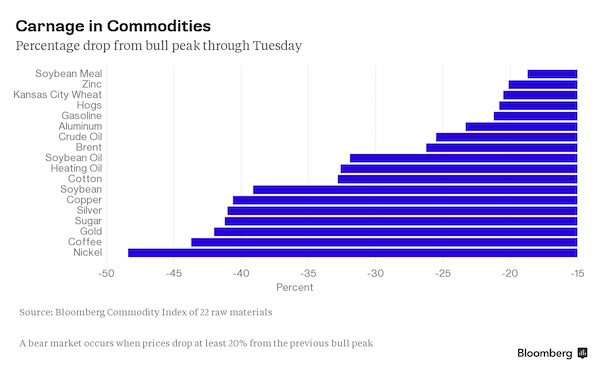
The underlying cause of this debt glut is the $12tn of free or cheap money created by central banks since 2009, combined with near-zero interest rates. When the real price of money is close to zero, people borrow and worry about the consequences later. Next, let’s look at the price of real things. Oil collapsed first, in mid 2014, falling from $110 a barrel to $49 now, despite a slight rebound in the interim. Next came commodities. Copper cost $4.50 a pound in 2011, but was half that in September. Inflation across the entire G7 is barely above zero, and deflation stalks the southern eurozone. World trade volumes have contracted tangibly since December 2014, according to the Dutch government index, while the value of global trade in primary commodities, which scored 150 on the same index a year ago, now stands at 114.

In these circumstances, the only way in which the expanding credit mountain can be an accurate signal about the future is if we are about to go through a spectacular productivity boom. The technology is there to do that, but the social arrangements are not. The market rewards companies that create labour exchanges for minicab drivers with multibillion-dollar valuations. Hot money chases after computing graduates with good ideas, but that is – at this phase of the cycle – as much an indicator of the stupidity of the money as the brightness of the ideas.

Read more …

“I lost most of my money investing in ChiNext stocks, but they are still worth buying..”

Down $4 Trillion, China Faithful Buy Stocks That Hurt Them Most (Bloomberg)

Wu Xin says she’s got a sure-fire plan to recoup losses from the $4 trillion selloff in China’s stock market: pile into equities that hurt her the most. The 28-year-old from Hangzhou has been snapping up shares in China’s small-cap ChiNext Index, undeterred by a tumble earlier this year that erased half the measure’s value in three months. “I lost most of my money investing in ChiNext stocks, but they are still worth buying,” said Wu, an ad saleswoman in the media industry. “I can make the most money from them in a rally, too.” Doubling down on the most volatile equities has become a go-to strategy for China’s 96 million individual investors as the stock market shows early signs of recovery. The ChiNext has rallied 38% from this year’s low in September – three times as much as the benchmark Shanghai Composite Index – and volumes on the small-cap bourse surged to an all-time high last month.

The rush back into the bear market’s biggest losers shows Chinese investors are still embracing risk, even as the economy heads for its weakest annual expansion since 1990. The danger is that another market downturn could saddle individuals with even deeper losses – a double whammy that Bocom International Holdings Co. says could do lasting damage to investors’ appetite for stocks. “If the ChiNext plunges again, it’s going to hurt,’’ said Hao Hong, the chief China strategist at Bocom in Hong Kong, who predicted the stock-market rout in June. When small-cap shares are rising this fast, buying is hard to resist. Zhu Zujuan, a 60-year-old retiree, says she purchased shares of Dingli Communications, a maker of wireless network testing gear, last Tuesday at 27.2 yuan apiece.

After a tea date with friends, she came back home to find the stock had rallied to 30 yuan – a 10% gain in a few hours, without any obvious news. “The market cap of ChiNext stocks is usually small, so it’s easy for them to rise,” Zhu said from Hangzhou. “I know the risk is high, but so is the return.” The ChiNext’s rally from its September low has extended this year’s gain to 68%, despite a tumble of as much as 55% from its June peak. Investors are increasingly trying to lock in quick gains. Average daily turnover in ChiNext shares surged 64% in October from the previous month, with about 3.5% of the entire market capitalization changing hands on Oct. 23. That was a record proportion relative to Shanghai, where turnover amounted to 1.5% of bourse’s market value.

Read more …

No, the structure of the EU is the one big mistake that outdoes them all.

Enlargement And The Euro Are Two Big Mistakes That Ruined Europe (Münchau)

There has hardly been a year when the EU has not been on the brink of some crisis: banking, sovereign debt, Russia’s annexation of Crimea and now refugees. You can always point fingers at individual politicians and assign blame. But it is highly implausible that the EU’s serial failures can always be explained as the product of accident and malice. I put it down to two catastrophic errors committed during the 1990s and at the beginning of this millennium. The first was the introduction of the euro; the second, the EU’s enlargement to 28 members from 15 a couple of decades ago. You might agree with one or other of these statements, or with neither of them. But few people will agree with both. I was among those who supported monetary union at the time of its introduction.

Advocates of the euro at the time came from two different groups, who struck a Faustian Pact. Members of the first group believed the euro as constructed would fail, and hoped it would somehow be fixed. The others thought the system would stay rigid, and bend the economies of its members into a new shape. This latter group knew that, to withstand the rigours of a fixed-exchange system that resembles nothing so much as the gold standard, countries would have to adjust to economic shocks through shifts in wages and prices — a course, they believed, that the euro’s members would be forced to take. The admission that the euro was a mistake should not be confused with a desire to dissolve it. That would be even more catastrophic. It is merely a recognition that we are trapped in a dysfunctional monetary system.

But how does enlargement play into this? This is not an argument about any particular member state with whose actions one happens to disagree. Nor is it an argument about the principle of enlargement, which is fundamental to the EU. My quarrel is with the speed of accession, and the criteria that aspiring members have to meet. Just as countries have maximum absorption capacities for migrants, the EU has a maximum absorption capacity for new members. I have no idea what that number is in any given time period, but it surely is not 13 members in a single decade. Enlargement affected Europe’s ability to respond to the shocks of subsequent years in two ways. First, it forced the EU to take its eye off the ball at a critical time when it should have focused on building the institutions needed to make the euro work.

Second, enlargement meant that EU countries that were not in the eurozone suddenly found themselves in the majority. That shift naturally shaped the EU’s own agenda. I recall the obsession during those years with competitiveness, a typical small-country economic issue. Debates on the reform of Europe’s treaties during those years focused on voting rights and the protection of minorities. It was the overwhelming view of European officials and members of the European Parliament that the eurozone itself did not need to be fixed. At that time it would have been comparatively easy to set up a banking union. But once the crisis set in, and banks suffered huge losses, countries could no longer share their deposit insurance schemes, let alone to create a single one for everybody.

Read more …

“It is a sick sector, having to nurse their own capital positions.”

Eurozone Banks Still Swamped With Bad Loans (Telegraph)

European banks are failing to cut their exposures to bad loans, according to a study from law firm Linklaters, leaving the sector weak and barely able to support economic growth. Banks had scrambled to cut bad loan levels and improve their capital buffers in the run up to tough stress tests in 2014, but have failed to make progress since then. The eurozone lenders are sitting on bad loans totalling €826bn, down just €15bn from €841bn in November of last year. The banks have tried to sell off portfolios of non-performing loans to investors who want to take on the assets. Funds have raised €40bn to buy up those assets but banks are still racking up more bad loans themselves, meaning the overall level is falling only very slowly. So far banks have “barely touched the tip of the iceberg,” said Linklaters’ Edward Chan. “It still means you don’t have the banks as a credible engine for growth. It is a sick sector, having to nurse their own capital positions.”

“You don’t have any source of funding for growth, which if you look at wider eurozone picture is a bit depressing.” Banks in Greece and Italy have the highest proportions of bad loans on their books, Linklaters found. A total of 3.92pc of all European bank assets are non-performing loans. By contrast the American banking system is in much better health – only 2pc of its assets are non-performing loans, just half as bad as the eurozone’s rate. The ECB has taken over much of the regulation of the biggest eurozone banks, which had led to expectations of more rapid action on banks’ balance sheets. Linklaters’ Andreas Steck believes the authority will soon get tougher on weak banks. “The ECB is clearly working hard to deal with non-performing loans resolution and with a working group now in place to tackle these loans, we will see them engaging in a much stronger fashion with national competent authorities and banks to ensure that further action is taken ahead of next year’s stress test,” he said.

Read more …

Brussels is truly an insane city.

Europe Prolongs Its Diesel Problem (Bloomberg Ed.)

Responding to public outrage over the Volkswagen diesel emissions scandal, the European Union rightly pledged to toughen emissions testing and enforce limits on nitrogen oxides (NOx), a hazardous type of diesel pollutant. But those moves amount to very little, now that the EU is giving the auto industry until 2020 to comply, and then only partially. The delay will just prolong the shift away from diesel. While it will be useful to have on-road testing, starting in 2017, EU regulators decided Wednesday to allow new car models to exceed legal levels of NOx by 110% until the beginning of 2020. Even after that, they can go over the limit by 50%. The adjustment period for existing car models is still longer. The concessions might make sense if the technology to meet the limit had yet to be developed. But selective catalytic reduction and other NOx-limiting mechanisms have been available for years.

Carmakers argue that they impose an added hassle and expense on consumers. But it is precisely the kind of burden that consumers must consider in deciding whether to buy a diesel car rather than an electric or a hybrid. Delaying the emissions limits compounds the market-distorting effects of the Europe’s initial decision, in the mid-1990s, to promote diesel engines with lower excise taxes and relatively lax environmental standards. These benefits explain why 35% of cars in the EU are diesel. American carmakers may be quietly cheering Europe’s folly, as it could prompt China to drop European car emissions standards in favor of stricter U.S. ones. What’s worse for Europe is that the delay on diesel rules undermines its credibility on limiting emissions. With key environmental talks coming up in Paris in just over a month, Europe has promised ambitious greenhouse gas reductions by 2030. But can it be trusted to follow through?

Read more …

Puerto Rico needs debt restructuring.

Puerto Rico Doesn’t Need Bankruptcy (WSJ)

Debt service will consume less than 17% of Puerto Rico’s consolidated budget this fiscal year. In the general-fund budget, which does not include government-owned corporations and agencies, debt service is below 16%. Neither number sounds like grounds for declaring bankruptcy. Factor in all the fat in government spending that could be cut, and the case for walking away from obligations to creditors is even weaker. But the U.S. is entering a presidential-election year and pollsters say voters tend to choose the candidate who “cares about people like me.” Puerto Ricans living on the island don’t vote, but those on the mainland do. What could say “caring” to these Hispanic voters in places like Florida, Ohio and Pennsylvania more than federal permission to write-down Puerto Rico’s $73 billion in debt?

Right on cue, Treasury wants Congress to approve legislation that would allow Puerto Rico to declare bankruptcy. In an analysis posted on its website, Treasury finds debt service as a%age of the general-fund budget is actually 38%, which is to say that it believes the way Puerto Rico has been calculating its debt-service burden for the last 40 years is wrong. It would be interesting to know how that got by all the credit-rating firms, lawyers and bond underwriters. It is also worth noting that Puerto Rico’s debt burden includes $18.5 billion in debt that under the island’s constitution must be serviced before any other payments come out of the general fund.

In a July 28 letter to Senate Finance Committee Chairman Orrin Hatch, Treasury Secretary Jacob Lew wrote, “I am deeply concerned that a protracted and disorderly restructuring process will cause long-term damage to the health, safety, and financial well-being of the families living and working in Puerto Rico.” Treasury counselor Antonio Weiss ratcheted up the alarm in Oct. 22 Senate testimony. “Puerto Rico’s fiscal crisis is escalating,“ he said, adding “that without federal action it could easily become a humanitarian crisis as well.” Such hyperbole is designed to rush Congress into approving the bankruptcy law.

Yet there is little evidence that Puerto Rico faces a humanitarian crisis any more than the heavily indebted states of California or Illinois. And as to the deteriorating fiscal environment, it seems to be largely the work of Gov. Alejandro García Padilla, who has been signaling markets that default is a policy goal. As Carlos Colón de Armas, a professor of finance at the Graduate School of Business at the University of Puerto Rico, told me last week, “If, instead of doing everything it can do in order not to pay, the government of Puerto Rico were doing everything it could do in order to pay, things would be very different.”

Read more …

Farmers are addicted to cheap handouts. Not even their fault.

Brexit Is A Life Or Death Matter For Britain’s Farmers (AEP)

Land prices will crash. British agriculture will face a traumatic shock, and 90pc of the country’s farmers will be ruined. There will be a wave of debt foreclosures by banks, akin to the America Dustbowl and the Grapes of Wrath. A fresh seed of discord will be sown between England, Scotland, and Wales, imperilling the UK. This is what is likely to happen if Britain votes to leave the EU next year, according to a confidential 70-page report issued to clients by the specialist consultants Agra Europe. It is not a propaganda document. It is a detailed text, carefully researched, written for industry insiders. It is not to be dismissed lightly. British farmers currently receive 60pc of their income from EU subsidies and environmental subsidies. They would lose most of this at a stroke unless the British government guaranteed compensating support of one kind or another, and so far it has clarified nothing.

Yet like all Brexit and counter-Brexit assertions, the Devil is in the assumption. Agra Europe takes it as a given that David Cameron or any other British prime minister will do little to prevent such a bloodbath running its course if the British people vote to withdraw from Europe, and say goodbye to the Common Agricultural Policy (CAP). “What is certain is that no UK government would subsidise agriculture on the scale operated under the CAP,” it states. This is conjecture. Few Brexit advocates – including ardent free-traders – suggest that subsidies should be slashed. They accept that agriculture is strategic, even iconic, and that society has a special duty of care to farmers. Let us call it ‘une certaine idée de l’Anglettere’, to borrow from Charles de Gaulle.

“Our view is that no farmer in the UK should left out of pocket as a result of Brexit. Preserving our farms and countryside is a very high priority,” says Ian Milne from Global Britain. “Farmers and fishermen should receive exactly what they received before, for at least five years. We should recruit the excellent agricultural colleges of Cirencester, Reading, and Manchester, and those in Scotland, to invent a new model of subsidies. We paid £12.3bn into the EU budget in 2014, which we would no longer have to pay, so there would be more than enough money.” Agra Europe’s report is worth reading. It is part of the “political discovery” that forces us to confront the hard realities the Brexit. We are all weary of rhetoric at this point. Direct CAP payments to Britain will average £2.88bn a year from 2014-2020.

This is a trivial sum for those who live and breath the world of global finance, almost a rounding error for Apple, Exxon, or JP Morgan. In 2013, these subsidies were worth €200 a hectare (£58 an acre) and made up 35-50pc of total gross income. “Only the super-efficient, top 10pc could survive without them,” it said. Most farmers have thin margins, if they have any at all. DEFRA figures for 2013-2014 show that a fifth of cereal and grazing livestock farms failed to make a profit, and this was before the latest leg down in global commodity prices. Average cereal farms earn around £100,000, and £55,000 of this comes from the EU single farm payment. The European Commission estimates that land prices would fall 30pc across the EU if CAP subsidies were abolished. “For farmers who have taken out debt against the value of their land, a loss of value could be fatal. 18pc of farms have current liabilities that exceed current assets,” says the Agra Europe report.

Read more …

This looks far too easy given that over half of loans are non-performing and austerity bakes more into the cake each passing day.

Greece Sets Terms for Aiding $15.9 Billion Bank Recapitalization (Bloomberg)

Greece’s government detailed how it will help banks plug the €14.4 billion hole in their books identified by the ECB, paving the way for the lenders to seek cash from investors for the second time in 18 months. The ECB expects the banks to raise at least €4.4 billion from shareholders and bondholders, sufficient to meet the shortfall identified under baseline macroeconomic assumptions in its Asset Quality Review, the central bank said Saturday. The state-owned Hellenic Financial Stability Fund is ready to inject the €10 billion identified in the ECB’s adverse scenario, offering 25% through common shares with full voting rights in the lenders, and the rest via contingent convertible securities, according to a government statement released late on Sunday night, in Athens.

The mix between shares and CoCos for the state’s participation in the capital raising plans will largely determine the ownership structure of battered lenders, and therefore investors’ appetite to chip in. U.S. billionaire Wilbur Ross, who holds a stake in Eurobank Ergasias, said Saturday Greece should only inject funds through CoCos to prevent the dilution of the stakes held by existing shareholders, which have already dropped more than 70% this year. “Investors will not be comfortable with committing new equity capital to banks that are effectively nationalized,” Ross said in a statement. “Since it was the actions of government that caused the imposition of capital controls and since these in turn have led to the need for equity, it would be nonsensical for the government now to dilute shareholders.”

Read more …

Starting to sound like a he said she said story.

IMF Pushes Europe For Formal Restructuring Accord On Greek Debt (Bloomberg)

Eurozone countries must commit to a formal restructuring of Greece’s debt before the IMF will lend new money to the country, according to one of the IMF’s top officials. Pledges to review Greece’s debt servicing won’t be enough unless they’re accompanied by specific terms for paring back the borrowing burden, David Lipton, the IMF’s first deputy managing director, said in an interview in Washington. Greece received an €86 billion bailout in August from the 19-nation currency bloc, which now wants the IMF to provide further support. “We want a debt operation agreed between Greece and its creditors,” Lipton said. “For us to go forward, we want more than a general assurance that the matter will be handled, with enough specific details on how it will be handled to assure the fund that Greece’s debt service will be on a sustainable path.”

Greek Prime Minister Alexis Tsipras has requested a new IMF program, which would replace a dormant one that’s on track to expire in March. Any new IMF program would have to be approved by an executive board representing the fund’s 188 member nations. Lipton said the amount of new IMF funding hasn’t been decided. Germany and other creditor nations say the Washington-based IMF, which lends to countries with balance-of-payments troubles, should play a financial and technical role in shoring up Greece’s economy and restoring the nation’s access to financial markets. As a result, fund participation is a central goal in the euro area’s bid to make Greece’s third bailout its last. The bailout loans Greece has amassed over its three rescues are the focus in the debt relief talks, since Greece’s private sector debt was already restructured in early 2012.

Many euro- area nations have said writing down the principal of the loans would be a “red line,” while indicating they might agree to better servicing terms like lower rates and longer loan maturities that would reduce how much Greece has to pay back over time. A technical group in Brussels is studying details. Greece in June became the first advanced country to miss a debt payment to the IMF. The country cleared its arrears to the fund in July. In 2010, worried that a Greek default might trigger a European banking crisis, the fund’s board agreed to waive a condition of IMF bailouts that required Greece’s debt to be sustainable. But member countries outside the euro zone are unlikely to give Greece special treatment this time. Lipton said the IMF has four priorities for a new program: implementation of policy pledges, fiscal structural policies needed for medium-term sustainability, fixing the banking sector, and addressing the debt.

Read more …

You bet.

Things Can Get Even Worse For Renewable Energy Companies (Dizard)

Perhaps the most immediate threat to renewables is developing at the state level, where elected legislators and appointed regulators are beginning to chip away at the biggest source of support for the US solar industry: “net metering”. These are schemes, most prominently in California, but also in Arizona, New Jersey and Hawaii, under which you could be paid at the retail power rate if your solar panels were sending back more power to the electric company than you were using. Net metering sounds virtuous, but in its simple formulation it leaves the cost of maintaining back-up power, i.e. that runs at night and on windless days, including all those fossil fuel generators, substations and transmission and distribution lines, spread over the other ratepayers.

In Arizona, a public power authority that serves Phoenix has already started charging solar panel users about $50 per month for the fixed costs of maintaining the traditional grid. Even in California, hearings are under way on whether to change the net-metering law to impose fixed charges on solar panel owners or renters who rely on the grid for back-up. Along with the social equity case being made against renewables net metering, there is a small but influential group of transmission engineers who are worried about prospective decreases in the reliability of the grid caused by the increased penetration of intermittent renewables. One such problem is “overgeneration”, which is created when the grid operator must balance incoming energy that it is in effect required to purchase, against insufficient demand.

This occurs frequently in California during sunny days, when rooftop solar panels, large solar farms and wind turbines push energy to consumers who do not need all of it. Also, the grid operators are finding that getting a renewables-intensive grid to recover from a blackout, never mind a massive cascading one, will be much more challenging than it has been with a fossil-fuel dependent grid. So a massive, weeks-long shutdown is another potential risk for renewables investors. Un-air conditioned Americans would shed their green covering very quickly.

Read more …

Oct 212015
 
 October 21, 2015  Posted by at 9:51 am Finance Tagged with: , , , , , , , , ,  1 Response »


Christopher Helin Federal truck, City Ice Delivery Co. 1934

China: A Debt Balloon With Nowhere to Go But Down (Bloomberg)
China Stocks Down Over 4% In Choppy Trade (CNBC)
China’s Overheated Bond Market Showing Strain for Local Bankers (Bloomberg)
China Bond Defaults Seen Rising After Sinosteel Misses Payment (Bloomberg)
Just How Bad Was the 2009 Global Recession? Really, Really Bad (Bloomberg)
Why Miners May Want To Rethink Record High Output (CNBC)
Barclays Plots Bombshell Ring-Fencing Plan (Sky)
Credit Suisse to Launch $6.3 Billion Capital Increase (WSJ)
Irish Biggest Losers From Financial Crash: ECB (Reuters)
Why There’s No Easy Way Out Of Spain’s Insurmountable Economic Mess (Telegraph)
From European Union to Just a Common Market (Roberto Savio)
Lessons for Draghi From a Land of Sub-Zero Interest Rates (Bloomberg)
Developers in Australia Roll Out Red Carpet for Wealthy Chinese (WSJ)
Britain Addicted To Bombing With The Weary Rationale Of A Junkie (Frankie Boyle)
Number Of London’s ‘Working Poor’ Surges 70% In 10 Years (Guardian)
Food Banks Have Become A Lifeline For Many, But Where Is The Way Out? (Guardian)
Buying Begets Buying: Stuff Has Consumed The Average American’s Life (Guardian)
Slovenia Deploys Troops to Border as Migrant Exodus Swells (AP)
Resettling Migrants From Middle East Camps Could Ease Crisis: Greece (Reuters)
Refugee Boats Wash Up At UK Military Base In Cyprus (Guardian)

“..the real problem will come in U.S. dollar China corporates.”

China: A Debt Balloon With Nowhere to Go But Down (Bloomberg)

Chinese skyscrapers apparently aren’t scaring bond investors, but they probably should. Debt buyers have brushed off concerns about China’s overvalued real estate and slowing growth this year. They have been snapping up speculative-grade bonds of Chinese companies, even those sold in the U.S., where the appetite for risk is waning in general. Consider, for example, a $41.5 billion pool of dollar-denominated bonds sold in large part by deeply indebted Chinese property companies. The debt has gained 9.2% this year, which is equal to $3.8 billion of market gains, according to Bank of America Merrill Lynch index data. These hefty returns are pretty amazing when juxtaposed with losses on U.S. high-yield bonds, which have suffered amid plunging commodity prices and waning economic momentum, especially in China.

Frederic Neumann, HSBC’s co-head of Asian economics research, put it more bluntly. “In many ways, the market is divorced from reality,” he said Monday at a conference in New York. While local-currency Chinese debt may hold its value, “the real problem will come in U.S. dollar China corporates.” Chinese debt markets have benefited from tumult in the nation’s equities, which has pushed local investors into the safety of bonds. A lot of this money is sticky, with institutions wanting to keep their money close to home. But some of these investors have made their way to the U.S., where they’re buying up bonds of Chinese companies. That’s propping up this slice of the dollar-denominated market at an unlikely time.

Read more …

Shanghai closed own 3% -after a late surge-, Shenzhen dropped almost 6%.

China Stocks Down Over 4% In Choppy Trade (CNBC)

Asian stocks mostly advanced on Wednesday, but share markets in China were hit by a sudden bout of selling in the afternoon session. Major U.S. averages slipped overnight, with the Dow Jones Industrial Average snapping a three-day winning streak, amid a decline in healthcare and biotech names. The blue-chip Dow and S&P 500 shed 0.1% each, while the Nasdaq Composite closed down 0.5%. Volatility returned to China’s share markets on Wednesday, with the Shanghai Composite index skidding over 4% after weaving in and out of positive territory since the market open. Earlier in the session, the key index touched 3,444 points – its highest level in two months.

“For the Shanghai Composite, the 3,500 level remains the key barrier to break. I expect stiff resistance above this handle as those who bought when the market was above this level, expecting state buying to prop up prices, will be keen to get rid of their stock holdings,” IG’s market strategist Bernard Aw wrote in a note. Shares of Huaneng Power leaped 2% after the listed unit of China’s biggest power generator delivering a 11.2% rise in third-quarter net profit on Tuesday, marking its weakest pace in three quarters amid slowing growth in the mainland. Among other indexes, the CSI300 erased early gains to slide 2.3%. Small-caps underperformed; the Shenzhen Composite tumbled 4% and the start-up ChiNext board plummeted 4.4%, a day after jumping 2%. Hong Kong markets are closed for the Chung Yeung Festival.

Read more …

“Repurchase transactions allowing investors to use existing note holdings as collateral to borrow money for one day doubled in the past year..”

China’s Overheated Bond Market Showing Strain for Local Bankers (Bloomberg)

Chinese bankers say a debt-driven bond market rally is starting to show the same signs of overheating that preceded a collapse in equities. Repurchase transactions allowing investors to use existing note holdings as collateral to borrow money for one day doubled in the past year to a record 2.1 trillion yuan ($331 billion) on Tuesday. The cost of such funding in the interbank market has risen to 1.87% from a five-year low of 1% in May and has swung violently before, reaching 11.74% in June 2013. A similar contract on the Shanghai stock exchange climbed to 2.21% as equities rallied. Credit spreads near the narrowest in six years are being questioned after a state-owned steel trader missed a bond payment. “There are signs of an overheating market, and certainly the rally can’t last for long,” said Wei Taiyuan at China Merchants Bank in Shanghai.

“Leverage in the bond market is much higher than at any time in history. If equities continue to perform well, or initial public offerings resume, the liquidity-fueled rally may come to an end.” Among possible triggers for a correction is Sinosteel Co.’s failure to pay interest due Tuesday on 2 billion yuan of bonds maturing in 2017, a default that’s fanned concern about the government’s willingness to meet the obligations of state-owned companies. Competition for funds is increasing as the best weekly rally in stocks since June has led to the biggest growth in margin debt for buying equities in half a year, which risks diverting money away from money markets. The yield premium of five-year AAA rated corporate bonds over similar-maturity Chinese government debt fell to 84 basis points on Sept. 7, the least since 2009. The spread widened to 100 basis points on Tuesday, compared with an average of 144 over the past five years.

Read more …

Think UK steel is bad?

China Bond Defaults Seen Rising After Sinosteel Misses Payment (Bloomberg)

China bond defaults are forecast to climb after a state-owned steelmaker missed an interest payment, raising questions about the government’s commitment to stand behind such firms. Sinosteel failed to pay interest due Tuesday on 2 billion yuan ($315 million) of 5.3% notes maturing in 2017 after saying it will extend the deadline as it plans to add a unit’s stock as collateral. That came after the National Development and Reform Commission planned to meet noteholders and ask them not to exercise a redemption option on Tuesday to force full repayment, people familiar with the matter said last week. Chinese authorities are weeding out weak state firms that Premier Li Keqiang called zombies. Australia & New Zealand Bank. warned that rising debt in the sector may drag economic growth down to as low as 3%.

Two state-owned companies, Baoding Tianwei and China National Erzhong reneged on obligations earlier this year, according to China International Capital and China Bond Rating Co. “Sinosteel’s default means we will see more and more real bond defaults, in which investors may not get full repayment, in China,” said Ivan Chung at Moody’s in Hong Kong. “The government may want to reduce its intervention in default cases and let market forces play a bigger role.” Sinosteel’s failure to pay interest on time constitutes a default, according to Industrial Securities, Haitong Securities and China Merchants Securities.

China Bond Rating Co. said in a report Wednesday if Sinosteel bond investors had agreed to the delay of interest payment, it didn’t constitute a default, whereas if they hadn’t, it did. Sinosteel hasn’t said in its statements whether it got permission from investors, and two calls to the company Wednesday went unanswered. Flagging authorities’ balancing act as they try to liberalize markets while preventing turbulence, Li said last week the government will prevent systemic risks and banks should not cut or withdraw lending to companies which are in “temporary” difficulties.

Read more …

“How do you define a global recession? For individual countries, the rule of thumb is two consecutive quarters of falling output. That convention is difficult to apply to the world economy, which rarely contracts.”

Just How Bad Was the 2009 Global Recession? Really, Really Bad (Bloomberg)

The global recession that followed the financial crisis was the most severe in half a century, an unusually synchronized shock that paralyzed trade and left 23 million more people out of work. Yet the response by policy makers hasn’t been up to the task, with central banks bearing too much of the burden. And the world may be on the edge of another recession, even though it hasn’t recovered from the last one. Those are the conclusions of a new book on business cycles released Tuesday by the IMF. “The 2009 episode was the most severe of the four global recessions of the past half century and the only one during which world output contracted outright – truly deserving of the ‘Great Recession’ label,” write Ayhan Kose, director of the World Bank’s Development Prospects Group, and Marco Terrones, deputy division chief at the IMF’s research department.

“The possibility of another global recession lingers in light of the persistently weak recovery, even though damage from the previous one has yet to be fully repaired.” The 272-page book, “Collapse and Revival: Understanding Global Recessions and Recoveries,” underscores the challenges policy makers face as they try to jumpstart a sputtering recovery more than six years after the global financial crisis. A slowdown in emerging markets driven by weak commodity prices forced the IMF this month to cut its outlook for global growth in 2015 to 3.1%, which would be the weakest rate since 2009, from a July forecast of 3.3%. Kose and Terrones try to answer a question that has become more pressing as nations become more integrated: How do you define a global recession? For individual countries, the rule of thumb is two consecutive quarters of falling output. That convention is difficult to apply to the world economy, which rarely contracts.

In predicting a global recession next year, Citigroup Chief Economist Willem Buiter recently forecast that world growth would slow to “well below” 2% in 2016. Kose and Terrones define a recession as a contraction in inflation-adjusted output per capita accompanied by a broad, synchronized decline in various measures, such as industrial production, unemployment, trade and capital flows, and energy consumption. By that standard, there have been four world recessions since 1960, starting in 1975, 1982, 1991 and 2009. In only the last case did the global economy shrink. The 2009 downturn was “by far” the deepest, Kose and Terrones found. It was also the broadest, with almost all advanced economies and a large number of emerging and developing countries contracting. About 65% of countries fell into recession, the highest among the four slumps.

Read more …

Iron ore is like oil: everyone produces full-tard just to stay alive for another day.

Why Miners May Want To Rethink Record High Output (CNBC)

The world’s top three iron-ore producers continue to consistently churn out record volumes of output, worsening an already dire supply glut, but investors are now wondering just how long that strategy can last. On Wednesday, BHP Billiton—the world’s largest miner by market capitalization—reported a 7% annual rise in September quarter output to 61 million tons, adding to a 6% gain in the June quarter, and maintaining its full-year guidance of 247 million tons. Report cards over the past week confirms other miners are also in high-output mode. Rio Tinto reported a 12% annual rise in third-quarter production to 86 million tons, building on a 9% gain in the previous quarter.

The world’s second largest miner also announced it was on track to meet a full-year target of 340 million tons. Meanwhile, Brazilian giant Vale logged a record performance, with output up 2.9% on year to 88.2 million tons and more increases to come. A low cost of production has been the secret to miners’ profitability despite iron ore prices crashing to $52 a ton from nearly $200 four years ago. Rio Tinto’s unit cash production cost at its Pilbara operation fell to $16.20 a ton during the first half of this year, from $20.40 per ton during the same period last year, while Vale plans to reduce its current unit cost from $15.80 per ton to less than $13 by 2018, according to the companies.

But if miners continue ramping up production at high levels, it could become counterproductive. “So far, miners have been able to withstand commodity price declines but if they keep pushing prices down, and testing the low cost producer-price relationship, margins and cash flow will eventually decline and they’ll get to a point where they can’t escape by cutting costs further,” explained David Lennox, resources analyst at market research firm Fat Prophets.

Read more …

Consumer deposits to be owned by investment bankers…

Barclays Plots Bombshell Ring-Fencing Plan (Sky)

Barclays is heading for a showdown with the Bank of England over a secret plan to place its high street operations under the temporary ownership of its investment banking arm. Sky News can reveal that Barclays is preparing to warn regulators that the credit rating of its investment bank could be slashed unless it is allowed to restructure its operations in this way. The development threatens to drop a bombshell into the heart of the debate about banking reform just days after City regulators outlined new measures designed to protect taxpayers in the event of a future banking crisis. John McFarlane, Barclays’ executive chairman, is understood to have briefed more than 100 of the bank’s top executives on the plans at a meeting at a west London hotel this month.

Mr McFarlane, who will revert to a non-executive role after a new chief executive is in place, is said to have acknowledged to colleagues the likely difficulty of securing regulators’ approval for the proposals. But an insider familiar with the meeting said he expressed a belief that the idea was consistent with the blueprint drawn up by the Independent Commission on Banking in 2011 for separating banks’ high street and investment banking operations. One source speculated that a rejection of Barclays’ proposals by the PRA could oblige it to sell large parts of its investment bank or seek to raise many billions of pounds in new capital from investors. Like other lenders – although to a greater degree owing to the size of its investment bank – Barclays’ credit rating derives a diversification benefit from its current structure.

Read more …

All big banks are in deep.

Credit Suisse to Launch $6.3 Billion Capital Increase (WSJ)

ZURICH— Credit Suisse nnounced plans on Wednesday to raise roughly 6 billion francs ($6.3 billion) in fresh capital and slash costs, as the Swiss bank delivered a disappointing set of quarterly results. Incoming Credit Suisse Chief Executive Tidjane Thiam took over the top job in July, and has been widely expected to raise capital and reduce what has been a relatively expensive, and relatively high-risk investment banking unit. On Wednesday, Credit Suisse said it would restructure its investment bank and significantly cut the amount of capital allocated to the business. That will be coupled by a proposed rights offering of about 4.7 billion francs to raise capital, and a private placing of roughly 1.35 billion francs, Credit Suisse said.

In addition, Credit Suisse said it plans a partial initial public offering for its Swiss bank unit. Its plans also include cutting 3.5 billion francs in costs by the end of 2018. [..] Credit Suisse has long operated a larger investment bank than that of its Swiss peer, UBS. That has provided Credit Suisse with needed profit during good quarters, but also with a relatively expensive set of businesses that are increasingly impractical due to stricter capital rules. Regulators in Switzerland are expected to unveil new rules for the big banks later this year, including a requirement to maintain a bigger cushion of capital relative to the loans and investments being made.

On Wednesday, Credit Suisse said it would reduce the amount of risk-weighted assets allocated to its investment banking businesses such as foreign exchange and rates by 72%, while the allocation to its so-called “prime” business providing services for hedge funds will be cut by half. On Wednesday, Credit Suisse reported a pretax loss of 125 million francs for its investment bank in the third quarter, compared with a profit of 516 million francs in the period last year. The bank cited challenging market conditions and “reduced client activity.” Overall, Credit Suisse posted a 24% decline in net profit for the third quarter, and an 8% decline in net revenues.

Read more …

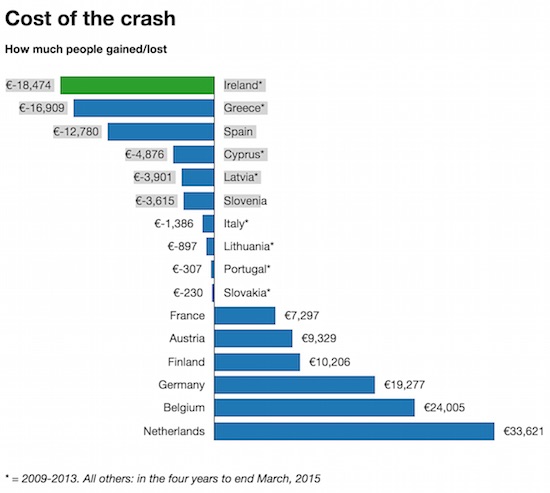
Germany, Holland came out big winners from the crash. if that doesn’t tell you the EU is a failure, what does?

Irish Biggest Losers From Financial Crash: ECB (Reuters)

The Irish lost more of their personal wealth than any other euro zone country in the aftermath of the financial crash while Germany and the Netherlands gained the most, fresh data from the ECB shows. In an analysis of the years between 2009 and 2013, ECB experts discovered that Ireland lost more than €18,000 per person, while Spaniards saw wealth dwindle by almost €13,000 as property in both nations plummeted. Greeks saw their notional wealth decline by almost €17,000 for the same reason. In the Netherlands and Germany, by contrast, the wealth per capita grew by roughly €33,000 and €19,000 respectively, due in part to a boost to financial investments over that time. The data, which takes a snapshot before the recent economic upswing in Spain and Ireland, illustrates the stark differences between countries in the 19-country euro zone that extends from cities such as Helsinki in the north to Athens in the south.

By presenting the data in this manner, the ECB acknowledges the divergence, although there is little the central bank can do to remedy it. Its money-printing scheme known as quantitative easing is spread out according to euro zone member countries’ relative size and not determined by their economic needs. To fix imbalances between strong industrial nations such as Germany and countries such as Spain, experts have long pushed for a system of financial transfers or payments from rich to poor states. Germany, which fears that this would lumber it with unmanageable costs and believes that handouts would discourage spendthrift countries from reforming, has flatly rejected the suggestion.

Read more …

A pumped-up success story.

Why There’s No Easy Way Out Of Spain’s Insurmountable Economic Mess (Telegraph)

Spain is the current superstar economy of the eurozone. The former bail-out country, which became embroiled in one of the worst banking and house price collapses in the euro just four years ago, is now proudly held up as the European Union’s model economic pupil. Spain is set to be the fastest growing economy of the “Big Four” euro economies – Germany, France, Italy and Spain – over the next two years, expanding by 3.2pc and 2.5pc respectively, according to the IMF. This compares to just 1.5pc and 1.6pc in Germany, and a paltry 1.2pc and 1.5pc in France. Madrid’s growth rate will also surpass the eurozone average of 2pc and 2.2pc over 2015-16, as it races ahead of the rest. The secret of this success lies in the implementation of belt-tightening measures and structural reforms, as demanded by Brussels, so the story goes.

But the economic turnaround has attracted high-profile critics. The recently-departed chief economist of the IMF has rubbished any talk of a growth “miracle” in Spain. In a new report, Simon Tilford at the Centre for European Reform also pours cold water over the dominant narrative of the Spanish recovery. “There is no evidence that [growth numbers] are the result of austerity, and not much evidence that they are the product of structural reforms,” writes Mr Tilford. Instead, he paints a picture of a fragile economy that has benefited from a number of headwinds, but remains acutely vulnerable to another global downturn. Here are some of the insurmountable challenges that are set to condemn Spain to more economic pain.

Spain’s export performance has been held up as the backbone of its stellar growth performance since 2013. Bouyed by a cheap euro, exports have boomed over the past two years. Key to this growth has been Spain’s “remarkable cost adjustment process” – where it has managed to slash wage costs – helping to “transform the export sector into a lean and mean machine, able to compete at a high level”, notes Angel Talavera at Oxford Economics. But buoyant exports have also been accompanied by falling imports, as suffering Spaniards have endured lower living standards and high unemployment, notes Mr Tilford. The composition of the exports is also a cause for concern. More than half of the growth has come from “low-value” goods such as food and fuel.

Read more …

That’s all that’ll be left. Best case.

From European Union to Just a Common Market (Roberto Savio)

Seventy years ago Europe came out from a terrible war, exhausted and destroyed. That produced a generation of statesman, who went about creating a European integration, in order to avoid the repetition of the internal conflicts that had created the two world wars. Today a war between France and Germany is unthinkable, and Europe is an island of peace for the first time in its history. This is the mantra we hear all the time. What is forgotten is that in fact a good part of Europe did not want integration. In 1960, the United Kingdom led the creation of an alternative institution, dedicated only to commercial exchange: the European Free Trade Association (EFTA), formed by the United Kingdom, Austria, Denmark, Norway, Portugal, Sweden, Switzerland, then later Finland and Iceland.

It was only in 1972 that, bowing to the success of European integration, the UK and Denmark asked to join the EU. Later, Portugal and Austria left EFTA to join the European Union. The UK was never interested in the European project and always felt committed to “a special relation” with United States. Union would mean also solidarity and integration, as the various EU treaties kept declaring. The UK was only interested in the market side of the process. Since 1972, the gloss of European integration has lost much of its shine. Younger generations have no memory of the last war. The EU is perceived far from its citizens, run by unelected officials who make decisions without a participatory process, and unable to respond to challenges. Where is the external policy of the EU? When does it take decisions that are not an echo of Washington?

Since the financial crisis of 1999, xenophobic, nationalistic and right wing parties have sprouted all over Europe. In Hungary, one of them is in power and openly claims that democracy is not the most efficient system. The Greek crisis has made clear that there is a north-south divide, while Germany and the others do not consider solidarity a criterion for financial issues. And the refugee crisis is now the last division in European integration. The UK has openly declared that it will take only a token number of 10,000 refugees, while a new west-east divide has become evident, with the strong opposition of Eastern Europe to take any refugee. The idea of solidarity is again out of the equation.

Germany moved because of its demographic reality. It had 800,000 vacant jobs, and it needs at least 500,000 immigrants per year to remain competitive and keep its pension system alive. But that mentality is even more clear with the East European countries, which experience increasing demographic decline. At the end of communism in 1989, Bulgaria had a population of 9 million. Now it is at 7.2 million. It is estimated that it will lose an additional 7% by 2030, and 28.5% by 2050. Romania will lose 22% by 2050, followed by Ukraine (20%), Moldova (20%), Bosnia and Herzegovina (19.5%), Latvia (19%), Lithuania (17.5%), Serbia (17%), Croatia (16%), and Hungary (16%). Yet, all Eastern Europe countries have followed the British rebellion, and take a strong stance on refusing to accept refugees.

Read more …

Fear.

Lessons for Draghi From a Land of Sub-Zero Interest Rates (Bloomberg)

Until not so long ago, the idea of sub-zero interest rates was about as far-fetched as the prospect of a brash real estate tycoon running for U.S. president. These days, the discussion is whether a deposit rate below minus 0.20% is a good trump card to play when dealing with Europe’s sclerotic economy. The ECB meets on Thursday for yet another discussion on how to stimulate growth. Rate cuts are improbable – ECB board member Benoit Coeure recently described the current level as “the effective lower bound.” Should ECB President Mario Draghi and his colleagues nevertheless opt to discuss the matter, they might consider taking this lesson from Denmark: negative rates don’t provide a quick fix. The Danish central bank, whose sole mandate is to guard the krone’s peg to the euro, first cut rates below zero in mid-2012, when investors were looking for havens at the height of Europe’s debt crisis.

The key deposit rate, now minus 0.75%, has been mostly negative since then. Economists recently surveyed by Bloomberg see negative rates continuing into 2017. That’s not necessarily because they expect rates to rise after that, but because their models just don’t go any further. One of the key lessons from Denmark is that banks are reluctant to charge customers for holding their money. While some have raised fees, “real rates for real people were actually never negative,” says Jesper Rangvid, a professor of finance at the Copenhagen Business School. For that reason, Danes haven’t been hoarding cash. According to Rangvid, rates would have to drop as low as minus 10% before people start “building their own vaults.” Experiences in Switzerland and Sweden tell a similar story. Economic theory says interest rates are inversely related to investment.

People are also supposed to spend less when rates are high and spend more when they’re low. Because interest rates determine the value of cash today, they have been described as “a tax on holding money” and “the price of impatience.” And yet, Danes have actually been squirreling away. According to central bank data, Danish households’ have added 28 billion kroner ($4.3 billion) to bank deposits since rates shrank to their record low on Feb. 5. Danish businesses, meanwhile, have barely increased their investments, adding less than 6% in the 12 quarters since Denmark’s policy rate turned negative for the first time. At a growth rate of 5% over the period, private consumption has been similarly muted. Why is that? Simply put, a weak economy makes interest rates a less powerful tool than central bankers would like.

Read more …

“People underestimate how much residential construction has been propping up the economy..”

Developers in Australia Roll Out Red Carpet for Wealthy Chinese (WSJ)

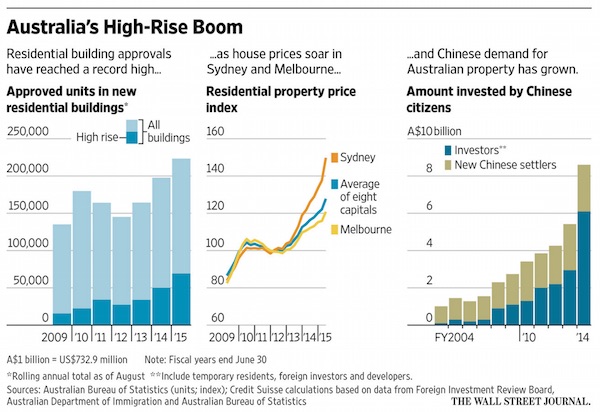
Cranes dominate skylines above Sydney and Melbourne, which are popular with Asian migrants. Current rules generally only allow foreign investors to buy real estate before construction, typically in apartment developments. Cracks are emerging in the market, however. On Friday, the country’s central bank warned that risks to residential property developers had risen over the past six months, with inner-city Melbourne and Brisbane particularly exposed to a supply glut of apartments. The central bank has previously warned that any sudden collapse in home prices risks destabilizing the nation’s banks and the economy, which grew by just 0.2% in the second quarter from the first, the slowest pace in four years.

“People underestimate how much residential construction has been propping up the economy,” said Warren Hogan, chief economist at Australia & New Zealand Banking Group. Approvals to build new dwellings hit an all-time high in the year through August, as did the number of permits given to build high-rise apartments, which now account for 31% of the total, up from 11% six years ago, according to government data. China has become the largest source of foreign money flowing into Australian real estate, with Chinese investment in residential property up by more than 60% to A$8.7 billion in the year through June 2014, a Credit Suisse analysis of government data shows.

Read more …

“Why is war more palatable than more refugees? Why is the destruction of lives you can’t see easier to live with than someone on your bus making a phone call in a language you don’t understand?”

Britain Addicted To Bombing With The Weary Rationale Of A Junkie (Frankie Boyle)

In every addiction, a part of us is addicted to the process. Laying out the cigarette papers to build the joint; heating the spoon and flicking the syringe; dealing with our emails before our DMs; cueing up Netflix for when the kids go to sleep; methodically polishing the keys to our own prisons. Britain seems to be going through the preliminaries associated with one of its most cherished addictions: bombing. Bombing Syria has probably only been postponed by Russia’s intervention. It was, of course, amusing to see the western press suddenly preoccupied about whether bombs were hitting their intended targets. Perhaps Putin should have avoided such rigorous international scrutiny by bombing only hospitals.

The recent immolation of a Médecins Sans Frontières hospital in Afghanistan presented us with the internal contradiction of our media’s presentation of bombing: that we have technology so precise our weapons can hear their victims begging for a trial, and that we sometimes blow up stuff “accidentally”. It has been suggested that non-white people caught up in our foreign wars are “unpersons reported”. More accurately, they are treated as subpersons. A handful of Afghans dying could make the front pages, but only if they were strangled one by one by Beyoncé as the half-time entertainment at the Super Bowl. Historically, Syria has existed as a place where outsiders come to fight, a bit like Wetherspoon’s.

No one likes Assad: he has the surprised appearance of a man who has just swallowed his own chin, and a bizarre, faint, fluffy moustache, as if he pulled on a cashmere turtleneck just after eating a toffee apple. He has created a hell for his own people that British teenagers seem eager to go to and fight in, just to give you some idea of how shit Leeds is. But if their desire to go to Syria is deluded, how is our government’s any less so? A government that doesn’t believe it should have any responsibility for regulating our banks or even delivering our post thinks it needs to be a key player in, of all things, the Syrian civil war. Somehow, the plight of this strategically significant state has touched their hearts. Britain is so concerned about refugees that it will do anything – except take in refugees – to try to kill its way to a peaceful solution.

Read more …

Is that why the Chinese are coming?

Number Of London’s ‘Working Poor’ Surges 70% In 10 Years (Guardian)

More than a million Londoners who are defined as living in poverty are members of households in which at least one adult has a job, according to a new analysis. The figures include 450,000 children who live in such households, and research estimates that cuts in working tax credits to families next April could make 640,000 children worse off. The analysis is contained in the fifth London Poverty Profile, which is compiled by the New Policy Institute thinktank for the charity Trust for London. It indicates that the total number of Londoners in poverty now stands at 2.25 million. Of these, slightly more than half – 1.2 million – qualify as “in-work poor”, representing an increase of 70% in the past 10 years.

The study found that, although the numbers of unemployed adults and the proportion of people in workless households has fallen in the capital, the city’s overall poverty rate is 27%, much as it has been for the past decade. The rate for the rest of England is 20%. The report also illuminates how the poverty picture is changing in some parts of the Greater London area, with two east London boroughs, Newham and Tower Hamlets, seeing significant falls in the numbers and%ages of benefit claimants there, while Brent and Ealing in the west now stand out for their high levels of low pay and unemployment. Just over one fifth of people in London in all types of working households are in poverty, compared with 15% a decade ago.

This is despite the present number of unemployed adults, just over 300,000, being the lowest since 2008, at a time of rapid increases in the capital’s population, and with the proportion of workless households being at a 20-year low of 10%. The poverty threshold is defined as households with incomes of less than 60% of the national median after housing costs are included, consistent with standards used across the EU. The report says: “The increase in the number of people in poverty in London has been almost entirely among those in working families.” It points to low pay, limited working hours and the capital’s notoriously high housing costs as key reasons. The poverty rate among working families where an adult is self-employed, not all adults work or they work only part-time is 35% and among those where all adults work full time or one works full time and one part time is 9%.

Read more …

Britain’s only growth industry.

Food Banks Have Become A Lifeline For Many, But Where Is The Way Out? (Guardian)

In a large steel container outside St Philip’s church in north Nottingham, Nigel Webster is taking stock: not just of the thousands of neatly stacked tins of food arrayed there, but of his experience as a food bank volunteer. When we started out three years ago, he reflects, we thought we’d be gone by now. For Webster, the manager of Bestwood and Bulwell food bank, part of the Trussell Trust network, the pressing existential question is not just: “Why food banks?” but: “Food banks for how long?”. The growth of the food bank has been an astonishing achievement, but he regards its continued presence as a kind of social disgrace. It is the search for a food bank exit strategy, as much day-to-day operational problems, that keeps him awake at night.

“We will always seek to help people in need,” he says. His Christian faith means he could not do otherwise. But there must be limits, he says. Food banks cannot simply let the state withdraw from its responsibilities. It is important, he says, to keep in mind the idea that the food bank, essentially, is an “outrage”. “We do not want our food banks to exist. We look forward to a time when they disappear. We do not want to get too comfortable. We must resist the temptation to expand. I do not think having a food bank on every street corner is a way for our society to go. Foodbanks must do their best to remain ‘unusual’”.

If anything, food banks are in danger of becoming mainstream. A series of reports and studies have linked cuts in the social security system to the rise in charity food. Scores of evidence submissions to a Commons work and pensions committee inquiry, opening on 21 October, testify that thousands of vulnerable citizens are forced to rely on food banks as a result of avoidable delays to benefits being paid. Food banks are gearing up for a surge in demand for charity food parcels over the next few months, as proposed cuts to working tax credits and housing benefit, the continuing rollout of universal credit, and the shrinking of local welfare support schemes take effect.

Read more …

Slavery 21st century style.

Buying Begets Buying: Stuff Has Consumed The Average American’s Life (Guardian)

The personal storage industry rakes in $22bn each year, and it’s only getting bigger. Why? I’ll give you a hint: it’s not because vast nations of hoarders have finally decided to get their acts together and clean out the hall closet. It’s also not because we’re short on space. In 1950 the average size of a home in the US was 983 square feet. Compare that to 2011, when American houses ballooned to an average size of 2,480 square feet – almost triple the size. And finally, it’s not because of our growing families. This will no doubt come as a great relief to our helpful commenters who each week kindly suggest that for maximum environmental impact we simply stop procreating altogether: family sizes in the western world are steadily shrinking, from an average of 3.37 people in 1950 to just 2.6 today.

So, if our houses have tripled in size while the number of people living in them has shrunk, what, exactly, are we doing with all of this extra space? And why the billions of dollars tossed to an industry that was virtually nonexistent a generation or two ago? Well, friends, it’s because of our stuff. What kind of stuff? Who cares! Whatever fits! Furniture, clothing, children’s toys (for those not fans of deprivation, that is), games, kitchen gadgets and darling tchotchkes that don’t do anything but take up space and look pretty for a season or two before being replaced by other, newer things – equally pretty and equally useless. The simple truth is this: you can read all the books and buy all the cute cubbies and baskets and chalkboard labels, even master the life-changing magic of cleaning up – but if you have more stuff than you do space to easily store it, your life will be spent a slave to your possessions.

We shop because we’re bored, anxious, depressed or angry, and we make the mistake of buying material goods and thinking they are treats which will fill the hole, soothe the wound, make us feel better. The problem is, they’re not treats, they’re responsibilities and what we own very quickly begins to own us. The second you open your wallet to buy something, it costs you – and in more ways than you might think. Yes, of course there’s the price tag and the corresponding amount of time it took you to earn that amount of money, but possessions also cost you space in your home and time spent cleaning and maintaining them. And as the token environmentalist in the room, I’d be remiss if I didn’t remind you that when you buy something, you’re also taking on the task of disposing of it (responsibly or not) when you’re done with it. Our addiction to consumption is a vicious one, and it’s stressing us out.

Read more …

Weather getting worse fast. Balkans can get nasty in winter.

Slovenia Deploys Troops to Border as Migrant Exodus Swells (AP)

Led by riot police on horseback, thousands of weary migrants marched across western Balkans borderlands as far as the eye could see Tuesday as authorities cautiously lowered barriers and intensified efforts to cope with a human tide unseen in Europe since World War II. Leaders of Slovenia deployed military units to support police on their overwhelmed southern border with Croatia, which delivered more than 6,000 asylum seekers by train and bus to the frontier in bitterly disputed circumstances between the former Yugoslav rivals. With far too few buses available in Slovenia to cope, most people walked 15 kilometers on rural lanes past cornfields and pastures to reach a refugee camp, a challenge eased by sunny weather after days of torrential rain, fog and frigid winds.

On Slovenia’s frontiers with Croatia and Austria, aid workers toiled to erect enough tents and other emergency accommodation to shelter up to 14,000 travelers, more than five times the tiny nation’s previous official limit. Interior Secretary of State Bostjan Sefic told reporters in the Slovene capital, Ljubljana, that the pressure on border security with Croatia had grown “very difficult with an enormous number of people.” He said Slovenia, an Alpine land of barely 2 million, needed much more help immediately from bigger EU partners to cope or the country might have to adopt border-toughening measures. “If this continues we will have extreme problems. Slovenia is already in dire straits, an impossible situation,” Sefic said as lawmakers debated whether to increase the military’s powers to manage border security.

In Brussels, Slovenian President Borut Pahor met European Union leaders and said he expected his country to apply for emergency financial aid and border patrol reinforcements from EU partners. Hungary, long the most popular eastern gateway for people fleeing conflict and poverty in the Middle East, Asia and Africa, has padlocked its borders for migrants progressively over the past month, forcing the tide west through Croatia and Slovenia. All three nations have expressed fears of ending up stuck accommodating tens of thousands of asylum-seekers indefinitely if other EU nations farther north close their borders too.

Read more …

Save them the Aegean trip and the drowning babaies.

Resettling Migrants From Middle East Camps Could Ease Crisis: Greece (Reuters)

Greece said on Tuesday that resettling migrants from camps in the Middle Eastern countries such as Turkey, Jordan and Lebanon, where they first arrive, could ease Europe’s refugee crisis. Greece is struggling to control the influx of more than half a million migrants through its islands bordering Turkey, with arrivals spiking over the past two days in a rush to beat the onset of winter. Some 10,000 people arrived on the island of Lesvos on Sunday and Monday alone, officials said. Reuters witnesses said there had also been a rush on Tuesday of mainly Syrians and Afghans.

“We have a huge problem in not being able to control the flow of arrivals,” migration minister Yannis Mouzalas told Skai TV. The International Organisation for Migration said of an estimated 650,500 arrivals to European Union states this year, almost 508,000 went through Greece, while the United Nations put that figure at 502,000 on Tuesday. “That (resettling) would mean we, and countries like Italy and Hungary, would not be dealing with uncontrolled flows of people, save these people from smugglers and from the prospect of drowning trying to get here,” Mouzalas said.

Read more …

“Asked whether the refugees would be able to claim asylum in Britain, the MoD official said: “That’s not our understanding.”

Refugee Boats Wash Up At UK Military Base In Cyprus (Guardian)

Three overloaded boats carrying more than 100 refugees from Syria have washed up at Britain’s military base in Cyprus, potentially opening up a new front line in the migration crisis. The refugees, believed to include women and children, have been transferred to a temporary reception area at the sovereign base at Akrotiri on southern coast of the Mediterranean island. A spokesman for the Ministry of Defence confirmed that three boats had arrived at the base, which has been used to launch airstrikes against Islamic State militants in Iraq and Syria. The MoD is still gathering details about the incident, including the number of refugees involved. “I believe it is more than a hundred, but there is no confirmation of the exact number at the moment,” the spokesman said.

He said it was unclear where the refugees had travelled from but a police official told local media that refugees “appear” to have come from Syria. He added: “At the moment the first priority is to make sure everyone is safe and well before decisions are taken on what’s going to happen to them. We don’t know full numbers. It is happening as we speak so details are still coming in.” Asked whether the refugees would be able to claim asylum in Britain, the MoD official said: “That’s not our understanding.” The base is one of two sovereign territories retained by Britain on Cyprus, a colony until 1960.

Cyprus has received hundreds of refugees from Syria, but if confirmed this would be the first time any have arrived at the Akrotiri base, which is about 150 miles from the Syrian port of Tartus. The news site In-Cyprus quoted George Kiteos, the head of police at the sovereign base area, as saying: “The number of persons has been counted and recorded. The boats were carrying over 100 persons.” He added: “They have received first aid and they all appear to be in good health. We have already alerted all the other necessary services. They appear to have come from nearby Syria.” The site said two small boats had been spotted off the coast of Akrotiri at about 6.30am and were shepherded back to the shore by the Cyprus coastguard.

Read more …

Sep 282015
 
 September 28, 2015  Posted by at 8:21 am Finance Tagged with: , , , , , , , , , ,  2 Responses »


John Vachon Koolmotor, Cleveland, Ohio May 1938

Cash Beats Stocks And Bonds For First Time In 25 Years (MarketWatch)
US Bonds Flash Warning Sign (WSJ)
Waiting for Collapse: USA Debt Bombs Bursting (Edstrom)
China August Industrial Profits Fall 8.8% From A Year Earlier (Reuters)
Chinese Mining Group Longmay To Cut 100,000 Coal Jobs (China Daily)
VW Proves That Global Business Has Become A Law Unto Itself (Guardian)
Seven Reasons Volkswagen Is Worse Than Enron (FT)
German Transport Authority Demands VW Car Clean-Up Plan By October 7 (Bloomberg)
VW Scandal to Hurt Its Financing Arm (WSJ)
VW Staff, Supplier Warned Of Emissions Test Cheating Years Ago (Reuters)
VW’s New CEO Is Moving Forward With a Strategy Shift (Bloomberg)
Catalan Separatists Claim Election Win As Yes Vote For Breakaway (Guardian)
Sweden’s Negative Interest Rates Have Turned Economics On Its Head (Telegraph)
Zero Inflation Looms Again for ECB as Oil Drop Counters Stimulus (Bloomberg)
Tory Welfare Cuts Will Destroy Benefit Of UK’s New Living Wage (Guardian)
Corbyn Recruits Top Global Economists to Boost Economic Credentials (Bloomberg)
Swiss Watchdog Says Opens Precious Metal Manipulation Probe (Reuters)
Rousseff Worried About Brazilian Companies With Dollar Debt (Bloomberg)
Shell Halts Alaska Oil Drilling After Disappointing Well Result (Bloomberg)
Banksy’s Dismaland To Be Taken Down And Sent To Calais To Build Shelters (PA)
500 Migrants Rescued In Mediterranean This Weekend: Italian Coastguard (AFP)

Brought to you by QE.

Cash Beats Stocks And Bonds For First Time In 25 Years (MarketWatch)

Cash is on track this year to outperform both stocks and bonds, something that hasn’t happened since 1990, according to Bank of America Merrill Lynch. And it might all be down to the notion that central bank-fueled liquidity has peaked. Year-to-date annualized returns are negative 6% for global stocks and negative 2.9% for global government bonds, according to analysts led by Michael Hartnett in a Friday note. The dollar is up 6% and commodities are down 17%, while cash is flat. Here’s what this has to do with the liquidity story:

[Quantitative easing] & zero rates reflated financial assets significantly. The only assets that QE did not reflate were cash, volatility, the US dollar and banks. Cash, volatility, the US dollar are all outperforming big-time in 2015, which tells you markets have been forced to discount peak of global liquidity/higher Fed funds. Frequent flash [crashes] (oil, UST, CHF, bunds, SPX) tell the same story. Peak in liquidity = peak of excess returns = trough in volatility.

The note speaks to what has become a very important theme for investors. While the Bank of Japan and the ECB continue to provide quantitative easing, the Fed has stopped its asset purchases and is moving toward lifting rates from near zero, as is the Bank of England. The notion that liquidity has peaked and that financial markets must now adjust to that new dynamic. Indeed, billionaire hedge-fund investor David Tepper earlier this month argued that as China and other emerging-market central banks shed foreign reserves, liquidity is no longer flowing one direction, making for more volatile conditions.

Read more …

“Clearly, the fact that spreads have been widening since the middle of 2014 is a very worrisome trend..” “We continue to scratch our heads as to the driver of that.”

US Bonds Flash Warning Sign (WSJ)

The U.S. corporate-bond market is starting to flash caution signals about the broader economy. The difference in yield, called the “spread,” between bonds from America’s strongest companies and ultrasafe U.S. Treasury securities has been steadily increasing, a trend that in the past has foreshadowed economic problems. Wider spreads mean that investors want more yield relative to Treasurys to own bonds from U.S. companies. It can signal that investors are less confident about companies’ business prospects and financial health, though other factors likely also are at play. Spreads in investment-grade corporate bonds—debt from companies rated triple-B-minus or higher—are on track to increase for the second year in a row, according to Barclays data.

That would be the first time since the financial crisis in 2007 and 2008 that spreads widened in two consecutive years. The previous times were in 1997 and 1998, as a financial crisis roiled Asian countries, and a few years before the dot-com bubble burst in the U.S. Investors and analysts say they are closely watching the action to determine whether trouble is brewing once again. Concerns are growing about companies’ ability to pay back the massive debt load taken on in recent years, as ultralow interest rates spurred corporate finance chiefs to sell record amounts of bonds. There is also anxiety that economic weakness overseas could ultimately spill over into the U.S., a worry highlighted on Thursday when Caterpillar said it could cut more than 10,000 jobs amid a slowdown in construction-equipment sales in China.

“We could see the economy accelerate; we could see this global weakness pass,” said Brian Rehling at Wells Fargo Investment Institute. “But you could also see things go the other way, where the global economy continues to weaken.” [..] As investors grow more skittish, companies looking to sell new debt are being forced to pay up. Altice NV on Friday reduced the size of a junk-bond deal backing its purchase of Cablevision from $6.3 billion to $4.8 billion and paid higher yields than initially expected, according to S&P Capital IQ LCD. The company also increased the size of a term loan to help finance the $10 billion acquisition. “Clearly, the fact that spreads have been widening since the middle of 2014 is a very worrisome trend,” said Krishna Memani at OppenheimerFunds, which oversees some $220 billion. “We continue to scratch our heads as to the driver of that.”

Read more …

A very extensive overview of what locations in the US are due to default first, and second. Pick your local flavor.

Waiting for Collapse: USA Debt Bombs Bursting (Edstrom)

) It’s been so easy the past 15 years for local governments in the USA, state governments, government authorities, corporations, banks, hedge funds and the US Federal government to simply say how many millions, billions or trillions of dollars they wanted, pay some high priced call accountants to fill out some paperwork with fine print and voila, millions, billions and trillions of dollars in borrowed money simply appeared. It has been that easy! Now, the government in the USA owes $46 trillion, US corporations owe $15 trillion, US individuals owe $13 trillion plus there are $315 trillion in outstanding Wall Street derivatives. (Few Americans know what a derivative is, but we as a nation are on the hook for up to $315 trillion in additional debt because of these derivatives.)

These debt figures continue to escalate with each passing month. Detroit and Puerto Rico have only just begun the debt bombs bursting in the USA, the USA’s slow motion economic collapse. Who’s next? I’m going to tell you about some US local and state governments that have too much debt and are ripe for debt collapse along with a few US government authorities and corporations that borrowed too much money and are also ripe for debt collapse. Mr. Dudley of the New York Federal Reserve Bank recently warned of a wave of US municipal debt collapses coming soon. The problem is bigger than solely US municipalities as Mr. Dudley no doubt is aware.

Chicago or LA, which one is more likely to collapse first? Chicago. Kanakee County IL or Perry County KY? Kanakee County is more likely to go belly up first. Atlantic City (AC) or Yonkers? AC is more likely to bite the dust first. 1 out of 25 states are ready to collapse within months, as are 1 out of 20 US cities, 1 out of 15 US government authorities and 1 out of 7 US corporations. Within a few years, many US cities, counties, authorities, states and corporations will have debt collapsed, before the USA as a nation debt collapses. A tsunami of debt collapses is hitting the USA. The causes are government officials and corporate executives who borrowed too much easy money plus Wall Street bankers and hedge fund vultures who lent too much easy money.

Besides city, county and state collapses, there will also be school debt collapses, hospital debt collapses, government authority debt collapses, individual bankruptcies, corporate debt collapses and finally the nationwide debt collapse of the USA. If change cannot be brought about fast – like increasing revenue (e.g. raising taxes on the rich) or cutting spending (e.g. ending endless war, cutting military/intel spending) or both – then, the best way forward may be to evacuate. Get away from the places about to collapse as quickly as you can. If you find your home is burning to the ground, as I discovered one Sunday evening in New York City in the Summer of 2011, what are you going to do? Evacuate.

Read more …

TEXT

China August Industrial Profits Fall 8.8% From A Year Earlier (Reuters)

Profits earned by Chinese industrial companies declined 8.8% in August from a year earlier due to rising costs and persistent falling prices, official data showed on Monday, adding to signs of weakness in the world’s second largest economy. Also hurting firms was the stock market slump, which pushed down their investment returns while yuan fluctuation increased companies’ financial costs in August, the National Bureau of Statistics (NBS) said. During August, profits of industrial companies suffered the biggest annual fall since the NBS began monitoring such data in 2011. For the first eight months of this year, profits were down 1.9% from the year-earlier period, according to the NBS. The bureau said firms were squeezed by rising costs and falling prices with profits falling more quickly in August than in July.

In total, August profits were down 156.6 billion yuan ($24.59 billion) from a year earlier. The NBS said investment returns for industrial companies from a year earlier increased by 4.12 billion yuan in August, compared with a 11.04 billion yuan gain in July. Financial payments of industrial firms’ increased by 23.9% in August from a year earlier, compared to a 3% year-on-year drop in July. A plunge in China’s stock market over the summer and a surprise devaluation in the yuan have roiled global markets, and raised doubts inside and outside China over Beijing’s ability to manage its economy. Among 41 industrial sectors, 31 sectors had year-on-year growth of profit in the first eight months of this year, while 10 recorded drops, the NBS said.

Read more …

Beijing will spin this as some clean air initiative.

Chinese Mining Group Longmay To Cut 100,000 Coal Jobs (China Daily)

The largest coal mining group in Northeast China is cutting 100,000 jobs within the next three months to reduce its losses – one of the biggest mass layoffs in recent years. Heilongjiang Longmay Mining Holding Group Co Ltd, which has a 240,000 workforce, said a special center would be created to help those losing their jobs to either relocate or start their own businesses. Chairman of the group Wang Zhikui said the job losses were a way of helping the company “stop bleeding”. It also plans to sell its non-coal related businesses to help pay off its debts, said Wang. The State-owned mining group has subsidiaries in Jixi, Hegang, Shuangyashan and Qitaihe in Heilongjiang province, which account for about half the region’s coal production.

China’s coal mining industry has been struggling with overcapacity and falling coal prices since 2012. Last year, Longmay launched a management restructuring and cut thousands of jobs to stay profitable, amid the overall industry decline. However, the company still reported around 5 billion yuan ($815 million) in losses. It has been a dramatic fall from grace for the company, which in 2011 reported 800 million yuan in profit with annual production exceeding 50 million metric tons.

Read more …

Entire political systems in their pockets.

VW Proves That Global Business Has Become A Law Unto Itself (Guardian)

A well-functioning capitalism has, and will always need, multiple and powerfully embedded checks and balances – not just on its conduct but on how it defines its purpose. Sometimes those checks are strong, uncompromised unions; sometimes tough regulation; sometimes rigorous external shareholders; sometimes independent non-executive directors and sometimes demanding, empowered consumers. Or a combination of all of the above. CEOs, company boards and their cheerleaders in a culture which so uncritically wants to be pro-business do not welcome any of this: checks and balances get in the way of “wealth generation”. They are dismissed as the work of liberal interferers and apostles of the nanny state. Germany’s economy has been a good example of how checks and balances work well.

But the existential crisis at Volkswagen following its systematic cheating of US regulators over dangerous diesel exhaust emissions shows that any society or company forgets the truth at its peril. Volkswagen abused the system of which it was part. It became an autocratic fiefdom in which environmental sustainability took second place to production – an approach apparently backed by the majority family shareholder, with no independent scrutiny by other shareholders, regulators, directors or consumers. Even its unions became co-opted to the cause. Worse, the insiders at the top paid themselves, ever more disproportionately, in bonuses linked to metrics that advanced the fiefdom’s interests. But they never had to answer tough questions about whether the fiefdom was on the right track.

The capacity to ignore views other than your own, no external sanction and the temptation for boundless self-enrichment can emerge in any capitalism – and when they do the result is toxic. VW, facing astounding fines and costs, may pay with its very existence. So why did a company with a great brand, passionate belief in engineering excellence and commitment to building great cars knowingly game the American regulatory system, to suppress measured emissions of nitrogen dioxide to a phenomenal degree? Plainly, there were commercial and production benefits. It could thus sell the diesel engines it manufactured for Europe in the much tougher regulatory environment – at least for diesel – of the US and challenge Toyota as the world’s largest car manufacturer. Directors, with their bonuses geared to growth, employment and profits, could become very rich indeed.

Read more …

Bailout?!

Seven Reasons Volkswagen Is Worse Than Enron (FT)

It has only been a week since the stunning revelation that the Volkswagen group equipped millions of diesel-powered cars with software designed to fool anybody testing their emissions, and just days since the company’s chief executive, Martin Winterkorn, resigned. And yet there are reasons to believe that the fallout from this scandal will be as big as Enron, or even bigger. Most corporate scandals stem from negligence or the failure to come clean about corporate wrongdoing. Far fewer involve deliberate fraud and criminal intent. Enron’s accounting manipulation is often held up as a prime example of the latter and cases featuring the US energy company’s massive financial fraud are therefore taught in business schools around the world. Here are seven reasons why the Volkswagen scandal is worse and could have far greater consequences.

First, whereas Enron’s fraud wiped out the life savings of thousands, Volkswagen’s has endangered the health of millions. The high levels of nitrogen oxides and fine particulates that the cars’ on-board software hid from regulators are hazardous and detrimental to health, particularly of children and those suffering from respiratory disease. Second, led by Volkswagen, Europe’s car manufacturers lobbied hard for governments to promote the adoption of diesel engines as a way to reduce carbon emissions. Whereas diesel engines power fewer than 5% of passenger cars in the US, where regulators uncovered the fraud, they constitute more than 50% of the market in Europe thanks in large part to generous government incentives.

It was bad enough that Enron’s chief executive urged employees to buy the company’s stock. This, however, is the equivalent of the US government offering tax breaks at Enron’s behest to get half of US households to buy stock propped up by fraudulent accounting. Third, the fines and lawsuits facing Volkswagen are likely to surpass Enron in both scale and scope. Volkswagen’s potential liability to Environmental Protection Agency fines is $18bn. Add to this fines in most or all of the 50 US states and class action lawsuits by buyers and car dealers who have seen the value of their cars and franchises diminish overnight and you have a massive legal bill.

Read more …

Presumably, if you lower performance enough, it might be doable. But that makes it a toss-up between NOx and CO2.

German Transport Authority Demands VW Car Clean-Up Plan By October 7 (Bloomberg)

Germany’s car regulators have asked Volkswagen to provide a plan by Oct. 7 for if and when its vehicles will meet national emissions requirements, after the company admitted cheating on U.S. air-pollution tests. The Federal Motor Transport Authority sent a letter to VW requesting a “binding” program and schedule for a technical solution, Transport Minister Alexander Dobrindt said Sunday in an e-mailed statement. Volkswagen will present a plan in the coming days for how it will fix its affected vehicles and will notify customers and relevant authorities, Peter Thul, a company spokesman, said by phone. Bild reported earlier about the letter.

VW may have known for years about the implications of software at the center of the test-cheating scandal, newspapers reported. Robert Bosch GmbH warned VW in 2007 that its planned use of the software is illegal, according to Bild. A Volkswagen employee did the same in 2011, Frankfurter Allgemeine Zeitung reported. Volkswagen is investigating and will present its findings as soon as they’re available, Thul said, declining to elaborate.

Read more …

When it rains…

VW Scandal to Hurt Its Financing Arm (WSJ)

Volkswagen’s giant U.S. and European financing operations often act as lenders for car buyers and dealers for any of the brands in the company’s stable, from the namesake VW to Bentley, Lamborghini, Audi, Porsche and others. It bundles banking activities, including deposit taking and consumer lending to spur car sales, as well as leasing and insurance operations. The unit’s lending and leasing contracts are backed by cars. If the value of the car drops, the financial services unit may have to book a write-down. Volkswagen Financial Services AG, as it is formally known, is now evaluating whether it has to book charges on the collateral value of cars affected by a recall, a spokesman said. “We’re in talks with Volkswagen to evaluate the potential impact” and aim to produce results next week, he said.

With more than 11,000 employees and assets of around €114 billion, the Financial Services unit contributed €781 million or nearly 14% to the group’s overall net profit of €5.66 billion in the first half, according to an analyst presentation. The entire unit had 12.6 million contracts, 15% of which are in North America and 70% in Europe. The ECB late last week temporarily excluded asset- backed securities originated by Volkswagen AG from its bond buying program to review recent developments, according to a person familiar with the matter. The ECB hopes to complete its review soon, the person said. VW bonds fell last week.

Read more …

And nothing happened at all..

VW Staff, Supplier Warned Of Emissions Test Cheating Years Ago (Reuters)

Volkswagen’s own staff and one of its suppliers warned years ago about software designed to thwart emissions tests, two German newspapers reported on Sunday, as the automaker tries to uncover how long its executives knew about the cheating. The world’s biggest automaker is adding up the cost to its business and reputation of the biggest scandal in its 78-year history, having acknowledged installing software in diesel engines designed to hide their emissions of toxic gasses. Countries around the world have launched their own investigations after the company was caught cheating on tests in the United States. Volkswagen says the software affected engines in 11 million cars, most of which were sold in Europe. The company’s internal investigation is likely to focus on how far up the chain of command were executives who were responsible for the cheating, and how long were they aware of it.

The Frankfurter Allgemeine Sonntagszeitung, citing a source on VW’s supervisory board, said the board had received an internal report at its meeting on Friday showing VW technicians had warned about illegal emissions practices in 2011. No explanation was given as to why the matter was not addressed then. Separately, Bild am Sonntag newspaper said VW’s internal probe had turned up a letter from parts supplier Bosch written in 2007 that also warned against the possible illegal use of Bosch-supplied software technology. The paper did not cite a source for its report. Volkswagen declined to comment on the details of either newspaper report. “There are serious investigations underway and the focus is now also on technical solutions” for customers and dealers, a Volkswagen spokesman said. “As soon as we have reliable facts we will be able to give answers.”

Read more …

All the smoke and mirrors they can get their hands on.

VW’s New CEO Is Moving Forward With a Strategy Shift (Bloomberg)

Matthias Mueller pressed the Volkswagen board to move ahead with a reorganization he helped devise before the carmaker was caught up in an emissions-cheating scandal, as the new leader seeks to put his stamp on the company. The former Porsche boss wanted the new strategy to remain on the agenda of the Friday meeting in Wolfsburg, Germany, according to a person familiar with Mueller’s thinking, who asked not to be identified because the discussions were private. Volkswagen had intended to hold off on a reorganization aimed at streamlining decision-making to give the new boss a chance to settle in. But Mueller, who had assisted his predecessor Martin Winterkorn with devising the plan, didn’t want to wait to start making the changes.

Volkswagen said Friday that more authority will be given to individual brands and regions, a departure from the centralized structures that kept key decisions in Wolfsburg and the chief executive officer’s inner circle. The announcement capped a tumultuous week after the company admitted it rigged some diesel engines to cheat on emissions tests. Friday’s meeting, which took place in a newly constructed office building within Volkswagen’s main plant, started before noon and stretched into the evening amid wrangling over who knew what and when. Documents from four years ago that flagged the illegal software was evidently never sent up the chain of command, underscoring the need for external investigators, said another person familiar with the meeting.

When the 20-member panel finally dispersed and presented VW’s new CEO, Mueller was flanked by Volkswagen’s power players: Wolfgang Porsche, the head of the family that controls a majority of the company’s voting shares; Bernd Osterloh, the chief representative of Volkswagen’s 600,000 workers; the prime minister of Lower Saxony, Stephan Weil, whose state owns 20% of Volkswagen; and Interim Chairman Berthold Huber. Mueller vowed to do what it takes to fix the company and its tattered reputation. His mission statement was echoed by Osterloh, who said the company needs a new corporate culture that’s more inclusive and avoids a climate in which problems are hidden. Huber called the crisis a “political and moral catastrophe.”

Still, Mueller’s authority isn’t absolute. Winterkorn remains CEO of Porsche Automobil Holding SE, Volkswagen’s dominant shareholder. His continued role is a contentious issue especially for labor leaders, said a person familiar with the issue. The investment vehicle of the Porsche family moved on Saturday to tighten its control of the automaker by buying shares held by Suzuki Motor. The purchase takes the family’s holding in VW to 52.2% from 50.7%.

Read more …

A test of European democracy bigger than Greece. When the laws of the land you want to secede from won’t allow you to secede…

Catalan Separatists Claim Election Win As Yes Vote For Breakaway (Guardian)

Separatists took control of Catalonia’s regional government in an election result that could plunge Spain into one of its deepest political crises of recent years, by forcing Madrid to confront an openly secessionist government at the helm of one of its wealthiest regions. A record-breaking number of Catalans cast their vote in Sunday’s election, billed as a de facto referendum on independence. With more than 98% of the votes counted, the nationalist coalition Junts pel Sí (Together for Yes) were projected to win 62 seats, while far-left pro-independence Popular Unity Candidacy, known in Spain as CUP, were set to gain 10 seats, meaning an alliance of the two parties could give secessionists an absolute majority in the region’s 135-seat parliament. “We won,” said Catalan leaderArtur Mas i Gavarró, as a jubilant crowd waved estelada flags at a rally in Barcelona.

“Today was a double victory – the yes side won, as did democracy.” After attempts by Catalan leaders to hold a referendum on independence were blocked by the central government in Madrid, Mas sought to turn the elections into a de facto referendum, pledging to begin the process of breaking away from Spain if Junts pel Sí won a majority of seats. His party fell six seats short of a majority on Sunday. But Mas vowed to push forward with independence. “We ask that the world recognise the victory of Catalonia and the victory of the yes,” he said. “We have won and that gives us an enormous strength to push this project forward.” Junts pel Sí, representing parties from the left and right, as well as grassroots independence activists, captured 39.7% of the vote, while CUP received 8.2%.

The result leaves the separatists with 47.9% of the vote, shy of the 50%, plus one seat, that they would have needed if Sunday’s vote had been a real referendum. It’s a result that will leave the movement struggling to gain legitimacy on the world stage, said political analyst Josep Ramoneda, while setting Madrid and Barcelona on course for a collision. “The government in Catalonia will try to move forward with independence, but this result won’t allow them to take irreversible steps,” he said, pointing to a declaration of independence as an example. “I mean, nobody will recognise that.” Instead, Catalonia will be left to face Madrid alone, who will seek to stymie any attempts to move forward with independence. The Spanish prime minister, Mariano Rajoy, has vowed to use the full power of the country’s judiciary to block any move towards independence.

Read more …

The war on cash intensifies.

Sweden’s Negative Interest Rates Have Turned Economics On Its Head (Telegraph)

It has long been believed that when it comes to interest rates, zero is as low as you can go. Who would choose to keep their money in the bank if they had to pay for the privilege? But for the people who control the world’s money, this idea has recently been thrown out of the window. Many central banks have pushed their rates into negative territory and yet the financial system has still to come to an abrupt end. It is a discovery that flips on its head the conventional idea of how authorities could respond to future economic crises; and for central bankers, this has come as a relief. Central bank policymakers had believed they had run out of room to support their respective economies, with their interest rates held close to the floor. Traditionally, it was thought that if you wanted to boost the economy, the central bank would reduce its interest rates.

Normally, the rates offered on savings accounts would follow, and people would choose to spend more, and save less. But there’s a limit, what economists called the “zero lower bound”. Cut rates too deeply, and savers would end up facing negative returns. In that case, this could encourage people to take their savings out of the bank and hoard them in cash. This could slow, rather than boost, the economy. What is happening now should not – according to conventional thinking – be possible. As central bank rates have turned negative, the rates offered on bank deposits have followed. Yet rather than stuffing cash under mattresses, people have left their money in the bank or spent it. Nowhere is the experiment with negative rates more obvious than among Nordic central banks.

Sweden – the first to dabble with negative rates – is perhaps the prime candidate for such experimentation. The country already has high savings rates, the third highest in the developed world according to the OECD and, despite growing at healthy rates, there appears to be plenty of slack left in the economy to prevent an overheat. Unemployment is unusually high for an advanced economy at more than 7pc, still well above its pre-crisis levels of sub-6pc. Crucially, the Riksbank’s mandate suggests that such a radical experiment is necessary. Policymakers have battled with deflation since late 2012, and with inflation at minus 0.2pc in August, it remains well below the central bank’s 2pc target.

To a great extent, the Riksbank’s hand has been forced by the plight of the eurozone. A tepid recovery in the currency union has required the ECB to bring in ever-looser policy. As the ECB’s actions have weakened the euro against Sweden’s krona, the cost of importing goods into Sweden has fallen, and weighed down on inflation. The Riksbank has had to cut its own rates in response in an attempt to avoid deep deflation. Sweden’s flexible approach to monetary policy has won it the plaudits of leading credit ratings agency. Standard and Poor’s recently reaffirmed the country’s triple AAA sovereign rating, remarking on the benefits it derives from “ample monetary policy flexibility”. Noting that the Riksbank had introduced both negative interest rates and quantitative easing, S&P said that “should inflation rates stay low or the krona appreciate materially, the central bank could lower the repo rate further”.

Read more …

It’s bewildering to see people describe QE as a success. But they get away with it.

Zero Inflation Looms Again for ECB as Oil Drop Counters Stimulus (Bloomberg)

If the euro area is about to run out of inflation – again – it won’t shock Mario Draghi. The ECB said more than three weeks ago that the inflation rate could turn negative this year because of the renewed decline in oil prices. The 19-nation region is set to take a step in that direction on Wednesday, when data will show consumer prices stagnated in September for the first time in five months, according to a Bloomberg survey of economists. Stalled prices would mark a setback for policy makers who have been trying to steer inflation back toward 2% for the better part of two years, and may spark a new debate about deflation risks. Yet while officials have repeatedly stressed that they’re prepared to add stimulus if needed, they’ve also said they want more evidence before making a decision.

“The figures this month are unlikely to prompt any action from the ECB,” said Ben May, an economist at Oxford Economics Ltd. in London. “Quantitative easing has prevented the emergence of second-round effects from the new decline in oil prices and the pickup in core inflation in recent months is a cause for comfort. Some people may be concerned by this new fall in inflation, but the ECB has tried to distance itself from these concerns.” The EU’s statistics office will publish September inflation data on Wednesday. Estimates in the Bloomberg survey range from 0.3% to minus 0.2%. Eurostat will release unemployment data for August at the same time, and the European Commission will issue its latest report on economic confidence on Tuesday.

Oil prices have fallen more than 23% since the end of June, and a barrel of crude now costs about half what it did a year ago. The decline has boosted disposable income, underpinned consumer confidence that is already benefiting from slowly receding unemployment, and turned domestic demand into a key driver of the region’s economic recovery. At the same time, it has made the ECB’s job more complicated.

Read more …

Basic income is a much better approach than living wage. Huge boost to an economy.

Tory Welfare Cuts Will Destroy Benefit Of UK’s New Living Wage (Guardian)

A record 6.5 million people – almost a quarter of UK workers – will remain trapped on poverty pay next year, despite George Osborne’s 50p-an-hour increase in the national minimum wage, according to research by the Resolution Foundation thinktank. Adam Corlett, Resolution’s economic analyst, said: “While the chancellor’s new wage floor will give a welcome boost to millions of Britain’s lowest-paid staff, it cannot guarantee a basic standard of living or compensate for the £12bn of welfare cuts that were announced alongside it.” The chancellor announced the introduction of a “national living wage” in his July budget. It was an eyecatching bid for the votes of Britain’s workers and will see the statutory minimum pay rate for over-25s increase from £6.70 an hour to £7.20 next April – and to about £9 an hour by 2020.

But the new national minimum will still fall short of an actual “living wage”, calculated on the basis of the cost of basic essentials, including housing, food and transport, that has been the centrepiece of a long-running public campaign. Supermarket giant Lidl recently became the latest high-profile company to promise its staff this higher rate, which stands at £7.85 outside London and £9.15 in the capital. In its annual Low Pay Britain report, to be published next week, the Resolution Foundation will suggest that the living wage will have to be higher – £8.25 an hour outside the capital in 2016 – in part to compensate for the reductions in tax credits and benefits also announced in the budget. Households that receive less in welfare payments will need higher wages to make ends meet.

Resolution forecasts that, despite Osborne’s announcement, the number of people struggling to survive on less than the living wage will continue to rise, hitting 6.5 million people, or 24.4% of employees, in 2016 – up from 5 million, or less than 20% of workers, in 2012. Frances O’Grady, general secretary of the TUC, said: “This analysis provides a sobering reality check. While any increase in the minimum wage is to be welcomed, the new supplement will not cure in-work poverty on its own.” She urged ministers to continue encouraging firms to adopt the living wage – a cause backed in the past by many senior Conservatives, including David Cameron and Boris Johnson.

Read more …

Quite a panel. Steve Keen’s missing though.

Corbyn Recruits Top Global Economists to Boost Economic Credentials (Bloomberg)

U.K. Labour leader Jeremy Corbyn recruited Nobel Prize-winning economist Joseph Stiglitz and wealth and inequality expert Thomas Piketty to advise his party as he seeks to regain credibility for policies attacked by many academics as potentially disastrous. His finance spokesman, John McDonnell, will outline the opposition’s “new economics” in a speech Monday that will cover his deficit-reduction plans and a goal to “change the economic discourse.” McDonnell’s office would say only that his plans involve a “radical review” of the Bank of England. Appointing Stiglitz – a well-known opponent of western governments’ austerity policies – and Piketty, whose book, “Capital in the 21st Century,” became a best-seller in 2013, mark Corbyn’s effort to restore trust among the business and academic community.

They will serve on a panel that will also include David Blanchflower, a former member of the BOE’s Monetary Policy Committee and labor-market economist who’s been vocal in his criticism of British central-bank policy and the U.K.’s Conservative government. “There is now a brilliant opportunity for the Labour Party to construct a fresh and new political economy which will expose austerity for the failure it has been in the U.K. and Europe,” Piketty said in an e-mailed statement. They’ll be joined on Labour’s Economic Advisory Committee by Mariana Mazzucato of Sussex University and Anastasia Nesvetailova and Ann Pettifor of City University in London, the main opposition party said in an e-mailed statement Sunday as it began its annual conference in Brighton, on England’s south coast.

“Corbynomics” has been the subject of much debate since the anti-austerity lawmaker become frontrunner in the party’s leadership race over the summer. His campaign leaflet “The Economy in 2020,” citing analysis by tax expert Richard Murphy, said the government is missing out on £120 billion ($180 billion) in uncollected revenue a year – enough to give every person in Britain £2,000. Corbyn also suggested creating a National Investment Bank, with the power to issue bonds that would then be acquired by the Bank of England. Corbyn’s form of quantitative easing would be used specifically to kick-start infrastructure projects – for instance building schools and hospitals. Murphy estimated this could generate £50 billion a year.

Read more …

The Swiss will need US, UK cooperation.

Swiss Watchdog Says Opens Precious Metal Manipulation Probe (Reuters)

The Swiss competition regulator said on Monday it had opened an investigation into possible manipulation of the precious metals market by several major banks. Switzerland’s WEKO watchdog said its investigation, the result of a preliminary probe, was looking at possible collusion of bid/ask spreads in the market by UBS, Julius Baer, Deutsche Bank, HSBC, Barclays, Morgan Stanley and Mitsui. A WEKO spokesman said the investigation would likely conclude in either 2016 or 2017.

Read more …

She’s still there? Right to be worried, though. Not worried enough, I’d say.

Rousseff Worried About Brazilian Companies With Dollar Debt (Bloomberg)

Brazil is “extremely concerned” about companies that have debt in dollars, President Dilma Rousseff told reporters in New York, after volatility in the country’s foreign exchange market last week reached the highest level in almost four years. “Brazil today has sufficient reserves to avoid any problems in relation to disruptions because of the real,” Rousseff said. “The government will take a very clear and firm position, as did the central bank at the end of last week.” Brazil’s currency fell to a historic low last week amid concern about the president’s ability to push budget cuts and tax hikes through Congress. Rousseff has said Brazil is better prepared to recover from this year’s recession, compared to past crises, because it has $370 billion in international reserves.

Rousseff arrived Friday in New York for the United Nations General Assembly after a week of negotiations with political allies over cabinet changes intended to consolidate her fragile ruling coalition and reduce government expenses. Political uncertainty has aggravated what is expected to be Brazil’s longest recession since the 1930s, and was cited by Standard & Poor’s as part of their decision to downgrade Latin America’s largest economy to junk status. Speaking after a meeting with heads of state from Germany, Japan and India, Rousseff repeated Brazil’s demands for reform of the UN Security Council to make it more representative of all member states. She said global challenges such as conflict in the Middle East and Europe’s refugee crisis could be better solved by more collective action.

Read more …

$3 billion spent on no oil at all.

Shell Halts Alaska Oil Drilling After Disappointing Well Result (Bloomberg)

Royal Dutch Shell will stop further oil and gas exploration offshore Alaska, citing high costs and “challenging” regulation for drilling in the region. Shell forecast it will take related financial charges, according to a company statement on Monday. The balance sheet carrying value of its Alaska position is about $3 billion, with additional future contractual commitments of about $1.1 billion, The Hague, Netherlands-based energy explorer said. The company will abandon the Burger J well in Alaska’s Chukchi Sea, saying indications of oil and gas weren’t sufficient to warrant further exploration. The company holds a 100% working interest in 275 Outer Continental Shelf blocks in the sea, according to the statement. “Shell will now cease further exploration activity in offshore Alaska for the foreseeable future,” the company said. “This decision reflects both the Burger J well result, the high costs associated with the project, and the challenging and unpredictable federal regulatory environment in offshore Alaska.”

Read more …

“The exhibition sold out every day of its five-week run, attracting about 4,000 people a day – a total of 150,000 visitors. ”

Banksy’s Dismaland To Be Taken Down And Sent To Calais To Build Shelters (PA)

Britain’s most disappointing tourist attraction is to be dismantled and sent to Calais to be shelter for migrants, creator Banksy has revealed. Work to take down Dismaland begins on Monday and the elusive street artist said all the timber and fixtures from the ‘bemusement park’ would be sent to the Jungle camp. An estimated 5,000 people displaced from countries including Syria, Libya and Eritrea are believed to be camped in and around the French port. On the Dismaland website, Banksy posted a picture of the migrant camp in Calais and had superimposed onto it his fire-ravaged fairytale Cinderella Castle. In a message accompanying the picture, he wrote: “Coming soon … Dismaland Calais.

“All the timber and fixtures from Dismaland are being sent to the Jungle refugee camp near Calais to build shelters. No online tickets will be available.” The theme park opened at a derelict seaside lido at Weston-super-Mare in Somerset and even though Banksy said it was ‘crap’, thousands of people visited. The controversial attraction featured migrant boats, Jimmy Savile and an anarchist training camp, and there were long queues as visitors waited to get inside when it first opened on 22 August. The exhibition sold out every day of its five-week run, attracting about 4,000 people a day – a total of 150,000 visitors.

North Somerset council, which has described the site as the centre of the contemporary art universe, said it would bring £7m to the local economy, while local business leaders have estimated that the economic benefit to the seaside town could top £20m. Banksy described the park as a festival of art, amusements and entry-level anarchism, adding: “This is an art show for the 99% who’d rather be at Alton Towers.” The Bristol-based artist later told the Sunday Times: “This is not a street art show. It’s modelled on those failed Christmas parks that pop up every December – where they stick some antlers on an Alsatian dog and spray fake snow on a skip. “It’s ambitious, but it’s also crap. I think there’s something very poetic and British about all that.”

Read more …

Will this ever stop? How many children must drown?

500 Migrants Rescued In Mediterranean This Weekend: Italian Coastguard (AFP)

Some 500 migrants were rescued in seven operations launched over the weekend in the Mediterranean, the Italian coastguard said. A spokesman told AFP on Sunday that four of the rescue operations had already wound up but the others were ongoing. “Saturday was quiet on the whole but now there is further movement,” he said. “We have had several interventions – one by a ship belonging to (medical charity) MSF, two coastguard units as well as an Italian naval ship and a ship belonging to EU Navfor Med,” he said. The EU Navfor Med is a military operation launched at the end of June to identify, capture and dispose of vessels and rescue migrants undertaking risky journeys in a desperate bid to try and get to Europe from war-ravaged Syria and other trouble spots.

The mission is equipped with four ships, including an Italian aircraft carrier, and four planes. It is manned by 1,318 troops from 22 European countries. A German frigate named Werra and an MSF (Doctors Without Borders) ship rescued 140 people from a giant dinghy on Saturday afternoon, according to an AFP photographer. The migrants mainly came from the west African countries of Nigeria, Ghana, Senegal and Sierra Leone and left Libya three days earlier. They were rescued about 80 kilometres off the Libyan coast. EU leaders have agreed to boost aid for Syria’s neighbours, including one billion dollars through UN agencies, in a bid to mitigate the refugee influx into Europe.

Read more …

Sep 092015
 
 September 9, 2015  Posted by at 9:00 am Finance Tagged with: , , , , , , , , , ,  2 Responses »


DPC St. Catherine Street, Montréal, Québec 1916

Japan Shares Jump Most in Seven Years (WSJ)
Bond Market Sends Fed All-Clear to Raise Interest Rates (Bloomberg)
World Bank Economist Warns Fed Hike Could Harm Emerging Economies (WSJ)
Deutsche Bank: The U.S. Dollar Rally Is “Rotating, not Ending” (Bloomberg)
Market Volatility Has Changed Immensely (Tracy Alloway)
China Just Killed the World’s Biggest Stock-Index Futures Market (Bloomberg)
Perfect Storm Continues To Hammer EM Currencies (BNE)
China Slowdown Hits Major African Economies Hard (WSJ)
Boom, Bust And Broken Trust Mark The Ages Of Finance (John Kay)
Germany To Receive More Than 800,000 Refugees This Year (Reuters)
Europe’s Alarming Lack Of Unity Over Refugees Could Break Up The EU (Ind.)
Concern Over Burgeoning Trade In Fake And Stolen Syrian Passports (Guardian)
Citi: Capital Markets Now Control Oil Prices (Tracy Alloway)
China Intends To Oust Dollar From Oil Trade (RT)
Obscure Hedge Fund Is Buying Tens of Billions of Dollars of US Treasurys (WSJ)
Yet Another Measure Of Risk In Junk-Bond Market Flashing Red (MarketWatch)
The City’s Stranglehold Makes Britain An Oh-So-Civilised Mafia State (Monbiot)
Majority of Greeks Say Adopting Euro Has Harmed Country (Gallup)
EU Nations Must Support UN Sovereign Debt Restructuring Proposals (19 Economists)
Russia Demands Answers As Bulgaria, Greece Deny Syria Flights (AFP)
How Europe Crushed Greece (Yanis Varoufakis)
Can Hobbits Save New Zealand? (CNBC)

With a graph that offers perspective.

Japan Shares Jump Most in Seven Years (WSJ)

Stocks in Japan jumped the most in more than seven years on Wednesday, shaking off unease about slowing growth in China amid a tentative rebound in Chinese stocks. The Nikkei Stock Average jumped 7.7%, or 1343.43, to 18770.51, marking the benchmark’s biggest daily percentage gain since October 2008. In point terms, it was the biggest gain since January 1994. A broad rally for shares and currencies comes after markets in the region fell Tuesday on weak Chinese trade data that had stoked concerns about a further slowdown in the world’s second-largest economy. Japanese stocks hit a seven-month low Tuesday. But on Wednesday, investor sentiment toward China took a positive turn.

China’s finance ministry said Tuesday evening that the country would roll out a “more forceful” fiscal policy to stimulate economic growth, which it said faced downward pressure. The Ministry of Finance said in a statement that it would allocate more funds to support some infrastructure projects and implement tax cuts for small businesses. It also said it would accelerate the approval process for duty-free stores to boost construction. “Authorities [have] released a slew of policies aimed at rebuilding investor confidence by introducing mid-to-long term market-regulating measures,” said Jacky Zhang, an analyst at BOC International.

Optimism that China was taking steps to help its economy gave the Shanghai Composite Index a 1.7% boost and sent the Hang Seng Index 3% higher. “Any signal that [China’s] government is going to do more to support growth is going to help sentiment,” especially measures on top of monetary easing, added Bernard Aw, market analyst at IG. Beijing has approved nearly 200 billion yuan of infrastructure projects since July, according to an article by state-owned Securities Daily Wednesday.

Read more …

The Fed is in a bind. Not hiking rates would mean losing credibility after all the talk about it, and it would signal they don’t think the US economy is all that strong, after all the talk about that. Mind you, if it does raise rates, it will be on the back of made-up numbers, but that’s all we have left for the US, as for China.

Bond Market Sends Fed All-Clear to Raise Interest Rates (Bloomberg)

Janet Yellen has the fixed-income market just where she wants it: ripe for the first increase in U.S. interest rates since 2006. Just about every indicator is telling the Federal Reserve Chair a move at next week’s policy meeting would cause government bonds little disruption. Her guidance has money markets pricing an extraordinarily slow pace of tightening, volatility metrics show no signs of panic, and forwards indicate benchmark rates will remain contained. Differences between shorter- and longer-term yields are flashing a positive signal for the economy. A green light from Treasuries is vital to avoid derailing the recovery that Yellen has nurtured because they help determine borrowing costs for businesses and consumers. Acting decisively now may even lend investors greater confidence in the outlook for growth.

“The debt markets have priced in a lot and it’s now time for the Fed to take advantage of that,” said Peter Tchir at Brean Capital, which has clients ranging from hedge funds and pension funds to money managers specializing in fixed-income markets. “The 10-year Treasury is at a very comfortable point, with forwards showing even a Fed hike won’t move yields much higher,” Tchir said. “Once we get through the first increase, and see the economy can do fine, it will remove the looming worry.” Bond investors have had plenty of time to get comfortable with the idea that interest rates are going to rise from near zero. As long ago as March, the Fed introduced the possibility of a move in 2015.

Policy makers said more recently they intended to act before year-end, assuming continued improvement in the labor market, as they were confident inflation would move back toward their 2% goal. With the unemployment rate at a seven-year low, futures trades are pricing in a 30% likelihood of an increase this month and 59% odds of a tightening before Dec. 31. The Fed will announce its next policy decision on Sept. 17. Even when the Fed does move, communication tools such as officials’ estimates for the future evolution of interest rates and Yellen’s own press conference may help assuage market nerves. “It’s not only about the move itself, it’s also about the statement,” said Christoph Kind at Frankfurt Trust. If “the Fed makes clear that there is a lot of time until the next hike, then there might be some relief and that could be good news.”

Read more …

But does the Fed care? Surely emerging markets are not part of its mandate?!

World Bank Economist Warns Fed Hike Could Harm Emerging Economies (WSJ)

The Federal Reserve should hold off raising rates at its policy-setting meeting later this month until global economies are stronger, Kaushik Basu, chief economist at the World Bank, said in a newspaper interview published Tuesday. An increase in rates at the Fed’s meeting next week would risk creating “panic and turmoil” in emerging markets, and would lead to “fear capital” leaving those nations along with swings in their currencies, Mr. Basu told the Financial Times. “I don’t think the Fed lift-off itself is going to create a major crisis but it will cause some immediate turbulence,” he told the newspaper. With the world economies “looking so troubled,” he said, “if the U.S. goes in for a very quick move in the middle of this, I feel it is going to affect countries quite badly.”

Read more …

Where the Fed can find fodder to raise rates despite all predictions that it won’t.

Deutsche Bank: The U.S. Dollar Rally Is “Rotating, not Ending” (Bloomberg)

Depending on which index you look at, King Dollar either gave back ground in August’s market turmoil or continued to grind higher. The most commonly cited U.S. dollar index, the DXY, retreated over the course of the month, while the Federal Reserve’s broad trade-weighted dollar index rose to its highest level since September 2003. The euro and the yen account for more than a 70% weighting in the DXY, while the broad trade-weighted dollar index, as the name suggests, tracks the greenback’s value relative to a greater array of foreign currencies. The yen and euro both gained, while stock markets tumbled, as investors unwound the popular bets made against these currencies, which also benefited from safe-haven flows.

“Fed rate expectations adjusted more than [European Central Bank] and [Bank of Japan] QE expectations (markets delayed Fed hikes but didn’t price-in more ECB/BoJ easing),” wrote researchers at Deutsche Bank, who expect the U.S. dollar to recoup its recent losses against those currencies over the next six months. The Chinese yuan, which is included in the trade-weighted dollar index but not the DXY, was devalued during the month. These two factors are at the heart of the gap between the two dollar indexes in August. And this divergence, according to Deutsche, reinforces that the U.S. dollar “upcycle” that began in 2011 is “rotating, not ending: from developed markets, to commodity foreign exchange, and now to China and Asia foreign exchange.”

Meanwhile, Goldman Sachs’s Aleksandar Timcenko and Kamakshya Trivedi have pointed out that the broad gains made by the U.S. dollar were much more a function of weakness in the other part of the currency pairs. They looked at emerging market currencies more generally, seeking to isolate how much of those foreign exchange moves over the past month could be attributed only to a U.S. dollar factor. They found that “the degree of focus on the USD factor in emerging market foreign exchange markets has waned substantially over the past month, and is near the lowest levels of the year.” Issues specific to emerging markets, they concluded, have been in the driving seat for the past month.

Read more …

“..the explosion in the popularity of volatility trading is now feeding on itself..”

Market Volatility Has Changed Immensely (Tracy Alloway)

On Aug. 24, as global markets fell precipitously, one thing was shooting up. The Chicago Board Options Exchange’s Volatility Index, the VIX, briefly jumped to a level not seen since the depths of the financial crisis. Behind the scenes, however, its esoteric cousin, the VVIX, did one better. For years, the VIX has been Wall Street’s go-to measure for expected stock market volatility. Derived from the price of options on the S&P 500, the volatility index has evolved into an asset class of its own and now acts as a benchmark for a host of futures, derivatives and exchange-traded products to be enjoyed by both big, professional fund managers and ‘mom and pop’ retail investors.

The dramatic events of last month underscore the degree to which the explosion in the popularity of volatility trading is now feeding on itself, creating booms and busts in implied volatility. Even as the VIX reached a post-crisis intraday high, the VVIX, which looks at the price of options on the VIX to gauge the implied volatility of the index itself, easily surpassed the levels it reached in 2008. Analysts, investors and traders point to two market developments that have arguably increased volatility in the world’s most famous volatility index, beginning with the rise of systematic strategies.

Such strategies fall under a host of names including commodity trading advisers (CTAs), volatility overlays, dynamic hedging and risk parity*, though it’s worth noting that many types of buy-side players have been dabbling in such techniques as they seek to boost returns in an era of historically low interest rates and suppressed market moves. When there’s a sudden spike in volatility, as there was last month, the price of near-term VIX futures rises. Meanwhile, volatility players – notably hedge funds and CTAs – scramble to buy protection as they either seek to hedge or cover short positions, causing a feedback loop that encourages near-term futures to rise even more.

Read more …

A biggie.

China Just Killed the World’s Biggest Stock-Index Futures Market (Bloomberg)

Add the world’s biggest stock-index futures market to the list of casualties from China’s interventionist campaign to stop a $5 trillion equity rout. Volumes in the country’s CSI 300 Index and CSI 500 Index futures sank to record lows on Tuesday after falling 99% from their June highs. Ranked by the World Federation of Exchanges as the most active market for index futures as recently as July, liquidity in China has dried up as authorities raised margin requirements, tightened position limits and started a police probe into bearish wagers. While trading in Chinese equities has also slumped amid curbs on short sales and an investigation into computer-driven orders, the tumble in futures volumes may cause even greater damage because of their central role in the investment strategies of domestic hedge funds and other institutional money managers.

A failure to revive the market would undercut the government’s own efforts to attract professional investors to local stock exchanges, where individuals still account for more than 80% of trades. “It is further evidence that the Chinese authorities are not yet ready to commit to freely trading markets,” said Tony Hann at Blackfriars Asset Management. “Fully functioning developed financial markets in China will take many years.” Chinese policy makers, intent on ending a selloff that has eroded confidence in their management of the economy, are targeting the futures market because selling the contracts is one of the easiest ways for investors to make large wagers against stocks.

It’s also a favored product for short-term speculators because the exchange allows participants to buy and sell the same contract in a single day. In the cash equities market, there’s a ban on same-day trading. Yet futures are also a popular tool among sophisticated investors with longer-term horizons. For hedge funds, they provide an easy way to adjust exposure to market swings. And large institutions use them to make cost-effective asset-allocation changes. As an example, selling index futures might be cheaper than unloading a large block of shares – an order that could put downward pressure on prices. A sustained slump in liquidity may spur some institutional investors to “give up hedging in futures, unwind futures positions and reduce their stock positions,” said Dai Shenshen at SWS Futures in Shanghai.

Read more …

There are lots of them.

Perfect Storm Continues To Hammer EM Currencies (BNE)

The Belarusian ruble was the world’s worst performing currency last week, hitting a record low against the dollar on August 28. A combination of market jitters over China’s economy and rising geopolitical tensions has had damaging consequences for many emerging market (EM) currencies, with the Turkish lira also hitting historic lows against the dollar. The Belarusian currency has been following the Russian ruble’s downward spiral, hit by a slump in oil prices and emerging market sell-offs. The Turkish lira also weakened to an all-time low and Turkish stocks fell on September 7 after the Kurdistan Workers’ Party (PKK) killed 16 soldiers in a single attack on September 6 in the conflict-riven southeast of the country.

The teetering Turkish currency combined with the unrest has rattled investors, causing more concerns over security ahead of the November snap election. The political uncertainty emerged after June’s inconclusive parliamentary elections kept the local currency under pressure. Falling as much as 1.29% in early trading following news of the attack on September 7, the lira weakened beyond the psychological barrier of TRY3 to the dollar. Shares dropped 1.28% on the back of the sharp decline in the lira. The lira has tumbled more than 20% this year against the dollar, making it one of the worst performing currencies on the EM landscape.

Concerns about the local currency are amplified by the prospects of a US interest rate increase later this year. Investors are also unnerved by the Turkish central bank’s reluctance to raise interest rates to defend the currency. Falling commodity prices and economic slowdowns in trading partner nations mean that Belarus and Turkey are not alone in their currency crises, with nearly all currencies in the former Soviet space taking a hit over the last month. China’s renminbi devaluation and the resultant crash in commodity prices have had a huge impact in emerging market sentiment across the globe, breeding anxiety in investors and hitting currency markets hard.

Read more …

“The country hasn’t prepared itself by developing in other areas.” Channel New Zealand, Australia et al.

China Slowdown Hits Major African Economies Hard (WSJ)

As the global oil-price slump passed its one-year anniversary in June, Angola’s President José Eduardo dos Santos booked a trip to Beijing. The long-serving autocrat hoped fresh loans and investment from China, Angola’s top trading partner, would buoy his country’s oil-dependent economy through choppy waters, according to financiers who do business with his government. On a weeklong visit, he signed a deal for China to build a $4.5 billion hydroelectric dam and a series of other projects. “China and Angola are good brothers and long-lasting strategic partners,” China’s President Xi Jinping said during meetings with Mr. dos Santos at the Chinese capital’s Great Hall of the People.

Now, Angola’s economic links to Beijing illustrate a broader problem across Africa: Nations that tied their fortunes to China find themselves hostage to its economy’s turbulence. President Xi is straining to arrest an economic slowdown in China, and that is aggravating a painful correction for oil-rich Angola, Beijing’s top African trading partner. Angolan importers are struggling to pay for critical items like medicine and grain. Moody’s Investors Service last week said rising government debt has put Angola at risk of a rating downgrade. Since January, the country’s kwanza currency has shed a quarter of its value against the U.S. dollar.

“Without the Chinese, there’s no money,” said one Angola-based financier, who said he feared retribution from Mr. dos Santos, whose family controls much of the economy. “The country hasn’t prepared itself by developing in other areas.” While forging closer economic ties with China, Angola and others also sought to consolidate their political power and aspire to Beijing’s state-led growth model. But those that bet on China’s demand for their oil and iron ore are realizing Beijing might not always be buying—and might not be able to teach them how to hang on to power indefinitely, either.

Read more …

History rhymes.

Boom, Bust And Broken Trust Mark The Ages Of Finance (John Kay)

In 1776, Adam Smith warned of the dangers of limited liability. Company directors were “the managers of other people’s money”. They could not be expected to watch over it with the “anxious vigilance” that partners would apply to their own cash. “Negligence and profusion,” Smith concluded, “must always prevail.” The South Sea bubble and other scandals of the early 18th century provided the background to Smith’s observation. For the next 150 years, corporate organisation was viewed with deep suspicion. But the huge capital requirements of rail transport paved the way for the extension of the limited liability model, which capped shareholders’ losses when their companies could not pay their debts. Still, partnership (which offers no such protection) remained the norm in finance.

The failure in 1866 of Overend Gurney, the iconic British banking collapse of the 19th century, happened just a year after its incorporation. When the House of Baring faced collapse in 1890, the Bank of England co-ordinated a rescue, but the partners were ruined. Louis Brandeis, a progressive lawyer who became a distinguished Supreme Court Justice, borrowed Smith’s “other people’s money” as the title of his excoriation of American finance sector at the beginning of the 20th century. Brandeis’s concern was the intermingling of industry and finance that was characteristic of America’s “gilded age”. It had allowed JP Morgan and Andrew Carnegie, Henry Clay Frick and John D Rockefeller to create a self-reinforcing cycle of economic and political power.

That power, Brandeis stressed, was acquired with the savings of the American public. The progressive backlash led by Brandeis and hostile journalists — the “muckrakers”, such as Ida Tarbell and Upton Sinclair — enjoyed some success in exposing the excesses of capitalism. The great industrialists of the interwar era, such as Alfred Sloan and Henry Ford, treated finance with disdain. Smith was not alone in warning that those who staked other people’s money would not treat it as carefully as their own: “When I speak of high finance as a harmful factor in recent years, I am speaking about a minority which includes the type of individual who speculates with other people’s money.” This was President Franklin Roosevelt in 1936.

The Wall Street crash and the introduction of securities regulation imposed new discipline on finance and its relationship to business. That worked for 50 years. But when Barings failed again in 1995, the organisation had become a limited company. The wealth of managers who supervised “rogue trader” Nick Leeson survived the crash; their business did not.

Read more …

“I think it’s clear to all of us that the number won’t stay at 800,000..”

Germany To Receive More Than 800,000 Refugees This Year (Reuters)

More than 800,000 refugees will come to Germany this year, the state premier of Germany’s biggest state, North Rhine-Westphalia, said on Tuesday. “I think it’s clear to all of us that the number won’t stay at 800,000,” Hannelore Kraft said, adding that this government forecast was three weeks old. She also pointed to an influx of 20,000 over the weekend. “So that the number will need to be revised upwards,” she said.

Read more …

Germany says it can take in 500,000 refugees per year for years (and it will have taken closer to a million by the end of this year – 100,000 in August alone). On the other hand, France has announced it will take 24,000 refugees, and Britain 20,000 over five years (20,000 arrived in Europe just over the weekend). Other European nations refuse any refugees, and Finland, just to name an example, has so far put its quota at 800. Meanwhile, EC president Juncker prepares a grand plan to ‘resettle’ 160,000 refugees, which can’t be far from the number that arrive in one single month.

How long do you think the EU will continue to exist?

Europe’s Alarming Lack Of Unity Over Refugees Could Break Up The EU (Ind.)

A three-year-old refugee child drowns while trying to reach the safety of a muddled and largely unwelcoming EU. Syrian refugee families are herded on and off trains in Budapest. Other refugees have their arms marked with identity numbers by Czech police. Razor-wire fences are built in Hungary – and in Calais. Germany (stiff, unyielding Germany) says: “Never mind the rules. Let them all come in.” So does Sweden. Some East European countries say: “Only Christian refugees are welcome; and not too many of those please.” Italy and Greece, swamped by refugees, demand more help from their partners. France and Austria vacillate. Spain says that it has problems enough. Britain tries, as usual, to make and play by its own rules. North vs south; east vs west; Britain vs the rest; German leadership or German dominance.

The refugee crisis is like a diabolical stress test devised to expose simultaneously all the moral and political fault lines of the European Union. The EU was born out of calamity. Over the last six decades, its policies have often been forged by resolving conflicts between member states. And yet this crisis seems more profound, more acute, more tangled, more poisonous, than any that has gone before. It is not about currencies or net contributions or farm subsidies but about the core issues of common humanity and solidarity that the EU claims to epitomise. The refugee crisis coincides with, and threatens to complicate, other existential challenges: Greek debt and the survival of the eurozone; EU reform and Britain’s in/out referendum next year. “The world is watching us,” the German Chancellor Angela Merkel said last week.

“If Europe fails on the refugee question, its close bond with universal human rights will be destroyed, and it will no longer be the Europe we dreamed of.” Open continental borders, one of the greatest of EU achievements, may be destroyed, Chancellor Merkel warned, unless the crisis is rapidly resolved. It is absurd to blame the EU for being “divided”. All the countries in Europe, and many political parties and many families, are split on how we should respond to the greatest refugee crisis on our continent for 70 years. There are no easy answers. The problem will grow even larger in the months and maybe years ahead. How could the EU not also be divided? Some of the divisions reflect genuine and honourable divergences in analysis and strategy, in geography or economic strength. Other statements hint at darker forces of extreme nationalism and racial intolerance. Disagreement is one thing. Irreconcilable differences are another.

Read more …

Brilliant side effect.

Concern Over Burgeoning Trade In Fake And Stolen Syrian Passports (Guardian)

When Mohamed paid an Afghan smuggler several hundred euros to drive him and his friends from Thessaloniki to the Greek-Macedonian border in July, he thought the money was all the smuggler would want. Instead, once on road the driver feigned a problem with the engine and persuaded the Syrians to leave the car on the pretext of avoiding detection by the police. “And then he stole our passports,” said Mohamed. Mohamed and his friends are the latest victims of a burgeoning trade in Syrian identity documents. Though most European nations have been slow to welcome more than a few Syrian refugees, the well-known preferential treatment Syrians receive within the German and Swedish asylum system has turned their passports into desired accessories for other immigrants who otherwise would not be likely qualify as refugees.

The head of the European border agency, Frontex, said this week that Arabs from outside Syria were buying counterfeit Syrian passports. Fabrice Leggeri told a French television channel that the appeal to buyers lay in how “they know Syrians get the right to asylum in all the member states of the European Union”. It’s a trade that is concerning not just Frontex, but Syrian refugees themselves, who feel that it may harm their own chances of asylum or at least slow their applications down. Hashem Alsouki, whose quest for refuge in Sweden was profiled by the Guardian earlier this year, said: “The situation with the passports is very worrying, and it might be the reason why my application for asylum is taking a long time. The officials have to spend more time working out if someone is a genuinely a Syrian citizen.”

Read more …

Shale can only survive on credit.

Citi: Capital Markets Now Control Oil Prices (Tracy Alloway)

From the concrete canyons of Lower Manhattan to the shale basins of West Texas, a new report from Citigroup underscores the degree to which Wall Street has financed the U.S. oil boom, with analysts warning that the slow grind of lower oil prices could spell tough times ahead for shale producers and their creditors. Cash-hungry shale producers have relied on a mix of bond sales and loans to finance capital-intensive gas explorations, with the interplay between the two types of financings now under the spotlight as oil companies face an intensifying credit crunch. “The shale sector is now being financially stress-tested by low prices, exposing shale’s dirty secret: many shale producers outspend cash flow and thus depend on capital market injections to fund ongoing activity,” Citi analysts wrote in research published on Tuesday.

Shale financing has zoomed into focus as U.S. oil companies embark on the latest round of semiannual discussions with lenders, known as the “redetermination of the borrowing base.” The discussions take place twice a year, in April and October, and involve shale producers and banks renegotiating the worth of oil assets securing credit facilities. With the price of crude now down 59% from its 2013 peak of $110 a barrel, October redeterminations are likely to crimp the amount of funding available to shale companies. The Citi analysts expect this year’s redeterminations to result in a 5% to 15% reduction in the borrowing base, which could in theory help spur the long-awaited shakeout in U.S. shale as producers either have to find fresh capital, merge with competitors, or simply shutter their businesses.

When it comes to the latter option, Citi argues that capital markets now wield unrivaled influence on who lives and who dies as investors choose how and at what price to fund shale producers. The wrinkle, however, is that shale companies may hang on for dear life as long as possible, thanks to perverse incentives in their corporate structure. “In an additional twist of capital markets’ influence on supply, incentives created by the capital markets may actually slow the supply rationalization for some producers in a classic case of ‘risk shifting,'” said the Citi analysts.

Read more …

Brent is grossly overrated as a benchmark.

China Intends To Oust Dollar From Oil Trade (RT)

China is planning to launch its own oil benchmark in October, similar to Brent and WTI, striving for a more important role in establishing crude prices. Unlike the Western benchmarks, the Chinese contracts will be nominated in the yuan, not the US dollar. Shanghai International Energy Exchange sent a draft futures contract to market players in August, Reuters reported quoting sources. Oil futures will be the first Chinese contract to permit direct participation of foreign investors. However, this is not the first step for greater oil market openness in China. In July, Beijing allowed private companies to import crude.

Previously importing was only done by state-run majors such as Sinopec, China National Petroleum Corporation and China National Offshore Oil Corporation, the Xinhua news agency reported. A Shanghai-based contract will compete in the crude futures market, which is worth of trillions of dollars and is dominated by two contracts, London’s Brent, seen as the global benchmark, and WTI, the key U.S. price. North Sea, Brent oil was first developed in the 1970s. The ICE Brent futures contract was developed in 1988. With an approximate output of only 1 million barrels per day, this blend is considered a benchmark and its contracts are now used to set prices for roughly 2/3 of the world’s oil. China is one of the world’s largest oil buyers. Nearly 60% of its oil consumption comes from imports.

Read more …

Casino.

Obscure Hedge Fund Is Buying Tens of Billions of Dollars of US Treasurys (WSJ)

A little-known New York hedge fund run by a former Yale University math whiz has been buying tens of billions of dollars of U.S. Treasury debt at recent auctions, drawing attention from the Treasury Department and Wall Street. Element Capital Management, led by trader Jeffrey Talpins, has been the largest purchaser in dozens of government-bond auctions over the past 10 months, people familiar with the matter said. The buying is part of an apparent effort by the fund to use borrowed money to exploit small inefficiencies in the world’s most liquid securities market, a strategy that is delivering sizable profits, said people close to the matter. Mr. Talpins is an intense and reserved trader formerly at Citigroup and Goldman Sachs.

He is known for a tenacious style that can grate on rivals and once tested the patience of former Federal Reserve Chairman Ben Bernanke. Element has been the largest bidder in many of the 62 Treasury note and bond auctions between last November and July, these people said. At many recent auctions, some of which involved sales of more than $30 billion of debt, Element purchased about 10% of the issue, these people said. That is an unusually large figure, analysts said. Element’s activity has raised questions because the cumulative purchases far exceed the hedge fund’s $6 billion in assets under management.

Treasury officials, who frequently meet with large auction participants, have asked Element about its activity, said someone close to the matter. “Their buying is eyebrow-raising,” said a trader who once worked for a firm that deals in government securities and witnessed Element’s bidding. These primary dealers often know the identity of other auction bidders. Element “never shared its strategy, but we often asked,” the trader said.

Read more …

More casino.

Yet Another Measure Of Risk In Junk-Bond Market Flashing Red (MarketWatch)

Yet another measure of risk in the U.S. junk-bond market is flashing an alarming signal. Moody’s Investors Service said its Covenant Quality Index deteriorated to its worst level on record in August from July, blowing past the previous record low set in November 2014. The index measures the degree of protection afforded to holders of junk, or high-yield, bonds sold by North American issuers. Covenants are provisions that aim to protect the credit quality of an issuer over time as a way to safeguard the bondholder’s investment. For the issuer, they are the strings attached to a deal that regulate its behavior and prevent it from further increasing its risk profile.

The Moody’s index uses a three-month rolling average covenant quality score that is weighted by each month’s total bond issuance. The scale runs from 1.0 to 5.0, where a lower score is a sign of stronger covenant quality, and a higher score is the opposite. The index rose to 4.53 in August from 4.37 in July and 4.42 in November 2014. It is now a full 116 basis points weaker than its best-ever score of 3.37 set in April 2011. “Single-month record weak scores in June and July drove the CQI to 4.53 in August for its worst score to date,” Moody’s analysts wrote in a report.

Read more …

No doubt about it.

The City’s Stranglehold Makes Britain An Oh-So-Civilised Mafia State (Monbiot)

It is not just that the very rich no longer fall while the very poor no longer rise. It’s that the system itself is protected from risk. Through bailouts, quantitative easing and delays in interest-rate rises, speculative investment has been so well cushioned that – as the Guardian economics editor, Larry Elliott, puts it – financial markets are “one of the last bastions of socialism left on Earth”. Public services, infrastructure, the very fabric of the nation: these too are being converted into risk-free investments. Social cleansing is transforming central London into an exclusive economic zone for property speculation. From a dozen directions, government policy converges on this objective. The benefits cap and the bedroom tax drive the poor out of their homes.

The forced sale of high-value council houses creates a new asset pool. An uncapped and scarcely regulated private rental market turns these assets into gold. The freeze on council-tax banding since 1991, the lifting of the inheritance tax threshold, and £14bn a year in tax breaks for private landlords all help to guarantee stupendous returns. And for those who wish simply to sit on their assets, the government can help here too, by ensuring there are no penalties for leaving buildings empty. As a result, great tracts of housing are removed from occupation. Agricultural land has proved an even better punt for City money: with the help of capital gains, inheritance and income tax exemptions, as well as farm subsidies, its price has quadrupled in 12 years.

Property in this country is a haven for the proceeds of international crime. The head of the National Crime Agency, Donald Toon, notes that “the London property market has been skewed by laundered money. Prices are being artificially driven up by overseas criminals who want to sequester their assets here in the UK.” It’s hardly surprising, given the degree of oversight. Private Eye has produced a map of British land owned by companies registered in offshore tax havens. The holdings amount to 1.2m acres, including much of the country’s prime real estate. Among those it names as beneficiaries are a cast of Russian oligarchs, oil sheikhs, British aristocrats and newspaper proprietors. These are the people for whom government policy works – and the less regulated the system that enriches them, the happier they are.

Read more …

Offer Greece a safe way out and people will vote for it.

Majority of Greeks Say Adopting Euro Has Harmed Country (Gallup)

As the Greek debt crisis came to a head again earlier this summer, it’s no surprise that leaders in more solvent eurozone countries expressed doubts about Greece’s participation in the monetary union — but these doubts are also widespread among Greeks themselves. A majority of adults in the country -55%- said in a poll conducted May 14-June 16 that they think converting from the Greek drachma to the euro in 2001 has harmed Greece, while one-third (34%) said the common currency has benefited the country. The situation in Greece reached a critical point on June 30 -shortly after the survey was completed- when Greece became the first developed country to default on a loan payment to the IMF. In a July 5 referendum, Greeks resolutely voted against an extension of the country’s second eurozone bailout, in protest against the new austerity measures it would have carried.

Greeks’ doubts about the euro reflect the effects of austerity measures over the past five years, including higher taxes and deep cuts in public spending, that many economists say have contributed to the country’s sharp economic contraction and soaring unemployment. Whether Greece would have been better off had it never joined the euro remains a matter of debate, however, as the country saw increased economic growth and a much-improved inflation rate through most of the 2000s. Greeks are less likely to harbor doubts about their country’s membership in the European Union. In fact, responses to this question are essentially the inverse of those regarding eurozone participation: 54% of Greeks say EU membership benefits the country, while 35% believe the opposite.

The EU has a much longer history than the euro, and Greece has been a member since 1981; thus, a much larger proportion of the Greek population is too young to remember a time when the country wasn’t an EU member. That generational difference may be reflected in the finding that the Greeks aged 60 and older are somewhat less likely to feel EU membership is a benefit (48%) than those younger than 60 (56%). While Greeks are less likely to say EU membership harms the country than they are to say the same about participation in the euro, the finding that about one-third overall feel this way is remarkable in light of the fervor with which many southern and eastern European countries have pursued membership over the past 20 years.

Read more …

Piketty, Varoufakis, Steve Keen etc. And yes, the world is in dire need of international restructuring laws. They could protect Greece from Brussels, for one thing.

EU Nations Must Support UN Sovereign Debt Restructuring Proposals (19 Economists)

On September 10, the United Nations General Assembly will vote on nine principles concerning the restructuring of sovereign debts. Abiding by such principles would have avoided the pitfalls of the Greek crisis, in which political representatives gave in to creditor demands despite their lack of economic sense and their disastrous social impact. This public interest resolution must be supported by all European states and brought into the public debate. The Greek crisis has made clear that individual states acting alone cannot negotiate reasonable conditions for the restructuring of their debt within the current political framework, even though these debts are often unsustainable over the long term.

Throughout its negotiations with creditor institutions, Greece faced a stubborn refusal to consider any debt restructuring, even though this refusal stood in contradiction to the IMF’s own recommendations. At the UN in New York exactly one year ago, Argentina, with the support of the 134 countries of the G77, proposed creating a committee aimed at establishing an international legal framework for the restructuring of sovereign debts. This committee, backed up by experts of the UNCTAD, today submits to vote nine principles that should be respected when restructuring sovereign debt: sovereignty, good faith, transparency, impartiality, equitable treatment, sovereign immunity, legitimacy, sustainability and majority restructuring.

In recent decades, a debt market has emerged that states are constrained to submit to. Argentina, standing at the forefront of these efforts, has been fending off “vulture funds” ever since it restructured its debt. These funds recently succeeded in freezing Argentina’s assets in the United States through the intervention of the American courts. Yesterday Argentina, today Greece, and tomorrow perhaps France as well: any indebted country can be blocked from restructuring its debt in spite of all common sense. Establishing a legal framework for debt restructuring, allowing each state to solve its debt problems without risking financial collapse or the loss of its sovereignty, is a matter of great urgency in promoting financial stability.

Read more …

Key qeustion: could Russia mess up Syria even worse than “we” have done?

Russia Demands Answers As Bulgaria, Greece Deny Syria Flights (AFP)

Moscow on Tuesday demanded answers from Greece and Bulgaria after Sofia banned Russian supply flights to Syria from its airspace and Athens said it had been asked by Washington to do the same. “If anyone – in this case our Greek and Bulgarian partners – has any doubts, then they, of course, should explain what the problem is,” deputy foreign minister Mikhail Bogdanov told the Interfax news agency. “If we are talking about them taking some sort of restrictive or prohibitive measures on the Americans’ request, then this raises questions about their sovereign right to take decisions about planes from other countries – Russia in particular – crossing their air space,” he said. “We explain where our planes are flying to, and what their purpose and their cargo is,” he added.

He said that ferrying cargo, which included humanitarian and military aid, through the airspace of a third party – as well as obtaining permission to do so – should be a routine procedure. “We’ve never had any problems before,” he said. Washington has expressed concern following reports suggesting Moscow may be boosting military support to Syrian President Bashar al-Assad and had sent a military advance team to the war-torn country. Earlier on Tuesday, NATO member Bulgaria confirmed it had refused permission late last night for an unspecified number of Russian aircraft to cross its airspace. Greece said on Monday that Washington had asked it to ban Russian supply flights to Syria from its airspace. It said it was examining the US request but gave no further details. Moscow has dismissed US concerns about its alleged Syria buildup, saying its military aid to the Assad regime was nothing out of the ordinary.

Read more …

Advice from Larry Summers? C’mon, Yanis…

How Europe Crushed Greece (Yanis Varoufakis)

[..] Mr. Schäuble felt that accepting an alternative plan for Greece’s recovery, in place of the troika’s program, would weaken Germany’s hand vis-à-vis the French. Thus little Greece was crushed while the elephants tussled. We had such a plan. In March, I undertook the task of compiling an alternative program for Greece’s recovery, with advice from the economist Jeffrey Sachs and input from a host of experts, including the former American Treasury Secretary Larry Summers, and the former British chancellor of the Exchequer Norman Lamont. Our proposals began with a strategy for debt swaps to reduce the public debt’s burden on state finances. This measure would allow for sustainable budget surpluses (net of debt and interest repayments) from 2018 onward.

We set a target for those surpluses of no more than 2% of national income (the troika program’s target is 3.5%). With less pressure on the government to depress demand in the economy by cutting public spending, the Greek economy would attract investors of productive capital. As well as making this possible, the debt swaps would also render Greek sovereign debt eligible for the European Central Bank’s quantitative easing program. This in turn would speed up Greece’s return to the money markets, reducing its reliance on loans from European institutions. To generate homegrown investment, we proposed a development bank to take over public assets from the state, collateralize them and so create an income stream for reinvestment.

We also planned to set up a “bad bank” that would use financial engineering techniques to clear the Greek commercial banks’ mountain of nonperforming loans. A series of other reforms, including a new, independent I.R.S.-like tax authority, rounded out our proposals. The document was ready on May 11. Although I presented it to key European finance ministers, including Mr. Schäuble, as the Greek Finance Ministry’s official plan, it never received the endorsement of our own prime minister. The reason? Because the troika made it abundantly clear to Mr. Tsipras that any such document would be seen as a hostile attempt to backtrack from the conditions of the troika’s existing program. That program, of course, had made no provision for debt restructuring and therefore demanded cripplingly high budget surpluses.

Read more …

No. Sorry.

Can Hobbits Save New Zealand? (CNBC)

As New Zealand’s dairy industry – a key pillar of the economy – crumbles under the pressure of a supply glut and slowing demand out of China, tourism in the land of hobbits is picking up some of the slack. But, this won’t be sufficient to reverse the slowdown in growth in the once “rock star” economy, say analysts, flagging the likelihood of further monetary easing as soon as this week. “With very low dairy prices and confidence falling sharply, New Zealand’s economy is slowing from the rapid pace of growth recorded in 2014,” said Paul Bloxham and Daniel Smith, economists at HSBC. Dairy products are the country’s biggest export earner, totaling 12 billion New Zealand dollars ($7.5 billion) in the year to June 30. However, this was down almost a quarter compared to the same period a year earlier, reflecting the slump in global diary prices.

Dairy prices sank to a 12-1/2-year low in August as the slowdown in China, the Middle East and other emerging markets damped on demand for protein and other producers stepped up production. [..] Weakness in the dairy sector not only hurts farm incomes, it has implications for the broader economy, say economists. “Low prices will reduce farm incomes, with many farmers facing negative cash-flow for the second season in a row. More worryingly, the malaise in the dairy sector appears to be spreading to other sectors,” said Bloxham and Smith. “Confidence has fallen sharply in the agricultural sector, but has also declined to varying degrees across all other business sectors.”

Lucky for New Zealand, as demand for its milk product cools, it is enjoying an uptick in inbound tourists, many of them inspired by the highly successful The Lord of Rings films trilogy shot in the country. Arrivals have also flocked from China – the country’s second largest visitor market after Australia. Over 315,000 mainland tourists traveled to the country between August 2014 and July 2015, up 30% on year, according to Tourism New Zealand. [..] tourism is set to overtake dairy as New Zealand’s biggest export earner as visitor arrivals continue to set new records, according to analysts.

Read more …

Aug 182015
 
 August 18, 2015  Posted by at 9:00 am Finance Tagged with: , , , , , , , , , ,  1 Response »


G. G. Bain 100-mile Harkness Handicap, Sheepshead Bay Motor Speedway, Brooklyn 1918

China Shanghai Stocks Lose 6.15% Overnight On Yuan Fears (CNBC)
World Shipping Slump Deepens As China Retreats (AEP)
Japan Exports Its Way to Irrelevance (Pesek)
China’s Currency Move Rattles African Economies (WSJ)
The Great Emerging-Market Bubble (BIll Emmott)
Bonds Signal Trouble Ahead As Equities Keep Calm (FT)
Greek Senior Bank Bonds Fall on Dijsselbloem Bail-In Comment (Bloomberg)
Greek Deposits Become Eligible For Bail-In On January 1, 2016 (Zero Hedge)
Greek Government On Its ‘Last Legs’, Merkel Faces Growing Rebellion (Telegraph)
Leftist Veteran Glezos Appeals To Syriza Leadership To ‘Come To Senses’ (Kath.)
Thanks To The EU’s Villainy, Greece Is Now Under Financial Occupation (Zizek)
A New Approach to Eurozone Sovereign Debt (Yanis Varoufakis)
Yanis Varoufakis: Bailout Deal Allows Greek Oligarchs To Maintain Grip (Guardian)
The Future of Europe (James Galbraith)
Brutish, Nasty And Not Even Short: The Ominous Future Of The Eurozone (Streeck)
Greece To Trouble Eurozone For Decades, Says Finland’s Soini (Reuters)
Banks Braced For Billions In Civil Claims Over Forex Rate Rigging (FT)
US Graft Probes May Cost Petrobras Record $1.6 Billion Or More (Reuters)
Ron Paul: Fed May Not Hike Because ‘Everything Is Vulnerable’ (CNBC)
Junk-Rated Offshore Drillers Headed into Bankruptcy (WolfStreet)
How Money, Race and Religion Determine the Fate of Europe-Bound Migrants (WSJ)

Kept going down after this article was posted.

China Shanghai Stocks Lose 6.15% Overnight On Yuan Fears (CNBC)

Chinese shares led losses in Asia on Tuesday, as nerves over China’s struggling economy and a deadly bomb explosion in Thailand sent investors scrambling for safety. A positive handover from Wall Street did little to help sentiment; the tech-heavy Nasdaq led gains with a 0.9% rise overnight, as investors scooped up battered biotech plays, while the Dow Jones Industrial Average and the S&P 500 notched up 0.4 and 0.5%, respectively, on the back of positive homebuilder data. China’s Shanghai Composite index widened losses to 5.2%, hitting a more than one-week low, as concerns over the yuan eclipsed data which showed monthly home prices up for a third straight month in July, indicating that country’s all-important property sector may be finally bottoming.

Prior to the market open, the People’s Bank of China (PBOC) set the midpoint rate at 6.3966 per dollar, firmer than the previous fix of 6.3969. However, the yuan fell against the greenback, slipping 0.2% to last change hands at 6.4086. Among the mainland’s other indexes, the blue-chip CSI300 and the smaller Shenzhen Composite plummeted 4.9 and 5.7%, respectively. Hong Kong’s Hang Seng index tracked the losses in its mainland peers to move down 0.9%. [..] utilities and industrial sectors were among the hardest-hit, with China Shipbuilding and China Shenhua Energy being two of the biggest drags on the index despite news that Beijing may be close to announcing broad plans to reform its state-owned enterprises (SOEs) this month.

Read more …

From the same Ambrose who mere days ago was quite upbeat on world trade.

World Shipping Slump Deepens As China Retreats (AEP)

World shipping has fallen into a deep slump over the late summer, dashing hopes of a quick recovery from the global trade recession earlier this year and heightening fears that the six-year economic expansion may be on its last legs. Freight rates for container shipping from Asia to Europe fell by over 20pc in the second week of August, even though trade volumes should be picking up at this time of the year. The Shanghai Containerized Freight Index (SCFI) for routes to north European ports crashed by 23pc in five trading days. The storm in the shipping industry comes as the New York state manufacturing index for July plummeted to a recessionary low of minus 14.9, the lowest since the Great Recession and one of the steepest one-month drops ever recorded.

The new shipments component fell to -13.8, and new orders to -15.7. A similar drop occurred in 2005 and proved to be a false alarm but the latest fall comes at a delicate moment for the world economy. There is now a full-blown August storm sweeping through global markets. The Bloomberg commodity index dropped to a fresh 13-year low on Monday and the MSCI index of emerging market equities touched depths not seen since August 2009. A closely-watched gauge of emerging market currencies has fallen for the eighth week – the longest run of unbroken declines since the beginning of the century – led by the Malaysian Ringgit, the Russian rouble and the Turkish lira. China’s surprise devaluation last week continues to send after-shocks through skittish global markets, already on edge over a likely rate rise by the US Fed in September – though this is now in doubt.

The currency move was widely taken as a warning that the Chinese economy is in deeper trouble than admitted so far, a menacing prospect for exporters of raw materials and for trade competitors in Asia. It threatens to transmit a fresh deflationary impulse through the global system. The great worry is that companies in emerging markets will struggle to service $4.5 trillion of US dollar debt taken out in the boom years when quantitative easing by the Fed flooded the world with cheap money, much of it at irresistible real rates of 1pc. This is up from $1 trillion in 2002. The monetary cycle has gone into reverse since the Fed ended QE in October 2014 and cut off the flow of fresh liquidity. While the first rate rise in eight years has been well-telegraphed, nobody knows for sure what will happen once tightening starts in earnest.

This stress-test could prove even more painful if China really has abandoned its (crawling) dollar peg and is seeking to protect export margins by driving down its currency. The yuan has risen by 60pc against the Japanese yen and 105pc against the rouble since mid-2012. Yet China nevertheless has a trade surplus of 6pc of GDP. Data from the Port of Hamburg released on Monday show much damage this currency surge may be doing to Chinese companies. Axel Mattern, the port’s chief executive, said a 10.9pc drop in trade with China was the chief reason why volumes of container cargoes passing through the port fell 6.8pc in the first six months.

Read more …

Abenomics was always only a huge failure.

Japan Exports Its Way to Irrelevance (Pesek)

There’s a difference between bad economic news and the devastating variety that Japan received Monday. Prime Minister Shinzo Abe might have been able to weather the second-quarter data showing a drop in Japanese consumption and a 1.6% decline in annualized growth. But it’s not clear his government can recover from the latest news about sputtering exports, which fell 4.4% from the previous quarter. An export boom, after all, was the main thing Abenomics, the prime minister’s much-heralded revival program, had going for it. The yen’s 35% drop since late 2012 made Japanese goods cheaper, companies more profitable and Nikkei stocks more attractive. But China is spoiling the broader strategy.

The economy of Japan’s biggest customer is slowing precipitously, which has imperiled earnings outlooks for Toyota, Sony, and trading houses like Mitsui. But Abe needs to recognize, as China already has, that this is only the latest sign of a broader reality: Asia’s old export model of economic growth no longer works. China’s devaluation last week raised fears of a return of the currency wars that devastated Asia in the late 1990s. That’s a reach, considering that exports are playing less and less of a role in China. McKinsey, for example, found that as far back as 2010, net exports were contributing only between 10% and 20% of Chinese GDP. The services sector is growing in size and influence to rebalance the economy – not fast enough, perhaps, but change is nevertheless afoot.

If any major country has been relying too much on exports it’s Japan. As yet another recession beckons, the Bank of Japan will likely respond with yet more easing to extend the yen’s declines and save giant exporters. No matter how cheap the yen gets, though, China will still be slowing. All the stimulus BOJ Governor Haruhiko Kuroda can muster won’t change the worsening trajectory of the region’s most-populous nation. That’s why Abe needs to take a page from Beijing and focus more on creating new industries at home. Tokyo seldom acknowledges it can learn anything from Beijing. Japan wrote the book on exporting your way to prosperity, one followed to great effect from South Korea to Vietnam, and eventually even China. But recent years have seen the student (China) surpass the teacher in moving past that simplistic growth strategy.

Abenomics, meanwhile, has proven to be a time machine endeavoring to return Japan to the export boom times of 1985. But even with additional BOJ stimulus, says Diana Choyleva of Lombard Street Research, exports don’t offer Japan a path to sustainable growth. Europe is still limping, the U.S. consumer isn’t the reliable growth engine it was a decade ago, and China’s relatively modest devaluation (about 3.5% in total) still means the yen’s value will rise on a trade-weighted basis.

Read more …

Better find an alternative to the term “emerging”.

China’s Currency Move Rattles African Economies (WSJ)

The shock waves from China’s surprise yuan devaluation are ricocheting through African economies, sending currencies tumbling and stoking anxiety that the continent’s biggest trading partner might be losing its appetite for everything from oil to wine. In South Africa, the rand hit a 14-year low of 12.94 to the dollar on Monday, extending a 2% drop since Aug. 10 and a 12% slide this year. Currencies in other African countries with close ties to China, like Angola’s kwanza and Zambia’s kwacha, are also down sharply after Beijing unexpectedly cut the yuan’s value by 2% against the dollar last Tuesday. China’s demand for Angolan oil, Zambian copper and South African gold has fueled a steep increase in trade, helping fuel rapid growth but leaving economies exposed to policy shifts in Beijing.

In 2013, Africa’s trade with China was valued at $211 billion, the African Development Bank said in June, more than twice the continent’s trade with the U.S. By contrast, 15 years ago, the U.S. traded three times as much with Africa as China did. Now, a weaker yuan is stoking fears in some African treasury departments and boardrooms that China’s buying power will be eroded—and that the world’s second-biggest economy may be slowing even more than official statistics suggest. Razia Khan, chief Africa economist at Standard Chartered bank, said China’s move was happening at a difficult moment for many African economies, which have been buffeted by volatility that has sent many regional currencies lower this year as oil prices dropped and the dollar surged. “Countries…with narrow export bases will be substantially disadvantaged,” she said.

Read more …

“..although countries can ride waves of growth and exploit commodity cycles despite having dysfunctional political institutions, the real test comes when times turn less favorable..”

The Great Emerging-Market Bubble (BIll Emmott)

Officially, Chinese growth is rock-steady at 7% per year, which happens to be the government’s declared target, but private economists’ estimates mostly range between 4% and 6%. One mantra of recent years has been that, whatever the twists and turns of global economic growth, of commodities or of financial markets, “the emerging-economy story remains intact.” By this, corporate boards and investment strategists mean that they still believe that emerging economies are destined to grow a lot faster than the developed world, importing technology and management techniques while exporting goods and services, thereby exploiting a winning combination of low wages and rising productivity.

There is, however, a problem with this mantra, beyond the simple fact that it must by definition be too general to cover such a wide range of economies in Asia, Latin America, Africa, and Eastern Europe. It is that if convergence and outperformance were merely a matter of logic and destiny, as the idea of an “emerging-economy story” implies, then that logic ought also to have applied during the decades before developing-country growth started to catch the eye. But it didn’t. The reason why it didn’t is the same reason why so many emerging economies are having trouble now. It is that the main determinants of an emerging-economy’s ability actually to emerge, sustainably, are politics, policy and all that is meant by the institutions of governance. More precisely, although countries can ride waves of growth and exploit commodity cycles despite having dysfunctional political institutions, the real test comes when times turn less favorable and a country needs to change course.

Read more …

“..if there is ever a dispute between what the bond market is saying and what the stock market is saying, the bond market is usually right..”

Bonds Signal Trouble Ahead As Equities Keep Calm (FT)

Confidence levels in corporate bond and equity markets have diverged to an extent not seen since the financial crisis as fixed income traders signal rougher times ahead to their stock market peers. Investment-grade bond yields and equity volatility, measures of investor sentiment in their respective markets, have moved further apart than at any time since March 2008, according to Bank of America Merrill Lynch analysts. US equities tumbled for the rest of that year as the financial crisis intensified. “Somebody has to be wrong here,” said Hans Mikkelsen, credit strategist at BofA. The contrast between equities and bonds comes as many economists expect the US Federal Reserve to increase overnight borrowing costs next month, the first rate rise in almost a decade.

“If I was an equity investor I would pay close attention to what’s going on in the corporate bond market, probably more than they are currently,” said Mr Mikkelsen. The broad S&P 500 has largely traded sideways this year, and briefly turned negative last week, while implied volatility, as measured by the CBOE Vix index, remains quiescent. The Vix has eased below 13, after a brief rise above 20 in July, a threshold that in the past has signalled an escalation of investor anxiety over equities. According to the BofA corporate bond index, the gap between yields on investment-grade corporate bonds and US government bonds has moved to 164 basis points.

This takes the difference between credit spreads per point of equity volatility to 10.26bp, BofA calculates, its highest level in more than seven years. “It’s a signal, but not necessarily a timing tool,” said Jack Ablin, chief investment officer at BMO Private Bank. He agreed that equity investors should be concerned by pessimism in the bond markets. “In my experience, if there is ever a dispute between what the bond market is saying and what the stock market is saying, the bond market is usually right,” he added.

Read more …

“We call Dijsselbloem’s solution a bail-up: part bail-out, part bail-in and part cock-up.” But that’s not the whole story (see article below this one).

Greek Senior Bank Bonds Fall on Dijsselbloem Bail-In Comment (Bloomberg)

Senior bonds of Greek banks tumbled after Euro-area finance ministers protected depositors from any losses in the nation’s €86 billion bailout. While Greece’s third bailout will spare depositors in any restructuring of the nation’s financial system, senior bank bondholders may not be so lucky, according to comments from Eurogroup President and Dutch Finance Minister Jeroen Dijsselbloem. The bondholders will be in line for losses if Greek lenders tap into any of the financial stability funds set aside in the new bailout. “Bondholders were overly optimistic because bail-in of senior bonds was not explicitly mentioned before,” said Robert Montague, a senior analyst at ECM Asset Management in London. “Today they were brought back down to earth with a bump.”

Under the bailout terms, as much as €25 billion will be made available in a fund to recapitalize the Greek banks, including €10 billion as a first installment. Greek stocks rose and government bond yields dropped on the deal, though senior unsecured bank bonds fell. “The bail-in instrument will apply for senior bondholders, whereas the bail-in of depositors is explicitly excluded,” Dijsselbloem said at a press conference in Brussels on Friday. Greece’s euro-area creditors made adoption of the EU’s Bank Resolution and Recovery Directive, or BRRD, a precondition of the bailout. The directive, which makes it easier to impose losses on senior creditors, should rank senior unsecured bondholders and depositors equally, said Olly Burrows at brokerage firm CRT Capital.

By protecting deposits, Greece is walking a different path to neighboring Cyprus, which imposed a levy on uninsured depositors as part of a rescue package in 2013. “It is not clear how they will make it possible to bail-in bonds while excluding deposits, but as we have seen in other problematic situations, where there is a will there will be a way,” Burrows said. “We call Dijsselbloem’s solution a bail-up: part bail-out, part bail-in and part cock-up.”

Read more …

No bail-in for deposits?! Here’s the real story.

Greek Deposits Become Eligible For Bail-In On January 1, 2016 (Zero Hedge)

Europe’s eagerness to promise depositor stability is transparent: the finmins will do everything in their power to halt the bank run from banks which will likely be grappling with capital controls for months if not years. Still, absent some assurance, there is no way that the depositors would be precluded from withdrawing all the money they had access to, which in turn would assure that the €86 billion bailout of which billions are set aside for bank recapitalization, would be insufficient long before the funds are even transfered. According to an Aug. 14 Eurogroup statement an asset quality review of Greek banks will take place before the end of the year,

“We expect a comprehensive assessment of the banks – so-called Asset Quality Review and Stress Tests – by the ECB/SSM to take place first,” EC spokeswoman Annika Breidthardt tells reporters in Brussels. “And this naturally takes a few weeks.” In other words Europe is stalling for time: time to get more Greeks to deposit their cash in the bank now, when deposits are “safe” and while everyone is shocked with confusion at the nonsensical financial acrobatics Europe is engaging in. But once Jan.1, 2016 rolls around, it will be a vastly different story. This was confirmed by the very next statement: “I must also stress that, depositors will not be hit” in this year’s review, she says. In this year’s, no. But the second the limitations from verbal promises of deposit immunity expire next year, everyone who is above the European deposit insurance limit becomes fair game for bail-in.

Dijsselbloem concluded on Friday that “Depositors have been excluded from the bail-in because in the first place it’s concerning SMEs and private persons. But it is only concerning depositors with more than 100,000 euros and those are mainly SMEs. That would again lead to a blow to the Greek economy. So the ministers said we will exclude them explicitly, it would bring damage the Greek economy.” Right, exclude them… until January 1, 2016. And only then impair them because Greece will never again be allowed to escape a state of permanent “damage” fo the economy. As for Greeks and local corporations whose funds are parked in a bank and who are wondering what all this means for their deposits, here is the answer: for the next 4.5 months, your deposits are safe, which under the current capital control regime doesn’t much matter: it’s not as if the money can be withdrawn in cash and moved offshore.

However, once January 1, 2016 hits and Greece becomes subject to a bank resolution process supervised and enforced by the BRRD, all bets are off. Which likely means that as the Greek bank balance sheet is finally “rationalized”, any outsized deposits will be promptly Cyprused. For our part, we tried to warn our Greek readers about the endgame of this farcical process since January of this year: we will warn them again – capital controls or not, pull whatever money you can in the next few months because once 2016 rolls around, all the rules change, and those unsecured bank liabilities yielding precisely nothing, and which some call “deposits” will be promptly restructured to make the Greek financial balance sheet at least somewhat remotely viable.

Read more …

Sounds more dramatic than it is. In Greece, democracy works. In Germany, differences are much less pronounced.

Greek Government On Its ‘Last Legs’, Merkel Faces Growing Rebellion (Telegraph)

Greek MPs are poised to hold a vote of confidence in the government of Alexis Tsipras after Leftist party rebels deserted the prime minister over the punishing terms of a third international bail-out agreement. Syriza’s energy minister Panos Skourletis said it was now “self evident” that parliamentarians would decide on whether or not to continue supporting the government after a “deep wound” had been inflicted on the ruling coalition. Lawmakers voted to ratify a 30-page “Memorandum of Understanding” to keep the country in the eurozone for the next three years on Friday. But the terms of the deal, which roll back a number of key pledges from the anti-austerity government, have split the ruling party. Mr Tsipras failed to get the backing of at least 120 of his own MPs, a constitutional threshold that could oblige him to trigger a vote in his leadership.

In a detailed evisceration of the austerity measures, former rebel finance minister Yanis Varoufakis denounced the agreement as encapsulating “the Greek government’s humiliating capitulation”. “Greek sovereignty is being forfeited wholesale” he said. “Not since the Soviet Union has wishful thinking, unsupported by anything tangible, posed as policymaking.” Support for the ruling coalition has becoming vanishingly thin. Greece’s two main opposition parties – which have so far voted to keep the country in the euro – vowed to pull the plug on the embattled premier should a vote be called in the coming weeks. Pasok, the much depleted socialist opposition, joined the conservative New Democracy in refusing to endorse Mr Tsipras and his junior coalition partner, led by defence minister Panos Kammenos.

[..] Chancellor Angela Merkel is facing the biggest domestic rebellion in her 10 years in office over the aid package. More than 60 of her Christian Democrat MPs rejected restarting talks over a new Greek rescue in an initial vote in July. This insurrection is set to mount when the package is put before a final parliamnetary vote on Wednesday, according to a key ally of the German premier. Michael Fuchs, deputy chairman of the CDU, said he had yet to decide whether or not he would back the bail-out as doubts over the involvement of the IMF continue to hang over Berlin. “There might be some changes by tomorrow, even,” said Mr Fuchs in an interview with Bloomberg.

Read more …

A broad summit sounds like the by far best idea available.

Leftist Veteran Glezos Appeals To Syriza Leadership To ‘Come To Senses’ (Kath.)

Leftist veteran Manolis Glezos, a former SYRIZA MEP, called on the party leadership to “come to your senses” and hold a broad summit, saying that the country’s third bailout “binds the Greek people hand and foot and enslaves them for entire decades.” “Let’s not allow the Left to become a seven-month parenthesis,” Glezos said in a statement. Describing the government’s strategy as “fickle and faltering,” he accused the party’s leadership of “erasing and destroying hopes and dreams.” “Finally come to your senses, fellow fighters and comrades of the leadership of the United Party,” Glezos wrote. “Before it is too late and before rushed initiatives are taken, listen to the voice of the people, of SYRIZA’s organizations and call a broad summit,” Glezos wrote, adding that “despite the intense dialogue that will take place, a solution will be found.”

Read more …

“.. the Greek retreat is not the last word for the simple reason that the crisis will hit again..[..]..The task of the Syriza government is to get ready for that moment..”

Thanks To The EU’s Villainy, Greece Is Now Under Financial Occupation (Zizek)

When my short essay on Greece after the referendum “The Courage of Hopelessness” was republished by In These Times, its title was changed into “How Alexis Tsipras and Syriza Outmaneuvered Angela Merkel and the Eurocrats”. Although I effectively think that accepting the EU terms was not a simple defeat, I am far from such an optimist view. The reversal of the NO of referendum to the YES to Brussels was a genuine devastating shock, a shattering painful catastrophe. More precisely, it was an apocalypse in both senses of the term, the usual one (catastrophe) and the original literal one (disclosure, revelation): the basic antagonism, deadlock, of the situation was clearly disclosed.

Many Leftist commentators (Habermas included) got it wrong when they read the conflict between the EU and Greece as the conflict between technocracy and politics: the EU treatment of Greece is not technocracy but politics at its purest, a politics which even runs against economic interests (as it was clearly stated by IMF, a true representative of cold economic rationality, which declared the bailout plan unworkable). If anything, it was Greece which stood for economic rationality and EU which stood for politico-ideological passion. After the Greek banks and stock exchange reopened, there was a tremendous flight of capital and fall of stocks which were not primarily a sign of the distrust of the Syriza government but of the distrust of the imposed EU measures a clear brutal message that (as we are used to put it in today s animistic terms) capital itself does not believe in the EU bailout plan.

(And, incidentally, most of the money given to Greece goes to the Western private banks, which means that Germany and other EU superpowers are spending taxpayers money to save their own banks which made the mistake of giving bad loans. Not to mention the fact that Germany profited tremendously from the escape of the Greek capital from Greece to Germany.) When Varoufakis justified his vote against the measures imposed by Bruxelles, he compared the deal to the Versailles treaty which was unjust and harboured a new war. Although his parallel is correct, I would prefer another one, with the Brest-Litovsk treaty between Soviet Russia and Germany at the beginning of 1918, in which, to the consternation of many of its partisans, the Bolshevik government ceded to Germany’s outrageous demands.

True, they retreated, but this gave them a breathing space to fortify their power and wait. And the same goes for Greece today: we are not at the end, the Greek retreat is not the last word for the simple reason that the crisis will hit again, in a couple of years if not earlier, and not only in Greece. The task of the Syriza government is to get ready for that moment, to patiently occupy positions and plan options. Keeping political power in these impossible conditions nonetheless provides a minimal space for preparing the ground for future action and for political education.

Read more …

“The ECB will service (as opposed to purchase) a portion of every maturing government bond corresponding to the percentage of the member state’s public debt that is allowed by the Maastricht rules.”

A New Approach to Eurozone Sovereign Debt (Yanis Varoufakis)

Greece’s public debt has been put back on Europe’s agenda. Indeed, this was perhaps the Greek government’s main achievement during its agonizing five-month standoff with its creditors. After years of “extend and pretend,” today almost everyone agrees that debt restructuring is essential. Most important, this is true not just for Greece. In February, I presented to the Eurogroup (which convenes the finance ministers of eurozone member states) a menu of options, including GDP-indexed bonds, which Charles Goodhart recently endorsed in the Financial Times, perpetual bonds to settle the legacy debt on the ECB’s books, and so forth. One hopes that the ground is now better prepared for such proposals to take root, before Greece sinks further into the quicksand of insolvency.

But the more interesting question is what all of this means for the eurozone as a whole. The prescient calls from Joseph Stigltiz, Jeffrey Sachs, and many others for a different approach to sovereign debt in general need to be modified to fit the particular characteristics of the eurozone’s crisis. The eurozone is unique among currency areas: Its central bank lacks a state to support its decisions, while its member states lack a central bank to support them in difficult times. Europe’s leaders have tried to fill this institutional lacuna with complex, non-credible rules that often fail to bind, and that, despite this failure, end up suffocating member states in need.

One such rule is the Maastricht Treaty’s cap on member states’ public debt at 60% of GDP. Another is the treaty’s “no bailout” clause. Most member states, including Germany, have violated the first rule, surreptitiously or not, while for several the second rule has been overwhelmed by expensive financing packages. The problem with debt restructuring in the eurozone is that it is essential and, at the same time, inconsistent with the implicit constitution underpinning the monetary union. When economics clashes with an institution’s rules, policymakers must either find creative ways to amend the rules or watch their creation collapse.

Here, then, is an idea (part of A Modest Proposal for Resolving the Euro Crisis, co-authored by Stuart Holland, and James K. Galbraith) aimed at re-calibrating the rules, enhancing their spirit, and addressing the underlying economic problem. In brief, the ECB could announce tomorrow morning that, henceforth, it will undertake a debt-conversion program for any member state that wishes to participate. The ECB will service (as opposed to purchase) a portion of every maturing government bond corresponding to the percentage of the member state’s public debt that is allowed by the Maastricht rules. Thus, in the case of member states with debt-to-GDP ratios of, say, 120% and 90%, the ECB would service, respectively, 50% and 66.7% of every maturing government bond.

Read more …

He’s not done yet by any means.

Yanis Varoufakis: Bailout Deal Allows Greek Oligarchs To Maintain Grip (Guardian)

Greece’s former finance minister Yanis Varoufakis has accused European leaders of allowing oligarchs to maintain their stranglehold on Greek society while punishing ordinary people in a line-by-line critique of the country’s €86bn bailout deal. Varoufakis said the Greek parliament had pushed through an agreement with international creditors that would allow oligarchs, who dominate sections of the economy, to generate huge profits and continue to avoid paying taxes. The outspoken economist published an annotated version of the deal memorandum on his website on Monday, arguing throughout the 62-page document that most of the measures imposed on Greece would make the country’s dire economic situation worse.

His first insertion makes clear his dismay at the dramatic events of last month, when the Greek prime minister, Alexis Tsipras, was forced to accept stringent terms for a new bailout amid calls from Germany for Greece’s temporary exit from the eurozone. Varoufakis, who resigned from his post in June, said: “This MoU [memorandum of understanding] was prepared to reflect the Greek government’s humiliating capitulation of 12 July, under threat of Grexit put to Tsipras by the Euro summit.” Folllowing the July summit, Athens agreed a three-year memorandum of understanding last week that will release €86bn of funds, much of it to repay debts related to two previous rescue deals. In exchange, Athens will implement wide-ranging reforms including changes to the state pension system and selling off government assets.

But Varoufakis said a reform programme overseen by the troika of lenders would only enslave ordinary workers and families by imposing tough welfare cuts while letting foreign companies grab domestic assets cheaply through privatisations. He said billionaire business owners in Greece would also escape scrutiny. In the memorandum it says: “Fiscal constraints have imposed hard choices, and it is therefore important that the burden of adjustment is borne by all parts of society and taking into account the ability to pay. Priority has been placed on actions to tackle tax evasion.” In answer, Varoufakis said: “As long as it is not committed by the oligarchs in full support of the troika through their multifarious activities.”

Read more …

Reforming the EU is a dead end street.

The Future of Europe (James Galbraith)

On June 8th, I had the honor of accompanying then-Greek finance minister, Yanis Varoufakis, to a private meeting in Berlin with the German finance minister, Wolfgang Schäuble. The meeting began with good-humored gesture, as Herr Schäuble presented to his colleague a handful of chocolate Euros, “for your nerves.” Yanis shared these around, and two weeks later I had a second honor, which was to give my coin to a third (ex-)finance minister, Professor Giuseppe Guarino, dean of constitutional scholars and the author of a striking small book (called The Truth about Europe and the Euro: An Essay, available here) on the European treaties and the Euro. Professor Guarino’s thesis is the following:

“On 1st January 1999 a coup d’état was carried out against the EU member states, their citizens, and the European Union itself. The ‘coup’ was not exercised by force but by cunning fraud… by means of Regulation 1466/97… The role assigned to the growth objective by the Treaty (Articles 102A, 103 and 104c), to be obtained by the political activity of the member states… is eliminated and replaced by an outcome, namely budgetary balance in the medium term.” As a direct consequence: “The democratic institutions envisaged by the constitutional order of each country no longer serve any purpose. Political parties can exert no influence whatever. Strikes and lockouts have no effect. Violent demonstrations cause additional damage but leave the predetermined policy directives unscathed.”

These words were written in 2013. Can there be any doubt, today, of their accuracy and of their exact application to the Greek case? It is true that Greek governments in power before 2010 governed badly, entered into the euro under false premises and then misrepresented the country’s deficit and debt. No one disputes this. But consider that when austerity came, the IMF and the European creditors imposed on Greece a program dictated by the doctrines of budget balance and debt reduction, including (a) deep cuts in public sector jobs and wages; (b) a large reduction in pensions; (c) a reduction in the minimum wage and the elimination of basic labor rights; (d) large regressive tax increases and (e) fire-sale privatization of state assets.

Read more …

Pretty brutal assessment.

Brutish, Nasty And Not Even Short: The Ominous Future Of The Eurozone (Streeck)

Now the dust has temporarily settled over the ruins of Greece’s economy, it is worth asking if there wasn’t a brief moment when the actors had found a way to cut the eurozone crisis’s Gordian knot. At some point in July German finance minister, Wolfgang Schäuble, appeared to have realised that his dream of a “core Europe” with a Franco-German avant-garde would vanish into thin air if Greece was allowed to remain in the economic and monetary union. Rewriting the rules of the union to accommodate the Greeks, Schäuble realised, would pull the euro southwards, and France, Italy and Spain with it – forever breaking up the European core.

His Greek equivalent Yanis Varoufakis, for his part, may have learned from his encounters of the third kind with the Eurogroup that the only role there was for Greece in the Europe of monetary union was that of an underfed and overregulated welfare recipient. Not only was this incompatible with Greek national pride; more importantly, what the governors of Europe would be willing to offer the Greeks by way of “European solidarity” would, at best, be too little to live on. The deal Schäuble offered in the last hour of July’s battle of the euro might have been worth exploring: a voluntary exit (an involuntary one not being possible under the current treaties) that gave Greece the freedom to devalue its currency and return to an independent monetary and fiscal policy, plus emergency assistance and some restructuring of the national debt, outside of the monetary union to avoid softening its rules by creating a precedent.

A generous golden handshake might have also been an idea, protecting Germany from being blamed for having plunged the Greeks into misery or driven them into the arms of Vladimir Putin. Politics can make strange bedfellows, but sometimes just for a one-night stand. In the end Varoufakis was overruled by Alexis Tsipras and Schäuble was overruled by Angela Merkel. The latter, displaying truly breathtaking political skills, managed within a day or two to redefine the resounding no of the Greek people to their creditors’ demands into a yes to “the European idea”, defined as a common currency – allowing him to sign on to even harsher conditions than had been rejected in the referendum (called, it seems, at the suggestion of Varoufakis, who was sacked on the very evening the results were in).

Afraid of the unimaginable economic disaster publicly imagined by fear-mongering euro supporters, and perhaps encouraged by informal promises by Brussels functionaries of future injections of other peoples’ money, Tsipras was ready to split his party and govern with those who had for decades let Greece rot in clientelism and corruption, offering the parties of Samaras and Papandreou an opportunity to regain legitimacy as pro-European supporters of “reform”.

Read more …

Little people from little countries get to have their say in the press. And they get off on that.

Greece To Trouble Eurozone For Decades, Says Finland’s Soini (Reuters)


Greece will be a headache for the eurozone for decades, Finland’s eurosceptic foreign minister said, and called for the IMF to participate in the Greece’s new bailout package. “Unfortunately, this problem will be in front of us for decades, I would say, if the eurozone stays together,” foreign minister Timo Soini said in an interview with public broadcaster YLE on Monday. IMF’s participation in the new bailout is uncertain because the fund demands debt reliefs to ease the burden on Greece. “An absolute debt cut, I think, is out of question, Germany too is against it … On other issues (maturities, interest rates) we must negotiate,” Soini said.

“IMF’s participation would also strengthen the expertise in the package, so that the programs will actually be carried out by Greece.” The Finnish parliament’s grand coalition last week approved the bailout deal. Soini’s nationalist the Finns party is known for opposing eurozone bailouts but had to support the new Greek deal to be able to keep a seat in the coalition government which it joined in May for the first time. “I still think bailout policy is bad policy … But in politics, one must make unpleasant decisions,” he said.

Read more …

If governments and regulatirs won’t do it…

Banks Braced For Billions In Civil Claims Over Forex Rate Rigging (FT)

Global banks are facing billions of pounds-worth of civil claims in London and Asia over the rigging of currency markets, following a landmark legal settlement in New York. Barclays, Goldman Sachs, HSBC and Royal Bank of Scotland were among nine banks revealed last Friday to have agreed a $2bn settlement with thousands of investors affected by rate-rigging in a New York court case. Lawyers warned the victory opens the floodgates for an even greater number of claims in London, the largest foreign exchange trading hub in the world, in a sign that the currency manipulation scandal is far from over. Banks could be hit as early as the autumn with claims in London’s High Court from corporates, fund managers and local authorities, according to lawyers working on the cases.

In addition, investors are expected to bring cases in Hong Kong and Singapore, which are also home to large foreign exchange markets. The US settlement comes just months after a record $5.6bn fine was slapped on six banks by regulators for manipulating the $5.3tn-a-day foreign exchange markets. “There will be more claims in London than in New York because it’s a bigger forex market,” said David McIlroy, a barrister at Forum Chambers. A settlement in London could amount to “tens of billions of pounds”, he said. Analysts said it would be extremely difficult to assess the financial impact on banks at this stage. “We’ve put in some element of civil fines for all the banks we cover, but it’s difficult to be specific because there aren’t that many clear precedents,” said one analyst.

“We looked at this one last week with interest, but the range of outcomes [from civil suits] is still quite wide.” Lawyers at US firm Hausfeld who worked on the class action said the recent settlement was “just the beginning”. Anthony Maton, a managing partner at Hausfeld, said: “There is no doubt that anyone who traded FX in or through the London or Asian markets — which transact trillions of dollars of business every day — will have suffered significant loss as a result of the actions of the banks. “Compensation for these losses will require concerted action in London.”

Read more …

Make that more.

US Graft Probes May Cost Petrobras Record $1.6 Billion Or More (Reuters)

Brazil’s Petrobras may need to pay record penalties of $1.6 billion or more to settle U.S. criminal and civil probes into its role in a corruption scandal, a person recently briefed by the company’s legal advisors told Reuters. State-run Petroleo Brasileiro, as the company is formally known, expects to face the largest penalties ever levied by U.S. authorities in a corporate corruption investigation, according to the person, who has direct knowledge of the company’s thinking. The settlement process could take two-to-three years, this person said. To date, the largest settlement of corporate corruption charges with the U.S. Department of Justice and the U.S. Securities and Exchange Commission was a 2008 agreement with Siemens, the German industrial giant.

It agreed to pay the U.S. $800 million to settle charges related to its role in a bribery scheme, and paid about the same amount to German authorities. The person told Reuters the legal advisors said they believed Petrobras faced fines that could be as large as, or more than, the $1.6 billion in combined U.S. and German penalties that Siemens faced. Two other sources with direct knowledge of Petrobras’ plans also said that any settlement, while several years away, would likely be “large,” but declined to give a specific estimate. All three sources requested anonymity, and cautioned that any estimates for the size of possible fines are very preliminary. Petrobras has not yet begun settlement talks with U.S. authorities, whose investigations are believed to be in an early phase, they said.

In November, the SEC sent a subpoena to Petrobras requesting information about the widening corruption investigations that have ensnared top company executives, major private contractors and senior politicians in Brazil. According to people familiar with the matter, the DOJ, which can bring criminal charges, is also investigating the company.

Read more …

“They’re terrified of 1937..” Hmm. Don’t forget that certain people made a killing post-1937.

Ron Paul: Fed May Not Hike Because ‘Everything Is Vulnerable’ (CNBC)

China’s move to devalue its currency roiled the markets last week, and stoked new fears about the health of the world’s third largest economy. However, according to former Rep. Ron Paul, the move may have given Federal Reserve Chair Janet Yellen the cover she needs to not raise rates later this year, as many market participants expect. “She’s going to be more hesitant to raise rates because she sees how fragile the global economy is,” Paul told CNBC’s “Futures Now” on Thursday. “She’s under the gun,” he added. “I could be wrong, but I don’t think they are going to raise interest rates.” According to the former Republican presidential candidate, a rapidly slowing Chinese economy adds just another headwind for an already struggling U.S. economy.

“I think there’s going to be enough problems existing, whether it’s the Chinese precipitating some crisis, or whether it’s our economy breaking down,” he said. Currently, markets expect the Fed will begin tightening monetary policy at its meeting in September. Gauges like closely watched fed fund futures contracts are pricing in a 45% chance of a September rate hike, while other analysts see the odds as higher. Yet institutions like the IMF have warned that a rate hike might imperil a fragile global recovery. In June, the IMF’s deputy director warned about potential risks of a Fed tightening. By Paul’s reasoning, the Fed is too scared to raise interest rates in the middle of an already weak recovery and risk sending the U.S. economy back into recession, or worse.

“They’re terrified of 1937,” said Paul, who has long called for a “day of reckoning” that will lead to the collapse of both the fixed income and equity markets. The Fed chief “does not want to be responsible for the depression that I think we’ve been in the midst of all along,” Paul added.

Read more …

The entire oil industry will try to keep smiling all the way to bankruptcy.

Junk-Rated Offshore Drillers Headed into Bankruptcy (WolfStreet)

After fracking, offshore drilling. At the leading edge is rig-contractor Hercules Offshore. In March 2014, before the oil price collapsed, it had the temerity to sell for 100 cents on the dollar $300 million in junk bonds. Since then, its shares have collapsed to near zero. Its bonds have collapsed too. And on Thursday last week, it and a whole gaggle of related companies filed for Chapter 11 bankruptcy. It won’t be the only junk-rated offshore driller with that fate, according to Fitch Ratings. Investors are going to get their pockets cleaned. “This is the lowest level of demand we have seen since the early days of the offshore industry,” Hercules CEO John Rynd had told investors in a quarterly conference call on April 29.

Hercules had already cut its global workforce – about 1,800 employees at the end of 2014 – by nearly 40%, he said. Offshore drillers have been buffeted from two directions: the collapse of drilling activity and the collapse in the daily rates they can charge for their offshore drilling rigs. So fewer rigs, and less money for each of the fewer rigs: Hercules’ revenues in the second quarter plunged 67% from a year ago! And junk-rated companies like Hercules that need new money to stay afloat and service their debts are finding out that their burned investors have shut off the spigot. “A leading indicator of further bankruptcies among other challenged high yield (HY) offshore drillers,” is what Fitch Ratings calls Hercules.

In the prepackaged bankruptcy, Hercules swaps four senior bond issues totaling $1.2 billion for 96.9% of the company’s equity. So how do these bondholders fare? The recovery rate for senior noteholders would be 41%, the company said in its disclosure statement. According to S&P Capital IQ LCD’s highyieldbond.com, “the range of reorganized equity value implies a recovery rate of 32-47.8%.” Meanwhile, the notes are quoted in the “low” 30-cents-on-the-dollar range. So for now, nearly a 70% haircut. Stockholders get the remaining 3.1% of the equity, plus warrants. Mere crumbs. To finish construction of the Hercules Highlander rig and to stay afloat a while longer, the company will also get $450 million in new money for 4.5 years, at LIBOR +9.5% per year, with a 1% floor. No more cheap money, even after bankruptcy, though it dramatically deleveraged the balance sheet at the expense of investors.

Read more …

The poor are expendable here too.

How Money, Race and Religion Determine the Fate of Europe-Bound Migrants (WSJ)

As Europe grapples with the biggest wave of migration since World War II, the fates of those crossing the Mediterranean are increasingly being determined by class systems based on money, ethnicity and religion. On these transnational trails, migrants tell of a fast-developing market for human cargo, where cash or creed can ensure a safer trip, more resources and better treatment. The discrimination starts at the beginning of migrants’ journeys at the hands of smugglers looking to maximize profits, and it ends with European authorities scrambling to handle the overwhelming numbers of people arriving and prioritizing them by nationality. In Greece this weekend, authorities deployed a 3,000-capacity passenger ferry to the island of Kos to host Syrian refugees arriving in record numbers.

Thousands of other asylum seekers on the island from Iraq and Afghanistan have been left without shelter, and with only sporadic access to food and a much longer wait to get their documents processed. Syrians are prioritized because the United Nations High Commissioner for Refugees has advised governments that they are so-called prima facie refugees, meaning they should be granted instant humanitarian protection because they are fleeing a war zone. EU countries recently agreed to resettle some 32,000 refugees from Greece and Italy, but said they would only do that for Syrian and Eritrean nationals, both designated as prima facie refugees by the U.N.

First reception procedures should be the same for everyone, said Barbara Molinario, a spokeswoman for the U.N. agency. Syrians are considered prima facie refugees, but “people from other countries might also have valid refugee claims, and generalizations should be avoided,” she said. On Kos, many locals view Syrians—who are almost neighbors across the Aegean Sea—as culturally similar to them. “Syrians are more civilized and they show more respect,” said Lefteris Kefalianos, a Kos resident who sells construction materials.

Read more …

Aug 062015
 
 August 6, 2015  Posted by at 11:36 am Finance Tagged with: , , , , , , , ,  1 Response »


NPC Fire at Thomas Somerville plant, Washington DC 1926

Commodities Are Crashing Like It’s 2008 All Over Again (Bloomberg)
Lost Decade in Emerging Markets: Investors Already Halfway There (Bloomberg)
Analyst Who Called Top of China Stock Rally Sees Rout Worsening (Bloomberg)
The Fed Is Cornered And There Are Visible Market Stresses Everywhere (Haselmann)
GDP Bonds Are Answer To Greek Debt Problem (FT)
Greece’s Debt Burden Can And Must Be Lightened Within The Euro (Bruegel)
Tsipras: Greece On ‘Final Stretch’ Of Talks With Creditors (Guardian)
Tests Start On Greece’s Systemic Lenders (Kathimerini)
Saudi Arabia May Go Broke Before The US Oil Industry Buckles (AEP)
ECB Paper: Banks That Lobby More Likely To Get Favourable Treatment (Reuters)
Eurozone Retail Sales Fall Sharply in June (WSJ)
A Prescription for Peace and Prosperity (Paul Craig Roberts)
Osborne, In Big Banks’ Pockets, Faces Wrath Of Challengers (Guardian)
The Economist: The TPP is Dead (Naked Capitalism)
Canada Is On The Verge Of A Recession (CNN)
Pope Francis’ ‘Attendance’ At GOP Debate Will Help Sink The Party (Farrell)
Most Americans Say Their Children Will Be Worse Off (MarketWatch)
Refugee Crisis on the Beach in Greece (NY Times)

I’m thinking 2008 will turn out to have nothing on the present crash.

Commodities Are Crashing Like It’s 2008 All Over Again (Bloomberg)

Attention commodities investors: Welcome back to 2008! The meltdown has pushed as many commodities into bear markets as there were in the month after the collapse of Lehman Brothers Holdings Inc., which spurred the worst financial crisis seven years ago since the Great Depression. Eighteen of the 22 components in the Bloomberg Commodity Index have dropped at least 20% from recent closing highs, meeting the common definition of a bear market. That’s the same number as at the end of October 2008, when deepening financial turmoil sent global markets into a swoon.

A stronger U.S. dollar and China’s cooling economy are adding to pressure on raw materials. Two of the index’s top three weightings – gold and crude oil – are in bear markets. The gauge itself has bounced off 13-year lows for the past month. Four commodities – corn, natural gas, wheat and cattle – have managed to stay out of bear markets, due to bad weather and supply issues. Hedge funds are growing more pessimistic as the year has gone on. Money managers have slashed bets on higher commodity prices by half this year, anticipating lower oil and gold prices.

Read more …

Everything shrinks.

Lost Decade in Emerging Markets: Investors Already Halfway There (Bloomberg)

Just 14 years ago Wall Street fell in love with the BRICs, the tidy acronym for four major emerging economies that, to many, looked like sure winners. Today, after heady runs and abrupt reversals, most of the BRICs – in fact, most developing nations – look like big-time losers. The history of emerging markets is a history of booms and busts, but the immediate future may hold something more prosaic: malaise. Investors today confront what could turn out to be a lost decade of returns, with four or five more meager years ahead. “These are very much the lean years after the bonanza decade,” said Harvard Kennedy School economist Carmen Reinhart, one of the world’s top experts on financial crises and developing economies.

Not long ago the BRICs – Brazil, Russia, India and China – were celebrated as engines of global growth. Now Brazil and Russia face deep recessions brought on by the collapse in global commodities, while China is slowing and struggling to prop up its fast-sinking stock market. The prospect of higher U.S. interest rates only adds to the gloom. Currencies from the South African rand to the Malaysian ringgit fell anew on Wednesday amid worries the U.S. Federal Reserve might move as early as September. To Ruchir Sharma, the turnabout suggests the outsize investment returns of the early 2000s – the MSCI Emerging Markets Index nearly quadrupled between 2002 and 2010 – now look like an anomaly.

“Very few emerging markets historically have ever been able to make it to the developed countries,” said Sharma, head of emerging markets at Morgan Stanley. “This is a return to normalcy.” The numbers are certainly sobering. All told, developing-nation currencies have fallen to their lowest levels since 1999, and bonds denominated in those currencies have wiped out five years’ worth of gains.

Read more …

“Shanghai looks bad and the global cycle is starting to look a little weaker, and that should pressure these things.”

Analyst Who Called Top of China Stock Rally Sees Rout Worsening (Bloomberg)

More than two decades’ experience poring over stock charts helped Thomas Schroeder lock in profits in April before Chinese companies in Hong Kong went into freefall. Now he’s bearish again, betting the slump in Chinese shares won’t stop anytime soon. The Shanghai Composite Index will decline to as low as 3,100 in two months, Schroeder said, 16% below the closing level Wednesday, despite intermittent rallies as the government steps up efforts to stabilize the market. The Hang Seng China Enterprises Index of mainland shares traded in Hong Kong will drop about 10%, he said. To Schroeder, slowing Chinese economic growth and collapsing commodities prices are heightening the chance that the indexes will fall below key equity market support levels.

These are lines on charts that technical analysts say typically mark a floor for prices. Technical analysts use past patterns to try to predict future movements. “For now, we’re in the bear camp,” Schroeder, founder and managing director at Chart Partners, a provider of trading strategies linked to technical analysis, said by phone from Bangkok. “You’re not going to get to it right away. I’m sure the Chinese government will continue to come in and try to support the market in Shanghai. But in the next two months, you’re going to be” reaching these levels.

The former global head of technical research for SG Securities and Asian technical analysis chief at UBS is watching the 3,400 level on the Shanghai Composite. He expects the gauge to fall further if that’s breached. It closed Wednesday at 3,694.57. The H-share measure had jumped 37% from a low in October when Schroeder made his call. Though it edged up a further 5.8% to a peak on May 26, it then slumped more than 25%, while a 32% rout in Shanghai shares helped destroy about $4 trillion in mainland market value. [..] “There are some big moves coming,” said Schroeder. “Shanghai looks bad and the global cycle is starting to look a little weaker, and that should pressure these things.”

Read more …

“Regulations have chased the ‘carry trades’ from the banking system into the shadow banking system where officials can’t see or measure the risk.”

The Fed Is Cornered And There Are Visible Market Stresses Everywhere (Haselmann)

Part One, China An economic slowdown is underway in China. This is reflected in the steep drop in the commodity complex and in the currencies of emerging market countries. Large imbalances are being worked off as Beijing attempts to shift the composition of its growth. Policy decision are not always economic. New sources of growth are being sought by Beijing as deleveraging occurs. Since officials care foremost about social stability, they try to preserve as many current jobs as possible during their attempt at economic transformation. During this period, banks might be averse to calling in loans. State owned enterprises (SOEs) are pressured to keep producing, so that workers can continue to receive a pay check. The result is over-production and downward pressure on prices.

Part Two, The Seven Year Fed Subsidy The Fed’s zero interest rate policy has provided a subsidy to investors for the past 7 years. The lure of easy profits from cheap money was wildly attractive and readily accepted by investors. The Fed “put” gave investors great confidence that they could outperform their exceptionally low cost of capital. These implicit promises by central banks encouraged trillions of dollars into ‘carry trades’ and various forms of market speculation. Complacent investors maintain these trades, despite the Fed’s warning of a looming reduction in the subsidy, and despite a balance sheet expected to shrink in 2016. It has been a risk-chasing ‘game of chicken’ that is coming to an end. Changing conditions have skewed risk/reward to the downside. This is particularly true because financial assets prices are exceptionally expensive.

Maybe investors do not believe ‘lift-off’ looms, because the Fed has changed its guidance so many times. Or maybe, investors are interpreting plummeting commodity prices and the steep fall in global trade as warning signs that global growth and inflation are under pressure. Is this why the US 30 year has rallied 40 basis points in the past 3 weeks? (see my July 17th note, “Bonds are Back”) Either scenario creates a paradox for risk-seeking investors. If the US economy continues on its current slow progress pace, then the Fed will act on its warning and hike rates in September. However, if the Fed does not hike in September it is likely because problems from China, commodities, Greece, or emerging markets (etc) cause the global outlook to deteriorate further. Neither scenario should be good for risk assets.

Part Three, “Carry Trade” During the 2008 crisis, Special Investment Vehicles (SIVs) were primarily responsible for freezing the interbank lending market. SIVs were separate entities set up primarily to earn the ‘carry’ differential between short-dated loans and longer-dated assets purchased with the proceeds of the loans. This legal structure allowed banks to own billions of dollars of securities (CDOs and such) off of their balance sheets. Since the entities were wholly-owned with liquidity guarantees, the vehicles received the same attractive funding rates as the parent banks. When the housing crisis (and Lehman collapse) spurred loan delinquencies, banks had to place all of these hidden securities onto their balance sheets.

Since the magnitude of the SIV levered assets was unknown to others, bank solvency was questioned, and interbank lending froze. Many of these securities had to be sold at fire sale prices, i.e., prices well below their economic value. When the Fed begins to normalize rates, trillions in carry trades will likely begin to unwind. The similarity to 2008 is glaring, except that banks no longer own SIVs. Regulations have chased the ‘carry trades’ from the banking system into the shadow banking system where officials can’t see or measure the risk. The banking system today is, no doubt, far less exposed, but too many sellers could overwhelm the depth of the market, leading to asset price contagion that filters into the real economy.

Read more …

Varoufakis proposed this in January.

GDP Bonds Are Answer To Greek Debt Problem (FT)

It is clear that Greece cannot repay its sovereign debt as it is now structured, despite a generous dose of reprofiling, (extend and pretend), already granted by the country’s public sector creditors in the eurozone. The IMF has endorsed this view. But how can one lower the debt burden on Greece, and yet at the same time be fair to other eurozone countries with debt burdens enlarged by the global financial crisis, such as Ireland; and fair also to the taxpayers in creditor countries, some of which may well be still poorer than the Greeks? There is, I believe, a way to do so. This mechanism is to restructure most, or all, of such Greek debt into real GDP bonds.

These pay nothing so long as real per capita income is below its previous peak, but, as a quid pro quo, they pay a multiple, say twice, of any%age increase in real per capita income as it rises beyond its prior peak level. The maturity would be long, say 40 years, but there would have to be a fixed maturity, since otherwise, in a growing economy the burden could eventually become excessive. Such a switch would achieve several objectives simultaneously. First, creditors would get paid if, and only if, they helped Greece to start growing again. The present fixation with large primary surpluses and austerity would get replaced with a growth programme. So long as growth remained possible, as it surely must, nothing would have to be written off. The net present value of the debt would be a strongly positive function of future Greek growth rates.

Second, the interest/dividend repayments would become strongly contracyclical, with larger payouts in booms when tax payments are high, rather than (mildly) pro-cyclical as they are now. Nothing would be paid in a recession, such as exists at present. Third, exactly the same option, to switch existing debt into real GDP bonds, could also be offered to any other country that has had to accept a support programme, notably Ireland, Cyprus and Portugal. There is no need to give uniquely favourable terms to Greece among all those countries worst hit by the financial crisis. Countries without such a programme, such as Italy, would be allowed to switch existing debt into real GDP bonds, but only on terms agreed after negotiation with existing creditors.

Any country could, of course, issue real GDP bonds to finance current deficits. Real GDP bonds are, of course, a form of national equity. The world is currently drowning in debt, and this is but one way to move the debt/equity ratio back towards a safer and saner balance. Just as we require banks to hold a higher equity ratio, and for much the same reasons, so we should encourage countries, especially those with volatile economies, to shift from debt to equity finance.

Read more …

A second proposal for GDP(-linked) bonds. COntagion?!

Greece’s Debt Burden Can And Must Be Lightened Within The Euro (Bruegel)

Perhaps the greatest damage caused by the confrontation with Greece is a general loss of confidence. If we want to get Greece back to growth, people, companies and investors have to regain confidence in the viability of the country. For this to work, a legitimate and competent government as well as an efficient administration and judiciary are essential. Yet the issue of debt sustainability is still central, even if the debt servicing costs are negligible in the short term. No one doubts the IMF’s analysis that the sustainability of Greek government debt constitutes a key precondition for recovery. The third program, which is now being negotiated, aims to put Greece back where it stood at the end of last year: with growth expectations of almost 3%.

This third programme is intended to be the exact opposite of a transfer program. It aims to strengthen the Greek economy and thereby protect the loans and guarantees provided by the creditors. A large part of the disbursements will go into debt repayments to official creditors. This is important, but not enough. The current link between debt servicing and membership of the single currency leads to a vicious circle that increases uncertainty, weakens growth and makes full debt repayment less likely. There will be no confidence and no growth in Greece without a solution to the debt problem. We suggest breaking this vicious cycle by tying the interest rates on the loans to the growth rate of the Greek economy, together with a conditional debt moratorium.

A Greece without growth should not pay any interest or make any repayments. The stronger the growth rate, the higher the interest and repayments to European creditors. The debt moratorium would mean that Greece could push back the repayments if it has not reached a certain level of GDP by 2022, when it is scheduled to begin servicing its debts to the European creditors. Such a solution would end the uncertainty and recognise the fact that Greek growth is a joint European concern and a prerequisite for Greece to service its debts. Stability and confidence could return. Much of the cause for the current political confrontation would be gone. Meanwhile, such an approach would not reduce the incentives for reform.

It is in the self-interest of any Greek government to pursue growth-friendly reforms. Of course, it will be necessary to design the plan in such a way as to avoid moral hazard; yet this is possible and the conditions are favourable. Such a solution would also be advantageous for the creditors. Some form of debt relief is inevitable. The main advantage of our proposal is that creditors would benefit if growth resumes and thereby reclaim more of their loans than otherwise possible. At the same time, our proposal has only a negligible impact on the creditors’ current budgets and would thus have no meaningful consequences for the constitutional debt limits of member states.

Read more …

Take the money and run.

Tsipras: Greece On ‘Final Stretch’ Of Talks With Creditors (Guardian)

Greece is “in the final stretch” of talks with lenders on a multibillion-euro bailout, the country’s prime minister, Alexis Tsipras, has said, on a day when banks suffered more punishing losses on the Athens stock market. Greece and its creditors are racing to agree a complex, three-year deal worth up to €86bn by 20 August, when Athens must come up with €3.5bn to repay debts to the ECB. Both sides have said a deal is possible, although Tsipras struck the most optimistic note so far when he said on Wednesday that the deal could end the uncertainty over Greece’s place in the eurozone. He said: “We are in the final stretch. Despite the difficulties we are facing, we hope this agreement can end uncertainty on the future of Greece.”

The head of the European commission, Jean-Claude Juncker, said an agreement was likely this month. He told Agence France-Presse: “All the reports I am getting suggest an accord this month, preferably before the 20th.” Negotiations were proceeding in a satisfactory way, he said. Officials from the commission, the ECB and the IMF began meeting the Greek government in the final week of July. Experts from the European Stability Mechanism, the eurozone fund that is expected to provide €50bn towards the bailout, are also at the Athens talks, but do not have the same power as the troika of lenders to set the conditions attached to the loan. At stake is the small print on reforms Greece must carry out in order to qualify for the loan, including overhauling its pension system and introducing a sweeping privatisation programme.

[..] Failure to reach an agreement would leave officials scrambling to find another emergency bridging loan, to add to the €7bn Greece had from an EU-wide bailout fund in July. Eurozone officials are anxious to avoid another short-term loan, as the rules on using the EU-wide fund have since been tightened to placate non-euro states such as the UK that are wary of being dragged into the Greek debt crisis.

Read more …

Why does Greece still have systemic lenders? Why does any country, for that matter?!

Tests Start On Greece’s Systemic Lenders (Kathimerini)

European officials began on Wednesday the inspection that will eventually determine the extent of the recapitalization required by local banks, while the timetable is extremely tight, aiming to have the entire process to boost the lenders’ share capital completed well before the end of the year. Inspectors from the ECB and the European Stability Mechanism yesterday delved into the files of more than 4,000 corporate loans and 2,000 mortgages, as they began probing the loan portfolios of the country’s four systemic banks. The December deadline is meant to prevent the application of the new bail-in law – i.e. the haircut on deposits of more than €100,000 – which will otherwise come into force in January 2016.

The timetable is so restricted that it foresees the monitoring of the loan portfolios’ figures up to June 30 running alongside the stress tests that will examine banks’ possible responses to various economic scenarios in the next couple of years. That will bring the start of the stress tests a step closer, with the first data being drawn as soon as mid-August, so that the results of both procedures can be announced by the end of October. That will leave a period of two months for the completion of the recapitalization, which could be conducted in summary fashion at the banks’ general meetings. Bank managers are expressing concern about the size of the capital requirements, with current estimates putting the total amount between €10 and €15 billion.

However, the final amount will to a great extent depend on the macroeconomic scenarios, which will involve economic contractions and unemployment levels that will determine the capacity of households and corporations to meet their loan repayment obligations. Corporate loans will come under the scrutiny of the Asset Quality Review, with the European experts assessing a broad sample of some 1,000 loans per bank. They will also probe around 500 mortgage loans per lender, factoring in the drop in property values.

Read more …

Ambrose loves the US almost as much as he does Yanis.

Saudi Arabia May Go Broke Before The US Oil Industry Buckles (AEP)

If the oil futures market is correct, Saudi Arabia will start running into trouble within two years. It will be in existential crisis by the end of the decade. The contract price of US crude oil for delivery in December 2020 is currently $62.05, implying a drastic change in the economic landscape for the Middle East and the petro-rentier states. The Saudis took a huge gamble last November when they stopped supporting prices and opted instead to flood the market and drive out rivals, boosting their own output to 10.6m barrels a day (b/d) into the teeth of the downturn. Bank of America says OPEC is now “effectively dissolved”. The cartel might as well shut down its offices in Vienna to save money.

If the aim was to choke the US shale industry, the Saudis have misjudged badly, just as they misjudged the growing shale threat at every stage for eight years. “It is becoming apparent that non-OPEC producers are not as responsive to low oil prices as had been thought, at least in the short-run,” said the Saudi central bank in its latest stability report. “The main impact has been to cut back on developmental drilling of new oil wells, rather than slowing the flow of oil from existing wells. This requires more patience,” it said. One Saudi expert was blunter. “The policy hasn’t worked and it will never work,” he said. By causing the oil price to crash, the Saudis and their Gulf allies have certainly killed off prospects for a raft of high-cost ventures in the Russian Arctic, the Gulf of Mexico, the deep waters of the mid-Atlantic, and the Canadian tar sands.

Consultants Wood Mackenzie say the major oil and gas companies have shelved 46 large projects, deferring $200bn of investments. The problem for the Saudis is that US shale frackers are not high-cost. They are mostly mid-cost, and as I reported from the CERAWeek energy forum in Houston, experts at IHS think shale companies may be able to shave those costs by 45pc this year – and not only by switching tactically to high-yielding wells. Advanced pad drilling techniques allow frackers to launch five or ten wells in different directions from the same site. Smart drill-bits with computer chips can seek out cracks in the rock. New dissolvable plugs promise to save $300,000 a well. “We’ve driven down drilling costs by 50pc, and we can see another 30pc ahead,” said John Hess, head of the Hess Corporation.

It was the same story from Scott Sheffield, head of Pioneer Natural Resources. “We have just drilled an 18,000 ft well in 16 days in the Permian Basin. Last year it took 30 days,” he said. The North American rig-count has dropped to 664 from 1,608 in October but output still rose to a 43-year high of 9.6m b/d June. It has only just begun to roll over. “The freight train of North American tight oil has kept on coming,” said Rex Tillerson, head of Exxon Mobil. He said the resilience of the sister industry of shale gas should be a cautionary warning to those reading too much into the rig-count. Gas prices have collapsed from $8 to $2.78 since 2009, and the number of gas rigs has dropped 1,200 to 209. Yet output has risen by 30pc over that period.

Read more …

What a surprise…

ECB Paper: Banks That Lobby More Likely To Get Favourable Treatment (Reuters)

Banks that spend money on lobbying or hire former regulators are more likely to get favourable treatment from their watchdog agency, according to a ECB paper published today. While lobbying in the United States has been subject to extensive disclosure for years, European authorities only started to tighten the rules in recent months. Companies that want to meet with officials are now obliged to join a register and their meetings are logged. The ECB paper, based on data from about 780 US banks, found that lenders which have lobbied, hired a former regulator or government official, or are otherwise close to the authorities are less likely to face additional sanctions if their capital ratios fall below the minimum threshold.

They also tend to have higher Fitch Bank Support Ratings, meaning they are considered more likely to receive public-sector help if they are at risk of default, the paper found. “Increasing lobbying expenditures raise the probability of preferential regulatory treatment, but even small lobbying expenditures prove to be effective,” authors Magdalena Ignatowski, Charlotte Werger and Josef Korte wrote in the paper. “Lobbying becomes more effective by involving former politicians as lobbyists,” the paper said. “The effectiveness of proximity to the relevant legislative committee increases with the amount of campaign contributions from the financial industry that elected legislators receive.”

But lobbying and other sources of political influence cease to be effective when a bank finds itself in deep financial distress and faces being closed, the paper found. The ECB research did not account for undeclared or indirect lobbying, such as that carried out by an association of banks, which means the real effect of lobbying might be even stronger, the authors wrote. “Our evidence indicates that expenditures on lobbying are on the rise, and that banks are increasing their influence activities,” the authors of the paper wrote. “It is important to be aware that regulatory treatment is not immune to the influence of banks, and that we might expect this influence to further increase.”

Read more …

And that’s NOT a surprise.

Eurozone Retail Sales Fall Sharply in June (WSJ)

Retail sales in the eurozone fell more sharply than expected in June, a fresh sign that the currency area’s economic recovery remains too weak to quickly bring down very high rates of unemployment, or raise inflation to the ECB’s target. Separately, the final results of surveys of purchasing managers at businesses around the eurozone recorded a slowdown in activity during July, although it was less marked than first estimated. And in Italy, the eurozone’s third largest member, figures showed industrial production fell by 1.1% on the month in June, a sign that the recovery from the country’s worst postwar recession is still fragile. The EU’s statistics agency said Wednesday retail sales in the 19 countries that use the euro fell 0.6% in June from May, but were up 1.2% from the same month last year.

It was the largest month-to-month fall since September 2014. Economists surveyed by The WSJ had estimated sales fell 0.2%, having seen figures from Germany that recorded a large drop. Eurostat said sales in Germany were down 2.3% from May. That is a blow to hopes that low unemployment and rising wages in its largest member would boost the recovery in the eurozone as whole, as Germans purchased more goods and services from weaker parts of the currency area. But the weakness in retail sales wasn’t confined to Germany, and is also a setback to the ECB’s goal of raising the annual rate of inflation to its target of just under 2%.

Read more …

Plenty of dreams.

A Prescription for Peace and Prosperity (Paul Craig Roberts)

For the United States to return to a prosperous road, the middle class must be restored and the ladders of upward mobility put back in place. The middle class served domestic political stability by being a buffer between rich and poor. Ladders of upward mobility are a relief valve that permit determined folk to rise from poverty to success. Rising incomes throughout society provide the consumer demand that drives an economy. This is the way the US economy worked in the post-WWII period. To reestablish the middle class the offshored jobs have to be brought home, monopolies broken up, regulation restored, and the central bank put under accountable control or abolished. Jobs offshoring enriched owners and managers of capital at the expense of the middle class.

Well paid manufacturing and industrial workers lost their livelihoods as did university graduates trained for tradable professional service jobs such as software engineering and information technology. No comparable wages and salaries could be found in the economy where the remaining jobs consist of domestic service employment, such as retail clerks, hospital orderlies, waitresses and bartenders. The current income loss is compounded by the loss of medical benefits and private pensions that supplemented Social Security retirement. Thus, jobs offshoring reduced both current and future consumer income. America’s middle class jobs can be brought home by changing the way corporations are taxed. Corporate income could be taxed on the basis of whether corporations add value to their product sold in US markets domestically or offshore.

Domestic production would have a lower tax rate. Offshored production would be taxed at a higher rate. The tax rate could be set to cancel out the cost savings of producing offshore. Under long-term attack by free market economists, the Sherman Antitrust Act has become a dead-letter law. Free market economists argue that markets are self-correcting and that anti-monopoly legislation is unnecessary and serves mainly to protect inefficiency. A large array of traditionally small business activities have been monopolized by franchises and “big box” stores. Family owned auto parts stores, hardware stores, restaurants, men’s clothing stores, and dress shops, have been crowded out. Walmart’s destructive impact on Main Street businesses is legendary. National corporations have pushed local businesses into the trash bin.

Read more …

How is it possible that people like Osborne get to make these decisions?

Osborne, In Big Banks’ Pockets, Faces Wrath Of Challengers (Guardian)

George Osborne has cut state support for Britain’s working families and imposed a pay freeze on public sector workers. But when it comes to Britain’s big banks, the chancellor has proved himself to be a pushover. That much was evident from the strong hints by Standard Chartered that it was no longer thinking of removing its head office from the UK and relocating to east Asia. Why? Because Osborne kindly did what was asked of him and announced deep cuts in the government’s bank levy that will halve the tax take for the exchequer by the early 2020s. Rarely has the lobbying power of the established banks been more obvious. In the runup to the election, HSBC said it was reviewing whether to keep its HQ in London.

Standard Chartered let it be known that it, too, was so unhappy about the bank levy that it might up sticks. The result was that Osborne beat a hasty retreat in his summer budget. He announced changes to the taxation of banks, cutting the bank levy while at the same time announcing an additional corporation tax of 8% for those banks making profits of more than £25m. This had the effect of shifting the tax burden from global UK-domiciled banks like HSBC, Barclays and Standard Chartered to the smaller challenger banks, because the levy was related to the size of a bank’s balance sheet, not just in Britain but anywhere in the world. Smaller banks such as Metro, Tesco and Aldermore were not big enough to pay. Despite the cave-in, this is not mission accomplished for the chancellor.

He has solved one problem – the risk that London’s reputation as a global banking hub might be damaged by the departure of HSBC or Standard Chartered – but created another. The challenger banks are now faced with paying higher corporation tax in order to keep HSBC and Standard Chartered sweet. Predictably, they are furious about it and are lobbying Osborne to raise the profits threshold for paying the supplementary corporation tax to £250m. More competition in high street banking is a good idea. It is forcing the established players to treat their customers with a bit more respect. Osborne wants HSBC and Standard Chartered to stay in the UK but not at the expense of the challenger banks. It won’t be long before a second climbdown is announced.

Read more …

That would be very good news.

The Economist: The TPP is Dead (Naked Capitalism)

Leith van Onselen at MacroBusiness tells us:

The chief economist of The Economist magazine, Simon Baptist, believes that the Trans-Pacific Partnership (TPP) trade deal is dead following the failure of final round negotiations in Hawaii last week. Here’s Baptist’s latest commentary on the TPP from his latest email newsletter:

The latest talks on the Trans-Pacific Partnership (TPP) did not end well and election timetables in Canada and the US mean that the prospect of a deal being ratified before the end of 2016 (at the earliest) is remote. The usual problem of agricultural markets was prominent, headlined by Canada’s refusal to open its dairy sector. For New Zealand—one of the four founder countries of the TPP, along with Brunei, Chile and Singapore—this was a non-negotiable issue.

Dairy was not the only problem. As usual, Japan was worried about cars and rice, and the US about patent protection for its pharma companies. The TPP was probably doomed when the US joined, and certainly when Japan did. It then became more of a political project than an economic one. Big trade agreements had hitherto focused on physical goods, while the TPP had an aim of forging rules of trade beyond this in intellectual property, investment and services.

China was a notable absence, and the US and Japan, in particular, were keen to set these rules with enough of the global economy behind them such that China would be forced into line later on. For now, the shape of international standards in these areas remains up for grabs. The next step for the TPP, if anything, is whether a smaller group—such as the founding four —will break away and go ahead on their own, with a much smaller share of global GDP involved, and in the hope that others will join later.

Yves here. This conclusion is even more deadly than it seems, particularly coming from a neoliberal organ like the Economist. I have to confess to not reading the Economist much on this topic, precisely because the articles I did see hewed so tightly to party line: that the TPP and its ugly sister, the Transatlantic Trade and Investment Partnership, were “free trade” deals and therefore of course should be passed, since more “free trade” was always and ever a good thing. In fact, trade is already substantially liberalized, and the further GDP gains that economists could gin up using their models (which have overstated results) were so pathetically small as to amount to rounding error. Accordingly, contacts in DC told us that the business community was not pushing the deal hard: “Multinationals don’t see much benefit to be had from being able to sue Malaysia over environmental regulations.” The corporate support for the TPP in the US was thus much narrower than the cheerleading in the press would have you believe.

Read more …

Not everyone seems to agree yet, but it’s there.

Canada Is On The Verge Of A Recession (CNN)

The latest economic data from Canada shows that it is inching toward recession, after its economy posted its fifth straight month of contraction. Statistics Canada revealed on July 31 that the Canadian economy shrank by 0.2% on an annualized basis in May, perhaps pushing the country over the edge into recessionary territory for the first half of 2015. “There is no sugar-coating this one,” Douglas Porter, BMO chief economist, wrote in a client note. “It’s a sour result.” The poor showing surprised economists, who predicted GDP to remain flat, but it the result followed a contraction in the first quarter at an annual rate of 0.6%. Canada’s economy may or may not have technically dipped into recession this year – defined as two consecutive quarters of negative GDP growth – but it is surely facing some serious headwinds.

Attempts to rebound: Canada’s central bank slashed interest rates in July to 0.50%, the second cut this year, but that may not be enough to goose the economy. With rates already so low, there comes a point when interest rate cuts have diminishing returns. Consumer confidence in Canada is at a two-year low. There are other fault lines in the Canadian economy. Fears over a housing bubble in key metro areas such as Toronto and Vancouver are rising. “In light of its hotter price performance over the past three to five years and greater supply risk, this vulnerability appears to be comparatively high in the Toronto market,” the deputy chief economist of TD Bank wrote in a new report. A run up in housing prices, along with overbuilding units that haven’t been sold, and a high home price-to-income ratio has TD Bank predicting a “medium-to-moderate” chance of a “painful price adjustment.”

In other words, the bubble could deflate. Housing markets in the oil patch have already started losing value. The Calgary Real Estate Board predicts that the resale value of homes will fall by 0.2% by the end of the year. And total home sales could fall by 22% in 2015. That is a dramatic downward revision from the group’s prediction in January that home sales would rise by 1.6%. It’s all about oil: But that’s because the economic situation is much worse in the oil patch than many had predicted six months ago. And oil prices have crashed again, a detail not yet captured by the disappointing GDP figures. Crude oil (WTI) is now below $50 per barrel, and Canada’s heavy oil trades at a discount to even that low figure due to pipeline constraints and lower quality.

Read more …

The Pope and The Donald.

Pope Francis’ ‘Attendance’ At GOP Debate Will Help Sink The Party (Farrell)

We know this activist pope just won’t stop — he keeps ramping up his attack, hammering away at capitalism’s war against the poor and the environment: “In this third world war, waged piecemeal, which we are now experiencing, a form of genocide is taking place, and it must end.” Get it? In Pope Francis’ world view, WWIII has already begun, is raging, here, now, today. So no surprise that his relentless anticapitalism attacks are driving conservative critics crazy. A RawStory.com headline captured the voice of the party: “Rush Limbaugh goes bonkers because Pope Francis called out-of-control capitalism the dung of the devil.” Yes, the pope said that capitalism is the “dung of the devil.”

It’s so easy to imagine what he’ll say live to 300 GOP members of Congress next month when he appears before a join session of Congress. Pope Francis’s blunt delivery reminds us of a construction worker operating a loud jackhammer, hell-bent on dismantling the massive concrete edifice of American capitalism with deep, biting attacks like: “Men and women are sacrificed to the idols of profit and consumption: it is the ‘culture of waste.’ If a computer breaks it is a tragedy, but poverty, the needs and dramas of so many people end up being considered normal.” Warning, he’s now their champion inciting the rebellion.

Yes, Pope Francis will actually hear every dismissal voiced by GOP debaters, about how they’re ignoring what the pope says in matters of economics, social policy, global-warming science. Big mistake guys. The GOP’s days of playing deaf are over, the elephant on the 2015-16 political stage is the big guy in the white suit with the engaging smile. Dismissing him won’t work this election, he’s got an army of billions on his side.

Read more …

Most Americans are right on at least something.

Most Americans Say Their Children Will Be Worse Off (MarketWatch)

The next generation of Americans will be healthier, their parents say, all except for their finances. Barely more than one in 10 (13%) American adults believe their children will be better off financially than they were when their career reached its peak and just over half (52%) believe their children will have less disposable income than they did in the future, according to a survey of more than 1,100 American adults released Wednesday by life insurer Haven Life and research firm YouGov. What’s more, just 20% of Americans believe their children will have a better quality of life when they reach their age. “For the baby boomer generation, pocket money from mom and dad was only part of their early childhood,” says Yaron Ben-Zvi, CEO of Haven Life.

“Today’s parents are increasingly prepared to worry about and provide for their children’s financial well-being well far into their adulthoods.” (In fact, 40% of millennials say they get some kind of financial help from their parents, according to an April 2015 Bank of America/USA Today survey of 1,000 kids and 1,000 parents.) Why do parents believe that their children are faced with bigger financial challenges? They are saddled with more student loan debt than previous generations. The number of borrowers who default (those who are at least nine months past due) rose to 1.2 million annually in 2012 from around 500,000 per year a decade ago, according to the New York Fed. And many young people – especially those living in big cities – are still priced out of the housing market.

Studies also show that the better start children have in life in terms of financial support and education, the more likely they are to surpass their parents’ earnings. Children raised in low-income American families are more likely to have very low incomes as adults, while children raised in high-income families can anticipate a much bigger jump in income, according to a report – “Economic Mobility in the United States” – released last month by researchers at Stanford University. Their future is brighter in one way, parents say. Two thirds (66%) believe their kids will be as healthy or have a healthier lifestyle and, as such, will have a higher quality of life, the Haven Life/YouGov survey also found. Some 81% of millennials exercise regularly versus 61% of baby boomers, and millennials take more fitness classes, according to research group Nielsen. Unlike many of their parents, they’re also growing up in a country where smoking is banned by 36 states in workplaces, restaurants and bars.

Read more …

Curious juxtaposition. Misery and holidays.

Refugee Crisis on the Beach in Greece (NY Times)

Refugee camps are always sad, desperate places. I saw a lot of them when I was covering southern Africa for four years. But most were in desolate, poor places, not vacation islands like Lesbos, Greece, where thousands of refugees have been arriving in small inflatable boats, as upscale tourists do their best to unwind. The strangest part about covering this story was the constant juxtaposition of the European good life and the misery of people who, fleeing war and violence, now found themselves sitting among piles of garbage as they waited for their papers to be processed. My Greek colleague, Nikolas Leontopoulos, and I would meet with officials in the town of Mytilene, passing tourists who were busy picking out their favorite suntan lotion, and then an hour later we were in the back hills, where families had not eaten and the stench of clogged toilets was overwhelming.

At one point, we went to visit a good-hearted hotel owner who, driving along on a scorching hot day, came across a group of refugees walking the 30 miles to the processing station. She picked them up only to find herself arrested for “aiding smugglers.” But now she was a world away, supervising an evening of salsa for her guests. German mothers in skimpy dresses danced with their young children. Fathers watched with ice-cold beers in their hands. The sea just beyond the patio lapped gently on the shores. In the north, the beaches were littered with pools of black plastic — the boats the refugees arrived in and then punctured for fear they would be sent back. Nearby there was always a neat pile of abandoned life jackets and other flotation devices, many of them ridiculously flimsy — inflatable tubes decorated with fish — which would have done little good if the boats had capsized. There were also toothbrushes and abandoned backpacks and toys, too. People’s lives scattered around.

Read more …

Jul 052015
 
 July 5, 2015  Posted by at 11:15 am Finance Tagged with: , , , , , , ,  3 Responses »


NPC Wilkins-Rogers Milling Co., Washington, DC 1926

Germany vs Greece: “Marx Is Claiming It Was Offside” (WaPo)
In Bad Faith (Ashoka Mody)
EU Warns Of Armageddon If Greek Voters Reject Terms (AEP)
Why I’d Vote ‘No’ On Greece’s Referendum (Brett Arends)
How a Greek Default Could Hammer Bonds (Carl B. Weinberg)
Quartet Of Crises Threatens Europe’s Core (Reuters)
Europe Can’t Afford To Let Athens Go Under, Says Varoufakis (Reuters)
Mirage of Economic Turnaround Masked New Greek Crisis in the Making (WSJ)
Our Heretic (And Not-So-Simple) Views On The Greek Referendum (ZH)
Euro Area Said to Weigh Push for Aid Deal Even If Greeks Vote No (Bloomberg)
The Greek Bluff In All Its Glory: Presenting The Grexit “Falling Dominoes” (ZH)
4th of July Fireworks: World War III With China Dead Ahead (Paul B. Farrell)
It’s Too Late To Save Our World, So Enjoy The Spectacle Of Doom (Guardian)

“Hegel is arguing that the reality is merely an a priori adjunct of non-naturalistic ethics..”

Germany vs Greece: “Marx Is Claiming It Was Offside” (WaPo)

Many top English-speaking economists are either alarmed or aghast over Europe’s handling of the crisis in Greece. Several Nobel Prize winners say it has been exacerbated, time and again, by an unnecessarily rigid approach by Germany, Europe’s economic powerhouse and decision-maker. Greece simply cannot repay its debts, economists argue, no matter how much the country slashes public services or raises taxes. So by insisting it keep on trying, the thinking goes, Germany seems to be intent on punishing Greece. The Germans see it differently, saying what they are doing may be painful, but necessary, to get the country on a sustainable footing for the long term. To understand the massive gap in opinion, it might help to watch a Monty Python sketch from 1974 about a soccer match between Germany and Greece.

In the match, the two countries are represented by their foremost philosophers. For much of the game, the two sides do nothing but talk. Then, in the final minute, there is movement. Socrates scores past German goalie Gottfried Wilhelm Leibniz, who lived from 1646 to 1716, to win. The German philosophers G.W.F. Hegel, Immanuel Kant and Karl Marx then dispute the goal with the referee, Confucius. “Hegel is arguing that the reality is merely an a priori adjunct of non-naturalistic ethics. Kant via the categorical imperative is holding that ontologically it exists only in the imagination,” the announcer says. “Marx is claiming it was offside.”

Read more …

Exactly my argument for why Troika negotiators should all be fired: “The IMF’s report is important because it reveals that the creditors negotiated with Greece in bad faith.”

In Bad Faith (Ashoka Mody)

On July 2, the IMF released its analysis of whether Greek debt was sustainable or not. The report said that Greek debt was not sustainable and deep debt relief along with substantial new financing were needed to stabilize Greece. In reaching this new assessment, the IMF stated it had learned many lessons. Among them: Greeks would not take adequate structural reforms to spur growth, they would not sell enough of their assets to repay their debt, and they were unable to undertake sufficient fiscal austerity. That left no choice but to grant Greece greater debt relief and to provide new financing to tide Greece over till it could stand on its own feet. The relief, the IMF, says must be provided by European creditors while the IMF is repaid in whole.

The IMF’s report is important because it reveals that the creditors negotiated with Greece in bad faith. For months, a haze was allowed to settle over the question of Greek debt sustainability. The timing of the report’s release—on the eve of a historic Greek referendum, well after the technical negotiations have broken down—suggests that there was no intention to allow a sober analysis of the Greek debt burden. Paul Taylor of Reuters tells us that the European authorities worked hard to suppress it and Landon Thomas of the New York Times reports that, until a few days ago, the IMF had played along. As a result, the entire burden of adjustment was to fall on the Greeks before any debt reduction could even be contemplated. This conclusion was based on indefensible economic logic and the absence of the IMF’s debt sustainability analysis intentionally biased the negotiations.

As an international organization responsible for global financial stability, it is the IMF’s role to explain clearly and honestly the economic parameters of a bailout negotiation. The Greeks, many said, benefited from low interest rates and repayments stretched out over many years. Therefore, no debt relief was needed. But, of course, as the IMF now makes clear, if a country has to repay about 4 percent of its income each year over the next 40 years and that country has poor growth prospects precisely because repaying that debt will lower growth, then debt is not sustainable. If this report had been made public earlier, the tone of the public debate and the media’s boorish stereotyping of Greeks and its government would have been balanced by greater clarity on the Greek position.

Read more …

Ambromance.

EU Warns Of Armageddon If Greek Voters Reject Terms (AEP)

Greece risks a collapse of the medical system, power black-outs, and an import blockade, if the Greek people reject creditor demands in a make-or-break referendum tomorrow, the EU’s highest elected official has warned. Martin Schulz, the president of the European Parliament, said the EU authorities may have to prepare emergency loans to keep basic public services functioning and to prevent the debt-stricken country spinning out of control next week. “Without new money, salaries won’t be paid, the health system will stop functioning, the power network and public transport will break down, and they won’t be able to import vital goods because nobody can pay,” he said. Mr Schulz earlier called for the elected Syriza government to be replaced by “technocrat” rule until stability is restored.

The alarmist warnings are part of an escalating pressure campaign by European leaders as Greeks decide their destiny in what has become – despite attempts by Syriza to present it otherwise – an in-out vote on euro membership after five years of economic depression and mass unemployment. Yanis Varoufakis, the Greek finance minister, said his country is on “war-footing” and accused the eurozone of trying to terrify Greek voters into submission. “What they’re doing with Greece has a name: terrorism. Why have they forced us to close the banks? To frighten people. It’s about spreading terror,” he told El Mundo. The complete break-down in trust between Syriza and the EU-IMF inspectors comes as polls show the “No” side neck and neck, each driven by powerful emotions in the bitterly divided country.

An estimated 40,000 people gathered for a rally for “No” side on Friday in front of the Greek parliament, drawn by a star-casting of Greek singers and defiant appearance by premier Alexis Tsipras. Some 18,000 thronged a nearby stadium for the “Yes” campaign, blowing whistles and waving Greek and EU flags, many afraid that Greece would be blown out of the EU altogether after 34 years, and cast into oblivion. The crisis has reached a point where the Greece’s manufacturing system is grinding to a halt. Crucial imports and raw materials have been stuck in ports since imposition of capital controls and the shut-down of the banking system a week ago. Industrialists cannot pay suppliers outside the country unless they are deemed a top priority by an emergency payments committee at the Greek treasury.

Read more …

“..why would you dig around under the sofa and behind the fridge to find the last few pennies so you could ship them off to Brussels?”

Why I’d Vote ‘No’ On Greece’s Referendum (Brett Arends)

While America celebrates its Declaration of Independence this weekend, the people of Greece are preparing for their own awesome display of democracy. Sunday’s referendum in Greece is about much more than economics, financial reform and the terms of debt repayments.It is about Greek independence — or its continued submission to the dictatorship of the so-called troika.The Greeks will make their own decisions. But if I were among them, I would certainly vote “no” to the troika. It isn’t even difficult. Here’s why.

1. Six years of a Great Depression is enough. Greek output has fallen 25% since the crisis began. Imports have plunged by 40%. A million people have lost their jobs. The official unemployment rate is now 25%, and it is north of 60% among young people. This is a social catastrophe. It is destroying jobs and lives. It is serving no purpose. Enough is enough.

2. If austerity were going to work, it would have done so by now. The Greek government has already tightened its belt even more than demanded, as the IMF has admitted. The country has turned big government deficits into government surpluses (before interest payments). When they struck their deal with the troika in 2010, the Greeks were expected to cut their gross national debts by this year to $350 billion. Instead, they’ve cut them down to $316 billion, 10% lower. They’ve tightened so far that by last summer the price of Greek government bonds had rallied 400% from their crisis lows. Belt tightened. House in order. Confidence restored. Right? Yet the economy has just kept going down and down and down.

3. The troika is crazy.They keep doing the same thing over and over again and expecting different results. In 2010, they said a policy of austerity would produce a “V-shaped” recovery. Ha ha! In 2013, they took another look at the situation and basically concluded: • The Greeks have done everything we asked of them and more. • It hasn’t worked. • Huh. How ’bout that? Their prescription: more austerity. And here we are again in 2015. The economy’s even worse. The solution? Er … even more austerity. Would you really take the advice of a crazy doctor?

4. Austerity doesn’t make sense anyway.It’s based on single-entry book-keeping — or the logical “fallacy of composition,” the belief that the whole is just a bigger version of each individual part. Yes, any person can make himself richer by raising his income and cutting his spending. But a society overall can’t do that, because my spending is your income and your spending is my income. Simple math. It’s like thinking that everyone at the poker table can win by playing well. So even if the Greek government keeps balancing its budget, that alone won’t make Greece overall somehow richer. It will simply transfer money from the private sector to the state (and thence to Brussels).

For that matter, while any person can run out of money, a country can’t. It doesn’t make any sense. Money is an accounting system — a form of IOU. How can everyone be forced to sit at home twiddling their thumbs because “there isn’t any money to go around”? And why, if that were the case, would you dig around under the sofa and behind the fridge to find the last few pennies so you could ship them off to Brussels?

Read more …

It’s getting scary out there.

How a Greek Default Could Hammer Bonds (Carl B. Weinberg)

Greece is on the verge of defaulting on €490 billion in loans, bond obligations, central-bank liquidity assistance, and interbank balances. Who will bear those losses? Greece’s creditors, which are all public entities across the euro zone, and that are on the hook for some €335 billion in loan guarantees. How will those losses be covered? Bonds will have to be sold that will roughly equal the increase in annual debt purchases by the European Central Bank announced last January. This is a hit to the European financial system nearly as big as Lehman Brothers’ balance sheet was in 2008. There are precious few alternatives left for Greece or Prime Minister Alexis Tsipras. His government has walked out of talks with its creditors, and he has called a national referendum for July 5.

Its choices are to accept “help” in the form of new loans to replace old loans (and accept austerity conditions), negotiate a debt restructuring with creditors, or default. The government has said it doesn’t want new loans—it wants debt relief. An IMF report on Thursday said that without at least $36 billion in new money over the next three years, Greece can’t meet its obligations without debt reduction. The government appears ready to renege on its debt obligations. So Greece’s creditors are going to lose money—a lot of money. Since these creditors are public entities, the losses will be borne, initially, by the public. You can’t find public-sector exposure in the national accounts of lending governments because they are off-balance-sheet contingent liabilities that don’t exist until they are needed.

But they add up to hundreds of billions of euros in guarantees for everything from the European Stability Mechanism, or ESM, to the ECB, to the interbank clearing system. Bonds will have to be sold to cover those markers. Issuance on this scale promises to be a blow for a market already vulnerable to a price correction. Talks between the Greek government and its creditors have nothing to do with saving Greece or bailing it out. This crisis is about managing the resolution of bad Greek assets in a way that inconveniences creditor governments the least, forcing the least net new public borrowing, and minimizing financial system risks. The best way to do that is to avert a hard default, even if it means kicking the can down the road.

Consider the ESM, Greece’s biggest creditor. Under its previous name, the European Financial Stability Facility, it loaned Greece €145 billion. If Greece defaults, the ESM, a Luxembourg corporation owned by the 19 European Monetary Union governments, will have to declare loans to Greece as nonperforming within 120 days. Accounting rules and regulators insist that financial institutions write off nonperforming assets in full, charging losses against reserves and hitting capital. Here’s the rub: The ESM has no loan-loss contingency reserves. Its only assets—other than loans to Greece—are loans to Ireland and Portugal. Its liabilities are triple A-rated bonds sold to the public.

How do you get a triple-A rating on a bond backed entirely by loans to junk-rated sovereign borrowers? Well, the governments guarantee the bonds, and because they are unfunded off-balance-sheet liabilities, they aren’t counted in their debt burdens—unless borrowers default. If Greece defaults hard, governments will be on the hook for €145 billion in guarantees on those loans to the ESM. We expect credit-rating agencies to insist that these unfunded guarantees be funded. After all, unfunded guarantees are worthless guarantees.

Read more …

Forgot one: Marine Le Pen. A much bigger crisis than Britain could ever be.

Quartet Of Crises Threatens Europe’s Core (Reuters)

Four great crises around Europe’s fringes threaten to engulf the European Union, potentially setting the ambitious post-war unification project back by decades. The EU’s unity, solidarity and international standing are at risk from Greece’s debt, Russia’s role in Ukraine, Britain’s pursuit of opt-outs and Mediterranean migration. Failure to cope adequately with any one of these would worsen the others, amplifying the perils confronting “Project Europe”. Greece’s default and the risk, dubbed ‘Grexit’, that it may crash out of the shared euro currency is the most immediate challenge to the long-standing notion of an “ever closer union” of European states and peoples.

“The longer-term consequences of Grexit would affect the European project as a whole. It would set a precedent and it would further undermine the raison d’être of the EU,” Fabian Zuleeg and Janis Emmanouilidis wrote in an analysis for the European Policy Center think-tank. Though Greece accounts for barely 2% of the euro zone’s economic output and of the EU’s population, its state bankruptcy after two bailouts in which euro zone partners lent it nearly €200 billion is a massive blow to EU prestige. Even before the outcome of Sunday’s Greek referendum was known, the atmosphere in Brussels was thick with recrimination – Greeks blaming Germans, most others blaming Greeks, Keynesian economists blaming a blinkered obsession with austerity, EU officials emphasizing the success of bailouts elsewhere in the bloc.

While its fate is still uncertain, Athens has already shown that the euro’s founders were deluded when they declared that membership of Europe’s single currency was unbreakable. Now its partners may try to slam the stable door behind Greece and take rapid steps to bind the remaining members closer together, perhaps repairing some of the initial design flaws of monetary union, though German opposition is likely to prevent any move toward joint government bond issuance. The next time recession or a spike in sovereign bond yields shakes the euro zone, markets will remember the Greek precedent.

Read more …

€1 trillion.

Europe Can’t Afford To Let Athens Go Under, Says Varoufakis (Reuters)

Europe will lose a trillion euros if it allows Greece to go under, the country’s finance minister said on Saturday, accusing creditors of ‘terrorizing’ Greeks into accepting austerity in a referendum on bailout terms. After a week in which Greece defaulted, closed its banks and began rationing cash, Greeks vote on Sunday on whether to accept or reject tough conditions sought by international creditors to extend a lending lifeline keeping the country afloat. Their decision could determine Greece’s future as a member of the single currency. Addressing a crowd of over 50,000 in central Athens, left-wing Prime Minister Alexis Tsipras urged them to spurn the deal, rejecting warnings from Greece’s European partners that this may bring an exit from the euro and even greater hardship.

A slew of opinion polls on Friday gave the “Yes” camp, which favors accepting the bailout terms, a slender lead but all were within the margin of error and pollsters said the vote was too close to call. Only one had the “No” vote advocated by the government winning. Tsipras’ finance minister, Yanis Varoufakis, said there was too much at stake for Europe to cast Greece adrift. “As much for Greece as for Europe, I’m sure,” Varoufakis told the Spanish newspaper El Mundo. “If Greece crashes, a trillion euros (the equivalent of Spain’s GDP) will be lost. It’s too much money and I don’t believe Europe could allow it.” “What they’re doing with Greece has a name: terrorism,” said Varoufakis. “Why have they forced us to close the banks? To frighten people. And when it’s about spreading terror, that is known as terrorism.”

Athens’ 18 partners in the euro zone say they can easily absorb the fallout from losing Greece, which accounts for barely 2% of the bloc’s economic output. But it would represent a massive blow to the prestige of Europe’s grand project to bind its nations into a union they said was unbreakable. “For Europe, this would be easy to manage economically,” Austrian Finance Minister Hans Joerg Schelling said in an interview with online newspaper Die Presse. For Greece, however, “it would indeed be considerably more dramatic.” Schelling said Greece would need humanitarian aid in case of a Grexit but described fears of widespread poverty as exaggerated and part of “a propaganda war”.

Read more …

“The consequence, as Greece heads in to a momentous referendum Sunday, is a country broken both socially and economically.”

Mirage of Economic Turnaround Masked New Greek Crisis in the Making (WSJ)

Last year, Greece looked as if it were on the way up. The economy was growing—at one point, faster than Germany’s. International investors jostled to buy the government’s bonds. Banks were rebuilding. Politicians talked about a “clean exit” from Greece’s yearslong bailout: no more loans, no more money, no more humiliating reviews by bureaucrats from Brussels. But many Greeks were still on the way down. Katerina Papalevizopoulou was out of work. Her husband had lost his job driving a truck and was driving a cab. In 2014, he made around €7,000 ($8,000), down from €9,000 the year before and half of what he had earned in 2008. They owe €70,000 on a mortgage on their apartment here. They sold their wedding rings. They sent their car to the scrap yard, for €250. They sent their boy, now 10, to live with his grandparents outside the city.

“I don’t want my son to be around this,” Ms. Papalevizopoulou says in their small and cluttered apartment. “If you want to look at my fridge, my pantry, it is empty,” she says. She apologizes that she has nothing to offer visitors. “The priest brings me food,” she says. For many Greeks, any economic improvement has been a mirage, even before the financial chaos of recent weeks. Debt burdens have become harder to bear. Wages have tumbled, pushed down by policies intended to make Greek workers more competitive internationally. Social services have been cut to help close the budget gap. As a result, Greek households have cut their own spending—and they have fallen behind on their debts. The consequence, as Greece heads in to a momentous referendum Sunday, is a country broken both socially and economically.

The rupture has helped elevate Alexis Tspiras, leader of the radical-left party Syriza, to prime minister. It has also been a force behind him as he has urged Greece to vote “no” to a deal with its European creditors. And no matter what outcome—a break with Europe or a rapprochement—the economic devastation means Greece will need a lot of fixing. Its banking system may be first in line, and a look at the country’s mortgage market shows why. When it entered the euro in 2001, Greece had a relatively small amount of consumer borrowing: Its banks had extended €24 billion in loans to domestic households at the end of that year. By the end of 2009, just before the debt crisis exploded, the figure had quadrupled to €99 billion.

Greece has high rates of homeownership, which Greek banks have financed with mortgages. Those are now in trouble. The crumbling economy has pushed many in the middle class to the lower middle class and many in the working class into poverty. Delinquencies on loans have soared. The four big Greek banks reported in the first quarter that between 32% and 39% of their Greek loans were nonperforming. And the pace of souring loans appears to have increased sharply this year: National Bank of Greece, the country’s largest lender, reported that €154 million in Greek mortgages became overdue, by 90 days or more, in the fourth quarter of last year. For the first quarter of this year, the figure jumped to more than €280 million.

Read more …

Germans are sold a story that sells well. But fair or realistic it is not.

Our Heretic (And Not-So-Simple) Views On The Greek Referendum (ZH)

Conventional wisdom has it as follows: Tsipras is a hardline communist, who overplayed his hand with the troika (or “the three institutions”, as he calls them). The referendum was a last-ditch play to retain power by stoking a nationalistic response to the standoff with creditors. We believe the current stand-off with Greece’s creditors is just part of the ongoing tug-of-war between Germany and the IMF on a possible haircut on Greek debt. The background of this conflict is as follows: the US (which exerts substantial influence on the IMF) is “pro Keynesian” while Germany is “pro austerity”.

The slowdown in the European economy is obviously affecting the US economy as well; hence the US interest is clearly justified. The USA has been nudging Europe to engage in some good-old Keynesian deficit-spending. Obviously, the deficit spending does not need to happen in Germany, whose economy is doing very well, thank you. It needs to happen in places like Greece, but then the question arises, how could this deficit be financed? Well, the markets are certainly not willing to finance Greece, so that leaves few people in the room able to do this. Rich Germany obviously comes to mind, but then this is a major no-no for German voters and politicians.

(West) Germany engaged in the mother of all expansionary policies (and fiscal transfers) at the time of reunification with East Germany, when it set a 1:1 conversion rate of the East German mark into the DEM, while the exchange rate applicable for East German exports had been at 1 to 4.3. Rightly or wrongly, it is widely accepted in Germany that the dismal performance of Germany during the rest of nineties is due to those very policies— justifiable perhaps at the time by a duty of solidarity. Quite understandably, the German public doesn’t feel such a strong duty of solidarity vis-à-vis Greece. Any German politician suggesting a large-scale fiscal transfer to Greece would be skewered. Any haircut on Greek official-sector debt would be seen as (and be) just that: a fiscal transfer to Greece.

One last background note: the German public seems convinced that Germany has already paid its dues when it comes to Greece. This is only partially true: the restructuring of Greek debt was at its heart an effort to convert private unsustainable debt into official unsustainable debt –saving major European banks in the process (including Deutsche Bank, which managed to stay afloat by engineering achieving a risk-weight asset density of 14% in 2008).

Read more …

It was St. Augustine who said: Charity Is No Substitute For Justice Withheld.

Euro Area Said to Weigh Push for Aid Deal Even If Greeks Vote No (Bloomberg)

Euro-area finance ministers may be ready to start work on a third bailout agreement for Greece after Sunday’s referendum, even if voters reject the bloc’s last aid proposal, according to two officials familiar with negotiations. A broad majority of finance chiefs have agreed to examine an official request from Greek Prime Minister Alexis Tsipras for aid from the European Stability Mechanism, the people said, asking not to be identified because the talks are confidential. That process could begin as soon as next week, one of them said. Officials on both sides of the negotiations are preparing to accelerate efforts to release aid for Greece irrespective of whether voters reject creditors’ aid terms in the referendum or inflict a defeat on the Tsipras government by delivering a “yes” vote.

With the banking system on lock down to shield it from deposit outflows ahead of the ballot, polls suggest the result is too close to call. The Eurogroup is waiting for the outcome of the referendum, a spokesman for Jeroen Dijsselbloem, the Dutch finance chief who leads meetings of euro-area ministers, said in a text message. While European leaders have framed the referendum as a vote on Greece’s future in the euro, the cost of a Greek exit may ultimately be greater than the bill for keeping the country in the currency. Finance ministers are no longer contemplating a Greek exit, said one of the officials. “We’re waiting for the referendum result,” German Finance Ministry spokesman Martin Jaeger told reporters in Berlin. “An ESM program would depend on a request from the Greek government.” Activating the ESM “is not a straightforward process,” he said.

The quickest way to release aid for Greece may be to hand over €3.3 billion in profit that the ECB made buying Greek debt during an earlier phase of the crisis. Finance ministers and some national parliaments would need to approve such a payment, which would likely be part of a broader third bailout deal. Greek Finance Minister Yanis Varoufakis said Friday he expects a deal to be done even if voters reject the euro area’s latest offer. Finance ministers discussed the request for a third bailout during a conference call on July 1. One of the officials said that Dijsselbloem intends to ask Greece’s creditors to make a swift assessment of any new proposals to speed up a disbursement. “We will come back to your request for financial stability support from the ESM only after and on the basis of the outcome of the referendum,” Dijsselbloem wrote in a July 1 letter to Tsipras.

Read more …

“Oh, and if France gets downgraded, Germany’s pro rata share of funding the EFSF jumps to a mindboggling €1.385 trillion, or 56% of German GDP!”

The Greek Bluff In All Its Glory: Presenting The Grexit “Falling Dominoes” (ZH)

Earlier today, Yanis Varoufakis reiterated his core thesis driving the entire Greek approach from day 1 of its negotiations with the Eurogroup: “Europe [stands] to lose as much as Athens if the country is forced from the euro after a referendum on Sunday on bailout terms.” This is merely a recap of what we said 4 years ago when in July of 2011 we explained “How Euro Bailout #2 Could Cost Up To 56% Of German GDP”, recall:

… the bottom line is that for an enlarged EFSF (which is what its blank check expansion today provided) to be effective, it will need to cover Italy and Belgium. As AB says, “its firepower would have to rise to €1.45trn backed by a total of €1.7trn guarantees.” And here is where the whole premise breaks down, if not from a financial standpoint, then certainly from a political one: “As the guarantees of the periphery including Italy are worthless, the Guarantee Germany would have to provide rises to €790bn or 32% of GDP.” That’s right: by not monetizing European debt on its books, the ECB has effectively left Germany holding the bag to the entire European bailout via the blank check SPV.

The cost if things go wrong: a third of the country economic output, and the worst case scenario: a depression the likes of which Germany has not seen since the 1920-30s. Oh, and if France gets downgraded, Germany’s pro rata share of funding the EFSF jumps to a mindboggling €1.385 trillion, or 56% of German GDP!

Several years later, in anticipation of precisely the predicament Europe finds itself today, the ECB did begin to monetize European debt, which has since become the biggest European risk-shock absorber of all, and the one which the ECB is literally betting the bank on: just count the number of times the ECB has sworn it has the tools and can offset any Greek risk contagion simply by buying bonds. Unfortunately, it is not that simple.

The reason is precisely in the contagion threat inherent in Europe’s alphabet soup of bailout mechanism as we explained four years ago in the post above, and as Carl Weinberg of High-Frequency Economics did hours ago in today’s edition of Barrons. Here is how the Greek contagion would spread, laid out in all its simplicity, should there be a Grexit, an outcome which the ECB could catalyze as soon as Monday in case of a “No” vote by raising ELA collateral haircuts:

The [Greek] government appears ready to renege on its debt obligations. So Greece’s creditors are going to lose money—a lot of money. Since these creditors are public entities, the losses will be borne, initially, by the public.

This crisis is about managing the resolution of bad Greek assets in a way that inconveniences creditor governments the least, forcing the least net new public borrowing, and minimizing financial system risks. The best way to do that is to avert a hard default, even if it means kicking the can down the road.

That, once again, is the Varoufakis all-in gamble, a gamble which assumes the ECB will be rational enough (in a game theory context) to appreciate the fallout of a Grexit on Europe’s creditors.

Read more …

Oh, that young Farrell guy again…

4th of July Fireworks: World War III With China Dead Ahead (Paul B. Farrell)

World War III? OK, so you’re distracted by Trump vs. Christie? By Wall Street hyping a bull-market recovery? So we forget war, they’re “over there,” nightly news clips of faraway killer bombs. Wrong, WWIII really is getting closer. At the launch of the Iraq War, the Bush team warned us of the “mother of all national security issues … by 2020 there is little doubt that something drastic is happening … warfare defining human life.” Pentagon generals are planning ahead for that 2020. But most Americans are more interested in their next gadget. Wake up. USA Today headline: “CIA veteran Morell: ISIS’ next test could be a 9/11-style attack.” That warning’s from an insider with George W. Bush in 2001 when hijacked airliners hit the World Trade Center. Twice acting CIA director, says USA Today’s Susan Page.

With Obama in the situation room when word came “Navy Seal Team Six had killed Osama bin Laden.” Morell’s new book, “The Great War of Our Time: The CIA’s Fight Against Terrorism From Al Qa’ida to ISIS,” makes clear America is already fighting World War III today. Worse, WWIII will go on for decades, “for as far as I can see,” says the CIA insider. Yes, WWIII is hot news with the Pentagon brass. The Wall Street Journal just reviewed “The Ghost Fleet” by Peter Singer and August Cole. Singer’s “one of Washington’s pre-eminent futurists.” He’s now “walking the Pentagon halls with an ominous warning for America’s military leaders: World War III with China is coming.”

In fact, even America’s advanced new F-35 fighter jets may be “blown from the sky by their Chinese-made microchips and Chinese hackers easily could worm their way into the military’s secretive intelligence service … and the Chinese Army may one day occupy Hawaii.” Speculation? No, the Journal’s Dion Nissenbaum reminded us Chinese hackers have already got into “White House computers, defense industry plans and millions of secret U.S. government files.” Singer’s “written authoritative books on America’s reliance on private military contractors, cybersecurity and the Defense Department’s growing dependence on robots, drones and technology,” and why that puts national security at high risk.

Read more …

“How surreal do the signs and warnings have to become before we stop in our tracks? Are whales required to fall from the sky?”

It’s Too Late To Save Our World, So Enjoy The Spectacle Of Doom (Guardian)

In the middle of a week of record temperatures, as if unaware of the irony, the business community celebrated the consolidation of its attempts to force the government’s hand to agree to a third filth-generating runway at Heathrow, tipping all species on Earth towards extinction. Everything will die soon, except for cockroaches, and Glastonbury favourite the Fall, who will survive even a nuclear holocaust, though they will still refuse to play their 80s chart hits. In Norfolk on Thursday, the tarmac melted, and ducklings became trapped in sticky blackness. When a lioness whelped in an ancient Roman street, Caesar thought something was up. Here, solid matter transmuted to hot liquid and swallowed baby birds whole. How surreal do the signs and warnings have to become before we stop in our tracks?

Are whales required to fall from the sky? Does Tim Henman have to give birth to a two-headed cat on Centre Court? CBI director John Cridland says: “The government must commit to the decision now, and get diggers in the ground at Heathrow swiftly by 2020.” Head of the Institute of Directors Simon Walker says: “There can now be no further delay from politicians.” And Segro chief executive David Sleath merely bellows: “Get on with it!”, like some selfish Top Gear presenter demanding his steak dinner after dawdling, the planet itself the powerless BBC employee he punches in the face. The business community has thrown its executive toys out of the pram, and now there are chrome ball bearings on strings everywhere, tripping up unpaid interns and making life difficult for immigrant cleaners scrabbling under desks on less than minimum wage.

David Cameron, an electoral promise to oppose the third runway sticking in his throat like an undigested salmon bone, can only duck his cowardly head and hope some terrible atrocity or a Wimbledon win wafts our attention away. When I was a child, my grandmother always referred to our pet dog’s excrement as “business”, so to this day, when I envisage “the business community”, I imagine a vast pile of sentient faeces issuing its demands while smoking a Cuban cigar, an image that seems increasing accurate as the decades pass. The destruction of all life on Earth is inevitable if fossil fuel use continues unabated. (Legal. Please advise. Are we allowed to say this now without being shouted down by Nigel Lawson?)

The business community’s genius move in the third runway debate has been to change the dialogue from an argument which should have been between building a runway and not building a runway at all, and trying to restructure our society to avoid the need for a third runway, into an argument about where exactly it was best to position this massive portent of our world’s forthcoming doom. It’s like offering an innocent man who doesn’t want to be hanged the chance to be poisoned instead.

Read more …

Jun 232015
 
 June 23, 2015  Posted by at 10:08 am Finance Tagged with: , , , , , , , , , ,  6 Responses »


Wyland Stanley Marmon touring car at Yosemite 1919

Greece: “It’s Like We Bought A Bad Franchise” (SMH)
Greece Is A Sideshow. The Eurozone Has Failed (Aditya Chakrabortty)
Crisis Is The New Normal For Weary Greeks (Guardian)
Greece’s Red Lines Start To Blur And Bend (Guardian)
Greek Offer To Creditors Runs Into Angry Backlash At Home (Reuters)
Syriza Members Warn Tsipras Against Betrayal With Bailout Compromise (Dow Jones)
On Those Creditor ‘Red Lines’ For Greece (Peter Doyle)
Greek Bank Run Fears Escalate As Capital Controls Openly Discussed (Telegraph)
EU Leaders Weigh Greek Debt Relief as Second Step in Aid Talks (Bloomberg)
The 2 Main Points Of Contention In The Greek Debt Saga (MarketWatch)
Why The Words ‘Civil War’ Are No Longer A Joke In Greece (Paul Mason)
The Euro “Young Adults Living With Their Parents” Zone (Zero Hedge)
Chinese Investors Are Swimming Naked in a Bubble (Pesek)
India Infrastructure: Built On Debt (FT)
“What We Are Paying For Is 20 Years Of Blunder & Neglect” (Simon Black)
Wages of Sin Still Weigh on Big Banks (WSJ)
$140 Billion Bond Fund Goes To Cash, “Braces For Bond-Market Collapse” (ZH)
History in Free Verse (Jim Kunstler)
Pop Goes The Bubble (Dmitry Orlov)
Ukraine President Poroshenko Admits Overthrow of Yanukovych Was a Coup (Zuesse)
What Would Europe Look Like If The Soviets Hadn’t Defeated Hitler? (John Wight)

“.. if Syriza can deliver just 20% of what it promised, it will be in power for 20 years..”

Greece: “It’s Like We Bought A Bad Franchise” (SMH)

The received wisdom is that if this summit does not strike a deal, then there is no hope of avoiding a Greek default on a €1.6 billion IMF loan, due to be repaid by the end of June. And if the loan is not repaid, Greece is likely to crash out of the euro and perhaps even the EU. International lenders are holding “hostage” €7.2 billion of new bailout cash, which will be released when Greece agrees to an economic reform package. However on Sunday the possibility was flagged that leaders could reach a broad, “in principle” deal on Monday, and hammer out the details at the very last minute when the loan is due. Neither side wants Greece to leave the eurozone. And there is said to be just a few billion euros difference in the reform packages being proffered.

But it’s not about the money, says Panagiotakis. “It’s political, it’s about who has control. If Syriza is seen as giving in to their demands, then they have no reason to continue in government. “Syriza – and Greece – doesn’t want a deal where something is given now but taken away again in three months time. Syriza wants a deal, even with compromises, that allows them to continue with policies without being kept hostage.” Syriza’s negotiators are also painfully aware that concessions that would be broadly acceptable to the Greek public may prove unacceptable to its own MPs. Depending on the degree of movement, they could lose as many as 20 MPs from their fragile coalition.

But if they secure a lasting deal, rather than a temporary fix, they will have achieved what many thought impossible. “My neighbours, friends and family say if Syriza can deliver just 20% of what it promised, it will be in power for 20 years,” Panagiotakis says. But the mood at the protest was that “rupture” with Europe was vastly preferable to more government spending cuts. “The cost of living is rising, business life has been ‘disappeared’, there’s no development,” says Bletas. “If we don’t succeed [in getting a better deal] it’s not worthwhile to stay in Europe. It’s like we bought a bad franchise.”

Read more …

Every European got poorer.

Greece Is A Sideshow. The Eurozone Has Failed (Aditya Chakrabortty)

Workers in France, Italy, Spain and the rest of the eurozone are now being undercut by the epic wage freeze going on in the giant country in the middle. Flassbeck and Lapavitsas describe this as Germany’s “beggar thy neighbour” policy – “but only after beggaring its own people”. In the last century, the other countries in the eurozone could have become more competitive by devaluing their national currencies – just as the UK has done since the banking meltdown. But now they’re all part of the same club, the only post-crash solution has been to pay workers less. That is expressly what the EC, the ECB and the IMF are telling Greece: make workers redundant, pay those still in a job much less, and slash pensions for the elderly. But it’s not just in Greece.

Nearly every meeting of the Wise Folk in Brussels and Strasbourg comes up with the same communique for “reform” of the labour market and social-security entitlements across the continent: a not-so-coded call for attacking ordinary people’s living standards. This is what the noble European project is turning into: a grim march to the bottom. This isn’t about creating a deeper democracy, but deeper markets – and the two are increasingly incompatible. Germany’s Angela Merkel has shown no compunction about meddling in the democratic affairs of other European countries – tacitly warning Greeks against voting for Syriza for instance, or forcing the Spanish socialist prime minister, José Luis Rodríguez Zapatero, to rip up the spending commitments that had won him an election.

The diplomatic beatings administered to Syriza since it came to power this year can only be seen as Europe trying to set an example to any Spanish voters who might be tempted to support its sister movement Podemos. Go too far left, runs the message, and you’ll get the same treatment. Whatever the founding ideals of the eurozone, they don’t match up to the grim reality in 2015. This is Thatcher’s revolution, or Reagan’s – but now on a continental scale. And as then, it is accompanied by the idea that There Is No Alternative either to running an economy, or even to which kind of government voters get to choose.

Read more …

“..half the Greek workforce has no income.”

Crisis Is The New Normal For Weary Greeks (Guardian)

As the “last-chance” talks rolled on towards another “last-ditch” summit possibly at the end of this week, weary Greeks have deadline fatigue. “Unfortunately, we’ve become hardened and accustomed to all this, including the never-ending talks,” said Christos Griogoriades, a physics and IT teacher in Greece’s northern second city of Thessaloniki. Panic about so-called “knife-edge”, “life-or-death” negotiations has become so commonplace that it is almost meaningless to a population whose major concerns are still making ends meet and scrimping for enough to eat. Griogoriades, 42, has friends who have lost good jobs and are now living back in their parents’ rural northern villages, supporting their young children on €40 a month and homegrown vegetables.

“We’ve got to the point where people here look at others, saying: ‘OK, I think I’ve got it bad but that man over there is eating from a garbage can.’ This is going to be our reality for many years, and I think the worst is yet to come.” His parents had lived through extreme post-war poverty and knew how to live very frugally. He felt the younger generation now felt condemned to live through an economic crisis that could stretch on for decades. With the Greek crisis now dragging on longer than the first world war, there have been at least a dozen emergency summits since 2009. The nation has so often been described as perched “on the edge of a cliff” and “staring into the abyss” that it has become part of the depressing new normality, just like cash-strapped hospitals, rocketing unemployment or the families with children living in flats with no running water or electricity because they cannot pay the bills.

Thessaloniki, which has long had the country’s highest jobless rates, now has 65% youth unemployment and around a third of the general workforce out of work. But unemployment is only part of the picture. Greece has around 1.5 million jobless, but a further one million people get up every day to go to work in jobs where bosses fail to pay them promptly. Salaries can trickle in three months late or even take a year to arrive in bank accounts. This means half the Greek workforce has no income. Meanwhile, whole families can depend for survival on grandparents’ shrinking pensions. While the emergency talks focus on immediate debt and repayments, many Greeks feel that little will help their daily struggle in the grim economic landscape.

Read more …

A risky game for Tsipras.

Greece’s Red Lines Start To Blur And Bend (Guardian)

Like a husband forgiven for countless infidelities, Greek leader Alexis Tsipras is back in Brussels with a wink and a smile and, yes, another kiss and make-up proposal. Only this time, it looks like the marriage is saved. Tsipras has for the first time in several months taken the time to consider the concerns of his partners and rather than simply demanding solidarity, he has put together a plan to patch things up. What his partners want is simple, if difficult to achieve without further sacrifices. They want to close a funding gap in this year’s budget that most analysts estimate at €2bn (£1.4bn). It would appear that the leader of the leftist Syriza government has done enough to keep alive his country’s hope of staying inside the euro.

The question for his supporters at home will be, has he ditched his principled stand against further austerity, and if he has, do they care? Tackling the towering cost of the Greek pension system was once considered a no-go area. Already cut by his predecessors, Tsipras had ruled out shaving anymore from the bill. Likewise VAT was off the agenda. Now it seems he is prepared to compromise on both issues. On pensions, Athens appears to have conceded that the government’s coffers must be shielded from a wave of early retirements. According to documents supplied by Tsipras’s finance minister, Yanis Varoufakis, there are 400,000 Greeks looking to retire this year who qualify for a state pension, most of them under the existing early retirement rules. That’s a whole bunch of 60- and 61-year-olds who want to get under the wire, probably to supplement a meagre income from working or to serve as an unemployment benefit, all at a huge cost to the public purse.

Read more …

Part of the negotiations.

Greek Offer To Creditors Runs Into Angry Backlash At Home (Reuters)

Greek lawmakers reacted angrily on Tuesday to concessions Athens offered in debt talks and parliament’s deputy speaker warned the proposals would struggle to win approval, puncturing optimism that a deal to lift Greece out of crisis might be quickly sealed. European leaders on Monday welcomed the new budget proposals from Athens as a basis for a possible agreement to unlock frozen aid and avert a default that could trigger a Greek exit from the euro zone. Stock markets also welcomed the plan, with European shares extending the previous session’s sharp rally and climbing to a three-week high on Tuesday, with growing expectations that Greece was getting closer to striking a deal.

But Prime Minister Alexis Tsipras, who was voted into office in January on a pledge to roll back years of austerity in a country battered by recession, must keep his leftist Syriza party as well as his creditors onside for a deal to stick. “I believe that this program as we see it … is difficult to pass by us,” Deputy parliament speaker and Syriza lawmaker Alexis Mitropoulos told Greek Mega TV on a morning news show. If parliament does fail to back the latest offer, which included higher taxes and welfare changes and steps to curtail early retirement, Tsipras might be forced to call a snap election or a referendum that would prolong the uncertainty.

Read more …

Tsipars walks dangerously close to the line with new concessions.

Syriza Members Warn Tsipras Against Betrayal With Bailout Compromise (Dow Jones)

To avert a default and possible exit from the eurozone, Greek Prime Minister Alexis Tsipras must sell Germany’s chancellor, Angela Merkel, on his plan to fix Greece’s finances. Then he needs to persuade Vassilis Chatzilamprou. But out at the Resistance Festival, an annual gathering of Greece’s far left, the lawmaker from Mr. Tsipras’s left- wing Syriza party said he was in no mood for submission. “We cannot accept strict, recessionary measures,” Mr. Chatzilamprou warned. It was after midnight Sunday, and the weekend festival was winding down. “People have now reached their limits.” Syriza isn’t a traditional party but a coalition of left-wing groups with an intricate family tree formed out of doctrinal splinters and squabbles.

It is those many, disparate factions that Mr. Tsipras must also satisfy with any potential bailout agreement with Greece’s creditors. Mr. Chatzilamprou, for instance, is a member of the Communist Organization of Greece, which is an outgrowth of the Organization of Marxist-Leninists of Greece. It is distinct from the Communist Tendency, which has a Trotskyite bent. (Neither should be confused with the Communist Party of Greece, which is outside Syrzia.) That unusual composition has made it especially hard for Mr. Tspiras to strike a deal with eurozone and IMF officials. “The people who are responsible for the negotiation move within a frame that is determined by the central committee of the party,” says Alekos Kalyvis, a longtime union official who is on the committee and responsible for its economic-policy portfolio.

The negotiators have some latitude to make decisions, he said, “but this shouldn’t be interpreted as if they have a blank check from the party – neither them nor Tspiras.” Many of Syriza’s factions regard the party’s rise as a epochal moment for the left–and any compromise on a bailout as a deep betrayal of its principles. Stathis Leoutsakos, another Syriza member of Parliament, said Germany and the other creditor countries are determined to defeat Syriza. “In my opinion, their aim is to humiliate the Greek government,” he says. “They want the message that no other politics are accepted in the eurozone.”

Read more …

“Disfunction is very deeply entrenched indeed.”

On Those Creditor ‘Red Lines’ For Greece (Peter Doyle)

Troika-Greek negotiations are reportedly down to the wire over early-retirement pensions, VAT, and labor reforms: the IMF says all are non-negotiable; Tsipras, perhaps inadvertently echoing Mrs. Thatcher, has, so far, responded “No! No! No!” These three issues converge on those at the upper end of their working lives, the 50-74 year old cohort, and are reflected in its participation and unemployment behavior. So it is worth considering data on those and the associated implications for the negotiations. Doing so suggests that these creditor red lines lack foundation Start with the obvious. Prior to 2009, Greece stands out with lower participation rates for this cohort than all but Hungary (males) and Malta (females). And the gender participation gap is also somewhat higher in Greece, but evolving.

So Greece is unusual, but why? Possibly early/generous retirement; possibly underreporting due to tax-evasion, low-pay, and/or predominance of agriculture and services; or perhaps skills outdating/mismatching and non-participation hysteresis; or public provision of education (easing the direct financial burden on parents of young adults); or health issues; and maybe slow-evolving gender cultural choices. But whatever their roots, these participation rates give rise to the political narrative of “cosseted Greeks” and they need to rise to boost incomes in Greece over the longterm. Once identified, their causes need to be fixed; the issue is “how and when?” Alongside, prior to 2009, unemployment rates in this cohort in Greece were either low (males) or middling (females); but no evident Greek stand-out.

These unemployment data clarify that relatively low participation rates in the 50-74 cohort prior to 2009 did not evidently reflect withdrawal due to lack of jobs for them to find, the “discouraged worker” effect. Instead, they were, in that sense, some kind of voluntary/structural feature of the labor market. To get a handle on the nature of those voluntary/structural characteristics of low Greek participation rates in this cohort, consider post-2008 developments. Given how much room there was for them to rise towards European “norms”, it is astonishing that participation rates barely budged despite an extraordinary battering from policy changes aimed to shift them—with average pensions, wages, and public employment cut broadly by 50, 40, and 30 percent respectively.

Greek male participation only edged up to end-2012 while Greek females continued their slow rise through early-2011. Then participation rates for both fell relative to their trends. This makes clear that any notion that the evident disfunction in the labor market in Greece—and hence the country’s long-term growth performance—is amenable even to enormous short-term parametric fixes on early-pensions, VAT, and wages in the current negotiations can be set aside. Disfunction is very deeply entrenched indeed.

Read more …

As if capital controls in a sovereign nation is something any foreigner has any legal say in.

Greek Bank Run Fears Escalate As Capital Controls Openly Discussed (Telegraph)

Pressure is mounting on the European Central Bank to keep Greece’s flailing banking system alive for another day, amid tentative hopes Greece will finally be granted the bail-out money it needs to avoid a debt default next week. The possibility of capital controls was raised at an aborted meeting of eurozone finance ministers on Monday, with Belgium’s finance minister admitting EU officials had discussed the draconian measures to stop money bleeding out of the financial system. “There were indeed different opinions; not everybody was on the same wave length with respect to capital controls” said Johan Van Overtveldt. Germany’s finance minister Wolfgang Schaeuble is thought to have raised the possibility which was roundly dismissed by his Greek counterpart Yanis Varoufakis.

Capital controls, such as deposit withdrawal limits, can only be imposed in a country at the request of a member state government in the EU. They were last seen in the eurozone in 2013, during Cyprus’s banking crisis, after the ECB threatened to pull the plug on the country’s financial system. The remarks came as European leaders failed to agree a deal to keep the country in the eurozone after two emergency summits convened in Brussels on Monday. After the summit, German Chancellor Angela Merkel said there remained “much more to do” as Athens failed to get its reforms rubber stamped by the euro’s finance ministers earlier in the day. The Eurogroup said they needed more time to consider a revised set of Greek reforms in order to ascertain whether or not they “added up”.

Confusion reigned in Brussels as Athens was reported to have sent the wrong document to creditors at 2am on Monday morning. But in a hopeful sign, president Jeroen Dijsselbloem said the Greek plans were a “welcome step in a positive direction”. Alexis Tsipras, the Greek prime minister, said on Monday night it was now up to European authorities to find a debt deal to save Athens from default. “The ball is in the court of the European authorities,” radical leftist leader Tsipras told reporters after an emergency eurozone summit in Brussels. “Our proposal has been accepted as the basis for discussion by the institutions,” he said. “Negotiations will continue over the next two days. We don’t want a fragmented deal that is only for a limited time. We want a complete and viable solution.”

Read more …

It’ll be all too watered down. Greece needs very serious relief.

EU Leaders Weigh Greek Debt Relief as Second Step in Aid Talks (Bloomberg)

Euro-area leaders said talk of debt relief for Greece is possible once the nation resolves the immediate financing dispute with its creditors. Easing Greece’s massive obligations won’t be decided in coming days and will instead come later in aid negotiations, French President Francois Hollande told reporters after a Brussels summit on Monday. He said creditors should commit to discussing debt changes as a “second step” after an agreement on Greece’s budget, economy and near-term financing is achieved in coming days. German Chancellor Angela Merkel took a similar line. While a third aid program is off the table for now, debt sustainability is part of the aid talks, she said.

“As far as the question of Greece’s ability to finance itself and its debt sustainability, this wasn’t discussed in detail, but it became clear that this question of being able to finance itself must be part of the deal,” Merkel told reporters after the meeting. The euro area said in 2012 that it might ease terms on some existing loans if Greece fulfilled its rescue conditions. For Prime Minister Alexis Tsipras to take advantage of those pledges, he’ll have to show his government has taken steps to fulfill its bailout obligations. As Monday’s summit took shape, leaders weighed how to present a renewed commitment to debt relief as part of talks on Greece’s bailout, according to officials familiar with the discussions.

France wants follow-on rescue arrangements to be part of any deal on how to handle the current program, the officials said. Greece will insist on a debt-relief component of any aid agreement, a Greek government official told reporters in Brussels. At the same time, the Greek official said, Greece is open to considering any type of debt arrangement that would pass muster with creditors. Maltese Prime Minister Joseph Muscat said the outlines of the debt talks are already in focus. “There is a commitment towards the realization of restructuring the Greek debt,” Muscat said in an interview after the summit. Haircuts would seem to be off the table, while three things on the agenda are the maturity of the debt, the grace period for no interest and the reduction of the coupon, he said.

Read more …

The numbers.

The 2 Main Points Of Contention In The Greek Debt Saga (MarketWatch)

Hopes for an imminent deal between Greece and its creditors led stock markets to rally in Europe and in the U.S. on Monday, after Athens offered last-ditch proposals aimed at ending a debt deadlock that has left the country on the brink of default. The proposals received a warm, preliminary welcome from the Eurogroup, which is composed of eurozone finance ministers, which called the measures a “positive step in the process.” The Greek proposals are projected to save €2.7 billion or 1.51% of GDP in 2015, up from €2 billion in Greece’s initial proposal, according to Greek newspaper Kathimerini, which posted a copy of the official cost analysis of the Greek proposal late Monday. In 2016 the measures would save €5.2 billion or 2.87% of GDP, up from €3.6 billion in the initial proposal.

However, an agreement is still far from a done deal. And the political stakes are high. A joint poll conducted last week by Greek firm Kapa Research and German firm Infratest dimap in both countries showed that voters feel that the other side is being too rigid. In Germany, 78% of citizens polled said that the Greek government doesn’t sufficiently understand German demands. In Greece, 67% said Germany doesn’t understand the Greek position. Here are the two biggest bones of contention between Greece and its creditors:

Pensions Greece’s creditors have consistently asked the cash-strapped country to eliminate early retirement and phase out solidarity grants for all pensioners. On Monday, Greece offered to raise the retirement age gradually to 67 and curb early retirement, Reuters reported. The question, however, is how long it would take the Greek government to get the retirement age to 67 and what this would mean in absolute euro amounts. The Greek side wants to increase pension contributions now and to phase in cuts over three years, starting Jan. 1, so that vested rights can be safeguarded, according to Greek newspaper To Vima.This would create pension savings worth 0.37% of GDP for this year and 1.05% starting next year, according to the Greek proposal.

Value-added tax Greece’s creditors have been pushing the country to modify its value-added tax, or VAT, by imposing a 23% rate across the board, with the exception of food, medicine and hotels, which would be taxed at an 11% rate. A value-added tax is a consumption tax that is levied on goods and services at every stage of the supply chain. T The Greek government, on the other side, wants to keep VAT on certain basic goods and services at a lower rate. They say the objective is to protect the most financially vulnerable citizens, since the VAT is viewed as regressive, meaning that it affects low-income citizens more than the high earners.

Greece’s initial proposal was a sliding scale: 6% on medicine, books and theaters; 11% on newspapers, food, energy, water, hotels and restaurants; and 23% on all other goods and services. The creditors wouldn’t accept this, so Greece came back offering 6% on medicine and books; 13% for energy and basic foods; and 23% for everything else. This is expected to provide savings and new revenues equal to 0.38% of GDP in 2015 and 0.74% in 2016, according to the proposal. According to the Greek press, the main bone of contention is energy: Greece won’t budge from a 13% tax rate on electrical bills while the creditors are pushing for 23%. Meanwhile, last week the Greek electric power authority reported that its unpaid bills reached €1.9 billion in 2015, up from €1.7 billion in 2014.

Read more …

A tad overdone,

Why The Words ‘Civil War’ Are No Longer A Joke In Greece (Paul Mason)

Here’s the situation as the Eurogroup on Greece is underway. On Sunday the Greek cabinet met and decided to make a further retreat on the fiscal targets their lenders want them to meet. There’s a gap of about €2bn between the two sides, and this latest move fills €1bn of it. This is by putting up the VAT rate on electricity, cutting the pensions of better-off pensioners, reducing early retirement rights quicker than planned, a one-off tax on companies with turnover above half a million, and closing tax loopholes. However, the real change is in the tone on debt relief. Alexis Tsipras has always argued that any deal done now should form the framework of a future discussion on rescheduling Greece’s debts. Until Sunday this was a red-line issue.

Now I understand the Greek government would accept a form of words that pledged to address this in future; and an un-named EU official has said this is likely. The problem is, these extra measures are effectively “left austerity” – changes of the kind the lenders don’t like, hitting the rich harder than the poor. So even if they accept they could help balance Greece’s books, they might still object that they are not sustainable. But the background to this final concession is ominous. Tsipras and his team are under huge pressure from within Syriza, and from within the 47% of voters who, when polled last week, said they would vote for Syriza. The pressure comes verbally, in constant text messages from constituents, and from a group within the parliamentary party known as the 53 group.

These are grassroots “modernised” left-wingers – and their 53+ MPs, combined with around 30 or so from the pro-Grexit Left Platform, have enough support and willpower to reject any deal that looks like humiliation. So Tsipras and his cabinet went to Brussels to make one more big concession, but fully prepared to endure an unwilling “rupture” with lenders, leading to the imposition of capital controls and a default, if they judge lenders are actually trying to humiliate them and force them to the exit. They understand the likely chaos would not just be economic. The second of the pro-euro demonstrations is due to be held tonight.

So far has the mood darkened between this essentially right-wing, pro-austerity movement and the mass base of Syriza that it has in the past week become routine for people to start throwing around the words “civil war”, and no longer in the jokey way they used to. People fear, sooner or later, that the left and right will stop alternating their demonstrations in Syntagma Square and start vying for control of it. As I’ve explained before, this is because the election of Syriza triggered a kind of recovered memory syndrome on both sides of politics, about the cold war and fascist collaboration and dictatorship in the 1970s.

Read more …

How to gut a society 101.

The Euro “Young Adults Living With Their Parents” Zone (Zero Hedge)

A ‘region’ divided… because nothing says ‘recovery’ like 45-55% of young peripheral European adults (25-34 year olds!!) living with their parents.

Read more …

The crash will be momentous.

Chinese Investors Are Swimming Naked in a Bubble (Pesek)

The question is, can Beijing put a bottom under history’s biggest equity bubble? As JPMorgan strategist Adrian Mowat sees it, “policy makers will step in if the market correction gets beyond a comfortable level. I would imagine if the correction continues [this] week you will hear something reassuring.” He’s not necessarily wrong for the moment. China will indeed throw everything it has at the market: central bank rate cuts, tweaking margin-trading rules, slowing the pace of initial public offerings, talking up share prices, you name it. What is wrong, though, is the belief that China can prevent the crash of a market already defying the most wildly optimistic of economic scenarios. Beijing can’t do it anymore than Tokyo could in 1990, Seoul in 1997 or Washington in 2008.

China is reaching the limits of its ability to prolong a rally that turned 928 days old Friday. Beijing has encouraged companies to pursue splashy IPOs in order to sustain the excitement on stock markets, and lure Chinese households to open trading accounts. The thought is that if average Chinese feel wealthy, they’ll buy into Xi’s vision of a “China Dream” and the legitimacy of the Communist Party. But the market bubble has grown to unsustainable proportions. The median stock, for instance, has a price-to-earnings ratio of 98, while the Shanghai Composite, which has a heavy weighting toward low-priced bank shares, is valued at 23 times. The reason bank shares are so depressed, of course, is China’s dueling bubble in debt.

China has $28 trillion of public and private debt; then there’s the unprecedented $363 billion of margin debt that’s supporting shares. It doesn’t help that China’s economic fundamentals have turned for the worse. As Bloomberg Intelligence analyst Kenneth Hoffman detailed in a report Friday, Chinese demand for steel is collapsing. On June 18, Bloomberg’s steel profitability lost $37 per metric ton, hitting a record low. Chinese manufacturing activity, Hoffman wrote, could be in for a “major decline,” even if Beijing ramps up its stimulus programs.

Read more …

Everybody does it. Except for Russia?!

India Infrastructure: Built On Debt (FT)

Some day, the Delhi Metro will be able to take race fans to the Buddh International Circuit, a $400m, 16-turn, state-of-the-art track on the outskirts of India’s sprawling capital. And once a gleaming new highway is completed, the track will be connected to Delhi and the tourist destination of Agra. But for now, there is little traffic on the highway leading to Buddh and even less on the pristine racetrack. It has been three years since Formula One abandoned the Buddh International Circuit, adding it to the sporting world’s crowded list of white elephants. It does not stand in total isolation, however. Block after block of concrete skeletons of towers that were meant to provide up to 200,000 apartments line the highway, casting shadows on dusty wasteland, dried riverbeds and mesquite weeds.

Welcome to what is likely India’s largest ghost city, which extends across five expansive parcels of land along the highway adjacent to the racetrack. What was meant to be the crowning achievement of Jaypee Group and Jay Prakash Gaur, its 85-year-old patriarch, has become a monument instead to unrealistic aspirations and poor execution on the one hand and a shortfall in growth, the high cost of capital and an uncertain political landscape on the other. The scale of Jaypee’s ghost city rivals that of some of China’s famous unoccupied cities. Fortunately for Jaypee, it also owns a collection of power and cement plants across India as well as three listed companies. Unfortunately, it also has about $12bn of debt, creditors and analysts say.

Jaypee is not alone in its plight. The company is ranked number six of 10 indebted Indian conglomerates that collectively owe about $125bn to their bankers, and account for 13% of all bank loans in India, according to data from Ashish Gupta, an analyst with Credit Suisse. Others on the list include Lanco, a construction and power company; GVK, an energy and transport group; and GMR, an infrastructure conglomerate. They are among the companies that should be leading India’s efforts to bolster its inadequate infrastructure, but instead are hampered by high debt levels and weak balance sheets. In many ways, the difficulties of these groups embody the problems facing modern India, where private sector investment has virtually ground to a halt. The cost of capital is high, and banks are reluctant to extend credit because they have too many bad loans.

Read more …

Nice historical metaphor.

“What We Are Paying For Is 20 Years Of Blunder & Neglect” (Simon Black)

In May 1940, a visibly concerned Winston Churchill traveled to Paris to survey the city’s defenses. Nazi forces had already blasted past French units and were rolling easily through the Somme Valley towards Paris. There wasn’t much time. And Churchill bluntly asked the commanders in his notoriously pitiful French, “Où est la masse de manoeuvre?” “Where are your reserve forces?” He later wrote in his memoirs that their response was one of the most shocking moments of his life. “Aucune,” replied the commander. “We have none.” Hitler took Paris within a few weeks. And on June 22, 1940, seventy-five years ago to the day, French diplomats signed a peace treaty making France a vassal state of Nazi Germany.

Maxime Weygand, France’s most esteemed general, remarked of the occasion, “What we are paying for is twenty years of blunder and neglect.” Given the extraordinary risks in the system right now, these words may soon come to haunt us as well. Seven years ago a global financial crisis was spawned from too much debt, artificially low interest rates, and a complete misperception of obvious risks (like loaning money to dead people…) They ‘solved’ that problem with even more debt, lowering interest rates below zero, and continuing to ignore obvious risks (like buying stocks at all-time highs). You don’t have to be a financial genius to see the absurdity in this logic. Based on their own financial statements, most Western governments are completely insolvent, and most major central banks are close to insolvency.

They’ve already ratcheted interest rates down to zero (or below) and have racked up a mountain of debt. There are effectively no tools left for governments and central banks to deal with another major crisis. Like Paris in 1940, they have no Plan B. They’re completely defenseless to support the financial system or the currency in the event of a major shock. We should all take a moment to appreciate this level of incompetence. This doesn’t happen overnight. It takes decades of “blunder and neglect” to engineer financial vulnerability on this scale. But they’ve somehow managed to pull it off. The only question is– how long until the next financial shock? Because it’s not a question of ‘if’, but ‘when’.

Read more …

How nonsensical is this?

Wages of Sin Still Weigh on Big Banks (WSJ)

The tide might not be turning. Hopes that regulatory and compliance costs at the biggest U.S. banks might begin to retreat after years of rising may be premature. As several recent stumbles make clear, banks still have more work to do to get right with regulators. Examples abound. The Office of the Comptroller of the Currency recently determined that six banks, including J.P. Morgan Chase and Wells Fargo, had failed to satisfy a 2011 order to fix foreclosure practices. As a consequence, the banks face restrictions on purchases of mortgage-servicing rights. Bank of America, which got a passing grade from the OCC on its foreclosure fix, was told by the Federal Reserve this year that its “stress test” performance had showed that management isn’t forward looking enough…

BofA has said it would spend $100 million to improve its stress-test abilities. The fact big banks still are running afoul of regulators raises doubts about the idea lenders can quickly cut back on the billions of dollars of additional costs they have incurred since the financial crisis. And that means bank results could disappoint compared with forecasts built on lower costs. Banks’ ability to cut costs continues to be important given revenue growth is lackluster and net-interest margins remain squeezed by superlow interest rates. Although the Federal Reserve is expected to begin raising overnight rates this year, that won’t immediately relieve the pressure. Banks have been promising to improve their efficiency ratios, which measure costs as a percentage of net revenue.

JP Morgan, for example, said in a presentation in February that it was aiming for a 55% efficiency ratio, down from 58% to 60% over the past few years. Wells Fargo says it targets 55% to 59%, compared with its current 58.8% ratio. Citigroup says it is targeting the mid-50s for its core business. The persistence of elevated regulatory and compliance costs could stymie their efforts. If costs remain high and revenue doesn’t pick up meaningfully, it will be hard to hit those targets. And while stress-test costs already are baked into bank expenses, the biggest banks are having to increase spending in hope of clearing another regulatory hurdle: living wills. Up until last year, banks didn’t pay too much attention to these. A regulatory shot across their bows, though, has forced them to devote far more time and resources to them.

Read more …

Look out below.

$140 Billion Bond Fund Goes To Cash, “Braces For Bond-Market Collapse” (ZH)

Recently, it’s become readily apparent that some of the world’s top money managers are getting concerned about what might happen when a mass exodus from bond funds collides head on with a completely illiquid secondary market for corporate credit. Indeed, bond market illiquidity is the topic du jour and has almost become something of a cliche among pundits and mainstream financial media outlets years after we first raised the issue in these pages. But just because something has become fashionable to discuss doesn’t mean it’s not worth discussing and indeed, we’re at least pleased to see that the world is suddenly awake to the fact that a primary market supply bonanza catalyzed by rock-bottom borrowing costs and yield-starved investors could spell disaster when paired with shrinking dealer inventories.

[..] whether you’re talking about corporate credit or “risk free” government debt, liquidity simply isn’t there and as was on full display last October, wild swings in illiquid markets will be exacerbated by the presence of parasitic HFTs. Meanwhile, Treasury market participants are shifting to futures and corporate bond fund managers are using ETFs to offset “diversifiable” outflows, phenomena which prove investors are actively avoiding credit markets by resorting to derivatives, a practice which only serves to make the underlying markets still more illiquid.

Read more …

”..derivative interest rate swaps and credit default swaps that have been laid into history’s greatest financial minefield.”

History in Free Verse (Jim Kunstler)

History might not rhyme, exactly, but it’s not bad for free verse. Greece is this century’s Serbia — a tiny, picturesque backwater nation blundering haplessly into the center stage of geopolitics. And the European Union is, whaddaya know, Germany in drag, on financial steroids. Nobody knows what will happen next in the struggle to wring some kind of debt repayment promises out of poor Greece. Without “restructuring” — a virtual national bankruptcy proceeding — there can be no plausible promises of repayment. Both sides seem to have exhausted their abilities to juke their way out. The European Union and its wing-men at the ECB and the IMF can only pretend to kick that fabled can down the road because it has turned into a cement-filled 50-gallon drum.

The Greek government can only pretend to further dismantle its civil service and pension systems lest angry citizens toss it out and replace it with a new government, perhaps an ugly and pugnacious one made up of Golden Dawn party Nazis. In the background, Spain, Portugal, Italy, Ireland, and perhaps even France wait without peeping to see if Greece is allowed to restructure, because you can be sure they will demand the same privilege to debt relief. But that’s hardly possible because the ECB has been engineering a shift of debt-holding away from the big corporate banks — which made all the stupid loans — to the taxpayers of their member states, especially Germany, which stands to be the biggest bag-holder when a contagion of serial default seeps across the continent.

This implies, of course, that along the way to that outcome something sickening happens to the price of all the bonds that the debt is embodied in. Namely, its value craters for the simple reason that the threat of non-payment makes interest rates shoot up to reflect the actualization of risk. That would certainly set off the booby-trap of derivative interest rate swaps and credit default swaps that have been laid into history’s greatest financial minefield. Thus, the big banks that were supposedly shielded by the ECB shell game of Hide the Debt Pea Somewhere Else, will blow up in a daisy-chain of unpayable obligations. The net effect of all that will be the disappearance of nominal wealth — it crosses an event horizon into a black hole never to be seen again.

The continent discovers it is a lot poorer than it thought. Fifty years of financial engineering comes to the grief it deserves for promoting the idea that it’s possible to get something for nothing. The same thing more or less awaits the USA, China, and Japan. For the USA in particular the signs of bankruptcy have been starkly visible for a long time outside the bubble regions of New York, Washington, and San Francisco. You see it in the amazing decrepitude of the built environment — the cities and towns left for dead, the struggling suburban strip malls tenanted if at all by wig shops and check-cashing operations, the rusted bridges, pot-holed highways, the Third World style train service.

Read more …

“..most houses in the US aren’t really worth the skinny little sticks that hold up their roofs..”

Pop Goes The Bubble (Dmitry Orlov)

And so all that Americans can do with all this free money is gamble with it. There are lots of worthwhile ways to spend money—build public transportation, for instance—but the problem is that none of them make money. And that, stupid though it seems, is a requirement. But creating a huge, wasteful financial casino alongside the real economy doesn’t help the real economy—it crowds it out. And it doesn’t really make money either; it makes bubbles. This should in some measure explain the more or less continuous economic shrinkage that has been happening in the US so far this century. It is also worth noting that, dire though these negative effects already seem, Americans have by no means seen the worst of it yet.

The story one commonly hears is that the US is the richest country on earth. Well, that may be true, on average, if you include financial wealth (which tends to be rather ephemeral), overvalued real estate (which is another great big bubble), promises that won’t be kept (such as the various retirement schemes that will never pay out) and much else that isn’t quite real. But it is definitely true that the US also has the largest group of incredibly poor people—much poorer than the poorest person in the poorest country on Earth. Their wealth is measured in the hundreds of thousands of dollars—but with a negative sign in front.

They are deep in debt from investing in overvalued real estate (most houses in the US aren’t really worth the skinny little sticks that hold up their roofs), or from getting an overpriced higher education (which has qualified them to serve coffee), or from running up other kinds of debt. Some of them may still look rich and prosperous for the moment, but that’s only because… you guessed it, four whole decades of ever-lower interest rates! Once interest rates start ticking up, and their entire incomes are gobbled up by interest payments, they will start looking as destitute as they actually are.

Read more …

How long can a government act against its own laws?

Ukraine President Poroshenko Admits Overthrow of Yanukovych Was a Coup (Zuesse)

Ukraine’s President Petro Poroshenko requests the supreme court of Ukraine to declare that his predecessor, Viktor Yanukovych, was overthrown by an illegal operation; in other words, that the post-Yanukovych government, including Poroshenko’s own Presidency, came into power from a coup, not from something democratic, not from any authentic constitutional process at all. In a remarkable document, which is not posted at the English version of the website of the Constitutional Court of Ukraine, but which is widely reported outside the United States, including Russia, Poroshenko, in Ukrainian (not in English), has petitioned the Constitutional Court of Ukraine (as it is being widely quoted in English):

“I ask the court to acknowledge that the law ‘on the removal of the presidential title from Viktor Yanukovych’ as unconstitutional.” I had previously reported, and here will excerpt, Poroshenko’s having himself admitted prior to 26 February 2014, to the EU’s investigator, and right after the February 22nd overthrow of Yanukovych, that the overthrow was a coup, and that it was even a false-flag operation, in which the snipers, who were dressed as if they were Ukrainian Security Bureau troops, were actually not, and that, as the EU’s investigator put his finding to the EU’s chief of foreign affairs Catherine Ashton [and with my explanatory annotations here]:

“the same oligarch [Poroshenko — and so when he became President he already knew this] told that well, all the evidence shows that the people who were killed by snipers, from both sides, among policemen and people from the streets, [this will shock Ashton, who had just said that Yanukovych had masterminded the killings] that they were the same snipers, killing people from both sides [so, Poroshenko himself knows that his regime is based on a false-flag U.S.-controlled coup d’etat against his predecessor]. … Behind the snipers, it was not Yanukovych, but it was somebody from the new coalition.”

This was when Ashton first learned that the myth that Yanukovych had been overthrown as a result of public outrage at his having rejected the EU’s offer of membership to Ukraine was just a hoax. (Actually, the planning for this coup was already under way in the U.S. Embassy by at least early 2013, well prior to Yanukovych’s EU decision. Furthermore, the Ukrainian public’s approval of the government peaked right after Yanukovych announced his rejection of the EU’s offer, but then the U.S.-engineered “Maidan” riots caused that approval to plunge.)

If the Court grants Poroshenko’s petition, then the appointment of Arseniy Yatsenyuk by the U.S. State Department’s Victoria Nuland on 4 February 2014, which was confirmed by the Ukrainian parliament (or Rada) at the end of the coup on February 26th, and the other appointments which were made, including that of Oleksandr Turchynov to fill in for Yanukovych as caretaker President until one of the junta’s chosen candidates would be ‘elected’ on May 25th of 2014, which ‘election’ Poroshenko won — all of this was illegal.

Read more …

Now there’s history for you.

What Would Europe Look Like If The Soviets Hadn’t Defeated Hitler? (John Wight)

Never has a leader so catastrophically misjudged the character of an enemy as Hitler misjudged the Soviet Union and its people prior to launching his invasion of the country on June 22, 1941. Hitler and other top Nazis were convinced that the Soviet Union would crumble under the weight of the largest military operation ever mounted, codenamed Operation Barbarossa. German and Axis forces comprising 4 million men, 3,600 tanks, over 4,000 aircraft, and 46,000 artillery pieces attacked the Soviet Union along a 2,900-kilometer front from the Baltic in the north to the Black Sea in the south.

Hitler’s grand ideological project of colonizing Eastern Europe, granting the German and German-speaking peoples so-called “lebensraum” (living space), destroying in the process the “degenerate” and “inferior” Slav peoples, untermenschen, while crushing the threat of “Jewish Bolshevism” to his vision of a racially pure Aryan Europe, was now under way. From the outset it was to be a war of annihilation in which millions would be slaughtered. Many Western historians have attempted, when interpreting this aspect of the Second World War, to represent it a struggle between two equally monstrous totalitarian systems. This is of course completely false – a blatantly revisionist and ideological attempt to undermine the role of the Soviet and Russian people in crushing fascism in the interests not only of themselves, their country and culture, but also in the interests of humanity as a whole.

Read more …

Jun 162015


Dorothea Lange Crossroads grocery store and filling station, Yakima, Washington, Sumac Park 1939

Greece Accuses Europe Of Plotting Regime Change (AEP)
Starvation Is The Price Greeks Will Pay For Remaining In The EU (PC Roberts)
Not Just Greece, Everyone Should Leave The Euro -There’s No Point (Worstall)
Why Greece Should Choose Eurozone Exit Rather Than Dependence (Irish Times)
Contagion From Greek Crisis Engulfs Eurozone Bonds (Reuters)
Defiant Tsipras Accuses Creditors Of ‘Pillaging’ Greece (FT)
Why Can’t Greece Just Declare Bankruptcy? (Stiglitz/Guzman)
Greece Isn’t Any Old Troubled Debtor (BBC)
Ex-IMF Official Says ‘Errors’ By Lenders Worsened Greek Crisis (Kathimerini)
What Is Reform? The Strange Case Of Greece And Europe (James Galbraith)
3% of the World’s Top Scientists are Greek (Greek Reporter)
Sunday Times ‘Reporter’ ‘Defends’ Snowden ‘Article’ (CNN)
IMF: Inequality Hurts Economic Growth (Guardian)
1% Of Households In 2014 Made Up 42% Of Total Private Global Wealth (Forbes)
Foreign Investors Pose Threat To US Residential Real Estate (MarketWatch)
$112 Billion Fund Manager Worries Bond-Market Fire Doors Are Locked (Bloomberg)
Fast Track Hands the Money Monopoly to Private Banks, Permanently (Ellen Brown)
CIA Torture Has Broken Spy Agency Rule On Human Experimentation (Guardian)
How Pension Funds Face Huge Risk From Climate Change (Guardian)
Pope Warns Of Destruction Of World’s Ecosystem In Leaked Encyclical (Guardian)

Brussels has experince in this.

Greece Accuses Europe Of Plotting Regime Change (AEP)

Greek premier Alexis Tsipras has accused Europe’s creditor powers of trying to subvert Greece’s elected government after five years of “pillaging”, warning in solemn terms that his country will defend its sovereign dignity whatever the consequences. The defiant stand came as the European Commission lashed out at the Greeks and warned that the country would collapse into a “state of emergency” unless there is a deal to avert a financial crash. Germany’s EU Commissioner Guenther Oettinger said the creditor powers must draw up urgent plans to cope with social unrest in Greece and a break-down of energy supplies and medicine as soon as July. In a terse statement, Mr Tsipras called on the EU institutions and the IMF to “adhere to realism”.

He accused the creditors of “political motives” for demanding further pension cuts, hinting that their real goal is to destroy the credibility of his radical-Left Syriza government and force regime change. “We are not only carrying a historical past underlined with struggles. We are carrying our people’s dignity as well as the aspirations of all Europeans. We cannot ignore this responsibility. It has to do with democracy,” he said. Germany’s Suddeutsche Zeitung reported that the creditors are drawing an ultimatum to the Greeks, threatening to cut off Greek access to the European payments system and forcing capital controls on the country as soon as this weekend. The plan would lead to the temporary closure of the banks, followed by a rationing of cash withdrawals.

Syriza sources have told the Telegraph that Greece may seek an injunction from the European Court of Justice to stop the creditors and the EU institutions acting in a way that breaches Greek treaty rights. This would be an unprecedented move, greatly complicating the picture. Equity markets fell across the Europe and bonds sold off sharply in the high-debt Latin states as investors start to think through the dramatic implications of a Greek default, followed by EMU rupture. “The Greek saga is finally reaching its climax, we think,” said Hans Redeker from Morgan Stanley. Yields on 10-year Portuguese bonds have jumped almost 170 basis points since their lows in March, reaching an eight-month high of 3.22pc. Spain’s yields have jumped by 120 points to 2.35pc.

While these levels are nothing like the panic spikes in past spasms of the EMU debt crisis, they are approaching levels that could soon tighten borrowing conditions for companies and mortgages. It may become harder for these countries to shake off deflation. Mario Draghi, the head of the European Central Bank, said the authorities could handle the immediate fall-out from a Greek default but refused to offer any further assurances. “The consequences in medium to long term to the Union is not something we are in a position to foresee,” he said.

Read more …

“Why will creating money for Greece create inflation but not for Goldman Sachs, Citibank, and JPMorganChase?”

Starvation Is The Price Greeks Will Pay For Remaining In The EU (PC Roberts)

Syriza, the new Greek government that intended to rescue Greece from austerity, has come a cropper. The government relied on the good will of its EU “partners,” only to find that its “partners” had no good will. The Greek government did not understand that the only concern was the bottom line, or profits, of those who held the Greek debt. The Greek people are as out to lunch as their government. The majority of Greeks want to remain in the EU even though it means that their pensions, their wages, their social services, and their employment opportunities will be reduced. Apparently for Greeks, being a part of Europe is worth being driven into the ground. The alleged “Greek crisis” makes no sense whatsoever.

It is obvious that Greece cannot with its devastated economy repay the debts that Goldman Sachs hid and then capitalized on the inside information, helping to cause the crisis. If the solvency of the holders of the Greek debt, apparently the NY hedge funds and German and Dutch banks, depends on being repaid, the ECB could just follow the example of the Federal Reserve and print the money to secure the Greek debt. The ECB is already printing 60 billion euros a month to save the European financial system, so why not include Greece? A conservative might say that such a course of action would cause inflation, but it hasn’t. The Fed has been creating money hands over fists for seven years, and according to the government there is no inflation.

We even have negative interest rates attesting to the absence of inflation. Why will creating money for Greece create inflation but not for Goldman Sachs, Citibank, and JPMorganChase? Obviously, the Western world doesn’t want to help Greece. The West wants to loot Greece. The deal is that Greece gets new loans with which to repay existing loans in exchange for selling municipal water companies to private investors (water rates will go up on the Greek people), for selling the state lottery to private investors (Greek government revenues drop, thus making debt repayment more difficult), and for other such “privatizations” such as selling the protected Greek islands to real estate developers. This is a good deal for everyone but Greece.

Read more …

The eurozone sinks all boats.

Not Just Greece, Everyone Should Leave The Euro -There’s No Point (Worstall)

If the 100,000 people of my native Bath all use different currencies then trade between the citizenry is going to be rather difficult. If we all use the same currency it will be easier and there will be more trade. Since trade is what gives us Smithian growth (from Adam Smith, the specialisation and division of labour and the trade in the resultant production), makes us all richer, this is a good idea. However, it’s possible to have too much of a good thing. If we’re using the same currency then we must, by definition, have the same monetary policy. And the larger the area we cover the more likely it is that we’ll have two more more areas within which it will react differently to an external or asymmetric shock (the definition of that second simply being a shock that hits different areas in different ways).

This is what Paul Krugman has been talking about with Finland and everyone has been talking about with respect to the property booms in Ireland and Spain a decade back. All of this is background: people have been chewing over how optimal the euro area is ever since the idea was first floated (hint: it’s not optimal). However, note that the size of that optimality depends upon the strength of the two effects. And if that increased trade effect is smaller then the optimal area becomes smaller. And what this most recent research seems to be showing is that there’s no extra trade effect at all:

“More importantly, we find that the trade effects of EMU are different from other currency unions. But, most disturbingly, we find that the precise econometric methodology used to estimate the currency effect on trade matters. A lot. In the large, we find no consistent evidence that EMU stimulated trade. Indeed, we are forced to conclude that econometric methodology matters so much that it undermines confidence in our ability to estimate the effect of currency union on trade.”

A reasonable rule of thumb is that if the effect you’re looking for varies a lot dependent upon the method you’re using to look for it (assuming that all the methods you are using are reasonable) then what you’re finding is not actually the effect, but variances due entirely to the measurement method. But even putting that aside they find that there’s a small through zero to possibly even negative effect upon trade of the currency union of the euro. Or, as we might put it, there’s no benefit and we’re left just with the costs. Things that cost us but have no benefit are things that we shouldn’t be doing. Thus, clearly, we shouldn’t be having the euro. Or, as we might put it, everyone should leave it, not just Greece.

Read more …

“One doesn’t have to agree with the politics of the far left in Greece to vindicate the integrity of their economic case.”

Why Greece Should Choose Eurozone Exit Rather Than Dependence (Irish Times)

The narrative of the euro zone crisis, the epicentre of which is Greece, has been airbrushed. Germany’s insistence that the 2012 bailout programme is a realistic reference point for current discussion is misconceived. Its assertion that debt relief can be discussed only after the completion of the current programme, rather than being the obvious starting point for a new agreement, is profoundly mistaken. The tenor of the euro zone’s criticism of the government of Alexis Tsipras has shifted from the patronising to the denunciatory, from faux long-suffering indulgence with a brash upstart to near visceral condemnation. The message is that the grown-ups are “exasperated” and “running out of patience” with Greece.

Germany’s minister for economic affairs, Sigmar Gabriel, argues that “Greece’s game theorists are gambling the future of their country. And Europe’s too.” This is revisionist rhetoric. Greece is more right than its critics. One doesn’t have to agree with the politics of the far left in Greece to vindicate the integrity of their economic case. What is true of a relationship is true also for a country: dependence is never healthy. Continued membership means continued dependence. Given the pressures being exerted on Greece, exit rather than dependence would be the better option. In February German finance minister Wolfgang Schäuble insisted that Greece complete the 2012 programme, regardless of the sea change in politics since then and the evidence that austerity was taking Greece further into recession.

He warned Athens not to question the framework of existing agreements or “everything is over”. It was a calamitous misjudgment. The “negotiations” have demonstrated how big countries behave when small countries step out of line and just how easily history can be rewritten. Tsipras, in an interview with Le Monde, said the euro zone’s dominant players were, by degrees, bringing about the “complete abolition of democracy in Europe” and were ushering in a technocratic monstrosity with powers to subjugate states that refuse to accept the “doctrines of extreme neoliberalism”.

Read more …

So much for ‘we have it under control’.

Contagion From Greek Crisis Engulfs Eurozone Bonds (Reuters)

Italian, Spanish and Portuguese bond yields leapt on Tuesday in one of the most serious episodes of contagion since the height of Europe’s debt crisis after the latest breakdown in talks between Greece and its creditors. Except for a jump in May during a global bond sell-off driven by improving inflation expectations, yields on bonds issued by the eurozone’s most vulnerable states were on track for their biggest three-day move since mid-2013. Similarly sharp moves were seen in 2012 as the crisis peaked, although yields on the three countries’ bonds remain far below the highs of above 7% hit in that period.

The moves, analysts say, could impact the dynamic of the negotiations between Greece and European leaders, who may have thought that the relative calm in markets during the protracted talks was a sign that investors thought a Grexit was manageable. “A lot of people, especially in Germany, have seemed relaxed about Greece. We’ve seen comments saying that if Greece exits it’s not such a big thing,” said Jean-Francois Robin, head of rates strategy at Natixis. “The market is just showing exactly the opposite of that.”

Read more …

Sociopaths.

Defiant Tsipras Accuses Creditors Of ‘Pillaging’ Greece (FT)

Alexis Tsipras, the Greek prime minister, vowed not to give in to demands made by his country’s international creditors, accusing them of “pillaging” Greece for the past five years and insisting it was now up to them to propose a new rescue plan to save Athens from bankruptcy. Mr Tsipras’ remarks came less than 24 hours after the collapse of last-ditch talks aimed at reaching agreement on the release of €7.2bn in desperately needed rescue funds. The comments were part of a chorus of defiance in Athens that left many senior EU officials convinced they can no longer clinch a deal with Greece to prevent it from crashing out of the eurozone.

Without a deal to release the final tranche of Greece’s current bailout, Athens is likely to default on a €1.5bn loan repayment due to be paid to the IMF in two weeks, an event officials fear would set off a financial chain reaction from which Greece would be unable to recover. “One can only suspect political motives behind the fact that [bailout negotiators] insist on further pension cuts, despite five years of pillaging,” Mr Tsipras said in a statement. “We are carrying our people’s dignity as well as the aspirations of all Europeans. We cannot ignore this responsibility. It is not a matter of ideological stubbornness. It has to do with democracy.”

Reflecting the growing fears of a Greek default, Günther Oettinger, Germany’s European commissioner, called for an “emergency plan, a ‘Plan B’” in case Athens failed to reach a deal, saying this would lead to “a state of emergency” in Greece, including difficulties paying for energy, police services and medicines. The growing signs of breakdown sent the Athens stock exchange down nearly 5% and borrowing costs on Greek bonds sharply higher. The jitters appeared to spread to other peripheral eurozone bonds as well, with sell-offs in benchmark Italian, Spanish and Portuguese debt.

Read more …

It can. And should.

Why Can’t Greece Just Declare Bankruptcy? (Stiglitz/Guzman)

Governments sometimes need to restructure their debts. Otherwise, a country’s economic and political stability may be threatened. But, in the absence of an international rule of law for resolving sovereign defaults, the world pays a higher price than it should for such restructurings. The result is a poorly functioning sovereign-debt market, marked by unnecessary strife and costly delays in addressing problems when they arise. We are reminded of this time and again. In Argentina, the authorities’ battles with a small number of “investors” (so-called vulture funds) jeopardized an entire debt restructuring agreed to — voluntarily — by an overwhelming majority of the country’s creditors.

In Greece, most of the “rescue” funds in the temporary “assistance” programs are allocated for payments to existing creditors, while the country is forced into austerity policies that have contributed mightily to a 25% decline in gross domestic product and have left its population worse off. In Ukraine, the potential political ramifications of sovereign-debt distress are enormous. So the question of how to manage sovereign-debt restructuring — to reduce debt to levels that are sustainable — is more pressing than ever. The current system puts excessive faith in the “virtues” of markets. Disputes are generally resolved not on the basis of rules that ensure fair resolution, but by bargaining among unequals, with the rich and powerful usually imposing their will on others.

The resulting outcomes are generally not only inequitable, but also inefficient. Those who claim that the system works well frame cases like Argentina as exceptions. Most of the time, they claim, the system does a good job. What they mean, of course, is that weak countries usually knuckle under. But at what cost to their citizens? How well do the restructurings work? Has the country been put on a sustainable debt path? Too often, because the defenders of the status quo do not ask these questions, one debt crisis is followed by another. Greece’s debt restructuring in 2012 is a case in point. The country played according to the “rules” of financial markets and managed to finalize the restructuring rapidly; but the agreement was a bad one and did not help the economy recover.

Three years later, Greece is in desperate need of a new restructuring. Distressed debtors need a fresh start. Excessive penalties lead to negative-sum games, in which the debtor cannot recover and creditors do not benefit from the larger repayment capacity that recovery would entail.

Read more …

Note: Peston rarely has anything worth quoting. But even he can see something’s amiss in the Greece ‘debate’.

Greece Isn’t Any Old Troubled Debtor (BBC)

it is not just the quantum of austerity that divides Athens from its creditors, it is also the method of execution. So the eurozone and IMF want further pension cuts and an increase in VAT on electricity. These measures are toxic for the Greek Syriza government because they are regressive, they disproportionately hurt the poorer Greeks who elected Syriza. So “why insist on pensions?”, says Blanchard. His answer is that pension expenditure in Greece is 16% of GDP, and “transfers from the budget to the pension system are close to 10% of GDP”. Now here in Britain we would think that public spending on pensions of close to a tenth of GDP is incredibly lavish: the equivalent figure for the UK, and indeed for most anglophone countries like the US and Canada, is much lower (at around 6% of GDP in Britain).

But in the UK, US and Canada, private pension saving is much higher than on the continent of Europe. And Greece’s government spending on pensions, as a share of GDP, is very much in the ballpark of spending in the rest of the eurozone: on the basis of the last official OECD figures, which admittedly are five years old, Greece spent less than Italy, France and Austria on pensions and only a bit more than Germany. And there is another thing: in 2009 the OECD calculated that Greek government cash spending on old-age and survivors benefits was 13% of its GDP. If the equivalent figure today is 10%, which is what Blanchard seems to suggest, that implies the outlay on pensions has already been reduced by around 40%, given that Greece’s GDP has shrunk by a quarter.

That said, on the basis of the last Eurostat figures, which are for 2012, Greece’s old-age outlay – including disability and incapacity payments – was considerably higher than the euro area average. So the stats are murky. But it is worth pointing out that Greece has proportionately more old people than the eurozone average, and more poor people (thanks to five years of slump). In other words, it is not obvious that there is outrageous excess in the Greek pension system (and there certainly isn’t in comparison with provision in Blanchard’s French home).

To state the obvious, which seems however to be lost on the leaders of the eurozone, once the euro is not forever for any member, it is not forever for all members. And once that clonking penny drops for global investors, the notion that the whole project will fall apart – not tomorrow, but one day – will increasingly become the default view.

Read more …

“We should have fought for this from the start.”

Ex-IMF Official Says ‘Errors’ By Lenders Worsened Greek Crisis (Kathimerini)

Greece’s former representative at the IMF, Panayiotis Roumeliotis, appeared before the parliamentary inquiry into the country’s debt and argued that Greece’s lenders have contributed to worsening the Greek crisis through the policies they advocated. “The mistake made by lenders is that they placed emphasis on the fiscal side and high taxes, which they are continuing to do now,” he said. “This resulted in the recession.” Roumeliotis was Greece’s envoy to the IMF when the first bailout was signed in 2010 and he claimed at the hearing that there was contact at the time between German and French officials to ensure that there would not be a restructuring of Greece debt as much of it was held by German and French banks. “They took too long to restructure Greece’s debt,” he said. “We should have fought for this from the start.”

Read more …

Galbraith is Varoufakis’ friend and adviser he brought with him from texas.

What Is Reform? The Strange Case Of Greece And Europe (James Galbraith)

On our way back from Berlin on Tuesday, Greek Finance Minister Yanis Varoufakis remarked to me that current usage of the word “reform” has its origins in the middle period of the Soviet Union, notably under Khrushchev, when modernizing academics sought to introduce elements of decentralization and market process into a sclerotic planning system. In those years when the American struggle was for rights and some young Europeans still dreamed of revolution, “reform” was not much used in the West. Today, in an odd twist of convergence, it has become the watchword of the ruling class.[..]

What is missing from the creditors’ demands is, well, reform. Cuts in pensions and VAT increases are not reform; they add nothing to economic activity or to competitiveness. Fire-sale privatization can lead to predatory private monopolies as anyone living in Latin America or Texas knows. Labor market deregulation is in the nature of an unethical experiment, the imposition of pain as therapy, something the internal records of the IMF as far back as 2010 confirm. No one can suggest that wage cuts can bring Greece into effective competition for jobs in traded goods with either Germany or Asia. Instead, what will happen is that anyone with competitive skills will leave. Reform in any true sense is a process that requires time, patience, planning, and money.

Pension reform and social insurance, modern labor rights, sensible privatizations and effective tax collection are reforms. So are measures relating to public administration, the justice system, tax enforcement, statistical integrity and other matters, which are agreed in principle and which the Greeks would implement readily if the creditors would permit it – but for negotiating reasons they do not. So would be an investment program emphasizing the advanced services Greece is well-suited to provide, including in health care, elder-care, higher education, research, and the arts. It requires recognizing that Greece cannot succeed by being the same as other countries; it must be different – a country with small shops, small hotels, high culture, and open beaches. A debt restructuring that would bring Greece back to the markets (and yes, that could be done, and the Greeks have a proposal to do it) would also be, on any reasonable reckoning, a reform.

The plain object of the creditors’ program is therefore not reform. It is the doubling-down on debt collection in the face of disaster. Pension cuts, wage cuts, tax increases and fire sales are offered up on the magical thought that the economy will recover despite the burden of higher taxes, lower purchasing power, and external repatriation of profits from privatization. The magic has already been tested for five years, with no success in the Greek case. That is why, instead of recovering as predicted after the bailout of 2010, Greece has suffered a loss of over 25% of its income with no end in sight. That is why the debt burden has gone from about 100% of GDP to 180%, when measured in terms of face values. But to admit this failure, in the case of Greece, would be to undermine the entire European policy project and the authority of those who run it.

Read more …

Still a very well educated people.

3% of the World’s Top Scientists are Greek (Greek Reporter)

Greeks may be only 0.2% of the world population but 3% of top international scientists are of Greek nationality, says a survey. John Ioannidis, Professor of Medicine at Stanford University, conducted the research and presented it on Saturday at the Panhellenic Medical Conference in Athens. Ioannidis gave a lecture in memory of prominent Doctor and Professor Dimitris Trichopoulos who died in December 2014. The title was “The exodus of Greek scientists – a meta-analysis,” and the survey showed statistics for a total of 672 scientists with Greek names who have the most influence in the international scientific bibliography. The professor used statistical data from the Google Scholar database.

On average, the 672 Greek scientists have received 17,000 reports each in the international scientific bibliography. Only one in seven of them (14%) lived or live in Greece, 86% of them live abroad where several of them were born, and 33 of them have passed away. In the wider scientific community there are about 20 million authors who have made at least one scientific publication. Greek names represent about 1% of those, meaning 200,000, while Greek names represent 3% of all scientists. The most ancient Greek scientist, Aristotle, is constantly used as a reference in the scientific bibliography. Statistically, out of the 672 leading Greek scientists, only 95 (14%) are located in Greece.

Read more …

How one can not be speechless after this 4 minute video is beyond us.

Sunday Times ‘Reporter’ ‘Defends’ Snowden ‘Article’ (CNN)

CNN’s George Howell speaks with Sunday Times correspondent Tom Harper about reports that Russia and China have decrypted files stolen by NSA leaker Edward Snowden.

Read more …

As its leadership promotes more of it.

IMF: Inequality Hurts Economic Growth (Guardian)

The idea that increased income inequality makes economies more dynamic has been rejected by an IMF study, which shows that the widening income gap between rich and poor is bad for growth. A report by five IMF economists dismissed “trickle down” economics, and said that if governments want to increase the pace of growth they should concentrate on helping the poorest 20% of their citizens. The study, covering advanced, emerging and developing countries, said technological progress, weaker trade unions, globalisation and tax policies that favoured thewealthy had all played their part in making widening inequality “the defining challenge of our time”. The IMF report said the way income is distributed matters for growth.

“If the income share of the top 20% [the rich] increases, then GDP growth actually declines over the medium term, suggesting that the benefits do not trickle down. In contrast, an increase in the income share of the bottom 20% [the poor] is associated with higher GDP growth,” said the report. Echoing the frequent warnings about rising inequality from the Fund’s managing director Christine Lagarde, the report says governments around the world need to tackle the problem. It said: “Raising the income share of the poor, and ensuring that there is no hollowing-out of the middle class, is actually good for growth.” The study, however, reflects the tension between the IMF’s economic analysis and the harder-line policy advice given to individual countries, such as Greece, that need financial support.

During its negotiations with Athens, the IMF has been seeking to weaken worker rights, but the research paper found that the easing of labour market regulations was associated with greater inequality and a boost to the incomes of the richest 10%. “This result is consistent with forthcoming IMF work, which finds the weakening of unions is associated with a higher top 10% income share for a smaller sample of advanced economies,” said the study.

Read more …

Guillotines must follow.

1% Of Households In 2014 Made Up 42% Of Total Private Global Wealth (Forbes)

The total number of millionaire households around the world reached a record 17.4 million in 2014, up 13.7% from 15.3 million the year before. Meanwhile, the ultra high net worth set is expected to grow at an equally impressive rate over the next five years. According to the Boston Consulting Group, wealth for the richest global families worth more than $100 million is projected to cross the $18 trillion mark by 2019. Currently, private wealth held by families with a fortune of more than $100 million total a combined $10 trillion, or roughly 6% of global wealth. Those ultra rich fortunes grew by 11% in 2014. To get to $18 trillion by 2019, the report predicts that household wealth will grow at a compound annual rate of about 12% in the next five years.

The report, published Monday, says there are more than 5,000 U.S. households worth $100 million or more. China follows with more than 1,000 ultra rich households. “This top segment is expected to be the fastest growing, in both the number of households and total wealth,” the reports’ authors wrote. In addition, the research shows that the top 1% of households in 2014 made up 42% of total private global wealth. Keep in mind, the survey only analyzes cash deposits, securities and life and pension plans. That means other big drivers of wealth like real estate, business ownership and collections aren’t included in the estimates.

Forbes’ own billionaires list, which analyzes all assets an individual can hold, counts 1,826 individuals from across the world with personal 10-figure fortunes, according to the World Billionaires list released in March. They controled an estimated $7.05 trillion at the time of the report. In the U.S. alone, Forbes estimates that there’s nearing 450 American billionaires. Many investors are “benefiting from the markets going up,” senior partner and wealth management expert Bruce Holley said at a Monday briefing. The amount of wealth held in equities rose to 64.1 trillion, up 17.5% from 2013, according to the report.

Read more …

All over the Anglo world.

Foreign Investors Pose Threat To US Residential Real Estate (MarketWatch)

U.S. real estate purchases by foreign nationals over a recent 12-month period totaled $92 billion. The negative impact of foreign investments in American residential real estate might have been badly overlooked by some U.S. government officials — and the potential harm it might cause is largely unknown to the average American. Reports from a variety of sources suggest that a housing recovery is taking place, though not at the pace expected. As of last month, it was still some 16% below its peak in 2008. Yet at the same time, some U.S. cities are experiencing an unusually high demand for residential real estate, with buyers outbidding each other, often by tens, and sometimes hundreds of thousands of dollars.

The same kind of outbidding was going on just prior to the 2007 real-estate crash where wealthy buyers, mostly foreign, were buying homes by paying for them in cash. Average American home owners, of whom one in three is on the verge of financial ruin, aren’t fueling such buying frenzies. Skyrocketing real-estate prices in America’s selected urban centers are likely the result of a foreign influx of cash, more particularly mainland Chinese money, which is now flooding major American cities in the billions of dollars. Last year, Bloomberg revealed a secret path that allows wealthy Chinese to transfer billions overseas. Before that, The Wall Street Journal outlined the questionable mechanics of moving cash out of China, where wealthy mainland Chinese bring their funds to Hong Kong and from there to other parts of the world.

Most of it ends up invested in favorite foreign destinations — namely the U.S., Australia, and Canada. Despite some Chinese banks across the border from Hong Kong allowing for a trial program (introduced in 2011) for overseas property purchases and emigration, the Bloomberg report noted that, “China’s foreign-exchange rules cap the maximum amount of yuan that individuals are allowed to convert at $50,000 each year and ban them from transferring the currency abroad directly.” So it’s illegal for mainland Chinese to take more than $50,000 out of the country — but wealthy Chinese are smuggling out billions. You can bet your last dollar that a good chunk of that Chinese money (of dubious origin) was earmarked for residential real-estate purchases, that is, the roofs over American heads.

Read more …

Let ‘er rip.

$112 Billion Fund Manager Worries Bond-Market Fire Doors Are Locked (Bloomberg)

If you haven’t realized by now that a lot of people are worried about bond-market liquidity, then I’m not sure why you’re bothering to read me. But in the hope that you’ll at least start taking an interest in where your pension fund is hanging out these days, maybe you’ll listen when a guy who manages $112 billion tells you that if bad things happen in bond land, the fire doors might turn out to be locked. Martin Gilbert runs Aberdeen Asset Management which, as previously mentioned, manages rather a lot of money. On Monday, he explained why he’s lined up a $500 million overdraft facility and has a further $1 billion of cash: “It will get ugly. You want bank lines in place in case you have to meet a redemption and there is no market.”

Let’s pause for a second to parse that sentence. Gilbert was talking about the risk of either Greece leaving the euro or the U.S. starting to raise borrowing costs. Either or both could spook investors, who in turn might ask Aberdeen for their money back. Except Aberdeen is concerned it might not be able to sell the things it bought with their money – so it would either have to deplete its cash to make the repayments, or borrow money to meet those redemptions. Setting aside a rainy day fund of $1.5 billion, just in case, is “a substantial amount but you’ve got to be prepared,” Gilbert said.

With the benefit of hindsight, I decided a while ago that the starting gun for the credit crunch was fired on Aug. 9, 2007. That day, BNP Paribas told investors it was freezing redemptions from three of its investment funds because it had decided there was no reliable way to determine the value of the assets in the funds, which in turn would make it impossible to sell things to repay investors. In other words, to echo Aberdeen’s Gilbert, there was no market.

Read more …

Permanently.

Fast Track Hands the Money Monopoly to Private Banks, Permanently (Ellen Brown)

On June 3, 2015, WikiLeaks released 17 key documents related to TiSA, which is considered perhaps the most important of the three deals being negotiated for “fast track” trade authority. The documents were supposed to remain classified for five years after being signed, displaying a level of secrecy that outstrips even the TPP’s four-year classification. TiSA involves 51 countries, including every advanced economy except the BRICS. The deal would liberalize global trade in services covering close to 80% of the US economy, including financial services, healthcare, education, engineering, telecommunications, and many more. It would restrict how governments can manage their public laws, and it could dismantle and privatize state-owned enterprises, turning those services over to the private sector.

Recall the secret plan devised by Wall Street and U.S. Treasury officials in the 1990s to open banking to the lucrative derivatives business. To pull this off required the relaxation of banking regulations not just in the US but globally, so that money would not flee to nations with safer banking laws. The vehicle used was the Financial Services Agreement concluded under the auspices of the World Trade Organization’s General Agreement on Trade in Services (GATS). The plan worked, and most countries were roped into this “liberalization” of their banking rules. The upshot was that the 2008 credit crisis took down not just the US economy but economies globally. TiSA picks up where the Financial Services Agreement left off, opening yet more doors for private banks and other commercial service industries, and slamming doors on governments that might consider opening their private banking sectors to public ownership.

Read more …

What the f*ck is this? How much Mengele literature have these bozos been reading?

CIA Torture Has Broken Spy Agency Rule On Human Experimentation (Guardian)

The Central Intelligence Agency had explicit guidelines for “human experimentation” before, during and after its post-9/11 torture of terrorism detainees, the Guardian has learned, which raise new questions about the limits on internal oversight over the agency’s in-house and contracted medical research. Sections of a previously classified CIA document, made public by the Guardian on Monday, empower the agency’s director to “approve, modify, or disapprove all proposals pertaining to human subject research”. The leeway provides the director, who has never in the agency’s history been a medical doctor, with significant influence over limitations the US government sets to preserve safe, humane and ethical procedures on people.

CIA director George Tenet approved abusive interrogation techniques, including waterboarding, designed by CIA contractor psychologists. He further instructed the agency’s health personnel to oversee the brutal interrogations – the beginning of years of controversy, still ongoing, about US torture as a violation of medical ethics. But the revelation of the guidelines has prompted critics of CIA torture to question how the agency could have ever implemented what it calls “enhanced interrogation techniques” – despite apparently having rules against “research on human subjects” without their informed consent.

Indeed, despite the lurid name, doctors, human-rights workers and intelligence experts consulted by the Guardian said the agency’s human-experimentation rules were consistent with responsible medical practices. The CIA, however, redacted one of the four subsections on human experimentation. “The more words you have, the more you can twist them, but it’s not a bad definition,” said Scott Allen, an internist and medical adviser to Physicians for Human Rights. The agency confirmed to the Guardian that the document was still in effect during the lifespan of the controversial rendition, detention and interrogation program.

Read more …

Just on of the risks to pension funds.

How Pension Funds Face Huge Risk From Climate Change (Guardian)

The pension funds of millions of people across the world, including teachers, public sector workers, health staff and academics in the UK and US, are heavily exposed to the plummeting coal sector, a Guardian analysis has revealed. It has also found that just a dozen people, including the owner of Chelsea FC, Roman Abramovich, own coal reserves equivalent to the annual carbon emissions of China, the world’s biggest polluter. The UN, which advocates a shift to clean energy, has more than $100m (£65m) invested in coal through its own pension fund. The Guardian examined the ownership of the biggest 50 publicly traded coal companies, ranked by the reserves held which in total are equivalent to more than 11 years of global emissions.

This alone could push the planet past beyond the 2C of climate change deemed dangerous by the world’s governments. A fast-growing, global fossil fuel divestment movement, backed by the Guardian’s Keep it in the Ground campaign, is having particular success in persuading investors to dump coal stocks. The world’s largest sovereign wealth fund, held by Norway, decided earlier this month to sell off more than $8bn of coal assets. The World Bank and the Bank of England have both warned that global action to cut carbon emissions could render fossil fuel reserves worthless, as analyses show most must remain in the ground. Coal, the most polluting fuel, is particularly at risk and investment bank Goldman Sachs declared in January the fuel had reached “retirement age”.

The coal price has crashed by 60% since 2011, as gas, renewable energy and climate policies have damaged demand. Tom Sanzillo, a former New York State comptroller who oversaw a $156bn pension fund, said: “Coal is arguably the worst performing sector in the whole world. Pension funds, which have a fiduciary duty to make money, have no business owning any of these companies. It is not a prospective risk, it is a now risk.” “The coal sector is falling into a financial death spiral,” said Mark Campanale, founder of the Carbon Tracker Initiative, which has pioneered analysis of the financial risks of fossil fuels. “The members of university, healthcare and UN pension funds are smart and informed people; they will be shocked to discover just how far exposed their funds are to coal investment risk.”

Read more …

How hostile will Washington be when he visits later this year?

Pope Warns Of Destruction Of World’s Ecosystem In Leaked Encyclical (Guardian)

Pope Francis will this week call for changes in lifestyles and energy consumption to avert the “unprecedented destruction of the ecosystem” before the end of this century, according to a leaked draft of a papal encyclical. In a document released by an Italian magazine on Monday, the pontiff will warn that failure to act would have “grave consequences for all of us”. Francis also called for a new global political authority tasked with “tackling … the reduction of pollution and the development of poor countries and regions”. His appeal echoed that of his predecessor, pope Benedict XVI, who in a 2009 encyclical proposed a kind of super-UN to deal with the world’s economic problems and injustices.

According to the lengthy draft, which was obtained and published by L’Espresso magazine, the Argentinean pope will align himself with the environmental movement and its objectives. While accepting that there may be some natural causes of global warming, the pope will also state that climate change is mostly a man-made problem. “Humanity is called to take note of the need for changes in lifestyle and changes in methods of production and consumption to combat this warming or at least the human causes that produce and accentuate it,” he wrote in the draft. “Numerous scientific studies indicate that the greater part of the global warming in recent decades is due to the great concentration of greenhouse gases … given off above all because of human activity.”

The pope will also single out those obstructing solutions. In an apparent reference to climate-change deniers, the draft states: “The attitudes that stand in the way of a solution, even among believers, range from negation of the problem, to indifference, to convenient resignation or blind faith in technical solutions.” The leak has frustrated the Vatican’s elaborate rollout of the encyclical on Thursday. Journalists were told they would be given an early copy on Thursday morning and that it would be released publicly at noon following a press conference. On Monday evening, the Vatican asked journalists not to publish details of the draft, emphasising that it was not the final text. A Vatican official said he believed the leak was an act of “sabotage against the pope”.

Read more …

Jun 112015
 
 June 11, 2015  Posted by at 10:02 am Finance Tagged with: , , , , , , , , ,  Comments Off on Debt Rattle June 11 2015


Russell Lee Store, La Forge, Missouri 1938

Bond Crash Across The World As Deflation Trade Goes Horribly Wrong (AEP)
Janet Yellen Gives Asia the Jitters (William Pesek)
MSCI Backs Itself Into Corner On China Share Inclusion (Reuters)
China Approves Another 1 Trillion Yuan Local Debt Swap (WSJ)
Greece is Playing an Ultimatum Game (Bloomberg)
Markets Surge On Rumours Of German Compromise On Greece (Guardian)
Germany Against 3rd Greek Bailout Under Any Circumstances: BILD (Reuters)
IMF’s ‘Never Again’ Experience In Greece May Get Worse (Reuters)
Ruling On Pension Cuts Will Cost Greek State €1.5 Billion (Kathimerini)
Growth, What Growth? Thatcherism Fails To Produce The Goods (Guardian)
Iceland’s Economy Recovered After It Jailed Bankers And Let Banks Go Bust (Ind.)
Iceland: The Economy That Came In From The Cold? (Independent)
The New Currency Trade: Short The Kiwi (CNBC)
Trends Show Crowdfunding To Surpass Venture Capital in 2016 (Forbes)
The Microfinance Delusion: Who Really Wins? (Hickel)
US Shifts Stance on Big Pharma in TPP Talks (NY Times)
TTIP Vote Postponed As European Parliament Descends Into Panic (Independent)
Maybe WWIII Won’t Occur, But The Damages Are Already Horrible (Zuesse)
US Draws EU Into Russia Crusade, Against Our Interests – Ex-French PM (RT)
Poll Highlights Divisions Among Public On Tackling Ukraine Crisis (RT)
Why Our Brains Don’t Process The Gravest Threats To Humanity (Brian Merchant)

Long term, the threat of inflation is non-existent. Money supply can be artificially lifted, but spending can not.

Bond Crash Across The World As Deflation Trade Goes Horribly Wrong (AEP)

The global deflation trade is unwinding with a vengeance. Yields on 10-year Bunds blew through 1pc today, spearheading a violent repricing of credit across the world. The scale is starting to match the ‘taper tantrum’ of mid-2013 when the US Federal Reserve issued its first gentle warning that quantitative easing would not last forever, and that the long-feared inflexion point was nearing in the international monetary cycle. Paper losses over the last three months have reached $1.2 trillion. Yields have jumped by 175 basis points in Indonesia, 160 in South Africa, 150 in Turkey, 130 in Mexico, and 80 in Australia. The epicentre is in the eurozone as the “QE” bet goes horribly wrong. Bund yields hit 1.05pc this morning before falling back in wild trading, up 100 basis points since March. French, Italian, and Spanish yields have moved in lockstep.

A parallel drama is unfolding in America where the Pimco Total Return Fund has just revealed that it slashed its holdings of US debt to 8.5pc of total assets in May, from 23.4pc a month earlier. This sort of move in the staid fixed income markets is exceedingly rare. The 10-year US Treasury yield – still the global benchmark price of money – has jumped 48 points to 2.47pc in eight trading sessions. “It is capitulation out there, and a lot of pain,” said Marc Ostwald from ADM. The bond crash has been an accident waiting to happen for months. Money supply aggregates have been surging all this year in Europe and the US, setting a trap for a small army of hedge funds and ‘prop desks’ trying to squeeze a few last drops out of a spent deflation trade. “We we’re too dogmatic,” confessed one bond trader at RBS.

Data collected by Gabriel Stein at Oxford Economics shows that ‘narrow’ M1 money in the eurozone has been growing at a rate of 16.2pc (annualized) over the last six months. You do not have to be monetarist expert to see the glaring anomaly. Broader M3 money has been rising at an 8.4pc rate on the same measure, a pace not seen since 2008. Economic historians will one day ask how it was possible for €2 trillion of eurozone bonds – a third of the government bond market – to have been trading at negative yields in the early spring of 2015 even as the reflation hammer was already coming down with crushing force. “It was the greater fool theory. They always thought there would be some other sucker to buy at an even higher price. Now we are returning to sanity,” said Mr Stein.

Read more …

But setting up emerging markers for huge losses is something Wall Street can reap huge profits from.

Janet Yellen Gives Asia the Jitters (William Pesek)

Janet Yellen probably doesn’t think about Bangkok, Jakarta or Manila very often – the Federal Reserve chair has enough to worry about in Washington. But as she continues to ponder hiking interest rates, the frenetic selloffs in stock markets on the other side of the world should give her pause. Stock exchanges in emerging markets are on their longest losing streak since 1990; since a late-April high, the MSCI Southeast Asia Index has lost almost 9%. If Yellen is wondering whether the developing world is ready for a tightening of U.S. monetary policy, the answer from Asia has been a resounding no. Late last year, a tightening of 25 basis-points would probably not have posed any problems.

But, in the interim, China’s slowdown has darkened the global economic outlook (even as its own equity bourses continue to skyrocket). Selloffs in Indonesia, Malaysia, the Philippines, Thailand and elsewhere speak to the growing anxiety about the two biggest actors in the global economy. The most immediate worry is the trade shock emanating from China. Massive share rallies in Shanghai and Shenzhen are papering over a growing number of economic cracks in China, including deflation and weak household spending. Despite government pledges to achieve 7% growth, sliding commodity prices suggests Chinese growth is decelerating.

And MSCI’s decision not to include China in its indices is a reminder that Asia has been hitching its future on an economy that isn’t yet ready for prime time. Asia also worries that China’s problems will be exacerbated by the Fed. Monetary purists will be tempted to dismiss the argument out of hand – the Fed should focus on keeping the U.S. economy stable and healthy, because that’s ultimately in the best interests of everyone from Seoul to Sao Paulo. What this line of thinking misses, though, are the feedback effects created by Fed policy. As the dollar rises, it draws money away from the developing world – often violently so. Consider how a strong dollar helped precipitate Asia’s 1997-1998 crisis and Latin America’s a decade earlier.

Read more …

Well, it protects China’s grandmas from even bigger losses.

MSCI Backs Itself Into Corner On China Share Inclusion (Reuters)

MSCI’s decision to defer including Chinese shares in its emerging market benchmark share indexes for a second time may have trapped the index provider into making promises it can’t keep, both to Beijing and to its investor constituents. While both MSCI and Chinese state media spun the decision as a speed bump on the way to inevitable inclusion, which will allow and in some cases require foreign funds to buy into Chinese stocks, the agendas of Chinese bureaucrats and foreign institutional investors are much further apart than they seem. “With this announcement (MSCI has) further hemmed themselves in, as they’ve outlined exactly what China needs to do. And if China satisfies them, they’ll be within their rights to ask why MSCI hasn’t lived up to its side of the bargain,” said one source familiar with MSCI’s strategy.

MSCI’s says the process requires time. “It wouldn’t be a negative, it would simply be the recognition that this process needs to take its own pace,” said Remy Briand, MSCI managing director and global head of research, when asked whether there could be fallout for the company if it finds itself delaying inclusion again next year. The changes foreign fund managers want are not minor tweaks. MSCI’s clients want Beijing to open its capital accounts so they can reliably move their money in and out of China’s markets, but the economy is facing its slowest growth in decades, which has led to capital flowing out of the country.

Read more …

Is it QE? It’s swapping shadow bank debt for central bank debt, with a large difference in duration and interest rates.

China Approves Another 1 Trillion Yuan Local Debt Swap (WSJ)

China will let its cities and provinces issue another 1 trillion yuan ($161 billion) of bonds as it continues an effort to rev up the economy and help local governments refinance their hefty debt burdens. The move, which doubles the amount Beijing initially authorized, will help local governments refinance 1.86 trillion yuan in debt due this year, according to Xinhua. It said swapping 1 trillion yuan will save local governments about 50 billion yuan in annual interest payments. Like the previous issue, local governments can effectively swap the debt for loans from China’s central bank. But Chinese officials continued to contend that such swaps aren’t the equivalent of a common central-bank tool known as quantitative easing, in which central banks buy bonds as a way to inject money into the financial system.

The move, which was expected, underscores Beijing’s continued worries about slowing economic growth and mounting debt. China’s 7% first-quarter year-over-year growth rate was the slowest in six years, and recent trade and inflation data continue to point to soft domestic demand. China’s local governments had run up 17.9 trillion yuan of debt as of mid-2013, or $2.89 trillion at current exchange rates, according to the most recent official data. That was up sharply from negligible levels six years earlier. Much of the debt was from a massive stimulus push in the wake of the 2008 financial crisis. In recent years, China’s local governments circumvented rules that bar them from borrowing to fund the infrastructure and housing projects that have been essential in maintaining fast economic growth.

Read more …

A power game. Not that they want to. They were forced into it.

Greece is Playing an Ultimatum Game (Bloomberg)

Hence, another classic game – the ultimatum game – might provide a better analogy. In the game, a player receives some money — say, $100 — but can keep it only by convincing a second player to accept part of the sum. If both parties are interested solely in maximizing their financial well-being, the first player should be able to offer as little as $1. After all, for the second player, $1 is better than nothing. When real people play the game, though, that’s not how it works out. The second player tends to reject any offer less than $30, seeing it as insulting. As a result, neither player gets any money. The game reaches inside people and stirs up deep emotions, demonstrating that humans are not dispassionate economic calculators.

You can’t understand it without thinking about human perceptions of fairness, justice and honor. This seems to fit the current situation in Europe. The creditors think Greece, in a position of weakness, should be grateful for the relief they’ve offered and get on with economic reforms. After all, it’s better than nothing. Yet Greece, while recognizing the need for reform, sees that the creditors can afford to do more and feels insulted by the suffering it must endure. If necessary, the Greeks are ready to risk blowing up the euro to preserve their independence and dignity. From this perspective, it’s not really an economic confrontation at all.

The technicalities of funding mechanisms and repayment schedules are merely the instruments through which power is being exerted from one side and resisted from the other. So when Greek Prime Minister Alexis Tsipras called the creditors’ latest proposal “absurd,” it might have been because, from the broad perspective of human decency, it was absurd. And when Jean-Claude Juncker, the chief executive of the EU, reportedly refused to answer a subsequent phone call from Tsipras, he might have done so because he was completely flummoxed by Greece’s irrationality. The ultimatum game teaches us that the Greek standoff can’t be understood through the lens of economic rationality alone. Those who attempt to do so risk making a costly miscalculation.

Read more …

A staggered reform program and loan program may yet be a decisive move.

Markets Surge On Rumours Of German Compromise On Greece (Guardian)

Stock markets surged on Wednesday after reports of a German proposal to allow Greece to receive a drip-feed of loans in return for a staggered reform programme. The softening of the German stance towards Athens cheered investors keen to see a sustainable rescue of the debt-stricken country after more than four months of wrangling. According to the reports, the chancellor Angela Merkel is prepared to accept a much-reduced reform programme, slimmed down to just one or two areas as part of an initial package, to salvage a deal with Greece and prevent it exiting the eurozone. Shares on the FTSE 100 moved ahead 76 points or 1.1%, while the German Dax and French CAC jumped 2.4% and 1.75%, respectively.

The EC, the IMF and the ECB, which have lent Greece €240bn (£175bn) between them, had until recently demanded all-encompassing reforms in return for the last tranche of bailout funds worth €7.6bn. Bloomberg said it spoke to at least two German officials close to the bailout talks who described the compromise deal as a possible way to end the impasse between the radical leftist Greek government and its creditors. The report, later denied by the German government as official policy, followed statements by Merkel and the French president, François Hollande, that they were ready to meet Greece’s embattled prime minister, Alexis Tsipras, at a summit in Brussels. Merkel said a solution was possible as she arrived for a summit of EU and Latin American leaders, just hours after the EC dismissed the latest Athens plan, saying it failed to address the need for deep changes.

Read more …

Right wing Germany rears its ugly head once more.

Germany Against 3rd Greek Bailout Under Any Circumstances: BILD (Reuters)

The German government is against a third aid programme for Greece under any circumstances, even if there was an agreement between Athens and its international lenders on a cash-for-reforms deal, the German mass daily Bild reported on Thursday. Instead, the current second aid programme could be extended and be broadened with funds from other programmes such as the €10.9 billion that were originally designed to rescue Greek banks, but were not needed, the report said. However, this could only happen if Athens was willing to implement substantial reforms, it added. “We don’t want to make our people bleed just because the ones in charge in Greece are not doing their job,” the mass daily quoted a member of the government as saying.

German Chancellor Angela Merkel is facing growing opposition among her ruling conservatives to granting Greece any further bailout funds. Athens’ unwillingness to accept further economic reforms is turning a growing minority of Merkel’s own conservatives against the prospect of unlocking a final tranche of Greece’s second bailout or agreeing to a third aid programme. Greece’s EU/IMF lenders have asked Athens to commit to sell off state assets, enforce pension cuts and press on with labour reforms, two sources familiar with the plan told Reuters last week, demands that would cross the Greek government’s “red lines”. If Greece were to accept the plan, lenders would aim to unlock €10.9 billion in unused bank bailout funds that were returned to the European Financial Stability Fund. This would enable Greece to cover its financial needs through July and August, the sources have said.

Read more …

“A 2010 IMF staff position note described default on any debt in advanced economies as “unnecessary, undesirable and unlikely”, yet 18 months later the IMF advocated a 70% “haircut”..”

IMF’s ‘Never Again’ Experience In Greece May Get Worse (Reuters)

For the IMF, five years of playing junior partner in European bailouts for Greece has been a “never again” experience, and the worst may be yet to come. The global lender has lent far more to Athens than to any other borrower, contributing nearly one-third of the total €240 billion, with the rest coming from euro zone governments and the bloc’s rescue fund. But it has sat uncomfortably in the side-car of the Greek rescue. Called in by EU paymaster Germany to try to keep the European institutions and the Greeks honest, the Washington-based IMF has never had control of the program. Now Greece may be about to become the first European nation to default on the IMF, putting it in exclusive company with Zimbabwe and Argentina.

Athens postponed a €300 million installment due last week and bundled it with others due this month into a single €1.6 billion payment due to the IMF at the end of June. Greece has said it can only pay if it gets new funds from creditors or is allowed to sell more short-term debt to Greek banks, which in turn hinges on a stalled cash-for-reform deal. Critics say the IMF has damaged its credibility by going along with political fudges to keep Greece in the euro zone rather than insisting on write-offs, first by private creditors and now by European governments, to make its debt sustainable. “One of the most important lessons for the IMF from the Greek program should be that a multilateral institution should not institutionalize special interests of a subset of its membership,” said Ousmene Mandeng, a former IMF official who is now an economics adviser.

“The interest of the IMF is not necessarily aligned with the EU/ECB,” he said. In 2013, the IMF published a critical evaluation of its own role in the first Greek bailout in 2010, arguing that it should have insisted on a “haircut” on Greece’s debt to private creditors from the outset. Instead it went along with European governments frightened of a Lehman-style market meltdown and keen to shield their banks from losses. The report, compiled by Fund staff, said IMF officials had doubts about Greece’s ability to repay its loan at the time but agreed to the plan because of fears of contagion from Greece’s predicament affecting other European states.

A 2010 IMF staff position note described default on any debt in advanced economies as “unnecessary, undesirable and unlikely”, yet 18 months later the IMF advocated a 70% “haircut” on Greek government debt as a condition for continued involvement in lending to Athens. Now IMF chief Christine Lagarde is hinting that European governments need to give Greece debt relief to make the numbers add up, but since this is politically unacceptable in Germany, she has had to talk in code in public. “Clearly, if there were to be slippages from those (fiscal) targets, for the whole program to add up, then financing has to be considered,” Lagarde told a news conference last week.

Read more …

Tsipras can take this to the troika.

Ruling On Pension Cuts Will Cost Greek State €1.5 Billion (Kathimerini)

The government will have to find €1 to 1.5 billion to cover the cost of a Council of State decision published on Wednesday, which calls for pensioners in the private sector and at state-owned corporations (DEKOs) to have their retirement pay restored to 2012 levels. In a majority decision (14 vs 11), Greece’s highest administrative court judged the reduction to main and supplementary pensions legislated in late 2012 as being unconstitutional. The ruling affects some 800,000 pensioners who earned more than 1,000 euros a month. It is estimated the decision will lead to pensions between €1,000 and €1,500 rising by 5%, those between 1,500 and 2,000 increasing by 10% and those over 2,000 seeing a rise of 15%.

The court said the government should have carried out a study on the impact these cuts would have had on the pensioners affected. The Council of State, however, decided that pensions should not be restored retroactively apart from some 2,000 individual cases where pensioners appealed the reductions on their own. This means that, apart from the latter cases, the government will have to find a way to increase the pensions in question from this point on rather than find the funds to cover the income the pensioners lost as a results of the cuts over the last 2.5 years.

Read more …

And you find this out only now?

Growth, What Growth? Thatcherism Fails To Produce The Goods (Guardian)

Margaret Thatcher’s policies of privatisation, light-touch regulation and low income tax failed to boost growth, according to a new study that casts doubt on the merits of free market economies. In a wide-ranging analysis of Britain’s performance in the decades before and after 1979, economists at the University of Cambridge say the liberal economic policies pioneered by Thatcher have been accompanied by higher unemployment and inequality. At the same time, contrary to widespread belief, GDP and productivity have grown more slowly since 1979 compared with the previous three decades. Liberal market policies such as lower tariffs and income taxes, free movement of labour, limited legal immunity for trade unions, privatisation and light-touch business regulation “did not produce the goods” in terms of higher growth in GDP and productivity, according to Ken Coutts and Graham Gudgin at the Centre for Business Research at Cambridge Judge Business School.

“Those who believe in the free market economy must be able to show that economic performance after 1979 was better than it would have been under the ‘corporatist’ economic policies of earlier decades. The starting point in doing this should be to show that the actual performance was better than had been the case during the decades prior to 1979,” said Coutts and Gudgin. “The report shows that the most important economic indicators, including growth in GDP per head, were in fact no better in the post-1979 decades.” On the analysis, only one aspect of post-1979 policies actually boosted growth, but that came with grave consequences a few decades on in the shape of the financial crisis. “Financial liberalisation was the sole aspect of the liberal market reforms introduced into the UK, initially in 1971-73 and more consistently from 1979, which materially increased the rate of economic growth,” the paper said.

Read more …

High time for others to do the same.

Iceland’s Economy Recovered After It Jailed Bankers And Let Banks Go Bust (Ind.)

Iceland’s finance minister has announced a 39% tax on investors looking to take their money overseas. The country has imposed the tax to prevent it hemorrhaging money as it loosens bank laws imposed six years ago, when Iceland made the shocking decision to let its banks go bust. Iceland also allowed bankers to be prosecuted as criminals – in contrast to the US and Europe, where banks were fined, but chief executives escaped punishment. The chief executive, chairman, Luxembourg ceo and second largest shareholder of Kaupthing, an Icelandic bank that collapsed, were sentenced in February to between four and five years in prison for market manipulation. “Why should we have a part of our society that is not being policed or without responsibility?” said special prosecutor Olafur Hauksson at the time. “It is dangerous that someone is too big to investigate – it gives a sense there is a safe haven.”

While the UK government nationalised Lloyds and RBS with tax-payers’ money and the US government bought stakes in its key banks, Iceland adopted a different approach. It said it would shore up domestic bank accounts. Everyone else was left to fight over the remaining cash. It also imposed capital controls restricting what ordinary people could do with their money– a measure some saw as a violation of free market economics. The plan worked. Iceland took a huge financial hit, just like every other country caught in the crisis. This year the IMF declared that Iceland had achieved economic recovery ‘without compromising its welfare model’ of universal healthcare and education. Other measures of progress like the country’s unemployment rate, compare just as well with countries like the US.

Read more …

Sensible policies.

Iceland: The Economy That Came In From The Cold? (Independent)

There are dangers in opening up. The country’s central bank says the book value of the assets of the failed banks that are denominated in Icelandic krona is about 500 billion krona (£2.47bn), roughly equal to a quarter of the country’s GDP. “The danger is capital flight and a consequent fall of the value of the krona,” said Thorolfur Matthiasson, economics professor at the University of Iceland. “That would be tantamount to October 2008, bringing back bad memories for ordinary people and possibly making most businesses unsustainable due to balance-sheet problems.” New legislation will impose a one-off 39% financial levy on the total assets of failed banks, raising $5.1bn, in order to help the country weather the blow of withdrawals. As an alternative, the foreign creditors can do a deal with the failed banks’ boards by the end of the year to surrender an equivalent portion of their claims.

Yet it is impossible to be sure whether this will be enough. Iceland’s Prime Minister, Sigmundur David Gunnlaugsson, sounded nervous yesterday as he advised foreign hedge funds that had snapped up distressed Icelandic banking assets after the bust not to sue over the tax. The unspoken fear is that aggressive foreign hedge funds will drag Iceland through the courts, as they did with Argentina, inflicting further economic damage in the process. Yet there are also reasons to believe things could turn out better than this for Iceland. Along with the creditors, the country itself suffered grievously in the crisis. The economy was sent spinning into depression and living standards collapsed. Many Icelanders – who had borrowed from their banks in foreign currencies such as Swiss francs to take advantage of lower interest rates – were forced into bankruptcy.

GDP contracted by 12% and Reykjavik was forced to call in the IMF for assistance. But the Icelandic economy has recovered surprisingly strongly since 2010. The massive devaluation of the krona against the dollar and the euro helped. There has been a big boost from tourism. Fishing has also boomed. An estimated one in 84 fish caught worldwide is now scooped out of the water by Icelandic trawlers. Unemployment, which spiked to 9% at the worst of the crisis, is now back down to 5%. In domestic currency terms the economy has recovered roughly to its pre-crisis peak. GDP is projected by the IMF to grow by a reasonable 3.5% this year. The current account, which was in deficit to the tune of a whopping 25% of GDP in 2009, is now in surplus.

Read more …

The glimmer is gone.

The New Currency Trade: Short The Kiwi (CNBC)

Currency analysts are betting on continued declines for the New Zealand dollar as officials fight to boost growth in a country that was heralded 2014’s rockstar economy. The Kiwi sank over 2% to a near five-year low of 70 U.S. cents Thursday after the Reserve Bank of New Zealand (RBNZ) lowered the benchmark cash rate by 25 basis points for the first time in four years. “Today’s announcement is significant for NZD because it marks the beginning of what could turn into a more prolonged easing cycle. Desynchronization of monetary policy should not only drive NZD/USD below 70 cents but take it lower against many other major currencies,” said Kathy Lien at BK Asset Management. Indeed, chances for parity with the Australian dollar, a popular call this year, are now over, noted Evan Lucas at IG.

RBNZ Governor Graeme Wheeler also left the door open to future cuts should economic data weaken further, adding that the currency remains overvalued despite a 17% fall against the greenback over the past year. The move surprised many economists who expected the bank to hold fire following consecutive hikes throughout 2014; the RBNZ was the first central bank in the developed world to increase rates after the global financial crisis. It’s likely to hit 68 U.S. cents over the next one to two months, warned Jonathan Cavenagh, senior FX strategist for Asia at Westpac Institutional Bank. “Given the RBNZ signaled it wasn’t done with one cut, the market will get quite aggressive with its rate outlook, leaving the Kiwi vulnerable to more downside.”

Read more …

Big shift. But conventional players will seek to invade.

Trends Show Crowdfunding To Surpass Venture Capital in 2016 (Forbes)

By 2016 the crowdfunding industry is on track to account for more funding than venture capital, according to a recent report by Massolution*. Just 5 years ago there was a relatively small market of early adopters crowdfunding online to the tune of a reported $880M in 2010. Fast forward to today and we saw $16 Billion crowdfunded in 2014, with 2015 estimated to grow to over $34 Billion. In comparison, the VC industry invests an average of $30 Billion each year. Meanwhile, the crowdfunding industry is doubling or more, every year, and is spread across several types of funding models including rewards, donation, equity, and debt/lending.

And now under new laws enacted in 2013, equity crowdfunding has sprung forth as the newest category of crowdfunding and is further accelerating this growth and disruption. If we look at what is driving this growth and change… we see that the collaborative economy has brought new disruptive models to giant existing industries like real estate and transportation, leveraging automation and the internet to create massively scalable businesses. he World Bank estimated that crowdfunding would reach $90 Billion by 2020. If the trend of doubling year over year continues, we’ll see $90 Billion by 2017. To put that in perspective, venture capital averages roughly $30 Billion per year and in 2014 accounted for roughly $45 Billion in investment, whereas angel capital averages roughly $20 Billion per year invested.

Equity crowdfunding, the newest category of crowdfunding, opened up publicly in September of 2013 under Title II of the JOBS Act and, while restricted to accredited investors only, has grown to an estimated $1 Billion invested online. In 2015 the estimate is for over $2.5 Billion to be invested through equity crowdfunding. If equity crowdfunding doubles every year like the rest of crowdfunding has, then it could reach $36 Billion by 2020 and surpass venture capital as the leading source of startup funding.

Read more …

“Microfinance has become a socially acceptable mechanism for extracting wealth and resources from poor people.”

The Microfinance Delusion: Who Really Wins? (Hickel)

What’s so fascinating about the microfinance craze is that it persists in the face of one unfortunate fact: microfinance doesn’t work. Of course, there are some lovely anecdotes out there about the transformative power of micro-loans, but as David Roodman from the Center for Global Development put it in his recent book, “The best estimate of the average impact of microcredit on the poverty of clients is zero.” This is not a fringe opinion. A comprehensive DFID-funded review of extant data comes to the same conclusion: the microfinance craze has been built on “foundations of sand” because “no clear evidence yet exists that microfinance programmes have positive impacts.” In fact, it turns out that microfinance usually ends up making poverty worse.

The reasons for this are fairly simple. Most microfinance loans are used to fund consumption – to help people buy the basic necessities they need to survive. In South Africa, for example, consumption accounts for 94% of microfinance use. As a result, borrowers don’t generate any new income that they can use to repay their loans so they end up taking out new loans to repay the old ones, wrapping themselves in layers of debt. When micro-loans are used to fund new businesses, budding entrepreneurs tend to encounter a lack of consumer demand. After all, their potential customers are poor and low on cash, and what little money they do have gets spent on basic goods that tend already to be available. In this context, new businesses end up displacing already-existing ones, yielding no net increase in employment and incomes.

And that’s the best of the likely outcomes. The worst – and much more likely – is that the new businesses fail, which then leads, once again, to vicious cycles of over-indebtedness that drive borrowers even further into poverty. This demand-side problem can be stated quite simply: poor people don’t have enough money. Apparently we need expensive research studies to point this out. The only consistent winners in the microfinance game are the lenders, many of whom charge exorbitant interest rates that sometimes reach up to 200% per annum. In the past we would have called such people loan sharks, but today they’re called microfinance providers, and they crown themselves with the moral halo that this term carries. Microfinance has become a socially acceptable mechanism for extracting wealth and resources from poor people.

Read more …

The New York Times works with Wikileaks?!

US Shifts Stance on Big Pharma in TPP Talks (NY Times)

Facing resistance from Pacific trading partners, the Obama administration is no longer demanding protection for pharmaceutical prices under the 12-nation Trans-Pacific Partnership, according to a newly leaked section of the proposed trade accord. But American negotiators are still pressing participating governments to open the process that sets reimbursement rates for drugs and medical devices. Public health professionals, generic-drug makers and activists opposed to the trade deal, which is still being negotiated, contend that it will empower big pharmaceutical firms to command higher reimbursement rates in the United States and abroad, at the expense of consumers.

“It was very clear to everyone except the U.S. that the initial proposal wasn’t about transparency. It was about getting market access for the pharmaceutical industry by giving them greater access to and influence over decision-making processes around pricing and reimbursement,” said Deborah Gleeson, a lecturer at the School of Psychology and Public Health at La Trobe University in Australia. And even though the section, known as the transparency annex, has been toned down, she said, “I think it’s a shame that the annex is still being considered at all for the TPP”.

The annex, which covers pharmaceutical and medical devices, is the latest document obtained by The New York Times in collaboration with the watchdog group WikiLeaks, and it was released before the House vote on whether to give President Obama expanded powers to complete the Trans-Pacific Partnership. The Senate has already approved legislation giving the president trade promotion authority, or fast-track power that would allow him to complete trade deals without the threat of amendments or a filibuster in Congress. A House vote on final passage of the bill, now expected on Friday, appears extremely close. [..]

Jay Taylor, vice president for international affairs for Pharmaceutical Research and Manufacturers of America, said penetrating the opaque process for getting a drug considered for a national health system, then listed as available and properly priced, is central to free trade for drug makers. “It is market access,” he said. That is particularly true for the Pacific accord, he said, because one of the countries, New Zealand, has a powerful system for holding down drug costs — and keeping drug makers in the dark. New Zealand’s health system has been held up as a model for the Pacific region, a prospect the pharmaceutical industry does not relish.

Read more …

“..the vote had to be delayed because there were too many proposed amendments.”

TTIP Vote Postponed As European Parliament Descends Into Panic (Independent)

An historic vote on the biggest trade deal ever negotiated between the EU and the US has had to be postponed after the European Parliament descended into chaos. European MPs were due to vote on the Transatlantic Trade and Investment Partnership on Wednesday. But the vote had to be delayed because there were too many proposed amendments. “It’s panic in parliament,” Yannick Jadot, a Green MEP from France, told AFP. Ministers have disagreed over a controversial dispute mechanism that some fear would allow big companies to bypass national courts to resolve disputes with investors. Socialist groups in the European Parliament reportedly blocked the dispute mechanism on Tuesday, which resulted in the vote being postponed.

Brussels had suggested a separate investment court to resolve disputes but lawmakers in the US have insisted that this is unnecessary. David Cameron has claimed that signing the deal would add £2 billion to the UK economy every year. But the plan has been violently opposed by campaign groups across Europe that fear it would be at the expense of national services and social and environmental welfare. On Wednesday Ukip MEPs led a protest against TTIP in the European Parliament, but their efforts were ignored because the session had already closed. TTIP negotiations were initiated by Europe to speed economic recovery. Commentators have said the US is growing tired of constant delays to an agreement. “It’s now very much up to EU to decide if they want this agreement. The patience of the US is running out,” Hosuk Lee-Makiyama, director of European Centre for International Political Economy, told The Independent.

Read more …

” It would be worse than anything ever known — and it could happen in and to our generation.”

Maybe WWIII Won’t Occur, But The Damages Are Already Horrible (Zuesse)

Why is there not, in Europe, a huge movement to abandon NATO, and to kick out the U.S. military? Whom is the U.S. ‘defending’ Europeans from, after the Warsaw Pact ended in 1991? Why did not Gorbachev demand that NATO disband when the Warsaw Pact did — simultaneous (instead of one-sided) disbanding of the Cold War, so that there would not become the foundation for international fascism to arise to conquer Russia (first, to surround it by an expanding NATO — and ultimately via TPP & TTIP), in the aftermath? Why is there not considerable public debate about these crucial historical, cultural, and economic, matters? Why is there such deceit, which requires these massive questions to be ignored so long by ‘historians’?

How is it even possible for the world to move constructively forward, in this environment, of severe censorship, in the media, in academia, and throughout ‘the free world’? Why is there no outrage that the Saudi and other Arabic royals fund islamic jihad (so long as it’s not in their own countries) but America instead demonizes Russia’s leaders, who consistently oppose jihadists and jihadism? Why are America’s rulers allied with the top financiers of jihad? Why is that being kept so secret? Why are these injustices tolerated by the public? Who will change this, and how? When will that desperately needed change even start? Will it start soon enough? Maybe WW III won’t occur, but the damages are already horrible, and they’re getting worse. This can go on until the end; and, if it does, that end will make horrible look like heaven, by comparison. It would be worse than anything ever known — and it could happen in and to our generation.

Read more …

How true.

US Draws EU Into Russia Crusade, Against Our Interests – Ex-French PM (RT)

The US is drawing European states into a “crusade” against Russia, which goes against Europe’s interests, former French Prime Minister Francois Fillon has said. Speaking to French media, he stressed that Europe now is dependent on Washington. “Today, Europe is not independent… The US is drawing us [the EU] into a crusade against Russia, which contradicts the interests of Europe,” Fillon told the BFMTV channel. The ex-French prime minister, who served in Nicolas Sarkozy’s government from 2007 till 2012, lashed out at Washington and its policies. Washington, Fillon said, pursues “extremely dangerous” policies in the Middle East that the EU and European states have to agree with. He accused German intelligence of spying on France “not in the interests of Germany but in the interests of the United States.”

Fillon pointed out that Washington is pressurizing Germany to concede to Greece and find a compromise. He noted the “American justice system” often interferes with the work of “European justice systems.” “Europe is not independent,” the ex-PM said, calling for “a broad debate on how Europe can regain its independence.” This, however, would not be possible if Europe goes ahead and signs the TTIP, a proposed EU-US treaty, which has drawn much criticism for its secretiveness and lack of accountability. “I am definitely against signing this agreement [TTIP] in the form in which it is now,” he added.

Read more …

In the next step of its campaign to look ridiculous (after yesterday’s ignorant Francesco Giavazzi rant on Greece), the FT has a poll on something it simply made up.

Poll Highlights Divisions Among Public On Tackling Ukraine Crisis (RT)

Barely half of voters in Nato states would support a military response to an attack on an alliance member, according to a 10-country survey that highlights divisions on how to respond to Russia and the Ukraine crisis. The outbreak of war in Ukraine last year has brought mistrust between Russia and the west to cold-war levels, with the public in Nato countries blaming Moscow for the violence and the Russian public rallying behind Vladimir Putin, their president. Yet the poll, based on more than 11,000 interviews in 10 countries and conducted by the Pew Research Centre, showed the limits of European public tolerance for an escalation in military support for Ukraine, or indeed for standing by the Nato commitment to mutual defence.

Fewer than half of respondents in the UK, Poland, Spain, France, Italy and Germany would back using force to help defend a Nato ally that was under military threat from Russia. But in most countries more than two-thirds thought the US would use military force in such an event, although in Poland just 49% thought Washington would intervene. The findings highlight political vulnerabilities that Nato officials fear Russia seeks to exploit, aiming to aggravate divisions on European measures against Russia such as sanctions while instilling doubts about the Nato alliance. Some of the starkest differences of opinion within the alliance are between the US and Germany. Almost two-thirds of Americans support Ukrainian membership of Nato compared with about a third of Germans. While 46% of Americans back sending arms to Ukraine, just 19% of Germans do.

Read more …

Short term.

Why Our Brains Don’t Process The Gravest Threats To Humanity (Brian Merchant)

Our brains are incredible little mushboxes; they are unfathomably complex, powerful organs that grant us motor skills, logic, and abstract thought. Brains have bequeathed unto we humans just about every cognitive advantage, it seems, except for one little omission: the ability to adequately process the concept of long-term, civilization-threatening phenomena. They’ve proven miracle workers for the short-term survival of individuals, but the human brain sort of malfunctions when it comes to navigating wide-lens, slowly-unfurling crises like climate change. Humans have, historically, proven absolutely awful, even incapable, of comprehending the large, looming—dare I say apocalyptic?—slowburn threats facing their societies.

“Our brain is essentially a get-out-of-the-way machine,” Daniel Gilbert, a professor of psychology at Harvard says in his university’s (decidedly less flashy) version of a TED talk. “That’s why we can duck a baseball in milliseconds.” That is, our brain seems to be programmed to react best to hard, certain information—threats that unfold over generations fail to trigger our reactionary instincts. “Many environmentalists say climate change is happening too fast,” Gilbert says. “No, it’s happening too slowly. It’s not happening nearly quickly enough to get our attention.” It’s an unfortunate quirk of human psychology; it’s allowed us to outwit and outplay most other species around the globe—we’re smarter, more resourceful, more conniving—but it might also come to mean we won’t outlast them.

There are currently a host of very real, very pressing, and very long-simmering crises on our plates; climate change, sure, but also biggies like mass extinction and biodiversity loss and ocean acidification, which will take up to many decades before they become full-blown, civilization-threatening calamities. That’s why I’ve always bristled a bit at the post-colon header of Jared Diamond’s great book, Collapse: How Societies Choose to Fail or Succeed. What society, comprised of humans capable of abstract thought, with fully developed brains, would actively choose to fail? “It’s been a good run, but seeing as how I am exhausted from all this rapaciousness and decadence, I hereby opt to Fall” -the Roman Empire. .

Read more …