
Apr 052018
 
 April 5, 2018  Posted by at 12:11 pm Finance Tagged with: , , , , , , , , , , , , ,  2 Responses »


Herbert Ponting Scott’s Terra Nova Expedition, Antarctica 1911


Something must be terribly wrong with the world. A few days ago Elizabeth Warren agreed with Trump on China, now Bernie Sanders agrees with him about Amazon. What’s happening?


Bernie Sanders Agrees With Trump: Amazon Has Too Much Power

Independent Vermont senator and 2016 presidential hopeful Bernie Sanders echoed President Donald Trump in expressing concern about retail giant Amazon. Sanders said that he felt Amazon had gotten too big on CNN’s “State of the Union” Sunday, and added that Amazon’s place in society should be examined.

“And I think this is, look, this is an issue that has got to be looked at. What we are seeing all over this country is the decline in retail. We’re seeing this incredibly large company getting involved in almost every area of commerce. And I think it is important to take a look at the power and influence that Amazon has,” said Sanders.

A backlash against Facebook, a backlash against Amazon. Are these things connected? Actually, yes, they are connected. But not in a way that either Trump or Sanders has clued in to. Someone who has, a for now lone voice, is David Stockman. Here’s what he wrote last week.


The Donald’s Blind Squirrel Nails An Acorn

It is said that even a blind squirrel occasionally finds an acorn, and so it goes with the Donald. Banging on his Twitter keyboard in the morning darkness, he drilled Jeff Bezos a new one – or at least that’s what most people would call having their net worth lightened by about $2 billion:

“I have stated my concerns with Amazon long before the Election. Unlike others, they pay little or no taxes to state & local governments, use our Postal System as their Delivery Boy (causing tremendous loss to the U.S.), and are putting many thousands of retailers out of business!” You can’t get more accurate than that. Amazon is a monstrous predator enabled by the state, but Amazon’s outrageous postal subsidy – a $1.46 gift card from the USPS stabled on each box – isn’t the half of it.

The real crime here is that Amazon has been exempted from making a profit, and the culprit is the Federal Reserve’s malignant regime of Bubble Finance. The latter has destroyed financial discipline entirely and turned the stock market into the greatest den of speculation in human history. That’s why Bezos can kill established businesses with impunity.

The casino allows him to run a pernicious business model based on “price to destroy”, rather than price for profit and a return on capital. Needless to say, under a regime of sound money and honest capital markets Amazon would be a far more benign economic creature. That’s because no real investors would value AMZN’s money-loosing e-Commerce business at $540 billion – nor even a small fraction of that after 25-years of profitless growth.

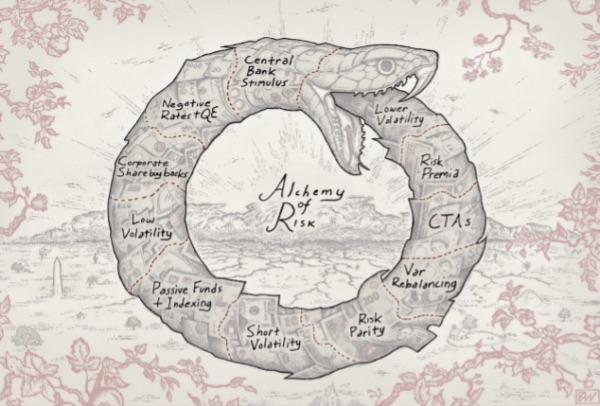
The bubble economy, the everything bubble, that we have been forced into, with QE, ultra-low rates, central banks buying trillions in what at least used to be assets, and massive buybacks that allow companies to raise their ‘value’ into the stratosphere, has enabled a company like Amazon to kill off its competition, which consists of many thousands of retailers, that do have to run a profit.

It’s a money scheme that allows many of the most ‘valuable’ tech companies to elbow their way into our lives, in ways that may seem beneficial to us at first, but in reality will only leave us behind with much less choice, far less competition, and many, many fewer jobs. Once it’s done someone will mention ‘scorched earth’. But for now they are everybody’s darlings; they are, don’t you know, the tech giants, the brainchildren of the best that the best among us have to offer.

They don’t all work the exact same way, which may make it harder to recognize what they have in common. For some it’s easier to see than for others. It’s also difficult to list them all. Here’s a few: Apple, Amazon, Facebook, Google (Alphabet), Tesla, Uber, Airbnb, Monsanto. Let’s go through the list.


Apple ? Yes, Apple too. But they make real things! Yes, but just as Apple CEO Tim Cook seeks to distance his company from the likes of Facebook on morals and ethics, he can’t deny that Apple sells a zillion phones to a large extent because everybody uses them to look at Facebook and Alphabet apps until their faces are blue. If data ethics are the only problem Cook sees, he’s in trouble.

Silicon Valley infighting shows that the industry does have an idea what is going wrong, in ways that should have already led to many more pronounced worries and investigations.


Silicon Valley Rivals Take Shots At Facebook

Mr. Cook, who has long sought to differentiate Apple on privacy matters, contrasted its focus on selling devices with Facebook and Google’s ad-based businesses that are built on user data. Asked what he would do if he were Facebook CEO Mark Zuckerberg, Mr. Cook replied: “I wouldn’t be in this situation.”

[..] Days earlier, François Chollet, an artificial intelligence engineer at Google, sought to draw a line between his company and Facebook. He tweeted that Google products like search and Gmail help users “to do more, to know more.” Facebook’s newsfeed, he wrote, “manipulates your worldview and seeks to maximally waste your time.”

[..] In January, Salesforce.com CEO Marc Benioff, whose company sells business software services, said that the addictive nature of social media means it should be regulated like a health issue.“I think that you do it exactly the same way that you regulated the cigarette industry,” Mr. Benioff told CNBC when asked how Facebook should be regulated. Some of the most cutting rebukes have come from people who know Facebook well.

In November, Sean Parker, the founding president of Facebook, said that Facebook executives, including himself, were “exploiting a vulnerability in human psychology” by designing a platform built on social validation. Mr. Parker didn’t respond to a request for comment.

Facebook generally hasn’t responded to the criticism, but it did after sharp comments from its former vice president of growth, Chamath Palihapitiya. “The short-term, dopamine-driven feedback loops that we have created are destroying how society works,” Mr. Palihapitiya said at a talk at Stanford University in November.

I would expect to hear a lot more of that sort of thing. Big Tech is changing the world in more ways than one. And spying on people Facebook-style is merely one of a long list of them. So yes, Apple certainly also belongs in that list. Facebook doesn’t build the devices people use to see what their friends had for breakfast, Apple does that. Moreover, Apple profits hugely from stock buybacks, so it fits in Stockman’s bubble finance definition of Amazon, too.

The failure of politics to investigate, and act against, those dopamine-driven feedback loops which exploit a vulnerability in human psychology in order to maximally waste your time and sell you product after product that you never (knew you) wanted is downright bizarre. Politicians only started talking about Facebook when a topic connected to Trump and Russia was linked to it.


Amazon: Trump can’t act fast enough on the tax situation and the US Postal deal. Not that that will solve the issue. Amazon, like all the companies on my list, can only be cut down to size if and when the everything bubble is. They are, after all, its children.

The most pernicious aspect of the Amazon ‘business model’, which all these firms share, and all are able to live by thanks to the central banks and the “greatest den of speculation in human history” they have created, is the prospect of world domination in their respective fields. They all hold in front of speculators the promise that they can crush all competition, or nearly all. Scorched earth, flat earth.


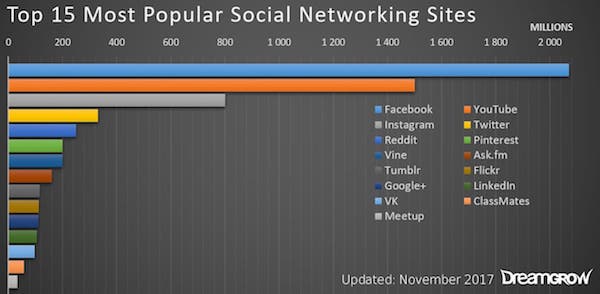
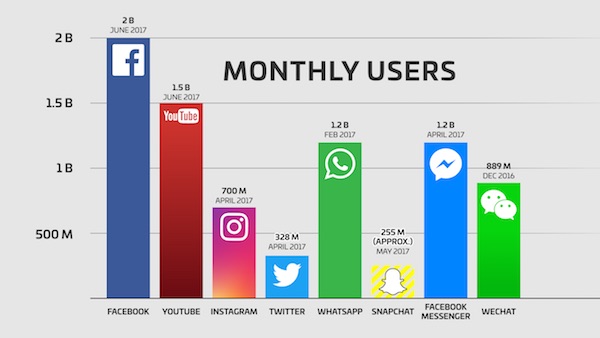
Facebook: their place in the list is obvious. What is it, 2.5 billion users? And what they don’t have is divvied up between them and Google when they buy up apps like Instagram. Officially competitors, but they have the exact same goals. And, like me, you may think: what’s the problem, just ban them from collecting all that data. Facebook has no reason to know, at least not one that serves us, where you were last Friday, and with whom. And just in case you missed that bit, they do.

But there their connection to the intelligence world comes in. Their platforms are better than anything the NSA has ever been able to develop. So we can say we don’t want Zuckerberg and Alphabet spying on us, but our own spies do want to do just that. That makes any kind of backlash much harder to succeed. And it doesn’t matter if you delete your Facebook account, they’ll find you anyway. Friend of a friend. We all have friends who are on Facebook, rinse and repeat.

The only hope there is, with Facebook as with the other companies, is for investors and speculators to dump their holdings in massive numbers. And that will only happen when the central bank Ponzi collapses. And it will, but by then we have a whole new set of problems.


Google: largely the same set of issues that Facebook has. Its tentacles are everywhere. Former CEO Eric Schmidt’s connections to the Pentagon should be really all you need to know. The EU may have issued all sorts of complaints and fines on competition grounds, but that makes no difference.

The one country with an effective response to Google and Facebook is China, that has largely banned both and built its own versions of their products. Which allows Beijing to ban people from boarding planes, buying homes etc., if their ‘social credit’ is deemed too low. If you want to be scared about where Big Tech’s powers can lead, look no further.


Tesla: Elon Musk has built a fantasy (and maybe I should put Paypal in this list too) on what everyone thinks must be done to ‘save the planet’ (yeah, build cars…) by grossly overstating the number of cars he can build, and financing his growth on not only speculation, but also on spectacular amounts of government subsidies (politicians want to save the planet, too).

And now he needs additional financing again. He will probably get it, again, but the Amazon backlash might have people take another look. One fine day… Fits David Stockman’s complaint to a t(ee), doesn’t have to make a profit. Musk has perfected that model.


Uber and Airbnb: why anyone anywhere would want to send money generated in their community, by renting out cars and apartments in that same community, to a bunch of people in Silicon Valley, is beyond me. Someone should set this up as an international effort that makes it easy for a community, a city etc., to provide this kind of service and make the profits benefit their own cities.

But like Amazon, they are free to run any competition into the ground because no profits are required until they have conquered the world. And then they can go nuts. It may look like a business model, but it isn’t. It’s a soon to be orphaned bubble child..


Monsanto: less obvious perhaps as an entry in the Big Tech list, but very much warranting a spot. And of course it stands for the entire chemical-seeds field. From Agent Orange to your children’s dinner plate. Monsanto has more lawyers and lobbyists on its payroll than it has scientists, but then its lofty goals outdo even those of Google or Amazon.

Facebook may focus on your addiction to human contact, but Bayer, DuPont, Syngenta et al have decided to make your food so addicted to their chemicals that they will in the future profit from every bite served on your table. How they will grow that food long term without any insects, bees or birds left is unclear, but they don’t seem to care much. As for profits? Monsanto seeks to rule the world, and for now care as little about profits as they do about insects.


Zuckerberg may claim that he only wants to improve Facebook’s service, but when that is done through for instance the 2012 so-called Transmission of Anger experiment in which the company tried to alter their users’ emotional states -and succeeded-, by manipulating their friends’ postings, that claim becomes pure ridicule. Selling off user data to scores of developers doesn’t help either. But do you see Congress tackling him in any serious way next week? Neither do I.

Because there’s one huge catch to the scenario that David Stockman -and I- painted, of the whole tech bubble collapsing when the financial bubble does. It is the links tech companies have built to intelligence. A group of Google employees wrote a letter to their CEO Sundar Pichai to protest the company’s involvement in “weaponized AI”, in the shape of Project Maven, a military surveillance engine to-be.

These people undoubtedly mean well, but they’re far too late. They will have to leave the “don’t be evil” company to actually not be evil. Because it’s not a big step from weaponized AI to killer robots. Microsoft is also part of the project, and Amazon is. If you work there and don’t want to be evil, you know what to do.

Yeah, it’s about our safety, and security, and political and military and economic power. But it’s also about spying on people, in even worse ways than Facebook does. So even as the central bank bubble, and the tech bubble, go poof, some of these companies may be saved by their military ties.

That sound you hear is George Orwell turning in his grave.



Apr 052018


Vincent van Gogh Le moulin de blute fin 1886


• The Fed Is Destroying Dollars (Napier)
• What Trump Gets Right About Europe’s Trade Problem (Pol.)
• “When You’re Already $500 Billion Down, You Can’t Lose!” (G.)
• Kudlow Says Trump’s China Tariffs Are Just Proposals Right Now (BBG)
• Up To 87 Million Facebook Users’ Data Shared With Cambridge Analytica (Ind.)
• Zuckerberg Says Most Facebook Users Will Only Get Privacy ‘In Spirit’ (Ind.)
• We Work For Google. Our Employer Shouldn’t Be In The Business Of War (G.)
• World’s Most Wanted Bank Whistleblower Arrested for Worst Possible Reason (DQ)
• Toronto’s Epic Housing Bubble Turns to Bust (WS)
• Tax Trouble For -Certain- Bitcoin Traders (F.)
• How Advertising Shaped the First Opioid Epidemic (Smithsonian)


Good points from Russell Napier. Also says Turkey will default, impose capital controls.

• The Fed Is Destroying Dollars (Napier)

Too much debt and not enough money remain a diagnosis for deflation and not inflation. In particular, we need to discuss why fears of inflation persist in a world where the US central bank and the US commercial banking system are now both destroying money. When both these key engines of the reserve currency creation act to destroy money, there will ultimately be a contraction in broad money growth, the first since the 1930s, if nothing changes. This analyst thinks that matters, but few, if any, agree. At this stage the interesting evidence is that this dramatic tightening of monetary policy seems to matter more outside the USA than within.

From its peak in November 2017 the level of US bank credit, when we adjust for the systems acquisition of non-banks, has posted no growth. When a commercial banking system posts no growth in bank credit over four months, it creates no money over that period. It just so happens that this is the same four months during which the Federal Reserve has been contracting its balance sheet. Sticking to the Policy Normalisation Principles (PNP) and their addendum of June 2017, the Fed has been destroying money by shrinking its balance sheet. In the period from August 2017 to February 2018 there has been a shrinkage of US$105.2bn in commercial bank reserve balances: the high-powered money. Based on the PNP, a further US$20bn will have been destroyed in March 2018.

So with a commercial banking system creating no money, and a central bank destroying money, we are looking at one of the tightest monetary policies ever pursued by a central bank. To disagree with that statement is to believe that monetary policy is judged solely by the price of money, without reference to the quantity of money. Such was the belief that led to the Great Depression. At this stage the distress associated with this policy seems to be falling primarily upon non-US companies that have borrowed USD. This has huge consequences for investors.

Read more …

EU is winner takes all.

• What Trump Gets Right About Europe’s Trade Problem (Pol.)

Donald Trump may prove to be the catalyst for change the eurozone has long been looking for. The protectionist U.S. president is forcing Europeans to face the unsettling problem of their massive current account surplus, which has been the best indicator of everything that’s wrong in the monetary union in the last five years. Forget Trump’s own economic analysis or lack thereof, and forget the attention-grabbing headlines on coming trade wars that may or may not happen. The U.S. president’s attacks on German exports — his Exhibit A that the Europeans aren’t playing a fair trade game — have helped throw a harsh light on the eurozone’s No. 1 problem.

Far from being a sign of economic well-being, the eurozone’s surplus — $380 billion last year or about 3% of the region’s GDP — reflects the monetary union’s deep structural flaws, worsened by the way it addressed its long crisis. [..] For a monetary union’s economy to be balanced, it has to take into account the differences between its respective nations’ different political, economic, and social systems. What happened instead when the euro crisis took everyone by surprise in 2009 was that each member country was told to become more like Germany. But for the system to work, if everyone must become like Germany, then Germany must also become a little bit less German. Surprise — this is not what happened. Countries in trouble were told to cut costs, boost competitiveness and implement austerity policies.

It worked: Imports fell and exports rose. Spain and Italy are now showing significant surpluses. In each of these countries, the balance has improved (from deficit to surplus) by roughly $100 billion since 2009 — the same as Germany’s accounts, which went from a $200 billion to $300 billion surplus. [..]According to European rules that are even less enforced than the more talked-about ones on fiscal deficits, a member country cannot run a surplus higher than 6% of its GDP. Germany’s surplus amounted to 8% of GDP last year, while the Netherlands’ was 8.5%. As long as the narrative of the eurozone crisis keeps making a surplus the moralistic sign of economic virtue, Europeans are unlikely to dare to take steps to tackle a problem that is now the world’s. Here’s hoping that the brutality of Trump’s attack on free trade will force them to spring into action.

Read more …

Something will have to happen. But nothing has so far, so why the loud voices?

• “When You’re Already $500 Billion Down, You Can’t Lose!” (G.)

Fears that Donald Trump is embroiling America in a global trade war intensified on Wednesday after China imposed on the US and stock markets plunged. The Dow Jones industrial average dropped and then rallied after markets fell in Europe and Asia on worries of an intensifying trade conflict between the world’s two biggest economies – the latest example of Trump taking his appetite for disruption to the global stage. After Washington unveiled plans to impose tariffs on $50bn in Chinese imports Tuesday, China hit back with plans to tax a matching $50bn of US products, including beef, cars, planes, soybeans and whiskey.

The US president has worn stock market success as a badge of honour and proof that, despite myriad controversies, the economy is booming under his presidency. But there are concerns that his aggressive tariffs and “America first” instincts could undermine confidence and cause a slowdown. Trump claimed last month that “trade wars are good, and easy to win”. China is the biggest market for US soy. The American Soybean Association, a lobbying group representing 21,000 producers, warned that China’s proposed 25% tariff on soybeans would be “devastating” to American farmers. It estimated that farmers lost an estimated $1.72bn on Wednesday morning alone as soybean futures tumbled.

John Heisdorffer, an Iowa farmer and the president of the association, said: “That’s real money lost for farmers, and it is entirely preventable.” He called on the White House to scrap its proposed tariffs. The car makers Ford and General Motors also issued statements calling for continued dialogue to resolve the escalating trade tensions. On Wednesday, Trump moved to play down concerns over a damaging trade war. He protested on Twitter: “We are not in a trade war with China, that war was lost many years ago by the foolish, or incompetent, people who represented the U.S. Now we have a Trade Deficit of $500 Billion a year, with Intellectual Property Theft of another $300 Billion. We cannot let this continue!” The president added: “When you’re already $500 Billion DOWN, you can’t lose!”

Read more …

Did anyone tell the soybeans?

• Kudlow Says Trump’s China Tariffs Are Just Proposals Right Now (BBG)

White House economic adviser Larry Kudlow stressed U.S. tariffs announced on Chinese goods are still only proposals that might never take effect as the Trump administration sought to tamp down fears of a trade war. “None of the tariffs have been put in place yet, these are all proposals,” Kudlow said in an interview Wednesday with Bloomberg News. “We’re putting it out for comment. There’s at least two months before any actions are taken.” Administration officials throughout the day emphasized the U.S. is willing to negotiate with China, helping to ease concerns among investors about a tit-for-tat trade conflict. The Dow Jones Industrial Average, after falling more than 2% at the market’s open, finished the day up almost 1%.

Commerce Secretary Wilbur Ross said China’s response isn’t expected to disrupt the U.S. economy. In an interview on CNBC on Wednesday, he said China’s announcement of retaliatory tariffs against the U.S. “shouldn’t surprise anyone.” He said the U.S. isn’t entering “World War III” and left the door open for a negotiated solution. “Even shooting wars end with negotiations,” Ross said. Earlier Wednesday, China said it would impose an additional 25% levy on about $50 billion of U.S. imports including soybeans, automobiles, chemicals and aircraft. The move matched the scale of proposed U.S. tariffs announced the previous day. The U.S. is allowing 60 days for public feedback and hasn’t specified when the tariffs would take effect, leaving a window open for talks. Chinese Ambassador to the U.S. Cui Tiankai said Wednesday his country is ready to negotiate.

Read more …

Keep that number growing. And when will the press acknowledge this is not about Cambridge Analytica?

• Up To 87 Million Facebook Users’ Data Shared With Cambridge Analytica (Ind.)

Up to 87 million people may have had their Facebook data improperly passed to a third-party political firm – and most users’ public profile information could have been collected, the social media company has revealed. Initial accounts estimated the number of people affected at around 50m. But Facebook updated that number to say information from as many as 37m additional users could been shared with Cambridge Analytica. And it warned in a blog post that a now-discarded feature meant “most people on Facebook” could have had their public data scraped by “malicious actors”.

The revelations expanded the scope of a privacy scandal besieging the company just days ahead of CEO Mark Zuckerberg’s hotly anticipated appearance before Congress. It had already been revealed that researcher harvested information encompassing a vast number of Facebook users and then passed it on to Cambridge Analytica, a company that went on to work for Donald Trump’s presidential campaign. The news has sent the company’s stock plunging and stoked a political outcry on both sides of the Atlantic. Facebook said it would inform users if their information had been funnelled to Cambridge Analytica. It said roughly 70 million of those users were in the United States.

And in seeking to reassure users that it was moving to safeguard their personal information, the company made an extraordinary disclosure: chief technology officer Mike Schroepfer said the majority of its users were vulnerable to abuse of a now-disabled feature allowing people to search for other users with phone numbers and email addresses. “Given the scale and sophistication of the activity we’ve seen, we believe most people on Facebook could have had their public profile scraped in this way”, Mr Schroepfer said in the blog post.

Read more …

Insane. Will he get some serious questions on Capitol Hill, or can he get away with this sort of thing?

• Zuckerberg Says Most Facebook Users Will Only Get Privacy ‘In Spirit’ (Ind.)

Facebook CEO Mark Zuckerberg has said that new data privacy laws will only apply “in spirit” to more than three quarters of the company’s users. Europe’s General Data Protection Regulation (GDPR) will force the social network to comply with strict rules about the privacy of its European users. But Mr Zuckerberg failed to commit to rolling out the protections globally. “We’re still nailing down details on this, but it should directionally be, in spirit, the whole thing,” Mr Zuckerberg said on Tuesday. With only 17 per cent of its 2.2 billion users residing within Europe, the vast majority of Facebook’s users will not benefit from the new rules.

Facebook has faced pressure in recent weeks to better protect its users’ data following revelations that the data analytics firm Cambridge Analytica harvested personal information from more than 50 million Facebook accounts in the build up to the 2016 US elections. On Monday, New York City Comptroller Scott Stringer called for Mr Zuckerberg to resign from his role as chairman of Facebook, adding that data privacy issues represented “a risk to our democracy.” The new data protection law – set to come into effect on May 25 – will give people more control over how companies store and use their personal data.

Read more …

Are you kidding? They all are. Stop working there.

• We Work For Google. Our Employer Shouldn’t Be In The Business Of War (G.)

Dear Sundar,

We believe that Google should not be in the business of war. Therefore we ask that Project Maven be cancelled and that Google draft, publicize and enforce a clear policy stating that neither Google nor its contractors will ever build warfare technology. Google is implementing Project Maven, a customized AI surveillance engine that uses “wide area motion imagery” data captured by US government drones to detect vehicles and other objects, track their motions and provide results to the Department of Defense. Recently, Googlers voiced concerns about Maven internally. Diane Greene responded, assuring them that the technology will not “operate or fly drones” and “will not be used to launch weapons”.

While this eliminates a narrow set of direct applications, the technology is being built for the military, and once it’s delivered it could easily be used to assist in these tasks. This plan will irreparably damage Google’s brand and its ability to compete for talent. Amid growing fears of biased and weaponized AI, Google is already struggling to keep the public’s trust. By entering into this contract, Google will join the ranks of companies like Palantir, Raytheon and General Dynamics. The argument that other firms, like Microsoft and Amazon, are also participating doesn’t make this any less risky for Google. Google’s unique history, its motto “don’t be evil”, and its direct reach into the lives of billions of users set it apart.

We cannot outsource the moral responsibility of our technologies to third parties. Google’s stated values make this clear: every one of our users is trusting us. Never jeopardize that. Ever. This contract puts Google’s reputation at risk and stands in direct opposition to our core values. Building this technology to assist the US government in military surveillance – and potentially lethal outcomes – is not acceptable. Recognizing Google’s moral and ethical responsibility, and the threat to Google’s reputation, we request that you: 1. Cancel this project immediately. 2. Draft, publicize and enforce a clear policy stating that neither Google nor its contractors will ever build warfare technology.

Read more …

Falciani was assisting the Spanish government, and now they sold him out to get to two Catalonia separatists.

• World’s Most Wanted Bank Whistleblower Arrested for Worst Possible Reason (DQ)

Hervé Falciani, the French-Italian former HSBC employee who blew the whistle on HSBC and 130,000 global tax evaders in 2008, has been arrested in Madrid on Tuesday in response to an arrest warrant issued by Switzerland for breaking the country’s bank secrecy laws. He lives in France, which rarely extradites its own citizens. But when Spanish authorities learned that he was in town to speak at a conference ominously titled, “When Telling the Truth is Heroic,” they made their move. If he is extradited to Switzerland he could face up to five years in prison. Falciani worked as a computer technician for HSBC’s Swiss subsidiary. One day in 2008, he left the office with five computer disks containing what would eventually become one of the largest leaks of banking data in history.

According to Swiss authorities, Falciani stole and then attempted to sell a trove of confidential data. Falciani says he was a whistleblower who wanted to expose a “broken” banking system, “which encouraged tax evasion.” When much of the stolen data was leaked to the press in 2015, it revealed, among other sordid things, that HSBC’s Swiss subsidiary routinely allowed clients to withdraw “bricks of cash,” often in foreign currencies of little use in Switzerland. It also colluded with clients to conceal undeclared “black” accounts from their domestic tax authorities and provided services to international criminals, corrupt businessmen, shady dictators and murky arms dealers.

As Falciani would soon find out, snitching on one of the world’s biggest banks and 130,000 of its richest clients does not make you a popular person in a country famed for its banking secrecy. In 2014 he was indicted in absentia by the Swiss federal government for violating the country’s bank secrecy laws and for industrial espionage. A year later he was sentenced by Switzerland’s federal court to five years in prison – the “longest sentence ever demanded by the confederation’s public ministry in a case of banking data theft.”

Read more …

All these bubbles will burst.

• Toronto’s Epic Housing Bubble Turns to Bust (WS)

After having ballooned for 18 years with barely a dip during the Financial Crisis, Toronto’s housing market, Canada’s largest, and among the most inflated in the world, is heading south with a vengeance, both in terms of sales volume and prices, particularly at the high end. Home sales in the Greater Toronto Area (GTA) plunged 39.5% in March compared to a year ago, to 7,228 homes, according to the Toronto Real Estate Board (TREB), the local real estate lobbying group. This was spread across all types of homes, even the formerly red-hot condo sector: • Detached houses -46.3% • Semi-detached houses -30.6% • Townhouses -34.2% • Condos -32.7%.

While new listings of homes for sale fell 12.4% year-over-year, at 14,866, they’d surged 41% from the prior month, and added to the listings of homes already on the market. The total number of active listings – new listings plus the listings from prior months that hadn’t sold or been pulled without having sold – more than doubled year-over-year to 15,971 homes, and were up 20% from February. At the current sales rate, total listings pencil out to a supply of 2.1 months. The average days-on-the-market before the home is sold or the listing is pulled without having sold doubled year-over-year to 20 days. Both data points show that the market is cooling from its red-hot phase, that potential sellers aren’t panicking just yet, and that potential buyers are taking their time and getting more reluctant, or losing their appetite altogether, with the fear of missing out (FOMO) having evaporated.

Sales volume has been plunging for months while listings of homes for sale have also surged for months. Prices follow volume, and prices have been backing off, but in February they actually fell on a year-over-year basis, the first since the Financial Crisis, and in March, they fell more steeply. This is what the report called a “change in market conditions.” The average price for the Greater Toronto Area (GTA) plunged 14.3% year-over-year to C$784,588. In other words, the average buyer in March a year ago is now about C$130,000 in the hole.

Read more …

Better check this out if this is you.

• Tax Trouble For -Certain- Bitcoin Traders (F.)

What do you do, come April 17, if you made a ton of money trading crypto last year and have since lost most of it? Panic, probably. A lot of last year’s winners are in deep porridge now. They owe tax on 2017 profits. They’re losing money now, so it’s not easy to come up with the cash to pay off the IRS. As for using today’s losses to offset last year’s gains, these tax naïfs are discovering, too late, that capital loss carryovers run forwards but not backwards. Suppose speculator Bob turned $200,000 into $1 million in last year’s feverish market, trading all the way—in and out of Bitcoin and Ethereum and Ripple and back in again. Now Bob has $800,000 in short-term capital gain to report on Schedule D. The state and federal tax bill is going to be upwards of $300,000.

The 2018 crash has shrunk Bob’s account value, let us suppose, to $300,000. If Bob sells out to pay the tax, he will have a $700,000 capital loss to claim. But he can claim the loss only against future capital gains, not past ones. Small consolation: Bob can use the $700,000 against up to $3,000 a year of ordinary income. If he throws in the towel on cryptocurrencies and goes back to his day job delivering pizzas, it will take him 234 years to catch even. Tyson Cross, an attorney in Reno, Nev. who has built up a specialty in crypto taxation, has been hearing many a sad tale recently. “Some alt coins are down to a tenth or less of their peak value,” he says. “The taxpayers are distraught. They don’t have any way to pay [the tax bill]. There’s only so much we can do.”

Read more …

There were no laws. Heroin was candy.

• How Advertising Shaped the First Opioid Epidemic (Smithsonian)

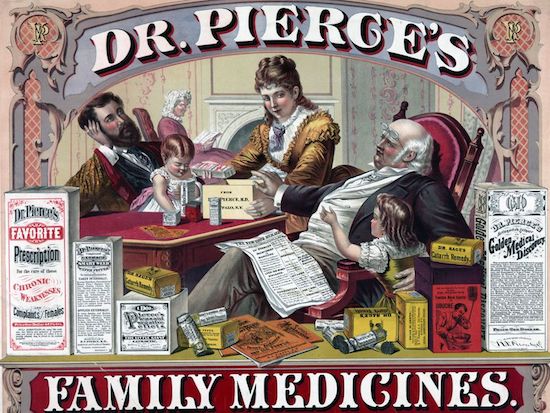
When historians trace back the roots of today’s opioid epidemic, they often find themselves returning to the wave of addiction that swept the U.S. in the late 19th century. That was when physicians first got their hands on morphine: a truly effective treatment for pain, delivered first by tablet and then by the newly invented hypodermic syringe. With no criminal regulations on morphine, opium or heroin, many of these drugs became the “secret ingredient” in readily available, dubiously effective medicines. In the 19th century, after all, there was no Food and Drug Administration (FDA) to regulate the advertising claims of health products. In such a climate, a popular so-called “patent medicine” market flourished.

Manufacturers of these nostrums often made misleading claims and kept their full ingredients list and formulas proprietary, though we now know they often contained cocaine, opium, morphine, alcohol and other intoxicants or toxins. Products like heroin cough drops and cocaine-laced toothache medicine were sold openly and freely over the counter, using colorful advertisements that can be downright shocking to modern eyes. Take this 1885 print ad for Mrs. Winslow’s Soothing Syrup for Teething Children, for instance, showing a mother and her two children looking suspiciously beatific. The morphine content may have helped. Yet while it’s easy to blame patent medicines and American negligence for the start of the first opioid epidemic, the real story is more complicated.

First, it would be a mistake to assume that Victorian era Americans were just hunky dory with giving infants morphine syrup. The problem was, they just didn’t know. It took the work of muckraking journalists such as Samuel Hopkins Adams, whose exposé series, “The Great American Fraud” appeared in Colliers from 1905 to 1906, to pull back the curtain. But more than that, widespread opiate use in Victorian America didn’t start with the patent medicines. It started with doctors.

Read more …

Apr 022018


John La Farge Girls Carrying a Canoe, Vaiala in Samoa 1891


• China Announces New Tariffs On 128 US Products (CNBC)
• The Real Bubble (ZH)
• Cryptocurrencies: Nothing Goes To Heck In A Straight Line (WS)
• Easter Shoppers Desert UK High Streets, Spreading Retail Gloom (G.)
• Trouble For Big Tech As Consumers Sour On Amazon, Facebook And Co (G.)
• Google, Facebook Too Big To Be Governed, Could Be Dismantled – Macron (Ind.)
• The Middle East Is Doomed (Ehsani)
• This Is How We End Up With John Bolton (CJ)
• Two Degrees No Longer Seen As Global Warming Guardrail (AFP)


Feels like China’s just going through the motions.

• China Announces New Tariffs On 128 US Products (CNBC)

China is implementing new tariffs on meat, fruit and other products from the U.S. as retaliation for American duties, heightening fears of a potential trade war between the world’s two largest economies. Beijing’s latest move, announced by its finance ministry in a statement dated April 1, is direct retaliation against taxes approved by President Donald Trump on imported steel and aluminum. Chinese officials had been warning over the last few weeks that their country would take action against the U.S. The tariffs begin on Monday, the finance ministry statement said. China’s Customs Tariff Commission is increasing the tariff rate on pork products and aluminum scrap by 25 percent. It’s also imposing a new 15 percent tariff on 120 other imported U.S. commodities, from almonds to apples and berries.

All told, the extra tariffs will hit 128 kinds of U.S. products, multiple outlets reported. The list of new duties matches the proposed list released by the government on March 23, according to Reuters. At that time, China said the affected U.S. goods had an import value of $3 billion in 2017 and included wine, fresh fruit, dried fruit and nuts, steel pipes, modified ethanol and ginseng. The decision to target $3 billion in U.S. imports is significant, but it’s widely seen as a drop in the ocean given the size of the bilateral trading relationship. U.S. goods exported to China in 2016 totaled $115.6 billion, according to official data. China’s retaliation is “a statement of intent … but it’s not an escalation in our opinion,” Steve Brice, chief investment strategist at Standard Chartered Private Bank, told CNBC on Monday.

Read more …

One of many, really.

• The Real Bubble (ZH)

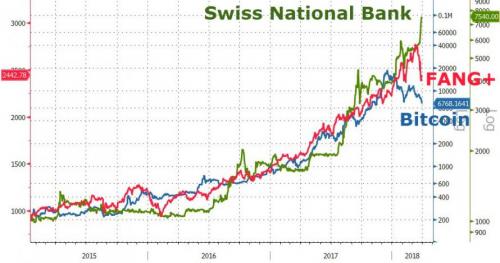
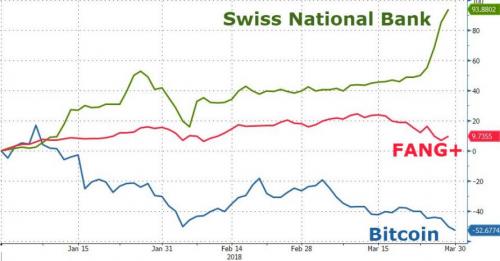
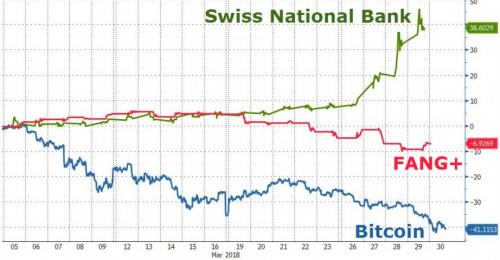
After a seemingly unstoppable surge higher for years, March was a tough one for tech stocks, as the curtain was lifted exposing Oz-like machinations behind the scenes that spooked investors enough to pop the bubble of delusion so many were living in. After a magnificent 2017, Cryptocurrencies also started 2018 off poorly as yet another ‘bubble’ popped. However, there was one ‘asset’ that had a tremendous 2017, and has gone on to greater and bubblier things in 2018. Spot the real bubble in financial markets… Bitcoin has bust, FANG stocks are FUBAR, but The SNB is accelerating.

As we noted previously, The SNB made 32 times more than 85 Swiss private banks… and owns a record $100 billion-plus of American stocks… $11,589.01. – That’s the US dollar amount of American stocks the Swiss National Bank owns on behalf of every man, woman and child in Switzerland. Let that sink in. A Central Bank has taken on itself to expand its balance sheet and invest in the proceeds, not in gold, nor sovereign debt – heck not even in corporate bonds. Nope, the SNB has taken it upon itself to “invest” that money in another country’s most risky part of the capital structure – equity. And don’t think it’s a small number. It’s almost $100 billion US dollars.

In a strange twist of fate, the Swiss National Bank is not only Switzerland’s Central Bank, but also a publicly traded security. And that ‘security’ has had a great year so far – up a stunning 93%…

However, as Holger Zschaepitz notes, the market cap of the Swiss National Bank remains below CHF1bn amidst a profit of CHF54.4bn. But that didn’t stop investors piling in to The SNB in March as a ‘safe haven’ as the rest of the world collapsed… As Macro Tourist’s Kevin Muir concluded previously, I worry that right now, Central Banks are being rewarded for keeping their balance sheets as big and risky as they can stomach. It appears to be a trade with no cost, and in fact, helps out by both keeping their currency weak, and in the meantime, making some money. It encourages them to be extremely slow easing off the accelerator. The idiocy of Central Banks taking this sort of risk is beyond description, but no sense arguing about it – it is what it is.

Read more …

65%.

• Cryptocurrencies: Nothing Goes To Heck In A Straight Line (WS)

I don’t think there has ever been an entire sector that skyrocketed as much and collapsed as quickly as the cryptocurrency space. The skyrocketing phase culminated at the turn of the year. Then the collapse phase set in, with different cryptos choosing different points in time. It doesn’t help that regulators around the world have caught on to these schemes called initial coin offerings (ICOs), where anyone, even the government of Venezuela, can try to sell homemade digital tokens to the gullible and take their “fiat” money from them and run away with it. There are now 1,596 cryptocurrencies and tokens out there, up from a handful a few years ago. And the gullible are getting cleaned out.

And it doesn’t help that the ways to promote these schemes are being closed off, one after the other. At the end of January, Facebook announced that, suddenly, “misleading or deceptive ads have no place on Facebook,” and it prohibited ads about ICOs and cryptos. On March 14, Google announced that it will block ads with “cryptocurrencies and related content,” including ICOs, cryptocurrency exchanges, cryptocurrency wallets, and cryptocurrency trading advice. Its crackdown begins in June. On March 26, Twitter announced that it would ban ads of ICOs, cryptocurrency exchanges, and cryptocurrency wallet services, unless they are by public companies traded on major stock markets. It will roll out its policy over the next 30 days.

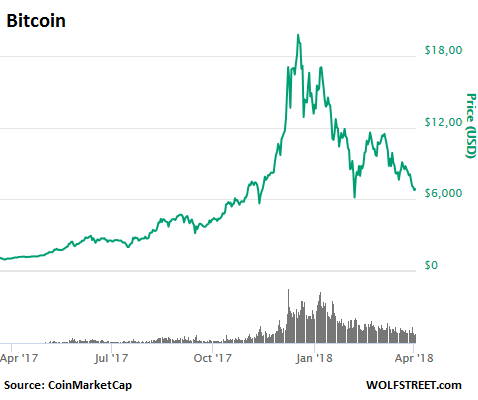
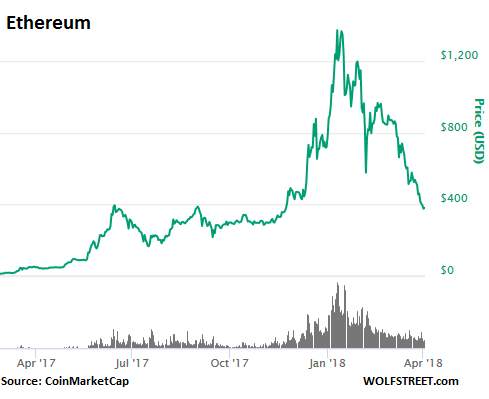
On March 29, MailChimp, a major email mass-distribution service, announced that it will block email promos from businesses that are “involved in any aspect of the sale, transaction, exchange, storage, marketing or production of cryptocurrencies, virtual currencies, and any digital assets related to an Initial Coin Offering.” This broadened and tightened its policy announced in February that promised to shut down any account related to promos of ICOs or blockchain activity. The overall cryptocurrency space, in terms of market capitalization, peaked on January 4, when market cap reached $707 billion, according to CoinMarketCap. Less than three months later, market cap has now plunged by 65% to $245 billion. $462 billion went up in smoke.

Read more …

It’s hard to accept that your entire country is pushing up daisies. But you got to sell your paper. So you get a real heavy headline, and then quote someone saying: “..the numbers were “generally pretty good news for retailers”..

• Easter Shoppers Desert UK High Streets, Spreading Retail Gloom (G.)

The gloom on Britain’s high streets deepened over the Easter bank holiday weekend as heavy rain in many areas drove people to seek the shelter of shopping centres or simply stay at home. The number of shoppers on UK high streets on Easter Sunday morning slumped by over 12% compared with 2017, according to retail intelligence firm Springboard. That followed a disappointing Good Friday, when high street footfall fell by 9.6%. Saturday was little better, with footfall down 6.9% year-on-year. This weekend had been billed as the most anticipated weekend for retail since Christmas, but Springboard said bad weather in some parts of the country had “definitely hit high streets”, and pulled the overall result for all UK shopping destinations down into minus figures.

A week ago Springboard predicted that this Easter weekend’s UK retail footfall could end up 2.4% higher than last year’s, though it had said this assumed “normal weather”. It added that if freezing conditions similar to those caused by the “beast from the east” returned, all bets were off. In the event wet weather sent a chill through the high streets, meaning footfall across all shopping destinations was down 2.4% on Good Friday and 3% lower on Saturday. However, retail parks and shopping centres typically enjoyed better fortunes than they did last year. Diane Wehrle, Springboard’s marketing and insights director, said the rain kept many people away from their local high street shops. But “at the same time, people did go shopping” rather than staying at home and browsing the web.

She said the numbers were “generally pretty good news for retailers”, many of whom would be quite heartened by the numbers of shoppers out on Good Friday and Holy Saturday. With predictions of snow in some parts of the country for Easter Monday, many retailers will be crossing their fingers and hoping that conditions are not too challenging. Last week it emerged that high street sales had slumped at the fastest rate for early spring in at least five years, as cold and snowy weather kept people away from the shops. Wehrle said of Easter Monday: “If it starts off dry in the morning, that will shape the day. If people wake up and it’s snowing, that will be it.”

Read more …

“..for shareholders and pension plans, the tarnishing of tech could have serious consequences.”

• Trouble For Big Tech As Consumers Sour On Amazon, Facebook And Co (G.)

Trump is going after Amazon; Congress is after Facebook; Google is too big, and Apple is short of new products. Is it any surprise that sentiment toward the tech industry giants is turning sour? The consequences of such a readjustment, however, may be dire. The past two weeks have been difficult for the tech sector by every measure. Tech stocks have largely driven the year’s stock market decline, the largest quarterly drop since 2015. Facebook saw more than $50bn shaved off its value after the Observer revealed that had harvested millions of people’s user data for political profiling. Now users are deleting accounts, and regulators may seek to limit how the company monetizes data, threatening Facebook’s business model.

On Monday, the Federal Trade Commission confirmed it was investigating the company’s data practices. Additionally, Facebook said it would to London to appear in front of UK lawmakers, but it would not send the chief executive, Mark Zuckerberg, who is increasingly seen as isolated and aloof. Shares of Facebook have declined more than 17% from the close on Friday 16 March to the close on Thursday before the Easter break. Amazon, meanwhile, long the target of President Trump’s ire, saw more than $30bn, or 5%, shaved off its $693bn market capitalization after it was reported that the president was “obsessed” with the company and that he “wondered aloud if there may be any way to go after Amazon with antitrust or competition law”.

Shares of Apple, and Google’s parent company Alphabet, are also down, dropping on concerns that tech firms now face tighter regulation across the board. For Apple, there’s an additional concern that following poor sales of its $1,000 iPhone X. For Google, there’s the prospect not only of tighter regulation on how it sells user date to advertisers, but also the fear of losing an important Android software patent case with Oracle. Big tech’s critics may be forgiven a moment of schadenfreude. But for shareholders and pension plans, the tarnishing of tech could have serious consequences.

Read more …

More on the article in yesterday’s Debt Rattle.

• Google, Facebook Too Big To Be Governed, Could Be Dismantled – Macron (Ind.)

Emmanuel Macron, the French president, has warned that Google and Facebook are becoming too big to be governed and could face being dismantled. Internet giants could be forced to pay for the disruption they cause in society and submit to French or European privacy regulations, he suggested. In an interview with the magazine Wired, the president warned that artificial intelligence (AI) would challenge democracy and open a Pandora’s box of privacy issues. He was speaking after announcing a €1.5bn (£1.32bn) investment in artificial intelligence research to accelerate innovation and catch up with China and the US.

Mr Macron said companies such as Google and Facebook were welcome in France, brought jobs and were “part of our ecosystem”. But he warned: “They have a very classical issue in a monopoly situation; they are huge players. At a point of time – but I think it will be a US problem, not a European problem – at a point of time, your government, your people, may say, ‘Wake up. They are too big.’ “Not just too big to fail, but too big to be governed. Which is brand new. “So at this point, you may choose to dismantle. That’s what happened at the very beginning of the oil sector when you had these big giants. That’s a competition issue.”

Read more …

We don’t know nearly enough on ME economies. So this is a real good find.

• The Middle East Is Doomed (Ehsani)

Authored by “Ehsani” – a Middle East expert, Syrian-American banker and financial analyst who visits the region frequently and writes for the influential geopolitical analysis blog, Syria Comment.

* * *

The Mideast is doomed. Egypt alone needs to create 700,000 jobs every single year to absorb the new job seekers out its 98 million population. A third of this population already live below the poverty line (482 Egyptian Pounds a month, which is less than $1 a day). The seeds of the vicious circle that the Mideast region finds itself in today were planted at least 5 decades ago. Excessive public spending without matching revenues were the catalyst to a faulty and dangerous incentive system that helped to balloon populations beyond control. A governance system that was ostensibly put in place to help the poor ended up being a built-in factory for poverty generation. Excessive subsidies helped misallocate resources and mask the true cost of living for households. Correlation between family size and income was lost.

Successive Mideast leaders are often referred to as evil dictators. I see them more as lousy economists and poor users of simple arithmetic and excel spreadsheets that can help demonstrate the simple, yet devastating power of compounding. Unless you are a Gulf-based monarchy enjoying the revenue stream from oil and gas that can postpone your day of reckoning, the numbers in nearly every single Arab country don’t add up. t is important to note that excessive population growth is not fundamental the issue here. Japan and many parts of Europe are suffering from too little population growth. The problem in Arab societies is lack of productivity stemming from weak private sector and overburdened bankrupt public sector. As students of Economics know, “Potential” Economic Growth of a country is derived by adding the growth rate of its labor force to the growth rate of the economy’s productivity.

High labor force growth therefore ought to be a plus for the “Potential Growth”. The Arab World’s problem is that it suffers from shockingly low levels of “productivity”. This may seem like a fancy word but the concept encapsulates everything that Arab economies and societies suffer from. Why does the Arab world have such low productivity? The answer lies in everything from excessive size of public sector, subsidies and overbearing regulatory system leading to corruption. As public sector liabilities grow, education, healthcare & infrastructure funding suffers. Why is the size of the public sector coupled with excessive subsidies the problem? Because what starts as the noble cause of helping the poor ends up masking the true costs of raising family size. Governments soon go broke. Services suffer. Anger rises. We know the drill now.

Read more …

Dead on, Caitlin.

• This Is How We End Up With John Bolton (CJ)

A GoFundMe for former FBI Deputy Director Andrew McCabe, who was fired two weeks ago by Attorney General Jeff Sessions, has raised over $400,000 in less than a day. Another way to say that would be that a former officer from the US intelligence community, who is married to a successful physician and will surely receive a book deal worth millions of dollars, just had a charity drive which in less than a day raised an amount of money it would take the average American years to earn. Meanwhile, an impoverished American recently died because his GoFundMe failed to raise enough money for his insulin and an FBI whistleblower was just arrested for trying to bring transparency to the Bureau’s secret domestic surveillance practices while banks receive massive bailouts, global fossil fuel subsidies total trillions of dollars, and Amazon paid zero federal taxes last year despite earning billions.

Even leaving aside the reasons for McCabe’s firing and the shady dealings he was accused of, this is a very solid illustration of everything that is sick about the United States of America. In America you have socialism for the rich and capitalism for the poor. You have government secrecy for the powerful and surveillance for the powerless. You have charity for wealthy establishment lackeys and rugged individualism for ordinary human beings. Those at the top are uplifted even further, while those on the bottom are stomped through the floor.

Julian Assange is currently under siege in the Ecuadorian embassy, deprived of mobility, sunlight and healthcare, and now internet, phone calls and visitors, all because he dared to bring some transparency to the powerful. Meanwhile the intelligence and defense agencies who serve as the armed goon squad of the wealthy and the powerful are able to kill, destroy and pillage from behind the opaque walls of near-total government secrecy in the name of “national security”. And instead of defending the single defenseless man who speaks truth to power, mainstream media reporters around the world are spitting on him in near-unanimity because he hurts power’s feelings.

This is how we end up with John Bolton, people. This is the “kiss-up, kick-down” pathway to success that elevates bloodthirsty psychopaths like John Bolton, the worst of the worst, the ones willing to do the most killing on behalf of the powerful and the most stomping on the powerless to get to the top. This has become the unquestioned pathway in every sphere of public life. We have a situation now where the highest echelons of power are not the wisest among us, but the wiliest. The fourth estate is full of everyday people who at one point presumably believed they were there to bring truth to power, stomping on the silvery head of one who does, while sucking up to the very power that he regularly embarrasses with his leak drops.

Read more …

All the stuff we should do but don’t. Should we instead ask why we don’t? All the ‘it’s not too late’ talk certainly doesn’t help.

• Two Degrees No Longer Seen As Global Warming Guardrail (AFP)

Limiting global warming to two degrees Celsius will not prevent destructive and deadly climate impacts, as once hoped, dozens of experts concluded in a score of scientific studies released Monday. A world that heats up by 2C (3.6 degrees Fahrenheit) – long regarded as the temperature ceiling for a climate-safe planet – could see mass displacement due to rising seas, a drop in per capita income, regional shortages of food and fresh water, and the loss of animal and plant species at an accelerated speed. Poor and emerging countries of Asia, Africa and Latin America will get hit hardest, according to the studies in the British Royal Society’s Philosophical Transactions A.

“We are detecting large changes in climate impacts for a 2C world, and so should take steps to avoid this,” said lead editor Dann Mitchell, an assistant professor at the University of Bristol. The 197-nation Paris climate treaty, inked in 2015, vows to halt warming at “well under” 2C compared to mid-19th century levels, and “pursue efforts” to cap the rise at 1.5C. UN Secretary-General Antonio Guterres on Thursday said climate change was “the most systemic threat to humankind”. With only one degree of warming so far, Earth has seen a crescendo of droughts, heatwaves, and storms ramped up by rising seas. Voluntary national pledges made under the Paris pact to cut CO2 emissions, if fulfilled, would yield a 3C world at best.

The treaty also requires that – by the end of the century – humanity stop adding more greenhouse gases to the atmosphere than oceans and forests can absorb, a threshold known as “net zero emissions”. “How fast we get to a 2C world” is critical, Mitchell told AFP. “If it only takes a couple of decades, we will be in trouble because we won’t have time to adapt to the climate.” [..] Researchers led by Felix Pretis, an economist at the University of Oxford, predict that two degrees of global warming will see GDP per person drop, on average, 13% by 2100, once costly climate change impacts are factored in. A 2ºC world will also “show significant negative impact on the rates of economic growth,” Pretis told AFP.

Read more …

Mar 282018


Edvard Munch Spring in Johan Karl Street 1944


• Steen Jakobsen Fears 30% Market Correction With Consumer ‘Maxed Out’ (CNBC)
• China Says Kim Jong Un Agrees To Denuclearize Korean Peninsula (R.)
• All The Personal Data That Facebook/Google Collect (Curran)
• Mark Zuckerberg Agrees To Testify Before Congress Over Data Scandal (G.)
• 37 State Attorneys General Demand Answers From Zuckerberg (ZH)
• Zuckerberg’s Refusal To Testify Before UK MPs ‘Absolutely Astonishing’ (G.)
• Jimmy Carter: Trump Hiring Bolton ‘A Disaster For Our Country’ (USAT)
• Brexit Referendum Won Through Fraud – Whistleblower (G.)
• Austria Draws Scorn for Sitting Out Russian Diplomat Expulsions (BBG)
• 160 Countries Want To See Proof In Skripal Case – Russia’s UK Embassy (RT)
• Tesla Just Months From A Total Collapse – Hedge Fund (MW)
• The Missing Economic Measure: Wealth, not GDP (OWiD)


Goldilocks and Frankenstein.

• Steen Jakobsen Fears 30% Market Correction With Consumer ‘Maxed Out’ (CNBC)

Stock markets could see a hefty fall in the coming months due to a slew of trends that point to a downturn in the global economy, one economist told CNBC. Steen Jakobsen, the often-bearish chief economist at Danish investment house Saxo Bank, cited several factors including growing credit loans, a widening fiscal deficit in the U.S., doubts over infrastructure spending plans and a potential trade war. “All the data we’ve seen over the last few weeks has basically been that the consumer is maxed out, we’ve seen that in credit card loans as well, so I think the consumer is done spending the money,” he told CNBC Tuesday. New data Tuesday showed that U.S. consumer confidence declined in March, falling below expectations and breaking a two month streak of gains.

“I think overall we have been pricing in for Goldilocks and we are closer to Frankenstein to be honest,” he said. He added that in a scenario of a potential sudden economic recession, he sees a possible market correction of between 25 and 30%. Jakobsen highlighted a “Goldilocks” scenario that he feels traders are mistakenly pricing in to markets, where fresh economic data are either not too hot or not too cold. Overall, the global economy is currently experiencing lower levels of unemployment and higher growth. Looking at 2018 in particular, many analysts hoped for strong global growth on the back of higher inflation and higher investment, but according to Jakobsen, these drivers “aren’t actually materializing.”

Instead, Jakobsen made a reference to the novel “Frankenstein,” arguing that the economy had been skewed by central bankers, who have injected trillions of dollars into the global economy to boost growth and investment. The first quarter of 2018 “started at more than 5% expected GDP; we are now significantly less than 2% for the (first quarter) expected, so I don’t really see things happening in the growth area,” Jacobsen added. “We’ve been at 2% exactly since the financial crisis, I don’t think we’re going to deviate from that,” he said.

Read more …

Again, he says it’s what his father and grandfather wanted. Perfect way to save face.

• China Says Kim Jong Un Agrees To Denuclearize Korean Peninsula (R.)

China said on Wednesday it won a pledge from North Korean leader Kim Jong Un to denuclearize the Korean peninsula during a meeting with President Xi Jinping, who pledged in return that China would uphold its friendship with its isolated neighbor. After two days of speculation, China announced on Wednesday that Kim had visited Beijing and met Xi during what the official Xinhua news agency called an unofficial visit from Sunday to Wednesday. The trip was Kim’s first known journey abroad since he assumed power in 2011 and is believed by analysts to serve as preparation for upcoming summits with South Korea and the United States.

Beijing has traditionally been the closest ally of secretive North Korea, but ties have been frayed by North Korea’s pursuit of nuclear weapons and China’s backing of tough U.N. sanctions in response. Xinhua cited Kim as telling Xi that the situation on the Korean peninsula is starting to improve because North Korea has taken the initiative to ease tensions and put forward proposals for peace talks. “It is our consistent stand to be committed to denuclearisation on the peninsula, in accordance with the will of late President Kim Il Sung and late General Secretary Kim Jong Il,” Kim Jong Un said, according to Xinhua. North Korea is willing to talk with the United States and hold a summit between the two countries, he said.

Read more …

Zero Hedge with the entire Twitter thread by Dylan Curran. Does that wake you up?

• All The Personal Data That Facebook/Google Collect (Curran)

The Cambridge Analytica scandal was never really about Cambridge Analytica. As we’ve pointed out, neither Facebook nor Cambridge Analytica have been accused of doing anything explicitly illegal (though one could be forgiven for believing they had, based on the number of lawsuits and official investigations that have been announced). Instead, the backlash to these revelations – which has been justifiably focused on Facebook – is so severe because the public has been forced to confront for the first time something that many had previously written off as an immutable certainty: That Facebook, Google and the rest of the tech behemoths store reams of personal data, essentially logging everything we do.

In response to demands for more transparency surrounding user data, Facebook and Google are offering users the option to view all of the metadata that Google and Facebook collect. And as Twitter user Dylan Curran pointed out in a comprehensive twitter thread examining his own data cache, the extent and bulk of the data collected and sorted by both companies is staggering. Google, Curran said, collected 5.5 gigabytes of data on him – equivalent to some 3 million Microsoft Word documents. Facebook, meanwhile, collected only 600 megabytes – equivalent to roughly 400,000 documents.

Another shocking revelation made by Curran: Even after deleting data like search history and revoking permissions for Google and Facebook applications, Curran still found a comprehensive log of his documents and other files stored on Google drive, his search history, chat logs and other sensitive data about his movements that he had expressly deleted. What’s worse, everything shown is the data cache of one individual. Just imagine how much data these companies hold in total.

Read more …

By now, shareholders may be his prime concern. Congress won’t hurt the CIA’s interests.

• Mark Zuckerberg Agrees To Testify Before Congress Over Data Scandal (G.)

Facebook’s chief executive, Mark Zuckerberg, has agreed to testify before the United States Congress in the wake of a that has sent the company’s share price tumbling and prompted numerous investigations and lawsuits. Zuckerberg has accepted an invitation to testify before the House energy and commerce committee, according to an aide familiar with the discussions. A date has not yet been set, and the spokesperson for the House committee declined to confirm reports that the hearing was scheduled for 12 April. The Senate judiciary and commerce committees have also invited Zuckerberg to appear at hearings.

His decision to testify before the US Congress was first reported by CNN, and contrasts with his refusal to appear before members of parliament in the UK. The chair of a British committee of MPs on Tuesday said Zuckerberg’s decision to send other executives to the UK to answer questions on his behalf was “absolutely astonishing”. However, news of US congressional evidence paves the way for a major showdown for Zuckerberg, 33, who has come under increasing pressure from lawmakers and the general public to account for Facebook’s business practices since the company acknowledged last September that it had sold advertisements to Russian agents seeking to influence the US presidential election.

Read more …

Facebook took 30% of the loot. They sold their data perhaps thousands of times.

• 37 State Attorneys General Demand Answers From Zuckerberg (ZH)

37 “profoundly concerned” U.S. state and territory attorneys general fired off a letter to Facebook CEO Mark Zuckerberg on Monday, demanding answers over reports that personal user information from Facebook profiles was provided to third parties without the users’ knowledge or consent. “Most recently, we have learned from news reports that the business practices within the social media world have evolved to give multiple software developers access to personal information of Facebook users. These reports raise serious questions regarding consumer privacy”

The letter notes the 50 million Facebook profiles which may have been “misused and misappropriated by third-party software developers,” noting that Facebook “took as much as 30%” of payments made through applications used by Facebook users. “According to these reports, Facebook’s previous policies allowed developers to access the personal data of “friends” of people who used applications on the platform, without the knowledge or express consent of those “friends.” It has also been reported that while providing other developers access to personal Facebook user data, Facebook took as much as 30% of payments made through the developers’ applications by Facebook users.”

In other words – while a Facebook user may have agreed in the fine print to allowing the social media giant to hoover up their information – their “friends” did not. “These revelations raise many serious questions concerning Facebook’s policies and practices” reads the letter, which asks “were those terms of service clear and understandable, or buried in boilerplate where few users would even read them?”

Read more …

He’s just not that into you. Why talk to “the UK parliamentary committee investigating fake news” when he’s already agreed to speak to Congress?

• Zuckerberg’s Refusal To Testify Before UK MPs ‘Absolutely Astonishing’ (G.)

Mark Zuckerberg has come under intense criticism from the UK parliamentary committee investigating fake news after the head of Facebook refused an invitation to testify in front of MPs for a third time. The chair, Damian Collins, said it had become more urgent the Facebook founder give evidence in person after oral evidence provided by the Cambridge Analytica whistleblower, Christopher Wylie. The MP said: “I think, given the extraordinary evidence we’ve heard so far today, it is absolutely astonishing that Mark Zuckerberg is not prepared to submit himself to questioning in front of a parliamentary or congressional hearing, given these are questions of fundamental importance and concern to his users, as well as to this inquiry.

“I would certainly urge him to think again if he has any care for people that use his company’s services.” Zuckerberg has been invited three times to speak to the committee, which is investigating the effects of fake news on UK democracy, but has always sent deputies to testify in his stead. MPs are likely to take a still dimmer view of his decision after he ultimately agreed to testify before Congress in the US. It was reported on Tuesday that the company is now considering strategy for his testimony. When the Commons committee travelled to Washington DC in February to obtain oral evidence from US companies, Facebook flew over its UK policy director rather than send a high-level executive to speak to the committee.

In response to the latest request, Facebook has suggested one of two executives could speak to parliament: Chris Cox, the company’ chief product officer, who is in charge of the Facebook news feed, or Mike Schroepfer, the chief technology officer, who heads up the developer platform. However, Theresa May declined to back Collins. Pressed by the committee chairman at the Commons liaison committee later in the day, the prime minister said “Mr Zuckerberg will decide for himself” whether to give evidence to parliament.

Read more …

The US has one sane person left. And he’s 93. Not that he’s the only one denouncing Bolton. But none of the rest do that nearly loud enough.

• Jimmy Carter: Trump Hiring Bolton ‘A Disaster For Our Country’ (USAT)

Former president Jimmy Carter, one of the few U.S. officials who has traveled to North Korea and met with its leaders, expresses hope for the planned White House summit with Pyongyang but warns that President Trump may have made “one of the worst mistakes” of his tenure by naming John Bolton to the sensitive post of national security adviser. In an exclusive interview with USA TODAY, pegged to the publication of his new book titled Faith, Carter calls Bolton “a warlike figure” who backs policies the former president calls catastrophic. “Maybe one of the worst mistakes that President Trump has made since he’s been in office is his employment of John Bolton, who has been advocating a war with North Korea for a long time and even an attack on Iran, and who has been one of the leading figures on orchestrating the decision to invade Iraq,” Carter said. He called the appointment, announced last week, “a disaster for our country.”

Read more …

Perfect for Tony Blair et al. Maybe too perfect. Who cares about this guy’s views? Stick to the facts, please.

• Brexit Referendum Won Through Fraud – Whistleblower (G.)

The EU referendum was won through fraud, the whistleblower Christopher Wylie has told MPs, accusing Vote Leave of improperly channelling money through a tech firm with links to Cambridge Analytica. Wylie told a select committee that the pro-Brexit campaign had a “common plan” to use the network of companies to get around election spending laws and said he thought there “could have been a different outcome had there not been, in my view, cheating”. “It makes me so angry, because a lot of people supported leave because they believe in the application of British law and British sovereignty. And to irrevocably alter the constitutional settlement of this country on fraud is a mutilation of the constitutional settlement of this country.”

Vote Leave has repeatedly denied allegations of collusion or deliberate overspending. When they , Boris Johnson, who fronted the campaign, said: “Vote Leave won fair and square – and legally. We are leaving the EU in a year and going global.” Wylie, who used to work for Cambridge Analytica, gave evidence in a nearly four-hour session before the digital, culture, media and sport select committee. He made a string of remarkable claims about Brexit and Cambridge Analytica, including that his predecessor, Dan Mursean, died mysteriously in a Kenyan hotel room in 2012 after a contract in the company turned sour. Wylie said it was striking that Vote Leave and three other pro-Brexit groups – ; Veterans for Britain, and Northern Ireland’s Democratic Unionist party – all used the services of the little-known firm Aggregate IQ (AIQ) to help target voters online.

Read more …

And Greece, Cyprus, Portugal, Bulgaria, Cyprus, Slovakia, Slovenia, Malta and Luxembourg. Belgium?!

• Austria Draws Scorn for Sitting Out Russian Diplomat Expulsions (BBG)

Austria is drawing criticism from parts of the European Union for saying it couldn’t expel Russian diplomats on account of its neutrality. Chancellor Sebastian Kurz’s government, which includes nationalists that cooperate with Vladimir Putin’s party, declined to join the tough international response to a nerve-agent attack on a former Russian spy in England. Austria is a “builder of bridges between East and West” and wants to “keep channels open” to Moscow, it said. That position is “hardly compatible with EU membership” and there’s “a big difference between being part of the West and being a bridge between the West and the East,” former Swedish Foreign Minister Carl Bildt said Tuesday on Twitter.

Artis Pabriks, a former Latvian foreign minister who’s a member of the European Parliament, called Austria’s decision a “bad joke.” He asked: “Which other EU policies/decisions Kurz does not apply to Austria?” Kurz, whose People’s Party is part of the same political family as the parties of Bildt and Pabriks, said Monday that Austria backs the EU’s decision to pull its ambassador to Russia. In declining to take further measures, his government cited Austria’s neutrality, which the country adopted as a condition for ending its post-World War II occupation by the U.S., the Soviet Union, the U.K. and France in 1955.

Read more …

7 billion people do, too.

• 160 Countries Want To See Proof In Skripal Case – Russia’s UK Embassy (RT)

Scores of non-Western countries refuse to take the UK’s assertion that Russia was behind the incident in Salisbury at face value, demanding it present the evidence, Moscow’s embassy in London said. Some 160 states share that view. While many in the Western world, save several notable exceptions, united behind the UK as it accused Russia of poisoning the former spy with a military-grade toxic agent, many more countries have not been persuaded by the fiery rhetoric of British PM Theresa May, the spokesperson for Russia’s British embassy told Sputnik.

“Even if Mrs. May said that she was absolutely sure that Russia was responsible for the incident in Salisbury, she would have to present all evidence to Russia, the international community and the British public. This is the opinion of almost 160 countries which are not members of the Western bloc,” he said. “It is obvious that no one in the wider world would take British words for granted.” On Monday, following the lead of the UK, the US, 18 EU states and other European countries, Canada and Australia announced they would expel a number of Russian diplomats in solidarity with the UK. Washington alone ordered the expulsion of 60 diplomats, including 12 at the Russian mission to the UN, alleging they were covert intelligence operatives.

What became the largest collective expulsion of Russian diplomats in history was denounced by Moscow as an extremely unfriendly and unwarranted step. Still, there were voices in the West that refused to side with London until the evidence is laid out. Austria as well as Switzerland, both stressing their neutral country status, refused to follow suit. Cyprus, Portugal, Bulgaria, Cyprus, Slovakia, Slovenia, Malta and Luxembourg did not jump on the expulsion bandwagon either.

Read more …

Magic Muskroom.

• Tesla Just Months From A Total Collapse – Hedge Fund (MW)

Unless Elon Musk “pulls a rabbit out of his hat,” Tesla will be bankrupt within four months, says John Thompson of Vilas Capital Management. “Companies eventually have to make a profit, and I don’t ever see that happening here,” he told MarketWatch. “This is one of the worst income statements I’ve ever seen and between the story and the financials, the financials will win out in this case.” Thompson manages $25 million and his Tesla short is the fund’s biggest position. To be fair, he’s been betting big against Tesla for years, which, of course, means he’s endured some brutal stretches. Last April, for instance, the stock hit a record high around the $300 mark, and Musk was right there to troll the Tesla bears.

From that point, the stock continued to break new ground, eventually topping out at $389.61. But despite Tesla’s strong performance in 2017, Thompson’s fund still managed to churn out a 65% gain for the year. Now, Tesla’s back to where it was when Musk fired off his “Shortville” tweet, and Thompson is confident his bet is about to pay off nicely. In fact, Thompson says if his prediction comes true, his fund could surge by another 50%. With that in mind, he says he’s investing $500,000 of his own money. “Tesla, without any doubt, is on the verge of bankruptcy,” he told clients in an email over the weekend.

He explained that funding will be hard to come by in the face of problems in delivering the Model 3, declining demand for the Model S and X, extreme valuation and a likely downgrade of its credit rating by Moody’s from B- to CCC. “As a reality check, Tesla is worth twice as much as Ford [estimate of the enterprise value of both companies], yet Ford made 6 million cars last year at a $7.6 billion profit while Tesla made 100,000 cars at a $2 billion loss,” Thompson said. “Further, Ford has $12 billion in cash held for ‘a rainy day’ while Tesla will likely run out of money in the next 3 months. I’ve never seen anything so absurd in my career.”

Read more …

Flows vs stocks. GDP is attractive if you want to make money with destruction.

• The Missing Economic Measure: Wealth, not GDP (OWiD)

So, what is GDP? GDP is a measure of economic activity – in terms of market-based gross output – in a given period (often a year). This is of course useful in many ways. GDP growth, when captured accurately, has the potential to tell us about the pace of change and rising levels of consumption. Equally, a cessation of GDP growth can serve as an important red flag: stalling enterprises and increases in unemployed workers tend to imply hardship and losses in welfare. However, there are important changes that GDP does not shed light on, and indeed might give us incorrect signals about. Think about climate change, a critical issue that has been increasingly under the international spotlight. An economy can increase its CO2 emissions and drive up local pollutants – both clearly harmful to the long-term wellbeing of the population – while being rewarded with rising GDP figures.

Similarly, a natural disaster might harm people, destroy infrastructure, and require expensive emergency measures – yet thanks to a rise in spending, this too would temporarily register as an increase in GDP. On the flip side, beneficial endeavors such as attempting to stall the alarming rate of biodiversity loss or deforestation not only fail to register in our headline statistic; they might slow its growth. This is where wealth accounting comes in. Rather than measuring flows, as GDP does, wealth is an indicator of an economy’s underlying capital stocks. Wealth, if measured in detail, accounts for the assets such as natural capital, produced capital, and human capital that underpin growth and consumption possibilities, and in this way shows us viable development pathways.

In the event of a natural disaster or rising pollution, for example, while GDP might grow, wealth measures would alert us to the depletion of underlying physical and natural capital stocks and the need for targeted investment. A detailed enough balance sheet would thus theoretically allow for the sustainable management of an economy’s productive capital. Therefore, while GDP has little to say about whether a nation’s assets can sustain current consumption levels into the future, wealth measures can tell us exactly this. The relationship between wealth and GDP is analogous to company accounts: the balance sheet of a company describes the stock of useful assets owned by a company (akin to wealth), while the profit and loss statement describes the flows of revenue, costs, and net income that the company has been able to generate using those assets (akin to GDP).

Read more …

Mar 262018
 
 March 26, 2018  Posted by at 9:22 am Finance Tagged with: , , , , , , , , , , , ,  2 Responses »


Opening night of the movie ‘Grand Hotel’ on Times Square at Astor Theater, New York 1932


• Dear America: Please Stop This Shit. Signed, The Rest Of The World. (CJ)
• Asian Shares Battered As Trade War Fears Sap Sentiment (R.)
• US-China Trade Deficit Is Set To Keep On Rising – Stephen Roach (CNBC)
• US Seeks Deal With China in Bid to Avert Trade War (BBG)
• US and South Korea Reach Agreement on Trade, Tariffs (BBG)
• EU Defends Controversial Juncker Aide Promotion (AFP)
• EU Antitrust Chief Keeps Open Threat To Break Up Google (R.)
• EU Leaders Host Turkish President Erdogan For Uneasy Summit (R.)
• Labour Moves to Prevent ‘No-Deal’ Brexit as Blair Seeks EU Vote (BBG)
• Facebook Approached Australian Political Parties To Microtarget Voters (ZH)
• Glory Days (Eric Peters)
• Nearly Half Of Japanese Think Abe Should Quit Over Land Sale Scandal (R.)
• Malaysia: Up To 10 Years’ Jail, Hefty Fines For Publishers Of ‘Fake News’ (R.)
• China Regulator Bans TV Parodies Amid Content Crackdown (R.)
• Kim Dotcom Wins Human Rights Tribunal Case, Says Extradition Bid ‘Over’ (NH)
• Global Warming Puts Nearly Half Of Species In Key Places At Risk (CNN)


Caitlin Johnstone. Is right.

• Dear America: Please Stop This Shit. Signed, The Rest Of The World. (CJ)

They want you arguing over who should and shouldn’t be called a terrorist based on what ideology you subscribe to and what color the latest killer’s skin was. They do not want you talking about the way the label “terrorist” itself is being used to justify unconstitutional detentions, torture, mass surveillance, and wars. They want you arguing over whether to support the Democrats because the Republicans will take civil rights away from disempowered groups or Republicans because the Democrats will take away your guns and force you to bake gay wedding cakes. They don’t want you talking about the fact that both parties advance Orwellian surveillance, neoliberal exploitation and neoconservative bloodshed in a good cop/bad cop extortion scheme to keep Americans cheerleading for their own enslavement.

They want you arguing about whether Trump did or did not collude with Russia. They do not want you looking at what preexisting agendas the CNN/CIA Russia narratives are advancing and who stands to benefit from them. They want everyone fighting over table scraps while they pour unfathomable riches into expanding and bolstering their empire. They psychologically brutalize you with propaganda day in and day out, and then expect you to look to them for protection from the phantoms they invented. They don’t want you paying attention to the growing number of signs that the current administration is gearing up for a major military bloodbath which may lead our species into a third and final world war. They want you talking about Stormy Daniels instead.

[..] Please stop this shit, America. If the US war machine goes after Iran or Russia it will likely mean a world war against multiple nuclear-armed countries, which could very easily send our species the way of the dinosaurs should a nuke get deployed in the fog of war. We don’t have time to focus on Stormy fucking Daniels.

Read more …

Cool down.

• Asian Shares Battered As Trade War Fears Sap Sentiment (R.)

Global markets were shaken when U.S. President Donald Trump moved to slap tariffs on Chinese goods, on top of import duties on steel and aluminum, prompting a defiant response from Beijing. But E-Mini futures for the S&P 500 brushed off the gloom on Monday to leap 0.6% on reports the United States and China have quietly started negotiating to improve U.S. access to Chinese markets. The United States also agreed to exempt South Korea from steel tariffs, imposing instead a quota on steel imports as the two countries renegotiate their trade deal. “If we do start to hear more favorable news from the U.S. administration and indeed from the Chinese side over the next few trading sessions, then we may see a sharp reversal of the recent moves in the market,” said Nick Twidale at Rakuten Securities Australia.

Read more …

The curse of the reserve currency.

• US-China Trade Deficit Is Set To Keep On Rising – Stephen Roach (CNBC)

Washington’s trade imbalance with Beijing – the stated motivation behind President Donald Trump’s punitive tariffs — will continue expanding in the years ahead, according to Yale University’s Stephen Roach. America’s trade deficits with China and other countries fundamentally reflect “the fact that we don’t save enough,” said Roach, a former Morgan Stanley Asia chairman. “When you don’t save and you want to spend and grow, you import surplus savings from abroad and you run these massive balance of payments and trade deficits to attract the foreign capital,” he told CNBC Monday at the annual China Development Forum. “That’s the way it’s always worked.”

The Trump administration budget deficits are “going to push our savings rate lower and if anything, our trade deficits are going to get bigger in the years ahead, including the one probably with China.” Reducing the U.S. trade deficit is one of Trump’s top policy goals – he’s argued that it hurts American job creation and weighs on overall growth. But many economists, including Roach, say trade imbalances are not a good metric for economic health since they are influenced by a variety of macroeconomic factors. “The bilateral trade deficit in the U.S. is really pretty meaningless,” Roach said.

And Trump’s $1.5 trillion tax cut, which was signed into law in December, is unlikely to change the status-quo. The fiscal stimulus package “is going to take debt-to-GDP ratios up by 1 to 2 %age points a year, relative to what they otherwise would have been,” Roach said. “For an economy like the United States, where the savings rate is already low, that’s going to push our savings rate even lower. So, we’re going to have to keep importing the surplus savings and running these balance of payments deficits to square the circle.”

Read more …

“..stop forced technology transfer..”

• US Seeks Deal With China in Bid to Avert Trade War (BBG)

Treasury Secretary Steven Mnuchin said he’s optimistic the U.S. can reach an agreement with China that will avert the need for President Donald Trump to impose tariffs on at least $50 billion of goods from the country. “We’re having very productive conversations with them,” Mnuchin said on “Fox News Sunday,” when discussing talks with China. “I’m cautiously hopeful we reach an agreement.” Trump on Thursday also directed Mnuchin to propose new investment restrictions on Chinese companies within 60 days to safeguard technologies the U.S. views as strategic. He has said he also wants a $100 billion decrease in the U.S. trade deficit with China.

A day after Trump’s announcement, which led to a selloff in global markets, China unveiled tariffs on $3 billion of U.S. imports in response to steel and aluminum duties ordered by Trump earlier this month. The White House then declared a temporary exemption for the European Union and other nations on those levies, making the focus on China clear. Though Beijing’s actions so far are seen by analysts as measured, there may be more to come.

China is conducting research on further lists of U.S. imports subject to tariffs, which are likely to cover airplanes, computer chips and the tourism industry, China Daily reported on Saturday, citing Wei Jianguo, a former vice commerce minister. Mnuchin said the two countries agree on reducing the deficit to some degree and are trying to “to see if we can reach an agreement as to what fair trade is for them to open up their markets, reduce their tariffs, stop forced technology transfer.” The U.S. will proceed with tariffs “unless we have an acceptable agreement that the president signs off on,” Mnuchin said Sunday. “We’re not afraid of a trade war, but that’s not our objective,” he said. “In a negotiation you have to be prepared to take action.”

Read more …

First hurdle out of the way.

• US and South Korea Reach Agreement on Trade, Tariffs (BBG)

The U.S. and South Korea reached an agreement on revising their six-year-old bilateral trade deal, and the U.S. said it wouldn’t impose President Donald Trump’s tariffs on steel imports from its ally in Asia. The two countries reached agreement “in principle” on the trade deal known as Korus, South Korea’s trade ministry said in a statement on Monday. While Korea avoids the steel tariff, shipments of the metal to the U.S. will be limited to a quota of about 2.7 million tons a year, according to the statement. Trump repeatedly criticized the trade deal with South Korea, calling it a “job-killer” that had increased the bilateral trade deficit. While he had pushed for it to be revised and threatened tariffs, there were also concerns that trade tensions would create a wedge between the allies just as the presidents of both nations look to meet with North Korean leader Kim Jong Un.

The announcement came after Treasury Secretary Steven Mnuchin said U.S. Trade Representative Robert Lighthizer reached “a very productive understanding.” “We expect to sign that agreement soon,” Mnuchin said on the “Fox News Sunday” program, calling it “an absolute win-win.” The quota is unlikely to hurt South Korea’s steel exports as sales to the U.S. account for 11% of total steel shipments overseas, the South Korean ministry said. The quota is set at 70% of the average of steel sales to the U.S. during 2015-2017.

Read more …

Europe makes its decisions behind close backroom doors.

• EU Defends Controversial Juncker Aide Promotion (AFP)

The European Commission on Sunday insisted the controversial promotion of President Jean-Claude Juncker’s top aide and enforcer was “in full compliance” with rules despite a growing cronyism row. The commission, the EU’s powerful executive arm, said there was nothing untoward about the elevation of Juncker’s former chief of staff Martin Selmayr to the post of secretary general, at the head of the EU’s 30,000-strong civil service. The scandal has gained momentum in recent weeks with the European Parliament launching an investigation and warning the affair risks fuelling eurosceptics around the continent. But the commission insisted Selmayr’s appointment was above board and made with the full backing of all EU commissioners.

“The decision was taken by the college of commissioners unanimously, in full compliance with the staff regulations and the rules of procedure of the commission,” the commission said in a written response to a list of 134 questions posed by MEPs. The row centres on what critics say was effectively an instantaneous double promotion for the 47-year-old Selmayr, Juncker’s former chief of staff, on February 21. During a single meeting of commissioners, Selmayr was made first deputy secretary general and then just minutes later secretary general when the incumbent, Alexander Italianer, suddenly announced his retirement. The commission confirmed that Juncker had known of Italianer’s plan to retire as early as 2015 and had told Selmayr about it.

But it rejected claims that Juncker and Selmayr had cooked up a plan in November last year to bounce the German into the secretary general role. It said that technically Selmayr had not been promoted, as he remains on the same civil service grade as before, and that he had taken a pay cut in switching jobs. As well as the parliamentary probe, the EU ombudsman, which investigates allegations of malpractice in European institutions, has also confirmed it has received two complaints about the matter and is analysing them. Sophie in ‘t Veld, a leading liberal member of the European Parliament, said earlier this month the affair “destroys all the credibility of the EU as a champion of integrity and transparency”.

Read more …

Expand it to Facebook?

• EU Antitrust Chief Keeps Open Threat To Break Up Google (R.)

The European Union holds “grave suspicions” about the dominance of internet giant Google and has not ruled out breaking it up, according to a warning by the EU’s antitrust chief, Britain’s Telegraph reported on Sunday. European Commissioner for Competition Margrethe Vestager reckons the threat to split Google into smaller companies must be kept open, the newspaper said. Google currently faces new EU rules on its commercial practices with smaller businesses that use its services.

Late last year, Vestager said more cases against Google were likely in the future, after the European Commission slapped a record €2.4 billion ($2.97 billion) fine on the world’s most popular internet search engine and told the firm to stop favoring its shopping service. The European Commission is in the process of drafting a new regulation aimed at regulating e-commerce sites, app stores and search engines to be more transparent in how they rank search results and why they delist some services.

Read more …

They should stop his forays into Syria, Iraq. They won’t. He’s got them by the balls.

• EU Leaders Host Turkish President Erdogan For Uneasy Summit (R.)

The European Union holds an uneasy summit with Turkey on Monday, when it is likely to provide Ankara with fresh cash to extend a deal on Syrian refugees but deflect Turkish demands for deeper trade ties and visa-free travel to Europe. With the bloc critical of what it considers to be Turkish President Recep Tayyip Erdogan’s growing authoritarianism at home and his intervention in Syria’s war, Brussels had hesitated to agree to the summit. But host Bulgaria viewed the meeting at the Black Sea port of Varna as a rare chance for dialogue with the country that remains a candidate for EU membership despite years of stalled talks.

EU leaders also cited Turkey’s importance as a NATO ally on Europe’s southern flank and in curbing immigration to Europe from the Middle East and Africa. “I am looking with mixed feelings towards the Varna summit because the differences in views between the EU and Turkey are many,” said European Commission President Jean-Claude Juncker, who will represent the bloc along with European Council President Donald Tusk. “It will be a frank and open debate, where we will not hide our differences but will seek to improve our cooperation,” Juncker told reporters on Friday after a two-day EU summit that discussed Turkey.

At that meeting in Brussels, leaders condemned what they said were Turkey’s illegal actions in a standoff over eastern Mediterranean gas reserves with bloc members Greece and Cyprus. But in a familiar pattern of public recrimination, Turkey’s minister for EU affairs, Omer Celik, said Ankara viewed the summit as “an important opportunity to move our relations forward” and that he expected “the same positive and constructive approach from the EU.” Erdogan will seek more money for Syrian refugees, a deeper customs union and progress in talks on letting Turks visit Europe without visas, a Turkish foreign ministry spokesman said.

Read more …

Why there’s a new wave of “Corbyn is an antisemite” going around.

• Labour Moves to Prevent ‘No-Deal’ Brexit as Blair Seeks EU Vote (BBG)

The U.K. Labour Party said it is seeking an amendment to key Brexit legislation to prevent Britain leaving the European Union without a deal, as former premier Tony Blair renewed his own call for a second referendum. “If Parliament rejects the Prime Minister’s deal, that cannot give licence to her, or the extreme Brexiteers in her party, to allow the U.K. to crash out without an agreement,” Labour’s Brexit spokesman, Keir Starmer, will say in a speech on Monday, according to extracts emailed by his party. “That would be the worst of all possible worlds.”

As Starmer plots to bind Theresa May’s Conservative government to negotiating a smooth exit from the European Union, former Labour leader Blair will say that Parliament should get to vote on the planned future relationship with the EU and then the electorate should “make the final judgment” ahead Britain’s scheduled departure from the bloc on March 29 next year. Starmer’s bid to rewrite the EU Withdrawal Bill throws up a new hurdle to the premier’s plans. While she’s repeatedly said she wants to reach an agreement with the bloc, May maintains that exiting without one is better than accepting a bad deal. A majority of lawmakers in both houses of Parliament oppose a hard Brexit.

Read more …

Talk your way out of this one, Mark.

• Facebook Approached Australian Political Parties To Microtarget Voters (ZH)

In the wake of a massive data harvesting scandal, it has emerged that Facebook approached at least two major Australian political parties during the final weeks of their 2016 election in order to help them “microtarget” voters using a powerful data matching tool, reports the Sydney Morning Herald. Facebook offered “advanced matching” as part of their so-called Custom Audience feature to both the conservative (if not confusingly named) Liberal Party, as well as the “democratic socialist” Labor Party. The tool promised to allow the parties to compare data they had collected about voters – such as names, birth dates, phone numbers, postcodes and email addresses – and match that information to Facebook profiles.

The combination of data sets would then allow political parties to target Australian swing voters with custom tailored ads over Facebook, which advertised a 17% increase in matching rates using a beta version of the service provided to the Liberal Party. Fairfax Media reports that while the conservative Liberal Party turned Facebook down over concerns that sending voter data overseas to Facebook servers would violate the Privacy Act and the Electoral Act, the Labor Party took Facebook up on their offer.

Asked specifically whether Labor used the tool, a Labor spokesman said in a statement: “A range of different campaign techniques and tools are used for campaigning, from doorknocking to phone banking to online. Labor works with different groups to get our message out, including social media platforms like Facebook.” “All of our work is in complete compliance with relevant laws, including the Commonwealth Electoral Act, which makes it a criminal offence to misuse information on the electoral roll.”

Read more …

“Today’s internet companies suck in free customer data through the front door, and sell it out the back door. The greater the flow, the higher the profits. They’re dominant. They’ll soon be regulated.”

• Glory Days (Eric Peters)

“May Day 1975 marked the start of Wall Street deregulation,” said the historian. “Banks and brokerages flourished thereafter, expanding their power and political influence.” 1998 marked peak deregulation with Clinton’s repeal of Glass-Steagall. “Pump and dump schemes of all sorts propagated; Wolf of Wall Street excesses. Then came the dot com IPO madness which led to Sarbanes Oxley.” The final debauchery was exposed in 2008, and led to sweeping Dodd-Frank financial regulation. “Wall Street’s been in lock-down ever since.” “The 1996 Telecom Act protected America’s nascent internet companies,” continued the historian. AOL started in 1985. Netscape launched in 1993, went public in 1995. Amazon launched in 1994. Yahoo 1995. Facebook 2004. YouTube 2005.

“The Act protected them from liability for anything republished on their sites.” They were too weak to withstand such liability and needed nurturing to foster innovation. “But Facebook has a $460bln market cap. It’s not responsible for what it publishes but the NY Times is. That’s now preposterous.” “When Wall Street lacked regulation, any product, no matter how absurd, was welcomed through the front door and pumped out to clients through the back door,” explained the historian. “The greater the flow, the higher the profits. Those were the glory days.” Then regulations raised costs, stymied product development, crushed the profit model. “Today’s internet companies suck in free customer data through the front door, and sell it out the back door. The greater the flow, the higher the profits. They’re dominant. They’ll soon be regulated.”

Read more …

Shinzo is addicted to power. But he said he would leave.

• Nearly Half Of Japanese Think Abe Should Quit Over Land Sale Scandal (R.)

Nearly half of Japanese voters believe Prime Minister Shinzo Abe should quit to take responsibility over a cronyism scandal and cover-up that have sent his support sliding, according to an opinion poll released on Monday. Suspicions have arisen about a sale of state-owned land at a huge discount to a nationalist school operator with ties to Abe’s wife, Akie, setting off the biggest political crisis Abe has faced since returning to power in 2012 and prompting protestors to call almost nightly for him to quit.

Abe has denied that either he or his wife intervened in the sale or were involved in altering documents related to the deal, in which mention of his and Akie’s names were removed. According to a public opinion survey covered by the liberal Asahi newspaper at the weekend, 48% of those polled said Abe and his government should quit, compared to 39% who said that wasn’t necessary.

Read more …

They’re all seeking to ban anything they don’t like.

Wonder who’s going to decide which news is fake. How about the Skripal case? Stormy Daniels? Corbyn is an anti-semite?

• Malaysia: Up To 10 Years’ Jail, Hefty Fines For Publishers Of ‘Fake News’ (R.)

Malaysian Prime Minister Najib Razak’s government tabled a bill in parliament on Monday outlawing “fake news”, with hefty fines and up to 10 years in jail, raising more concerns about media freedom in the wake of a multi-billion dollar graft scandal. The bill was tabled ahead of a national election that is expected to be called within weeks and as Najib faces widespread criticism over the scandal at state fund 1Malaysia Development Berhad (1MDB). Under the Anti-Fake News 2018 bill, anyone who published so-called fake news could face fines of up to 500,000 ringgit ($128,140), up to 10 years in jail, or both.

“The proposed Act seeks to safeguard the public against the proliferation of fake news whilst ensuring the right to freedom of speech and expression under the Federal Constitution is respected,” it said. It defines fake news as “news, information, data or reports which is or are wholly or partly false” and includes features, visuals and audio recordings. The law, which covers digital publications and social media, also applies to offenders outside Malaysia, including foreigners, as long as Malaysia or a Malaysian citizen were affected.

Read more …

“.. in violation of socialist core values..”

• China Regulator Bans TV Parodies Amid Content Crackdown (R.)

China’s media regulator is cracking down on video spoofs, the official Xinhua new agency reported, amid an intensified crackdown on any content that is deemed to be in violation of socialist core values under President Xi Jinping. The decision comes after Xi cemented his power at a recent meeting of parliament by having presidential term limits scrapped, and the ruling Communist Party tightened its grip on the media by handing control over film, news and publishing to its powerful publicity department. Xinhua said video sites must ban videos that “distort, mock or defame classical literary and art works”, citing a directive from the State Administration of Press, Publication, Radio, Film and Television on Thursday.

Reuters separately reviewed a copy of the directive, which was unusually labeled “extra urgent”. Industry insiders say the sweeping crackdown on media content, which has been gaining force since last year, is having a chilling effect on content makers and distributors. “It means a lot of content makers will have to transition and make their content more serious. For ‘extra urgent’ notice like this, you have to act immediately,” said Wu Jian, a Beijing-based analyst. “Those who don’t comply in time will immediately be closed down,” Wu said.

Read more …

On Twitter: “Let’s see how ‘speculative’ and ‘premature’ my recent Obama affidavit is after we get access to all the puzzle pieces.”

• Kim Dotcom Wins Human Rights Tribunal Case, Says Extradition Bid ‘Over’ (NH)

The Human Rights Tribunal has ruled that the Attorney-General broke the law by withholding information from Kim Dotcom, which he says means his extradition case is “over”. In July 2015, Mr Dotcom sent an urgent information privacy request to all 28 Ministers of the Crown as well as almost all Government departments, asking for personal information they had on him, including under his previous names. Nearly all the requests were transferred to the Attorney-General Chris Finlayson, who declined the Megaupload founder’s requests on the grounds that they were “vexatious” and trivial. The Solicitor-General also said Mr Dotcom had not provided sufficient reasons for urgency.

On Monday, the Human Rights Tribunal ruled that the Attorney-General unlawfully withheld information from Mr Dotcom, meaning he perverted the course of justice. The Government and Ministers have been ordered to comply with the original requests and supply all relevant documents to Mr Dotcom. Mr Dotcom was awarded damages for loss of benefit and loss of dignity. In a series of celebratory tweets, Mr Dotcom claimed this decision meant his extradition case is “over”. He has threatened former Prime Minister Sir John Key with legal action, and said he will see everyone involved in the so-called “Mega Conspiracy” in court. He has also called for the immediate resignation of the Privacy Commissioner.

Read more …

If temperature rise is kept below 2ºC “only” 25% of species will be lost.

• Global Warming Puts Nearly Half Of Species In Key Places At Risk (CNN)

About half of all plants and animals in 35 of the world’s most biodiverse places are at risk of extinction due to climate change, a new report claims. “Hotter days, longer periods of drought, and more intense storms are becoming the new normal, and species around the world are already feeling the effects,” said Nikhil Advani, lead specialist for climate, communities and wildlife at the World Wildlife Fund (WWF). The report, a collaboration between the University of East Anglia, the James Cook University, and the WWF, found that nearly 80,000 plants and animals in 35 diverse and wildlife-rich areas – including the Amazon rainforest, the Galapagos islands, southwest Australia and Madagascar – could become extinct if global temperatures rise. The 35 places were chosen based on their “uniqueness and the variety of plants and animals found there,” the WWF said.

“The collected results reveal some striking trends. They add powerful evidence that we urgently need global action to mitigate climate change,” the report said. A corresponding study was also published by the scientific journal Climate Change. If temperatures were to rise by 4.5 degrees Celsius, animals like African elephants would likely lack sufficient water supplies and 96% of all breeding ground for tigers in India’s Sundarbans region could be submerged in water. However, if temperature rise was kept to below 2 degrees Celsius – the global target set by the landmark Paris Climate Accord in 2015 – the number of species lost could be limited to 25%. “This is not simply about the disappearance of certain species from particular places, but about profound changes to ecosystems that provide vital services to hundreds of millions of people,” the WWF said in its report.

Read more …

Mar 212018
 
 March 21, 2018  Posted by at 2:21 pm Finance Tagged with: , , , , , , , , , , ,  5 Responses »


Hildegard von Bingen (1098-1179) German artist, philosopher, composer, mystic Cosmic Tree


All of a sudden, politicians in the EU, UK, and USA all want to talk to Mark Zuckerberg. That’s a bad enough sign all by itself. It means they all either have been asleep, complicit, or they’re not very bright. The media tries to convince us the Facebook ‘scandal’ is about Trump, Russia (yawn..) and elections. It’s not. Not even close.

If Zuckerberg ever shows up for any of these meetings with ‘worried’ politicians, he’ll come with a cabal of lawyers in tow, and they’ll put the blame on anyone but Facebook and say the company was tricked by devious parties who didn’t live up to their legal agreements.

After that, the argument won’t be whether Facebook broke any laws for allowing data breaches, but whether their data use policy itself is, and always was, illegal. Now, Facebook has been around for a few years, with their policies, and nobody ever raised their voices. Not really, that is.

And then it’ll all fizzle out, amid some additional grandstanding from all involved, face-saving galore, and more blame for Trump and Russia.


The new European Parliament chief Antonio Tajani said yesterday: “We’ve invited Mark Zuckerberg to the European Parliament. Facebook needs to clarify before the representatives of 500 million Europeans that personal data is not being used to manipulate democracy.”

That’s all you need to know, really. Personal data can be used to manipulate anything as long as it’s not democracy. Or at least democracy as the Brussels elite choose to define it.

First: this is not about Cambridge Analytica, it’s about Facebook. Or rather, it’s about the entire social media and search industry, as well as its connections to the intelligence community. Don’t ever again see Google or Facebook as not being part of that.

What Facebook enabled Cambridge Analytica to do, it will do ten times bigger itself. And it sells licences to do it to probably thousands of other ‘developers’. The CIA and NSA may have unlimited powers, but prior to Alphabet and Facebook, they never had the databases. They do now, and they’re using them. ‘Manipulate democracy’? What democracy?

Then: 50 million is nothing. Once the six degrees of separation giant squid gets going, there’s no stopping it. The Cambridge Analytica thing supposedly started with a few hundred thousand people who consented to having their data used for ‘academic’ purposes. From there it’s easy to get to 50 million. It’s harder to stop there than it is to go to hundreds of millions. It’s the six degrees of separation.

Facebook allegedly has over 2 billion user accounts, and their algorithms don’t stop there either. If anything, 50 million is a bit of a failure. What you should understand in this is that Cambridge Analytica are a bunch of loose cannons (yeah, yeah, those dark videos look so incriminating..) and nobody knows what they ever captured.

The real issue lies elsewhere. And we can figure it out. All we need is a few glances into the past. This first article is from June 30 2014. It contains all you read today, and more. Just a bit less Russia and Trump.


Facebook Reveals News Feed Experiment To Control Emotions

It already knows whether you are single or dating, the first school you went to and whether you like or loathe Justin Bieber. But now Facebook, the world’s biggest social networking site, is facing a storm of protest after it revealed it had discovered how to make users feel happier or sadder with a few computer key strokes. It has published details of a vast experiment in which it manipulated information posted on 689,000 users’ home pages and found it could make people feel more positive or negative through a process of “emotional contagion”.

In a study with academics from Cornell and the University of California, Facebook filtered users’ news feeds – the flow of comments, videos, pictures and web links posted by other people in their social network. One test reduced users’ exposure to their friends’ “positive emotional content”, resulting in fewer positive posts of their own. Another test reduced exposure to “negative emotional content” and the opposite happened.

The study concluded: “Emotions expressed by friends, via online social networks, influence our own moods, constituting, to our knowledge, the first experimental evidence for massive-scale emotional contagion via social networks.”

The question is simple, isn’t it? Do you want to provide a bunch of, well, geeks, with the ability to change how you feel, just so their employers can make -more- money off of you? That is 1984. That is thought control. And Facebook is some modern honey trap.

Lawyers, internet activists and politicians said this weekend that the mass experiment in emotional manipulation was “scandalous”, “spooky” and “disturbing”. On Sunday evening, a senior British MP called for a parliamentary investigation into how Facebook and other social networks manipulated emotional and psychological responses of users by editing information supplied to them.

Jim Sheridan, a member of the Commons media select committee, said the experiment was intrusive. “This is extraordinarily powerful stuff and if there is not already legislation on this, then there should be to protect people,” he said. “They are manipulating material from people’s personal lives and I am worried about the ability of Facebook and others to manipulate people’s thoughts in politics or other areas. If people are being thought-controlled in this kind of way there needs to be protection and they at least need to know about it.”

Um, so 4 years ago, there was a call for a parliamentary investigation in Britain and a member of the Commons media select committee proclaimed there should be legislation to protect people. Wonder how that panned out? Read the news today. Time stood still.

But there’s of course much more going on. You can claim that people should know about their thoughts being controlled, but that’s nonsense. Nobody in their right mind would, provided the arguments are honestly laid out, permit any such thing.

Moreover, it’s not just their own emotions that are being manipulated, it’s those of their friends and family too. If you are deeply unhappy, they may not see you expressing your distress; it can be easily filtered out so you appear in great spirits. Your friends feel good but someone wants you sad? No problem.

And there’s yet another aspect, one that Facebook may try to use for legal reasons: ever since the days of Edward Bernays, advertisements, and media in a broader sense, are shaped to influence what you think and feel. It sells soda, it sells cars, and it sells wars.

So yeah, people should know about all this, but the role of politicians and parliaments must also be to eradicate it altogether and forever from the societies that vote them in power. Or to tell their voters that they think it’s acceptable, and by the way, they too use deception to get more votes.

A Facebook spokeswoman said the research, published this month in the journal of the Proceedings of the National Academy of Sciences in the US, was carried out “to improve our services and to make the content people see on Facebook as relevant and engaging as possible”. She said: “A big part of this is understanding how people respond to different types of content, whether it’s positive or negative in tone, news from friends, or information from pages they follow.”

But other commentators voiced fears that the process could be used for political purposes in the runup to elections or to encourage people to stay on the site by feeding them happy thoughts and so boosting advertising revenues. In a series of Twitter posts, Clay Johnson, the co-founder of Blue State Digital, the firm that built and managed Barack Obama’s online campaign for the presidency in 2008, said: “The Facebook ‘transmission of anger’ experiment is terrifying.”

He asked: “Could the CIA incite revolution in Sudan by pressuring Facebook to promote discontent? Should that be legal? Could Mark Zuckerberg swing an election by promoting Upworthy [a website aggregating viral content] posts two weeks beforehand? Should that be legal?”

The ‘transmission of anger’ experiment. This is the world you live in.

Well, no, none of it should be legal. And none of it would be if people knew what was going on.

It was claimed that Facebook may have breached ethical and legal guidelines by not informing its users they were being manipulated in the experiment, which was carried out in 2012. The study said altering the news feeds was “consistent with Facebook’s data use policy, to which all users agree prior to creating an account on Facebook, constituting informed consent for this research”.

But Susan Fiske, the Princeton academic who edited the study, said she was concerned. “People are supposed to be told they are going to be participants in research and then agree to it and have the option not to agree to it without penalty.”

James Grimmelmann, professor of law at Maryland University, said Facebook had failed to gain “informed consent” as defined by the US federal policy for the protection of human subjects, which demands explanation of the purposes of the research and the expected duration of the subject’s participation, a description of any reasonably foreseeable risks and a statement that participation is voluntary. “This study is a scandal because it brought Facebook’s troubling practices into a realm – academia – where we still have standards of treating people with dignity and serving the common good,” he said on his blog.

Ah, academia, you unblemished child. We never knew you. Incidentally, what appears to be creeping through between the lines here is that Facebook’s data use policy was prepared from the start, 14+ years ago, for exactly these kinds of ‘experiments’. Which gives a whole new dimension to the discussion today.

It is not new for internet firms to use algorithms to select content to show to users and Jacob Silverman, author of Terms of Service: Social Media, Surveillance, and the Price of Constant Connection, told Wire magazine on Sunday the internet was already “a vast collection of market research studies; we’re the subjects”.

“What’s disturbing about how Facebook went about this, though, is that they essentially manipulated the sentiments of hundreds of thousands of users without asking permission,” he said. “Facebook cares most about two things: engagement and advertising.

If Facebook, say, decides that filtering out negative posts helps keep people happy and clicking, there’s little reason to think that they won’t do just that. As long as the platform remains such an important gatekeeper – and their algorithms utterly opaque – we should be wary about the amount of power and trust we delegate to it.”

Robert Blackie, director of digital at Ogilvy One marketing agency, said the way internet companies filtered information they showed users was fundamental to their business models, which made them reluctant to be open about it.

“To guarantee continued public acceptance they will have to discuss this more openly in the future,” he said. “There will have to be either independent reviewers of what they do or government regulation. If they don’t get the value exchange right then people will be reluctant to use their services, which is potentially a big business problem.”

Feel a bit more awake now? Remember, that was a 2012 study. Let’s move on to 2016, when Shoshana Zuboff penned the following for German paper Franfurter Allgemeine. Just in case you thought it was all about Facebook. This is a bit more abstract, but worth it, in all its length (which I don’t have space for).


The Secrets of Surveillance Capitalism

[..] The game is no longer about sending you a mail order catalogue or even about targeting online advertising. The game is selling access to the real-time flow of your daily life –your reality—in order to directly influence and modify your behavior for profit. This is the gateway to a new universe of monetization opportunities: restaurants who want to be your destination. Service vendors who want to fix your brake pads.

Shops who will lure you like the fabled Sirens. The “various people” are anyone, and everyone who wants a piece of your behavior for profit. Small wonder, then, that Google recently announced that its maps will not only provide the route you search but will also suggest a destination.

This is just one peephole, in one corner, of one industry, and the peepholes are multiplying like cockroaches. Among the many interviews I’ve conducted over the past three years, the Chief Data Scientist of a much-admired Silicon Valley company that develops applications to improve students’ learning told me:

“The goal of everything we do is to change people’s actual behavior at scale. When people use our app, we can capture their behaviors, identify good and bad behaviors, and develop ways to reward the good and punish the bad.

[..] There was a time when we laid responsibility for the assault on behavioral data at the door of the state and its security agencies. Later, we also blamed the cunning practices of a handful of banks, data brokers, and Internet companies. Some attribute the assault to an inevitable “age of big data,” as if it were possible to conceive of data born pure and blameless, data suspended in some celestial place where facts sublimate into truth.

I’ve come to a different conclusion: The assault we face is driven in large measure by the exceptional appetites of a wholly new genus of capitalism, a systemic coherent new logic of accumulation that I call surveillance capitalism. Capitalism has been hijacked by a lucrative surveillance project that subverts the “normal” evolutionary mechanisms associated with its historical success and corrupts the unity of supply and demand that has for centuries, however imperfectly, tethered capitalism to the genuine needs of its populations and societies, thus enabling the fruitful expansion of market democracy.

[..] the application of machine learning, artificial intelligence, and data science for continuous algorithmic improvement constitutes an immensely expensive, sophisticated, and exclusive twenty-first century “means of production.” [..] the new manufacturing process converts behavioral surplus into prediction products designed to predict behavior now and soon.

[..] these prediction products are sold into a new kind of meta-market that trades exclusively in future behavior. The better (more predictive) the product, the lower the risks for buyers, and the greater the volume of sales. Surveillance capitalism’s profits derive primarily, if not entirely, from such markets for future behavior.

And then we get to today. For more examples of the same, and for confirmation that even though all of this stuff was known -let alone knowable- years ago, nothing has changed.


Ex-Facebook Insider Says Covert Data Harvesting Was Routine

Hundreds of millions of Facebook users are likely to have had their private information harvested by companies that exploited the same terms as the firm that collected data and passed it on to Cambridge Analytica, according to a new whistleblower.

Sandy Parakilas, the platform operations manager at Facebook responsible for policing data breaches by third-party software developers between 2011 and 2012, told the Guardian he warned senior executives at the company that its lax approach to data protection risked a major breach. “My concerns were that all of the data that left Facebook servers to developers could not be monitored by Facebook, so we had no idea what developers were doing with the data,” he said.

[..] That feature, called friends permission, was a boon to outside software developers who, from 2007 onwards, were given permission by Facebook to build quizzes and games – like the widely popular FarmVille – that were hosted on the platform. The apps proliferated on Facebook in the years leading up to the company’s 2012 initial public offering, an era when most users were still accessing the platform via laptops and computers rather than smartphones.

Facebook took a 30% cut of payments made through apps, but in return enabled their creators to have access to Facebook user data. Parakilas does not know how many companies sought friends permission data before such access was terminated around mid-2014. However, he said he believes tens or maybe even hundreds of thousands of developers may have done so. Parakilas estimates that “a majority of Facebook users” could have had their data harvested by app developers without their knowledge.

[..] During the time he was at Facebook, Parakilas said the company was keen to encourage more developers to build apps for its platform and “one of the main ways to get developers interested in building apps was through offering them access to this data”. Shortly after arriving at the company’s Silicon Valley headquarters he was told that any decision to ban an app required the personal approval of the chief executive, Mark Zuckerberg…

OK, to summarize: Mark Zuckerberg will be fine, apart from some stock losses. Facebook’s data use policies may not conform to every single piece of legislation in every country Facebook operates in, but they’ve been there since 2004. So lawmakers are as culpable as the company is.

There’ll be big words, lots of them. And there may be people leaving Facebook. But the platform is addictive, and 2 billion addicts is a very large target group. Some other company may develop a competitor and promise ‘better’ policies and conditions, but the big money is in the very thing discussed today: manipulating people’s data, and thereby manipulating their behavior.

Perhaps if news media and advertizers were so inclined, they’d explain to their readers and viewers exactly that, but in the end they A) all do it to some extent, and B) are all connected to Facebook and Google to some extent.

But the main driving force is and will remain the intelligence agencies, who have come to depend on ‘social media’ for the one thing they themselves were incapable of providing, but saw Alphabet and Facebook incite gullible people themselves to provide: an artificial intelligence driven database that knows more about you than you know yourself.

That the intelligence community today is powered by artificial intelligence is pretty out there to start with. That AI would give it the means to predict your future behavior, and manipulate you into that behavior seemingly at will, is something that warrants reflection.

George Orwell could not have foreseen this.


Jan 102018


Giorgione The Tempest 1508


Happy belated new year. Belatedly. Thought I’d sit out a few days, since there wasn’t much news to be expected. And it did pan out that way, other than Trump bogarting the limelight; but then, that isn’t really news either. Anything he says or does triggers the expansive anti-Donald echo chamber into a daily frenzy. And frankly, guys, it’s not just boring, but you’re also continuously providing him with free publicity. At least make him work for some of it.

Then, however, the big microprocessor (chip) security ‘flaw’ was exposed. And that’s sort of interesting, because it concerns the basic architecture of basically every microchip produced in the past 20 years, even well before smartphones. Now, the first thing you have to realize is that we’re not actually talking about a flaw here, but about a feature. We use that line a lot in a half-jokingly version, but in this case it’s very much true. As Bloomberg succinctly put it:

All modern microprocessors, including those that run smartphones, are built to essentially guess what functions they’re likely to be asked to run next. By queuing up possible executions in advance, they’re able to crunch data and run software much faster. The problem in this case is that this predictive loading of instructions allows access to data that’s normally cordoned off securely..

And:

Spectre fools the processor into running speculative operations – ones it wouldn’t normally perform – and then uses information about how long the hardware takes to retrieve the data to infer the details of that information. Meltdown exposes data directly by undermining the way information in different applications is kept separate by what’s known as a kernel, the key software at the core of every computer.

As I said: feature, not flaw (or two really, Spectre and Meltdown). And that makes one wonder: fixing a flaw is one thing, but how do you fix a feature? Several quotes claim that software patches would mean the performance speed of affected chips (that would be all of them) would go down by 25-30% or so. Which is bad enough, but the problem is not -limited to- software. And patching up hardware/firmware issues with software can’t be easy, if even viable.

That would make one suspect that even if a software patch can suppress this feature, as long as the architecture doesn’t change, it can still function as a backdoor. Apple may say there are no known exploits of it, but would they tell if for instance intelligence services used it? Or other parties that cannot be labeled ‘hackers’?


All that ties in seemingly seamlessly with Apple shareholders expressing their worries about the effect of their investments. Though you might want to wonder if their worries would be the same if Apple shares plummeted tomorrow.


Two Major Apple Shareholders Push for Study of iPhone Addiction in Children

..activist investor Jana Partners and the California State Teachers’ Retirement System urged Apple to create ways for parents to restrict children’s access to their mobile phones. They also want the company to study the effects of heavy usage on mental health.

There are a few things off with this. First, there’s the risk of these kids’ iPhones being hacked through the flaw, feature, backdoor mentioned above. That’s potentially a lot worse for them. Then, there’s the obvious fact that parents can simply take their children’s phones away, there’s no better way to restrict access. Why should that be Apple’s responsibility?

But most of all, children are addicted to their phones because of the content, and Apple, though they would wish it were different, are not the major content providers. That role is played by Alphabet/Google/YouTube and Facebook/Instagram, and to a lesser extent Snapchat and Twitter. And they are a much bigger threat than Apple is.


There has been a lot of talk about hate speech, fake news and election interference over the past year and change -and it won’t stop anytime soon, because it’s political gold dust. Germany, France, the UK, US and a whole slew of smaller nations have all tried to implicate Russia in all of these issues, and for good measure opposition parties to incumbent governments have been fingered too.

There are perhaps very obvious examples of all three topics, but the issue as a whole is far from clear. In Germany, Twitter accounts of the Alternative für Deutschland party have been blocked, but given that they now have seats in parliament, that is a tricky problem. Likewise, much of what the US MSM has been writing about Trump and his organization has proven unsubstantiated, and could therefore be labeled fake news. It isn’t to date, other than by the president himself, but who draws the line where?

The US election interference narrative is shaky, since it largely appears to rely on $100k or so in Facebook ads bought by some mysterious party, ads that are supposed to have been much more effective than many billions of dollars in campaign funding. The kind of thing that makes you think: if the Russians are so much better at this than we are, we might as well hand it all over to them right now.

The main problem with the election interference stories is that none of it has ever been proven. Not even the $100k+ in Facebook ads; they might just as well have originated in Langley and we only have Langley’s word for any alternative claims. Overall, defining what is hate speech and what is fake news seems to come down far too much to opinions rather than facts, and that has us sliding down a supremely slippery slope, not exactly a place to build solid policy on.

So how and why can Facebook and Google be trusted to provide objective assessments on what is fake news and hate speech vs what is not? That is what they are being tasked with at present. They hires tens of thousands of people to do that ‘job’. But what are these people’s qualifications? How do these companies make sure political bias is kept out of the process? Do they even want to keep it out, or do Zuckerberg, Brin, Schmidt want to confirm their own bias?

It’s hard to see how the decision making process, fake vs real news, hate speech, political meddling, will not inevitably become one guided and goaded by intelligence services, because they are the ones who claim to have both the knowledge and the evidence upon which these decisions must be based. But US intelligence is not politically neutral, and they don’t share the sources of their ‘evidence’.


Still, none of that is the main problem here either. Though we’re getting closer.

Over the holidays, I saw a movie in which there was a teachers’ Christmas party at some highschool. All the teachers were bored and sat or stood in silence looking at nothing. And I realized that kind of scene no longer exists today. Though the movie was just 10-15 years old, there have been some profound changes. At a party like that, or at a busstop, in a bus or train, a waiting room or even a family dinner, everyone is now glued to their smartphone. Even people walking down the street are. And those driving down the street.

What all these people seem to do most is look at their Facebook/Instagram/Snapchat etc. accounts. And apart from the profound changes to human interaction in public spaces, there are other things that deserve attention. Like for instance that while you think you’re having private conversations with your friends and family, there’s nothing private about it. Everything you tell your ‘friends’ de facto becomes property of the owners of the app you’re sharing it on.

When your friends read what you just wrote, they see not only that but also ads that the app displays alongside it. That means Facebook makes money from your friends’ attention for your words. Since Facebook reached 2 billion active users in 2017, that adds up. And they don’t have to do anything for that, other than keep the channels open.

But that is not the worst part. Facebook not only makes money off your contact with family and friends, something most people would probably find comparatively innocent, it also ‘spies’ on you. At the very least, its algorithms actively scour its databases to suggest possible additional friends, and/or people you might know. That can lead to unexpected and potentially undesirable results:


Facebook Figured Out My Family Secrets, And It Won’t Tell Me How

Rebecca Porter and I were strangers, as far as I knew. Facebook, however, thought we might be connected. Her name popped up this winter on my list of “People You May Know”, the social network’s roster of potential new online friends for me. The People You May Know feature is notorious for its uncanny ability to recognise who you associate with in real life. It has mystified and disconcerted Facebook users by showing them an old boss, a one-night-stand, or someone they just ran into on the street.

These friend suggestions go far beyond mundane linking of schoolmates or colleagues. Over the years, I’d been told many weird stories about them, such as when a psychiatrist told me that her patients were being recommended to one another, indirectly outing their medical issues.

What makes the results so unsettling is the range of data sources – location information, activity on other apps, facial recognition on photographs – that Facebook has at its disposal to cross-check its users against one another [..] . People are generally aware that Facebook is keeping tabs on who they are and how they use the network, but the depth and persistence of that monitoring is hard to grasp. And People You May Know, or “PYMK” in the company’s internal shorthand, is a black box.

To try to get a look into that black box – and the unknown and apparently aggressive data collection that feeds it – I began downloading and saving the list of people Facebook recommended to me, to see who came up, and what patterns might emerge. On any given day, it tended to recommend about 160 people, some of them over and over again; over the course of the winter, it suggested more than 1400 different people to me. About 200, or 15% of them, were, in fact, people I knew, but the rest appeared to be strangers.

And then there was Rebecca Porter. She showed up on the list after about a month: An older woman, living in Ohio, with whom I had no Facebook friends in common. I did not recognise her, but her last name was familiar. My biological grandfather is a man I’ve never met, with the last name Porter, who abandoned my father when he was a baby. My father was adopted by a man whose last name was Hill, and he didn’t find out about his biological father until adulthood.

The gist of the tale is clear: Someone being introduced by Facebook to someone (s)he never knew, and may not have wanted to know, or know about him/her.

But we’re still skirting the real problems. Though by now you may want to give it all another thought. The real problem is that by giving out the information on Facebook, even if it all seems completely harmless and innocent to you, you have become Big Brother.

That may sound over the top, and I wouldn’t want to go into popular innuendo that the NSA has started either Facebook or Bitcoin, but it’s obvious that when Google’s and Facebook’s algorithms can dig up so much information on people and the links between them, the intelligence community wants a piece of that. Google/Alphabet’s CEO (he’s leaving that post soon) Eric Schmidt is the head of DOD’s Defense Innovation Board for a reason, and he has been close to the Democratic Party core for years.

It all fits too well to be discarded. It’s inevitable that the NSA, the CIA have recognized the potential of Big Tech for spying on Americans -and everyone else- for a while now. What you write on Facebook may seem harmless, but the algorithms can do more with it than -quite literally- is ‘dreamt of in your philosophy’.

And so Pirate Bay co-founder Peter Sunde is accurate in recognizing the symptoms, but not in diagnosing the underlying affliction. Mark Zuckerberg is not the dictator, and Trump is not in control of the data. They are mere conduits, and the buck stops elsewhere. We’ve centralized all our data to Big Brother.


We’ve Centralized All Of Our Data To A Guy Called Mark Zuckerberg

“Everything has gone wrong. That’s the thing, it’s not about what will happen in the future it’s about what’s going on right now. We’ve centralized all of our data to a guy called Mark Zuckerberg, who’s basically the biggest dictator in the world as he wasn’t elected by anyone. Trump is basically in control over this data that Zuckerberg has, so I think we’re already there. Everything that could go wrong has gone wrong and I don’t think there’s a way for us to stop it.”

One of the most important things to realize is that the problem isn’t a technological one. “The internet was made to be decentralized,” says Sunde, “but we keep centralizing everything on top of the internet.” To support this, Sunde points out that in the last 10 years, almost every up-and-coming tech company or website has been bought by the big five: Amazon, Google, Apple, Microsoft and Facebook. The ones that manage to escape the reach of the giants, often end up adding to the centralization.

We don’t create things anymore, instead we just have virtual things. Uber, Alibaba and Airbnb, for example, do they have products? No. We went from this product-based model, to virtual product, to virtually no product what so ever. This is the centralization process going on. Although we should be aware that the current effects of centralization, we shouldn’t overlook that it’s only going to get worse. There are a lot of upcoming tech-based services that are at risk of becoming centralized, which could have a huge impact on our daily lives.

[..] Feeling a bit optimistic, I asked Sunde whether we could still fight for decentralization and bring the power back to the people. His answer was simple. “No. We lost this fight a long time ago. The only way we can do any difference is by limiting the powers of these companies – by governments stepping in – but unfortunately the EU or the US don’t seem to have any interest in doing this.”

The model is absolutely perfect, and it’s not even one that was built on purpose. When Facebook started, Zuckerberg et al were not thinking about 2 billion active users. Nor were they aiming for algorithms that could so pervasively document people’s lives and their connections to others across space and time, or that these people themselves would provide them with the information that can be used to build files on them that can at some point in their lives be used against them, if that is deemed necessary.

And this is just early innings. This is before artificial intelligence and virtual -and/or augmented- reality have really taken off. But when AI is truly unleashed upon the internet, everyone’s seemingly innocent everyday stories as told to family and friends will be a treasure trove when it comes to building the pictures of their lives that are useful to governments and their intelligence agencies.

These platforms are labeled social media, and we might want to think about that label. It’s nice to be able to communicate with people who are not where you find yourself at a given point in time, but there’s a price to pay for that; actually, multiple prices. We’ve likely all found ourselves in situations by now where people act less, not more sociable precisely because of social media; they’re just communicating with their phones, not their immediate surroundings.

Somehow at times that feels a whole new -big- step for mankind: you’re together but you’re not. We are social animals but we attempt to transfer our social lives across space and time to moments and places we’re not at. And we have a gadget that does that for us. That is a puzzling development, and from where I’m sitting a worrying one as well. Somewhere along the same lines as being able to watch ever better photography from ever more remote nature scenes as that nature is being destroyed.


Still, few of us would have imagined that when 1984 finally happened, we would ourselves turn out to be Big Brother, but that’s what we are. Or if you want you can insist we’re merely feeding the monster. Same difference. But maybe that too is just a small step for man and a giant leap for mankind. Just like the never before seen quality footage of animals about to go extinct.

Who is anyone of us to judge any of it? It’s confusing, it throws us off everything we were taught is normal and lasting, and that’s only when we pay attention, and it all happens at lightning speed.

One thing we can say though: none of this is innocent. Whatever it is mankind is leaping into, we left innocence behind for good.


Nov 112017
 
 November 11, 2017  Posted by at 9:15 pm Finance Tagged with: , , , , , , , , ,  12 Responses »


Jean-Léon Gérôme Truth Coming Out of Her Well to Shame Mankind 1896


An entire library of articles about Big Tech is coming out these days, and I find that much of it is written so well, and the ideas in them so well expressed, that I have little to add. Except, I think I may have the solution to the problems many people see. But I also have a concern that I don’t see addressed, and that may well prevent that solution from being adopted. If so, we’re very far away from any solution at all. And that’s seriously bad news.

Let’s start with a general -even ‘light’- critique of social media by Claire Wardle and Hossein Derakhshan for the Guardian:


How Did The News Go ‘Fake’? When The Media Went Social

Social media force us to live our lives in public, positioned centre-stage in our very own daily performances. Erving Goffman, the American sociologist, articulated the idea of “life as theatre” in his 1956 book The Presentation of Self in Everyday Life, and while the book was published more than half a century ago, the concept is even more relevant today. It is increasingly difficult to live a private life, in terms not just of keeping our personal data away from governments or corporations, but also of keeping our movements, interests and, most worryingly, information consumption habits from the wider world.

The social networks are engineered so that we are constantly assessing others – and being assessed ourselves. In fact our “selves” are scattered across different platforms, and our decisions, which are public or semi-public performances, are driven by our desire to make a good impression on our audiences, imagined and actual. We grudgingly accept these public performances when it comes to our travels, shopping, dating, and dining. We know the deal. The online tools that we use are free in return for us giving up our data, and we understand that they need us to publicly share our lifestyle decisions to encourage people in our network to join, connect and purchase.

But, critically, the same forces have impacted the way we consume news and information. Before our media became “social”, only our closest family or friends knew what we read or watched, and if we wanted to keep our guilty pleasures secret, we could. Now, for those of us who consume news via the social networks, what we “like” and what we follow is visible to many [..] Consumption of the news has become a performance that can’t be solely about seeking information or even entertainment. What we choose to “like” or follow is part of our identity, an indication of our social class and status, and most frequently our political persuasion.

That sets the scene. People sell their lives, their souls, to join a network that then sells these lives -and souls- to the highest bidder, for a profit the people themselves get nothing of. This is not some far-fetched idea. As noted further down, in terms of scale, Facebook is a present day Christianity. And these concerns are not only coming from ‘concerned citizens’, some of the early participants are speaking out as well. Like Facebook co-founder Sean Parker:


Facebook: God Only Knows What It’s Doing To Our Children’s Brains

Sean Parker, the founding president of Facebook, gave me a candid insider’s look at how social networks purposely hook and potentially hurt our brains. Be smart: Parker’s I-was-there account provides priceless perspective in the rising debate about the power and effects of the social networks, which now have scale and reach unknown in human history. [..]

“When Facebook was getting going, I had these people who would come up to me and they would say, ‘I’m not on social media.’ And I would say, ‘OK. You know, you will be.’ And then they would say, ‘No, no, no. I value my real-life interactions. I value the moment. I value presence. I value intimacy.’ And I would say, … ‘We’ll get you eventually.'”

“I don’t know if I really understood the consequences of what I was saying, because [of] the unintended consequences of a network when it grows to a billion or 2 billion people and … it literally changes your relationship with society, with each other … It probably interferes with productivity in weird ways. God only knows what it’s doing to our children’s brains.”

“The thought process that went into building these applications, Facebook being the first of them, … was all about: ‘How do we consume as much of your time and conscious attention as possible?'” “And that means that we need to sort of give you a little dopamine hit every once in a while, because someone liked or commented on a photo or a post or whatever. And that’s going to get you to contribute more content, and that’s going to get you … more likes and comments.”

“It’s a social-validation feedback loop … exactly the kind of thing that a hacker like myself would come up with, because you’re exploiting a vulnerability in human psychology.” “The inventors, creators — it’s me, it’s Mark [Zuckerberg], it’s Kevin Systrom on Instagram, it’s all of these people — understood this consciously. And we did it anyway.”

Early stage investor in Facebook, Roger McNamee, also has some words to add along the same lines as Parker. They make it sound like they’re Frankenstein and Facebook is their monster.


How Facebook and Google Threaten Public Health – and Democracy

The term “addiction” is no exaggeration. The average consumer checks his or her smartphone 150 times a day, making more than 2,000 swipes and touches. The applications they use most frequently are owned by Facebook and Alphabet, and the usage of those products is still increasing. In terms of scale, Facebook and YouTube are similar to Christianity and Islam respectively. More than 2 billion people use Facebook every month, 1.3 billion check in every day. More than 1.5 billion people use YouTube. Other services owned by these companies also have user populations of 1 billion or more.

Facebook and Alphabet are huge because users are willing to trade privacy and openness for “convenient and free.” Content creators resisted at first, but user demand forced them to surrender control and profits to Facebook and Alphabet. The sad truth is that Facebook and Alphabet have behaved irresponsibly in the pursuit of massive profits. They have consciously combined persuasive techniques developed by propagandists and the gambling industry with technology in ways that threaten public health and democracy.

The issue, however, is not social networking or search. It is advertising business models. Let me explain. From the earliest days of tabloid newspapers, publishers realized the power of exploiting human emotions. To win a battle for attention, publishers must give users “what they want,” content that appeals to emotions, rather than intellect. Substance cannot compete with sensation, which must be amplified constantly, lest consumers get distracted and move on. “If it bleeds, it leads” has guided editorial choices for more than 150 years, but has only become a threat to society in the past decade, since the introduction of smartphones.

Media delivery platforms like newspapers, television, books, and even computers are persuasive, but people only engage with them for a few hours each day and every person receives the same content. Today’s battle for attention is not a fair fight. Every competitor exploits the same techniques, but Facebook and Alphabet have prohibitive advantages: personalization and smartphones. Unlike older media, Facebook and Alphabet know essentially everything about their users, tracking them everywhere they go on the web and often beyond.

By making every experience free and easy, Facebook and Alphabet became gatekeepers on the internet, giving them levels of control and profitability previously unknown in media. They exploit data to customize each user’s experience and siphon profits from content creators. Thanks to smartphones, the battle for attention now takes place on a single platform that is available every waking moment. Competitors to Facebook and Alphabet do not have a prayer.

Facebook and Alphabet monetize content through advertising that is targeted more precisely than has ever been possible before. The platforms create “filter bubbles” around each user, confirming pre-existing beliefs and often creating the illusion that everyone shares the same views. Platforms do this because it is profitable. The downside of filter bubbles is that beliefs become more rigid and extreme. Users are less open to new ideas and even to facts.

Of the millions of pieces of content that Facebook can show each user at a given time, they choose the handful most likely to maximize profits. If it were not for the advertising business model, Facebook might choose content that informs, inspires, or enriches users. Instead, the user experience on Facebook is dominated by appeals to fear and anger. This would be bad enough, but reality is worse.

And in a Daily Mail article, McNamee’s ideas are taken a mile or so further. Goebbels, Bernays, fear, anger, personalization, civility.


Early Facebook Investor Compares The Social Network To Nazi Propaganda

Facebook officials have been compared to the Nazi propaganda chief Joseph Goebbels by a former investor. Roger McNamee also likened the company’s methods to those of Edward Bernays, the ‘father of public’ relations who promoted smoking for women. Mr McNamee, who made a fortune backing the social network in its infancy, has spoken out about his concern about the techniques the tech giants use to engage users and advertisers. [..] the former investor said everyone was now ‘in one degree or another addicted’ to the site while he feared the platform was causing people to swap real relationships for phoney ones.

And he likened the techniques of the company to Mr Bernays and Hitler’s public relations minister. ‘In order to maintain your attention they have taken all the techniques of Edward Bernays and Joseph Goebbels, and all of the other people from the world of persuasion, and all the big ad agencies, and they’ve mapped it onto an all day product with highly personalised information in order to addict you,’ Mr McNamee told The Telegraph. Mr McNamee said Facebook was creating a culture of ‘fear and anger’. ‘We have lowered the civil discourse, people have become less civil to each other..’

He said the tech giant had ‘weaponised’ the First Amendment to ‘essentially absolve themselves of responsibility’. He added: ‘I say this as somebody who was there at the beginning.’ Mr McNamee’s comments come as a further blow to Facebook as just last month former employee Justin Rosenstein spoke out about his concerns. Mr Rosenstein, the Facebook engineer who built a prototype of the network’s ‘like’ button, called the creation the ‘bright dings of pseudo-pleasure’. He said he was forced to limit his own use of the social network because he was worried about the impact it had on him.

As for the economic, not the societal or personal, effects of social media, Yanis Varoufakis had this to say a few weeks ago:


Capitalism Is Ending Because It Has Made Itself Obsolete – Varoufakis

Former Greek finance minister Yanis Varoufakis has claimed capitalism is coming to an end because it is making itself obsolete. The former economics professor told an audience at University College London that the rise of giant technology corporations and artificial intelligence will cause the current economic system to undermine itself. Mr Varoufakis said companies such as Google and Facebook, for the first time ever, are having their capital bought and produced by consumers.

“Firstly the technologies were funded by some government grant; secondly every time you search for something on Google, you contribute to Google’s capital,” he said. “And who gets the returns from capital? Google, not you. “So now there is no doubt capital is being socially produced, and the returns are being privatised. This with artificial intelligence is going to be the end of capitalism.”

Ergo, as people sell their lives and their souls to Facebook and Alphabet, they sell their economies along with them. That’s what that means. And you were just checking what your friends were doing. Or, that’s what you thought you were doing.

The solution to all these pains is, likely unintentionally, provided by Umair Haque’s critique of economics. It’s interesting to see how the topics ‘blend’, ‘intertwine’.


How Economics Failed the Economy

When, in the 1930s, the great economist Simon Kuznets created GDP, he deliberately left two industries out of this then novel, revolutionary idea of a national income : finance and advertising. [..] Kuznets logic was simple, and it was not mere opinion, but analytical fact: finance and advertising don’t create new value, they only allocate, or distribute existing value in the same way that a loan to buy a television isn’t the television, or an ad for healthcare isn’t healthcare. They are only means to goods, not goods themselves. Now we come to two tragedies of history.

What happened next is that Congress laughed, as Congresses do, ignored Kuznets, and included advertising and finance anyways for political reasons -after all, bigger, to the politicians mind, has always been better, and therefore, a bigger national income must have been better. Right? Let’s think about it. Today, something very curious has taken place.

If we do what Kuznets originally suggested, and subtract finance and advertising from GDP, what does that picture -a picture of the economy as it actually is reveal? Well, since the lion’s share of growth, more than 50% every year, comes from finance and advertising -whether via Facebook or Google or Wall St and hedge funds and so on- we would immediately see that the economic growth that the US has chased so desperately, so furiously, never actually existed at all.

Growth itself has only been an illusion, a trick of numbers, generated by including what should have been left out in the first place. If we subtracted allocative industries from GDP, we’d see that economic growth is in fact below population growth, and has been for a very long time now, probably since the 1980s and in that way, the US economy has been stagnant, which is (surprise) what everyday life feels like. Feels like.

Economic indicators do not anymore tell us a realistic, worthwhile, and accurate story about the truth of the economy, and they never did -only, for a while, the trick convinced us that reality wasn’t. Today, that trick is over, and economies grow , but people’s lives, their well-being, incomes, and wealth, do not, and that, of course, is why extremism is sweeping the globe. Perhaps now you begin to see why the two have grown divorced from one another: economics failed the economy.

Now let us go one step, then two steps, further. Finance and advertising are no longer merely allocative industries today. They are now extractive industries. That is, they internalize value from society, and shift costs onto society, all the while creating no value themselves.

The story is easiest to understand via Facebook’s example: it makes its users sadder, lonelier, and unhappier, and also corrodes democracy in spectacular and catastrophic ways. There is not a single upside of any kind that is discernible -and yet, all the above is counted as a benefit, not a cost, in national income, so the economy can thus grow, even while a society of miserable people are being manipulated by foreign actors into destroying their own democracy. Pretty neat, huh?

It was BECAUSE finance and advertising were counted as creative, productive, when they were only allocative, distributive that they soon became extractive. After all, if we had said from the beginning that these industries do not count, perhaps they would not have needed to maximize profits (or for VCs to pour money into them, and so on) endlessly to count more. But we didn’t.

And so soon, they had no choice but to become extractive: chasing more and more profits, to juice up the illusion of growth, and soon enough, these industries began to eat the economy whole, because of course, as Kuznets observed, they allocate everything else in the economy, and therefore, they control it.

Thus, the truly creative, productive, life-giving parts of the economy shrank in relative, and even in absolute terms, as they were taken apart, strip-mined, and consumed in order to feed the predatory parts of the economy, which do not expand human potential. The economy did eat itself, just as Marx had supposed – only the reason was not something inherent in it, but a choice, a mistake, a tragedy.

[..] Life is not flourishing, growing, or developing in a single way that I or even you can readily identify or name. And yet, the economy appears to be growing, because purely allocative and distributive enterprises like Uber, Facebook, credit rating agencies, endless nameless hedge funds, shady personal info brokers, and so on, which fail to contribute positively to human life in any discernible way whatsoever, are all counted as beneficial. Do you see the absurdity of it?

[..] It’s not a coincidence that the good has failed to grow, nor is it an act of the gods. It was a choice. A simple cause-effect relationship, of a society tricking itself into desperately pretending it was growing, versus truly growing. Remember not subtracting finance and advertising from GDP, to create the illusion of growth? Had America not done that, then perhaps it might have had to work hard to find ways to genuinely, authentically, meaningfully grow, instead of taken the easy way out, only to end up stagnating today, and unable to really even figure out why yet.

Industries that are not productive, but instead only extract money from society, need to be taxed so heavily they have trouble surviving. If that doesn’t happen, your economy will never thrive, or even survive. The whole service economy fata morgana must be thrown as far away as we can throw it. Economies must produce real, tangible things, or they die.

For the finance industry this means: tax the sh*t out of any transactions they engage in. Want to make money on complex derivatives? We’ll take 75+%. Upfront. And no, you can’t take your company overseas. Don’t even try.

For Uber and Airbnb it means pay taxes up the wazoo, either as a company or as individual home slash car owners. Uber and Airbnb take huge amounts of money out of local economies, societies, communities, which is nonsense, unnecessary and detrimental. Every city can set up its own local car- or home rental schemes. Their profits should stay within the community, and be invested in it.

For Google and Facebook as the world’s new major -only?!- ad agencies: Tax the heebies out of them or forbid them from running any ads at all. Why? Because they extract enormous amounts of productive capital from society. Capital they, as Varoufakis says, do not even themselves create.

YOU are creating the capital, and YOU then must pay for access to the capital created. Yeah, it feels like you can just hook up and look at what your friends are doing, but the price extracted from you, your friends, and your community is so high you would never volunteer to pay for it if you had any idea.


The one thing that I don’t see anyone address, and that might prevent these pretty straightforward ”tax-them-til they-bleed!” answers to the threat of New Big Tech, is that Facebook, Alphabet et al have built a very strong relationship with various intelligence communities. And then you have Goebbels and Bernays in the service of the CIA.

As Google, Facebook and the CIA are ever more entwined, these companies become so important to what ‘the spooks’ consider the interests of the nation that they will become mutually protective. And once CIA headquarters in Langley, VA, aka the aptly named “George Bush Center for Intelligence”, openly as well as secretly protects you, you’re pretty much set for life. A long life.

Next up: they’ll be taking over entire economies, societies. This is happening as we speak. I know, you were thinking it was ‘the Russians’ with a few as yet unproven bucks in Facebook ads that were threatening US and European democracies. Well, you’re really going to have to think again.

The world has never seen such technologies. It has never seen such intensity, depth of, or such dependence on, information. We are simply not prepared for any of this. But we need to learn fast, or become patsies and slaves in a full blown 1984 style piece of absurd theater. Our politicians are AWOL and MIA for all of it, they have no idea what to say or think, they don’t understand what Google or bitcoin or Uber really mean.

In the meantime, we know one thing we can do, and we can justify doing it through the concept of non-productive and extractive industries. That is, tax them till they bleed. That we would hit the finance industry with that as well is a welcome bonus. Long overdue. We need productive economies or we’re done. And Facebook and Alphabet -and Goldman Sachs- don’t produce d*ck all.

When you think about it, the only growth that’s left in the US economy is that of companies spying on American citizens. Well, that and Europeans. China has banned Facebook and Google. Why do you think they have? Because Google and Facebook ARE 1984, that’s why. And if there’s going to be a Big Brother in the Middle Kingdom, it’s not going to be Silicon Valley.


Oct 222017
 
 October 22, 2017  Posted by at 2:02 pm Finance Tagged with: , , , , , , , , , ,  14 Responses »


Alfred Wertheimer Elvis 1956


New Zealand’s new prime minister Jacinda Ardern calls capitalism a blatant failure. Former Greek finance minister Yanis Varoufakis says capitalism is ‘merely’ coming to an end because it is making itself obsolete. Mathematics professor Bruce Boghosian claims that without redistribution of wealth, our market economy would not be stable, because wealth always tends to concentrate. The people at Artemis Capital Management write that the stock market has begun self-cannibalizing like a snake eating its tail, and the only reason we’re not in a recession already is ‘financial alchemy’.

At the very least we can say that the system is under pressure. But what system is that? It would be nice to have a clearcut definition of capitalism, but alas, there are many, about as many as there are different forms of it. That doesn’t make this any easier. Americans call many European economies ‘socialist’, which seems to mean they are not capitalist. But Scandinavian countries don’t function like the Soviet Union either.

And if you see how much money is involved in transfer payments to citizens in the US, the supposed bastion of free market capitalism, it’s tempting to conclude the system has already failed. But even with transfer payments, inequality is at record levels. That would seem to confirm Boghosian’s statement that “even if a society does redistribute wealth, if it’s too small an amount, “a partial oligarchy will result..” So what then?


Varoufakis and others want a “universal basic dividend”, or “universal basic income”. Would that be the end of capitalism as we know it? Or is it just a -perhaps more extreme- form of ‘state capitalism’? Varoufakis deems it inevitable because technology will eradicate so many jobs from societies that people won’t be able to make money from work. Personally, I’ve long thought that the pending large-scale demise of pensions systems will lead to some form of UBI.

37-year-young Jacinda Ardern is very clear in her assessment of New Zealand’s form of capitalism. If you’ve got the worst homelessness in the developed world, you have a broken system. If the system fails the people, it’s no good. Other people might argue that capitalism never promised to take care of everyone. Or rather, not through state interference. Labour’s Ardern has her view:


New Zealand’s New Prime Minister Brands Capitalism A ‘Blatant Failure’

[Jacinda] Ardern, has pledged her government will increase the minimum wage, write child poverty reduction targets into law, and build thousands of affordable homes. In her first full interview since becoming prime minister-elect, she told current affairs programme The Nation that capitalism had “failed our people”. “If you have hundreds of thousands of children living in homes without enough to survive, that’s a blatant failure,” she said. [..] “When you have a market economy, it all comes down to whether or not you acknowledge where the market has failed and where intervention is required. Has it failed our people in recent times? Yes. How can you claim you’ve been successful when you have growth roughly 3%, but you’ve got the worst homelessness in the developed world?”

So to which extent should a state interfere in markets, and in society at large? There are obviously wide ideological divides when it comes to answering that one. Does that mean there is no answer possible at all? Perhaps not. Perhaps the answer lies in the fact that the system is predestined to fail, as Boghosian’s mathematical models suggest: “Our work refutes the idea that free markets, by virtually leaving people up to their own devices, will be fair..”

That doesn’t necessarily demand a lot of interference, we could ‘simply’ write the rules of the game in such a way that the ‘natural tendency’ towards wealth concentration is blocked. An example is the history of the top US income tax rate. Arguably, the nation was doing a lot better under Eisenhower and Kennedy, with a top rate of 91%, than it is today. If you put a few rules like that in play, perhaps including Varoufakis’ idea of a ‘common welfare fund’, maybe the state doesn’t have to interfere much otherwise.


One of the main underlying claims of capitalism, and of macroeconomics in general, is that markets -and societies- will sort themselves out if left alone. Bruce Boghosian says this is not true, and that he has the math to prove it. The entire notion of markets tending towards a ‘supply-demand equilibrium’ is nonsense, he says (echoing Minsky, Steve Keen et al). Trickle-down economics is a figment of the imagination, while trickle up-economics flourishes.

This refutes much of what our economic systems are based on, which would appear to indicate that we need an urgent revision of these systems. Unless we would agree that Darwin-on-Steroids is a good idea. We don’t and won’t, because it would mean Stephen Foster’s “frail forms fainting at the door” all over the place. A market ideology that causes widespread misery has no future.


The Mathematics of Inequality

Seven years ago, the combined wealth of 388 billionaires equaled that of the poorest half of humanity , according to Oxfam International. This past January the equation was even more unbalanced: it took only eight billionaires, marking an unmistakable march toward increased concentration of wealth. Today that number has been reduced to five billionaires.

Trying to understand such growing inequality is usually the purview of economists, but Bruce Boghosian, a professor of mathematics, thinks he has found another explanation—and a warning. Using a mathematical model devised to mimic a simplified version of the free market, he and colleagues are finding that, without redistribution, wealth becomes increasingly more concentrated, and inequality grows until almost all assets are held by an extremely small percent of people.

“Our work refutes the idea that free markets, by virtually leaving people up to their own devices, will be fair,” he said. “Our model, which is able to explain the form of the actual wealth distribution with remarkable accuracy, also shows that free markets cannot be stable without redistribution mechanisms. The reality is precisely the opposite of what so-called ‘market fundamentalists’ would have us believe.”

While economists use math for their models, they seek to show that an economy governed by supply and demand will result in a steady state or equilibrium, while Boghosian’s efforts “don’t try to engineer a supply-demand equilibrium, and we don’t find one,” he said. [..] The model tracks the data with remarkable accuracy, he said. He and his team will soon publish a paper on how it relates to U.S. wealth data from 1989 to 2013.

“We have also begun to apply it to wealth data from the ECB, and so far it seems to work very well for certain European countries as well,” he said [..] It turns out that when agents do well in early transactions, the odds are so increasingly stacked in their favor that—without redistribution from taxes or other wealth-transfer mechanisms—they will get more money, and keep accruing wealth inevitably.

“Without redistribution of wealth, our market economy would not be stable,” said Boghosian. “One person would run away with all the wealth, and it would keep going until it came to complete oligarchy.” And even if a society does redistribute wealth, if it’s too small an amount, “a partial oligarchy will result,” Boghosian said.

If markets and societies cannot survive under current rules, theories and ideologies, what do we do? The Artemis guys strongly suggest we stop the practice of excessive stock buybacks- even if they’re the only thing propping up the whole market system. Because they’re leading us straight into a recession. Because they’re making that recession a lot worse.


Volatility and the Alchemy of Risk

The Ouroboros, a Greek word meaning ‘tail devourer’, is the ancient symbol of a snake consuming its own body in perfect symmetry. The imagery of the Ouroboros evokes the infinite nature of creation from destruction. The sign appears across cultures and is an important icon in the esoteric tradition of Alchemy. Egyptian mystics first derived the symbol from a real phenomenon in nature. In extreme heat a snake, unable to self-regulate its body temperature,will experience an out-of-control spike in its metabolism. In a state of mania, the snake is unable to differentiate its own tail from its prey,and will attack itself, self-cannibalizing until it perishes. In nature and markets, when randomness self-organizes into too perfect symmetry, order becomes the source of chaos.

The Ouroboros is a metaphor for the financial alchemy driving the modern Bear Market in Fear. Volatility across asset classes is at multi-generational lows. A dangerous feedback loop now exists between ultra-low interest rates, debt expansion, asset volatility, and financial engineering that allocates risk based on that volatility. In this self-reflexive loop volatility can reinforce itself both lower and higher. In a market where stocks and bonds are both overvalued, financial alchemy is the only way to feed our global hunger for yield, until it kills the very system it is nourishing.


[..] At the head of the Great Snake of Risk is unprecedented monetary policy. Since 2009 Global Central Banks have pumped in $15 trillion in stimulus creating an imbalance in the investment demand for and supply of quality assets. Long term government bond yields are now the lowest levels in the history of human civilization dating back to 1285. As of this summer there was $9.5 trillion worth of negative yielding debt globally. Last month Austria issued a 100-year bond with a coupon of only 2.1%(6) that will lose close to half its value if interest rates rise 1% or more. The global demand for yield is now unmatched in human history. None of this makes sense outside a framework of financial repression.

Amid this mania for investment, the stock market has begun self-cannibalizing… literally. Since 2009, US companies have spent a record $3.8 trillion on share buy-backs financed by historic levels of debt issuance. Share buybacks are a form of financial alchemy that uses balance sheet leverage to reduce liquidity generating the illusion of growth. A shocking +40% of the earning-per-share growth and +30% of the stock market gains since 2009 are from share buy-backs. Absent this financial engineering we would already be in an earnings recession.

Any strategy that systematically buys declines in markets is mathematically shorting volatility. To this effect, the trillions of dollars spent on share buybacks are equivalent to a giant short volatility position that enhances mean reversion. Every decline in markets is aggressively bought by the market itself, further lowing volatility. Stock price valuations are now at levels which in the past have preceded depressions including 1928, 1999, and 2007. The role of active investors is to find value, but when all asset classes are overvalued, the only way to survive is by using financial engineering to short volatility in some form.

Yanis Varoufakis doesn’t so much argue that capitalism has already failed, he says it is bound to fail in the near future. Because new technology, including artificial intelligence, will destroy too many jobs for society to continue to function intact. That is already happening, in that we both produce and consume Google’s ‘products’, but we get none of the profits. An example:


Google’s Plan To Revolutionise Cities Is A Takeover In All But Name

Alphabet’s weapons are impressive. Cheap, modular buildings to be assembled quickly; sensors monitoring air quality and building conditions; adaptive traffic lights prioritising pedestrians and cyclists; parking systems directing cars to available slots. Not to mention delivery robots, advanced energy grids, automated waste sorting, and, of course, ubiquitous self-driving cars. Alphabet essentially wants to be the default platform for other municipal services. Cities, it says, have always been platforms; now they are simply going digital.

“The world’s great cities are all hubs of growth and innovation because they leveraged platforms put in place by visionary leaders,” states the proposal. “Rome had aqueducts, London the Underground, Manhattan the street grid.” Toronto, led by its own visionary leaders, will have Alphabet. Amid all this platformaphoria, one could easily forget that the street grid is not typically the property of a private entity, capable of excluding some and indulging others. Would we want Trump Inc to own it? Probably not. So why hurry to give its digital equivalent to Alphabet?

Google aims at taking over our entire communities, and claims this will be to our benefit. We let the new technology companies expand far and wide, to a large extent because our ‘leaders’ don’t understand what is happening any better than we do. But that is not a good thing, for many different reasons. It’ll be very hard to whistle them back later, both because of the wealth they’re building, and because of the intensifying links they have to government, including -or especially- the intelligence community.


Capitalism Is Ending Because It Has Made Itself Obsolete

Former Greek finance minister Yanis Varoufakis has claimed capitalism is coming to an end because it is making itself obsolete. The former economics professor told an audience at University College London that the rise of giant technology corporations and artificial intelligence will cause the current economic system to undermine itself.

Mr Varoufakis [..] said companies such as Google and Facebook, for the first time ever, are having their capital bought and produced by consumers. “Firstly the technologies were funded by some government grant; secondly every time you search for something on Google, you contribute to Google’s capital,” he said. “And who gets the returns from capital? Google, not you. “So now there is no doubt capital is being socially produced, and the returns are being privatised. This with artificial intelligence is going to be the end of capitalism.”

Warning Karl Marx “will have his revenge ”, the 56-year-old said for the first time since capitalism started, new technology “is going to destroy a lot more jobs than it creates”. He added: “Capitalism is going to undermine capitalism , because they are producing all these technologies that will make corporations and the private means of production obsolete. “And then what happens? I have no idea.”

Describing the present economic situation as “unsustainable” and fearing the rise of “toxic nationalism”, Mr Varoufakis said governments needed to prepare for post-capitalism by introducing redistributive wealth policies. He suggested one effective policy would be for 10% of all future issue of shares to be put into a “common welfare fund” owned by the people. Out of this a “universal basic dividend” could be paid to every citizen.

Has capitalism failed already, as Jacinda Ardern claims, or will that happen only in the future, as Varoufakis says? It may be a moot question once the system and the markets start collapsing. That they will, and must, is not a question but a certainty, even a mathematical one. Whatever your ideology, that is not a good thing. And the current ideology has caused this, that much is clear.

If the remaining wealth is not divided better than it is today, those who have gathered most of it will also find themselves in non-functioning societies and communities. Unless perhaps you’re George W. and have property in Paraguay.

But even then. We’re eating our tails.


Oct 222017
 
 October 22, 2017  Posted by at 9:14 am Finance Tagged with: , , , , , , , ,  1 Response »


Edmund Melzl The Buddhas of Bamiyan in Afghanistan 1958


• Political Economics (Snider)
• Smart Money And Dumb Money Are Moving In Opposite Directions (MW)
• Beijing Is The Covert Buyer Of A Quarter Of All Chinese Real Estate (ZH)
• The Mathematics of Inequality (TuftsNow)
• New Zealand’s New Prime Minister Brands Capitalism A ‘Blatant Failure’ (Ind.)
• Euroskeptic Billionaire on Route to Czech Election Victory (BBG)
• US Immigrant Population Climbed To Record 43.7 Million In 2016 (F.)
• After 54 Years America Deserves To Know Everything (PP)
• Into the Cold and Dark (Jim Kunstler)
• Google’s Plan To Revolutionise Cities Is A Takeover In All But Name (O.)
• Put Drivers In Control (NEF)
• “Success, Greeks No Longer Seek Food In Garbage Bins” (KTG)
• 5 Year Old Syrian Girl Dies In ‘Concentration Camp’ Funded By UK Taxpayers (RT)


“How can anyone claim the Fed under Yellen or Bernanke performed even minimally well?”

• Political Economics (Snider)

The political winds are changing, and the parties themselves are being realigned in different directions (which is not something new; there have been several re-alignments throughout American history even though the two major parties have been entrenched since the 1850’s when Republicans first appeared). Who the next Fed Chair is could tell us something about how far along we are in this evolution. What Krugman wants, meaning, it is safe to assume, what all those like him want, is simple: success. He believes that the central bank has given us exactly that, therefore it is stupid to upset what works.

“In particular, both Bernanke and Yellen responded effectively to a once-in-three-generations economic crisis despite constant heckling from back-seat drivers in Congress and on the political right in general. And their intellectual and moral courage has been completely vindicated by events.” This is right here is the very central point of political difference that is pulling the world slowly apart. Krugman offers no evidence for his assertion, that the Fed has performed admirably and successfully, he just states it as if it was so (a common tactic in the mainstream, the fallacy of authority). Whenever challenged on this contention, the argument will always go back to “jobs saved.”

A worse counterfactual downside is not a rational standard for evaluation in any discipline or context. The only benchmark that should matter is recovery, as any economy facing recession, even an unusually severe one, has to make it back to the prior condition. On that score the Fed has utterly and unambiguously failed. One reason for it is the one thing Economists like Krugman never bring up; the 2008 panic. How can anyone claim the Fed under Yellen or Bernanke performed even minimally well? The very fact that the panic happened at all is a direct indictment on monetary policy and the people who were there during it (you had one job to do!).

[..] The irrational, emotional defense for the ideology is what is driving political upheaval, including Donald Trump’s occupying the White House. To most people, Krugman’s ideas and assertions are nonsense. They don’t have to know anything about QE’s effect on the TBA market and dollar rolls, how exactly McDonald’s was borrowing from FRBNY, or what it was that AIG did that ultimately made the Federal Reserve profits. People know the Fed did a bunch of stuff that didn’t work because they can tell there is something very wrong with the economy.

Read more …

Short, long, smart, dumb.

• Smart Money And Dumb Money Are Moving In Opposite Directions (MW)

While all seems calm in the U.S. equity markets, with stocks continuing to hit all-time highs, an interesting trend has emerged beneath the surface. Combing through the latest Commitments of Traders report from the Commodity Futures Trading Commission (CFTC), we found that commercial traders (“smart money”) have a record number of short positions in the Dow Jones Industrial Average. At the same time, noncommercial traders (“dumb money”) have a record number of long positions. You may be thinking “one group thinks stocks will go up, and the other thinks stocks will go down. What’s the big deal?” Here’s the big deal. There’s a strong negative correlation between commercial traders’ short positions and the Dow Jones Industrial Average, as the below chart shows. When short positions increase, the DJIA usually falls … perfect timing!

The opposite also is true. When noncommercial traders increase their long positions, the market usually drops shortly thereafter. It seems they have a habit of buying the market at exactly the wrong time.

Given that the “smart money” usually wins this tug of war, let’s focus on the reasons behind their negative outlook for stocks. Here’s some of the reasons professional money managers may be growing cautious about stocks today. Findings from Goldman Sachs Asset Management (GSAM) show that by just about every measure, stocks are expensive today. But it’s not only U.S. stocks that are trading at all-time highs. This chart from Deutsche Bank shows that, in their own words, “we’re in a period of very elevated global asset prices — possibly the most elevated in history.”

Lofty valuations are likely a big factor in Warren Buffett’s and Seth Klarman’s reasoning for holding record levels of cash in their portfolios. In September, Buffett’s Berkshire Hathaway had $99.7 billion in cash on the sidelines. Klarman’s Baupost Group held 42% of its portfolio in cash, the largest single position. So U.S. stocks are expensive by most measures. But they have been expensive for quite some time. High valuations don’t mean a crash is imminent. They do, however, tell us something about future returns.

Read more …

Absolutely nuts. But then, the Fed buys mortgage backed securities…

• Beijing Is The Covert Buyer Of A Quarter Of All Chinese Real Estate (ZH)

According to a fascinating new WSJ report, China’s housing downturn is likely far worse than meets the eye, as under Beijing’s direction more than 200 cities across China for the last three years have been buying surplus apartments from property developers and moving in families from condemned city blocks and nearby villages. China’s Housing Ministry, which is behind the purchases, said it plans to continue the program through 2020. The strategy, supported by central-government bank lending, has rescued housing developers and lifted the property market, As the WSJ notes, this latest backdoor bailout “It is a sharp illustration of China’s economy under President Xi Jinping and the economic challenges he will face as he renews his 5-year term at a twice-a-decade Communist Party Congress that opens on Wednesday.”

Rosealea Yao from Gavekal Dragonomics, who was also quoted above, wrote that “the government’s creativity in coming up with new ways of supporting the housing market is impressive—but it’s also an indication that it still depends on housing for growth.” While traditionally, China’s government used to build homes for families who lost theirs to development or decay, last year, local governments, from the northeast rust belt to the city of Bengbu with 3.7 million amid the croplands of central Anhui province, spent more than $100 billion to buy housing from developers or subsidize purchases, according to Gavekal Dragonomics. In other words, the reason why China no longer has ghost cities is because the government is buying them in just as concerning, “ghostly” transcations.

The underlying structure is yet another typically-Chinese ponzi scheme: “Underpinning the strategy is a cycle of debt. Cities borrow from state banks for purchases and subsidies, then sell more land to developers to repay the loans. As developers build more housing, they, too, accrue more debt, setting up the state to bail them out again. The burden on the state rises, as does the risk of collapse.” [..] Beijing is now the (covert) marginal buyer of a quarter of all Chinese real estate. That, in itself, is a mindblowing statistic. What is scarier, is that despite this implicit backstop, property sales are once again declining after 30 months of increases. One can only imagine the epic crash that would ensue at this moment, if – for some reason – the government bid were to be pulled, and just how spectacular the ensuing global depression would be as the rug is pulled from below the middle class of the world’s fastest growing economy.

Read more …

“..And even if a society does redistribute wealth, if it’s too small an amount, “a partial oligarchy will result..”

• The Mathematics of Inequality (TuftsNow)

Seven years ago, the combined wealth of 388 billionaires equaled that of the poorest half of humanity, according to Oxfam International. This past January the equation was even more unbalanced: it took only eight billionaires, marking an unmistakable march toward increased concentration of wealth. Today that number has been reduced to five billionaires. Trying to understand such growing inequality is usually the purview of economists, but Bruce Boghosian, a professor of mathematics, thinks he has found another explanation—and a warning. Using a mathematical model devised to mimic a simplified version of the free market, he and colleagues are finding that, without redistribution, wealth becomes increasingly more concentrated, and inequality grows until almost all assets are held by an extremely small% of people.

“Our work refutes the idea that free markets, by virtually leaving people up to their own devices, will be fair,” he said. “Our model, which is able to explain the form of the actual wealth distribution with remarkable accuracy, also shows that free markets cannot be stable without redistribution mechanisms. The reality is precisely the opposite of what so-called ‘market fundamentalists’ would have us believe.” While economists use math for their models, they seek to show that an economy governed by supply and demand will result in a steady state or equilibrium, while Boghosian’s efforts “don’t try to engineer a supply-demand equilibrium, and we don’t find one,” he said. [..] The model tracks the data with remarkable accuracy, he said. He and his team will soon publish a paper on how it relates to U.S. wealth data from 1989 to 2013.

“We have also begun to apply it to wealth data from the ECB, and so far it seems to work very well for certain European countries as well,” he said [..] It turns out that when agents do well in early transactions, the odds are so increasingly stacked in their favor that—without redistribution from taxes or other wealth-transfer mechanisms—they will get more money, and keep accruing wealth inevitably. “Without redistribution of wealth, our market economy would not be stable,” said Boghosian. “One person would run away with all the wealth, and it would keep going until it came to complete oligarchy.” And even if a society does redistribute wealth, if it’s too small an amount, “a partial oligarchy will result,” Boghosian said.

Read more …

Well that’s clear enough.

• New Zealand’s New Prime Minister Brands Capitalism A ‘Blatant Failure’ (Ind.)

New Zealand’s new prime minister called capitalism a “blatant failure”, before citing levels of homelessness and low wages as evidence that “the market has failed” her country’s poor. Jacinda Ardern, who is to become the nation’s youngest leader since 1856, said measures used to gauge economic success “have to change” to take into account “people’s ability to actually have a meaningful life”. The 37-year-old will take office next month after the populist New Zealand First party agreed to form a centre-left coalition with her Labour Party. They will be supported by the liberal Greens. New Zealanders had been waiting since 23 September to find out who would govern their country after national elections ended without a clear winner. Ms Ardern has pledged her government will increase the minimum wage, write child poverty reduction targets into law, and build thousands of affordable homes.

In her first full interview since becoming prime minister-elect, she told current affairs programme The Nation that capitalism had “failed our people”. “If you have hundreds of thousands of children living in homes without enough to survive, that’s a blatant failure,” she said. “What else could you describe it as?” Incumbent prime minister Bill English, whose National Party has held power for nine years, has said his party grew the economy and produced increasing budget surpluses which benefited the nation. But Ms Ardern said: “When you have a market economy, it all comes down to whether or not you acknowledge where the market has failed and where intervention is required. Has it failed our people in recent times? Yes. “How can you claim you’ve been successful when you have growth roughly three per cent, but you’ve got the worst homelessness in the developed world?”

Read more …

He won by a landslide. An even more far-right and anti-EU party also won. More problems in the heart of the Union.

• Euroskeptic Billionaire on Route to Czech Election Victory (BBG)

A Czech billionaire looks set to win parliamentary elections Saturday, overcoming traditional political parties on a pledge to run the state like a business, fight Muslim immigration and oppose deeper integration with the European Union. Andrej Babis, who has drawn comparisons to Donald Trump and Silvio Berlusconi, had a wide lead in opinion polls before two days of voting started Friday. With a chemical, food and media empire employing 34,000 in 18 countries, the Slovak-born businessman – and second-richest Czech – increased his popularity while serving as finance minister before he was fired by his coalition partner, Prime Minister Bohuslav Sobotka. Taking credit for the EU’s lowest unemployment, one of its fastest rates of economic growth, and a budget surplus, Babis has portrayed himself as a competent manager struggling against traditional parties.

That’s lifted his ANO party’s support, while his attacks against Muslim immigration and criticism of the EU have helped fuel the rise of anti-establishment political forces similar to Germany’s AfD and Austria’s Freedom Party. It’s also raised concern that a Babis victory may add another source of tension within the EU, which has clashed with Poland and Hungary over democratic values. “Babis has managed to take advantage of the crisis of traditional parties and offer something new,” Josef Mlejnek, a political scientist at Charles University in Prague, said by phone. “He has depicted his rivals as an incompetent, corrupt bunch and he is presenting himself as the only one who can get things in order.” [..] Sobotka dismissed Babis in May in a conflict over his past business dealings.

The premier’s Social Democrats later teamed up with the opposition to strip the billionaire of his parliamentary immunity from prosecution to make way for an investigation into fraud allegations. Police have since charged Babis, 63, in the case of a 50 million-koruna ($2.3 million) in EU subsidies transferred to his Stork Nest recreation complex. Babis denies wrongdoing and says the allegations are an attempt to sideline him from politics. Despite the scandal, he’s held on to support siphoned from both the Social Democrats and other traditional parties. He has boasted of streamlining government operations and, via a law requiring retailers to link their cash registers to the Finance Ministry, boosting budget revenue and cracking down on tax evasion. At the same time, he’s railed against EU “meddling,” a stance that resonates with voters in the bloc’s most euroskeptic member.

Read more …

What about the time when almost all Americans were immigrants?

• US Immigrant Population Climbed To Record 43.7 Million In 2016 (F.)

According to new data released by the U.S. Census Bureau, the nation’s immigrant population, both legal and illegal, climbed to a record 43.7 million in July 2016. That’s an increase of half a million since 2015 and 12.6 million since the turn of the century. Immigrants now comprise 13.5% of the U.S. population, roughly one out of eight residents, the highest share in 106 years. The all-time highest immigrant share of the U.S. population was 14.7%, recorded in 1910 when the country had 13.5 million immigrants. According to the Census Bureau, that will be eclipsed by 2030 when the immigrant share reaches 15.8% or 56.9 million people. Up to 2050, the influx is expected to continue its upward trajectory, with the number of immigrants projected to reach 72.3 million and account for an 18.2% share of the population.

Currently, Mexico has the highest share of America’s foreign-born population by far with over 11.5 million people. Despite also being the top sending nation with a grand total of 1.1 million new arrivals between 2010 and 2016, the Mexican-born population has not grown in the past six years due to return migration and natural mortality. During the same time frame, the sending countries with the highest increases were Saudi Arabia (122%), Nepal (86%) and Afghanistan (74%). Out of all states, Texas recorded the greatest numeric increase in immigrants (587,889) between 2010 and 2016, ahead of Florida (578,468) and California (527,234).

Read more …

There won’t be much left.

• After 54 Years America Deserves To Know Everything (PP)

President of the United States Dwight Eisenhower, a five-star general in the Army before his presidency, upon departing the White House in January 1961, issued a bone-chilling warning about the dangers of the Deep State to President John F. Kennedy before Kennedy took office. Eisenhower warned Kennedy that the “military industrial complex created an imperative for development… It was compelled to create a permanent armaments industry.” Kennedy stood up against the military-industrial complex. Did that lead to Kennedy’s assassination? Did Kennedy’s assassination trigger the Deep State’s birth of a baby vampire squid with tentacles spread throughout many industries? We did have the Warren Commission, but did that commission provide any reasonable explanation as to how President Kennedy was assassinated?

Given what we know today, it’s likely that the truth has been withheld from the American public and the world. For example, doubt remains widespread about the Warren Commission’s conclusions since several trajectory analyses show that one bullet could not have caused all the damage that occurred. Are the CIA and the Deep State colluding to keep this information secret? In one set of recently declassified CIA documents, the American people learned that JFK’s assassination led to the CIA creating the highly derogatory term “conspiracy theory” and “conspiracy theorists”. This was the beginning of Deep State psychological operations used to malign, slander, discredit, and undermine the credibility of anyone who dared to voice dissent towards the government. The CIA called this branch the Clandestine Services unit and its aim was to ruin anyone who wanted to take on the establishment and the military industrial complex.

The military-industrial complex has garnered far too much power in Washington since World War II, and it now presents the biggest threat to democracy and liberty in America. And it has only gotten bigger since George W. Bush entered office and declared “a war on terror”. Just take a look at the stock prices of military-industrial complex participants — they have skyrocketed over 1000% (e.g. Northrop Grumman). The presence of a Deep State became very clear and even more pronounced during the 2016 presidential election cycle, which unearthed Washington’s culture of pay-to-play and cover-ups. This led to the December 2016 proclamation to America by President-elect Trump that he was going to “drain the swamp.” In response, Senate minority leader Chuck Schumer went on The Rachel Maddow Show in January 2017 and delivered the following warning to President Trump: “Let me tell you: You take on the intelligence community—they have six ways from Sunday at getting back at you,”

Read more …

“The revolution to come out of this frozen swamp of irresponsibility will be the messiest and most incoherent in world history.”

• Into the Cold and Dark (Jim Kunstler)

Many, including yours truly, have expected the distortions and perversions on the money side of life to express themselves in money itself: the dollar. So far, it has only wobbled down about ten percent. This is due perhaps to the calibrated disinformation known as “forward guidance” issued by this country’s central bank, the Federal Reserve, which has been threatening — pretty idly so far — to raise interest rates and shrink down its vault of hoarded securities — a lot of it janky paper left over from the misadventures of 2007-2009. I guess the lesson is that when you have a pervasively false and corrupt financial system, it is always subject to a little additional accounting fraud — until it’s not.

And the next thing you know, you’re sitting in the rubble of what used to be your civilization. The ever more immiserated schnooks who make up the former middle-class know that their lives are crumbling, and may feel that they’re subject to the utterly overwhelming forces of a cruel destiny generated by a leviathan state that hates and despises them. And of course that is exactly why they turned to the Golden Golem of Greatness for salvation. Alas, Mr. Trump has not constructed a coherent strategy for defeating the colossus of fakery that drives the nation ever-deeper toward the cold and dark. He has a talent for distraction and disruption, though, and so far that gave cover to a whole lot of other people in power who have been able to stand around with their hands in their pockets doing nothing about the sinking state of the nation.

Now, the vaudeville act is coming to a spectacular conclusion as the trappings of Halloween go back in the closet and the pulsating, LED-studded Santas go up on the rooftops. Every ceremony of American life seems drained of meaning now, including the machinations of government over the budget and taxes. The revolution to come out of this frozen swamp of irresponsibility will be the messiest and most incoherent in world history. Nobody will have any idea what is going on outside the geo-storm of failure. About the only thing one can say for sure is that the American life which emerges from this maelstrom will not look a whole lot like what we’re living in today. I remain serenely convinced that when it finally passes, the air will be fresh again and the sun will shine, and a lot more people will know what is real and what is not.

Read more …

Pay attention.

• Google’s Plan To Revolutionise Cities Is A Takeover In All But Name (O.)

Last June Volume, a leading magazine on architecture and design, published an article on the GoogleUrbanism project. Conceived at a renowned design institute in Moscow, the project charts a plausible urban future based on cities acting as important sites for “data extractivism” – the conversion of data harvested from individuals into artificial intelligence technologies, allowing companies such as Alphabet, Google’s parent company, to act as providers of sophisticated and comprehensive services. The cities themselves, the project insisted, would get a share of revenue from the data. Cities surely wouldn’t mind but what about Alphabet? The company does take cities seriously. Its executives have floated the idea of taking some struggling city – Detroit? – and reinventing it around Alphabet services, with no annoying regulations blocking this march of progress.

All of this might have looked counter-intuitive several decades ago, but today, when institutions such as the World Bank preach the virtues of privately run cities and bigwigs in Silicon Valley aspire to build sea-based micronations liberated from conventional bureaucracy, it does not seem so far-fetched. Alphabet already operates many urban services: city maps, real-time traffic information, free wifi (in New York), self-driving cars. In 2015 it launched a dedicated city unit, Sidewalk Labs, run by Daniel Doctoroff, former deputy mayor of New York and a veteran of Wall Street. Doctoroff’s background hints at what the actual Google Urbanism – as opposed to its theoretical formulations – portends: using Alphabet’s data prowess to build profitable alliances with other powerful forces behind contemporary cities, from property developers to institutional investors.

On this view, Google Urbanism is anything but revolutionary. Yes, it thrives on data and sensors, but they only play a secondary role in determining what gets built, why, and at what cost. One might as well call it Blackstone Urbanism – in homage to one of the largest financial players in the property market. [..] Alphabet’s weapons are impressive. Cheap, modular buildings to be assembled quickly; sensors monitoring air quality and building conditions; adaptive traffic lights prioritising pedestrians and cyclists; parking systems directing cars to available slots. Not to mention delivery robots, advanced energy grids, automated waste sorting, and, of course, ubiquitous self-driving cars.

Alphabet essentially wants to be the default platform for other municipal services. Cities, it says, have always been platforms; now they are simply going digital. “The world’s great cities are all hubs of growth and innovation because they leveraged platforms put in place by visionary leaders,” states the proposal. “Rome had aqueducts, London the Underground, Manhattan the street grid.” Toronto, led by its own visionary leaders, will have Alphabet. Amid all this platformaphoria, one could easily forget that the street grid is not typically the property of a private entity, capable of excluding some and indulging others. Would we want Trump Inc to own it? Probably not. So why hurry to give its digital equivalent to Alphabet?

Read more …

Sort of the opposite of what Google wants.

• Put Drivers In Control (NEF)

Last weekend, Jeremy Corbyn raised an intriguing possibility. “Imagine an Uber,” he said, “run co-operatively by their drivers, collectively controlling their futures, agreeing their own pay and conditions, with profits shared or re-invested.” Many have since dismissed this idea as wishful thinking. First, there is Uber’s undoubted popularity among its users – hundreds of thousands of people signed a petition protesting against Transport for London’s decision not to renew Uber’s licence. Then there is its market dominance, which only ever seems to intensify. How can any rival hope to compete in the increasingly monopolistic world of private hire? Finally there is the factor which underpins both its popularity and its dominance. And that’s its price point. When Uber came on the scene, it undercut other taxi services by a huge margin.

And it appeared to do so by spending vast amounts of venture capital in a bid to achieve global dominance of the market. Any co-operative, driver-owned alternative to Uber has to be competitive on price or it will never break through Uber’s grip on the market. How can they do that without spending vast amounts of capital? Where would that money come from? None of these arguments holds water. At the New Economics Foundation we recently called for ‘Khan’s Cars’, a mutually owned taxi platform for London which would give drivers real control over their working lives while still providing people with the cheap and convenient transport they need. We believe a driver-owned alternative could genuinely compete with Uber on price and convenience, especially if supported by the Mayor of London.

In fact, Uber isn’t as cheap as it seems. The company’s use of surge pricing, which inflates prices during periods of high demand, allows it to present cheaper prices at other times. Partly as a result of this, Uber makes a profit in the UK – suggesting the basic pricing model is financially viable without vast capital resources. So the gap to close isn’t as wide as it may look at first glance. Furthermore, Uber takes between 20-25% of the fares it charges. Khan’s Cars could reduce that %age since it will not have shareholders looking to extract profit.

Read more …

Delusionary.

• “Success, Greeks No Longer Seek Food In Garbage Bins” (KTG)

“There are no people seeking food in the garbage bins as in 2014,” Culture Minister Elena Kountoura said adding that citizens congratulate the government for its social policies. People are congratulating the government because “in 2014 there were people struggling to have a meal on their table. It is a success that people do not eat from the garbage anymore, “Kountoura from junior coalition partner Independent Greeks claimed speaking to private Skai TV on Saturday morning. “Despite the difficulties, people manage it.” “At least, Greeks are now living in dignity,” she said further adding “we brought growth.” She claimed further that “no minister cuts pensions, no minister introduces taxes.” The Culture Minister said further that “we have ten difficult months ahead” until the Greek program ends in August 2018. She said that also this year was an unprecedented success for the tourism industry saying that “90% of the capacity” was fully booked.

PS no taxes, no pension cuts? I propose, Minister Kountoura to take a fresh look into the 2015 bailout agreement and the additional agreement the coalition government signed last May in order to enable the conclusion of the second review. As for the meals from garbage bins… well… I wonder why neighbors still leave bags with food on the street, bags that quickly disappear. Probably they didn’t hear of the growth and the government success story.

Read more …

“Their daughter had just died and they were left there. They had nothing. No visit from a psychiatrist. The mother was silent. They were in shock and the children were saying ‘my sister died – she died just here.’”

• 5 Year Old Syrian Girl Dies In ‘Concentration Camp’ Funded By UK Taxpayers (RT)

British aid money is propping up a European migrant camp routinely likened to a prison. In just one appalling example, a Syrian girl who survived war, smugglers and the Aegean Sea, died last week in a cold, damp tent in Moria, on the Greek island of Lesbos. She was five. The girl, her parents and her five siblings had been offered a freezing tent in the squalid camp when they arrived in search of safety a week earlier. Her body was discovered last Sunday by her father and pregnant mother, who just hours before were denied extra blankets to keep their daughter warm and given just paracetamol to treat her medical issues. “I crawled inside and the blankets on the floor were wet, it was so cold and dirty and damp,” Daliah, a volunteer and former protection team employee who visited the family, told RT UK.

Their daughter had just died and they were left there. They had nothing. No visit from a psychiatrist. The mother was silent. They were in shock and the children were saying ‘my sister died – she died just here.’ “There was a volunteer there in tears. He told me they just pulled her out like a dog and took her away. There was no dignity.” Following her “unexplained” death, her tiny body was buried without an Islamic funeral and without her mother being present. “She became nothing but a number – she didn’t even get her last respect,” Daliah said. The child, whose parents did not wish to be identified, is yet another victim of the migration crisis Europe has mishandled and misjudged. With grotesque irony, European Union ministers who advocate saving refugees from war zones enjoy worldwide praise for funding camps like these.


The grave of a five-year-old girl who died on Lesbos © Zoie O’Brien / RT

Read more …