Jul 222016
 
 July 22, 2016  Posted by at 8:26 am Finance Tagged with: , , , , , , , , ,  1 Response »


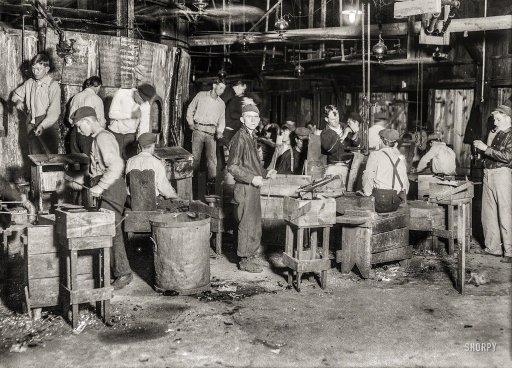
Lewis Wickes Hine Night scene in Cumberland Glass Works, Bridgeton, NJ 1909

• (There’s No) Money In The Mattress (Roberts)
• Sub-Zero Government Bonds Turn the Hunt For Yield Upside Down (BBG)
• US Sides With HSBC To Block Release Of Money Laundering Report (R.)
• Are Wall Street Banks in Trouble? You’d Never Know from the Headlines (WSoP)
• Denmark Faces ‘Out of Control’ Housing Market in Negative Spiral (BBG)
• Fracklog in Biggest US Oil Field May All But Disappear (BBG)
• China Continues To Produce More Steel Than The Rest Of The World Combined (BI)
• China’s Vice FinMin: We’ve Got No Reason To Devalue The Yuan (CNBC)
• Apple’s Q2 China Revenues Could Fall 20%: Baidu (CNBC)
• Pension Funds Are Underwater – And Taking Us With Them (VW)
• Once-Expanding EU Prepares To Contract For The First Time In Its History (G.)
• Earth On Track For Hottest Year Ever As Warming Speeds Up (R.)
• Fighting the Most Dangerous Animal in the World (Spiegel)


“Every time someone says, ‘There is a lot of cash on the sidelines,’ a tiny part of my soul dies.”

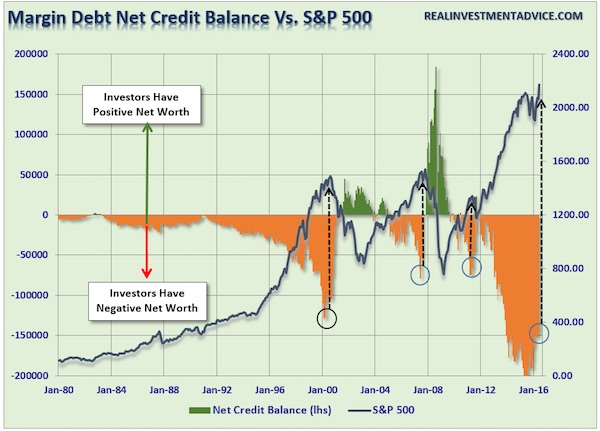
Scary graph.

• (There’s No) Money In The Mattress (Roberts)

Here is a myth that just won’t seem to die: “Cash On The Sidelines.” This is the age old excuse why the current “bull market” rally is set to continue into the indefinite future. The ongoing belief is that at any moment investors are suddenly going to empty bank accounts and pour it into the markets. However, the reality is if they haven’t done it by now after 3-consecutive rounds of Q.E. in the U.S., a 200% advance in the markets, and now global Q.E., exactly what will that catalyst be? However, Clifford Asness summed up the problem with this myth the best and is worth repeating:

“Every time someone says, ‘There is a lot of cash on the sidelines,’ a tiny part of my soul dies. There are no sidelines. Those saying this seem to envision a seller of stocks moving her money to cash and awaiting a chance to return. But they always ignore that this seller sold to somebody, who presumably moved a precisely equal amount of cash off the sidelines. If you want to save those who say this, I can think of two ways. First, they really just mean that sentiment is negative but people are waiting to buy. If sentiment turns, it won’t move any cash off the sidelines because, again, that just can’t happen, but it can mean prices will rise because more people will be trying to get off the nonexistent sidelines than on.

Second, over the long term, there really are sidelines in the sense that new shares can be created or destroyed (net issuance), and that may well be a function of investor sentiment. But even though I’ve thrown people who use this phrase a lifeline, I believe that they really do think there are sidelines. There aren’t. Like any equilibrium concept (a powerful way of thinking that is amazingly underused), there can be a sideline for any subset of investors, but someone else has to be doing the opposite. Add us all up and there are no sidelines.”

Margin debt levels, negative cash balances, also suggest the same. Cash on the sidelines? Not really.

Read more …

And there are plenty plans to ‘do more’.

• Sub-Zero Government Bonds Turn the Hunt For Yield Upside Down (BBG)

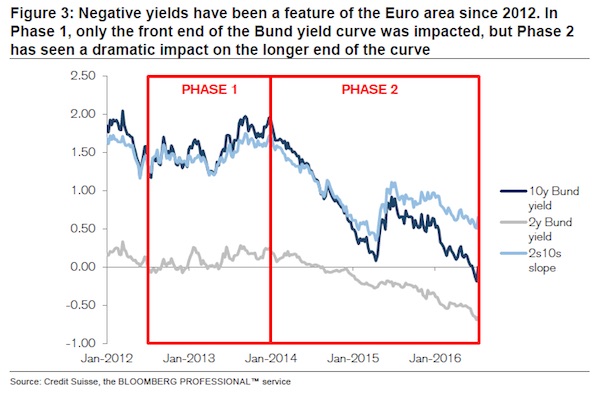
The erosion of yields on government debt is generally thought to push investors into riskier assets as they seek out higher returns. That’s true, argue Credit Suisse analysts in a new note, but only in the ‘first phase’ of a negative yield world. That is, when yields on government bonds with shorter-durations dip below zero, total returns on riskier assets such as junk-rated corporate debt do trump returns on German bunds. That tendency disappeared, however, as yields on longer-dated government debt also fell into negative territory — at least in Europe.

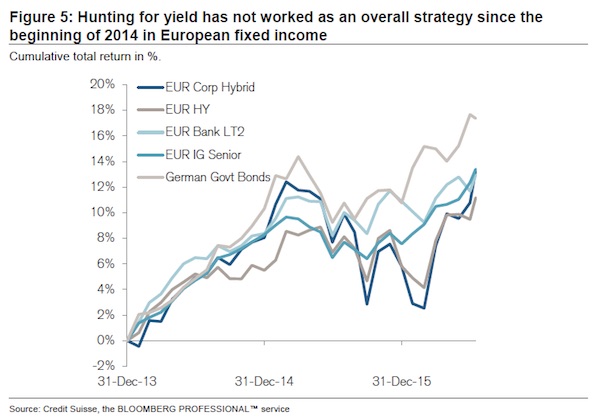
“The defining characteristic of Phase One is a strong outperformance of high-yielding credit assets versus low-yielding credit assets and government bonds, i.e. a strong hunt for yield trend. Nothing unusual so far,” write Credit Suisse’s William Porter and Chiraag Somaia. “However, more interestingly, Phase Two, still characterized by negative yields, actually sees an outperformance of government bonds versus both low- and high-yielding credit assets, i.e. any hunt for yield over the past 2.5 years as a whole has been an unsuccessful strategy.” The trend is shown in the below chart, where total returns on German government bonds have bested high-yield and investment-grade corporate debt.

“For now, we think ever-falling yields represent an overall risk aversion and/or verdict on economic policies that is not overly friendly to yieldier assets despite the obvious incentives they carry in this environment,” conclude the analysts. “So yield-hunting behavior is not always and everywhere wrong – this summer may treat it favorably – but any outperformance has subsequently been counter-trend in the past 2.5 years.”

Read more …

Quick! Find me a carpet to sweep this under!

• US Sides With HSBC To Block Release Of Money Laundering Report (R.)

The U.S. government asked a federal appeals court on Thursday to block the release of a report detailing how HSBC is working to improve its money laundering controls after the British bank was fined $1.92 billion. In a brief filed with the 2nd U.S. Circuit Court of Appeals, the U.S. Department of Justice sought to overturn an order issued earlier this year by U.S. District Judge John Gleeson to make public a report by the bank’s outside monitor. “Public disclosure of the monitor’s report, even in redacted form, would hinder the monitor’s ability to supervise HSBC,” the government’s court filing said, adding that bank employees would be less likely to cooperate with the monitor if they knew their interactions could be released.

HSBC concurred with the court’s finding. “HSBC also argues that the Monitor’s report should remain confidential, as have the Monitor, the UK Financial Conduct Authority, the US Federal Reserve and other HSBC regulators,” HSBC said in a statement. “The effectiveness of the monitorship is dependent on confidentiality.” The filing comes a week after U.S. congressional investigators criticized senior officials at the Department of Justice for overruling internal recommendations to criminally prosecute HSBC for money-laundering violations. Instead, the government in 2012 fined HSBC and entered into a five-year deferred prosecution agreement that stipulated all charges would be dropped if the bank agreed to install an independent monitor to help improve compliance. In the 2012 settlement, HSBC admitted to violating U.S. sanctions laws and failing to stop Mexican and Colombian cartels from laundering hundreds of millions of dollars in drug proceeds through the bank.

Read more …

Martens & Martens. Strong.

• Are Wall Street Banks in Trouble? You’d Never Know from the Headlines (WSoP)

On July 14, when America’s biggest bank by assets reported its second quarter earnings, this headline ran at the New York Times: “JPMorgan Chase Has Strong Quarter as Earnings Top Estimates.” CNBC, a unit of NBCUniversal, used the same criteria in its headlines to report the earnings of Citigroup, Bank of America and Morgan Stanley — putting a positive spin in the headline because the earnings had topped what analysts were expecting – rather than the far more meaningful, and traditional, measure of whether earnings had beaten the same quarter a year earlier. CNBC’s headlines read: Citigroup earnings handily top Wall Street expectations: CNBC-July 15, 2016 Bank of America earnings top expectations: CNBC-July 18, 2016 Morgan Stanley solidly beats earnings expectations: CNBC-July 20, 2016.

This is hubris of the highest order. Publicly traded companies simply guide research analysts toward lowered expectations on their upcoming quarterly earnings so that the companies can surprise on the upside and get these kinds of misleading headlines in the all-to-willing New York media – which has a vested interest in making everything appear rosy in the Big Apple. (New York media is dependent on fat Wall Street profits to boost the price of their own publicly traded shares since ad revenue in New York is linked to the health of Wall Street.) One would never know by these headlines that big bank earnings were actually down year over year – and in some cases, down dramatically. JPMorgan Chase earned $6.2 billion in the second quarter of 2016 versus $6.29 billion in the second quarter of 2015.

The news was far worse at Citigroup, despite the rosy headline at CNBC. Citigroup’s second quarter profit fell 17.5% year over year, to $4 billion from $4.85 billion in the second quarter of 2015. Its revenues were the lowest in 14 years according to S&P Capital IQ. At Bank of America, profit fell to $4.23 billion from $5.3 billion in the second quarter of 2015, a sharp decline of 20%. Morgan Stanley reported a year over year decline of 8%, with profits in the second quarter of 2016 falling to $1.67 billion from $1.82 billion in the second quarter of 2015. Now news of jobs cuts is spilling out with the Wall Street Journal reporting that Bank of America will make “$5 billion in annual cost cuts by 2018 as part of its strategy to deal with persistently low interest rates that are eating away at lenders’ profitability.”

The New York Post is calling job cuts at Goldman Sachs the worst since the financial crisis in 2008. Fortune’s Stephen Gandel reported two days ago that Goldman had slashed a whopping “1,700 positions in the past three months.” Something else one won’t find in those smiley-face headlines is the fact that Wall Street is not only bleeding profits and jobs but it’s also bleeding equity capital – the only thing that separates the word “bank” from the word “bankruptcy.” While the Dow Jones Industrial Average and Standard and Poor’s 500 Indices may be setting new highs, the big Wall Street banks are decidedly not.

Over the past 52 weeks, Goldman is down from a share price of $214.61 to an open this morning of $162.55 – a decline of 24%. Bank of America is off 22% from its 52-week high, based on today’s open. Morgan Stanley and Citigroup are in decidedly worse shape with declines of 28% and 27%, respectively, from their 52 week highs versus their share price at the open of the New York Stock Exchange this morning. Add this all up and you’re talking about tens of billions of dollars in equity capital vaporizing.

Read more …

Denmark is in the same position as dozens of other countries: “..there’s a real risk that housing prices can see a dramatic fall, even though we’re not seeing a bubble in the classical definition of the term..”

• Denmark Faces ‘Out of Control’ Housing Market in Negative Spiral (BBG)

Denmark’s biggest mortgage bank is warning there’s a risk the housing market may get “out of control,” especially around cities, as long-term negative interest rates make borrowers complacent. “To be concrete, there is a danger that Danes go blind to the risk of rates ever rising again,” Tore Stramer, chief analyst at Nykredit in Copenhagen, said in an e-mail. “That raises the risk of a major housing price decline, when rates at some point or other start to rise again.” Denmark’s central bank has had negative interest rates for the better part of four years. Thomas F. Borgen, CEO of Danske Bank, says his managers are operating under the assumption that rates won’t go positive until “at least” 2018, with Britain’s departure from the EU adding to the risk of an even longer period below zero.

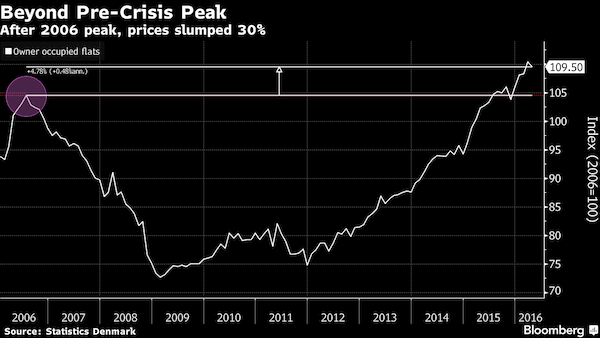
With no other country on the planet having experienced negative rates longer than Denmark, the distortions the policy is wreaking may provide a preview of what other economies face should they go down a similar path. Danes can get short-term mortgages at negative interest rates, and pay less to borrow for 30 years than the U.S. government. Apartment prices in Denmark are now about 5% above their 2006 peak. Back then, the country’s bubble burst and apartment prices slumped about 30% through 2009. “It’s worth remembering that there’s a real risk that housing prices can see a dramatic fall, even though we’re not seeing a bubble in the classical definition of the term,” Stramer said. Denmark’s negative rates are a product of the central bank’s policy of defending the krone’s peg to the euro. Its main rate was minus 0.75% for most of last year, though the bank raised it by 10 basis points in January in an effort to normalize policy.

Read more …

Reality kicks in. What’s going to happen to the lenders who made it all possible?

• Fracklog in Biggest US Oil Field May All But Disappear (BBG)

The number of dormant crude and natural gas wells in the U.S. stopped growing in the first quarter – and may all but disappear in the nation’s biggest oil field should prices hold steady. As of April 1, there were 4,230 wells left idle after being drilled, a figure little changed from January, according to an analysis by Bloomberg Intelligence. While some explorers have continued to grow their fracklog of drilled but not yet hydraulically fractured wells, others began tapping them in February as oil prices rose, the report showed.

Crude in the $40- to $50-a-barrel range may wipe out most of the fracklog in Texas’s Permian Basin and as much as 70% of the inventory in its Eagle Ford play by the end of 2017, according to Bloomberg Intelligence analyst Andrew Cosgrove. While bringing them online is the cheapest way of taking advantage of higher prices, the wave of new supply also threatens to kill the fragile recovery that oil and gas markets have seen so far this year. “We think that by the end of the third quarter, beginning of the fourth quarter, the bullish catalyst of falling U.S. production will be all but gone,” Cosgrove said in an interview Thursday. “You’ll start to see U.S. production flat lining.”

Read more …

It’s the same as oil producers. In China’s steel industry, a return to reality would mean too many jobs lost to bear.

• China Continues To Produce More Steel Than The Rest Of The World Combined (BI)

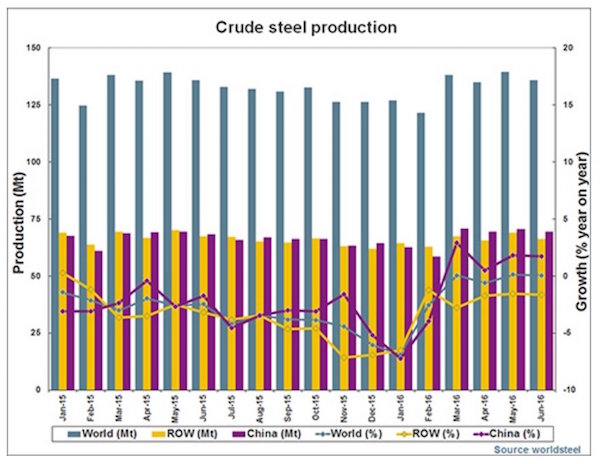
For the fourth month in a row, China produced more steel than all other nations combined in June. According to data released by the WorldSteel Association on Wednesday, a group that accounts for approximately 85% of the world’s steel production, China produced 69.5 million of crude steel in June, dwarfing production in all other nations which came in at 66.5 million tonnes. At 136 million tonnes, total global output in June was unchanged from the levels of a year earlier.

While down 1.4% on the 70.5 million tonnes produced in May, Chinese crude steel production is now 1.7% higher than the levels of June 2015, fitting with the splurge in state-backed infrastructure investment seen in recent months. Despite the recent uplift in steel production, shown in the chart below supplied by WorldSteel, global steel production came in at 794.8 million tonnes in the first half of the year, down 1.9% on the same corresponding period in 2015.

Read more …

They fix it daily, but that’s not manipulation nor devaluation…. That’s just fixing.

• China’s Vice FinMin: We’ve Got No Reason To Devalue The Yuan (CNBC)

China has no reason to devalue the yuan, as economic fundamentals remained strong, with growth at 6.7% in the first half, the country’s Vice Finance Minister Zhu Guangyao told CNBC. Zhu’s comments came shortly before Republican presidential candidate Donald Trump lambasted China again, this time for what he said was “devastating currency manipulation. [..] “The yuan has been trading around five-year lows recently, as concerns over the state of the economy fueled capital outflows. Investors have also expressed concerns over the level of debt built up in the economy. China suffered almost $700 billion worth of capital flight in 2015. The surge in outflows late in 2015 sparked market concerns that China’s foreign reserves weren’t sufficient to stabilize the currency by buying yuan over the long term.

Meanwhile, the greenback has strengthened against most major currencies as investors reacted to negative interest rates in Japan and Europe, as well as the possibility the Federal Reserve would continue on its rate-hiking path. On Friday the dollar/yuan traded at 6.6683 on-shore and 6.6754 off-shore. China fixes its currency against the dollar every day. In August, China shifted the market mechanism for setting the daily fix, saying it would set the spot rate based on the previous day’s close, theoretically allowing market forces to play a greater role in its direction. That resulted in an effective 2% devaluation in the currency, a move that sparked fears of a “currency war” to make Chinese exports more competitive.

Read more …

What’s that going to do to the share price?

• Apple’s Q2 China Revenues Could Fall 20%: Baidu (CNBC)

Apple’s revenues in China could be down 20% in China in its quarterly earnings report, according to research by Baidu, the so-called “Chinese Google.” As part of its online suite of products Baidu offers mapping software and a search platform. It has about a 70 to 80% market share in search in China and logs billions of location requests on Baidu Maps. Using this so called “big data” from the use of its map and search products, which is all anonymized, Baidu said it could predict employment and consumer trends and their impact on a company’s revenues. It used these tools on Apple’s retail sales in China, selecting a list of flagship Apple stores in mainland China and the counting the volume of map queries of all the stores.

Baidu found that in the last quarter of 2015, map query volumes were up 15.4% year-on-year, which corresponded with a 14% rise in Apple’s China revenue in that same period. But in the first quarter of 2016, map queries declined 24.5% year-on-year, which was parallel with a 26% decline in Apple’s China revenue. “The impressively strong correlation indicates that map query data provides possibilities for us to ‘nowcast’ the company’s revenues and reveal the future trends. Based on our analysis of latest data, we project that the Apple’s revenue in China of second quarter of 2016 may be down around 20% on a year-over-year basis,” Baidu concluded. The “second-quarter” that Baidu references is Apple’s fiscal third-quarter and will be announced on July 26.

Read more …

Pensions. A word your children will know only from history books.

• Pension Funds Are Underwater – And Taking Us With Them (VW)

The California Public Employees’ Retirement System (CalPERS) has announced its worst performance in seven years. Its meager rate of return for the fiscal year ending June 30 just managed to squeak by .6%, not even beating our current meager rate of inflation. After two successive years of tepid returns, long-term fund averages have sunk far below the critical 7.5% benchmark. It’s bad news for California taxpayers, because if returns don’t soon show a long-term average of 7.5%, they’ll be the ones who will have to make up the difference. Ted Eliopoulos, the fund’s chief investment officer, admits the massive pension fund’s long-term returns are well below anticipated levels, telling the Los Angeles Times, “We’re moving into a much more challenging, low-return environment.”

Yeah. Average returns are now barely over seven% for a twenty-year period, and returns over ten and fifteen years now average less than 6%. These changes are not just a blip on the investment horizon, as we assume bond yields and stock dividends will improve. According to the Milliman pension consulting firm, many public pension funds have had to adjust their expectations to accommodate lower returns overall. CalPERS needs to adjust its own expectations accordingly, even though doing so would drive up costs for state and local government agencies covered by the big pension firm. “We quite clearly have a lower return expectation than we had just two years ago,” Eliopoulos said. “That will be reflected in our next cycle. We are cognizant that this is a challenging environment for institutional investors.”

Thus, while the Times reports this dismal turn of events as a new development, it’s apparent Eliopoulos and CalPERS have been struggling for a while. What’s more, financial observers have been voicing concerns about pension fund depletion for at least as long as bond yields and stock dividends have been anemic. [..] The bad news is: If you’re a California public employee, you’re going to take a hit. But even if you’re not a public employee, but merely a California taxpayer, you’ll also take a hit. In addition, while private employee pension funds don’t pose the same financial risk to non-participants, their members run a similar risk; after all, they’re toiling in the same universe of stocks and bonds.

Read more …

The Guardian gets the headline right, but shows no understanding of what it means.

• Once-Expanding EU Prepares To Contract For The First Time In Its History (G.)

Johannes Hahn’s job title sounds a little incongruous these days: he’s the EU commissioner for European neighbourhood policy and enlargement negotiations. The job title was created in the late 1990s during a period of optimism and expansion. But now, thanks to the will of 52% of British voters, the EU looks set to contract rather than enlarge for the first time in its history. There are still six candidate countries for EU membership, in the process of making formal applications to join the bloc, as well as a number of other countries with various levels of association. But with many in the EU wary and sceptical of further expansion, the only enlargement negotiations going on at the moment are about managing the expectations of countries that want to join.

Hahn was in Kiev last week, meeting Ukrainian government officials and chairing ministerial meetings of the EU’s Eastern Partnership, a programme linking the EU with six former Soviet countries, which was launched as a response to the Russian war with Georgia in 2008 and was implicitly meant as the first step towards EU membership for the nations. “Don’t believe that the unfortunate decision of Brexit will have any influence on our relationship – quite the opposite,” he told a meeting of the group’s foreign ministers.

But in reality, the initial Eastern Partnership plans are in tatters, as both enlargement fatigue inside the EU and a stick-carrot combination from Russia has pushed a number of the countries away from wanting further integration with the EU. Two of them, Belarus and Armenia, have joined Russia’s Eurasian Economic Union, an explicit challenge to the EU, while nobody seriously speaks about Ukraine or Georgia as members any more.

Read more …

Surprise? What surprise?

• Earth On Track For Hottest Year Ever As Warming Speeds Up (R.)

The earth is on track for its hottest year on record and warming at a faster rate than expected, the World Meteorological Organization (WMO) said on Thursday. Temperatures recorded mainly in the northern hemisphere in the first six months of the year, coupled with an early and fast Arctic sea ice melt and “new highs” in heat-trapping carbon dioxide levels, point to quickening climate change, it said. June marked the 14th straight month of record heat, the United Nations agency said. It called for speedy implementation of a global pact reached in Paris last December to limit climate change by shifting from fossil fuels to green energy by 2100.

“What we’ve seen so far for the first six months of 2016 is really quite alarming,” David Carlson, director of the WMO’s Climate Research Program, told a news briefing. “This year suggests that the planet can warm up faster than we expected in a much shorter time… We don’t have as much time as we thought.” The average temperature in the first six months of 2016 was 1.3° Celsius (2.4° Fahrenheit) warmer than the pre-industrial era of the late 19th Century, according to space agency NASA. [..] “There’s almost no plausible scenario at this point that is going to get us anything other than an extraordinary year in terms of ice (melt), CO2, temperature – all the things that we track,” Carlson said. “If we got this much surprise this year, how many more surprises are ahead of us?”

Read more …

Hard to gauge what’s going to happen with this.

• Fighting the Most Dangerous Animal in the World (Spiegel)

[..] Aedes aegypti presents a threat to some 4 billion people across the globe. The world long approached the Aedes agypti plague as though it were a storm that would soon blow over, but it has now become a fixture in large cities in the tropics. If nothing is done, experts say, more and more people will die as a result. And it has also become clear that some of the tropical diseases carried by this insect are coming to Europe. Partly, that is the result of rising temperatures on the European continent. In the southwestern German city of Freiburg, for example, scientists have determined that a population of Aedes mosquitoes survived the German winter for the first time. It used to be that only those who traveled to the tropics were at risk of becoming infected with tropical illnesses.

But now, many in Europe must face the prospect of the tropics coming to them. It was images from Brazil that sent a jolt of fear around the world at the beginning of this year. Across the country, babies were suddenly being born with heads that were misshapen and too small. When indications mounted that this curious increase in cases of so-called microcephaly was connected to the Zika epidemic that had stormed across Brazil in the previous months, the WHO declared an international emergency. Brazil mobilized 220,000 soldiers for the battle, sending them through bathrooms, yards and garages to eliminate standing water where female Aedes mosquitoes lay their eggs. But the campaign did little to reduce the threat. In the first four months of this year, officials registered 100,000 additional cases thought to be Zika.

In addition, almost a million people were infected with dengue fever, more than ever before in such a short span of time. There is no vaccine against the Zika virus and there is no medicine that can prevent people from becoming infected. In March, medical researchers said that Zika can also be transmitted via sexual intercourse and, as if that weren’t enough, 151 health experts wrote an open letter in May demanding that the Olympic Games – set to kick off in Rio in two weeks – be postponed or moved. Taking the risk of holding the games as planned, they said, would be irresponsible. The city is expecting a half-million visitors. If only a tiny fraction of them become infected by the virus, these games – intended to crown Brazil’s climb to economic power status – could mark the beginnings of a catastrophe.

Read more …

May 032016
 
 May 3, 2016  Posted by at 9:14 am Finance Tagged with: , , , , , , , , , , ,  1 Response »


DPC French Market, New Orleans 1910

• The EU Exists Only To Become A Superstate (Lawson)
• US Dollar Falls To 1-Year Low (BBG)
• Yen Under Pressure to Extend World-Beating Rally Against Dollar (BBG)
• Kuroda Kollapse Kontinues As USDJPY Nears 105 Handle (ZH)
• BOJ Chief Kuroda Warns Current Yen Strength Risks Harming Recovery (BBG)
• China Factory Activity Contracts for 14th Straight Month In April (CNBC)
• Fed’s Williams Sees Big Drop In Asset Prices As Systemic Risk (R.)
• Apple’s Losing Streak Is Nearing Historic Levels (BBG)
• No Alternative To Low Rates For Now, Draghi Says (R.)
• ECB Report Says Investors May Be Profiting From Leaked US Data (FT)
• Six Counterpoints About Australian Public Debt (Stanford)
• ‘Bank of Mum and Dad’ Behind 25% Of British Mortgages (G.)
• Dominoes: Vanishing Arctic Ice Shifts Jet Stream, Which Melts Glaciers (WaPo)
• Germany Wants To Extend Border Controls For Another 6 Months (AP)
• Denmark Extends Controls On German Border (EN)
• EU States Face Charge For Refusing Refugees (FT)
• 90,000 Unaccompanied Minors Sought Asylum In EU In 2015 (R.)

I don’t think I have much in common with Nigel Lawson -aka Lord Lawson of Blaby-, but it’s important that this ‘little fact’ be known and exposed. Even a superstate needs values if it is to survive. The EU ain’t got any left. Who wants to belong to that?

• The EU Exists Only To Become A Superstate (Lawson)

For Britain, the issue in the coming European referendum is not Europe, with its great history, incomparable culture, and diverse peoples, but the European Union. To confuse the two is both geographically and historically obtuse. European civilisation existed long before the coming of the EU, and will continue long after this episode in Europe’s history is, hopefully, over. On the European mainland it has always been well understood that the whole purpose of European integration was political, and that economic integration was simply a means to a political end. In Britain, and perhaps also in the US, that has been much less well understood, particularly within the business community, who sometimes find it hard to grasp that politics can trump economics. The fact that the objective has always been political does not mean that it is in any way disreputable.

Indeed, the most compelling original objective was highly commendable. It was, bluntly, to eliminate the threat to Europe and the wider world from a recrudescence of German militarism, by placing the German tiger in a European cage. Whether or not membership of the EU has had much to do with it, that objective has been achieved: there is no longer a threat from German militarism. But in the background there has always been another political objective behind European economic integration, one which is now firmly in the foreground. That is the creation of a federal European superstate, a United States of Europe. Despite the resonance of the phrase, not one of the conditions that contributed to making a success of the United States of America exists in the case of the EU. But that is what the EU is all about. That is its sole raison d’être. And, unlike the first objective, it is profoundly misguided.

For the United Kingdom to remain in the EU would be particularly perverse, since not even our political elites wish to see this country absorbed into a United States of Europe. To be part of a political project whose objective we emphatically do not share cannot possibly make sense. It is true that our present Prime Minister argues that he has secured a British “opt-out” from the political union, but this is completely meaningless. “But,” comes the inevitable question, “what is your alternative to membership of the EU?” A more absurd question it would be hard to envisage. The alternative to being in the EU is not being in the EU. And it may come as a shock to the little Europeans that most of the world is not in the EU – and that most of these countries are doing better economically than most of the EU.

Read more …

Why don’t I see nobody accuse the US of currency manipulation?! That still the Shanghi Accord legacy?

• US Dollar Falls To 1-Year Low (BBG)

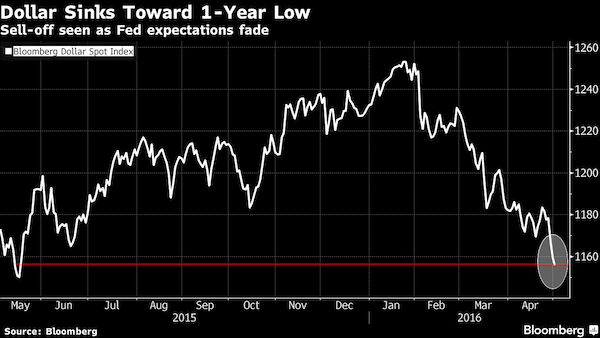
The dollar fell to an 18-month low against the yen and touched its weakest since August versus the euro amid speculation that the U.S. won’t raise interest rates any time soon. The U.S. currency has lost ground versus most major peers over the past month as traders lowered expectations for a rate increase by the Federal Reserve in June to 12%. The Bloomberg Dollar Spot Index headed for the lowest close in almost a year, after a report showed manufacturing in the U.S. expanded less than forecast. Persistent weakness dragged the dollar down against the euro for a third straight month in April – its longest losing streak since 2013 – amid signs U.S. policy makers aren’t convinced the global and domestic economies can withstand higher borrowing costs.

It fell on Tuesday against Australia’s currency as Chinese equities climbed by the most in nearly three weeks. The U.S. has posted disappointing growth data as nascent signs of recovery emerge in Europe and China’s growth momentum accelerates. “The Fed is completely out of the picture now for the next few weeks – even with the June meeting, there’s got to be a lot of doubt about whether the Fed can raise rates,” said Shaun Osborne at Bank of Nova Scotia in Toronto. “The dollar has just not done particularly well over the past few weeks as the Fed has moved toward delaying rate hikes, and that’s a situation that definitely will continue, certainly for the near term.”

Read more …

Abe must be going nuts.

• Yen Under Pressure to Extend World-Beating Rally Against Dollar (BBG)

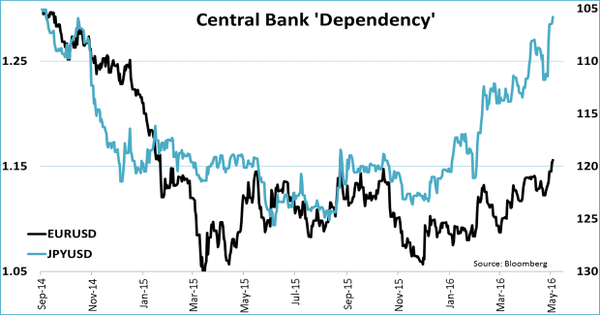
The yen’s world-beating rally against the dollar looks to be gathering momentum, as central bank inaction on both sides of the Pacific Ocean leaves inflation expectations to drive the exchange rate. Japan’s currency extended its climb to an 18-month high Monday after Bank of Japan Governor Haruhiko Kuroda refrained from adding to stimulus on Thursday. That took its gain this year to 13%, the most among developed-market peers. The BOJ’s decision came just hours after Federal Reserve Chair Janet Yellen frustrated dollar bulls by reiterating she’s in no rush to cool the economy by raising interest rates. JPMorgan sees further yen gains after the U.S. put Japan on a new currency watch list.

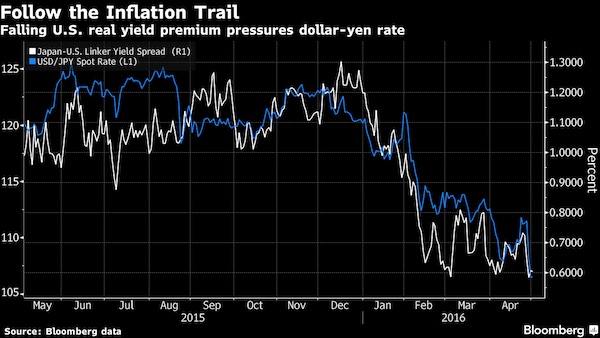
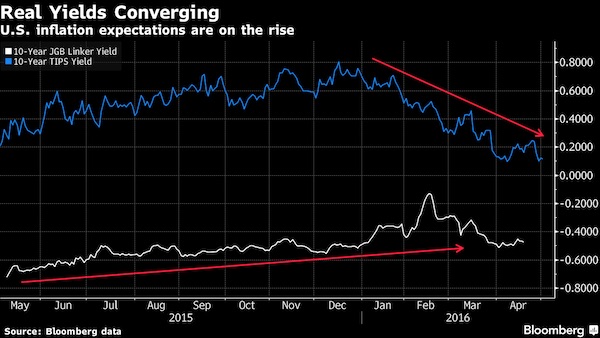
With consumer price pressures building in the U.S. and dissipating in Japan, that narrows the gap in so-called real yields – the returns an investor can expect after accounting for inflation – supporting yen strength. If both central banks stay on the sidelines, Credit Suisse projects Japan’s currency could rapidly appreciate toward 90 per dollar. “So long as the Fed signals that they are being cautious in raising rates, real yields in the U.S. will decline, leading the dollar weaker,” said Hiromichi Shirakawa, the Swiss lender’s chief Japan economist and a former BOJ official. “The currency market is in a rather dangerous zone.” The BOJ’s benchmark for measuring progress toward its 2% target showed prices retreated at an annual 0.3% pace in March, the biggest decline since April 2013, the month that Kuroda initiated his stimulus program.

It had previously hovered near zero for more than a year. By contrast, the Fed’s preferred measure of inflation, based on the prices of goods and services consumers buy, rose 0.8% in the year through March. The so-called core measure, which strips out food and energy prices, climbed 1.6%. That’s seen a Treasury market gauge of inflation expectations over the coming decade – called the break-even rate – jump to 1.7% from as low as 1.2% in February. The equivalent measure in Japan is languishing at 0.3%. Benchmark 10-year Treasury Inflation Protected Securities yield around 0.1%, compared with about minus 0.5% for equivalent Japanese notes.

Japan met two of three criteria used to judge unfair practices in the U.S. report: a trade surplus with the U.S. above $20 billion, and a current-account surplus amounting to more than 3% of gross-domestic product. The third would be a repeated depreciation of the currency by buying foreign assets equivalent to 2% of gross domestic over a year. Meeting all three would trigger action by the U.S. president to enter discussions with the country and seek potential penalties. China, Germany, South Korea and Taiwan also made the watch list.

Read more …

“..Perhaps Jack Lew’s “currency manipulation” report was enough to stall the Japanese currency war for now?..”

• Kuroda Kollapse Kontinues As USDJPY Nears 105 Handle (ZH)

Either The BoJ steps in soon and intervenes (even by just “checking levels”) or Kuroda-san is truly terrified of The G-20. USDJPY has now crashed 7 handles since last Thursday’s shock BoJ disappointment crashing to within 5 pips of a 105 handle tonight for the first time in 18 months…


Erasing the entire devaluation post-Fed, post QQE2…


Perhaps Jack Lew’s “currency manipulation” report was enough to stall the Japanese currency war for now? Or is China greatly rotating its Yuan devaluation pressure against another member of its basket…?


Charts: Bloomberg

Read more …

1) What recovery? 2) Abe and Kuroda are powerless prisoners to America’s dollar manipulation

• BOJ Chief Kuroda Warns Current Yen Strength Risks Harming Recovery (BBG)

Bank of Japan Governor Haruhiko Kuroda warned that the yen’s biggest rally since Abenomics began risks harming the nation’s economic recovery. Speaking to reporters in Frankfurt Monday, Kuroda also reiterated that BOJ policy makers won’t hesitate to expand monetary stimulus in order to achieve their 2% inflation target. Japanese Prime Minister Shinzo Abe said the same day in Paris that rapid movements in exchange rates are undesirable, according to national broadcaster NHK. “There is a risk that the yen’s current appreciation brings an unwelcome impact on the economy,” Kuroda said on the sidelines of an annual gathering of finance chiefs from members of the Asian Development Bank, which he used to lead.

“We will be closely monitoring the impact of financial markets on the real economy and prices.” A weaker currency has been a linchpin of Abe’s program to stoke growth and exit deflation. Japan’s economy is at risk of sliding into its second recession in two years after contracting in the final three months of 2015, while inflation remains far from the BOJ’s target. One gauge showed consumer prices retreated at an annual 0.3% pace in March, the biggest decline since April 2013, the month that Kuroda initiated his stimulus program. The yen has climbed 13% against the dollar this year, the best performance among its developed-market peers. That has chipped away at the 36% decline over the previous four years, which was triggered by Abe’s pledge of unlimited monetary easy to correct yen strength.

Kuroda and his board left policy settings unchanged at a meeting Thursday, spurring a nearly 5%, two-day surge in the yen against the dollar. It reached an 18-month high of 106.05 per greenback on Tuesday, before trading at 106.19 as of 9:54 a.m. in Singapore. Japanese markets are closed for holidays Tuesday, Wednesday and Thursday this week.

Read more …

Beyond salvation.

• China Factory Activity Contracts for 14th Straight Month In April (CNBC)

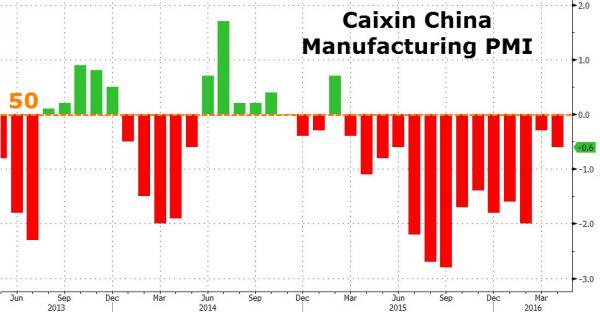
Activity in China’s manufacturing sector unexpectedly declined further in April, a private survey showed Tuesday, reviving doubts over the health of the world’s second-largest economy. The Caixin Manufacturing Purchasing Managers’ Index (PMI) fell to 49.4 in April from 49.7 in March, according to Markit, which compiles the index. A reading above 50 indicates expansion; one below indicates contraction. The Caixin PMI, which focuses on smaller and medium-sized enterprises, was last in expansionary territory in February 2015. The official PMI, which targets larger companies, printed at 50.2 in April, the second successive month of expansion, figures released over the weekend showed. The survey findings follow recent economic data that appeared to suggest that China’s economy was slowly regaining its poise after a torrid 12 months.

China’s exports rose at their fastest clip in a year in March, while industrial profits also picked up in the first quarter. A flurry of rate cuts and easing of reserve requirement have helped bolster sentiment, while the capital outflows that had unnerved sentiment at the start of the year have slowed. The Caixin survey, however, cast a more somber picture. Respondents reported stagnant new orders, while new export work fell for a fifth month running. Companies shed staff as client demand was muted. “The fluctuations indicate the economy lacks a solid foundation for recovery and is still in the process of bottoming out. The government needs to keep a close watch on the risk of a further economic downturn,” said He Fan at Caixin Insight Group.

Read more …

What blows up must blow down.

• Fed’s Williams Sees Big Drop In Asset Prices As Systemic Risk (R.)

San Francisco Fed President John Williams reiterated Monday his view that the U.S. economy is ready for higher interest rates, but flagged the risk of broad-based declines in asset prices as a result. “It makes sense for us to be moving interest rates gradually back to more a normal level over the next couple years,” Williams said. “I actually think that’s a sign of strength for the global economy.” Speaking at a panel on systemic risk at the Milken Institute Global Conference, Williams said the biggest systemic financial risk currently is the possibility that “broad sets of assets are going to see big movements downward” as interest rates rise. “That’s an area that I think is a potential risk.” Williams did not suggest he sees another crisis brewing, adding that U.S. regulators have made “amazing” progress in shoring up banks against potential future failure.

“What I worry a lot more about is when people forget about the financial crisis, when they forget about the terrible things that happened,” he said, suggesting that may not happen for another five or ten years. The Fed raised interest rates for the first time in nearly a decade last December, but has held off raising them any further amid global stock volatility and worries over a decline in global growth. Even after the Fed resumes raising rates, Williams said, it will not be able to lift them as high as it has in the past. Most Fed officials currently think that the rate at which the economy can sustain healthy employment and steady prices has probably fallen to about 3.25% in the long run, a full %age point lower than was the case before the crisis. But there are significant downside risks to that estimate, Williams said.

Read more …

No. 1 US stock for years.

• Apple’s Losing Streak Is Nearing Historic Levels (BBG)

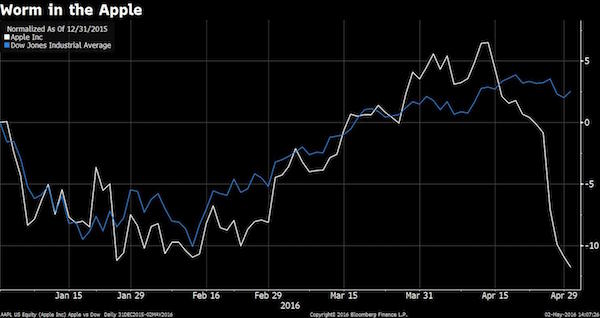
So far in 2016, Apple is the dog of the Dow. After an underwhelming earnings report led to the shares’ worst week since January 2013, Apple stock extended its losses to kick off May, closing down 0.18% on Monday. The benchmark index’s laggard has declined by nearly 11% so far this year heading into today’s session: Bespoke Investment Group notes that Monday’s negative close marks eight straight sessions in the red for Apple—something that last happened in July 1998, and has now happened only four times in the company’s history. More than $79 billion in Apple’s market capitalization has been erased over the past eight sessions.

The company’s heavy weighting in major sector and benchmark indexes, coupled with the stock’s terrible two-week stretch, has made $4 billion in assets of exchange-traded funds evaporate over this stretch. “Smart beta” ETFs are poised to trounce their more popular peers, Bloomberg’s Eric Balchunas observes, in the event that this span of underperformance continues. There’s a possible silver lining for Apple bulls, and investors who own those market-cap-weighted ETFs: The stock tends to bounce back in earnest following these rare stretches of rotten performance. “Two of the three eight-day streaks saw the stock fall on day nine as well, but the stock has never experienced a losing streak longer than nine trading days,” Bespoke writes. “While the next day and next week returns following eight-day losing streaks lean negative, the stock has been higher over the next month all three times for a median gain of 8.01%.”

Read more …

Well, there is, but Draghi’s masters don’t want it.

• No Alternative To Low Rates For Now, Draghi Says (R.)

Low interest rates are not harmless but they are only the symptom, not the cause of an underlying problem across major economies, ECB President Mario Draghi said on Monday, arguing that there was no alternative for now. “Thus the second part of the answer to raising rates of return is clear: continued expansionary policies until excess slack in the economy has been reduced and inflation dynamics are sustainably consistent again with price stability,” Draghi told a conference. “There is simply no alternative to this today.” “The only potential margin for maneuver is in the composition of the policy mix, that is, the balance of monetary and fiscal policy,” he added.

Read more …

Corruption is not a deficiency, it’s the MO.

• ECB Report Says Investors May Be Profiting From Leaked US Data (FT)

US investors may be profiting from leaked economic data releases that allow them to front-run market-moving news, according to a research paper published by the ECB. Macroeconomic news announcements can move markets, as traders watch for indications about how the economy is performing. The data are released to everyone at the same time to ensure fairness but ECB researchers said they had found evidence of “informed trading” ahead of US data releases. Of the 21 market-moving announcements analysed, seven “show evidence of substantial informed trading before the official release time”, according to the paper, including two releases from the US government. The pre-release “price drift” accounts for about half of the overall price impact from the announcement.

The researchers looked at the impact on futures tracking the S&P 500 stock index and the 10-year Treasury bond for the 30 minutes preceding the announcement. The researchers also note that the price impact has become worse since 2008, and estimate that since 2008 profits in the S&P “e-mini” futures market alone amount to about $20m per year. “These results imply that some traders have private information about macroeconomic fundamentals,” said the report. “The evidence suggests that the pre-announcement drift likely comes from a combination of information leakage and superior forecasting based on proprietary data collection and reprocessing of public information.”

The paper raises questions about the safeguards used to ensure data are protected up until scheduled release time. Important economic indicators in the US are subject to the “Principle Federal Economic Indicator” guidelines, but the report notes that many distributors of the data are not subject to the same rules. “To ensure fairness, no market participant should have access to this information until the official release time,” the report added. “Yet, in this paper we find strong evidence of informed trading before several key macroeconomic news announcements.”

Read more …

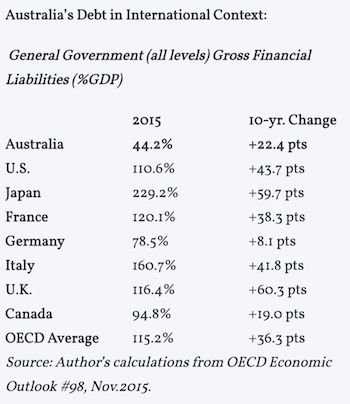
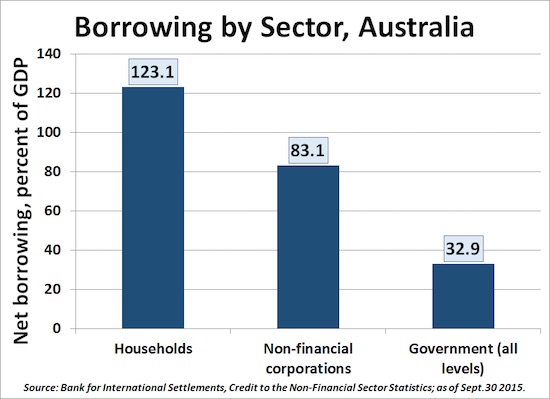
Household debt is a much bigger factor is some countries than others. In Australia, it’s far bigger than government debt. But the latter is what all political talk is about. “Pumping up fear of government debt is always an essential step in preparing the public to accept cutbacks in essential public services.”

• Six Counterpoints About Australian Public Debt (Stanford)

In the lead-up to today’s pre-election Commonwealth budget, much has been written about the need to quickly eliminate the government’s deficit, and reduce its accumulated debt. The standard shibboleths are invoked liberally: government must face hard truths and learn to live within its means; government must balance its budget (just like households do); debt-raters will punish us for our profligacy; and more. Pumping up fear of government debt is always an essential step in preparing the public to accept cutbacks in essential public services. And with Australians heading to the polls, the tough-love imagery serves another function: instilling fear that a change in government, at such a fragile time, would threaten the “stability” of Australia’s economy.

However, this well-worn line of rhetoric will fit uncomfortably for the Coalition government, given its indecisive and contradictory approach to fiscal policy while in office. The deficit has gotten bigger, not smaller, on their watch, despite the destructive and unnecessary cutbacks in public services imposed in their first budget. Their response to Australia’s fiscal and economic problems has consisted mostly of floating one half-formed trial balloon after another (from raising the GST to transferring income tax powers to the states to cutting corporate taxes), with no systematic analysis or framework. And their ideological desire to invoke a phony debt “crisis” as an excuse for ratcheting down spending will conflict with another, more immediate priority: throwing around new money (or at least announcements of new money), especially in marginal electorates, in hopes of buying their way back into office.

In short, the politics of debt and deficits will be both intense and complicated in the coming weeks. To help innoculate Australians against this hysteria, here are six important facts about public debt, what it is – and what it isn’t.

1. Australia’s public debt is relatively small

3. Other sectors of society borrow much more than government

Read more …

Somone should explain to these people what’s going on. Mum and Dad will lose their shirts AND their skirts. Ironically, some insist more homes must be build. Ironoc, because that would mean even steeper losses for those buying into today’s craze.

• ‘Bank of Mum and Dad’ Behind 25% Of British Mortgages (G.)

The “Bank of Mum and Dad” will help finance 25% of UK mortgage transactions this year, according to research. Parents are set to lend their children £5bn to help them on to the property ladder. If the lending power was of all these parents was combined, it would be a top 10 mortgage provider. Nigel Wilson, chief executive of Legal & General, which carried out the research, said the data showed a number of issues, including house prices being “out of sync with wages”. The research estimated that the Bank of Mum and Dad will provide deposits for more than 300,000 mortgages. The homes purchased will be worth £77bn and the average contribution is £17,500 or 7% of the average purchase price.

But relying on parental support might soon be unsustainable as parents could be giving away more than they can afford. Wilson said that in London the funding method was reaching “tipping point” already as parental contributions made up more than 50% of the wealth (excluding property) of the average household in the capital. He said: “The Bank of Mum and Dad plays a vital role in helping young people to take their early steps on to the housing ladder.” Not all young people have parents who can afford to help them and some who do still do not have enough to buy a place of their own, he said. He added: “We need to fix the housing market by revolutionising the supply side – if we build more houses, demand can be met at a sensible level and prices will stabilise relative to wages.”

Read more …

Positive feedback.

• Dominoes: Vanishing Arctic Ice Shifts Jet Stream, Which Melts Glaciers (WaPo)

Investigating the factors affecting ice melt in Greenland — one of the most rapidly changing places on Earth — is a major priority for climate scientists. And new research is revealing that there are a more complex set of variables affecting the ice sheet than experts had imagined. A recent set of scientific papers have proposed a critical connection between sharp declines in Arctic sea ice and changes in the atmosphere, which they say are not only affecting ice melt in Greenland, but also weather patterns all over the North Atlantic. The new studies center on an atmospheric phenomenon known as “blocking” — this is when high pressure systems remain stationary in one place for long periods of time (days or even weeks), causing weather conditions to stay relatively stable for as long as the block remains in place.

They can occur when there’s a change or disturbance in the jet stream, causing the flow of air in the atmosphere to form a kind of eddy, said Jennifer Francis, a research professor and climate expert at Rutgers University. Blocking events over Greenland are particularly interesting to climate scientists because of their potential to drive temperatures up and increase melting on the ice sheet. “When they do happen, and they kind of set up in just the right spot, they bring a lot of warm, moist air from the North Atlantic up over Greenland, and that helps contribute to increased cloudiness and warming of the surface,” Francis said. “When that happens, especially in the summer, we tend to see these melt events occur.” Now, two new studies have suggested that there’s been a recent increase in the frequency of melt-triggering blocking events over Greenland — and that it’s likely been fueled by climate change-driven losses of Arctic sea ice.

A paper set to be published Monday in the International Journal of Climatology reveals an uptick in the frequency of these blocking events over Greenland since the 1980s. A team of researchers led by the University of Sheffield’s Edward Hanna used a global meteorological dataset relying on historical records to measure the frequency and strength of high pressure systems over Greenland all the way back to the year 1851. Previous analyses had only extended the record back to 1948, so the new study is able to place recent blocking events in a much larger historical context. When the researchers analyzed the data, they found that the increase in blocking frequency over the past 30 years is particularly pronounced in the summer, the time of year when blocking events are likely to have the biggest impact on ice melt.

Read more …

Clueless, rudderless, valueless.

• Germany Wants To Extend Border Controls For Another 6 Months (AP)

Germany and some other EU countries are planning to ask the European Commission for an extension of border controls within the Schengen passport-free travel zone for another six months because they fear a new wave of migrants. Interior Minister Thomas de Maizere’s spokesman says a letter is being sent Monday asking for an extension of the controls on the German-Austrian border, which were implemented last year when thousands of migrants crossed into Germany daily. De Maizere has expressed concern before that an increasing number of migrants will try to reach Europe this summer by crossing the Mediterranean Sea from lawless Libya to Italy, then travel north to Austria and Germany. Germany registered nearly 1.1 million new arrivals last year and is keen to bring the numbers down in 2016.

Germany’s defense minister, meanwhile, said it was up to Italy to protect its borders but other European countries must be ready to help if needed. Ursula von der Leyen’s comments Monday touched on the potential problems Italy could have with increased arrival of migrants looking for an alternative route into the EU now that the West Balkans route is closed and Turkey has committed to taking back those arriving illegally to Greece. She said a solution must be found “together with Italy.” Austria plans to impose border controls at its main border crossing with Italy to prevent potential attempts by migrants to enter, and with Austria bordering Germany, von der Leyen’s comments indicate her country’s concern that it also may have to deal with new waves of migrants seeking entry.

Read more …

“..We have to protect ourselves against the Islamic State group..”

• Denmark Extends Controls On German Border (EN)

Denmark has extended temporary controls on its border with Germany, first imposed in January to help regulate an influx of migrants. The measures have been prolonged by another month until the beginning of June. The European Commission, struggling to prevent the collapse of the Schengen agreement, has confirmed it will soon authorise more such extensions. The Danish government says it has joined several countries in writing to the Commission asking for a two-year extension. “Together with the Germans, the French, the Austrians and the Swedes I have today sent a letter to the EU commission asking for the possibility to extend the border control for the next two years,” said Inger Støjberg, Danish minister of immigration and integration.

“I have done so because we need to look out for Denmark. We have to protect ourselves against the Islamic State group, who are trying to take advantage of the situation where there are holes in borders. But also as protection against the influx of refugees coming through Europe.” The Commission could give the green light as early as Wednesday to countries within the passport-free Schengen zone wishing to extend exceptional border controls. The five countries have taken the measures because of the influx of migrants and refugees heading north via the so-called Balkans route after entering Europe via the Greek shores. Although the crisis has eased, the governments say many migrants are still camped along the route and in Greece.

Read more …

The cattle trade continues unabated. Europeans are as immoral as their leadership.

• EU States Face Charge For Refusing Refugees (FT)

European countries that refuse to share the burden of high immigration will face a financial charge of about €250,000 per refugee, according to Brussels’ plans to overhaul the bloc’s asylum rules. The punitive financial pay-off clause is one of the most contentious parts of the European Commission’s proposed revision of the so-called Dublin asylum regulation, due to be revealed on Wednesday. It represents the EU’s most concerted attempt to salvage an asylum system that collapsed under the weight of a million-strong migration to Europe last year, endangering the principle of passport-free travel in the Schengen area. In recent weeks migrant flows to Greece have fallen due to tighter controls through the western Balkans and a deal with Turkey to send-back asylum seekers arriving on Greek islands.

However, the EU remains as politically divided as ever over strengthening the bloc’s asylum rules. While acknowledging these political constraints, the commission’s reforms aim to gradually shift more responsibility away from the overwhelmed frontline states, such as Greece, in future crises, primarily through an automatic system to share refugees across Europe if a country faces a sudden influx. Crucially, this is backed by a clause that allows immigration-wary countries to pay a fee — set at a deliberately high level — if they want to avoid taking relocated asylum seekers for a temporary period. According to four people familiar with the proposal, this contribution was set at €250,000 per asylum seeker in Monday’s commission draft. But those involved in the talks say it may well be adjusted in deliberations over coming days.

“The size of the contribution may change but the idea is to make it appear like a sanction,” said one official who has seen the proposal. Another diplomat said in any event the price of refusing to host a refugee would be “hundreds of thousands of euros”. Eastern European states such as Poland and Hungary would welcome alternatives to mandatory asylum quotas but will balk at the high penalties suggested. At the commission’s recommended rate, Poland would need to pay around €1.5bn to avoid its existing 6,200 quota to relocate refugees from Italy and Greece. These financial contributions are in part designed to fix incentives around migrant quotas, which have badly failed and proved almost impossible to implement even once agreed in law. The commission proposal builds on the EU’s flagship emergency scheme to relocate 160,000 refugees, which has barely redistributed 1% of its target since it was agreed last year.

Read more …

And how many did you say are unaccounted for, Europe?

• 90,000 Unaccompanied Minors Sought Asylum In EU In 2015 (R.)

Some 88,300 unaccompanied minors sought asylum in the EU in 2015, 13% of them children younger than 14, crossing continents without their parents to seek a place of safety, EU data showed on Monday. More than a million people fleeing war and poverty in the Middle East and Africa reached Europe last year. While that was roughly double the 2014 figure, the number of unaccompanied minors quadrupled, statistics agency Eurostat said. Minors made up about a third of the 1.26 million first-time asylum applications filed in the EU last year. EU states disagree on how to handle Europe’s worst migration crisis since World War II and anti-immigrant sentiment has grown, even in countries that traditionally have a generous approach to helping people seeking refuge.

Four in 10 unaccompanied minors applied for asylum in Sweden, where some have called for greater checks, suspicious that adults are passing themselves off as children in order to secure protection they might otherwise be denied. Eurostat’s figures refer specifically to asylum applicants “considered to be unaccompanied minors,” meaning EU states accepted the youngsters’ declared age or established it themselves through age assessment procedures. More than 90% of the minors traveling without a parent or guardian were boys and more than half of them were between 16 and 17 years old. Half were Afghans and the second largest group were Syrians, at 16% of the total. After Sweden, Germany, Hungary and Austria followed as the main destinations for unaccompanied underage asylum seekers.

Read more …

Apr 302016
 
 April 30, 2016  Posted by at 8:52 am Finance Tagged with: , , , , , , , , , ,  Comments Off on Debt Rattle April 30 2016


Byron Street haberdashery, New York 1900

• US Puts China, Japan on New Watch List for FX Practices (BBG)
• US Chides Five Economic Powers Over Policies (WSJ)
• UK Consumers Borrow At Fastest Rate In Over A Decade (R.)
• Apple Stock Suffers Worst Week Since 2013 (R.)
• Chinese Cities Dive Back Into Debt To Fuel Growth Even As Defaults Rise (R.)
• China’s Stocks, Bonds, Yuan Are a Triple Losing Bet This Month (BBG)
• Hong Kong Underwater Mortgages Jump 15-Fold in Q1 as Prices Drop (BBG)
• Derivatives Houses To Open Accounts With Federal Reserve (FT)
• Draghi Challenge Seen As Consumer Prices Fall More Than Forecast (BBG)
• Fighting Deflation With Unconventional Fiscal Policy (VoxEu)
• Oil Market Deja Vu Triggers Predictions of a Return to $30 (BBG)
• Pipelines: The Next Devastating Phase Of The Oil Bust (Forbes)
• More Tigers Poached In India So Far This Year Than In All Of 2015 (AFP)
• Small Mammal Shuts Down World’s Most Powerful Machine (NPR)
• The Full Story Behind Bloomberg’s Attempt To “Unmask” Zero Hedge (ZH)
• Turkey PM: Denying Visa-Free Travel Means Collapse Of EU Refugee Deal (DS)

Very funny. But the one country that has seen its currency gain global advantage of late is the US itself.

• US Puts China, Japan on New Watch List for FX Practices (BBG)

The U.S. put economies including China, Japan and Germany on a new currency watch list, saying their foreign-exchange practices bear close monitoring to gauge whether they provide an unfair trade advantage over America. The inaugural list also includes South Korea and Taiwan, the Treasury Department said Friday in a revamped version of its semi-annual report on the foreign-exchange policies of major U.S. trading partners. The five economies met two of the three criteria used to judge unfair practices under a February law that seeks to enforce U.S. trade interests. Meeting all three would trigger action by the president to enter discussions with the country and seek potential penalties.

The new scrutiny of some of the world’s biggest economies comes amid a bruising presidential campaign in which candidates from both the Democratic and Republican parties have questioned the merits of free trade. Republican front-runner Donald Trump has promised to declare China a currency manipulator, and the latest report may fail to appease critics in Congress who say China’s practices have cost American manufacturing jobs. “We will continue to watch this process closely to ensure that the president squarely addresses currency manipulation and stands up for the American people,” House Ways and Means Chairman Kevin Brady, a Texas Republican, said in a statement on the Treasury report. The Treasury had already been monitoring countries for evidence of currency manipulation under a 1988 law.

In the latest report, the department concluded that no major trading partner qualified as a currency manipulator; the last country it labeled as such was China, in 1994. Under the new law, Treasury officials developed three criteria to decide if countries are being unfair: an economy having a trade surplus with the U.S. above $20 billion; having a current-account surplus amounting to more than 3% of its GDP; and one that repeatedly depreciates its currency by buying foreign assets equivalent to 2% of output over the year. China, Japan, Germany and South Korea were flagged as a result of their trade and current-account surpluses, the department said. Taiwan made the list because of its current-account surplus and persistent intervention to weaken the currency, according to the Treasury. If a country meets all three criteria, it could eventually be cut off from some U.S. development financing and excluded from U.S. government contracts.

Read more …

But then again, the idea is probably that attack is the best defense…

• US Chides Five Economic Powers Over Policies (WSJ)

The Obama administration delivered a shot across the bow to Asia’s leading exporters and Germany for their economic policies and warned that a number of major economies around the globe could face intense pressure to engage in currency interventions to counter slow growth. The U.S. Treasury Department, in its semiannual currency report to Congress, called out China, Japan, South Korea, Taiwan and Germany for relying on policies it says threaten to damage the U.S. and the global economy. The countries are cited in a new name-and-shame list that can trigger sanctions against offending trade partners under fresh powers Congress granted last year to address economic policies that threaten U.S. industries.

U.S. officials are increasingly concerned other countries aren’t doing enough to boost demand at home, relying too heavily on exports to bolster growth. Counting on cheap currencies as a shortcut to boosting exports can create risks across the global economy, as nations fight to stay ahead of their competitors. Over the past two decades, for example, many U.S. officials have accused China of using an undervalued currency to bolster its manufacturing sector. A cheaper currency makes products cheaper overseas. Although China has moved to address some of those worries, tension over currency policy more broadly has heightened in recent years, amid an unprecedented era of easy-money policies, weak global growth and rising exchange-rate volatility.

The failure of many countries to overhaul their economies after the financial crisis has prompted economists to slash global growth forecasts. Amplifying those worries, a 20% surge in the dollar’s value against a basket of major currencies over the past two years has slowed U.S. growth, as American products became more expensive to international buyers. The Obama administration said in its new report that the economic and currency policies of China, Japan, Korea, Taiwan and Germany are adding to the global economy’s problems. Absent stronger efforts by those countries to boost domestic demand, “global growth has suffered and will continue to suffer,” the Treasury Department said.

Read more …

This is not good. This is very bad.

• UK Consumers Borrow At Fastest Rate In Over A Decade (R.)

British mortgage approvals fell for the first time in six months in March shortly before a new tax took effect, but consumers borrowed at the fastest rate in over a decade, Bank of England data showed. Mortgage approvals for house purchases numbered 71,357 in March, down from 73,195 in February. Analysts in a Reuters poll had forecast 74,500 mortgage approvals were made in March. British finance minister George Osborne announced in November that he would add a surcharge on the purchase of buy-to-let properties and second homes from April 1, in a move aimed to boost home ownership by first-time buyers. The news spurred an increase in buying of such properties in recent months before March’s slowdown as the deadline approached.

Net mortgage lending, which lags approvals, rose by £7.435 billion last month, the biggest increase since October 2007, before the global financial crisis hit and above all forecasts in the Reuters poll. Figures released earlier this week by the British Bankers’ Association, which are less comprehensive than those of the BoE, also showed a fall in mortgage approvals in March accompanied by a rise in mortgage lending as previously approved deals were carried out. The BoE said consumer credit grew by £1.883 billion last month, the strongest increase since March 2005 and a long way above the median forecast for an increase of £1.3 billion in the Reuters poll of economists. The rise was not a one-off: in the first quarter as a whole, consumer credit rose by an annualised 11.6%, the strongest increase since the first three months of 2015.

Read more …

The narrative: “..progress [in China] has been a let-down..”. But a 26% plunge in revenue is not just a ‘let-down’.

• Apple Stock Suffers Worst Week Since 2013 (R.)

Apple on Friday ended its worst week on the stock market since 2013 as worries festered about a slowdown in iPhone sales and after influential shareholder Carl Icahn revealed he sold his entire stake. Shares of Apple, a mainstay of many Wall Street portfolios and the largest component of the Standard & Poor’s 500 index, have dropped 11% in the past five sessions. That shrank the technology behemoth’s market capitalization by $65 billion. Confidence in the company has been shaken since posting its first-ever quarterly decline in iPhone sales and first revenue drop in 13 years on Tuesday, although Apple investors pointed to the stock’s relatively low valuation as a key reason to hold onto the stock. “If you’re going to buy Apple, you have to buy it for the long term, because the next year or two are going to be very tough,” said Michael Yoshikami, chief executive of Destination Wealth Management.

Faced with lackluster sales of smartphones in the United States, Apple has bet on China as a major new growth engine, but progress there has been a let-down. Revenue from China slumped 26% during the March quarter and its iBooks Stores and iTunes Movie service in China were shut down last week after the introduction of new regulations on online publishing. Pointing to concerns that Beijing could make it difficult for Apple to conduct business in China, long-time Apple investor Carl Icahn told CNBC on Thursday that he had sold his stake in the company he previously described as a “no brainer” and undervalued. The selloff has left Apple trading at about 11 times its expected 12-month earnings, cheap compared to its average of 17.5 over the past 10 years. S&P 500 stocks on average are trading at 17 times expected earnings.

Read more …

China is fast becoming a one-dimensional nation.

• Chinese Cities Dive Back Into Debt To Fuel Growth Even As Defaults Rise (R.)

With a nod from Beijing, China’s local governments have embarked on a massive new round of off-balance sheet debt financing, underpinning a fragile pick up in the economy but raising red flags on financial stability. The increased borrowing for an economy already swimming in debt adds to concerns about growing bubbles in certain major asset classes, such as real estate and commodities, and a bond market seeing a rise in corporate defaults. Economists say increasing public sector investment – most of it financed locally with debt – is behind improvements in China’s economy. First-quarter GDP rose at the weakest pace in seven years, but other data suggested growth was picking up in March. “With new infrastructure projects effectively all funded by debt and more consumer mortgages, the leverage problem and risks on the financial sector are rising,” Credit Suisse analysts wrote in a research report.

Local government financing vehicles (LGFVs), which Chinese cities use to circumvent official spending limits, raised at least 538 billion yuan ($83 billion) in bonds in the first quarter, up 178% from a year earlier and the highest quarterly issuance since June 2014, Everbright Securities said, quoting figures from privately held financial data provider WIND. Issuance in March alone was a monthly record of 287 billion yuan ($44.3 billion). China’s planning agency, the National Development and Reform Commission, declined to comment on the sharp rise in LGFV issuance. Most of the LGFV debt in the first quarter was made up of so-called enterprise bonds, which the NDRC oversees. Beijing had been trying to move LGFV debt on to municipal balance sheets via the 2014 creation of a municipal bond market. But policymakers retreated from this in the middle of 2015, easing borrowing restrictions as economic growth stumbled.

Consequently, LGFV issuance in the first quarter of 2016 was nearly 60% as large as the municipal bond issuance meant to replace it, up from just 37% in the fourth quarter of 2015, central clearinghouse and brokerage data shows. “In the second half of last year, the government raised the%age of project financing that can be funded with debt,” said Yang Zhao, chief China economist at Nomura in Hong Kong, helping spark the flurry of LGFV deals. “If they continue on, the debt-to-GDP ratio could actually go up quite rapidly. I don’t think the policy is sustainable, and you’ll see policymakers slow down the pace of (credit) easing in a quarter or two.”

Read more …

“..Your return is too low for your risk in China.”

• China’s Stocks, Bonds, Yuan Are a Triple Losing Bet This Month (BBG)

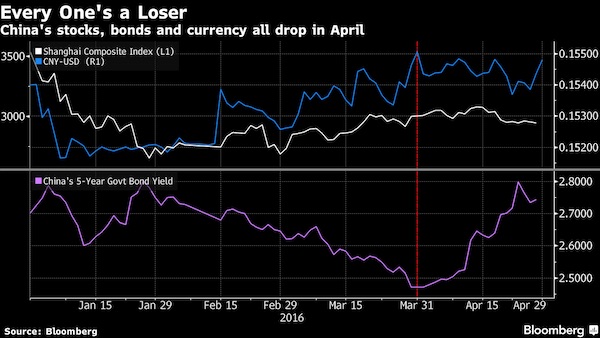
For the first time in two years, China’s stocks, bonds and currency are all a losing proposition. The Shanghai Composite dropped 2.2% in April, the yuan fell 0.6% versus the dollar, while government and corporate bonds tumbled, with the five-year sovereign yield rising 27 basis points. Even a sudden revival in the nation’s commodities markets is looking fragile after frenzied speculation prompted exchanges to take measures to cool trading. The declines mark a reversal from March, when the benchmark equities gauge jumped 12% and the yuan rallied the most since 2010 as new credit surged. Improving data from industrial output to retail sales have led traders to pare back bets for more stimulus, while rising credit defaults are fueling the biggest selloff in junk debt since the data became available in 2014.

Deutsche Bank is one bull looking to reduce holdings of Chinese stocks on bets the economy will fail to reach the government’s growth targets and yuan declines will accelerate. “Clearly there was a turn in China,” said Sean Taylor, CIO for Asia Pacific for Deutsche Bank’s wealth-management unit in Hong Kong. “You’ve seen money in the A-share market going to property and commodities. We’ve been adding risk in the last few months and coming into the summer, we will take it away and wait for opportunities to add again. We are not yet ready for China’s structural story because earnings haven’t come through.” Investor interest in the world’s second-largest equity market is waning, with turnover on the Shanghai Stock Exchange falling to levels last seen regularly in 2014 and a gauge of volatility dropping to a 12-month low. Investments in stock-market funds fell by 89 billion yuan ($13.7 billion) in April.

[..] Government bonds are coming under pressure as inflation increased to the highest since mid-2014, while corporate notes are slumping amid a spate of defaults and a surprise move by state-owned China Railway Materials to halt its bond trading this month because of what the company called “repayment issues.” “We will definitely see more defaults and difficulties for corporates in issuing new bonds,” said David Gaud at Edmond de Rothschild Asset Management in Hong Kong. “Credit costs will go up and credit spreads will widen. Your return is too low for your risk in China.”

Read more …

Small potatoes for now, but at the same time there’s nothing in sight that could reverse the trend.

• Hong Kong Underwater Mortgages Jump 15-Fold in Q1 as Prices Drop (BBG)

The number of Hong Kong homeowners with apartments worth less than their mortgages surged 15 times in the first quarter, according to the Hong Kong Monetary Authority. The number of negative-equity mortgages rose to 1,432, with a total value of HK$4.9 billion ($634 million), for the three months ended March, from 95 such home loans worth HK$418 million in the previous quarter, the city’s de facto central bank said on its website Friday.

Property prices in Hong Kong, which reached a record last year, have been sliding and sales tumbled to a 25-year low in February amid economic uncertainty. Home prices in the city slumped 13% from September to March, according to data compiled by Centaline Property Agency. The government is determined to tackle the housing problem and maintain a healthy development of the market, the city’s Rating and Valuation Department said in a report on Friday, while maintaining that it has no intention to withdraw demand-side property curbs.

Read more …

The one word that comes to mind: incestuous: “..The switch has been made possible by clearing houses’ designation as systemically-important utilities..”

• Derivatives Houses To Open Accounts With Federal Reserve (FT)

Derivatives brokers choosing where to park their margin money will now have the option of the world’s most powerful central bank. The Federal Reserve Bank of Chicago has authorised three of the US’s largest clearing houses, run by CME Group and Intercontinental Exchange, and the Options Clearing Corporation, to open an account at the central bank. ICE’s permit is for its US credit derivatives clearing house. The change at the CME applies only to house cash belonging to brokers, its executives said on a conference call on Thursday. Margin posted by their customers will continue to be walled off and held by commercial banks or in US Treasury bonds, they confirmed.

The switch has been made possible by clearing houses’ designation as systemically-important utilities, which recognised the dangers to the financial system if they failed and gave them access to the Fed’s cash in an emergency. Tougher regulation of markets means they must now handle billions of dollars of futures and swaps trades every day. Traders who use derivatives must safeguard their deals against defaults with margin and collateral. For clearing brokers whose business has been damaged by years of low interest rates, keeping cash at the Fed could yield better returns. New market rules also authorised a regional Fed bank to maintain an account for designated clearing houses and pay earnings on any balance, as it already does for US banks subject to Fed oversight.

“When effective, we expect to pass a higher rate to clearing members for their house positions than we do today,” John Pietrowicz, CME’s chief financial officer, told analysts. Mr Pietrowicz said the accounts would open in the “next month or so”. While the majority of the returns would be passed back to clearing members, CME would also be able to “earn more” as cash balances increased. CME applied for access to a Fed account in 2014, a spokeswoman said, and would direct funds into an omnibus account for collateral and settlement services. The derivatives industry and its regulator have argued in recent years that tougher banking laws have hurt the brokerage business by making clearing uneconomical. “The resulting industry consolidation would increase systemic risk by concentrating derivatives clearing activities in fewer clearing member banks,” Walt Lukken, chief executive of the FIA industry association, testified to a US House agriculture subcommittee on Thursday.

Read more …

It might be best to ignore these numbers. Whatever BBG’s economist panel predicts is always wrong. Growth numbers are always manipulated. One good thing to take away is that consumer prices do not equal inflation.

• Draghi Challenge Seen As Consumer Prices Fall More Than Forecast (BBG)

Mario Draghi’s policy challenge was highlighted once again on Friday, with the fastest economic growth in a year overshadowed by a renewed drop in consumer prices. The euro-area inflation rate fell to minus 0.2% in April, a worse out-turn than the 0.1% decline forecast by economists in a Bloomberg survey. It wasn’t all bad news for the ECB president however, with the economy expanding 0.6% in the first quarter and unemployment declining in March to the lowest since 2011. Draghi has said the situation in the 19-nation region is slowly improving, but that hasn’t assuaged his concerns about the inflation outlook. Policy makers cut interest rates and ramped up other stimulus last month, and the ECB president has signaled he’s willing to do even more to revive price growth. “Draghi has to be on alert – despite the solid growth momentum, inflation is not picking up,” said Michael Schubert at Commerzbank.

“The ECB will have to do more in the future, an extension of QE being most likely, but for the time being we’ll have to be patient.” Eurostat released the euro-area growth data about two weeks earlier than usual as it tries to make figures on output more timely, which could help inform the ECB’s policy-making. The new timing brings the region into line with the U.S. and U.K., which also publish first estimates within about a month of the end of the quarter. Based on the latest data, the euro area grew faster than both countries in the January-March period, with the U.K. expanding 0.4% and the U.S. by 0.5% on an annualized basis. National euro-zone data on Friday also provided some positive news, with both the French and Spanish economies expanding faster than expected. Growth in France accelerated to 0.5% from 0.3%, helped by investment and consumer spending, while Spain shrugged off a political deadlock that’s left it facing new elections to grow 0.8%.

Read more …

More economists entirely clueless on the link between debt and deflation. There’s tons of them, and they’re on ‘both sides of the debate’. And it doesn’t matter one iota how many ‘equations’ from their school books they can quote. Suggesting that increasing VAT rates -in incremental steps- will make people spend more ignores the reason why they don’t spend now: debt. In fact, VAT increases will make things more expensive, and that will result in less spending, not more. That’s what Japan has been showing us for 20 years.

• Fighting Deflation With Unconventional Fiscal Policy (VoxEu)

In his Marjolin lecture on 4 February 2016, Mario Draghi asserted that “there are forces in the global economy that are conspiring to hold inflation down” (Draghi 2016). Eurostat confirmed that in February 2016 the annual inflation rate for the Eurozone was -0.2% (Eurostat 2016). On 10 March 2016, the ECB board agreed upon a set of largely unexpected monetary policy measures, with the aim of boosting inflation and growth in the Eurozone. These measures were inspired, among others, by thoughts in Bernanke (2010) and Blanchard et al. (2010).

The conundrum the Eurozone faces is finding a recipe to support inflation and ultimately consumption and economic growth in a setting in which traditional monetary policy measures are not viable, and governments cannot support growth with fiscal spending because of their large debt-to-GDP ratios. In this column, we discuss an alternative to monetary interventions, which we call unconventional fiscal policy. • Unconventional fiscal policy aims to increase growth and inflation in a budget neutral fashion, while keeping constant the tax burden on households.

Feldstein (2002) introduced the notion of unconventional fiscal policy measures at times of liquidity traps. Among several possible interventions Feldstein proposed: “A series of pre-announced increases in the value-added tax (VAT) to generate consumer price inflation, and hence increase private spending via intertemporal substitution.” In his words: “This [VAT] tax-induced inflation would give households an incentive to spend sooner rather than waiting until prices are substantially higher.” The intuition for this proposal is based on a simple logic: announcing higher prices in the future will increase current inflation expectations. Higher inflation expectations at times of fixed nominal interest rates should reduce real interest rates (Fisher equation), and lower real interest rates should increase households’ incentives to consume rather than save (Euler equation).

Because imposing higher VAT reduces households’ wealth – especially poorer households’ wealth – and might affect households’ labour supply, lower income taxes (or transfers for those households that do not pay any income tax) should accompany the increase in VAT. Designed this way, the policy measure would be budget-neutral for the government, as well as for households. It would incentivise households to consume immediately, jump-start the economy, and hence help the economy exit the slump. In his presidential address to the 2011 American Economic Association Annual Meeting, Bob Hall (2011) reiterated Feldstein’s ideas, and encouraged further research to understand the viability and effects of unconventional fiscal policy, both theoretically and empirically.

Read more …

Clueless: “..the current recovery could boost industry activity and slow the decline..”

• Oil Market Deja Vu Triggers Predictions of a Return to $30 (BBG)

Oil’s climb above $45 a barrel is reassuring influential figures from BP to the IEA that the industry is finally recovering from the worst slump in a generation. Others say the market is about to fall into the same trap as last year. There’s a sense of deja vu at Commerzbank, BNP Paribas and UBS, who say crude’s gain of about 70% from a 12-year low in January resembles the recovery that took hold this time last year – only to sputter out by May as the supply glut endured. Prices will sink back towards $30 a barrel in the coming weeks, BNP and UBS warn. “There are dangerous parallels to 2015,” said Eugen Weinberg at Commerzbank. “The market already appears overheated and a correction is overdue.”

Last year, Brent crude rose 45% from January to almost $68 in May as traders anticipated a rapid decrease in U.S. output as drilling rigs were idled. The rally reversed when production kept rising, peaking at 9.61 million barrels a day in June 2015, a year after the price slump began. While drilling cutbacks eventually took their toll and the nation’s output slipped to 8.9 million barrels a day last week, the current recovery could boost industry activity and slow the decline.

Read more …

At least something’s trickling down…

• Pipelines: The Next Devastating Phase Of The Oil Bust (Forbes)

When oil and natural gas prices began their swan dive in 2014 and continued their descent in 2015, the casualties seemed obvious. Exploration and production companies would need to file for bankruptcy protection and restructure en masse. Banks that financed these companies would need to write down bad loans and noteholders that invested in their high yield debt would be left holding the bag, or at least, the equity securities of the reorganized producers. The damage would also extend to the so-called “midstream” companies that transport oil and gas from wells to processing facilities and end-users downstream. It was thought that the damage to such midstream companies would be substantial, but manageable.

However, an ongoing legal tussle in the Sabine Oil and Gas bankruptcy proceeding in New York threatens to devastate an important corner of the $500 billion midstream industry and set off a new and entirely unexpected phase of the energy crisis. The dispute started in September 2015, when Sabine filed a motion in its bankruptcy case seeking authority to reject contracts it had entered into with two separate midstream operators that provided gas gathering and other services. Rejecting contracts and walking away from pre-bankruptcy obligations is commonplace for bankrupt debtors, but in the oil and gas industry many midstream companies thought their arrangements were protected from this risk.

That is because such gathering contracts “dedicate” the relevant oil and gas mineral interests and surrounding acreage to the midstream companies, which is intended to create a property interest known as a “real covenant” that “runs with the land.” Under longstanding bankruptcy principles, conveyances of real property—and certain associated rights—are not contracts that can be “rejected.” If the midstream companies prevailed in the argument that contractual dedications could create real covenants, then if a producer filed for bankruptcy protection or if its mineral rights were transferred to a new owner, the midstream company would retain its exclusive property right to gather oil and gas produced from the land and receive a fee for such services.

This argument seemed a strong one. However, after examining the applicable Texas property law at issue, on March 8, 2016, Judge Chapman issued a non-binding bench ruling holding that the legal requirements for treating these arrangements as real property interests were not satisfied and that they could be invalidated in bankruptcy through the contract rejection process. This ruling rocked the midstream world. It also came when similar attempts to reject gathering agreements were underway in the Quicksilver Resources and Magnum Hunter Resources bankruptcy cases in Delaware, leading to a sense that the midstream industry was under assault.

Read more …

We’re fast losing the conditions that gave us life. But we lack the intelligence to understand this. Which makes it only fitting. If you’re not smart enough to survive, then you won’t.

• More Tigers Poached In India So Far This Year Than In All Of 2015 (AFP)

More tigers have been killed in India already this year than in the whole of 2015, a census showed Friday, raising doubts about the country’s anti-poaching efforts. The Wildlife Protection Society of India, a conservation charity, said 28 of the endangered beasts had been poached by April 26, three more than last year. Tiger meat and bones are used in traditional Chinese medicine and fetch high prices. “The stats are worrying indeed,” said Tito Joseph, programme manager at the group. “Poaching can only be stopped when we have coordinated, intelligence-led enforcement operations, because citizens of many countries are involved in illegal wildlife trade. It’s a transnational organised crime.”

Poachers use guns, poison and even steel traps and electrocution to kill their prey. India is home to more than half of the world’s tiger population with 2,226 in its reserves according to the last count in 2014. The figures come after a report by the WWF and the Global Tiger Forum said the number of wild tigers in the world had increased for the first time in more than a century to an estimated 3,890. The report cited improved conservation efforts, although its authors cautioned that the rise could be partly attributed to improved data gathering.

Read more …

“Nor are the problems exclusive to the LHC: In 2006, raccoons conducted a “coordinated” attack on a particle accelerator in Illinois. It is unclear whether the animals are trying to stop humanity from unlocking the secrets of the universe. Of course, small mammals cause problems in all sorts of organizations. Yesterday, a group of children took National Public Radio off the air for over a minute before engineers could restore the broadcast.”

• Small Mammal Shuts Down World’s Most Powerful Machine (NPR)

A small mammal has sabotaged the world’s most powerful scientific instrument. The Large Hadron Collider, a 17-mile superconducting machine designed to smash protons together at close to the speed of light, went offline overnight. Engineers investigating the mishap found the charred remains of a furry creature near a gnawed-through power cable. “We had electrical problems, and we are pretty sure this was caused by a small animal,” says Arnaud Marsollier, head of press for CERN, the organization that runs the $7 billion particle collider in Switzerland. Although they had not conducted a thorough analysis of the remains, Marsollier says they believe the creature was “a weasel, probably.” (Update: An official briefing document from CERN indicates the creature may have been a marten.)

The shutdown comes as the LHC was preparing to collect new data on the Higgs Boson, a fundamental particle it discovered in 2012. The Higgs is believed to endow other particles with mass, and it is considered to be a cornerstone of the modern theory of particle physics. Researchers have seen some hints in recent data that other, yet-undiscovered particles might also be generated inside the LHC. If those other particles exist, they could revolutionize researcher’s understanding of everything from the laws of gravity, to quantum mechanics. Unfortunately, Marsollier says, scientists will have to wait while workers bring the machine back online. Repairs will take a few days, but getting the machine fully ready to smash might take another week or two. “It may be mid-May,” he says.

These sorts of mishaps are not unheard of, says Marsollier. The LHC is located outside of Geneva. “We are in the countryside, and of course we have wild animals everywhere.” There have been previous incidents, including one in 2009, when a bird is believed to have dropped a baguette onto critical electrical systems. Nor are the problems exclusive to the LHC: In 2006, raccoons conducted a “coordinated” attack on a particle accelerator in Illinois. It is unclear whether the animals are trying to stop humanity from unlocking the secrets of the universe. Of course, small mammals cause problems in all sorts of organizations. Yesterday, a group of children took National Public Radio off the air for over a minute before engineers could restore the broadcast.

Read more …

Though they have every right to defend themselves, something makes me wish Tyler Durden had counted to 10 before writing this. They could have limited it to: “Zero Hedge admits to having hired an unstable writer”, and left it at that. That’s all the Bloomberg attempt at smut warrants. As is, Zero Hedge poebably killed the secrecy as much as Bloomberg did.

• The Full Story Behind Bloomberg’s Attempt To “Unmask” Zero Hedge (ZH)

Over the years, Zero Hedge has proven to be a magnet for media attention. It started years ago with a NY Magazine article published in September 2009 which first “unmasked” the people behind Zero Hedge with the “The Dow Zero Insurgency: The nothing-can-be-believed chaos of the financial crisis created a golden opportunity for a blog run by a mysterious ex-hedge-funder with a dodgy past and conspiracy theories to burn” in which we were presented as a bunch of “conspiracy theory” tin foil hat paranoid loons. We are ok with being typecast as “conspiracy theorists” as these “theories” tend to become “conspiracy fact” months to years later.

Others, such as “academics who defend Wall Street to reap rewards” had taken on a different approach, accusing the website of being a “Russian information operation”, supporting pro-Russian interests, which allegedly involved KGB and even Putin ties, simply because we refused to follow the pro-US script. We are certainly ok with being the object of other’s conspiracy theories, in this case completely false ones since we have never been in contact with anyone in Russia, or the US, or any government for that matter. We have also never accepted a dollar of outside funding from either public or private organization – we have prided ourselves in our financial independence because we have been profitable since inception. Which brings us to the latest “outing” of Zero Hedge, this time from none other than Bloomberg which this morning leads with “Unmasking the Men Behind Zero Hedge, Wall Street’s Renegade Blog” in which it makes the tacit admission that “Bloomberg LP competes with Zero Hedge in providing financial news and information.”

To an extent we were surprised, because while much of the “information” Bloomberg claims it reveals could have been discovered by anyone with a cursory 30 second google search, this time the accusation lobbed at Zero Hedge by Bloomberg was a new one: that we are capitalists who seek to generate profits and who have expectations from our employees. This comes from a media organization which caters to Wall Street and is run by one of the wealthiest people in the world. Underlying the entire Bloomberg article is disclosure based on a former employee at Zero Hedge. Traditionally we don’t reply to such media stories but in this case we’ll make an exception as there is a substantial amount of information Bloomberg has purposefully failed to add.

Read more …

Brussels will never be able to push through visa-free travel for nearly 80 million Turks. It’s simply not going to happen, not in a democratic way. Greece should be very afraid.

• Turkey PM: Denying Visa-Free Travel Means Collapse Of EU Refugee Deal (DS)

Prime Minister Ahmet Davutoglu said on Thursday evening that there are disappointments and the EU has un-kept promises in recent Turkish-EU relations and that Turkey will stop implementing the recent readmission agreement if the EU does not keep its word and grant visa-free travel to Turkish citizens. Speaking to a group of journalist who accompanied his visit to Qatar on Thursday, Davutoglu said that Turkey is successfully implementing the EU-Turkey deal from March 18 and that the deal has ended illegal migration to Europe.

“Last October there were 6,800 illegal migrants passing over to Europe from Turkey every day. This figure went down to 3,000 in January after we started to implement the terms of the November deal with EU. We made a game changing move with the March 18 deal and this figure is now about 25 per day. Moreover, in April there have been some days on which no migrant passed to Europe,” Davutoglu said, and asked: “Have you heard about the death of a migrant in the Aegean Sea since April 4?” Asserting that Turkey will fulfill all EU criteria for visa-free travel on Monday, Davutoglu said that Ankara will stop implementing the readmission agreement if the EU does not grant visa-free travel.

“These two issues are linked to each other and are part of the deal with the EU. This is a test for everyone. We think that we have passed our test,” Davutoglu said, and added that it is now time for the EU to fulfill its obligations. “[The EU] promised to invest €1 billion for refuges until end of July. We will see whether they keep their promise or not. We have experienced disappointment in the past. We will react negatively if these experiences reoccur,” Davutoglu said, adding that in 2004 the EU had promised to lift restrictions on Turkish Cypriots if they vote for the Annan Plan, but it did not keep its promise afterward.

Read more …

Apr 272016
 
 April 27, 2016  Posted by at 9:16 am Finance Tagged with: , , , , , , , , , ,  1 Response »


G. G. Bain Navy dirigible, Long Island 1915

• Apple Just Wiped Out $40 Billion In Value (BI)
• Rotten Apple: Stock Plunges 8% On Earnings, Revenue Miss (CNBC)
• Apple China Sales Drop 26% (CNBC)
• Alarm Over Corporate America’s Debt And Stalled Earnings (Authers)
• Weak US Factory, Consumer Confidence Data Cloud Growth Outlook (R.)
• Once Bustling Trade Ports in Asia and Europe Lose Steam (WSJ)
• Exxon Mobil Downgrade Leaves Just Two AAA-Rated Companies In The US (MW)
• China Ratings Downgrade Wave Seen as Next Driver of Bond Slump (BBG)
• China’s Commodity Frenzy Spurs New Crackdown From Exchanges (BBG)
• Eurogroup Meeting Cancelled, Tsipras To Ask For Special EU Summit (Kath.)
• Greece Faces New IMF Curve Ball to Unlock Aid (BBG)
• Moody’s Downgrades Canadian Province Of Alberta On Rising Debt (R.)
• From Germany To The US, Authorities Want Access To Panama Papers (DW)
• ‘Largest Ever Airlift’ Flies 33 Circus Lions To Africa Sanctuary (AP)
• How Less Stuff Could Make Us Happier – And Fix Stagnation (G.)
• Europe’s Failure On Refugees Echoes The Moral Collapse Of The 1930s (G.)

A lot of people and funds are long Apple, and own sizable chunks of it.

• Apple Just Wiped Out $40 Billion In Value (BI)

Apple’s disappointing earnings report on Tuesday sent the stock down more than 7% in after-hours trading. That’s a lot for any company, but particularly dramatic for Apple, which is the most valuable in the world. Before the market closed today, Apple’s market cap was $578 billion. That means a 7% drop erases more than $40 billion worth of value. But the bad news doesn’t end there. Shares of some of Apple’s suppliers are also down, with Bloomberg reporting that Cirrus Logic has lost more than 8%. By way of comparison, Alphabet’s market cap is around $485 billion. How long until it passes the leader?

Read more …

Peak Apple is now in the rearview mirror.

• Rotten Apple: Stock Plunges 8% On Earnings, Revenue Miss (CNBC)

Apple reported quarterly earnings and revenue that missed analysts’ estimates on Tuesday, and its guidance for the current quarter also fell shy of expectations. The tech giant said it saw fiscal second-quarter earnings of $1.90 per diluted share on $50.56 billion in revenue. Wall Street expected Apple to report earnings of about $2 a share on $51.97 billion in revenue, according to a consensus estimate from Thomson Reuters. That revenue figure was a roughly 13% decline against $58.01 billion in the comparable year-ago period — representing the first year-over-year quarterly sales drop since 2003. Shares in the company fell more than 8% in after-hours trading, erasing more than $46 billion in market cap.

That after-hours loss is greater than the market cap of 391 of the S&P 500 companies. Importantly, the company announced a 10% dividend increase and a $50 billion increase to its capital return program. Under that new plan, Apple expects to spend a total of $250 billion of cash by the end of March 2018, it said. On the dividend, Apple said its board had declared a dividend of $.57 per share, payable on May 12, 2016 to shareholders of record as of the close of business on May 9. A key reason for the declining revenue was Apple’s year-over-year decrease in iPhone sales. Despite this, Apple CEO Tim Cook told CNBC Tuesday that the company is in “the early innings of the iPhone.”

In fact, Apple beat Wall Street’s estimates on iPhone shipments, reporting 51.19 million for the quarter. Analysts had expected 50.3 million, according to StreetAccount. Still, that iPhone unit count was a 16% decline from the 61.17 million shipped during the same period last year. For his part, however, Cook described the iPhone business as “healthy and strong” on the call. In fact, Cook said the company added more switchers from Android and other platforms in the first half of the year than in any other six month period ever.

Read more …

Tim Cook is spinning. Reality says the next great gadget is long overdue; the iPhone is a Jobs idea, the iWatch a failure, and what has Apple done for you lately?

• Apple China Sales Drop 26% (CNBC)

Apple’s sales in China tumbled in the second quarter after currency headwinds hurt Hong Kong sales, the company said in Tuesday’s earnings. “The vast majority of the weakness sits in Hong Kong,” Apple CEO Tim Cook told analysts in an earnings call. “The Hong Kong dollar being pegged to the U.S. dollar, and therefore it carries the burden of strength of U.S. dollar. And that has driven tourism, trade and international shopping down significantly compared to what it was in the year ago.” The company reported quarterly earnings and revenue that missed analysts’ expectations, with revenue declining year-over-year in every region. But China saw the biggest share of declines: Greater China sales, once the tech giant’s fastest growing market, fell to $12.49 billion in the second quarter, the company said, a 26% year-over-year decline.

Excluding Hong Kong and Taiwan, mainland China saw sales decline 11% on a reported basis, and 7% on a constant currency basis, Cook said. But people need to look under the numbers, Cook said, as LTE adoption increases and more Apple stores open in the region. “When I look at the larger picture, I think China is not weak as is talked about,” Cook said. “I see China as … a lot more stable than what I think is the common view of it. We remain really optimistic about China.” Chief financial officer Luca Maestri said the business in China was “better than the numbers might suggest.” “We had significant inventory channel reductions and currency weakness which affected our reported revenue,” Maestri said in an earnings call.

“Keep in mind that we were up against an extremely difficult year-ago compare when our mainland China revenue grew 81%. We remain very optimistic about the China market over the long-term, and we are committed to investing there for the long run.” But speaking in January, Cook warned that the company had seen “some signs of economic softness” in the Greater China region. That business segment, which includes mainland China, Taiwan and Hong Kong, is a key area of growth for the U.S. tech giant, but Cook acknowledged in January that it had been something of a “turbulent environment.” China has seen its pace of economic expansion slowing in recent quarters, and its stock markets have taken investors on a roller coaster ride during that time.

Read more …

Buybacks are fizzling out. They’re too expensive an option to continue propping up shares.

• Alarm Over Corporate America’s Debt And Stalled Earnings (Authers)

Corporate America is swimming in cash. There is no great news about this, and no great mystery about where it came from. Seven years of historically low interest rates will prompt companies to borrow. A new development, however, is that investors are starting to ask in more detail what companies are doing with their cash. And they are starting to revolt against signs of over-leverage. That over-leverage has grown most blatant in the last year, as earnings growth has petered out and, in many cases, turned negative. This has made the sharp increases in corporate debt in the post-crisis era look far harder to sustain. Perhaps the most alarming illustration of the problem compares annual changes in net debt with the annual change in earnings before interest, tax, depreciation and amortisation, which is a decent approximation for the operating cash flow from which they can expect to repay that debt. As the chart shows, debt has grown at almost 30% over the past year; the cash flow to pay it has fallen slightly.

According to Andrew Lapthorne of Société Générale, the reality is that “US corporates appear to be spending way too much (over 35% more than their gross operating cash flow, the biggest deficit in over 20 years of data) and are using debt issuance to make up the difference”. The decline in earnings and cash flows in the past year has accentuated the problem, and brought it to the top of investors’ consciousness. A further issue is the uses to which the debt has been put. As pointed out many times in the post-crisis years, it has generally not gone into capital expenditures, which might arguably be expected to boost the economy. It has instead been deployed to pay dividends, or to buy back stock — or to buy other companies. Shifts in these uses of cash are now affecting markets.

Cash-funded mergers and acquisitions are at a record. In the four quarters to the end of last September, according to Ned Davis Research, S&P 500 companies spent $376bn on acquisitions, 43% above the prior high in 2007, ahead of the credit crisis. Buyback activity remains intense. According to S&P Dow Jones, for each of the seven quarters up to the third quarter of last year, between 20% and 23% of S&P 500 companies bought back enough shares to reduce their total shares outstanding at a rate of 4% per year. In the last quarter of 2015, 25.8% of companies did so.

Read more …

“First-quarter GDP growth estimates are as low as a 0.3% rate.”

• Weak US Factory, Consumer Confidence Data Cloud Growth Outlook (R.)

Orders for long-lasting U.S. manufactured goods rebounded far less than expected in March as demand for automobiles, computers and electrical goods slumped, suggesting the downturn in the factory sector was far from over. Tuesday’s report from the Commerce Department also implied that business spending and economic growth were weak in the first quarter. Prospects for the second quarter darkened after another report showed an ebb in consumer confidence in April. The data came as Federal Reserve officials started a two-day policy meeting. The U.S. central bank is expected to leave its benchmark overnight interest rate unchanged on Wednesday. The Fed raised rates in December for the first time in nearly a decade.

“These disappointing reports will likely add to the caution at the Fed. Given the weak performance in these two key segments of the economy, we expect the rebound in growth momentum in the second quarter to be quite weak,” said Millan Mulraine, deputy chief economist at TD Securities in New York. The Commerce Department said orders for durable goods, items ranging from toasters to aircraft meant to last three years or more, increased 0.8% last month after declining 3.1% in February. Non-defense capital goods orders excluding aircraft, a closely watched proxy for business spending plans, were unchanged after a downwardly revised 2.7% decrease in the prior month. These so-called core capital goods orders were previously reported to have decreased 2.5% in February.

Economists had forecast durable goods orders advancing 1.8% last month and core capital goods increasing 0.8%. Shipments of core capital goods – used to calculate equipment spending in the gross domestic product report – rose 0.3% after slumping 1.8% in February. Manufacturing, which accounts for 12% of the U.S. economy, is struggling with the lingering effects of the dollar’s past surge and sluggish overseas demand. [..] The durable goods report added to recent reports on retail sales, trade and industrial production in suggesting economic growth slowed further in the first quarter. The economy grew at an anemic 1.4% annualized rate in the fourth quarter. First-quarter GDP growth estimates are as low as a 0.3% rate. The government will publish its advance first-quarter GDP growth estimate on Thursday.

Read more …

It’ll take a long time for people to acknowledge that globalization, centralization, global trade, are declining and are in essence over, since they are shrinking. And shrinkage=death in our system.

• Once Bustling Trade Ports in Asia and Europe Lose Steam (WSJ)

At a logistics park bordering Shanghai’s port last month, the only goods stored in a three-story warehouse were high-end jeans, T-shirts and jackets imported from the U.K. and Hong Kong, most of which had sat there for nearly two years. Business at the 108,000-square-foot floor warehouse dwindled at the end of 2015 after several Chinese wine importers pulled out, said Yang Ying, the warehouse keeper, leaving lots of empty space. The final blow came after a merchant turned away a shipment in December at the dock. “The client told the ship hands, just take the wine back to France,” Ms. Yang said. “Nobody wants it.” Pain is increasing among the world’s biggest ports—from Shanghai to Hamburg—amid weaker growth in global trade and a calamitous end to a global commodities boom.

Overall trade rose just 2.8% in 2015, according to the World Trade Organization, the fourth consecutive year below 3% growth and historically weak compared with global economic expansion. The ancient business of ship-borne trade has been whipsawed, first by a boom that demanded more and bigger vessels, and more recently by an abrupt slowing. That turnabout has roiled the container-shipping industry, which transports more than 95% of the world’s goods, from clothes and shoes to car parts, electronic and handbags. It has set off a frenzy of consolidation and costs cutting across the world’s fleets. Ashore, it is also slamming ports and port operators, the linchpin to global commerce. Nowhere is the carnage more painful than along the Europe-Asia trade route, measuring roughly 28,000 miles round trip.

A cooling Chinese economy and a high-profile crackdown by Beijing on corruption has damped demand for everything from commodities like iron ore to designer scarves and shoes. Meanwhile, Europe’s still sputtering recovery from the global economic crisis is hitting the flow of goods in the other direction. On Friday, the Hong Kong Marine Department reported throughput for its port in the first quarter was off 11% from the first three months of last year. Throughput for all of 2015 also dropped 11%. “It is the first time you see people in shipping being really scared,” said Basil Karatzas, of New York-based Karatzas Marine Advisors and Co.

Read more …

Things are not well.

• Exxon Mobil Downgrade Leaves Just Two AAA-Rated Companies In The US (MW)

In a sign of deteriorating credit quality, Standard & Poor’s on Tuesday stripped oil giant Exxon Mobil of its pristine AAA rating, leaving just two U.S. non-financial companies with what is the highest possible rating on their debt. Microsoft and consumer goods giant Johnson & Johnson are now the only companies to enjoy an AAA rating, the strongest possible vote of confidence in their financial strength and discipline in meeting all of their debt obligations. As recently as 2008, there were six AAA-rated companies, but General Electric, Pfizer and Automatic Data Processing have been downgraded since then. “This shows that the corporate market is not immune from secular industry changes and deep cyclical troughs that materially impact the immediate-term credit outlook,” said Brian Gibbons at research firm CreditSights.

S&P cut Exxon’s rating by two notches to AA-plus, and said the outlook is stable, meaning it does not expect to adjust the rating in the near term. The rating agency had placed the rating on CreditWatch negative on Feb. 2, in the light of the lengthy slump in oil prices. “We believe Exxon Mobil’s credit measures will be weak for our expectations for a ‘AAA’ rating due, in part, to low commodity prices, high reinvestment requirements, and large dividend payments,” the agency wrote in a statement. Exxon has more than doubled its debt load in recent years, as it spends generously on major projects, said S&P. But the oil giant has also been rewarding its shareholders with dividend payments and share buybacks “that substantially exceeded internally generated cash flow.”

Exxon is likely to benefit from near-term production gains as some of those projects are completed, but maintaining production and replacing reserves will require more spending. “We believe the company may return cash to shareholders rather than building cash or reducing debt, limiting improvement in our projected credit measures when commodity prices improve,” said S&P. Gibbons said the two-notch downgrade is harsh, given Exxon’s status as the best-of-breed oil and gas company in the world, the strength of its balance sheet and earnings diversity through upstream and downstream businesses. “Its global reach positions it much better than any other energy peer, but it too is not immune to the depths of the cycle,” he said.

Read more …

Zombie nation.

• China Ratings Downgrade Wave Seen as Next Driver of Bond Slump (BBG)

China’s slumping onshore bond market is braced for rating cuts, as companies report weaker earnings and prepare for unprecedented debt maturities. China Securities and HFT Investment Management predict downgrades will surge as a slumping economy makes financial reports due by April 30 a gloomy read. Companies in China must repay 547 billion yuan ($86 billion) of onshore notes in May, the most in any month ever, data compiled by Bloomberg show. Investors are avoiding risky debt, with the yield premium on three-year AA- rated local bonds, considered junk in China, widening 43 basis points in April, the most since 2014. “An explosion of credit risks is spreading,” said He Qian at HFT Investment Management. “The risks are spreading from privately held companies to state-owned companies, from overcapacity industries to all other industries.”

At least seven companies missed bond payment this year, up from only two in the same period of 2015 as Premier Li Keqiang tries to rid industries with overcapacity of zombie producers. Onshore agencies have cut 33 issuer ratings, almost double the 17 for the first four months of 2015, according to China Chengxin International Credit Rating Co. There have been 34 upgrades versus 37% a year ago. “We will see a wave of rating downgrades in the middle of this year,” said Wei Zhen at Bosera Asset Management. She oversees the Bosera Anfeng 18-Month Interval Bond Fund, whose 17% return in the past year was the best among fixed-income funds tracked by research firm Howbuy. “The rising credit risks may lead to a further correction in the corporate bond market.” Chinese investors have complained onshore ratings don’t fully reflect issuers’ credit risks.

More than 50% of Chinese locally-rated AAA bonds issued by listed firms may have default risk consistent with what Bloomberg’s quantitative, independent default-risk model deems below-investment-grade companies. Shi Yuxin at HuaAn Fund Management said in a report on April 18 that China’s “inflated” ratings will be under pressure to have “substantial” downgrades in 2016 as local governments cut their support for troubled companies. About 14.9% of listed Chinese companies have forecast losses for 2015, compared with 12.7% in 2014, according to data compiled by China International Capital Corp. Ministry of Finance data released on Tuesday showed that profit at state-owned companies slid 13.8% in the first quarter from a year earlier. Investors are fleeing the bond market. The market value of assets held by 718 onshore bond funds dropped last week, accounting for 95.6% of all the fixed-income funds tracked by Shanghai-based research firm Howbuy.

Read more …

Beijing has lost the narrative.

• China’s Commodity Frenzy Spurs New Crackdown From Exchanges (BBG)

China’s commodity exchanges stepped up efforts to curb speculation in trading in everything from steel to iron ore and coking coal after prices soared amid a credit-fueled binge. Futures slumped on Wednesday. Bourses in Dalian, Shanghai and Zhengzhou have announced further measures, including higher fees and a reduction in night hours, adding to a raft of moves this month that have made it more expensive for investors to trade. Goldman Sachs said this week it was concerned about the surge in speculative trading in iron ore, adding daily volumes were so large that they sometimes exceed annual imports. Ore prices have surged 34% this year in Dalian, while steel reinforcement bar is up 39% in Shanghai.

Morgan Stanley said the spike in speculative trading had stunned global markets, citing a jump in activity for eggs, garlic and cotton as well as iron ore and steel. The explosive growth in trading has stoked concerns that the frenzy was triggered by a credit-fueled surge in liquidity echoing the stock market bubble in 2015 and is destined for a similar bust, according to Zheng Ge at CEFC Wanda Futures. China’s investors have been honing in on raw materials amid signs of a pickup in demand after policy makers talked up growth, added stimulus and the property market rebounded. Among the latest changes, the Dalian exchange raised trading fees for iron ore, coking coal and coke, while Shanghai said it would increase margin requirements for steel reinforcement bar and hot-rolled coil, and shorten trading hours.

The Zhengzhou exchange raised trading charges and margin requirements for some commodities. Iron ore futures plunged 4.1% on Wednesday, extending their decline in the past four days to 8.9%. Steel reinforcement bar lost 3.2% and coking coal slid 4.6% as prices responded to the exchange moves. “We’re trying to clampdown firmly on the trend of excessive speculation in some commodity trading,” the Dalian bourse said in a statement. “We’ll be highly vigilant and adopt further measures if necessary.”

Read more …

Does SYRIZA have any fight left? If not, Europe is going to walk all over it.

• Eurogroup Meeting Cancelled, Tsipras To Ask For Special EU Summit (Kath.)

Greece and its lenders were unable on Tuesday to reach an agreement on how to line up €3.6 billion in contingent austerity measures, leading to plans for an extra meeting of eurozone finance ministers on Thursday being dropped. A spokesman for Eurogroup President Jeroen Dijsselbloem confirmed on Tuesday night that there would be no meeting this week to rubber-stamp an agreement between Athens and the institutions and conclude the first review of the third Greek bailout program. “More time needed,” tweeted Michel Reijns. “Meeting of first review, contingency package and debt at later stage,” he added, without suggesting when eurozone finance ministers might meet to discuss Greece.

Prime Minister Alexis Tsipras is expected to call European Council President Donald Tusk today to ask for an extraordinary EU leaders’ summit to discuss the Greek program as the SYRIZA leader feels that Athens has met its bailout commitments and that the lenders’ side is standing in the way of an agreement. Greek government sources said earlier that the details of an initial €5.4 billion package of tax hikes and pension cuts had been finalized. However, the standby measures, which total 2% of GDP, proved to be a stumbling block. Athens proposed that the government should commit to adopting corrective measures if fiscal targets are missed but that these interventions should only be specified after Greece’s fiscal data has been ratified by Eurostat.

This proposal is thought to have been rejected by the IMF and some eurozone member-states, which want Greece to legislate specific measures now and have them on standby in case they are needed. Sources said that Finance Minister Euclid Tsakalotos spoke with some of his eurozone counterparts on Tuesday in order to explain the situation to them. The Greek government believes that German Finance Minister Wolfgang Schaeuble showed understanding for Greece’s position and appeared to support the Greek proposal for a permanent mechanism to reduce spending when the adjustment program is not on track. Athens is adamant that the IMF’s insistence on specific standby measures being legislated now was the only factor that prevented Greece and the institutions reaching an agreement on Tuesday.

Read more …

This battle is about contingency plans, not even actual ones, but what-ifs.

• Greece Faces New IMF Curve Ball to Unlock Aid (BBG)

Greek Prime Minister Alexis Tsipras has promised voters he’ll reject even one euro cent more of budget austerity than is needed under the country’s bailout. Greece’s international creditors say the program’s requirements may include €3.5 billion in extra fiscal tightening he hadn’t bargained for. The demand by the euro area and the IMF is a potential bombshell for the government, raising the threat of renewed instability in Greece. Tsipras rode to power in January 2015 railing against austerity and nearly steered Greece out of the euro before flip-flopping last summer to secure the nation’s third bailout in six years. Since then the Greek economy has slipped back into recession, unemployment has stayed stubbornly high at around 25% and public support for the euro has weakened.

Just like last year, Tsipras needs financial aid to avoid defaulting on payments to the ECB that come due in three months time. The prime minister’s current dilemma stems from a disagreement between the euro area and the IMF. While the European creditors say the government in Athens has committed to enough austerity to reach the targeted budget surplus before interest payments of 3.5% of gross domestic product in 2018, the IMF projects current Greek measures will produce an excess of just 1.5%. With Germany insisting on continued IMF involvement in the Greek aid program, the conflicting forecasts have led the creditors as a whole to call for “contingency measures” equal to 2% of GDP. These would kick in should the government in Athens stray off its budgetary course as the IMF projects.

So Tsipras and Finance Minister Euclid Tsakalotos face the delicate task of drawing up measures that can satisfy the creditors without breaking apart their coalition with the nationalist Independent Greeks. That balancing act would be a challenge for any Greek government, let alone one with an anti-austerity base, a deep dislike of the Washington-based IMF and a three-seat majority in parliament.

Read more …

The fastest growing economy in North America for years. Gone.

• Moody’s Downgrades Canadian Province Of Alberta On Rising Debt (R.)

Moody’s Investors Service stripped Alberta of its Aaa credit rating on Monday, becoming the latest ratings agency to downgrade the Canadian province after the oil price shock pushed its finances deep into the red. Citing its worsening fiscal position and resulting rapid rise in debt, Moody’s downgraded the province’s long-term rating to Aa1 from Aaa and maintained a negative outlook. The downgrade “reflects the province’s growing and unconstrained debt burden, extended timeframe back to balance, weakened liquidity, and risks surrounding the success of the province’s medium-term fiscal plan,” Moody’s Assistant Vice President Adam Hardi said in a statement. Earlier this month, Dominion Bond Rating Service also downgraded the province after the provincial government forecast a budget deficit of C$10.4 billion ($8.21 billion) this fiscal year.

Standard & Poor’s stripped Alberta of its AAA credit rating in December. Alberta’s left-leaning NDP government expects the once-booming province to be C$57.6 billion in debt by 2019, while Finance Minister Joe Ceci said Alberta could run deficits until 2024. Ceci described the latest downgrade as a “disappointment” and reiterated the government’s commitment to maintaining funding for public services and infrastructure spending in a bid to spur growth. The province is home to Canada’s vast oil sands and is the No. 1 exporter of crude to the United States but the government expects oil and gas revenues this year to be almost 90% lower than 2014. Earlier this month the Canadian Association of Petroleum Producers said capital investment in the industry has dropped C$50 billion in two years and more than 100,000 oil and gas workers have been laid off.

Read more …

In order to pre-empt ‘authorities’, what the journalists should do is reach out to Wikileaks and find a means to release the data after redacting them in a way that prevents people from getting hurt. The ICIJ does not seem to have that ability. They will come to regret that, because pressure will rise.

• From Germany To The US, Authorities Want Access To Panama Papers (DW)

Germany’s federal states on Friday called for increased measures against tax havens and for media outlets to allow prosecutors to examine the contents of a cache of 11.5 million documents known as the “Panama Papers,” which had been leaked to the press. “If the data sets from the ‘Panama Papers’ are not made accessible, then we cannot draw any consequences,” said Lower Saxony’s Finance Minister Peter-Jürgen Schneider, Reuters news agency reported. However, the Munich-based newspaper Süddeutsche Zeitung’s (SZ) investigative unit on Tuesday said it would not hand over the cache nor would it publish the leak online, despite calls to do so by government officials and representatives of the whistleblowing organization WikiLeaks.

“As journalists, we have to protect our source: we can’t guarantee that there is no way for someone to find out who the source is with the data. That’s why we can’t make the data public,” the team said during an “Ask Me Anything” session on Reddit, which included journalist Bastian Obermayer, who was first contacted by the anonymous source. “You don’t harm the privacy of people, who are not in the public eye. Blacking out private data is a task that would require a lifetime of work – we have eleven million documents,” the unit added. In a letter to the International Consortium of Investigative Journalists (ICIJ) obtained by British newspaper The Guardian this week, US attorney for Manhattan Preet Bharara said the Justice Department “has opened a criminal investigation regarding matters to which the Panama Papers are relevant.”

“The office would greatly appreciate an opportunity to speak as soon as possible with any ICIJ employee or representative involved in the Panama Papers project in order to discuss this matter further,” Bharara said. ICIJ Director Gerard Ryle said on Thursday that the organization would not release unpublished data to the Justice Department or other government entities, although it welcomed the “US Attorney’s Office reviewing all of the information from the Panama Papers.” “ICIJ does not intend to play a role in that investigation. Our focus is journalism … ICIJ, and its parent organization, the Center for Public Integrity, are media organizations shielded by the First Amendment and other legal protections from becoming an arm of law enforcement,” Ryle said in a statement.

Read more …

Thank you.

• ‘Largest Ever Airlift’ Flies 33 Circus Lions To Africa Sanctuary (AP)

Thirty-three lions rescued from circuses in Peru and Colombia are being flown back to their homeland to live out the rest of their lives in a private sanctuary in South Africa. The largest ever airlift of lions will take place on Friday and has been organised and paid for by Animal Defenders International. The Los Angeles-based group has for years worked with lawmakers in the two South American countries to ban the use of wild animals in circuses, where they often are held in appalling conditions. The lions suffered in captivity: some were declawed, one lost an eye and many were recovered with broken or rotting teeth.

The group said the first group of nine lions would be collected in the capital, Bogota, on a McDonnell Douglas cargo plane, which would pick up 24 more in Lima before heading to Johannesburg. From there they would be transported by land to their new home at the Emoya Big Cat Sanctuary in Limpopo province, where they would enjoy large natural enclosures. “It will be hugely satisfying to see these lions walking into the African bush,” said Tom Phillips, ADI’s vice-president, as he inspected the cages that will be used to transport the lions. “It might be one of the finest rescues I’ve ever seen; it’s never happened before taking lions from circuses in South America all the way to Africa,” he added. “It’s like a fairytale.”

Read more …

Or, more likely, we’ll bash each other’s heads in. Bit too dreamy for me.

• How Less Stuff Could Make Us Happier – And Fix Stagnation (G.)

Has western society reached “peak stuff”? If reports that once-insatiable shoppers are starting to cut back are true, what are the consequences for the old economic theory that more consumption equals greater happiness? That is a question a Bank of England blogger has posed, with interesting and upbeat conclusions. Writing on Bank Underground, a blog where Bank of England staff can challenge prevailing orthodoxies, Dan Nixon wondered if rather than shopping our way to satisfaction, a Buddhism-inspired trend of mindfulness has taught us that less is more. Inspired by its message to appreciate the moment, perhaps we can achieve greater happiness by seeking to simplify our desires, rather than satisfy them, wrote Nixon, who works in the Bank’s stakeholder communications and strategy division.

The result of less consumption but greater wellbeing could be “especially important for debates around secular stagnation and ecological sustainability”, he says. In other words, if secular stagnation is nigh and there is a permanent downward shift in the potential growth rates of advanced economies, increased attention will naturally turn to alternative ways to increase wellbeing. “‘Less is more’ ideas could form one part of the solution,” said Nixon. There are also interesting implications in the field of environmental economics, given human wellbeing and ecological sustainability are often assumed to be in conflict. “The neat thing about the less is more critique is that it achieves less consumption without constraining people’s decisions,” said the Bank blogger.

The repeated Black Friday sales frenzies that have spilled across the Atlantic from the US to the UK and the continuing fortunes of big online retailers such as Amazon may feel at odds with all the less is more talk. But the rise of mindfulness, in media coverage, schools and workplaces – including at the Bank of England – has coincided with signs that shopping may be losing its appeal as our national pastime. Ikea, purveyor of flatpacks and tealights, recently claimed the appetite of western consumers for home furnishings had reached its peak. The Swedish furniture giant’s UK crammed car parks and long hotdog queues may suggest otherwise but Ikea’s head of sustainability, Steve Howard, has spoken of “peak curtains”.

His views were followed weeks later by official figures showing the amount of “stuff” used in the UK – including food, fuel, metals and building materials – had fallen dramatically since 2001. The Office for National Statistics data revealed that on average people used 15 tonnes of material in 2001 compared with just over 10 tonnes in 2013.

Read more …

Fully in line with what I’ve often said. In a situation like this, you have to put people first, not politics, or you will create mayhem. This is a certainty. It’s too late already for Europe. The goodwill and moral high ground wasted over the past 18 months will take 100 years to regain, if ever.

• Europe’s Failure On Refugees Echoes The Moral Collapse Of The 1930s (G.)

In 1938, representatives from 32 western states gathered in the pretty resort town of Evian, southern France. Evian is now famous for its water, but back then, the delegates had something else on their minds. They were there to discuss whether to admit a growing number of Jewish refugees, fleeing persecution in Germany and Austria. After several days of negotiations, most countries, including Britain, decided to do nothing. On Monday, I was reminded of the Evian conference when British MPs voted against welcoming just 600 child refugees a year over the next half-decade. The two moments are not exactly comparable. History doesn’t necessarily repeat itself. But it does echo, and it does remind us of the consequences of ethical failure. Looking back at their inaction at Evian, delegates could claim they were unaware of what was to come.

In 2016, we no longer have that excuse. Nevertheless, both in Britain and across Europe and America, we currently seem keen to forget the lessons of the past. In Britain, many of those MPs who voted against admitting a few thousand refugees are also campaigning to unravel a mechanism – the EU – that was created, at least in part, to heal the divisions that tore apart the continent during the first and second world wars. Across Europe, leaders recently ripped up the 1951 refugee convention – a landmark document partly inspired by the failures of people such as the Evian delegates – in order to justify deporting Syrians back to Turkey, a country where most can’t work legally, despite recent legislative changes; where some have allegedly been deported back to Syria; and still more have been shot at the border.

Emboldened by this, the Italian and German governments have since joined David Cameron in calling for refugees to be sent back to Libya, a war zone where – in a startling display of cognitive dissonance – some of the same governments are also mulling a military intervention. Where many migrants work in conditions tantamount to slavery. Where three separate governments are vying for control. And where Isis runs part of the coastline.

Read more …

Jan 272016
 
 January 27, 2016  Posted by at 10:00 am Finance Tagged with: , , , , , ,  1 Response »


DPC City Market, Kansas City, Missouri 1906

• Nikkei Climbs, But Shanghai Extends Fall (CNBC)
• Why China’s Capital Flight Carnage Will Continue (Telegraph)
• A China Bank Contagion Could Blow Up Global Markets (CNBC)
• China Accuses George Soros Of ‘Declaring War’ On Yuan (AFP)
• Head Of China’s Statistics Bureau Investigated For Corruption (AFP)
• Inquiry in China Adds to Doubt Over Reliability of Economic Data (NY Times)
• Cash Is King as Europe Adapts to Negative Interest Rates (BBG)
• Europe Bank Rout Erases $434 Billion In 6 Months (BBG)
• The Market’s Troubling Message (Ashoka Mody)
• EU Botched Billion Euro Bail-Outs During Financial Crisis (Telegraph)
• World’s Biggest Wealth Fund Speaks Out on Missing Liquidity at Banks (BBG)
• Apple Reaches Peak iPhone, So What Now? (MW)
• Apple: ‘Extreme Conditions Unlike Anything We’ve Experienced Before'(BBG)
• AIG To Return $25 Billion After Activist Siege (FT)
• The Black Hole of Deflation Is Swallowing the Entire World (GWB)
• The Future is Blivets (Dmitry Orlov)
• The Agonies of Sensible People (Jim Kunstler)
• Clock Ticks Down On EU Passport Free Travel Dream (AP)
• Danish Parliament Approves Plan To Seize Assets From Refugees (Guardian)
• Belgium Wants Camp for 300,000 Refugees in Athens (DM)

Europe and oil falling.

• Nikkei Climbs, But Shanghai Extends Fall (CNBC)

Asia markets were mostly higher on Wednesday after Wall Street surged overnight on a bounce in oil prices and positive earnings news, shrugging off the recent global rout, at least temporarily. China shares were volatile, erasing most early losses in late trade. “Swinging from depressive slumps to manic rallies, markets remain volatile,” Vishnu Varathan, an analyst at Mizuho Bank, said in a note Wednesday. China’s market is likely to remain the region’s sticky wicket for hopes the long global rout will end. The Shanghai Composite was down 0.46% after tumbling as much as 4.10% earlier. That followed the index’s worst day on Tuesday since the suspension of the circuit breaker rule in early January, closing down 6.4%, hitting its lowest level since December 2014. The Shenzhen Composite dropped 0.948% after trading down as much as 5.62% earlier in the session.

Amid concerns about slowing economic growth and depreciation of the yuan, shares on the mainland got an additional bit of bad news Wednesday: China’s industrial profits fell 4.7% on-year in December, declining for a seventh month. The Shanghai Composite is down more than 20% since its most recent high of 3,651.76 on December 22, leaving it in a “bear within a bear” market. The index is off more than 47% from its 52-week high of 5,166.35, set June 2015. “Chinese markets look like they will continue to sell off until their last day of trading before Chinese New Year on February 5,” Angus Nicholson at spreadbettor IG said in a note Wednesday. “There is a good chance that Chinese equities may find their cyclical bottom in the next week and half if the current pace of selloff continues.” He expects the Shanghai Composite might eventually bottom around the 2300-2400 level.

Read more …

Self-fulfilling.

• Why China’s Capital Flight Carnage Will Continue (Telegraph)

Money has poured out of emerging market economies as fears that they will disappoint have continued to grow. This capital flight has put extreme pressure on emerging market currencies, driving speculation that more of these economies will have to capitulate, allowing marked devaluations of their currencies, or enforcing capital controls. $735bn was pulled out of emerging markets last year alone, according to the Institute of International Finance (IIF), up from $111bn in the preceding year. “The bulk of these outflows relate to China,” said the IIF, adding that money managers were taking out their money “in the face of concerns about a weakening currency”. Total capital outflows from the People’s Republic were thought to stand at $676bn last year.

The IIF said that it anticipated that capital would continue to leave emerging markets this year, but at a “more moderate pace”. Since Beijing’s botched readjustment of the yuan last August, investors have been anxious that a larger currency depreciation is on the way. As a result, they have taken their money out of the country in anticipation, increasing the demand for other currencies, at the expense of renminbi demand. The People’s Bank of China (PBoC) has had to intervene heavily, burning through reserves to keep the currency strong. “The recent flood of capital leaving China has been driven primarily by increased scepticism that the PBoC will hold to its pledge to keep the renminbi stable,” said Mark Williams at Capital Economics. Capital Economics estimated that outflows stood at $140bn in December alone, as firms may reassessing their expansion plans, and investors worry about the possibility of a further downturn.

“The PBoC has enough reserves to keep selling at December’s rate until mid-2018 but it would presumably throw in the towel before they were all exhausted,” said Mr Williams. “If investors think the PBoC may shift its stance in future, they have an incentive to sell renminbi assets now even if no policy change is currently being considered.” While the movements in Chinese stock markets are far removed from the real economy, and that economy does not seem to be melting down, high levels of capital flight could be toxic for the country. Helene Rey, an economics professor at the London Business School, told The Telegraph that there is a risk that investors overreact to recent moves, and negativity about China “becomes self-fulfilling”. “We know China has a lot of reserves, but when capital flows flow out at a quick rate this might have a lot of psychological consequences.” She suggested that a significant depreciation of China’s yuan would “probably not be good for the stability of a lot of emerging markets”.

Claudio Piron, a Bank of America Merrill Lynch strategist, said that China’s current problems were the result of its struggles with the impossible trinity, or “trilemma”. Policymakers cannot control capital flows, monetary policy and the currency all at the same time. Mr Piron said that the outflows have captured the “conflict between easing monetary conditions on one hand and contradictory attempts at foreign exchange intervention to target the yuan’s strength against the dollar on the other”. The policy uncertainty causing the outflows “may only be resolved once the market has regained confidence in China’s ability to restore a robust recovery and China’s monetary has come to an end”. Mr Piron suggested this would come in the final quarter of 2016 at the earliest.

Read more …

In China, a bank default is a government default.

• A China Bank Contagion Could Blow Up Global Markets (CNBC)

If the dark predictions are going to come true — that the market turmoil out of China will lead to “another 2008” — it will have to be a very different kind of crisis than the original. Six months after sell-offs in Shanghai began to reverberate through markets worldwide, bond-rating agencies continue to rate Chinese banks’ credit as investment grade, suggesting that if China does lead the world into recession, it will be a different affair than the sudden, sharp downturn catalyzed by the collapse of Lehman Bros. A measure of default risk used by Moody’s Investors Service puts the risk of any of the Big Four Chinese banks — Bank of China, the Industrial and Commercial Bank of China, China Construction Bank and Agricultural Bank of China — defaulting in the next year at no more than 1.5%, and for some as little as 0.5%, said Samuel Malone at Moody’s Analytics.

Even with nearly $11 trillion of assets and loans that reach into all sectors of China’s $10.3 trillion economy, for now, experts see little likelihood the banks themselves will be a problem; China’s largest banks are all controlled by a government that has the determination and resources to prop them up if necessary. And their ties to U.S. institutions are narrow enough that bond-rating agencies don’t foresee anything like the financial contagion of 2008, when liquidity problems quickly spread from bank to bank and nation to nation as the extent of the mortgage crisis became clear.

Read more …

“Declaring war on China’s currency? Ha ha”

• China Accuses George Soros Of ‘Declaring War’ On Yuan (AFP)

Chinese state media has stepped up a salvo of biting commentaries against George Soros and other currency traders as the yuan comes under pressure, with the billionaire investor accused of “declaring war” on the unit. At the annual World Economic Forum in Davos last week, Soros told Bloomberg TV that the world’s second-largest economy – where growth has already slowed to a 25-year low according to official figures – was heading for more troubles. “A hard landing is practically unavoidable,” he said. Soros – whose enormous trades are still blamed in some countries for contributing to the Asian financial crisis of 1997 – pointed to deflation and excessive debt as reasons for China’s slowdown.

The normally stable yuan, whose value is closely controlled by Beijing, has come under pressure in recent weeks and months in overseas markets and from capital outflows. Authorities have spent hundreds of billions of dollars to defend it. China’s official Xinhua news agency on Wednesday said that Soros had predicted economic troubles for China “several times in the past”. “Either the short-sellers haven’t done their homework or … they are intentionally trying to create panic to snap profits,” it said. An English-language op-ed in the nationalistic Global Times newspaper blamed “westerners” for not “accepting responsibility for the mess” in the world economy. The comments came after the overseas edition of the People’s Daily, the official mouthpiece of the Communist party, published a front-page article Tuesday titled “Declaring war on China’s currency? Ha ha” that was widely shared on Chinese social media.

Soros “publicly ‘declared war’ on China”, the paper said, citing the 85-year-old as saying that he had taken positions against Asian currencies. But some readers questioned whether the official rhetoric could fuel Chinese investors’ fears. “They say a lot of loud slogans, but do official media even know that Chinese investors are in hell?” said one poster on social media network Weibo. “I’m afraid that Chinese investors will die in a stampede before Soros even shows his hand.” In the 1990s Soros led speculators in bets against the Bank of England, which unsuccessfully sought to defend the pound’s exchange rate peg. “The Chinese left it too long” to change their growth model from dependence on exports to a consumer-led one, Soros said, even though Beijing had “greater latitude” than others to manage such a transition because of its currency reserves, which stand at over US$3tn.

Read more …

Done just hours after he says all’s fine in the economy. Beijing must not want to restore confidence.

• Head Of China’s Statistics Bureau Investigated For Corruption (AFP)

The head of China’s statistics bureau is being investigated for corruption, the country’s watchdog said on Tuesday. “Wang Baoan is suspected of severe disciplinary violations, he is currently under investigation,” the Central Commission for Discipline Inspection said in a one-line statement on its website, using a phrase that is usually used to refer to corruption. The announcement came just hours after Wang appeared at a media briefing in Beijing on China’s economy in 2015. Last week the National Bureau of Statistics released data that showed China’s economy grew at the slowest pace in 25 years. Wang reiterated on Tuesday that the country’s GDP calculations were reliable, Chinese media reported, despite widespread criticism of the data.

Questions have repeatedly been raised about the accuracy of official Chinese economic statistics, which critics say can be subject to political manipulation. Wang was appointed head of the National Bureau of Statistics in April 2015. He previously spent about 17 years in various positions in the finance ministry. Official allegations of corruption against high-level politicians are generally followed by an internal investigation by China’s Communist party, and sometimes lead to criminal proceedings which often end in conviction. Internal investigations into high-level party officials operate without judicial oversight. Once announced, they are likely to lead to a sacking followed by criminal prosecution and a jail sentence.

Read more …

They knew that in advance.

• Inquiry in China Adds to Doubt Over Reliability of Economic Data (NY Times)

The veracity of China’s economic data has been increasingly questioned as the slowing pace of the country’s growth has startled the world. And a new investigation into the official who oversees the numbers is unlikely to inspire confidence. The Communist Party’s anticorruption commission announced late Tuesday that it was looking into the head of the country’s statistics agency over what it called “serious violations.” It is unclear whether the investigation into the agency’s head, Wang Baoan, who became the director of the National Bureau of Statistics of China last April, is related to his current role or to his previous one as vice minister of finance. The commission did not release any further details about the inquiry.

China’s shrinking manufacturing sector and falling stock market have unnerved global investors. Any further doubt about its economic figures could paint an even darker picture of the health of the economy, adding to the pain in the markets. Stocks in Shanghai, which closed before the announcement, were off 6.4% on Tuesday. The statistics bureau has a variety of responsibilities that are hard to balance even in the best of times. The bureau is supposed to provide China’s leaders with an unvarnished assessment of the country’s economic strengths and weaknesses, even while reassuring the public about growth and maintaining consumer confidence. It is also supposed to release enough detailed and accurate information for investors and corporate leaders to make sound decisions about economic and financial prospects.

Few doubt that China has grown enormously over the past three decades. But economists, bankers and analysts who study the numbers believe that the bureau smooths data, underestimating growth during economic booms and overestimating it during downturns. Many economists are worried that China’s economy is not expanding anywhere close to the nearly 7% annual pace that bureau data still show. By some estimates, the pace is half of the official figures. Those skeptical about the data point, in part, to the underlying numbers. For example, electricity consumption, long a barometer of economic health and of the veracity of economic statistics, was nearly unchanged last year instead of rising in line with growth in China’s GDP. Some have cited the lack of correlation as a sign of possible fudging in the country’s economic statistics, while optimists have said that the figures may show how China is shifting away from energy-intensive manufacturing.

State news media reported last month that several officials in northeastern China had admitted to inflating investment figures and other data in previous years. Such moves, the reports indicated, helped explain steep drops in reported data from the region last year. Still, the bureau has consistently and repeatedly defended its statistics, contending that critics do not adequately understand the data or the Chinese economy. And the market impact of the investigation could be limited by the fact that many were already wondering about China’s data. “The international credibility of China’s GDP figures is anyway very low, so this probably is not a severe blow,” said Diana Choyleva at Lombard Street Research

Read more …

What happened to the war on cash?

• Cash Is King as Europe Adapts to Negative Interest Rates (BBG)

Europe’s ATMs worked overtime in 2015. A record €1.08 trillion ($1.17 trillion) of banknotes were in circulation, almost double the value 10 years ago, according to data compiled by the ECB. That’s a counterargument to some bankers who say that electronic forms of cash will replace paper money sooner rather than later. The value of banknotes in circulation rose 6.5% last year, the most since 2008. There are financial reasons – including negative rates on deposits – but part of the increase could be related to the influx of refugees, who don’t have bank accounts.

Read more …

“Deutsche Bank and Standard Chartered are each down more than 40% since July.”

• Europe Bank Rout Erases $434 Billion In 6 Months (BBG)

The plunge in European bank stocks over the past six months has wiped out about €400 billion ($434 billion) in market value, an amount that’s more than twice the annual economic output of Greece at current prices. The STOXX Europe 600 Banks Index, grouping 46 lenders, dropped twice as much as the region’s benchmark share index since late July. Banking stocks have fallen 14% in January alone, heading for their worst monthly performance since the depths of Europe’s sovereign-debt crisis in 2011. Deutsche Bank and Standard Chartered are each down more than 40% since July.

Read more …

“..after long absences, earthquakes come in quick succession. ”

• The Market’s Troubling Message (Ashoka Mody)

Amid one of the worst market routs on record, a chorus of reassuring economic commentators insists that global fundamentals are sound and investors are overreacting, behaving like a panicked herd. Don’t be so sure. Consider how wrong economists have been about the effects of the 2008 financial debacle. In April 2010, the IMF declared the crisis over and projected annualized global growth of 4.6% by 2015. By April 2015, the forecast had declined to 3.4%. When the weak last quarter’s results are released, the reality will probably be 3% or less. Economists are used to linear models, in which changes follow a relatively gradual and predictable path. But thanks in part to the political and economic shocks of recent years, we live in a highly non-linear world. The late Danish physicist Per Bak explained that after long absences, earthquakes come in quick succession.

A breached fault line sends shock waves that weaken other fault lines, spreading the vulnerabilities. The subprime crisis of 2007 breached the initial fault line. It damaged U.S. and European banks that had indulged in its excesses. The Americans responded and controlled the damage. Euro-area authorities did not, making them even more susceptible to the Greek earthquake that hit in late-2009. Europeans kept building temporary shelters as the banking and sovereign debt crisis gathered force, never constructing anything that would hold as new fault lines opened. Enter China, which briefly held the world economy together amidst the worst of the crisis. Just in 2009, the Chinese pumped in credit equal to 30% of gross domestic product, boosting demand for global commodities and equipment.

Germans benefited in particular from the demand for cars, machine tools, and high-speed rails. This activated supply chains throughout Europe. But China is becoming more a source of risk than resilience. The number to look at is not Chinese GDP, which is almost certainly a political statement. The country’s imports have collapsed. This is troubling because it is the epicenter of global trade. Shockwaves from China can test all the global fault lines, making it a potent source of financial turbulence. Only China can undo its excesses. Its vast industrial overcapacity and ghost real estate developments must be wound down. As that happens, large parts of the financial system will be knocked down. The resulting losses will need to be distributed through a fierce political process. Even if the country’s governance structure can adapt, the required deep-rooted change could cause China’s slowdown to persist for years.

Read more …

The last gasps of the EU.

• EU Botched Billion Euro Bail-Outs During Financial Crisis (Telegraph)

The European Commission mishandled government bail-outs in the wake of the financial crisis, imposing harsher conditions on member states as contagion spread across the continent, the EU’s Court of Auditors has found. In the first major assessment of the Commission’s role in “Troika” of international creditors, the ECA said Brussels was unprepared for Europe’s spiralling debt crisis as it failed to spot dangerous deficit levels in member states. The spending watchdog looked at five bail-outs from 2009 to 2011. Auditors found the Commission escalated its austerity demands as the financial crisis spread to the single currency’s periphery. Portugal was required to comply with nearly 400 conditions as part of its €78bn rescue programme in 2011, while Hungary – which was bailed-out in 2008 – was only asked to adhere to a list of only 60 demands.

“Some countries’ deficit targets were relaxed more than the economic situation would appear to justify,” said the auditors. “Countries that needed more reforms in a given field were asked to comply with fewer conditions than better-performing countries.” Greece – the eurozone’s biggest recipient of rescue cash – was not part of the audit and will be subject to its own bail-out review. The findings seem to vindicate initial fears that the EU lacked the expertise to manage a crisis which bought Europe to its knees after 2009. German chancellor Angela Merkel pushed hard for the IMF to be involved in the financial rescues of Ireland, Portugal and Greece, in a bid to enhance the credibility of the rescue programmes. Auditors said the Commission failed to spot dangerous deficit levels building up in member states before the crisis, which meant “it was not prepared for the first requests for financial assistance” when the signs of financial stress emerged.

Other shortcomings included the use of basic and “cumbersome” spreadsheets to forecast economic performance and missing documentation, which have yet to be found by authorities. “It is imperative that we learn from the mistakes which were made” said Baudilio Tomé Muguruza of the European Court of Auditors. Criticism of the Commission comes after the former president of ECB was hauled before Ireland’s parliament to explain his institution’s actions during the country’s 2010 rescue. The ECB, which formed part of the Troika along with the Commission and IMF, has been accused of forcing Dublin to assume the vast liabilities of Ireland’s failing banks – protecting senior bonholders from taking losses.

Read more …

Obvious.

• World’s Biggest Wealth Fund Speaks Out on Missing Liquidity at Banks (BBG)

As some of the world’s best-known investment banks blame tougher capital rules for contributing to the lack of liquidity in financial markets, the world’s biggest sovereign wealth fund has a different take. The argument is “an excuse for something else,” Oeyvind Schanke, chief investment officer of asset strategies at Norway’s $790 billion fund, said in an interview in Oslo on Tuesday. One week after bank executives met in Davos, Switzerland, where they spent some time discussing the fallout of stricter financial requirements, Norway’s wealth fund is questioning a tendency to blame regulators. “New regulations have reduced volume on a normal day because you don’t have that type of market-making activity from the investment banks and other large players,” Schanke said.

“But in times of big movements they wouldn’t be there anyway. 2008 is a perfect example. You didn’t have any tough regulation in 2008, but somehow the fixed-income market froze up – which you would have expected because this type of activity is to facilitate normal trading days.” “Obviously they are used to making money on this activity and now they can’t make money anymore,” he said. “They’re trying to find reasons for what’s going on.” Concerns that markets face a liquidity crunch are growing as the world’s biggest investment banks retreat from capital-intensive fixed income, currency and commodities trading to meet tougher regulatory demands. Liquidity has been affected by banks committing less capital. But the same regulations that are contributing to that have made the world of finance much safer, according to Schanke. “You can’t have it all.”

Read more …

Now bubble to pop.

• Apple Reaches Peak iPhone, So What Now? (MW)

Apple confirmed the worst fears of many investors Tuesday: The company has hit peak iPhone. As many on Wall Street had predicted, Tuesday’s earnings report showed that Apple revenue growth has slowed, with sales increasing less than 2% year-over-year in the all-important holiday quarter. The iPhone grew by only 0.4% year-over year, and Chief Executive Tim Cook admitted smartphone sales are likely to decline for the first time in the current quarter. Apple depends on sales of the iPhone for the bulk of its revenue, including $51.6 billion of its $75.9 billion in holiday-quarter sales. As iPhone sales have continued to grow since its introduction in 2007, Apple has become the most valuable company in the world, but a slowdown likely signals Apple’s transition from a high-growth tech stock to a value stock.

Cook presented an outlook that shows total revenue will fall along with iPhone sales in the current quarter, citing economic ”malaise in virtually every country in the world” as well as currency headwinds. Apple’s outlook for its fiscal second quarter revenue — ranging from $50 billion to $53 billion — represents a potential revenue decline of 8.6% to 13.8% from $58 billion in the fiscal second quarter of 2015. Apple shares dropped more than 2.5% in late trading. Apple’s other businesses have not stepped up to augment the iPhone. In its fiscal first quarter, Apple saw a tiny uptick in iPhone revenue but declines in its other major hardware products, as iPad revenue fell 21% and Mac revenue fell 3%.

Apple introduced its first new hardware product since the iPad in 2015, the Apple Watch, but it still offers a small, unknown sales total for the company. Revenue for other products — which includes the Apple Watch along with the Apple TV, Beats headphones, the iPod and accessories — jumped 62% year-over-year, but still brought in less than $4.4 billion. Those numbers won’t move the needle when total revenues topped $75 billion.

Read more …

Maybe what you experienced before was extreme, and this is normal?!

• Apple: ‘Extreme Conditions Unlike Anything We’ve Experienced Before'(BBG)

What’s keeping the CEO of a company that just reported the most profitable quarter in history up at night? For Apple’s Tim Cook, it’s the “economic challenges all over the world.” “This is a huge accomplishment for our company especially given the turbulent world around us,” said Cook, immediately after running through the company’s quarterly financial highlights on a conference call. Ever since the surprise devaluation of the Chinese yuan in August, the potential for a hard landing in the world’s second-largest economy has been front-of-mind for investors. Cook did nothing to assuage those concerns. While pointing out that Apple had been performing quite well in China last summer—unlike some other firms—he suggested that the forward outlook was not nearly as bright.

“Notwithstanding these record results, we began to see some signs of economic softness in Greater China earlier this month, most notably in Hong Kong,” he said. Meanwhile, other major markets for Apple, including Brazil, Russia, Japan, Canada, southeast Asia, Turkey, and the eurozone have been roiled by slow economic growth, the downturn in commodities prices, and weakening currencies. “Our results are particularly impressive given the challenging global macroeconomic environment,” said Cook. “We’re seeing extreme conditions unlike anything we’ve experienced before just about everywhere we look.”

For Apple, which generates roughly two-thirds of its revenues outside the U.S., this is no small matter. The lofty U.S. greenback crimped revenues received abroad, with Cook specifically citing the adverse effect of weakness in the British pound, euro, Canadian dollar, Aussie dollar, Mexican peso, Turkish lira, Brazilian real, and Russian ruble. According to Cook, these foreign exchange fluctuations shaved 15% off revenues the tech powerhouse earned abroad relative to its fiscal fourth quarter.

Read more …

Yeah, sure, AIG is a going concern, yada yada. Thing is, what’s the bill, and who’s paying?

• AIG To Return $25 Billion After Activist Siege (FT)

American International Group’s chief executive has pledged to return $25bn to shareholders as he defies demands from activist investors Carl Icahn and John Paulson to break up the world’s fourth most valuable insurance company. Peter Hancock on Tuesday unveiled a streamlining plan including a listing of AIG’s mortgage insurance arm, accelerated cost cutting and a separation of legacy assets in an effort to rally support from other shareholders. He said that AIG, which has already scaled back dramatically since the financial crisis and its $185bn government bailout, would be willing to make further disposals if they made financial sense — but argued that there was no case at present to shed core divisions.

“We’re absolutely open to additional divestitures beyond what we’ve talked about — even of our largest units — but you don’t make a decision of that scale without thinking very hard about the impact,” he said. Management’s refusal to acquiesce to the activists’ break-up call sets the stage for a full-scale proxy war. Mr Icahn has already said that he hopes directors “will take matters into its own hands if management still resists drastic change”. The billionaire, who has received support from Mr Paulson, believes that AIG should split apart its life and general insurance arms, highlighting that Washington plans to subject the group to tougher regulations as a “systemically important” financial institution or Sifi. Mr Hancock rejected the Sifi argument as a “complete red herring”.

“It’s maybe issue number 15 on the list,” he said. “Now is not the time to be short-sighted and simply react to the demands of those who challenge us.” Shares in AIG, whose discount to book value has made it a target for activists, rose 1.3% to $56.08 after it made its long-awaited strategic update. The $25bn of capital to be distributed via dividends and stock buybacks over the next two years is equivalent to more than a third of AIG’s $68bn market capitalisation. The group returned $12bn last year. Mr Hancock’s initiatives include a stock market launch this year of AIG’s mortgage insurance arm, United Guaranty. The group plans to float a 20% stake as a “first step towards a full separation”. The division as a whole is estimated to be worth about $6bn.

Read more …

As I said many times before.

• The Black Hole of Deflation Is Swallowing the Entire World (GWB)

Many high-powered people and institutions say that deflation is threatening much of the world’s economy … China may export deflation to the rest of the world. Japan is mired in deflation. Economists are afraid that deflation will hit Hong Kong. The Telegraph reported last week: RBS has advised clients to brace for a “cataclysmic year” and a global deflationary crisis, warning that major stock markets could fall by a fifth and oil may plummet to $16 a barrel. Andrew Roberts, the bank’s research chief for European economics and rates, said that global trade and loans are contracting, a nasty cocktail for corporate balance sheets and equity earnings.

The Independent notes:”Lower oil prices could push leading economies into deflation. Just look at the latest inflation rates – calculated before oil fell below $30 a barrel. In the UK and France, inflation is running at an almost invisible 0.2% per annum; Germany is at 0.3% and the US at 0.5%. Almost certainly these annual rates will soon fall below zero and so, at the very least, we shall be experiencing ‘technical’ deflation. Technical deflation is a short period of gently falling prices that does no harm. The real thing works like a doomsday machine and engenders a downward spiral that is difficult to stop and brings about a 1930s style slump. Referring to the risk of deflation, two American central bankers indicated their worries last week. James Bullard, the head of the St Louis Federal Reserve, said falling inflation expectations were “worrisome”, while Charles Evans of the Chicago Fed, said the situation was “troubling”.

Deflation will likely nail Europe: “Research Team at TDS suggests that the euro area looks set to endure five consecutive months of deflation, starting in February. “The further collapse in oil prices and what is likely spillover into core prices means the ECB’s 2016 inflation tracking is likely to be almost a full percentage point below their forecast of just six weeks ago.” (Indeed, many say that Europe is stuck in a depression.) The U.S. might seem better, but a top analyst said last year: “Core inflation in the US would be just as low as in the Eurozone if measured on the same basis”.

Read more …

Funny tragedy.

• The Future is Blivets (Dmitry Orlov)

If you have been paying attention, you may have noticed that the global financial markets are currently in meltdown mode. Apparently, the world has hit diminishing returns on making stuff. There is simply too much of everything, be it oil wells, container ships, skyscrapers, cars or houses. Because of this, the world has also hit diminishing returns on borrowing money to build and sell more stuff, because the stuff we build doesn’t sell. And because it doesn’t sell, the price of stuff that’s already been made keeps going down, lowering its value as loan collateral and making the problem worse.

One solution that’s been proposed is to convert from a products economy to a services economy. For instance, instead of making widgets, everybody gives each other backrubs. This works great in theory. The backrub industry doesn’t generate an ever-expanding inventory of backrubs that then have to be unloaded. But there are some problems with this plan. The first problem is that too few people have enough money saved up to spend on backrubs, so they would have to get the backrubs on credit. Another problem is that, unlike a widget, a backrub is not a productive asset, and doesn’t help you pay off the money you had to borrow to pay for the backrub. Lastly, a backrub, once you have received it, isn’t worth very much. You can’t auction it off, and you can’t use it as collateral for a loan.

These are big problems, and one proposed solution is to create good, well-paying jobs that put money in people’s pockets—money that they can then spent on backrubs. This is best done by investing in productivity improvements: send people to school, invest in high tech and so on. It’s an intuitively obvious idea: productive workers are easier to employ than unproductive workers, because the stuff they make ends up cheaper, and people can afford to buy more of it. Whether they do buy more of it is debatable, especially if there is more than enough of it already and nobody has any extra money saved. Still, the theory makes sense.

But this theory doesn’t seem to be working all that well: no matter how much money we put into automation—robotic assembly lines, internet-based virtualization, what have you—the number of unemployed workers isn’t going down at all. And it’s even worse with driverless cars. In theory, they are great: if the driver doesn’t have to do the driving, then she can spend the time giving her passengers backrubs. But no matter how much money we throw at driverless cars, the number of unemplyed drivers, or unemployed massage therapists, isn’t going down.

Read more …

The USA: “..a shameless land where anything goes and nothing matters.”

• The Agonies of Sensible People (Jim Kunstler)

I think it is fair to say that Michael Bloomberg’s success as the three-term mayor of New York City (2002 – 2013) was due almost completely to the financialization of the economy. A Niagara of money flowed into the city as banking ballooned from 5% to 40% of the US economy. As all the formerly skeezy neighborhoods of New York — the Bowery, the Meatpacking District, etc —got buffed up, the desolation in places like Utica, Dayton, Gary, and Memphis got worse. You might say New York City benefited hugely from all the assets stripped out of the flyover states. All of which is to say that that recent revival of New York City was not necessarily due to Michael Bloomberg’s genius. He presided over a very special moment in history when money was flowing in a particular way, and he went with flow.

For all that, it seems likely that he was also an able administrator as this occurred. A lot of out-front elements of city life improved visibly while he was around. Crime went down, the subways ran better, public spaces were improved. What would he be able to do in the compressive deflationary depression that I call the long emergency? Could he restore faith in authority? Could he comfort a battered public on the airwaves? Could he begin the awful task of politically deconstructing the matrix of rackets that has made it impossible for this country to move where history is taking us (smaller, finer, more local)?

Finally, on top of his Wall Street connection, Bloomberg is Jewish. (As I am.) Is the country now crazed enough to see the emergence of a Jewish Wall Streeter as the incarnation of all their hobgoblin-infested nightmares? Very possibly so, since the old left wing Progressives have adopted the Palestinians as their new pet oppressed minority du jour and have been inveighing against Israel incessantly. Well, that would be a darn shame. But that’s what you might get in a shameless land where anything goes and nothing matters. For now, anyway, the real disrupter is turning out to be Michael Bloomberg. Finally a serious man enters the stage.

Read more …

There’s going to be a lot of empty offices in Brussels soon.

• Clock Ticks Down On EU Passport Free Travel Dream (AP)

Passport-free travel and hassle-free business in Europe has never been in more danger. With more than 1 million people streaming into the EU hoping for sanctuary or jobs, nations have erected fences, deployed troops and tightened border controls. “What we have worked for, for so many years, we are seeing it crumbling now in front of us,” Roberta Metsola, a leading EU lawmaker on migration, told AP on Tuesday. As draconian as they might seem, most attempts to stem the migrant flow have been within the letter, if not the spirit, of the rules governing the European travel haven known as the Schengen area, a jewel in the EUs integration crown But as of mid-May, the EU is in uncharted waters. The legal options for countries like Germany, Austria and Sweden to impose ID checks on everyone who enters, including Europeans, begin to run out.

“Our citizens have a right to feel safe,” Metsola said. “If that means that we will need to keep stock of who is crossing our borders for a specific amount of time, then we will have to do it.” The German government has signaled it’s unlikely to ease border controls on May 13, when its temporary border measures legally expire. If no other mechanism is in place by then, the Schengen rule book could effectively be suspended. Most EU nations blame Greece for this. [..] Aid groups estimate that Greece has shelter for barely 10,000 people; a little over one% of those who need it. The Greek coastguard is totally overwhelmed. Managing the country’s vast maritime border would challenge even an experienced government with a fully equipped public service. Greece, at the moment, is also consumed with a crippling economic crisis. But, Metsola said, “there is a lack of knowledge as to who is coming in and who is going out, and that automatically increases fear and increases the security concerns.

Read more …

It will get much crazier than this yet.

• Danish Parliament Approves Plan To Seize Assets From Refugees (Guardian)

European states have reacted in some of the most drastic ways yet to the continent’s biggest migration crisis since the second world war, with Denmark enacting a law that allows police to seize refugees’ assets. The vote in the Danish parliament on Tuesday, which followed similar moves in Switzerland and southern Germany, came as central European leaders amplified calls to seal the borders of the Balkans, a move that would risk trapping thousands of asylum seekers in Greece. Under the new Danish law, police will be allowed to search asylum seekers on arrival in the country and confiscate any non-essential items worth more than 10,000 kroner (£1,000) that have no sentimental value to their owner.

The centre-right government said the procedure is intended to cover the cost of each asylum seeker’s treatment by the state, and mimics the handling of Danish citizens on welfare. Elsewhere in Europe, the Czech and Slovakian prime ministers condemned Greece’s inability to prevent hundreds of thousands of refugees from moving onwards to northern European countries. They jointly called for increased border protection to block the passage of refugees from Greece, a day after EU interior ministers said they were willing to consider the suspension of the Schengen agreement that allows free passage between most EU countries. Robert Fico, the Slovakian prime minister, said: “There must be a backup plan, regardless of whether Greece stays in Schengen. We must find an effective border protection.”

The idea outraged the Greek government, which must now consider the possibility of hundreds of thousands of refugees being unable to leave Greece, which is struggling with high unemployment and economic strife. Nikos Xydakis, Greece’s alternate foreign minister for EU affairs, called the idea “hysterical” and warned that it could lead to the fragmentation of Europe. “If every country raises a fence, we return to the cold war period and the iron curtain. This isn’t EU integration – this is EU fragmentation.” The Greek government faces calls to take tougher action to block the passage of the thousands of refugees arriving in Greece by boat every day, but Xydakis said the only way of stopping them would be to shoot them – an option that Greece was not willing to take, even if it meant being fenced in.

“If Europe is to put Greece in a deep humanitarian crisis, let’s see it [happen],” he said in an interview with the Guardian on Tuesday. “We are in the sixth year of a depression and [have] unemployment of 25% … But if our colleagues and partners in the EU think that we have to let people drown or sink their boats, we can’t do that. Maybe we will suffer, but we will manage.”

Read more …

How about this for crazy?

• Belgium Wants Camp for 300,000 Refugees in Athens (DM)

Belgium has called for vast refugee camps holding up to 300,000 refugees to be built in Greece in a desperate attempt to stem the flow of migrants from Syria and other nations outside Europe. At an emergency summit of European leaders yesterday, Belgian migration minister Theo Francken raised the spectre of setting up ‘closed facilities’ in Greece to be operated by the EU. He said that the Greeks ‘now need to bear the consequences’ of being too weak to guard their own borders and called for Athens to face an EU ‘sanction mechanism’ under which the rising number of refugees entering the country would be forced to stay there.

Read more …

Oct 082015
 
 October 8, 2015  Posted by at 9:49 am Finance Tagged with: , , , , , , , , , , ,  3 Responses »


Ben Shahn L.F. Kitts general store in Maynardville, Tennessee Oct 1935

• IMF: Next Financial Crash Inevitable, With Same Flaws As Last Time (Guardian)
• IMF Warns Emerging Market Companies Have Overborrowed $3 Trillion (Reuters)
• Banks’ Exposure To Glencore Is a $100 Billion ‘Gorilla’: BofA (Bloomberg)
• Deutsche Bank Sees $7 Billion In Q3 Losses, Writedowns (NY Times)
• Germany’s Exports Plunge 5.2% In August, Most Since January 2009 (Bloomberg)
• Once the Biggest Buyer, China Starts Dumping U.S. Government Debt (WSJ)
• Powerful Democratic Senator Launches Inquiry Into Bank Misconduct (WSJ)
• Four Ways the Oil Price Crash Is Hurting the Global Economy (Bloomberg)
• For Volkswagen, New Questions Arise on US Injury Reporting (Bloomberg)
• Apple’s Real Cash Pile Is 99% Smaller Than You Think (MarketWatch)
• Brazil President Dilma Rousseff Loses Legal Battle, Faces Impeachment (Guardian)
• The World’s Silliest Empire (Dmitry Orlov)
• EU Court Dismisses Investors’ Claims Against ECB Over Greek Debt (Reuters)
• 40% EU Budget For Greece Migration Goes To Security, Border Control (Fotiadis)
• Merkel Rules Out Freeze On Refugee Intake (DW)
• Monsanto To Cut 2600 Jobs, Lose $500 Million, Shares Down 24% In 2015 (Forbes)
• St. Louis Girds For Catastrophe As 5-Year Underground Fire Nears Nuke Waste (AP)
• World’s Oceans Facing Biggest Coral Die-Off In History (Guardian)
• Coral Reefs Worth Four Times As Much As UK Economy: Earth Index (Guardian)

Lagarde forgot to set her alarm sometime in 2010.

• IMF: Next Financial Crash Inevitable, With Same Flaws As Last Time (Guardian)

The next financial crisis is coming, it’s a just a matter of time – and we haven’t finished fixing the flaws in the global system that were so brutally exposed by the last one. That is the message from the IMF’s latest Global Financial Stability report, which will make sobering reading for the finance ministers and central bankers gathered in Lima, Peru, for its annual meeting. Massive monetary policy stimulus has rekindled growth in developed economies since the deep recession that followed the collapse of Lehman Brothers in 2008; but what the IMF calls the “handover” to a more sustainable recovery – without the extra prop of ultra-low borrowing costs – has so far failed to materialise.

Meanwhile, the cheap money created to rescue the developed economies has flooded out into emerging markets, inflating asset bubbles, and encouraging companies and governments to take advantage of unusually low borrowing costs and load up on debt. “Balance sheets have become stretched thinner in many emerging market companies and banks. These firms have become more susceptible to financial stress,” the IMF says. Meanwhile, the failure to patch up the international financial system after the last crash, by ensuring that banks in emerging markets hold enough capital, and constraining risky borrowing, for example, means that a new Lehman Brothers-type shock could spark another global panic.

“Shocks may originate in advanced or emerging markets and, combined with unaddressed system vulnerabilities, could lead to a global asset market disruption and a sudden drying up of market liquidity in many asset classes,” the IMF says, warning that some markets appear to be “brittle”. So as the US Federal Reserve lays the groundwork for a return to peacetime interest rates, from the emergency levels of the past seven years, financial markets face what the IMF calls an “unprecedented adjustment”; and the world looks woefully underprepared.

Read more …

Total’s much higher than that.

• IMF Warns Emerging Market Companies Have Overborrowed $3 Trillion (Reuters)

Emerging market companies have an estimated $3 trillion in overextended loans that threaten to trigger a sharp credit crunch and capital outflows in economies that have already been hit hard by low commodity prices, the IMF said on Wednesday. The IMF warned that a messy withdrawal of stimulus measures in advanced economies could start a “vicious cycle of fire sales, redemptions, and more volatility.” The U.S. Federal Reserve has said it is on track to raise rates for the first time in almost a decade by the end of this year. Overborrowing in emerging market economies likely adds up to an average of 15% of their gross domestic product, and 25% of China’s GDP, the IMF said.

Emerging markets where companies tapped easy credit to soften the impacts of the global financial crisis are now on the verge of a credit downturn, the IMF said. Many of the borrowers are state-owned enterprises and the lenders are often local banks. “Corporate and bank balance sheets are currently stretched,” it said in its Global Financial Stability Report. “Immediate prudential attention is needed.” China’s exposure to credit risks as it transitions to a more market-based economy is especially worrisome, the Fund said. China’s August stock market crash and sudden devaluation in August rattled global markets. “Direct financial spillovers include a possibly adverse impact on the asset quality of at least $800 billion of cross-border bank exposures,” the Fund said. The IMF said China should improve access to it equity market to provide companies an alternative to bank financing.

Read more …

Lehman redux.

• Banks’ Exposure To Glencore Is a $100 Billion ‘Gorilla’: BofA (Bloomberg)

Global financial firms’ estimated $100 billion or more exposure to Glencore Plc may draw more scrutiny as regulatory stress tests approach after the commodity giant’s stock plunge this year, according to Bank of America. Bank shareholders and regulators may be concerned that Glencore’s debt and trade finance deals, of which a “significant majority” are unsecured, will reveal higher-than-expected risk and require more capital once the lenders are put through U.S. and U.K. stress tests, BofA analysts said Wednesday. Adding an estimated $50 billion of committed lines to the company’s own reported gross debt, the analysts say financial firms’ exposure may be three times larger than Glencore’s reported adjusted net debt of less than $30 billion.

“The banking industry may have significantly more exposure to Glencore than is generally appreciated in the market,” analysts including Alastair Ryan and Michael Helsby said in a note titled “The $100 Billion Gorilla In the Room.” The commodity-price bust and “stress in Glencore’s share price and debt spreads may spur a review by investors, supervisors and bank management,” while “bank shareholders may pressure managements to reduce exposures,” they said. Loans to the industry have come under scrutiny as the price of oil, copper and other commodities fell to the lowest in 16 years amid weakening demand from China. Glencore, the Swiss producer and trader of commodities led by billionaire Ivan Glasenberg, has pledged to cut debt by $10 billion and revealed more detail about its financing to mollify investors. On Dec. 1, the Bank of England releases its second round of stress tests, in which it has pledged to examine U.K. banks’ commodities exposure.

[..]Glencore has $35 billion in bonds, $9 billion in bank borrowings, $8 billion in available drawings and $1 billion in secured borrowings, in addition to $50 billion in committed credit lines, against which it draws letters of credit to finance trading, according to BofA. That compares with more than $90 billion in property, plant, equipment and inventories.

Read more …

Losing $2+ billion each month. That should end well.

• Deutsche Bank Sees $7 Billion In Q3 Losses, Writedowns (NY Times)

Deutsche Bank, the giant German bank that has a big presence on Wall Street and is facing much regulatory scrutiny in the United States, on Wednesday warned that it expects to post a hefty loss in the third quarter. The bank, Germany’s largest, forecast a net loss of €6.2 billion for the quarter. It comes just months into the tenure of Deutsche Bank’s new co-chief executive, John Cryan, who is trying to overhaul the institution. Along with the scandal and upheaval at Volkswagen, Deutsche’s struggles point to some of the weaknesses of Germany’s corporate culture. “The news is not good, and I expect a number of you will be very disappointed by it,” Mr. Cryan said in a memo to employees. “We expect to report a sizable loss for the third quarter.”

Deutsche also said that it would recommend reducing or eliminating its dividend for the rest of 2015. A dividend cut is a jarring move for any bank. It often suggests that a bank is trying to conserve its capital, the financial foundation of a bank that can protect it from shocks and losses. On some measures, Deutsche has less capital than some of its better-performing peers. The net loss is driven by a combined $8.5 billion in financial hits. New chief executives often take “kitchen sink” financial charges to clean up problems or complete unfinished tasks left by the former leaders — and this may be what’s happening at Deutsche. But at troubled companies, the first set of charges is often not the last.

Still, shareholders of Deutsche might take heart from the fact that the third-quarter loss stemmed mostly from a $6.5 billion write down of so-called intangible assets. These can be assets that reflect past paper gains, so reducing their value is not thought to be as serious as slashing the value of, say, financial assets like bonds or loans. Still, the write-downs of intangible assets appeared to be prompted by higher capital requirements by regulators. Since many regulatory capital changes have been known for a while, it is not clear why Deutsche would be taking the charge now. Cutting the value of intangible assets may not have much of an impact on an important regulatory capital measurement, something that Deutsche noted in its news release.

Read more …

Pre-VW. Expectation was 0.9% drop.

• Germany’s Exports Plunge 5.2% In August, Most Since January 2009 (Bloomberg)

German exports slumped the most since the height of the 2009 recession in a sign that Europe’s largest economy is vulnerable to risks from weakening global trade. Foreign sales declined 5.2% in August from the previous month, the Federal Statistics Office in Wiesbaden said on Thursday. That’s the steepest since January 2009. Economists predicted a drop of 0.9%. Imports fell 3.1%. The trade surplus shrank to €15.3 billion from €25 billion in July, according to the report. Germany is grappling with a slowdown in China and other emerging markets, which have been key destinations for its exports.

With factory orders from countries outside the 19-nation euro region down more than 13% in July and August combined, the focus is shifting to strengthening domestic spending fueled by pent-up investment demand and consumption. The decline is the latest sign that prospects for the economy are deteriorating. Germany’s leading economic institutes are set to lower their growth forecast for 2015 to about 1.8% from a previous estimate of 2.1%, Reuters reported on Wednesday. The ECB will publish an account of its Sept. 2-3 monetary-policy meeting later on Thursday. Investors are looking for signs that policy makers are getting closer to increasing stimulus.

Read more …

The Treasury game is over.

• Once the Biggest Buyer, China Starts Dumping U.S. Government Debt (WSJ)

Central banks around the world are selling U.S. government bonds at the fastest pace on record, the most dramatic shift in the $12.8 trillion Treasury market since the financial crisis. Sales by China, Russia, Brazil and Taiwan are the latest sign of an emerging-markets slowdown that is threatening to spill over into the U.S. economy. Previously, all four were large purchasers of U.S. debt. While central banks have been selling, a large swath of other buyers has stepped in, including U.S. and foreign firms. That buying, driven in large part by worries about the world’s economic outlook, has helped keep bond yields at low levels from a historical standpoint. But many investors say the reversal in central-bank Treasury purchases stands to increase price swings in the long run.

It could also pave the way for higher yields when the global economy is on firmer footing, they say. Central-bank purchases over the past decade are widely perceived to have “helped depress the long-term Treasury bond yields,” said Stephen Jen, managing partner at SLJ Macro Partners and a former economist at the IMF. “Now, we have sort of a reverse situation.” Foreign official net sales of U.S. Treasury debt maturing in at least a year hit $123 billion in the 12 months ended in July, said Torsten Slok, chief international economist at Deutsche Bank Securities, citing Treasury Department data. It was the biggest decline since data started to be collected in 1978. A year earlier, foreign central banks purchased $27 billion of U.S. notes and bonds.

In the past decade, large trade surpluses or commodity revenues permitted many emerging-market countries to accumulate large foreign-exchange reserves. Many purchased U.S. debt because the Treasury market is the most liquid and the U.S. dollar is the world’s reserve currency. Foreign official purchases rose as high as a net $230 billion in the year ended in January 2013, the Deutsche Bank data show. But as global economic growth weakened, commodity prices slumped and the dollar rose in anticipation of expected Federal Reserve interest-rate increases, capital flowed out of emerging economies, forcing some central banks to raise cash to buy their local currencies. In recent months, China’s central bank in particular has stepped up its selling of Treasurys.

Read more …

Don’t hold your breath.

• Powerful Democratic Senator Launches Inquiry Into Bank Misconduct (WSJ)

A powerful Democratic senator has launched an inquiry into bank misconduct, asking top financial institutions to turn over information about the settlements they have entered into with federal agencies over the past decade. Sherrod Brown of Ohio, the top Democrat on the Senate Banking Committee, asked banks in a letter dated Sept. 30 to provide details of any “legally enforceable judgment, agreement, settlement, decree or order dated January 1, 2005 to the present,” involving 15 federal agencies including the Department of Justice, the Federal Reserve, the Securities and Exchange Commission, and several Treasury Department units. The inquiry could add fuel to growing criticism by lawmakers and others that such settlements have failed to deter repeated bank misbehavior.

The letter asks for the impact of the settlements, including sanctions paid, personnel or board changes or other compliance fixes that followed, whether any individuals were punished, and whether the bank had sought any waivers from any disqualifications that followed such settlements. The questions touch on issues that recent settlements have raised, including whether certain penalties were largely offset by corresponding tax benefits, or whether the SEC has too readily provided waivers to the disqualifications that banks face when hit with criminal penalties. Federal prosecutors have also described how banks predicted catastrophic consequences to potential criminal charges, even though such consequences never materialized.

Many of the largest U.S. and foreign banks with large U.S. operations received the letter, including JPMorgan, Wells Fargo, Deutsche Bank, Citigroup and HSBC, according to people familiar with the letters. Representatives of several of the banks have discussed the letters with each other and are strategizing how to respond, some of the people said. Mr. Brown’s letter was not signed by Sen. Richard Shelby (R. Ala.), the chairman of the banking committee. It set an Oct. 28 deadline for response, and said Mr. Brown was acting as the committee’s top minority member under authority granted to him by the rules of the Senate. Mr. Shelby questioned Mr. Brown’s interpretation of those rules. “I’m not sure he has the authority to do that..” He said Mr. Brown couldn’t send the letter on the committee’s behalf, but “if he sends a letter personally, he can do that.”

Read more …

As we said when prices first started falling: oil is simply too big a part of the entire economy for lower prices to be beneficial.

• Four Ways the Oil Price Crash Is Hurting the Global Economy (Bloomberg)

Lower oil prices were roundly celebrated as a tailwind for global growth. In theory, the movement of wealth from commodity producers, which often stow away oil revenue in sovereign wealth funds, to consumers, which spend a far larger portion of their income, is a positive for economic activity. But strategists at Credit Suisse believe that so far, the global economy has seen only the storm from lower crude, not the rainbow that follows. “The fall in the oil price was considered by many investors, and ourselves, to be a significant positive for global GDP growth,” a team led by global equity strategist Andrew Garthwaite admitted. The net effect of this development, according to their calculations, has turned out to be a 0.2% hit to the global economy.

The negative effects of lower oil—namely the large-scale cuts to capital expenditures—are having a large and immediate impact on global gross domestic product. “The problem is that commodity-related capex accounts for circa 30% of global capex (with oil capex down 13% and mining capex down 31% in the past 12 months),” wrote the strategists, “and thus the fall in U.S. and global commodity capex and opex has taken at least circa 0.8% off U.S. GDP growth in the first half 2015 and circa 1% off global GDP growth over the last year.” Garthwaite and his group highlight three other channels through which soft oil prices have adversely affected the American economy: employment, wages, and dividend income.

Employment in oil and oil-related industries has declined by roughly 8% since October 2014, with initial jobless claims in North Dakota, a prime beneficiary of the shale revolution, at extremely elevated levels. During this period, average hourly wages for those employed in oil and gas extraction shrank nearly 10% after growing at a robust clip in the previous two years. And the payouts to investors who own oil stocks have also been cut, which Credit Suisse deems to be a modest negative for household income. “A fall in capex brings with it a fall in direct employment and earnings (total payroll income in the U.S. energy sector is down by 18% since November last year, for example), as well as second-round effects on other industries servicing the capex process, from machinery producers to catering and hotels,” the team wrote.

Read more …

“They are also significantly below the reporting of automakers that have already been cited for non-compliance.”

• For Volkswagen, New Questions Arise on US Injury Reporting (Bloomberg)

Volkswagen reported death and injury claims at the lowest rate of any major automaker in the U.S. over the last decade. The numbers are so good that some industry experts wonder if they add up. The average reporting rate of the 11 biggest automakers was nine times higher than Volkswagen’s, according to an analysis of government data completed last week by financial advisory firm Stout Risius Ross at the request of Bloomberg News. This year, two of Volkswagen’s competitors, Honda and Fiat Chrysler’s U.S. unit, have said they underreported claims to the U.S. government, and Honda paid a fine. Volkswagen’s rate is lower than Honda and Chrysler’s underreported numbers, the data show. To ensure fair comparisons among carmakers of different sizes, the rates were calculated per million vehicles on the road.

“The data demonstrates that even on a fleet-adjusted basis, the number of reported incidents by Volkswagen is significantly below what one would expect based on those reported by other automakers,” said Neil Steinkamp, a Stout Risius managing director. “They are also significantly below the reporting of automakers that have already been cited for non-compliance.” The reporting of death and injury claims is part of the National Highway Traffic Safety Administration’s so-called early-warning system to spot vehicle-defect trends in an attempt to reduce fatalities. [..] NHTSA is focused on improving the system of reporting potential defects, both through monitoring automaker reports and making its analysis of the data more effective, spokesman Gordon Trowbridge said in an e-mail.

The agency is implementing recommendations of an audit by the Transportation Department’s inspector general, including more actively following up on fatality reports and lawsuits, he said. He had no comment on specific automakers’ compliance. Clarence Ditlow, executive director of the Washington-based watchdog Center for Auto Safety, said that Volkswagen’s numbers are so low that he questions how they were compiled. “NHTSA doesn’t have the resources to police all of this, but now they’re asking the automakers to tell them whether they’re in compliance,” Ditlow said. “For the automakers, it’s a time of reckoning.”

Read more …

“That spare cash is mostly an illusion, even a shell game, as a new report has just confirmed..”

• Apple’s Real Cash Pile Is 99% Smaller Than You Think (MarketWatch)

You’re one of millions of loyal Apple stockholders. And if there’s anything you love more than your new iPhone 6s, it’s the huge $203 billion in spare cash that the company says is sitting in its bank accounts. That’s the number widely reported in the media. It’s the number that appears on Page 8 of the company’s most recent quarterly financial report. It’s a record cash pile for any American company. It’s a $50 billion increase in the past 12 months alone. And it’s equal to $36 per share, a juicy amount for shares you can buy for around $110. There’s just one problem: That spare cash is mostly an illusion, even a shell game, as a new report has just confirmed. In reality, the amount of spare cash that Apple has on its balance sheet is a tiny fraction of that. Actually, it’s about the same as the estimated net worth of its CEO, Tim Cook.

First, Apple’s nominal cash hoard includes an astonishing $181.1 billion held offshore in tax shelters to avoid paying Uncle Sam, as Citizens for Tax Justice, a think tank, points out in new report published on Tuesday. It’s easy to say, “Oh, that’s just a claim by some liberal think tank.” But the real source of the number is Apple itself, which reports the same figure on Page 31 of its most recent quarterly report. Citizens for Tax Justice is taking aim at tax avoidance by U.S. corporations across the board, not merely targeting Apple, and its report will be discussed most keenly by all those interested in politics or economics. But it also has deep implications for those interested in finance, and especially those with stock in Apple.

As the CTJ report observes, Apple would have to pay about $59.2 billion in U.S. taxes if it tried to repatriate that money. So if it ever tried to return the cash to investors, through dividends or stock buybacks, it would lose a third of the money in taxes first. OK, the company says it has no plans to bring the money back to the U.S. But so long as the stock is beyond the reach of U.S. tax authorities, it is also beyond the reach of investors. And that makes it much less valuable, and significant, for stockholders. And that’s not the only bad news. Apple’s balance sheet also reveals that it owes $147.5 billion in debts, accounts payable and other liabilities, plus another $31.5 billion in “off-balance-sheet” liabilities such as leases and purchasing commitments. When you add it all up, Apple’s spare cash is a tiny, tiny fraction of the $203 billion reported.

Read more …

Cats in a sack thrown into the sea off Copacabana.

• Brazil President Dilma Rousseff Loses Legal Battle, Faces Impeachment (Guardian)

Brazil’s besieged president, Dilma Rousseff, has lost a major battle after the federal audit court rejected her government’s accounts from 2014, paving the way for her opponents to try to impeach her. In a unanimous vote the federal accounts court, known as the TCU, ruled Rousseff’s government manipulated its accounts in 2014 to disguise a widening fiscal deficit as she campaigned for re-election. The ruling, the TCU’s first against a Brazilian president in nearly 80 years, is not legally binding but will be used by opposition lawmakers to argue for impeachment proceedings against the unpopular leftist leader in an increasingly hostile congress. Opposition leaders hugged and cheered when the ruling was announced in Congress, though it was not clear how quickly they would move or whether they have enough support to impeach the president.

“This establishes that they doctored fiscal accounts, which is an administrative crime and President Rousseff should face an impeachment vote,” said Carlos Sampaio, leader of the opposition PSDB party in the lower house. “It’s the end for the Rousseff government,” said Rubens Bueno, a congressman from the PPS party. He said the opposition has the votes to start proceedings in the lower house though perhaps not the two-thirds majority needed for an impeachment trial in the senate. In a last-ditch bid to win time, the government had asked the supreme court to delay Wednesday’s ruling, but it refused.

Read more …

“How can you even now fail to understand what a mess you have made?”

• The World’s Silliest Empire (Dmitry Orlov)

I couldn’t help but notice that over the past few weeks the Empire has become extremely silly so silly that I believe it deserves the title of the World’s Silliest Empire. One could claim that it has been silly before, but recent developments seem to signal a quantum leap in its silliness level. The first bit of extreme silliness surfaced when Gen. Lloyd J. Austin III, the head of the United States Central Command, told a Senate panel that only a very small number of Syrian fighters trained by the United States remained in the fight perhaps as few as five. The tab for training and equipping them was $500 million. That’s $100 million per fighter, but that’s OK, because it’s all good as long as the military contractors are getting paid.

Things got even sillier when it later turned out that even these few fighters got car-jacked by ISIS/al Qaeda in Syria (whatever they are currently calling themselves) and got their vehicles and weapons taken away from them. General Austin’s previous role as as Lt. General Casey in Tim Burton’s film Mars Attacks! It was already a very silly role, but his current role is a definite career advancement, both in terms of rank and in terms of silliness level. The next silly moment arrived at the UN General Assembly meeting in New York, where Obama, who went on for 30 minutes instead of the allotted 15 (does Mr. Silly President know how to read a clock?) managed to use up all of this time and say absolutely nothing that made any sense to anyone.

But it was Putin’s speech that laid out the Empire’s silliness for all to see when he scolded the US for making a bloody mess of the Middle East with its ham-handed interventions. The oft-repeated quote is “Do you understand what you have done?” but that’s not quite right. The Russian can be more accurately translated as “How can you even now fail to understand what a mess you have made?” Words matter: this is not how one talks to a superpower before an assembly of the world’s leaders; this is how one scolds a stupid and wayward child. In the eyes of the whole world, this made the Empire look rather silly.

Read more …

Second highest court. To be continued.

• EU Court Dismisses Investors’ Claims Against ECB Over Greek Debt (Reuters)

An EU court on Wednesday dismissed claims by more than 200 Italian investors against the ECB over Greek debt restructuring in 2012, saying their losses were part of normal financial market risk. More than 200 Italian investors were seeking to sue the ECB for damages of more than €12 million. They argued that the ECB negotiated a secret swap agreement with Greece early in 2012, receiving new better-structured bonds and so granting itself preferred creditor status to the detriment of others. Other Greek bond holders received new securities with a substantially lower nominal value and a longer maturity period. The General Court of the European Union, the second highest EU court, said in its ruling that the ECB had exclusively acted with the objective of stabilizing markets.

Read more …

They should do all they can to prevent more children from drowning. But that’s not a European priority.

• 40% EU Budget For Greece Migration Goes To Security, Border Control (Fotiadis)

Despite the Internal Security Fund (ISF) will be a key factor in shaping population and border control mechanisms during the next six years throughout the EU, its importance and scope is still very often underestimated by the public as well as organisations directly affected by it. The complete picture of the European Commission’s investment in security and surveillance equipment in the next six years, facilitated in a great extent through ISF, can provide a good base for reflection regarding the security environment within immigration policy will evolve. National ISF budget proposals are not made publicly accessible by the Commission and many of the procurements budgeted on them are considered classified by national authorities.

The Greek National ISF Programme was leaked last month by the British Whistler-blower Statewatch. It was submitted mid July to the EC including extensive proposals for projects on the VISA and BORDER CONTROL fields. Though the program is named “National” it is striking that the national priorities expressed in the document match entirely the EC’s policy priorities on surveillance, data processing systems and various aspects of the security apparatus the EU is promoting on its external borders. Among other Greece is asking funding for upgrading and completing development of the VISA Information System as well as to facilitate upgrades necessary for entry-exit system (Smart Borders package) – €4.269.000.

In the frame of developing its EUROSUR capacities the country will get €67.500.000. This money goes…

– for the extension of the automated surveillance system on the rest of river Evros (partly established since 2011-12)
– for development of an Integrated Maritime Surveillance System (HCG) by mid 2021
– for supporting the implementation of Integrated Border Management, Greece will expand and develop further its Automated Identification System (AIS)
– for development + relocation of the National Coordination Center

Read more …

She’s smart enough to see she can’t.

• Merkel Rules Out Freeze On Refugee Intake (DW)

Angela Merkel has ruled out any freeze on migrants entering Germany, claiming that it would be impractical. In a television interview, the chancellor said she was “convinced” that the country would cope. Asked in a television interview with German public broadcaster ARD, the chancellor said the introduction of a migrant limit would not be practical. “How should that work?” Merkel told talk show host Anne Will. “You cannot just close the borders.” “There is no sense in my promising something that I cannot deliver,” she stated, repeating an earlier assertion that German was able to deal with the crisis. “We will manage,” said Merkel. “I am quite strongly convinced of that.” The chancellor said that her duty was “to do everything possible and have optimism and inner certainty that this problem can be solved.”

Merkel responded to criticism from Bavarian state premier Horst Seehofer, leader of Merkel’s conservative coalition partner the CSU, that Berlin had no plan. “Yes, I have a plan,” she stressed. Seehofer warned on Wednesday that he might introduce “emergency measures” if the government did not limit the influx. He warned that Bavaria might send refugees straight on to other states, and set up transit zones. Earlier in the day, Merkel had told the European Parliament that Europe needed to rewrite its rules on immigration. “Let’s be frank. The Dublin process, in its current form, is obsolete,” Merkel told the assembly in Strasbourg, referring to the Dublin rules under which refugees must apply for asylum in the first EU country that they enter. The chancellor was delivering a joint appeal alongside French President Francois Hollande. Merkel appealed for a new procedure to redistribute asylum seekers “fairly” throughout the 28-nation bloc.

Read more …

I like.

• Monsanto To Cut 2600 Jobs, Lose $500 Million, Shares Down 24% In 2015 (Forbes)

Agricultural giant Monsanto didn’t have a lot of great news to share with investors when it reported its fourth quarter earnings on Wednesday. Shares dropped 1% before turning positive in morning trading as investors digested the info. Here are six highlights from the report:

1. The company is losing more money. Monsanto reported a net loss of $495 million, or $1.06 per share, in the quarter. This was much steeper than the net loss of $156 million, or 31 cents per share, a year ago.

2. It did even worse than analysts expected. Monsanto disappointed on both its top and bottom line. The company reported an adjusted per-share loss of 19 cents in the quarter, a far cry from the two cent loss analysts were expecting. Net sales of $2.35 billion also missed analyst estimates of $2.76 billion.

3. Corn sales fell again. Monsanto is selling less and less corn, with corn seed sales dropping 5% to $598 million. This is still Monsanto’s biggest-selling product, but has been on the decline as farmers plant fewer acres of the vegetable.

4. The future doesn’t look so bright. ”There is no doubt 2016 will be a tough year for the industry,” said chief financial officer Pierre Courduroux on a call with investors. Due to headwinds relating to falling commodity prices and unfavorable currency exchange rates, Monsanto is now forecasting per-share earnings for its new fiscal year in the range of $5.10 to $5.60, which is well below analyst forecasts of $6.19.

5. It’s cutting thousands of jobs. Monsanto announced plans to get rid of 2,600 jobs in the next two years as part of an effort to cut costs. It’s also exiting the sugarcane business as it slims down and streamlines its operations. Restructuring is expected to yield cost-savings of up to $300 million a year starting in fiscal 2017.

6. It’s returning money to shareholders. Monsanto announced a new $3 billion accelerated share repurchase program. It had suspended share buybacks during its pursuit of Syngenta , a months-long effort it has now given up on, and will now be able to buy back its stock at multi-year lows.

Shares are down 24% this year and fell another 1% before turning positive on Wednesday morning.

Read more …

“Republic Services is spending millions of dollars to ease or eliminate the smell..”

• St. Louis Girds For Catastrophe As 5-Year Underground Fire Nears Nuke Waste (AP)

Beneath the surface of a St. Louis-area landfill lurk two things that should never meet: a slow-burning fire and a cache of Cold War-era nuclear waste, separated by no more than 1,200 feet. Government officials have quietly adopted an emergency plan in case the smoldering embers ever reach the waste, a potentially “catastrophic event” that could send up a plume of radioactive smoke over a densely populated area near the city’s main airport. Although the fire at Bridgeton Landfill has been burning since at least 2010, the plan for a worst-case scenario was developed only a year ago and never publicized until this week, when St. Louis radio station KMOX first obtained a copy. County Executive Steve Stenger cautioned that the plan “is not an indication of any imminent danger.”

“It is county government’s responsibility to protect the health, safety and well-being of all St. Louis County residents,” he said in a statement. Landfill operator Republic Services downplayed any risk. Interceptor wells — underground structures that capture below-surface gasses — and other safeguards are in place to keep the fire and the nuclear waste separate. “County officials and emergency managers have an obligation to plan for various scenarios, even very remote ones,” landfill spokesman Russ Knocke said in a statement. The landfill “is safe and intensively monitored.” The cause of the fire is unknown. For years, the most immediate concern has been an odor created by the smoldering. Republic Services is spending millions of dollars to ease or eliminate the smell by removing concrete pipes that allowed the odor to escape and installing plastic caps over parts of the landfill.

Read more …

Nor a surprise.

• World’s Oceans Facing Biggest Coral Die-Off In History (Guardian)

Scientists have confirmed the third-ever global bleaching of coral reefs is under way and warned it could see the biggest coral die-off in history. Since 2014, a massive underwater heatwave, driven by climate change, has caused corals to lose their brilliance and die in every ocean. By the end of this year 38% of the world’s reefs will have been affected. About 5% will have died forever. But with a very strong El Niño driving record global temperatures and a huge patch of hot water, known as “the Blob”, hanging obstinately in the north-western Pacific, things look far worse again for 2016. For coral scientists such as Dr Mark Eakin, the coordinator of the US National Oceanic and Atmospheric Administration Coral Reef Watch programme, this is the cataclysm that has been feared since the first global bleaching occurred in 1998 .

“The fact that 2016’s bleaching will be added on top of the bleaching that has occurred since June 2014 makes me really worried about what the cumulative impact may be. It very well may be the worst period of coral bleaching we’ve seen,” he told the Guardian. The only two previous such global events were in 1998 and 2010, when every major ocean basin experienced bleaching. Professor Ove Hoegh-Guldberg, director of the Global Change Institute at the University of Queensland, Australia, said the ocean was now primed for “the worst coral bleaching event in history”. “The development of conditions in the Pacific looks exactly like what happened in 1997. And of course following 1997 we had this extremely warm year, with damage occurring in 50 countries at least and 16% of corals dying by the end of it,” he said. “Many of us think this will exceed the damage that was done in 1998.”

Read more …

Yes, but we want profit today.

• Coral Reefs Worth Four Times As Much As UK Economy: Earth Index (Guardian)

Coral reefs are worth £6tn a year in services they provide for people – almost four times as much as the UK economy – an assessment of the value of natural assets has found. The ‘Earth Index’ drawn up for BBC Earth also found bees contributed £106bn to the world economy in pollinating crops, and that vultures were worth £1.6bn for clearing up animal carcasses and preventing human health hazards. Vultures are an example of the price of losing nature, with the birds suffering severe declines across the Indian subcontinent due to a veterinary drug which is lethal to them. The declines led to an increase in feral dogs which spread rabies, causing an estimated 50,000 more deaths, and significant clean-up costs.

The assessment even puts a price on the value of freshwater of almost £46tn a year, the equivalent of the entire world economy as without freshwater the economy would not exist. Coral reefs were worth £6.2tn in protection from storms, providing fish, tourism and storing carbon emissions, compared with the £1.7tn value of the UK economy and almost three times the annual price-tag of oil at just under £2.2tn. The Earth Index is being published in the financial sections of newspapers around the world to put nature on the stock exchange.

Neil Nightingale, creative director of BBC Earth said: “When you see the figures in black and white it’s illuminating to see that the annual revenues of the world’s most successful companies – Apple, General Motors, Nestle, Bank of China – all pale in comparison to the financial return to our economy from natural assets.” Fish are worth £171bn and tiny plankton, which form the basis of food webs in the world’s oceans, have a value of £139bn a year for their role in storing carbon alone. The index is based on a study of existing data, and aims to pilot a model for reporting the financial contribution nature makes to the global economy. Canada’s polar bears are worth £6.3bn, while in the UK, the value of nature has been estimated at 1.5tn, with soils generating £5.3bn a year and bees generating £651m.

Read more …

Jul 232015
 
 July 23, 2015  Posted by at 9:52 am Finance Tagged with: , , , , , , , ,  2 Responses »


Harris&Ewing No caption, Washington DC 1915

• Mining Shares Plunge As Commodities Index Hits 13-Year Low (FT)
• Gold Isn’t Even Close To Being The Biggest Loser Among Commodities (MarketWtch)
• Capital Exodus From China Reaches $800 Billion As Crisis Deepens (AEP)
• A $4 Trillion Force From China That Helped the Euro Now Hurts It (Bloomberg)
• China’s Shoppers May Take 10 Years To Step Up (CNBC)
• Greek Parliament Approves EU Demands in Order to Keep the Euro (Bloomberg)
• Euro’s Resilience During Greece Debt Crisis Belies Damage Done (Bloomberg)
• Awkward Alliance Running Germany Exposed by Greek Crisis (Bloomberg)
• On Reform, Europe Asks Greece To Go Where Many Fear To Tread (Reuters)
• Germany And Greece Need Counselling (Guardian)
• Greece Isn’t The Problem; It’s A Symptom Of The Problem (Simon Black)
• Moving on From the Euro (O’Rourke)
• EU Refuses To Acknowledge Mistakes Made In Greek Bailout (Richard Koo)
• Bank Curbs Hit Greek Charities (Reuters)
• Finns Told Pay Cuts Now Only Way to Rescue Economy From Failure (Bloomberg)
• Catalans Spur the Remaking of Spain With Battle for Independence (Bloomberg)
• Tim Cook’s $181 Billion Headache: Almost 90% Of Apple’s Cash Held Overseas (BBG)
• Ancient DNA Link Between Amazonians and Australasians Traced (NY Times)
• The 97% Scientific Consensus on Climate Change Is Wrong-It’s Even Higher (Hill)

All that’s getting lost is virtual capital. But there’s lots of it.

• Mining Shares Plunge As Commodities Index Hits 13-Year Low (FT)

Billions of dollars of shareholder value was erased from the world’s largest mining companies on Wednesday as an index of commodities prices plumbed a fresh 13-year low. The Bloomberg commodity price index, which tracks a basket of the world’s most commonly used raw materials, fell to 95.5 points, its lowest reading since March 2002. The Bloomberg commodity index has declined by more than 40% since September 2011, with the recent slide intensifying selling of shares in mining companies. The gold price declined by $12 to $1,088 an ounce, marking the third time it has fallen below $1,100 after a bout of panic selling in China erupted on Sunday. “Precious metals appear to be the main driver” of this current outbreak of negative sentiment, said Nic Brown at Natixis.

He added that the commodities sector had been persistently underperforming for several months, with a gradual deceleration in Chinese growth and a stronger dollar contributing to what felt like “the world’s longest hangover”. Shares in Anglo-American, which is heavily invested in iron ore production in Brazil, dropped 5.59% to the bottom of the FTSE 100 index. Glencore’s shares fell 5.4% to the lowest level since it listed in 2009. Shares in BHP Billiton fell 5.7% in London, after the Anglo-Australian diversified miner revealed in a quarterly update that it planned to take a sizeable charge of $350m to $650m on underlying profit, mostly because of weakness in its copper business. A week ago, BHP wrote down the value of its US shale assets by $2bn.

In its update on Wednesday morning, the miner forecast that prices for all of its leading commodities, apart from iron ore, would be lower this financial year than they were in its previous full-year period. Shares in gold miners, which have dropped drastically this month, were relatively unscathed on Wednesday, however. Barrick Gold, of Canada, was 0.7% lower after the first few hours of New York trading. The shares have lost more than 40% of their value since late April, although the company claims its production is low cost, forecasting a maximum AISC (all-in sustaining cost) of $895 per tonne for its current financial year.

Read more …

The beginning.

• Gold Isn’t Even Close To Being The Biggest Loser Among Commodities (MarketWtch)

Gold’s collapse to five-year lows is dominating headlines, but it has been a rough year so far for commodities in general. Expectations the Federal Reserve will move later this year to raise rates, potentially leading to more strength for the U.S. dollar, gets much of the blame. Most commodities are priced in dollars, making them more expensive to users of other currencies as the greenback strengthens. The ICE dollar index, a measure of the U.S. unit against a basket of six major rivals is up by around 7.8% year-to-date. “The wider commodity market is seeing plenty of downward pressure on the back of an ever-strengthening dollar,” said Craig Erlam, senior market analyst at Oanda, in a note. One thing that might stand out is that while gold has taken it on the chin lately, it isn’t the biggest loser.

By a wide margin, that distinction goes to coffee futures, which are off 23.5% (Only, don’t tell coffee purveyor Starbucks, which is raising the prices of java at its stores). Coffee is feeling the pangs of a weaker Brazilian real currency, favorable harvest conditions in that country, and expectations for a rebound in inventories. Coffee had rallied into the autumn of 2014 on crop worries tied in part to a drought in Brazil. Meanwhile, cocoa futures have outperformed, albeit in highly volatile fashion. Prices of cocoa tumbled early in the year but eventually recovered as worries mounted over the impact of a severe Harmattan wind on harvests in Ivory Coast, the world’s largest producer, and Ghana, which is No. 2, noted analysts at Capital Economics. That rally gave way as fears eased, but renewed concerns over dry weather and low fertilizer use in Ghana eventually sent futures soaring anew, the analysts noted.

Here’s a table looking at the performance since the end of last year through Tuesday afternoon of some of the most traded and closely watched commodities compared with the Bloomberg Commodity Index. This is a non-comprehensive list:

Bloomberg Commodity Index -7.6%
Cocoa (Nymex) +14.7%
Cotton (Nymex) +6.8%
Corn (CBT) +5.2%
Natural gas (Nymex) -0.3%
Brent crude oil (ICE) -0.5%
Soybeans (CBT) -1.9%
WTI crude oil (Nymex) -4.6%
Silver (Comex) -5.2%
Lean hogs (CME) -6.4%
Gold (Comex) -7.2%
Wheat (CBT) -11%
Live cattle (CME) -11.2%
High-grade copper (Comex) -12.3%
Coffee (IFUS) -23.5%
Source: FactSet

Read more …

“Lombard Street Research says China’s true economic growth rate is currently below 4pc, using proxy measures of output.”

• Capital Exodus From China Reaches $800 Billion As Crisis Deepens (AEP)

China is engineering yet another mini-boom. Credit is picking up again. The Communist Party has helpfully outlawed falling equity prices. Economic growth will almost certainly accelerate over the next few months, giving global commodity markets a brief reprieve. Yet the underlying picture in China is going from bad to worse. Robin Brooks at Goldman Sachs estimates that capital outflows topped $224bn in the second quarter, a level “beyond anything seen historically”. The Chinese central bank (PBOC) is being forced to run down the country’s foreign reserves to defend the yuan. This intervention is becoming chronic. The volume is rising. Mr Brooks calculates that the authorities sold $48bn of bonds between March and June.

Charles Dumas at Lombard Street Research says capital outflows – when will we start calling it capital flight? – have reached $800bn over the past year. These are frighteningly large sums of money. China’s bond sales automatically entail monetary tightening. What we are seeing is the mirror image of the boom years, when the PBOC was accumulating $4 trillion of reserves in order to hold down the yuan, adding extra stimulus to an economy that was already overheating. The squeeze earlier this year came at the worst moment, just as the country was struggling to emerge from recession. I use the term recession advisedly. Looking back, we may conclude that the world economy came within a whisker of stalling in the first half of 2015.

The Dutch CPB’s world trade index shows that shipping volumes contracted by 1.2pc in May, and have been negative in four of the past five months. This is extremely rare. It would usually imply a global recession under the World Bank’s definition. The epicentre of this crunch has clearly been in China, with cascade effects through Russia, Brazil and the commodity nexus. Chinese industry ground to a halt earlier this year. Electricity use fell. Rail freight dropped at near double-digit rates. What had begun as a deliberate policy by Beijing to rein in excess credit escaped control, escalating into a vicious balance-sheet purge. The Chinese authorities have tried to counter the slowdown by talking up an irresponsible stock market boom in the state-controlled media. This has been a fiasco of the first order.

The equity surge had no discernable effect on GDP growth, and probably diverted spending away from the real economy. The $4 trillion crash that followed has exposed the true reflexes of President Xi Jinping. Half the shares traded in Shanghai and Shenzhen were suspended. New floats were halted. Some 300 corporate bosses were strong-armed into buying back their own shares. Police state tactics were used hunt down short sellers. We know from a vivid account in Caixin magazine that China’s top brokers were shut in a room and ordered to hand over money for an orchestrated buying blitz. A target of 4,500 was set for the Shanghai Composite by Communist Party officials.

Read more …

It’s all about the USD.

• A $4 Trillion Force From China That Helped the Euro Now Hurts It (Bloomberg)

For almost a decade, China’s effort to diversify the world’s biggest foreign-exchange reserves supported the euro. Now, the almost $4 trillion force may be working against the single currency. China’s central bank depleted $299 billion of reserves in the year through June to keep the yuan from falling, offsetting the private sector’s sales of the currency for dollars amid a stock-market rout and faltering economy. The decline in reserves is the longest in People’s Bank of China data going back to 1993. It may mark the end of an era of accumulation that led the bank to buy euros as part of reducing reliance on the dollar. After unloading dollars to bolster the yuan, the central bank may find its reserves out of balance.

That may lead it to replenish holdings of the U.S. currency and dump some euros, according to Credit Suisse. After the dollar, the euro is the most widely used reserve currency for central banks, IMF data show. “There’s a structural change underway,” said Robin Brooks at Goldman Sachs. “This adds to the case in our minds for lower euro-dollar.” China has been limiting yuan moves in recent months to encourage greater global use and keep money from flowing out of the world’s second-biggest economy as it pushes for reserve-currency status at the IMF. While the yuan has gained about 34% since China stopped pegging it to the dollar a decade ago, its appreciation has come to a halt.

The Chinese exchange rate has held within 0.35% of 6.2 per dollar since March, and has moved less than 0.1% every day in July. The euro has slumped about 2.2% against the dollar this month to about $1.0905, and reached the lowest since April. The drop has traders eyeing the euro’s March low of $1.0458, which was the weakest level since January 2003. The shared currency will weaken to $1.05 by year-end, according to the median forecast in a Bloomberg survey. Goldman Sachs projected the euro will decline to 95 U.S. cents in around 12 months and 80 cents in 2017. “Reserve recycling – a factor associated with euro strength in the past – is unlikely to be sizeable for quite some time,” according to Brooks.

Read more …

That’s the same as saying they never will. China will be a very different place in 10 years.

• China’s Shoppers May Take 10 Years To Step Up (CNBC)

Chinese policymakers are gung-ho to transition their economy away from investment and toward consumption, but that may not happen for another decade, new data shows. “Without a substantial intervention, we believe consumption’s share of China’s economy is unlikely to rise substantially before 2025,” The Demand Institute, a non-profit organization operated by The Conference Board and Nielsen, said in a new report. Private consumption as a share of gross domestic product (GDP) will average 28% from now until 2025, the think-tank said. To be sure, the mainland has long underperformed the global average in this regard as Beijing previously focused on export-led growth.

Consumption as a share of GDP was 37% last year, according to the Brookings Institution, compared with around 70% in the U.S. and 60% in fellow emerging market, India. The indicator has only recently started to stabilize in recent years. Consumption relative to GDP declined 48 %age points from 1952 to 2011, one of the longest and largest drops of any nation on record. Based on an examination of 167 countries between 1950 and 2011, the report found that nations with similar economic characteristics to China saw consumption remain flat relative to GDP for a considerable period following previous declines. China’s desire to rebalance its economy stems from the need to avoid the dreaded “middle-income trap,” in which developing countries are unable to graduate into high-income countries after achieving a certain level of per capita GDP.

While many economists believe the economic transition is already underway, albeit at a gradual pace, they also expect it will take a while before consumption’s share of GDP spikes higher. “Only towards the end of decade, when the economy slows further to 5-6%, consumption’s share of GDP will become more important,” said Jian Chang, China economist at Barclays. “But we have seen investment slow significantly and I think total consumption as a share of GDP could near 50% this year.” Beijing’s strategic vision of boosting consumption was first outlined in 2011’s 12th Five-year Plan and since then, the government has unleashed a slew of measures, including raising wages and slashing import tariffs on high-demand goods.

Read more …

No riots at all last night.

• Greek Parliament Approves EU Demands in Order to Keep the Euro (Bloomberg)

Greece passed a second bundle of policy measures demanded by the country’s European creditors as Prime Minister Alexis Tsipras urged lawmakers to stop the country being forced out of the euro. Tsipras won the support of at least 151 lawmakers in a televised, public vote in the 300-seat parliament in Athens for a bill that will simplify court decisions and transpose European rules on failing banks. Echoing the rhetoric of the predecessors he once demonized, Tsipras said he’ll implement the creditors’ program even though he thinks the policies being imposed are wrong. He insisted he’ll do everything he can to improve the final deal.

“Conservative forces within Europe still insist on their plans to kick Greece out of the euro,” Tsipras told legislators in the early hours of Thursday. “We chose a compromise that forces us to implement a program we don’t believe in and we will implement it, because the choices we have are tough.” The prime minister is trying to hold together his ad hoc majority long enough to finalize the €86 billion bailout program the country needs to stave off financial collapse. Abandoned by party hardliners, Tsipras is reliant on his political opponents to deliver the measures that creditors have demanded.

The new banking rules will, in theory, shield taxpayers from the cost of bank failures and stipulate that unsecured depositors – those with more than €100,000 with an individual bank – will face losses before the public purse. Shareholders, senior and junior creditors will be in line to take a hit before depositors. However, the law won’t come into effect until the start of 2016 and Finance Minister Euclid Tsakalotos told lawmakers that banks will already have been recapitalized by then. Greek lenders are in line for as much as 25 billion euros of new capital under the outline terms of the new bailout program.

Read more …

” Europe’s shared currency accounted for 20.7% of global central-bank holdings in the three months ended March 31, the lowest proportion since 2002..”

• Euro’s Resilience During Greece Debt Crisis Belies Damage Done (Bloomberg)

The euro may have avoided the indignity of losing a member, yet the wrangling over Greece has delivered lasting damage to its image in the eyes of investors. Millennium Global and M&G, which manage a combined $413 billion, say the political brinkmanship leading up to last week’s bailout deal exposed the euro zone’s weakness: the lack of a fiscal union. Commerzbank, Germany’s No. 2 lender, warns the ongoing crisis will erode demand for the euro as a reserve currency, which reached a 13-year low in March. “There are cracks in the edifice of the currency union,” said Richard Benson at Millennium Global in London. With or without Greece leaving the euro, “our longer-term view of the euro is diminished because of the political breakdown.”

Because the euro remained resilient as Greece came close to leaving the currency bloc, the pressures it faces show up best in long-term measures such as reserves data and cross-border flows. Those suggest investors are discriminating more between member states. At stake is nothing less than the 19-nation currency’s status as an irrevocable symbol of European unity. The biggest risk for investors, and euro-zone policy makers, is contagion from Greece to other countries in the region’s periphery. Spain and Portugal are often named as countries that may follow if Greece was forced out of the currency bloc. Flows into Spanish and Portuguese companies from mergers and acquisitions total $16.9 billion this year, down 46% from the same period in 2014, data compiled by Bloomberg show.

Evidence of lingering stress can also be found in the nations’ bond yields versus those of benchmark German securities. While they’re a fraction of their highs in 2012, when the region’s debt crisis was at its peak, they remain elevated compared with the euro’s early years through 2007. For Spain, the difference in 10-year yields is about 1.24%age points, compared with the median of 0.01%age point from the start of 2003 to the end of 2006. The stress is less visible in the single currency’s value, which rose to $1.0951 in Tokyo on Thursday after Greek lawmakers voted through a second package of creditors’ demands. The euro is about 2% stronger than three months ago. Europe’s shared currency accounted for 20.7% of global central-bank holdings in the three months ended March 31, the lowest proportion since 2002 and down from 22.1% at the end of last year, IMF data show.

Read more …

Wait till the real negotiations start.

• Awkward Alliance Running Germany Exposed by Greek Crisis (Bloomberg)

In 2000, Angela Merkel pushed past Wolfgang Schaeuble on her way to the top of the political ladder. As finance minister, he’s won her pledge of a free hand in policy making in exchange for his loyalty. Now the awkward alliance that forms the core of Europe’s financial crisis-fighting effort is under its biggest strain yet. As officials prepare a third Greek bailout, Merkel is holding fast to the view that the 19-member currency union must stay intact. Schaeuble has pushed back, dangling the threat of expulsion to what he considered an untrustworthy government. “Merkel and Schaeuble operate according to different logic,” Andrea Roemmele, a political scientist at the Hertie School of Governance in Berlin, said by phone.

For Merkel, “to some extent it’s about her legacy” as German chancellor at a time of crises, “and that’s something that Schaeuble just doesn’t think about,” she said. The mostly cordial entente between the two has dragged skeptical lawmakers to back bailouts that about half of Germans oppose. The cantankerous Schaeuble has given voice to backbenchers’ doubts, while Merkel has reminded Germany of its unique responsibility in holding the euro together. Ultimately, Germany has provided the biggest share of almost half a trillion euros ($547 billion) of aid offered to five euro-area countries in the past five years. “Merkel and Schaeuble are singing from the same sheet, but they’re singing different melodies,” said Fredrik Erixon, head of the European Centre for International Political Economy in Brussels. “It falls to the finance minister to be the bad guy.”

Their roles have been further strained by Schaeuble’s evident distaste for Greek Prime Minister Alexis Tsipras’s Germany-bashing. That has deepened questions about Greece’s ability to repay its debt. At issue for Merkel is cutting loose a NATO ally in a region vulnerable to Vladimir Putin’s increasingly aggressive foreign policy. The conflict between the two played out during three days of European diplomacy in Brussels this month, where Merkel’s view that Greece can’t be suspended from the euro without its consent carried the day amid pressure from France and Italy. That unlocked a deal on July 13 to begin talks on a third bailout tied to further austerity for Greece.

Read more …

The hypocrisy is stunning. In more ways than one, Greece is a lab rat.

• On Reform, Europe Asks Greece To Go Where Many Fear To Tread (Reuters)

Greece’s new bail-out deal imposes a stiff dose of budget rigor and market deregulation which critics say few leaders of Western Europe’s biggest nations have dared serve their own voters. “Francois Hollande is very good at telling others how to do their reforms,” opposition French conservative Xavier Bertrand said in a dig at France’s Socialist leader, a key broker in the Greek accord clinched on July 13 after all-night Brussels talks. “So what’s he waiting for in France?” said Bertrand, who was labor minister in the 2007-2012 government of former President Nicolas Sarkozy, which also struggled to make good on campaign pledges to revamp the euro zone’s second largest economy.

While euro zone leaders deflect cries of double standards by insisting the tough measures are justified to rescue Greece from collapse, such jibes underline how uneven reform has been in the 19-member currency area since its launch in 1999. While she has balanced Germany’s budget for the first time since 1969, Angela Merkel faces regular criticism that she has done little in a decade in power to modernize the bloc’s biggest economy since taking over from Gerhard Schroeder, voted out in 2005 after introducing a raft of painful labor reforms. The demands made on Athens to win a new bail-out worth up to €86 billion would, if implemented, transform the Greek economy from the bad boy of Europe into a reform poster-child.

They come as Greece pursues spending cuts of such rigor that it eked out a small primary budget surplus before debt service for the second successive year in 2014, in stark contrast to repeat deficit-sinning by France. Desperate times call for desperate measures, Greek creditors respond, arguing that this is what happens when your national debt hits 177% of gross domestic product and a crumbling economy leaves one in four of the workforce with no job. But as Greek Prime Minister Alexis Tsipras braced to push a further batch of measures through parliament on Wednesday, it is worth recalling that much of what Athens has been told to achieve has proven so socially and politically explosive that others in Europe have struggled to do the same.

Read more …

Debt counselling?!

• Germany And Greece Need Counselling (Guardian)

Political Berlin feels emotional right now. A high-level German politician put it this way to me recently: “It’s like a whole hysteria going on here. The Berlin political world is emotional all the time. It has to stop, but I don’t know how. The anger is on the left, it’s on the right.” The historian Jacob Soll touched on this outpouring of emotion as it relates to Greece in a column in the New York Times last week, and his conclusion is that Germans must regain their cool if they want to lead Europe. He is right, but he is skipping a step. Germans cannot regain their cool until they reduce the outrage they feel towards Greece, which they perceive as the guilty partner in their eurozone marriage. To do this, both nations must engage an impartial, outside mediator to help them mitigate the outrage they feel towards each other.

In a structured, therapy-like setting, relevant policymakers from both sides would then finally be able to sit together and create a shared vision to wrest Greece from its economic depression. Outrage-mitigation mediation works in situations where activists and corporations find themselves at loggerheads. Ideally, corporations and their critics commit to sitting together in a room and sharing their dilemmas – to actually explaining their positions in the safe space created by the mediators. The chief executive of a corporation that has flouted environmental laws might say something like: “You activists just don’t get it. This pollution is not that bad. It creates X amount of jobs and it allows us to earn Y amount of profit. We can then pay Z taxes and thereby fulfil our role in society.”

The activists might reply: “We won’t accept that logic, because – aside from the fact that you’re ruining the environment, perhaps with the tacit acceptance of regulators whom you’ve bought off – your pollution is just shifting the cost of your business to society, which has to deal with all of these sick and/or dead people. But, OK, we get that your business has an economic purpose, so if you stop polluting and move to another model, we will mobilise our base and our leadership to support you.” Germany can look to its own transformation away from nuclear power to renewables as an example here. This process, accelerated after Fukushima, saw anti-nuclear activists, politicians and the power industry jointly define the vision for the future state of Germany’s energy supply.

Since everyone has bought into the vision, activists and industry stand eagerly behind the transformation. In fact, buy-in for this green movement has become so widespread that it has become part of Germany’s national identity. Seen in this light, last week’s deal imposing a 77% VAT increase – from 13% to 23% – and other punitive measures on Greece are bound to fail: not only because they would seem to contradict a century of economic theory, but also because neither Germany nor Greece has bought into them. Everyone hates this deal. Germany feels it is being asked for a gift at the end of a gun, sinking money into a country that will never actually pay it back and that it does not perceive as critical for its national and economic security. Greece is outraged that more austerity will further lower its standard of living, and it is tired of being called lazy and inept by Europe’s de facto hegemonic power.

Read more …

“..any bankrupt nation that wants to survive is going to have to roll out bold incentive programs to attract talented people, growing businesses, and capital.”

• Greece Isn’t The Problem; It’s A Symptom Of The Problem (Simon Black)

All eyes may be on Greece right now, but in reality, the economic malaise is widespread across the continent. Italy is gasping to exit from its longest recession in history, while unemployment figures across Southern Europe remain at appalling levels. In France, the unemployment rate is near record highs. Finland, once a darling of the Eurozone, is posting its worst unemployment figures in 13-years. Even in Austria growth is flat and sluggish. It’s clear that Greece is not the problem. It’s a symptom of the problem. The real problem is that every one of these nations has violated the universal law of prosperity: produce more than you consume. This is the way it works in nature, and for individuals. If you spend your entire life going in to debt, making idiotic financial decisions, and rarely holding down a stable job, you’re not going to prosper.

Yet governments feel entitled to continuously run huge deficits, rack up historic debts, and make absurd promises that they cannot possibly keep. This is a complete and total violation of the universal law of prosperity. And as their financial reckoning days approach, history shows there are generally two options. The first outcome is that a country is forced to become more competitive– to rapidly change course and start producing more than it consumes. It’s like a bankrupt company bringing in a turnaround expert: Apple summoning Steve Jobs in its darkest hour. But here’s the thing: if a nation wants to produce, it needs producers. That means talented employees, professionals, investors, and entrepreneurs. So any bankrupt nation that wants to survive is going to have to roll out bold incentive programs to attract talented people, growing businesses, and capital.

This includes cutting taxes, reducing red tape, establishing easy residency programs for talented foreigners, etc. And it’s already happening. Even the UK has been working to slash its corporate tax burden and attract more multinationals to its shores. Portugal has been offering residency in exchange for real estate investment, which has helped stabilize its troubled property market. Malta offers economic citizenship, providing public finances with vital capital. And I expect Greece to launch similar programs; we might even see the Greek government selling off passports bundled together with an island. No joke. They’d be well advised to do so; because the second option for bankrupt nations is to slide deeper into chaos.

Read more …

Nice, but gets stuck in train of thought.

• Moving on From the Euro (O’Rourke)

In the short run, the eurozone needs much looser monetary and fiscal policy. It also needs a higher inflation target (to reduce the need for nominal wage and price reductions); debt relief, where appropriate; a proper banking union with an adequate, centralized fiscal backstop; and a “safe” eurozone asset that national banks could hold, thereby breaking the sovereign-bank doom loop. Unfortunately, economists have not argued strongly for a proper fiscal union. Even those who consider it economically necessary censor themselves, because they believe it to be politically impossible. The problem is that silence has narrowed the frontier of political possibility even further, so that more modest proposals have fallen by the wayside as well.

Five years on, the eurozone still lacks a proper banking union, or even, as Greece demonstrated, a proper lender of last resort. Moreover, a higher inflation target remains unthinkable, and the German government argues that defaults on sovereign debt are illegal within the eurozone. Pro-cyclical fiscal adjustment is still the order of the day. The ECB’s belated embrace of quantitative easing was a welcome step forward, but policymakers’ enormously destructive decision to shut down a member state’s banking system – for what appears to be political reasons – is a far larger step backward. And no one is talking about real fiscal and political union, even though no one can imagine European Monetary Union surviving under the status quo.

Meanwhile, the political damage is ongoing: not all protest parties are as pro-European as Greece’s ruling Syriza. And domestic politics is being distorted by the inability of centrist politicians to address voters’ concerns about the eurozone’s economic policies and its democratic deficit. To do so, it is feared, would give implicit support to the skeptics, which is taboo. Thus, in France, Socialist President François Hollande channels Jean-Baptiste Say, arguing that supply creates its own demand, while the far-right National Front’s Marine Le Pen gets to quote Paul Krugman and Joseph Stiglitz approvingly. No wonder that working-class voters are turning to her party.

Read more …

Koo shows his head is not a balanced one.

• EU Refuses To Acknowledge Mistakes Made In Greek Bailout (Richard Koo)

Strictly speaking, Greece confronted two problems simultaneously. One was that GDP had been artificially boosted by a profligate fiscal policy carried out under the cover of understated deficit data. The other was a balance sheet recession triggered by the collapse of the massive housing bubble that resulted from the ECB’s ultra-low-interest- rate policy that lasted from 2000 to 2005. The artificial increase in GDP (Mr. Blanchard correctly noted that Greek output was “above potential to start” in 2008) was something that other periphery countries like Spain and Ireland did not have to confront. A certain decline in GDP from such a level was inevitable as profligate fiscal policy was replaced by the necessary fiscal consolidation.

But what complicated matters in Greece is that in addition to the standard decline in GDP that results when profligate government spending eventually sparks a fiscal crisis, Greece was also in the midst of a balance sheet recession. The nation’s housing bubble and subsequent collapse were actually larger than those of Spain in terms of housing price appreciation and decline. If all of Greece’s current problems were simply the price to be paid for past fiscal indulgence, the decline in output would have been much smaller than the actual 30 percent. But because the economy also faced a serious balance sheet recession, the fiscal consolidation measures implemented to address excess government spending caused GDP to fall by nearly 30%.

Admittedly, it would have been extremely difficult for anybody to balance the need to end the profligate fiscal policy while maintaining sufficient fiscal stimulus to keep the country in balance sheet recession from falling off the fiscal cliff. But now that it is where it is, the policymakers must find ways to get the economy to grow again. There is also the possibility that the way data was presented by the EU and IMF further widened the perceptual gap between European lenders and the Greek public. Nearly all of the Greek analysis produced by the IMF and the EU has discussed matters relative to GDP, whereas Greek standards of living are linked directly to the absolute level of GDP.

Read more …

The numbers dwarf our AE for Athens Fund.

• Bank Curbs Hit Greek Charities (Reuters)

Donations to Greek children’s charities have dived since the government imposed drastic curbs on bank withdrawals, putting some volunteer-run services at risk just when they are needed most. One charity chief is turning to the millions of Greeks who live abroad for help, as business and individual donors at home cannot get hold of cash beyond the 60 euros they are allowed to take out of their accounts each day, or €420 every week. The Smile of the Child – a charity which receives almost no state funding – said much of its income had been almost wiped out since the government introduced capital controls just over three weeks ago to avert a run on the banks. “As soon as capital controls were implemented, we saw a complete drop in donations to almost nothing,” the charity’s president, Costas Giannopoulos, told Reuters.

The public health system is struggling following five years of economic crisis and government austerity policies. However, the charity runs services including mobile health units offering free pediatric, dental and eye care to children, as well as a helpline which receives thousands of calls a year where young people can report issues such as physical and sexual abuse. With living standards tumbling, growing numbers of Greeks rely on these services. Asked what would happen if the capital controls are not eased, Giannopoulos said: “It means we’ll be in danger.” “That’s why we are trying to mobilize Greeks abroad … to understand that there is a Greece which is fighting to support people at the bottom of the chain.”

The ethnic Greek diaspora spans the world, with large populations in the United States, Australia, Britain and Germany. The Smile of the Child needs around €1.3 million a month to operate fully but has only around €400,000 in the bank. A new deal struck between Greece and its creditors last week could also push up demand for volunteer-run clinics and food banks across Greece. The cost of living already rose on Monday with value-added tax raised to 23% on a range of services and foodstuffs. Cuts to pensions, further tax increases and reductions in public spending will follow under a third bailout program for Greece. The Smile of the Child already expects to help around 50% more children this year than in 2014, with around 120,000 under-18s expected to benefit, up from 83,000 in 2014. In 2011, only around 20,000 babies and youngsters were being supported, a sign of the social crisis following years of high unemployment and cuts to areas such as health and education.

Read more …

Finland has failed.

• Finns Told Pay Cuts Now Only Way to Rescue Economy From Failure (Bloomberg)

One of Germany’s staunchest allies in backing euro-zone austerity is about to feel some of the pain the policy brings with it. Finnish Prime Minister Juha Sipila will this month battle unions to reduce the cost of labor. Without the measure, he says Finland will need a €1.5 billion austerity package to meet budget goals. “Reducing labor costs is the first big challenge on the path of Finnish economic revival,” Aktia chief economist Anssi Rantala said in an interview. “The country cannot afford to fail in this.” Sipila wants Finnish labor to cost 5% less by 2019, a proposal unions already rejected in May, one month after the self-made millionaire won national elections on pledges to save Finland’s economy.

He’s due to put forward a detailed plan on July 31 and unions have three weeks to respond. Rantala at Aktia, a Finnish bank, says the fastest way to cut labor costs is to increase work hours without raising pay, in what amounts to an effective wage cut that might not look as bad on paper. Sipila needs to push through the unpopular policy to try to revive competitiveness in Finland, which has yet to recover from the loss of a consumer electronics industry once led by Nokia Oyj and a faltering paper manufacturing sector.

Unit labor costs in Finland, where gross domestic product has contracted for the past three years, are almost 20% higher than those of its main trading partners, including Germany. Finland’s euro membership means it can’t rely on a weaker currency to help close that gap. Unemployment has held at, or above, 10% for the past five months. Meanwhile, Sipila got the go-ahead from the Finnish parliament’s Grand Committee earlier this month to start negotiations on a third Greek bailout, after austerity policies failed to end that nation’s crisis. A poll published the same day showed 57% of Finns don’t want their government to back another Greek rescue.

Read more …

First regional elections. Then 3 weeks later, national elections. Will Spain ever look the same?

• Catalans Spur the Remaking of Spain With Battle for Independence (Bloomberg)

Catalonia’s bid for independence has opened the floodgates: Now all Spain’s major parties are looking to remake the way the state’s power is carved up. Catalan President Artur Mas plans to use voting for the region’s parliament on Sept. 27 – weeks before national elections are due – as a de-facto referendum on leaving Spain. Just as the Scottish independence movement has prompted a rethink of how the U.K. is governed, Spain’s national parties are responding with plans to prevent the disintegration of a country whose mainland borders are unchanged since the 17th century. Prime Minister Mariano Rajoy’s People’s Party is seeking to give the regions much more say in the Senate in Madrid.

The main opposition Socialists are proposing a looser federal state, while the insurgent Podemos and Ciudadanos parties are floating their own ideas. “Mas has contributed to reopening the debate about how Spain should be governed and taxes should be distributed,” said Antonio Barroso, a London-based analyst at Teneo Intelligence. “With Mas or without him, that’s going to be an issue that Spaniards will face over the course of the next legislative term.” Spain’s 1978 constitution set up regional administrations with varying degrees of autonomy. But over the past three years, Mas has moved from seeking more control over taxes to demanding the right for Catalans to break away completely.

He’s already campaigning for September’s regional election. If separatist groups win a majority in the legislature in Barcelona and the central government refuses to negotiate, he says he’ll make a unilateral declaration of independence. “We are ready to do it,” Mas said as he presented a joint list of pro-secession candidates for the election at an event in Barcelona on Monday. “We have been getting ready for months and years.” Opposing Mas’s list, as well as the national parties, will be Unio, which split from Mas last month over the independence demands after running with his Convergencia party on a joint platform since 1978. Polls suggest Mas will fall short of a majority in the 135-member chamber.

A July 6-9 Feedback survey for La Vanguardia newspaper gave the groups in his alliance a maximum of 56 seats, 12 too few. The anti-capitalist Popular Unity Candidates, known as the CUP in Catalan, in line to win as many as 10 seats, also back independence but plan to run separately. Still, a single list including the CUP would gain as many as 72 seats, according to the poll, which was based on 1,000 interviews and with a margin of error of 3.2%. Even if Mas falls short in September, the genie is out of the bottle. Catalonia will be split down the middle, and other regions such as Valencia and the capital, Madrid, are pushing for changes to the tax system.

Read more …

“Under current law, US companies owe the full 35% corporate tax rate—the highest of any industrialized nation—on income they earn around the world.”

• Tim Cook’s $181 Billion Headache: Almost 90% Of Apple’s Cash Held Overseas (BBG)

Apple’s cash topped $200 billion for the first time as the portion of money held abroad rose to almost 90%, putting more pressure on CEO Tim Cook to find a way to use the funds without incurring US taxes. Booming iPhone sales overseas are adding to Apple’s cash pile, pushing the company to embrace offshore affiliates to preserve and invest the money. Cook, who was called before US Congress in 2013 to defend Apple against allegations of dodging taxes, is facing questions on what Apple will do with its cash pile and fielding calls from investors, such as billionaire activist Carl Icahn, to return shareholder capital. “They don’t really have that much on-shore cash,” said Tim Arcuri at Cowen. “They’re still sort of hamstrung on what they can do, barring the ability to repatriate a bunch of off-shore cash.”

Cook has been vocal about his desire for US law makers to amend the country’s tax laws so that companies can repatriate more cash. Apple’s overseas cash has climbed 70% since Cook spoke to Congress, and now makes up 89% of Apple’s $202.8 billion in cash and investments at the end of June, the company said on Tuesday, up from 72% of $146.6 billion in cash two years ago. Driving that is Apple’s booming global revenue. Sales in greater China, for example, more than doubled to $13.2 billion in the latest quarter from a year earlier. At the same time, Apple’s US federal lobbying spending has been climbing, and reached a record $4.1 million last year as it advocated on a wide range of issues. The company’s lobbying climbed 46% in the second quarter from a year earlier.

The iPhone maker added three lobbyists on the issues of taxes in the past year, and is addressing concerns such as corporate and international “tax reform,” according to records filed with the US senate this week. Under current law, US companies owe the full 35% corporate tax rate—the highest of any industrialized nation—on income they earn around the world. They receive tax credits for payments to foreign governments, and have to pay the US the difference only when they bring the money home. That system encourages companies to shift profits to low-tax foreign countries and leave the money there. As a result, more than $2 trillion is being stockpiled overseas by US companies.

Read more …

One big happy family.

• Ancient DNA Link Between Amazonians and Australasians Traced (NY Times)

Some people in the Brazilian Amazon are very distant relations of indigenous Australians, New Guineans and other Australasians, two groups of scientists who conducted detailed genetic analyses reported Tuesday. But the researchers disagree on the source of that ancestry. The connection is ancient, all agree, and attributable to Eurasian migrants to the Americas who had some Australasian ancestry, the scientists said. But one group said the evidence is clear that two different populations came from Siberia to settle the Americas 15,000 or more years ago. The other scientific team says there was only one founding population from which all indigenous Americans, except for the Inuit, descended and the Australasian DNA came later, and not through a full-scale migration.

For instance, genes could have flowed through a kind of chain of intermarriage and mixing between groups living in the Aleutian Islands and down the Pacific Coast. Both papers were based on comparisons of patterns in the genomes of many living individuals from different genetic groups and geographic regions, and of ancient skeletons. David Reich of Harvard, the senior author of a paper published Tuesday in the journal Nature, said the DNA pattern was “surprising and unexpected, and we weren’t really looking for it.” Pontus Skoglund, a researcher working with Dr. Reich who was investigating data gathered for previous research, found the pattern, or signal, as he described it. He and Dr. Reich and their colleagues used numerous forms of analysis, comparing different groups to see how distant they were genetically, to determine if there was some mistake.

But, Dr. Skoglund said, “we can’t make it go away.” Dr. Reich reported in 2012, based on some of the same evidence, that a group he called the First Americans came from Siberia 15,000 or more years ago, and were the ancestors of most Native Americans on both continents. There was a second and later migration, he said, that gave rise to a group of Indians including the Chipewyan, Apache and Navajo, who speak similar languages. The Inuit are generally agreed to have made a separate, later migration. Now, based on new evidence and much deeper analysis, he and Dr. Skoglund and colleagues concluded that the first migration, which began 15,000 or more years ago, consisted not only of the group he identified as the First Americans, but of a second group that he calls Population Y.

They could have come before, after or around the same time as the First Americans. But Population Y, he writes, “carried ancestry more closely related to indigenous Australians, New Guineans and Andaman Islanders than to any present-day Eurasians or Native Americans.”

Read more …

Shouldn’t we really be having another discussion by now?

• The 97% Scientific Consensus on Climate Change Is Wrong-It’s Even Higher (Hill)

In May, Last Week Tonight host John Oliver attempted to visually demonstrate what a true debate on climate change should look like. Instead of bringing out one expert on either side of the issue, Oliver brought on set 97 scientists who support evidence that humans are causing global warming to argue with three climate skeptics—“a statistically representative climate change debate,” he said. The sketch was based on the “climate consensus,” the notion that 97% of climate scientists agree that global warming is occurring and that humans are part of the problem. But if Oliver really wanted to be up-to-date on his stats, he would have put 99.99 scientists on one side of the desk.

That’s according to James L. Powell, director of the National Physical Sciences Consortium, who reviewed more than 24,000 peer-reviewed scientific articles on climate change published between 2013 and 2014. Powell identified 69,406 authors named in the articles, four of whom rejected climate change as being caused by human emissions. That’s one in every 17,352 scientists. Oliver would need a much bigger studio to statistically represent that disparity. “The 97% is wrong, period,” Powell said. “Look at it this way: If someone says that 97% of publishing climate scientists accept anthropogenic [human-caused] global warming, your natural inference is that 3% reject it. But I found only 0.006% who reject it. That is a difference of 500 times.”

Read more …

May 042015


Alfred Palmer Conversion. Beverage containers to aviation oxygen cylinders 1942

• When What Comes Down Doesn’t Go Up (Economist)
• When Will Apple Stop Screwing the US Economy? (Zatlin)
• America’s Trailer Parks: Residents Are Poor, Owners Are Getting Rich (Guardian)
• China Gets Backed Into A Corner By The ‘Impossible Trinity’ (MarketWatch)
• China’s Long Bull Run (Barron’s)
• Share Trading Frenzy Grows As China’s Economy Slows (SMH)
• China’s Factory Activity Shows Continued Contraction (CNBC)
• 100 Days Of Solitude: Syriza Struggles As Greeks Stare Into The Abyss (Guardian)
• Greece’s Firebrand Finance Minister Deserves to Be Heard (El-Erian)
• Athens Cheers German President’s Stance On WWII Reparations To Greece (RT)
• Merkel Says Germany Can’t Cut Off Nazi Past, Cites Greece (Bloomberg)
• Trading in Greek Government Bonds Slows to a Trickle (WSJ)
• Greek Medical Ass’n: Clinic For The Poor ‘Illegal’, ‘Unfair Competition’ (KPG)
• Bernanke’s Rebuttal (WSJ)
• Schäuble Spied For The Americans And Told Lie After Lie About ClubMed (Slog)
• Saudi Arabia Uses US-Supplied Cluster Bombs In Yemen (Human Rights Watch)
• Who Is Bombing Whom In The Middle East? (Robert Fisk)
• Tax The Rich, Save The Budget $19.5 Billion A Year: Australia Institute (SMH)

Wages.

• When What Comes Down Doesn’t Go Up (Economist)

According to the rich world’s politicians, economics has a new villain. The modish scoundrel of the past seven years—the immoral banker outwitting inept regulators—has been edged out by a returning blackguard: the tight-fisted boss crushing the hopes of honest workers with miserly pay. In America workers have been demonstrating for higher pay and stronger union rights in the profitable but poorly paying food industry. Hillary Clinton has blasted CEOs who earn 300 times what the average worker does, pledging that her run for the presidency will champion the “everyday Americans” who have the “deck stacked” against them.

In Britain Ed Miliband, leader of the opposition Labour Party, has told the electorate that he plans to punish “predatory” capitalists that exploit the low-paid; his electoral rival David Cameron retorts that his Conservatives are the “party of working people”. In Japan Shinzo Abe has sworn to lift salaries, and cajoles and threatens Japanese bosses to deliver on his promise. The facts give such rhetoric resonance. In most places the recession that followed the financial crisis had dire effects on wages. Despite five years of growth American real wages are still 1.2% below what they were at the beginning of 2009. In Britain, real wages fell every year between 2009 and 2014, the longest decline since the mid-1800s. In 2014 median pay was 10% below its 2008 high.

Germany, a haven during the euro-zone crisis, has done better, but wages are still 2.4% below their 2008 level. While there are exceptions—median pay has risen since 2008 in Canada and France—these have generally been bad years for wages. Flat and falling pay does not just matter to the people afflicted and to those who worry generally about growing inequality (a linked problem, but not quite the same one). Workers are also shoppers. Across the G7 group of rich countries household consumption ranges from 55% (France) to 68% (America) of GDP. While it makes sense for an individual boss to hold down pay, low pay across the economy as a whole threatens to put a lid on the growth that one would otherwise expect after a recession.

If it does not there’s a chance it will be because households are again borrowing to spend in an unsustainable way. But if there is good reason to be worried about wages, the political heat also has a concerning side. To design sound policies it is vital to understand why wages have stopped rising, what the implications of a flat-wage world would be, and the likely impact of pay-propelling policies. But economics is still only just getting to grips with these questions.

Read more …

“..Apple could have assembled phones and tablets in the US, but that would mean spending an extra $5 per phone; the extra labor cost to build that $700 phone here instead of in Vietnam or China..”

• When Will Apple Stop Screwing the US Economy? (Zatlin)

Nine years, a trillion dollars in sales, and almost no taxes paid. That’s just the starting point for wondering about Apple’s actual contribution to the US economy. Apple’s success drags down the US GDP. The behemoth that is Apple sold almost 200M phones last year, none of which were made in the US or used components made here. Instead of exporting $100B in iPhones, the US imported $50B. That $150B swing matters in terms of balance of trade, GDP and jobs. If you wanted to improve the US economy, there’s no better place to start than with Apple and smartphones. Apple undermines the US manufacturing base. Assembly matters and manufacturing matters more.

There was a time when Apple could have assembled phones and tablets in the US, but that would mean spending an extra $5 per phone since that’s approximately the extra labor cost to build that $700 phone here instead of in Vietnam or China. Assembly may not be a competitive, value-add step but it does employ a lot of people. Unfortunately, it would also cut Apple’s profits by $1B, shrinking the company’s annual net income from $45B to $44B. Apple wouldn’t notice a drop in profits of $1B because it’s not putting its cash to use: Apple has $200B in cash conveniently parked outside of the US, not doing anything. On the other hand, assembling in the US would employ tens of thousands of people. A bit more productive use of capital, I believe.

Semiconductor manufacturing is more important in the grand scheme of things. It’s a fact that higher-skilled high-tech jobs create more wealth for an economy because they lead to innovation and new product development. Again, Apple could have its chips made in the US, by Intel for example. Instead, Apple turned to Samsung (Korea) and TSMC (Taiwan), going offshore to save another few dollars. With a healthy dose of Schadenfreude, one notes Apple’s struggles to compete with Samsung, its past and present chip manufacturer. When Apple turned to Samsung to manufacture chips, the company also transferred vital intellectual property. Samsung learned everything it needed to know to design its own chips and phones. Apple saved ~$2B per year. In return, Samsung gained $100B a year in smartphone market share.

But while Apple’s greed makes it penny wise and pound foolish, it’s the US that pays the price. Shifting manufacturing of the most cutting-edge chips has permanently eroded our manufacturing base and high-tech competitive edge. Should the US offer a $1B annual manufacturing subsidy to Apple? Well, it actually already does, except the amount is closer to $15B. As part of Apple’s ‘Zen and the Art of Freeloading,’ Apple has found arcane tax rules that funnel sales through Ireland and dodge US taxes. The Senate found that in 2011 Apple paid the IRS just $2.5B in taxes on $128B in sales. Before someone points out that Apple’s success boosts US employment by a few thousand workers, the US economy would get much more of a boost if Apple didn’t work so hard to dodge its fair share of taxes.

Read more …

In America, it’s alright to prey on the poor.

• America’s Trailer Parks: Residents Are Poor, Owners Are Getting Rich (Guardian)

The number one rule is stated twice, once in the classroom and once on the bus: “Don’t make fun of the residents.” Welcome to Mobile Home University, a three-day, $2,000 “boot camp” that teaches people from across the US how to make a fortune by buying up trailer parks. Trailer parks are big and profitable business – particularly after hundreds of thousands of Americans who lost their homes in the financial crisis created a huge demand for affordable housing. According to US Census figures, more than 20 million people, or 6% of the population, live in trailer parks. It is a market that has not been lost on some of the country’s richest and most high-profile investors. Sam Zell’s Equity LifeStyle Properties (ELS) is the largest mobile home park owner in America, with controlling interests in nearly 140,000 parks.

In 2014, ELS made $777m in revenue, helping boost Zell’s near-$5bn fortune. Warren Buffett, the nation’s second-richest man with a $72bn fortune, owns the biggest mobile home manufacturer in the US, Clayton Homes, and the two biggest mobile home lenders, 21st Mortgage Corporation and Vanderbilt Mortgage and Finance Company. Buffett’s trailer park investments will feature heavily at his annual meeting this weekend, which will be attended by more than 40,000 shareholders in Omaha. Such success is prompting ordinary people with little or no experience to try to follow in their footsteps. On a bright Saturday morning, under the Floridian sun, Frank Rolfe, the multimillionaire co-founder of Mobile Home University who is the nation’s 10th-biggest trailer park owner, conducts a tour of parks around Orlando, Florida. [..]

“[The rents] do not go down, that’s one thing that’s a safe bet in the trailer park world. Our rents do not go down. “We traditionally raise our rents by an average of 10% a year or something like that, and it’s pretty much true for the industry. Our world record [rent increase] went from $125 to $275 in one month.” Rolfe, who bought a pistol for personal security when he bought his first park, 20 years ago, says he sent a letter to every tenant at that park in Grapevine, Texas, telling them the rent was going to more than double but was still below the market rate of $325. “If you don’t like this or you think you can do better, here’s a list of all the other parks in Grapevine and a list of the owners,” he said in the letter. “Go ahead, call them if you want to move. How many customers do you think we lost? Zero. Where were they going to go?”

Read more …

“..if a government has exchange-rate and interest-rate targets as well as free capital flows, it can only control two..”

• China Gets Backed Into A Corner By The ‘Impossible Trinity’ (MarketWatch)

Investors continue to overlook China’s weakening economy in the belief that Beijing will “do what it takes” to restore growth. But the Chinese economy is stubbornly refusing to react to stimulus efforts, and an increasingly overvalued currency may be to blame. Last week, Beijing inadvertently put the yuan in the spotlight after speculation that the People’s Bank of China might become the latest central bank to resort to taking out the big bazooka of quantitative easing. This was hurriedly denied, yet it crystallizes Beijing’s dilemma as it seeks to loosen monetary policy to rescue the economy from a looming debt crisis and deflating property bubble. Analysts are flagging the dilemma policy makers face as they increasingly bump up against the “Impossible Trinity.”

This is a key economic theory that states that if a government has exchange-rate and interest-rate targets as well as free capital flows, it can only control two — but not all three — factors at the same time. This rule might comes as surprise for a one-party state where authorities are used to exercising sweeping control across the economy and financial system. Bank of America Merrill Lynch says that China is struggling with two conflicting policy objectives, on the one hand seeking to ease monetary conditions to support growth, but on the other seeking to have the yuan shadow the U.S. dollar which is strengthening as America’s economy recovers.

The result is that monetary conditions have recently tightened because of the yuan’s appreciation, which has more than offset the cuts to interest rates. Likewise, Merrill Lynch questions whether China can lower interest rates without allowing the currency to fall. The same would surely follow with quantitative easing, as experience elsewhere has shown such a policy is typically accompanied by sharp currency deprecation.

Read more …

Casino.

• China’s Long Bull Run (Barron’s)

China’s President Xi Jinping was born in the Year of the Snake, but at heart he is China’s biggest bull. Already, China’s paramount leader has orchestrated the planet’s hottest recent bull market: Over the past year, Chinese stocks available to mainland investors have surged a staggering 119% in Shanghai and 121% in Shenzhen, with the biggest gains coming since November. The offshore stock market in Hong Kong – open to foreigners and laden with Chinese listings as well as global companies from Prada to Samsonite – has lagged but is starting to catch up, jumping 13% in April alone. The scary part: Chinese stocks are braving seven-year highs just as economic growth slows to 7% from 12% five years ago.

You’d think a monster rally egged on by great expectations of monetary easing and market reform would attract a lot of attention, and it has – starting with the locals. With real estate stagnant and stern restrictions on investing overseas, mainlanders seem only too happy to cheer on a homegrown bull. Local investors recently opened new stock market accounts at a rate of 4.1 million a week, up from about 70,000 a year ago. Many are borrowing to swell the herd, and margin balances have surpassed 1.6 trillion yuan ($258 billion), up from 300 billion yuan 16 months ago. By mid-April, BNP Paribas estimated, more than 70% of mainland-listed stocks were commanding prices exceeding 50 times earnings, while 40% fetched more than 100 times earnings.

Clearly, Red China’s bull run can give you a high like you’d get from guzzling too much Red Bull. “Mainland investors’ optimism toward the stock market is now far out of line with fundamentals,” warns Mizuho Securities’ Kengo Yoshida. The size and speed of this levitation, and pressure on the economy to live up to rising expectations, increase the likelihood of corrections of 10% or more, which could accelerate as margin traders liquidate their positions. Now here’s the scariest part: Economists and strategists suggest that this bull market has just begun, as China begins to open its stock markets to global investors. At 4442, the Shanghai Composite Index still is 27% below its 2007 peak of 6092. This means long-term investors with horizons of more than three years may need to hold their noses and look to pullbacks to build their Chinese portfolios.

Read more …

“The amount borrowed by investors to purchase stocks has quadrupled from a year earlier..”

• Share Trading Frenzy Grows As China’s Economy Slows (SMH)

In China, a sharemarket ticker board bathed in red is a good thing. The colour, considered auspicious in these parts, is used to signify share price gains; not losses, as is the convention elsewhere. It’s not all that seems topsy-turvy in the world of Chinese equity markets, at least for the uninitiated. Despite years of world-leading economic growth, Chinese shares had remained in the doldrums. Now, just as the economy is coming off the boil – prompting solemn warnings from the country’s top leaders – China’s sharemarkets are on a tear, more than doubling in value in the past year and adding more than $5 trillion to market capitalisation. The Shanghai Stock Exchange’s daily turnover exceeded that of Wall Street’s New York Stock Exchange for the first time in its history last month.

Price-earnings ratios (a valuation method for shares), particularly for riskier small-cap stocks, are looking stretched by conventional measures, prompting concerns over whether prices are entering bubble territory, or at the very least, whether the market’s stellar bull run is sustainable. The amount borrowed by investors to purchase stocks has quadrupled from a year earlier, fuelled by a recent surge in margin trading, which, in turn, is often funded by China’s infamous shadow lending sector. Investors continue to pile in at an increasing rate. Five million new trading accounts were opened in March. And, just last week, another 3.3 million new share accounts were created; 10 times more than normal.

Many economists and demographers point to the lack of a comprehensive social welfare net in China as a key reason for its people’s stereotypical streak of conservatism and a high savings rate. However, the inverse is also true, and many, especially younger Chinese, are entrepreneurial, willing to take risks, particularly when there is fast money to be made. Anecdotes run rife of ordinary Chinese investors selling their homes (as the housing market cools) or quitting their jobs to speculate in – or, as it’s known colloquially in Mandarin, to “stir-fry” – stocks.

Read more …

Makes GDP numbers hard to believe.

• China’s Factory Activity Shows Continued Contraction (CNBC)

The latest gauge of China’s manufacturing activity showed the country’s vast factory sector remained in contraction for the month of April. The HSBC final Purchasing Managers’ Index (PMI) fell to 48.9, its fastest drop in a year, down from the preliminary reading of 49.2 and weakening from the 49.6 print in March. A reading below 50 indicates contraction. The figures follow Friday’s official print which showed PMI in April unchanged at 50.1 from the previous month. The official PMI tends to track the bigger manufacturers while the HSBC gauge surveys the small and medium-sized firms. “I think it’s the weakest number in a while and it shows continual sequential contraction,” said Julia Wang, greater China economist with HSBC. “I definitely think that after the above 50 official reading last week, some people might have hoped that we see some signs of stabilization today.”

The overall new orders sub-index dipped to 48.7 in April, the sharpest contraction in a year, although new export orders showed tentative signs of improvement. Both input and output prices declined for a ninth month in April, while manufacturing employment contracted for an 18th month. “Data suggested that relatively weak domestic demand was the main driver of reduced new business, as new export work picked up in April (albeit marginally),” according to a note from Markit, who compiled the PMI data. “Consequently, employment in the sector continued to decline, while purchasing activity fell at the quickest rate in 13 months.” China’s economy has been battling a weak external environment, sluggish domestic demand and a slowing property sector for a while. The economy expanded 7.4% last year, its slowest full-year pace since 1990 and undershooting the government’s targets for the first time since 1998.

Read more …

“I have come round to accepting that my daughter’s generation is a lost generation..”

• 100 Days Of Solitude: Syriza Struggles As Greeks Stare Into The Abyss (Guardian)

In the countdown to Syriza marking 100 days in office, Greece got its first crisis monument. Arms outstretched, mouth wide open, his face locked in despair, the sculpture depicts a man dangling from a financial index in free fall. Below, his world of concrete and stone lies broken and smashed. Officially known as the “crisis work”, the art piece has attracted a steady flow of spectators to the place where it has been erected, in the shadow of a bridge on the boulevard that connects Athens to the sea. Flowers lie next to it as if in mourning for all that has passed. For Tasos Nyfadopoulos, the young sculptor behind the work, it is the first public tribute to the thousands of suicides the crisis has left in its wake. And an expression of everything Greeks have come to feel. “People want art to express them,” he said.

“And with this work I tried to express my own feelings and let society at large speak.” On the rollercoaster ride that is the debt-stricken country’s epic battle to stay afloat, many had hoped that Syriza would also provide solace. But five years after Athens was forced to be bailed out by the EU and IMF – accepting the biggest rescue package in global financial history – Greeks are not sure what to think. What they do know is that after five years of dancing to the tune of austerity – of making the sacrifices necessary to keep bankruptcy at bay – they are, like Nyfadopoulos’s dangling man, once again staring in to the abyss. The great wave of hope that had brought the radical leftists to power – on a promise to cancel austerity – has crashed on the rocks of renewed uncertainty over whether the country can stay the course of eurozone membership at all.

More than ever, Greece seems headed for the exit door. [..] “We are not at the point of outright panic yet but people are clearly very worried,” said Mouriki, a sociologist. “Close to €30bn has been withdrawn by depositors and firms from bank accounts since December which is more that at the height of the crisis in mid 2012.” But shades of panic have arrived and, indelibly, have begun to reveal themselves in other ways: from the government sequestering the funds of public bodies to help pay bills; to Greek borrowing costs soaring on fears of insolvency; to savers stuffing their freezers with cash and ever more parents encouraging their children to move abroad. “I have come round to accepting that my daughter’s generation is a lost generation,” lamented Panaghiota Mourtidou, sitting in the food pantry she helps run in central Athens.

“At 30 there is no chance that she will have any of the certainties that we enjoyed but maybe my grandchildren will. That, now, is my great hope.” It is testimony to the Greeks’ enduring faith in hope that Syriza is still leading in the polls even if support for its negotiating strategy has plummeted and diehards speak of crushing concessions being made. The party, on the margins of politics barely three years ago, was shown in a poll released by polling agency Marc three days ago to be 14.8 points ahead of the conservative main opposition New Democracy. Backing for Yanis Varoufakis, the controversial finance minister most associated with the reckless brinkmanship that has alienated Athens from its euro-area partners, is also high. Reports of his being rounded on by eurozone counterparts decrying his “amateurish” ways at a summit meeting on 24 April, appear only to have rallied support.

Read more …

“Varoufakis is impatient, and understandably so.”

• Greece’s Firebrand Finance Minister Deserves to Be Heard (El-Erian)

I have never met or spoken to Yanis Varoufakis, Greece’s finance minister. Yet I feel I have gotten to know him through his writing and interviews, and by reading about his interactions with both the official and private sectors in Europe. That’s why – though I understand the rationale for the decision – I was saddened last week when Prime Minister Alexis Tsipras sidelined Varoufakis from Greece’s complicated and consequential negotiations with its European creditors and the IMF. Varoufakis was a breath of fresh air in this protracted and exhausting Greek economic drama, which involves alarming human costs in terms of unemployment, poverty and lost opportunities. Backed by considerable economic logic and a desire to do better, he pressed for more realism in the policy conditions demanded by Greece’s creditors.

And he never tired of reminding people that Greece’s recovery wasn’t that country’s responsibility alone. His approach to substance came with an unusual negotiating style – one that attracted quite a bit of attention but understandably proved unpalatable to his European partners. Having spent the bulk of his career in academia, Varoufakis erred toward open public discussion and discourse. Diplomatic niceties were set aside in favor of candid debates. Flowery introductions gave way to laser-like focus on areas of disagreements. Having also been part of a government that was elected on the promise to restoring Greece’s dignity, he had no hesitation about speaking to other European finance ministers as an equal.

And because his meetings were closely covered by the media – in particular those with his German counterparts – the world was often treated to a level of drama that hardly ever emerges from European negotiations: accusations and counter-accusations, rebukes and unusual physical postures. Varoufakis is impatient, and understandably so. Having observed the suffering of his people for so many years because of what he believes were unguided policies, he was ready to shake things up. Yet in his keenness to deliver a big bang solution, he neglected the small confidence-building steps that were required. [..]

Varoufakis’s move to the background will increase the probability that a chilly stalemate will give way to another Band-Aid arrangement that allows Greece to muddle along for a little longer. But unless this time is used by the country’s creditors to accept a truth that Varoufakis consistently tried to impose – that Greek economic reforms, no matter how bold, won’t succeed unless the budget austerity conditions are relaxed and there is further debt relief – the finance minister could return to the front line. This time, he would have a different mission: that of seeking to restore order after a “Graccident,” a big economic and financial accident that makes the country’s continued membership of the euro zone almost impossible.

Read more …

“”We are not only people who are living in this day and age, but we’re also the descendants of those who left behind a trail of destruction in Europe..”

• Athens Cheers German President’s Stance On WWII Reparations To Greece (RT)

Greek authorities have welcomed the recent statement of German President Joachim Gauck, who said that Germany should consider paying WWII reparations to Greece. “These things that the German President Joachim Gauck said are a contribution to the effort we make to heal the wounds of the past, Greek Deputy Defense Minister Kostas Isihos said in a statement. “It is an answer to those who argue that our claims to Germany after World War II are directed against Germany. This is wrong, he added. The German president yesterday made a historic declaration, which stresses the need to investigate the German perspective payment of reparations to Greece. It is the first time the German side opens the issue of German debt.

Earlier, President Joachim Gauck declared he understands Athens calls for WWII reparations, saying that Berlin should examine its historical responsibility to Greece. “We are not only people who are living in this day and age, but we re also the descendants of those who left behind a trail of destruction in Europe during World War II in Greece, among other places, where we shamefully knew little about it for so long”, Gauck told daily Suddeutsche Zeitung. According to the German president, “it’s the right thing to do for a history-conscious country like ours to consider what possibilities there might be for reparations.”

Many Greeks blame Germany, Athens biggest creditor, for the tough austerity measures and record high unemployment they have faced after getting two international bailouts total worth €240 billion. In April, Greece calculated that Germany owes it no less than €278.7 billion in World War II reparations. “According to our calculations, the debt linked to German reparations is €278.7 billion euros, including €10.3 billion for the so-called forced loan. All the other amounts are related to allowances for individuals or infrastructure, said the country’s deputy finance minister, Dimitris Mardas.

Germany had repeatedly denied that it owes Greece any more money, saying it had already paid Athens war damages of $25 million in the 1950s, equivalent to $220 million today, and also paid out 115 million Deutschmarks (a sum worth around $230 million today), to victims of Nazi crimes in the early 1960s. After Nazi forces took control of Greece in 1941, the stage was set for one of the bloodiest confrontations of World War II as Greek resistance fighters put up a fierce struggle to end the occupation. They were powerless, however, to prevent the Third Reich from extracting an interest-free 476 million Reichsmarks loan from the Greek central bank, which devastated the Greek economy.

Read more …

“..she said “it’s important” for her to visit Moscow on May 10 to join President Vladimir Putin in honoring soldiers who died in World War II.”

• Merkel Says Germany Can’t Cut Off Nazi Past, Cites Greece (Bloomberg)

Germany has a duty to deal sensitively with the Nazi era, Chancellor Angela Merkel said, citing a debate in Greece about German responsibility for the country’s occupation during World War II. “One can’t draw the line on history,” Merkel said in her weekly podcast Saturday before the 70th anniversary of the war’s end next week. “We see this in the discussion in Greece and also in other European countries. We Germans do have a special responsibility to deal in an aware, sensitive and knowledgeable way with what we perpetrated under Nazism.” While voicing understanding for the “long-lasting wounds” caused by the Nazis across Europe, the chancellor declined to address Greek demands for war reparations and said the task facing European governments now is to halt the rise in public debt.

Merkel’s comments reflect her leading role in holding together the 19-nation euro and confronting Russia in the conflict over Ukraine. While there are “deep differences of opinion” with Russia, she said “it’s important” for her to visit Moscow on May 10 to join President Vladimir Putin in honoring soldiers who died in World War II. Merkel’s government is ruling out further war reparations for Greece, saying the matter was closed by Europe’s acceptance of the treaty that reunified East and West Germany in 1990 at the end of the Cold War. Germany should nonetheless explore compensation for war crimes committed by German soldiers during World War II, German President Joachim Gauck, whose post is mostly ceremonial, was quoted as saying by Sueddeutsche Zeitung.

Read more …

“..18 global banks that are approved primary dealers—appointed by the Greek government and Bank of Greece last December—aren’t participating in Greek Treasury-bill auctions this year..”

• Trading in Greek Government Bonds Slows to a Trickle (WSJ)

Greece’s standoff with creditors has investors speculating once again about the impact of a default on its debt or the country’s exit from the euro. What it hasn’t done is spark much trading in Greek government bonds. Only €2 million ($2.24 million) of Greek government bonds changed hands on the country’s HDAT electronic-trading platform in April, according to the latest data from the Bank of Greece. Last year, monthly volumes averaged €866 million. Not since the run-up to Greece’s 2012 default have volumes been so low. Meanwhile, 18 global banks that are approved primary dealers—appointed by the Greek government and Bank of Greece last December—aren’t participating in Greek Treasury-bill auctions this year, according to several people familiar with the situation.

Primary dealers are expected to support a country’s public debt markets by participating in bond auctions and quoting prices on secondary debt markets. With trading so thin, the price of Greece’s debt has swung wildly in recent weeks. Bonds maturing in July 2017 fell from 87 cents on the euro in January to as low as 61 European cents in April, only to rebound to 74 cents Friday. “Greece is too binary” to get involved in, since bonds will either rally sharply if an agreement with creditors is reached or plunge if Greece defaults, said Ariel Bezalel at Jupiter Asset Management. “It’s toss-a-coin stuff.”

This marks quite a turnaround from a year ago. Greece looked to have left its troubles behind when it returned to public bond markets in April last year for the first time since it was bailed out by international creditors in 2012. Investors snapped up the new bond, and Greece duly issued another one in July. Trading volumes began to rise. But Greek bond prices began to fall toward year-end as popular support lifted the left-wing Syriza party, which opposes austerity measures imposed by the country’s creditors. Investors got jittery at the prospect of Syriza—which won power in late January—attempting to renegotiate the bailout package.

Read more …

“..offering health services free of charge to vulnerable members of society was creating unfair competition.”

• Greek Medical Ass’n: Clinic For The Poor ‘Illegal’, ‘Unfair Competition’ (KPG)

Greece is a country always good for surprises! And here comes a painful injection to the hundreds of volunteers offering their services to the poor of the IMF-austerity hit country. After a couple of years of social practice and solidarity in the field of health care and 51 units across the country providing the basics free of charge to the millions of uninsured and zero-income citizens, a local medical association came out to denounce social clinics and pharmacies as illegal due to unfair competition. In an announcement the Board of the Medical Association of Arta, Western Greece, denounced as illegal the operation of a Social Clinic and Pharmacy stressing at the same time that the operation of a clinic offering health services free of charge to vulnerable members of the society was creating unfair competition.

“It is not known in what working relations the doctors provide their services, whether they are employed or work as freelancers or they offer voluntary work. The legitimate interests of the physicians members of the Medical Association of Arta should be particularly been taken care of in the context of the unfair competition these polyclinics create,” the statement notes adding that according to the Law of 2014 Greeks and foreigners with social security number have access free of charge to public health care. Of course, things are not as simple as stated by the Law. In a country where one in four Greeks is unemployed and consequently uninsured, public hospitals treat only ‘emergencies’ of uninsured and then again only if they fulfill certain conditions.

KTG personally was eye-witness to a incident where the doctors told a man with a broken arm that he had to have certain insurance stamps before he lost his job in order to be treated free of charge, otherwise he had to cover all expenses. Exactly this situation of “treatment free of charge …but” was stressed by the Arta Social Clinic and Pharmacy in a statement adding that after the many austerity cuts in health care and pensions and the skyrocketing of the unemployment, many citizens were even unable to pay their participation in order to buy their prescription medicine. Therefore the social clinics and pharmacies are a necessity, “creating a protection shield and cohesion in the society through social solidarity networks so that the society resists and imposes alternative solutions in the crisis.”

Read more …

Why bother? He’s a lying SOB no matter what you do or say.

• Bernanke’s Rebuttal (WSJ)

It’s nice to know we’re being read, and Thursday’s editorial on “The Slow-Growth Fed” sure got a rise out of Ben Bernanke. The former Federal Reserve Chairman turned blogger turned Pimco adviser wrote to defend the central bank and by implication his policies as innocent of responsibility for subpar economic growth. This is fun, so let’s parse the Revered One’s arguments. First, Mr. Bernanke accuses us of “forecasting a breakout in inflation” at least since 2006. The central banker is getting into the polemical swing, but he’s wild with that one. We’re not always right. But we’ve been careful not to join some of our friends in predicting inflation from the Fed’s post-crisis policies. We’ve written that we are in uncharted monetary territory with risks and outcomes we lack the foresight to predict.

Our view has been that the Fed’s first round of quantitative easing was necessary to stem the financial panic—and that it worked. We were skeptical of the later bouts of QE, and in our view these have been notably less successful in helping the economy return to robust health. Asset prices are up and the wealthy are better off, but the working stiff is still waiting for the economic payoff. Mr. Bernanke defends the Fed’s over-optimistic economic growth forecasts by saying the central bank has been overly pessimistic about unemployment. “The relatively rapid decline in unemployment in recent years shows that the critical objective of putting people back to work is being met,” Mr. Bernanke writes. Now, that’s over-optimism. One reason the jobless rate has fallen to 5.5% is because so many people have left the workforce.

The labor participation rate has plunged to 1978 levels during this supposedly splendid expansion. Most economists acknowledge that if the participation rate had stayed constant, the jobless rate would still be close to 8%. The failure to attract the long-term unemployed into the job market is one reason the Fed continues to hold interest rates so low. Mr. Bernanke’s other defense is the counterfactual that it could have been worse: “It seems clear that the Fed’s aggressive actions are an important reason that job creation in the United States has outstripped that of other industrial countries by a wide margin.” That’s conveniently unprovable, not least because it doesn’t correct for non-monetary variables. The structural policy impediments to growth in Europe and Japan are far worse than in the U.S., yet Mr. Bernanke implies that the main policy difference is that they waited too long to try QE.

Read more …

Schäuble used to head the German secret service.

• Schäuble Spied For The Americans And Told Lie After Lie About ClubMed (Slog)

The BND secret service once run by the delightfully tonto Wolfgang Schäuble has been routinely spying on its EU ‘partners’ working directly for the US National Security Agency (NSA). The NSA regularly – ie, daily – supplies German agents and BND technical centres with updated lists of names, mobile numbers and IP addresses to monitor. Used under the cover of the usual “combating the war against terrorism” bollocks, it transpires now that the Chancellery has known the full strength of this deception for seven years…since 2008. Equally disturbing is that there are so many EU-based companies on the lists, the espionage has involved the commercial as well as political sectors. Schäuble was Federal Minister of the Interior in the First Merkel cabinet from 2005 to 2009.

This was his second term as Head Spook of the Bundesrepublik, and over the years he built an unparalleled reputation for using the media as propaganda weapons. In October 2013, Schäuble was accused by the former Portuguese Prime Minister, José Sócrates, of regularly salting the European media with ‘stories’ against the government prior to the Portuguese bailout. In August 2007 Wheelchair Wolfie told the media and the Bundestag a blatant pack of lies about the use of Trojan malware in ‘suspected’ computers. The man now bidding to run the eurozone Fiskalunion told Spiegel that “such cyber spying will only be carried out in a handful of exceptional cases, and only target those suspected of planning terror attacks”.

At the time, Federal Commissioner for Data Protection Peter Schaar wondered in an interview with the Frankfurter Rundschau “how the high-court mandated “core privacy” can be maintained in light of such a strategy”.The answer is of course that it couldn’t be….and hasn’t been. But the true extent of Schäuble’s perfidious hypocrisy can only be appreciated in the context of his feigned outrage just ten months ago at the ‘revelation’ that America had been spying on Germany. The current top spymaster Thomas de Maiziere said there was “disproportionate and serious political damage” compared to the scant advantage gained by the spying. Not just people in Greece but also other EU members should pay close attention to this latest in a long line of revelations about Herr Schäuble.

He is a scheming, machiavellian deceiver with the ethics of a scorpion, and a trust factor of -82. He lied in 2007 about surveillance, he persuaded Papandreou to lie about the size of Greek debts in 2010, he has persistently lied about “the cost” to Germany of Greek default, he lied about the Spanish ‘recovery earlier this week, he lied about the situation in Portugal during 2012, he lied to the Cypriots in 2013, and he orchestrated a foul FinMin attack on Yanis Varoufakis last week. [..] ..the eurozone is about to get an amoral secret policeman as its head of eurozone fiscal matters….a man happy to let the US ride roughshod over EU citizens’ privacy, happy to work with an ECB Chairman at the same game, ever-ready to depict the Greeks as cardboard Untermenschen, and willing to pull any stunt – however despicable – in order to “win”.

Read more …

Nice going, Uncle Sam.

• Saudi Arabia Uses US-Supplied Cluster Bombs In Yemen (Human Rights Watch)

Credible evidence indicates that the Saudi-led coalition used banned cluster munitions supplied by the United States in airstrikes against Houthi forces in Yemen, Human Rights Watch said today. Cluster munitions pose long-term dangers to civilians and are prohibited by a 2008 treaty adopted by 116 countries, though not Saudi Arabia, Yemen, or the United States. Photographs, video, and other evidence have emerged since mid-April 2015 indicating that cluster munitions have been used during recent weeks in coalition airstrikes in Yemen’s northern Saada governorate, the traditional Houthi stronghold bordering Saudi Arabia.

Human Rights Watch has established through analysis of satellite imagery that the weapons appeared to land on a cultivated plateau, within 600 meters of several dozen buildings in four to six village clusters. “Saudi-led cluster munition airstrikes have been hitting areas near villages, putting local people in danger,” said Steve Goose, arms director at Human Rights Watch. “These weapons should never be used under any circumstances. Saudi Arabia and other coalition members – and the supplier, the US – are flouting the global standard that rejects cluster munitions because of their long-term threat to civilians.”

Read more …

Fisk is confused. “It amazes me that all these warriors of the air don’t regularly crash into each other as they go on bombing and bombing.”

• Who Is Bombing Whom In The Middle East? (Robert Fisk)

Let me try to get this right. The Saudis are bombing Yemen because they fear the Shia Houthis are working for the Iranians. The Saudis are also bombing Isis in Iraq and the Isis in Syria. So are the United Arab Emirates. The Syrian government is bombing its enemies in Syria and the Iraqi government is also bombing its enemies in Iraq. America, France, Britain, Denmark, Holland, Australia and – believe it or not – Canada are bombing Isis in Syria and Isis in Iraq, partly on behalf of the Iraqi government (for which read Shia militias) but absolutely not on behalf of the Syrian government. The Jordanians and Saudis and Bahrainis are also bombing Isis in Syria and Iraq because they don’t like them, but the Jordanians are bombing Isis even more than the Saudis after their pilot-prisoner was burned to death in a cage.

The Egyptians are bombing parts of Libya because a group of Christian Egyptians had their heads chopped off by what might – notionally – be the same so-called Islamic State, as Isis refers to itself. The Iranians have acknowledged bombing Isis in Iraq – of which the Americans (but not the Iraqi government) take a rather dim view. And of course the Israelis have several times bombed Syrian government forces in Syria but not Isis (an interesting choice, we’d all agree). Chocks away! It amazes me that all these warriors of the air don’t regularly crash into each other as they go on bombing and bombing. And since Lebanon’s Middle East Airlines is the only international carrier still flying over Syria – but not, thank heavens, over Isis’s Syrian capital of Raqqa – I’m even more amazed that my flights from Beirut to the Gulf have gone untouched by the blitz boys of so many Arab and Western states as they career around the skies of Mesopotamia and the Levant.

The sectarian and theological nature of this war seems perfectly clear to all who live in the Middle East – albeit not to our American chums. The Sunni Saudis are bombing the Shia Yemenis and the Shia Iranians are bombing the Sunni Iraqis. The Sunni Egyptians are bombing Sunni Libyans, it’s true, and the Jordanian Sunnis are bombing Iraqi Sunnis. But the Shia-supported Syrian government forces are bombing their Sunni Syrian enemies and the Lebanese Hezbollah – Shia to a man – are fighting the Syrian President Bashar al-Assad’s Sunni enemies, along with Iranian Revolutionary Guards and an ever-larger number of Afghan Shia men in Syrian uniforms.

Read more …

“..if the Abbott government chooses to collect additional revenue from a higher goods and services tax, rather than closing loopholes benefiting the rich, it “will likely pay a high political price”.

• Tax The Rich, Save The Budget $19.5 Billion A Year: Australia Institute (SMH)

If Prime Minister Tony Abbott stopped giving superannuation tax breaks to the rich, restricted negative gearing, scrapped the capital gains tax discount and slapped a minimum tax rate on high-income earners, he could raise up to $19.5 billion in annual revenue, The Australia Institute showed. New economic modelling by the institute, ahead of next week’s federal budget, found the majority of the savings from such changes would come from high-income households. The report took aim at the Abbott government for dishing out budget cuts that hurt the nation’s poorest. It also criticises Labor’s superannuation policy. The institute said restricting negative gearing to new residential property investment and scrapping the tax discount would save the budget $7.4 billion per year.

The institute said restricting negative gearing to new residential property investment and scrapping the tax discount would save the budget $7.4 billion per year. The institute’s latest modelling on superannuation tax concessions showed that the benefits of super tax concessions are mainly accruing to the top 10% of households, who claim 41% of the tax concessions, worth $12.2 billion. It said the top 20% of households receive 60% of tax concessions, worth $17.8 billion. This is compared to the bottom 50% of households who only get 11% of the tax concessions, worth $3.35 billion. By making changes to super and these other tax breaks the government could save up to $19.5 billion a year, it said. Almost three quarters of the savings ($14.1 billion) would come from the top 10% of households by income.

Although the full $19.5 billion may not be reached, as some of the rich will always try and look for other tax shelters, the government could still raise substantial amounts of revenue and use it to assist disadvantaged communities. “If the government wishes to ensure everyone is enlisted to do the budget’s ‘heavy lifting’, then identifying progressive revenue-raising opportunities is the most efficient means to do so,” the report said. The institute also proposed a series of other taxes including a super profits tax on banks, a financial transactions tax, an estate tax and restricting fossil-fuel subsidies.The Australia Institute executive director Richard Denniss said if the Abbott government chooses to collect additional revenue from a higher goods and services tax, rather than closing loopholes benefiting the rich, it “will likely pay a high political price”.

Read more …

Feb 262015
 
 February 26, 2015  Posted by at 11:11 am Finance Tagged with: , , , , , , , , , , ,  2 Responses »


Edward Meyer School victory garden on First Avenue New York 1944


• Oil Headed For $20-$30 As US Runs Out Of Storage Capacity (CNBC)
• Yellen Fights Back as Lawmakers Intensify Push to Rein in Fed (Bloomberg)
• Greece vs. Europe: Who Won? (Bloomberg)
• Varoufakis Says Funding Problem Lies Ahead (Kathimerini)
• Varoufakis Counts On ECB to Avoid Greek Default in March (Bloomberg)
• European Banks vs. Greek Labour: Michael Hudson (TRNN)
• Former Greek Finance Minister In Court For Tampering With Lagarde List (Guardian)
• Greek Revenue Shortfall Came To €1 Billion In January (Kathimerini)
• Noonan Says Greece Should Seek Irish-Style Solution to Debt Woe (Bloomberg)
• Greek Energy Minister Opposes Privatization (NY Times)
• Tsipras In Marathon Talks With SYRIZA MPs (Kathimerini)
• Kiev Decision to Cut Gas to Donetsk ‘Bears Hallmarks of Genocide’ (Sputnik)
• Ukraine Risks Losing IMF Support for Aid If War Escalates (Bloomberg)
• China Drops Cisco, Apple And Others For State Purchases (Reuters)
• China Central Bank Newspaper Warns Of Rising Deflation Risk (Reuters)
• Naomi Klein: ‘The Economic System We Have Created Global Warming’ (Spiegel)
• Is Capitalism Destroying Our Planet? (Spiegel)
• Nestle Pays $2.25 to Bottle and Sell a Million Litres of BC Water (Tyee)
• Stock-Market Crash Of 2016: The Countdown Begins (Paul B. Farrell)
• Together We Can Stop The Big Tax Evaders (Hervé Falciani via Beppe Grillo.it)
• Keynes And The Puzzle Of Falling Prices (Skidelsky)
• We’re Living Longer, Yes, But Why Not Healthier? (MarketWatch)
• New Theory Could Prove How Life Began – And Has God ‘On The Ropes’ (Ind.)

“If you run out of space, prices tend to react a lot more violently to adjust that supply and demand imbalance and that’s what we expect over the next few weeks..”

• Oil Headed For $20-$30 As US Runs Out Of Storage Capacity (CNBC)

Oil supply running ahead of demand hasn’t just pressured prices, it’s also filling up storage space, potentially pushing crude toward another leg down. “We’re going to see pretty fast inventory builds over the next few weeks,” Francisco Blanch, head of commodity research at Bank of America-Merrill Lynch, told CNBC Wednesday, noting that global supply is running around 1.4 million barrels a day above demand. “If you run out of space, prices tend to react a lot more violently to adjust that supply and demand imbalance and that’s what we expect over the next few weeks,” he said, forecasting both WTI and Brent will fall toward $30 a barrel. Prices settled at $50.99 and $61.97, respectively, on Wednesday.

He cited fresh American Petroleum Institute (API) data which showed U.S. crude inventories climbed by a larger-than-expected 8.9 million barrels in the week ended Feb. 20, for a total of around 437 million barrels squirreled away. Around 50 million to 100 million barrels of crude oil may be gathering dust in floating storage by the end of the second quarter, compared with around 110 million barrels in April 2009, during the global financial crisis, he estimated. The supply build isn’t helped by an oil market that’s in contango, or when the “spot” price is lower than the price of the future contract. That makes it more profitable for traders to stick their oil in storage to sell at a higher price later. As much as 80% of the commercially available storage in the U.S. may already be utilized, Premasish Das, downstream analyst at IHS Energy Insight, told CNBC last week.

“As the oversupply increases again in the second quarter, the contango structure will widen. This will further incentivize crude storage,” Das said. Others are also concerned about how quickly space could run out. “Within around two months, [onshore storage will] be completely exhausted,” Ivan Szapakowski, a commodity strategist at Citigroup, told CNBC last week. “The only remaining storage globally will then be floating storage, tankers.” Citigroup is forecasting oil prices to fall toward $20 a barrel before recovering.

Read more …

The real problem is not the Fed’s independence from political parties, but its independence from Wall Street institutions.

• Yellen Fights Back as Lawmakers Intensify Push to Rein in Fed (Bloomberg)

Janet Yellen sparred with Republican lawmakers in the most heated exchange in her yearlong tenure as Federal Reserve chair, highlighting the central bank’s exposure to growing demands for greater oversight from Congress. In testimony on Wednesday before the House Financial Services Committee, Yellen forcefully rejected accusations from Republicans that she’s unaccountable to Capitol Hill and too closely aligned with the White House and Democrats. “The Fed already has been completely immersed and guided by partisan politics,” said Scott Garrett, a New Jersey Republican who has introduced one of the bills this year to give Congress more control over the Fed and curb its powers. Yellen called that a “complete mis-characterization.”

Republicans want to rein in the Fed’s expanded oversight of the financial industry while limiting its aggressive monetary policy. Yellen’s challenge is to push back against proposals that include Senator Rand Paul’s “Audit the Fed” bill, while trying to avoid damaging political fights. The confrontational hearing “is not business as usual,” said Allen Sinai, CEO of Decision Economics Inc. in New York. Yellen’s propensity “is to answer questions directly and clearly and not to mince words. That can get the chairperson in trouble in a hot political world.” Tension between the Fed and Congress is not new. Yellen’s predecessor, Ben S. Bernanke, a Republican appointed by President George W. Bush, endured bruising encounters with lawmakers during the financial crisis when the Fed became a lightning rod for public anger over Wall Street bailouts.

Yet Wednesday’s hearing was particularly combative. In Garrett’s exchange with Yellen, he accused the Fed of partisanship because she met with President Barack Obama at the White House a day before last November’s midterm congressional election and held a separate meeting later that month with labor and community organizers. “The more pressure there is to legislate, even if they don’t do so, the more the Fed has to open its ears and figure out how to be more responsive to these pressures,” said Sarah Binder, a senior fellow at the Brookings Institution in Washington. “This was a real partisan broadside.”

Bill Huizenga, a Michigan Republican who has proposed requiring the Fed to follow a rule in setting interest rates, questioned Yellen’s regular meetings with Treasury Secretary Jacob J. Lew. “The Federal Reserve is independent,” Yellen countered, saying she doesn’t discuss future monetary policy actions with the secretary or with the White House. Financial Services Chairman Jeb Hensarling of Texas, who last year led a series of hearings scrutinizing the Fed, set the tone for the three-hour hearing by telling Yellen he plans to “listen very carefully” to suggestions to overhaul the Fed. “Fed reforms are needed, and I, for one, believe Fed reforms are coming,” Hensarling said.

Read more …

Good comment by Clive Crook: “There was no need to let it happen. Greece could and should have been calmly granted a financial breathing space to negotiate a successor program weeks ago. It’s mismanagement on a remarkable scale. I admit I was wrong. I just hadn’t understood what Europe’s leaders were capable of.”

• Greece vs. Europe: Who Won? (Bloomberg)

Some readers have reminded me about my recent post, “Why Europe Will Cave to Greece.” Europe didn’t cave, they smile – Greece caved to Europe. Well, it’s true, things haven’t gone as I expected when I wrote that post at the end of January. You can count on dysfunction in the European Union, but rarely to this degree. Still, it’s too early to say who caved to whom. The most one can say at the moment is that this is no way to run a monetary union. The outcome of the negotiations was prefigured at the end of last week by Greek Finance Minister Yanis Varoufakis, who said he was asking Europe to meet him “not half-way but one-fifth of the way.” That’s about what happened – though in judging who gave way and how far, a lot depends on what was really at stake.

Before arriving at the recent impasse, Greece had already abandoned its demands for outright debt write-downs, deliverance from the “troika”], and a clean exit from its bailout program. That was capitulation of a sort, but not so consequential, because it was more about abandoning political postures than making real concessions. Substantively, less ground was yielded than you might think. Outright debt forgiveness? It would be better if the creditors granted this and, in the end, they probably will. But in the meantime there are other ways to provide relief (extended maturities, lower interest rates, yields linked to growth in gross domestic product, and so forth). These alternatives are still on the table. No more troika? Monday night’s proposals were indeed submitted to “the institutions,” but even here, notice that Monday’s letter from Varoufakis talks about doing things in agreement with the institutions, not about accepting their instructions. [..]

Here’s the main thing: This was a crisis, still unresolved, that was willed in the first place by the euro zone’s leaders. There was no need to let it happen. Greece could and should have been calmly granted a financial breathing space to negotiate a successor program weeks ago. It’s mismanagement on a remarkable scale. I admit I was wrong. I just hadn’t understood what Europe’s leaders were capable of.

Read more …

“Varoufakis suggested that the ECB could return profits of €1.9 billion it made from purchasing Greek bonds on the secondary market..” “The ECB recognizes that this is money we are owed. This is not borrowed money, it’s an overpayment to the ECB.”

• Varoufakis Says Funding Problem Lies Ahead (Kathimerini)

Finance Minister Yanis Varoufakis admitted on Wednesday that Greece may face difficulties in finding the money to pay its obligations to the International Monetary Fund and the European Central Bank over the next few months. Greece has to repay €1.6 billion to the IMF next month and €6.7 billion to the ECB in the summer and Varoufakis said in an interview with Alpha Radio that making these payments would be a problem. “We are starting to negotiate this issue with our partners from today,” added the Greek finance minister. In an interview with Bloomberg TV, Varoufakis suggested that the ECB could return profits of €1.9 billion it made from purchasing Greek bonds on the secondary market to help Athens pay its IMF loan next month.

“The ECB could simply hand over this money to the IMF as partial repayment,” he said. “The ECB recognizes that this is money we are owed. This is not borrowed money, it’s an overpayment to the ECB.” In another interview with CNBC, Varoufakis assured markets that Greece would overcome its short-term funding challenges. “They understand that when there is a cash flow problem, which is effectively a spike for a short space of time, but the long term seems quite good,” he said. “They can be confident that Europe is going to find a way of dealing with the cash flow problem. Can you imagine allowing the eurozone to fragment over a few billion euros?”

Read more …

“I find it very hard to imagine that Europe and the IMF will allow us to trip over what is a relatively small cash problem.” “In the elections of Jan. 25, he got more votes than any other candidate for the Greek parliament in any Greek district..”

• Varoufakis Counts On ECB to Avoid Greek Default in March (Bloomberg)

Greek Finance Minister Yanis Varoufakis said he’s counting on the ECB to help the country avert default when it runs out of money next month, while bank deposits are also starting to flow back. The ECB owes Greece almost €2 billion euros from the return of profits from its program of buying euro-region bonds to support the market, Varoufakis said in an interview with Bloomberg Television in Athens. The government must make a payment to the IMF in March. “So it could hand over this money to the IMF as partial repayment,” he said on Wednesday. “I’m giving you examples, nothing has been decided. This is money we are owed. This is our money, an overpayment to the ECB.”

Euro-region finance ministers approved a package of Greek reforms, which include improved tax collection and tackling corruption, on Tuesday following a recommendation from creditor institutions. On the same day, about 700 million euros returned to Greek bank accounts, Varoufakis said. There were more than €20 billion of withdrawals since early December, according to estimates. “Yesterday, there was a deposit flight back into the Greek banking sector,” said Varoufakis, 53. “It’s a question of direction. Once you turn the tide, you hope.” ECB President Mario Draghi told the European Parliament earlier on Wednesday it was a popular misconception that it was up to the central bank to return any profit from buying bonds through the Securities and Markets Program.

“The profits are ready to be distributed if Greece obliges with the program,” Draghi said. “It’s a commitment by the member states, not by the ECB.” Creditor institutions – the European Commission, ECB and IMF – warned that the package of reforms were just the start of Greece needs to stick with its commitments. The measures, which also include maintaining state-asset sales, are a condition for extending the availability of bailout funds for another four months based on an initial agreement on Feb. 20. The current program, which has been keeping Europe’s most indebted state afloat since 2010, was scheduled to expire at the end of this month.

The next hurdle will come in April when the institutions and finance ministers review progress. That will come after the government has to service about €2.2 billion of debt, including repaying loans to the IMF. The figure doesn’t include rolling over Treasury bills. “I’m pretty confident we won’t have a cash-flow problem, because we all struggled very hard through long hours of discussions with our partners with institutions to come to this stage,” Varoufakis said. “I find it very hard to imagine that Europe and the IMF will allow us to trip over what is a relatively small cash problem. Varoufakis, an economics professor at the University of Athens, spoke from his office on the sixth floor in the finance ministry, which lies opposite the Greek Parliament in Syntagma square, scene of demonstrations during the economic crisis. In the elections of Jan. 25, he got more votes than any other candidate for the Greek parliament in any Greek district.

Read more …

“It’s not so much Germany versus Greece, as the papers say. It’s really the war of the banks against labor.”

• European Banks vs. Greek Labour: Michael Hudson (TRNN)

Now joining us to discuss the tabled plan is Michael Hudson. He is a distinguished research professor of economics at the University of Missouri-Kansas City. So, Michael, these international banks represented by the finance ministers now in Brussels, when they were in crisis and we the public treasury bailed them out, they had no problem with that. Why are they now refusing to assist Greece at a time of need when in fact some politicians and even the troika is being more receptive to what Greece is saying?

HUDSON: Because what’s at issue really is a class war. It’s not so much Germany versus Greece, as the papers say. It’s really the war of the banks against labor. And it’s a continuation of Thatcherism and neoliberalism. The problem isn’t simply that the troika wants Greece to balance the budget; it wanted Greece to balance the budget by lowering wages and by imposing austerity on the labor force. But instead, the terms in which Varoufakis has suggested balancing the budget are to impose austerity on the financial class, on the tycoons, on the tax dodgers. And he said, okay, instead of lowering pensions to the workers, instead of shrinking the domestic market, instead of pursuing a self-defeating austerity, we’re going to raise two and a half billion from the powerful Greek tycoons. We’re going to collect the back taxes that they have. We’re going to crack down on illegal smuggling of oil and the other networks and on the real estate owners that have been avoiding taxes, because the Greek upper classes have become notorious for tax dodging.

Well, this has infuriated the banks, because it turns out the finance ministers of Europe are not all in favor of balancing the budget if it has to be balanced by taxing the rich, because the banks know that whatever taxes the rich are able to avoid ends up being paid to the banks. So now the gloves are off and the class war is sort of back. Originally, Varoufakis thought he was negotiating with the troika, that is, with the IMF, the European Central Bank, and the Euro Council. But instead they said, no, no, you’re negotiating with the finance ministers. And the finance ministers in Europe are very much like Tim Geithner in the United States. They’re lobbyists for the big banks. And the finance minister said, how can we screw up this and make sure that we treat Greece as an object lesson, pretty much like America treated Cuba in 1960?

PERIES: Hold on, hold on for one second, Michael. Let’s explain that, because Yanis Varoufakis, the finance minister of Greece, is very well-briefed and very well-positioned to negotiate all of this. Now, why did he think he was negotiating with the troika when in fact he was negotiating with [crosstalk]

HUDSON: Because officially that’s who he’s negotiating with. He went and he took them at their word. And then he found out–and yesterday, Jamie Galbraith, who went with him to Europe, published in Fortune a description saying, wait a minute, the finance ministers are fighting with the troika. The troika don’t have their story straight. The troika and the finance ministers are all fighting among themselves over what exactly is to be done. And to really throw a monkey wrench in, the German finance minister, Schäuble, said, wait a minute, we’ve got to bring in the Spanish government and the Portuguese government and the Finnish government, and they’ve got to agree.

Well, all of a sudden the position of Spain, for instance, is, wait a minute, we’re in power, we’re a Thatcherite neoliberal party. If Greece ends up not going along with austerity and saving its workers, then Podemos Party in Spain, is going to win the next election and we’ll be out of power. We have to make sure that Varoufakis and the SYRIZA Party is a failure, so that we ourselves can tell the working class, you see what happened to Greece? It got smashed, and we’re going to smash you if you try to do what they do; if you try to tax the rich, if you try to take over the banks and prevent the kleptocracy, there’s going to be a disaster.

Read more …

Let them eat brioche?

• Former Greek Finance Minister In Court For Tampering With Lagarde List (Guardian)

A new front in Greece’s unfolding economic drama has opened in Athens as the former finance minister George Papaconstantinou, was brought before a special tribunal accused of tampering with a public list of tax evaders and attempted breach of faith. Facing a panel of judges convened for the hearing, the man most associated with Greece’s first international bailout cut a lonely figure as he pleaded not guilty. “I am innocent, your honour,” he said addressing the presiding court judge seated on the uppermost bench of an antechamber of court officials. “I deny all the charges.” Greece had been waiting for this moment. Papaconstantinou, 53, stands accused of removing the names of three of his relatives from a catalogue of some 2,062 suspected tax evaders handed to him by Christine Lagarde, his French counterpart at the time.

Lagarde, now head of the IMF, had passed on the list of names – all account holders at the Geneva branch of HSBC – with the express purpose that the prospective offenders be pursued. At more than €20bn a year, tax avoidance is by far the biggest single drain on the country’s debt-stricken economy with Athens’ new leftist-led government vowing to crack down on it as never before. Papaconstantinou, who was finance minister between October 2009 and June 2011 under the socialist premier, George Papandreou, faces a life sentence if convicted. The alleged offences include the aggravating factor of being seen as crimes against the state. Dressed in a dark suit and flanked by lawyers on either side, the former politician – once regarded as the face of hope and reform in Greece – sat motionless as the court proceedings got under way.

He is the first politician to be tried before a special criminal court in over two decades. It was in the same wood-pannelled room in March 1991 that the then socialist premier Andreas Papandreou was also put on trial. Papaconstantinou, an urbane economist who spent more than half of his life abroad before returning to Greece to become involved in politics, claims he has been “framed” by an establishment desperate to be seen meting out punishment to politicians perceived to have brought the nation to the brink of economic collapse. During his 20 months in office, he says, he introduced some of the country’s most draconian tax legislation. But Athens also stands alone in failing to act on the so–called Lagarde list – initially stolen by a renegade bank clerk at HSBC before being seized by French police.

Read more …

The bottom?

• Greek Revenue Shortfall Came To €1 Billion In January (Kathimerini)

The Finance Ministry is attempting to resuscitate state revenues after their major shortfall in January and the estimate by a top government official that the fiscal gap of the 2015-16 period will amount to between €5 and €7 billion. According to the definitive data on the execution of the state budget published on Wednesday, revenues both from income tax and value-added tax posted a major decline due to the political uncertainty and the inactivity of monitoring mechanisms. The revenue shortfall of more than €1 billion has taken the primary surplus to €443 million euros, against a target for €1.366 billion – i.e. €923 million below target.

Net revenues reached 3.49 billion, missing their target by 23.1% or €1.05 billion. Income tax revenues were off 49% while indirect tax revenues missed their target by 13.8%. VAT takings produced a 20.4% shortfall. Expenditure was €16 million within target, at €3.3 billion. The slump in public revenues is the reason why Alternate Finance Minister Nadia Valavani wants to see the new payment schemes for expired debts to the state implemented. The bill containing this provision will be presented to the country’s creditors next week so that it can be tabled in Parliament as soon as possible.

Read more …

But Greece doesn’t have the same situation?! No domestic banks that went nuts… So to what extent does the comparison hold?

• Noonan Says Greece Should Seek Irish-Style Solution to Debt Woe (Bloomberg)

Irish Finance Minister Michael Noonan said Greece should seek to reduce interest rates on its debts and push for later repayment dates rather than the “nuclear” options of leaving the euro area and writing off loans. “There’s a middle road and it’s along the lines of what we did in Ireland,” Noonan said in an interview with Bloomberg Television. “You negotiate to make your debt more sustainable, even without getting debt write-offs.” Noonan and other euro-region finance ministers agreed on Tuesday to extend Greece’s bailout program for another four months after signing off on a reform plan proposed by the government in Athens. The Syriza party was elected to power last month on a platform that included writing off some debts and ending austerity.

Ireland, which sought a €67.5 billion international rescue in 2010 amid the worst property crash in western Europe, has emerged from an era of austerity, Noonan wrote in a column for the Irish Independent newspaper published Wednesday. The country has cut interest repayments by more than 10 billion euros through negotiations and reduced the amount it will have to borrow over the next decade by €20 billion by extending the maturities on some loans, he wrote. “There’s a number of moving parts,” Noonan said in the interview. “It’s a question of agreeing on the parts that move to make the debt more sustainable and it’s in that space the negotiations can take place.”

Based on the provisional agreement between Greece and its official creditors on Feb. 20, the approval of the list was a condition for extending the availability of bailout funds for another four months. The current program, which has been keeping Europe’s most indebted state afloat since 2010, was scheduled to expire at the end of this month. Approval of the Greek plans offered a short reprieve for the country, which risked defaulting on some of its liabilities as early as next month without further financing from the creditor institutions. Greece has until April to refine the details. Negotiations on Tuesday weren’t “heated,” Noonan said. Ireland and other nations that took international assistance in the wake of the financial crisis, including Portugal and Spain, would prefer Greece to solve its problems using similar measures, Noonan said.

Read more …

Good for him. No country should sell off their assets to anonymous dickheads.

• Greek Energy Minister Opposes Privatization (NY Times)

Greece’s new plan to revamp its economy to satisfy eurozone creditors hit its first political snag on Wednesday, when the country’s energy minister publicly opposed efforts to sell off state assets as part of that program. “There will be no privatization in energy,” the minister, Panagiotis Lafazanis, who leads a radical-left bloc in Syriza, the party of Prime Minister Alexis Tsipras, said in comments to the center-left Greek daily newspaper Ta Nea. Although Mr. Lafazanis would presumably not have the final say, his opposition could disrupt plans to sell stakes in the public gas corporation, the state-controlled electric company and Greece’s largest oil refiner. Bids were solicited for the gas company, DEPA, under the previous government, which had also promised to partly sell off the other two.

Mr. Lafazanis also opposed plans to privatize the power grid operator, in comments to another newspaper, Ethnos, claiming that the bids made to date “are not binding.” The Greek economic plan approved by eurozone finance ministers on Tuesday promised not to roll back any privatization projects already in the works. Moreover, Greece needs the few billion euros that those sales might raise. By late Wednesday, there had been no public response to Mr. Lafazanis from the government, but Mr. Tsipras might be hesitant to confront the energy minister because of his influence in the party. In a speech to Syriza lawmakers on Wednesday, Mr. Tsipras called for support of the government’s economic program but skirted the issue of privatizations. The government must move quickly to “detail” its overhauls and “build credibility” with its creditors, he said.

In comments to reporters afterward, the economy and infrastructure minister, Giorgos Stathakis, who is closer to the prime minister than Mr. Lafazanis is, said that no completed sell-offs would be reversed but that the terms of all privatization projects currently underway would be “reviewed.” Talks between Greece and its lenders have shifted to covering Greece’s financing needs as its cash reserves dwindle. But the release of a pending loan disbursement of €7.2 billion, will depend on Greece’s keeping its promises. In an interview with Greek radio on Wednesday, the finance minister, Yanis Varoufakis, said Greece had no immediate threat to government liquidity but “will definitely have a problem” meeting its obligation to make a debt payment of about €1.5 billion next month to the IMF and around €7 billion in July and August to the ECB. Greece has proposed issuing Treasury bills to raise some of the money but would need the approval of the ECB to do so.

Read more …

Democrats.

• Tsipras In Marathon Talks With SYRIZA MPs (Kathimerini)

SYRIZA MPs spent more than 10 hours behind closed doors Wednesday discussing the government’s agreement with its creditors after Prime Minister Alexis Tsipras assured them that it was the best deal Greece could get at the moment. Tsipras briefed the party’s parliamentary group on the course of negotiations over the last few weeks as well as the implications of the agreement, which was clinched on Tuesday after Greece sent a list of reform proposals that was provisionally accepted by its creditors. Deputy Prime Minister Yiannis Dragasakis and Finance Minister Yanis Varoufakis also spoke to the leftist MPs. “We secured a bridging agreement that managed to help us spoil the plan to choke the government in fiscal, funding and financial terms,” Tsipras told SYRIZA lawmakers, according to sources.

The prime minister indicated that the previous government had been hoping that the challenges facing its successor would be so great that they would lead to it not being able to last for long, the so-called “left parenthesis.” Tsipras urged his MPs to raise any questions they had but to also make it clear if they are going to vote for the four-month extension when it is submitted to Parliament. “I want to know whether you agree or disagree with the deal,” he said, according to sources. “If there is someone who will vote against it, I want them to say so now.” Production Reconstruction, Energy and Environment Minister Panayiotis Lafazanis was one of the most critical of the agreement with Greece’s lenders.

“There are parts of the letter [with reform proposals] that are reminiscent of the lenders’ language, not ours,” the leader of SYRIZA’s left-wing faction, the Left Platform, is reported to have said. In a newspaper interview earlier, Lafazanis said the government would not proceed with energy privatizations even though Greece has committed to seeing existing sell-off projects through. He said that since binding offers had not been received for the Public Power Corporation and other assets, the government could cancel the projects. However, Lafazanis also indicated that he will stick to his position to cancel the privatization of the former airport site at Elliniko, even though the deal went through last year. In contrast, Economy Minister Giorgos Stathakis said that the government would stick with the Elliniko agreement and the recent concession deal for 14 regional airports but would seek changes to the agreements.

Read more …

It does.

• Kiev Decision to Cut Gas to Donetsk ‘Bears Hallmarks of Genocide’ (Sputnik)

Russian President Vladimir Putin said Wednesday the decision of the Ukrainian authorities to halt gas supplies to Donetsk amid the ongoing humanitarian catastrophe “bear hallmarks of genocide”. “As if hunger [in Donetsk and Luhansk] was not enough – the OSCE has already stated that the region is experiencing a humanitarian catastrophe – they had their gas supplies cut off. What would you call it? I would say this bears the hallmarks of genocide,” he said during a meeting with President of Cyprus Nicos Anastasiades. “Apparently, some responsible leaders of the modern-day Ukraine are unable to understand the importance of humanitarian issues. It seems that the very notion of humanism has been forgotten,” he added.

Read more …

Ukrainian officials will have to explain to the IMF why the central bank tightened capital controls, as well as how the government plans to revive the economy in general..

• Ukraine Risks Losing IMF Support for Aid If War Escalates (Bloomberg)

Ukraine risks losing support from IMF member countries for a proposed $17.5 billion bailout if the conflict in the former Soviet republic continues to escalate, according to two people familiar with the matter. The new four-year loan program is awaiting approval by the International Monetary Fund’s executive board, which represents the lender’s 188 member nations. Getting the panel’s consent will become more challenging if pro-Russia rebels continue their advance and seize territory such as the strategic port city of Mariupol, one of the people said. A second person said that while a worsening conflict would complicate approval, IMF country representatives are likely to maintain their support unless an open conflict with Russia breaks out affecting the majority of Ukraine. Both people asked not to be identified because the matter is confidential.

Any doubts over the IMF funds would increase pressure on Ukrainian allies including the U.S. and European Union to step up their own funding to prevent the country from becoming more vulnerable to Russian economic pressure and wider incursion by pro-Russia rebels. A worsening conflict would make it tougher for Ukraine to maintain economic commitments to the IMF and repay the money while deepening the fund’s involvement in the worst standoff in Europe since the end of the Cold War. Plugging Ukraine’s financing needs and stabilizing its economy amid an armed conflict will be an “enormous challenge,” said William Taylor, the U.S. ambassador to Ukraine from 2006 to 2009 who is now acting executive vice president at the U.S. Institute of Peace. “If they’re going to exist as a nation, they’re going to have to be able to defend themselves.”

Last year’s $17 billion, two-year bailout for Ukraine by the IMF had broad support from the fund’s board, overcoming concerns at the time about the security risks in the country, one of the people said. There have been many violations of the cease-fire agreed on in the Belarusian capital of Minsk on Feb. 12, U.S. Secretary of State John Kerry said Wednesday. Ukraine and its allies in the EU and the U.S. accuse Russia of backing the militants in the conflict that has killed more than 5,600 people, according to United Nations estimates. Russia denies military involvement. Ukraine’s decision this week to tighten capital controls may also complicate the IMF plans. IMF staff members are revising their economic projections in light of the restrictions, according to one of the people familiar with the situation.

Read more …

Most expensive trade miss ever?

• China Drops Cisco, Apple And Others For State Purchases (Reuters)

China has dropped some of the world’s leading technology brands from its approved state purchase lists, while approving thousands more locally made products, in what some say is a response to revelations of widespread Western cybersurveillance. Others put the shift down to a protectionist impulse to shield China’s domestic technology industry from competition. Chief casualty is U.S. network equipment maker Cisco , which in 2012 counted 60 products on the Central Government Procurement Center’s (CGPC) list, but by late 2014 had none, a Reuters analysis of official data shows. Smartphone and PC maker Apple as also been dropped over the period, along with Intel’s security software firm McAfee and network and server software firm Citrix.

The number of products on the list, which covers regular spending by central ministries, jumped by more than 2,000 in two years to just under 5,000, but the increase is almost entirely due to local makers. The number of approved foreign tech brands fell by a third, while less than half of those with security-related products survived the cull. An official at the procurement agency said there were many reasons why local makers might be preferred, including sheer weight of numbers and the fact that domestic security technology firms offered more product guarantees than overseas rivals.

China’s change of tack coincided with leaks by former U.S. National Security Agency (NSA) contractor Edward Snowden in mid-2013 that exposed several global surveillance program, many of them run by the NSA with the cooperation of telecom companies and European governments. “The Snowden incident, it’s become a real concern, especially for top leaders,” said Tu Xinquan, Associate Director of the China Institute of WTO Studies at the University of International Business and Economics in Beijing. “In some sense the American government has some responsibility for that; (China’s) concerns have some legitimacy.”

Read more …

But they still pretend they have it under control..

• China Central Bank Newspaper Warns Of Rising Deflation Risk (Reuters)

China is dangerously close to slipping into deflation, the central bank’s newspaper warned on Wednesday, highlighting increasing nervousness in policymaking circles as a sputtering economy struggles to pick up speed despite a raft of stimulus steps. The article, published in Finance News, quoted the secretary general of the China Urban Finance Society Chan Xiangyang as saying that risk of deflation is greater than many appreciate. The Society is a national academic group not directly affiliated with the People’s Bank of China (PBOC), but in many cases the publication of such pieces in the central bank’s newspaper indicates tacit approval of the message. As a slowdown in China’s economy over the past year was accompanied by a chill in global demand, Beijing has stepped up measures to prevent the Asian economic powerhouse from stumbling.

In November last year, the PBOC startled markets with an unexpected interest rate cut – the first since 2012 – and then followed up with a cut to banks’ required reserve ratio in early February. Analysts have speculated that the central bank will be forced to take more aggressive easing measures in the coming months if price and credit data continues to drift lower. Chan said the deteriorating macroeconomic environment, combined with enduring industrial overcapacity, widespread speculative and inefficient investment, and slowing foreign capital inflows are all weighing heavily on prices. That risks setting off a debilitating deflationary cycle in the world’s second-largest economy, similar to the “lost decades” experienced by Japan under similar – but not identical – circumstances that began in the 1990s, in which inexorable price declines discouraged investment.

Read more …

“We have systematically given away the tools. Regulations of any kind are now scorned. Governments no longer create tough rules that limit oil companies and other corporations. This crisis fell into our laps in a disastrous way at the worst possible moment.”

• Naomi Klein: ‘The Economic System We Have Created Global Warming’ (Spiegel)

SPIEGEL: Ms. Klein, why aren’t people able to stop climate change?
Klein: Bad luck. Bad timing. Many unfortunate coincidences.

SPIEGEL: The wrong catastrophe at the wrong moment?
Klein: The worst possible moment. The connection between greenhouse gases and global warming has been a mainstream political issue for humanity since 1988. It was precisely the time that the Berlin Wall fell and Francis Fukuyama declared the “End of History,” the victory of Western capitalism. Canada and the US signed the first free-trade agreement, which became the prototype for the rest of the world.

SPIEGEL: So you’re saying that a new era of consumption and energy use began precisely at the moment when sustainability and restraint would have been more appropriate?
Klein: Exactly. And it was at precisely this moment that we were also being told that there was no longer any such thing as social responsibility and collective action, that we should leave everything to the market. We privatized our railways and the energy grid, the WTO and the IMF locked in an unregulated capitalism. Unfortunately, this led to an explosion in emissions.

SPIEGEL: You’re an activist, and you’ve blamed capitalism for all kinds of things over the years. Now you’re blaming it for climate change too?
Klein: That’s no reason for irony. The numbers tell the story. During the 1990s, emissions went up by 1 percent per year. Starting in 2000, they started to go up by an average of 3.4 percent. The American Dream was exported globally and consumer goods that we thought of as essential to meet our needs expanded rapidly. We started seeing ourselves exclusively as consumers. When shopping as a way of life is exported to every corner of the globe, that requires energy. A lot of energy.

SPIEGEL: Let’s go back to our first question: Why have people been unable to stop this development?
Klein: We have systematically given away the tools. Regulations of any kind are now scorned. Governments no longer create tough rules that limit oil companies and other corporations. This crisis fell into our laps in a disastrous way at the worst possible moment. Now we’re out of time. Where we are right now is a do-or-die moment. If we don’t act as a species, our future is in peril. We need to cut emissions radically.

Read more …

In what way is that a question? How is it possible it is still asked?

• Is Capitalism Destroying Our Planet? (Spiegel)

Humans are full of contradictions, including the urge to destroy things they love. Like our planet. Take Australian Prime Minister Tony Abbott. Like everyone living Down Under, he’s extremely proud of his country’s wonder of the world, the Great Barrier Reef. At the same time, though, Abbott believes that burning coal is “good for humanity,” even though it produces greenhouse gases that ultimately make our world’s oceans warmer, stormier and more acidic. In recent years, Australia has exported more coal than any other country in the world. And the reef, the largest living organism on the planet, is dying. Half of the corals that make up the reef are, in fact, already dead.

Indian Prime Minister Narendra Modi also wants the best for his country and is loathe to see it damaged by droughts, cyclones and storm surges. Nevertheless, he is planning on doubling India’s coal production by 2019 in addition to importing more coal from Australia. It is necessary to do so, he says, to help his country’s poor. India is already the third largest producer of greenhouse gases, behind China and the United States. But climate change is altering the monsoon season, with both flooding and drought becoming more common.
And who would accuse the majority of US Senators of being insensitive to the extreme shortage of water afflicting California? Yet the law-making body recently brushed aside everything science has learned about global warming and voted down two measures that attributed the phenomenon to human activity.

For Americans and foreign tourists alike, California is a magical place, famous for Yosemite National Park, its Pacific coastline, its golden light. The state also grows around a third of all US produce. For now. An historic drought that has been ongoing for over three years has forced farmers to abandon their fields and to slaughter their animals. Since 1880, when global temperatures began to be systematically collected, no year has been warmer than 2014. The 15 warmest years, with one single exception, have come during the first 15 years of the new millennium. Indeed, it has become an open question as to whether global warming can be stopped anymore – or at least limited as policymakers have called for. Is capitalism ultimately responsible for the problem, or could it actually help to solve it?

Read more …

Crazy tale.

• Nestle Pays $2.25 to Bottle and Sell a Million Litres of BC Water (Tyee)

Have you ever paid $2.25 for a bottle of water? Of course, and you can pay a lot more than that if you go to a Vancouver Canucks game, a concert, movie theatre or restaurant. So what if you could pay $2.25 not for a 500-millilitre bottle, not for a big office cooler full, but for 1 million litres of water? Sounds ridiculous given the retail price, but that’s the unbelievably low rate the BC Liberal government has given to giant multinational firm Nestle and others to extract fresh, clean groundwater to bottle and sell for exorbitant profits. The price is so outrageous I have to repeat it. Nestle Waters Canada pays the province just $2.25 for every million litres of water. The total estimated price of all the water Nestle will bottle in B.C. over an entire year is – wait for it – $562 a year!

That’s an improvement, if you can believe it, because until recently they got it all for free. It must be nice to have an endless supply of potable water, where you can take as much as you like, sell it for an enormous profit, and pay a pittance for its use. Unfortunately, I must confess a terrible sin: I drink bottled water regularly, and mostly Nestle products. I pay about 50 cents a bottle. I know I should be drinking tap water in the metal refillable container that is currently gathering dust on a shelf in my house, but it’s so darn convenient to throw multiple bottles of Nestle water in my office and home fridges and pop them in my car when I head out.

Don’t bother lecturing me – at least I’m drinking healthy water and hydrating myself – but this farce makes me rethink my willingness to line their pockets. I feel apologetic, but Nestle doesn’t. “We’re investing millions of dollars in that plant. We employ 75 people [and] we pay millions of dollars in taxes,” said Nestle spokesman John Challinor in 2013. Cry me a river. And at $2.25 per million litres, they can bloody well afford it.

Read more …

Farrell’s in a league of his own. I’m pretty sure he’s also the guy in UP.

• Stock-Market Crash Of 2016: The Countdown Begins (Paul B. Farrell)

It’s time to start the countdown to the crash of 2016. No, this is not a prediction of a minor correction. Plan on a 50% crash. Most investors don’t want to hear the countdown, will tune out. Basic psychology. They’ll keep charging ahead with a bullish battle cry, about how the Nasdaq will keep climbing relentlessly to a new record above 5,048 … smiling as they remember reading that a whopping 73 companies are now in the Wall Street Journal’s Billion Dollar Start-up Club, with Uber ($41 billion), SpaceX ($12 billion) and Snapchat ($10 billion). Hearts race even faster reading in Bloomberg BusinessWeek that “China’s IPO Boom Mints Billionaires” and Jack Ma’s Alibaba fortune is now valued at $35.1 billion. Yes, technology IPOs are in the lead, and with all that good news, it’s easy to understand why investors tune out, don’t want to hear the warnings, no countdown to the 2016 crash.

But the crash of 2016 really is coming. Dead ahead. Maybe not till we get a bit closer to the presidential election cycle of 2016. But a crash is a sure bet, it’s guaranteed certain: Complete with echoes of the 2008 crash, which impacted on the GOP election results, triggering a $10 trillion loss of market cap … like the 1999 dot-com collapse, it’s post-millennium loss of $8 trillion market cap, plus a 30-month recession … moreover a lot like the 1929 crash and the long depression that followed. Plus cycles theorists warn that we dodged a crash in 2012-2013, thanks to the Fed’s stimulus and cheap-money polities. Or rather delayed it, which adds more power to the next one. Why not sooner, you ask? Why not in 2015? Yes, Mark Hulbert’s already warned that the “stock market risk is higher today than it was in the dot-com era.” Yes, a dip is possible. MarketWatch’s Sue Chang writes of a 10%-20% stock-market correction by July.

But we also know markets are typically up the third year of a presidency. So if no crash is in the cards this year, then why bother with warnings and a countdown? Why bother building up the 2016 elections with lots of dark early warning signs, and doom-and-gloom warnings for the next 18 months? Why? Simple, behavioral economists have long been telling us that investors will either choose to stay in denial till it’s too late, never having learned the lessons of history when the market collapsed in 2008, 2000 or 1929, when they collectively lost trillions. Or we know some investors really do want to heed the warnings, so they can plan ahead, avoid big losses, and take advantage of opportunities later, at the bottom.

Read more …

Falciani deserves far more attention than he gets. Far more.

• Together We Can Stop The Big Tax Evaders (Hervè Falciani via Beppe Grillo.it)

Blog: What are the Falciani lists?”
Hervè Falciani: Above all they are clues gathered over many years that enable us to check up on the HSBC Bank: a prime example of an International offshore bank, one of the largest in the world, and that explains the workings of this network of banks that currently operate in the shadows and are hiding half of the world’s debt. That’s a fact. Half of the interest we are paying goes into the coffers of these banks.

Blog: After the scandal you have raised, what’s next?
Hervè Falciani: There are many little things to be done that will have a huge effect. For example, how the banks are controlled. The current controls are ineffective because the very people who are paid to do the controlling are controlling those that pay them. To avoid this we have to add something more to the control systems of the firms that do the controlling, namely members of the public. This will change everything! We will be able to put the fear of God into those that organise these tax evasion schemes within the banks and furthermore we will also be able to get our hands on information that is hidden.

The biggest problem we have is with politics that are unhelpful and often there are major conflicts of interest. The Directors are the very same businessmen that don’t pay their taxes. We have seen many examples of this. These days, when we talk about an archive dedicated to politicians, journalists, magistrates and even members of the public, it means that this archive will store traces of who does something and who doesn’t. That’s exactly what we are doing with this HSBC case and all the other cases too. The history of these traces will enable the public to use it whenever in order to change things since it is based on fact in a scientific manner.

Blog: Is there someone who has helped you in the past and is still helping you at the moment?
Hervè Falciani: There are various fields. For a number of years we have been working with the 5-Star Movement to explain things and point out where action must be taken. The 5-Star Movement’s programme is going in the very direction that is needed, in other words, how to implement these basic principles. That’s why I have always insisted, and continue to insist on the little things that will have a major effect. For example, the banks’ hearings on the control of citizens is something that is already included in the 5SM’s programme. As a matter of fact, we have already had the pleasure of starting to work with a number of 5-Star Movement’s deputies to do just that! To ensure implementation with little effort and thereby achieve huge results.

Read more …

The confusion inherent in both use of terminology and in pre-conceived notions is deafening. You reach the point where nothing means anything anymore.

• Keynes And The Puzzle Of Falling Prices (Skidelsky)

In 1923, John Maynard Keynes addressed a fundamental economic question that remains valid today. “[I]nflation is unjust and deflation is inexpedient,” he wrote. “Of the two perhaps deflation is … the worse; because it is worse…to provoke unemployment than to disappoint the rentier. But it is not necessary that we should weigh one evil against the other.” The logic of the argument seems irrefutable. Because many contracts are “sticky” (that is, not easily revised) in monetary terms, inflation and deflation would both inflict damage on the economy. Rising prices reduce the value of savings and pensions, while falling prices reduce profit expectations, encourage hoarding, and increase the real burden of debt.

Keynes’s dictum has become the ruling wisdom of monetary policy (one of his few to survive). Governments, according to the conventional wisdom, should aim for stable prices, with a slight bias toward inflation to stimulate the “animal spirits” of businessmen and shoppers. In the 10 years prior to the 2008 financial crisis, independent central banks set an inflation target of about 2%, in order to provide economies with a price-stability “anchor”. There should be no expectation that prices would be allowed to deviate, except temporarily, from the target. Uncertainty relating to the future course of prices would be eliminated from business calculations.

Since 2008, the Federal Reserve Board and the European Central Bank have failed to meet the 2% inflation target in any year; the Bank of England (BoE) has been on target in only one year out of seven. Moreover, in 2015, prices in the United States, the eurozone, and the United Kingdom are set to fall. So what is left of the inflation anchor? And what do falling prices mean for economic recovery? The first thing to bear in mind is that the “anchor” was always as flimsy as the monetary theory on which it was based. The price level at any time is the result of many factors, of which monetary policy is perhaps the least important. Today, the collapse in the price of crude oil is probably the most significant factor driving inflation below target, just as in 2011 it was the rise in oil prices that drove it above target.

Read more …

Beacuse our societies have long preferred quantity over quality in a trillion ways (pun intended).

• We’re Living Longer, Yes, But Why Not Healthier? (MarketWatch)

I often say that Americans are getting healthier and living longer. The living-longer part I am sure about. Life expectancy for men at 65 increased from 15.9 years to 18.3 years between the 2000 and 2014 reports issued by the Social Security Trustees. It’s true that virtually all the gains in life expectancy accrued to the better-educated, better-paid portion of the population, but the bottom line is that—on average—we are living longer. All the demographers agree this trend will continue; the only question is how fast life expectancy will continue to increase.

Given the improvement in life expectancy, I thought that people would report that they felt healthier. That does not appear to be the case. Since the early 1970s, the National Health Interview Survey has asked the question: “Would you say your health in general is excellent, very good, good, fair, or poor?” A response of fair or poor is an indication of serious problems and is correlated with subsequent mortality. Pooling data for four time periods (1974-76, 1994-96, 2004-06, and 2011-13) shows a big decline in the percentage of respondents with fair or poor health between 1974-76 and 1994-96, then very little improvement thereafter (as the graph at the top of the column shows). Data from the Current Population Survey (CPS), which includes an identical question, shows a clustering of responses from the mid-1990s through today.

Moreover, the Health and Retirement Study (HRS), the gold standard for anyone examining the behavior of older Americans, presents a similar picture. The HRS follows people 50 and older, interviewing them every two years. The first group was interviewed in 1992, and additional cohorts have been added over time. Participants in the HRS are also asked to classify their health as excellent, very good, good, fair or poor. As the graph below indicates, the percentage of men between the ages of 55 and 65 classifying their health as fair or poor has remained virtually unchanged between 1994-1996 and 2010-12. Several other indicators, such as incidence of various diseases, also suggest little improvement in health. Interestingly, in contrast to the NHIS and the CPS, the percentage of HRS respondents reporting fair or poor health does not increase with age.

Read more …

Wow: “..when a group of atoms is exposed for a long time to a source of energy, it will restructure itself to dissipate more energy.”

• New Theory Could Prove How Life Began – And Has God ‘On The Ropes’ (Ind.)

A new theory could answer the question of how life began – and throw out the need for God. A writer on the website of Richard Dawkins’ foundation says that the theory has put God “on the ropes” and has “terrified” Christians. It proposes that life did not emerge by accident or luck from a primordial soup and a bolt of lightning. Instead, life itself came about by necessity – it follows from the laws of nature and is as inevitable as rocks rolling downhill. The problem for scientists attempting to understand how life began is understanding how living beings – which tend to be far better at taking energy from the environment and dissipating it as heat – could come about from non-living ones. But a new theory, proposed by a researcher at MIT and first reported in Quanta Magazine, proposes that when a group of atoms is exposed for a long time to a source of energy, it will restructure itself to dissipate more energy.

The emergence of life might not be the luck of atoms arranging themselves in the right way, it says, but an inevitable event if the conditions are correct. “You start with a random clump of atoms, and if you shine light on it for long enough, it should not be so surprising that you get a plant,” England said. Paul Rosenberg, writing this week on Richard Dawkins’ site, said that the theory could make things “a whole lot worse for creationists”. As Rosenberg notes, the idea that life could have evolved from non-living things is one that has been held for some time, and was described by the pre-Socratic philosophers. But England’s theory marks the first time that has been convincingly proposed since Darwin, and is backed by mathematical research and a proposal that can be put to the test.

Read more …

Feb 242015
 
 February 24, 2015  Posted by at 1:23 pm Finance Tagged with: , , , , , , , ,  5 Responses »


Russell Lee Washington DC, “Cafe on L Street.” 1938

• Will Yellen Set The Dollar Free? (CNBC)
• European Commission Backs Greek Reform Proposals (WSJ)
• Greek Plan to Tackle Economy Goes Before Finance Chiefs (Bloomberg)
• Greece ‘Delays Reform Plan Deadline’ (BBC)
• ‘It’s Treason!’ Greek Anger At Government U-Turn (CNBC)
• Interventionism Kills: Post-Coup Ukraine One Year Later (Ron Paul)
• Why the World Is So Bad at Tracking Dirty Money (Bloomberg)
• Medicines To Cost Taxpayers Millions More In Secret TTIP Trade Deal (Guardian)
• Apple Now Twice As Big As World’s 2nd-Largest Company, ExxonMobil (Telegraph)
• The Performance of Many Hedge Funds Just Comes Down to Owning Apple (Bloomberg)
• How Goes the War? (Jim Kunstler)
• Putin Says War With Ukraine ‘Unlikely’ (BBC)
• Tales From an Oil-Sands Slide: Angst Amid Bravado in Alberta (Bloomberg)
• European Shale Dream Is Dying Before It Started (CNBC)
• Work Of Prominent Climate Change Denier Funded By Energy Industry (Guardian)
• UK Will Need To Import Over Half Of Its Food Within A Generation (Guardian)

Hike, grandma, hike. And then get under the bus.

• Will Yellen Set The Dollar Free? (CNBC)

The U.S. dollar has been range bound for weeks, but if Federal Reserve Chair Janet Yellen sounds more upbeat about the labor market in her testimony to Congress this week, analysts say the greenback could test recent highs against several currencies. “The U.S. dollar has been in consolidation mode. If Janet Yellen comes out sounding fairly hawkish and suggests the rate hike cycle could start in the middle of the year, the dollar could rise,” said ANZ senior currency strategist Khoon Goh. The greenback has been waiting for a fresh catalyst for a month following its near 19% surge from September to 95.50 in January, to 12 year highs.

If the scenario that Goh outlined comes true, the U.S. dollar index could test its all-time high, he said; it’s currently around 94.58. Expectations that the Fed will hike rates sooner rather than later underpinned the dollar’s rise, but some soft economic data including Monday’s below-view housing figures are limiting further gains. Investors will focus on Yellen’s testimony to Congress on Tuesday and Wednesday for further clues on when the Fed will hike rates. Should she sound “more upbeat about labor market developments, it would be a key factor in conditioning the markets’ expectations that the Federal Reserve is preparing to create options to set the stage for a rate hike at its next meeting,” said NAB’s Ray Attrill.

He sees the U.S. dollar index rallying by 0.5% or dropping by 1%, depending on whether Yellen is hawkish or dovish. “Currency markets have been more confident about an earlier rate hike, perhaps in June, than the bond markets, which are factoring in an October rate hike,” said NAB’s Attrill. But even if Yellen confirms the markets’ dollar-long positions with hawkish comments, it won’t have equal impact on all currencies, say analysts.

Read more …
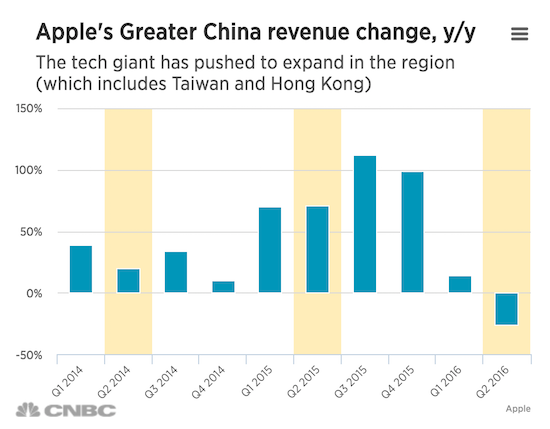
Yay?!

• European Commission Backs Greek Reform Proposals (WSJ)

The European Commission on Tuesday backed proposals made by the Greek government for reworking its bailout program, putting Athens one step closer to securing a four-month extension to its expiring bailout. But the bloc’s governments will require more detail on the proposals before giving Greece more money and possibly before approving its extension request. Eurozone finance ministers will discuss the list of proposals, sent by Greece to its creditors on Monday night, on a conference call Tuesday afternoon. “In the commission’s view, this list is sufficiently comprehensive to be a valid starting point for a successful conclusion of the review, as called for by [eurozone finance ministers],” said commission spokesman Margaritis Schinas. “We are notably encouraged by the strong commitment to combat tax evasion and corruption.”

However, Jeroen Dijsselbloem, the Dutch finance minister who leads meetings of the eurozone ministers, said the proposals represented “just a first step.” “This list is just an indication of the kind of reforms they would like to replace and also the ones they would like to continue,” Mr. Dijsselbloem said at the European Parliament on Tuesday. The commission is one of three institutions—along with the European Central Bank and International Monetary Fund—that have been overseeing Greece’s bailout and had been asked to assess the list before the eurozone ministers speak on their conference call at 13:00 GMT. Mr. Schinas said the fact that a conference call has been scheduled indicates the ECB and the IMF support the Greek proposals. The list, reviewed by The Wall Street Journal, includes pledges on privatizations, reforms to pension policy and government spending cuts, including reducing the number of ministries from 16 to 10. It also pledges to raise the minimum wage, a measure that has raised concerns among some of Greece’s creditors.

A eurozone official who had seen the list was skeptical. “It should be much more concrete, but hopefully we will receive more concreteness,” the official said. Nevertheless, Greek stocks surged on the news that the commission believes the proposals appear to meet the demands of eurozone finance ministers, with the main stock exchange in Athens rising almost 7% in early trade. Bonds also jumped. The Greek government needs its creditors to approve its proposals to secure a four-month extension to its €240 billion ($273 billion) bailout, which expires at the end of the month. Mr. Dijsselbloem said he received the list of reforms at 11:15 on Monday evening. That means Athens submitted the list in time, despite an announcement by the Greek government on Monday night that it wouldn’t send the measures until Tuesday morning. Greek Finance Minister Yanis Varoufakis also sent the list of reforms to the commission, the ECB and the IMF.

Read more …
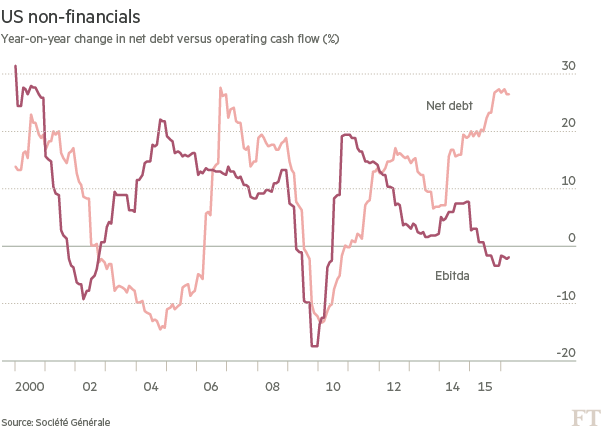
Hierarchy.

• Greek Plan to Tackle Economy Goes Before Finance Chiefs (Bloomberg)

Greece’s month-old government is about to find out whether a package of new economic measures sketched in recent days is enough to win more funding from the rest of the euro region to keep the country solvent. A draft list was sent to creditor institutions on Monday, based on a provisional agreement on Feb. 20. A Greek government official said the policies will be provided to the euro-area group of finance ministers on Tuesday before they discuss on a conference call whether the commitments go far enough. “I am very confident,” Dutch Finance Minister Jeroen Dijsselbloem, who is president of the group, said on Monday. “The Greek government has been very serious, working very hard the last couple of days. We need it to be strong enough to work on the next couple of months. I am always optimistic.”

Approval of the Greek plans would offer a four-month reprieve for the country. At the same time, Prime Minister Alexis Tsipras must try to avoid defections within his anti-austerity Syriza party after it won power on pledges to take back control of Greece’s finances. The measures are first subject to validation by the International Monetary Fund, the European Central Bank and the European Commission, the institutions that were known as the troika and from which Tsipras told voters Greece would break free. A draft was under discussion Monday evening, an official from the institutions said. The person asked not to be named because the deliberations are private. IMF Managing Director Christine Lagarde said she hoped there would be a “meeting of the minds” between Greece and the rest of Europe on the changes needed.

“Greece has to go through very in-depth, sometimes difficult reforms,” she said in an interview on HuffPost Live on Monday. They “will have to tackle vested interests, protected professions, rigidity in various markets,” she said. The government said in a statement the same day that the list will include all of Syriza’s pledges for “alleviating the humanitarian crisis” and the cabinet will convene on Tuesday after the document goes to finance ministers. The package would then be put to national parliaments for formal consent, though lawmakers and officials in Germany, Finland and the Netherlands signaled they won’t stand in the way once their governments grant consent for the aid extension. Greek government spokesman Gabriel Sakellaridis said earlier that the list will include fighting corruption and changes to the tax system.

Read more …
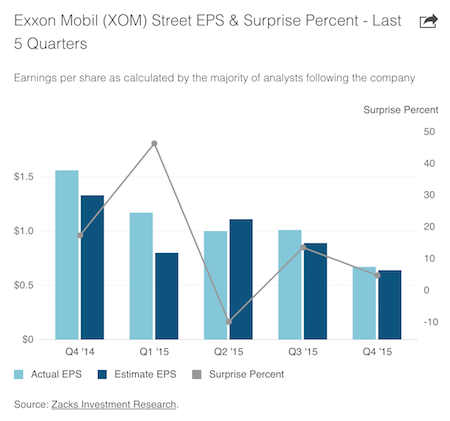
But then, finally…

• Greece ‘Delays Reform Plan Deadline’ (BBC)

Greece will send a list of reforms aimed at securing a bailout extension to EU partners on Tuesday morning, missing a Monday deadline, officials say. The list must be approved by international creditors to secure a four-month loan extension. Analysts say the deal’s collapse would revive fears Greece will exit the euro. Minister of state Nikos Pappas says the list will include measures to fight tax evasion and trim the civil service. But Greek officials have also stressed that there will be policies aimed at fulfilling pre-election pledges to help those hit by years of economic crisis. Greece’s creditors – the ECB, EC and IMF – are expected to deliver their verdict on the proposals later on Tuesday, before the reforms are discussed in a conference call with eurozone finance ministers.

Greece agreed an extension to its financial rescue programme with eurozone countries on Friday, and said it would submit its list of reforms before Tuesday. Late on Monday, officials said that although Greece had given no reason, the Eurogroup had agreed to a delay. The four-month extension deal is widely regarded as a major climb-down for Prime Minister Alexis Tsipras, who won power in January vowing to reverse budget cuts. Greece hasn’t disclosed why the infamous list has been delayed but insists it will arrive in Brussels on Tuesday. Drafts leaked to the Greek media suggest proposals broadly fall into three categories: tackling tax evasion, structural reforms and social measures that help the poor with healthcare or electricity bills and prevent those in debt from losing their homes.

It’s not clear which will make the final list or whether the reforms will be accepted by Greece’s creditors. If there’s a fundamental disagreement, the deal to extend Greece’s loan could collapse. The government is likely to be forced into U-turns on some promises made before the election, such as raising the minimum wage or rehiring public sector workers. The hard left of the governing party is opposed. But the majority of Syriza’s supporters appear to be behind it, relieved at least that Athens is proposing reforms for the first time rather than being handed a fait accompli by its creditors. Bild, Germany’s biggest newspaper, broke down in an article what it said was a tax hit list devised by the Greek government. It will reportedly seek to raise 2.5bn euros from the fortunes of rich Greeks, 2.5bn from back taxes owed by individuals and businesses, and 2.3bn from a crackdown on tobacco and petrol smuggling.

Read more …
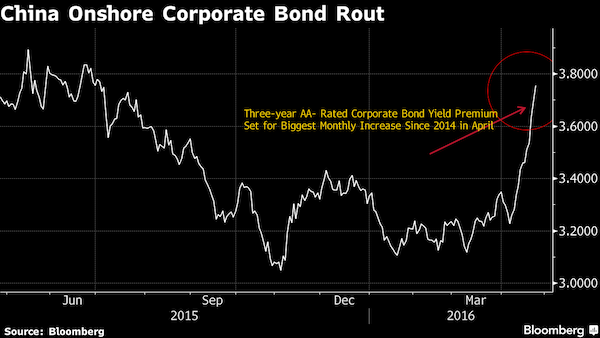
It’s a long day… living in Reseda… there’s a free-way runnin’ through the yard….

• ‘It’s Treason!’ Greek Anger At Government U-Turn (CNBC)

[..] not only has Tsipras attracted criticism for trying to present the deal as a win for the country, he has also been accused of merely overseeing a change of names for the bailout. For example, the “troika” is now referred to as “institutions,” and the “memorandum of understanding” is now referred to as the “agreement.” “To say that we finished off the ‘Memorandum’ and the ‘troika’, just because they changed their names makes me incredibly angry,” Athens-based Giannis Loverdos said on Facebook. “It’s as if Tsipras, [Finance Minister Yanis] Varoufakis and the others are telling me: ‘We believe that you are stupid…and you will believe whatever lie we tell you.'” Whereas Kostas Karampas, who also lives in Athens, went further, called the signing of a new deal “treason” on Facebook. He argued that whoever signs the new bailout agreement and new reform measures were “collaborators and will be judged by the Greek people for ultimate treason.”

One Greek expat in London was more sympathetic to Tspiras’ Syriza party, however. “I already knew from the beginning that the things that Syriza was promising before the election were not realistic,” mechanical engineer Antonis Kountouriotis told CNBC Monday, adding that he expected the government to make some concessions during negotiations. “They’ve tried to make an agreement that will benefit Greece and they do not follow a “yes” attitude to everything that the IMF and/or Europe—let’s face it, by Europe I mean Germany—want. I think we’ll have to wait and see whether they keep that attitude of negotiation, and whether they’ll manage to achieve a better agreement for Greece, before we judge them.” Despite the deal, Greece is still at the mercy of its European neighbors.

[..] although Tsipras has only been in power a month, analysts are questioning whether Friday’s deal—and notably, Greece’s request for an extension after previously shunning the notion—will come back to haunt the prime minister, threatening his credibility as a leader. Sotirios Zartaloudis, a lecturer in politics at the University of Birmingham, said in a blog post following the deal that Greece’s new government was “threatened by its own populist agenda vis-a-vis its Western partners and its voters.” “Its fate will be the benchmark for other populist anti-systemic parties throughout Europe,” he wrote Friday.

Read more …
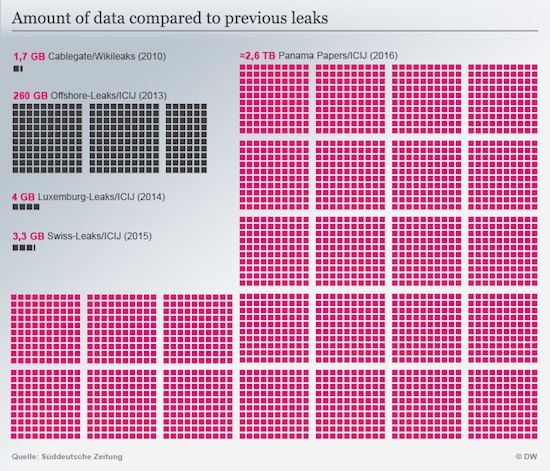
Dead on.

• Interventionism Kills: Post-Coup Ukraine One Year Later (Ron Paul)

[..] As we soon found out from a leaked telephone call, the US ambassador in Kiev and Assistant Secretary of State, Victoria Nuland, were making detailed plans for a new government in Kiev after the legal government was overthrown with their assistance. The protests continued to grow but finally on February 20th of last year a European delegation brokered a compromise that included early elections and several other concessions from Yanukovych. It appeared disaster had been averted, but suddenly that night some of the most violent groups, which had been close to the US, carried out the coup and Yanukovych fled the country.

When the east refused to recognize the new government as legitimate and held a referendum to secede from the west, Kiev sent in tanks to force them to submit. Rather than accept the will of those seeking independence from what they viewed as an illegitimate government put in place by foreigners, the Obama administration decided to blame it all on the Russians and began imposing sanctions!

That war launched by Kiev has lasted until the present, with a ceasefire this month brokered by the Germans and French finally offering some hope for an end to the killing. More than 5,000 have been killed and many of those were civilians bombed in their cities by Kiev. What if John McCain had stayed home and worried about his constituents in Arizona instead of non-constituents 6,000 miles away? What if the other US and EU politicians had done the same? What if Victoria Nuland and US Ambassador Geoffrey Pyatt had focused on actual diplomacy instead of regime change? If they had done so, there is a good chance many if not all of those who have been killed in the violence would still be alive today. Interventionism kills.

Read more …

Lack of will.

• Why the World Is So Bad at Tracking Dirty Money (Bloomberg)

The leaked revelations about the tax-evading activities of the Swiss subsidiary of HSBC Bank rumble on. Britain’s Chancellor of the Exchequer has faced questions as to why, despite evidence of 1,100 tax-evading accounts being passed to the government in 2010, there has been only one prosecution—and why the chairman of HSBC was subsequently made a government minister. The scandal is a reminder that the global institutions which try to prevent money laundering are not just ineffective—they’re also incredibly expensive to maintain. It’s time to cut them down to size.

The multilateral Financial Action Task Force (FATF), which ostensibly regulates money laundering, emerged as a response to the war on drugs and has expanded during the war on terror. The rules now officially cover almost every country. Not only banks but also lawyers, car dealers, currency exchanges, casinos, and realtors are required to report “suspicious” customers who appear to have more money than they can account for through legal transactions. If laundering activities that banks fail to report are subsequently uncovered, banks may get heavily sanctioned: HSBC itself was previously forced to pay $1.92 billion in fines related to laundering Mexican drug cartel proceeds.

Michael Levi of Cardiff University and Peter Reuter of the University of Maryland have studied the global anti-money-laundering system and conclude that it has helped facilitate some criminal investigations and prosecutions. But at best, it snares just a fraction of 1% of criminal income flows. A lower-end estimate for global laundering transactions is 2% of global gross domestic product—or about $1.5 trillion. Global money laundering convictions involve at the most hundreds of millions. In the U.S., a generous estimate of seizures would amount to a mere 0.2% of all laundered funds.

Read more …
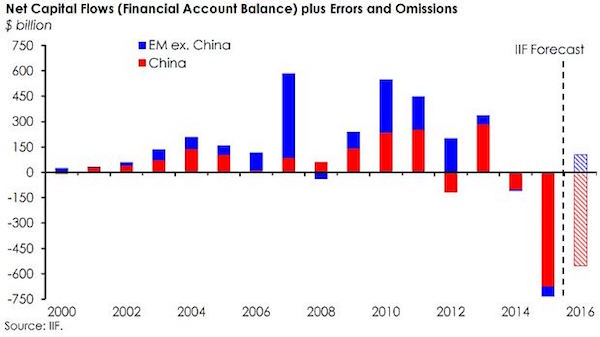
We better stop this while we can.

• Medicines To Cost Taxpayers Millions More In Secret TTIP Trade Deal (Guardian)

Medicines will cost Australian taxpayers hundreds of millions of dollars more each year if measures in a leaked draft of the secretive Trans-Pacific Partnership Agreement are implemented, a new report says. The most recently leaked draft of the international trade deal includes provisions proposed by the US that would further protect the monopoly pharmaceutical companies hold over drugs, and delay cheaper versions from entering the market, the Medical Journal of Australia report says. The draft agreement sets in stone low patenting standards which allow drug companies to practice “evergreening” – when a pharmaceutical company tries to maintain its market monopoly on a drug for longer by applying for extra patents.

This prevents other companies entering the market with cheaper versions of the same medicine and imposes large and unnecessary costs on the health system and consumers, the report, published on Monday, said. The report’s authors gave the example of Efexor, produced by Pfizer, an antidepressant which had major side effects. Pfizer subsequently developed slow-release versions of the drug, called Efexor-XR, which significantly reduced its side-effects and which became much more widely prescribed than Efexor.

Pfizer claimed the slow-release versions were different enough from the original to be granted new patents. Its claim was rejected, but the legal battle delayed cheaper generic versions of the drug from entering the market for two and half years. “By the time this patent was eventually declared invalid, the delay to the generic market had cost taxpayers $209m,” the authors wrote. “The three greatest concerns for Australia in the recent draft include provisions that would further entrench secondary patenting and evergreening, lock in extensions to patent terms, and extend monopoly rights over clinical trial data for certain medicines.”

Read more …
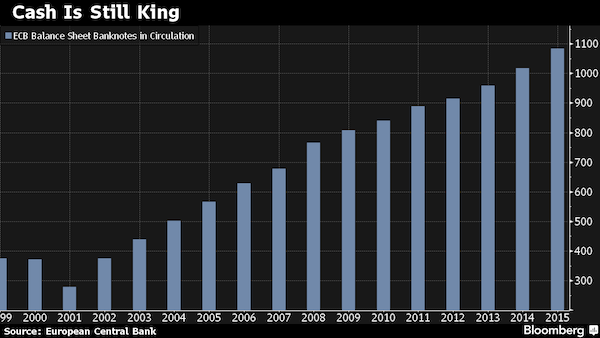
Bubble, anyone?

• Apple Now Twice As Big As World’s 2nd-Largest Company, ExxonMobil (Telegraph)

Apple is now twice as big as the world’s second-largest listed company, oil giant ExxonMobil. Shares in the iPhone maker jumped 2.7pc on Monday to close at $133, giving the company a market value of more than $774bn (£500bn). ExxonMobil saw its stock fall 1pc to $89.01, valuing the US group at just under $377bn, as the 50pc collapse in oil prices since last June continues to weigh on the company. Apple’s shares have risen 21.7pc so far this year as the company prepares to follow-up the hugely successful release of the iPhone 6 in September with its first smartwatch. Apple has reportedly asked its Asian suppliers to manufacture more than 5m Apple Watches ahead of its April retail date

Strong sales of the larger-screened iPhones resulted in the biggest ever quarterly profit reported by a company, with device sales rising 29.5pc in the final three months of 2014 to $74.6bn, driving net income up from $13.1bn to $18bn in the quarter. Those results helped Apple become the world’s first $700bn company on February 10. Tim Cook, Apple’s chief executive, said at a conference earlier this month that he was confident that the company would continue to grow at a rapid pace. “We don’t believe in such laws as laws of large numbers. This is sort of an old dogma that was cooked up by somebody,” he said.

“Steve [Jobs, the co-founder of Apple and former chief executive] did a lot of things for us over many years but one of the things he ingrained in us is that putting limits on your thinking is never good.” Analysts said the company would continue to grow from strength to strength. “Given Apple’s powerful iPhone cycle, a big 4G ramp in China and the upcoming launch of Apple Watch in April, we believe there is still plenty to look forward to during this transformational cycle,” said Brian White, an analyst at Cantor Fitzgerald.

Read more …
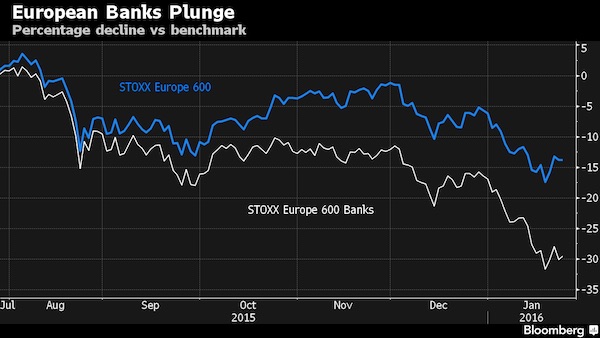
Bubble squared?!

• The Performance of Many Hedge Funds Just Comes Down to Owning Apple (Bloomberg)

In an equity environment where hedge funds are struggling to break even, Apple Inc. has played the role of savior, according to Goldman Sachs. A group of companies representing the most popular long positions for hedge funds is up just 0.2% in 2015, compared to a 2.3% gain for the Standard & Poor’s 500 Index, data compiled by Goldman Sachs show. A 19% year-to-date increase for Apple, which is owned by one in every five hedge funds and is a top-10 position for 12% of them, has provided a needed boost, the firm said. Apple came into 2015 poised to have a major impact on money managers, comprising the highest %age of hedge fund equity assets in more than two years, according to Goldman Sachs data. The technology titan constitutes 4% of an S&P 500 that’s hovering near an all-time high.

“Apple reigns undisputed as the most popular hedge fund stock,” a group of Goldman Sachs analysts including chief U.S. equity strategist David Kostin wrote in a Feb. 20 client note. The company is a “key driver of hedge fund performance, as well as U.S. equity earnings growth and returns,” they said. Goldman Sachs maintains a basket containing the 50 stocks that appear most often among the top 10 holdings of fundamentally-driven hedge fund portfolios. For its most recent report, the firm analyzed 854 hedge funds with $2.1 trillion of gross equity positions at the start of 2015. Apple is forecast to climb about 2% in the next 12 months, according to 44 analysts surveyed by Bloomberg. Goldman Sachs is more bullish, predicting a 9.7% rise to $145 per share.

Hedge fund holdings of Apple remained resilient in the fourth quarter even as some large money managers pared exposure to equities, particularly for U.S. companies. Greenlight Capital’s David Einhorn said he scaled back bets on stock gains during the fourth quarter after markets climbed and as a stronger dollar threatens to limit earnings of U.S. companies from operations overseas. David Tepper’s Appaloosa Management had $2.74 billion less in U.S. stocks in the fourth quarter, a 40% drop from the previous quarter. Soros Fund Management, the family office of billionaire hedge fund manager George Soros, moved about $2 billion into companies in Asia and Europe, according to a person familiar with the strategy.

Read more …
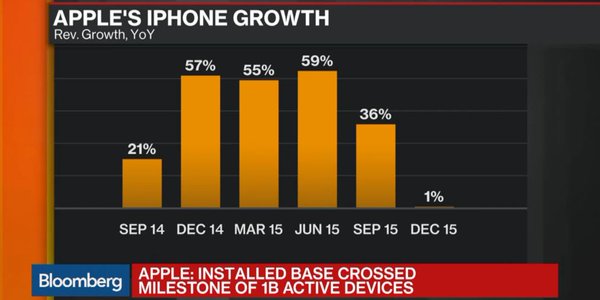
“Few people grok that Greece is an entity with an economy not much bigger than North Carolina’s”

• How Goes the War? (Jim Kunstler)

Oh, you didn’t notice that World War Three is underway, actually has been for more than year? Well, that’s because most of it has been taking place in the banking sector, which for most people is just an alternative universe of math. The catch, which many people either miss or don’t care about, is that the math doesn’t add up. For instance, the runaway choo-choo train of linked European sovereign bond obligations with its overloaded caboose of interest rate swaps and other janky derivatives of mass destruction. That train left the station in Athens a few weeks ago bound for Frankfurt. Ever since, the German government and its cohorts in the EU, the ECB, and the IMF have been issuing reassurances that the choo choo train will not blow up when it reaches its destination.

Few people grok that Greece is an entity with an economy not much bigger than North Carolina’s, yet it is burdened with roughly $350 billion of old debt that will never be paid back. The only thing at issue is how it will not be paid back, that is, what mode of pretense will be employed to disguise the inability to pay back this debt. The mode du jour has been the crude one of lending Greece more money to pay back the interest on the old debt. A seven-year-old ought to be able to understand where that leads. It’s kind of up to the Greeks this week to possibly opt out of that farcical deal. They have at least two other present options: return to being a sunwashed semi-medieval backwater of olive farmers, shepherds, and inn-keepers, or perhaps lease out some cozy corner of their vast Mediterranean coastline to the Russian navy for enough annual walking-around money to keep the lights on for the aforementioned farmers, shepherds, and inn-keepers.

Of course, that would drive the US and its NATO quislings batshit crazy. We’ve already got our knickers in a twist over Ukraine, a so-called nation whose highest and best purpose over the millennia has been as a sort of lethal doormat in front of Russia, leaving adventurers like Napoleon and Hitler bleeding in the snow as they crawled back to their nations of origin. In short, Ukraine has worked so well for Russia that we must be insane to imagine that it would give up that traditional relationship. Yet the US and NATO persist in their foolishness and attempt to back up their Kievan intrigues with financial “sanctions” against Russia.

Read more …

Who else is interested in peace?

• Putin Says War With Ukraine ‘Unlikely’ (BBC)

The Russian president, Vladimir Putin, has said war with neighbouring Ukraine is “unlikely”, in an interview for Russian television. Mr Putin also stressed his support for the Minsk agreement as the best way to stabilise eastern Ukraine. Ukraine has said there is clear evidence Russia is helping the rebels in the east, something Russia denies. Earlier, Ukraine’s military said rebel shelling had prevented them withdrawing heavy weapons from the front line.

In his interview, Mr Putin was asked if there was a real threat of war, given the situation in eastern Ukraine. “I think that such an apocalyptic scenario is unlikely and I hope this will never happen,” he said. Mr Putin said that if the Minsk agreement was implemented, eastern Ukraine would “gradually stabilise”. “Europe is just as interested in that as Russia. No-one wants conflict on the edge of Europe, especially armed conflict,” he said.

Read more …
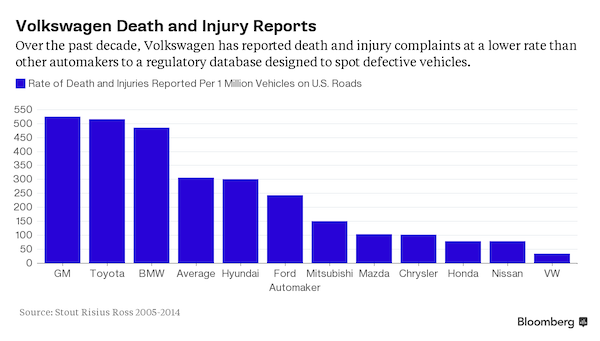
They’d be fine if only reality would vanish.

• Tales From an Oil-Sands Slide: Angst Amid Bravado in Alberta (Bloomberg)

The pain of crude’s collapse is beginning to bite in Alberta, from the oil-sands boomtown of Fort McMurray to the corporate boardrooms of Calgary. As the C$340-billion ($270 billion) petro-economy confronts an oil market meltdown, a decade-long investment spree is being reversed, layoffs and spending cuts are in full swing at companies such as Suncor Energy, and everyone from oil drillers to real estate agents is feeling the pinch. In Fort McMurray, where the oil is so near the surface it oozes out of the ground in places and coats people’s boots, the mayor is reconsidering city projects. In Calgary, which boasted Canada’s biggest concentration of millionaires and one of the hottest real-estate markets, realtors just had their worst two months on record. The Bank of Canada has cut interest rates in an effort to limit the damage from spreading to the rest of economy.

Yet, even in the midst of the price swoon, many executives and workers remain confident the oil-sands industry –which has endured deep cyclical downturns before and was built on long-term investments to operate at high costs – will pull through. Here are their stories. Terence Stewart sits at home as the rain falls in Nanaimo, British Columbia, waiting for the phone to ring. A month ago, the engineering designer was making blueprints for holding tanks and scaffolding at Cenovus Energy Inc.’s oil-sands project in Narrows Lake, 1,700 kilometers (1,050 miles) away. With the 54 percent drop in the price of oil since June, Cenovus scaled back plans to develop the 130,000 barrel-a-day project – and with it Stewart’s job. Last week, the producer announced the first layoff in its history, dismissing 800 people and freezing wages.

With a decade of work experience in the oil sands, Stewart, 59, is looking a job closer to home to “tide him over” until the petroleum industry improves. He hopes liquefied natural gas projects being proposed by companies like Royal Dutch Shell Plc along the Pacific coast will get the green light and provide him with a job in the coming year. So far, none of the proponents has committed to any investment. “It is a very volatile industry,” he said. For now, he’s counting on finding work locally at one of the small manufacturers in Nanaimo or Vancouver, though he won’t be immune to the lure of oil-sands jobs that pay as much as C$100 an hour when times are good. “You do get paid very well in the oil and gas field,” he says. “But you do have to plan for a rainy day.”

Read more …
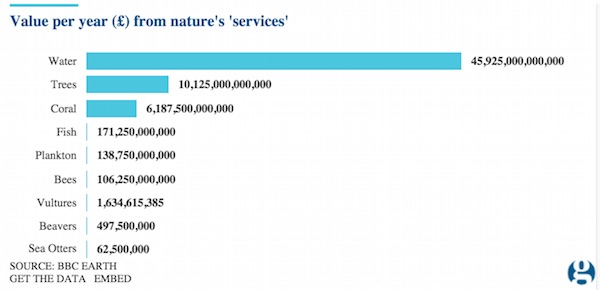
Who needs a brain when you have shale?

• European Shale Dream Is Dying Before It Started (CNBC)

Oil and gas giant Chevron is giving up on its shale gas plans for Romania, marking the end of its European efforts for the resource. And it’s not alone in scrapping European plans. The California-based company said that the fracking project does not make economic sense at this time, so it is relinquishing its concessions in the country. Less than a month earlier, Chevron pulled out of shale gas exploration in Poland, citing similar reasoning. “Chevron intends to pursue relinquishment of its interest in these (Romanian) concessions in 2015,” the company’s Kent Robertson said. “This is a business decision which is a result of Chevron’s overall assessment that this project in Romania does not currently compete (favorably) with other investment opportunities in our global portfolio.”

Chevron wholly owned and operated the 1.6 million-acre Barlad Shale concession in northeast Romania, and three concessions covering 670,000 acres in the country’s southeast, according to the company’s website. The development marks a major blow for the European shale industry. Many European officials have designated energy development as a top priority, but popular backlash and a series of disappointing exploration results have stunted these hopes. In fact, Romanian Prime Minister Victor Ponta indicated last year that oil companies could be on something of a fool’s errand in his country.

“It looks like we don’t have shale gas, we fought very hard for something that we do not have,” Ponta told television channel Antena 3, according to Reuters. “I cannot tell you more than this, but I don’t think we fought for something that existed.”
A 2013 report from the U.S. Energy Information Administration projected that Romania held the fifth-largest unproved wet shale gas estimated reserves in Europe (trailing Russia, Poland, France and Ukraine).

Read more …

A BIG SURPRISE.

• Work Of Prominent Climate Change Denier Funded By Energy Industry (Guardian)

A prominent academic and climate change denier’s work was funded almost entirely by the energy industry, receiving more than $1.2m from companies, lobby groups and oil billionaires over more than a decade, newly released documents show. Over the last 14 years Willie Soon, a researcher at the Harvard-Smithsonian Centre for Astrophysics, received a total of $1.25m from Exxon Mobil, Southern Company, the American Petroleum Institute (API) and a foundation run by the ultra-conservative Koch brothers, the documents obtained by Greenpeace through freedom of information filings show. According to the documents, the biggest single funder was Southern Company, one of the country’s biggest electricity providers that relies heavily on coal. The documents draw new attention to the industry’s efforts to block action against climate change – including President Barack Obama’s power-plant rules.

Unlike the vast majority of scientists, Soon does not accept that rising greenhouse gas emissions since the industrial age are causing climate changes. He contends climate change is driven by the sun. In the relatively small universe of climate denial Soon, with his Harvard-Smithsonian credentials, was a sought after commodity. He was cited admiringly by Senator James Inhofe, the Oklahoma Republican who famously called global warming a hoax. He was called to testify when Republicans in the Kansas state legislature tried to block measures promoting wind and solar power. The Heartland Institute, a hub of climate denial, gave Soon a courage award. Soon did not enjoy such recognition from the scientific community. There were no grants from Nasa, the National Science Foundation or the other institutions which were funding his colleagues at the Center for Astrophysics.

According to the documents, his work was funded almost entirely by the fossil fuel lobby. “The question here is really: ‘What did API, ExxonMobil, Southern Company and Charles Koch see in Willie Soon? What did they get for $1m-plus,” said Kert Davies, a former Greenpeace researcher who filed the original freedom of information requests. Greenpeace and the Climate Investigations Center, of which Davies is the founder, shared the documents with news organisations. “Did they simply hope he was on to research that would disprove the consensus? Or was it too enticing to be able to basically buy the nameplate Harvard-Smithsonian?”

Read more …

Count your blessings.

• UK Will Need To Import Over Half Of Its Food Within A Generation (Guardian)

More than half of the UK’s food will come from overseas within a generation, as a rising population and stalling farm productivity combine to erode what remains of the UK’s self-sufficiency, according to farming leaders. The UK’s failure to produce more food will leave households more vulnerable to volatile prices and potential shortages, the National Farmers’ Union will say at its annual conference on Tuesday. The farming body will call on politicians to encourage new investment in farming, and develop a national plan for a higher degree of food self-sufficiency. Meurig Raymond, president of the NFU, warned: “The stark choice for the next government is whether to trust the nation’s food security to volatile world markets or to back British farming and reverse the worrying trend in food production. I want to see a robust plan for increasing the productive potential of farming, stimulating investment and ensuring that the drive to increase British food production is at the heart of every government department.”

The NFU cited “poorly crafted regulation”, including EU and UK policies that have “over-emphasised environmental rather than production outcomes and complicated the busienss of farming”, and farmers having weak bargaining power with big retailers as key problems affecting agriculture. Farmers meeting in Birmingham are expected to demand more attention from politicians ahead of the general election, when rural votes could play an important role in deciding the make-up of the next government. The Conservatives dominate in rural areas, but many key Liberal Democrat constituencies have a farming base. Farming production is worth about £26bn a year, while the broader food industry accounts for about £103bn to the UK economy, more than the car and aerospace industries combined, and represents about 3.5m jobs.

According to projections by the NFU, on current trends the UK will reach a tipping point in about 25 years, beyond which a majority of our food will have to be imported, unless governments take strong action to improve food production and protect consumers from a future of relying on food bought from abroad. Self-sufficiency in food in the UK has been eroded since the 1980s: about 60% of food currently consumed here is grown here, down from nearly 80% in the mid 1980s, even though more varieties of food previously thought exotic are now grown in the UK. The problems created for British farmers when cheap imports flood the UK’s market have been illustrated in recent weeks. A glut of dairy products on international markets has sent prices to farmers plummeting, driving thousands out of business and threatening a future in which the UK has to import its fresh milk.

Read more …