
Aug 122016
 
 August 12, 2016  Posted by at 10:17 am Finance Tagged with: , , , , , , , , ,  2 Responses »


G. G. Bain At Casino, Belmar, Sunday, NJ 1910

• Private Lenders Increase the Risk of a Global Debt Crisis (TeleSur)
• US Homeownership Dips to Lowest Rate Since 1960 (RCM)
• The Next Huge American Housing Bailout Could Be Coming (TAM)
• China’s Stimulus Efforts Show ‘Malinvestment Is Still Hard at Work’ (BBG)
• The UK Is the New Engine of Bond-Market Distortion (WSJ)
• A Really Vicious Circle Is Threatening UK Pension Pots (BBG)
• IMF to ECB: Forget Negative Rates, Or You’ll Do More Harm Than Good (MW)
• Global Shipping Giant Moller-Maersk Reports 90% Fall In Net Profit (CNBC/R.)


Warning against vulture funds. Then again, isn’t the IMF one of them too?

• Private Lenders Increase the Risk of a Global Debt Crisis (TeleSur)

Private creditors have replaced the public sector as lead borrower to developing countries, which has contributed to a new borrowing and lending boom. Private financial institutions are responsible for prompting a potential “new wave” of debt crises among developing nations, according to a new report carried out by European Think Tank Eurodad. Public debt in developing countries is increasingly being borrowed from private lenders, which the authors argue has meant that an increasing portion of credit is not effectively monitored or regulated. “Private borrowers, in particular private corporations, have used this regulation gap to throw a big borrowing party, a debt party, and thus have contributed disproportionately to the external debt burden that developing countries carry now,” the report warned.

As part of its findings, the authors of the report concluded that, “while relative debt burdens decreased between 2000 and 2010, these trends have reversed in 2011. Since then debt is on an upward path, also when measured in relative terms.” Developing countries total external debt burden reached US$5.4 trillion in 2014 and over half of this amount is now owed by private debtors, according to data from the report titled,“The Evolving Nature of Developing Country Debt and Solutions for Change.” The study attributed the recent increase in private creditors to the heavy public borrowing that took place during the 1980’s and 1990’s, which prompted sharper restrictions on public lending institutions such as the International Monetary Fund.

Read more …

Remember affordable housing?

• US Homeownership Dips to Lowest Rate Since 1960 (RCM)

The US homeownership rate, as recently reported by the Census Bureau, dropped to 62.9% in the second quarter of 2016, a rate about equal to the rate of 61.9% reported over a half century ago for 1960. This stagnation compares unfavorably to 1900 to 1960 when the non-farm homeownership rate increased from 36.5% to 61%.-a period encompassing rampant urbanization, immigration, and population growth. For example, the non-farm population quadrupled from about 42 million to 166 million, yet the non-farm homeownership rate increased by 67%. Except for the interruption caused by the Great Depression, the rate of increase was moderate to strong throughout the period.

How can this be? Isn’t there an alphabet soup of federal agencies-FHA, HUD, FNMA, FHLMC, GNMA, RHS, FHLBs-all with the goal of increasing homeownership by making it more “affordable”? Don’t these agencies fund or insure countless trillions of dollars in home loan lending–most with very liberal loan terms? Could it be the federal government massive liberalization of mortgage terms creates demand pressure leading to higher prices? Could it be federal, state, and local governments’ implement land use policies that constrain supply and drive prices up even further? Could it be government housing policies have made homeownership less, not more affordable or accessible?

The answer is an unequivocal yes. Since the mid-1950, liberalized federal lending policies have fueled a massive and dangerous increase in leverage-one that continues to this day. For example, in 1954 FHA loans had an average loan term of 22 years vs. 29.5 years today, an average loan-to-value of 80% vs. 97.5%, average housing debt-to-income ratio of 15% vs. 28%. Only the average borrowing cost in 1954 of 4.5% is the same as it is today. The result is today’s FHA borrower can purchase a home selling for twice as much as one with the underwriting standards in place in 1954-but without a dollar’s increase in income!

Read more …

It’s all a big rip-off. Get the government out of housing once and for all.

• The Next Huge American Housing Bailout Could Be Coming (TAM)

The failures of government intervention in the economy have made headlines yet again. Recent stress tests by the Federal Housing Finance Agency found something sinister brewing under the surface at notorious mortgage giants Fannie Mae and Freddie Mac. The results show that these puppet companies could need up to a $126 billion bailout if the economy continues to deteriorate. That’s right — the two companies that were taken over by the government and that sucked $187 billion from the treasury could be entitled to more taxpayer money. The toxic home loans bought during the last crisis coupled with a lack of liquidity have suddenly become serious risk factors.

The so-called “recovery” that has been trumpeted for years by countless politicians and economists is falling apart in plain view. The media will do just about anything to assure the public that this is all isolated and overblown, but the canary in the coal mine has just dropped dead. The tests ran a scenario eerily similar to warnings we’ve heard about what the economic future might hold: “The global market shock involves large and immediate changes in asset prices, interest rates, and spreads caused by general market dislocation and uncertainty in the global economy.” In the throes of the 2008 crisis, the government took many unprecedented actions, but one of the most notable was seizing control of the two largest mortgage loan holders in the country.

Since then, Fannie Mae and Freddie Mac have been converted from subsidized private organizations into some of the biggest government-sponsored enterprises ever created. These institutions have been used to prop up the entire real estate market by purchasing trillions of dollars in home loans from other banks to keep prices elevated. Without Fannie and Freddie, the supply of houses on the market would have far exceeded the number of buyers. This glut in supply and low demand would have forced sellers to lower prices until a deal was made. Instead, these wards of the state were able to buy up properties at artificially high prices using government-issued blank checks, allowing for the manipulation of home values back up to desired levels.

Read more …

Debt at work.

• China’s Stimulus Efforts Show ‘Malinvestment Is Still Hard at Work’ (BBG)

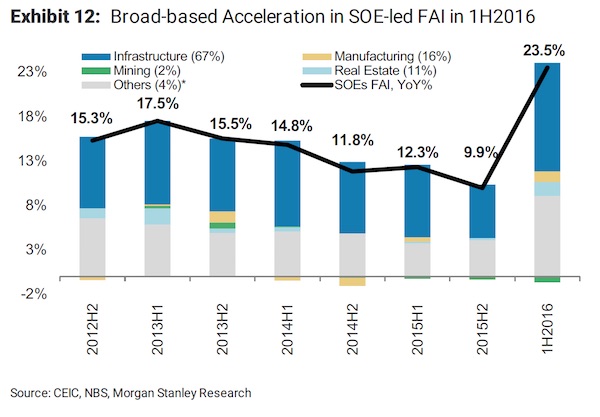
It was supposed to be different this time. Ahead of looming fiscal stimulus from China, analysts were quick to emphasize that this would be a leaner, smarter government spending program. There would be a new method of financing to try to keep the debt burdens for local governments from becoming too onerous. And, above all, it would be targeted to avoid exacerbating the excess capacity that’s abundant in many industries. While the scale of the expenditures certainly pales in comparison to those that followed the Great Recession, the story remains the same. A Morgan Stanley team, led by Chief China Economist Robin Xing, noted that fixed-asset investment growth among state-owned enterprises (or SOEs) has accelerated across the board in 2016, with the exception of mining.

This same trend also holds for investment in services sectors, Xing observed. These data suggest that stimulus efforts have not been as targeted as proponents hoped, belie the narrative of rotation of growth from credit-driven infrastructure projects to activity linked to domestic demand, and raise the specter of further malinvestment in the world’s second largest economy. “We know a) in real terms rebalancing isn’t advancing as much as the government protests citing nominal data and b) the restimulation this last year of investment via credit and fiscal policies will certainly have slowed it down further,” writes George Magnus, senior economic adviser at UBS. “Capital accumulation isn’t all or always wrong but if it’s largely debt financed and SOE provided, I’d say that malinvestment is still hard at work.”
Read more …

Lest we forget: There is no market. There is only distortion.

• The UK Is the New Engine of Bond-Market Distortion (WSJ)

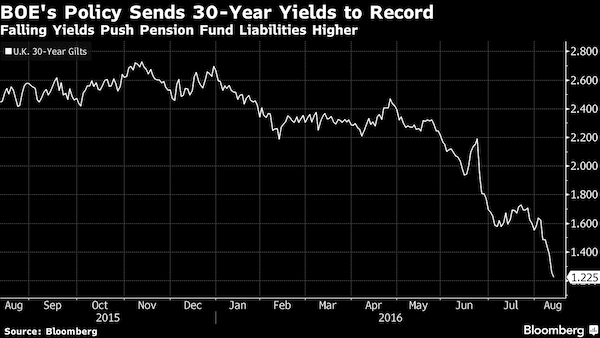
Britain has taken over from Japan as the world’s wildest bond market, raising new questions about the distortions being caused by central banks. The soaring price (and so plunging yield) of the 30-year gilt means it has now returned the same 31% over the past 12 months as the Japanese 30-year note, even as some of the excess in long-dated Japanese bonds falls away. The race into gilts partly anticipated and was accelerated by the Bank of England’s resumption of bond purchases this week, part of a package of monetary easing designed to offset damage to the economy from June’s Brexit vote. Lower gilt yields are in turn contributing to demand for global bonds, helping keep U.S. Treasury yields depressed even as other market moves suggest a revival of hopes for growth and inflation.

This again raises a long-running problem for investors. Should they regard low yields as a sign of how grim a future is in store for the world economy? Or are central banks distorting the signal so much through bond purchases that yields no longer carry much information about the economy? The rally in gilts has been extraordinary, with the yield on the U.K.’s longest-dated bond, the 2068 maturity, almost halving from 2% on the day of the referendum to 1.06% on Thursday. The price of the bond is up 53% this year, the sort of gains usually produced by risky stocks, not rock-solid government paper.

Read more …

Consolation: it happens everywhere.

• A Really Vicious Circle Is Threatening UK Pension Pots (BBG)

As the Bank of England seeks to ease Brexit angst by injecting money into the U.K. economy, pension managers and insurers are finding themselves caught up in a vicious circle. Britain’s new quantitative-easing program, combined with monetary easing around the world, is crushing yields, leaving these long-term investors ever more desperate to hold on to their 20-, 30- and 50-year bonds to meet return targets and liabilities. That forces protagonists like the BOE, which is buying 60 billion pounds ($78 billion) of government debt over six months, to bid higher prices – driving yields down even further.

This may explain the crunch this week, when the central bank failed to find enough investors to sell it longer-maturity gilts, the part of the debt market dominated by pensions and insurers. While the revival of QE is intended to reduce the risk of a Brexit-fueled slump, the shortfall raises the question of whether debt purchases with newly created money are becoming part of the problem as well as the solution. “We recognize the Bank’s concern and the need to protect the economy,” said Helen Forrest Hall, defined-benefit policy lead at the Pensions and Lifetime Savings Association in London. “But the challenge we have is that the QE programs do have an impact on pension funds’ liabilities.”
Read more …

Yeah, can’t risk bank profits, can we?

• IMF to ECB: Forget Negative Rates, Or You’ll Do More Harm Than Good (MW)

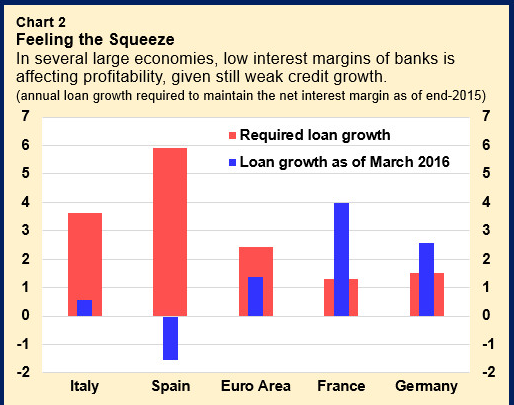
Economists at the IMF are urging the ECB to stop yanking interest rates further into negative territory, warning it will take a toll on the region’s already struggling banks and reduce lending to businesses and households. In a blog post on the IMF website, economists Andy Jobst and Huidan Lin say any additional cuts that would push rates further below zero will encounter diminishing returns and threaten, at this point, to do more harm than good. “Further policy rate cuts could bring into focus the potential trade-off between effective monetary transmission and bank profitability. Lower bank profitability and equity prices could pressure banks with slender capital buffers to reduce lending, especially those with high levels of troubled loans,” the analysts said on the blog.

“The prospect of prolonged low policy rates has clouded the earnings outlook for most banks, suggesting that the benefits from a negative interest rate policy might diminish over time,” they said. The warning comes as expectations are rising the central bank will announce fresh stimulus at its September meeting to offset the negative impact on the eurozone from the U.K.’s Brexit vote on June 23. At its July meeting, ECB boss Mario Draghi stopped short of pledging more measures, saying the policy makers will reassess in September when it will have fresh economic forecasts that factor in the impact of the U.K.’s referendum on ending its EU membership.
Read more …

New normal: Profit falls 90%, shares up 5.3%.

• Global Shipping Giant Moller-Maersk Reports 90% Fall In Net Profit (CNBC/R.)

Moller-Maersk kept its downbeat 2016 profit forecast on Friday as the Danish shipping and oil giant reported net profit way under expectations as it struggles to cope with a shipping recession and tough oil markets. The Danish shipping and oil group said net profit fell to $101 million in April-June, lagging a forecast of $196 million. It was also around 90% lower than the $1.069 billion reported for the same period last year. The company maintained its outlook for an underlying profit for the full year significantly below last years $3.1 billion. Shares of the group were up 5.3% Friday morning.

Trond Westlie, chief financial officer of Maersk Group, told CNBC on Friday that the shipping industry faced turbulent times as a result of the “very difficult” oil market and decline in freight rates. “When we look at the overall market and when we look at supply and demand and the growth in the world, we still think it’s going to be low-growth and volatile.” “For us, like always, we have a view on a couple of weeks or a four weeks’ indication on where the market is going but after that it’s very opaque for us as well.”

Read more …

Aug 102016
 
 August 10, 2016  Posted by at 9:35 am Finance Tagged with: , , , , , , , , , , ,  Comments Off on Debt Rattle August 10 2016


Lewis Wickes Hine Workshop of Sanitary Ice Cream Cone Co., OK City 1917

• Bank Of England Suffers Stunning Failure On Second Day Of QE (ZH)
• Bank of England QE and the Imaginary “Brexit Shock” (AM)
• Negative-Yield Debt Is Doing The Opposite Of What It Was Supposed To Do (CNBC)
• The Private Pain of China’s Economy (WSJ)
• Oil Companies Face $110 Billion Debt Wall Over Next 5 Years (BBG)
• The Problem With Europe Is The Euro (Stiglitz)
• The EU Enters Its Endgame (Dowd)
• Marc Faber: Tesla Shares Are Going To $0 (CNBC)
• The US Public Pensions Ponzi (ZH)
• Housing ‘Shell Shock’ Faces Danes Who Think Market Can Only Rise (BBG)
• Call Blockchain Developers What They Are: Fiduciaries (Walch)
• Construction Of Giant Dam In Canada Prompts Human Rights Outcry (G.)


Did Carney really not see this coming? That would be stunning indeed. Not hard at all to find out.

• Bank Of England Suffers Stunning Failure On Second Day Of QE (ZH)

It started off well enough. On the first day of the Bank of England’s resumption of Gilt QE after the central bank had put its monetization of bonds on hiatus in 2012, bondholders were perfectly happy to offload to Mark Carney bonds that matured in 3 to 7 years. In fact, in the first “POMO” in four years, there were 3.63 offers for every bid of the £1.17 billion in bonds the BOE wanted to buy. However, earlier today, when the BOE tried to purchase another £1.17 billion in bonds, this time with a maturity monger than 15 years, something stunning happened: it suffered an unexpected failure which has rarely if ever happened in central bank history: only £1.118 billion worth of sellers showed up, meaning that the BOE’s second open market operation was uncovered by a ratio of 0.96.

Simply stated, the Bank of England encountered an offerless market. What makes this particular failure especially notable – and troubling – is that while technically uncovered sales of government securities happen frequently, and Germany is quite prominent in that regard as numerous Bund auctions have failed to find enough demand in the open market in recent years forcing the “retention” of the offered surplus, when it comes to a central bank’s buying of securities, there should be, at least in practice, full coverage of the operation as the central bank is willing and able to pay any price to sellers to satisfy its quota. For example, in today’s operation, the scarcity led to the BOE accepting all submissions, even as some investors offered prices above the prevailing market.

The highest accepted price for the 4% bond due in 2060, for example, was 194.00, compared with a weighted average of 192.152, which means that the happy seller obtained a yield well in excess of that implied by the market. And yet, despite having a completely price indiscriminate buyer, some £52 million worth of bond sellers simply refused to sell to the BOE at any price! The QE failure quickly raised alarm signals among the bond buying community. In a Bloomberg TV interview, Luke Hickmore at Aberdeen Asset Management said that “lots of people are bidding us for bonds – Mark Carney is now bidding me for bonds and he still can’t have them. The problem is he was trying to buy 15-year plus bonds today in the gilt market. That’s a really difficult area.”

Read more …

“One might as well try to improve one’s health by playing a few rounds of Russian roulette every morning before breakfast.”

• Bank of England QE and the Imaginary “Brexit Shock” (AM)

For reasons we cannot even begin to fathom, Mark Carney is considered a “superstar” among central bankers. Presumably this was one of the reasons why the British government helped him to execute a well-timed exit from the Bank of Canada by hiring him to head the Bank of England (well-timed because he disappeared from Canada with its bubble economy seemingly still intact, leaving his successor to take the blame). The adulation he receives is really a major head-scratcher. What has he ever done aside from operating the “Ctrl. Prnt.” buttons? As far as we are aware, nothing. As we have discussed previously, his main legacy is that he has left Canada with one of the greatest and scariest real estate and consumer credit bubbles extant in the world today. Some accomplishment!

With respect to his economic analysis, it seems not the least bit different from the neo-Keynesian/ semi-monetarist mumbo jumbo we get to hear from central bankers everywhere. This is by the way no surprise: they’re an incestuous bunch and have largely received their education at the same institutions. Most of them seem genuinely convinced that central planning not only works, but is necessary to improve on the alleged drawbacks of an “unfettered market” (i.e., the mythical unhampered free market economy no-one alive today has ever experienced). If one looks closely at what they are actually doing, it soon becomes clear that it is in principle not much different from what John Law did in France in the early 18th century (the difference is one of degree only).

The much-dreaded “Brexit” has now given Mr. Carney the opportunity to do what he does best, namely open the monetary spigots wide. One might as well try to improve one’s health by playing a few rounds of Russian roulette every morning before breakfast.

Read more …

NIRP scares the sh*t out of people. And rightly so.

• Negative-Yield Debt Is Doing The Opposite Of What It Was Supposed To Do (CNBC)

Paying someone to borrow your money sounds like a questionable idea on paper, and seems not to be working out so well in practice. Yet that’s exactly what people who buy negative-yielding bonds do: Instead of collecting payments in the form of yields, investors have to pay someone to take their cash. Investors ostensibly hope they can sell the debt elsewhere and make a profit, as prices go up when yields fall. It’s a strange arrangement that nonetheless has become policy in Japan and parts of Europe. The goal that sovereign debt issuers and central banks hope to achieve is a world where money is pushed toward risk and all that no-yielding debt causes inflation that leads to growth.

However, as the arrangement spreads around the world to the point where more than $11 trillion of global debt holds negative yields, questions are growing quickly about its efficacy. “It’s the definition of insanity: Keep doing the same thing over and again and expect a different result. That’s my assessment of central banks in a nutshell,” said Kim Rupert, managing director of global fixed income analysis at Action Economics. “I never thought I’d say that. I had a lot of respect for central bankers. But they’re getting way overindulgent with very little success as far as I can tell.”

Read more …

“..urged local officials to “chant bright songs about the China economy loudly” to boost confidence..”

• The Private Pain of China’s Economy (WSJ)

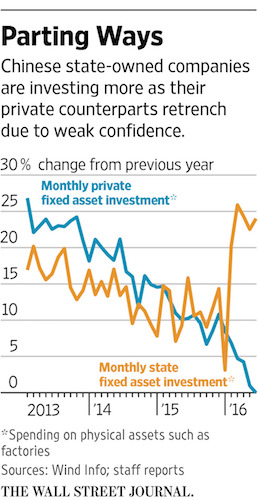
Private investment is withering in China. Companies are shying away from risking their capital, discouraged by a cloudy global outlook and four years of slowing Chinese growth, intermittent deflation and conflicting policy messages. The development risks setting back Beijing’s aim to shift the economy from low-end manufacturing to the kind of high-tech industries and services that dynamic private companies tend to provide. Private investment on capital goods like factories and trucks grew by just 2.8% in the year’s first half following nearly 30% annual average growth over the past decade. In June, it fell for the first time since China started tracking the data in 2004. The July figure, to be released Aug. 12, is expected to show further weakness.

In a bid to reverse the trend, Beijing has stepped up efforts to slash red tape and reduce barriers for entrepreneurs and urged local officials to “chant bright songs about the China economy loudly” to boost confidence, according to one circular. Beijing also has tried to flood the economy with credit to compensate for the decline in private investment. It boosted total social financing, a broad measure of credit that includes both bank loans and nonbank lending, to a first-quarter record. But state banks, China’s main lenders, aren’t always cooperating. In the second quarter, state banks charged private companies interest rates that were 6 percentage points higher than for their public-sector counterparts, according to investment bank CICC. Officials at two state banks said they are careful when lending to smaller private borrowers given concerns over risk and lack of sufficient collateral.

Private companies also report more difficulty in raising informal loans from nonbank lenders, friends and relatives as bad loans increase and lenders grow more cautious. China’s leaders also have pressured state-owned firms to invest more. They responded with a 23% first-half jump in investment that helped prop up economic growth. But the strategy sidelines private companies that account for three-fifths of China’s economy and four-fifths of its workforce. “The government plans a lot of large-scale investments but rarely thinks about private investors getting squeezed out,” said Jon Chan Kung, founder of research group Beijing Anbound Information Co. “Companies are facing a lot of confusion and questions about China’s future.”

Read more …

It’s all about hoping prices will rise. If they don’t, and soon, these guys are toast.

• Oil Companies Face $110 Billion Debt Wall Over Next 5 Years (BBG)

The worst may be yet to come for some strained oil services companies as $110 billion in debt, most of it junk rated, creeps closer to maturity. More than $21 billion of debt from oilfield services and drilling companies is estimated to be maturing in 2018, almost three times the total burden in 2017, according to a report from Moody’s Investors Service on Aug. 9. More than 70% of those high-yield bonds and term loans are rated Caa1 or lower, and more than 90% are rated below B1. Speculative-grade debt is becoming increasingly risky, as the default rate is expected to reach 5.1% in November, according to a separate Moody’s report.

The 12-month global default rate rose to 4.7% in July, up from its long-term average of 4.2%, Moody’s wrote. Of the 102 defaults this year, 49 have come from the oil and gas sector, Moody’s noted. “While some companies will be able to delay refinancing until business conditions improve, for the lowest-rated entities, onerous interest payments and required capital expenditure will consume cash balances and challenge their ability to wait it out,” Morris Borenstein, an assistant vice president at Moody’s, said in the report.

Read more …

The problem is the silly assumptions it was built on.

• The Problem With Europe Is The Euro (Stiglitz)

Advocates of the euro rightly argue that it was not just an economic project that sought to improve standards of living by increasing the efficiency of resource allocations, pursuing the principles of comparative advantage, enhancing competition, taking advantage of economies of scale and strengthening economic stability. More importantly, it was a political project; it was supposed to enhance the political integration of Europe, bringing the people and countries closer together and ensuring peaceful coexistence. The euro has failed to achieve either of its two principal goals of prosperity and political integration: these goals are now more distant than they were before the creation of the eurozone. Instead of peace and harmony, European countries now view each other with distrust and anger.

Old stereotypes are being revived as northern Europe decries the south as lazy and unreliable, and memories of Germany’s behaviour in the world wars are invoked. The eurozone was flawed at birth. The structure of the eurozone – the rules, regulations and institutions that govern it – is to blame for the poor performance of the region, including its multiple crises. The diversity of Europe had been its strength. But for a single currency to work over a region with enormous economic and political diversity is not easy. A single currency entails a fixed exchange rate among the countries, and a single interest rate. Even if these are set to reflect the circumstances in the majority of member countries, given the economic diversity, there needs to be an array of institutions that can help those nations for which the policies are not well suited.

Europe failed to create these institutions. Worse still, the structure of the eurozone built in certain ideas about what was required for economic success – for instance, that the central bank should focus on inflation, as opposed to the mandate of the Federal Reserve in the US, which incorporates unemployment, growth and stability. It was not simply that the eurozone was not structured to accommodate Europe’s economic diversity; it was that the structure of the eurozone, its rules and regulations, were not designed to promote growth, employment and stability. Why would well-intentioned statesmen and women, attempting to forge a stronger, more united Europe, create something that has had the opposite effect? The founders of the euro were guided by a set of ideas and notions about how economies function that were fashionable at the time, but that were simply wrong.

Read more …

Strong by Kevin Dowd: “..what is the point of her insisting that the UK maintain completely open borders with the EU when nearly a dozen continental EU members no longer do so?”

• The EU Enters Its Endgame (Dowd)

The list of countries with strong sentiment for their own Exit votes is a long one: according to a recent opinion poll, over half of the French and Italian electorates want their own exit referenda, and around 40% of the Swedish, Belgian, German, Hungarian, Polish and Spanish electorates want them. There is also strong support in Austria, Denmark, Finland, the Netherlands, Portugal, Slovakia and Sweden. Other opinion polls suggest even stronger support, but by my count, there is strong support for exit referenda in at least 16 of the 28 member countries of the EU—and then there is Greece, which has its own bone or two to pick with the EU.

Further afield, there were calls for secessionist votes in the United States and the Canadian Prime Minister was soon fending off calls for a Quexit vote. The cat is well and truly out of Pandora’s bag. The issues now are not whether there will be a similar referendum in another country but rather which country will be next and then how many will follow after that. Brexit was merely the first domino. The EU will not survive the process—and by that I do not mean that it will not survive in its current form, which is obvious—I mean that it will not survive at all. The EU “project”—the attempt to establish a federalist European superstate against the wishes of many of its subjects—has failed and the EU itself is unraveling. The only question now is how unpleasant the endgame will be.

[..] A week or so ago, I saw the German Chancellor on the news again repeat her mantra that the UK will only have access to the Single Market if it complies with her demand that it maintain free movement of peoples across what is still now the EU. I found myself scratching my head. Memo to Planet Merkel: does she not see that free movement no longer exists? Schengen has largely broken down: border controls within the EU are already a reality and the Nordics are preparing or already have plans to impose further controls to prevent their welfare states being overwhelmed by migrants. So would someone please explain to me: what is the point of her insisting that the UK maintain completely open borders with the EU when nearly a dozen continental EU members no longer do so?

Read more …

“Anybody in the world can make it eventually, at much lower cost and probably much more efficiently..”

• Marc Faber: Tesla Shares Are Going To $0 (CNBC)

Marc Faber, editor of the Gloom, Boom & Doom Report, is well-known his perennially bearish take on the overall market. But there are also some specific stocks of which the investor known as “Dr. Doom” takes a particularly dim view – and right now, prime among those is Tesla. “What they produce can be produced by Mercedes, BMW, Toyota, Nissan. Anybody in the world can make it eventually, at much lower cost and probably much more efficiently,” Faber said Monday on CNBC’s “Trading Nation.”

“The market for Toyota and these large automobile companies is simply not big enough, but the moment it becomes bigger, they’ll move into the field and then Tesla will have a lot of competition.” Faber sees this increased competition causing more than a small dent in the company’s business and stock performance. “I think Tesla is a company that is likely to go to zero eventually,” Faber said.

Read more …

“Others have suggested that returns should be closer to risk-free rates which would imply an even more draconian $8.4 trillion underfunding.”

• The US Public Pensions Ponzi (ZH)

Defined Benefit Pension Plans are, in many cases, a ponzi scheme. Current assets are used to pay current claims in full in spite of insufficient funding to pay future liabilities… classic Ponzi. But unlike wall street and corporate ponzi schemes no one goes to jail here because the establishment is complicit. Everyone from government officials to union bosses are incentivized to maintain the status quo…public employees get to sleep better at night thinking they have a “retirement plan,” public legislators get to be re-elected by union membership while pretending their states are solvent and union bosses get to keep their jobs while hiding the truth from employees.

We even published a note several days ago entitled “Establishment Tries To Suppress “Dissident Actuaries” Explosive Report On Public Pensions,” which pointed out that the American Academy of Actuaries and the Society of Actuaries killed a report that would have warned about the implications of lowering long-term expected returns on pension assets. Apparently the truth was just too scary. Bill Gross has been warning of the unintended consequences of low interest rates for years, and reiterated his concerns to Bloomberg recently: “Fund managers that have been counting on returns of 7% to 8% may need to adjust that to around 4%, Gross, who runs the $1.5 billion Janus Global Unconstrained Bond Fund, said. Public pensions, including the California Public Employees’ Retirement System, the largest in the U.S., are reporting gains of less than 1% for the fiscal year ended June 30.”

To our great surprise, certain pension funds are finally taking notice. Richard Ingram of Illinois’s largest pension fund recently announced that he would be taking another look at long-term return expectations noting that “anybody that doesn’t consider revisiting what their assumed rate of return is would be ignoring reality.” Ingram’s Illinois Teachers’ Retirement System is only 41.5% funded and currently assumes annual returns of 7.5%, down from 8% in 2014. We decided to take a look at what would happen if all federal, state and local pension plans decided to heed the advice of Mr. Gross. As one might suspect, the results are not pleasant.

We conservatively assume that public pensions are currently $2.0 trillion underfunded ($4.5 trillion of assets for $6.5 trillion of liabilities) even though we’ve seen estimates that suggest $3.5 trillion or more might be more appropriate. We then adjusted the return on asset assumption down from the 7.5% used by most pensions to the 4.0% suggested by Mr. Gross and found that true public pension underfunding could be closer to $5.5 trillion, or over 2.5x more than current estimates. Others have suggested that returns should be closer to risk-free rates which would imply an even more draconian $8.4 trillion underfunding.

Read more …

There’s lots of this in Europe.

• Housing ‘Shell Shock’ Faces Danes Who Think Market Can Only Rise (BBG)

Denmark’s biggest mortgage bank is urging homeowners to remember that a seemingly unstoppable series of price gains can end, and even go into reverse. At Nykredit, chief analyst Mira Lie Nielsen says Danes need to start putting the possibility of housing price declines “on their radars” or risk going into “shell shock when it happens.” “Our expectation isn’t that home prices will fall in the near future, but it’s important to say, again and again, that especially apartment prices can also fall,” Nielsen said in an e-mail. After almost half a decade of negative interest rates, many homeowners in Denmark are being paid to borrow, excluding bank fees.

Most analysts estimate Danish rates won’t go positive until 2018 at the earliest, threatening to create an atmosphere of complacency as borrowers take on bigger mortgages based on assumptions that low rates are here to stay. Home prices rose an annual 4.5% across Denmark in July, according to Boligsiden.dk, a web portal that tracks the property market. Copenhagen apartment prices soared 9.4%, underpinning the “continued need to be particularly aware” of the potential risks, Nielsen said. “Prices for city dwellings are at a markedly higher level today and are in a range where few people who aren’t already benefiting from the price gains can join in,” Nielsen said.

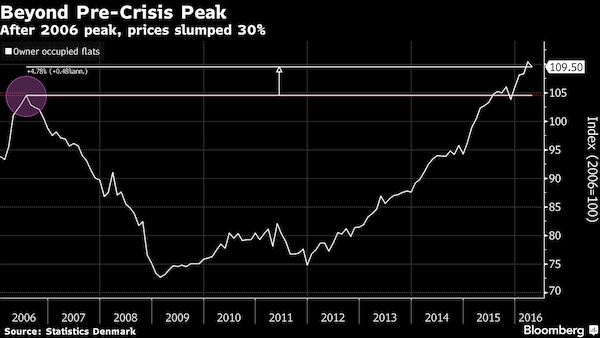
“So the price level is playing its own damping role on the market, because incomes haven’t quite been able to keep up. This is already visible in Copenhagen.” Apartment prices in Denmark are about 5% above their 2006 peak, according to the latest data from Statistics Denmark. Back then, the country’s bubble burst and apartment prices slumped about 30% through 2009. But there’s also a flip side to record-low interest rates. Banks have suffered fewer writedowns as borrowers find it easier to repay cheaper loans. The number of homeowners unable to honor their mortgage commitments is falling, with just 0.19% failing to meet payment deadlines in the first quarter, according to industry data published on Tuesday.

Read more …

“..the romance of decentralization..”

• Call Blockchain Developers What They Are: Fiduciaries (Walch)

The recent hack of the DAO (short for Decentralized Autonomous Organization) and the subsequent reversal of funds on Ethereum’s blockchain should finally put an end to a decentralization charade. People are, in fact, governing public blockchains, and we need to be able to trust them. From the beginning, the core developers (who write, evaluate and modify the software code) and the powerful miners (holders of significant chunks of computing power within the network) have been the governing bodies of these so-called decentralized systems. Yet the romance of decentralization – with the seductive idea that we don’t have to trust anyone because no human is doing anything – has allowed many to overlook this important truth.

In the techno-utopian world of blockchain technology, it has become fashionable to proclaim that software code and its operation can replace the need for human governance. Hence, the push toward “decentralized autonomous organizations,” which are essentially corporations run through code rather than by people. The first of these, the DAO, began operating in May 2016, raising $150 million from investors to operate as a venture fund for blockchain technology. The DAO is just software, coded by an ambitious group at the company Slock.It. It was embarrassingly compromised through a computer hack for $60 million within a month of its inception.

The theft’s fallout has been dramatic. Since the DAO was built on the Ethereum blockchain, everyone involved with the technology was affected: DAO investors, owners of ether (the cryptocurrency of Ethereum) and anyone building anything on Ethereum, which has sought to be a platform for so-called smart contracts. This raised serious questions like: Should folks try to get the stolen ether back? Should they leave it be, as the hack was simply an exploitation of a bug in the purportedly unstoppable code?

Read more …

“The rivers are the arteries of the Earth. When we block them up, the earth becomes unhealthy.”

• Construction Of Giant Dam In Canada Prompts Human Rights Outcry (G.)

Human rights campaigners are calling on Canadian authorities to halt construction of a huge hydroelectric dam in western Canada over concerns that the mega-project tramples on the rights of indigenous peoples in the area. A global campaign launched by Amnesty International on Tuesday called on the federal government and the provincial government of British Columbia to withdraw all permits and approvals for the Site C hydroelectric dam, a C$9bn project that will see more than 5,000 hectares (12,350 acres) of land – roughly equivalent to about 5,000 rugby fields – flooded in north-east British Columbia. The land is part of the traditional territories of indigenous peoples in the region, said Craig Benjamin of Amnesty International Canada.

“It’s an area that people have used for thousands upon thousands of years. Their ancestors are buried in the land; there are hundreds of unique sites of cultural importance; there is cultural knowledge of how to live on land that is associated with this specific spot.” Many continue to rely on the land to hunt, fish, plant medicines, gather berries and conduct ceremonies. “There are really few other places where they can go to practice their culture and to exercise their rights because this is a region that has been so heavily impacted by large-scale resource development.” Amid protests by several First Nations groups, the project was approved by provincial and federal authorities in 2014, allowing preparatory work to begin last summer.

Earlier this year, as clear-cutting began in the area, part of the construction was held up by a protest camp set up by indigenous activists. “This is home,” said Helen Knott, one of the half a dozen protesters who occupied the site. “The rivers are the arteries of the Earth. When we block them up, the earth becomes unhealthy. It’s about being able to protect something to pass on to our children.” After two months in the snow and braving temperatures that dropped as low as -20C, a provincial court ordered them to dismantle the camp.

Read more …

Aug 042016
 
 August 4, 2016  Posted by at 8:04 am Finance Tagged with: , , , , , , , , , , ,  Comments Off on Debt Rattle August 4 2016


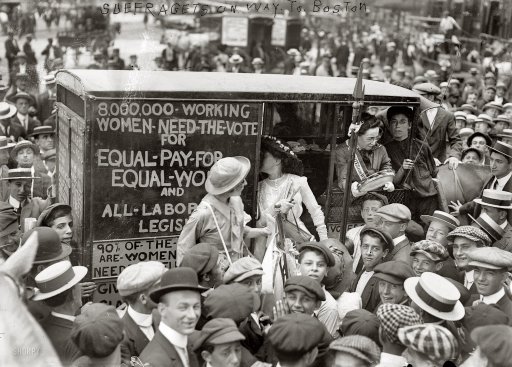
G.G. Bain New York, suffragettes on way to Boston 1913

• Is Deutsche as Dangerous to Financial Stability as Citigroup in 2008? (M2)
• Pound Volatility Gauge Climbs as Traders Brace for BOE Rate Cut (BBG)
• Britain Faces A Nasty Shock When The Global Energy Cycle Turns (AEP)
• Cash Handouts Are Best Way To Boost Growth, Say Economists (G.)
• Shock At The ATM: 1000s Of Supplementary Greek Pensions Cut By 21%-46% (KTG)
• EU Trade Policy ‘Close To Death’ If Canada Deal Fails (Politico)
• Reality of BC’s Foreign Buyers Tax Begins To Bite, Deals Collapsing (FP)
• Morgan Stanley Discloses $3.21 Billion Italian Swaps Claim (BBG)
• Tesla Loses $293 Million as Deliveries Fall Short, Expenses Rise (WSJ)
• We’re Not Out of the Woods Yet (STA)
• Justice Department Officials Objected to US Cash Payment to Iran (WSJ)
• Julian Assange: The Untold Story Of An Epic Struggle For Justice (Pilger)
• Court Throws Out Terrorism Conviction In Canada, Cites Police Entrapment (I’Cept)
• Italy Adopts ‘Beautiful’ New Law To Slash Food Waste (BBC)


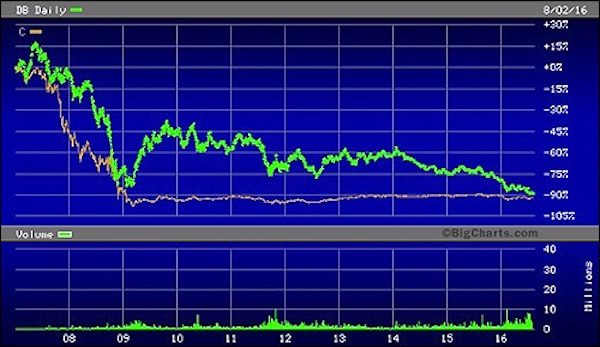
Martens and Martens. “..a year ago, Deutsche Bank’s stock closed at $34.88. Its share price at the open this morning was $12.56, a loss of 64% in one year’s time. But from June 1 of 2007, Deutsche Bank has lost a whopping 90% of its share value, right on par with Citigroup.”

• Is Deutsche as Dangerous to Financial Stability as Citigroup in 2008? (M2)

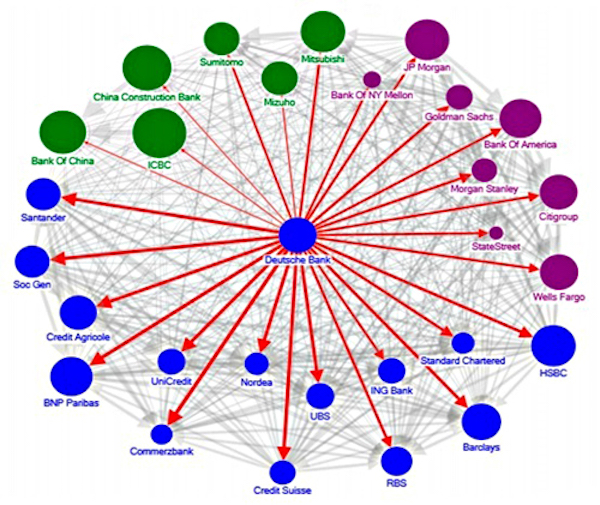
Deutsche Bank is starting to resemble the financial basket case that Citigroup became in 2008, leading to Citigroup’s partial ownership by the U.S. government for a time and the bank requiring the largest taxpayer bailout in U.S. financial history. Citigroup’s teetering condition and its interconnectedness to other mega banks played a critical role in the Wall Street crash and collapse of the U.S. economy. That Deutsche Bank (which is highly interconnected to other major Wall Street banks and locked and loaded with tens of trillions of dollars in derivatives) is now showing the same kind of stresses as Citigroup back in 2008, raises the obvious question about just how effectively the Obama administration has reined in systemic financial risk after six years of reassurances that Dodd-Frank financial reform was getting the job done.

On this date a year ago, Deutsche Bank’s stock closed at $34.88. Its share price at the open this morning on the New York Stock Exchange was $12.56, a loss of 64% in one year’s time. But from June 1 of 2007, prior to the onset of the financial crisis, Deutsche Bank has lost a whopping 90% of its share value, right on par with Citigroup. As of this morning’s open, Deutsche Bank has a measly $17.32 billion in equity capital versus a portfolio of derivatives amounting to just shy of $50 trillion notional (face amount) as of December 31, 2015.


Systemic Risk Among Deutsche Bank and Global Systemically Important Banks (Source: IMF: “The blue, purple and green nodes denote European, US and Asian banks, respectively. The thickness of the arrows capture total linkages (both inward and outward), and the arrow captures the direction of net spillover. The size of the nodes reflects asset size.”)

Read more …

Carney’s expected to announce desperate measures today.

• Pound Volatility Gauge Climbs as Traders Brace for BOE Rate Cut (BBG)

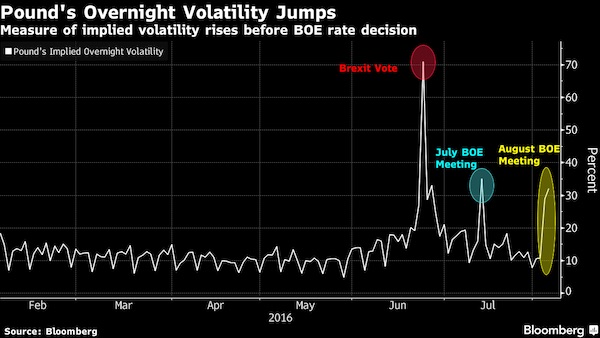
A measure of overnight potential price swings for the pound against the dollar approached the highest closing level since Britain voted to leave the European Union in June as traders braced for the Bank of England’s policy decision Thursday, which most economists forecast will bring the first interest-rate cut in seven years. Sterling fell versus all but one of its 16 major peers as swaps pricing showed a 100% chance of a rate cut. While all except two of 52 analysts in a Bloomberg survey forecast a reduction, there are a suite of other measures, including an expansion of its bond-purchase program, which the BOE may adopt to tackle a Brexit-induced fallout which are more difficult to predict.

Some economists said they would not rule out the possibility that the BOE will keep its powder dry at this meeting, as it did in July, while awaiting a clearer economic picture. “There is quite a lot of speculation regarding what the BOE might do today, so the short-term volatility is to be expected,” said Mark Dowding, a London-based partner and money manager at BlueBay Asset Management. “We doubt the BOE would be opposed to the idea of the pound falling further as it would support the growth outlook, which is deteriorating markedly. We see the pound falling to $1.20 or lower by the end of the year.”

Read more …

Yes, Britain’s in for a bind. But energy is not Ambrose’s strong suit.

• Britain Faces A Nasty Shock When The Global Energy Cycle Turns (AEP)

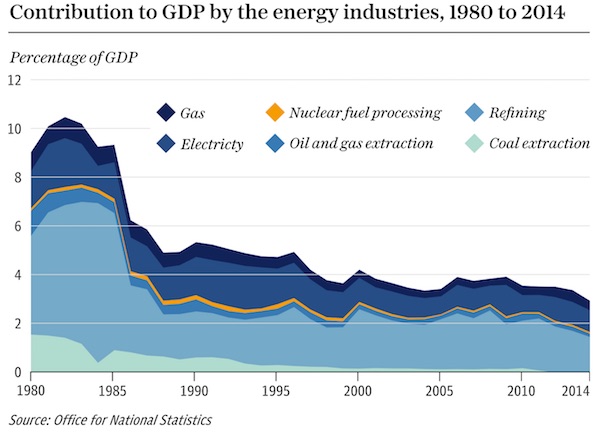
Britain’s energy industry is dying. While the US is striving for self-sufficiency in fuel and power as a primary goal of strategic security in a dangerous world, this country has acted with strange insouciance. We have let matters drift for so long that half of our nuclear reactors will be phased out over the next nine years with nothing ready to replace them. North Sea oil and gas is a spent reserve. Britain’s dependency on imported fuels and electricity has jumped from 17pc to 46pc since 2000. Energy is becoming a corrosive element in Britain’s current account deficit, now 6.9pc of GDP, and the scale of vulnerability has been masked by the slump in world energy prices. When the global fossil cycle turns – inevitable, given the $400 investment freeze in oil and gas projects over the last two years – Britain will face a national energy ‘margin call’.

The confluence of Brexit, a new government, and the review of the Hinkley Point nuclear plant have suddenly thrown open the debate on how the UK should power its economy. It is a dangerous moment, but also giddily fluid. As a summer exercise, I will float a few thoughts on how to seize this chance, open to suggestions from Telegraph readers for better ideas. My heterodox mix will satisfy nobody: it includes fracking a l’outrance, micro-nuclear and molten-salt reactors, more off-shore wind, a Norwegian-style push for electric vehicles by 2030, and a grand plan for carbon capture and storage to take advantage of Britain’s unique competitive advantage in this field and revitalize Northern industries.

There is no shortage of funds. Britain can borrow at 1.47pc for half a century, and it should do so without compunction as an investment stimulus to carry the country through the post-Brexit storm. Oil and gas fracking does not require public money anyway. Britain’s shale industry is already poised to drill, so that is where I will begin today.

Read more …

Including Steve Keen, David Graeber.

• Cash Handouts Are Best Way To Boost Growth, Say Economists (G.)

Direct cash handouts to households would be a better way of boosting Britain’s flagging economy than the interest-rate cuts expected from the Bank of England on Thursday, according to a group of progressive economists. In a letter to the chancellor, 35 economists have urged Philip Hammond to ditch the approach that has been followed by the government since the recession of 2008-09 and give the Bank the right to try more radical options. The letter, to be printed in Thursday’s Guardian, suggests that the Bank should be allowed to create money to fund key infrastructure projects. Alternatively, the group says the Bank could pay for tax cuts or direct payments to households.

The letter states: “A fiscal stimulus financed by central bank money creation could be used to fund essential investment in infrastructure projects – boosting the incomes of businesses and households, and increasing the public sector’s productive assets in the process. Alternatively, the money could be used to fund either a tax cut or direct cash transfers to households, resulting in an immediate increase of household disposable incomes.” Threadneedle Street would need approval from the Treasury to adopt what the US economist Milton Friedman once described as “helicopter drops” of money on to the economy as a means of removing the threat of deflation. The nine members of the Bank’s monetary policy committee (MPC) will announce at midday how they plan to respond to the economic shock caused by the decision to leave the EU in the 23 June referendum.

Read more …

The rape of Greece continues.

• Shock At The ATM: 1000s Of Supplementary Greek Pensions Cut By 21%-46% (KTG)

It was certainly a shock for thousands of Greek pensioners: beginning of August they saw their supplementary pensions to have undergone cuts from 21% up to 46%. Affected are 311,680 pensioners receiving pensions from 11 pension funds. The 3. bailout and the Pensions Reforms provided that if the sum of main and supplementary pension exceeds €1,300 gross, the supplementary pension has to be cut. The second wave of cuts to be implemented as of September will affect another 924,345 pensioners belonging to other pension funds.

The Pension Reforms ended up in throwing all pensioners in one bag and have them ‘share’ the available pension funds, although this is –first of all- “unfair” for the pensioners of the private sector. They have been loyally paying their social security contributions all through their work life, while the pensioners of the public sector have been paying much less and thus receiving disproportionately much more. Public servants who massively left service with early retirement of 25 years in 2010, they ended up receiving a pension amount equal to their salary – although it should have been much lower. Yes, it is unfair. And this is what I hear from more and more people form the private sector.

Read more …

100,000 TTiP protesters in Germany yesterday?!

• EU Trade Policy ‘Close To Death’ If Canada Deal Fails (Politico)

One of the EU’s most senior officials has warned that the bloc’s trade policy will be “close to death” if it cannot ratify a landmark agreement with Canada. The alarm sounded by Jean-Luc Demarty, director-general for trade, is a sign of growing concern in Brussels that the European Commission is losing control over one of its core competencies in the face of surging public opposition to free trade. In a frustrating blow to the Commission, the member countries last month wrested the approval process for the trade deal with Canada away from Brussels. The accord will now require approval in Europe’s 38 national and regional parliaments, raising the specter of delays and even vetoes in assemblies ranging from Wallonia to Romania.

Demarty delivered his stark warning at the EU’s trade policy committee ahead of the summer break, according to people present at the confidential meeting. Most diplomats expect the Canadian deal to win the qualified majority required for provisional application at the Council. Notes from the July 15 meeting, seen by POLITICO on Monday, showed that Demarty warned that EU trade policy would have a “big credibility problem” if it could not ratify the deal. He then added that it would be “close to death.” Two other diplomats confirmed the remarks and added that this was now typical of Demarty’s tone on the subject. One observed that Demarty seemed “helpless.”

Traditionally, trade has been the blue-riband portfolio in Brussels, with national governments surrendering all of their powers to negotiate trade deals and impose tariffs to the Commission. But Brussels suffered a significant setback on July 5 when France and Germany unexpectedly insisted that a trade deal with Canada would have to be ratified by the EU’s 38 national and regional assemblies. That has left the Commission scrambling to rescue the deal and preserve its status as the biggest force in global trade.

Read more …

It’s healthy when bubbles burst. But painful too for some.

• Reality of BC’s Foreign Buyers Tax Begins To Bite, Deals Collapsing (FP)

Realtors and lawyers desperate to get in under the deadline filed a record-setting 15,000 property transfer applications on Thursday and Friday, the last business days before B.C.’s punishing new 15-per-cent tax on foreign property buyers went into effect. More than 9,200 transactions were filed on Friday, breaking the 2007-2008 record of more than 8,400 in a single day, according to the B.C. Land Title and Survey Authority. It also reported over 5,800 transactions on Thursday, representing nearly as many deals registered at month’s end in April. The demand was so heavy that it crashed the land titles office’s electronic filing service on both days, the authority said.

Now, as a new dawn breaks in Metro Vancouver’s real estate market, realty companies and real estate boards are reporting the first anecdotes of deals falling through as foreign buyers forfeited deposits on binding deals rather than pay the new tax. And they report evidence of local buyers withdrawing offers in expectation that the market will soften. Elton Ash, executive vice-president of Re/Max Western Region, said it is too early to accurately quantify how many deals fell apart, but he’s heard from realtors in some of the company’s 30 Metro Vancouver offices of cases where foreign buyers who couldn’t rearrange previously negotiated closing dates have already walked away.

[..] Jonathan Cooper, vice-president of operations at MacDonald Realty, expects many cases to go to court because deposits are held in trust by realtors and usually can’t be released without a court order. “I think the next chapters in this story are going to be written by lawyers,” Cooper said. “There are going to be cases for sellers trying to get the deposit out of trust and maybe suing the buyer for specific performance trying to get them to complete, and/or for damages if they are not able to find a buyer at a similar price point.”

Read more …

“Across Italy, cities faced with shrinking income and rising expenses bought swaps from U.S. firms to cut short-term interest costs..”

• Morgan Stanley Discloses $3.21 Billion Italian Swaps Claim (BBG)

Morgan Stanley said an Italian prosecutor may seek as much as €2.88 billion ($3.21 billion) over allegations that derivatives the investment bank sold more than a decade ago were improper and unfairly unwound. Italy’s Court of Accounts, the country’s state auditor, sent Morgan Stanley the proposed claim over derivatives created from 1999 through 2005 and terminated by 2012, the New York-based bank said Wednesday in a quarterly regulatory filing. Italy had paid Morgan Stanley $3.4 billion to unwind interest-rate swaps and options that had backfired, as it was cheaper than renewing the contracts, Bloomberg reported in 2012.

Mark Lake, a Morgan Stanley spokesman, said the proposed claim is groundless and that the bank will defend itself vigorously. Wall Street has been accused of duping municipalities with sophisticated and complex instruments. Some banks pitched the derivatives transactions as a way to save on borrowing expenses, but many ended up being costly for their government customers. Across Italy, cities faced with shrinking income and rising expenses bought swaps from U.S. firms to cut short-term interest costs, putting them at risk of paying more in the long run.

Read more …

Wonder when this bubble will burst. Tesla rides ‘green waves’ in more than one way.

• Tesla Loses $293 Million as Deliveries Fall Short, Expenses Rise (WSJ)

Tesla Motors’s loss widened in the second quarter amid higher costs, but the company stuck to an ambitious plan that calls for building nearly 80,000 cars in 2016 and pulling forward a cheaper sedan aimed at the mass market. The Silicon Valley electric car maker’s report follows a tumultuous period capped by a traffic fatality related to the company’s semiautonomous Autopilot system. Regulators also dinged the company’s practice of having certain buyers sign nondisclosure agreements and the company faced continued questions about the quality of its Model X sport-utility vehicle.

Tesla, long known as a company that moves faster than traditional auto makers, plowed forward during the quarter. It announced its intention to combine with SolarCity Corp., which shares with Tesla Elon Musk as chairman. On Monday, the Tesla announced a firm deal with SolarCity valued at $2.6 billion.

Read more …

“..the next leg down in oil prices could be far more disruptive than most investors expect and it may not take much to trigger a major financial event.”

• We’re Not Out of the Woods Yet (STA)

The risk of a global shock appears to be rising once again as (1) oil prices fall back into the $30s and (2) modestly improving US economic growth strengthens the case for a rising dollar. In addition to a likely revival in US rate hike expectations, growing foreign demand for US cash flows, or the prospect for more central bank easing abroad (both of which could drive the dollar higher), the world economy may already be nearing another breaking point as foreign central bank assets held at the Federal Reserve continue to fall on a year-over-year basis. Every time this measure has fallen below zero in the last fifty years, it has coincided with a major global event.

My suspicion is that oil producing countries (who officially flipped from current account surplus into current account deficit in 2015) are liquidating their US dollar assets to manage government budget shortfalls. With that in mind, the next leg down in oil prices could be far more disruptive than most investors expect and it may not take much to trigger a major financial event. We’re not aggressively betting on a crisis, but my colleagues and I on the STA Investment Committee continue to run conservative portfolios with an underweight to equities, and a focus on yield-oriented assets (like corporate bonds and preferred stocks) and defensive assets (like cash, gold, managed futures, and long-dated US Treasuries) while we wait for quality assets to go on sale.

If you’ve been paying attention to global markets this year, you are probably still scratching your head as to what fundamentally changed in early February. What pulled us back from the edge of a global crisis and set the stage for one of the most powerful reflations (ex earnings) in recent memory? What caused corporate credit spreads to collapse, crude oil to bottom, and the S&P 500 to scream higher? And, most importantly, is this a sustainable new trend? Or an epic bear trap? As regular FWIW readers may remember, I offered a hypothesis in mid-March – arguing that major central banks had begun to quietly intervene in foreign exchange markets – and I laid out a vision for 2016 as long as policy elites were able to keep the trade-weighted US dollar in a “goldilocks” trading range.

Read more …

Ronald Reagan Returns.

• Justice Department Officials Objected to US Cash Payment to Iran (WSJ)

Senior Justice Department officials objected to sending a plane loaded with cash to Tehran at the same time that Iran released four imprisoned Americans, but their objections were overruled by the State Department, according to people familiar with the discussions. After announcing the release of the Americans in January, President Barack Obama also said the U.S. would pay $1.7 billion to Iran to settle a failed arms deal dating back to 1979. What wasn’t disclosed then was that the first payment would be $400 million in cash, flown in at the same time, as The Wall Street Journal reported Tuesday.

The timing and manner of the payment raised alarms at the Justice Department, according to those familiar with the discussions. “People knew what it was going to look like, and there was concern the Iranians probably did consider it a ransom payment,’’ said one of the people. The disclosures reignited a political furor over the Iran deal in Washington that could complicate White House efforts to fortify it before Mr. Obama’s term ends. Three top Republicans who have been feuding in recent weeks—presidential candidate Donald Trump, Sen. John McCain and House Speaker Paul Ryan—were united Wednesday in blasting the Obama administration.

Read more …

Excellent expose by John Pilger.

• Julian Assange: The Untold Story Of An Epic Struggle For Justice (Pilger)

The siege of Knightsbridge is both an emblem of gross injustice and a gruelling farce. For three years, a police cordon around the Ecuadorean embassy in London has served no purpose other than to flaunt the power of the state. It has cost £12 million. The quarry is an Australian charged with no crime, a refugee whose only security is the room given him by a brave South American country. His “crime” is to have initiated a wave of truth-telling in an era of lies, cynicism and war. The persecution of Julian Assange is about to flare again as it enters a dangerous stage. From August 20, three quarters of the Swedish prosecutor’s case against Assange regarding sexual misconduct in 2010 will disappear as the statute of limitations expires.

At the same time Washington’s obsession with Assange and WikiLeaks has intensified. Indeed, it is vindictive American power that offers the greatest threat – as Chelsea Manning and those still held in Guantanamo can attest. The Americans are pursuing Assange because WikiLeaks exposed their epic crimes in Afghanistan and Iraq: the wholesale killing of tens of thousands of civilians, which they covered up, and their contempt for sovereignty and international law, as demonstrated vividly in their leaked diplomatic cables. WikiLeaks continues to expose criminal activity by the US, having just published top secret US intercepts – US spies’ reports detailing private phone calls of the presidents of France and Germany, and other senior officials, relating to internal European political and economic affairs.

None of this is illegal under the US Constitution. As a presidential candidate in 2008, Barack Obama, a professor of constitutional law, lauded whistleblowers as “part of a healthy democracy [and they]must be protected from reprisal”. In 2012, the campaign to re-elect President Barack Obama boasted on its website that he had prosecuted more whistleblowers in his first term than all other US presidents combined.

Read more …

The details are stunning, but at the same time familiar.

• Court Throws Out Terrorism Conviction In Canada, Cites Police Entrapment (I’Cept)

Sting operations — in which an undercover agent or informant provides the means and opportunity to lure otherwise incapable people into committing a crime — have represented the default tactic for counterterrorism prosecutions since the 9/11 attacks. Critics believe these stings amount to entrapment. Human Rights Watch, for instance, argues that law enforcement authorities in the U.S. have overstepped their role by “effectively participating in developing terrorism plots.” Nonetheless, U.S. courts have rejected entrapment defenses, no matter how hapless the defendants. In Canada, however, the legal standing of counterterrorism stings has suddenly shifted.

Last week, a high-ranking judge in British Columbia stayed the convictions of two alleged terrorists, ruling that they had been “skillfully manipulated” and entrapped by an elaborate sting operation organized by the Royal Canadian Mounted Police. “The specter of the defendants serving a life sentence for a crime that the police manufactured by exploiting their vulnerabilities, by instilling fear that they would be killed if they backed out, and by quashing all doubts they had in the religious justifications for the crime, is offensive to our concept of fundamental justice,” the judge wrote. “Simply put, the world has enough terrorists. We do not need the police to create more out of marginalized people who have neither the capacity nor sufficient motivation to do it themselves.”

This is the first time that a counterterrorism sting — whose tactics were developed by the FBI through modifying those of undercover drug stings — has been thrown out of court whole cloth in Canada or the U.S. Supreme Court Justice Catherine J. Bruce was ruling in the case of John Nuttall and his common-law wife, Amanda Korody, two drug addicts who lived on the streets in British Columbia. As part of sting operation in which the RCMP paid at least 200 officers a total of more than $900,000 Canadian in overtime, law-enforcement agents encouraged the couple to place pressure-cooker bombs at the British Columbia parliament building on Canada Day 2013. As in FBI counterterrorism stings, RCMP provided Nuttall and Korody with everything they needed to become terrorists.

Read more …

Can we adopt this throughout the world please?

• Italy Adopts ‘Beautiful’ New Law To Slash Food Waste (BBC)

Italy has passed into law a raft of new measures to try to reduce the mountain of food wasted in the country each year. The bill – backed by 181 Senators, with two against and 16 abstaining – aims to cut waste one million tonnes from the estimated five million it wastes each year. It has been heralded as “one of the most beautiful and practical legacies” of the Expo Milano 2015 international exhibition – which focused on tackling hunger and food waste worldwide – by Agriculture Minister Maurizio Martina. According to ministers, food waste costs Italy’s business and households more than €12bn per year. Studies suggest it could amount to more than 1% of GDP.

The problem is by no means confined to Italy. The UN Food and Agricultural Organisation (FAO) estimates that some one third of food may be wasted worldwide – a figure which rises to some 40% in Europe. “The food currently wasted in Europe could feed 200 million people,” the FAO says. It’s not the first time Italy has acted decisively over issues of hunger and food. Three months ago, its highest court ruled that stealing small amounts of food to stave off hunger was not a crime.

Read more …

Jul 222016


Dorothea Lange ‘OK Family bound for Kingfisher and Lubbock. We’ll be in California yet’ 1938

Basic income is a topic I’ve been thinking about for a while, and while I won’t get anywhere near a comprehensive overview -there are too many uncertainties and untested ideas-, I’m going to try to paint a first chapter in a work of progress. Or, a thought experiment, for me and others.

Of course I’ve read a lot of and about other people’s ideas on the topic, and I’m sure there are many more out there that I haven’t seen yet, but I’m afraid to say that about all of those I did read tend to fall into the same ‘trap’. That is, they project their ideas, which are widely varying, onto -or close to- the economy (economies) and society (societies) as they are today.

Their basic income examples and ideas and theories (as well as criticisms of them) are all built around a perception of the economy as it is, or better still as it once was. And that is probably a bad idea. Because the economy of the future will not be like it is today, or was yesterday, and neither will societies.

And that is not because of the role automation and/or robots will play, a topic that features prominently in many basic income writings; those things are but a minor distraction. What will change our world much more profoundly will be the inevitable demise of the economic system as we know it.

And it’s against that backdrop that the issue of basic income must be viewed. If only because it then becomes something entirely different.


I started thinking a while back that it would not be robots or inequality that would be the foundation of and driving force behind basic income, but the ruin of our pension systems. Of course one has to be careful with general statements on this, because there are so many different systems and approaches when it comes to pensions and other old-age ‘provisions’ and/or ‘benefits’.

What all have in common today, though, is that they’re woefully underfunded and sliding down further fast due to ultralow interest rates and other ‘policies’, as well as to ageing societies. It seems almost incredulous that until a few years ago most pensions funds were required by law to invest only in AAA-rated assets.

While they may not all suffer from the same afflictions, all these systems, from Social Security to private pension funds, do suffer from the same symptoms. Painting the picture with a broad stroke, it’s safe to say they’re all in essence Ponzi schemes.

While many of the ‘Social Security variety’ depend on the trust in a government to pay out something for which nothing -or very little- has been set aside, those of the variety in which money IS actually paid in are inflicted by the twin impairments of too little return on what is paid in to maintain the fund, and too few newcomers to pay for what ‘oldtimers’ never paid but do want to take out.

A third ‘impairment’ will occur when younger workers figure out they’re paying into something they will never see any benefits of, and refuse to fork over any longer.

Low interest rates and ageing populations are wreaking havoc on -especially- European and Japanese pensions even as we speak, and a brief look at future trendlines makes abundantly clear where things are going.

Pondering all that, it seems obvious that at some point a government with at least a bit of vision would come to the conclusion that a basic income to replace all the faltering old-age provisions schemes -and many others- might make a lot of sense. If only because, once you think about it, ‘free’ money only for older people does not make sense, neither politically nor economically.


But let’s take a step back; that last bit still doesn’t take sufficiently into account that our economies are about to undergo radical changes because they are collapsing. What I find interesting is that this collapse actually seems to play into the hands of a basic income. For several reasons, as a matter of fact.

I am convinced that a basic income in an economy that’s part of a centralized, even globalized, system, makes no sense. You can’t really have a basic income in a society that imports most of what it uses, but that still is the model of most of our societies. We import much of what’s essential, and export non-essential things.

That is a problem that will more or less solve itself, though we better pay attention and be prepared, or else. We may not know exactly when or how the economic collapse will occur, but that’s not the most important thing. What is, is that centralization can only happen in a growing economy. As soon as growth halts -or even reverses-, economies will of necessity decentralize. Unless perhaps they’re under a dictatorship, but even then.

Setting up a basic income system in a society that, for example, imports its clothes and furniture -and sometimes even food- from China, is a doomed proposition. The number one requirement for a successful basic income is that the money issued stays inside the society it’s being issued in. If not, it would merely speed up bankruptcy.

The money must be spent locally, on local products, as much as possible, because then it will be worth much more to the local economy. This will also go far towards fighting deflation, because the velocity of money will increase. To ensure that as much as possible is spent inside a community/society, the manufacturing base will need to be (re-)built.

Which must happen anyway as the global economy sinks, and the sooner, the better. The worldwide transport lines we know today will not exist for much longer, and it will take time to adapt one’s economy to that.

On the bright side, this decentralization, or relocalization, or ‘protectionism’ if you will, will (re-)create a lot of jobs. Not ones that will pay as much as what we see now, but that’s not necessarily such a bad thing. And besides, it’s not as if we have some kind of free choice. Reality will dictate the terms. We must produce our own essentials once again: food, clothing, housing, furniture etc.

Still on the bright side, the new jobs will make basic income much less costly for a society. Because you can top off what people make on top on whatever the basic income is, and you can do so at a level that everyone can agree to.


That’s my first take of basic income in a crisis, a crisis I see as set in stone. Which changes the whole issue of a basic income. Plenty people will see this as socialism or something in that vein, I see it as perhaps the only way to make sure you have a functioning society on the way down. With none of the alternatives looking particularly appealing.

When discussing the details of such a program, what would probably be good, if only for the sake of justice, is to combine it with Steve Keen’s notion of a Modern Debt Jubilee, in which debt gets cancelled but those with most debt are obliged to pay -part of it- down, while those who are debt-free get ‘rewarded’ for that status.

What I have always found difficult to envision is how a jubilee would work in modern days. The ones ‘of old’ would typically involve a local ruler and/or landlord to whom subjects owed debts of some sort, which the ruler could declare null and void while still being the ruler- and the richest man around.

Today debts are global, with much of them having been securitized and sold on to large -financial- institutions who may even be anonymous and have shareholders in dozens of different countries. How do you get them to agree to large-scale debt cancellation or reform? I’m not saying it can’t be done, but it’s not the same thing.

The hardest part of what I laid out above may well be to get people who feel they are owed benefits, pensions or otherwise, to accept that these will be incorporated into a new basic income system. Not many understand to what extent pensions systems are Ponzi’s, and even those who do to an extent may still refuse to give up their slice of the pie.

It should be fairly easy, though, to explain what their slice will look like once the systems collapse, or even simply once nobody pays in anymore. And because younger people have no reason to pay for something they know they will never see the benefits of, and moreover all this can be phased in/out over a certain period of time, it may well unfold faster and easier than one might think at first sight.


Lastly, some numbers. Greg Ip wrote for the Wall Street Journal last week: Revival of Universal Basic Income Proposal Ignores Needs of Labor Force. Obviously, in my example, i.e. in an economy that’s going down the drain, the term ‘needs of the labor force’ takes on a whole different role and meaning. In his piece, Ip says:

To send every American adult $10,000 a year would cost $2.4 trillion, or 13% of GDP.

And I think that is a misleading way of phrasing things. Because the money doesn’t disappear, so it doesn’t ‘cost’ that; and that’s not only true in my theoretical example. Most of the ‘basic income money’ would circulate inside the economy, and much comes back to the issuing state through various taxes. Crux is don’t let it leave the economy it’s issued in.

Mind you, I don’t see a basic income trial happen in the US, because it’s far too big a country. The EU is too large too. You’d need smaller units. And as I said, a shrinking economy would of necessity make units smaller. In Europe, these units already exist. In countries the size of Finland, Switzerland, Scotland, Wales, perhaps Greece, a basic income trial may well be viable.

That is, provided they shrug off the strangleholds that bind them to centralized systems. But that they will wind up doing regardless. What’s more important is that such a trial is meticulously planned, and not with some pie in the sky idea of where the world economy is headed.

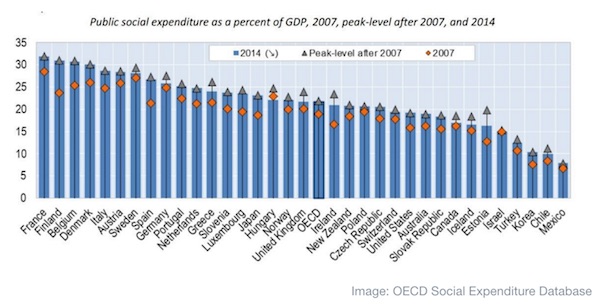
Greg Ip suggests that a $10,000 basic income for all US adults is not realistic, because it would ‘cost’ 13% of GDP. But this graph from the World Economic Forum World Economic Forum on social expenditures as calculated by the OECD, puts things in a different light:


In 2014, US social expenditures were at about 20% of GDP, which is 50% more than Ip’s example. And that is the main point behind the basic income question, even if you don’t subscribe to the collapsing economy ‘thesis’: what would happen if you replace all -or almost all- social benefit schemes in a particular society with a basic income? How much money would you save, or how much extra would it cost?

Ip seems to contend that a basic income would be prohibitively expensive. But, even if the OECD numbers fail to include certain items, there’s a lot of leeway between the 13% of GDP a US basic income would cost, and the 20% of GDP America now pays in benefits. About $1.2 trillion in leeway. So the cost picture at the very least is not all that obvious.

By the way, it’s kind of funny that I’ve seen nobody address the perhaps most ironic thing: even if the state would save a lot of money moving to the much simpler basic income from a myriad of other programs, that would make a whole lot of civil servants unemployed all at once. Can’t help wondering why no-one brings that up.

But the US is not the best example, for various reasons. It’s countries that have the right size to hold a trial in, or at least what we can perceive as the right size. Finland, Belgium, Denmark all spend close to 30% of GDP on social expenditures. Portugal, Greece, Slovenia, Luxembourg are at 25%. If a basic income can be had for 13% of GDP, these countries stand to save a fortune…

Unfortunately, you can’t be in the EU and start a basic income trial. And that’s a shame. Because it’s going to be very hard to get this right, and it’ll take some serious time and effort. So much so that not starting today is a risk in itself.

But as long as people keep having faith in the economists, politicians, bankers and reporters who drill the ‘recovery is right around the corner’ meme into them 24/7, and any alternative to that meme just scares the heebees out of them, I’m afraid there’ll be no basic income trial. Yes, there are a few ideas, but they’re all based on the wrong -growth- assumptions, so they’re sure to fail.

Caveat: No, I haven’t gone through all different social benefits plans of all countries I’ve mentioned, so I don’t know what part of GDP each spends at present, or how much they could save or lose. Someone will have to write ‘the book’ on this.

For my thought experiment here I found it sufficient to go with the basic principles, and throw in a few numbers. And the most elementary difference between me and other voices is not there anyway: that is in my putting the basic income issue against the backdrop of economic collapse, and nobody else really doing that whom I’ve read.

Yes, the title is Marquez, of course, THE time of cholera


Jul 132016
 
 July 13, 2016  Posted by at 8:33 am Finance Tagged with: , , , , , , ,  11 Responses »


Tim McKulka Elderly Woman Receives Emergency Food Aid, Sudan 2008

• Markets Are In The Twilight Zone, Get Ready For New New Deal (AFR)
• BOE Governor Carney Accused Of ‘Peddling Phoney Forecasts’ Over Brexit (G.)
• Carney Should Stop Being So Gloomy About Brexit (Ashoka Mody)
• German Leaders Demand Brexit Clarity From New British PM (R.)
• British Pensions £383 Billion Underwater As Liabilities Hit Record (Tel.)
• Ireland’s Economists Left Speechless by 26% Growth Figure (BBG)
• Losing Australia’s AAA Rating To Make Losers of Mortgage Holders (BBG)
• The Richest Generation in US History Just Keeps Getting Richer (BBG)
• A Year After Bailout, Greece Struggles For Brighter Future (AFP)
• EU Development Aid To Finance Armies In Africa (EuO)
• Global Arms Race Escalates As Sabres Rattle In South China Sea (AEP)
• Economic Theory as Ideology (Zaman)
• Half Of All US Food Produce Is Thrown Away (G.)


Thought we were already there.

• Markets Are In The Twilight Zone, Get Ready For New New Deal (AFR)

Macquarie analysts have likened the bizarre and inherently contradictory moves in markets to a “twilight zone” which is leading investors to a world where free-market economic thinking will be overtaken by the “nationalisation of credit” and state-sponsored growth. Think about that. Monetary policy is beating a path to a world where conventional market signals such as credit spreads and the price of risk will “finally perish” and be unseated by one where states are the drivers of credit, and spending and capital formation is the domain of central banks. “It would take the form of state-sponsored stimulation of consumption, investment, [research and development] and rescuing what essentially is a bankrupt financial superstructure (ie banks, insurance, life and pensions),” the Macquarie report, authored by Hong Kong-based analyst Viktor Shvets, said.

“Whilst similar to FDR’s New Deal, it would be a far more distorted world than either the 1930s or the 1960s-70s, with brand new investment signals.” [..] The unusual commentary from Macquarie says this “state driven paradise” will be brought on by ongoing high levels of volatility and “discontinuities” similar to what markets are grappling with today. “We don’t believe these conditions are yet satisfied, but the chances are high that they would be over the next 12-18 months. In the meantime, we still expect half-hearted ‘stop and go projects’. Japan is likely to be the first to ‘jump’ and wholeheartedly embrace this merger of fiscal, income support and monetary policies but others would eventually follow. It is just a matter of time.”

The Bank of Japan and re-elected Japan Prime Minister Shinzo Abe have signalled a fiscal-led stimulus package in excess of ¥10 trillion ($98 billion) is under consideration. The contradiction that Macquarie is referring to is the way markets have behaved since Brexit, where assets historically linked to “risk-on” and “risk-off” moods have inexplicably rallied in unison. Equities, a classic risk asset, have recovered all of their losses since the Brexit vote on the belief that central banks will step in and lift asset prices by doing stimulus and ignore sound fears about asset bubbles.

Read more …

His role is questionable. Shirked far too close to influencing politics.

• BOE Governor Carney Accused Of ‘Peddling Phoney Forecasts’ Over Brexit (G.)

Mark Carney has agreed to hand notes of private meetings he had with the chancellor in the run-up to the EU referendum to MPs, after a Treasury select committee hearing where the governor of the Bank of England faced questions about whether he had “peddled phoney forecasts” about the risks of a vote for Brexit. In his first appearance at the Treasury select committee since the referendum, the Bank’s governor faced questions about whether he had tried to scare the electorate by warning of the economic shock – and possible recession – that a vote to leave the EU would cause. Andrew Tyrie, the committee’s chairman, citing two former chancellors and two former leaders of the Conservative party, said the Bank had also been accused of “startling dishonesty”.

Tyrie, a Conservative MP, told Carney that the accusations, if true, would be a “very robust assault on the Bank’s credibility” and also of the independence from government it was granted in 1997 that could not be recovered under the Canadian’s tenure. Carney said he had held private meetings with George Osborne before the 23 June vote. He agreed that the MPs could appoint someone to review the notes of those meetings but said he would be reluctant for them to be made public. Carney was also asked by Jacob Rees-Mogg, a prominent Brexit campaigner, whether the Bank should be, like Caesar’s wife, beyond suspicion in terms of being influenced by politicians. The governor, who said politicians had sought to inform him rather than influence him, replied: “Those who cast it [the independence] into question should consider their motivations and their judgments.”

Read more …

That would mean Stage Five: Acceptance. It’ll take a while. In the meantime, the ‘gloom’ is driven by politics, not economics. And yes, Carney is the champ, hoping for a self-fulfilling process. The Leave camp, which won (remember?), should perhaps ask for him to step down.

• Carney Should Stop Being So Gloomy About Brexit (Ashoka Mody)

Few have been more downbeat about the outlook for the U.K. economy than the country’s own central bank governor, Mark Carney. If he wants to help mitigate the consequences of the vote to leave the European Union, he should send a more encouraging message by holding back on monetary stimulus. People charged with managing economies usually try to be optimistic, on the logic that their positive attitude will give people and businesses the confidence to spend and invest, ultimately making the optimism self-fulfilling. The rhetoric surrounding Britain’s vote on EU membership has been a glaring exception. In a bid to influence the vote, a chorus of global policymakers predicted dire consequences. That chorus has sadly persisted.

After voters chose to leave, the secretary general of the Organisation for Economic Cooperation and Development, Angel Gurria, reiterated forecasts of higher unemployment and permanent damage to household incomes. Christine Lagarde, managing director of the IMF, said that the decision was “casting a shadow over international growth.” Yet Brexit’s shadow is hard to discern amid the broader global decline in output growth and interest rates that began in early 2014. Perhaps no one, though, has been as active as Carney in stoking feelings of gloom and doom – a particularly notable feat, given that central bank governors rarely make predictions of economic and financial turmoil, especially when it concerns their own currency.

As far back as May, the Bank of England said that the possibility of Brexit was already weighing on the British pound, even though much of the decline in sterling’s value had happened earlier, when the polls – and especially the betting markets – showed a clear lead for the “Remain” campaign. The currency actually stabilized during the brief period when polls showed the “Leave” campaign gaining ground. Markets have come to anticipate Carney’s public appearances as harbingers of bad news. The pound began to decline in the hours before his first major post-Brexit speech on June 30, and he did not disappoint: Brexit-induced uncertainty, he insisted, had caused “economic post-traumatic stress disorder amongst households and businesses, as well as in financial markets.”

Read more …

Or else what?

• German Leaders Demand Brexit Clarity From New British PM (R.)

German leaders stepped up the pressure on Britain’s incoming prime minister Theresa May on Tuesday by demanding she swiftly spell out when she will launch divorce proceedings with the European Union. “The task of the new prime minister … will be to get clarity on the question of what kind of relationship Britain wants to build with the EU,” Chancellor Angela Merkel told a news conference. Her finance minister Wolfgang Schaeuble said clarity was needed quickly to limit uncertainty after Britain’s shock choice for ‘Brexit’, which has rocked the 28-nation bloc and thrown decades of European integration into reverse. May, 59, will on Wednesday replace David Cameron, who is resigning after Britons rejected his advice and voted on June 23 to quit the EU.

On arriving and departing from Cameron’s last cabinet meeting, she waved a little awkwardly from the doorstep of 10 Downing Street, shortly to become her home. She will face the enormous task of disentangling Britain from a forest of EU laws, accumulated over more than four decades, and negotiating new trade terms while limiting potential damage to the economy. The pound was up 1.2% against the dollar at around $1.3150, boosted by the appointment of a new prime minister weeks earlier than expected after May’s main rival dropped out. But it remains more than 12% below the $1.50 it touched on the night of the June 23 referendum, reflecting concerns that Brexit will hit trade, investment and growth.

The German leaders spoke after May’s ally Chris Grayling appeared to dampen any hopes among Britain’s EU partners that her rapid ascent might accelerate the process of moving ahead with the split and resolving the uncertainty hanging over the 28-nation bloc.

Read more …

Which of course can be blamed on Brexit again. But it’s really just a Ponzi scheme dying a natural death.

• British Pensions £383 Billion Underwater As Liabilities Hit Record (Tel.)

Britain’s gold-plated pensions now have record-breaking liabilities of £1.75 trillion after the EU referendum triggered a rout in their core gilt and equity holdings, highlighting the difficulty of funding the UK’s retirement needs. The country has almost 6,000 defined benefit schemes, which are obliged to pay their members an amount in retirement often tied to their final salary. Just 950 of these schemes were in surplus on June 30, with the rest hoping to make up the shortfall from long-term investment returns. In total, defined benefit funds are £383.6bn underwater, compared to £294.6bn just a month ago, as the tumbling UK government bond yields added to liabilities while global stock markets wiped value from the schemes’ equity investments.

Around 78pc of the long-term liabilities of the schemes are funded, down from 81.5pc within a month. While these figures are merely a snapshot, the data from the Pension Protection Fund highlights the precarious position of numerous schemes. “Companies are having to divert profits into schemes to make good on their promises, which means less investment capital to help businesses grow and less money available to invest in the pensions of younger workers,” said Tom McPhail, head of retirement policy at Hargreaves Lansdown. “Accrued pension rights have to be respected and investors have to be able to trust the system, however there is also a growing argument for the Government to look at finding a more balanced approach to the retirement funding needs of UK workforce.”

UBS analysts have estimated that a 1pc fall in real yields on government bonds results in a 10pc rise in pension liabilities, although this varies by scheme depending on how many bonds they hold. Gilts have jumped in price, lowering their yields, as global investors seek out safe havens. Industrial companies have the largest pension burdens, amounting to 77pc of their overall market value of the businesses, according to UBS’s research, while telecoms firms have liabilities worth 56pc of their value and utilities’ liabilities have reached 54pc.

Read more …

Hilarious.

• Ireland’s Economists Left Speechless by 26% Growth Figure (BBG)

In three days, Jim Power is due in London to brief the British-Irish Trade Association on the state of the Irish economy. Now, he has no idea what he is going to say. The economy grew 26% in 2015, officials from the Central Statistics Office told a stunned room full of economists and reporters in Dublin on Tuesday. Previously, they had estimated growth of 7.8%. “I’m not going to stand up and say the economy grew by 26%,” Power, an independent economist, said after the release. “It’s meaningless – we would be laughing” if these numbers came out of China, he said. The figure is mostly explained by the open nature of Ireland’s economy and its attraction to U.S. companies seeking access to a 12.5% tax rate.

Among firms that have inverted to Ireland, mostly through acquisitions, are Perrigo and Jazz Pharmaceuticals. Corporations with assets overseas of €523 billion were headquartered in Ireland in 2014, up from €391 billion in 2013, according to the statistics office. “We are a very small economy, and if we get a big increase in assets, this is what happens,” Michael Connolly, an official at the CSO, said on Tuesday. Once explained the numbers are “believable,” he said. In a statement, Finance Minister Michael Noonan pointed out that growth numbers cut Ireland’s debt and deficit ratios. Trouble is, they carry downsides too. For one, tax inversions artificially inflate the size of Ireland’s economy.

When the headquarters of a group of companies becomes resident in Ireland, all of its global profits may be counted as part of the nation’s gross national income, according to the ministry. Since 2008, that gauge has been boosted by about 7 billion euros thanks to corporate relocations, without accompanying substance or employment, the ministry has said. This in turn drives up the country’s contribution to the European Union budget, which is based on the size of the economy. For a second thing, it leaves self-described “baffled” analysts like Power at a loss to explain the state of the Irish economy. Power says he’ll look at indicators like employment growth and tax revenue for a better gauge, and guesses Ireland’s underlying economic growth was 5.5% last year.

Read more …

A world of pain.

• Losing Australia’s AAA Rating To Make Losers of Mortgage Holders (BBG)

The biggest losers after Prime Minister Malcolm Turnbull scraped through to win Australia’s fractious elections could be homebuyers facing higher costs on their A$1.6 trillion ($1.2 trillion) in mortgages. The price to protect bonds issued by the nation’s banks climbed seven basis points last week after S&P Global Ratings cut its outlook on Australia’s AAA grade to negative on concern government deficits will persist without “more forceful” decisions to rein in shortfalls. It also put the nation’s biggest lenders on notice. Stephen Miller, BlackRock’s head of fixed income for Australia, said Wednesday there’s a “real risk” Australia loses its top debt score.

“An increase in funding costs relating to a ratings downgrade will impact bank margins, but banks may choose to offset this via loan pricing,” said Anthony Ip at Citigroup in Sydney, adding that any increase in funding costs will be significant but manageable. “At the end of the day it’s still a competitive lending market.” Australia’s largest lenders – Australia & New Zealand Banking, Commonwealth Bank of Australia, National Australia Bank and Westpac Banking – rely on offshore bond markets for a fifth of their funding requirements, central bank data show. If their rankings were lowered after a sovereign downgrade, that would increase borrowing costs as much as 20 basis points, prompting them to slap mortgagees with higher interest rates, according to Citigroup.

Read more …

I smell a timebomb.

• The Richest Generation in US History Just Keeps Getting Richer (BBG)

Baby boomers started turning 65 in 2011, marking the unofficial beginning of their retirement years. The timing could not have been better for older boomers, who are already part of the wealthiest generation in U.S. history. Since then, the broad S&P 500-stock index is up 91%, including dividends. U.S. stocks hit a record high yesterday. Market performance in the early years of retirement is a crucial worry for anyone living off a nest egg. In the worst-case scenario, stocks crash just as retirees start spending their savings, leaving them in a hole they can no longer earn their way out of. Older boomers have experienced what is arguably the best-case scenario: The S&P 500 has returned 269% since its March 2009 low.

As a recent study in the Journal of Financial Planning shows, wealthy retirees can be very cautious about spending down their savings. This instinct, along with the stock market’s new record, suggests that many boomers are likely to end up with far more money than they know what to do with. Researchers followed the spending and investing behavior of 65- to 70-year-olds from 2000 to 2008. The poorest 40% of the survey respondents generally spent more than they earned, according to the study, which was funded by Texas Tech University. Those in the middle were able to keep their spending at about 8% below what they could have safely spent from pensions, investments, and Social Security.

The wealthiest fifth, meanwhile, had a gap of as much as 53% between their spending and what they could have spent. The authors wrote: “Retirees in the top quintile of financial wealth were spending nowhere near an amount that would place them in danger of running out of money. In fact, the average financial assets of wealthy retirees increased during this period and most retirees spent less than their income.” In other words, these affluent Americans retired and then continued to get richer. That’s quite a feat when you’re no longer working, particularly against the backdrop of the mediocre stock market of the early 2000s.

Read more …

Conditions in Greece are getting worse, fast. I’ll soon have more on that, firsthand. Meanwhile, another 4 refugees died this morning off Lesbos.

• A Year After Bailout, Greece Struggles For Brighter Future (AFP)

A year after it fought and lost a tug-of-war with its creditors, Greece remains a country that seems adrift, and many of its citizens view the present as joyless and the future as grim. Summer 2015 saw Greece’s youthful left-wing Prime Minister Alexis Tsipras wage an extraordinary battle between the mighty European Union, the European Central Bank and the IMF. Over five months, Tsipras and his firebrand finance minister, Yanis Varoufakis, took Greece and Europe to the brink as they demanded the creditors ease reforms imposed under two previous bailouts agreed since 2010. As the EU, ECB and IMF took a hard line, Greece’s financial flows shrank and a bank crisis loomed – but Tsipras, instead of buckling, stunned the world by announcing a referendum on the new deal proposed by creditors.

On July 5, 62% of voters rejected the package. But even with the mandate of the Greek people behind him, Tsipras backed down: the risk of seeing Greece thrown out of the eurozone was too much. Instead, in a dramatic U-turn, he let go of Varoufakis, replaced him with the more moderate Euclid Tsakalotos – and just over a week later, signed the third bailout. The deal was worth €86 billion over three years and laden with conditions, such as tax hikes and pension reforms, considered by critics to be so tough that social media buzzed with talk of a coup d’etat. Since then, Greece has soldiered on, weathering popular unrest and the consequences of the 2015 migration crisis, while Tsipras strives to defend his leftwing credentials.

Read more …

Brussels is completely lost. Time to end its misery.

• EU Development Aid To Finance Armies In Africa (EuO)

The EU commission wants to finance foreign armies as part of a larger effort to stop people from fleeing to Europe, including in countries with patchy human rights. A commission draft proposal released on Tuesday (5 July) spells out reasons why it is “necessary to provide assistance to the militaries of partner countries”. Some €100 million that were initially slated for development aid will be diverted to finance military-led border control exploits and other initiatives like mine-clearing The EU money can also be used to finance anything from troop transport vehicles to uniforms and surveillance equipment. Even furniture, stationary and “sport facilities” are covered. The EU has already contracted out some €1 billion from 2001 to 2009 when it came to things like law enforcement and border management.

But this is the first time it will pump money directly into a foreign military structure. “The direct financing of the military is not possible [at the moment]. Due to exceptional circumstances in some partner countries, it was important to close this gap,” notes the document, a joint communication to the European Parliament and EU Council. The document attempts to quell some concerns over how the money will be used. It notes, for instance, that it won’t fund “recurrent military expenditure”, weapons and ammunition, and combat training. But such limitations are unlikely to be taken seriously by critics. “This proposal is nothing short of scandalous,” said German Green deputy Reinhard Butikofer.

Read more …

No Ambrose, not the International Court of Justice. The ruling was by the Permanent Court of Arbitration. And your conclusion is fit for the National Enquirer: “The world has not been in such peril since the Cuban Missile Crisis.”

• Global Arms Race Escalates As Sabres Rattle In South China Sea (AEP)

The South China Sea has become the most dangerous fault-line in the world. Beijing and Washington are on a collision course over these contested waters, the shipping lane for 60pc of global trade. As expected, the International Court of Justice in The Hague has ruled that China has no “historic title” to areas of this sea stretching all the way to the ‘nine dash line’ – deep into the territorial waters of a ring of South East Asian states. Equally expected, Beijing has dismissed the verdict with scorn, accusing the tribunal of “shamelessly abusing its authority”. The state media said the country “must be prepared for any military confrontation” with the US, and must not flinch from war if provoked.

It is the latest in a series ominous developments in Asia and Europe that are rapidly subverting the Western international system and setting off a global rearmament race with strong echoes of the late-1930s. Tensions are flaring up across so many spots in East Asia that global investment funds are actively betting on defence stocks and technology companies linked to military expansion. Nomura has launched an “Asian Arms Race Basket” as a hedge against potential conflicts in the East China Sea, the Straits of Taiwan, and the South China Sea. Among the companies listed are Mitsubishi Heavy Industry and Sumitomo Precision in Japan, China Shipbuilding and AVIC Aircraft in China, Korea Aerospace and the explosives group Hanwha, as well as Reliance Defence and Bharat Electronics in India.

The Stockholm International Peace Research Institute says China spent $215bn on defence last year, a fivefold increase since 2000, and more than the whole of the European Union combined. It is developing indigenous aircraft carriers. US experts say its “Two-Ocean Strategy” implies a fleet of five or six aircraft carrier battle groups to project global power. Japan has upgraded its once invisible Self-Defence Force to a full-fledged fighting machine with a humming new headquarters and an air of determined alertness. The country has been increasing military spending for the last four years, especially under its nationalist leader Shinzo Abe, commissioning its largest warship since the Second World War, an 800-ft DDH-class helicopter carrier.

Rearmament has paradoxical effects. It acts as a form of Keynesian stimulus, as it did in the late 1930s. The spending might absorb some of the Asian savings glut and eat into excess industrial capacity, lifting the world out of secular stagnation, but it is a lethal way to do it. A parallel process is underway in Europe where defence spending has been shooting up since the Russian invasion of Crimea, ending years of neglect and austerity budgets. Outlays are expected to rise by 20pc in Central and Eastern Europe this year, and 9.2pc in South-Eastern Europe, according to the French think-tank IRIS.

Read more …

Not terribly smart people.

• Economic Theory as Ideology (Zaman)

[..] For a very long time, economists refused to take results from experiments seriously, because these were in direct conflict with axioms at the heart of economic theories. The empirical failure of economic axioms led to the creation of “Behavioral Economics,” which studies actual behavior of human beings. In any scientific field, “behavioral economics” would be the center of attention, since it matches the observational evidence about human behavior. Furthermore, the axiomatic theory, which is contradicted by the empirical evidence, would be a long forgotten idea belonging to the primitive history of economic science. Surprisingly, mainstream economic textbooks, used all over the planet, continue to teach axiomatic theories of human behavior as if they are true, while behavioral economics remains neglected and ignored.

Why do economists maintain an ideological commitment to patently false theories of human behavior? Certainly it is not because these theories are noble and elevating. In fact, many observers have argued that these theories create immoral behavior, by teaching that selfishness, without concern for morality or society, is rational for everyone, and good for society. For example, Nobel Laureate Milton Friedman taught that businesses should maximize profits, without any concern for social responsibility. Given this license, multinational corporations have gone on a rampage, exploiting natural resources by using methods which threaten to destroy the planet. The easiest way to make a profit is to appropriate a priceless natural treasure, like a rainforest, and chop it down for timber.

The losses from industrial wastes are changing the composition of the atmosphere, oceans, lakes and rivers, and inflicting costs on all human beings, but creating profits for corporate coffers. This strategy is called ‘socializing the losses and privatizing the gains.’ With massive profits, it is easy to buy politicians to prevent environmental concerns from getting in the way. The book Merchants of Doubt documents a well funded campaign to create doubt about climate change, so that corporations can continue to make profits while destroying the planet. The persistence of economic theories which celebrate and glorify these poisonous ideologies of personal greed and social irresponsibility can be traced to corporate funding of think-tanks and research which promote “free markets”. The charms of “freedom” propagated by economic ideologies conceal the ugly reality of corporate freedom and wage slavery of the masses.

Read more …

The glory of mankind.

• Half Of All US Food Produce Is Thrown Away (G.)

Americans throw away almost as much food as they eat because of a “cult of perfection”, deepening hunger and poverty, and inflicting a heavy toll on the environment. Vast quantities of fresh produce grown in the US are left in the field to rot, fed to livestock or hauled directly from the field to landfill, because of unrealistic and unyielding cosmetic standards, according to official data and interviews with dozens of farmers, packers, truckers, researchers, campaigners and government officials. From the fields and orchards of California to the population centres of the east coast, farmers and others on the food distribution chain say high-value and nutritious food is being sacrificed to retailers’ demand for unattainable perfection.

“It’s all about blemish-free produce,” says Jay Johnson, who ships fresh fruit and vegetables from North Carolina and central Florida. “What happens in our business today is that it is either perfect, or it gets rejected. It is perfect to them, or they turn it down. And then you are stuck.” Food waste is often described as a “farm-to-fork” problem. Produce is lost in fields, warehouses, packaging, distribution, supermarkets, restaurants and fridges. By one government tally, about 60m tonnes of produce worth about $160bn, is wasted by retailers and consumers every year – one third of all foodstuffs. But that is just a “downstream” measure.

In more than two dozen interviews, farmers, packers, wholesalers, truckers, food academics and campaigners described the waste that occurs “upstream”: scarred vegetables regularly abandoned in the field to save the expense and labour involved in harvest. Or left to rot in a warehouse because of minor blemishes that do not necessarily affect freshness or quality. When added to the retail waste, it takes the amount of food lost close to half of all produce grown, experts say. “I would say at times there is 25% of the crop that is just thrown away or fed to cattle,” said Wayde Kirschenman, whose family has been growing potatoes and other vegetables near Bakersfield, California, since the 1930s. “Sometimes it can be worse.”

Read more …

Jul 022016
 
 July 2, 2016  Posted by at 8:18 am Finance Tagged with: , , , , , , , , ,  2 Responses »


Walker Evans Vicksburg, Mississippi. “Vicksburg Negroes and shop front.” 1936

• Everyone’s a Winner in Brexit Aftermath as Doves Rescue Market (BBG)
• The European Union Is ‘Doomed To Fail’ : Taleb (CNBC)
• Hungary’s Migrant Referendum Shows Europe’s Post-Brexit Challenge (R.)
• Kyle Bass Says China’s Corporate Bond Market Is ‘Freezing Up’ (BBG)
• QE Only Works When You’re The Only Country Doing It: Kyle Bass (ZH)
• Bad-Loan Ultimatum in India Sees Default Risk Climb Most in Asia (BBG)
• World Biggest Pension Fund Seen Losing $43 Billion Last Quarter (BBG)
• We May Have Reached Peak Pensioner (G.)
• Hacked Emails Reveal US NATO General Plotting Against Obama (Intercept)
• Australia Accused Of Torturing, Waterboarding Refugees (Ind.)


Bad news is good news again. No more uncertainty.

• Everyone’s a Winner in Brexit Aftermath as Doves Rescue Market (BBG)

One week after Brexit, the lesson investors are taking away is that there’s no problem central banks can’t fix. Just days after the U.K.’s vote to leave the European Union roiled financial markets around the world, stocks and bonds surged in tandem this week as policy makers once again rode to the rescue, dropping hints of further stimulus and suggesting they’ll keep interest rates lower for longer. Traditionally, what’s good for one asset class has not been good for the other, and stocks and bonds more often move in opposite directions on the same information. Yet with unprecedented monetary easing showing no signs of slowing, that relationship continues to break down.

With almost $12 trillion of government bonds globally paying less than zero, a rush into Treasuries Friday pushed yields to record lows, even as encouraging economic data helped propel U.S. stocks toward all-time highs. “This may be the new normal,” said Aaron Kohli, a fixed-income strategist in New York at BMO Capital Markets, one of 23 primary dealers that trade with Fed. “If you flood the markets with liquidity, and you have the anticipation that the central banks are going to be dovish — either adding to quantitative easing or becoming less hawkish, as the case may be for the U.S. Fed — any assets that aren’t impaired or encumbered are going to do very well.”

Read more …

“This is 2016. They are still thinking 1950 economics..”

• The European Union Is ‘Doomed To Fail’ : Taleb (CNBC)

The European Union is doomed to fail, “Black Swan” author Nassim Nicholas Taleb said Thursday. He told CNBC’s “Power Lunch” the EU has become a “metastatic and rather incompetent bureaucracy” that is too intrusive. “The way they’ve been building it top down from Brussels is doomed to fail. This is 2016. They are still thinking 1950 economics,” said Taleb, who is also the author of “Antifragile” and is an advisor to Universa Investments. Taleb has warned about an EU breakup for some time, calling it a horrible, stupid project back in 2012. In fact, the U.K.’s vote to exit the EU last week didn’t turn out to be the catastrophe that was expected, he said. While Brexit fears initially rattled global markets, stocks have been climbing back up over the last few days.

While he’s against the current bureaucracy in place in the Europe, he still believes countries can work together, forming free trade agreements and joint military and economic policies. He envisions an Anglo-Saxon economic zone that encompasses the U.S., Ireland, Scotland and Britain. Taleb also doesn’t see Brexit as an isolated event. “People just realize that these elites don’t know what they’re talking about. It’s nice to have elites..you don’t want them to tell you what to do,” he said. “So they are tired of that and it’s a rebellion.” “You have waves and of course we have a wave and I think that .. it’s spreading.” That can be seen in the popularity of Donald Trump, he added. “He’s a brilliant salesperson. He knows how to sell you real estate.. He knows what people want. And he detected exactly that point. And he’s delivering but through trial and error.“

Read more …

Note: On July 1, Slovakia took over from Holland as chair of the EU. Slovakia is very much opposed to the migrant quota plans.

And Orban is a dick, but he poses a basic question on sovereignty. Which the EU should not just try to sweep under the carpet, because it represents the very core of all the issues. It’s worrisome to me that the right seems to be the only side asking the right questions these days.

• Hungary’s Migrant Referendum Shows Europe’s Post-Brexit Challenge (R.)

Emboldened by Britain’s shock vote to quit the EU, Hungary’s leader Viktor Orban is forging ahead with his own referendum on migration, in what European diplomats see as a sign of battles to come with anti-Brussels populists across the continent. The 53-year-old Orban, in power since 2010, has clashed several times with the EU on issues ranging from independence of the courts and the central bank to his handling of the migrant crisis, which has included a fence on Hungary’s southern border. His next clash pits him against an EU Commission plan to resettle refugees across member states based on quotas, which Orban sees as an act of out-of-touch Brussels bureaucrats usurping national authority.

“We need to fight to prove to people that it is possible to form an EU migration policy that is in line with the Hungarian national interest,” Orban said days after the Brexit vote. “This is going to be a long struggle for which I will need a strong mandate, which cannot be ensured without a referendum,” said Orban, who is in favor of remaining in the EU but wants more powers for member states. Orban has enlisted allies, such as neighboring Slovakia, which also opposes the quotas and this week joined a chorus of eastern EU states calling for the powers of the EU Commission to be reined in after Britain’s vote to leave.

“We have a big problem with the proposed reform of the Dublin system,” Slovak Prime Minister Robert Fico said. “We think it’s stupid, because this is exactly what will keep dividing Europe if (countries) will be asked to pay €250,000 for each migrant they refuse to take.” [..] Orban has said the migration crisis could drive more countries out of the EU. His government will ask Hungarians: “Do you agree that the European Union should be able to prescribe the mandatory settlement of non-Hungarian citizens in Hungary without the consent of parliament?”

Read more …

“..the largest macro imbalance in world history..” People who’ve been reading me for a while will know I fully agree with Bass. Except perhaps for his optimism about China as a buying opportunity. You must take into account, in my view, the inevitable massive losses for Chinese citizens, and their potential reaction to them.

• Kyle Bass Says China’s Corporate Bond Market Is ‘Freezing Up’ (BBG)

Kyle Bass, the hedge-fund manager who’s wagering on a devaluation in China, said the country’s $3 trillion corporate bond market is “freezing up” amid rising defaults and canceled debt sales. “We’re starting to see the beginning of the Chinese machine literally break down,” Bass, the founder Hayman Capital Management, said in an interview on Real Vision. China’s corporate bond market contracted by a record in May as tepid economic growth and a raft of missed payments spooked investors. Seventeen publicly-traded Chinese bonds have defaulted so far this year, up from six in 2015, and at least 188 firms have scrapped or delayed debt sales since the end of March, according to data compiled by Bloomberg.

Bass, who rose to fame after prescient bets against U.S. subprime mortgages, has so far had less success with his China wagers, saying they’ve contributed to his “terrible” performance over the past two years. While his corporate bond warning follows signs of market stress, there’s no evidence yet of a collapse. Yields on junk-rated Chinese debt fell the most this year in June, while companies were able to sell 1.85 trillion yuan ($278 billion) of onshore notes in the second quarter. Defaults have ramifications beyond the corporate debt market, according to Bass. It also threatens to undermine the $3.5 trillion market for wealth management products, which raise money from Chinese individuals to invest in bonds, stocks and derivatives, he said.

The products receive less regulatory oversight than banks and often have mismatches between their maturities and underlying assets. Bass said in February that China’s lenders may suffer losses more than four times those at American banks during the 2008 credit crisis. He also predicted the yuan will fall in excess of 30%. In the Real Vision interview, Bass reiterated that China’s lending binge in recent years has created “the largest macro imbalance in world history.” He expects bank losses of $3 trillion to trigger a bailout, with the central bank slashing reserve requirements, cutting the deposit rate to zero and expanding its balance sheet – all of which will weigh on the yuan.

Read more …

Great interview with Bass.

• QE Only Works When You’re The Only Country Doing It: Kyle Bass (ZH)

Grant : this idea of helicopter money, and the idea of banning cash, and all these things that, when you sit here in the cold like that, you can see exactly why they need to do these things. You watch the narrative unfold in the media, and then the trial balloons get floated. But you’re right, they have to go to helicopter money, they’re really not going to have a choice. And it seems to me that they are going to have to try to ban cash. Because, as you say, the U.S. savings rate has tripled since 2007, and that’s literally the last thing they want or need. So is there any way out for these guys? Because that’s the thesis that I keep checking. I can’t see a way out, absent cold fusion.

Kyle : Look, I had a fascinating out of body experience meeting with one of the world’s top central bankers in a private meeting about three years ago. And he said, “You know Kyle, quantitative easing only works when you’re the only country doing it.” He would never say that publicly. And I’ll protect his name, because it was a private meeting. But it was one of those moments where I…it was one of those epiphanies almost, where it’s something you and I knew, but hearing him say it, call it one of the four top central bankers in the world, it was a jarring experience for me, because when I look around the world today, everyone’s in the same boat. So we’re all trying…we’re attempting through our treasury and our Fed to get the rest of the world to not devalue against us, while we quietly attempt to devalue ourselves against them, and it’s all this…it is the race to the bottom, it is the beggar thy neighbor policies that we all talk about. And I believe that there is no way out.

Read more …

Another economic miracle showing rot.

• Bad-Loan Ultimatum in India Sees Default Risk Climb Most in Asia (BBG)

Investors are starting to show nerves over the Reserve Bank of India’s ultimatum for state lenders to clean up their rising pile of bad loans this fiscal year. Bank of India’s credit-default swaps jumped 31 basis points in the past month, the most among Asian banks, after it was one of three lenders downgraded by S&P Global Ratings on May 30. Yield premiums on dollar bonds of the Mumbai-based company, Indian Overseas Bank and Syndicate Bank climbed to the highest in at least four months after the action. “It’s one of the most trying times for the public sector banks and how they handle this will be crucial for their future survival,” said Rajesh Mokashi at CARE Ratings. “I see a substantial jump in non-performing loans for most banks for the year to March 31, 2017.”

RBI Governor Raghuram Rajan, who will hand over the reins to an as-yet-undecided successor in September, has given lenders until March 31 to clean up stressed loans that surged to 11.5% of their assets last fiscal year. The rating downgrades will make it harder to raise capital for India’s state-owned commercial lenders, which issued no dollar bonds this year, versus $895 million in the first half of last year.

Read more …

From AAA to stocks. It took only a few years. And there goes your pension.

• World Biggest Pension Fund Seen Losing $43 Billion Last Quarter (BBG)

Losses for the world’s biggest pension fund likely deepened in the quarter just ended, extending what may be its worst annual loss since the global financial crisis, brokerage estimates showed. Japan’s Government Pension Investment Fund will probably post a 4.4 trillion yen ($43 billion) loss in the April-June quarter, according to calculations by Yohei Iwao, executive director of the institutional equities division at Morgan Stanley MUFG Securities. That follows what he estimates was a 5 trillion yen decline in the fiscal year ended March 31, which would amount to the worst performance since fiscal 2009 when the fund lost 9.7 trillion yen.

The calculations come amid criticism the government has put the public’s pension money at risk after the fund known as the whale for the size of its assets increased its equity allocations in 2014. That’s prompted the main opposition party to pledge GPIF will move investments back into safer ones in its manifesto ahead of elections this month. “Looks like the scrutiny on GPIF will continue,” Morgan Stanley MUFG’s Iwao said. GPIF has been hurt after global stock routs in mid-2015 and early this year helped wipe about $7.4 trillion off world equities in the past 12 months. Japan’s Topix index has tumbled 19% in 2016 to be the second-worst performing developed stock market as the yen strengthened, reducing returns from overseas holdings.

Read more …

No politician wants to touch this. Not in their timeframe.

• We May Have Reached Peak Pensioner (G.)

Since 2004-05 the average income of all pensioners has jumped from £250 a week to £297. For pensioner couples the average income is £444, or £23,000 a year. During the same period, incomes for working people have stagnated or fallen; even today, average net disposable income is below where it was in 2007-08. Two factors have driven pensioner incomes up: first, the “triple lock” for state pensions, which has guaranteed that it rises every year by the highest of price inflation, earnings growth or 2.5%. During the global financial crash the triple lock meant pensioners received income rises even when pay for working people was falling. Income from welfare benefits has increased for pensioners since 1994-95, but fallen for working people.

[..] generous final salary pension schemes are in catastrophic decline, now confined almost entirely to the public sector. In the private sector their replacements will only pay a fraction of the amount enjoyed by the generation before them. While many previously picked up two-thirds of their final salary, today’s workers will be lucky to pick up 25%-30% of their former salary. Today’s well-off pensioners are, literally, a dying breed. This is not an argument to say that today’s pensioners should in any way be stripped of their incomes. There is huge inequality among pensioners themselves.

You know all those stories about pensioners saying their incomes have been destroyed by a decade of super-low interest rates? The truth is that the median weekly income from savings in retirement is just £6 a week. The average, though, is £64 a week. That tells you that a small number of pensioners have a large investment income, but the majority have almost nothing. There is a debate to be had about generational fairness. Britain, like all developed nations, is an ageing country. How do we arrange our national finances so that the elderly are protected, while at the same time the young are not overly burdened paying for it?

The problem is that the reforms suggested so far fall on today’s working generation. For example, the age at which you will qualify for the state pension is rising steeply. That’s an inevitable consequence of improved longevity, but one that will hit people in their late 50s, especially women, hard, not the existing retired. Another widely mooted reform is to slash pension tax relief, but the losers there are again the existing working population. Should better-off pensioners be expected to pay more as well? Maybe. But as we know from the referendum result, the old vote and the young don’t.

Read more …

Breedlove is a nasty piece of work. So is NATO.

• Hacked Emails Reveal US NATO General Plotting Against Obama (Intercept)

Retired U.S. Air Force Gen. Philip Breedlove, until recently the supreme commander of NATO forces in Europe, plotted in private to overcome President Barack Obama’s reluctance to escalate military tensions with Russia over the war in Ukraine in 2014, according to apparently hacked emails from Breedlove’s Gmail account that were posted on a new website called DC Leaks. Obama defied political pressure from hawks in Congress and the military to provide lethal assistance to the Ukrainian government, fearing that doing so would increase the bloodshed and provide Russian President Vladimir Putin with the justification for deeper incursions into the country.

Breedlove, during briefings to Congress, notably contradicted the Obama administration regarding the situation in Ukraine, leading to news stories about conflict between the general and Obama. But the leaked emails provide an even more dramatic picture of the intense back-channel lobbying for the Obama administration to begin a proxy war with Russia in Ukraine. In a series of messages in 2014, Breedlove sought meetings with former Secretary of State Colin Powell, asking for advice on how to pressure the Obama administration to take a more aggressive posture towards Russia.

“I may be wrong, … but I do not see this WH really ‘engaged’ by working with Europe/NATO. Frankly I think we are a ‘worry,’ … ie a threat to get the nation drug into a conflict,” Breedlove wrote in an email to Powell, who responded by accepting an invitation to meet and discuss the dilemma. “I seek your counsel on two fronts,” Breedlove continued, “… how to frame this opportunity in a time where all eyes [sic] on ISIL all the time, … and two,… how to work this personally with the POTUS.”

Read more …

Unbelievable. Australians themselves need to address their government’s despicable behavior.

• Australia Accused Of Torturing, Waterboarding Refugees (Ind.)

[..] in a devastating critique of Australia’s methods, medical ethicists have warned there is “increasing evidence that Australia is engaged in torturing asylum seekers” with refugees imprisoned for more than a year without trial. There are allegations of waterboarding, another method of torture called “zipping” in which people are tied to a bed that is then thrown into the air, sexual assault and exploitation, and child abuse. And the inmates of detention centres created outside of Australia to avoid its laws are held in conditions of secrecy that prevent scrutiny of their treatment while laws prevent doctors speaking out about mistreatment.

Last year, a United Nations report accused Australia of breaking the Convention Against Torture over its treatment of migrants. The then Prime Minister, Tony Abbott, responded that “Australians are sick of being lectured to by the United Nations”, saying their policies had stopped refugee boats from trying to make the perilous sea journey to Australia and “ended the deaths at sea”. In a paper in the Journal of Medical Ethics, the ethicists, Dr John-Paul Sanggaran, of the University of New South Wales, and Professor Deborah Zion, of Victoria University, wrote that there was “increasing evidence that Australia is engaged in torturing asylum seekers”.

“There are allegations of situations, circumstances and actions that also constitute cruel and unusual punishment throughout Australian immigration detention,” they wrote. They pointed to allegations by guards at a detention centre on the island of Nauru “of waterboarding, familiar to most as a torture technique that simulates drowning used by the CIA in places like Guantanamo bay”. “‘Zipping’ is also alleged. It is described as tying an individual to a metal bed frame with cable ties, the bed is then thrown into the air causing injury to the bound individual when the frame crashes to the ground,” they added.

Read more …

Jun 152016
 
 June 15, 2016  Posted by at 7:48 am Finance Tagged with: , , , , , , , ,  3 Responses »


Lewis Wickes Hine Workers stringing beans in J.S. Farrand Packing Co, Baltimore 1920

• A Lost Decade? We Should Be So Lucky (Das)
• NY Pension Fund Posts 0.19% Return In Fiscal Year (WGRZ)
• The Typical American Couple Has Only $5,000 Saved For Retirement (MW)
• Borrowing From ECB Shows Where Banks Are Most Vulnerable (BBG)
• How Low Can Bond Yields Go? Lower (ZH)
• China Devalues Yuan To Weakest Since Jan 2011 (ZH)
• China Stocks Denied MSCI Entry In Blow To Xi’s Ambitions (BBG)
• Fed Faces Battle To Escape World’s Low Interest Rate Grip (R.)
• Jeff Gundlach Says ‘Central Banks Are Losing Control’ (R.)
• London House Prices Up 14% In A Year (Ind.)
• Let’s Not Sleepwalk Into Economic And Geopolitical Catastrophe (T.)
• George Osborne: Vote For Brexit And Face £30 Billion Of Taxes And Cuts (G.)
• Bookies Are Still Pretty Sure Brexit Isn’t Going to Happen (BBG)
• The Law of Attraction (Dmitry Orlov)
• Putting A Price On Nature Is Wrong (G.)
• Avocado Shortage Fuels Crime Wave In New Zealand (G.)

“..Unfortunately, as Brazilian writer Paulo Coelho once observed, “Every time we repeat the same mistake, the price goes up.”

• A Lost Decade? We Should Be So Lucky (Das)

A growing number of economists seem convinced that the U.S., European Union and China are all headed for a prolonged period of sluggish growth — secular stagnation, in the words of former Treasury Secretary Larry Summers. A close parallel would seem to be 1990s Japan. There, too, the bursting of debt-funded asset price bubbles gave way to multiple rounds of fiscal stimulus, massive monetary easing and rock-bottom interest rates. Rescue efforts stabilized conditions but couldn’t spark a sustainable recovery, leaving the economy mired in low growth, low inflation and high debt. In some ways, this outcome might not seem so terrible. (One visiting English politician dazzled by Tokyo’s Ginza noted that if this was a recession, he wanted one too.)

When Japan entered its downturn, however, the country had several advantages both internally and externally that nations today don’t. For many, a Japan-style slump may be the best-case scenario. First and foremost, at the onset of its crisis, Japan enjoyed modest levels of government debt – around 20% of GDP – as well as strong domestic savings and an abnormally high home bias in investment. Even now, around 90% of government bonds are held by Japanese buyers. This has allowed successive Japanese governments to run large budget deficits and finance their spending domestically, assisted by an accommodative central bank that’s kept the cost of servicing debt low. By contrast, many problem economies today suffer from high levels of government debt – around 80% to 100% of GDP – as well as total debt. China’s official government debt is lower, around 55% of GDP.

But that number doesn’t take into account borrowing by large banks and other state-owned enterprises, which is backed up to varying degrees by the government. Some countries also have low domestic savings and are reliant on foreign capital, limiting their ability to finance budget deficits.

Read more …

The gall: “Despite weak equity markets, the fund’s diversified portfolio and our investment team delivered a positive return..”

• NY Pension Fund Posts 0.19% Return In Fiscal Year (WGRZ)

New York’s $178 billion pension fund posted a mere 0.19% return on investments for the fiscal year that ended March 31, the lowest return since 2009, Comptroller Thomas DiNapoli announced Monday. New York’s Common Retirement Fund includes 1 million active members and retirees, and the performance of the fund impacts how much local governments have to pay into the system each year – which influences property taxes. Pension costs soared after the recession in 2009 when the fund plummeted nearly 25%. But the fund has improved in recent years, leading to back-to-back years of a decline in contribution rates for municipalities. DiNapoli said the fund’s performance was the result of a weak year on Wall Street.

“Despite weak equity markets, the fund’s diversified portfolio and our investment team delivered a positive return,” DiNapoli said in a statement. “We continue to have confidence in our asset allocation for the long term. Our investment team is focused on ensuring we remain one of the best funded and top performing plans in the country.” The fund is the third-largest public pension fund in the nation, giving it pull with investors and companies. The pension plan has often been cited as one of the best-funded plans in the nation, avoiding pension shortfalls found in other states. But DiNapoli has repeatedly lowered the fund’s expected rate of return – from 8% to 7.5% in 2010 and then again last year to 7% to limit the fund’s volatility.

In August or September, DiNapoli will announce the contribution rates for local governments for the coming year. Currently, the average contribution rate for state and local governments to fund the pension fund is 18% of payroll. For police and fire officers, the governments contribute about 25%. In the early 2000s, local governments contributed nearly zero to the fund.

Read more …

Just wait till the recovery sets in. Everything will be just peachy.

• The Typical American Couple Has Only $5,000 Saved For Retirement (MW)

When American companies began switching from traditional pensions to self-directed 401(k)-like plans in the 1980s and 1990s, it was supposed to lead to a golden age of retirement security. No longer would workers be at the mercy of the company’s generosity or of Social Security’s solvency; workers themselves would be responsible for saving enough for a comfortable retirement. Some 30 years later, the results are in: The median working-age couple has saved only $5,000 for their retirement, according to an analysis of the Federal Reserve’s 2013 Survey of Consumer Finances by economist Monique Morrissey of the Economic Policy Institute. The do-it-yourself pension system is a disaster.

Even as the traditional company-funded pension has nearly disappeared and even as Social Security benefits are being slowly eroded, most workers haven’t saved enough to offset those losses to their retirement income. Seventy percent of couples have less than $50,000 saved. Even those on the cusp of retirement — the median couple in their late 50s or early 60s — has saved only $17,000 in a retirement savings account, such as a defined-contribution 401(k), individual retirement account, Keogh or similar savings account. How long does $5,000, or even $50,000, last? Until the first big medical bill? Morrissey figures that about 43% of working-age families have no retirement savings at all. Among those who are five to 10 years away from retirement, 39% have no retirement savings of their own.

Read more …

Not exactly news, is it?

• Borrowing From ECB Shows Where Banks Are Most Vulnerable (BBG)

Spanish and Italian banks scoop up more than half of the money the European Central Bank provides in its regular refinancing operations, signaling that borrowing in financial markets remains difficult or unattractive for them eight years after the collapse of Lehman Brothers Holdings Inc. Banks’ balance sheets remain cluttered with non-performing loans and foreclosed assets just as revenue generation is damped by sluggish credit demand and low interest rates depressing margins. In addition to the weekly and three-months operations, the ECB will offer targeted longer-term loans next week that’ll mature in 2020.

Read more …

To phrase it differently: how crazy are central bankers?

• How Low Can Bond Yields Go? Lower (ZH)

How low can bond yields go? Every day seems to provide fresh evidence that we really don’t know. But whatever your answer, between the gravitational pull of central bank debt purchases and a slowing global economy, the reality is: probably lower. Milestones include unprecedented 10-year yields in Germany, Japan and the U.K. British government debt has returned 8.1% this year and the spread between 10-year gilts and comparable Treasuries is at the widest since 2006 on concern the U.K. may vote to leave the EU. It may seem crazy that 11 sovereigns have negative-yielding five-year debt. Hard though it is to accept, bondholders aren’t playing the greater fool. Central banks are primed to push yields lower until they get results. “It’s a mad scramble for defensive positions,” said Jack McIntyre, a bond manager with Brandywine Global Investment Management. “We’re competing against the world’s central banks” for bonds”.

Trends in consumer prices haven’t acted as a brake. Inflation in advanced economies fell to 0.3% last year, the least since 2009 and down from 1.4% in 2014, according to IMF data. The U.K. vote has broader consequences. Recent polls have favored the Brexit camp, and should voters seek separation, others in the EU may try to follow. Should that happen, German 10-year yields could go more negative than -0.03%. Gilts have rallied without BOE purchases. A decision to depart may force its hand in lowering rates or resuming bond acquisitions, boosting gains in the process. McIntyre prefers Treasuries to gilts in either voting outcome. They’ll hold their value better should the U.K. remain, while Brexit may tarnish its standing as a top-tier issuer by introducing credit risk.

Read more …

Bunch of manipulators.

• China Devalues Yuan To Weakest Since Jan 2011 (ZH)

Just in case The Fed had any ideas of surprising markets with a “confidence-inspiring” rate-hike tomorrow, The PBOC just sent a message loud and clear to Janet as they devalued the Yuan fix by over 2 handles, above 6.60 for the first time since January 2011. This is the 3rd major devaluation step in the last 10 months (remember when China said August was a “one off”?)


Bear in mind this kind of currency turmoil has not ended well for US equities in the past…


Which may help explain why funding market stress is starting to appear in Libor/OIS and basis-swaps (demand for USDollars), and why US and European banks are tumbling…

Read more …

“..investors clearly indicated that they would like to see further improvements in the accessibility..”

• China Stocks Denied MSCI Entry In Blow To Xi’s Ambitions (BBG)

China’s domestic equities were denied entry into MSCI Inc.’s benchmark indexes for a third time, a setback for President Xi Jinping’s efforts to raise the profile of mainland markets and turn the yuan into an international currency. Policy makers need to make additional improvements to the accessibility of the A share market, according to a statement from the index compiler on Tuesday. MSCI, whose emerging-market index is tracked by investors with $1.5 trillion in assets, said it will reconsider inclusion in its 2017 review, while not ruling out an earlier announcement.

China was rejected despite a flurry of measures this year to address MSCI’s concerns, including curbs on arbitrary trading halts and looser restrictions on cross-border capital flows. The decision suggests international investors are still uncomfortable putting their money in the $6 trillion market after a botched government campaign to prop up share prices roiled global equities last year. While Chinese authorities have demonstrated a commitment to opening the market, “investors clearly indicated that they would like to see further improvements in the accessibility,” Remy Briand, MSCI’s global head of research, said in the statement.

Read more …

“..it could also force discussion of whether to raise the inflation target in order to try to push the entire rate structure higher.”

• Fed Faces Battle To Escape World’s Low Interest Rate Grip (R.)

Evidence that the U.S. neutral rate of interest remains stalled near zero may slow Federal Reserve rate hikes even more than expected, tying the hands of policymakers until a rebound in global demand or other forces raise that key measure of the economy’s underlying strength. Though difficult to estimate precisely, the neutral rate is the point at which monetary policy neither encourages nor discourages spending and investment, and is thus a key measure of whether a given federal funds rate is stimulating or restricting the economy. With the Fed still trying to encourage spending, investment and hiring, a low neutral rate means the Fed has less room to move before that stimulus is gone.

Fed estimates published online show little consistent movement in the neutral rate in recent years even as the labor market tightened and growth continued above trend, confounding expectations that it would move higher in an economy expanding beyond potential. Officials cite a variety of possible explanations, but the result is the same: until policymakers are satisfied that the neutral rate is moving higher, they face an effective cap of 2% or even less on the federal funds rate. Coupled with a 2% inflation rate, the Fed’s target, that would put the “real” federal funds rate at zero. If inflation remains below target, the ceiling on the Fed would be that much lower as well.

That is a far cry from the 3.5 to 4% that the Fed’s policy rate has averaged since the 1990s, and means the central bank will treat each move with particular caution, current and former Fed officials say. It also means the central bank would be stuck near zero, and more likely to have to return to unconventional policy in a downturn; it could also force discussion of whether to raise the inflation target in order to try to push the entire rate structure higher.

Read more …

“They’ve turned into the ‘Zombie Fed.'”

• Jeff Gundlach Says ‘Central Banks Are Losing Control’ (R.)

Jeffrey Gundlach, the chief executive of DoubleLine Capital, said on Tuesday investors are dropping risky assets and turning to safer securities including Treasuries and gold because they are losing faith in central banks. The man known on Wall Street as the ‘Bond King’ is one of the first heavyweight investors to publicly raise red flags about the credibility of major central banks, including the U.S. Federal Reserve, as countries struggle to manage economic growth. Last year, Gundlach correctly predicted that oil prices would plunge, junk bonds would live up to their name and China’s slowing economy would pressure emerging markets. In 2014, he forecast U.S. Treasury yields would fall, not rise as many others had expected.

“Central banks are losing control and they don’t know what to do … just like the Republican establishment and Donald Trump,” Gundlach told Reuters in a telephone interview, referring to the Republic Party’s unpredictable presumptive nominee for U.S. President. Safe-haven German Bund yields fell below zero on Tuesday for the first time and global equity markets slid for a fourth day in a row on intensifying worries about a potential British exit from the EU next week. [..] “The Fed is confused and their confusion spills into investor psychology,” said Gundlach. [..] “The Fed changes its tone so frequently, it seems every other week the message is different. They’ve turned into the ‘Zombie Fed.’ They say the meeting this week is ‘live,’ but investors all know it isn’t at all.”
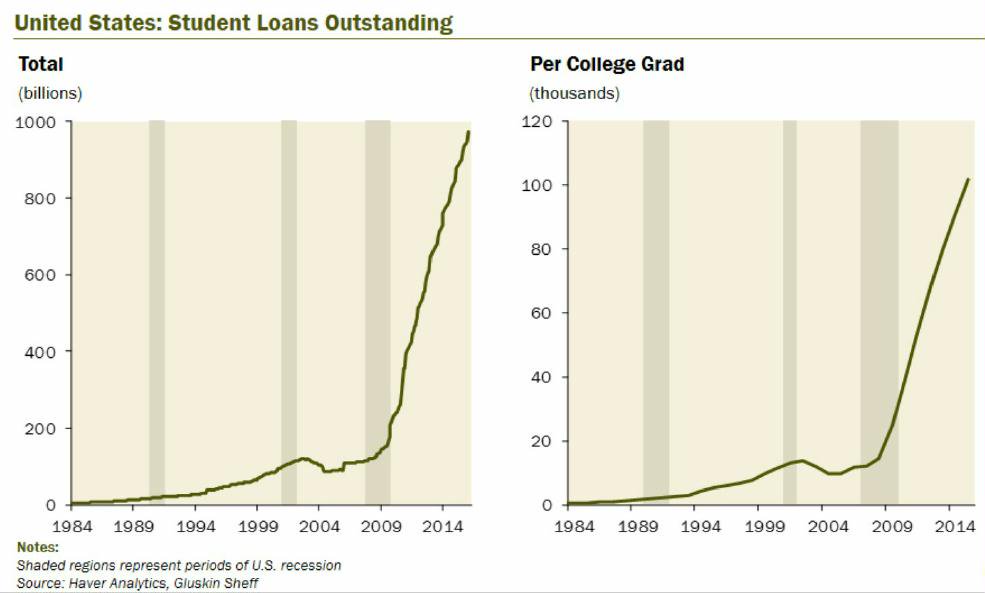
[..] Gundlach also noted the dramatic “drawdowns” from the highs in several stock markets. Germany is down 22%, Japan is down 23%, China is down 45%, the United Kingdom market is down 15% and France is down 20%. “Negative rates do not prop up stock markets,” Gundlach said on the webcast.

Read more …

How to kill a city.

• London House Prices Up 14% In A Year (Ind.)

House prices across the UK continued to grow in April, with London prices leaping by more than 14% over the past year, according to official figures published on Tuesday. The average house price in the UK increased 8.2% year on year to £209,054, up 16,000 from the same time in 2015. In London, which continued to be far more expensive than anywhere else in the country, the average house price is now more than £470,000, up by nearly £60,000 on April last year. [..]

The average house price for England was £225,000, an increase of 9.1% on last year compared, with £139,000 in Wales, £138,000 in Scotland and £118,000 in Northern Ireland. The increase came despite clear evidence that housing market activity has slowed markedly following April’s Stamp Duty increase for buy-to-let investors and second home buyers. The possibility of the UK leaving the European Union following the referendum on 23 June has not dampened demand, the ONS said. “Despite the short term uncertainty of next week’s EU referendum, regional property markets are receiving a pre-summer swell, giving homebuyers more choices.

Read more …

You guys should have thought of that before creating your biggest ever housing bubble.

• Let’s Not Sleepwalk Into Economic And Geopolitical Catastrophe (T.)

If Europe’s political leaders awake on Friday June 24 to find that Britain has voted to leave the EU – which judging by the polls is looking ever more likely – they will know who to blame most: themselves. For many citizens, there are much greater issues of principle and interest at stake in this referendum than the economy. But for me, economic and political stability are the prime consideration, which is why, as regular readers of my columns will already have guessed, I will be voting to remain. Yet I do so with a deep sense of foreboding, for despite the benefits Britain has enjoyed in its 43 years of membership, the EU has become a dysfunctional Byzantium of paralysing political and economic complexity. It has not been possible for a long time now to be an enthusiastic European.

Much of what was good about the EU as a force for peace through trade and economic advancement has long since ceased to be true. Over the last eight years, the EU has faced two distinct but related, existential crises – the eurozone debt meltdown and the challenge of mass, cross border migration. On both counts it has failed miserably. Though very different in their characteristics, these crises essentially have the same genesis. Both result from the attempt to crunch together economies of widely different income, wealth and welfare support. Give Greece, Spain, Portugal and Italy the ability to borrow at a German interest rate, and they were always bound to be enveloped by an unsustainable credit boom.

Denied both the natural market adjustment mechanism of free floating exchange rates, and the policy flexibility to mount a nationally-determined response, these debt crises have been left festering and unresolved, with devastating consequences for growth and jobs. Similarly, if the inhabitants of a low income, developing country are given the right to live and work in a much richer one with far superior public services and social welfare, then nobody should be surprised by both the reality of mass migration and the now all too evident backlash against it. In this regard too, the single European market, with its founding “four freedoms”, has proved incapable of responding.

Read more …

Tune in next week and/or tomorrow for Hell Freezes Over.

• George Osborne: Vote For Brexit And Face £30 Billion Of Taxes And Cuts (G.)

George Osborne will warn that he would have to fill the £30bn blackhole in public finances triggered by a vote to leave the European Union by hiking income tax, alcohol and petrol duties and making massive cuts to the NHS, schools and defence. In a sign of the panic gripping the remain campaign, the chancellor plans to say that the hit to the economy will be so large that he will have little choice but to tear apart Conservative manifesto promises in an emergency budget delivered within weeks of an out vote. “Far from freeing up money to spend on public services as the leave campaign would like you to believe, quitting the EU would mean less money,” Osborne will say. “Billions less. It’s a lose-lose situation for British families and we shouldn’t risk it.”

The chancellor will spell out his concerns at an event where he will be joined by his predecessor, Alistair Darling. The Labour politician will say he is more worried now than he was during the 2008 financial crisis, arguing that a Brexit vote will result in not just one emergency budget but “one after another”. The pair will publish an “illustrative budget scorecard” comprising a long list of the sort of measures they say may have to be implemented.
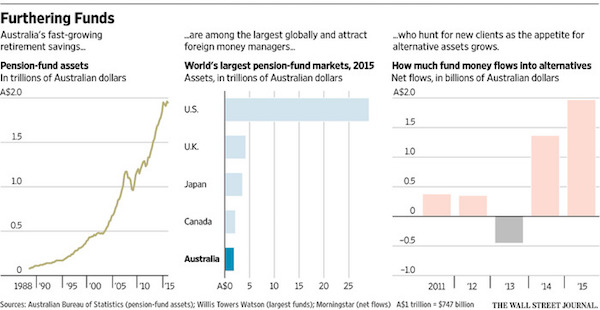
Read more …

Or so they say.

• Bookies Are Still Pretty Sure Brexit Isn’t Going to Happen (BBG)

While polls show the U.K.’s Brexit vote poised on a knife’s edge, bookies remain fairly confident the nation will stay in the European Union. Most of the biggest betting firms and exchanges in the U.K., Ireland and beyond place a 60% or better chance on David Cameron averting a so-called Brexit. That’s even after five polls published this week showed the “Leave” side ahead, with the latest survey giving it as much as a 7 percentage-point lead over “Remain.” “Pollsters ask people what they feel on a particular day; we are predicting what they will actually do on June 23,” said Jamie McKittrick, head of sports trading at Ladbrokes Plc. “Historically, we have seen a late swing to the status quo, especially among the undecideds.”

Analysts at firms like Danske Bank A/S and Investec Plc now routinely include gambling odds in client notes, with betting markets viewed as offering clues to the direction of political events. In March, for example, Paddy Power Betfair Plc, Ireland’s largest bookmaker, paid out 120,000 euros ($135,000) on Donald Trump winning the U.S. Republican presidential nomination, months before he won enough delegates to become the presumptive nominee. [..] As recently as last month, oddsmakers were placing a 20% chance on the possibility of the U.K. leaving the EU. While bookmakers like Ladbrokes this week slashed the odds on a Brexit, for now, they still make the U.K. staying in the EU the most likely outcome. That’s a pattern apparent across most betting firms and exchanges.

“The EU referendum market has exploded into life in the past week with an average of 1 million pounds traded every day, ” said Naomi Totten of Betfair, which also places a 60% probability on the U.K. opting to stay inside the EU. “Brexit has been backed heavily in the past 24 hours, although Remain is still clinging to favoritism.”

Read more …

Excellent Dmitry on Dunbar’s rule of 150.

• The Law of Attraction (Dmitry Orlov)

One unintended consequence of our current mode of living is that it has warped and perverted our interpersonal interactions. In order to be able to afford to simply inhabit the planet and satisfy our basic needs, we are required to play all sorts of contrived roles. Specifically, we are forced deal with each other according to arbitrary rules that are forced upon us. As employees we are expected to readily lie to customers to protect our employers’ profits. As salespeople we are expected to sell things we know better than to ever want to buy. Then there is a whole category of people who work as enforcers, and are specifically paid to disregard all humane considerations and to dole out punishments without any allowance for dire personal circumstances.

Vast social and financial hierarchies reward psychopathic behavior (which is regarded as professionalism) while punishing altruism and compassion (which is regarded as weakness or corruption). Co-workers arbitrarily thrown together by managerial whim often spend more time with each other than with their own families, trapped in a world of stunted, superficial relationships that gradually erode their humanity. Parents often have no choice but to pay strangers to raise their children for them. These strangers work for a wage rather than out of love for the children, and when their contract ends, so does the bond between the child and caregiver, undermining the child’s faith in humanity. When parents do get to see their children, they are often tired and distracted, conditioning the children to treat them no better than they treat the strangers who take care of them the rest of the time.

Growing up with a constant deficit of sensitivity, sincerity, security and warmth, once they reach adulthood these children expect their relationships to be either manipulative and abusive, or regulated by contract. Their humanity becomes reduced to a set of selfish and materialistic drives. Their misshapen psyches are balanced on a knife’s edge between a morbid fear of exclusion, which drives them toward mimicry and conformism, and an unnatural, hypertrophied competitive drive that destroys their instinct for spontaneous cooperation. When you take a step back from it all and look at it, the impression is one of a society-wide mental disorder.

Read more …

Good starting point, not great execution.

• Putting A Price On Nature Is Wrong (G.)

The paradox of environmental economics is that we feel compelled to price nature to make its loss visible on the balance sheet, but in doing so we legitimise its commodification and validate its critical overconsumption in an unbounded market system. No carbon market is yet designed to work within a precautionary limit on global emissions. That means that currently it would be possible to pay to emit the notional extra tonne of carbon that might push us over the edge into irreversible climatic upheaval. What price should that tonne of carbon carry? The more goods you pile onto a ship, the more likely it is to sink. You can price the relative risk of different levels of load, and insure it accordingly, and you can put a price on the economic cost of lost goods should the ship turn turtle.

But if your life depends on keeping the boat afloat, pricing ultimately becomes irrelevant. The point is to stay on the surface. That is why the Plimsoll safety line on the side of ships was introduced to prevent overloading (easy to spot, it looks exactly like the London Underground symbol). There are many economic and scientific problems in pricing nature and the environment, such as around offsetting, and there are philosophical ones too. In deciding whether or not to build a new road through a community woodland, how is the value of the woodland arrived at in any cost benefit analysis done by planners? Asking how much the community is prepared to pay to keep it would be constrained by ability to pay, but ask what amount would be needed to compensate for its intrinsic worth might, in theory, yield an infinite price.

Fiona Reynolds, former chief of the National Trust, is the latest to argue that we need whole other ways to assess the value of the natural world. When the economist Dieter Helm, chair of the Natural Capital Committee, wrote that: “the environment is part of the economy and needs to be properly integrated into it so that growth opportunities will not be missed,” he both gave the game away about pricing as a hostage to fortune, and made a category error. It is the economy that needs to be properly integrated into the environment so that its limits to growth can be understood.

Read more …

“These stolen avocados can carry risks,” he said.

• Avocado Shortage Fuels Crime Wave In New Zealand (G.)

Surging local and international demand for avocados is fuelling a crime wave in New Zealand. Since January there have been close to 40 large-scale thefts from avocado orchards in the north island of New Zealand, with as many as 350 fruit stolen at a time. Avocados are selling for between NZ$4-6 each (£2-3) across the country, after a poor season last year and increasing local demand. According to New Zealand Avocado in 2015 an additional 96,000 New Zealand households began purchasing avocados, and local growers – largely geared towards the lucrative export market – have been unable to keep up with the surge in demand.

The recent thefts have taken place in the middle of the night, with the crop either “raked” from the tree and collected in blankets or sheets on the ground, or hand-picked and driven away to pop-up road-side stallsgrocery stores or small-scale sushi, fruit and sandwich shops in Auckland. Sergeant Aaron Fraser of Waihi said there had been “spates” of avocado thefts during his time in the police but nothing as sustained as the current activity. “These stolen avocados can carry risks,” he said. “They are unripe, some have been sprayed recently and they may still carry toxins on the skin. But with the prices so high at the moment, the potential for profit is a strong inducement for certain individuals.”

Read more …

Jun 132016
 
 June 13, 2016  Posted by at 8:28 am Finance Tagged with: , , , , , , , , , , ,  2 Responses »


G. G. Bain Police machine gun, New York 1918

• Surging Yen Sends Nikkei Down 3.1% Amid Pan-Asia Sell-Off (CNBC)
• Trading Floors Go Quiet Across Asia as Equity Desks Face the Ax (BBG)
• Growing Corporate Debt a ‘Key Fault Line’ In China’s Economy: IMF (R.)
• Chinese State-Owned Companies Face Greater Scrutiny Of EU Deals (R.)
• Bank of America Shares Flash Bearish Signals Galore (MW)
• About That US Economic Rebound… (ZH)
• David Stockman’s View of Trump vs. Clinton (BBG)
• US Student Loans Numbers Are Simply Mad (Gurdgiev)
• The US Has Already Reinstated Debtors’ Prisons (NY Times)
• Why I Am Voting To Leave The EU (AEP)
• EU Chief Says Getting Closer To Granting Turks Visa-Free Travel (R.)
• Negative Rates Drive Major Changes At European Pension Funds (II)
• Frustrations of Telling the Truth (Paul Craig Roberts)
• Over 2,500 Migrants Rescued Off Italy Over Weekend (AFP)

The surging yen is fixing to kill Abe(nomics).

• Surging Yen Sends Nikkei Down 3.1% Amid Pan-Asia Sell-Off (CNBC)

Asian markets were sharply lower Monday, ahead of central bank meetings in the U.S. and Japan this week and amid jitters over the upcoming referendum on whether the U.K. would remain in the EU. Japan’s Nikkei 225 tumbled 3.09%, as fresh strength in the yen pressured stocks, with major exporters selling off. Shares of Toyota, Nissan, Honda and Sony traded down between 3.18 and 3.89%. The yen strengthened against the greenback ahead of the Bank of Japan’s two-day policy meeting starting June 15. Additionally, the yen is considered a safe-haven currency and increased concerns over the risk of a Brexit may be driving funds into the currency.

The currency pair traded at 105.98 as of 12:44 p.m. HK/SIN, compared with levels around 106.80 on Friday afternoon local time. “The BOJ … will likely delay a rate cut in the meeting, favoring a coordinated event when the government releases its fiscal stimulus package in Autumn,” said Stephen Innes, a senior foreign exchange trader at OANDA Asia Pacific. “This delay will likely appreciate the yen over the short term if the BOJ remains sidelined.”

Read more …

“Revenue from trading stocks in China and Hong Kong could fall 30% to 50% in the first half from a year earlier..”

• Trading Floors Go Quiet Across Asia as Equity Desks Face the Ax (BBG)

Even by the boom-bust standards of Asia’s equity business, it’s been a turbulent 12 months. At this time last year, the industry was riding high as China’s stock market soared, volumes jumped to records and some of the biggest names in finance boosted hiring. Now, turnover is shrinking at the fastest pace since at least 2006 and banks are under growing pressure to either downsize their Asian equity desks, or exit parts of the business altogether. Investors and issuers are retrenching after Chinese shares crashed, the Federal Reserve tightened monetary policy and divisive political debates from the U.S. to Britain weighed on sentiment. Revenue from trading stocks in China and Hong Kong could fall 30% to 50% in the first half from a year earlier, according to senior executives at four firms.

Equity derivatives sales in Asia are on track to drop at least 50%, while prime brokerage is down roughly 20%, two of the executives said. “Because overall revenue is down, further cuts are likely across the industry,” said Taichi Takahashi at UBS in Hong Kong. “Some second-tier players will throw in the towel because their market share is shrinking.” Revenue for the industry in Asia slumped 32% to $2.6 billion in the first quarter from a year earlier, compared with a 20% drop worldwide, according to estimates from Coalition, a banking research firm. Regional equities headcount dropped by about 300, or 6%, Coalition figures show. Turnover on Asia’s 10 biggest exchanges has declined 69% from last year’s peak in May, the deepest slump over any period of the same length since Bloomberg began tracking the data in 2006.

Read more …

It’s corporate PLUS local government.

• Growing Corporate Debt a ‘Key Fault Line’ In China’s Economy: IMF (R.)

China must act quickly to address mounting corporate debt, a major source of worry about the world’s second-largest economy, a senior IMF official said on Saturday. David Lipton, first deputy managing director of the IMF, warned in a speech to a group of economists in the southern city of Shenzhen that companies’ indebtedness is a “key fault line in the Chinese economy.” “Company debt problems today can become systemic debt problems tomorrow. Systemic debt problems can lead to much lower economic growth, or a banking crisis. Or both,” Lipton said, according to a copy of his prepared remarks provided to Reuters.

China, whose economy grew in 2015 at its slowest pace in a quarter of a century, has been grappling with rising debt levels and overcapacity. Last week, the People’s Bank of China warned in its mid-year work report that the government’s push to reduce debt levels and overcapacity could increase bond default risks and make it more difficult for companies to raise funds. Lipton said corporate debt in China stands at about 145% of GDP, a high ratio. He singled out state-owned enterprises, which he said accounted for about 55% of corporate debt but only 22% of economic output, according to IMF estimates.

Read more …

The EU is not all bad. Don’t let China buy your assets with monopoly money.

• Chinese State-Owned Companies Face Greater Scrutiny Of EU Deals (R.)

Chinese state-owned companies seeking to buy European assets are going to face greater regulatory scrutiny following a landmark European Commission decision on a recent deal. In its review of a proposed joint venture between France’s EDF and state-owned China General Nuclear Power (CGN), the Commission – which has exclusive power over antitrust issues in the EU – ruled that CGN was not independent from China’s central administrator for state-owned enterprises, the State-owned Assets Supervision and Administration Commission (SASAC). As a result, it decided that it did have the power to decide whether the deal should be cleared.

It meant that the Commission didn’t only consider CGN’s own revenue but the combined revenue of all Chinese energy state-owned enterprises when considering whether the deal came under its jurisdiction. This approach automatically bumped CGN’s turnover above the minimum EU threshold for merger clearance, a warning shot for other Chinese state-owned enterprises (SOEs) who may be considering buying assets in Europe and were not anticipating needing to get a regulatory green light. The Commission generally only reviews a merger if each party to it has more than €250 million in sales in the EU as well as combined global sales of more than €5 billion. CGN’s turnover, alone, didn’t cross that €250 million threshold, but the Chinese energy SOEs as a whole do breach that level.

Read more …

Negative rates hurt.

• Bank of America Shares Flash Bearish Signals Galore (MW)

The selloff in Bank of America stock Friday capped a week in which a number of bearish chart patterns were completed, implying potential for further declines to multi-month lows. The banking giant’s shares slumped 2.5% to close at $13.83 Friday. Volume of 89.6 million shares made them the most-actively traded on the NYSE, according to FactSet. The selloff comes as the yield on the 10-year Treasury note slumped to a three-year low of 1.639%, as part of a global bond rush that pushed yields on several government benchmarks to record lows. Lower long-term interest rates can hurt banks’ earnings, as they narrow the spread between what banks earn by funding longer-term assets, such as loans, with shorter-term liabilities.

Here are some of the bearish technical developments in BofA’s stock that have occurred this past week: • On Tuesday, the stock fell below an uptrend line, supported by three support points, that began at the Feb. 11 bottom. That suggests the short-term trend has flipped to negative. • The trendline breakdown occurred as the stock failed to get back above its 200-day moving average, which many see as a dividing line between shorter-term and longer-term trends. This indicates that the rally off the February low was just a minor bounce within a more dominant downtrend. • The stock closed Thursday below its 50-day moving average, which many use as a guide to the short-term trend. After the 50-day moving average held as support during the May pullback, the drop below it this week was a warning sign that the trendline break was for real.

Read more …

Forgive me for thinking this is clear enough.

• About That US Economic Rebound… (ZH)

Following the steep drop in first quarter GDP which printed at 0.7% in the first revision, economists, strategists and pundits have once again put their collective hopes on another second-half rebound, with expectations for a Q2 rebound running high – the Atlanta Fed’s latest GDP nowcast stands at 2.5%. Unfortunately, this may once again be unwarranted. The reason: the collapse in retail spending which many had expected would be transitory and which has pressured discretionary consumer stocks in recent weeks, just refuses to go away. As we showed on Friday, both critical categories of retail sales (based on BofA credit and debit card spending data), there has been a dramatic collapse in both luxury …

… and home improvement related spending.

The math here is simple: without a strong rebound in spending, there simply can not be a strong rebound in GDP, period. Which, incidentally, is precisely what Goldman’s latest Current Activity Indicator – a real-time proxy for GDP – has found. Here is David Kostin in his latest US Weekly Kickstart: “The Goldman Sachs Economics US Current Activity Indicator (CAI) is a proxy for real-time GDP growth and the metric has slowed to 1.3%. Our economics colleagues expect GDP growth will accelerate to a 3.2% pace in 2Q and average 2.3% during 2H 2016.”

This was the lowest print in over five years. And here is why the Fed will not only not be hiking in June or July, or frankly any time soon. In fact, judging by this chart – and based on the recent collapse in global bond yields – the Fed’s next move will be to cut rates.

Read more …

I’m -mostly- with David on this.

• David Stockman’s View of Trump vs. Clinton (BBG)


Read more …

No, really, America’s problem is debt. And the western world’s problem is debt. And China, and Japan.

• US Student Loans Numbers Are Simply Mad (Gurdgiev)

If you like hockey stick charts, you’ll love these two covering U.S. student loans debt evolution over time:

The numbers are simply mad: total debt rose from around $100 billion ca 2006 to almost $1 trillion by the end of 2015. On a per capita of student population basis, same period rise was from around $16,000 per student to over $100,000 per student. More recent data, through May 2016 shows that average student debt is now at $133,000 and the total quantum of student loans outstanding is at over $1.2 trillion. Data from Bloomberg, through 2014, shows that Federal Government-originated student loans have increased 10-fold since 1990:


Source: Bloomberg, data from Collegeboard.org

Read more …

“.. in Ferguson, Mo., the average household paid $272 in fines in 2012, and the average adult had 1.6 arrest warrants issued that year..”

• The US Has Already Reinstated Debtors’ Prisons (NY Times)

In the 1830s, the civilized world began to close debtors’ prisons, recognizing them as barbaric and also silly: The one way to ensure that citizens cannot repay debts is to lock them up. In the 21st century, the US has reinstated a broad system of debtors’ prisons, in effect making it a crime to be poor. If you don’t believe me, come with me to the county jail in Tulsa. On the day I visited, 23 people were incarcerated for failure to pay government fines and fees, including one woman imprisoned because she couldn’t pay a fine for lacking a license plate. [..] “It’s 100% true that we have debtor prisons in 2016,” says Jill Webb, a public defender. “The only reason these people are in jail is that they can’t pay their fines. “Not only that, but we’re paying $64 a day to keep them in jail — not because of what they’ve done, but because they’re poor.”

This is as unconscionable in 2016 as it was in 1830, and it is a system found across the country. In the last 25 years, as mass incarceration became increasingly costly, states and localities shifted the burden to criminal offenders with an explosion in special fees and surcharges. Here in Oklahoma, criminal defendants can be assessed 66 different kinds of fees, from a “courthouse security fee” to a “sheriff’s fee for pursuing fugitive from justice,” and even a fee for an indigent person applying for a public defender (I’m not kidding: An indigent person is actually billed for requesting a public defender, and if he or she does not pay, an arrest warrant is issued). Even the Tulsa County district attorney, Stephen Kunzweiler, thinks these fines are a ridiculous way to finance his office.

“It’s a dysfunctional system,” he says. A new book, “A Pound of Flesh,” by Alexes Harris of the University of Washington, notes that these modern debtors’ prisons now exist across America. Harris writes that in Rhode Island in 2007, 18 people were incarcerated a day, on average, for failure to pay court debt, while in Ferguson, Mo., the average household paid $272 in fines in 2012, and the average adult had 1.6 arrest warrants issued that year. “Impoverished defendants have nothing to give,” Harris says, and the result is a system that disproportionately punishes the poor and minorities, leaving them with an overhang of debt from which they can never escape.

Read more …

I agree with Ambrose for once. On balance, what’s negative about the EU far outweighs the advantages.

“Brexit vote is about the supremacy of Parliament and nothing else..“ “Where we concur is that the EU as constructed is not only corrosive but ultimately dangerous..”

• Why I Am Voting To Leave The EU (AEP)

With sadness and tortured by doubts, I will cast my vote as an ordinary citizen for withdrawal from the European Union. Let there be no illusion about the trauma of Brexit. Anybody who claims that Britain can lightly disengage after 43 years enmeshed in EU affairs is a charlatan, or a dreamer, or has little contact with the realities of global finance and geopolitics. Stripped of distractions, it comes down to an elemental choice: whether to restore the full self-government of this nation, or to continue living under a higher supranational regime, ruled by a European Council that we do not elect in any meaningful sense, and that the British people can never remove, even when it persists in error. For some of us – and we do not take our cue from the Leave campaign – it has nothing to do with payments into the EU budget.

Whatever the sum, it is economically trivial, worth unfettered access to a giant market. We are deciding whether to be guided by a Commission with quasi-executive powers that operates more like the priesthood of the 13th Century papacy than a modern civil service; and whether to submit to a European Court (ECJ) that claims sweeping supremacy, with no right of appeal. It is whether you think the nation states of Europe are the only authentic fora of democracy, be it in this country, or Sweden, or the Netherlands, or France – where Nicholas Sarkozy has launched his presidential bid with an invocation of King Clovis and 1,500 years of Frankish unity. My Europhile Greek friend Yanis Varoufakis and I both agree on one central point, that today’s EU is a deformed halfway house that nobody ever wanted.

His solution is a great leap forward towards a United States of Europe with a genuine parliament holding an elected president to account. Though even he doubts his dream. “There is a virtue in heroic failure,” he said. I do not think this is remotely possible, or would be desirable if it were, but it is not on offer anyway. Six years into the eurozone crisis there is no a flicker of fiscal union: no eurobonds, no Hamiltonian redemption fund, no pooling of debt, and no budget transfers. The banking union belies its name. Germany and the creditor states have dug in their heels. Where we concur is that the EU as constructed is not only corrosive but ultimately dangerous, and that is the phase we have now reached as governing authority crumbles across Europe.

The Project bleeds the lifeblood of the national institutions, but fails to replace them with anything lovable or legitimate at a European level. It draws away charisma, and destroys it. This is how democracies die. “They are slowly drained of what makes them democratic, by a gradual process of internal decay and mounting indifference, until one suddenly notices that they have become something different, like the republican constitutions of Athens or Rome or the Italian city-states of the Renaissance,” says Lord Sumption of our Supreme Court.

Read more …

Tusk driving the final nail in Cameron’s coffin?!

• EU Chief Says Getting Closer To Granting Turks Visa-Free Travel (R.)

The EU is getting closer to granting Turks visa-free travel to Europe, but talks on this will continue until at least October, EC President Donald Tusk said in an interview with German newspaper Bild published on Monday. Asked when Turks would be given visa freedom, Tusk said: “When they have fulfilled all of the conditions without exception.” He added: “The negotiations will certainly last until October but we’re getting ever closer.” The deal to give Turks visa-free travel in return for reducing the flow of illegal migrants to the bloc has been held up by a disagreement over Turkey’s anti-terror laws, which some in Europe see as too broad. Turkey says its needs the law to fight its multiple security threats. Last week Turkey said it expected a positive outcome in coming days in talks with the EU about visa-free travel for Turks.

Read more …

Want to see collapse in action? Watch pension plans.

• Negative Rates Drive Major Changes At European Pension Funds (II)

In recent years European pension fund managers have been moving down the credit spectrum, wading into private markets, putting money into infrastructure and other illiquid assets; in short, doing almost anything to generate yield. But with negative interest rates strengthening their grip on Europe, many plan sponsors are realizing they can’t earn their way out of today’s dilemma. So even as they do what they can to diversify assets, pension funds are moving to curb their liabilities by limiting payouts to retirees, shifting to defined contribution-type models from defined benefit ones and taking other steps to make sure the money doesn’t run out. Consider Credit Suisse. The Zurich-based bank offers one of the more generous retirement plans in the country with the second-largest pension system in continental Europe.

But the pension fund, like most others in Switzerland, was blindsided by the Swiss National Bank’s January 2015 abandonment of its exchange rate ceiling, which sent the Swiss franc soaring and bond yields falling deeper into negative territory than anywhere in Europe. The Sf15.6 billion ($15.8 billion) fund saw its return plunge to 1.6% last year from 7.3% in 2014. Concerned that negative rates and ever-rising life spans put the financial health of the fund at risk, trustees late last year adopted a sweeping reform of the scheme that will gradually raise the retirement age, trim benefits for future retirees and shift workers with high salaries into a pure defined contribution savings plan for part of their incomes. “We do not want an underfunded situation,” says Matthias Hochrein, the plan’s chief operating officer.

In the Netherlands, which has Europe’s largest pension system by far in proportional terms, with assets worth nearly 184% of GDP, plans are also looking to tighten their belts. In recent weeks the country’s two largest plans -ABP, the €358 billion pension fund for civil servants, and PFZW, the €billion plan for health care workers- have warned that they may have to cut benefit payments to existing retirees next year because low interest rates have reduced their funding ratios to just a hair above 90%, the threshold that triggers mandatory remedial action.

Read more …

Well, at least we still can for now.

• Frustrations of Telling the Truth (Paul Craig Roberts)

Some examples of the ‘abuse’ one gets when telling the truth: If I criticize the Israeli government for abusing Palestinians and stealing their country, the Israel Lobby accuses me of being an anti-semite who wants to repeat the holocaust. In the same batch of emails, anti-semites denounce me for being too easy on Israel and covering up for the Jewish conspiracy against mankind. When I write about the One Percent using the government to loot the economy, I receive emails blaming me because I worked for Reagan “who started it all by cutting tax rates for the rich.” These people have no conception of supply-side economics, its purpose, success, and the way it prepared the way for Reagan to negotiate the end of the Cold War. At one point in their lives they read a left-wing screed against Reagan, and that is the extent of their understanding. But they are full of blind hate.

When I write about Washington’s crimes against other countries, I receive emails asking me where I was during Iran-Contra and Grenada. Apparently, they think that a Treasury official can run the State Department and Pentagon. Some of the readers are so confused that they think Reagan overthrew Allende in Chile. Alllende was overthrown in 1973. Reagan was inaugurated in 1981. It is dispiriting that there actually are people this ignorant and so proud of it that they will accuse me of helping Reagan to overthrow Allende. When I point out the dangers of the reckless folly of Washington’s aggressions against Russia, China, and the independent Muslim world, superpatriots denounce me for being anti-American. There is a stratum of the US population that thinks that it is a criminal act to disbelieve the government or to question its judgment and motives. “You are with us or against us.”

When I document the death of the US Constitution and the rise of the American Police State, “law and order” conservatives admonish me that the police state only appies to terrorists and criminals and does not apply to law abiding citizens. They are convinced that Snowden and Assange are traitors, and no amount of evidence or reason can convince them otherwise. Neither can they be convinced that in the 21st century, law has become a weapon in the hands of government and no longer is a shield of the people. The Rule of Law in America is dead.

Read more …

While you were looking the other way…

• Over 2,500 Migrants Rescued Off Italy Over Weekend (AFP)

More than 2,500 migrants seeking to reach Europe were rescued off the coast of Sicily over the weekend in 20 separate operations, the Italian coastguard said Sunday. Vessels from the Italian navy and coastguard took part in rescue operations, along with ships from volunteer and aid groups. Medical charity Doctors Without Borders said it had recovered one dead body from one of the migrant boats. Authorities said 1,348 migrants were picked up Saturday and 1,230 on Sunday. So far this year more than 48,000 people have been brought to the Italian coast after being pulled from boats trying to cross from Libya, according to the UN refugee agency. With the return of the good weather the rescue operations are expected to increase. For the time being the numbers arriving are similar to those seen last year and in 2014.

Read more …

Jun 122016
 
 June 12, 2016  Posted by at 10:21 am Finance Tagged with: , , , , , ,  6 Responses »


Jack Delano Worker inspecting locomotive, Proviso Yard 1942

• European Central Bank Preparing for Brexit (IS)
• We’re Rich! We’re Rich! Are Inflated Asset Prices Like Real Wealth? (SA)
• The Pension Bubble: How The Defaults Will Occur (PD)
• Bulging Pension Funds Lure US Asset Managers to Australia (WSJ)
• ‘Condition Red Alert’ – Albert Edwards (BI)
• ECB Corporate Bond-Buying Program Makes Up Almost 1 In 5 Trades (CNBC)
• Real Unemployment Rate More Than Double The Official Number: CLSA (ZH)
• Where Do Matters Stand? (Paul Craig Roberts)

“..Brexit might potentially be a worse hit to mainland Europe than to the UK itself..”

• European Central Bank Preparing for Brexit (IS)

The European Central Bank said they are gearing up for the UK leaving the EU by activating swap lines to financial institutions should the Brexit trigger capital outflows in the short-term. Meanwhile, major European Banks are already facing declines in stock valuation, with dynamics in yield curves suggesting the market is weighing a greater possibility of the ‘Out’ vote in the UK. As volatility increases ahead of the June 23 referendum, additional euro-denominated liquidity might come in handy for the European banking system, particularly so given that the ultra-accommodative monetary conditions are failing to boost either growth or inflation in the near-to-mid-term.

The ECB announced they are ready to pour extra euro liquidity to financial institutions through the existing mechanisms of swap lines should the UK decide to leave the EU. In such a scenario, additional euros would help calm the markets and boost the already-battered banking sector capitalization, staving off the risks of massive financial turmoil amidst the uncertainty of the potential effects of Britain’s separation from the bloc. “Life won’t change much after the referendum — these agreements and contracts will still be in force,” Ilmars Rimsevics of the ECB Governing Council, and also the head of Latvia’s central bank said. “If they’ll be needed and there is some sort of shock, then of course these lines will work.”

Meanwhile, the European banks are tumbling and crumbling, as the prospect of Brexit becomes increasingly likely. During the past two weeks, the European financial institutions suffered the worst blow to their capitalization in two years, hinting at possible massive capital outflows in case of Brexit. Deutsche Bank dropped to its record lowest, according to European stock market data. Considering these developments, Brexit might potentially be a worse hit to mainland Europe than to the UK itself. Either way, the upside of this is that the overheated European stock markets would cool to be more in line with the sluggish overall growth in the region.

Read more …

“..the U.S. economy is by far the best it has ever been and total household wealth is clearly vastly superior to prior periods.”

• We’re Rich! We’re Rich! Are Inflated Asset Prices Like Real Wealth? (SA)

The Federal Reserve recently released the latest “Financial Accounts of the United States” and I am pleased to inform readers that the U.S. economy is by far the best it has ever been and total household wealth is clearly vastly superior to prior periods. In a nutshell, we’ve done it. We beat back the last recession and generated enormous amounts of new wealth by having asset prices for existing wealth move higher. Who says you need growth in GDP or that real wealth has to be measured in having the goods and services that improve human lives? The financial accounts clearly show that the total household wealth in the United States has grown dramatically and vastly outpaced inflation so long as inflation is measured in other terms.

[..] Say you live in a city where the hospital has only one ambulance. If you have a heart attack, you may be out of luck. If the hospital can acquire a second ambulance, the community has gained a form of real wealth. That ambulance can provide a service that can save lives. In such a situation, you might feel that your odds of surviving a heart attack had improved. On the other hand, if the price of ambulances doubled it would do nothing to improve your odds of surviving. Unfortunately, either of these situations would double asset value recorded for ambulances. Since inflation rates are low over the last several years there is a general theory that the impact of inflation is not material to these measurements.

Read more …

Slowly?!

• The Pension Bubble: How The Defaults Will Occur (PD)

Experts worry about stock, bond and real estate market excesses. But a bubble is forming that dwarfs them all: in pension plans. Millions of Americans and Canadians who are counting on pension benefits to fund their retirements risk being severely disappointed. The hard money community has, of course, been aware of this for some time. However in recent years, even the elites have been taking notice. One such group, the International Forum of the Americas, will be holding its fourth annual pension conference in Montreal next Monday. There politicians, financiers and monetary policy officials will discuss the declining rates of return in public and private sector pension plans. The picture they will paint is increasingly grim.

Pension funds, which have been issuing over-optimistic revenue forecasts for years, aren’t going to earn nearly enough money to pay the benefits recipients expect. Much of this relates to secular stagnation in the economy. Bonds, which form a major part of most plans’ holdings, earn next to nothing in interest. Stocks, which are trading at record levels, despite falling corporate earnings, look to have more downside risk than upside potential. Worse, if bond returns average 2%, balanced portfolios projecting 7% to 8% annual returns, have to earn 12% to 14% on equities investments to make up the difference. That’s unlikely to happen. At least private sector plans have some money in them – public sector plans are in even in worse shape. Governments have almost nothing put aside to fund future retirees – and they don’t even fully list their debts.

That process of “cooking the books” ramped up in a major way during Bill Clinton’s administration, whom Hillary Clinton, the current Democratic Presidential nominee, has promised to “put in charge of the economy.” The upshot is that most Americans and Canadians have no clue how far in debt their countries are. Researchers such as Laurence Kotlikoff , a professor at Boston University and a write-in candidate for President in 2016, suggest that unfunded pension and other liabilities run into the tens of trillions of dollars in the United States. The Fraser Institute has shown that Canada isn’t much better.

Read more …

Hedge funds will help pension funds default.

• Bulging Pension Funds Lure US Asset Managers to Australia (WSJ)

U.S. asset managers are going for the hard sell in Australia in a bid to woo some of the world’s most cashed-up pension funds as clients. The push is being led by hedge funds and other firms offering so-called alternative investments in anything from almond plantations to oil futures. Several large U.S. asset managers recently opened offices in Sydney. Others have forged alliances with local fund managers and some already-established players are adding more sales staff.

Los Angeles-based Oaktree Capital Management, which invests in commercial mortgages and debt of financially troubled companies, opened a local branch here in March. U.S. giant TIAA Global Asset Management, which for years has been buying up Australian farmland, timber plantations and shopping malls, last year cemented its presence with a Sydney office. A major draw for foreign managers is the country’s two trillion Australian dollars (about US$1.5 trillion) in retirement savings, one of the largest and fastest-growing pools of pension money in the world. “Everyone wants to get their hands on that pie,” said Jesse Huang at Boston-based quantitative hedge fund PanAgora Asset Management. “People think there’s a lot of money to be made in Australia.”

Read more …

“It is not a pleasant place. It is cold, dark, and damp..”

• ‘Condition Red Alert’ – Albert Edwards (BI)

“The key to the Ice Age thesis is to sound CONDITION RED ALERT as each recession approaches, because the equity outcome then always proves much worse than anyone expects due to the additional phase of secular de-rating..” In the aftermath of the latest, weaker than expected, nonfarm payroll data, economists are certainly more worried. The excellent folks at Advisor Perspectives highlight the Fedis Labour Market Conditions Index as suggesting a recession is imminent (the cumulative peak is an average of 9 months ahead of the start of recession and we are now four months beyond a peak. For investors who think copper still has some predictive power, its recent move is disturbing.

This, of course, is just another recession in Edwards’ Ice Age thesis, which posits that during long-term equity downturns, it takes at least four recessions to work through. So far, according to Edwards, we have only had two since the top of the bubble in 2000, so we still have a way to go until the pain is over. “The secular bear market only ends when cyclically adjusted valuation measures reach rock bottom (such as the Shiller PE on the bottom line),” said Edwards. “Each successive recession (red part of real S&P top line) sees huge downturns, usually to new lower lows of both prices and valuations. That is why we reiterated our view early this year that in the coming recession the S&P will bottom at 550, a 75% decline from current levels.”

Edwards maintains that he is bearish for a reason, despite it being a difficult spot. “We remain at the bearish extreme of the market,” he wrote. “It is not a pleasant place. It is cold, dark, and damp. People either don’it speak to you or send you abusive emails. Members of your own family pretend not to know you. Actually, I made that last bit up.”

Read more …

They’re shooting for more.

• ECB Corporate Bond-Buying Program Makes Up Almost 1 In 5 Trades (CNBC)

Nearly 19% of all corporate bond activity in the past two days is down to the European Central Bank’s corporate bond-buying program, according to insights from market data provider Trax. The ECB formally kicked off its corporate bond buying program on June 8th, a move heralded by President Mario Draghi in March. As part of its plan, the ECB will buy euro-denominated investment grade bonds issued by companies in the euro area. Data from Trax released Friday showed that in the whole of 2015, corporate bond buying accounted for 12% of all corporate bond activity processed by Trax. This number went up to 14% in just the first half of 2016, the firm reported. The company processes approximately 65% of all fixed income transactions in Europe through its post-trade services.

Read more …

What everyone knows.

• Real Unemployment Rate More Than Double The Official Number: CLSA (ZH)

While everyone loves to focus on the headline unemployment rate as a reason to say the economy is doing well, especially those at the Fed trying to justify hiking rates into a recession, or those in the current administration trying to establish a legacy of being a market whisperer, the facts get in the way of that narrative. We continuously remind those who are interested in the truth that the number of Americans who are no longer in the labor force has hit an all time high of 94.7 million. If one were to factor in the low labor force participation rate, the actual unemployment rate would be significantly higher than the 4.7% headline.

According to CLSA economists, who have updated an analysis we first did in the summer of 2010, if the participation rate stayed at the levels before the financial crisis, the unemployment rate would be 9.6%, more than double what it is today.

Read more …

“..the West is incapable of producing leadership capable of preserving life on earth.”

• Where Do Matters Stand? (Paul Craig Roberts)

On the eve of World War II the United States was still mired in the Great Depression and found itself facing war on two fronts with Japan and Germany. However bleak the outlook, it was nothing compared to the outlook today. Has anyone in Washington, the presstitute Western media, the EU, or NATO ever considered the consequences of constant military and propaganda provocations against Russia? Is there anyone in any responsible position anywhere in the Western world who has enough sense to ask: “What if the Russians believe us? What if we convince Russia that we are going to attack her?” The same can be asked about China.

The recklessness of the White House Fool and the media whores has gone far beyond mere danger. What do the Russians think when they see that the Democratic Party intends to elect Hillary Clinton president of the US? Hillary is a person so crazed that she declared the president of Russia to be “the new Hitler” and organized through her underling, neocon monster Victoria Nuland, the overthrow of the democratically elected government of Ukraine. Nuland installed Washington’s puppet government in a former Russian province that until about 20 years ago was part of Russia for centuries. I would bet that this tells even the naive pro-western part of the Russian government and population that the United States intends war with Russia.

[..] The Russians know that the propaganda about “Russian aggression” is a lie. What is the purpose of the lie other than to prepare the Western peoples for war with Russia? There is no other explanation. Even morons such as Obama, Merkel, Hollande, and Cameron should be capable of understanding that it is extremely dangerous to convince a major military power that you are going to attack. To simultaneously also convince China doubles the danger. Clearly, the West is incapable of producing leadership capable of preserving life on earth.

Read more …

Jun 052016


Unknown General Patrick’s headquarters, City Point, Virginia 1865

• World Faces Pensions Crisis, Warns OECD (Tel.)
• The Case For A Super Glass-Steagall (David Stockman)
• Payday Loans a Crony Capitalist Target (WSJ)
• What Makes this Jobs Report so Truly Ugly (WS)
• Americans Not In The Labor Force Soar To Record 94.7 Million (ZH)
• Higher Australian Household Debt Mounts To ‘Unsustainable’ Levels (Aus.)
• A Guaranteed Income for Every American (WSJ)
• Italy And France Are Urging Caution Over Bank Capital (R.)
• Self-Harming Taxation, Or The Liquidation Of The Kulaks (Georganas)

The OECD is late to the game, and fails to comprehend the scale and urgency of that crisis.

• World Faces Pensions Crisis, Warns OECD (Tel.)

The global pensions crisis has been laid bare by new analysis that shows people retiring today can expect half the income of those who became pensioners at the start of the millennium. The stark findings by the OECD will be presented in a report this week that highlights the impact of ultra-low interest rates on global retirement incomes. It shows that a person buying an annuity today who saved 10pc of their wages into a pension for 40 years can expect just over half the earnings of someone who saved the same amount but retired 15 years ago. The think-tank’s analysis of defined contribution schemes, where the value of pension pots can rise or fall depending on how investments perform, highlights the challenge faced by many pension providers in the current low growth and low inflation environment

Pension funds invest around 40pc of their assets in fixed income securities, according to the OECD, including lower yielding government bonds. “We’ve had more than half a decade of very low interest rates and that means someone who has been putting money into a savings account or into a pension fund – the value of their lifetime retirement is about half the value of someone who retired in 2000,” said Catherine Mann, the OECD’s chief economist. Tom McPhail, head of pensions research at Hargreaves Lansdown, said the OECD’s findings were consistent with its UK research. “Someone that started putting money in a pension in the 1960s was investing at a time when baby boomers were entering the workforce. But the last 16 years and the financial crisis have had an extremely negative impact on asset prices.”

Read more …

Sometime down the line, the big banks will be broken up. But it’s not something the politicial system can achieve with a few votes. Because it is owned by those same banks.

• The Case For A Super Glass-Steagall (David Stockman)

Donald Trump can instantly get to the left of Hillary with respect to Wall Street and the one percenters by embracing Super Glass-Steagall. The latter would cap U.S. banks at $180 billion in assets (<1% of GDP) if they wished to have access to the Fed’s discount window and have their deposits backed by FDIC insurance. Such Federally privileged institutions would also be prohibited from engaging in trading, underwriting, investment banking, private equity, hedge funds, derivatives and other activities outside of deposit taking and lending. Instead, these latter inherently risky economic functions would be performed on the free market by at-risk banks and financial services companies.

The latter could never get too big to fail or to manage because the market would stop them first or they would be disciplined by the fail-safe institution of bankruptcy. No taxpayer would ever be put in harms’ way of trades like those of the London Whale. By embracing this kind of Super Glass-Steagall Trump would consolidate his base in the flyover zones and reel in some of the Bernie Sanders throng, too. The latter will never forgive Clinton for her Goldman Sachs speech whoring. And that’s to say nothing of her full-throated support for the 2008 bank bailouts and the Fed’s subsequent giant gifts of QE and ZIRP to the Wall Street gamblers. Besides, breaking up the big banks and putting Wall Street back on a free market based level playing field is the right thing to do.

Today’s multi-trillion banks are simply not free enterprise institutions entitled to be let alone. Instead, they are wards of the state dependent upon its subsidies, safety nets, regulatory protections and legal privileges. Consequently, they have gotten far larger, more risky and dangerous to society than could ever happen in an honest, disciplined market. Foremost among these artificial props is the Fed’s discount window. The latter provides cheap, unlimited funding at a moment’s notice with no questions asked. The purpose is to insure banking system liquidity and stability and to thwart contagion, but it also nullifies the essential bank management discipline and prudence that comes from fear of depositor flight.

Read more …

The big boys smell big profits.

• Payday Loans a Crony Capitalist Target (WSJ)

To voters living comfortably in Cambridge, Mass., or the suburbs of Seattle, the payday lending crackdown sounds just right: Those storefront entrepreneurs of dubious extraction are preying upon the poor. They should be banned. But for the Consumer Financial Protection Bureau, the creation of Dodd-Frank which has been busy demonstrating the dangers of an unrestrained regulatory state, a slogan that polls well with liberal voters is only a starting point. The end result of its new payday rules, like all Obama regulatory endeavors, is to concentrate more power in the hands of Washington lobbyists and politicians and the companies that can afford to pay for them.

CFPB director Richard Corday’s 1,300-page regulatory edict will require payday lenders, an industry largely made up of thousands of storefront operators, to run full credit checks on prospective borrowers (average loan $392) to test their sources of income, need for the loan, and ability to keep financing their living expenses while paying it back. Perversely, this will make it hard or impossible to serve those customers who use the payday lending service most appropriately—who borrow when pinched but then promptly repay and don’t roll over their debt. The industry will become more focused on retaining habitual users, those who take out loans many times a year and get caught in “debt traps,” continually rolling over what are supposed to be short-term, high-margin loans.

The massive record-keeping and data requirements that Mr. Corday is foisting on the industry will have another effect: It will drive out the small, local players who have dominated the industry in favor of big firms and consolidators who can afford the regulatory overhead. It will also favor companies that can substitute big data for local knowledge like, like . . . Well, like LendUp, the Google-backed venture that issued a statement Thursday applauding the CFPB rules. Google’s self-interest has become a recurrent theme in Obama policy making, not surprising considering a study in April that found that 250 Googlers had come or gone from administration employment, and Google lobbyist visits to the Obama White House vastly outnumbered those of any other company.

Read more …

“Something has to give – and it’s starting to..”

• What Makes this Jobs Report so Truly Ugly (WS)

[..] ..we suspected that the March jobs report, released in early April, would be a debacle. We based this on an analysis of the divergence over time between the reports issued by payroll processing company ADP and the jobs reports issued by the Bureau of Labor Statistics. That divergence had been going on for months. Eventually it reverts to the mean. We postulated that March would be that month. Instead, it happened two months behind schedule, so to speak, as today’s jobs report was precisely that sort of debacle. This is what was “expected”: The Labor Department was expected to report, according to Wall Street economists, a “moderate” gain of 158,000 jobs in May, “moderate” given that the Verizon strike kept 35,000 workers off their jobs. The “whisper number” was around 200,000 jobs.

And this is what we got: The BLS reported that the economy had added 38,000 jobs, the lowest since September 2010. Furthermore, the April job gains of 160,000 were chopped down by 37,000 and the March job gains of 208,000 were chopped down by 22,000. Hence, with 59,000 jobs revised away, and with only 38,000 jobs “created” in May, the net total in today’s report was a net loss of 21,000 jobs. We haven’t seen that since the Financial Crisis. A number of sectors, including manufacturing, shed jobs, and the labor participation rate dropped for the second month in a row, to 62.6%. Just about the only good number was the magic headline unemployment rate, which fell sharply, from 5% in April to 4.7%, the lowest since the Great Recession began, leaving some folks scratching their heads and searching for answers.

[.] Staffing agencies are cutting back because companies no longer need that many workers. Total business sales in the US have been declining since mid-2014. Productivity has been crummy and getting worse. Earnings are down for the fourth quarter in a row. Companies see that demand for their products is faltering, so the expense-cutting has started. The first to go are the hapless temporary workers. This is the reality for businesses: The chart below shows the gaping disconnect between declining total business sales (all businesses, not just the S&P 500 companies) and total nonfarm employment. Something has to give – and it’s starting to:

Read more …

Anything else is just noise. Unemployment stats become illusionary.

• Americans Not In The Labor Force Soar To Record 94.7 Million (ZH)

So much for that much anticipated rebound in the participation rate. After it had managed to rise for 5 months in a row through March, hitting the highest level in one year, the disenchantment with working has returned, and the labor force participation rate promptly slumped in both April and May, sliding 0.4% in the past two months to 62.60%, just shy of its 35 year low of 62.4% hit last October.

This can be seen in the surge of Americans who are no longer in the labor force, who spiked by 664,000 in May, hitting an all time high of 94.7 million. As a result of this the US labor force shrank by over 400,000 to 158,466K, down from 158,924K a month ago, and helped the unemployment rate tumble to 4.7%, the lowest level since 2007. Adding the number of unemployed workers to the people not in the labor force, there are now over 102 million Americans who are either unemployment or no longer looking for work.

Read more …

Cooked.

• Higher Australian Household Debt Mounts To ‘Unsustainable’ Levels (Aus.)

‘If something cannot go on forever, it will stop’, said Herbert Stein, economic adviser to presidents Nixon and Ford. Stein was mocking concerns about the “unsustainable” US current account and budget deficits in the late 1980s. He had a point, both grew much larger. Calling things unsustainable is often a cover for expressing disapproval for other reasons. The federal budget has been in surplus in fewer than 20 of the 116 years since Federation, so deficits are clearly sustainable. What isn’t sustainable is a rising stock of public debt (and interest payments) as a share of national income. Both main political parties are rightly and routinely admonished for doing little to stem the rising tide of federal and state government debt, which has tripled to about 34% of GDP over the past 10 years.

But the spectacular ascent of private debt, which has doubled to about 160% of GDP over the past 20 years, hasn’t rated a mention by either side of politics in this election. Public debt peaked above 170% of GDP during the Great Depression but private, and in particular household, debt has never been remotely close to its present proportion. Its previous peak of just over 60% occurred in the 1880s property boom, and we know what happened after that. Almost all the increase in private debt since the 1990s has entailed households borrowing to buy houses to live in and (increasingly) to rent out. Ever lower interest rates and financial deregulation have fuelled a mutually reinforcing explosion of dwelling prices and debt.

Finance textbooks teach that banks lend to businesses, which reinvest the funds in the economy. But the reality is that they lend to households to buy and invest in houses. In the past 20 years the stock of business credit, $852 billion in April, has dropped from half to a third of the total lending. Australian households overtook the Swiss as the world’s most indebted this year, with outstanding debt equivalent to 125% of GDP and no let up in sight. Combined owner-occupier and investor loans outstanding have risen from $1.2 trillion to $1.6 trillion in the past five years. While the national accounts this week showed gross national income shrank 0.4% over the year to March, housing credit increased 7.2%.

Read more …

A conversation that must and will be conducted. This from Charles Murray is not all that bad.

• A Guaranteed Income for Every American (WSJ)

First, my big caveat: A UBI will do the good things I claim only if it replaces all other transfer payments and the bureaucracies that oversee them. If the guaranteed income is an add-on to the existing system, it will be as destructive as its critics fear. Second, the system has to be designed with certain key features. In my version, every American citizen age 21 and older would get a $13,000 annual grant deposited electronically into a bank account in monthly installments. Three thousand dollars must be used for health insurance (a complicated provision I won’t try to explain here), leaving every adult with $10,000 in disposable annual income for the rest of their lives. People can make up to $30,000 in earned income without losing a penny of the grant.

After $30,000, a graduated surtax reimburses part of the grant, which would drop to $6,500 (but no lower) when an individual reaches $60,000 of earned income. Why should people making good incomes retain any part of the UBI? Because they will be losing Social Security and Medicare, and they need to be compensated. The UBI is to be financed by getting rid of Social Security, Medicare, Medicaid, food stamps, Supplemental Security Income, housing subsidies, welfare for single women and every other kind of welfare and social-services program, as well as agricultural subsidies and corporate welfare. As of 2014, the annual cost of a UBI would have been about $200 billion cheaper than the current system. By 2020, it would be nearly a trillion dollars cheaper.

Read more …

After bringing down Greek banks, they now try to keep their own standing.

• Italy And France Are Urging Caution Over Bank Capital (R.)

Excessive capital requirements can backfire, Italy’s economy minister said on Saturday, defending a joint French-Italian proposal to cap the amount of reserves that euro zone banks should have to wipe out before they can be rescued. Rules in force since the beginning of this year require euro zone banks to respect a minimum requirement for their own funds and eligible liabilities (MREL) in order to qualify for access to a bank-financed rescue fund in case of failure, and avoid full liquidation. In a joint paper, seen by Reuters, Paris and Rome raised doubts on the rationale of introducing a floor for MREL and urged instead a cap that should not exceed 8% of banks’ debt. IEconomy Minister Pier Carlo Padoan told an economic conference on Saturday there was a risk banks could be asked to raise too much capital too quickly, which would leave them vulnerable if tough markets made it hard to raise funds.

“Instead of stronger banks we end up with weaker ones,” he said. “The French-Italian initiative at this very delicate stage of the creation of a banking union is a voice calling for caution. We’re all going in the same direction, a stronger banking system, let’s do so at the right pace, let’s not exaggerate please.” Following the euro zone debt and banking crisis, EU countries have designed a banking union meant to strengthen lenders’ financial stability, but have not yet brought the plan to completion. Germany, the dominant power in the euro zone, is dragging its feet on a European bank deposit guarantee scheme, widely regarded as a missing link in the project. “If we don’t accept risk-sharing why are we wasting our time with the euro?,” Padoan said.

Read more …

A hilarious example of where EU-induced Greek tax measures can and do lead.

• Self-Harming Taxation, Or The Liquidation Of The Kulaks (Georganas)

[..] Even the infamous case of the VAT in Greece (which has risen to be among the highest in the EU) does not yield a clear negative fiscal effect. Of course it’s not enough to show that VAT revenues fell after the rates rose, since at the same time, many other factors changed, harming the Greek economy. It is notoriously hard to isolate the effect of every change, the same way as it’s hard to predict what the effect of smaller fiscal deficits in the middle of a multidimensional crisis will be (by the way that’s the issue at the heart of the whole fiscal multipliers debate, involving the IMF, Greece and the EU).

In the recent Ryanair case though, economic investigators would probably be able to find a smoking gun. Because of a €12 tax per passenger, the no-frills airline recently decided to reduce its flights to Greece. The total damage for the country due to lower visitor numbers is clearly higher than the benefit of the tax revenue. This is an extreme case of a long bureacratic tradition in Greece, agencies taking measures with a. a very narrow own-receipts goal, which is also viewed b. in a very myopic sense, ignoring second-level effects (what we call general equilibrium effects) Typically, an agency or ministry that wants to be able to boast of “results” takes a measure with immediate benefit for itself, that could however be causing a net loss for the country as a whole, or even its own government.

A classic example is the “voluntary exit”: civil servants at government agencies or utilities being let go to lower the salary item on the agency’s budget (as the government has requested), but increasing the burden for pension funds, that again is covered by the same government, often at greater cost. In the tourism sector, the €12 per capita tax is negligible next to the more than €700 that the average European summer visitor spends in the country (that’s why in Hania, for example, hoteliers have allied to subsidize Ryanair’s activity). Even if the government ignores the country’s benefit and only cares about its tax revenues, it seems to be ignoring the €300 of additional VAT and income tax that every tourist brings.

Read more …