
Jul 132017
 
 July 13, 2017  Posted by at 8:56 am Finance Tagged with: , , , , , , , , ,  3 Responses »


Vincent van Gogh Vineyards with a View of Auvers 1890

 

‘Investors Underestimate How Low The Bar Is For The Fed’ (CNBC)
Unwinding QE will be “More Disruptive than People Think” (WS)
I Wouldn’t Rule Out Another Financial Crisis – IMF’s Lagarde (CNBC)
The US Stock Market Is 66% Higher Than It Should Be (Kee jr)
Valuation Measures & Forward Returns (Lance Roberts)
Nonprime Mortgages Prove Leery Investors Are Finally Hungry Again (CNBC)
VISA takes its War on Cash to US Retailers (WS)
Greece To Exit EU’s Excessive Deficit Procedure (K.)
Brain Drain Gathers Pace as One in Three Greeks Looks for a Job Abroad
Germany Profits From Greek Debt Crisis (HB)
Defiant Varoufakis Ready to Face ‘Even Martial Court’ Over Plan B (GR)


What Yellen says is not so interesting. What lies beyond those carefully crafted speeches is.

BTW, no Trump today, but maybe we can start a separate gossip page.

“The Fed says it’s going to hike again this year, markets says 50-50. The Fed says three, four times next year, the market says it’s not going to happen at all..”

‘Investors Underestimate How Low The Bar Is For The Fed’ (CNBC)

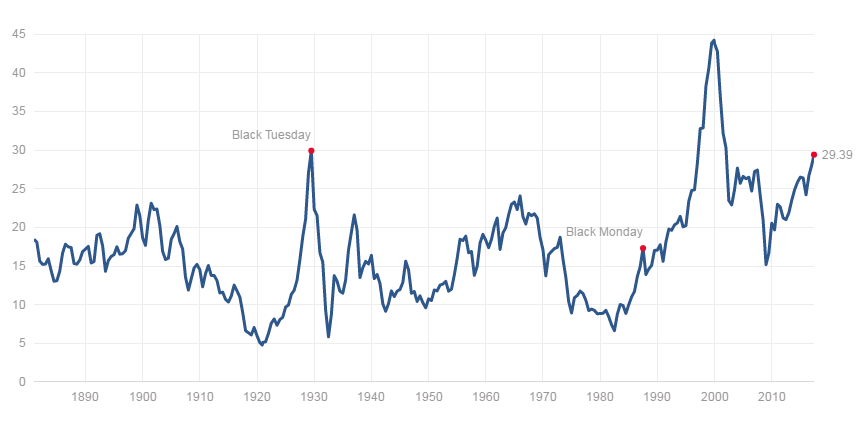
Patrick Armstrong, the CIO at Plurimi Investment Managers, believes that very high valuations, an expected tightening in monetary policy and too much optimism over tax cuts and new fiscal spending should leave investors cautious on the United States. “Valuation doesn’t matter in the short term but at current CAPE (cyclically adjusted price to earnings, which gives a more clear indication of a stock price in comparison to average earnings over the last 10 years) of 29 times, U.S. equities have historically delivered negative real returns over periods of two to five years,” he said in an investment outlook published earlier this month. The U.S. Federal Reserve has begun normalizing its policy in the wake of improved economic growth and low unemployment levels.

According to Armstrong, the easy monetary policy of the past had boosted equities but this might change with the Fed’s plans to hike rates and reduce its balance sheet. “I think there was a clear warning in the last (meeting) minutes talking about risk premium, price earnings and investors haven’t acknowledged it, but when the Fed starts worrying about equity markets, as an equity investor they’ve given you that warning,” he told CNBC on Tuesday. The third reason to be “short” – where a trader takes a bet that prices will fall – on U.S. equities is the government’s plans on fiscal policy. President Donald Trump promised tax cuts and big infrastructure spending, which made U.S. equities rally since he took office last November. However, such policies are yet to reach the consultation stage and doubts have emerged over the president’s ability to deliver.

[..] Speaking to CNBC Tuesday, Armstrong suggested that investors aren’t listening to the U.S. Federal Reserve. “What investors are completely underestimating is how low the bar is for the United States Federal Reserve. They have told us what they intend to do, the markets don’t believe any of it,” Armstrong said. “The Fed says it’s going to hike again this year, markets says 50-50. The Fed says three, four times next year, the market says it’s not going to happen at all,” he added.

Read more …

Central banks are trying to get out before the blast. But in doing so they bring it forward. Were given far too much power.

Unwinding QE will be “More Disruptive than People Think” (WS)

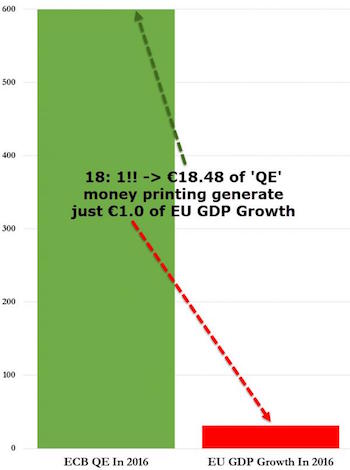
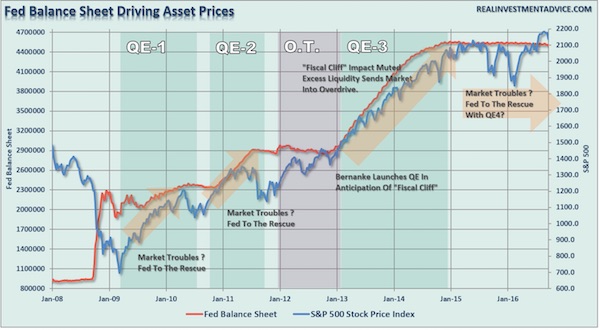
“We’ve never had QE like this before, and we’ve never had unwinding like this before,” said JPMorgan CEO Jamie Dimon at the Europlace finance conference in Paris. “Obviously that should say something to you about the risk that might mean, because we’ve never lived with it before.” He was referring to the Fed’s plan to unwind QE, shedding Treasury securities and mortgage-backed securities on its balance sheet. The Fed will likely announce the kick-off this year, possibly at its September meeting. According to its plan, there will be a phase-in period. It will unload $10 billion the first month and raise that to $50 billion over the next 12 months. Then it will continue at that pace to achieve its “balance sheet normalization.” Just like the Fed “created” this money during QE to buy these assets, it will “destroy” this money at a rate of $50 billion a month, or $600 billion a year.

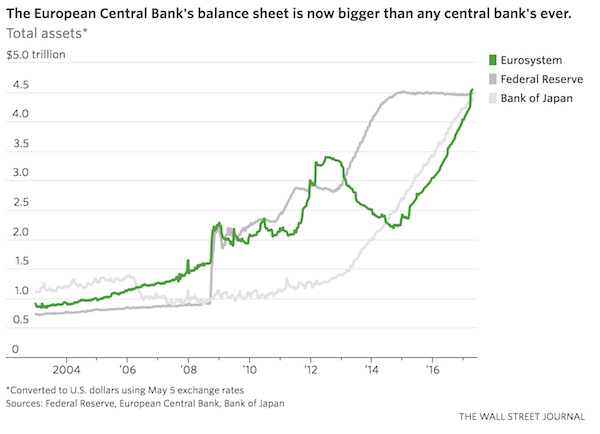
It’s the reverse of QE, with reverse effects. Other central banks are in a similar boat. The Fed, the Bank of Japan, and the ECB together have loaded up their balance sheets with $14 trillion in assets. Unwinding this is going to have some impact – likely reversing some of the asset price inflation in stocks, bonds, real estate, and other markets that these gigantic bouts of asset buying have caused. The Bank of Japan has been quietly tapering its asset purchases for a while to where it buys only enough to keep the 10-year yield barely above zero. And the ECB has tapered its monthly purchases by €20 billion earlier this year and is preparing the markets for more tapering. Once central banks stop buying assets, the phase starts when central banks try to unload some of those assets. The Fed is at the threshold of this phase.

Dimon was less concerned about the Fed’s rate hikes. People are too focused on rate hikes, he said, according to a Bloomberg recording of the conference. If the economy is strong, economic growth itself overcomes the issues posed by higher rates, he said. The economy has been through rate hikes many times before. They’re a known quantity. But “when selling securities in the market place starts,” that’s when it gets serious. “When that happens of size or substance, it could be a little more disruptive than people think,” he said. Whatever it will do, no one knows what it will do – because “it never happened before.”

Read more …

Don’t woryy, they serve the same lords.

I Wouldn’t Rule Out Another Financial Crisis – IMF’s Lagarde (CNBC)

The IMF’s Managing Director, Christine Lagarde, has said that she would not rule out another financial crisis in her lifetime, indicating that comments made recently by Federal Reserve Chair Janet Yellen may have been premature. “There may, one day, be another crisis,” Lagarde told CNBC Tuesday on the sidelines of a joint conference with the IMF and the Croatian National Bank in Dubrovnik. Lagarde’s comments responded to a statement made by Yellen a fortnight earlier in which she said she does not expect to see another financial crisis in her lifetime. “I plan on having a long life and I hope she (Yellen) does, too, so I wouldn’t absolutely bet on that because there are cycles that we have seen over the past decade and I wouldn’t exclude that,” Lagarde said.

She, however, noted the unpredictability of financial crises and said that finance ministers and policymakers should act with caution to prepare for such eventualities. “Where it will come from, what form it takes, how international and broad-based it will be is to be seen, and typically the crisis never comes from where we expect it,” she added. “Our duty, and certainly the message that we give to the finance ministers, to the policymakers, is ‘be prepared’. Make sure that your financial sector is under good supervision, that it’s well regulated, that the institutions are rock-solid, and anticipate at home with enough buffers so that you can resist the potential crisis.”

Read more …

And we will see undershoot on the way down. The Fed killing off price discovery will be a scourge on society.

The US Stock Market Is 66% Higher Than It Should Be (Kee jr)

I have, in previous articles here on MarketWatch, pointed out the fundamental risks in the U.S. stock market. I have identified the liquidity risks created by the ECB and the Federal Reserve in the tightening of monetary policy, in the reduction of the Fed’s balance sheet, and the likelihood that these risks will prick the asset bubble that the market is in today. Most people I speak and email with agree. The risks are high, as the price-to-earnings multiple of the S&P 500 (about 25, depending on the indicator) is far greater than its historical norm (14.5). The truth, however, is that no one knows for sure. But, still, people are apathetic. In fact, my experience over the past 20 years and through each of the past two major asset bubbles (the internet bubble in 2000 and the credit crisis in 2008-2009), is that the unanimous identification of an asset bubble did not take place until after the asset bubble had burst.

By that time, all of the major indices — the Dow Jones Industrial Average S&P 500, Nasdaq 100 and Russell 2000 — had already fallen. The result largely handcuffed investors to investments that were severely underwater. As luck would have it, though, after the credit crisis, the Fed’s policy-making body printed $2 trillion and, with that money, bought assets to prop up the economy and save investors from destruction. Largely, this perceived savior is probably why investors are so lethargic when it comes to the asset bubble that we are probably in right now. This bubble even seems to include real estate and bonds in addition to stocks, and it has been driven by fabricated central bank liquidity.

Admittedly, I cannot be sure what will happen. I do not know if this bubble will burst, and I do not know if central banks will come running to the rescue again, as they did after the credit crisis. Unfortunately, I do know a great deal of people who believe that the central banks of the world will simply print more money if the going gets tough again, but that is a seriously risky bet. With major indices coming off all-time highs and technical trading patterns (dojis) surfacing in long-term chart patterns last week, potential reversal signals are coming on a technical basis. As much as it is appealing to opt for relaxation and vacationing during the summer months, some time must be spent evaluating the conditions the market is facing right now.

In previous articles, I have offered alternatives to the traditional buy-and-hold methodology, and I think everyone should consider heading that way because strategies like “lock and walk” can work no matter what happens. The risks in the market today are extremely high for buy-and-hold investors because the liquidity picture is changing for the worse, and that is fundamental in nature. But longer-term technical observations point toward serious risks as well. My longer-term macroeconomic analysis, The Investment Rate, is offering warnings that this market is 66% higher than it should be. Given the changes in liquidity and technical observations happening now, those risk warnings should be heard with an acute ear.

Read more …

A whole bunch of Lance graphs again. Hard to choose. But pretty as the graphs are, they do not paint a pretty picture. They say BUBBLE.

Valuation Measures & Forward Returns (Lance Roberts)

[..] if the market can reverse the current course of weakness and rally above recent highs, it will confirm the bull market is alive and well, and we will continue to look for a push to our next target of 2500. With portfolios currently fully allocated, we are simply monitoring risk and looking for opportunities to invest “new capital” into markets with a measured risk/reward ratio. However, this is a very short-term outlook which is why “price is the only thing that matters.” “Price measures the current “psychology” of the “herd” and is the clearest representation of the behavioral dynamics of the living organism we call “the market.” But in the long-term, fundamentals are the only thing that matters. I have shown you the following chart many times before. Which is simply a comparison of 20-year forward total real returns from every previous P/E ratio.
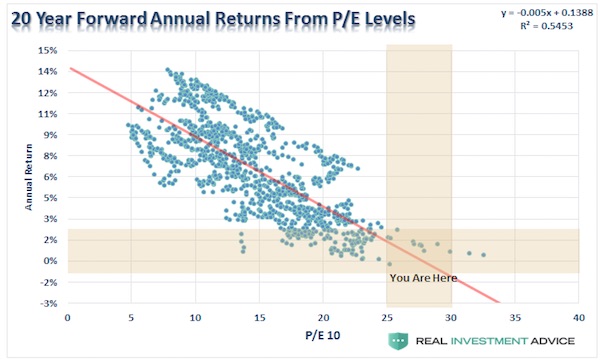
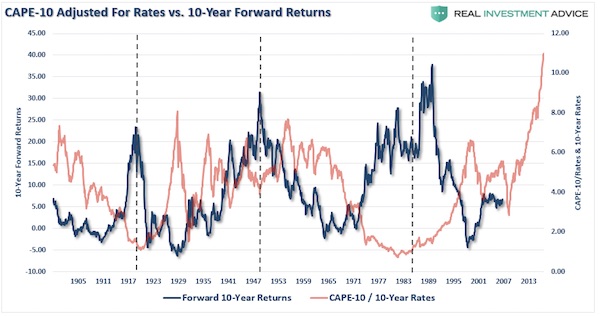
I know, I know. “P/E’s don’t matter anymore because of Central Bank interventions, accounting gimmicks, share buybacks, etc.” Okay, let’s play. In the following series of charts, I am using forward 10-year returns just for consistency as some of the data sets utilized don’t yet have enough history to show 20-years of forward returns. The purpose here is simple. Based on a variety of measures, is the valuation/return ratio still valid, OR, is this time really different? Let’s see. Tobin’s Q-ratio measures the market value of a company’s assets divided by its replacement costs. The higher the ratio, the higher the cost resulting in lower returns going forward. Just as a comparison, I have added Shiller’s CAPE-10. Not surprisingly the two measures not only have an extremely high correlation, but the return outcome remains the same.
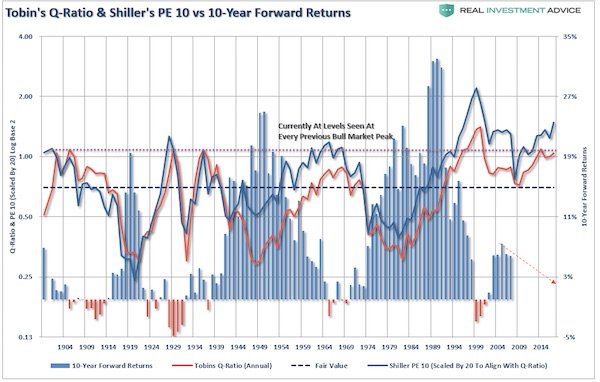
One of the arguments has been that higher valuations are okay because interest rates are so low. Okay, let’s take the smoothed P/E ratio (CAPE-10 above) and compare it to the 10-year average of interest rates going back to 1900. The analysis that low rates justify higher valuations clearly does not withstand the test of history.
Read more …

Substitute nonprime for subprime and you open a whole new can of suckers again. “No, these are fine and upstanding citizens. They just don’t have access to normal bank loans.” Gee, why is that?

Nonprime Mortgages Prove Leery Investors Are Finally Hungry Again (CNBC)

The appetite for riskier mortgages is rising, and a small cadre of investment firms is ready to feed it. Angel Oak Capital Advisors just announced its second rated securitization of nonprime residential mortgages this year, a deal worth just more than $210 million and its largest ever. Its first deal was slightly less, but demand from borrowers and investors alike is growing, and the securitizations are growing with it. Angel Oak is one of very few firms offering these private-label mortgage-backed securities — the ones that were so very popular during the last housing boom and which were later blamed for the financial crisis. Today’s nonprime loans, however, are nothing like the ones of the past. The government cracked down on faulty loan products, those with low teaser rates, negative amortization and no documentation.

Still, for the past decade investors wouldn’t touch anything that wasn’t government-backed. Only now are they seeing value and dipping their toes in again. The number of nonprime mortgage-backed securities “skyrocketed” in the second quarter of this year, according to Inside Mortgage Finance — a total of $1.08 billion of MBS backed by nonprime home loans. That was the strongest quarter for the sector since the financial crisis. It is still, however, nothing compared with the volume that caused the housing crash. “At one point during the housing boom, we had a third of all mortgage originations that were nonprime [subprime or Alt-A, the latter having low or no documentation]. We’re not going to be even 5% of the market if we have a record year this year. It still has a long, long way to go,” said Guy Cecala, CEO of Inside Mortgage Finance.

That is because while investors are hungry for yield, they are still very skeptical. The ratings agencies are as well. That makes it difficult for companies like Angel Oak, and its competitors — Lone Star and Deephaven Mortgage — to issue large quantities of nonprime MBS. Nonprime securitizations today are far less risky, consisting of loans that were underwritten far more stringently. Angel Oaks’ securitization does consist of both fixed- and floating-rate loans. “In addition to borrowers that had prior credit events, our loans are also for borrowers who are self-employed,” said Lauren Hedvat, capital markets director at Angel Oak. “They are of high credit quality, but they are not able to access mortgage products by the more traditional bank routes.”

Read more …

Start paying cash everywhere.

VISA takes its War on Cash to US Retailers (WS)

“We’re focused on putting cash out of business,” Visa’s new CEO Al Kelly said on June 22 at Visa Investor Day. Pushing consumers into digital and electronic payments is the company’s “number-one growth lever.” Visa has been dogged by the stubborn survival of cash and checks, despite widespread government and corporate efforts to kill them off. Globally, check and cash transactions totaled $17 trillion in 2016, Visa President Ryan McInerney said. Confusingly, that’s up 2% from a year earlier. So today, Visa rolled out a new initiative on its war on cash. It’s designed “for small business restaurants, cafés, or food truck owners,” and the like. In this trial, it will award up to $10,000 each to 50 eligible businesses (online businesses are excluded) when they commit to refusing cash payments.

Going “100% cashless,” as Visa calls it, means that consumers can only pay with debit or credit cards or with their smartphones. That’ll be the day. You go to your favorite taco truck, and when it comes time to pay, you pull out a wad of legal tender, only to be treated to an embarrassed nod toward a sign that says, “No Cash.” I’d walk. But Visa hopes that other folks will pull out their Visa-branded card or a smartphone with a payment app that uses the Visa system. This would help Visa extract its fees from the transaction. “We have an incredible opportunity to educate merchants and consumers alike on the effectiveness of going cashless,” Jack Forestell, Visa’s head of global merchant solutions, said in the press release, which touted a “study” that Visa recently “conducted” that “found that if businesses in 100 cities transitioned from cash to digital, their cities stand to experience net benefits of $312 billion per year.”

However dubious these “net benefits” may be, one thing is not dubious: Visa gets a cut from every transaction made via Visa-branded cards or digital payment systems that use Visa. The merchant pays the cut and then tries to pass it on to customers via higher prices. The total card fees normally range between 1% and 3%. Among the entities that get to divvy this moolah up are the bank that issued the visa card and the credit card network – such as Visa, MasterCard, and the like. Visa gets just a small piece of the pie, but if it is on every transaction, it adds up. And payments by cash and check seriously get in the way of a lot of money. In 2016, Visa extracted $15 billion from processing transactions globally without even carrying any credit risk (the banks have to deal with that).

Read more …

Purely symbolic. Everyone loves to present a meme of recovery, but it’s not there. Ironically, the move from deficit to -forced- surplus guarantees it. Greece should run a deficit now to boost its economy.

Greece To Exit EU’s Excessive Deficit Procedure (K.)

After eight years, Greece emerged on Wednesday from the European Commission’s process for countries with excessive deficit. The Commission proposed Greece’s exit from the process as its general government debt has dropped below the threshold of 3% of GDP. This is a largely symbolic move, but it does have some significance given that the government is planning to return to the bond markets for the first time since 2014. Economic Affairs Commissioner Pierre Moscovici gave a wink to the markets on Wednesday, saying that the disbursement of the tranche of 7.7 billion euros on Monday and the decision on the deficit is “good news that the markets ought to read,” even though he explained that what the investors do is not up to him.

Commission Vice President Valdis Dombrovskis called on Greece to capitalize on its achievements and continue to strengthen confidence in its economy, which is crucial as the country prepares its return to the credit markets. The Commission’s proposal for Greece’s emergence from the deficit procedure has to be ratified by the EU’s finance ministers, but has little practical use. Ultimately, Greece’s fiscal targets are dictated by the bailout agreement and not by the rules that apply to other eurozone members. As one European official told Kathimerini, “nothing changes essentially, the fiscal targets Greece must hit remain high and [yesterday’s] decision is only of a symbolic dimension.”

Read more …

Greece can only get worse, for many years into the future.

Brain Drain Gathers Pace as One in Three Greeks Looks for a Job Abroad

A new study highlights the problem in the Greek labor market as more than 30% of Greek unemployed say that they are actively seeking a job abroad. According to the annual survey by the firm Adecco titled “Employability in Greece,” the brain drain phenomenon has been increasing over the last three years. In 2015 only about 11% of unemployed respondents said that they were actively looking for a job abroad. This figure increased to 28% in 2016 and reached 33% this year. The responses show that the unemployed have different reasons to seek work abroad. Whereas in 2005, the main reason was the prospect of a better wage, in 2016 and 2017 the main reason given were better career opportunities.

The study conducted for the third year running, in collaboration with polling company LMG, was based on a sample of 903 people from the age of 18 to 67. According to other findings, 37% of respondents say that they have been out of the labor market for at least 12 months. Despite the slight improvement in official unemployment rates, the Adecco survey finds that there is an increasing number of people who state that they have been at least once without a job – 58% this year compared to 54% in 2016. According to the data, more than 1 out of 4 (28%) are out of the labor market, a higher rate compared with the previous two years.

Read more …

Money that could have helped Greece escape the claws of Schäuble et al. The pattern is not coincidental.

Germany Profits From Greek Debt Crisis (HB)

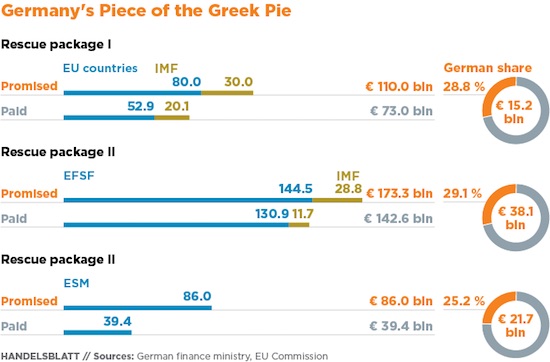
The German government has long been accused by critics of profiting from Greece’s debt crisis. Now there are some new numbers to back it up: Loans and bonds purchased in support of Greece over nearly a decade have resulted in profits of €1.34 billion for Germany’s finance ministry, which confirmed the number in response to a parliamentary query from the Green Party, according to a report by German daily Süddeutsche Zeitung. The profits come from a range of programs, running into the hundreds of billions, that Germany and other euro-zone countries have backed to keep Greece’s government and economy afloat since its massive debt crisis emerged in 2009. It includes, for example, a €393-million profit generated from a 2010 loan by the development bank KfW, which is owned by the German government.

The report also shows that Germany’s central bank, the Bundesbank, has received profits from the Securities Market Program (SMP), a now-defunct government bond-buying plan initiated by the ECB and run from 2010 to 2012. The ECB collected more than €1.1 billion in 2016 in interest payments on the nearly €20 billion-worth of Greek bonds it bought through the SMP, according to the report. This year, the figure will be €901 million, which will again be redistributed to the euro zone’s 19 member states. Since 2015, Germany has collected a total of €952 million in SMP profits. The new revelations drew strong criticism from the Greens Party, in opposition. “The profits from collecting interest must be paid out to Greece. [Finance Minister] Wolfgang Schäuble cannot use the Greek profits to clean up Germany’s federal budget,” Manuel Sarrazin, EU expert for the Green Party in the parliament, told the Süddeutsche newspaper.

Mr. Schäuble, a member of Chancellor Angela Merkel’s conservative Christian Democrats, has been cannily keeping Germany’s federal budget balanced over the past four years, taking on no new debt. Berlin’s surplus amounted to €6.2 billion in 2016 alone. Critics complain that Greece’s crisis has helped it achieve that goal. “It might be legal for Germany to profit from the crisis in Greece, but from a moral and solidarity perspective, it is not right,” Sven-Christian Kindler, budget policy spokesperson for the Green Party, also told the paper. Mr. Schäuble has said he is open to reducing Greece’s interest burden but has resisted calls to end them completely. His finance ministry has argued that, with inflation, deferring interest payments would eventually end up costing Greece’s creditors.
Read more …

There are many parties not too keen on such an investigation, and Varoufakis is not one of them.

Defiant Varoufakis Ready to Face ‘Even Martial Court’ Over Plan B (GR)

Undeterred over the controversy surrounding the new disclosures over the system of a parallel currency that was apparently considered by the government of Alexis Tsipras in 2015, Yanis Varoufakis said that he is ready to face any court to respond to the charges. Speaking in a radio show, Varoufakis, the finance minister at the time and the instigator of the parallel payments system or Plan B, said that Tsipras had a copy of the proposals from as early as 2012 when he was still in opposition. “I have handed the plan to Tsipras in 2012,” so it could become the government’s plan B if negotiations with Greece’s creditors collapsed.

Mr. Varoufakis said he was willing to accept any kind of judicial investigation into Plan B and his role in drafting it. “Let’s have a special court of inquiry, or even a martial court, or any other court, so all the facts can be revealed,” he said responding to calls from the opposition for a judicial inquiry. He also attacked the SYRIZA-led government for refusing to proceed with an investigation. The Varoufakis Plan B for the Greek economy in the event that the country clashed with creditors and went bankrupt was to partially pay civil servants with coupons. Parts of the plan were revealed last week by his financial advisor Glenn Kim.

Read more …

Jun 132017
 
 June 13, 2017  Posted by at 9:55 am Finance Tagged with: , , , , , , , , ,  1 Response »


Pablo Picasso Les femmes d’Alger Version 0 1955


The Average Stock Is Enormously, Tremendously Overvalued (Katsenelson)
72% Of US Businesses Are Not Profitable (Simon Black)
UBS Has Some Very Bad News For The Global Economy (ZH)
Fed To Raise Interest Rates, Give More Detail On Balance Sheet Winddown (R.)
EU Plans to Force Relocation of Euro Clearing After Brexit (BBG)
Norway Central Bank Explains How Money Is Created (Norges Bank)
Qatar Spends $8 Million To Airlift 4,000 Cows (BBG)
Things To Come (Jim Kunstler)
Multi-Million Dollar Upgrade Planned To ‘Failsafe’ Arctic Seed Vault (G.)
EU To Open Case Against Poland, Hungary, Czech Republic Over Refugees (R.)
ECB Unlikely to Include Greece in QE in Coming Months (BBG)
Greek Debt Deal ‘Not Far’ Says New French Finance Minister (AFP)
One Dead As 6.3-Magnitude Earthquake Rocks Greek Islands Lesbos, Chios (AFP)


No markets, no discovery, just smoke.

The Average Stock Is Enormously, Tremendously Overvalued (Katsenelson)

We are constantly looking for new stocks by running stock screens, endlessly reading (blogs, research, magazines, newspapers), looking at holdings of investors we respect, talking to our large network of professional investors, attending conferences, scouring through ideas published on value investor networks, and finally, looking with frustration at our large (and growing) watch list of companies we’d like to buy at a significant margin of safety. The median stock on our watch list has to decline by about 35–40% to be an attractive buy. But maybe we’re too subjective. Instead of just asking you to take our word for it, in this letter, we’ll show you a few charts that not only demonstrate our point, but also show the magnitude of the stock market’s overvaluation and, more importantly, put it into historical context.

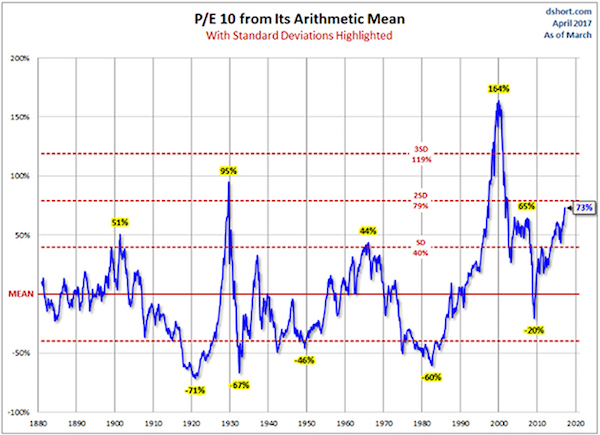
Each chart examines stock market valuation from a slightly differently perspective, but each arrives at the same conclusion: the average stock is overvalued somewhere between tremendously and enormously. If you don’t know whether “enormously” is greater than “tremendously” or vice versa, don’t worry, we don’t know either. But this is our point exactly: When an asset class is significantly overvalued and continues to get overvalued, quantifying its overvaluation brings little value. Let’s demonstrate this point by looking at a few charts. The first chart shows price-to-earnings of the S&P 500 in relation to its historical average. The average stock today is trading at 73% above its historical average valuation. There are only two other times in history that stocks were more expensive than they are today: just before the Great Depression hit and in the 1999 run-up to the dot-com bubble burst.

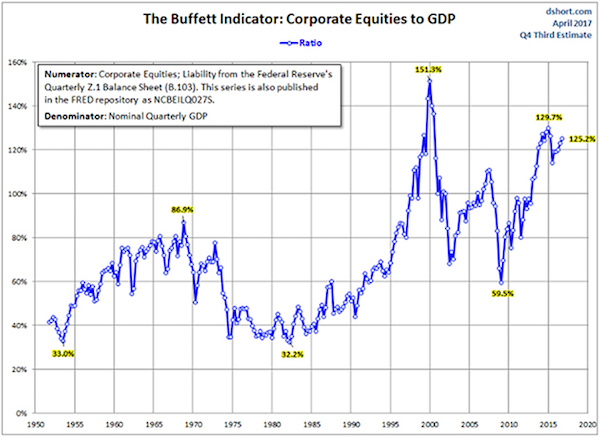
We know how the history played in both cases—consequently stocks declined, a lot. Based on over a century of history, we are fairly sure that, this time too, stock valuations will at some point mean revert and stock markets will decline. After all, price-to-earnings behaves like a pendulum that swings around the mean, and today that pendulum has swung far above the mean. What we don’t know is how this journey will look in the interim. Before the inevitable decline, will price-to-earnings revisit the pre-Great Depression level of 95% above average, or will it maybe say hello to the pre-dot-com crash level of 164% above average? Or will another injection of QE steroids send stocks valuations to new, never-before-seen highs? Nobody knows. One chart is not enough. Let’s take a look at another one called the Buffett Indicator. Think of this chart as a price-to-sales ratio for the whole economy, that is, the market value of all equities divided by GDP. The higher the price-to-sales ratio, the more expensive stocks are.

Read more …

What does this say about where the S&P is?

72% Of US Businesses Are Not Profitable (Simon Black)

Total Household Wealth is exactly what it sounds like– the total net worth of every person in the United States, from Bill Gates down to the youngest newborn baby. So when you add up all the 330+ million folks in the Land of the Free and tally up their combined net worth, the total is $94 trillion. The thing is that the VAST majority of that wealth, especially the incredible growth over the last 8 years, has been from increases in just two asset classes: real estate and the stock market. In fact, stocks and real estate alone account for roughly 2/3 of the wealth increase since 2009. I’ll come back to that in a moment. Now, simultaneously, we see plenty of other interesting data, also published by the Federal Reserve and US federal government. Both the Fed and Census Bureau, for example, tell us that over 80% of businesses in the US are “nonemployer” companies, i.e. businesses which only employ one person (the owner), and often provide his/her primary source of income.

Yet according to the Federal Reserve, only 35% of these small businesses are profitable. Most are operating at a loss. In other words, only 35% of the companies which make up 80% of American businesses are profitable. You’re probably already doing the arithmetic– this means that a whopping 72% of all US businesses are NOT profitable. That hardly sounds like record wealth to me. Shifting gears, there’s the little factoid that an astounding 40% of young Americans are living with their parents– the highest%age in the last 75 years. And who can blame them considering student debt in the Land of the Free also hit a record $1.4 trillion three months ago, more than double the amount since the Great Recession. Speaking of record debt, US credit card debt passed a record $1 trillion, and total US consumer credit hit a record $3.8 trillion last month. Again, all of this hardly seems like ‘wealth’ to me.

Then there’s the issue of wages, which have remained essentially flat since the 2009 Great Recession if you adjust for inflation. According to the US Department of Labor, inflation-adjusted wages, aka “real hourly compensation” in the US fell an annualized 0.9% last quarter, and fell a dismal 5.6% in the previous quarter. Adjusted for inflation, the average American isn’t making any more money. Once again, this is a pitiful excuse for ‘wealth.’ American businesses aren’t more productive either. The same Labor Department report shows that productivity in the Land of the Free was flat in the first quarter of this year. And productivity actually declined in 2016– something that hasn’t happened in at least the last 50 years. Not to mention total economic growth in the Land of the Free has been pretty pitiful, logging a pathetic 1.6% last year. And GDP growth in the first quarter of 2017 was just 1.2% on an annualized basis. The US economy has exceed hasn’t surpassed 3% growth in more than 10-years.

Read more …

Oversaturated with debt.

UBS Has Some Very Bad News For The Global Economy (ZH)

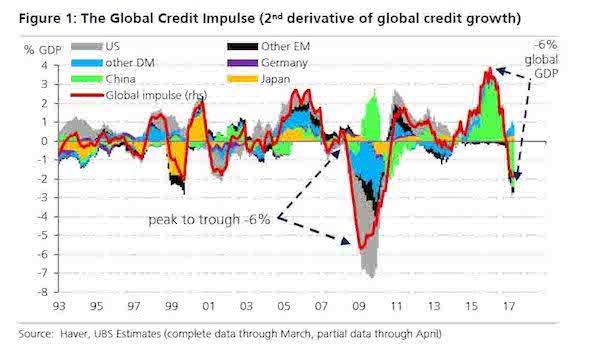
[..] fast forwarding just over three months later, where are we now? To answer that question, overnight UBS released its much anticipated update on the current state of the global credit impulse, and it’s nothing short of a disaster. As Kapteyn writes in what may have been the most eagerly awaited report in recent UBS history, “we have been inundated with questions about the chart below, first published in March. Yes, the global credit impulse is still falling. And yes, it matters because the correlation of this global credit impulse with global domestic demand is 0.61.” But it’s what follows next that should send shivers down the spine of anyone still clutching to the failed “recovery” narrative:

From peak to trough the deceleration in global credit growth is now approaching that during the global financial crisis (-6% of global GDP), even if the dispersion of the decline is much narrower. Currently 55% of the countries in our sample have experienced a -0.3 standard deviation deterioration in their credit impulse (median over 12 months) compared to 77% of countries in Dec ’09 when the median decline was -1.4 stdev.” Here is what the stunning collapse in the credit impulse looks like as of today:

While we urge all readers to get in touch with their friendly UBS sales coverage for the full report, here is a quick primer from UBS on what the current data is telling us, not so much about China where the credit impulse slowdown was discussed previously, but about the world’s biggest economy. From UBS: The credit impulse in the US has also turned down, seemingly on the back of a sharp drop in demand for C&I loans. The slowdown is more visible in the bank loan data than the Flow of Funds data we are using to calculate the credit impulse (the FoF is 3x as broad and includes non-bank credit as well). But the slowdown is nonetheless at odds with confidence being expressed about investment and future borrowing plans.

The US credit impulse was running at 0.7% GDP back in September 2016 and by March had fallen to -0.53% GDP (recovering somewhat in April based on bank loan data). Why does this matter? Because as UBS shows in the chart below, in the US the correlation between activity and the impulse is very strong, and the lack of credit growth could constrain an acceleration in GDP from weak Q1 levels (the credit impulse suggests domestic demand growth should be close to 1% rather than the 2+% which consensus is currently tracking).

Read more …

Yawn.

Fed To Raise Interest Rates, Give More Detail On Balance Sheet Winddown (R.)

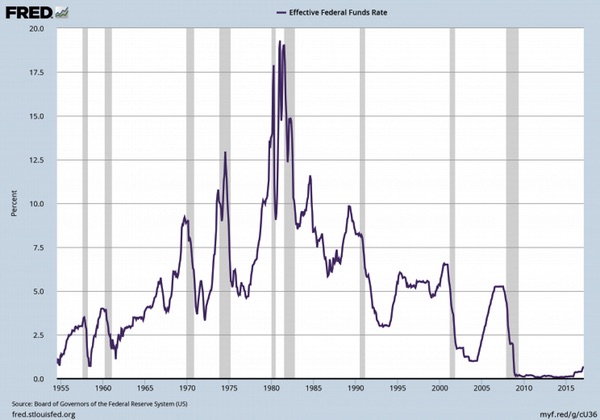
The U.S. Federal Reserve is widely expected to raise its benchmark interest rate this week due to a tightening labor market and may also provide more detail on its plans to shrink the mammoth bond portfolio it amassed to nurse the economic recovery. The central bank is scheduled to release its decision at 2 p.m EDT on Wednesday at the conclusion of its two-day policy meeting. Fed Chair Janet Yellen is due to hold a press conference at 2:30 pm EDT. “The expectation of a rate hike…is widely held, and has been reinforced by the most recent round of Fed communications,” said Michael Feroli, an economist with J.P. Morgan. Economists polled by Reuters overwhelmingly see the Fed raising its benchmark rate to a target range of 1.00 to 1.25% this week.

The Fed embarked on its first tightening cycle in more than a decade in December 2015. A quarter%age point interest rate rise on Wednesday would be the second nudge upwards this year following a similar move in March. Since then, the unemployment rate has fallen to a 16-year low of 4.3% and economic growth appears to have reaccelerated following a lackluster first quarter. However, other indicators of the economy’s health have been more mixed. The Fed’s preferred measure of underlying inflation has retreated to 1.5% from 1.8% earlier in 2017 and investors are growing increasingly doubtful policymakers will be able to stick to their anticipated pace of tightening of three interest rate rises this year and next.

Read more …

There’s money in derivatives yet.

EU Plans to Force Relocation of Euro Clearing After Brexit (BBG)

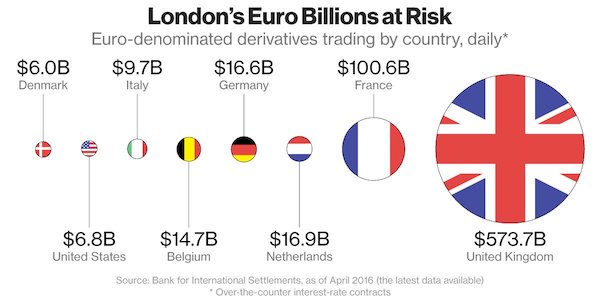
Firms that clear euro-denominated derivatives may be forced to relocate to the European Union from London after Brexit under EU proposals to be rolled out on Tuesday, according to a person with knowledge of the matter. Under the European Commission’s plans for overhauling supervision of clearinghouses that are based outside the bloc, firms deemed systemically important to the EU financial system could be required to accept direct oversight by the bloc’s authorities, the person said, asking not to be named because the proposals aren’t yet public. Firms could also be forced to move their euro clearing operations to a location inside the EU, the person said.

This so-called location requirement has spurred warnings from the industry of skyrocketing costs, and has helped to turn clearing into a political football as the EU and U.K. prepare for divorce negotiations. In a June 8 letter to Valdis Dombrovskis, the EU’s financial-services policy chief, the International Swaps and Derivatives Association said a survey of data from 11 banks showed that requiring euro-denominated interest-rate derivatives to be cleared by an EU-based clearinghouse would boost initial margin by as much as 20%. The proposals to be published on Tuesday are largely in line with initial plans floated last month by the commission, the EU’s executive arm.
Read more …

Central banks and shunned economists seem to be the only ones who understand this.
Norway Central Bank Explains How Money Is Created (Norges Bank)

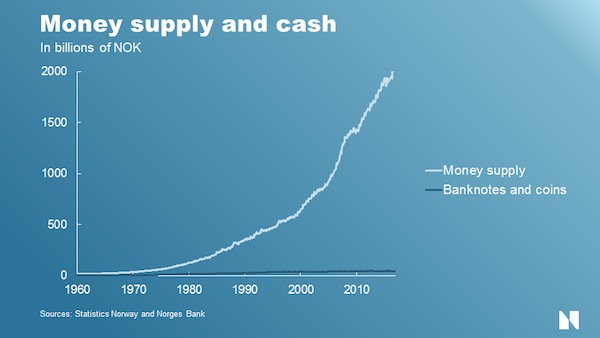
Today, there are two forms of central bank money. One of the forms is common knowledge – banknotes and coins. The other, bank reserves at Norges Bank, is less well known. The sum total of banknotes and coins and bank reserves at Norges Bank is about NOK 85 billion.[5] But the total money supply is much larger than this. Customer deposits in banks are also money. These deposits, referred to as deposit money, total more than NOK 2 trillion in Norway. This money is created by banks, not by Norges Bank. Chart 1 shows the money supply and the supply of banknotes and coins in Norway since 1960. In Norway, the money supply mainly comprises deposit money in banks.[6] In the early 1960s, banknotes and coins accounted for a fifth of the money supply. Current accounts and cheques were already becoming commonplace.

Since then, banks’ deposit money has increased dramatically, and today, banknotes and coins make up less than 2.5% of the money supply. In other words, virtually all the money we use has been created by banks. So how do banks create money? The answer to that question comes as quite a surprise to most people. When you borrow from a bank, the bank credits your bank account. The deposit – the money – is created by the bank the moment it issues the loan. The bank does not transfer the money from someone else’s bank account or from a vault full of money. The money lent to you by the bank has been created by the bank itself – out of nothing: fiat – let it become. The money created by the bank does not disappear when it leaves your account. If you use it to make a payment, it is just transferred to the recipient’s account.

The money is only removed from circulation when someone uses their deposits to repay a bank, as when we make a loan repayment.[7] The money supply is therefore only reduced when banks’ claims on the rest of the economy decrease. Banks also fund lending by raising loans themselves instead of creating money in the form of deposits. In order to reduce risk, banks also use other forms of investment in addition to lending.[8] Nevertheless, the money supply is growing at almost at the same pace as total bank credit. To sum up: banks create money out of nothing and withdraw it when loans are repaid. Growth in total bank credit is normally matched by growth in the money supply.[9] This does not sound encouraging. Is money an illusion? Why is today’s privately issued deposit money often perceived to be as safe as money issued by the central bank?

Read more …

Flying pigs would have been even nicer.

Qatar Spends $8 Million To Airlift 4,000 Cows (BBG)

Call it the biggest bovine airlift in history. The showdown between Qatar and its neighbors has disrupted trade, split families and threatened to alter long-standing geopolitical alliances. It’s also prompted one Qatari businessman to fly 4,000 cows to the Gulf desert in an act of resistance and opportunity to fill the void left by a collapse in the supply of fresh milk. It will take as many as 60 flights for Qatar Airways to deliver the 590-kilogram beasts that Moutaz Al Khayyat, chairman of Power International Holding, bought in Australia and the U.S. “This is the time to work for Qatar,” he said. Led by Saudi Arabia, Qatar stands accused of supporting Islamic militants, charges the sheikhdom has repeatedly denied.

The isolation that started on June 5 has forced the world’s richest country by capita to open new trade routes to import food, building materials and equipment for its natural gas industry. The central bank said domestic and international transactions were running normally. Turkish dairy goods have been flown in, and Iranian fruit and vegetables are on the way. There’s also a campaign to buy home-grown produce. Signs with colors of the Qatari flag have been placed next to dairy products in stores. One sign dangling from the ceiling said: “Together for the support of local products.” “It’s a message of defiance, that we don’t need others,” said Umm Issa, 40, a government employee perusing the shelves of a supermarket before taking a carton of Turkish milk to try. “Our government has made sure we have no shortages and we are grateful for that. We have no fear. No one will die of hunger.”

Read more …

“..they had no idea what to do about it, except maybe try to escape the moment-by-moment pain of their ruined lives with powerful drugs. And then, a champion presented himself..”

Things To Come (Jim Kunstler)

As our politicos creep deeper into a legalistic wilderness hunting for phantoms of Russian collusion, nobody pays attention to the most dangerous force in American life: the unraveling financialization of the economy. Financialization is what happens when the people-in-charge “create” colossal sums of “money” out of nothing — by issuing loans, a.k.a. debt — and then cream off stupendous profits from the asset bubbles, interest rate arbitrages, and other opportunities for swindling that the artificial wealth presents. It was a kind of magic trick that produced monuments of concentrated personal wealth for a few and left the rest of the population drowning in obligations from a stolen future. The future is now upon us. Financialization expressed itself in other interesting ways, for instance the amazing renovation of New York City (Brooklyn especially).

It didn’t happen just because Generation X was repulsed by the boring suburbs it grew up in and longed for a life of artisanal cocktails. It happened because financialization concentrated immense wealth geographically in the very few places where its activities took place — not just New York but San Francisco, Washington, and Boston — and could support luxuries like craft food and brews. Quite a bit of that wealth was extracted from asset-stripping the rest of America where financialization was absent, kind of a national distress sale of the fly-over places and the people in them. That dynamic, of course, produced the phenomenon of President Donald Trump, the distilled essence of all the economic distress “out there” and the rage it entailed.

The people of Ohio, Indiana, and Wisconsin were left holding a big bag of nothing and they certainly noticed what had been done to them, though they had no idea what to do about it, except maybe try to escape the moment-by-moment pain of their ruined lives with powerful drugs. And then, a champion presented himself, and promised to bring back the dimly remembered wonder years of post-war well-being — even though the world had changed utterly — and the poor suckers fell for it. Not to mention the fact that his opponent — the avaricious Hillary, with her hundreds of millions in ill-gotten wealth — was a very avatar of the financialization that had turned their lives to shit. And then the woman called them “a basket of deplorables” for noticing what had happened to them.

Read more …

The permafrost is not all that perma.

Multi-Million Dollar Upgrade Planned To ‘Failsafe’ Arctic Seed Vault (G.)

The Global Seed Vault, built in the Arctic as an impregnable deep freeze for the world’s most precious food seeds, is to undergo a multi-million dollar upgrade after water from melting permafrost flooded its access tunnel. No seeds were damaged but the incident undermined the original belief that the vault would be a “failsafe” facility, securing the world’s food supply forever. Now the Norwegian government, which owns the vault, has committed $4.4m (NOK37m) to improvements. The vault is buried 130m inside a mountain in the Svalbard archipelago and contains almost a million packets of seeds, each a variety of an important food crop. The vault was opened in 2008, sunk deep into the permafrost, and was expected to provide protection against “the challenge of natural or man-made disasters” and “to stand the test of time”.

But the vault’s planners had not anticipated the extreme warm weather seen recently at the end of the world’s hottest ever recorded year. “The background to the technical improvements is that the permafrost has not established itself as planned,” said a government statement. “A group will investigate potential solutions to counter the increased water volumes resulting from a wetter and warmer climate on Svalbard.” One option could be to replace the access tunnel, which slopes down towards the vault’s main door, carrying water towards the seeds. A new upward sloping tunnel would take water away from the vault.

A former Svalbard coal miner, Arne Kristoffersen, told the Guardian most coal mines on the islands had upward sloping entrance tunnels: “For me it is obvious to build an entrance tunnel upwards, so the water can run out. I am really surprised they made such a stupid construction.” Hege Njaa Aschim, the Norwegian government’s spokeswoman for the vault, said: “The construction was planned like that because it was practical as a way to go inside and it should not be a problem because of the permafrost keeping it safe. But we see now, when the permafrost is not established, maybe we should do something else with the tunnel, so that is why we have this project now.”

Read more …

Hollow threats.

EU To Open Case Against Poland, Hungary, Czech Republic Over Refugees (R.)

The European Union’s executive will decide on Tuesday to open legal cases against three eastern members for failing to take in asylum-seekers to relieve states on the front lines of the bloc’s migration crisis, sources said. The European Commission would agree at a regular meeting to send so-called letters of formal notice to Poland and Hungary, three diplomats and EU officials told Reuters. Two others said the Czech Republic was also on the list. This would mark a sharp escalation of the internal EU disputes over migration. Such letters are the first step in the so-called infringement procedures the Commission can open against EU states for failing to meet their legal obligations. The eastern allies Poland and Hungary have vowed not to budge. Their staunch opposition to accepting asylum-seekers, and criticism of Brussels for trying to enforce the scheme, are popular among their nationalist-minded, eurosceptic voters.

Speaking in Hungary’s parliament earlier on Monday, Prime Minister Viktor Orban said: “We will not give in to blackmail from Brussels and we reject the mandatory relocation quota.” A spokeswoman in Brussels did not confirm or deny the executive would go ahead with the legal cases, but referred to an interview that Commission head Jean-Claude Juncker gave to the German weekly Der Spiegel last week. “Those that do not take part have to assume that they will be faced with infringement procedures,” he was quoted as saying. Poland and Hungary have refused to take in a single person under a plan agreed in 2015 to relocate 160,000 asylum-seekers from Italy and Greece, which had been overwhelmed by mass influx of people from the Middle East and Africa. Poland’s Interior Minister Mariusz Blaszczak was quoted as saying on Monday by the state news agency PAP: “We believe that the relocation methods attract more waves of immigration to Europe, they are ineffective.”

Read more …

Not going to happen, it would solve many of Greece’s problems, and Germany is not done with it yet.

ECB Unlikely to Include Greece in QE in Coming Months (BBG)

The ECB is unlikely to include Greek bonds in its asset-purchase program for the foreseeable future, a person familiar with the matter said, as European creditors aren’t prepared to offer substantially easier repayment terms on bailout loans to improve the nation’s debt outlook. Euro-area finance ministers will meet in Luxembourg on June 15 to discuss debt-relief measures that the ECB has said are needed before it will consider purchasing Greek bonds. The so-called Eurogroup is expected to complete a review of Athens’s rescue program that would allow for the disbursement of at least €7.4 billion in aid needed for a similar amount of bond repayments in July. An agreement among the ministers will likely allow the IMF – whose participation in the rescue program is a requirement for many nations – to commit in principle to a conditional loan, said the person.

But the extent and wording of debt-relief commitments probably won’t convince the Governing Council of the ECB to buy Greek bonds. And while the government of Prime Minister Alexis Tsipras is relying on quantitative easing to aid Greece’s return to the public debt market, the ECB won’t factor fiscal consequences into its policy-making decisions and excessive emphasis on QE inclusion would be misguided, according to the person. [..] The ECB’s quantitative easing is scheduled to continue until December 2017, with economists saying purchases will be gradually tapered throughout 2018. This would leave little time for purchases of Greek bonds before the program’s end.

Meanwhile, France, which is trying to bridge differences on the debt issue, has proposed automatically reducing loan repayments when Greece misses growth targets, according to two people with knowledge of the talks. European officials see the proposal as a step in the right direction but doubt it will be enough to convince the ECB to include Greece in its bond purchase program if the IMF maintains its position that the country’s debt is unsustainable. Other euro-area member states so far have opposed France’s proposal, the people said.

Read more …

Is Macron going to stand up to Merkel and Schäuble? I’m not convinced.

Greek Debt Deal ‘Not Far’ Says New French Finance Minister (AFP)

A deal on debt relief for Greece is “not far,” France’s new finance minister Bruno Le Maire said Monday ahead of crunch eurozone talks on the issue on Thursday. “I am optimistic that we will have a good solution. We are not far from agreement,” Le Maire said ahead of a meeting with Greek PM Alexis Tsipras. “We are really doing our best to find an agreement,” he had said earlier after seeing his Greek counterpart Euclid Tsakalotos. “It’s difficult. It’s complicated,” he said. At the June 15 meeting, Le Maire said he planned to propose a “mechanism” of “flexibility” to lessen Greek debt repayment based on its economic growth. “It’s a mechanism which should allow us to revise certain (debt) parameters based on Greek growth,” he told reporters.

The issue of debt relief for Greece has sharply divided its international creditors, the EU and the IMF, for months in the latest round of talks. The impasse has held up a tranche of bailout cash which Greece needs to repay loans in July, and Athens says its fragile recovery has also been impaired. Tsipras has said he will ask EU leaders to resolve the issue at the end of June if no solution is forthcoming on Thursday. “Piling drama on the problem helps no one,” he said on Monday. The Europeans expect Greece’s economy to grow strongly and its government to bring in large surpluses in revenue in the coming years, allowing it to pay down its debts. But the IMF is less optimistic, arguing there must be further relief for Athens before it can label its debt sustainable and justify loaning Greece any more cash.

New French President Emmanuel Macron last month called Tsipras after his election, saying he was in favour of “finding a deal soon to alleviate the weight of Greece’s debt over time.” Macron’s position puts him at odds with Germany where Greek debt relief – following three different bailouts with public money for the country since 2010 – is seen as a vote loser ahead of general elections in September. Macron explained his thinking about Greece in an interview to the Mediapart website two days before his election. “I am in principle in favour of a concerted restructuring of Greek debt and in keeping Greece in the eurozone. Why? Because the current system is unsustainable,” he said.

Read more …

Wonder what the older, religious people on Lesbos must be thinking by now. It once was a quiet place.

One Dead As 6.3-Magnitude Earthquake Rocks Greek Islands Lesbos, Chios (AFP)

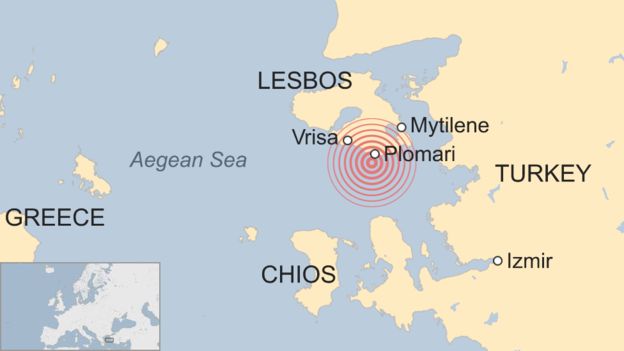
A woman died and 10 people were hurt on Monday when a 6.3-magnitude earthquake struck the Greek islands of Lesbos and Chios and the Aegean coast of western Turkey, officials said. The middle-aged victim had been trapped for around seven hours in the ruins of her home in the Lesbos village of Vrisa, the area that bore the brunt of the strong quake and where several homes collapsed. “Our fellow citizen who was trapped in the house that collapsed in Vrisa was pulled out dead,” Lesbos mayor Spyros Galinos said in a tweet. The earthquake also struck the Aegean coast of western Turkey after 1200 GMT.

Video footage shot by a Vrisa resident on a cellphone showed masonry from several single and two-level homes clogging the streets. “It’s a difficult situation, we are facing a disaster,” Christiana Kalogirou, governor of the north Aegean region, told Greek state TV station ERT, adding: “Some 10 people are injured.” “The army is bringing in tents so people can spend the night,” she said, adding that the south of Lesbos had taken the brunt of the quake. The tremor, felt as far as Athens and Izmir in Turkey, damaged at least three churches and shops in south Lesbos, local owners said, while rock slides blocked some roads.

Read more …

May 302017
 
 May 30, 2017  Posted by at 8:50 am Finance Tagged with: , , , , , , , , , , ,  5 Responses »


Inge Morath Paris 1954


Australia Hedge Fund Returns Cash To Clients Citing Looming Calamity (SMH)
Hong Kong Throngs of Thousands Defy Bid to Cool Home Market (BBG)
Saudi Foreign Reserves Dip Below $500 Billion in April (BBG)
The Great US Energy Debt Wall (SRSRocco)
Greece, Italy Tensions Hit Euro, Asian Stocks, Lift Yen, Gold (R.)
Draghi Rules Out Including Greece in ECB QE For Now (K.)
Greece Warns Recovery Threatened If Debt Deal Is Blocked At Next Talks (G.)
Deposits And Loans At Greek Banks Continue Slide (K.)
EU Moves To Crack Down On Carmakers In Wake Of VW Emissions Scandal (G.)
Painstaking Detail Of Brexit Process Revealed In EU Documents (G.)
May Battles Against Complacency as UK Election Lead Slips Away (BBG)
Russia Expects China To Help Resolve Syrian Crisis (DS)
Putin, Macron Have ‘Open, Frank Exchange Of Opinions’ (RT)
Let’s All Agree To Lock In This Russophobia For At Least 3.5 More Years (Saker)
The So-Called Resistance (Jim Kunstler)
Germany Steps Up Attack On Trump For ‘Weakening’ The West (G.)
Greece, Germany Agree To Slow Refugee Family Reunification (F24)


After having milked the bubble for all it’s worth…

Australia Hedge Fund Returns Cash To Clients Citing Looming Calamity (SMH)

Australian asset manager Altair Asset Management has made the extraordinary decision to liquidate its Australian shares funds and return “hundreds of millions” of dollars back to its clients, citing an impending property market “calamity” and the “overvalued and dangerous time in this cycle”. “Giving up management and performance fees and handing back cash from investments managed by us is a seminal decision, however preserving client’s assets is what all fund managers should put before their own interests,” Philip Parker, who serves as Altair’s chairman and chief investment officer, said in a statement on Monday. The 30-year veteran of funds management said that he had on May 15 advised all Altair clients that he planned to “sell all the underlying shares in the Altair unit trusts and to then hand back the cash to those same managed fund investors”.

Mr Parker said he had “disbanded the team for time being”, including his investment committee of chief economist Steve Roberts, senior healthcare analyst Sally Warneford and independent strategist Gerard Minack. “I would like to make clear this is not a winding up of Altair, but a decision to hand back client monies out of equities which I deem to be far too risky at this point,” Mr Parker’s statement said. “We think that there is too much risk in this market at the moment, we think it’s crazy,” Mr Parker said more candidly. “Valuations are stretched, property is massively overstretched and most of the companies that we follow are at our one-year rolling returns targets – and that’s after we’ve ticked them up over the past year.” “Now we are asking ‘is there any more juice in these companies valuations?’ and the answer is stridently, and with very few exceptions, ‘no there isn’t’.”

Mr Parker outlined a roll call of “the more obvious reasons to exit the riskier asset markets of shares and property”. They included: the Australian east-coast property market “bubble” and its “impending correction”; worries that issues around China’s hot property sector and escalating debt levels will blow up “later this year”; “oversized” geopolitical risks and an “unpredictable” US political environment; and the “overvalued” Aussie equity market. But it was the overheated local property market that was the clearest and most present danger, Mr Parker said. “When you speak to people candidly in the banks, they’ll tell you very specifically that they are extraordinarily worried about the over-leverage of the Australian population in general,” he said.

Read more …

More looming calamity.

Hong Kong Throngs of Thousands Defy Bid to Cool Home Market (BBG)

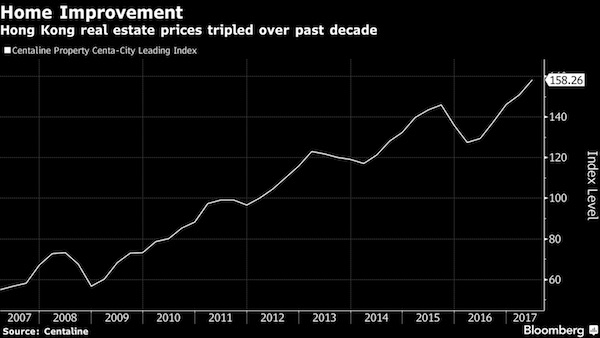
Snaking queues of thousands of prospective apartment buyers in Hong Kong signaled authorities have made no progress in cooling a red-hot property market, where prices are at records. People were lining up on Friday and over the weekend at Victoria Skye, a luxury project at the former airport site of Kai Tak, and at the Ocean Pride development by Cheung Kong Property and MTR. “Successive moves by the government in recent memory to cool the property market only resulted in it becoming crazier,” The Standard newspaper said in an editorial on Monday. “The result is a sea of madness.” The Hong Kong Monetary Authority has been tightening rules for lenders, including restricting levels of lending to developers, as it tries to limit financial risks and take some of the heat out of the market.

The Centaline Property Centa-City Leading Index of existing homes has advanced 23% in the past year, setting new price records week after week. At a Legislative Council meeting on Monday, HKMA Chief Executive Norman Chan said levels of demand were reminiscent of 20 years ago – before Hong Kong suffered a property bust – and he expressed concern that people with limited financial resources were buying just because they thought prices would only keep going up. [..] Developers sold 8,616 homes in the first five months of the year, already more than were sold in any first half since new purchasing rules were introduced in 2013, the Hong Kong Economic Times reported. K&K Property has offered an additional 200 units at Victoria Skye after it sold 306 flats on Saturday, Ming Pao newspaper reported. Cheung Kong will put another 346 up for grabs after selling 496 in a single day, May 26.

Read more …

Buying too many weapons. The House of Saud is nervous.

Saudi Foreign Reserves Dip Below $500 Billion in April (BBG)

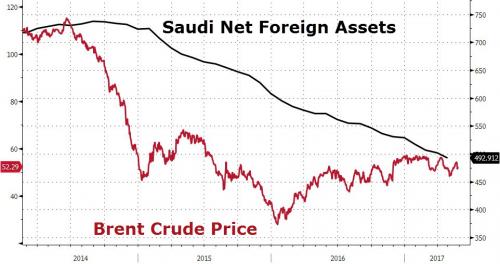
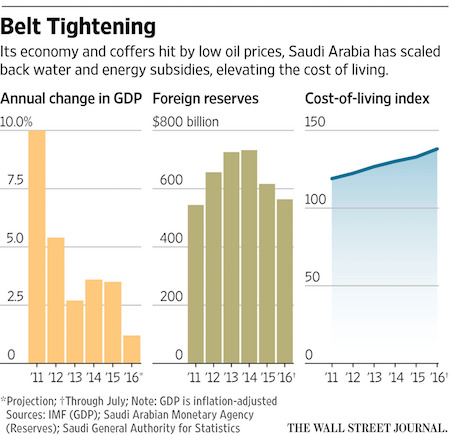
Saudi Arabia’s net foreign assets dropped below $500 billion in April for the first time since 2011 even after the kingdom raised $9 billion from its first international sale of Islamic bonds. The Saudi Arabian Monetary Authority, as the central bank is known, said on Sunday its net foreign assets fell by $8.5 billion from the previous month to about $493 billion, the lowest level since 2011. That brings the decline this year to $36 billion. “Didn’t really see any major driver for such a huge drop, especially when accounting for the sukuk sale,” said Mohamed Abu Basha at EFG-Hermes, an investment bank. Even if the proceeds from the sale weren’t included, “the reserve decline remains huge,” he said.

Saudi Arabia’s foreign reserves have dropped from a peak of more than $730 billion in 2014 after the plunge in oil prices, prompting the IMF to warn that the kingdom may run out of financial assets needed to support spending within five years. Authorities have since embarked on an unprecedented plan to overhaul the economy and repair public finances. But the pace of the decline in reserves this year has puzzled economists who see little evidence of increased government spending, fueling speculation it’s triggered by capital flight and the costs of the kingdom’s war in Yemen. Finance Minister Mohammed Al-Jadaan said in April that the government didn’t withdraw from its central bank reserves during the first quarter. He said the decline could be attributed to local contractors paying overseas vendors after the government settled its arrears.

Read more …

It’s not (just) the shale companies, it’s their lenders who are in danger.

The Great US Energy Debt Wall (SRSRocco)

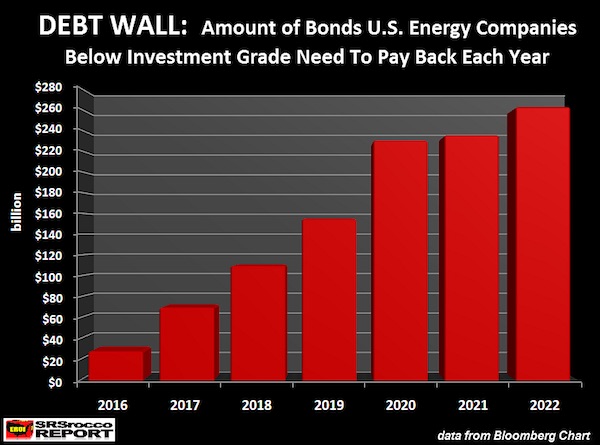
While the U.S. oil and gas industry struggles to stay alive as it produces energy at low prices, there’s another huge problem just waiting around the corner. Yes, it’s true… the worst is yet to come for an industry that was supposed to make the United States, energy independent. So, grab your popcorn and watch as the U.S. oil and gas industry gets ready to hit the GREAT ENERGY DEBT WALL. So, what is this “Debt Wall?” It’s the ever-increasing amount of debt that the U.S. oil and gas industry will need to pay back each year. Unfortunately, many misguided Americans thought these energy companies were making money hand over fist when the price of oil was above $100 from 2011 to the middle of 2014. They weren’t. Instead, they racked up a great deal of debt as they spent more money drilling for oil than the cash they received from operations.

As they continued to borrow more money than they made, the oil and gas companies pushed back the day of reckoning as far as they could. However, that day is approaching… and fast. According to the data by Bloomberg, the amount of bonds below investment grade the U.S. energy companies need to pay back each year will surge to approximately $70 billion in 2017, up from $30 billion in 2016. That’s just the beginning…. it gets even worse each passing year. As we can see, the outstanding debt (in bonds) will jump to $110 billion in 2018, $155 billion in 2019, and then skyrocket to $230 billion in 2020. This is extremely bad news because it takes oil profits to pay down debt. Right now, very few oil and gas companies are making decent profits or free cash flow. Those that are, have been cutting their capital expenditures substantially in order to turn negative free cash flow into positive.

Unfortunately, it still won’t be enough… not by a long-shot. If we use some simple math, we can plainly see the U.S. oil industry will never be able to pay back the majority of its debt: Shale Oil Production, Cost & Profit Estimates For 2018 • REVENUE = 5 million barrels per day shale oil production x 365 days x $50 a barrel = $91 billion. • EST. PROFIT = 5 million barrels per day shale oil production x 365 days x $10 a barrel = $18 billion. If these shale oil companies do actually produce 5 million barrels of oil per day in 2018, and were able to make a $10 profit (not likely), that would net them $18 billion. However, according to the Bloomberg data, these companies would need to pay back $110 billion in debt (bonds) in 2018. If they would use all their free cash flow profits to pay back this debt, they would still owe $92 billion.

Read more …

BILD says Greeks have mentioned defaulting on July payments.

Greece, Italy Tensions Hit Euro, Asian Stocks, Lift Yen, Gold (R.)

Concerns about a Greek bailout, early Italian elections and comments by the ECB chief about the need for continued stimulus all kept the euro under pressure on Tuesday. European geopolitical fears sapped risk appetite, weighing on Asian stocks and lifting safe havens including the yen and gold, though trading was thin with several markets closed for holidays. The euro slid 0.3% to $1.1129 in its fourth session of declines. James Woods at Rivkin Securities in Sydney attributed most of the currency’s decline on Tuesday to a German press report saying Athens may opt out of its next bailout payment if creditors cannot strike a debt relief deal. “The bailout payments are necessary to meet existing debt repayments due in July, so if Greece were to forgo this bailout payment the probability of a default would spike, reopening the discussion around a Grexit from the Euro zone,” Woods said.

However, he cautioned against reading “too much into it” without more details or confirmation, adding it was unlikely Greece would forego the bailout payment at this stage. Euro zone finance ministers failed to agree with the International Monetary Fund on Greek debt relief or to release new loans to Athens last week, but did come close enough to aim to do both at their June meeting. Comments by former Italian Prime Minister Matteo Renzi on Sunday in favour of holding an election at the same time as Germany’s in September also pulled the euro lower. So did a statement by ECB President Mario Draghi reiterating the need for “substantial” stimulus given subdued inflation.

Read more …

If he includes Greece, it becomes harder for Germany to plunder it. And they’re not done with that.

Draghi Rules Out Including Greece in ECB QE For Now (K.)

ECB chief Mario Draghi took the wind out of the government’s sails on Monday, telling the European Parliament that the ECB will not consider including Greece in its QE program before the conclusion of its bailout review and its debt is made sustainable. “First, let’s have an agreement, a full agreement, and let’s find measures that will make the debt sustainable through time,” Draghi told European lawmakers in Brussels, adding that he regretted that “a clear definition of the debt measures was not reached in the last Eurogroup.” Draghi also said that after creditors agree on what sort of debt relief measures Greece will get, the Governing Council of the ECB will carry out its own “fully independent” analysis to see if the debt would also be sustainable in adverse scenarios.

His comments came as Prime Minister Alexis Tsipras said that Greece was hoping that there will be an initiative in June for “a definitive settlement of the crisis through a clear solution of reducing the debt.” “Let there be a solution and let it come when it comes,” he said after his meeting in Athens with Estonian Prime Minister Juri Ratas, adding that the sooner the matter is solved the better. The tough road ahead for Greece was reflected in remarks yesterday by Finance Minister Euclid Tsakalotos, who said the country’s inclusion in QE is indeed “a difficult issue.” “The ECB, like our Lord, works in mysterious ways,” he told reporters. Draghi’s remarks were seen as another another blow, if not the killer, to the government’s narrative regarding the time frame it had laid out for the country to get on the road to economic recovery.

More specifically, Prime Minister Alexis Tsipras’s roadmap stipulated that after the second review of the country’s third bailout is wrapped up, creditors and the IMF would agree on how to make the country’s debt sustainable, and this would in turn allow Greece join the QE program, which would pave the way for the country’s return to international markets. But with the review all but concluded, and no definitive statements from the creditors on what sort of debt relief measures it can expect – or when – the best the government can hope for now is that the sequence of events outlined in the Tsipras roadmap will take place in the fall at the earliest, and definitely after the German national elections in September. The way things stand now, the most the government can expect from the June 15 Eurogroup is the release of the bailout tranche of more than €7 billion, but not the reassurance it wants in order to join the QE program.

Read more …

That’s exactly why these deals keep on being blocked. The EU doesn’t want a Greek recovery. Cart, horse.

Greece Warns Recovery Threatened If Debt Deal Is Blocked At Next Talks (G.)

Greece on Monday issued a panic warning that its recovery would be thrown into doubt if Brussels blocked a debt deal at the next meeting of euro area finance ministers. Fearing that Germany will insist on delays to an agreement until at least after elections in September, Athens’ finance minister hinted that the beleaguered nation could be plunged deeper into recession after seeing its economy contract by more than 25% since the start of its financial crisis. With £7.5bn in debt repayments due in July and lenders meeting on 15 June to try and reach an agreement after failing last month, Euclid Tsakalotos made an urgent appeal for clarity on Monday. “It is incumbent on all sides to find a solution,” he told foreign correspondents. “There is very little point in entering a [bailout] programme if the goal is not to leave the programme. And leaving the programme should be the responsibility not just of the debt country but the creditor country as well.”

Athens, Tsakalotos continued, had kept its side of the bargain, legislating highly unpopular reforms to produce savings of 2% of GDP, while the EU and IMF had not kept theirs. “We can’t accept a deal which is not what was on the table,” he said. “What was on the table was if Greece carried outs its reform package then creditors would ensure that there would be a clear runway through clarity for debt.” Instead, the IMF had refused to endorse the proposed solution – saying it fell far short of what was necessary to engender debt sustainability – with the result that Athens had been forced to reject it, Tsakalotos added. The Fund and Berlin – the biggest contributor of Greece’s three rescue programs – have long been in disagreement over how to reduce Greek debt.

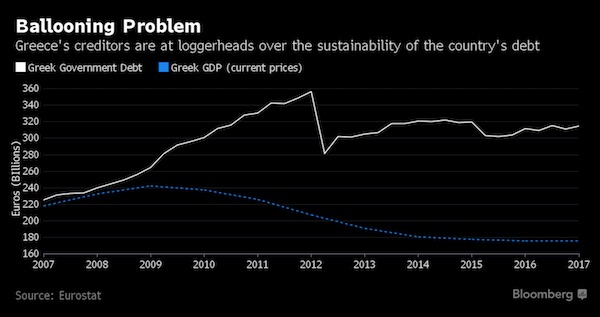
Tsakalotos was addressing a hastily arranged press conference. Held in the dining room of the Athens’ mansion that houses the prime minister’s office, it appeared to highlight the mood of nervousness pervading the Greek government. With a debt mountain hovering around €314bn – or 180% of GDP – the Syriza-dominated coalition of Alexis Tsipras has long argued that debt relief is essential to foreign investment and economic recovery. [..] ..time, said Tsakalotos on Monday, was running out. “Our ask is … that everyone keeps their side of the bargain. The position [of creditors] is going to be very difficult to defend. What can they say? That the Greek government did everything but we will send it to the rocks.”

Read more …

Which will affect Greek banks, which will affect the state, etc etc. There never was another option.

Deposits And Loans At Greek Banks Continue Slide (K.)

Deposits in Greek banks declined by more than €2.4 billion in the first four months of the year, while credit contraction has continued in 2017 for an eighth consecutive year. Still, April was the second month of credit expansion. The sum of Greek deposits reached almost €118.9 billion at the end of last month, down from about €121.4 billion at end-December 2016, due to the uncertainty that has prevailed over the Greek economy this year. Bank of Greece data show a fresh €313.3 million drop in deposits from end-March to end-April – a result of the €665.3 million decline in the cash flow of corporations, from nearly €20.5 billion in March to almost €19.8 billion last month. In fact the picture of corporate deposits in April looks technically better than it would had it not been for the €620 million share capital increase by Fraport Greece and Sklavenitis’s €400 million bond.

The level of savings has practically reverted to what it was in 2001, when Greece was still using the drachma, and forecasts speak of a stable picture with few fluctuations expected in the rest of 2017. Senior bank officials say the next few months will be difficult despite the projections for more revenues from tourism: The tax obligations starting from July, with income tax and later Single Property Tax (ENFIA) deadlines, are expected to eat further into the savings of households and corporations’ cash flow. Meanwhile the difference between loans issued and old loans paid back has remained in negative territory in 2017, reaching a rate of -0.9% in the first four months. However, April showed a positive flow amounting to €659 million after an expansion of €307 million in March.

Read more …

Yeah, they’re going to risk bankrupting German and French carmakers, right?

EU Moves To Crack Down On Carmakers In Wake Of VW Emissions Scandal (G.)

The European Union has moved towards cracking down on carmakers who cheat emissions tests by giving the EU executive more powers to monitor testing and impose fines. The European council overcame initial objections from Germany and agreed to try to reform the system for approving vehicles in Europe in the wake of the Volkswagen emissions scandal. The draft now goes for negotiations with the European commission and the European parliament, where the car industry holds a strong influence. “Above all, the objective is building trust and credibility again in the European type-approval system,” said Chris Cardona, the economy minister of Malta, which holds the EU’s six-month rotating presidency.

The VW emissions scandal erupted in September 2015, with the carmaker admitting it had installed software defeat devices in 11m diesel cars worldwide, meaning the vehicles only cut their nitrogen oxide pollution during certification tests. The draft EU rules call for reducing the power of national authorities and empowering the European commission to test and inspect vehicles, to ensure compliance with emissions standards, and to respond to any irregularities. “This will increase the independence and quality of the EU type-approval system,” the council said in a statement. “The commission could also impose fines for infringements on manufacturers and importers of up to €30,000 [£26,000] per noncompliant vehicle.” Under the draft rules, every EU country will be required to check emissions in one in every 50,000 new vehicles based on real driving conditions.

Read more …

The EU comes prepared.

Painstaking Detail Of Brexit Process Revealed In EU Documents (G.)

Just 10 days before the general election, the EU published two documents that will affect every person living in Britain for years to come. Despite being dropped into the maelstrom of an election caused by Brexit, there was hardly a murmur. The documents were the most detailed positions yet from the EU’s chief negotiator, Michel Barnier, on the upcoming divorce talks with the UK. In two policy papers, the bloc has elaborated its stance on the Brexit bill and citizens’ rights. [..] The muted reaction can be explained partly by the fact that the texts were published with zero fanfare, when the country was still reeling from the terrorist atrocity in Manchester. Furthermore, the EU documents contain no surprises. The equivalent of dotting the Is and crossing the Ts, they are a reminder the EU has had 11 months to get ready for Brexit.

That is almost one year to assemble squadrons of specialists to pore over EU treaties and legal tomes to map the way ahead. The 10-page paper on the bill does not put a price on the divorce, but sets out in painstaking detail all EU bodies with a vested interest in the spoils – 40 agencies, eight joint projects on new technologies and a panoply of funds agreed by all countries, from aid for refugees in Turkey to supporting peace in Colombia. No detail is too small. Britain is even on the hook for funding teachers at the elite European schools that educate EU civil servants’ children. On citizens’ rights, the EU spells out in greater detail the protections it wants to secure for nearly 5 million people on the wrong side of Brexit – 3.5 million EU nationals in the UK and 1.2 million Britons on the continent.

Read more …

Fear is all they have left. Blunt lies about Corbyn.

May Battles Against Complacency as UK Election Lead Slips Away (BBG)

Theresa May began the U.K. election campaign warning that pollsters giving her a 20-point lead could be wrong. With her lead now slashed, she’s hoping they really are. A series of missteps by May and her advisers, along with a populist Labour campaign, have put the prime minister on the defensive. Activists no longer laugh when she raises the prospect of a Corbyn victory at her rallies and some have questioned the wisdom of building a campaign around her own personal brand, urging people to vote for “Theresa May and her team.” Investors have awoken to the fact that May’s promise of “strong and stable” government — never mind a landslide to match Tony Blair’s in 1997 — could be in jeopardy with the pound dipping after a specific poll showed May’s Conservative Party leading the Labour Party by just five points.

“The Tories are right to be worried if the momentum looks to be with Labour, but they can still turn it around,” Andrew Hawkins, chairman of pollsters ComRes, said in a telephone interview. With a nation still in shock over the Manchester bombing and June 8 elections round the corner, May got back to the campaign trail and reverted to her tested lines on Brexit: That Labour leader Jeremy Corbyn cannot be trusted to navigate Britain through two years of talks. “It’s important as people come closer to that vote – that’s only next week – that they focus on the choice that’s there before them,” the prime minister told activists at a rally in Twickenham, southwest London, on Monday. “If I lose just six seats my government loses its majority, that could mean in 10 days time a government in chaos with Jeremy Corbyn in Number 10.”

But gone was the confidence when she stunned Britain by calling a snap election on April 18. On the day of the announcement, an ICM/Guardian poll gave May’s Tories a lead over Labour of 21 points and surveys in the following weekend’s newspapers suggested leads of 24 and 25 points. Now, she is vulnerable to attack. Interviewer Jeremy Paxman quizzed May about her U-turns, in an interview on Sky News on Monday: “You have backed down over social care, and over national insurance. If I was in Brussels, I would think you are a blowhard who collapses at the first sign of gunfire.” Her rival on the other hand has grown more relaxed, holding his own against the same interviewer who has a reputation for being a rottweiler in his style of questioning. In one instance, Corbyn won a big round of applause when asked about whether he’d want to abolish monarchy: “Do you know what? I had a very nice chat with the Queen.”

Read more …

US room to move gets smaller fast.

Russia Expects China To Help Resolve Syrian Crisis (DS)

Moscow hopes for China’s help in solving the Syrian crisis and restoring the country, Russian Deputy Foreign Minister Igor Morgulov said Monday. “Our cooperation with China on Syria at various international venues is unprecedented. We blocked six attempts to pass anti-Syrian resolutions in the U.N. Security Council,” Morgulov said at “Russia and China: Taking on a New Quality of Bilateral Relations” international conference. The Russian deputy foreign minister added that Russia values Beijing’s position on the Syrian crisis, and hopes that, “the Chinese partners will continue their efforts to promote a political settlement.”

“Together we call for a peaceful and political-diplomatic solution to conflicts, without double standards, unilateral action or attempts at ousting regimes. Our approaches coincide, among other things, on the uncompromising fight against terrorism,” Morgulov said. Russia and China have repeatedly vetoed U.N. Security Council resolutions imposing sanctions against the Assad regime. Moscow has long-standing links to the Assad regime and is its key ally, while China has an established policy of non-intervention in other countries’ affairs.

Read more …

French interests in Russia are substantial. Macron going after RT and Sputnik is a weird way to not offend Merkel.

Putin, Macron Have ‘Open, Frank Exchange Of Opinions’ (RT)

Russian President Vladimir Putin and his French counterpart, Emmanuel Macron, had “difficult” but “frank” talks during their first meeting in Versailles. The two leaders vowed to improve relations and jointly address international problems. The first meeting of the Russian and French leaders lasted almost three hours, with Macron saying that “Franco-Russian friendship” was at the heart of the talks. The French president admitted, however, that he has “some disagreements” with his Russian counterpart, but said that the two leaders discussed them openly in a “frank exchange of views.” Putin also said that the two leaders have some differences, but said that they view many issues in a similar way, and that French-Russian relations could be “qualitatively” improved. “We sought … common ground [in dealing] with key issues of the international agenda. And I believe that we see it. We are able to … at least try to start resolving the key contemporary problems together,” Putin said.

The Russian leader went on to say that his talks with Macron helped the pair to find common points in dealing with major international problems, and the that two sides would try to further bring together their views on these issues. Putin also invited his French counterpart to Russia, saying: “I hope that he will be able to spend several weeks in Moscow.” French President Macron said that serious international problems cannot be resolved without Moscow, as he stressed the importance of the role Russia plays in the modern world. “No major problem in the world can be solved without Russia,” he told the press conference. Macron then said that France is interested in intensifying cooperation with Russia, particularly in resolving the Syrian crisis. The French leader went on to say that this issue demands “an inclusive political solution.”

Read more …

Pretty brilliant. Much more at the link.

Let’s All Agree To Lock In This Russophobia For At Least 3.5 More Years (Saker)

There I was again, flying first class on my shareholders’ dime from New York to San Francisco, when I was deeply saddened to read about the death of Zbigniew Brzezinski, National Security Adviser to Jimmy Carter. For a moment I thought: “Surely I can find some anti-Putin articles to read rather than this one?” Those always make me so happy! But then I remembered that Zbig was a man after my own heart, because he was one of the West’s greatest Russophobes. Even the New York Times talked of his “rigid hatred of the Soviet Union”. Zbig ended the détente led by Nixon as Carter, not Reagan, restarted good, old-fashioned, American Russophobia: Selling the Soviets computers with bugs for industrial sabotage, the propaganda effort of the 1980 Olympic Boycott, the US grain embargo to try and starve the Russian people, the arming of the Taliban’s forerunners to destabilize a left-wing government in Afghanistan and thus unleashing Islamic terrorism on the world, etc.

Just as American Democrats know for an undeniable fact that Jimmy Carter is our nation’s greatest living man of peace, I contend that Zbig’s anti-Russian stance makes him nearly as great a humanitarian, and certainly a model Democrat in 2017. And Zbig knew, as I and all good Democrats know, that the greatest fight of our generation is the fight against Vladimir Putin. Poverty, starvation, refugees, terrorism, climate change – everyone in America is realizing that if we can just get rid of Putin, everything else will surely fall into line. Surely! So I was pretty sad to read of Zbig’s passing, but that’s when it hit me: Just because he’s gone, it doesn’t mean we have to give up hating Russia! We’ve been hating Russia since November – more than 6 months now – and, frankly…it feels awesome! I don’t how long it takes to make a habit permanent, so let’s all agree to lock in this Russophobia for at least 3.5 more years, possibly 7.5!

It would be a fitting testament to a man whose prophetic Russophobia was misunderstood as “anti-communism”. Say it loud: It’s time for progressive Americans to unite behind hating Russians! Again! Let’s party like it’s 1979! Now, I’m as politically-correct a CEO as was ever made -my allegiance to Hillary proves that – but I can tell that some people think that I should equivocate by writing “hating the Russian government” instead of the “Russians”. Well, it’s bold, but being bold is why we CEOs deserve the big bucks and you deserve our crumbs. Not our table crumbs – those are too good for you – I mean the crumbs that fall around our fine, Italian shoes. Here’s the problem with the Russians: Putin’s approval rating is over 85%. It is a testament to the master of evil that he has duped nearly all 144 million Russian citizens. They said that 50 million Elvis fans can’t be wrong, but 124 million Putin fans clearly are. I don’t know anything about Russian domestic politics, but I don’t have to – that’s my right as an American.

Read more …

Hillary posing as the resistance says it all. They don’t even have a narrative left.

The So-Called Resistance (Jim Kunstler)

[..] what would a real resistance look like? First, it would oppose the aforementioned asset-stripping that the US economy has become, the transfer of capital in all its forms — monetary, political, cultural, social — from the dis-employed former middle classes to the tiny, select beneficiaries of financial manipulation. Note that the things being manipulated — markets, currencies, securities, and interest rates — are increasingly phantom entities that appear to maintain their value only because the high priests of financial authority say that they do. The shelf-life of that flim-flam approaches its endgame as it self-evidently immiserates the masses and their sheer faith in its recondite promises dwindles away to nothing.

A genuine resistance would begin to deconstruct this clerisy and its institutions, namely Too Big To Fail banks and the Federal Reserve. The best opportunity to accomplish that would have been the early months of Mr. Obama’s turn in the White House, the dark time of the previous financial crash when the damage was fresh and obvious. But the former president blew that under the influence of high priests Robert Rubin and Larry Summers. And the lower order clerics were allowed run their hoodoo machine flat out in the following eight years. Just look at the long chart of the Standard & Poors index. Tragically, this ever-upward arc is now taken to be the normal state of things, and when it fails the implosion will be orders of magnitude more violent than the last time.

One would think that a genuine resistance would also oppose the growing consolidation of power in the now-colossal spying apparatus of the nation — the often averred to “seventeen intel agencies” that show signs of being actively at war against other parts of the government and against citizens themselves. Hence, the non-stop murmur of allegation about “Russian interference in the election,” going back to the summer of 2016 without either any real evidence, or any clarification of what is actually alleged to have happened. Another tragic turn is that this fifth column of rogue intel agencies has recruited the major organs of the news to incessantly repeat its allegations until the public accepts the story as established fact rather than just the manufactured story it so far appears to be. Well, the lives of persons and societies founder on versions of the “reality” they fabricate for their own purposes. A genuine resistance would show foremost some fidelity to a reality beyond the spin-factories of self-delusion.

Read more …

Election coming up, perhaps?

Germany Steps Up Attack On Trump For ‘Weakening’ The West (G.)

Germany has unleashed a volley of criticism against Donald Trump, slamming his “short-sighted” policies that have “weakened the west” and hurt European interests. The sharp words from foreign minister Sigmar Gabriel came after the US president concluded his first official tour abroad taking in Saudi Arabia, Israel, Brussels and then Italy for a G7 summit. Angela Merkel warned on Sunday that the US and Britain may no longer be completely reliable partners. Germany’s exasperation was laid bare after the G7 summit, which wrapped up on Saturday with Trump refusing to affirm US support for the 2015 Paris climate accord. Days earlier, in Saudi Arabia, Trump presided over the single largest US arms deal in American history, worth $110bn over the next decade and including ships, tanks and anti-missile systems.

Gabriel said on Monday that “anyone who accelerates climate change by weakening environmental protection, who sells more weapons in conflict zones and who does not want to politically resolve religious conflicts is putting peace in Europe at risk”. “The short-sighted policies of the American government stand against the interests of the European Union,” he said, judging that “the west has become smaller, at least it has become weaker”. “We Europeans must fight for more climate protection, fewer weapons and against religious [fanaticism], otherwise the Middle East and Africa will be further destabilised,” Gabriel said. [..] The relationship between Merkel and Trump contrasts with the warm ties between herself and Barack Obama. The previous US president last week travelled to Berlin to attend a key Protestant conference. Obama’s participation in a forum with Merkel last Thursday came hours before her meeting with Trump in Brussels at the Nato summit.

Read more …

Right, election coming up. Which trumps human rights and international law.

Greece, Germany Agree To Slow Refugee Family Reunification (F24)

Greece and Germany have agreed to slow the reunification of refugee families divided between the two nations during their scramble to safety, according to a leaked letter published Monday. “Family reunification transfer to Germany will slow down as agreed,” Greek Migration Minister Yiannis Mouzalas wrote to German Interior Minister Thomas de Maiziere in a May 4 letter obtained by leftist daily Efimerida ton Syntakton. The Greek migration ministry declined to comment, but earlier this month Mouzalas said the slowdown was due to “technical difficulties.” In the letter, Mouzalas reportedly acknowledges that the move – enacted because of the sheer volume of asylum requests – will affect “more than two thousand people” while some “will have to wait for years” to reach Germany even though their requests have been approved.

Asylum seekers – mostly Syrian refugees in Greece’s case – are entitled to join family members elsewhere in the European Union within six months from the date their request is approved. In his letter, Mouzalas said Berlin and Athens had to agree on a “common line” to address “increasingly desperate and critical comments” so that Athens is not blamed for the delays. He then suggests a joint response: “We understand that asylum seekers are eager to meet with their family, but given that both Greece and Germany have very large asylum seeking populations, delays are inevitable.” Ulla Jelpke, a deputy of German far-left Party Die Linke, earlier this month said Berlin had capped the number of refugees eligible for reunification at 70 people per month. Accordingly, Efimerida ton Syntakton said there were just 70 transfers in April compared to 540 in March and 370 in February.

Read more …

May 242017
 
 May 24, 2017  Posted by at 9:32 am Finance Tagged with: , , , , , , , , , ,  6 Responses »


Henri Matisse Nu Blue IV 1952


China Hit by First Moody’s Downgrade Since 1989 on Debt Risk (BBG)
Chinese Banks Are In Big Trouble (ZH)
American Exceptionalism – Population Growth vs Money Growth (Econimica)
Shiller: Stay In The Market, It ‘Could Go Up 50% From Here’ (CNBC)
German Police Search Daimler Facilities In Dieselgate Probe (DW)
Canada Must Deflate Its Housing Bubble (BBG Ed.)
The Violence of Austerity (OD)
IMF Wants More Realism In Eurozone Assumptions On Greece (R.)
QE Remains A Long Shot For Greece (K.)
In Germany, Syrian Man Wins Case Against Deportation To Greece (AP)
Elder Refugees Seeking Asylum in Europe Left Stranded in Greece – HRW (GR)
Tasmania Bans Super Trawlers From Its Waters (AAP)
Fossils Cast Doubt On Human Lineage Originating In Africa (R.)


Moody’s worries are the local government financing vehicles and state-owned enterprises, which are umbilically linked to the shadow banks.

You can’t run an entire economy from and in the shadows.

China Hit by First Moody’s Downgrade Since 1989 on Debt Risk (BBG)

Moody’s Investors Service cut its rating on China’s debt for the first time since 1989, challenging the view that the nation’s leadership will be able to rein in leverage while maintaining the pace of economic growth. Stocks and the yuan slipped in early trading after Moody’s reduced the rating to A1 from Aa3 on Wednesday, with markets paring losses in the afternoon. Moody’s cited the likelihood of a “material rise” in economy-wide debt and the burden that will place on the state’s finances, while also changing the outlook to stable from negative. It’s “absolutely groundless” for Moody’s to argue that local government financing vehicles and state-owned enterprise debt will swell the government’s contingent liabilities, according to a response released by the Ministry of Finance. The ratings company has underestimated the capability of the government to deepen reform and boost demand, the ministry said.

It wouldn’t be the first time a rating company was behind the curve, nor is such pushback unique – U.S. Treasury officials questioned the credibility of a 2011 downgrade from Standard & Poor’s. Still, the move underscores broader doubts over whether President Xi Jinping’s government can simultaneously cut excessive leverage and steady growth, all with a twice a decade reshuffle of top party posts looming later this year. “It is a psychological blow that China will not take kindly to and absolutely speaks to the rising financial pressures,” said Christopher Balding, an associate professor at the HSBC School of Business at Peking University in Shenzhen. That said, “it doesn’t matter much in the grand scheme of things because so much of Chinese debt is held by state or quasi-state actors and minimal amounts are international investors.”

Total outstanding credit climbed to about 260% of GDP by the end of 2016, up from 160% in 2008. At the same time, China’s external debt is low by international standards, at around 12% of gross domestic product, according to the IMF, meaning that a downgrade isn’t likely to be as disruptive as it would be for nations more reliant on international funding. Overseas institutions’ holdings of onshore bonds dropped to 830 billion yuan ($121 billion) as of the end of March, from 853 billion yuan three months earlier, People’s Bank of China data show. That’s less than 1.5% of 63.7 trillion yuan of outstanding notes. Moody’s last cut China’s sovereign rating in 1989, when it downgraded the sovereign to Baa2 from Baa1, according to spokesperson, Manvela Yeung. Moody’s lowered China’s credit-rating outlook to negative from stable in March 2016, citing rising debt, falling currency reserves and uncertainty over authorities’ ability to carry out reforms.

Read more …

Starting to be painful. At some point, Beijing total control will come up empty.

Chinese Banks Are In Big Trouble (ZH)

That’s not supposed to happen… With the crackdown on financial system leverage underway, Chinese banks (and securities firms) are in big trouble. As we noted previously, China’s bond curve is inverted, yields are surging, and Chinese regulatory decisions shutting down various shadow-banking pipelines has crushed securities firms’ stocks. However, as Bloomberg points out, as China’s deleveraging efforts cut into banks’ profit margins, rising base funding costs and interbank credit risk concerns have pushed banks’ cost of borrowing beyond the rate they charge customers for loans for the first time in history. As the chart shows, the one-year Shanghai Interbank Offered Rate has exceeded the Loan Prime Rate, the first time this has happened since the latter was introduced in 2013. “This is probably just the beginning” and interbank funding costs will rise further amid the drive to reduce leverage, said Xu Hanfei at China Merchants Securities in Shanghai.

Read more …

Wonderful from Chris Hamilton.

American Exceptionalism – Population Growth vs Money Growth (Econimica)

Since 1971, and the disconnection of the dollar from a finite gold backing, the value of money (the dollar) has been determined by it’s purchasing power versus the inflation of the assets to be purchased. Thus printing more money has not necessarily created “wealth” if the assets to be purchased are rising as fast or faster than the purchasing power of the “money”. The Fed touts it’s dual mandate of full employment and stable prices…but the result in prices; not so stable. The primary global asset purchasable only in US dollars, crude oil, has told a story of wildly gyrating prices. Since the end of Bretton Woods and the subsequent Congressionally dual mandated roles bestowed on the Fed…crude oil prices have gone bezerk, twice climbing nearly 10x’s within a decade. This is the opposite of stable (particularly compared to the price stability from WWII’s end until the Fed took over).

Soooo, theoretically the growth of “money” should be linked to the growth of the population, to ensure an adequate and stable money supply exists for the growing population. In a moment I’ll show you anything but a stable money supply. But first, the chart below shows the total 25-54yr/old US population, those employed among them, and the value in dollars of all publicly traded US stocks (represented by the Wilshire 5000). Something far beyond population growth or employment growth is pushing up the value of dollar based assets, gauging by US stock markets accelerating appreciation.

With that in mind, the chart below shows the growth of M3 money (the broadest measure of US “money”) and the broader 15-64yr/old US population since 1971. The money supply has grown in excess of 20x’s (2,000%) vs. the working age population (15-64yr/olds) which has grown less than 1x (nearly 70% increase).

This results in a rising ratio of “money” on a per capita of the core population basis, as the chart below details. The total amount of “money” rose from approximately $5 thousand dollars per working age adult to todays $65 thousand dollars per adult…an increase of 13x’s (1.300%).

The annual growth of the 15-64yr/old core US population peaked in 2003 and annual core population growth has decelerated by 90% since…while annual M3 growth has doubled over the same time period. [..] The chart below from 2000 into 2017 shows the change in both core population and M3 money supply, showing the year over year change on a monthly basis…and the current fall in core population growth will continue downward, likely turning negative at times over the next year (yet another first for America).

The final chart is the growth in M3 money supply per the growth in the adult, working age population. I’m not an economist or expert on much of anything…but that doesn’t look particularly good to me (something to do with “hyper-monetization” or some such thing). All I can say is the appearance of hockey sticks typically aren’t a good or stable sign but their appearance, just like those of black swans, has become the “new normal”.

Read more …

It could also fall by 50%.

Shiller: Stay In The Market, It ‘Could Go Up 50% From Here’ (CNBC)

Nobel Prize-winning economist Robert Shiller believes investors should continue to own stocks because the bull market may continue for years. CNBC’s Mike Santoli spoke with Shiller in an exclusive interview for CNBC PRO. Santoli asked Shiller about his market outlook. “I would say have some stocks in your portfolio. It could go up 50% from here. That’s what it did around 2000, after it reached this level, it went up another 50%. So I’m not against investing in the stock market when you consider the alternatives. But I think if one wants to diversify, US is high in its CAPE ratio. You can go practically anywhere else in the world and it’s lower,” Shiller said. “We could even set a new another record high in CAPE, that’s not a forecast.”

Shiller developed the “cyclically adjusted price-to-earnings ratio” (CAPE) market valuation measure, which is calculated using price divided by the index’s average historical 10-year earnings, adjusted for inflation. The economist’s research found future 10-year stock market returns were negatively correlated to high CAPE ratio readings on a relative basis. However, even though the current CAPE ratio is at 29, which is above the 17 historical average, the economist is not calling for a market decline. “I can see it as a real possibility that stocks prices and house prices would both keep going up for years, but I’m not forecasting that by any means,” he added.

Read more …

Dragging on.

German Police Search Daimler Facilities In Dieselgate Probe (DW)

German authorities have raided several locations associated with German premium carmaker Daimler. They acted on an initial suspicion of fraud involving misleading information about emission levels. Prosecutors in the southern German city of Stuttgart confirmed Tuesday they had searched about a dozen locations associated with the maker of Mercedes-Benz cars. The raids came as a result of the company being suspected of fraud and misleading advertising in relation to the selling of diesel-powered vehicles. Prosecutors have yet to provide further details on the raids. They only said the raids were carried out by well over 200 investigators across the country, with the focus of the search in progress on locations in the states of Baden-Württemberg, Lower Saxony, Saxony and the the city state of Berlin.

The carmaker said the investigations targeted “known and unknown employees of Daimler over suspicion of fraud related to the possible manipulation of exhaust gas emissions in passenger cars with diesel engines.” Daimler executives said they were not aware of any emissions scandal, adding that they were fully co-operating with investigators. The automaker had earlier agreed with Germany’s Federal Motor Transport Authority to “voluntarily” recall 247,000 vehicles to remove “potentially problematic technology,” which Daimler said had been installed to prevent engines from being damaged. Daimler has also been in the crosshairs of prosecutors in the US where it faces a number of class-action suits by car owners who have accused the company of not being accurate in stating emissions levels for a number of its diesel-powered models.

Read more …

You don’t say.

Canada Must Deflate Its Housing Bubble (BBG Ed.)

Canada’s housing market offers a case study in a contentious economic issue: If a central bank sees a bubble forming, should it act to deflate it? In this instance, the answer should be a resounding yes. A combination of foreign money, local speculation and abundant credit has driven Canadian house prices to levels that even government officials recognize cannot be sustained. In the Toronto area, for example, they were up 32% from a year earlier in April. David Rosenberg, an economist at Canadian investment firm Gluskin Sheff, notes that it would take a decline of more than 40% to restore the historical relationship between prices and household income. Granted, the bubble bears little resemblance to the U.S. subprime boom that triggered the global financial crisis.

Although one specialized lender, Home Capital, has had issues with fraudulent mortgage applications, regulation has largely kept out high-risk products. Homeowners haven’t been withdrawing a lot of equity, and can’t legally walk away from their debts like many Americans can. Banks aren’t sitting on the kinds of structured products that destroyed balance sheets in the U.S. Nearly all mortgage securities and a large portion of loans are guaranteed by the government. That said, the situation presents clear risks. As buyers stretch to afford homes, household debt has risen to 167% of disposable income – the highest among the Group of Seven industrialized nations. This is a serious vulnerability, and a big part of the rationale behind Canadian banks’ recent ratings downgrade. The more indebted people are, the more sensitive their spending becomes to changes in prices and interest rates, potentially allowing an otherwise small shock to result in a deep recession.

What to do? Administrative efforts to curb lending and tax foreign buyers have helped but haven’t solved the problem. That’s largely because extremely low interest rates are still giving people a big incentive to borrow. The Bank of Canada has held its target rate at 1% or lower since 2009, and at 0.5% since 2015, when it eased to counteract the effect of falling oil prices. That’s a very stimulative stance in a country where the neutral rate is estimated to be about 3% or higher. One can’t help but see a parallel with the low U.S. rates and the housing bubble of the early 2000s.

Read more …

The Violence of Austerity, edited by Vickie Cooper and David Whyte, is published by Pluto Press.

The Violence of Austerity (OD)

As we move towards the general election, we are paralyzed by what is probably the biggest single issue affecting ordinary people in the country: austerity. We are unable to fully understand both the economic madness of austerity and the true scale of the human cost and death toll that ‘fiscal discipline’ has unleashed. Since coming into power as Prime Minister, Theresa May has made a strategic decision not to use the word ‘austerity’. Instead she has adopted a more palatable language in a vain attempt to distance herself from the Cameron governments before her: “you call it austerity; I call it living within our means.” The experience of countless thousands of people is precisely the opposite: people are actively prevented from living within their means and are cut off from their most basic entitlement to: housing, food, health care, social care and general protection from hardship.

And people are dying as a result of these austerity effects. In February, Jeremy Corbyn made precisely this point when he observed the conclusions of one report that 30,000 people were dying unnecessarily every year because of the cuts to NHS and to local authority social care budgets. But this is really only the tip of the iceberg. The scale of disruption felt by people at the sharp end of these benefit reforms is enormous. Countless thousands of others have died prematurely following work capability assessments: approximately 10,000 according the government’s own figures. People are dying as a result of benefit sanction which has fatal impacts on existing health conditions, such as diabetes and heart disease. Austerity is about dismantling social protection. The crisis we face in social care is precipitated by cuts to local authority funding.

In the first 5 years of austerity, local authority budgets were cut by 40%, amounting to an estimated £18bn in care provision. A decade of cuts, when added up, also means that some key agencies that protect us, such as the Health and Safety Executive and the Environment Agency will have been decimated by up to 60% of funding cuts. Scaling back on an already paltry funding in these critical areas of regulation will lead to a rise in pollution related illness and disease and will fail to ensure people are safe at work. The economic folly is that austerity will cost society more in the long term. Local authorities are, for example, housing people in very expensive temporary accommodation because the government has disinvested in social housing.

The crisis in homelessness has paradoxically led to a £400 million rise in benefit payments. The future costs of disinvesting in young people will be seismic. Ending austerity would mean restoring our system of social protection and restoring the spending power of local authorities. It would mean, as all the political parties except the Conservatives recognise, taxing the rich, not punishing the poor in order to pay for a problem that has its roots in a global financial system that enriched the elite. It would also mean recognizing that the best way to prevent the worsening violence of austerity and to rebuild the economy is to re-invest in public sector jobs.

Read more …

The Greek government is being played for fools. Given how long this has been going on, one might suggest they are.

IMF Wants More Realism In Eurozone Assumptions On Greece (R.)

The IMF needs to see more realistic euro zone assumptions about Greece’s economy and more detail on planned debt relief measures to join a bailout, IMF’s European Department head Poul Thomsen said. Thomsen said the IMF and Greece’s euro zone lenders made progress in talks on Monday, but were not yet quite there. “We still think there is a need for more realism in assumptions and more specificity,” Thomsen said on Tuesday. The euro zone and the IMF agreed on Monday that Greece would have to keep a primary surplus – the budget balance before debt servicing – at 3.5% of GDP for five years after the bailout ends in 2018. But officials said the size of the surplus afterwards was still under discussion and there were also differences on economic growth assumptions, especially that forecasts used for debt relief plans spanned dozens of years. A group of euro zone countries led by Germany wants the IMF to join the Greek bailout, now handled by euro zone governments alone, to increase credibility. The IMF says that it will only join if Greece is granted debt relief.

Read more …

Greece will be declared eligible for inclusion in the ECB’s QE only AFTER the central bank says it will taper QE.

QE Remains A Long Shot For Greece (K.)

Greece is nowhere near a swift inclusion in the ECB’s QE program, according to senior officials at domestic banks. They argue that the issue of the national debt, and securing its sustainability in a way that would satisfy the IMF too, constitutes a particularly complex problem that may well be too hard to resolve by next month’s Eurogroup. They therefore consider Greece’s entry into the ECB’s bond-buying program this summer unlikely – instead expecting it to happen after the German election in the fall, either by the end of 2017 or in early 2018. Some go as far as expressing concern as to whether Greece will make it in at all before the program ends.

While there are more and more voices within the ECB speaking in favor of concluding the program earlier, Greece would like enjoy its benefits for more than two years. Greek banks are hoping a formula will be found at the next Eurogroup, on June 15, that will allow the disbursement of the next bailout tranche while putting off any decisions on the debt. The most optimistic observers note there is a chance of Greece entering QE between July and September and next month’s Eurogroup will be crucial to this end. The ECB argues that Greece’s inclusion in the bond-buying program requires the safeguarding of the debt’s sustainability.

In this context political statements or a mere reference to a series of measures will not suffice, as they will have to constitute legally binding pledges, which is highly unlikely before the German election. Goldman Sachs stated in an analysis that this country is not likely to fulfill the terms the ECB has set to join QE before the reduction of the monthly rate of bond purchases is activated. It also highlighted the high rate of bad loans as a point of concern that might also delay the decision for Greece to enjoy the benefits of QE. Similarly, Citi estimates that without an agreement on the easing of the debt, both inclusion in QE and a return to the bond markets would be quite difficult for Greece.

Read more …

In one and the same Union, laws and rights are widely divergent. That is not a union.

In Germany, Syrian Man Wins Case Against Deportation To Greece (AP)

Germany’s highest court has upheld a complaint by a Syrian whose asylum claim was rejected because he’d already been granted asylum in Greece. The man, whose name wasn’t released, arrived in Germany in 2015. He told officials he had already been granted protection in Greece but had been living on the street there and received no support from the Greek government. The man’s claim in Germany was rejected, meaning that he risked deportation to Greece. Germany’s Federal Constitutional Court said Tuesday that a lower court had wrongly failed to take account of a lack of welfare payments for refugees in Greece and to check whether there were assurances that the man would be given at least temporary housing. Judges sent the case back to the lower court to reconsider.

Read more …

Who cares about human rights declarations when elections are coming up?

Elder Refugees Seeking Asylum in Europe Left Stranded in Greece – HRW (GR)

There are many unnecessary delays and arbitrary barriers which keep older refugees and asylum seekers stranded in Greece, unable to reunite with family members who have legal status in the EU, Human Rights Watch said on Monday. According to their publication on Monday, EU: Older Refugees Stranded in Greece, one of the main issues that older refugees face is that family reunification does not focus on reuniting an entire family, but spouses and parents with minor children who are under the age of 18. Hundreds of older refugees and asylum seekers currently in Greece who have fled war zones and persecution are waiting to learn if they will be allowed to reunite with adult family members who have been granted residency in another EU country. Although EU law provides for family reunification for older people, lack of clarity or explicit provisions governing the process means that they can remain in limbo, far from their family for prolonged periods of time.

“These older people, already victims of conflict and persecution, hoped to find protection in the EU after treacherous journeys to Greece, and to be reunited with their family,” said Bethany Brown, researcher on older people’s rights at Human Rights Watch. “Now they don’t know if they will ever see their relatives again.” While several barriers are common to all asylum seekers, they can have a more significant impact on older people. Older people have been shown, in some contexts, to have significantly higher rates of psychological distress than the general refugee population, and often suffer from health issues, injuries and violence during displacement, and frailty that can be exacerbated by time and uncertainty.

Read more …

A little piece of news. But a good one.

Tasmania Bans Super Trawlers From Its Waters (AAP)

Tasmania’s parliament has passed laws banning super trawler fishing vessels from operating in the state’s waters. Legislation was given a green light on Wednesday, with Liberal government MP Mark Shelton confirming that any future attempts to allow freezer trawler vessels would require an act of parliament. “Our bill should give recreational fishers additional comfort that any future attempt to let super trawlers into the small pelagic fishery will be met with parliamentary hurdles,” he said.

Read more …

Graecopithecus freybergi.

Fossils Cast Doubt On Human Lineage Originating In Africa (R.)

Fossils from Greece and Bulgaria of an ape-like creature that lived 7.2 million years ago may fundamentally alter the understanding of human origins, casting doubt on the view that the evolutionary lineage that led to people arose in Africa. Scientists said on Monday the creature, known as Graecopithecus freybergi and known only from a lower jawbone and an isolated tooth, may be the oldest-known member of the human lineage that began after an evolutionary split from the line that led to chimpanzees, our closest cousins. The jawbone, which included teeth, was unearthed in 1944 in Athens. The premolar was found in south-central Bulgaria in 2009.

The researchers examined them using sophisticated new techniques including CT scans and established their age by dating the sedimentary rock in which they were found. They found dental root development that possessed telltale human characteristics not seen in chimps and their ancestors, placing Graecopithecus within the human lineage, known as hominins. Until now, the oldest-known hominin was Sahelanthropus, which lived 6-7 million years ago in Chad. The scientific consensus long has been that hominins originated in Africa. Considering the Graecopithecus fossils hail from the Balkans, the eastern Mediterranean may have given rise to the human lineage, the researchers said.

The findings in no way call into question that our species, Homo sapiens, first appeared in Africa about 200,000 years ago and later migrated to other parts of the world, the researchers said. “Our species evolved in Africa. Our lineage may not have,” said paleoanthropologist Madelaine Böhme of Germany’s University of Tübingen, adding that the findings “may change radically our understanding of early human/hominin origin.” Homo sapiens is only the latest in a long evolutionary hominin line that began with overwhelmingly ape-like species, followed by a succession of species acquiring more and more human traits over time.

Read more …

May 112017
 
 May 11, 2017  Posted by at 8:49 am Finance Tagged with: , , , , , , , , , , , ,  2 Responses »


Paul Almasy Les Halles, Paris 1950


Trump and Lavrov Meeting Round-Up (TASS)
$9 Trillion Question: What Happens When Central Banks Stop Buying Bonds? (WSJ)
Draghi Stays Calm on Stimulus as Dutch MPs Warn of Risks With Tulip (BBG)
It’s Not Just The VIX – Low Volatility Is Everywhere (R.)
Six Canadian Banks Cut by Moody’s on Consumers’ Debt Burden (BBG)
China Holds Giant Meeting On Spending Billions To Reshape The World (CNBC)
‘Stagnant’ Buyer Demand Puts The Brakes On UK Housing Market (G.)
UK Labour Party’s Plan To Nationalise Rail, Mail And Energy Firms (G.)
Panic! Like It’s 1837 (DB)
Italy Financial Regulator Threatens EU with Return to “National Currency” (DQ)
Greek Capital Controls To Stay Till At Least End Of 2018 (K.)
Greek PM Tsipras Heralds ‘Landmark’ Plan For Healthcare (K.)
Turkish Coast Guard Publishes Maps Claiming Half Of The Aegean Sea (KTG)
Libya Intercepts Almost 500 Migrants After Sea Duel (AFP)
Where Have All The Insects Gone? (Sciencemag )


The presence of a TASS reporter when Lavrov visited the White House was critized in the US media. Here’s what he wrote.

Trump and Lavrov Meeting Round-Up (TASS)

Before meeting with Donald Trump, Sergey Lavrov held talks with the US top diplomat Rex Tillerson. Lavrov’s talks with the US president lasted for about 40 minutes behind closed doors. Moscow and Washington can and should solve global issues together, Lavrov said following his meetings with US Secretary of State Rex Tillerson and US President Donald Trump. “I had a bilateral meeting with Rex Tillerson, then the two of us were received by President Trump,” the Russian top diplomat said. “We discussed, first and foremost, our cooperation on the international stage.” “At present, our dialogue is not as politicized as it used to be during Obama’s presidency. The Trump administration, including the president himself and the secretary of state, are people of action who are willing to negotiate,” the Russian top diplomat pointed out.

Lavrov said agreement reached with Tillerson to continue using diplomatic channel to discuss Russian-US relations. According to Lavrov, the current state of bilateral relations is no cause for joy. “The reason why our relations deteriorated to this state is no secret,” the Russian top diplomat added. “Unfortunately, the previous (US) administration did everything possible to undermine the basis of our relations so now we have to start from a very low level.” “President Trump has clarified his interest in building mutually beneficial and practical relations, as well as in solving issues,” Lavrov pointed out. “This is very important,” he said. Lavrov believes Syria has areas where US might contribute to operation of de-escalation zones. “We are ready for this cooperation and today have discussed in detail the steps and mechanisms which we can manage together,” Lavrov said.

“We have confirmed our interest in the US’ most active role in those issues,” Lavrov said. “I imagine the Americans are interested in this too.” “We proceed from the fact they will take up the initiative,” he added. “We have thoroughly discussed the Syrian issue, particularly the ideas related to setting up de-escalation zones,” the Russian top diplomat said. “We share an understanding that this should become a common step aimed at putting an end to violence across Syria,” he added.

Read more …

One word: mayhem.

$9 Trillion Question: What Happens When Central Banks Stop Buying Bonds? (WSJ)

Central banks have been the world’s biggest buyers of government bonds, but may soon stop—a tidal shift for global markets. Yet investors can’t agree on what that shift will mean. Part of the problem is that there is little agreement about how the massive stimulus policies, known as quantitative easing or QE, affected bonds in the first place. That makes it especially hard to assess what happens when the tide changes. Many expect bond yields could rise and shares fall, some see little effect at all, while others suggest it is riskier investments, such as corporate bonds or Italian government debt, that will bear the brunt. But recently, yields on European high-yield corporate bonds hit their lowest since before the financial crisis, in one potential sign that the threat of tapering has yet to affect markets.

When the unwinding begins money managers may not be positioned for it, and markets could move swiftly. In the summer of 2013, investors suddenly got spooked about the Federal Reserve withdrawing stimulus, leading to a swift bond sell off that sent yields on the 10-year Treasury up by more than 1%age point. By buying bonds after the 2008 financial crisis, central banks across the developed world sought to push yields lower and drive money into riskier assets, reducing borrowing costs for businesses. “If it’s unclear what benefits we’ve had in the buying, it’s unclear what will happen in the selling,” said Tim Courtney, chief investment officer at Exencial Wealth Advisors.

Recent data showed that the ECBholds total assets of $4.5 trillion, more than any other central bank ever. The Fed and the Bank of Japan each have $4.4 trillion, although the BOJ isn’t expected to wind down QE soon. With the world economy finally recovering, investors believe that holdings at the Fed and ECB have peaked. U.S. officials are discussing how to wind down their portfolio, which they have kept constant since 2014. The ECB’s purchases of government and corporate debt are now more likely to be tapered later in the year, analysts say, after pro-business candidate Emmanuel Macron’s victory in the French presidential election Sunday.

Read more …

Dutch politicians either don’t care about their European Union peer Greece, or they don’t know about it. Neither is a good option. They are doing so well over the backs of the Greeks they want Draghi to enact policies that will make them even richer, and the Greeks even more miserable. Oh, and of course “The euro is irrevocable” only until it isn’t.

Draghi Stays Calm on Stimulus as Dutch MPs Warn of Risks With Tulip (BBG)

Mario Draghi kept his cool in the Netherlands – at least on monetary policy. Repeatedly pressed by Dutch lawmakers to say when he’ll start winding down euro-area monetary stimulus, the Ecb president replied that it’s still too soon to consider, despite a “firming, broad-based upswing” in the economy. “Is it time to exit? Or is it time to start thinking about exit or not? The assessment of the Governing council is that this time hasn’t come yet.” His reward was a gift of a plastic tulip in a reminder of a past European financial crisis. Draghi’s voluntary appearance at the hearing on Wednesday put him front and center in one of the nations most critical of the ECB’s ultra-loose policies, which are seen by opponents as overstepping the institution’s mandate, burdening savers and pension providers, and stoking asset bubbles.

Legislators did appear occasionally to get under his skin. The tension rose when he was quizzed multiple times him on the possibility that a government will one day have to restructure its debt, while on the topic of a nation leaving the currency bloc – as Greece came close to doing in 2015 – Draghi’s response was blunt. “The euro is irrevocable. This is the Treaty. I will not speculate on something that has no basis.” The intense questioning underscored the gap between relatively rosy economic data and the discontent among individuals who can’t see the fruits of the ECB’s €2.3 trillion bond-buying program and minus 0.4% deposit rate. It’s a challenge for Draghi, who reiterated his concern that underlying inflation remains feeble and falling unemployment has yet to boost wage growth. The region is far from healing the scars of a double-dip recession that wiped out 9 million jobs and helped the rise of anti-euro populists such as Marine Le Pen, who lost this month’s French presidential election but still managed to pick up more than a third of the vote.

Read more …

The silence before.

It’s Not Just The VIX – Low Volatility Is Everywhere (R.)

The current slump in expectations of market volatility is not just a stock market phenomenon – it is the lowest it’s been for years across fixed income, currency and commodity markets around the world. It shows little sign of reversing, which means market players are essentially not expecting much in the way of shocks or sharp movements any time soon. It’s an environment in which asset prices can continue rising and bond spreads narrow further. The improving global economy, robust corporate profitability, ample central bank stimulus even as U.S. interest rates are rising, and some fading political risk from elections have all contributed to create a backdrop of relative calm.

There is little evidence of investors hedging – or seeking to protect themselves – from adverse conditions. It is most notably seen in the VIX index of implied volatility on the U.S. S&P 500 stock index, the so-called “fear index”. But implied volatility across the G10 major currencies is its lowest in three years, and U.S. Treasury market volatility its lowest in 18 months and close to record lows. The VIX, meanwhile, has dipped to lows not seen since December 2006, is posting its lowest closing levels since 1993, and is on a record run of closes below 11. By comparison, it was at almost 90 at the height of the financial crisis. Not much current “fear”, then.

Implied volatility is an options market measure of investors’ expectation of how much a certain asset or market will rise or fall over a given period of time in the future. It and actual volatility can quickly become entwined in a spiral lower because investors are less inclined to pay up for “put” options – effectively a bet on prices falling – when the market is rising. If a shock does come the cost of these “puts” would shoot higher as investors scramble to buy them. Surging volatility is invariably associated with steep market drawdowns. According to Deutsche Bank’s Torsten Slok, an investor betting a year ago that the VIX would fall – shorting the index – would have gained around 160% today. Conversely, an investor buying the VIX a year ago assuming it would rise would have lost 75%.

Read more …

What’s that rumbling sound in the distance?

Six Canadian Banks Cut by Moody’s on Consumers’ Debt Burden (BBG)

Six of Canada’s largest banks had credit ratings downgraded by Moody’s Investors Service on concern that over-indebted consumers and high housing prices have left lenders vulnerable to potential losses on assets. Toronto-Dominion Bank, Bank of Montreal, Bank of Nova Scotia, Canadian Imperial Bank of Commerce, National Bank of Canada and Royal Bank of Canada had their long-term debt and deposit ratings lowered one level, Moody’s said Wednesday in a statement. It also cut its counterparty risk assessment for the firms, excluding Toronto-Dominion. “Expanding levels of private-sector debt could weaken asset quality in the future,” David Beattie, a Moody’s senior vice president, said in the statement.

“Continued growth in Canadian consumer debt and elevated housing prices leaves consumers, and Canadian banks, more vulnerable to downside risks facing the Canadian economy than in the past.” A run on deposits at alternative mortgage lender Home Capital has sparked concern over a broader slowdown in the nation’s real estate market, at a time when Canadians are taking on higher levels of household debt. The firm’s struggles have taken a toll on Canada’s biggest financial institutions, which have seen stocks slide on concern about contagion. In its statement, Moody’s pointed to ballooning private-sector debt that amounted to 185% of Canada’s GDP at the end of last year. House prices have climbed despite efforts by policy makers, it said. And business credit has grown as well.

Read more …

Straight from the Monopoly printing press.

China Holds Giant Meeting On Spending Billions To Reshape The World (CNBC)

[..] the most populous nation on the planet wants to increase its influence by digging further into its pockets — flush with cash after decades of rapid growth — to splash out with its “One Belt, One Road” policy. President Xi Jinping first announced the policy in 2013; it was later named one of China’s three major national strategies, and morphed into an entire chapter in the current five-year plan, to run through 2020. [..] The plan aims to connect Asia, Europe, the Middle East and Africa with a vast logistics and transport network, using roads, ports, railway tracks, pipelines, airports, transnational electric grids and even fiber optic lines. The scheme involves 65 countries, which together account for one-third of global GDP and 60% of the world’s population, or 4.5 billion people, according to Oxford Economics.

This is part of China’s push to increase global clout — building modern infrastructure can attract more investment and trade along the “One Belt, One Road” route. It could be beneficial for western China, which is less developed, as it links up with neighboring countries. And in the long run, it will help China shore up access to energy resources. The policy could boost the domestic economy with demand abroad, and might also soak up some of the overcapacity in China’s heavy industry, but analysts say these are fringe benefits. Experts say China has an opportunity to step into a global leadership role, one that the U.S. previously filled and may now be abandoning, especially after President Donald Trump pulled out of a major trade deal, the Trans-Pacific Partnership.

It’s clear China wants to wield greater influence — Xi’s speech in January at the World Economic Forum in Davos touted the benefits of globalization, and called for international cooperation. And an article by Premier Li Keqiang published shortly after also called for economic openness. But despite all the talk of global connectivity, skeptics highlight that China still restricts foreign investment, censorship continues to be an issue and concerns remain over human rights. [..] In 2015, the China Development Bank said it had reserved $890 billion for more than 900 projects. The Export-Import Bank of China announced early last year that it had started financing over 1,000 projects. The China-led Asian Infrastructure Investment Bank is also providing financing.

Read more …

The British should be happy for housing prices returning to more normal levels.

‘Stagnant’ Buyer Demand Puts The Brakes On UK Housing Market (G.)

The UK housing market is continuing to slow down, with falling property sales, “stagnant” buyer demand and general election uncertainty all adding up to one of the most downbeat reports issued by surveyors since the financial crash. In its latest monthly snapshot of the market, the Royal Institution of Chartered Surveyors (Rics) said momentum was “continuing to ebb,” with no sign of change in the near future. Its report is the latest in a series of recent surveys suggesting that the slowdown is getting worse as household budgets continue to be squeezed and affordability pressures bite. It comes days after the Halifax said house prices fell by 0.1% in April, which meant they were nearly £3,000 below their December 2016 peak. Nationwide reported a bigger decline in April – it said prices fell by 0.4%, following a 0.3% drop in March.

Some parts of London appear to have been hit particularly hard, with estate agents and developers resorting to offering free cars and other incentives to try to tempt buyers. Rics said its members had reported that sales were slipping slightly following months of flat transactions. A lack of choice for would-be buyers across the UK appears to be one of the major factors putting a dampener on sales: the latest report said there was “an acute shortage of stock,” with the typical number of properties on estate agents’ books hovering close to record lows. New instructions continue to drop, which could make the situation worse: the flow of fresh listings to agents remained negative for the 14th month in a row at a national level, said Rics, though it added that the situation had apparently improved slightly in London.

Read more …

How dead is the left? Nice contest.

UK Labour Party’s Plan To Nationalise Rail, Mail And Energy Firms (G.)

Jeremy Corbyn will lay out plans to take parts of Britain’s energy industry back into public ownership alongside the railways and the Royal Mail in a radical manifesto that promises an annual injection of £6bn for the NHS and £1.6bn for social care. A draft version of the document, drawn up by the leadership team and seen by the Guardian, pledges the phased abolition of tuition fees, a dramatic boost in finance for childcare, a review of sweeping cuts to universal credit and a promise to scrap the bedroom tax. Party sources said Corbyn wants to promise a “transformational programme” with a package covering the NHS, education, housing and jobs as well as industrial intervention and sweeping nationalisation. But critics said the policies represented a shift back to the 1970s with the Conservatives describing it as a “total shambles” and a plan to “unleash chaos on Britain”.

Corbyn’s leaked blueprint, which is likely to trigger a fierce debate of Labour’s national executive committee and shadow cabinet at the so-called Clause V meeting at noon on Thursday, also includes:
• Ordering councils to build 100,000 new council homes a year under a new Department for Housing.
• An immediate “emergency price cap” on energy bills to ensure that the average duel fuel household energy bill remains below £1,000 a year.
• Stopping planned increases to the pension age beyond 66.
• “Fair rules and reasonable management” on immigration with 1,000 extra border guards, alongside a promise not to “fan the flames of fear” but to recognise the benefits that migrants bring.

On the question of foreign policy, an area on which Corbyn has campaigned for decades, the draft document said it will be “guided by the values of peace, universal rights and international law”. However, Labour, which is facing Tory pressure over the question of national security, does include a commitment to spend 2% of GDP on defence. The draft manifesto, which will only be finalised after it is agreed on Thursday, also makes clear that the party supports the renewal of Trident, despite Corbyn’s longstanding opposition to nuclear weapons.

Read more …

Cycles.

Panic! Like It’s 1837 (DB)

180 years ago today, everyone panicked. On May 10, 1837, New York banks finally realized that the easy money they were lending was unsustainable, and demanded payment in “specie,” or hard money like gold and silver coin. They had previously been accepting paper currency that for every $5 was backed by only $1 in silver or gold. Things culminated to that point after years of borrowing the paper currency to expand west, buy land, and build infrastructure. As silver came in from Mexico, banks lent out five times the amount of their deposits–fractional reserve banking. At the same time, the value of silver was falling because its supply was increasing in America. Great Britain, which had been lending much of the money, was less interested in silver because they could pay for trade with China in opium.

So even though Britain had a year earlier begun demanding payment in specie, the abundant silver in America did not hold the same weight, so to speak, it had previously. Now, reflect on this for a second. The USA was depending on loans from a country that they had successfully revolted and seceded from fewer than 50 years earlier. Britain had also provoked The War of 1812 just 25 years earlier when they wouldn’t stop attacking American ships. But somehow it still seemed like a good idea to depend on British banks to form the foundation of American development. So at the same time when American banks had to backstep their risky practices, Britain also just so happened to need 25% less cotton, which was the foundation of the American economy. This only exacerbated the trade deficit.

But still, despite whether or not Britain’s actions were nefarious, the whole situation would have been remarkably cushioned if fractional reserve banking had not been used. Because of this “easy money,” land was bought at enormous rates on credit, but credit that was not backed by actual value–only 1/5 of the actual value existed of what was being lent! President Andrew Jackson was not entirely without blame either. When he deconstructed the federal bank, he deposited the money into state banks, and encouraged them to go ahead and lend, lend, lend! Of course, when the time came for the banks to return the deposits, the money was gone. So when this massive real estate bubble burst in 1837, it caused a panic and ensuing recession that lasted until 1844. Does any of this sound familiar to you?

Read more …

The moment the ECB is allowed to buy Greek bonds again is also the moment it decides to quit its bond-buying program.

Italy Financial Regulator Threatens EU with Return to “National Currency” (DQ)

Despite trillions of euros worth of QE, Italy has continued to suffer a 30% loss in competitiveness compared to Germany during the last two decades. And now Italy must begin to prepare itself for the biggest nightmare of all: the gradual tightening of the ECB’s monetary policy. “Inflation is gradually returning to the area of the 2% target, while in the United States a monetary tightening is taking place,” Vegas said. The German government is exerting mounting pressure on the ECB to begin tapering QE before elections in September. So, too, is the Netherlands whose parliament today treated ECB President Mario Draghi to a rare grilling. The MPs ended the session by presenting Draghi with a departing gift of a solar-powered tulip, to remind him of the country’s infamous mid-17th century asset price bubble and financial crisis.

For the moment Draghi and his ECB cohorts refuse to yield, but with the ECB’s balance sheet just hitting 38.7% of Eurozone GDP, 15 %age points higher than the Fed’s, they may ultimately have little choice in the matter. As Vegas points out, for Italy (and countries like it), that will mean having to face a whole new situation, “in which it will no longer be possible to count on the external support of monetary leverage.” This is likely to be a major problem for a country that has grown so dependent on that external support. According to the Bank for International Settlements, in 2016, international banks in particular those in Germany reduced their exposure to Italy by 15%, or over $100 billion, half of it in the last quarter of the year. ECB intervention helped plug the shortfall, at least for a while.

But the ECB has already reduced its monthly purchases of European sovereign debt instruments, from €80 billion to just over €60 billion. As the appetite for Italian government debt falls, the yields on Italian bonds will rise. The only market participants seemingly still willing and able (for now) to increase their purchase of Italian debt are Italian banks. In his address, Vegas proposed introducing a safeguard threshold of €100,000 for the banks’ bondholders, many of whom are ordinary Italian citizens, with combined holdings worth some €200 billion, who were told by the banks that their bonds were a secure investment. Not any more. “The management of crises may require timely intervention that is not compatible with the mechanisms in Frankfurt and Brussels,” Vegas added.

To get his point across, he issued a barely veiled threat in Frankfurt and Brussels’ direction — that of Italy’s exit from the Eurozone, a prospect that should not be altogether discounted given the recent growth of anti-euro sentiment and rising political instability in Italy. So he threatened: “Merely the announcement of a return to a national currency would provoke an immediate outflow of capital that would seriously jeopardize Italy’s ability to refinance the world’s third biggest public debt.”

Read more …

In other words: any positive numbers you may read about Greek GDP are false.

Greek Capital Controls To Stay Till At Least End Of 2018 (K.)

Greece will spend at least three-and-a-half years under the restrictions of capital controls as their abolition is not expected to come any earlier than the end of 2018, according to a competent credit sector source. The next step in terms of their easing will come after the completion of the bailout review and the disbursement of the funding tranche, provided banks see some recovery in deposits. Sources say that the planning provides primarily for helping enterprises by increasing the limit on international transactions concerning product imports or the acquisition of raw materials. Almost two years after the capital controls were imposed, by next Tuesday, according to the agreement with the creditors, the Bank of Greece and the Finance Ministry have to present a road map for the easing of restrictions.

The road map is already being prepared and according to sources it will not contain any dates for the easing of controls but rather will record the conditions necessary for each step to come. Kathimerini understands that the conditions will be the following: the return of deposits, the reduction of nonperforming loans, the state’s access to money markets, the country’s inclusion in the ECB’s QE program, and the settlement of the national debt. “Ideally, by end-2018 we will be able to speak of an end to the controls. In any case, the restrictions on deposits will be the last to be lifted,” notes a senior banking source, referring to the cash withdrawal limit that currently stands at €840 per 14 days. The Hellenic Bank Association’s Executive Committee will meet on Wednesday to discuss proposals for the gradual easing of restrictions.

The bankers’ proposals will constitute an updated version of those tabled in November 2016; they will likely include the introduction of a monthly limit of 2,000 euros for cash withdrawals and an increase in the withdrawal limit for funds originating from abroad from 30% to 60%. The drop in deposits over the first quarter of the year will make it harder for such proposals to be implemented for the time being.

Read more …

Saving the healthcare system from Troika-induced collapse is a good idea. Not sure this is the way.

Greek PM Tsipras Heralds ‘Landmark’ Plan For Healthcare (K.)

Speaking of an “institutional intervention of landmark significance,” Prime Minister Alexis Tsipras heralded on Wednesday the creation of a new primary healthcare system to be based on local health centers staffed with general practitioners. The aim is to set up 239 such centers by the end of the year, employing 3,000 family doctors and nursing staff, Tsipras said in a speech at a health center in Thessaloniki. The first 60 of those centers are to start operating by the summer, the premier said, noting that poorer areas will be prioritized. “If you were to ask me what I want to be left behind after the years of governance by SYRIZA and ANEL,” he said, referring to junior coalition partner Independent Greeks, “I would say a very essential landmark health sector reform with the creation of primary healthcare.”

Tsipras also took the opportunity to lash out at the political opposition, accusing previous governments of having a plan for “the passive privatization of the health sector.” As for the national federation of Greek hospital workers (POEDIN), which has railed against the current government for cutbacks in the health sector, Tsipras hit back, calling it “a trade union that has secured privileges.” The prime minister added that his government remained determined to fight corruption in the health sector, referring to alleged scandals embroiling the Hellenic Center for Disease Control and Prevention (KEELPNO) and the Swiss pharmaceuticals firm Novartis. “Everything will come to light,” he said.

Read more …

Erdogan’s at the White House today, or is that tomorrow?!

Turkish Coast Guard Publishes Maps Claiming Half Of The Aegean Sea (KTG)

The Turkish Coast Guard published alleged official maps and documents claiming half of the Aegean Sea belong to Turkey. In this sense, Ankara claims to won dozens of Greek islands, the entire eastern Aegean from the island of Samothraki in the North to Kastelorizo in the South. The maps and claims have been uploaded on the website of the Turkish Coast Guard in the context of a 60-page report about the activities of the TCG in 2016. On page 7 and 13 of the report, the maps allegedly show Turkey’s Search And Rescue responsibility area. The maps show half of the Aegean Sea and also a very good part of the Black Sea, where Turkey’s SAR area coincides with the Turkish Exclusive Economic Zone (EEZ). Turkey did not signed the convention in order to not be obliged to recognize the Greek EEZ.

The United Nations Convention on the Law of the Sea (UNCLOS), also called the Law of the Sea Convention or the Law of the Sea treaty, is the international agreement that resulted from the third United Nations Conference on the Law of the Sea (UNCLOS III), which took place between 1973 and 1982. The Law of the Sea Convention defines the rights and responsibilities of nations with respect to their use of the world’s oceans, establishing guidelines for businesses, the environment, and the management of marine natural resources. The most significant issues covered were setting limits, navigation, archipelagic status and transit regimes, exclusive economic zones (EEZs), continental shelf jurisdiction, deep seabed mining, the exploitation regime, protection of the marine environment, scientific research, and settlement of disputes. Turkey started to claim areas in the Aegean Sea after 1997 when a Turkish ship sank near the Greek islet of Imia and Ankara sent SAR vessels.

Read more …

Sea Watch seems to go a bit far.

Libya Intercepts Almost 500 Migrants After Sea Duel (AFP)

Libya’s coastguard on Wednesday intercepted a wooden boat packed with almost 500 migrants after duelling with a German rescue ship and coming under fire from traffickers, the navy said. The migrants, who were bound for Italy, were picked up off the western city of Sabratha, said navy spokesman Ayoub Qassem. The German non-governmental organisation “Sea-Watch tried to disrupt the coastguard operation… inside Libyan waters and wanted to take the migrants, on the pretext that Libya wasn’t safe,” Qassem told AFP. Sea-Watch posted a video on Twitter of what it said was a Libyan coastguard vessel narrowly cutting across the bow of its ship.

“This EU-funded Libyan patrol vessel almost crashed (into) our civil rescue ship,” read the caption. Qassem also said the coastguard had come under fire from people traffickers, without reporting any casualties. The 493 migrants included 277 from Morocco and many from Bangladesh, said Qassem, and 20 women and a child were aboard the boat. All were taken to a naval base in Tripoli. There were also migrants from Syria, Tunisia, Egypt, Sudan, Pakistan, Chad, Mali and Nigeria, he added. According to international organisations, between 800,000 and one million people, mostly from sub-Saharan Africa, are currently in Libya hoping to make the perilous Mediterranean crossing to Europe.

Read more …

No insects, no bats, no birds, etc etc.

Where Have All The Insects Gone? (Sciencemag )

Entomologists call it the windshield phenomenon. “If you talk to people, they have a gut feeling. They remember how insects used to smash on your windscreen,” says Wolfgang Wägele, director of the Leibniz Institute for Animal Biodiversity in Bonn, Germany. Today, drivers spend less time scraping and scrubbing. “I’m a very data-driven person,” says Scott Black, executive director of the Xerces Society for Invertebrate Conservation in Portland, Oregon. “But it is a visceral reaction when you realize you don’t see that mess anymore.” Some people argue that cars today are more aerodynamic and therefore less deadly to insects. But Black says his pride and joy as a teenager in Nebraska was his 1969 Ford Mustang Mach 1—with some pretty sleek lines. “I used to have to wash my car all the time. It was always covered with insects.”

Lately, Martin Sorg, an entomologist here, has seen the opposite: “I drive a Land Rover, with the aerodynamics of a refrigerator, and these days it stays clean.” Though observations about splattered bugs aren’t scientific, few reliable data exist on the fate of important insect species. Scientists have tracked alarming declines in domesticated honey bees, monarch butterflies, and lightning bugs. But few have paid attention to the moths, hover flies, beetles, and countless other insects that buzz and flitter through the warm months. “We have a pretty good track record of ignoring most noncharismatic species,” which most insects are, says Joe Nocera, an ecologist at the University of New Brunswick in Canada. Of the scant records that do exist, many come from amateur naturalists, whether butterfly collectors or bird watchers.

Now, a new set of long-term data is coming to light, this time from a dedicated group of mostly amateur entomologists who have tracked insect abundance at more than 100 nature reserves in western Europe since the 1980s. Over that time the group, the Krefeld Entomological Society, has seen the yearly insect catches fluctuate, as expected. But in 2013 they spotted something alarming. When they returned to one of their earliest trapping sites from 1989, the total mass of their catch had fallen by nearly 80%. Perhaps it was a particularly bad year, they thought, so they set up the traps again in 2014. The numbers were just as low. Through more direct comparisons, the group—which had preserved thousands of samples over 3 decades—found dramatic declines across more than a dozen other sites.

Such losses reverberate up the food chain. “If you’re an insect-eating bird living in that area, four-fifths of your food is gone in the last quarter-century, which is staggering,” says Dave Goulson, an ecologist at the University of Sussex in the United Kingdom, who is working with the Krefeld group to analyze and publish some of the data. “One almost hopes that it’s not representative—that it’s some strange artifact.”

Read more …

Apr 022017
 
 April 2, 2017  Posted by at 2:29 pm Finance Tagged with: , , , , , , , , , ,  Comments Off on The American Dream, Twice Removed


Vincent van Gogh Corridor In The Asylum 1889


Nicole Foss is in Christchurch, New Zealand right now for the Living Economies Expo, and sent me, I’m still in Athens, Greece, a piece written by yet another longtime Automatic Earth reader, Helen Loughrey (keep ’em coming!), who describes her efforts trying to find a rental home in Fairfield County, Connecticut.

The first thing that struck me is how effortless and global sending information has become (category things you know but that hit you anyway occasionally, which is a good thing). The second is that the fall-out of the financial crisis has followed the same path as the information ‘revolution’: that is, it’s spreading faster than wildfire.

And I can’t avoid linking that to earlier periods of American poverty (see the photos), times in which ‘leaders’ thought it appropriate to let large swaths of the population live in misery, so everyone else would think twice about raising their voices. A tried and true strategy.

But of course there are large differences as well today between the likes of Greece and Connecticut. In Athens, there’s a poverty problem. In Fairfield County, there’s a (fake) ‘wealth problem’. Ever fewer people can afford to buy a home, so the rental market is ‘booming’ so much many can’t even afford to rent.

We can summarize this as ‘The Ravages Of The Fed’, and its interest rate policies. Or as ‘The Afterburn of QE’. That way it’s more obvious that this doesn’t happen only in the US. Every country and city in the world in which central banks and governments have deliberately blown real estate bubbles, face the same issue. Toronto, Sydney, Hong Kong, Stockholm, you know the list by now.

Helen’s real-life observations offer a ‘wonderful’ picture of how the process unfolds. The demise of America comes in small steps. But it’s unstoppable. The same is true for every other housing bubble. When no-one can afford to buy a home anymore but a bunch of Russians and Chinese, rental prices surge. And then shortly after that the whole thing goes up in smoke.

Here’s Helen:


Helen Loughrey: I am getting a reminder about class systems and downward social drift while searching for a rental in Fairfield County, Connecticut.

First of all, I realize I am extremely lucky to be able to afford a home at all. More and more Americans increasingly cannot. I am very aware that my current socioeconomic status could be gone in an instant. And so I am more inclined to notice class issues. There, but for the grace of GDP, go I.

And as one who studies the economy, I know we are all destined to go ‘there’ in the not-so-distant future. Owners are downsizing to become tenants, occupancy rates may rise to depression era levels, and homelessness will continue to rise up through the social fabric like water wicking up a paper towel.  

This week, I rejected an unoccupied split level rental for the dilapidated condition of the heavily scuff-marked and dingy old wall paint and dirty carpets and peeling deck paint. The house screamed “I do not care about my tenants’ quality of life.” I told my real estate agent that it indicated the landlord would not be responsive to tenant needs. He replied, “Well, after all, it’s a *rental*.”

And that statement in its conventional wisdom summed up class assumptions: buyers deserve better than renters. Yet landlords expect renters to deposit $8,000 to $10,000 of their savings, to maintain excellent credit ratings, to pay more than they would for a monthly mortgage, and to increase payments over time by $100/month every year without commensurate capital improvements to maintain the quality of the premises.

I replied, “Well, renters are people too.” I was facing the fact that despite having been a conscientious homeowner and model tenant, I had lost significant socioeconomic status by becoming a renter.


Another anecdote: Our current rental is likewise being shown to potential tenants. This week an until-recently wealthy, brand new divorcée with a pre-teen visited while I was here. She needs to switch her daughter from private school to the public schools and to quickly obtain a separate town residence in order to register her daughter. 

I spiffed up the place for my landlord, put fresh flowers on every table, and told the prospect how marvelous it was to raise our daughter in this school district with the backyard pool available to her new friends, how the third bedroom was a cozy office/family room. She listened politely but she visibly recoiled at the drop in living standards that comes with renting after a divorce. Welcome to the Greenwich renters club, my dear.


Arthur Rothstein Low-cost housing. Saint Louis, Mo. 1936


I remember despairing in our 2013 rental search that we would not find a decent home by the time we had to register our daughter in the Greenwich school system. We had compromised on this residence. Granted, the New York regional prices are stratospheric compared to our southern Maryland experience. You must DOUBLE your housing costs and even then you get much less square footage for the money.

Second, even though Greenwich is notoriously about rich and famous estates in “back country”, nevertheless like any city there are a lot more resident middle class people in average homes and even less well-off poor living in lower quality public housing apartment complexes.

The options in our price range were deplorable when we arrived here. So we paid a lot more than we thought we could afford only to share a portion of a 1950’s era non-updated house with the resident owner living in the in-law apartment.

I tried not to compare it to the larger modern house we had owned in Maryland but on my depressed days, I let my mind wander through our old home for old times’ sake. (But even there during the real estate boom years, I remember thinking we could not afford to buy again in our own neighborhood.)

In 2013 we had offered less than the listed price for our current Greenwich rental but past the top of our affordability. We rationalized that there was a swimming pool bonus for our daughter to invite new friends over. Our offer was accepted. We incorrectly assumed that over the years, the monthly rent would not rise much.

The list price should have been a clue to us that the landlord would attempt to increase the price back to their higher monthly income expectations. Plus the landlord retired from his job and took out a home equity loan a year later.  


G. G. Bain Eviction in an East Side neighborhood of New York 1908


Four years later, the time has come for us to balk at any further increases. This 3 bedroom 2 bath “tear-down” house apartment now is listed at $5500 and in three years the landlord likely expects rent creep to provide the $6000 they want in monthly income. Well, good luck to the next tenant. So we are house-hunting again. We no longer require the public school system,  but since we are paying cash now for college, our options are still limited. (I could write another essay about skyrocketing college costs.)

We recently concluded that we are now priced-out of the Greenwich rental market for what we are seeking: my husband needs a home office. I want to get moving finally on a productive food garden and starting a Permaculture Design school home business.

Convincing a potential landlord to allow me to convert costly wasteful lawn space into productive perennial food garden space; and to accept all my pets, a well behaved 6 pound lapdog plus 24,000 to 140,000 honeybees …. does not endear me to the real estate agents here. (I could write another essay on entitled and controlling listing agents.)

Other factors also place upward pressure on rental pricing: The sales market is in a longterm slump. Fewer potential buyers qualify to enter the market because they have recently lost their life savings in the housing slump themselves or they are too young to have acquired any.

Bank lenders expect larger down payments than in the recent past, amounts which I expect will be forfeited to the banks anyway when the economy tanks and more “homeowners” are thrown out of work. (Tanked economy, thanks in part to those same banks betting their depositors money in declining real estate.)

Renters risk losing their deposits to unscrupulous thieving landlords but nothing beats a thieving bankster. That down payment you saved? Kiss it goodbye, you are very likely never getting it back. And banksters know this. It is why they demand high down payments.

They’re counting on the eventuality that a good portion of current mortgagees will have to forfeit in a depressed economy. But you would not know there is a sales market slump, let alone another looming crash, by reading glowing real estate -sponsored newspaper articles. It is no wonder many  sales are for cash not lien, to wealthy foreign buyers.


Carl Mydans Kitchen of Ozarks cabin purchased for Lake of the Ozarks project, Missouri 1936


Anyone buying housing today should expect an asset value loss to occur when the real estate market adjusts downward again. (Which is another reason we are not buying in this market.) However sellers, listening to advice from hopeful real estate agents and pollyannish economists, are holding out for *higher* prices to return.

They eventually remove their properties from the sales market in order to rent them after they still cannot find a buyer even though dropping the price continuously for two years. And because fewer people can afford buying than renting, the price of rentals is rising now while the price of real estate is dropping.

Landlords who are strapped with high mortgages from the boom years, and other landlords who may have owned their older houses outright but then took out home equity loans to finance eventual roofing or HVAC expenses, and even to afford replacement cars or family vacations, are placing expectations on their tenants to provide the income to pay for those bank loans.

Meanwhile town zoning laws still prevent the tenant cost savings of subletting; and prevent owners from contracting with simultaneous multiple tenants. Yet the pool from which to draw tenants who can afford a whole house or 3/4 of one is still shrinking.

Renters like us may eventually opt (and perhaps should be opting now) for smaller square footage multiple family apartment complexes. (But no food gardening amenities? Rental managers take note.) Whole houses, with high mortgages to cover, will remain vacant and become foreclosed.

And I get it, owning a mortgaged property is also costly. But while renters are seeing standards of living drop now, so too will landlords when their properties sit vacant due to aggregate inability of renters’ incomes to afford to support the mortgaged landlords in the manner to which they had once become accustomed.

There will be a resurgence in foreclosures. And then, if they are lucky to still have a job income, we’ll also welcome them to the renters club.


Mar 102017
 
 March 10, 2017  Posted by at 9:47 am Finance Tagged with: , , , , , , , , , ,  1 Response »


Marjory Collins “Italian girls watching US Army parade on Mott Street, New York” 1942


Janet Yellen Is Busy Preparing America For A New Economic Era (G.)
Albert Edwards: Next Week The Fed Will Unleash “A Bond Market Bloodbath” (ZH)
Bill Gross: Don’t Be Fooled By ‘Trump Mirage’ (Forbes)
Why Do Politicians Continue To Push The Zombie Creed Of Austerity? (G.)
New WikiLeaks Reveal Proof Of Slippery Slope Toward Totalitarianism (Kucinich)
Assange Says Leaks Show CIA’s ‘Devastating Incompetence’ (AFP)
China Concerned At Revelations In Wikileaks Dump Of Hacked CIA Data (R.)
Truman Was Right About the CIA (Deist)
Don’t Forget JFK’s Fight With The CIA (LR)
China Rails Against US For Human Rights Violations (R.)
China As A Superpower (Tavares)
Germany’s ‘Powerhouse’ Economy Is Cracking (CNBC)
1/8th Of QE Money, Given To The Public, Would Have Had The Same Effect (MK)
One in Three U.K. Homeowners Earn More From Property Than Work (BBG)
Poland Reacts With Fury To Re-Election Of Donald Tusk (G.)
80% of Greek Households Struggle To Make Ends Meet (BBG)


“The old rule of thumb is that recessions come around every seven years..” But the old rule said nothing about QE. It talked about functioning markets, not what we see now.

Janet Yellen Is Busy Preparing America For A New Economic Era (G.)

The head of the US central bank is busy preparing America, its new president, and indeed the world, for rising interest rates – and for a new economic era. The story of US interest rates this decade is simple to the point of tedium. The key fed funds rate has been dragging along just above zero ever since the banking crash. In December 2015, it was nudged up by a quarter of a%age point by Ms Yellen and her colleagues at the Federal Reserve. A whole year later, they nudged it up again, which means that seven years after the notional end of the US recession it stands at mere 0.75%. That is set to change. Over the past few weeks, rate setters at the Fed have dropped broader and broader hints that interest rates will go up as soon as next Wednesday – and will keep going up.

Last Friday was the turn of Ms Yellen. Speaking in Chicago, she said: “We currently judge that it will be appropriate to gradually increase the federal funds rate if the economic data continue to come in about as we expect.” That is about as straightforward as you get in central-bank speak. Nor is that likely to be the end of the rises: according to the Fed’s charts, committee members now forecast three interest-rate rises this year alone, and more in 2018. There are geopolitical reasons to hold off making too early a move. Next month, France’s presidential election, in which rightwing, anti-euro candidate Marine Le Pen is leading the polls, kicks off. Last year, the Fed held off in June before the Brexit vote. While the timing is still moot, there are few betting that rates won’t rise.

Considering this, three observations can be made. First, even while all this briefing has been going on, US asset markets have remained remarkably buoyant. That is very different from the nerves exhibited by investors in US Treasury bonds in 2013, when Ms Yellen’s predecessor, Ben Bernanke, dared to suggest he might turn off the tap marked “easy money”. Even with a much more volatile figure in the White House, financial markets seem far more confident on the prospects for the US. Second, by raising rates now the Fed is giving itself vital room for manoeuvre ahead of the next downturn. The old rule of thumb is that recessions come around every seven years – which would mean, going by the National Bureau of Economic Research, that the next bust is not far away.

Read more …

“All that is needed now is for the Fed to sprinkle life-giving rate hikes onto these, as yet dormant, seeds of destruction.”

Albert Edwards: Next Week The Fed Will Unleash “A Bond Market Bloodbath” (ZH)

Make no mistake. Unlike most in the markets, I remain a secular bond bull and do not think this 35 year long bull bond market is over. I believe the US Fed has created another massive credit bubble that will, when it bursts, lay the global economy very low indeed. Combine this with the problems of a Chinese economy dependent on increasingly ineffective injections of credit to produce increasingly pedestrian GDP growth and you have a right global mess. The 2007/8 Global Financial Crisis will look like a soft-landing when the Fed blows this sucker sky high. The seeds for that debacle have already been sown with the Fed having presided over one of the biggest corporate credit bubbles in US history. All that is needed now is for the Fed to sprinkle life-giving rate hikes onto these, as yet dormant, seeds of destruction.

Accelerated Fed rate hikes will cause tremors in the Treasury bond markets, forcing rates up, most especially in the 2 year – just like 1994. But as yet another central bank-inspired global recession unfolds, I believe US 10y bond yields will ultimately converge with Japanese and European yields well below zero – in other words, buy 10y bonds on weakness! [..] For those few of us in the markets of a certain age, Orange County conjures up only one thing: 1994 goes down in infamy as one of the biggest ever bond market bloodbaths in history culminating at the end of the year with Orange County in California going bankrupt (younger clients in their late 20s will only know the OC as the mid-2000s teen programme based in Newport Beach, which I watched religiously with my then teenage son and daughter).

I remember the 1994 period as if it were yesterday (unlike yesterday itself). Despite the Fed telegraphing the series of rate hikes and market participants forecasting multiple hikes, it was most curious how the market went into total convulsion. I was chatting to my ‘similarly young’ colleague Kit Juckes about this and he reminded me that the whole yield curve gapped up some 50bp immediately! It was a bloodbath, especially for 2y paper.

Read more …

Remember Nicole talking about multiple claims to underlying real wealth: “Our highly levered financial system is like a truckload of nitro glycerin on a bumpy road,” Gross says. “One mistake can set off a credit implosion where holders of stocks, high yield bonds, and yes, subprime mortgages all rush to the bank to claim its one and only dollar in the vault.”

Bill Gross: Don’t Be Fooled By ‘Trump Mirage’ (Forbes)

Bill Gross has never been one to mince words – and his March investment outlook is no anomaly in his oeuvre of outspoken manifestos. In his latest investor letter, out Thursday morning, Janus Capital’s billionaire bond guru warns against putting too much faith in the market exuberance inspired by President Trump and his agenda. “‘Don’t lose it’ is my first and most important conceptual lesson for [my kids] despite the Trump bull market and the current ‘animal spirits’ that encourage risk, as opposed to the preservation of capital,” Gross writes. (Though more a matter of coincidence, the reference to animal spirits is a canny turn of phrase: JPMorgan chief Jamie Dimon said in an interview Thursday morning that business and consumer confidence has “skyrocketed” because Trump has “woken up the animal spirits.”)

Gross goes on: “Don’t be allured by the Trump mirage of 3-4% growth and the magical benefits of tax cuts and deregulation. The U.S. and indeed the global economy is walking a fine line due to increasing leverage and the potential for too high (or too low) interest rates to wreak havoc on an increasingly stressed financial system. Be more concerned about the return of your money than the return on your money in 2017 and beyond.” This not the first time Gross has gone after Trump: he levied criticism in November (“I write in amazed, almost amused bewilderment at what American voters have done to themselves,” he said at the time) and again in December (“investors must consider the negatives of Trump’s anti-globalization ideas”). But the rationale in his latest investor letter is different from his prior notes, centering less on Trump’s policies and more on the global credit situation.

The world economy, Gross says, currently holds more credit relative to GDP than it did at the beginning of the 2008 financial crisis. In the U.S., credit is 350% of annual GDP, “and the ratio is rising,” he says. In China, that ratio sits close to 300%. Gross acknowledges that capitalism depends on credit expansion, but says that credit creation has its limits, and interest rates must be carefully monitored so that borrowers can repay their debts. But if rates are too low, “the system breaks down,” because savers and pension funds can’t earn a high enough rate of return to service those debts. “Our highly levered financial system is like a truckload of nitro glycerin on a bumpy road,” Gross says. “One mistake can set off a credit implosion where holders of stocks, high yield bonds, and yes, subprime mortgages all rush to the bank to claim its one and only dollar in the vault.”

Read more …

“We are being schooled in an extraordinary cognitive dissonance..”

Why Do Politicians Continue To Push The Zombie Creed Of Austerity? (G.)

The US cognitive linguist George Lakoff characterises politics as a clash between two opposing models of parenting. Rightwingers subscribe to the strict, responsible parent with a firm grip on the purse strings, while leftwingers prefer the nurturing, providing version. Everyone is currently in thrall to the strict-parent model. Politicians and supposedly impartial broadcasters are constantly noting that, of course, “times are tight”. The beneficent state is a luxury we can no longer afford. “We can’t go back to 1945,” government ministers intone wearily, as if explaining to a child, before blithely announcing a return to other mid-century relics – such as grammar schools. Despite being thoroughly discredited by economists, and despite Theresa May’s promised investment programme, the zombie creed of austerity staggers on.

On what basis, exactly, do we live in straitened times? Yes, there’s the cost and uncertainty of Brexit. But a year or two ago, it was something else – the fallout from the recession, or turbulence in the eurozone. This is opportunistic shock doctrine stuff, where any bungling failure or general sense of global adversity can lend partisan political choices the air of necessity. The annual ritual of the budget reanimates the pernicious myth that the economy is like a household budget. Since we have our own currency, we actually enjoy capacious fiscal elasticity. The “strict” parent is really a mean parent. The “fairer funding formula”, by which the government is proposing to take money from some schools to give to supposedly more deserving ones, is a pointless zero-sum game. Instead of making children fight over measly slivers of cake, why not just bake a bigger one?

There are extraordinary funds in private hands, if only we conceived of them as part of our common wealth. A report last week by property consultants Knight Frank predicted that the number of UK-based ultra-high-net-worth individuals (those with more than £24m in assets) will rise by 30% over the next decade. There is more than £10trn squirrelled away in the UK. The NHS costs £110bn a year; total government spending on education is £85bn a year. We are being schooled in an extraordinary cognitive dissonance, with luxury housing developments springing up in plain sight across the capital. If you question the basis on which we deem these evident riches untouchable, you are dismissed as hopelessly naive. There’s something doubly infantilising about this reaction: aren’t you aware that belts need to be tightened? And don’t you know the difference between public and private money?

Read more …

“We have crossed the threshold of a cowardly new world..”

New WikiLeaks Reveal Proof Of Slippery Slope Toward Totalitarianism (Kucinich)

The U.S. government must get a grip on the massive opening that the CIA, through its misfeasance, nonfeasance and malfeasance, has created. If Tuesday’s WikiLeaks document dump is authentic, as it appears to be, then the agency left open electronic gateways that make all Americans vulnerable to spying, eavesdropping and technological manipulation that could bring genuine harm. That the CIA has reached into the lives of all Americans through its wholesale gathering of the nation’s “haystack” of information has already been reported. It is bad enough that the government spies on its own people. It is equally bad that the CIA, through its incompetence, has opened the cyberdoor to anyone with the technological skills and connections to spy on anyone else.

The constant erosion of privacy at the hands of the government and corporations has annihilated the concept of a “right to privacy,” which is embedded in the rationale of the First, Third, Fourth, Ninth and Fourteenth Amendments to the U.S. Constitution. It is becoming increasingly clear that we are sliding down the slippery slope toward totalitarianism, where private lives do not exist. We have entered a condition of constitutional crisis that requires a full-throated response from the American people. I have repeatedly warned about the dangers of the Patriot Act and its successive iterations, the execrable national security letters that turn every FBI agent into a star chamberlain, the dangers of fear-based security policies eroding our republic. We have crossed the threshold of a cowardly new world, and it’s time we tell the government and the corporations who have intruded to stop it.

Read more …

The CIA should have shared its info with Apple et al, to make phones etc safe. It did not.

Assange Says Leaks Show CIA’s ‘Devastating Incompetence’ (AFP)

WikiLeaks founder Julian Assange on Thursday accused the CIA of “devastating incompetence” for failing to protect its hacking secrets and said he would work with tech companies to develop fixes for them. “This is a historic act of devastating incompetence, to have created such an arsenal and then stored it all in one place,” Assange said. “It is impossible to keep effective control of cyber weapons… If you build them, eventually you will lose them,” Assange said. Assange was speaking in a press conference streamed live from Ecuador’s embassy in London, where he has been living as a fugitive from justice since 2012. He said his anti-secrecy website had “a lot more information” about the Central Intelligence Agency’s hacking operation but would hold off on publishing it until WikiLeaks had spoken to tech manufacturers.

“We have decided to work with them to give them some exclusive access to the additional technical details we have so fixes can be developed and then pushed out. “Once this material is effectively disarmed by us we will publish additional details about what has been occurring,” he added. [..] WikiLeaks itself said the documents, hacking tools and code came from an archive that had circulated among US government hackers and private contractors. “The CIA has been so careless to produce this material. So do various cyber mafia already have it? Do foreign intelligence agencies already have it? It’s quite possible numerous people already might have it,” Assange said.

Read more …

is WikiLeaks going to share info with China tech as well?

China Concerned At Revelations In Wikileaks Dump Of Hacked CIA Data (R.)

China expressed concern on Thursday over revelations in a trove of data released by Wikileaks purporting to show that the CIA can hack all manner of devices, including those made by Chinese companies. Dozens of firms rushed to contain the damage from possible security weak points following the anti-secrecy organization’s revelations, although some said they needed more details of what the U.S. intelligence agency was up to. Widely-used routers from Silicon Valley-based Cisco were listed as targets, as were those supplied by Chinese vendors Huawei and ZTE and Taiwan supplier Zyxel for their devices used in China and Pakistan.

Chinese Foreign Ministry spokesman Geng Shuang said China expressed concern about the reports and reiterated its opposition to all forms of hacking. “We urge the U.S. side to stop listening in, monitoring, stealing secrets and internet hacking against China and other countries,” Geng told a daily news briefing. China is frequently accused by the United States and other countries of hacking attacks, which it always denies. The Chinese government has its own sophisticated domestic surveillance program and keeps tight control of the internet at home, saying such measures are needed to protect national security and maintain stability.

Read more …

“They spend billions of dollars on stirring up trouble so they’ll have something to report on.”

Truman Was Right About the CIA (Deist)

Unfortunately it was only in hindsight that Truman came to see the “Iron Law of Oligarchy” at work, which posits that all organizations – particularly government bureaucracies – eventually fall under the control of an elite few. That elite, he came to understand, did not include the president or his cabinet:

Truman: I think [creation of the CIA] was a mistake. And if I’d know what was going to happen, I never would have done it. [..] But it got out of hand. The fella … the one that was in the White House after me never paid any attention to it, and it got out of hand. Why, they’ve got an organization over there in Virginia now that is practically the equal of the Pentagon in many ways. And I think I’ve told you, one Pentagon is one too many. Now, as nearly as I can make out, those fellows in the CIA don’t just report on wars and the like, they go out and make their own, and there’s nobody to keep track of what they’re up to. They spend billions of dollars on stirring up trouble so they’ll have something to report on. They’ve become … it’s become a government all of its own and all secret. They don’t have to account to anybody.

That’s a very dangerous thing in a democratic society, and it’s got to be put a stop to. The people have got a right to know what those birds are up to. And if I was back in the White House, people would know. You see, the way a free government works, there’s got to be a housecleaning every now and again, and I don’t care what branch of the government is involved. Somebody has to keep an eye on things. And when you can’t do any housecleaning because everything that goes on is a damn secret, why, then we’re on our way to something the Founding Fathers didn’t have in mind. Secrecy and a free, democratic government don’t mix. And if what happened at the Bay of Pigs doesn’t prove that, I don’t know what does. You have got to keep an eye on the military at all times, and it doesn’t matter whether it’s the birds in the Pentagon or the birds in the CIA.

Read more …

“..by the time he was assassinated, Kennedy was at full war against the U.S. national-security establishment. He was challenging all of their Cold War assumptions. He was proposing peaceful coexistence with what the CIA and the military had said was an implacable foe that was determined to take over America. And he was doing the unthinkable — making friends with the Soviet Union (i.e., Russia), Cuba, and the communist world.”

Don’t Forget JFK’s Fight With The CIA (LR)

Kennedy came into office as a standard cold warrior. That is, like most Americans in the 1950s and 1960s, he had bought into the notion that had been inculcated into the American people since the end of World War II — that America’s wartime partner and ally, the Soviet Union (i.e., Russia), was coming to get us and subject the American people to communism. To combat what was billed as an international communist conspiracy based in Moscow, Americans were told, it would be necessary to adopt the same type of governmental structure that existed in Russia — a national-security apparatus grafted onto America’s original limited-government structure that had been established by the Constitution. That apparatus included a giant, permanent, and ever-growing military establishment, or what President Eisenhower would later call “the military-industrial complex.”

It also consisted of a secretive agency called the CIA, which would come to wield omnipotent powers within what continued to be billed as a “limited government.” Such powers would include assassination, regime-change operations, foreign coups, kidnapping, torture, rendition, involuntary medical experimentation (e.g., MKULTRA), spying and surveillance of Americans — the types of things that characterized the KGB and even the Hitler’s Gestapo. Kennedy believed in this apparatus. Even though it had been adopted without a constitutional amendment, he believed it was necessary to keep America free and safe from the Reds, who, it was said, were coming to get us. He experienced his first dose of reality a few months after being sworn into office, when the CIA presented its secret plan to invade Cuba and effect regime change there.

The plan called for using CIA-trained Cuban exiles to do the invading, with the U.S. government denying any role in the operation. Kennedy’s job, under the CIA plan, would be to lie about U.S. involvement in the invasion, thereby making him America’s liar-in-chief (and indirectly subjecting him to blackmail by the CIA). The CIA assured Kennedy that the invasion could succeed without U.S. air support, and JFK made it clear that no air support would be furnished. The CIA lied. In fact, they knew that there was no way that the operation could succeed without air support. But they figured that once the invasion got underway, Kennedy would have no effective choice but to change his mind and provide the needed air support. It was a classic CIA set up of a newly elected president.

When the invasion started to fail, the CIA urged the president to change his mind. He refused to do so, and the invasion force was easily defeated. The CIA considered Kennedy’s action to be a grave betrayal of America and the CIA’s Cuban “freedom fighters.” Kennedy publicly took responsibility for the debacle but privately he was outraged. He knew that the CIA had set him up, with the aim of maneuvering him into intervening with air support. He fired the much-revered and much-respected CIA Director Allen Dulles (who, in a classic conflict of interest, would later be appointed to the Warren Commission). Reflecting his disdain for the CIA, Kennedy promised to “splinter the CIA into a thousand pieces and scatter it to the winds.”

Read more …

Yes, it’s come to this. That door is now wide open.

China Rails Against US For Human Rights Violations (R.)

China lashed out at the United States for its “terrible human rights problems” in a report on Thursday, adding to recent international criticism of Washington on issues ranging from violence inflicted on minorities to U.S. immigration policies. The U.S. State Department’s annual report on rights in nearly 200 countries last week accused China of torture, executions without due process, repression of political rights and persecution of ethnic minorities, among other issues. In an annual Chinese response to the U.S. report, China’s State Council, or cabinet, said the United States suffered from rampant gun violence and high levels of incarceration. U.S. airstrikes in Iraq and Syria had caused thousands of civilian deaths, according to the report, which was carried by the state-run Xinhua news agency.

“With the gunshots lingering in people’s ears behind the Statue of Liberty, worsening racial discrimination and the election farce dominated by money politics, the self-proclaimed human rights defender has exposed its human rights ‘myth’ with its own deeds,” the State Council said. “The United States repeatedly trampled on human rights in other countries and wilfully slaughtered innocent victims,” it said, referring to deaths in U.S. drone strikes. On Wednesday, the U.N. High Commissioner for Human Rights, Zeid Ra’ad al-Hussein, said U.S. President Donald Trump’s comments about migrants, Mexicans and Muslims were “harmful and fuel xenophobic abuses” and that his immigration policies could lead to breaches of international law. Trump’s derogatory campaign rhetoric against Muslims and Mexican immigrants won enthusiastic backing from prominent white supremacists who embrace anti-Jewish, anti-black and anti-Muslim ideologies, though the president has disavowed their support.

Read more …

“President Xi Jinping offers some hints. He has discussed the prospects for “democratizing” the international system..”

China As A Superpower (Tavares)

One way to gauge China’s longer term intentions is to assess what Chinese leaders are saying today. President Xi Jinping has articulated a vision for China over the next few decades. This vision has been termed the “Chinese Dream” or the “great rejuvenation of the Chinese nation.” These slogans capture goals, milestones, and timelines. In terms of timeframe, the Chinese refer to the “two one hundreds”: i) the centenary of the founding of the Chinese Communist Party in 2021; and ii) the centenary of the founding of the People’s Republic of China in 2049. By 2021 China hopes to become what the Chinese call a “moderately well-off society.” By mid-century China hopes to be on par with other developed countries.

Most measures for tracking China’s progress are socio-economic in nature: disposable income, socioeconomic equality, access to higher education, access to healthcare and so forth. To achieve these objectives, China still hews to the basic principle laid out by paramount leader Deng Xiaoping, namely, peace and development. The concept of peace and development derives from the notion that China needs a peaceful external environment to develop economically. But there are also external components to China’s long term goals, particularly China’s relations with the rest of the world. President Xi Jinping offers some hints. He has discussed the prospects for “democratizing” the international system. This is code for a transition from a unipolar world dominated by the United States to a multipolar world.

As China rises, China envisions the emergence of a new global configuration in which China is a great power among other coequal great powers, including the European Union, India, and Russia, in the international system. This aligns with the “rise of the rest” hypothesis. As China gets very strong, it would also seek to amend the rules that have governed the current international order in ways that accommodates China’s interests as a great power. China’s rise thus raises a series of important questions about the implications for Asia. What does China want in East Asia as it rises? Would China seek to become the dominant power in East Asia? Would it seek a dramatically reduced role for the United States? More troubling, would China seek a Sino-centric regional order in which many of its neighbors, including Japan, must acquiesce to its strategic prerogatives?

Read more …

“..German industrial new orders dropping by 7.4% on the month in January – the biggest monthly fall since 2009 [..] January figures showed a drop of 10.5% in domestic demand and a contraction of 4.9% in foreign orders.”

Germany’s ‘Powerhouse’ Economy Is Cracking (CNBC)

Germany is often described as the “powerhouse” of Europe, but the health of the world’s fourth largest economy is not as rosy as most people think, according to one economist. “The crack in Germany’s economy has become most evident in consumer spending. Retail sales volumes have slowed consistently since growth rates peaked in mid-2015. They have crashed in the last six monthly reports,” Carl Weinberg, chief economist at High Frequency Economics, said in a note earlier this week. Hard data shows that Germany’s economy has been facing problems for at least the past six months, despite an uptick in growth at the end of last year. At the same time, income has been slowing dramatically and the reasons behind this are far from clear.

“As domestic demand is imploding, so is foreign demand,” Weinberg added. “Exports are flat year-on-year. This is not to say that net exports are not rising. However, the flat gross exports mean industrial output to make goods for export is not growing.” “Without growth of either exports or domestic consumer spending, industrial production has stalled,” Weinberg said. On Tuesday, data showed German industrial new orders dropping by 7.4% on the month in January – the biggest monthly fall since 2009. According to Reuters, a breakdown of the January figures showed a drop of 10.5% in domestic demand and a contraction of 4.9% in foreign orders.

Read more …

Second part of the show. Last week, Steve ‘submittied evidence’ on QE to a Treasury Committee in the UK.

“If these conventional theories of economics actually worked, you and I wouldn’t have an audience.”

1/8th Of QE Money, Given To The Public, Would Have Had The Same Effect (MK)

In this episode of the Keiser Report, Max and Stacy discuss why neoliberalism didn’t make us richer. In the second half, Max interviews professor Steve Keen about Quantitative easing (QE) and its role in financial crisis.

Read more …

But they will tell you this is normal.

One in Three U.K. Homeowners Earn More From Property Than Work (BBG)

Home prices in 31% of the U.K.’s local authority districts have risen more than the total average take-home pay of workers in the area over the past two years, according to Halifax. While homeowners would have to sell their houses to realize those gains, it illustrates how quickly prices have risen, as well as how hard it is for new buyers to get on the property ladder. Rising house prices have helped underpin consumption, the backbone of Britain’s economy, even as wage increases have been more modest. Still, the distribution of gains highlight regional disparities. More than 90% of the areas were in London, the South and East of England, the report published Friday said.

The biggest gap was in Haringey, a borough in the north of the capital city, where house prices increased by an average of 139,803 pounds ($169,805), exceeding average take-home earnings by 91,450 pounds or 3,810 pounds per month. “While it’s no longer unusual for houses to ‘earn’ more than the people living in them in some places, there are clearly local impacts,” said economist Martin Ellis. “Homeowners in these areas can build up large levels of equity quickly, but for potential buyers whose wages have failed to keep pace, the cost of buying a home has become more unaffordable.” The only areas where earnings exceeded house price increases were the North East, Scotland and Northern Ireland.

Read more …

The peak AND the bottom of EU democracy. Tusk is in Brussels to represent Poland. But Poland doesn’t want him to do that. The EU doesn’t care.

Poland Reacts With Fury To Re-Election Of Donald Tusk (G.)

Donald Tusk has won a second term as European council president, overcoming bitter opposition from Poland that has left the country isolated in Europe. Tusk, a former Polish prime minister, was re-elected on Thursday with overwhelming support to lead the council, the body that organises EU leaders’ meetings, for a second term lasting two and a half years. His reappointment until the end of 2019 means he will play a crucial role in Britain’s negotiations to leave the EU. The Pole, from the pro-European centre-right Civic Platform party, overcame strong resistance from his own government, led by the Eurosceptic Law and Justice party (PiS). The outcome was never in doubt, but is a blow for the Warsaw government, which responded with fury. “We know now that it [the EU] is a union under Berlin’s diktat,” the Polish foreign minister, Witold Waszczykowski, told Polish media, echoing persistent claims by PiS that the EU is controlled by Berlin.

Despite its anger, however, Poland was left isolated as other countries including traditional central European allies lined up to back Tusk, a popular choice to guide the EU through difficult Brexit talks and tense debates on migration. News of his re-election was broken by Belgium’s prime minister, Charles Michel, who tweeted his congratulations less than two hours after the meeting had started. In a rare formal vote, 27 of the EU’s 28 governments supported Tusk. The Polish prime minister, Beata Szydlo, confirmed that Poland would retaliate by blocking the EU summit communique, a statement summarising EU policy on economic growth, migration and the western Balkans. But the document can still be approved in a different procedure, a manoeuvre likely to deepen the wedge between Warsaw and other EU capitals.

Read more …

For some reason the text with the graph is about the UK, though that’s obviously not where the problem is.

80% of Greek Households Struggle To Make Ends Meet (BBG)

Around one in six U.K. households had “great difficulty” or “difficulty” in making ends meet in 2015, according to Eurostat. While that’s below the estimated average of 26% across the European Union, it’s more than triple the proportion of struggling Swedes and about double the%age in Germany. With inflation forecast to accelerate this year and grocers such as Wm Morrison Supermarkets Plc warning price increases will soon hit, British consumers look set to face a further squeeze on living standards this year.

Read more …

Mar 042017
 
 March 4, 2017  Posted by at 9:42 am Finance Tagged with: , , , , , , , , , ,  4 Responses »


DPC Pine Street below Kearney after the great San Francisco earthquake and fire 1906


Yellen Points To March Rate Hike As Fed Signals End Of Easy Money (R.)
The Fed Is Embarking On A Path That Usually Ends With A Recession (Udland)
A Selloff Is Looming As Fear Stalks The Stock Market Rally (MW)
Medicine In The USA Is A Hostage Racket (Jim Kunstler)
Chevron Warns Future Oil Drilling May Be ‘Economically Infeasible’ (Ind.)
Germany-Turkey War Of Words Escalates (BBC)
UK Could Quit EU Without Paying A Penny (G.)
Greece Should Be Added to ECB’s QE Bond-Buying List (BBG)
To Solve Refugee Crisis, Stop Funding Terrorism – Tulsi Gabbard (TAM)
Austria To Stop Giving Food, Shelter To Rejected Asylum Seekers (ZH)
US Considers Separating Women And Children Who Enter Country Illegally (G.)
Parents Fearing Deportation Pick Guardians For US Children (R.)


‘The end of easy money’ will only come through collapse.

Yellen Points To March Rate Hike As Fed Signals End Of Easy Money (R.)

The U.S. Federal Reserve’s long-stalled ‘liftoff’ of interest rates may finally get airborne this year as policymakers from Chair Janet Yellen on Friday to regional leaders across the United States signaled that the era of easy money is drawing to a close. Yellen capped off a seemingly coordinated push from the central bank on Friday when she cemented the view that the Fed will raise interest rates at its next meeting on March 14-15, and likely be able to move faster after that than it has in years. It’s a welcome turn for the Fed chair, who has hoped to get rates off the ground throughout her three-year tenure, and now sees the economy on track and investors aligned around the idea.

“At our meeting later this month, the committee will evaluate whether employment and inflation are continuing to evolve in line with our expectations, in which case a further adjustment of the federal funds rate would likely be appropriate,” Yellen said at a business luncheon in Chicago. “The process of scaling back accommodation likely will not be as slow as it was in 2015 and 2016,” she added. Stocks were up slightly, and futures tied to rate-hike expectations moved little on Yellen’s remarks. The comments from Fed speakers this week had already pushed market pricing of a March hike to 80%. The Fed has struggled for the past three years to raise interest rates off the zero lower bound as the U.S. economy slowly healed after the Great Recession. Issues from sluggish inflation globally to the dampening effect of a strong dollar and low energy prices blew them off course. By contrast, 2017 may be the year the Fed is able to follow through on its forecast of three rate hikes.

Read more …

Central bank manipulation is a craziness that can end in one way only.

The Fed Is Embarking On A Path That Usually Ends With A Recession (Udland)

Stocks are at record highs. And while the Trump administration’s early days have been filled with internal political chaos, the market’s reaction has continued to remain positive. On Wednesday, when U.S. stocks had their best day of the year, the popular SPY ETF, which tracks the S&P 500, saw $8.2 billion in new inflows, its single-best day since December 2014. But something else happened on Wednesday that should have equity bulls quite a bit more concerned: markets got behind the idea the Federal Reserve will raise interest rates in March and, perhaps, be more aggressive about raising rates in than previously expected.On Friday, Fed Chair Janet Yellen signaled that a March rate hike is on the table and said the pace of the Fed raising rates in 2017 would likely exceed that seen in 2015 and 2016.

And while an accomodative Fed has been seen as a backstop for markets during the post-crisis bull run higher, a tighter Fed is bad news for stocks because when rates begin to rise, the end of the bull market has already been signaled. As we highlighted in our daily market outlook post, David Rosenberg at Gluskin Sheff wrote Thursday that, “Monetary policy is profoundly more important to the markets and the economy than is the case with fiscal policy, though all the Fed is doing now is removing accommodation.” Rosenberg added that, “there have been 13 Fed rate hike cycles in the post-WWII era, and 10 landed the economy in recession. Soft landing are rare and when they have occurred, they have come in the third year of the expansion, not the eighth.”


The gray bars mark recessions. Ahead of recessions, rates usually rise. Right now, rates are set to rise.

Read more …

Fear vs greed.

A Selloff Is Looming As Fear Stalks The Stock Market Rally (MW)

Wall Street’s so-called fear index has started to move in lockstep with stock prices and that has one money manager warning of an impending selloff even as market sentiment remains fairly stable. Jesse Felder, founder of the Felder Report and an alumni of Bear Stearns, on Friday shared a chart that showed an increasingly positive correlation between the S&P 500 and the CBOE Market Volatility Index. “Normally stocks and the VIX move in opposite directions…and it makes sense that rising stock prices mean less fear and vice versa,” said Felder. However, that reverse relationship has started to change in recent days as expectations of a market correction mount.

The VIX is a measure of the market’s expectation for volatility over the next 30 days and is calculated from the implied volatilities of S&P 500 index options. A low reading indicates a placid market while a higher number suggests elevated uncertainty. “The options market is pricing in greater volatility ahead even though stocks don’t yet reflect this same dynamic,” Felder told MarketWatch. “Over the past few years this signal has preceded anywhere from a 2% to a 10% correction.”

That this trend comes on top of the 10-year Treasury yield’s nearly 40% surge over the past year as the Federal Reserve prepares to tighten monetary policy suggest risky assets such as equities will face significant selling pressure. Analysts are projecting the Fed to raise interest rates three times this year, a view reinforced by comments from Fed Chairwoman Janet Yellen on Friday that a rate hike at the next Federal Open Market Committee in mid-March is likely. “The Fed looks like it will take its third step toward tightening here soon so it might pay to remember the old Wall Street adage ‘three steps and a stumble.’ For these reasons, I think the chance of a major reversal is higher than it has been in the past,” he said.

Read more …

“Some things are too big to fail; some are too broken to fix.”

Medicine In The USA Is A Hostage Racket (Jim Kunstler)

The ObamaCare quandary. A fiasco for sure. Under it, not uncommonly, a family pays $12,000-a-year for a policy that carries a $5,000 deductible. That’s an interesting number in a land were most people don’t even have enough ready cash for routine car repairs. The cruel and idiotic injustice of such a set-up could only happen in a society that has normalized pervasive lying, universal accounting fraud, and corporate racketeering. I personally doubt the existing health care system can be reformed. Anyway, we’re starting in the wrong place with it. The part that nobody talks about is the psychopathic pricing system that drives medicine. The average cost for a normal (non-surgical) hospital childbirth in America these days is $10,000. WTF? An appendectomy: between $9,000 and $20,000 depending on where. WTF?

These days, a hip replacement runs about $38,000. Of course, you will never find out what a treatment or procedure costs before-the-fact. They simply won’t tell you. They’ll say something utterly ridiculous like, “we just don’t know.” You’ll find out when the bills roll in. Last time I had a hip replacement, I received a single line-item hospital charge report from the insurance company that said: “Room and board, 36 hours… $23,000.” Say what? This was apart from the surgeon’s bill and the cost of the metal implant, just for occupying a bed for a day and a half pending discharge. They didn’t do a damn thing besides take my blood pressure and temperature a dozen times, and give me a few hydrocodone pills.

The ugly truth, readers, is that medicine in the USA is a hostage racket. They have you in a tight spot at a weak moment and they extract maximum payment to allow you to get on with your life, with no meaningful correlation to services rendered — just whatever they could get. Until these racketeers are compelled under law to post their prices openly and transparently, no amount of tweaking the role of insurers or government policy will make any difference. Note, too, that there is a direct connection between the outrageous salaries of hospital executives and their non-transparent, dishonest, and extortionist pricing machinations. The pharma industry is, of course, a subsidiary racket and needs to be subject to the kind of treatment the Department of Justice used to dispense to the likes of the Teamsters Union.

The healthcare system probably will not be reformed, but rather will collapse, and when it does, it will reorganize itself in a way that barely resembles current practice. For one thing, citizens will have to gain control over their own disastrous behavior, especially their eating, or else suffer the consequences, namely an early death. Second, the hospital system must be decentralized so that localities are once again served by small hospitals and clinics. The current system represents a mergers-and-acquisitions orgy that went berserk the past quarter century. The resulting administrative over-burden at every medical practice in the land is a perfectly designed fraud machine for enabling rackets. Preliminary verdict: congress will get nowhere in 2017 trying to fix this mess. Some things are too big to fail; some are too broken to fix. The coming debacle in finance, markets, and currencies will speed its demise.

Read more …

Because of climate legislation.

Chevron Warns Future Oil Drilling May Be ‘Economically Infeasible’ (Ind.)

In an industry first, one of the world’s biggest oil companies has warned it could face legal action over climate change. Chevron, the California-based multinational, admitted it could be the subject of “governmental investigations and, potentially, private litigation” because of its role in causing global warming. And the firm added that regulations designed to reduce greenhouse gas emissions might also render the “extraction of the company’s oil and gas resources economically infeasible”. Environmentalists suggested the decision to admit the threat to the company could be a reaction to legal case brought last year against Exxon Mobil by the Boston-based Conservation Law Foundation, which alleges the fossil fuel company tried to discredit climate science despite knowing the risks in order to make money.

Chevron was one of a number of oil firms targeted in a campaign by the Union of Concerned Scientists in the US to “stop funding climate disinformation”. And, in an official filing about the state of its financial health to the US Securities and Exchange Commission (SEC), the company lays out possible reasons why it might have been in its interest to cast doubt on scientific evidence that its products are causing a problem. Laws requiring the reduction of emissions – like legislation that could be in the UK Government’s long-delayed Emissions Reduction Plan – “may result in increased and substantial … costs and could, among other things, reduce demand for hydrocarbons”, Chevron said in a section called “risk factors”.

“In the years ahead, companies in the energy industry, like Chevron, may be challenged by an increase in international and domestic regulation relating to greenhouse gas emissions,” it said. “Such regulation could have the impact of curtailing profitability in the oil and gas sector or rendering the extraction of the company’s oil and gas resources economically infeasible.”

Read more …

Makes me fear for Greece.

Germany-Turkey War Of Words Escalates (BBC)

A row between Ankara and Berlin over a series of cancelled Turkish political rallies in Germany is continuing to escalate. On Friday, Turkish President Recep Tayyip Erdogan accused Berlin of “aiding and harbouring” terror. He said a German-Turkish journalist detained by Turkey was a “German agent” and a member of the outlawed Kurdish militant group, the PKK. A source in Germany’s foreign ministry told Reuters the claims were “absurd”. Earlier German Chancellor Angela Merkel said she respected local authorities’ decisions to cancel rallies that Turkey’s justice and economy ministers had been scheduled to address. Turkey is trying to woo ethnic Turkish voters ahead of a key referendum. About 1.4 million Turks living in Germany are eligible to vote in the April referendum, in which President Erdogan aims to win backing for sweeping new powers.

The constitutional changes would boost Mr Erdogan’s presidency and significantly weaken parliament’s role. Turkish officials have been angered after local German officials withdrew permission for rallies in Gaggenau, Cologne and Frechen. Gaggenau authorities had said there was insufficient space for the rally, while Cologne officials said they had been misled about the purpose of the event. Turkish Justice Minister Bekir Bozdag, who had been due to speak in Gaggenau, said he saw “old illnesses flaring up” between the two Nato allies. Meanwhile, Turkish Foreign Minister Mevlut Cavusoglu accused the German government of backing opposition to Mr Erdogan’s planned constitutional changes. He said: “You are not Turkey’s boss. You are not a first class [country] and Turkey is not second class. We are not treating you like that, and you have to treat Turkey properly. “If you want to maintain your relations with us, you have to learn how to behave.”

Germany’s foreign ministry said the central government had nothing to do with the cancellations, and Ankara should refrain from “pouring oil on the fire”. The growing row is troubling for Chancellor Merkel because she persuaded Turkey to help block the surge of migrants – many of them Syrian refugees – into the EU. Separately, the Dutch government on Friday described plans for a Turkish referendum campaign rally in Rotterdam as “undesirable”. Turkish Foreign Minister Mevlut Cavusoglu was reportedly meant to attend the rally scheduled for 11 March. Ties between Berlin and Istanbul are also strained over Turkey’s arrest of Deniz Yucel, a journalist who works for Die Welt. Mr Yucel “hid in the German embassy as a member of the PKK and a German agent for one month”, Mr Erdogan said. “When we told them to hand him over to be tried, they refused.” German’s foreign ministry called the spy claims “absurd”. Ms Merkel, referring to the case earlier, told reporters in Tunis: “We support freedom of expression and we can criticise Turkey.”

Read more …

The EU’s position in the talks will weaken as the union crumbles.

UK Could Quit EU Without Paying A Penny (G.)

The UK could walk away from the European Union in 2019 without paying a penny, the House of Lords has said, in a report bound to raise tensions with Brussels in the run-up to Brexit talks. The British government would have no legal obligation to either pay a €60bn Brexit bill mooted by the European commission or honour payments into the EU budget promised by the former prime minister David Cameron, according to analysis by the House of Lords EU financial affairs sub-committee. In a report published on Saturday, the committee argues that the British government would be on strong legal ground if it chose to leave the EU without paying anything, adding that Brussels would have no realistic chance of getting any money.

The peers stress, however, that if the government wants goodwill from EU countries and a deal on access to European markets, agreement on the budget will be important. “The UK appears to have a strong legal position in respect of the EU budget post-Brexit and this provides important context to the article 50 negotiations,” said Lady Falkner of Margravine, the Liberal Democrat peer who chairs the sub-committee. “Even though we consider that the UK will not be legally obliged to pay into the EU budget after Brexit, the issue will be a prominent factor in withdrawal negotiations. The government will have to set the financial and political costs of making such payments against potential gains from other elements of the negotiations.”

[..] The peers’ argument will be toxic to the EU’s chief Brexit negotiator, Michel Barnier, whose staff drew up the mooted bill ranging from €55bn-€60bn. This covers the UK’s share of EU civil staff pensions, unpaid bills and decommissioning nuclear power plants. Barnier is expecting the UK to pay into the EU budget in 2019 and 2020, putting the UK on the hook for payments worth £12.4bn, agreed by Cameron in 2013. The EU’s €1tn, seven-year budget was negotiated in late 2013 by EU leaders including the British prime minister. It is due to expire at the end of 2020, although bills may be trickling in until 2023. This reflects that payments for EU-funded infrastructure projects, such as roads or airports, are not settled until two to three years after being promised.

Read more …

There is no reason for the ECB not to include Greece. Never was. It’s pure economic strangulation.

Greece Should Be Added to ECB’s QE Bond-Buying List (BBG)

Greece and its creditors look poised to strike a deal that will allow the nation to draw down aid and avoid defaulting on its debts in July. That sounds good, but it is, in fact, just a fudge. What’s needed instead is for the country to regain access to capital markets in its own right. To help make that happen, the European Central Bank should add Greek bonds to the list of securities eligible for purchase under its quantitative easing program.

The deal Greece is about to agree with its European partners and the IMF is the latest in a long line of compromises that have failed to address the core issue – that Greece’s debts, now 170% of economic output, are so burdensome they are preventing a recovery. The IMF is right to argue that Greece needs additional debt relief on the €174 billion it owes to the European Financial Stability Facility and the European Stability Mechanism. With elections looming this year in the Netherlands, France and Germany, however, details about that relief will probably have to wait until next year; voters don’t want to hear about Greek bailouts right now. But the ECB can act swiftly to include Greek bonds in its asset purchase program.

German Chancellor Angela Merkel has told ECB President Mario Draghi that she’s willing to let inclusion in his QE program be used as an incentive to persuade Greece to agree to the new deal, the Greek news service Kathimerini reported on Wednesday, without identifying the source of its information. Draghi has made a new agreement between Greece and its lenders a condition of adding Greek debt to the 60 billion euros of bonds the central bank will buy from April, as it scales back the monthly program from 80 billion euros. Greek Prime Minister Alexis Tsipras told lawmakers last week that he’s hopeful the latest bailout review can be completed by March 20, when euro-region finance ministers are scheduled to meet in Brussels.

While Greek yields have declined in recent weeks, they remain too high for the country to attempt to tap the markets. Greece’s two-year borrowing cost of about 7%, for example, compares with just 2% for Italy and 1.7% for Spain, both of which have benefited from the support of ECB purchases:

Read more …

“..never once laying blame to the U.S. military establishment for spending over $1 billion a year arming Syrian rebels.”

To Solve Refugee Crisis, Stop Funding Terrorism – Tulsi Gabbard (TAM)

Democratic Congresswoman Tulsi Gabbard, the politician who previously accused the U.S. of arming ISIS, is still calling on the U.S. government to stop its disastrous regime change policies in the Middle East. According to a press release made public on Tuesday, Gabbard has again called for the U.S. to stop aiding terrorists like al-Qaeda and ISIS. Gabbard’s guest at the presidential address to Congress, a Kurdish refugee activist, also called for an end to the U.S. policy of “regime change in Syria.” Gabbard said:

“In the face of unimaginable heartbreak, Tima has been a voice for the voiceless, a champion for refugees worldwide, and a strong advocate for ending the regime change war in Syria. I am honored to welcome her to Washington tonight as we raise our voices to call on our nation’s leaders to end the counterproductive regime change war in Syria that has caused great human suffering, refugees, loss of life, and devastation. We urge leaders in Congress to pass the Stop Arming Terrorists Act and end our destructive policy of using American taxpayer dollars to provide direct and indirect support to armed militants allied with terrorist groups like al-Qaeda and ISIS in Syria, who are fighting to overthrow the Syrian government.”

Gabbard also reportedly told Russian state-owned news station RT: “For years, our government has been providing both direct and indirect support to these armed militant groups, who are working directly with or under the command of terrorist groups like Al-Qaeda and ISIS, all in their effort and fight to overthrow the Syrian government.” The activist, Tima Kurdi, is more widely known as the aunt of a three-year-old boy who drowned on the shores of Turkey in September 2015. The image went viral on social media and was easily manipulated by the mainstream media to further the United States’ agenda in the region, never once laying blame to the U.S. military establishment for spending over $1 billion a year arming Syrian rebels.

Read more …

Welcome to Europe. It’s the same as America.

Austria To Stop Giving Food, Shelter To Rejected Asylum Seekers (ZH)

In a bill aimed at encouraging asylum seekers to leave voluntarily, Austrian lawmakers are considering halting the provision of food and accommodation to migrants who are denied asylum and refuse to leave the country. Austria took in roughly 90,000 asylum seekers in 2015, more than 1 percent of its population, as it was swept up in Europe’s migration crisis when hundreds of thousands of people crossed its borders, most on their way to Germany. As Reuters notes, it has since tightened immigration restrictions and helped shut down the route through the Balkans by which almost all those people – many of them fleeing war and poverty in the Middle East and elsewhere – arrived. Asylum applications fell by more than half last year.

Asylum seekers in Austria get so-called basic services, including free accommodation, food, access to medical treatment and €40 pocket money a month. But now, Austria’s centrist coalition government on Tuesday agreed on a draft law which would allow authorities to stop providing accommodation and food to rejected asylum seekers who refuse to leave the country. “The first thing is basically that they don’t get anything from the Austrian state if they don’t have the right to stay here. Is that so hard to understand?” As Politico reports, Interior Minister Wolfgang Sobotka said the law, which will need approval by parliament, was designed to encourage rejected asylum seekers to leave voluntarily.

Read more …

This is getting too absurd.

US Considers Separating Women And Children Who Enter Country Illegally (G.)

Women and children crossing together illegally into the United States could be separated by US authorities under a proposal being considered by the Department of Homeland Security, according to three government officials. Part of the reason for the proposal is to deter mothers from migrating to the United States with their children, said the officials, who have been briefed on the proposal. The policy shift would allow the government to keep parents in custody while they contest deportation or wait for asylum hearings. Children would be put into protective custody with the Department of Health and Human Services, in the “least restrictive setting” until they can be taken into the care of a US relative or state-sponsored guardian.

Currently, families contesting deportation or applying for asylum are generally released from detention quickly and allowed to remain in the United States until their cases are resolved. A federal appeals court ruling bars prolonged child detention. Donald Trump has called for ending so-called “catch and release”, in which people who cross illegally are freed to live in the United States while awaiting legal proceedings. Two of the officials were briefed on the proposal at a 2 February town hall for asylum officers by US Citizenship and Immigration Services asylum chief John Lafferty. A third DHS official said the department was actively considering separating women from their children but has not made a decision. About 54,000 children and their guardians were apprehended between 1 October 2016, and 31 January 2017, more than double the number caught over the same time period a year earlier.

Read more …

The sadness is deafening.

Parents Fearing Deportation Pick Guardians For US Children (R.)

Parents who immigrated illegally to the United States and now fear deportation under the Trump administration are inundating immigration advocates with requests for help in securing care for their children in the event they are expelled from the country. The Coalition for Humane Immigrant Rights of Los Angeles (CHIRLA) advocacy group has been receiving about 10 requests a day from parents who want to put in place temporary guardianships for their children, said spokesman Jorge-Mario Cabrera. Last year, the group said it received about two requests a month for guardianship letters and notarization services. At the request of a nonprofit organization, the National Lawyers Guild in Washington D.C. put out a call this week for volunteer attorneys to help immigrants fill out forms granting friends or relatives the right to make legal and financial decisions in their absence.

In New Jersey, immigration attorney Helen Ramirez said she is getting about six phone calls a day from parents. Last year, she said, she had no such calls. “Their biggest fear is that their kids will end up in foster care,” Ramirez said. President Donald Trump’s administration has issued directives to agents to more aggressively enforce immigration laws and more immigrants are coming under scrutiny by the authorities. For parents of U.S. citizens who are ordered removed, the U.S. Immigration and Customs Enforcement (ICE) agency “accommodates, to the extent practicable, the parents’ efforts to make provisions” for their children, said ICE spokeswoman Sarah Rodriguez. She said that might include access to a lawyer, consular officials and relatives for detained parents to execute powers of attorney or apply for passports and buy airline tickets if the parents decide whether or not to take the children with them.

Randy Capps of the Migration Policy Institute (MPI), a Washington-based non-profit that analyzes the movement of people worldwide, said that while putting contingency plans in place is a good idea, he does not think the level of fear is justified. During the previous administration of President Barack Obama, a Democrat, the likelihood of both parents being deported was slim, Capps said. He doubts there will be a huge shift under Republican Trump toward deporting both parents. “The odds are still very low but not as low as they were – and this is just the beginning of the administration,” he said.

Read more …

Sep 242016
 
 September 24, 2016  Posted by at 8:28 am Finance Tagged with: , , , , , , , ,  Comments Off on Debt Rattle September 24 2016


DPC “Unloading fish at ‘T’ wharf, Boston, Mass.” 1903


Austerity Only Benefits Germany But Destroys Europe, Renzi Says (BBG)
€18 In ECB QE Generated Just €1 In GDP Growth (ZH)
IMF Calls For More Greek Pension Cuts, Greater Debt Relief (Kath.)
Plunging Velocity of Money Closes Fed Window (Roberts)
Russia’s Central Bank Criticizes The Easy Money Policies Of Its Peers (CNBC)
BIS, OECD Warn On Canadian Housing Bubble Debt, See No Exit (WS)
Oil Slumps 4% As No Output Deal Expected For OPEC (R.)
Kingdom Comedown: Falling Oil Prices Shock Saudi Middle Class (WSJ)
Health Warning! “Realism” Virus Afflicting Mainstream Economists (Steve Keen)
Obama Vetoes 9/11 Saudi Bill, Sets Up Showdown With Congress (R.)
EU Refuses To Revise Canada CETA Trade Deal (BBC)
NATO’s Expansion Parade Makes America Less Secure (Forbes)


Renzi should have made these statements years ago. Now they look like cynical ways to get votes.

Austerity Only Benefits Germany But Destroys Europe, Renzi Says (BBG)

Italian Prime Minister Matteo Renzi had some fighting words for German leader Angela Merkel: Your obsession with austerity is strangling Europe and your country is the only one profiting. That view, held by others in the EU, rarely gets aired publicly quite so forcefully. Especially by Renzi, who until recently had deployed priceless ancient Roman art and Ferraris in some of Merkel’s recent visits to Italy. But Brexit, which exposed cracks in the European project, has made the EU more vulnerable to jabs. In New York for the United Nations General Assembly, while Merkel hung back at home to face an angry electorate, Renzi lashed out. “Stressing austerity means destroying Europe,” Renzi told an audience of policy experts at the Council on Foreign Relations.

”Which is the only country which receives an advantage from this strategy? The one which exports the most: Germany.” The 41-year-old premier has staked his political future on a referendum on constitutional reform that polls show he could narrowly lose. Confronted with an economy in trouble, he’s stepped up criticism of the EU’s rigid budget deficit limits and of the nations seen as wielding the most power in the 28-nation bloc: Germany and France. His appeal for more flexibility has grown more strident as pressure mounts for him to pick a date for when Italians will vote on cutting back the Senate with the aim of making governments more stable and simplifying the passage of legislation. The referendum is expected to take place by the end of the year, and Renzi has said he would quit if he loses.

Read more …

“..€80 billion have been wasted almost every month!..”

€18 In ECB QE Generated Just €1 In GDP Growth (ZH)

After almost two years of the quantitative easing program in the Euro Area, economic figures have remained very weak. As GEFIRA details, inflation is still fluctuating near zero, while GDP growth in the region has started to slow down instead of accelerating. According to the ECB data, to generate €1.0 of GDP growth, €18.5 had to be printed in the QE, which means that €80 billion have thus been wasted almost every month! This year, the ECB printed nearly €600 billion within the frame of asset purchase programme (QE). At the same time, GDP has increased by… €31 billion; even if up to the end of 2015 the ECB issued €650 billion during its QE program. Needless to say that the Greek debt is “only” €360 billion and there has been no chance of a relief, so far.

The question is where this money from the QE goes and who benefits from it. Clearly it is not the real sector, the so called Main Street of French, Italian or Portuguese cities (Greece is not under the QE program). European stocks are still weak, too, while stock exchanges in the USA are hitting their records. So, is the ECB serving Europeans?

Read more …

More pension cuts is an immoral demand.

IMF Calls For More Greek Pension Cuts, Greater Debt Relief (Kath.)

The International Monetary Fund called for Greece to cut pensions and taxes and for its lenders to provide significant debt relief in order for the country to make a convincing exit from the crisis. In its annual report on the Greek economy, following so-called Article Four consultations in Athens, the Fund described the country’s pension system as “unaffordable” despite recent reforms. It argued that the pension system’s deficit remains too high at 11%, compared to a 2.5% average in the eurozone, and that too much of a burden has been placed on Greeks currently in work, while existing pensioners have largely been protected. The Fund also said that Greece’s tax credit system was too generous, exempting around half of salary earners compared to a euro area average of 8%.

The IMF proposes a reduction in taxes and social security contributions, arguing that recent increases created incentives for undeclared work. “Greece needs less austerity, not more,” said IMF mission chief Delia Velculescu as she presented the report in a teleconference with journalists. The Fund, whose role in Greece’s third bailout program has yet to be clarified, also stressed the need for European lenders to deliver on their debt relief pledge as “growth prospects remain weak and subject to high downside risks.” “Even with full implementation of this demanding policy agenda, Greece requires substantial debt relief calibrated on credible fiscal and growth targets,” the report said.

Read more …

Plunging velocity is the most important deflation indicator.

Plunging Velocity of Money Closes Fed Window (Roberts)

The problem for the Federal Reserve remains the simple fact there is NO evidence that “Quantitative Easing” actually works as intended. The artificial suppression of interest rates was supposed to spur economic activity by encouraging lending activities through the banks. Such an outcome should have been witnessed by an increase in monetary velocity. As the velocity of money accelerates, demand rises and inflationary pressures increase. However, as you can clearly see, the demand for money has been on the decline since the turn of the century.

The surge in M2V during the 90’s was largely driven by the surge in household leverage as consumers turned to debt to fill the gap between falling wage growth and rising standards of living. The issue for the Fed is the decline in the “unemployment rate,” caused solely by the shrinking labor force, is obfuscating the difference between a “real” and “statistical” full employment level. While it is expected that millions of individuals will retire in the coming years ahead; the reality is that many of those “potential” retirees will continue to work throughout their retirement years. In turn, this will have an adverse effect by keeping the labor pool inflated and further suppressing future wage growth.

[..] It is quiet evident the financial markets, and by extension, the economy, have become tied to Central Bank interventions. As shown in the chart below, the correlations between Federal Reserve interventions and the markets is quite high. Of course, this was ALWAYS the intention of these monetary interventions. As Ben Bernanke suggested in 2010 as he launched the second round of Quantitative Easing, the goal of the program was to lift asset prices to spur consumer confidence thereby lifting economic growth. The problem was the lifting of asset prices acted as a massive wealth transfer from the middle class to the top-10% providing little catalyst for a broad-based economic recovery. Unwittingly, the Fed has now become co-dependent on the markets. If they move to tighten monetary policy, the market sells off impacting consumer confidence and pushes economic growth rates lower. With economic growth already running below 2%, there is very little leeway for the Fed to make a policy error at this juncture.

Read more …

The smartest kid on the block.

Russia’s Central Bank Criticizes The Easy Money Policies Of Its Peers (CNBC)

Russia’s economy is facing a different range of issues than those facing the U.S., Japan and the euro zone and so the central bank has to take a different approach, Russia’s central bank governor told CNBC, questioning whether other central banks still had the means to influence their economies. “Whether (other) central banks still have in their possession the types of tools to influence this situation (is the subject of a very broad discussion),” Russia Central Bank Governor Elvira Nabiullina told CNBC in Moscow. “Whether they are already finding themselves on the brink of negative interest rates and some are already in negative interest rate territory. These are most certainly not trivial problems. But as far as the Russian economy is concerned, we find ourselves in a totally different situation,” she said.

Nabiullina was critical of the environment of easy monetary policy that other central banks have created in recent years with their quantitative easing (QE) programs. These were aimed at boosting liquidity, investment and economic growth but they have not necessarily translated into investment in the real economy. Rather, there has been increased liquidity in financial markets, prompting concerns of an equity and bond bubble that will burst when QE programs are eventually wound down and monetary policy “normalized.” Nabiullina warned that “because of the continued easing of monetary policy in many countries there is also the possibility that a higher level of financial market volatility will persist.”

Read more …

Tragedy waiting in the wings.

BIS, OECD Warn On Canadian Housing Bubble Debt, See No Exit (WS)

Everyone is fretting about the Canadian house price bubble and the mountain of debt it generates – from the IMF on down to the regular Canadian. Now even the Bank for International Settlement (BIS) and the OECD warn about the risks. Every city has its own housing market, and some aren’t so hot. But in Vancouver and Toronto, all heck has broken loose in recent years. In Vancouver, for example, even as sales volume plunged 45% in August from a year ago – under the impact of the new 15% transfer tax aimed at Chinese non-resident investors – the “benchmark” price of a detached house soared by 35.8%, of an apartment by 26.9%, and of an attached house by 31.1%. Ludicrous price increases!

In Toronto, a similar scenario has been playing out, but not quite as wildly. In both cities, the median detached house now sells for well over C$1 million. Even the Bank of Canada has warned about them, though it has lowered rates last year to inflate the housing market further – instead of raising rate sharply, which would wring some speculative heat out of the system. But no one wants to deflate a housing bubble. During the Financial Crisis, when real estate prices in the US collapsed and returned, if only briefly, to something reflecting the old normal, Canadian home prices barely dipped before re-soaring. And this has been going on for years and years and years.

The OECD in its Interim Economic Outlook warned: “Over recent years, real house prices have been growing at a similar or higher pace than prior to the crisis in a number of countries, including Canada, the United Kingdom, and the United States. The rise in real estate prices has pushed up price-to-rent ratios to record highs in several advanced economies.” Canada stands out. Even on an inflation-adjusted basis, Canadian home prices have long ago shot through the roof. The OECD supplied this bone-chilling chart. The top line (orange) represents Canadian house price changes, adjusted for inflation.

[..] Real estate is highly leveraged. It’s funded with debt. Many folks cite down-payment requirements in rationalizing why the Canadian market cannot implode, and why, if it does implode, it won’t pose a problem for the banks. However, an entire industry has sprung up to help homebuyers get around the down-payment requirements. So household debt has been piling up for years, driven by mortgage debt. Statistics Canada reported two weeks ago that the ratio of household debt to disposable income has jumped to another record in the second quarter, to a breath-taking 167.6%:

Read more …

Even if there were a deal, global output would barely fall.

Oil Slumps 4% As No Output Deal Expected For OPEC (R.)

Oil prices tumbled 4% on Friday on signs Saudi Arabia and arch rival Iran were making little progress in achieving preliminary agreement ahead of talks by major crude exporters next week aimed at freezing production. Also weighing on sentiment was data showing the United States was on track to add the most number of oil rigs in a quarter since the crude price crash began two years ago. Lower equity prices on Wall Street and other world stock markets was another bearish factor. Brent crude futures settled down $1.76, or 3.7%, at $45.89 a barrel. For the week, it rose 0.3%, accounting for gains in the past two sessions. U.S. West Texas Intermediate (WTI) crude futures fell $1.84, or 4%, to settle at $44.48. On the week, WTI gained 3%.

Crude futures slumped after sources said Saudi Arabia did not expect a decision in Algeria where the OPEC and other big oil producers were to convene for Sept 26-28 talks. “The Algeria meeting is not a decision making meeting. It is for consultations,” a source familiar with Saudi oil officials’ thinking told Reuters. Earlier in the day, the market rallied when Reuters reported that Saudi Arabia had offered to reduce production if Iran caps its own output this year. Oil prices are typically volatile before OPEC talks and Friday’s session was tempered with caution despite market sentiment on a high this week after the U.S. government reported on Wednesday a third straight weekly drop in crude stockpiles. “A ‘No Deal’ result in our definition will be one where OPEC not only failed to get an explicit deal out of the meetings, but also failed to develop a forward plan,” Macquarie Capital said, referring to the Algeria talks. “This would be another epic fail by OPEC.”

Read more …

People keep on suggesting that SA has a choice, without acknowledging that any output cut would promptly be filled by some other producer. Cutting output equals losing market share.

Kingdom Comedown: Falling Oil Prices Shock Saudi Middle Class (WSJ)

[..] a sharp drop in the price of oil, Saudi Arabia’s main revenue source, has forced the government to withdraw some benefits this year—raising the cost of living in the kingdom and hurting its middle class, a part of society long insulated from such problems. Saudi Arabia heads into next week’s meeting of major oil producers in a tight spot. With a slowing economy and shrinking foreign reserves, the kingdom is coming under pressure to take steps that support the price of oil, as it did this month with an accord it struck with Russia. The sharp price drop is mainly because of a glut in the market, in part caused by Saudi Arabia itself. The world’s top oil producer continues to pump crude at record levels to defend its market share.

One option to lift prices that could work, some analysts say, is to freeze output at a certain level and exempt Iran from such a deal, given that its push to increase production to pre-sanction levels appears to have stalled in recent months. Saudi Arabia has previously refused to sign any deal that exempts arch-rival Iran. As its people start feeling the pain, that could change. The kingdom is grappling with major job losses among its construction workers—many from poorer countries—as some previously state-backed construction companies suffer from drying up government funding. Those spending cuts are now hitting the Saudi working middle class.

Read more …

Funny. What I wonder about is, the criticism of mainstream economics is going mainstream, but the ‘solutions’ are not the same.

Health Warning! “Realism” Virus Afflicting Mainstream Economists (Steve Keen)

Some papers that are remarkably critical of mainstream economics have been published recently, not by the usual suspects like myself, but by prominent mainstream economists: ex-Minneapolis Fed Chairman Narayana Kocherlokata, ex-IMF Chief Economist Olivier Blanchard, and current World Bank Chief Economist Paul Romer. I discuss these papers in a tongue-in-cheek introduction to another key problems of unrealism in economics–the absence of any role for energy in both Post Keynesian and Neoclassical production functions. I also address Olivier Blanchard’s desire for a “widely accepted analytical macroeconomic core”, explain the role of credit in aggregate demand and income, and identify the countries most likely to face a credit crunch in the near future. I gave this talk to staff and students of the EPOG program at the University of Paris 13 on Friday September 23rd.

Read more …

He’s stuck. Allowing it would open up one Pandora’s Box, not allowing it opens yet another.

Obama Vetoes 9/11 Saudi Bill, Sets Up Showdown With Congress (R.)

President Barack Obama on Friday vetoed legislation allowing families of victims of the Sept. 11 attacks to sue Saudi Arabia, which could prompt Congress to overturn his decision with a rare veto override, the first of his presidency. Obama said the Justice Against Sponsors of Terrorism Act would hurt U.S. national security and harm important alliances, while shifting crucial terrorism-related issues from policy officials into the hands of the courts. The bill passed the Senate and House of Representatives in reaction to long-running suspicions, denied by Saudi Arabia, that hijackers of the four U.S. jetliners that attacked the United States in 2001 were backed by the Saudi government. Fifteen of the 19 hijackers were Saudi nationals.

Obama said other countries could use the law, known as JASTA, as an excuse to sue U.S. diplomats, members of the military or companies – even for actions of foreign organizations that had received U.S. aid, equipment or training. “Removing sovereign immunity in U.S. courts from foreign governments that are not designated as state sponsors of terrorism, based solely on allegations that such foreign governments’ actions abroad had a connection to terrorism-related injuries on U.S. soil, threatens to undermine these longstanding principles that protect the United States, our forces, and our personnel,” Obama said in a statement. Senator Chuck Schumer, who co-wrote the legislation and has championed it, immediately made clear how difficult it will be for Obama to sustain the veto. Schumer issued a statement within moments of receiving the veto, promising that it would be “swiftly and soundly overturned.”

Read more …

Sure, why don’t you, against the will of your own people. Should work just fine.

EU Refuses To Revise Canada CETA Trade Deal (BBC)

The European Commission has ruled that a controversial EU-Canada free trade deal – CETA – cannot be renegotiated, despite much opposition in Europe. “CETA is done and we will not reopen it,” said EU Trade Commissioner Cecilia Malmstrom. Ms Malmstrom was speaking as EU trade ministers met in Slovakia to discuss CETA and a similar deal with the US, TTIP, which has also faced criticism. A draft CETA deal has been agreed, but parliaments could still delay it. Thousands of activists protested against CETA and TTIP in Germany on Saturday and thousands more in Brussels – outside the EU’s headquarters – on Tuesday. Activists fear that the deals could water down European standards in the key areas of workers’ rights, public health and the environment.

There is also great anxiety about proposed special courts where investors will be able to sue governments if they feel that legislation hurts their business unfairly. Critics say the mere existence of such courts – an alternative to national courts – will have a “chilling” effect on policymakers, leading to slacker regulation on the environment and welfare. Ms Malmstrom said CETA would dominate Friday’s meeting in Bratislava. The Commission hopes the deal can be signed with Canada at the end of October, so that it can then go to the European Parliament for ratification. But it will also need to be ratified by national parliaments across the EU. “What we are discussing with the Canadians is if we should make some clarifications, a declaration so that we can cover some of those concerns,” Ms Malmstrom said. She acknowledged fears in some countries that politicians might see their “the right to regulate” diluted. “Maybe that [right] needs to be even clearer in a declaration,” she said, admitting that the CETA negotiations were still “difficult”.

Read more …

Surprisingly lucid overview. Not everyone’s turned into a Putin basher yet.

NATO’s Expansion Parade Makes America Less Secure (Forbes)

The transatlantic alliance was created in 1949 to protect war-ravaged Western Europe from the Soviet Union, an opportunistic predator after its victory over Nazi Germany. The threat to America reflected both Moscow’s control over Eastern and Central Europe and the USSR’s role as an ideologically hostile peer competitor. The end of the Cold War changed everything. The Soviet subject nations were freed, a humanitarian bonanza. More important, the successor state of Russia went from hostile superpower to indifferent regional power. NATO lost its essential purpose, since the U.S. no longer needed to shield Western Europe from Moscow. Yet the alliance proved to be as resilient as other government bureaucracies. NATO officials desperately sought new reasons to exist.

Explained Vice President Al Gore: “Everyone realizes that a military alliance, when faced with a fundamental change in the threat for which it was founded, either must define a convincing new rationale or become decrepit.” The latter was viewed as inconceivable, not even worth considering. So the alliance expanded both its mission (to “out-of-area” activities) and membership (inducting former Warsaw Pact members). Washington’s military obligations multiplied even as the most important threat against it dissipated. Objections to this course were summarily rejected. Not a single Senator voted against admitting the three Baltic states. Then no one imagined that the U.S. might be expected to fight on their behalf. The alliance was seen as the international equivalent of a gentleman’s club, to which everyone who is someone belongs.

Those who pointed to possible conflicts with Moscow were dismissed as scaremongers. Expansion was expected to be all gain, no pain. Alas, Russia did not perceive moving the traditional anti-Moscow alliance up to its borders as a friendly act. Despite coming from the KGB, Vladimir Putin originally didn’t seem to bear the U.S. or West much animus. However, NATO compounded expansion with an unprovoked war against Serbia, a traditional Slavic ally of Moscow, and proposals to include Georgia and Ukraine, the latter which long had especially close historical, cultural, economic, and military ties with Russia. Over time Putin, as well as many of his countrymen, came to view the transatlantic alliance as a threat.

Read more …

Sep 072016
 
 September 7, 2016  Posted by at 9:15 am Finance Tagged with: , , , , , , , , , , ,  2 Responses »


Harris&Ewing “Congressional Union for Woman Suffrage” 1916

Why More QE Won’t Work: Debt Is Cheap But Equity Is Expensive (BBG)
ECB Set To Extend QE Well Into Next Year As It Fights Deflation (CNBC)
Could the ECB Start Buying Stocks? (WSJ)
Now Companies Are Getting Paid to Borrow (WSJ)
Message to the Fed: We’re not in Kansas Anymore (Farmer)
China Grabs Bigger Slice Of Shrinking Global Trade Pie (BBG)
Why China Isn’t a Financial Center (Balding)
Time to Worry: Stocks and Bonds Are Moving Together (WSJ)
First Factories, Now Services Signal Cracks in US Economy (BBG)
New Zealand Tops World House Price Increase (G.)
EU Ethics Watchdog Intervenes Over Former EC Chief Barroso’s Goldman Job (G.)
How Snowden Escaped (NaPo)
Greece Overhauls Refugee Center Planning As Islands Appeal For Help (Kath.)
UK Immigration Minister Confirms Work To Start On £1.9 Million Calais Wall (G.)
Nearly Half Of All Refugees Are Now Children (G.)


Pretending you can save an economy by buying already overpriced stocks is absolute lunacy.

Why More QE Won’t Work: Debt Is Cheap But Equity Is Expensive (BBG)

As central banks in Europe and Japan gear up to further expand quantitative-easing policies, market participants have issued a flurry of stark warnings about the potentially-negative unintended consequences, from the hit to pension funds to the risk of fueling market bubbles. But the more-prosaic prognostication — that further easing simply won’t stimulate slowing economies by reviving enfeebled corporate investment — may be the hardest-hitting retort from the perspective of central banks in the U.K., euro-area and Japan. While a clutch of reasons for moribund business investment in advanced economies have been advanced, central banks would do well to wake up to another typically over-looked cause, according to a new report from Citigroup.

Corporate investment faces a financing hurdle as the weighted-average cost of capital for companies (known as WACC) remains elevated thanks to the stubbornly high cost of equity, Hans Lorenzen, Citi credit analyst, said in a report published this week. The report pleads with central banks to forgo further asset purchases, citing diminishing returns from such stimulus programs and their questionable efficacy more generally. Corporates aren’t feeling the financing benefits offered by the global fall in real long-term interest rates thanks to a historically-high equity risk premium — which, in simple terms, is the excess return the stock market is expected to earn over a perceived risk-free rate, Lorenzen said.

Although companies typically aren’t dependent on equity issuance to fund investment programs – relying instead on fixed-income markets – the equity risk premium is an important factor influencing investment decisions made by company boards. The higher the cost of equity, the higher the theoretical overall cost of capital for corporates. In other words, investments that don’t on paper appear to make returns materially greater than the company’s WACC will face financing challenges.

Read more …

Only thing is, we know it’s useless-at least for what it purports to be aimed at.

ECB Set To Extend QE Well Into Next Year As It Fights Deflation (CNBC)

The ECB is expected to extend its trillion-euro bond-buying program beyond March 2017 and announce to expand the universe of eligibile bonds as part of its seemingly never-ending struggle to kickstart the euro zone’s economy. The central bank and its President Mario Draghi has been trying to push inflation back to its goal of below but close to 2 percent with a plethora of measures and instruments ranging from negative deposit rates to spur lending, a QE program that has been buying €80 billion ($89 billion) in bonds every month and interest rates close to zero – but without a breakthrough success. Analysts believe the ECB’s governing council has its work cut out when it meets to decide on monetary policy Thursday.

The headline rate of inflation remained unchanged at 0.2% in August. Core, or underlying inflation, which excludes energy, goods, alcohol and tobacco, fell from 0.9% in July to 0.8%, according to Eurostat. The eurozone economy slowed slightly in August as Germany’s services sector faltered, according to surveys of purchasing managers, expanding at the weakest pace in 19 months. Amid the factors for the cooling of the economy is the UK’s decision to leave the EU which may have dampened the currency area’s modest recovery. “We think the ECB will expand the duration of its QE programme from March 2017 currently to September 2017,” Nick Kounis at ABN Amro writes. “The ECB will most likely also need to announce changes to its QE programme to increase the universe of eligible assets as it will not be able to meet even its current targets under the current structure.”

Read more …

It could, but it’s the worst thing it could do.

Could the ECB Start Buying Stocks? (WSJ)

Central banks have become some of the biggest investors in bond markets. Now some in the financial markets think stocks should benefit more from their largess. Some economists say the ECB, which meets Thursday to decide if it should expand its current bond-buying program, should invest in equities. The reason: It is running out of bonds to buy. A move by the ECB into equities would have big implications for Europe’s stock markets, which have been rocked by a series of shocks this year, from volatility in China to Britain’s vote to leave the EU. The prospect of billions of euros flowing into equities could prop up prices, much as ECB bond purchases have done for debt securities. The signaling effect from the ECB’s unlimited money-printing power may also limit downturns in equities.

Stock purchases don’t appear to be on the near-term agenda. But ECB officials haven’t ruled them out, and the idea could gain steam if they continue to undershoot their 2% inflation target. Some central banks already invest in equities. Switzerland’s central bank has accumulated over $100 billion worth of stocks, including large holdings in blue-chip U.S. companies such as Apple and Coca-Cola. If the ECB decides to raise its stimulus by extending its current bond program, as many analysts expect, fresh questions will be raised about how it will continue to find enough bonds to buy. The bank is already purchasing €80 billion a month of corporate and public-sector bonds to reduce interest rates across the eurozone. Its holdings of public-sector debt reached €1 trillion last week, the ECB said Monday.

Read more …

The ECB is keeping sick companies alive, destroying price discovery in the process.

Now Companies Are Getting Paid to Borrow (WSJ)

Investors are now paying for the privilege of lending their money to companies, a fresh sign of how aggressive central-bank policy is upending conventional patterns in finance. German consumer-products company Henkel AG and French drugmaker Sanofi each sold no-interest bonds at a premium to their face value Tuesday. That means investors are paying more for the bonds than they will get back when the bonds mature in the next few years. A number of governments already have been able to issue bonds at negative yields this year. But it is a rare feat for companies, which also ask investors to bear credit risk.

Yields on corporate debt have plunged in recent months as investors have pushed up prices in the scramble for returns. Roughly €706 billion of eurozone investment-grade corporate bonds traded at negative yields as of Sept. 5, or over 30% of the entire market, according to trading platform Tradeweb, up from roughly 5% of the market in early January. [..] Tuesday’s deals, however, are among just a handful of corporate offerings that have actually been sold at negative yields. They include offerings of euro-denominated bonds earlier this year by units of British oil giant BP and German auto maker BMW, according to Dealogic. Germany’s state rail operator, Deutsche Bahn, also has issued euro-denominated bonds at negative yields.

The ECB launched its corporate bond-buying program in early June and had bought over €20 billion of corporate bonds as of Sep. 2. Most of its purchases came in secondary markets, where investors buy and sell already issued bonds. The central bank meets Thursday and will decide if it should expand its current bond-buying program. The purchases have helped set off a burst of issuance following the traditional summer lull in local capital markets. Last month was the busiest August on record for new issuance of euro-denominated, investment grade corporate debt, according to Dealogic.

Read more …

Kansas is all they know.

Message to the Fed: We’re not in Kansas Anymore (Farmer)

There is a lasting and stable connection in data between changes in the interest rate and changes in the unemployment rate. Past data suggest that if the Fed were to raise the interest rate at its next meeting, unemployment would increase and output growth would slow. It is fear of that outcome that causes central bank doves to be reluctant to raise the interest rate. But although an interest rate increase has preceded a slowdown by approximately three months in past data, there is a connection at longer horizons between inflation and the T-bill rate. That connection, sometimes called the Fisher relationship after the American economist Irving Fisher, arises from the fact that, risk-adjusted, T-bills and equities should pay the same rate of return.

The one-year real return on a T-bill is the difference between the interest rate and the expected one-year inflation rate. The one-year real return on holding the S&P 500 is the gain you can expect to make from buying the market today and selling it one year later. Economic theory suggests that the gap between those two expected returns arises from the fact that equities are riskier than T-bills, and importantly, the gap cannot be too big. Therein lies the policy maker’s conundrum. To hit an inflation target of 2%, the T-bill rate must be 2% higher than the underlying risk adjusted real rate: policy makers call this rate r*. There is some evidence that r* is currently very low currently, possibly zero or even negative. But if the Fed were to raise the policy rate to 2% at the next meeting, they are terrified that they might trigger a recession.

Let’s examine that argument. The fact that a rate rise caused a slowdown in past data does not mean that a rate rise will cause a slowdown in future data. This time really is different. It is different because in 2008 the Fed expanded its policy options. Before 2008 the interest rate set by the Fed was the Federal Funds Rate (FFR). That is the overnight rate at which commercial banks can borrow or lend to each other. Before 2008, there was a large and active Fed funds market used by commercial banks to meet reserve requirements. Commercial banks are required to hold roughly 10% of their balance sheets in the form of reserves. In the past, because reserves did not pay interest, banks kept them to a minimum. Excess reserves for much of the post-war period were essentially zero. Firms and households hold cash because they need liquid assets to facilitate trade. But cash is costly to hold because a firm must forgo investment opportunities. In the parlance of economic theory, we say that the FFR is the opportunity cost of holding money.

Read more …

Trade wars and currency wars a-coming.

China Grabs Bigger Slice Of Shrinking Global Trade Pie (BBG)

China is eating up a larger chunk of the world’s shrinking trade pie. Brushing off rising wages, a shrinking workforce and intensifying competition from lower cost nations from Vietnam to Mexico, China’s global export share climbed to 14.6% last year from 12.9% a year earlier. That’s the highest proportion of world exports ever in IMF data going back to 1980. Yet even as its export share climbs globally, manufacturing’s slice of China’s economy is waning as services and consumption emerge as the new growth drivers. For the global economy, a slide in China’s exports this year isn’t proving any respite as an even sharper slump in its imports erodes a pillar of demand.

Those trends are likely to be replicated in August data due Thursday. Exports are estimated to fall 4% from a year earlier and imports are seen dropping 5.4%, leaving a trade surplus of $58.85 billion, according to a survey of economists by Bloomberg News as of late Tuesday. While China’s advantage in low-end manufacturing has been seized upon by Donald Trump’s populist campaign for the U.S. presidency, the shift into higher value-added products from robots to computers is also pitting China against developed-market competitors from South Korea to Germany. A weaker yuan risks exacerbating global trade tensions, which became a hot button issue at the G-20 meeting in Hangzhou over cheap steel shipments.

“All the talk we have heard over the last few years about China losing its global competitive advantage is nonsense,” said Shane Oliver, head of investment strategy at AMP Capital Investors in Sydney. “This will all further fuel increasing trade tensions as already evident in the U.K. with the Brexit vote and in the U.S. with the support for Trump’s populist protectionist platform.”

Read more …

Many voices proclaim that China’s foray into SDRs will lead to the end of the USD. Balding sees it differently. SDRs signal China’s weaknesses.

Why China Isn’t a Financial Center (Balding)

Amid all the buzz about China’s hosting the G-20 summit in Hangzhou – all the accords, arguments and alleged snubs – another symbolically significant event was largely obscured. Last week, the World Bank issued bonds denominated in Special Drawing Rights, or SDRs, in China’s interbank market. Beginning in October, the yuan will be included in the basket of currencies used to set the SDRs’ value. To China, this symbolizes its status as a rising power. I’d argue that it instead symbolizes why China is struggling to become a global financial center. Beijing conceived of SDRs as something of a compromise. It would like the global monetary system to be less reliant on the U.S. dollar and more favorable toward its own currency.

Yet it continues to impose capital controls, which limit the yuan’s usage overseas, and it doesn’t want to let the yuan’s value float freely, which would be a prerequisite to its becoming a true reserve currency. China saw SDRs as a way to split the difference, to create a competitor to the dollar and maintain a fixed exchange rate at the same time. The problem is that there’s almost no conceivable reason to use them. SDRs were created as a synthetic reserve asset by the IMF decades ago, under the Bretton Woods system. No country uses them for normal business, and no government is likely to issue bonds denominated in them except for political reasons, as the World Bank is doing. Companies won’t use them either. If a firm wants to borrow to build a plant in Japan, it will issue a bond in yen so it can repay in yen.

If its customers are global, surely an ambitious investment bank would be willing to build a customized currency portfolio index that would match its needs. Rather than using the SDR’s weighting of currencies, the company could sell a bond in a synthetic index of anything: a 25% split between dollars, euros, yen and reals, say. No customer pays in SDRs; why bind yourself to repaying debts in them? The reason China is pushing SDRs is that it hopes to gain the prestige of a global currency without facing the financial pressure to let the yuan float freely or to loosen capital controls. It wants the benefits of global leadership, in other words, but would prefer to avoid the drawbacks. This is precisely the attitude that’s hindering China’s rise as a global financial center.

Read more …

Distortion is all we have left.

Time to Worry: Stocks and Bonds Are Moving Together (WSJ)

Wall Street traders and fund managers returning from the summer break are likely to focus on the obvious: a series of central-bank meetings in coming weeks and the imminent U.S. election. They also should be paying close attention to some unusual behavior in the market, where the changing relationship between bonds and stocks may be a sign of trouble ahead. A generation of traders have grown up with the idea that stock prices and bond yields tend to rise and fall together, as what is good for stocks is bad for bonds (pushing the price down and yield up), and vice versa. This summer, the relationship seems to have broken down in the U.S. Share prices and bond yields moved in the same direction in just 11 of the past 30 trading days, close to the lowest since the start of 2007.

This is far from unprecedented. But since Lehman Brothers failed in 2008, such a swing in the relationship has been unusual and suggests prices are being driven by something other than the balance of hope and fear about the economy. It has tended to coincide with times of deep discontent in markets, notably the 2013 “taper tantrum,” when bond yields briefly surged after Federal Reserve officials signaled they would soon end stimulus, and last year’s brief bubble in German bunds. The simplest explanation is that expectations of interest rates being lower for longer—some central bankers have suggested lower forever—pushes the price of everything up, and yields down.

When the focus is on the discount rate used to value all assets, bond and stock prices rise and fall together, creating the inverse relationship between bond yields and shares. Such a focus on monetary policy isn’t healthy. It leaves markets more exposed to sudden shocks, both from changes in policy and from an economy to which less attention is being paid. “It’s a somewhat mercurial thing, but there are big shifts [in correlations], and being on the right side of those big shifts is important,” said Philip Saunders at Investec Asset Management. “You do see some brutal price action at these correlation inflection points.”

Read more …

What? We have enough waiters?

First Factories, Now Services Signal Cracks in US Economy (BBG)

Some cracks could be starting to appear in the picture of an otherwise resilient U.S. economy. An abrupt drop in the Institute for Supply Management’s services gauge on Tuesday to a six-year low is the latest in a string of unexpectedly weak data for August. Other less-than-stellar figures include an ISM factory survey showing a contraction in manufacturing; a cooling of hiring; automobile sales falling short of forecasts; and an index of consumer sentiment at a four-month low. While there is hardly any evidence that growth is falling off a cliff, the run of disappointing figures make it tougher to argue that the underlying momentum of the world’s largest economy is holding up.

It also potentially complicates the task of Federal Reserve policy makers, who are debating whether to raise interest rates as soon as this month; traders’ bets on a September move faded further after the report on service industries, which make up almost 90% of the economy. “The latest set of ISM numbers is shockingly weak,” said Joshua Shapiro, chief U.S. economist at Maria Fiorini Ramirez Inc. in New York. “It certainly gives the doves at the Fed more ammunition. It makes the Fed’s conversation at the September meeting that much more contentious.” The ISM’s non-manufacturing index slumped to 51.4, the lowest since February 2010, from 55.5 in July, the Tempe, Arizona-based group reported. The figure was lower than the most pessimistic projection in a Bloomberg survey.

The ISM measures of orders and business activity skidded by the most since 2008, when the U.S. was in a recession. Readings above 50 indicate expansion. Stocks fell, bonds climbed and the dollar weakened against most of its major peers after the data were released.

Read more …

AKA New Zealand has world’s biggest housing bubble.

New Zealand Tops World House Price Increase (G.)

New Zealand has the world’s most frenetic property market, with prices in Auckland now outstripping London, and possibly dashing the hopes of British buyers hoping to escape Brexit. In a global ranking of house price growth by estate agents Knight Frank, New Zealand was second to Turkey, but once the impact of inflation was stripped out it came top with 11% annual growth. Canada was the only other country to see price growth of 10% or more over the past year. It also recorded the fastest price rises of any country over the past three months. Meanwhile once white-hot property markets in the far east are cooling fast. Taiwan saw price falls of 9.4% over the past year, putting it at the bottom of Knight Frank’s ranking. Hong Kong and Singapore have also seen significant reductions in house prices.

Auckland is at the centre of an extraordinary property boom, with separate data revealing that the city’s average house price last month hit NZ$1m (£550,000) for the first time. The country’s QV house price index found that the typical Auckland home was valued at NZ$1,013,632 in August, an increase of 15.9% over the year. That’s just under £560,000 and higher than the average London property price of £472,384 according to data. Spiralling prices – up NZ$20,000 a month over the past quarter – and the falling pound are likely to deter Britons hoping to emigrate.

Read more …

After the fact.

EU Ethics Watchdog Intervenes Over Former EC Chief Barroso’s Goldman Job (G.)

The EU’s ethics watchdog is to look into the former European commission president José Manuel Barroso’s new job with Goldman Sachs, which includes advising the investment bank and its clients on Brexit. In a letter to Barroso’s successor, Jean-Claude Juncker, the EU ombudsman, Emily O’Reilly, said Barroso’s appointment as non-executive chairman of Goldman raised widespread concerns. She cited “understandable international attention given the importance of his former role and the global power, influence, and history of the bank with which he is now connected”. Her intervention comes after EU staff launched a petition calling on EU institutions to take “strong exemplary measures” against Barroso including the loss of his pension while he works for Goldman.

The petition now has more than 120,000 signatures. O’Reilly told Juncker that public unease will be exacerbated by the fact that Barroso is to advise Goldman Sachs on Britain’s exit from the EU. She warned of the danger of a breach of ethics in his interaction with former colleagues, including the EU’s chief Brexit negotiator, Michel Barnier, a former special adviser to Barroso. O’Reilly said new guidance was needed to ensure that EU staff were “not affected by any possible failure on Mr Barroso’s part to comply with his duty to act with integrity”. Barroso joined Goldman less than two years after leaving office at the European commission, but after the 18-month cooling-off period stipulated by European rules.

Read more …

Great story from an unlikely source, Canada’s right-wing National Post.

How Snowden Escaped (NaPo)

Edward Snowden, a former U.S. intelligence contractor, became the most wanted fugitive in the world after leaking a cache of classified documents to the media detailing extensive cyber spying networks by the U.S. government on its own citizens and governments around the world. To escape the long arm of American justice, the man responsible for the largest national security breach in U.S. history retained a Canadian lawyer in Hong Kong who hatched a plan that included a visit to the UN sub-office where the North Carolina native applied for refugee status to avoid extradition to the U.S.

Fearing the media would surround and follow Snowden — making it easier for the Hong Kong authorities to arrest the one-time CIA analyst on behalf of the U.S. — his lawyers made him virtually disappear for two weeks from June 10 to June 23, 2013, before he emerged on an Aeroflot airplane bound for Moscow, where he remains stranded today in self-imposed exile. “That morning, I had minutes to figure out how to get him to the UN, away from the media, and out of harm’s way with the weight of the U.S. government bearing down on him. I did what I had to do, and could do, to help him,” Robert Tibbo, the whistleblower’s lead lawyer in Hong Kong told the Post in a wide-ranging interview, the first detailing the chaotic days of Snowden’s escape three years ago. “They wanted the data and they wanted to shut him down. Our greatest fear was that Ed would be found.”

The covert scheme to dodge U.S. attempts to arrest Snowden could have been ripped from the pages of a spy thriller. The fugitive was disguised in a dark hat and glasses and transported by car at night by two lawyers to safe houses on the crowded and impoverished fringes of Hong Kong. Snowden hunkered down in small, cluttered, dingy rooms where as many as four people shared less than 150 square feet. Batteries were removed from cellphones when they gathered, burner phones were used to place calls, SIM cards were exchanged and sophisticated computer encryption was used to communicate when face-to-face meetings were not possible. Snowden rarely ventured out, and only at night where he could easily be lost among the many other asylum seekers. “Nobody would dream that a man of such high profile would be placed among the most reviled people in Hong Kong,” recalled Tibbo, a Canadian-born and educated barrister who has practiced law for 15 years. “We put him in a place where no one would look.”

Read more …

It is criminal that Europe doesn’t reach out to help. But we still do. Click here and Please Help The Automatic Earth Help The Poorest Greeks And Refugees! This works! No governments, no NGOs. Thats means no overhead, no salaries, just help.

Greece Overhauls Refugee Center Planning As Islands Appeal For Help (Kath.)

Government officials on Tuesday determined which reception centers for migrants across the country are to close and where new, improved facilities are to open but did not determine a time-frame, even as authorities on the Aegean islands warn of dangerously cramped and tense conditions in local camps. More than 12,500 migrants are currently living in reception centers on five Aegean islands – Lesvos, Chios, Kos, Leros and Samos – and hundreds more are arriving every day from neighboring Turkey. Spyros Galinos, the mayor of Lesvos, which is hosting 5,484 migrants, wrote to Alternate Migration Policy Minister Yiannis Mouzalas on Tuesday to express his concern about the “extremely dangerous conditions” on the island.

He asked the minister for the immediate transfer of migrants from Lesvos to other facilities on the mainland “to avert far worse developments.” However, decongesting facilities on the islands is part of the government’s broader overhaul of a network of reception centers spread across the country. An aide close to Mouzalas determined on Tuesday which camps in northern Greece will close and which will be improved but did not say when this would happen. Among the facilities that are to close are those in Sindos and Oraiokastro, near Thessaloniki, and in Nea Kavala, near Kilkis. Reception centers in Diavata and Vassilika, also in northern Greece, are to be upgraded.

A new reception center for minors is to start operating at the Amygdaleza facility, north of the capital, next Monday. Meanwhile, sources said on Tuesday that child refugees will start attending Greek schools at the end of this month. The 22,000 child refugees currently in Greece will be inducted into the school system in groups. Those aged between 4 and 7 will attend kindergartens to be set up within migrant reception centers. Children aged 7 to 15 will join classes at public schools near the reception centers where they are staying. And unaccompanied minors aged 14 to 18 will be able to join vocational training classes if they so desire.

Read more …

A tangible monument to incompetence and spectacular failure.

UK Immigration Minister Confirms Work To Start On £1.9 Million Calais Wall (G.)

Work is about to begin on “a big, new wall” in Calais as the latest attempt to prevent refugees and migrants jumping aboard lorries heading for the Channel port, the UK’s immigration minister has confirmed. Robert Goodwill told MPs on Tuesday that the four-metre high wall was part of a £17m package of joint Anglo-French security measures to tighten precautions at the port. “People are still getting through,” he said. “We have done the fences. Now we are doing the wall,” the new immigration minister told the Commons home affairs committee. Building on the 1km-long wall along the ferry port’s main dual-carriageway approach road, known as the Rocade, is due to start this month.

The £1.9m wall will be built in two sections on either side of the road to protect lorries and other vehicles from migrants who have used rocks, shopping trolleys and even tree trunks to try to stop vehicles before climbing aboard. It will be made of smooth concrete in an attempt to make it more difficult to scale, with plants and flowers on one side to reduce its visual impact on the local area. It is due to be completed by the end of the year. The plan has already attracted criticism from local residents who have started calling it “the great wall of Calais”.

Read more …

What do you call a world that refuses to protect its children?

Nearly Half Of All Refugees Are Now Children (G.)

Children now make up more than half of the world’s refugees, according to a Unicef report, despite the fact they account for less than a third of the global population. Just two countries – Syria and Afghanistan – comprise half of all child refugees under protection by the United Nations High Commissioner for Refugees (UNHCR), while roughly three-quarters of the world’s child refugees come from just 10 countries. New and on-going global conflicts over the last five years have forced the number of child refugees to jump by 75% to 8 million, the report warns, putting these children at high risk of human smuggling, trafficking and other forms of abuse.

The Unicef report – which pulls together the latest global data regarding migration and analyses the effect it has on children – shows that globally some 50 million children have either migrated to another country or been forcibly displaced internally; of these, 28 million have been forced to flee by conflict. It also calls on the international community for urgent action to protect child migrants; end detention for children seeking refugee status or migrating; keep families together; and provide much-needed education and health services for children migrants. “Though many communities and people around the world have welcomed refugee and migrant children, xenophobia, discrimination, and exclusion pose serious threats to their lives and futures,” said Unicef’s executive director, Anthony Lake.

“But if young refugees are accepted and protected today, if they have the chance to learn and grow, and to develop their potential, they can be a source of stability and economic progress.”

Read more …