
Dec 152017


Gustave Courbet The bathers 1853

 

• Central Banks Want World To Party On As They Remove Punch Bowl (BBG)
• This Is What Happened To The American Dream – It’s Not Pretty (MW)
• The Rude Awakening Of Slumbering Bulls (Roberts)
• MiFID’s Cautious Start on Bond-Price Rules Shows Lobbying Impact (BBG)
• Why American Capitalism Doesn’t Work For All Americans – Deaton (MW)
• Europe’s Sovereign-Bank ‘Doom Loop’ Can’t Be Broken (BBG)
• Jim Chanos: We Think Tesla Is Worth Zero (CNBC)
• WikiLeaks Recognised As A ‘Media Organisation’ By UK Tribunal (G.)
• EU Leaders Clash Over Refugees (R.)
• Palau Makes All Visitors Sign Pledge To Respect Environment (G.)
• Arctic Warming So Rapid That Computer Measuring It Rejected The Results (Ind.)


And that’s not going to fly. So back to QE in 2018? Or will they wait so long the damage becomes irreversible (I know it already is, but still..)

• Central Banks Want World To Party On As They Remove Punch Bowl (BBG)

Central bankers are gingerly trying to take away the punch bowl without interrupting the party. Led by interest-rate increases by the Federal Reserve and the People’s Bank of China, central banks around the world shifted toward a tighter monetary stance this week. Yet the moves were either so well-telegraphed, or so tiny, and the language about future action so hedged, that there was barely a ripple in financial markets. “They’re terrified of upsetting the markets,” said Paul Mortimer-Lee, chief market economist at BNP Paribas. So “they’re all exiting quite slowly from emergency settings” on monetary policy. The likely result of this leisurely approach: another year of synchronized global growth in 2018.

Indeed, both the Fed and the ECB revised up their forecasts for the growth of their respective economies next year even as they signaled that they would be slowly scaling back the stimulus they are providing. “The global economy is doing well,” Fed Chair Janet Yellen told reporters on Wednesday after the U.S. central bank raised interest rates for the third time this year. “We’re in a synchronized expansion. This is the first time in many years that we’ve seen this.” [..] Policy makers though played down fears that asset price bubbles were building that could threaten the financial system and the economy. “When we look at other indicators of financial stability risks, there’s nothing flashing red there or possibly even orange,” Yellen said.

[..]“Central banks, who’ve been pumping money into the system for the past decade or so, are going to be removing it,” said Iain Stealey, fixed-income portfolio manager at JPMorgan Asset Management in a Bloomberg Television interview on Thursday. “It’s going to be slow to start with, very gradual, but it’s going to be a real change in rhetoric.”

Read more …

The course of inequality is very different from one continent to the other.

• This Is What Happened To The American Dream – It’s Not Pretty (MW)

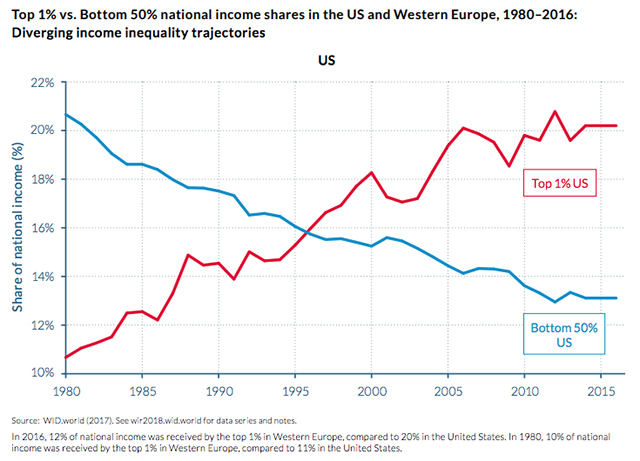
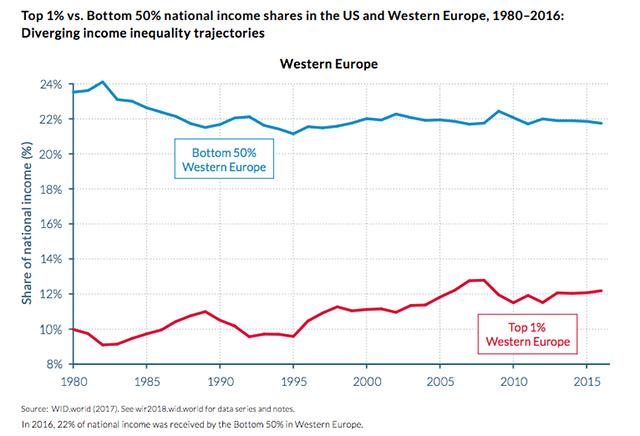
There’s one area where there’s been huge growth in the U.S. — the gap between the rich and poor. The divergence in the levels of inequality has been “extreme” between Western Europe and the U.S., according to the 2018 World Inequality Report, released by the World Inequality Lab, a research project in over 70 countries based at the Paris School of Economics, and co-authored by the French economist Thomas Piketty. “The global middle class has been squeezed,” it said. In 1980, the U.S. and Western Europe had similar levels of inequality. And today? Not so much. While the top 1% of earners made up just 10% in both regions in 1980, it increased slightly to 12% in 2016 in Western Europe, but doubled to 20% in the U.S. “Since 1980, income inequality has increased rapidly in North America, China, India, and Russia,” it said.
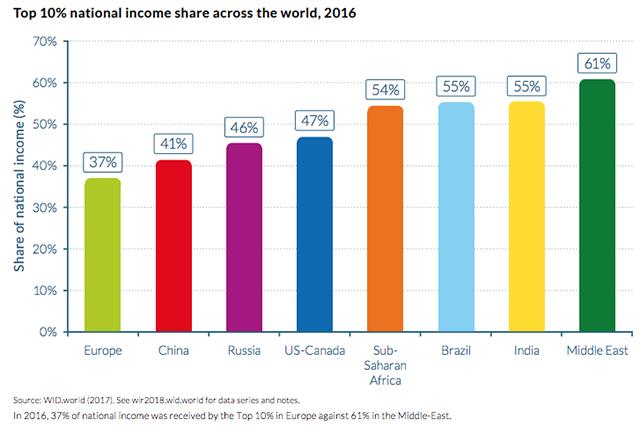
“The income-inequality trajectory observed in the U.S. is largely due to massive educational inequalities, combined with a tax system that grew less progressive despite a surge in top labor compensation since the 1980s,” it found. In Europe, tax and wage inequality was moderated by educational and wage-setting policies that were more favorable to low and middle-income groups. In the U.S., out of 100 children whose parents are among the bottom 10% of income earners, only 20 to 30 of them actually go to college. However, closer to 90 out of 100 children go to college if their parents are within the top 10% earners. What’s more, research has shown that when elite colleges open their doors to students from poor backgrounds, academic performance at the institution doesn’t decline.
Read more …

“Animal spirits”, “irrational exuberance”, “value investing”, “momentum chase”. What is this, verbal bankruptcy?

• The Rude Awakening Of Slumbering Bulls (Roberts)

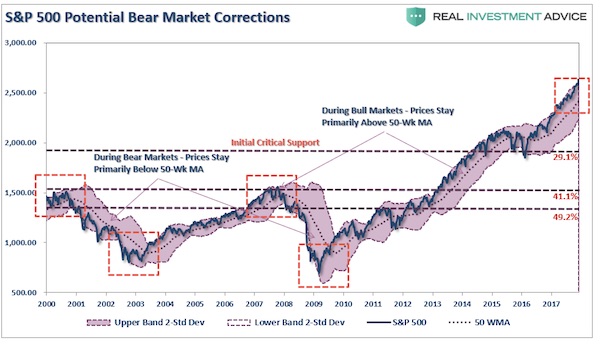
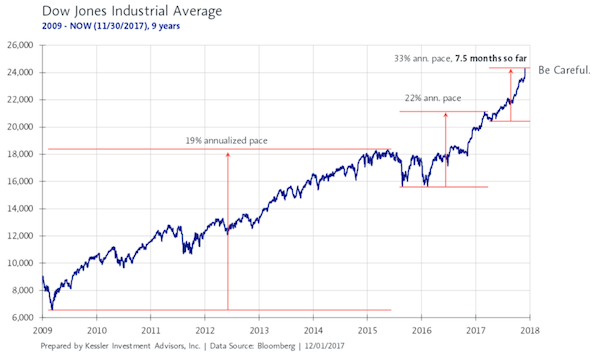
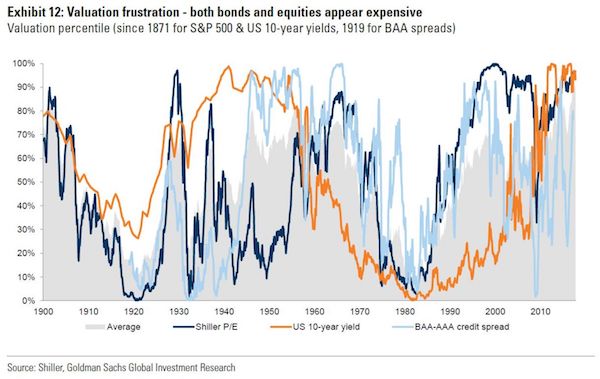
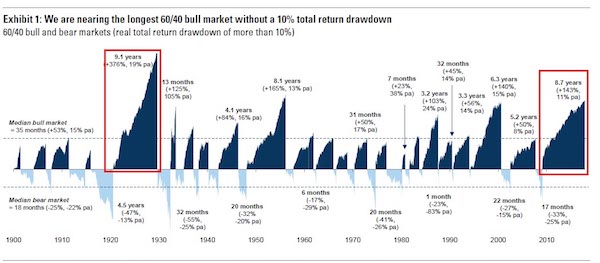
Here’s a little secret, “Animal Spirits” is simply another name for “Irrational Exuberance,” as it is the manifestation of the capitulation of individuals who are suffering from an extreme case of the “FOMO’s” (Fear Of Missing Out). The chart below shows the stages of the previous bull markets and the inflection points of the appearance of “Animal Spirits.” At the peak of previous bull market advances, the markets have entered into an accelerated phase of price advances.
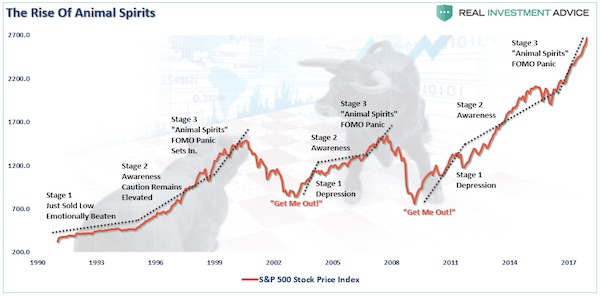
Since “the price you pay day is the value you receive tomorrow,” as famously noted by Warren Buffet, it should not come as a surprise that “value investing” is lagging the “momentum chase” in the market currently. But again, this is something that has historically, and repeatedly occurred, during very late stage bull market advances as the “rationalization” for a “never-ending bull market” is promulgated.
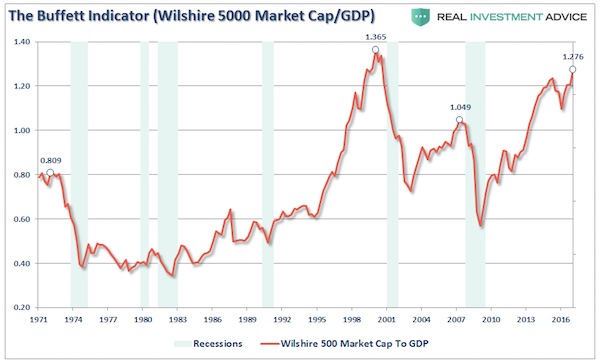
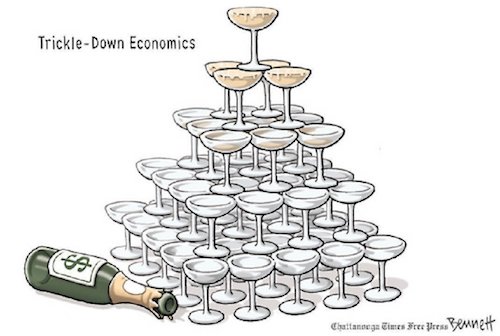
Given the length of the economic expansion, the risk to the “bull market” thesis is an economic slowdown, or contraction, that derails the lofty expectations of continued earnings growth. While tax reform legislation may provide a bump to earnings growth in the near-term, it is the longer-term growth rates of the economy that matters. Furthermore, while providing a tax cut to corporations will certainly boost their bottom line, there is little evidence, historically speaking, “trickle-down economics” actually occurs. If it did, wages as a share of corporate profits wouldn’t look like this.
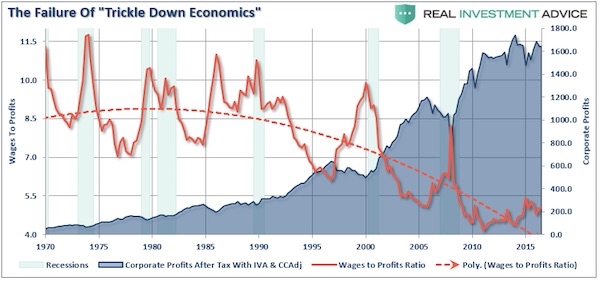
With an economy that is 70% driven by the 90% of the population who don’t benefit from corporate tax cuts, the long-term effects of a deficit and debt busting tax bill should be worrying investors. But, for now, that is not the case as the rise in “animal spirits” is simply the reflection of the rising delusion of investors who frantically cling to data points which somehow support the notion “this time is different,” a point recently made by Sentiment Trader: “We’ve discussed a multitude of momentum studies in the past month or two, with an almost universal suggestion that the types of readings we’ve seen this year are rare and hard to bust. This unrelenting bid has been one of, if not THE, most compelling bullish argument, and it shows little sign of stopping.”

Read more …

K-Street has taken over Brussels too.

• MiFID’s Cautious Start on Bond-Price Rules Shows Lobbying Impact (BBG)

For years, the bond industry argued that price-disclosure requirements in MiFID II were unsuited to the market and would hinder trading. With less than 1% of notes affected when the rules kick in on Jan. 3, that lobbying seems to have paid off. The European Securities and Markets Authority said last week that 566 bond instruments out of 61,761 it analyzed were sufficiently liquid to fall under the pre- and post-trade transparency rules in the MiFID II package. Most were sovereign bonds, which are used as collateral in everything from repurchase agreements to derivative trades. About 150 corporate securities made the list, issued by financial firms such as CaixaBank, Italian power giant Enel and telecommunications company Wind Tre. But the small number of securities initially captured by MiFID II means the law’s goal of shedding light on the market may not be achieved anytime soon.

“ESMA’s approach will contribute very little towards improving transparency in this notoriously opaque market segment,” said Christian Stiefmueller, who’s in charge of banking for Finance Watch, a public-interest watchdog in Brussels. “ESMA’s approach is a present to market makers, i.e. traders at the major investment banks, who thrive on a lack of transparency.” As part of its efforts to prevent another financial crisis, the EU is implementing rules designed to shift trading on to exchanges where regulators can track it, boost transparency to protect individual investors and level the playing field for professionals. MiFID II transparency rules require market operators and investment firms that run a trading venue to make public “current bid and offer prices and the depth of trading interests at those prices” continuously during trading hours for some bonds and other non-equity securities.

Read more …

People only get poorer, the dream is over.

• Why American Capitalism Doesn’t Work For All Americans – Deaton (MW)

MarketWatch: I want to make the bridge from your findings to the economy. You have said that white working class workers are facing a loss of their way of life.

Deaton: This is much more hypothetical because of course, you are saying “what is doing this?” Tying it to the economy is tricky because it is certainly not true that it was the Great Recession that made this happen, for example. And in fact even if you go back to the late 1990s, the patterns of income and so on are not that different across groups. They don’t match up. Any simple story that said “it is the economy stupid,” is stupid. So we trace this back sort of a long way, and if you look at birth cohorts it is like each successive birth cohort is doing worse. They are more susceptible to these deaths throughout life, and the deaths rise with age more rapidly for younger cohorts, so we’re attracted by this idea that there is a cumulative process going on which is steadily getting worse over time. And, you know, the destruction of the way of life of the white working class is maybe a good way of thinking about this.
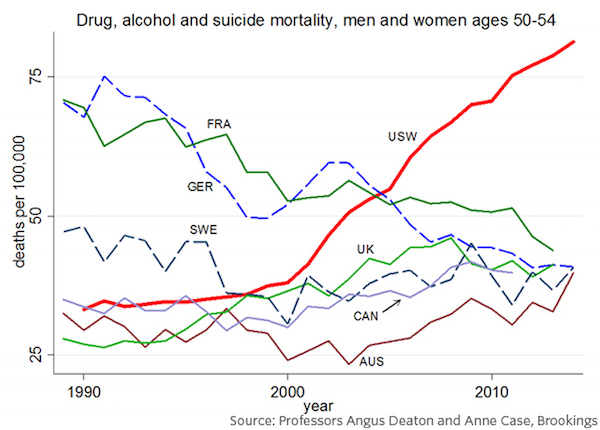
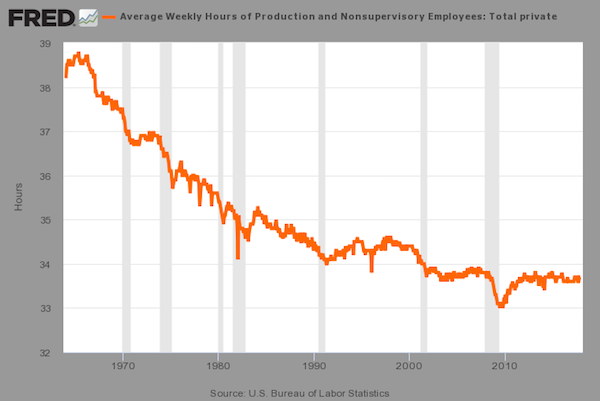
I mean we are very attracted by that. You know, the ultimate poison may be in the labor market, but, it works through a lot of other bad stuff that is going on — like the decline in marriage rates, the increase in out-of-wedlock childbearing, and all those sort of things. It is those things that get to middle age and your life has not worked out the way you thought, not just in terms of the salary you earned, but also your marital relationship, your kids who you may not know anymore and who are living with someone else. So there are a lot of people who in their 50s that find that their life has just sort of come apart. One story is just that there has been this slow loss of the white working class life. There has been stagnation in wages for 50 years. If you don’t have a university degree, median wages for those people have actually been going down. So it is just like that model, whereby American capitalism really delivered to people who were not particularly well-educated, seems to be broken.

Read more …

“..the phenomenon whereby weak banks can destabilize governments that support them and over-indebted governments can push banks holding their bonds over the precipice..”

• Europe’s Sovereign-Bank ‘Doom Loop’ Can’t Be Broken (BBG)

Ever since the financial crisis, the European Union has grappled with how to solve the so-called sovereign bank doom loop – the phenomenon whereby weak banks can destabilize governments that support them and over-indebted governments can push banks holding their bonds over the precipice. The widely touted solution is the European Banking Union, which the European Commission wants completed by 2018. New rules introduced European bank supervision, a new resolution framework that limits sovereign support and a pan-EU deposit insurance scheme as a means of breaking the interdependence between banks and sovereigns. The first problem with this approach is that it’s actually not possible to break the doom loop. The second is that trying to do so through the banking union may actually increase risks in the European Union.

Euro zone banks, who are legally required to hold safe and liquid assets, often buy disproportionately large chunks of their home country sovereign debt because these are often the most familiar safe assets, and the sovereign yield curve is used as a baseline for pricing most credit. However, if the price of these bonds plummets – or, worse, if these bonds have to be restructured – banks get into trouble, as Greek banks found. The doom loop works in other ways too. Rating agencies have a separate methodology for rating banks wherein the possibility of state support raises bank ratings between one and six notches above what these would be on a standalone basis. A weak government means that investors discount the ability of the sovereign to support a bank in times of trouble, so a bank’s rating will also fall.

That explains why, during the euro zone crisis, badly run German landesbanken (a group of state-owned banks) had a better credit rating compared to Santander, one of Europe’s best-run banks, headquartered in Spain. Sometimes the bill for bailing out banks is so large that an otherwise healthy sovereign itself needs to be bailed out, as Ireland found out. Finally, the doom loop can kick in if depositors doubt that governments can honor their guarantees. Rumors of a bank being in trouble can be self-fulfilling, leading to the withdrawal of short-term funding and deposits. It was a fear of such a run on deposits in Spanish banks that prompted ECB President Mario Draghi to say the ECB would do “whatever it takes” to stem the crisis. Deposit guarantee schemes are important in reducing the risks of such a run on the bank. But these guarantees are only as good as a government’s ability to pay.

Read more …

He’s probably right.

• Jim Chanos: We Think Tesla Is Worth Zero (CNBC)

Famed short seller Jim Chanos took another shot at Tesla on Thursday, saying the company’s equity is worth nothing. “Let’s just say Tesla and Mr. Musk have a broad interpretation of the truth,” Chanos, founder of Kynikos Associates, told CNBC’s Kelly Evans. “There have been all kinds of announcements that this company has made … that turned out not to be true.” Chanos mentioned the unveiling of Tesla’s electric Semi truck and roadster last month as examples. The short seller noted that Tesla CEO Elon Musk said “the Semi would be available in 2019 and the roadster in 2020. Where is he producing those? Those production lines have to be up and approved years before we get into production.”

Chanos has been short Tesla for a long time. On Nov. 14, he said he added to his short position against the electric vehicle maker throughout the year. However, Tesla shares are up sharply this year, advancing nearly 60%. “To me, where the stock is now is not the story,” Chanos said. “I don’t care that it came from $30 or $200 or $300. That’s just meaningless.” “We think the equity is worthless,” he said in the interview on “Closing Bell.”

Read more …

Politics will trump the legal system, wanna bet?!

• WikiLeaks Recognised As A ‘Media Organisation’ By UK Tribunal (G.)

A British tribunal has recognised Julian Assange’s WikiLeaks as a “media organisation”, a point of contention with the United States, which is seeking to prosecute him and disputes his journalistic credentials. The issue of whether Assange is a journalist and publisher would almost certainly be one of the main battlegrounds in the event of the US seeking his extradition from the UK. The definition of WikiLeaks by the information tribunal, which is roughly equivalent to a court, could help Assange’s defence against extradition on press freedom grounds. The US has been considering prosecution of Assange since 2010 when WikiLeaks published hundreds of thousands of confidential US defence and diplomatic documents. US attorney general Jeff Sessions said in April this year that the arrest of Assange is a priority for the US.

The director of the CIA, Mike Pompeo, after leaks of emails from the US Democratic party and from Hillary Clinton, described WikiLeaks as “a non-state hostile intelligence service often abetted by state actors like Russia”. He added Assange is not covered by the US constitution, which protects journalists. But the UK’s information tribunal, headed by judge Andrew Bartlett QC, in a summary and ruling published on Thursday on a freedom of information case, says explicitly: “WikiLeaks is a media organisation which publishes and comments upon censored or restricted official materials involving war, surveillance or corruption, which are leaked to it in a variety of different circumstances.” The comment is made under a heading that says simply: “Facts”.

The tribunal’s definition of WikiLeaks comes in the 21-page summary into a freedom of information case heard in London in November. An Italian journalist, Stefania Maurizi, is seeking the release of documents relating to Assange, mainly in regard to extradition, and had lodged an appeal with the tribunal. While the tribunal dismissed her appeal, it acknowledged there issues weighing in favour of public disclosure in relation to Assange. But it added these were outweighed by a need for confidentiality on the matter of extradition.

Read more …

A long cold lonely winter.

• EU Leaders Clash Over Refugees (R.)

Two years after the Mediterranean migrant crisis blew a hole in the European Union, a tentative effort to patch up differences over what to do with refugees underlined continuing rifts among the bloc’s leaders. A free-wheeling discussion over a Brussels summit dinner that began on Thursday night and spilled into the wee hours of Friday was intended to clear the air and see if there was a way to reconcile opposing views on how to reform defunct asylum rules. But leaders emerging from nearly three hours of talks made clear that while there was little of the angry passion of 2015, when a million people flooded into Greece and headed for Germany, the “frank and sober” discussion failed to blunt sharp rifts pitting some eastern states against many of the rest.

“We have a lot of work to do,” German Chancellor Angela Merkel told reporters. “The positions have not changed.” Divisions over how to share out relatively small numbers of refugees have poisoned relations in the EU, complicating efforts to present a united front in talks with London on Brexit and to agree an EU budget out to 2028. New Polish and Czech leaders stuck to lines shared with Hungary and Slovakia that their ex-communist societies cannot accept significant immigration, especially of Muslims. Czech Prime Minister Andrej Babis called the debate “quite stormy” and told reporters that Greek Prime Minister Alexis Tsipras had been “quite aggressive.” But, he said, the eastern allies would not let the majority impose obligatory refugee quotas on them.

Merkel and Italian Prime Minister Paolo Gentiloni were among those who demanded that all countries take in a mandatory share of people requiring asylum, who have been concentrated on the Mediterranean coast, or after chaotic movements across Europe, in the richer northwest of the bloc.

Read more …

Only viable in countries that provide the good example.

• Palau Makes All Visitors Sign Pledge To Respect Environment (G.)

The tiny Pacific island nation of Palau has introduced a new law requiring visitors to sign a pledge not to harm the environment before entering the country. The pledge will be stamped into the passports of international arrivals from this month. Visitors will be required to sign before proceeding through immigration, making a formal promise to the children of Palau to “preserve and protect your beautiful and unique island home”, and to “tread lightly, act kindly and explore lightly”. Almost 6,000 people signed in the first two weeks. It’s the first time such a pledge has been written into a country’s immigration policies, but Palau has long been vocal about the environment. The country has already reported larger tides and an increase in severe tropical storms. The sea level around its 700 islands has risen by about 9mm a year since 1993, almost three times the global average rate.

President Tommy Remengesau is a vocal environmental campaigner. He told a United Nations climate forum in 2014 that if the world failed to act to curb its carbon emissions, “our global warming doomsday is already set in stone”. In 2015 Palau created the world’s sixth-largest marine sanctuary, protecting 80% of its maritime territory, an area of tuna-rich ocean the size of California, from both fishing and oil drilling. Remengesau said he hoped that requiring visitors to sign a pledge to protect the environment would create a cultural shift among tourists and make them aware of the fragility of the environment. “While Palau may be a small-island nation, we are a large ocean-state and conservation is at the heart of our culture,” he said. “We rely on our environment to survive and if our beautiful country is lost to environmental degradation, we will be the last generation to enjoy both its beauty and life-sustaining biodiversity.”

Read more …

Not surprising.

• Arctic Warming So Rapid That Computer Measuring It Rejected The Results (Ind.)

Climate change in the Arctic has “outrun” a computer designed to measure it. So rapid was the temperature change at a weather station in Alaska, the computer analysing the data detected an error and stopped recording the correct temperature. In a blog post, US National Oceanic and Atmospheric Administration (NOAA) climate scientist Dr Deke Arndt explained the recent incident, referring to it as “an ironic exclamation point to swift regional climate change in and near the Arctic”. The weather station is located in Utqiagvik, the most northerly town in the US. Low levels of sea ice in the region caused the air temperatures to rise quickly. The computers NOAA use to automatically record climate data have in-built algorithms that ensure the information they record is accurate.

This algorithm is meant to be triggered if the instruments measuring temperatures are damaged, or if there is an artificial change in the environment surrounding them. In this case, the temperature change was such a shock to the system that the computer “disqualified itself” from the Alaskan temperature analysis. This left northern Alaska “analysed a little cooler than it really was”, wrote Dr Arndt. The data from the station was missing for all of 2017, and the last few months of 2016. “In this case, instead of a station move, or urban sprawl, or an equipment change, it was actually very real climate change that changed the environment, by erasing a lot of the sea ice that used to hang out nearby,” wrote Dr Arndt. The Arctic is warming at twice the rate of the global average, meaning the effects of climate change are felt particularly keenly in polar regions.

Read more …

Dec 132017
 
 December 13, 2017  Posted by at 10:22 am Finance Tagged with: , , , , , , , , , ,  7 Responses »


MC Escher Relativity 1953


• ‘Buy the Dip’ Has Never Been More Popular in US Stocks (BBG)
• Bitcoin Bears Soon Able to Short Futures Through Interactive Brokers (BBG)
• China’s GDP Growth Set To Plunge To Near 30-Year Low In 2018 – ADB (CNBC)
• Free Money From China Comes With Strings (CNBC)
• 2700 By Christmas? (Roberts)
• The Great Globalisation Lie (Rodrik)
• Britain Doesn’t Appear To Be Collapsing As A Result Of Brexit (Bilbo)
• Abracadabra (Jim Kunstler)
• FBI Officials Said Clinton ‘Has To Win’ Race To White House (R.)
• Former Facebook Executive: Social Media Is Ripping Society Apart (G.)
• Japan Court Bars Restart of Nuclear Reactor Shut After Fukushima (BBG)
• Greeks Crushed By Tax Burden (K.)
• The Refugee Crisis In Greece Hasn’t Gone Away And Our Leaders Don’t Care (NS)
• Arctic Permafrost Thawing Faster Than Ever (AP)


Full blast casino.

• ‘Buy the Dip’ Has Never Been More Popular in US Stocks (BBG)

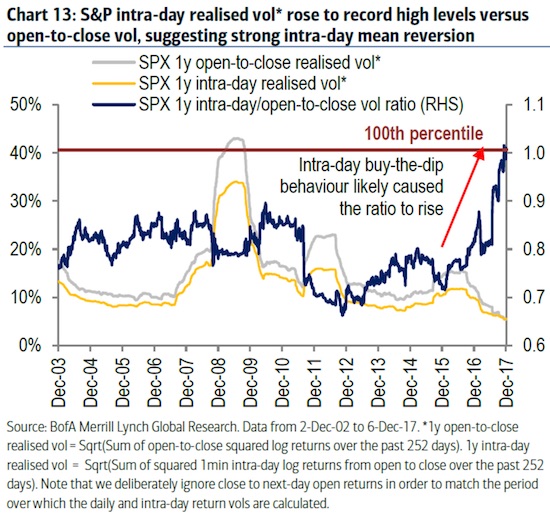
“Buy the dip” has never been so popular. The practice of treating any and all pullbacks in risk assets as opportunities to accumulate more has become entrenched in global equity markets, especially in the U.S., according to analysts at Bank of America Merrill Lynch. “Investors no longer fear shocks but love them,” a team led by global equity derivatives researcher Nitin Saksena wrote in a note Tuesday. “Since 2013, central banks have stepped in (or communicated that they may step in) to protect markets, leaving investors confident enough to ‘buy-the-dip.’” Intraday realized volatility for the S&P 500 Index relative to the realized volatility in the open-close ratio for the benchmark gauge has soared to record highs this year, emblematic of an environment in which buying the dip has become gospel for traders, according to the bank’s analysis of price action going back to 2003.

This ratio is also above the 90th%ile for the Euro Stoxx 50 Index and Nikkei 225. In practice, this suggests any early weakness in stocks is being met with an onslaught of buying that propels the index back to where it opened by the time the closing bell sounds. BofA equity derivatives strategist Clovis Couasnon puts it this way: Imagine the S&P 500 Index is down 1% at midday, only to rebound and finish broadly unchanged. The open-to-close return would be close to zero, but under the surface there were two moves of about 1%. “So if the buy-the-dip behavior is strong enough to cause mean reversion, this will cause intraday vol to be more supported than open-to-close vol,” he explained.

Read more …

Buy the dip 2.0. Why does this make me feel nervous?

• Bitcoin Bears Soon Able to Short Futures Through Interactive Brokers (BBG)

Interactive Brokers plans to let bitcoin bears bet against the digital currency’s recently debuted futures contracts. Starting this week, the brokerage will allow its users to take short positions on bitcoin futures under certain conditions, according to company spokeswoman Kalen Holliday, who said the decision was made “in response to client demand.” Interactive Brokers has accepted long positions with a margin requirement of at least 50% since the contracts debuted Sunday on Cboe Global Markets Inc. Shorting bitcoin futures, or betting that their price will fall, is potentially an even riskier strategy.

It’s possible to lose an unlimited amount of money on a short position, particularly if the cost of the digital currency and its derivatives continues to climb. Interactive Brokers has a few requirements for shorting bitcoin futures: the spread must be one-to-one, and the short leg must have the earlier expiry date so that once it expires the surviving leg will be long, according to Holliday. Trading won’t be offered in retirement accounts or to Japanese residents.

Read more …

That’s going to hurt.

• China’s GDP Growth Set To Plunge To Near 30-Year Low In 2018 – ADB (CNBC)

China’s economy will expand a bit faster than expected this year on resilient consumption but growth will stutter in 2018, the Asian Development Bank said Wednesday. Growth on the mainland is now expected at 6.8% in 2017, up from the previous forecast of 6.7%, the Asian Development Bank (ADB) said in its latest forecasts released on Wednesday. Growth prospects in China for 2017 have been revised upward as spending by households has held up reasonably well. Still, persisting headwinds will weigh on economic impulses next year. The world’s second-largest economy is likely to grow by 6.4% in 2018 due to “controlled moderation” in the economy, Joseph Zveglich, ADB’s macroeconomic research director told CNBC. That would mark the slowest pace of expansion since 1990, according to World Bank data.

The Chinese government is treading a thin line between deleveraging and keeping its debt-fueled economy humming. Growth in the wider region will also be a bit better this year. Stronger-than-expected exports and domestic consumption likely lifted economic growth in developing Asia in 2017, the ADB said. The upgraded outlook saw GDP growth in the region of developing Asia moving up 0.1 percentage point to 6% in 2017. The region includes 45 ADB members including China, Hong Kong, South Korea and Singapore, but excludes Japan. The rosier prediction came after a year of uncertainty due to fears of trade protectionism. There was “stronger-than-expected growth in most of our economies especially in terms of the pickup in trade,” Zveglich said.

Read more …

Said it often before: China is exporting its credit Ponzi and its overcapacity. The countries along the Belt Road will end up paying.

• Free Money From China Comes With Strings (CNBC)

China giveth, and China taketh away. Across Asia, the world’s second-largest economy has financed infrastructure projects as part of its massive, so-called Belt and Road program. But it’s entirely up to Beijing to decide which countries get funding and when — and Pakistan offers a cautionary tale. Pakistan is home to one of China’s central infrastructure schemes: a near $60 billion collection of land and sea projects known as the China-Pakistan Economic Corridor (CPEC). But Chinese President Xi Jinping’s administration said it would halt funding for three major roads that are part of the corridor, Pakistani newspaper Dawn reported last week, citing an Islamabad official. Beijing will resume funding after it releases “new guidelines,” the newspaper said.

[..] If true, the news is proof of China’s unilateral management style, analysts said. “What Beijing giveth, Beijing can also taketh away,” Ian Bremmer, president and founder of political consultancy Eurasia Group, wrote in a recent note. Unlike the Asian Infrastructure Investment Bank, another China-led program, Belt and Road projects “aren’t transparent or consensus driven,” he said. “The nature of Chinese economic decision-making has the potential to cause significant downside risks for those countries that become most dependent on the Belt Road initiative,” he said. Nations that suddenly fall out of political favor with Beijing, for whatever reason, could subsequently suffer weighty economic consequences.

Read more …

The Fed hasn’t even started to tighten yet. The feast of liquidity just goes on. But it can’t going forward, or Fed credibility is gone.

• 2700 By Christmas? (Roberts)

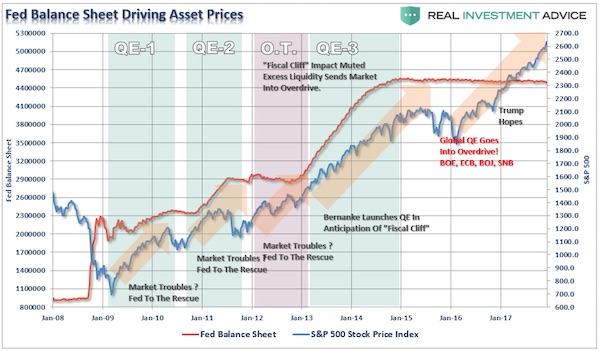
Following the early 2016 correction, the “carry trade” has picked up steam and has continued to force asset prices higher as liquidity seeks opportunity. With the “carry trade” now extremely extended currently, which is also highly leveraged, watch for a triggering of a “sell signal” as a sign to temporarily reduce equity-related risk. But wait, the Fed is reducing their liquidity flows into the financial system, right? Not so much. As shown in the first chart below, the Fed’s balance sheet continues to remain stable even as asset prices surge.

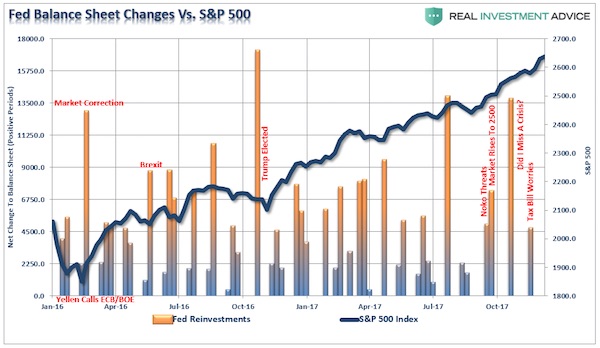
With global Central Banks still flooding the system with liquidity, the Fed has yet to begin rolling off their reinvestments as expected. In fact, the Fed made a timely reinvestment during the “Senate Tax Bill” debacle earlier this month.

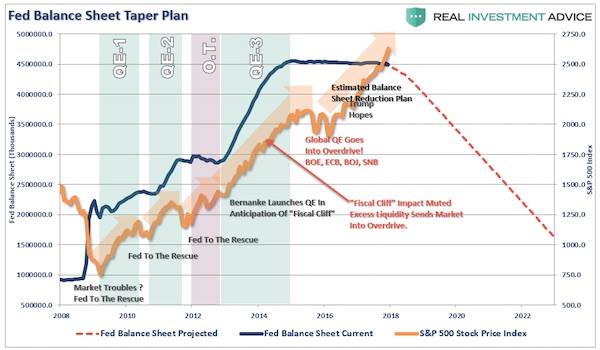
Of course, that bump of liquidity sent asset prices rocketing higher. The question becomes just what will happen to the markets when the Fed actually does begin to aggressively decrease their “reinvestments” in the coming year. The projected decline in the balance sheet looks like the following. One can only imagine how a market which has been repeatedly driven higher on a “feast of liquidity,” either from the Fed or other Central Banks, will react to being put on a diet.

Read more …

“The gain to the US from Nafta: just 0.1 per cent of GDP. If the same effort had gone into creating decent jobs, would we have Trump?”

Globalization automatically leads to Misallocation.

• The Great Globalisation Lie (Rodrik)

According to the celebrated Stolper-Samuelson theorem of trade theory, in places—like the US and western Europe—where skilled workers are plentiful, unskilled workers will see their wages decline under freer trade. Openness to trade always hurts some people in society, except in the extreme case (not relevant for any large economy) where the only things imported are things that are never produced at home. In theory, countries could always compensate their losers by redistributing from the winners, and in practice they sometimes did. With its extensive safety nets, Europe in the second half of the 20th century was relatively well prepared to deal with disruptive trade flows. In addition, trade negotiators initially carved out special regimes for garments and textiles exporters in the advanced economies, limiting their exposure.

Even in the best of circumstances, however, freeing up trade caused pain as well as gain. After the 1980s, the balance began to look worse and worse. When tariffs (like taxes) are too high they distort economic behaviour more, and do more damage to prosperity. Back in the 1950s and 1960s, tariffs were often very high and so their reduction did much to grow the overall economic pie. But four or five decades later, in a world where typical tariffs were in single figures, the picture was different. If you’re starting off with the tariffs of the post-war era, the standard economic models suggest that to achieve an overall net gain of $1 in national income through liberalising trade, you could expect to see around $4 or $5 of income being reshuffled across different groups within a particular country.

But under the tariffs that applied by the end of the 20th century, achieving that overall dollar of gain would be associated with as much as $20 being redistributed, implying the creation of an awful lot of losers. And what’s more, by the 1990s we were into an era of welfare state retrenchment rather than expansion. So it became less plausible than it used to be to believe that those losses will be compensated.

Read more …

Long read.

• Britain Doesn’t Appear To Be Collapsing As A Result Of Brexit (Bilbo)

Do you remember back to May 2016, when the British Treasury, which is clearly full of mainstream macroeconomists who have little understanding of how the system actually operates released their ‘Brexit’ predictions? The ‘study’ (putting the best spin possible on what was a tawdry piece of propaganda) – HM Treasury analysis: the immediate economic impact of leaving the EU – was strategically released to have maximum impact on the vote, which would come just a month later. Fortunately, for Britain and its people, the attempt to provide misinformation failed. As time passes, while the British government and the EU dilly-dally about the ‘divorce’ details, we are getting a better picture of what is happening post-Brexit as the ‘market’ sorts what it can sort out.

Much has been said about the destructive shifts in trade that will follow Brexit. But these scaremongers fail to grasp that Britain has been moving away from trade with the EU for some years now and that process will continue into the future. I come from a nation that was dealt a major trading shock at the other end of Britain’s ill-fated dalliance with Europe. It also made alternative plans and prospered as a result. The outcomes of Brexit will be in the hands of the domestic policies that follow. Stick to neoliberalism and there will be a disaster. But the opportunity is there for British Labour to recast itself and seize the scope for better public infrastructure, better services and stronger domestic demand. Then the nation will see why leaving the corporatist, austerity-biased failure that the EU has become was a stroke of genius.

The only good thing about the Treasury Report was that it was “Printed on paper containing 75% recycled bre content minimum” but even then it was a waste of real resources.

Read more …

“.. the money that the Fed loaned to the US government (in exchange for a bond) was never there in the first place. The Fed prestidigitated it out of an alternate universe.”

• Abracadabra (Jim Kunstler)

So, the Fed has this thing called a balance sheet, which is actually a computer file, filled with entries that denote securities that it holds. These securities, mostly US government bonds of various categories and bundles of mortgages wrangled together by the mysterious government-sponsored entity called Freddie Mac, represent about $4.5 trillion in debt. They’re IOUs that supposedly pay interest for a set number of years. When that term of years expires, the Fed gets back the money it loaned, which is called the principal. Ahhhh, here’s the cute part! You see, the money that the Fed loaned to the US government (in exchange for a bond) was never there in the first place. The Fed prestidigitated it out of an alternate universe. They gave this money to a “primary dealer” bank in exchange for the bond, which the bank abracadabraed up for the US Treasury.

Well, not really. In fact, the Fed just made a notation on the bank’s “reserve” account that the money from the alternate universe appeared there. Somehow that money was sent via a virtual pneumatic tube to the US Treasury, where it was used to pay for drones to blow up Yemeni wedding parties, and for the Secret Service to visit pole dancing bars when the president traveled to foreign lands. Here’s the fun part. The Fed announces that it is going to shed this nasty debt, at about $10 billion worth a month starting this past October. Their stated goal is to reach an ultimate wind-down velocity of $50 billion a month (cue laugh track). If they ever get there (cue laugh track) it would take 20 years to complete the wind-down. The chance of that happening is about the same as the chance that Janet Yellen will come down your chimney on December 24 with a sack-full of chocolate Bitcoins.

But never mind the long view for the moment. One way they plan to accomplish this feat is to “roll off” the bonds. That is, when the bonds mature — i.e. come to the end of their term — they will cease to exist. Poof! Wait a minute! When a bond matures, the issuer has to send the principal back to the lender. After all, the Fed lent the US Treasury X-billion dollars, the US Treasury paid interest on the loan for X-years, and now it has to fork over the full value of the loan (hopefully in dollars that have magically inflated over the years and are now worth less than when they were borrowed — another magic trick!). But that doesn’t happen.

Read more …

More calls for more special counsels.

• FBI Officials Said Clinton ‘Has To Win’ Race To White House (R.)

Senior FBI officials who helped probe Donald Trump’s 2016 presidential campaign told a colleague that Democratic Presidential candidate Hillary Clinton had to win the race to the White House, the New York Times reported on Tuesday. Peter Strzok, a senior FBI agent, said Clinton “just has to win” in a text sent to FBI lawyer Lisa Page, the Times reported. The messages showed concern from Strzok and Page that a Trump presidency could politicize the FBI, the report said, citing texts turned over to Congress and obtained by the newspaper.

Justice Department Inspector General Michael Horowitz is investigating the texts in a probe into FBI’s handling of its investigation into Clinton’s use of a private email server for official correspondence when she was Secretary of State under former President Barack Obama, the report added. Strzok was removed from working on the Russia probe after media reports earlier this month suggested he had exchanged text messages that disparaged Trump and supported Clinton. Strzok was involved in both the Clinton email and Russia investigations.
Read more …

You don’t say.

• Former Facebook Executive: Social Media Is Ripping Society Apart (G.)

A former Facebook executive has said he feels “tremendous guilt” over his work on “tools that are ripping apart the social fabric of how society works”, joining a growing chorus of critics of the social media giant. Chamath Palihapitiya, who was vice-president for user growth at Facebook before he left the company in 2011, said: “The short-term, dopamine-driven feedback loops that we have created are destroying how society works. No civil discourse, no cooperation, misinformation, mistruth.” The remarks, which were made at a Stanford Business School event in November, were just surfaced by tech website the Verge on Monday. “This is not about Russian ads,” he added. “This is a global problem. It is eroding the core foundations of how people behave by and between each other.”

Palihapitiya’s comments last month were made a day after Facebook’s founding president, Sean Parker, criticized the way that the company “exploit[s] a vulnerability in human psychology” by creating a “social-validation feedback loop” during an interview at an Axios event. Parker had said that he was “something of a conscientious objector” to using social media, a stance echoed by Palihapitaya who said that he was now hoping to use the money he made at Facebook to do good in the world. “I can’t control them,” Palihapitaya said of his former employer. “I can control my decision, which is that I don’t use that shit. I can control my kids’ decisions, which is that they’re not allowed to use that shit.” He also called on his audience to “soul-search” about their own relationship to social media. “Your behaviors, you don’t realize it, but you are being programmed,” he said. “It was unintentional, but now you gotta decide how much you’re going to give up, how much of your intellectual independence.

Read more …

It often seems that the only thinking people are in courts.

• Japan Court Bars Restart of Nuclear Reactor Shut After Fukushima (BBG)

A Japanese court overturned a ruling that allowed a nuclear reactor in the country’s south to operate, frustrating the government’s push to bring online dozens of plants shut in the wake of the 2011 Fukushima disaster. The decision by the Hiroshima High Court, which cited risks from nearby volcanoes, sides with local citizens and reverses a lower court’s ruling that had cleared the way for Shikoku Electric Power to operate its Ikata No. 3 unit, according to an emailed statement Wednesday from the company. The reactor, which restarted last year under stricter safety regulations, has been shut for maintenance and was scheduled to restart on Jan. 20. Shikoku Electric fell as much as 11% in Tokyo, the biggest decline in more than four years, before paring the drop to 8.3%.

The injunction issued by the court is a blow to Prime Minister Shinzo Abe’s goal of having nuclear power account for as much as 22% of the nation’s electricity mix by 2030. Public opposition through local courts and municipal governments has emerged as one of the biggest obstacles to that plan. Just four of Japan’s 42 operable nuclear reactors are currently online. The ruling was the first time a high court in Japan has overturned a lower court on the issue of nuclear restarts since the Fukushima disaster. A district court in Hiroshima sided with the utility in March in deciding not to issue a temporary injunction. Shikoku called Wednesday’s ruling “unacceptable” and said it will try to get it reversed. The injunction is effective through Sept. 30, 2018, according to court documents.

Read more …

That loud sucking sound.

• Greeks Crushed By Tax Burden (K.)

Tax authorities have confiscated the salaries, pensions and assets of more that 180,000 taxpayers since the start of the year, but expired debts to the state have continued to rise, reaching almost €100 billion, as the taxpaying capacity of the Greeks is all but exhausted. In the month of October, authorities made almost 1,000 confiscations a day from people with debts to the state of more than €500. In the first 10 months of the year, the state confiscated some €4 billion, and the plans of the Independent Authority for Public Revenue provide for forced measures to be imposed on 1.7 million state debtors next year. IAPR statistics show that in October alone, the unpaid tax obligations of households and enterprises came to €1.2 billion. Unpaid taxes from January to October amounted to €10.44 billion, which brings the total including unpaid debts from previous years to almost €100 billion, or about 55% of the country’s GDP.

The inability of citizens and businesses to meet their obligations is also confirmed by the course of public revenues, which this year have declined by more than €2.5 billion. The same situation is expected to continue into next year, as the new tax burdens and increased social security contributions look set to send debts to the state soaring. Notably, since 2014, there has been a consolidated trend of a €1 billion increase each month in expired debts to the state. There are now 4.17 million taxpayers who owe the state money. This means that one in every two taxpayers is in arrears to the state, with 1,724,708 taxpayers facing the risk of forced collection measures. Of the €99.8 billion of total debt, just €10-15 billion is still considered to be collectible, as the lion’s share concerns debts from previous years, in many cases of bankrupt enterprises and deceased individuals.

Read more …

“It’s a spot where one can buy and sell drugs, or the bodies of underage boys who are stuck in Greece thanks to a recent law change that dictates they must stay here until they come of age.”

• The Refugee Crisis In Greece Hasn’t Gone Away And Our Leaders Don’t Care (NS)

It’s just after nine on an ordinary Thursday night. About 50 people are gathered next to the main entrance of Pedion Tou Areos, the park at the northern limits of central Athens. The weather is now unmistakably cold, but the refugees gathering every night here seem to be increasing in number. It’s a spot where one can buy and sell drugs, or the bodies of underage boys who are stuck in Greece thanks to a recent law change that dictates they must stay here until they come of age. Both the drugs and the boys are cheap. A few euros for a hit of sisa, a synthetic drug called “the cocaine of the poor”, and a tenner for a session in the park’s bushes with kids as young as 14. The faces change, but the situation remains the same, or worse.

A 14-year-old boy from Afghanistan called Mohammed who was working in the park disappeared over the summer without a trace. He most probably made his way towards the border, to be smuggled out. If he’s lucky he will have made it to northern Europe. If not, he will just be one of thousands who have vanished in the Balkan corridor. It’s now December and winter is being felt across the country. Storms in October and November flooded parts of Greece, turning the open air camps that still hold thousands of refugees in more than 50 locations into mudpits. A video shared by refugees currently staying in Moria, the camp on the island of Lesvos that sits at the forefront of the Greek refugee crisis, shows a small child crying while walking through the camp’s grounds. Tents provided by the UNHCR and the Greek state are in bad shape.

Some have caved in. Floors are under mud and water. “They are trying to turn the island into Greece’s Guantanamo,” said the mayor of Mytilene, the capital of Lesvos, at a press conference. If you climb up a little hill on the side of the camp, you can get a good view of the compound. A year ago, the refugees had mostly been staying in prefabs, but fires, accidents and overcrowding brought the tents back. [..] An emergency relief programme is relocating people from Lesvos to camps across Greece, 30 to 50 at a time. But the rest of the camps are in is no better shape. Recently, a nine-year-old boy from Afghanistan tried to commit suicide on Chios, another Greek island. The doctors treating him suspected he had been abused inside the camp. It’s no suprise. Médecins Sans Frontières Greece said that “in our clinic in Lesvos, we have at least ten people per day who have self-harmed or attempted suicide. The situation in the islands is beyond desperate.”

Read more …

“The Arctic has traditionally been the refrigerator to the planet, but the door of the refrigerator has been left open..”

• Arctic Permafrost Thawing Faster Than Ever (AP)

Permafrost in the Arctic is thawing faster than ever, according to a new US government report that also found Arctic seawater is warming and sea ice is melting at the fastest pace in 1,500 years. The annual report released on Tuesday by the National Oceanic and Atmospheric Administration showed slightly less warming in many measurements than a record hot 2016. But scientists remain concerned because the far northern region is warming twice as fast as the rest of the globe and has reached a level of warming that’s unprecedented in modern times. “2017 continued to show us we are on this deepening trend where the Arctic is a very different place than it was even a decade ago,” said Jeremy Mathis, head of NOAA’s Arctic research program and co-author of the 93-page report.

Findings were discussed at the American Geophysical Union meeting in New Orleans. “What happens in the Arctic doesn’t stay in the Arctic; it affects the rest of the planet,” said acting NOAA chief Timothy Gallaudet. “The Arctic has huge influence on the world at large.” Permafrost records show the frozen ground that many buildings, roads and pipelines are built on reached record warm temperatures last year nearing and sometimes exceeding the thawing point. That could make them vulnerable when the ground melts and shifts, the report said. Unlike other readings, permafrost data tend to lag a year. Preliminary reports from the US and Canada in 2017 showed permafrost temperatures are “again the warmest for all sites” measured in North America, said study co-author Vladimir Romanovsky, a professor at the University of Alaska in Fairbanks.

Arctic sea ice usually shrinks in September and this year it was only the eighth lowest on record for the melting season. But scientists said they were most concerned about what happens in the winter – especially March – when sea ice is supposed to be building to its highest levels. Arctic winter sea ice maximum levels in 2017 were the smallest they’ve ever been for the season when ice normally grows. It was the third straight year of record low winter sea ice recovery. Records go back to 1979. About 79% of the Arctic sea ice is thin and only a year old. In 1985, 45% of the sea ice in the Arctic was thick, older ice, said NOAA Arctic scientist Emily Osborne

Read more …

Dec 122017
 
 December 12, 2017  Posted by at 10:28 am Finance Tagged with: , , , , , , , , , , , , ,  3 Responses »


Wassily Kandinsky Clear connection 1925


• How Fed Rate Hikes Impact US Debt Slaves (WS)
• Why Obamacare Is Locked In An Inescapable Death Spiral (ZH)
• Sitting Closer To The Exit (Roberts)
• Oil Producers Turning to Crypto to Solve Sanctions Problems (Luongo)
• Peak Bitcoin Media Mania Yet? (WS)
• Bitcoin – Millennials’ “Fake Gold” (Katsenelson)
• Next Bank of Japan Governor Faces a ‘Job From Hell’ (BBG)
• Sweden: More Signs The World’s Biggest Housing Bubble Is Cracking (ZH)
• Trump Tells NASA to Send Americans to the Moon (AFP)
• Exxon To Provide Details On Climate Change Impact To Its Business (R.)
• Apple Aims To Block Climate, Rights Using SEC Guidance (R.)
• EU Could ‘Scrap Refugee Quota Scheme’ (G.)
• Lesvos Authorities Block Ship With Container Homes For Refugees (AP)
• Germany Rejects Additional Winter Aid For Refugees On Greek Islands (KTG)


“If the average interest rate on this debt is 20%, credit-cart interest payments alone add $233 a month to their household expenditures.”

• How Fed Rate Hikes Impact US Debt Slaves (WS)

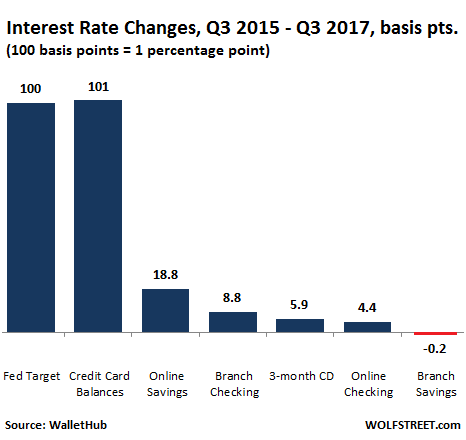
Revolving credit outstanding of $1 trillion, spread over 117.72 million households, would amount to $8,300 per household. But many households do not carry interest-bearing credit card debt; they pay their cards off in full every month. Finance charges are concentrated on households that use this form of debt to finance their spending and that cannot pay off their balances every month. Many of these households are already strung out and are among the least able to afford higher interest payments. Consumer credit bureau TransUnion shed some light on this in its Q3 2017 Industry Insights Report, according to which 195.9 million consumers had a revolving credit balance at the end of Q3, with total account balances of $1.35 trillion. This equals $6,892 per person with revolving credit balances.

If there are two people with balances in a household, this would amount to nearly $14,000 of this high-cost debt. If the average interest rate on this debt is 20%, credit-cart interest payments alone add $233 a month to their household expenditures. What is next for these folks? For now, the Fed has penciled in, and economists expect, three hikes next year. But recent developments – particularly the expected tax cuts and what the Fed calls “elevated asset prices” – suggest that the Fed might “surprise” the markets with its hawkishness in 2018. The Fed is currently pegging the “neutral” rate – the rate at which the federal funds rate is neither stimulating nor slowing the economy – at somewhere near 2.5% to 2.75%, so about five or six more rates hikes from today’s target range.

Interest rates on credit cards would follow in lockstep. These rate hikes to “neutral” would extract another $8 billion or so a year, on top of the additional $7.5 billion from the prior rate hikes. But that’s not all. Credit card balances continue to rise as our brave consumers are trying to prop up US consumer spending and thus the global economy by borrowing more and more. Thus, rising credit card balances combined with rising interest rates on those balances conspire to produce sharply higher interest costs. Since consumers with high-interest credit-card balances already don’t have enough money to pay off their costly debt, these additional interest payments will further curtail their efforts at making principal payments and thus inflate their credit card balances further.

Read more …

And if/when you manage to pay off your credit cards, there’s the next challenge…

• Why Obamacare Is Locked In An Inescapable Death Spiral (ZH)

Ever since it was signed into law in 2010, defenders of Obamacare have dismissed staggering surges in annual premiums by highlighting only the rates paid by those fortunate enough to receive subsidies. In fact, last year we wrote about Marjorie Connolly’s, from Obama’s Department of Health and Human Services, response to the Tennessee insurance commissioner’s fear that the exchanges in his state were “very near collapse” after a staggering 59% premium surge: “Consumers in Tennessee will continue to have affordable coverage options in 2017. Last year, the average monthly premium for people with Marketplace coverage getting tax credits increased just $2, from $102 to $104 per month, despite headlines suggesting double digit increases,” said Marjorie Connolly, HHS spokeswoman, in a statement.

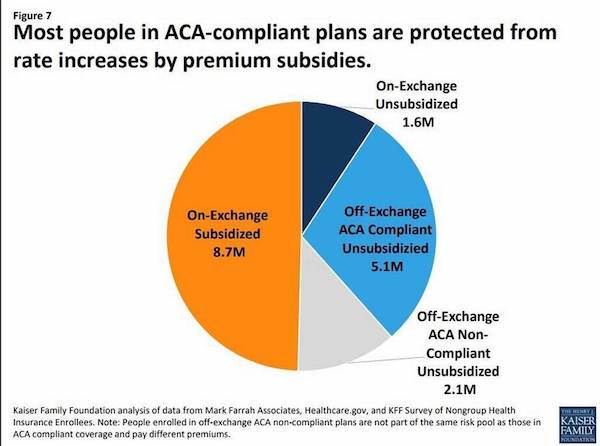
We’re unsure whether Connolly’s comment was just propaganda intended to defend a failing piece of legislation or an intentional, blatant admission that the Department of Health and Human Services just doesn’t care about the majority of Americans, the so-called 1%’ers, who are facing debilitating increases in healthcare costs simply because they manage to live above the poverty line. We’ll let you decide on that one. Be that as it may, as the Miami Herald points out this morning, roughly half of all Obamacare participants, nearly 9 million people in aggregate, don’t qualify for the subsidies that Connolly praised and have been forced to absorb debilitating premium increases for the past several years.

[..] As open enrollment for Affordable Care Act coverage nears the deadline of Dec. 15, and Florida once again leads all states using the federal exchange at healthcare.gov, Heidi and Richard Reiter sit at the kitchen table at their Davie home and struggle to piece together the family’s health insurance for 2018. The Reiters buy their own coverage, but they earn too much to qualify for financial aid to lower their monthly premiums. For 2017, they bought a plan off the exchange and paid $26,000 in premiums for family coverage, including their two sons, ages 21 and 17. Keeping the same coverage for 2018 would have cost the Reiters $40,000 in premiums, a 54% increase. So they selected a lower-priced plan that covers less but costs $29,000 in premiums. “That’s more than a lot of people’s mortgage payments,” Richard Reiter said. “For me, it’s a crisis situation.”

Read more …

The odds of a correction (reversion).

• Sitting Closer To The Exit (Roberts)

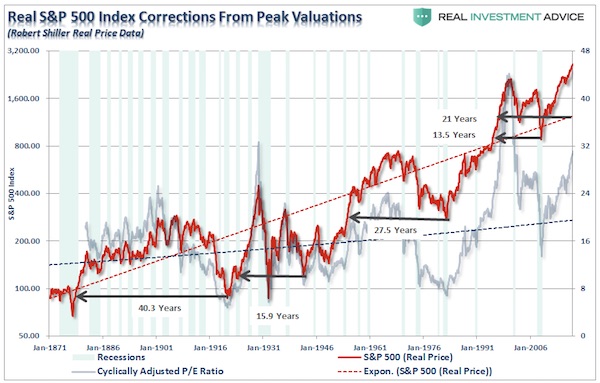
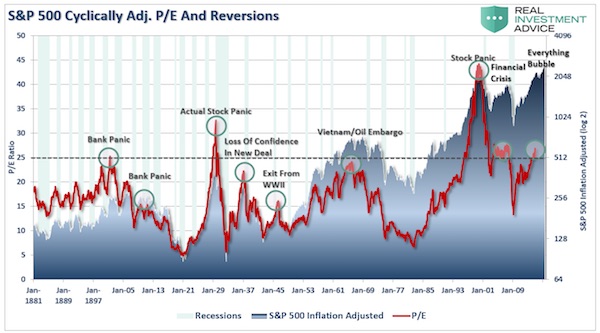
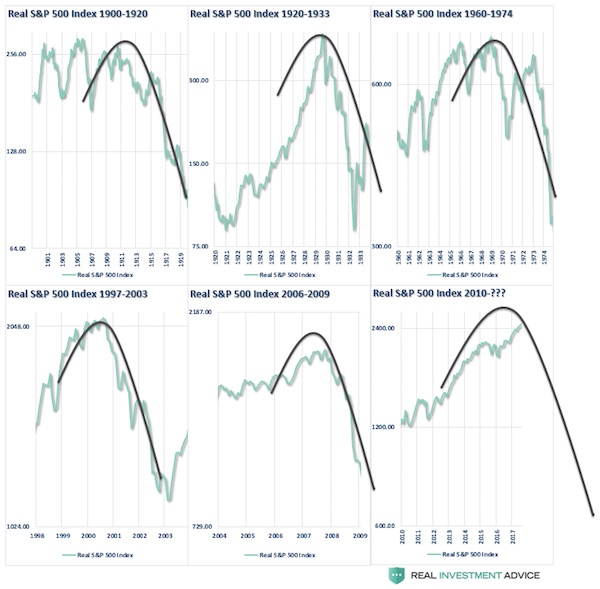
While valuation risk is certainly concerning, it is the extreme deviations of other measures to which attention should be paid. When long-term indicators have previously been this overbought, further gains in the market have been hard to achieve. However, the problem comes, as identified by the vertical lines, is understanding when these indicators reverse course. The subsequent “reversions” have not been forgiving. The chart below brings this idea of reversion into a bit clearer focus. I have overlaid the real, inflation-adjusted, S&P 500 index over the cyclically-adjusted P/E ratio. Historically, we find that when both valuations and prices have extended well beyond their intrinsic long-term trendlines, subsequent reversions beyond those trend lines have ensued. Every. Single. Time.

Importantly, these reversions have wiped out a decade, or more, in investor gains. As noted, if the next correction began in 2018, and ONLY reverts back to the long-term trendline, which historically has never been the case, investors would reset portfolios back to levels not seen since 1997. Two decades of gains lost. With everyone crowded into the “ETF Theater,” the “exit” problem should be of serious concern. “Over the next several weeks, or even months, the markets can certainly extend the current deviations from long-term mean even further. But that is the nature of every bull market peak, and bubble, throughout history as the seeming impervious advance lures the last of the stock market ‘holdouts’ back into the markets.”

Read more …

“..the petrodollar is not the source of the U.S. dollar’s power around the world, but rather the U.S.’s main fulcrum by which to keep competition out of the markets..”

• Oil Producers Turning to Crypto to Solve Sanctions Problems (Luongo)

Last week, Venezuela announced it would develop a national cryptocurrency backed by its oil reserves, the Petro. Now there is a report that Russia is considering the same thing. Iran will likely follow suit. As of right now this is just a rumor, but it makes some sense. So, let’s treat this rumor as fact for the sake of argument and see where it leads us. The U.S. continues to sanction and threaten all of these countries for daring to challenge the global status quo. There is no denying this. [..] at the heart of this is the petrodollar. Contrary to what many believe, the petrodollar is not the source of the U.S. dollar’s power around the world, but rather the U.S.’s main fulcrum by which to keep competition out of the markets. It is a secondary effect of the dollar’s dominance in global finance today. But it is not the main driver.

Financial market are simply too big relative to the size any one commodity market for it to be the fulcrum on which everything hinges. It was that way in the past. But it is not now. That said, however, getting out from underneath the petrodollar gives a country independence to begin building financial architecture that can be levered up over time to threaten the institutional control it helped create. U.S. foreign policy defends the petrodollar along with other systems in place – the IMF, the World Bank, SWIFT, LIBOR and the central banks themselves – to maintain its control. The main oil producers, however, can escape this control simply by selling their oil in currencies other than the U.S. dollar. That’s not enough to dethrone the dollar, but, like I just said, it is where the process has to start. Therefore, any and all means must be employed to defend the dollar empire by keeping everyone inside that system.

[..] The problem with backing any currency with physical reserves is the fluctuations in value of those reserves. It’s not like oil is a low-beta commodity or anything. But, like everything else in the commodity space, price movements are supposed to be smoothed out by the futures markets helping to coordinate price with time. But the bigger problem is the estimation of those reserves the coin’s value is based on. First, how do you accurately quantify them? Can holders of Petro or Neft-coin trust the Russian or Venezuelan governments to provide accurate assessments of their reserves? Second, there is the ability of the country to pull it out of the ground and sell it into the market at anything close to a fair price. This isn’t a concern for Russia, the world’s 2nd largest supplier of oil and very stable government but Venezuela is the opposite. And, its “Petro” would probably trade at quite a discount early on to the dollar price of oil.

Read more …

I doubt it. If only because as Taleb said, you can’t actually short BTC, and they should have introduced options along with futures. They didn’t. This story is far from over.

• Peak Bitcoin Media Mania Yet? (WS)

Bitcoin mania is now everywhere. It’s hard to have a conversation with regular people without sooner or later getting into bitcoin. Some of this is just for fun. Manias breed amazement. Miracles are wonderful to behold. But some of it is pretty serious. “We’ve seen mortgages being taken out to buy bitcoin,” said Joseph Borg, president of the North American Securities Administrators Association and director of the Alabama Securities Commission, on CNBC’s Power Lunch today. “People do credit cards, equity lines,” he said. Bitcoin futures trading started Sunday night on the Cboe futures exchange. Next week, the CME will offer trading in bitcoin futures.

This way, speculators can bet with unlimited derivatives on an unregulated digital entity that is backed by nothing and whose cash trading takes place in unregulated opaque and easily hacked exchanges around the world. But Borg doesn’t think that futures contracts legitimize bitcoin. Innovation and technology always outrun regulation, he said. “You’re on this mania curve. At some point in time there’s got to be a leveling off,” he said. “Cryptocurrency is here to stay. Blockchain is here to stay. Whether it is bitcoin or not, I don’t know.” And so the media mania over bitcoin has become deafening.

Read more …

But there’s definitely a media bubble, even if there’s no BTC one yet.

• Bitcoin – Millennials’ “Fake Gold” (Katsenelson)

If you cannot value an asset you cannot be rational. With Bitcoin at $11,000 today, it is crystal clear to me, with the benefit of hindsight, that I should have bought Bitcoin at 28 cents. But you only get hindsight in hindsight. Let’s mentally (only mentally) buy Bitcoin today at $11,000. If it goes up 5% a day like a clock and gets to $110,000 – you don’t need rationality. Just buy and gloat. But what do you do if the price goes down to $8,000? You’ll probably say, “No big deal, I believe in cryptocurrencies.” What if it then goes to $5,500? Half of your hard-earned money is gone. Do you buy more? Trust me, at that point in time the celebratory articles you are reading today will have vanished. The awesome stories of a plumber becoming an overnight millionaire with the help of Bitcoin will not be gracing the social media.

The moral support – which is really peer pressure – that drives you to own Bitcoin will be gone, too. Then you’ll be reading stories about other suckers like you who bought it at what – in hindsight – turned out to be the all-time high and who got sucked into the potential for future riches. And then Bitcoin will tumble to $2,000 and then to $100. Since you have no idea what this crypto thing is worth, there is no center of gravity to guide you or anyone else to make rational decisions. With Coke or another real business that generates actual cash flows, we can at least have an intelligent conversation about what the company is worth. We can’t have one with Bitcoin. The X times Y = Z math will be reapplied by Wall Street as it moves on to something else.
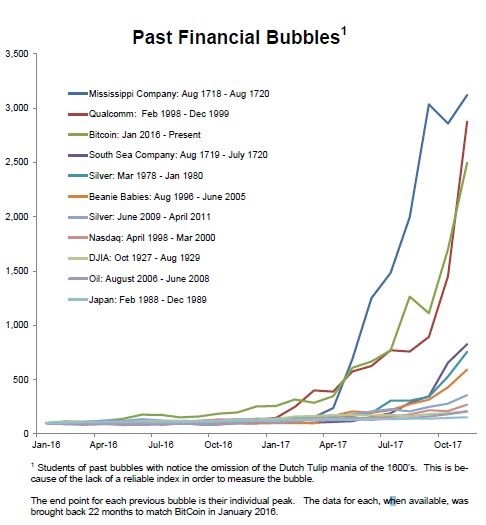
People who are buying Bitcoin today are doing it for one simple reason: FOMO – fear of missing out. Yes, this behavior is so predominant in our society that we even have an acronym for it. Bitcoin is priced today at $11,000 because the fool who bought it for $11,000 is hoping that there is another, greater fool who will pay $12,000 for it tomorrow. This game of greater fools is not new. The Dutch played it with tulips in the 1600s– it did not end well. Americans took the game to a new level with dotcoms in the late 1990s – that round ended in tears, too. And now millennials and millennial-wannabes are playing it with Bitcoin and few hundred other competing cryptocurrencies.

The counterargument to everything I have said so far is that those dollar bills you have in your wallet or that digitally reside in your bank account are as fictional as Bitcoin. True. Currencies, like most things in our lives, are stories that we all have (mostly) unconsciously bought into. Of course, society and, even more importantly, governments have agreed that these fiat currencies are going to be the means of exchange. Also, taxation by the government turns the dollar bill “story” into a very physical reality: If you don’t pay taxes in dollars, you go to jail. (The US government will not accept Bitcoins, gold, chunks of granite, or even British pounds).

Read more …

Compared to Japan, all other central banks are wimps and pussies.

• Next Bank of Japan Governor Faces a ‘Job From Hell’ (BBG)

The next governor of the Bank of Japan faces a “job from hell.” That’s according to Takeshi Fujimaki, a banker-turned-lawmaker who sees any attempt by Japan’s central bank to exit its program of unprecedented easing as triggering a Greek-like debt crisis. “This is the calm before the battle,” Fujimaki, an opposition Japan Innovation Party politician who once served briefly as an adviser to George Soros, said in an interview at his Tokyo office on Monday. BOJ Governor Haruhiko Kuroda’s five-year term runs out in April, with recent praise from Prime Minister Shinzo Abe strengthening expectations that the 73-year-old will stay on for a second stint. His massive easing program has weakened the yen, bolstered exports and helped stock prices to more than double. But inflation is still short of the government’s 2% target, and critics say the BOJ’s swollen balance sheet is unsustainable.

Fujimaki, 67, said he agreed with the view expressed by Kuroda’s predecessor Masaaki Shirakawa in his 2013 resignation press conference, when he said no judgment could be made on non-traditional monetary easing in Japan and in other developed economies until exits had been completed. Last week, Kuroda said the BOJ can take the appropriate steps to exit when the time comes, but talking specifics of an exit now would end up confusing markets. Even so, Fujimaki said Kuroda should stay on to oversee an exit from the policies he introduced. “Because Mr. Kuroda has taken it this far, he should carry on until the end,” Fujimaki said. “Just taking the good part and running away would be unfair.”

Read more …

“(SEB) says 63% of households in Stockholm now expect prices to decline in the coming year while only 21% expect an increase; that’s “a dramatic shift compared with only two months’ ago..”

• Sweden: More Signs The World’s Biggest Housing Bubble Is Cracking (ZH)

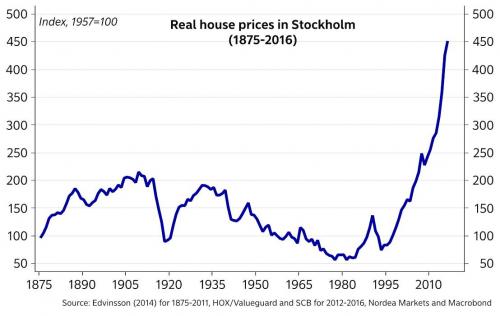
We like to highlight that although Sweden’s property bubble is not the longest running (that accolade goes to Australia at 55 years), it is probably the world’s biggest, even though it gets relatively little coverage in the mainstream financial media. A month ago, we noted that SEB’s housing price indicator suffered its second biggest ever drop, falling by 39 points, only lagging a steeper fall from ten years earlier. This month the indicator, which shows the balance between households forecasting rising or falling prices, fell into negative territory, dropping to -5 from +11 in November. Households expecting prices to rise has almost halved from 66% In October, to 43% in November and 36% this month. The percentage of households expecting prices to fall has risen from 16% in October, to 32% in November and 41% this month.

After the housing price indicator was published, the Swedish krona fell as much as 0.7% versus the Euro to 10.0118, its lowest level since 5 December 2017. Not surprisingly, the focal point of Sweden’s property boom has been Stockholm, where the decline in the housing price indicator in December 2017 was precipitous. According to Bloomberg. “SEB says sharp drop in home-price expectations in Stockholm was main culprit behind the decline in its Swedish home-price indicator, with the indicator falling to -42 in the Swedish capital in Dec. from -6 in Nov. That means the Stockholm indicator is now close to the record low of -47 that was reached in Dec. 2008, at the height of the global financial crisis. (SEB) says 63% of households in Stockholm now expect prices to decline in the coming year while only 21% expect an increase; that’s “a dramatic shift compared with only two months’ ago..”

Given the disproportionate rate of decline in December in Stockholm, SEB was minded to ask whether special factors are at work “rather than general drivers such as fears over rising interest rates or a weak business cycle”. Indeed, aside from south-eastern Sweden, the outlook in all other regions remains positive. With regard to Stockholm, the bank notes that a large increase in new supply of expensive residential property and what it terms “very negative media reporting” have had an impact. Whether that’s a fair assessment, or whether it’s realist reporting of a monumental asset bubble is a moot point. What is indisputable is that the number of Swedish homes for sale has surged in November 2017 compared with the same month last year.

Read more …

After talking to Musk and Bezos. Who target billions in profits from the bridges to nowhere on steroids.

• Trump Tells NASA to Send Americans to the Moon (AFP)

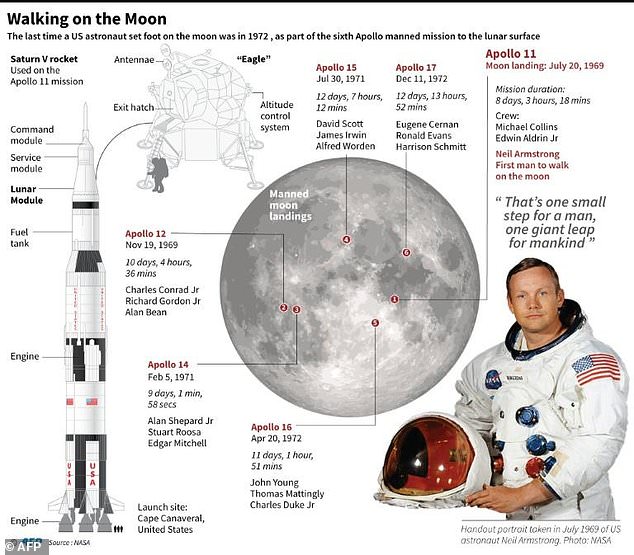
US President Donald Trump directed NASA on Monday to send Americans to the Moon for the first time since 1972, in order to prepare for future trips to Mars. “This time we will not only plant our flag and leave our footprint,” Trump said at a White House ceremony as he signed the new space policy directive. “We will establish a foundation for an eventual mission to Mars and perhaps someday to many worlds beyond.” The directive calls on NASA to ramp up its efforts to send people to deep space, a policy that unites politicians on both sides of the aisle in the United States. However, it steered clear of the most divisive and thorny issues in space exploration: budgets and timelines.

Space policy experts agree that any attempt to send people to Mars, which lies an average of 140 million miles (225 million kilometers) from Earth, would require immense technical prowess and a massive wallet. The last time US astronauts visited the Moon was during the Apollo missions of the 1960s and 1970s. Trump, who signed the directive in the presence of Harrison Schmitt, one of the last Americans to walk on the Moon 45 years ago, said “today, we pledge that he will not be the last.” The better known Buzz Aldrin, the second man on the Moon after Armstrong and a fervent advocate of future space missions, was also present at the ceremony but not mentioned by Trump during his speech.

[..] Trump vowed his new directive “will refocus the space program on human exploration and discovery,” and “marks an important step in returning American astronauts to the Moon for the first time since 1972.” The goal of the new Moon missions would include “long-term exploration and use” of its surface. “We’re dreaming big,” Trump said. His administration has previously held several meetings with SpaceX boss Elon Musk and Amazon owner Jeff Bezos, who also owns Blue Origin.

Read more …

The article has two authors, and at least one editor (Reuters), and still it says this: “world temperatures are likely to rise by more than 2 degrees Celsius (35.6°F) this century..

• Exxon To Provide Details On Climate Change Impact To Its Business (R.)

Exxon Mobil on Monday said it would publish new details about how climate change could affect its business in a move aimed at appeasing critics and forestalling another proxy fight next year. The largest U.S. oil and gas producer said in a filing to U.S. securities regulators that its board agreed to provide shareholders with information on “energy demand sensitivities, implications of two degree Celsius scenarios, and positioning for a lower-carbon future.” Scientists have warned that world temperatures are likely to rise by more than 2 degrees Celsius (35.6°F) this century, surpassing a “tipping point” that a global climate deal aims to avert. Exxon’s statement, which came three days before the deadline for its 2018 annual meeting resolution submissions, said additional information would be released in the near future, but did not provide details.

The company’s board originally opposed providing shareholders with a report outlining the potential impact of global warming on Exxon’s long-term outlook. Thomas P. DiNapoli, New York state’s comptroller, heads one the two lead sponsors of a shareholder resolution calling for Exxon to issue a climate-impact report. He called Monday’s decision “a win for shareholders and for the company’s ability to manage risk.” However, another sponsor noted the lack of specificity in the company’s statement. “This is giving no detail,” said Tim Smith, who leads shareholder engagement efforts at Walden Asset Management, a co-filer of last spring’s resolution. He said Exxon’s statement “needs to be expanded to assure shareowners that they’re responsive to last year’s request.”

Read more …

Apple, Exxon, everybody seeks to escape their own shareholders.

• Apple Aims To Block Climate, Rights Using SEC Guidance (R.)

Apple is pushing back on shareholder proposals on climate issue and human rights concerns, an effort activists worry could sharply restrict investor rights. In letters to the U.S. Securities and Exchange Commission last month, an attorney for the California computer maker argued at least four shareholder proposals relate to “ordinary business” and therefore can be left off the proxy Apple is expected to publish early next year, ahead of its annual meeting. The attorney, Gene Levoff, cited guidance issued by the SEC on Nov. 1 saying that company boards are generally best positioned to decide if a resolution raises significant policy issues worth putting to a vote.

While companies routinely seek permission to skip shareholder proposals, Apple’s application of the new SEC guidance shows how it could be used to ignore many investor proposals by claiming boards routinely review those areas, said Sanford Lewis, a Massachusetts attorney representing Apple shareholders who had filed two of the resolutions. Were the SEC to side with Apple, “this would be an incredibly dangerous precedent that would essentially say a great many proposals could be omitted,” Lewis said. [..] Often seen as distractions in the past, shareholder measures have taken on new significance as big asset managers increasingly back those on areas like climate change or board diversity.
Apple cited the SEC’s new guidance among other things in seeking to omit the shareholder measures from its proxy, according to letters Apple sent to the SEC. These include calls for Apple to take steps such as establishing a “human rights committee” to address concerns on topics like censorship, and for Apple to report on its ability to cut greenhouse gas emissions.
Read more …

Tusk against the rest. Couldn’t be because he’s Polish, could it? And looking at big jobs back home?!
• EU Could ‘Scrap Refugee Quota Scheme’ (G.)

The EU could scrap a divisive scheme that compels member states to accept quotas of refugees, one of the bloc’s most senior leaders will say this week. The president of the European council, Donald Tusk, will tell EU leaders at a summit on Thursday that mandatory quotas have been divisive and ineffective, in a clear sign that he is ready to abandon the policy that has created bitter splits across the continent. Tusk will set a six-month deadline for EU leaders to reach unanimous agreement on reforms to the European asylum system, but will propose alternatives if there is no consensus. “If there is no solution … including on the issue of mandatory quotas, the president of the European council will present a way forward,” states a draft letter from Tusk to national capitals, seen by the Guardian.

In effect this means scrapping mandatory quotas, because Hungary, Poland and Czech Republic are fiercely opposed to the idea of dispersing refugees around the bloc based on a formula drawn up in Brussels. Tusk is likely to face opposition, however, from other EU bodies, including the European commission. EU leaders introduced compulsory quotas in 2015 at the height of the migration crisis, as thousands of people arrived daily on Europe’s shores, many of whom were refugees from Syria, Iraq and Eritrea. Hungary, Slovakia, Romania and the Czech Republic voted against the move, but the policy was forced through by a majority vote. Hungary and Poland have defied the rest of the EU by not taking a single refugee under the scheme, which aimed to relocate about 120,000 refugees, mainly Syrians. The Czech republic has taken in only 12. All three countries were referred to the European court of justice last week for failing to implement the policy, the usual procedure for flouting EU rules.

Read more …

All refugees living on Lesbos should be evacuated.

• Lesvos Authorities Block Ship With Container Homes For Refugees (AP)

Authorities on the Greek island of Lesvos say they have blocked a ship carrying container homes for refugees and other migrants in protest at the refusal of the government and the European Union to move more people to Greece’s mainland. A government-chartered ship carrying the containers remained anchored at Mytilene, the island’s main town, on Monday after municipal vehicles were used to block port facilities. The island’s municipal board was due to meet later on Monday to decide on whether to lift the blockade following talks with the government, state-run TV ERT said. The mayors of five Greek islands facing the coast of Turkey are demanding that the government and EU end a policy of containment for migrants – introduced last year as a deterrent against illegal migration – because living facilities are severely overcrowded.

Read more …

Merkel, the story of a great and bitter failure.

• Germany Rejects Additional Winter Aid For Refugees On Greek Islands (KTG)

The German Foreign Ministry has made it clear that it will not provide additional winter assistance to refugees on the Aegean islands. In a related question from German newspapers, the foreign ministry replied that “responsibility for accommodating and feeding refugees falls under the jurisdiction of each country.” According to dpa, the Foreign Ministry recalled that Berlin recently funded the installation of 135 heated containers for a total of 800 people in two camps in the Thessaloniki region and that the EU has allocated up to now 1.4 billion euros to tackle the refugee crisis in Greece.

Meanwhile, there is media report that Greece has persuaded Turkey to accept migrant returns from the mainland in order to reduce critical overcrowding in its refugee camps. The Kathimerini daily said the agreement came during a strained two-day state visit by Turkish President Recep Tayyip Erdogan this week, during which he angered his hosts with talk of revising borders and complaints about Greece’s treatment of its Muslim minority. The deal is in addition to Turkey’s existing agreement to take back migrants from Aegean island camps, under the terms of an EU-Turkey pact.

Read more …

Dec 102017
 
 December 10, 2017  Posted by at 10:22 am Finance Tagged with: , , , , , , , , , ,  8 Responses »


Robert Frank Motorama, Los Angeles 1956


• Peak Fantasy Time (David Stockman)
• Deflation Remains Biggest Threat As Lofty Stock Markets Head Into 2018 (F.)
• Global Powers Lobby To Stop Special Brexit Deal For UK (G.)
• The US Media Yesterday Suffered its Most Humiliating Debacle in Ages (GG)
• Principles of Political Economy: The Opening Lines (Steve Keen)
• Half A Salary, Half A Job, Half A Life (K.)
• Erdogan, Tsipras Strike Secret Deal On Refugees (K.)
• Refugee Arrivals in Greece Offset Decongestion Efforts (K.)
• Super Rich Shown To Have Grown Out Of Ancient Farming (G.)
• India Gov. Files Suits Against Monsanto et al Over Bollworm Cotton Attack (VoI)


Politics is the entertainment division of the military industrial complex.
-Frank Zappa

The decline in quality of jobs -and compensation- is as horrible as the jobs reports’ attempts at hiding that decline.

• Peak Fantasy Time (David Stockman)

If you want to know why both Wall Street and Washington are so delusional about America’s baleful economic predicament, just consider this morsel from today’s Wall Street Journal on the purportedly awesome November jobs report. “Wages rose just 2.5% from a year earlier in November—near the same lackluster pace maintained since late 2015, despite a much lower unemployment rate. But in a positive sign for Americans’ incomes, the average work week increased by about 6 minutes to 34.5 hours in November…. November marked the 86th straight month employers added to payrolls.” Whoopee! Six whole minutes added to a work week that has been shrinking for decades owing to the relentlessly deteriorating quality mix of the “jobs” counted by the BLS establishment survey.

In fact, even by that dubious measure, the work week is still shorter than it was at the December 2007 pre-crisis peak (33.8) and well below its 2000 peak level. The reason isn’t hard to figure: The US economy is generating fewer and fewer goods producing jobs where the work week averages 40.5 hours and weekly pay equates to $58,400 annually and far more bar, hotel and restaurant jobs, where the work week averages just 26.1 hours and weekly pay equates to only $21,000 annually. In other words, the ballyhoed headline averages are essentially meaningless noise because the BLS counts all jobs equal – that is, a 10-hour per week gig at the minimum wage at McDonald’s weighs the same as a 45 hour per week (with overtime) job at the Caterpillar plant in Peoria that pays $80,000 annually in wages and benefits.

In fact, what has been the weakest expansion in history by far may now be finally running out of gas. During the last several weeks the pace of US treasury payroll tax collections has actually dropped sharply – and it is ultimately Uncle Sam’s collection box which gives the most accurate, concurrent reading on the state of the US economy. Some 20 million employers do not tend to send in withholding receipts for the kind of phantom seasonally maladjusted, imputed and trend-modeled jobs which populate the BLS reports.

Yet we we are not close to having recovered the 4.3 million goods producing jobs lost in the Great Recession; 40% of them are still AWOL – meaning they are not likely to be recovered before the next recession hits. Stated differently, the US economy has been shedding high paying goods producing jobs ever since they peaked at 25 million way back in 1980. Indeed, we are still not even close to the 24.6 million figure which was posted at the turn of the century.

By contrast, the count of leisure and hospitality jobs( bars, hotels and restaurants), or what we have dubbed the “Bread and Circuses Economy” keeps growing steadily, thereby filling up the empty space where good jobs have vacated the BLS headline total. Thus, when goods-producing jobs peaked at 25 million back in 1980, there were only 6.7 million jobs in leisure and hospitality. Today that sector employs 16.0 million part-time, low-pay workers..

Read more …

“.. the Fed has erroneously predicted 2% inflation for 66 months and continues to tell us that the low levels of inflation are “transitory.“

• Deflation Remains Biggest Threat As Lofty Stock Markets Head Into 2018 (F.)

In the two weeks running up to the passage of the Senate’s version of the tax bill, the equity markets moved significantly depending on how any particular Republican senator intended on voting. Then, when the Senate finally passed the bill on the next business day, markets made new intra-day record highs, but then reversed course. Given the current sky-high market valuation levels, the tax benefits are already priced in. Economist David Rosenberg examined market reaction to the five major tax bills of the last 70 years. He found that, on average, the S&P 500 rises 14.3% (median 18.9%) in the year leading up to the passage of the tax legislation. In the year following, on average, the index falls 7.5% (median 13.1%). It could be he is on to something.

If it has been historically easy money that has propelled the U.S. and every other major stock market to record heights over the past few years, then it is noteworthy that the last 12 moves from the world’s central banks have been tightening moves. We know that the Fed is certain to tighten next week at its December 12-13 meeting. This, despite the fact that the Fed’s governing board is deeply divided on the outlook for interest rates and inflation. According to their own minutes, some Fed-governing members continue to hold to the academic view that the Phillips curve (i.e., inflation always rises when the unemployment rate is low) is alive and well. Under this view, inflation is just around the corner and the Fed had better be pre-emptive, lest inflation get ahead of them.

The other view is that today’s economy exhibits behaviors that are significantly different from those that dominated the 60+ years of post-WWII America, and that inflation is no longer the threat it used to be. In fact, deflation may be a bigger threat, especially given the high and rising debt levels. Regular readers know that I have espoused the latter viewpoint. I have pointed out several times that the Fed has erroneously predicted 2% inflation for 66 months and continues to tell us that the low levels of inflation are “transitory.” Fed Chair-Elect Powell espoused this viewpoint in his confirmation hearing, so, there is not much hope that they Fed will back off.

Read more …

US, Canada et al don’t want any special treatment for Britain. But that’s not their decision.

• Global Powers Lobby To Stop Special Brexit Deal For UK (G.)

Theresa May’s hopes of securing a unique post-Brexit trade deal with the EU were under threat on Saturday night as Brussels said it was coming under international pressure to deny Britain special treatment. After a week that saw May reach a deal with the EU that will allow Brexit talks to move forward on to future trade relations, EU officials insisted a bespoke deal more favourable to the UK than other non-EU nations was out of the question. One EU source close to the talks said: “We have been approached by a number of [non-member] countries expressing concerns and making it clear that it would constitute a major problem for them if suddenly the UK were to get better terms than they get.”

The official said that once the UK is out of the single market and customs union in March 2019, there could be no replication of the terms of the current trading relationship, or anything close to it, and no special treatment. “It is not just an indication of some strange rigid principle. It is because things won’t work,” he said. “First and foremost we need to stick to this balance of rights and obligations, otherwise we will be undermining our own customs union and single market. Second, we cannot upset relations with other third countries,” the official said. “If we were to give the UK a very lopsided deal, then the other partners with whom we have been engaging and who entered into balanced agreements would come back and question those agreements.”

Read more …

Julian Assange on Twitter: “Is the fake news story about @WikiLeaks yesterday the worst since Iraq? It’s a serious question. Three outlets, CNN, NBC and ABC all independently “confirmed” the same false information. Has there previously been a serious triple origin fake news story? i.e not just re-reporting.”

• The US Media Yesterday Suffered its Most Humiliating Debacle in Ages (GG)

Friday was one of the most embarrassing days for the U.S. media in quite a long time. The humiliation orgy was kicked off by CNN, with MSNBC and CBS close behind, with countless pundits, commentators and operatives joining the party throughout the day. By the end of the day, it was clear that several of the nation’s largest and most influential news outlets had spread an explosive but completely false news story to millions of people, while refusing to provide any explanation of how it happened. The spectacle began on Friday morning at 11:00 am EST, when the Most Trusted Name in News™ spent 12 straight minutes on air flamboyantly hyping an exclusive bombshell report that seemed to prove that WikiLeaks, last September, had secretly offered the Trump campaign, even Donald Trump himself, special access to the DNC emails before they were published on the internet.

As CNN sees the world, this would prove collusion between the Trump family and WikiLeaks and, more importantly, between Trump and Russia, since the U.S. intelligence community regards WikiLeaks as an “arm of Russian intelligence,” and therefore, so does the U.S. media. This entire revelation was based on an email which CNN strongly implied it had exclusively obtained and had in its possession. The email was sent by someone named “Michael J. Erickson” – someone nobody had heard of previously and whom CNN could not identify – to Donald Trump, Jr., offering a decryption key and access to DNC emails that WikiLeaks had “uploaded.”

Read more …

Steve is busy introducing economics to energy. Another thing the entire field entirely overlooked.

• Principles of Political Economy: The Opening Lines (Steve Keen)

Labor without Energy is a Corpse; Capital without Energy is a Statue

Economics went astray from the very first sentence of Adam Smith’s Wealth of Nations in 1776: “The annual labour of every nation”, Smith asserted, “is the fund which originally supplies it with all the necessaries and conveniences of life which it annually consumes, and which consist always, either in the immediate produce of that labour, or in what is purchased with that produce from other nations.” This paragraph mimicked the structure, and even the cadence (though not the brevity), of the opening sentence of Richard Cantillon’s 1730 treatise Essai sur la Nature du Commerce en Général (which Smith read). However, Smith made one crucial substitution: he asserted that “Labor … is the fund” from which our wealth springs, whereas Cantillon asserted that it was Land:

“Land”, Cantillon began, “is the source or matter from which all wealth is drawn; man’s labor provides the form for its production, and wealth in itself is nothing but the food, conveniences, and pleasures of life.” (21) Both these assertions are strictly false. The true source of the wealth that humanity has generated from production is neither Labor nor Land, but the Energy that humanity’s production systems harness and turn into useful work (now known as “Exergy”). However, Smith’s assertion is irredeemably false, whereas Cantillon’s merely needs generalization to make it consistent with the fundamental laws of the universe known as the Laws of Thermodynamics. These Laws are still poorly known by economists, which in part explains why economic theory has managed to be in conflict with them for so long. Illustrating why this is so, and why it is crucial, will take time, and effort on your part too to understand them (if you do not already).

But the fact that no theory that contradicts them can be taken seriously, was stated eloquently by the physicist Arthur Eddington in his 1928 book for lay readers The Nature of the Physical World: The law that entropy always increases—the second law of thermodynamics—holds, I think, the supreme position among the laws of Nature. If someone points out to you that your pet theory of the universe is in disagreement with Maxwell’s equations—then so much the worse for Maxwell’s equations. If it is found to be contradicted by observations—well, these experimentalists do bungle things sometimes. But if your theory is found to be against the second law of thermodynamics I can give you no hope; there is nothing for it but to collapse in deepest humiliation. (37)

Read more …

Life in Greece. Every day gets worse.

• Half A Salary, Half A Job, Half A Life (K.)

Two in three Greeks fail to pay their bills on time, mainly because they don’t have the money. Three in 10 private sector workers, meanwhile, work part time and get paid a salary of 407.15 euros a month, on average. The first case puts Greece at the top of the list of EU countries in terms of citizens that don’t keep up with their bills, according to the European Consumer Payment Report 2017, with the main reason being the lack of money. In the rest of Europe, the main causes of delays are simple absentmindedness or forgetfulness. The second case is something entirely different. In one sense, it can be interpreted as a reduction in unemployment, which dropped to 20.5% in September. Basically, unemployment falls as part-time work rises, with 30.6% of employees in the private sector working such jobs.

Is this something to be glad about? Should we welcome it as an improvement in the country’s economy? Flexible forms of labor that bring in a pittance of a salary strengthen the ranks of the nouveau pauvre, but at the same time bring down unemployment – albeit dragging down every index that points to a normal life along with it. This is the new normal. But how can 400 euros a month possibly be considered normal? We are beyond the viral videos of the first months of the crisis, of frenzied officials claiming that children were fainting of hunger at school, of images of people rummaging through trash cans looking for food, of pensioners falling over each other for a bag of free potatoes and other such dramatic scenes, real or contrived, that appeared on screens all over the world, and which the present government is quick to claim no longer exist.

Today, some really “lucky” Greeks are insured and have a daily wage of 51 euros, adding up to 1,193 euros a month. But the majority, the less fortunate – yet still fortunate enough to have a job – need to make do with 400 euros a month. It is a conundrum that requires a good deal of math. This month you’ll pay the water bill but not the electricity, you’ll limit your purchases to the bare essentials and you’ll adapt your diet to your budget. What’s left after that? A constant knot in your stomach that you have to learn to put up with. You won’t faint in the street, but each day will be a struggle. You will die a little bit inside, but this is not a measurable reaction and the indices don’t care. Neither does the government, whose slogan when it was in the opposition was that there are real people behind the data. Now the only number it cares to talk about is the shrinking unemployment rate.[..]

The line that defines normal is constantly being shifted and with it the definition of poverty.

Read more …

Erdogan was in Greece the past week and tried to stir up as much shit as he could. Refugees remain his main weapon.

• Erdogan, Tsipras Strike Secret Deal On Refugees (K.)

As pressure due to overcrowding continues to build at reception centers for migrants on the islands of the eastern Aegean, Turkish President Recep Tayyip Erdogan accepted a request by Prime Minister Alexis Tsipras that Turkey take back migrants from the Greek mainland as well as the islands, Kathimerini understands. During a joint press conference with Erdogan on Thursday, Tsipras declared that “new measures have been agreed for cooperation in the context of the European Union-Turkey agreement,” referring to a deal signed between Ankara and Brussels in March 2016 to curb human trafficking across the Aegean. Tsipras’s comments spurred much speculation about what those measures might be. It appears that they would involve triggering the return of migrants to Turkey, a process that has largely halted as new arrivals often lodge applications for asylum, a lengthy process.

Thousands of migrants, particularly those deemed to be the most vulnerable such as children, pregnant women and the elderly, have already been transferred from cramped facilities on the islands to the mainland. But conditions remain overcrowded at the island camps amid a constant stream of new arrivals from neighboring Turkey. What remains unclear is whether officials in Brussels have approved the deal; as it stands, it would basically undermine the basis of last year’s EU-Ankara agreement, according to which migrants should remain on the islands until a decision has been reached on their status (whether they are considered to belong to vulnerable groups meriting priority treatment, to be granted asylum etc). In recent comments, Dutch Ambassador in Athens Caspar Veldkamp expressed concerns about the prospects of mass relocations to the mainland if returns are not being made to Turkey, noting that this could undermine the EU-Turkey deal and encourage human smugglers rather than averting them.

For the leftist-led government, however, moving migrants from cramped facilities to mainland camps would appease those in the party concerned about inhumane conditions on the islands. As winter looms, and hundreds of migrants continue to live in tents around the reception centers, Migration Minister Yiannis Mouzalas has conceded that he could not rule out the risk of people dying from hypothermia. In an interview with Der Spiegel that was published on Friday, Mouzalas said that authorities were making preparations to ensure that island camps are ready to deal with plunging temperatures. Everything should be in place by December 15, he said. “The key though is the number of new arrivals,” he said, adding that if there is no large increase in numbers “then we are well prepared.” Authorities might reserve some rooms at local hotels if necessary, he said.

Read more …

Haven’t heard this one before, and it feels like an ominous sign: “Migration Minister Yiannis Mouzalas told Germany’s Spiegel Online that he cannot guarantee that no one will die in the camps with the onset of winter.”

• Refugee Arrivals in Greece Offset Decongestion Efforts (K.)

The effort to improve the living conditions of refugees and migrants stranded at overcrowded reception centers on the eastern Aegean islands of Lesvos, Chios and Samos by transferring some of them to the mainland will fail to yield the desired result as long as flows from Turkey continue. In its latest report, the UNHCR said that 17,764 people were transferred from the islands to the mainland in the period from July 2016 to November 2017. UNHCR sources clarified, however, that the number of those removed from the islands is significantly higher than the official figure. Many of the people who have completed the necessary procedures or are deemed to be vulnerable, and as such are allowed to depart for the mainland, do so at their own cost, the same sources said.

They also reckoned that in 2016 around 40% of transfers were conducted by the UNHCR but the%age rose to 80% in 2017 after a request by the Migration Policy Ministry. At the same time, however, in the period between early April 2016, when Ankara and Brussels reached a deal to limit migrant flows into Europe, until late November, some 48,600 people arrived in Greece. In November, 3,800 people arrived on the Greek islands from Turkey, while 2,128 asylum seekers were transferred to the mainland in the same month. The Migration Policy Ministry on Saturday dismissed rumors on Chios that there are plans for the immediate removal of some 1,000 people from the Vial hotspot. It said that removals will take place gradually.

Meanwhile, Migration Minister Yiannis Mouzalas told Germany’s Spiegel Online that he cannot guarantee that no one will die in the camps with the onset of winter. “What we can do,” he said, “is try the utmost to prevent death.” Moreover, the German newspaper Bild said that an increasing number of refugees in Greece are trying to get to other European Union countries using forged passports.

Read more …

There are multiple pieces coming out lately that prove the obvious: once mankind started gathering surpluses, hierarchies developed, and so did inequality.

• Super Rich Shown To Have Grown Out Of Ancient Farming (G.)

To measure relative wealth in a society, the team worked with archaeologists studying 62 different societies in Europe, Asia and North America. Some of these were up to 10,000 years old and included digs in ancient Babylonia, Catalhoyuk (now in Turkey) and Pompeii. Researchers analysed the sizes of houses at these sites and used these as indicators of the variations of wealth that existed there at any one time. “House size gives a very good indication of wealth,” said Smith. This point was backed by Kohler. “We consider house size to be a proxy for wealth.” The figures produced by these analyses provided the team with an indication of a particular society’s wealth. The greater the diversity in house size, the greater the inequality. In turn this disparity was measured using a system based on the Gini coefficient.

“Gini coefficients range from zero for societies in which each person has exactly the same amount of wealth to a society in which a single person owns the resources of an entire society. Such a society would have a Gini coefficient of one,” Kohler said. The team found that ancient farming societies had an inequality with a coefficient of around 0.35. That is a higher level of inequality than the level that is likely to have existed in earlier millennia when humans lived as hunter gatherers and shared many resources. “However, this inequality among these, the first farmers, is an awful lot less than the inequality you find in the US today,” said Kohler. “Here we have a Gini coefficient of around 0.8 today.” In the ancient farms of the New World, inequality stayed more or less the same. However, in Eurasia it started to climb over time until it reached levels of around 0.6 a few thousand years ago. This rise coincides with the introduction of oxen and horses and their exploitation in the ploughing of fields.

Read more …

More. Monsanto. Mayhem.

• India Gov. Files Suits Against Monsanto et al Over Bollworm Cotton Attack (VoI)

The Maharashtra government on Friday announced that it would file police complaints against seed companies like Monsanto, which supplied seeds of BT Cotton, the crops from which were destroyed in a large-scale bollworm attack. Maharashtra’s Revenue Minister Chandrakant Patil said on Friday more than 70% of the cotton crop in Vidarbha has been destroyed due to the bollworm attack. He added that companies like Monsanto had provided the BT Cotton seeds with the promise that they were immune to attacks by the pest. The Vasantrao Naik Shetkari Swavalamban Mission, a state government body, has estimated that the output of cotton in Maharashtra would fall to 43.10 lakh quintal as compared to 78.61 quintals in December 2016.

The opposition parties are however demanding that the Maharashtra government pay compensation to cotton farmers on the lines of the ongoing farm loan waiver extended to cultivators. The Nationalist Congress Party is demanding that the government provide a compensation of Rs 25,000 per hectare for farmers whose crop has been destroyed in the bollworm attack. NCP leader Dhananjay Munde said his party would hold protests in the cotton-growing areas of Vidarbha to force the government raise compesation to farmers. With the opposition parties likely to paralyse the state legislature during the Winter Session to be held in Nagpur from Monday, Chief Ministre Devendra Fadnavis’s government on Friday asked revenue officials to carry out panchnama of crops destroyed in the bollwork attack. “We are working on a compensation package for farmers,” Patil told reporters.

Read more …


Politics is the entertainment division of the military industrial complex.
-Frank Zappa


Dec 062017
 
 December 6, 2017  Posted by at 9:28 am Finance Tagged with: , , , , , , , , , , ,  6 Responses »


Balthus Therèse dreaming 1938


• Just How Big Could The Next Correction Be? (Roberts)
• Second Canadian Mortgage Lender Crashes After Admitting Mortgage Fraud (ZH)
• Toronto Housing Prices Fall Amid Growing Pool of Homes for Sale (BBG)
• Plunder Capitalism (Paul Craig Roberts)
• ‘We Can’t Go On Like This’: Resignation In EU As Brexit Talks Stutter (G.)
• Theresa May Faces New Brexit Revolt From Boris Johnson (BBG)
• Most Brits Still Want Brexit But Expect It All to End Badly (BBG)
• Juncker Seeks Greater Commission Control over Eurozone (Spiegel)
• What Now? (Jim Kunstler)
• The Premature Delisting of the Yellowstone Grizzly Bear (CP)
• Greek Pension Cuts To Hit 70% Since The Start Of The Bailouts (K.)
• Aid Groups Warn Of Looming Emergency At Greek Asylum Centres (G.)
• Europe’s Migrant Crisis: Millions Still to Come (Kern)
• US Homeless Population Rises For The First Time Since The Great Recession (G.)
• Nearly 130,000 British Children To Wake Up Homeless This Christmas (Ind.)


From a larger article by Lance, This is Nuts. A 40% crash is starting to sound like a lowball.

• Just How Big Could The Next Correction Be? (Roberts)

Just how big could the next correction be? As stated above, just a correction back to the initial “critical support” set at the 2016 lows would equate to a 29.1% decline. However, the risk, as noted above, is that a correction of that magnitude would begin to trigger margin calls, junk bond defaults, blow up the “VIX” short-carry and trigger a wave of automated selling as the algorithms begin to sell in tandem. Such a combination of events could conceivably push markets to either strong support at the previous two bull market peaks or to support at the 2011 peak which coincides with the topping formations of 2000 and 2007. Such a correction would entail either a 41.1% to 49.2% decline.

I won’t even mention the remote, but real, possibility of a nearly 75% retracement to the previous lows of the last two “bear markets.” That can’t happen you say? It wouldn’t even match the decline following the 1929 crash of 85%. Furthermore, as technical analyst J. Brett Freeze, CFA, recently noted: “The Wave Principle suggests that the S&P 500 Index is completing a 60-year, five-wave motive structure. If this analysis is correct, it also suggests that a multi-year, three-wave corrective structure is immediately ahead. We do not make explicit price forecasts, but the Wave Principle proposes to us that, at a minimum, the lows of 2009 will be surpassed as the corrective structure completes.” Anything is possible.

Read more …

Behing every bubble there is fraud.

• Second Canadian Mortgage Lender Crashes After Admitting Mortgage Fraud (ZH)

Back in April/May, Canada’s biggest mortgage lender, Home Capital Group, crashed its way into the headlines, coming clean over its balance sheet-full of liar loans, suffered a bank run, and was forced to take emergency liquidty from taxpaying pensioners, and was eventually bailed out by good old Warren Buffett. “Probably nothing…”

Well just when everyone though that crisis was over, a second cockroach in the Canadian mortgage bubble fiasco just emerged… Laurentian Bank of Canada fell the most in almost nine years after reporting it found customer misrepresentations on some mortgage loans it sold to another firm.

Echoing problems that almost sunk Home Capital Group, Bloomberg reports that: An audit “identified documentation issues and client misrepresentations” with some mortgages from its B2B Bank unit that were sold to a third-party firm, the lender said Tuesday in its annual report. Laurentian said it will repurchase about C$89 million ($70 million) of those mortgages in the first quarter, or 4.9% of such loans sold to the firm. It will buy back an additional C$91 million of mortgages “inadvertently” sold to the firm, also in the first quarter. Just as we saw with Home Capital, the CEO initially shrugged it off as immaterial: “This is largely a documentation and securitization-eligibility issue,” Chief Executive Officer Francois Desjardins said in a call with analysts. “It is not material for the bank, its operations, its funding nor its capital. We have worked to change processes to ensure that this issue is resolved.”

Read more …

Pop.

• Toronto Housing Prices Fall Amid Growing Pool of Homes for Sale (BBG)

Canada’s largest housing market continues to see prices fall amid a widening pool of homes for sale, though there are signs the correction is beginning to lure in some new buyers. The Toronto Real Estate Board’s benchmark home price index fell for the sixth consecutive month, down another 0.4% from October. The index has fallen 8.8% since May – the largest six-month decline in the history of data back to 2000. For the first time since 2009, the average price of a home sold in Toronto – at C$761,757 ($600,991) in November – failed to surpass levels from a year earlier.

Toronto’s housing market, dubbed one of the riskiest housing bubble cities by UBS, has slumped over the past few months amid government rules and harsher mortgage guidelines aimed at curbing demand. That’s coincided with a sharp increase in supply with new listings up 37% from a year earlier. [..] Toronto realtors sold 7,374 units in November. While that’s down 13% from a year earlier, the number is one of the highest readings for the month over the past decade. The correction in Toronto’s housing market has been primarily in Toronto’s detached market, where average prices surpassed C$1.2 million earlier this year. The price index for single family detached homes is down 12% since May. The condominium price index is little changed from record levels earlier this year.

Read more …

“..the tax cut edges us closer to revolution resulting from complete distrust of government..”

• Plunder Capitalism (Paul Craig Roberts)

I deplore the tax cut that has passed Congress. It is not an economic policy tax cut, and it has nothing whatsoever to do with supply-side economics. The entire purpose is to raise equity prices by providing equity owners with more capital gains and dividends. In other words, it is legislation that makes equity owners richer, thus further polarizing society into a vast arena of poverty and near-poverty and the One%, or more precisely a fraction of the One% wallowing in billions of dollars. Unless our rulers can continue to control the explanations, the tax cut edges us closer to revolution resulting from complete distrust of government. The current tax legislation drops the corporate tax rate to 20%. This means that global corporations registered in the US will be taxed at a lower income tax rate than a licensed practical nurse making $50,000 per year.

The nurse, if single, faces in 2017 a 25% marginal tax rate on all income over $37,950. A single person is taxed at a rate of 33% on all income above $191,651. 33% was the top tax rate extracted from medieval serfs, and approaches the tax rate on US 19th century slaves. Such an upper middle class income as $191,651 sounds extraordinary to most Americans, but it is so far from the multi-million dollar annual incomes of the rich as to be invisible. In America, it is the shrinking middle and upper middle class incomes that bear the burden of income taxation. The rich with their capital gains from their equity holdings are taxed at 15%. Even single individuals who earn between $1 and $9,325 are taxed at 10% on their pittance.

The neoliberal economists who are the shills for the rich, Wall Street, and the Banks-Too-Big-Too-Fail claim, erroneously, that by cutting the corporate income tax rate to 20% all sorts of offshored profits will be brought back to the US and lead to a booming economy and higher wages. This is absolute total nonsense. The money won’t come back, because it is invested abroad where labor costs are lower, if invested at all instead of buying back the corporation’s stock or buying other existing companies. After 20 years of offshoring US manufacturing and professional tradable skills and the incomes associated with the jobs, who is going to invest in America? The American population has no income with which to purchase the goods and services from new investment, and the American population’s credit cards are maxed out.

Read more …

“We have to treat the UK political system like a rotten egg..”

• ‘We Can’t Go On Like This’: Resignation In EU As Brexit Talks Stutter (G.)

Theresa May has less than a week to salvage a Brexit deal that would open the way to trade talks before the end of the year, amid increasing signs of impatience within the EU over her handling of the process. EU negotiators expect the prime minister to return to Brussels very soon, but have said time is running out to strike a deal at a European summit next week. “The show is now in London,” said the chief spokesman of the European commission president, Jean-Claude Juncker. “We stand ready here in the commission to resume talks with the United Kingdom at any moment in time when we get the sign that London is ready.” While the next “final” deadline for stage one has not been defined publicly, several EU sources said the deal would have to be struck by the end of the week, with either Friday or Sunday as the last resort.

One EU ambassador told the Guardian the failure to reach a deal on Northern Ireland was a microcosm of a wider problem. “At root the problem is that [May] seems incapable of making a decision and is afraid of her own shadow,” the source said. “We cannot go on like this, with no idea what the UK wants. She just has to have the conversation with her own cabinet, and if that upsets someone, or someone resigns, so be it. She has to say what kind of trading relationship she is seeking. We cannot do it for her, and she cannot defer forever.” For weeks, European officials have walked a tightrope between sticking to the EU’s tough negotiating stance and seeking to avoid action or words that could destabilise the fragile May government. “We have to treat the UK political system like a rotten egg,” said one EU source in the run-up to Monday’s talks, suggesting that if “the realities of the world” dawned too soon, the British government could become more fragile.

Read more …

Cats in a sack.

• Theresa May Faces New Brexit Revolt From Boris Johnson (BBG)

Prime Minister Theresa May is facing a revolt from inside her Cabinet over her plan to keep U.K. regulations aligned with the European Union after Brexit, a split that threatens to undermine her hopes of breaking the deadlock in negotiations. Efforts to rescue Brexit talks from an embarrassing breakdown on Monday prompted fresh divisions in the U.K. Cabinet on Tuesday, as leading Brexit-backers challenged the prime minister just days before a key deadline in talks. Brexit Secretary David Davis told Parliament he wanted the whole country to remain close to EU economic regulations after the split, a move that could have helped unblock talks that broke down over the issue of the Irish border.

Keeping the whole U.K. close to EU regulation would make it easier to avoid a border on the island of Ireland without putting up a new barrier between Northern Ireland and the rest of the U.K. The prospect of a border within the U.K. is a red line for the Northern Irish party that keeps Theresa May in power in London. Foreign Secretary Boris Johnson and Environment Secretary Michael Gove, who together led the Brexit campaign in last year’s referendum, raised concerns about the plan, according to people familiar with the matter. The ministers believe the proposals threaten to dilute Brexit and Johnson raised his fears during a meeting of May’s Cabinet on Tuesday. Part of the Brexit narrative in the last 18 months has been that the split will allow the U.K. to break free from EU rules and chart its own course with free-trade deals around the world.

Read more …

“What’s clear, is that May will be blamed for any failure.”

• Most Brits Still Want Brexit But Expect It All to End Badly (BBG)

British voters increasingly think Brexit is being mishandled. But that doesn’t mean they’re turning their backs on the idea of abandoning the EU – just on Prime Minister Theresa May’s Conservative government. A report by the National Centre For Social Research published Wednesday found that 52% of people believe the country will get a bad deal, compared to 37% in February, a month before May began divorce proceedings. Even before this week’s embarrassing breakdown, only one in five Brits said the government was handling the talks well. Among those supporting Brexit, 61% thought May was conducting talks badly. The survey of 2,200 people was completed in October, before reports that May was increasing the amount of money she was willing to pay to leave and also before the recent dramatic turn of events that has May at the mercy of a Northern Irish ally.

The findings speak to the sense of disconnect between how the population feels about a process they triggered with the 2016 referendum – and the political realities of a fragile government riven with divisions and bogged down in increasingly technical negotiations. The survey found little change in people’s attitude to Brexit itself. [..] this suggests that rather than regretting their vote, Leave supporters are coming to see it as a good idea badly implemented, something that could help Jeremy Corbyn’s opposition Labour Party. While Britons wonder what is going on – and perhaps even why leaving needs to be so complicated – the EU gave May until the end of the week to deliver a solution to an intractable problem – how to avoid a hard border in Ireland after Northern Ireland leaves the bloc along with the rest of the U.K.

Britain needs to provide an answer that satisfies all sides to move on to trade. What’s clear, is that May will be blamed for any failure. She set the clock for Britain’s exit in March 2019 and was relying on a summit next week to get EU leaders to allow discussions to begin on commerce, as well as a grace period to give businesses time to adapt.

Read more …

Merkel blinking will have far reaching repercussions. But Europeans don’t want more centralization.

• Juncker Seeks Greater Commission Control over Eurozone (Spiegel)

Jean-Claude Juncker never lets others outshine him if he spots an opportunity to give the European project a boost. And that goes for friends and enemies alike. Indeed, the European Commission president has now come up with a project that not only transgressions the mandate given him by the leaders of the European Union member states, but also pits him against all the Eurozone finance ministers as well. Juncker was supposed to reach an agreement with finance ministers from the common currency area on proposals for deepening European integration he will present at the forthcoming EU summit later this month. Plans for greater EU integration are currently in vogue, a trend started by French President Emmanuel Macron, who presented his ideas for a better Europe two days after the German election in late September.

But instead of getting the finance ministers on board, Juncker has embarked on an ego trip. On Wednesday, the Commission is to present its plan without any input from the finance ministers whatsoever. The Eurogroup of 19 Eurozone finance ministers met in Brussels on Monday and on Tuesday it was the turn of Ecofin, which represents the EU finance ministers, but officially neither group was consulted on the Commission’s plans. “The entire approach is a disaster,” one participant complained. And because the national experts had no input, it’s unlikely that EU heads of state and government will do more than simply take note of Juncker’s proposals. The timing is an expression of rivalry between the Commission and the EU member states when it comes to questions relating to theeconomic and currency union. And the finance ministers aren’t likely to be impressed with the content, either. After all, the Commission’s proposals are designed to increase its own influence at the expense of the member states.

But there is more at stake than just a few bruised Brussels egos. The clash over competencies between European institutions risks torpedoing the French president’s drive for reform. For the first time in years, the French have seized the opportunity to once again set the tone in the EU. Yet, their call to arms is being met with hardly any response. Germany is preoccupied with forming a new government – and nothing much happens in Brussels without Chancellor Angela Merkel. Juncker, though, does not want to stand accused of wasting the chance to implement reforms. His central idea is to turn the EU bailout fund, the European Stability Mechanism, into an EU institution.

Read more …

How much longer for Mueller now the WSJ has called for his head?

• What Now? (Jim Kunstler)

“Contact with Russians.” Grown men and women, doubling and re-doubling down on a political fantasy, repeat this prayer hour after hour on the cable channels and Web waves as if trying to exorcise a nation possessed by the unholy hosts of Hell. But such vicars of the news as Wolf Blitzer, Rachel Maddow, Chuck Todd, and Dean Baquet (of The New York Times) only shove the country closer to a cliff of constitutional crisis. To a certain class of people — a class that includes a lot of Intellectuals-Yet-Idiots, as Nassim Taleb has dubbed them — President Donald Trump is a figure of supernatural malignity who must be ousted at all costs. I did not vote for Donald Trump and I do not admire him; but I rather resent the dishonesty that is being marshaled against him, especially the mis-use of judicial procedure and the mendacious propagandizing of the nation in service to that end.

This is what it comes down to: General Mike Flynn, designated National Security Advisor, conferred with Russian Ambassador Sergey Kislyak after the 2016 election about two pressing matters: a vote in the UN orchestrated against Israel, and sanctions imposed against Russia by outgoing President Obama on December 28, two weeks before the inauguration. Both these matters could be viewed as bits of mischief designed deliberately to create foreign policy problems for the incoming administration. Flynn’s discussions with Ambassador Kislyak amounted to what are called “back channel talks.” These informal, probing communications occur all the time and everywhere in American foreign policy, especially the transitional months every four or eight years when a new president comes in. They are necessarily secret because they concern issues of high sensitivity.

Every incoming presidential staff in my lifetime (going back to Dwight Eisenhower) has conducted back-channel talks with foreign diplomats in order to directly assess where things stand, minus public posturing and bloviating. And so that is what Mike Flynn did, as incoming National Security Advisor, after an eight-year run of worsening relations with Russia under Obama that Trump publicly pledged to improve. And now he’s been charged with lying to the FBI about it. Which raises some enormous and troubling questions well beyond the simple charge, questions that suggest a US government at war against itself.

Read more …

What’s America without grizzlies?

• The Premature Delisting of the Yellowstone Grizzly Bear (CP)

The Fish and Wildlife Service (FWS) has decided to delist the Yellowstone grizzly bears, removing them from the protection afforded by the Endangered Species Act (ESA). And state wildlife agencies in Wyoming and Montana are anxious to start sport hunting the bears. If you follow environmental politics, it is very clear why industries like the oil and gas industry, livestock industry and timber industry and the politicians they elect to represent their interests are anxious to see the bear delisted. Without ESA listing, environmentally destructive practices will have fewer restrictions, hence greater profits at the expense of the bear and its habitat. Delisting is opposed by a number of environmental groups [..] Conspicuously absent from the list of organizations opposing delisting is the Greater Yellowstone Coalition.

Proponents of delisting, including the FWS, argue that with as many as 700 grizzlies in the Greater Yellowstone Ecosystem, thus ensuring the bears are now safe from extinction. Seven hundred bears may sound like a big number. But this figure lacks context. Consider that the Greater Yellowstone Ecosystem is nearly 28 million acres in total area. That is nearly the same acreage as the state of New York. Now ask yourself if 700 bears spread over an area the size of New York sounds like a lot of bears? Many population ecologists believe 700 bears is far too small a number of animals to ensure long-term population viability. Rather than hundreds, we need several thousand bears.

Read more …

But politicians talk of growth.

• Greek Pension Cuts To Hit 70% Since The Start Of The Bailouts (K.)

The next batch of pension cuts, voted through in the last couple of years and set to come into force within the next two years, will take total losses for pensioners since the start of the bailout period in 2010 up to 70%. A recent European Commission report on the course of Greece’s bailout program revealed that the reforms passed since 2015 will slash up to 7% of the country’s GDP up to 2030. The United Pensioners network has made its own calculations and estimates that the impending cuts will exacerbate pensioners’ already difficult position, with 1.5 million of them threatened with poverty. The network argues that when the cuts expected in 2018 and 2019 are added to those implemented since 2010, the reduction in pensions will reach 70%.

Network chief Nikos Hatzopoulos notes that “owing to the additional measures up until 2019, the flexibility in employment and the reduction of state funding from 18 billion to 12 billion euros, by 2021, one in every two pensioners will get a net pension of 550 euros [per month]. If one also takes into account the reduction of the tax-free threshold, the net amount will come to 480 euros.” Pensioners who retired before 2016 stand to lose up to 18% of their main and auxiliary pensions, while the new pensions to be issued based on the law introduced in May 2016 by then minister Giorgos Katrougalos will be up to 30% lower.

More than 140,000 retirees on low pensions will see their EKAS supplement decrease in 2018, as another 238 million euros per year is to be slashed from the budget for benefits for low income pensioners. The number of recipients will drop from 210,000 to 70,000 in just one year. There will also be a reduction in new auxiliary pensions (with applications dating from January 2015), a 6% cut to the retirement lump sum, and a freeze on existing pensions for another four years, as retirees will not get the nominal raise they would normally receive based on the growth rate and inflation.

Read more …

A few hundred have been moved, but thousands more must be.

• Aid Groups Warn Of Looming Emergency At Greek Asylum Centres (G.)

Humanitarian groups have warned of a looming emergency on Greece’s eastern Aegean islands, the day after residents converged on Athens in protest at policies that have seen thousands of migrants and refugees marooned in reception centres. A surge in arrivals from neighbouring Turkey has seen numbers soar with officials speaking of a four-fold increase in men, women and children seeking asylum on Chios, Kos, Leros, Lesbos and Samos. Conditions are deteriorating in the vastly overcrowded camps in a situation that Médecins Sans Frontières (MSF) on Wednesday warned was “beyond desperate”. “In Lesbos, entire families who recently arrived from countries including Syria, Afghanistan and Iraq are packed into small summer tents, under the rain and in low temperatures struggling to keep dry and warm,” said Aria Danika, MSF’s project coordinator on the island.

“In our mental health clinic we have received an average of 10 patients with acute mental distress every day, including many who tried to kill themselves or self-harm. The situation on the island was already terrible. Now it’s beyond desperate.” Demonstrators – led by delegations of officials from Chios, Lesbos and Samos – gathered in the Athens sunshine on Tuesday to demand that the government move people out of camps. “Action has to be taken now, before it is too late,” said Panos Pitsios, president of the town council of Mytilene, Lesbos’s capital. “We are heading towards an eruption, a situation that is on the verge of getting out of control.”

The strategy of stranding migrants and refugees in remote camps where tensions have also mounted between rival ethnicities has also been condemned by human rights groups. Organisations increasingly fear that unless asylum seekers are transferred to the mainland where facilities are less crowded and better equipped, thousands could be left out in the cold as winter approaches.

Read more …

Biblical proportions.

• Europe’s Migrant Crisis: Millions Still to Come (Kern)

The African Union-European Union (AU-EU) summit, held in in Abidjan, Côte d’Ivoire, on November 29-30, 2017, has ended in abject failure after the 55 African and 28 European leaders attending the event were unable to agree on even basic measures to prevent potentially tens of millions of African migrants from flooding Europe. Despite high expectations and grand statements, the only concrete decision to come out of Abidjan was the promise to evacuate 3,800 African migrants stranded in Libya. More than six million migrants are waiting in countries around the Mediterranean to cross into Europe, according to a classified German government report leaked to Bild. The report said that one million people are waiting in Libya; another one million are waiting in Egypt, 720,000 in Jordan, 430,000 in Algeria, 160,000 in Tunisia, and 50,000 in Morocco.

More than three million others who are waiting in Turkey are currently prevented from crossing into Europe by the EU’s migrant deal with Turkish President Recep Tayyip Erdogan. The former head of the British embassy in Benghazi, Joe Walker-Cousins, warned that as many as a million migrants from countries across Africa are already on the way to Libya and Europe. The EU’s efforts to train a Libyan coast guard was “too little and too late,” he said. “My informants in the area tell me there are potentially one million migrants, if not more, already coming up through the pipeline from central Africa and the Horn of Africa.” The President of the European Parliament, Antonio Tajani, said that Europe is “underestimating” the scale and severity of the migration crisis and that “millions of Africans” will flood the continent in the next few years unless urgent action is taken.

In an interview with Il Messagero, Tajani said there would be an exodus “of biblical proportions that would be impossible to stop” if Europe failed to confront the problem now: “Population growth, climate change, desertification, wars, famine in Somalia and Sudan. These are the factors that are forcing people to leave. “When people lose hope, they risk crossing the Sahara and the Mediterranean because it is worse to stay at home, where they run enormous risks. If we don’t confront this soon, we will find ourselves with millions of people on our doorstep within five years. “Today we are trying to solve a problem of a few thousand people, but we need to have a strategy for millions of people.”

Read more …

Recovery.

• US Homeless Population Rises For The First Time Since The Great Recession (G.)

America’s homeless population has risen this year for the first time since the Great Recession, propelled by the housing crisis afflicting the west coast, according to a new federal study. The study has found that 553,742 people were homeless on a single night this year, a 0.7% increase over last year. It suggests that despite a fizzy stock market and a burgeoning gross domestic product, the poorest Americans are still struggling to meet their most basic needs. “The improved economy is a good thing, but it does put pressure on the rental market, which does put pressure on the poorest Angelenos,” said Peter Lynn, head of the Los Angeles homelessness agency. The most dramatic spike in the nation was in his region, where a record 55,000 people were counted. “Clearly we have an outsize effect on the national homelessness picture.”

Ben Carson, secretary of the Department of Housing and Urban Development, which produced the report, said in a statement: “This is not a federal problem – it’s everybody’s problem.” Advocates who have witnessed the homelessness crisis unfold since it emerged in the early 1980s are grimly astonished by its persistence. “I never in a million years thought that it would drag on for three decades with no end in sight,” said Bob Erlenbusch, who began working in Los Angeles in 1984. The government mandates that cities and regions perform a homeless street count every two years, when volunteers fan out everywhere from frozen parks in Anchorage to palm-lined streets in Beverly Hills and enumerate people by hand. Those numbers are combined with the total staying in shelters and temporary housing. The tally is considered a crucial indicator of broad trends, but owing to the difficulties involved it is also widely regarded as an undercount.

Read more …

There is neither a valid reason nor a justification for this. It’s simply a lack of basic values.

• Nearly 130,000 British Children To Wake Up Homeless This Christmas (Ind.)

Nearly 130,000 children in Britain will wake up homeless and in temporary accommodation this Christmas as child homelessness reaches a 10-year high, new research shows. The number of youngsters who will be spending the festive period in temporary accommodation such as B&Bs and hostels – often with a single room for the whole family and no kitchen – is up 7% on last year, amounting to an additional 8,000 children, according to a report by charity Shelter. Interviews carried out by the charity reveal a quarter of families in temporary accommodation have no access to a kitchen, with many having to eat meals on the bed or floor of their room. The vast majority live in a single room, with more than a third of parents saying they have to share a bed with their children.

An analysis of government figures by Shelter shows that one in every 111 children is currently homeless in the UK, with at least 140 families becoming homeless every day. In England, where the highest number of families are placed into B&Bs, 45% stay beyond the six-week legal limit. The report also lays bare the psychological turmoil experienced by families living in these cramped conditions for often long periods of time, with three-quarters of parents saying their children’s mental health had been badly affected by living in such settings.

Read more …

Dec 052017
 
 December 5, 2017  Posted by at 10:01 am Finance Tagged with: , , , , , , , , , ,  4 Responses »


The Kennedies


• China’s Property Binge Fuels Mortgage Fraud Frenzy (R.)
• This Time IS Different, It Just Ends The Same (Roberts)
• What Sowed The Seeds Of The Bitcoin Mania? (TM)
• Bitcoin Is A ‘Dangerous Speculative Bubble’ – Stephen Roach (CNBC)
• The Two-Tiered European Community (Bilbo)
• This Could Mean The End Of May – And The Beginning Of Corbyn (Ind.)
• Theresa May Humiliated As DUP Scuppers Border Deal (Ind.)
• Confused May In Alignment Only With Herself Over Irish Issue (G.)
• White House Weighing Plans For Private Spies To Counter “Deep State” (IC)
• Apple Agrees To Pay Over $15 Billion To Ireland In Back Taxes (ArsT)
• China, the Digital Giant (PS)
• Pilots Across Germany Are Blocking The Deportation Of Asylum Seekers (IBT)
• Push To Move Refugees From Greek Islands To Mainland (K.)
• The World’s Oceans Are Under The Greatest Threat In History – Attenborough (G.)


It’s all fraud, and none of it is persecuted: “When everyone is doing it, you can’t put everyone in jail..”

“Operating out of small, cramped offices, often in residential blocks, loan agents “re-package” – or falsify documents for mortgage applications. “Around 60% of property buyers in Shanghai are involved in some kind of re-packaging..”

• China’s Property Binge Fuels Mortgage Fraud Frenzy (R.)

[..] across China, unqualified borrowers use fake documents to secure mortgages, while loans deceptively obtained for other purposes are funnelled into property. These frauds are often committed with the consent and encouragement of other parties to the transactions, including lending brokers, property agents, valuation companies and the banks themselves. And these alleged crimes are rarely punished. Hu Weigang, a senior partner at Guangdong Shen Dadi Law Firm, would like to see the law enforced on the mainland as it is in Hong Kong, where creating a bogus document can lead to jail. But, he acknowledges, the scale of this cheating makes it virtually impossible. “When everyone is doing it, you can’t put everyone in jail,” says Hu, who specializes in real estate litigation.

While property prices in China continue to rise, mortgage fraud remains largely a hidden danger, much as subprime loans in the United States remained mostly out of sight ahead of the 2008 global financial crisis. The fear is that in a property correction, fraudulent mortgages would unravel, accelerating a collapse of housing prices in the world’s second biggest economy. This, in turn, would imperil China’s debt-laden financial system. The danger from gravity-defying home prices is clear to the ruling Communist Party. In his marathon speech at the 19th Party Congress in October, Chinese President Xi Jinping warned about the overheated property market. “Houses are built to be lived in, not for speculation,” he said. Top bank officials are also worried. Xu Zhong, head of the research bureau at the central bank, the People’s Bank of China, sees pitfalls ahead.

“We must be very aware that rapidly rising housing prices could not only hamper our economic development, but could easily result in systemic risks and negatively impact the macroeconomy..” The motive for widespread mortgage fraud is simple: fear of missing out. Millions of homeowners are enjoying the sensation of ever-expanding wealth. The average value of residential housing in China more than tripled between 2000 and 2015 as a huge property market emerged from the early decades of economic reforms. So far, China’s new home-owning class has yet to experience a sustained downturn in housing values. Official data showed prices grew 12.4% in 2016, the fastest rate since 2011. A report tracking home price trends by the Chinese Academy of Social Sciences, a state think tank, showed prices in 33 major cities soared 42% in 2016. Private estimates and anecdotal evidence suggest prices in most big Chinese cities actually doubled or tripled since late 2015.

Read more …

Look at them bubbles…

• This Time IS Different, It Just Ends The Same (Roberts)

“Market bubbles have NOTHING to do with valuations or fundamentals.” [..] Stock market bubbles are driven by speculation, greed, and emotional biases – therefore valuations and fundamentals are simply a reflection of those emotions. In other words, bubbles can exist even at times when valuations and fundamentals might argue otherwise. Let me show you a very basic example of what I mean. The chart below is the long-term valuation of the S&P 500 going back to 1871.

The pattern of bubbles is interesting because it changes the argument from a fundamental view to a technical view. Prices reflect the psychology of the market which can create a feedback loop between the markets and fundamentals. This pattern of bubbles can be clearly seen at every bull market peak in history. The chart below utilizes Dr. Robert Shiller’s stock market data going back to 1900 on an inflation-adjusted basis with an overlay of the asymmetrical bubble shape.

There is currently a strong belief that the financial markets are not in a bubble. The arguments supporting those beliefs are all based on comparisons to past market bubbles. The inherent problem with much of the mainstream analysis is that it assumes everything remains status quo. However, the question becomes what can go wrong for the market? In a word, “much.” Economic growth remains very elusive, corporate profits appear to have peaked, and there is an overwhelming complacency with regards to risk. Those ingredients combined with an extraction of liquidity by the Federal Reserve leaves the markets more vulnerable to an exogenous event than currently believed.

Read more …

I can hear the protests from here…

• What Sowed The Seeds Of The Bitcoin Mania? (TM)

2017 was an unusual year where financial conditions actually eased despite the Federal Reserve raising rates. The financial tightness in 2015 and 2016 was catalyzed by weakness in the energy market. With the help of central banks, as we have previously stated, the economy narrowly avoided a recession. It’s still remarkable to see how much financial conditions have eased since. According to the Taylor Rule, financial conditions are the easiest since 1970. The Chicago Fed’s net financial conditions index has financial conditions the easiest since 1993.


Chicago Fed- Financial Conditions Index

This explains why GDP growth was above 3% in Q2 and Q3 2017 for the first time since 2004-2005. It also explains why stock volatility has been very low; the S&P 500 has been up for 13 straight months which is the longest streak since at least 1928 (the index was created in 1923). With low interest rates and easy financial conditions, it’s not surprising that we’ve seen intense speculation in bitcoin. The cryptocurrency space has had other years with great performance, but the break out in 2017 is partially a result of the easy monetary environment. As you can see, the financial conditions in the 1990s and in the past year have both been very loose. The economic expansions were both elongated which further increases speculation as traders forget what a recession is. The chart below compares bitcoin’s rally since 2016 with other bubbles.

As you can see, Qualcomm’s performance in the 1990s is like bitcoin’s rally. This is a great analogy because Qualcomm saw its stock collapse in the dot com bust, but it has had a viable business model recently, making the Snapdragon chips in smartphones. The tech bubble was based on optimism which ended up being realized with the expansion of the mobile internet. However, the tech bubble witnessed exaggerated valuations, much like cryptocurrencies are experiencing today. Most of the blockchain startups today will fail like Pets.com did in the 1990s. However, blockchain technology in the future will likely become as synonymous with daily life as the internet is today.

Read more …

And more protests. Lots of older economists speak out against bitcoin.

• Bitcoin Is A ‘Dangerous Speculative Bubble’ – Stephen Roach (CNBC)

With the price of bitcoin moving toward $12,000, a top economist on Tuesday sent a stark warning to investors: The cryptocurrency is in a “dangerous speculative bubble.” “This is a toxic concept for investors,” said Stephen Roach, Yale University senior fellow and the former Asia chairman and chief economist at investment bank Morgan Stanley. Roach, described by Yale as one of Wall Street’s most influential economists, spent the bulk of his 30-year career at Morgan Stanley heading up a highly regarded team of economists around the world. He had a critical take on the explosion of buying the world’s most popular cryptocurrency. “This is a dangerous speculative bubble by any shadow or stretch of the imagination,” he told CNBC’s “The Rundown.” “I’ve never seen a chart of a security where the price really has a vertical pattern to it. And bitcoin is the most vertical of any pattern I’ve ever seen in my career,” he added.

Bitcoin has surged more than 1,000% this year, accelerated by rising interest from retail and institutional investors who view the digital currency as a possible future means of exchange and store of value. Major exchanges like the CME and CBOE have also legitimized the currency’s investment credentials by saying they plan to introduce futures contracts to their respective exchanges, likely further supporting the price. Roach suggested that exchange legitimization makes bitcoin “somewhat dangerous” for investors, given what he described as a “lack of intrinsic underlying economic value to the concept.” Many investors admit to not understanding the technicalities of the instrument or the blockchain technology that underpins its existence, hoping instead to profit on the expectation that bitcoin as an investment will simply continue to rise. “Like all bubbles, they burst,” Roach said. “They go down, and the one who’s made the last investment gets hurt the most, there’s no question about it.”

Read more …

But the Troika demands 3.5% surpluses! “My estimate is that Greece should be running deficits close to 8 to 10% of GDP to move the economy in the right direction.”

• The Two-Tiered European Community (Bilbo)

This is the final part of my four-part discussion of a so-called progressive proposal advanced by German academic Fritz Sharpf to reform the Eurozone into two tiers: a ‘Northern’ hard currency tier and a ‘Southern’ non-euro tier with the latter nations tying their currencies to the euro. We have seen that rather than providing a framework for convergence between the current Eurozone Member States, Sharpfs’ proposal would not liberate the weaker nations from the yoke of the euro, In fact, the proposal would just tie the exiting nations to the euro in a slightly different way – one that will not provide sufficient flexibility to make much difference.

In questioning the current orthodoxy, Sharpf also notes that if the ECB strictly behaved within the Maastricht rules then the need for even more aggressive internal devaluation would be required as the “sanctions would be inflicted by anonymous market forces”. That is, the Member States currently in trouble would soon go broke as they would have trouble raising funds from the bond markets at acceptable yields, given they do not issue their own currencies. In this context, Sharpf concludes that: “It is hard to see why Southern governments, after all the sacrifices that they have already been forced to make under the present regime, should opt for an alternative that would not loosen economic constraints but remove the present protections against state insolvency.” The same might be said of his Proposal 2.

Why would the Southern states, who would be forced to exit under his plan, not then fully exploit their new found currency capacities to improve domestic demand conditions immediately, which would then, after a while push their external balances into deficit, and once there was sufficient volumes of their own currency in the system, place downward pressure on their exchange rates? Greece only has a current account close to balance because the enduring Depression has killed import growth. Turn the growth back on and they will soon be back in deficit. As I noted in Part 1, the real exchange rate data shows that despite the painful internal devaluation that has been imposed on many Eurozone nations, only Ireland has improved its international competitiveness against Germany.

I also cannot see the ECB agreeing to unconditionally provide euro and other foreign currency reserves to the exiting nations who are running their fiscal policy outside the parameters of the Northern states. Can you imagine Germany, which proudly runs fiscal surpluses while its major transport network is falling apart (bridges etc) tolerating Greece running the fiscal deficits it needs to restore some sense of prosperity? While Germany sits on current account surpluses of around 7-8% and thus creating massive imbalances within the Eurozone, they lecture everyone else about fiscal rectitude. My estimate is that Greece should be running deficits close to 8 to 10% of GDP to move the economy in the right direction.

Read more …

More entertainment.

• This Could Mean The End Of May – And The Beginning Of Corbyn (Ind.)

Is this it? The moment when the May premiership is over? Could Corbyn end up taking power in a matter of weeks? It’s at least possible, though I concede it sounds far-fetched at first. In history, some British Prime Ministers have had their premierships wrecked by the “Irish Question”. Others, in more recent times, have been destroyed by Europe. Theresa May is unique in managing to combine both famously intractable and insoluble issues into one lethal cocktail. And so, it seems she is about to swallow the poison. Her premiership may be even shorter than many anticipated, and a Jeremy Corbyn-led government could be a fact of British life by the time the snows melt next year. Here’s how.

From what we can discern, the Government is perfectly happy to concede “special status” for Northern Ireland / Ireland in the Brexit talks – anathema to the Ulster Unionists. This is because the Government desperately needs to get onto the second phase of the process – the trade talks for the whole UK – and MPs, without being too crude about it, are happy to sign whatever the EU sticks under their nose and worry about the consequences later. In the end, they will risk their support from the DUP to get moving on Brexit. Jobs (Tory MPs’ included) are at stake. After all, ministers such as David Davis always say that “nothing’s agreed until everything’s agreed”, so having now ratted on the Democratic Unionists, they can, in due course, re-rat on the Irish and the EU, after a trade deal is sorted out.

Read more …

This looks very amateurish. And everybody knows.

• Theresa May Humiliated As DUP Scuppers Border Deal (Ind.)

Theresa May’s Brexit strategy is in disarray after the Irish Prime Minister dramatically accused her of reneging on an agreement that would have ended the deadlock in the talks. On a day of drama, the Prime Minister pulled the plug on a deal on the Irish border after it was rejected by the Democratic Unionist Party which props her up in power – triggering claims she is being “held to ransom”. The embarrassment left Ms May scrambling to arrange crisis talks with the DUP before she heads back to Brussels later this week, with the clock ticking on the negotiations. EU leaders have demanded she guarantee there will no hard land border in Ireland before a summit next week, if the talks are to move on to discussing future trade and a transitional deal.

The unravelling of the deal also left many Conservatives questioning Ms May’s handling of the talks, amid disbelief that the DUP had not been squared off in advance. The talks broke down after Arlene Foster, the DUP leader, ruled out any move “which separates Northern Ireland economically or politically from the rest of the United Kingdom”. “We have been very clear. Northern Ireland must leave the EU on the same terms as the rest of the United Kingdom,” she said, speaking at Stormont. The party – despite being the Tories’ partner in government – appeared to be blindsided by the UK’s apparent concession of “regulatory alignment” on both sides of the border, to avoid checks. Within 20 minutes, Ms May interrupted her talks with Jean-Claude Juncker, the EU Commission President, to telephone Ms Foster. When she went back to the lunch, the deal was off.

Read more …

“By the time Cornwall had got in on the act by insisting its dogs be allowed to surf wherever they wanted..”

• Confused May In Alignment Only With Herself Over Irish Issue (G.)

“Are you sure we can’t fudge the Northern Ireland border issue just a little bit?” she had asked Juncker on arrival in Brussels. Juncker had sniggered. Absolutely not. What bit of “regulatory alignment” did she not get? Theresa had another go. How about we say that pigs, cheese and a few cows are allowed to wander across the border without a passport? So you’re basically giving in and accepting that Northern Ireland must stay inside the single market and the customs union, Juncker had observed. Mmm, yes and no, Theresa whispered, checking over her shoulder to make sure no one was listening. It was like this. Regulatory divergence and regulatory alignment could almost mean exactly the same thing. It just depended which side you were looking at it from. The secret was to persuade the divergers that you weren’t aligning and the aligners you weren’t diverging by drafting something that was equally open to misinterpretation by both.

“Whatever,” Juncker had yawned. Having persuaded herself she had got a deal she could sell – to herself if no one else – Theresa set about drafting an agreement with the Irish government. As the news seeped out that an agreement had been reached, all hell broke loose. If the Northern Irish could have a special nod and a wink for pigs, the Scots must have the same exemptions for scotch. And heather. Then London started making demands. Just because it could. It had never fancied leaving the EU anyway. By the time Cornwall had got in on the act by insisting its dogs be allowed to surf wherever they wanted, it dawned on the prime minister that maybe she ought to run the agreement past the DUP. Arlene Foster’s response had been unequivocal. Theresa could keep her £1bn. Any deal that didn’t make Northern Ireland exactly the same as the rest of the UK was unacceptable. No special status, no nothing. And if push came to shove, she’d bring down the UK government.

Read more …

Erik Prince and Oliver North. Yeah, those are the guys I would trust.

• White House Weighing Plans For Private Spies To Counter “Deep State” (IC)

The Trump administration is considering a set of proposals developed by Blackwater founder Erik Prince and a retired CIA officer — with assistance from Oliver North, a key figure in the Iran-Contra scandal — to provide CIA Director Mike Pompeo and the White House with a global, private spy network that would circumvent official U.S. intelligence agencies, according to several current and former U.S. intelligence officials and others familiar with the proposals. The sources say the plans have been pitched to the White House as a means of countering “deep state” enemies in the intelligence community seeking to undermine Trump’s presidency. The creation of such a program raises the possibility that the effort would be used to create an intelligence apparatus to justify the Trump administration’s political agenda.

“Pompeo can’t trust the CIA bureaucracy, so we need to create this thing that reports just directly to him,” said a former senior U.S. intelligence official with firsthand knowledge of the proposals, in describing White House discussions. “It is a direct-action arm, totally off the books,” this person said, meaning the intelligence collected would not be shared with the rest of the CIA or the larger intelligence community. “The whole point is this is supposed to report to the president and Pompeo directly.” Oliver North, who appears frequently on Trump’s favorite TV network, Fox News, was enlisted to help sell the effort to the administration. He was the “ideological leader” brought in to lend credibility, said the former senior intelligence official.

Some of the individuals involved with the proposals secretly met with major Trump donors asking them to help finance operations before any official contracts were signed. The proposals would utilize an army of spies with no official cover in several countries deemed “denied areas” for current American intelligence personnel, including North Korea and Iran. The White House has also considered creating a new global rendition unit meant to capture terrorist suspects around the world, as well as a propaganda campaign in the Middle East and Europe to combat Islamic extremism and Iran. “I can find no evidence that this ever came to the attention of anyone at the NSC or [White House] at all,” wrote Michael N. Anton, a spokesperson for the National Security Council, in an email. “The White House does not and would not support such a proposal.”

Read more …

“The deal had allowed Apple to pay an effective corporate tax rate of 1% on its European profits in 2003, down to as low as 0.005% in certain years..”

• Apple Agrees To Pay Over $15 Billion To Ireland In Back Taxes (ArsT)

According to a top Irish official, Apple has agreed to to pay Ireland around $15.4 billion in back taxes. “We have now reached agreement with Apple in relation to the principles and operation of the escrow fund,” Finance Minister Paschal Donohoe told reporters before a meeting with European Competition Commissioner Margrethe Vestager. “We expect the money will begin to be transmitted into the account from Apple across the first quarter of next year.” Ireland was formally referred to the European Court of Justice after it failed to implement a 2016 order that required the island nation to collect the same amount in unpaid taxes. Over a year ago, as Ars reported, the EU’s competition chief Vestager said that a two-year investigation into so-called sweetheart tax deals in 1991 and 2007 had found Apple guilty of receiving illegal state aid from the Emerald Isle.

The deal had allowed Apple to pay an effective corporate tax rate of 1% on its European profits in 2003, down to as low as 0.005% in certain years, according to Vestager. Apple has denied any wrongdoing and has also said that it received no “special deal.” “We have a dedicated team working diligently and expeditiously with Ireland on the process the European Commission has mandated,” Apple said in a Monday statement according to UPI. “We remain confident the General Court of the EU will overturn the Commission’s decision once it has reviewed all the evidence.” Both Apple and Ireland have challenged the EU’s court order.

Read more …

Why not check this for fraud too?

• China, the Digital Giant (PS)

China has firmly established itself as a global leader in consumer-oriented digital technologies. It is the world’s largest e-commerce market, accounting for more than 40% of global transactions, and ranks among the top three countries for venture capital investment in autonomous vehicles, 3D printing, robotics, drones, and artificial intelligence (AI). One in three of the world’s unicorns (start-ups valued at more than $1 billion) is Chinese, and the country’s cloud providers hold the world record for computing efficiency. While China runs a trade deficit in services overall, it has lately been running a trade surplus in digital services of up to $15 billion per year. Powering China’s impressive progress in the digital economy are Internet giants like Alibaba, Baidu, and Tencent, which are commercializing their services on a massive scale, and bringing new business models to the world.

Together, these three companies have 500-900 million active monthly users in their respective sectors. Their rise has been facilitated by light – or, perhaps more accurate, late – regulation. For example, regulators put a cap on the value of online money transfers a full 11 years after Alipay introduced the service. Now, these Internet firms are using their positions to invest in China’s digital ecosystem – and in the emerging cadre of tenacious entrepreneurs that increasingly define it. Alibaba, Baidu, and Tencent together fund 30% of China’s top start-ups, such as Didi Chuxing ($50 billion), Meituan-Dianping ($30 billion), and JD.com ($56 billion). With the world’s largest domestic market and plentiful venture capital, China’s old “copy-cat” entrepreneurs have transformed themselves into innovation powerhouses.

They fought like gladiators in the world’s most competitive market, learned to develop sophisticated business models (such as Taobao’s freemium model), and built impregnable moats to protect their businesses (for example, Meituan-Dianping created an end-to-end food app, including delivery). As a result, the valuation of Chinese innovators is many times higher than that of their Western counterparts. Moreover, China leads the world in some sectors, from livestreaming (one example is Musical.ly, a lip-syncing and video-sharing app) to bicycle sharing (Mobike and Ofo exceed 50 million rides per day in China, and are now expanding abroad).

Most important, China is at the frontier of mobile payments, with more than 600 million Chinese mobile users able to conduct peer-to-peer transactions with nearly no fees. China’s mobile-payment infrastructure – which already handles far more transactions than the third-party mobile-payment market in the United States – will become a platform for many more innovations.

Read more …

Merkel is losing ground fast. First inviting refugees and then paying them to leave, what is that?

• Pilots Across Germany Are Blocking The Deportation Of Asylum Seekers (IBT)

Pilots across Germany are refusing to carry out deportations of asylum seekers and have prevented at least 222 planned flights so far, the government said on Monday (4 December) Germany’s main airline Lufthansa and its subsidiary Eurowings halted at least 85 flights in the first eight months of this year, according to a freedom of information request obtained by the Left party. The majority of the cancellations took place at Frankfurt airport, Germany’s largest and most important transport hub. A large number of the flights were scheduled to repatriate refugees to Afghanistan, a move which has been widely condemned by human rights organisations. Earlier this year, Amnesty International called on European governments to “implement a moratorium on returns to Afghanistan until they can take place in safety and dignity”.

Anna Shea, Amnesty International’s Researcher on Refugee and Migrant Rights, said that government was being “wilfully blind” to the fact that violence was at a record high in Afghanistan. Despite an increase in deportations, Germany remains the top destination for refugees in the European Union. This year, Germany has taken in more asylum seekers than all other 27 EU countries combined. In the first six months of 2017 the country processed 388,201 asylum cases, Die Welt reported, quoting statistics agency Eurostat. To try and curb the numbers, the German government is offering rejected asylum seekers up to €1000 in benefits if they voluntarily return home. Families who agree to leave are entitled to receive up to €3000. Interior Minister Thomas de Maizière (CDU) told the Süddeutsche Zeitung on Sunday (3 December): “If you decide by the end of February for a voluntary return, you will get in addition to first aid, a housing aid for the first 12 months in your country of origin.”

Read more …

Tsipras has to ask Brussels (re: Merkel) for permission.

• Push To Move Refugees From Greek Islands To Mainland (K.)

Municipal officials from the islands of Lesvos, Chios and Samos, which are bearing the brunt of an increased influx of migrants from neighboring Turkey, are due in Athens on Tuesday to press the government for action to ease the pressure on their local communities. The officials decided to coordinate their protests and seek a meeting with Migration Minister Yiannis Mouzalas to speed up the transfer of migrants from the islands to mainland Greece. There are currently more than 15,000 migrants living in state-run camps on Lesvos, Chios, Samos, Leros and Kos. More than 15,000 have been transferred to the mainland over the past year. Of those more than 3,500 were transferred in the last month alone. But islanders say more action is needed due to growing tensions in the reception centers and among the local communities as arrivals from Turkey have increased.

Hopes that a European Union refugee relocation program could ease some of the pressure have been largely frustrated as the process is a slow one. European Migration Commissioner Dimitris Avramopoulos has said the so-called Dublin Regulation, which dictates that refugees apply for asylum in the first EU country they enter, must be reformed for pressure on countries such as Greece and Italy to ease. In a related development on Monday, a court on Lesvos indicted 16 North African migrants who participated in the occupation of a central square in Mytilene, the main port of Lesvos. Authorities on the island detained a total of 25 protesters late on Sunday but the other nine were released as they are minors. The migrants had staged the protest in a bid to press authorities to accelerate their asylum applications and their transfer to mainland Greece.

Read more …

No question there.

• The World’s Oceans Are Under The Greatest Threat In History – Attenborough (G.)

The world’s oceans are under the greatest threat in history, according to Sir David Attenborough. The seas are a vital part of the global ecosystem, leaving the future of all life on Earth dependent on humanity’s actions, he says. Attenborough will issue the warning in the final episode of the Blue Planet 2 series, which details the damage being wreaked in seas around the globe by climate change, plastic pollution, overfishing and even noise. Previous BBC nature series presented by Attenborough have sometimes been criticised for treading too lightly around humanity’s damage to the planet. But the final episode of the latest series is entirely dedicated to the issue. “For years we thought the oceans were so vast and the inhabitants so infinitely numerous that nothing we could do could have an effect upon them. But now we know that was wrong,” says Attenborough.

“It is now clear our actions are having a significant impact on the world’s oceans. [They] are under threat now as never before in human history. Many people believe the oceans have reached a crisis point.” Attenborough says: “Surely we have a responsibility to care for our blue planet. The future of humanity, and indeed all life on Earth, now depends on us.” BBC executives were reportedly concerned about the series appearing to become politicised and ordered a fact-check, which it passed. The series producer, Mark Brownlow, said it was impossible to overlook the harm being caused in the oceans: “We just couldn’t ignore it – it wouldn’t be a truthful portrayal of the world’s oceans. We are not out there to campaign. We are just showing it as it is and it is quite shocking.”


Strict management of the herring fishery in Norway has saved it from collapse. Herring now draw in humpback whales and orca. Photograph: Audun Rikardsen

Read more …

Dec 032017
 
 December 3, 2017  Posted by at 9:47 am Finance Tagged with: , , , , , , , , , ,  1 Response »


Nicolas de Staël Paris la nuit 1954


• Are We Too Optimistic On Global Growth? (Saxo Bank)
• The Government Is Coming For Your Bitcoin (Black)
• Bitcoin & Tax: The Coming Coinbase Fiasco (Mike Maloney)
• Theresa May Faces New Crisis After Mass Walkout Over Social Policy (O.)
• Corbyn Signals Labour Could Be Open to Second Brexit Referendum (BBG)
• Theresa May Has Got To Come Clean About The Cost Of Brexit (Ind.)
• The Coming Days Will Stretch The Politics Of Brexit To The Limit (RTE)
• EU’s Net Starts To Close On Tax Havens (G.)
• Greece, Creditors Strike Deal on the Conditions for Fresh Cash (BBG)
• Islanders To Descend On Athens Over Refugee Crisis (K.)
• US Pulls Out of UN’s Global Compact on Migration (AFP)
• Why Did We Start Farming? (LRB)


Bits and pieces from A Saxo banks missive.

First graph: China credit impulse in the world economy plummeted 25% in Q2.

Second graph: Saxo smokes funny stuff. It says: Global trade but also non-construction investment in Western countries has been catching up with the pre-crisis long-term trend.. Well, not that I can see there.

Third graph: Stuff about inflation. Look, velocity is sinking through the floor. And Broad Money is not rising much (despite QE). Ergo: no inflation.

• Are We Too Optimistic On Global Growth? (Saxo Bank)

Is economic growth on a solid footing?We have a contrarian view on global growth in 2018 and consider that the consensus is a bit too rosy. We expect lower GDP growth in the second and third quarters due to the contraction in the credit impulse in China. As mentioned by the IMF, China still represents one-third of the global growth impulse. In Q2’17, China’s credit impulse declined by 25% year-on-year, therefore reaching a new post-crisis low. Since this index leads the real economy by nine to 12 months, we expect worse data next year for China, but also for the global economy.

The global economic situation has been improving over the past years. Global trade but also non-construction investment in Western countries has been catching up with the pre-crisis long-term trend.

[..] Will inflation ever come back? Lowflation has been one of the main macroeconomic issues in recent years and it is expected to remain a thorn in the foot of central bankers for longer yet. Since September 2016, China – the main exporter of deflation – has started to export inflation along with higher global commodity prices (up 3% in October 2017 year-on-year, based on data from the World Bank), but global inflation still remains subdued. Central bankers, and particularly ECB president Mario Draghi, consider that low inflation is only a transitory phenomenon linked to hysteresis and underemployment and that job gains will eventually push inflation to target. Those elements certainly play a role in the short and medium terms but as pointed out by Benoit Coeuré, the problem is that the Phillips curve is “flatter, non-linear, mid-specified”.

We don’t expect that inflation will significantly pick up next year since, in our view, lowflation is primarily a structural phenomenon. More and more economists are agreeing with that take, including outgoing Federal Reserve chair Janet Yellen who recently confirmed that we don’t properly understand inflation dynamics. Monetarists explain low inflation by the slow rate of growth in broad money since the great recession. This might be part of the problem, but it is not completely convincing since the money stock has not been constant and has started to decrease since 1997 in the United States.

Read more …

Two pieces on the same issue: the IRS and bitcoin. First Simon Black, then Mike Maloney.

• The Government Is Coming For Your Bitcoin (Black)

The same day Bitcoin cracked its all-time high above $11,000, the government dealt its first blow to the crypto world… On Wednesday, a federal judge in San Francisco ordered the popular Bitcoin exchange, Coinbase, to provide the IRS with information on over 14,000 account holders. The taxman noticed that only 800-900 people reported gains related to Bitcoin in each of the years between 2013-2015. It seemed unusual given Bitcoin’s meteoric rise. So the IRS went for its pound of flesh. Initially, the government wanted complete data on every Coinbase user that transacted between 2013 and 2015. The exchange’s website says it has 13 million users (more than the number of Schwab brokerage accounts).

But Coinbase pushed back… and the government agreed to only take limited data (including name, date of birth, address, tax ID number, transaction statements and account logs) for accounts that have bought, sold, sent or received at least $20,000 worth of Bitcoin in a given year. Don’t say I didn’t warn you about Coinbase. I told Sovereign Man: Confidential readers last month: “If you’re tempted to purchase Bitcoin from the popular Coinbase exchange, don’t bother. They’ve sold out to regulators.” The IRS is calling this a “partial win.” But you can be sure, there will be a public beheading. This is something governments almost always do. [..] Now that it’s at all-time highs, the government wants its piece.

I read the 400+ pages of the proposed tax code. How many lines in there do you think deal with cryptocurrency? ZERO. How many lines deal with e-commerce? ZERO. The government had every opportunity to set the rules for the 21st century. And they failed miserably. So the rules remain as clear as mud. Instead of trying to make it clear, their tactic is intimidation, force and coercion. This is just the beginning. There will be more. And my advice is don’t be one of those guys. Every transaction that you make in Bitcoin is potentially a taxable event.

Read more …

“And guess what they’re going to have to sell to come up with the cash [to pay the IRS]; because you can’t pay your taxes with bitcoin…

• Bitcoin & Tax: The Coming Coinbase Fiasco (Mike Maloney)

Mike Maloney takes a look at a very important Bitcoin issue that could prove to be a market-mover in the new year: The IRS has realized that Bitcoin is a cash cow for them, but at the same time there is just a small percentage of Coinbase users who are filing gains or losses. What could this add up to?

Read more …

May’s problems grow fast. Her own people are starting to leave her. They fear for their own political futures. Cue Corbyn.

• Theresa May Faces New Crisis After Mass Walkout Over Social Policy (O.)

Theresa May was plunged into a new crisis on Saturday night after the government’s social mobility adviser revealed he and his team were quitting, warning that the prime minister was failing in her pledge to build a “fairer Britain”. In a major blow to No 10, Alan Milburn, the former Labour cabinet minister who chairs the government’s social mobility commission, said that he and all three of his fellow commissioners were walking out – including a leading conservative, Gillian Shephard. The move will be seen as a direct challenge to May’s vow in Downing Street to place fairness and social justice at the heart of her premiership. In his resignation letter, seen by the Observer, Milburn warns that dealing with Brexit means the government “does not seem to have the necessary bandwidth to ensure the rhetoric of healing social division is matched with the reality.

“I have little hope of the current government making the progress I believe is necessary to bring about a fairer Britain,” he tells the prime minister. “It seems unable to commit to the future of the commission as an independent body or to give due priority to the social mobility challenge facing our nation.” The resignations come with the prime minister already under pressure, as she faces crunch Brexit talks and questions over the future of her most senior minister, Damian Green. Milburn says failing to deal with the inequalities that fuelled the Brexit vote would simply lead to a rise of political extremes. In a devastating assessment of the lack of progress, Milburn says: “The worst position in politics is to set out a proposition that you’re going to heal social divisions and then do nothing about it. It’s almost better never to say that you’ll do anything about it.

“It’s disappointing at least that the government hasn’t got its shoulder to the wheel in the way it should to deal with these structural issues that lead to social division and political alienation in the country. “In America for 30 years real average earnings have remained flat. Now here the chancellor is predicting that will last for 20 years. That has a consequence for people, but a political consequence as well. It means more anger, more resentment and creates a breeding ground for populism.”

Read more …

Very risky, but once he can make the costs clear, he might pull it off. He’ll need Tory defectors, though, and they won’t want to help him. But if things get bad enough with May, they may.

• Corbyn Signals Labour Could Be Open to Second Brexit Referendum (BBG)

U.K. Labour Party leader Jeremy Corbyn hinted that he could be open to holding a second referendum on Brexit as the consequences of leaving the European Union become clearer. Asked if he was prepared to rule out a second vote after meeting with Portuguese Prime Minister Antonio Costa in Lisbon on Saturday, Corbyn said his party hasn’t fixed its position on the issue. “We’ve not made any decision on a second referendum,’’ Corbyn said at a European Socialist Party conference in the Portuguese capital. “What we’ve said is that we would respect the result of the first referendum.”

Britain’s main opposition party is trying to portray itself as a government-in-waiting after gaining seats in June’s general election and stripping Prime Minister Theresa May of her majority. Since going into that vote with a Brexit strategy similar to May’s Conservatives, Labour has diverged in recent months, saying it would keep open the options of remaining in the single market and customs union, both of which the premier has ruled out. “If we were in government, we would immediately legislate to guarantee British residence to all European Union nationals that live and work in Britain, and the right to bring their families to Britain as well,’’ Corbyn told reporters. “We will negotiate the issues of relations with Europe on the basis of a free-trade relationship with Europe.’’

Read more …

This is only about the divorce bill. Someone should ask about the total cost.

• Theresa May Has Got To Come Clean About The Cost Of Brexit (Ind.)

We know what the Prime Minister is up to. She wants to keep quiet about the size of the exit fee she is offering to the European Union until after Monday’s lunch with Jean-Claude Juncker, the Europan Commission President, and Michel Barnier, the EU negotiator. Indeed, she does not want her own MPs to know the sum until after the European Council on 14 and 15 December, at which she hopes to secure agreement to move to the next phase of Brexit talks. Once again, the national interest is being subordinated to the higher cause of holding the Conservative Party together – the sort of thing that prompted David Cameron to get us into the mess we are now in.

It is a small consolation, therefore, that the official opposition, led on this question by Sir Keir Starmer, the Shadow Brexit Secretary, is holding the Government to account. Labour is tabling an amendment to the EU (Withdrawal) Bill on Wednesday that would require any financial settlement to be assessed by the Office for Budget Responsibility and the National Audit Office. Of course, The Independent regards the prospect of a settlement amounting to between £45bn and £55bn as reasonable in principle. The reasons Conservative Eurosceptics might find it hard to accept are obvious. One is that they ran a referendum campaign on the assumption that leaving the EU would save the British people vast sums that could be diverted to the health service or other popular causes. The divorce bill gives the opposite impression.

This impression is reinforced by the way the sum, made up of several separate items, is rolled up into one very big number. In fact, of the £45bn-£55bn, about £20bn represents the continuation of our net contributions for the two years of a transition period, in which we would continue to be an EU member in all but name (and influence). The rest, Ms May insists, is similarly money that we owe in any case as a consequence of our membership. f so, there can be no objection to its being scrutinised to confirm it – or to giving Parliament the chance to approve or reject it in a vote. As Lord Heseltine, the former Deputy Prime Minister, told The Independent, “What would a Conservative opposition do if a Labour Party proposed to spend £30bn, £40bn or £50bn without telling Parliament what it was doing with it?”

Read more …

And then there’s the Irish question.

• The Coming Days Will Stretch The Politics Of Brexit To The Limit (RTE)

When it comes to the border on the island of Ireland, the coming days will stretch the politics of Brexit to the limit. “For a border community, it impacts on every aspect of everyday life. When you get up in the morning, which road do you go out on?” “In Dublin or Belfast they won’t understand.” These are the views of one resident reported in a comprehensive survey of people living along both sides of the border on how Brexit will impact their lives, economically, socially, and psychologically. The paper, Bordering on Brexit: The Views of Local Communities in the Central Border Region of Ireland/Northern Ireland, has been published by a Queen’s University research team led by Dr Katy Hayward.

“That very close, tight way that it affects everything you think about and everything you do” continues the respondent. “For example, the man who fixes my car lives in Newtownbutler, Co Fermanagh – to drive you’d go out the Cavan road into Co Fermanagh, then into Co Monaghan, then into Co Fermanagh and then you get to his house. I could do that journey in 10 or 15 minutes; what would that be like if crossing an international European border?” These parochial but very real concerns, from Derry to Dundalk, are this weekend the subject of intense international diplomacy, gripping London, Dublin, Belfast and Brussels in a seemingly irreconcilable tug of politics. Donald Tusk, the President of the European Council, has set Monday as an absolute deadline for Theresa May to tell the EU, during a working lunch with the Commission president Jean-Claude Juncker, how she intends to solve the border problem, as well as the issue of Britain’s financial settlement and the rights of EU citizens.

Whether that deadline can be met, and what happens between Monday and the summit of EU leaders on 14 and 15 December, will have untold implications for the history of Ireland and the United Kingdom. The outcome may determine whether there is a hard border, no border, or something in between. It will have ramifications for the civil war in the Conservative Party and the stand-off between Sinn Féin and the DUP in Northern Ireland. It will have implications for millions of euro in cross-border trade, for cross-border healthcare, education, energy, waterways and other daily activities whose very nature is encouraged and facilitated by the Good Friday Agreement (GFA). And it will have implications for the man in Co Cavan who gets his car fixed in Newtownbutler, Co Fermanagh.

Read more …

Just not their own., Ireland; Luxembourg; The Netherlands; Malta.

• EU’s Net Starts To Close On Tax Havens (G.)

When Europe’s finance ministers sit down to a working breakfast in Brussels on Tuesday, after deciding whether to order the continental or the full English, the British delegation will be faced with an even tougher decision. Chancellor Philip Hammond and his counterparts will be asked to approve a list of those countries, island states and former colonies which the European Union has deemed to be “non-cooperative jurisdictions”. Put more plainly, the EU will be announcing a blacklist of tax havens. Coming as it does less than a month after the publication of the Paradise Papers – an investigation by the Guardian and 95 partners worldwide into a leak of 13.4 million files from two offshore service providers – the announcement is hotly anticipated. Campaigners, lobbyists and politicians on both sides of the offshore debate are on tenterhooks.

For the kind of small island economies whose GDP depends on selling secrecy and tax breaks, a blacklisting could be devastating, particularly if Brussels follows up with a series of sanctions for doing business in these countries. Speculation about who will be placed on the EU’s naughty step has reached fever pitch. The latest draft, according to reports last week, contains 20 names, down from a possible 92 at the beginning of the year. That number could be further whittled down – the horse-trading is continuing up to the wire. So fierce is the debate that some believe publication might be postponed. “The finance ministers of the member states must not let political considerations cloud their judgment when agreeing their final list next week,” says the influential tax reform campaigner and German MEP Sven Giegold.

One of the big questions is how many, if any, members of the UK’s sprawling offshore network will be named. Any decision taken by ministers on Tuesday will have to be unanimous. Britain may be exiting Europe, but it retains its veto until 2019 and Theresa May’s government has been pulling every lever to protect its dependencies. Whitehall sources have confirmed that those Caribbean territories which suffered the most damage during this year’s devastating hurricanes will be given extra time to get their house in order. It has been reported that seven jurisdictions, not all of them British, have been given a temporary reprieve in order to recover from the damage. This is likely to mean the British Virgin Islands, Montserrat and the Turks & Caicos Islands – all of which are UK territories that took a battering from hurricanes Harvey, Irma and Maria – are safe for now.

[..] In a recent report, Blacklist or Whitewash?, Oxfam applied the criteria the EU is using to draw up the blacklist to 92 countries screened by the union and its 28 member states. The criteria exclude EU member states, but if they did not, Oxfam concluded that four countries should be blacklisted: Ireland; Luxembourg; The Netherlands; Malta. It also concluded that 35 non-EU states should be on the list: Albania; Anguilla; Antigua and Barbuda; Aruba; Bahamas; Bahrain; Bermuda; Bosnia and Herzegovina; British Virgin Islands; Cook Islands; Cayman Islands; Curaçao; Faroe Islands; Macedonia; Gibraltar; Greenland; Guam; Hong Kong; Jersey; Marshall Islands; Mauritius; Montenegro; Nauru; New Caledonia; Niue; Oman; Palau; Serbia; Singapore; Switzerland; Taiwan; Trinidad and Tobago; UAE; US Virgin Islands; Vanuatu.

Read more …

Drip drip drip bloodletting.

• Greece, Creditors Strike Deal on the Conditions for Fresh Cash (BBG)

Greece and its international creditors agreed on a set of economic overhauls the country must undertake in exchange for fresh loans, paving the way for a payment that will help it build a cash buffer as it seeks to prepare for its bailout exit. The so-called staff level agreement came after a week of talks in Athens saw the two sides reach common ground on politically sensitive issues such as reforms in the energy sector, public administration, the financial system, social-cohesion programs and fiscal performance among others. “We reached the staff-level agreement” Finance Minister Euclid Tsakalotos said after the last meeting with creditor’s representatives in Athens. Greece is going to implement as soon as possible all the measures needed in order to get fresh bailout money, he added.

After January’s Eurogroup, Tsakalotos expects that discussions will start for further debt relief, the fourth bailout review that is expected to conclude in May or June, and for exiting the crisis. The deal marks the completion of a key step in the negotiations between Athens and the auditors of its aid program – representing euro-area governments and the IMF – as the country is starting to prepare for its post-bailout life. A successful conclusion of the current review will not only entail the release of fresh loans but it will also help Greece regain the trust of investors, as it plans to tap financial markets again. The continent’s most indebted state was the first euro-area nation to seek a lifeline from its peers in 2010 and the only one still reliant on such concessional loans to stay afloat. Additional bond sales are a crucial step in the efforts to build up a post-program cash cushion and ensure it can stand on its own feet without external help. “Looking ahead, our baseline remains that Greece will achieve a clean exit from the bailout program when it ends next summer,” Wolfango Piccoli, co-president of Teneo Intelligence said in a note to clients.

“To this aim, Greece would need to build a buffer of around 12-15 billion euros ahead of its exit from the program.” Still, the Greek government will first have to implement a long list of around 100 overhauls before it can receive any fresh disbursements and formally conclude the ongoing audit of its bailout. Some measures will be voted in December while an omnibus bill to implement the remaining prior actions must be voted in parliament before Jan. 11. Once Greece has undertaken the agreed reforms, euro-area finance ministry deputies can examine whether Athens has fully complied with the conditions attached to its bailout at a meeting on Jan. 11 and green-light the disbursement of fresh loans, which could take place by mid-February, an EU official said on Dec. 1.

Read more …

Athens will end up bringing thousands to the mainland. And housing many in deplorable conditions.

• Islanders To Descend On Athens Over Refugee Crisis (K.)

Protesters will converge outside the Immigration Policy Ministry on Tuesday to demand immediate relief for the eastern Aegean islands of Samos, Lesvos and Chios, where facilities for migrants and refugees are overflowing with thousands of stranded asylum seekers. The rally is being organized by the municipalities of the three islands and aims to publicize the plight of asylum seekers who have been trapped there for more than a year, testing local communities. “We have decided to protest and to demand again the immediate decongestion of our islands, so that the government reacts to the problem,” a joint statement by the municipalities read. To this end, Samos Mayor Michalis Angelopoulos is in contact with islander associations in Athens to get their support.

Currently the islands of the Aegean are home to a total of 15,486 refugees and migrants, of whom 6,520 are at Lesvos’s Moria hotspot, which was designed to hold 2,300 people. Similarly, on Samos there are 2,083 people sheltered at the center near Vathi which has a capacity of just 700, as does the Vial facility on Chios, which is currently sheltering 2,377 people. With winter arriving, hundreds of people – half of whom are children – at the Lesvos and Chios hotspots are still living in summer tents and exposed to the elements, without access to basic hygiene facilities.

Reports said that work to place prefabricated huts next to the Vial hotspot to help ease the crowded conditions at the center and to make improvements to existing facilities was put on hold on Friday by a local court, pending a January 16 trial which will examine a lawsuit filed by the Chios Municipality against the Immigration Policy Ministry over its decision to house migrants and refugees at that specific hotspot. Meanwhile, in a government bid to relieve some of the pressure on the islands, 500 people were transferred in the last two days alone from the islands to the Greek mainland. Nonetheless, 50 more people arrived on the islands’ shores from Turkey on Friday.

Read more …

Given what we see of refugee conditions globally, that Compact doesn’t seem to amount to much.

• US Pulls Out of UN’s Global Compact on Migration (AFP)

The administration of President Donald Trump has withdrawn the United States from a United Nations pact to improve the handling of migrant and refugee situations, deeming it “inconsistent” with its policies, the US mission to the global body announced Saturday. “Today, the US Mission to the United Nations informed the UN Secretary-General that the United States is ending its participation in the Global Compact on Migration,” the Americans said in a statement. In September 2016, the 193 members of the UN General Assembly unanimously adopted a non-binding political declaration, the New York Declaration for Refugees and Migrants, pledging to uphold the rights of refugees, help them resettle and ensure they have access to education and jobs.

“The New York Declaration contains numerous provisions that are inconsistent with US immigration and refugee policies and the Trump Administration’s immigration principles. As a result, President Trump determined that the United States would end its participation in the Compact process that aims to reach international consensus at the UN in 2018,” the US statement said. US Ambassador Nikki Haley said the country would continue its “generosity” in supporting migrants and refugees around the world, but that “our decisions on immigration policies must always be made by Americans and Americans alone.” “We will decide how best to control our borders and who will be allowed to enter our country. The global approach in the New York Declaration is simply not compatible with US sovereignty.”

Read more …

Great discussion. Many false assumptions. Farming was not exactly a health booster.

• Why Did We Start Farming? (LRB)

Fire changed humans as well as the world. Eating cooked food transformed our bodies; we developed a much shorter digestive tract, meaning that more metabolic energy was available to grow our brains. At the same time, Homo sapiens became domesticated by its dependence on fire for warmth, protection and fuel. If this was the start of human progress towards ‘civilisation’, then – according to the conventional narrative – the next step was the invention of agriculture around ten thousand years ago. Farming, it is said, saved us from a dreary nomadic Stone Age hunter-gatherer existence by allowing us to settle down, build towns and develop the city-states that were the centres of early civilisations. People flocked to them for the security, leisure and economic opportunities gained from living within thick city walls.

The story continues with the collapse of the city-states and barbarian insurgency, plunging civilised worlds – ancient Mesopotamia, China, Mesoamerica – into their dark ages. Thus civilisations rise and fall. Or so we are told. The perfectly formed city-state is the ideal, deeply ingrained in the Western psyche, on which our notion of the nation-state is founded, ultimately inspiring Donald Trump’s notion of a ‘city’ wall to keep out the barbarian Mexican horde, and Brexiters’ desire to ‘take back control’ from insurgent European bureaucrats. But what if the conventional narrative is entirely wrong? What if ancient ruins testify to an aberration in the normal state of human affairs rather than a glorious and ancient past to whose achievements we should once again aspire?

What if the origin of farming wasn’t a moment of liberation but of entrapment? Scott offers an alternative to the conventional narrative that is altogether more fascinating, not least in the way it omits any self-congratulation about human achievement. His account of the deep past doesn’t purport to be definitive, but it is surely more accurate than the one we’re used to, and it implicitly exposes the flaws in contemporary political ideas that ultimately rest on a narrative of human progress and on the ideal of the city/nation-state.

[..] But why did it take so long – about four thousand years – for the city-states to appear? The reason is probably the disease, pestilence and economic fragility of those Neolithic villages. How did they survive and grow at all? Well, although farming would have significantly increased mortality rates in both infants and adults, sedentism would have increased fertility. Mobile hunter-gatherers were effectively limited by the demands of travel to having one child every four years. An increase in fertility that just about outpaced the increase in mortality would account for the slow, steady increase in population in the villages. By 3500 BCE the economic and demographic conditions were in place for a power-grab by would-be leaders.

Read more …

Dec 022017
 
 December 2, 2017  Posted by at 9:39 am Finance Tagged with: , , , , , , , , ,  9 Responses »


James McNeill Whistler Harmony in Blue and Silver: Trouville 1865


• Senate Approves Republicans’ Tax Overhaul (R.)
• Debt, Taxes, Growth And The GOP Con Job (Stockman)
• SocGen: The Good Times Are Coming To An End In 2018 (BI)
• Keeping You Awake At Night (Roberts)
• Stock Market Acceleration In Final Stage (Kessler)
• Pensions Aren’t The Ticking Timebomb – Rents Are (G.)
• Carmageddon for Tesla (WS)
• AI Has Already Taken Over, It’s Called the Corporation (Lent)
• The UN Is Investigating Extreme Poverty … In America (G.)
• Despite Greek Shelter, Yazidis Struggle To Integrate (AFP)


Largely hastily and secretly written by lobbyists, and mostly unread by lawmakers. Doesn’t seem to be the way to do things. Have you no pride?

• Senate Approves Republicans’ Tax Overhaul (R.)

The U.S. Senate approved a sweeping tax overhaul on Saturday, moving Republicans and President Donald Trump a major step closer to their goal of slashing taxes for businesses and the rich while offering everyday Americans a mixed bag of changes. In what would be the largest U.S. tax overhaul since the 1980s, Republicans want to add $1.4 trillion over 10 years to the $20 trillion national debt to finance changes that they say would further boost an already growing economy. U.S. stock markets have rallied for months in hopes Washington would provide significant tax cuts for corporations. Following the 51-49 vote, talks will begin, likely next week, between the Senate and the House of Representatives, which has already approved its own tax bill. The two chambers must craft a single bill to send to Trump to sign into law.

Trump wants that to happen before the end of the year, allowing him and his Republicans to score their first major legislative achievement of 2017, despite controlling the White House, the Senate and the House since he took office in January. Celebrating their victory, Republican leaders said the tax cuts would encourage U.S. companies to invest more and boost economic growth. “We have an opportunity now to make America more competitive, to keep jobs from being shipped offshore and to provide substantial relief to the middle class,” said Mitch McConnell, the Republican leader in the Senate. The tax overhaul is seen by Republicans as crucial to their prospects in the November 2018 mid-term election campaigns when they will have to defend their majorities in Congress.

In a legislative battle that moved so fast a final draft of the bill was unavailable to the public until just hours before the vote, Democrats slammed the measure as a give-away to businesses and the rich financed with billions in taxpayer debt.

Read more …

Stockman agrees.

• Debt, Taxes, Growth And The GOP Con Job (Stockman)

During more than four decades in Washington and on Wall Street it is quite possible that we never picked up any useful skills. But along the way we did unavoidably acquire what amounts to a survival tool in those fair precincts—-namely, a nose for the con job. And what a doozy we have going now as a desperate mob of Capitol Hill Republicans attempts to enact something—anything— that can be vaguely labeled tax reform/tax cut. And for a reason that lies only slightly below the surface. In a word, they are scared to death that the political train wreck in the Oval Office will put them out of business for years to come. So they are attempting to erect a shield of legislative accomplishment that can be sold in 2018 as the work of the GOP Congress, not the unhinged tweet-storm in the White House.

To be sure, some element of political calculus always lies behind legislation. For instance, the Dems didn’t pass the Wagner Act in 1935, the Voting Rights Act of 1965 or the Affordable Care Act of 2010 as an exercise in pure civic virtue—-these measures targeted huge constituencies with tens of millions of votes at stake. Still, threadbare theories and untoward effects are just that; they can’t be redeemed by the risible claim that this legislative Rube Goldberg Contraption is being jammed through sight unseen (in ACA redux fashion) for the benefit of the rank and file Republican voters—and most especially not for the dispossessed independents and Dems of Flyover America who voted for Trump out of protest against the failing status quo. To the contrary. The GOP tax bill is of the lobbies, by the PACs and for the money. Period.

There is no higher purpose or even nugget of conservative economic principle to it. The battle cry of “pro-growth tax cuts” is just a warmed over 35 year-old mantra from the Reagan era that does not remotely reflect the actual content of the bill or disguise what it really is: Namely, a cowardly infliction of more than $2 trillion of debt on future American taxpayers in order to fund tax relief today for the GOP’s K-Street and Wall Street paymasters. On a net basis, in fact, fully 97% of the $1.412 trillion revenue loss in the Senate Committee bill over the next decade is attributable to the $1.369 trillion cost of cutting the corporate rate from 35% to 20% (and repeal of the related AMT). All the rest of the massive bill is just a monumental zero-sum pot stirring operation.

Read more …

She sings.

• SocGen: The Good Times Are Coming To An End In 2018 (BI)

The party’s almost over, Societe Generale strategists say. A strong earnings recovery and a growing economy have fueled investor interest in buying risky corporate bonds this year. SocGen’s credit strategists see 2018 as a transition year for the credit market, with the low-yield environment that has driven some investors into riskier credit instruments likely to turn. “We expect 2018 to see the last of the good times, with very positive conditions early in the year,” the strategists Juan Esteban Valencia and Guy Stear said. “In our view, the ultra-low yield environment will remain in place, making credit a very attractive proposition, even at current levels. Additionally, economic growth should remain healthy and the CSPP (and QE program) should remain supportive of the asset class. However, at some point, we expect these idyllic conditions to start shifting.”

By stopping their bond-buying programs, the ECB and the Fed would leave credit, including the market for government bonds, more vulnerable to market movements, according to SocGen. Global credit already looks overvalued, the strategists said. Sustained demand for riskier corporate bonds has reduced the spread between their yields and comparable government bonds to the lowest levels in three years. A previous study they conducted showed that the level of spreads explained about half of the following year’s performance. “Low spreads are the mother of negative excess returns,” they said, adding that credit markets would start 2018 on the wrong footing with tight valuations and low breakevens. Like Societe Generale’s credit strategists, the firm’s economists see a risk that the US economy starts to slow down in 2019 or 2020 amid lower profit margins.

Read more …

More great graphs from Lance. The last breaths of the system: It now requires nearly $4.00 of debt for each $1.00 of economic growth..

• Keeping You Awake At Night (Roberts)

[..] while Janet Yellen was focused on Federal Debt, the real issue is total debt as a percentage of the economy. Every piece of leverage whether it is government debt, personal debt and even leverage requires servicing which detracts “savings” from being applied to more productive uses. Yes, in the short-term debt can be used to supplant consumption required to artificially stimulate growth, but the long-term effect is entirely negative. As shown in the chart below, total system debt how exceeds 370% of GDP and is rising.

It now requires ever increasing levels of debt to create each $1 of economic growth. From 1959 to 1983, it required roughly $1.25 of debt to create $1 of economic activity. However, as I have discussed previously, the deregulation of the financial sector, combined with falling interest rates, led to a debt explosion. That debt explosion, which allowed for an excessive standard of living, has led to the long-term deterioration in economic growth rates. It now requires nearly $4.00 of debt for each $1.00 of economic growth.

Read more …

Tick. Tock.

• Stock Market Acceleration In Final Stage (Kessler)

Secular stock-market bullish trends tend to accelerate as they mature. The last three big bull moves in the Dow Jones Industrial Average look very similar and suggest a near-term major correction. See below:


Read more …

What happens when you blow bubbles to hide your failures. But just make homes places to live in again, not speculative assets. It’s not that hard to understand, or do.

• Pensions Aren’t The Ticking Timebomb – Rents Are (G.)

Scottish Widows is the sort of unassuming pensions company that rarely likes to publicly criticise government policy. But an analysis it published this week is a stark warning about the ticking time bomb that will explode in 10 to 20 years’ time. And it’s not pension incomes that are the worry – it’s the fact that so many of tomorrow’s pensioners who never got on to the property ladder in the 2000s and 2010s will have to find huge amounts of money to pay ever-escalating rents to private landlords. Scottish Widows skirts around the issue by suggesting that non-homeowners currently in their 50s should start saving an extra £6,000 a year now to be able to afford their rent in retirement. As if people on low incomes are going to find that sort of money. The reason they are renting is that they were never able to find the savings for a deposit on a house in the first place, or didn’t earn enough to qualify for a mortgage.

The reality is that these people are likely to retire with little more than the state pension plus a small bit of private pension. Maybe they will be picking up about £200 a week once they are 67. Given that the average rent in England and Wales is £845 a month – and in London it’s about £1,250 a month – then the whole lot will be gobbled up by the landlord. So the taxpayer will have no alternative but to step in and pay most of the rent, and we are then on the hook for payments going on for maybe 20 or 30 years. All so that the buy-to-let landlord with multiple properties can enjoy a lavish retirement themselves. This is the lunacy of promoting buy to let as a long term form of tenure for millions of people. Even in developed countries where renting is common, such as Germany, most people are living in a home they own by the time they reach retirement.

Renting all the way through retirement, funded by the taxpayer, to a landlord who has the power to evict without reason and at short notice, is the worst possible situation. And it’s one we are hurtling towards. Make no mistake about the dramatic change in the retirement landscape that is coming. Scottish Widows projects that one in eight retirees will be renting by 2032 – treble today’s figure. After that it will continue rising. It says there is a £43bn gap between the income and savings people have now and what the rent bill will be in retirement. That’s more than one-third of the entire NHS budget for a year – to be squandered on rent.

Read more …

“In February 2017, Tesla hyped these Model 3 production numbers for 2017: “Our Model 3 program is on track to start limited vehicle production in July and to steadily ramp production to exceed 5,000 vehicles per week at some point in the fourth quarter and 10,000 vehicles per week at some point in 2018.” November is solidly in the fourth quarter. 5,000 vehicles per week would mean over 20,000 a month. OK, this is November and not December, so maybe 4,000 a week for a total of 16,000. We got 345.”

• Carmageddon for Tesla (WS)

Today was the monthly moment of truth for automakers in the US. They reported the number of new vehicles that their dealers delivered to their customers and that the automakers delivered directly to large fleet customers. These are unit sales, not dollar sales, and they’re religiously followed by the industry. Total sales in November rose 0.9% from a year ago to 1,393,010 new vehicles, according to Autodata, which tracks these sales as they’re reported by the automakers. Sales of cars dropped 8.2%. Sales of trucks – which include SUVs, crossovers, pickups, and vans – rose 6.6%. Strong replacement demand from the hurricane-affected areas in Texas papered over weaknesses elsewhere. As always, there were winners and losers. And one of the losers was Tesla.

First things first: There is nothing wrong with a tiny automaker trying to design, make, and sell cool but expensive cars that a few thousand Americans might buy every month, and trying to do so on a battleground dominated by giants. Porsche has been doing that for years. Porsche AG is owned by Volkswagen AG, which is itself majority-owned by Porsche Automobil Holding SE. Tesla is out there by itself. And Tesla has put electric vehicles on the map. That was a huge feat. EVs have been around since the 1800s, but given the challenges that batteries posed, they simply didn’t catch on until Tesla made EVs cool. Yet Tesla has to buy the battery cells from battery makers, such as Panasonic. Tesla isn’t quite out there by itself, though. The Wall Street hype machine backs it up, dousing it with billions of dollars on a regular basis to burn through as fast as it can.

This masterful hype has created a giant market capitalization of about $52 billion, more than most automakers, including Ford ($50 billion). It’s not far behind GM ($61 billion). But Tesla – which lost $619 million in Q3 – delivered only 3,590 vehicles in November in the US, down 18% from a year ago. There are all kinds of interesting aspects about this. One: 3,590 vehicles amounts to a market share of only 0.26%, of the 1,393,010 new cars and trucks sold in the US in November. Porsche outsold Tesla by 55% (5,555 new vehicles). Two: Tesla doesn’t report monthly deliveries. It wants to play with the big boys, but it doesn’t want people to know on a monthly basis just how crummy and by comparison inconsequential its US sales numbers are. Opaque and dedicated to hype, it refuses to disclose how many vehicles it delivered that month in the US.

So the industry is estimating Tesla’s monthly US sales. Tesla discloses unit sales data in its quarterly earnings reports, long after everyone has already forgotten about the months in which they occurred. Three: So how are Model 3 sales doing? Since Tesla doesn’t disclose its monthly deliveries in the US, the industry is guessing. The assembly line still isn’t working. “Manufacturing bottlenecks,” as Tesla calls it, and “manufacturing hell,” as Elon Musk calls it, rule the day. In Q3, Tesla delivered 220 handmade Model 3’s. In October, it delivered about 145 handmade units. In November, the assembly line still wasn’t assembling cars. Inside EVs estimates that Tesla delivered a whopping 345 units in November.

Read more …

Interesting angle.

• AI Has Already Taken Over, It’s Called the Corporation (Lent)

When corporations were first formed back in the seventeenth century, their inventors—just like modern software engineers—acted with what they believed were good intentions. The first corporate charters were simply designed to limit an investor’s liability to the amount of their investment, thus encouraging them to finance risky expeditions to India and Southeast Asia. However, an unintended consequence soon emerged, known as moral hazard: with the potential upside greater than the downside, reckless behavior ensued, leading to a series of spectacular frauds and a market crash that resulted in corporations being temporarily banned in England in 1720. Thomas Jefferson and other leaders of the United States, aware of the English experience, were deeply suspicious of corporations, giving them limited charters with tightly constrained powers.

However, during the turmoil of the Civil War, industrialists took advantage of the disarray, leveraging widespread political corruption to expand their influence. Shortly before his death, Abraham Lincoln lamented what he saw happening with a resounding prophecy: “Corporations have been enthroned … An era of corruption in high places will follow… until wealth is aggregated in a few hands … and the Republic is destroyed.” Corporations, just like a potential runaway AI, have no intrinsic interest in human welfare. They are legal constructions: abstract entities designed with the ultimate goal of maximizing financial returns for their investors above all else. If corporations were in fact real persons, they would be sociopaths, completely lacking the ability for empathy that is a crucial element of normal human behavior.

Unlike humans, however, corporations are theoretically immortal, cannot be put in prison, and the larger multinationals are not constrained by the laws of any individual country. With the incalculable advantage of their superhuman powers, corporations have literally taken over the world. They have grown so massive that an astonishing sixty-nine of the largest hundred economies in the world are not nation states but corporate entities.

Read more …

The UN fails to speak out on far too many issues. It has made itself a lame duck.

• The UN Is Investigating Extreme Poverty … In America (G.)

The United Nations monitor on extreme poverty and human rights has embarked on a coast-to-coast tour of the US to hold the world’s richest nation – and its president – to account for the hardships endured by America’s most vulnerable citizens. The tour, which kicked off on Friday morning, will make stops in four states as well as Washington DC and the US territory of Puerto Rico. It will focus on several of the social and economic barriers that render the American dream merely a pipe dream to millions – from homelessness in California to racial discrimination in the Deep South, cumulative neglect in Puerto Rico and the decline of industrial jobs in West Virginia. With 41 million Americans officially in poverty according to the US Census Bureau (other estimates put that figure much higher), one aim of the UN mission will be to demonstrate that no country, however wealthy, is immune from human suffering induced by growing inequality.

Nor is any nation, however powerful, beyond the reach of human rights law – a message that the US government and Donald Trump might find hard to stomach given their tendency to regard internal affairs as sacrosanct. The UN special rapporteur on extreme poverty and human rights, Philip Alston, is a feisty Australian and New York University law professor who has a fearsome track record of holding power to account. He tore a strip off the Saudi Arabian regime for its treatment of women months before the kingdom legalized their right to drive, denounced the Brazilian government for attacking the poor through austerity, and even excoriated the UN itself for importing cholera to Haiti. The US is no stranger to Alston’s withering tongue, having come under heavy criticism from him for its program of drone strikes on terrorist targets abroad.

In his previous role as UN special rapporteur on extrajudicial executions, Alston blamed the Obama administration and the CIA for killing many innocent civilians in attacks he said were of dubious international legality. Now Alston has set off on his sixth, and arguably most sensitive, visit as UN monitor on extreme poverty since he took up the position in June 2014. At the heart of his fact-finding tour will be a question that is causing increasing anxiety at a troubled time: is it possible, in one of the world’s leading democracies, to enjoy fundamental human rights such as political participation or voting rights if you are unable to meet basic living standards, let alone engage, as Thomas Jefferson put it, in the pursuit of happiness?

Read more …

Untreated traumas. A largely forgotten part of the refugee crisis.

• Despite Greek Shelter, Yazidis Struggle To Integrate (AFP)

Having run the gauntlet of invasion, combat, killings and enslavement by Islamic State jihadists in Iraq, the members of this religious minority have found temporary shelter in the largely agricultural region of Serres in northern Greece. The camp they have been allocated to is one of the best in the country – their prefabricated homes have air conditioning and solar panels to heat water. The grounds are clean and there is a playground for the children. Many hope to be reunited with other Yazidis stranded in Greece, but with the country struggling to manage more than 50,000 refugees and migrants stranded on its territory, that is not always an option. “Creating a camp just for Yazidis is neither possible nor viable,” said a Greek official with knowledge of refugee management efforts.

The camp can normally accommodate 700 people. At the moment there are some 350 Yazidis, most of them women and children, waiting for EU-sponsored relocation to other parts of Europe. Greece’s policy is to move eligible refugees from overcrowded island camps – where they undergo identity checks upon arrival from Turkey – to the mainland, where more comfortable accommodation is available in better camps, UN-funded flats and hotels. But the Yazidis, who have already faced an ordeal keeping their dwindling community together thus far, oppose this policy. This is partly down to fear of other communities. They had a scare earlier this year, when a Yazidi celebration in Kilkis, another part of northern Greece, descended into violence between Arabs and Kurds.

[..] In areas controlled by Islamic State, thousands of women and girls from the Yazidi minority were used as sex slaves and suffered horrific abuse, including rape, abduction, slavery and cruel, inhumane and degrading treatment. The suffering the Yazidis have endured explains why community elders in Serres have written to the migration ministry to officially request that the camp be assigned to Yazidis alone. “We ask for our community not to be disturbed and to live here in safety until we depart,” says Hajdar Hamat, a self-styled spokesman for the Yazidis at the camp. “Everybody knows about our peoples’ genocide. We did not come from Sinjar to Greece for fun. Europe must protect us,” says Hamat.

Read more …

Nov 302017


Roger Viollet Great Paris Flood, Gare Saint-Lazare 1910


• Goldman Warns Highest Market Valuations Since 1900 Mean Pain Is Coming (BBG)
• The Last Time This Happened Was Just Months Before The Great Depression (ZH)
• Pecking Order (Ben Hunt)
• The Bitcoin Debate: Max Keiser vs. Steve Keen (RT)
• Why We Can’t Trust Basic Economic Figures (Qz)
• What Americans Spent The Most Money On In The Third Quarter (ZH)
• Monetary Imperialism (Michael Hudson)
• One In 10 London Families Rely On Food Banks To Survive (Ind.)
• Half A Million UK Children Go To School Hungry Every Day (Ind.)
• All Is Not Well In The Visegrad Economies (CER)
• Pressure On Greece To Scrap Arms Deal With Saudi Arabia (G.)
• Greece Moves Hundreds Of Asylum Seekers From Lesvos To Mainland (R.)
• Common Pesticide Can Make Migrating Birds Lose Their Way (G.)
• ‘Shocking’ Rise In Rubbish Washing Up On UK Beaches (G.)
• Lobster Found With Pepsi Logo ‘Tattoo’ (G.)


Bubble, anyone?

• Goldman Warns Highest Market Valuations Since 1900 Mean Pain Is Coming (BBG)

A prolonged bull market across stocks, bonds and credit has left a measure of average valuation at the highest since 1900, a condition that at some point is going to translate into pain for investors, according to Goldman Sachs. “It has seldom been the case that equities, bonds and credit have been similarly expensive at the same time, only in the Roaring ’20s and the Golden ’50s,” Goldman Sachs International strategists including Christian Mueller-Glissman wrote in a note this week. “All good things must come to an end” and “there will be a bear market, eventually” they said. As central banks cut back their quantitative easing, pushing up the premiums investors demand to hold longer-dated bonds, returns are “likely to be lower across assets” over the medium term, the analysts said.

A second, less likely, scenario would involve “fast pain.” Stock and bond valuations would both get hit, with the mix depending on whether the trigger involved a negative growth shock, or a growth shock alongside an inflation pick-up. “Elevated valuations increase the risk of draw-downs for the simple reason that there is less buffer to absorb shocks,” the strategists wrote. “The average valuation percentile across equity, bonds and credit in the U.S. is 90%, an all-time high.” A portfolio of 60% S&P 500 Index stocks and 40% 10-year U.S. Treasuries generated a 7.1% inflation-adjusted return since 1985, Goldman calculated – compared with 4.8% over the last century. The tech-bubble implosion and global financial crisis were the two taints to the record.

Low inflation has prevailed in the current period, just as it did alongside economic growth in the 1920s and 1950s, according to the Goldman report. “The worst outcome for 60/40 portfolios is high and rising inflation, which is when both bonds and equities suffer, even outside recessions.” An increase in policy rates triggered by price pressures “remains a key risk for multi-asset portfolios. Duration risk in bond markets is much higher this cycle,” they wrote.

Read more …

Bubble? Hell, no.

• The Last Time This Happened Was Just Months Before The Great Depression (ZH)

As Goldman observes: “we are closing in on the longest 60/40 bull market in history – there has been no 10% drawdown in real terms since 2009. A passive long-only balanced portfolio has delivered attractive risk-adjusted returns since the 90s. A favourable ‘Goldilocks’ macro backdrop, supported by the ‘Great Moderation’ and the central bank put, has boosted returns in both equities and bonds. However, after the recent ‘bull market in everything’, valuations across assets are as expensive as they have been this century, which reduces the potential for returns and diversification in balanced portfolios. Some more statistics: “We are nearing the longest bull market for balanced equity/bond portfolios in over a century – a simple 60/40 portfolio (60% S&P 500, 40% US 10-year bonds) has not had a drawdown of more than 10% since the GFC trough (8.7 years) and has delivered a 143% return (11% p.a.) since then.”

And when was the last time a balance portfolio had such a tremendous return? Goldman answers again: “The longest run has been during the Roaring 20s, ending with the Great Depression. The second longest run was the post-war ‘Golden age’ in the 50s – the 90s Boom has been in third place but is now fourth, after the current run. In other words, one would have to go back to some time in early 1929 to be looking at the kind of returns that a balanced “60/40” portfolio is generating today. In fact, the current period of staggering returns without a 10% total drawdown is now 8.7 years. How long was the comparable period in the 1928s? 9.1 years. Which means that if history is any guide, the second great depression is just around the corner.

Read more …

If we can agree that trickle down is just a ruse invented to trick the gullible, we should also agree that any and all QE is robbery in plain daylight.

• Pecking Order (Ben Hunt)

Step One in the Pecking Order Lie is to promote a narrative of trickle-down economics — that making the rich even richer is a good thing for the non-rich. This is exactly what Ben Bernanke is saying here, that the Fed’s extraordinary efforts to prop up the stock market aren’t just good for the rich, but will be good for everyone once the “wealth effect” kicks in and the rich start spending their money. Whenever someone uses the phrase “wealth effect”, they are promoting a trickle-down narrative. How does trickle-down monetary policy work? By spending TRILLIONS of dollars to buy financial assets, the world’s central banks have inflated the prices of ALL financial assets, EVERYWHERE in the world. This is not a secret plan. This is not a hidden agenda. This is the avowed purpose of what central bankers call Large Scale Asset Purchases (LSAPs).

The goal is to force us to “reach for yield”. The goal is to force us to buy more and more risky assets (stocks) at higher and higher prices. The Fed is trying to make the stock market go up. And they’re succeeding. Here’s a great chart from TCW showing how this works. The orange line is the growth rate of the US economy. The blue line is the growth rate of how rich we are. By tripling the stock market, the Fed has made us much richer than our economy has grown … SOOO much richer than our economy has grown. But the goodies of a trebled stock market aren’t evenly distributed. Who owns stocks? If we’re talking about households, leaving aside pension funds and endowments and other institutional investors, it’s the rich, mostly. And that household share of the Central Bankers’ Bubble doesn’t increase linearly with wealth, but exponentially, meaning that the really rich own a lot more stocks than the merely rich, so the really rich have gotten a lot richer than the merely rich.

Here’s a chart from Deutsche Bank showing the impact (it’s a year old, so the effect is even more pronounced today with the stock market 20% higher). Thirty years ago, the non-rich (the bottom 90% of American households by income) owned 35% of American household wealth. Today they own about 22%. Forty years ago, the really rich (the top 1/10th of 1% of American households by income) owned about 7% of American household wealth. Today they, too, own about 22%. Moreover, the gains of the really rich have mirrored the losses of the non-rich, which means that the well-off and merely rich (the remaining 9.9% of American households) haven’t seen much of a change one way or another.

Now this shift in relative wealth of the non-rich and the really rich didn’t start with the Central Bankers’ Bubble and its narrative of trickle-down wealth effects from monetary policy. It started roughly in 1980 with the Reagan narrative of trickle-down wealth effects from fiscal policy. And before we make overly facile comparisons with the 1920s and 1930s, this chart isn’t taking into account pensions and social security and other safety net features of the modern semi-sorta-welfare state. So I don’t know how historically abnormal today’s level of significant wealth inequality might be, whether it’s Louis XVI level inequality or simply robber baron level inequality. But I know that it IS.

Read more …

Love Max (as does Steve), but he doesn’t look good here. You don’t enter a discussion with Steve Keen without even trying to listen. And I remember Max pushing silver the same way he does bitcoin.

• The Bitcoin Debate: Max Keiser vs. Steve Keen (RT)

Read more …

Netherlands as a (quasi-) legal money launderer.

• Why We Can’t Trust Basic Economic Figures (Qz)

Donald Trump doesn’t know what he’s talking about when he decries America’s trade deficits with countries around the world—and that’s not his fault. None of us do. Thanks to offshoring practices like those revealed in the Paradise and Panama Papers, global investment figures are “a big black hole,” says Daniel Haberly, an economic geographer at the University of Sussex. “We don’t really know what the world economy actually looks like. That’s the big burning question for me. We have this picture of what it looks like on paper but in reality it’s probably something completely different.” Look no further than the UK for an example of how crazy investment statistics are. The first name on its list of top foreign direct investors doesn’t surprise—it’s the world’s biggest economy, the United States.

Second place, however, isn’t such a behemoth. According to British government stats, the Netherlands supposedly shoveled £139.8 billion ($186 billion), 28% of its GDP, into the UK in 2015. Anglo-Dutch ties run long and deep, but can a country of just 17 million people really be investing so much cash into Britain alone? Quite simply, no. The Netherlands is not just a smallish European trading nation—it’s also one of the world’s biggest conduits for cash going to and from tax havens. When the British government broke down its FDI statistics this year (chapter 6), it realized that only 34.5% of that money actually came from the Netherlands; much of the rest being from European subsidiaries of big US companies or… from British companies rerouting their money.

Read more …

The US political system failing to tackle healthcare, with a ton of examples how to do it across the world, tells you all you need to know about how morally bankrupt it is.

• What Americans Spent The Most Money On In The Third Quarter (ZH)

One month ago, when the BEA released its first estimate of the hurricane-impacted economy during the third quarter (which came in at a stronger than expected 3.0%) we were surprised to report that according to the Department of Commerce, in the third quarter the biggest driver of marginal spending was car sales (technically Motor Vehicles and Parts), which increased by $15.6 billion to $463.5 billion. Which, as we said at the time and considering recent US and global automakers data, was paradoxical in light of the ongoing decline in overall sales in the second half of 2017, and it was far too early to expect the post-hurricane spending spree. It was also surprising because as Americans splurged on cars, they pulled back on gasoline purchases, which was the single biggest detractor to spending, subtracting a marginal $3.5 billion in PCE, to $283.6 billion.

In any case, we concluded by saying that “we now await for the revisions to this initial estimate over the coming two months, because something tells us that the auto spending spree will be thoroughly revised well lower.” One month later, when the BEA released its second Q3 GDP estimate, it appears we were right: the contribution from motor vehicles was indeed revised lower, but not nearly as dramatically as we expected, only from a marginal increase of $15.6 million to $13.5 million. And yet, many other line items did see a downward revision, which means that something had to increase sharply to compensate for the downward revisions among other spending components.

Sure enough, something did: the old faithful “plug” which has saved the US economy every quarter for the past 4 years: Healthcare, or as it is better known, Obamacare, because with Trump failing to repeal Obama’s signature health law, it means that Healthcare will merrily “contribute to GDP” for years to come, by being the single biggest marginal spending item for the foreseeable future.

Finally, for a comparison of how dramatically the contribution of “Healthcare” was revised higher, here is a chart showing side by side the change in spending among all key line items. One can almost hear the orders “from above” to make GDP 3% or higher at any cost when looking at this chart.

Read more …

Must. Read. Like anything Hudson.

• Monetary Imperialism (Michael Hudson)

In theory, the global financial system is supposed to help every country gain. Mainstream teaching of international finance, trade and “foreign aid” (defined simply as any government credit) depicts an almost utopian system uplifting all countries, not stripping their assets and imposing austerity. The reality since World War I is that the United States has taken the lead in shaping the international financial system to promote gains for its own bankers, farm exporters, its oil and gas sector, and buyers of foreign resources – and most of all, to collect on debts owed to it. Each time this global system has broken down over the past century, the major destabilizing force has been American over-reach and the drive by its bankers and bondholders for short-term gains.

The dollar-centered financial system is leaving more industrial as well as Third World countries debt-strapped. Its three institutional pillars – the IMF, World Bank and World Trade Organization – have imposed monetary, fiscal and financial dependency, most recently by the post-Soviet Baltics, Greece and the rest of southern Europe. The resulting strains are now reaching the point where they are breaking apart the arrangements put in place after World War II. The most destructive fiction of international finance is that all debts can be paid, and indeed should be paid, even when this tears economies apart by forcing them into austerity – to save bondholders, not labor and industry. Yet European countries, and especially Germany, have shied from pressing for a more balanced global economy that would foster growth for all countries and avoid the current economic slowdown and debt deflation.

After World War I the U.S. Government deviated from what had been traditional European policy – forgiving military support costs among the victors. U.S. officials demanded payment for the arms shipped to its Allies in the years before America entered the Great War in 1917. The Allies turned to Germany for reparations to pay these debts. Headed by John Maynard Keynes, British diplomats sought to clean their hands of responsibility for the consequences by promising that all the money they received from Germany would simply be forwarded to the U.S. Treasury. The sums were so unpayably high that Germany was driven into austerity and collapse. The nation suffered hyperinflation as the Reichsbank printed marks to throw onto the foreign exchange also were pushed into financial collapse. The debt deflation was much like that of Third World debtors a generation ago, and today’s southern European PIIGS (Portugal, Ireland, Italy, Greece and Spain).

Read more …

Medieval third world.

• One In 10 London Families Rely On Food Banks To Survive (Ind.)

One in 10 London families are relying on charity handouts to eat and food banks are facing unprecedented strain in the run-up to Christmas, new figures reveal. One in four London parents worry about being able to afford to feed their children, the research found, while almost one in five have to choose between heating their homes or feeding their family. The exclusive poll, conducted by Kellogg’s to mark the start of The Independent and Evening Standard Help a Hungry Child campaign, exposed the devastating choices facing parents around the country as food banks struggle to keep up with growing demand. At least 146,798 three-day emergency parcels were handed out by Trussell Trust foodbanks in December 2016, a 47% spike compared to the average for the overall 2016/17 financial year, according to the charity.

Children accounted for 61,093 of those affected. Now the charity is warning 2017 could herald an even higher increase, following a 13% surge in food bank usage during the first six months of this year. The figures are revealed as a Labour MP urges the Government to accurately measure the number of people going hungry with a food insecurity bill. Emma Lewell-Buck, a member of the All-Party Parliamentary Group on Hunger, will present the cost-neutral bill to the Commons on Wednesday. It will ask the Government to incorporate questions about how often people go without food into national surveys. She called rising food bank usage a “massive dereliction of state duty” and is urging Theresa May to take urgent action to recognise the scale of the problem.

“They have to admit what everybody already knows that the levels of hunger are far higher than we have realised,” she said. “It is the duty of the state, there is no way food banks should have filled the gap left by the welfare state that this Government has created.” She added: “Now food banks are becoming a pillar of the welfare state and they should not be and they should never have been.” The South Shields MP said getting a measure on the true scale of the numbers going hungry would force the Government into taking a more proactive stance in tackling hunger.

Read more …

Talk about a failed society…

• Half A Million UK Children Go To School Hungry Every Day (Ind.)

When money is tight eight-year-old Emma’s parents are forced to send their daughter to school, tummy rumbling, without any breakfast. In the evening, she fills up on plain pasta or reduced microwave meals – cheap food her parents can afford. Emma says she often feels too tired to concentrate on her schoolwork. The situation Emma lives with is the devastating reality faced by the 500,000 children across the UK who go to school hungry each day. Eight million people in Britain – the world’s sixth largest economy – are living in food poverty, according to the United Nations (UN). And an estimated 870,000 children in England may be going to bed hungry each night because their parents are unable to provide the meals they need.

But not eating isn’t the only problem – access to nourishing and nutrient-filled food is simply out of reach for thousands of families living on the breadline, with far-reaching consequences for too many of Britain’s children. Dr George Grimble, a medical scientist at University College London, said the situation was “disastrous” for developing children, resulting in malnourishment, obesity and squandered potential. “When people are in poverty they are forced to buy the cheapest foods – filling but nutrient-lacking food,” Dr Grimble told The Independent. “Food poverty in the community overlays to a large extent on disease malnutrition.” More than 60% of paediatricians believe food insecurity contributed to the ill health among children they treat, according to a 2017 survey by the Royal College of Paediatricians and Child Health.

The harrowing hunger stats sit juxtaposed with the fact 100 million tons of food is wasted each year across the EU. More than 400 million meals’ worth of edible food was sent to landfill in 2016 which could have been redistributed to feed hungry people across Britain, according to the Government’s waste advisory body, Wrap.

Read more …

“..succumbed to populists..” is too easy a cop-out. These countries will define Europe going forward.

• All Is Not Well In The Visegrad Economies (CER)

On the face of it, the Visegrad countries – the Czech Republic, Hungary, Poland and Slovakia – are doing well economically. The data for GDP per head suggest a gradual convergence in living standards with Western Europe. They continue to attract a disproportionate share of inward investment in EU manufacturing, and their integration into EU-wide supply chains helps to explain why they are now collectively Germany’s most important trade partner, ahead of China and the US. But the political situation across the Visegrad is anything but rosy. Voters in all four countries have succumbed to populists. The reasons for this populism are complex, but economics probably provides a bigger part of the explanation than the positive headline numbers suggest.

In 2016, GDP per head in the Visegrad four (adjusted for price differences) ranged from 64% of eurozone levels in Poland to 82% in the Czech Republic. The Czech Republic, Slovakia and Poland have experienced significant convergence in GDP per head with the eurozone over the last ten years (though it should be noted that the dire performance of the eurozone economy over that period was a major reason for this). But what matters to the average person is not GDP growth, but personal income growth, and hence living standards. And here the Visegrad picture is less reassuring. In 2016 worker ‘compensation’ (wages and salaries and other benefits) ranged from just 50% of the eurozone’s in Hungary to 59% in the Czech Republic. And the rate of convergence of compensation with the eurozone average has been slower than the rate of convergence of GDP.

Growth in consumption across the Visegrad countries has lagged behind growth in GDP, resulting in a sharp fall in consumption as a share of overall spending. This has happened in nearly all developed economies over the last decade, but the scale of the decline in all four Visegrad economies has been much greater. Average households have not seen enough of the fruits of economic growth. Those rewards have gone disproportionately to the owners of capital, and in these countries, that tends to mean foreigners. In the Czech Republic, Hungary, and Slovakia, the most important sectors are largely or wholly foreign-owned. The Polish economy is much bigger and more diversified than the other three, but the level of foreign ownership is still very high.

Read more …

How about the pressure on US, France, UK?

• Pressure On Greece To Scrap Arms Deal With Saudi Arabia (G.)

The Greek government has announced it will abide by any EU embargo on Saudi Arabia as it faces criticism over a controversial arms deal, including from its own MPs. As cracks appeared in the leftist-led coalition over the €66m weapons agreement with the kingdom, the administration’s spokesman said Athens would apply the law “by the letter” if EU sanctions were announced. “We are waiting to see the decisions of the European parliament and will act accordingly,” said Dimitris Tzannakopoulos. “The process is frozen.” Mounting tensions within the ruling Syriza party have matched international condemnation of the agreement by human rights groups. Amnesty International has said the munitions could end up being used by the Gulf state in its war against neighbouring Yemen, where civilian populations have borne the brunt of the conflict.

“[We] call on Greece to immediately rescind the sale and transfer of military equipment to Saudi Arabia and to refuse approval of the transport of every type of conventional weapons, ammunitions and war material to point of conflicts in Yemen,” the rights group said. Prominent members of the ruling Syriza party have questioned the morality of selling arms to Saudi Arabia, and on Tuesday the Greek parliament’s military procurements committee also hinted it may scrap the deal. “Greece is a hub of stability, peace and friendship in the greater region and that is what it should be exporting,” the former deputy European affairs minister Nikos Xydakis told the Guardian. “There is no need for this [deal] to go through and frankly when we’re talking about €66m, not €66bn, it isn’t worth the trouble. It’s not the sort of money that will save Greece.”

Read more …

Whose initiative? Brussels, Berlin?

• Greece Moves Hundreds Of Asylum Seekers From Lesvos To Mainland (R.)

Greek authorities on Thursday said they have moved a few hundred asylum seekers from the island of Lesvos to the mainland in an effort to ease overcrowding in its camps. Thousands of asylum seekers have become stranded on Lesbos and four other islands close to Turkey since the European Union agreed a deal with Ankara in March 2016 to shut down the route through Greece. “I came to heaven from hell,” said 30-year old Mohammad Firuz, who lived for two months in a state-run camp in Lesvos.

Firuz was among 300 people, many of them women and children, aboard a ferry that reached the port of Piraeus early on Thursday morning. The asylum seekers would be taken to camps and apartments in the mainland, authorities said. Lesvos is now hosting some 8,500 asylum-seekers, nearly three times the capacity of state-run facilities. Violence often breaks out, mainly over delays in asylum procedures and poor living standards. Lesvos residents went on strike earlier this month to protest against European policies they say have turned it into a “prison” for migrants and refugees.

Read more …

This is just too nuts. Ban the shit.

• Common Pesticide Can Make Migrating Birds Lose Their Way (G.)

The world’s most widely used insecticide may cause migrating songbirds to lose their sense of direction and suffer drastic weight loss, according to new research. The work is significant because it is the first direct evidence that neonicotinoids can harm songbirds and their migration, and it adds to small but growing research suggesting the pesticides may damage wildlife far beyond bees and other insects. Farmland birds have declined drastically in North America and Europe in recent decades and pesticides have long been suspected as playing a role. The first evidence for a link came in 2014 when a study in the Netherlands found that bird populations fell most sharply in the areas where neonicotinoid pollution was highest, with starlings, tree sparrows and swallows among the most affected.

“The reason our new study is special is this is not a correlation – it is actual experimental evidence,” said Prof Christy Morrissey, at the University of Saskatchewan in Canada, who said the results shocked her. “The effects were really dramatic. We didn’t anticipate the acute toxicity, because the levels [of neonicotinoid] we gave them were so low. Three neonicotinoids were banned from use on flowering crops in the European Union in 2013 due to unacceptable risks to bees and other pollinators and a total outdoor ban is being considered. Canada is also considering a total ban. Neonicotinoids now pollute the environment across the world and pressure is growing to slash pesticide use, which research shows would not reduce food production on almost all farms.

The new research, published in the peer-reviewed journal Scientific Reports, analysed the effect of the neonicotinoid imidacloprid on white-crowned sparrows that migrate from the southern US and Mexico to northern Canada in summer. Birds were given doses equivalent to less than a single corn seed and within hours became weak, developed stomach problems and stopped eating. They quickly lost 17-25% of their weight, depending on the dose, and were unable to identify the northward direction of their migration. “Basically, these birds became lost,” said Morrissey. Control birds that were not exposed to the insecticide were unaffected.

Read more …

Again: ban the shit.

• ‘Shocking’ Rise In Rubbish Washing Up On UK Beaches (G.)

The rubbish washing up on the UK’s beaches is continuing to increase, rising by 10% in 2017, the Marine Conservation Society’s (MCS) annual beach clean has revealed. Much of the waste is plastic, leading the MCS to call on the government to urgently introduce a charge on single-use plastic items, such as straws, cups and cutlery. The chancellor, Philip Hammond, recently announced the government is considering such action. About 12m tonnes of plastic litter enters the oceans every year, killing millions of marine animals. People are also believed to be inadvertently eating the plastic, potentially contaminated with toxic chemicals, via seafood. The MCS beach clean in September saw 7,000 volunteers scour 340 beaches and collect an average of 718 pieces of rubbish every 100 metres.

The survey uses a standard methodology and data from the last decade and shows a rising tide of litter along the coast. Most of the litter is small, unidentifiable fragments of plastic, broken down in the sea from larger objects and often mistaken for food by fish and birds. But 20% of the rubbish is packaging from “on the go” food and drink, such as cups, bottles, cutlery, stirrers and sandwich packets. “Our beach clean evidence shows a shocking rise in the amount of litter this year,” said Sandy Luk, MCS chief executive. “Our oceans are choking in plastic. We urgently need a levy on single-use plastic as a first step.” “We are concerned we are continuing on this upwards trend,” said Lizzie Prior, beach and river clean project officer at the MCS. “Plastic never goes away – it does not decompose. It just goes to smaller and smaller pieces and becomes much more harmful for our marine environment.”

She said the tax on plastic bags introduced in 2015, which has seen their use drop by 85%, had a rapid impact, with the number of bags found on beaches down by 40% since 2014. “It is really fantastic to see that small charge completely changed people’s behaviour,” she said. “A levy [on other single use plastic] would be a fantastic next step.”

Read more …

Any day now, McDonald’s will start beaming ads onto the surface of the moon.

• Lobster Found With Pepsi Logo ‘Tattoo’ (G.)

Concerns over debris littering the world’s oceans are back in the spotlight after a Canadian fishing crew found a lobster with the blue and red Pepsi logo imprinted on its claw. Trapped in the waters off Grand Manan, New Brunswick, the lobster had been loaded onto a crate to have its claws banded when Karissa Lindstrand came across it. Lindstrand, who drinks as many as 12 cans of Pepsi a day, quickly spotted the resemblance. “I was like: ‘Oh, that’s a Pepsi can,’” she said. On closer look, it seemed more like a tattoo on the claw. “It looked like it was a print put right on the lobster claw.” Neither she or any of the crew had seen anything like it. More than a week after the find, debate has swirled over how it might have come to be: some believe the lobster might have grown around a can that ended up at the bottom of the ocean.

Others speculate that part of a Pepsi box somehow become stuck on the lobster. Lindstrand disputes these theories. The image on the claw was pixelated, she said, suggesting it couldn’t have come from a can. And the image on a Pepsi box is far too large to be what she saw on the claw. The logo looked like it came from a printed picture, but paper would have deteriorated in the ocean. “I’m still trying to wrap my brain around what exactly it was,” she said. The find comes amid growing concerns over the amount of debris accumulating in the world’s oceans. Between 5m and 13m tonnes of plastic leak into the world’s oceans each year to be ingested by sea birds, fish and other organisms, leading the record-breaking sailor Dame Ellen MacArthur to warn that by 2050 the sea could have more plastic in it than fish, by weight.

Read more …

Nov 272017
 
 November 27, 2017  Posted by at 10:00 am Finance Tagged with: , , , , , , , , ,  14 Responses »


Guatave Courbet The cliffs of Étretat after the storm 1870


• Why Are We Addicted To Debt? (Forbes)
• China Debt Grows At Faster Pace Despite Years Of Efforts To Contain It (R.)
• Maybe China Shouldn’t Open Up (Pettis)
• OECD Warns on Rising Debt Risk as Canadians Most in the Red (BBG)
• Bitcoin – Too Far Too Fast? (Peter Tchir)
• Italy’s 5-Star, Stung By Fake News Claims, Wants OSCE Election Monitors (R.)
• The Problem Isn’t Populism: the Problem Is the Status Quo Has Failed (CHS)
• Britain Must Accept High Immigration Or Forget Trade Deal With India (BI)
• Why There Is No Peace On Earth (Stockman)
• Australia’s Final Solution (Connelly)
• Fears For World’s Rarest Penguin As Population Plummets (G.)


Asia, that is. Check the marginal productivity of debt graph. And remember, once you’re at zero, you’re done. I’d venture you’re done way before even.

• Why Are We Addicted To Debt? (Forbes)

Almost everyone is familiar with Asia’s rags to riches story. The recent economic miracle led to huge increases in living standards across the region. Average incomes rose by factors of 100% to even 400% in some areas. Not to mention the number of people surviving on less than $2 USD a day was cut in half. A major turning point for this economic wonder was when China joined of the World Trade Organization in 2002. Shortly after, Asia’s contribution to the global GDP jumped from 11% to 21%. However, debt distorts these figures in a variety of ways. So, that begs the question; was it a miracle or just an illusion? What tricks does Asia have up its sleeve? Many are becoming increasingly anxious over Asia’s debt-fueled economy. Their fears may soon become a reality.

[..] Asia’s ability to consume credit seems never ending. Even during the recent financial crisis, Asia witnessed governments working hard to maintain cheap money flowing into their financial systems. The Chinese government implemented a stimulus package with record low interest rates. They wanted to mimic the methods used by other global central banks during the 2007 and 2008 financial crisis. Despite the large amount of media attention China’s borrowing levels received, they’re not special. As you can see in the chart below, credit levels have soared throughout Asia. Singapore, Hong Kong, Thailand, and Malaysia all have increased their debt to GDP ratios since 2001.

An increased dependency on cheap, available credit produced household debt to shoot up in South Korea and Taiwan. What are the possible outcomes? In many of these economies, high debt levels could lead to tragedy. The main culprit would be GDP growth rate’s inability to balance out spiraling debt levels. This situation is called the marginal productivity of debt. Or put more simply, new debt is not as efficient at creating new growth. Look at the chart below to see how the marginal productivity of debt plays out in Asian economies. Even major, regional growth contributors like South Korea, Japan and China, have experienced this downward trend. Indonesia is the only exception.

Since 2001 China’s marginal productivity has declined by a factor just short of 50%. Since investment has been one of China’s main growth drivers (almost entirely financed by debt), this is concerning. To add fuel to the fire, much of that debt has been funneled into China’s state-owned enterprises (SOEs). For instance, while corporate debt was at 165% of the GDP in 2015, SOEs made up 71% of it. Meanwhile, those SOEs only contributed around 20% to China’s total GDP.

Read more …

Unstoppable?

• China Debt Grows At Faster Pace Despite Years Of Efforts To Contain It (R.)

For years China’s top officials have touted their ambitious policy priority to wean the world’s second-largest economy off high levels of debt, but there is not much to show for it. On the contrary, a Reuters analysis shows the debt pile at Chinese firms has been climbing in that time, with levels at the end of September growing at the fastest pace in four years. The build-up has continued even as policymakers roll out a series of measures to end the explosive growth of debt, including persuading state firms and local governments to prune borrowing and tighter rules and monitoring of banks’ short-term borrowing. By some estimates, China’s overall debt is now as much as three times the size of its economy.

Without a comprehensive strategy to tackle the overhang, there is a growing risk China will have a banking crisis or sharply slower growth or both, the IMF said last year. China’s central bank governor, Zhou Xiaochuan, made global headlines with a warning last month of the risks of a “Minsky moment”, referring to a sudden collapse in asset prices after long periods of growth, sparked by debt or currency pressures. On the sidelines of a key, twice-a-decade Communist Party Congress in October, Zhou referred to relatively high corporate debt and the fast pace of growth in household lending. While also pledging to fend off such risks, Zhou has acknowledged it will take some time to bring debt down to more manageable levels.

Reuters analysis of 2,146 China listed firms showed their total debt at the end of September jumped 23% from a year ago, the highest pace of growth since 2013. The analysis covered three-fifths of the country’s listed firms, but excluded financials, which have seen the brunt of government de-risking and deleveraging efforts so far.

Read more …

Michael Pettis still sees isolationism as an answer. But isn’t China too open for that already?

• Maybe China Shouldn’t Open Up (Pettis)

China needs reform. This has long been the consensus advice from economists and multilateral institutions such as the World Bank, whose recent “China 2030” report argues that Chinese leaders should strengthen the role of markets and liberalize legal, financial and other institutions governing the economy. Their to-do list is virtually gospel by now: free up trade and investment, unshackle the exchange rate and ease capital controls. Such reforms are held not only to be worthy in themselves, but critical to solving China’s biggest problem: its debt, which has skyrocketed to well over 260% of GDP from 162% in 2008. The speed and scale of credit expansion has raised fears of a financial crisis, even from such normally staid figures as central bank governor Zhou Xiaochuan. The hope is that reforms will boost productivity enough to allow China to outgrow its debt burden before that crisis hits.

This logic is flawed for two reasons. First, China is unlikely to suffer a financial crisis, and this is precisely because of the government’s ability to restructure banking-sector liabilities at will. The real threat is different. Once a country’s debt burden is high enough to create uncertainty about allocating future debt-servicing costs, the debt itself becomes an obstacle to growth. This process – known as “financial distress” – is well-understood in finance theory but is still unfamiliar to many economists. So, unfortunately, is the corroborating history. In the past two centuries, there have been dozens of cases of overly-indebted countries whose policymakers have promised to implement liberalizing reforms meant to allow the country to outgrow its debt. None has succeeded. No excessively indebted country has ever outgrown its debt until a meaningful portion has been forcibly assigned to one economic sector or another.

There are many ways this can occur. Mexico restructured its debt at a discount in 1990, thereby forcing the cost onto creditors. Germany inflated the debt away after 1919, forcing the cost onto pensioners and others with fixed incomes. A decade ago, China forced the cost onto household savers through negative real interest rates. If it is going to regain sustainable growth, China, too, must deleverage. The only healthy way to do so is first, to force local governments to liquidate assets and assign part of the proceeds to debt reduction, and second, to wean China off its dependence on excessive investment by transferring wealth from local governments to households, so they can consume more.

Read more …

I wanted to include this article because it raises a serious question. The countries with arguably the highest household debt levels (or close) are New Zealand, Australia, Holland, Sweden, Denmark, Norway. They are all missing from the OECD numbers. How can that be a coincidence?

• OECD Warns on Rising Debt Risk as Canadians Most in the Red (BBG)

The OECD warned that rising private debt loads in both advanced and developing economies pose a risk to growth as Canada, South Korea and the U.K. lead the world in household borrowing. “Household and corporate debt in many advanced and emerging market economies is high,” the OECD said Thursday in a pre-released section of a report to be presented next week. “While higher indebtedness does not necessarily imply that problems are just around the corner, it does increase vulnerability to shocks”. With the global economy showing its most even expansion since the financial crisis, debt levels and credit quality are among the risks that could trigger a downturn. Consumer debt tops 100% of GDP in Canada, with South Korea and Britain both above 80%. On corporate borrowing, the OECD warned about a shift in risk from banks to the bond market and a “substantial” decrease in credit quality.

Read more …

As bitcoin nears $10K, Tchir reflects.

Bit from Twitter: @JorgeStolfi: “Bitcoin’s market cap just passed 150 billion USD. For those who do not know, that is how much money NEW bitcoin “investors” will have to spend, in order for the current bitcoin holders to get the money that they THINK they have.”

• Bitcoin – Too Far Too Fast? (Peter Tchir)

As Bitcoin surges above $9,250 on the open this Sunday, I have to admit to having some real trepidation at these levels. I have been a proponent of the view that Bitcoin and cryptocurrencies would benefit from the launch of ETFs and futures. My view is that allowing for easier ‘adoption’ of Bitcoin will help fuel its growth as it lets new investors participate indirectly. I should not limit that theory to just more traditional ways to invest, like ETFs and futures, but should also include easier ways to establish wallets and to own Bitcoin (and other cryptocurrencies) the ‘traditional’ way. There are a growing number of ‘easy’ to use guides to getting Bitcoin (I have glanced at many but haven’t followed through to verify how well they work of don’t work).

I am convinced that ease of access and the potential for more mainstream products linked to Bitcoin has helped fuel its surge. But now, I am concerned it has gone too far, too fast. I have three major concerns that could slow the price rise or even cause it to have a significant correction (yes, I am converting from bullish Bitcoin to at best neutral). Here are the three concerns:

1) Are all the ETF and Futures launches a ‘sell the news’ event? Basically the question is, while I believe that easier adoption will lead to inflows, how much of that is priced in? Have speculators loaded their electronic wallets with Bitcoin hoping to capitalize on the expected gains to the point, there won’t be more expected gains? Understanding when something is ‘already’ priced in is difficult at the best of times, let alone with something as complex and growing exponentially like Bitcoin, but, I can’t help but wonder. I have felt a switch in discussions I’m having over the last few weeks. A subtle switch, but one where the Bitcoin bulls seem more eager to name ever higher price targets, while the agnostics seem more willing to do work and think about it more, rather than in a rush to get some money into Bitcoin. The sort of behavior that may be indicating a ‘sell the news’ type of environment.

2) There are becoming too many competing investments which are causing some investors to question how ‘real’ the existing ones are. Yes, I understand that ICO’s aren’t necessarily dilutive, if you can purchase them with Bitcoin, but it does start to appear odd when it seems like virtually every day, someone or some entity is announcing some new variation on the theme.

3) Fedcoin, the potential for the Fed could be classified within concern number 2, but is really only part of a larger, separate concern – that governments or central banks will push back. I read this week, along with a lot of other people, an article describing that Bitcoin was now worth more than McDonald’s. While that sort of article is designed to ‘shock’ investors, especially more conservative investors, I think it represents a larger, growing concern that the ‘establishment’ has surrounding cryptocurrencies. Whether the concerns are more focused on the potential for illegal funds to enter the system, taxation, controlling ‘pump and dump’ schemes or making your own job more difficult to manage, I’m sensing they are rising to the surface again. I think we have hit another tipping point where to expect a response to attempt to slow down the growth and valuation of crytpocurrencies should be expected.

Something that has risen almost a ‘ten-bagger’ in less than a year is bound to attract attention. Bitcoin rebounded strongly after the China crackdown, so this fear might be over-rated, but a more organized government or central bank crackdown shouldn’t come as a surprise to anyone. The bigger question, in my mind, is whether Bitcoin can withstand that – but that is a question for another day. I am torn, because my thesis of ‘ease of adoption’ seems to be playing out and in general it is a long way from being fully played out, which by itself is supportive of greater price appreciation. But, at the moment, my concerns are winning out and I’d be taking some chips, or bits, as the case may be, off the table.

Read more …

Russigate spreads its wings. But what if Russiagate is the real fake news?

• Italy’s 5-Star, Stung By Fake News Claims, Wants OSCE Election Monitors (R.)

Italy’s anti-establishment 5-Star Movement wants international observers to monitor next year’s national election campaign to help ward off “fake news”, party leader Luigi Di Maio said on Sunday. His comments came after the ruling Democratic Party (PD) accused 5-Star supporters of using interlinked internet accounts to spread misinformation and smear the center-left government. Di Maio, who was elected 5-Star leader in September, said his party was often misrepresented by the traditional media and said the Organization for Security and Cooperation in Europe (OSCE) should oversee the forthcoming election. “The problem of fake news exists and we think it is necessary to have the OSCE monitor news and political debate during the election campaign,” Di Maio said on Facebook.

Such a request is unlikely to gain traction with 5-Star’s opponents, who allege that the maverick group is to blame for some of the most egregious smear campaigns. Last week unofficial Facebook accounts that back 5-Star published a photograph purportedly showing a close ally of PD leader Matteo Renzi attending the funeral of Mafia boss Salvatore Riina. In fact it was a photo taken in 2016 at the funeral of a murdered migrant. “Di Maio says he wants to call up OSCE monitors. Why doesn’t he call up U.N. peacekeepers and the Red Cross, and while he is at it, why not telephone (his associates) who are continuing to post this filth,” Renzi told a conference on Sunday. The sharing of false or misleading headlines and mass postings by automated social media “bots” has become a global issue, with accusations that Russia tried to influence votes in the United States and France. Moscow has denied this.

Some PD leaders called this weekend for legislation ahead of the elections, which are due by May, to crack down on the spread of false news. Renzi ruled that out on Sunday, but said his party would release twice-monthly reports on web abuses. “We do not want to shut down any website, but we want accountability,” Renzi said. The 5-Star party complains that it is unfairly treated by mainstream media, saying state broadcaster RAI is under the sway of the government, while the largest private media group is controlled by the family of former center-right prime minister Silvio Berlusconi. Italy’s leading newspapers, which are owned by large industrial concerns, have also been highly critical of 5-Star, which has promised a campaign against corruption and is seen as unfriendly to big business.

Latest polls show 5-Star has built a stable lead over other parties, with support of around 28% against 24% for the PD and 15% for Forza Italia. A new electoral law which encourages coalition building ahead of the vote, means Berlusconi’s center-right bloc should emerge as the single largest political force, albeit without a clear parliamentary majority.

Read more …

Or the problem is that nobody wants to understand this.

• The Problem Isn’t Populism: the Problem Is the Status Quo Has Failed (CHS)

The corporate/billionaires’ media would have us believe that the crisis we face is populism, a code word for every ugly manifestation of fascism known to humanity. By invoking populism as the cause of our distemper, the mainstream media is implicitly suggesting that the problem is “bad people” -those whose own failings manifest in an attraction to fascism. If we can successfully marginalize these troubled troglodytes, then our problem, populism, would go away and the wonderfulness, equality and widespread prosperity of pre-populist America will be restored. The problem isn’t populism -the problem is the status quo has failed 95% of the populace.

Life isn’t wonderful, prosperous and filled with expansive equality except in the Protected Elite of the top 5% of technocrats, corporate executives, tenured academics, bureaucrats, financiers, bankers, lobbyists and wealthy (or soon to be wealthy) politicos. The bottom 95% need a time machine to recover any semblance of prosperity. They need a time machine that goes back 20 years so they can buy a little bungalow on a postage-stamp lot for $150,000 on the Left and Right Coasts, because now the little bungalows cost $1 million and up. Housing valuations have become so detached from what people earn that even the top 5% has trouble qualifying for a jumbo mortgage without the help of the Bank of Mom and Dad or the family trust fund. The bottom 95% need a time machine to return to the days when college tuition and fees were semi-affordable–say, 30 years ago.

The bottom 95% also need a time machine to return to a time when they could afford healthcare insurance without government subsidies–a generation ago, or better yet, two generations ago. In an age where phantom wealth sprouts like poisoned mushrooms from speculative bubbles, the bottom 95% need a time machine that goes back 8 years so they buy the S&P 500 at 670, or better yet, buy bitcoin for $1 or $10, just to make up the loss in the purchasing power of their wages. Populism is the dismissive propaganda term that the media uses to distract us from the real cause of our problems: the total failure of the status quo, the corrupt, predatory, exploitive, inefficient, rentier pay-to-play-“democracy” cartel-state hierarchy that has failed the bottom 95%.

Read more …

Boomerang. Right back at you.

• Britain Must Accept High Immigration Or Forget Trade Deal With India (BI)

Britain will struggle to sign new free trade deals with economic powerhouses like India after Brexit unless it is willing to accept high levels of immigration from these countries into Britain. That’s according to Lord Bilimoria, co-founder of Cobra beer, and one of Britain’s most well-known entrepreneurs. Bilimoria spoke to Business Insider on Friday following International Trade Secretary Liam Fox’s claim that his efforts to make Britain a great trading nation are being undermined by the unwillingness of British businesses to export. The Indian-born British businessman described Fox as “utterly unfit” to serve as International Trade Secretary and claimed that nobody “across the board” in British business “has any respect” for the Conservative minister. “Nobody takes him seriously. That’s a fact,” Bilimoria told BI.

Bilimoria then described what he felt was a contradiction at the heart of the case for Brexit, in that Britain will not be able to significantly reduce inward migration — as many have Brexiteers promised — if it wants any hope of ambitious and wide-ranging free trade deals with countries like India. “What trade deals has he [Fox] actually done?” the life peer said. “The Indian high commissioner has warned that an agreement [between Britain and India] might not be in place until 2030 — and said talks haven’t even begun. “He said India will want the movement of professionals; the movement of doctors, the movement of engineers. He said both sides will benefit from this exchange. It won’t be a one-way street.”

Read more …

Excellent expansive overview of the past 100 years.

• Why There Is No Peace On Earth (Stockman)

After the Berlin Wall fell in November 1989 and the death of the Soviet Union was confirmed two years later when Boris Yeltsin courageously stood down the red army tanks in front of Moscow’s White House, a dark era in human history came to an end. The world had descended into what had been a 77-year global war, incepting with the mobilization of the armies of old Europe in August 1914. If you want to count bodies, 150 million were killed by all the depredations which germinated in the Great War, its foolish aftermath at Versailles, and the march of history into the world war and cold war which followed inexorably thereupon. To wit, upwards of 8% of the human race was wiped-out during that span.

The toll encompassed the madness of trench warfare during 1914-1918; the murderous regimes of Soviet and Nazi totalitarianism that rose from the ashes of the Great War and Versailles; and then the carnage of WWII and all the lesser (unnecessary) wars and invasions of the Cold War including Korea and Vietnam. [..] The end of the cold war meant world peace was finally at hand, yet 26 years later there is still no peace because Imperial Washington confounds it. In fact, the War Party entrenched in the nation’s capital is dedicated to economic interests and ideological perversions that guarantee perpetual war; they ensure endless waste on armaments and the inestimable death and human suffering that stems from 21st century high tech warfare and the terrorist blowback it inherently generates among those upon which the War Party inflicts its violent hegemony.

In short, there was a virulent threat to peace still lurking on the Potomac after the 77-year war ended. The great general and president, Dwight Eisenhower, had called it the “military-industrial complex” in his farewell address, but that memorable phrase had been abbreviated by his speechwriters, who deleted the word “congressional” in a gesture of comity to the legislative branch. So restore Ike’s deleted reference to the pork barrels and Sunday afternoon warriors of Capitol Hill and toss in the legions of beltway busybodies that constituted the civilian branches of the cold war armada (CIA, State, AID etc.) and the circle would have been complete. It constituted the most awesome machine of warfare and imperial hegemony since the Roman legions bestrode most of the civilized world. In a word, the real threat to peace circa 1991 was that Pax Americana would not go away quietly in the night.

Read more …

What’s happening to us? Manus, Greece, let alone Yemen, Myanmar, Syria, where are we heading?

• Australia’s Final Solution (Connelly)

Over the weekend, 620 refugees were forcibly removed from the now decommissioned prison on Manus Island, following a ruling in October that their incarceration was unconstitutional. Under instruction from Australia’s Immigration Minister Peter Dutton, prisoners were beaten with steel bars by Papua New Guinea’s paramilitary guards, starved of food, water, and electricity. They are forbidden access to doctors, nurses, social workers, urgently needed medication, and legal representation. Water supplies were deliberately destroyed. Makeshift wells were poisoned. The Australian government claims the prisoners were relocated to new facilities in nearby town, Lorengau, however those at the site say the facilities are both still under construction and at excess capacity. Prisoners forced onto buses were turned away at the gates, left sitting out in the heat for hours with no word on when they would be allowed to enter their new makeshift prisons.

[..] Australia, the ‘innovation nation’, the country of the fair go, could not possibly entertain a system of incarceration whose cruelty wasn’t entirely by design. So anchored are they to the lie that they ‘stopped the boats’, they will let more than 620 refugees fleeing civil war and religious persecution die from starvation, malnutrition, heart-problems and disease than find them a permanent home, lest they appear soft on national security. (FYI, they haven’t stopped the boats. The government has simply stopped reporting on their arrival. I have been told by members of the defence force who work on refugee ‘intercept vessels’ of mothers whose children had died in their arms, being sent back out to sea to drift aimlessly towards… anywhere but here. The boats haven’t stopped).

New Zealand’s Labour government has already volunteered to resettle the prisoners on both Manus and Nauru but their offers have been met with vitriol, scorn and diplomatic threats. Taking responsibility for a mess of its own making is a response too compassionate for this government. It needs to be barbaric. That’s the point of deterrence. If the barbarism isn’t obviously, outrageously cruel, then the system has failed. This is Australia’s final solution: ‘Deterrence’. Robbed of even the right to their own name, the refugees languishing in detention on Manus Island were literally issued numbers that would become their formal identity and how they are referred to by the prison guards (who incidentally have a long and “well-documented history of rapes, sexual assaults, physical abuse, murders and other serious human rights abuses”, according to a report from The Age).

Read more …

We’re picking off species one by one. We no longer respect life itself. Who are the gods we’re praying to, and why would they listen?

• Fears For World’s Rarest Penguin As Population Plummets (G.)

Almost half the breeding population of the world’s most endangered penguin species, the yellow-eyed penguin, has disappeared in one part of New Zealand and conservation groups believe commercial fishing is to blame. The yellow-eyed penguin is endemic to New Zealand’s South Island and sub-Antarctic islands, where there are just 1,600 to 1,800 left in the wild, down from nearly 7,000 in 2000. During a recent survey of the island sanctuary of Whenua Hou (Codfish Island), department of conservation staff made the alarming discovery that close to half the island’s breeding population of penguins had vanished. Elsewhere in New Zealand the bird’s population is at its lowest level in 27 years. Forest & Bird’s chief executive Kevin Hague said because the island was predator-free the evidence pointed to the animals being caught and drowned in the nets of commercial fishing trawlers.

Only 3% of commercial trawlers have independent observers on them to report bycatch deaths. “Unlike previous years where disease and high temperatures caused deaths on land, this year birds have disappeared at sea,” said Hague. “There is an active set net fishery within the penguins’ Whenua Hou foraging ground, and the indications are that nearly half the Whenua Hou hoiho population has been drowned in one or more of these nets.” Last year 24 nests were recorded on Whenua Hou, but this year rangers only found 14. Penguin numbers are declining in other parts of the South Island as well, and researchers fear the beloved bird, which appears on the New Zealand $5 note, is heading ever closer to extinction. University of Otago’s Thomas Mattern, a penguin expert, told the Otago Daily Times he believed time was running out for the birds. “Quite frankly, the yellow-eyed penguins, in my professional opinion, are on their way out,” Mattern said.

Read more …