
Nov 252017


Walter Kelleher 13th Macy’s Thanksgiving Day Parade NYC 1937

 

• Canada’s Household Debt Levels Higher Than Any Other Country (CNBC)
• As America Gives Thanks, Homelessness Sets New Records (Snyder)
• UK Council Proposes £1,000 Fines For Homeless People Sleeping In Tents (G.)
• UK Faces Longest Fall in Living Standards on Record (BBG)
• Britain Has 10-Day Absolute Deadline On Key Brexit Issues: Tusk (R.)
• Germany’s Voice Suddenly Missing in Brussels (Spiegel)
• Tesla’s Newest Promises Break the Laws of Batteries (BBG)
• The Old Songs (Jim Kunstler)
• Let’s Adopt The U.S. Naval Policy of 1890 (Rossini)
• The US-Saudi Starvation Blockade (Buchanan)
• Horrified By Libya Slave Trade, Rwanda Offers Refuge To Migrants (IBT)
• Mediterranean ‘By Far World’s Deadliest Border’ For Migrants – IOM (R.)
• The Refugee Scandal on the Island of Lesbos (Spiegel)
• Endangered Butterfly, Mexican Shrub May Be Hurdles to Trump Wall (BBG)


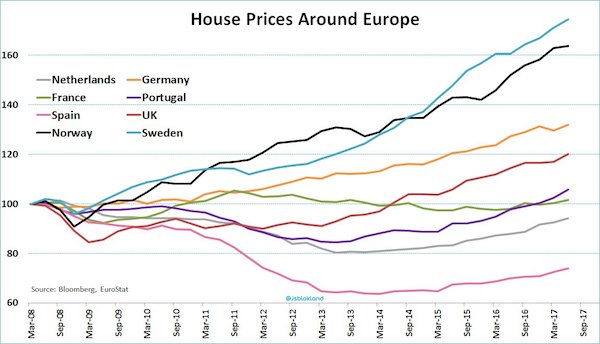
Canada, Australia, New Zealand; and Sweden, Denmark and Norway.

• Canada’s Household Debt Levels Higher Than Any Other Country (CNBC)

Household debt levels in Canada are higher than in any other country, according to a report by the Organization for Economic Cooperation and Development (OECD). In a preliminary version of the report, set to be released fully next month, the OECD found Canada’s household debt ranked as the highest among the 35 developed and developing countries the group monitors. The rapid accumulation of household debt for Canadians could also leave its economy particularly vulnerable to shocks, the organization said. “Although in part this reflects strong population growth, these developments may entail significant risk to financial stability given the direct exposure of the financial system to the housing market,” the OECD said. The group found Canada’s household debt-to-GDP ratio had ballooned to 101% — significantly higher than any other nation studied.

In comparison, the ratio for South Korea was the next highest at slightly under 93%, with the U.K. third at over 88%. In the U.S., the household debt-to-GDP ratio was around 80%, while Germany and France had a ratio below 60%. “Research points to a number of links between high indebtedness and the risks of severe recessions,” the group said. While virtually all countries witnessed soaring debt loads ahead of the credit crisis a decade ago, most have seen their indebtedness reduce over time. However, for Canada — and some countries in Scandinavia — this has not been the case, with OECD pinning the blame on inflated house prices. “OECD countries that have experienced the strongest increases in household debt since the crisis have also the steepest rise in house prices,” the group said.
Read more …

Highest since the Great Depression.

• As America Gives Thanks, Homelessness Sets New Records (Snyder)

If the U.S. economy was actually in good shape, we would expect that the number of people that are homeless would be going down or at least stabilizing. Instead, we have a growing national crisis on our hands. In fact, within the past two years “at least 10 cities or municipal regions in California, Oregon and Washington” have declared a state of emergency because the number of homeless is growing so rapidly. Things are particularly bad in southern California, and this year the Midnight Mission will literally be feeding a small army of people that have nowhere to sleep at night… “Thanksgiving meals will be served to thousands of homeless and near-homeless individuals today on Skid Row and in Pasadena and Canoga Park amid calls for donations and volunteers for the rest of the year. The Midnight Mission will serve Thanksgiving brunch to nearly 2,500 homeless and near-homeless men, women and children, according to Georgia Berkovich, its director of public affairs.”

Overall, the Midnight Mission serves more than a million meals a year, and Berkovich says that homelessness hasn’t been this bad in southern California “since the Great Depression”… “Berkovich said the group has been serving nearly 1 million meals a year each year since 2013. “We haven’t seen numbers like this since the Great Depression,” she said.” And of course the official numbers confirm what Berkovich is claiming. According to an article published earlier this year, the number of homeless people living in Los Angeles County has never been higher…”The number of homeless people in Los Angeles has jumped to a new record, as city officials grapple with a humanitarian crisis of proportions remarkable for a modern American metropolis. Municipal leaders said that a recent count over several nights found 55,188 homeless people living in a survey region comprising most of Los Angeles County, up more than 25% from last year.”

If the California economy is truly doing well, then why is this happening? We see the same thing happening when we look at the east coast. Just check out these numbers from New York City… “In recent years the number of homeless people has grown. Whereas rents increased by 18% between 2005 and 2015, incomes rose by 5%. When Rudy Giuliani entered City Hall in 1994, 24,000 people lived in shelters. About 31,000 lived in them when Mike Bloomberg became mayor in 2002. When Bill de Blasio entered City Hall in 2014, 51,500 did. The number of homeless people now in shelters is around 63,000. For New York, this is the highest that the homeless population has been since the Great Depression, and city leaders are trying to come up with a solution.”

Read more …

It’s getting to be time for Hoovervilles.

• UK Council Proposes £1,000 Fines For Homeless People Sleeping In Tents (G.)

A council has been called “cruel and callous” for proposing £1,000 fines to homeless people sleeping in tents in the city centre. Stoke-on-Trent council in Staffordshire is consulting on a public space protection order (PSPO) that will make it an offence for a person to “assemble, erect, occupy or use” a tent unless part of a council-sanctioned activity such as a music festival. Under such a scheme anyone who fails to pay their £100 on-the-spot penalty notice can be prosecuted and could be fined up to £1,000 in court. Though only currently at the consultation stage, the PSPO would cover the city centre, Hanley park, Festival park and Octagon retail park.

Ruth Smeeth, the Labour MP for Stoke-on-Trent North and Kidsgrove, said: “This is a cruel and callous policy to inflict on our most vulnerable in the lead-up to Christmas. We do have a growing problem with homelessness here in Stoke-on-Trent, but punishing people for their misfortune is no way to fix it. “It’s right and proper that the police take action to stop antisocial behaviour on our streets, but punishing the homeless simply for being homeless is appalling. “In recent years we’ve seen local funding for drug and alcohol treatment slashed and support to tackle homelessness cut to the bone. Locking these people up or saddling them with debt they can’t pay will only make the problem worse.”

Read more …

Incompetence.

• UK Faces Longest Fall in Living Standards on Record (BBG)

Britons were warned they are on course for the longest fall in living standards since records began 60 years ago after the U.K.’s fiscal watchdog took the ax to its outlook for economic growth. In an analysis of the government’s latest budget and accompanying report by the Office for Budget Responsibility, the Resolution Foundation said on Thursday that the economy is set to be 42 billion pounds ($56 billion) smaller in 2022 than the OBR predicted in March. It also calculated wages will not return to their pre-financial crisis levels of 2007 until at least 2025 once inflation is taken into account. Average annual pay is now projected to be 1,030 pounds lower in 2022 than the March forecasts and household disposable incomes will fall for an unprecedented 19 straight quarters between 2015 and 2020, according to Resolution.

The analysis was reinforced by the Institute for Fiscal Studies, which said the OBR’s forecasts implied average earnings would be almost 1,400 pounds lower in 2021 than predicted before the 2016 Brexit referendum and still below their 2008 level. “We are in danger of losing not just one but getting on for two decades of earnings growth,” IFS Director Paul Johnson told a briefing in London on Thursday. The warnings underscore the challenge Chancellor of the Exchequer Philip Hammond faced on Wednesday when he released a budget that left him little room for fiscal maneuver as Brexit looms. The OBR slashed its growth forecasts as a result of weak productivity, and Hammond piled further pressure on the budget by pledging extra cash for the health service and abolishing the tax on some housing purchases for first-time buyers.

Read more …

Tusk pretends to speak with a powerful mandate, but…

• Britain Has 10-Day Absolute Deadline On Key Brexit Issues: Tusk (R.)

Britain has only 10 days left to deliver on all three areas of its divorce terms with the European Union if London wants to start talks on a transition period after Brexit and a future relationship, the chairman of EU leaders Donald Tusk said. “We need to see progress from UK within 10 days on all issues, including on Ireland,” Tusk tweeted on Friday after a meeting with British Prime Minister Theresa May in Brussels. “Sufficient progress in Brexit talks at December council is possible but still a huge challenge,” he said on Twitter. An EU official said that May agreed in the one-hour discussions that Dec. 4 was the “absolute deadline” to allow the EU’s Brexit negotiator Michel Barnier to recommend moving onto the next stage on trade and future ties.

“Tusk presented the timeline ahead of the December European Council, with Dec. 4 as the absolute deadline for the UK to make additional efforts, allowing Barnier to be in a position to recommend sufficient progress,” the official said. “May agreed to this timeframe,” the official said. The official said Tusk had warned that if there was no progress within next 10 days, that would make moving forward impossible. The official said that the way Ireland’s border with Northern Ireland functioned after Britain leaves the EU in March 2019 was still an issue.

Read more …

… that mandate has severely weakened now Germany’s in trouble…

• Germany’s Voice Suddenly Missing in Brussels (Spiegel)

European Union Budget Commissioner Günther Oettinger wanted to know what is going on in Germany. To find out, he set up a number of meetings in Berlin this week, including one in the Chancellery. He also arranged to chat with Christian Lindner, the head of the Free Democrats (FDP) and the man who unexpectedly turned his back on German coalition talks in Berlin last Sunday night. The reason for Oettinger’s interest in the political developments in Germany is simple. He has been assigned with writing a draft EU budget for the next 10 years and his due date is next May. He is currently traveling from capital to capital on the Continent to determine how member states envision EU spending for the period from 2018 to 2027.

But the German voice, which generally carries significant weight when it comes to budgetary questions,is silent these days. “The long process of assembling a government is weakening Germany’s influence in Brussels,” says Oettinger. “German influence on important issues is currently undiscernible.” The failure of German coalition negotiations in Berlin has caught the European Union completely off guard. Ahead of elections in France and the Netherlands earlier this year, there had been widespread concern about the rise of the right wing and potential difficulties when it came to assembling a governing coalition in those countries. Few such concerns were voiced ahead of Germany’s general election on Sept. 24. Everyone assumed that Germany was solid.

Now, though, French President Emmanuel Macron has taken center stage in the EU with his ambitious reform proposals while European Council President Donald Tusk has already come up with a detailed timeline for transforming Macron’s vision into concrete policy decisions. And suddenly, Germany has vanished. “You’re ruining our entire presidency,” complained Kaja Tael, Estonia’s permanent representative in Brussels. Estonia currently holds the EU’s rotating presidency.

Read more …

Still surprised by these things?

• Tesla’s Newest Promises Break the Laws of Batteries (BBG)

Elon Musk knows how to make promises. Even by his own standards, the promises made last week while introducing two new Tesla vehicles—the heavy-duty Semi Truck and the speedy Roadster—are monuments of envelope pushing. To deliver, according to close observers of battery technology, Tesla would have to far exceed what is currently thought possible. Take the Tesla Semi: Musk vowed it would haul an unprecedented 80,000 pounds for 500 miles on a single charge, then recharge 400 miles of range in 30 minutes. That would require, based on Bloomberg estimates, a charging system that’s 10 times more powerful than one of the fastest battery-charging networks on the road today—Tesla’s own Superchargers.

The diminutive Tesla Roadster is promised to be the quickest production car ever built. But that achievement would mean squeezing into its tiny frame a battery twice as powerful as the largest battery currently available in an electric car. These claims are so far beyond current industry standards for electric vehicles that they would require either advances in battery technology or a new understanding of how batteries are put to use, said Sam Jaffe, battery analyst for Cairn Energy Research in Boulder, Colorado. In some cases, experts suspect Tesla might be banking on technological improvements between now and the time when new vehicles are actually ready for delivery.

Read more …

“There is some kind of revolution coming to American life.”

• The Old Songs (Jim Kunstler)

It probably all comes down to money. Money represents the mojo to keep on keeping on, and there is probably nothing more unreal in American life these days than the way we measure our money — literally, what it’s worth, and what everything related to it is worth. So there is nothing more unreal in our national life than the idea that it’s possible to keep on keeping on as we do. The weeks ahead may be most illuminating on this score. The debt ceiling suspension runs out on December 8, around the same time that the tax reform question will resolve one way or another. The debt ceiling means that the treasury can’t issue any more bonds, bills, or notes. That is, it can’t borrow any more money to pretend the government can keep running.

[..] There’s a fair chance that congress may not be able to resolve the debt ceiling deadline. The votes may just not be there. If the deadline comes and goes, the treasury can only use incoming tax revenues to cover its costs, and it won’t be enough. It will have to choose whether it issues paychecks to the roughly 2.7 million US government employees, or pays the vendors that sell things like warplanes to the military, or pay out so-called entitlements like Medicare and SNAP cards, or pay the interest on the previously-issued bonds, debts, and bills that the US has racked up over the years. Believe it or not, making those interest payments is probably the top priority, because failing to do that would shove the nation officially into default for the first time and destroy the country’s credit standing. The full faith and credit in the US dollar would shatter.

And then the fun and games would really cease. The country would discover it doesn’t have its mojo working, as another old song goes. The reality of being truly broke will set in. After all, there are two basic ways of going broke as a nation: you can run out of money; or you can have plenty of money that is worthless. Take your pick. There is some kind of revolution coming to American life. One way or another, it amounts to a much lower standard of living. The journey there may take the public by surprise, a la Ernest Hemingway’s crack about how a character in one of his stories went broke: slowly, and then all at once. The main question about this journey must be whether it is accompanied by political violence. One would have to think the potential for that is pretty high, given levels of animosity and delusional thinking among the two opposing factions — can we even call them Left and Right anymore? — which may even exceed the ill-feeling of 1861.

Read more …

Amen.

• Let’s Adopt The U.S. Naval Policy of 1890 (Rossini)

Back in 1890, the U.S. Naval Policy Board said in a report: “We fear no encroachments on our territory, nor are we tempted at present to encroach on that of others. We have no colonies, nor any desire to acquire them.” First, let’s discuss the aspect of the statement that has not changed one iota since 1890: “We fear no encroachments on our territory”. In 2017, we can say the exact same statement with total confidence. No state on the planet has any interest in conquering America. No one is interested in ruling over our WalMart/McDonald’s society. No one is interested in taking over Washington D.C. and inheriting 20,000,000,000,000 in debt. No one is interested in ruling a nation of people who are in debt up to their eyeballs with student loans, auto loans, mortgage loans, credit card loans….loans…loans…loans…loans…loans… No one is interested!

Which leads to the part of the statement that has changed since 1890: “..nor are we tempted at present to encroach on that of others.” In 1898, that aspect changed, and the U.S. federal government has never looked back. In 1898, the U.S. got its first taste of the conquering game. It swiftly took control of the Philippines, Guam, Puerto Rico, Cuba, and Hawaii. All of a sudden 11 million people were under a new American Empire. A few decades later, after the first high wore off, one of the worst decisions in the history of the world was made: U.S. President Woodrow Wilson tricked the American public into entering an exhausted and stalemated European war between princes. The “war to end all wars” was the war that would lead to the death of hundreds of millions over the next century.

The rest, of course, is history, and here we are: Broke….A country with middle-class that is disappearing, and 50% of the American public receiving some kind of welfare from a bankrupt government. U.S. Naval Policy in 1890 is where it’s at. The sooner we adopt it, the better.
Read more …

History repeats AND rhymes.

• The US-Saudi Starvation Blockade (Buchanan)

Our aim is to “starve the whole population – men, women, and children, old and young, wounded and sound – into submission,” said First Lord of the Admiralty Winston Churchill. He was speaking of Germany at the outset of the Great War of 1914-1918. Americans denounced as inhumane this starvation blockade that would eventually take the lives of a million German civilians. Yet when we went to war in 1917, a U.S. admiral told British Prime Minister Lloyd George, “You will find that it will take us only two months to become as great criminals as you are.” After the Armistice of Nov. 11, 1918, however, the starvation blockade was not lifted until Germany capitulated to all Allied demands in the Treaty of Versailles.

As late as March 1919, four months after the Germans laid down their arms, Churchill arose in Parliament to exult, “We are enforcing the blockade with rigor, and Germany is very near starvation.” So grave were conditions in Germany that Gen. Sir Herbert Plumer protested to Lloyd George in Paris that morale among his troops on the Rhine was sinking from seeing “hordes of skinny and bloated children pawing over the offal from British cantonments.” The starvation blockade was a war crime and a crime against humanity. But the horrors of the Second World War made people forget this milestone on the Western road to barbarism. A comparable crime is being committed today against the poorest people in the Arab world – and with the complicity of the United States.

[..] Almost 90% of Yemen’s food, fuel and medicine is imported, and these imports are being cut off. The largest cities under Houthi control, the port of Hodaida and Sanaa, the capital, have lost access to drinking water because the fuel needed to purify the water is not there. Thousands have died of cholera. Hundreds of thousands are at risk. Children are in danger from a diphtheria epidemic. Critical drugs and medicines have stopped coming in, a death sentence for diabetics and cancer patients. If airfields and ports under Houthi control are not allowed to open and the necessities of life and humanitarian aid are not allowed to flow in, the Yemenis face famine and starvation. What did these people do to deserve this? What did they do to us that we would assist the Saudis in doing this to them?

The Houthis are not al-Qaida or ISIS. Those are Sunni terrorist groups, and the Houthis detest them. Is this now the American way of war? Are we Americans, this Thanksgiving and Christmas, prepared to collude in a human rights catastrophe that will engender a hatred of us among generations of Yemeni and stain the name of our country?

Read more …

We can’t afford Yemen, and we can’t afford Libya. We need to stop these medieval situations.

• Horrified By Libya Slave Trade, Rwanda Offers Refuge To Migrants (IBT)

Rwanda has opened its doors to migrants stuck in Libya and announced plans to take in as many as 30,000 people. The offer of help comes in response to an exposé into Libya’s underbelly where slave trade is flourishing. It involves migrants from other parts of Africa who are stuck in the country as they wait for an opportunity to cross into Europe. The government is still ironing out the details regarding how it plans to move interested parties from the northern part of the continent to the east. “Rwanda is currently under discussions… to see how we can help in welcoming migrants held captive in Libya,” Rwanda’s Foreign Minister Louise Mushikiwabo told AFP. “It has just been decided, so numbers and means are still under discussion, but Rwanda estimates the number to be welcomed around 30,000,” she said.

“For Africans being sold in Libya: Rwanda is small, but we will find some space!” she tweeted. In its investigation into the slave market in Libya, CNN was able to capture footage of auctions held in the capital city of Tripoli, where bids were accepted for men to be used for manual labour. While the videos only featured males, they have raised concerns over a similar fate for women and children who escaped their countries to come to Libya. “Rwanda, like the rest of the world, was horrified by the images of the tragedy currently unfolding in Libya, where African men, women and children who were on the road to exile, have been held and turned into slaves,” Mushikiwabo continued. “Given Rwanda’s political philosophy and our own history, we cannot remain silent when human beings are being mistreated and auctioned off like cattle,” she said. The minister was referring to her nation’s own dark history wherein over 800,000 people (mostly Tutsi) were killed in 1994 in one of the worst genocides in world history.

Read more …

You see, Angela, the power you crave comes with responsibilities.

• Mediterranean ‘By Far World’s Deadliest Border’ For Migrants – IOM (R.)

More than 33,000 migrants have died at sea trying to reach European shores this century, making the Mediterranean “by far the world’s deadliest border”, the United Nations migration agency said on Friday. After record arrivals from 2014 to 2016, the European Union’s deal with Turkey to stop arrivals from Greece, and robust patrols off Libya’s coast have greatly reduced the flow, the International Organization for Migration (IOM) said. Professor Philippe Fargues of the European University Institute in Florence, author of the report, said the figures probably underestimated the actual scale of the human tragedy. “The report states that at least 33,761 migrants were reported to have died or gone missing in the Mediterranean between the year 2000 to 2017. This number is as of June 30,” IOM’s Jorge Galindo told a Geneva news briefing.

“It concludes that Europe’s Mediterranean border is by far the world’s deadliest,” he said. So far this year some 161,000 migrants and refugees have arrived in Europe by sea, about 75% of them landing in Italy with the rest in Greece, Cyprus and Spain, according to IOM figures. Nearly 3,000 others are dead or missing, it said. “Shutting the shorter and less dangerous routes can open longer and more dangerous routes, thus increasing the likelihood of dying at sea,” Fargues said. The report said: “Cooperation with Turkey to stem irregular flows is now being replicated with Libya, the main country of departure of migrants smuggled along the central route; however, such an approach is not only morally reprehensible but likely to be unsuccessful, given the context of extremely poor governance, instability and political fragmentation in Libya.”

Read more …

Brussels and Athens have run out of excuses.

• The Refugee Scandal on the Island of Lesbos (Spiegel)

Those wishing to visit ground zero of European ignominy must simply drive up an olive tree-covered hill on the island of Lesbos until the high cement walls of Camp Moria come into view. “Welcome to prison,” someone has spray-painted on the walls. The dreadful stench of urine and garbage greets visitors and the ground is covered with hundreds of plastic bags. It is raining, and filthy water has collected ankle-deep on the road. The migrants who come out of the camp are covered with thin plastic capes and many of them are wearing only flipflops on their feet as they walk through the soup. Children are crying as men jostle their way through the crowd. Welcome to one of the most shameful sites in all of Europe. Camp Moria was originally built to handle 2,330 refugees. But currently it is home to 6,489.

[..] Conditions on the island of Lesbos haverarely been as precarious as they are today. Just as winter is arriving in Greece, some 15,000 refugees find themselves trapped in the five “hotspots” located on Greek islands in the Aegean Sea. Fully 8,357 of them are on Lesbos, living in horrific conditions in overcrowded, completely inadequate shelters. A huge number of refugees are forced to sleep in tents designed for summer conditions and many of them fear for their safety because of the close quarters and the repeated clashes in the main camp. Dozens of refugees have begun a hunger strike on Lesbos. The European Union’s refugee deal with Turkey may have managed to cut the number of people reaching Greece by 97%, but dozens of migrants continue to arrive every day.

Thus far this year, around 11,000 people have crossed over to the island from Turkey – a tiny number compared to the 12,500 who arrived on a single day in August 2015. But back then, newcomers were taken to the mainland and allowed to continue their journeys through the Balkans toward Hungary, Austria and, ultimately, Germany. Now, though, the former registration facilities have essentially been transformed into prisons. [..] he government in Athens has had plenty of time to learn its lesson from last winter, when five refugees died in Camp Moria, some of them because they were trying to heat their tents. Now, the country’s immigration minister is seeking to solve the problem at the last minute ahead of this winter by renting hotels on Lesbos and bringing in two ships from Piraeus that can accommodate a total of 3,000 refugees.

On the island of Lesbos though, where residents have shown remarkable patience thus far, there is widespread opposition to the plan. On Monday, the mayor of Lesbos, known for being a moderate, called for a general strike and declared war on the Greek government. He accuses Athens of seeking to use the need to establish winter facilities as an excuse to transform Lesbos into a prison island.

Read more …

Let’s finish on a lighter note.

• Endangered Butterfly, Mexican Shrub May Be Hurdles to Trump Wall (BBG)

Environmentalists suing to block President Donald Trump from constructing a wall along the Mexican border say the project would imperil endangered species including the Quino checkerspot butterfly and the Mexican flannel bush. The Homeland Security Department has asserted authority under federal immigration law to waive compliance with environmental protection statutes because 14 miles of existing fencing near San Diego is “no longer optimal for border patrol operations.”

Defenders of Wildlife, the Animal Legal Defense Fund, the Sierra Club and the Center for Biological Diversity argued in court filings this week that the Trump administration’s attempts to sidestep the National Environmental Policy Act and the Endangered Species Act are unconstitutional. A hearing over the dispute is set for February before U.S. District Judge Gonzalo Curiel, whom Trump scorned during the presidential campaign over the San Diego jurist’s handling of the Trump University fraud litigation. Trump attacked Curiel as being biased against him because of his Mexican heritage, saying the Indiana-born judge had issued rulings against him as retribution for his pledge to build a wall between the U.S. and its neighbor to the south.

Read more …

Nov 242017
 
 November 24, 2017  Posted by at 9:50 am Finance Tagged with: , , , , , , , , ,  5 Responses »


Dorothea Lange Migrant agricultural workers in California 1935


• The Party Is Over for Australia’s $5.6 Trillion Housing Frenzy (BBG)
• The UK’s Future Economic Storm Just Got Worse (CNBC)
• UK Consumer Confidence Hits Lowest Level Since Aftermath Of Brexit Vote (BBG)
• After Sudden Rout, China Stock Traders Question Beijing Put
• China Bank Profits Face Squeeze From Tighter Rules – Fitch (BBG)
• China Reports Breaking Up Gang That Moved $3 Billion Abroad (AP)
• Bitcoin Mining Now Consumes More Electricity Than 159 Countries (PCUK)
• Mexico Revokes Monsanto Permit To Market GMO Soy In Seven States (R.)
• Turkey, Iran, Russia and India are Playing the New Silk Roads (Escobar)
• Greek PM Tsipras ‘Proud’ Of Living Conditions Of Refugees (K.)
• Greece Vows Greater Effort To Protect Refugees Over Winter (AP)
• Greek Pensioners March Against Government That ‘Took Everything’ (R.)


In case you were wondering just how big the bubble has become. Look at New Zealand too.

• The Party Is Over for Australia’s $5.6 Trillion Housing Frenzy (BBG)

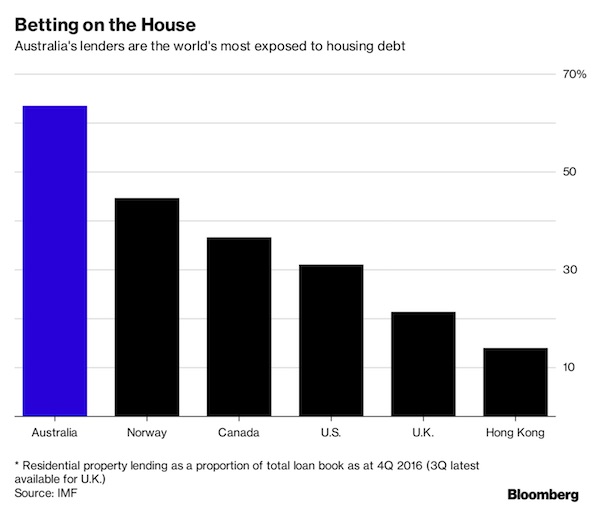
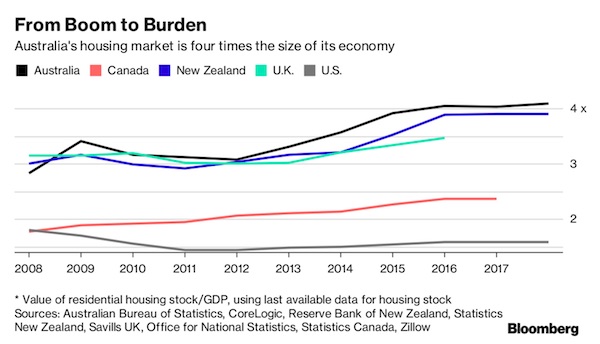
The party is finally winding down for Australia’s housing market. How severe the hangover is will determine the economy’s fate for years to come. After five years of surging prices, the market value of the nation’s homes has ballooned to A$7.3 trillion ($5.6 trillion) – or more than four times gross domestic product. Not even the U.S. and U.K. markets achieved such heights at their peaks a decade ago before prices spiraled lower and dragged their economies with them. Australia’s obsession with property is firmly entrenched in the nation’s economy and psyche, fueled by record-low interest rates, generous tax breaks, banks hooked on mortgage lending, and prime-time TV shows where home renovators are lauded like sporting heroes. For many, homes morphed into cash machines to finance loans for boats, cars and investment properties. The upshot: households are now twice as indebted as China’s.

So far, the Reserve Bank of Australia has relied on banking regulators to apply the brakes with lending curbs. It reckons the financial system is well-placed to withstand any shocks, but isn’t so confident on consumers. That puts it out of step with developed-world peers that are incrementally tightening policy, with Governor Philip Lowe this week making clear local interest rates aren’t going anywhere soon. To be sure, there are key dynamics that differentiate Australia’s housing boom with those that soured in recent years around the world. Aussie banks can claim against other income and assets or chase individuals into bankruptcy if borrowers default. Tax deductions for interest paid on investment loans also support demand, as does a rich pipeline of demand from Asian buyers, especially Chinese. But with prices in major cities like Sydney finally leveling off and a wave of new apartments about to hit markets in Brisbane and Melbourne, it’s worth taking a look at housing’s out-sized influence on Australia’s economy.

The weight of Australian homes on the economy is heavier than policy makers would like. On one hand, the dizzy valuations reflect a desirable location and strong population growth. But they also reflect the massive liabilities that are now tied to these assets. “The risk is that it leaves the Australian economy extremely exposed, and a minor shock could become far more significant,” said Daniel Blake, an economist at Morgan Stanley in Sydney.
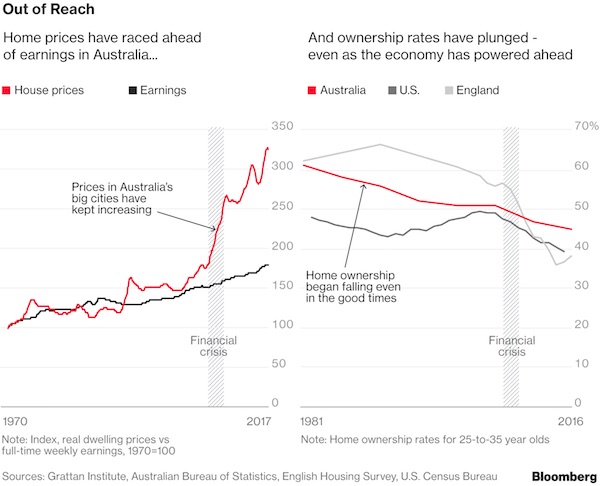
The increasing treatment of housing as a financial commodity has seen borrowers rush into a byzantine maze of mortgage-related products. That’s made banks very profitable, but very exposed. While the RBA is satisfied that lenders have adequate buffers to cope with any downturn, banks may find it harder to value their collateral in a falling market as investors look to consolidate their portfolios of multiple homes, said Blake.

Read more …

Projecting until 2070 may not be the most useful exercise. The next 10 years is wobbly enough.

• The UK’s Future Economic Storm Just Got Worse (CNBC)

Britons should better get used to austerity. Even though the U.K. government has mostly fixed its short-run fiscal problems caused by the global financial crisis, the long-run challenge of keeping fiscal policy on a sustainable path has grown even bigger, according to the latest economic projections published alongside Wednesday’s Autumn Budget. Over the medium term, U.K. fiscal policy looks to be heading towards calm waters. Combining the progress made under then-Finance Minister George Osborne from 2010 until early 2016 with the tax and spending plans announced on Wednesday by the incumbent Philip Hammond, will manage to get the annual fiscal deficit down from a peak of 8% of GDP in 2009 to less than 2.5% this year, and eventually to close to 1% by early next decade.
This should be enough for debt as a percentage of GDP to begin to fall gradually from around 87% of GDP from next year onwards into the 2020s. This is good news. But looking further out, U.K. fiscal policy appears to be heading towards a storm. Back in January, the Office for Budget Responsibility (OBR), the U.K.’s independent fiscal watchdog, projected that U.K. public debt will rise again from the 2030s onwards to nearly 250% of GDP by the 2070s. Rising health, state pension and long-term social care costs linked to demographic factors are likely to cause the fiscal deficit to surge again. U.K. public sector debt is projected to reach highs not seen since World War II. It gets worse. Keep in mind that the projections made in January assumed that productivity growth, the major determinant of economic growth, would average 2% per year into the long run.

Yesterday, the OBR downgraded this judgement to 1.3%. While productivity growth has declined across the advanced world in the past decade, the Brexit-stricken U.K. is suffering an extra hit by weakening the economic ties with its biggest market, the EU. In this new context, the earlier forecast that debt would rise to 250% of GDP within 50 years looks like a significant underestimate, to put it mildly. By reducing projected growth rates for wages and profits, the new lower outlook for trend productivity growth steepens the U.K.’s future fiscal hill. Unlike revenues from taxation, which mostly rise and fall in line with the rate of economic growth, future costs coming from the ageing population are independent of economic factors.

Read more …

Everyone can see the clowns in the news everyday.

• UK Consumer Confidence Hits Lowest Level Since Aftermath Of Brexit Vote (BBG)

U.K. consumer confidence tumbled in November, reaching the lowest level since the aftermath of the Brexit vote. YouGov and the Centre for Economics and Business Research said optimism suffered its biggest monthly decline since the month after the referendum, with all eight measures that make up the index falling. The score for household financial situations in the past 30 days dropped to its lowest since January 2014, and a gauge of home owners’ expectations for values over the next 12 months slid to the least in a year following the Bank of England’s rate increase on Nov. 2. The report on Friday comes after official data this week highlighted the importance of consumers to the U.K. economy, as a jump in household spending offset slowing business investment and a drag from trade to drive a 0.4% expansion in the third quarter.

It also follows Chancellor of the Exchequer Philip Hammond’s announcement of a downgrade to the economic outlook as a result of a sluggish productivity and Brexit headwinds. Warnings of a consumer slowdown are coming ahead of the crucial Christmas shopping period as the squeeze on incomes from inflation continues. Figures last week showed retail sales fell in October from a year earlier, the first decline in more than four years. “Households are understandably worried.” said Christian Jaccarini, an economist at the CEBR. “The first interest-rate hike in over a decade triggered fears that higher borrowing costs will compound the inflation-induced squeeze on household incomes.”

Read more …

How do you go from running a casino to having actual stock markets?

• After Sudden Rout, China Stock Traders Question Beijing Put

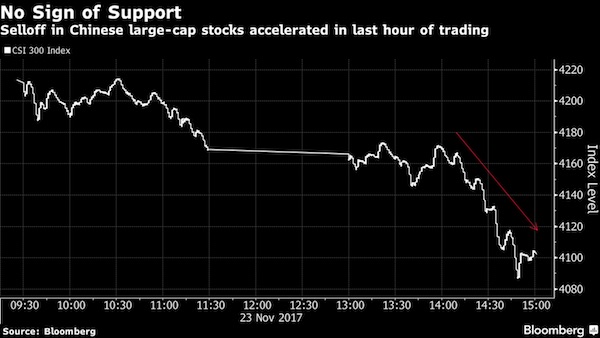
What happened to the Beijing put? That’s what investors in China are asking themselves after a gauge of large-cap stocks plunged 3% on Thursday, rattling a market that’s grown accustomed to state support when losses get extreme. While there were signs over the past week that the government was looking to cool gains in high-flying shares like Kweichow Moutai – along with concerns over rising corporate bond yields – the severity of Thursday’s slump caught some traders off guard. The biggest surprise was that losses accelerated into the close. The nation’s CSI 300 Index sank 52 points in the final 45 minutes of trading, the steepest afternoon decline since the depths of China’s stock market crash in January 2016. Such late-day selloffs have been rare this year, with the index rising an average 2.9 points.

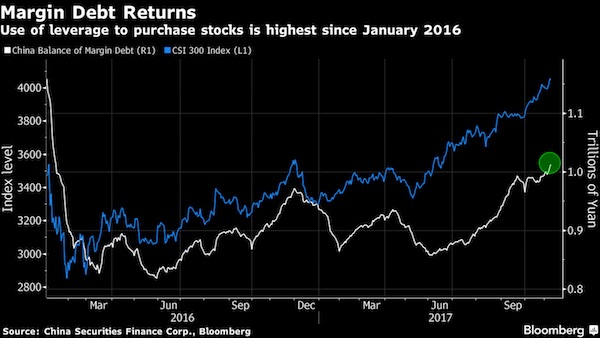
While it’s unclear why state funds allowed shares to tumble this time, analysts said the episode may help wring some of the complacency out of China’s stocks. Before Thursday’s slump, the CSI 300 had climbed 28% this year to the highest level since July 2015. Margin debt, while still well below its bubble peak in 2015, has increased for six straight months. “Some investors might have been just taking profit in the morning, and that turned into a selling stampede in the afternoon,” said Wang Chen, Shanghai-based partner with XuFunds Investment Management Co. “Investments in blue chips were overcrowded, and a lot of them were bought with margin financing.”

[..] For Sun Jianbo, president of China Vision Capital Management, valuations among large-cap shares are too expensive for state-backed funds to intervene. The CSI 300 traded at its highest level relative to the broader Shanghai Composite Index in at least 12 years at the start of this week as investors flocked to large caps such as Moutai and Ping An Insurance. “There’s no need to prop up the market yet,” Sun said. “A lot of big caps are still expensive and it would do more harm than good to state-backed funds if they buy now.”

The divergence between large-cap shares and the rest of the market may be one reason why the government took aim at Moutai. Before Xinhua warned last week that gains in the liquor maker were excessive, the stock had more than doubled this year. Given that much of the gains in Chinese shares this year can be explained by improving earnings prospects, it’s likely that government’s bigger target is leverage, according to Ken Peng at Citi Private Bank in Hong Kong.

Read more …

Aimed at the shadows, but…

• China Bank Profits Face Squeeze From Tighter Rules – Fitch (BBG)

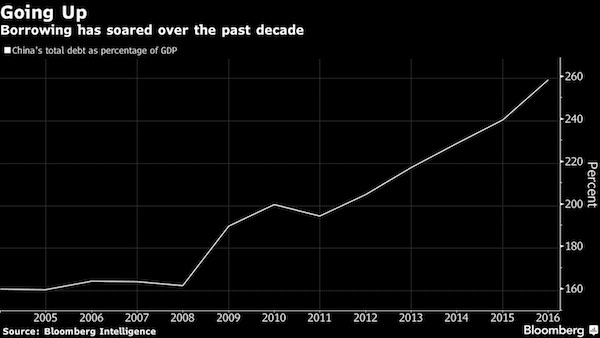
Profit margins at Chinese banks will be squeezed next year and credit growth is likely to slow as increasing regulation eats up capital, Fitch Ratings said. The lending businesses of the country’s smaller banks face the most pressure and they will rely more on larger state-owned rivals for liquidity, the ratings company said in a statement Friday. At the same time, the shadow-banking sector, which one brokerage values at about $19 trillion, will attract even more regulatory scrutiny in 2018, Fitch said. Chinese regulators are sweeping through the country’s $40 trillion financial sector in a bid to contain risk after total debt ballooned to about 260 percent of the size of the economy. In the past week alone, they’ve proposed rules governing returns from asset-management products, laid out limits on bank shareholdings and unveiled a purge of cash micro-lenders.

“Credit growth is likely to decelerate next year, given the tighter regulatory stance,” Fitch said. “Funding conditions are likely to remain tight, pointing to continued margin pressure at smaller banks which rely more on non-deposit funding.” The predictions from Fitch and S&P Global Ratings on Thursday suggest the cost of the system-wide measures will be sluggish profit growth at domestic banks, which include Industrial & Commercial Bank of China, the world’s largest by assets. New rules pushing shadow-banking items back on to lenders’ balance sheets will lead to an increase in risk that could weigh on bank capital, Fitch said. Net income growth in the banking sector will remain in the “low single digits” in 2018, it said. The ratings company kept its outlook on Chinese banks at stable, saying sovereign support for the sector remains “very strong.”

Read more …

“..as many as 10,000 people might have been involved..”

• China Reports Breaking Up Gang That Moved $3 Billion Abroad (AP)

Chinese police say they have broken up a gang that smuggled 20 billion yuan ($3 billion) out of the country, evading financial controls imposed by Beijing to stem an outflow of capital from the economy. Seven suspects were detained in the case centered in the southern city Shaoguan near Hong Kong but as many as 10,000 people might have been involved, the official Xinhua News Agency reported. Chinese authorities have steadily tightened foreign-exchange controls to stem a multibillion-dollar outflow of capital that they say hampers financial management in the world’s second-largest economy. The group in Shaoguan is accused of moving money illegally using 148 bank accounts opened in 20 provinces with stolen identity cards, according to Xinhua.

It said they made unspecified “huge profits” by trading on the difference in exchange rates between Hong Kong dollars and the mainland’s yuan. Beijing allowed an informal financial industry to flourish over the past two decades to support entrepreneurs but is tightening controls due to mounting concern about financial stability. Regulators are especially worried about unauthorized cross-border movement of money at a time when they are trying to stem an outflow of capital. Companies and investors rushed to export money after a change in the mechanism used to set the government-controlled exchange rate in 2015 prompted expectations the yuan would weaken in value. That forced the Chinese central bank to spend heavily to shore up the yuan.

Read more …

“In the past month alone, Bitcoin mining electricity consumption is estimated to have increased by 29.98%..”

• Bitcoin Mining Now Consumes More Electricity Than 159 Countries (PCUK)

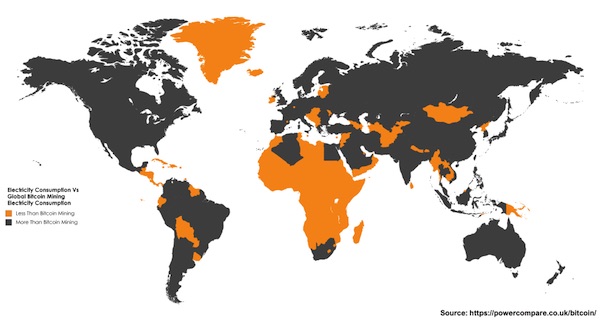
Bitcoin’s ongoing meteoric price rise has received the bulk of recent press attention with a lot of discussion around whether or not it’s a bubble waiting to burst. However, most the coverage has missed out one of the more interesting and unintended consequences of this price increase. That is the surge in global electricity consumption used to “mine” more Bitcoins. According to Digiconomist’s Bitcoin Energy Consumption Index, as of Monday November 20th, 2017 Bitcoin’s current estimated annual electricity consumption stands at 29.05TWh. That’s the equivalent of 0.13% of total global electricity consumption. While that may not sound like a lot, it means Bitcoin mining is now using more electricity than 159 individual countries. More than Ireland or Nigeria. If Bitcoin miners were a country they’d rank 61st in the world in terms of electricity consumption.

Here are a few other interesting facts about Bitcoin mining and electricity consumption:

• In the past month alone, Bitcoin mining electricity consumption is estimated to have increased by 29.98%
• If it keeps increasing at this rate, Bitcoin mining will consume all the world’s electricity by February 2020.
• Estimated annualised global mining revenues: $7.2 billion USD (£5.4 billion)
• Estimated global mining costs: $1.5 billion USD (£1.1 billion)
• Number of Americans who could be powered by bitcoin mining: 2.4 million (more than the population of Houston)
• Number of Britons who could be powered by bitcoin mining: 6.1 million (more than the population of Birmingham, Leeds, Sheffield, Manchester, Bradford, Liverpool, Bristol, Croydon, Coventry, Leicester & Nottingham combined) Or Scotland, Wales or Northern Ireland.
• Bitcoin Mining consumes more electricity than 12 US states (Alaska, Hawaii, Idaho, Maine, Montana, New Hampshire, New Mexico, North Dakota, Rhode Island, South Dakota, Vermont and Wyoming)

Read more …

Gracias Mexico.

• Mexico Revokes Monsanto Permit To Market GMO Soy In Seven States (R.)

Monsanto said on Thursday that Mexico’s agriculture sanitation authority SENASICA had revoked its permit to commercialize genetically modified soy in seven states, criticizing the decision as unjustified. Monsanto said in a statement that the permit had been withdrawn on unwarranted legal and technical grounds. The company said it would take the necessary steps to safeguard its rights and those of farmers using the technology, but did not elaborate. Mexican newspaper Reforma cited a document saying the permit had been withdrawn due to the detection of transgenic Monsanto soya in areas where it was not authorized. Monsanto rejected that argument, saying in its statement that authorities had not done an analysis of how the soy on which their decision was based was sown. The revocation applies to the states of Tamaulipas, San Luis Potosi, Veracruz, Chiapas, Campeche, Yucatan and Quintana Roo and follows a 2016 legal suspension of the permit.

Read more …

China will build much of it all, but it won’t pay for it. It’s exporting a Ponzi.

• Turkey, Iran, Russia and India are Playing the New Silk Roads (Escobar)

Vladimir Putin, Recep Tayyip Erdogan and Hassan Rouhani will hold a summit this Wednesday in Sochi to discuss Syria. Russia, Turkey and Iran are the three power players at the Astana negotiations – where multiple cease-fires, as hard to implement as they are, at least evolve, slowly but surely, towards the ultimate target – a political settlement. A stable Syria is crucial to all parties involved in Eurasia integration. As Asia Times reported, China has made it clear that a pacified Syria will eventually become a hub of the New Silk Roads, known as the Belt and Road Initiative (BRI) – building on the previous business bonanza of legions of small traders commuting between Yiwu and the Levant. Away from intractable war and peace issues, it’s even more enlightening to observe how Turkey, Iran and Russia are playing their overlapping versions of Eurasia economic integration and/or BRI-related business.

Much has to do with the energy/transportation connectivity between railway networks – and, further on the down the road, high-speed rail – and what I have described, since the early 2000s, as Pipelineistan. The Baku-Tblisi-Ceyhan (BTC) pipeline, a deal brokered in person in Baku by the late Dr Zbigniew “Grand Chessboard” Brzezinski, was a major energy/geopolitical coup by the Clinton administration, laying out an umbilical steel cord between Azerbaijan, Georgia and Turkey. Now comes the Baku-Tblisi-Kars (BTK) railway – inaugurated with great fanfare by Erdogan alongside Azerbaijani President Ilham Aliyev and Georgian Prime Minister Giorgi Kvirikashvili, but also crucially Kazakh Prime Minister Bakhytzhan Sagintayev and Uzbek Prime Minister Abdulla Aripov. After all, this is about the integration of the Caucasus with Central Asia.

Erdogan actually went further: BTK is “an important chain in the New Silk Road, which aims to connect Asia, Africa, and Europe.” The new transportation corridor is configured as an important Eurasian hub linking not only the Caucasus with Central Asia but also, in the Big Picture, the EU with Western China. BTK is just the beginning, considering the long-term strategy of Chinese-built high-speed rail from Xinjiang across Central Asia all the way to Iran, Turkey, and of course, the dream destination: the EU. Erdogan can clearly see how Turkey is strategically positioned to profit from it.

Read more …

Alexis, Alexis, we know you don’t mean it that way, so why risk getting caught with your foot in your mouth?

• Greek PM Tsipras ‘Proud’ Of Living Conditions Of Refugees (K.)

Prime Minister has said he is “proud” of living conditions for refugees on the Greek mainland, although he admitted that “the situation remains difficult” for those stranded on the islands of the eastern Aegean. Speaking to France’s Le Figaro newspaper on the occasion of his visit to Paris, Tsipras also defended a deal between the European Union and Ankara to stem migrant flows in the Aegean. “The deal between the EU and Turkey is hard but necessary; it helped put an end to the daily deaths in the Aegean. We have received more than 60,000 refugees on mainland Greece who live in good conditions, with access to health and education. It is something I am proud of,” Tsipras said.

“The situation on the islands remains difficult. There is a large number of migrants and refugees and asylum procedures are time-consuming,” he said. Greece has seen a surge of migrant arrivals in recent months. With winter fast approaching and migrant reception centers on the Aegean islands reaching breaking point due to overcrowding, 20 human rights groups this week sent a letter to the Greek government calling for immediate action.

Read more …

People are dying already. It’s only autumn.

• Greece Vows Greater Effort To Protect Refugees Over Winter (AP)

Greece has promised to step up efforts to protect migrants and refugees over the winter on the Greek islands, but defended a 2016 deal between Turkey and the European Union to stop the westward flow of migrants into Europe. On a visit to France, Prime Minister Alexis Tsipras told the country’s Figaro newspaper on Thursday that the agreement was difficult but necessary. His remarks followed strongly criticism from aid agencies and human rights groups over conditions at migrant shelters on Lesvos and other Greek islands. Greece has seen a surge of migrant arrivals in recent months. On Thursday, Greek border police recovered the body of a man believed to be a migrant in a river that divides Greece and Turkey – the second such incident in two days.

Read more …

“They’re killing us and they’re mocking us at the same time..”

• Greek Pensioners March Against Government That ‘Took Everything’ (R.)

Several hundred elderly Greeks marched through Athens on Thursday, protesting against a government they say “took everything” with a new round of cuts to pensions and crumbling health care benefits. Greece’s three bailouts since 2010 have repeatedly taken aim at the pension system. Cuts have pushed nearly half its elderly below the poverty line with incomes of less 600 euros ($710.70) a month. With nearly a quarter of the workforce unemployed, a quarter of children living in poverty and benefits slashed, parents have grown dependent on grandparents for handouts. But after the cuts to pensions, some Greeks have seen their monthly cheque fall between 40 and 50 percent in seven years. After rent, utility bills and health care, they barely make ends meet.

“I have never seen the country in this state, not even during war,” said 80-year-old Nikos Georgiadis, a former hotel employee whose pension has been reduced by 40 percent. “Pensioners are impoverished, and not only can they not afford to buy medicines, some are looking for food in the trash,” he said, leaning on a tree to catch his breath. Fotini Karavidou, a 75-year-old retired accountant who joined the march in a wheelchair, said she had to “cut back on everything” to afford medicine. “It’s simple – many pensioners cannot afford to eat and to buy medicine,” said Yiannis Karadimas, 67, who heads a local pensioners association. Karadimas said it was “a joke” that the government had legalised marijuana for medical purposes while cutting back on health care spending. “They’re killing us and they’re mocking us at the same time,” he said.

The popularity of Prime Minister Alexis Tsipras has waned since he first won elections in 2015. In an effort to rebuild public support, the government gave Greece’s 1.3 million pensioners a one-off Christmas bonus last year, worth 300 to 500 euros each. But the handouts have failed to whip up any obvious increase in support. Pensioners have taken to the streets time and again in recent months. About 2,000 people joined Thursday’s march. “Unfortunately, I voted for them, and they turned out to be the biggest liars of all,” Georgiadis, the pensioner, said. “It [the government] promised us everything, and it took everything.”

Read more …

Nov 232017


Nicolas de Staël Mer du nord 1954


Punxsutawney Phil Hammond, the UK chancellor, presented his Budget yesterday and declared five more years of austerity for Britain. As was to be expected. One doesn’t even have to go into the details of the Budget to understand that it is a dead end street for both the country and for Theresa May’s Tory party.

So why the persistent focus on austerity while it becomes clearer every day that it is suffocating the British economy? There are many answers to that. Sheer incompetence is a major one, a lack of empathy with the poorer another. Conservative Britain is a class society full of people who dream of empire, and deem their class a higher form of life than those who work low-paid jobs.

When you see that the British Parliament has even voted that animals don’t feel pain or emotions, you’d be tempted to think it’s a throwback all the way back to the Middle Ages, not just the British Empire. They’re as lost in time as Bill Murray is in Groundhog Day. Only worse.

But perhaps incompetence is the big one here. The inability to understand that if your economy is not doing well, you need to stimulate it, not drain even more of what’s left out of it. The people in government don’t understand economics, and therefore rely on economic theory for guidance. And the prevailing theories of the day prescribe bloodletting as the cure, so they bloodlet (let blood?). Let it bleed.

This is not a British problem, it’s pan-European if not global. Neither is the UK Tory party the only one being killed by it, all Conservative parties share that faith. They’re just lucky that their left wing opponents have all committed hara kiri, and joined their ranks when it comes to economics. All of Europe’s poorer have lost the voices that were supposed to speak for them, to economic incompetence.

Obviously, the US democrats did their own hara kiri years ago. One might label -some of- Bernie Sanders’ views left-wing, but he’s trapped in a system that won’t let him breathe.


All of this leads me to question the following:

A letter in the Guardian published on Sunday called on Chancellor Philip Hammond, ahead of his budget presentation on Wednesday, to end austerity in the UK. It is signed by 113 people, a veritable who’s who from the academic field, one -economics- professor after another. They include people like Joe Stiglitz, Steve Keen, Dave Graeber.

Looking at the letter itself, and then the entire list, makes me wonder: I’m sure you all mean well, guys, but I think perhaps you should first of all ask yourselves how it is possible that such a large group of well-educated ladies and gentlemen has become so utterly sidelined over time when it comes to major economic decisions, has allowed itself to be sidelined.

It’s one thing to ask what someone else is doing wrong, it’s another to ask yourself what you have done wrong. My question to y’all would be: where were you? Shouldn’t you have written and/or signed this letter 7 years ago, or 5, even just 3? Isn’t calling on the Chancellor to ‘end austerity now’ a bit late in the game?

Is it even the right call, or should you maybe be calling for him to simply resign (along with the entire cabinet)? After all, what are the odds that the Tories are going to turn on a dime and reverse their entire economic policies? They would look stupid, and they will avoid that like the plague. Here’s that letter:


The Chancellor Must End Austerity Now – It Is Punishing An Entire Generation

Seven years of austerity has destroyed lives. An estimated 30,000 excess deaths can be linked to cuts in NHS spending and the social care crisis in 2015 alone. The number of food parcels given to impoverished Britons has grown from tens of thousands in 2010 to over a million. Children are suffering from real-terms spending cuts in up to 88% of schools. The public sector pay cap has meant that millions of workers are struggling to make ends meet. Alongside the mounting human costs, austerity has hurt our economy.

The UK has experienced its weakest recovery on record and suffers from poor levels of investment, leading to low productivity and falling wages. This government has missed every one of its own debt reduction targets because austerity simply doesn’t work. The case for cuts has been grounded in ideology and untruths. We’ve been told public debt is the outcome of overspending on public services rather than bailing out the banks. We’ve been told that while the government can find money for the DUP, we cannot afford investment in public services and infrastructure.

We’ve been told that unless we “tighten our belts” we’ll saddle future generations with debt – but it’s the onslaught of cuts that is punishing an entire generation. Given the unprecedented economic uncertainty posed by Brexit negotiations and the private sector’s failure to invest, we cannot risk exacerbating an already anaemic recovery with further public spending cuts. We’ve reached a dangerous tipping point. Austerity has failed the British people and the British economy. We demand the chancellor ends austerity now.

If you ask me, Britain reached that ‘dangerous tipping point’ years ago. And talking about ‘an anaemic recovery’ sounds like total nonsense. There is no recovery, as you yourselves make clear with the examples you provide of the consequences of austerity. So why say it?

I don’t know if we can blame individual economists for missing out on the effects of political measures, although when those measures affect economics, we probably should. But regardless, the big game in town these days is politics, not economics. Everywhere there are ‘leaders’ fighting for survival, and it’s telling that Donald Trump is not nearly the most besieged among them.

That Theresa May is still PM of the UK is as surprising as it is ridiculous. But it also points to the lack of coherence and timing among her opponents, including those 113 academics. That once May goes, which could be soon, the Tories get to pick yet another one of their own as PM, is even more ridiculous. To top off the absurdity, the next in line could be Boris Johnson.

A country that finds itself in a quandary as immense as the UK faces post-Brexit vote, should not let one party that had a mere 42% of the vote, run all the plans, decisions and negotiations, be they domestic and/or international. There is no surer way for disaster to ensue. It’s the system itself that fails if that possibility exists, more than that one party.

The UK needs, more than anything, a national government (or something in that vein), an option in which at least a majority of the population is represented. That is much more important than some call for some policy to be halted.

Moreover, everyone should see this in the light of international political developments as a whole. What’s happening in Albion is not an isolated event, and it doesn’t happen under the influence of isolated forces or developments. What happened overnight on Sunday with the failure of Angela Merkel’s attempt to form a German coalition government makes that more obvious than ever.

Traditional political parties, left and right, have been swept out of power all over Europe. Germany is just one more example. The process doesn’t have the same shape, or the same speed, everywhere. But it’s real. It’s due to a mixture of rising inequality, deteriorating economic conditions and no left left to represent the people, the victims, at the bottom of societies. Well, and there’s the incessant lies about economic recovery.

But let’s take a little detour first. Just in order to illustrate the point even more. The Guardian ran a piece, also on Sunday, on newly minted French President Emmanuel Macron and his government and party, that is pretty hilarious.


New Head Of Macron’s Party Vows To Recapture Its Grassroots ‘Soul’

A fiercely loyal, self-styled “man of the people” has been appointed to lead Emmanuel Macron’s fledgling political movement, La République En Marche (The Republic on the Move, or La REM), promising to recapture the party’s“soul” after a hiatus since the recent election win. Christophe Castaner, 51, a burly member of parliament with a southern accent, styles himself as both in touch with everyday voters and devoted to Macron’s well-oiled communications machine. He was handpicked by the French president to take over the running of La REM.

Castaner, currently a minister and government spokesman, was a Socialist mayor of a picturesque small town in Provence for more than a decade before becoming one of the first politicians to jump ship to Macron’s centrist project in its early days. He grew up in a military family in the south of France, left school before his final exams – which he retook as an adult – and has a reputation for straight-talking. At La REM’s first party congress in Lyon this weekend, Castaner was the lone candidate for the role of party director.

He was picked by Macron at a presidential palace dinner, then confirmed by a group of party members with a show of hands rather than a secret ballot, sparking criticism from the media and political observers about undemocratic internal party practices. A small group of 100 party followers went public last week with an open resignation letter, claiming the party had no internal democracy. Others, including La REM members of parliament, responded that Castaner was “the obvious choice”.

Macron founded his own movement because he saw an opening to defeat all traditional French parties. He won the presidential elections, and only after that organized the movement into an actual political party ahead of parliamentary elections. I’d still like to see someone explain who paid for the campaigns of hundreds of candidate parliamentarians. It’s a mystery. France’s banking and business sector?

Macron has set an example for many people in other countries, provided they can unravel that mystery, of how they, too, can defeat incumbents and other long time power blocks. There are two countries where such tactics have until now not seemed possible: the UK and US. But that, too, will change.

In many other European countries, age-old blocks have already been beaten into submission. Even if many deep state powers in France et al have merely shifted allegiances. As their peers elsewhere will. But that’s just the way things are. It doesn’t negate the huge shifts in politics. Voters all over feel they’ve been had for too long. It’s all part of a tectonic shift. Deteriorating economic conditions will do that for you.

What makes the article on Macron et al so entertaining is the mention of the promise to “..recapture the party’s grassroots “soul”. A political party that’s barely a year old does not have grassroots, let alone a soul. Anyone who thinks otherwise is not thinking. And that is a good thing to keep in mind, because Macron’s example – and success- will inspire similar initiatives in many places, and similar nonsensical narratives.


Ironically, if that’s the right word, the world -or at least the EU- is now Macron’s oyster. Angela Merkel has shown her weaknesses, and she has blinked first, in her failed attempt to form a new cabinet, and she will not recover from that, not with anything remotely like her past clout. Maybe -more than- 12 years as head of state is not such a good idea.

While Macron is a blank sheet without a soul or grassroots, Merkel and her CDU party possess both in spades. It’s just that in today’s world these things tend to easily turn against you. You’re better off without a past that you can be blamed for. Macron has no past. And no soul.

Merkel leaves an enormous void both in Germany and in Europe (even globally). And it’s one thing for her to have become too powerful at home, but it’s quite another for the same to have been allowed on the entire continent. Germany, under any leadership, will remain the only power in Europe that matters, no matter what grand plans Macron devises. And that is the EU’s fatal flaw. If you have 27-28 sovereign countries and you try to order them around all the time, you have a problem on your hands.


There is an inherent contradiction in being both the leader of political union’s strongest country and -simultaneously- of the union as a whole, and Merkel has bitterly failed in addressing, let alone solving, that contradiction. Merkel didn’t create it, true enough, but because she is/was the boss, it is her responsibility to address it. Even if it’s ultimately unsolvable.

In the present setting, any German leader, Angela or someone else, will be voted in by Germans, and focus on their interests, to hold on to these votes. But German interests are not always the same as those of other countries. That means Germany will always come out on top, and more so as time passes. Ever more wealth will flow to Berlin. That’s the fatal flaw, and at present there’s no way out of it.

With Merkel weakened, or soon even gone, lots of voices will speak up across Europe for their countries’ sovereignty, and the attack on them from Brussels. We already have Poland, Czechia and Hungary. Expect a lot more noise from Italy in the run-up to its elections. The power balance that Merkel held together is gone for good.

Yes, her refugee policy backfired, which is no surprise given that she decided on it like some empress. But what may be more important is that her traditional opponent, the left wing SPD, was not only her coalition partner, but it has no ideas that are notably different from her conservatives, and its new head is the former head of the European Parliament.

Where does one turn as a German who doesn’t want all that more EU all the time? Either far left or far right. Everything else has become a homogenous blob, all across Europe. And all of that blob is in favor of imposing ever more austerity on the most unlucky in their societies, because bloodletting is the most advanced treatment they know of.


It’s not even so much the financial crisis that has caused a political crisis in Europe, it’s the answers to it, the incompetence. Greece is a far worse-off victim of austerity than Britain is, and Yanis Varoufakis has described very well why that is: an absolute stonewalling refusal to talk about any alternatives to bloodletting. Because austerity is an ideology bordering on religion, executed by people who care much more about their own careers than they do about their people.

Greece is beyond salvation, its economy has been so thoroughly destroyed it will take decades to recover, if it ever can. Britain is set to follow the Greek example. The blame for that will be put on Brexit, not disastrous economic ‘policies’. In the same way that the Greek crisis was blamed on the Greeks, not the German and French banks that treated the country like an overleveraged game of Texas Hold ’em.

After Merkel Europe will fall victim to a vast power vacuum. In effect, today’s already ‘After Merkel’, even if it will take people a while to understand that. The EU is unraveling, and the blame goes to austerity and its incompetent priests. Including Angela. The bloodletters destroy their own economies, and they don’t understand that either.

Merkel hasn’t just demolished Greece, she has, in doing that, fatally undermined the foundations of the EU as well. And Germany. Look, ‘Mutti’ Merkel invited a million refugees to her country, and now refuses to let hundreds of war-traumatized children stuck on Greek islands join their parents in Germany, because she fears it could cost her votes. Talk about priorities. Theresa May does the same as we speak.

There’s a price to be paid for incompetence. It’s a shame that Merkel and Theresa May and Punxsutawney Phil Hammond won’t be the ones paying -the worst of- it.


Nov 232017
 
 November 23, 2017  Posted by at 9:43 am Finance Tagged with: , , , , , , , , , , , ,  8 Responses »


Roger Viollet Great Paris Flood, Avenue Daumesnil 1910


• Fed Fears New Record High Credit Bubble – Danielle DiMartino Booth (USAW)
• Global Debt Is Rising, Especially in Emerging Economies (St. Louis Fed)
• Pressure on US Households Intensifies (DDMB)
• Zombie Firms Roam Europe Because Banks Help Keep Them Undead
• China Is Pumping A Lot Of Cash Into Its Economy To Calm Investors (CNBC)
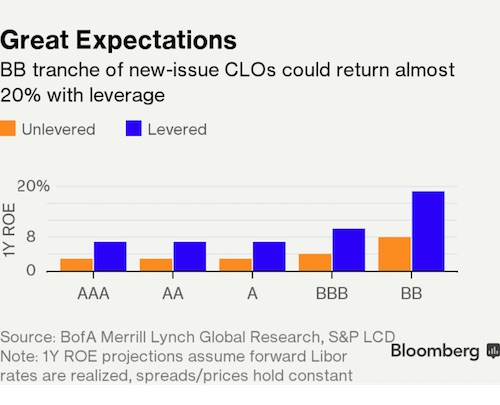
• Chinese Investors Eye Leverage to Juice U.S. CLO Returns (BBG)
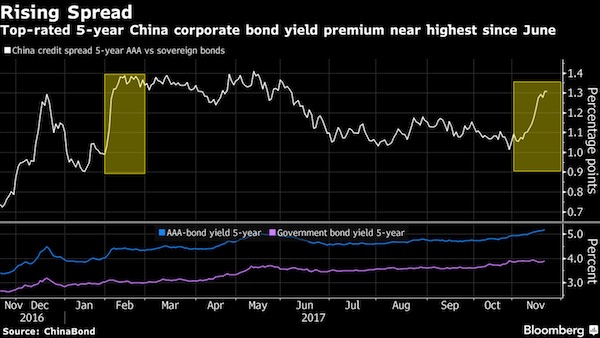
• China’s $3.4 Trillion Corporate Bond Market Faces Rocky 2018 (BBG)
• Worst Growth In Decades Pushes UK To Inject £25bn Into Economy (Ind.)
• Budget Shows Tories Are Unfit For Office – Corbyn (G.)
• Facebook To Let Users See If They ‘Liked’ Russian Accounts (R.)
• Putin Tell Russian Firms To Be Ready For War Production (Ind.)
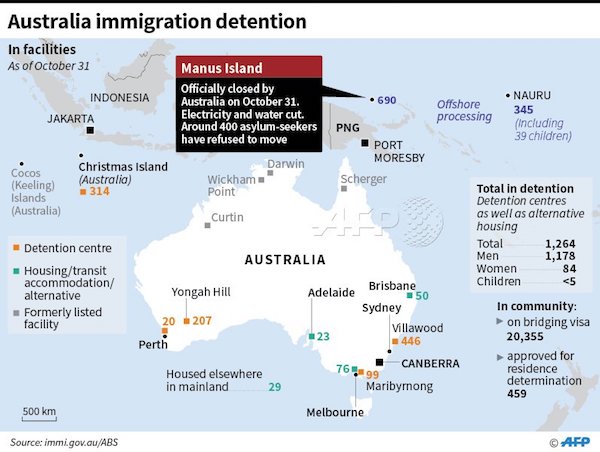
• PNG Police Move In On Closed Australia Refugee Camp On Manus (AFP)
• Night Being Lost To Artificial Light (BBC)


“I don’t think any of us know what the implications are for a $50 trillion debt build since the great financial crisis (of 2008). It is impossible to say. We have never dealt with anything of this magnitude.”

• Fed Fears New Record High Credit Bubble – Danielle DiMartino Booth (USAW)

Former Federal Reserve insider Danielle DiMartino Booth says the record high stock and bond prices make the Fed nervous because it’s fearful of popping this record high credit bubble. DiMartino Booth says, “The Fed’s biggest fear is they know darn well this much credit has built up in the background, and the ramifications of the un-wind for what has happened since the great financial crisis is even greater than what happened in 2008 and 2009. It’s global and pretty viral. So, the Fed has good reason to be fearful of what’s going to happen when the baby boomer generation and the pension funds in this country take a third body blow since 2000, and that’s why they are so very, very intimidated by the financial markets and so fearful of a correction.”

Why will the Fed not allow even a small correction in the markets? DiMartino Booth says, “Look back to last year when Deutsche Bank took the markets to DEFCON 1. Maybe you were paying attention and maybe you weren’t, but it certainly got the German government’s attention. They said the checkbook is open, and we will do whatever we need to do because we can’t quantify what will happen when a major bank gets into a distressed situation. I think what central banks worldwide fear is that there has been such a magnificent re-blowing of the credit bubble since 2007 and 2008 that they can’t tell you where the contagion is going to be. So, they have this great fear of a 2% or 3% or 10% (correction) and do not know what the daisy chain is going to look like and where the contagion is going to land.

It could be the Chinese bond market. It could be Italian insolvent banks or it might be Deutsche Bank, or whether it might be small or midsize U.S. commercial lenders. They can’t tell you where the systemic risk lies, and that’s where their fear is. This credit bubble is of their making.” In short, the Fed does not know what is going to happen, and according to DiMartino Booth, nobody does. DiMartino Booth contends, “I don’t think any of us know what the implications are for a $50 trillion debt build since the great financial crisis (of 2008). It is impossible to say. We have never dealt with anything of this magnitude.”

“2017 is the record for quantitative easing (money printing) globally. We have never, not even in the darkest days of the financial crisis, central banks have never injected as much money as they have into the markets. . . . I am not a gold bug, but we do know that in times of corrections that there is no place to hide in traditional asset classes that you can get at your Merrill Lynch brokerage. Gold and silver in the precious metals complex are the only places to hide and get true diversification and safety.”

Read more …

They do know what’s going on.

• Global Debt Is Rising, Especially in Emerging Economies (St. Louis Fed)

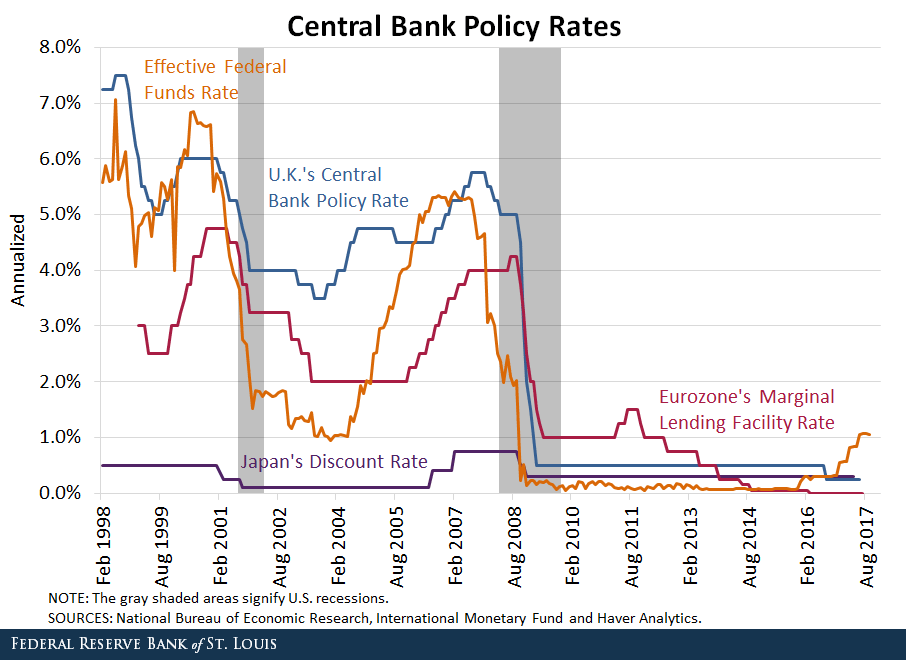
The world has become used to cheap credit. And the increase in borrowing by emerging economies could pose a risk as monetary policy normalizes. In response to the most recent recession, central banks around the world decreased their main policy rates to almost zero, as seen in the figure below.

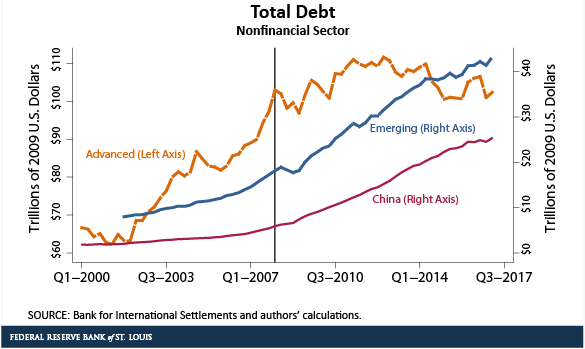
[..] The downward trend in short-term and long-term interest rates has made borrowing cheaper over time. As a result, global debt has increased substantially since 2007. According to Bank for International Settlements (BIS) data, total debt of the nonfinancial sector (that is, households, government and nonfinancial corporations) amounted to $145 trillion in the first quarter of 2017, an increase of 40% since the first quarter of 2007. Most of this increase has been driven by an increase in total debt in emerging economies, especially in China, as seen in the following figure.

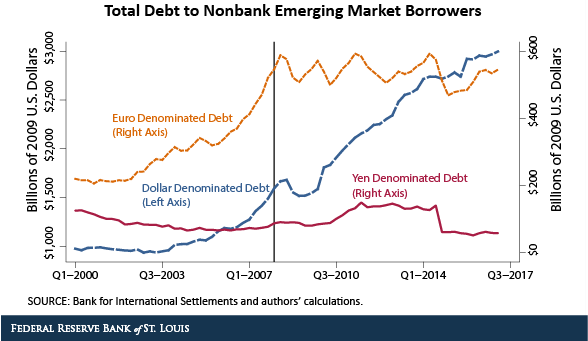
Furthermore, emerging economies have borrowed heavily in foreign currency, mainly in U.S. dollars, shown in the figure below.

According to the BIS, total dollar-denominated debt outside the U.S. reached $10.7 trillion in the first quarter of 2017, and about a third of this debt is owed by the nonfinancial sector of emerging economies. Analysts have stressed that the rapid accumulation of debt in emerging economies could pose risks for the global economy in the presence of U.S. monetary policy normalization. Market expectations of a rapid increase in the policy rate and the reduction of the Federal Reserve’s balance sheet could lead to higher borrowing costs and an appreciation of the U.S. dollar. This, in turn, would increase the cost of refinancing debt in emerging economies. If these risks materialized, there could be an increase in the demand for safe assets, particularly U.S. Treasuries. This would lead to a decrease in long-term rates. In times of monetary normalization, the yield curve would flatten, and banks profitability could be eroded.

Read more …

After the storms…

• Pressure on US Households Intensifies (DDMB)

The full effects of Hurricanes Harvey and Irma are rapidly showing up in the data. In September, according to Black Knight, the number of mortgages either past due or in foreclosure rose by 214,000, or 9%, compared with August. At 5.1%, the combined rate is far off the previous month’s 4.7% and the most recent low of 4.5% recorded in March 2007. October’s numbers have brought the picture more clearly into focus. More than 229,000 past-due mortgages are tied to the storms. Hurricane Irma accounted for 163,000 and Harvey, 66,000. To place the damage to households in context, before the storms, Florida and Texas ranked 22nd and 20th among non-current mortgage states. As of October, Florida has risen to second place and Texas is in fifth place.

The economy has also enjoyed a rush of car sales as sufficiently-collateralized and insured drivers immediately replaced vehicles destroyed by the storms. According to the latest retail data, car sales slowed to a 0.7% growth rate in October, far below September’s blistering 4.6-percent pace. Nonetheless, the next development could be a further deterioration in auto delinquencies attributed to storm victims. The most recent third-quarter data from the New York Fed suggest struggling households continue to buckle under the strains of their monthly payments. The delinquency rate for subprime loans originated by auto-finance companies, as opposed to banks, hit 9.7% in the three months ended in September.

With one in four auto loans outstanding going to subprime borrowers, the rate has been rising since 2013 and is at a seven-year high. What’s most notable is that these delinquency rates are being recorded outside recession, all but ensuring 2009’s peak of 10.9% will be breached in the next downturn. And while credit-card delinquencies are nowhere near their crisis-era double-digit peaks, the New York Fed noted that serious delinquencies have been on the rise for one year. The serious delinquency rate hit 4.6% in the third quarter, up from 4.4% the prior quarter. Adjusted for inflation, the growth of U.S. credit-card spending has outpaced that of incomes for 26 straight months.

Read more …

Anyone shorting Italy for real yet?

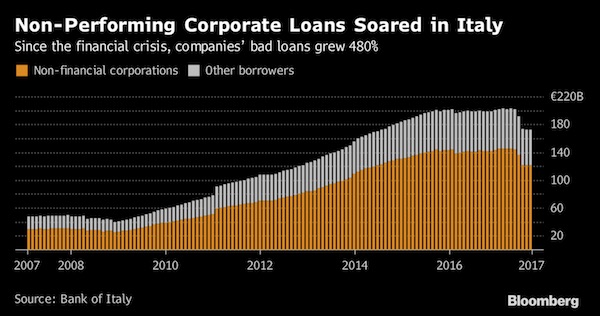
• Zombie Firms Roam Europe Because Banks Help Keep Them Undead

So-called zombie firms – companies that would be out of business or painfully restructured in a competitive economy – have become a key issue for policy makers grappling with sluggish productivity growth in developed economies. The fear is that those “zombies” are sucking up capital that could otherwise go to more productive firms. A new study by the OECD helps explaining how banks favor the spread of zombie firms. It shows that weak companies tend to be connected to weak banks which prefer to roll over or restructure bad loans rather than declaring them delinquent and writing them off. The OECD’s research by Dan Andrews and Filippos Petroulakis lends new urgency to the ECB’s efforts to slash non-performing loans in the region.

Supervisors have asked for detailed plans of how NPLs will be cut and are mulling requiring banks to set aside more capital for soured loans. “In order to facilitate the unwinding of the zombie problem, it is essential that bank balance sheets are strong, underlining the need for fast recapitalizations after crises and other measures to reduce NPLs,” write the authors. “The zombie firm problem in Europe may at least partly stem from bank forbearance.” Weak productivity matters in an ageing continent like Europe, where a shrinking working population is expected to support an ever increasing number of retirees. This can’t happen unless technology and education make it possible to squeeze more and more output from labor and capital.

The OECD has been investigating the impact of living-dead companies for years. It argues that zombification leads to capital misallocation, as weak banks tend to steer less capital to healthier and more productive firms. This in turn leads to low productivity and returns, making it more difficult to get credit even for innovative companies. Andrews and Petroulakis also say that, in addition to forcing banks to work down their NPLs and bolster capital, efficient laws on insolvency are needed. It is not a coincidence that Italy – the European country with the largest NPL problem – overhauled its bankruptcy rules last month to make them quicker and more efficient.

Read more …

Mr. Xi, sir, it’s time to be careful.

• China Is Pumping A Lot Of Cash Into Its Economy To Calm Investors (CNBC)

China has been pumping a lot of cash into its system to lift market sentiment, as the world’s second-largest economy walks a thin line between curbing debt and keeping everything running smoothly. Last week, the People’s Bank of China injected cash totaling 810 billion Chinese yuan ($122.4 billion) in five straight days of daily liquidity management operations. Those actions, which represented the largest weekly net increase since January, were in part a Beijing response to its 10-year sovereign bond yields spiking to multiyear highs, experts said. “Surging Chinese government bond yields hit the nerve of policymakers, so in order to further prevent a greater surge, they injected liquidity into the system to improve market sentiment,” said Ken Cheung, a foreign exchange strategist at Mizuho Bank who focuses on Chinese currencies and monetary policies.

Nomura analysts said last week in a note that the bond rout was due to fears of regulatory tightening from Beijing. Bond yields, which move inversely to prices, briefly hit 4% in China for the first time in three years. A rise in the benchmark government bond yield threatens to drive up overall borrowing costs — and potentially worsen the country’s debt situation. On Monday and Tuesday of this week, the PBOC injected a net 30 billion yuan ($4.5 billion), but it didn’t expand that money supply on Wednesday. Analysts said that pause may have been due to market sentiment seemingly stabilizing, but it may be short-lived. As Chinese 10-year yields are still near the psychologically important 4% level, Cheung told CNBC he expects more injections ahead if necessary, as Beijing needs to “maintain liquidity to please the market.”

Read more …

“It’s dangerous territory. Leveraging BB-rated bonds – is that a good idea?”

• Chinese Investors Eye Leverage to Juice U.S. CLO Returns (BBG)

The last time Asian investors borrowed money to invest in structured-credit products – during the run-up to the financial crisis – it didn’t work out so well. Now, a new set of buyers from China are hoping things turn out differently. Instead of snapping up packages of risky derivatives tied to U.S. home loans, they’re buying collateralized loan obligations that bundle together corporate loans to highly leveraged companies. And while such CLOs weathered the last crisis relatively well, there’s already concern that these investors are being tempted to deploy leverage to amplify their returns. The problem is that even the riskiest pieces of CLOs can yield less than the 8 to 10% targets Chinese investors have grown accustomed to in their markets, according to Collin Chan, a CLO analyst at Bank of America Corp.

So CLOs, the junk-rated slices of which yield just 5.5 percentage points more than Libor, “may not be crazily attractive” to them, said Chan, whose team has trekked to China multiple times this year to pitch the products to investors there. On a recent trip to China, potential new investors expressed interest in the idea of applying leverage for the purchase of CLOs, even at the riskier BB level, Chan said. He estimates levered returns for the BB-rated CLO slice may be almost 20%. Leverage is employed using the repo financing market, where short-term loans allow investors to borrow money by lending securities. It’s the latest evidence of the search for yield that has engulfed credit markets and provided a significant boost for CLO sales this year. China and its many types of financial institutions now look like promising buyers for a product that in Asia has typically been bought by Japanese banks and Korean insurers.

“It wouldn’t be wise for the Chinese to use leverage at this stage,” said Asif Khan, head of CLO origination and distribution at MUFG. “It’s dangerous territory. Leveraging BB-rated bonds – is that a good idea? Any potential use of leverage by Chinese investors could pose potential risk in case of severe volatility.” [..] Chinese investors have yet to enter the CLO market en masse. However signs point to their growing participation. In some cases, investment banks and CLO managers have made as many as five trips to Asia this year, adding on special CLO-focused investor conferences in mainland China for the first time ever to raise the product’s profile. The demand to diversify into dollar assets has grown from a wide range of investors, despite Chinese-government capital controls limiting deployment of capital abroad.

Read more …

$3.4 trillion sounds low.

• China’s $3.4 Trillion Corporate Bond Market Faces Rocky 2018 (BBG)

China’s deleveraging campaign is finally starting to bite in the nation’s corporate-bond market, a shift that will make 2018 a clearer test of policy makers’ appetites to let struggling companies fail. Yields on five-year top-rated local corporate notes have jumped about 33 basis points since the month began, to a three-year high of 5.3%, according to data compiled by clearing house ChinaBond. Government bonds, which have far greater liquidity, had already moved last month as the central bank warned further deleveraging was needed. With more than $1 trillion of local bonds maturing in 2018-19, it will become increasingly expensive for Chinese companies to roll over financing – and all the tougher for those in industries like coal that the nation’s leadership wants to shrink.

Two companies based in Inner Mongolia, a northern province that’s suffered from a debt-and-construction binge, missed bond payments on Tuesday, in a demonstration of the kind of pain that may come. In the long haul, that all may be good for China. Allowing more defaults could see its bond market become more like its overseas counterparts, with a greater differentiation in price. And that could mean it channels funds more productively. “The deleveraging campaign and the new rules on the asset management industry will further differentiate good and bad quality credits, and make the onshore credit market more efficient,” said Raymond Gui at Income Partners Asset Management. “Weaker companies will find it harder to roll over their debts because funding costs will stay high.” Gui predicts yields will keep climbing. The average for top-rated corporate bonds is already 2.2 percentage points above what investors demanded to hold them in October last year.

Read more …

More austerity.

• Worst Growth In Decades Pushes UK To Inject £25bn Into Economy (Ind.)

Britain faces its worst period of economic growth in more than half a century after official data revealed a country hamstrung by feeble productivity and Brexit. Dismal figures released alongside Philip Hammond’s Budget led the Chancellor to announce a £25bn cash injection to strengthen the ailing economy. The major giveaway will see money head towards housebuilding, preparing Whitehall for Brexit, the NHS and boosting the tech sector. But despite the extra cash most government departments will still experience deep cuts over the next five years, as Mr Hammond struggles to get the public finances under control. Mr Hammond tried to put a positive sheen on progress towards reducing net debt and abolishing the deficit, but data suggested Britain would now fail to achieve a budget surplus before 2031.

Forecasts from the Office for Budget Responsibility indicated GDP would grow by 1.5% in 2017, down from the 2% forecast in March. The Government’s official financial auditor said growth would drop to 1.4% next year – as low as 1.3% in 2019 and 2020 – and then pick up to 1.5% in 2021 and 1.6% in 2022. The OBR said the main downward pressure on growth was a big fall in the UK’s projected productivity, intensifying public spending cuts and Brexit uncertainty. The body was established in 2010 by then-Chancellor George Osborne to end a system under which the Treasury produced its own economic growth estimates. The latest predictions are the gloomiest that the auditor has ever given, and they are also smaller than any produced by the Treasury since 1983. Institute for Fiscal Studies director Paul Johnson said the 1.4% average growth forecast over the period was “much worse than we have had over the last 60 or 70 years”.

Read more …

“.. the reality will be – a lot of people will be no better off. And the misery that many are in will be continuing.”

• Budget Shows Tories Are Unfit For Office – Corbyn (G.)

In his response to the budget, Corbyn – it is the leader of the opposition who traditionally speaks rather than the shadow chancellor – said Hammond had completely failed to tackle a national crisis of stagnation and falling wages. “The test of a budget is how it affects the reality of people’s lives all around this country,” the Labour leader said. “And I believe as the days go ahead, and this budget unravels, the reality will be – a lot of people will be no better off. And the misery that many are in will be continuing.” Largely eschewing direct focus on Hammond’s specific announcements in favour of a broader critique of the government’s wider economic approach, Corbyn castigated Hammond for again missing deficit reduction targets, and for a continued spending squeeze on schools and the police.

Speaking about housing, Corbyn said rough sleeping had doubled since 2010, and that this Christmas 120,000 children would be living in temporary accommodation. “We need a large-scale publicly funded housebuilding programme, not this government’s accounting tricks and empty promises.” Summing up, he said: “We were promised a revolutionary budget. The reality is nothing has changed. People were looking for help from this budget. They have been let down. Let down by a government that, like the economy they’ve presided over, is weak and unstable and in need of urgent change. They call this budget ‘Fit for the Future’. The reality is this is a government no longer fit for office.”

Read more …

Mish commented on Twitter he’d be more interested in seeing which CIA propaganda sites he’d liked.

Question is: should we trust Facebook’s assessment of what is Russian and what not? I don’t think so.

• Facebook To Let Users See If They ‘Liked’ Russian Accounts (R.)

Facebook said on Wednesday it would build a web page to allow users to see which Russian propaganda accounts they have liked or followed, after U.S. lawmakers demanded that the social network be more open about the reach of the accounts. U.S. lawmakers called the announcement a positive step. The web page, though, would fall short of their demands that Facebook individually notify users about Russian propaganda posts or ads they were exposed to. Facebook, Alphabet Inc’s Google and Twitter are facing a backlash after saying Russians used their services to anonymously spread divisive messages among Americans in the run-up to the 2016 U.S. elections. U.S. lawmakers have criticized the tech firms for not doing more to detect the alleged election meddling, which the Russian government denies involvement in.

Facebook says the propaganda came from the Internet Research Agency, a Russian organization that according to lawmakers and researchers employs hundreds of people to push pro-Kremlin content under phony social media accounts. As many as 126 million people could have been served posts on Facebook and 20 million on Instagram, the company says. Facebook has since deactivated the accounts. Facebook, in a statement, said it would let people see which pages or accounts they liked or followed between January 2015 and August 2017 that were affiliated with the Internet Research Agency. The tool will be available by the end of the year as “part of our ongoing effort to protect our platforms and the people who use them from bad actors who try to undermine our democracy,” Facebook said.

The web page will show only a list of accounts, not the posts or ads affiliated with them, according to a mock-up. U.S. lawmakers have separately published some posts. It was not clear if Facebook would eventually do more, such as sending individualized notifications to users.

Read more …

NATO is a real threat.

• Putin Tell Russian Firms To Be Ready For War Production (Ind.)

Russian business should be prepared to switch to production to military needs at any time, said Vladimir Putin on Wednesday. The Russian president was speaking at a conference of military leaders in Sochi. “The ability of our economy to increase military production and services at a given time is one of the most important aspects of military security,” Mr Putin said. “To this end, all strategic, and simply large-scale enterprise should be ready, regardless of ownership.” A day earlier, the president had spoken of a need to catch up and overtake the West in military technology. “Our army and navy need to have the very best equipment — better than foreign equivalents,” he said. “If we want to win, we have to be better.”

Since the 2008 Georgian war, which was a difficult operation, the Russian military has undergone extensive modernisation. Ageing Soviet equipment has gone. There is a new testing regime. There are new command structures. The budget has also increased exponentially. This year, military expenses will cross 3 trillion roubles, or 3.3% of GDP. This would be a record were it not for one-off costs in 2016. Over the next two years, spending is forecast to be cut back slightly, to approximately 2.8% of GDP. Though that budget remains less than 30% of the combined Nato budget in Europe, many countries are increasing their military spending in response to the “Russian threat”. Nato military command has also been restructured — it says in response to Russian cyber and military threats.

Read more …

First thing that needs to happen is Australian media reporting on this. Then people must protest. New Zealand recently offered to take a whole group of these people, Australia declined. Many need medical treatment. Australia refuses.

• PNG Police Move In On Closed Australia Refugee Camp On Manus (AFP)

Papua New Guinea police moved into the shuttered Australian refugee camp on the country’s Manus Island Thursday in the most aggressive push yet to force hundreds of men to leave, the Australian government and detainees said. The police operation was confirmed by Australia’s Immigration Minister Peter Dutton, who said Canberra was “very keen for people to move out of the Manus regional processing centre”. “I think it’s outrageous that people are still there,” he told Sydney commercial radio station 2GB. “We want people to move.” Iranian Behrouz Boochani tweeted from inside the camp earlier Thursday, writing that “police have started to break the shelters, water tanks and are saying ‘move, move'”.

“Navy soldiers are outside the prison camp. We are on high alert right now. We are under attack,” he said, adding that two refugees were in need of urgent medical treatment. Other refugees posted photos to social media sites showing police entering the camp, which Australia declared closed on October 31 after the PNG Supreme Court declared it unconstitutional. [..] Australia had shut off electricity and water supplies to the camp and demanded that some 600 asylum-seekers detained there move to three nearby transition centres. Around 400 of the asylum-seekers have refused to leave, saying they fear for their safety in a local population which opposes their presence on the island. They also say the three transition centres are not fully operational, with a lack of security, sufficient water or electricity.

[..] Canberra has strongly rejected calls to move the refugees to Australia and instead has tried to resettle them in third countries, including the United States. But so far, just 54 refugees have been accepted by Washington, with 24 flown to America in September. Despite widespread criticism, Canberra has defended its offshore processing policy as stopping deaths at sea after a spate of drownings.

Read more …

Oh, the lights will go out eventually…

• Night Being Lost To Artificial Light (BBC)

A study of pictures of Earth by night has revealed that artificial light is growing brighter and more extensive every year. Between 2012 and 2016, the planet’s artificially lit outdoor area grew by more than 2% per year. Scientists say a “loss of night” in many countries is having negative consequences for “flora, fauna, and human well-being”. A team published the findings in the journal Science Advances. Their study used data from a Nasa satellite radiometer – a device designed specifically to measure the brightness of night-time light. It showed that changes in brightness over time varied greatly by country. Some of the world’s “brightest nations”, such as the US and Spain, remained the same. Most nations in South America, Africa and Asia grew brighter. Only a few countries showed a decrease in brightness, such as Yemen and Syria – both experiencing warfare.

The nocturnal satellite images – of glowing coastlines and spider-like city networks – look quite beautiful but artificial lighting has unintended consequences for human health and the environment. Lead researcher Christopher Kyba from the German Research Centre for Geoscience in Potsdam said that the introduction of artificial light was “one of the most dramatic physical changes human beings have made to our environment”. He and his colleagues had expected to see a decrease in brightness in wealthy cities and industrial areas as they switched from the orange glow of sodium lights to more energy-efficient LEDs; the light sensor on the satellite is not able to measure the bluer part of the spectrum of light that LEDs emit.

“I expected that in wealthy countries – like the US, UK, and Germany – we’d see overall decreases in light, especially in brightly lit areas,” he told BBC News. “Instead we see countries like the US staying the same and the UK and Germany becoming increasingly bright.” Since the satellite sensor does not “see” the bluer light that humans can see, the increases in brightness that we experience will be even greater than what the researchers were able to measure.


UK, Netherlands, Belgium

Read more …

Nov 192017
 
 November 19, 2017  Posted by at 10:04 am Finance Tagged with: , , , , , , , , ,  4 Responses »


Wyland Stanley Pontiac coupe at San Francisco Palace of Fine Arts 1935


• A Fiscal Disappointment – Tax Bill (Lebowitz)
• Mt. Gox’s Bitcoin Customers Could Lose Again (R.)
• The Coming Economic Downturn In Canada (MN)
• How a Half-Educated Tech Elite Delivered Us Into Chaos (Naughton)
• Europe Turns On Facebook, Google For Digital Tax Revamp (AFP)
• When Unpaid Student Loan Bills Mean You Can No Longer Work (NYT)
• Subways May Be the Latest Casualty of China’s Crackdown on Debt (BBG)
• Upsurge In Big Earthquakes Predicted For 2018 As Earth Rotation Slows (G.)
• Will Puerto Ricans Return Home After Hurricane María? (Conv.)
• 600 African Migrants Rescued Near Spain (AFP)
• First Child Refugee From Greek Camps Comes To UK (G.)
• Lesvos Authorities Going On Strike Over Rising Migrant Population (K.)
• Over 50,000 Yemeni Children Expected To Die By The End Of 2017 (Ind.)


This is about much more than the Tax bill. It’s about how much growth you get per dollar in debt added. That is crucial.

• A Fiscal Disappointment – Tax Bill (Lebowitz)

The Committee For A Responsible Budget penned after the passage of the tax bill: “The House approved debt-financed tax cuts based on predictions of magical economic growth that defy history and all credible analyses. Tax reform should grow the economy and not add to the debt. Unfortunately, lawmakers are assuming faster economic growth will pay for that debt increase when there is no evidence it will cover more than a fraction of the tax bill’s costs. The last time Congress added 10-figures worth of tax cuts to the debt in 2001, it blew a hole in the budget and helped erase our surpluses — despite claims that economic growth would cover the cost.The growth fairy did not appear then, and it would be unwise to assume she will this time around.” Read that again. Despite claiming to be “fiscally conservative,” what is so amazing is that Republicans are considering doing this when debt is at the highest level in history and climbing.

When the “Reagan” tax cuts of were passed, debt was less than 50% of GDP, inflation and interest rates were high and falling, and the economy was just recovering from back to back recessions. When the “Bush” tax cuts were passed, debt to GDP was only slightly higher than under Reagan but despite the tax cuts, the economy slid into a recession compounded by the “dot.com” bust. Currently, debt is 104% of GDP — higher than any time in history, the economy has been in a 9-year expansion at the lowest rate of growth on record, and interest rates and inflation are low with the Fed hiking rates and reducing monetary support. The situation currently is much more like Bush versus Reagan. Lastly, despite the continuing “talking points” that “tax cuts” spur economic growth and will pay for themselves over time….there is no evidence to support that claim.

Read more …

A curious tale.

• Mt. Gox’s Bitcoin Customers Could Lose Again (R.)

When Mt. Gox, the world’s largest bitcoin trading exchange, collapsed in early 2014, more than 24,000 customers around the world lost access to hundreds of millions of dollars’ worth of cryptocurrency and cash. More than three years later, with the price of bitcoin skyrocketing to more than $7,000, not a single customer has recouped a single cent, crypto or otherwise. It’s not clear when they will. The failed exchange has become stuck in a morass of litigation – a Russian doll of bankruptcies in Japan and New Zealand, four in all, plus lawsuits in the United States and competing claims from creditors. And although the Mt. Gox bankruptcy trustee recovered digital currency now worth more than $1.6 billion, under Japanese law the exchange’s customers likely will recover only a fraction of that.

Kim Nilsson, a Swedish software developer who had more than a dozen bitcoins at Mt. Gox, isn’t optimistic of a payout soon. “It’s a legal twilight zone,” he says. “I wouldn’t be surprised if it took several years more.” There are few better examples of the dangers of investing in cryptocurrencies than Mt. Gox. As Reuters reported in September, cryptocurrency exchanges – where digital coins are bought, sold and stored – are largely unregulated and have become magnets for fraud and deception. At least 10 of them have closed, often after thefts, leaving customers without their funds. In all, more than 980,000 bitcoins have been stolen from exchanges since 2011 – two-thirds of those from Mt. Gox. Today, all of the stolen coins would be worth more than $6 billion, Reuters has calculated.

Mt. Gox is one of the few collapsed exchanges that ended up in bankruptcy court; some just vanished. But the problem for Mt. Gox’s thousands of creditors is that under Japanese bankruptcy law, their claims were valued at the market price of bitcoin in April 2014 just before the Tokyo District Court ordered the exchange be liquidated. At that time, one bitcoin was worth $483. On the basis of the April 2014 value, the claims ultimately approved were fixed at 45.6 billion Japanese yen, currently about $400 million. Based on the current price of bitcoin, Mt. Gox’s bankruptcy trustee is sitting on enough cash to repay creditors whose claims have been approved more than three times that amount, according to Reuters’ calculation. But that likely won’t happen, according to two Japanese bankruptcy attorneys.

In Japan, by law any funds left over in a bankrupt company’s estate after creditors have been paid go to shareholders. Mt. Gox is 88% owned by a Japanese company called Tibanne. And Mark Karpeles, a 32-year-old French software engineer and Mt. Gox’s former chief executive, owns 100% of Tibanne. Karpeles is currently on trial in Tokyo, accused of embezzling money from Mt. Gox and manipulating its data, as well as breach of trust. He has pleaded not guilty to the charges, some of which carry sentences of up to 10 years. He served nearly a year in jail following his arrest in August 2015.[..] In a three-hour interview, Karpeles told Reuters he doesn’t want the money. The main reason: He expects he would be inundated with lawsuits. He says he already is facing about a half dozen. “I don’t want to be the beneficiary of this,” he said. “I don’t really need money. I work, I get by.”

Read more …

Bubbles all around.

• The Coming Economic Downturn In Canada (MN)

Given its natural resource-based economy, Canada is a boom and bust kind of place. This year, the country has enjoyed a significant boom. Thanks to a government stimulus program, rising corporate capital expenditures and consumer spending, Canada’s GDP growth has been nothing short of spectacular in 2017. According to Statistics Canada, the latest reading for year-over-year GDP growth is a healthy 3.5% (as of August 2017). While this is stronger than all major developed countries, growth is decelerating from its most recent peak in May 2017 (when GDP growth was an astounding 4.7%). A visual overview of historical GDP growth is shown below for reference:

Following the crude oil bust in the second quarter of 2014, Canadian growth rates cratered. While the country avoided a technical recession, the economic outlook was poor until early 2016. After crude oil returned to a bull market in the first quarter of 2016, the fortunes of the country turned. Given limited growth in 2015, the economy had no problem delivering 2%+ year-over-year growth rates in 2016. As a substantial stimulus program ramped up government spending in 2017, growth rates have continued to accelerate this year. While Canada has delivered exceptional growth in the last two years, the future outlook is much more challenging.

Beyond the issue of base effects (mathematically, year-over-year GDP growth will be much tougher next year), key sectors including the oil & gas industry and Canadian real estate look ripe for a downturn. As WTI crude strengthens beyond $55, crude oil is clearly in a bull market today. Looking at figures from the International Energy Agency, global demand growth continues to run ahead of supply growth. Thus the ongoing bull market is supported by fundamentals. Thanks to the impact of hurricanes and infrastructure bottlenecks in 2017, US shale hasn’t entirely fulfilled its role as the global ‘swing producer’ this year. The dynamics of supply growth versus demand growth are shown below:

Read more …

It’s a good thing this is getting addressed. It may well be too late though.

• How a Half-Educated Tech Elite Delivered Us Into Chaos (Naughton)

One of the biggest puzzles about our current predicament with fake news and the weaponisation of social media is why the folks who built this technology are so taken aback by what has happened. Exhibit A is the founder of Facebook, Mark Zuckerberg, whose political education I recently chronicled. But he’s not alone. In fact I’d say he is quite representative of many of the biggest movers and shakers in the tech world. We have a burgeoning genre of “OMG, what have we done?” angst coming from former Facebook and Google employees who have begun to realise that the cool stuff they worked on might have had, well, antisocial consequences.

Put simply, what Google and Facebook have built is a pair of amazingly sophisticated, computer-driven engines for extracting users’ personal information and data trails, refining them for sale to advertisers in high-speed data-trading auctions that are entirely unregulated and opaque to everyone except the companies themselves. The purpose of this infrastructure was to enable companies to target people with carefully customised commercial messages and, as far as we know, they are pretty good at that. (Though some advertisers are beginning to wonder if these systems are quite as good as Google and Facebook claim.) And in doing this, Zuckerberg, Google co-founders Larry Page and Sergey Brin and co wrote themselves licences to print money and build insanely profitable companies.

It never seems to have occurred to them that their advertising engines could also be used to deliver precisely targeted ideological and political messages to voters. Hence the obvious question: how could such smart people be so stupid? The cynical answer is they knew about the potential dark side all along and didn’t care, because to acknowledge it might have undermined the aforementioned licences to print money. Which is another way of saying that most tech leaders are sociopaths. Personally I think that’s unlikely, although among their number are some very peculiar characters: one thinks, for example, of Paypal co-founder Peter Thiel – Trump’s favourite techie; and Travis Kalanick, the founder of Uber. So what else could explain the astonishing naivety of the tech crowd? My hunch is it has something to do with their educational backgrounds.

Take the Google co-founders. Sergey Brin studied mathematics and computer science. His partner, Larry Page, studied engineering and computer science. Zuckerberg dropped out of Harvard, where he was studying psychology and computer science, but seems to have been more interested in the latter. Now mathematics, engineering and computer science are wonderful disciplines – intellectually demanding and fulfilling. And they are economically vital for any advanced society. But mastering them teaches students very little about society or history – or indeed about human nature. As a consequence, the new masters of our universe are people who are essentially only half-educated. They have had no exposure to the humanities or the social sciences, the academic disciplines that aim to provide some understanding of how society works, of history and of the roles that beliefs, philosophies, laws, norms, religion and customs play in the evolution of human culture.

Read more …

It’s as much about the companies as it is about Europe’s own tax havens. The latter should be easier to tackle.

• Europe Turns On Facebook, Google For Digital Tax Revamp (AFP)

They have revolutionised the way we live, but are US tech giants the new robber barons of the 21st century, banking billions in profit while short-changing the public by paying only a pittance in tax? With public coffers still strained years after the worst of the debt crisis, EU leaders have agreed to tackle the question, spurred on by French President Emmanuel Macron who has slammed the likes of Google, Facebook and Apple as the “freeloaders of the modern world”. As recently as March, five of the world’s top 10 valued companies were Silicon Valley behemoths: Apple, Google’s Alphabet, Microsoft, Amazon and Facebook. (Germany’s SAP was Europe’s biggest and 56th on the global list). But tax rules today are designed for yesterday’s economy when US multinationals -such as General Motors, IBM or McDonald’s- entered countries loudly, with new factories, jobs and more taxes for the taking.

These firms had what tax specialists call “permanent establishment”, when companies showed a clear physical presence measured and taxed through tangible, real world assets. But today in most EU nations, the US tech titans exist almost exclusively in the virtual world, their services piped through apps to smart phones and tablets from designers and data servers oceans away. Ghost-like, Silicon Valley has turned Europe’s economies upside down, but often with just a skeleton staff and some office space in markets with millions of users or customers. According to EU law, to operate across Europe, multinationals have almost total liberty to choose a home country of their choosing. Not surprisingly, they choose small, low tax nations such as Ireland, the Netherlands or Luxembourg. Thus, it is through Ireland that Facebook draws its wealth from millions of accounts across Europe.

There are 33 million accounts in France and 31 million in Germany, according to recent data. While users enjoy the platform, Facebook tracks likes, comments and page views and sells the data to companies who then target consumers. But unlike the economy of old, Facebook sells its data to French companies not from France but from a great, nation-less elsewhere, with no phone number, address or physical “presence” for a customer who probably cares little. It is in states like Ireland, whose official tax rate of 12.5% is the lowest in Europe, that the giants have parked their EU headquarters and book profits from revenues made across the bloc. Indeed, actual revenues from advertising are minimal in France and Germany, but at Facebook HQ Ireland they grew to 7.9 billion euros, even though the vast majority does not come from the tiny EU island-nation of a mere 2.5 million users.

Read more …

A crazy world.

• When Unpaid Student Loan Bills Mean You Can No Longer Work (NYT)

Fall behind on your student loan payments, lose your job. Few people realize that the loans they take out to pay for their education could eventually derail their careers. But in 19 states, government agencies can seize state-issued professional licenses from residents who default on their educational debts. Another state, South Dakota, suspends driver’s licenses, making it nearly impossible for people to get to work. As debt levels rise, creditors are taking increasingly tough actions to chase people who fall behind on student loans. Going after professional licenses stands out as especially punitive. Firefighters, nurses, teachers, lawyers, massage therapists, barbers, psychologists and real estate brokers have all had their credentials suspended or revoked.

Determining the number of people who have lost their licenses is impossible because many state agencies and licensing boards don’t track the information. Public records requests by The New York Times identified at least 8,700 cases in which licenses were taken away or put at risk of suspension in recent years, although that tally almost certainly understates the true number. [..] With student debt levels soaring — the loans are now the largest source of household debt outside of mortgages — so are defaults. Lenders have always pursued delinquent borrowers: by filing lawsuits, garnishing their wages, putting liens on their property and seizing tax refunds. Blocking licenses is a more aggressive weapon, and states are using it on behalf of themselves and the federal government.

Proponents of the little-known state licensing laws say they are in taxpayers’ interest. Many student loans are backed by guarantees by the state or federal government, which foot the bills if borrowers default. Faced with losing their licenses, the reasoning goes, debtors will find the money. But critics from both parties say the laws shove some borrowers off a financial cliff.

Read more …

Politicians everywhere dream of big and grandiose projects.

• Subways May Be the Latest Casualty of China’s Crackdown on Debt (BBG)

China’s frenzied construction of subway systems in cities all over the country may be easing, amid reports funding has been pulled for some projects as Beijing pushes to rein in debt levels. The National Development and Reform Commission, China’s top economic planning body, is revising a 2003 policy on subway development, Caixin reported on Saturday. The NDRC wants to “raise the bar” for approving local rail projects amid growing concern over a debt-driven infrastructure boom, the financial magazine said, citing sources that it didn’t identify. Population levels, as well as the economy and fiscal conditions of Chinese cities seeking permission for subway projects will be more closely scrutinized, Caixin said. Subway construction is a constant presence in China’s cities, with streets torn up to build the capacity needed to transport the swelling ranks of urban commuters.

Beijing alone has been testing three lines: a driverless subway, a maglev train, and a tram to be launched in the city’s western suburbs at the end of the year, the official Xinhua News Agency reported in September. But investment in the sector appears to be tapering off, just as China’s leaders make reining in financial risks a top priority. Fixed-asset investment in rail transportation has slowed almost to a standstill in 2017, increasing just 0.4% in January-October from a year earlier, statistics bureau data show. That’s down from 3.5% growth in the first four months of the year. Private rail transport investment – which makes up a tiny share of an industry that’s dominated by state-backed enterprises – slumped 58.6% January-October from a year earlier.

Read more …

Rotation slowing by a millisecond per day.

• Upsurge In Big Earthquakes Predicted For 2018 As Earth Rotation Slows (G.)

Scientists have warned there could be a big increase in numbers of devastating earthquakes around the world next year. They believe variations in the speed of Earth’s rotation could trigger intense seismic activity, particularly in heavily populated tropical regions. Although such fluctuations in rotation are small – changing the length of the day by a millisecond – they could still be implicated in the release of vast amounts of underground energy, it is argued. The link between Earth’s rotation and seismic activity was highlighted last month in a paper by Roger Bilham of the University of Colorado in Boulder and Rebecca Bendick of the University of Montana in Missoula presented at the annual meeting of the Geological Society of America.

“The correlation between Earth’s rotation and earthquake activity is strong and suggests there is going to be an increase in numbers of intense earthquakes next year,” Bilham told the Observer last week. In their study, Bilham and Bendick looked at earthquakes of magnitude 7 and greater that had occurred since 1900. “Major earthquakes have been well recorded for more than a century and that gives us a good record to study,” said Bilham. They found five periods when there had been significantly higher numbers of large earthquakes compared with other times. “In these periods, there were between 25 to 30 intense earthquakes a year,” said Bilham. “The rest of the time the average figure was around 15 major earthquakes a year.”

The researchers searched to find correlations between these periods of intense seismic activity and other factors and discovered that when Earth’s rotation decreased slightly it was followed by periods of increased numbers of intense earthquakes. “The rotation of the Earth does change slightly – by a millisecond a day sometimes – and that can be measured very accurately by atomic clocks,” said Bilham. Bilham and Bendick found that there had been periods of around five years when Earth’s rotation slowed by such an amount several times over the past century and a half. Crucially, these periods were followed by periods when the numbers of intense earthquakes increased. “It is straightforward,” said Bilham. “The Earth is offering us a five-year heads-up on future earthquakes.”

Read more …

Many will not.

• Will Puerto Ricans Return Home After Hurricane María? (Conv.)

Even before this year’s devastating hurricane season, the team of demographers I work with at Penn State and the Puerto Rico Institute of Statistics had predicted that the population of Puerto Rico would decline over the next few decades. Have Hurricanes Irma and María accelerated this trend? Slowing population decline is central to the economic recovery plan drafted by the Puerto Rican government in March of this year. If migration off the island accelerates, it is likely that the government of Puerto Rico will face even greater challenges in meeting that plan’s milestones. Preliminary data from the Puerto Rican Diaspora Study, which I recently concluded, can help shed light on how many Puerto Ricans who have fled the island might return home – and how many are gone for good.

In the two months since María made landfall, Puerto Ricans have left the island in even higher numbers than before. Recent commercial flight passenger data indicate that between Sept. 20, the day Hurricane María made landfall, and Nov. 7, approximately 100,000 people left Puerto Rico. That number exceeds the 89,000 people who left island during all of 2015 and increases by the day. Lack of access to power, drinking water and health care are pushing people out. Recent forecasts of migration out of Puerto Rico from the Center for Puerto Rican Studies at CUNY suggest that, because of Hurricane María, the island may lose up to 470,335 residents, or 14% of its current population, by 2020. This would represent a doubling of migration off the island compared to previous years.

Read more …

3,000 died this year.

• 600 African Migrants Rescued Near Spain (AFP)

Around 600 African migrants were rescued off the coast of Spain in 24 hours, a sea rescue patrol said Saturday. The Guardia Civil and Salvamento Maritimo rescue service added that operations to recover further migrants were still under way. Spain is the third busiest gateway for migrants arriving in Europe, but far behind Italy and Greece. However, the number of people arriving by sea in Spain has nearly tripled over the last year to 17,687. Many Africans undertaking the long route to Europe are choosing to avoid crossing danger-ridden Libya to get to Italy along the so-called central Mediterranean route, and choosing instead to get there via Morocco and Spain.

On Saturday, most of the migrants arrived in the south-eastern region of Murcia, where 431 people aboard 41 makeshift boats were discovered. Patrols found more than 110 people in the Alboran Sea, between Morocco and Spain’s Andalusian coast. Operations were also conducted in the Strait of Gibraltar, recovering 48 people on four makeshift boats. The rescues were carried out by the Navy, the Guardia Civil police and Salvamento Maritimo. According to the International Organization for Migration (IOM) close to 160,000 people have made the dangerous crossing to Europe this year and almost 3,000 more died or went missing while trying.

Read more …

An irreversibly harmed child who has been waiting for a year for Britain to fulfill an already made pledge.

• First Child Refugee From Greek Camps Comes To UK (G.)

More than a year after the UK government pledged to transfer hundreds of child refugees from Greece, the first unaccompanied minor from the country will arrive in London this week. However the 15-year-old Syrian is described by experts as profoundly traumatised because of the delay and has recently attempted to take his own life. Fourteen months have elapsed since the boy was first identified by the Home Office as especially vulnerable and eligible for immediate transfer. It has also emerged that Hammersmith and Fulham council in west London told the Home Office a year ago that it had a place for the teenager, but officials did not act on the offer – a decision that charities say has caused “irreversible damage” to the child, who has lost contact with his family in Syria.

Giannoula Kefala, the council’s principal social worker, said: “From my perspective, the impasse and likely irreversible harm already caused to this extremely vulnerable child is unbearably disturbing.” Kefala said that last December she informed the Home Office of her intention to travel to Greece to assess the boy. “It is absolutely clear from my visit that the long delay has caused this child terrible harm, and that it has been apparent for a long time that the available resources in Greece cannot cater for this child’s needs. Recent hospital records make clear that the ongoing uncertainty is having a devastating impact.” The teenager is currently on heavy psychiatric medication, which worries his doctor but which is believed to be necessary to prevent a fatal outcome.

Until last Monday the youngster was being detained in a police cell with no access to medical professionals, and forced to sleep on a mattress on the floor. On 22 October, police said the boy, after repeated self-harming, had made a suicide attempt and was at “imminent risk of killing himself”. Kefala said she was concerned the boy could die.

Read more …

They live in summer tents. It’s been pouring with rain for days. The UNHCR has many rolls of plastic sheeting just lying around.

• Lesvos Authorities Going On Strike Over Rising Migrant Population (K.)

With reception centers for migrants on the Aegean islands reaching breaking point, local authorities on Lesvos go on strike on Monday to draw attention to the problem. The island’s mayor, Spyros Galinos, called the general strike last week, noting that the rising migrant population “has fueled insecurity among citizens.” Authorities on Lesvos want the government to move migrants from seriously overcrowded facilities on the islands to the mainland. Around 16,000 migrants have been relocated to the mainland since October last year, but more transfers are needed as dozens continue to reach the islands daily even as the pace of returns to Turkey remains slow. Concerns are also growing about hundreds of migrants living in tents around the reception centers amid worsening weather conditions. The Interior Ministry has said that measures to deal with the winter months will be implemented in phases through the end of December.

Read more …

Please stop.

• Over 50,000 Yemeni Children Expected To Die By The End Of 2017 (Ind.)

More than 50,000 children in Yemen are expected to die by the end of the year as a result of disease and starvation caused by the stalemated war in the country, Save the Children has warned. Seven million people are on the brink of famine in the country, which is in the grips of the largest cholera outbreak in modern history. An estimated 130 Yemeni children are dying every day and an estimated 400,000 children will need treatment for acute malnutrition this year, the charity said. “These deaths are as senseless as they are preventable,” said Tamer Kirolos, Save the Children’s country director for Yemen. “They mean more than a hundred mothers grieving for the death of a child, day after day.”

Eighteen-month-old Nadhira from the Bani Qais district of Hajja, northern Yemen, is suffering from severe acute malnutrition and respiratory diseases. Her mother saved the family’s income for three days to afford to take her to Hajja city for treatment, but her condition deteriorated once again after they were left unable to afford the medicine. “I worry about my family’s food and medicine when they get sick. I want my daughter to live: she’s my biggest concern now. I wish my daughter recovers from her sickness soon,” her mother Shaika said.

The charity has warned the death toll as a result of starvation and disease could be even higher, as the calculations were made before Saudi Arabia tightened a blockade on rebel-held parts of the country in response to a missile fired from rebel territory towards Riyadh international airport this month. The blockade has closed the major entry ports of Hodeidah and Saleef, as well as the airport in the capital Sanaa, which has severely hindered the access of food and aid.

Read more …

Nov 122017
 
 November 12, 2017  Posted by at 9:47 am Finance Tagged with: , , , , , , , , , ,  3 Responses »


Fifth Avenue at 25th Street. New York City 1905


• “Bitcoin Cash” Quadruples in 2 Days. Bitcoin Crashes by $35 Billion (WS)
• Podesta Group “Will Not Exist At The End Of The Year” (ZH)
• Global Banks, City of London Raise “Disorderly Brexit” Alarm (DQ)
• Forty UK Conservative Lawmakers Ready To Oust PM May (R.)
• Theresa May Faces Defeat By MPs Demanding Vote On Final Brexit Deal (G.)
• Sack Boris Johnson For Shaming Our Nation, Jeremy Corbyn Tells PM (G.)
• German War Reparations ‘Matter Of Honor’ For Poland (R.)
• 750,000 Protesters Flood Barcelona Demanding Release Of Catalan Leaders (R.)
• EU Has Become A ‘Caricature’ Of Its Founding Values – Puidgemont (RT)
• Trafficking Laws ‘Target Refugee Aid Workers In EU’ (G.)
• Greece’s Middle Incomes Go Under The Knife (K.)


Safe to say that Wolf Richter is not a big fan.

• “Bitcoin Cash” Quadruples in 2 Days. Bitcoin Crashes by $35 Billion (WS)

I’m writing this Saturday night, Pacific Time, and cryptos never rest. By Sunday morning, “Bitcoin Cash” might have soared another $1,000 or crashed by $1,000; and bitcoin might have soared or crashed by another $1,500. Neither would surprise me, the way these things are going. One thing for sure, you’re not watching grass grow. Bitcoin Cash, which was split from bitcoin in August, began surging from $630 on Thursday mid-day Pacific Time. Within 24 hours, it jumped 50% (or by $320) to $950. It then lost steam. But in the wee hours of Saturday morning, it fired up again and soared another $450 to $1,400 by late morning. It then fell off, but Saturday night, it returned to form and spiked to $2,448 at the moment, nearly quadrupling in two days. Here is what the move looks like in US dollars in a seven-day chart (via WorldCoinIndex):

Its market valuation jumped by $30 billion over the two days, from $10.6 billion to $41 billion. I mean why even bother with the stock market. Bitcoin went the opposite way. It plunged from a peak of $7,771 on November 8 mid-morning to $5,519 at this moment, losing $2,252 or 29% in three days. It’s now back where it first had been in late October. Its market valuation plunged by $35 billion from $127 billion to $92 billion. $35 billion is starting to add up, so to speak (via WorldCoinIndex):

Bitcoin ran into an entanglement on November 8, when developers called off a planned software upgrade, SegWit2x. The upgrade was supposed to have improved transactions speeds. This was blamed for the plunge that started on Wednesday. Then the fun focused on Bitcoin Cash. By Friday, as Bitcoin Cash had soared 50% while bitcoin was crashing, it was blamed on traders that were switching from chasing after bitcoin to chasing after Bitcoin Cash. At the time, Joshua Raymond, a director at the foreign-exchange and CFD broker XTB, told Business Insider: “The delay to Segwit2x has damaged confidence amongst bitcoin investors concerning the much-needed resolution to speed up bitcoin’s slow processing speed.

“Everyone was hoping the Segwit2x would address this but unfortunately, the delay due to a lack of consensus on the mechanics has affected confidence. Confidence on transaction speed in Bitcoin has deteriorated significantly in recent months. As Bitcoin Cash enjoys much faster transaction speeds, we have started to see a recycling of positions out of Bitcoin into Bitcoin Cash as a consequence.” Just don’t call cryptos an investment or asset or asset class or currency. While they could be used as currency, in reality, these kinds of violent moves make their use as currency way too risky and nonsensical. What’s left? The blockchain technology, which underpins these cryptos, is free and open source. Currently a lot of smart brains are trying to figure out how to put the technology to work in all kinds of industries.

Some of them will likely succeed. I’m looking forward to the moment when there is a way of transferring money around the world that is universal, convenient, cheap, fast, not subject to violent fluctuations, and 100% reliable. But that moment isn’t here yet, and neither bitcoin nor Bitcoin Cash will have anything to do with it. Instead of being usable currencies, cryptos – CoinMarketCap lists nearly 1,300 of them, with many of them already worthless – are a form of online betting based on a new technology, and they’re subject to different dynamics than classic online betting, but not regulated or forbidden by governments, unlike classic online betting.

Read more …

“..both sides of the swamp should probably control themselves in any premature celebrations as this appears to be far from over..”

• Podesta Group “Will Not Exist At The End Of The Year” (ZH)

Just three weeks after we reported that special counsel Mueller was targeting lobbying firm Podesta Group. and just two weeks after Tony Podesta resigned from his position at the firm he founded, The Hill reports that Kimberley Fritts, the Podesta Group’s chief executive, told employees on Thursday that the firm would not exist at the end of the year and that they would likely not be paid through the end of November, sources told CNN. Fritts announced her resignation from the top Washington lobbying group after Podesta left the company amid ties to indictments filed in the Russia investigation. Fritts is beginning work on launching a new firm. Her last day at the company Friday created new uncertainty for the Podesta Group after the departure of Podesta on Oct. 30.

Multiple employees who spoke to The Hill said the mood at the firm was mostly optimistic, though they said many of the firm’s dozens of employees could be in limbo as Fritts sets up the new firm and brings Podesta Group talent and clients with her. As a reminder, Mueller is now investigating whether the Podesta Group properly identified to U.S. authorities its foreign work on behalf of a Ukrainian advocacy group in Europe, CNN reported. An NBC report found that the Podesta Group was one of several firms working on Paul Manafort’s public relations campaign for European Centre for a Modern Ukraine, which the Podesta Group claims it thought was a nonpartisan think tank, something which this site reported first last August. And here is one reason why we suspect more than a few on the left are now concerned…

It goes without saying, that Podesta’s brother, John, is arguably one of the top figure in Democratic politics, serving most recently as chief of staff in the Bill Clinton White House and also as the chairman of Hillary Clinton’s 2016 presidential campaign. What happens next to Tony (and perhaps his brother John) is to be determined, but one thing is clear: both sides of the swamp should probably control themselves in any premature celebrations as this appears to be far from over.

Read more …

“..the Brexit vote has presented rival European nations and the ECB with a golden opportunity to undermine the UK’s domination of Europe’s financial industry. They won’t let it go to waste.”

• Global Banks, City of London Raise “Disorderly Brexit” Alarm (DQ)

For the City of London Corporation, the prospect of a messy Brexit is even more terrifying than it is for many of the global banks it hosts within its coveted Square Mile. The Bank of England has warned that up to 75,000 jobs could be lost in the financial sector following Britain’s departure from the European Union. But it’s not just jobs that are on the line; so, too, is the Square Mile’s role as the world’s most important financial center, not to mention the backbone of the UK economy. In recent months the European Commission and the European Central Bank have redoubled their efforts to compel financial institutions to move at least some of their operations onto the continent. “I have a very clear message to both smaller and larger banks: the clock is ticking,” said Sabine Lautenschläger, Member of the Executive Board of the ECB and Vice-Chair of the Supervisory Board of the ECB.

“No one knows how Brexit will play out, and that’s why all affected banks should prepare themselves with a hard Brexit in mind.” Some banks are already taking action. Goldman has set aside the top eight floors of a 37-story block under construction in Frankfurt which is expected to be ready for occupation in the third quarter of 2019. Just a few months before that, construction work on the bank’s new £350m European headquarters in central London should be completed. Ten days ago, Goldman Sachs CEO Lloyd Blankfein, posted a tweet of an aerial shot of the half-finished construction in London, with the words “expecting/hoping to fill it up, but so much outside our control.” As the head of an organization with alumni at the very top of both the Bank of England and the ECB as well as tentacles that reach out to just about every corner of the old continent, Blankfein is clearly selling Goldman short, if you’ll excuse the pun.

Goldman’s not the only major bank hedging its bets. On Tuesday Germany’s struggling behemoth, Deutsche Bank, announced that it had signed an agreement to occupy at least 469,000 square feet at a site under construction in the City of London. The move comes despite a warning in April that thousands of Deutsche Bank’s UK staff may have to relocate after Brexit. To that end, Deutsche has begun work on a Frankfurt booking center that would take up some of the slack if the German lender was forced to turn its London branch into a subsidiary when Britain leaves the EU.

Most banks would prefer the status quo to continue, with the lion’s share of their operations remaining in London, which already has the physical infrastructure, legal apparatus and friendly political and regulatory culture needed to support the full gamut of global financial services. But the Brexit vote has presented rival European nations and the ECB with a golden opportunity to undermine the UK’s domination of Europe’s financial industry. They won’t let it go to waste.

Read more …

It truly is Monty Python by now.

• Forty UK Conservative Lawmakers Ready To Oust PM May (R.)

Forty members of parliament from Prime Minister Theresa May’s Conservative Party have agreed to sign a letter of no-confidence in her, the Sunday Times newspaper reported. That is eight short of the number needed to trigger a party leadership contest, the mechanism through which May could be forced from office and replaced by another Conservative. May has been struggling to maintain her authority over her party since a snap election on June 8 which she called thinking she would win by a wide margin but instead resulted in her losing her parliamentary majority. Divided over how to extricate Britain from the European Union and hit by multiple scandals involving ministers, May’s government has failed to assert control over a chaotic political situation that is weakening London’s hand in Brexit talks.

An earlier attempt to unseat May in the wake of her disastrous speech at the annual party conference fizzled out, but many Conservatives remain unhappy with the prime minister’s performance and talk of a leadership contest has not gone away. May has lost two cabinet ministers in as many weeks: Michael Fallon stepped down as defense secretary after becoming implicated in a wider scandal about sexual misconduct in parliament, while Priti Patel resigned as aid minister after she was found to have had secret meetings with top Israeli officials.

Read more …

So there’s those who just want her gone, and then there’s the ones who look for a reason.

• Theresa May Faces Defeat By MPs Demanding Vote On Final Brexit Deal (G.)

Theresa May faces a devastating Commons defeat over Brexit within weeks if she continues to deny parliament a meaningful vote on the final deal with the EU, Tory and Labour MPs have warned. With the withdrawal bill returning to the Commons on Tuesday, a cross-party group who oppose a hard Brexit and are co-operating on tactics say they believe they have the numbers to defeat the government if they are denied such a vote. While the critical amendments and closest votes are not expected to be taken until next month, Tories who oppose a hard Brexit insist there is no softening of their position and that they are biding their time ready to strike before Christmas. Some Tories say they are even more determined to insist on parliament’s right to veto a bad or no deal because the prime minister appears not to have responded to any of their concerns over recent weeks.

Instead, in what was seen by many as a provocative move, she announced last week that the government had tabled its own amendment that would commit the UK to formally leaving on 29 March 2019, whatever the outcome of negotiations and even if there were no deal. Meanwhile, a secret memo to May written by Boris Johnson and Michael Gove dictating terms for a hard Brexit has emerged. In blunt terms, the pair tell the prime minister to “underline her resolve” to achieve a total break with Brussels, and name 30 June 2021 as the fixed end of Britain’s transition period after leaving the EU in March 2019. The missive will undoubtedly lead critics to say the prime minister is being held hostage by the leading Brexiters. A Commons defeat for May over Brexit, at a time when her government is reeling from the loss of two cabinet ministers in six days – and may lose more – would raise further questions over her ability to survive as prime minister.

Read more …

She better be quick then, or she won’t have the job anymore.

• Sack Boris Johnson For Shaming Our Nation, Jeremy Corbyn Tells PM (G.)

jeremy Corbyn has fired an extraordinary broadside against Boris Johnson, calling for him to be sacked immediately as foreign secretary for “undermining our country” and “putting our citizens at risk”. The blistering attack – and demand that Theresa May fire him – was delivered exclusively in a statement to the Observer on Saturday night, as pressure mounted on Johnson over his diplomatic blunder in the case of Nazanin Zaghari-Ratcliffe, the British mother imprisoned in Iran. The Labour leader cites a litany of undiplomatic and ill-chosen statements from Johnson since his appointment by May as foreign secretary in July last year. Corbyn accuses him of having a “colonial throwback take on the world”, and of repeatedly “letting our country down”.

It is the mishandling of the “heartbreaking” case of Zaghari-Ratcliffe that persuaded Corbyn to call for his dismissal. His statement ends: “We’ve put up with Johnson embarrassing and undermining our country with his incompetence and colonial throwback views and putting our citizens at risk for long enough. It’s time for him to go.” The intervention places both May and Johnson under renewed pressure after 10 days in which the prime minister has been forced to dismiss defence secretary Sir Michael Fallon for inappropriate behaviour towards women, and the international development secretary, Priti Patel, for conducting a freelance aid policy in the Middle East without informing No 10 or the Foreign Office.

Read more …

Get in line.

• German War Reparations ‘Matter Of Honor’ For Poland (R.)

Demanding reparations from Germany for its actions in Poland during World War Two is a matter of honor for Warsaw, Jaroslaw Kaczynski, the leader of Polish ruling Law and Justice (PiS) party, said on Saturday. The issue of reparations, revived by Poland’s eurosceptic PiS after decades of improving relations with Germany, could escalate tensions between the two European Union members. In September Polish parliamentary legal experts ruled that Warsaw has the right to demand reparations from Germany, although Poland’s foreign minister indicated that no immediate claim would be made. “The French were paid, Jews were paid, many other nations were paid for the losses they suffered during World War Two. Poles were not,” Kaczynski said.

“It is not only about material funds. It is about our status, our honor … And this is not theater. This is our demand, a totally serious demand,” added Kaczynski, Poland’s de facto leader. The PiS government, deeply distrustful of Germany, has raised calls for wartime compensation in recent months but Foreign Minister Witold Waszczykowski has said further analysis was needed before any claims were lodged. Six million Poles, including three million Polish Jews, were killed during the war, and the capital Warsaw was razed to the ground in 1944 after a failed uprising in which 200,000 civilians died.

Read more …

They’ll have to do a lot more demonstrating.

• 750,000 Protesters Flood Barcelona Demanding Release Of Catalan Leaders (R.)

Hundreds of thousands of Catalan independence supporters clogged one of Barcelona’s main avenues on Saturday to demand the release of separatist leaders held in prison for their roles in the region’s banned drive to split from Spain. Wearing yellow ribbons on their lapels to signify support, they filled the length of the Avenue Marina that runs from the beach to Barcelona’s iconic Sagrada Familia church, while the jailed leaders’ families made speeches. Catalonia’s two main grassroots independence groups called the march, under the slogan “Freedom for the political prisoners,” after their leaders were remanded in custody on charges of sedition last month. The protest is seen as a test of how the independence movement’s support has fared since the Catalan government declared independence on Oct. 27, prompting Spanish Prime Minister Mariano Rajoy to fire its members, dissolve the regional parliament and call new elections for December.

An opinion poll this week showed that pro-independence parties would win the largest share of the vote, though a majority was not assured and question marks remain over ousted regional head Carles Puigdemont’s leadership of the separatist cause. “Look at all the people here,” said 63-year-old Pep Morales. “The independence movement is still going strong.” Barcelona police said about 750,000 people had attended, many from across Catalonia. The protesters carried photos with the faces of those in prison, waved the red-and-yellow striped Catalan independence flag and shone lights from their phones. The Spanish High Court has jailed eight former Catalan government members, along with the leaders of the Catalan National Assembly (ANC) and Omnium Cultural, while investigations continue.

Read more …

That’s true in many ways.

• EU Has Become A ‘Caricature’ Of Its Founding Values – Puidgemont (RT)

Sacked Catalan leader Carles Puigdemont has lashed out against the European Union (EU) over its response to the Catalan crisis, in which Brussels sided with Madrid in suppressing the independence drive of the region. Puigdemont criticized the EU as a “caricature of what Europe is and of what we want Europe to be,” claiming, there is “no will to help solve the politics of the conflict.” Catalonia staged a regional independence referendum on October 1, amid a massive crackdown by police on voters in which nearly 900 people were injured. Following the ‘yes’ vote, Barcelona attempted to initiate dialogue with the central government, hoping the EU would step in and act as mediator to help defuse tensions.

Leaders of European nations, as well as the EU’s main institutions, sided with the Spanish Prime Minister Mariano Rajoy instead, and refused to recognize Catalonia’s self-determination call, referring to the crisis as an internal Spanish matter. The former Catalan leader sees it as a betrayal of the fundamental “values that took us to constitute Europe.” Puigdemont believes the EU leadership, which he said comprises “four or five governments,” are “probably not the most appropriate to lead the EU.” “What will the EU become in hands of this people?” the former Catalan leader asked, pointing out that he does not want the EU’s leadership to “confuse” traditional European values with “their political and economic interests.”

Just this week, European Commission President Jean-Claude Juncker called on all member nations to fight against separatist tendencies in Europe, apparently in reference to Scotland, Lombardy, Venice and other regions throughout the continent which have expressed strong self-determination ambitions. “Nationalisms are a poison that prevent Europe from working together,” Juncker said Thursday in the Spanish city of Salamanca. “We cannot stay with our arms crossed because it is time for us to do what needs to be done. I say ‘no’ to any form of separatism that weakens Europe and further widens the existing fissures.” [..] “To be treated like a criminal, like a drug-trafficker, like a paedophile, like a serial killer, I think this is abuse,” the Catalan leader lamented. “This isn’t politics, this is using the courts to do politics.”

Read more …

The shame of the EU keeps getting bigger and deeper.

• Trafficking Laws ‘Target Refugee Aid Workers In EU’ (G.)

Aid workers are being targeted throughout Europe as countries including the UK use laws aimed at traffickers and smugglers to discourage humanitarian activity, a study claims. A six-month investigation by the London-based Institute of Race Relations documented the prosecutions of 45 individual “humanitarian actors” under anti-smuggling or immigration laws in 26 separate actions over the past two years. Examples include a 25-year-old British volunteer with a refugee support group, who last January sought to bring an Albanian mother and two children to the UK in the boot of her car so they could join their husband and father. She was sentenced in March to 14 months in jail, although the sentence was suspended to take into account her “misguided humanitarianism”.

UK law does not distinguish between humanitarian and commercial motives in such prosecutions, but does take such factors into account in sentencing. In Switzerland, a 43-year-old woman known to refugees as Mother Teresa for her work in providing food for those stranded on the Italian side of the border, was sentenced in September to a fine and a suspended 80-day jail term for helping unaccompanied children into the country. In France, British volunteers helping refugees in Calais have frequently been harassed by the authorities. In October 2015, former British soldier Rob Lawrie was arrested at the border for hiding a four-year-old Afghan child in his van in response to her father’s pleas to take her to relatives in Leeds. Lawrie, from West Yorkshire, avoided jail after a French court found him guilty of the lesser charge of endangerment rather than assisting illegal entry.

And in March this year three French and British volunteers with charity Roya Citoyenne were arrested for distributing food to migrants. The 68-page IRR report chronicles a culture of criminalisation in which volunteers for charities and aid groups, attempting to fill the gaps in state provision, are targeted for providing food, shelter and clean water to migrants in informal encampments or on streets. The EU’s border force, Frontex, has accused aid groups including Médecins Sans Frontières of co-operating with migrant traffickers in the Mediterranean. The report criticises senior Frontex officials for “attempts to bully and delegitimise” NGO search and rescue missions in the Mediterranean by accusing aid groups of working with smugglers and encouraging trafficking. The IRR’s vice-chair, Frances Webber, said: “Across the continent, criminal laws designed to target organised smuggling gangs and profiteers are distorted and stretched to fit an anti-refugee, anti-humanitarian agenda, and in the process criminalise decency itself.”

Read more …

Disposable income down by 50%. Taxes and social security up 96.8%. The Troika is taxing Greece to death. On purpose. It’ll be a tourist destination only. And a refugee camp.

• Greece’s Middle Incomes Go Under The Knife (K.)

The disposable income of Greece’s average earners has been slashed by more than 50% due to overtaxation in recent years, according to the latest data examined by Kathimerini, which also paints a grim picture for the coming years. What’s more, the reduction of the income tax threshold is expected to further impact the disposable income of households. Brussels expects Greece’s primary surplus to beat its target of 3.5% of GDP again next year, rising to 3.9%, and then to 3.7% in 2019. However, the primary surpluses Greece has posted in the last two years are largely due to exorbitant taxes rather the result of growth. Moreover, while the European Commission’s statistics point to a disproportionate increase in taxation in Greece, at a time when the economy was shrinking, the country’s industrialists and political opposition say overtaxation has led to more tax evasion and the failure of the tax system.

Those hardest hit have been freelance professionals, who since 2009 have been subjected to unprecedented raids by the tax office, and more recently by social insurance contribution hikes, resulting in the gradual exhaustion of their income. And high taxes, including property taxes, are the reason why both freelancers and self-employed professionals submitted incomes last year that were 20% lower than their actual earnings. A telling example of overtaxation concerns freelance professionals who own a car and an apartment and earn 50,000 euros a year: In 2009 they had to pay 16,333 euros of their annual income to the tax office and their social security fund, leaving them with a net income of 33,667 euros. Five years later, their clear income dropped by a further 4,344 euros to 29,323.

The situation today is even more dire as the same self-employed professional making 50,000 euros must pay 32,151 euros in taxes and contributions, leaving them with a disposable income of 17,849. Taxes and social security contributions have rocketed by 96.8% since 2009, while compared to 2014 they have risen by 55.5%.

Read more …

Nov 102017
 
 November 10, 2017  Posted by at 9:52 am Finance Tagged with: , , , , , , , , , ,  11 Responses »


Edward S. Curtis A smoky day at the Sugar Bowl—Hupa c. 1923


• Stock-Market Investors Are Starting To Freak Out About Junk Bonds (MW)
• China’s New Way To Hide Debt: Call It Equity (ZH)
• China To Remove Foreign Ownership Limit In Chinese Banks, Brokers (BBG)
• Why Have We Built A Paradise For Offshore Billionaires? (Thomas Frank)
• We Should Tax Them On Transactions – Steve Keen (RT)
• Kleptocrat-Owned Media Pick Out ‘Incrimination’ To Target Russia – Keiser (RT)
• ‘$300 Million In Cryptocurrency’ Accidentally Lost Forever Due To Bug (G.)
• Monsanto Sued By Brazilian Soybean Farmers Over GMO Seed (RT)
• Monsanto In Court Again: New Herbicide Kills 3.6 Million Acres Of Crops (ZH)
• Lebanon PM’s Resignation Is Not All It Seems (Fisk)
• Saudi Arabia Is Blocking Aid To The World’s Worst Humanitarian Crisis
• Antarctica Is Being Rapidly Melted From Below (Ind.)
• Next Round Of Greek Pension Cuts To Reach Up To 18% In 2019 (K.)
• EU Parliamentarians Warn Refugees May Die on Greek Islands (GR)
• Facebook: God Only Knows What It’s Doing To Our Children’s Brains (Axios)


is this where it’ll all blow up?

• Stock-Market Investors Are Starting To Freak Out About Junk Bonds (MW)

Wall Street bears are sounding alarms about a recent drop in non-investment-grade bonds, popularly referred to as junk bonds. The SPDR Bloomberg Barclays High Yield Bond ETF, an exchange-traded fund that tracks junk bonds, is on track to finished at its lowest level since March 24. Another well known junk-bond ETF, the iShares iBoxx $ High Yield Corporate Bond ETF also carved out late-March nadir, according to FactSet data. Both ETFs fell below their 200-day moving averages early this month, signaling that momentum in fixed-income products is bearish. Technical analysts tend to follow short- and long-term averages in an asset to help determine bullish and bearish trends. The moves for JNK and HYG, referencing their widely used tickers, come as the S&P 500 index and the Dow Jones Industrial Average have been testing fresh highs.

Normally, junk bonds and stocks are positively correlated, or move in the same direction, because junk bonds are considered a proxy for risk appetite in the market. Junk bonds had been drawing interest, particularly in an environment of ultralow bonds, with the 10-year Treasury and the 30-year Treasury bond offering yields below their historic averages, even as the Federal Reserve embarks upon efforts to lift interest rates from crisis-era levels. Bonds with the highest yields tend to be the riskiest and therefore offer a commensurate compensation in exchange for that perceived risk. Bond prices and yields move in opposition. However, a recent divergence between junk bonds and stocks, taking hold in late October, has raised eyebrows among Wall Street investors.

Read more …

This cannot end well.

• China’s New Way To Hide Debt: Call It Equity (ZH)

The legacy of the soon-to-retire PBoC governor, Zhou Xiochuan, will be that in sharp contrast to his western brethren, he warned that China’s credit bubble would burst before the fact. Two weeks ago, Zhou warned during the Party Congress that China’s financial system could be heading for a “Minsky moment” due to high levels of corporate debt and rapidly rising household debt. “If we are too optimistic when things go smoothly, tensions build up, which could lead to a sharp correction, what we call a ‘Minsky moment’. That’s what we should particularly defend against.” Perhaps sensing that nobody in the Middle Kingdom was paying attention, we noted two days ago his lengthy essay published on the PBoC website. It contained another warning that latent risks are accumulating in the Chinese system, including some that are “hidden, complex, contagious and hazardous.”

He also highlighted “debt finance disguised as equity” as a concern. Talking of which, there’s a new growth market in the gargantuan Chinese corporate debt market – we are referring to perpetual notes. Are you ready for the clever part about perpetual notes – they are debt but it’s permissible under Chinese accounting regulations to classify them as “equity” – et voila, corporate gearing has fallen. Under pressure to trim borrowings, China’s companies have found a way to reduce their lofty debt burdens – even if some of the risk remains. Sales of perpetual notes – long-dated securities that can be listed as equity rather than debt on balance sheets given that in theory they could never mature – have soared to a record this year as Beijing zeros in on leverage and the threat it poses to the financial system.

The bonds are so popular that issuance by non-bank firms has jumped to the equivalent of 433 billion yuan ($65 billion), more than seven times sales by companies in the U.S. “Chinese issuers love perpetual bonds because they are under great pressure to deleverage,” said Wang Ying, a senior director at Fitch Ratings in Shanghai. “Sophisticated investors should do their homework and shouldn’t be misled by the numbers in accounting books.

Read more …

China signals it needs money, badly.

• China To Remove Foreign Ownership Limit In Chinese Banks, Brokers (BBG)

China took a major step toward the long-awaited opening of its financial system, removing foreign ownership limits on its banks and asset-management companies, and allowing overseas firms to take majority stakes in local securities ventures and insurers. Regulators are drafting detailed rules, which will be released soon, Vice Finance Minister Zhu Guangyao said at a briefing in Beijing on Friday. Foreign firms will be allowed to own up to 51% in securities ventures and life-insurance companies, caps that will be removed gradually over time, he said. China’s steps look poised to end years of frustration for foreign banks, who have long been marginal players in Asia’s largest economy. The announcement could be seen as a major win for U.S. President Donald Trump, whose first official visit to China was followed by a string of Sino-U.S. deals.

“This is a milestone in China’s progress of opening up its economy,” said Larry Hu at Macquarie in Hong Kong. Announcing this during Trump’s visit shows the world that “China and the U.S. are in a business and trade cooperation rather than confrontation,” Hu said. On Thursday, China’s Foreign Ministry foreshadowed the latest moves, with a statement saying that entry barriers to sectors such as banking, insurance, securities and funds will be “substantially” eased. Those comments came following a meeting between Trump and his counterpart Xi Jinping. The moves would be encouraging to foreign banks, asset managers and insurers, who have long been kept on the margins in China, the world’s second-largest economy, by various barriers. Global banks are currently limited to owning 49% of local securities joint ventures, frustrating their attempts to compete effectively with Chinese rivals.

Read more …

“This is their democracy today. We just happen to live in it.”

• Why Have We Built A Paradise For Offshore Billionaires? (Thomas Frank)

It’s not enough to say, in response to the Paradise Papers revelations, that we already knew that rich people parked their money in offshore tax havens, where their piles accumulate far from the scrutiny of our government. Nor is it enough to say that we were already aware that we live in a time of “inequality.” What we have learned this week is the clinical definition of the word. What we have learned is how much the rich and the virtuous have been hiding away and where they’re hiding it. Yes, there are sinister-looking Russian capitalists involved. But there’s also our favorite actors and singers. Our beloved alma mater, supposedly a charitable institution. Everyone with money seems to be in on it. We’re also learning that maybe we’ve had it backwards all along.

Tax havens on some tropical island aren’t some sideshow to western capitalism; they are a central reality. Those hidden billions are like an unseen planet whose gravity is pulling our politics and our economy always in a certain direction. And this week we finally began to understand what that uncharted planet looks like; we started to grasp its mass and its power. Think about it like this. For decades Americans have been erupting in anger at what they can see happening to their beloved middle-class world. We think we know what the culprit is; we can see it vaguely through a darkened glass. It’s “elitism.” It’s a “rigged system.” It’s people who think they’re better than us. And for decades we have lashed out. At the immigrant next door. At Jews. At Muslims. At school teachers. At public workers who are still paid a decent wage. Our fury, unrelenting, grows and grows.

We revolt, but it turns out we have chosen the wrong political leader. We revolt again: this time, the leader is even worse. This week we are coming face to face with a big part of the right answer: it’s that the celebrities and business leaders we have raised up above ourselves would like to have nothing to do with us. Yes, they are grateful for the protection of our laws. Yes, they like having the police and the Marine Corps on hand to defend their property. Yes, they eat our food and breathe our air and expect us to keep these pure and healthy; they demand that we get educated before we may come and work for them, and for that purpose they expect us to pay for a vast system of public schools. They also expect us to watch their movies, to buy their products, to use their software. They expect our (slowly declining) middle class to be their loyal customers.

[..] Our leaders raised up a tiny class of otherworldly individuals and built a paradise for them, made their lives supremely delicious. Today they hold unimaginable and unaccountable power. We endure potholes and live in fear of collapsing highway bridges because our leaders wanted these very special people to have an even larger second yacht. Our kids sit in overcrowded classrooms in underfunded schools so that a handful of exalted individuals can relax on their own private beach. Today it is these same golden figures with their offshore billions who host the fundraisers, hire the lobbyists, bankroll the think tanks and subsidize the artists and intellectuals. This is their democracy today. We just happen to live in it.

Read more …

“So the only way we can really stop it – is by forgetting about taxing them with income. Income tax works for workers – it doesn’t work for a corporation; it doesn’t work for the wealthy.”

• We Should Tax Them On Transactions – Steve Keen (RT)

Steve Keen, Professor of Economics at Kingston University says the findings of the so-called Paradise Papers haven’t been surprising as “Tax evasion by the wealthy has been going on for decades, and we’ll never stop it. “We simply have to find a way to bring tax revenue back into the government that they can’t evade. And it will always manage to evade income tax,” he told RT. Keen adds though that it won’t be easy to stop this thing from happening. Partly that’s “because we don’t understand how taxation actually works.” “We think taxation is necessary to finance government spending. In fact, the government can spend regardless of taxation – the taxation simply takes large amounts of the money out of the system that government has spent into it because if we didn’t tax, we would have a risk of inflation.”

“Once you look at it that way, what the rich are actually doing – are siphoning off money that has been created by the government, accumulating it in offshore accounts and hanging onto the wealth, which should be recycled back into the economy. So the only way we can really stop it – is by forgetting about taxing them with income. Income tax works for workers – it doesn’t work for a corporation; it doesn’t work for the wealthy. We should tax them on transactions, and then they can’t evade unless they stop having transactions. If they stop having transactions, they will stop being wealthy,” he said. RT: What are the chances of that happening? SK: It just takes politicians to understand how money is created. So I think it is almost virtually impossible. They continue spreading this myth that they have got to tax us to be able to spend, running austerity, which is unnecessary. All this fits in to actually loading the pockets of the rich. Maybe there is a connection…

Read more …

Part 2 of the article above.

• Kleptocrat-Owned Media Pick Out ‘Incrimination’ To Target Russia – Keiser (RT)

Let’s talk about some numbers there. To put this into a broader context, the Tax Justice Network did a study a couple of years ago. They determined that between $21 and $31 trillion is held offshore. This means that hundreds of billions of dollars of taxes go uncollected. It means those who are paying tax are paying for the entire tax burden for various countries infrastructures, military, etc. You end up with what I would call apartheid, where you have got approximately 200,000 people in the world, who pay no tax and are able to invest without paying any tax. So they are compounding money at 20-22% a year without paying tax. So the billionaire class is escalating, we know this.

Meanwhile, the poverty levels are continuing to rise because people are being ripped off by these corrupt countries in cahoots with these billionaires, who are placing the entire cost of running a society on those who can least afford it. And into the mix comes the social uprising – more violence, because naturally, if you have everything stolen from you, you have nothing to lose, so you become violent. Now, to specifically answer your question about Russia being targeted by selectively picking out … here’s an elegant phrase – you’re trying to pick a fly poop from the pepper. So they look at this big scattershot of information, and with little tweezers, they try to pick out what they perceive to be incriminating data points.

Then they build a scenario, and then the corporations that are owned by the same people that are hiding the wealth… There are only approximately six major media companies in America. Those are owned by the same kleptocrats that are hiding all these billions of dollars. They then put that story out there to deflect and confuse the average mainstream media watcher that “oh my Gosh, Russia is involved in this scandal! Russia is involved in Black Lives Matter! Russia is involved with Hillary losing the election because she is completely inept. Russia, Russia, Russia…”

Read more …

Confidence.

• ‘$300 Million In Cryptocurrency’ Accidentally Lost Forever Due To Bug (G.)

More than $300m of cryptocurrency has been lost after a series of bugs in a popular digital wallet service led one curious developer to accidentally take control of and then lock up the funds, according to reports. Unlike most cryptocurrency hacks, however, the money wasn’t deliberately taken: it was effectively destroyed by accident. The lost money was in the form of Ether, the tradable currency that fuels the Ethereum distributed app platform, and was kept in digital multi-signature wallets built by a developer called Parity. These wallets require more than one user to enter their key before funds can be transferred. On Tuesday Parity revealed that, while fixing a bug that let hackers steal $32m out of few multi-signature wallets, it had inadvertently left a second flaw in its systems that allowed one user to become the sole owner of every single multi-signature wallet.

The user, “devops199”, triggered the flaw apparently by accident. When they realised what they had done, they attempted to undo the damage by deleting the code which had transferred ownership of the funds. Rather than returning the money, however, that simply locked all the funds in those multisignature wallets permanently, with no way to access them. “This means that currently no funds can be moved out of the multi-sig wallets,” Parity says in a security advisory. Effectively, a user accidentally stole hundreds of wallets simultaneously, and then set them on fire in a panic while trying to give them back. Some are pushing for a “hard fork” of Ethereum, which would undo the damage by effectively asking 51% of the currency’s users to agree to pretend that it had never happened in the first place.

That would require a change to the code that controls ethereum, and then that change to be adopted by the majority of the user base. The risk is that some of the community refuses to accept the change, resulting in a split into two parallel groups. Such an act isn’t unheard of: another hack, two years ago, of an Ethereum app called the DAO resulted in $150m being stolen. The hard fork was successful then, but the money stolen represented a much larger portion of the entire Ethereum market than the $300m lost to Parity. The lost $300m follows the discovery of bug in July that led to the theft of $32m in ether from just three multisignature wallets. A marathon coding and hacking effort was required to secure another $208m against theft. Patching that bug led to the flaw in Parity’s system that devops199 triggered by accident.

Read more …

Lawsuit after lawsuit after lawsuit. At what point will we say it’s enough?

• Monsanto Sued By Brazilian Soybean Farmers Over GMO Seed (RT)

Growers in Brazil’s largest soybean producing state Mato Grosso have asked a court to cancel Monsanto’s Intacta GMO seed patent. They claim irregularities, including the company’s alleged failure to prove it brings de facto technological innovation. The Mato Grosso branch of Aprosoja, the association representing the growers, has filed a lawsuit in a federal court in Brasilia. The growers claim Monsanto’s Intacta RR2 PRO patent “does not fully reveal the invention so as to allow, at the end of the exclusivity period, for any person to freely have access to it.” That requirement “avoids that a company controls a technology for an undetermined period of time,” Aprosoja said, adding Intacta’s patent protection extends through October 2022. It cited data from consultancy Agroconsult, saying that about 53% of Brazil’s soy area was planted with Intacta technology in the 2016/17 crop cycle.

Around 40% of the crop is grown with Monsanto’s Roundup Ready seed technology (Intacta’s predecessor), and only seven% is non-GM. Brazilian farmers have been continually urging the replacement of genetically modified soybeans with non-GM seeds. Recently they asked Monsanto and other producers of pest-resistant corn seeds to reimburse them for money spent on additional pesticides when the bugs killed the crops instead of dying. Several years ago five million Brazilian soybean farmers sued Monsanto, claiming the genetic-engineering company was collecting royalties on crops it unfairly claims as its own. In 2012, the Brazilian court ruled in favor of the Brazilian farmers, saying Monsanto owes them at least $2 billion since 2004. After the legal disputes, Monsanto stopped collecting royalties linked to its first-generation Roundup Ready technology, and some farmers agreed to get a discount rate to use Intacta seeds.

Read more …

How is Monsanto not a criminal enterprise?

• Monsanto In Court Again: New Herbicide Kills 3.6 Million Acres Of Crops (ZH)

[..] as the Wall Street Journal points out today, after allegedly wiping out millions of acres of farm ground across the Midwest, Monsanto once again finds itself in a familiar spot: the courtroom. Monsanto’s new version of the herbicide called dicamba is part of a more than $1 billion investment that pairs it with new genetically engineered seeds that are resistant to the spray. But some farmers say their nonresistant crops suffered after neighbors’ dicamba drifted onto their land. The agricultural giant in October sued the Arkansas State Plant Board following the board’s decision to bar Monsanto’s new herbicide and propose tougher restrictions on similar weed killers ahead of the 2018 growing season. Monsanto claims its herbicide is being held to an unfair standard.

Arkansas has been a flashpoint in the dispute: About 900,000 acres of crops were reported damaged there, more than in any other state. About 300 farmers, crop scientists and other attendees gathered in Little Rock on Wednesday for a hearing on Arkansas’s proposed stiffer dicamba controls, which Monsanto and some farmers are fighting. The proposed restrictions are subject to the approval of a subcommittee of state legislators.

As we pointed out previously, the EPA has reported that farmers in 25 states submitted more than 2,700 claims to state agricultural agencies that neighbors’ dicamba spraying shriveled 3.6 million acres of soybeans. The herbicide is also blamed for damaging other crops, such as cantaloupe and pumpkins. The massive crop damage prompted Arkansas’s Plant Board to propose the idea of prohibiting dicamba use from mid-April through the end of October to safeguard growing plants. The state has also refused to approve Monsanto’s dicamba product for use in Arkansas, saying it needs further analysis by University of Arkansas researchers.

Of course, delays didn’t sit well with Monsanto which stands to make some $350 million a year in dicamba and related seed sales according to Jonas Oxgaard, an analyst with Bernstein who described the products as “their big moneymaker.” Meanwhile, farmers are exploring their own legal options with some joining a class-action lawsuit against Monsanto and BASF, seeking compensation for damaged crops.

Read more …

Follow the money: ..the kingdom owes Hariri’s “Oger” company as much as $9bn..

• Lebanon PM’s Resignation Is Not All It Seems (Fisk)

When Saad Hariri’s jet touched down at Riyadh on the evening of 3 November, the first thing he saw was a group of Saudi policemen surrounding the plane. When they came aboard, they confiscated his mobile phone and those of his bodyguards. Thus was Lebanon’s prime minister silenced. It was a dramatic moment in tune with the soap-box drama played out across Saudi Arabia this past week: the house arrest of 11 princes – including the immensely wealthy Alwaleed bin Talal – and four ministers and scores of other former government lackeys, not to mention the freezing of up to 1,700 bank accounts. Crown Prince Mohamed bin Salman’s “Night of the Long Knives” did indeed begin at night, only hours after Hariri’s arrival in Riyadh. So what on earth is the crown prince up to?

Put bluntly, he is clawing down all his rivals and – so the Lebanese fear – trying to destroy the government in Beirut, force the Shia Hezbollah out of the cabinet and restart a civil war in Lebanon. It won’t work, for the Lebanese – while not as rich – are a lot smarter than the Saudis. Every political group in the country, including Hezbollah, are demanding one thing only: Hariri must come back. As for Saudi Arabia, those who said that the Arab revolution will one day reach Riyadh – not with a minority Shia rising, but with a war inside the Sunni Wahhabi royal family – are watching the events of the past week with both shock and awe. But back to Hariri. On Friday 3 November, he was in a cabinet meeting in Beirut. Then he received a call, asking him to see King Salman of Saudi Arabia.

Hariri, who like his assassinated father Rafiq, holds Saudi as well as Lebanese citizenship, set off at once. You do not turn down a king, even if you saw him a few days’ earlier, as Hariri had. And especially when the kingdom owes Hariri’s “Oger” company as much as $9bn, for such is the commonly rumoured state of affairs in what we now call “cash-strapped Saudi Arabia”. But more extraordinary matters were to come. Out of the blue and to the total shock of Lebanese ministers, Hariri, reading from a written text, announced on Saturday on the Arabia television channel – readers can guess which Gulf kingdom owns it – that he was resigning as prime minister of Lebanon. There were threats against his life, he said – though this was news to the security services in Beirut – and Hezbollah should be disarmed and wherever Iran interfered in the Middle East, there was chaos.

[..] Of course, the real story is just what is going on in Saudi Arabia itself, for the crown prince has broken forever the great compromise that exists in the kingdom: between the royal family and the clergy, and between the tribes. This was always the bedrock upon which the country stood or fell. And Mohamed bin Salman has now broken this apart. He is liquidating his enemies – the arrests, needless to say, are supposedly part of an “anti-corruption drive”, a device which Arab dictators have always used when destroying their political opponents.

Read more …

Our friends.

• Saudi Arabia Is Blocking Aid To The World’s Worst Humanitarian Crisis

Saudi Arabia is stopping food and aid from getting into Yemen, in a move that the United Nations said will be “catastrophic” for a country already facing world’s worst humanitarian crisis. Saudi Arabia shut down all access points to Yemen by air, land, and sea over the weekend, in what they say is an attempt to to curb arms trafficking from Iran to Houthi rebels after an intercepted missile landed on the outskirts Riyadh. “The Coalition Forces Command decided to temporarily close all Yemeni air, sea and land ports,” the coalition said in a statement on the Saudi state news outlet SPA. The Kingdom’s lock down means critical humanitarian aid like medical supplies, food, and water, are not getting into the country. Aid workers decried the decision, warning of “dire” consequences for a country where millions of people rely on humanitarian aid to stay alive.

“Humanitarian supply lines to Yemen must remain open,” urged Robert Mardini, the International Committee of the Red Cross’s regional director for the Near and Middle East. “Food, medicine and other essential supplies are critical for the survival of 27 million Yemenis already weakened by a conflict now in its third year.” Mardini said that shipments of chlorine tablets, used to tackle the spread of cholera, were stopped at the country’s northern border. “That lifeline has to be kept open and it is absolutely essential that the operation of the United Nations Humanitarian Air Service (UNHAS) be allowed to continue unhindered,”Jens Laerke, a spokesperson for the UN Office for the Coordination of Humanitarian Affairs (OCHA) told reporters Tuesday.

Read more …

It’s a wonder there’s any ice left.

• Antarctica Is Being Rapidly Melted From Below (Ind.)

There is something mysterious and hot lurking beneath the surface of the Antarctic ice. Now Nasa says that it might have found the source of that strange heating – a “mantle plume” – or upwelling of abnormally hot rock, that lies deep beneath the surface. The heat is causing the surface of the ice to melt and crack, resulting in rivers and other disruption to Antarctica. Around 30 years ago, a scientist at the University of Colorado Denver said that there might be a mantle plume under a region of the continent known as Marie Byrd Land. That hypothesis helped explain some strange features seen on the ice, like volcanic activity and a dome. Mantle plumes are narrow streams through which hot rock rises up from the Earth’s mantle, and then spreads out under the crust. Because the material itself is hot and buoyant, it makes the crust bulge upwards.

They explain how some places – like Hawaii and Yellowstone – have huge amounts of geothermal activity despite being far from the edge of a tectonic plate. But it was also an idea that was hard to believe, since the ice above the plume is still there. “I thought it was crazy,” said Helene Seroussi of Nasa’s Jet Propulsion Laboratory, who helped the lead work. “I didn’t see how we could have that amount of heat and still have ice on top of it.” Now scientists have used the latest techniques to support the idea. The team developed a mantle plume numerical model to look at how much geothermal heat would be needed to explain what is seen at Marie Byrd Land, including the dome and the giant subsurface rivers and lakes present on Antarctica’s bedrock.

Read more …

Further guaranteeing the further demise of the country.

• Next Round Of Greek Pension Cuts To Reach Up To 18% In 2019 (K.)

The recalculation of pensions paid out to people who have already retired will likely lead to major cuts for pensioners of the former Traders’ Fund (TEBE/OAEE) and the civil servants’ fund, as well as those who used to work at banks and state firms. According to data presented to the country’s creditors by the Labor Ministry, three-quarters of the recalculations have been completed, while the process is expected to finish by year-end. The cuts will be implemented from January 1, 2019, but the country’s 2.6 million pensioners should learn by how much their income will suffer by the middle of next year, as Athens has told the creditors it will inform all pensioners by June 2018.

Legally, the cuts cannot exceed 18%, even if the pensioner’s so-called personal difference – i.e. the margin between the pension they secured in the past and the amount a new pensioner would receive – is greater. The law also provides for the abolition of allowances for spouses and children, which a large share of pensioners receive. Kathimerini understands the recalculation results will lead to major cuts mainly for pensioners who had high salaries but few years of service, as well as widows.

Read more …

is there anyone is the EU left with a conscience?

• EU Parliamentarians Warn Refugees May Die on Greek Islands (GR)

The EU Council and the European Commission must work urgently with Greece to prevent a humanitarian crisis this winter, according to the he Progressive Alliance of Socialists and Democrats (S&D) Group in the European Parliament. The group called for a debate in the parliament’s plenary session next week in Strasbourg. “Thousands of people seeking asylum on the Greek islands still do not have adequate protection for the coming cold months,” said S&D Group President Gianni Pittella.

“Many are still sleeping in light tents designed for summer weather, without sleeping bags, on thin mats or even on the ground. EU governments need to immediately stop sending back refugees to Greece under the Dublin mechanism; which is creating further strain on the Greek asylum system. If we do not act and refugees die from the cold, as they did last year, then their blood will be on our hands.” Pittella was also quick to stress that all EU member states must fulfill their obligations to relocate refugees from Greece. “A legal decision has been taken by the EU, and this must be fully respected. Relocation is the only way of taking these people out of limbo and allowing them to get on with rebuilding their lives.”

Read more …

‘We’ll get you eventually.”

• Facebook: God Only Knows What It’s Doing To Our Children’s Brains (Axios)

Sean Parker, the founding president of Facebook, gave me a candid insider’s look at how social networks purposely hook and potentially hurt our brains. Be smart: Parker’s I-was-there account provides priceless perspective in the rising debate about the power and effects of the social networks, which now have scale and reach unknown in human history. He’s worried enough that he’s sounding the alarm. Parker, 38, now founder and chair of the Parker Institute for Cancer Immunotherapy, spoke yesterday at an Axios event at the National Constitution Center in Philadelphia, about accelerating cancer innovation. In the green room, Parker mentioned that he has become “something of a conscientious objector” on social media. By the time he left the stage, he jokingly said Mark Zuckerberg will probably block his account after reading this:

“When Facebook was getting going, I had these people who would come up to me and they would say, ‘I’m not on social media.’ And I would say, ‘OK. You know, you will be.’ And then they would say, ‘No, no, no. I value my real-life interactions. I value the moment. I value presence. I value intimacy.’ And I would say, … ‘We’ll get you eventually.'”

“I don’t know if I really understood the consequences of what I was saying, because [of] the unintended consequences of a network when it grows to a billion or 2 billion people and … it literally changes your relationship with society, with each other … It probably interferes with productivity in weird ways. God only knows what it’s doing to our children’s brains.”

“The thought process that went into building these applications, Facebook being the first of them, … was all about: ‘How do we consume as much of your time and conscious attention as possible?'” “And that means that we need to sort of give you a little dopamine hit every once in a while, because someone liked or commented on a photo or a post or whatever. And that’s going to get you to contribute more content, and that’s going to get you … more likes and comments.”

“It’s a social-validation feedback loop … exactly the kind of thing that a hacker like myself would come up with, because you’re exploiting a vulnerability in human psychology.”

“The inventors, creators — it’s me, it’s Mark [Zuckerberg], it’s Kevin Systrom on Instagram, it’s all of these people — understood this consciously. And we did it anyway.”

Read more …

Nov 052017
 
 November 5, 2017  Posted by at 9:37 am Finance Tagged with: , , , , , , , , , ,  4 Responses »


Edward S. Curtis Navajo weaver c. 1907


• Senior Princes, One Of World’s Richest Men Arrested In Saudi Crackdown (BBG)
• Saudi Arabia Detains Princes, Ex-Ministers After Cabinet Reshuffle (MEE)
• Shakeup Stuns Analysts Who Say It Shows Saudis Mean Business (BBG)
• Lebanon PM Resigns, Bringing Saudi-Iran Proxy Conflict to the Fore (BBG)
• Trump Urges Saudi Aramco to List on New York Stock Exchange (BBG)
• China’s Zhou Warns on Rising Financial Risk in Blunt Article (BBG)
• China To Expand Corruption Supervision Pilot Scheme Nationwide (R.)
• Donna Brazile Considered Replacing Hillary Clinton With Joe Biden (G.)
• The Great College Loan Swindle (Taibbi)
• Santa Claus May Be Coming To Town, But Will The Shoppers Go Too? (G.)
• In the World’s Most Livable Cities, Hardly Anyone Can Afford a Home (BBG)
• Australia -Again- Snubs New Zealand Offer To Take Refugees (AFP)


Was there a coup? If so, who against who? Jared Kushner just came back from one of his secretive trips to Saudi a few days ago. He’s allegedly close with MBS. Osama Bin Laden’s older brother also arrested. Too much money floating around. And too many princes.

• Senior Princes, One Of World’s Richest Men Arrested In Saudi Crackdown (BBG)

Saudi Arabia’s King Salman removed one of the royal family’s most prominent princes from his ministerial role and arrested other royals and top officials in an anti-corruption drive that clears any remaining obstacles to his son’s potential ascension to the throne. Acting on orders from a newly established anti-corruption committee, headed by Crown Prince Mohammed bin Salman, police arrested 11 princes, four ministers and dozens of former ministers, the Saudi-owned Al Arabiya television said. Prince Miteb, son of the late King Abdullah, was removed from his post as head of the powerful National Guards. Prince Alwaleed bin Talal, one of the world’s richest men and a shareholder of Citigroup and Twitter, was among those detained, according to a senior Saudi official who spoke on condition of anonymity.

“Laws will be applied firmly on everyone who touched public money and didn’t protect it or embezzled it, or abused their power and influence,” King Salman said in comments shown on state TV. “This will be applied on those big and small, and we will fear no one.” Prince Miteb was replaced by Prince Khaled Ayyaf, according to a royal decree. Before his ouster, Prince Miteb was one of the few remaining senior royals to have survived a series of cabinet shuffles that promoted allies of the crown prince, who is the direct heir to the throne. King Salman had already sidelined other senior members of the royal family to prevent any opposition to the crown prince, 32-year-old Prince Mohammed, known as MBS among diplomats and journalists, who replaced his elder cousin, Muhammed bin Nayef, in June.

That maneuver removed any doubt of how succession plans will unfold following the reign of King Salman, now 81. “The hardline approach is risky because it will solidify the dislike many powerful Saudis have for the crown prince, but it is likely that MBS succeeds, and emerges from this episode more empowered,” Hani Sabra, founder of Alef Advisory, a Middle East political risk practice, wrote in a note. “We can’t confidently project when a leadership transition will take place, but today’s developments are a signpost that MBS is moving toward the role of king.”

Read more …

From Middle East Eye.

• Saudi Arabia Detains Princes, Ex-Ministers After Cabinet Reshuffle (MEE)

Saudi Arabia has detained 11 princes and dozens of former ministers through its newly formed anti-corruption committee, including erstwhile national guard minister Mutaib bin Abdullah. According to an MEE source in Riyadh, Mutaib was arrested along with his brother Turki. Famous multi-billionaire prince Al-Waleed bin Talal bin Abdulaziz and a number of former ministers and businessmen were also arrested. Both Mutaib bin Abdullah and Al-Waleed bin Talal are senior members of Saudi’s royal family. Also among the arrested were Waleed al-Ibrahim, founder of the MBC broadcasting group, and billionaire businessman Saleh Kamel. The arrests came hours after Saudi appointed new ministers. Economy minister Adel Fakieh was replaced by Mohammed al-Tuwaijri while Khaled bin Ayyaf replaced Mutaib, son of the late King Abdullah, as national guard minister.

The new anti-corruption committee, headed by Crown Prince Mohammed bin Salman, was formed by royal decree earlier on Saturday. The arrests and dismissals came just two months after King Salman replaced his nephew Mohammed bin Nayef with his son Mohammed as the country’s crown prince. The move consolidates Mohammed’s control of the kingdom’s security institutions, which had long been headed by separate powerful branches of the ruling family. “Since Mohammed bin Salman became the crown prince in June, we’ve seen a lot of upheaval,” Ian Black, of the London School of Economics, told Al Jazeera. “We’ve seen the announcement of this very ambitious Saudi plan to transform the Saudi economy, Vision 2030.” “The breadth and scale of the arrests appears to be unprecedented in modern Saudi history,” said Kristian Ulrichsen at Rice University.

In September the authorities arrested about two dozen people, including influential clerics, in what activists denounced as a coordinated crackdown. Analysts said many of those detained were resistant to Prince Mohammed’s aggressive foreign policy that includes the boycott of Gulf neighbour Qatar as well as some of his bold policy reforms, including privatising state assets and cutting subsidies.

Read more …

“Everybody will be worried now. Some of these names have been there for 30 years.”

• Shakeup Stuns Analysts Who Say It Shows Saudis Mean Business (BBG)

Saudi Arabia’s unprecedented decision to arrest senior princes and billionaires shocked analysts across the region, but to some it’s a sign the kingdom is serious about change. The nation’s stocks declined. A newly formed anti-corruption committee, headed by Crown Prince Mohammed bin Salman, instructed police to arrest 11 princes, four ministers and dozens of former ministers, the Saudi-owned Al Arabiya television said. The decision comes about two weeks after the kingdom announced a series of projects, including a $500 billion city, as part of a plan to overhaul an economy that has been almost entirely dependent on oil revenue for decades. The Tadawul All Share Index fell 1.8% as of 10:04 a.m. in Riyadh.

Purges haven’t “been done at this scale or in this public manner before,” said Mohammed Ali Yasin, CEO of Abu Dhabi-based NBAD Securities. “Accountability has been introduced, no one is immune. Everybody will be worried now. Some of these names have been there for 30 years. This affects Kingdom Holding, Saudi Airlines and the Finance Ministry.” A plunge in crude prices has forced Saudi Arabia to face the shortcomings of its $650 billion economy. Part of its plan to prepare for life after oil is to sell shares in oil giant Aramco in 2018 and transform its stock market to a gateway into Saudi Arabia. “There should be some initial speculation in general as people are just concerned about what happened, this will be priced in,” said Mazen Al-Sudairi, the head of research at Al Rajhi Capital in Riyadh. “But if you look on the long term, this should be seen as a positive measure that is good for the country and the market.”

Read more …

More Saudi.

• Lebanon PM Resigns, Bringing Saudi-Iran Proxy Conflict to the Fore (BBG)

Lebanese Prime Minister Saad al-Hariri unexpectedly resigned on Saturday in a televised speech from Saudi Arabia, saying he feared for his life and accusing Iran and its proxies of destabilizing his country and the region. Hariri, a pro-Saudi Sunni politician, said Lebanon has suffered enough because of the Iranian-backed Hezbollah and its grip on domestic politics. “I want to say to Iran and its followers that they are losing in their interference in the affairs of Arab nations, and our nation will rise as it did before – and the hands that are extended to it with evil will be cut off,” he said. The resignation raises the prospect of a renewed political confrontation between Iran and Saudi Arabia in Lebanon at a time when the Islamic Republic and its allies are widely seen to have won the proxy war against Sunni powers in neighboring Syria.

Saudi Arabia and Iran are on opposite ends of other regional conflicts such as Yemen and Iraq. The Lebanese government includes Hezbollah members, and Hariri’s decision aims to weaken the group’s legitimate representation, said Sami Nader, head of the Beirut-based Levant Institute for Strategic Affairs. “It’s part of an all-out Saudi confrontation with Iran,” he said. As the war against Islamic State in Syria and Iraq winds down, analysts are warning against a surge in other conflicts as regional and global powers seek to divide spheres of influence. And while Saudi Arabia failed in its pursuit to remove Syrian President Bashar al-Assad, an ally of Iran, from power, the kingdom has found a backer in U.S. President Donald Trump in his focus on containing Iran’s clout in the Middle East.

Read more …

And yet more Saudi.

• Trump Urges Saudi Aramco to List on New York Stock Exchange (BBG)

President Donald Trump, raising the political stakes in what would be the largest initial public offering, said the U.S. would “very much appreciate” if Saudi Arabia’s government lists the Saudi Arabian Oil Co. on the New York Stock Exchange. “Important to the United States!” Trump said in a Twitter post from Honolulu early Saturday. Trump’s tweet, sent hours before he was set to depart for an 11-day tour of Asia, came out of the blue for Aramco, according to a person familiar with the company, who asked not to be named. But the move is consistent with a growing push by American regulators to lure companies to U.S. stock exchanges. Trump told reporters later Saturday aboard Air Force One that he was motivated to send the tweet because the Aramco IPO “will be just about the biggest ever” and the U.S. wants “to have all the big listings.”

The Saudis were not currently looking at listing on a U.S. exchange “because of litigation risk, and other risk, which is sad,” he said. “I want them to very strongly consider the New York Stock Exchange or NASDAQ or frankly anybody else located in this country,” Trump said. He added that he had recently spoken to King Salman. The tweet was “energy geopolitics in action,” said Jason Bordoff, director of the Center on Global Energy Policy at Columbia University and a former senior oil official in the Obama administration. “At a time when the Saudis are looking for the U.S. to get tougher on Iran, the Saudi-Russian relationship is warming, the Saudis are trying to attract international private capital, and the Chinese are rumored to be considering taking a piece of Aramco, Trump’s personal plea to list in N.Y. raises the diplomatic stakes of Aramco’s decision.”

Read more …

“Latent risks are accumulating, including some that are “hidden, complex, sudden, contagious and hazardous..”

• China’s Zhou Warns on Rising Financial Risk in Blunt Article (BBG)

China’s financial system is getting significantly more vulnerable due to high leverage, according to central bank governor Zhou Xiaochuan, who also flagged the need for deeper reforms in the world’s second-biggest economy. Latent risks are accumulating, including some that are “hidden, complex, sudden, contagious and hazardous,” even as the overall health of the financial system remains good, Zhou wrote in a lengthy article published on the People’s Bank of China’s website late Saturday. The nation should toughen regulation and let markets serve the real economy better, according to Zhou. The government should also open up financial markets by relaxing capital controls and reducing restrictions on non-Chinese financial institutions that want to operate on the mainland, he wrote.

“High leverage is the ultimate origin of macro financial vulnerability,” wrote Zhou, 69, who is widely expected to retire soon after a record 15-year tenure. “In sectors of the real economy, this is reflected as excessive debt, and in the financial system, this is reflected as credit that has been expanding too quickly.” Zhou’s comments signal that policy makers remain committed to a campaign to reduce borrowing levels across the economy. Concern that regulators may intensify the deleveraging drive after the twice-a-decade Communist Party Congress has helped push yields on 10-year government bonds to a three-year high. Still, measures of credit continue to show expansion, with aggregate financing surging to a six-month high of 1.82 trillion yuan ($274 billion) in September. China’s corporate debt surged to 159% of the economy in 2016, compared with 104% 10 years ago, while overall borrowing climbed to 260%.

Read more …

Hard not to see Saudi and China doing the same thing.

• China To Expand Corruption Supervision Pilot Scheme Nationwide (R.)

China will expand a pilot project for anti-graft supervision reforms nationwide next year that will consolidate existing corruption agencies, state-run news agency Xinhua reported, as President Xi Jinping expands his signature policy drive. Xinhua said in a report published late on Saturday China’s top legislature adopted a decision calling for new supervisory commissions to be set up by the People’s Congresses at provincial, city and county-levels to “supervise those exercising public power”. Xi’s signature anti-graft drive has jailed or otherwise punished nearly 1.4 million Communist Party members since 2012. The leader, who began his second five-year term in October, has vowed to maintain the “irreversible” momentum of the campaign to root out corruption.

China aims to pass a national supervision law and set up a new commission at the annual parliament meetings early next year. The new National Supervision Commission will work with the Communist Party’s anti-graft body, the Central Commission for Discipline Inspection, expanding the purview of Xi’s anti-graft campaign to include employees at state-backed institutions. Xinhua said the commissions to be set up nationwide under the China legislature’s new directive will have the power to investigate illegal activities such as graft, misuse of authority, neglect of duty, and wasting public funds.

Read more …

if you didn’t get yet what a catastrophe the Democratic party has become.

• Donna Brazile Considered Replacing Hillary Clinton With Joe Biden (G.)

The former head of the Democratic National Committee says she considered initiating effort to replace Hillary Clinton as the party’s presidential nominee with then vice-president Joe Biden. Donna Brazile makes the revelation in a memoir being released on Tuesday entitled Hacks: The Inside Story of the Break-ins and Breakdowns that Put Donald Trump in the White House. Brazile writes that she considered initiating Clinton’s removal after she collapsed while leaving a 9/11 memorial service in New York City. Clinton later acknowledged she was suffering from pneumonia. But Brazile says the larger issue was that her campaign was “anemic” and had taken on “the odor of failure”.

After considering a dozen combinations to replace Clinton and her running mate, Tim Kaine from Virginia, Brazile writes that she settled on Biden and Cory Booker of New Jersey as those with the best chance of defeating Trump. Ultimately, the former DNC head says, “I thought of Hillary, and all the women in the country who were so proud of and excited about her. I could not do this to them.”

Read more …

“In higher education, every party you meet, from the moment you first set foot on campus, is in on the game.”

• The Great College Loan Swindle (Taibbi)

Horror stories about student debt are nothing new. But this school year marks a considerable worsening of a tale that ought to have been a national emergency years ago. The government in charge of regulating this mess is now filled with predatory monsters who have extensive ties to the exploitative for-profit education industry – from Donald Trump himself to Education Secretary Betsy DeVos, who sets much of the federal loan policy, to Julian Schmoke, onetime dean of the infamous DeVry University, whom Trump appointed to police fraud in education. Americans don’t understand the student-loan crisis because they’ve been trained to view the issue in terms of a series of separate, unrelated problems. They will read in one place that as of the summer of 2017, a record 8.5 million Americans are in default on their student debt, with about $1.3 trillion in loans still outstanding.

In another place, voters will read that the cost of higher education is skyrocketing, soaring in a seemingly market-defying arc that for nearly a decade now has run almost double the rate of inflation. Tuition for a halfway decent school now frequently surpasses $50,000 a year. How, the average newsreader wonders, can any child not born in a yacht afford to go to school these days? In a third place, that same reader will see some heartless monster, usually a Republican, threatening to cut federal student lending. The current bogeyman is Trump, who is threatening to slash the Pell Grant program by $3.9 billion, which would seem to put higher education even further out of reach for poor and middle-income families. This too seems appalling, and triggers a different kind of response, encouraging progressive voters to lobby for increased availability for educational lending.

But the separateness of these stories clouds the unifying issue underneath: The education industry as a whole is a con. In fact, since the mortgage business blew up in 2008, education and student debt is probably our reigning unexposed nation-wide scam. It’s a multiparty affair, what shakedown artists call a “big store scheme,” like in the movie The Sting: a complex deception requiring a big cast to string the mark along every step of the way. In higher education, every party you meet, from the moment you first set foot on campus, is in on the game.

Read more …

Fear of Christmas.

• Santa Claus May Be Coming To Town, But Will The Shoppers Go Too? (G.)

Christmas is still seven weeks away, but, unsurprisingly, that does not stop retailers getting into the festive spirit early in the hope to attract crowds to the tills. On Tuesday, singer Rita Ora will turn on the Christmas lights on Oxford Street to mark the beginning of the festivities, close to Marks & Spencer’s Marble Arch branch. But will it be a merry Christmas for retailers? This week both M&S and Sainsbury’s will announce half-year results at an uncertain time for the high street. A recent survey from the CBI showed high street sales falling at their fastest rate since the height of the recession in 2009 as inflation causes households to put the brakes on spending. The cost of groceries, clothes and electronics has been rising since the Brexit vote last year, piling pressure on shoppers.

Recently, Asda’s income tracker found that there has been a slump on the spending power of the average household, while research from Lloyds Bank found that families are feeling the strain of the rising costs of living compared with a year ago. All of which could add up to a grim Christmas for retailers as shoppers struggle to deal with the post-Brexit economy. A further warning was sounded last week when Next reported a fall in October high street sales. Retailers will be hoping that Rita Ora will be able to instil some festive cheer to start off the shopping season.

Read more …

Same story all over the world.

• In the World’s Most Livable Cities, Hardly Anyone Can Afford a Home (BBG)

Home ownership among young Australians has fallen to the lowest level on record, as an explosive property boom squeezes out all but the wealthiest. Supercharged by record low interest rates, a lack of supply and a tax system that favors property investors, home prices have surged more than 140% in the past 15 years, propelling Sydney past London and New York to rank as the world’s second-most expensive housing market. Melbourne, ranked the world’s most livable city the past seven years by the Economist Intelligence Unit, is now the planet’s sixth-most expensive place to buy a house. In response, home ownership among the young has plunged: only 45% of 25-to-34 year-olds own their own home, down 16%age points from the 1980s, with almost half the decline coming in the past decade.

At the same time, hefty mortgages have pushed household debt to a record, acting as a drag on the economy’s 26 years of unbroken growth. As more people retire still owing a mortgage, or renting, they are more likely to qualify for government welfare, undermining the A$2.3 trillion ($1.8 trillion) pension savings system. “The great Australian dream of home ownership is becoming a nightmare,’’ said Brendan Coates, a housing policy expert at the Grattan Institute. “It’s down to a collective failure of government policy that will take at least two decades to fix.” Voter angst over housing affordability is mounting: almost 90% of Australians fear future generations won’t be able to buy a home, according to an Australian National University survey.

Failure to address the issue is heaping pressure on a government already under fire for the botched rollout of a A$49 billion national high-speed internet network, and energy-policy bungling that’s sent power bills soaring and triggered fears of blackouts this summer. One of the biggest flashpoints are tax incentives that have turned housing into a speculative financial asset. First-home buyers complain they can’t compete against investors, who through a perk known as negative gearing can claim the costs of owning a property-for-rent – including mortgage interest – as a tax deduction against other income. The allure of property investment was turbocharged in 1999, when capital gains tax was halved. With housing prices seen as a one-way bet, investors piled in.

Read more …

People deserve to go to jail for what Australia has done to these people.

• Australia -Again- Snubs New Zealand Offer To Take Refugees (AFP)

Australia Sunday snubbed New Zealand’s renewed offer to resettle 150 refugees held at remote Pacific camps, despite the closure of one detention centre in Papua New Guinea which has triggered a stand-off between detainees and the authorities. Canberra has been forced on the defensive by the move from Wellington’s new government, with Prime Minister Malcolm Turnbull saying Australia would instead prioritise a similar deal with the US to resettle refugees in America, despite slow progress. The issue re-emerged when the conservative Australian prime minister met his centre-left New Zealand counterpart Jacinda Ardern for the first time Sunday in Sydney. Pressure to resettle refugees increased after the Australian centre on PNG’s Manus Island was shut Tuesday after the nation’s Supreme Court ruled it unconstitutional.

About 600 detainees are refusing to leave citing safety fears if they move to transition centres where locals are reportedly hostile. But conditions in the camp are deteriorating with limited food and water and electricity cut off, with the United Nations warning of a humanitarian emergency. Under its tough immigration policy, Canberra sends asylum seekers who try to reach Australia by boat to two camps, in Manus and Nauru, and they are barred from resettling in Australia. Australia has struggled to move the refugees to third countries such as Cambodia or PNG. “The offer is very genuine and remains on the table,” Ardern told reporters after meeting Turnbull. But the Australian leader replied that while he appreciated the offer – first made by Wellington in 2013 – “we are not taking it up at this time”.

Read more …

Nov 042017
 
 November 4, 2017  Posted by at 2:11 pm Finance Tagged with: , , , , , , , , ,  5 Responses »


Claude Monet The house at Yerres 1876


If there is one thing the Spain vs Catalonia conflict reminds us of, it has got to be Turkey. And that is a much bigger problem for the EU than it realizes. First of all, Brussels can no longer insist that this is an internal, domestic, Spanish issue, since Catalan president Puidgemont is in…Brussels. So are 4 members of his government.

That moves decisions to be made about his situation from the Spanish legal system to its Belgian counterpart. And the two are not identical twins. Even if both countries are EU members. This may expose a very large European problem: the lack of equality among justice systems. Citizens of EU member countries are free to move and work across the Union, but they are subject to different laws and constitutions.

The way the Spanish government tries to go after Puidgemont is exactly the same as the way Turkish president Erdogan tries to get to his perceived archenemy, Fethullah Gülen, a longtime resident of Pennsylvania. But the US doesn’t want to extradite Gülen, not even now Turkey arrests US embassy personnel. The Americans have had enough of Erdogan.

Erdogan accuses Gülen of organizing a coup. Spanish PM Rajoy accuses the Catalan government of the same. But they are not the same kind of coup. The Turkish one saw violence and death. The Spanish one did not, at least not from the side of those who allegedly perpetrated the coup.

Brussels should have intervened in the Catalonia mess a long time ago, called a meeting, instead of claiming this had nothing to do with the EU, a claim as cowardly as it is cheap. You’re either a union or you’re not. And if you are, the well-being of all your citizens is your responsibility. You don’t get to cherry pick. You got to walk your talk.

Belgian news paper De Standaard today makes an interesting distinction. It says the Belgian judicial system is not asked to “extradite” Puidgemont to Spain (uitlevering), but to “surrender” him (overlevering). Legal gibberish.

The paper also states that the case will go through three different courts, each of which has 15 days to announce a decision, so Puidgemont is safe for at least a month and a half. And then on December 21, Rajoy had called elections in Catalonia. For which, reportedly, he will seek to ban several parties. Don’t be surprised if that includes Puidgemont’s.

Moreover, even if the democratically elected president of Catalonia loses all appeals available to him, he could then ask for asylum in Belgium (apparently, Belgium is the only EU member country in which EU citizens can ask for asylum). And then you would really get into a mix-up of EU versus Belgian versus Spanish laws. In a way this is good, it would test a system that is not prepared at all for such divergences.

But what a disaster this is, once more, for the EU. It has shown zero leadership in the case, neither from the likes of European Commission head Juncker nor from Angela Merkel, its most powerful head of state. How can one not conclude that the Union is completely rudderless? This is just as bad as the refugee crisis, and the beheading of the Greek economy.

Threatening people with 30-year jail terms for organizing a peaceful vote is not what the EU should stand for. And now that is does, it threatens its own survival. Europe cannot be the land of Erdogan or Franco, it cannot look the other way and live.

That may be why the German armed forces, the Bundeswehr, have prepared a report that looks at future scenarios for Europe, including worst-case ones. The article in Der Spiegel is in German only, and my command of the language is a tad rusty, but the translation through Google is surprisingly accurate, I only had to change a few words.

The authors don’t seek the worst case option in either Spain or Greece, but perhaps they should. Then again, some of their projections are stark enough to offer plenty food for thought.


Military planners think EU collapse is conceivable

According to SPIEGEL information, the Bundeswehr played through social and political trends until 2040 for the first time. Strategists are also developing a worst-case scenario. The Bundeswehr believes that an end to the West in its current form over the next few decades is possible. This is according to information from Der Spiegel from the “Strategic Perspective 2040”, which was adopted at the end of February by the top of the Ministry of Defense and since then kept under wraps.

For the first time in its history, the Bundeswehr’s 102-page document shows how social trends and international conflicts could influence German security policy in the coming decades. The study sets the framework in which the Bundeswehr of the future is likely to move.

The paper does not yet provide any concrete conclusions for equipment and strength. In one of the six scenarios (“The EU in Disintegration and Germany in Reactive Mode”), the authors assume a “multiple confrontation”. The future projection describes a world in which the international order erodes after “decades of instability”, value systems worldwide diverge and globalization is stopped.

“The EU enlargement has been largely abandoned, other states have left the community, Europe has lost its global competitiveness,” write the Bundeswehr strategists: “The increasingly disorderly, sometimes chaotic and conflict-prone world has dramatically changed the security environment of Germany and Europe.” In the fifth scenario (“West against East”), some eastern EU countries are freezing the state of European integration while others have “joined the Eastern bloc”.

In the fourth scenario (“multipolar competition”), extremism is on the rise and there are EU partners who “even occasionally seem to seek a specific approach to Russia’s” state capitalist model “. The document expressly makes no prognosis, but all scenarios are “plausible with the 2040 time horizon,” write the authors. The simulations were developed by scientists of the Federal Armed Forces Planning Office.

Funny, that ‘future projection’ looks a lot like how I see the EU today, not in 2040.

There’s a longer article behind a paywall at Der Spiegel, but this should be sufficient to get a conversation going. Angela Merkel may be all EU all the time, just like all her EU peers, but her own army has serious questions about that. And given the Catalonia swamp, who could doubt that they are right about having doubts?

Yanis Varoufakis’ DiEM25 movement is all set towards democratizing the EU, but how realistic is that goal? How divergent does a Union have to get before you give up on it? Poland, Hungary, Czechia all want completely different things from what Holland and Germany want. New French president Macron is finding out as we speak that he can only do what Merkel allows him to.

And then along comes Spain and tries to inflict Franco era laws and violence on its citizens. But Brussels does nothing, and neither does Berlin. Refugees can rot away on Greek islands if eastern Europe doesn’t want them, and Catalan grandmas can get beaten to a pulp by the remnants of Franco’s troops, Brussels has zilch.

The way the EU functions today is no accident, and it’s not some new development. Present-day Brussels is the culmination of 50-60 years of institutionalization. You don’t change that with an election here or there.

Will Catalonia be the endgame of Brussels? Will it be the refugee crisis? Brexit? It’s impossible to say, but what is certain is that in its present state, the Union has no future. And at the same time, there’s no solution in sight. The powers that be are deeply invested, and they’re not going to let go just because some country, or part of a country, or political party, or group of voters wants them to.

The EU is profoundly anti-democratic, and it intends to stay that way. But imagine that Belgium ‘surrenders’ Puidgemont, a man whose movement has lifted anti-violence to a whole new and modern level, and Rajoy jails him for 30 years, and the next day sits in on some meeting in Brussels, what picture does that paint for the 500 million EU citizens?

They’re crazy if they think they can get away with this.


Nov 042017
 
 November 4, 2017  Posted by at 9:27 am Finance Tagged with: , , , , , , , , ,  3 Responses »


Henri Cartier Bresson Shanghai 1947


• Funny Facts Friday (David Stockman)
• October Payrolls, Average Hourly Earnings Miss Big (ZH)
• Record 95.4 Million Americans Not in Labor Force, 968,000 Exit In 1 Month (ZH)
• Manafort Money Laundering Charge In Russia Probe May Face Challenges (R.)
• Swamp-O-Rama (Jim Kunstler)
• How Democrats Can Beat The Republican Tax Cut (Bartlett)
• European Arrest Warrant Issued For Catalan Leader Carles Puigdemont (G.)
• America’s Opioid Crisis Is About To Get Worse (ZH)
• ‘No Deal’ Brexit To Add £930 A Year To UK Shopping Bills (G.)
• Stalked By Default Fears, Venezuela Calls Creditor Meeting (AFP)
• The Greek Island Camp Where Only The Sick Or Pregnant Can Leave (G.)


“there has been no gain in employed prime age male workers during the entirety of this century!”

• Funny Facts Friday (David Stockman)

The funny numbers came in a veritable torrent today. For instance, the so-called U-3 unemployment rate dropped to a 17-year low of 4.1% for October. Yet the same BLS household survey which posted the lowest unemployment rate since early 2000 showed that the number of employed Americans actually sank by 484,000 last month. How’s that? Well, easy as pie according to the data mavens at the BLS. It seems that the number of persons not in the labor force soared by 969,000 in October. So, yes, with a smaller numerator and an even smaller denominator they came up with a better – nay, awesome – unemployment rate. Then again, none of the talking heads on bubblevision even mentioned the staggering loss of 484,000 jobs during the month because they ignore the household survey’s job count entirely in favor of the establishment survey number (up 261,000) – even though the former drives the unemployment rate, which they crow about endlessly.

This cherry-picking of the data is quite understandable, however, when you consider what is really buried in the household survey and is completely ignored by the stock peddlers. To wit, not so awesome at all is the fact that during October there was an all-time record of 95.4 million persons not in the labor force and another 6.5 million that were jobless – meaning 102 million Americans (16 and older) don’t have jobs. That compares to 42 million retired workers on social security. Consequently, there are 60 million adult Americans who are housewives, students, disabled, food stamp and welfare recipients, social security dependents, dwellers in mom’s basement or denizens of the illegal drug, gambling or sex trades.

To be sure, we don’t have any special opinion on the merits of these pursuits, but we do have a point of view on the societal and fiscal math. Namely, the diminishing relative ranks of workers and tax mules in American society are going to buckle under the weight of baby boom retirements and soaring welfare and public sector health care costs in the years just ahead. In that context, one of the most striking numbers in today’s report is that 53.0 million prime age men 25 to 54 years old were employed in October, 2017. As is evident in the chart below, that is down by 1.5 million jobholders since the pre-crisis peak in May 2007 and virtually identical to the number in January 2001. Stated differently, there has been no gain in employed prime age male workers during the entirety of this century!

Read more …

“..on a monthly basis, there was no wage increase at all..”

• October Payrolls, Average Hourly Earnings Miss Big (ZH)

Well, with virtually everyone expecting a 300K+ payrolls number after last month’s negative hurricane-distorted print, and with whispers of a 400K print floating around, it only made sense that not only would payrolls disppoint, printing at 261K, one standard deviation below the 310K consensus estimate (and that even with a whopping 89,000 waiters and bartenders added) .. but also that the far more important average hourly earnings number, which was expected to rise at a 2.7% rate Y/Y, also missed, printing at 2.4% instead with September revised lower to 2.8%. Worse, on a monthly basis, there was no wage increase at all, printing at 0.0% (technically it was a 1 cent decline), below the 0.2% expected, and the lowest since June 2015.

Average weekly earnings also disappointed, declining by 35 cents to $912.63, the first decline since May. It is also notable that after the September surge, the number of employed Americans per the Household Survey tumbled by 484K in October, to 153.961 million. That said, the real action this time was found in previous months, where September was revised higher from -33.000 to +18,000 while August was revised up from +169,000 to +208,000, for a total two month revision of +90,000. Additionally, the unemployment rate dropped to a new cycle low, declining from 4.2% to 4.1%, below the 4.2% expected, while the underemployment rate declined to 7.9%, the lowest since the start of the century.

Read more …

“..the civilian labor force shrunk by whopping 765,000 in one month.”

• Record 95.4 Million Americans Not in Labor Force, 968,000 Exit In 1 Month (ZH)

In what was otherwise a mediocre jobs report, in which the establishment survey reported that a lower than expected 261K jobs were added to the post-Hurricane economy, the biggest surprise was not in the Establishment survey, but the household, where the unemployment rate tumbled once more, sliding to a new cycle low of 4.1%, for all the wrong reasons, because a quick look at the participation rate metrics showed that in October there was a sharp decline, with the labor force part. rate sliding from 63.1% to 62.7%, back to 4 decade lows…… driven by one disturbing metric: the number of people who exited the labor force soared by a near record 968,000 in October – the third highest on record – pushing the total number of people not in the labor force to a record 95.385 million, as the civilian labor force shrunk by whopping 765,000 in one month.

This took place as the number of employed Americans declined by 484,000, however since the unemployment rate denominator dropped more, it translated into an actual decline in the unemployment rate! So much for economist hopes that potential workers from the fringes are coming back to the labor force. Of course, the implication is even worse: with more slack being created in the form of workers who are leaving, not entering, the labor force, this creates a buffer for wage growth, and suggests that any hope for rapidly rising wages has once again been derailed.

Read more …

Not clear what they will be left with. FARA seems hard to prosecute.

• Manafort Money Laundering Charge In Russia Probe May Face Challenges (R.)

When the lawyer for the former campaign manager of President Donald Trump attacked the money laundering charge brought against his client as flimsy, some legal experts say he may have pinpointed a potential weakness in the indictment by U.S. special counsel Robert Mueller. Paul Manafort and his associate Rick Gates both pleaded not guilty on Monday to charges that they failed to disclose they were lobbying for pro-Russia former Ukrainian President Viktor Yanukovich between 2006 and 2015 and laundered tens of millions of dollars by funneling the money through dozens of companies, partnerships and bank accounts.

In a court filing on Thursday, Manafort defense lawyer Kevin Downing said the money laundering count, the most serious facing his client with a 20-year maximum sentence, was based on a “tenuous legal theory” tying it to his failure to register as a foreign agent of the former Ukrainian leader. [..] The language of the filing and defiant statements Downing made outside the courthouse following Manafort’s arraignment on Monday suggest the lawyer is planning an aggressive defense of the charges, the first to be made public from Mueller’s probe into Russian interference in the 2016 presidential election. The Kremlin has denied meddling and Trump has said there was no collusion. Neither Trump nor his campaign was mentioned in the indictments issued on Monday.

Downing will also be seeking to suppress evidence he said was improperly obtained by search warrant, according to an additional filing on Friday. Manafort’s Virginia home was raided by FBI agents over the summer. The money laundering statute targets financial transactions involving the proceeds of “specified unlawful activity.” According to the Manafort indictment, the unlawful activity was his violation of the U.S. Foreign Agent Registration Act (FARA). Though the money laundering statute includes FARA violations, Seattle tax lawyer John Colvin said the charge against Manafort was not as straightforward as most other cases. “It doesn’t fit the normal paradigm” of money-laundering cases involving criminal activity like drug trafficking, Colvin said. “It seems like a stretch to me.”

Read more …

“Are there any like me out there who would like to see both parties tossed onto the garbage barge of history?”

• Swamp-O-Rama (Jim Kunstler)

Now comes the news from Donna Brazille, on-again-off-again Democrat Party chair, that the primary elections were elaborately rigged by HRC functionaries to buy control of her nomination. Let’s not even go into the bidding for the Christopher Steele “dossier” alleging kinky sexual romps in Moscow by Donald Trump, or the activities in Ukraine of Tony Podesta’s DC lobbying company — that’s Tony, brother of John Podesta, Clinton campaign chief, whose emails remain a truffle cache for the rooting dogs of the DOJ, if they were actually on-the-task. I write this as a still-registered Democrat myself — though I consider myself their enemy now, yet hardly a Trump partisan. Are there any like me out there who would like to see both parties tossed onto the garbage barge of history?

Of course, to say that also means throwing out a cargo of terrible ideas and beliefs, not just two clown cars of personalities. Identity politics, zero interest rate policy, American Exceptionalism, endless debt, nation-building in foreign lands, FASB-157, sanctuary cities, Title IX coercion, racketeering in health care and higher ed, market interventions, ambiguous borders… is just some of the cargo that needs to be dumped overboard with both parties. Watergate begins to look as quaint and simple as a game of Chutes and Ladders compared to RussiaGate. Not only are both parties implicated one way or another in multiple nefarious schemes, plots, and intrigues, but the Department of Justice and its subsidiary, the FBI, look culpable in a range of cover-ups and mis-directions. If the DOJ becomes disabled, how does any of this get resolved?

The whole extravaganza is heading toward a constitutional crisis that might clean out the system like a Death Wish coffee enema. Sentiment may arise for Mr. Mueller to step aside, if President Trump doesn’t make the rash decision to simply fire him. The latter would certainly foment a constitutional crisis that could include an effort to run Trump over with the 25th amendment. In the event, we’ll be in a new kind of civil war.

Read more …

New deal.

• How Democrats Can Beat The Republican Tax Cut (Bartlett)

To get back on offense, I think Democrats should stop trying to compete with Republicans on more distributionally fair tax cuts. When you can’t win, don’t play the game. Instead, they should say, if Republicans are willing to increase the deficit by $1.5 trillion, let’s use that money for something the country really needs that will create a vastly greater number of jobs. That is a giant infrastructure program. There is no need to detail the myriad of ways that the money could be spent without coming close to exhausting the available projects. Roads, bridges, schools, hurricane repair projects, sea walls and such to protect against future climate catastrophes, the power grid and many, many more. Civil engineers periodically publish long lists of urgent infrastructure needs.

Not only would a big infrastructure program be capital that will pay off for decades, just as Republican Dwight Eisenhower’s national highway program did, but it will create vastly more jobs than any kind of tax cut, especially the one Republicans are proposing that would largely benefit the wealthy while providing no incentives for job creation or investment. The Congressional Budget Office has long provided estimates to Congress showing that direct spending by government on infrastructure has a much more powerful effect on economic growth than any type of tax cut. A February 2015 report showed that purchases of goods and services by the federal government would raise GDP by as much as $2.50 for every $1 spent. Grants to state and local government for infrastructure could create as much as $2.20 for every $1 spent.

By contrast, according to the same report, a temporary tax cut for the wealthy, such as Republicans propose today, would create at most 60 cents of GDP for every $1 of foregone revenue. A tax cut for the middle class is much better, creating as much as $1.50 of GDP for every $1 of revenue loss. Corporate tax cuts are the worst, creating at most 40 cents of GDP for every $1 of revenue loss. Some may say that these estimates are high, given that we are close to full employment, according to many economists. But the additional stimulus would draw many discouraged workers back into the labor force, especially if it created upward pressure on wages, which workers desperately need. Higher wages will raise consumer spending that will further increase growth.

Read more …

This is going spectacularly off the rails. Brussels can no longer insist it’s a domestic Spanish issue. Because Puidgemont is in …. Brussels.

• European Arrest Warrant Issued For Catalan Leader Carles Puigdemont (G.)

A Spanish judge has issued an international arrest warrant for Catalonia’s ousted president a day after she jailed eight members of the region’s separatist government pending possible charges over last week’s declaration of independence. In the latest twist in Spain’s worst political crisis in four decades, a national court judge on Friday issued a European arrest warrant for Carles Puigdemont in response to a request from state prosecutors. Puigdemont flew to Brussels earlier this week with a handful of his deposed ministers after Spanish authorities removed him and his cabinet from office for pushing ahead with the declaration despite repeated warnings that it was illegal. Puigdemont’s Belgian lawyer has already said his client will fight extradition without seeking political asylum.

Puigdemont was summoned to appear at Spain’s national court on Thursday to give evidence relating to possible charges of sedition, rebellion and misuse of public funds, but failed to appear. He has said he would only return to Spain if he were offered guarantees that the judicial process he would face were fair. Late on Friday, Puigdemont told the Belgian public TV channel RTBF that he would put his faith in the Belgian courts. He said: “I will not flee from justice. I will go towards justice, but real justice. I’ve told my lawyers to tell the Belgian justice system that I’m completely available to cooperate. “It’s obvious it’s politicised. The guarantees are not there for a fair, independent trial.”

It was Puigdemont first interview since arriving in Brussels on Monday and it he claimed there was “enormous influence of politics over the judiciary in Spain”. He said: “It’s not normal that we risk 30 years in prison, it’s extremely barbaric, we can not talk about democracy.” Puigdemont said he was ready to stand in the election, adding: “It’s possible to run a campaign from anywhere. We consider ourselves a legitimate government. “There must be a continuity to tell the world what’s going on in Spain … It’s not with a government in jail that the elections will be neutral, independent, normal.”

Read more …

Better make it a national emergency right now.

• America’s Opioid Crisis Is About To Get Worse (ZH)

The simple chart below from the United Nation’s Office on Drugs and Crime beautifully illustrates the next leg up in America’s opioid crisis. If you thought today’s situation was bad – think again. Afghanistan, the world’s largest producer of opium just logged a record crop harvest this year doubling last year’s production. Some how – some way, Afghanistan’s opium will find its way into a neighborhood near you. According to VOANEWS, Last year, poppies were cultivated on 201,000 hectares, yielding 4,700 tons of opium, up 46% from 2015. Sources told VOA’s Pashto service more than 10,000 tons of opium were produced this year. Opium then can be refined into heroin. The U.N. Office on Drugs and Crime estimated that opium accounted for some 16% of the country’s GDP last year, including more than two-thirds of the entire agricultural sector. In addition to fueling insecurity, violence and insurgency, the drug production is discouraging private and public investment, a UNODC report said.

This is a bad sign for President Trump who opted to call the opioid crisis a ‘public emergency’ rather than a full-blown ‘national emergency’. Highlights from Trump’s opioid crisis speech: In 2016, more than two million Americans had an addiction to prescription or illicit opioids. Since 2000, over 300,000 Americans have died from overdoses involving opioids. Drug overdoses are now the leading cause of injury death in the United States, outnumbering both traffic crashes and gun-related deaths. In 2015, there were 52,404 drug overdose deaths — 33,091 of those deaths, almost two-thirds, involved the use of opioids. The situation has only gotten worse, with drug overdose deaths in 2016 expected to exceed 64,000. This represents a rate of 175 deaths a day.

Read more …

What happens when you transfer your food production abroad. Look, Cuba and Russia used it to their advantage.

• ‘No Deal’ Brexit To Add £930 A Year To UK Shopping Bills (G.)

Households face increases of up to £930 in their annual shopping bills if Britain walks away from Brexit talks without a trade deal, according to new research that reveals a disproportionate impact on poorer families and the unemployed. Meat, vegetables, dairy products, clothing and footwear would be subject to the largest consumer price rises under a “no-deal” scenario, according to a study published in the authoritative National Institute Economic Review, adding to inflationary pressures that have already forced the first interest rate rise in a decade this week. Stalled negotiations resume next week in Brussels, but the government is also about to publish a trade bill that would result in Britain being required to apply swingeing new tariffs on European imports if it falls back on World Trade Organisation rules.

Since WTO tariffs are highest for fresh food – reaching 45% for dairy products and 37% for meat – and much of this is currently imported from Europe, the team of economists predict an inflationary surge that could match that already inflicted by the falling pound. This would impact most on those least able to afford it, as poorer households typically spend a much higher proportion of their income on food and other essentials. For the 2m worst-affected households, the study predicts their weekly expenditure will rise by 2-4.7%, equivalent to £400-930 extra a year. “The overall increase in price in the affected goods is estimated to be 2.7% and this translates into an increase in the overall cost of living of 0.8-1.1% for a typical family, with the unemployed and families, those with children and pensioners hit hardest,” conclude the economists from the University of Sussex and Resolution Foundation.

Read more …

America takes revenge on Chavez.

• Stalked By Default Fears, Venezuela Calls Creditor Meeting (AFP)

Venezuela on Friday called foreign creditors to a November 13 meeting in Caracas aiming to restructure its estimated $150 billion debt, as credit-rating agencies dealt the crisis-stricken country another blow with double downgrades. Standard & Poor’s cut the nation’s long-term foreign currency rating to “CC” from “CCC-” over growing concerns of the risk of a debt default in the oil-producing country, while fellow agency Fitch cut the long-term debt rating to “C” from “CC.” The increasingly dire warnings followed President Nicolas Maduro’s calls to “investors across the whole world and to holders of Venezuelan debt” to attend a Caracas meeting November 13 “to start a process to refinance and renegotiate the external debt.”

His vice president, Tareck El Aissami, who is leading a commission tasked with the restructuring, said the government is seeking “sovereign commitments” for a debt renegotiation. Flanked by the ministers in charge of the economy, finance and energy, El Aissami confirmed the country had on Friday started to pay out $1.2 billion due to service the debt of state oil company PDVSA. Maduro announced Thursday that Venezuela would begin talks to refinance the debt immediately after that payment was made. El Aissami, one of the Venezuelan officials sanctioned by the United States due to alleged ties to drug trafficking, said the talks with creditors will “establish the groundwork to renegotiate the terms of the foreign debt of the Republic and of PDVSA.”

“We will begin a sovereign renegotiation of our debt and we will continue to comply fully, transparently, as our government has done historically,” he said in a televised statement. He noted that since 2014 Venezuela, which has the largest proven crude oil reserves in the world, has paid nearly $72 billion in principal and interest payments on the debt. Maduro has repeatedly blamed the United States for the country’s woes, saying Washington is trying to strangle Venezuela with sanctions. US sanctions imposed on Venezuela in August ban US trade in any new bonds issued by the Venezuelan government or PDVSA — a needed step in any restructuring. El Aissami denounced the “continued aggression, permanent sabotage, blockade and financial persecution” he said US President Donald Trump has imposed on the people of Venezuela.

But he said the sanctions really hurt bondholders and financial institutions. Much of Venezuela’s debt is held by China and Russia, to be paid off in oil – the resource that underpins the Venezuelan economy. The country has less than $10 billion in foreign currency reserves. Analysts were pessimistic about Venezuela’s chances of successfully restructuring its debt. “Venezuela’s options to keep up with its payments are shrinking rapidly, mainly because any restructuring needs to be matched with clear and credible economic reforms capable of winning the trust and support of bond-holders,” said Diego Moya-Ocampos, an analyst at London-based IHS Markit.

Read more …

People will make themselves sick, self harm, just to get off the islands.

• The Greek Island Camp Where Only The Sick Or Pregnant Can Leave (G.)

Eida was two months pregnant when she suffered a miscarriage. A month later, the 18-year-old Syrian refugee still feels angry and despondent. Not just that she lost a child. But that being pregnant was her ticket off the Greek island of Samos – and out of a squalid, barren, barb-wired camp. The young woman is one of around 3,000 refugees in Samos, one of the five Greek “hotspot” islands in the eastern Aegean Sea, designated by the EU to act as a barricade against massive irregular migrant arrivals from Turkey. Since March 2016, when Brussels concluded a controversial agreement with Ankara to curb migrant flows, only vulnerable cases are transferred from the hotspots to the Greek mainland. Eida had hoped to become one of those cases.

The rest are left with two options: languish under deplorable conditions in the camps until their asylum claims are examined, or pay local smuggling networks €1,000 or more to get ferried to the mainland. Anastasia Theodoridou, head of social services at Samos state hospital, says she routinely deals with cases like Eida’s. “Dozens of women come to the hospital desperate to find out they are pregnant. Other refugees are eager for a diagnosis of any serious condition. And if there is nothing wrong with them, they bring their spouses and children. Maybe one of them might have a chance of a diagnosis.” According to internal documents, the Samos hospital has handled 7,857 visits by refugees since the start of the year.

The grotesque paradox of refugees hoping to be ill to get favourable treatment casts a shadow on the EU’s narrative about the success of its response to the refugee crisis.The rosy outlook from Brussels is often based on statistics that show a sharp reduction in irregular daily crossings and deaths in the Aegean. This in turn has resulted in a broad desertion of the tragedy by the international community: journalists have long since gone home, NGOs are packing up, volunteers are few and far between and official funding has been reduced. But despite substantial EU support to Athens – €430m has been contracted according to the European commission – conditions at the Greek hotspots remain appalling. With the focus now shifting to refugees crossing the sea from Libya, Tunisia or Algeria, the situation here is still no less dramatic than a year ago. It is still a massive crisis, albeit a somewhat forgotten one.

Read more …