
Nov 022017
 
 November 2, 2017  Posted by at 9:32 am Finance Tagged with: , , , , , , , , , ,  1 Response »


Marc Riboud Painting the Eiffel Tower 1953

 

• The US Isn’t Prepared for the Next Recession (Atlantic)
• The New Fed Chair Will Watch an Economy Fraught With Risks (BBG)
• The Can Kickers’ Cacophony (Stockman)
• New Zealand’s Housing Boom Has Come to an End (BBG)
• Australia Mortgage Stress Is Rapidly Increasing (DFA)
• Scandinavia Property Markets Are Up 70% But Experts Say There’s No Bubble (BBG)
• City Could Lose 10,000 Jobs On Day One Of Brexit – Bank Of England (G.)
• Child Poverty In Britain Set To Soar To New Record (G.)
• The Limits of Russian Sanctions (HBlatt)
• Spanish Court To Question Catalonia Separatists – Except Puigdemont (AFP)
• Monsanto, BASF Weed Killers Strain US States With Damage Complaints (R.)
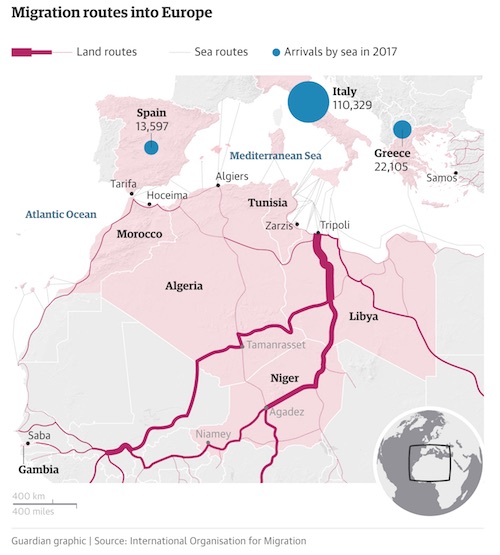
• Greece Concerned Over 200% Spike In Refugee, Migrant Arrivals (K.)
• Greece Mulls Emergency Housing Measures After Migrant Spike (AP)
• Refugees In Greece Demand Transfer To Germany, Start Hunger Strike (R.)


Oh well, we’ll just bail out the banks then.

• The US Isn’t Prepared for the Next Recession (Atlantic)

Maybe it will start with a failed initial public offering, followed by the revelation of widespread fraud in Silicon Valley. Perhaps energy prices will spike, sapping the finances of anyone who drives a car to work. Maybe a foreign crisis will cause a credit crunch, or President Trump will spark a global trade war. A recession might seem like a distant concern, with the latest data showing that the current, extraordinarily economic long expansion just keeps humming along. But one will hit eventually, for some reason or another—that’s how economies work. And when it does, the country won’t be ready. The average middle-class household has largely recovered from the Great Recession, which began nearly 10 years ago, in December 2007.

The growing economy has started to boost earnings across the income spectrum, and higher housing prices have done the same for net worth. The amount of debt that households owe is falling, too. Yet millions of people remain in perilous financial shape, with little to buffer them in the event of a layoff. Roughly half of respondents to a Federal Reserve survey conducted in 2015 said that they could not come up with $400 in an emergency, with a third saying they could not cover three months of expenses, even if they sold assets, dipped into retirement accounts, and asked friends and family for help. Outsize wealth and income continue to accumulate at the very top of the scale, and the finances of millions of American families remain fragile. Americans are no worse off than they were when the last recession hit, in other words, but a decade of growth has not made them more secure, either.

Read more …

He really said it: “Torsten Slok, chief international economist at Deutsche Bank in New York: “The world economy has never been in better shape”

• The New Fed Chair Will Watch an Economy Fraught With Risks (BBG)

Jerome Powell, said to be President Donald Trump’s pick to be the next Federal Reserve chairman, is set to take the reins of the world’s most important central bank at a time when the U.S. economy is on a roll. Growth is accelerating, inflation is tame and unemployment is the lowest in 16 years. Such a backdrop should initially enable a new Fed chairman to keep gradually raising interest rates from historic lows with the aim of stretching out what is already the third-longest U.S. upswing. Expansions don’t die of old age. Rather, they typically are brought down by the bursting of asset bubbles, shocks like natural disasters or political upheaval, or errors by central banks. Faster rate hikes could cool the stock market but risk holding inflation below the central bank’s target, possibly tipping the economy into a recession.

Tightening too slowly could stoke asset values even further. Powell, and Trump by association, will own the outcome. Powell has the added dilemma that his Fed would confront any slump in growth with little in its policy arsenal. There is barely room to cut rates deeply, and the backup plan – quantitative easing – is now the subject of Republican lawmaker ire. “Powell has been dealt some cards in this poker game that aren’t helpful for carrying out monetary policy,” said Torsten Slok, chief international economist at Deutsche Bank in New York. “The world economy has never been in better shape, but it is a very unthankful job to be a central banker these days.”

Read more …

“What lies around the corner is an immense fiscal catastrophe. That’s the inexorable result of the current cacophony of can-kicking in the Imperial City.”

• The Can Kickers’ Cacophony (Stockman)

[..] if by some miracle the Donald survives the Mueller assault, the GOP retains it majority in the bi-elections and the Republican party finally gets some serious fiscal gumption, it would still not be able to impact the deficit much before 2022. Yet by then, the baseline level of red ink by CBO’s lights will be $1.02 trillion per year or nearly $1.2 trillion with the tax cut add-on permitted under this year’s budget resolution. Nor can that dire prospect be mitigated by attacking the 25% part of the budget left over for so-called discretionary or appropriated programs. That’s because upwards of $10 trillion of the $13.6 trillion baseline in this category is accounted for by national security, veterans, homeland security, border control and public infrastructure – all of which Trump and much of the Congressional GOP want to increase.

In short, the GOP is now in the midst of kicking the fiscal can right straight into a terminal crisis. Indeed, they have as much as admitted that in the implicit numbers in their phony FY 2018 budget resolution, which really wasn’t a budget plan at all, but merely a de facto amendment to the Senate rules to circumvent the normal 60-vote rule on the tax bill. Stated differently, none of the $5 trillion in deficit cuts in the GOP’s budget resolution are real because none of them are subject to reconciliation. So the true fact of the case is that the GOP majorities on Capitol Hill have just passed a budget resolution which incorporates CBO’s baseline deficit of $10.1 trillion over the next decade and adds $1.5 trillion more.

In turn, that computes out to a $32.2 trillion public debt by 2027 or 135% of GDP. And that assumes Rosy Scenario economics, too. Namely, that there will be no recession for 207 months thru 2027 – a feat that is double the longest unbroken economic expansion in recorded history. In this context, the Donald tweeted yesterday a giant tax cut is just around the corner: “The Republican House members are working hard (and late) toward the Massive Tax Cuts that they know you deserve. These will be biggest ever!” No they won’t be! What lies around the corner is an immense fiscal catastrophe. That’s the inexorable result of the current cacophony of can-kicking in the Imperial City. And as we shall address tomorrow, there is no chance that Jerome Powell or any other busload of central bankers can save the day. The monetary can has been kicked way too long, as well.

Read more …

Question is how bad will the fall be?

• New Zealand’s Housing Boom Has Come to an End (BBG)

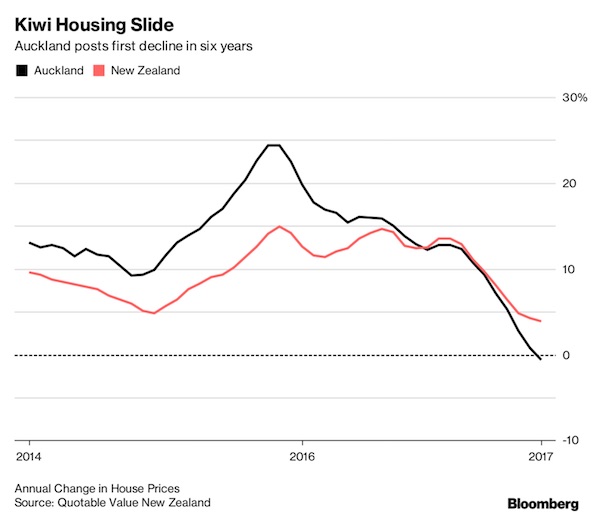
House prices in New Zealand’s largest city posted their first annual decline in six years in October, bringing an end to the nation’s property boom. Prices in the Auckland region fell 0.6% from a year earlier, helping to slow the rate of growth nationwide to 3.9%, a five-year low, property research agency Quotable Value said Thursday. Auckland’s average house price has soared 90% in the last 10 years to more than NZ$1 million ($690,000), underpinning a 56% climb in the national average to NZ$647,000. The new Labour-led government this week announced it will ban foreigners from buying existing homes as it seeks to make housing more affordable for first-time buyers, a central pledge in its election campaign.

Labour also plans to build 100,000 dwellings over the next 10 years to address a shortage, and it will change tax structures to make housing less attractive to investors, who have stoked the property boom. “There appears to be a trend of slowing in the rate of growth, with the frenzy induced by high numbers of investors in the market subsiding and a return to more normal levels of activity in housing markets around the country,” QV spokeswoman Andrea Rush said in a statement. While the surge in prices since 2012 is largely due to a supply shortage amid record immigration, investors played a key role. That prompted the central bank to last year tighten lending restrictions on them, which has helped take the heat out of the market.

Outside Auckland, which is home to a third of New Zealand’s 4.8 million people, price growth has slowed dramatically in cities that saw double-digit gains in 2016. Hamilton prices rose just 1.1% in the year to October, the QV report shows, down from a peak of 31.5% in July last year. In capital city Wellington, where supply is constrained, values rose 10% in the year. In Christchurch, which is over-supplied, prices fell 1.6%.
Read more …

People bought far more than they can afford.

• Australia Mortgage Stress Is Rapidly Increasing (DFA)

Digital Finance Analytics has released the October 2017 Mortgage Stress and Default Analysis update. Across Australia, more than 910,000 households are estimated to be now in mortgage stress (last month 905,000) and more than 21,000 of these in severe stress, up by 3,000 from last month. This equates to 29.2% of households. We see continued default pressure building in Western Australia, as well as among more affluent household, beyond the traditional mortgage belts across the country. We estimate that more than 52,000 households risk 30-day default in the next 12 months, up 3,000 from last month. We expect bank portfolio losses to be around 2.8 basis points ahead, though with losses in WA rising to 4.9 basis points.
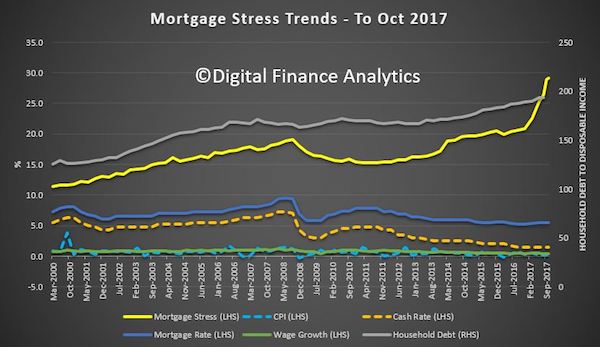
Risks in the system continue to rise, and while recent strengthening of lending standards will help protect new borrowers, there are many households currently holding loans which would not now be approved. As continued pressure from low wage growth and rising costs bites, those with larger mortgages are having more difficulty balancing the family budget. These stressed households are less likely to spend at the shops, which will act as a further drag anchor on future growth, one reason why retail spending is muted. The number of households impacted are economically significant, especially as household debt continues to climb to new record levels. Mortgage lending is still growing at three times income. This is not sustainable.

Read more …

This time is different: “healthy re-balancing”

• Scandinavia Property Markets Are Up 70% But Experts Say There’s No Bubble (BBG)

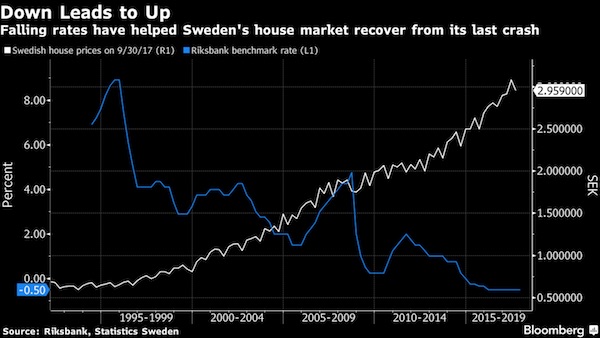
Scandinavia’s red-hot property markets may be showing signs of cooling, but rumors of a bursting bubble are greatly exaggerated. That’s the consensus among local economists, who point to strong fundamentals and persistently low interest rates as evidence that the downturn is a “healthy re-balancing” rather than a harbinger of an imminent collapse. “If you ask me what is the main risk to the macro scenario, I’d say it’s probably house prices,” said Erik Bruce, senior economist at Nordea Bank in Oslo. “But I find it hard to see them dropping significantly with interest rates at this level, unemployment falling and optimism coming back.” Average house prices have shot up around 70% in both Sweden and Norway over the past decade (in Copenhagen they’ve nearly doubled since 2012, the year Danish rates first turned negative).

After years of warnings about excessive debt and overheating from financial regulators and central bankers, they’re now slowing in both Stockholm and Oslo. The adjustment in Norway’s capital city comes as the government there has tightened lending standards in order to reduce speculative buying. “These measures have worked,” said Bruce, noting that prices in Oslo are down 7-8% from their peak. In Stockholm, it’s more about supply and demand. The number of apartments up for sale in the Swedish capital hit a nine-year high in October, but real estate agents say they are having problems unloading properties as buyers and sellers drift apart on price. “New trends often start in Stockholm,” said Nordea’s Sweden-based economist Torbjorn Isaksson, so we expect “house prices at the national level to level out, going forward.”
Read more …

Should be glad to see all those bankers go.

• City Could Lose 10,000 Jobs On Day One Of Brexit – Bank Of England (G.)

The Bank of England has warned that 10,000 jobs could leave the City on “day one” after the UK leaves the EU. Sam Woods, a deputy governor of the Bank, also admitted that forecasts of 75,000 job losses over the long-term were “plausible” at an appearance before peers on the Lords EU financial affairs sub-committee on Wednesday. Woods runs the regulatory arm of the Bank and based his estimate of 10,000 jobs on responses he received from 400 banks and financial firms required to provide him with their contingency plans for a hard Brexit. He has been reviewing the plans since July and said some were being put in place – with banks reserving school places and hiring office space – but that this process would get under way “in earnest” in the first quarter of 2018.

The estimate of 75,000 job losses was made by consultancy Oliver Wyman, and based on the assumption that the UK would be left to rely on World Trade Organisation rules with no transition period after March 2019, when the UK leaves the EU. Under this scenario, £10bn of tax revenue might also be lost, it said. The 75,000 estimate includes the knock-on effect of fewer City jobs to other parts of the economy. Woods said this was not a Bank of England estimate, but described it as being within a plausible range of job losses that would happen in the long term if the UK left the EU without a trade deal. He said the actual number was a “moving feast” and that the initial impact of about 10,000 roles amounted to 2% of the total employed in bank and insurance jobs, or less than 1% of financial services jobs.

Read more …

If ‘only’ a 30% child poverty rate is presented as a triumph, your society is a very dismal failure.

• Child Poverty In Britain Set To Soar To New Record (G.)

The number of children living in poverty will soar to a record 5.2 million over the next five years as government welfare cuts bite deepest on households with young families, a leading UK thinktank has said. New research from the Institute for Fiscal Studies predicts an increase of more than a million in the number of children living in poverty, more than reversing all the progress made over the past 20 years. The IFS said freezing benefits, the introduction of universal credit and less generous tax credits would mean a surge in child poverty and that the steepest increases would be in the most deprived parts of the country. “Across all regions, relative child poverty is projected to increase markedly,” the IFS said. “The smallest increases are in the south, but even there relative child poverty is projected to rise by at least four percentage points.

The northern regions, the Midlands, Wales and Northern Ireland are projected to see increases of at least eight percentage points.” The report’s findings, which also predict a widening of the gap between rich and poor and four more years of weak income growth, pose a direct challenge to Theresa May, who arrived in Downing Street pledging to help those “just about managing”. May has slightly softened the impact of the £12bn of welfare cuts announced by the then chancellor George Osborne after the 2015 general election, but the IFS said the impact on poor families would still be severe. By 2021-22, the IFS expects 37% of children to be living in relative poverty – defined as a household where the income is less than 60% of the UK median – after housing costs have been taken into account.

The thinktank said this was the highest percentage since modern records began in 1961. Tackling child poverty was a priority for Labour when it took office in 1997 and over the next 13 years the rate fell from 34% to just under 30%. Since then, the relative child poverty rate has remained unchanged but, according to the IFS, is now set to increase by seven percentage points to 37% over the next five years.

Read more …

What doesn’t kill you makes you stronger.

• The Limits of Russian Sanctions (HBlatt)

For Russia’s economy, the end of 2014 was something of a perfect storm, Elvira Nabiullina, the country’s central bank chief, remembers. In addition to sanctions imposed by the West, Russia had to deal with a collapse in oil prices. “The effect of the oil price was larger than that of the sanctions,” she said in an interview. “Now the economy has gotten used to both factors. The economy is growing again.” That may not be what European and American leaders would like to hear. After all, the whole point of economic sanctions is to convince political leaders like Russian President Vladimir Putin to change course. Sanctions were imposed on Russia in the aftermath of its annexation of Crimea from Ukraine.

The numbers bear out Ms. Nabiullina’s argument. Russia’s economy grew at a 2.5% annual rate in the second quarter of this year, nearly a five-year high and the third straight quarter of growth for Russia after nearly two years in a recession. Overall the IMF sees the economy growing 1.8% this year. Ms. Nabiullina’s remarks could give fodder to both sides of the Atlantic: Critics of sanctions, which include a number of German politicians and companies that have close business ties to Russia, would point out that there’s little point in continuing something that is having little effect. Supporters would say this is an argument for making sanctions even tougher – something the United States is considering imposing unilaterally by targeting energy firms, over the stiff opposition of German and European politicians who fear their own economies will be caught in the crossfire.

Ms. Nabiullina of course is no politician. Her job as central bank chief is to steer the Russian economy. But she did say that she believes sanctions are here to stay. “Our forecasts for continued economic development are built on the assumption that they will remain in place.” Even if the Russian economy has adapted, it would be wrong to say that sanctions have had no effect at all. Ms. Nabiullina said that foreign direct investment in Russia has fallen since December 2014 as the economy fell into a downward spiral, though she said some foreign investors are starting to return to the country’s bond markets. “That shows Russia’s macro-economic stability.”

Inflation also remains a mixed bag in the country. Ms. Nabiullina noted that inflation has fallen to below 3% – better even than her own medium-target of keeping price increases at 4% or below – but she said Russians have yet to be convinced that prices will remain stable. Interest rates, which were cut slightly on Friday to 8.25%, are being held high in Russia because consumer and business decisions are being driven more by inflation expectations than by actual inflation. “The population is accustomed to high inflation and doesn’t yet believe that it can stay low for a long period,” she said. “That is why our monetary policy remains strict.”

Read more …

Will Spain make the mistake of parading them as criminals in public?

• Spanish Court To Question Catalonia Separatists – Except Puigdemont (AFP)

Spain is set for another day of drama in the Catalonia crisis on Thursday with a judge in Madrid to question the deposed leaders of the region’s separatist government. Notable by his likely absence, however, will be the dismissed Catalan president Carles Puigdemont, who is in Brussels and refusing to come, according to his lawyer. “He will not go to Madrid and I have suggested that he be questioned here in Belgium,” Paul Bekaert told Spain’s TV3 television on Wednesday. The hearing at the national court in Madrid, which deals with major criminal cases, is to start at 9am and to continue on Friday. The judge wants to question Puigdemont and 13 others over their efforts to spearhead Catalonia’s independence drive, which has plunged Spain into its biggest crisis in decades.

[..] On Monday, Spain’s chief prosecutor said he was seeking charges of rebellion – punishable by up to 30 years in prison – sedition and misuse of public funds against the 14. The speaker of the Catalan parliament, Carme Forcadell, and five parliamentary deputies will also be questioned over the same alleged offences, but by a judge at the supreme court. It was unclear how many of them will show up. Puigdemont, 54, has dismissed the accusations as politically motivated and on Tuesday said he would remain in Brussels until he had guarantees that any proceedings would be impartial. In a statement, he said there was a concerted effort to divide his government.

Some will go before a national audience “to denounce the drive of Spanish justice to pursue political ideas”, while others “will stay in Brussels to decry this political process to the international community”, he wrote. Puigdemont has retained the support of many in Catalonia. Maria Angels Selgas, a 60-year-old sales manager in Barcelona, said that for her, Puigdemont was still the Catalan president. “If they humiliate him then they humiliate also the more than 2 million Catalans who voted ‘yes’ in the referendum,” she said.

Read more …

Time to close them down. There’s too much toxicity involved, we can’t afford it.

• Monsanto, BASF Weed Killers Strain US States With Damage Complaints (R.)

U.S. farmers have overwhelmed state governments with thousands of complaints about crop damage linked to new versions of weed killers, threatening future sales by manufacturers Monsanto and BASF. Monsanto is banking on weed killers using a chemical known as dicamba – and seeds engineered to resist it – to dominate soybean production in the United States, the world’s second-largest exporter. The United States has faced a weed-killer crisis this year caused by the new formulations of dicamba-based herbicides, which farmers and weed experts say have harmed crops because they evaporate and drift away from where they are applied. Monsanto and BASF say the herbicides are safe when properly applied. They need to convince regulators after the flood of complaints to state agriculture departments.

The U.S. Environmental Protection Agency (EPA) last year approved use of the weed killers on dicamba-resistant crops during the summer growing season. Previously, farmers used dicamba to kill weeds before they planted seeds, and not while the crops were growing. However, the EPA approved such use only until Nov. 9, 2018, because “extraordinary precautions” are needed to prevent dicamba products from tainting vulnerable crops, a spokesman told Reuters in a statement last week. The agency wanted to be able to step in if there were problems, he said. Next year, the EPA will determine whether to extend its approval by reviewing damage complaints and consulting with state and industry experts. States are separately considering new restrictions on usage for 2018.

Major soybean-growing states, including Arkansas, Missouri and Illinois, each received roughly four years’ worth of complaints about possible pesticide damage to crops this year due to dicamba use, state regulators said. Now agriculture officials face long backlogs of cases to investigate, which are driving up costs for lab tests and overtime. Several states had to reassign employees to handle the load. “We don’t have the staff to be able to handle 400 investigations in a year plus do all the other required work,” said Paul Bailey, director of the Plant Industries division of the Missouri Department of Agriculture. In Missouri, farmers filed about 310 complaints over suspected dicamba damage, on top of the roughly 80 complaints about pesticides the state receives in a typical year, he said. Nationwide, states launched 2,708 investigations into dicamba-related plant injury by Oct. 15, according to data compiled by the University of Missouri.

Read more …

Where’s Mutti Merkel?

• Greece Concerned Over 200% Spike In Refugee, Migrant Arrivals (K.)

Migration Policy Minister Yiannis Mouzalas on Wednesday conceded that the migration problem is becoming more difficult to manage as the number of people arriving on the shores of Greek islands from Turkey since August is up 200% compared to the same period last year. Describing the spike as a “special phase” in the migration problem, Mouzalas added that while the average arrival rate in July was 87 people per day, it shot up to 156 per day in August, while in the months of September and October it rose even further, to 214 per day. With around 4,000 people arriving on the islands in October alone, Mouzalas described the situation at the congested camps on Lesvos as “very bad” and on Chios as “bad.” Nonetheless, he said that Greece continues to view the joint declaration of the EU and Turkey in March to stem the flow of migrants into Europe as valid.

Greece, he said, has intensified diplomatic efforts to ensure the implementation of the agreement which he described as “decisive for the future of Greece.” Referring to the scant number of returns of migrants to Turkey from Greece, Mouzalas said, “We would like to see more returns because that will restore the order of things.” He attributed the low number of returns to Turkey – 1,360 people since the deal was activated – to the way asylum applications are examined in Greece. “We are the only country that has four levels of examination of asylum applications,” he said, while admitting that some of the migrants whose applications have been rejected find illegal means to leave the islands and travel to the mainland.

Read more …

Cruise ships.

• Greece Mulls Emergency Housing Measures After Migrant Spike (AP)

Greece’s government is considering emergency measures to house migrants and refugees confined to Greek islands over the winter months following a roughly four-fold increase in the number of daily arrivals from Turkey. Migration Minister Yannis Mouzalas said Wednesday that average arrivals had jumped since mid-August from about 50 per day to more than 200. He added the government could use ferries or military ships to provide additional housing space over the winter if alternatives provided by local municipalities were exhausted. Under a 2016 deal between Turkey and the EU migrants and refugees reaching Greek islands from the Turkish mainland are not allow to travel to the Greek mainland before their asylum claims are examined. Mouzalas said the agreement was not under threat but that the rise in migrant arrivals was “concerning.”

Read more …

Right in front of Parliament.

• Refugees In Greece Demand Transfer To Germany, Start Hunger Strike (R.)

A group of mainly Syrian women and children who have been stranded in Greece pitched tents opposite parliament in Athens on Wednesday in a protest against delays in reuniting with relatives in Germany. Some of the refugees, who say they have been in Greece for over a year, said they had begun a hunger strike. “Our family ties our stronger than your illegal agreements,” read a banner held up by one woman, referring to deals on refugees between European Union nations. Greek media have reported that Greece and Germany informally agreed in May to slow down refugee reunification, stranding families in Greece for months after they fled Syria’s civil war. Greece denies this.

“What we’ve managed to do on family reunification is to have an increase of about 27% this year compared with last year, even though we’re accused of cutting back family reunification and doing deals to cut back family reunification,” Migration Minister Yannis Mouzalas told reporters. Mouzalas said Greece had assurances from Germany that refugees whose applications have been accepted will eventually go to Germany even if there are delays. He denied that refugees had to pay for their flights. Applications for asylum, reunification and relocation to other European countries can take months to be processed.

Read more …

Nov 012017
 
 November 1, 2017  Posted by at 9:37 am Finance Tagged with: , , , , , , , , ,  5 Responses »


Pablo Picasso Blue nude 1902


• Americans Are Officially Freaking Out (BBG)
• Mueller Mugs America: The Case Of Baby George Papadopoulos (Stockman)
• Some Of The Scariest Charts In Finance To Celebrate Halloween (BV)
• Most Of UK Fruit And Veg Is From Other EU Nations, Brexit To Be Dramatic (G.)
• Corbyn Has a Plan to Get May’s Tories to Give Up 58 Brexit Secrets (BBG)
• Australia’s Housing Boom Is ‘Officially Over’ – UBS (BBG)
• Government Raids On Catalonia Police Spark Fears Of Wider Crackdown (Ind.)
• Puigdemont Says Can’t Return To Catalonia, Spain Intent On ‘Vengeance’ (Ind.)
• New Jersey Sues OxyContin Maker, Links Marketing To Opioid Crisis (R.)
• Germany Forced To Pay Consumers To Use More Electricity
• Greece Plans An Unprecedented €30 Billion Debt Swap (BBG)
• Greek PM Under Fire Over Migrants, Refugees (K.)


Major point in this: the media freaks out the people.

• Americans Are Officially Freaking Out (BBG)

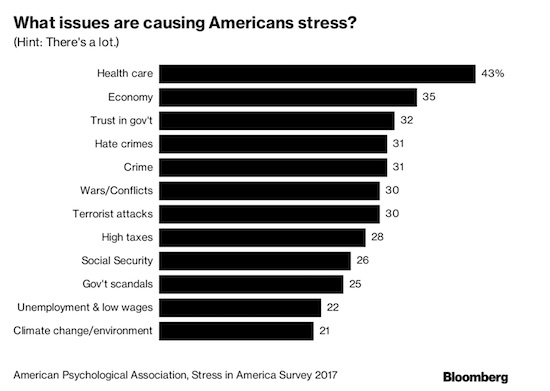
For those lying awake at night worried about health care, the economy, and an overall feeling of divide between you and your neighbors, there’s at least one source of comfort: Your neighbors might very well be lying awake, too. Almost two-thirds of Americans, or 63%, report being stressed about the future of the nation, according to the American Psychological Association’s Eleventh Stress in America survey, conducted in August and released on Wednesday. This worry about the fate of the union tops longstanding stressors such as money (62%) and work (61%) and also cuts across political proclivities. However, a significantly larger proportion of Democrats (73%) reported feeling stress than independents (59%) and Republicans (56%).

The “current social divisiveness” in America was reported by 59% of those surveyed as a cause of their own malaise. When the APA surveyed Americans a year ago, 52% said they were stressed by the presidential campaign. Since then, anxieties have only grown. A majority of the more than 3,400 Americans polled, 59%, said “they consider this to to be the lowest point in our nation’s history that they can remember.” That sentiment spanned generations, including those that lived through World War II, the Vietnam War, and the terrorist attacks of Sept. 11. (Some 30% of people polled cited terrorism as a source of concern, a number that’s likely to rise given the alleged terrorist attack in New York City on Tuesday.)

“We have a picture that says people are concerned,” said Arthur Evans, APA’s chief executive officer. “Any one data point may not not be so important, but taken together, it starts to paint a picture.” The survey didn’t ask respondents specifically about the administration of President Donald Trump, Evans said. He points to the “acrimony in the public discourse” and “the general feeling that we are divided as a country” as being more important than any particular person or political party. [..] And keeping up with the latest developments is a source of worry all its own. Most Americans—56%—said they want to stay informed, but the news causes them stress. (Yet even more, 72%, said “the media blows things out of proportion.”)

Read more …

Who brought in Baby George? Haven’t seen anyone dig into his contacts. His story doesn’t seem to add up. Been pushing Russia on Trump far too much. A Trojan Horse?

• Mueller Mugs America: The Case Of Baby George Papadopoulos (Stockman)

This is how the Deep State crushes disobedience by the unwashed American public. It indicts not only ham sandwiches but, apparently, political infants in diapers too, if that’s what it takes. Hence the sudden notoriety of Baby George Papadopoulos, who pled guilty to “lying” about an essentially immaterial date to the FBI. Oh, and by all signs and signals that plea came after this 30 year-old novice had been wearing a wire for several months. So here’s how this noxious act of bullying by Robert Mueller’s Federally-deputized thugs came down. It seems that during the early months of 2016, when Trump was winning primary after primary against all mainstream media expectations, the Donald’s establishment betters began attacking his foreign policy credentials with special malice aforethought.

That was mainly owing to his sensible suggestion that it would be better to seek rapprochement with Russia rather than pursue Hillary’s Cold War 2.0 and that 25 years after the disappearance of the Soviet Union from the pages of history that NATO was obsolete. Since this totally plausible (and correct) viewpoint was deeply offensive to the Imperial City’s group think and threatened the Warfare State’s existential need for a fearsome enemy, Trump’s ruminations about making a deal with Putin were belittled. They were, in fact, attributed not to a fresh look at the realities abroad or the possibility that homeland security does not require a global empire, but to the candidate’s lack of any pedigreed foreign policy advisors. Indeed, when it came to the Republican-oriented foreign policy establishment-nearly all of which had joined the Never Trump cause-the Donald added insult to injury.

That is, by suggesting he got his foreign policy views watching TV (like most of Washington) and that he could do a better job against terrorism than the Pentagon generals (not hard). At length, however, the “who are your foreign policy advisors” meme got so relentless that the Donald relented. On March 21, 2016 he announced a group of five advisors that exactly no one who was anyone in the Imperial City had ever heard of, and for good reason. Trump apparently rarely even met with the Five and no one running the campaign paid much attention to them. Still, Baby George’s carelessness about the exact dates and sequences of utterly irrelevant and inconsequential events is enough to get him time in one of Uncle Sam’s hospitality suites.

Read more …

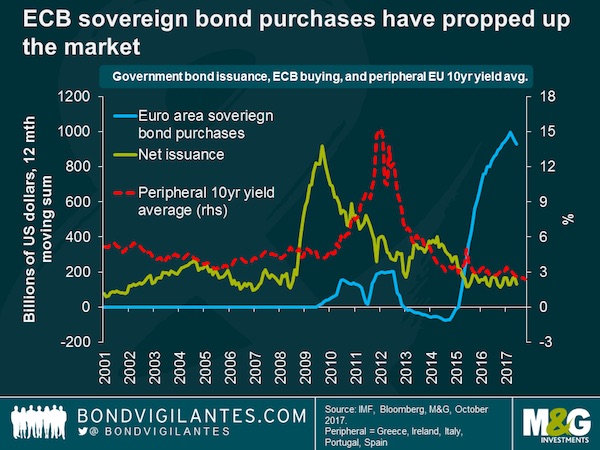
“..ECB QE is currently 7 times bigger than net issuance. So is it any wonder why yields have fallen, and what happens when the ECB tries to turn off the easy money tap?”

• Some Of The Scariest Charts In Finance To Celebrate Halloween (BV)

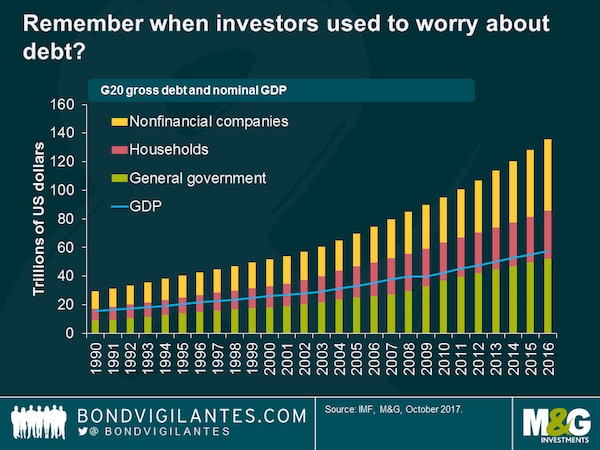
Investment markets have been remarkably resilient over the course of 2017. Sure, the geopolitical environment has thrown up a few frightening days which saw markets sell-off but on the whole volatility has been muted and most asset classes have generated solid total returns. That said, any horror movie fan will tell you that the scariest part of a horror film happens when things are relatively calm. With that in mind, here are a few charts that shine a light on a number of threats that are lurking just below the surface of the global economy.


ECB quantitative easing has propped up government bond markets

The strength of the European economy, and signs of labour market healing across the euro area, has been the surprise story of 2017. It is undeniable that the ECB, and its quantitative easing programme, has played a huge part in the economic success seen to date. Many point to the fall in yields on peripheral area debt as a sign that the euro sovereign debt crisis is well and truly over. The question is, do falling yields signify increasing confidence in the ability of euro area nations to repay their debt, or do they simply reflect the asset purchases that the ECB has conducted since the QE programme started? The above chart, published in the most recent IMF Global Financial Stability Report, shows that official purchases of euro area debt has eclipsed net issuance since May 2015. Indeed, ECB QE is currently 7 times bigger than net issuance. So is it any wonder why yields have fallen, and what happens when the ECB tries to turn off the easy money tap?


Debt is a beast that cannot be tamed

Read more …

The EU forces food transports across the Union. Damn transport costs, including pollution. The result: “the system is very fragile”. Don’t depend for your essentials on people living 1000 miles away. It’s not that hard.

• Most Of UK Fruit And Veg Is From Other EU Nations, Brexit To Be Dramatic (G.)

The UK faces serious health implications if the government fails to agree a Brexit deal, finds a report that says of 35 portions of fruit and vegetables, a figure relating to the five-a-day recommendation for individuals, just one “portion” is grown in the UK and picked by British or non-EU workers. The report, to mark the launch of a new RSA commission examining the impact of Brexit on food and farming, found that the five-a-day health target – which adds up to the 35 portions of fruit and vegetables a week – was overwhelmingly met by food grown in the EU or harvested by EU workers in the UK. Sue Pritchard, director of the RSA Food, Farming and Countryside Commission, said Brexit offered a great opportunity to reshape farming and food, but warned that no deal over the exit from the union would have a dramatic and immediate effect.

“What would be available on the shelves would change dramatically. There will be delays at ports and all along the food supply system – the impact will be felt very, very quickly,” she said. The study found that of the average 28 portions consumed by Britons of the recommended weekly intake of 35 portions of fruit and vegetables, the equivalent of 11 portions came from the EU, seven from the rest of the world and nine arose from the UK and were harvested by workers from other EU countries. The equivalent of just one portion was grown in the UK and harvested by British or non-EU workers. Pritchard added: “If there is no deal the system is very fragile and the impact in the UK food supply is likely to be dramatic.” The majority of farmers backed Brexit, but the National Farmers’ Union has since suggested that crops will “rot in the fields” and that Britain will be unable to produce the food if the government cannot secure a deal that allows tens of thousands of EU workers to continue to work on UK farms.

Read more …

Fitting. The entire country is back in Victorian times.

• Corbyn Has a Plan to Get May’s Tories to Give Up 58 Brexit Secrets (BBG)

The main U.K. opposition party wants to deploy a parliamentary tool hardly used since the 19th century to get Theresa May’s Conservatives to spill Brexit secrets. The political prize? The release of 58 studies on how leaving the European Union will affect industries that make up 88 percent of the economy. Brexit Secretary David Davis said he didn’t want to publish the studies because it would compromise the U.K.’s negotiating position. On Monday, he listed the sectors in a letter but stopped short of revealing more. Jeremy Corbyn’s Labour wants to use an obscure legislative device to force the hand of Tories, who have been coy about what the economic fallout might be when the country leaves the 28-nation bloc.

On Wednesday, Labour will argue that lawmakers should have the right to see the studies, and will ask Parliament to vote to make “an humble address” to Queen Elizabeth II, asking her to order her ministers to release the assessments to the House of Commons Brexit Committee. This means-to-an-end hasn’t been used much since Victorian times. “Ministers cannot keep withholding vital information from Parliament about the impact of Brexit on jobs and the economy,” Labour Brexit spokesman Keir Starmer said in an emailed statement.

Read more …

Panic in Canberra.

• Australia’s Housing Boom Is ‘Officially Over’ – UBS (BBG)

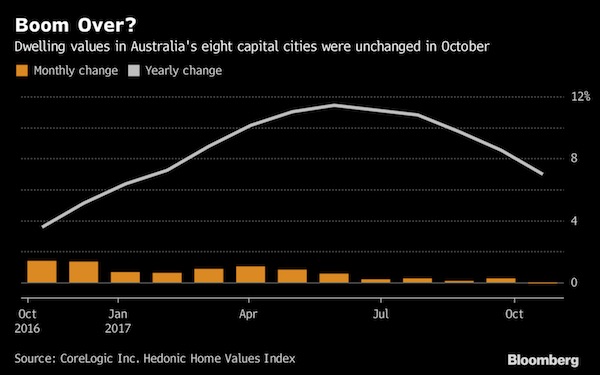
The housing boom that has seen Australian home prices more than double since the turn of the century is “officially over,” after data showed prices now flatlining, UBS said. National house prices were unchanged in October from September, while annual growth has slowed to 7% from more than 10% as recently as July, CoreLogic data released Wednesday showed. “There is now a persistent and sharp slowdown unfolding,” UBS economists led by George Tharenou said in a report. “This suggests a tightening of financial conditions is unfolding, which we expect to weigh on consumption growth via a fading household-wealth effect.”

An end to Australia’s property boom will be welcome news for first-time buyers, who have struggled to break into the market after surging prices propelled Sydney past London and New York to be the second-most expensive housing market. Less impressed may be property investors, already squeezed by regulatory lending curbs that drove up mortgage rates. The cooling housing market may encourage the Reserve Bank to keep interest rates at a record low. A rate hike would be undesirable as it would put further downward pressure on dwelling prices, said Diana Mousina, senior economist at AMP Capital Investors.

Read more …

Once they start locking up people, will Catalans still be non-violent?

• Government Raids On Catalonia Police Spark Fears Of Wider Crackdown (Ind.)

The acrimony and recriminations which followed Catalonia’s declaration of independence shows little sign of defusing following the fleeing of president Carles Puigdemont to Brussels. Spain’s civil guard raided the headquarters of the regional police, Mossos d’Esquadra, today drawing accusations of starting a crackdown. Computers and documents were taken away from the building in Sabadell as well as seven other offices. “We are carrying out inspections related to the Mossos d’Esquadra’s communications on the day of the illegal referendum,” said a civil guard spokesman. “This is something we are entitled to do.” The Mossos had been ordered by Madrid to stop the vote taking place, but they had refused, pointing out that this would have led to clashes with activists who had been protecting the polling stations. The national police, who were sent in, seized ballot boxes sparking violence.

The raids were viewed by some as the beginning of a punitive drive which will continue against separatists. As the news of the raids came in the afternoon, a group of activists approached police in Plaza de Colon in Barcelona city centre, the scene of huge demonstrations in recent weeks, offering sympathy and solidarity. The officers, whose chief Josep Lluis Trapero was sacked by Madrid at the weekend, were cautious in their response. “We are waiting to hear more details,” said one. “We don’t know any more than you do.” For Adreia Carbonell, a 23-year-old student and supporter of independence, the civil guard action was an ominous pointer for the future. “It is a form of counter-revolution,” she said. “The Spanish can now do what they like. There will be more raids, more arrests soon, you will see. They are intimidating our police who protect us and of course our government has gone.”

Read more …

Double-sided. He’s gotten much weaker by leaving. But probably avoided a long jail term.

• Puigdemont Says Can’t Return To Catalonia, Spain Intent On ‘Vengeance’ (Ind.)

Hot, last-minute and chaotic, ousted Catalan leader Carles Puigdemont’s first press conference since fleeing Barcelona for Brussels was a fitting tribute to the political crisis that has gripped Spain. Amid speculation that he and members of his former cabinet would seek political asylum, fuelled by the comments of a Belgian minister, the disputed Catalan president instead recommitted himself to the independence cause. It is believed that Mr Puigdemont and his colleagues drove across the border into France before flying to Brussels on Monday, after Spain took over control of the Catalan region’s government and agencies. Mr Puigdemont said he could not return to Spain unless given clear assurances that he will be protected, accusing Madrid of being intent on “vengeance”.

He and his colleagues would stay in Belgium as long as their safety was not assured in Spain and would “continue our work despite the limits imposed on us.” Insisting he remained the rightful leader of Catalonia, Mr Puigdemont said his centre-right PDeCAT party would nonetheless accept the challenge of regional elections called for 21 December “with all our strength” and vowed that Catalan separatists would come out to vote. Spain wants Catalonia “to abandon our political project, and they won’t achieve it,” he said. As the news emerged on Monday that Mr Puigdemont’s contingent had fled the country, there was a distinct sense of deflation among those of his allies who remained in Barcelona to carry out a planned campaign of civil disobedience.

And as he entered the building in Brussels, he walked past protesters holding Spanish national flags and a sign that read “Estado de Derecho” – “Rule Of Law”. Other anti-independence demonstrators waving Catalan and Spanish flags chanted “viva Espana, viva Cataluña!” amid a heavy presence from Belgian police.

Read more …

Horses and barns.

• New Jersey Sues OxyContin Maker, Links Marketing To Opioid Crisis (R.)

New Jersey on Tuesday sued Purdue Pharma LP, accusing the maker of the chronic pain medication OxyContin of fueling the state’s opioid crisis through deceptive marketing to doctors and patients, including the elderly and the “opioid-naive.” The state’s attorney general, Christopher Porrino, faulted what he called Purdue’s “almost inconceivable callousness and irresponsibility” in a decade-long campaign of downplaying the risks and exaggerating the benefits of opioids in the pursuit of profit. “We vigorously deny these allegations and look forward to the opportunity to present our defense,” Purdue said in a statement. “We are deeply troubled by the opioid crisis and we are dedicated to being part of the solution.” At least 11 U.S. states have sued Purdue over opioids, including a complaint filed by Alaska on Monday.

Read more …

The grid’s a harsh mistress.

• Germany Forced To Pay Consumers To Use More Electricity

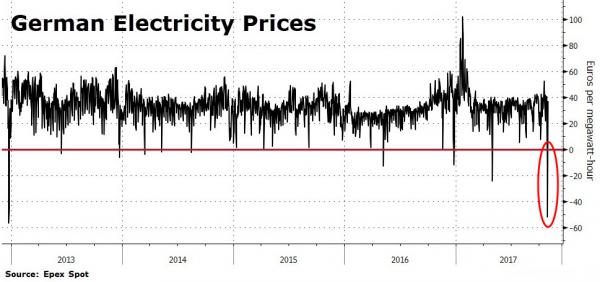
A stormy weekend led to free electricity in Germany, as Bloomberg reports wind generation reached a record, forcing power producers to pay customers the most since Christmas 2012 to use electricity. Power prices turned negative as wind output reached 39,409 megawatts on Saturday, equivalent to the output of about 40 nuclear reactors. To keep the grid supply and demand in balance, negative prices encourage producers to either shut power stations or else pay consumers to take the extra electricity off the network.

Read more …

We get the intent, but what does this solve?

• Greece Plans An Unprecedented €30 Billion Debt Swap (BBG)

The Greek government is planning an unprecedented debt swap worth 29.7 billion euros ($34.5 billion) aimed at boosting the liquidity of its paper and easing the sale of new bonds in the future. Under a project that could be launched in mid November, the government plans to swap 20 bonds issued after a restructuring of Greek debt held by private investors in 2012 with as many as five new fixed-coupon bonds, according to two senior bankers with knowledge of the swap plan. The bank officials requested anonymity as the plan has yet to be made public. The maturities of the new bonds may be the same as for the existing notes, which range from 2023 to 2042. “The move aims to address the current illiquidity of the Greek bond market, ” according to analysts at Pantelakis Securities SA in Athens.

It will also “establish a decent yield curve, thus facilitating the country’s return to public debt markets.” The move comes as Greece prepares for life after the end of its current bailout program in August 2018. The debt swap is a step toward the country’s full return to markets required to avoid a new bailout program. The government plans to tap the bond market in 2018 to raise at least 6 billion euros to create an adequate buffer to honor debt obligations, according to a government official. The government has yet to decide on the exact timing of the swap, the Greek official said on condition of anonymity. One of the bank officials said that transaction could start on Nov. 13 and the settlement could happen a week later. The goal is to conclude the swap before the next mission of the country’s creditors, which is scheduled for the last week of November.

Read more …

Maybe SYRIZA is the only force that can stop this.

• Greek PM Under Fire Over Migrants, Refugees (K.)

Prime Minister Alexis Tsipras and his migration minister came under a hail of fire Monday from a radical faction within SYRIZA over the plight of the thousands of refugees and migrants stranded in Greece. The criticism was launched during a meeting of the party’s political secretariat at which Tsipras had hoped to showcase his government’s success in steering the country toward a post-bailout era. But instead, the government and Migration Policy Minister Yiannis Mouzalas were slammed by members of the political secretariat that represent the Group of 53 faction – seen as a custodian of party purity – within SYRIZA, over the consistent violation of migrants and refugees’ human rights. More specifically, they blamed the leftist-led coalition government and Mouzalas for delays in providing migrants and refugees with appropriate accommodation as winter approaches.

Moreover, they slammed Tsipras for failing to absorb funds from the European Union and other international organizations intended to aid migrants and refugees. The government was also chided by the Group of 53 for giving its full support to last year’s agreement between the European Union and Turkey to stem the flow of migrants into Europe, while EU countries were not doing the same. “If you think I’m doing everything wrong, then I’ll resign,” Mouzalas told his critics at the meeting. However, members of the faction shot back, calling Mouzalas a hypocrite as they said he is planning to leave the ministry anyway as his name has been put forward for a seat on the Council of Europe.

Read more …

Oct 312017
 
 October 31, 2017  Posted by at 9:43 am Finance Tagged with: , , , , , , , ,  5 Responses »


Salvador Dalí The persistence of memory 1931


• A Monstrous Bubble – The Destroyer Called Amazon (Stockman)
• How The Actual Magic Money Tree Works (G.)
• UK Debt Averages £8,000 Per Person – Not Including Mortgages (G.)
• Surge In UK Consumer Borrowing Fuels Likely Interest Rate Rise (G.)
• Theresa May Faces Snap Election If Defeated By Parliament On Brexit Deal (ES)
• Russia Could Hold Congress Of Syrian Peoples In Mid-November (DS)
• Europhile Left Deluded On EU Reform Process (Bilbo)
• Four Trajectories for Europe’s Future (Turchin)
• How Europe Exported Its Refugee Crisis To North Africa (G.)
• Libyan Path To Europe Turns Into Dead End For Desperate Migrants (G.)


Will Washington be swallowed whole by the swamp? Might be a good outcome. Endless articles about Trump and Russia and Mueller. But very hard to find anything neutral. Journalism has become opinionism.

Is Papadopoulos a plant? Where did he come from? Did Fusion GPS set up the Trump Tower meeting after consulting with the DNC? Isn’t there a country to run? I’m getting tired, and I’m sure I’m not the only one.


Stockman doesn’t buy it.

• A Monstrous Bubble – The Destroyer Called Amazon (Stockman)

when it comes to wanton destruction we can think of no better evidence than the $63 billion market cap eruption visited upon Amazon owing to its purported “blow-out” earnings report on Friday. Except it wasn’t all that. In the year ago quarter AMZN’s pre-tax earnings came in at $491 million, which was actually alot more than the $316 million figure posted for Q3 2017. In fact, the company’s niggardly current quarter profit represented 36% plunge from prior year, but thanks to the company’s tax cut “selfie” the headline reading robo-machines didn’t even notice this rather dramatic setback. To wit, AMZN effective tax rate plunged from an aberrantly high 46.6% last year to a quite low 18.4% this year. As a result, its reported net income remained flat relative to prior year.

Stated differently, the blow-out earnings figure of $0.53 per share reported Friday was exactly the same the same $0.53 per share reported last year, but the “blow-out” part was due to the “beat” from the $0.02 street consensus. Then again, the street consensus had been for $1.91 per share only 90 days ago! As per usual, it had been “guided “down by 99% in the interim. If nothing else, this proves that the whole SEC “Fair Disclosure” (FD) is an absolute farce and that the SEC itself is an utter waste of taxpayer money. It also proves, of course, that a bevy of high priced advisors are far more efficacious at cutting tax rates than a House (of Representatives) full of Republicans foaming at the mouth about the topic. But how in the world does this kind of hyper-fiddling with accounting statement tax rates justify a market cap gain in one day ($63 billion) that exceeds the entire market cap of GM($61 billion) or Aetna ($57 billion)?

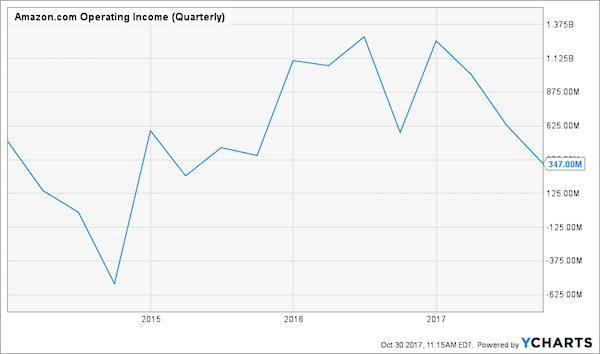
As it happened, Amazon’s LTM net income of $1.926 billion for the quarter might be a slightly better indicator of its profitability because the company’s four-quarter tax rate averaged out close to the US statutory rate, meaning that the company is being valued at 280X under normal tax rates. Moreover, even if you pro forma the results with the GOP’s vaunted 20% tax rate you would get LTM net income of $2.48 billion and a PE multiple of 217X; and for that matter, just go ahead and abolish the corporate tax entirely and AMZN’s PE at the zero bracket would still compute to 174X. We dwell on the absurdity of Amazon’s PE multiple in the first instance because there is absolutely nothing in its financial performance that warrants these massive market cap gains. Thus, way back in Q3 2014, AMZN’s operating income was $510 million. As shown below, it has been staggering around like a drunken sailor ever since – lapsing to just $347 million in the purportedly red hot quarter just ended.

Read more …

“..house prices rise to meet the amount the lender is prepared to lend, rather than being moored to wages..”

• How The Actual Magic Money Tree Works (G.)

Shock data shows that most MPs do not know how money is created. Responding to a survey commissioned by Positive Money just before the June election, 85% were unaware that new money was created every time a commercial bank extended a loan, while 70% thought that only the government had the power to create new money. The results are only a shock if you didn’t see the last poll of MPs on exactly this topic, in 2014, revealing broadly the same level of ignorance. Indeed, the real shock is that MPs still, without embarrassment, answer surveys. Yet almost all our hot-button political issues, from social security to housing, relate back to the meaning and creation of money; so if the people making those choices don’t have a clue, that isn’t without consequence. How is money created? Some is created by the state, but usually in a financial emergency.

For instance, the crash gave rise to quantitative easing – money pumped directly into the economy by the government. The vast majority of money (97%) comes into being when a commercial bank extends a loan. Meanwhile, 27% of bank lending goes to other financial corporations; 50% to mortgages (mainly on existing residential property); 8% to high-cost credit (including overdrafts and credit cards); and just 15% to non-financial corporates, that is, the productive economy. What’s wrong with that? On the corporate financial side, bank-lending inflates asset prices, which concentrates wealth in the hands of the wealthy. On the mortgage side, house prices rise to meet the amount the lender is prepared to lend, rather than being moored to wages. The lender benefits enormously from larger mortgages and longer periods of indebtedness; the homeowner benefits slightly from a bigger asset, but obviously spends longer in debt servitude; the renter loses out completely.

Is there a magic money tree? All money comes from a magic tree, in the sense that money is spirited from thin air. There is no gold standard. Banks do not work to a money-multiplier model, where they extend loans as a multiple of the deposits they already hold. Money is created on faith alone, whether that is faith in ever-increasing housing prices or any other given investment. This does not mean that creation is risk-free: any government could create too much and spawn hyper-inflation. Any commercial bank could create too much and generate over-indebtedness in the private economy, which is what has happened. But it does mean that money has no innate value, it is simply a marker of trust between a lender and a borrower. So it is the ultimate democratic resource. The argument marshalled against social investment such as education, welfare and public services, that it is unaffordable because there is no magic money tree, is nonsensical. It all comes from the tree; the real question is, who is in charge of the tree?

Read more …

Why do they borrow? Is it for essentials?

• UK Debt Averages £8,000 Per Person – Not Including Mortgages (G.)

More than 6 million Britons don’t believe they will ever be debt free, according to new research which has also found the average person in the UK owes £8,000 – on top of any mortgage debt. Almost a quarter of all Britons said they are struggling to make ends meet, while 62% said they were often worried about their levels of personal debt, according to research for Comparethemarket.com. Earlier this month, the price comparison website asked 2,000 adults detailed questions about their personal finances. They found that 10% of respondents had “maxed out” on a credit card, while a similar number said they had been overdrawn within the past 12 months. A third of those interviewed told researchers that they were already planning on taking on additional debt – in the form of credit cards, loans car finance and mortgages – in the next year.

Over a third said they could not see themselves ever being in a financial position to help younger family members, breaking the tradition of the “bank of mum and dad”. The results chime with a recent study by the Financial Conduct Authority which found that that 4.1 million people are already in serious financial difficulty. The survey, the biggest ever by the city regulator, concluded that half of the UK population are financially vulnerable, with 25- to 34-year-olds the most over-indebted. Shakila Hashmi, head of money at Comparethemarket.com, said: “Right now millions of Brits could be in danger of suffering from one of the longest financial hangovers in history. While it may be hard to see an end in sight, the worst thing people in debt can do right now is stick their head in the sand. As well as reining in spending, there are other ways you can reduce debt, like switching to credit cards that help you get on top of debt with interest-free periods.”

Read more …

If you borrow too much, we’ll make it costlier.

• Surge In UK Consumer Borrowing Fuels Likely Interest Rate Rise (G.)

A near-double-digit increase in lending to households in the year to September has left the Bank of England on track to raise interest rates on Thursday, amid concerns that consumers are creating an unmanageable mountain of unsecured debt. The pace of annual consumer credit growth was 9.9% last month, according to figures from the central bank, as borrowing on credit cards, overdrafts and unsecured loans jumped. The consistent appetite for borrowing is likely to put further pressure on the Bank to raise interest rates this week, with other indicators such as inflation and unemployment already supporting the case for a rise. Last month the Bank said British lenders needed to hold an extra £11bn of capital to guard against consumer loans going sour, due to concerns that banks had overestimated the creditworthiness of their borrowers.

Consumer credit has rocketed since 2014 when it was running at an annual rate of 4%. Last year the annual growth rate hit 12%, with the latest September numbers creating a a consumer debt of more than £204bn. Analysts were unsure whether the increase was a sign of growing confidence among consumers or desperation as wages growth stagnated and inflation rises. Only a steep fall in car loans in recent months has stopped the overall level of consumer credit creeping back to last year’s levels. Joanna Elson, chief executive of the Money Advice Trust, the charity that runs National Debtline, said regulators should monitor the effects of an interest rate rise, which will increase pressure on many household finances.

“With household debt a growing concern and an interest rate rise likely as early as this week, we encourage households to exercise caution before taking on additional borrowing – and consider how they would be able to cope with repayments in the event of a shock to their income. “Millions of people will have never experienced an interest rate rise. We are concerned that a small rise, combined with high levels of borrowing, rising living costs and slow wage growth could be enough to push many households into financial difficulty,” she said.

Read more …

How Britain goes to the dogs.

• Theresa May Faces Snap Election If Defeated By Parliament On Brexit Deal (ES)

Theresa May was threatened with a snap general election today if she is defeated by Parliament on her Brexit deal. Tory right wingers raised the “nuclear threat” of a forced election in what was seen as an attempt to see off calls to empower the Commons to amend the deal or call for fresh negotiations. Iain Duncan Smith, the former Conservative leader and leading Brexit-backer, said it would be on “a confidence issue” and defeat would make the Government “head towards” a general election. “It will be the most important vote of the entire Parliament and if the Government loses it you head towards that conclusion,” he told the Evening Standard. Mrs May is aiming to hammer out a leaving deal with the EU by October or November next year.

The decision on whether Parliament gets a “take it or leave it” vote or the right to amend the deal is shaping up to be the key battle of Brexit. John Whittingdale, the former Culture Secretary, claimed the vote itself would be “a vote of confidence in government” that would trigger an election if defeated. “I think for the Government to come to Parliament and say we have a deal … and for Parliament then to turn around and say, ‘well, actually, we don’t agree it’s a good deal and we’re going to throw it out’, that is a vote of confidence in government,” he told The Westminster Hour. “I can’t see how the government could say ‘oh alright then, we’ll go and have another go’. I think there would have to be a general election.”

But MPs backing a softer pro-business Brexit said Mrs May must keep Parliament involved. Nicky Morgan, the chair of the Treasury Select Committee, said: “Ministers have promised Parliament a meaningful vote. They need to keep Parliament informed and involved to avoid problems at the end. “They resisted a Parliamentary vote on Article 50 until compelled to give way. They should do all they can to avoid a repetition.” Former minister Bob Neill said the eurosceptic threat smacked of “desperation”.

Read more …

Where will the US be?

• Russia Could Hold Congress Of Syrian Peoples In Mid-November (DS)

A Moscow-backed congress of all Syria’s ethnic groups could take place in Russia as soon as next month and launch work on drawing up a new constitution, the RIA news agency reported Monday, citing a source familiar with the situation. RIA said the Congress of Syrian peoples, the idea of which President Vladimir Putin first mentioned at a forum with foreign scholars earlier this month, could take place in mid-November in the Russian Black Sea resort of Sochi. According to the source, 1,000-1,300 participants from the Assad regime and pro-regime forces as well as various opposition groups will participate. The source added that representatives of various ethnic groups, including Kurds and Turkmens, and religious clergy are also expected. Special U.N. envoy for Syria Staffan de Mistura agreed to participate in the congress but set out a list of terms and conditions that have to be met before the event. Putin says the congress could be an important step toward a political settlement and could also help draft a new constitution for the country.

Read more …

Permanent austerity. Strong by Bill Mitchell.

• Europhile Left Deluded On EU Reform Process (Bilbo)

The Europhiles maintain a blind faith in what they claim to be a reform process, which when carried through will reduce some of the acknowledged shortcomings (I would say disastrously terminal design flaws). They don’t put any time dimension on this ‘process’ but claim it is an on-going dialogue and we should sit tight and wait for it to deliver. Apparently waiting for ‘pigs to fly’ is a better strategy than dealing with the basic problems that this failed system has created. I think otherwise. The human disaster that the Eurozone has created impacts daily on peoples’ lives. It is entrenching long-term costs where a whole generation of Europeans has been denied the chance to work.

That will reverberate for the rest of their lives and create dysfunctional outcomes no matter what ‘reforms’ are introduced. The damage is already done and remedies are desperately needed now. The so-called ‘reforms’ to date have been pathetic (think: banking union) and do not redress the flawed design. And to put a finer point on it: Germany will never allow sufficient changes to be made to render the EMU a functioning and effective federation. The Europhile Left is deluded if it thinks otherwise.

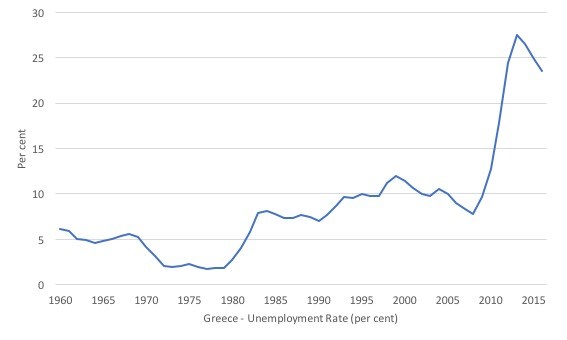
[..] here is the OECD Economic Outlook data (from 1960 to 2016) for the Greek unemployment rate, which confirms the veracity of the tweet statement (at least as far as Greek unemployment goes). The fact that the Greek unemployment averaged just 6.6% prior to the crisis (from 1960 to 2008) and has averaged 20.9% since then (2009-2016) and has been above 20% since 2012 tells me that the policy structures in place have failed badly since the GFC. That means – the austerity imposed under the Stability and Growth Pact, the lack of a federal fiscal capacity and the lack of a ‘federal sentiment’ which would have eased the way for generous funds transfers to Greece to allow it to restore domestic demand relatively quickly.

Read more …

Halting fragmentation seems futile.

• Four Trajectories for Europe’s Future (Turchin)

Scenario 1. The disintegrative trends that I and others have written about are just a “blip”, a temporary set-back that will be soon overcome. The grand project of European integration will soon recover and by 2027 everybody will look back and have fun at the expense of “doomsayers”. I think that this trajectory is extremely unlikely. First, because of the shift in the social mood of the Germans, to which I referred above. Second, because all across Europe the well-being of large segments of the population is declining. To give just two examples, think of the extraordinary high unemployment rates for the young workers in countries like Spain, and of declining real wages of UK workers over the past decade.

Scenario 2. The EU continues to muddle through. Neither integrative, nor disintegrative trend dominates over the next decade, and in 2027 we are pretty much where we are now. In my opinion, this inertial scenario is more likely than the optimistic Scenario 1, but still not too likely. An equilibrium is a dynamic process, it can maintain itself only when two opposite forces cancel each other out. I don’t see any compelling signs of an integrative force that would cancel the disintegrative forces. Empirically, history doesn’t stand still. So things will either improve, or get worse. [..] my money is on the disintegrative trend prevailing (although personally I wish it was otherwise). Incidentally, the governing elites of the EU behave as though they all believe in Scenario 1 (or, at worst, Scenario 2).

Scenario 3. The next 10 years will see an increasingly fragmented European landscape. The EU will not be formally abolished, but it will increasingly lose its capacity to influence constituent countries. Led by Hungary and Poland, other small and medium-sized countries will increasingly set their national policies without much regard for Brussels. This fragmentation will be accomplished largely in a nonviolent way. Perhaps not in ten years, as it may take longer, but eventually the EU will look much like the Holy Roman Empire. This “HRE” scenario is probably the most likely, at least in my opinion.

Scenario 4. Like in the previous scenarios, the disintegrative trend will dominate, but dissolution of the EU will not be peaceful. I think (I hope) that the violent disintegration scenario is much less likely than the Scenario 3. And I know that almost nobody believes that a violent break-up is possible. Very few people remain who fought in World War II. And this is the danger. The government of Mariano Rajoy apparently can’t imagine that one result of their push to suppress the Catalonian independence movement could be a bloody civil war.


The Holy Roman Empire in 1618

Read more …

“We are creating chaos in our own backyard and there will be a high price to pay if we don’t fix it..”

• How Europe Exported Its Refugee Crisis To North Africa (G.)

Something happened to the deadly migrant trail into Europe in 2017. It dried up. Not completely, but palpably. In the high summer, peak time for traffic across the Mediterranean, numbers fell by as much as 70%. This was no random occurrence. Even before the mass arrival of more than a million migrants and refugees into Europe in 2015, European policymakers had been desperately seeking solutions that would not just deal with those already here, but prevent more from coming. From Berlin to Brussels it is clear: there cannot be an open-ended invitation to the miserable millions of Europe’s southern and eastern periphery. Instead, European leaders have sought to export the problem whence it came: principally north Africa.

The means have been various: disrupting humanitarian rescue missions in the Mediterranean, offering aid to north African countries that commit to stemming the flow of people themselves, funding the UN to repatriate migrants stuck in Libya and beefing up the Libyan coastguard. The upshot has been to bottleneck the migration crisis in a part of the world least able to cope with it. Critics have said Europe is merely trying to export the problem and contain it for reasons of political expediency, but that this approach will not work. “We are creating chaos in our own backyard and there will be a high price to pay if we don’t fix it,” said one senior European aid official, who did not wish to be named.

The new hard-headed approach crystallised with the EU-Africa trust fund in November 2015, when European leaders offered an initial €2bn to help deport unwanted migrants and prevent people from leaving in the first place. Spread between 26 countries, the fund pays for skills training in Ethiopia and antenatal care in South Sudan, as well as helping migrants stranded in north Africa return home on a voluntary basis. Separately the European commission has signed migration deals with five African countries, Niger, Mali, Nigeria, Senegal and Ethiopia. These migration “compacts” tie development aid, trade and other EU policies to the EU’s agenda on returning unwanted migrants from Europe. For instance, in the first year of the compact, Mali took back 404 voluntary returnees and accepted EU funds to beef up its internal security forces and border control and crack down on smugglers.

Read more …

Europe is feeding gangs.

• Libyan Path To Europe Turns Into Dead End For Desperate Migrants (G.)

UNHCR, the UN’s refugee agency, estimates that there are about 30 government-run detention centres in Libya, but that doesn’t include clandestine facilities run by traffickers and militias. Several hundred thousand migrants are thought to be in the country. “In general, conditions are really bad in these detention centers,” says UNHCR Libya chief Roberto Mignone. “At best, they are more or less functional, but serious human rights violations and sexual assaults are committed there.” UNHCR is trying to help migrants move out of the illicit detention centres and into facilities that it manages. But the agency’s freedom to operate is limited by a parlous security situation: Mignone and his staff operate out of neighbouring Tunisia, with the help of a few dozen Libyan associates.

“The security situation is very complicated and it is frustrating not to have free access to all in need. We have no overview of the militias’ or traffickers’ detention centres or prisons,” says Mignone. Since Muammar Gaddafi was ousted in 2011, Libya has served as both a magnet and a funnel for migrants desperate to start new lives in Europe. After record-breaking numbers of arrivals in Italy in 2016 and unprecedented numbers dying in the Mediterranean over the past two years, the EU signalled a new determination to head of the migration problem closer to the source with a series of deals with Libya earlier this year. One part of the strategy involved the south of the country – where more than 2,500km (1,550 miles) of desert borders with Algeria, Chad, Niger and Sudan provide multiple channels north.

A series of consultations was established between the Italian interior minister, Marco Minniti, and south Libyan mayors, who represent local groups and tribes. The deal pinpointed seven “elements” to pacify the different factions, from the Tebu to the Beni Suleiman, in the name of a common commitment to halt migrant trafficking. This project was heavily supported by Ahmed Maetig, vice-president of the Libyan presidential council, and greeted warmly in southern Libya, by the mayor of Sebha, Hamed Al-Khayali. “The project we are carrying forward now with Italy involves the development and growth of southern Libya within the framework of the fight against illegal immigration,” Khayali said.

Read more …

Oct 302017
 
 October 30, 2017  Posted by at 9:36 am Finance Tagged with: , , , , , , , , ,  8 Responses »


Salvador Dalí Cadaques 1923


• The Dollar’s Enjoying a Renaissance (BBG)
• Biggest Stock Collapse in World History Has No End in Sight (BBG)
• China’s Bonds Spell Disaster (BBG)
• China’s Debt Battle Has Global Growth at Stake (BBG)
• China Corporate Bond Investors’ Luck May Be About to Run Out (BBG)
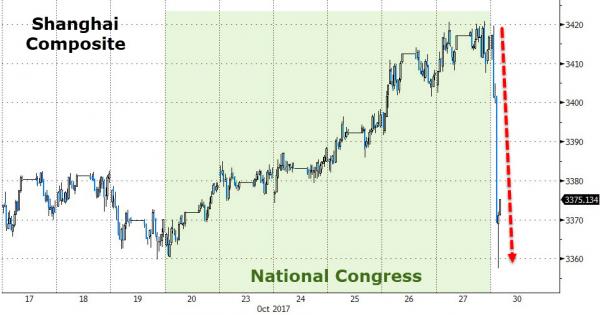
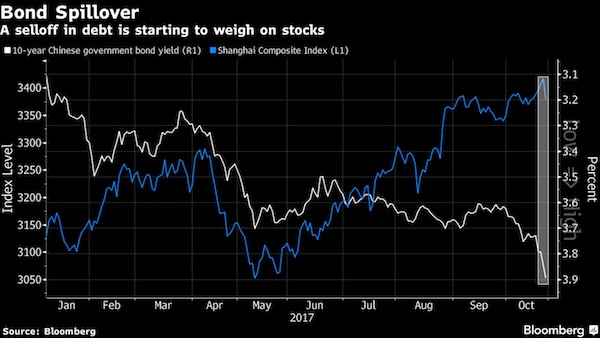
• China Bond Selloff Spreads to Stocks as Deleveraging Risks Mount (BBG)
• US Regulator Wants To Loosen Leash On Wells Fargo (R.)
• Damning Verdict On UK Austerity In Major Report (Ind.)
• Plan To Create $400 Million Army in Sahel Faces UN Moment Of Truth (G.)
• Greek Islanders Are ‘Heroes,’ Says European Commission VP (K.)
• Bushman Banter’ Was Crucial To Hunter-Gatherers’ Evolutionary Success (G.)


“More than a dead cat bounce?!”

• The Dollar’s Enjoying a Renaissance (BBG)

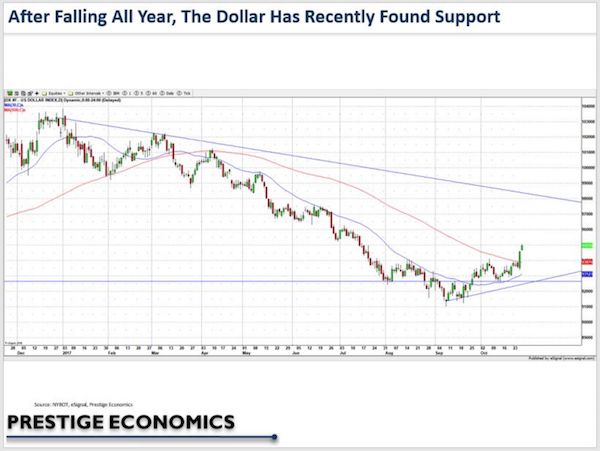
After getting pummeled all year by the euro, the dollar is having a moment. In Wall Street parlance, it may be more than just a dead-cat bounce, as politics, economic fundamentals and technicals have converged to give the greenback a boost. The U.S. currency surged in the immediate aftermath of Donald Trump’s election victory before suffering a long descent that lasted from December until last month. That’s when the political viability of U.S. fiscal policy reform in the shape of – as yet to be detailed – tax cuts (and maybe even tax reform) became increasingly likely. Although equity markets have reflected optimism all year that tax cuts would come, the dollar has conveyed doubt along with gold and bonds. The Bloomberg Dollar Index is up more than 4% from its low for the year on Sept. 8, partially rebounding from the more than 10% drop since the end of December.

There could be more to come in the short term if tax cuts happen, because the legislation is likely to contain a provision that would allow U.S. companies to repatriate significant foreign profits and further bolster the economy. That could spark more inflation and put U.S. monetary policy on a more aggressive path. In terms of the euro, the political situation in Europe has been a distraction. After the election of the far-right Alternative for Germany party to the Bundestag on Sept. 24, the independence movement in the Spanish autonomous region of Catalonia has devolved into a political rat’s nest. Uncertainty, regionalism and the risk of escalating discord in Spain are adding to the political dissonance – a stark contrast to the apparent acceptance of U.S. Senate Republicans of higher national debt levels in exchange for tax cuts.

Read more …

Lots of Bloomberg today. After the Party Congress, things start to look very different. Stocks and bonds both under a lot of pressure.

• Biggest Stock Collapse in World History Has No End in Sight (BBG)

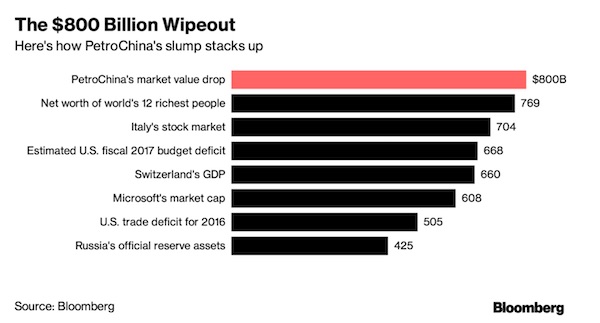
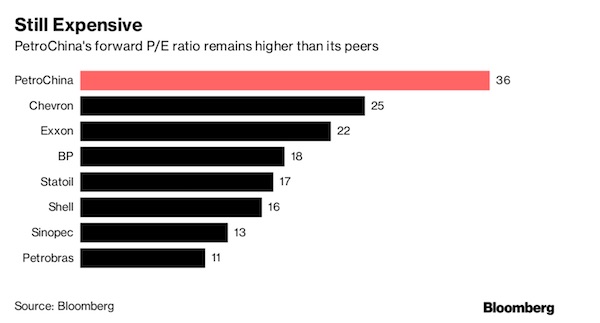
It’s going to take more than the biggest stock slump in world history to convince analysts that PetroChina has finally hit bottom. Ten years after PetroChina peaked on its first day of trading in Shanghai, the state-owned energy producer has lost about $800 billion of market value – a sum large enough to buy every listed company in Italy, or circle the Earth 31 times with $100 bills. In current dollar terms, it’s the world’s biggest-ever wipeout of shareholder wealth. And it may only get worse. If the average analyst estimate compiled by Bloomberg proves right, PetroChina’s Shanghai shares will sink 16% to an all-time low in the next 12 months.

The stock has been pummeled by some of China’s biggest economic policy shifts of the past decade, including the government’s move away from a commodity-intensive development model and its attempts to clamp down on speculative manias of the sort that turned PetroChina into the world’s first trillion-dollar company in 2007. Throw in oil’s 44% drop over the last 10 years and Chinese President Xi Jinping’s ambitious plans to promote electric vehicles, and it’s easy to see why analysts are still bearish. It doesn’t help that PetroChina shares trade at 36 times estimated 12-month earnings, a 53% premium versus global peers. “It’s going to be tough times ahead for PetroChina,” said Toshihiko Takamoto, a Singapore-based money manager at Asset Management One, which oversees about $800 million in Asia. “Why would anyone want to buy the stock when it’s trading for more than 30 times earnings?”

Read more …

No mincing words.

• China’s Bonds Spell Disaster (BBG)

Qin Han, chief fixed-income analyst at Guotai Junan Securities, doesn’t mince his words when it comes to the rout in Chinese bonds. “Considering the pace of the slump, which is very fast, it’s fair to say we are likely in a bond disaster,” Qin said. Shorter-tenor notes led the selloff in government debt on Monday, making the yield curve inversion the steepest since at least 2006, according to data compiled by Bloomberg. Concern that rising borrowing costs and inflation will erode returns have weighed on the debt market in the past month, with one top-performing macro fund manager saying he was shorting Chinese bonds.

The yield on five-year government bonds surged nine basis points to 3.97% as of 1:29 p.m. in Shanghai, while the cost on 10-year notes jumped six basis points to 3.9%, with the spread reaching eight basis points earlier Monday. The yield gap will widen further, and the cost on debt due in a decade will likely reach 4% “very soon,” said Qin. “The yield will become even more inverted as fragile sentiment prevails,” he said. “Yes, this is overselling, but it’s not the time to buy yet as the overselling could last longer.”

Read more …

It’s not just China that’s affected.

• China’s Debt Battle Has Global Growth at Stake (BBG)

It used to be that when America sneezed, the world caught a cold. This time around, it’s the risk of a sickly China that poses a bigger threat. The world’s second-largest economy is now trying to ward off the sniffles. While output is still growing at a pace that sees GDP double every decade, the problem remains that much of that has been fueled by a massive buildup of credit. Total borrowing climbed to about 260% of the economy’s size by the end of 2016, up from 162% in 2008, and will hit close to 320% by 2021 according to Bloomberg Intelligence estimates. Economy-wide debt levels are on track to rank among “the highest in the world,” according to Tom Orlik, BI’s Chief Asia Economist. That path may be what prompted outgoing People’s Bank of China Governor Zhou Xiaochuan to warn of the risk of a plunge in asset values following a debt binge, or a “Minsky Moment,” earlier this month.

Given that China is forecast by the International Monetary Fund to contribute more than a third of global growth this year, controlling China’s debt matters far beyond its borders. There are two key components of China’s credit clampdown, each posing challenges to policy makers. First is wringing out bets on property prices. As President Xi Jinping put it in a keynote policy speech to the Communist Party leadership on Oct. 18: Housing is for living in, not for speculation. The latest data show that in some areas, prices are still surging in many cities despite a raft of measures to make it harder for investors to buy real estate with borrowed money. Xi’an, China’s ancient capital, saw home values soar almost 15% in September from a year before. It will be up to regulators to come up with measures that deliver on Xi’s mandate without tipping housing into a downward spiral.

Property crashes in the U.S., Japan and U.K. over the past three decades amply illustrated how damaging they can be to economies. The second key challenge is progress in aligning borrowing costs with borrowers’ ability to repay — rather than with their relationship with the state. China’s financial system has long let companies that are state owned or are seen to be implementing state initiatives get funding more cheaply than others. That’s thanks to the assumption the government would step in if needed to back them up. To help encourage capital to be deployed more efficiently – and to prevent firms that are effectively insolvent keep going thanks to continued funding – policy makers have begun to gradually take away implicit support.

Read more …

“A majority of non-bank financial institutions’ debt holdings are corporate bonds, so their selloff can lead to severe consequences..”

• China Corporate Bond Investors’ Luck May Be About to Run Out (BBG)

Investors in Chinese company bonds have so far avoided the brunt of a debt selloff that’s driven 10-year sovereign yields to the highest in three years. Their luck may be about to run out. Now that the Communist Party Congress is over, China’s bond holders may be about to get hit by “daggers falling from the sky,” said Huachuang Securities Co., referring to aggressive deleveraging policies. Plus, accelerating inflation and the risk that China’s central bank may follow the Federal Reserve in raising borrowing costs are casting a shadow over the entire bond market. That all means that the situation that’s existed for most of 2017 – sovereign yields rising, and corporate debt remaining relatively resilient – is at risk of cracking. As appetite for bonds of any kind dwindles and authorities roll out measures that target higher-risk investments, company securities are in the line of fire.

“It’s very likely we will see a significant increase in corporate yields in the coming year,” said David Qu, a market economist at Australia & New Zealand Banking in Shanghai. “The trigger could be tougher regulations or a default. A majority of non-bank financial institutions’ debt holdings are corporate bonds, so their selloff can lead to severe consequences. Banks are underestimating authorities’ intentions to tighten regulations.” Signs of a turnaround are already beginning to show, with the yield on three-year AAA notes – the most common grading for Chinese corporate debt – rising 21 basis points this month to the highest level since early June. The spread between those notes and government debt has climbed in October and was last at 116 basis points, though it’s still a long way from this year’s peak of 150 basis points in April.

Losses accelerated earlier this month after People’s Bank of China Governor Zhou Xiaochuan voiced concern about high borrowing levels and signaled that growth could beat expectations. If concerns on regulation intensify and risks of a debt repayment failure appear, the market may go through a major correction in the near term, Huachuang analysts including Qu Qing wrote in a note last week.

Read more …

How far will Xi go? Is that big yuan devaluation still in play?

• China Bond Selloff Spreads to Stocks as Deleveraging Risks Mount (BBG)

Chinese stocks fell the most since early August, breaking the calm that persisted through the recent Communist Party Congress, as government bonds extended a monthly rout amid concern the government will step up efforts to reduce leverage in the financial sector. The Shanghai Composite Index dropped as much as 1.7% on Monday, and was 0.8% lower at 11:27 a.m. local time. Small-cap shares bore the brunt of the selling, with the ChiNext gauge tumbling as much as 2.5%. Equity indexes in Hong Kong pared gains. The 10-year yield climbed five basis points to 3.90%, a three-year high. While China’s equity market was subdued for most of this month amid state efforts to limit volatility during the twice-a-decade Party gathering, sovereign yields have been climbing.

There’s more than 1 trillion yuan ($150 billion) of funding provided by the central bank that matures this week, the most since February. “Pessimism in the bond market is spilling over to the stocks,” said Hao Hong, chief China strategist at Bocom International Holdings Co. in Hong Kong. “Surging yields of the government bonds are resulting in worsened sentiment and higher funding costs for companies, of which smaller ones will suffer most as they rely more heavily on the market rather than bank loans for financing.” There are also early signs economic data may weaken, after solid figures for most of this year buoyed equities. Chinese shares held steady during the week-long Congress amid speculation the “National Team,” as state-backed funds are referred to, would step in to avoid any large swings.

Read more …

Yeah, that sounds great. Wells Fargo should be shut down and its execs put on trial.

• US Regulator Wants To Loosen Leash On Wells Fargo (R.)

A leading U.S. regulator wants to make it easier for Wells Fargo to pay employees when they leave, loosening a restriction in place since a phony accounts scandal hit the bank last year, according to people familiar with the matter. The initiative comes as President Donald Trump is trying to lighten rules on Wall Street and the bank regulator, Keith Noreika, acting Comptroller of the Currency (OCC), must weigh whether to vet new Wells Fargo executives. If Noreika’s approach prevails, the OCC could go easier on Wells Fargo and any other large banks sanctioned in the future. Since Noreika took control of the OCC in May, he has advocated easing up on sanctions imposed on Wells Fargo in the wake of the scandal over abusive sales practices, according to current and former officials.

Wells Fargo reached a $190 million settlement in September 2016 after admitting that its sales staff opened as many as 2.1 million accounts without customers’ consent. Since then the estimate has climbed to as many as 3.5 million. As part of the deal with regulators, incoming Wells Fargo executives can face a vetting from the OCC while severance payouts must be cleared by the OCC and a sister agency, the Federal Deposit Insurance Corporation. But Noreika wants officials to work faster when they review severance pay and the agency can choose to waive its check on incoming executives. Hundreds of Wells Fargo employees have had their severance payouts frozen when they left as regulators tried to determine what role those employees might have had in the scandal.

Read more …

High time for the Tories to leave.

• Damning Verdict On UK Austerity In Major Report (Ind.)

Despite years of painful austerity, the UK’s level of public spending is today no lower as a share of national income than it was after 11 years of a Labour government in 2008, according to a report by the Institute for Fiscal Studies. The major report from the UK’s leading economic think tank shows that deep cuts have left the NHS, schools and prisons in a “fragile state”, and have merely returned public spending to pre-financial crisis levels. The document presents a challenge to claims that Conservative-driven austerity saved the public finances following years of Labour overspending. The think tank’s report goes on to conclude that in the light of the data, Chancellor Philip Hammond’s plan to abolish the UK’s deficit by the mid-2020s is “no longer sensible”.

With his critical Budget approaching in November, it challenges him to admit the target looks “increasingly unlikely” in the light of a worsening economic outlook, exacerbated by Britain’s “terrible” productivity and uncertainty over Brexit. The IFS analysis of public spending levels appears in its pre-Budget look at the Chancellor’s options published on Monday. It found public spending as a share of national income was at a similar level both now and shortly before the financial crash, an event David Cameron and George Osborne claimed Labour overspending left the country ill-prepared for. In 2007-08, public spending as a share of GDP was 39%, it peaked in 2009-10 at 45.1% and is forecast to be 39.6% this year, according to the IFS.

The main justification for austerity has been the need to reduce and eventually abolish the deficit, a target that the IFS refers to as “ever-receding”. The IFS argues Mr Hammond’s critical budget speech next month, will be given against a backdrop of a worsening economic outlook that demands austerity goals are rethought. [..] The IFS report said: “It looks like [Mr Hammond] will face a substantial deterioration in the projected state of the public finances. “He will know that seven years of ‘austerity’ have left many public services in a fragile state. And, in the known unknowns surrounding both the shape and impact of Brexit, he faces even greater than usual levels of economic uncertainty.”

Read more …

Armies. The only answer we have.

• Plan To Create $400 Million Army in Sahel Faces UN Moment Of Truth (G.)

Unprecedented plans to combat human trafficking and terrorism across the Sahel and into Libya will face a major credibility test on Monday when the UN decides whether to back a new proposed five-nation joint security force across the region. The 5,000-strong army costing $400m in the first year is designed to end growing insecurity, a driving force of migration, and combat endemic people-smuggling that has since 2014 seen 30,000 killed in the Sahara and an estimated 10,000 drowned in the central Mediterranean. The joint G5 force, due to be fully operational next spring and working across five Sahel states, has the strong backing of France and Italy, but is suffering a massive shortfall in funds, doubts about its mandate and claims that the Sahel region needs better coordinated development aid, and fewer security responses, to combat migration.

The Trump administration, opposed to multilateral initiatives, has so far refused to let the UN back the G5 Sahel force with cash. The force commanders claim they need €423m in its first year, but so far only €108m has been raised, almost half from the EU. The British say they support the force in principle, but have offered no funds as yet. Western diplomats hope the US will provide substantial bilateral funding for the operation, even if they refuse to channel their contribution multilaterally through the UN. France, with the support of the UN secretary general, António Guterres, and regional African leaders, has been pouring diplomatic resources into persuading a sceptical Trump administration that the UN should financially back the force.

Read more …

With a straight face. But the refugees must stay on the islands, even if there’s no place for them.

• Greek Islanders Are ‘Heroes,’ Says European Commission VP (K.)

The Greek islanders in the eastern Aegean who have helped thousands of refugees under adverse conditions are “heroes,” according to the European Commission’s First Vice President Frans Timmermans. In an interview with Sunday’s Kathimerini ahead of his visit to Greece on Monday, Timmermans said that, despite being under immense pressure, the mayors and residents of the islands are doing everything in their power to help refugees.Timmermans, who has described the situation on the islands as “unacceptable,” expressed concern over the difficulty the Greek government has in absorbing EU funds – around €1 billion – for infrastructure to shelter some 50,000 refugees.

“We are faced with a series of problems,” he said, adding that that the Commission’s experience “has shown that it’s hard to get the support we provide in the spot where it is needed most.” Timmermans, who was one of the main architects of last year’s deal between the EU and Turkey to stem the flow of migrants into Europe, said that people whose asylum applications have been processed should be returned to Turkey as stipulated in the agreement. But with just 1,600 returns having taken place since 2016, Timmermans said that “this doesn’t happen enough.” He refrained from placing blame on either Greece or Turkey but insisted that the system must not be changed. Migrants, he said, must stay on the islands, despite the difficulties, because their transfer to the mainland would send a wrong message and create a new wave of arrivals.

Read more …

” If the success of a civilisation is judged by its endurance over time, this means the Khoisan are by far the most successful, stable and sustainable civilisation in human history.”

• Bushman Banter’ Was Crucial To Hunter-Gatherers’ Evolutionary Success (G.)

Barely a day goes by when proponents of greater taxation, universal income and other initiatives aimed at addressing systematic inequality are not accused of inciting the “politics of envy”. Doing so is an effective way of closing down debate; envy is, after all, among the deadliest of the “deadly sins”. Yet politicians inclined to dismiss inequality in this way may do so at their peril. For the evidence of our hunting and gathering ancestors suggests we are hard-wired to respond viscerally to inequality. In the 1960s, the Ju/’hoansi “Bushmen” of the Kalahari desert became famous for turning established views of social evolution on their head. But their contribution to our understanding of the human story is far more important than simply making us rethink our past.

Until then, it had been widely believed that hunter gatherers endured a near-constant battle against starvation. But when a young Canadian anthropologist, Richard B Lee, conducted a series of simple economic input-output analyses of the Ju/’hoansi as they went about their daily lives, he found not only did they make a good living from hunting and gathering, but they did so on the basis of only 15 hours’ work per week. On the strength of this, anthropologists redubbed hunter-gatherers “the original affluent society”. I started working with Ju/’hoansi in the early 1990s. By then, more than a half-century of land dispossession meant that, other than in a few remote areas, they formed a highly marginalised underclass eking out a living on the dismal fringes of an ever-expanding global economy. I have been documenting their often traumatic encounters with modernity ever since.

The importance of understanding how hunter-gatherers made such a good living has only recently come to light, thanks to a sequence of genomic studies and archaeological discoveries. These show that the broader Bushmen population (referred to collectively as Khoisan) are far older than we had ever imagined, and have been hunting and gathering continuously in southern Africa for well over 150,000 years. If the success of a civilisation is judged by its endurance over time, this means the Khoisan are by far the most successful, stable and sustainable civilisation in human history.

Read more …

Oct 202017
 
 October 20, 2017  Posted by at 7:54 am Finance Tagged with: , , , , , , , , ,  1 Response »


René Magritte Youth 1924


• Fed Flunks Econ 101: Understanding Inflation (MW)
• Meet The Bears Predicting Stock Market Doom (CNN)
• Catalan Groups Call For Mass Withdrawal Of Money From Bank ATMs (CN)
• The World’s Largest ICO Is Imploding After Just 3 Months (ZH)
• Scandal-Hit Nissan Suspends All Production For Japan Market (AFP)
• End Of Australia Auto-Making Sector As Holden Closes Doors (AFP)
• Top Startup Investors See Mounting ‘Backlash’ Against Tech (R.)
• Native American Tribe Holding Patents Sues Amazon And Microsoft (R.)
• Putin Slams West for Lack of Respect and Broken Trust (BBG)
• Ditch Neoliberalism To Win Again, Jeremy Corbyn Tells EU’s Center-Left (Ind.)
• Merkel Comes to May’s Aid on Brexit (BBG)
• Italian Regions To Vote In Europe’s Latest Referendums On Autonomy (G.)
• Greece Plans Billion Euro Handout For The Poor (R.)
• Tensions Rise On Aegean Islands As Migrants Continue To Arrive (K.)
• Global Pollution Kills Millions, Threatens ‘Survival Of Human Societies’ (G.)


As I’ve said 1000 times.

• Fed Flunks Econ 101: Understanding Inflation (MW)

The Federal Reserve’s illusive quest to achieve 2% inflation over the medium term is becoming a long-term problem. The institutional anxiety over the chronic inflation undershoot is evident in daily news stories, Fed speeches and the increased focus in internal discussions, as reflected in the minutes of the Sept. 19-20 meeting of the Federal Open Market Committee (FOMC). One doesn’t have to read between the lines to appreciate the degree to which policy makers fear the onset of the next recession without adequate “room” to lower interest rates. Hence, normalizing interest rates is “on track,” as the headline above noted, even though the relationship — between unemployment and inflation — is decidedly off track.

So what gives? The persistence of sub-2% inflation in the face of nine years of near-zero interest rates and an economy at what is perceived to be full employment has led to an array of silly explanations, embarrassing excuses and a host of pseudo-theories. Just maybe the Fed’s internal guidance system is flawed. The inverse correlation between unemployment and wages in the U.K. from 1861 to 1957 initially observed by New Zealand economist A.W. Phillips has morphed into a model of causation for Fed chief Janet Yellen and the current crop of U.S. policy makers. It’s not clear why. Just eyeballing the graph of the Fed’s preferred inflation measure and the civilian unemployment rate, one might conclude that the relationship broke down in the 1970s and has yet to reassert itself. Is a half-century malfunction enough to declare a theory null and void?

One would think so. Yet the notion of cost-push inflation as (supposedly) expressed by Phillips Curve lives, although faith in it has started to wane, even among ardent devotees like labor-economist Yellen. Instead, we are confronted with headlines such as, “Nobody seems to know why there is no inflation.” Really? Have they all forgotten Milton Friedman’s axiom that inflation is always and everywhere a monetary phenomenon? When the central bank creates more money than the public wants to hold, people spend it. The increased demand for goods and services eventually exceeds the economy’s ability to produce or provide them. The result is higher economy-wide prices, or inflation.

That isn’t happening, not just in the U.S. but across the globe. For all the sturm und drang about the Fed debasing the dollar and sowing the seeds of the next great inflation, the public’s demand for money has increased. The increased desire to hold cash and checkable deposits has risen to meet the increased supply. Velocity, or the rate at which money turns over, has plummeted.

Read more …

“.. it’s central banks that typically end the party. And central banks are telling you it’s last call.”

• Meet The Bears Predicting Stock Market Doom (CNN)

The red-hot stock market may continue its rapid ascent, especially if Trump delivers his promise for “massive” corporate tax cuts. And even if not, healthy economic fundamentals and corporate profits should continue to support stocks. Nonetheless, some bears are fighting the herd mentality on Wall Street by warning of serious trouble brewing just beneath the surface of the stock market. These market skeptics are reassured by the fact that betting against stocks wasn’t popular in 2007, either. “The best time to be a bear is the loneliest time,” Jesse Felder, a money manager and founder of The Felder Report, told CNNMoney. Here are some of the red flags these bears are warning about, including similarities between now and 30 years ago:

In 2007 and 2008, Chris Cole presciently bet that market volatility would skyrocket to levels no one had seen before. He took those crisis-era winnings and started Artemis Capital, a hedge fund that has amassed $210 million. Today, the stock market is unusually quiet. The VIX, a popular barometer of market fear, recently hit a record low. Cole thinks it’s a mirage, partly because popular trading strategies allow investors to bet on the low volatility itself. All those bets lead to even lower volatility – until something unexpected happens, like suddenly higher interest rates. “Any shock to the system could cause this to unravel in the opposite direction, where higher volatility drives higher volatility,” Cole told CNNMoney. “This is a massive risk to the system. The only thing we’re missing is a fire.” [..] “This is a disaster waiting to happen,” said Cole. “In the event there is a fire, this can cause a massive explosion.”

Kyle Bass, founder of Hayman Capital Management, is also having a flashback to 30 years ago. “If you look at the all of the different constituencies of the market today, it resembles the portfolio insurance debacle of 1987 on steroids,” Bass told Real Vision TV in an interview released on Wednesday. Bass fears that, once stock prices decline 4% to 5%, that will quickly morph into a 10% to 15% plunge. He isn’t sure about timing, but pointed to geopolitical trouble and central banks as potential triggers. “Buckle up, because I think you’re going to see a pretty interesting air pocket. And I don’t think investors are ready for that,” he said.

Peter Boockvar, chief market analyst at The Lindsey Group, predicts the “overvalued” stock market will run into serious trouble as central banks hit the brakes on the stimulus measures they used to prop up economies after the crisis. He pointed to the Federal Reserve shrinking its balance sheet and the European Central Bank slowing its bond purchases. “Historically speaking, central banks put us into recessions and bear markets. The same will happen this time,” Boockvar said. He estimates that central banks will be pumping $1 trillion less money into markets. “The liquidity spigot is going to be dripping instead of flowing. That’s a really big deal,” said Boockvar. He conceded that stocks could run higher before eventually reversing. “When it happens, I’m not sure,” Boockvar said. “But it’s central banks that typically end the party. And central banks are telling you it’s last call.”

Read more …

Chaos.

• Catalan Groups Call For Mass Withdrawal Of Money From Bank ATMs (CN)

Civil society organizations in Catalonia call for a mass withdrawal of money from bank ATMs on Friday at 8am in order to pressure the Spanish government. Organizers don’t especify how much money should be taken out nor what to do with it. The action targets the five main banks in Catalonia: Caixa Bank, Sabadell, Bankia, BBVA and Santander. Organizers call on clients of Caixa Bank and Sabadell to show their disagreement with the banks’ recent decision to move their headquarters out of Catalonia due to the escalating political crisis between governments in Barcelona and Madrid.

This is the first “direct and peaceful” action organized by Crida per la Democràcia (Call for Democracy). This is an umbrella group which includes among others the two main pro-independence organizations in Catalonia: the Catalan National Assembly (ANC) and Òmnium Cultural. The mass withdrawal is also aimed at condemning the imprisonment of ANC and Òmnium presidents, Jordi Sánchez and Jordi Cuixart, held in custody on sedition charges since Monday.

Read more …

All’s not well in crypto land.

• The World’s Largest ICO Is Imploding After Just 3 Months (ZH)

Earlier this summer, Tezos smashed existing sales records in the white-hot IPO market after the company’s pitch to build a better blockchain for cryptocurrencies made it one of the buzziest ICOs in the world. As we noted at the time, the company capitalized on that buzz by courting VC firms and other institutional investors with a $50 million token pre-sale. After the company opened up selling to the broader public, demand soared as investors greedily bought up tokens in spite of glitches that threatened to derail the sale early on. By the end of its weeks-long token sale in July, Tezos had sold more than $230 million. Now, Tezos is proving that authorities in the US and China were on to something when they decided to crack down on the ICO market, which has become a cesspool of fraud and abuse.

To wit, the company’s management revealed this week that progress on its vaunted product has stalled as it has struggled to recruit engineering talent, and an acrimonious dispute between several of the company’s leading figures has spilled out into the open. As WSJ’s Paul Vigna reports, “a battle between the founders of the company and the head of the Swiss foundation they installed to give it more independence has put most trading of Tezos coins on ice, possibly until early next year.” The shakeup started after Tezos founders Arthur and Kathleen Breitman reported the delays in a blog post published Wednesday. But even more alarming, the pair accused Johann Gevers, the head of a Swiss foundation which oversees their funds, of attempting to overpay himself using the massive pot of investor capital – despite the fact that the company will likely blow through its promised deadline of allocating tokens to buyers by December (the tokens have yet to be created).

In early September we became aware that the president of the Tezos Foundation, Johann Gevers, engaged in an attempt at self-dealing, misrepresenting to the council the value of a bonus he attempted to grant himself. We have been working with the Tezos foundation to resolve the matter and have advocated for his removal from the foundation council. We are confident in the council’s ability to handle this sensitive matter with care and diligence. In the meantime, Johann’s operational role in the foundation has been suspended, pending an investigation by the council’s auditor. The news sent Tezos futures contracts trading on BitMex, an exchange known for its cryptocurrency futures products, tumbling more than 50% as traders unwound bets the project would be launched before the end of the year, as Bloomberg pointed out.

Read more …

The final nail in the Made in Japan coffin.

• Scandal-Hit Nissan Suspends All Production For Japan Market (AFP)

Nissan said Thursday it was suspending all production destined for the local market, as Japan’s number-two automaker grapples with a mounting inspection scandal that has already seen it recall some 1.2 million vehicles. “Nissan decided today to suspend vehicle production for the Japan market at all Nissan and Nissan Shatai plants in Japan,” it said in a statement, referring to an affiliate. The announcement comes weeks after the company announced the major recall as it admitted that staff without proper authorisation had conducted final inspections on some vehicles intended for the domestic market before they were shipped to dealers. On Thursday, it said a third-party investigator found the misconduct had continued at three of its six Japanese plants even after it took steps to end the crisis.

“Nissan regards the recurrence of this issue at domestic plants – despite the corrective measures taken – as critical,” it said. “The investigation team will continue to thoroughly investigate the issue and determine measures to prevent a recurrence.” Nissan president Hiroto Saikawa offered a blunt assessment, saying that “old habits” were to blame. “You might say it would be easy to stop people who are not supposed to inspect from inspecting,” he told reporters Thursday. “But we are having to take (new measures) in order to stop old habits that had been part of our routine operations at the factories.”

Read more …

Lost skills.

• End Of Australia Auto-Making Sector As Holden Closes Doors (AFP)

The last car rolled off the production line of Australian automaker Holden on Friday, marking the demise of a national industry unable to stand up to global competition. The closure of the Elizabeth plant in South Australia is the end of an era for Holden, which first started in the state as a saddlery business in 1856 and made the nation’s first mass-produced car in 1948. The brand has long been an Australian household name, with 1970s commercials singing that “football, meat pies, kangaroos and Holden cars” were part of the nation’s identity. “I feel very sad, as we all do, for it’s the end of an era, and you can’t get away from the emotional response to the closure,” Prime Minister Malcolm Turnbull told Melbourne radio station 3AW on Friday.

Holden was marketed as “Australia’s Own Car” and became a symbol of post-war prosperity Down Under despite being a subsidiary of US giant General Motors. At its peak in 1964, Holden employed almost 24,000 staff. But just 950 were able to watch the final car leave the factory floor Friday. “There are a number of people who have been here since the seventies and today will be a very emotional day for some people and a very sad day,” Australian Manufacturing Workers Union state secretary John Camillo told reporters. The union blamed the federal government for causing the closure by withdrawing support to the auto sector. The death of the industry was always on the cards after subsidies were cut off in 2014. Some Aus$30 billion (US$24 billion) in assistance was handed out between 1997 and 2012, according to the government’s Productivity Commission.

Read more …

The rich get scared. It’s about power as much as money.

• Top Startup Investors See Mounting ‘Backlash’ Against Tech (R.)

Two of the technology industry’s top startup investors took to the stage at a conference on Wednesday to decry the power that companies such as Facebook had amassed and call for a redistribution of wealth. Bill Maris, who founded Alphabet’s venture capital arm and now runs venture fund Section 32, and Sam Altman, president of startup accelerator Y Combinator, said widespread discontent over income inequality helped elect U.S. President Donald Trump and had put wealthy technology companies in the crosshairs. “I do know that the tech backlash is going to be strong,” said Altman. “We have more and more concentrated power and wealth.” The market capitalization of the so-called Big Five technology companies – Alphabet, Apple, Amazon, Microsoft and Facebook – has doubled in the last three years to more than $3 trillion.

Silicon Valley broadly has amassed significant wealth during the latest tech boom. Altman and Maris spoke on the final day of The Wall Street Journal DLive technology conference in Southern California. Facebook’s role in facilitating what U.S. intelligence agencies have identified as Russian interference in last year’s U.S. presidential election is an example of the immense power the social media company has amassed, the investors said. “The companies that used to be fun and disruptive and interesting and benevolent are now disrupting our elections,” Maris said.

Altman said people “are understandably uncomfortable with that.” Altman, who unequivocally rebuffed rumors that he would run for governor of California next year, said he expects more demands from both the public and policy makers on data privacy, limiting what personal information Facebook and others can collect. Maris said regulators would have good cause to break up the big technology companies. “These companies are more powerful than AT&T ever was,” he said. [..] Altman and Maris offered few details of how to accomplish a redistribution of wealth. Maris proposed shorter term limits for elected officials and simplifying the tax code. Altman has advocated basic income, a poverty-fighting proposal in which all residents would receive a regular, unconditional sum of money from the government.

Read more …

Curious legal battle.

• Native American Tribe Holding Patents Sues Amazon And Microsoft (R.)

A Native American tribe sued Amazon.com and Microsoft in federal court in Virginia on Wednesday for infringing supercomputer patents it is holding for a technology firm. The Saint Regis Mohawk Tribe was assigned the patents by SRC Labs LLC in August, in a deal intended to use the tribe’s sovereign status to shield them from administrative review. SRC is also a plaintiff in the case. The tribe, which would receive a share of any award, made a similar deal in September to hold patents for Allergan on its dry eye medicine Restasis. SRC and Allergan made the deals to shield their patents from review by the Patent Trial and Appeal Board, an administrative court run by the U.S. patent office that frequently revokes patents.

The tribe would get revenue to address environmental damage and rising healthcare costs. Companies sued for patent infringement in federal court often respond by asking the patent board to invalidate the asserted patents. Both Microsoft and Amazon have used this strategy to prevail in previous disputes. A federal court in Texas separately invalidated Allergan’s Restasis patents on Monday. The company responded that it would appeal that ruling.Allergan’s deal with the tribe has drawn criticism from a bipartisan group of U.S. lawmakers, some of whom have called it a “sham.” Missouri Senator Claire McCaskill on Oct. 5 introduced a bill to ban attempts to take advantage of tribal sovereignty.

Read more …

“The biggest mistake our country made was that we put too much trust in you; and your mistake was that you saw this trust as a lack of power and you abused it..”

• Putin Slams West for Lack of Respect and Broken Trust (BBG)

President Vladimir Putin has yet to declare his candidacy for re-election next year, but on Thursday the outlines of his campaign were clear, beginning from his strongest suit as the man who restored power and respect to Russia. Putin spent much of his address to an annual gathering of foreign-policy specialists from Russia and abroad recounting his country’s perceived humiliation following the collapse of the Soviet Union, singling out the West and the U.S. for special criticism. “The biggest mistake our country made was that we put too much trust in you; and your mistake was that you saw this trust as a lack of power and you abused it,’’ he said during a question-and-answer session that was carried on national television. What was needed, he said, was “respect.’’

In its portrayal of the U.S., “it was the most negative speech Putin has given’’ at the annual Valdai Club meeting, said Toby Gati, a former U.S. National Security Council and State Department official who is a regular at the event. At the same time, the Russian leader appeared to leave a door open to a rapprochement with U.S. President Donald Trump, saying that he, too, deserved respect as the elected choice of the American people. [..] Even during the Cold War, the U.S. and the Soviet Union had always treated each other with respect, said Putin, lamenting how the Russian flag was recently torn from the country’s consulate in California. “Respect has been the underbelly of the whole conference,’’ said Wendell Wallach, chairman of technology and ethics studies at Yale University.

Read more …

The only leftist in Europe left standing. Oh irony.

• Ditch Neoliberalism To Win Again, Jeremy Corbyn Tells EU’s Center-Left (Ind.)

Jeremy Corbyn has warned centre-left parties across Europe that they must follow his lead and abandon the neoliberal economics of the imagined “centre ground” if they want to start winning elections again. The Labour leader was given a hero’s welcome at the Europe Together conference of centre-left parties in Brussels, where he was introduced as “the new Prime Minister of Britain” and received two standing ovations from a packed auditorium. Continental centre-left leaders are looking to Mr Corbyn’s Labour as a model to reinvigorate their movement. Across Europe from France to Germany, Austria to Netherlands, and Spain to Greece, once powerful social-democratic parties have been reduced to a shadow of their former selves – with Labour a notable exception.

Mr Corbyn said low taxes, deregulation, and privatisation had not brought prosperity for Europe’s populations and that if social democratic parties continued to endorse them they would continue to lose elections. He berated the longstanding leadership of the centre-left, telling delegates from across the EU: “For too long the most prominent voices in our movement have looked out of touch, too willing to defend the status quo and the established order. “In a desperate attempt to protect what is seen as the centre-ground of politics: only to find the centre ground has shifted or was never where the elites thought it was in the first place.” Citing the rise of the far-right in countries like Austria and France, Mr Corbyn said the abdication of the radical end of politics by the left had created space for reactionary parties.

“Our broken system has provided fertile ground for the growth of nationalist and xenophobic politics,” he said. “We all know their politics of hate, blame and division and not the answer, but unless we offer a clear and radical alternative of credible solutions for the problem we face, unless we offer a chance to change the broken system, and hope for a more prosper future we are clearing the path for the extreme right to make even more far-reaching inroads into our communities. Their message of fear and division would become the political mainstream of our discourse. But we can offer a radical alternative, we have the ideas to make progressive politics the dominant force of this century. But if we don’t get our message right, don’t stand up for our core beliefs, and if we don’t stand for change we will founder and stagnate.”

Read more …

Does Angela not like what Corbyn has to say?

• Merkel Comes to May’s Aid on Brexit (BBG)

German Chancellor Angela Merkel offered Theresa May the political cover she’s been asking for to take further steps in Brexit talks, calling on both sides to move so that a deal can be reached by year-end. The U.K. prime minister signaled she’s willing to offer more on the divorce bill, according to a U.K. official. May urged leaders at a European summit to help her find a deal she could sell to skeptics at home, and her counterparts responded with words of encouragement – though no concrete concessions. Merkel said there’s “zero indication” that Brexit talks won’t succeed and she “truly” wants an agreement rather than an “unpredictable resolution.” She welcomed the concessions May made in a landmark speech in Florence last month and said she’s “very motivated” to get talks moved on from the divorce settlement to trade by December.

“Now both sides need to move,” she told reporters after hearing May speak at dinner, in a shift of rhetoric for the EU side, which has previously insisted that it’s up to the U.K. alone to make the next move. [..] he chancellor’s upbeat tone on Brexit was in marked contrast to Germany’s portrayal in the U.K. media as the principle obstacle to Britain’s attempts to shift negotiations onto trade and a transition period. In reality, Merkel has rarely commented on Brexit in the past two months or more as she fought for re-election to a fourth term. Even when she has weighed in, the chancellor tended to adopt a matter-of-fact approach that stuck to the facts. “So what I heard today was a confirmation of the fact that, in contrast to what you hear in the British press, the process is moving forward step by step,” Merkel said. “You get the impression that after a few weeks you already have to announce the final product, and I found that – to be very clear – absurd.”

Read more …

it’s not about borders, but about decentralizing power. Unstoppable.

• Italian Regions To Vote In Europe’s Latest Referendums On Autonomy (G.)

Two of Italy’s richest regions are holding referendums on greater autonomy on Sunday, in the latest push by European regions to wrest more power from the centre. Lombardy and Veneto, between them home to a quarter of Italy’s population, are seeking semi-autonomy, giving them more control over their finances and administration. Although legally non-binding, the exercise is the latest ripple in a wave of votes on greater autonomy across Europe in recent years, from Scotland in 2014 to Brexit last year and Catalonia in September. Although both regions have in the past campaigned for complete independence from Rome, their leaders have made it clear the ballots are about autonomy and not secession.

Some insight into the dynamics can be gleaned from the example of Sappada, a mountainous town in Veneto that straddles the regional border with Friuli-Venezia Giulia. A skiing and hiking paradise, the town is on the verge of becoming the first in Italy to switch regions to become part of Friuli-Venezia Giulia, one of Italy’s five semi-autonomous regions. The plan was approved by the Italian government in September after a lengthy bureaucratic process. “The reasons for people wanting to be part of Friuli are varied: we have our own dialect, which originates from German, and culturally we feel closer to Friuli,” Manuel Piller Hoffer, the mayor of Sappada, told the Guardian. “But the main one is economic: living next door to a semi-autonomous region, people see advantages that they don’t have. They see finances being controlled better, a better health service and sustainable investments being made – they see a better standard of living.”

Read more …

Do you need to call it a ‘handout’, Reuters?

• Greece Plans Billion Euro Handout For The Poor (R.)

Greece plans to offer handouts worth 1 billion euros to poor Greeks who have suffered during the seven-year debt crisis after beating its budget targets this year, the government said on Thursday. Greece expects to return to nearly 2% growth this year and achieve a primary surplus – which excludes debt servicing costs – of 2.2% of GDP, outperforming the 1.75% bailout target. “The surplus outperformance which will be distributed to social groups that have suffered the biggest pressure during the financial crisis, will be close to 1 billion euros,” government spokesman Dimitris Tzanakopoulos told reporters. It is not yet clear who would be eligible for what the leftist-led government calls a “social dividend.” Hundreds of thousands of Greeks have lost their jobs during a six-year recession that cut more than a quarter of the country’s GDP.

With unemployment 21.3% and youth unemployment at 42.8% many households rely on the income of grandparents – although they have lost more than a third of the value of their pensions since 2010, when Athens signed up to its first international bailout. The government will make final decisions in late November, once it gets full-year budget data, Tzanakopoulos said. Greece’s fiscal performance this year and its 2018 budget is expected to be discussed with representatives from its European Union lenders and the International Monetary Fund next week when a crucial review of its bailout progress starts. Tzanakopoulos reiterated that Athens aims to wrap up the review as soon as possible, ruling out new austerity measures.

Read more …

We’re really going to see this play out all over again?

• Tensions Rise On Aegean Islands As Migrants Continue To Arrive (K.)

As dozens of migrants continue to land daily on the shores of eastern Aegean islands, and tensions rise in reception centers, local communities are becoming increasingly divided over growing migrant populations. A total of 438 people arrived on the islands aboard smuggling boats from Turkey in the first three days of the week, with another 175 people arriving on the islet of Oinousses yesterday morning. The latter were transferred to a center on nearby Chios which is very cramped with 1,600 people living in facilities designed to host 850. The situation is worse on Samos, where a reception center designed to host 700 people is accommodating 2,850.

The Migration Ministry said around 1,000 migrants will be relocated to the mainland next week. But island authorities said that this will not adequately ease conditions at the overcrowded facilities. Samos Mayor Michalis Angelopoulos on Thursday appealed for European Union support during a meeting of regional authority officials in Strasbourg. He said the Aegean islands “cannot bear the burden of the refugee problem which is threatening to divide Europe.” There are divisions on the islands too. On Sunday rival groups are planning demonstrations on Samos – far-right extremists to protest the growing migrant population and leftists to protest the EU’s “anti-migrant” policy.

Read more …

When you think money is more valuable than life.

• Global Pollution Kills Millions, Threatens ‘Survival Of Human Societies’ (G.)

Pollution kills at least nine million people and costs trillions of dollars every year, according to the most comprehensive global analysis to date, which warns the crisis “threatens the continuing survival of human societies”. Toxic air, water, soils and workplaces are responsible for the diseases that kill one in every six people around the world, the landmark report found, and the true total could be millions higher because the impact of many pollutants are poorly understood. The deaths attributed to pollution are triple those from Aids, malaria and tuberculosis combined. The vast majority of the pollution deaths occur in poorer nations and in some, such as India, Chad and Madagascar, pollution causes a quarter of all deaths. The international researchers said this burden is a hugely expensive drag on developing economies.

Rich nations still have work to do to tackle pollution: the US and Japan are in the top 10 for deaths from “modern” forms of pollution, ie fossil fuel-related air pollution and chemical pollution. But the scientists said that the big improvements that have been made in developed nations in recent decades show that beating pollution is a winnable battle if there is the political will. “Pollution is one of the great existential challenges of the [human-dominated] Anthropocene era,” concluded the authors of the Commission on Pollution and Health, published in the Lancet on Friday. “Pollution endangers the stability of the Earth’s support systems and threatens the continuing survival of human societies.”

Prof Philip Landrigan, at the Icahn School of Medicine at Mount Sinai, US, who co-led the commission, said: “We fear that with nine million deaths a year, we are pushing the envelope on the amount of pollution the Earth can carry.” For example, he said, air pollution deaths in south-east Asia are on track to double by 2050. Landrigan said the scale of deaths from pollution had surprised the researchers and that two other “real shockers” stood out. First was how quickly modern pollution deaths were rising, while “traditional” pollution deaths – from contaminated water and wood cooking fires – were falling as development work bears fruit. “Secondly, we hadn’t really got our minds around how much pollution is not counted in the present tally,” he said. “The current figure of nine million is almost certainly an underestimate, probably by several million.”

Read more …

Oct 172017
 
 October 17, 2017  Posted by at 8:40 am Finance Tagged with: , , , , , , , , ,  4 Responses »


Rembrandt An Old Scholar Near a Window in a Vaulted Room 1631


• Asset Prices & Monetary Policy in an Irrational World (Whalen)
• Central Banks Will Cause An Orgy of Blood (Clarmond)
• Global Central Banking Leadership Flux Looms (R.)
• Kobe Steel Faked Quality Data For Decades (Nikkei)
• China’s Impact on Global Markets is About to Get Much Bigger (BBG)
• China’s Banks Are Bingeing on Bonds Despite Debt Crackdown (BBG)
• China Has Only Taken Baby Steps to Cut Leverage (BBG)
• Investigations of Wall Street Have Disappeared from Corporate Media (Martens)
• MIT Economist Andrew Lo Wants You To Realize That Traders Are Animals (BW)
• Varoufakis Tells Macron To Adopt The ‘Empty-chair’ Tactic (EuA)
• The Kurds Have No Friends But The Mountains (David Graeber)
• Malta Car Bomb Kills Panama Papers Journalist (G.)
• IMF Chief Calls For Implementation Of Greek Program, Debt Relief (K.)
• 2,000 Refugees, Migrants Landed in Greece Since October 1 (GR)


“.. the logical and unavoidable result of the end of QE is that asset prices must fall and excessive debt must be reduced.”

• Asset Prices & Monetary Policy in an Irrational World (Whalen)

[..] Let’s wind the clock back two decades to December 1996. The Labor Department had just reported a “blowout” jobs report. Then-Federal Reserve chairman Alan Greenspan had just completed a decade in office. He made a now famous speech at American Enterprise Institute wherein Greenspan asked if “irrational exuberance” had begun to play a role in the increase of certain asset prices. He said:

“Clearly, sustained low inflation implies less uncertainty about the future, and lower risk premiums imply higher prices of stocks and other earning assets. We can see that in the inverse relationship exhibited by price/earnings ratios and the rate of inflation in the past. But how do we know when irrational exuberance has unduly escalated asset values, which then become subject to unexpected and prolonged contractions as they have in Japan over the past decade? And how do we factor that assessment into monetary policy? We as central bankers need not be concerned if a collapsing financial asset bubble does not threaten to impair the real economy, its production, jobs, and price stability. Indeed, the sharp stock market break of 1987 had few negative consequences for the economy. But we should not underestimate or become complacent about the complexity of the interactions of asset markets and the economy. Thus, evaluating shifts in balance sheets generally, and in asset prices particularly, must be an integral part of the development of monetary policy.”

In the wake of the 2008 financial crisis, the FOMC abandoned its focus on the productive sector and essentially substituted exuberant monetary policy for the irrational behavior of investors in the roaring 2000s. In place of banks and other intermediaries pushing up assets prices, we instead have seen almost a decade of “quantitative easing” by the FOMC doing much the same thing. And all of this in the name of boosting the real economy?

The Federal Reserve System, joined by the Bank of Japan and the ECB, artificially increased assets prices in a coordinated effort not to promote growth, but avoid debt deflation. Unfortunately, without an increase in income to match the artificial rise in assets prices, the logical and unavoidable result of the end of QE is that asset prices must fall and excessive debt must be reduced. Stocks, commercial real estate and many other asset classes have been vastly inflated by the actions of global central banks. Assuming that these central bankers actually understand the implications of their actions, which are nicely summarized by Greenspan’s remarks some 20 years ago, then the obvious conclusion is that there is no way to “normalize” monetary policy without seeing a significant, secular decline in asset prices. The image below illustrates the most recent meeting of the FOMC.

Read more …

Great piece of history.

• Central Banks Will Cause An Orgy of Blood (Clarmond)

The Bank of Japan’s current path provides an ominous reminder of a similar era 80 years ago. These policies, which are also being followed by the other world central banks, will lead to disaster. “One man – one kill” railed Inoue Nissho, leader of the Ketsumeidan (the Blood Pledge Corps), a Japanese ultranationalist group of the 1930s committed to cleansing the country of ‘traitors’ – the leaders of business and government. The first name on their death list was Inoue Junnosuke, a former Finance Minister, an austerity advocate and former governor of the Bank of Japan (BOJ); he was shot as he visited a nursery school. The next name was Dan Takuma, head of the Mitsui Group, the Japanese Goldman Sachs; he was shot in front of his office in the fashionable Nihonbashi district.

Further attacks on the BOJ and Mitsubishi Bank followed but were unsuccessful. The “world of cosmopolitan finance had collided with nationalist resentment.” The liberal elite was stunned, unable to provide answers to the social turmoil of the time; and with the establishment paralysed, the public began to sympathise with the killers’ aims. Enter Finance Minister Takahashi Korekiyo. He placated the nationalists by championing massive deficit financing, via the BOJ, to pull Japan out of its economic morass. Japan’s economy soon embarked on a period of economic growth with stable prices, full employment and humming factories, an “economic nirvana.” Seven decades later these results were heralded a success by another central banker trying a similar trick – Ben Bernanke. Korekiyo’s plan was to fund government spending by having the BOJ directly purchase all the government-issued bonds.

The hope was that, when conditions and inflation improved, the bonds would be sold back into the market. Four years later, the BOJ’s balance sheet was 90% of GDP, and the economy (and for “economy” read military) was totally dependent on government spending financed by the BOJ. As the first modest hint of inflation arrived Korekiyo attempted to sell government bonds publicly, but the auction failed. With this failure it became clear that the bonds which had been stuffed onto the BOJ’s balance sheet could never be sold. Korekiyo’s struggle to ‘cut up the credit card’ culminated in him suffering a similar fate to Junnosuke and being cut up in an attack of army machetes. As the BOJ’s balance sheet crossed 100% of GDP, there could be no turning back, the road to conflict had been primed by the BOJ’s swollen balance sheet and the money that had flooded into the military.

The current Bank of Japan’s balance sheet has now again crossed that fabled 100% of GDP and it is getting close to owning 45% of outstanding government bonds. There is no end in sight with the BOJ buying $60 billion a month of government debt. At this current pace the modern BOJ will by 2019 be the proud owner of 60% of the local bond market. There is no longer a market price for a Japanese Government Bond, it is an asset whose price is set by the BOJ. The key difference between today and the 1930s is that Japan now has an open capital account, therefore the only untethered market price is the currency. The Yen’s continued devaluation will be deep and comprehensive, while Japanese equities will continue to rise, adjusting to the currency loss.

Read more …

Musical chairs. Won’t change a thing.

• Global Central Banking Leadership Flux Looms (R.)

The leaders of the world’s top central banks who risked trillions of dollars and their reputations to rescue the global economy are now set to walk off stage at a time when the lingering effects of the crisis, evolving technology and a combustible political landscape will challenge their successors. The Fed, the Bank of Japan and the People’s Bank of China may all have new bosses in early 2018 and there will be a new head of the ECB the following year. The new leaders will have to deal with the hangover from the 2007-2009 crisis and its immediate aftermath as well as newly emerging risks. Some $10 trillion in assets bought by the Fed, the ECB and the BOJ to prop up their economies remains on the books and will have to be pared back. Stubbornly low global inflation and weak growth complicate the return to more conventional policies.

There are unfinished reforms in China and Europe, while the rise of nationalism could erode central bank independence. Further ahead, the spread of cryptocurrencies and other technologies threatens to weaken central bank control over the financial system. “The bad news is that in a crisis people learn by doing,” said Vincent Reinhart, chief economist at investment firm Standish Mellon and a longtime official at the Federal Reserve. “Will the next set of people have the set of experiences that allows them to do that? Will they have a test?” The changing of the guard could veer in unpredictable directions. China’s president is considering a provincial official to succeed Zhou Xiaochuan, a veteran policymaker who has led the central bank since 2002 and whom analysts regard as a champion of reforms that could falter without his leadership.

Read more …

Even had a fraud manual. This keeps growing by the day.

• Kobe Steel Faked Quality Data For Decades (Nikkei)

Product quality data was falsified for decades at some Kobe Steel plants in Japan, well beyond the roughly 10-year time frame given by the steelmaker, a source with knowledge of the situation said Monday. Employees involved in the data manipulation used the industry term tokusai to refer to shipping of products that did not meet the standards requested by customers, the source said. Though tokusai usually refers to voluntary acceptance of such products, plants sometimes sent substandard goods without customers’ consent. The word was apparently in use at some plants for 40 to 50 years. The cheating procedures eventually became institutionalized in what was essentially a tacit fraud manual, allowing the practice to continue as managers came and went. Data manipulation may have occurred with the knowledge of plant foremen and quality control managers. Some shipments even came with forged inspection certificates.

Kobe Steel has tapped senior officials in the aluminum and copper business – where most of the misconduct took place – to serve on its board. How far up the chain of command knowledge of the fraud may have extended in the past remains an open question. Systemic data falsification took place at four Japanese production sites. The scandal has spread to the manufacturer’s mainstay steel business, with revelations Friday that steel wire was also shipped without inspection or with faked certificates. The number of affected customers has swelled from around 200 to roughly 500. Kobe Steel has said it will complete safety inspections for already shipped products in two weeks or so. A report on the causes of the fraud and measures to prevent a recurrence will come out in a month or so. The steelmaker is conducting a groupwide probe that includes interviews with former senior officials.

Read more …

Yeah, when its Ponzi collapses.

• China’s Impact on Global Markets is About to Get Much Bigger (BBG)

China’s ascension as an economic superstar over the past three-plus decades is out of sync with its heft in global financial markets. But things are starting to change, and investors around the world will feel the difference. China makes up more than one-seventh of the global economy, yet its footprint in international portfolios is ludicrously small, with overseas investors owning less than 2% of its domestic stocks and bonds. But its insulated markets are slowly becoming more integrated, as President Xi Jinping loosens rules on foreign participation. That push could get further backing at the Communist Party’s twice-a-decade congress this month, where the leadership will set policy priorities for the coming five years.

China’s capacity to influence global financial markets has been growing incrementally, but the pivotal moment came in 2015, when the yuan’s unexpected devaluation rocked assets worldwide, showing investors beyond Asia that China’s markets are a force to be reckoned with. The surprise move saw the yuan slide the most in two decades on Aug. 11, 2015, as Beijing sought to shore up economic growth and make China’s exports more competitive. Following on from a Chinese stock rout in mid-2015 that also had a ripple effect globally, the devaluation rattled risk assets for weeks as it was seen as an admission the economy was struggling. Fast forward to 2017, and China’s clout has only expanded, with its lion’s share of global trade making the managed yuan an anchor for currencies throughout Asia.

The nation’s status as both the world’s biggest exporter and the largest market of consumers means policy tweaks in Beijing can affect prices for everything from beef to bitcoin. Trading on Shanghai’s commodity futures market is taking on increasing influence beyond China’s borders. The country’s pivot away from the smokestack industries that have been its growth engine for decades toward high-tech production is already shifting the global landscape for manufacturing and consumption. At the same time, China is looking to draw in more foreign capital by opening conduits to its equity and bond markets, among the largest in the world. That makes the 19th party congress, where Xi will unveil the party’s vision for China over the next five years, key for even the most peripheral of investors.

Read more …

It’s almost funny.

• China’s Banks Are Bingeing on Bonds Despite Debt Crackdown (BBG)

China’s banks are still bingeing on short-term financing, defying analyst predictions that they would wean themselves off such debt as regulators intensify a crackdown on leverage. Sales of negotiable certificates of deposit — a key funding source for medium and smaller banks — surged 49% from a year ago in the third quarter to a record 5.4 trillion yuan ($819 billion), according to data compiled by Bloomberg. While strategists had predicted in June that the NCD market would shrink, it turned out to be one of the few funding channels left as officials drained cash from the interbank market and asked lenders to strengthen risk controls. China’s deleveraging looms large in debt-market dynamics these days, with government bond yields at two-year highs and the one-week Shanghai Interbank Offered Rate not far from the most expensive since 2015.

Still, officials are also trying to keep the economy humming: they’ve tweaked the rules governing NCD issuance, but haven’t shut off the taps as credit growth accelerates. “The short-term debt is an indispensable fundraising channel for smaller banks,” said Shen Bifan, head of research at First Capital Securities Co.’s fixed-income department in Shenzhen. “As other channels get squeezed, and lenders’ books continue to expand, as is the case now amid solid economic growth, it’d be difficult to see the NCD market size shrink.” Net financing – sales minus maturities – through such securities was at 333 billion yuan in the third quarter, versus a total of 1.7 trillion yuan in the first half, data compiled by Bloomberg show. With more than 8 trillion yuan of contracts outstanding, it’s now the fourth-largest type of bond in China, after sovereign, local government and policy bank debt.

Read more …

Xi only talks the talk.

• China Has Only Taken Baby Steps to Cut Leverage (BBG)

China has taken “baby steps” toward cutting leverage as lending from banks slows, but progress has been uneven as borrowing by households and the government has risen, according to S&P Global Ratings. Authorities are adopting both tight and loose policies to try to reduce the country’s dependency on debt without causing a hard landing, analysts led by Christopher Lee wrote in a note dated Oct. 16. S&P last month cut China’s sovereign rating for the first time since 1999, saying it didn’t believe enough was being done to contain credit growth.

The next big test is whether companies can withstand higher funding costs as financial conditions tighten, according to S&P. “Smaller and less-capitalized banks may feel the liquidity squeeze and pressures on their capital, leading to distress; and default risks could also increase for the local government financing vehicles,” the analysts wrote. “Passing the baton of credit-fueled growth in recent years to households also has many obvious risks,” such as a correction in the property market hurting consumption, they said.

Read more …

One system.

• Investigations of Wall Street Have Disappeared from Corporate Media (Martens)

Rupert Murdoch’s News Corp. bought Dow Jones & Company in late 2007 after a century of ownership by the Bancroft family. The purchase just happened to come at a time when the Federal Reserve had secretly begun to funnel what would end up totaling $16 trillion in cumulative low-cost loans to bail out the Wall Street mega banks and their foreign counterparts. In 2011, the Pew Research Center released a study on how front page coverage had changed since the News Corp. purchase of the Wall Street Journal. Pew found that “coverage has clearly moved away from what had been the paper’s core mission under previous ownership—covering business and corporate America. In the past three and a half years, front-page coverage of business is down about one-third from what it had been in 2007, the last year of the old ownership regime.”

What is not down but “up” at the Wall Street Journal is its defense of the Wall Street banking giants’ indefensible practices on its editorial and opinion pages. One of the most striking examples of the changing face of corporate media coverage of Wall Street was an October 20, 2013 editorial in the Wall Street Journal headlined:“The Morgan Shakedown.” The unsigned editorial began with this: “The tentative $13 billion settlement that the Justice Department appears to be extracting from J.P. Morgan Chase needs to be understood as a watershed moment in American capitalism. Federal law enforcers are confiscating roughly half of a company’s annual earnings for no other reason than because they can and because they want to appease their left-wing populist allies.”

Actually, there was a very good reason for the $13 billion settlement – but the intrepid investigative reporting on that subject would be done by Matt Taibbi for Rolling Stone – not by the paper still calling itself the “Wall Street” Journal. Taibbi revealed that the U.S. Justice Department had actually settled on the cheap and had failed to reveal to the public that it had the most credible of eyewitnesses to mortgage fraud at JPMorgan Chase – a securities attorney who worked there and had reported the fraud to her supervisors. The attorney, Alayne Fleischmann, told Taibbi that what she witnessed in JPMorgan’s mortgage operations was “massive criminal securities fraud.”

Taibbi’s in-depth report on the matter made the editorial board at the Wall Street Journal appear naïve or captured by Wall Street. It raised the added embarrassing question as to why the Wall Street Journal was out of touch with the details of the Justice Department’s investigation.

Read more …

This year’s Fauxbel for human behavior, next year’s for animal behavior?

• MIT Economist Andrew Lo Wants You To Realize That Traders Are Animals (BW)

Every reigning theory of finance has holes. The efficient-markets hypothesis says markets are rational and self-regulating, but it doesn’t account for crashes and crises; behavioral finance blames market breakdowns on investors’ short-term thinking, but it fails to account for group dynamics or predict future markets. Andrew Lo spent his early career studying these flaws. Lo, 57, is the Charles E. and Susan T. Harris professor of finance at the MIT Sloan School of Management, but he’s always been a multidisciplinarian. At the Bronx High School of Science, he excelled in biology, physics, chemistry, and mathematics and liked solving broad problems. “I just really enjoyed the dynamics across all these fields,” he says. “I never thought of myself as, I am an economist or I’m a statistician.”

Eighteen years into his research, Lo had a major insight. One day in 1999 his 4-year-old son took off running toward a gorilla cage at the Smithsonian’s National Zoo. “The mother gorilla jumped right in and growled,” he says. “And as soon as she did that, I did the same thing. I ran to my child and brought him back.” The similarity of their reactions startled Lo and caused him to wonder: Could there be other similarities in the way people and animals react to danger and risk? The insight eventually led to the adaptive-markets hypothesis. “Right now, we tend to collect prices and assume that those are the only things that matter” to predict investor behavior, Lo says, whereas an ecologist would try to understand investors as a population—which means accounting for their animal instincts. Lo’s hypothesis says people act in their own self-interest but frequently make mistakes, figure out where they’ve erred, and change their behaviors.

The broader system also adapts. These complex interactions contribute to our booms and busts. Lo’s book-length exploration of the idea, Adaptive Markets, came out in February. Says Ben Golub, a founding partner at BlackRock Inc. and now co-head of the company’s risk and quantitative analysis group: “It makes you realize that at any time in the market, the people who are there are not there by accident.” Some people survived the last financial crisis and might be more risk-averse, and some people who’ve joined since might be more risk-tolerant. “The cautious guys survive for a while and then get pushed out by the more aggressive risk takers, who then get thrown out when the thing blows up in their faces,” Golub says. He’s made the book required reading for many BlackRock employees.

Read more …

“Varoufakis plans to run for the 2019 European elections, even if he says the European Parliament “is not a real parliament.” But he wants to run in Germany, “to show that federalism is possible, and also that Germany’s current politics is harmful for Germans.”

• Varoufakis Tells Macron To Adopt The ‘Empty-chair’ Tactic (EuA)

More than fifty years ago, in 1965, French President Charles de Gaulle withdrew his ministers from the Council of the EU, de facto vetoing all decisions. According to Yanis Varoufakis, former finance minister for Greece, Macron should consider refreshing this tactic – but for the opposite reason. De Gaulle was defending nation states, while Macron wants to push federalism forward. “Macron has got some good ideas, but he already lost, he is done, belittled by Germany” who refuses to create a budget for the Eurozone, according to the economist, who spoke to the French press in Paris. According to him, the success of the far-right party AfD in September’s parliamentary election gives Germany the perfect excuse to retrench on this dossier. And the European Monetary Fund, proposed by Germany as an alternative to a Eurozone budget, is a sham and not a real compromise, according to Varoufakis.

The only way to force Germany into siding with France on relaunching the federalist process is the empty-chair tactic, he says. A form of “constructive disobedience” [..] “Trying to achieve a permanent reduction of the public deficit under 3% of GDP is nonsensical. It is not a problem to run a public deficit: Arizona will always have one, especially if compared to California. In a federation, this happens a lot. But in the case of France, current public spending will condemn the country to permanent stagnation, because the German industry has a monopoly of numerous markets”, he says. The real priority according to him is investment, which should be raised to €500 billion per year. “The Juncker plan is a farce,” he said.

Without a eurozone budget to relaunch the federalist project, the economist proposes that the European Investment Bank (BEI) issue green bonds to finance large infrastructure projects in clean energy and transport – and that the ECB buys them. “We don’t need to change the treaties. It is already feasible – it is just a question of achieving the consensus of the EIB’s board.” On the type of projects that should be financed, Varoufakis echoes Macron who spoke about a way to cross the old continent without polluting: he would like to develop a railway network from the East to the West as well as invest in clean energy. While he sides with Macron’s federalist elements, including a transnational list for the 2019 European elections, Varoufakis is also very critical of his first steps.

“The speech he gave in Greece was pathetic. Coming to tell us that Greece is out of the crisis is an insult, and speaking from [Athens’ Acropolis] where countless dictators spoke to Greeks adds insult to injury,” said the economist. Varoufakis plans to run for the 2019 European elections, even if he says the European Parliament “is not a real parliament.” But he wants to run in Germany, “to show that federalism is possible, and also that Germany’s current politics is harmful for Germans.”

Read more …

Excellent and very educational.

• The Kurds Have No Friends But The Mountains (David Graeber)

“The Kurds have no friends but the mountains” — that’s what Mehmet Aksoy used to say. But Mehmet, who was killed Sept. 26 during an attack by the Islamic State in northern Syria, was my friend, and a tireless advocate of the Kurdish freedom movement. He was working on an essay that began with those words when he died. He often used that adage to explain the plight of his people, who have long been used or mistreated by the very powers that claim to spread democracy and freedom through the world. I first met Mehmet at a Kurdish demonstration in London, where he lived. I had come because of my interest in direct democratic movements like the one the Syrian Kurds were building, but ended up feeling as if I was lurking, out of place at the fringe of the gathering, until he walked up and introduced himself.

I came to know him as I’ve now heard many in the community did, as kind and unassuming but somehow larger than life, always juggling a dozen projects, films, essays, events and political actions. Now I think it’s important to tell people about his last project, his writing on the conflict in Kurdistan, so that more of us understand what’s at stake there. He was writing in the shadow of a referendum taking place in neighboring Iraqi Kurdistan that everyone knew would end with a strong endorsement of an independent Kurdish state. But the Syrian Kurdish freedom movement that Mehmet represents has pursued an entirely different vision from that of the Kurds in Iraq: It does not wish to change the borders of states but simply to ignore them and to build grass-roots democracy at the community level.

It frustrated Mehmet that the endless sacrifices of Kurdish fighters against the Islamic State in cities across Syria are being mistakenly seen as justification of more borders and more divisions rather than for less. Too often in the Western news media, the Kurds are grouped together as one homogeneous people, with Syrian Kurds often an afterthought of late because of the attention the Iraqi Kurds have received for their referendum. But the Kurds in these two countries have built very different political systems. The Syrian Kurds have built a coalition with Arabs, Syriacs, Christians and others in the northern slice of Syria that they call Rojava (or, more officially, the The Democratic Federation of Northern Syria.).

Read more …

RIP. May your courage shine on others.

• Malta Car Bomb Kills Panama Papers Journalist (G.)

The journalist who led the Panama Papers investigation into corruption in Malta was killed on Monday in a car bomb near her home. Daphne Caruana Galizia died on Monday afternoon when her car, a Peugeot 108, was destroyed by a powerful explosive device which blew the vehicle into several pieces and threw the debris into a nearby field. A blogger whose posts often attracted more readers than the combined circulation of the country’s newspapers, Caruana Galizia was recently described by the Politico website as a “one-woman WikiLeaks”. Her blogs were a thorn in the side of both the establishment and underworld figures that hold sway in Europe’s smallest member state.

Her most recent revelations pointed the finger at Malta’s prime minister, Joseph Muscat, and two of his closest aides, connecting offshore companies linked to the three men with the sale of Maltese passports and payments from the government of Azerbaijan. No group or individual has come forward to claim responsibility for the attack. Malta’s president, Marie-Louise Coleiro Preca, called for calm. “In these moments, when the country is shocked by such a vicious attack, I call on everyone to measure their words, to not pass judgment and to show solidarity,” she said. After a fraught general election this summer, commentators had been fearing a return to the political violence that scarred Malta during the 1980s.

In a statement, Muscat condemned the “barbaric attack”, saying he had asked police to reach out to other countries’ security services for help identifying the perpetrators. [..] Caruana Galizia, who claimed to have no political affiliations, set her sights on a wide range of targets, from banks facilitating money laundering to links between Malta’s online gaming industry and the Mafia. Over the last two years, her reporting had largely focused on revelations from the Panama Papers, a cache of 11.5m documents leaked from the internal database of the world’s fourth largest offshore law firm, Mossack Fonseca.

Read more …

This is theater. And it’s empty.

• IMF Chief Calls For Implementation Of Greek Program, Debt Relief (K.)

Managing Director of the IMF, Christine Lagarde, has praised Greece’s progress on reforms while saying that implementation of the adjustment program coupled with an agreement on debt relief are key to leading the debt-wracked country out of the crisis. The IMF chief made the comments after a meeting with Greek Prime Minister Alexis Tsipras in Washington Monday to discuss recent developments in Greece and key issues ahead. “I was very pleased to welcome Prime Minister Tsipras to the IMF today. I complimented him and the Greek people on the notable progress Greece has achieved in the implementation of difficult policies, including recent pension and income tax reforms. We had an excellent and productive meeting,” Lagarde said in a statement after the meeting.

“The IMF recently approved in principle a new arrangement to support Greece’s policy program. Resolute implementation of this program, together with an agreement with Greece’s European partners on debt relief, are essential to support Greece’s return to sustainable growth and a successful exit from official financing next year,” Lagarde said. “The prime minister and I are committed to working together towards this goal,” she said. In his comments, Tsipras said that “after several years of economic recession Greece has turned a page.” The Greek prime minister said that it is in everyone’s interest to wrap up the third bailout review as swiftly as possible.

Read more …

Numbers rising as we speak.

• 2,000 Refugees, Migrants Landed in Greece Since October 1 (GR)

A total of 1,877 migrants and refugees crossed into the northern Aegean islands from the Turkish coast during the first 15 days of October. According to official figures, 1,148 have arrived in Lesvos; 572 in Chios, and 117 in Samos. In addition to this, on Monday morning, 44 people arrived in Lesvos and 157 in Chios. Between October 1 and 13, the Turkish coast guard announced that it had located 25 incidents involving dinghies with migrants and refugees on board, that had attempted to reach the Greek waters. 907 people have been returned back to Turkey.

Read more …

Sep 292017
 
 September 29, 2017  Posted by at 9:10 am Finance Tagged with: , , , , , , , ,  Comments Off on Debt Rattle September 29 2017


Pablo Picasso Weeping woman 1937


• US Inequality Near Historic Highs, Wages Stagnant (BI)
• UBS Indentifies 8 Cities With Biggest Housing Bubbles (ZH)
• Chinese Money Is Still Leaking Into the World’s Housing Markets (BBG)
• China’s Bitcoin Market Alive And Well As Traders Defy Crackdown (R.)
• China Orders North Korean Companies Active In The Country To Shut Down (BBG)
• The Closing Of The Catalan Polling Stations (EI)
• French Vineyards Robbed Of Seven Tonnes Of Grapes (AFP)
• Schäuble Leaves But Schäuble-ism Lives On (Varoufakis)
• Over Half Of All Greek Enterprises Are In The Red (K.)
• Surge In Migration To Greece Fuels Misery In Refugee Camps (G.)
• China’s Love of Meat Is Driving Global Antibiotic Usage (BBG)
• Tropical Forests Don’t Absorb Carbon. They Emit As Much As All US Transit (Q.)


Economy out of balance.

• US Inequality Near Historic Highs, Wages Stagnant (BI)

There is a reason so many Americans feel the economy’s recovery from the Great Recession has not benefited them: It hasn’t. An expansion that began, believe it or not, more than seven years ago has extended a longer-run trend of wage stagnation for the average US worker, despite a sharp drop in the official unemployment rate to 4.4% from an October 2009 peak of 10%. No wonder the recovery seems so lopsided, particularly given economic inequality levels not seen since before the Great Depression. A new report from the Hamilton Project, an economic-policy initiative of the Brookings Institution in Washington, offers a range of startling figures and charts that paints a rather dramatic picture of US economic disparities. “The U.S. economy has experienced long-term real wage stagnation and a persistent lack of economic progress for many workers,” wrote Jay Shambaugh, a White House economist under President Barack Obama who now heads the Hamilton Project.

After adjusting for inflation, wages are just 10% higher in 2017 than they were in 1973, amounting to real annual wage growth of just below 0.2% a year, the report says. [..] One big source of the problem: Starting around the 1970s, US productivity growth began rising much more rapidly than workers’ compensation — meaning the share of growth was accumulating increasingly in corporate profits at the expense of pay. The report attributes this both to the increasing role of technology in the workplace but also to a loss of bargaining power brought on by anti-union labor policies and other wage-suppressing measures. “Changes in worker bargaining power, competition within and across industries, and globalization can all influence the share of output workers receive,” the report said.

Read more …

What happened to Auckland?

• UBS Indentifies 8 Cities With Biggest Housing Bubbles (ZH)

Two years ago, when UBS looked at the world’s most expensive housing markets, it found that London and Hong Kong were the only two areas exposed to bubble risk. What a difference just a couple of years makes, because in the latest report by UBS wealth Management, which compiles the bank’s Global Real Estate Bubble Index, it found that eight of the world’s largest cities are now subject to a massive speculative housing bubble. And while perpetually low mortgage rates are clearly to blame for the rapid ascent of home prices, Chinese money laundering operations clearly seem to also be playing a role as their favorite markets of Vancouver, Toronto and Sydney all made this year’s list. Bubble risk seems greatest in Toronto, where it has increased significantly in the last year.

Stockholm, Munich, Vancouver, Sydney, London and Hong Kong all remain in risk territory, with Amsterdam joining this group after being overvalued last year. Valuations are stretched in Paris, San Francisco, Los Angeles, Zurich, Frankfurt, Tokyo and Geneva as well. In contrast, property markets in Boston, Singapore, New York and Milan seem fairly valued, while Chicago remains undervalued, just as it was last year. Price bubbles are a regularly recurring phenomenon in property markets. The term “bubble” refers to a substantial and sustained mispricing of an asset, the existence of which cannot be proved unless it bursts. But recurring patterns of property market excesses are observable in the historical data. Typical signs include a decoupling of prices from local incomes and rents, and distortions of the real economy, such as excessive lending and construction activity. The UBS Global Real Estate Bubble Index gauges the risk of a property bubble on the basis of such patterns.

As UBS points out, artificially low interest rates in Europe, for example, have kept mortgage payments below their 10-year average despite real prices surging 30% since 2007. Falling mortgage rates over the last decade have made buying a home vastly more attractive, which increased average willingness to pay for home ownership. In European cities, for example, the annual usage costs for apartments (mortgage interest payments and amortization) are still below their 10-year average, despite real prices escalating 30% since 2007. In Canada and Australia, too, a large part of the negative impact of higher purchase prices on affordability was cushioned by low mortgage rates.

Read more …

Xi must watch his reserves.

• Chinese Money Is Still Leaking Into the World’s Housing Markets (BBG)

Tighter capital controls have done little to dent the appetite of Chinese buyers who already helped drive prices higher across the globe. While definitive data are hard to come by, real estate brokers including Knight Frank LLP, Savills Plc and domestic firm Shiju report rising purchases of overseas property this year. What’s changed is that the curbs have prompted buyers to look for cheaper homes in smaller cities, making down payments more manageable. Part of the reason for the unhindered overseas purchases could be that authorities have already succeeded in stemming capital outflows after cracking down on the most acquisitive companies. That eases the need to enforce limits on individuals, a more difficult and costly process, said Steven Zhang at Morgan Stanley Huaxin. “It’s a question of cost and benefit,” Zhang said.

Since the start of 2017, Chinese applying for their $50,000-a-year foreign-exchange quotas must sign pledges that the money won’t be used for real estate. Violators face a range of potential sanctions. [..] The impact of the increased currency scrutiny has been on the size rather than the quantity of deals. At real estate portal Juwai.com, the average price of overseas properties Chinese buyers inquired about dropped to just over $292,000 this year from more than $356,000 in 2016. Some buyers are eschewing pricey hubs like New York for less-expensive areas such as Florida and Texas, according to Eric Lam, chief executive of Shiju, the overseas broker unit of Shenzhen World Union Properties. They’re typically spending up to 3 million yuan ($450,000) for U.S. homes, and as much as 2 million yuan for U.K. properties, prices that make for manageable down payments using exchange quotas, Lam said.

Jones Lang LaSalle said it was mainly selling U.K. homes, often below $500,000, and Cushman & Wakefield also highlighted surging Chinese demand for British property after the pound weakened following the Brexit vote. [..] The undimmed appetite suggests Chinese money could continue to put upward pressure on prices, a trend that’s stoked concern among locals in cities from Vancouver to Sydney. Chinese buyers, mainly from the mainland but also from Taiwan and Hong Kong, spent a record $31.7 billion on U.S. residential properties in the year through March 31, remaining the biggest foreign force in the market.

Read more …

The crackdown doesn’t come into effect until October.

• China’s Bitcoin Market Alive And Well As Traders Defy Crackdown (R.)

Weeks after Beijing banned fundraising through token launches and ordered some bitcoin exchanges to shut, casting a chill over the cryptocurrency industry, traders say that the market is far from dead. While several exchanges have announced that they will close by the end of this month, traders have now moved to buy and sell bitcoin directly with each other on peer-to-peer marketplaces and messenger apps. Industry insiders say some overseas-based initial coin offerings (ICOs) are still being marketed. Although the crackdown has dissuaded large swathes of less-experienced investors from participating in the trade, market participants point to the limits Chinese regulators ultimately face in controlling the industry, where many users are anonymous and difficult to track.

In the short-run, the crackdown has also created an arbitrage opportunity for investors, with the price of bitcoin in China now trading at a discount to overseas exchanges. “They can’t set rules to stop me from investing in what I want to invest in. They say you are protecting me, but as long as I think this is good, they have no way to intervene,” said a Chinese bitcoin investor named Victor, who declined to give his full name citing current sensitivities. [..] “The fact that bitcoin is still being traded is an indication that China isn’t looking to eliminate them, but reposition things in a way to have better control over them,” said Marshall Swatt, the founder of New York-based Coinsetter, a bitcoin exchange acquired by larger peer San Francisco-based Kraken in 2016.

Other Chinese cryptocurrency players said traders were also moving away from using Tencent’s WeChat app, to encrypted messenger app Telegram to avoid regulatory scrutiny. Some said they were still seeing overseas-based ICOs being marketed in China. The Sept. 4 shutdown of ICOs stipulated that Chinese citizens were not allowed to invest in ICOs. Overseas ICOs have been returning money on a voluntary basis.

Read more …

That’s going to hurt.

• China Orders North Korean Companies Active In The Country To Shut Down (BBG)

China ordered North Korean companies active in the country to shut down as it seeks to implement United Nations’ sanctions against the hermetic regime. Joint ventures between Chinese firms and North Korean entities and individuals will also have to close, according to a statement on the website of China’s Ministry of Commerce Thursday. Companies are required to cease business within 120 days of Sept. 12 – the day after the UN passed new sanctions aimed at punishing North Korea for its latest missile and nuclear tests. Non-profit and non-commercial public utility and infrastructure projects are not subject to the order, the ministry said. The move comes ahead of U.S. Secretary of State Rex Tillerson’s visit to China at the weekend. North Korea is among topics to be discussed with senior Chinese leaders, along with President Donald Trump’s planned trip to the region and trade and investment issues, the State Department said in a statement on Wednesday.

Read more …

Please keep the peace.

• The Closing Of The Catalan Polling Stations (EI)

As we reported yesterday, the Catalan head prosecutor has instructed the regional police, the Mossos d’Esquadra, to seal the designated polling stations for Sunday’s independence referendum by Friday. This may not be easy. The radical left separatist party CUP is calling for the seals to be broken, and there will be attempts to organise sit-ins at the polling stations before the police comes to seal them, which would force the police to clear the sit-in. As we noted yesterday they are about 2,700 polling stations in a Catalan election, which stretches the police’s ability to cover them all simultaneously. The Mossos have responded officially that they will act proportionately, and that there is a risk that sealing the polling places may lead to public unrest. In addition, they are demanding a court order – not just an instruction from the prosecutor – to seal the polling stations.

The Catalan government says that the police is there to guarantee order so that people can exercise their right to vote, while the Spanish government says the police is there to prevent illegal acts from being carried out. The Catalan premier has convened the region’s public safety board, which includes representatives of the Spanish interior minister who will be in attendance. The interior minister had previously set up security coordination meetings for all the Spanish and Catalan police forces, which the Mossos resent as they result in putting them under command of the national police. We have also reported that Mariano Rajoy will miss tomorrow’s informal EU summit in Tallinn, which starts today with a dinner, ostensibly on account of the Catalan referendum. The referendum is scheduled for Sunday. We wonder whether Mariano Rajoy feels he needs to be in Spain on the Friday just in case unrest breaks out.

Read more …

Sounds like a lot. The French are serious about wine.

• French Vineyards Robbed Of Seven Tonnes Of Grapes (AFP)

At least seven tonnes of grapes have been stolen in the dead of night from vineyards in France’s prime winegrowing region of Bordeaux, following a disastrous yield blamed on poor weather, police say. Three vineyards have had grapes and even whole vines stolen since mid-September, police said on Wednesday. They said about six and a half tonnes of grapes disappeared from a vineyard in Genissac near the world-famous Saint Emilion region, adding that the theft was clearly committed by professional vintners. Between 600 and 700kg (1,300 and 1,500lb) of grapes were stolen from a vineyard in Pomerol, which produces top quality reds. Thieves also uprooted 500 vines from a vineyard in nearby Montagne, police said.

A fourth grape robbery took place in Lalande-de-Pomerol, according to a local press report. Thieves making away with grapes is not a new phenomenon but it has surged this year apparently because of a very low yield. “There’s a great temptation to help oneself from [the vineyard] next door,” an industry expert told AFP on condition of anonymity. France faces its poorest wine harvest since 1945 after an unusually mild March and frosty April, experts said last month, although a hot summer promises to deliver top vintages. The agriculture ministry said output was expected to total 37.2m hectolitres (983m US gallons), 18% less than 2016 and 17% below the average over the past five years.

Read more …

Merkel already sold off Greece to please her bankers. Now she’s planning to make things worse in order to cement a coalition.

• Schäuble Leaves But Schäuble-ism Lives On (Varoufakis)

Wolfgang Schäuble may have left the finance ministry but his policy for turning the eurozone into an iron cage of austerity, that is the very antithesis of a democratic federation, lives on. What is remarkable about Dr Schäuble’s tenure was how he invested heavily in maintaining the fragility of the monetary union, rather than eradicating it in order to render the eurozone macro-economically sustainable and resilient. Why did Dr Schäuble aim at maintaining the eurozone’s fragility? Why was he, in this context, ever so keen to maintain the threat of Grexit? The simple answer is: Because a state of permanent fragility was instrumental to his strategy for using the threat of expulsion from the euro (or even of Germany’s withdrawal from it) to discipline the deficit countries – chiefly France.

Deep in Dr Schäuble’ thinking there was the belief that, as a federation is infeasible, the euro is a glorified fixed exchange rate regime. And the only way of maintaining discipline within such a regime was to keep alive the threat of expulsion or exit. But to keep that threat alive, the eurozone could not be allowed to develop the instruments and institutions that would stop it from being fragile. Thus, the eurozone’s permanent fragility was, from Dr Schäuble’s perspective an end-in-itself, rather than a failure. The Free Democratic Party’s ascension will see to it that Wolfgang Schäuble’s departure will not alter the policy of doing whatever it takes to prevent the eurozone‘s evolution into a sustainable macroeconomy.

The FDP’s sole promise to its voters was to prevent any of Emmanuel Macron’s plans, for some federation-lite, from being agreed to, and for pursuing Grexit. Even worse, whereas Wolfgang Schäuble understood that austerity plus new loans were catastrophic for countries like Greece (but insisted on them as part of his campaign to discipline France and Italy), his FDP successors at the finance ministry will probably be less ‘enlightened’ believing that the ‘tough medicine’ is fit for purpose. And so the never ending crisis of Europe’s social economy, that feeds the xenophobic political monsters, continues.

Read more …

Waterboarding. And worse. Do this to an economy, and it will fail outright. That, then, must be what Berlin is aiming for.

• Over Half Of All Greek Enterprises Are In The Red (K.)

At least 56% of small and medium-sized enterprises (SMEs) are now in debt due to low liquidity and high borrowing, a combination that forbids them from meeting their short-term obligations. Only a fraction have a chance of having their debt restructured, which means that sooner or later they will follow the fate of many of their peers and be forced to shut down. This is the main conclusion of a Piraeus Bank analysis after a sample of 7,896 companies were assessed using its Enterprise Rating System (ERS). Given that over 97% of enterprises in Greece are SMEs, the risk both to them and the economy in general is clear, with an impact on state revenues, employment and bank provisions.

The ERS assessment resulted in four categories of enterprises based on liquidity, solvency, degree of leverage and debt servicing. Just 8.6% of all companies have made it into the A category. They are the healthiest businesses, with high cash flows, even though two-thirds face problems with their earnings. Category B accounts for 35.7% of companies, which display satisfactory performance; however, it should be observed that the obligations of these businesses exceed their assets by 1.2 times. The largest category is C, with two-fifths of all companies, or 40.4%; they are enterprises which have not yet reached the brink as they have some chances at becoming sustainable, but indicate a low degree of debt servicing, finding themselves in the red.

Finally there is category D, which hosts 15.4% of all companies. The vast majority (82.5%) has a substantial problem in terms of sustainability; not only do they have a negative operating profit rate, averaging at -9.1%, but they are also loss-making. The average company in this category has borrowing that is three-and-a-half times its assets and 25 times its earnings before interest, tax, depreciation and amortization (EBITDA).

Read more …

Lesvos Solidarity on Twitter: “Section C in #moria now houses around 200 unaccompanied minors, incl pregnant girls. They are unattended after 17.00.”

• Surge In Migration To Greece Fuels Misery In Refugee Camps (G.)

Greece is experiencing a dramatic rise in the number of refugees and migrants entering the country, exacerbating already deplorable living conditions on island camps. The number of people arriving, across land and sea borders, has more than doubled since the beginning of the summer. Authorities estimate arrivals are now at their highest level since March 2016, with over 200 men, women and children being registered every day. “It is dramatic and it is the most vulnerable of the vulnerable coming in,” said Elias Pavlopoulos, who heads Médecins sans Frontières in Greece. “There are whole families fleeing war zones in Syria and Iraq. In the last few months our clinics have seen more people who have suffered violence, who are victims of rape, who have been tortured, than ever before.”

Despite a pledge by EU member states in September 2015 to relocate 160,000 asylum seekers – including 106,000 from Greece and Italy – a mere 29,000 have been moved to other European countries so far. With the 28-nation bloc failing to meet the deadline set out in its own plan, mass demonstrations are expected in capitals across Europe this weekend. Refugees and migrants have been arriving in Greece not only on rickety boats from Turkey but by foot across the frontier between the two countries. On Wednesday, police announced 37 refugees – including 19 children – from Iraq, Syria, Eritrea and Afghanistan, had been dumped by smugglers on the national highway outside Thessaloniki.

Human rights groups are increasingly likening the situation to 2015, when, at the height of the migrant crisis that engulfed Europe, Greece saw close to a million people enter the country on onward journeys that often took them to Germany. “We’re living the days of 2015,” said Pantelis Dimitriou from Iliaktida, a local NGO on Lesbos operating accommodation and support centres for the newly arrived. “The flows have become huge. From around 50 to 60 in early July they are now at more than 200 every day. Maybe it is the German elections, maybe it is about Turkey’s [worsening] relations with the EU, or maybe this is the last push before winter, but something is going on.” More worrying is the number of minors making the often treacherous journey to get to Greece. In a statement this week, Save the Children said around 40% of the new arrivals were under the age of 18. Over 1,500 unaccompanied minors are currently on waiting lists in Greece to be housed in child shelters.

Read more …

We need a global ban on using antibiotics on farms. But the industry is very powerful.

• China’s Love of Meat Is Driving Global Antibiotic Usage (BBG)

Growing global demand for animal protein is good news for the pharmaceutical industry, but a worry for public health. Food animals will consume 200,235 tons of antimicrobial medicines by 2030, 53% more than they were getting in 2013, according to a study published Thursday in the journal Science. China, already the world’s largest consumer of veterinary antimicrobials, is forecast to lead the charge, with a 59% jump. That bodes badly for the efficacy of these infection-fighting medications. The study’s authors linked the quantity of drugs used on farms with the emergence of foodborne bacteria, like Campylobacter and Salmonella harboring antibiotic-resistance genes. Limiting daily meat intake worldwide to the equivalent of one standard fast-food burger per person could reduce global consumption of antimicrobials in food animals by 66%, the researchers said.

Read more …

It was fun while it lasted?!

• Tropical Forests Don’t Absorb Carbon. They Emit As Much As All US Transit (Q.)

Since humans began to worry about having put too much carbon in the atmosphere, we’ve considered tropical forests an important “carbon sink.” Their fast growth rate, dense vegetation, and rich soils sucked more carbon out of the atmosphere then they produced. In other words, tropical forests were a natural greenhouse-gas vacuum. Except now, just when the world most needs them to be, they’re not. At some point, it turns out, deforestation, drought, and other forest-disturbing factors tipped the scales, making tropical forests a net producer of carbon rather than a sink, according to a new study published Sept. 28 in the journal Science. Each year, instead of absorbing carbon, these degraded forests are a source of more carbon (roughly 425 teragrams of carbon per year) than an entire year’s worth of US transportation emissions.

Scientists at Woods Hole Research Center and Boston University spent two and a half years trekking to tropical forests in 22 countries, measuring trees’ thickness and recording their growth rate, which is a big factor in how much carbon a forest is absorbing. They then paired their field data with laser remote-sensing data and 12 years of satellite data from NASA’s MODIS satellites. The researcher’s combined approach allowed them to figure out not just losses from dramatic deforestation, but also the harder-to-calculate losses from less obvious factors, like selective logging and small-scale farming. Previous studies have looked at large-scale deforestation in the tropics as a source of carbon, and more recent papers have pointed towards the subtler forms of degradation as a likely underestimated source.

Read more …

Sep 062017
 
 September 6, 2017  Posted by at 9:10 am Finance Tagged with: , , , , , , , , ,  5 Responses »


Edward Hopper Summer evening 1947


• Irma Becomes Most Powerful Hurricane Ever Recorded In Atlantic (G.)
• Australia: Classic Mortgage Ponzi Finance Model (News)
• The World Is Becoming Desperate About Deflation (Katsenelson)
• Mario Draghi Is Running Out Of Bonds To Buy (BBG)
• Banks Moving Jobs From London Post-Brexit Need To Act Fast – Bundesbank (CNBC)
• UK PM May in Double Brexit Trouble (BBG)
• Trump: I Will ‘Revisit’ DACA If Congress Can’t Legalize It (CNBC)
• Putin Warns of Planetary Catastrophe over North Korea (G.)
• Diplomacy With North Korea Has Worked Before, and Can Work Again (N.)
• The Bad Guys Are The Ones Invading Sovereign Nations (M.)
• Neoliberalism is a Form of Fascism (Cadelli)
• European Top Court Dismisses Eastern States’ Challenge To Refugee Quota (DW)
• Plastic Film Covering 12% of China’s Farmland Contaminates Soil (BBG)


Tropical storm José is close behind, and the next one, Katia, is forming in the Gulf. Prayers. The Saffir-Simpson scale doesn’t go to 6, or Irma would be that. 5++ for now.

• Irma Becomes Most Powerful Hurricane Ever Recorded In Atlantic (G.)

The most powerful Atlantic Ocean hurricane in recorded history bore down on the islands of the north-east Caribbean on Tuesday night local time, following a path predicted to then rake Puerto Rico, the Dominican Republic, Haiti and Cuba before possibly heading for Florida over the weekend. At the far north-eastern edge of the Caribbean, authorities on the Leeward Islands of Antigua and Barbuda cut power and urged residents to shelter indoors as they braced for Hurricane Irma’s first contact with land early on Wednesday. Officials warned people to seek protection from Irma’s “onslaught” in a statement that closed with: “May God protect us all.” The category 5 storm had maximum sustained winds of 185mph (295kph) by early Tuesday evening, according to the US National Hurricane Center (NHC) in Miami.

Category 5 hurricanes are rare and are capable of inflicting life-threatening winds, storm surges and rainfall. Hurricane Harvey, which last week devastated Houston, was category 4. Other islands in the path of the storm included the US and British Virgin Islands and Anguilla, a small, low-lying British island territory of about 15,000 people. US president Donald Trump declared emergencies in Florida, Puerto Rico and the US Virgin Islands. Warm water is fuel for hurricanes and Irma is over water that is one degree celsius (1.8F) warmer than normal. The 26C (79F) water that hurricanes need goes about 250 feet deep (80m), said Jeff Masters, meteorology director of the private forecasting service Weather Underground.

Four other storms have had winds as strong in the overall Atlantic region but they were in the Caribbean Sea or the Gulf of Mexico, which are usually home to warmer waters that fuel cyclones. Hurricane Allen hit 190mph in 1980, while 2005’s Wilma, 1988’s Gilbert and a 1935 great Florida Key storm all had 185mph winds.

Read more …

‘piss in a fancy bottle scam’

• Australia: Classic Mortgage Ponzi Finance Model (News)

The Australian mortgage market has “ballooned” due to banks issuing new loans against unrealised capital gains of existing investment properties, creating a $1.7 trillion “house of cards”, a new report warns. The report, “The Big Rort”, by LF Economics founder Lindsay David, argues Australian banks’ use of “combined loan to value ratio” — less common in other countries — makes it easy for investors to accumulate “multiple properties in a relatively short period of time despite high house prices relative to income”. “The use of unrealised capital gain (equity) of one property to secure financing to purchase another property in Australia is extreme,” the report says. “This approach allows lenders to report the cross-collateral security of one property which is then used as collateral against the total loan size to purchase another property. This approach substitutes as a cash deposit.

“This has exacerbated risks in the housing market as little to no cash deposits are used.” The report describes the system as a “classic mortgage Ponzi finance model”, with newly purchased properties often generating net rental income losses, adversely impacting upon cash flows. “Profitability is therefore predicated upon ever-rising housing prices,” the report says. “When house prices have fallen in a local market, many borrowers were unable to service the principal on their mortgages when the interest only period expires or are unable to roll over the interest-only period.” LF Economics argues that while international money markets have until now provided “remarkably affordable funding” enabling Australian banks to issue “large and risky loans”, there is a growing risk the wholesale lending community will walk away from the Australian banking system.

“[Many] international wholesale lenders … may find out the hard way that they have invested into nothing more than a $1.7 trillion ‘piss in a fancy bottle scam’,” the report says. The report largely sheets the blame home to Australia’s financial regulators, the Australian Prudential Regulation Authority and the Australian Securities and Investments Commission. “ASIC and APRA have failed to protect borrowers from predatory and illegal lending practices,” it says. “Although ASIC has no official ‘duty of care’, APRA does, and will have some serious questions to answer in relation to systemic criminality within the mortgage market committed by the financial institutions they regulate. The evidence strongly suggests the regulators have done nothing to combat white-collar criminality in the mortgage market.”

Read more …

Because the world doesn’t know what it is.

• The World Is Becoming Desperate About Deflation (Katsenelson)

The Great Recession may be over, but eight years later we can still see the deep scars and unhealed wounds it left on the global economy. In an attempt to prevent an unpleasant revisit to the Stone Age, global governments have bailed out banks and the private sector. These bailouts and subsequent stimuli swelled global government debt, which jumped 75%, to $58 trillion in 2014 from $33 trillion in 2007. (These numbers, from McKinsey, are the latest, but it’s fair to say they have not shrunk since.) There’s a lot about today’s environment that doesn’t fit neatly into economic theory. Ballooning government debt should have brought higher – much higher – interest rates. But central banks bought the bonds of their respective governments and corporations, driving interest rates down to the point at which a quarter of global government debt now “pays” negative interest.

The concept of positive interest rates is straightforward. You take your savings, which you amass by forgoing current consumption — not buying a newer car or making fewer trips to fancy restaurants — and lend it to someone. In exchange for your sacrifice, you receive interest payments. With negative interest rates, something quite different happens: You lend $100 to your neighbor. A year later the neighbor knocks on your door and, with a smile on his face, repays that $100 loan by writing you a check for $95. You had to pay $5 for forgoing your consumption of $100 for a year. The key takeaway: negative and near-zero interest rates show central banks’ desperation to avoid deflation. More important, they highlight the bleak state of the global economy. In theory, low- and negative interest rates were supposed to reduce savings and stimulate spending.

In practice, the opposite has happened: The savings rate has gone up. As interest rates on their deposits declined, consumers felt that now they had to save more to earn the same income. Go figure. Some countries resort to negative interest rates because they want to devalue their currencies. This strategy suffers from what economists call the fallacy of composition: the mistaken assumption that what is true of one member of a group is true for the group as a whole. As a country adopts negative interest rates, its currency will decline against others — arguably stimulating its export sector (at the expense of other countries). But there is absolutely nothing proprietary about this strategy: Other governments will do the same, and in the end all will experience lowered consumption and a higher savings rate.

Read more …

Draghi seeks to protect Europe’s biggest banks, but he can’t. Not anymore.

• Mario Draghi Is Running Out Of Bonds To Buy (BBG)

The European Central Bank may not have as much flexibility left in its bond-buying program as Mario Draghi insists. As the Governing Council kicks off discussion about the future of its asset purchases, the question that will loom large is how much wiggle room policy makers have to extend their 2.3 trillion-euro program ($2.7 trillion). Not much, according to two economists. They believe the ECB’s decision to wind down bond buying next year will be a matter of necessity rather a choice. “Bond scarcity is increasing in more and more countries,” says Louis Harreau, an ECB strategist at Credit Agricole CIB in Paris. “The ECB will be forced to reduce its QE regardless of economic conditions, simply because it has no more bonds to purchase.”

But working out how much space the central bank still has is fiendishly hard. That’s because the asset-purchase program is like a three-dimensional game of chess spread over bonds from 18 euro-area states. The 19th member, Greece, is excluded from the program. The first rule the ECB could trip over is the one that prohibits the accumulation of more than 33% of debt from a single country. Germany could hit this mark as early as spring if the current pace of purchases is maintained, says Commerzbank Chief Economist Joerg Kraemer. It’s long been a red line for Draghi and revisiting it now when the program is awaiting a review at the European Union’s highest court could be particularly tricky.

Yet some rules of the program are more malleable, giving the ECB potential leeway. The euro-area central banks have quotas to meet in buying each nation’s debt based on the size of their economies. But they can deviate from those capital-key guidelines and have done so for months now. A good example is Germany, where debt-buying last month hit the lowest level since the program started more than two years ago. According to Harreau, the ECB could deviate from the capital key by a total of €5 billion a month, twice the amount they do now. That could ease the strain for some countries, but would still require the program to be wound down by the end of next year, he says.

Read more …

By the time Brexit is reality, they’ll need to lay them off anyway.

• Banks Moving Jobs From London Post-Brexit Need To Act Fast – Bundesbank (CNBC)

Frankfurt and Dublin are emerging as the clear favorites for post-Brexit relocation among U.K.-based banks, according to a top official at Germany’s central bank. “From the discussions I have, it is my clear impression that Dublin and Frankfurt are the two cities where there is most interest (from City lenders). We have received quite a number of applications,” Andreas Dombret, an executive board member at the German Bundesbank, told CNBC on Tuesday. “We encourage the banks to finalize their thinking, especially the ones that have not done so, and to really think where they want to move and how they want to move … Let’s all not try to walk through the same narrow door in the 11th hour,” he added. Britain’s financial services industry has been quietly preparing for Brexit given that it’s likely to lose its EU passporting rights – these are special licenses that allow U.K.-based banks to sell their services across the whole of the EU.

The negotiations between London and Brussels are still ongoing and it remains unclear how many employees will have to be moved from London to other European cities. At the moment, the disruption appears to be minimal compared to the overall size of the industry. But there are clear winners from the exit of some jobs from London with Frankfurt and Dublin perceived to be the top destinations for institutions that wish to continue working with clients across the EU. When asked whether vulnerable European banks could trigger a systemic crisis across the continent, Dombret said that such a prospect “doesn’t keep me up at night.” “I’m not that worried about a systemic crisis at all. There are regions, there are sectors and there are certain banks in certain countries which are more exposed than others but it is not a system wide or country wide issue,” he said.

Read more …

An event that shapes an entire nation is negotiated by just one segment of its population. Not even a majority at that.

• UK PM May in Double Brexit Trouble (BBG)

U.K. Prime Minister Theresa May’s Brexit planning suffered a double blow as a top European Union official doubted that trade talks will start next month and the opposition Labour Party prepared to challenge key legislation. The EU’s deputy Brexit negotiator, Sabine Weyand, told German lawmakers that she’s skeptical officials will be able to begin discussing a trade deal in October, as they had hoped, according to two people present at the briefing. Her warning emerged as Labour announced it will seek to block May’s plan for a post-Brexit legal regime in London. May also has to contend with a leak of a draft plan for new immigration rules, which would end the free movement of workers on the day Britain leaves the EU, and impose restrictions on all but highly skilled workers from the region.

The 82-page document, obtained by The Guardian, said immigration should not just benefit the migrants, but “make existing residents better off.” The fresh trouble at home and abroad exposes how hard May is finding it to extricate the U.K. from the EU just days after the latest round of negotiations ended in acrimony with the two sides at odds over how much Britain should pay when it quits the bloc. [..] The EU has said it will not shift to discussing the sweeping new free-trade agreement that the U.K. wants until “sufficient progress” has been made on divorce issues – including the financial settlement, the rights of citizens and the border between Northern Ireland and the Irish Republic.

Labour is challenging the government’s argument that with a shrinking amount of time available, ministers should be handed the power to revise aspects of EU law without full parliamentary scrutiny. As May has no majority in Parliament, she’d be vulnerable to rebels from her own Conservative side, and some Tories, including former Attorney General Dominic Grieve, have already expressed reservations about this aspect of the bill. If amendments to the bill mean ministers have to get parliamentary approval for each regulation, they risk being held up by constant roadblocks.

Read more …

In the hands of Congress now.

• Trump: I Will ‘Revisit’ DACA If Congress Can’t Legalize It (CNBC)

President Donald Trump on Tuesday night said he would “revisit” the Obama-era policy shielding hundreds of thousands of young people from deportation in six months if Congress cannot legalize it. It is unclear what action Trump would take if he decided to again address Deferred Action for Childhood Arrivals, the program that he said he would end Tuesday with a six-month delay. However, his tweeted comment appears to cloud his view on the issue after a day in which he and his administration vehemently criticized President Barack Obama’s authority to implement the policy. Trump’s decision set up a potential rush for lawmakers to pass a bill protecting so-called dreamers before the Trump administration’s deadline. It is unclear if the GOP-led Congress, members of which voted to sink similar legislation in the past, can do so in the near future as it faces multiple crucial deadlines to approve legislation.

In a statement earlier Tuesday, Trump said he looks forward “to working with Republicans and Democrats in Congress to finally address all of these issues in a manner that puts the hardworking citizens of our country first.” “As I’ve said before, we will resolve the DACA issue with heart and compassion — but through the lawful democratic process — while at the same time ensuring that any immigration reform we adopt provides enduring benefits for the American citizens we were elected to serve. We must also have heart and compassion for unemployed, struggling, and forgotten Americans,” Trump said. Trump allies like Attorney General Jeff Sessions urged him to end DACA, arguing it will be difficult to defend in court. “Simply put, if we are to further our goal of strengthening the constitutional order and rule of law in America, the Department of Justice cannot defend this overreach,” Sessions said Tuesday in announcing the move.

Read more …

“They will eat grass but will not stop their [nuclear] programme as long as they do not feel safe.”

• Putin Warns of Planetary Catastrophe over North Korea (G.)

The Russian president, Vladimir Putin, has warned that the escalating North Korean crisis could cause a “planetary catastrophe” and huge loss of life, and described US proposals for further sanctions on Pyongyang as “useless”. “Ramping up military hysteria in such conditions is senseless; it’s a dead end,” he told reporters in China. “It could lead to a global, planetary catastrophe and a huge loss of human life. There is no other way to solve the North Korean nuclear issue, save that of peaceful dialogue.” On Sunday, North Korea carried out its sixth and by far its most powerful nuclear test to date. The underground blast triggered a magnitude-6.3 earthquake and was more powerful than the bombs dropped by the US on Hiroshima and Nagasaki during the second world war. Putin was attending the Brics summit, bringing together the leaders of Brazil, Russia, India, China and South Africa.

Speaking on Tuesday, the final day of the summit in Xiamen, China, he said Russia condemned North Korea’s provocations but said further sanctions would be useless and ineffective, describing the measures as a “road to nowhere”. Foreign interventions in Iraq and Libya had convinced the North Korean leader, Kim Jong-un, that he needed nuclear weapons to survive, Putin said. “We all remember what happened with Iraq and Saddam Hussein. His children were killed, I think his grandson was shot, the whole country was destroyed and Saddam Hussein was hanged … We all know how this happened and people in North Korea remember well what happened in Iraq. “They will eat grass but will not stop their [nuclear] programme as long as they do not feel safe.”

Read more …

History does talk. Jimmy Carter was replaced with “We came, we saw, he died.”

• Diplomacy With North Korea Has Worked Before, and Can Work Again (N.)

The 1994 agreement was the United States’ response to a regional political crisis that began that year when North Korea announced its intention to withdraw from the Nuclear Non-Proliferation Treaty (NPT), which requires non-nuclear states to agree never to develop or acquire nuclear weapons. Although it had no nuclear weapon, North Korea was producing plutonium, an action that almost led the United States to launch a pre-emptive strike against its plutonium facility. That war was averted when Jimmy Carter made a surprise trip to Pyongyang and met with North Korea’s founder and leader at the time, Kim Il-sung (he died a few months later, and his power was inherited by his son, Kim Jong-il). The framework was signed in October 1994, ending “three years of on and off vilification, stalemates, brinkmanship, saber-rattling, threats of force, and intense negotiations,” Park Kun-young, a professor of international relations at Korea Catholic University, wrote in a 2009 history of the negotiations.

In addition to shutting its one operating reactor, Yongbyon, the North also stopped construction of two large reactors “that together were capable of generating 30 bombs’ worth of plutonium a year,” according to Leon V. Sigal, a former State Department official who helped negotiate the 1994 framework and directs a Northeast Asia security project at the Social Science Research Council in New York. Most important for the United States, it remained in the NPT. In exchange for North Korea’s concessions, the United States agreed to provide 500,000 tons a year of heavy fuel oil to North Korea as well two commercial light-water reactors considered more “proliferation resistant” than the Soviet-era heavy-water facility the North was using. The new reactors were to be built in 2003 by a US/Japanese/South Korean consortium called the Korean Peninsula Energy Development Organization, or KEDO. (The reactors, however, were never completed).

[..] First, the Agreed Framework led North Korea to halt its plutonium-based nuclear-weapons program for over a decade, forgoing enough enrichment to make over 100 nuclear bombs. “What people don’t know is that North Korea made no fissible material whatsoever from 1991 to 2003,” says Sigal. (The International Atomic Energy Agency confirmed in 1994 that the North had ceased production of plutonium three years earlier.) “A lot of this history” about North Korea, Sigal adds with a sigh, “is in the land of make-believe.” Second, the framework remained in effect well into the Bush administration. In 1998, the State Department’s Rust Deming testified to Congress that “there is no fundamental violation of any aspect of the framework agreement”; four years later, a similar pledge was made by Bush’s then–Secretary of State Colin Powell.

Read more …

“Americans are saturated in lies about their country from birth..”

• The Bad Guys Are The Ones Invading Sovereign Nations (M.)

These are not the bad guys. The bad guys are the ones refusing to respect the sovereignty of North Korea or any other nation under the sun. The bad guys are the ones invading sovereign nations at will and slaughtering civilians with explosives dropped from flying killing machines. The fact that something so simple and so obvious is not universally known in America speaks to the phenomenal efficacy of its corporate media propaganda machine. Because of that propaganda machine, Americans sincerely think that the bad guys are the tiny little nations that America bullies in proxy conflicts to maintain global hegemony. They’re watching Star Wars and cheering for the stormtroopers.

Because of the neoconservative American supremacist doctrine that the US power establishment has espoused, America has given itself the authority to intervene in any government’s affairs at any time and for any reason. This doctrine of American supremacy is founded on the belief that the United States was selected by destiny to lead the world when it won the Cold War, a divine right of sorts to dominion over the entire planet. This is the real evil. The North Koreans aren’t the bad guys, and the South Koreans want to get along with them. They’re sick of being in a constant state of war, they want dialogue and diplomacy with North Korea by a nearly four to one margin, and they staged large protests against America’s missile defense system which at one point mobilized 8,000 riot police to remove protesters from a South Korean THAAD site.

These are the people who are actually putting their lives on the line with Seoul’s close proximity to the DMZ, and they want peace and de-escalation. They should be allowed to have that, but their US-backed government is talking about bringing American tactical nukes back to the Korean Peninsula. [..] Americans are saturated in lies about their country from birth, throughout their schooling and by every screen they interact with throughout their day; it’s a testament to their good will that the elites are forced to put on this Scooby Doo haunted house song and dance every time.

Read more …

The Mussolini kind.

• Neoliberalism is a Form of Fascism (Cadelli)

The time for rhetorical reservations is over. Things have to be called by their name to make it possible for a co-ordinated democratic reaction to be initiated, above all in the public services. Liberalism was a doctrine derived from the philosophy of Enlightenment, at once political and economic, which aimed at imposing on the state the necessary distance for ensuring respect for liberties and the coming of democratic emancipation. It was the motor for the arrival, and the continuing progress, of Western democracies. Neoliberalism is a form of economism in our day that strikes at every moment and every sector of our community. It is a form of extremism. Fascism may be defined as the subordination of every part of the State to a totalitarian and nihilistic ideology.

I argue that neoliberalism is a species of fascism because the economy has brought under subjection not only the government of democratic countries but also every aspect of our thought. The state is now at the disposal of the economy and of finance, which treat it as a subordinate and lord over it to an extent that puts the common good in jeopardy. The austerity that is demanded by the financial milieu has become a supreme value, replacing politics. Saving money precludes pursuing any other public objective. It is reaching the point where claims are being made that the principle of budgetary orthodoxy should be included in state constitutions. A mockery is being made of the notion of public service. The nihilism that results from this makes possible the dismissal of universalism and the most evident humanistic values: solidarity, fraternity, integration and respect for all and for differences.

There is no place any more even for classical economic theory: work was formerly an element in demand, and to that extent there was respect for workers; international finance has made of it a mere adjustment variable. Every totalitarianism starts as distortion of language, as depicted accurately in George Orwell’s 1984. Neoliberalism has its Newspeak and strategies of communication that enable it to deform reality. In this spirit, every budgetary cut is represented as an instance of modernisation of the sectors concerned. If some of the most deprived are no longer reimbursed for medical expenses and so stop visiting the dentist, this is modernisation of social security in action.

Read more …

The EU seeks to forcefully redefine ‘sovereignty’, like it did in Greece. That will not end well. Even if these countries gave in and admitted refugees, how would they be treated?

• European Top Court Dismisses Eastern States’ Challenge To Refugee Quota (DW)

The EU’s top court on Wednesday dismissed a challenge by eastern European members over the bloc’s mandatory refugee quota program. The ruling means that Hungary and Slovakia could face fines if they refuse to abide by the quota system. The ruling is a victory for EU immigration policy, which has divided the bloc as nearly 1.7 million people arrived from the Middle East and Africa since 2014. Poland, Slovakia, the Czech Republic and Hungary argue the mandatory quota system violates their sovereignty and threatens their societies. The legal challenge was also backed by Poland, which alongside Hungary has not taken in any asylum seekers. Slovakia and the Czech Republic have only taken in a few dozen asylum seekers. Only 24,000 of 160,000 refugees from frontline Mediterranean states like Greece and Italy have been transferred to other states under the EU’s refugee burden sharing policy agreed to in 2015.

Read more …

Because they have farmland to spare?

• Plastic Film Covering 12% of China’s Farmland Contaminates Soil (BBG)

China will expand its agricultural use of environment-damaging plastic film to boost crop production even as authorities try to curb soil pollution, a government scientist said. Some 1.45 million metric tons of polyethylene are spread in razor-thin sheets across 20 million hectares (49 million acres) — an area about half the size of California — of farmland in China. Use of the translucent material may exceed 2 million tons by 2024 and cover 22 million hectares, according to Yan Changrong, a researcher with the Chinese Academy of Agricultural Sciences in Beijing. The plastic sheets, used as mulch over 12% of China’s farmland, are growing in popularity because they trap moisture and heat, and prevent weeds and pests. Those features can bolster cotton, maize and wheat yields, while enabling crops to be grown across a wider area.

“The technology can boost yields by 30%, so you can image how much extra production we can get — it can solve the problems of producing sufficient food and fiber,” Yan said in an interview at his office at the academy’s Institute of Environment and Sustainable Development in Agriculture. The downside is that polypropylene film isn’t biodegradable and often not recycled. Potentially cancer-causing toxins can be released into the soil from the plastic residue, known locally as “white pollution,” which is present at levels of 60-to-300 kilograms (132-to-661 pounds) per hectare in some provinces. [..] Regrettably, there are no viable alternatives to polyethylene that possess the same agronomic advantages. That means farmers are compelled to keep using it to boost production and income, said Yan, as he flicked through slides showing pollution in the northwest region of Xinjiang.

The material enables crops to be grown in both drier and colder environments. In Xinjiang, which accounts for almost 70% of the country’s cotton output, plastic mulch is used on all cotton farms; and across 93% of the country’s tobacco fields, he said. The film reduces water demand by 20-to-30%.

Read more …

Aug 292017
 
 August 29, 2017  Posted by at 8:15 am Finance Tagged with: , , , , , , , , ,  4 Responses »


MC Escher Still life and street 1937


• China Is Going To Hit A Wall (FuW)
• Nomi Prins: Big Bank Concentration and Counterparty Risk Expands (DR)
• China’s Central Bank Is Working Hard to Stand Still (BBG)
• Pundits And Politicians Are Tacitly Admitting They Lied About Russia (M.)
• The Media Is the Villain – for Creating a World Dumb Enough for Trump (Taibbi)
• The 5 Steps to World Domination (CHS)
• Pure Rubbish? What The Buffett Indicator Is Really Predicting (Roberts)
• When the Butterfly Flaps Its Wings (Jim Kunstler)
• France, Germany, Italy, Spain Agree on Plan to Stem Migration Flows (BBG)
• Debt Cut For Greece Not On Agenda For Now, Schaeuble Says (R.)
• Chastised by EU, a Resentful Greece Embraces China’s Cash and Interests (NYT)
• Kenya Gets World’s Toughest Plastic Bag Ban: 4 Years Jail Or $40,000 Fine (R.)


How much longer?

• China Is Going To Hit A Wall (FuW)

Anne Stevenson-Yang, co-founder and research director at J Capital, warns that the monster bubble in the Chinese housing market is ripe to pop and that the Chinese currency will crash. There have been warnings about a bubble in China’s housing market for some time now. How hot is the real estate market? So far this year has been crazy, particularly in the area around Beijing. Just a few weeks ago I was in this little rustbelt city called Zhuozhou in the Hebei province where the steel mills are. It’s a very unpleasant place to spend time. It’s very polluted, there’s nothing to do, the food is bad and the landscape is awful. It’s just no place you want to be and yet property prices have doubled, tripled and in some places even quadrupled in a year.

What’s fueling this boom? It’s like in every property bubble: People build these stories. In Florida for example, the idea in the housing bubble was that all Americans are going to retire there. Florida has nice beaches, it’s warm and Americans are getting older, so everybody’s going to retire there. In China, the idea is that all these areas 200 miles outside of Beijing are going to be bedrooms for the working class of Beijing. So they’re going to build subways, schools, hospitals and other public facilities there and the prices are going to go up. The story goes that all these people who can’t afford to live in Beijing but work there are going to live in places like Zhuozhou instead and that they are going to take the high speed rail into Beijing. Everybody is speculating like mad but in the end nobody wants to live there.

And how are such ghost towns financed? There is probably no company that is more representative of the investment bubble than Evergrande. It’s the biggest pyramid scheme the world has yet seen. Evergrande is highly leveraged and has like 270 projects all over the country. I have been easily to 40 of them yet I have only seen one that was fully occupied. Many of these projects are megalomaniac visions and totally empty. Yet you go to these places and you see their sales room filled with young buyers. When I open my eyes I see crumbling stone and empty jungles or deserts. What they see is a future with wealthy Europeanized people strolling on modern paths. It’s just amazing. It’s a mass illusion and Evergrande more than any of these developers plays to this illusion by building developments that are specifically positioned for the investor, not to live there but to buy for some future appreciation in price.

How long can these crazy times last? I’ve been wondering that for years now. In a few places, property bubbles already have popped but the government keeps information from going out. Back in 2011 for instance, there was a property bust in the region of Ordos where most of China’s coal is. Prices dropped like 50% but if you looked at the official statistics they may have dropped 4%. Another place was in Wenzhou which is a place in China’s Zhejiang province where there is a lot of private money. After the bubble popped the central government had to go in and had to create a bailout fund. But nobody ever got information about it. In fact, all the newspapers put out information about how actually Wenzhou is fine. So will China’s housing frenzy ever come to an end at all? China is going to hit a wall. They’re not positioned to take the political pain that’s entailed by just stopping with all that madness.

So there will be a bust but it’s very hard to say exactly how long it takes. Basically, there are two paths. One of them is you break public confidence in some way. For that to happen you have to have a bank failure, a well-known investment product that doesn’t pay or some property developer that goes bust. You’ve had that locally in all sorts of places but you have to have a really big bust that everyone is aware of. And what would be the other path? The other thing that eventually has to happen is that the Chinese currency has to devalue. The reason why the developers can just keep on selling is because they keep getting refinanced. All the refinancing means that China has to keep on expanding the money supply and when you keep on expanding the money supply you have too much money and the value of the money declines. Obviously it’s not quite that simple but that’s basically what’s going on.

Read more …

Nomi is asked the same question: how much longer? She thinks it could be a few years yet.

• Nomi Prins: Big Bank Concentration and Counterparty Risk Expands (DR)

Prins notes, “As we learned from the global financial crisis, the Federal Reserve has done a lousy job at regulating the risks that were coming into the financial system from the major private banks.” “Not only did it do a bad job at detecting risks, it did the opposite and deflected concerns from those highlighting the risks. From the standpoint of monetary policy, looking ten years out, its pursuit of policy with absolutely no limitation from the outside (printing money, buying securities) was a failure.” “If the Federal Reserve policies were able to make a real impact, we wouldn’t have needed them to go on for ten years following the financial crisis. What we are seeing right now is that there is no particular end in sight. The fact that there is no jurisdiction that can instruct the Fed what to do, where it is currently working under unconventional policy for artificial markets, has created more risk instead of less.”

“If we were to create an external benchmark that at the very least pulls them into some coordinated approach, that would be a better way of maintaining stability. Whether that is a standard currency approach or whatever that might be.” When speaking on how long the central banks might be able to stall and what tools in the face of another crisis Nomi Prins elaborates on her most recent research. “There has been collusion and collaboration amongst the G7 central banks. They have been ensuring that central banks like the Federal Reserve and others coordinate in their policy consortium moves. In effect we have seen a consistent global zero % interest rate policy and ongoing quantitative easing policy be unveiled, even if some banks reduce their engagement. That’s why we have been able to perpetuate this system for so long.”

“This is not one individual central bank but a coordinated, collusive approach. Can that continue? The guidance, as well as the actions of the central banks has indicated there could be multiple years of this to come. Because there is no external limitation on their policy and there’s no voting them out I’d say this could go on for at least a few more years. For the most part the people in power are going to stay in power. Even in the case of the U.S, if we were to see Janet Yellen leave and Gary Cohn step in at the Fed, I’d expect we would see much of the same.”

Read more …

Control illusion.

• China’s Central Bank Is Working Hard to Stand Still (BBG)

While some of the biggest central banks are agonizing over changing direction, the People’s Bank of China is working hard to stay right where it is. That’s because, as the U.S. Federal Reserve or the European Central Bank are heading into phases of tighter policy, China’s monetary authority is engaged in an increasingly complex effort to preserve the status quo while the world changes around it. According to 60 % of economists in a Bloomberg survey conducted this month, the PBOC’s broad policy stance will remain “roughly the same” through the end of 2017. It’s how they maintain the hold, though, that matters. Through the use of a wide range of monetary instruments, the PBOC is attempting to meet two seemingly conflicting goals at once – weed out excessive borrowing in the financial system while ensuring credit to an economy that’s on a long-term slowdown.

The need to maintain the balance is especially acute amid the political sensitivity around the approaching leadership transition of the 19th Party Congress in the fall. “High leverage has put the central bank in a dilemma where easing could further expand the scale of debt and where tightening pushes up interest expenses and weighs on growth,” said Wen Bin at China Minsheng Banking in Beijing. “The PBOC is using open-market monetary tools to stay flexible and strike a balance.” Achieving those aims, without a change in the benchmark lending rate, in practice means constant fine-tuning of daily conditions in the inter-bank money market. Over the past year, the PBOC has poked and prodded traders using an array of lending and cash-absorbing instruments of different maturities. Here’s that process in charts:

Using different tenors to inject and withdraw funds from markets is the practical aspect of the PBOC’s stated policy of keeping liquidity “neither tight nor loose.” Yet at the same time, for much of the past year, gradually-rising interbank rates have been desirable amid a push to stabilize debt — crimping incentives to lend short-term within the financial system, while remaining wary of choking off credit to the real economy. The PBOC’s preference for longer-dated tools such as 28-day reverse repo has raised borrowing costs. Now, as the economy may be set for deceleration in the second half of the year and some progress in debt reduction has been achieved, use of longer-dated repurchase agreements has been pared back.

Read more …

“You need to either thoroughly refute every single argument against the narrative you’ve been spinning or admit publicly that you’ve been catastrophically wrong. ”

• Pundits And Politicians Are Tacitly Admitting They Lied About Russia (M.)

It has been nearly three weeks since The Nation pushed an explosive memo from the Veteran Intelligence Professionals for Sanity into mainstream consciousness with an article detailing the evidence that the DNC leaks last year could not have been the result of a Russian hack. By continuing to ignore it, the US intelligence community and all the pundits and politicians who have advanced the Russian hacking narrative are tacitly admitting that they lied. The report is unequivocal. Not only could Russian hackers not have obtained the DNC emails in the way they are alleged to have obtained them, but metadata was in fact manipulated to implicate Russia in the leak. Since publication of the viral Nation article, even more evidence has come to light showing that a hack is far more improbable even than originally suspected. This means that there is currently more publicly-available evidence indicating that Russia did not hack the DNC than there is that it did.

These earth-shattering revelations have gone all but ignored by the mainstream media, which had until the report surfaced been pummelling the American psyche with relentless fearmongering about the Great Russian Menace. The unquestioned narrative that Russia attacked American democracy in what many establishment politicians have horrifyingly labeled an “act of war” quickly transformed into ridiculous unsubstantiated claims about the Kremlin having taken over the highest levels of the US government and McCarthyite witch hunts against anyone who questioned these baseless assertions. This fact-free hysteria was used to manufacture support for new cold war escalations which remain in place to this day, threatening the existence of all life on earth.

Far from addressing the massive, gaping plot holes that have suddenly emerged in its frenzied narrative, the mass media has all but ghosted from the scene. Russia gets an occasional mention now and again, but the fever-pitch shrieking panic has unquestionably been dialed down by several orders of magnitude. This is unacceptable. You don’t get to lie to the American people for nine months, terrify them with fact-free ghost stories that their nation has been taken over by a hostile foreign body, use their terror to manufacture support for a new cold war, and then change the subject to Nazis and Joe Arpaio as soon as evidence emerges that you’ve been reporting blatant falsehoods. That is not a thing. You need to either thoroughly refute every single argument against the narrative you’ve been spinning or admit publicly that you’ve been catastrophically wrong.

You need to either (A) prove that you have not knowingly and/or unknowingly deceived the world, or (B) do everything you can to fix the damage that you have done. Until the US intelligence community, the mainstream media, and the politicians who’ve been advancing this Russian hacking narrative do one of these two things, their silence on the matter should be interpreted as a tacit admission that they’ve been lying to us this entire time. After Iraq there was already no reason to give these institutions the benefit of the doubt, and since the VIPS report there is every reason in the world to believe that they’ve been lying to advance domestic and foreign agendas. They either refute the VIPS report in its entirety, or we must treat their refusal to do so as a tacit admission of nothing less than a crime against humanity.

Read more …

I like Taibbi. He’s a good writer. But he’s gotten awkwardly close to the whole anti-Trump frenzy. Suggesting that CNN has been covering Trump ‘responsibly’ is simply not credible. See article above. CNN et al go after Trump because it’s profitable in the echo chamber. Where it doesn’t matter whether what you say is true.

• The Media Is the Villain – for Creating a World Dumb Enough for Trump (Taibbi)

No news director would turn off the feed in the middle of a Trump-meltdown. This presidency has become the ultimate ratings bonanza. Trump couldn’t do better numbers if he jumped off Mount Kilimanjaro carrying a Kardashian. This was confirmed this week by yet another shruggingly honest TV executive – in this case Tony Maddox, head of CNN International. Maddox said CNN is doing business at “record levels.” He hinted also that the monster ratings they’re getting have taken the sting out of being accused of promoting fake news. “[Trump] is good for business,” Maddox said. “It’s a glib thing to say. But our performance has been enhanced during this news period.” Maddox, speaking at the Edinburgh TV festival, added that most of the outlets that have been singled out by Trump are doing a swimming business.

“If you look at the groups that Trump has primarily targeted: CNN, The New York Times, The Washington Post, Saturday Night Live, Stephen Colbert,” he said, “every single one of those has seen a quite remarkable growth in their viewing figures, in their sales figures.” Everyone hisses whenever they hear quotes like these. They recall the infamous line from last year by CBS chief Les Moonves, about how Trump “may not be good for America, but he’s damn good for CBS.” Moonves was even cheekier than Maddox. He laughed and added, “The money’s rolling in, and this is fun. They’re not even talking about issues, they’re throwing bombs at each other, and I think the advertising reflects that.” For more than two years now, it’s been obvious that Donald Trump is a disaster on almost every level except one – he’s great for the media business.

Most of us who do this work have already gone through the process of working out just how guilty we should or should not feel about this. Many execs and editors – and Maddox seems to fall into this category – have convinced themselves that the ratings and the money are a kind of cosmic reward for covering Trump responsibly. But deep down, most of us know that’s a lie. Donald Trump gets awesome ratings for the same reason Fear Factor made money feeding people rat-hair tortilla chips: nothing sells like a freak show. If a meteor crashes into jello night at the Playboy mansion, it doesn’t matter if you send Edward R. Murrow to do the standup. Some things sell themselves.

Read more …

All you need is the power to print money.

• The 5 Steps to World Domination (CHS)

1. Turn everything into a commodity that can be traded on the global market: land, leases on land, options to purchase land, houses, buildings, rooms in slums, labor, tools, robots, water, water rights, mineral rights, rights to air routes, ships, aircraft, political power, shares in corporations, government bonds, municipal bonds, corporate bonds, student loans that have been bundled into debt-based instruments, the income from city parking meters, electricity, software, advertising, marketing, media, social media, food, energy, insurance, gold, metals, credit, interest-rate swaps and last but not least, financial instruments that control and/or pyramid all the real-world goods and assets that have been commoditized (i.e. almost everything).

Why is this the essential first step in World Domination? Once something has been commoditized, it can be bought and sold in the global marketplace in fiat currencies–currencies that are not backed by any real-world asset and that can be created out of thin air by central and private banks. You see the dynamic, right? Create credit-currency out of thin air, and then use this “free money” to buy up the real world. Quite a trick, isn’t it? Get a means of exchange for essentially nothing (i.e. money at near-zero interest rates) and then trade this for assets that produce goods and services everyone else needs or wants. Now we understand steps 2 and 3:

2. Enable private banks to create money out of thin air via fractional reserve banking. You know the drill: banks can issue $15 in new loans for every $1 in cash they hold in reserve. (Depending on the current regulations, it might as little as $10 or as much as $35 that can be created and lent out for every $1 held in cash reserve.) In the current zero-interest rate environment, this new money can be borrowed for near-zero carrying costs by corporations and financiers.

3. Establish a central bank with essentially unlimited ability to bring money into existence and use it to backstop the private banking sector. If the private banks get in trouble, no problem, the central bank is there to bail them out with unlimited lines of credit and an unlimited ability to create new money.

4. Undermine/destroy local economies’ ability to organize production and consumption without using credit and fiat currencies (i.e. money controlled and issued by central and private banks). Trading goods on barter? Get rid of that. Using social ties rather than cash or bank credit to organize production and consumption? Eliminate that capability. Locally issued currencies? That’s against the law. Using cash? bad, very bad–everyone must use banks and bank credit instead. Once these four steps are in place, the 5th step is easy:

5. Buy up all the productive assets and income streams of the world with nearly free credit-money. No saver can compete with corporations and financiers with access to billions of dollars in nearly-free credit-money. It doesn’t matter if you earn $1,000 or $100,000 a year–you will be outbid.

Read more …

Too much focus on Buffett. Like there was on Greenspan.

• Pure Rubbish? What The Buffett Indicator Is Really Predicting (Roberts)

While we are indeed currently in a very bullish trend of the market, there are two halves of every market cycle. “In the end, it does not matter IF you are ‘bullish’ or ‘bearish.’ The reality is that both ‘bulls’ and ‘bears’ are owned by the ‘broken clock’ syndrome during the full-market cycle. However, what is grossly important in achieving long-term investment success is not necessarily being ‘right’ during the first half of the cycle, but by not being ‘wrong’ during the second half.” Will valuations currently pushing the 3rd highest level in history, it is only a function of time before the second-half of the full-market cycle ensues. That is not a prediction of a crash. It is just a fact.

[..] valuations DO NOT predict market crashes. Valuations are predictive of future returns on investments from current levels. Period. I recently quoted Cliff Asness on this issue in particular: “Ten-year forward average returns fall nearly monotonically as starting Shiller P/E’s increase. Also, as starting Shiller P/E’s go up, worst cases get worse and best cases get weaker. If today’s Shiller P/E is 22.2, and your long-term plan calls for a 10% nominal (or with today’s inflation about 7-8% real) return on the stock market, you are basically rooting for the absolute best case in history to play out again, and rooting for something drastically above the average case from these valuations.” We can prove that by looking at forward 10-year total returns versus various levels of PE ratios historically.

Read more …

“Ordinarily, failure to raise the debt ceiling would lead to a government shut-down, including hurricane recovery operations, unless the president invoked some kind of emergency powers.”

• When the Butterfly Flaps Its Wings (Jim Kunstler)

It remains to be seen what the impact will be from Mother Nature putting the nation’s fourth largest city out-of-business. And for how long? It’s possible that Houston will never entirely recover from Hurricane Harvey. The event may exceed the physical damage that Hurricane Katrina did to New Orleans. It may bankrupt large insurance companies and dramatically raise the risk of doing business anywhere along the Gulf and Atlantic coasts of the USA — or at least erase the perceived guarantee that losses are recoverable. It may even turn out to be the black swan that reveals the hyper-fragility of a US-driven financial system.

Houston also happens to be the center of the US oil industry. Offices can be moved elsewhere, of course, but not so easily the nine major oil refineries that sprawl between Buffalo Bayou over to Beaumont, Port Arthur, and then Lake Charles, Louisiana. Harvey is inching back out to the Gulf where it will inhale more energy over the warm ocean waters and then return inland in the direction of those refineries. The economic damage could be epic. Much of the supply for the Colonial Pipeline system emanates from the region around Houston, running through Atlanta and clear up to Philadelphia and New York. There could be lines at the gas stations along the eastern seaboard in early September.

The event is converging with the US government running out of money this fall without new authority to borrow more by congress voting to raise the US debt ceiling. Perhaps the emergency of Hurricane Harvey and its costly aftermath will bludgeon congress into quickly raising the debt ceiling. If that doesn’t happen, and the debt ceiling is not raised, the federal government might have to pretend that it can pay for emergency assistance to Texas and Louisiana. That pretense can only go so far before government contractors balk and maybe even walk.

Ordinarily, failure to raise the debt ceiling would lead to a government shut-down, including hurricane recovery operations, unless the president invoked some kind of emergency powers. That would be decisive action, but it could also be the beginning of something that looks like a full-out dictatorship. Powers assumed are often not surrendered when the original emergency is over. And what would the president use for money if a substantial enough number of congresspersons and senators are prompted by their distaste for Mr. Trump to drag out the process of financially re-liquefying the government? (And nevermind even passing a budget.)

Read more …

Kabuki theater for the home front. Empty nonsense.

• France, Germany, Italy, Spain Agree on Plan to Stem Migration Flows (BBG)

France, Germany, Italy and Spain agreed a plan to stem migration across the Mediterranean at talks with Libya, Chad and Niger in Paris, as summit host President Emmanuel Macron called for asylum seekers to be processed on African soil. Safe zones should be set up in Chad and Niger to “identify” asylum seekers in Africa, under the supervision of the United Nations High Commissioner for Refugees, Macron told reporters after the talks in the Elysee Palace Monday. “There’s a lot of work to be done, but I think we have a framework in which we can move forward,” German Chancellor Angela Merkel said at the briefing.

Leaders said in a joint statement that they would work with countries of origin and transit to boost the fight against smuggler networks. France, Germany, Italy and Spain stressed their commitment “to stopping irregular migration flows well ahead of the Mediterranean coast.” In reaction to reports about poor humanitarian conditions in refugee camps in Libya, leaders also promised to set up “facilities with adequate humanitarian standards” for refugees stranded there. France, Germany and Spain remained committed to giving further help to Italy – which has often complained in the past that it was left alone to cope with the migrant flows – by stepping up relocations and appropriately staffing the European Union’s Frontex border management force, they said.

Read more …

Maybe Greece’s best hope is for Merkel to dump him.

• Debt Cut For Greece Not On Agenda For Now, Schaeuble Says (R.)

Greece must press ahead with implementing its reforms-for-aid program and become more competitive, German Finance Minister Wolfgang Schaeuble was quoted as saying, adding that debt relief for Athens was “currently” not on the agenda. Eurozone finance ministers and the IMF reached an agreement on Greece in June, paving the way for new emergency loans for Athens while leaving the contentious issue of debt relief for later. Asked in an interview with the newspaper Mannheimer Morgen if he could envisage a partial cut in debt for Greece, Schaeuble said, “That’s currently not on the agenda at all.” Chancellor Angela Merkel and Schaeuble do not want to discuss any details of debt relief for Greece before federal elections on September 24, in which the far-right euro-skeptic AfD party is forecast to enter parliament for the first time.

Starting a discussion about debt relief would send the wrong signal to Athens at a time when the economy was doing better and recovering, Schaeuble told Mannheimer Morgen. “The country doesn’t need a debt cut now, but it must continually work on its competitiveness,” Schaeuble said. He pointed out that Greece’s borrowing costs for the next 10 to 15 years were already relatively low. “Above all, as long as member states are responsible for financial and economic policy, they must also bear the consequences of their own decisions themselves”, he said. Schaeuble, whose insistence on reforms to public finances in Athens have long made him a hate figure for many Greeks, has signaled his readiness to deepen eurozone integration as long as risks and liabilities arising from political decisions remain linked.

Merkel’s conservative Christian Democrats are leading the center-left Social Democrats by about 15 percentage points in opinion polls and are the heavy favorites to retain power after the election. Schaeuble, who has been finance minister since 2009 and will turn 75 on September 18, has signaled his willingness to continue as finance minister. But Merkel could be forced to sacrifice him to secure a coalition deal.

Read more …

Strange innuendo-laced piece from NYT. It’s all they do these days. “While the Europeans are acting towards Greece like medieval leeches, the Chinese keep bringing money..” Varoufakis made a deal with China in spring 2015. Merkel called Beijing to say: keep your hands off. That should have been part of this article.

• Chastised by EU, a Resentful Greece Embraces China’s Cash and Interests (NYT)

After years of struggling under austerity imposed by European partners and a chilly shoulder from the United States, Greece has embraced the advances of China, its most ardent and geopolitically ambitious suitor. While Europe was busy squeezing Greece, the Chinese swooped in with bucket-loads of investments that have begun to pay off, not only economically but also by apparently giving China a political foothold in Greece, and by extension, in Europe. Last summer, Greece helped stop the European Union from issuing a unified statement against Chinese aggression in the South China Sea. This June, Athens prevented the bloc from condemning China’s human rights record. Days later it opposed tougher screening of Chinese investments in Europe.

Greece’s diplomatic stance hardly went unnoticed by its European partners or by the United States, all of which had previously worried that the country’s economic vulnerability might make it a ripe target for Russia, always eager to divide the bloc. Instead, it is the Chinese who have become an increasingly powerful foreign player in Greece after years of assiduous courtship and checkbook diplomacy. Among those initiatives, China plans to make the Greek port of Piraeus the “dragon head” of its vast “One Belt, One Road” project, a new Silk Road into Europe. When Germany treated Greece as the eurozone’s delinquent, China designated a recovery-hungry Greece its “most reliable friend” in Europe. “While the Europeans are acting towards Greece like medieval leeches, the Chinese keep bringing money,” said Costas Douzinas, the head of the Greek Parliament’s foreign affairs and defense committee and a member of the governing Syriza party.

China has already used its economic muscle to stamp a major geopolitical footprint in Africa and South America as it scours the globe for natural resources to fuel its economy. If China was initially welcomed as a deep-pocketed investor — and an alternative to America — it has faced growing criticism that it is less an economic partner than a 21st-century incarnation of a colonialist power. If not looking for natural resources in Europe, China has for years invested heavily across the bloc, its largest trading partner. Yet now concerns are rising that Beijing is using its economic clout for political leverage. Mr. Douzinas said China had never explicitly asked Greece for support on the human rights vote or on other sensitive issues, though he and other Greek officials acknowledge that explicit requests are not necessary. “If you’re down and someone slaps you and someone else gives you an alm,” Mr. Douzinas said, “when you can do something in return, who will you help, the one who helped you or the one who slapped you?”

Read more …

We need Kenya to show us how to do this?!

• Kenya Gets World’s Toughest Plastic Bag Ban: 4 Years Jail Or $40,000 Fine (R.)

Kenyans producing, selling or even using plastic bags will risk imprisonment of up to four years or fines of $40,000 (£31,000) from Monday, as the world’s toughest law aimed at reducing plastic pollution came into effect. The east African nation joins more than 40 other countries that have banned, partly banned or taxed single use plastic bags, including China, France, Rwanda, and Italy. Many bags drift into the ocean, strangling turtles, suffocating seabirds and filling the stomachs of dolphins and whales with waste until they die of starvation. “If we continue like this, by 2050, we will have more plastic in the ocean than fish,” said Habib El-Habr, an expert on marine litter working with the UN environment programme in Kenya.

Plastic bags, which El-Habr says take between 500 to 1,000 years to break down, also enter the human food chain through fish and other animals. In Nairobi’s slaughterhouses, some cows destined for human consumption had 20 bags removed from their stomachs. “This is something we didn’t get 10 years ago but now it’s almost on a daily basis,” said county vet Mbuthi Kinyanjui as he watched men in bloodied white uniforms scoop sodden plastic bags from the stomachs of cow carcasses. Kenya’s law allows police to go after anyone even carrying a plastic bag. But Judy Wakhungu, Kenya’s environment minister, said enforcement would initially be directed at manufacturers and suppliers.[..] Kenya is a major exporter of plastic bags to the region.

Read more …

Aug 232017
 
 August 23, 2017  Posted by at 9:17 am Finance Tagged with: , , , , , , , ,  5 Responses »


William Merritt Chase Back Of A Nude 1888


• Banks Earn Record Profits in Q2, Savers Sacrificed: FDIC (WS)
• The Silent Crisis in US Housing Finance (Whalen)
• The New Economic Science Of Capitalism’s Slow-Burn Energy Collapse (Ahmed)
• Switch to Renewables Won’t End the Geopolitics of Energy (BBG)
• No U.S.-Russia Cyber Unit Without Trump Notifying Congress (R.)
• The Imperial Collapse Clock Ticks Closer to Midnight (Krieger)
• The Confederate General Who Was Erased (Dailey)
• EU Opens Probe Into Bayer Takeover Of Monsanto (AFP)
• Schaeuble Wants To Allow Eurozone Countries To Tap ESM For Investments (R.)
• Fears Of Tensions As Refugee Arrivals in Greece Rise Again (K.)


And who are you going to turn to to protest this? Not your politicians, they’re in on it.

• Banks Earn Record Profits in Q2, Savers Sacrificed: FDIC (WS)

Savers have been shanghaied into doing an enormous job, in small increments, day after day, for nine years: Recapitalizing the collapsed US banking system and making it immensely profitable again, leading to high core-capital ratios, record bonuses, big-fat dividends, and massive share-buybacks. And the FDIC, in its Quarterly Banking Profile released today, shows how. The total number of FDIC-insured commercial banks and savings institutions fell by 271 to 5,787 by the end of the second quarter. Of them, 5,338 were community banks. Most of this shrinkage was due to consolidation. But there were a handful of bank failures: in 2016, five banks failed. So far this year, six banks failed. The remaining banks get a bigger slice of the pie.

Here’s the good news: Almost everything in the report is good news! That is, unless you’re a saver whose income stream has been confiscated in order to make this good news possible. FDIC-insured banks and savings institutions booked a combined net income of $48.3 billion in the second quarter 2017, a post-crisis high. That’s up by $4.7 billion, or 10.7%, from a year ago (chart via FDIC):

This $4.7-billion increase in earnings was caused by a jump in net interest income of $10.3 billion (9.1%). Net interest income is the difference between a bank’s revenues generated by interest-bearing assets, such as loans, and the costs of its liabilities, mainly deposits but also bonds and the like. Currently banks borrow money from depositors at near zero cost. And it’s a lot of money. At the end of Q2, all commercial banks held $11.2 trillion in domestic deposits. Of that, $9.1 trillion were savings deposits. This is money that banks owe savers. A lot of nearly free money. [..] One of the most important performance metrics for banks is Return On Assets. In Q2, for all FDIC-insured banks combined, the Average ROA reached 1.14%, the highest since Q2 2007. Yes, thank you hallelujah dear savers (chart via FDIC):

Read more …

Nothing to do with inflation (we know because money velocity is way down), but with trapping people into debt: “Even adjusted for inflation, the median home price in 1940 would only have been $30,600 in 2000 dollars”.

• The Silent Crisis in US Housing Finance (Whalen)

The big picture on housing reflected in the mainstream media is one of caution, as illustrated in The Wall Street Journal. Borodovsky & Ramkumar ask the obvious question: Are US homes overvalued? Short answer: Yes. Send your cards and letters to Janet Yellen c/o the Federal Open Market Committee in Washington. As we’ve discussed in several forums over the past few years, home valuations are one of the clearest indicators of inflation in the US economy. While members of the tenured world of economics somehow rationalize understating or ignoring the fact of double digit increases in home prices along the country’s affluent periphery, sure looks like asset price inflation to us. In fact, since WWII home prices in the US have gone up four times the official inflation rate.

“Houses weren’t always this expensive,” notes CNBC. “In 1940, the median home value in the U.S. was just $2,938. In 1980, it was $47,200, and by 2000, it had risen to $119,600. Even adjusted for inflation, the median home price in 1940 would only have been $30,600 in 2000 dollars, according to data from the U.S. Census.” Inflation, just to review, is defined as too many dollars chasing too few goods, in this case bona fide investment opportunities. A combination of slow household formation and low levels of new home construction are seen as the proximate cause of the housing price squeeze, but higher prices also limit the level of existing home sales. Many long-time residents of high priced markets like CA and NY cannot move without leaving the community entirely. So they get a home equity line or reverse mortgage, and shelter in place, thereby reducing the stock of available homes.

Two key indicators that especially worry us in the world of credit is the falling cost of defaults and the widening gap between asset pricing and cash flow. Credit metrics for bank-owned single-family and multifamily loans are showing very low default rates. More, loss-given default (LGD) remains in negative territory for the latter, suggesting a steady supply of greater fools ready to buy busted multifamily property developments above par value. We can’t wait for the FDIC quarterly data for Q2 2017 to be released next week as we expect these credit metrics to skew even further. Single-family exposures are likewise showing very low default rates and LGDs at 30-year lows, again suggesting a significant asset price bubble in 1-4 family homes. The fact that many of these properties are well under water in terms of what the property could fetch as a rental also seasons our view that we are in the midst of a Fed-induced investment mania.

Read more …

Nice and interesting, but don’t present it as something new. At best all the scientists et al quoted have only recently found out. And as the Automatic Earth has said forever, don’t say the 2007/8 crisis was caused by energy issues. The financial world didn’t need any help causing it.

• The New Economic Science Of Capitalism’s Slow-Burn Energy Collapse (Ahmed)

Recent studies suggest that the EROI of fossil fuels has steadily declined since the early 20th century, meaning that as we’re depleting our higher quality resources, we’re using more and more energy just to get new energy out. This means that the costs of energy production are increasing while the quality of the energy we’re producing is declining. But unlike previous studies, the authors of the new paper [..] have removed any uncertainty that might have remained about the matter. Court and Fizaine find that the EROI values of global oil and gas production reached their maximum peaks in the 1930s and 40s. Global oil production hit peak EROI at 50:1; while global gas production hit peak EROI at 150:1. Since then, the EROI values of oil and gas-the overall energy we’re able to extract from these resources for every unit of energy we put in- is inexorably declining.

Even coal, the only fossil fuel resource whose EROI has not yet maxed out, is forecast to undergo an EROI peak sometime between 2020 and 2045. This means that while coal might still have signficant production potential in some parts of the world, rising costs of production are making it increasingly uneconomical. Axiom: Aggregating this data together reveals that the world’s fossil fuels overall experienced their maximum cumulative EROI of approximately 44:1 in the early 1960s.

Since then, the total value of energy we’re able to extract from the world’s fossil fuel resource base has undergone a protracted, continuous and irreversible decline. At this rate of decline, by 2100, we are projected to extract the same value of EROI from fossil fuels as we were in the 1800s. Several other studies suggest that this ongoing decline in the overall value of the energy extracted from global fossil fuels has played a fundamental role in the slowdown of global economic growth in recent years. In this sense, the 2008 financial crash did not represent a singular event, but rather one key event in an unfolding process. [..] Going back to the new EROI analysis by French economists, Victor Court and Florian Fizaine, the EROI of oil is forecast to reduce to 15:1 by 2018. It will continue to decline to around 10:1 by 2035. They broadly forecast the same pattern for gas and coal: Overall, their data suggests that the EROI of all fossil fuels will hit 15:1 by 2060, and decline further to 10:1 by 2080.

Read more …

Whole new resources wars lie ahead.

• Switch to Renewables Won’t End the Geopolitics of Energy (BBG)

Yes, there are many reasons to be enthusiastic about a shift toward renewables. Unfortunately, an escape from energy geopolitics is not likely to be among them. [..] Among the most interesting of possible trends we highlight is the idea that a more renewable-heavy future will likely bring with it new forms of the “resource curse” – the phenomenon that political and economic development in many resource-wealthy countries seems stymied when compared to resource-poor ones. In many resource-rich nations, economic growth is actually slower and political institutions are more likely to be repressive and nondemocratic. In the world of fossil fuels, this curse has generally applied to big producers of oil and gas.

In a world heavier on renewables, the curse will probably not be so relevant for producers of power; solar, wind and geothermal energy are more likely to be generated and consumed within the borders of a country than to become profitable exports and generators of huge windfall cash flows. Rather, we may see this curse surface in countries rich in the materials required to produce the components that make renewable energy possible. Many of these resources are rare-earth metals and other commodities deep underground. For example, indium and cobalt – neither is technically a rare-earth metal, but they are still relatively hard to come by – are essential for making solar panels and batteries.

China provides approximately half of the indium consumed globally today, whereas the Democratic Republic of the Congo is the source of more than half the world’s cobalt. The big producers of lithium, another material essential for the production of batteries, are Argentina, Australia, Chile and China. Yet Bolivia’s large untapped reserves of lithium could catapult it into this league in the future. Tellurium is not a rare-earth mineral, but it is another key component of solar panels. The U.S. has imported most of this material from Canada, but relies to some extent on Belgium, China and the Philippines. By some estimates, China supplies as much as 95% of all the rare-earth elements in the global market. Given Beijing’s dominant position, the world should expect repeats of the 2010 episode when China halted the sale of rare earths to Japan – where they are vital for the production of solar panels and batteries – in the wake of a maritime dispute.

Read more …

Whatever anyone thinks of this, do note that one political freely body voting itself the powers of another is scary.

• No U.S.-Russia Cyber Unit Without Trump Notifying Congress (R.)

U.S. President Donald Trump would be required to notify U.S. lawmakers before creating a joint U.S.-Russia cyber security unit – an idea that has drawn criticism across the political spectrum – under legislation advancing in Congress. The proposal, if it became law, would be the latest in a series of maneuvers by Congress that either limit the president’s authority on Russia matters or rebuke his desire to warm relations with Moscow. A provision contained within the annual Intelligence Authorization Act and passed by the U.S. Senate Intelligence Committee 14-1 would require the Trump administration to provide Congress with a report describing what intelligence would be shared with Russia, any counterintelligence concerns and how those concerns would be addressed.

The bill, which grants congressional approval for clandestine operations carried out by the CIA and other U.S. intelligence agencies, passed the Senate Intelligence Committee in July, but its text was only recently made public because it involves sensitive intelligence operations. Trump last month said on Twitter that he and Russian President Vladimir Putin had discussed establishing “an impenetrable Cyber Security unit” to address issues like the risk of cyber meddling in elections. Trump quickly backpedaled on the idea, which was criticized by Democrats, senior Republicans and the National Security Agency director. [..] Trump wants to improve relations with Russia, a desire that has been hamstrung by the conclusions of U.S. intelligence agencies that Russia interfered in the 2016 presidential election to help Republican Trump against Democrat Hillary Clinton.

U.S. congressional panels and a special counsel are investigating the interference and possible collusion between Russia and members of Trump’s campaign. Moscow has denied any meddling and Trump has denied any collusion. Previously, Congress tied the president’s hands on Russia by passing a bill that Trump cannot ease the sanctions against Russia unless he seeks congressional approval. In August, the Senate blocked Trump from being able to make recess appointments while lawmakers were on break, fearing the president would fire Attorney General Jeff Sessions over his handling of the Russian probe. Lawmakers have also introduced legislation to stop Trump from having the ability to fire Robert Mueller, the special counsel appointed to determine whether there was collusion between Trump’s 2016 presidential campaign and Moscow.

Read more …

Amen.

• The Imperial Collapse Clock Ticks Closer to Midnight (Krieger)

If you haven’t watched Trump’s Afghanistan speech by now you really should. It’s not good enough to read anyone else’s summary, you need to hear it for yourselves. It’s only 25 minutes long. As I started listening, I sensed myself getting angry. It was the same empty, bullshit propaganda I’ve been hearing from U.S. Presidents my entire life. This broken record of disingenuousness has become simply unbearable, and even worse, I know it’s going to work on millions upon millions of Americans. We refuse to think for ourselves, and we refuse to admit the obvious. There will be hell to pay for this ignorance and denial. [..] towards the end of the speech, Trump says the following:

“In every generation we have faced down evil, and we have always prevailed. We prevailed because we know who we are and what we are fighting for.”

Unfortunately, here’s the cold hard truth: We have no idea who we are, and we have no idea what we are fighting for. We’ve become the very evil he claims to be fighting against as the nation morphed into a pernicious, destructive, and immoral empire. This is the heart of the problem — we are constantly lying to ourselves. Of course, we’ll never set things on the right track if we can’t diagnose the disease in the first place. We’ve torched our national treasure and goodwill by running around the world trying to push everybody around, and simultaneously institutionalized a corrupt and predatory neo-feudal society at home. We’ve ignored our own people in a foolish and self-destructive quest to maintain and grow empire and the results will not be pretty.

Read more …

Good story. The world is not black and white, there are simply people who don’t want to see color.

• The Confederate General Who Was Erased (Dailey)

A native Virginian, a railroad magnate, a slaveholder, and an ardent secessionist, Mahone served in the Confederate army throughout the war. He was one of the Army of Northern Virginia’s most able commanders, distinguishing himself particularly in the summer of 1864 at the Battle of the Crater outside Petersburg. After the war, Robert E. Lee recalled that, when contemplating a successor, he thought that Mahone “had developed the highest qualities for organization and command.” General William Mahone has not been forgotten entirely. Rather, he has been selectively remembered. There is a Mahone Monument, for example, erected by the Daughters of the Confederacy, at the Crater Battlefield in Petersburg, and Civil War scholars have treated Mahone’s military career with respect.

There is an able biography. The problems posed by William Mahone for many Virginians in the past — and what makes it worthwhile for us to think about him in the present — lie in his postwar career. Senator William Mahone was one of the most maligned political leaders in post-Civil War America. He was also one of the most capable. Compared to the Roman traitor Cataline (by Virginia Democrats), to Moses (by African American congressman John Mercer Langston), and to Napoleon (by himself), Mahone organized and led the most successful interracial political alliance in the post-emancipation South. Mahone’s Readjuster Party, an independent coalition of black and white Republicans and white Democrats that was named for its policy of downwardly “readjusting” Virginia’s state debt, governed the state from 1879 to 1883.

During this period, a Readjuster governor occupied the statehouse, two Readjusters represented Virginia in the United States Senate, and Readjusters represented six of Virginia’s ten congressional districts. Under Mahone’s leadership, his coalition controlled the state legislature and the courts, and held and distributed the state’s many coveted federal offices. A black-majority party, the Readjusters legitimated and promoted African American citizenship and political power by supporting black suffrage, office-holding, and jury service. To a degree previously unseen in Virginia, and unmatched anywhere else in the nineteenth-century South, the Readjusters became an institutional force for the protection and advancement of black rights and interests.

At the state level, the Readjusters separated payment of the school tax from the suffrage, thereby enfranchising thousands of Virginia’s poorest voters. They restored and reinvigorated public education in the state, and they lowered real estate and personal property taxes. They banned the chain gang and the whipping post. At the municipal level, Readjuster governments paved streets, added sidewalks, and modernized water systems.

The Readjusters lost power in 1883 through a Democratic campaign of violence, electoral fraud, and appeals to white solidarity. While Democrats suppressed progressive politics in the state, other groups of elite white Virginians worked fast to eradicate the memory of Virginia’s experiment in interracial democracy. These were mutually reinforcing projects. Convinced that black enfranchisement was “the greatest curse that ever befell this country,” members of the Association for the Preservation of Virginia Antiquities (APVA), founded in 1889, equated the Readjuster’ rule with “mobocracy” and called for radical pruning of the electorate. After 1900, William Mahone was characterized by whites in Virginia as a demagogic race traitor with autocratic tendencies. This representation was so powerful that as late as the 1940s the worst charge that could be brought against an anti-Democratic opposition candidate was that he had been associated with Mahone and the Readjusters.

Read more …

Monopolizing food should be fought for reasons much more profound than legal or economic ones.

• EU Opens Probe Into Bayer Takeover Of Monsanto (AFP)

The European Commission said Tuesday that it was opening an in-depth investigation into the proposed $66 billion (56-billion-euro) takeover of US seed and pesticide supplier Monsanto by Germany’s Bayer, citing concerns it could reduce competition in key products for farmers. “Seeds and pesticide products are essential for farmers and ultimately consumers,” said EU Competition Commissioner Margrethe Vestager. “We need to ensure effective competition so that farmers can have access to innovative products, better quality and also purchase products at competitive prices.” In its own statement, Leverkusen-based Bayer said it “believes that the proposed combination will be highly beneficial for farmers and consumers.” The firm “will continue to work closely and constructively with the European Commission” and still aims to receive approval for the deal by the end of the year, it added.

After a months-long pursuit in which it raised its offer price several times, Bayer won over Monsanto’s management in September for the deal, which would create the world’s largest integrated pesticides and seeds company. If the tie-up goes ahead, the new company would have some 140,000 employees around the world with combined annual revenues from agriculture alone of about €23 billion. But the deal has drawn criticism from environmental groups because of Monsanto’s long history of promoting genetically modified crops. “There’s not much to investigate. One monster corporation controlling our food is a bad idea for farmers and citizens everywhere,” said Nick Flynn of the Avaaz advocacy group. “Over a million people are hoping Commissioner Vestager comes back with a long-term rejection of Monsanto and Bayer’s marriage from hell.”

Read more …

Trojan.

• Schaeuble Wants To Allow Eurozone Countries To Tap ESM For Investments (R.)

German Finance Minister Wolfgang Schaeuble is working on a proposal that would allow southern eurozone countries to tap into the single currency bloc’s bailout fund to boost investments during recessions, a newspaper said on Wednesday. If the unsourced report in the mass-selling German daily Bild is confirmed, the plan would mark a major change of policy for Schaeuble who had until recently always opposed transfers from richer eurozone countries to poorer members like Greece. Germany is the biggest contributer to the European Stability Mechanism, the eurozone’s bailout fund. Bild said Schaeuble intended to make the proposal after Germany’s Sept.24 election, which his conservatives led by Chancellor Angela Merkel are expected to win. In exchange for more flexible access to the ESM, Schaeuble wants the fund to have more say over national debt and budgets.

Bild added that the proposal was a goodwill gesture toward French President Emmanuel Macron who has vowed to work with Merkel on a roadmap for closer eurozone integration. Schaeuble said earlier this year that he shared Macron’s view that financial transfers from richer to poorer states are necessary within the eurozone. A joint eurozone budget and a common finance minister are among ideas for deeper European Union integration around the single currency after Britain leaves the EU in 2019. Completing a banking union has also been proposed. Schaeuble is loathed in many southern eurozone countries and especially in Greece, for insisting on tough austerity measures in exchange for bailout funds during the bloc’s debt crisis that started seven years ago.

Read more …

Time for Greece to get scared again.

• Fears Of Tensions As Refugee Arrivals in Greece Rise Again (K.)

Authorities on the islands of the eastern Aegean were unnerved on Tuesday by the arrival of 397 undocumented migrants in just one day, though it remained unclear whether a recent spike in newcomers is the beginning of a new, stronger influx from neighboring Turkey. The 397 new arrivals – 225 on Chios, 61 on Samos, 93 on Leros and 18 on Kos – came on the heels of 643 who landed on the islands over the weekend. August has seen the people smugglers intensify their operations, with more than 2,400 migrants landing on Greek shores following journeys aboard smuggling vessels from Turkey. The renewed influx is putting further pressure on already overcrowded migrant reception facilities on the islands, with authorities acknowledging that a key problem is the slow rate at which hundreds of asylum applications are being processed.

“There has been a noticeable increase in refugee and migrant arrivals over the past few days, which underlines the need for asylum services to be boosted immediately so that the the process is completed more quickly and the islands can be decongested,” the regional governor for the northern Aegean, Christina Kalogirou, told Kathimerini. Most migrants who see their inital asylum claims rejected lodge appeals, which drags out the process even longer, Kalogirou said, adding that the presence of hundreds of migrants in crowded venues for months on end leads to “aggravated situations, tension and even outbreaks of violence.”

Read more …