Jul 282016
 
 July 28, 2016  Posted by at 8:11 am Finance Tagged with: , , , , , , , , , ,  6 Responses »


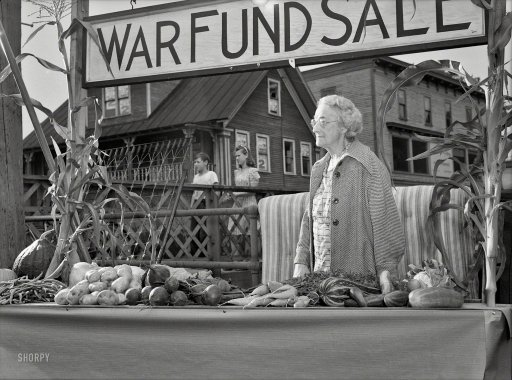
Marion Post Wolcott Main Street. Sheridan, Wyoming 1941

• Beijing’s Property Sales Surge 65% In 2015 (R.)
• How a Chinese Highway Became a Boulevard of Broken Dreams (WSJ)
• China Shadow Banking Assets Grew 30% In 2015 (R.)
• An Auction House Learns the Art of Shadow Banking (BBG)
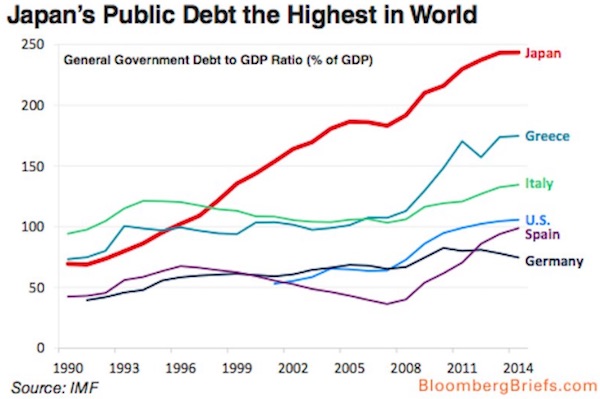
• Japan’s Real Problem Is Too Much Debt (720G)
• Can the World Deal With a New Bank Crisis? (Satyajit Das)
• Wolfgang Schäuble Bails Out Spain, Portugal (Pol.)
• Households on the Hook for Italy’s Next Bailout (BBG)
• Buying Longer Bonds Holds Danger (WSJ)
• Trump Draws Ire After Urging Russia To Find ‘Missing’ Clinton Emails (R.)
• In Clash Of Billionaires, Bloomberg Calls Trump White House Race ‘A Con’ (R.)
• IRS Launches Investigation Of Clinton Foundation (DC)
• Turkey Shuts Down 45 Newspapers, 16 TV Stations (AP)
• Taxes On Apple’s Offshore Assets Would Cover Most Of US Education Budget (MW)
• The Slot Machine in Your Pocket (Spiegel)


Government blows bubble. Rinse and repeat.

• Beijing’s Property Sales Surge 65% In 2015 (R.)

Property sales in Beijing rose 64.8% in 2015, boosted by more favorable housing policies, according to a real estate white paper released by the city’s government. Increased government stimulus sparked a sharp reversal in the market after sales volumes fell 30% in 2014, the white paper said. The benchmark interest rate for housing loans also dropped to its lower level in almost a decade, after several interest rate cuts, the paper noted. “The country’s housing credit and tax policies have been at their most favorable levels in recent years,” the paper said.

The number of newly-built commercial homes and existing stock sold in Beijing increased 26% and 90.7% respectively year-on-year in 2015, according to the paper published by Beijing Municipal Commission of Housing and Urban-Rural Development. China reported slightly stronger-than-expected economic growth in the second quarter as the housing boom and a government infrastructure building spree boosted demand for materials from cement to steel. But recent data has also indicated that property investment growth is cooling. Some of the country’s biggest cities have had to impose curbs on property purchases as sharp price rises raise fears of possible asset bubbles.

Read more …

This bubble is popping, though.

• How a Chinese Highway Became a Boulevard of Broken Dreams (WSJ)

A highway project here that is four years behind schedule and hundreds of millions of dollars over budget helps explain why Beijing s effort to raise infrastructure spending is an increasingly ineffective way to boost the economy. When construction on the Chang An Expressway began in 2008 it seemed a sure bet. Its private partners stood to collect decades of lucrative toll revenue. The economy and the environment would benefit by slashing three hours off a four-hour trip. But the project, in central Hunan province, has been beset by financial problems, resident protests and a corruption probe, issues that also have hindered hundreds of other projects in China.

Such setbacks are hurting Beijing s efforts to halt a decline in economic growth that is rippling across the globe and threatening political stability at home. China also is drawing less benefit from the infrastructure projects it completes. After a 15-year period in which the country built thousands of roads, airports, bridges and buildings, the economic benefit of adding even more is decidedly less valuable. Local governments’ heavy debt loads from prior stimulus efforts are further obstructing China’s efforts to stimulate the economy with infrastructure spending. More of their borrowed money is going to pay back previous loans. Many of these projects lose money, adding still more debt.

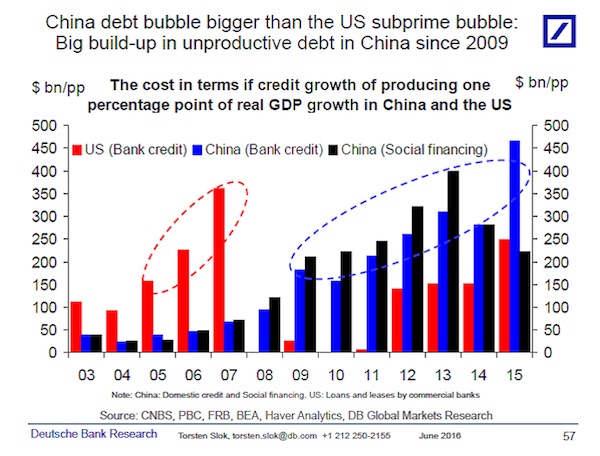
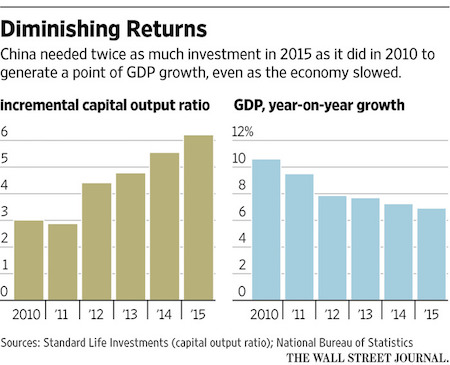
The upshot: China needed twice as much investment per unit of growth in 2015 as it did in 2010, official data show. This hasn’t stopped Beijing from doubling down on infrastructure spending as exports, manufacturing and other growth engines sputter. The government plans to spend $749 billion on transport projects over the next three years, compared with $171 billion worth built last year.
Read more …

Crackdown? Only in name. China is addicted to the shadows.

• China Shadow Banking Assets Grew 30% In 2015 (R.)

Shadow banking activity in China has expanded further and now accounts for nearly a third of the total banking sector assets, raising financial risks in the world’s second-largest economy, rating agency Moody’s Investor Service said on Wednesday. Shadow banking assets in China increased by 30% last year, reaching almost 54 trillion yuan (6.17 trillion pounds), according to Moody’s estimates. That is equivalent to about 78% of China’s total economic output and 27.6% of its banking assets. In 2011, shadow banking products accounted for 17.2% of total banking assets, and the share grew to 24.3% in 2014. China’s crackdown on risky practices in the thinly regulated shadow banking system has taken on fresh urgency amid a growing number of corporate defaults, and as policymakers appear worried about the risks of relying on too much debt-fuelled stimulus.

Despite this, shadow banking’s share in bank loans and total bank assets has expanded rapidly, as sectors and firms reeling from overcapacity and poor credit profiles turn to other sources of funding, and investors hunt for higher yields. “The rise in overall leverage and further expansion of shadow banking activity are pushing up financial risks,” said the Moody’s report, adding the growth highlights “spillover risks” to the financial system due to its interconnectedness. Years of breakneck growth for China’s top insurers have been partly fuelled by a splurge on shadow banking-linked products that could punch multi-billion-dollar holes in their balance sheets, a Reuters analysis showed.

Mid-tier Chinese banks are also increasingly using complex instruments to make new loans and restructure existing loans that are then shown as low-risk investments on balance sheets, masking the scale and risks of the slowing economy. The takeover tussle embroiling top Chinese developer China Vanke has also showed how local banks are increasingly exposed to highly volatile domestic stock markets through shadow lending products. “The increasing size of the shadow banking system means that during a disorderly contraction, banks could have difficulty replacing shadow banking credit, leaving borrowers who rely on such financing at risk of a credit crunch,” Moody’s said.

Read more …

Shadow banking comes in many different guises.

• An Auction House Learns the Art of Shadow Banking (BBG)

A year before he got caught up in a U.S. money-laundering investigation, Malaysian financier Jho Low was looking to borrow more than $100 million without having to answer all the nosy know-your-customer questions required by U.S. banks such as JPMorgan Chase. “Prefer the boutique banks that can move fast vs the large ones like JPM,” Low wrote on March 13, 2014, to an employee of a private art dealership that had sold him a painting by Claude Monet for $35 million a few months earlier. The lender “can take all the art no problems,” he wrote the next day. “All in Geneva free port. Speed is the most important and one with a fairly quick and relaxed kyc process.”

Low got his money a month later, not from a bank but from Sotheby’s, an auction house that isn’t subject to the same money-laundering scrutiny by regulators. He pledged 17 works of art, valued between $191.6 million and $258.3 million, to secure a $107 million loan, according to a U.S. Justice Department complaint filed July 20 in an effort to seize more than $1 billion of assets allegedly siphoned from a Malaysian state fund. As prices for art skyrocketed, Sotheby’s and other firms have become shadow banks, making millions of dollars of legal loans outside the regulated financial system and raising concerns that such financing could facilitate money laundering. Sotheby’s tripled lending to $682 million over the four years ended in 2015.

Last year it almost doubled, to $1 billion, a revolving credit facility provided by banks including JPMorgan and HSBC that it can use to make loans. “One way to launder is to use art as a security for a loan,” said David Hall, who spent 10 years as a special prosecutor for the Federal Bureau of Investigation’s Art Crime Team and is now a partner at law firm Wiggin & Dana. Hall, who wouldn’t comment about Sotheby’s or the Low case, said the aim is to use ill-gotten funds to purchase assets that can be used as collateral for a loan. “The level of scrutiny you’ll receive from a bank is much higher than you will receive from an auction house.”

Read more …

It’s everybody’s real problem, but even more so for Japan.

• Japan’s Real Problem Is Too Much Debt (720G)

The Japanese economy has been the poster child for economic malaise and bad fortune for so long that even the most radical policy responses no longer garner much attention. In fact, recent policy actions intended to weaken the Yen have resulted in significant appreciation of the yen against the currencies of Japan’s major trade partners, further crippling economic activity. The frustration of an appreciating currency coupled with deflation and zero economic growth has produced signs that what Japan has in store for the world falls squarely in to the category of “you ain’t seen nothin’ yet.” Assuming new fiscal and monetary policies will be similar to those enacted in the past is a big risk that should be contemplated by investors.

The Japanese economy has been fighting weak growth and deflationary forces for over 25 years. Japan’s equity market and real estate bubbles burst in the first week of 1990, presaging deflation and stagnant economic growth ever since. Despite countless monetary and fiscal efforts to combat these economic ailments, nothing seems to work. Any economist worth his salt has multiple reasons for the depth and breadth of these issues but very few get to the heart of the problem. The typical analysis suggests that weak growth in Japan is primarily being caused by weak demand. Over the last 25 years, insufficient demand, or a lack of consumption, has been addressed by increasingly incentivizing the population and the government to consume more by taking on additional debt.

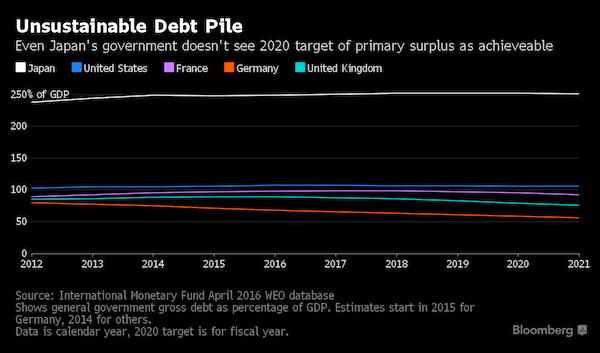
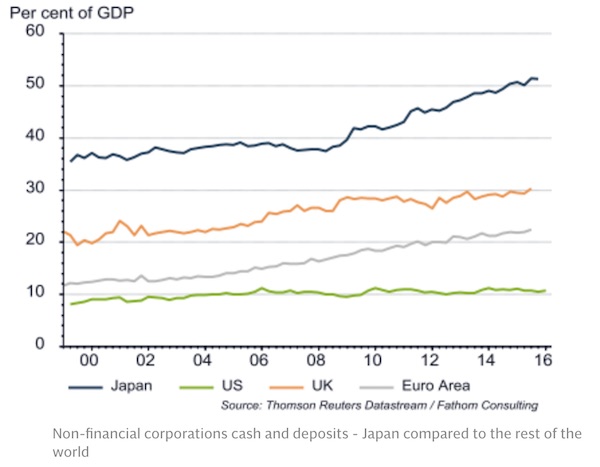
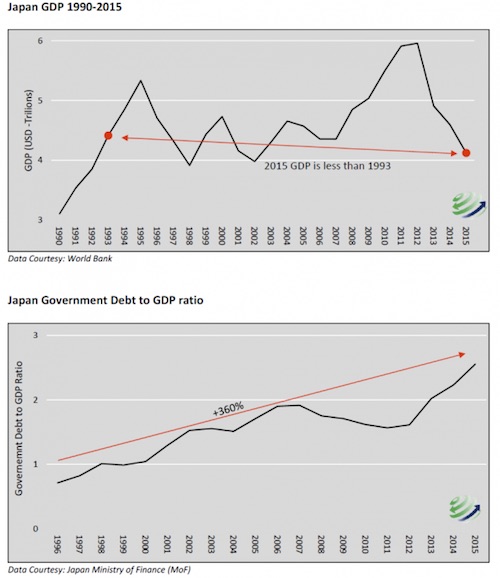
That incentive is produced via lower interest rates. If demand really is the problem, however, then some version of these policies should have worked, but to date they have not. If the real problem, however, is too much debt, which at 255% of Japan’s GDP seems a reasonable assumption to us, then the misdiagnoses and resulting ill-designed policy response leads to even slower growth, more persistent deflationary pressures and exacerbates the original problem.
Read more …

Not much choice.

• Can the World Deal With a New Bank Crisis? (Satyajit Das)

As Europe braces for the release of its bank stress tests on Friday, the world could be on the verge of another banking crisis. The signs are obvious to all. The World Bank estimates the ratio of non-performing loans to total gross loans in 2015 reached 4.3%. Before the 2009 global financial crisis, they stood at 4.2%. If anything, the problem is starker now than then: There are more than $3 trillion in stressed loan assets worldwide, compared to the roughly $1 trillion of U.S. subprime loans that triggered the 2009 crisis. European banks are saddled with $1.3 trillion in non-performing loans, nearly $400 billion of them in Italy. The IMF estimates that risky loans in China also total $1.3 trillion, although private forecasts are higher. India’s stressed loans top $150 billion.

Once again, banks in the US, Canada, UK, several European countries, Asia, Australia and New Zealand are heavily exposed to property markets, which are overvalued by historical measures. In addition, banks have significant exposure to the troubled resource sector: Lending to the energy sector alone totals around $3 trillion globally. Borrowers are struggling to service that debt in an environment of falling commodity prices, weak growth, overcapacity, rising borrowing costs and (in some cases) a weaker currency. To make matters worse, the world’s limp recovery since 2009 is intensifying loan stresses. In advanced economies, low growth and disinflation or deflation is making it harder for companies to pay off what they owe. Many European firms are suffering from a lack of global competitiveness, exacerbated by the effects of the single currency.

Read more …

Greece should sue him over this.

• Wolfgang Schäuble Bails Out Spain, Portugal (Pol.)

Ahead of Wednesday’s meeting of the EU’s 27 commissioners, Spain and Portugal looked to be headed for the eurozone’s version of politically embarrassing fiscal purgatory. There was no question that the Iberian duo’s budget deficits were in blatant breach of the single currency zone’s rules. Momentum was growing for the Commission to impose, for the first time ever, a fine totaling in the millions of euros. Even Jean-Claude Juncker, the Commission chief, had seemingly changed his previously skeptical views on sanctions, pushing his colleagues in recent weeks to enforce the rules and shore up Brussels’ credibility on eurozone governance. Then salvation arrived from an unlikely source: Wolfgang Schäuble.

The German finance minister, curmudgeonly fiscal hawk and scourge of spendthrift southern Europeans, broke with public type in a concerted, last-minute campaign to stop the sanctions, according to people familiar with his actions. Over the past weeks and days, Schäuble worked the phones and used personal encounters, pressing commissioners on the fence, mostly from his own center-right political block, to cancel the threatened fine. The behind-the-scenes intervention was driven by political considerations particular to this moment that trumped Schäuble’s long-standing demands for the eurozone nations to keep their budgets in order and abide by commonly agreed rules.

[..] As the consensus grew against a fine, Juncker urged the participants to make clear to the outside world why Brussels ducked, once again, imposing sanctions on rule breakers. “We must not be more Catholic than the Pope, but please make it known that the Pope wanted a fine of zero,” Juncker said, speaking in French at the closed-door meeting, according to a source in the room.

Read more …

And now Schäuble can save Italy too.

• Households on the Hook for Italy’s Next Bailout (BBG)

While the stability of Italy’s banks has been a front-burner issue for policy makers since the first tremors of the global financial crisis, the result of stress tests on Friday could usher in the final stage of solving their predicament. Retail investors own almost half of the most vulnerable securities, a legacy of banks using their customers as a piggy bank for cheap funding. UniCredit declined to comment on Imperatore’s recollection. The bank’s subordinated bonds available to retail investors trade close to par, indicating investors don’t expect to suffer losses. The bank is considering raising as much as €5 billion from shareholders and selling its entire stake in Poland’s Bank Pekao to raise capital, people familiar with the matter said on Wednesday.

At the zenith of the financial crisis, between July 2007 and June 2009, 80% of Italian banks’ bonds were sold to retail investors, according to regulator Consob. Through savers, banks funded themselves at a similar cost to the Italian government, whereas they gave professional money managers an extra%age point in debt interest, the 2010 report found. The channel of selling junior bonds to savers has virtually shut this year. So far in 2016, only one Italian bank, Mediobanca, has sold subordinated debt with an initial investment designed to attract small-scale investors – selling €200 million of junior bonds with a minimum denomination of €1,000. In the same period last year 10 banks sold €1.4 billion of notes with the same minimum subscription size.

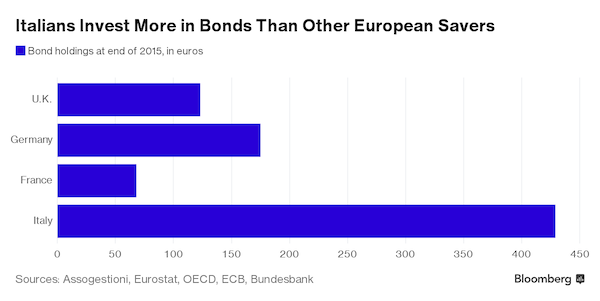
Still, Italian savers held €31 billion of subordinated bank bonds as of October, more than double the €13 billion in the hands of foreign investors, according to the Bank of Italy. That translates to about €1,260 of the junior bank debt for every household in Italy. Banca Monte dei Paschi di Siena, which has more than €27 billion of toxic loans on its books and needs to be recapitalized, has about €5 billion of junior debt.
Read more …

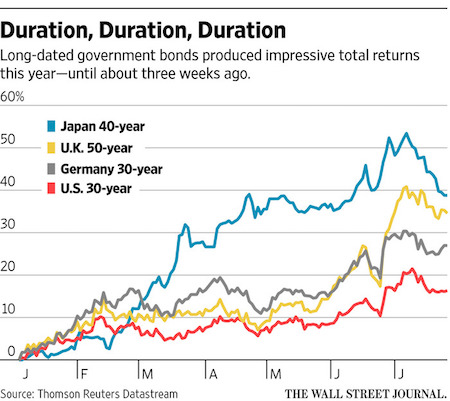
“..if yields merely rise back to where they started the year, it would be catastrophic for those who have chased longer duration. The 30-year Treasury would lose 14% of its value, while Japan’s 40-year would lose a quarter of its value..”

• Buying Longer Bonds Holds Danger (WSJ)

Investors in Japan’s 40-year bond have lost 24 years of coupon income in just three weeks as the rush into long-dated safe government paper went into sharp reverse. At one level, the 10% fall in the price of the longest-dated Japanese government bond is just a correction after this year’s extraordinary rally, which delivered returns of more than 50% before the pullback. At another, it highlights something dangerous at work in today’s markets: the scale of the risks investors are willing to take as they try to avoid anything that depends on economic growth. Japan’s bond selloff was worse than other markets’, as investors prepared for next week’s ¥28 trillion ($268 billion) spending and tax-cut package and a possible further Bank of Japan stimulus this Friday.

U.S., U.K. and German bond prices have also dropped since early July, though by less, as global demand weakened for long-duration assets. The demand for safe assets with a long duration—a proxy for how long it takes an investor to get his money back—was mirrored in stocks and corporate bonds. Rather than search out the highest-yielding assets, investors looked for those with secure yield, even if it was lower. So this year, triple-A-rated corporate bonds have outperformed double-A or single-A bonds, according to Barclays data. The same applied for junk bonds, with the higher ratings outperforming lower ones. (An exception was bonds close to or already in default, which were mainly energy companies and so were boosted by the rising oil price.)

[..] if yields merely rise back to where they started the year, it would be catastrophic for those who have chased longer duration. The 30-year Treasury would lose 14% of its value, while Japan’s 40-year would lose a quarter of its value, equal to 63 years of coupons. Has the long-run economic outlook really changed so much since January?
Read more …

Excuse me? That post is already taken: “..The Clinton campaign shot back that Trump was posing a possible national security threat..”

• Trump Draws Ire After Urging Russia To Find ‘Missing’ Clinton Emails (R.)

Republican Donald Trump on Wednesday invited Russia to dig up tens of thousands of “missing” emails from Hillary Clinton’s time at the U.S. State Department, vexing intelligence experts and prompting Democrats to accuse him of urging foreigners to spy on Americans. “Russia, if you’re listening, I hope you’re able to find the 30,000 emails that are missing,” Trump, the Republican presidential nominee, told reporters. Trump made the remark at a testy news conference at his Doral golf resort in Florida that allowed him to steal some of the limelight from the Philadelphia convention where Clinton on Thursday will accept the Democratic presidential nomination for the Nov. 8 election.

The Clinton campaign shot back that Trump was posing a possible national security threat by encouraging a foreign power to conduct espionage in the United States. Some intelligence experts said the comments raised questions about Trump’s judgment. A spokesman for Trump, Jason Miller, tried to tamp down the storm of protest, saying Trump did not urge Russia to hack Clinton’s emails. Trump said on Twitter that if anyone had Clinton’s emails, “perhaps they should share them with the FBI!” The criticism of Trump’s comments reverberated at the Democratic National Convention where speakers brought up the episode to try to intensify Democratic support for Clinton, who is running neck and neck with Trump in the polls.

“Donald Trump today once again took Russia’s side. He asked the Russians to interfere in American politics,” longtime Clinton supporter and former CIA Director Leon Panetta said. “Donald Trump … is asking one of our adversaries to engage in hacking or intelligence efforts against the United States of America to affect the election.” Another speaker, retired U.S. Rear Admiral John Hutson, said of Trump: “This morning, he personally invited Russia to hack us. That’s not law and order, that’s criminal intent.”

Read more …

You ain’t helping, Mikey…

• In Clash Of Billionaires, Bloomberg Calls Trump White House Race ‘A Con’ (R.)

New York media mogul Michael Bloomberg assailed fellow billionaire Donald Trump on Wednesday, calling his U.S. presidential race a “con” and ripping into his history of bankruptcies and lawsuits. “Trump says he wants to run the nation like he’s running his business? God help us,” Bloomberg told the Democratic National Convention in Philadelphia to roaring applause. “I’m a New Yorker and I know a con when I see one.” Formerly a Republican and now an independent, Bloomberg was for the most part greeted warmly by the audience in the Wells Fargo Center arena where he threw his support behind the Democrats’ presidential nominee, Hillary Clinton.

The owner of the Bloomberg media empire and a former New York City mayor, Bloomberg was an odd choice for a speaker at the Democratic conclave, where many party progressives have railed against the influence of billionaires in politics. “Let me thank all of you for welcoming an outsider here, to deliver what will be an unconventional convention speech,” he said when he took the stage, eliciting cheers. “I am not here as a member of any party. I am here for one reason: to explain why I believe it is imperative that we elect Hillary Clinton as the next president of the United States.” Bloomberg had considered running for the White House as an independent this year but dropped the idea in March, saying it could increase the chances Trump would win.

Bloomberg has known Trump casually for years and twice appeared on Trump’s reality TV show “The Apprentice.” But since Trump entered the race for president in June 2015, Bloomberg has taken issue with him, lashing out at his policies and fiery rhetoric, especially his call to ban Muslims from entering the country and his promise to wall off the Mexican border and deport millions of undocumented foreigners.

Read more …

If they can get the FBI to stop, what good would the IRS be?

• IRS Launches Investigation Of Clinton Foundation (DC)

IRS Commissioner John Koskinen referred congressional charges of corrupt Clinton Foundation “pay-to-play” activities to his tax agency’s exempt operations office for investigation, The Daily Caller News Foundation has learned. The request to investigate the Bill, Hillary and Chelsea Clinton Foundation on charges of “public corruption” was made in a July 15 letter by 64 House Republicans to the IRS, FBI and Federal Trade Commission (FTC). They charged the foundation is “lawless.” The initiative is being led by Rep. Marsha Blackburn, a Tennessee Republican who serves as the vice chairwoman of the House Committee on Energy and Commerce, which oversees FTC. The FTC regulates public charities alongside the IRS.

The lawmakers charged the Clinton Foundation is a “lawless ‘pay-to-play’ enterprise that has been operating under a cloak of philanthropy for years and should be investigated.” Koskinen’s July 22 reply came only a week after the House Republicans contacted the tax agency. It arrived to their offices Monday, the first opening day of the Democratic National Convention in Philadelphia. “We have forwarded the information you have submitted to our Exempt Organizations Program in Dallas,” Koskinen told the Republicans. The Exempt Organization Program is the division of the IRS that regulates the operations of public foundations and charities.

It’s the same division that was led by former IRS official Lois Lerner when hundreds of conservative, evangelical and tea party non-profit applicants were illegally targeted and harassed by tax officials. Blackburn told TheDCNF she believes the IRS has a double standard because, “they would go after conservative groups and religious groups and organizations, but they wouldn’t be looking at the Clinton Foundation for years. It was as if they choose who they are going to audit and question. It’s not right.” Blackburn said she and her colleagues will “continue to push” for answers on the Clinton Foundation’s governing policies, including its insular board of directors. She said they also will examine conflicts of interest and “follow the money trail.”

Read more …

No schools, no papers, no TV. How does that country run?

• Turkey Shuts Down 45 Newspapers, 16 TV Stations (AP)

Turkey’s state run news agency says close to 1,700 officers have been formally discharged from the military following the country’s failed coup. Anadolu Agency also says the government has decided to close down dozens of media organizations, including 45 newspapers and 16 television stations. The government says a U.S.-based Muslim cleric is behind the failed uprising by a faction within the military that led to some 290 deaths on July 15. Thousands have been detained for suspected links to the coup, including Calgary’s Davud Hanci, an imam for the Correctional Service Canada and the Alberta correctional services who went to Turkey with his family on July 7 to visit his ailing father.

Hanci was detained and accused of working for U.S.-based cleric Fethullah Gulen, who Turkey alleges orchestrated the failed July 15 military coup. Gulen has repeatedly denied the claims. Hanci’s friends and family say he is innocent and they fear for his safety. Tens of thousands in Turkey have also been purged from state institutions. Earlier, authorities issued warrants for the detention of 47 former executives or senior journalists of Turkey’s Zaman newspaper for alleged links to Gulen. Such detentions have raised concerns that people could be targeted simply for criticizing the government. The media watchdog Reporters Without Borders condemned Turkey’s purges of journalists, saying they have assumed “increasingly alarming proportions.”

Read more …

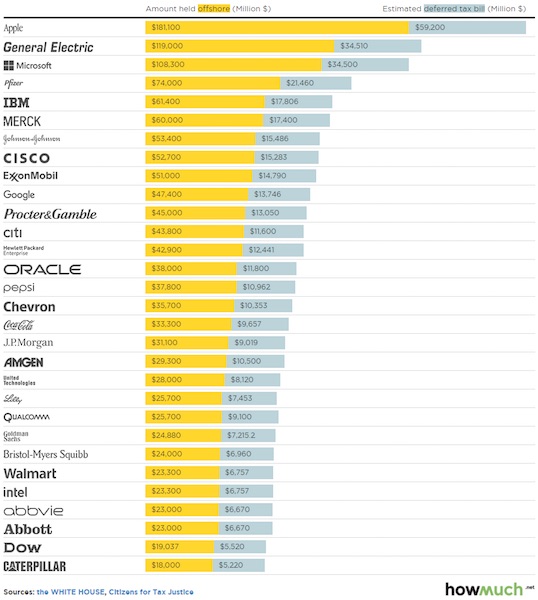
“Apple and its massive $181.1 billion overseas stash, a $70 billion increase from the prior year.”

• Taxes On Apple’s Offshore Assets Would Cover Most Of US Education Budget (MW)

The amount of money stashed overseas by U.S. multinationals has exploded in recent years, doubling between 2008 and 2014 to more than $2 trillion. For some perspective on the numbers, cost-estimating website HowMuch.net crunched the most recent data and created a telling interactive chart. Topping the list: Apple and its massive $181.1 billion overseas stash, a $70 billion increase from the prior year.

That total corresponds to $59.2 billion in deferred taxes, which is enough to cover more than two-thirds of the federal budget for education, training and employment, according to the 2014 numbers compiled by Citizens for Tax Justice last October. Elsewhere, General Electric’s taxes could take care of almost 5% of our Social Security costs, while taxes from Microsoft had it kept its money in the U.S., could have covered a fifth of all federal spending on veteran’s benefits. According to estimates, the prevalence of offshore tax havens causes the U.S. to lose out on $90 billion in federal income taxes each year. That’s no small chunk.
Read more …

“The average person checks their phone 150 times a day. Why do we do this? Are we making 150 conscious choices?”

• The Slot Machine in Your Pocket (Spiegel)

When we get sucked into our smartphones or distracted, we think it’s just an accident and our responsibility. But it’s not. It’s also because smartphones and apps hijack our innate psychological biases and vulnerabilities. I learned about our minds’ vulnerabilities when I was a magician. Magicians start by looking for blind spots, vulnerabilities and biases of people’s minds, so they can influence what people do without them even realizing it. Once you know how to push people’s buttons, you can play them like a piano. And this is exactly what technology does to your mind. App designers play your psychological vulnerabilities in the race to grab your attention. I want to show you how they do it, and offer hope that we have an opportunity to demand a different future from technology companies.

If you’re an app, how do you keep people hooked? Turn yourself into a slot machine. The average person checks their phone 150 times a day. Why do we do this? Are we making 150 conscious choices? One major reason why is the number one psychological ingredient in slot machines: intermittent variable rewards. If you want to maximize addictiveness, all tech designers need to do is link a user’s action (like pulling a lever) with a variable reward. You pull a lever and immediately receive either an enticing reward (a match, a prize!) or nothing. Addictiveness is maximized when the rate of reward is most variable.

Does this effect really work on people? Yes. Slot machines make more money in the United States than baseball, movies, and theme parks combined. Relative to other kinds of gambling, people get “problematically involved” with slot machines three to four times faster according to New York University professor Natasha Dow Schüll, author of “Addiction by Design.”

Read more …

Jul 022016


Jack Delano “Lower Manhattan seen from the S.S. Coamo leaving New York.” 1941

Brexit is nowhere near the biggest challenge to western economies. And not just because it has devolved into a two-bit theater piece. Though we should not forget the value of that development: it lays bare the real Albion and the power hunger of its supposed leaders. From xenophobia and racism on the streets, to back-stabbing in dimly lit smoky backrooms, there’s not a states(wo)man in sight, and none will be forthcoming. Only sell-outs need apply.

The only person with an ounce of integrity left is Jeremy Corbyn, but his Labour party is dead, which is why he must fight off an entire horde of zombies. Unless Corbyn leaves labour and starts Podemos UK, he’s gone too. The current infighting on both the left and right means there is a unique window for something new, but Brits love what they think are their traditions, plus Corbyn has been Labour all his life, and he just won’t see it.

The main threat inside the EU isn’t Brexit either. It’s Italy. Whose banks sit on over 30% of all eurozone non-performing loans, while its GDP is about 10% of EU GDP. How they would defend it I don’t know, they’re probably counting on not having to, but Juncker and Tusk’s European Commission has apparently approved a scheme worth €150 billion that will allow these banks to issue quasi-sovereign bonds when they come under attack. An attack that is now even more guaranteed to occcur than before.


Still, none of Europe’s internal affairs have anything on what’s coming in from the east. Reading between the lines of Japan’s Tankan survey numbers there is only one possible conclusion: the ongoing and ever more costly utter failure of Abenomics continues unabated.

It’s developing in pretty much the exact way I said it would when Shinzo Abe first announced the policies in late 2012. Not that it was such a brilliant insight, all you had to know is that Abe and his central bank head Kuroda don’t understand what their mastodont problem, deflation, actually is, and that means they are powerless to solve it.

That Abe said somewhere along the way that all that was needed was his people’s confidence to make Abenomics work, says more than enough. The multiple flip-flops over a sales-tax increase say the rest. People don’t become more confident just because someone tells them to; that has the opposite effect. Deflation results from reduced spending, which in turn comes from not only decreasing confidence as well as a decrease in money people have available to spend.

That modern economics sees everything not spent as ‘savings’ adds significantly to the failure -on the part of Abe, Kuroda and just about everyone else- to understand what happened in Japan over the past 2-3 decades. To repeat once again, inflation/deflation is the velocity of money multiplied by money- and credit supply. The latter factor has in general gone through the roof, but that means zilch if the former -velocity- tanks.

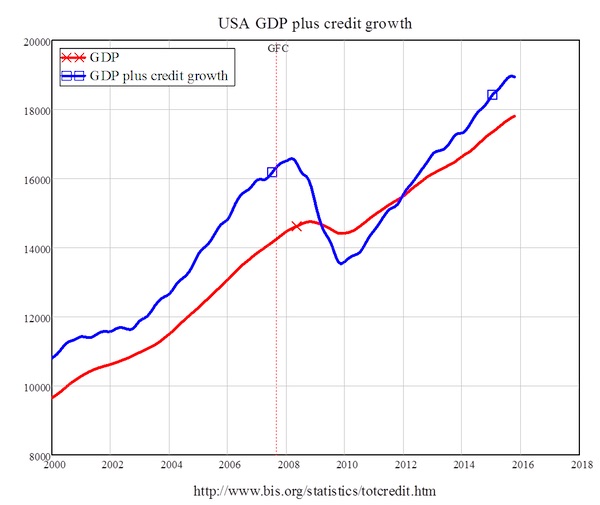
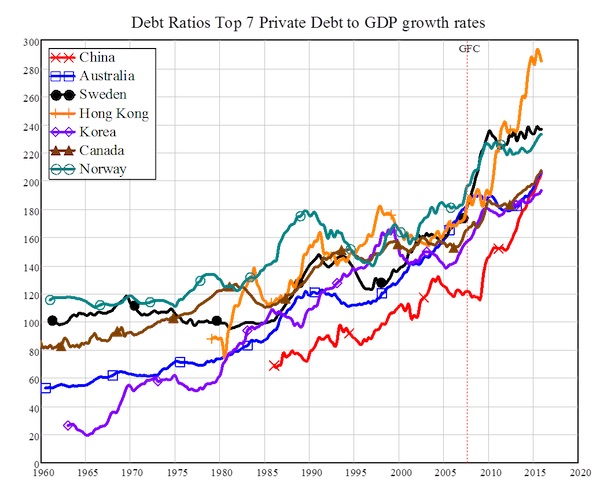
That this velocity is -still- tanking, in Japan as well as in the western world, is due to, more than anything else, an unparalleled surge in debt. At some point, that will catch up with any economy and society. Even if they are growing, which our economies are not. Growth has been replaced with credit, and credit is debt. It’s safe to say that money velocity cannot possibly ‘recover’ until large swaths of debt have been cancelled, one way or another.

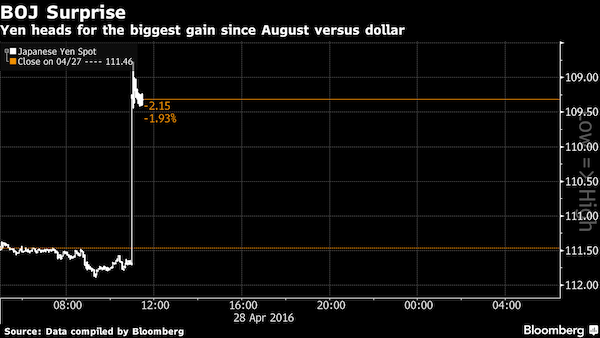
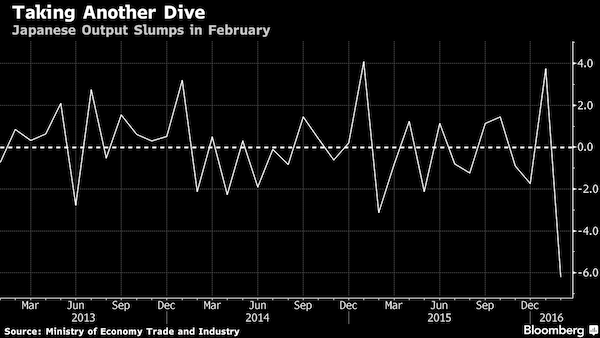
For Japan we saw this week that “..household spending fell for the third straight month in May and core consumer prices suffered their biggest annual drop since 2013..” (Reuters) while “..The Topix index dropped about 9% in June, plunging on June 24 with the Brexit vote, the most since the aftermath of the 2011 earthquake. The yen strengthened about 8% against the dollar in June..“ (Bloomberg).

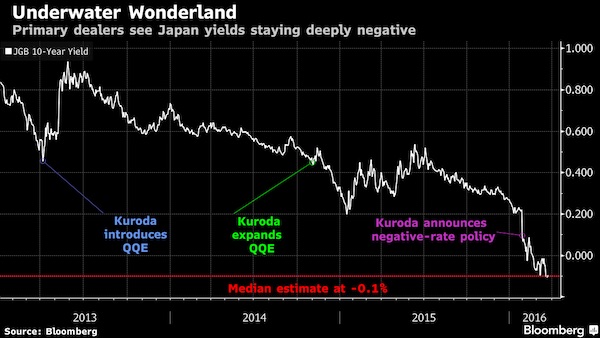
Japan has an upper-house election in a little over a week, and it seems like Abe can still feel comfortable about his position. A remarkable thing. The country needs to stop digging, it’s in a more than 400% debt-to-GDP hole, but Abe won’t listen. The rising yen is suffocating what is left of the economy, as are the negative interest rates, but all the talk is about ‘further easing’.


Still, Japan is outta here, and this has been obvious for a long time to the more observant observer. In the case of China, it is a more recent phenomenon, and it will even be disputed for a while to come. It’s also one that will have a much more devastating effect on the west. We’ve seen problems in various markets in Singapore, Macau and Hong Kong, but the real issues on the mainland are still to be sprung on us.

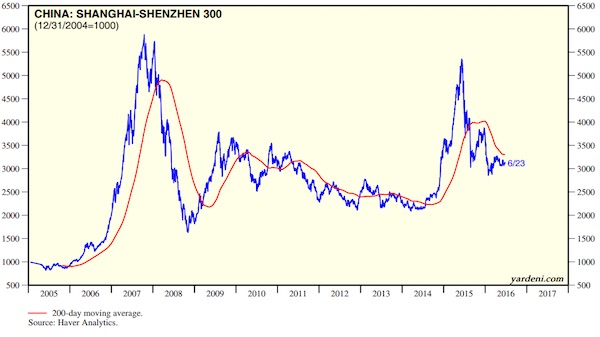
Mainland stock exchanges are as good a place as any to begin with. The combined tally for Shanghai and Shenzhen looks like this -data till June 23-; yes, that’s a loss of over 40% in the past year.

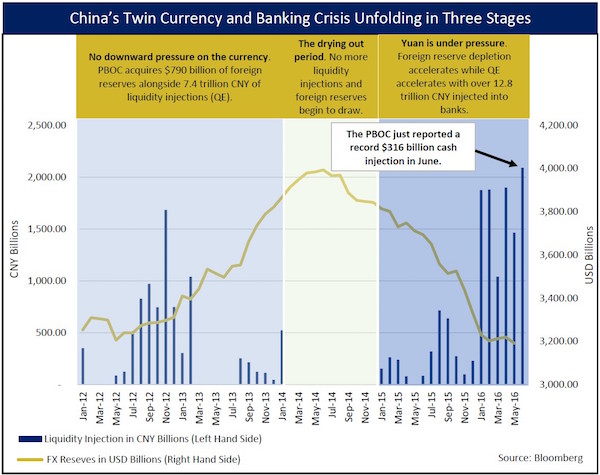
Beijing has been trying very hard to paper over these numbers, even quit supporting it all for a while through 2014, only to do a 180º when they didn’t like what they saw (foreign reserves drawdown), and now PBoC injections have gone bonkers: $316 billion in one month would mean $4 trillion on a yearly basis in what is really nothing but monopoly money.

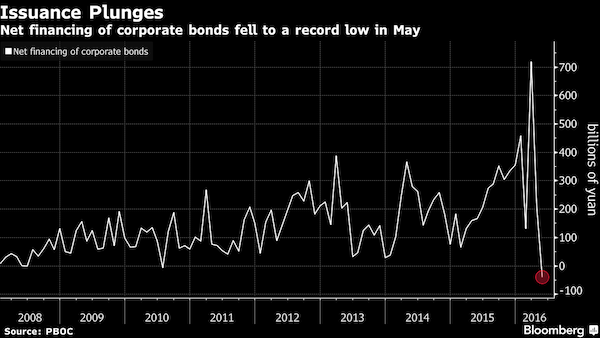
Meanwhile, corporate bonds are, perhaps partly because of volatility, becoming an endangered species. Maybe the PBoC can do something there as well, the way Draghi does in Europe (must be high on the agenda), but there’s already so much bad debt we hardly dare watch.

China must and will try to keep boosting exports by devaluing the yuan. It’s just waiting for an opportunity to do it without being accused of currency manipulation. Perhaps it can create that opportunity?! Create a crisis and then use it?! Regardless, this Reuters headline yesterday sounded very tongue in cheek:

China To ‘Tolerate’ Weaker Yuan

China’s central bank would tolerate a fall in the yuan to as low as 6.8 per dollar in 2016 to support the economy, which would mean the currency matching last year’s record decline of 4.5%, policy sources said. The yuan is already trading at its lowest level in more than five years, so the central bank would ensure any decline is gradual for fear of triggering capital outflows and criticism from trading partners such as the United States, said government economists and advisers involved in regular policy discussions. Presumptive U.S. Republican Presidential nominee Donald Trump already has China in his sights, saying on Wednesday he would label China a currency manipulator if elected in November.

Note: remember Japan above? The yen rose 8% against the USD just in June, as the yuan fell by just 4.5% in all of 2015 (6.8% over the past 2 years). Now you go figure what’s happening to Japan-China trade. And the yuan is still hugely overvalued. But the desire to be part of the IMF basket of currencies comes with obligations. Trump doesn’t help either.

I said in the beginning of this year that a 30% devaluation was something of a minimum, and that certainly continues to stand. So yeah, creating a crisis may be the only way out. An accident in the South China Sea perhaps. Combined with a ‘tolerance’ for a 50% weaker yuan….

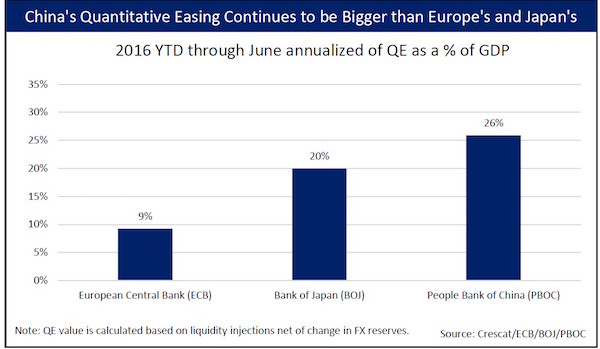
All of the above leads us to the title of this essay: deflation is coming in from the east. China’s economy’s already in deflation, even though it will take some time yet to be acknowledged. A very ‘nice’ report from Crescat Capital provides a bunch of clues.

China QE Dwarfs Japan and EU

In July of 2014, we wrote about the huge imbalance with respect to China’s M2 money supply and nominal GDP relative to the US. At the time, China’s M2 money supply was 71% higher than the US but its economy was 56% smaller, which we said was an indication of the overvaluation of the Chinese currency. Since that time, the yuan has fallen by only 6.8% relative to the dollar. We haven’t seen anything yet.

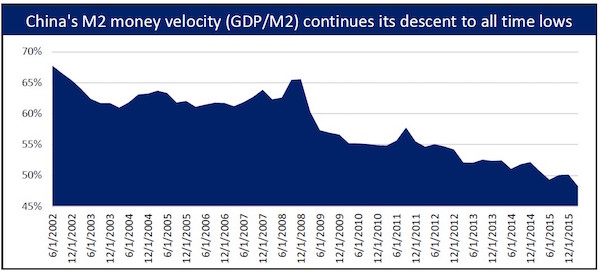
Today, the circumstances have significantly worsened. Money supply has continued to grow faster than GDP. With over $30 trillion of assets in its banking system and an underappreciated non-performing loan problem, we are convinced that China is headed for a twin banking and currency crisis. Money velocity has reached historically low levels which reflects China’s extreme credit imbalance and its crimping impact on its ability to generate future real GDP growth.

Just as worrying as the immense amount of credit built up, China has been reporting major downward revisions in its balance of payments (BoP) accounts. For more than a decade, China had been reporting an impossible twin surplus in its BoP accounts. When we wrote about this issue in 2014, we emphasized the likelihood of massive illicit capital outflows that not been accounted for. At that time, according to the State Administration of Foreign Exchange of China (SAFE), China had accumulated a BoP imbalance that was close to $9.4 trillion surplus since 2000 which we believed represented capital outflows that should have been recorded in the capital account.

The same accumulated BoP number today, revised by SAFE several times since, is now a deficit of about $2.8 trillion. Essentially, with its revisions, the SAFE has acknowledged even more capital outflows over the last 16 years than we had initially identified. On the capital account side, there was a downward revision of $10.1 trillion – from a $4.2 trillion surplus to a $5.9 trillion deficit. On the current account side, the revisions show that Chinese exports have not been as strong as initially reported over the last decade and a half. China’s current account surplus has been reduced by $2.1 trillion– going from $5.1 trillion to $2.9 trillion over the last 16 years. What we initially considered to be a $9.4 trillion imbalance has been more than proven by a $12.2 trillion revision.

Those are some pretty damning numbers, if you sit on them for a bit. There was another graph that came with that report that takes us head first into deflationary territory. China’s velocity of money:

That is utterly devastating. It’s what we see in the US, EU and Japan too, but ‘we’ have thus far been able to export our deflation -to an extent- to … China. No more. China has started exporting its own deflation to the west. Beijing MUST devalue its currency anywhere in the range of 30-50% or its export sector will collapse. It is not difficult.

That it will have to achieve this despite the objections of Donald Trump and the IMF is just a minor pain; Xi Jinping has more pressing matters on his mind. Like pitchforks.

The ‘normal’ response in economics would be: in order to fight deflation, increase consumer spending (aka raise money velocity)! But as we’ve seen with Japan, that’s much easier said than done. Because there are reasons people are not spending. And the only way to overcome that is to guarantee them a good income for a solid time into the future, in an economy that induces confidence.

That is not happening in Japan, or the US or EU, and it’s now gone in China too. Beijing has another additional issue that (formerly) rich countries don’t have. This is from a recent Marketwatch article on Andy Xie:

China Is Headed For A 1929-Style Depression

[..] Xie said China’s trajectory instead resembles the one that led to the Great Depression, when the expansion of credit, loose monetary policy and a widespread belief that asset prices would never fall contributed to rampant speculation that ended with a crippling market crash. China in 2016 looks much the same, according to Xie, with half of the country’s debt propping up real-estate prices and heavy leverage in the stock market – indicating that conditions are ripe for a correction. “The government is allowing speculation by providing cheap financing .. China “is riding a tiger and is terrified of a crash. So it keeps pumping cash into the economy. It is difficult to see how China can avoid a crisis.”

And then check this out:

China’s GDP grew 6.9% in 2015, its slowest pace in a quarter-century. For 2016, Beijing has set a GDP target of 6.5% to 7%; The latest spate of global uncertainties prompted Bank of America Merrill Lynch and Deutsche Bank to trim their forecasts to 6.4% and 6.6%, respectively. The export sector, long a driver of Chinese growth, is sputtering due to global saturation and household consumption is barely 30% of China’s GDP, Xie said. In the U.S., household consumption accounted for more than 68% of GDP in 2014, according to the World Bank.

Yeah, China is supposed to be going from an export driven- to a consumer driven economy. Problem with that seems to be that those consumers would need money to spend, and to earn that money they would need to work in export industries (since there is not nearly enough domestic demand). Bit of a Catch 22. And definitely not one you would want to find yourself in when the global economy is tanking.

The more monopoly money Beijing prints, the more pressure there will be on the yuan. And if they themselves don’t devalue the yuan, the markets will do it for them.

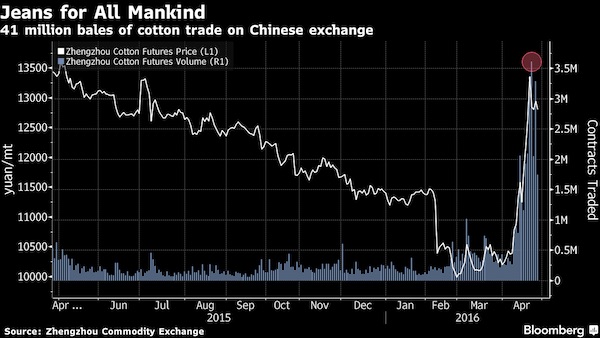
Kyle Bass says China’s $3 trillion corporate bond market is “freezing up” (see the third graph above), which threatens to undermine the $3.5 trillion market for the wealth management products Chinese mom and pops invest in. He expects a whopping $3 trillion in bank losses, an amount equal to the entire corporate bond market (!) “to trigger a bailout, with the central bank slashing reserve requirements, cutting the deposit rate to zero and expanding its balance sheet – all of which will weigh on the yuan.”

With the yuan down by as much as it would seem to be on course for, wages and prices in the west will plummet. This wave of deflation is set to hit western economies already in deflation and already drowning in private debt, and therefore equipped with severely weakened defenses.

Leonard Cohen once wrote a song called “Democracy Is Coming To The USA”. Maybe someone can do a version that says deflation is coming too. Not sure that’s good for democracy, though.

Have a great Holiday Weekend.

Jul 012016
 
 July 1, 2016  Posted by at 9:26 am Finance Tagged with: , , , , , , , ,  2 Responses »


Harris&Ewing Oil for salads 1918

• Japan Deflation Intensifies (R.)
• Japan’s Prices Keep Falling in Challenge to Abe, Kuroda (BBG)
• China QE Dwarfs Japan and EU (VW)
• China To ‘Tolerate’ Weaker Yuan (R.)
• China Is Headed For A 1929-Style Depression: Andy Xie (MW)
• Asian Factories Struggle, Brexit Throws Up New Threats (R.)
• Europe Post-Brexit (Brad Setser)
• EU Approves Italian Contingency Plan To Guarantee Bank Liquidity (R.)
• The Italian Job (DDMB)
• Standard & Poor’s Cuts EU Credit Rating (G.)
• Price Discovery, RIP (David Stockman)
• Scientists Warn Of ‘Global Climate Emergency’ Over Jet Stream Shift (Ind.)
• Refugees Encounter a Foreign Word: Welcome (NY Times)


Abenomics and BOJ stimulus are dismal failures. So what to do? Moar of the same of course. How much longer can Abe remain in power?

• Japan Deflation Intensifies (R.)

Japanese manufacturers’ confidence was subdued in June and service-sector sentiment deteriorated from three months ago on weak consumption, a central bank survey showed, in discouraging signs for a fragile economy grappling with a strong yen and slack overseas demand. The results of the survey could have been much worse had it captured the gloom from Britain’s vote last week to leave the EU, which spread turmoil in financial markets and put pressure on the Bank of Japan to expand its stimulus later this month. Separate data on Friday showed household spending fell for the third straight month in May and core consumer prices suffered their biggest annual drop since 2013, keeping policymakers under pressure to do more to spur growth.

“Worsening sentiment for non-manufacturers represents weak demand. This gives the government an incentive to increase stimulus spending,” said Daiju Aoki at UBS Securities. “If the government announces the size of stimulus spending shortly after the upper house election next week, the BOJ could ease policy at the end of the month,” he said. The BOJ’s closely-watched quarterly tankan survey showed the headline index for big manufacturers’ sentiment stood at plus 6, unchanged from three months ago and better than a median market forecast of plus 4. Big non-manufacturers’ sentiment index worsened to plus 19 from plus 22, the survey showed, as retailers felt the pain from weak domestic consumption and a slowdown in spending among overseas tourists.

Read more …

“The yen strengthened about 8% against the dollar in June.”
• Japan’s Prices Keep Falling in Challenge to Abe, Kuroda (BBG)

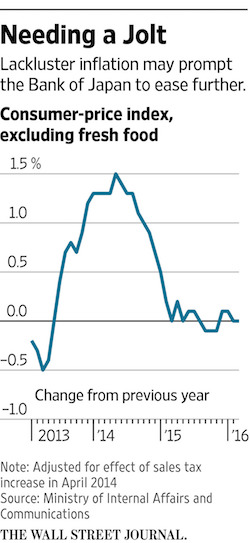
With a little more than a week until Japan goes to the polls for an upper-house election, a batch of economic data released Friday underscores the challenge Prime Minister Shinzo Abe faces in convincing voters that his policies are working. Consumer prices excluding fresh food fell for a third straight month and household spending declined, undermining efforts to revitalize the world’s third-largest economy. While corporate confidence and unemployment were unchanged, there is still little pressure for higher wages. Friday’s data followed reports earlier this week showing that industrial production fell more than economists had forecast and retail sales were flat in May, adding to concern that Japan’s recovery may be faltering after the economy returned to growth in the first quarter.

The U.K.’s vote to leave the European Union has strengthened the yen and roiled financial markets, increasing risks to corporate earnings for Japanese companies. The data will put more pressure on Bank of Japan Governor Haruhiko Kuroda to expand monetary stimulus at the policy meeting later this month, especially with the stronger yen and the central bank far from its 2% inflation target. “Given concerns over the effects of the Brexit vote and the strengthening yen, there is a high chance that the BOJ will ease further at its July meeting,” said Hiroaki Muto at Tokai Tokyo Research Center. “If the BOJ doesn’t move this time, there’s a possibility that the yen will strengthen further.” The Topix index dropped about 9% in June, plunging on June 24 with the Brexit vote, the most since the aftermath of the 2011 earthquake. The yen strengthened about 8% against the dollar in June.
Read more …

Chinese deflation.

• China QE Dwarfs Japan and EU (VW)

In July of 2014, we wrote about the huge imbalance with respect to China’s M2 money supply and nominal GDP relative to the US. At the time, China’s M2 money supply was 71% higher than the US but its economy was 56% smaller, which we said was an indication of the overvaluation of the Chinese currency. Since that time, the yuan has fallen by only 6.8% relative to the dollar. We haven’t seen anything yet. Today, the circumstances have significantly worsened. Money supply has continued to grow faster than GDP. With over $30 trillion of assets in its banking system and an underappreciated non-performing loan problem, we are convinced that China is headed for a twin banking and currency crisis. Money velocity has reached historically low levels which reflects China’s extreme credit imbalance and its crimping impact on its ability to generate future real GDP growth.

Just as worrying as the immense amount of credit built up, China has been reporting major downward revisions in its balance of payments (BoP) accounts. For more than a decade, China had been reporting an impossible twin surplus in its BoP accounts. When we wrote about this issue in 2014, we emphasized the likelihood of massive illicit capital outflows that not been accounted for. At that time, according to the State Administration of Foreign Exchange of China (SAFE), China had accumulated a BoP imbalance that was close to $9.4 trillion surplus since 2000 which we believed represented capital outflows that should have been recorded in the capital account.

The same accumulated BoP number today, revised by SAFE several times since, is now a deficit of about $2.8 trillion. Essentially, with its revisions, the SAFE has acknowledged even more capital outflows over the last 16 years than we had initially identified. On the capital account side, there was a downward revision of $10.1 trillion – from a $4.2 trillion surplus to a $5.9 trillion deficit. On the current account side, the revisions show that Chinese exports have not been as strong as initially reported over the last decade and a half. China’s current account surplus has been reduced by $2.1 trillion– going from $5.1 trillion to $2.9 trillion over the last 16 years. What we initially considered to be a $9.4 trillion imbalance has been more than proven by a $12.2 trillion revision.

Read more …

Cryptic fun.

• China To ‘Tolerate’ Weaker Yuan (R.)

China’s central bank would tolerate a fall in the yuan to as low as 6.8 per dollar in 2016 to support the economy, which would mean the currency matching last year’s record decline of 4.5%, policy sources said. The yuan is already trading at its lowest level in more than five years, so the central bank would ensure any decline is gradual for fear of triggering capital outflows and criticism from trading partners such as the United States, said government economists and advisers involved in regular policy discussions. Presumptive U.S. Republican Presidential nominee Donald Trump already has China in his sights, saying on Wednesday he would label China a currency manipulator if elected in November.

The economists and advisers are not directly briefed on policy by the People’s Bank of China (PBOC), but they have regular meetings and interactions with central bank officials and they provide policy recommendations. They said the central bank would tolerate a further weakening of the yuan this year to between 6.7-6.8 per dollar. “The central bank is willing to see yuan depreciation, as long as depreciation expectations are under control,” said a government economist, who requested anonymity due to the sensitivity of the matter. “The Brexit vote was a big shock. The market volatility may last for some time.”

Read more …

Good read.

• China Is Headed For A 1929-Style Depression: Andy Xie (MW)

Andy Xie isn’t known for tepid opinions. The provocative Xie, who was a top economist at the World Bank and Morgan Stanley, found notoriety a decade ago when he left the Wall Street bank after a controversial internal report went public. Today, he is among the loudest voices warning of an inevitable implosion in China, the world’s second-largest economy. Xie, now working independently and based in Shanghai, says the coming collapse won’t be like the Asian currency crisis of 1997 or the U.S. financial meltdown of 2008. In a recent interview with MarketWatch, Xie said China’s trajectory instead resembles the one that led to the Great Depression, when the expansion of credit, loose monetary policy and a widespread belief that asset prices would never fall contributed to rampant speculation that ended with a crippling market crash.

China in 2016 looks much the same, according to Xie, with half of the country’s debt propping up real-estate prices and heavy leverage in the stock market — indicating that conditions are ripe for a correction. “The government is allowing speculation by providing cheap financing,” Xie told MarketWatch. China “is riding a tiger and is terrified of a crash. So it keeps pumping cash into the economy. It is difficult to see how China can avoid a crisis.” Xie’s viewpoints have at times attracted unwelcome attention. In 2006, when he was a star Asia economist at Morgan Stanley a leaked email to colleagues in which he said money laundering was bolstering growth in Singapore led to his abrupt departure from the bank. In early 2007, he termed China’s surging markets a “bubble” that could lead to a banking crisis,” and in 2009 he likened them to a “Ponzi scheme.”

Read more …

“Most of the responses from manufacturers also preceded the Brexit vote, suggesting July could be even tougher.”

• Asian Factories Struggle, Brexit Throws Up New Threats (R.)

China’s vast factory sector flatlined in June as exports shrank and jobs were cut, a worrying trend evident across Asia that argues for yet more policy stimulus as doubts gather over the potency of measures taken so far. The hard times signaled by a range of surveys was not what the world needed a week after Britain’s vote to leave the European Union condemned that bloc to months, if not years, of political and economic instability. Most of the responses from manufacturers also preceded the Brexit vote, suggesting July could be even tougher. “The unimaginable has happened and the UK vote will cast a long shadow over the UK, Europe and global markets for some time to come,” warned Westpac head currency strategist Robert Rennie.

“A structurally weaker pound, a softer euro and weaker global growth beckons.” Among the many surveys out on Friday, China’s official Purchasing Managers’ Index (PMI) slipped a tick to 50 in June, dead on the level that is supposed to separate growth from contraction. One saving grace was the services sector measure, which nudged up to 53.7 in a positive sign for consumer activity. More worrying was the Caixin version of the PMI, which covers a greater share of smaller firms, where the index fell to a four-month trough of 48.6 in June, from 49.2 in May.

Read more …

“..the euro area’s aggregate fiscal impulse will be negative in 2017—exactly the opposite of what it should be when a surplus region is faced with a shock to external demand..”

• Europe Post-Brexit (Brad Setser)

A few thoughts, focusing on narrow issues of macroeconomic management rather than the bigger political issues. The U.K. has been running a sizeable current account deficit for some time now, thanks to an unusually low national savings rate. That means, on net, it has been supplying the rest of Europe with demand—something other European countries need. This isn’t likely to provide Britain the negotiating leverage the Brexiters claimed (the other European countries fear the precedent more than the loss of demand) but it will shape the economic fallout. The fall in the pound is a necessary part of the U.K.’s adjustment. It will spread the pain from a downturn in British demand to the rest of the euro area.

Brexit uncertainty is thus a sizable negative shock to growth in Britian’s euro area trading partners not just to Britain itself: relative to the pre-Brexit referendum baseline, I would guess that Brexit uncertainty will knock a cumulative half a%age point off euro area growth over the next two years.* Of course, the euro area, which runs a significant current account surplus and can borrow at low nominal rates, has fiscal capacity to counteract this shock. Germany is being paid to borrow for ten years, and the average ten year rate for the euro area as a whole is around 1%. The euro area could provide a fiscal offset, whether jointly, through new euro area investment funds or simply through a shift in say German policy on public investment and other adjustments to national policy.

I say this knowing full-well the political constraints to fiscal action. The Germans do not want to run a deficit. The Dutch are committed to bringing an already low deficit down further. France, Italy and especially Spain face pressure from the Commission to tighten policy. The Juncker plan never really created the capacity for shared funding of investment. The euro area’s aggregate fiscal stance is, more or less, the sum of national fiscal policies of the biggest euro area economies. If I had to bet, I would bet that the euro area’s aggregate fiscal impulse will be negative in 2017—exactly the opposite of what it should be when a surplus region is faced with a shock to external demand. A lot depends on the fiscal path Spain negotiates once it forms a new government, given that is running the largest fiscal deficit of the euro area’s big five economies.

Read more …

€150 billion. Chump change. Wait, there was a eurozone debt crisis in 2011?

Italy’s banks can now issue bonds with the same guarantee sovereign bonds have. But only the solvent ones, as in: those who don’t need it.

This is worse than a band-aid. Just wait till the vultures wake up.

• EU Approves Italian Contingency Plan To Guarantee Bank Liquidity (R.)

The European Commission has authorized an Italian government plan to guarantee liquidity for banks in the event of a financial crisis in the euro zone’s third-largest economy, an EU executive spokeswoman said on Thursday. The Commission approved the scheme last Sunday, another EU official said, days after Britain voted to leave the EU, triggering a sell-off in European bank stocks, especially in Italy, home to roughly a third of the euro zone’s bad debts. The scheme, worth up to €150 billion according to some media reports, would only be triggered in circumstances similar to the euro zone debt crisis of 2011, when some banks in the currency bloc needed to be bailed out and the interbank market had ceased to function. “Given the financial markets turmoil of recent days, the government saw it fit to prepare for all scenarios, even the most improbable, to be ready to step in to protect savers,” the Italian Treasury said in a statement.

Italian officials stressed they did not expect Italy to suffer a 2011-style meltdown in confidence but said it was prudent to plan for a worst-case scenario. Italian bank shares ended up 2% on Thursday after news of the scheme. Under the scheme, a bank can ask the government to guarantee its bond issues, ensuring that it can raise money even in troubled markets, but it only applies until the end of this year and only to banks with solvent balance sheets. “In this way, they can issue bonds that, with the assistance of the public guarantee, are similar to an Italian government bond,” said one source familiar with the scheme. [..] Rome has said it is concerned that Italian banks, which hold €360 billion of bad loans, risk attack by hedge funds betting that market turmoil, increased by last week’s Brexit vote, could tip them into a full-blown crisis.

Read more …

How Germany is blowing up the very EU that is making it rich.

• The Italian Job (DDMB)

More than any of its peers, the Italian economy has suffered since joining the euro in 1999. Since 2007, its economy has contracted by 10% and suffered not one, not two, but three recessions. Competitive export-led growth has been deeply impaired by virtue of Italy’s being effectively yoked to the massive German economy. Despite the rise of China, Germany has been able to maintain its top three ranking among world exporters. The secret weapon? That would be the euro. In 1998, the year before Germany switched to the euro, the country exported $540 billion. By 2015, that figure had swelled to $1.3 trillion. Italy’s exports have also grown, but not nearly as robustly, coming in last year at $459 billion compared to $242 billion the year before it joined the euro.

Just as it once was the case with China, Germany benefits from its relatively weak currency. If Germany was not tethered to its weaker-economy neighbors and was still on the Deutsche Mark, it would have a significantly stronger currency and substantially lower exports due to the price of its exports being much more expensive for world markets. Back in 2011, UBS put pencil to paper and figured that losing the common currency would trigger an immediate effective tax increase for the average German citizen of about €7,000 and between €3,500 to €4,000 every single year going forward. By contrast, swallowing half the debt of Greece, Ireland and Portugal at that time would have generated a little over €1,000 tab per citizen.

Now you see why bailing out is so easy to do, though the Germans do put on a great show of irritation at having to foot such bills. But let’s be honest. Consider the alternative. Reverse that effect and, with all else being equal, you begin to appreciate why Italy’s exports have become relatively more expensive, burdened as they are with a more expensive currency than they would have had. Consider that globalization had already done a number on the country’s once magnificent industrial base when Italy opted into the euro and left the lire behind. Since then, the country’s industrial capacity has been further decimated, shrinking by 15%. To take but one example, in 2007, Italy manufactured 24 million appliances; by 2012 it had declined to 13 million.

Read more …

S&P doesn’t mind doing useless things.

• Standard & Poor’s Cuts EU Credit Rating (G.)

The European Union has suffered a downgrade of its long-term credit rating following the UK’s Brexit vote last week. In a move that will increase the borrowing costs for the 28-member bloc, the credit ratings agency S&P said the EU should see its status as a safe haven for investors reduced to AA from AA+. The agency said: “After the decision by the UK electorate to leave the EU … we have reassessed our opinion of cohesion within the EU, which we now consider to be a neutral rather than positive rating factor.” International investors use credit agency reports to gauge the safety of their funds and the likelihood that their investments will become insolvent. Pension funds and other investors typically move their money to safe havens in times of uncertainty.

But concerns that the ripple effects of the Brexit vote will hit the profits of corporations in Europe, the US and Japan and hurt government finances have grown in recent days. Earlier this week S&P became the last of the three major ratings agencies to strip the UK of its last AAA rating as it warned that the economic, fiscal and constitutional risks the country faced had increased following the EU referendum result. The UK was placed on negative watch, which puts the government on notice of possible further downgrades, after S&P described the result of the vote as “a seminal event” that would “lead to a less predictable, stable and effective policy framework in the UK”. The agency added that the vote to remain in Scotland and Northern Ireland “creates wider constitutional issues for the country as a whole”.

Read more …

“..the ECB apparently determined it will not go broke in subzero land even if it is driving insurance companies, pension funds, banks and plain old savers in exactly that direction.”

• Price Discovery, RIP (David Stockman)

That was quick. With nearly 85% of the Brexit loss recovered in three days and the market now up for the quarter and the year, what’s not to like? After all, the central banks are purportedly at the ready, and, in the case of the ECB and BOE, are already swinging into action according to their shills in the MSM. MarketWatch thus noted,

Markets were boosted by reports indicating the ECB is weighing changes to its bond-buying program, while “the Bank of England also said they are all in,” said Joe Saluzzi at Themis Trading. The ECB is considering changing the rules regarding the types of bonds it can buy as part of its stimulus package to amid concerns it could run out of securities to buy under current stipulations, according to Bloomberg News. The report followed comments from BOE Gov. Mark Carney, who indicated the central bank is poised to further ease monetary policy to combat.

Well now, by the sound of it you would think that the madman Draghi is fixing to uncork the mother of all QEs if there is a danger that the ECB will “run out of securities to buy”. Who would have thought that the debt engorged governments of the eurozone couldn’t manufacture enough IOUs to satisfy Mario’s “buy” button? In fact, with public debt at 91% of GDP you would think that the $12.5 trillion outstanding would be enough to go around. It turns out, however, that the operative phrase is “under current stipulations”. In a fit of apparent prudence, the ECB determined that in buying $90 billion of government bonds and other securities per month, it would only purchase securities with a yield higher than its negative 0.4% deposit rate.

That’s right. Stumbling around in their monetary puzzle palace, the geniuses at the ECB determined that subzero rates are just fine with one condition. Namely, so long as they don’t have to pay more to own German bonds, for example, than German banks are paying to deposit excess funds at the ECB. Stated differently, the ECB apparently determined it will not go broke in subzero land even if it is driving insurance companies, pension funds, banks and plain old savers in exactly that direction. But then comes the catch-22. The more bonds Draghi promises to buy, the more the casino front-runners scarf-up those same bonds on 95% repo leverage – knowing that Mario will gift them with a big fat gain on their tiny sliver of capital at risk.

Read more …

“The behaviour of the jet stream suggests massive hits to the [global] food supply and the potential for massive geopolitical unrest. There’s very strange things going on on planet Earth right now.”

• Scientists Warn Of ‘Global Climate Emergency’ Over Jet Stream Shift (Ind.)

Environmental scientists have declared a “global climate emergency” after the Northern hemisphere jet stream was found to have crossed the equator, bringing “unprecedented” changes to the world’s weather patterns. Robert Scribbler and University of Ottawa researcher Paul Beckwith warned of the “weather-destabilising and extreme weather-generating” consequences of the jet stream shift. The scientists said the anomalies were most likely precipitated by man-made climate change, which caused the jet stream to slow down and create larger waves. Scribbler wrote in a post on his environmental blog on Tuesday: “It’s the very picture of weather-weirding due to climate change. Something that would absolutely not happen in a normal world.

Something, that if it continues, basically threatens seasonal integrity. The blogger explained the barrier between the two jet streams generates the strong divide between summer and winter, and the “death of winter” could commence if it is eroded as warm weather leaks into the “winter zone” of the year. He continued: “As the poles have warmed due to human-forced climate change, the Hemispherical Jet Streams have moved out of the Middle Latitudes more and more. You get this weather-destabilising and extreme weather generating mixing of seasons.” Meanwhile, Mr Beckwith confirmed the changes would usher in a sustained period of “climate system mayhem” which could prove difficult to resolve.

He said: “Our climate system behaviour continues to behave in new and scary ways that we have never anticipated, or seen before. “Welcome to climate chaos. We must declare a global climate emergency. “The behaviour of the jet stream suggests massive hits to the [global] food supply and the potential for massive geopolitical unrest. There’s very strange things going on on planet Earth right now.”

Read more …

Absolute must read. How is it possible that my adopted home away from home gets it so right, yet no-one else tries to learn from it?

• Refugees Encounter a Foreign Word: Welcome (NY Times)

Much of the world is reacting to the refugee crisis – 21 million displaced from their countries, nearly five million of them Syrian — with hesitation or hostility. Greece shipped desperate migrants back to Turkey; Denmark confiscated their valuables; and even Germany, which has accepted more than half a million refugees, is struggling with growing resistance to them. Broader anxiety about immigration and borders helped motivate Britons to take the extraordinary step last week of voting to leave the EU. In the United States, even before the Orlando massacre spawned new dread about “lone wolf” terrorism, a majority of American governors said they wanted to block Syrian refugees because some could be dangerous.

Donald J. Trump, the presumptive Republican presidential nominee, has called for temporary bans on all Muslims from entering the country and recently warned that Syrian refugees would cause “big problems in the future.” The Obama administration promised to take in 10,000 Syrians by Sept. 30 but has so far admitted about half that many. Just across the border, however, the Canadian government can barely keep up with the demand to welcome them. Many volunteers felt called to action by the photograph of Alan Kurdi, the Syrian toddler whose body washed up last fall on a Turkish beach. He had only a slight connection to Canada – his aunt lived near Vancouver – but his death caused recrimination so strong it helped elect an idealistic, refugee-friendly prime minister, Justin Trudeau.

The Toronto Star greeted the first planeload by splashing “Welcome to Canada” in English and Arabic across its front page. Eager sponsors toured local Middle Eastern supermarkets to learn what to buy and cook and used a toll-free hotline for instant Arabic translation. Impatient would-be sponsors — “an angry mob of do-gooders,” The Star called them — have been seeking more families. The new government committed to taking in 25,000 Syrian refugees and then raised the total by tens of thousands. In the ideal version of private sponsorship, the groups become concierges and surrogate family members who help integrate the outsiders, called “New Canadians.” The hope is that the Syrians will form bonds with those unlike them, from openly gay sponsors to business owners who will help them find jobs to lifelong residents who will take them skating and canoeing.

Ms. McLorg’s group of neighbors and friends includes doctors, economists, a lawyer, an artist, teachers and a bookkeeper. Advocates for sponsorship believe that private citizens can achieve more than the government alone, raising the number of refugees admitted, guiding newcomers more effectively and potentially helping solve the puzzle of how best to resettle Muslims in Western countries. Some advocates even talk about extending the Canadian system across the globe. (Slightly fewer than half of the Syrian refugees who recently arrived in Canada have private sponsors, including some deemed particularly vulnerable who get additional public funds. The rest are resettled by the government.)

Read more …

May 272016


Jack Delano Near Shawboro, North Carolina, Florida migrants on way to Cranberry, NJ 1940

• Bill Gross Trying to Short Credit to Reverse Four Decades of Instinct (BBG)
• “Japan Is Already Doing Helicopter Money” (BBG)
• “China’s Economy Resembles A Spinning Top Running Out Of Momentum” (RD)
• US-China Economic Poker Game Looms With Market Calm at Stake (BBG)
• China Stocks Head for Longest Weekly Losing Streak in Four Years (BBG)
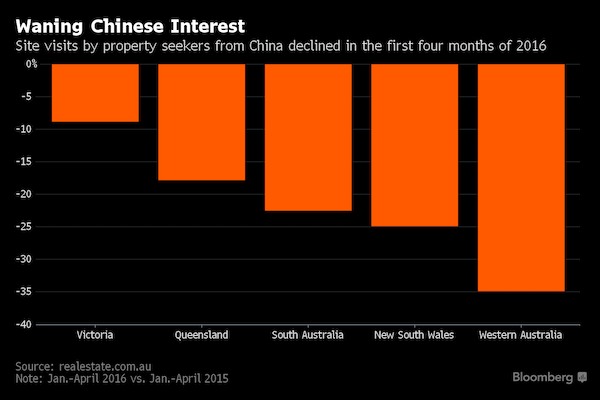
• Chinese Buyers Are Losing Interest In Australian Property (BBG)
• EU Warns China To Expect New Steel Tariffs (FT)
• Japan Fails in Bid to Have G-7 Warn of Global Crisis Risk (BBG)
• Corporate Japan Much More Downbeat About Escape From Deflation (R.)
• Debt Repayments In Crude Cripple Poorer Oil Producers (R.)
• Wells Fargo Launches 3% Down-Payment Mortgage (CNBC)
• Universal Basic Income: Money For Nothing (FT)
• After 7 Years, UK Workers Still Waiting For Decent Pay Rises (FT)
• Cameron Denies Being A “Closet Brexiteer” (R.)
• Australia Erased From UN Climate Change Report As Government Intervenes (G.)
• ‘Disaster in the Making’: The Many Failures of the EU-Turkey Refugee Deal (Sp.)
• Up To 80 Dead In Shipwreck Off Libya (MEE)

“I’m an investor that ultimately does believe in the system, but believes that the system itself is at risk.”

What Gross says is that being an investor is no longer any use. Or, as I said quite a while ago, in a market as manipulated as this one, with no price discovery, there are no investors. You’d have to fully redefine the term. For now, there are only people pretending to be investors.

• Bill Gross Trying to Short Credit to Reverse Four Decades of Instinct (BBG)

Bill Gross, who built a career and a $1.9 billion personal fortune trading bonds, is trying to go short on credit, a position that he said runs contrary to his instincts and training as an investor. Gross, who manages the $1.3 billion Janus Global Unconstrained Bond Fund, said he is moving to sell credit risk and insurance on market volatility rather than buying long-term debt, because he believes a day of reckoning will come when central banks will no longer be able to prop up asset prices and investors will withdraw from markets. “It’s really hard to change your psychological makeup and to be a hedge manager that is comfortable with being short,” he said in an interview with Bloomberg’s Erik Schatzker. “I’m working on it, because I’m an investor that ultimately does believe in the system, but believes that the system itself is at risk.”

Central bankers, seeking to stimulate economies, have lowered rates below zero in Europe and Japan, driving down returns on national debt, while investors seeking higher yield have pushed up the value of other credit. Stimulus from central banks worldwide has artificially pushed up values of stocks and credit, which has made Gross cautious on such assets, he said. Eliminating credit as an investment means “not buying stocks, not buying high-yield bonds,” Gross said. “It means going the other way, which comes at a price.” The U.S. Fed Funds target rate is between 0.25% and 0.5%. Eventually, central bankers will have to raise rates to reward individual savers, insurance companies and other investors who depend on fixed-income returns, or the economy and markets will suffer, according to Gross.

The Fed will boost the rate in June and should continue a gradual path of increases, Gross said. Since last week when the Fed released minutes of an April meeting indicating the economy has strengthened enough for a rate increase, the probability of a hike at the June 15 Federal Open Market Committee meeting has climbed to 34%, according to futures information compiled by Bloomberg.

Read more …

Shinzo Abe approaches full panic mode. Dangerous.

• “Japan Is Already Doing Helicopter Money” (BBG)

Yukio Noguchi, a former Ministry of Finance official whose business books are best sellers, envisages a scenario in which a failure of Japan’s economic stimulus could drive the yen to weaken beyond 300 per dollar. “If these fiscal and monetary policies continue, the yen’s value is at great risk,” the 75-year-old professor at Tokyo’s Waseda University said in an interview on May 11. “If you base your thinking on the efficient-markets hypothesis, you can’t predict a level for the currency. But, if the nation’s economic strength weakens, it is possible the yen could drop to 300, or 500, or 1,000 to the dollar.” Growth has stagnated for a decade despite fiscal and monetary stimulus efforts that left the government with a debt burden that is the highest in the world, at about 2.5 times the value of the nation’s economic output.

Noguchi believes the Bank of Japan is already financing fiscal spending, providing so-called helicopter money. That echoes comments by billionaire bond investor Bill Gross, who said the likely endgame was for the BOJ to forgive sovereign debt. The problem with the extremely cheap money is that it gets channeled into unproductive areas, and allows “zombie companies” to continue to stay in business, said Noguchi, who has a Ph.D. in economics from Yale, and is currently an adviser at Waseda University in Tokyo. Even so, this stimulus hasn’t been effective, and capital investment, wages, and prices aren’t rising, he said. “Japan is already doing helicopter money, as Bernanke describes it,” said Noguchi, whose economics books and life-hacking scheduler have sold millions of copies in Japan. “That’s what’s happening now under the BOJ’s asset purchase policy, with banks buying longer-maturity bonds and immediately selling them to the BOJ.”

Read more …

Duncan’s not fooling around.

• “China’s Economy Resembles A Spinning Top Running Out Of Momentum” (RD)

Economist and financial author Richard Duncan has published a stark look at China’s economy as it enters a new phase of slower growth, assessing the implications for a global economy that has become reliant on Chinese demand as a driver. Duncan believes that China’s economic boom ended in 2015 and that a protracted slump lies ahead. He has published a series of videos explaining why, in his opinion, China’s economic development model of export-led and investment-driven growth is now in crisis. The South China Morning Post brings you the first video in that series.

“China’s economy resembles a spinning top that is running out of momentum. It is wobbling and gyrating erratically,” Duncan said. A former Hong Kong-based banking analyst, Duncan has also worked as an analyst at the World Bank, and as global head of investment strategy at ABN AMRO Asset Management in London. He has authored three books on the global economic crisis, including The Dollar Crisis: Causes, Consequences, Cures. He is now chief economist at the Singapore-based hedge fund Blackhorse Asset Management.

Read more …

Cats in a sack.

• US-China Economic Poker Game Looms With Market Calm at Stake (BBG)

As top American and Chinese officials prepare for their annual powwow against the backdrop of a looming Federal Reserve interest-rate increase, the policy actions of the world’s two-biggest economies have never been so closely bound. In what could be likened to a poker game, officials from the world’s two biggest economies will attempt to assess each others’ policy plans – and their potential domestic implications – when they sit down in Beijing June 6-7. China wants to loosen the yuan’s link with the dollar while averting an exodus of capital. The Fed wants to gradually move away from near-zero interest rates, with almost all officials penciling in at least two quarter-point hikes this year.

The past nine months have made clear how the two sides’ goals can conflict, with the withdrawal of U.S. stimulus encouraging Chinese outflows and a surprise August yuan devaluation generating market ructions that put a pause on a Fed rate move. A Fed-induced surge in the U.S. currency would put pressure on the yuan, lighting a match under money outflows that have eased significantly after a record $1 trillion left in 2015. Avoiding another financial conflagration is one task for Fed Vice Chairman Stanley Fischer, U.S. Treasury Secretary Jacob J. Lew and other officials when they meet their Chinese counterparts. The gathering will be the eighth and final Strategic and Economic Dialogue since the Obama administration agreed on the annual sessions, which were an extension of a Bush administration initiative.

Read more …

Listening to the ‘authorative voice’.

• China Stocks Head for Longest Weekly Losing Streak in Four Years (BBG)

China’s stocks headed for their longest stretch of weekly losses since July 2012 amid concern a pick-up in earnings growth is losing steam as the nation’s economy slows. The Shanghai Composite Index was poised for a sixth week of declines after slipping 0.3% on Friday. Industrial, drug and consumer-staples producers were the worst performers this week. China Southern Airlines and Air China slumped more than 6% during the period, hurt by rising fuel prices and a weakening yuan. Data on Friday showed industrial companies’ profit growth slowed to 4.2% in April. Hong Kong stocks halted a three-day advance after Tingyi Cayman Islands reported slumping earnings.

Sentiment toward Chinese stocks turned bearish after March’s pick up in economic indicators didn’t carry over to April and a high-profile warning by the People’s Daily about the nation’s high levels of debt damped hopes for more easing. Adding to the concern this week is the prospect of higher U.S. interest rates spurring capital outflows. Despite dwindling optimism, the Shanghai Composite hasn’t strayed more than 51 points from 2,800 in the past two weeks, with declines limited by suspected buying from state-backed funds aimed at preventing the benchmark from ending below that level. “The market is slowly searching for a bottom and testing investors’ patience,” said Wu Kan at JK Life Insurance in Shanghai. “Stocks are fluctuating in a small range near 2,800 amid waning turnover, as investors cautiously await clarity over issues such as the timing of U.S. rate hikes. Small rebounds, if any, will be followed by declines.”

Read more …

Losing interest? Are we sure that’s the only reason?

• Chinese Buyers Are Losing Interest In Australian Property (BBG)

Buyers from China, often blamed for the sharp rise in home prices in Sydney and Melbourne, are starting to lose interest. In the first four months of the year, visits by potential buyers from China to realestate.com.au’s listings in New South Wales state, which has Sydney as its capital, declined 25% from the same period last year. Views of properties in Victoria state, whose capital is Melbourne, fell 8.9%, while the mining state of Western Australia saw the biggest drop of 35%, according to the portal, one of the nation’s two biggest property websites.

Read more …

At some point China must retaliate.

• EU Warns China To Expect New Steel Tariffs (FT)

The EU has warned China that it faces new anti-dumping tariffs on steel, amid growing pressure for the west to block Beijing’s bid for “market economy status” and greater access to world markets. Speaking ahead of the G-7 summit in Japan, European Commission president Jean-Claude Juncker declared: “If somebody distorts the market, Europe cannot be defenseless.” The issue of Chinese steel exports will be discussed by G-7 leaders on Thursday against the backdrop of a steel crisis in many western countries, including Britain where efforts are under way to save Tata Steel’s UK operations. Draft language prepared for discussions on the G-7 communique, while not mentioning China, expresses concern about the excess supply of steel around the world and says it has distorted the global market.

A Japanese government official said the issue went beyond steel to other commodities as well. Juncker claimed Chinese overcapacity amounted to double the EU’s annual steel production and that it had contributed to the loss of “thousands of jobs since 2008”. “We will step up our trade defense measures,” he said. Juncker also said there would be an impact assessment of Chinese steel exports and detailed discussion on Beijing’s bid for market economy status under WTO rules. China expects to achieve that status in December on the 15th anniversary of its 2001 accession to the WTO, giving it greater access to world markets and making it harder for third parties such as the EU to impose anti-dumping sanctions.

Read more …

So it’s G7, but not really, since Juncker and Tusk are also invited, while Putin and Xi are not. You make it up as you go along.

• Japan Fails in Bid to Have G-7 Warn of Global Crisis Risk (BBG)

Japanese Prime Minister Shinzo Abe failed in his bid to have Group of Seven leaders warn of the risk of a global economic crisis in a communique issued as their summit wraps up Friday in central Japan. The final statement declares that G-7 countries “have strengthened the resilience of our economies in order to avoid falling into another crisis.” Japan had pressed G-7 leaders to note “the risk of the global economy exceeding the normal economic cycle and falling into a crisis if we did not take appropriate policy responses in a timely manner.” On Thursday, Abe presented documents to the G-7 indicating there was a danger of the world economy careering into a crisis on the scale of the 2008 Lehman shock.

Abe has frequently said he would proceed with a planned increase in Japan’s sales tax in April 2017 unless there is an event on the scale of Lehman or a major earthquake. He is expected to announce next week he is deferring the tax rise, Japanese media reported. One of the biggest topics at the meeting was China, which is not a member of the G-7. A slowdown in China, alongside a global steel glut, has spurred concerns among developed economies and at times disagreement on how best to spur growth. Abe has advocated greater government spending to back up monetary policy action. The communique urged a coordinated, albeit differentiated, response to storm clouds gathering over the global economy. Leaders pledged to use a mix of tools depending on their circumstances.

Read more …

Fast looming gloom: “70% of companies see no decisive escape from deflation for the foreseeable future, up from 48% in January”

• Corporate Japan Much More Downbeat About Escape From Deflation (R.)

Japan Inc has become increasingly pessimistic about the country’s ability to beat deflation, with the vast majority of firms now expecting no escape for the foreseeable future, a Reuters poll showed. Most Japanese companies also said they did not think Prime Minister Shinzo Abe’s latest growth strategy that centers on lifting the mininum wage and investment in technology would help bring significant improvement to a faltering economy. Abe swept into office three years ago with bold plans to end decades of deflation and bring about sustainable growth. But while unprecedented monetary policy in tandem with fiscal stimulus met with some initial success, any gains in ridding the country of a deflationary mindset look like they could be slipping away.

The Reuters Corporate Survey, conducted May 9-23, found 70% of companies see no decisive escape from deflation for the foreseeable future, up from 48% in January when the same question was asked. “Demand is not on an upward trend, and household spending is not rising because base pay is not rising,” wrote a manager at a chemicals company. “It has become difficult for companies to lift prices.” Japan has only managed very mild inflation since Abe took office and the pace of price gains has been slowing since 2014. Core consumer prices in March fell 0.3% from a year earlier, the fastest decline in three years due to lower oil prices. The survey also found that 79% of companies were worried that consumer prices could return to deflation either this year or next.

Read more …

Stunning from earlier in the week. ‘Weaker producers’ are forced to flood the market, but with nothing in return.

• Debt Repayments In Crude Cripple Poorer Oil Producers (R.)

Poorer oil-producing countries which took out loans to be repaid in oil when the price was higher are having to send three times as much to respect repayment schedules now prices have fallen. This has crippled the finances of countries such as Angola, Venezuela, Nigeria and Iraq and created a further division within OPEC. Ahead of an OPEC meeting next week, poorer members have continued to push for output cuts to lift prices but wealthier Gulf Arab members such as Saudi Arabia, which are free of such debts, are resisting taking any action despite prices falling 60% in the past 2 years. Angola, Africa’s largest oil producer has borrowed as much as $25 billion from China since 2010, including about $5 billion last December, forcing its state oil firm to channel almost its entire oil output toward debt repayments this year.

This year Angola, Nigeria, Iraq, Venezuela and Kurdistan are due to repay a total of between $30 billion and $50 billion with oil, according to Reuters calculations based on publicly disclosed information and details given by participants in ongoing restructuring talks. Repaying $50 billion required only slightly over 1 million barrels per day (bpd) of oil exports when it was trading at $120 per barrel but with prices of around $40, the same repayment would require exports of over 3 million bpd. “All of those oil nations – Angola, Nigeria, Venezuela – have taken money for survival but haven’t got any money left for investments. “That is very damaging to their long-term growth prospects,” said Amrita Sen from Energy Aspects think-tank.

“People tend to look at current production volumes but if you have committed your entire production to China or other buyers under loans – then you cannot invest to keep growing and won’t benefit from higher prices in the future.” China has also become Venezuela’s top financier via an oil-for-loans program which since 2007 has funneled $50 billion into Venezuelan coffers in exchange for repayment in crude and fuel, including a $5 billion deal last September. While details of the loans have not been made public, analysts from Barclays estimate Caracas owes $7 billion to Beijing this year and needs nearly 800,000 bpd to meet payments, up from 230,000 bpd when oil traded at $100 per barrel.

Read more …

But of course. Got to keep them sales going until they don’t.

• Wells Fargo Launches 3% Down-Payment Mortgage (CNBC)

First-time buyers and low- to moderate-income buyers have largely been sidelined by today’s housing recovery. The common cry is too-tight credit. Lenders have kept the credit box restrictive because they are gun-shy from the billions of dollars in buy backs and judicial settlements stemming from the mortgage crisis that they still face today. Now, the nation’s largest lender, Wells Fargo, says it is opening that box with a new low down payment loan — a loan it claims is low-risk to the bank. “We are fully underwriting the borrowers, we are partnering with Fannie Mae to originate and sell these loans, we are ensuring the borrowers have an ability to repay and that they’re qualified for home ownership, but we’re simplifying things for the homebuyer,” said Brad Blackwell, executive vice president and portfolio business manager at Wells Fargo.

Branded “yourFirstMortgage,” Wells Fargo’s new product has a minimum down payment of 3% for a fixed-rate conventional mortgage of up to $417,000. Down payment help can come from gifts and community-assistance programs. Customers are not required to complete a homebuyer education course, but if they do, they may earn a 1/8% interest rate reduction. The minimum FICO score for these loans, which are underwritten according to Fannie Mae standards, is 620. Mortgage insurance can either be rolled in to the cost of the loan or purchased separately by the borrower. Blackwell said either way, the monthly payment is less than a government-insured FHA loan. More importantly, it’s simpler than other 3% down payment products already in the market, some of which have specific income and counseling requirements.

“We’ve taken all the complexity of the home mortgage lending process, removed it from the front-line consumer, so that it’s easy for them to understand and Wells Fargo is taking care of all the capital markets and other types of complexities behind the scenes,” added Blackwell. Other 3% down payment products from Bank of America with Freddie Mac or Fannie Mae’s HomeReady program have not been popular because lenders find them bureaucratic and hard to use. “To the extent that Wells is using this product as liberally as they can, that’s a positive for most borrowers,” said Guy Cecala, CEO of Inside Mortgage Finance.

Read more …

Sort of like Brexit, a discussion conducted on the wrong terms. It can’t only be about robots taking jobs. That is far too narrow. Economic collapse is a much larger factor.

• Universal Basic Income: Money For Nothing (FT)

Switzerland’s traditionally conservative electorate will next month vote on the superficially preposterous idea of handing out an unconditional basic income of SFr30,000 ($30,275) a year to every citizen, regardless of work, wealth or their social contribution. Opinion polls suggest the June 5 referendum will be heavily defeated. And even if some kind of electoral convulsion results in the proposal being unexpectedly approved by voters, it is certain to be shot down by the 26 cantons that would have to implement it. But the very fact that one of the world’s most prosperous countries is holding such a vote highlights how a centuries-old dream of radical thinkers is seeping into the political mainstream.

In countries as diverse as Brazil, Canada, Finland, the Netherlands and India, local and national governments are experimenting with the idea of introducing some form of basic income as they struggle to overhaul inefficient welfare states and manage the social disruption caused by technological change. Daniel Häni, a chirpy Basel entrepreneur who is one of the Swiss initiative’s main supporters, said modern welfare states provide basic social support but are failing to adapt to the needs and values of our times. The trouble is that they are too costly and cumbersome, assume that a citizen’s worth is determined solely by their value as an employee and rely on means testing by an overly intrusive state. “Our social system is 150 years old and is based on Bismarck’s response to Industrialisation 1.0,” he said. “Our idea is simple. We want to render the conditional unconditional. UBI is about shifting power back to the citizen.”

The idea of providing money for nothing to all citizens dates back centuries and was nurtured by a radical cult before resurfacing in recent times. In the 20th century it was championed by thinkers on the left, such as John Kenneth Galbraith and Martin Luther King, as a means of promoting social justice and equal opportunity. But it was also backed by some libertarians and economists on the right, including Milton Friedman, as a way of restricting the coercive state and restoring individual choice and freedom. Incredible as it seems today, President Richard Nixon came very close to implementing a negative income tax (a variant of basic income) across the US in 1970. Nixon’s initiative, part of his Family Assistance Plan, was strongly backed by the House of Representatives but failed in the Senate, where some Democrats considered it unambitious, and several Republicans considered it too bold.

Read more …

Something tells me they will get to wait a lot longer.

• After 7 Years, UK Workers Still Waiting For Decent Pay Rises (FT)

Britain’s workers have gone seven years without a decent pay rise — and data published on Thursday suggest they will have to wait a while longer. In the three months to the end of April, the busiest month of the year for pay settlements, the median pay settlement dipped from 2% to 1.7%. XpertHR, the company that gathers the data, said almost half the awards were lower than the same group of employees received last year, while only a fifth were higher. Economics textbooks would not have predicted such figures. Wages are meant to rise when unemployment falls since there are fewer jobless people around who are willing to work for low pay. Yet though unemployment has dropped to a pre-crisis low of 5.1%, average wage growth remains stubbornly slow at about 2% a year — roughly half the pace that was typical before the crash.

Adopting the slogan “Britain deserves a pay rise”, the government has tried to force the issue by raising the minimum wage sharply in April but this does not seem to have affected average pay. Britain is not alone: wage growth has weakened across the developed world and economists in Germany and the US, where unemployment is similarly low, are just as puzzled. Employers are less mystified. “We keep referring back to the old world, where full employment meant pay should be rapidly rising but I think the new world we’re in now is [that] we have still got underemployment, low productivity and low inflationary environments, which means there’s no need to raise pay,” said James Hick, managing director of ManpowerGroup Solutions, which supplies 35,000 contractors and temps per week to UK employers.

There are plenty of lower-paid people who would work more hours if they could, said Mr Hick, which lessens the pressure on employers to pay more. The unemployment rate may be the same as it was in 2006 but 14% of part-time workers say they cannot find full-time work, compared with 9% a decade ago. [..] The most important factor in the long term is that Britain has suffered a productivity slowdown since the financial crisis, much like many other countries, including the US. British workers are now 14% less productive than they would have been if the pre-crisis growth trend had continued. Employer lobby groups such as the CBI say wages cannot rise sustainably until workers increase their output per hour.

Read more …

Could have fooled me… Why else make such crazy claims?

• Cameron Denies Being A “Closet Brexiteer” (R.)

British Prime Minister David Cameron said on Friday he was not a “closet Brexiteer” and that leaving the European Union would hurt Britain’s economic future and complicate trade deals with countries such as Japan. Speaking at a meeting of the G7 industrial powers, Cameron rejected a description by a former aide this week that he secretly supported a vote to leave the EU at a referendum on June 23. “So I have never been a closet Brexiteer,” he told a news conference in Japan. “I am absolutely passionate about getting the right result, getting this reform in Europe and remaining part of it. It’s in Britain’s interests and that’s what it is all about.”

Read more …

Almost funny.

• Australia Erased From UN Climate Change Report As Government Intervenes (G.)

Every reference to Australia was scrubbed from the final version of a major UN report on climate change after the Australian government intervened, objecting that the information could harm tourism. Guardian Australia can reveal the report “World Heritage and Tourism in a Changing Climate”, which Unesco jointly published with the United Nations environment program and the Union of Concerned Scientists on Friday, initially had a key chapter on the Great Barrier Reef, as well as small sections on Kakadu and the Tasmanian forests. But when the Australian Department of Environment saw a draft of the report, it objected, and every mention of Australia was removed by Unesco. Will Steffen, one of the scientific reviewers of the axed section on the reef, said Australia’s move was reminiscent of “the old Soviet Union”.

No sections about any other country were removed from the report. The removals left Australia as the only inhabited continent on the planet with no mentions. Explaining the decision to object to the report, a spokesperson for the environment department told Guardian Australia: “Recent experience in Australia had shown that negative commentary about the status of world heritage properties impacted on tourism.” As a result of climate change combined with weather phenomena, the Great Barrier Reef is in the midst of the worst crisis in recorded history. Unusually warm water has caused 93% of the reefs along the 2,300km site to experience bleaching. In the northern most pristine part, scientists think half the coral might have died. The omission was “frankly astounding,” Steffen said.

Read more …

The German view of a doomed deal.

• ‘Disaster in the Making’: The Many Failures of the EU-Turkey Refugee Deal (Sp.)

It is becoming increasingly difficult to maintain the claim that Turkey is a safe place for refugees. According to Amnesty International, Turkish authorities have deported hundreds of refugees from Turkey back to Syria in recent months. In early May, Human Rights Watch documented the cases or five Syrian refugees who were shot dead while attempting to enter Turkey, allegedly by Turkish border troops. The Syrian Observatory for Human Rights reported 16 deaths at the Syrian-Turkish border between December 2015 and March 2016. The EU has sent 390 migrants from Greece back to Turkey since early April, far fewer than planned. About 8,000 migrants, a third of them Syrians, remain in the Aegean islands. The European Commission now believes that Greek appellate judges may stop one in three deportations of Syrians.

“This strikes at the core of the deal,” said a senior Brussels official. Europe’s goal with the Turkey agreement is deterrence. In recent weeks, a number of migrants have indeed chosen not to leave Turkey for Greece, fearing that they would be sent back. If it now emerges that the Greeks are not deporting migrants nearly as quickly as anticipated, many more refugees could risk the voyage across the sea again soon, predicts Metin Çorabatir, chairman of the Ankara-based Research Center on Asylum and Migration (IGAM). But the camps on the Greek island are already overcrowded. Food is scarce and migrants have set garbage cans on fire to protest conditions in the camps. “We don’t know what we’ll do if even more people arrive,” says an official with the Greek Ministry of Migration. Political consultant Knaus calls it a “disaster in the making.”

Nevertheless, the EU is clinging to the deal, despite the tense climate between Brussels and Ankara. Erdogan has threatened to cancel the agreement altogether if EU refuses to grant Turkish citizens visa-free travel, while Europe has countered that Ankara needs to reform the Turkish anti-terrorism law first, as agreed. The Turkish president hardly misses an opportunity to show that he couldn’t care less about what Europeans think – of his plan, for instance, to revoke the immunity of members of parliamentarians who refuse to toe the line, so that they can then be sidelined with the help of the judiciary. And now that Prime Minister Ahmet Davutoglu has been ousted, the EU has lost a level-headed dialog partner in Turkey. His successor, Transportation Minister Binali Yildirim, is seen as an Erdogan acolyte.

Read more …

Thousands are being rescued every single day. The idea that you can just stop the flow is a lethal illusion. But still no emergency UN meetings.

• Up To 80 Dead In Shipwreck Off Libya (MEE)

Up to 80 people are feared dead after a shipwreck off Libya, while at least 50 refugees and migrants have been rescued from the waves, the EU’s naval force said on Thursday. The wreck comes during a week in which more than 6,000 migrants and refugees have been rescued by Libyan, Italian and other authorities off the coast of Libya. On Thursday, a Luxembourg reconnaissance plane spotted the capsized boat around 64km off the Libyan coast with about 100 refugees and migrants in the water or clinging to the sinking vessel, captain Antonello de Renzis Sonnino, spokesman for the EU’s Sophia military operation to combat people smugglers in the Mediterranean, told AFP. The Spanish frigate Reina Sofia and Italian coast guard raced to the scene and threw life-floats and jackets to those in the water.

“Unfortunately, there were bodies too,” de Renzis Sonnino said, adding that the rescue operation was still ongoing. In photographs released by EUNAVFOR MED on Twitter people could be seen waving their arms for help as they balance perilously on the deck of the boat, already underwater but clearly visible in the limpid aquamarine sea. The shipwreck followed sharply on the heels of a disaster on Wednesday when a migrant boat overturned leaving five people dead, and another sinking on Tuesday which left a baby girl orphaned after both her parents died. Video footage of the incident released by the Italian navy showed people toppling into the sea as the overcrowded vessel capsized. A bout of good weather as summer arrives has kicked off a fresh stream of boats attempting to cross from Libya to Italy. The survivors will be added to the list of nearly 40,000 migrants and refugees to arrive in the country’s southern ports so far this year.

Read more …

Apr 282016
 
 April 28, 2016  Posted by at 9:01 am Finance Tagged with: , , , , , , , , , , ,  4 Responses »


G. G. Bain Goose Creek, houses on the water, Jamaica Bay, Long Island 1910

• The European Union Always Was A CIA Project (AEP)
• Yen Surges, Nikkei Plunges As BOJ Keeps Policy Steady (CNBC)
• Japan Consumer Prices Fall At Fastest Pace In 3 Years (R.)
• America’s Earnings Recession Just Got Worse (CNN)
• America’s Trade Deficit Begins at Home (Roach)
• China Trades Enough Cotton in One Day to Make Jeans for Everyone (BBG)
• IMF Warns Chinese Response To Debt Needs To Be More Comprehensive (FT)
• China Struggles As Oil Losses Climb (EM)
• US Oil Woes Start To Hit Workers Hard (WSJ)
• Dan Loeb: We’re In The ‘First Inning’ Of A ‘Washout’ In Hedge Funds (CNBC)
• The Bad Smell Hovering Over The Global Economy (G.)
• Europe’s Securitisation Industry’s Sales At Lowest For 5 Years (FT)
• Merkel Attacks Draghi Over Interest Rates Policy, Cites Risks To Banks (R.)
• Tusk Rejects Tsipras Request For EU Summit On Greece Bailout (G.)
• Athens Under Pressure To Clear Piraeus Refugee Camp Before Tourists Arrive (G.)
• More Than A Million People In UK Living In Destitution (G.)
• Papua New Guinea To Close Aussie Refugee Detention Camp (AFP)

Ambrose dives into history. A shame he can’t see beyond the Cold War when assessing Russia.

• The European Union Always Was A CIA Project (AEP)

Brexiteers should have been prepared for the shattering intervention of the US. The European Union always was an American project. It was Washington that drove European integration in the late 1940s, and funded it covertly under the Truman, Eisenhower, Kennedy, Johnson, and Nixon administrations. While irritated at times, the US has relied on the EU ever since as the anchor to American regional interests alongside NATO. There has never been a divide-and-rule strategy. The eurosceptic camp has been strangely blind to this, somehow supposing that powerful forces across the Atlantic are egging on British secession, and will hail them as liberators. The anti-Brussels movement in France – and to a lesser extent in Italy and Germany, and among the Nordic Left – works from the opposite premise, that the EU is essentially an instrument of Anglo-Saxon power and ‘capitalisme sauvage’.

France’s Marine Le Pen is trenchantly anti-American. She rails against dollar supremacy. Her Front National relies on funding from Russian banks linked to Vladimir Putin. Like it or not, this is at least is strategically coherent. The Schuman Declaration that set the tone of Franco-German reconciliation – and would lead by stages to the European Community – was cooked up by the US Secretary of State Dean Acheson at a meeting in Foggy Bottom. “It all began in Washington,” said Robert Schuman’s chief of staff. It was the Truman administration that browbeat the French to reach a modus vivendi with Germany in the early post-War years, even threatening to cut off US Marshall aid at a furious meeting with recalcitrant French leaders they resisted in September 1950.

Truman’s motive was obvious. The Yalta settlement with the Soviet Union was breaking down. He wanted a united front to deter the Kremlin from further aggrandizement after Stalin gobbled up Czechoslovakia, doubly so after Communist North Korea crossed the 38th Parallel and invaded the South. For British eurosceptics, Jean Monnet looms large in the federalist pantheon, the eminence grise of supranational villainy. Few are aware that he spent much of his life in America, and served as war-time eyes and ears of Franklin Roosevelt. General Charles de Gaulle thought him an American agent, as indeed he was in a loose sense. Eric Roussel’s biography of Monnet reveals how he worked hand in glove with successive administrations. It is odd that this magisterial 1000-page study has never been translated into English since it is the best work ever written about the origins of the EU.

Nor are many aware of declassified documents from the State Department archives showing that US intelligence funded the European movement secretly for decades, and worked aggressively behind the scenes to push Britain into the project. As this newspaper first reported when the treasure became available, one memorandum dated July 26, 1950, reveals a campaign to promote a full-fledged European parliament. It is signed by Gen William J Donovan, head of the American wartime Office of Strategic Services, precursor of the CIA. The key CIA front was the American Committee for a United Europe (ACUE), chaired by Donovan. Another document shows that it provided 53.5% of the European movement’s funds in 1958. The board included Walter Bedell Smith and Allen Dulles, CIA directors in the Fifties, and a caste of ex-OSS officials who moved in and out of the CIA.

Papers show that it treated some of the EU’s ‘founding fathers’ as hired hands, and actively prevented them finding alternative funding that would have broken reliance on Washington. There is nothing particularly wicked about this. The US acted astutely in the context of the Cold War. The political reconstruction of Europe was a roaring success. There were horrible misjudgments along the way, of course. A memo dated June 11, 1965, instructs the vice-president of the European Community to pursue monetary union by stealth, suppressing debate until the “adoption of such proposals would become virtually inescapable”. This was too clever by half, as we can see today from debt-deflation traps and mass unemployment across southern Europe.

Read more …

Japan cannot take an ever rising yen. It will need to plummet, and quite soon.

• Yen Surges, Nikkei Plunges As BOJ Keeps Policy Steady (CNBC)

Japanese shares sold off and the yen surged against the dollar Thursday after the Bank of Japan’s (BOJ) decision to keep monetary policy steady disappointed a section of the market betting on further stimulus. The benchmark Nikkei 225 was down 3.24%, compared to a 1.41% gain before the decision. The Topix index fell 2.15%. The yen moved sharply higher, with the dollar/yen pair dropping 2.10% to 109.11 as of 12:45 p.m. HK/SIN, compared with the 111 level it traded at before the decision. Australia’s ASX 200 was up 0.54%, boosted by advances in the energy and materials sub-indexes. In South Korea, the Kospi fell 0.61%. In Hong Kong, the Hang Seng index was up 0.50%. Chinese mainland markets retreated, with the Shanghai composite down 0.68%, while the Shenzhen composite dropped 1.04%.

Following the BOJ’s decision and the yen’s strength, major Japanese exporters saw their shares tumble, with Toyota, Nissan and Honda down between 2.74 and 3.55%. A stronger yen is usually a negative for exporters as it reduces their overseas profits when converted into local currency. “However, in the last ten years, Japan’s exporters’ currency sensitivity has been reduced,” Masakazu Takeda at Hennessy Japan Fund told CNBC’s “Capital Connection.” Takeda said as an example, every time the dollar weakened by 10 yen, Toyota’s operating profits declined by about 13%. “That’s down from 20% ten years ago,” he said, adding, “Companies have been making efforts to reduce the currency sensitivity.” Japanese banking stocks also sold off sharply, with shares of Mitsubishi UFJ down 5.06%, SMFG down 5.21% and Nomura tumbling 9.41%. Nikkei index heavyweight Fast Retailing sold off 5.05%.

Read more …

Where Abenomics fails most spectacularly: “..Household spending in March fell 5.3% from a year earlier..” Note: this was reported prior to the BOJ decision to hold off on stimulus.

• Japan Consumer Prices Fall At Fastest Pace In 3 Years (R.)

Japan’s consumer prices fell in March at the fastest pace in three years and household spending declined at the fastest pace in a year, keeping the Bank of Japan under pressure to implement more stimulus to support the economy. Separate data showed industrial output rose more than expected and labor demand rose to the highest in two decades, but renewed worries about weak private consumption are likely to temper any optimism about the economy. The BOJ is likely to debate expanding monetary stimulus at a policy meeting ending later on Thursday, as sluggish global demand hurts exports and weak wage growth undermines private consumption, sources have told Reuters.. “Oil prices falls and the waning effect from a weak yen pushed down core CPI,” said Hidenobu Tokuda, senior economist at Mizuho Research Institute.

“We expect the BOJ will ease policy today. It will probably be difficult politically for the BOJ to further cut negative interest rates, so we expect the central bank will focus on qualitative easing such as increasing ETF buying.” The core consumer price index (CPI), which includes oil products but excludes volatile fresh food prices, fell 0.3% in March from a year earlier, more than the median forecast for a 0.2% annual decline. That marked the fastest decline since April 2013 due to lower prices for gasoline and slowing gains in prices for durable goods and overseas travel. The core-core CPI, which excludes food and energy, rose 0.7% in the year to March, slower than a 0.8% annual increase in the previous month. Household spending in March fell 5.3% from a year earlier due to lower spending on clothes, leisure activities and gasoline. That was more than the median estimate for a 4.2% annual decline and marked the fastest decline since March 2015.

Read more …

It’s not just Apple.

• America’s Earnings Recession Just Got Worse (CNN)

Apple, Chipotle and Twitter each got thumped Wednesday after reporting weak or disappointing earnings. Twitter and Chipotle have their own distinct failures, but Apple, like many, is also a victim of the global slowdown. Overall, S&P 500 earnings so far this quarter are down 8%. That marks the third quarterly decline in a row and the worst since 2009, according to S&P Global Market Intelligence. Weak global growth is closing consumers’ wallets, while the strong dollar is only making iPhones and other American goods more expensive for foreign buyers. Add on still-low oil prices and Corporate America is facing major headwinds. “It’s like these companies are trying to play basketball but the tar is melting and sticking to their sneaks. Not fun to watch,” says Jack Kramer, co-founder of MarketSnacks, a financial newsletter.

Apple’s stock quickly fell more than 7% when markets opened Wednesday after it revealed its first annual sales growth decline since 2003. Reeling from its E. coli scare late last year, Chipotle reported its first quarterly loss ever and its stock dropped about 5%. And Twitter’s stock spiraled 15% lower on Wednesday after its results missed estimates. They’re not alone. Big oil, tech and other former bull market studs like Starbucks are getting burned this quarter too. Earnings for energy companies are down a whopping 110% compared to a year ago. Consider this: seven of the 10 major sectors in the S&P 500 are in the red so far this quarter. A year ago, only two sectors suffered profit drops, according to S&P. Tech companies’ earnings are down nearly 6% this quarter. Embodying the trend is Google. It got pounded by the strong dollar, which hurt overseas sales. Microsoft also lost overseas revenue due to the strong dollar.

Read more …

Stephen Roach says Americans should save more. But the entire economy still ‘stands’ exactly because they either don’t or can’t.

• America’s Trade Deficit Begins at Home (Roach)

Thanks to fear mongering on the US presidential campaign trail, the trade debate and its impact on American workers is being distorted at both ends of the political spectrum. From China-bashing on the right to the backlash against the Trans-Pacific Partnership (TPP) on the left, politicians of both parties have mischaracterized foreign trade as America’s greatest economic threat. In 2015, the United States had trade deficits with 101 countries – a multilateral trade deficit in the jargon of economics. But this cannot be pinned on one or two “bad actors,” as politicians invariably put it. Yes, China – everyone’s favorite scapegoat – accounts for the biggest portion of this imbalance. But the combined deficits of the other 100 countries are even larger.

What the candidates won’t tell the American people is that the trade deficit and the pressures it places on hard-pressed middle-class workers stem from problems made at home. In fact, the real reason the US has such a massive multilateral trade deficit is that Americans don’t save. Total US saving – the sum total of the saving of families, businesses, and the government sector – amounted to just 2.6% of national income in the fourth quarter of 2015. That is a 0.6-percentage-point drop from a year earlier and less than half the 6.3% average that prevailed during the final three decades of the twentieth century. Any basic economics course stresses the ironclad accounting identity that saving must equal investment at each and every point in time. Without saving, investing in the future is all but impossible.

And yet that’s the position in which the US currently finds itself. Indeed, the saving numbers cited above are “net” of depreciation – meaning that they measure the saving available to fund new capacity rather than the replacement of worn-out facilities. Unfortunately, that is precisely what America is lacking. So why is this relevant for the trade debate? In order to keep growing, the US must import surplus saving from abroad. As the world’s greatest economic power and issuer of what is essentially the global reserve currency, America has had no trouble – at least not yet – attracting the foreign capital it needs to compensate for a shortfall of domestic saving. But there is a critical twist: To import foreign saving, the US must run a massive international balance-of-payments deficit.

The mirror image of America’s saving shortfall is its current-account deficit, which has averaged 2.6% of GDP since 1980. It is this chronic current-account gap that drives the multilateral trade deficit with 101 countries. To borrow from abroad, America must give its trading partners something in return for their capital: US demand for products made overseas.

Read more …

Some day soon we’ll hear a very loud bang in the Chinese commodities craze. It has effectively turned exchanges into bookmakers. Many ‘investors’ don’t know what they’re buying, they’re just afraid -again- of being left behind.

• China Trades Enough Cotton in One Day to Make Jeans for Everyone (BBG)

It’s not just metals caught up in China’s commodity fever. The equivalent of 41 million bales of cotton traded in a single day on the Zhengzhou Commodity Exchange last week, the most in more than five years and enough to make almost 9 billion pairs of jeans, or at least one for every person on the planet. Prices that had slumped to the lowest on record in February surged almost 19% in the four days leading up to the trading spike on Friday. Traders have piled in to Chinese commodity markets, sending volumes of everything from steel to coking coal soaring and prompting exchanges to boost margins and fees or issue warnings to investors. The surge in trading is reminiscent of last year’s equities rally that boosted the stock market before a rout erased $5 trillion. China is the world’s largest consumer of cotton and second-biggest producer.

“Record low levels in February and March sparked buying interest from both inside and outside of the cotton industry and also triggered speculation, which resulted in mounting bets in Zhengzhou futures,” said Liu Qiannan at Galaxy Futures. “With massive investment and encouragement from the crazy steel and iron ore market in China, sentiment then turned to bullish from bearish.” More than 3.6 million contracts of 5 metric tons apiece traded in Zhengzhou on Friday. With Chinese exchanges double counting volume to account for the long and short side of a trade, that’s still about 9 million tons, or 41 million bales. One bale can make 215 pairs of jeans, according to the National Cotton Council of America. On the same day, about 1.6 billion pounds traded on ICE Futures U.S. in New York. That’s about 3.3 million bales, or more than 700 million pairs of jeans, enough to dress only the U.S., Brazil and Japan in denim.

Read more …

Hollow rhetoric (since there’s no solution), but it does confirm once again how dire China’s situation is : “..one in six of the business loans on Chinese banks’ books — was owed by companies who brought in less in revenues than they owed in interest payments alone.”

• IMF Warns Chinese Response To Debt Needs To Be More Comprehensive (FT)

China’s leaders need to look beyond the current solutions being floated to tackle the country’s mounting corporate debt problems and come up with a bigger plan to do so, the IMF’s top China expert has warned. The IMF has been expressing growing concern about China’s debt issues and pushing for an urgent response by Beijing to what the fund sees as a serious problem for the Chinese economy. It warned in a report earlier this month that $1.3tn in corporate debt — or almost one in six of the business loans on Chinese banks’ books — was owed by companies who brought in less in revenues than they owed in interest payments alone.

In a paper published on Tuesday, James Daniel, the fund’s China mission chief, and two co-authors, went further and warned that Beijing needed a comprehensive strategy to tackle the problem. They warned that the two main responses Beijing was planning to the problem — debt-for-equity swaps and the securitisation of non-performing loans — could in fact make the problem worse if underlying issues were not dealt with. “Converting NPLs into equity or securitising them are techniques that can play a role in addressing these problems and have been used successfully by some other countries,” Mr Daniel and his co-authors wrote.

“But they are not comprehensive solutions by themselves — indeed, they could worsen the problem, for example, by allowing zombie firms [non-viable firms that are still operating] to keep going.” The plan for debt-for-equity swaps could end up offering a temporary lifeline to unviable state-owned companies, they warned. It could also leave them managed by state-owned banks or other officials with little experience in doing so. Pooling non-performing loans and selling them as securities also presented other potential problems. While it could help clear up debt problems quickly it could also end up helping to prop up struggling state-owned enterprises. Some 60% of non-performing loans in China are owed by SOEs “and are concentrated in a few distressed industries”, they wrote.

Read more …

This is why China is stockpiling like nuts.

• China Struggles As Oil Losses Climb (EM)

China’s biggest oilfield is suffering huge losses as the government seeks to avoid layoffs despite prices that have dropped below production costs. On April 8, the official Xinhua news agency reported that the Daqing oilfield in northern Heilongjiang province lost over 5 billion yuan (U.S. $769 million) in the first two months of the year. In spite of the costs, production in the first quarter held steady at year-earlier levels of 9.28 million tons (755,800 barrels per day), according to PetroChina, the listed subsidiary of state-owned China National Petroleum Corp. (CNPC). Output has been declining for years at Daqing, China’s mainstay oil resource, which has fueled the economy for over six decades. Annual production of 50 million metric tons (1 million barrels per day) lasted 27 years until 2003 before slipping to the 40-million-ton range, the official English-language China Daily and Global Times said.

In December 2014, PetroChina announced plans to cut output by 1.5 million tons and scale back production at the depleted field to 32 million tons by 2020. But even at lower levels, production at Daqing with enhanced recovery methods is proving uneconomic. Production costs stand at U.S. $45 (292 yuan) per barrel, said Jiang Wanchun, Communist Party secretary of the oilfield, according to The Wall Street Journal. China’s average production cost is $40 (260 yuan) per barrel, China Daily said. With benchmark oil prices falling below $45 since early December, Daqing has been losing money on every barrel it pumps. Prices dipped below U.S. $28 (182 yuan) per barrel in February before staging a partial recovery. Even after international prices approached the $45 range last week, the prospects for profits at Daqing appeared marginal at best.

Read more …

As a bubble pops.

• US Oil Woes Start To Hit Workers Hard (WSJ)

The slump in crude prices is starting to show up as missed payments by consumers in the oil patch. In states from Oklahoma and Texas to North Dakota and Wyoming, rising unemployment in the energy sector is pushing up loan delinquencies and raising the risk of new losses for banks. Wells Fargo this month reported an increase in borrowers falling behind on payments in areas including Houston and parts of Alaska. J.P. Morgan said auto-loan delinquency rates picked up in some energy-related markets. Overall, energy-dependent states are posting delinquency rates that in many cases exceed the national average, according to data prepared for The Wall Street Journal by credit bureau TransUnion. “In these energy states, we are clearly seeing the impact of the loss of oil jobs,” said Ezra Becker, senior vice president and head of research at TransUnion.

“We don’t expect to see any kind of material improvement in the short term.” Some 119,600 oil and gas jobs nationwide have been eliminated—22% of the total—since September 2014, according to the Federal Reserve Bank of Dallas. The price of U.S.-traded oil, while on the rise this year, has dropped 28% since June. Some analysts have warned that persistent crude oversupply could prevent further price gains. Car loans and credit cards have been affected the most, and there are some early signs of delinquency-rate increases in borrowers who can’t make mortgage payments. Moody’s Investors Service said the share of borrowers in oil-focused areas falling 30 days behind on a pool of Freddie Mac mortgages, while low at 0.38% in December, began to exceed the average elsewhere in the country last summer. The average for other areas was 0.29% in December.

Read more …

And now hit hard by Apple too.

• Dan Loeb: We’re In The ‘First Inning’ Of A ‘Washout’ In Hedge Funds (CNBC)

Hedge funds are getting killed, says hedge fund manager Dan Loeb. Loeb’s Third Point Capital put out its quarterly letter to investors on Tuesday, calling the first three months of 2016 “one of the most catastrophic periods of hedge fund performance that we can remember since the inception of this fund.” Third Point was down 2.3% during the first quarter, which compares with a 1.3% gain for the S&P 500 over the same period. (As bad as that may be, though, it could have been worse — Bill Ackman’s Pershing Square was down more than 25% in the quarter.) Despite the weak performance, Third Point believes it is positioned to do well the rest of the year.

“There is no doubt that we are in the first innings of a washout in hedge funds and certain strategies,” Third Point said. “We believe we are well-positioned to seize the opportunities borne out of this chaos and are pleased to have preserved capital through a period of vicious swings in treacherous markets.” What caused the catastrophe? “Volatility across asset classes and a reversal of certain trends that started last summer caught many investors flat-footed in Q1 2016,” the firm added.

More specifically, Loeb said:
• China is all over the map.
• Hedge funds were long the “FANG” stocks — Facebook, Amazon, Netflix and Google — and those stocks are not doing well.
• “The Valeant debacle in mid-March decimated some hedge fund portfolios.” (The stock lost almost three-quarters of its value during the quarter).
• The collapsed Pfizer-Allergan deal hurt investors.
• A “huge asset rotation” into a “market neutral” strategy.
• He thinks the dollar has peaked, and oil has hit a bottom.

“We believe that the past few months of increasing complexity are here to stay and now is a more important time than ever to employ active portfolio management to take advantage of this volatility,” Loeb concluded. As an industry, hedge funds bounced back in March after a miserable start to 2016. The HFRI Fund Weighted Composite Index gained 1.8% in March, its strongest performance since February 2015. However, hedge funds saw investor redemptions in the first quarter. Investors withdrew $14.3 billion, leaving total assets under management at $3.1 trillion, according to industry tracker Preqin.

Read more …

What happens when central banks lose the illusion of control, and stocks start falling for real?!

• The Bad Smell Hovering Over The Global Economy (G.)

All is calm. All is still. Share prices are going up. Oil prices are rising. China has stabilised. The eurozone is over the worst. After a panicky start to 2016, investors have decided that things aren’t so bad after all. Put your ear to the ground though, and it is possible to hear the blades whirring. Far away, preparations are being made for helicopter drops of money onto the global economy. With due honour to one of Humphrey Bogart’s many great lines from Casablanca: “Maybe not today, maybe not tomorrow but soon.” But isn’t it true that action by Beijing has boosted activity in China, helping to push oil prices back above $40 a barrel? Has Mario Draghi not announced a fresh stimulus package from the ECB designed to remove the threat of deflation?

Are hundreds of thousands of jobs not being created in the US each month? In each case, the answer is yes. China’s economy appears to have bottomed out. Fears of a $20 oil price have receded. Prices have stopped falling in the eurozone. Employment growth has continued in the US. The International Monetary Fund is forecasting growth in the global economy of just over 3% this year – nothing spectacular, but not a disaster either. Don’t be fooled. China’s growth is the result of a surge in investment and the strongest credit growth in almost two years. There has been a return to a model that burdened the country with excess manufacturing capacity, a property bubble and a rising number of non-performing loans. The economy has been stabilised, but at a cost.

The upward trend in oil prices also looks brittle. The fundamentals of the market – supply continues to exceed demand – have not changed. Then there’s the US. Here there are two problems – one glaringly apparent, the other lurking in the shadows. The overt weakness is that real incomes continue to be squeezed, despite the fall in unemployment. Americans are finding that wages are barely keeping pace with prices, and that the amount left over for discretionary spending is being eaten into by higher rents and medical bills. For a while, consumer spending was kept going because rock-bottom interest rates allowed auto dealers to offer tempting terms to those of limited means wanting to buy a new car or truck.

In an echo of the subprime real estate crisis, vehicle sales are now falling. The hidden problem has been highlighted by Andrew Lapthorne of the French bank Société Générale. Companies have exploited the Federal Reserve’s low interest-rate regime to load up on debt they don’t actually need. “The proceeds of this debt raising are then largely reinvested back into the equity market via M&A or share buybacks in an attempt to boost share prices in the absence of actual demand,” Lapthorne says. “The effect on US non-financial balance sheets is now starting to look devastating.” He adds that the trigger for a US corporate debt crisis would be falling share prices, something that might easily be caused by the Fed increasing interest rates.

Read more …

And this is while the ECB has been buying ABS since 2014. Where would the ‘industry’ be without the ECB? It’s the ‘little things’ that tell the story of where we are, best.

• Europe’s Securitisation Industry’s Sales At Lowest For 5 Years (FT)

Europe’s securitisation market has experienced its worst quarter for new sales in nearly five years, underscoring the industry’s ongoing decline in spite of efforts from policymakers to revive the sector. During the first three months of the year, €14.3bn of securitisations were sold, marking the lowest quarterly level since mid-2011. Public issuance fell from €19.7bn over the same period a year earlier, according to data from the Association for Financial Markets in Europe. Securitisation — which takes mortgages and other loans, and packages them into bond-like instruments of varying risks — was once a booming industry in Europe but has struggled since the financial crisis. The slide in activity comes in spite of efforts from Brussels to revive the asset class, which it sees as a key source of funding across Europe’s economies.

The ECB has been buying asset-backed securities since late 2014 as part of its asset purchase programmes designed to stimulate the region’s economy. “The market is languishing,” said Richard Hopkin, head of fixed income at the Association for Financial Markets in Europe. “Firms are restructuring and scaling back their securitisation businesses.” Earlier in April, Nomura became the latest investment bank to pare back its securitisation team, amid broader cuts to its European investment banking business. Last summer, Barclays announced job cuts in its team. Market participants have pointed to stringent regulation on the asset class, in particular the capital charges against the products for banks and insurance companies, as a central factor in its decline.

Read more …

There’s a High Noon fight brewing between Draghi and all of Germany.

• Merkel Attacks Draghi Over Interest Rates Policy, Cites Risks To Banks (R.)

The ECB’s ultra-low interest rates could worsen problems for already weak banks in Europe, German Chancellor Angela Merkel said on Wednesday, calling for a tightening of monetary policy. The ECB unveiled a large stimulus package in March that included cutting its deposit rate deeper into negative territory and increasing asset buys, despite the objections of Germany, the largest economy in the euro zone. The ECB stimulus prompted a fresh wave of criticism from German politicians who fear the ultra-easy monetary policy is eroding both the savings of thrifty citizens and also bank margins, putting the banking system at risk. “The risks remain high. There are still too many weak banks in Europe and the low interest rates … will tend to make this problem worse over the coming years,” Merkel said at an event in Duesseldorf for German savings banks.

ECB head Mario Draghi says the policy of printing money and keeping borrowing costs at rock bottom is working and that interest rates will stay at current record lows for a long time. The ECB targets inflation of close to 2% over the medium-term but it is running at just below zero. Merkel said politicians need to press for more structural reforms to help generate stronger growth and private investment, thereby freeing up central banks to pursue a tighter monetary policy. “Central banks, including the ECB, are independent so I think politicians must focus on stimulating growth,” she said.

Read more …

The likes of Tusk and Dijsselbloem simple enjoy holding a gun to Greece’s head so much they can’t help themselves. It’s what sociopaths derive their pleasures from. So no emergency meeting because of a non-reason: ““There are practical issues that many countries have, with national holidays next week.”

That’s like the old joke of a country being invaded and telling the attackers to come back next week.

• Tusk Rejects Tsipras Request For EU Summit On Greece Bailout (G.)

Mounting urgency has returned to Greece with the country’s financial predicament igniting fears of a re-run of last summer’s nail-biting drama. Rejecting a Greek request for an extraordinary EU summit to discuss its troubled bailout programme, European council president Donald Tusk instead urged eurozone finance ministers to resume talks that would avert further turmoil. The nation faces default if it fails to receive the necessary loans to cover €3.5 bn in maturing debt in July. “We have to avoid a situation of renewed uncertainty for Greece,” he told reporters after speaking with prime minister Alexis Tsipras on Wednesday. “We need a specific date for a new Eurogroup meeting in the not-so-distant future and I am talking not about weeks but about days.”

In a repeat of last year’s heady days, Athens’ leftist-led government is scrambling to raise funds to ensure payment of salaries and pensions in May. The reserves of state entities and pension funds have effectively been sequestered with officials demanding deposits be placed in the central bank on short-term loan to cover looming shortfalls. “The government is behaving as if it has already run out of money,” said prominent political commentator Pantelis Kapsis. “That in itself signifies there will be no agreement soon. There is great uncertainty. All scenarios are on the table including early elections.” Greece’s embattled prime minister appealed for the emergency EU summit after Athens and its creditors failed late Tuesday to resolve differences over the extent of budget cuts and reforms the debt-stricken state must make in return for rescue loans.

The lack of headway prompted Dutch finance minister and Eurogroup chairman, Jeroen Dijsselbloem, who oversees negotiations, to cancel a scheduled meeting at which it was hoped the talks would finally be concluded on Thursday. Speaking in Paris after talks with his French counterpart Michel Sapin on Wednesday, Dijsselbloem said a new meeting would be lined up in the weeks ahead. “I don’t have a deadline, although there is a sense of urgency that we all share, so we’ll have to see whether it can be next week or ultimately the week after,” he told reporters. “There are practical issues that many countries have, with national holidays next week.”

Read more …

A bad tourist season could be the last straw for Greece, and another reason for Europe to add more demands.

• Athens Under Pressure To Clear Piraeus Refugee Camp Before Tourists Arrive (G.)

[..] At its peak last month, close to 14,000 refugees had amassed in Piraeus, posing serious challenges for public order and health. By mid-April, however, attention had turned increasingly to the capital’s erstwhile international airport in Elliniko. Once poised to become Europe’s biggest metropolitan park, the disused airport was transformed into an “official” shelter in March, when it became clear that countries further north had cut off access to Europe for good. If there was a semblance of order to the chaos of Piraeus, there is none here: outside derelict buildings, children play barefoot around overflowing rubbish bins; officialdom comes in the form of a single police car, parked alongside a fence clad with clothes, while up a flight of stairs inside the departure terminal, roughly 2,000 men, women and children – almost double the centre’s capacity – sleep side by side.

Lack of heat or air-conditioning means it is cold at night and stifling during the day; sanitation amounts to five toilets for men and five for women, with showers installed earlier this month. A further 3,000 refugees are crammed into two former Olympic venues – the old hockey and baseball stadiums – at Elliniko, where conditions are said to be so poor that access for NGOs or the media is rare. With hunger reputed to be on the rise, volunteers have openly voiced fears of offering services to people who are increasingly desperate. Last week, following the death of a 17-year-old Afghan girl in the camp, irate local mayors felt compelled to write a letter to prime minister Alexis Tsipras deploring the conditions as unacceptable and inhumane. Calling for immediate measures, the Athens Medical Association warned of a public health emergency.

“So far, Greece has been very lucky,” Papayiannakis noted before news of the Afhgan girl’s death broke. “There have been no serious incidents – but luck, you know, can run out.” Despite record unemployment and poverty levels, Greeks have responded to the influx with compassion and solidarity. Many have brought food and clothes to public squares, harking back to their families’ own experience as refugees when thousands were forcibly expelled from the Anatolian heartland after Greece’s ill-fated attempt to invade Turkey in 1922. For immigrants like Arif Rahman, a businessman who heads the Bangladeshi Chamber of Commerce, that reaction has been heartening – even if the government’s own response has been bungled and chaotic.

A slender man who first came to Greece in the late 1980s, Rahman has all too often witnessed his adopted country’s tough immigration policies – not least its steadfast refusal to offer citizenship to the children of emigres. “Now is the time for Greeks to show what civilisation and democracy means,” he says. “These people don’t want to stay here. We keep telling the government, as foreign community leaders, ‘Ask us for help, we know our people, we know what they need. Don’t let it get uglier than it already has.’”

Read more …

What a crazy country it is turning into. All in an eery silence. Where are the protests?

• More Than A Million People In UK Living In Destitution (G.)

More than a million people in the UK are so poor they cannot afford to eat properly, keep clean or stay warm and dry, according to a groundbreaking attempt to measure the scale of destitution in Britain. A study by the Joseph Rowntree Foundation (JRF) found that 184,500 households experienced a level of poverty in a typical week last year that left them reliant on charities for essentials such as food, clothes, shelter and toiletries. More than three-quarters of destitute people reported going without meals, while more than half were unable to heat their home. Destitution affected their mental health, left them socially isolated and prone to acute feelings of shame and humiliation.

Although the study could not demonstrate that destitution had increased in recent years, it said this would be a plausible conclusion because of related evidence showing austerity-era rises in severe poverty, food bank use, homelessness and benefit sanction rates. In 2015, there were 668,000 destitute households containing 1,252,000 people, including 312,000 children. The study said this was an underestimate because the data did not capture poor households who eschewed charity handouts or used only state-funded welfare services Julia Unwin, chief executive of JRF, said: “It is simply unacceptable to see such levels of severe poverty in our country in the 21st century. Governments of all stripes have failed to protect people at the bottom of the income scale from the effects of severe poverty, leaving many unable to feed, clothe or house themselves and their families.”

Researchers called on the government to monitor destitution levels annually to better understand how people in poverty slipped into extreme hardship and to examine what could be done to close the holes in the welfare safety net. Destitution was defined by researchers as reliance on a weekly income so low (£70 for a single adult, £140 for a couple with children after housing costs) that basic essentials were unaffordable. People who met at least two of six measures over the course of a month, including eating fewer than two meals a day for two or more days, inability to heat or light their home for five days or sleeping rough for one or more nights, were also deemed to be destitute.

Read more …

Australia is trying to outdo the EU in becoming the wasteland of of international law, morals, decency and human values.

• Papua New Guinea To Close Aussie Refugee Detention Camp (AFP)

Australia’s hardline immigration policy was thrown into turmoil yesterday after Papua New Guinea (PNG) ordered a processing camp to close, leaving the fate of hundreds of asylum-seekers hanging in the balance. The move to shutter the Australian-funded Manus island facility follows a Supreme Court ruling on Tuesday that holding people there was unconstitutional and illegal. Piling further pressure on Canberra, just weeks away from an expected election campaign, an Iranian refugee set himself on fire during a visit by UN officials to Nauru, the other Pacific nation where Australia sends boat people. And four others on the tiny outpost reportedly attempted suicide by drinking washing powder on Tuesday.

“Respecting this (court) ruling, Papua New Guinea will immediately ask the Australian government to make alternative arrangements for the asylum seekers at the regional processing centre,” Prime Minister Peter O’Neill said. Papua New Guinea’s former opposition leader Belden Namah had challenged the Manus arrangement in court, claiming it violated the rights of asylum seekers. The Supreme Court found that detaining them on the island was “contrary to their constitutional right of personal liberty”.

Despite this, Australian Immigration Minister Peter Dutton was adamant that none of the 850 or so men held there would enter his country and that Canberra’s policy – designed to deter others wanting to make the risky journey by boat – would not change. “As I have said, and as the Australian government has consistently acted, we will work with our PNG partners to address the issues raised by the Supreme Court of PNG,” he said in a statement after Mr O’Neill’s decision. Mr O’Neill did not set a timeframe for the closure. He said he did not anticipate asylum seekers being kept for so long at the Manus camp, which was reopened in 2012 by Australia after being closed five years earlier when the then Labor government abandoned offshore processing.

Read more …

Apr 262016
 
 April 26, 2016  Posted by at 9:04 am Finance Tagged with: , , , , , , , , , ,  3 Responses »


Harris&Ewing Inauguration of air mail service, Washington, DC 1918

• Japan Government Weighs Shopping Vouchers, Promotions To Boost Consumption (R.)
• How Long Can the Bank of Japan Wait on Easing? (WSJ)
• China Clamps Down On Commodities Frenzy (FT)
• Goldman Says China’s Iron Speculation ‘Concerns Us the Most’ (BBG)
• “China Is Hoarding Crude At The Fastest Pace On Record” (ZH)
• China Expected To See $538 Billion Capital Exodus In 2016 (R.)
• Obama Says TTiP Should Be Signed By The ‘End Of The Year’ (Ind.)
• German Scorn Could Kill the TTiP (BBG)
• ECB Pushes For Eurozone Deposit Protection, At Odds With Germany (R.)
• The Euro’s Next Existential Crisis Might Arrive on Friday (BBG)
• Saudi Prince Vows Thatcherite Revolution And Escape From Oil (AEP)
• Saudi Arabia Puts Aramco Valuation Above $2 Trillion (BBG)
• How America’s Rich Betrayed Their Fellow Citizens (Gaughan)
• Syrian Food Crisis Deepens As War Chokes Farming (Reuters)
• Merkel’s Refugee Strategy – A Brown Nose Becomes the Chancellor (Rose)
• UK Government, Tories Vote Against Accepting 3,000 Child Refugees (G.)

And why not?! If Abenomics’ 4th arrow is shopping vouchers, will the 5th be spoon feeding?

• Japan Government Weighs Shopping Vouchers, Promotions To Boost Consumption (R.)

Japan’s government might issue spending vouchers and promote national discount-sales events similar to Black Friday in the United States to boost its lackluster consumer spending and accelerate GDP growth. The government could decide the details as soon as next month as it finalizes the policies for its annual growth strategy, which could potentially help the Bank of Japan in its struggle to accelerate inflation. Authorities will also take steps to increase inbound tourism, raise the national minimum wage and encourage more IT investment, according to a draft approved on Monday by the government’s top advisory panel. The focus of this year’s growth strategy is meeting Prime Minister Shinzo Abe’s target of raising nominal GDP to 600 trillion yen ($5.40 trillion).

However, some economists have said sluggish growth in real wages and Japan’s shrinking workforce make it difficult to reach this target. At the end of 2015, nominal GDP was around 500 trillion yen. Consumer spending accounts for around 60% of Japan’s economy, and there is renewed focus on the household sector as consumption has struggled to gain momentum recently. There is also lingering speculation that Abe will cancel a nationwide sales tax increase scheduled for 2017 and focus more on fiscal spending to raise GDP and rebuild areas damaged by an earthquake in southern Japan earlier this month. Previously, Japan’s ruling Liberal Democratic Party has issued shopping vouchers, which economists say tends to only temporarily lift consumer spending and the broader economy.

Read more …

These people are lost because they have no idea what inflation is: “..that could considerably affect the mindset” of the public and rejuvenate inflation expectations..”

• How Long Can the Bank of Japan Wait on Easing? (WSJ)

Officials and market participants agree that the Bank of Japan ought to do more to beat deflation, but they are split about whether it has to do so this week. Economic data offer plenty of reasons for easing at the central bank’s two-day meeting, which concludes Thursday. The economy is at risk of shrinking in second quarter because of big earthquakes that shook southern Japan recently. Inflation—including energy—is stuck near zero, while inflation expectations are by some measures the weakest in three years. Wage growth has slowed and the yen has strengthened. All of that runs counter to Bank of Japan Gov. Haruhiko Kuroda’s three-year-old campaign to deliver 2% inflation and put Japan on a steady growth path.

His latest gambit, a Jan. 29 decision to introduce negative interest rates on some commercial bank deposits at the central bank, hasn’t delivered results so far. Officials recognize the challenge. At least five of the BOJ’s nine policy-setting board members think that at the coming meeting, the bank should push back its forecast date for achieving its 2% inflation target, according to people close to the bank. The current forecast calls for 2% to be reached between April 2017 and September 2017. The target date has already been pushed back three times in the past year. “Risks to prices remain skewed to the downside,” one of the people said. The yen remains 8% higher than in late January, despite a modest pullback over the past week. That spells trouble for exporters that are already struggling with a global economic slowdown.

It also saps inflation by making imports cheaper. In an interview earlier this month with The Wall Street Journal, Mr. Kuroda said about the yen: “If excessive appreciation continues, that could affect not just actual inflation but even the trend in inflation.” Private economists’ expectations for additional easing are the strongest in months. “We expect aggressive easing from the BOJ this week,” said Morgan Stanley MUFG Securities chief Japan economist Robert Feldman. Among other steps, Mr. Feldman believes the BOJ will cut its rate on excess commercial-bank deposits to at least minus 0.2% and perhaps to minus 0.3% from minus 0.1%. Others question that timing. Etsuro Honda, an economic adviser to Prime Minister Shinzo Abe, suggested this week in an interview that he wanted the BOJ to hold fire for now.

That is partly because global financial market turbulence has subsided, and partly because Mr. Honda hopes further BOJ easing could come as part of a coordinated action. Mr. Abe is looking into expanded government spending later this year and a possible delay in a sales-tax increase set to take effect in April 2017. “I know it’s hard to implement all three at the same time, but if we could do so with a relatively close timing…that could considerably affect the mindset” of the public and rejuvenate inflation expectations, Mr. Honda said. He said the prime minister’s Abenomics policy was in a “new phase” in which monetary policy alone was no longer sufficient to affect expectations.

Read more …

It would be bad enough if it were ‘only’ commodities. But the actual scariest part is this: “Almost half of the world’s most active commodity derivatives are now traded on Chinese exchanges.”

• China Clamps Down On Commodities Frenzy (FT)

China moved to clamp down on excessive speculation in commodities on Monday after weeks of frenzied trading boosted prices and ignited fears of another bubble in its domestic markets. Activity on China’s largest commodity exchanges has surged in recent days with turnover in key steel contracts exceeding the combined volume of the Shanghai and Shenzhen stock exchanges on one day last week. Investors around the world have zeroed in on the latest trading binge as the prices of many commodities have risen sharply, with iron ore gaining almost a third in just two weeks. Cash has started to flow into raw materials in part because Chinese officials imposed curbs on equities trading last year. “China’s latest speculative spike has stunned global markets,” said Tom Price, a Morgan Stanley analyst.

Shanghai steel futures have risen more than 50% this year and more than a fifth this month. Iron ore traded on the Dalian Commodity Exchange hit its highest level since September 2014 last week. The surge led the country’s largest commodity trading venues — the Shanghai Futures Exchange, Dalian Commodity Exchange and Zhengzhou Commodities Exchange — to curb activity by lifting transaction costs, margins and daily trading limits on some contracts. Pricing power for the world’s most important raw materials has shifted east during a decade of economic growth that has transformed China into the largest importer of almost every major commodity. Almost half of the world’s most active commodity derivatives are now traded on Chinese exchanges.

Analysts said the trigger for increased speculative interest in commodities was a credit surge engineered by Chinese policymakers this year to prop up the economy and its currency. This led to a pick-up in construction activity and stoked investor appetite for ways to bet on the Chinese economy. Beijing imposed draconian rules on equities last year as fears of a slowing economy triggered a sell-off that threatened stability. “The Chinese speculative community seems to have decided the big credit figures that came out two weeks ago were a green light to get levered up,” Michael Coleman, co-founder of RCMA Asset Management in Singapore, “They don’t want to buy the stock market because of all the curbs that are in place and seem to have taken the view that commodities are really cheap.”

Read more …

“There have been two days in the past month where futures volumes have been greater than the total amount of iron ore that China actually imported for the whole of 2015..”

• Goldman Says China’s Iron Speculation ‘Concerns Us the Most’ (BBG)

Goldman Sachs has expressed its concern about the surge in speculative trading in iron ore futures in China, saying that daily volumes are now so large that they sometimes exceed annual imports. The increase in futures trading in the world’s largest importer was among factors that have lifted prices, according to a report from analysts Matthew Ross and Jie Ma received on Tuesday. Iron ore volumes traded on the Dalian Commodity Exchange are up more than 400% from a year ago, they said. “While increased fixed-asset investment in China, a bring-forward of steel production (ahead of a government curtailment) and mining disruptions help to explain the strong rally in the iron ore price, the one driver that concerns us the most is the increased speculation in the Chinese iron ore futures market,” they wrote.

Iron ore has rallied in 2016, buttressed by the explosion in speculative trading in China’s commodity futures markets as mills boosted monthly output to a record. The spike in raw materials trading in China has stunned global markets, according to Morgan Stanley, which cited the jump in local activity in iron ore as well as steel. The increase has prompted exchange authorities in Asia’s top economy including Dalian to tighten rules on the trading of some contracts. “There have been two days in the past month where futures volumes have been greater than the total amount of iron ore that China actually imported for the whole of 2015 (950 million tons),” the Goldman analysts wrote. To slow trading activity, the Dalian exchange has announced it would be increasing margin requirements and transaction costs on iron ore futures, they said.

Read more …

How much capital flees the country in these deals?

• “China Is Hoarding Crude At The Fastest Pace On Record” (ZH)

In the aftermath of China’s gargantuan, record new loan injection in Q1, which saw a whopping $1 trillion in new bank and shadow loans created in the first three months of the year, many were wondering where much of this newly created cash was ending up. We now know where most of it went: soaring imports of crude oil. We know this because as the chart below shows, Chinese crude imports via Qingdao port in Shandong province surged to record 9.86 million metric tons last month based on data from General Administration of Customs. As Energy Aspects pointed out in a report last week, “Imports through Qingdao surged to another record as teapot utilization picked up, leading to rising congestion at the Shandong ports.”

And sure enough, this kind of record surge in imports should promptly lead to another tanker “parking lot” by China’s most important port. This is precisely what happened when according to reports, some 21 crude oil tankers with ~33.6 million bbls of capacity signaled from around Qingdao last Monday, according to data compiled by Bloomberg. 12 of those vessels, with about 18 million bbls, were also there 10 days earlier, data show. As Bloomberg adds, port management had met to discuss measures to ease congestion, citing an official at Qingdao port’s general office, however for now it appears to not be doing a great job. Incidentally, putting Qingdao oil traffic in context, last year the port handled 69.9 million metric tons overseas oil shipments, or ~21% of nation’s total crude imports, more than any other Chinese port.

So what caused this surge in demand? The answer is China’s “teapot” refineries. According to Oilchem.net, the operating rate at small refineries in eastern Shandong province rose to 51.84% of capacity as of the week ended Apr. 22. The utilization rates climbed as various teapot refiners completed maintenance and restarted production. How much of a boost in oil demand did teapot refineries represent? Well, the current operating run rates is averaging 50.42% this tear compared to just 37.72% a year ago, Bloomberg calculated. Notably, this may be just the beginning of China’s. As Bloomberg adds today, China, the world’s second-biggest crude consumer, may be poised for another increase in imports after the number of supertankers bound for the Asian country’s ports rose to a 16-month high amid signs it’s stockpiling.

Read more …

How about we double that number?

• China Expected To See $538 Billion Capital Exodus In 2016 (R.)

Global investors are expected to pull $538 billion out of China’s slowing economy in 2016, the Institute of International Finance (IIF) estimated on Monday, although the pace of outflows has dropped. That number would be down a fifth from the $674 billion pulled out last year, the industry association said, but could accelerate again if fears re-emerge of a “disorderly” drop in the yuan, or the renminbi, as the currency is also known. Capital exodus from China can influence emerging markets more generally, partly because of its sheer size and partly because sustained outflows can trigger more exchange rate volatility, which could then feed a fresh wave of outflows. “A sharp drop in the renminbi would likely spark a renewed sell-off of global risk assets and trigger a flight of portfolio capital from emerging markets,” the IIF said in a new report.

“Moreover, a sharp depreciation of the renminbi could lead to a round of competitive devaluation in other emerging markets, particularly in those with close trade linkages to China.” For now, though, outflows are slowing. Roughly $35 billion was pulled out in March, bringing the total since the start of the year to around $175 billion, well below the pace seen in the second half of 2015. The IIF cited progress Chinese authorities had made in easing worries about the yuan’s direction. They have emphasized there is more focus on its value against a basket of currencies, rather than just the U.S. dollar. One “important unknown”, however, is the threshold of currency reserves below which Chinese authorities would start to worry. They might then either allow the yuan to fall again or markedly tighten capital controls.

Read more …

He sees failure on the horizon. Does it matter? Reality is that it won’t be ratified before the end of his term, so it’s all up for grabs no matter what.

• Obama Says TTiP Should Be Signed By The ‘End Of The Year’ (Ind.)

US President Barack Obama has said that the controversial Trans-Atlantic Trade and Investment Partnership should be signed “by the end of the year”. During a visit to an industrial trade fair in Hannover on Sunday, Obama warned that TTIP must be signed before it is derailed by political events, in what was likely a reference to the US election. “We’ve now been negotiating TTIP for three years. We have made important progress. But time is not on our side,” Obama said in the speech. “If we don’t complete negotiations this year, then upcoming political transitions – in the US and Europe – could mean this agreement won’t be finished for quite some time.” TTIP is the biggest transatlantic trade deal in history. Opponents say it would give corporations the power to sue governments when they pass regulation that could hit that corporation’s profits.

UNs figures have shown that that US companies have made billions of dollars by suing other governments nearly 130 times in the past 15 years under similar free-trade agreements. Details of the cases are often secret, but notorious precedents include Philip Morris suing Australia and Uruguay for putting health warnings on cigarette packets. Obama has described national laws and protections as “regulatory and bureaucratic irritants and blockages to trade.” In Hanover, he used a speech alongside the German Chancellor Angela Merkel to make a renewed push for the treaty to be signed. “Angela and I agree that the US and EU need to keep moving forward with the Transatlantic Trade and Investment Partnership negotiations,” he said. “I don’t anticipate that we will be able to have completed ratification of a deal by the end of the year, but I do anticipate that we can have completed the agreement.”

Read more …

The Germans have turned really antagonistic.

• German Scorn Could Kill the TTiP (BBG)

In Hannover on Sunday, Barack Obama sought to convince a hostile German public of the merits of a transatlantic free-trade deal. Pitching EU membership in Britain was a walk in the park by comparison. It’s hard to overstate the level of opposition to the new deal in Germany. The Transatlantic Trade and Investment Partnership, or TTIP, is more unpopular in Germany these days than President Obama in a room full of Tory euroskeptics. Ask an American what they think about investor-state dispute settlement provisions and you are likely to get a blank face. Ask a German, and there’s a good chance you’ll get an earful. That wasn’t always the case. Two years ago, when negotiations for a new transatlantic trade deal were announced (it was Germany that pushed for an agreement then, by the way), more than half of Germans favored the deal.

A survey released last week showed only one in five Germans want it now. To Germans, TTIP reflects a capitalism that is too finance-driven, dominated by large multinationals, cavalier about privacy and not as serious about product standards. A new round of negotiations – the 13th, for anyone keeping track – started in New York Monday for a pact that would liberalize trade affecting 40% of the global economy. The key to a deal, as Obama’s Hannover visit suggested, rests with Germany. That a global exporting powerhouse and Europe’s biggest economy has become such a reluctant partner ought to be at least as worrying as the prospect of losing Britain’s voice in the EU. It’s unusual even in these highly charged times for a trade agreement to receive the kind of attention that TTIP has in parts of Europe.

But TTIP isn’t a typical free-trade agreement. For one thing, it’s much bigger than anything attempted before. It would create the world’s largest free market of some 800 million people. According to U.S. chamber of commerce estimates, it would add €119 billion to Europe’s economy and €95 billion to the U.S. economy, creating thousands of jobs in the process. But the real difference is qualitative. While tariffs are already low between the two economies (they would be reduced further under TTIP), the main thrust of the agreement is the removal of non-tariff barriers in agriculture, services, procurement and other areas. It is this large-scale regulatory liberalization that many Europeans, and principally Germans, find dangerous. Americans, too, are losing their appetite for free trade agreements, but their reasons are rather more prosaic.

Among Americans opposed to the deal, half say they are worried about job losses and lower wages. Only 17% of Germans had those concerns. Germans, instead, are focused on what they see as inferior American standards (something that will strike many Americans as ironic after the Volkswagen emission scandal), concerns about privacy and also lack of transparency in the negotiations. These sentiments took American negotiators by surprise. America is the destination of over 8% of German exports; some 600,000 German jobs directly or indirectly depend on that trade, according to a 2013 study by the Cologne Institute for Economic Research. German trust for America’s business standards has been low for a while – there was near hysteria over chlorine-washed U.S. chickens, even though a German body declared them perfectly safe – but many figured France would present bigger obstacles to clinching an agreement.

Read more …

These centralization attempts are dead in the water, and it’s hard to see what it would take to get them out of there.

• ECB Pushes For Eurozone Deposit Protection, At Odds With Germany (R.)

The ECB backed plans on Monday for a common means to protect savers, setting it on course for another collision with Germany over a scheme Berlin has so far blocked. After the financial crash, the ECB took charge of bank supervision across the 19 countries in the euro zone as part of wider reforms known as ‘banking union’ to make the sector safer. A parallel plan for pan-euro zone deposit protection, however, has yet to get off the ground, chiefly due to opposition from Germany, which does not want to be on the hook for bank failures elsewhere. On Monday, the ECB appealed for the introduction of common deposit protection as set out in plans from the EU’s executive European Commission. It would eventually replace the current country-by-country patchwork and help stop a repeat of the bank runs seen during the financial crisis.

In a legal opinion to European ministers signed by its President Mario Draghi, the ECB argued that “establishing a common safety net for depositors at the European level is the logical complement” to ECB supervision. “A European Deposit Insurance Scheme is the necessary third pillar to complete the Banking Union,” the letter said. The first ‘pillar’ is banking supervision and the second is resolution, a scheme for winding banks down. The call again puts the ECB at odds with Germany, where politicians including Finance Minister Wolfgang Schaeuble have stepped up criticism of its cheap money policy. Schaeuble was even reported as blaming the ECB’s stance in part for the rise of the right-wing, anti-immigration Alternative for Germany (AfD). Although influential, the ECB’s opinion is not binding and may be ignored by the ministers. Before it becomes law, such saver protection would require approval from euro zone countries, including Germany – unlikely for now.

Read more …

“Surely Portugal can’t be a kind of simultaneously dead-and-alive-Schrodingers-cat?”

• The Euro’s Next Existential Crisis Might Arrive on Friday (BBG)

The euro’s future still looks far from secure. The ECB is defending its independence amid an attack on its negative interest-rate policies by Germany. European Commission President Jean-Claude Juncker admitted last week that “the European project has lost parts of its attractiveness.” Greece is still wrangling over the terms of its next bailout payment. And at the end of this week, a geeky decision in a corner of the bond market could send the bloc back into crisis mode. A credit-rating agency called Dominion Bond Rating Service is scheduled to complete its review of Portugal’s financial fitness on Friday. Moody’s, Standard & Poor’s and Fitch all view Portugal as undeserving of investment-grade status; put another way, Portugal is deemed a risky, junk-rated borrower. DBRS, though, has maintained its country classification at investment grade.

So long as at least one of the four rating agencies judges Portugal to be worthy, its government debt remains eligible to participate in the ECB’s bond-buying program. But if the country drops to sub-investment grade at all four, the ECB’s own rules forbid it from buying any more Portuguese government securities – purchases which have ballooned to almost €15 billion in the program’s one-year lifetime. So if DBRS lowers the nation’s grade – a distinct possibility, given the weakness of the Portuguese economy and the fact that the judgments of three other assayers of creditworthiness are all worse than DBRS’s – it could trigger a renewed crisis in the euro area. The ECB’s purchases are arguably responsible for keeping Portugal’s 10-year borrowing cost at an average of a bit less than 3% in the past six months.

Compare that with Greece, which doesn’t qualify for ECB assistance and has had an average yield of almost 9% since October, and it becomes clear how valuable ECB eligibility is – and how financially damaging it might be for Portugal if it was shut out after a downgrade. Surely Portugal can’t be a kind of simultaneously dead-and-alive-Schrodingers-cat? Surely it either is or isn’t investment grade, and therefore either should or shouldn’t qualify for the ECB program? Unfortunately, rating assessments are fraught with subjectivity and bias, as the world learned to its cost during the credit crisis. Where one analyst sees a life-threatening debt-to-gross-domestic-product ratio, another may see indebtedness that’s merely troubling.

Read more …

Yeah, that’ll happen. Saudi as a tourism destination. Come watch the beheadings!

• Saudi Prince Vows Thatcherite Revolution And Escape From Oil (AEP)

Saudi Arabia has launched a radical ‘Thatcherite’ shake-up to an avert economic crisis and prepare the kingdom for the post-carbon world, stunning analysts with claims that it could break reliance on oil within just four years. Prince Mohammad bin Salman, the country’s de facto ruler, vowed to build a $3 trillion wealth fund and break onto the world stage as an investment superpower, the spearhead of an historic package of measures intended to bring the deformed economy kicking and screaming into the 21st Century. “We have an addiction to oil. This is dangerous. I think that by 2020 we can live without it,” he told Al Arabiya television. It is an extraordinary claim for a government that has historically relied on oil exports for 90pc of its income and has yet to achieve much success in building alternative industries.

Gulf veterans say his words should be understood as poetic licence. Prince Mohammad, a 31 year-old tornado determined to smash the status quo, has amassed immense power over the economy and defence that belies his title as deputy crown prince, filling the cabinet with modern technocrats and startling his sinecure cousins from the Al Saud family with the unfamiliar prospect of hard work. The plan known as “Vision2030” aims to slash $80bn of wasteful spending each year and impose some degree of order on the kingdom’s chaotic finances with a consumption tax and fresh levies. Water prices have already risen tenfold as subsidies are paired back, though this prompted a protest storm on Twitter and is a warning of how hard it will be to dismantle the cradle-to-grave welfare system that keeps a lid on dissent.

Petrol has jumped 50pc, but it still costs just 16 pence a litre. Female participation in the workforce will rise from 22pc to 30pc. The share of non-oil exports is to jump from 16pc to 50pc. The country is to build its own defence industry. “We have the third or fourth-largest military spending in the world, yet our army is ranked in the twenties,” he said. “When I enter a Saudi military base, the floor is tiled with marble, and the finishing is five stars. Enter a base in the US, you can see the pipes in the ceiling. It’s made of cement. It is practical,” he said.

The reform blueprint is inspired by a McKinsey study – Beyond Oil – that laid out how the country can double GDP over the next fifteen years and reinvent itself with a $4 trillion of investment across eight industries, from electrical manufacturing, to cars, healthcare, metals, steel, aluminium smelting, solar power, and most surprisingly tourism. McKinsey warned that half-hearted reform risks disaster, and bankruptcy. There is some logic to the Vision2030 plan given Saudi Arabia’s access to cheap energy. Delivery is another matter. “We have seen these sorts of transition plans before and they never come to much,” said Patrick Dennis from Oxford Economics. “I don’t think they can pull this off. The riyal peg is grossly overvalued and that makes it even harder. We think market pressures will become overwhelming if there is little evidence of real reform by 2018.”


Saudi Arabia has one of the lowest production costs in the world


But Saudi Arabia needs $100 oil to balance the budget. That is its Achilles Heel

Read more …

Pie in the sky.

• Saudi Arabia Puts Aramco Valuation Above $2 Trillion (BBG)

Saudi Arabia’s Deputy Crown Prince Mohammed bin Salman said he expects the value of Saudi Arabian Oil Co. to exceed $2 trillion as the kingdom prepares to sell part of the company in what could be the world’s largest initial public offering. The valuation of the oil producer known as Saudi Aramco hasn’t been completed, Prince Mohammed said in an interview with Saudi-owned Al Arabiya television. The government plans to turn Aramco into a holding company and will sell less than 5% of that entity, he said. Aramco units may be offered for sale at a second stage, he said. Prince Mohammed is leading the biggest economic shakeup since the founding of Saudi Arabia in 1932, with measures that represent a radical shift for a country built on petrodollars.

Saudi Aramco’s sale is a key part of the “Saudi 2030 Vision” announced Monday to overhaul the economy and reduce the kingdom’s reliance on oil, he said. It will help increase transparency, he said. “If Saudi Aramco is listed then it must announce its statements and it will do that every quarter,” he said. “It will be under the supervision of all Saudi banks, all analysts, all Saudi thinkers. Even more all international banks and research and planning centers in the world will monitor it intensively.” Aramco’s crude reserves of about 260 billion barrels are almost 10 times those of Exxon Mobil. Its daily production of more than 10 million barrels is more than the domestic output of every U.S. oil company combined.

“In 2020, I think we will be able to live without oil,” Prince Mohammed said. “We will need it but we can live without it.” Saudi Arabia has “huge” mining assets it can use to create jobs, according to the prince. The country has 6% of global uranium reserves, which is “another oil that we have not exploited,” he said. Saudi Arabia uses only 3 to 5% of its mining resources such as gold, silver and phosphate, he said.

Read more …

“Romney defended his sons by declaring that they served their country by “helping me get elected”.

• How America’s Rich Betrayed Their Fellow Citizens (Gaughan)

[..] No single location encapsulates the worldview of “old money” families better than Harvard’s Memorial church, which stands in the center of Harvard Yard. The church’s walls list the Harvard students, alumni and faculty members who have perished in America’s wars since 1917. The numbers are breathtaking. During the world wars, thousands of Harvard students and alumni served in the US military. In all, about 400 died in WWI and nearly 700 in WWII. The ranks of Harvard fatalities included Quentin Roosevelt, the youngest son of Theodore Roosevelt, and Joseph Kennedy Jr, the older brother of John F Kennedy. Harvard’s military death toll is particularly staggering when one considers that in the early 20th century, Harvard’s student body was drawn primarily from America’s richest and most well-connected families.

Those families could have pulled strings to ensure their sons stayed out of combat. But they did not, as powerfully demonstrated by the list of names at Memorial church and similar memorials across the Ivy League. During the world wars, the upper classes did their part to defend the nation. Things could not be more different today. Only a small number of Harvard alumni serve in the military, and until recently, the university barred the military’s officer training programs from campus. Harvard is not unique. Military experience is rare among America’s political and economic elite. None of the current presidential candidates has served in the military, and only 18% of members of Congress are veterans, the lowest %age in generations.

As the children of elites have opted out of military service, middle-class and working-class families have taken up the slack, providing the vast majority of the nation’s service members. Mitt Romney, an immensely wealthy Harvard graduate, revealed the cavalier attitude of the rich toward military service during the 2008 presidential campaign. As the Iraq and Afghanistan wars raged, critics pointed out that none of Romney’s five sons had served in the military. In response, Romney defended his sons by declaring that they served their country by “helping me get elected”. The fact that Romney viewed working on a relative’s political campaign as the patriotic equivalent of battlefield service revealed just how tone-deaf many in America’s upper classes have become.

The military is only one example of how disconnected wealthy Americans are from their country. The extraordinarily low rate of charitable giving among the rich offers more evidence. Even though we live in a time of entrenched income inequality, poor Americans actually give a higher%age of their income to charity than the rich do. The lack of generosity among America’s upper classes shows no signs of abating. Although the overall wealth of the upper classes is growing, levels of charitable giving continue to fall among the rich.

Read more …

No, the refugee flow will not stop.

• Syrian Food Crisis Deepens As War Chokes Farming (Reuters)

Syria’s war has destroyed agricultural infrastructure and fractured the state system that provides farmers with seeds and buys their crops, deepening a humanitarian crisis in a country struggling to produce enough grain to feed its people. The country’s shortage of its main staple wheat is worsening. The area of land sown with the cereal – used to make bread – and with barley has fallen again this year, the UN Food and Agriculture Organization (FAO) told Reuters. The northeast province of Hasaka, which accounts for almost half the country’s wheat production has seen heavy fighting between the Kurdish YPG militia, backed by the US-led air strikes, and Islamic State militants.

Farming infrastructure, including irrigation canals and grain depots, has been destroyed, according to the FAO. It said the storage facilities of the state seeds body across the country had also been damaged, so it had distributed just a tenth of the 450,000 tonnes of seeds that farmers needed to cultivate their land this season. Farmers are also struggling to get their produce to market so it can be sold and distributed to the population. The conflict has led to the number of state collection centers falling to 22 in 2015, from 31 the year before and about 140 before civil war broke out between government forces and rebels five years ago, according to the General Organisation for Cereal Processing and Trade (Hoboob), the state agency that runs them.

Many of those lost have been damaged or destroyed. The breakdown of the agricultural system means Syria could struggle to feed itself for many years after any end to the fighting, and need a significant level of international aid, the FAO says. It has had a major impact on plantings; the area of land sown with wheat and barley for the 2015-2016 season stood at 2.16 million hectares, down from 2.38 million hectares the previous season and 3.125 million in 2010 before the war, and only around two-thirds of the area targeted by the government, said the FAO.

Read more …

Caveat: Merkel has not ‘raised charges’ against Böhmermann. Other than that, it’s about time more people speak out against her.

• Merkel’s Refugee Strategy – A Brown Nose Becomes the Chancellor (Rose)

It is a visit most Germans would like to forget – quickly. Their Chancellor Angela Merkel travelled to Turkey last Saturday, dropped in at what is termed a “sanitised” refugee camp for a well-orchestrated public relations exercise, and then held a press conference, effusing over Turkey’s exemplary treatment of refugees. It was “Brown Nose Tour The Second” to Turkey for Ms Merkel (the last in October, just before Turkish elections, in a veiled endorsement of Turkey’s dictator Recip Erdogan in return for a deal to stop the flow of refugees from Turkey to Greece). This spectacle was much more than a display of hypocrisy. Ms Merkel’s newest kowtow to Erdogan, following her recent decision to raise charges against the German satirist Jan Böhmermann for libelling Erdogan, demonstrated to the German people that they are not the generous, enlightened people they thought they were and the EU has nothing to do with Beethoven’s ode of joy, its unofficial anthem.

Still Ms Merkel hopes her brown nose may yet revive her failing political fortune. Ms Merkel has every reason to be thankful to Erdogan. Since the two completed their deal on 20 March the number of refugees crossing from Turkey has steadily declined. In the past five weeks a mere 113 refugees have purportedly been transferred from Turkey to the EU. That is not even 20 per week. Ms Merkel’s visit is however just one element in a vastly larger development. It is just eight months ago that the Germans were celebrating their Willkommenskultur, solidarity with refugees fleeing wars in Syria, Iraq and Afghanistan. At the forefront was Ms Merkel, nicking Barack Obama’s 2008 election motto “Yes we can!” (Wir schaffen das). Currently Willkommenskultur is being redefined in Germany: Bringing Arab and African dictators and war criminals out of the cold to support the EU’s anti-refugee policy.

The motivation for this generous gesture by Germany’s Chancellor and the German government is to dump Willkommenskultur I. Willkommenskultur II will furnish authoritarian leaders and warlords with cash, weapons, equipment to secure borders and other assistance to keep refugees from reaching Europe as well as repatriating those that manage to survive the journey and enter EU territory. This has become an integral aspect of Ms Merkel’s present policy of closing EU borders and deportation.

Read more …

Wow. Just wow. Voting against defenseless children. What does that say about a person (294 of them, actually)?

• UK Government, Tories Vote Against Accepting 3,000 Child Refugees (G.)

A high-profile campaign for the UK to accept 3,000 child refugees stranded in Europe has failed after the government narrowly won a vote in the House of Commons rejecting the plan. MPs voted against the proposals by 294 to 276 on Monday after the Home Office persuaded most potential Tory rebels that it was doing enough to help child refugees in Syria and neighbouring countries. The amendment to the immigration bill would have forced the government to accept 3,000 unaccompanied refugee minors, mostly from Syria, who have made their way to mainland Europe. It originated in the House of Lords after being introduced by Alf Dubs, a Labour peer who was a beneficiary of the Kindertransport, the government-backed programme that took child refugees from Germany in the run-up to WWII.

Following the vote, Labour vowed to continue its efforts to make the government change its mind, tabling a new amendment in the House of Lords asking it to accept a specified number of child refugees from Europe after consultation with local councils. The Home Office successfully saw off the Dubs amendment in the Commons after arguing it would act as an incentive for refugees to make the dangerous Mediterranean crossing to Europe. James Brokenshire, a Home Office minister, said the government could not support a policy that would “inadvertently create a situation in which families see an advantage in sending children alone ahead and in the hands of traffickers, putting their lives at risk by attempting treacherous sea crossings to Europe which would be the worst of all outcomes”.

The amendment was backed by Labour, the SNP and Liberal Democrats. Keir Starmer, a shadow Home Office minister, said “history would judge” MPs for voting against the plan, saying it was the biggest refugee crisis in Europe since the second world war. “It is the challenge of our times and whether we rise to it or not will be the measure of us,” Starmer said. “We have the clear evidence of thousands of vulnerable children and we now need to act. This is the moment to do something about it, by voting with us this evening.”

Read more …

Apr 122016
 
 April 12, 2016  Posted by at 9:38 am Finance Tagged with: , , , , , , , , , ,  5 Responses »


Gottscho-Schleisner Fulton Market pier, view to Manhattan over East River, NY 1934

• US Bank Stocks Are Having A Terrible 2016 (WSJ)
• BofA Warns “Europe Looks Frightening” (ZH)
• The Party’s Over (BBG)
• Olivier Blanchard Eyes Ugly ‘End Game’ For Japan On Debt Spiral (AEP)
• Smash The Mafia Elite, Treat Offshore Wealth As Terrorist Finance (Mason)
• Aussie Hazards From Mortgages to Mines Lift Bond Risk (BBG)
• Australia’s Housing Bubble And The Road To Private Serfdom (Soos)
• Scientists Unveil New ‘Tree of Life’ (NY Times)
• How Kim Kardashian Gets Elected President (Jim Kunstler)
• Greece, Troika Adjourn Bailout Review Till After IMF Spring Meet (R.)
• Ten Billion Risks in Greece’s Summer of Discontent (BBG)
• ‘Europe Has To Change Course’: Greece and Portugal Unite To Lambast EU (Tel.)
• Tsipras Aiming For Debt Relief But Slams IMF (Kath.)
• Greece Hopes To Move Refugees From Piraeus, But Tension At Elliniko (Kath.)
• 95,000 Unaccompanied Children Applied For Asylum In Europe In 2015 (EUO)
• Italy Rescues 1,850 Migrants In Strait Of Sicily (AFP)

Luckily they’re TBTF. They don’t have to worry. We do.

• US Bank Stocks Are Having A Terrible 2016 (WSJ)

Bank stocks are having a terrible 2016, as central-bank policies, which for years lifted asset prices, are hurting the financial sector. The impact of economic stimulus efforts on lenders will get a fresh airing this week, as big U.S. banks begin reporting their earnings for the first quarter. Trading revenue is expected to have taken a hit, but the more enduring problem will be visible in the lenders’ net interest margins, the basic measure of bank profitability that gets flattened by low interest rates. The broader U.S. stock market has shaken off a steep slump at the beginning of the year and is back in positive territory. But banks and other financial companies are lagging far behind. The divergence highlights the dilemma facing central banks. Easy-money policies have fueled a rally in risky assets.

They are also squeezing profits at financial companies, inflicting pain on a sector that is fundamental to the health of the economy. Earnings for S&P 500 financial companies during the quarter ended March are expected to be down 8.5% from the same period last year, according to FactSet. Analysts have cut their projections for almost three-quarters of the companies in the financial sector, including J.P. Morgan Chase and Bank of America, both of which are scheduled to release earnings this week. “At the end of the day, it’s just a more difficult earnings environment for financials,” said Jeremy Zirin at UBS Wealth Management Americas. Bank shares face an array of challenges. Low and in some cases negative interest rates globally have eroded banks earnings, while a steep decline in commodity prices at the start of the year raised concerns over lenders exposure to soured loans in the energy and mining sectors.

In Europe, the picture has been complicated further by concerns over nonperforming loans broadly, particularly in economically stressed Southern Europe. Financial companies are the worst performers in the S&P 500, down 7.6% in 2016 as the broader index has risen 0.2%. The KBW Nasdaq Bank Index of large U.S. commercial lenders has fallen 15% this year. Some big banks have done even worse. Morgan Stanley has fallen 25% this year, giving up roughly three years of stock-price gains in the process. Bank of America is in a similar position, with its shares down 23%. Citigroup shares have dropped 22%.

Read more …

Very scary graph.

• BofA Warns “Europe Looks Frightening” (ZH)

"Europe looks concerning" warns BofAML's Stephen Suttmeier, pointing out, rather ominously that the broad European index – STOXX 600 – is trading like it did in 2001 & 2008.


The STOXX Europe 600 (SXXP) is trending below declining and bearishly positioned 26 and 40-week moving averages. ECB quantitative easing has not reversed this bearish trend. The 2016 set-up is similar to early 2001 and early 2008 with 350 important resistance and 300 important support. Both 2001 and 2008 saw rebounds into bearishly positioned and falling 26/40-week MAs that formed important lower tops in May.

We think this pattern could repeat or at least rhyme moving into May 2016. The breaks below 300 in September 2011 and June 2008 led to much deeper weakness and a similar break in 2016 could see the SXXP trend down toward 200.

Source: BofAML

Read more …

“Some of the more exotic activities from major corporations of late make much more sense when considered against a landscape of deteriorating returns.”

• The Party’s Over (BBG)

It’s when a party’s been going on too long that it’s most at risk of getting out of hand. The more interesting guests fade away, leaving the field dominated by a sketchier crowd. Behavior considered beyond the pale earlier in the evening is excused to inject more vigor into flagging spirits.Financial markets, which former Federal Reserve Chairman William McChesney Martin once likened to a drunken debauch, exhibit similar dynamics. Seven years into the current global economic recovery, the punch bowl is almost drained. The remaining revelers are starting to raid the cupboards for stronger stuff. For evidence that the balloons are bursting and the dance-floor lights are coming up, take a look at the return on equity of the S&P 500 Index.

The measure dropped below 12% on March 21 – the first time it’s crossed the line in that direction since June 2008. The occasions prior to that were May 2001 and April 1991, and all three instances coincided closely with U.S. recessions. You see a similar pattern in the FTSE 100 Index. Just 11 trading days during the 2009 nadir of global markets saw returns on equity slip below the current level of 5.5%. In Asia, the Hang Seng Index, Shanghai Composite and CSI 300 have all touched their lowest levels since 2009 this year, and remain just a sliver above their rock-bottom points.Among major equity indexes, only the Nikkei, which is not far below its highest levels since 2008, and Europe’s Stoxx 50, which has been bumping along at low levels since 2011, break the pattern.

Some of the more exotic activities from major corporations of late make much more sense when considered against a landscape of deteriorating returns. Take inversions, where U.S. companies carry out reverse takeovers of foreign businesses in order to benefit from low corporate tax rates overseas.Such deals, which activist investor Carl Icahn estimates have exceeded half a trillion dollars in recent years, don’t come cheap. Pfizer, the global pharmaceutical giant that dropped its $160 billion attempt to hop into bed with Allergan after the U.S. Treasury promised to claw back the lost revenue, will pay a $400 million break fee to its spurned partner, people familiar with the matter said last week. There’s also an estimated $120 million to $150 million Pfizer will have to shell out for the work its own bankers and lawyers have done.

Read more …

“The BoJ is soaking up the entire budget deficit under Governor Haruhiko Kuroda as he pursues QE a l’outrance.”

• Olivier Blanchard Eyes Ugly ‘End Game’ For Japan On Debt Spiral (AEP)

Japan is heading for a full-blown solvency crisis as the country runs out of local investors and may ultimately be forced to inflate away its debt in a desperate end-game, one of the world’s most influential economists has warned. Olivier Blanchard, former chief economist at the IMF, said zero interest rates have disguised the underlying danger posed by Japan’s public debt, likely to reach 250pc of GDP this year and spiralling upwards on an unsustainable trajectory. “To our surprise, Japanese retirees have been willing to hold government debt at zero rates, but the marginal investor will soon not be a Japanese retiree,” he said. Prof Blanchard said the Japanese treasury will have to tap foreign funds to plug the gap and this will prove far more costly, threatening to bring the long-feared funding crisis to a head.

“If and when US hedge funds become the marginal Japanese debt, they are going to ask for a substantial spread,” he told the Telegraph, speaking at the Ambrosetti forum of world policy-makers on Lake Como. Analysts say this would transform the country’s debt dynamics and kill the illusion of solvency, possibly in a sudden, non-linear fashion. Prof Blanchard, now at the Peterson Institute in Washington, said the Bank of Japan will come under mounting political pressure to fund the budget directly, at which point the country risks lurching from deflation to an inflationary denouement. “One day the BoJ may well get a call from the finance ministry saying please think about us – it is a life or death question – and keep rates at zero for a bit longer,” he said.

“The risk of fiscal dominance, leading eventually to high inflation, is definitely present. I would not be surprised if this were to happen sometime in the next five to ten years.” Arguably, this is already starting to happen. The BoJ is soaking up the entire budget deficit under Governor Haruhiko Kuroda as he pursues quantitative easing a l’outrance. The central bank owned 34.5pc of the Japanese government bond market as of February, and this is expected to reach 50pc by 2017.

Read more …

But the mob owns the house..

• Smash The Mafia Elite, Treat Offshore Wealth As Terrorist Finance (Mason)

Amid the cobbled passageways and tumbling tenements of the Italian city of Perugia, it’s possible to daydream you are in the middle ages. You are surrounded by medieval art and architecture. And then you think: hold on, what happened to the Renaissance? Sure, there are some imposing private palaces from the period 1300-1500, and sure Raphael left half a fresco in a tiny chapel. But it’s not Florence. The money was clearly here at some point but, some time after 1300, the artistic, cultural and scientific riches moved somewhere else. By 1500, the city was “smaller, poorer and politically narrower” than 200 years before, writes historian Sarah Rubin Blanshei. Why? Because the rich did not pay their taxes.

The Perugian elite became a closed stratum of mafiosi, earning their money from mercenary work abroad, jealously guarding their family inheritance, stifling social mobility. Sound familiar? As David Cameron’s fiasco over the Panama Papers collides with George Osborne’s over the budget, the danger is that we frame these merely as political scandals. In fact, the Panama Papers point to a deeper sickness. Globalised capitalism has become an organised and legalised form of corruption, in which the work of the manager, the inventor and the entrepreneur come second to that of people whose wealth “works for them” – preferably in a jurisdiction nobody can see. If you listen to Cameron’s defenders, their logic follows three contours: he did nothing illegal, nothing unparliamentary and nothing wrong.

I do not doubt his decision to invest in an offshore fund was legal. That he failed to register his shares in Blairmore on becoming an MP, and lobbied for the protection of offshore trusts while being an undeclared beneficiary of one, does merit investigation by Parliament. But it’s the insistence by the apopleptic right that he should not be criticised over tax avoidance – that “everybody does it” – that we should register as a kind of collective Marie Antoinette moment for the UK’s social elite.

Read more …

MO: “..the acquisition of defaulted debt at a discount..”

• Aussie Hazards From Mortgages to Mines Lift Bond Risk (BBG)

Those Australians struggling with mortgage payments and the possibility of damage from the global commodity price slump are helping to inflate bond risk for Macquarie Group’s banking unit. The cost of insuring Macquarie Bank notes against non-payment climbed to as much as 172 basis points last month, the highest since June 2013, after the lender flagged a rise in overdue home loans. The Sydney-based bank’s credit-default swaps have increased 39 basis points in 2016, the second most in the benchmark Markit iTraxx Australia index, and were at 155 basis points April 8. While Macquarie Group is predicted to post a record full-year profit, there’s increasing speculation about how well Australia’s lenders will cope with a mining downturn that’s already causing some resource-related firms to default on loans.

Large gyrations in global markets in the first quarter helped drive out credit spreads for banks, and there’s concern that home-loan books will be hurt by a stuttering Australian housing market. “Macquarie’s CDS was caught up in the February selloff with the big four banks and whilst the latter have regained ground in March, Macquarie remains at wides,” said Simon Fletcherat National Australia Bank. “This is likely to be in part due to some market nerves” after Macquarie revealed an increase in overdue loans in one of its recent regulatory filings, he said. While Macquarie’s total impaired mortgages fell in the final three months of 2015 compared with the previous quarter, the lender on Feb. 19 flagged an increase in overdue loans over the same timeframe. The bank’s 90-days-plus overdue residential mortgages almost doubled to A$476 million ($360 million) in the quarter ended Dec. 31. The main “driver” of the increase was due to the acquisition of defaulted debt at a discount, the lender said in a statement on its website last month.

Read more …

Do let it sink in: “With total household sector liabilities at $2.2 trillion dollars as of 2015, Q4, Australians are so indebted that the majority of principal will never be repaid.”

• Australia’s Housing Bubble And The Road To Private Serfdom (Soos)

Over the last 20 years, housing has developed a reputation as a risk-free and high-gain asset. Property remains a coveted asset and can now be purchased with a small deposit; the rest borrowed from banks. It certainly is an attractive investment: since 1996, housing prices, adjusted for inflation and quality, have soared by 141% through to 2015.

Many global housing markets corrected after the GFC, but Australia’s continued to boom, especially in Sydney and Melbourne. This resilience is attributable to the vested interests: the FIRE (finance, insurance and real estate) sector, numerous Federal and state government interventions, and leveraged home owners and investors, who believe housing price inflation benefits them.Almost every residential owner wants the gravy train to continue running to escape the drudgery of wage labour and achieve the coveted status of property baron.

Australia has one of the world’s most expensive housing markets, but unlike an Olympic gold medal, the nation should feel shame rather than pride in achieving this dubious feat. Residential property is so highly leveraged that even a small fall in its value would have adverse consequences, placing heavily-geared owners in the position of negative equity. Falling prices and credit defaults can reverberate throughout the economy, leading to a recession or worse. After all, a real estate slump drove other wealthy economies into a major downturn during the GFC, not the other way around.

The largest and most important purchase the average person will make is not even financed with their own money. Relative to GDP, the Australian household sector vies with Switzerland for accumulating the largest debt burden globally. As of 2015, Q4, this amounts to 124%, which is much higher than what many other nations peaked at before the bursting of their housing bubbles.

This massive indebtedness is ignored by both political parties, who endlessly claim we need to transition the Federal Government budget back to surplus as this represents “fiscal responsibility”. The reason is because nobody wants the value of their properties to sink and, instead, is supposed to repeat the hysteria about the “budget emergency”, “runaway public debt”, “record deficit” and so on. Public debt peaked in 1932 at 173% of GDP, when the economy was far less productive. Today, it is low compared to historical and global trends. With total household sector liabilities at $2.2 trillion dollars as of 2015, Q4, Australians are so indebted that the majority of principal will never be repaid. With nominal rent growth now turning negative and wage growth at record lows, it will become increasingly difficult to finance repayments, especially for first home buyers.

Read more …

“The “great Tree of Life,” he said, “fills with its dead and broken branches the crust of the earth, and covers the surface with its ever branching and beautiful ramifications.”

• Scientists Unveil New ‘Tree of Life’ (NY Times)

A team of scientists unveiled a new tree of life on Monday, a diagram outlining the evolution of all living things. The researchers found that bacteria make up most of life’s branches. And they found that much of that diversity has been waiting in plain sight to be discovered, dwelling in river mud and meadow soils. “It is a momentous discovery – an entire continent of life-forms,” said Eugene V. Koonin of the National Center for Biotechnology Information, who was not involved in the study. The study was published in the journal Nature Microbiology. In his 1859 book “On the Origin of Species,” Charles Darwin envisioned evolution like a branching tree. The “great Tree of Life,” he said, “fills with its dead and broken branches the crust of the earth, and covers the surface with its ever branching and beautiful ramifications.”

Ever since, biologists have sought to draw the tree of life. The invention of DNA sequencing revolutionized that project, because scientists could find the relationship among species encoded in their genes. In the 1970s, Carl Woese of the University of Illinois and his colleagues published the first “universal tree of life” based on this approach. They presented the tree as three great trunks. Our own trunk, known as eukaryotes, includes animals, plants, fungi and protozoans. A second trunk included many familiar bacteria like Escherichia coli. The third trunk that Woese and his colleagues identified included little-known microbes that live in extreme places like hot springs and oxygen-free wetlands. Woese and his colleagues called this third trunk Archaea.

[..] The scientists needed a supercomputer to evaluate a vast number of possible trees. Eventually, they found one best supported by the evidence. It’s a humbling thing to behold. All the eukaryotes, from humans to flowers to amoebae, fit on a slender twig. The new study supported previous findings that eukaryotes and archaea are closely related. But overshadowing those lineages is a sprawling menagerie of bacteria. Remarkably, the scientists didn’t have to go to extreme places to find many of their new lineages. “Meadow soil is one of the most microbially complex environments on the planet,” Dr. Hug said.

Read more …

How crazy it can get is anybody’s guess.

• How Kim Kardashian Gets Elected President (Jim Kunstler)

[..] It must be obvious that the next occupant of the White House will preside over the implosion of all these arrangements since, in the immortal words of economist Herb Stein, if something can’t go on forever, it will stop. So the only individuals left seeking the position are 1) An inarticulate reality TV buffoon; 2) a war-happy evangelical maniac; 3) a narcissistic monster of entitlement whose “turn” it is to hold the country’s highest office; and 4) a valiant but quixotic self-proclaimed socialist altacocker who might have walked off the set of Welcome Back Kotter, 40th Reunion Special. These are the ones left standing halfway to the conventions. Nobody else in his, her, it, xe, or they right mind wants to be handed this schwag-bag of doom.

On Saturday, the unstoppable Democratic shoo-in Hillary lost her 7th straight contest to the only theoretically electable Vermont Don Quixote, Bernie Sanders. This was a week after it was reported in The Huff-Po that her campaign crew literally bought-and-paid for the entire 50-state smorgasbord of super-delegates who will supposedly compensate for Hillary’s inability to otherwise win votes the old-fashioned way, by ballots cast. Wonder why that didn’t make nary a ripple in the media afterward? Because this is the land where anything goes and nothing matters, and that’s really all you need to know about how things work in the USA these days.

The Republican mandarins are apparently delirious over loose cannon Donald Trump’s flagging poll numbers in the remaining primary states. Should Trump fall on his face, do you think they’ll just hand Ted Cruz the Ronald Reagan Crown-and-Scepter set. (They’d rather lock Ted in the back of a Chevy cargo van with five Mexican narcos and a chain saw.) The GOP establishment insiders are already lighting cigars in preparation for the biggest smoke-filled room in US political history, Cleveland, July 20. But what poor shmo will they have to drag to the podium to get this odious thing done? Who wants to be the guy in the Oval Office when Janet Yellen comes in some muggy DC morning and says, “Uh, sir (ma’am)… that sucker you heard was gonna go down…? Well, uh, it just did.”

As for the Dems: they are about to anoint the most unpopular candidate of our lifetimes. The BLM mobs have promised to deliver mayhem to the streets of the party conventions and don’t think they will spare Hillary in Philary, no matter how many chitlins she scarfed down last month in Carolina. The action in Philly will unleash and reveal all the deadly power of President Obama’s NSA goon squads when the militarized police put down the riots, and Hillary will be tagged guilty by association. And that is how Kim Kardashian gets elected president.

Read more …

The Troika always only intended to hang Greece out to dry.

• Greece, Troika Adjourn Bailout Review Till After IMF Spring Meet (R.)

Greece and its international lenders adjourned talks on a crucial bailout review early on Tuesday and will resume them immediately after this week’s IMF spring meeting, the Greek finance minister said. Lenders, who had been in Athens for just over a week, will return next Monday after the IMF spring meeting in Washington with a view to concluding an agreement by April 22, when eurozone finance ministers are scheduled to meet, Finance Minister Euclid Tsakalotos told reporters. “The Greek government and the four institutions agreed there was progress,” Tsakalotos said, referring to European institutions and the IMF.

Greece’s review of progress, under a bailout deal reached in July, has dragged on for months mainly because of differences among the lenders over its projected fiscal shortfall by 2018 – initially seen at 3% by the EU and 4.5% by the IMF – and resistance from Athens on unpopular measures. The differences among the lenders themselves remained. With Athens, divergences hinged on the depth of pension reform and regulating non-performing loans, particularly those involving primary home mortgages, sources close to the talks have said. “It would have been good to conclude on a deal today … we have made many concessions until now,” a Greek government official participating in the Athens-based talks said. A source close to the talks said ‘most issues’ remained open. A positive review will unlock up to €5 billion in aid. Athens needs the money to repay €3.5 billion to the IMF and the ECB in July, as well as unpaid domestic bills.

Read more …

June 23: UK referendum.

• Ten Billion Risks in Greece’s Summer of Discontent (BBG)

Europe is gearing up for a summer of discontent. There’s the U.K. referendum on EU membership, a simmering refugee crisis and an increasingly desperate ECB. Taken together, this list gives reason enough to be fearful about the health of the European project in the coming months. But there is also Greece, which is caught in a spat between Germany and the IMF over debt relief as it seeks yet more bailout money. Greece – whose economic crisis already threatened to destroy the irrevocable nature of euro membership – still seems to be dragging its feet over state asset sales and pension reform. It is hemorrhaging cash from its banking system. Athens has to find more than €5 billion to meet its debts in June – and another €5 billion in July.

That’s €10 billion Greece doesn’t have; not, perhaps, a princely sum for a larger, healthier European state but that’s 20% of Greece’s annual tax income. Now, there’s an argument that with so much else going on in the European theatre, Brussels will be keen to fudge a solution just to get Greece off the agenda. IMF may not be so willing to oblige, however. If May comes and goes without a deal – be it because of German intransigence on debt relief, IMF stubbornness on budget targets, or Greek brinksmanship — Greece and its creditors may run out of time to avoid default. As Greece’s debt repayment deadlines approach, EU officials may be busy fighting fires kindled by Britain’s June 23 referendum on EU membership. The outcome of that vote is far from certain.

Bloomberg’s composite tracker of opinion polls puts votes to remain in the EU at 39 points, those wanting to leave at 38, with “don’t knows” holding the balance of power at 23. With Prime Minister David Cameron embroiled in a domestic row about his personal taxes in the wake of the so-called Panama Papers, government popularity is likely to take a hit. That can only help the anti-EU campaign; it won’t take many undecided voters to swing the outcome. The European Commission’s regular survey of attitudes to the EU, known as the eurobarometer, has already taken a turn for the worse, with the most recent poll showing rising discontent: The proportion of Europeans for whom the EU conjures up a negative image has risen to 23% (+4); before this, it had declined continuously in the four previous surveys.

Renewed concern about the European project is just starting to surface in the bond market. Investors are now charging Portugal 3.3 percentage points more for 10-year money than they demand from Germany, a spread that’s well above its six-month average of 2.2 points. Italy’s risk premium rose to 1.3 points last week, up from December’s low of 0.9 points, while Spain is at 1.4 points, up from 1.2 points a month ago. That’s not enough to ring alarm bells; but it’s odd at a time when the ECB is increasing its sovereign bond purchases.

Read more …

But Europe won’t. So what’s next?

• ‘Europe Has To Change Course’: Greece and Portugal Unite To Lambast EU (Tel.)

Europe must move away from “self-defeating” austerity and embrace “progressive” reform, the prime ministers of Greece and Portugal have declared. Europe is at “a critical crossroads” and needs to decide whether to embrace “closer political, fiscal and social integration” or pursue fragmentation and “narrow national interest”, Greek prime minister Alexis Tsipras and his Portuguese counterpart António Costa said in a joint statement. Both Portugal and Greece have received bail-outs from the European Union following the crash of 2008. Portugal exited its €78bn bail-out programme in May 2014, while Greece is struggling to close a crucial review of its third bail-out in five years.

“We, as prime ministers of two countries with a similar policy experience in the context of their respective adjustment programmes, share the conviction that austerity-only policies are wrong and insufficient to overcome the existing challenges,” said Mr Tsipras and Mr Costa. They added: “Europe has to change course. Instead of merely adjusting to self-defeating competitiveness and austerity measures, our two countries take the decision to closely co-operate at all levels, bilateral and European, to put forward a progressive programme of democratic Eurozone Governance, economic revival, employment creation, centered on quality jobs, and socially just and environmentally responsible growth in Europe and in our countries.”

The prime ministers also criticised the response of some EU member states to the migrant crisis, with Mr Tsipras saying that the use of teargas and plastic bullets by Macedonian police during clashes with refugees at the Idomeni makeshift camp was a disgrace to European civilisation. The Portuguese prime minister is in Athens on an official visit. Speaking after his meeting with Mr Costa, the Greek prime minister slammed the role of the IMF in Greece’s bail-out talks. “In Greece wrong policies were applied and it is a paradox that those who recognized that there were wrong policies, admitting their mistake, insist on applying the mistake,” said Mr Tsipras.

Read more …

Does Tsipras still have meaning?

• Tsipras Aiming For Debt Relief But Slams IMF (Kath.)

As negotiations between Greece and its quartet of lenders dragged on into Monday night, Prime Minister Alexis Tsipras again took aim at the International Monetary Fund for its “mistaken policies,” saying it was “time to get serious as the livelihoods of millions of people were at stake.” His remarks follow similar comments made by government officials last week to the effect that the IMF’s demands for more reforms were an obstacle to a deal. Tsipras said the Fund’s policies were damaging not only Greece but Europe as well. The stakes, he said, are too high for the third bailout program not to succeed, otherwise not just Greece but Europe will suffer as well – at a time when it is faced with three parallel crises – financial, security and refugees.

“And right before a crucial referendum [in Britain], I think what is most important is stability and recovery and the prospects of its [Europe’s] people.” But IMF chief Christine Lagarde was adamant on Monday that Greece must implement more reforms, even though she admitted that the Fund had made mistakes in its handling of the Greek crisis. “Greece cannot just continuously tag along and expect that things will be sorted out. The Greek leaders will need to take more ownership of re-establishing their country,” she said. The government is racing against time to complete the first review of its third bailout package by Easter so as to push for debt relief discussions at the IMF’s Spring Meeting in Washington this weekend.

According to the Greek government, last July’s bailout deal clearly stipulates that debt relief would be on the table for discussion once the first review was concluded. “[The deal] is absolutely clear: It says that after the successful conclusion of the first review, the discussion on the debt will begin without terms and preconditions,” Tsipras said during a joint press conference with his Portuguese counterpart Antonio Costa, who is on an official visit to Athens.

Read more …

Our friend Kostas and his Social Kitchen crew serve a lot of meals at Ellliniko, among other sites. The situation is fluent and volatile, but they keep trying every day.

• Greece Hopes To Move Refugees From Piraeus, But Tension At Elliniko (Kath.)

Authorities are hoping to convince hundreds of refugees and migrants to leave the unofficial camps at Idomeni and Piraeus in the coming days, as tension builds up at other facilities. The government aims to transport around 1,500 people from the camp at the Piraeus passenger terminal by the end of the week and said that four buses full of migrants had left Idomeni in northern Greece on Monday. The refugees from Piraeus will be taken to Skaramagas, west of Athens, where the army has created another temporary facility to house the migrants who have found themselves trapped in Greece. Officials are hoping the fact that some refugees have already moved to the camp and found conditions to be good will help them persuade others to leave the overcrowded site at Piraeus, where more than 4,100 people are currently camped.

However, concerns mounted on Monday over the situation at a reception center for refugees and migrants at the site of the capital’s old airport in Elliniko, southern Athens, where thousands of desperate people are living in cramped and tense conditions. In a letter to the Interior, Immigration and Defense ministries, the head of the real estate company designated to oversee the management of the Elliniko plot described the situation at the site as “out of control and harboring serious risks.” In the letter, Soultana Spyropoulou noted that a three-month agreement to host migrants at the site expired at the end of March and had envisaged 700 people, not the approximately 6,000 currently residing there. Police officers who have been assigned to guard the site report daily brawls between groups of migrants as well as thefts and even cases of rape.

Read more …

Some 10% of whom are already lost. European values.

• 95,000 Unaccompanied Children Applied For Asylum In Europe In 2015 (EUO)

At least 95,000 unaccompanied children applied for asylum in Europe last year, four times the numbers for 2014. The huge increase was discovered by the Bureau of Investigative Journalism during an investigation into the level of migration among unaccompanied children, defined as those under 18 years old, in Europe and the stark inconsistencies in the way they are treated. From approaching 29 different governments for statistics, the investigators found that at least 95,070 applied for asylum in Europe in 2015, up from 23,572 in 2014. The figure is much higher than previous estimates, and provides the clearest picture yet of the actual scale of migration among unaccompanied minors during last year’s refugee crisis. Only 17 of the 29 countries provided data. Spain refused to cooperate, while France said publication of official data would be later this year.

Eurostat will also complete its own figures later this year. The children are treated very differently by national authorities, with some using controversial methods such as wrist bone X-rays to determine age. The numbers raise serious questions, not only for the ability of countries to cope with the influx, but also around the children’s welfare and their uncertain future. The UK-based Bureau of Investigative Journalism has been investigating the issues faced by unaccompanied minors for two years. The focus had been on the UK but was expanded to continental Europe late last year. It approached 27 EU member states for numbers, plus Norway and Switzerland. Almost all of the larger countries were among the 17 that provided details. Of those 17, Sweden registered the most asylum applications by lone children in 2015 – 35,369. This was followed by 14,439 in Germany, 9,331 in Austria and 8,804 in Hungary.

Read more …

The Big Shift.

• Italy Rescues 1,850 Migrants In Strait Of Sicily (AFP)

The Italian coastguard Monday rescued 1,850 migrants in eight operations in the Strait of Sicily, as a wave of boats departing from the Libyan coast intensifies. Two small boats carrying a total of 740 people were intercepted by the coastguard ship Diciotti, while Italian Navy vessel Cigala Fulgosi came to the aid of two inflatable dinghies with 255 people on board, a coastguard statement said. A merchant ship was diverted to help another 117 people, while an EU naval force vessel picked up 738 migrants trying to cross on two barges and a small boat.

According to UN refugee agency data at the end of March, some 17,500 people have arrived in Italy since the start of the year. Two weeks ago nearly 1,600 migrants were rescued in the same area, adding to fears that calmer seas at the onset of spring are encouraging greater numbers of migrants to attempt the perilous crossing after a winter lull. There are also concerns that European efforts to shut down the migrant sea crossing from Turkey to Greece will encourage more people to attempt the more dangerous Mediterranean passage from Libya to Italy.

Read more …

Mar 302016
 
 March 30, 2016  Posted by at 8:59 am Finance Tagged with: , , , , , , , , ,  1 Response »


William Henry Jackson Tamasopo River Canyon, San Luis Potosi, Mexico 1890

• Yellen Is Worried About Global Growth – And Wall Street Loves It (MW)
• Yellen Says Caution in Raising Rates Is ‘Especially Warranted’ (BBG)
• The US Is in for Much Greater Civil Unrest Ahead (Dent)
• Steel Industry Dealt Hammer Blow As Tata Withdraws From UK (Tel.)
• Bonfire of the Commodities Writedowns is Just Starting (BBG)
• Japan Industrial Output Drops 6.2% In February, Most Since 2011 (BBG)
• China’s True Demand For Copper Is Only Half as Much as You Think (BBG)
• China’s Large Banks Wary on Beijing’s Plan for Bad Debt to Equity Swaps (BBG)
• Eurozone ‘Flying On One Engine’: S&P (CNBC)
• Europe’s Bond Shortage Means Draghi Is About to Shock the Market (BBG)
• Oil Explorers Face Challenge to Secure Financing as Oil Prices Fall (WSJ)
• The Rise and Fall of Goldman’s Big Man in Malaysia (BBG)
• New Student Loans Targeted Straight at Mom and Dad (WSJ)
• Free Lunch: Basic Welfare Policy (Sandhu)
• Always Attack the Wrong Country (Dmitry Orlov)
• European Border Crackdown Kickstarts Migrant-Smuggling Business (WSJ)
• UN Chief Urges All Countries To Resettle Syrian Refugees (Reuters)

The price we all will pay for this lousy piece of theater rises by the day.

• Yellen Is Worried About Global Growth – And Wall Street Loves It (MW)

Janet Yellen offered up her best impression of a dove Tuesday. In other words, the Federal Reserve chairwoman stressed her intent to gradually lift benchmark interest rates off ultralow levels. Unsurprisingly, Wall Street cheered the prospect of an ever slower approach to raising interest rates as she spoke at a highly anticipated speech at the Economic Club of New York. The Dow Jones and the S&P 500 both posted their highest settlements of 2016. The dollar turned south and yields for rate-sensitive Treasurys touched one-month lows. What is worth taking note of is Yellen’s increased focus on forces outside of the U.S. as she outlines a plan to gingerly normalize interest rates, reiterating an updated March policy statement and the Fed’s reduced expectations for rate increases in 2016 (two versus an earlier projection for four).

In a note, Deutsche Bank chief international economist Torsten Slok pointed out that Yellen & Co. have been more influenced by events in the rest of the world since late May. Mentions of China, the dollar and the term “global” have been more readily used by the Yellen as the emergence of negative interest rates in Japan and Europe have underscored consternation about the state of the world economy and. in particular, a slowdown by the world’s second-largest economy: China. Slok’s bar graph below illustrates the point. The Fed’s mandate, as Yellen reiterated Tuesday, is centered on the twin goals of maximum employment and stable prices, the latter of which the Fed defines as inflation at or near its 2% target level. But lately, fears that storms brewing abroad could wash ashore in the U.S. have come into greater focus, as the excerpt from Yellen’s Tuesday comments show:

“One concern pertains to the pace of global growth, which is importantly influenced by developments in China. There is a consensus that China’s economy will slow in the coming years as it transitions away from investment toward consumption and from exports toward domestic sources of growth. There is much uncertainty, however, about how smoothly this transition will proceed and about the policy framework in place to manage any financial disruptions that might accompany it. These uncertainties were heightened by market confusion earlier this year over China’s exchange rate policy.”

Read more …

How this is any different from interpreting the incoherent utterances of an oracle intoxicated by fumes, I don’t know.

• Yellen Says Caution in Raising Rates Is ‘Especially Warranted’ (BBG)

Federal Reserve Chair Janet Yellen said it is appropriate for U.S. central bankers to “proceed cautiously” in raising interest rates because the global economy presents heightened risks. The speech to the Economic Club of New York made a strong case for running the economy hot to push away from the zero boundary for the Federal Open Market Committee’s target rate. “I consider it appropriate for the committee to proceed cautiously in adjusting policy,” Yellen said Tuesday. “This caution is especially warranted because, with the federal funds rate so low, the FOMC’s ability to use conventional monetary policy to respond to economic disturbances is asymmetric.” Fed officials left their benchmark lending rate target unchanged this month at 0.25% to 0.5% while revising down their median estimate for the number of rate increases that will be warranted this year to two hikes, from four projected in December.

U.S. Treasuries advanced following her remarks, while the dollar weakened and U.S. stocks erased earlier losses. The Standard & Poor’s 500 Index was up 0.5% to 2,046.90 at 1:52 p.m. in New York, after falling as much as 0.4%. “Yellen has doubled down on the dovishness from the March statement and press conference,” said Neil Dutta at Renaissance Macro Research. “Global economic developments are cited very prominently.” Yellen said the FOMC “would still have considerable scope” to ease policy if rates hit zero again, pointing to forward guidance on interest rates and increases in the “size or duration of our holdings of long-term securities.”

“While these tools may entail some risks and costs that do not apply to the federal funds rate, we used them effectively to strengthen the recovery from the Great Recession, and we would do so again if needed,” she said. Fed officials’ quarterly economic forecasts for the U.S. didn’t change much in March, while Yellen stressed in a post-FOMC meeting press conference on March 16 that their sense of risks from global economic and financial developments had mounted. Yellen mentioned two risks in her New York speech. Growth in China is slowing, she noted, and there is some uncertainty about how the nation will handle the transition from exports to domestic sources of growth. A second risk is the outlook for commodity prices, and oil in particular. Further declines in oil prices could have “adverse” effects on the global economy, she said.

Read more …

“The politics are more polarized than even the Depression and more like the Civil War – and we have over 300 million guns in this country.”

• The US Is in for Much Greater Civil Unrest Ahead (Dent)

I made a confession to our Boom & Bust subscribers last month. While I generally advise against owning most real estate, I have a secluded property in the Caribbean. It’s the only property I own (I rent my home in Tampa) and I know for a fact that its value will likely depreciate in the great real estate shakeout I see ahead, although likely by half as much as a high-end property in Florida. The reason I own this property is because I see rising chances for civil unrest in the inevitable downturn ahead, especially in the U.S. I want a place to go if things get really bad, and it looks increasingly likely that they will. The evidence for that is piling up in this year’s presidential race… What we have now, surprising to most political analysts, is a genuine voter revolt against the rich and the establishment.

Trump is taking over the Republican Party, and Sanders is threatening Clinton beyond what almost anyone would have forecast a year ago, even if he can’t quite seem to win. And it doesn’t matter if Trump can back up most of his statements with facts, or if Sanders’ policies have any chance of being viable economically. They understand what the pundits don’t. The people are angry and they want change. When the U.S. came out of World War II, it emerged with the strongest and most successful middle class in the decades that followed. Never before had there been such a middle class emerge in all of history. We had a vibrant workforce with higher wages… a baby boom… startling innovation… But now we have led the decline of that middle class, with wage competition from Asia, Mexico and other emerging countries, and the rapid rise of the professional and speculative classes.

Meanwhile, many higher-paid manufacturing jobs have moved overseas, and even service jobs like call centers have moved to places like India. More immigrants have come in and competed as well. That’s why a silent “near” majority of Americans are anti-immigrant and free trade… Duh! But here’s the real rub. Higher incomes help you survive at a better standard of living, and real wages have only been declining since 2000. They’ve barely risen even back to 1970s levels. That’s enough to be mad about. The ability to live as you want, to retire longer term, and to have power in society comes more from wealth – and that is way more skewed towards the upper class. And that’s where the middle class in America has lost the most ground. Look at this chart from a recent study by Credit Suisse of the share of wealth held by the middle class. Look at how we compare to the rest of the top countries.

The U.S. is the worst! No wonder the middle class here feels the most dis-empowered! It explains why America’s electorate either wants to nominate a political outsider who talks tough and promises to restore our power in the world… or an avowed socialist to combat income and wealth inequality by attacking Wall Street and the top 1%. I have said for a long time that the two countries I most expect to have the worst potential for civil unrest are China… and the U.S. China because it created the greatest over-expansion and urbanization bubble in modern history. Now, it has 250 million unregistered migrant urban workers from rural areas that will be stuck without jobs (and nowhere to go) after they can’t keep building infrastructures for no one. But the U.S. has the most polarized politics of any major country, and the greatest income and wealth inequality in the developed world. The politics are more polarized than even the Depression and more like the Civil War – and we have over 300 million guns in this country.

Read more …

A minister mentioned temp government ownership of the steel industry this morning. Like China, I guess?!

• Steel Industry Dealt Hammer Blow As Tata Withdraws From UK (Tel.)

The steel industry was dealt a hammer blow on Tuesday as it emerged that Tata plans to completely withdraw from its British operation, putting thousands of jobs at risk. The Indian conglomerate’s board decided to pull out of the UK after rejecting a turnaround plan for Port Talbot, the nation’s biggest steelworks. The South Wales plant employs around 4,000 who face an uncertain future as Tata now seeks a buyer for its British steel assets. Steelworks in South Yorkshire, Northamptonshire and County Durham are also set to be put up for sale. A Tata spokesman said: “The Tata Steel Board came to a unanimous conclusion that the [turnaround] plan is unaffordable… the assumptions behind it are inherently very risky, and its likelihood of delivery is highly uncertain.”

Tata said it had ordered its European steel subsidiary to “explore all options for portfolio restructuring including the potential divestment of Tata Steel UK, in whole or in parts”. The decision by Tata placed the Government under pressure to step in to save Britain’s steel industry. Anna Soubry, the industry minister, has said that “in the words of the Prime Minister, we are unequivocal in saying that steel is a vital industry”. As Tata’s decision emerged from Mumbai, officials were looking at options to secure the survival of British steel making under new owners. It is understood they could include similar measures to those taken by the Scottish government to facilitate the acquisition of two former Tata mills by the commodities investor Liberty House. Taxpayers footed the bill to keep workers on standby and the plants were even temporarily nationalised while the deal was finalised.

Read more …

“For energy companies, the price-book ratio is about 31% below its 10-year average, while the discount for miners is 44%.”

• Bonfire of the Commodities Writedowns is Just Starting (BBG)

What does $13 billion of burning money smell like? Commodity investors are getting a nose for it. Japanese trading houses Mitsui, Mitsubishi, and Sumitomo have announced 767 billion yen ($6.8 billion) of writedowns on assets this year, including copper, nickel, iron-ore and natural-gas projects. PetroChina wrote 25 billion yuan ($3.8 billion) off the value of oil and gas fields that have “no hope” of making a profit at current prices, President Wang Dongjin said last week, while Citic posted a HK$12.5 billion ($1.6 billion) impairment on an Australian iron-ore mine. Cnooc’s annual results last Thursday count as a good news story against that backdrop, with impairments of 2.75 billion yuan that were lower than the previous year’s.

Investors might hope after all this that we’d be reaching the level where mining and energy assets have been written back to normal levels, allowing companies to start the hard work of rebuilding. It doesn’t look that way. There’s certainly been a reality check of late. The balance sheets of major mining and energy companies have shrunk by $856 billion over the past 12 months, putting the value of their total assets at their lowest level since 2011, according to data compiled by Bloomberg. That looks dramatic until you compare it to the performance of the Bloomberg Commodities index. Companies are still more asset-rich than they were in 2011, which was the peak of a once-in-a-generation commodities boom. This delayed response to lower prices isn’t surprising.

Non-financial companies should have a high bar for reassessing their asset values to prevent manipulation of earnings (revaluations upward count as income, just as writedowns count against profit). That means a degree of inertia: after the 2008 financial crisis, the value of assets in the S&P 500 index didn’t bottom out until June 2010. Even if you blame weak-kneed accountants for that delay, an analogous pattern can be seen in the real economy. Default rates in the U.S. tend to peak well after economic slowdowns begin. To some extent, equity investors are already taking this in their stride. Price-to-book ratios of the Bloomberg World Energy Index and the Bloomberg World Mining Index are at their lowest levels since at least 2003, suggesting the market doesn’t believe companies’ balance sheets are worth as much as they appear on paper. For energy companies, the price-book ratio is about 31% below its 10-year average, while the discount for miners is 44%.

Read more …

And projections for elections indicate Abe could get a 2/3 majority. How weird is that?

• Japan Industrial Output Drops 6.2% In February, Most Since 2011 (BBG)

Japan’s industrial production dropped the most since the March 2011 earthquake as falling exports sapped demand and a steel-mill explosion halted domestic car production at Toyota. Output slumped 6.2% in February after rising in January, the trade ministry said on Wednesday. Economists surveyed by Bloomberg had forecast a 5.9% drop. The government projects output will expand 3.9% this month. The data underscores the weakness of Japan’s recovery from last quarter’s contraction, with overseas shipments dropping for the last five months and sluggish domestic demand. With pressure building on policy makers to bolster growth, Prime Minister Shinzo Abe said Tuesday that the government would front load spending after parliament passed a record budget for the 12 months starting April 1. He resisted calls for a supplementary fiscal package.

“The slump in industrial output in February suggests that manufacturing activity will contract this quarter,” Marcel Thieliant, senior Japan economist at Capital Economics, wrote in a note. This means there is a growing risk that the economy won’t expand this quarter after the contraction in the final three months of last year, Thieliant wrote. Junichi Makino, chief economist at SMBC Nikko Securities, was more upbeat about the outlook. Production plans for March and April are strong, and there are signs of stronger demand for cars, electrical equipment and machinery, he said in a note. The size of the drop in February was due to both the fall in production at Toyota and the lunar new year, according to Makino.

Read more …

“For years, traders on the mainland have used copper as collateral to finance trades in which they borrowed foreign currencies and invested the proceeds in higher-yielding assets denominated in renminbi.”

• China’s True Demand For Copper Is Only Half as Much as You Think (BBG)

Virtually every aspect of the commodities bust has a China angle. Forecasts for China’s consumption of raw materials have proved wildly optimistic, while domestic production of certain resources have resulted in particularly severe gluts in commodities such as steel and coal. But in one respect, China has been putting an artificial degree of upward pressure on a select resource—copper—sparing it from the worst of the rout in commodities. For years, traders on the mainland have used copper as collateral to finance trades in which they borrowed foreign currencies and invested the proceeds in higher-yielding assets denominated in renminbi. This carry trade with Chinese characteristics allowed them to net a tidy profit.

(As an aside, however, the devaluation of yuan in August prompted analysts to wonder whether this trade has reached its best-before date—something that would have implications for the future global demand for copper, if true. Meanwhile, there have been persistent rumors of regulators cracking down on such trades.) This practice of warehousing copper to help engage in financial arbitrage “inflated demand, kept prices higher, and led miners to raise output,” according to Bloomberg Intelligence Analysts Kenneth Hoffman and Sean Gilmartin, who sought to identify the extent to which demand for copper has been buoyed by its use as collateral for such trades. The decline in Chinese copper demand for household appliances and electronics since 2011 doesn’t jibe with the headline demand statistics, the analysts note, which show the country’s total copper demand increased of 45% from 2011 to 2015.

Moreover, when benchmarked against cement—another material widely used for construction purposes—copper’s rapid rise in China looks particularly suspicious. While cement intensity, or percentage used per square meter, rose 11% in the time period, copper intensity surged an astounding 117%. Putting all this together, Hoffman and Gilmartin conclude that “real Chinese demand may be 54% lower than anticipated” after stripping out the demand for copper tied to the carry trade. That amounts to nearly 7 million metric tonnes of copper procured for use as collateral in 2015 alone, according to the pair’s calculations—equal to the mass of more than 30,000 Statues of Liberty.

Read more …

The banks will be stuck with the smelly bits. Lots of them.

• China’s Large Banks Wary on Beijing’s Plan for Bad Debt to Equity Swaps (BBG)

China’s proposal to deal with a potential bad-loan crisis by having banks convert their soured debt into equity is meeting with unexpected resistance from some of the biggest potential beneficiaries of the plan – the country’s large banks. Asked about the plan at the Boao Forum last week, China Construction Bank Chairman Wang Hongzhang said he needs to think of his shareholders and wouldn’t want to see a plan that simply converted “bad debt into bad equity.” China Citic Bank’s Vice President Sun Deshun said at a press conference last week that any compulsory conversion of debt into equity would have to be capped. And Bank of China Chairman Tian Guoli said in Boao that it’s “hard to evaluate” how effective debt-equity swaps will be, as so much has changed in China since the tool was used to bail out the banking system during a previous crisis in the late 1990s.

Behind the caution is a lack of clarity about how exactly the government will proceed with the conversion of up to 1.27 trillion yuan ($195 billion) of bad debt owed to the banks mostly by the country’s lumbering state-owned enterprises, and – crucially – about the level of support that will be available from the state. Bank of Communications, the first of China’s large banks to report 2015 earnings, said Tuesday it nearly doubled its bad-debt provisions in the fourth quarter of last year to 7.5 billion yuan. Without backing from the government, in the form of cash injections or easier capital rules for the banks, any debt-equity swaps would simply shift the bad-loan problem from the SOEs to the banks, with potentially disastrous consequences for the stability of the nation’s lenders. On the other hand it will be politically impossible to repeat the approach used in 1999 and again in 2004, when Chinese taxpayers effectively underwrote the bailouts, leaving the banks unscathed.

“You can’t kill three birds with one stone,” said Mu Hua at Guangfa Securities, referring to the need to balance the need to fix bank and SOE bad loans while protecting the interests of Chinese taxpayers. “Voluntary swaps won’t scale up unless the government offers enough incentive, such as lowering the risk weighting or setting up a platform for banks to dump the stakes.” The discussion of debt-equity swaps comes as China’s policymakers scramble for ways to cut corporate leverage that has climbed to a record high, and to clean up the mounting tally of bad loans on the banks’ books. Premier Li Keqiang said at the National People’s Congress earlier this month that the country may use the swaps to cut the leverage ratio of Chinese companies and to mitigate financial risks.

Read more …

Growth comes from household debt.

• Eurozone ‘Flying On One Engine’: S&P (CNBC)

The euro zone economy is “flying on one engine,” according to the chief European economist at ratings agency Standard and Poor’s, which trimmed its growth and inflation forecasts for the euro zone. In his latest report on Wednesday, S&P’s Chief European Economist Jean-Michel Six likened the 19-country euro zone to a plane “flying on one engine” and “fighting for altitude” and said that while there are reasons to hope that the economy will pick up altitude, a “pre-crisis flight path” of robust growth is not likely. Since the start of the year, Six noted that global market turmoil had caused a “nosedive in financial conditions…(which) had taken some wind out of the euro zone economy” and although regional conditions had since improved – particularly due to what he called a “well-received” set of more accommodative measures from the ECB – the eurozone relied too much on domestic consumption for growth.

While the euro zone had seen its recovery “gathering momentum” over the last two years, Six warned that the “the current upswing in the euro zone has been a one-engine, consumer recovery.” To illustrate his point, Six noted that consumption represents 55% of the region’s GDP and has accounted for a “whopping” 72% of economic growth since 2014. That dependence on consumption entailed risks, he said, although the euro zone might well get away with it. “A recovery that mainly relies on one cylinder is by definition suspicious: It could quickly grind to a halt, as it did in the previous cycle in 2010-2011. Or, it could be a flash in the pan, caused simply by a one-off drop in household energy bills.”

Read more …

ECB leaves nothing for others to invest in.

• Europe’s Bond Shortage Means Draghi Is About to Shock the Market (BBG)

As ECB Governor Mario Draghi prepares to increase and broaden his bond-buying program, the shrunken market might be in for a shock. While policy makers will expand their asset-purchase plan by €20 billion a month at the start of April, corporate debt won’t be included until later in the quarter. That’s leaving investors to face even higher demand for government bonds with supply unable to keep up and some of Europe’s biggest banks are predicting yields are headed for even more record lows. “All of that is going to be in covered bonds, in govvies, in agencies,” Vincent Chaigneau at Societe Generale in London said in an interview. “That’s going to create a shock on supply-demand in Europe.”

The prospect of increased largess from the ECB has pushed government bonds higher, with the yield on German 10-year bunds headed for their biggest quarterly slide in almost five years. They dropped to 0.15% on Tuesday, half where they were when the ECB announced an increase to its quantitative-easing program on March 10. French bank Societe Generale predicts the bund yield will slide not only to the record low of 0.049% posted in April 2015, but to negative 0.05% by the end of the next quarter. The ECB cut its main interest rates, announced the increase to QE and revealed a new targeted-loan program earlier this month as it ramped up efforts to boost inflation in the 19-member currency bloc. A report on Thursday will show consumer prices in the currency zone probably fell for a second month in March, according to economists surveyed by Bloomberg.

The rate hasn’t touched policy makers’ near-2% goal since 2013.The ECB has said it’s confident it has an “adequate” universe of assets to buy. But even when corporate debt purchases start, some investors are skeptical the ECB will be able to purchase sufficient quantities to alleviate pressure on government securities. Peter Schaffrik at Royal Bank of Canada in London said the consensus is that officials will be able to buy about €5 billion of company bonds, leaving an additional €15 billion of government and agency securities to be acquired each month.

Read more …

The defaults are delayed not because of energy firms, but because of their lenders.

• Oil Explorers Face Challenge to Secure Financing as Oil Prices Fall (WSJ)

Just a few years ago, when oil sold for about $100 a barrel, banks [in London] were lining up to give international oil explorers access to billions of dollars to finance new drilling and projects. But as oil prices stay mired in a funk, the money is drying up. Senior executives from companies such as Tullow Oil and Cairn Energy have been meeting with their bankers for a biannual review of the loans that allow them to keep drilling and building out projects. For many European companies, it has been a nail-biting experience, as banks worry about the growing pile of debt taken on by oil companies with little or no profits. Several companies said they expect their ability to tap credit lines to be diminished after the reviews. Some lenders have brought in teams that specialize in corporate restructuring to scrutinize companies’ balance sheets, spending and assets, though not at Tullow or Cairn.

In the past, the reviews were generally conducted solely by banks’ energy specialists. The new scrutiny in Europe comes as oil-company debt emerges as an issue across the world with prices for crude near $40 a barrel—down more than 60% from June 2014. Globally, the net debt of publicly listed oil and gas companies has nearly tripled over the past decade to $549 billion in 2015, excluding state-owned oil companies, according to Wood Mackenzie, the energy consultancy. Reviews of these loans have high stakes. If a bank decides a company has already borrowed more than it can afford, the reviews could trigger a repayment, more cost cuts or even a fire sale of assets to raise cash. “There isn’t anyone in the oil independent sector that will be very relaxed at the moment,” said Thomas Bethel at Herbert Smith Freehills.

Oil companies are facing a similar set of biannual reviews in the U.S., where many small and midsize companies borrowed heavily to expand during the shale boom. The number of energy loans deemed in danger of default is on course to breach 50% at several major U.S. banks, The WSJ reported last week. But some American firms have been able to raise cash by issuing new stock or selling new debt, while in recent years Europe-based explorers have come to rely more on bank lending as investors that once pumped up the industry are fleeing in droves. In Europe, the focus is on a specialized type of borrowing known as reserves-based lending that has mushroomed in recent years. Europe’s top 10 non-state-owned oil companies have taken on over $12 billion in such loans, which are particularly exposed to energy prices as they are secured against the value of a company’s petroleum reserves and future production.

Read more …

What happens when you plant Goldman’s MO in fertile ground.

• The Rise and Fall of Goldman’s Big Man in Malaysia (BBG)

The prime minister of Malaysia had a message for the crowd at the Grand Hyatt San Francisco in September 2013. “We cannot have an egalitarian society – it’s impossible to have an egalitarian society,” Najib Razak said. “But certainly we can achieve a more equitable society.” Tim Leissner, one of Goldman Sachs’s star bankers, enjoyed the festivities that night with model Kimora Lee Simmons, who’s now his wife. In snapshots she posted to Twitter, she’s sitting next to Najib’s wife, and then standing between him and Leissner. Everyone smiled. The good times didn’t last. At least $681 million landed in the prime minister’s personal bank accounts that year, money his government has said was a gift from the Saudi royal family. The windfall triggered turmoil for him, investigations into the state fund he oversees and trouble for Goldman Sachs, which helped it raise $6.5 billion.

Leissner, the firm’s Southeast Asia chairman, left last month after questions about the fund, his work on an Indonesian mining deal and an allegedly inaccurate reference letter. Few corporations have mastered the mix of money and power like New York-based Goldman Sachs, whose alumni have become U.S. lawmakers, Treasury secretaries and central bankers. Leissner’s rise and fall shows how lucrative and fraught it can be when the bank exports that recipe worldwide. In 2002, when the firm made him head of investment banking in Singapore, it had just cleaned up a mess there after offending powerful families. It took only a few years before the networking maestro was helping the bank soar in Southeast Asia – culminating in billion-dollar deals with state fund 1Malaysia Development Bhd., also known as 1MDB. But if his links to the rich and powerful fueled his Goldman career, they also helped end it.

Read more …

How to kill an entire education system in a few easy steps.

• New Student Loans Targeted Straight at Mom and Dad (WSJ)

As rising tuition costs pile ever-higher debts on students, lenders and colleges are pushing for an alternative: Heap more on their parents. An increasing number of private student lenders are rolling out parent loans, which allow borrowers to get funds to pay for their children’s education without putting the students on the hook. The loans mimic a similar federal program but don’t charge the hefty upfront fee levied by the government, which could make them cheaper and encourage more use. SLM Corp., the largest U.S. private student lender by loan originations and better known as Sallie Mae, will introduce its version of the loan next month. Parents will be able to borrow at interest rates ranging from about 3.75% to 13%, with 10 years to pay it off.

“There’s an opportunity to expand our reach,” said Charles Rocha, chief marketing officer at Sallie Mae. The lender joins banks like Citizens Financial Group, which started offering a similar loan last year. Online lender Social Finance, or SoFi, first rolled one out in 2014 at the request of Stanford University. Stanford spokesman Brad Hayward said the university initiated discussions about the loan to help parents who were looking for more financing options. Colleges including Stanford, Boston College and Carnegie Mellon University are referring parents to the loans through emails or by putting them on lists of preferred loan options. An official at Boston College also said the school approached lenders to create the loans.

Lenders see the new products as an area of growth in an otherwise sluggish lending environment. Colleges are helping push them in part because of a quirk in federal calculations. Unlike ordinary federal student loans, the parent loans don’t count on a scorecard in which the U.S. Education Department discloses universities’ median student debt at graduation. That can ease the pressure to keep tuition increases in check at a time when heavy student debt has become a political issue.

Read more …

“..basic income could remove the need for a welfare state that is patronising and humiliating..”

• Free Lunch: Basic Welfare Policy (Sandhu)

There are ideas that refuse to die no matter how many times they are rejected. One such idea is Universal Basic Income. Basic income is the proposal to pay all citizens an unconditional regular amount sufficient for basic needs, and then leave them to seek their fortune as best they can in the market. Few trials have been held and those have not led to large-scale adoption, but the proposal keeps recurring in social policy debates. That is largely because it is an excellent idea. In the past century the attraction for thinkers on the left and the right has been that basic income could remove the need for a welfare state that is patronising and humiliating, creates perverse incentives against working, and whose complexity means it often fails to reach those truly in need of help while subsidising the middle class.

Today, with deepening anxiety that we will all be put out of work (or, alternatively, be enslaved) by robots, the appeal of basic income has returned to its roots. More than 200 years ago, Thomas Paine advocated it as a way to fairly distribute the “ground rent” generated by concentrated landholdings to the landless — the idea being that the earth was humanity’s common property. If technological change today means markets tilt the distribution of income towards capital owners and away from workers, a similar argument can be made for the redistribution of “rent” due to humanity’s technological ingenuity equally among every citizen.

Read more …

“The reason to want to make problems worse is that problems are profitable..”

• Always Attack the Wrong Country (Dmitry Orlov)

There are numerous tactics available to those who aim to make problems worse while pretending to solve them, but misdirection is always a favorite. The reason to want to make problems worse is that problems are profitable—for someone. And the reason to pretend to be solving them is that causing problems, then making them worse, makes those who profit from them look bad. In the international arena, this type of misdirection tends to take on a farcical aspect. The ones profiting from the world’s problems are the members of the US foreign policy and military establishments, the defense contractors and the politicians around the world, and especially in the EU, who have been bought off by them. Their tactic of misdirection is conditioned by a certain quirk of the American public, which is that it doesn’t concern itself too much with the rest of the world.

The average member of the American public has no idea where various countries are, can’t tell Sweden from Switzerland, thinks that Iran is full of Arabs and can’t distinguish any of the countries that end in -stan. And so a handy trick has evolved, which amounts to the following dictum: “Always attack the wrong country.” Need some examples? After 9/11, which, according to the official story (which is probably nonsense) was carried out by “suicide bombers” (some of them, amusingly, still alive today) who were mostly from Saudi Arabia, the US chose to retaliate by attacking Saudi Arabia Afghanistan and Iraq. When Arab Spring erupted (because a heat wave in Russia drove up wheat prices) the obvious place to concentrate efforts, to avoid a seriously bad outcome for the region, was Egypt—the most populous Arab country and an anchor for the entire region. And so the US and NATO decided to attack Egypt Libya.

When things went south in the Ukraine, whose vacillating government couldn’t make up its mind whether it wanted to remain within the Customs Union with Russia, its traditional trading partner, or to gamble on signing an agreement with the EU based on vague (and since then broken) promises of economic cooperation, the obvious place to go and try to fix things was the Ukraine. And so the US and the EU decided fix the Ukraine Russia, even though Russia is not particularly broken. Russia was not amused; nor is it a country to be trifled with, and so in response the Russians inflicted some serious pain on the Washington establishment farmers within the EU.

Who was at fault exceedingly [became] clear once the Ukrainians that managed to get into power (including some very nasty neo-Nazis) started to violate the rights of Ukraine’s Russian-speaking majority, including staging some massacres, in turn causing a large chunk of it to hold referendums and vote to secede. (Perhaps you didn’t know this, but the majority of the people in the Ukraine are Russian-speakers, and there is just one city of any size—Lvov—that is mostly Ukrainian-speaking. Mind you, I find Ukrainian to be very cute and it makes me smile whenever I hear it. I don’t bother speaking it, though, because any Ukrainian with an IQ above bathwater temperature understands Russian.) And so the US and the EU decided to fix things by continuing to put pressure on the Ukraine Russia.

Read more …

The exact opposite of what they -pretend to- want.

• European Border Crackdown Kickstarts Migrant-Smuggling Business (WSJ)

ATHENS—The leaders of 15 human-smuggling networks gathered behind the closed curtains of an Afghan restaurant here in late February, the air fragrant from grilled lamb and hookahs. It was time to celebrate a boost to their business, people present recall. Police in Macedonia had just stopped letting Afghans cross the border from Greece. Today, the entire human highway to Europe’s north, traveled by nearly a million refugees and other migrants last year, has been closed. The crackdown, complete with razor-wire fences guarded by riot police, has stranded about 50,000 migrants in Greece. Many are desperate to get out but too afraid to turn back. For those with cash left, smugglers are now the best hope.

The combination of closed borders and unrestrained migration has turned Athens’s Victoria Square and the nearby port city of Piraeus into the center of a barely disguised human-trafficking business. In grimy cafes, cheap hotels and dark alleys, business is booming for smugglers who arrange transit around closed borders and into relative safety. They say they even offer a money-back guarantee—most of the time. “If you stay here even for five minutes, you will see it. A human bazaar is taking place,” said Orestis Papadopoulos, owner of a kiosk on Victoria Square that sells cigarettes and magazines. “And when the police clear the square, they just go around the corner and come back minutes later.” One recent afternoon, Ali, who wouldn’t provide his last name, walked into the restaurant that hosted the February celebration. He said he is 33 years old, was born in Afghanistan and lives in Athens. He specializes in smuggling Afghans and Iraqis.

Followed by three associates, Ali grinned broadly, exposing a missing tooth. Then he hugged other men in the restaurant, including a passport forger. Thirty Afghan clients had just reached Germany, meaning Ali’s smuggling syndicate would get about €54,000 ($60,280). “I’m very happy today,” he said. Ali’s smartphone rang as he ate lamb with rice. A prospective customer wanted to reach Germany by plane, using a false passport. “It costs €4,700,” Ali said. He left the noisy restaurant to haggle. When Europe’s refugee crisis exploded last year, demand for smugglers fizzled once migrants had successfully crossed the Aegean Sea from Turkey. German Chancellor Angela Merkel ’s open-door policy for refugees largely made Ali and his rivals obsolete.

Since then, the Balkans and the EUhave clamped down on migration from Greece into the rest of the continent, threatening to turn the country into a giant, open-air refugee camp. The problem will likely be exacerbated by last week’s terrorist attacks in Brussels, which immediately led to toughened security at airports, train stations and borders. Europe is now even less likely to reopen its borders to legal transit for refugees and migrants. For smugglers, the job could get harder, but they can always push the prices they charge higher.

Read more …

“If Europe were to welcome the same percentage of refugees as Lebanon in comparison to its population, it would have to take in 100 million refugees.”

• UN Chief Urges All Countries To Resettle Syrian Refugees (Reuters)

U.N. Secretary-General Ban Ki-moon called on all countries on Wednesday to show solidarity and accept nearly half a million Syrian refugees for resettlement over the next three years. Ban, kicking off a ministerial conference hosted by the U.N. refugee agency UNHCR in Geneva, said: “This demands an exponential increase in global solidarity.” The United Nations is aiming to re-settle some 480,000 refugees, about 10% of those now in neighboring countries, by the end of 2018, but has conceded it needs to overcome widespread fear and political manipulation. Ban urged countries to pledge new and additional pathways for admitting Syrian refugees, adding: “These pathways can include resettlement or humanitarian admission, family reunions, as well as labor or study opportunities.”

Filippo Grandi, U.N. High Commissioner for Refugees, said the refugees were facing increasing obstacles to find safety. “We must find a way to manage this crisis in a more humane, equitable and organized manner. It is only possible if the international community is united and in agreement on how to move forward,” Grandi said. The five-year conflict has killed at least 250,000 and driven nearly 5 million refugees abroad, mostly to neighboring Turkey, Lebanon, Jordan and Iraq. Grandi said: “If Europe were to welcome the same percentage of refugees as Lebanon in comparison to its population, it would have to take in 100 million refugees.” Ban, referring to U.N.-led efforts to end the war, said: “We have a cessation of hostilities, by and large holding for over a month, but the parties must consolidate and expand it into a ceasefire, and ultimately to a political solution through dialogue.”

Read more …

Mar 292016
 
 March 29, 2016  Posted by at 9:28 am Finance Tagged with: , , , , , , , , ,  9 Responses »


DPC Provision store. Caracas, Venezuela 1905

• US Consumer Spending, Trade Data Signal Sluggish Growth (Reuters)
• Still The Land Of Opportunity? (BBG)
• It’s Official: The Oil Surge Was Driven By The Biggest Short-Squeeze Ever (ZH)
• Barclays Warns Commodities May Slump in ‘Rush for the Exits’ (BBG)
• Oil Firms Slow Exploration to Weather Low-Price Era (WSJ)
• Saudi Economy Shows Deepening Signs of Strain (BBG)
• Can Anything Rescue Japan From The Abyss? (Tel.)
• ECB’s Gloomy Price Outlook to Be Confirmed Just as QE Expands (BBG)
• Europe’s Emerging Bubbles Need Structural Reform (Sinn)
• Investors Are in Denial About China Troubles (Balding)
• State-Owned Steelmaker Latest Chinese Company to Miss Bond Payment (BBG)
• The Credit Card Loophole That Gets Around China’s Capital Curbs (BBG)
• How Con Man Used China To Launder Millions (AP)
• Central Melbourne Apartment Values Fall 30% (AFR)
• The Great Nausea (Jim Kunstler)
• Worst Bleaching On Record For Great Barrier Reef (AFP)
• Germany Wants Refugees To Integrate Or Lose Residency Rights (Reuters)
• Rich Countries Resettle Barely 1% of Syrian Refugees (AFP)
• Nearly 1,500 Migrants Rescued Off Libya In Past 2 Days (AFP)

Wait a minute, just a few days ago we read that consumers keep the US economy going?!

• US Consumer Spending, Trade Data Signal Sluggish Growth (Reuters)

U.S. consumer spending barely rose in February and inflation retreated, suggesting the Federal Reserve could remain cautious about raising interest rates this year even as the labor market rapidly tightens. Monday’s report from the Commerce Department also showed consumer spending in January was not as strong as previously reported. That, together with other data showing a widening in the goods trade deficit in February, indicated economic growth remained sluggish in the first quarter. “It speaks to the weakening in domestic economic momentum at the start of this year, further reinforcing the Fed’s cautious monetary policy bias,” said Millan Mulraine at TD Securities in New York.

Consumer spending edged up 0.1% as households cut back on goods purchases after a downwardly revised 0.1% gain in January. Consumer spending, which accounts for more than two-thirds of U.S. economic activity, was previously reported to have increased 0.5% in January. When adjusted for inflation, consumer spending rose 0.2%. Inflation-adjusted consumer spending for January was revised down to show it unchanged rather than the 0.4% rise that was previously reported. Given labor market strength and cheap gasoline, economists speculated that consumption had been hampered by a massive stock market sell-off at the start of the year which eroded consumer confidence. In a separate report, the Commerce Department said the advance goods trade deficit widened to $62.9 billion in February from $62.2 billion, rising for a fourth straight month as an increase in exports was offset by a gain in imports.

Read more …

You can’t run a functioning democracy in a class system.

• Still The Land Of Opportunity? (BBG)

As the presidential primary season continues, much has been made of the appeal that candidates Donald Trump and Bernie Sanders hold for the angry, disaffected working class. Everyone seems to agree that this group is in trouble, and needs serious help. But which Americans exactly are part of the working class? There is no set definition. You can define class by wealth, but a young worker starting out on Wall Street and earning relatively little is hardly lower-class. You can define it by income, although that will be distorted by local differences in the cost of living, and by age (retirees have little income but usually more wealth). You also can define it by educational status. But perhaps the most important definition is in people’s minds. Gallup periodically asks people to place themselves in one of five classes – upper, upper-middle, middle, working and lower. Here are the results for the five categories:

The percentages of Americans who consider themselves working class has stayed relatively stable. But the self-identified middle class has plunged by about 10 percentage points, matched by an even larger increase in the percentage of Americans who label themselves lower class. The self-identified lower class should probably be included in the working class that gets discussed in articles about Trump and Sanders. Why do fewer Americans identify as middle class? One obvious possibility is that the middle class has been spreading out, separating into a well-to-do upper-middle and an expanding working class. The evidence shows that something like this has been happening for decades now. Here is the U.S. Gini coefficient, a broad measure of income inequality:

Income inequality has been steadily increasing since 1970, with especially big jumps in the early 1980s and early 1990s. That certainly seems likely to reduce the share of people who feel like they’re in the middle. But we don’t see a divergence – what we really see is a downward drift. Why? Perhaps slow growth has made everyone in the U.S. more pessimistic. Or perhaps inequality itself lowers everyone’s perception of their own class. People making $25,000 might compare themselves to people making $50,000, but people making $400,000 might compare themselves to people making $2 million. One development is that the difference between the working and upper-middle class incomes has widened, but the gap between the upper middle and the rich has absolutely exploded. That could be making everyone more pessimistic about where they stand in the hierarchy.

Read more …

The plunge in demand takes a long time to seep into people’s minds.

• It’s Official: The Oil Surge Was Driven By The Biggest Short-Squeeze Ever (ZH)

Two months ago, just before crude dropped to 13 year lows, we warned oil traders that there is “a constant short squeeze threat” because “oil shorts are at all-time highs”, adding that “we have seen extreme short positioning building up in the oil futures market. The quantity of short positions opened is at an all-time high for Brent, and still high for WTI futures.” We also warned that “a positive surprise could happen quite sharply, as short positions are likely to be squeezed by a profit-taking move. On WTI, the in-the-money short positions are really dominating at the front end of the curve while out-of-the-money long positions are dominating at the long end of the curve: the front end of oil curve could thus be more exposed to some profit-taking.”

It was, and just a few days later, the algos took this warning to heart and, courtesy of the most recurring headline (that of a “farcical” oil production freeze) as a recurring catalyst, unleashed an historic short squeeze. Actually make that a record short squeeze. Wait, that’s impossible: surely it was more than just shorts covering and oil rose because actual longs were piling in, one could say. One would be wrong, and it is now official: as crude soared 50% since Feb. 11, Bloomberg writes, the number of bets on increased prices has barely budged. “Instead, the upward pressure on prices appears to have come from traders cashing out of bearish wagers at an unprecedented pace. The liquidation of short positions during the last seven weeks covered by data from the U.S. Commodity Futures Trading Commission was the largest on record.”

“The rally has come from shorts getting scared out of their positions, and you’re not seeing a lot of money coming in on the long side,” said John Kilduff at Again Capital, a New York hedge fund focused on energy. “It really calls into question the fortitude and staying power of the rally.” The details: “short positions on West Texas Intermediate crude, or bets that prices will fall, have dropped by 131,617 contracts since Feb. 2, the biggest liquidation in CFTC data going back a decade. To close out a bearish position, traders buy back futures and options, putting upward pressure on prices. In the same period, bullish wagers fell by 971. In the past 10 years, there have been only two other seven-week short-covering streaks, CFTC data show. The first started in September 2009 and the second in December 2012. Both were much smaller than the recent one and were accompanied by oil rallies.”

It gets better: as we showed previously, the irony is that as oil futures shorts were squeezed out, ETF longs actually declined instead of growing as absolutely nobody – except those who have to buy-in – believes this quote-unquote rally. Bloomberg notes that the rebound faltered a day after WTI prices touched a four-month high of $41.45 a barrel on March 22, tumbling 4% in New York after government data showed U.S. crude supplies surged the prior week to the highest level since 1930. Perhaps there are no more shorts left to squeeze, in which case watch out to the downside: “When energy markets get loaded to one side of the boat like that, you can have vicious reversals,” said Kilduff. And vice versa.

Read more …

The short-term consequences of highly leveraged long-term investments.

• Barclays Warns Commodities May Slump in ‘Rush for the Exits’ (BBG)

Commodities including oil and copper are at risk of steep declines as recent advances aren’t fully grounded in improved fundamentals, according to Barclays, which warned that prices may tumble as investors rush for the exits. Copper may slump to the low $4,000s a metric ton, from $4,945 in London last week, while oil could fall back to the low $30s a barrel, analyst Kevin Norrish said in a note. The risk for raw materials is that investors seek to liquidate bets on gains quickly and in unison, with potentially highly negative consequences, Norrish wrote in the note entitled “Buffalo Jump,” a term that describes a cliff where Native Americans herded bison to their death. “Investors have been attracted to commodities as one of the best performing assets so far in 2016,” he said in the March 28 report.

“However, in the absence of any concerted fundamental improvements, those returns are unlikely to be repeated in the second quarter, making commodities vulnerable to a wave of investor liquidation.” Commodities are headed for a quarterly advance amid speculation that prices may now be bottoming after they slumped 11% in the final three months of 2015 and 14% in the third quarter. Oil and copper have recovered from multi-year lows seen in the January and February, and Barclays estimated net flows into commodity products totaled more than $20 billion in the two-month period in the strongest start to a year since 2011. “Given that recent price appreciation does not seem to be very well founded in improving fundamentals, and that upward trends may prove difficult to sustain, the risk is growing that any setback will result in a rush for the exits that could again lead commodity prices to overshoot to the downside,” he said.

Investors were increasingly taking short-term bets on raw materials, not the long-term buy-and-hold strategy for diversification and inflation protection that underpinned inflows in the previous decade, he said. In addition, as commodities are among the few assets that have risen in the first quarter, that may make investors keener than usual to close out bets on gains, he said. “Key commodities markets such as oil and copper already face overhangs of excess production capacity and inventories, but also now face another obstacle in the recovery process, that of positioning, which is now approaching bullish extremes,” Norrish said.

Read more …

The backdrop is overproduction.

• Oil Firms Slow Exploration to Weather Low-Price Era (WSJ)

The world’s biggest oil companies are draining their petroleum reserves faster than they are replacing them—a symptom of how a deep oil-price decline is reshaping the energy industry’s priorities. In 2015, the seven biggest publicly traded Western energy companies, including Exxon Mobil and Shell, replaced just 75% of the oil and natural gas they pumped, on average, according to a Wall Street Journal analysis of company data. It was the biggest combined drop in inventory that companies have reported in at least a decade. For Exxon, 2015 marked the first time in more than two decades it didn’t fully replace production with new reserves, according to the company. It reported replacing 67% of its 2015 output.

In the past, shrinking reserves could send investors and executives into a panic over a company’s future prospects. These days, with ultralow oil prices, “it becomes less important” to replenish stockpiles, said Luca Bertelli, chief exploration officer at Italian oil producer Eni SpA. Eni has shifted spending away from high-risk, high-reward projects in favor of squeezing more out of fields that are already producing, he said. That shift shows how producers are responding to low prices by pulling back on new exploration in favor of maximizing profits. The risk is that cutting back on new projects now, when prices are low, could lead to shortages and price spikes in the future.

Historically, energy companies spent heavily in the present to find resources for the future—new wells that would replace the barrels they pump every day. When they decide they can extract the oil and gas economically, firms book those resources as proved reserves, untapped inventories to be exploited at a profit down the road. The current oil glut has forced companies to cut spending wherever they can. So they have pulled back on exploratory drilling and spending on new projects. Across the oil sector last year, companies approved just six new developments, according to Morgan Stanley researchers.

Read more …

Caught in a vicious circle.

• Saudi Economy Shows Deepening Signs of Strain (BBG)

The Saudi economy is showing deepening signs of strain under the weight of cheap oil. Saudi consumers withdrew and spent less money in February, according to central bank data released on Monday. M3, one of the broadest measures of money supply, shrank for the first time since at least 2000, when Bloomberg started tracking the data. While the kingdom still has one of the world’s largest foreign-currency reserves, cuts in government spending to shore up public finances are taking a toll on the economy. Growth may slow to 1.5% this year, according to the median estimate of a Bloomberg survey, the slowest pace since at least 2009. Saudi officials have repeatedly said that the nation can weather the slump in oil prices. Cash withdrawals through ATMs fell 8% after expanding for at least the previous five months, central bank data show. Point-of-sale transactions, an indicator of consumer confidence in the economy, dropped to 15.2 billion riyals ($4.1 billion).

And while bank credit to private businesses expanded about 10%, the growth likely reflects short-term borrowing, according to Monica Malik, the chief economist at Abu Dhabi Commercial Bank. “The rise in credit doesn’t indicate business expansion,” she said. “Actually, project activity has fallen substantially. All in all, lower government spending is taking a deepening toll on economic growth, and we can see it in the data.” The government is seeking to plug a budget deficit that reached about 15% of GDP in 2015. Authorities have also raised energy prices. Malik said the contraction of money supply likely reflects the government’s withdrawal of domestic deposits and the drop in net foreign assets, which declined 38 billion riyals. The pace of the drop was the slowest since October as Brent crude prices rebounded during the month. Oil exports make up about 70% of the government’s revenue.

Read more …

What Abenomics ia all about: Leading a horse to water.

• Can Anything Rescue Japan From The Abyss? (Tel.)

“Shunto” season has failed to grip Japan. The country’s annual Spring assault on wages seems to have passed with little more than a whimper this year despite being billed as one of the most anticipated economic events in Japan’s recent history. Translating as “spring wage offensive”, Shunto marks the annual Japanese ritual of wage bargaining between business groups and labour unions. This year’s negotiations have been preceded by months of feverish lobbying from prime minister Shinzo Abe who has urged the country’s business groups to raise wages and help smash Japan’s deflationary mindset once and for all. The issue has become the latest lightning rod in the country’s two decade struggle to ensure long-term economic prosperity. Higher salaries encourage consumption and are vital in raising inflation.

This in turn would help erode some part of Japan’s record 250pc of GDP debt pile. Abe’s calls have been echoed by some of the world’s most renowned economists. Olivier Blanchard, the former chief economist at the IMF and Adam Posen, a former BOE policymaker, have called for an unprecedented 10pc increase in nominal wages in 2016. In the last two years, average wages have risen by just 1pc. “What is needed is a jump-start to a wage-price spiral of the sort feared from the 1970s”, say Posen and Blanchard, who call for a “virtuous cycle” of wage growth, inflation, and lower debt to release Japan from economic stagnancy. But like so many of Tokyo’s radical attempts to extricate itself out of low growth and low inflation, the early signs show that Shunto has already fallen flat.

Car-making giant Toyota is reported to have agreed on a wage settlement which will boost its employees’ basic wages by just ¥1500 ($13) a month, despite recording bumper profits of ¥2.17 trillion ($19bn) last year. Overall, the fruits of 2016’s Shunto are set to be more meagre than those of last year. The March round of talks indicate wages hike demands from unions to be around 3.27pc this year, lower than the 3.74pc of 2015, according to analysts at UBS. This indicates the average eventual wage hike will be around 0.3pc in 2016 for the country’s 63.5m workers, down from 0.69pc agreed in 2015, calculate economists at JP Morgan. This reticence to raise wages puzzles economists. Nearly four years on from the start of the government’s Abenomics programme, Japanese companies are sitting on a record cash piles equivalent to nearly 50pc of the country’s entire GDP.

Read more …

The ignorance of the ‘experts’ is stunning.

• ECB’s Gloomy Price Outlook to Be Confirmed Just as QE Expands (BBG)

As Mario Draghi prepares to ramp up debt purchases starting Friday in his biggest assault against euro-area deflation risks, he’s about to get another sense of the magnitude of the challenge. Consumer prices in the currency zone probably fell for a second month in March and the unemployment rate remained in double digits in February, economists forecast in Bloomberg surveys before data this week. Another report is expected to say economic confidence was unchanged in the 19-nation region in March. Policy makers led by the European Central Bank president are expanding monthly asset buying to €80 billion from €60 billion and introducing new measures to lift inflation that hasn’t touched their near-2% goal since 2013.

While the economy is growing, it’s not gaining momentum, and a slow decline in unemployment has failed to spur enough demand to counter falling oil costs and ignite price gains. “The data will confirm that the ECB was right to act, and also may even need to do more in the future,” said Nick Kounis at ABN Amro in Amsterdam. “Underlying inflationary pressures are extremely weak and going in the wrong direction.” Draghi said this month that negative inflation rates may be “unavoidable” in the coming months and it’s “crucial to avoid second-round effects.” That concern prompted the ECB Governing Council to cut its deposit rate on March 10 and add a new series of long-term loans to banks, which will begin in June. The expansion of quantitative easing will start April 1.

“The window of action was now, we had a weak start to the year, and we’re seeing that feeding through to the numbers,” said Anatoli Annenkov at SocGen in London. He doesn’t expect any additional major ECB action this year, as policy makers wait to see how their new actions feed through to the economy. “The key to the ECB for getting inflation back on target is that we do need to see growth really pick up, and the recovery to take it to the next level,” said James Nixon, an economist at Oxford Economics in London. “It’s really the corporate sector that’s just sitting around with its hands in its pockets.”

Read more …

Europe needs normal interest rates, not crazy experiments.

• Europe’s Emerging Bubbles Need Structural Reform (Sinn)

The ECB’s latest policy moves have shocked many observers; while their goal – to prevent deflation and spur growth – is clear, the policies themselves are setting the stage for severe instability. The policies in question include setting the interest rate on the ECB’s main refinancing operations to zero; raising monthly asset purchases by €20bn to €80bn; and pushing the interest rate on money that banks deposit with the ECB further into negative territory, to -0.4%. Moreover, the ECB has launched a series of four targeted longer-term refinancing operations, which also carry negative interest rates. Banks receive up to 0.4% interest on ECB credit that they take themselves, provided they lend it out to private businesses.

These policies are, in essence, the latest in a string of attempts by the ECB to address the fallout of the collapse of the massive bubble that formed in southern Europe in the early years of the euro. This began with the announcement of the euro’s introduction at the 1995 EU Summit in Madrid, which caused interest rates to tumble. The inflationary credit bubble spurred in southern European countries by the persistence of lower interest rates undermined their competitiveness and drove asset and property prices to unsustainably high levels. When the bubble burst, the ECB tried to prevent the excessive prices from returning to equilibrium by using its printing press and promising unlimited coverage to investors. The latest ECB measures are more of the same.

Of course, when the financial crisis erupted in full force in 2008, following the collapse of the US investment bank Lehman Brothers, the ECB’s interventions were justified. But after the global economy started to recover during the latter part of the following year, the ECB’s moves became increasingly problematic, because they enabled countries to evade structural reform and hindered the necessary disinflation in the southern eurozone countries – or even halted it altogether, as in Portugal and Italy. Southern Europe had succumbed to the drug of cheap credit. But when private credit stalled and the symptoms of withdrawal began to appear, the ECB provided replacement drugs. Instead of treating the addiction, it created junkie economies that were unable to function without a fix.

[..] the worst effects of the ECB policy may be yet to come, if the eurozone’s still-sound economies also become credit junkies. There are already some worrying signs of this. Property markets in Austria, Germany, and Luxembourg have practically exploded throughout the crisis, as a result of banks chasing borrowers with offers of loans at near-zero interest rates, regardless of their creditworthiness. In Austria, property prices have risen by nearly half since the Lehman collapse; in Luxembourg, they have risen by almost one-third. Even Germany, Europe’s largest economy, has been experiencing a massive property boom since 2010, with average urban property prices having risen by more than one-third – and by nearly half in large cities. The country is undergoing a construction boom not seen since reunification. Real estate agents have only leftovers on offer.

Read more …

The entire world is affected.

• Investors Are in Denial About China’s Troubles (Balding)

Back in 2009, as China unleashed a massive fiscal stimulus and investment spree in response to the global financial crisis, the rest of the world was all too willing to believe the impossible. Aided by consultant research predicting decades of explosive growth, companies placed huge bets on China and expected to ride the never-ending boom to riches. Amid the gold rush, they bulked up to sell China t-shirts or tons of iron ore. They urged their governments to sign free-trade deals with Beijing. Commodity producers heedlessly expanded capacity, believing that 10% growth would continue indefinitely. Consumer brands rushed to set up flagships in third-tier Chinese cities. Shipping companies scrambled to build new fleets to meet an expected explosion in global trade.

However, as with so many previous bouts of irrational exuberance, this time wasn’t really different. The ruthless rules of supply and demand still applied. And now, the longer that painful decisions are delayed, the harder they’ll become. Commodities firms, in particular, are learning that lesson the hard way. As prices rose with Chinese demand, they made large upfront investments financed by borrowing – often on a 20-year timeline, in the expectation that growth would last and last. Now, with China’s economy slowing and the prices of everything from oil to metals plummeting, the bills are coming due. Major iron ore firms, which had predicted that Chinese steel demand would keep rising until about 2030, are now looking at substantial overinvestment and deteriorating credit. Dairy farmers, who increased their herds with future Chinese consumer demand in mind, are feeling the pinch as milk prices plunge.

After years of ramping up production to fuel China’s expected growth, oil-producing countries from Saudi Arabia to Norway are facing grim decisions about their public finances. Russia is rapidly draining its sovereign wealth fund. Venezuela is pleading with China for loans – on top of the nearly $60 billion already doled out – to stave off collapse. Pundits are warning that the large debt load of U.S. shale-gas and oil producers could pose greater risks than sub-prime lending did a decade ago. No less so than China, the rest of the world needs to face up to some new realities. First, the golden age of Chinese construction is over. There’s now enormous surplus capacity in virtually every industry that requires fixed-asset investment. Companies can no longer rely on the “Beijing put” of new government stimulus to boost growth.

Iron ore producers and copper miners all need to begin a painful process of downsizing and deleveraging – just as China’s bloated state-owned enterprises do. Producers around the world haven’t faced up to the new normal. Second, companies of all stripes have to put in the effort to understand China better. Expectations of double-digit growth, regardless of how poor the performance, have vanished. Luxury brands that once hoped their Beijing flagships would smooth the balance sheets at European headquarters need to recognize that different markets require different strategies, and that shops in China won’t run on autopilot. They need to compete. Third, companies and countries alike need to face up to their own irrational exuberance. Whether it’s failing to diversify, spending recklessly on the back of high prices, or taking on too much debt, fundamental mistakes can’t be blamed on China. Doing so only delays the inevitable.

Read more …

“Dongbei Special Steel’s missed payment comes just four days after the company disclosed that its former chairman, Yang Hua, was found dead by hanging at his home..”

• State-Owned Steelmaker Latest Chinese Company to Miss Bond Payment (BBG)

A state-owned Chinese steelmaker failed to make a 852 million yuan ($131 million) bond payment and expressed uncertainty about meeting a larger bill next week as the slowing economy weighs on debt-laden producers. Dongbei Special Steel, based in the northeastern city of Dalian, said it failed to repay the sum of interest and principal due Monday, according to a statement posted on the Chinamoney website. The company said in a separate statement that it also might not be able to repay 1 billion yuan due April 3 on a 90-day bill because of tight liquidity. The company sold 800 million yuan in one-year bonds last year with a coupon of 6.5%, according to data compiled by Bloomberg. Chinese firms are struggling with surging debt burdens as Premier Li Keqiang seeks to weed out zombie corporations amid the country’s worst economic slowdown in a quarter century.

At least a dozen companies have defaulted on bonds over the past two years even as the central bank loosened monetary policy. Nanjing Yurun Foods, a sausage maker, and Zibo Hongda Mining, an iron ore miner, both said they defaulted on notes this month. Dongbei Special Steel’s missed payment comes just four days after the company disclosed that its former chairman, Yang Hua, was found dead by hanging at his home. The company said the death was under investigation by the relevant authority. Other Chinese steelmakers are also facing rising debt pressures. The northern city of Tianjin plans to set up a committee of creditors to help Bohai Steel “get out of trouble,” Caixin reported March 18. Minister of Human Resources Yin Weimin said Feb. 29 that about 1.8 million steel-and-coal workers would be laid off as the country cuts industrial overcapacity and reforms bloated state-owned enterprises.

Read more …

Overpaying for insurance. Now there’s a business model.

• The Credit Card Loophole That Gets Around China’s Capital Curbs (BBG)

More than 800. That’s how many times Hong Kong insurance agent Raymond Ng swiped the credit cards of a mainland Chinese client buying HK$28 million ($3.6 million) worth of insurance policies in the city earlier this month. Dozens, maybe more. That’s how many other agents are using similar tactics as a way around new restrictions on insurance policy purchases by mainlanders that are often used to evade capital controls and get their money out of China, according to interviews with five Hong Kong agents working for Prudential, AIA Group and two smaller insurance companies. “There are always ways around new restrictions,” said Ng, 30, who started selling insurance and investment products to mainland Chinese four years ago, declining to allow his company’s name to be used.

“Chinese customers are accelerating the pace of moving assets outside China, especially through insurance products.” Multiple credit-card swiping to buy insurance products, even hundreds of times, isn’t illegal in Hong Kong, but it allows individuals to exceed limits on insurance purchases by mainlanders meant to control capital outflows from China. The widespread practice shows just how eager Chinese remain to move money abroad amid a weakening economy and expectations of further declines in the yuan, potentially putting pressure on authorities to impose stricter curbs. Since February, Chinese regulators have moved to control the booming business of citizens buying insurance in Hong Kong, first by putting a $5,000 limit on each transaction and later by limiting electronic transfers for such purchases.

Previously there had been no limit on the use of the country’s China UnionPay credit and debit cards for buying the policies, giving individuals wanting to move money abroad a convenient way around the country’s foreign-exchange controls. Multiple card swipes mean the new curbs lose some of their effectiveness. When it imposed the $5,000 limit, the State Administration of Foreign Exchange said it would “closely monitor” cardholders and insurers for cases where cards have been swiped multiple times, though the regulator stopped short of banning multiple card use to purchase individual policies.

Read more …

A great 21st century Great Con story. Which features, what a surprise, China’s shadow banking system.

• How Con Man Used China To Launder Millions (AP)

Gilbert Chikli was rolling in money, stolen from some of the world’s biggest corporations. His targets: Accenture. Disney. American Express. In less than two years, he made off with at least 6.1 million euros from France alone. But he had a problem. He couldn’t spend the money. A tangle of banking rules designed to stop con men like him stood between Chikli and his cash. He needed to find a weak link in the global financial system, a place to make his stolen money appear legitimate. He found it in China. “China has become a universal, international gateway for all manner of scams,” he said in an interview with The Associated Press. “Because China today is a world power, because it doesn’t care about neighboring countries, and because, overall, China is flipping off other countries in a big way.”

A visionary con man, Chikli realized early on — around 2000, the year before China joined the WTO – the potential that lay in the shadows of China’s rise, its entrenched corruption and informal banking channels that date back over 1,000 years. The French-Israeli man told the AP he laundered 90% of his money through China and Hong Kong, slipping it into the region’s great tides of legitimate trade and finance. Today, he is in good company. Criminals around the world have discovered that a good way to liberate their dirty money is to send it to China, which is emerging as an international hub for money laundering, AP has found. Gangs from Israel and Spain, North African cannabis dealers and cartels from Mexico and Colombia are among those using China as a haven where they can safely hide money, clean it, and pump it back into the global financial system, according to police officials, European and U.S. court records and intelligence documents reviewed by AP.

In a regular briefing with reporters Monday, Chinese Foreign Ministry spokesman Hong Lei said the government “places great emphasis” on fighting crimes such as money laundering and is working to expand international cooperation. “China is not, has not been, nor will be in the future a center of global money laundering,” he said. Chikli is widely credited in France with inventing a con that has inspired a generation of copycats. Chikli’s scam, called the fake president or fake CEO scam, has cost companies around the world $1.8 billion in just over two years, according to the FBI. And the damages are rising fast.

Read more …

Getting nervous.

• Central Melbourne Apartment Values Fall 30% (AFR)

Apartments in central Melbourne are being resold at discounts of up to 30% from their original off-plan purchase price, sales data shows. Not all units have fallen in value – some have risen – but analysis of a handful of transactions shows many apartments have failed to hold their value between original purchase and resale, typically a few years later. One property where prices have fallen is 27 Little Collins Street, which includes 171 apartments in a 32-storey tower above a Sheraton-branded hotel, completed by developer Golden Age in July last year. A three-bedroom, two-bathroom apartment occupying 140 square metres and with two car parks sold for $1,565,000 in August, a 28.7% discount on its November 2010 purchase price of $2,195,000.

A two-bedroom unit in the same building fell almost 23% in less than a year, when it was bought for $1,075,000 last April, having previously been purchased for $1,320,000 in June 2014. A number of smaller apartments without car parks suffered falls ranging from almost 4% to 8% between 2010 and their resale last year. Melbourne’s surge in new apartments led to predictions more than a year ago than an oversupply was likely to push prices down. While greater supply would limit rental income growth, as long as interest rates remained low there was unlikely to be a big correction in prices because buyers could still fund the gap between rental income and their mortgage payments, said BIS Shrapnel analyst Angie Zigomanis.

“Anyone who’s bought an apartment off-plan and then looks to onsell within a couple of years will probably be looking at a 10% decline, but [up to a] 40% decline – there might be the odd example – it’s definitely not going to be the norm,” Mr Zigomanis said. “At the broader level those price falls will be mitigated by lower interest rates and the fact that people aren’t necessarily going to be obliged to put their property on the market.”

Read more …

“When the grifters can’t cash their checks — or move their pixels into the accounts receivable column — they will be immobilized. Of course, if that happens, so will everything else, including your ability to buy any more frozen pizzas.”

• The Great Nausea (Jim Kunstler)

[..] the latest meme spreading across the web wires is how deeply the voters divide by sex: men flocking around Trump (or Machine Gun Ted Cruz), and the ladies standing at each mighty column of Hillary’s azure pant-suit. Yes, a national war of the sexes. Just what we need with all our shit falling apart. This sorry diversion results not from the triumph of feminism, as widely believed, but actually from the failure of American manhood. Proof of that, of course, is the ascendance of Trump, this punch-line of a political leader with all the gravitas of a hood ornament. History repeats itself, first as tragedy, second as farce – thank you, Karl Marx, O peevish mischief-maker squirming upon your fabled boils!

Finally, what will take the Deep State down is not some lance-wielding armored savior on a white horse but the awful undertow of financial implosion that awaits as the seasons of 2016 turn. When faith in our money and the instruments represented in it goes, look out below. There are so many rifts in the international banking system that the vista begins to look like the spring ice break-up on the Lake of Nations. When the grifters can’t cash their checks — or move their pixels into the accounts receivable column — they will be immobilized. Of course, if that happens, so will everything else, including your ability to buy any more frozen pizzas. Trump, Cruz, Hillary, and Bernie are signs that this poor paralyzed country needs to go through a convulsion to flush out all the toxic idiocy of this historical moment.

Trigger warning: it may be the messiest revolution in history when it finally comes, there is so much dross to clear out of the system. Trump and Hillary are like two giant fistulas obstructing the national bowel. Of course, a lot of sentient Americans do not want their nation dying on the toilet like Elvis. The indignity of it! In the name of the founding fathers, please, someone, fetch the enema bag. Events still lie hidden like bear traps on the path to “Decision 2016” as they like to say on the cable networks. Somewhere in London, Singapore, Shanghai, or New York, a 25-year-old coked-out Forex trader is going to tap the untoward keystroke that brings down a derivatives avalanche… or two brothers of Allah in some Berlin row-house will go forth one bright morning in vests of Semtex… and finally enough will be enough.

Read more …

The most vulnerable go first.

• Worst Bleaching On Record For Great Barrier Reef (AFP)

Aerial surveys of Australia’s Great Barrier Reef have revealed the worst bleaching on record in the icon’s pristine north, scientists said Tuesday, with few corals escaping damage. Researchers said the view was devastating after surveying some 520 reefs via plane and helicopter between Cairns and the Torres Strait in the north of Queensland state. “This will change the Great Barrier Reef forever,” Terry Hughes, an expert on coral reefs from James Cook University, told the Australian Broadcasting Corporation. “We’re seeing huge levels of bleaching in the northern thousand kilometre stretch of the Great Barrier Reef.” Just over a week ago, the Australian government revealed bleaching at the World Heritage-listed site was “severe” but noted that the southern area had escaped the worst.

Bleaching occurs when abnormal environmental conditions, such as warmer sea temperatures, cause corals to expel tiny photosynthetic algae, draining them of their colour. Hughes, convener of Australia’s National Coral Bleaching Taskforce, agreed in a statement that the southern reef had “dodged a bullet due to cloudy weather that cooled the water temperatures down”. But he said in the far north – the most remote and pristine areas – almost without exception, every reef showed consistently high levels of bleaching. “We flew for 4,000 kilometres in the most pristine parts of the Great Barrier Reef and saw only four reefs that had no bleaching,” he said. “The severity is much greater than in earlier bleaching events in 2002 or 1998.” Fellow James Cook University expert James Kerry said more surveys were to follow, but the damage seen from the air in the north was severe, often falling into the highest category of level four, meaning 60% of the coral was bleached.

Read more …

Not unreasonable. But. But they would have to be accepted in full as Germans, both by officials and by the people. Canada’s model is exemplary in this.

• Germany Wants Refugees To Integrate Or Lose Residency Rights (Reuters)

German Interior Minister Thomas de Maiziere said he is planning a new law that will require refugees to learn German and integrate into society, or else lose their permanent right of residence. The initiative comes after voters punished Chancellor Angela Merkel’s conservatives in regional elections earlier this month, giving a thumbs-down to her open-door refugee policy and turning in droves to the anti-immigrant party Alternative for Germany (AfD). Around 1 million migrants arrived in Germany last year – many fleeing conflict and economic hardship in the Middle East and Africa – and de Maiziere said around 100,000 more had arrived so far this year. Germany expected that in return for language lessons, social benefits and housing, the new arrivals made an effort to integrate, he told ARD television.

“For those who refuse to learn German, for those who refuse to allow their relatives to integrate – for instance women or girls – for those who reject job offers: for them, there cannot be an unlimited settlement permit after three years,” he said. De Maiziere, who belongs to Merkel’s conservatives party, added that he wanted “a link between successful integration and the permission for how long one is allowed to stay in Germany.” Vice Chancellor Sigmar Gabriel welcomed the draft law, which is planned for May. “We must not only support integration but demand it,” Gabriel told mass-selling daily Bild. Gabriel’s Social Democrats, the junior partner in Germany’s ruling coalition with Merkel’s conservatives, also suffered losses in this month’s elections in three German states.

Read more …

“The United States [..] has meanwhile pledged just 7% of the nearly 171,000 considered to be its fair share, it showed. The Netherlands also stood at 7%, Denmark at 15 and Britain at 22, Oxfam said.

• Rich Countries Resettle Barely 1% of Syrian Refugees (AFP)

Wealthy countries have resettled only a fraction of the nearly five million refugees who have fled Syria, Oxfam said on Tuesday, urging them to step up and do their share. The British charity called on wealthy countries to resettle at least 10% of the 4.8 million Syrian refugees registered in the region surrounding the war-ravaged nation by the end of the year. So far, rich countries have pledged fewer than 130,000 resettlement spots, and only around 67,100 people – a mere 1.39% of the refugees – have made it to their final destinations since 2013, Oxfam said. The charity issued its report ahead of an unprecedented UN-hosted conference in Geneva on Wednesday, where countries will be asked to pledge resettlement spots for Syrian refugees. As the brutal conflict enters its sixth year, most of the people who have fled are located in Syria’s immediate neighbours such as Turkey, Lebanon, Jordan and Iraq.

But as the war has dragged on and conditions have worsened in the surrounding states, Syrians have increasingly set their sights on Europe, accounting for most of the more than one million migrants who risked their lives crossing the Mediterranean last year. They are also believed to be heavily represented among the more than 7,500 people, including many children, who have died trying to make the crossing since 2014. Wednesday’s conference, which will be opened by UN Secretary General Ban Ki-moon, will aim to ensure “global responsibility sharing” for the crisis sparked by Syria’s brutal conflict, which has claimed more than 270,000 lives. “To date the response to calls of increased resettlement of vulnerable refugees has been disappointing, and the conference is an opportunity for states to mark a change of course,” the Oxfam report said.

The charity said its analysis showed only three of the world’s wealthy countries – Canada, Germany and Norway – had pledged more resettlement spots than what was considered their “fair share” according to the size of their economies. Five other countries, Australia, Finland, Iceland, Sweden and New Zealand had meanwhile pledged more than half of their fair share, while the remaining 20 nations included in the analysis fell far short, Oxfam said. Thus, France had only so far pledged to take in 1,000 Syrian refugees, or only four% of the nearly 26,000 considered to be its fair share, the report said. The United States, which has resettled 1,812 Syrian refugees and said it will take in 10,000 more, has meanwhile pledged just 7% of the nearly 171,000 considered to be its fair share, it showed. The Netherlands also stood at 7%, Denmark at 15 and Britain at 22, Oxfam said.

Read more …

The old new route is going strong. After a few days of – weather related- declining arrivals on Lesbos, numbers are rising there again as well.

• Nearly 1,500 Migrants Rescued Off Libya In Past 2 Days (AFP)

Nearly 1,500 migrants, including many women and children, have been rescued in the Mediterranean off the coast of Libya over the past two days, the Italian coastguard said Monday. A total of 1,482 people were picked up in about a dozen rescue operations at sea on Sunday and Monday, according to the Italian coastguard which coordinated the search and rescue efforts. They did not release the nationalities of the migrants and refugees.

They said 730 people were rescued on Sunday and 752 on Monday. They did not provide a breakdown of the number of children and women on board. The UN refugee agency said last week that nearly 14,500 migrants had arrived in Italy via Libya since the start of the year, up 42.5% on the same period a year earlier. Libya has long been a stepping stone for migrants seeking a better life in Europe, with Italy some 300 kilometres across the sea. European leaders fear that a recent deal with Ankara to stem the flow of migrants arriving in Greece via Turkey will increase crossings attempts from Libya.

Read more …

Mar 282016
 
 March 28, 2016  Posted by at 8:40 am Finance Tagged with: , , , , , , , , ,  3 Responses »


Albert Freeman Mrs. Alice White at the War Fund Victory Store, Hardwick, VT 1942

• The Seven Countries Most Vulnerable To A Debt Crisis (Steve Keen)
• Capital and Credit (Mr. Practical)
• Japan’s Negative Rates A Looming Headache For Central Bank (Reuters)
• Japan Seen Stuck With Negative Yields on 70% of Bonds for 2016 (BBG)
• China’s Pension Fund To Flow Into Stock Market This Year (CD)
• China Hunts Source of Letter Urging Xi to Quit (WSJ)
• US Energy Companies Pay Up to Raise Cash (WSJ)
• Negative Gearing Has Created Empty Houses And Artificial Scarcity (SMH)
• Has The Brics Bubble Burst? (Guardian)
• In Yahoo, Another Example of the Buyback Mirage (NY Times)
• Wealthier Countries Have More Leisure Time – With One Big Exception (Wef)
• Is Monsanto Losing Its Grip? (WS)
• Pentagon, CIA-Armed Militias Fight Each Other In Syria (LA Times)
• Saudi Arabia Campaign Leaves 80% Of Yemen Population Needing Aid (G.)
• Smugglers Prepare New Human Trafficking Route To Italy (DW)
• EU Prepares For Massive Migration Flows From Libya (EurActiv)

It’s Steve’s birthday today!

• The Seven Countries Most Vulnerable To A Debt Crisis (Steve Keen)

For decades, some of the most important data about market economies was simply unavailable: the level of private debt. You could get government debt data easily, but (with the outstanding exception of the USA—and also Australia) it was hard to come by. That has been remedied by the Bank of International Settlements, which now publishes a quarterly series on debt—government & private—for over 40 countries. This data lets me identify the seven countries that, on my analysis, are most likely to suffer a debt crisis in the next 1-3 years. They are, in order of likely severity: China, Australia, Sweden, Hong Kong (though it might deserve first billing), Korea, Canada, and Norway. I’ve detailed the logic behind my argument too many times to count, and I won’t repeat it here.

The bottom line is that private sector expenditure in an economy can be measured as the sum of GDP plus the change in credit, and crises occur when (a) the ratio of private debt to GDP is large; (b) growing quickly compared to GDP. When the growth of credit falls—as it eventually must, as growing debt servicing exhausts the funds available to finance it, new borrowers baulk at entry costs to house purchases, and numerous euphoric and Ponzi-based debt-financed schemes fail—then the change in credit falls, and can go negative, thus reducing demand rather than adding to it.

This is what caused the Global Financial Crisis, and the simplest way to simply substantiate my argument—which virtually every other economist on the planet will advise you is crazy (except Michael Hudson, Dirk Bezemer and a few others)—is to show you this data for the USA. The crisis began as the rate of growth of credit began to fall, and the Great Recession was dated as starting in 2008 and ending in 2010. As you can see from Figure 1, the sum of GDP plus credit growth peaked in 2008, and fell till 2010—at which point the recovery began.


Figure 1: America’s crisis began when the rate of growth of credit began to fall

The BIS database lets me identify other countries—several of which managed to avoid a serious downturn during the GFC—which fill these two pre-requisites: a high level of private debt to GDP, and a rapid growth of that ratio in the last few years. The American ex-banker turned philanthropist and debt reformer Richard Vague, in his excellent empirical study of crises over the last 150 years, concluded that crises occur when (a) private debt exceeds 1.5 times GDP and (b) the level grows by about 20% (say from 140% to 160%) over a 5 year period.

America fitted those gloves in 2008, as did many other countries—all of which are either still in a crisis (especially in the Eurozone), or are suffering “inexplicably” low growth after an apparent recovery (as is the case in the USA, the UK, and so on). Using the BIS database, I can identify 21 countries that meet Richard’s first criteria, but to “go for broke” on this forecast, I restricted myself to the 16 countries that had a private debt to GDP ratio exceeding 175% of GDP. To simplify my analysis, I then limited the second criteria to countries where the increase in private debt last year exceeded 10% of GDP. That combination gave me my list.


Figure 2: Countries with private debt/GDP > 175% & debt growth in 2015 > 10% of GDP, ranked by debt growth

Read more …

“If all the savings are chased out of banks, what is left for investment for the future?”

• Capital and Credit (Mr. Practical)

Central banks have altered the definition of debt. Debt was once created by banks when they lent out deposits, transferring the liquid capital of the depositor to the debtor; the bank, acting as a clearing house, guaranteed the deposit. The Federal Reserve allows banks to lever that functionality by requiring banks to keep just 10% of the deposit as collateral; ergo, a bank could lend ten times its deposit base. That was the first step in levering capital up in the economy. It was and is called fractional banking. Over the last 30 years, central banks, regulators, and Wall Street have created various methods to increase that leverage even more; in other words, they have taken a modicum of capital and created mountains of debt with it. In other words, financial engineering creates new and different ways to increase leverage.

Most of those vehicles are disguised as derivatives. For example, some stocks allow investors to buy them on margin of 50%: they put up half of the cost and a broker lends them the other half so the investor’s capital is levered two-to-one. Alternatively, through derivatives, they can buy an SP500 futures contract and only put up 5% in capital and the broker will lend them the other 95%, so the investor’s capital is levered twenty to one! The derivatives market has a notional value of ~$1 quadrillion (one thousand trillions; pause to let the enormity of that number sink in); this provides a glimmer of the risk and leverage embedded in the derivatives markets, and by extension the stock and commodity markets. The system imploded under this debt in 2008 because there was not enough income being generated to pay back interest and principal.

Central banks and governments responded by adding $60 trillion of fresh global debt to reflate the bubble. How is that working? Well, we’re now seeing negative interest rates (NIRP) in Europe and Asia and many think they are coming to the U.S. Negative interest rates mean savers are now being charged to keep their money at the bank; there now is a cost to holding cash in a savings account. This is not natural and has revolting consequences. If you buy an Italian government bond you actually have to pay them interest to lend them money. This is ridiculous on its face but especially since Italy is bankrupt. The only reason it is possible is that the central bank of Europe is buying them up to that price. And why is this happening? The bubble is fraying. It is about to pop again for all of the new debt created since 2008; that debt is even less productive than the previous debt and generates even less income to pay it back.

Bureaucrats can either lever capital or re-distribute it. t seems they are having trouble levering it any further so negative rates are an attempt to re-distribute capital. All of the savings in liquid capital within the banks must be chased out to buy increasingly risky assets like stocks and houses to stimulate the economy. This is like Dr. Frankenstein raising the dead. If all the savings are chased out of banks, what is left for investment for the future?

Read more …

“The JGB market is really in a bubble, when you think about it as an investment vehicle..”

• Japan’s Negative Rates A Looming Headache For Central Bank (Reuters)

Driving interest rates below zero, the Bank of Japan has turned a comatose government bond market into an enormous free-for-all, complicating the central bank’s own efforts to kick-start growth and end deflation. The $9 trillion market for Japanese government bonds had been all but paralyzed since the BOJ began a massive monetary easing three years ago that made the bank the dominant buyer. But in the two months since the BOJ announced it was imposing a negative interest rate, JGBs have become a volatile commodity, with prices swinging wildly as below-zero yields confound investors’ attempts to find fair market value. “The JGB market is really in a bubble, when you think about it as an investment vehicle,” said Takuji Okubo at Japan Macro Advisors. “Their prices have moved away from fundamentals, and people don’t have a traditional way to measure their value.”

As the BOJ’s dominance distorts bond market functions and dries up liquidity, the central bank could have a hard time tapering its buying binge when it eventually chooses to exit its “quantitative and qualitative easing” program. The bank theoretically could just sit on its enormous holdings until the bonds mature, but policymakers are unlikely to want those assets to remain on the balance sheet for decades. On the other hand, it might be difficult to smoothly taper off its asset purchases, much less sell its holdings. So far, the BOJ’s money printing has kept the cost for financing the government’s massive public debt very low. A spike in that cost could stoke market fears Japan may be losing control of its finances, potentially triggering a damaging bond sell-off, some analysts say. “It would be quite tough for the BOJ to taper such an enormous balance sheet without disrupting markets,” said a person familiar with the BOJ’s thinking.

Read more …

Abe to call snap elections, the opposition melting into blocks to prevent a 2/3 majority.

• Japan Seen Stuck With Negative Yields on 70% of Bonds for 2016 (BBG)

Japanese primary dealers say negative bond yields are here to stay in 2016, and room for capital gains has run out. [..] Three years after the start of the Bank of Japan’s unprecedented quantitative and qualitative easing, or QQE, and two months since the surprise announcement of negative interest rates, bond investors are still trying to adjust to the conditions that have turned yields on 70% of the market negative. Even amid such extreme measures, the central bank has failed to prevent inflation from flatlining for more than a year. Most of the dealers surveyed expect a further expansion of stimulus. “The BOJ has dominated the bond market,” said Takafumi Yamawaki at JPMorgan, who sees the 10-year note yielding minus 0.15% at year-end. “Yields will remain deeply depressed.” An investor would just about break even if the 10-year JGB yield ended the year at minus 0.1%, after accounting for reinvested interest.

The 10-year yield was at minus 0.095% on Friday, the lowest globally after Switzerland’s minus 0.35%. The equivalent U.S. Treasury note yielded 1.9%. JGBs have returned 5.3% over the past six months, the most of 26 sovereign debt markets tracked by Bloomberg, as yields pushed ever lower amid pressure from BOJ easing. “We expect an expansion of stimulus, and if the market happens to rule out any additional boost in stimulus, that would create an opportunity to go long,” said Takeki Fukushima at Citigroup in Tokyo, who predicts the 10-year note will yield about minus 0.15% at year-end. The BOJ owns an unprecedented one-third of outstanding JGBs, more than any other class of investor, as it snaps up as much as 12 trillion yen ($106 billion) of the debt each month. The result has been a loss of liquidity that has heightened volatility and hurt market functionality.

Read more …

There goes the kitchen sink.

• China’s Pension Fund To Flow Into Stock Market This Year (CD)

China’s massive pension fund may begin investing in the nation’s A-share markets this year, an anticipated move that will channel approximately 600 billion yuan ($92.28 billion) into the equity market and likely improve its liquidity. The target date comes several months after China’s State Council published an investment guideline that would allow the country’s pension fund to invest in more diversified and risker products, with the maximum proportion of investments in stocks and equities set at 30% of total net assets. As of last Friday, the nation’s A-share markets’ combined value totaled about 44 trillion yuan. China’s pension fund, which accounts for approximately 90% of the country’s total social security fund pool, had net assets of 3.98 trillion yuan by the end of 2015.

By the end of last year, total investible pension fund nationwide reached approximately 2 trillion yuan, according to data from the Ministry of Human Resources and Social Security. Yin Weimin, the minister of Human Resources and Social Security, said last week: “Detailed guidelines about how the investments will be conducted are expected shortly and the investments will be made through commissioned institutional investors.” According to a survey by the Shenzhen Stock Exchange, which polled 3,874 small investors from 219 cities around China, more than 77.5% of respondents said they had been anticipating the pension fund investments and that the move will bring a wave of liquidity.

The move is expected to not only benefit the equity market but also the pension fund itself, because yields from investing in equities are normally higher than that from treasury bonds or interest rates from bank accounts. Critics have said that the low yields earned from bank accounts or bonds will not meet the increasing demands of a rapidly growing elderly population. Researchers said it will take time for all of the investible portion of the pension fund to become fully injected into the equity market. Provinces that have already piloted their local pension funds to be invested in the equity market have reported positive yields. South China’s Guangdong province reportedly accrued a combined yield of 17.34 billion yuan from a 100-billion-yuan investment.

Read more …

China, Turkey, Saudi: what’s the difference? And they’re all our friends…

• China Hunts Source of Letter Urging Xi to Quit (WSJ)

A Chinese news portal’s publication of a mysterious letter calling for President Xi Jinping’s resignation appears to have triggered a hunt for those responsible, in a sign of Beijing’s anxiety over bubbling dissent within the Communist Party. The letter, whose authorship remains unclear, appeared on the eve of China’s legislative session in early March, the most public political event of the year. Since then, at least four managers and editors with Wujie Media—whose news website published the missive—and about 10 people from a related company providing technical support have gone missing, according to their friends and associates, who say the disappearances are linked to a government probe into the letter.

A U.S.-based dissident author said authorities have also taken away his family in southern China over claims that he had helped disseminate the letter – an allegation he denies. The editor of an overseas Chinese website that also published the letter said he has received harassing phone calls and anonymous death threats. Wujie Media -which is based in Beijing and partly owned by the government of China’s far western Xinjiang region- hasn’t published any original news content since mid-March, while its social-media accounts have also gone silent. Many among its more than 100 employees worry that the company may soon be shut down, according to a Wujie employee and two people familiar with the situation.

[..] Analysts said the incident highlights the party’s concerns over the letter and a broader pushback against Mr. Xi’s domineering style of leadership. The response “shows a real brittleness of power and of high levels of nervousness,” said Kerry Brown, professor of Chinese studies at King’s College London. “If this sort of complaint spreads, then there could be real problems,” he said. [..] “The concentration of power in Xi’s hands, as well as the budding personality cult, have come to arouse dissent among party circles,” said Daniel Leese, a professor of Chinese history and politics at Germany’s University of Freiburg. Over the past two months, divisions between the disgruntled party members and Mr. Xi’s camp have spilled out into the open. After prominent real-estate tycoon and party member Ren Zhiqiang questioned Mr. Xi’s demands for loyalty from the media, party news outlets savaged the retired businessman.

Read more …

“These firms have come to rely on selling new shares to pay down debt and keep rigs drilling..”

• US Energy Companies Pay Up to Raise Cash (WSJ)

Energy companies tapping the stock market to fill their coffers are deepening the pain for shareholders. These firms have come to rely on selling new shares to pay down debt and keep rigs drilling since oil and gas prices began tumbling in late 2014. The further commodity prices and energy stocks slid, the more shares that companies have had to sell at ever lower prices to raise the desired proceeds. This has further diluted the stakes held by existing shareholders, who are already suffering from falling share prices. North American oil and gas producers have raised more than $10 billion selling new shares this year. That’s in line with the amount raised over the same period last year, which went on to be a record year for so-called follow-on stock offerings with about $18 billion raised.

The cash injections haven’t guaranteed stability for the companies selling shares, though. Emerald Oil, which sold $27.5 million of new shares last year, filed Tuesday for chapter 11 bankruptcy protection. Wunderlich Securities estimates that a prearranged sale of Emerald’s North Dakota drilling fields will yield roughly enough to pay back its bank lenders, leaving little for other creditors and nothing for shareholders. Those who bought roughly $50 million of stock that Goodrich Petroleum sold last March have been basically wiped out. The Houston company’s stock, which ended the week trading at 8 cents, was delisted from the New York Stock Exchange earlier this year. Earlier this month Goodrich said that when it discloses its 2015 financial results, its auditors are likely to express “substantial doubt” about its ability to stay in business.

Much of the money raised by oil and gas producers this year has been through deals that involve banks putting up their own capital to buy a chunk of the company’s stock—below the market rate because of the risk they are taking on—before selling it to investors. A bigger discount in these so-called block, or bought, deals reflects the risk perceived by banks when it comes to energy companies at a time when the price of oil has been fluctuating and large U.S. banks have said they are seeing more energy loans go bad. Last June, Energen raised about a net $400 million in a sale of 5.7 million shares, according to Dealogic. Following the offering, shares declined by nearly 70% by Feb. 16, more than the nearly 60% decline of the SIG Oil Exploration and Production stock index, an industry benchmark, in the same period.

Read more …

Australia is belatedly waking up. It won’t stop the pain.

• Negative Gearing Has Created Empty Houses And Artificial Scarcity (SMH)

A major myth that permeates the recent debate on housing affordability is that the present level of housing supply is not meeting demand. Scarcity of housing, we are repeatedly told, is driving up prices. The same voices simplistically suggest, reduce the barriers caused by planners and housing supply will respond, bringing affordability back into the market. But more reasoned voices can be heard above the clamour, focussing on the perverse effects of our highly skewed housing taxation and subsidy system, as well as a complete lack of a national housing policy framework to support affordable housing. Nevertheless, throughout this debate there is little recognition of the broader shifts in housing stock, tenure and housing opportunity that these policies have created.

At the last census there were nearly 120,000 empty dwelling in the greater Sydney region alone, representing nearly one fifth of the projected new housing demand to be met by 2031, or equivalent to nearly five years of projected dwelling need. When this is combined with under-utilised dwellings, such as those let out as short-term accommodation, the total number of dwellings reaches 230,000 in Sydney, and 238,000 in Melbourne. There is a possibility that these aggregate figures could be accounted for by a spatial mismatch between supply and demand. That is, they are in places that people simply don’t want to live. But this isn’t the case. When these numbers are mapped there is a clear concentration of unoccupied dwellings in central parts of all our metropolitan areas. In Sydney there is a clear bias towards inner, eastern suburb and north shore locations.

This aligns with established areas of highest rents and prices. This picture is repeated in the other cities. If you chose to accept that there is a housing shortage in Sydney, then the sheer scale and location of these figures strongly suggest that this is an artificially produced scarcity. The number of empty dwellings could more than account for the notional supply shortfalls. Why, then, are these homes left vacant when they could command the highest prices or rents? To answer this, we mapped rental yields for the same period. What it reveals is that rental yields tend to be highest in the outer suburbs, where residential property is cheaper to purchase. Where rental yields are lowest is in the inner city and eastern and north shore suburbs, where capital values (and therefore gains) are highest. And this is where we also see higher rates of vacant properties. This is not a coincidence.

Read more …

There’s a lot more bursting in the offing.

• Has The Brics Bubble Burst? (Guardian)

The political crisis in Brazil over economic mismanagement and high-level corruption, likely to come to a head next week, has reinforced the fashionable view, popular among western governments and businesses, that the Brics bubble has burst. Members of the exclusive Brics club of leading developing countries – Brazil, Russia, India, China and South Africa – are failing to justify predictions that, separately and together, they will dominate the 21st century world, or so the argument goes. The Brics concept, plus acronym, was dreamed up in 2001 by Jim O’Neill, chairman of Goldman Sachs Asset Management. He highlighted the combined potential of non-western powers controlling one quarter of the world’s land mass and accounting for more than 40% of its population. O’Neill’s idea morphed into a formal association, with South Africa joining the original Bric group in 2011.

The five nations, with a joint estimated GDP of $16tn, set up their own development bank in parallel to the US-dominated IMF and World Bank and hold summits rivalling the G7 forum. Their next meeting will be in Goa, India, in October. But ambitious plans to create an alternative reserve currency to the US dollar and challenge American dominance in IT and global security surveillance have come to little. Meanwhile, adverse economic conditions compounded by falling global demand and lower oil and commodity prices are taking their toll. Last November, Goldman Sachs, where the idea originated, closed its Bric investment fund after assets reportedly declined in value by 88% from a 2010 peak. The bank told the SEC it did not expect “significant asset growth in the foreseeable future”. “The promise of Bric’s rapid and sustainable growth has been challenged very much for the last five years or so,” Jorge Mariscal at UBS told Bloomberg Business. “The Bric concept was popular. But nothing is eternal.”

Read more …

“..Yahoo, if it had invested that same amount of money in its operations, would have had to generate only a 3.2% after-tax return to produce overall net profit growth of 16% annually over those years.”

• In Yahoo, Another Example of the Buyback Mirage (NY Times)

It is one of the great investment conundrums of our time: Why do so many stockholders cheer when a company announces that it’s buying back shares? Stated simply, repurchase programs can be hazardous to a company’s long-term financial health and often signal a management that has run out of better ways to invest in the business. And yet investors love them. Not all stock repurchases are bad, of course. But given the enormous popularity of buybacks nowadays, those that are harmful probably outnumber the beneficial. Those who run companies like buybacks because they make their earnings look better on a per-share basis. When fewer shares are outstanding, each one technically earns more. But a company’s overall profit growth is unaffected by share buybacks.

And comparing increases in earnings per share with real profit growth reveals the impact that buybacks have on that particular measure. Call it the buyback mirage. Consider Yahoo. The company bought back shares worth $6.6 billion from 2008 to 2014, according to Robert L. Colby, a retired investment professional and developer of Corequity, an equity valuation service used by institutional investors. These purchases helped increase Yahoo’s earnings per share about 16% annually, on average. But a good bit of that performance was the buyback mirage. Growth in Yahoo’s overall net profits came in at about 11% annually. Given these figures, Mr. Colby reckoned that Yahoo, if it had invested that same amount of money in its operations, would have had to generate only a 3.2% after-tax return to produce overall net profit growth of 16% annually over those years.

Some companies argue that the money they spend repurchasing stock is a shrewd use of their capital. And given Yahoo’s track record in recent years, its management team seems to have had a hard time identifying profitable investments. But Mr. Colby pointed out that buybacks provide only a one-time benefit, while smart investments in a company’s operations can generate years of gains. This analysis may be of interest to Starboard Value, an activist investor that is a large and unhappy Yahoo shareholder. On Thursday, Starboard nominated nine directors to replace the company’s entire board, saying its current members lack “the leadership, objectivity and perspective needed to make decisions that are in the best interests of shareholders.”

Read more …

“Sure, the French may have day care and five-week vacations and 35-hour work weeks,” we’ve argued. “But we’ve got flat-screen TVs, $5 footlongs and big cars.”

• Wealthier Countries Have More Leisure Time – With One Big Exception (Wef)

The American work ethic can basically be boiled down to one well-worn phrase: “Work hard, play hard.” But new research from a pair of Stanford University economists suggests we are failing, miserably, at the latter half of that maxim. Take a look at the chart below. It’s a plot of hours worked per capita versus GDP, and one country really stands out. As countries get wealthier, their annual hours worked per capita tend to decrease, at least in the sample examined here by economists Charles Jones and Peter Klenow. They measure GDP in fractions of U.S. GDP, because they’re most interested in how other countries stack up to the United States in terms of economic well-being. For instance, Russia’s GDP per capita is less than half of that in the United States, so it lands halfway down the chart’s X axis.

The relationship between GDP and working hours harkens back to economist John Maynard Keynes’ famous prediction that his grandchildren would be working 15-hour work weeks – thanks, in part, to increased productivity from new machines and technology. Since you’re probably reading this story at your office or on your commute, you’re well aware that things didn’t exactly work out this way. We didn’t trade our productivity gains for more time, we traded them instead for more stuff. But the extent of that trade-off -time versus stuff- hasn’t been the same in all countries, as the chart above illustrates. “Average annual hours worked per capita in the U.S. are 877 versus only 535 in France: the average person in France works less than two-thirds as much as the average person in the U.S.,” Jones and Klenow write. You see similar numbers in Spain, Italy and the UK.

For a long time we’ve used our stuff to justify our workaholism. “Sure, the French may have day care and five-week vacations and 35-hour work weeks,” we’ve argued. “But we’ve got flat-screen TVs, $5 footlongs and big cars.” Or, in strictly economic terms: “France’s per capita GDP is only 67% of ours. Who’s living the good life now?” But in their new research, forthcoming in the American Economic Review, Jones and Klenow attempt to devise a “a summary statistic for the economic well-being” that goes beyond GDP. Economists have proposed alternative measures incorporating everything from “greenness” to “gross national happiness.” The Stanford economists make the latest contribution to the genre with their measure that “combines data on consumption, leisure, inequality, and mortality.”

They find that when you throw these other qualities into the mix, the economic well-being gap between the United States and other wealthy countries shrinks – but it doesn’t disappear completely. “Living standards in Western Europe are much closer to those in the United States than it would appear from GDP per capita,” Jones and Klenow conclude. “Longer lives with more leisure time and more equal consumption in Western Europe largely offset their lower average consumption vis a visthe United States.” So, even when you factor in our ridiculously long work weeks, the things we miss out on when we work long hours, and the myriad ways that overwork iskilling us, the United States is still No. 1! Which is irksome, I’m sure, to the millions of French workers who spend literally the entire month of August at the beach.

Read more …

Monsanto counts on the TPP and TTiP.

• Is Monsanto Losing Its Grip? (WS)

Monsanto is not having a good year. The company recently slashed its 2016 earnings forecast from the $5.10-$5.60 per share it had forecast in December to $4.40-$5.10, claiming that about 25-30 cents of the reduction was due to the stronger dollar. But judging by recent trends, a strong dollar could soon be the least of its concerns. Across a number of key markets, the company is facing growing resistance, not only from farmers and consumers but also, amazingly, governments. In India, the world’s biggest cotton producer, the Ministry of Agriculture accuses Monsanto of price gouging. It even imposed a 70% cut in the royalties that the firm’s Indian subsidiary could charge farmers for their crop genes, prompting Monsanto to threaten that it would withdraw its biotech crop genes from the country. If Monsanto’s threat was a bluff, it’s just been called.

According to Mandava Prabhakara Rao, the president of the National Seed Association of India (NSAI), Monsanto’s threat came as a big relief: All these years, the company has restrained us from using technologies other than the one developed by it. It forced the seed firms to sign the licence agreements that barred them from using other technologies. India’s government also seems unconcerned by the prospect of Monsanto’s withdrawal.“It’s now up to Monsanto to decide whether they want to accept this rate or not,” said Minister of state for agriculture and food processing, Sanjeev Balyan. “We’re not scared if Monsanto leaves the country, because our team of scientists are working to develop (an) indigenous variety of (GM) seeds.” India’s pushback against Monsanto is part of a gathering global backlash against Monsanto and the GMO industry as a whole.

Even in the U.S., where GMOs are estimated to represent more than 90% of corn, soybean, and cotton acres, the trend is no longer Monsanto’s friend. Earlier this year the company filed a lawsuit against the state of California for its intent to label glyphosate, the main chemical used in Monsanto’s flagship Roundup herbicide, as a probable carcinogen, in accordance with the World Health Organization’s recent findings. There’s also growing pressure on major food outlets to stop using GMO ingredients. After the USDA’s 2015 approval of genetically modified apples and potatoes, companies including McDonald’s and Wendy’s claimed they didn’t plan to use them, saying they were happy with non-GMO suppliers. Even more importantly, the Orwellian-titled Deny Americans the Right to Know (DARK) act, aimed at prohibiting mandatory GMO labelling, was defeated in the Senate last week.

Meanwhile, in Mexico, Monsanto’s fourth biggest market after the U.S., Brazil, and Argentina, a moratorium remains in place on the granting of licenses for GMO seed manufacturers like Monsanto, Dow, and Du Pont. In the face of growing public and judicial opposition, Monsanto & Friends have pinned their hopes on the Peña Nieto government’s upcoming agrarian reform act. Manuel Bravo, Monsanto’s director for Latin America, recently told El País that he is confident that once the legal problems in the courts are “resolved,” the issue will become a central plank in the current administration’s agenda. “The Government has been very clear about the importance of these technologies,” he said. Across the Atlantic, Monsanto’s problems are somewhat more intractable. Already more than half of EU countries have moved to bar GMO cultivation, while a last-minute mutiny by four EU states (France, Sweden, Italy, and the Netherlands) recently forced the postponement of a vote in Brussels on re-licensing glyphosate.

Read more …

“This is a complicated, multi-sided war where our options are severely limited..”

• Pentagon, CIA-Armed Militias Fight Each Other In Syria (LA Times)

Syrian militias armed by different parts of the U.S. war machine have begun to fight each other on the plains between the besieged city of Aleppo and the Turkish border, highlighting how little control U.S. intelligence officers and military planners have over the groups they have financed and trained in the bitter five-year-old civil war. The fighting has intensified over the last two months, as CIA-armed units and Pentagon-armed ones have repeatedly shot at each other while maneuvering through contested territory on the northern outskirts of Aleppo, U.S. officials and rebel leaders have confirmed. In mid-February, a CIA-armed militia called Fursan al Haq, or Knights of Righteousness, was run out of the town of Marea, about 20 miles north of Aleppo, by Pentagon-backed Syrian Democratic Forces moving in from Kurdish-controlled areas to the east.

“Any faction that attacks us, regardless from where it gets its support, we will fight it,” Maj. Fares Bayoush, a leader of Fursan al Haq, said in an interview. Rebel fighters described similar clashes in the town of Azaz, a key transit point for fighters and supplies between Aleppo and the Turkish border, and on March 3 in the Aleppo neighborhood of Sheikh Maqsud. The attacks by one U.S.-backed group against another come amid continued heavy fighting in Syria and illustrate the difficulty facing U.S. efforts to coordinate among dozens of armed groups that are trying to overthrow the government of President Bashar Assad, fight the Islamic State militant group and battle one another all at the same time. “It is an enormous challenge,” said Rep. Adam Schiff (D-Burbank), the top Democrat on the House Intelligence Committee, who described the clashes between U.S.-supported groups as “a fairly new phenomenon.”

“It is part of the three-dimensional chess that is the Syrian battlefield,” he said. The area in northern Syria around Aleppo, the country’s second-largest city, features not only a war between the Assad government and its opponents, but also periodic battles against Islamic State militants, who control much of eastern Syria and also some territory to the northwest of the city, and long-standing tensions among the ethnic groups that inhabit the area, Arabs, Kurds and Turkmen. “This is a complicated, multi-sided war where our options are severely limited,” said a U.S. official, who wasn’t authorized to speak publicly on the matter. “We know we need a partner on the ground. We can’t defeat ISIL without that part of the equation, so we keep trying to forge those relationships.”

Read more …

More refugees.

• Saudi Arabia Campaign Leaves 80% Of Yemen Population Needing Aid (G.)

It is difficult to view Saudi Arabia’s relentless war of attrition in Yemen as anything other than a destructive failure. The military intervention that began one year ago has killed an estimated 6,400 people, half of them civilians, injured 30,000 more and displaced 2.5 million, according to the UN. Eighty per cent of the population, about 20 million people, are now in need of some form of aid. The Saudis’ principal aim – to restore Yemen’s deposed president, Abd Rabbuh Mansur Hadi – has not been achieved. If they hoped to contain spreading Iranian regional influence, that has not worked, either. If the US-backed coalition’s campaign was intended to combat terrorism, that too has flopped. Al-Qaida in the Arabian Peninsula (AQAP), in particular, and Islamic State (Isis) have profited from the continuing anarchy.

The conflict pits Aden-based Hadi government forces and their Sunni Arab allies against Houthi Shia militias, backed by Tehran, who control the capital, Sana’a, and much of central and northern Yemen. Already one of the world’s poorest countries before fighting escalated last year, Yemen now faces widespread famine. Food shortages are being exacerbated by a growing bank and credit crisis, Oxfam warned this week. “The destruction of farms and markets, a de facto blockade on commercial imports, and a long-running fuel crisis have caused a drop in agricultural production, a scarcity of supplies and exorbitant food prices,” Oxfam said. Sajjad Mohamed Sajid, Oxfam’s country director, said: “A brutal conflict on top of an existing crisis … has created one of the biggest humanitarian emergencies in the world today – yet most people are unaware of it. Close to 14.4 million people are hungry and the majority will not be able to withstand the rising prices.”

Read more …

Inevitable. Refugee streams flow like water. Impossible to stop.

• Smugglers Prepare New Human Trafficking Route To Italy (DW)

Trafficking gangs are arranging a new way to ship migrants from Turkey to the EU by sailing to Italy, a leading German newspaper reports. Demand for alternative routes has been rising for weeks, according to the article. The smugglers intended to start transporting refugees via the new Italian route in the first week of April, according to the Sunday edition of the “Frankfurter Allgemeine Zeitung” newspaper. They would reportedly use small cargo vessels and fishing ships to ferry their customers from the seaside resort Antalya in Turkey, the Turkish city of Mersin near the Syrian border, and the Greek capital Athens. According to the paper, the price for such trip is between 3,000 and 5,000 euros ($3,400 -$5,600), which is much more expensive than traveling the usual route from Turkish shores to one of the Greek islands.

However, refugees face growing obstacles attempting to reach Western Europe through Greece, with several countries along the Balkan route closing their borders to migrants. Last week, the EU also forged an agreement with Ankara about shipping migrants back to Turkey, slowing the influx to a trickle. The traffickers responded to growing demand for alternative routes in recent weeks by preparing their new venture, according to the Sunday article. Some of the smugglers aimed to offer two trips per week, and at least one claimed he could fit 200 people on a boat. They also advised migrants to stay below deck until the vessels reached international waters. In addition to migrants in Turkey and Greece, hundreds of thousands of people were waiting to cross to Italy from Libya, EU officials said. The Italian interior ministry has registered almost 14,000 arrivals this year.

Read more …

“..In August [2015], we had 40-50 Moroccans, and in November, their number was over 7,000.”

• EU Prepares For Massive Migration Flows From Libya (EurActiv)

EU leaders will discuss the critical situation in Libya and potential waves of immigrants trying to reach Europe on 18 April, EurActiv Greece has been informed. The discussion will take place following the regular Foreign Affairs Council meeting and ahead of Foreign Affairs Council Defence on 19 April, in Luxembourg. French Defence Minister Jean-Yves Le Drian said yesterday (24 March) that some 800,000 migrants are in Libya hoping to cross to Europe. Le Drian told Europe 1 radio that “hundreds of thousands” of migrants were in Libya, having fled conflict and poverty in the Middle East and elsewhere, adding that the figure of 800,000 was “about right”. In an interview with EurActiv in December, Greece’s Alternate Foreign Minister for European Affairs, Nikos Xydakis, noted that new routes and new compositions [in migration flows] were found.

“The people who now come from the Turkish coast to the Greek islands are from the Maghreb. Let me give you an example. In August [2015], we had 40-50 Moroccans, and in November, their number was over 7,000.” “The route we have identified is the following: Moroccans and Algerians can travel without a visa from Maghreb countries, with a very cheap ticket with Turkish Airlines, directly to Constantinople [Istanbul], and then they easily reach the coast and go to the other side [Greece],” Xydakis said. But the presence of NATO in the Aegean Sea combined with a possible “isolation” in Greece due to the closed borders on the north might have discouraged migrants and re-directed the routes.

Read more …