
Aug 032017
 
 August 3, 2017  Posted by at 8:58 am Finance Tagged with: , , , , , , , , ,  3 Responses »


Marion Post Wolcott Street scenes. Port Gibson, Mississippi 1940

 

• Buybacks and Dividends Eat 100% of Bank Earnings (WS)
• America’s Productivity Plunge Explained (ZH)
• Amazon is the New Tech Crash (David Stockman)
• Public Pensions Average 0.6% Return In 2016 Despite 7.6% Assumption (ZH)
• Plan For The Worst (Roberts)
• Who Needs $100 Oil? Majors Making More Cash at $50, Goldman Says (BBG)
• China’s Fear of Japan-Style Economic Bust Drives Crackdown on Deals (BBG)
• The US Just Declared Full-Scale Trade War On Russia (Medvedev)
• Seymour Hersh: RussiaGate Is A CIA-Planted Lie, Revenge Against Trump (Zuesse)
• The Witch Hunt for Donald Trump Surpasses the Salem Witch Trials (PCR)
• Canada Opens Montreal’s Olympic Stadium To House Asylum Seekers (R.)
• Number Of Child Refugees In Greek Detention Centres Rises ‘Alarmingly’ (PA)
• We Got Too BIG For The World (Kingsnorth)


And then they go after the Volcker rule. Take away their political power or else.

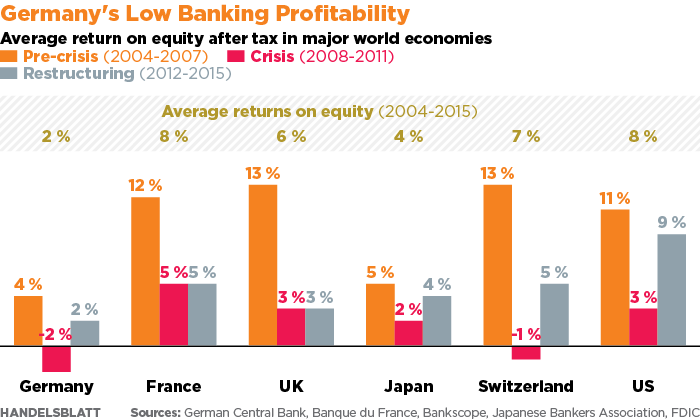
• Buybacks and Dividends Eat 100% of Bank Earnings (WS)

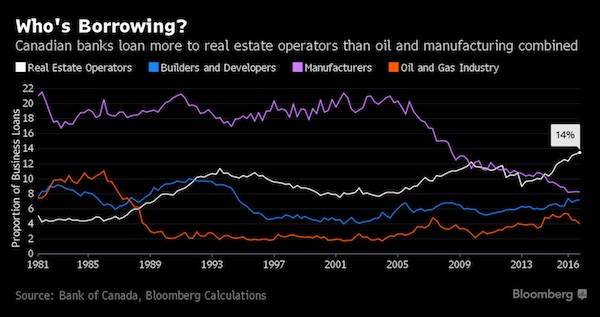
When tighter regulations were imposed on the banks after the Financial Crisis, the largest among them, the very ones that threatened to bring down the financial system, began squealing. Those voices are now being heard by Congress, which is considering deregulating the banks again. In particular, they claim that current capital requirements force banks to curtail their lending to businesses and consumers, and thus hurt the economy. Nonsense! That’s in essence what FDIC Vice Chairman Thomas Hoenig told Senate Banking Committee Chairman Mike Crapo and the committee’s senior Democrat, Sherrod Brown, in a letter dated Tuesday, according to Reuters. The senators are trying to find a compromise on bank deregulation. If banks wanted to increase lending, they could easily do so without lower capital requirements, Hoenig pointed out.

Rather than blowing their income on share-buybacks or paying it out in form of dividends, banks could retain more of their income, thus adding it to regulatory capital. Capital absorbs the losses from bad loans. Higher capital levels make a bank more resilient during the next crisis. If there isn’t enough capital, the bank collapses and gets bailed out. But banks that increase their capital levels through retained earnings are stronger and can lend more. Alas, in the first quarter, the 10 largest bank holding companies in the US plowed over 100% of their earnings into share buybacks and dividends, he wrote. If they had retained more of their income, they could have boosted lending by $1 trillion. The CEO of the top bank on this list has been very vocal about plowing more of the bank’s income into share buybacks and dividends, while pushing regulators to lower capital requirements.
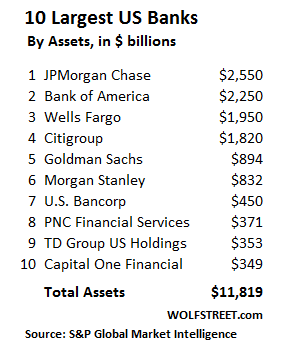
In his “Dear Fellow Shareholders” letter in April, Jamie Dimon wrote under the heading “Regulatory Reform,” among many other things: “It is clear that the banks have too much capital.” “And we think it’s clear that banks can use more of their capital to finance the economy without sacrificing safety and soundness. Had they been less afraid of potential CCAR stress losses, banks probably would have been more aggressive in making some small business loans, lower rated middle market loans and near-prime mortgages. But the government was preventing them from doing it, he suggested.

Read more …

I think it started when manufacturing was exported to China et al. How are you supposed to be productive when you don’t make anything?

• America’s Productivity Plunge Explained (ZH)

For the first time since the financial crisis, US multifactor productivity growth turned negative last year, mystifying economists who have struggled to find something to blame for the fact that worker productivity is declining despite a technology boom that should make them more efficient – at least in theory. To be sure, economists have struggled to find explanations for the exasperating trend, with some arguing that the US hasn’t figured out how to properly measure productivity growth correctly now that service-sector jobs proliferate while manufacturing shrinks. But what if there’s a more straightforward explanation? What if the decline in US productivity measured since the 1970s isn’t happening in spite of technology, but because of it?

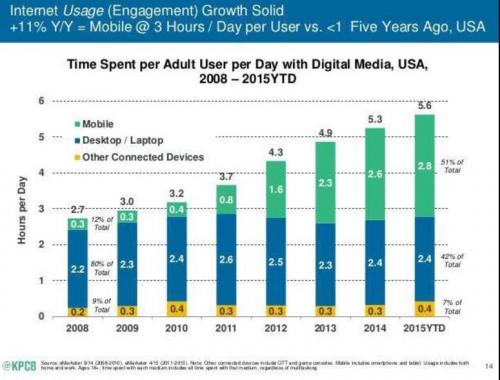
To wit, Facebook has just released user-engagement data for its popular Instagram photo-sharing app. Unsurprisingly, the data show that the average user below the age of 25 now spends more than 32 minutes a day on the app, while the average user aged 25 and older. The last time Facebook released this data, in October 2014, its users averaged 21 minutes a day on the app.
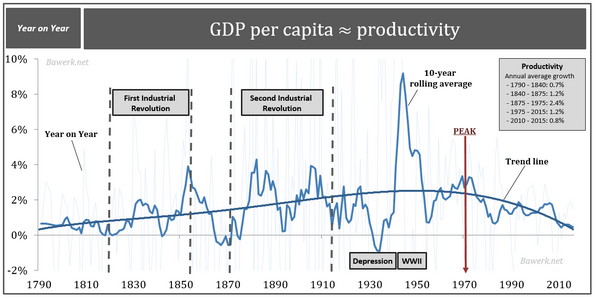
According to Bloomberg, “time spent is an important metric for advertisers, which like to hear that users are browsing an app beyond quick checks for updates, making them more likely to run into some marketing.” Maybe they should matter more to economists, too. Aside from short-lived booms in the 1990s and 2000s, US productivity growth has averaged just 1.2% from 1975 up to today after peaking above 3% in 1972. As we detailed previously, adjusting for the WWII anomaly (which tells us that GDP is not a good measure of a country’s prosperity) US productivity growth peaked in 1972 – incidentally the year after Nixon took the US off gold.

The productivity decline witnessed ever since is unprecedented. Despite the short lived boom of the 1990s US productivity growth only average 1.2 per cent from 1975 up to today. If we isolate the last 15 years US productivity growth is on par with what an agrarian slave economy was able to achieve 200 years ago. As we reported last year, users spent 51% of their total internet time on mobile devices, for a total of 5.6 hours per day snapchatting, face-booking, insta-graming and taking selfies.
Read more …

The new wonders are the ones who don’t make dick all.

• Amazon is the New Tech Crash (David Stockman)

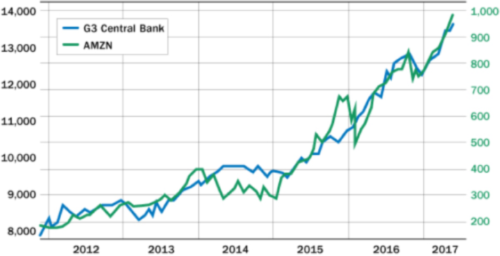
It won’t be long now. During the last 31 months the stock market mania has rapidly narrowed to just a handful of shooting stars. At the forefront has been Amazon.com, Inc., which saw its stock price double from $285 per share in January 2015 to $575 by October of that year. It then doubled again to about $1,000 in the 21 months since. By contrast, much of the stock market has remained in flat-earth land. For instance, those sections of the stock market that are tethered to the floundering real world economy have posted flat-lining earnings, or even sharp declines, as in the case of oil and gas. Needless to say, the drastic market narrowing of the last 30 months has been accompanied by soaring price/earnings (PE) multiples among the handful of big winners.

In the case of the so-called FAANGs + M (Facebook, Apple, Amazon, Netflix, Google and Microsoft), the group’s weighted average PE multiple has increased by some 50%. The degree to which the casino’s speculative mania has been concentrated in the FAANGs + M can also be seen by contrasting them with the other 494 stocks in the S&P 500. The market cap of the index as a whole rose from $17.7 trillion in January 2015 to some $21.2 trillion at present, meaning that the FAANGs + M account for about 40% of the entire gain. Stated differently, the market cap of the other 494 stocks rose from $16.0 trillion to $18.1 trillion during that 30-month period. That is, 13% versus the 82% gain of the six super-momentum stocks.

Moreover, if this concentrated $1.4 trillion gain in a handful of stocks sounds familiar that’s because this rodeo has been held before. The Four Horseman of Tech (Microsoft, Dell, Cisco and Intel) at the turn of the century saw their market cap soar from $850 billion to $1.65 trillion or by 94% during the manic months before the dotcom peak. At the March 2000 peak, Microsoft’s PE multiple was 60X, Intel’s was 50X and Cisco’s hit 200X. Those nosebleed valuations were really not much different than Facebook today at 40X, Amazon at 190X and Netflix at 217X. The truth is, even great companies do not escape drastic over-valuation during the blow-off stage of bubble peaks. Accordingly, two years later the Four Horseman as a group had shed $1.25 trillion or 75% of their valuation.
Read more …

“The media don’t crow every time the price of milk goes up, so why should it cheer higher prices in a different market? It’s great only if you own the cow.”

• Dow 22,000 Is Not Good News For Most Americans (MW)

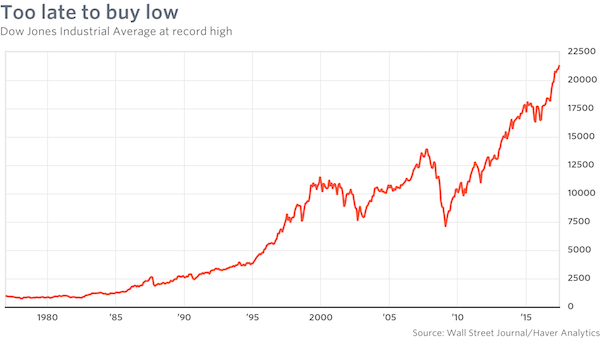
The U.S. stock market hit another record Wednesday, with the Dow Jones Industrial Average surpassing 22,000 for the first time. The media acted like Dow 22,000 is a good thing. The cheerleaders in the anchor desks are wearing goofy hats and high-fiving each other like their team just won the Super Bowl. But record-high stock prices are not inherently a good thing. Whether it’s good for you individually depends on whether you own lots of shares or not. Most people do not own very many shares at all, so most of us aren’t benefiting much from high stock prices. The media don’t crow every time the price of milk goes up, so why should it cheer higher prices in a different market? It’s great only if you own the cow.

Who owns the stock market? About half of all equity is owned by the richest 1 million or so families, and another 41% is owned by the rest of the top 10%. The bottom 90% of families own about 9% of outstanding shares. [..] High stock prices might have a benefit if it meant that more capital would be invested in America’s corporations. That’s the myth of the stock market, anyway. In reality, the stock market doesn’t funnel any additional capital into corporations at all. Nonfinancial corporations have been net buyers — not sellers — of equities for the past 23 years in a row. The stock market is actually a process for extracting wealth from corporations and passing it along to the wealthy people who owns shares.
Read more …

The headline bumbers are all you need really. Ponzi as far as the eye can see.

• Public Pensions Average 0.6% Return In 2016 Despite 7.6% Assumption (ZH)

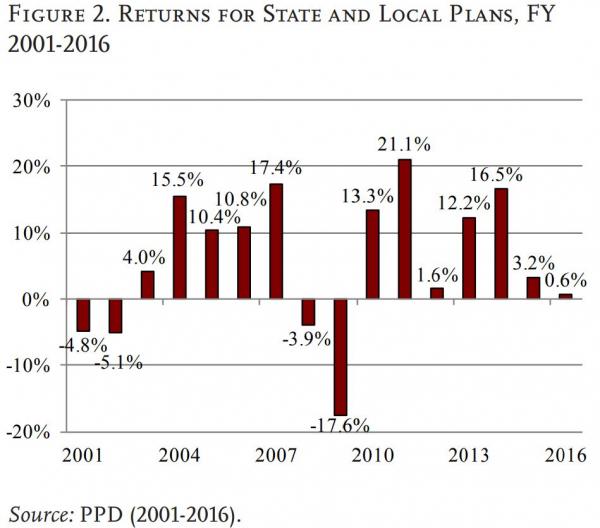
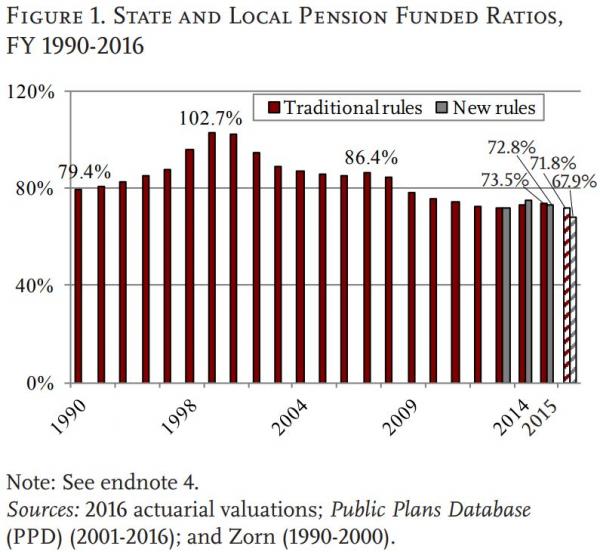
We’ve frequently argued that public pension funds in the U.S. are nothing more than thinly-veiled ponzi schemes with their ridiculously high return assumptions specifically intended to artificially minimize the present value of future retiree payment obligations and thus also minimize required annual contributions from taxpayers…all while actual, if immediately intangible, underfunded liabilities continue to surge. As evidence of that assertion, we present to you the latest public pension analysis from the Center for Retirement Research at Boston College. As part of their study, Boston College reviewed 170 public pension plans in the U.S. and found that their average 2016 return was an abysmal 0.6% compared to an average assumed return of 7.6%. Meanwhile, per the chart below, the average return for the past 15 years has also been well below discount rate assumptions, at just 5.95%.
All of which, as we stated above, continues to result in surging liabilities and collapsing funding ratios.
But, perhaps the most telling sign of the massive ponzi scheme being perpetrated on American retirees is the following chart which shows that net cash flows have become increasingly negative, as a percentage of assets, as annual cash benefit payments continue to exceed cash contributions.
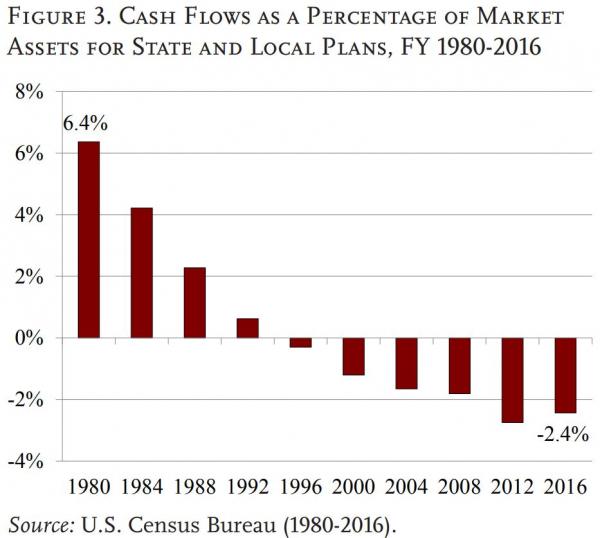
Conclusion, you can hide behind high discount rates and a “kick the can down the road” strategy in the short-term…but in the long run actual cash flows matter.

Read more …

Pensions, planning: good luck in the bubble.

• Plan For The Worst (Roberts)

One of the biggest mistakes that people make is assuming markets will grow at a consistent rate over the given time frame to retirement. There is a massive difference between compounded returns and real returns as shown. The assumption is that an investment is made in 1965 at the age of 20. In 2000, the individual is now 55 and just 10 years from retirement. The S&P index is actual through 2016 and projected through age 100 using historical volatility and market cycles as a precedent for future returns. While the historical AVERAGE return is 7% for both series, the shortfall between “compounded” returns and “actual” returns is significant. That shortfall is compounded further when you begin to add in the impact of fees, taxes, and inflation over the given time frame.
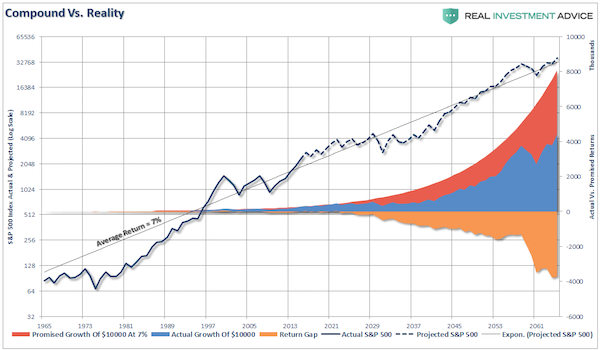
The single biggest mistake made in financial planning is NOT to include variable rates of return in your planning process. Furthermore, choosing rates of return for planning purposes that are outside historical norms is a critical mistake. Stocks tend to grow roughly at the rate of GDP plus dividends. Into today’s world GDP is expected to grow at roughly 2% in the future with dividends around 2% currently. The difference between 8% returns and 4% is quite substantial. Also, to achieve 8% in a 4% return environment, you must increase your return over the market by 100%. The level of “risk” that must be taken on to outperform the markets by such a degree is enormous. While markets can have years of significant outperformance, it only takes one devastating year of losses to wipe out years of accumulation.

Read more …

A new business model? Does this apply only to oil, or should all businesses cut their sales prices in half to increase their profits? Alternatively, maybe shareholders should sue BP and Shell for all missed profits in the past?

• Who Needs $100 Oil? Majors Making More Cash at $50, Goldman Says (BBG)

Oil majors are raking in more cash now than they did in the heyday of $100 oil, according to Goldman Sachs. Integrated giants like BP and Royal Dutch Shell have adapted to lower prices by cutting costs and improving operations, analysts at the bank including Michele Della Vigna said in a research note Wednesday. European majors made more cash during the first half of this year, when Brent averaged $52 a barrel, than they did in the first half of 2014 when prices were $109. Back then, high oil prices had caused executives to overreach on projects, leading to delays, cost overruns and inefficiency, Goldman said. Those projects are coming online now, producing more revenue, while companies have tightened their belts and divested some assets to reduce debt burdens.
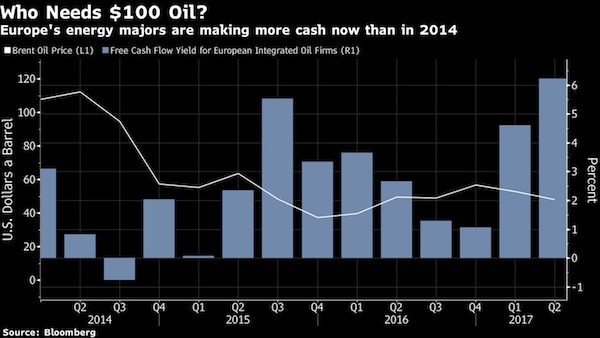
“Simplification, standardization and deflation are repositioning the oil industry for better profitability and cash generation in the current environment than in 2013-14 when the oil price was above $100 a barrel,” the analysts said. In the second quarter, Europe’s big oil companies generated enough cash from operations to cover 91 percent of their capital expenses and dividends, showing that they’re close to being able to fund shareholder payments with business-generated revenue, according to Goldman. That will give companies the ability to stop paying dividends by issuing new stock, which has diluted major European energy shares by 3 to 13 percent since 2014.

Read more …

Too late.

• China’s Fear of Japan-Style Economic Bust Drives Crackdown on Deals (BBG)

President Xi Jinping’s top economic adviser commissioned a study earlier this year to see how China could avoid the fate of Japan’s epic bust in the 1990s and decades of stagnation that followed. The report covered a wide range of topics, from the Plaza Accord on currency to a real-estate bubble to demographics that made Japan the oldest population in Asia, according to a person familiar with the matter who has seen the report. While details are scarce, the person revealed one key recommendation that policy makers have since implemented: The need to curtail a global buying spree by some of the nation’s biggest private companies. Communist Party leaders discussed Japan’s experience in a Politburo meeting on April 26, according to the person, who asked not to be identified as the discussions are private.

State media came alive afterward, with reports trumpeting Xi’s warning that financial stability is crucial in economic growth. Then in June came a bombshell: reports that the banking regulator had asked lenders to provide information on overseas loans made to Dalian Wanda Group Co., Anbang Insurance Group Co., HNA, Fosun International Ltd. and the owner of Italian soccer team AC Milan. While the timing of those requests is unclear, other watchdogs soon issued directives to curb excessive borrowing, speculation on equities and high yields in wealth-management products. Jim O’Neill, previously chief economist at Goldman Sachs and a former U.K. government minister, said Chinese policy makers are constantly looking to avoid the mistakes of other countries — and Japan in particular.

“You see it in repeated attempts to stop various potential property bubbles so China doesn’t end up with a Japan-style property collapse,” O’Neill said in an email. “There does appear to be some signs that some Chinese investors don’t invest in clear understandable ways, but they wouldn’t be the only ones where that is true!” [..] The moves reflect concerns that China’s top dealmakers have borrowed too much from state banks, threatening the financial system and ultimately the party’s legitimacy to rule — a key worry ahead of a once-in-five-year conclave later this year that will cement Xi’s power through 2022.

Read more …

Well argued by Russia’s PM, and it shows just how extensive the sanctions are. Does America need decades more of Cold War?: “The sanctions codified into law will now last for decades, unless some miracle occurs. [..] the future relationship between the Russian Federation and the United States will be extremely tense, regardless of the composition of the Congress or the personality of the president.”

• The US Just Declared Full-Scale Trade War On Russia (Medvedev)

The signing of new sanctions against Russia into law by the US president leads to several consequences. First, any hope of improving our relations with the new US administration is over. Second, the US just declared a full-scale trade war on Russia. Third, the Trump administration demonstrated it is utterly powerless, and in the most humiliating manner transferred executive powers to Congress. This shifts the alignment of forces in US political circles.

What does this mean for the U.S.? The American establishment completely outplayed Trump. The president is not happy with the new sanctions, but he could not avoid signing the new law. The purpose of the new sanctions was to put Trump in his place. Their ultimate goal is to remove Trump from power. An incompetent player must be eliminated. At the same time, the interests of American businesses were almost ignored. Politics rose above the pragmatic approach. Anti-Russian hysteria has turned into a key part of not only foreign (as has been the case many times), but also domestic US policy (this is recent).

The sanctions codified into law will now last for decades, unless some miracle occurs. Moreover, it will be tougher than the Jackson-Vanik law, because it is comprehensive and can not be postponed by special orders of the president without the consent of the Congress. Therefore, the future relationship between the Russian Federation and the United States will be extremely tense, regardless of the composition of the Congress or the personality of the president. Relations between the two countries will now be clarified in international bodies and courts of justice leading to further intensification of international tensions, and a refusal to resolve major international problems.

What does this mean for Russia? We will continue to work on the development of the economy and social sphere, we will deal with import substitution, solve the most important state tasks, counting primarily on ourselves. We have learned to do this in recent years. Within almost closed financial markets, foreign creditors and investors will be afraid to invest in Russia due to worries of sanctions against third parties and countries. In some ways, it will benefit us, although sanctions – in general – are meaningless. We will manage.

Read more …

No, Hersh is not some kind of nut.

• Seymour Hersh: RussiaGate Is A CIA-Planted Lie, Revenge Against Trump (Zuesse)

During the latter portion of a phone-call by investigative journalist, Seymour Hersh, Hersh has now presented “a narrative [from his investigation] of how that whole fucking thing began,” including who actually is behind the ‘RussiaGate’ lies, and why they are spreading these lies.

In a youtube video upload-dated August 1st, he reveals from his inside FBI and Washington DC Police Department sources — now, long before the Justice Department’s Special Counsel Robert Mueller will be presenting his official ‘findings’ to the nation — that the charges that Russia had anything to do with the leaks from the DNC and Hillary Clinton’s campaign to Wikileaks, that those charges spread by the press, were a CIA-planted lie, and that what Wikileaks had gotten was only leaks (including at least from the murdered DNC-staffer Seth Rich), and were not from any outsider (including ’the Russians’), but that Rich didn’t get killed for that, but was instead shot in the back during a brutal robbery, which occurred in the high-crime DC neighborhood where he lived. Here is the video…

Read more …

So maybe Paul Craig Roberts lays it on a bit thick sometimes. But what happens in America is dangerous, and Trump is not the principal danger.

• The Witch Hunt for Donald Trump Surpasses the Salem Witch Trials (PCR)

In 1940 US attorney general Robert Jackson warned federal prosecutors against “picking the man and then putting investigators to work, to pin some offense on him. It is in this realm—in which the prosecutor picks some person whom he dislikes or desires to embarrass, or selects some group of unpopular persons and then looks for an offense—that the greatest danger of abuse of prosecuting power lies. It is here that law enforcement becomes personal, and the real crime becomes that of being unpopular with the predominant or governing group, being attached to the wrong political views or being personally obnoxious to, or in the way of, the prosecutor himself.” Robert Jackson has given a perfect description of what is happening to President Trump at the hands of special prosecutor Robert Mueller.

Trump is vastly unpopular with the ruling establishment, with the Democrats, with the military/security complex and their bought and paid for Senators, and with the media for proving wrong all the smart people’s prediction that Hillary would win the election in a landslide. From day one this cabal has been out to get Trump, and they have given the task of framing up Trump to Mueller. An honest man would not have accepted the job of chief witch-hunter, which is what Mueller’s job is. The breathless hype of a nonexistent “Russian collusion” has been the lead news story for months despite the fact that no one, not the CIA, not the NSA, not the FBI, not the Director of National Intelligence, can find a scrap of evidence.

In desperation, three of the seventeen US intelligence agencies picked a small handful of employees thought to lack integrity and produced an unverified report, absent of any evidence, that the hand-picked handful thought that there might have been a collusion. On the basis of what evidence they do not say. That nothing more substantial than this led to a special prosecutor shows how totally corrupt justice in America is. Furthermore the baseless charge itself is an absurdity. There is no law against an incoming administration conversing with other governments. Indeed, Trump, Flynn, and whomever should be given medals for quickly moving to smooth Russian feathers ruffled by the reckless Bush and Obama regimes. What good for anyone can come from ceaselessly provoking a nuclear Russian bear?

Read more …

Spent so much time in that stadium watching baseball etc. Good memories.

• Canada Opens Montreal’s Olympic Stadium To House Asylum Seekers (R.)

Canadian health authorities and aid workers are using an Olympic stadium to shelter asylum seekers as a growing number of people walk into the country from the United States. The Quebec Red Cross and local health authorities opened Montreal’s Olympic Stadium on Wednesday to asylum seekers brought in by bus after having crossed the U.S. border, Red Cross spokeswoman Stephanie Picard said. The city is seeing a growing influx in refugee claimants coming from the United States and is scrambling to house them all. The Red Cross is assisting with beds and providing bedding and other personal-care items. Montreal’s health authority would not provide exact numbers on how many people are being housed in the stadium, built for the 1976 Olympics and which now serves as an event space.

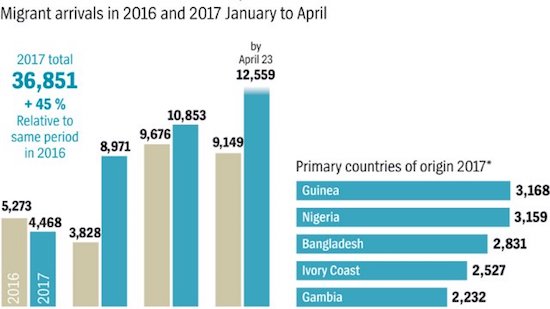
More than 4,300 people have walked across the U.S. border into Canada this year seeking refugee status. The vast majority of them come to Quebec, according to figures from the federal government. Many asylum seekers who spoke to Reuters say they left the United States fearing President Donald Trump’s immigration crackdown. People who cross the border illegally to file refugee claims are apprehended and held for questioning by both police and border officials before being allowed to file claims and live in Canada while their application is processed. Montreal Mayor Denis Coderre welcomed the asylum seekers on Twitter Wednesday afternoon, saying 2,500 people had come in July alone. He said on Twitter that providing for the new arrivals is a “humanitarian gesture.”

Read more …

Look, there have to be limits, or we will not survive this, none of us. Locking up children just because they have fled bombs is beyond insane.

• Number Of Child Refugees In Greek Detention Centres Rises ‘Alarmingly’ (PA)

The number of unaccompanied child migrants living in “dirty” Greek detention centres has increased “alarmingly”, a human rights organisation has warned. An estimated 117 children were in police cells or custody centres in Greece at the end of July, compared to just two in November 2016, according to figures released by the country’s government. Under Greek law, the authorities should separate minors into safe accommodation, where they are appointed guardians who represent them in legal proceedings. But when there is no space in safe shelters, the authorities detain them in police stations and immigration detention facilities, sometimes with unrelated adults. “Instead of being cared for, dozens of vulnerable children are locked in dirty, crowded police cells and other detention facilities across Greece, in some cases with unrelated adults,” said Eva Cossé, the country’s researcher at Human Rights Watch.

“The Greek government has a duty to end this abusive practice and make sure these vulnerable kids get the care and protection they need.” Human Rights Watch has written to Migration Policy Minister Yiannis Mouzalas to stop the automatic detention of unaccompanied children. It suggested the government should amend legislation and significantly shorten the amount of time a child can be detained in protective custody. While they wait for a space in a shelter, many children are not provided with information about their rights and are not told how to apply for asylum, the organisation said. Aid workers have previously reported that the uncertainty and distress caused by the asylum process, exacerbated an ongoing mental health crisis among migrants living on the islands. Children as young as nine have harmed themselves, while 12-year-olds have attempted to kill themselves, Save the Children said in March.

Read more …

Too big NOT to fail.

• We Got Too BIG For The World (Kingsnorth)

Living through a collapse is a curious experience. Perhaps the most curious part is that nobody wants to admit it’s a collapse. The results of half a century of debt-fueled “growth” are becoming impossible to deny convincingly, but even as economies and certainties crumble, our appointed leaders bravely hold the line. No one wants to be the first to say the dam is cracked beyond repair. To listen to a political leader at this moment in history is like sitting through a sermon by a priest who has lost his faith but is desperately trying not to admit it, even to himself. Watch your chosen president or prime minister mouthing tough-guy platitudes to the party faithful. Listen to them insisting in studied prose that all will be well. Study the expressions on their faces as they talk about “growth” as if it were a heathen god to be appeased by tipping another cauldron’s worth of fictional money into the mouth of a volcano.

In times like these, people look elsewhere for answers. A time of crisis is also a time of opening up, when thinking that was consigned to the fringes moves to center stage. When things fall apart, the appetite for new ways of seeing is palpable, and there are always plenty of people willing to feed it by coming forward with their pet big ideas. But here’s a thought: what if big ideas are part of the problem? What if, in fact, the problem is bigness itself? The crisis currently playing out on the world stage is a crisis of growth. Not, as we are regularly told, a crisis caused by too little growth, but by too much of it. Banks grew so big that their collapse would have brought down the entire global economy. To prevent this, they were bailed out with huge tranches of public money, which in turn is precipitating social crises on the streets of Western nations. The European Union has grown so big, and so unaccountable, that it threatens to collapse in on itself.

Corporations have grown so big that they are overwhelming democracies and building a global plutocracy to serve their own interests. The human economy as a whole has grown so big that it has been able to change the atmospheric composition of the planet and precipitate a mass-extinction event. One man who would not have been surprised by this crisis of bigness, had he lived to see it, was Leopold Kohr. Kohr has a good claim to be the most interesting political thinker that you have never heard of. Unlike Karl Marx, he did not found a global movement or inspire revolutions. Unlike Friedrich Hayek, he did not rewrite the economic rules of the modern world. Kohr was a modest, self-deprecating man, but this was not the reason his ideas have been ignored by movers and shakers in the half-century since they were produced. They have been ignored because they do not flatter the egos of the power-hungry, be they revolutionaries or plutocrats. In fact, Kohr’s message is a direct challenge to them.

“Wherever something is wrong,” he insisted, “something is too big.”

Read more …

Jul 252017
 
 July 25, 2017  Posted by at 1:31 pm Finance Tagged with: , , , , , , , , , ,  6 Responses »


Walter Langley Never morning wore to evening but some heart did break 1894


If there’s one myth -and there are many- that we should invalidate in the cross-over world of politics and economics, it‘s that central banks have saved us from a financial crisis. It’s a carefully construed myth, but it’s as false as can be. Our central banks have caused our financial crises, not saved us from them.

It really should -but doesn’t- make us cringe uncontrollably to see Bank of England governor-for-hire Mark Carney announce -straightfaced- that:

“A decade after the start of the global financial crisis, G20 reforms are building a safer, simpler and fairer financial system. “We have fixed the issues that caused the last crisis. They were fundamental and deep-seated, which is why it was such a major job.”

Or, for that matter, to see Fed chief Janet Yellen declare that there won’t be another financial crisis in her lifetime, while she’s busy-bee busy building that next crisis as we speak. These people are now saying increasingly crazy things, and that should make us pause.

Central banks don’t serve people, or even societies, as that same myth claims. They serve banks. Even if central bankers themselves believe that this is one and the same thing, that doesn’t make it true. And if they don’t understand this, they should never be let anywhere near the positions they hold.

You can pin the moment central banks went awry at any point in time you like. The Bank of England’s foundation in 1694, the Federal Reserve’s in 1913, the ECB much more recently. What’s crucial in the timing is where and when the best interests of the banks split off from those of their societies. Because that is when central banks will stop serving those societies. We are at such a -turning?!- point right now. And it’s been coming for some time, ‘slowly’ working its way towards an inevitable abyss.

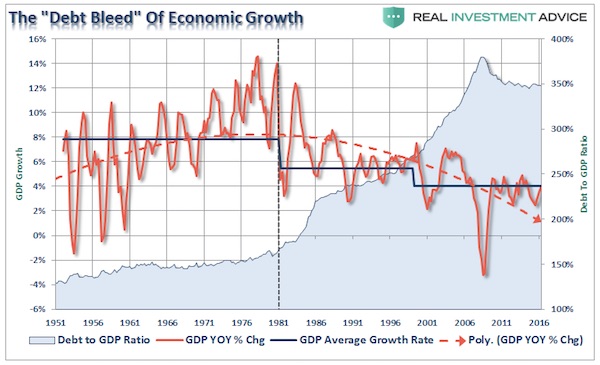
Over the past few years the Automatic Earth has argues repeatedly, along several different avenues, that American society was at its richest between the late 1960s and early 1980s. Yet another illustration of this came only yesterday in a Lance Roberts graph:


Anyone see a recovery in there? Lance uses 1981 as a ‘cut-off’ date, but the GDP growth rate as represented by the dotted line doesn’t really begin to go ‘bad’ until 1986 or so. At the tail end of the late 1960s to early 1980s period, as the American economy was inexorably getting poorer, Alan Greenspan took over as Federal Reserve governor in 1987. A narrative was carefully crafted by and for the media with Greenspan as an ‘oracle’ or even a ‘rock star’, but in reality he has been instrumental in saddling the economy with what will turn out to be insurmountable problems.

Greenspan was a major driving force behind the repeal of Glass-Steagall, which was finally established through the Gramm-Leach-Bliley act of 1999. This was an open political act by the Federal Reserve governor, something that everyone should have then protested, and still should now, but didn’t and doesn’t. Central bankers should be kept far removed from politics, anywhere and everywhere, because they represent a small segment of society, banks, not society as a whole.

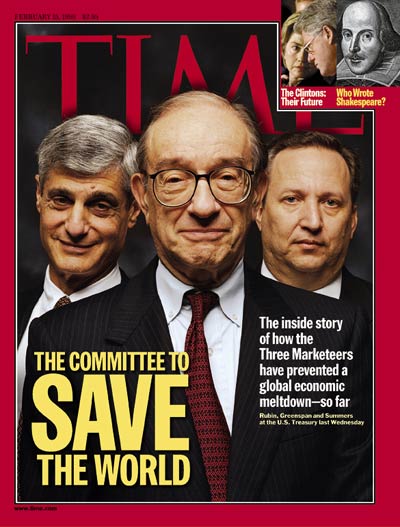
Because of the ‘oracle’ narrative, Greenspan was instead praised for saving the world. But all that Greenspan and his accomplices, Robert Rubin and Larry Summers, actually did in getting rid of the 1933 Glass-Steagall act separation between investment- and consumer banking was to open the floodgates of debt, and even more importantly, leveraged debt. All part of the ‘financial innovations’ Greenspan famously lauded for saving and growing economies. It was all just more debt on top of more debt.


Greenspan et al ‘simply’ did what central bankers do: they represent the best interests of banks. And the world’s central bankers have never looked back. That most people still find it hard to believe that America -and the west- has been getting poorer for the past 30-40 years, goes to show how effective the narratives have been. The world looks richer instead of poorer, after all. That this is exclusively because of rising debt numbers wherever you look is not part of the narratives. Indeed, ruling economic models and theories ignore the role played by both banks and credit in an economy, almost entirely.

Alan Greenspan left as Fed head in 2006, after having wreaked his havoc on America for almost two decades, right before the financial crisis that took off in 2007-2008 became apparent to the world at large. The crisis was largely his doing, but he has escaped just about all the blame for it. Good PR.

With Ben Bernanke, an alleged academic genius on the Great Depression, as Greenspan’s replacement, the Fed just kept going and turned it up a notch. It was no longer possible in the financial world to pretend that banks and people had the same interests, so the former were bailed out at the expense of the latter. The illusionary narrative for the public, however, remained intact. What do people know about finance, anyway? Just make sure the S&P goes up. Easy as pie.

The narrative has switched to Bernanke, and Yellen after him, as well as Mario Draghi at the ECB and Haruhiko Kuroda at the Bank of Japan, saving the world from doom. But once again, they are the ones who are creating the crisis, not the ones saving us from it. They are saving the banks, and saddling the people with the costs.

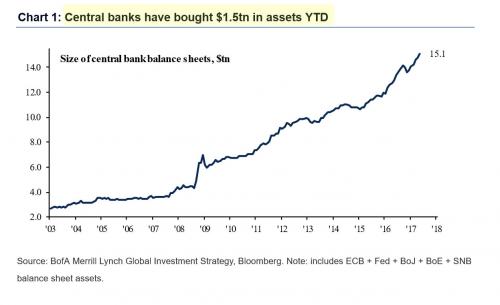
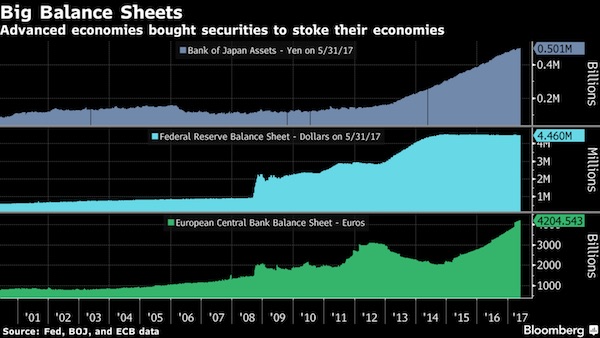
In the past decade, these central bankers have purchased $20-$50 trillion in bonds, securities and stocks. The only intention, and indeed the only result, is to keep banks from falling over, increase their profits, and maintain the illusion that economies are recovering and growing.

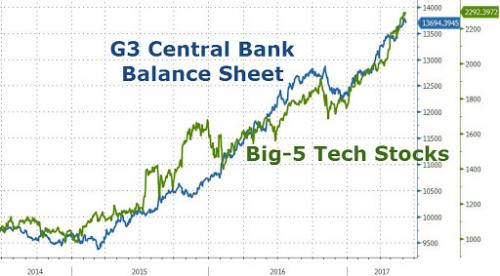
They can only achieve this by creating bubbles wherever they can. Apart from the QE programs under which they bought all those ‘assets’, they used -and still do- another tool: lowering interest rates to the point where borrowing money becomes so cheap everyone can do it, and then do it some more. It has worked miracles in blowing stock market valuations out of all realistic proportions, and in doing the same for housing markets in locations all over the globe.

The role of China’s central bank in this is interesting too, but it is such an open and obvious political tool that it really deserves its own discussion and narrative. Basically, Beijing did what it saw Washington do and thought: why hold back?


Fast forward to today and we see that we’ve landed in a whole new, and next, phase of the story. The world’s central banks are all stuck in their own – self-created – bubbles and narratives. They all talk about how they solved all the issues, and how they will now return to normal, but the sad truth is they can’t and they know it.

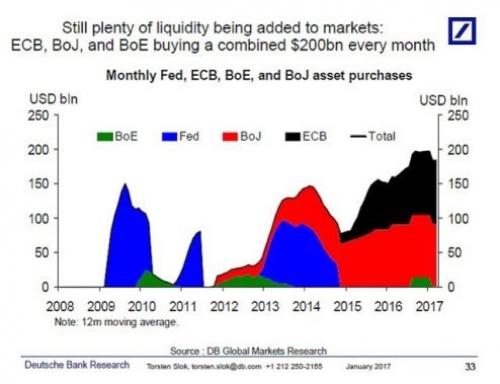
The Fed stopped purchasing assets through its QE program a while back, but it could only do that because Frankfurt and Japan took over. And now they, too, talk about quitting QE. Slowly, yada yada, because of control, yada yada, but they know they must. They also know they can’t. Because the entire recovery narrative is a mirage, a fata morgana, a sleight of hand.

And that means we have arrived at a point that is new and very dangerous for the entire global economy and all of its people.


That is, the world’s central bankers now have an incentive to create the next crisis. This is because they know this crisis is inevitable, and they know their masters and protégés, the banks, risk suffering immensely or even going under. ‘Tapering’, or whatever you might call the -slow- end to QE and the -slow- hiking of interest rates, will prick and blow up bubbles one by one, and often in violent fashion.

When housing bubbles burst, economies lose the primary ingredient for maintaining -let alone increasing- their money supply: banks creating money out of thin hot air. Since the money supply is one of the key components of inflation, along with velocity of money, there will be fantastic outbursts of debt deflation. You’ve never seen -let alone imagined- anything like it.

The worst part of it is not government debt, though that, when financed with bond sales, is not not an instrument to infinity and beyond either. But the big hit to economies will be private debt. Where in many bubble areas, and they’re too numerous too mention, eager potential buyers today fret over affordable housing supply, it’ll all turn on a dime and owners won’t be able to sell without being suffocated by crippling losses.

Pension funds, which have already suffered perhaps more than any other parties because of low interest ZIRP and NIRP policies, have switched en masse to riskier assets like stocks. Well, another whammy, and a bigger one, is waiting just outside the door. Pensions will be so last century.


That another crisis is waiting to happen, and that politics and media have made sure that just about no-one at all is aware of it, is one thing. We already knew this, a few of us. That the world’s main central bankers have an active incentive to bring about the crisis, if only by sitting on their hands long enough, is new. But they do.

Yellen, Draghi and Kuroda may opt to leave before pulling the trigger, or be fired soon enough. But whoever is in the governor seats will realize that unleashing a crisis sooner rather than later is the only option left not to be blamed for it. Let the house of dominoes crumble now, and they can say “nobody could have seen this coming”, while at the same time saving what they can for the banks and bankers they serve. That option will not be on the table for much longer.

We should have never given them, let alone their member/master banks, the power to conjure up trillions out of nothing, and use that power as a political tool. But it is too late now.


Jul 012017


Fred Lyon Terrific Street, Barbary Coast, San Francisco 1947


• Bill To Remove Trump From Office Picks Up Democratic Support (DM)
• Bank of America: The Fed Is Preparing To Make The Rich Poorer (ZH)
• Debt Is the Third Benjamin Franklin Certainty (Stockman)
• UK Household Incomes Fall Most In 40 Years, Savings Rates Crash (Ind.)
• China’s Opening Of Bond Market May Spark ‘Massive Demand’ From Foreigners (CNBC)
• Judge Orders Illinois To Pay Billions More Toward Medicaid (CT)
• Maine Governor Won’t Sign Latest Budget Proposal, Will Allow A Shutdown (BDN)
• Connecticut Social Service Agencies Brace for Deep Cuts With No Budget (AP)
• America’s Pension Bomb: Illinois Is Just the Start (BBG)
• An Awful Lot Of Americans Are A Walking Illinois Now (Jim Kunstler)
• US Says Its Warning Appears To Have Averted Syrian Chemical Attack (R.)
• Make No Mistake, We Are Already at War in Syria (Giraldi)
• Qatar Crisis: Armed Conflict And Protracted Dispute Grow More Likely (CNBC)
• Oliver Stone: Edward Snowden Is The “Most American Of Patriots” (ZH)
• Billionaires And Aristocrats Biggest Beneficiaries Of EU Farm Subsidies (TLE)
• Juncker: EU To Discuss More Migrant Help For Greece And Italy (R.)


I thought they were kidding, Daily Mail after all. But there are more reports on this. In a nutshell: the people who support this are much less capable of doing THEIR jobs than Trump is of doing his. They’re 100% delusional. And they lack a very essential respect for the American system and the Office of the President.

But it’ll all just keep coming. This is on the same day that both the NYT and AP feel forced finally to state that their Russiagate/hacking reporting has been based on nothing at all.

• Bill To Remove Trump From Office Picks Up Democratic Support (DM)

A Democratic congressman has proposed convening a special committee of psychiatrists and other doctors whose job would be to determine if President Donald Trump is fit to serve in the Oval Office. Maryland Rep. Jamie Raskin, who also teaches constitutional law at American University, has predictably failed to attract any Republicans to his banner. But the U.S. Constitution’s 25th Amendment does allow for a majority of the president’s cabinet, or ‘such other body as Congress may by law provide,’ to decide if an Oval Office occupant is unable to carry out his duties – and then to put it to a full congressional vote. Vice President Mike Pence would also have to agree, which could slow down the process – or speed it up if he wanted the levers of power for himself.

The 25th Amendment has been around since shortly after the John F. Kennedy assassination, but Congress has never formed its own committee in case it’s needed to judge a president’s mental health. Raskin’s bill would allow the four Republican and Democratic leaders of the House and Senate to each choose a psychiatrist and another doctor. Then each party would add a former statesman – like a retired president or vice president. The final group of 10 would meet and choose an 11th member, who would become the committee’s chairman. Once the group is officially seated, the House and Senate could direct it through a joint resolution to conduct an actual examination of the president ‘to determine whether the president is incapacitated, either mentally or physically,’ according to the Raskin bill.

And if the president refuses to participate, the bill dictates, that ‘shall be taken into consideration by the commission in reaching a conclusion.’ Under the 25th Amendment, such a committee – or the president’s cabinet – can notify Congress in writing that a sitting president is unfit. In either case the vice president must concur, and he would immediately become ‘acting president.’ Presidents have voluntarily transferred their powers to vice presidents in the past, including when they are put under anesthesia for medical procedures. In the case of Raskin’s plan, the Constitution holds that both houses of Congress would hold a vote within three weeks. If two-thirds majorities in the House and Senate agreed that the president couldn’t discharge his duties, he would be dismissed.

Raskin’s plan could have a fatal flaw, however: Legal scholars tend to agree that when the Constitution’s framers first provided for the replacement of a president with an ‘inability to discharge the Powers and Duties of the Office,’ they weren’t talking about mere eccentricities. And when the 25th Amendment was sent to the states for ratification in 1965, the Senate agreed that ‘inability’ meant that a president was ‘unable to make or communicate his decisions’ and suffered from a ‘mental debility’ rendering him ‘unable or unwilling to make any rational decision.’ So far two dozen members of the House, all Democrats, have signed on to cosponsor the bill. Texas Rep. Sheila Jackson Lee, a far-left liberal Democrat, claimed Friday in a Fox Business Channel interview that Congress can remove ‘incompetent’ presidents. ‘The 25th Amendment is utilized when a president is perceived to be incompetent or unable to do his or her job,’ she said.

Read more …

Interesting idea, but how valid?:“Fed/ECB are now tightening to make Wall St poorer” because it is “no longer politically acceptable to stoke Wall St bubble.”

• Bank of America: The Fed Is Preparing To Make The Rich Poorer (ZH)

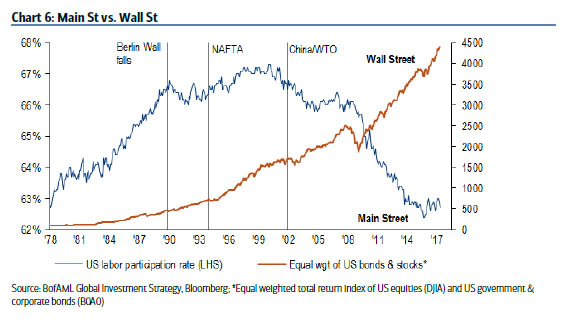
Remember when – for years and years after the grand, global QE experiment started – any suggestion that central bankers are the primary cause behind global wealth inequality, and thus directly responsible for such political outcomes as Brexit and Trump – was branded as a conspiracy theory by bloggers living in their parents’ basement? We do, because we were accused over and over of just that (our position on the Fed and other central banks should be familiar to all by now). Well, as of this morning, none other than the chief investment strategist at BofA, Michael Hartnett, is a basement dwelling, tinfoil hatter because in his latest Flow Show report, writes that “central banks have exacerbated inequality via Wall St inflation & Main St deflation.”

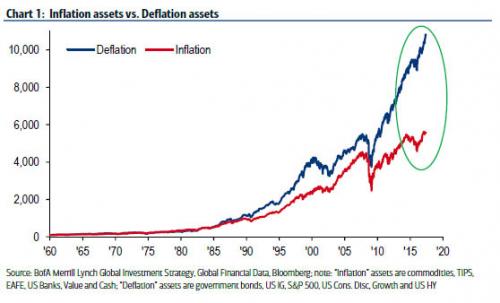
Of course we knew that, you knew that, and pretty much everyone else knew that, but those whose jobs depended on not admitting it, kept their mouths shut terrified of pointing out that the central banking emperor is not only naked, but an idiot. Well, the seal has been broken, and even the biggest cowards from within the financial establishment, most of whom can be found on financial twitter for some inexplicable reason, can speak up now. However, it’s what Hartnett said next that was more notable, namely that the “massive outperformance of deflation assets versus inflation assets shows central bank failure in War on Deflation…they have failed to boost wage expectations, inflation expectation, “animal spirits” on Main St.”

And, according to the Bank of American, now that central banks are in full reverse mode, there are “two ways to cure inequality…you can make the poor richer…or you can make the rich poorer…” So for anyone still confused, about what is taking place right now, the “Fed/ECB are now tightening to make Wall St poorer” because it is “no longer politically acceptable to stoke Wall St bubble.” Sooner or later the market will get it, and when it does, those who sell first will be happy. Everyone else will be stuck with a market that is locked limited down, with no position sales possible indefinitely, maybe in perpetuity.

Read more …

“..the nation effectively performed a leveraged buyout (LBO) on itself during the last forty years. And that did temporarily add to the appearance of prosperity.”

• Debt Is the Third Benjamin Franklin Certainty (Stockman)

Once upon a time people used to have mortgage burning ceremonies when later in their working years the balance on the one-time loan they took out in their 30s to buy their castle was finally reduced to zero. And there was no such thing as student loans, and not only because students are inherently not credit worthy. College was paid for with family savings, summer jobs, work study and an austere life of four to a dorm room. No more. The essence of debt in the present era is that it is perpetually increased and rolled-over. It’s never reduced and paid-off. To be sure, much of mainstream opinion considers that reality unremarkable — even evidence of economic progress and enlightenment. Keynesians, Washington politicians and Wall Street gamblers would have it no other way because their entire modus operandi is based not just on ever more debt, but more importantly, on ever higher leverage.

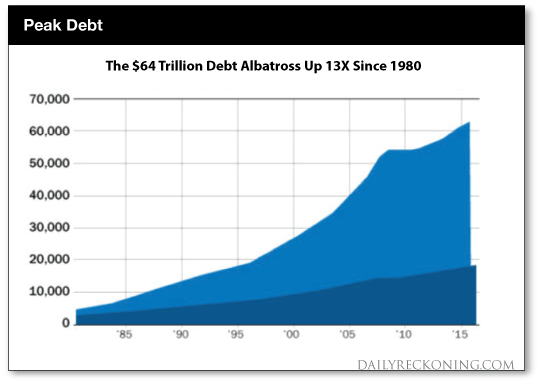
The chart below not only proves the latter point, but documents that over the last four decades rising leverage has been insinuated into every nook and cranny of the U.S. economy. Nominal GDP (dark blue) grew by 6X from $3 trillion to $18 trillion, whereas total credit outstanding (light blue) soared by 13X from $5 trillion to $64 trillion. Consequently, the national leverage ratio rose from 1.5X in 1980 to 3.5X today. My point today is not to moralize, but to discuss the practical implications of the nation’s debt-topia for Ben Franklin’s other two certainties — death and (especially) taxes. There’s no doubt that the modus operandi of the American economy has been transformed by the trends displayed in the below chart. It so happened that the 1.5X ratio of total debt-to-income (GDP) at the beginning of the chart was not an aberration.

It had actually been a constant for 100 years — except for a couple of unusual years during the Great Depression. It was also linked with the greatest period of capitalist prosperity, economic growth and rising living standards in recorded history. By contrast, today’s 3.5X debt-to-income ratio has two clear implications. First, the nation effectively performed a leveraged buyout (LBO) on itself during the last forty years. And that did temporarily add to the appearance of prosperity. But it also means that the U.S. economy is now lugging two turns of extra debt compared to the historic norm. Mainstream opinion, of course, says “so what?” The U.S. economy is lugging $35 trillion of extra debt, that’s what. That’s right. In the absence of the 40-year leverage aberration since the late 1970s, the chart below would show about $29 trillion of credit market debt (public and private) outstanding, not $64 trillion.

Read more …

Just don’t blame this on Brexit. It’s a much longer trajectory. Britain has been living above its weight for a long time, and austerity has made that much worse.

• UK Household Incomes Fall Most In 40 Years, Savings Rates Crash (Ind.)

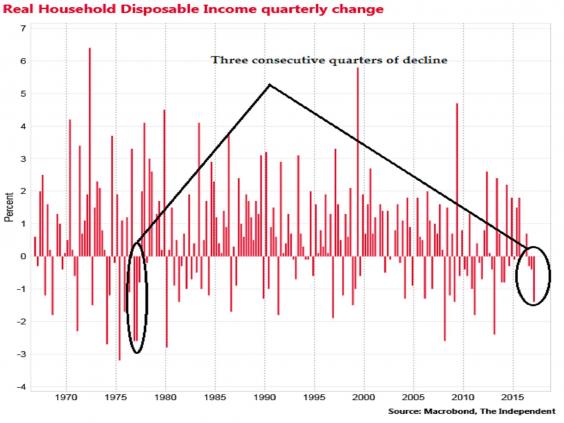
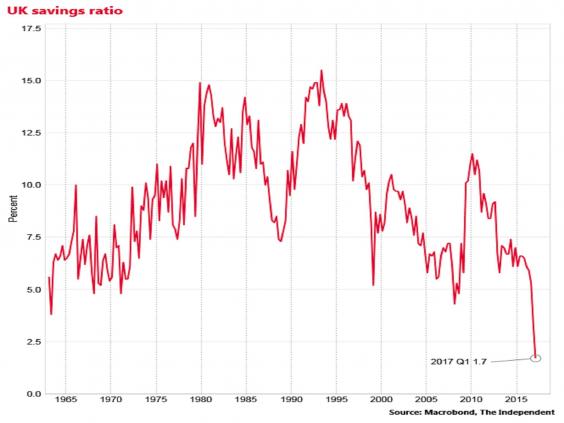
The aggregate real disposable income of UK households has fallen for three quarters in a row for the first time since the 1970s, according to the Office for National Statistics. The ONS said that the inflation-adjusted compensation of the household sector fell 1.4% in the first three months of 2017, reflecting spiking inflation and weak pay growth. It was the biggest decline since the first quarter of 2013 and followed a 0.4% fall in Q4 2016 and a 0.3% slip in Q3 2016. Three consecutive quarters of contraction is the worst run for the series since 1976-77. The ONS also said that the aggregate household savings rate collapsed to just 1.7%, down from 3.3% in the final quarter of 2016, and the lowest on record, although it said one-off tax payment factors might have distorted the latest reading.

Nevertheless, weak pay growth means that households have had to resort to running down their savings and borrowing to support consumption, which has almost single-handedly powered the overall economy since last June’s Brexit vote. “This is not sustainable and fuels the belief that weakened consumer spending is likely to hold back the economy over the coming months,” said Howard Archer of the EY Item Club. “With consumer confidence declining and banks reporting that they intend to restrict the supply of secured credit, the saving rate is more likely to rise than fall ahead,” said Samuel Tombs of Pantheon.

Read more …

Those foreigners would have to sell somthing first, we presume. There goes the S&P?!

• China’s Opening Of Bond Market May Spark ‘Massive Demand’ From Foreigners (CNBC)

China’s move to open up its fixed income market to foreign investors will eventually unleash “massive” demand for the mainland’s bonds, the chief executive of the company that operates Hong Kong’s stock exchange, told CNBC on Friday. In May, regulators in Hong Kong and on the mainland approved a “bond connect” program to allow investors operating in Hong Kong to trade Chinese bonds, called a “northbound” flow, with a “southbound” flow of Chinese investment into Hong Kong to be considered later. Authorities also won’t cap the amount that foreigners can invest in China. “I think this is a huge breakthrough,” HKEx CEO Charles Li told CNBC’s “Squawk Box” on the anniversary of Hong Kong’s handover to China.

Li said that while large investors are already able to access the mainland fixed income market though existing programs, the bond connect would be fundamentally different. “People are now finally able to do it and able to do it in a way that is familiar, that is similar to the way we trade U.S. dollar Treasurys or other international treasury fixed income instruments,” he said. “That is something so new. That the demand, underlying demand, the potent demand are massive.” He noted that with China’s yuan being included in the IMF’s Special Drawing Rights (SDR) basket in November 2015, some investors must include at least some renminbi assets on their balance sheets. Inclusion in the SDR means the renminbi is now officially recognized as a reserve currency. “That will require massive reallocation of capital but over quite a long period of time,” Li said, saying foreign investment into Chinese bonds was “at the beginning of the beginning.”
Read more …

Not all of this will come out as bad as it may look tomorrow morning, but down the line it’s all a toxic swamp. In the short term, deep cuts to social programs.

• Judge Orders Illinois To Pay Billions More Toward Medicaid (CT)

A federal judge on Friday ordered Illinois to start paying $293 million in state money toward Medicaid bills every month and an additional $1 billion over the course of the next year, worsening a cash-flow problem caused by two years of budget-free spending by state government. U.S. District Judge Joan Lefkow’s ruling came after lawyers representing Medicaid patients and attorneys for the state were unable to agree on a plan to deal with bills and pay down a $3 billion backlog owed to health care providers. The ruling requires the state to start promptly paying all new Medicaid bills, which is estimated at about $586 million per month, and to pay down $2 billion of its bill backlog in payments spread out over the course of the coming fiscal year. The federal government pays half of those costs, so the bottom line for the state will be $293 million per month and $1 billion in backlogged bill payments over the next year.

Comptroller Susana Mendoza’s office earlier in the week had offered to pay an additional $150 million per month, but the plaintiffs rejected it, saying it wasn’t enough. The $150 million would have only cost the state $75 million because of the federal match, and Mendoza’s office said that was all the state could spare while meeting other demands. Now, Mendoza said Friday’s ruling would cause her to likely have to cut payments to the state’s pension funds, state payroll or payments to local governments. Payments to bond holders won’t be interrupted, she said. “As if the governor and legislators needed any more reason to compromise and settle on a comprehensive budget plan immediately, Friday’s ruling by the U.S. District Court takes the state’s finances from horrific to catastrophic,” Mendoza said in a statement. “A comprehensive budget plan must be passed immediately.”
Read more …

Maine beat Illinois to it! Partial shutdown started today.

• Maine Governor Won’t Sign Latest Budget Proposal, Will Allow A Shutdown (BDN)

Gov. Paul LePage said Friday that he won’t sign a state budget package endorsed Thursday night by a special panel, ensuring a partial shutdown of state government at midnight. The Republican governor’s opposition to the budget deal would force Maine’s first state government shutdown since 1991, which could stretch 10 days if LePage holds a budget bill for the full time the Constitution allows before he must act. A budget would go to him tonight if the Legislature can muster two-thirds votes in both chambers, but even that was a big “if” on Friday. LePage hosted House Republicans for a Friday morning meeting where he reportedly implored them to oppose the budget deal negotiated by Senate President Mike Thibodeau, R-Winterport, and House Speaker Sara Gideon, D-Freeport.
LePage told reporters his major objections were the overall cost of the budget package – around $7.1 billion – and that it proposes raising the state’s lodging tax from 9% to 10.5% without income tax cuts. However, the budget package currently under consideration contains an income tax cut of 3% because it eliminates the surtax on income above $200,000 per year for education which was approved by voters last year. LePage said “on June 30” – the deadline for Maine’s next fiscal year – “they’re trying to put a gun to the governor’s head,” but it won’t work. “This budget they have has no prayer, and if they’re hell-bent on bringing this budget down, we will shut down at midnight tonight and we will talk to them in 10 days,” LePage said.

Read more …

Whack-a-state.

• Connecticut Social Service Agencies Brace for Deep Cuts With No Budget (AP)

Nonprofit social service agencies prepared Friday to cut programs, close facilities and lay off staff after Gov. Dannel P. Malloy signed an order that slashes funding to maintain essential state services after lawmakers couldn’t come to terms on a budget before the end of the fiscal year. Barry Simon, president and CEO of Oak Hill, said his Hartford-based agency which serves people with developmental disabilities has decided to close four group homes and consolidate two others. Oak Hill was already losing money on those programs and anticipated the problem would be acerbated by the additional state reimbursement cuts in Malloy’s executive order. “Because of this situation, we’re pulling the trigger because it’s only going to get worse,” he said. Simon said 26 individuals live at the six affected group homes, some as long as 20 years. Most are being moved into other facilities.

Meanwhile, Oak Hill is scaling back day programs and employment services for people currently receiving services. And Simon said his agency cut off new admissions two months ago, in anticipation of the state budget impasse. Malloy called it “regrettable” he had to sign the executive order. When it became clear an agreement wasn’t possible on a new, two-year state budget before the fiscal year ended, the Democrat urged the General Assembly to pass a three-month “mini budget” he created. Malloy said it would be less draconian than the executive order and give lawmakers more time to reach a budget deal. While Democratic and Republican state Senate leaders supported Malloy’s mini budget, House leaders did not. Democratic House officials instead offered an eleventh-hour, two-year budget they said can be ready for a vote July 18. Malloy, however, was unenthusiastic about the proposal.

Read more …

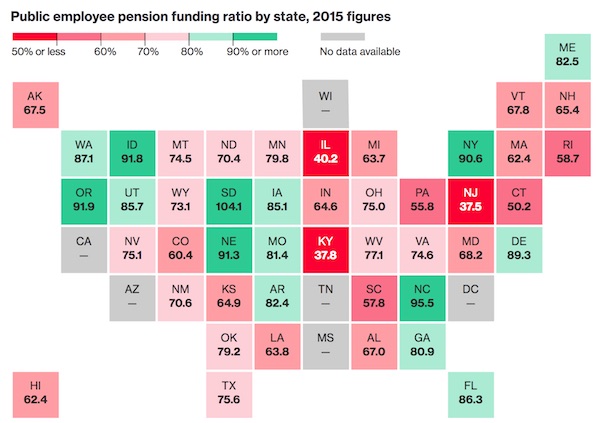
A healthy pension fund today should really be over 100% funded- because of future demographic expectations. Only South Dakota’s complies.

• America’s Pension Bomb: Illinois Is Just the Start (BBG)

We’ve been hearing it for years: America’s public pensions are a ticking time bomb. Well, at long last, the state of Illinois is about to expose just how big this blowup could be. As of the 2015 fiscal year, Illinois had promised its employees $199 billion in retirement benefits. Right now, it’s $119.1 billion short. That gap lies at the center of a years-in-the-making fiscal mess that’s threatening to drop the state’s credit rating to junk-bond status. But Illinois is hardly alone. Connecticut and New Jersey—states that, to most of the world, seem like oases of prosperity—are under growing financial strain, too. We’ve ranked the states by the size of their funding gap. The lower the funding ratio, the more money the state has to come up with to meet its pension obligations.

Read more …

“The American people, by and large, have no more idea how false and fragile the financial arrangements of the nation are than the average eight-year-old has about why the re-po squad is towing away Daddy’s Ford-F150.”

• An Awful Lot Of Americans Are A Walking Illinois Now (Jim Kunstler)

The preview of coming attractions is currently playing out in Illinois — soon to be joined by Connecticut, California, Kentucky, and many other bankrupt states. Illinois is dead broke. It can’t pay the contractors who fix things like roads and storm drains, and supply food to its prisons. It’s over $200-billion deep in pension obligations that will never be honored. Its Medicaid system is a shambles. It doesn’t even have the cash-on-hand to pay lottery winners (what happened to all the cash paid into the lottery by the suckers who didn’t win, which is supposed to pay off the winners?). The state legislature hasn’t passed a budget in three years. The governor and the mayor of Chicago and everybody else nominally in charge have no idea what they’re going to do about it. Think the federal government is going to just step in and save the day there?

They’d have to bail out every other foundering state and that’s just not going to happen, especially with that same federal government about to run out of cash money itself, with no resolution of the debt ceiling controversy that might allow it to even pretend to borrow more money by issuing treasury bonds that are instantly bought by the Federal Reserve — which, of course, is not an official government agency but a private banking consortium contracted to manage the nation’s money. Do you begin to see the outlines of the clusterfuck rising like a bad moon over the harvest season of 2017? The American people, by and large, have no more idea how false and fragile the financial arrangements of the nation are than the average eight-year-old has about why the re-po squad is towing away Daddy’s Ford-F150.

We’re just doing what we always do: gittin’ our summer on. Breaking out the potato salad and the Bud Lites – at least those who have enough mojo left in their MasterCards to charge the party supplies. An awful lot of Americans must be maxed out, though, people who actually used to work at things and get paid for it. Each one of them is a walking Illinois now, facing each dawning day with a bigger load of problems, more things they can’t pay for, and moving closer to the dreadful day when everything is gone, every chattel, every knickknack, the very roof over their head, and most particularly the belief that they live in a fair and decent society.

Read more …

Absurd theater 2017. Because: “The intelligence that prompted the administration’s warning to Syria this week was “far from conclusive,” said a U.S. official familiar with it. “It did not come close to saying that a chemical weapons attack was coming,” the official said.”

But Nikki Haley says: “I would like to think that the president saved many innocent men, women and children.”

• US Says Its Warning Appears To Have Averted Syrian Chemical Attack (R.)

U.S. Defense Secretary Jim Mattis said on Wednesday that the Syrian government of President Bashar al-Assad appeared so far to have heeded a warning this week from Washington not to carry out a chemical weapons attack. Russia, the Syrian government’s main backer in the country’s civil war, warned that it would respond proportionately if the United States took pre-emptive measures against Syrian forces to stop what the White House says could be a planned chemical attack. The White House said on Monday it appeared the Syrian military was preparing to conduct a chemical weapons attack and said that Assad and his forces would “pay a heavy price” if it did so. The warning was based on intelligence that indicated preparations for such a strike were under way at Syria’s Shayrat airfield, U.S. officials said.

“It appears that they took the warning seriously,” Mattis said. “They didn’t do it,” he told reporters flying with him to Brussels for a meeting of NATO defense ministers. He offered no evidence other than the fact that an attack had not taken place. Asked whether he believed Assad’s forces had called off any such strike completely, Mattis said: “I think you better ask Assad about that.” Washington accused Syrian forces of using the Shayrat airfield for a chemical weapons attack in April. Syria denies this. The intelligence that prompted the administration’s warning to Syria this week was “far from conclusive,” said a U.S. official familiar with it. “It did not come close to saying that a chemical weapons attack was coming,” the official said.

[..] Russian Foreign Minister Sergei Lavrov said on Wednesday that Moscow will respond if the United States takes measures against Syrian government forces. “We will react with dignity, in proportion to the real situation that may take place,” he said at a news conference in the city of Krasnodar. Lavrov said he hoped the United States was not preparing to use its intelligence assessments about the Syrian government’s intentions as a pretext to mount a “provocation” in Syria. [..] In Washington, the U.S. ambassador to the United Nations, Nikki Haley, credited Trump with saving Syrian lives. “Due to the president’s actions, we did not see an incident,” Haley told U.S. lawmakers. “I would like to think that the president saved many innocent men, women and children.”

Read more …

Suggestion: look at this through Russian eyes. They don’t think Trump is crazy, they think all of America is.

• Make No Mistake, We Are Already at War in Syria (Giraldi)

Donald Trump has been in office for five months and it would appear that at least some of the outlines of his foreign policy are beginning to take shape, though that may be exaggeration as no one seems to be in charge. The “America First” slogan seemingly does not apply to what is developing, as actual U.S. interests do not appear to be driving what takes place, and there does not seem to be any overriding principle that shapes the responses to the many challenges confronting Washington worldwide. The two most important observations that one might make are both quite negative. First, lamentably, the promised détente with Russia has actually gone into reverse, with the relationship between the two countries at the lowest point since the time of the late, lamented Hillary Rodham Clinton as Secretary of State.

Second, we are already at war with Syria even though the media and Congress seem blissfully unaware of that fact. We are also making aggressive moves intended to create a casus belli for going to war with Iran, and are doubling down in Afghanistan with more troops on the way, so Donald Trump’s pledge to avoid pointless wars and nation-building were apparently little more than glib talking points intended to make Barack Obama look bad. The situation with Russia can be repaired as Vladimir Putin is a realist head of state of a country that is vulnerable and willing to work with Washington, but it will require an end to the constant vituperation being directed against Moscow by the media and the Democratic Party. That process could easily spin out for another year with all parties now agreeing that Russia intervened in our election even though no one has yet presented any evidence that Russia did anything at all.

Syria is more complicated. Senators Tim Kaine and Rand Paul have raised the alarm over American involvement in that country, declaring the U.S. military intervention to be illegal. Indeed it is, as it is a violation of the United Nations Charter and the American Constitution. No one has argued that Syria in any way threatens the United States, and the current policy is also an affront to common sense: like it or not Syria is a sovereign country in which we Americans have set up military bases and are supporting “rebels” (including jihadis and terrorists) who are seeking to overthrow the legitimate government. We have also established a so-called “de-confliction” zone in the southeast of the country to protect our proxies without the consent of the government in Damascus. All of that adds up to what is unambiguously unprovoked aggression, an act of war.

Read more …

Expect Russia to react to this too, and soon.

• Qatar Crisis: Armed Conflict And Protracted Dispute Grow More Likely (CNBC)

A diplomatic crisis on the Arabian Peninsula is turning into a protracted standoff, and some analysts now say the risk of armed conflict is emerging. The dispute between Qatar, a major natural gas exporter, and its neighbors is now entering its fifth week. Saudi Arabia, the United Arab Emirates, Egypt and Bahrain cut diplomatic ties with Qatar and implemented a partial blockade on June 5 in a bid to bring the tiny Persian Gulf monarchy in line with Saudi-dominated foreign policy. Some analysts initially thought the parties would seek a resolution by the end of the Muslim holy month of Ramadan, but last week, the anti-Qatar alliance issued a series of harsh demands. “It’s escalated to a stage where it’s very difficult for both sides to back down,” Firas Modad, analyst at IHS Markit, told CNBC this week.

The demands include non-starters such as shutting down Al Jazeera news and closing a Turkish military base. The coalition also calls on Qatar to end its alleged ties to terrorist groups and political opposition figures in Gulf nations and Egypt. It demanded Qatar pay reparations and submit to compliance reviews going forward. Qatar has rejected the demands. That is likely to trigger a series of additional economic and political sanctions against the government in Doha, causing the impasse to stretch out for months, risk consultancy Eurasia Group concluded in a briefing this week. “The crisis will continue to escalate before the Qatari leadership ultimately adjusts its policy positions, or in a slightly less likely scenario, opts to cement an alliance with Turkey and closer ties with Iran,” Eurasia Group said.

Read more …

Or the Most Patriotic of Americans?

• Oliver Stone: Edward Snowden Is The “Most American Of Patriots” (ZH)

Director Oliver Stone, who’s recently released series “The Putin Interviews” stirred up controversy among liberals who accused him of being a Russian propagandist, appeared on the Liberty Report with former Texas Congressman Ron Paul to discuss the documentary, his views about former NSA contractor Edward Snowden, and why the US’s aggressive approach to containing the purported threat posed by Russia has led to a breakdown in relations between the two powers. Stone said he’s been “interested” in Russia since being raised as a conservative in New York City, claiming that his father instilled a “fear” of Communism and Russians in him at a young age. In the early 1980s, Stone visited the country for the first time as a screenwriter with the idea of interviewing several dissidents. He has returned several times since.

In particular, Stone has become interested in the case of Snowden, whom he praised as “the most American of patriots.” “I was interested in Russia – I went back into the 2000s. The Snowden story occupied me. And of course, it’s so ironic that he the most American of patriots is living in Moscow because he has to. It’s the only country in the world that would give him asylum – in other words it’s the only country in the word that can deny the US what it wants which is Snowden.” “[Putin] explained to me that Russians wanted an extradition treaty with the US for years, but nothing doing, because there are a lot of Russian criminals in America who stole money from Russia. He did nothing wrong in Russian terms so they gave him asylum – now its 3 years 5 years whatever its going to be. I wish Ed well I really do.”

Stone also shared a story about watching the movie “Dr. Strangelove” with Putin, who he said was greatly moved. “I showed him the movie Dr. Strangelove…and he watched it very serious about it. He said this movie was very accurate of that time and it’s still accurate today.” Circling back to the issue of nuclear deterrents, Stone said he’s worried that rising tensions around the world could trigger a “nuclear confrontation.” “I’m saying I have reached that age when I am not really concerned about what happens to me but… it’s not just about the US, but about the whole planet and I feel a nuclear confrontation, an accident, could happen tomorrow. But you put ABMs in Poland and Romania – that’s a gigantic mistake.”

“An ABM can be converted overnight from a defensive missile to an offensive missile. They’re surrounded from the North the East and the West by US missiles and we don’t seem to realize it.” Stone says he’s “scared for America,” explaining that many US citizens prefer to blindly accept media spin that’s favorable to the US establishment, without questioning it, or trying to understand Russia’s point of view. “It’s a good thing I went through JFK when I was younger…there’s been a lot of controversy around my movies. I’m scared not for myself because I’m at that age, they can’t destroy me anymore, but I’m scared for America, I’m afraid they’ve lost their sense. I’m afraid there’s a lack of foresight and leadership.”

Read more …

EU farm budget is about €1 trillion. While Greece’s health care system and social programs are being murdered underpressure from the same EU.

• Billionaires And Aristocrats Biggest Beneficiaries Of EU Farm Subsidies (TLE)

20% of the 100 largest payments under the European Union’s “direct” subsidy system now go to people or families on the Sunday Times Rich List. According to a new investigation by Energydesk billionaires and aristocrats last year scooped up an even greater proportion of the UK’s biggest farm subsidy payouts, with “basic payments” to the Top 100’s Rich List recipients totalling £11.2 million in 2016 – up from £10.6 million the previous year. Direct EU subsidies – now known as “basic payments” – have attracted criticism for largely rewarding landowners simply for owning land, rather than paying farmers to invest in environmental or other “public goods”. The National Trust – which itself received £1.6m in basic payments last year – said the system needed fundamental reform, even if it meant the trust getting less income for its land.

Richard Hebditch, the trust’s external affairs director, said: “Rather than being paid for how much land you happen to farm, a new model which delivers clear public benefit from the money being spent is within reach after Brexit. “Farmers should receive a fair market price for safe and sustainable supplies of food, with public funding paying for the crucial role of protecting vulnerable natural resources, caring for our heritage and landscape and helping address issues like flooding and climate change.” Ironically, the farm business owned by prominent Brexit-backing billionaire inventor Sir James Dyson is now the biggest for-profit recipient of direct EU farm subsidies in the UK. Beeswax Dyson Farming netted £1.6 million under the basic payment scheme last year – up from £1.4 million in 2015. According to the Rich List, Sir James and family are worth £7.8 billion, and he is a bigger landowner than the Queen, with holdings of around 25,000 acres.

Read more …

Nobody takes Juncker serious anymore.

• Juncker: EU To Discuss More Migrant Help For Greece And Italy (R.)

The EU executive will discuss further measures with Italy and Greece in the coming week to help the Mediterranean states deal with irregular migrants, European Commission President Jean-Claude Juncker said on Friday. Asked at a news conference what, in particular, the Commission might do to help Italy, where arrivals from Libya are up a third on a year ago, Juncker said: “I will see with the Italian prime minister, with the Greek prime minister, during the coming week what further efforts the Commission can line up to relieve Italy and Greece in their difficult struggles.” He recalled that he had described both countries as “heroic” and said he had discussed the issue on Thursday at a meeting in Berlin with Italian Prime Minister Paolo Gentiloni and leaders of other big EU states which are members of the global G20.

“I said Italy and Greece … cannot be left alone in this refugee crises,’ Juncker told reporters in Tallinn, where he was meeting the Estonian government as it takes on the six-month presidency of European Union ministerial councils. He rejected any suggestion the Union had failed to help the countries where most refugees and migrants are arriving, noting EU funds allocated to Italy and Greece and border guard and other personnel sent to help process those arriving. The Commission on Thursday threw its weight behind a plea by Italy for fellow EU states to allow rescue boats carrying migrants to dock in their ports.

EU diplomats said they were looking at Italian concerns over how private charities are picking up people just off the Libyan coast. Some see that as encouraging more to take to the sea. The rescue organisations complain of unfair criticism. About 10,000 people have been rescued over the past three days. Italy has taken in 82,000 people so far this year. Voters dealt a blow to the ruling party in local elections last week, opting for groups promising a tougher line on immigration. The Commission has signalled readiness to give Italy more cash to help with increased arrivals, though officials and diplomats in Brussels are sceptical there would be any swift agreement for other EU states to take in the private boats.

Read more …

Jun 102017
 
 June 10, 2017  Posted by at 9:22 am Finance Tagged with: , , , , , , , , ,  3 Responses »


Marshall Hirsh Rue de Steinkerque, Paris 1950


• Central Banks Have Bought A Record $1.5 Trillion In Assets In 2017 (ZH)
• Central Banks Are Poised to Start Rowing in One Direction Again (BBG)
• US Household Net Worth Climbs to Record $94.8 Trillion (WSJ)
• Trump Lawyer Doubles Down On Comey Perjury Accusation (ZH)
• Britain’s Credit Rating At Risk After General Election Outcome (RT)
• Jeremy Corbyn: 1, British Mainstream Media: 0 (McDonald)
• Tories turn on Theresa (G.)
• Who is the DUP? A Brief History of UK Parliament’s New Kingmaker (RT)
• 5 Things To Know About DUP Politicians And Science (New Scientist)
• Without Glass-Steagall America Will Fail (PCR)
• Breaking Up the Banks Is Easier Than You Might Think (Nomi Prins)
• Australian Households’ Share Of National Economic Pie Nears 50-Year Low (G.)
• How Germany’s Three-Tiered Banking System Works (HandelsBlatt)
• Greek Pensions Not Enough To Cover Costs Of Medicines, Bills And Food (K.)


The crime of our times. There’s nobody to stop it.

• Central Banks Have Bought A Record $1.5 Trillion In Assets In 2017 (ZH)

One month ago, when observing the record low vol coupled with record high stock prices, we reported a stunning statistic: central banks have bought $1 trillion of financial assets just in the first four months of 2017, which amounts to $3.6 trillion annualized, “the largest CB buying on record” according to Bank of America. Today BofA’s Michael Hartnett provides an update on this number: he writes that central bank balance sheets have now grown to a record $15.1 trillion, up from $14.6 trillion in late April, and says that “central banks have bought a record $1.5 trillion in assets YTD.”

The latest data means that contrary to previous calculations, central banks are now injecting a record $300 billion in liquidity per month, above the $200 billion which Deutsche Bank recently warned is a “red-line” indicator for risk assets.

This, as we said last month, is why “nothing else matters” in a market addicted to what is now record central bank generosity. What is ironic is that this unprecedented central bank buying spree comes as a time when the global economy is supposedly in a “coordinated recovery” and when the Fed, and more recently, the ECB and BOJ have been warning about tighter monetary conditions, raising rates and tapering QE. To this, Hartnett responds that “Fed hikes next week & “rhetorical tightening” by ECB & BoJ beginning, but we fear too late to prevent Icarus” by which he means that no matter what central banks do, a final blow-off top in the stock market is imminent. He is probably correct, especially when looking at the “big 5” tech stocks, whose performance has an uncanny correlation with the size of the consolidated central bank balance sheet.

Read more …

There are actually still people who claim central banks have solved problems. They only made them worse, but with a time-lag.

• Central Banks Are Poised to Start Rowing in One Direction Again (BBG)

[..] The shift has been gradual and often subtle, yet it marks a sea change. Largely in unison, central banks employed unprecedented, unconventional easing to force their economies back into gear after the global financial crisis spurred widespread unemployment and a decade of sub-par growth. In many, that involved large-scale asset purchase programs. In the euro area and Japan, it included negative rates. The Fed has been reducing accommodation on its own since December 2015. Now, others are beginning to discuss unwinding their policies, restoring a sense of togetherness. “We’re talking about a change from a situation where the central banks were basically pedal to the metal, full throttle, as much monetary stimulus as you could conceivably do,” said Jacob Funk Kirkegaard at the Peterson Institute for International Economics.

“Now, central banks in advanced economies are reacting to a recovering economy.” As hiring hums along and central banks tip-toe toward the exit, the Fed stands to benefit. The dollar has seen upward pressure as the U.S. central bank hikes and other monetary authorities ease, and a strong greenback means cheaper imports and lower inflation. The Fed’s preferred price index continues to undershoot its 2 percent goal. “You don’t want it falling out of bed, but dollar depreciation would lead to higher inflation in the U.S.,” Bryson said. “Frankly, I think the Fed wouldn’t be that unhappy to see higher inflation.” The change is also good news for the nations turning toward the exit, as it signals that business confidence is picking up, more people are working, and the specter of another economic dip is fading from view. “None of the big global central banks is looking to loosen policy,” said Andrew Kenningham at Capital Economics in London. “What has changed is that the fear of outright deflation, or entrenched low inflation, has now faded.”

Read more …

That’s not worth or wealth. That’s a bubble.

• US Household Net Worth Climbs to Record $94.8 Trillion (WSJ)

The total net worth of U.S. households climbed by $2.3 trillion in the first quarter of 2017, reaching a record $94.8 trillion as the stock market soared and home prices climbed in many parts of the country. Household wealth in the stock market climbed by $1.3 trillion in the quarter, showing just how much the market’s climb to Dow 20000 and beyond has created a swell of wealth on American’s investment statements that is helping underpin consumer confidence. The figures are from a quarterly Federal Reserve report, known as the Flow of Funds, that tracks the aggregate wealth of all U.S. households and nonprofit organizations.

The report showed that the value of household real estate rose by about $500 billion in the quarter, reflecting a continuing increase in national home prices. The sum Americans held in savings accounts rose by about $100 billion in the quarter. Household debts increased by about $46 billion in the quarter. The $2.3 trillion increase, though large, isn’t without precedent. Such large increases were seen in the late 1990s when the stock market was also climbing rapidly, and in 2004 when both markets and home prices were climbing. The last time wealth increased so rapidly was late 2013.

During the 2007-09 recession, when the housing market and stock market both fell, households lost nearly $12 trillion in wealth. But in recent years, households in aggregate have regained that wealth and more as first the stock market, and then the housing market, began to rebound. The U.S. has about 126 million households, meaning the average net worth of U.S. households is about $750,000. The report provides no details of how that wealth is distributed between households. The figures aren’t adjusted for inflation.

Read more …

Always risky to tangle with top lawyers.

• Trump Lawyer Doubles Down On Comey Perjury Accusation (ZH)

Yesterday, the Twittersphere lit up when Julie Davis of the New York Times sent out a tweet suggesting that Trump’s personal attorney, Marc Kasowitz, had potentially made a serious blunder in mixing up his timeline of when Comey first leaked details of his meetings with Trump to the Times. Here is what Kasowitz said yesterday: Although Mr. Comey testified he only leaked the memos in response to a tweet, the public record reveals that the New York Times was quoting from these memos the day before the referenced tweet, which belies Mr. Comey’s excuse for this unauthorized disclosure of privileged information and appears to entirely retaliatory. Davis, and most of the media, assumed that Kasowitz was referring to an article published on May 16th by the New York Times entitled “Comey Memo Says Trump Asked Him to End Flynn Investigation.”

Of course, given that Trump’s tweet about the Comey tapes was sent 4 days prior, it couldn’t have possibly been triggered by the the NYT’s May 16th story, as Kasowitz suggested, which led Ms. Davis of the Times to publish her ‘gotcha’ tweet. Unfortunately for Davis and the New York Times, Kasowitz has just released a clarifying statement which points out that he was never referring to the May 16th article in his statement yesterday, but rather an article published on May 11, the day before Trump’s tweet, entitled “In a Private Dinner, Trump Demanded Loyalty. Comey Demurred,” which seems to discuss, in detail, the same facts presented in Comey’s now infamous memos. Here is the full statement from Kasowitz:

Statement of Marc Kasowitz, Attorney to President Donald J. Trump:

“Numerous press stories have misreported that our statement yesterday incorrectly claimed that the New York Times was reporting details from Mr Comey’s memos the day before President Trump’s May 12, 2017 Tweet because, according to these reports, the first New York Times story to mention the memos specifically was May 16, 2017, which was after the Tweet. Our statement was accurate and was not referring to the May 16, 2017 story. Rather, Mr. Comey’s written statement, which he testified he prepared from his written memo, describes the details of the January dinner in virtually verbatim language as the New York Times May 11, 2017 story describing the same dinner. That story was the day before President Trump’s Tweet. It is obvious that whomever was the source for the May 11, 2017 New York Times story got that information from the memos or from someone reading or who had read the memos. This makes clear, as our statement said, that Mr Comey incorrectly testified that he never leaked the contents of the memo or details of the dinner before President Trump’s May ’12. 2017 Tweet.”

Meanwhile, a quick review of the New York Times’ May 11 story does seem to suggest that Kasowitz has a point as the language describing Trump’s January dinner with Comey is almost identical to the testimony he presented to Congress yesterday. Therefore, whoever supplied this ‘leak’ to the NYT’s was either in possession of Comey’s memos or had been read them verbatim shortly before they were relayed to the Times.

Read more …

A world of pain.

• Britain’s Credit Rating At Risk After General Election Outcome (RT)

International rating agencies, closely monitoring the situation in the UK, have warned the country’s creditworthiness faces a downgrade after the Conservative Party’s failure to win a majority in Thursday’s general election. According to the agencies, the UK’s election result could delay negotiations with the European Union over its exit from the bloc and throws the future path of its economic policy into doubt. “In our view, the lack of a majority for any party is likely to delay Brexit negotiations, scheduled to start very soon,” said S&P in a statement, adding it doesn’t “exclude the possibility of another snap election.” “These considerations are reflected in our current negative outlook on the long-term ratings,” added the agency. S&P currently rates the UK at AA, with a negative outlook. The country was stripped of its triple-A rating immediately after the Brexit referendum last year. The negative outlook means Britain is at risk of future downgrades.

S&P’s sovereign chief ratings officer Moritz Kraemer told CNBC the assessment will depend “pretty much on the further outcome of the Brexit negotiations and the reality that the UK will face outside the EU, which is still uncertain.” Brexit negotiations are supposed to begin in less than two weeks. The UK holds the second highest rating Aa1 from another agency, Moody’s. It had held the rating since 2013 when it was downgraded from AAA due to sluggish growth prospects and fiscal challenges. The agency’s lead UK sovereign analyst Kathrin Muehlbronner said on Friday, “Moody’s is monitoring the UK’s process of forming a new government and will assess the credit implications in due course.” “As previously stated, the future path of the UK sovereign rating will be largely driven by two factors: first, the outcome of the UK’s negotiations on leaving the EU and the implications this has for the country’s growth outlook. Second, fiscal developments, given the country’s fiscal deficit and rising public debt,” she said.

Read more …

Very much the Guardian too.

• Jeremy Corbyn: 1, British Mainstream Media: 0 (McDonald)

From it’s “The Sun Wot Won It” to a vacuum. The Labour Party’s surge this Thursday spells the end of the popular press’ ability to manipulate the outcome of elections. It also proves the relevance of alternative media in the internet age. It was June, 2015. And RT UK’s Afshin Rattansi was interviewing a man in a beige blazer about his unlikely bid to lead British Labour. His name was Jeremy Corbyn, and he spoke a lot of sense. Too much of it to win the leadership contest, it immediately appeared. Over the following weeks, Corbyn’s support increased, and the Labour-leaning mainstream media became more-and-more opposed to his candidacy. Particularly the Guardian, a newspaper which professes to be a leftist organ, but, in reality, will always favor liberal causes over those affecting the poor. [..] Here’s a selection of Guardian comment headlines from the past 24 months or so.

30 July 2015 – Michael White – “If Labour elects Jeremy Corbyn as leader, it will be the most reckless move since choosing the admirable but unworldly pacifist, George Lansbury, in 1932.”

25 June 2016 – Polly Toynbee – “Dismal, spineless, Jeremy Corbyn let us down again.”

28 June 2016 – Editorial – “The question is no longer whether his (Corbyn’s) leadership should end because at Westminster it already has. The challenge for the Labour left is to rescue something from it.”

14 December 2016 – Rafael Behr – “Jeremy Corbyn may be unassailable, but he is not leading Labour.”

11 January 2017 – Suzanne Moore – “Labour’s Corbyn reboot shows exactly why he has to go.”

1 March 2017 – Owen Jones – “Jeremy Corbyn says he is staying. That’s not good enough.”

5 May 2017 – Jonathan Freedland – “No more excuses: Jeremy Corbyn is to blame for this meltdown.” (almost a month before polling day).

Also, 5 May 2017 – Nick Cohen – “Corbyn & (John) McDonnell could limit a Tory landslide by resigning now. That they would rather die, shows the far left is an anti-Labour movement.” (ditto)

And let’s not forget The New Statesman, where Jason Cowley suggested, only on Tuesday, that Corbyn could be leading his party to “its worst defeat since 1935.” Two days before he delivered Labour’s biggest vote share increase since 1945.

And that was the election where Labour’s greatest ever chief, Clement Attlee, stunned a victorious Winston Churchill in the aftermath of World War Two. Or Cowley’s colleague, George Eaton, who told us in March: “Jeremy knows he can’t do the job…. senior figures from all parties discuss the way forward: a new Labour leader, a new party or something else?” Also, worth a mention in this social media era, are Twitter “freelancers” like the author JK Rowling. In September of last year, she described Corbyn as “Utterly deluded,” saying “I want a Labour govt (sic), to help people trapped where I was once trapped. Corbyn helps only Tories.”

Read more …

Turning on a dime. Lust for power does that.

• Tories turn on Theresa (G.)

Theresa May is fighting for her future as prime minister, according to Britain’s newspapers, which have issued damning verdicts on the Conservatives’ failure to win a majority in the general election. The Sun and the Daily Mail, which heavily supported May and criticised Jeremy Corbyn in the runup to the election, said senior Conservatives had turned on the prime minister and that she could be forced to step down within six months. The Sun’s front page headline, over a photo of May eating chips, was “She’s had her chips”, while the Daily Mail said, “Tories turn on Theresa”. The Mail described the prime minister’s election campaign as “disastrous” and said the Conservatives had been “plunged into civil war”.

The Daily Telegraph and the Times, which, like the Sun and Mail, supported the Conservatives before the election, also warned that May’s future was at risk. The Times’ front page said: “May stares into the abyss.” The Guardian, which backed Labour, said May and the Conservatives had gone from “hubris to humiliation” during the election campaign. May was also criticised for looking to strike a deal with the DUP of Northern Ireland in order to form a government. The Daily Mirror accused May of forming a “Coalition of crackpots” and pointed out that the Northern Irish party opposes gay marriage and abortion. May’s setback will raise questions about the influence of newspapers on the electorate, given that the majority strongly backed her and the Conservatives.

The Guardian reported last week that some of the most shared articles on social media about the general election were from partisan blogs such as Another Angry Voice, The Canary and Evolve Politics, which backed Labour. The Sun had urged its readers not to “chuck Britain in the Cor-bin” in its last edition before the election, provoking a backlash on social media, while on Wednesday the Daily Mail devoted 13 pages to attacking Labour, Corbyn, Diane Abbott and John McDonnell under the headline “Apologists for terror”. The Sun is owned by Rupert Murdoch’s News Corp. John Prescott, the former deputy leader of Labour, tweeted on Thursday night that he had heard from a “very good source” that Murdoch had “stormed out” of the Times’s election party after seeing the exit poll, which predicted that the Conservatives would fail to win a majority.

Read more …

Theresa May’s desperate hunger for power endangers the peace process.

• Who is the DUP? A Brief History of UK Parliament’s New Kingmaker (RT)

The Democratic Unionist Party (DUP) holds the key to Theresa May remaining in Downing Street but what do we know about this Protestant party drawn from the pro-union side of Northern Ireland’s deeply sectarian political spectrum? As Britons scramble to learn about the party that will prop up May’s mandate to execute Brexit, a swathe of the online conversation has focused on the party’s past comments on homophobia, Islam and creationism. The DUP was at the center of a bloody sectarian divide during Northern Ireland’s Troubles – a conflict involving rival paramilitary groups and the British Army which claimed more than 3,000 lives over 30 years. The Conservatives and the DUP won’t form a formal coalition government but the latter will support the government regardless.

“We want there to be a government. We have worked well with May. The alternative is intolerable. For as long as Corbyn leads Labour, we will ensure there’s a Tory PM,” a DUP source was cited as saying in by the Guardian. The party is the creation of firebrand Protestant Evangelical Minister Ian Paisley. Reverend Paisley also founded the Free Presbyterian Church of Ulster and was characterized by his entrenched Unionist views and his hostile opposition to the Catholic Church. In its early years, the party was heavily involved in a campaign against homosexuality and fiercely opposed gay rights. Paisley, who was famed for his extraordinarily fiery speeches, routinely preached against homosexuality and the party picketed gay rights events as part of their ‘Save Ulster from Sodomy’ campaign.

The campaign was ultimately unsuccessful as homosexuality was decriminalized in 1982. Paisley became infamous in 1988 when, as a member of the European Parliament for Northern Ireland, he caused uproar by interrupting an address by Pope John Paul II. During his protest he shouted: “I refuse you as Christ’s enemy and Antichrist with all your false doctrine,” while brandishing posters reading: “Pope John Paul II ANTICHRIST.”

Read more …

Backwaters.

• 5 Things To Know About DUP Politicians And Science (New Scientist)

Having failed to win an overall majority in the UK’s general election, Theresa May’s Conservative party is hoping to foster an informal coalition with Northern Ireland’s Democratic Unionist Party (DUP). Members of the party have taken controversial stances on everything from climate change to evolution, with one assembly member being unaware that heterosexual people can contract HIV. Here are five things you need to know when it comes to science and the DUP

Climate change The party has a history of speaking out against climate change. Senior member Sammy Wilson has called climate change a “con”, and described the Paris Agreement as “window dressing for climate chancers”. During his time as Northern Ireland’s environment minister, he said that people would eventually “look back at this whole climate change debate and ask ourselves how on Earth we were ever conned into spending billions of pounds” on the issue. It isn’t just Wilson though – in 2014, DUP ministers tried to oppose proposals to introduce local measures against climate change in Northern Ireland.

Abortion Northern Ireland remains the only part of the UK where women cannot access abortion unless their life is endangered by pregnancy – a legal situation that is incompatible with the European Convention on Human Rights, according to a Belfast High Court ruling in 2015. But on taking leadership of the party in 2016, Arlene Foster promised to block any attempt to change these laws, telling reporters “I would not want abortion to be as freely available here as it is in England.” Foster did, however, say she might consider an amendment in cases of rape. But the DUP’s Jim Wells – formerly the health minister for Northern Ireland – opposes abortion even in these circumstances.

Evolution DUP assembly member Thomas Buchanan has previously called for creationism to be taught in schools. In 2016, he voiced support for an evangelical Christian programme that offers “helpful practical advice on how to counter evolutionary teaching”. He has expressed a desire to see every school in Northern Ireland teaching creationism, describing evolution as a “peddled lie”. Buchanan told the Irish News “I’m someone who believes in creationism and that the world was spoken into existence in six days by His power,” adding that children had been “corrupted by the teaching of evolution”.

Green energy The DUP’s leader narrowly survived a no-confidence motion following a disastrous attempt to bolster green energy in Northern Ireland by providing subsidies for wood burners. Arlene Foster introduced the scheme in 2012 when she was head of the Department of Enterprise, Trade and Investment. The original budget was £25 million, but a lack of price controls meant that, over five years, almost £500 million went up in smoke.

HIV Last year, DUP assembly member Trevor Clarke admitted that he had thought only gay people could be infected with HIV, until a charity explained otherwise. He made the comments during a parliamentary debate around a campaign to “promote awareness and prevention” of HIV in Northern Ireland and to increase support for those living with HIV.

Read more …

“That any corporation is too big to fail is a contradiction of the justification of capitalism.”

• Without Glass-Steagall America Will Fail (PCR)

Not only must Glass-Steagall be restored, but also the large banks must be reduced in size. That any corporation is too big to fail is a contradiction of the justification of capitalism. Capitalism’s justification is that those corporations that misuse resources and make losses go out of business, thus releasing the misused resources to those who can use them profitably. Capitalism is supposed to benefit society, not be dependent on society to bail it out. I was present when George Champion, former CEO and Chairman of Chase Manhattan Bank testified before the Senate Banking Committee against national branch banking. Champion said that it would result in the banks becoming too large and that the branches would suck savings out of local communities for investment in traded financial assets. Consequently, local communities would be faced with a dearth of loanable funds, and local businesses would die or not be born from lack of loanable funds.

I covered the story for Business Week. But despite the facts as laid out by the pre-eminent banker of our time, the palms had been greased, and the folly proceeded. As Assistant Secretary of the US Treasury in the Reagan Administration, I opposed all financial deregulation. Financial deregulation does nothing but open the gates to fraud and sharp dealing. It allows one institution, even one individual, to make a fortune by wrecking the lives of millions. The American public is not sufficiently sophisticated to understand these matters, but they know when they are hurting. Few in the House and Senate are sufficiently sophisticated to understand these matters, but they do know that to understand them is not conducive to having their palms greased. So how do the elected representatives manage to represent those who vote them into office? The answer is that they seldom do.

The question before Congress today is whether they will take the country down for the sake of campaign contributions and cushy jobs if they lose their seat, or will they take personal risks in order to save the country. America cannot survive if excessive risks and financial fraud can be bailed out by taxpayers. US Representatives Walter Jones and Marcy Kaptur and members of the House and staff on both sides of the aisle, along with former Goldman Sachs executive Nomi Prins and leaders of citizens’ groups, have arranged a briefing in the House of Representatives on June 14 about the importance of Glass-Steagall to the economic, political, and social stability of the United States. Let your representative know that you do not want the financial responsibility for the reckless financial practices of the big banks. Let your representative know also that you do not want big banks that dominate the financial arena. Let them know that you want the return of Glass-Steagall.

Read more …

“..a fresh bubble is inflating. This time, it’s not US subprime mortgages at the heart of a budding banking crisis, but $51 trillion in corporate debt in the form of bonds, loans, and related derivatives.”

• Breaking Up the Banks Is Easier Than You Might Think (Nomi Prins)

Today, a fresh bubble is inflating. This time, it’s not US subprime mortgages at the heart of a budding banking crisis, but $51 trillion in corporate debt in the form of bonds, loans, and related derivatives. The credit ratings agency S&P Global Ratings has predicted that such debt could rise to $75 trillion by 2020 and the defaults on it are starting to increase in pace. Banks have profited by the short-term creation and trading of this corporate debt, propagating even greater risk. Should that bubble burst, it could make the subprime mortgage bubble of 2007 look like a relatively small-scale event. On the positive side, there’s a growing bipartisan alliance in Congress and outside it on restoring Glass-Steagall.

This increasingly wide-ranging consensus reaches from the AFL-CIO to the libertarian Mises Institute, in the Senate from John McCain to Elizabeth Warren, Bernie Sanders, and Maria Cantwell, and in the House of Representatives from Republicans Walter Jones and Mike Coffman to Democrats Marcy Kaptur and Tulsi Gabbard. In fact, just this week, Kaptur and Jones announced an amendment to the pending Financial Choice Act in the House of Representives, that would represent the first genuine attempt to bring to a vote the possibility of resurrecting the Glass-Steagall Act since its repeal. So, Donald, here’s the question: Where do you—the man who, in the course of a few weeks, embraced Middle Eastern autocrats, turned relations with key NATO allies upside down, and to the astonishment of much of the world, withdrew the United States from the Paris climate agreement—stand?

In just a few months in office, you’ve turned the White House into an outpost for your family business, but when it comes to the financial wellbeing of the rest of us, what will you do? Will you, in fact, protect us from another future meltdown of the financial system? It wouldn’t be that hard and you were clear enough on this issue in your election campaign, but does that even matter to you today? I noticed that recently, in an Oval Office interview with Bloomberg News, when asked about breaking up the banks, you said, “I’m looking at that right now. There’s some people that want to go back to the old system, right? So we’re going to look at that.”

Read more …

“..the downward trend in labour’s share of GDP over the past 40 years has been more marked in Australia than in those other economies, apart from New Zealand.”

• Australian Households’ Share Of National Economic Pie Nears 50-Year Low (G.)

The share of national income going to Australian households is close to a 50-year low, and now “lies towards the bottom of the international ladder”, an economist has warned. Bureau of Statistics data show labour’s share of gross domestic product has fallen to 51.5%, down from 54.2% in the third quarter of last year. At the same time, the profit share of GDP has risen from 24.5% to a five-year high of 27.5%. Paul Dales from Capital Economics said Australian households had not seen “one cent” of the extra income generated by recent soaring commodity prices because “it’s all gone into the pocket of business”. He said the share of national income going to households was now “within a whisker” of a 50-year low and a meaningful cyclical or structural upturn in that share of income was “very unlikely” if jobs growth and wages growth remained so low.

“The share of the economic pie that households currently enjoy isn’t just small by Australia’s own standards, it’s also small by international standards,” Dales wrote in a note to clients. “As a share of GDP, the compensation of Australian employees lies towards the bottom of the international ladder. That’s not always been the case. “Back in 1975, Australia households received a bigger share of the economic pie than households in the US, France and New Zealand. Only in the UK did the compensation of employees account for a larger share of GDP. “But the downward trend in labour’s share of GDP over the past 40 years has been more marked in Australia than in those other economies, apart from New Zealand.” This trend in most economies was mainly because of structural changes that had reduced the bargaining power of employees, including globalisation, the increased flexibility of the labour market and technical innovation, which had flattened firms’ cost curves, Dales said.

Read more …

Source of stability?!

• How Germany’s Three-Tiered Banking System Works (HandelsBlatt)

[..] In Germany today some 18 million people, or one in four adults, belong to a credit union. And the idea has spread. Some 800 million people around the world belong to cooperatives, and there are even about 6,000 scattered around the United States. Reinhard Siebel of Frankfurt’s Goethe University says that German credit unions have also inspired today’s micro-financing projects in developing countries. The savings banks in the second tier have been copied less and remain more uniquely German, although Cuba and Ireland are interested in importing the concept. They’re sometimes compared to savings-and-loans in the United States. But the difference is that Germany’s savings banks are publicly-owned – either by municipal governments in the case of local Sparkassen or by federal states in the case of the regional Landesbanken.

Credit unions and savings banks have a few things in common. Both are part of networks of cross-guarantees to protect savers in the event that one of them goes bust. And both have mandates that emphasize maximizing the welfare of their members or stakeholders rather than making profit. In the case of savings banks, this means giving back to the municipality that owns the bank. Savings banks typically sponsor local festivals, finance local hospitals and universities and so forth. All this might sound like a leftist dream – putting communities or democratically elected governments in charge of money-lending rather than greedy private bankers. Creating an altruistic financial system was indeed part of the founders’ motivation. But it hasn’t always played out in practice.

Take the 2008 financial crisis. Some of the culprits were private banks like Commerzbank and Deutsche Bank. But the state-backed Landesbanken had also strayed beyond their allegedly conservative remits, investing in shady American mortgage-backed securities and pouring money into Greece, Spain and Portugal during their boom years. Those exposures were considered risks to the whole banking system and therefore required billions in taxpayer bailouts. So being public instead of private didn’t make them better banks. In fact, it may have made them worse, argues Wilhelm Schmundt, a German financial analyst for the consultancy Bain & Company. He thinks the Landesbanken got in trouble precisely because they were being watched over by public officials who had no real expertise in banking.

Read more …

“There are pensioners whose original supplementary pensions came to €585.20 per month and today amount to just €138.80. This signifies a reduction of 78%.”

• Greek Pensions Not Enough To Cover Costs Of Medicines, Bills And Food (K.)

Three in every four pensioners already find themselves financially crippled, while upcoming cuts to pensions combined with bailout interventions in their allowances are expected to lead to a total reduction of pensioners’ incomes by up to 70%. This is the conclusion of a survey conducted by the United Pensioners network, which paints a picture of pensioners today as poor, demoralized and disappointed. It adds that the pension most retirees receives doesn’t even cover the costs of spending on medications, bills and food. The head of the network, Nikos Hatzopoulos, notes that “the reductions that pensioners’ incomes have suffered are huge. It’s not just the cuts, it’s also the [social security] contribution hikes, tax hikes and all the levies that have impoverished the veterans of the work force.

Pensions corresponding to revenues withheld from a lifetime’s work have been turned into a mere gratuity through the bailout agreement regulations.” The network’s data are quite staggering: Some 1.5 million pensioners with annual incomes up to €4,500 have sunk into poverty while new cuts to current pension will in 2019 have led to a total loss of income of 70% since Greece entered the bailout mechanism in 2010. New main pensions will not exceed €655 per month for average-paid workers. At the same time supplementary pensions have been savaged, as the seven rounds of cuts inflicted on them average at 50% in total. There are pensioners whose original supplementary pensions came to €585.20 per month and today amount to just €138.80. This signifies a reduction of 78%. Of the total figure of 2.89 million pensioners, 2.15 million (or 74%) have to make ends meet on monthly pensions that do not exceed €1,000.

Read more …

May 272017
 
 May 27, 2017  Posted by at 8:33 am Finance Tagged with: , , , , , , , , , ,  5 Responses »


Paul Klee Limits of the Mind 1927


• Global Pension Underfunding To Grow To $400 Trillion Over Next 30 Years (ZH)
• UK Retirement Age Could Hit 80 As Pensions Deficit Sets Off Time Bomb (Ind.)
• President Trump’s Disastrous Budget Plan (John T. Harvey)
• Trump Prepares “War Room”, “Big White House Changes”, Loss Of Twitter (ZH)
• Trump’s Allies, Convicted of High Crimes Without a Trial (BBG)
• Millennials Want to Buy Homes but Aren’t Saving for Down Payments (WSJ)
• Australia Economy Hit By Spending Strike, Cyclone (AFR)
• Theresa May Launches Strongest Attack Yet On Jeremy Corbyn (Tel.)
• No Exit (Jim Kunstler)
• Libyan Coastguard Opened Fire At Refugee Boats: NGOs (AlJ)
• Hopes For Refugee Crisis Plan Fall Into Chasm Between G7 And Trump (G.)


Long time coming, we’ve been warning about this for as long as the Automatic Earth exists. It’s slow motion, but it’s certain.

• Global Pension Underfunding To Grow To $400 Trillion Over Next 30 Years (ZH)

Of course, as we’ve argued before, the current pension underfunding levels are sure to only get worse over the coming decades as the world will have to contend with a wave of retiring Baby Boomers and a period of lackluster, volatile returns. So how bad could the global funding gap get? Unfortunately, the World Economic Forum (WEF) recently set out to solve that impossible math equation and it turns out the answer is about $400 trillion…give or take a couple trillion. Not surprisingly, the WEF attributed their terrifying conclusion to an ageing population, lack of savings, low expected growth rates and financially illiterate citizens.

• Long-term, low-growth environment: Over the past 10 years, long-term investment returns have been significantly lower than historic averages. Equities have performed 3%-5% below historic averages and bond returns have typically been 1%-3% lower. Low rates have grown future liabilities, and at the same time investment returns have been lower than expected and unable to make up the growing pension shortfall.

• Inadequate savings rates: To support a reasonable level of income in retirement, 10%-15% of an average annual salary needs to be saved. Today, individual savings rates in most countries are far lower. This is already presenting challenges where traditionally defined benefit structures would have provided a guaranteed pension benefit. Now, as workers look at their defined contribution retirement balances, with no guaranteed benefits, they are realizing that the retirement income their savings will provide will be much lower than expected.

• Low levels of financial literacy: Levels of financial literacy are very low worldwide. This represents a threat to pension systems which are more selfdirected and which rely more on private savings in addition to employer- or government-provided savings. Of course, ignoring that minor ~20 year increase in life expectancy over the past 60 years without raising retirement ages can take a toll on those present value calculations of future liabilities.

Oh, and turns out that politicians creating massive ponzi schemes to promise citizens that their government would take care of their financial needs in perpetuity, while never really bothering to explain the true costs of such programs, was probably a bad idea. But luckily these politicians are exempt from being prosecuted for their financial crimes…so taxpayers will just have to deal with picking up the $400 trillion tab.

Read more …

And once you’re 80 everyhting’s gone, spent.

• UK Retirement Age Could Hit 80 As Pensions Deficit Sets Off Time Bomb (Ind.)

The UK has been told to prepare for a workforce of 80-year-olds as the world’s leading economies struggle to deal with a £54 trillion pensions time bomb. The amount could balloon to an astonishing £334 trillion by 2050 unless policymakers take urgent action, the World Economic Forum has warned. An ageing population, falling birth rates and poor access to pension products were the main sources of the widening gap between what people are saving and the amount they would have to put away to adequately fund their retirement, the WEF said. The projection is based on the OECD’s recommendation that people should have retirement income of around 70% of their salary.

On this measure, the UK’s shortfall is higher than £6.2 trillion and set to increase by around 4% per year, reaching more than £25 trillion by 2050. To avoid the looming crisis, governments need to to improve financial literacy and increase access to pensions in order to boost the amount people save, the WEF said. “Policymakers do need to be thinking now about how to integrate 75- and even 80-year-olds in the workplace,” Michael Drexler, head of financial and infrastructure systems for the WEF told The Financial Times. The WEF said life expectancy has risen rapidly since the 1950s, increasing by two years every decade on average. Babies born now can expect to live longer than 100 years, according to the WEF report.

Read more …

Nobody, Rep. or Dem., is interested in actually understanding the economy, they just want their favorite people to do well.

• President Trump’s Disastrous Budget Plan (John T. Harvey)

Several months ago, I graded President Trump’s economics. The standard I used was the extent to which various policies drained or refilled the swamp, with the assumption that the former represented acts that helped the middle class (or aspirants thereto). I marked him with two swamp drainers (+2) and five swamp refillers (-5) for a net of -3. His newly-announced budget plan, however — where I had given him the benefit of the doubt and a +1–just switched to a -1. It is absolutely disastrous. As much as I complained about Obama’s, this may be worse. You can do a quick Google search and find plenty of line-by-line analyses to see where the cuts will come. I won’t bother with that. Instead, I want you to take a step back and just look at the simple logic involved. What is the macro impact of Trump’s newfound conviction that we need to reduce the public deficit?

1. It lowers our savings. Ignoring for the moment the foreign sector, there are only two main actors in our economy: the public sector and the private sector. The inescapable accounting logic is that if the public sector spends more than it earns, then the private sector must earn more than it spends. Or put another way, the government’s deficit is your surplus. Period. No alternate interpretation is possible. Now add in the fact that we already spend more for foreign products than they spend for ours and you see that not only does the private sector need the government’s deficit if it is going to have any net savings, but that deficit needs to be even larger than our net outflow to China, et al!

2. It reduces profits. Actually, this is really part of the above, but it gets a little more concrete. When the government cuts spending, this isn’t just a number of a ledger somewhere. It’s someone’s income: a fireman, a librarian, a Marine, a park ranger, a university physics professor working with grant money, etc., etc. As it stands today, those people are buying bread, milk, gas, movie tickets, apartment rentals, cars, and so on. Who is going to buy those items if we lay off those government workers? No one. In fact, it would then logically lead to even more layoffs as those businesses lost profits. So much for helping the entrepreneur.

3. It burdens current generations (and does nothing to help future ones). Probably the most fundamental fact about the debt is also the least understood one: it is impossible — IMPOSSIBLE — for the U.S. to be forced to default on debt in dollars. I have written on this point extensively and will not go on about it here. The bottom line is that default is off the table, it can’t happen. Hence, the only impact of cutting the deficit is the reduction in savings and profits (and employment) mentioned above.

And so, without even considering the micro impacts of the various cuts he has in mind, it’s bad news all around and Trump’s grade has dropped from -3 (+2 – 5) to a -5 (+1 – 6). Of course, for the rest of us the impact is somewhat more significant than getting a bad report card.

Read more …

Big changes were always going to happen. Losing Twitter, Spicer, Goldman alumni, Bannon, now maybe Kushner, no surprises there.

• Trump Prepares “War Room”, “Big White House Changes”, Loss Of Twitter (ZH)

In lieu of the Friday night “Trump bombshell” deliverable from the NYT-WaPo complex, today it was Reuters’ and the Wall Street Journal’s turn to lay out the suspenseful weekend reads, previewing major potential upcoming changes to the Trump administration. First, according to Reuters, Trump’s top advisors are preparing to establish a “war room” to combat negative reports and mounting questions about communication between Russia. Steve Bannon and Trump’s son-in-law Jared Kushner, both senior advisors to the president, will be involved in the new messaging effort, which also aims to push Trump’s policy agenda and schedule more rallies with supporters. This “most aggressive effort yet” to push back against allegations involving Russia and his presidential campaign, will launch once Trump returns from his overseas trip.
\
[..] Second, in a separate but similar report from the WSJ, the paper writes that Trump is “actively discussing major changes” in the White House, including a shakeup of his senior team, after spending much of his free time during his overseas trip weighing the Russia investigation and the political crisis it poses for him. A flurry of meetings devoted to White House operations are scheduled for next week, officials said, and sparks are expected to fly. While this isn’t the first time a major shake up around Trump was announced as imminent, recalls Axios reporting two weeks ago that an “angry” Trump was planning a huge reboot, and that Priebus, Bannon and Spicer could be fired …

[..] The biggest change may be that Trump is about to lose his twitter privileges for good: One major change under consideration would vet the president’s social media posts through a team of lawyers, who would decide if any needed to be adjusted or curtailed. The idea, said one of Mr. Trump’s advisers, is to create a system so that tweets “don’t go from the president’s mind out to the universe.” Some of Mr. Trump’s tweets—from hinting that he may have taped conversations with Mr. Comey to suggesting without any evidence that former President Barack Obama wire-tapped Trump Tower—have opened him to criticism and at times confounded his communications team. Trump aides have long attempted to rein in his tweeting, and some saw any type of legal vetting as difficult to implement. “I would be shocked if he would agree to that,” said Barry Bennett, a former Trump campaign aide.

[..] most interesting is the alleged emerging tension between Trump and his Goldman advisors: “Some Trump advisers have also questioned the judgment of communications officials, citing as an example the rollout of a tax-plan outline in April that featured Goldman Sachs alumnae Steven Mnuchin, the Treasury secretary, and Gary Cohn, the National Economic Council director. “The left is automatically going to say the tax plan is tailored to the rich and to Wall Street. And we just gave them an image of the rich and of Wall Street,” one Trump former campaign official said. In an amusing tangent, the WSJ also points out that Trump’s return to Washington will mark the end of a period which, White House staffers said, “brought some relief from the hectic pace of the news surrounding the administration and the Russia investigation. Some noted that it gave them a rare time to eat dinner at home.”

Read more …

Peeking out of the echo chamber.

• Trump’s Allies, Convicted of High Crimes Without a Trial (BBG)

Heard any good Mike Flynn jokes lately? How about this one from “Morning Joe,” this week? “When it comes to legal issues, he’s like Charmin. You just keep squeezing.” Maybe you’ve seen Stephen Colbert’s segment from February about Trump’s former national security adviser: “It’s funny ’cause it’s treason.” Don’t miss the exchange in the New Yorker last month with former acting attorney general Sally Yates. Reporter Ryan Lizza asked Yates about how she informed the White House counsel that Flynn had lied to his colleagues about his monitored conversations with the Russian ambassador. “You didn’t just text, ‘Heads-up, your N.S.A. might be a spy’?” Lizza asked. Yates quipped: “Is there an emoji for that?” Well it’s nice to see our elites are in such good humor about something so grave. If there truly was treason, it’s no joking matter.

If there was not, then this man’s name is being tarnished unfairly. Ha. Ha. After all, Flynn has yet to be charged with a crime. If there is evidence that he betrayed his country, it has yet to be presented. None of the many news stories about Flynn’s contacts with Russians and Turks has accused him of being disloyal to his country. And yet a decorated general has already been tried and convicted in the press. None of this would be happening without some very dirty business from the national security state. It’s a two-pronged campaign. First there are the whispers. Anonymous officials describe in detail elements of an ongoing investigation: intercepts of conversations between Russian officials about how they could influence Flynn during the transition; monitored phone calls about how Flynn had lied about his conversations with the Russian ambassador to his colleagues; how Flynn failed to disclose his payment from the Russian propaganda network on his official forms.

This prong of the campaign is at least factual, but the facts don’t speak for themselves. The second and more insidious element here is the innuendo. Yates never says Flynn was a spy for Russia. But her public remarks to Congress and the media appear designed to leave that impression. As she told Lizza, Flynn was “compromised by the Russians.” This sounds far more sinister than Flynn’s explanation when he left his post in February. Back then he said he had forgotten elements of his discussion with the Russian ambassador that covered a wide range of issues.

Read more …

They aren’t because they can’t. This is what feeding bubbles leads to. This is the Fed for you.

• Millennials Want to Buy Homes but Aren’t Saving for Down Payments (WSJ)

Most millennials have saved virtually nothing for a down payment on a home, according to a new study, suggesting many will face steep obstacles to homeownership in the years ahead. Nearly 70% of young people ages 18 to 34 years old said they have saved less than $1,000 for a down payment, according to a survey by Apartment List, a rental listing company, expected to be released Friday. About 40% said they aren’t saving anything on a monthly basis. Even senior members of the group are falling short. Nearly 40% of older millennials, those age 25 to 34, who by historical measures should already own or be a few years away from homeownership, said they are saving nothing for a down payment each month.

The study helps illuminate a tension at the heart of the housing market. The vast majority—some 80%—of millennials said they eventually plan to buy a home. But 72% said the primary obstacle is that they can’t afford it. “It’s encouraging that millennials do want to buy homes. It suggests that they are delaying forming households but they’re not giving it up,” said Andrew Woo, director of data science and growth at Apartment List. “The biggest reason [they aren’t buying] is because of affordability.” Catie Peterson, a 22-year-old graphic designer in Fort Lauderdale, Fla., said she doesn’t expect to start saving for a down payment for another five years or so. “I barely have enough savings to cover my car if it were to break down,” she said.

Ms. Peterson said she pays $975 a month in rent for a small one-bedroom apartment, which is about one third of her paycheck, leaving little room to save. “Once I get settled in my career and settled in my family, I think buying a house would be reasonable,” she said. The reasons young people are falling behind include student loan debt, rising rents and the slow starts many got to their careers during the recession. Living in vibrant urban centers with ready access to restaurants, bars and entertainment might also make saving seem less urgent. Many are children of the affluent baby boomer generation and some expect their parents to give them a boost when the time comes. In all, about one-quarter of millennials ages 25 to 34 expect to receive help from friends or family, according to the survey. Still, three-quarters said they expect to receive less than $10,000, which might not be enough to close the gap.

Read more …

All the money that’s left is tied up in property.

• Australia Economy Hit By Spending Strike, Cyclone (AFR)

Australia’s economy looks to have experienced its weakest start to a year since 2011 – narrowly skirting a contraction – as a growing consumer spending strike and a cyclone-driven slowdown in exports weighs on activity just as the government bets its budget strategy on a rebound. While the country is not at risk just yet of a technical recession – or two quarters of consecutive declines in gross domestic product – the economy looks set to continue in 2017 its whip-saw pattern of the past year. Combined with weak spending and a fall in shipments of iron ore and coal, as well as lower commodity prices, the first quarter is likely to have been weighed down by a sudden collapse in construction work – a sign that a regulatory squeeze on apartment lending may be starting to bite.

Weak retail spending, which this week saw the seventh retailer go under in recent months, sharply rising car loan delinquencies and falling new car sales all point toward a population clamping down on discretionary spending. ANZ Bank economists said next month’s national accounts may show the economy grew just 0.1% from the December quarter – raising the spectre of the second negative quarter in nine months after GDP shrank by 0.5% in the September quarter before rebounding by 1.1% in late 2016. Annual growth may have shuddered to just 1.5% in the opening months of the year from 2.4% last year. While they are in the minority, some analysts are starting to warn that the economy may have gone backwards, not just in the March quarter, but may be doing so in the current period.

[..] Commonwealth Bank of Australia senior economist Michael Workman cautioned that it was “too early to tell” if GDP would go negative. “There’s always a lot of worriers out there, and they’re very good for the market,” he said. But he isn’t one of them. “It could be as low as 0.1, but it’s too early to tell with any certainty.” ANZ senior economist Felicity Emmett said there was a growing realisation among households that low wage growth was here to stay. “That’s quite difficult for the household sector when they have very high levels of debt. In terms of the atmospherics, the business surveys do suggest quite positive, but the decline in consumer spending quite worrying.”

Read more …

Don’t be surprised if she loses.

• Theresa May Launches Strongest Attack Yet On Jeremy Corbyn (Tel.)

Theresa May has accused Jeremy Corbyn of providing an “excuse for terrorism” in her strongest attack on the Labour leader to date. The Prime Minister said Mr Corbyn had suggested the Manchester suicide bombing and other terrorist attacks “are our own fault” by linking terrorism to British foreign policy. She also rounded on Mr Corbyn for the timing of his remarks – made in a campaign speech on Friday – just days after 22 children and adults were killed. In an interview with the BBC’s Andrew Neil, Mr Corbyn repeated his claim that terrorism was partly caused by “the consequences of our interventions in Afghanistan, in Iraq, in Libya”. The Labour leader also would not withdraw his previous description of NATO as a “Frankenstein” organisation, and refused six times to guarantee a replacement of Trident.

It came as senior Tories expressed concern that Mrs May’s message of “strong and stable” leadership is not cutting through with voters after one poll found her lead over Labour had been reduced to just five points. Mrs May on Friday night claimed a victory in the war on terror as she convinced leaders of the G7 countries to sign up to plans she has drawn up for a crackdown on Facebook and other social media sites being used as recruiting tools by Isil. She also struck a deal to make countries pick up British jihadis before they get home, after it emerged that Manchester bomber Salman Abedi stopped in Germany on his way back from Libya just days before the attack. [..] Mr Corbyn was criticised by figures from across the political spectrum for linking the Manchester attack to British foreign policy in Libya and elsewhere.

Boris Johnson, the Foreign Secretary, said his comments were “absolutely obscene”, while Andy Burnham, the new Labour Mayor of Manchester, said Mr Corbyn was wrong when he pointed to “the connections between wars our government has supported or fought in other countries and terrorism here at home”. Mrs May looked angry as she addressed Mr Corbyn’s speech during a press conference at the G7 summit in Sicily. She said: “I’m going to be very clear about what has been said today. “What has happened is I have been here at the G7 working with other international leaders to fight terrorism. “At the same time, Jeremy Corbyn has said that terror attacks in Britain are our own fault – and he has chosen to do that just a few days after one of the worst terrorist atrocities we have experienced in the United Kingdom.

Read more …

“Do you suppose that, in the hothouse of Washington, incoming foreign policy officers of Obama’s government had no conversations with foreign diplomats between the election of 2008 and Obama’s inauguration? The idea is laughable. ..”

• No Exit (Jim Kunstler)

A most curious feature in the current low state of American politics is the delusional thinking at both ends of the political spectrum. Both factions have gone off the rails mentally, and the parties they represent race toward oblivion like Thelma and Louise in their beater car. More ominously, there are no new factions with a grip on reality even beginning to form anywhere in the background — as in the 1850s when the Whigs foundered and the party of Lincoln segued into power. To see the Democrats go on about “Russian collusion” you would think we were watching a rerun of the John Birch Society in its heyday. Americans who have done business in Russia as private citizens are being persecuted as though they were trading with the enemy in wartime. Newsflash: we are not at war with Russia, which, by the way, is no longer the Soviet Union.

It is one of many European countries that Americans are entitled to do business in — even in the case of General Mike Flynn accepting a $20,000 speaking fee from the RT news company. Has anyone noticed that Ben Bernanke routinely takes $200,000-plus speaking fees in many foreign countries whose interests are not identical to ours and no one is persecuting him. Likewise, the insane idea that it is malfeasant for high public officials to speak to Russian officials, or for the president to share sensitive strategic information with them, especially about genuine mutual enemies such as the various Islamic jihad armies. Since when is that beyond the pale? Well, since January of this year when the Democrat Party ordained that members of the Trump transition team were forbidden to speak to Russian diplomats at the highest level.

Do you suppose that, in the hothouse of Washington, incoming foreign policy officers of Obama’s government had no conversations with foreign diplomats between the election of 2008 and Obama’s inauguration? The idea is laughable. [..] The party of the right, the Republicans, have made themselves hostages to the marginal personality of Donald Trump, who prevailed over a cast of Republican empty suits in the pathetic and appalling primary contests of last spring. The Republican party has not demonstrated that it has the dimmest idea what is going on “out there” in the very flyover districts its minions and flunkies pretend to represent, or that they believe in anything not cynically calculated to bamboozle the economically immiserated classes left behind by their deliberate asset-stripping approach to the public interest.

Read more …

Libyan Coastguard gets EU funding.

• Libyan Coastguard Opened Fire At Refugee Boats: NGOs (AlJ)

Libyan coastguard officers opened fire on two boats loaded with refugees while rescue attempts were under way in the Mediterranean Sea on Tuesday, according to nongovernmental organisations involved in the operations. The Libyan coastguard has rejected the accusations and demanded evidence. But those at the scene told Al Jazeera that at around noon, as rescue workers from four groups – French NGOs SOS Mediterranee and Doctors Without Borders (MSF), Italian NGO Save the Children and German NGO Jugend Rettet – were trying to save refugees, a speedboat equipped with four machine guns and bearing the emblem of the Libyan coastguard arrived at the scene.

The speedboat approached the rescue operation at high speed, creating large waves that made it difficult for the refugees to board rubber dinghies, the witnesses said. Shortly after, a series of gunshots could be heard coming from near the dinghies, Laura Garel, a communications officer on the SOS Mediterranee’s rescue vessel Aquarius, told Al Jazeera. Jugend Rettet. “For us the situation was critical,” said Jonas. “We are here to help, but were forced to stand idly by as to avoid getting hit by a bullet ourselves.” [..[ The Libyan coastguard denied Tuesday’s incident took place, calling the accusations “illogical”. Ayob Amr Ghasem, a Libyan navy spokesman, challenged the rescue groups to produce evidence of their claims. “Why would we have shot at boats if we are the ones that always save them?” Ghasem was quoted by the Italian ANSA news agency as saying.

Read more …

The EU tries to blame its refugee failings on Trump. Same for its CON21 climate disaster.

• Hopes For Refugee Crisis Plan Fall Into Chasm Between G7 And Trump (G.)

Divisions between Donald Trump and other members of the G7 at the summit in Sicily have become so broad and deep that they may be forced to issue a brief leaders’ statement rather than a full communique, dashing Italian hopes of engineering a big step forward on migration and famine. With the US president apparently reluctant to compromise with European leaders over climate change, trade and migration, the European council president, Donald Tusk, was forced to admit on Friday that this would be the most challenging G7 summit in years and there was a risk of events spiralling out of control. A draft statement shown to the Guardian reveals Trump wants world leaders to make only a short reference to migration and to throw out a plan by the Italian hosts for a comprehensive five-page statement that acknowledges migrants’ rights, the factors driving refugees and their positive contribution.

The Italian plans – one on human movement and another on food security – were set to be the centrepiece of its summit diplomacy. Italy had chosen Taormina in Sicily as the venue to symbolise the world’s concern over the plight of refugees coming from the Middle East and Africa. It had hoped the summit would end on Saturday with a bold statement that the world, and not just individual nations, had a responsibility for the refugee crisis. Italy is expected to take in 200,000 refugees in 2017; more than 1,300 have drowned so far this year while trying to make the perilous crossing from north Africa. Trump’s negotiators brought a new brief text of the final communique to a pre-meeting of the G7 on 26 April and said they were vetoing the Italian “human mobility” plan, which had been the subject of careful negotiation for months.

The new text, offered by the US on a take-it-or-leave-it basis, acknowledges the human rights of migrants, but affirms “the sovereign rights of states to control their own borders and set clear limits on net migration levels as key elements of their national security”. It also asserts the need for refugees to be supported as close to their home countries as possible. Diplomatic sources said intense talks were under way to rescue some of the Italian agenda on migration. Italian officials, faced with little option, insisted the brief wording on migration in the draft represented a good compromise and said there was no problem with the Americans. The communique did reference the idea of “upstream” action on the issue – but also supporting legal pathways to return individuals to their country of origin. In a sign of the immediacy of the refugee crisis, the Libyan coastguard said as many as 20 boats had been spotted off the Libyan coast on Friday carrying thousands of migrants.

Read more …


May 052017


Fred Stein Under the El New York 1949


• Senate GOP to Snub House Obamacare Repeal Bill and Write Its Own (BBG)
• Cost Of Interest On US Government Debt Tops Half A Trillion Dollars (ZH)
• Oil Extends Slump Below $45 (BBG)
• Emerging-Market Companies Binge On Dollar-Denominated Debt (BBG)
• Chemchina Clinches Landmark $43 Billion Takeover of Syngenta (R.)
• Brexit Talks Could Become ‘Impossible’: EU Council President Tusk (Ind.)
• Italy’s Bankrupt National Airline Is Being Put Up For Sale (Ind.)
• Italy’s Rescue Of Its Airline Comes At Great Cost To The Economy (BBG)
• Baumol’s Cost Disease Explains A Lot About Our Economies (Vox)
• Russia Set to Police Syria Safe Zones Backed by Iran, Turkey (BBG)
• Syria Safe Zones To Be Shut For US, Coalition Planes (R.)
• EU Wants China’s Help To Stop Boats Being Used By Migrants (R.)
• EU Seeks to Ward Off New Refugee Crisis (Spiegel)
• Tensions Boiling Over On Greece’s Chios Amid Absence Of Migrant Facility (K.)
• Greece Paying Asylum Seekers To Reject Appeals (EUO)
• Greece Says Has Done Its Bit, Now Wants Debt Relief (R.)
• Greek Pensioners’ Network Lists 23 Cuts Inflicted On Benefits (K.)


This could take a while. And that’s a good thing.

• Senate GOP to Snub House Obamacare Repeal Bill and Write Its Own (BBG)

Several key Senate Republicans said they will set aside the narrowly passed House health-care bill and write their own version instead, a sign of how difficult it will be to deliver on seven years of promises to repeal Obamacare. Lamar Alexander of Tennessee, who chairs the Senate health committee, and Roy Blunt of Missouri, a member of GOP leadership, both described the plan, even as the House was celebrating passing its repeal after weeks of back and forth. The decision will likely delay even further the prospect of any repeal bill reaching President Donald Trump’s desk. Hospital stocks dipped on the House vote, but quickly bounced back on the news the Senate would start over with its own version, with the BI North America Hospitals Index up 0.9% at 2:39 p.m. Hospitals fear the winding-down of Obamacare’s Medicaid expansion will leave them with more customers who can’t afford to pay.

Trump celebrated the House vote with a news conference at the White House, standing alongside dozens of Republican lawmakers. “This has really brought the Republican Party together,” he said. But in the wake of the House’s razor-thin 217-213 vote, the Senate made clear it was going in a different direction. Alaska’s Lisa Murkowski, who has been very critical of the House bill, said Thursday she hopes they start with “a clean slate” in the Senate. To get some kind of bill through his chamber, Majority Leader Mitch McConnell will need to unite moderate and conservative wings of the party that want to pull the measure in entirely different directions. The GOP controls the chamber 52-48, meaning he can lose no more than two Republicans and still pass it, given the united Democratic opposition.

Read more …

At ZIRP.

• Cost Of Interest On US Government Debt Tops Half A Trillion Dollars (ZH)

With debt ceilings, spending plans, and tax reforms focusing all eyes on Washington, we thought it notable that for the first time in US history, the cost of interest on US government debt has risen above half a trillion dollars… One wonders, given the grandiose spending plans, if we will ever get back below half a trillion dollars?

Read more …

We’ve been saying all along OPEC cuts were fantasy. US shale is a minor factor. Lack of demand is a major one.

• Oil Extends Slump Below $45 (BBG)

Oil slid below $45 a barrel for the first time since OPEC agreed to cut output in November as U.S. shale confounds the producer group’s attempts to prop up prices. Futures have collapsed 11% this week, slumping to the lowest since Nov. 15 – two weeks before OPEC agreed to production curbs to boost prices and ease a global glut. The decline is being driven by expanding U.S. output that’s countering the group’s curbs. Energy companies in Asia slumped on Friday, after their American counterparts were hammered in the previous session. While news of OPEC’s cuts drove prices in early January to the highest since July 2015, that increase encouraged U.S. drillers to pump more.

The result has been 11 straight weeks of expansion in American production in the longest run of gains since 2012. Prices are still more than 50% below their peak in 2014, when surging shale output triggered crude’s biggest collapse in a generation and left rival producers such as Saudi Arabia scrambling to protect market share. “There’s disappointment that the production cuts we’ve seen from OPEC and others has not had any impact at this stage on global inventory levels,” said Ric Spooner, a chief market analyst at CMC Markets in Sydney. “The market seems to be much further away from a balanced situation than some had previously forecast. There is a possibility that oil could be headed to the low $40s range from here.”

Read more …

Expecting the dollar to fall. Doesn’t look all that wise.

• Emerging-Market Companies Binge On Dollar-Denominated Debt (BBG)

Emerging-market companies are showing up to the U.S. debt market at the fastest pace ever, and finding plenty of appetite for their bonds. Sales of dollar-denominated notes have climbed to about $160 billion this year, more than double offerings at this point in 2016 and the fastest annual start on record, according to data compiled by Bloomberg going back to 1999. Emerging-market assets tanked after Donald Trump’s surprise election in November, but they’ve quickly recovered, with bonds returning 4% this year and outperforming U.S. investment-grade and high-yield debt. The deluge of issuance began when companies anticipating a surge in borrowing costs amid economic stimulus from Trump rushed to sell notes before his inauguration Jan. 20.

But the expected jump never materialized, extending the window for companies like Petroleo Brasileiro SA and Petroleos Mexicanos to pursue multi-billion-dollar deals. They found plenty of demand from investors keen to buy shorter-dated debt that’s better insulated against rising U.S. interest rates. Jean-Dominique Butikofer, the head of emerging markets for fixed income at Voya Investment Management in Atlanta, said he’s seen new interest in emerging markets from investors who already own U.S. high-yield bonds or emerging market sovereign debt that’s more vulnerable to rising interest rates. “You want to be less sensitive to U.S. rates, but you still want to diversify and you still want to play the EM catch-up growth story,” said Butikofer, whose firm manages $217 billion. “You’re going to gradually add emerging-market corporates.”

Read more …

There should never be something like a pesticides and seeds group. Break them up.

• Chemchina Clinches Landmark $43 Billion Takeover of Syngenta (R.)

ChemChina has won more than enough support from Syngenta shareholders to clinch its $43 billion takeover of the Swiss pesticides and seeds group, the two companies said on Friday. The deal, announced in February 2016, was prompted by China’s desire to use Syngenta’s portfolio of top-tier chemicals and patent-protected seeds to improve domestic agricultural output. It is China’s biggest foreign takeover to date. It is one of several deals that are remaking the international market for agricultural chemicals, seeds and fertilisers. The other deals in the sector are a $130 billion proposed merger of Dow Chemical and DuPont, and Bayer’s plan to merge with Monsanto. The trend toward market consolidation has triggered fears among farmers that the pipeline for new herbicides and pesticides might slow.

Regulators have required some divestments as a condition for approving the Syngenta deal. Based on preliminary numbers, around 80.7% of Syngenta shares have been tendered, above the minimum threshold of 67% support, the partners said in a joint statement. [..] The transaction is set to close on May 18 after the start of an additional acceptance period for shareholders and payment of a special 5-franc dividend to holders of Swiss-listed shares on May 16. Holders of U.S.-listed depositor receipts will get the special dividend in July. Syngenta shares will be delisted from the Swiss bourse and its depository receipts from the New York Stock Exchange. Chief Executive Erik Fyrwald played down the transition from publicly listed group to becoming part of a Chinese state enterprise, stressing that Syngenta would remain a Swiss-based global company while under Chinese ownership.

Read more …

May has nothing, election or not. “..the 30-minute slot that we are going to devote to Brexit per week, for this week it’s up.”

• Brexit Talks Could Become ‘Impossible’: EU Council President Tusk (Ind.)

The President of the EU’s ruling Council has intervened to calm Brexit tensions 24 hours after Theresa May launched a vicious attack on “Brussels bureaucrats” on the steps of No 10. Donald Tusk warned that talks would become “impossible” if emotions got out of hand between the UK and EU and called for “mutual respect” between the negotiating parties. The call for calm comes after Theresa May accused the EU’s bureaucracy of trying to influence the result of Britian’s general election by maliciously leaking the content of discussions to the media. In an aggressive speech on Wenesday she tore into officials, warning that her government would not let “the bureaucrats of Brussels run over us”.

The European Commission this morning reacted indignantly to Ms May’s conspiracy theory, with a spokesperson telling reporters that the organisation was “rather busy” and preoccupied with more important matters than trying to fix the poll. But Mr Tusk, a Polish national who represents the EU states’ heads of government in Brussels, said on Thursday afternoon: “Brexit talks [are] difficult enough. If emotions get out of hand, they’ll become impossible. Discretion, moderation and mutual respect needed. “At stake are the daily lives and interests of millions of people on both sides of the Channel.”

The call for calm contrasts with that of a Commission spokesperson earlier today, who said: “We are not naive, we know that there is an election taking place in the United Kingdom. People get excited whenever we have elections. “This election in the United Kingdom is mainly about Brexit. But we here in Brussels, we are very busy, rather busy, with our policy work. “We have too much to do on our plate. So, in a nutshell, we are very busy. And we will not Brexitise our work. “To put it in the words of an EU diplomat, the 30-minute slot that we are going to devote to Brexit per week, for this week it’s up.”

Read more …

10 years too late? 20?

• Italy’s Bankrupt National Airline Is Being Put Up For Sale (Ind.)

Alitalia will be put up for sale in two weeks having earlier this week fallen into administration. In a radio interview cited by the Financial Times, Carlo Calenda, the country’s economic development minister, said that the priority is for the whole company to get bought. “Within 15 days the commissioners will be open to expressions of interest,” he said. On Tuesday, Alitalia started bankruptcy proceedings for the second time in a decade after employees rejected job cuts and concessions linked to a €2bn recapitalisation plan. Shareholders voted unanimously to file for special administration. According to the Financial Times, the government of Prime Minister Paolo Gentiloni has extended a bridge loan of €600m to keep Alitalia afloat for the next six months, but has ruled out nationalisation.

This loan should give the commissioners appointed by the government time to come up with a strategy that will ensure the airline’s fleet is not grounded. Speaking to the broadcaster, Mr Calenda said the €600m loan would be the “maximum” of state aid on offer. Speaking about possible buyers, Mr Calenda said “any idea is welcome”. He stressed, however, that “Alitalia needs an alliance with a big European group”. Alitalia, whose major shareholders are Abu-Dhabi based Etihad Airways and Italian banks, has about 12,500 employees. It has been struggling ever since a previous bankruptcy in 2008.

Read more …

Somone will buy it for pennies on the buck. China?

• Italy’s Rescue Of Its Airline Comes At Great Cost To The Economy (BBG)

Given its rich history, Italy is rightly attached to its relics. Unfortunately, this affection for the past does not stop at the Colosseum: It applies to failing companies too. Take Alitalia, Italy’s loss-making flag carrier, which has survived for years thanks to a string of public and private rescues. On Tuesday, the airline went into administration, prompting the government to provide a fresh loan worth €600 million ($655 million) to guarantee another six months of operation. Surely the time has come for Italy to stop losses. Unless Alitalia can find a buyer, the government should allow it to go bust. Politically, that is a tall order, of course. Politicians want to protect workers, who stand to lose their jobs if a company shuts down. But every euro used in a bailout is one that can’t be spent elsewhere; what economists call “opportunity cost.” How many more jobs could have been created had the government invested €600 million into upgrading Italy’s digital infrastructure?

Keeping Alitalia alive is also a burden on productivity, since it takes resources that might be deployed by more efficient competitors. Last year, a study for the European Commission found that the misallocation of workers and capital in Italy has steadily worsened since 1995, accounting for a large fraction of Italy’s productivity slowdown. If the government is serious about Italy returning to sustainable growth, it should stop helping losers get in the way of productive companies. There are also questions of financial stability. Between 1974 and 2014, Italian taxpayers have spent €7.4 billion propping up Alitalia, according to Mediobanca. Italy’s addiction to helping companies in trouble has contributed to its huge government debt, which now stands at nearly 133% of GDP, exposing Rome to the risk of a financial crisis.

The same problem also applies to banks. From UniCredit to Intesa Sanpaolo, many of Italy’s big lenders have granted hundreds of millions in credit lines to Alitalia, only to see their loans go up in smoke. The list also includes Monte Dei Paschi di Siena, the troubled bank which in December had to apply for a multi-billion euro government bailout. The reason? It was struggling under the weight of non-performing loans, like those it provided to Alitalia. While European rules on state aid will make it difficult for Rome to help Alitalia beyond the initial six months, one should never underestimate the ability of the Italian government to find a way to stitch together another flawed rescue. But if Italy is to finally start focusing on future growth, it will have to stop dwelling on the ruins of the past.

Read more …

A great economist died.

• Baumol’s Cost Disease Explains A Lot About Our Economies (Vox)

William Baumol — an economist who just died at the age of 95 — had a famous idea, commonly known as Baumol’s cost disease, that explains a lot about our modern world. It explains why barbers make more in San Francisco than in Cleveland and why services such as health care and education keep getting more expensive. And it provides a possible explanation for why rich countries like America are devoting more and more of their workforces to low-productivity services, dragging down the economy-wide rate of productivity growth. In the 1960s, Baumol was trying to understand the economics of the arts, and he noticed something surprising: Musicians weren’t getting any more productive — playing a piece written for a string quartet took four musicians the same amount of time in 1965 as it did in 1865 — yet musicians in 1965 made a lot more money than musicians in 1865.

The explanation wasn’t too hard to figure out. Rising worker productivity in other sectors of the economy, like manufacturing, was pushing up wages. An arts institution that insisted on paying musicians 1860s wages in a 1960s economy would find their musicians were constantly quitting to take other jobs. So arts institutions — at least those that could afford it — had to raise their wages in order to attract and retain the best musicians. The consequence is that rising productivity in the manufacturing sector of the economy inevitably pushes up the cost of labor-intensive services like live musical performances. Rising productivity allows factories to cut prices and raise wages at the same time. But when wages rise, music venues have no alternative but to raise ticket prices to cover the higher costs.

This became known as Baumol’s cost disease, and Baumol realized that it had implications far beyond the arts. It implies that in a world of rapid technological progress, we should expect the cost of manufactured goods — cars, smartphones, T-shirts, bananas, and so forth — to fall, while the cost of labor-intensive services — schooling, health care, child care, haircuts, fitness coaching, legal services, and so forth — to rise. And this is exactly what the data shows. Decade after decade, health care and education have gotten more expensive while the price of clothing, cars, furniture, toys, and other manufactured goods has gone down relative to the overall inflation rate — exactly the pattern Baumol predicted a half-century ago.

Baumol’s cost disease is a powerful tool for understanding the modern economic world. It suggests, for example, that the continually rising costs of education and health care isn’t necessarily a sign that anything has gone wrong with those sectors of the economy. At least until we invent robotic professors, teachers, doctors, and nurses, we should expect these low-productivity sectors of the economy to get more expensive. While some argue that prices keep rising because the government subsidizes health care through programs like Medicare and college educations through student loans and grants, you see the same basic pattern with services like summer camps, veterinary services, and Broadway shows that aren’t hamstrung by government regulations and subsidies.

Read more …

Putin keeps his enemies close.

• Russia Set to Police Syria Safe Zones Backed by Iran, Turkey (BBG)

Russia said it’s ready to send peacekeepers to Syria as it won backing from Turkey and Iran for a plan to establish safe zones inside the war-torn country in an effort to shore up a shaky cease-fire brokered by the three powers. The three countries signed a memorandum on the creation of so-called de-escalation areas on Thursday after two days of talks in Kazakhstan that also included representatives of the Syrian government and rebel groups. Opposition leaders distanced themselves from the plan, saying they can’t accept Iran as a guarantor of the truce and that they want “clear and tangible” guarantees the deal will be enforced. The U.S. also expressed doubts. “Russia is ready to send its observers” to help enforce the safe zones, President Vladimir Putin’s envoy to Syria, Alexander Lavrentiev, told reporters in the Kazakh capital, Astana. “We believe the Syrian crisis can only be resolved through political methods.”

Putin said on Wednesday that he’d secured the backing of U.S. President Donald Trump for the proposal, which could include a ban on bombing raids. But State Department spokeswoman Heather Nauert said Thursday that the U.S. has “concerns” about the accord, “including the involvement of Iran as a so-called “guarantor,”’ and said Russia should do more to stop violence. [..] The latest initiative would establish four zones patrolled by foreign forces – possibly including Russian ones – in the northwestern Idlib province, Homs province in the west, the East Ghouta suburb of the capital Damascus and southern Syria. It will take a month to finalize the maps of the proposed safe zones, Iranian Deputy Foreign Minister Hossein Jaberi Ansari said. The United Nations’ Special Envoy for Syria, Staffan de Mistura, who also attended the Astana talks, described the agreement as a “step in the right direction.”

Read more …

That’ll go down well with Wolfowitz et al.

• Syria Safe Zones To Be Shut For US, Coalition Planes (R.)

The safe zones which are being created in Syria will be closed for warplanes of the United States and those of the U.S.-led coalition, Russian news agencies quoted Russian envoy at Syria peace talks Alexander Lavrentyev as saying on Friday. Turkey and Iran agreed on Thursday to Russia’s proposal for “de-escalation zones” in Syria, a move welcomed by the United Nations but met with scepticism from the United States.

Read more …

Stop selling rubber boats, problem solved!

• EU Wants China’s Help To Stop Boats Being Used By Migrants (R.)

The European Union wants China to help prevent migrants and refugees using Chinese-made inflatable boats to get into the bloc by stopping the boats reaching them, the European Commissioner for Migration said on Thursday. Dimitris Avramopoulos, speaking to reporters in Beijing after meeting Chinese Minister for Public Security Guo Shengkun, said the rubber boats used by people smugglers were made in China. “The rubber boats used by the smuggler networks in the Mediterranean are fabricated somewhere in China, they are exported to the countries in Asia and they are used by them,” Avramopoulos said.

“So I requested the support and cooperation from the Chinese authorities in order to track down this business and dismantle it, because what they produce is not serving the common good of the country. It is a very dangerous tool in the hands of ruthless smugglers.” He gave no further details, but said he and Guo had not discussed the possibility of China taking any of the refugees or migrants. More than a million people sought asylum in Europe’s rich north in 2015, mostly in Germany but also in large numbers in Sweden, straining the capacity of countries to cope. A contentious deal with Turkey to stop Syrian refugees from reaching Greece and the overland route to Germany, in return for EU funds, has reduced flows to a trickle, though thousands of migrants still try to reach Europe from Libya via sea routes.

Read more …

Who cares about the law? “..a more restrictive interpretation of asylum rights..”

• EU Seeks to Ward Off New Refugee Crisis (Spiegel)

Merkel has promised that the refugee crisis seen two years ago will not be repeated: Never again will Europe see an uncontrolled inflow of millions of people. The refugee deal with Turkey is working, we are repeatedly told, and the crisis is over. That, though, could turn out to be wrong. With German voters set to go to the polls on Sept. 24, Merkel’s re-election campaign hinges on there not being a repeat of the refugee crisis, even if it’s not as substantial as the 2015 influx. But west of the closed Balkan route, a new migrant stream has been growing since the beginning of the year. From Jan. 1 to April 23, 36,851 migrants have followed the central Mediterranean route from North Africa to Italy. That represents a 45% increase over the same period last year, when a record 181,000 people crossed the Mediterranean on the route.

Even more concerning is the fact that summer hasn’t even begun. Experience has shown that most migrants only climb into the boats once the Mediterranean grows calmer. Italian authorities estimate that a quarter million people will arrive on its shores this year. “There are challenges ahead,” says a senior German security official. Berlin is particularly concerned because it’s not just Africans who are taking the Mediterranean route to Italy. An increasing number of South Asians are as well, which could mean that the route across the sea to Italy is now seen as a viable alternative to the defunct Balkan route. People from Bangladesh now represent the second largest group of migrants that have crossed over from Libya this year. From January to March 2016, by contrast, exactly one Bangladeshi was picked up on the route. Pakistanis have also chosen the Mediterranean route more often in recent months.

[..] The EU is currently working on an emergency plan in case a “serious crisis situation” develops. The discussions are focusing on a scenario under which more than 200,000 refugees would have to be redistributed each year. An unpublished report by Malta, which currently holds the rotating European Council presidency, calls for a more restrictive interpretation of asylum rights in such a case. In other words, should too many migrants begin arriving, the EU will increase efforts at deterrence. Controversial proposals for reception camps to be established in North Africa also remain under discussion. Most of those currently fleeing from countries like Nigeria, Guinea and the Ivory Coast are doing so to escape grinding poverty and in the hopes of finding better opportunities in Europe. Very few of them have much chance of being granted asylum. That reality has made redistribution within the EU even more difficult. According to current law, those with no chance at asylum are supposed to be sent back home as quickly as possible and not sent to other European countries.

Read more …

Now add a huge rise in arrival numbers.

• Tensions Boiling Over On Greece’s Chios Amid Absence Of Migrant Facility (K.)

Tensions are rising on the eastern Aegean island of Chios, which is currently favored by human smugglers ferrying migrants over from neighboring Turkey, with an increasing number of brawls at overcrowded state reception centers and local residents’ tolerance wearing thin. Clashes between migrants of different ethnicities are an almost daily occurrence, residents said following a violent confrontation on Tuesday night between Afghan and Algerian nationals at the Vial reception facility. That incident started as a fight between two small groups throwing stones at each other and escalated into a full-blown brawl involving around 60 people. Riot police stationed nearby were eventually obliged to enter the facility and break up the fight.

According to sources at the Citizens’ Protection Ministry, migrants have been arriving in greater numbers on Chios as it still lacks a so-called pre-departure camp due to protests by local residents against the creation of new facilities on the island. As a result, migrants landing on Chios and deemed ineligible for asylum are not being deported to Turkey as foreseen in an agreement signed between Turkey and the EU in March last year. Around 200 migrants have arrived on Chios this week, according to government figures, compared to virtually none on other islands in the eastern Aegean. And, according to a top-ranking police official, the problem is unlikely to be resolved until a center is set up. “The message being sent to those deciding to make the journey is that if you get to Chios they won’t send you back,” he said.

Read more …

NGOs to be thrown off the islands this summer, Greek army and the Greek Red Cross to take over.

• Greece Paying Asylum Seekers To Reject Appeals (EUO)

The Greek government is giving cash incentives for rejected asylum seekers on the islands to forgo their legal rights to appeal their cases. Some €1,000 and free plane tickets home are now part of a largely EU-financed package to send them packing as quickly as possible. “This is quite complicated and quite immoral,” a Greek lawyer working for Save the Children, an international NGO, told EUobserver on Tuesday (2 May). The move is part of a larger effort to return people to Turkey and free up administrative bottlenecks, but the plan has generated criticism from human rights defenders who say asylum seekers are being pushed into taking the money. People have five days to decide whether to take the cash, with reports emerging that even that short delay was not being respected by authorities. Previously, people were entitled to the assistance even if they appealed.

The scheme only applies to those in so-called eu hotspots on the Chios, Kos, Leros, Lesvos, and Samos islands, where arrivals are screened, given that Turkey does not accept people back from mainland Greece. Greek minister of migration Ioannis Mouzalas has said the financial bait was needed to prevent bogus claimants from abusing the asylum system. The new rules on excluding people who appeal their cases, imposed last month, also come after the European Commission pressured Athens into shortening its appeal process and removing administrative barriers to send more people home. The EU-Turkey deal last year was supposed to ensure that new asylum arrivals whose applications have been declared unfounded would be returned to the country. But only around 1,500 have been sent back since its launch, with the Greek appeals system consistently ruling in favour of initially rejected asylum seekers over broader concerns that Turkey was not safe.

[..] The whole appears to be part of bigger plan to squeeze asylum-seeker rights on the islands and get them out of Greece as fast as possible. It also comes on the heels of a new plan that aims to boot NGOs from the islands. “Many NGOs will longer be on the islands after July, it means there is going to be a lot less scrutiny and a lot less visibility on what is going on as well,” said Claire Whelan from the Norwegian Refugee Council, an independent humanitarian organisation. NGOs working in the medical field in the Vial hotspot in Chios island have already been replaced by the Greek army and the Greek Red Cross. All were informed earlier this year that DG ECHO, the EU Commission’s humanitarian branch, would no longer fund them. Instead, the money will be coming from the Commission’s interior and security department, DG Home. “One of the biggest gaps we see, that remains, is access to legal assistance and legal counseling. And I don’t know if that will be funded under DG Home and the government,” the Norwegian Refugee Council’s Whelan said.

Read more …

Europe doesn’t care what Greece wants.

• Greece Says Has Done Its Bit, Now Wants Debt Relief (R.)

Prime Minister Alexis Tsipras called on Greece’s international lenders on Thursday to reach an agreement on easing its debt burden by May 22, when eurozone finance ministers meet in Brussels to discuss the country’s bailout progress. Athens and its creditors reached a long-awaited deal at staff-level this week on a series of bailout reforms Greece needs to unlock loans from its €86 billion rescue package, the country’s third since 2010. The EU and the IMF, which has yet to announce if it will participate in the bailout, have now started negotiations over Greece’s post-bailout fiscal targets, a key element for granting it further debt relief. Greece is being firm that it has done what was asked of it and now wants to see movement from the other side. “Medium-term debt relief measures must be clearly defined by the May 22 Eurogroup meeting,” Tsipras told his cabinet on Thursday.

“Greece has done its part and all parties must now fulfill their commitments.” The creditors have been not been quite as upbeat and there is no guarantee that the May 22 meeting will actually sign off on the new tranche of loans, let alone draft up debt relief. But Luxembourg Finance Minister Pierre Gramenga did cite progress when speaking to reporters on the sidelines of a conference in Luxembourg. “We’re one step closer. They [Greece] over-performed last year, they are on track this year, we have now an agreement looming that we will hopefully agree on in Eurogroup,” he said. “Those who have been pessimistic all the time have been proved wrong. I’m very pleased about that. The worst case is not always the scenario that plays out.” Greece’s economy and budget have improved markedly recently, although major problems of poverty and unemployment persist.

Read more …

Additional 18% cuts to come.

• Greek Pensioners’ Network Lists 23 Cuts Inflicted On Benefits (K.)

At least 23 cuts have been inflicted on pensioners since 2010, with losses adding up to more than €50 billion. For some, their benefits have fallen by as much as 50%. The United Pensioners network has just added a 23rd cut to its list – the reduction of up to 18% of main and supplementary pensions agreed by the government this week. Network chief Nikos Hatzopoulos says the cuts have impoverished pensioners. The other 22 cuts on the list are as follows:

– In 2010, Christmas, Easter and holiday bonuses ended.

– In 2011, all pensioners under the age of 60 took a 6-10% cut.

– In the same year, pensioners were also slapped with a solidarity levy ranging from 3 to 13% for monthly pensions over €1,400. Also cuts to supplementary pensions started, from 3 to 10%.

– Main pensions to under-60s were slashed in 2011 and supplementary pensions of more than 150 euros a month fell by 15-30%.

– From January 2012, there were fresh cuts to any “high” pensions not affected until then.

– In 2012, monthly pensions over 1,000 euros were hit with a new cut.

– Summer 2014 saw a 5.2% cut to all supplementary pensions.

– In 2015, minimum pensions fell.

– In the same year, all early retirements incurred a 10% cut.

– From last May, all new pensioners were informed they would get up to 30% less.

– Some 250,000 supplementary pensions fell by up to 40%.

– The EKAS benefit to 160,000 low-income pensioners was ended.

– Civil servants’ share fund dividends were slashed 45%.

– High pensions took a retroactive cut from late 2016 to end-2018.

– Widows’ benefits fell and stricter criteria were introduced.

– The pensions of people with employment were slashed 60%.

– Early retirees took big cuts.

– Retirement lump sums shrank 15-20%.

– New disability pensions were slashed last May.

– The healthcare levy on main pensions rose.

– A similar 6% levy was imposed on supplementary pensions.

– Since January, 650,000 farmers have had to pay a 14% income levy.

Read more …

May 022017
 
 May 2, 2017  Posted by at 9:00 am Finance Tagged with: , , , , , , , , , ,  3 Responses »


Grand Central Station NY WWII


• Trump Weighs Breaking Up Wall Street Banks, Raising Gas Tax (BBG)
• Life After Oil Makes Real Estate Canada’s New Economic Crutch (BBG)
• How Did Home Capital Get Into Trouble? (BBG)
• China Leverage Rising At ‘Alarming Pace’: Central Bank Official (R.)
• UBS, BNP, RBS Get Subpoenas in US Treasuries Probe (BBG)
• The US Health Care Industry Is Bound To Collapse Soon (NYP)
• Exhaustion Gaps and the Fear of Missing Out (John Hussman)
• Barack Obama Cashes In, But Harry Truman And Jimmy Carter Refused (IC)
• The Sound of One Wing Flapping (Jim Kunstler)
• Emmanuel Macron Has Taken French Voters For Granted. Now He Risks Defeat (G.)
• How Juncker’s Downing Street Dinner Turned Sour (G.)
• Greece Reaches Deal With Creditors To Pave Way For Bailout Talks (G.)
• Greece: Any Better Times Or More Pitfalls Ahead? (LSE)


Don’t hold your breath for breaking up banks. Gas tax is more interesting: keep oil prices low and off you go. Could be a huge source of revenue, and Trump needs a few of those.

• Trump Weighs Breaking Up Wall Street Banks, Raising Gas Tax (BBG)

President Donald Trump said he’s actively considering a breakup of giant Wall Street banks, giving a push to efforts to revive a Depression-era law separating consumer and investment banking. “I’m looking at that right now,” Trump said of breaking up banks in a 30-minute Oval Office interview with Bloomberg News. “There’s some people that want to go back to the old system, right? So we’re going to look at that.” Trump also said he’s open to increasing the U.S. gas tax to fund infrastructure development, in a further sign that policies unpopular with the Republican establishment are under consideration in the White House. He described higher gas taxes as acceptable to truckers – “I have one friend who’s a big trucker,” he said – as long as the proceeds are dedicated to improving U.S. highways.

During the presidential campaign, Trump called for a “21st century” version of the 1933 Glass-Steagall law that required the separation of consumer and investment banking. The 2016 Republican Party platform also backed restoring the legal barrier, which was repealed in 1999 under a financial deregulation signed by then-President Bill Clinton. A handful of lawmakers blame the repeal for contributing to the 2008 financial crisis, an argument that Wall Street flatly rejects. Trump couldn’t unilaterally restore the law; Congress would have to pass a new version. Trump officials, including Treasury Secretary Steven Mnuchin and National Economic Council Director Gary Cohn, have offered support for bringing back some version of Glass-Steagall, though they’ve offered scant details on an updated approach. Both Mnuchin and Cohn are former bankers who worked for Goldman Sachs.

Read more …

A deeply unstable economy.

• Life After Oil Makes Real Estate Canada’s New Economic Crutch (BBG)

Two things happened last week that were a reminder of just how vital real estate has become to Canada’s economy. On Friday, Statistics Canada released GDP data that showed February was a banner month for sectors linked to housing. The real estate industry, residential construction, financial and legal services generated a combined 0.5% increase in output, the biggest one-month gain since 2014. Without those, the overall economy would have contracted slightly in February. A day earlier, the Ontario government released a budget that projects land transfer taxes will surpass C$3 billion ($2 billion) in the current fiscal year, from C$1.8 billion three years ago. For the province, it’s the difference between a balanced budget and a deficit.

Measures of housing’s contribution to the economy are imprecise, but estimates largely put the direct contribution in excess of 20%. It’s much more than that once you add all the indirect effects, with benefits spread widely from lawyer fees to government revenue and increased retail purchases through so-called wealth effects as rising home equity values prompt households to ramp up consumption. The big worry is that Canada has moved from a reliance on oil to a reliance on real estate. The influence of housing on the economy is so pervasive that it won’t take much of a slowdown to act as a major drag on the economy, said Mark Chandler, head of fixed-income research at RBC Capital Markets in Toronto.

“You don’t need a collapse in house prices, you don’t need housing starts to be cut in half for weaker real estate sector to have a significant effect on GDP and incomes,” Chandler said. RBC’s ballpark estimate is that a 10% decline in national home prices would knock a full percentage point off growth. A Toronto Dominion Bank report from 2015 found the housing wealth effect has been responsible for about one-fifth of all growth in consumption since 2001. “A lot of the strength we have seen in consumption is housing related,” said Brian DePratto, the economist who wrote the 2015 report. If you strip out the direct and indirect impact from housing on the economy, “you are talking about a much lower trend pace of growth.”

Read more …

Subprime.

• How Did Home Capital Get Into Trouble? (BBG)

The world is suddenly paying attention to Home Capital, the tiny Canadian mortgage lender that’s on the ropes. The stock is plunging, it faces a run on deposits and regulators are probing management’s disclosure of fraudulent mortgages. Its troubles are raising questions: Is this an isolated case of a struggling mortgage company, or early signs of cracks forming in Canada’s red-hot housing market?

1. How did Home Capital get into trouble? It started in 2014 when the company, formed 31 years ago by Gerald Soloway, failed to screen a pile of questionable mortgages brought in by outside brokers. Some 45 brokers falsified income information on borrowers, prompting Home Capital to cut ties with them, leading to a drop in new business. This eventually led to an investigation by the Ontario Securities Commission, which said on April 19 that Home Capital had misled investors by not disclosing the fraud until five months after they became aware of the problem.

2. Will Home Capital fail? There are plenty of signs of stress. The stock has plunged almost 75% this year, cutting its market value to about C$515 million, from C$3.5 billion in 2014. Most pressing is the run on deposits. Customers pulled C$1.5 billion from high-interest savings accounts in four weeks, cutting the balances to C$500 million. The company has another C$13 billion in GICS. As these 30- and 60-day deposits come due, more withdrawals may follow. Without a deposit base, Home Capital can’t fund new mortgages. Home Capital hired investment bankers for a possible sale, though there is likely as much interest in the loan book as the company itself. Commercial banks may be interested, precluding any need for a government bailout. Financial regulators say they are watching closely.

3. Will this fallout spread to other lenders? Possibly. Home Capital competes with other companies in the so-called alternative mortgage space. They cater to small-business owners, new immigrants and other people who can’t get mortgages from the big commercial banks. It’s a niche segment but growing, accounting for almost 13% of the market. Unlike in the U.S. housing crash when loan defaults soared, there is little evidence of faulty loans so far. Home Capital’s delinquency rate, for example, was just 0.20% as of February. Still, shares of rivals First National and Equitable have been dragged lower by the Home Capital woes as investors fear contagion.

Read more …

Beijing sends a lot of signals, but it cannot make good on them without risking the economy, and everybody knows it. It’s all based on the idea that a centralized economy can be forced into a smooth descent, but that’s just a fallacy.

• China Leverage Rising At ‘Alarming Pace’: Central Bank Official (R.)

China’s level of leverage is rising at an “alarming pace”, particularly in the finance sector, a senior central bank official said in a commentary, amid growing concern by the country’s senior leaders over financial security. The official Xinhua news agency on Monday cited Xu Zhong, head of the People’s Bank of China’s research bureau, as saying the country needed to deleverage at a “proper pace” to reduce financial sector debt and avoid systemic financial risk. “China’s overall leverage level is reasonable but is rising at an alarming pace, especially in the financial sector,” Xu said. The original commentary was published in business journal Caijing Magazine. Xu said high levels of stimulus spending from government paired with poor corporate management and financial supervision were key factors causing rising levels of leverage, Xinhua said.

He added the government should stick to “prudent and neutral” monetary policy, reduce emphasis on economic growth targets, and improve corporate governance so authorities did not have to step in so frequently to help companies out. “Financial security is achieved via reforms, not bail-outs,” Xinhua reported Xu as saying. Last week President Xi Jinping called for increased efforts to ward off systemic risks and help maintain financial security. Analysts say financial risk and asset bubbles pose a threat to the world’s second-largest economy if not handed well. Former Chinese finance minister Lou Jiwei also said last month that high leverage was the biggest risk facing China’s economy because debt has piled up despite government efforts to deleverage. The Bank for International Settlements warned last year that excessive credit growth in China is signaling an increasing risk of a banking crisis in the next three years.

Read more …

Well, maybe they’ll get serious because it’s about Treasuries this time, and foreign banks. Then again, these are primary dealers in Treasuries.

• UBS, BNP, RBS Get Subpoenas in US Treasuries Probe (BBG)

Federal prosecutors have subpoenaed several banks as part of a criminal investigation into possible manipulation of the U.S. Treasuries market, according to people familiar with the matter. The Justice Department issued subpoenas last month to banks including UBS, BNP Paribas and the Royal Bank of Scotland seeking information on the $14 trillion market, said two people, who asked not to be named because the investigation is confidential. U.S. authorities have been examining the U.S. Treasuries market for roughly two years. In November 2015, Goldman Sachs disclosed that U.S. authorities had sought information related to its trading of when-issued securities, which are among the least transparent instruments in the world’s largest debt market. When-issued securities act as placeholders for bills, notes or bonds before they’re auctioned. The instruments change hands over the counter, with lifespans of just days. There’s scant public information on trading volumes or the market’s biggest players.

[..] The Justice Department in late 2015 asked about when-issued securities as part of broader requests for documents it sent to most or all of the roughly two dozen primary dealers in U.S. Treasuries, a person familiar with the matter told Bloomberg News at the time. UBS, BNP Paribas and RBS are primary dealers in U.S. Treasuries. Authorities haven’t accused any of the banks of wrongdoing. Trading of these instruments is also the subject of several lawsuits against primary dealers filed since July 2015. In them investors allege that traders at global banks colluded to artificially inflate the price of the when-issued securities, which allow the banks to sell U.S. debt before they own it. Then they bought the debt at auctions for an artificially suppressed price, unfairly profiting at investors’ expense, the lawsuits contend. The banks are scheduled to file motions to dismiss those lawsuits once the lead counsel for the plaintiffs is chosen.

Read more …

Increased health care spending presumably adds to GDP, so why worry?

• The US Health Care Industry Is Bound To Collapse Soon (NYP)

As industry spending and debt servicing rage out of control, health care is ranked as the No. 1 US “systemic recession risk” in a new report. The sums at stake are staggering: Spending in the sector accounted for $3.3 trillion in 2015, and is 18% of the US economy today. The industry generates 16% of private sector jobs nationwide, up from 10% in 1990. US health care spending is forecast to grow by an average 5.6% annually in the coming decade, according to a report by the Center for Medicare and Medicaid Services (CMS), a projection based on no changes out of Washington and in the Affordable Care Care through 2025. Meanwhile, national spending on health care is forecast to outpace US GDP growth by 1.2%. CMS has estimated that spending will comprise 19.9% of GDP by 2025, up from 17.8% in 2015.

“There’s no question that rising health care costs are hurting our overall economy,” said New York-based financial adviser Michael Mondiello. “With consumer spending accounting for some 70% of economic activity, the more we spend on health care, the less we have to purchase other things like a vacation or to save for retirement.” [..] The first murmurs of early trouble may have been detected. “Companies in the health care sector are starting to lay people off,” said John Burns, CEO of John Burns Real Estate Consulting.. [..] “Health care companies borrowed too much money, and have grown their debt faster than their revenue, so you have to have a pullback.”

[..] In a report published by Burns, health care is identified as the largest systemic risk to the economy, of the three sectors Burns examined, which also included technology and automotive. The conventional wisdom points to US demographic trends, and an aging population, as supportive of the long-term strength, but the report shows industry growth has surpassed what is sustainable:
• Health care company debt is up 308% since 2009.
• The number of hospitals in health systems has expanded by 26% since 1999.
• The yearly medical costs for a family of four have jumped 189% since 2002, from $9,000 to $26,000.
“It could be like a Lehman Brothers scenario, where a couple of big health care companies take the economy down,” Burns told The Post.

Read more …

As usual, a long essay from John. A few bites:

• Exhaustion Gaps and the Fear of Missing Out (John Hussman)

To offer a sense of the market return/risk profile that has typically been associated with exhaustion gaps at overvalued, overbought, overbullish extremes, the chart below shows the maximum gain and maximum loss in the market as measured from each instance to the subsequent bear market low. Multiple exhaustion gaps in the same market cycle are depicted separately. I recognize that my regular comments about the likelihood of the S&P 500 losing half or more of its value over the completion of this cycle may seem preposterous. A review of market history may help to understand these expectations, which are consistent with both the valuation evidence later in this comment, and with the outcomes that have typically completed prior speculative market cycles.

Two caveats are important here. First, given the simplicity of the conditions that define an exhaustion gap above, and their reliance on daily market behavior, it’s not clear that investors should wait for such gaps in future market cycles if other danger signs are already present. The best way to view these exhaustion gaps, I think, is that they represent points, late in a bull market cycle, where investors become overwhelmed by fear of missing out (FOMO), leaving a lopsided equilibrium where the remaining pool of potential buyers evaporates and the pool of potential sellers becomes saturated. Conversely, it seems likely that simple daily signals like the exhaustion gaps above could be misleading in the future, if more robust measures still indicate persistent risk-seeking among investors.

As a reminder of where market valuations stand, based on what actually works across market cycles, the chart below presents several of the most historically reliable equity valuation measures we track. We can form expectations about the likely range of market losses over the completion of this cycle by asking what amount of retreat would be required to bring these measures to either: a) the highest level of valuation reached at any previous bear market low, or b) the historical norm of each measure. Emphatically, these estimates do not assume that valuations will move below their historical norms at the next bear market low (as they did, in fact, as recently as the 2009 low). The smallest expected loss estimate comes in at -45.6%, while the largest loss estimate (taking each measure to its respective historical norm) is -62.1%. The average range of estimated market losses is -47.7% to -60.1%, while the median range is -45.6% to -62.0%.

Read more …

I think I already know which way Trump will lean.

• Barack Obama Cashes In, But Harry Truman And Jimmy Carter Refused (IC)

It used to be the norm for presidents to retire to ordinary life after their stint in the White House — just ask Harry Truman. When the Democratic president was getting ready to leave the White House in 1953, he was approached by many employers. The Los Angeles Times noted that if he was “unemployed after he leaves the White House it won’t be for lack of job offers … but [he] has accepted none of them.” One of those job offers was from a Florida real estate developer, asking him to become a “chairman, officer, or stockholder, at a figure of not less than $100,000” — the sort of position that is commonplace today for ex-politicians. Presumably, had Truman taken the position, it would have been a good deal for both parties: the president’s prestige and connections would also enrich the company.

Truman declined. “I could never lend myself to any transaction, however respectable, that would commercialize on the prestige and dignity of the office of the presidency,” he wrote of his refusal to influence-peddle. Although he had access to a small pension from his military service, Truman had little financial support after leaving office. He moved back into his family home in Independence, Mo., and insisted on being treated like anyone else. He would tell people not to call him “Mr. President,” and settled on a fairly ordinary routine once he was back in Independence. He would take a morning walk through the town square. He kept an office nearby where he would answer mail from Americans. He chose to engage with just about anyone who walked into his office — not only people who wrote him big checks, or invited him onto their private yachts and private islands.

“Many people,” he once said, “feel that a president or an ex-president is partly theirs — they are right to some extent — and that they have a right to call upon him.” Indeed, his office number was even listed in a nearby telephone directory. He eventually agreed to write a memoir for Life magazine, but it was a lengthy project that provided far from luxurious stipends. Truman’s modest life post-presidency moved Congress in 1958 to establish a pension system that provides an annual cash payout as well as expenses for an office and staff. Gerald Ford nevertheless shattered precedent when he joined the boards of corporations such as 20th Century Fox, hit the paid speech circuit, and was made an honorary director by Citigroup.

But his successor, Jimmy Carter, who grew up in a modest home in Plains, Georgia, did not follow Ford’s example. He refused to become a professional paid speaker or join corporate boards. He moved back to Plains, and was welcomed home by a crowd of neighbors and supporters. He quickly made himself busy as a nonprofit founder and a volunteer diplomat. He did make money post-presidency — but by serving ordinary people, not elites. He wrote dozens of best-selling books bought by millions of people across the world — the post-presidency equivalent of small donors. Carter explained his thinking to the Guardian in 2011, telling them that his “favorite president, and the one I admired most, was Harry Truman. When Truman left office he took the same position. He didn’t serve on corporate boards. He didn’t make speeches around the world for a lot of money.”

Read more …

“Rest easy America… oh, and buy every dip.”

• The Sound of One Wing Flapping (Jim Kunstler)

And suddenly the storms of early Trumptopia subside, or seem to. The surface of things turns eerily placid as the sweets of May sweep away the toils of an elongated mud season. Somebody stuffed Kim Jong Un back in his bunker with a carton of Kools and the Vin Diesel video library. France appears resigned to Hollandaise Lite in the refreshing form of boy wonder Macron. It’s been weeks since The New York Times complained about the Russians stealing Hillary’s turn as leader of the free world. We’re given to understand that Congress managed overnight to cook up a spending bill that will avert a Government shut-down until September. Rest easy America… oh, and buy every dip.

A calm surface is exactly what Black Swans like to land on, though by definition we will not know they’re out there until our reveries are broken by the sound of wings flapping. Some kind of dirty bird showed up on Canada’s thawing pond last week when that country’s biggest home loan lender suffered a 60 percent pukage of shareholder equity and had to be bailed out — not by the Canadian government directly, but by the Ontario Province’s Health Care Workers Pension Fund, a neat bit of hocus pocus that amounts to a one-year emergency loan at ten percent interest. If that’s a way for insolvent public employee pension plans to find enough “yield” to meet their obligations, then maybe that could be the magic bullet for the USA’s foundering pension funds.

The next time Citibank, Goldman Sachs, JP Morgan, and friends get a case of the Vapors, let them be bailed out by the Detroit School Bus Drivers’ Pension Fund at ten percent interest. That ought to work. And let Calpers take care of Wells Fargo. The situation across Western Civilization is as follows: virtually every major financial institution has become a check-kiting operation or a Ponzi scheme, and we’ve reached the point where they can only pretend to be rescued. Bailout or not, the Toronto-based Home Capital Group is still stuck with shit-loads of non-performing sub-prime mortgage loans — its specialty — and Canada’s spectacular real estate bubble has hardly begun to pop. The collateral is starting to turn, like dead meat in the May sunshine, and the odium will waft across the border.

Read more …

“It is truly astonishing that the man who inspired (as personal secretary) and implemented (as finance minister) the policies of President François Hollande could be branded as something radically new.”

• Emmanuel Macron Has Taken French Voters For Granted. Now He Risks Defeat (G.)

The rise of Macron is characteristic of the age of spin doctors: it illustrates both their power and their limits. It is truly astonishing that the man who inspired (as personal secretary) and implemented (as finance minister) the policies of President François Hollande could be branded as something radically new. To achieve this feat, spin doctors resorted to celebrity-building in ways previously unknown in French political life. Macron was new because he was young and handsome, and because he had never been elected before. He appeared repeatedly on the front pages of Paris Match with his wife, whose name is chanted by his supporters at his rallies. In the final weeks of the campaign Macron was so careful not to expose the true nature of his programme (which amounts to little more than the unpopular liberalism-cum-austerity implemented by Hollande) that his speeches degenerated into vacuous exercises in cliche and tautology.

The strategy worked up to a point: he qualified for the second round. Yet its limits are also clear. Last spring, France saw nationwide protests against the labour laws that Macron had largely designed. The opposition was not only to their content, but also to the manner in which they were passed: the government bypassed a parliamentary vote. During these demonstrations police used high levels of violence, yet Macron never uttered a word to calm things down. He has already announced that he would resort to governing by decree if needed, and it is easy to anticipate increased social tensions by the autumn. To those who would oppose him, Macron would answer that he is implementing the programme on which he was elected. Theoretically, Macron should defeat Le Pen hands down. The problem is that the meaning of such a result would be unclear: how many would have voted for him, and how many against her?

Read more …

The EU can do what it wants with the UK, because whatever it is, the Brits will blame each other for anything that goes wrong. No need for divide and conquer, there’s a hopeless divide already; Brussels can focus on conquer.

• How Juncker’s Downing Street Dinner Turned Sour (G.)

The meeting last Wednesday started with a kiss on the cheek, gratefully immortalised by the photographers on Downing Street’s pavement. It ended with a withering putdown: “I’m leaving Downing Street 10 times more sceptical than I was before,” Juncker told his host. It is said that the talks started pleasantly enough. During half of an hour of chit-chat in an anteroom, before taking their place at the dinner table, May told Juncker that she didn’t want just to talk Brexit during the evening but there were other matters of world affairs to discuss. “Like what?”, Juncker asked. In fact, little else seemed to be on the prime minister’s mind. Juncker did have a topic to raise though, and the issue at hand may just explain some of the current iciness between the two leaders.

That very morning the EU should have been shuffling around its money to deal with issues such as the migration crisis, which could not have been expected a few years ago when the bloc’s budget had been set. But on Monday morning Juncker had been made aware of an email from the UK’s permanent representative in Brussels explaining that because a general election had been announced, the British government couldn’t give its support to any changes in how the EU was going to spend its cash. Juncker smelled mischief – maybe it was a way to show the EU what trouble Britain could cause if it didn’t get its way? “What on earth is all this supposed to mean?” he is said to have asked May. Perhaps you won’t be able to talk about Brexit then, he queried, when May explained the rules of purdah, under which governments in an election are to avoid binding the hands of the next administration.

[..] it was the substance of the talks that were to cause Juncker the most unease. And it was Juncker’s despair that got to his colleagues. This was the man who through the trickiest of negotiations had always seen a path through. But when presented with May’s insistence that EU citizens in the UK would be treated in the future like any other foreign national, that trade talks needed to start before the issue of Britain’s divorce bill was settled or her claim that technically the UK owed nothing at all to the union, his lack of optimism for the future became clear. “Theresa May started by stating that the UK wanted to discuss first future arrangements, then article 50 stuff,” one source with knowledge of the dinner said.

“It felt to the EU side like she does not live on planet Mars but rather in a galaxy very far away.” She was “deluded” and appeared to be “living in a parallel universe”, Juncker told the German chancellor, Angela Merkel, in a phone call said to have taken place just moments after the delegation left Downing Street.

Read more …

Absolute insanity: “..pensions are to be cut by 9% on average..”

• Greece Reaches Deal With Creditors To Pave Way For Bailout Talks (G.)

Greece has reached a preliminary deal with its creditors that should pave the way for long-awaited debt relief talks, the Greek finance minister said on Tuesday. “The negotiations are concluded,” Euclid Tsakalotos told reporters, according to state agency ANA. After overnight talks, Tsakalotos said a “preliminary technical agreement” had been achieved ahead of a 22 May meeting of eurozone finance ministers, which is required to approve the deal. Tsakalotos added he was “certain” that the agreement would enable Greece to secure debt relief measures from its creditors, which he has said is vital to spearhead recovery in the country’s struggling economy. A compromise is required to unblock a tranche of loans Greece needs for debt repayments of €7bn ($7.6bn) in July.

Under pressure from its creditors – the EU, ECB and the IMF – the government agreed earlier this month to adopt another €3.6bn in cuts in 2019 and 2020. Athens conceded fresh pension and tax break cuts in return for permission to spend an equivalent sum on poverty relief measures. A government source on Tuesday said pensions are to be cut by 9% on average, ANA said. The measures are to be approved by parliament by mid-May. However, prime minister Alexis Tsipras has said he will not apply these cuts without a clear pledge later this month on debt-easing measures for Greece. Athens also hopes to be finally allowed access to the ECB’s QE asset purchase programme, to help its return to bond markets.

Read more …

So many numbers it’s easy to forget this is about people.

• Greece: Any Better Times Or More Pitfalls Ahead? (LSE)

In 2015, Greece, an EU state member since 1981 with a population of 10,846,979 people, recorded the highest level of GGD (General Government Gross Debt to GDP ratio) in the EU-28, at 176.9%. Concerning the volume index of GDP per capita in PPS (Purchasing Parity Standards) we find Greece’s GDP per capita dropped from 4% lower than the EU-28 average in 2004 to 29% lower in 2015. However, GDP is a measure of a country’s economic activity, and therefore it should not be considered a measure of a country’s well-being. If we take the AIC (Actual Individual Consumption) per capita in PPS (Purchasing Power Standard) as a better indicator to describe the material welfare of households, Greece showed an AIC index per capitalower by some 19% than the EU-28 average in 2015. Labour productivity per hour worked expressed in US $ (which means GDP per hour worked expressed in US $) was estimated among the lowest in the EU-28, at $32 in 2015.

Curiously, Greece has the highest average hours worked per year in the EU-28, at 2,042 hours, its average hourly labour cost is among the lowest in the EU-28, at €14.5, its average annual wages at US $25,211 and unemployment rate of 24.90%. 43% of pensioners live on €660/month on average, and many Greek pensioners are also supporting unemployed children and grandchildren. [..] Unemployment is a tragedy for Greece. The highest jobless rate was recorded in 2014, at 27.8%. The current level of unemployment, the highest in the EU, is about 24%. Unemployed workers between 45 and 64 years of age (currently almost one in three unemployed, around 347,400 people, whereof 280,000 are long-term unemployed, in 2009 they were one in five, or 99,000 people)- , and young unemployed people aged 15-24 (close to 50% of the total) are the most adversely affected demographics.

According to ELSTAT (Hellenic Statistical Authority) – GSEE (General Confederation of Greek Workers), nine out of ten Greeks without job do not receive unemployment benefits and 71.8-73.8% (around 807,000 people) of all unemployed (1,124,000 people) have been out of work for more than twelve months, while only 1.5% of them receive the 700 euro/month applicable to the long-term registered unemployed. In the last quarter report for 2016, ELSTAT shows that the amount of Greeks facing long-term unemployment has risen some 146% (from 327,700 to 807,000 people) over the 6-year period. Additionally, there are 350,000 Greek families without a single member working, and unemployment has led some 300,000 highly skilled professionals and workers to leave the country.

[..] According to a study carry out by the Cologne Institute of Economic Research, poverty rate in Greece increased by 40% from 2008 to 2015, the largest increase among EU countries. A new multidimensional poverty index was used to calculate poverty, which is not based on income alone but on other factors such as the deprivation of material goods, quality of education, underemployment and, access to healthcare. In 2015, according to Eurostat, more than one in three residents of Greece experienced conditions of poverty and/or social exclusion. The percentage of those within this group had risen from 29.1% in 2008 to 35.7% in 2015, or 3.8 million people. 21.4% of the Greek population are living below the national poverty line (with an income less than 60 % of the national average), 22.2 % are severely materially deprived,

Read more …

Apr 262017
 
 April 26, 2017  Posted by at 8:49 am Finance Tagged with: , , , , , , , , ,  Comments Off on Debt Rattle April 26 2017


Pablo Picasso Self portrait 1906


• There’s a Huge Disagreement Between Bonds and Stocks (BBG)
• Trump May Pick Gary Cohn To Replace Janet Yellen At The Fed (CNBC)
• Trudeau’s Reward for Courting Trump Is a Trade War on Lumber (BBG)
• Apartheid Without the Racism’: How China Keeps Rural Folks Down (WSJ)
• Chinese Stock Market Roller Coaster Looks To Be Back In Full Force (CNBC)
• Cataclysm (Robert Gore)
• Currency Markets Suggest Traders Get Early Glimpse at UK Government Data (WSJ)
• Draghi’s Stimulus Could Blunt Populism (BBG)
• Juncker Against ‘Major Cuts’ To Greek Pensions (K.)
• As Bailout Negotiations Resume, Tsipras Tries To Sweeten Pill (K.)
• Trump On Greece: “They Are In Such A Terrible Situation There” (NM)
• EU Auditors Say Refugee Centers In Greece, Italy Overwhelmed (AP)
• Amnesty Calls For Shutdown Of Greece’s Elliniko Refugee Camp (K.)


“The rates market is pricing in the death of tax reform and dimming 2018 economic prospects..”

• There’s a Huge Disagreement Between Bonds and Stocks (BBG)

Markets are taking sides when it comes to the direction of the U.S. economy. In the green corner are stocks. The Standard & Poor’s 500 index is just 0.2% away from a record high reached in March on bets that Donald Trump’s administration will push through tax-code changes to spark growth. In the red corner sit U.S. government bonds, where benchmark 10-year Treasury yields have unwound almost half of their post-election increase, suggesting a far more pessimistic view the economy. “The increasing divergence between global equity market performance and bond markets has raised questions as to whom is right,” Jefferies Group analysts led by Sean Darby wrote in a note.

Figuring out which market will be on the right side of history is a pressing issue for analysts, investors and traders. If government bonds prove correct, risk appetite may soon vanish; if the optimism displayed by stocks and corporate bonds is vindicated, then interest-rate markets are likely to sell off in coming months, according to strategists. The issue is gaining added urgency as Trump nears his 100th day as president with plans to unveil Wednesday a proposal to lower the corporate rate to 15%. Optimism that the new U.S. administration would deliver tax cuts and boost corporate earnings may account for the resilience of bullish equity sentiment, according to strategists at Rabobank.

“The post-election jump in stocks could at least in part have been due to this mechanistic response rather than an optimistic view of the future,” strategists led by Richard Macguire wrote in a note. A cut in the corporate tax rate would automatically boost earnings per share, justifying an advance in stock prices, they argue. Still, interest-rate markets are flashing warning signals. Money markets such as the London interbank offered rate and interest rate swaps, for instance, show some alarm over growth prospects next year, according to Bank of America. “The rates market is pricing in the death of tax reform and dimming 2018 economic prospects,” strategists led by Shyam Rajan wrote in a note to clients.

Read more …

Haven’t heard that term in a while: “He also has emphasized the need for a cheap dollar and low interest rates as the economy seeks escape velocity..”

• Trump May Pick Gary Cohn To Replace Janet Yellen At The Fed (CNBC)

Should President Donald Trump choose to replace Fed Chair Janet Yellen when her term expires next year, he could well turn to someone close by to fill the void. Speculation is building on Wall Street that a likely replacement to run the central bank would be Gary Cohn, director of the National Economic Council and Trump’s closest economic advisor. Cohn also is a former chief operating officer of Goldman Sachs. “The buzz among those who claim Cohn confides in them is that he would like to eventually replace” Yellen, assuming Trump decides to move in a different direction when the chair’s term ends in early February, Beacon Policy Advisors said in its daily report for clients Tuesday.

“On paper, Cohn likely meets Trump’s expected top two requirements for a Fed chair candidate,” the Beacon analysis said, specifically citing Cohn’s advocacy for deregulation and his likelihood to keep interest rates low as Trump seeks to implement his pro-growth economic policies. Trump has had an awkward relationship with Yellen. During the campaign in 2016, he openly chided the central bank chief, accusing her of keeping interest rates low and using monetary stimulus to prop up the economy under former President Barack Obama. However, he’s been relatively mum about Yellen since taking office in January. He also has emphasized the need for a cheap dollar and low interest rates as the economy seeks escape velocity from an extended period of low growth.

“If Trump wants rates to be as low as possible, (Yellen’s) still the best choice,” said Greg Valliere, chief global strategist at Horizon Investments and a widely followed expert on the Wall Street-Washington connection. “In my career, I’ve never seen a president who favored higher interest rates. That’s pretty unusual.” Cohn, though, also would be more likely to endorse monetary policy that would fit the Trump agenda. [..] “He’s the leading contender,” said Christopher Whalen, an insider in the banking world and currently head of Whalen Global Advisors. “Every Fed chairman in recent memory going back even to (Paul) Volcker went through the White House in one way or the other. … It would certainly make sense.” A White House spokeswoman said the chatter was “entirely speculation” and called the Beacon report and any others “inaccurate.”

Read more …

Softwood lumber is a forever problem.

• Trudeau’s Reward for Courting Trump Is a Trade War on Lumber (BBG)

Justin Trudeau has always played nice with Donald Trump. The refugee-hugging liberal bit his tongue, flooded Washington with envoys, feted Ivanka Trump on Broadway and relentlessly talked up Canada-U.S. ties. It hasn’t worked. On Monday, Trump teed off a fresh trade war by slapping tariffs of up to 24% on Canadian softwood lumber as battles brew over the North American Free Trade Agreement and the dairy industry. After winning praise for his Trump strategy, with Angela Merkel and others pressing the Canadian prime minister for advice, Trudeau finds himself a target – or an example. “Think of this as the violin Trump gets to play and set the mood of the place,” said Eric Miller, a former Canadian diplomat who is now with the Rideau Potomac Strategy Group.

“It’s a great way to underline America First to the Europeans, Japanese and others, if you actually take a hard line with Canada.” Canada is hardly a poster-child trade offender for Trump. It’s the number-one buyer of U.S. goods with a largely balanced trade relationship (totaling $635 billion in 2016, according to U.S. census data), a peaceful next-door neighbor and among the closest U.S. allies. Trudeau moderated his message, re-calibrated his domestic agenda to court Trump and even helped him dial back G-20 commitments on trade. Trump himself pledged only a “tweaking” of ties before turning on Canada this month.

[..] Canada looks set to stick to its play-nice strategy, and Trudeau had fair warnings on all this. His father, former prime minister Pierre Trudeau, famously described Canada-U.S. relations as “sleeping with an elephant,” with Canada “affected by every twitch and grunt.” This elephant is now wide awake, but Trump’s commerce chief says the softwood dispute is strictly business. Describing Canada as “generally a good neighbor,” Ross distanced Trump from the softwood decision during a White House briefing Tuesday. “I don’t think it has anything to do with the personal relationship between Mr. Trudeau and the president,” he said.

Read more …

A story full of craziness: “Over the past decade, housing prices have increased as much as 700% in cities like Beijing and Shanghai.”

• Apartheid Without the Racism’: How China Keeps Rural Folks Down (WSJ)

An epic property boom restricted to city dwellers has opened a wealth gap that continues to widen in China, setting back a state campaign to ease poverty and shunting rural dwellers from the middle-class dream. China’s system of hukou, or household registration, a decades-old legacy of the planned economy, binds most Chinese to their place of birth, and denies those outside China’s booming megacities the right to buy property inside them. That has largely shut them out of one of history’s biggest wealth transfers: 98% of Chinese housing is now in private hands from virtually none a generation ago. Over the past decade, housing prices have increased as much as 700% in cities like Beijing and Shanghai. Property now accounts for 70% of personal wealth in the country.

“Housing is everything in China,” said Li Gan, a professor at Southwestern University of Finance and Economics. Unless the Communist Party privatizes land, which is unlikely, farmers will continue to lose ground, he said. Meanwhile, home prices keep rising at a faster pace, with March the quickest in the past five months. China has recently stepped up efforts to fight poverty, including extending medical insurance to the poor and resettling them from areas prone to landslides and other geological threats. It also said it is building a new megacity two hours from Beijing, bringing whirlwind growth to a dusty backwater. Both initiatives suggest leaders’ awareness of the deep inequities along rural-urban lines.

In 1978, when China embarked on economic overhauls, city dwellers earned about twice as much as rural residents; they now earn about 3.5 times as much, according to a study released in April by Paris School of Economics professor Thomas Piketty and World Bank consultant Li Yang. Studies by the Asian Development Bank and the University of Michigan suggest China’s rich-poor gap is even higher once property and hukou status are taken into account. “The urban-rural wealth divide is much greater than the income divide,” Southwestern University’s Mr. Gan said.

Read more …

Never left.

• Chinese Stock Market Roller Coaster Looks To Be Back In Full Force (CNBC)

The roller coaster that is the Chinese stock market seems to be back in full force. Stocks in Shanghai had been in a period of relative calm so far this year, but a relatively precipitous drop of 2.7% this month has refocused attention on the markets. This year, investors have been buoyed by stronger economic data — first quarter GDP growth came in at 6.9%, which was better than expected. Specific sectors like property and construction also got a boost after Beijing announced the creation of a new special economic zone, dubbed Xiongan New Area, in Hebei province. But, as the saying goes, what goes up must come down. Since late last week, Shanghai stocks have been on a bit of a losing streak. Monday’s drop of more than 1% was the worst thus far this year, and Tuesday saw an uptick that left numbers little changed.

The Shanghai Composite was up about 0.3% by 11 a.m. SIN/HK. This recent volatility complicates government efforts to keep calm in the markets ahead of a major leadership change this fall. Only about 10 days ago, Liu Shiyu, the chairman of the China Securities Regulatory Commission, delivered a speech at the Shenzhen exchange, making an explicit call to maintain market stability, connecting the financial markets to politics directly. Consultancy Eurasia Group pointed out that Liu said, “today there is no finance without politics, and no politics that does not closely watch finance,” noting sensitivities around the coming change in top Communist Party brass and protecting the 100 million investors in China.

Read more …

” The costs of failure are borne by the victims.”

• Cataclysm (Robert Gore)

Very few people foresaw its failure when it was imminent, even purported experts. The small group who said Soviet communism wouldn’t work because it couldn’t work were disparaged right up until it didn’t work. However, the deck is always stacked in favor of those predicting this or that government will fail. Ultimately they all do because they all come to rest on a foundation of coercion and fraud, which doesn’t work because it can’t work. There is both a quantitative and qualitative calculus for individuals subject to a government: what the government takes versus what individuals get back. Government is a protection racket: turn over your money and it promises physical security from invasion and crime, and adjudication and restitution in the event of civil or criminal wrongs. The quantitative calculus: am I getting more back than I put in? The qualitative calculus: what activities and people does the government help or hinder?

Protection rackets are often indistinguishable from extortion rackets, the “protector” a bigger threat to the “protected” than the threats against which they’re supposedly protected. Such is the case with the US government, as it was with the former Soviet government. Blessed with naturally defensive geographies and huge nuclear arsenals, the chances of the US being attacked are (or were, in the case of the former Soviet Union) remote. The cost for actual protection provided by those governments has been a tiny fraction of what’s been extracted by force or fraud from their citizenries, the very definition of an extortion racket. Freedom militates against stupidity; coercion compounds it. Competitive markets and a wide-open intellectual climate either kill the worst ideas or impel their improvement.

Power corrupts so completely because those who hold it rarely face negative feedback or consequences. Critics are mocked, stifled, imprisoned, or murdered. The costs of failure are borne by the victims. The perpetrators blame those failures on lack of funding or authority and receive more of the same. Nothing succeeds like failure in coercive systems. Just look at the US governments “wars” on poverty, drugs, and terrorism. For rational people in free, competitive systems an ever-expanding gap between shining intentions and dismal reality prompts psychological turmoil. The powerful salve outbreaks of cognitive dissonance with arrogance, which expands apace with their failing programs. Just look at Obamacare, which its progenitor hails as his greatest accomplishment.

Read more …

Bit of a problem?

• Currency Markets Suggest Traders Get Early Glimpse at UK Government Data (WSJ)

A comparison of trading data for the Swedish krona and British pound may provide further evidence that some investors could be trading with knowledge of U.K. official statistics before they are published. Sweden and Britain, two European countries with widely traded currencies, have very different approaches when it comes to policy on who sees official economic data before it goes out. In Sweden, nobody outside the statistics office, not even the country’s prime minister, is allowed to see sensitive data before release, according to Statistics Sweden, the country’s official data provider. In Britain, over a hundred lawmakers, advisers and press officers get to see some numbers up to a day before it comes out.

The British pound often moves sharply in the hour before data is released, but the krona shows no signs of moving ahead of Swedish numbers, an analysis of trading data between January 2011 and March 2017 suggests. During the hour before unexpectedly strong or weak U.K. data is made public, the pound moved 0.065% versus the dollar on average in the same direction it subsequently did after those numbers came out, according to an analysis prepared for The Wall Street Journal by Alexander Kurov, associate professor of finance at West Virginia University. It showed that the average change in the pound’s value one hour before and after such economic data announcements is 0.127%, meaning around half the shift associated with the statistics came ahead of their official release.

The Swedish krona moved by an average of 0.163% versus the dollar over the same period before and after unexpectedly strong and weak data releases, according to the analysis. But in the hour ahead of public dissemination, the krona drifted only 0.003% in the direction it would end up going after publication. “The evidence of informed trading before U.K. macroeconomic news is very strong,” said Prof. Kurov. “The data offers no indication that informed trading is taking place before comparable Swedish announcements.” [..] Previous research by Prof. Kurov has also shown that traders in the U.S. aren’t anticipating government released statistics with the same precision as those in Britain appear to be. In the U.S., only the president and the chairman of the Council of Economic Advisers receive that data a day in advance.

Read more …

So what if the stimulus stops?

• Draghi’s Stimulus Could Blunt Populism (BBG)

Mario Draghi’s stimulus didn’t prevent the rise of populists who want to reject the euro, but it might be taking the edge off the economic pain that fueled their support. The European Central Bank president has pushed through measures that have led the currency bloc out of a double-dip recession and cut unemployment, a key source of discontent among voters, by 4 million people in the past four years. Satisfaction with the single currency has been rising in most nations over the same period. Yet as the French presidential election shows, politicians calling for an exit from the bloc are far from out of touch. The National Front’s Marine Le Pen made it past the first round and is on track for a 40% share of the vote in May’s runoff — not enough to win, but still a reminder that an ECB-inspired economic upturn won’t sway everyone.

The recovery “will take away some fuel from populist parties but it is not sufficient to make them disappear,” said Joerg Kraemer, chief economist at Commerzbank in Frankfurt. “It would be wrong to follow a strategy saying: we only have to stimulate the economy enough, to create growth, to solve the problem.” Draghi, who will hold a press conference on Thursday after the Governing Council sets monetary policy, has previously called the ECB’s policies “socially progressive” because they boost consumption, investment and jobs. That addresses one of the key attractions of populism. Le Pen was bolstered by people out of work, winning nine of the 10 mainland French departments that have the highest jobless rates by anywhere from one-quarter to one-third of Sunday’s vote.

The country has barely managed to bring down unemployment since the financial crisis. While polls predict her defeat in the May 7 run-off, Le Pen’s chances of becoming president might hinge on how much voter disaffection reduces turnout, according to analysts who sifted through first-round results. Despite France’s woes, support for the euro there has been recovering. In Italy, where unemployment actually rose last year, it continues to languish and the anti-establishment Five Star Movement has a realistic chance of power.

Read more …

While his underlings demand a lot more of it.

• Juncker Against ‘Major Cuts’ To Greek Pensions (K.)

European Commission President Jean-Claude Juncker has voiced skepticism over plans to impose further pension cuts in Greece while addressing the need to outline possible measures on debt relief next month. “No major cuts in the pension sector should be pursued by the institutions,” Juncker said in an interview with euro2day.gr financial website on the sidelines of the IMF spring meetings in Washington, adding that “the poor part of the Greek society – the pensioners and the retirees – are suffering.” “We have to acknowledge that Greece is making a huge progress and it will be a bad development if we insist on major cuts in pensions,” Juncker said.

Asked about the reaction of Christine Lagarde, the IMF’s managing director, Juncker said: “I did not get the impression that she was in total opposition to what I was telling her.” The head of the Commission also said EU governments should take steps toward securing a Greek debt relief. “I think that as far as debt relief is concerned, we don’t need other poems… Debt relief measures – reasonable ones – are heavily needed, Juncker said. “I don’t think that this can be done in May. But the eurogroup in May must give a design for future possible debt relief measures,” he said.

Read more …

Tsipras says no measures unless debt relief. Want to bet he’ll capitulate on that too?

• As Bailout Negotiations Resume, Tsipras Tries To Sweeten Pill (K.)

As Finance Minister Euclid Tsakalotos resumed bailout negotiations in Athens with representatives of the country’s creditors, Prime Minister Alexis Tsipras declared on Tuesday that his government will legislate new tough measures in mid-May but will not enforce them if Greece does not get debt relief. “We entered a negotiation that does not relate strictly to the program itself but also has to do with the debt,” Tsipras told ANT1 channel. He said his government would approve a new raft of measures in Parliament in good faith, anticipating that creditors will follow suit by honoring pledges to offer medium-term debt relief, but will change course if those promises are not met. “A sovereign government can take back something it has voted if an agreement is not honored,” he said, noting that the only reason coalition MPs will approve a new agreement is to secure debt relief.

Tsipras defended his government’s performance in negotiations despite vehement criticism by the opposition, which, he insisted, has offered no viable alternative. “We won some things, we lost some things, but overall the negotiation ended with a positive score as the government secured the countermeasures and labor rights,” he said, referring to reforms that Athens has said will lighten the load of austerity. Noting that a “political agreement” is already in place, Tsipras said he was sure the technical details of the detail will be hammered out by a May 22 Eurogroup summit. He insisted that the new package of measures would be a “ticket out of the program,” referring to the austerity measures underpinning Greece’s bailout. Greek officials gave little detail about negotiations in Athens on Tuesday apart from saying they were “on a good course.”

The premier admitted to having “delusions” when his leftist SYRIZA was in opposition, hoping that a major change in Europe could be brought about by an uprising of the Greek people. “I didn’t hesitate to say that I had illusions,” he said. “We hit a wall,” he said, noting however, that “this battle was not in vain.” As for his one-time battle cry, “Go back Madame Merkel,” Tsipras said he still believed that German Chancellor Angela Merkel should not have championed such tough austerity across Europe but remarked that she showed herself to be a responsible politician in her response to the refugee crisis.

Read more …

Will he understand the importance of a stable Greece in the region? Don’t count on it.

• Trump On Greece: “They Are In Such A Terrible Situation There” (NM)

Less than 24 hours after the International Monetary Fund closed its four-day meeting in Washington the president himself told Newsmax Monday night that he would soon reveal his policy toward the financial colossus. Although he offered no details, Mr. Trump nonetheless signaled — in announcing his IMF policy sooner rather than later — that he would most likely support keeping the current level of U.S. financial support for the IMF rather than ask Congress to rescind it. “We’ll have something on the IMF in a few days,” Trump said in response to a question from Newsmax, strongly hinting that he was aware of the questions about what the policy of the fund’s largest shareholder would be under its new president. The president spoke to us at a private meeting for conservative journalists in the West Wing of the White House.

Trump also made it clear he was sympathetic to the plight of Greece, now in its eighth year of grappling with a debt that is now at 323 billion euros. Along with the European Central Bank and Eurogroup (the 19 members of the Eurozone that exercise control over the Euro currency), the IMF is one of the members of the troika — the three creditors who provided loans to keep the Greek economy afloat since 2010. “Greece!” Trump exclaimed to us, “They are in such a terrible situation there. It’s awful. Are you Greek?” Trump’s statements came one month after he dealt a jolt to IMF supporters by naming David Malpass, a longtime critic of the fund, as the top U.S. Treasury official overseeing international finance. He subsequently named another IMF skeptic, former investment banker and American Enterprise Institute Visiting Scholar Adam Lerrick, as deputy to Malpass.

During the recent IMF/World Bank spring meeting in Washington, participants made it clear they had a nervous apprehension about how they would be treated by the Trump administration. “It is important that the IMF and the creditors reach an honorable compromise ensuring the sustainability of the Greek debt,” Greek Finance Minister Euclid Tsakalotos told me. “We are waiting to see what the new administration in the U.S. thinks. We don’t want this to drag on.”

Read more …

This is a solvable problem.

• EU Auditors Say Refugee Centers In Greece, Italy Overwhelmed (AP)

European Union auditors say that centers set up in Greece and Italy to fast-track the registration of migrants are overwhelmed and urgently require more experts, particularly to help children. In a report released Tuesday, the auditors say that two more centers known as “hotspots” are needed to process migrants in Italy and that facilities on Greek islands where people arrive from Turkey must be improved. It says that in Greece “there are still more migrants arriving at the hotspots than leaving, and they are seriously overcrowded.” Some children have been held in “restrictive conditions” there for more than three months. The auditors say the hotspots in Greece and Italy are designed to process about 8,000 people but are routinely dealing with 15,000-16,000 migrants.

Read more …

No, transfer them to northern Europe, not to other camps in Greece.

• Amnesty Calls For Shutdown Of Greece’s Elliniko Refugee Camp (K.)

Amnesty International has made an urgent appeal for the shutdown of the Elliniko migrant and refugee camp on Athens’s southern coast and is calling for the transfer of its 1,200 occupants to alternative shelters. The rights organization is decrying appalling living conditions at the facility and says that women and underage girls live in constant fear of sexual and verbal abuse. According to Amnesty, women at the camp feel that they might come under attack at any moment in their tents, toilets and showers. Many avoid leaving their tents altogether for fear of harassment. The camp at the site of Athens’s former airport is inhabited mainly by Afghans who have been living in squalor in tents for over a year, with an insufficient number of toilets and showers, and limited privacy.

The situation has reportedly led to increased rates of depression and anxiety, as well as suicide attempts. Meanwhile, European Union auditors said in a report released on Tuesday that the centers set up in Greece and Italy to fast-track the registration of migrants are in urgent need of more expert help – particularly with regard to children – as they are overcrowded. “There are still more migrants arriving at the hotspots than leaving, and they are seriously overcrowded,” the report said, adding that children are being held in “restrictive conditions” for more than three months. The auditors called for the improvement of facilities on the Greek islands and said two more hotspots are needed to process migrants in Italy. Hotspots in Greece and Italy, the report said, are designed to process some 8,000 people but routinely deal with 15,000-16,000 migrants.

Read more …

Apr 232017
 
 April 23, 2017  Posted by at 2:31 pm Finance Tagged with: , , , , , , , , , ,  11 Responses »


René Magritte Le Cri du Coeur 1960


Austerity is over, proclaimed the IMF this week. And no doubt attributed that to the ‘successful’ period of ‘five years of belt tightening’ a.k.a. ‘gradual fiscal consolidation’ it has, along with its econo-religious ilk, imposed on many of the world’s people. Only, it’s not true of course. Austerity is not over. You can ask many of those same people about that. It’s certainly not true in Greece.

IMF Says Austerity Is Over

Austerity is over as governments across the rich world increased spending last year and plan to keep their wallets open for the foreseeable future. After five years of belt tightening, the IMF says the era of spending cuts that followed the financial crisis is now at an end. “Advanced economies eased their fiscal stance by one-fifth of 1pc of GDP in 2016, breaking a five-year trend of gradual fiscal consolidation,” said the IMF in its fiscal monitor.

In Greece, the government did not increase spending in 2016. Nor is the country’s era of spending cuts at an end. So did the IMF ‘forget’ about Greece? Or does it not count it as part of the rich world? Greece is a member of the EU, and the EU is absolutely part of the rich world, so that can’t be it. Something Freudian, wishful thinking perhaps?

However this may be, it’s obvious the IMF are not done with Greece yet. And neither are the rest of the Troika. They are still demanding measures that are dead certain to plunge the Greeks much further into their abyss in the future. As my friend Steve Keen put it to me recently: “Dreadful. It will become Europe’s Somalia.”

An excellent example of this is the Greek primary budget surplus. The Troika has been demanding that it reach 3.5% of GDP for the next number of years (the number changes all the time, 3, 5, 10?). Which is the worst thing it could do, at least for the Greek people and the Greek economy. Not for those who seek to buy Greek assets on the cheap.


But sure enough, the Hellenic Statistical Authority (ELSTAT) jubilantly announced on Friday that the 2016 primary surplus was 4.19% (8 times more than the 0.5% expected). This is bad news for Greeks, though they don’t know it. It is also a condition for receiving the next phase of the current bailout. Here’s what that comes down to: in order to save itself from default/bankruptcy, the country is required to destroy its economy.

And that’s not all: the surplus is a requirement to get a next bailout tranche, and debt relief, but as a reward for achieving that surplus, Greece can now expect to get less … debt relief. Because obviously they’re doing great, right?! They managed to squeeze another €7.3 billion out of their poor. So they should always be able to do that in every subsequent year.

The government in Athens sees the surplus as a ‘weapon’ that can be used in the never-ending bailout negotiations, but the Troika will simply move the goalposts again; that’s its MO.

A country in a shape as bad as Greece’s needs stimulus, not a budget surplus; a deficit would be much more helpful. You could perhaps demand that the country goes for a 0% deficit, though even that is far from ideal. But never a surplus. Every penny of the surplus should have been spent to make sure the economy doesn’t get even worse.

Greek news outlet Kathimerini gets it sort of right, though its headline should have read “Greek Primary Surplus Chokes Economy“.

Greek Primary Surplus Chokes Market

The state’s fiscal performance last year has exceeded even the most ambitious targets, as the primary budget surplus as defined by the Greek bailout program, came to 4.19% of GDP, government spokesman Dimitris Tzanakopoulos announced on Friday. It came to €7.369 billion against a target for €879 million, or just 0.5% of GDP. A little earlier, the president of the Hellenic Statistical Authority (ELSTAT), Thanos Thanopoulos, announced the primary surplus according to Eurostat rules, saying that it came to 3.9% of GDP or €6.937 billion.

The two calculations differ in methodology, but it is the surplus attained according to the bailout rules that matters for assessing the course of the program. This was also the first time since 1995 that Greece achieved a general government surplus – equal to 0.7% of GDP – which includes the cost of paying interest to the country’s creditors. There is a downside to the news, however, as the figures point to overtaxation imposed last year combined with excessive containment of expenditure.

The amount of €6-6.5 billion collected in excess of the budgeted surplus has put a chokehold on the economy, contributing to a great extent to the stagnation recorded on the GDP level in 2016. On the one hand, the impressive result could be a valuable weapon for the government in its negotiations with creditors to argue that it is on the right track to fiscal streamlining and can achieve or even exceed the agreed targets. On the other hand, however, the overperformance of the budget may weaken the argument in favor of lightening the country’s debt load.

Eurogroup head Dijsselbloem sees no shame in admitting this last point :

Dijsselbloem Sees ‘Tough’ Greek Debt Relief Talks With IMF

“That will be a tough discussion with the IMF,” said Dijsselbloem, who is also the Dutch Finance Minister in a caretaker cabinet, “There are some political constraints where we can go and where we can’t go.” The level of Greece’s primary budget surplus is key in determining the kind of debt relief it will need. The more such surplus it has, the less debt relief will be needed.

That’s just plain insane, malicious even. Greek PM Tsipras should never have accepted any such thing, neither the surplus demands nor the fact that they affect debt relief, since both assure a further demise of the economy.

Because: where does the surplus come from? Easy: from Troika-mandated pension cuts and rising tax levels. That means the Greek government is taking money OUT of the economy. And not a little bit, but a full 4% of GDP, over €7 billion. An economy from which so much has already vanished.

The €7.369 billion primary surplus, in a country of somewhere between 10 and 11 million people, means some €700 per capita has been taken out of the economy in 2016. Money that could have been used to spend inside that economy, saving jobs, and keeping people fed and sheltered. For a family of 3.5 people that means €200 per month less to spend on necessities (the only thing most Greeks can spend any money on).

I’ve listed some of the things a number of times before that have happened to Greece since the EU and IMF declared de facto financial war on the country. Here are a few (there are many more where these came from):

25-30% of working age Greeks are unemployed (and that’s just official numbers), well over 1 million people; over 50% of young people are unemployed. Only one in ten unemployed Greeks receive an unemployment benefit (€360 per month), and only for one year. 9 out of 10 get nothing.

Which means 52% of Greek households are forced to live off the pension of an elderly family member. 60% of Greek pensioners receive pensions below €700. 45% of pensioners live below the poverty line with pensions below €665. Pensions have been cut some 12 times already. More cuts are in the pipeline.

40% of -small- businesses have said they expect to close in 2017. Even if it’s just half that, imagine the number of additional jobs that will disappear.


But the Troika demands don’t stop there; they are manifold. On top of the pension cuts and the primary surplus requirement, there are the tax hikes. So the vast majority of Greeks have ever less money to spend, the government takes money out of the economy to achieve a surplus, and on top of that everything gets more expensive because of rising taxes. Did I ever mention businesses must pay their taxes up front for a full year?

The Troika is not “rebalancing Greece’s public finances in a growth-friendly manner”, as Dijsselbloem put it, it is strangling the economy. And then strangling it some more.

There may have been all sorts of things wrong in Greece, including financially. But that is true to some degree for every country. And there’s no doubt there was, and still is, a lot of corruption. But that would seem to mean the EU must help fight that corruption, not suffocate the poor.


Yes, that’s about a 30% decline in GDP since 2007


The ECB effectively closed down the Greek banking system in 2015, in a move that’s likely illegal. It asked for a legal opinion on the move but refuses to publish that opinion. As if Europeans have no right to know what the legal status is of what their central bank does.

The ECB also keeps on refusing to include Greece in its QE program. It buys bonds and securities from Germany, which doesn’t need the stimulus, and not those of Greece, which does have that need. Maybe someone should ask for a legal opinion on that too.

The surplus requirements will be the nail in the coffin that do Greece in. Our economies depend for their GDP numbers on consumer spending, to the tune of 60-70%. Since Greek ‘consumers’ can only spend on basic necessities, that number may be even higher there. And that is the number the country is required to cut even more. Where do you think GDP is headed in that scenario? And unemployment, and the economy at large?

The question must be: don’t the Troika people understand what they’re doing? It’s real basic economics. Or do they have an alternative agenda, one that is diametrically opposed to the “rebalancing Greece’s public finances in a growth-friendly manner” line? It has to be one of the two; those are all the flavors we have.

You can perhaps have an idea that a country can spend money on wrong, wasteful things. But that risk is close to zilch in Greece, where many if not most people already can’t afford the necessities. Necessities and waste are mutually exclusive. A lot more money is wasted in Dijsselbloem’s Holland than in Greece.

In a situation like the one Greece is in, deflation is a certainty, and it’s a deadly kind of deflation. What makes it worse is that this remains hidden because barely a soul knows what deflation is.

Greece’s deflation hides behind rising taxes. Which is why taxes should never be counted towards inflation; it would mean all a government has to do to raise inflation is to raise taxes; a truly dumb idea. Which is nevertheless used everywhere on a daily basis.

In reality, inflation/deflation is money/credit supply multiplied by the velocity of money. And in Greece both are falling rapidly. The primary surplus requirements make it that much worse. It really is the worst thing one could invent for the country.

For the Greek economy, for its businesses, for its people, to survive and at some point perhaps even claw back some of the 30% of GDP it lost since 2007, what is needed is a way to make sure money can flow. Not in wasteful ways, but in ways that allow for people to buy food and clothing and pay for rent and power.

If you want to do that, taking 4% of GDP out of an economy, and 3.5% annually for years to come, is the very worst thing. That can only make things worse. And if the Greek economy deteriorates further, how can the country ever repay the debts it supposedly has? Isn’t that a lesson learned from the 1919 Versailles treaty?

The economists at the IMF and the EU/ECB, and the politicians they serve, either don’t understand basic economics, or they have their eyes on some other prize.


Apr 202017
 
 April 20, 2017  Posted by at 9:04 am Finance Tagged with: , , , , , , , ,  5 Responses »


Fra Filippo Lippi 1406-1469 The Virgin Mary


• The IMF Says Austerity Is Over (Tel.)
• Reflation Trades of 2016 Deflate With Remarkable Speed (R.)
• IMF Warns High US Corporate Leverage Could Threaten Financial Stability (WSJ)
• Securities-Based Loans Are Scaring Fiscal Experts (NYP)
• Telling the Truth: (P + G) – M = I (MarkGB)
• You’re Hired! A Guaranteed Job For Anyone Who Wants One (DJ)
• Japan’s Middle-Aged ‘Parasite Singles’ Face Uncertain Future (R.)
• The EU’s Collapse Is Now “Imminent” (Doug Casey)
• Greece Needs To Start Having Babies Again or Face Financial Oblivion (Ind.)
• 40% of Spanish Children Live in Poverty (EurA)
• Ontario Set to Unveil Its Plan to Cool Toronto Housing (BBG)
• Feds Knew of 700 Wells Fargo Whistleblower Cases in 2010 (CNN)
• So It Goes (Oliver Stone)
• A Melting Arctic Changes Everything (BBG)


Yeah, sure, just come look in Greece. Where the IMF itself demands ever more austerity. While claiming austerity is over.

• The IMF Says Austerity Is Over (Tel.)

Austerity is over as governments across the rich world increased spending last year and plan to keep their wallets open for the foreseeable future. After five years of belt tightening, the IMF says the era of spending cuts that followed the financial crisis is now at an end. “Advanced economies eased their fiscal stance by one-fifth of 1pc of GDP in 2016, breaking a five-year trend of gradual fiscal consolidation,” said the IMF in its fiscal monitor. “Their aggregate fiscal stance is expected to remain broadly neutral in 2017 as well as in the following years.” The British Government is still trying to reduce the deficit but at a slower pace, as Philip Hammond, the Chancellor, wanted to ease spending cuts following the vote for Brexit last year.

Although extra spending may be welcomed by those who want funds for specific projects or public services, the IMF is worried that governments are still heavily indebted and need to be careful with their budgets. The US government, for instance, should use the current economic growth spurt as a chance to get its finances under control. “In the United States, where the economy is close to full employment, fiscal consolidation could start next year to put debt firmly on a downward path,” the IMF said. That contrasts heavily with President Donald Trump’s plans to spend more on infrastructure and defence while cutting taxes, a combination that risks ramping up the budget deficit. “These policies are expected to generate rising deficits over the medium term.

As a result, the US debt ratio is projected to increase continuously over the five-year forecast horizon,” the IMF warned. Overall the IMF believes government debts “should stabilise in the medium term, averaging more than 100pc of GDP, rather than decline as previously expected.” With debts that high, governments have to walk a fine line to use fiscal policy to support sustainable economic growth, but avoid dangerous over-indebtedness. “Fiscal policy is generally seen as a powerful tool for promoting inclusive growth and can contribute to stabilising the economy, particularly during deep recessions and when monetary policy has become less effective,” said the IMF.

Read more …

How can anyone get this right if they can’t even properly define inflation?

• Reflation Trades of 2016 Deflate With Remarkable Speed (R.)

Stocks, bond yields and the dollar are all falling, yield curves are flattening and sterling is marching higher. The “reflation” trades of 2016 that were supposed to mark a turning point in global markets are fading. Fast. The question for investors is whether this is the play book for the rest of the year, or whether the trends of 2016 will resume in the second half of the year. What is clear is that much of the conviction with which investors went into 2017 has been lost. This week, Goldman Sachs ditched its long-standing bullish call on the U.S. dollar, and Deutsche Bank did likewise with their gloomy sterling outlook. Following the developed world’s two most seismic events last year – the U.S. presidential election and Brexit – investors around the world had positioned for a broad-based reflation trade.

Trump’s surprise election victory was supposed to unleash a wave of tax cuts, banking deregulation and fiscal largesse that would lift U.S. – and global – growth. Meanwhile, sterling’s 20% plunge after the Brexit vote was supposed to pave the way for a surge in UK equities and inflation. This, indeed, is how it played out as 2017 got underway. The Federal Reserve raised interest rates twice, the dollar reached a 14-year peak, Wall Street hit record highs, and government bond yield curves around the world steepened to the benefit of banks and financial stocks. But it is now unraveling, in large part due to a clear slowdown in U.S. growth and signs that global inflation is leveling off. Flatter yield curves where short- and long-term bond yields are close to each other suggest economic uncertainty.

[..] Citi’s economic surprises indexes for most of the world’s major economies have been heading south for the past month. The U.S. index has suddenly tumbled to lows not seen since November, and is below all its peers apart from Japan’s. And inflation expectations are showing signs of peaking too. The dollar is now down 2.5% year-to-date (but still up 2% since the U.S. election; U.S. bank stocks are down 10% from their February peak (but still up 20% from the election); and sterling is down 13% against the dollar since the Brexit vote last June (but it has been down as much as 20%). Estimates of first quarter U.S. growth have been slashed in recent weeks, with the Atlanta Fed’s closely-watched GDPNow model pointing to just 0.5% compared with around 2.5% less than two months ago.

Read more …

All it takes is a few rate hikes.

• IMF Warns High US Corporate Leverage Could Threaten Financial Stability (WSJ)

U.S. corporate debt has ballooned on cheap credit to levels exceeding those prevailing just before the 2008 financial crisis, a potential threat to financial stability, the IMF warned in its latest review of the top threats to markets and banks. High corporate leverage could become problematic as the Federal Reserve raises short-term interest rates, the IMF warned, since higher borrowing costs could hinder the ability of firms to service debts. While borrowing costs remain low, debt servicing as a proportion of income has risen to its highest level since 2010, raising questions over firms’ ability to service their debts, according to the IMF’s study of nearly 4,000 U.S. firms accounting for about half of the economywide corporate sector balance sheet.

Companies have added $7.8 trillion of debt and other liabilities since 2010, while issuing $3 trillion of equity, net of buybacks, according to the IMF. The IMF’s message stands in contrast to the one being sent by the corporate bond market, which has been rallying for more than a year now. In early March, the average spread between junk-rated corporate bond yields and U.S. Treasury yields reached 3.44 percentage points, its lowest point since July 2014, according to Bloomberg Barclays data. It was most recently at 3.92 percentage points, still a very low level by historical standards, indicating that investors don’t see the debt as very risky.

Read more …

So you buy mortgage backed securities, and then use them as collateral for a loan that lets you buy more securities. The serpent and the tail.

• Securities-Based Loans Are Scaring Fiscal Experts (NYP)

Forget subprime mortgages – one of Wall Street’s biggest risks doesn’t even show up on most banks’ balance sheets. Financial insiders are getting increasingly worried over the popularity of securities-based loans, or SBLs – a risky form of debt marketed to wealthy investors who typically use it to buy big assets like houses. The loans, which are taken against pools of stocks and bonds, offer borrowers cheap money fast without having to sell their underlying securities – an attractive option when the Dow is rising. But if markets crash, brokers can unload their clients’ holdings at fire-sale prices – and go after the house to cover the the vig. Fears of such ugly scenarios are growing as the Fed hikes interest rates, stocks are hitting all-time highs, and high-net-worth individuals are using this form of “shadow margin” to borrow more against stocks and bonds in their portfolios than ever before.

It’s not clear how much debt has been taken out in the form of SBLs, and a lack of regulatory oversight is partly to blame. Finra, the brokerage regulator, doesn’t track it, nor does the Securities and Exchange Commission — even though both have warned investors about the risks. However, several advisers surveyed by The Post estimated there is between $100 billion and $250 billion in outstanding SBLs among all brokerages. At least one concerned financial executive is in talks with lawyers to file a whistleblower case over the issue against a major bank with the Securities and Exchange Commission, The Post has learned. “When the market does turn, and it will at some point, it will be a major disaster,” said the exec, who requested confidentiality in exchange for speaking on the issue with The Post.

Read more …

Here’s what I think will lead to UBI: poor old people. I skipped all the examples and links provided here. Do read them. “Where ‘P’ is pensions, ‘G’ is ‘government intervention’, ‘M’ is media oversight, and ‘I’ is insolvency.”

• Telling the truth: (P + G) – M = I (MarkGB)

Telling the truth has never been popular with politicians. They believe that it would prevent them from getting elected. Making new promises that will never be kept, and covering up the unaffordability of old promises…is how politicians get elected. The pattern is well worn and predictable: they use promises to ‘bribe’ people to vote for them, then they fail to deliver, then they blame someone else, then they change the subject…rinse and repeat…meanwhile the really important stuff get’s brushed under the carpet or kicked down the road…choose your own metaphor. There are few greater examples of this than the approaching crisis in pensions: A tale that has been decades in the telling, the climax will be a calamity that the corporate media doesn’t want to look at, and politicians never mention or acknowledge. Short of being strapped to a metal chair and entertained with an electrical massage they never will…which is a nice thought but regrettably still illegal, at least on the mainland.

[..] Despite the dark pleasure it would give me to label our political and economic elites: ‘as thick as two short planks’…the truth is that many of them are not. It’s far worse than that I’m afraid. They are ‘liars’. The politicians, central bankers, economists and journalists who understand the situation we face, but do nothing to address it, are discrediting the positions of responsibility that they hold…by lying through omission, by obfuscation, through denial, by issuing false and/or misleading information, and via the good old fashioned ‘art’ of bull$hitting straight to camera. Finally, and on a slightly lighter note, for anyone reading this who has been brainwashed with the idea that any theory or observation that can’t be reduced to an equation, is not real ‘economics’…here is an equation for you (but don’t expect your professor to like it):

(P + G) – M = I

Where ‘P’ is pensions, ‘G’ is ‘government intervention’, ‘M’ is media oversight, and ‘I’ is insolvency. Throughout recorded history, this equation has never failed to balance eventually…ask any legionnaire.

Read more …

Another -more palatable?!- way of phrasing UBI.

• You’re Hired! A Guaranteed Job For Anyone Who Wants One (DJ)

Democrats have begun the presidency of Donald Trump exiled to the political wilderness. They’ve lost the White House, both houses of Congress, a shocking number of state governments, while the “blue state” vote has turned out to be really just the “blue city” vote. The party has cast about for solutions, battling it out over identity politics, the proper opposition strategy, and more. But Democrats might consider taking a cue from Trump himself. Namely, his relentless promises to bring back good-paying American jobs. “It’s the first and most consistent thing he discusses,” observed Mike Konczal, a fellow at the Roosevelt Institute, after reviewing Trump’s speeches. The President understands, as The New York Times’s Josh Barro noted, that most Americans think the purpose of private business is to provide good jobs, not merely turn a profit.

Even Trump’s xenophobia and white nationalism are not totally separate from this: Kicking out all the immigrants and rolling foreign competitors are critical components of how he would restore jobs. Democrats tend to treat jobs as the happy by-product of other goals like infrastructure revitalization or green energy projects. Or they treat deindustrialization and job dislocation as regrettable inevitabilities, offering training, unemployment insurance, health care, and so on to ameliorate their effects. All these policies are worthy. But a job is not merely a delivery mechanism for income that can be replaced by an alternative source. It’s a fundamental way that people assert their dignity, stake their claim in society, and understand their mutual obligations to one another. There’s pretty clear evidence that losing this social identity matters as much as the loss of financial security.

The damage done by long-term joblessness to mental and physical health is rivaled only by the death of a spouse. It wreaks havoc on marriages, families, mortality rates, alcoholism rates, and more. The 2008 crisis drove long-term unemployment into the stratosphere, and today it remains near a historic high. Trump went right at this problem, telling Michigan in October of 2016: “I am going to bring back your jobs.” Period. Democrats should consider making the same moon shot promise. But unlike Trump, they should back it up with a policy plan. And there’s an idea that could do the trick. It emerges naturally from progressive values. It’s big, bold, and could fit on a bumper sticker. It’s generally called the “job guarantee” or the “employer of last resort.” In a nutshell: Have the federal government guarantee employment, with benefits and a living wage, to every American willing and able to work.

Read more …

More pension troubles. Today Japan, tomorrow your neck of the woods.

• Japan’s Middle-Aged ‘Parasite Singles’ Face Uncertain Future (R.)

Their youth long gone, members of Japan’s generation of “parasite singles” face a precarious future, wondering how to survive once the parents many depended on for years pass away. Some 4.5 million Japanese aged between 35 and 54 were living with their parents in 2016, according to a researcher at the Statistical Research and Training Institute on a demographic phenomena that emerged two decades ago, when youthful singles made headlines for mooching off parents to lead carefree lives. Now, without pensions or savings of their own, these middle-aged stay-at-homes threaten to place an extra burden on a social welfare system that is already creaking under pressure from Japan’s aging population and shrinking workforce.

Hiromi Tanaka once sang backup for pop groups, and epitomized the optimism of youth. “I got used to living in an unstable situation and figured somehow it would work out,” Tanaka told Reuters as she sat at the piano in a small parlor of an old house connected to her elderly mother’s next door. Now aged 54, Tanaka relies on income from giving private singing lessons to a dwindling number of students, and her mother’s pension to make ends meet. She has no pension plan of her own, and has used up most of her savings. “My father died last year so pension income was halved,” she said. “If things go on like this, my mother and I will fall together.” Tanaka is one of the growing ranks of “life-time singles,” whose numbers hit a record in 2015, according to data released this month that showed that among 50-year-olds, 1 in 4 men and 1 in 7 women were unmarried.

“During the ‘bubble economy’ until the mid-1990s, the 20-somethings were happily amusing themselves. They thought by the time they were in their 30s, they’d be married,” said Masahiro Yamada, a Chuo University sociologist who coined the term “parasite singles” in 1997. “But one-third never married and are now around age 50,” Yamada said. The trend is not only a factor behind Japan’s low birthrate and shrinking population. It also puts an extra damper on consumption since new household formation is a key driver of private spending. And since about 20% of the middle-aged stay-at-home singles rely on parents for support, they also threaten to weigh on social safety nets. “Once they use up inherited assets and savings, when nothing is left, they will go on the dole,” Yamada said.

Read more …

Casey gets lots of things spectacularly wrong. The EU did need trade pacts etc., to enhance, guarantee quality control. The EU did a lot of good things. But it got taken over by the shit that floats to the top: “The European Union in Brussels is composed of a class of bureaucrats that are extremely well paid, have tremendous benefits, and have their own self-referencing little culture. They’re exactly the same kind of people that live within the Washington, D.C. beltway.”

• The EU’s Collapse Is Now “Imminent” (Doug Casey)

A free trade pact between different governments is unnecessary for free trade. An individual country interested in prosperity and freedom only needs to eliminate all import and export duties, and all import and export quotas. When a country has duties or quotas, it’s essentially putting itself under embargo, shooting its economy in the foot. Businesses should trade with whomever they want for their own advantage. But that wasn’t the way the Europeans did it. The Eurocrats, instead, created a treaty the size of a New York telephone book, regulating everything. This is the problem with the EU. They say it is about free trade, but really it’s about somebody’s arbitrary idea of “fair trade,” which amounts to regulating everything. In addition to its disastrous economic consequences, it creates misunderstandings and confusion in the mind of the average person.

Brussels has become another layer of bureaucracy on top of all the national layers and local layers for the average European to deal with. The European Union in Brussels is composed of a class of bureaucrats that are extremely well paid, have tremendous benefits, and have their own self-referencing little culture. They’re exactly the same kind of people that live within the Washington, D.C. beltway. The EU was built upon a foundation of sand, doomed to failure from the very start. The idea was ill-fated because the Swedes and the Sicilians are as different from each other as the Poles and the Irish. There are linguistic, religious, and cultural differences, and big differences in the standard of living. Artificial political constructs never last. The EU is great for the “elites” in Brussels; not so much for the average citizen.

Meanwhile, there’s a centrifugal force even within these European countries. In Spain, the Basques and the Catalans want to split off, and in the UK, the Scots want to make the United Kingdom quite a bit less united. You’ve got to remember that before Garibaldi, Italy was scores of little dukedoms and principalities that all spoke their own variations of the Italian language. And the same was true in what’s now Germany before Bismarck in 1871. In Italy 89% of the Venetians voted to separate a couple of years ago. The Italian South Tyrol region, where 70% of the people speak German, has a strong independence movement. There are movements in Corsica and a half dozen other departments in France. Even in Belgium, the home of the EU, the chances are excellent that Flanders will separate at some point.

Read more …

Another feature brought to you by the Troika.

• Greece Needs To Start Having Babies Again or Face Financial Oblivion (Ind.)

People in Greece can’t afford to have more than one child, and many are opting to have none at all. Fertility doctor Minas Mastrominas tells the New York Times that some women have decided not to conceive, and single-child parents have been asking him to destroy their remaining embryos. He said: “After eight years of economic stagnation, they’re giving up on their dreams.” It isn’t just Greece suffering low birth rates. In fact the trend spreads to most of Europe, with Spain, Portugal and Italy also reporting dangerously low rates. Unemployment continues to be a serious issue in Greece. Rates are slightly lower than in 2016 when they were 23.9%, but are still very high at 23.5%. The slump has affected women more, with unemployment rates at 27% compared to 20% of men.

Child tax breaks and subsidies for large families have decreased, and the country stands at having to lowest budget in the EU for family and child benefits. During the height of the crisis, women postponed childbirth in favour of working. As the years dragged on, the rate of fertility decreased, making it biologically more difficult to conceive. Additionally, gender equality came to a standstill, and many women of ‘childbearing age’ were denied employment, or had their contract changed to part time involuntarily, as soon as they got pregnant. One of the most prominent areas that will be detrimentally affected is pensions and the welfare system. Additionally, according to Eurostat, such low birth rates – under 2.1 – could create a demographic disaster. This will have a knock-on effect on pensions, with fewer young people working.

Read more …

And the children we do have, we treat like this. No wonder there are fewer of them.

• 40% of Spanish Children Live in Poverty (EurA)

Spain has the EU’s third highest rate of child poverty, after Romania and Greece. EURACTIV Spain reports. After the economic crisis and years of austerity, child poverty is on the rise in wealthy countries, according to Unicef. In Spain, the proportion of children living below the poverty line increased by 9 percentage points between 2008 and 2014, to reach almost 40%. While child poverty in general rose significantly, the sharpest increase (56%) was among households of four people (two adults and two children) living on less than €700 per month, or €8,400 per year. Spain has the third widest gap in the EU, behind Latvia and Cyprus, between the levels of social protection offered to children and people over 65. During the crisis, Spain’s oldest citizens were much better protected than its youngest.

According to the Spanish Statistical Office, cited by Unicef, investment in the social protection of families fell by €11.5 billion between 2009 and 2015. Unicef also highlighted that families with children, large families, single-parent families and teenagers suffered the most from the effects of poverty. As for Madrid’s response to the crisis, the UN’s agency for children criticised its failure to contain child poverty. “Social protection policies are very fragmented and very unequal, with little focus on children,” Unicef said. For the organisation, this is due, among other causes, to the strong link between social security and workers’ contributions, and the fact that many of the state’s family aid programmes take the form of tax credits, which have little impact on low earners.

Read more …

They’ll get it awfully wrong. It’s too late in the game.

• Ontario Set to Unveil Its Plan to Cool Toronto Housing (BBG)

Ontario is expected to impose a tax on “non-resident speculators” when it announces new measures Thursday to cool the red-hot housing market in Toronto, according to people familiar with the plans. The measures are intended to improve housing affordability, and address both supply and demand, the people said, speaking on condition of anonymity because the plans are not yet public. The measures are also said to include a new tax aimed at curbing purchases from non-resident speculators. [..] Home prices in the Toronto area climbed 6.2% last month, the biggest one-month gain on record, according to a benchmark price index by the Canadian Real Estate Association, and are up almost 30% in the past 12 months. Bank of Canada Governor Stephen Poloz said last week the price gains are “divorced” from the typical measures of demand, such as income growth and demographics, and said they are unsustainable.

“The focus has to be on runaway prices, more so than affordability per se,” Robert Hogue, a senior economist at Royal Bank of Canada, said in a phone interview. “The risk now is about expectations in the market, or market psychology, as you have both sellers and buyers expecting much higher prices.” The Toronto Star reported earlier, without saying where it got the information, that Sousa will announce some 10 measures ranging from rent controls to a new tax on speculators. The move comes a week before the province tables its budget on April 27, and two days after Sousa said the government recognizes that “now” is the time to address runaway home prices. Sousa on Tuesday met Canadian Finance Minister Bill Morneau and Toronto Mayor John Tory, who said that possible steps include taxing homes left empty for speculative purposes. Rent increases on newer buildings may be limited to about 1.5% above the inflation rate, which was at 2% in February, the Star reported.

Read more …

Daddy, please tell the story again of why we have regulators!

• Feds Knew of 700 Wells Fargo Whistleblower Cases in 2010 (CNN)

America’s chief federal banking regulator admits it failed to act on numerous “red flags” at Wells Fargo that could have stopped the fake account scandal years earlier. One particularly alarming red flag that went unheeded: In January 2010, the regulator was aware of “700 cases of whistleblower complaints” about Wells Fargo’s sales tactics. An internal review published on Wednesday by the Office of the Comptroller of the Currency found that the regulator didn’t live up to its responsibilities. The report found that oversight of Wells Fargo was “untimely and ineffective” and federal examiners overseeing the bank “missed” several opportunities to uncover the problems that led to the creation of millions of fake accounts. The review painted a damning picture of the OCC’s ability to spot what in retrospect should have been obvious problems at one of the nation’s biggest banks.

The OCC did confront Carrie Tolstedt, then head of Wells Fargo’s community bank, about the stunning number of whistleblower claims. However, there are no records that show that federal inspectors “investigated the root cause,” or force Wells Fargo to probe it. It’s now clear that root cause of Wells Fargo’s problems – both the creation of fake accounts and the related 5,300 firings – was the notoriously aggressive sales goals targets set by senior management. At one point, rank and file bankers were asked to open as many as eight accounts per customer. That’s why the bank has eliminated them. From top management to Wells Fargo’s board of directors, everyone turned a blind eye to these issues. There’s evidence now that some of this was flagged as early as 2004 to management.

Read more …

Stone states the obvious.

• So It Goes (Oliver Stone)

I confess I really had hopes for some conscience from Trump about America’s wars, but I was wrong – fooled again! – as I had been by the early Reagan, and less so by Bush 43. Reagan found his mantra with the “evil empire” rhetoric against Russia, which almost kicked off a nuclear war in 1983 – and Bush found his ‘us against the world’ crusade at 9/11, in which of course we’re still mired. It seems that Trump really has no ‘there’ there, far less a conscience, as he’s taken off the handcuffs on our war machine and turned it over to his glorified Generals – and he’s being praised for it by our ‘liberal’ media who continue to play at war so recklessly. What a tortured bind we’re in. There are intelligent people in Washington/New York, but they’ve lost their minds as they’ve been stampeded into a Syrian-Russian groupthink, a consensus without asking – ‘Who benefits from this latest gas attack?’

Certainly neither Assad nor Putin. The only benefits go to the terrorists who initiated the action to stave off their military defeat. It was a desperate gamble, but it worked because the Western media immediately got behind it with crude propagandizing about murdered babies, etc. No real investigation or time for a UN chemical unit to establish what happened, much less find a motive. Why would Assad do something so stupid when he’s clearly winning the civil war? No, I believe America has decided somewhere, in the crises of the Trump administration, that we will get into this war at any cost, under any circumstances – to, once again, change the secular regime in Syria, which has been, from the Bush era on, one of the top goals – next to Iran – of the neoconservatives. At the very least, we will cut out a chunk of northeastern Syria and call it a State.

Abetted by the Clintonites, they’ve done a wonderful job throwing America into chaos with probes into Russia’s alleged hacking of our election and Trump being their proxy candidate (now clearly disproved by his bombing attack) – and sadly, worst of all in some ways, admitting no memory of the same false flag incident in 2013, for which again Assad was blamed (see Seymour Hersh’s fascinating deconstruction of this US propaganda, ‘London Review of Books’ December 19, 2013, “Whose sarin?”). No memory, no history, no rules – or rather ‘American rules.’ No, this isn’t an accident or a one-off affair. This is the State deliberately misinforming the public through its corporate media and leads us to believe, as Mike Whitney points out in his brilliant analyses, “Will Washington Risk WW3” and “Syria: Where the Rubber Meets the Road,” that something far more sinister waits in the background.

Read more …

BBG can’t even run a story on climate anymore without adding “..the emerging risk of an emboldened and growing Russian empire..”, and more of such useful hints.

• A Melting Arctic Changes Everything (BBG)

The story of the Arctic begins with temperature but it’s so much more—this is a tale about oil and economics, about humanity and science, about politics and borders and the emerging risk of an emboldened and growing Russian empire. The world as a whole has warmed about 0.9 degrees Celsius (1.7 degrees Fahrenheit) since 1880. Arctic temperatures have risen twice that amount during the same time period. The most recent year analyzed, October 2015 to September 2016, was 3.5C warmer than the early 1900s, according to the 2016 Arctic Report Card. Northern Canada, Svalbard, Norway and Russia’s Kara Sea reached an astounding 14C (25F) higher than normal last fall. Scientists refer to these dramatic physical changes as “Arctic amplification,” or positive feedback loops. It’s a little bit like compound interest.

A small change snowballs, and Arctic conditions become much less Arctic, much more quickly. “After studying the Arctic and its climate for three-and-a-half decades,” Mark Serreze, director of the National Snow and Ice Data center, wrote recently. “I have concluded that what has happened over the last year goes beyond even the extreme.” The heat is making quick work of its natural prey: ice. Scientists track the number of “freezing-degree days,” a running seasonal tally of the amount of time it’s been cold enough for water to freeze. The 2016-2017 winter season has seen a dramatic shortfall in coldness—more than 20% below the average, a record. Sea ice has diminished much faster than scientists and climate models anticipated. Last month set a new low for March, out-melting 2015 by 23,000 square miles.

Compared with the 1981-2010 baseline, the average September sea-ice minimum has been dropping by more than 13% per decade. A recent study in Nature Climate Change estimated that from 30-50% of sea ice loss is due to climate variability, while the rest occurs because of human activity. Receding ice decreases the Earth’s overall reflectivity, making the Arctic darker and therefore absorbing even more heat. The ice is not all the same age or thickness, although it has become somewhat more uniform. In 1985, about 45% of Arctic sea ice was made up of older and thicker multi-year ice. By 2016, that number shrank to 22%.

Read more …