
May 092015
 
 May 9, 2015  Posted by at 11:07 am Finance Tagged with: , , , , , , , ,  11 Responses »


Arthur Rothstein Steam shovels on flatcars, Cherokee County, Kansas 1936


• Wall Street Soars On Hopes Of Fed Reprieve, Yet Sting In The Tail (AEP)
• Wall Street Is One Sick Puppy (David Stockman)
• Currencies’ Wild Ride to Get Wilder as US Rate Rise Beckons (Bloomberg)
• Low Productivity Alarms US Policy Makers (FT)
• Countdown To The Stock-Market Crash Of 2016 Is Ticking Louder (Paul B. Farrell)
• ‘Good’ Jobs Report? 15 Million Unemployed People Want To Work (MarketWatch)
• UK Braces for Battle Over Europe After Cameron’s Victory (Bloomberg)
• The $364 Billion Real Estate Threat Inside China’s Biggest Banks (Bloomberg)
• Deflation Works! (Bill Bonner)
• Documents Distributed by Greece’s Varoufakis ‘Baffle’ Eurozone Officials (WSJ)
• Illinois Supreme Court Strikes Down Law to Rein in Public Sector Pensions (WSJ)
• Democracy Is A Religion That Has Failed The Poor (Guardian)
• Petrobras: The Betrayal of Brazil (Bloomberg)
• The Clintons and Their Banker Friends- The Wall Street Connection (Nomi Prins)
• Germany Spies, US Denies (Bloomberg)
• Trans-Pacific Partnership Will Lead To A Global Race To The Bottom (Guardian)
• Is There Such A Thing As A Skyscraper Curse? (Economist, March 28)
• Global Crime Syndicates Are Buying Expensive Australia Real Estate (Domain)
• Australian PM Adviser Exposes Cimate Change As Hoax, Shames All of Science (SBS)

“Markets keep treating weak data as “good news” (because it delays Fed tightening), but there comes a point when the macro-economic malaise does so much damage to earnings that reality catches up.”

• Wall Street Soars On Hopes Of Fed Reprieve, Yet Sting In The Tail (AEP)

Pay packets have fallen across the gamut of US industry, manufacturing, and trade over the last two months, greatly reducing the likelihood of any rise in interest rates by the US Federal Reserve until later this year. The Dow Jones index of stocks soared by 260 points to 18,186 in early trading after the US non-farm payrolls report for April revealed that wage pressures remain all but dead in the American labour market. Contracts on the futures markets immediately pushed out the first rate rise for several months, pricing in a 51pc chance of ‘lift-off’ in December. The long-feared inflexion point for the global monetary cycle may have been delayed once again. Emerging market equities rallied strongly on hopes of another six-month reprieve for dollar debtors across the world.

Companies and state entities outside the US have borrowed a record $9 trillion in dollars, leaving them acutely vulnerable to a currency “margin call” triggered by Fed tightening. This dollar leverage has jumped from $2 trillion fourteen years ago. It is heavily concentrated in Brazil, Russia, South Africa, Turkey, China and the rest of emerging Asia. The US generated 223,000 jobs in April and the unemployment rate fell to a 7-year low of 5.4pc, yet the underlying trend remains disappointingly weak. Both overtime and the number of hours worked edged down. The jobs figure for March was revised down sharply to 85,000. The labour participation rate for men is still stuck at 69.4pc, six percentage points lower than it was fifteen years ago and the lowest level since modern data began after WWII.

Had it not been for a surge in pay for financial services – the spill-over from an increasingly frothy asset boom – overall weekly earnings would have dropped for a second month in a row. It is unclear how the Fed will respond this soggy data. Dennis Lockhart, head of the Atlanta Fed, remained hawkish this week, insisting that the economy would soon return to growth rates of 2.5pc to 3pc after grinding to halt in the first quarter. He warned that a rate rise in June was still “in play”, contrary to market assumptions. “I’m still of the view that the conditions will be appropriate in the middle of the year, which we are getting closer to,” he said. Yet the US economy has not yet recovered from a winter shock.

Mr Lockhart’s own advance indicator – the Atlanta Fed’s GDPNow series – suggests that growth has been running at a pace of just 0.8pc in the five weeks to early May. It is below the Fed’s stall speed gauge. China’s exports fell 6.9pc in April from a year earlier and remain shockingly weak. The eurozone’s retail sales unexpectedly slid 0.8pc in March, and Germany’s index of core industrial orders has turned negative. Markets keep treating weak data as “good news” (because it delays Fed tightening), but there comes a point when the macro-economic malaise does so much damage to earnings that reality catches up.

Read more …

“..the number of full-time jobs dropped by 252,000 in April – hardly an endorsement of the awesomeness theme.”

• Wall Street Is One Sick Puppy (David Stockman)

The robo-traders – both the silicon and carbon based varieties – were raging again today in celebration of a “goldilocks” jobs report. That is, the headline number for April was purportedly strong enough to sustain the “all is awesome” meme, while the sharp downward revision for March to only 85,000 new jobs will allegedly enable the Fed to kick-the-can yet again – this time until its September meeting. As one Cool-Aid drinker put it, ‘“Probably best scenario in which the market was hoping for growth but not (so strong) that the Fed needs to hike in June,” said Ryan Larson at RBC Global Asset Management.’ Today’s knee jerk rip, of course, is the fifth one of roughly this magnitude since February 20th, but its all been for naught.

The headline based rips have not been able to levitate the S&P 500 for nearly three months now.In fact, however, the incoming data since February 20 has been uniformly bad. The chop depicted in the graph, therefore, only underscores that the market is desperately churning as it attempts to sustain an irrationally exuberant high. Indeed, today’s jobs data was not bullish in the slightest once you get below the headline. Specifically, the number of full-time jobs dropped by 252,000 in April – hardly an endorsement of the awesomeness theme. True enough, the monthly number for this important metric bounces around considerably. Yet that’s exactly why the algo fevers stirred by the incoming data headlines are just one more piece of evidence that the stock market is completely broken.

What counts is not the headline, but the trend; and when it comes to full time jobs there are still 1.1 million fewer now than at the pre-crisis peak in Q4 2007. Needless to say, a net shrinkage of full-time jobs after seven and one-half years is not exactly something that merits a 20.5X multiple on the S&P 500 or 75X on the Russell 2000. That’s the case especially when that same flat lining jobs trend has been underway for nearly a decade and one-half. To wit, since April 2000 the BLS’ full time job count has grown at only 0.35% annually. Now how in the world do you capitalize earnings at a rate which implies gangbusters growth of output and profits as far as the eye can see, when the US economy is self-evidently trapped in a deep rut that represents a drastic downshift from all prior history?

Read more …

Rollercoaster ahead.

• Currencies’ Wild Ride to Get Wilder as US Rate Rise Beckons (Bloomberg)

If you thought the past week in the foreign-exchange market was wild, you haven’t seen anything yet. That’s the outlook from investors and strategists ranging from State Street Global Advisors to Cambridge Global Payments after price swings in the euro versus the dollar approached the highest level in more than three years. Volatility surged as traders unwound bets for gains in European bonds and stocks that had been funded in euros, prompting demand for the shared currency to close out what are known as carry trades. Price swings accelerated Friday after a lackluster U.S. employment report, raising more questions than answers about the timing of Federal Reserve interest-rate increases. “This unusual backdrop is going to create some turmoil,” Dan Farley at State Street.

“The next several weeks are likely to be choppy as things continue to be absorbed, bouncing off the good and the bad news.” The euro’s one-month implied volatility jumped as high as 13.2%, inching toward the 14% level where it last closed in December 2011. The common currency was unchanged on the week at $1.1199 as of 5 p.m. on Friday in New York. The Bloomberg Dollar Spot Index slid 0.7%, falling a fourth week in its longest run of declines since October 2013. The greenback weakened 0.3% to 119.76 yen. Europe’s bond rout wiped more than $400 billion from the value of the region’s debt in the past two weeks as investors questioned whether the ECB will continue its program of asset purchases through September 2016 amid signs the region’s economy is picking up.

The selloff eroded the premium Treasuries pay over bunds to the narrowest since February, lessening the attractiveness of dollar-denominated assets. “You’re going to see continued volatility driven by the bond markets,” said Karl Schamotta at Cambridge Global Payments in Toronto. “Investors are increasingly concerned that they could be caught in the exits when everyone rushes out of the theater.”

Read more …

Apparently these people find it hard to see what’s wrong.

• Low Productivity Alarms US Policy Makers (FT)

US innovators claim they have never been busier, but their ideas are persistently failing to transform the country’s economic data. Labour productivity fell an annual 1.9% in the first three months of the year, while unit labour costs rose sharply, official figures showed on Wednesday. The output per hour figures came as the country’s gross domestic product barely grew during the quarter even as it added an average of nearly 200,000 jobs a month. The numbers confirm a longer-run trend of slowing productivity that is alarming policy makers and complicating Federal Reserve decision-making. “It has slowed in quite a worrying way,” said Torsten Slok, chief international economist at Deutsche Bank.

Productivity, which measures how efficiently inputs such as labour and capital are used, evolves over years and decades. This means a single quarter’s data should not be over-interpreted — especially one that was hit by one-time factors including freezing temperatures. The first quarter dive mirrors a weather-affected first quarter in 2014. But the numbers, which follow a 2.1% annual productivity drop in the fourth quarter, confirm a broader tendency that has been mirrored in a number of advanced economies and has perplexed economists. Analysis from the San Francisco Federal Reserve shows there was a surge in US productivity between 1995 and 2003, driven by the IT boom, with growth doubling from the annualised average of 1.5% set in the 1970s, 1980s and early 1990s.

The picture then reversed, however, and the US has been stuck in a lower-productivity growth trend since. Internationally comparable figures from the Conference Board show a broader slowdown among advanced economies including the UK and Japan over recent decades. Some economists say these weak numbers are jarring given the inventiveness being displayed in sectors such as software, medicine, and advanced manufacturing, and the rapid advance of robotics. “People are saying the pace of innovation has never been higher,” says Martin Neil Baily, an economist at Brookings, the think-tank.

Read more …

“2016 sounds more and more like McCain/Palin’s 2008 loss when the GOP was also deep in denial about the coming market crash..”

• Countdown To The Stock-Market Crash Of 2016 Is Ticking Louder (Paul B. Farrell)

Warning bells just keep getting louder and louder as the countdown to the Crash of 2016 keeps ticking. Wall Street’s in denial, but the Washington Post warns: “U.S. economic growth slows to 0.2%, grinding nearly to a halt.” USA Today hears “Bubble Talk” at the Vegas “Davos for Geeks.” Earlier the Wall Street Journal warned, “declining population could reduce global economic growth by 40%.” Then recently the “slow-growth Fed” was blamed. Wrong, former Fed chief Ben Bernanke counterattacked: “I’m waiting for the Journal to argue for a well-structured program of public infrastructure development, which would support growth in the near term by creating jobs and in the longer term by making our economy more productive.”

But for years the Fed “has been pretty much the only game in town as far as economic policy goes.” Today “we should be looking for a better balance between monetary and other growth-promoting policies, including fiscal policy.” Fiscal policy? No, Ben, not a chance. The GOP controls economic policy. And they will never give “growth-promoting fiscal policy” victories to President Obama and Hillary Clinton before the presidential election of 2016. Never. In spite of Bernanke’s obviously rational solution to the core problems of the American economy, one that would help the American people, the GOP will never, ever agree to fiscal stimulus programs that give the Democrats bragging rights and make Obama and Clinton look good before the elections.

The GOP is hungry for power, very hungry. They lost the presidency twice to Obama. They want it back. And now their collective ego is convinced that with the $889 million backing from the Koch Empire they can beat Hillary and take absolute control of the American democracy: win the presidency, hold Congress, gain the power to issue executive orders and veto legislation, appoint more than 6,000 insiders including cabinet officers, regulatory heads, federal judges, ambassadors, staff bureaucrats, and more. Yes, the GOP knows all that power is on the line in 2016. Listen: 2016 sounds more and more like McCain/Palin’s 2008 loss when the GOP was also deep in denial about the coming market crash. Money manager Jeremy Grantham’s predictions see beyond the Big Oil-funded GOP’s gross denial, he sees that “around the presidential election or soon after, the market bubble will burst, as bubbles always do, and will revert to its trend value, around half of its peak or worse.”

Read more …

Only 15 million out of 93 million not in labor force? So 78 million bluntly refuse to work? Hard to believe.

• ‘Good’ Jobs Report? 15 Million Unemployed People Want To Work (MarketWatch)

There is good news in the jobs market, just not enough of it. The Bureau of Labor Statistics reported Friday that the U.S. economy continued to create jobs at a healthy pace of nearly 200,000 per month in the first four months of the year, and the unemployment rate dipped to 5.4% in April, the lowest since May 2008. But we are still far from achieving an economy that offers a job for everyone who wants one. And wages are barely growing for the 148 million who do have a job. Nearly 15 million jobless people say they want to work, but the Federal Reserve seems nearly ready to declare victory, figuring that the unemployment rate can’t go much lower without setting off a harmful inflationary spiral.

There is scant evidence that tight labor markets are putting any pressure on companies to raise their prices: Unit labor costs are up just 1.1% in the past year. Inflation — no matter how you measure it — is not a risk in the near term, or even in the medium term. There’s little evidence that workers have gotten those hefty raises that economists insisted were coming any day now. Growth in average hourly earnings is stuck in the same tight range of about 2% per year that it’s been at for the past five years. In April, average hourly earnings rose only 0.1%, bringing the change over the past year to 2.2%. And the “average” wage overstates the reality for most workers.

The average is boosted by rapid pay increases for just a few, including executives, whose “salaries” include bonuses and the receipt of shares of the company’s stock or options to buy shares. The encouraging acceleration in compensation that was reported in the employment cost index last week was largely due to sales commissions and bonuses collected by only a few. Most workers aren’t seeing that 2.2% pay increase. For the median full-time worker, usual weekly earnings are up just 1.5% in the past year, far below the 4% pay raise they got the last time that the unemployment rate was as low as 5.4%. (The “median” means that half of the workers got less than a 1.5% pay raise, and half got more.)

Read more …

“While the U.K. Independence Party, which campaigns for an EU exit, has only won one seat, the party won 13% of the popular vote..”

• UK Braces for Battle Over Europe After Cameron’s Victory (Bloomberg)

David Cameron persuaded U.K. voters to give him a second term as prime minister. Now he needs to persuade them to stay in the European Union. The Conservatives’ surprise win came after a campaign that saw Cameron’s pledge of a referendum on EU membership by 2017 share almost equal billing with his record of delivering economic stability. Cameron, who has said he wants the country to stay in the EU, will first seek to renegotiate Britain’s membership terms. The Conservatives “may even try and bring things forward to stop this wrecking the next two years for them,” said Tim Bale, professor of politics at Queen Mary University in London.

“It’s a very tight majority which means he will have to make promises to people and do things to keep them on board on Europe, in particular as Cameron has a record of backing down under pressure to euro skeptics.” While the pound surged on Cameron’s victory amid optimism that an economic recovery will solidify under his administration, some investors warned that the euphoria could be short lived as a EU referendum draws closer into view. The vote is intended to settle a question that’s divided the nation since the U.K. joined Europe’s common market in 1973, and split the Conservatives for a generation. “Initial short-term cheer could be followed by a medium-term chill,” said Fabrice Montagne at Barclays.

“The referendum is likely to generate a substantial amount of uncertainty, particularly if polls fail to show more substantial support for EU membership in the coming weeks and months.” With most seats declared, the BBC forecast the Tories to take 331 of Parliament’s 650 seats to Labour’s 232 seats, a result that would allow Cameron to govern alone. While the U.K. Independence Party, which campaigns for an EU exit, has only won one seat, the party won 13% of the popular vote, according to the BBC. Last year, UKIP won the most votes in elections for the European Parliament, taking almost a third of Britain’s seats.

Read more …

That’s just China’s biggest four banks. “Property prices in 70 Chinese cities have fallen for more than a year..” “Loans backed by properties now comprise 40% of all facilities held by Fitch-rated banks..”

• The $364 Billion Real Estate Threat Inside China’s Biggest Banks (Bloomberg)

Fitch Ratings has called real estate the “biggest threat” to Chinese banks as surging loans tied to properties coincide with defaults and falling sales. Corporate loans backed by buildings have grown almost fivefold since 2008 and residential mortgages have more than tripled in the period among lenders rated by Fitch, the company said Friday. That’s seen property loans held by China’s four biggest lenders soar to a total 2.26 trillion yuan ($364 billion), according to their annual reports. “Collateral is supposed to reduce bank risk – but the rise of property collateral in corporate loans may actually increase the chance of bank failure,” Fitch analysts Jack Yuan and Grace Wu said in the report.

“This is because the widespread use of such collateral has lowered the perceived risks of lending, fueling China’s credit build-up and spreading real-estate risk to other sectors of the economy.” Alarm bells sounded last month when Kaisa Group Holdings Ltd. became the first Chinese developer to default on offshore bonds, putting more scrutiny on a sector that made up a third of the nation’s economy in 2013, according to Gavekal Dragonomics. Property prices in 70 Chinese cities have fallen for more than a year, the worst losing streak in at least a decade, while sales have dropped for 11 of the past 24 months, Bloomberg-compiled data show. Loans backed by properties now comprise 40% of all facilities held by Fitch-rated banks, according to the report. Total credit to real estate could be as high as 60% if other types of financing besides direct loans are included, Fitch said.

“The property market is usually one of the main revenue contributors to the state,” said Raymond Chia, the head of credit research for Asia ex-Japan at Schroder Investment Management Ltd. “With the weakness in the sector, especially with excess inventory overhang as well as weak earnings by developers, economic growth will be affected.” Industrial & Commercial Bank of China, the world’s biggest bank by assets, held 443.5 billion yuan of real estate loans, or 6.6% of all facilities, at the end of last year, according to its annual report. The portion for Bank of China, the nation’s second-largest, was 714.6 billion yuan of advances, or 8.4% of its credit book.

Read more …

“Today, a long depression in the US would be unbearable. The public couldn’t stand it. Six out of ten households live paycheck to paycheck. Can you imagine what would happen if those paychecks ceased?”

• Deflation Works! (Bill Bonner)

As we have seen, Japan has already had a 25-year slump. The US is now in Year 8 of its slump, with fragile growth at only half the rate of the last century. They could get better… or worse. Negative rates could keep the cronies in business. The slump itself – combined with peak debt and 500 million Chinese laborers – could keep inflation in check. But the point comes when investors see that the risk of loss (because something can always go wrong) is greater than the hope of gain. That moment must be approaching in the US stock market. Prices are near record highs, even as the economy flirts with recession. One day, perhaps soon, we will see stocks falling – as much as 1,000 points in 24 hours. Jacking up the stock market has been the Fed’s singular success. Activism has been its creed.

Interventionism is its modus operandi. It will not sit tight as the market falls apart and the economy goes into recession. Instead, it will announce QE 4. It will try to enforce negative interest rates. And it will move – as will the Japanese – to “direct monetary funding” of government deficits. That is, it will dispense with the fiction of “borrowing” from its own central bank. It will simply print the money it needs. The US Fed of 1930 was not nearly as ambitious and assertive as the Fed of 2015. In the ‘30s, it watched as the economy chilled into a Great Depression. As Ben Bernanke told Milton Friedman, “We won’t do that again.” It couldn’t if it wanted to. Back in the ‘30s, consumer debt had barely been invented. Most people still lived on or near farms, where they could take care of themselves even if the economy was in a depression.

Few people had credit. Instead, they had savings. There were no food stamps. No disability. No rent assistance. No zombie industries. No student debt. No auto debt. No cash-back mortgages. And cash was real money, backed by gold. Today, a long depression in the US would be unbearable. The public couldn’t stand it. Six out of ten households live paycheck to paycheck. Can you imagine what would happen if those paychecks ceased? Supposedly, the US economy is still growing… with the stock market near record highs. Yet, one out of every five households in America has not a single wage-earner. Among inner-city black men, ages 20-24, only 4 out of 10 have jobs. Half the households in the US count on government money to make ends meet. And 50 million get food stamps. What would happen to the cities – and the suburbs – in a real depression?

Read more …

They try to act as if Yanis were stupid, but they themselves lack understanding of the matter at hand.

• Documents Distributed by Greece’s Varoufakis ‘Baffle’ Eurozone Officials (WSJ)

Economic plans and growth estimates distributed by Greek Finance Minister Yanis Varoufakis to some of his eurozone counterparts have baffled officials involved in the talks over its international bailout. Officials say that the files differ greatly from what has been discussed at the technical level in Brussels in recent days and underline how Mr. Varoufakis continues to complicate progress toward a financing deal. The 36-page document, entitled “Greece’s recovery: A blueprint” and seen by The Wall Street Journal, was presented by Mr. Varoufakis to his counterparts in Paris and Rome, as well as senior officials in Brussels, while he was touring European capitals over the past week, according to four European officials.

The Greek Finance Ministry said the document was a first draft of a new plan “for the recovery and growth of the country in the [post-bailout] era,” which it said Mr. Varoufakis had discussed informally with some of his counterparts. “This is a long-term project that goes well beyond the limits of the negotiation that is currently underway in the Brussels Group,” as the group of experts representing Greece and its creditors is known, the ministry said. Greece’s leftist-led government is locked in negotiations with the European Union and the International Monetary Fund over its next slice of financial aid as part of a €245 billion rescue package. Disagreements over cuts to Greece’s pension system and changes to its labor rules that would make it easier to dismiss workers have held up a deal on further loans.

While the talks have become more constructive, differences remain wide, European officials say. The paper focuses on the Greek economy and how it can return to growth. “Perhaps it is time to visualize a recovering Greece before we unlock the present impasse,” the document says, before going into areas where the country plans overhauls. While some of the outlined measures are the same as those agreed to in the negotiations—such as the creation of an independent tax commissioner—the paper differs in other areas. One significant difference is the creation of a so-called bad bank that would house and wind down Greek lenders’ bad loans. “Conveniently, the financing of the bad bank is not treated,” an EU official said.

Read more …

Prelude to multiple bankruptcies.

• Illinois Supreme Court Strikes Down Law to Rein in Public Sector Pensions (WSJ)

The Illinois Supreme Court struck down the state’s 2013 pension overhaul, unraveling an effort by lawmakers to rein in benefits for the consistently underfunded public-sector system. The current pension shortfall is estimated at $111 billion, one of the largest nationally. The high court affirmed a decision in November by a state circuit court that the legislative changes violated pension protections written into the state constitution. The decision is a victory for a consortium of public-sector unions while creating a huge challenge for new Republican Gov. Bruce Rauner, who already faces a yawning budget deficit for the coming fiscal year.

“The financial challenges facing state and local governments in Illinois are well known and significant,” said Justice Lloyd Karmeier, writing for the entire court. “It is our obligation, however, just as it is theirs, to ensure that the law is followed.” Illinois joins Oregon and Arizona as recent examples of high courts peeling back pension overhauls. Other states, including Colorado and Florida, have upheld laws cutting benefits. Mr. Rauner’s office urged a constitutional amendment to help fix the problem. Otherwise, the state will be forced to turn to tax increases, budget cuts or, as Mr. Rauner discussed earlier this year, municipal bankruptcy. Recent federal bankruptcy cases in Detroit and Stockton, Calif., have raised the question of whether pension benefits are fully protected.

After the ruling, Standard & Poor’s Ratings Services put the state’s credit ratings on watch for potential downgrade, saying Illinois faces “profound credit challenges.” The Illinois law would have reduced retirement costs by shrinking cost-of-living increases for retirees, raising retirement ages for younger workers, and capping the size of pensions. “The court’s ruling confirms that the Illinois Constitution ensures against the government’s unilateral diminishment or impairment of public pensions,” said Michael Carrigan, president of the Illinois ALF-CIO, speaking on behalf of the We Are One Illinois coalition of unions.

Read more …

It’s not democracy, it’s what is not democracy but is still called by that name.

• Democracy Is A Religion That Has Failed The Poor (Guardian)

Right now I feel ashamed to be English. Ashamed to belong to a country that has clearly identified itself as insular, self-absorbed and apparently caring so little for the most vulnerable people among us. Why did a million people visiting food banks make such a minimal difference? Did we just vote for our own narrow concerns and sod the rest? Maybe that’s why the pollsters got it so badly wrong: we are not so much a nation of shy voters as of ashamed voters, people who want to present to the nice polling man as socially inclusive, but who, in the privacy of the booth, tick the box of our own self-interest. Rewind 24 hours and it felt so different. Thursday morning was lovely in London, full of the promise of spring. Even the spat I had with the man outside my polling station shouting at “fucking immigrants” didn’t disrupt an overall feeling of optimism.

Were people walking just a little bit more purposefully? Was I mistaken in detecting some calm excitement, almost an unspoken communal bonhomie? Perhaps also a feeling of empowerment, a sense that it was “the people” that could now make a difference. But by bedtime the spell had been broken. Things were going to stay the same. No real difference had been made. The utterly miserable thought strikes me that Russell Brand just might have been right. What difference did my vote make? Why indeed do people vote, and care so passionately about voting, particularly in constituencies in which voting one way or the other won’t make a blind bit of difference? And why do the poor vote when, by voting, they merely give legitimacy to a system that connives with their oppression and alienation?

The anthropologist Mukulika Banerjee suggests a fascinating answer: elections are like religious rituals, often devoid of rational purpose or efficacy for the individual participant, but full of symbolic meaning. They are the nearest thing the secular has to the sacred, presenting a moment of empowerment. But is this empowerment illusory? Is, as Banerjee asks, “the ability to vote … a necessary safety valve which allows for the airing of popular disaffection, but which nevertheless ultimately restores the status quo. In such a reading, elections require the complicity of all participants in a deliberate mis-recognition of the emptiness of its procedures and the lack of any significant changes which this ritual brings about, but are a necessary charade to mollify a restless electorate.”

Read more …

The numbers are insane and growing. This may well make the country ungovernable.

• Petrobras: The Betrayal of Brazil (Bloomberg)

Since March 2014, prosecutors have accused more than 110 people of corruption, money laundering, and other financial crimes. Six construction and engineering firms have been accused of illegal enrichment in what is known as a noncriminal misconduct action. On April 22, Moro delivered the first convictions. He found Costa and Youssef guilty of money laundering, including the Land Rover purchase. Moro gave both men reduced sentences two years house arrest for Costa and three years in prison for Youssef for cooperating with prosecutors. All of that is something of a preview of the big show: Prosecutors say they may accuse some of Brazil s largest builders with running an illegal cartel.

It’s been clearly proven in this case that there was a criminal scheme inside Petrobras that involved a cartel, bid rigging, bribes to government officials and politicians, and money laundering, Moro wrote in sentencing Costa and Youssef. There will be a cartel indictment, says Carlos Lima, a lead prosecutor in the case. I do’ t like to get ahead of myself and say this will happen, but it will. It’s just a matter of time. In filings in Judge Moro’s court, prosecutors have named 16 companies that allegedly formed a cartel to fix Petrobras contracts between 2006 and 2014. The list includes some of Brazil s largest construction and engineering firms, including Camargo Correa, OAS, UTC Engenharia, and the biggest of them all, Construtora Norberto Odebrecht. All of these companies deny being part of a cartel, except Camargo Correa, which declined to comment.

Petrobras says it knew nothing about the bid rigging and is collaborating with authorities in the investigation. As to whether it was the victim of a cartel, the company is certain, Mario Jorge Silva, Petrobras’s executive manager for performance, said at an April 22 news conference. In financial filings, Petrobras says 199.6 billion reais worth of contracts were rigged by the alleged cartel. For years, a co-owner of the engineering firm UTC called members to meetings at his offices in Sao Paulo via text messages, according to testimony and documents submitted in Moro’s court. The participants were greeted by an assistant, who handed out name tags. At the meetings, executives took copious notes detailing how the alleged cartel would divvy up Petrobras contracts, at inflated prices. One builder put together a 2 1/2-page encoded guide for group members that describes contract bidding as a soccer tournament, with leagues and teams.

Another document drawn up by a group member lists the chosen winners of upcoming bidding for 14 contracts for a refinery, with the title Fluminense Final Bingo Proposal, using a nickname for the state of Rio de Janeiro. Prosecutors say the builders got away with it by paying kickbacks, usually 3%, on every contract. Petrobras estimates that the graft added up to at least 6.2 billion reais, much of which, prosecutors say, was funneled into the war chests of the parties that backed Luiz In·cio Lula da Silva, president of the country from 2003 to 2010, and his handpicked successor, Dilma Rousseff. Lula and Rousseff haven t been charged with wrongdoing, but special prosecutors have opened criminal investigations into more than 50 members of congress and other politicians implicated in the corruption scheme.

Read more …

“..in all these years, Hillary Clinton has not publicly condemned Wall Street or any individual Wall Street leader.”

• The Clintons and Their Banker Friends- The Wall Street Connection (Nomi Prins)

The past, especially the political past, doesn’t just provide clues to the present. In the realm of the presidency and Wall Street, it provides an ongoing pathway for political-financial relationships and policies that remain a threat to the American economy going forward. When Hillary Clinton video-announced her bid for the Oval Office, she claimed she wanted to be a “champion” for the American people. Since then, she has attempted to recast herself as a populist and distance herself from some of the policies of her husband. But Bill Clinton did not become president without sharing the friendships, associations, and ideologies of the elite banking sect, nor will Hillary Clinton. Such relationships run too deep and are too longstanding.

To grasp the dangers that the Big Six banks (JPMorgan Chase, Citigroup, Bank of America, Wells Fargo, Goldman Sachs, and Morgan Stanley) presently pose to the financial stability of our nation and the world, you need to understand their history in Washington, starting with the Clinton years of the 1990s. Alliances established then (not exclusively with Democrats, since bankers are bipartisan by nature) enabled these firms to become as politically powerful as they are today and to exert that power over an unprecedented amount of capital. Rest assured of one thing: their past and present CEOs will prove as critical in backing a Hillary Clinton presidency as they were in enabling her husband’s years in office.

In return, today’s titans of finance and their hordes of lobbyists, more than half of whom held prior positions in the government, exact certain requirements from Washington. They need to know that a safety net or bailout will always be available in times of emergency and that the regulatory road will be open to whatever practices they deem most profitable. Whatever her populist pitch may be in the 2016 campaign – and she will have one – note that, in all these years, Hillary Clinton has not publicly condemned Wall Street or any individual Wall Street leader. Though she may, in the heat of that campaign, raise the bad-apples or bad-situation explanation for Wall Street’s role in the financial crisis of 2007-2008, rest assured that she will not point fingers at her friends.

She will not chastise the people that pay her hundreds of thousands of dollars a pop to speak or the ones that have long shared the social circles in which she and her husband move. She is an undeniable component of the Clinton political-financial legacy that came to national fruition more than 23 years ago, which is why looking back at the history of the first Clinton presidency is likely to tell you so much about the shape and character of the possible second one.

Read more …

Deepening.

• Germany Spies, US Denies (Bloomberg)

Reports of German spying on European corporate targets at the behest of the U.S. have led to calls that Chancellor Angela Merkel was hypocritical for complaining about U.S. spying on Germany. Well, yes — but the hypocrisy of politicians hardly comes as a shock. What’s more striking about the recent revelations is their targets – and what they say about U.S. government claims that it doesn’t spy on behalf of private U.S. corporations. Start with a rather obvious question: Why would the U.S. government rely on Germany to spy on European corporations? Why not just do the spying directly? It’s not as if the U.S. lacks the intelligence capacity to do it. After all, the U.S. spied directly on Merkel in the episode that made her object so strongly and publicly and hypocritically.

It’s hard to know for sure, and the answer may conceivably lie in complex interstate agreements that aren’t public. But there’s a highly plausible alternative answer, one connected to the recent history of U.S. efforts to vilify Chinese government’s industrial espionage. The U.S. may be using Germany to do industrial spying because it wants to claim that, unlike other countries, the U.S. doesn’t do spying on behalf of its corporations. In August 2013, a National Security Agency spokesman told the Washington Post in an e-mail that the Department of Defense “does ***not*** engage in economic espionage in any domain, including cyber.” In case you’re wondering, the six asterisks appeared in the original e-mail. Notice that the NSA statement didn’t say that other agencies avoid economic espionage, just those that are part of the Department of Defense.

Notice, too, that the statement didn’t say that no one shares stolen information with the U.S. The next month, after a fresh round of Edward Snowden revelations, the director of national intelligence, James Clapper, issued a further statement. He acknowledged that “the Intelligence Community” (his capitalization) “collects information about economic and financial matters.” But he insisted that: “What we do not do … is use our foreign intelligence capabilities to steal the trade secrets of foreign companies on behalf of – or give intelligence we collect to – U.S. companies to enhance their international competitiveness or increase their bottom line.” A close, retrospective reading of this statement reveals it to be completely consistent with the U.S. relying on foreign intelligence organizations, such as the Germans, to spy on private targets – and then share the proceeds with American companies for whatever reason.

Read more …

All globalization does.

• Trans-Pacific Partnership Will Lead To A Global Race To The Bottom (Guardian)

At a time when economic inequality around the globe continues to widen, the Trans-Pacific Partnership (TPP) will only make things worse. Unlike what President Obama claims, the agreement will only encourage a race to the bottom, in which a small percentage of people get ridiculously rich while most workers around the globe stay miserably poor. We can’t let that happen. Today, President Obama is visiting Nike’s headquarters in Beaverton, Oregon to garner support for the trade deal, which would be signed by the US and 11 Pacific Rim countries. That’s an apt place for Obama to beat the free-trade drum – Nike, like the TPP, is associated with offshoring American jobs, widening the income inequality gap, and increasing the number of people making slave wages overseas.

Since the passage of NAFTA in 1993, we’ve seen the loss of nearly five million US manufacturing jobs, the closure of more than 57,000 factories, and stagnant wages. This deal won’t be any different. In November, Zachary Senn, a college student reporter at the Modesto Bee, spent three weeks in Indonesia living with and interviewing workers who make goods for Nike, Adidas, Puma and Converse. When you hear Obama talking about those “high-quality jobs,” think of RM, a 32-year-old mother who told Senn that she works 55 hours, six days a week and makes just $184 a month after 12 years at the PT Nikomas factory, a Nike subcontractor that employs 25,000 people. That’s 83 cents an hour or $2,208 a year. RM works in the sewing department and is expected to process 100 shoes an hour.

“If we don’t meet our quotas, we get yelled at”, she told Senn. “And then the quotas are piled into the next day”. Eating lunch is difficult because the food “smells bad,” and worse yet, RM said there is only one restroom, with 15 stalls, for 850 women. RM told Senn that she doesn’t want Nike to leave Indonesia; she wants an end to verbal abuse and a 50% raise, which would allow her to better provide for her family. Is $368 a month too much to ask from a multinational corporation that posted $27.8 billion in revenue and spent $3 billion on advertising and promotions in fiscal 2014? Nike CEO Mark Parker was paid $14.7 million in compensation last year. That’s $7,656 an hour. Wages in Vietnam, a key TPP partner, are even lower than Indonesia. Nike’s largest production center is in Vietnam where 330,000 mostly young women workers with no legal rights earn just 48 to 69 cents an hour.

Read more …

6 weeks old, but too good to leave behind.

• Is There Such A Thing As A Skyscraper Curse? (Economist, March 28)

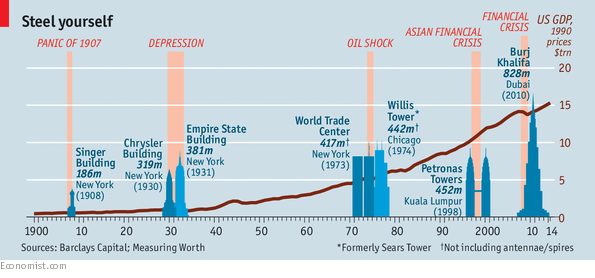
The world is in the middle of a skyscraper boom. Last year nearly 100 buildings over 200 metres tall were built—more than ever before. This year China’s business capital will welcome the Shanghai Tower, which will be the world’s second-tallest building. Saudi Arabia is building Kingdom Tower, which will be the world’s tallest (and twice the height of One World Trade Centre in New York, the tallest building in the Americas). Does this frenzy of building augur badly for the world economy? Various academics and pundits, many of them cited by The Economist, have long argued as much, but new research casts doubt on it.

In 1999 Andrew Lawrence, then of Dresdner Kleinwort Benson, an investment bank, identified what came to be known as the “skyscraper curse”.* Mr Lawrence noticed a curious correlation between the construction of the world’s tallest buildings and economic crises. The unveiling of the Singer Building and the Metropolitan Life Tower in New York, in 1908 and 1909 respectively, roughly coincided with the financial panic of 1907 and subsequent recession. The Empire State Building opened its doors in 1931, as the Great Depression was getting going (it was soon dubbed the “Empty State Building”). Malaysia’s Petronas Towers became the world’s tallest building in 1996, just before the Asian financial crisis. Dubai’s Burj Khalifa, currently the world’s tallest building, opened in 2010 in the middle of a local and global crash.

Skyscrapers can be hugely profitable, since by building upwards developers can rent out more floor space on a given plot of land. But at some point extra storeys are no longer a good deal, since marginal costs—for more lifts and extra steel to stop the building from swaying in the wind, for example—increase faster than marginal revenues (rents or sales). William Clark and John Kingston, an economist and an architect writing in 1930, found that the profit-maximising height for a skyscraper in midtown New York in the 1920s was no more than 63 storeys. (The ideal height is probably not much different today.) Record-breaking skyscrapers could therefore be seen as an indication that gung-ho investors are overestimating the probable future returns from new construction.

Indeed, developers may be building record-breaking towers even though they know they are economically inefficient. There is, after all, a certain cachet to having a very tall building with your name on it. In 1998 Donald Trump, a magnate, presented a plan to build the world’s tallest residential building in New York as the righting of a historical wrong, not a shrewd business move. “I’ve always thought that New York should have the tallest building in the world,” he proclaimed. If such vanity projects can secure funding, the theory goes, financial markets must be out of control and will soon suffer a sharp correction. Mr Trump’s tower opened just as the dotcom bubble was bursting.
Read more …

And London, New York etc. Real estate is a great way to launder cash.

• Global Crime Syndicates Are Buying Expensive Australia Real Estate (Domain)

Some of Australia’s most expensive real estate is being bought by global crime syndicates, one of the country’s top crime-fighting bodies says. So worried are they about the influx of dirty money that the Australian Crime Commission has launched an investigation looking at money laundering and terrorism financing through property. Concerns that criminals may be targeting real estate were raised within the commission about six months ago, according to an ACC spokeswoman. The Targeting Criminal Wealth Special Investigation is expected to run until June next year. “Taskforce investigations have uncovered information about organised crime entities investing in high-value commodities, such as real estate, to help launder illicit funds into the legitimate economy,” said ACC chief executive Chris Dawson, APM.

“The Australian real estate sector is perceived as stable and at low risk of significant depreciation in the short term, and potential for growth in the long term. It is likely that organised crime are exploiting these conditions to invest in the Australian real estate market to launder the proceeds of illicit activity including drug profits.” The ACC declined to specify countries of concern because the investigation is ongoing. Parliamentary secretary to the Treasurer Kelly O’Dwyer said the federal government was being forced to play catch-up on the issue because there had been no co-ordinated data matching scheme on property records to date. The recently announced data-matching scheme set to start from December 1 as part of the federal government’s crackdown on foreign investment would be a big help to agencies like the ACC in these investigations, Ms O’Dwyer said.

Read more …

Brilliant.

• Australian PM Adviser Exposes Cimate Change As Hoax, Shames All of Science (SBS)

Business Adviser Maurice Newman has been praised today for his stellar work uncovering that climate change was a hoax perpetrated by the United Nations and the vast majority of the entire scientific community from all around the world. Newman, who also managed to expose the New World Order as something that actually exists and isn’t just made up by conspiracy theorising weirdos, has been widely praised for his efforts in bringing down what is thought to be the most elaborate conspiracy of all time. “Of course he will be in consideration for the Nobel Prize,” said one science observer. “To completely humiliate the vast majority of the scientific community like this on such a huge issue is almost unprecedented.

“In years to come we’ll say Maurice Newman in the same breath as we say Albert Einstein and Isaac Newton. To think, thousands of scientists and millions upon millions of dollars of resources couldn’t uncover this conspiracy but one guy with no expertise managed to bring it all down on a lark.” The world’s scientists have reacted with abject shame at being found out after all this time. “I always knew we’d be found out,” said one scientist. “It’s only so long you can keep something like this up when you have to independently incorporate every person studying climate, sea levels, soil, and thousands of other aspects. The paper trail alone was incredibly obvious. Not to mention our connection with the United Nations meaning we had to have every nation on board with tricking Australia for some reason.


Read more …

Apr 012015


NPC Pennsylvania Avenue storefront view, Washington DC 1921

• Americans Just Aren’t Spending (CNN)
• The Glory Days of Private Equity Are Over (WSJ)
• Japan’s Newest Export: Deflation (Pesek)
• The Oil Price Slump Is Fuelling Financial Instability Globally (Satyajit Das)
• ‘A Lot More Easing’ Coming From China Central Bank (CNBC)
• Iceland Looks At Ending Boom And Bust With Radical Money Plan (AFP)
• Tsipras Vows To Stop Greek ‘Bleeding’ As Creditors Frustrate Athens (Telegraph)
• Merkel Faces Rebellion As Senior Official Resigns Over Greek Bail-Out (DT)
• Greek Prime Minister Vows No Capitulation To Creditors (Independent)
• Greece Fails To Reach Initial Deal On Reforms With Lenders (Reuters)
• Japanese Hoarding $300 Billion Under Mattresses (CNBC)
• ‘Wealth Creators’ Are Robbing Our Most Productive People (Monbiot)
• Is It Time For ‘Shadow Bank’ Stress Tests? (CNBC)
• The Way Out (Jim Kunstler)
• Ukraine Interior Ministry ‘Uncooperative And Obstructive’ In Maidan Probe (RT)
• License to Kill (Dmitry Orlov)

Deflation.

• Americans Just Aren’t Spending (CNN)

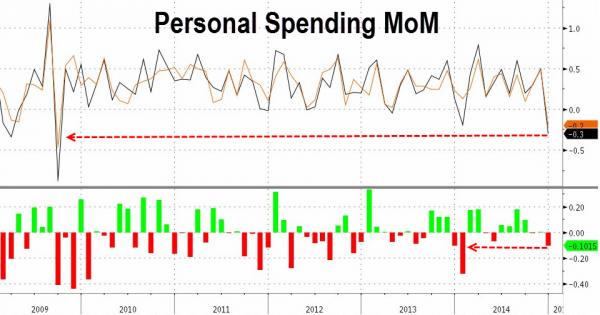
Consumer spending is often called an engine of the United States economy. That engine may be about to blow a gasket. Consumers are sitting on their wallets. The government reported Monday that personal consumption expenditures – aka consumer spending – rose just 0.1% in February. That follows two months of declines of 0.2%. It comes at a time when people actually do have a little bit more money to spend. In the same report, the government said disposable personal incomes rose 0.4% in February, after rising 0.5% in January and 0.3% in December. So what are consumers doing? Despite some headlines to the contrary, it appears that Americans are showing signs of fiscal responsibility. They are saving more. Mind you, they still may not be saving enough for things like retirement, a new house, or their kids’ college education.

But the savings rate rose to 5.8% in February – the highest level since late 2012. This is a bit of a surprise. Many economists were predicting that consumers would spend all that money they were saving from cheaper gas prices as if it were a tax refund check courtesy of OPEC. But oil prices may have now stabilized. As such, economists at Barclays wrote Monday that “the boost from energy prices is fading.” They suggested that the awful winter weather could be one reason for soft consumer spending in February. And Barclays is predicting that spending will rebound in the second quarter and the savings rate will fall. Still, sluggish consumer spending could mean that the economy will report very little in the way of growth for the first quarter — despite the continued strength of the labor market.

The economy has been adding jobs at an impressive clip for the past year. And the unemployment rate has fallen. But even though personal incomes are rising, wages have not risen that much to make consumers feel as if they are rolling in the dough. That’s because the personal income figure takes into account increases in other items such as interest and dividend payments on investments as well as Social Security, Medicare and other government safety net distributions. So wages have to pick up more dramatically, or consumers may not be willing to spend more. And that’s a proverbial Catch-22 for the economy. Saving more is great for the long-term. But spending is what’s needed to get the economy roaring again in the short run.

Read more …

No markets left.

• The Glory Days of Private Equity Are Over (WSJ)

Private equity is done. Stick a fork in it. With Kraft singles and Heinz ketchup as toppings, there are many signs that private equity has peaked as an asset class. Sure, private equity is pervasive, which is one of its problems. According to Dow Jones LP Source, 765 funds raised $266 billion in 2014, up 11.7% over 2013. Ever since David Swensen, the investment manager of the Yale University endowment, almost 30 years ago began successfully allocating outsize portions of the portfolio to “alternate” assets, especially private equity, the so-called Swensen model has been widely duplicated. Last week the Stanford endowment named Swensen-disciple Robert Wallace as CEO. There is a lot of capital chasing similar deals.

When it comes down to it, private equity is pretty simple. You buy a company, putting up some cash and borrowing the rest, sometimes from banks but often via exotic instruments that Wall Street is happy to sell. Then you manage the company for cash flow, making sure you can make interest payments with enough left over for fees and investor dividends. With enough cash flow, you either take the company public or sell it to someone else. And how do you generate cash flow? You can expand the company, but more likely you slash costs, close divisions, cut staff, curtail marketing, eliminate research and development and more. In other words, cutting to the bone.

The Swenson model has worked for the past three decades. But it’s a bull-market investment vehicle whose time is done. Here are the main reasons private equity has peaked—the first four are reasonably obvious, but the last one is the killer. First, interest rates are going up. As they say on “Game of Thrones,” winter is coming. The Federal Reserve will no longer be “patient” on raising rates. This year? Next year? It doesn’t matter. Rising interest rates mean private equity will see higher costs of capital, wreaking havoc on Excel spreadsheets justifying future returns. Second, banks are slowing lending for leveraged deals. Since 2013, regulators have been discouraging leverage above six times earnings before interest, taxes, depreciation and amortization, or Ebitda, a measure of cash flow. Leveraged loans are the lifeblood of private equity; limits are already crimping the ability to do deals.

Read more …

What’d I say?

• Japan’s Newest Export: Deflation (Pesek)

In 2006, seven years before he became Bank of Japan governor, a testy Haruhiko Kuroda told me he thought China was raising its own living standards at the expense of its Asian neighbors. “The relationship between exchange rates and poverty reduction is not so direct, but a more flexible Chinese exchange rate would benefit Asia,” Kuroda, who at the time was head of the Asian Development Bank, told me in his office overlooking the Manila skyline. “It would make a difference.” Today, those remarks demand to be read with a sense of irony. As Japan’s leading central banker for the past two years, Kuroda has relentlessly weakened the yen, which means he is now responsible for precisely the same regional dynamic he once lamented.

None of this is to suggest Kuroda is up to anything sinister. His mandate, after all, is to produce 2% inflation for Japan, and thus pull its $4.9 trillion economy out of a two-decade deflationary spiral. But it’s impossible to deny that the yen’s weak exchange rate is indirectly exporting deflation to the region. Taiwan’s export-dependent economy is feeling the strain, and Singapore might be next. But South Korea has been hit particularly hard. The country’s 4.7% plunge in industrial output in February is the latest sign that deflation is on its doorstep. The country’s consumer prices also rose by only 0.5% last month (the slowest pace since 1999), and its exports were down 3.4%.

Korean manufacturers have responded to the yen’s 20% drop in value by trying to keep the prices of their own products down. In practice, that’s meant executives with excess cash on their balance sheets have avoided making investments or giving workers a raise. The resulting wage suppression, however, is having negative consequences of its own, by hampering domestic consumption. (It doesn’t help that Korean households are sitting on record debt, equivalent to about 70% of GDP)

Read more …

“..Emerging markets have about 75% of their $2.6trn debt denominated in dollars. A similar proportion of their $3.1trn bank borrowings is dollar-denominated.”

• The Oil Price Slump Is Fuelling Financial Instability Globally (Satyajit Das)

Financial markets have generally assumed lower oil prices are good for asset prices, resulting from the positive effect on growth and lower inflation which extends the period of low interest rates. In reality, the large movement in oil prices has the potential to create significant financial instability, especially in debt markets. Heavily indebted energy companies and sovereign or near-sovereign borrowers with large oil exposures face increased risk of financial distress. The boom in borrowings by energy businesses, especially shale gas and oil producers, has created a dangerous debt overhang. Energy companies now make up around 15% of the Barclays US Corporate High-Yield Bond Index, up more than 300% from 2005. Since 2010, energy producers have raised $550bn of funds.

In 2014, more than 40% of new non-investment grade syndicated loans were to the oil and gas sector. During the boom, non-investment grade bond issues and loans for the oil industry were underpinned by high oil prices and the search for yield. Now low oil prices have reduced revenues sharply, making it difficult to service debt. The industry’s weak financial structure and business model compounds the problem. A significant proportion of the industry is highly levered with borrowings that are greater than three times gross operating profits. Many firms were cash flow negative even when prices were high, usually debt-funded to maintain production. If the firms have difficulty meeting existing commitments, then the decrease in available funding and higher costs will create a toxic negative spiral.

Sovereign and near-sovereign borrowers in oil-dependent countries are similarly vulnerable. Energy companies, such as Brazil’s Petrobras, Mexico’s Pemex and Russia’s Gazprom are among the largest issuers of emerging market debt. Since 2009, they borrowed about $140bn in bond markets. Petrobras has around $170bn in debt, one of the most indebted companies in the world. Many oil-dependent economies also face additional problems from a growing currency mismatch. Many producers borrow in dollars. Falling oil revenues as a result of lower prices reduce the dollar cash flow available to service the debt. Weak oil prices also drive weakness in the value of the domestic currency of oil producers, while higher dollar interest rates compound the mismatch.

Read more …

QE Peking Duck.

• ‘A Lot More Easing’ Coming From China Central Bank (CNBC)

China’s most recent effort to prop up its softening real estate market is not enough, analysts say, noting that a series of interest rate cuts from the central bank is the best remedy. “I’m virtually certain we’ll see further interest rate cuts and a lot more easing, probably bank reserve requirement ratio (RRR) cuts, in the coming months,” Macquarie’s Sam Le Cornu told CNBC. “I think people are underestimating the degree of liquidity that will be put into the market and the number of interest rate cuts.” Chinese homebuyers were given a break on Monday after authorities lowered the threshold of down payments on mortgages for second homes to 40% from 60% and waived the business tax on the resale of property after two years. The measures follow Beijing’s effort to spur the economy by cutting interest rates twice since November and lowering the reserve requirements of major banks.

But that isn’t enough for many investors who continue to call for further easing. “[China still needs] further across-board monetary policy easing,” Nomura’s China economics team said in a note on Monday. It expects “more policy easing, with three more interest rate cuts and three more reserve requirement ratio cuts over the remainder of 2015.” However, Nomura believes that Mondays’ move will “see the pace of property market correction stabilizing in the second half of the year.” Monday’s move comes amid growing concerns over slowing economic growth. China set its 2015 growth target “at around 7%” in early March – it’s lowest target in 11 years – after posting its slowest annual growth rate in 24 years in 2014. The housing sector accounts for around 15% of China’s economy, and recent housing data suggests that growth continues to slow.

Read more …

No moar.

• Iceland Looks At Ending Boom And Bust With Radical Money Plan (AFP)

Iceland’s government is considering a revolutionary monetary proposal – removing the power of commercial banks to create money and handing it to the central bank. The proposal, which would be a turnaround in the history of modern finance, was part of a report written by a lawmaker from the ruling centrist Progress Party, Frosti Sigurjonsson, entitled “A better monetary system for Iceland”. “The findings will be an important contribution to the upcoming discussion, here and elsewhere, on money creation and monetary policy,” Prime Minister Sigmundur David Gunnlaugsson said. The report, commissioned by the premier, is aimed at putting an end to a monetary system in place through a slew of financial crises, including the latest one in 2008.

According to a study by four central bankers, the country has had “over 20 instances of financial crises of different types” since 1875, with “six serious multiple financial crisis episodes occurring every 15 years on average”. Mr Sigurjonsson said the problem each time arose from ballooning credit during a strong economic cycle. He argued the central bank was unable to contain the credit boom, allowing inflation to rise and sparking exaggerated risk-taking and speculation, the threat of bank collapse and costly state interventions. In Iceland, as in other modern market economies, the central bank controls the creation of banknotes and coins but not the creation of all money, which occurs as soon as a commercial bank offers a line of credit. The central bank can only try to influence the money supply with its monetary policy tools.

Under the so-called Sovereign Money proposal, the country’s central bank would become the only creator of money. “Crucially, the power to create money is kept separate from the power to decide how that new money is used,” Mr Sigurjonsson wrote in the proposal. “As with the state budget, the parliament will debate the government’s proposal for allocation of new money,” he wrote. Banks would continue to manage accounts and payments, and would serve as intermediaries between savers and lenders. Mr Sigurjonsson, a businessman and economist, was one of the masterminds behind Iceland’s household debt relief programme launched in May 2014 and aimed at helping the many Icelanders whose finances were strangled by inflation-indexed mortgages signed before the 2008 financial crisis.

Read more …

My man.

• Tsipras Vows To Stop Greek ‘Bleeding’ As Creditors Frustrate Athens (Telegraph)

Greece’s prime minister has vowed not capitulate to the country’s eurozone creditors, reviving controversial calls for debt relief as his government battles to unlock bail-out cash. Addressing his parliament on Monday evening, Alexis Tsipras said he would seek an “honest compromise” with Greece’s international paymasters, but warned he would not submit “unconditionally” to demands for further austerity on his stricken economy. Mr Tsipras, who spoke after a frustrating day of progress between his government and officials from the Brussels Group, insisted he would stop “the Greek people’s bleeding” as he ruled out measures such as hiking VAT. The Leftist premier also repeated his claims for Second World War reparations from Germany, and insisted on debt relief from Greece’s lenders.

Greek pleas for a bond-swap or outright haircut on its debt mountain have subsided following a February 20 agreement to extend its bail-out by four months. But Mr Tsipras said he would now pursue a claim for debt forgiveness in order to maintain the sustainability of the country’s finances. Greece is racing to get the seal of approval on a bail-out extension, before financial deadlines in April, six weeks after its Leftist government agreed an eleventh hour deal with European creditors. Despite reports Athens would submit a final comprehensive list of proposals to finance ministers on Monday, work on completing the revenue-raising measures has yet to be completed, according to European officials. Speaking in Helsinki alongside her Finnish counterpart on Monday, German Chancellor Angela Merkel cautioned any final Greek blueprint had to “add up”.

“We will await the outcome of these discussions, but in the end the broad framework has to add up,” said Ms Merkel. Circulated drafts of the reforms included cutting early retirement, raising €350m from clamping town on VAT fraud, and €250m from stamping out oil, alcohol and tobacco smuggling. But the measures are likely to fall short of creditor demands. Dissatisfied eurozone officials warned the government would still need cut pensions and wages to receive the €7.2bn it needs to stay afloat. The government’s current public sector wage and pension bill amounts to €1.2bn a month, an outlay which Athens will struggle to meet in April without a fresh injection of cash. The fledgling Greek premier also faces a domestic battle to retain the support of Syriza’s Left Platform, who oppose measures such as a property tax and the continued privatisation of the country’s ports, airports and power grids.

Read more …

You tell ’em girl.

• Merkel Faces Rebellion As Senior Official Resigns Over Greek Bail-Out (DT)

Political tensions in Europe’s largest creditor nation were laid bare after a senior ally of Angela Merkel’s ruling party stepped down in protest at his government’s support for a Greek bail-out. Peter Gauweiler, deputy chairman of the Christian Social Union – the Bavarian sister party of the ruling CDU – said Greece was a “bankrupt state” and he could not serve as a member of parliament as long as his “dissenting vote against an extension of the current and completely ineffective program” was ignored. Mr Gauweiler, a fierce critic of financial support for the eurozone’s indebted countries, was appointed vice-chairman of the CSU in November 2013 in a move to appease the growing eurosceptic elements within his party.

“I have been publicly pressured to vote in the Bundestag for the exact opposite, on the grounds that I am a vice-president,” said Mr Gauweiler in a statement on his website. “This is incompatible with my interpretation of the duty of a legislator.” Leader of the CSU Horst Seehofer also came in for heavy criticism from Mr Gauweiler, who has lodged legal complaints with the German Constitutional Court against the ECB’s attempts to establish financial backstops and its purchases of government bonds. Mr Gauweiler was also one of the 28 members of Ms Merkel’s coalition to vote in opposition to Greece’s bail-out extension in February. The rapid rise of the Alternative for Germany party (AfD) who seek to force Greece out of the monetary union, has put pressure on Ms Merkel’s ruling coalition.

Her conservative Christian Democrat party suffered its worst election result since the Second World War last month, at the hands of the eurosceptics. The AfD have already made overtures towards Mr Gauweiler, extending an invitation for him to join their ranks on Tuesday. The new Greek government is currently appealing for debt relief and the unlocking of a fresh round of bail-out money as it seeks to avert bankruptcy. Speaking in Helskini on Monday, Ms Merkel warned Athens plans for reforming the economy must “add up”.

Read more …

“The European authorities want to show who is boss; This is a government they didn’t want. And they really don’t want this government to succeed.”

• Greek Prime Minister Vows No Capitulation To Creditors (Independent)

Germany turned the screws on Greece again yesterday, as officials insisted Athens has still not provided a satisfactory programme of economic reforms to its single currency partners. However, in a defiant speech, the anti-austerity Greek prime minister, Alexis Tsipras, warned that his government would not “capitulate” and would keep on pushing for a “fair compromise” with its creditors. Greece’s fellow eurozone member states, including Germany, must approve the release of the remaining €7.2bn in bailout funds the country is expecting. Without the cash, Greece could run of money to pay its civil servants by the end of next month and might be unable to meet a €450m loan repayment to the International Monetary Fund which is due on 9 April.

Greece has prepared a list of proposed economic reforms, but sources in Berlin said yesterday that it was not good enough to unlock the vital funding. “We need to wait for the Greek side to present us with a comprehensive list of reform measures which is suitable for discussion with the institutions and then later in the Eurogroup,” said Martin Jaeger, a spokesman for the German finance ministry. Chancellor Angela Merkel, on a visit to Helsinki, also implied Athens was still falling short. “The question is, can and will Greece fulfil the expectations that we all have?” she asked. According to Greek sources, Athens’s plan, which is projected to raise some €3.7bn this year, includes a crackdown on tax evasion through thorough audits of offshore bank transfers.

Other proposed revenue raisers are a value-added tax on the lottery, the auction of television broadcast licences and a smuggling crackdown. But, in an indication that Mr Tsipras intends to partly reverse the previous administration’s privatisation programme, the plan also targets only €1.5bn of revenues from state asset sales, down from €2.2bn in the previous budget. And in a speech to the Athens parliament last night, Mr Tsipras insisted, once again, that Greece’s large national debt needs to be restructured – anathema to Greece’s eurozone sovereign creditors. Mark Weisbrot of the Centre for Economic and Policy Research think-tank yesterday accused Brussels and Berlin of deliberately trying to undermine the Greek economy in order to force concessions from Athens. “The European authorities want to show who is boss,” he said. “This is a government they didn’t want. And they really don’t want this government to succeed.”

Read more …

Someone up there doesn’t like you.

• Greece Fails To Reach Initial Deal On Reforms With Lenders (Reuters)

Greece failed to reach an initial deal with the EU and the IMF to unlock aid after the creditors dismissed a package of reforms from Athens as ideas rather than a concrete plan, officials said on Tuesday. The lack of a deal further raises pressure on Athens, which faces the prospect of running out of money in a few weeks unless it can convince lenders to dole out more financial help. Athens put a brave face on the failure to reach an agreement with the “Brussels Group” of representatives from the EU and the IMF, saying it remained keen for a deal on the basis of its long-held demand that the measures it is asked to implement do not hurt economic growth. Lenders will intensify efforts to collect data in Athens, it said. One source close to the talks said the halt in negotiations was not a sign of a rupture but an indication of slow-moving progress in the discussions.

Mistrust and acrimony have characterized much of Greece’s talks with lenders since Prime Minister Alexis Tsipras stormed to power in January pledging to end austerity and a bailout program that has kept Greece afloat for over four years. Greece and its European partners have sought to show publicly that relations have improved in recent weeks after Tsipras held a series of talks with EU leaders, but both sides remain far apart on issues ranging from pension reform to debt relief. At issue now is a list of reforms that Greece presented to the Brussels Group representatives last week, in an effort to show lenders that it is committed to living up to pledges of financial discipline and is worthy of aid. But euro zone officials panned the list as inadequate. One EU official said the lenders had yet to receive the list they had been waiting for.

Read more …

They’re small ones too.

• Japanese Hoarding $300 Billion Under Mattresses (CNBC)

The Japanese are hoarding over $300 billion under their mattresses and that cash will likely stay there unless a crisis of epic proportions sparks capital flight, analyst say. “The money has been sitting there so long, it’s difficult to pin down what will prompt people to spend the cash,” Mizuho Securities’ chief market economist Yasunori Ueno told CNBC by phone. The notion came to public attention last year when Finance Minister Taro Aso scolded the Japanese for sitting on 880 trillion yen ($7.33 trillion) in cash, which was widely reported by the local press as being ‘kept under mattresses’. “It’s ridiculous – the money should be deposited at financial institutions so the banks can fund promising industries,” said Aso, according to a Sankei newspaper report.

But that figure was based on household cash deposits at Japanese banks, rather than hidden under mattresses, Ueno said. As per his calculations in a note dated March 25, households are probably hoarding around 36 trillion yen ($301 billion) of cash. “It’s like an iceberg – it just won’t melt,” said Dai-ichi Life Research Institute (DLRI) chief economist Hideo Kumano. “It will just sit there, immobile and frozen in time.” In many countries hoarding cash at home is synonymous with the underground economy, but the reasons in Japan are more mundane. “Under deflation, cash is king,” said DLRI’s Kumano, although he added that an unknown portion of the cash is probably just being hidden from the taxman.

At any rate, putting cash in the bank doesn’t mean it will earn any interest. Deposit accounts do not pay any interest in Japan. Even a ten-year savings account will only pay interest of between 0.10% and 0.150%, or one dollar on every 10,000 dollars in the bank, according to Mizuho Bank’s website. “Why bother going to the bank to deposit your money when it earns no interest? You may as well save yourself the effort of taking the trip down to the bank,” said Kumano.

Read more …

Up vs down.

• ‘Wealth Creators’ Are Robbing Our Most Productive People (Monbiot)

There is an inverse relationship between utility and reward. The most lucrative, prestigious jobs tend to cause the greatest harm. The most useful workers tend to be paid least and treated worst. I was reminded of this while listening last week to a care worker describing her job. Carole’s company gives her a rota of, er, three half-hour visits an hour. It takes no account of the time required to travel between jobs, and doesn’t pay her for it either, which means she makes less than the minimum wage. During the few minutes she spends with a client, she may have to get them out of bed, help them on the toilet, wash them, dress them, make breakfast and give them their medicines. If she ever gets a break, she told the BBC radio programme You and Yours, she spends it with her clients. For some, she is the only person they see all day.

Is there more difficult or worthwhile employment? Yet she is paid in criticism and insults as well as pennies. She is shouted at by family members for being late and not spending enough time with each client, then upbraided by the company because of the complaints it receives. Her profession is assailed in the media as the problems created by the corporate model are blamed on the workers. “I love going to people; I love helping them, but the constant criticism is depressing,” she says. “It’s like always being in the wrong.” Her experience is unexceptional. A report by the Resolution Foundation reveals that two-thirds of frontline care workers receive less than the living wage. Ten%, like Carole, are illegally paid less than the minimum wage. This abuse is not confined to the UK: in the US, 27% of care workers who make home visits are paid less than the legal minimum.

Let’s imagine the lives of those who own or run the company. We have to imagine it because, for good reasons, neither the care worker’s real name nor the company she works for were revealed. The more costs and corners they cut, the more profitable their business will be. In other words, the less they care, the better they will do. The perfect chief executive, from the point of view of shareholders, is a fully fledged sociopath. Such people will soon become very rich. They will be praised by the government as wealth creators. If they donate enough money to party funds, they have a high chance of becoming peers of the realm. Gushing profiles in the press will commend their entrepreneurial chutzpah and flair.

Read more …

“..the sector is viewed as likely to be larger than the supervised banking industry..”

• Is It Time For ‘Shadow Bank’ Stress Tests? (CNBC)

A leading member of Germany’s Bundesbank has backed U.S. calls for “shadow banking”, the unregulated sector that provides credit on a global scale, to be subject to stress-testing. “Stress testing, as has been suggested, may be a good idea,” Andreas Dombret, a member of the Bundesbank’s executive board responsible for banking supervision, told CNBC on Tuesday. “But if we were to go by this route, it should be directed to the link between the shadow banking sector and the banks. So it is not about introducing regulation, if there is no systemic link between this sector and the banks. That is what we really have to care about.”

Dombret was commenting after Fed Vice Chairman Stanley Fischer suggested tougher rules for shadow banking on Monday, as well as stress tests to assess the risk the sector could pose to global finance in the event of a slump. Shadow banking is huge on a global scale, handled $75 trillion in funds in 2013, up $5 trillion on the start of the year, according to the Financial Stability Board. In some countries, such as the U.S., the sector is viewed as likely to be larger than the supervised banking industry. Stress tests for conventional banking activities were adopted by the U.S. and Europe after the 2007-08 financial crisis to gauge big banks’ ability to manage risk and plan for a potential economic shock.

On Tuesday, Dombret, who has worked for major international banks like Deutsche and JPMorgan, said there might be a need to regulate shadowing banking, if it proved to be a “systemic risk” to the financial sector. “We need to monitor very closely what is happening in this sector, and the relationship between these so-called shadow banks—I would rather call them ‘non-bank’ banks—and the banking sector, and should there be a systemic risk, and should there be a close link, we may even have to go beyond monitoring and we have to go towards may be also regulation.”

Read more …

“I don’t think we’ll go there via rational political discourse..”

• The Way Out (Jim Kunstler)

The truth is, when you rig a money system with price interventions, distortions, and perversions, they will eventually express themselves in ways destructive to the system. In the present case of world-wide QE and central bank monkey business, these rackets are expressing themselves, finally, in wobbling currencies. In many nations, people are deeply unsure of what their money is worth, and how much it might be worth a month from now. This includes the USA, except for the moment our money is said to be magically appreciating in value compared to everyone else’s. Aren’t we special?

Get this: nothing is more hazardous than undermining people’s trust in their money. All of this financial perfidy conceals the basic fact that the human race has reached the limits of techno-industrialism. There are too many people and not enough basic resources to grow more of them — oil, fishes, soil, ores, fertilizers — and there is no steady-state “solution” to keep that economy going. In other words, it must either grow or contract, and it can’t really grow anymore (despite the exertions of government statisticians), so the authorities are trying to provide a monetary illusion of growth, when instead we’re in contraction.

Yes, contraction. The way out is to get with the program, shed the dead-weight and go where reality wants to take you. In the USA that means do everything possible to quit supporting giant failing systems — Big Box shopping, mass motoring, GMO agribiz, TBTF banks — and get behind local Main Street integrated economies, walkable towns, regular railroads, smaller and more numerous farms, local medical clinic health care, artistry in public works, and community caretaking of the unfit. All this surely implies a reduced role for the national government, and maybe the states, too. You could call it a lower standard of living, or just a different way to live.

I don’t think we’ll go there via rational political discourse. The current instabilities around the world are so sinister that they are liable to lead to even more strenuous efforts at the top to pretend that everything’s working, and even war is one way to pretend you’re okay (and the “other guy” isn’t). Of course, war has already broken out, in the MidEast and Ukraine, and it has everything to do with the sequential failure of nations, in one way or another, to overcome the limits of techno-industrialism. America will be dragged kicking and screaming to the realization of what it needs to do. The 2016 election will be the convulsion point.

Read more …

And for good reasons too.

• Ukraine Interior Ministry ‘Uncooperative And Obstructive’ In Maidan Probe (RT)

The investigation into Maidan violence during Ukraine’s coup didn’t satisfy the requirements of the European Convention on Human Rights, says a report from the European Council, adding that Ukraine’s Interior Ministry was “uncooperative and obstructive.” The report specifically concentrated on the investigation of violent acts during the three months of Maidan demonstrations: Violent dispersal of the protest by Berkut riot police on November 30, 2013, clashes on January 22, 2014, which resulted in the first deaths of protesters, and February 18-21, 2014, the deadliest days of the Kiev protests. Before the February 2014 coup, “there was no genuine attempt to pursue investigations,” said a document by the International Advisory Panel.

The panel was established by the Council of Europe to review investigations into the violent incidents during the Maidan demonstrations. “The lack of genuine investigations during the three months of the demonstrations inevitably meant that the investigations did not begin promptly and this constituted, of itself, a substantial challenge for the investigations, which took place thereafter and on which the Panel’s review has principally focused,” the report stated. The panel added that “the appointment post-Maidan of certain officials to senior positions in the MoI [Ukraine Interior Ministry] contributed to the lack of appearance of independence.” It also “served to undermine public confidence in the readiness of the MoI to investigate the crimes committed during Maidan.”

The EU experts call the number of investigations performed by the Prosecutor General’s Office (PGO) on Maidan violence “wholly inadequate.” “The Panel did not consider the allocation of investigative work between the PGO, on the one hand, and the Kyiv [Kiev] City Prosecutor’s Office and the MoI, on the other, to be coherent or efficient,” says the report. “Nor did the Panel find the PGO’s supervision of the investigative work of the Kyiv [Kiev] City Prosecutor’s Office to have been effective.” Cooperation by Ukraine’s Interior Ministry “was crucial to the effectiveness of the PGO investigations,” according to the document.

“There are strong grounds to believe that the MoI attitude to the PGO has been uncooperative and, in certain respects, obstructive,” says the report, adding that the “Prosecutor General’s Office didn’t take all the necessary steps to ensure effective co-operation” by the Interior Ministry in the investigations. They also found there were facts of “the grant of amnesties or pardons to law enforcement officers in relation to unlawful killings or acts of ill-treatment” of protesters during the Maidan protests. This “would be incompatible with Ukraine’s obligations under Articles 2 and 3 of the Convention,” said the document. “The serious investigative deficiencies identified in this Report have undermined the authorities’ ability to establish the circumstances of the Maidan-related crimes and to identify those responsible.”

Read more …

” ..non-symbolic non-gestures of a preventive nature are sure to follow..”

• License to Kill (Dmitry Orlov)

With the strategy of destroying in order to create no longer viable, but with the blind ambition to still try to prevail everywhere in the world somehow still part of the political culture, all that remains is murder. The main tool of foreign policy becomes political assassination: be it Saddam Hussein, or Muammar Qaddafi, or Slobodan Milosevic, or Osama bin Laden, or any number of lesser targets, the idea is to simply kill them.

While aiming for the head of an organization is a favorite technique, the general populace gets is share of murder too. How many funerals and wedding parties have been taken out by drone strikes? I don’t know that anyone in the US really knows, but I am sure that those whose relatives were killed do remember, and will remember for the next few centuries at least. This tactic is generally not conducive to creating a durable peace, but it is a good tactic for perpetuating and escalating conflict. But that’s now an acceptable goal, because it creates the rationale for increased military spending, making it possible to breed more chaos.

Recently a retired US general went on television to declare that what’s needed to turn around the situation in the Ukraine is to simply start killing Russians. The Russians listened to that, marveled at his idiocy, and then went ahead and opened a criminal case against him. Now this general will be unable to travel to an ever-increasing number of countries around the world for fear of getting arrested and deported to Russia to stand trial.

This is largely a symbolic gesture, but non-symbolic non-gestures of a preventive nature are sure to follow. You see, my fellow space travelers, murder happens to be illegal. In most jurisdictions, inciting others to murder also happens to be illegal. Americans have granted themselves the license to kill without checking to see whether perhaps they might be exceeding their authority. We should expect, then, that as their power trickles away, their license to kill will be revoked, and they find themselves reclassified from global hegemons to mere murderers.

Read more …

Mar 312015
 
 March 31, 2015  Posted by at 9:57 am Finance Tagged with: , , , , , , , , , , ,  5 Responses »


Dorothea Lange Butter bean vines across the porch, Negro quarter, Memphis, Tennessee 1938

• The US Economy Is Showing Cracks (CNN)
• Greek Construction Sector Crumbles By 80% In Just Five Years (Kathimerini)
• Bernanke: I Didn’t Throw Seniors Under The Bus (MarketWatch)
• The Fed’s Startling Numbers on Student Debt (Simon Black)
• The Fed’s ‘Repression’ Has Cost Savers $470 Billion (MarketWatch)
• Low US Consumer Spending Points To Slow First Quarter (MarketWatch)
• Jumping On Junk: Investors Crazy For High Yield (CNBC)
• 19 Economists Call On The ECB To Make ‘QE For The People’ (BasicIncome.org)
• Foreign Investors Are Cashing Out of China (Bloomberg)
• Bank Of England Stress Tests To Include Feared Global Crash (Guardian)
• Germany Says Greece Must Flesh Out Reforms To Unlock Aid (Reuters)
• Yanis Varoufakis Calls For End To ‘Toxic Blame Game’ (BBC)
• Greek Plans To Unlock Aid ‘Lack Technocratic Input’ (Bloomberg)
• Tsipras Presses Allies for Support as Greek Cash Crunch Deepens (Bloomberg)
• Repeal, Don’t Reform the IMF! (Ron Paul)
• Americans See Putin As Only Slightly More Imminent Threat Than Obama (Reuters)
• Fracking’s New Legal Threat: Earthquake Suits (WSJ)
• Iran Deal Unlikely Before March 31 as Russia Leaves Talks (Bloomberg)
• Sierra Leone Ebola Lockdown Exposes Hundreds Of Suspected Cases (Reuters)

Many. But we knew that. CNN, though? Really?: “The consumer really hasn’t kicked in at full speed ahead..”

• The US Economy Is Showing Cracks (CNN)

The U.S. job market had its best year of gains last year since 1999, and economic activity hit a whopping 5% in the third quarter – the best quarter since 2003. Three months later, the U.S. economy is looking a little tired. It’s losing momentum in puzzling ways. Hiring is still strong, but experts are starting to scale back their growth forecasts. Federal Reserve chair Janet Yellen summed it up well in a speech Friday: “If underlying conditions had truly returned to normal, the economy should be booming.” Economists say there are two main problems: Workers’ wages aren’t growing much, if at all. As a result, Americans aren’t going out and spending much. On top of that, many foreign economies are slowing down, which puts pressure on the U.S. The question going forward is whether we’re just in a blip or a bigger shift is taking place.

“The consumer really hasn’t kicked in at full speed ahead,” says Peter Cardillo, chief market economist at Rockwell Global Capital. “We’re going through a soft patch.” With March’s jobs report out on Friday, this economic head-scratcher will be in full focus this week. The U.S. added over half a millions jobs in the first two months of this year alone. That’s a 50% increase from the same two-month stretch a year ago when the Polar Vortex had much of America in a funk. Job gains have come across the board: health care, construction, the service sector and retail businesses have all seen strong pick up. The unemployment rate is down to 5.5%, its lowest mark in seven years. It would be a full-steam story on jobs except for one thing: wage growth. Hourly wages only grew 2% in February. That’s a marginal bump up, but it’s too little for most Americans to notice the recovery’s progress. It’s also well below the Federal Reserve’s roughly 3.5% goal. [..]

People don’t go out and spend unless they feel confident about the future. There was hope that cheap gas would spur people to feel better about the economy and their pocketbooks. A gallon of gas was $3.53 a year ago. Now it’s $2.42, according to AAA. But a lot of people are still holding onto that savings. Retail sales and construction on new homes both fell in February, missing estimates. The latest numbers on manufacturing are also weaker than hoped for. All this could just be a winter slowdown, but it’s raising red flags. “Most of it was due to the inclement weather we had…I think that kept a lot of shoppers at home,” says Bernard Baumohl at the Economic Outlook Group.

Read more …

That’s one big number.

• Greek Construction Crumbles By 80% In Just Five Years (Kathimerini)

Construction in Greece has suffered one of the biggest declines to have been recorded by any professional sector within just a few years, as business activity in the domain has dropped as much as 80% since 2008, a study by the Foundation for Economic and Industrial Research (IOBE) showed on Monday. It added that more than a third of the economic contraction recorded from 2008 to 2013 in Greece is associated with the drop in investment in construction. Employment in the sector more than halved within five years, from 589,000 people in 2008 to 287,000 in 2013, the study revealed.

Read more …

The stupidest thing in a long while: “There is “absolutely nothing artificial” about setting the Fed rate at the equilibrium rate.”

• Bernanke: I Didn’t Throw Seniors Under The Bus (MarketWatch)

Former Fed Chairman Ben Bernanke unveiled a new blog on Monday and used his first post to defend his record from criticism that he kept rates artificially low and hurt savers. Bernanke said he was worried that his post was “very textbook-y” and with some reason. His blog is built around the concept of an “equilibrium real interest rate” which is the ideal level of rates minus inflation that would allow the economy to use all of its labor and capital resources. Fed Chair Janet Yellen discussed this concept in her policy speech last week. Underneath all the wonkiness in the post is a real passion to convince people that Bernanke was not “throwing seniors under the bus” as at least one of his legislative critics alleged.

During and after the financial crisis, Bernanke said, the equilibrium rate was low and even negative. If the U.S. central bank had pushed rates up to help savers, it would have likely led to an economic slowdown, Bernanke said. The best policy for the Fed is to set rates at the equilibrium rate, he added. So critics who argue that the he kept interest rates “artificially low” are also confused, Bernanke said. There is “absolutely nothing artificial” about setting the Fed rate at the equilibrium rate, he said.

Read more …

“Only 37% of total students loan balances are currently in repayment and not delinquent.”

• The Fed’s Startling Numbers on Student Debt (Simon Black)

What I’m about to tell you is not my own opinion or even analysis. It’s original data that comes from the United States Federal Reserve and national credit bureaus.
• 40 million Americans are now in debt because of their university education, and on average borrowers have four loans with a total balance of $29,000.
• According to the Fed, “Student loans have the highest delinquency rate of any form of household credit, having surpassed credit cards in 2012.”
• Since 2010, student debt has been the second largest category of personal debt, just after a home mortgage.
• The delinquency rate for student loans is now hovering near an all-time high since they started collecting data 12 years ago.
• Only 37% of total students loan balances are currently in repayment and not delinquent.

The rest—nearly 2 out of 3—are either behind on payments, in all-out default, or have entered some sort of deferral program to delay making payments, with a small percentage still in school. It’s pretty obvious that this is a giant, unsustainable bubble (more on this below). But even more important are the personal implications. University graduates now matriculate with tens of thousands of dollars worth of debt. Debt is another form of servitude. Like medieval serfs, debt keeps people tied to jobs they dislike in places they don’t want to be working for bosses they hate doing things that make them feel unfulfilled. Debt makes it very difficult to walk away and start fresh. In fact, ‘starting fresh’ is almost legally impossible when it comes to student debt. Even in US bankruptcy court, student debt cannot be discharged in almost all cases.

It is an albatross that hangs over you for a decade or more if you do make the payments, and it follows you around for the rest of your life if you do not. (I’m not suggesting anyone default on what they owed—simply pointing out that nearly every other form of debt can be discharged EXCEPT for student debt.) This kind of debt has a huge impact on people’s lives. Again, according to the Federal Reserve, “[G]rowing student debt has contributed to the recent decline in the homeownership rate and to the sharp increase in parental co-residence among millennials.” So the Fed’s own analysis shows that student debt is a cause for people in their 20s and 30s to live at home with their parents. Amazing.

Read more …

How to destroy an economy in five easy lessons.

• The Fed’s ‘Repression’ Has Cost Savers $470 Billion (MarketWatch)

Artificially low interest rates have cost U.S. savers $470 billion, according to a report released Thursday. The report, from reinsurer Swiss Re, argues against current high levels of so-called financial repression. Swiss Re came up with the $470 billion number by looking at rates from 2008 to 2013. The insurer argues that if the Fed had followed a policy based on the Taylor Rule — a mechanistic way of determining interest rates that some congressional Republicans advocate — the Fed funds target would have been 1.7%age points higher on average. That in turn would have boosted interest income by an average of $14,000 for the wealthiest 1%, and $160 for the bottom 90%. The report concedes that there are obvious beneficiaries of lower rates too, through lower mortgage rates, higher house prices and a rising stock market.

The boost to household wealth from house prices was an estimated $1 trillion and from the stock market was an estimated $9 trillion — dwarfing, then, the $470 billion hit on savings. The report points out, however, that since the rich are more likely to own stocks, and have pricier homes, this has aggravated inequality. Moreover, the report says it’s questionable whether there’s been a boost on actual consumption, since neither equity nor real estate gains are immediately translatable into cash. “As a result, the increase in financial and housing wealth has – at best – only marginally benefited the real economy,” the report says.

Swiss Re also has a natural, vested interest in higher interest rates. The report says U.S. and European insurers have lost around $400 billion in yield income due to financial repression. The financial repression index, shown in the chart above, is based on real government bond yields, the difference between actual yields and fair value, central bank asset purchases, the difference in policy rate vs. the Taylor rule, regulatory risk, asset encumbrance, the available of high-quality liquid assets and domestic debts holdings and capital flow. Most of the components represent an average for both the European Union and the U.S.

Read more …

It’s called deflation.

• Low US Consumer Spending Points To Slow First Quarter (MarketWatch)

Forget about a strong start for the U.S. economy in 2015: Consumer spending barely rose in February after a decline in January, pointing to much slower growth in the first quarter. Consumer spending rose a scant 0.1% last month, the Commerce Department said Monday. Economists polled by MarketWatch were looking for a seasonally adjusted 0.3% gain. The small increase in spending in February and outright decline in January suggest the economy failed in early 2015 to match the pace of growth at the end of last year. Gross domestic product is forecast to expand just 1.4% in the first quarter, down from 2.2% in the fourth quarter and 5% in the third quarter. Harsh winter weather that kept people indoors and steered them away from car dealers and other retailers likely contributed to small gain in spending in February. Lower gasoline prices also were a factor in keeping spending down January and December.

Yet with the weather turning warmer and companies hiring at the fastest pace in 15 years, most economists predict the economy will accelerate in the spring. More American working will boost consumer spending, they say. A similar pattern played itself out in 2014. GDP shrank 2.1% in the first quarter but bounced back with an increase of 4.6% in the second quarter. What could also help this year are the first hints that wages are starting to rise, at least for some workers whose skills are in short supply. Personal incomes in February rose a solid 0.4% for the fourth time in five months. “Households are still flush with the money saved from the big drop-off in gasoline prices and, with the labor market still on fire, incomes should continue to increase at a solid pace,” said Paul Ashworth, chief U.S. economist at Capital Economics. “That provides the scope for a big gain in consumption in the second quarter.”

Read more …

Everybody’s vulnerable to swings.

• Jumping On Junk: Investors Crazy For High Yield (CNBC)

The supply of U.S. companies with junk-rated debt is rising just as investor demand for higher yields is climbing. Moody’s reports a two-year high in company debt rated B3 negative or worse—a.k.a. junk—as part of a trend that has seen the list of 184 companies grow by 26% over the period. The rise has been led by oil and gas firms, which accounted for 12 of the 28 additions to the junk list in February. What’s more, the roster would be even longer but for companies falling off the list due to reasons including filing for bankruptcy. Of the 18 issuers no longer rated, 39% filed either for bankruptcy protection or “distressed exchange, and 33% withdrew, with just 28% getting off the list due to upgrades.” “This is a reversal from the previous two quarters, when most companies left the list via ratings upgrades,” Moody’s said.

“If this reversal continues, it could signal tough times ahead for speculative-grade issuers.” Not so far, though. Fueled by low default rates and generally favorable credit conditions, investors in 2015 have been pouring money into funds that invest in high-yield debt. In fact, the previous six weeks before the most recent week had the highest level of flows to junk funds since the financial crisis in 2008 and 2009, according to Morningstar. Flows to junk-focused funds have taken in a net $12.2 billion so far in 2015 as part of a broader interest in fixed income amid a turbulent stock market, Bank of America Merrill Lynch reported. In addition to the big cash attraction to junk, high-grade bond funds have seen net inflows of $36.4 billion.

Read more …

Steve’s own debt jubilee is still a great idea. But it goes against every banker and politician’s desire.

• 19 Economists Call On The ECB To Make ‘QE For The People’ (BasicIncome.org)

A letter published [Mar 26] in the Financial Times signed by 19 economists calls on the European Central Bank to adopt an alternative quantitative easing policy. The letter includes a call to distribute cash directly to citizens of the eurozone. As a response to the ECB plan to inject €60 bn a month for the next 18 months into the financial system, 19 economists have signed a letter to the Financial Times calling on the ECB to adopt a different approach which they consider a more efficient way to boost the eurozone economy. “The evidence suggests that conventional QE is an unreliable tool for boosting GDP or employment. Bank of England research shows that it benefits the well-off, who gain from increasing asset prices, much more than the poorest,” the letter reads. The signatories offer an alternative:

Rather than being injected into the financial markets, the new money created by eurozone central banks could be used to finance government spending (such as investing in much needed infrastructure projects); alternatively each eurozone citizen could be given €175 per month, for 19 months, which they could use to pay down existing debts or spend as they please. By directly boosting spending and employment, either approach would be far more effective than the ECB’s plans for conventional QE.

The idea of having central banks to distribute cash to citizens has often been called “quantitative easing for the people” – a term coined by Steve Keen, an Australian economist. Prof. Steve Keen signed the letter, along with 18 other economists, including several advocates for basic income such as BIEN’s cofounder Guy Standing, David Graeber, Frances Coppola and Lord Robert Skidelsky. Guy Standing recently wrote an article outlining a proposal for having the ECB to finance basic income pilot studies in Europe:

“Monthly payments could be provided to every man, woman and child in, say, four areas on a pilot basis, with the sole condition that they would only continue to receive them if they were residing in those areas. People would still be free to move. However, it would help them to be able to stay. Such payments could be made for a period of 12 or 24 months.”

Read more …

First the bust of the housing bubble, now the stock bubble bursts. What’s next for China’s savings?

• Foreign Investors Are Cashing Out of China (Bloomberg)

International investors are cashing out of China’s world-beating equity rally Foreigners sold a net 1.7 billion yuan ($274 million) of Chinese shares via the Shanghai-Hong Kong exchange link in the week through Monday, while outflows from the two biggest Hong Kong exchange-traded funds tracking mainland shares totaled $622 million. Money flowed out of the link again on Tuesday as the Shanghai Composite Index touched a seven-year high on government plans to bolster the housing market. Global investors are losing faith in the rally even as mainland traders open stock accounts at the fastest pace on record and authorities endorse gains in equities that have doubled China’s market value over the past year to a record $6.5 trillion.

While locals are focused on the prospects for further stimulus, UBS says foreigners are concerned it hasn’t done enough to revive growth after a gauge of manufacturing contracted in March and measures of industrial output and investment trailed estimates in the first two months of 2015. “The A-share market is in a bubble stage,” said Wenjie Lu, a strategist at UBS in Shanghai. “It makes sense for foreign investors to take profits.”

Read more …

The BoE’s already preparing for the BIG China bust.

• Bank Of England Stress Tests To Include Feared Global Crash (Guardian)

The Bank of England is to impose a series of tests on large UK banks to establish whether they are able to withstand a dramatic slowdown in China, a contraction in the eurozone, the worst deflation since the 1930s or a fall in UK interest rates to zero. The Co-operative bank – which failed last year’s tests – is no longer included in the annual assessments of the industry’s financial strength as it is too small, leaving six banks and the Nationwide building society to be tested. The banks are Barclays, HSBC, Santander UK, Standard Chartered and the two bailed-out banks, Lloyds Banking Group and Royal Bank of Scotland. The Bank will give more weight to international scenarios, devised after talks with the IMF, than it did in the 2014 tests, which had a domestic emphasis.

Last year’s tests were designed to meet those imposed by the European Banking Authority, which is not conducting tests this year. The City is expecting this year’s tests to focus on the strength of HSBC and Standard Chartered, although a scenario for the UK is included, under which inflation is negative for seven consecutive quarters – the largest fall in prices for 80 years – and the bank rate cut to zero from the 0.5% level at which it has been stuck since the banking crisis. Banks are being asked to test their ability to withstand shocks over a five-year period to the end of 2019 and be expected to maintain a minimum amount of capital and meet a leverage ratio – a tougher measure of financial strength – while ensuring lending to the real economy grows 10% over the five-year period.

Mark Carney, governor of the Bank, said last year’s results showed the UK banking system was stronger than it had been before the 2008 crisis. “This year’s test will have a different focus and is equally important. By assessing the resilience of the UK banking system against a major shock, we will improve further our ability to identify vulnerabilities and we will ensure that banks have plans in place to address a wider range of problems,” Carney said. The severity of the test’s imagined downturn in China – with growth falling to about 1.6% growth – is likened to the scale of the fall in house prices in the UK used last year, when house prices were assumed to collapse by 35%. Chinese economic growth is about 7%.

Read more …

“..audits of bank transfers abroad, TV license and e-gaming tenders, a value-added-tax lottery scheme, a crackdown on smuggling and the settlement of arrears owed to the state.”

• Germany Says Greece Must Flesh Out Reforms To Unlock Aid (Reuters)

– Greece’s biggest creditor Germany said on Monday that the euro zone would give Athens no further financial aid until it has a more detailed list of reforms and some are enacted into law, adding to scepticism over plans presented last week. A senior official in Brussels on Sunday had dismissed the list as “ideas” rather than a plan that Greece could submit to EU and IMF lenders to avoid running out of cash next month. Euro zone states are still waiting for Greece to send a more comprehensive list, a German finance ministry spokesman said. Chancellor Angela Merkel said Athens had a certain degree of flexibility on which reforms to implement but that they must “add up” to the satisfaction of European partners. “The question is can and will Greece fulfill the expectations that we all have,” she said during a visit to Helsinki.

“There can be variation as far as which measures a government opts for but in the end the overall framework must add up.” There was no immediate reaction from Athens on whether the list would be amended further. Lenders have said it could take several more days before a proper list was ready. Greek and other euro zone officials from the Euro Working Group are due to discuss the reforms on April 1. A Greek finance ministry official said the list included a lowered target of €1.5 billion in proceeds from asset sales this year and a proposal to set up a bad bank with bailout funds returned to the euro zone in February. Among the slated asset sales is a stake in the country’s biggest port, Piraeus, in which China has expressed interest. The list also estimates Greece can raise €3.7 billion this year through audits of bank transfers abroad, TV license and e-gaming tenders, a value-added-tax lottery scheme, a crackdown on smuggling and the settlement of arrears owed to the state.

Read more …

“..but no “recessionary measures” such as wage and pension cuts.”

• Yanis Varoufakis Calls For End To ‘Toxic Blame Game’ (BBC)

Greek finance minister Yanis Varoufakis has called for an end to the “toxic blame game” between Greece and Germany. He made the call as Greece prepares to finalise its list of economic reforms to present to its international creditors. The reforms are needed to unlock a new tranche of bailout cash for Greece, which could run out of money in weeks. Mr Varoufakis said that finger-pointing between Germany and Greece would only aid Europe’s enemies. Athens and Berlin have been engaged in a bitter war of words as the Greek government seeks to renegotiate the terms of its bailout. German finance minister Wolfgang Schaeuble has publicly expressed his anger, claiming last week that Greece “has destroyed all trust”. He also acknowledged that Greece could “accidentally leave the eurozone”.

Writing in the German business newspaper Handelsblatt, Mr Varoufakis said that tensions between the two countries “must stop”, adding: “Only then can Greece, with support of its partners, focus on implementing effective reforms and growth-orientated policy strategies.” Greece submitted preliminary plans to the EU, IMF and the ECB on Friday night that it says will raise some €3bn in state revenues. They include measures to combat tax evasion, more privatisations and higher taxes on alcohol and cigarettes, but no “recessionary measures” such as wage and pension cuts. However, the reforms as initially proposed do not appear to have been specific enough to win the approval of the lenders, formerly known as the “troika”.

Read more …

That definition says it all, doesn’t it?!

• Greek Plans To Unlock Aid ‘Lack Technocratic Input’ (Bloomberg)

Greece’s proposed plans to bolster its finances in exchange for unlocking bailout funds still need lots of work, three European officials said. The 15-page draft, which was discussed Sunday in Brussels, requires more information and details and was a long way from serving as the basis of a deal, said one of the aides, who asked not to be named because the talks were private. Seeking a strategy that passes muster with European officials now withholding loans as the country’s cash crunch deepens, Greece’s government foresees a net increase of €3.7 billion in receipts this year. The biggest chunk would be as much as €875 million from the “intensification of audits on lists of bank transfers and offshore entities,” according to the draft.

“The implication from early on has been that the Greek side doesn’t have enough flesh on bones of some of the new proposals,” said Michael Michaelides at RBS. “The surprising thing about even current proposals given leaks is the seeming lack of technocratic input, which would have helped the Greek case.” Prime Minister Alexis Tsipras was elected Jan. 25 on a platform of easing budget cuts and restructuring debt. While he backed away from those positions to win a Feb. 20 agreement to extend the nation’s bailout until the end of June, his diplomatic maneuvering and the delays in providing a detailed economic plan are frustrating the rest of the currency bloc. They have also roiled financial markets and spurred Greeks to pull their savings from banks, derailing the economic recovery.

Read more …

Eh, yes, you can: “When the deputy prime minister is in China and making certain statements, you can’t contradict it here before he’s even returned to Greece.”

• Tsipras Presses Allies for Support as Greek Cash Crunch Deepens (Bloomberg)

Greek Prime Minister Alexis Tsipras, facing euro-area demands for a credible economic plan, is fending off allies at home who are spoiling for a fight. With the 40-year-old premier due to address parliament in Athens Monday evening amid a deepening cash crunch, a pair of his ministers warned against retreating from election promises to end austerity. Underscoring the cacophony, the energy minister contradicted Tsipiras’s deputy on the sale of the country’s biggest port to China. “This speaking with two tongues has an expiration date,” said Aristidis Hatzis, associate professor of law and economics at the University of Athens. “When the deputy prime minister is in China and making certain statements, you can’t contradict it here before he’s even returned to Greece.” [..]

Greece has red lines and won’t agree to any “recessionary measures” such as cutting wages or pensions or allowing mass dismissals, Tsipras told Real News newspaper in an interview published Sunday. The only way for Greece to end its crisis is through confrontation, if not conflict, with a “Germanized Europe,” Energy Minister Panagiotis Lafazanis said in an interview with the Athens-based Kefalaio newspaper. Privatizations, especially in strategic areas, “can’t and won’t happen,” he said. [..] Adding to the confusion, Euclid Tsakalotos, international economic-affairs minister, said Greece won’t abandon its anti-austerity philosophy in return for aid. He spoke in the U.K.’s Guardian newspaper as talks were taking place in Brussels over the reform measures. Greece wants a deal but will go its own way “in the event of a bad scenario,” he said.

Read more …

I’m with Ron on this. As I said before, all supra-national organizations should be folded, because they will all over time drift towards attracting sociopaths attracted by the lack of transparency and democracy inherent in them.

• Repeal, Don’t Reform the IMF! (Ron Paul)

A responsible financial institution would not extend a new loan of between $17 and $40 billion to a borrower already struggling to pay back an existing multi-billion dollar loan. Yet that is just what the International Monetary Fund (IMF) did last month when it extended a new loan to the government of Ukraine. This new loan may not make much economic sense, but propping up the existing Ukrainian government serves the foreign policy agenda of the US government. Since the IMF receives most of its funding from the United States, it is hardly surprising that it would tailor its actions to advance the US government’s foreign policy goals.

The IMF also has a history of using the funds provided to it by the American taxpayer to prop up dictatorial regimes and support unsound economic policies. Some may claim the IMF does promote free markets by requiring that countries receiving IMF loans implement some positive economic reforms, such as reducing government spending. However, other conditions imposed by the IMF, such as that the country receiving the loan deflate its currency and implement an industrial policy promoting exports, do not seem designed to promote a true free market, much less improve the people’s living standards by giving them greater economic opportunities.

The problem with the IMF cannot be fixed by changing the conditions attached to IMF loans. The fundamental problem with the IMF is that it is funded by resources taken forcibly from the private sector. By taking resources out of private hands and giving them to IMF bureaucrats, government distorts the marketplace, harming both American taxpayers and the citizens of the countries receiving the IMF loans. The idea that the IMF is somehow better able to allocate capital than are private investors is just as flawed as every other form of central planning. The IMF must be repealed, not reformed.

Read more …

“Syria’s Assad used to rank high. Only 17% see him as a threat now, but a year and half ago, John Kerry put him on a list he apparently keeps that also includes Adolf Hitler and Saddam Hussein. ”

• Americans See Putin As Only Slightly More Imminent Threat Than Obama (Reuters)

People in the United States feel under threat, both from beyond our borders and within them. In fact, when asked about both U.S. President Barack Obama and Russian President Vladimir Putin, it was a pretty darn close call — 20 percent saw Putin as an imminent threat compared to 18 percent who said the same about Obama. A recent Reuters/Ipsos poll asked more than 3,000 Americans what they see as some of the biggest threats to themselves and the country. You can slice and dice the information in literally hundreds of different ways here. People were shown a range of potential threats and then asked to rate how dangerous they were with one being no threat and five meaning the threat is imminent.

I think it’s safe to say that a national security expert might not agree with the public’s choices. More people fear Boko Haram, a scary but ragged Islamic radical group in Nigeria that might have trouble paying for plane tickets to the United States, than Russia, which recently invaded a major European country. And a whopping 34 percent consider Kim Jong-un, the leader of impoverished North Korea, an imminent threat. Kim may have a couple of nukes, but otherwise his nation is a basket case, so poor that it relies on international aid to feed itself. Though considering how fast Sony Pictures pulled “The Interview” from theaters, I guess the public’s not alone in being afraid of the young man with the unique hairstyle.

Perhaps the most disturbing part, however, is how Americans view each other, simply because of the political party they favor. Thirteen percent of us see the Republican and Democratic parties as an imminent threat. That’s the same number who think the Chinese might be. Quick reality check: neither political party is the largest foreign holder of U.S. debt, nor could they cripple us economically in an afternoon. Nor has either party independently building an army that may soon be able to rival that of the United States — that we know of, anyway.

Read more …

Do Google Holland Earthquakes.

• Energy’s New Legal Threat: Earthquake Suits (WSJ)

After an earthquake toppled her chimney, sending rocks crashing through the roof and onto her legs, Sandra Ladra didn’t blame an act of God. She sued two energy companies, alleging they triggered the 2011 quake by injecting wastewater from drilling deep into the ground. Ms. Ladra’s lawsuit, now before the Oklahoma Supreme Court, highlights an emerging liability question for energy companies: Can they be forced to pay for damages from earthquakes if the tremors can be linked to oil-and-gas activity? Oklahoma, with a history of mild-to-moderate seismic activity, experienced 585 earthquakes of 3.0 or greater magnitude last year—big enough to be felt indoors—according to the Oklahoma Geological Survey.

That’s more than the state had in the previous 30 years combined and the most of any state in the contiguous U.S. So far, most of the tremors under investigation in Oklahoma and other oil-producing states, including Arkansas, Kansas, Ohio and Texas, have been too small to cause major damage. But the prospect of facing juries over quake-related claims is reverberating throughout the energy industry, which fears lawsuits and tighter regulations could increase costs and stall drilling. “It’s definitely something that has risen to a level of fairly high concern,” Steve Everley at industry advocate Energy In Depth said of earthquake-related risks. “Companies recognize that there’s a problem here,” he said, adding that they are contributing data to help regulators determine what’s causing the quakes.

Most of the focus isn’t on hydraulic fracturing, which involves shooting a slurry of water, sand and chemicals into wells to let oil and gas flow out—and which helped touch off the recent U.S. energy boom. Instead, researchers say the most serious seismic risk comes from a separate process: disposal of toxic fluids left over from fracking and drilling by putting it in wells deep underground. Geologists concluded decades ago that injecting fluid into a geologic fault can lubricate giant slabs of rock, causing them to slip. Scientists say disposal wells are sometimes bored into unmapped faults. The practice isn’t new, but has proliferated with the U.S. drilling boom.

Read more …

If the US hadn’t antagonized Russia three ways to Sunday before, this would have been a whole different (storm in a) cup of tea.

• Iran Deal Unlikely Before March 31 as Russia Leaves Talks (Bloomberg)

Russian Foreign Minister Sergei Lavrov left talks on Iran’s nuclear program and will only return if an accord is in sight, suggesting that negotiations will continue into the final hours before a March 31 deadline. Diplomats said obstacles remain after foreign ministers from the six powers jointly met Iranian envoys for the first time in the latest round of talks in Lausanne, Switzerland. Lavrov will return if there’s a “realistic understanding of a deal,” Russian Foreign Ministry spokeswoman Maria Zakharova said. “The main thing that gives us optimism is the determination of all the ministers to reach a result without taking a pause,” said Lavrov’s deputy, Sergei Rybakov. Russia sees positive signals at the talks, Dmitry Peskov, Putin’s spokesman, said in Moscow.

After a 12-year standoff, negotiators are divided over the pace of easing sanctions on Iran and the limits to be imposed on its nuclear program. A framework accord by March 31 would be a step toward ending Iran’s economic isolation, though another three months are envisaged to reach a detailed final agreement. Talks are stuck on how to roll back sanctions and how to reimpose them should Iran violate the agreement, a European diplomat said after Monday’s plenary meeting. No decision has been made on how to dispose of Iran’s enriched uranium, which is essential to ensuring that its nuclear program is exclusively peaceful, a U.S. official said. While the countries in talks with Iran would prefer that the uranium be transferred to a guarantor nation, other options are being discussed, the European diplomat said.

Read more …

Yikes.

• Sierra Leone Ebola Lockdown Exposes Hundreds Of Suspected Cases (Reuters)

A three-day lockdown in Sierra Leone has exposed hundreds of potential new cases of Ebola, aiding efforts to bring to an end an epidemic that has already killed 3,000 people in the country. Officials ordered the country’s 6 million residents to stay indoors or face arrest during the period that ended late on Sunday as hundreds of health officials went door-to-door looking for hidden patients and educating residents about the virus. Reports to authorities of sick people increased by 191% in Western Area, which includes the capital, during the lockdown compared with the previous weekend, said Obi Sesay of the National Ebola Response Center. “Tests are being carried out on their blood samples, and the results will be in by Wednesday,” Sesay said, adding that 173 of the patients in Freetown met an initial case definition for Ebola.

In the rest of the country, there was a 50% increase in sick people reported in the lockdown’s first two days, Sesay said. Sierra Leone has reported nearly 12,000 cases since the worst Ebola epidemic in history was detected in neighboring Guinea a year ago. In all, more than 10,000 people have died in the two countries plus Liberia. New cases have fallen since a peak of more than 500 a week in December, but the government said the lockdown, its second, would help identify the last cases and reduce complacency. A source who declined to be identified said there were 961 death alerts nationwide during the lockdown’s first two days and 495 reports of illness of which 235 were suspected Ebola.

Read more …

Mar 022015
 
 March 2, 2015  Posted by at 10:01 am Finance Tagged with: , , , , , , , , , ,  4 Responses »


Christopher Helin Flint auto, Ghirardelli Square, San Francisco 1924

• Austria On Track to Bail in Heta Creditors After Aid Stop (Bloomberg)
• ‘What Is Desirable For The Eurozone May Not Be Feasible’ (Reuters)
• David Stockman Warns ‘It’s One Of The Scariest Moments In History’ (Zero Hedge)
• Are Central Banks Creating Deflation? (Zero Hedge)
• Negative Yields: What Could Go Wrong? (CNBC)
• Greek Debt Becoming Less Sustainable (Kathimerini)
• German Finance Chief Schaeuble Softens Tough Tone Against Greece (Telegraph)
• Greece Is Being Forced Into Purgatory To Save The Euro (Telegraph)
• How Jeroen Dijsselbloem Did The Deal To Extend The Greece Bailout (FT)
• Alexis Tsipras Comes Under Fire From Spanish Prime Minister (Guardian)
• Catalonia Prepares To Set Up Own Foreign Missions, Tax System (RT)
• ECB Braces For QE As Others Shift Rates (Reuters)
• Merkel’s Bavarian Allies Criticise EU Exception For French Deficit (Reuters)
• Bells Toll For Europe’s Largest Gas Field (Reuters)
• Ukrainian Economy Starts to Buckle Behind Cloak of Calm in Kiev (Bloomberg)
• Ex-Guerrilla, Champion Of The Poor: Uruguay President Steps Down (RT)
• Documentary on Air Pollution Grips Over 30 Million Chinese in 1 Day (NY Times)

Once this gets started, it’ll be hard to stop it from spreading.

• Austria On Track to Bail in Heta Creditors After Aid Stop (Bloomberg)

Austria won’t give fresh capital to Heta Asset Resolution making the “bad bank” of failed Hypo Alpe-Adria-Bank the first case under new European Union rules imposing losses on bank bondholders. Austria cut off support for Heta, which has already cost Austrian taxpayers about €5.5 billion in aid, after Heta notified the government it may need as much as €7.6 billion euros on top of that, the Finance Ministry said in a statement on Sunday. The Finanzmarktaufsicht regulator put Heta into resolution and ordered an immediate debt moratorium. “The decision was triggered by information from Heta’s management about the first results of an asset review,” the ministry said.

“Because of that dramatic change of the asset evaluation, the ministry together with the entire government decided not to invest any more tax money into Heta.” Heta’s predecessor Hypo Alpe was nationalized in 2009 after it was close to collapse because of bad loans in the western Balkans and shareholders led by Bayerische Landesbank walked away from the bank. Its rescue and wind-down has been complicated by a string of court cases and by the fact that a large part of its debt is guaranteed by the Carinthia province, a former owner of the bank. The FMA is taking over the wind-down of Heta, which kept around €18 billion of Hypo’s assets when it was set up last year.

While it works out a resolution plan it won’t repay Heta’s liabilities under an Austrian law that came into force Jan. 1 to implement the EU Bank Recovery and Resolution Directive, the authority said in a statement. The immediate debt moratorium means €950 million of bonds due March 6 and March 20 won’t be repaid. It affects €9.8 billion in outstanding bonds, supplementary capital and Schuldschein loans, €1.24 billion debt to Pfandbriefbank, a bank that handles bond issues for Austrian provinvial banks, as well as loans from BayernLB, according to the FMA’s decree published on its website.

Read more …

“Austerity has fueled radical forces of political protest and may be running out of democratic road..”

• ‘What Is Desirable For The Eurozone May Not Be Feasible’ (Reuters)

The latest episode of Greece’s debt crisis has revived doubts about the long-term survival of the euro, nowhere more so than in London, Europe’s main financial center and a hotbed of Euroskepticism. The heightened risk of a Greek default and/or exit comes just as there are signs that the euro zone is turning the corner after seven years of financial and economic crisis and that its perilous internal imbalances may be starting to diminish. To skeptics, the election of a radical leftist-led government in Athens committed to tearing up Greece’s bailout looks like the start of an unraveling of the 19-nation currency area, with southern countries rebelling against austerity while EU paymaster Germany rebels against further aid.

A last-ditch deal to extend Greece’s bailout for four months after much kicking and screaming between Athens and Berlin did little to ease fears that the euro zone’s weakest link may end up defaulting on its official European creditors. U.S. economist Milton Friedman’s aphorism – “What is unsustainable will not be sustained” – is cited frequently by those who believe market forces will eventually overwhelm the political will that holds the euro together. Countries that share a single currency cannot devalue when their economies lose competitiveness, as occurred in southern Europe in the first decade of the euro’s existence. There is no mechanism for large fiscal transfers between member states.

So the only option has been a wrenching “internal devaluation” by countries on the periphery of the euro area, involving real wage, pension and public spending cuts and mass unemployment that has caused deep social distress. Austerity has fueled radical forces of political protest and may be running out of democratic road – not just in Greece – but none of the alternative ways out of the euro zone’s economic divergence dilemma looks remotely plausible. “The history of the gold standard tells us that an asymmetric adjustment process involving internal devaluation in debtor countries, with no corresponding inflation in the core, is unlikely to be economically or politically sustainable,” economic historians Kevin O’Rourke and Alan Taylor wrote in the Journal of Economic Perspectives in 2013. “What is desirable for the euro zone may not be feasible.”

Read more …

Can’t say it enough: “Zero interest rates for 70 months have basically destroyed the pricing function in the financial markets.”

• David Stockman Warns ‘It’s One Of The Scariest Moments In History’ (Zero Hedge)

“The Fed is out of control,” exclaims David Stockman – perhaps best known for architecting Reagan’s economic turnaround known as ‘Morning in America’ – adding that “people don’t want to hear the reality and the truth that we’re facing.” The following discussion, with Harry Dent, outlines their perspectives on the looming collapse of free market prosperity and the desctruction of American wealth as policymakers “take our economy in a direction that is dangerous, that is not sustainable, and is likely to fully undermine everything that’s been built up and created by the American people over decades and decades.” The Fed, Stockman concludes, “is a rogue institution,” and their actions have led us to “one of the scariest moments in our history… it’s a festering time-bomb and we’re not sure when it will explode.”[..]

David Stockman: People don’t want to hear the reality and the truth that we’re facing. But I think there is an enormous appetite out in the country to get a different perspective than what you have from the media day in and day out, so I say the fed is out of control. Its balance sheet is exploded. It’s printing money like never before. Zero interest rates for 70 months have basically destroyed the pricing function in the financial markets. I said that as a result of this, Wall Street has become a huge casino which basically rewards gamblers, but it is not functioning as a capital raising, capital allocating instrument, which really is what the financial markets should do in a free market system. I warned about the size of the federal debt.

I’m an old budget director from the Reagan days. We had a trillion dollar national debt, a 3 trillion economy when I started. Today, it’s 18 trillion. Eighteen fold gain in the last 35 years versus maybe a fourfold gain in the economy. So all of these trends are taking our economy in a direction that is dangerous, that is not sustainable, and is likely to fully undermine everything that’s been built up and created by the American people over decades and decades. So people don’t want to hear the warning. They don’t want to hear the truth in the establishment, in Wall Street, in Washington, but I think out in the country they must.

(Click link for video)

Read more …

That would be a yes: “David Stockman: … massive money printing by central banks on a worldwide basis is inherently deflationary..”

• Are Central Banks Creating Deflation? (Zero Hedge)

Last week we noted that with the start of Q€ just around the corner, the ECB finds itself in a rather absurd situation. In what we called the ultimate easy money paradox (or the ultimate Keynesian boondoggle), Mario Draghi and crew are doomed to trip over their own policies as they (literally) attempt to monetize twice the net supply of eurozone fixed income this year. The problem is two-fold: 1) the central bank’s adventures in NIRP-dom mean anyone willing to sell their EGBs would face the truly silly prospect of sending the proceeds right back where they came from, except at a cost of 20 bps (negative deposit facility rate), and 2) because the central bank’s easy money policies have compressed credit spreads, sellers who wanted to reinvest the cash they would theoretically receive for their EGBs would have to do so at ridiculously low rates, a scenario that would compound QE’s already negative effect on NIM for banks and would be absolutely untenable for insurers.

So what we have “is one deflation-fighting policy stymying another [and] the central bank’s previous efforts to drive down rates thwarting its current plans to … drive down rates.” Now, courtesy of Citi’s Matt King, it’s our distinct pleasure to present yet another wonderfully ridiculous paradox inadvertently created by central banks who apparently aren’t capable of understanding when they’re just pushing on a string: manufactured deflation or, more poignantly, just what the doctor did not order. Here’s Citi:

It’s that linkage between investment (or the lack of it) and all the stimulus which we find so disturbing. If the first $5tn of global QE, which saw corporate bond yields in both $ and € fall to all-time lows, didn’t prompt a wave of investment, what do we think a sixth trillion is going to do? Another client put it more strongly still. “By lowering the cost of borrowing, QE has lowered the risk of default. This has led to overcapacity (see highly leveraged shale companies). Overcapacity leads to deflation. With QE, are central banks manufacturing what they are trying to defeat?”

Ultimately, the question is whether the ceaseless printing of money is actually creating any demand, and for King, the answer is pretty clearly “no”: “QE, and stimulus generally, is supposed to create new demand, improving capacity utilization, not reducing it. But … it feels ever more as though central bank easing is just shifting demand from one place to another, not augmenting it.”

Read more …

A lot.

• Negative Yields: What Could Go Wrong? (CNBC)

Some central banks have cut interest rates into negative territory in an effort to eke out some economic growth, but the step could spur unintended, counterproductive outcomes. “Negative rates could backfire,” Francesco Garzarelli, co-head of macro markets research at Goldman Sachs, said in a note Friday. “At least some segments of the population could feel poorer, and less secure,” he said. “Rather than lifting consumption and borrowing, ultra-loose monetary policy could perversely lead to an increase in precautionary savings and a slower economic recovery.” In an effort to ward off potential deflation and bolster nearly flat-lined economic growth, some central banks – including the ECB, the Swiss National Bank and central banks in Sweden and Denmark – have cut rates into negative territory.

A big chunk of the government bond market has gone negative: JPMorgan estimated that in January, around $3.6 trillion worth of developed market government bonds—or 16% of its Global Bond Index—was at a negative yield. That’s something that can spur new problems, Goldman said, noting concerns that pension funds and insurance companies may struggle to meet guaranteed payouts. “Today’s very low or even negative fixed income yields often are not large enough to match future liabilities,” Goldman said, noting insurance companies are generally assuming forward rates will be positive and above current rates. If low or negative yields persist, making guaranteed products work will become increasingly difficult, it said. In addition, if banks’ profitability takes a hit from negative rates, it could actually discourage bank lending, hurting efforts to revive economic activity, Goldman said.

There’s also the risk of asset bubbles forming, Garzarelli said, adding the risk is especially high for “high duration” assets such as technology stocks and high-dividend-paying stocks, which already have “eye-watering” valuations. Others also believe ZYNY, or zero-yield to negative-yield, may not follow the theoretical playbook in the real economy. “Traditional economic theory suggests that low interest rates will encourage households to borrow more, both to acquire housing and also to favor present consumption over future consumption,” Michala Marcussen at SocGen said in a note dated Sunday. But in practice, it may not work as households are already relatively highly indebted, labor markets remain fragile and regulations have become more demanding, she said. “Indeed, households may even opt to save more to compensate for low yields, and all the more so in ageing populations,” Marcussen said.

Read more …

Ironically, Ukrainians are spending like crazy just so they have things, and not a rapidly falling currency, in their hands. The Greeks do the opposite: they spend even less.

• Greek Debt Becoming Less Sustainable (Kathimerini)

The agreement between the Greek government and its lenders, which was sanctioned by the Eurogroup last Tuesday, appears to be more of a respite and less of a sea change in the relationship between the two sides. The apparent confidence gap is bound to aggravate economic conditions and undermine talks on debt relief unless it is bridged fast. Refraining from adversarial statements is the least they can do at this point, especially some ministers. According to the latest revision of gross domestic product data, based on seasonally adjusted figures, the Greek economy shrank by a revised 0.4% in the last quarter of 2014 compared to the previous quarter as opposed to a 0.2% drop in the flash estimate. This brought the real GDP growth rate to 0.75% for the whole year, still better than earlier forecasts, ranging between 0.4 and 0.6%.

Political uncertainty appears to have taken its toll as households and businesses cut back on spending. Unfortunately, businessmen and others think this trend has continued in the first months of 2015. If they are right, real GDP will dip again in the first quarter of this year, compared to the last one in 2014. This will make it unlikely to reach the budget goal of 2.9% annual growth in 2015. Moreover, international investment banks and others are downgrading this year’s economic growth forecasts, ranging between 0.6 and 2%. With the consumer price index continuing to decline, the prospects for an end to deflation do not look promising at this point. In the 12-month period from February 2014 to January 2015, average prices as measured by the CPI decreased by 1.4% year-on-year.

Even if deflation settles closer to a 1% average decline, nominal GDP is likely to be little changed and may even shrink, assuming real economic activity disappoints. This is not a good omen for the sustainability of the Greek public debt, bankers and others point out. This is even more the case if one thinks the country’s official creditors will accept the government’s arguments and economic reality, lowering the target of the primary budget surplus to 1.5% of GDP for 2015. Readers are reminded that the surplus target has been set at 3% of GDP in the program for this year and 4.5% next year. The country is projected to pay about 6 billion euros, or more than 3% of GDP, in interest payments to its creditors in 2015. In other words, interest payments will exceed the likely primary budget surplus, adding to the public debt stock.

Read more …

Merkel told him to.

• German Finance Chief Schaeuble Softens Tough Tone Against Greece (Telegraph)

German finance minister Wolfgang Schaeuble has softened his hard-line attitude towards Greece, saying its new Left-wing Syriza government needs “a bit of time” but appears to be able to work towards resolving its debt crisis. “The new Greek government has strong public support,” Mr Schaeuble told German newspaper Bild am Sonntag. “I am confident that it will put in place the necessary measures, set up a more efficient tax system and in the end honour its commitments. You have to give a little bit of time to a newly elected government,” he told the Sunday paper. “To govern is to face reality.” Mr Schaeuble added that his Greek counterpart, Yanis Varoufakis, despite their policy clashes, had “behaved most properly with me” and had “the right to as much respect as everyone else”.

It was an abrupt change in tone for Mr Schaeuble, who has repeatedly exchanged jibes with Mr Varoufakis since the Greek election in January brought in an anti-austerity government. Ahead of Friday’s crucial parliamentary vote in Germany, where MPs voted overwhelmingly to extend Greece’s existing financial aid programme until June, Mr Schaeuble had warned that Greece would not receive “a single euro” until it meets the pledges of its existing €240bn bail-out programme. “If the Greeks violate the agreements, then they have become obsolete,” a visibly angry Mr Schaeuble said at a meeting on Friday to persuade German MPs to support the deal ahead of the parliamentary vote. “Mr Varoufakis had not done anything to make our lives easier,” he added. After German MPs voted for the four-month bail-out extension, which Mr Schaeuble insisted was not a new finance deal for the troubled country, Greece pledged to implement reforms and savings.

Read more …

Nothing can save the euro.

• Greece Is Being Forced Into Purgatory To Save The Euro (Telegraph)

The nickname for the IMF in the markets is “It’s mostly fiscal”, reflecting the IMF’s view that when a country gets into trouble, the manifestation is a huge government budget deficit. And the cure involves spending cuts and higher taxes. That is exactly what happened in Greece. But there was a difference. In most cases, the traditional IMF medicine counter-balances fiscal tightening with a devaluation of the exchange rate. The idea is that as the fiscal tightening squeezes domestic demand and threatens to cause higher unemployment, then a more competitive currency encourages net exports. Essentially, exports fill the hole left by the retreating government But this was not possible in the Greek case because the country does not have its own currency – because it joined the euro.

The only way of compensating for this absence was to allow domestic deflation of prices to produce an “internal devaluation”. What a laugh! We learned in the 1930s that this does not work. Deflation is extremely slow and painful and, even if it succeeded in improving competitiveness, it would worsen the debt ratio because it reduces the money value of GDP (the denominator of the ratio). The result is that Greece is on the road to misery, with no obvious escape. Why don’t the Germans understand the logic of this argument? They tend to look at matters with regard to debt – and economic policy more generally – moralistically. The Greek public sector has been wasteful in the extreme and Greek taxpayers have treated paying tax as near-voluntary. Accordingly, they have had it coming to them.

When they reform themselves, then the economy will bounce back. I am speechless at this attitude. Yes, the Greek public sector has been appallingly wasteful and making it less so is an important part of boosting Greece’s sustainable growth rate. But the current priority is not that, but boosting Greece’s actual growth rate now – and that is all about demand. There is no such thing as a free spending cut. Even tax evaders and under-employed public servants go shopping. Why do the IMF and the other lenders persevere with this destructive path? The answer is IMP: “It’s mostly political.” That is to say, it is driven by the overriding will to keep the euro on the road. By now you should know my answer. Greece should come out of the euro and allow its new currency to depreciate sharply, perhaps by 30pc to 40pc.

Read more …

Curious how several parts of the ‘EU’ act independently from each other.

• How Jeroen Dijsselbloem Did The Deal To Extend The Greece Bailout (FT)

A first eurogroup meeting to start the process broke up in acrimony. Mr Dijsselbloem tried again five days later but the ensuing bust-up proved even more spectacular: Mr Varoufakis marched out of the session accusing the Dutchman of reneging on a deal Athens had struck with Pierre Moscovici, the European Commission s economic chief. Mr Dijsselbloem blames the commission, which has typically been more lenient towards Greece than its other creditors, saying its intervention had short-circuited proper procedure and that he had been kept in the dark. The Greeks then thought they had an agreement, Mr Dijsselbloem said. I was not involved in that, and that s not very smart.

If you want to get an agreement with the eurogoup, it would help to inform me of what you re trying to do. Instead, Mr Dijsselbloem issued his own, far tougher proposal, which quickly leaked to the press. He put his head in his hands to mimic his reaction upon learning of the leak, presumably orchestrated by Mr Varoufakis. I know in politics it’s all about the frame and who gets to frame first, he said. But if you’re in such a delicate process, trying to rebuild trust, trying to get a process going, to then .. walk into the press room and say: Oh, these guys can’t be trusted, look what they re trying to push down our throats. That was just not very helpful.

A third and final eurogroup session was held the day after Athens finally sent its request for an extension, and Mr Dijsselbloem changed strategy. The key players in the debate were all present: the three institutions that monitor Greece s bailout (the commission, the European Central Bank and the International Monetary Fund) along with the Greeks and the Germans, to put it quite bluntly , Mr Dijsselbloem said. Each was brought in for pre-meeting negotiations. But instead of dealing with Mr Varoufakis, Mr Dijsselbloem spoke only to Mr Tsipras over the phone. I didn’t see Varoufakis at all that morning, he said. I didn’t speak to him. I said to Tsipras, this had to be it. And I think after 15 minutes he called me back, and there was one more word we managed to change. And that was it.

Read more …

Nice scuffle…

• Alexis Tsipras Comes Under Fire From Spanish Prime Minister (Guardian)

Greece’s anti-austerity government has denied that it sees Europe through the prism of “hostile and friendly countries” as the Spanish prime minister Mariano Rajoy hit back at accusations that Spain and Portugal had deliberately tried to topple the new leftist-led administration. The war of words erupted when Greek premier Alexis Tsipras attacked the sabotage tactics that had, he said, been employed by Lisbon and Madrid in an effort to scupper the chances of a successful end to the negotiations over the eurozone’s extension of the Greek bailout programme. He accused the Iberian partners of deliberately taking a hard line in the talks because they feared the rise of radical forces in their own countries.

“We found opposing us an axis of powers … led by the governments of Spain and Portugal which, for obvious political reasons, attempted to lead the entire negotiations to the brink,” Tsipras told party members on Saturday. “Their plan was, and is, to wear down, topple or bring our government to unconditional surrender before our work begins to bear fruit and before the Greek example affects other countries… And mainly before the elections in Spain.” Rajoy responded angrily on Sunday, saying that Spain had stood by Greece in solidarity by contributing to the debt-stricken country’s €240bn bailout. “We are not responsible for the frustration generated by the radical Greek left that promised the Greeks something it couldn’t deliver on,” he said.

Aides close to Tsipras insisted that Athens had little desire to “seek enemies abroad,” but the leftist leader had a duty to disclose the details of last month’s dramatic negotiations with creditors to keep the bankrupt country afloat. “Prime minister Alexis Tsipras was obliged to relate in detail to the Greek people the hard negotiations at the crucial eurogroup that led to the agreement,” said the insiders. “The attitude [shown by] governments towards the deal isn’t a secret – after all such views had become publicly known from the first moment, which is only right.”

Read more …

More threats for Rajoy. Beware, the Spanish army stands ready to occupy Barcelona.

• Catalonia Prepares To Set Up Own Foreign Missions, Tax System (RT)

Catalonia is preparing its own tax system, and creating a network of foreign missions as it prepares for a snap regional vote on independence. Recently Spain’s top court ruled that the region’s symbolic referendum vote in November was unconstitutional. Nationalist leaders in the northeastern region have urged a snap local vote on the issue of independence on September 27, AFP reported. Catalan president Artur Mas and his government are reportedly working on tax, diplomacy, and social security restructuring in case Catalonia becomes an independent state. The focus is on taxation as the Catalan authorities now collect only 5% of the taxes raised in the region.

Last November, Catalan president Artur Mas organized a symbolic vote on independence, with 80% voting in favor. However, the turnout was only 40%. Catalonia has 7.5 million residents (16% of Spain’s population), and represents some 20% of the country’s GDP. Alone, the region could collect €100 billion in taxes yearly, much more than Catalonia would need if it becomes independent, said Joan Iglesias, a former Spanish tax inspector, who is now behind the Catalan tax reform. “Everyone knows that Catalonia would be viable economically. It is the most economically productive territory in Spain,” Iglesias told AFP. Apart from the tax reform, Catalonia would need to establish its own central bank, upgrade computer systems and employ more civil servants.

Also, the region says it needs to open more foreign offices. Currently, Catalonia is represented in the UK, France, Germany, the US, Belgium and has recently set up missions in Austria and Italy. In February, Mas set up a commission responsible for carrying out the tasks essential for an independent state. Plus, he ordered a study into the steps Catalonia needs to take to make sure the services like telecommunications would function in case of secession. However, “work is advancing too slowly,” Catalan lawmaker with the separatist Esquerra Republicana de Catalunya (ERC) party, Lluis Salvador, told AFP. “We need to streamline our efforts so we arrive at the elections in September at a much more advanced state.”

Read more …

The ECB QE will be the worst central bank failure in a long time.

• ECB Braces For QE As Others Shift Rates (Reuters)

Greek funding and quantitative easing in Europe, an expected rate cut in Australia and the buoyant U.S. labor market are set to be the focus of an economic week dominated by a host of central bank meetings. Greece may have secured an extension of its bailout last week, but it remains reliant on emergency funding.The European Central Bank’s Governing Council convenes in Cyprus on Thursday and may take a decision on whether to accept Greek government bonds as collateral for its direct ECB funding, which it stopped doing at the start of February.If the ECB does not – and it most likely will not – it could be forced to prolong the provision of Emergency Liquidity Assistance (ELA) to the Greek central bank.

“The Greek question will be a hot topic,” said ING Chief Eurozone Economist Peter Vanden Houte. “(Greek Finance Minister Yanis) Varoufakis has been saying the country is counting on the ECB for finances over the next few months.”ECB President Mario Draghi is also expected to provide further details on the bank’s €1 trillion government bond buying program, which begins in March. He may face questions about the program’s ability to reach its target, such as how the ECB intends to convince domestic banks to sell their government debt, with the prospect of then parking the money with the ECB at a negative interest rate. The ECB will also release new economic forecasts. Chief Economist Peter Praet said last week that it was likely to revise upward its expectations for growth in the euro zone, with low oil prices and a weak euro helping.

Read more …

Yeah! Let’s go after France.

• Merkel’s Bavarian Allies Criticise EU Exception For French Deficit (Reuters)

A leading member of German Chancellor Angela Merkel’s conservative allies in Bavaria has criticised the European Commission’s decision to give France two extra years to cut its deficit, a letter seen by Reuters shows. On Wednesday Brussels said it would give France until 2017 to bring its deficit below the EU limit of 3% of GDP, sparing Paris a fine and giving it a new grace period after it missed a second deadline to put its finances in order. The decision has been condemned by some euro zone policymakers, who said it undermines the credibility of EU budget rules which were tightened in recent years to prevent overspending and a future sovereign debt crisis. Gerda Hasselfeldt, head of the Christian Social Union (CSU) parliamentary group, wrote to European Commission President Jean-Claude Juncker in a letter dated Feb. 27 to say that the timing of Brussels’ decision left a “bad aftertaste”.

Hasselfeldt wrote: “Right now, at a time when we’re facing big challenges in our responsibility for the European Union and the euro zone and when we’re working on the principle of solidarity in return for solidity, it’s extremely important not to allow any exceptions.” She said the euro zone was vehemently urging Athens to stick to rules set by the Eurogroup of euro zone finance ministers despite significant domestic resistance, and that while she did not want to compare Greece with France, “stringent action” was the only way to ensure Europe and the euro zone remain credible. “We should not create the dangerous impression that we want to apply double standards,” Hasselfeldt said, adding that the same rules needed to apply to all countries whatever their size.

Read more …

Scary story. Since I spent the better part of the past two years in Holland, I’ve heard a lot about it.

• Bells Toll For Europe’s Largest Gas Field (Reuters)

Dutch church bells that for centuries have tolled to warn of floods across the low-lying countryside are sounding the alarm for a new threat: earthquakes linked to Europe’s largest natural gas field. “Money can buy a lot of things, but a building like this cannot be replaced,” said Jur Bekooy, a civil engineer with the Groningen Old Churches Association, pointing to cracks in the ceiling and walls of the 13th-century Maria Church in the village of Westerwijtwerd. Long ignored, voices like Bekooy’s are being heard as elections loom this month and following a damning report from the independent Dutch Safety Board. It accused the government and the field’s operators, Shell and Exxon Mobil, of ignoring the threat of earthquakes linked to the massive Groningen gas field for years.

There are now questions about the future exploitation of the field that lies under the northern province of Groningen, with implications that reach well beyond its significance for Dutch state coffers. Lessons from Groningen, which lies far from any natural fault line, feed into a debate over the threat posed by hydraulic fracturing in the United States, China, Britain and elsewhere. The world’s 10th largest gas field, Groningen is expected to supply the bulk of the Netherlands’ annual gas needs of 20-30 billion cubic meters (bcm) until the mid-2020s. The Dutch also have contracts to sell 40-60 bcm annually to buyers in Germany, Britain, Italy, Belgium and France. In all, Groningen and a few smaller Dutch fields supply 15% of Europe’s gas consumption, providing one alternative to Russian supply. When Economic Affairs Minister Henk Kamp recently ordered production at Groningen cut by 16%, gas prices jumped across Western Europe.

Groningen has been in continuous production since 1963. As far back as 1993 small quakes were definitively linked to its output. But in the late 2000s, they suddenly became more frequent and stronger. With government finances under pressure from the 2008 financial crisis, production at Groningen had been ramped up from around 30 bcm in 2007 to more than 50 bcm by 2010. The money generated helped the Dutch cushion the blow of austerity policies championed by the Cabinet. As Prime Minister Mark Rutte publicly pressed southern European governments to bring their spending under control, Dutch government gas revenues of €15 billion by 2013 were about the size of the national deficit.

Without gas, the deficit that year would have doubled from 2.5% to 5%, violating eurozone budget rules. But on Aug. 16, 2012, an earthquake with its epicenter under the town of Huizinge marked the beginning of the end for aggressive output from Groningen. It registered 3.6 on the Richter scale, larger than any predicted by engineers at NAM, the joint venture field operator between Shell and Exxon. “Until the Huizinge earthquake, we had 1,100 damage claims in 20 years,” said NAM spokesman Sander van Rootselaar. “After the quake we had more than 30,000.” Earthquakes caused by gas production are usually small, unless they happen near a fault line and can trigger a larger natural quake. But in Groningen they occur close to the surface, damaging stone and brick buildings never designed to withstand shaking. Of the 50 churches located above the field, some 40 have been affected, said Bekooy.

Read more …

Getting worse fast.

• Ukrainian Economy Starts to Buckle Behind Cloak of Calm in Kiev (Bloomberg)

Ukrainians are seeing signs the economy is cracking under the weight of war and the risk of default. While restaurants and cafes are bustling and shelves are full in Kiev, a city of 3 million, a recession stretching into a second year is igniting angst about the return of the disarray unleashed by the Soviet Union’s collapse in 1991. Especially outside the capital, that era of food shortages, hyperinflation and mass unemployment doesn’t seem so far away.= “My business is about to close and there are many more like it,” said Valentyna Lozova, a 65-year-old accountant in Kiev. “Salaries aren’t rising, inflation is galloping and the hryvnia’s in freefall. I’m afraid of the future.”

It’s becoming harder for Ukrainians, mindful of the thousands who’ve died in a 11-month insurgency near the nation’s border with Russia, to put a brave face on their economic woes. With much of the country’s industrial base in ruins and a looming debt restructuring, the effect may be felt for years. The economy is set to plunge 12% in 2014-15 and the inflation rate jumped to 28.5% in January, the world’s second-highest behind Venezuela. As the economy deteriorated, the hryvnia has sunk 70% in the past year, the most in the world, sparking panic in some towns. “I see people every day in supermarkets buying sacks of flour and cereals as prices grow,” said Iryna Lebiga, a 31-year-old mother of three who’s struggling to find a buyer for her unprofitable sheep farm in Poltava, a 350-kilometer (220-mile) drive east of Kiev. “People don’t have money. Someone approached us last year but my husband thought he offered too little. Now, nobody offers even half of that.”

Even in Kiev, some people were spooked into stocking up on staples after the central bank banned foreign-currency trading for one day last week and the hryvnia’s street price plunged. The Silpo supermarket chain rearranged delivery to its outlets to keep up with growing demand, its press office said in an e-mail. While the recession isn’t yet as deep as the last one in 2009, this contraction is longer-lasting and Ukraine entered it after two years of almost zero-growth. The scale of the malaise risks triggering disquiet among some Ukrainians who helped unseat their Russian-backed leader last year with the hope of rebuilding the nation, according to Citibank in Moscow.

Read more …

More on this great man.

• Ex-Guerrilla, Champion Of The Poor: Uruguay President Steps Down (RT)

Uruguay’s president, Jose “Pepe” Mujica, a former guerrilla who lives on a farm and gives most of his salary to charity, is stepping down after five years in office, ending his term as one of the world’s most popular leaders ever. Mujica, 79, is leaving office with a 65% approval rating. He is constitutionally prohibited from serving consecutive terms. “I became president filled with idealism, but then reality hit,” Mujica said in an interview with a local newspaper earlier this week, according to AFP. Some call him “the world’s poorest president.” Others the “president every other country would like to have.” But Mujica says “there’s still so much to do” and hopes that the next government, led by Tabare Vazquez (who was elected president for a second time last November) will be “better than mine and will have greater success.”

Mujica said he succeeded in putting Uruguay on the world map. He managed to turn the cattle-ranching country, home to 3,4 million people, into an energy-exporting nation, Brazil being Uruguay’s top export market (followed by China, Argentina, Venezuela and the US.) Uruguay’s $55 billion economy has grown an average 5.7% annually since 2005, according to the World Bank. Uruguay has maintained its decreasing trend in public debt-to-GDP ratio – from 100% in 2003 to 60% by 2014. It has also managed to decrease the cost of its debt, and reduce dollarization – from 80% in 2002 to 50% in 2014. “We’ve had positive years for equality. Ten years ago, about 39% of Uruguayans lived below the poverty line; we’ve brought that down to under 11% and we’ve reduced extreme poverty from 5% to only 0.5%,” Mujica told the Guardian in November.

After Latin America’s anti-drug war proved a failure, the South American country became the first in the world to fully legalize marijuana, with Mujica arguing that drug trafficking is in fact more dangerous than marijuana itself. One of the most progressive leaders in Latin America. Muijica also legalized abortion and same-sex marriage and agreed to take in detainees once held at the notorious Guantanamo Bay. Six former US detainees, who were never charged with a crime, came to Uruguay in December as refugees. The six included four Syrians, a Palestinian and a Tunisian. Although they were cleared for release back in 2009, the US was not able to discharge them until the Uruguayan President offered to receive them. Mujica, a former leftist Tupamaro guerrilla leader, spent 13 years in jail during the years of Uruguay’s military dictatorship. He survived torture and endless months of solitary confinement. Majica said he never regretted his time in jail, which he believes helped shape his character.

Read more …

“But when you carry a life in you, what she breathes, eats and drinks are all your responsibility, and then you feel the fear.”

• Documentary on Air Pollution Grips Over 30 Million Chinese in 1 Day (NY Times)

Millions of Chinese, riveted and outraged, watched a 104-minute documentary video over the weekend that begins with a slight woman in jeans and a white blouse walking on to a stage dimly lit in blue. As an audience looks on somberly, the woman, Chai Jing, displays a graph of brown-red peaks with occasional troughs. “This was the PM 2.5 curve for Beijing in January 2013, when there were 25 days of smog in that one month,” explains Ms. Chai, a former Chinese television reporter, referring to a widely used gauge of air pollution. Back then, she says, she paid little attention to the smog engulfing much of China and affecting 600 million people, even as her work took her to places where the air was acrid with fumes and dust.

“But,” Ms. Chai says with a pause, “when I returned to Beijing, I learned that I was pregnant.” She has said her concerns about what the filthy air would mean for her infant daughter’s health prompted her to produce the documentary, “Under the Dome.” It was published online Saturday, and swiftly inspired an unusually passionate eruption of public and mass media discussion. The newly appointed minister of environmental protection even likened the documentary to “Silent Spring,” Rachel Carson’s landmark exposé of chemical pollution. “I’d never felt afraid of pollution before, and never wore a mask no matter where,” Ms. Chai, 39, says in the video. “But when you carry a life in you, what she breathes, eats and drinks are all your responsibility, and then you feel the fear.”

By early Monday morning, “Under the Dome” had been played more than 20 million times on Youku, a popular video-sharing site, and it was also being viewed widely on other sites. Tens of thousands of viewers posted comments about the video, many of them parents who identified with Ms. Chai’s concern for her daughter. Some praised her for forthrightly condemning the industrial interests, energy conglomerates and bureaucratic hurdles that she says have obstructed stronger action against pollution. Others lamented that she was able to do so only after leaving her job with the state-run China Central Television.

Read more …

Feb 262015
 
 February 26, 2015  Posted by at 11:11 am Finance Tagged with: , , , , , , , , , , ,  2 Responses »


Edward Meyer School victory garden on First Avenue New York 1944

• Oil Headed For $20-$30 As US Runs Out Of Storage Capacity (CNBC)
• Yellen Fights Back as Lawmakers Intensify Push to Rein in Fed (Bloomberg)
• Greece vs. Europe: Who Won? (Bloomberg)
• Varoufakis Says Funding Problem Lies Ahead (Kathimerini)
• Varoufakis Counts On ECB to Avoid Greek Default in March (Bloomberg)
• European Banks vs. Greek Labour: Michael Hudson (TRNN)
• Former Greek Finance Minister In Court For Tampering With Lagarde List (Guardian)
• Greek Revenue Shortfall Came To €1 Billion In January (Kathimerini)
• Noonan Says Greece Should Seek Irish-Style Solution to Debt Woe (Bloomberg)
• Greek Energy Minister Opposes Privatization (NY Times)
• Tsipras In Marathon Talks With SYRIZA MPs (Kathimerini)
• Kiev Decision to Cut Gas to Donetsk ‘Bears Hallmarks of Genocide’ (Sputnik)
• Ukraine Risks Losing IMF Support for Aid If War Escalates (Bloomberg)
• China Drops Cisco, Apple And Others For State Purchases (Reuters)
• China Central Bank Newspaper Warns Of Rising Deflation Risk (Reuters)
• Naomi Klein: ‘The Economic System We Have Created Global Warming’ (Spiegel)
• Is Capitalism Destroying Our Planet? (Spiegel)
• Nestle Pays $2.25 to Bottle and Sell a Million Litres of BC Water (Tyee)
• Stock-Market Crash Of 2016: The Countdown Begins (Paul B. Farrell)
• Together We Can Stop The Big Tax Evaders (Hervé Falciani via Beppe Grillo.it)
• Keynes And The Puzzle Of Falling Prices (Skidelsky)
• We’re Living Longer, Yes, But Why Not Healthier? (MarketWatch)
• New Theory Could Prove How Life Began – And Has God ‘On The Ropes’ (Ind.)

“If you run out of space, prices tend to react a lot more violently to adjust that supply and demand imbalance and that’s what we expect over the next few weeks..”

• Oil Headed For $20-$30 As US Runs Out Of Storage Capacity (CNBC)

Oil supply running ahead of demand hasn’t just pressured prices, it’s also filling up storage space, potentially pushing crude toward another leg down. “We’re going to see pretty fast inventory builds over the next few weeks,” Francisco Blanch, head of commodity research at Bank of America-Merrill Lynch, told CNBC Wednesday, noting that global supply is running around 1.4 million barrels a day above demand. “If you run out of space, prices tend to react a lot more violently to adjust that supply and demand imbalance and that’s what we expect over the next few weeks,” he said, forecasting both WTI and Brent will fall toward $30 a barrel. Prices settled at $50.99 and $61.97, respectively, on Wednesday.

He cited fresh American Petroleum Institute (API) data which showed U.S. crude inventories climbed by a larger-than-expected 8.9 million barrels in the week ended Feb. 20, for a total of around 437 million barrels squirreled away. Around 50 million to 100 million barrels of crude oil may be gathering dust in floating storage by the end of the second quarter, compared with around 110 million barrels in April 2009, during the global financial crisis, he estimated. The supply build isn’t helped by an oil market that’s in contango, or when the “spot” price is lower than the price of the future contract. That makes it more profitable for traders to stick their oil in storage to sell at a higher price later. As much as 80% of the commercially available storage in the U.S. may already be utilized, Premasish Das, downstream analyst at IHS Energy Insight, told CNBC last week.

“As the oversupply increases again in the second quarter, the contango structure will widen. This will further incentivize crude storage,” Das said. Others are also concerned about how quickly space could run out. “Within around two months, [onshore storage will] be completely exhausted,” Ivan Szapakowski, a commodity strategist at Citigroup, told CNBC last week. “The only remaining storage globally will then be floating storage, tankers.” Citigroup is forecasting oil prices to fall toward $20 a barrel before recovering.

Read more …

The real problem is not the Fed’s independence from political parties, but its independence from Wall Street institutions.

• Yellen Fights Back as Lawmakers Intensify Push to Rein in Fed (Bloomberg)

Janet Yellen sparred with Republican lawmakers in the most heated exchange in her yearlong tenure as Federal Reserve chair, highlighting the central bank’s exposure to growing demands for greater oversight from Congress. In testimony on Wednesday before the House Financial Services Committee, Yellen forcefully rejected accusations from Republicans that she’s unaccountable to Capitol Hill and too closely aligned with the White House and Democrats. “The Fed already has been completely immersed and guided by partisan politics,” said Scott Garrett, a New Jersey Republican who has introduced one of the bills this year to give Congress more control over the Fed and curb its powers. Yellen called that a “complete mis-characterization.”

Republicans want to rein in the Fed’s expanded oversight of the financial industry while limiting its aggressive monetary policy. Yellen’s challenge is to push back against proposals that include Senator Rand Paul’s “Audit the Fed” bill, while trying to avoid damaging political fights. The confrontational hearing “is not business as usual,” said Allen Sinai, CEO of Decision Economics Inc. in New York. Yellen’s propensity “is to answer questions directly and clearly and not to mince words. That can get the chairperson in trouble in a hot political world.” Tension between the Fed and Congress is not new. Yellen’s predecessor, Ben S. Bernanke, a Republican appointed by President George W. Bush, endured bruising encounters with lawmakers during the financial crisis when the Fed became a lightning rod for public anger over Wall Street bailouts.

Yet Wednesday’s hearing was particularly combative. In Garrett’s exchange with Yellen, he accused the Fed of partisanship because she met with President Barack Obama at the White House a day before last November’s midterm congressional election and held a separate meeting later that month with labor and community organizers. “The more pressure there is to legislate, even if they don’t do so, the more the Fed has to open its ears and figure out how to be more responsive to these pressures,” said Sarah Binder, a senior fellow at the Brookings Institution in Washington. “This was a real partisan broadside.”

Bill Huizenga, a Michigan Republican who has proposed requiring the Fed to follow a rule in setting interest rates, questioned Yellen’s regular meetings with Treasury Secretary Jacob J. Lew. “The Federal Reserve is independent,” Yellen countered, saying she doesn’t discuss future monetary policy actions with the secretary or with the White House. Financial Services Chairman Jeb Hensarling of Texas, who last year led a series of hearings scrutinizing the Fed, set the tone for the three-hour hearing by telling Yellen he plans to “listen very carefully” to suggestions to overhaul the Fed. “Fed reforms are needed, and I, for one, believe Fed reforms are coming,” Hensarling said.

Read more …

Good comment by Clive Crook: “There was no need to let it happen. Greece could and should have been calmly granted a financial breathing space to negotiate a successor program weeks ago. It’s mismanagement on a remarkable scale. I admit I was wrong. I just hadn’t understood what Europe’s leaders were capable of.”

• Greece vs. Europe: Who Won? (Bloomberg)

Some readers have reminded me about my recent post, “Why Europe Will Cave to Greece.” Europe didn’t cave, they smile – Greece caved to Europe. Well, it’s true, things haven’t gone as I expected when I wrote that post at the end of January. You can count on dysfunction in the European Union, but rarely to this degree. Still, it’s too early to say who caved to whom. The most one can say at the moment is that this is no way to run a monetary union. The outcome of the negotiations was prefigured at the end of last week by Greek Finance Minister Yanis Varoufakis, who said he was asking Europe to meet him “not half-way but one-fifth of the way.” That’s about what happened – though in judging who gave way and how far, a lot depends on what was really at stake.

Before arriving at the recent impasse, Greece had already abandoned its demands for outright debt write-downs, deliverance from the “troika”], and a clean exit from its bailout program. That was capitulation of a sort, but not so consequential, because it was more about abandoning political postures than making real concessions. Substantively, less ground was yielded than you might think. Outright debt forgiveness? It would be better if the creditors granted this and, in the end, they probably will. But in the meantime there are other ways to provide relief (extended maturities, lower interest rates, yields linked to growth in gross domestic product, and so forth). These alternatives are still on the table. No more troika? Monday night’s proposals were indeed submitted to “the institutions,” but even here, notice that Monday’s letter from Varoufakis talks about doing things in agreement with the institutions, not about accepting their instructions. [..]

Here’s the main thing: This was a crisis, still unresolved, that was willed in the first place by the euro zone’s leaders. There was no need to let it happen. Greece could and should have been calmly granted a financial breathing space to negotiate a successor program weeks ago. It’s mismanagement on a remarkable scale. I admit I was wrong. I just hadn’t understood what Europe’s leaders were capable of.

Read more …

“Varoufakis suggested that the ECB could return profits of €1.9 billion it made from purchasing Greek bonds on the secondary market..” “The ECB recognizes that this is money we are owed. This is not borrowed money, it’s an overpayment to the ECB.”

• Varoufakis Says Funding Problem Lies Ahead (Kathimerini)

Finance Minister Yanis Varoufakis admitted on Wednesday that Greece may face difficulties in finding the money to pay its obligations to the International Monetary Fund and the European Central Bank over the next few months. Greece has to repay €1.6 billion to the IMF next month and €6.7 billion to the ECB in the summer and Varoufakis said in an interview with Alpha Radio that making these payments would be a problem. “We are starting to negotiate this issue with our partners from today,” added the Greek finance minister. In an interview with Bloomberg TV, Varoufakis suggested that the ECB could return profits of €1.9 billion it made from purchasing Greek bonds on the secondary market to help Athens pay its IMF loan next month.

“The ECB could simply hand over this money to the IMF as partial repayment,” he said. “The ECB recognizes that this is money we are owed. This is not borrowed money, it’s an overpayment to the ECB.” In another interview with CNBC, Varoufakis assured markets that Greece would overcome its short-term funding challenges. “They understand that when there is a cash flow problem, which is effectively a spike for a short space of time, but the long term seems quite good,” he said. “They can be confident that Europe is going to find a way of dealing with the cash flow problem. Can you imagine allowing the eurozone to fragment over a few billion euros?”

Read more …

“I find it very hard to imagine that Europe and the IMF will allow us to trip over what is a relatively small cash problem.” “In the elections of Jan. 25, he got more votes than any other candidate for the Greek parliament in any Greek district..”

• Varoufakis Counts On ECB to Avoid Greek Default in March (Bloomberg)

Greek Finance Minister Yanis Varoufakis said he’s counting on the ECB to help the country avert default when it runs out of money next month, while bank deposits are also starting to flow back. The ECB owes Greece almost €2 billion euros from the return of profits from its program of buying euro-region bonds to support the market, Varoufakis said in an interview with Bloomberg Television in Athens. The government must make a payment to the IMF in March. “So it could hand over this money to the IMF as partial repayment,” he said on Wednesday. “I’m giving you examples, nothing has been decided. This is money we are owed. This is our money, an overpayment to the ECB.”

Euro-region finance ministers approved a package of Greek reforms, which include improved tax collection and tackling corruption, on Tuesday following a recommendation from creditor institutions. On the same day, about 700 million euros returned to Greek bank accounts, Varoufakis said. There were more than €20 billion of withdrawals since early December, according to estimates. “Yesterday, there was a deposit flight back into the Greek banking sector,” said Varoufakis, 53. “It’s a question of direction. Once you turn the tide, you hope.” ECB President Mario Draghi told the European Parliament earlier on Wednesday it was a popular misconception that it was up to the central bank to return any profit from buying bonds through the Securities and Markets Program.

“The profits are ready to be distributed if Greece obliges with the program,” Draghi said. “It’s a commitment by the member states, not by the ECB.” Creditor institutions – the European Commission, ECB and IMF – warned that the package of reforms were just the start of Greece needs to stick with its commitments. The measures, which also include maintaining state-asset sales, are a condition for extending the availability of bailout funds for another four months based on an initial agreement on Feb. 20. The current program, which has been keeping Europe’s most indebted state afloat since 2010, was scheduled to expire at the end of this month.

The next hurdle will come in April when the institutions and finance ministers review progress. That will come after the government has to service about €2.2 billion of debt, including repaying loans to the IMF. The figure doesn’t include rolling over Treasury bills. “I’m pretty confident we won’t have a cash-flow problem, because we all struggled very hard through long hours of discussions with our partners with institutions to come to this stage,” Varoufakis said. “I find it very hard to imagine that Europe and the IMF will allow us to trip over what is a relatively small cash problem. Varoufakis, an economics professor at the University of Athens, spoke from his office on the sixth floor in the finance ministry, which lies opposite the Greek Parliament in Syntagma square, scene of demonstrations during the economic crisis. In the elections of Jan. 25, he got more votes than any other candidate for the Greek parliament in any Greek district.

Read more …

“It’s not so much Germany versus Greece, as the papers say. It’s really the war of the banks against labor.”

• European Banks vs. Greek Labour: Michael Hudson (TRNN)

Now joining us to discuss the tabled plan is Michael Hudson. He is a distinguished research professor of economics at the University of Missouri-Kansas City. So, Michael, these international banks represented by the finance ministers now in Brussels, when they were in crisis and we the public treasury bailed them out, they had no problem with that. Why are they now refusing to assist Greece at a time of need when in fact some politicians and even the troika is being more receptive to what Greece is saying?

HUDSON: Because what’s at issue really is a class war. It’s not so much Germany versus Greece, as the papers say. It’s really the war of the banks against labor. And it’s a continuation of Thatcherism and neoliberalism. The problem isn’t simply that the troika wants Greece to balance the budget; it wanted Greece to balance the budget by lowering wages and by imposing austerity on the labor force. But instead, the terms in which Varoufakis has suggested balancing the budget are to impose austerity on the financial class, on the tycoons, on the tax dodgers. And he said, okay, instead of lowering pensions to the workers, instead of shrinking the domestic market, instead of pursuing a self-defeating austerity, we’re going to raise two and a half billion from the powerful Greek tycoons. We’re going to collect the back taxes that they have. We’re going to crack down on illegal smuggling of oil and the other networks and on the real estate owners that have been avoiding taxes, because the Greek upper classes have become notorious for tax dodging.

Well, this has infuriated the banks, because it turns out the finance ministers of Europe are not all in favor of balancing the budget if it has to be balanced by taxing the rich, because the banks know that whatever taxes the rich are able to avoid ends up being paid to the banks. So now the gloves are off and the class war is sort of back. Originally, Varoufakis thought he was negotiating with the troika, that is, with the IMF, the European Central Bank, and the Euro Council. But instead they said, no, no, you’re negotiating with the finance ministers. And the finance ministers in Europe are very much like Tim Geithner in the United States. They’re lobbyists for the big banks. And the finance minister said, how can we screw up this and make sure that we treat Greece as an object lesson, pretty much like America treated Cuba in 1960?

PERIES: Hold on, hold on for one second, Michael. Let’s explain that, because Yanis Varoufakis, the finance minister of Greece, is very well-briefed and very well-positioned to negotiate all of this. Now, why did he think he was negotiating with the troika when in fact he was negotiating with [crosstalk]

HUDSON: Because officially that’s who he’s negotiating with. He went and he took them at their word. And then he found out–and yesterday, Jamie Galbraith, who went with him to Europe, published in Fortune a description saying, wait a minute, the finance ministers are fighting with the troika. The troika don’t have their story straight. The troika and the finance ministers are all fighting among themselves over what exactly is to be done. And to really throw a monkey wrench in, the German finance minister, Schäuble, said, wait a minute, we’ve got to bring in the Spanish government and the Portuguese government and the Finnish government, and they’ve got to agree.

Well, all of a sudden the position of Spain, for instance, is, wait a minute, we’re in power, we’re a Thatcherite neoliberal party. If Greece ends up not going along with austerity and saving its workers, then Podemos Party in Spain, is going to win the next election and we’ll be out of power. We have to make sure that Varoufakis and the SYRIZA Party is a failure, so that we ourselves can tell the working class, you see what happened to Greece? It got smashed, and we’re going to smash you if you try to do what they do; if you try to tax the rich, if you try to take over the banks and prevent the kleptocracy, there’s going to be a disaster.

Read more …

Let them eat brioche?

• Former Greek Finance Minister In Court For Tampering With Lagarde List (Guardian)

A new front in Greece’s unfolding economic drama has opened in Athens as the former finance minister George Papaconstantinou, was brought before a special tribunal accused of tampering with a public list of tax evaders and attempted breach of faith. Facing a panel of judges convened for the hearing, the man most associated with Greece’s first international bailout cut a lonely figure as he pleaded not guilty. “I am innocent, your honour,” he said addressing the presiding court judge seated on the uppermost bench of an antechamber of court officials. “I deny all the charges.” Greece had been waiting for this moment. Papaconstantinou, 53, stands accused of removing the names of three of his relatives from a catalogue of some 2,062 suspected tax evaders handed to him by Christine Lagarde, his French counterpart at the time.

Lagarde, now head of the IMF, had passed on the list of names – all account holders at the Geneva branch of HSBC – with the express purpose that the prospective offenders be pursued. At more than €20bn a year, tax avoidance is by far the biggest single drain on the country’s debt-stricken economy with Athens’ new leftist-led government vowing to crack down on it as never before. Papaconstantinou, who was finance minister between October 2009 and June 2011 under the socialist premier, George Papandreou, faces a life sentence if convicted. The alleged offences include the aggravating factor of being seen as crimes against the state. Dressed in a dark suit and flanked by lawyers on either side, the former politician – once regarded as the face of hope and reform in Greece – sat motionless as the court proceedings got under way.

He is the first politician to be tried before a special criminal court in over two decades. It was in the same wood-pannelled room in March 1991 that the then socialist premier Andreas Papandreou was also put on trial. Papaconstantinou, an urbane economist who spent more than half of his life abroad before returning to Greece to become involved in politics, claims he has been “framed” by an establishment desperate to be seen meting out punishment to politicians perceived to have brought the nation to the brink of economic collapse. During his 20 months in office, he says, he introduced some of the country’s most draconian tax legislation. But Athens also stands alone in failing to act on the so–called Lagarde list – initially stolen by a renegade bank clerk at HSBC before being seized by French police.

Read more …

The bottom?

• Greek Revenue Shortfall Came To €1 Billion In January (Kathimerini)

The Finance Ministry is attempting to resuscitate state revenues after their major shortfall in January and the estimate by a top government official that the fiscal gap of the 2015-16 period will amount to between €5 and €7 billion. According to the definitive data on the execution of the state budget published on Wednesday, revenues both from income tax and value-added tax posted a major decline due to the political uncertainty and the inactivity of monitoring mechanisms. The revenue shortfall of more than €1 billion has taken the primary surplus to €443 million euros, against a target for €1.366 billion – i.e. €923 million below target.

Net revenues reached 3.49 billion, missing their target by 23.1% or €1.05 billion. Income tax revenues were off 49% while indirect tax revenues missed their target by 13.8%. VAT takings produced a 20.4% shortfall. Expenditure was €16 million within target, at €3.3 billion. The slump in public revenues is the reason why Alternate Finance Minister Nadia Valavani wants to see the new payment schemes for expired debts to the state implemented. The bill containing this provision will be presented to the country’s creditors next week so that it can be tabled in Parliament as soon as possible.

Read more …

But Greece doesn’t have the same situation?! No domestic banks that went nuts… So to what extent does the comparison hold?

• Noonan Says Greece Should Seek Irish-Style Solution to Debt Woe (Bloomberg)

Irish Finance Minister Michael Noonan said Greece should seek to reduce interest rates on its debts and push for later repayment dates rather than the “nuclear” options of leaving the euro area and writing off loans. “There’s a middle road and it’s along the lines of what we did in Ireland,” Noonan said in an interview with Bloomberg Television. “You negotiate to make your debt more sustainable, even without getting debt write-offs.” Noonan and other euro-region finance ministers agreed on Tuesday to extend Greece’s bailout program for another four months after signing off on a reform plan proposed by the government in Athens. The Syriza party was elected to power last month on a platform that included writing off some debts and ending austerity.

Ireland, which sought a €67.5 billion international rescue in 2010 amid the worst property crash in western Europe, has emerged from an era of austerity, Noonan wrote in a column for the Irish Independent newspaper published Wednesday. The country has cut interest repayments by more than 10 billion euros through negotiations and reduced the amount it will have to borrow over the next decade by €20 billion by extending the maturities on some loans, he wrote. “There’s a number of moving parts,” Noonan said in the interview. “It’s a question of agreeing on the parts that move to make the debt more sustainable and it’s in that space the negotiations can take place.”

Based on the provisional agreement between Greece and its official creditors on Feb. 20, the approval of the list was a condition for extending the availability of bailout funds for another four months. The current program, which has been keeping Europe’s most indebted state afloat since 2010, was scheduled to expire at the end of this month. Approval of the Greek plans offered a short reprieve for the country, which risked defaulting on some of its liabilities as early as next month without further financing from the creditor institutions. Greece has until April to refine the details. Negotiations on Tuesday weren’t “heated,” Noonan said. Ireland and other nations that took international assistance in the wake of the financial crisis, including Portugal and Spain, would prefer Greece to solve its problems using similar measures, Noonan said.

Read more …

Good for him. No country should sell off their assets to anonymous dickheads.

• Greek Energy Minister Opposes Privatization (NY Times)

Greece’s new plan to revamp its economy to satisfy eurozone creditors hit its first political snag on Wednesday, when the country’s energy minister publicly opposed efforts to sell off state assets as part of that program. “There will be no privatization in energy,” the minister, Panagiotis Lafazanis, who leads a radical-left bloc in Syriza, the party of Prime Minister Alexis Tsipras, said in comments to the center-left Greek daily newspaper Ta Nea. Although Mr. Lafazanis would presumably not have the final say, his opposition could disrupt plans to sell stakes in the public gas corporation, the state-controlled electric company and Greece’s largest oil refiner. Bids were solicited for the gas company, DEPA, under the previous government, which had also promised to partly sell off the other two.

Mr. Lafazanis also opposed plans to privatize the power grid operator, in comments to another newspaper, Ethnos, claiming that the bids made to date “are not binding.” The Greek economic plan approved by eurozone finance ministers on Tuesday promised not to roll back any privatization projects already in the works. Moreover, Greece needs the few billion euros that those sales might raise. By late Wednesday, there had been no public response to Mr. Lafazanis from the government, but Mr. Tsipras might be hesitant to confront the energy minister because of his influence in the party. In a speech to Syriza lawmakers on Wednesday, Mr. Tsipras called for support of the government’s economic program but skirted the issue of privatizations. The government must move quickly to “detail” its overhauls and “build credibility” with its creditors, he said.

In comments to reporters afterward, the economy and infrastructure minister, Giorgos Stathakis, who is closer to the prime minister than Mr. Lafazanis is, said that no completed sell-offs would be reversed but that the terms of all privatization projects currently underway would be “reviewed.” Talks between Greece and its lenders have shifted to covering Greece’s financing needs as its cash reserves dwindle. But the release of a pending loan disbursement of €7.2 billion, will depend on Greece’s keeping its promises. In an interview with Greek radio on Wednesday, the finance minister, Yanis Varoufakis, said Greece had no immediate threat to government liquidity but “will definitely have a problem” meeting its obligation to make a debt payment of about €1.5 billion next month to the IMF and around €7 billion in July and August to the ECB. Greece has proposed issuing Treasury bills to raise some of the money but would need the approval of the ECB to do so.

Read more …

Democrats.

• Tsipras In Marathon Talks With SYRIZA MPs (Kathimerini)

SYRIZA MPs spent more than 10 hours behind closed doors Wednesday discussing the government’s agreement with its creditors after Prime Minister Alexis Tsipras assured them that it was the best deal Greece could get at the moment. Tsipras briefed the party’s parliamentary group on the course of negotiations over the last few weeks as well as the implications of the agreement, which was clinched on Tuesday after Greece sent a list of reform proposals that was provisionally accepted by its creditors. Deputy Prime Minister Yiannis Dragasakis and Finance Minister Yanis Varoufakis also spoke to the leftist MPs. “We secured a bridging agreement that managed to help us spoil the plan to choke the government in fiscal, funding and financial terms,” Tsipras told SYRIZA lawmakers, according to sources.

The prime minister indicated that the previous government had been hoping that the challenges facing its successor would be so great that they would lead to it not being able to last for long, the so-called “left parenthesis.” Tsipras urged his MPs to raise any questions they had but to also make it clear if they are going to vote for the four-month extension when it is submitted to Parliament. “I want to know whether you agree or disagree with the deal,” he said, according to sources. “If there is someone who will vote against it, I want them to say so now.” Production Reconstruction, Energy and Environment Minister Panayiotis Lafazanis was one of the most critical of the agreement with Greece’s lenders.

“There are parts of the letter [with reform proposals] that are reminiscent of the lenders’ language, not ours,” the leader of SYRIZA’s left-wing faction, the Left Platform, is reported to have said. In a newspaper interview earlier, Lafazanis said the government would not proceed with energy privatizations even though Greece has committed to seeing existing sell-off projects through. He said that since binding offers had not been received for the Public Power Corporation and other assets, the government could cancel the projects. However, Lafazanis also indicated that he will stick to his position to cancel the privatization of the former airport site at Elliniko, even though the deal went through last year. In contrast, Economy Minister Giorgos Stathakis said that the government would stick with the Elliniko agreement and the recent concession deal for 14 regional airports but would seek changes to the agreements.

Read more …

It does.

• Kiev Decision to Cut Gas to Donetsk ‘Bears Hallmarks of Genocide’ (Sputnik)

Russian President Vladimir Putin said Wednesday the decision of the Ukrainian authorities to halt gas supplies to Donetsk amid the ongoing humanitarian catastrophe “bear hallmarks of genocide”. “As if hunger [in Donetsk and Luhansk] was not enough – the OSCE has already stated that the region is experiencing a humanitarian catastrophe – they had their gas supplies cut off. What would you call it? I would say this bears the hallmarks of genocide,” he said during a meeting with President of Cyprus Nicos Anastasiades. “Apparently, some responsible leaders of the modern-day Ukraine are unable to understand the importance of humanitarian issues. It seems that the very notion of humanism has been forgotten,” he added.

Read more …

Ukrainian officials will have to explain to the IMF why the central bank tightened capital controls, as well as how the government plans to revive the economy in general..

• Ukraine Risks Losing IMF Support for Aid If War Escalates (Bloomberg)

Ukraine risks losing support from IMF member countries for a proposed $17.5 billion bailout if the conflict in the former Soviet republic continues to escalate, according to two people familiar with the matter. The new four-year loan program is awaiting approval by the International Monetary Fund’s executive board, which represents the lender’s 188 member nations. Getting the panel’s consent will become more challenging if pro-Russia rebels continue their advance and seize territory such as the strategic port city of Mariupol, one of the people said. A second person said that while a worsening conflict would complicate approval, IMF country representatives are likely to maintain their support unless an open conflict with Russia breaks out affecting the majority of Ukraine. Both people asked not to be identified because the matter is confidential.

Any doubts over the IMF funds would increase pressure on Ukrainian allies including the U.S. and European Union to step up their own funding to prevent the country from becoming more vulnerable to Russian economic pressure and wider incursion by pro-Russia rebels. A worsening conflict would make it tougher for Ukraine to maintain economic commitments to the IMF and repay the money while deepening the fund’s involvement in the worst standoff in Europe since the end of the Cold War. Plugging Ukraine’s financing needs and stabilizing its economy amid an armed conflict will be an “enormous challenge,” said William Taylor, the U.S. ambassador to Ukraine from 2006 to 2009 who is now acting executive vice president at the U.S. Institute of Peace. “If they’re going to exist as a nation, they’re going to have to be able to defend themselves.”

Last year’s $17 billion, two-year bailout for Ukraine by the IMF had broad support from the fund’s board, overcoming concerns at the time about the security risks in the country, one of the people said. There have been many violations of the cease-fire agreed on in the Belarusian capital of Minsk on Feb. 12, U.S. Secretary of State John Kerry said Wednesday. Ukraine and its allies in the EU and the U.S. accuse Russia of backing the militants in the conflict that has killed more than 5,600 people, according to United Nations estimates. Russia denies military involvement. Ukraine’s decision this week to tighten capital controls may also complicate the IMF plans. IMF staff members are revising their economic projections in light of the restrictions, according to one of the people familiar with the situation.

Read more …

Most expensive trade miss ever?

• China Drops Cisco, Apple And Others For State Purchases (Reuters)

China has dropped some of the world’s leading technology brands from its approved state purchase lists, while approving thousands more locally made products, in what some say is a response to revelations of widespread Western cybersurveillance. Others put the shift down to a protectionist impulse to shield China’s domestic technology industry from competition. Chief casualty is U.S. network equipment maker Cisco , which in 2012 counted 60 products on the Central Government Procurement Center’s (CGPC) list, but by late 2014 had none, a Reuters analysis of official data shows. Smartphone and PC maker Apple as also been dropped over the period, along with Intel’s security software firm McAfee and network and server software firm Citrix.

The number of products on the list, which covers regular spending by central ministries, jumped by more than 2,000 in two years to just under 5,000, but the increase is almost entirely due to local makers. The number of approved foreign tech brands fell by a third, while less than half of those with security-related products survived the cull. An official at the procurement agency said there were many reasons why local makers might be preferred, including sheer weight of numbers and the fact that domestic security technology firms offered more product guarantees than overseas rivals.

China’s change of tack coincided with leaks by former U.S. National Security Agency (NSA) contractor Edward Snowden in mid-2013 that exposed several global surveillance program, many of them run by the NSA with the cooperation of telecom companies and European governments. “The Snowden incident, it’s become a real concern, especially for top leaders,” said Tu Xinquan, Associate Director of the China Institute of WTO Studies at the University of International Business and Economics in Beijing. “In some sense the American government has some responsibility for that; (China’s) concerns have some legitimacy.”

Read more …

But they still pretend they have it under control..

• China Central Bank Newspaper Warns Of Rising Deflation Risk (Reuters)

China is dangerously close to slipping into deflation, the central bank’s newspaper warned on Wednesday, highlighting increasing nervousness in policymaking circles as a sputtering economy struggles to pick up speed despite a raft of stimulus steps. The article, published in Finance News, quoted the secretary general of the China Urban Finance Society Chan Xiangyang as saying that risk of deflation is greater than many appreciate. The Society is a national academic group not directly affiliated with the People’s Bank of China (PBOC), but in many cases the publication of such pieces in the central bank’s newspaper indicates tacit approval of the message. As a slowdown in China’s economy over the past year was accompanied by a chill in global demand, Beijing has stepped up measures to prevent the Asian economic powerhouse from stumbling.

In November last year, the PBOC startled markets with an unexpected interest rate cut – the first since 2012 – and then followed up with a cut to banks’ required reserve ratio in early February. Analysts have speculated that the central bank will be forced to take more aggressive easing measures in the coming months if price and credit data continues to drift lower. Chan said the deteriorating macroeconomic environment, combined with enduring industrial overcapacity, widespread speculative and inefficient investment, and slowing foreign capital inflows are all weighing heavily on prices. That risks setting off a debilitating deflationary cycle in the world’s second-largest economy, similar to the “lost decades” experienced by Japan under similar – but not identical – circumstances that began in the 1990s, in which inexorable price declines discouraged investment.

Read more …

“We have systematically given away the tools. Regulations of any kind are now scorned. Governments no longer create tough rules that limit oil companies and other corporations. This crisis fell into our laps in a disastrous way at the worst possible moment.”

• Naomi Klein: ‘The Economic System We Have Created Global Warming’ (Spiegel)

SPIEGEL: Ms. Klein, why aren’t people able to stop climate change?
Klein: Bad luck. Bad timing. Many unfortunate coincidences.

SPIEGEL: The wrong catastrophe at the wrong moment?
Klein: The worst possible moment. The connection between greenhouse gases and global warming has been a mainstream political issue for humanity since 1988. It was precisely the time that the Berlin Wall fell and Francis Fukuyama declared the “End of History,” the victory of Western capitalism. Canada and the US signed the first free-trade agreement, which became the prototype for the rest of the world.

SPIEGEL: So you’re saying that a new era of consumption and energy use began precisely at the moment when sustainability and restraint would have been more appropriate?
Klein: Exactly. And it was at precisely this moment that we were also being told that there was no longer any such thing as social responsibility and collective action, that we should leave everything to the market. We privatized our railways and the energy grid, the WTO and the IMF locked in an unregulated capitalism. Unfortunately, this led to an explosion in emissions.

SPIEGEL: You’re an activist, and you’ve blamed capitalism for all kinds of things over the years. Now you’re blaming it for climate change too?
Klein: That’s no reason for irony. The numbers tell the story. During the 1990s, emissions went up by 1 percent per year. Starting in 2000, they started to go up by an average of 3.4 percent. The American Dream was exported globally and consumer goods that we thought of as essential to meet our needs expanded rapidly. We started seeing ourselves exclusively as consumers. When shopping as a way of life is exported to every corner of the globe, that requires energy. A lot of energy.

SPIEGEL: Let’s go back to our first question: Why have people been unable to stop this development?
Klein: We have systematically given away the tools. Regulations of any kind are now scorned. Governments no longer create tough rules that limit oil companies and other corporations. This crisis fell into our laps in a disastrous way at the worst possible moment. Now we’re out of time. Where we are right now is a do-or-die moment. If we don’t act as a species, our future is in peril. We need to cut emissions radically.

Read more …

In what way is that a question? How is it possible it is still asked?

• Is Capitalism Destroying Our Planet? (Spiegel)

Humans are full of contradictions, including the urge to destroy things they love. Like our planet. Take Australian Prime Minister Tony Abbott. Like everyone living Down Under, he’s extremely proud of his country’s wonder of the world, the Great Barrier Reef. At the same time, though, Abbott believes that burning coal is “good for humanity,” even though it produces greenhouse gases that ultimately make our world’s oceans warmer, stormier and more acidic. In recent years, Australia has exported more coal than any other country in the world. And the reef, the largest living organism on the planet, is dying. Half of the corals that make up the reef are, in fact, already dead.

Indian Prime Minister Narendra Modi also wants the best for his country and is loathe to see it damaged by droughts, cyclones and storm surges. Nevertheless, he is planning on doubling India’s coal production by 2019 in addition to importing more coal from Australia. It is necessary to do so, he says, to help his country’s poor. India is already the third largest producer of greenhouse gases, behind China and the United States. But climate change is altering the monsoon season, with both flooding and drought becoming more common.
And who would accuse the majority of US Senators of being insensitive to the extreme shortage of water afflicting California? Yet the law-making body recently brushed aside everything science has learned about global warming and voted down two measures that attributed the phenomenon to human activity.

For Americans and foreign tourists alike, California is a magical place, famous for Yosemite National Park, its Pacific coastline, its golden light. The state also grows around a third of all US produce. For now. An historic drought that has been ongoing for over three years has forced farmers to abandon their fields and to slaughter their animals. Since 1880, when global temperatures began to be systematically collected, no year has been warmer than 2014. The 15 warmest years, with one single exception, have come during the first 15 years of the new millennium. Indeed, it has become an open question as to whether global warming can be stopped anymore – or at least limited as policymakers have called for. Is capitalism ultimately responsible for the problem, or could it actually help to solve it?

Read more …

Crazy tale.

• Nestle Pays $2.25 to Bottle and Sell a Million Litres of BC Water (Tyee)

Have you ever paid $2.25 for a bottle of water? Of course, and you can pay a lot more than that if you go to a Vancouver Canucks game, a concert, movie theatre or restaurant. So what if you could pay $2.25 not for a 500-millilitre bottle, not for a big office cooler full, but for 1 million litres of water? Sounds ridiculous given the retail price, but that’s the unbelievably low rate the BC Liberal government has given to giant multinational firm Nestle and others to extract fresh, clean groundwater to bottle and sell for exorbitant profits. The price is so outrageous I have to repeat it. Nestle Waters Canada pays the province just $2.25 for every million litres of water. The total estimated price of all the water Nestle will bottle in B.C. over an entire year is – wait for it – $562 a year!

That’s an improvement, if you can believe it, because until recently they got it all for free. It must be nice to have an endless supply of potable water, where you can take as much as you like, sell it for an enormous profit, and pay a pittance for its use. Unfortunately, I must confess a terrible sin: I drink bottled water regularly, and mostly Nestle products. I pay about 50 cents a bottle. I know I should be drinking tap water in the metal refillable container that is currently gathering dust on a shelf in my house, but it’s so darn convenient to throw multiple bottles of Nestle water in my office and home fridges and pop them in my car when I head out.

Don’t bother lecturing me – at least I’m drinking healthy water and hydrating myself – but this farce makes me rethink my willingness to line their pockets. I feel apologetic, but Nestle doesn’t. “We’re investing millions of dollars in that plant. We employ 75 people [and] we pay millions of dollars in taxes,” said Nestle spokesman John Challinor in 2013. Cry me a river. And at $2.25 per million litres, they can bloody well afford it.

Read more …

Farrell’s in a league of his own. I’m pretty sure he’s also the guy in UP.

• Stock-Market Crash Of 2016: The Countdown Begins (Paul B. Farrell)

It’s time to start the countdown to the crash of 2016. No, this is not a prediction of a minor correction. Plan on a 50% crash. Most investors don’t want to hear the countdown, will tune out. Basic psychology. They’ll keep charging ahead with a bullish battle cry, about how the Nasdaq will keep climbing relentlessly to a new record above 5,048 … smiling as they remember reading that a whopping 73 companies are now in the Wall Street Journal’s Billion Dollar Start-up Club, with Uber ($41 billion), SpaceX ($12 billion) and Snapchat ($10 billion). Hearts race even faster reading in Bloomberg BusinessWeek that “China’s IPO Boom Mints Billionaires” and Jack Ma’s Alibaba fortune is now valued at $35.1 billion. Yes, technology IPOs are in the lead, and with all that good news, it’s easy to understand why investors tune out, don’t want to hear the warnings, no countdown to the 2016 crash.

But the crash of 2016 really is coming. Dead ahead. Maybe not till we get a bit closer to the presidential election cycle of 2016. But a crash is a sure bet, it’s guaranteed certain: Complete with echoes of the 2008 crash, which impacted on the GOP election results, triggering a $10 trillion loss of market cap … like the 1999 dot-com collapse, it’s post-millennium loss of $8 trillion market cap, plus a 30-month recession … moreover a lot like the 1929 crash and the long depression that followed. Plus cycles theorists warn that we dodged a crash in 2012-2013, thanks to the Fed’s stimulus and cheap-money polities. Or rather delayed it, which adds more power to the next one. Why not sooner, you ask? Why not in 2015? Yes, Mark Hulbert’s already warned that the “stock market risk is higher today than it was in the dot-com era.” Yes, a dip is possible. MarketWatch’s Sue Chang writes of a 10%-20% stock-market correction by July.

But we also know markets are typically up the third year of a presidency. So if no crash is in the cards this year, then why bother with warnings and a countdown? Why bother building up the 2016 elections with lots of dark early warning signs, and doom-and-gloom warnings for the next 18 months? Why? Simple, behavioral economists have long been telling us that investors will either choose to stay in denial till it’s too late, never having learned the lessons of history when the market collapsed in 2008, 2000 or 1929, when they collectively lost trillions. Or we know some investors really do want to heed the warnings, so they can plan ahead, avoid big losses, and take advantage of opportunities later, at the bottom.

Read more …

Falciani deserves far more attention than he gets. Far more.

• Together We Can Stop The Big Tax Evaders (Hervè Falciani via Beppe Grillo.it)

Blog: What are the Falciani lists?”
Hervè Falciani: Above all they are clues gathered over many years that enable us to check up on the HSBC Bank: a prime example of an International offshore bank, one of the largest in the world, and that explains the workings of this network of banks that currently operate in the shadows and are hiding half of the world’s debt. That’s a fact. Half of the interest we are paying goes into the coffers of these banks.

Blog: After the scandal you have raised, what’s next?
Hervè Falciani: There are many little things to be done that will have a huge effect. For example, how the banks are controlled. The current controls are ineffective because the very people who are paid to do the controlling are controlling those that pay them. To avoid this we have to add something more to the control systems of the firms that do the controlling, namely members of the public. This will change everything! We will be able to put the fear of God into those that organise these tax evasion schemes within the banks and furthermore we will also be able to get our hands on information that is hidden.

The biggest problem we have is with politics that are unhelpful and often there are major conflicts of interest. The Directors are the very same businessmen that don’t pay their taxes. We have seen many examples of this. These days, when we talk about an archive dedicated to politicians, journalists, magistrates and even members of the public, it means that this archive will store traces of who does something and who doesn’t. That’s exactly what we are doing with this HSBC case and all the other cases too. The history of these traces will enable the public to use it whenever in order to change things since it is based on fact in a scientific manner.

Blog: Is there someone who has helped you in the past and is still helping you at the moment?
Hervè Falciani: There are various fields. For a number of years we have been working with the 5-Star Movement to explain things and point out where action must be taken. The 5-Star Movement’s programme is going in the very direction that is needed, in other words, how to implement these basic principles. That’s why I have always insisted, and continue to insist on the little things that will have a major effect. For example, the banks’ hearings on the control of citizens is something that is already included in the 5SM’s programme. As a matter of fact, we have already had the pleasure of starting to work with a number of 5-Star Movement’s deputies to do just that! To ensure implementation with little effort and thereby achieve huge results.

Read more …

The confusion inherent in both use of terminology and in pre-conceived notions is deafening. You reach the point where nothing means anything anymore.

• Keynes And The Puzzle Of Falling Prices (Skidelsky)

In 1923, John Maynard Keynes addressed a fundamental economic question that remains valid today. “[I]nflation is unjust and deflation is inexpedient,” he wrote. “Of the two perhaps deflation is … the worse; because it is worse…to provoke unemployment than to disappoint the rentier. But it is not necessary that we should weigh one evil against the other.” The logic of the argument seems irrefutable. Because many contracts are “sticky” (that is, not easily revised) in monetary terms, inflation and deflation would both inflict damage on the economy. Rising prices reduce the value of savings and pensions, while falling prices reduce profit expectations, encourage hoarding, and increase the real burden of debt.

Keynes’s dictum has become the ruling wisdom of monetary policy (one of his few to survive). Governments, according to the conventional wisdom, should aim for stable prices, with a slight bias toward inflation to stimulate the “animal spirits” of businessmen and shoppers. In the 10 years prior to the 2008 financial crisis, independent central banks set an inflation target of about 2%, in order to provide economies with a price-stability “anchor”. There should be no expectation that prices would be allowed to deviate, except temporarily, from the target. Uncertainty relating to the future course of prices would be eliminated from business calculations.

Since 2008, the Federal Reserve Board and the European Central Bank have failed to meet the 2% inflation target in any year; the Bank of England (BoE) has been on target in only one year out of seven. Moreover, in 2015, prices in the United States, the eurozone, and the United Kingdom are set to fall. So what is left of the inflation anchor? And what do falling prices mean for economic recovery? The first thing to bear in mind is that the “anchor” was always as flimsy as the monetary theory on which it was based. The price level at any time is the result of many factors, of which monetary policy is perhaps the least important. Today, the collapse in the price of crude oil is probably the most significant factor driving inflation below target, just as in 2011 it was the rise in oil prices that drove it above target.

Read more …

Beacuse our societies have long preferred quantity over quality in a trillion ways (pun intended).

• We’re Living Longer, Yes, But Why Not Healthier? (MarketWatch)

I often say that Americans are getting healthier and living longer. The living-longer part I am sure about. Life expectancy for men at 65 increased from 15.9 years to 18.3 years between the 2000 and 2014 reports issued by the Social Security Trustees. It’s true that virtually all the gains in life expectancy accrued to the better-educated, better-paid portion of the population, but the bottom line is that—on average—we are living longer. All the demographers agree this trend will continue; the only question is how fast life expectancy will continue to increase.

Given the improvement in life expectancy, I thought that people would report that they felt healthier. That does not appear to be the case. Since the early 1970s, the National Health Interview Survey has asked the question: “Would you say your health in general is excellent, very good, good, fair, or poor?” A response of fair or poor is an indication of serious problems and is correlated with subsequent mortality. Pooling data for four time periods (1974-76, 1994-96, 2004-06, and 2011-13) shows a big decline in the percentage of respondents with fair or poor health between 1974-76 and 1994-96, then very little improvement thereafter (as the graph at the top of the column shows). Data from the Current Population Survey (CPS), which includes an identical question, shows a clustering of responses from the mid-1990s through today.

Moreover, the Health and Retirement Study (HRS), the gold standard for anyone examining the behavior of older Americans, presents a similar picture. The HRS follows people 50 and older, interviewing them every two years. The first group was interviewed in 1992, and additional cohorts have been added over time. Participants in the HRS are also asked to classify their health as excellent, very good, good, fair or poor. As the graph below indicates, the percentage of men between the ages of 55 and 65 classifying their health as fair or poor has remained virtually unchanged between 1994-1996 and 2010-12. Several other indicators, such as incidence of various diseases, also suggest little improvement in health. Interestingly, in contrast to the NHIS and the CPS, the percentage of HRS respondents reporting fair or poor health does not increase with age.

Read more …

Wow: “..when a group of atoms is exposed for a long time to a source of energy, it will restructure itself to dissipate more energy.”

• New Theory Could Prove How Life Began – And Has God ‘On The Ropes’ (Ind.)

A new theory could answer the question of how life began – and throw out the need for God. A writer on the website of Richard Dawkins’ foundation says that the theory has put God “on the ropes” and has “terrified” Christians. It proposes that life did not emerge by accident or luck from a primordial soup and a bolt of lightning. Instead, life itself came about by necessity – it follows from the laws of nature and is as inevitable as rocks rolling downhill. The problem for scientists attempting to understand how life began is understanding how living beings – which tend to be far better at taking energy from the environment and dissipating it as heat – could come about from non-living ones. But a new theory, proposed by a researcher at MIT and first reported in Quanta Magazine, proposes that when a group of atoms is exposed for a long time to a source of energy, it will restructure itself to dissipate more energy.

The emergence of life might not be the luck of atoms arranging themselves in the right way, it says, but an inevitable event if the conditions are correct. “You start with a random clump of atoms, and if you shine light on it for long enough, it should not be so surprising that you get a plant,” England said. Paul Rosenberg, writing this week on Richard Dawkins’ site, said that the theory could make things “a whole lot worse for creationists”. As Rosenberg notes, the idea that life could have evolved from non-living things is one that has been held for some time, and was described by the pre-Socratic philosophers. But England’s theory marks the first time that has been convincingly proposed since Darwin, and is backed by mathematical research and a proposal that can be put to the test.

Read more …

Feb 092015
 
 February 9, 2015  Posted by at 11:25 am Finance Tagged with: , , , , , , , ,  3 Responses »


NPC Ezra Meeker’s Wild West show rolls into town, Washington DC May 11 1925

• The Swiss Leaks (60 Minutes)
• HSBC Files: Swiss Bank Helped Clients Dodge Taxes And Hide Millions (Guardian)
• US Government Faces Pressure After Biggest Leak In Banking History (Guardian)
• Greek Leader Tsipras Pledges to Press Ahead on Undoing Austerity Measures (WSJ)
• Greenspan Predicts Greece Exit From Euro Inevitable (BBC)
• Greek Finance Minister Says Euro Will Collapse If Greece Exits (Reuters)
• If Greece Exits, Here Is What Happens – Redux (Zero Hedge)
• UK Is Readying Contingency Plans for Possible Greek Eurozone Exit (WSJ)
• Historically Speaking Germany A Bigger Deadbeat Than Greece (Joe Schlesinger)
• A Greece Debt Deal Is By All Means Not Impossible (Guardian)
• War and Default in Europe Pose Merkel’s Biggest Challenge (Bloomberg)
• Obama Joins the Greek Chorus (Ashoka Mody)
• Bernie Sanders Asks Janet Yellen to Explain Her Apparent Inaction on Greece (NC)
• In The Eternal City, The Euro Remains The Eternal Problem (Guardian)
• Italy Lenders Seen Cleansing Books Amid Bad-Bank Plans (Bloomberg)
• US Banks Say Soaring Dollar Puts Them at Disadvantage (WSJ)
• Global Economy Will Shrink By $2.3 Trillion In 2015 (Zero Hedge)
• Trouble For China As Money Flows Out (MarketWatch)
• Citi Fears 23% Downside Correction in Chinese Stocks (Zero Hedge)
• Will US Consumers Ever Go On Spending Spree? (MarketWatch)
• Albert Edwards: Core Inflation In The US And Europe Are The Same (Zero Hedge)
• OECD: Changes Must Cut Inequality, Not Just Boost Economic Growth (Guardian)
• US Locks In Cheap Financing (Bloomberg)

“For these big banks, the fines that have been imposed amount to a parking ticket..”

• The Swiss Leaks (60 Minutes)

The largest and most damaging Swiss bank heist in history doesn’t involve stolen money but stolen computer files with more than 100,000 names tied to Swiss bank accounts at HSBC, the second largest commercial bank in the world. A 37-year-old computer security specialist named Hervé Falciani stole the huge cache of data in 2007 and gave it to the French government. It’s now being used to go after tax cheats all over the world. 60 Minutes, working with a group called the International Consortium of Investigative Journalists, obtained the leaked files.

They show the bank did business with a collection of international outlaws: tax dodgers, arms dealers and drug smugglers – offering a rare glimpse into the highly secretive world of Swiss banking. This is the stolen data that is shaking the Swiss banking world to its core. It contains names, nationalities, account information, deposit amounts – but most remarkable are these detailed notes revealing the private dealings between HSBC and its clients. Few people know more about money laundering and tax evasion by banks than Jack Blum. He’s a former U.S. Senate staff investigator. We asked him to analyze the files for us.

Jack Blum: Well, the amount of information here that has come public is extraordinary. Absolutely extraordinary. [..] If you read these notes, what you understand is the bank is trying to accommodate the secrecy needs of the client. And that’s the first concern.

Read more …

Jailtime!

• HSBC Files: Swiss Bank Helped Clients Dodge Taxes And Hide Millions (Guardian)

HSBC’s Swiss banking arm helped wealthy customers dodge taxes and conceal millions of dollars of assets, doling out bundles of untraceable cash and advising clients on how to circumvent domestic tax authorities, according to a huge cache of leaked secret bank account files. The files – obtained through an international collaboration of news outlets, including the Guardian, the French daily Le Monde, BBC Panorama and the Washington-based International Consortium of Investigative Journalists – reveal that HSBC’s Swiss private bank:
• Routinely allowed clients to withdraw bricks of cash, often in foreign currencies of little use in Switzerland.
• Aggressively marketed schemes likely to enable wealthy clients to avoid European taxes.
• Colluded with some clients to conceal undeclared “black” accounts from their domestic tax authorities.
• Provided accounts to international criminals, corrupt businessmen and other high-risk individuals.

The HSBC files, which cover the period 2005-2007, amount to the biggest banking leak in history, shedding light on some 30,000 accounts holding almost $120bn of assets. The revelations will amplify calls for crackdowns on offshore tax havens and stoke political arguments in the US, Britain and elsewhere in Europe where exchequers are seen to be fighting a losing battle against fleet-footed and wealthy individuals in the globalised world. Approached by the Guardian, HSBC, the world’s second largest bank, has now admitted wrongdoing by its Swiss subsidiary. “We acknowledge and are accountable for past compliance and control failures,” the bank said in a statement. The Swiss arm, the statement said, had not been fully integrated into HSBC after its purchase in 1999, allowing “significantly lower” standards of compliance and due diligence to persist.

Read more …

The chance of Washington coming clean is zero.

• US Government Faces Pressure After Biggest Leak In Banking History (Guardian)

The US government will come under intense pressure this week to explain what action it took after receiving a massive cache of leaked data that revealed how the Swiss banking arm of HSBC, the world’s second-largest bank, helped wealthy customers conceal billions of dollars of assets. [..] .. the Swiss files, made public for the first time by the Guardian and other media, are likely to raise questions in Washington over whether there is evidence to prosecute HSBC or its executives in the US. Lawmakers are also expected to question the rigour of IRS investigations into undeclared assets hidden by US taxpayers in Geneva.

The IRS said it “remains committed to our priority efforts to stop offshore tax evasion wherever it occurs”, and pointed out it has collected more than $7bn from a program, introduced in 2009, that allows US taxpayers to voluntarily disclose previously undeclared offshore accounts. However the IRS declined to say how much it has retrieved in back taxes, interest and penalties as a result of investigations stemming from the leaked HSBC Swiss data. The IRS also declined to say how many US taxpayers have been investigated as a result of the leak, citing taxpayer privacy and the Tax Information Exchange Agreement (TIEA), a treaty that renders secret information shared between the US and France.

The DoJ said it “does not confirm or deny the existence of an investigation”. Senior Senate sources said government officials are likely to be questioned on Capitol Hill over what action was taken after the US received the leaked HSBC data almost five years ago. On Tuesday, Maryann Hunter, who is on the board of governors of the Federal Reserve, and has some responsibility for regulation of foreign banking organisations operating in the US, will give evidence to the Senate banking committee. Two days later, Geoffrey Graber, a deputy associate attorney general at the DoJ who oversees settlements with Wall Street banks, will appear before a House judiciary subcommittee. Both are expected to be questioned about the leak.

Read more …

“The more our partners want austerity, the more the problem with the debt will get worse..“

• Greek Leader Tsipras Pledges to Press Ahead on Undoing Austerity Measures (WSJ)

Greece unveiled plans Sunday to undo several austerity measures that were a condition of its international bailout, ranging from tax cuts to increasing the minimum wage, putting the country firmly on a collision course with its European partners. In a speech to lawmakers, Prime Minister Alexis Tsipras reiterated that Greece would seek a bridge loan from its international creditors until June, refusing to accept an extension of its current bailout, as demanded by European partners. “We know very well that talks won’t be easy and that we are facing an uphill path but we believe in our abilities,” he said, presenting his newly-elected government’s policy statement to lawmakers. “The more our partners want austerity, the more the problem with the debt will get worse,“ he said.

Among the changes announced by Mr. Tsipras are raising the taxable income threshold; gradually increasing the minimum wage, starting next year; and dropping a recently introduced property tax. He also promised the retirement age wouldn’t be changed. These changes are aimed at providing the country with a growth push, he added, after the economy contracted by about a quarter in the last five years and unemployment shot up to more than 25%. It is not clear, however, where the savings will come from in order to pay for these changes, given that Mr. Tsipras promises that the country will avoid creating fresh budget deficits. Greece’s current €240 billion rescue runs out at the end of the month, and the government has warned it could run out of money in weeks unless it can gain access to additional funds.

The Greek government also has said that it wants to change the terms of its funding agreement, which require the new leftist government to adhere to austerity measures agreed to by its predecessors. But Greece’s partners in the European Union—led by Germany—have insisted that promises made by the previous Greek government have to be kept if Athens wants to receive further assistance. Eurozone officials have asked Greece to come up with a specific funding plan by Wednesday, when finance ministers, meeting in Brussels, will try to move closer to a deal on the paralyzed bailout program. A day later, Mr. Tsipras will sit down for his first talks with German Chancellor Angela Merkel at a European summit in Brussels.

Read more …

The oracle comes clean with his last breath.

• Greenspan Predicts Greece Exit From Euro Inevitable (BBC)

The former head of the US central bank, Alan Greenspan, has predicted that Greece will have to leave the eurozone. He told the BBC he could not see who would be willing to put up more loans to bolster Greece’s struggling economy. Greece wants to re-negotiate its bailout, but Mr Greenspan said “I don’t think it will be resolved without Greece leaving the eurozone”. Earlier, UK Chancellor George Osborne said a Greek exit would cause “deep ructions” for Britain. Mr Greenspan, chairman of the Federal Reserve from 1987 to 2006, said: “I believe [Greece] will eventually leave. I don’t think it helps them or the rest of the eurozone – it is just a matter of time before everyone recognises that parting is the best strategy.

“The problem is that there there is no way that I can conceive of the euro of continuing, unless and until all of the members of eurozone become politically integrated – actually even just fiscally integrated won’t do it.” Following the election in Greece of the anti-austerity Syriza party, Greek ministers have been touring European capitals trying to drum up support for a re-negotiation of its bailout terms. However, there appears little willingness in Berlin, or at the European Central Bank, to alter the terms of its €240bn rescue by the EU, ECB and IMF. “The [bailout] conditions with Greece were generous, beyond all measure,” German Finance Minister Wolfgang Schaeuble said last week. He saw no justification for relaxing them further. Mr Greenspan said: “All the cards are being held by members of the eurozone.”

He also warned that trying to hold the 19-nation euro bloc together “is putting strain on everybody”. He said as well as Greece leaving the eurozone, there was a real risk of a “much bigger break-up” with other southern European countries forced out. Alan Greenspan has long been a critic of the European single currency. Now, the 88-year-old former chairman of the US Federal Reserve has repeated a claim that nothing short of full political union – a United States of Europe – can save the euro from extinction. Given that few (if any) of the current 19 sovereign governments which make up the eurozone would choose to create such an entity at this time, that means – for Greenspan at least – the euro is doomed. Before all that, though, he foresees Greece quitting the single currency, but the euro surviving intact. Grexit, he says, is more manageable now than it would have been when Greece got its first EU bailout in 2010.

Read more …

“The euro is fragile, it’s like building a castle of cards, if you take out the Greek card the others will collapse.”

• Greek Finance Minister Says Euro Will Collapse If Greece Exits (Reuters)

– If Greece is forced out of the euro zone, other countries will inevitably follow and the currency bloc will collapse, Greek Finance Minister Yanis Varoufakis said on Sunday, in comments which drew a rebuke from Italy. Greece’s new leftist government is trying to re-negotiate its debt repayments and has begun to roll back austerity policies agreed with its international creditors. In an interview with Italian state television network RAI, Varoufakis said Greece’s debt problems must be solved as part of a rejection of austerity policies for the euro zone as a whole. He called for a massive “new deal” investment program funded by the European Investment Bank.

“The euro is fragile, it’s like building a castle of cards, if you take out the Greek card the others will collapse.” Varoufakis said according to an Italian transcript of the interview released by RAI ahead of broadcast. The euro zone faces a risk of fragmentation and “de-construction” unless it faces up to the fact that Greece, and not only Greece, is unable to pay back its debt under the current terms, Varoufakis said. “I would warn anyone who is considering strategically amputating Greece from Europe because this is very dangerous,” he said. “Who will be next after us? Portugal? What will happen when Italy discovers it is impossible to remain inside the straitjacket of austerity?”

Varoufakis and his Prime Minister Alexis Tsipras received friendly words but no support for debt re-negotiation from their Italian counterparts when they visited Rome last week. But Varoufakis said things were different behind the scenes. “Italian officials, I can’t tell you from which big institution, approached me to tell me they backed us but they can’t tell the truth because Italy also risks bankruptcy and they are afraid of the reaction from Germany,” he said. “Let’s face it, Italy’s debt situation is unsustainable,” he added, a comment that drew a sharp response from Italian Economy Minister Pier Carlo Padoan, who said in a tweet that Italy’s debt was “solid and sustainable.”

Read more …

Pretty ugly.

• If Greece Exits, Here Is What Happens – Redux (Zero Hedge)

Now that the possibility of a Greek exit from the euro is back to being topic #1 of discussion, just as it was back in the summer of 2012 and the fall of 2011, and investors are propagandized by groundless speculation posited by journalists who have never used excel in their lives and are merely paid mouthpieces of bigger bank interests, it is time to rewind to a step by step analysis of precisely what will happen in the moments before Greece announces the EMU exit, how the transition from pre- to post- occurs, and the aftermath of what said transition would entail, courtesy of one of the smarter minds out there at the time (before his transition to a more status quo supportive tone), Citi’s Willem Buiter, who pontificated precisely on this topic previously. Three words: “not unequivocally good.” From Willem Buiter (2012): What happens when Greece exits from the euro area?

Were Greece to be forced out of the euro area (say by the ECB refusing to continue lending to Greek banks through the regular channels at the Eurosystem and stopping Greece’s access to enhanced credit support (ELA) at the Greek central bank), there would be no reason for Greece not to repudiate completely all sovereign debt held by the private sector and by the ECB. Domestic political pressures might even drive the government of the day to repudiate the loans it had received from the Greek Loan Facility and from the EFSF, despite it having been issued under English law.

Only the IMF would be likely to continue to be exempt from a default on its exposure, because a newly ex-euro area Greece would need all the friends it could get – outside the EU. In the case of a confrontation-driven Greek exit from the euro area, we would therefore expect to see around a 90% NPV cut in its sovereign debt, with 100% NPV losses on all debt issued under Greek law, including the debt held, directly or directly, by the ECB/Eurosystem. We would also expect 100% NPV losses on the loans by the Greek Loan Facility and the EFSF to the Greek sovereign.

Read more …

Everyone is, of course.

• UK Is Readying Contingency Plans for Possible Greek Eurozone Exit (WSJ)

The U.K. government is stepping up contingency planning to prepare for a possible Greek exit from the eurozone and the market instability such a move would create, U.K. Treasury chief George Osborne said on Sunday. The U.K. government has said the standoff between Greece’s new antiausterity government and the eurozone is increasing the risks to the global and U.K. economy. “That’s why I’m going tomorrow to the G-20 [Group of 20] to encourage our partners to resolve this crisis. It’s why we’re stepping up the contingency planning here at home,” Mr. Osborne told the BBC in an interview. “We have got to make sure we don’t, at this critical time when Britain is also facing a critical choice, add to the instability abroad with instability at home.”

Mr. Osborne is on Monday heading to Istanbul for talks with other finance officials from the G-20. Alan Greenspan , former chairman of the U.S. Federal Reserve, said in a separate interview that he believed Greece would eventually leave the eurozone. He told the BBC he couldn’t see who would be willing to put up more loans to bolster the country’s struggling economy. “I believe [Greece] will eventually leave. I don’t think it helps them or the rest of the eurozone—it is just a matter of time before everyone recognizes that parting is the best strategy,” he was quoted as saying by the BBC.

Ahead of the U.K. general election in May, Prime Minister David Cameron and Mr. Osborne have used the Greek situation to argue their case for a continuation of the government’s austerity plans. Mr. Osborne noted that Greece had chosen to stay in the eurozone and had worked hard to do so. “If Greece left the euro that would create real instability in financials markets in Europe,” he said. “That’s why we have got to avoid this crisis getting out of control, which is why we have got to make sure we have an international effort to resolve the standoff and here in Britain we step up our contingency planning to prepare for whatever is thrown at us.”

Read more …

“In the 1920s, according to a prominent German economic historian, Germany was “like Greece on steroids.”

• Historically Speaking Germany A Bigger Deadbeat Than Greece (Joe Schlesinger)

In its attempt to bust the austerity shackles that lenders have imposed, Greece’s new leftist government is finding a particularly unsympathetic ear in Germany, the EU’s paymaster, which says it is done writing off Greek debt. That warning from German Chancellor Angela Merkel and others is overwhelmingly backed by a German public outraged by the contrast between Greece’s spendthrift ways, with its penchant for treating tax bills as junk mail, and their own obsession with a tight hold on the purse strings, both personal and as a country. What the Germans are conveniently ignoring is their own record as one of history’s biggest deadbeats. In the 1920s, according to a prominent German economic historian, Germany was “like Greece on steroids.”

Albrecht Ritschl, a professor at the London School of economics and adviser to Germany, says that Germany’s current prosperity was built on borrowed — mostly American — money, much of it written off. It all started in 1918 when Germany lost the First World War. In the peace settlement that followed, the victors exacted payment of 269 billion marks or 96,000 tonnes of gold. Mirroring the Greeks’ current sentiments regarding debt repayment and forced austerity, Germans after WWI saw the reparations as a national humiliation and rejected the validity of that Versailles Treaty. They did pay, though. But they made their payment by printing ever more money, which led to the kind of hyperinflation where money was carried around in suitcases. By 1923, one U.S. dollar was worth billions of marks. In Berlin, a streetcar ticket cost 15 billion marks.

The collapse of the German economy led to the demise of the country’s Weimar Republic democracy and the rise of Adolf Hitler, who promptly stopped the payments once he came to power. It is often said that the debacle of the Versailles settlement thus led directly to Second World War. But once that war was over, with Germany having lost again, the lesson of Versailles was finally heeded. Instead of punishing the Germans, the victorious Western allies decided to help them get back on their feet again. Not all Germans, of course, because by that time the country was divided between the Soviet satrapy of Communist East Germany and the budding democracy of West Germany. The Cold War was on, and the allies wanted to make sure that Western Europe didn’t succumb to Joseph Stalin, as it had a decade earlier to Hitler and his collaborators. The problem, though, was that Western Europe lay in ruins and its people were starving. There was only one possible rescuer — the U.S.[..]

In 1947, the U.S. Congress voted $13 billion in aid to the Europeans, a massive sum at the time. The Germans got $1.45 billion of that money. They were also allowed to put off paying, and indeed never did fully repay the money they already owed to other Europeans as well as the Americans. [..] As for the money they owed, in 2010 the Germans made a last payment of €69.9 million to settle all their debts from both wars. That settlement, though, was more symbolic than real as the original debt was repeatedly reduced over the decades.

Read more …

“..nor does she want to be the politician responsible for rolling back more than half a century of closer European integration.”

• A Greece Debt Deal Is By All Means Not Impossible (Guardian)

Tsipras is not going to get everything he wants. He might only get a fraction of what he wants. But he will get something. Why? Because this is Europe, where horse-trading and deal-making is the natural order of things. Because the Greek people have spoken by voting for Syriza. Because there is an acceptance that the country has suffered grievously in the past five years. But, above all, because sending Tsipras off with a flea in his ear would mean risking Greece leaving the eurozone. And nobody wants that: not Juncker, not Mario Draghi, not Angela Merkel. The German chancellor may not be prepared to offer Tsipras much, but nor does she want to be the politician responsible for rolling back more than half a century of closer European integration.

A deal will be done despite what appeared to be a hardening of positions in the second half of last week. The mood darkened after the European Central Bank said it would no longer accept Greek bonds as collateral for lending to Greek banks. That was seen as an aggressive act, since it means the Greek central bank will have to provide its own emergency assistance at a higher interest rate. And even that source of funding could be ended by the ECB if it thought there was no prospect of a deal between Athens and its eurozone partners. Were this to happen, it would precipitate a financial crisis. Greece’s banks would become insolvent very quickly, leaving Tsipras with the choice of either abject surrender or exit from the euro, followed by debt default and devaluation.

It is, though, unlikely to get to this point. Indeed, there are some commentators – such as the US prizewinning economist Paul Krugman – who believe that far from being a crude act of belligerence this was actually another one of Draghi’s subtle ploys, designed to make it clear to Merkel just how close the eurozone was to losing one of its 19 members. By refusing to be provoked by the ECB move, Tsipras and his finance minister, Yanis Varoufakis, pitched their response just about right. That said, any concessions to Greece will be limited. That was clear in the two days I spent in Brussels last week talking to officials and politicians. Valdis Dombrovskis, commissioner for the euro and social dialogue, said: “We are respecting the democratic choice of the Greek people. The European commission is willing to engage with Greece. The basis of the negotiations is that all sides stick with their own commitments.”

Read more …

Merkel has largely morphed into a tool.

• War and Default in Europe Pose Merkel’s Biggest Challenge (Bloomberg)

After almost a decade as German chancellor, Angela Merkel faces a moment of truth as a resurgent Russia and fed-up Greeks challenge her blueprint for Europe’s future. As bloodshed in eastern Ukraine escalates and the new Greek government rejects austerity championed by Merkel, her deliberate leadership style may be reaching the limit of its effectiveness. With Europe’s post-Cold War order and its unifying currency at stake, the weight of global and domestic expectations is pushing Merkel out of her comfort zone and into two direct confrontations. Both adversaries and allies have repeatedly underestimated Merkel’s determination as she rose from obscurity in an East German lab to become the world’s most powerful woman.

“It underscores how much Germany is really the pivotal power in Europe and Angela Merkel is the pivotal leader,” Daniel Hamilton, head of the Center for Transatlantic Relations at the Paul H. Nitze School of Advanced International Studies in Washington, said in an interview. “Much of it has to do with Germany’s success, but much of it also has to do with default by other powers. It’s not like she or Germany aspires to this role.” Merkel’s status as Europe’s go-to leader will be on display when President Barack Obama hosts her at the White House on Monday. In the run-up, she’s resisting pressure by U.S. politicians to send arms to Ukraine’s government. The biggest risk for Merkel is if either crisis spiraled out of control. At that point, she would have failed to address “German concern about stability,” Hamilton said.

While Merkel, 60, doesn’t deliver grand visions of European unity and reconciliation like her mentor Helmut Kohl, she has a practical set of values that are now under threat. For the 19-nation currency bloc, her goal is to make economies from Greece to Ireland more like her export-driven powerhouse. She says changes are vital to adapt to globalization and Europe’s aging populations. Even so, bailouts she backed have spawned a challenge by the anti-euro Alternative for Germany party that limits her leeway for cutting another deal with Greece.

Read more …

They all start to admit their failures, but still insist Greece pay for them.

• Obama Joins the Greek Chorus (Ashoka Mody)

US President Barack Obama’s recent call to ease the austerity imposed on Greece is remarkable – and not only for his endorsement of the newly elected Greek government’s negotiating position in the face of its official creditors. Obama’s comments represent a break with the long-standing tradition of official American silence on European monetary affairs. While scholars in the United States have frequently denounced the policies of Europe’s monetary union, their government has looked the other way. Those who criticize the euro or how it is managed have long run the risk of being dismissed as Anglo-Saxons or, worse, anti-Europeans. British Prime Minister Margaret Thatcher accurately foresaw the folly of a European monetary union. Gordon Brown, as British Chancellor of the Exchequer, followed in Thatcher’s footsteps.

When his staff presented carefully researched reasons for not joining the euro, many Europeans sneered. And that is why Obama’s statement was such a breath of fresh air. It came a day after German Chancellor Angela Merkel said that Greece should not expect more debt relief and must maintain austerity. Meanwhile, after days of not-so-veiled threats, the European Central Bank is on the verge of cutting funding to Greek banks. The guardians of financial stability are amplifying a destabilizing bank run. Obama’s breach of Europe’s intellectual insularity is all the more remarkable because even the IMF has acquiesced in German-imposed orthodoxy. As IMF Managing Director Christine Lagarde told the Irish Times: “A debt is a debt, and it is a contract. Defaulting, restructuring, changing the terms has consequences.”

The Fund stood by in the 1990s, when the eurozone misadventure was concocted. In 2002, the director of the IMF’s European Department described the fiscal rules that institutionalized the culture of persistent austerity as a “sound framework.” And, in May 2010, the IMF endorsed the European authorities’ decision not to impose losses on Greece’s private creditors – a move that was reversed only after unprecedented fiscal belt-tightening sent the Greek economy into a tailspin. The delays and errors in managing the Greek crisis started early. In July 2010, Lagarde, who was France’s finance minister at the time, recognized the damage incurred by those initial delays, “If we had been able to address [Greece’s debt] right from the start, say in February, I think we would have been able to prevent it from snowballing the way that it did.”

Read more …

The US, too, is at risk.

• Bernie Sanders Asks Janet Yellen to Explain Her Apparent Inaction on Greece (NC)

Senator Bernie Sanders issued a letter over the weekend asking Janet Yellen to “make it clear to the leadership of the European Central Bank that the United States and the Federal Reserve object to actions that affect our national interest and risk U.S. and global financial stability through the unnecessary and counterproductive implementation of deflationary policies.” The full letter is embedded below. Also note that Senator Sanders wrote Christine Lagarde at the IMF on January 28, two days after Syriza’s victory, expressing his concern about the humanitarian costs and political risks of continuing to pursue failed austerity policies. If you are a Vermont voter, please e-mail him and thank him for taking this stand. And the rest of you who are moved to help, please write Hillary Clinton’s office and ask why, as the Democratic party Presidential nominee-in-waiting, why she is silent on this important topic.

Read more …

Greece 2.

• In The Eternal City, The Euro Remains The Eternal Problem (Guardian)

You see, for decades, the Italian economy trundled along quite nicely, with a strong industrial sector, a great name for design, and the ability to devalue the lira from time to time, when wages got out of control and international competitiveness suffered. That is to say, for all its “structural rigidities” and “Italian practices”, the economy performed reasonably well. In recent decades, it has been hit by a succession of blows, not least the financial crisis – which struck after great strides had been made in reducing the budget deficit – and the economic straitjacket of the eurozone. Membership of the single currency not only removes the freedom to devalue against, for example, Germany: it also subjects Italy to the kind of fiscal sadism against which the Greeks have just revolted.

The many “rigidities” of Italy’s economy are highlighted in the film Girlfriend in a Coma, made by Annalisa Piras and former Economist editor Bill Emmott, described by Le Monde as “a desperate love letter to Italy”. Well, the Italians are having another go. One reform which might not be too popular with Pessina is yet another attempt to crack down on tax avoidance – generally considered something of a national sport. They are trying to speed up the justice system as part of an effort to stimulate more inward investment, and – especially important for so many of the young, who are effectively excluded from the labour market – the Renzi administration aims to reduce the imbalance in labour contracts between those with a “job for life” and those desperate to get a job.

Meanwhile, rays of hope as the sun was setting in Venice last Saturday were: first, although Italy cannot devalue against Germany, the entire eurozone may gain some relief from both the ECB QE programme – boosting money and credit – and the devaluation of the euro. Then there is the potential boost to spending from the lower oil price.Nevertheless, macroeconomic policy in the eurozone remains far too restrictive. I think we are talking of alleviation of the Italian economy’s problems, rather than a cure.

Read more …

In your dreams: “Appropriate tax relief or state guarantees on assets backed by bad debts would smooth the way for the creation of a private market in non-performing loans..”

• Italy Lenders Seen Cleansing Books Amid Bad-Bank Plans (Bloomberg)

Italian banks, under pressure to bring their balance sheets in line with the ECB’s health check, will probably set aside billions more for loan losses in the fourth quarter as the government considers a national plan for offloading their troubled assets. Banca Monte dei Paschi the weakest performer in the 130-bank review, is likely to almost triple its loan-loss provisions to €3.2 billion, according to the average of six analyst estimates compiled by Bloomberg for Italy’s third-biggest bank. In total, the top five banks may set aside about €8 billion, estimates show.

The nation’s lenders are saddled with a record €181 billion of nonperforming loans that are hindering their ability to expand lending and holding back the country’s recovery from its third recession in six years. More than two years after the balance-sheet clean-up started, the government is considering creating a bad bank to accelerate disposals of problematic assets. Government support would help generate economic growth, Bank of Italy Governor Ignazio Visco said Saturday. “Appropriate tax relief or state guarantees on assets backed by bad debts would smooth the way for the creation of a private market in non-performing loans,” he said in a speech in Milan.

“A bad bank vehicle combined with structural reforms would be a key tool to improve Italian bank profitability,” analysts at Morgan Stanley including Francesca Tondi wrote in a report Friday. Fabrizio Bernardi, an analyst at Fidentiis Equities, said banks with a lower-than-average asset quality profile would benefit the most from a bad bank. All five banks are scheduled to publish fourth-quarter earnings this week. Leading the pack, UniCredit and Intesa Sanpaolo will probably set aside about €3 billion between them. Both banks posted full-year losses in 2013 after writing down billions of non-performing loans. Banco Popolare, the country’s fifth-biggest lender, may post €1.27 billion in provisions, according to the surveys.

Read more …

Boo hoo hoo.

• US Banks Say Soaring Dollar Puts Them at Disadvantage (WSJ)

The strengthening U.S. dollar is rippling through the financial system in unexpected ways, revealing what bankers say is a hidden flaw in a Federal Reserve proposal to increase capital cushions at the nation’s largest banks. Big U.S. banks say that, under the rule proposed in December, the recent steep rise in the dollar’s value would force some U.S. firms to hold billions of dollars more in capital than foreign competitors, including weaker European banks, because of how the Fed plans to calculate a so-called surcharge levied on the eight most systemically important U.S. banks. The Fed rule is aimed at forcing big banks to add extra layers of financing to protect against losses.

The banks believe it would wind up penalizing U.S. banks if the dollar remains strong against the euro, as many economists expect, because the high exchange rate makes their dollar-denominated assets and operations look larger relative to their European peers. Officials from banks including Citigroup, Goldman Sachs, Bank of America and Morgan Stanley met privately with Fed officials in January to discuss the threat and other concerns about the rule, according to people who attended. The banks plan to file an official comment letter later this month detailing those concerns and seeking changes to how the proposal calculates the extra capital required. The currency’s potential impact on big U.S. banks is the latest example of how a strengthening dollar is affecting the U.S. economy.

The strong dollar is hitting the profits and sales of a wide swath of corporate America, including firms that expanded overseas aggressively, like consumer-products giant Procter & Gamble and pharmaceuticals company Pfizer, but are now finding that sales abroad are suffering or not keeping up with dollar-based costs. The impact has weighed on U.S. stocks and raised worries about the health of the U.S. economy. U.S. banks say the currency volatility exposes underlying problems with the Fed’s proposal, which is aimed at forcing banks to shrink by putting a price on bigness but ties their capital requirements in part to forces beyond their control. Banks have already expressed concern that the Fed’s surcharge proposal is tougher than what European regulators are expected to require.

Read more …

In dollar terms.

• Global Economy Will Shrink By $2.3 Trillion In 2015 (Zero Hedge)

Via BofAML: The $2.3 Trillion Global GDP Write-Off

Global nominal GDP is likely to contract by about $2.3tn in 2015, a consequence of the USD strengthening. It will be the sixth time since 1980 that global nominal GDP contracts in dollar terms and the second biggest contraction since 2009. This change will have far reaching implications across markets, principally for commodity prices. The world is going to be about $2.37tn smaller in 2015 than what we thought when we prepared our Year Ahead forecasts. This is not insignificant, as it represents 3.2% of last year’s estimated global GDP. For perspective, that would be as if an economy of the size between Brazil’s and the UK’s would have just disappeared.

In our calculation, we include the US, the Euro area, Japan, the UK, Australia, Canada and all the emerging markets we cover. Together they totaled $70.9tn last year, or 91% of the world output as measured by the IMF. The change is mostly attributed to the stronger USD. We barely changed our real growth forecasts from the time of the Year Ahead publication. In fact, we expect global real growth to accelerate to 3.5% in 2015 from 3.3% in 2014. The number of goods and services produced will increase at a faster rate; it is just that most of them are going to be produced in countries where the currency has weakened against the USD, and will continue to weaken, according to our forecast.

Read more …

“The dilemma for the People’s Bank of China is how to keep liquidity flowing without prompting more outflows.”

• Trouble For China As Money Flows Out (MarketWatch)

China’s reserve requirement cut last week failed to provide much of a lift as it was more about replacing hot money outflows than adding new money. It also helped to bring into focus the central bank’s tricky position: In an environment of capital outflows how do you fine-tune policy so that both a credit crunch and currency crunch are avoided? Without signs the economy is regaining momentum, investors should watch out for unexpected policy moves — such as meaningful currency depreciation or new measures to trap capital inside its borders. Concerns will be compounded by terrible trade figures released at the weekend, with exports unexpectedly down 3.3% in January from a year earlier and imports falling almost 20%.

After running the reserve-reduction numbers, analysts poured cold water on last week’s half-percentage-point cut, as it merely tops up liquidity after recent outflows. Fitch Ratings calculates the 570 billion yuan ($91.4 billion) freed up almost equals exactly the 575 billion yuan in net capital outflows in 2014. The dilemma for the People’s Bank of China (PBOC) is how to keep liquidity flowing without prompting more outflows. If it loosens aggressively during a period of capital outflows and dollar strength, this could just help facilitate capital flight. Expectations of a weakening yuan would also have the same effect.

Here, the consensus remains that authorities will be resolute in defending the loosely pegged exchange rate, with Bank of America saying it expects the PBOC will stabilize the rate in order to stem capital flight. Keeping the currency stable is widely viewed as a key policy objective of Beijing as it seeks to elevate the yuan to a means of settlement for international trade and even as a reserve currency. What’s more, Chinese corporations hold a sizeable amount of foreign-currency debt. However, analysts warn that pressure is building on the exchange rate. TD Securities estimates monetary conditions in China are the tightest in a decade, with a real effective exchange rate at 15-year highs and growth in credit at decade lows. January’s decline in exports will put the yuan’s level under renewed scrutiny.

Read more …

“We suggest you take a look at a chart of Chinese retail margin debt, but not just right before bedtime. It looks something like the U.S. figures heading for 1929.”

• Citi Fears 23% Downside Correction in Chinese Stocks (Zero Hedge)

The Chinese stock market is “looking prercarious” according to Citi FX Technicals’ team. A bearish outside day on the Shanghai Composite could represent just the first of a series of technical patterns that suggest a potential 23% correction… as 100s of thousands of newly minted margin’d retail equity ‘investors’ find out the hard what a tap on the shoulder feels like. As Paul Singer warned, “take a look at a chart of Chinese retail margin debt, but not just right before bedtime. It looks something like the U.S. figures heading for 1929.” Via Citi FX,
• The Shanghai Composite Index posted a bearish outside day in today’s trading
• This suggests a return to the recent low from January 14th at 3,095. A breach of that level would confirm a double top that would target a decline to 2,785
• Such a move would break through the 55dMA for the first time since July 2014 (on a closing basis).
• Given the stretched moving average dynamic a breach of the 55dMA would leave the way open for a move to the 2,415 – 2,445 range, where the 200dMA converges with support from the February 2013 high
Everything’s fine…

Perhaps – more fundamentally speaking – Elliott’s Paul Singer sums it up best… “A universal belief underlying global financial markets is that the Chinese government has complete control over its economy and financial system. We cannot know whether the corruption, bad loans, see-through projects, and internal dynamics of the Chinese system are bad, very bad, or headed for a crack-up, but any set of developments that challenge the widespread assumption of complete Chinese control over its destiny would be a very large shock to global markets.

We suggest you take a look at a chart of Chinese retail margin debt, but not just right before bedtime. It looks something like the U.S. figures heading for 1929. But there is no way for outsiders to know the net of the balance of forces, and whether the negatives are overwhelmed by the Chinese economic growth juggernaut. To paraphrase Senator Everett Dirksen: A trillion dollars of margin debt, a couple of trillion dollars of sour loans, a trillion dollars of wasted capital projects, and pretty soon you are talking about real money.”

Read more …

“Although consumers are better off than they’ve been in years, they sure haven’t acted like it.” That’s because they’re only better off in accounting models.

• Will US Consumers Ever Go On Spending Spree? (MarketWatch)

There are more jobs now, for more money, than any time since the recession ended in mid-2009. Gas prices are at a six-year low, while the stock market is near near an all-time high. The question is whether Americans will spend that newfound wealth. So far, the answer has been no. The pace of consumer spending continues to disappoint even though unemployment has tumbled below 6% and U.S. added 3.1 million jobs in 2014 — the biggest gain since 1999. Although consumers are better off than they’ve been in years, they sure haven’t acted like it. Americans are still saving more and shopping frugally. Just look at what’s happened in the past few months. The savings rate rose in December to 4.9% to mark the highest level since midsummer, government data showed.

At the same time, both retail sales and consumer spending fell sharply. There’s a big asterisk to that last factoid: in both cases the negative readings reflected lower prices, namely at the gas pump. Even so, inflation-adjusted consumer spending fell slightly in December. Which again raises the question heading into Thursday’s report on retail sales. When will consumers start to spend that extra cash — and pump up the U.S. economy? Retailers seem to expect it will happen soon, as they’ve added 113,000 new positions over the last three months. Traders are expecting the headline figure again to decline in January, reflecting the lower revenue coming in for gas stations. Auto sales also will be lower, according to what the auto companies themselves have reported.

Read more …

“..the US deflation threat is every bit as immediate as that in the eurozone.”

• Albert Edwards: Core Inflation In The US And Europe Are The Same (Zero Hedge)

.. one thing the SocGen strategist revealed which most certainly was not widespread public knowledge is that if one uses the inflation-measurement methodology of Europe, then not only is core CPI in the US below that of “deflationary” Europe, but is in fact negative! The US deflationary predicament, which is hiding between the lines, is why Edwards maintains his “view that the market is far too convinced that the US is in the spring of its economic recovery, whereas I believe we could well be in the autumn. What matters though is not my view, but the overconfidence of investors together with the very rich equity valuations.” The catalyst would be investor realization “that, despite the US having recently been the single engine of global growth, the US deflation threat is every bit as immediate as that in the eurozone.” Edwards explains:

The US CPI shelter component is made up of rent (7% of total CPI) and owner-occupier equivalent rent (OER, a massive 24% of the CPI). Now, when we exclude food and energy from the CPI we often hear people complain that we shouldn’t as food and energy are real expenditures that cannot be avoided. In contrast, the OER is a totally made-up number which no homeowner actually pays! OER is meant to measure the implied rent they incur by living in their home rather than renting it out – economists debate its inclusion in the CPI.

Typically OER mirrors actual rents which tend to lag house price inflation, which rose strongly in 2013 but is now slowing sharply. Hence OER inflation will probably slow too this year, revealing the underlying deflation threat. But whatever the whys and wherefores, the bottom line is simple – OER is not part of the eurozone CPI and to compare like-with-like we should exclude it. If we do, the yoy rate of core US CPI inflation is the same as in the eurozone.

But, perhaps more significantly, the 6m change in core US CPI inflation (using the eurozone definition) is actually already negative, unlike the eurozone series. Who then do you think has the bigger deflation problem ? the US or the eurozone? Which sadly means that not only all those “whopping” job gains of the past 3 months will be promptly “seasonally-adjusted” away during the next major revision opportunity, but that all the talk of a rate hike at a time when the US has a worse deflation problem than the Eurozone, will quickly and quietly disappear.

Read more …

“..the thinktank’s annual “Going for Growth” report..” Oh boy..

• OECD: Changes Must Cut Inequality, Not Just Boost Economic Growth (Guardian)

Politicians must focus on policies that ensure stronger economic growth goes hand in hand with fairer distribution of the gains if they are to stem rising inequality, a leading economic thinktank has said. Analysing the effects of pro-growth policies on inequality, the Paris-based Organisation for Economic Co-operation and Development (OECD) has identified widening gaps in wealth distribution in many rich nations, with the the poorest hardest hit. The OECD urges governments to prioritise policies that help reduce inequality while also boosting growth, such as more education for low-skilled workers and measures to get more women into work.

The recommendations, part of the thinktank’s annual “Going for Growth” report, are being unveiled in Istanbul on the first day of the G20 finance ministers’ meeting. The OECD suggestion that some pro-growth policies have widened inequality will further fuel the heated debate over how countries can best restore sustainable economic growth six years after the global financial crisis. “The financial crisis and continued subdued recovery have resulted in lower growth potential for most advanced countries, while many emerging-market economies are facing a slowdown,” says the report. “In the near term, policy challenges include persistently high unemployment, slowing productivity, high public-sector budget deficit and debt, as well as remaining fragilities in the financial sector.

The crisis has also increased social distress, as lower-income households were hit hard, with young people suffering the most severe income losses and facing increasing poverty risk.” The report comes as Greece’s new leftwing government faces off with its international creditors and argues that relentless cuts under the terms of its bailout package have stifled the economy and caused widespread hardship. The OECD report highlights large increases in income inequality and poverty in Greece, alongside other countries hit hardest by the crisis: Iceland, Ireland and Spain.

Read more …

Understatement of the year; “Treasuries are “becoming detached from U.S. economic fundamentals..”

• US Locks In Cheap Financing (Bloomberg)

Uncle Sam is going long. As the insatiable demand for Treasuries pushes down yields, the U.S. has locked in low-cost financing for years to come by issuing more long-term debt. The average maturity of Treasuries is now poised to reach an all-time high this year. The shift is saving money for American taxpayers – but it’s also made Treasuries more perilous for bond investors as the strength of the U.S. economy bolsters the Federal Reserve’s case for raising interest rates. Holders stand to lose about $570 billion if yields rise by a%age point, data compiled by Bloomberg show. In 2009, it was $170 billion. Treasuries are “becoming detached from U.S. economic fundamentals,” said William Irving at Fidelity Investments, which oversees about $2 trillion. “I don’t think it’s a great time to buy.”\

Long-term Treasuries have been some of the best investments around in the past year as oil tumbled, deflation emerged in Europe and a global slowdown threatened to drag on the U.S. recovery. The 30-year bond, the longest maturity security issued by the Treasury, returned 29%, double that for U.S. equities. The rally accelerated in 2015, pushing down yields to a record-low 2.22% on Jan. 30. A year ago, yields were closer to 4%. The demand for long bonds helped the Obama administration trim the nation’s short-term borrowing, which ballooned as U.S. ran trillion-dollar deficits to restore demand after the credit crisis. Treasuries due three years or less make up 48% of the market for U.S. debt, versus 58% six years ago.

The share of bills, due in one year or less, is approaching the least since the 1950s. That’s given the U.S. more time to repay its obligations. The average maturity has reached 68.7 months, or two months short of its high in 2001. With the U.S. budget deficit falling to a six-year low, the government is in better shape to finance its record debt burden when interest rates do rise.

Read more …

Feb 062015
 
 February 6, 2015  Posted by at 11:44 am Finance Tagged with: , , , , , , , , ,  1 Response »


DPC Chamber of Commerce, Boston MA 1904

• Deflation Risk in U.S. Seen Rivaling Euro Area (Bloomberg)
• Stocks Will Be ‘Ripped To Smithereens’: Albert Edwards (CNBC)
• Oil Heading For $30, Currency War Coming (CNBC)
• Is China Preparing for Currency War? (Pesek)
• China’s Monumental Debt Trap – Why It Will Rock The Global Economy (Stockman)
• Conquering China’s Mountain of Debt (Bloomberg)
• The Debt Write-off Behind Germany’s ‘Economic Miracle’ (France24)
• Why Deutsche Bank Thinks Europe Will Fold (Zero Hedge)
• Time for #GreekLivesMatter (Naked Capitalism)
• Greek Leaders Return Home for Rethink After Rebuff From Germany (Bloomberg)
• ECB Said to Allow Greek Banks €59.5 Billion Emergency Cash (Bloomberg)
• Greek Debt Drama Is ‘Theater,’ But Stakes Are High (CNBC)
• Greece and Varoufakis Need Supporters Not Sympathisers (Guardian)
• The Lazard Banker Shaping Greece’s and Ukraine’s Financial Fate (WSJ)
• Banker to the Broke: Lazard Advises Greece, Ukraine (Bloomberg)
• Abenomics Leaves Japan’s Poor and Elderly Behind (Bloomberg)
• Is Denmark Facing A Speculative Attack? (CNBC)
• Australia Central Bank Acting Like It ‘Just Woke Up’ (CNBC)
• Oz PM Abbott Fights for Political Life as Colleagues Seek Ouster (Bloomberg)
• Venezuela Oil Deal Hits Caribbean Hard (CNBC)
• John Kerry Rated Worst Secretary Of State In 50 Years (MarketWatch)

“The scales will soon lift from the market’s eyes.”

• Deflation Risk in U.S. Seen Rivaling Euro Area (Bloomberg)

Deflation would be as much of an issue for the U.S. as it is for the euro region if consumer prices were tracked the same way, according to Albert Edwards, a global strategist at Societe Generale SA. The Chart Of The Day helps illustrate how Edwards drew his conclusion, presented in a report yesterday. He tracked changes in the core U.S. consumer-price index, which excludes food and energy, and the CPI for shelter. Core inflation in December was 1.6%, according to the Labor Department. That’s 0.9 percentage point more than the euro region’s comparable figure, as compiled by Eurostat. This gap disappears after bringing the U.S. figure into line with Eurostat’s definition of housing, Edwards wrote.

“The deflationary fault line on which the U.S. sits is every bit as precarious as that of the euro zone, but is being disguised,” the London-based strategist wrote. “The scales will soon lift from the market’s eyes.” Ten-year Treasury notes are headed for yields of less than 1% as the deflation threat grows, according to Edwards. The yield stood at 1.81% yesterday after ending last month at 1.64%. The adjusted U.S. data exclude owners’ equivalent rent, or the estimated cost borne by homeowners who live in their houses as opposed to renting them out. The euro region doesn’t have a similar category.

Read more …

“U.S. numbers differ because they are measured with “shelter inflation” which is derived from housing costs based on rent, not the price of homes.”

• Stocks Will Be ‘Ripped To Smithereens’: Albert Edwards (CNBC)

Societe Generale’s notoriously bearish strategist, Albert Edwards, has warned that the deflation threat currently dogging the euro zone is greater in the U.S. and that equity markets will soon be “ripped to smithereens.” “The deflationary fault line on which the U.S. sits is every bit as precarious as that of the euro zone, but is being disguised,” he said in a new research note on Thursday. “The scales will soon lift from the market’s eyes.” Despite years of central bank easing, consumer price growth across the world has begun to stagnate with the euro zone recently falling into deflationary territory – when consumer price growth turns negative. An official flash figure for the 19-country region last week showed prices fell by 0.6% year-on-year in January.

Across the Atlantic, consumer prices increased 0.8% in the 12 months through December, the weakest reading since October 2009. The U.S. might be posting better figures than the euro zone, but Edwards argues that it’s not a like-for-like comparison. “My former esteemed colleagues Marchel Alexandrovich and David Owen pointed out to me that if U.S. core CPI (consumer price index) is measured in a similar way to the euro zone, then U.S. core CPI inflation is already ‘pari passu’ (on an equal footing) with the euro zone despite the former having enjoyed a much stronger economy,” he said. He adds that U.S. numbers differ because they are measured with “shelter inflation” which is derived from housing costs based on rent, not the price of homes.

This has been preventing U.S. core CPI from falling away sharply, to the extent that it has in the euro zone, according to Edwards. With this warning, Edwards now believes that there is “ample room” for global yields to fall further over the next two years. He believes that market participants will see sub-1% yields on the U.S. 10-year sovereign, down from its current level of 1.8015%. Edwards regularly touts the idea of an economic “Ice Age” in which equities will collapse because of global deflationary pressures. On Thursday he maintained his view that equities are likely to fall below 2009 lows. “I remain confident that the global equity markets will be ripped to smithereens in the next economic downturn which will, once again, show that the central banks have inflated another massive unstable financial bubble,” he said. “The market is far too convinced that the U.S. is in the spring of its economic recovery, whereas I believe we could well be in the autumn.”

Read more …

“Kilduff said that the industry had merely gotten rid of “the runts of the litter..”

• Oil Heading For $30, Currency War Coming (CNBC)

So much for the rally. Oil will likely still head as low as $30, analyst John Kilduff told CNBC on Thursday. “I still believe we’re going to go to that $30 to $33 area, which is the low point from the financial crisis in 2008, 2009. What you saw over the past several days was technical in nature, a short squeeze. This volatility is a little crazy and I think that $30 target is a downside target is for technicians that are in this market,” the founding partner of Again Capital said in a “Squawk Box” interview. U.S. crude tumbled 9% on Wednesday to settle at $48.45, erasing nearly all of its gains in the previous two sessions. The benchmark commodity – West Texas Intermediate – had soared 22% from a nearly six-year low of $43.58 last Thursday, ending the day at $53.05 on Tuesday.

The rally’s sharp reversal spilled over into the stock market, with energy stocks leading the day’s decline in the S&P 500. Data on Friday that showed exploration and production companies had shut down 90 rigs in the prior week boosted the rally. Kilduff said that the industry had merely gotten rid of “the runts of the litter,” noting that U.S. production had not fallen and still stands at 9.1 million barrels a day. He said speculation that Saudi Arabia, the world’s largest oil exporter, would agree to production cuts in order to reach a deal with Russia on the Syrian conflict also sent oil higher.

Read more …

It has no choice.

• Is China Preparing for Currency War? (Pesek)

China has entered the global monetary-easing fray, along with more than a dozen other economies, after its central bank surprised investors by cutting reserve requirements 50 basis points to spur lending and combat deflation. But Beijing may be raring for an even bigger and more perilous fight – in the currency markets. Reducing the amount of cash that banks are required to set aside (to 19.5%), as China has just done, is largely symbolic – a don’t-panic-we’re-on-top-of-things reassurance to international markets and local property developers. Still, the move is also an inflection point. China is in all likelihood about to loosen monetary policy considerably to support economic growth. If global conditions worsen, China’s one-year lending rate, now at 5.6%, could head toward zero.

At the same time, something else is afoot in Beijing could have even greater global impact. The central bank is cooking up measures to widen the band in which its currency trades. People’s Bank of China officials say it’s about limiting volatility as capital zooms in and out of the economy. Let’s call it what it really is: the first step toward yuan depreciation and currency war. As China grapples with its slowest growth in 24 years, President Xi Jinping is under pressure to stimulate the economy. Yet that would run afoul of his pledges to curb runaway debt and credit (the latter jumped about $20 trillion from 2009 to 2014). What better way to gin up growth without adding to China’s bubbles than by sharply weakening the exchange rate?

A cheaper yuan would boost exports and buy Xi more time to recalibrate growth engines away from excessive investment and debt. “The real economy desperately needs a weaker yuan,” says economist Diana Choyleva of Lombard Street Research. The question is, does the rest of the world? Any significant drop in the yuan would prompt Japan to unleash another quantitative-easing blitz. The same goes for South Korea, whose exports are already hurting. Singapore might feel compelled to expand upon last week’s move to weaken its dollar. Before long, officials in Bangkok, Hanoi, Jakarta, Manila, Taipei and even Latin America might act to protect their economies’ competitiveness.

Read more …

David Stockman sent me a mail last night pointing out we had written on the same topic yesterday: “Perhaps there truly is such a thing as “great minds thinking”………..etc.” My inevitable reply: “That IS funny, yeah. You’ll never see me thinking of myself as a great mind, though (you, different story altogether), I’m just an outsider describing the crash to all the other outsiders.” See also: Debt In The Time Of Wall Street.

• China’s Monumental Debt Trap – Why It Will Rock The Global Economy (Stockman)

Bloomberg News finally did something useful this morning by publishing some startling graphs from McKinsey’s latest update on the worldwide debt tsunami. If you don’t mind a tad of rounding, the planetary debt total now stands at $200 trillion compared to world GDP of just $70 trillion. The implied 2.9X global leverage ratio is daunting in itself. But now would be an excellent time to recall the lessons of Greece because the true implications are far more ominous. Today’s raging crisis in Greece was hidden from view for many years in the run-up to its first EU bailout in 2010 because the denominator of its reported leverage ratio – national income or GDP – was artificially inflated by the debt fueled boom underway in its economy.

In other words, it was caught in a feedback loop. The more it borrowed to finance government deficit spending and business investment, whether profitable or not, the more its Keynesian macro metrics – that is, GDP accounts based on spending, not real wealth—-registered a falsely rising level of prosperity and capacity to carry its ballooning debt. Five years later, of course, the picture is much different. Greece’s GDP has now shrunk by more than 25%. The abysmal picture depicted in the graph below explains what really happened. Namely, that the bloated denominator of GDP came crashing back to earth, exposing that Greece’s true leverage was dramatically higher than the 100% ratio reported in the years before the crisis.

Read more …

“They receive only about half of China’s total tax revenue, while they must pay for 80% of all government expenses..”

• Conquering China’s Mountain of Debt (Bloomberg)

Close the back door, open the front door. That s the official slogan used to describe China s most ambitious reform of government finances in two decades, to be introduced later in 2015. The aim is to wean badly indebted local governments tens of thousands of cities, counties, and townships off their dangerous reliance on off-balance-sheet financing and backdoor borrowing, from both banks and the unregulated shadow finance sector. Funds to support China s rapid urbanization to build infrastructure, keep pension programs solvent, and more will come from a vastly expanded, newly legalized local bond market.

The development of a local bond market is a real milestone, says Debra Roane, senior credit officer at Moody’s Investors Service. Once local governments start issuing debt in their own name, it will be clear that they are responsible for it, and that will ultimately lead to more prudent decision- making. They will stay away from riskier projects. Ever since China’s last major fiscal reform in the mid-1990s, when then-Vice Premier Zhu Rongji restored control of public finances to the national government, local governments have faced a dilemma. They receive only about half of China’s total tax revenue, while they must pay for 80% of all government expenses, including schools, roads, and health care. The local governments are banned from borrowing directly from banks and from issuing bonds.

As a result, a vast, unregulated industry has sprung up in what many call local government finance vehicles. Some 10,000 of these for-profit finance companies raise funds for local needs. They also have enabled local authorities to commit acts of apparent folly. The finance companies, with the implicit backing of local governments, bankrolled entire new city districts that now sit largely empty. This has led to a very opaque and risky situation, with unclear accountability, Roane says. It s not clear who is responsible for all this debt. China’s officially stated deficit is about 2% of its gross domestic product. That’s a fiction, says Chen Long, China economist at researcher GavekalDragonomics in Beijing, because it doesn’t include any of this indirect local borrowing. Add it in and the deficit rises to about 5% of GDP, Chen estimates. The National Audit Office found that as of 18 months ago, local debt including indirect borrowing totaled 17.9 trillion yuan ($2.86 trillion), up 63% since the end of 2010, much more than the 40% expansion of the economy.

Read more …

As Tsipras said (paraphrased) : “And we didn’t even kill anyone”.

• The Debt Write-off Behind Germany’s ‘Economic Miracle’ (France24)

When discussing Greece’s whopping $310 billion debt, the country’s new Prime Minister Alexis Tsipras likes to recall a time when Europe’s great debt offender was not Greece, but Germany, today’s paragon of fiscal responsibility. The leader of the radical-left Syriza party refers in particular to an international conference held in London in 1953, during which West Germany secured a write-off of more than 50% of debt, accumulated after two world wars. Back then, with memories of Nazi atrocities still fresh, many countries were reluctant to offer such generous debt relief. But the US persuaded its European allies, including Greece, to relinquish debt repayments and reparations in order to build a stable and prosperous Western Europe that could contain the threat from Soviet Russia.

“Tsipras is right to remind Germans how well they were treated, with both debt relief and money from the Marshall Plan,” says Professor Stephany Griffith-Jones, an economist at Columbia University, referring to the US programme to help rebuild European economies after World War II. She believes Greece is justified in demanding a more generous approach from its creditors, despite obvious differences between its current plight and that of war-ravaged Germany. “In fact, Greece’s situation is perhaps more urgent because the pressure from markets and the financial sector is so much stronger than in the 1950s,” she says.

West Germany’s debt at the time was well below the levels seen in Greece today. But German negotiators successfully argued that it would hinder efforts to rebuild the country’s economy – much as Greek governments have in recent years, in vain. Under a crucial term of the London Agreement, repayments of the remaining debt were made conditional on West Germany running a trade surplus. In other words, the German government would only pay back its creditors when it could afford to – and not by borrowing even more money. Reimbursements were also limited to 3% of export earnings. This gave Germany’s creditors an incentive to import German goods so they would later get their money back, thereby laying the foundations of the country’s powerful export sector and fostering its so-called “economic miracle”.

“Germany’s resurgence has only been possible through waiving extensive debt payments and stopping reparations to its World War II victims,” economic historian Albrecht Ritschl told Der Spiegel in 2011, describing Germany as “the biggest debt transgressor” of the past century. “During the 20th century, Germany was responsible for what were the biggest national bankruptcies in recent history,” Ritschl said, pointing to the collapse of the German economy in the early 1930s, which sent shockwaves through global markets. “It is only thanks to the United States, which sacrificed vast amounts of money after both World War I and World War II, that Germany is financially stable today and holds the status of Europe’s headmaster. That fact, unfortunately, often seems to be forgotten.”

Read more …

“If DB is right, and if Europe folds, the question then is what concessions will the ECB and the Eurozone be prepared to give to Italy, Spain and all the other nations where anti-European sentiment has been on a tear..”

• Why Deutsche Bank Thinks Europe Will Fold (Zero Hedge)

The Greek situation summaries Greece by Deutsche Bank’s George Saravelos have consistently been among the best in the entire sellside. His latest Greek update, which is a must read for anyone who hasn’t been following the fluid developments out of southeast Europe, which fluctuate not on an hourly but on a minute basis, does not disappoint. But while his summary of events is great, what is of far greater significance is his conclusion, namely that ultimately Europe will fold: “we consider the most likely outcome to be a Eurogroup offer of a new Third program” and “given that the current program expires this February the offer to negotiate a new Third program may provide political room for the government to sit on the negotiating table.

At the same time such an offer is very likely to be attached to strict conditions, with the willingness to accommodate t-bill issuance an open question. Developments overnight suggest that this has become less likely, imposing maximum pressure on the government to reach agreement within a matter of weeks.” If DB is right, and if Europe folds, the question then is what concessions will the ECB and the Eurozone be prepared to give to Italy, Spain and all the other nations where anti-European sentiment has been on a tear in recent months, and especially in the aftermath of Syriza’s stunning victory.

From Deutsche Bank: Greek Update

Over the last couple of weeks we have framed developments in Greece around three questions:
• First, under what conditions would the Troika be willing to continue negotiating with Greece?
• Second, does the Greek government accept these conditions?
• Third, how does the ECB link Greek bank financing to program negotiation?

Read more …

“The ECB’s kneecapping of Greece demonstrates how central banks act as powerful enforcers on behalf of lenders and investors. The ECB operates with no concern that it will be reined in by democratic governments..”

• Time for #GreekLivesMatter (Naked Capitalism)

If you are not part of the solution, you are part of the problem. The Troika’s willingness to turn Greece into a failed state first, as a side effect of its “rescue the French and German banks” operation, and now, as part of its German hegemony protection racket, is killing people and in the longer term will only accelerate the rise of extreme right wing elements in the Eurozone. As Ilargi wrote last week:

In what universe is it a good thing to have over half of the young people in entire countries without work, without prospects, without a future? And then when they stand up and complain, threaten them with worse? How can that possibly be the best we can do? And how much worse would you like to make it? If a flood of suicides and miscarriages, plummeting birth rates and doctors turning tricks is not bad enough yet, what would be?

If you live in Germany or Finland, and it were indeed true that maintaining your present lifestyle depends on squeezing the population of Greece into utter misery, what would your response be? F##k ‘em? You know what, even if that were so, your nations have entered into a union with Greece (and Spain, and Portugal et al), and that means you can’t only reap the riches on your side and leave them with the bitter fruit.

[..] Please circulate this post widely and tweet it, using #GreekLivesMatter. If you live in a city where a central bank is located, get this idea in front of organizers. They can no doubt adapt and improve upon it. And above all, send it to all the Greeks you know, even those in Greece who might send it on to friends and family in the diaspora. If you are in the US, please contact your Congressman and express your dismay that the Fed is tacitly supporting the ECB in its reckless and destructive Eurozone policies and has the stature and the leverage to weigh in. Remember, many Republicans are as unhappy with the lack of transparency and undue concentration of power at the Fed. Even a small step supporting this effort is a step in the right direction.

Read more …

“We didn’t even agree to disagree from where I’m standing..”

• Greek Leaders Return Home for Rethink After Rebuff From Germany (Bloomberg)

Prime Minister Alexis Tsipras is preparing to set out the most detailed account yet of his plans to revive the Greek economy after a diplomatic push ended with a rebuff from Germany and a warning shot from the ECB. Tsipras was greeted by the rare sight of a pro-government demonstration in downtown Athens on Thursday night after he vowed to stick to his anti-bailout campaign pledges, despite their rejection by German Finance Minister Wolfgang Schaeuble. The prime minister will lay out his policy plans on Sunday, in the opening speech of the three-day-long parliamentary debate leading up to a confidence vote to confirm his government.

Ministers met in Athens on Thursday to discuss the policy program and may reconvene on Saturday to assess Finance Minister Yanis Varoufakis’s feedback from his meeting with Schaeuble in Berlin. The first direct talks between Greece and Germany since Tsipras took power yielded no agreement on how to narrow their differences over Tsipras’s determination to end the German-led austerity regime. “We agreed to disagree” Schaeuble said after meeting Varoufakis on Thursday. “We didn’t even agree to disagree from where I’m standing,” the Greek responded.

A few hours before the Berlin encounter, the ECB heaped pressure on Tsipras by restricting Greek access to its direct liquidity lines, citing concerns about the country’s commitment to existing bailout pledges. The Greek government opted to “stop cooperating with the troika,” ECB Governing Council member Jens Weidmann said in a speech in Venice on Thursday. The move leaves Greek banks reliant on €59.5 billion of Emergency Liquidity Assistance, extended by the Bank of Greece, which is subject to review by the ECB Governing Council every two weeks. Undeterred by the ECB reaction, which triggered a sell-off in Greek bank shares, Tsipras told lawmakers from his party, Syriza, that he intends to stick to his campaign promises. “The government will negotiate hard for the first time in years, and will put a final end to the troika and its policies,” Tsipras said.

As Tsipras was speaking, hundreds gathered outside the parliament building to protest against the ECB’s decision, labeling it “blackmail.” Unlike the riots which rocked the Greek capital in 2011 and 2012, the march was peaceful and evening news bulletins dedicated more time to the fact that Syriza lawmakers opt not to wear ties than to the market declines, which saw bank stocks lose 10%. Sakellaridis said that Tsipras’s visits to Nicosia, Rome, Paris and Brussels this week had yielded results and the government isn’t alarmed about the potential impact of the ECB decision. Central bank governor Yannis Stournaras said the ECB decision “can be reversed” and the outflow of banking deposits is “under control.” “It was a very quiet day today,” he said, after meeting Deputy Prime Minister Yannis Dragasakis.

Read more …

Allow?! If it walks feudal, and quacks feudal…

• ECB Said to Allow Greek Banks €59.5 Billion Emergency Cash (Bloomberg)

The European Central Bank will allow the Greek central bank to provide as much as €59.5 billion in emergency funding for the country’s lenders, a euro-area central-bank official familiar with the decision said. The measure is needed after the ECB shut off a key avenue for Greek banks’ funding on Wednesday, citing doubts that the country’s newly elected government will conclude its aid program. Greek stocks and bonds fell on Thursday after the ECB’s decision to end a waiver on the quality of Greek debt it accepts as collateral. The offer highlights how ECB officials are warning Greek politicians to keep to euro-area rules while striving to avoid a crisis in the financial system.

The ECB approved €50 billion in ELA as a replacement for its regular funding, plus an extra €9.5 billion, the official said, asking not to be identified because the proceedings aren’t public. German newspaper Die Welt reported earlier on Thursday that the ECB would allow the Greek central bank to offer about €60 billion in ELA. Under the measure, a nation’s central bank can provide liquidity to lenders at its own risk. The ECB will review ELA every two weeks to check whether the funds are being used in a way that doesn’t interfere with monetary policy. Should the ECB object, “the bank concerned cannot fund itself and that the bank concerned the same day or in the next couple of days would miss a payment and the counterpart will call a bankruptcy,” Governing Council member Klaas Knot said at the Dutch parliament in The Hague on Thursday. “So you have a credit event,” he said, while declining to comment specifically on Greece.

Read more …

“Everyone wants to live in fairyland and none of us want to go back to real economies [..] This is nice theater, but it’s not going to solve anything.”

• Greek Debt Drama Is ‘Theater,’ But Stakes Are High (CNBC)

The ongoing drama surrounding Greece’s efforts to drum up support for a new debt deal is just “theater,” according to one analyst, who warned that Europe needs to wake up. Greek Finance Minister Yanis Varoufakis met his German counterpart Wolfgang Scheuble in Berlin on Thursday, after a week of travelling across Europe to try and bolster support for a new debt deal and bailout conditions. The talks were a mixed success, however, with Scheuble saying that the ministers had “agreed to disagree,” but Varoufakis denying that this was the case. Satyajit Das, author of “Traders, Guns & Money” told CNBC Friday that the talks were symptomatic of a “make-believe world.”

“Everyone wants to live in fairyland and none of us want to go back to real economies,” he said. “This is nice theater, but it’s not going to solve anything.” With no apparent progress over a debt deal for Greece, despite a week of high profile meetings between Varoufakis and Greek Prime Minister Alexis Tsipras and their fellow euro zone ministers, there is growing speculation over the eventual outcome. Das, an expert on financial derivatives and risk management, went on to stress that Greece’s “underlying dynamics” hadn’t changed. “They still can’t pay back their debt and we haven’t fixed anything. We still have to fix the basic economy,” he said. “The fundamental thing is that the Greeks want to be in the euro, they want to get this relief. The Germans want to save the German banks and the French want to save the French banks –they don’t want to have write-offs.” [..]

Panicos Demetriades, former governor of the Central Bank of Cyprus, told CNBC Friday that a “game of chicken” was being played out between the Greeks and Germans. And he added that an agreement over Greece was needed sooner rather than later in order to maintain confidence in the Greek financial system. “The Greeks have done everything possible to gain support for their positions, which are not unreasonable as the program doesn’t seem to be producing what was expected of it,” he told CNBC. “But they really don’t have the time that they think they do – that time isn’t there.” Demetriades, professor of financial economics at the University of Leicester, said that the ECB move was a symptom of deposit outflows in Greece. “Depositors are getting nervous. Even a small chance of the euro area breaking up would leave them in a mess,” he said. “It is important that the Greek government understands that if there is no agreement soon things will progressively get worse for them.”

Read more …

“Varoufakis’s plea for “space for all of us to come to an agreement” sounds no more than common sense.”

• Greece and Varoufakis Need Supporters Not Sympathisers (Guardian)

What has Yanis Varoufakis, Greece’s finance minister, achieved during his grand tour of European capitals this week? Not much. He has collected a few rave reviews for his dress sense and sounded a model of sweet reasonableness in his press conferences. But on the substance? Yesterday in Berlin Wolfgang Schäuble, Germany’s finance minister, said Greece’s European partners had already gone as far as they would go on debt relief. He invited Athens to help itself. Varoufakis was left in the odd position of disputing Schäuble’s assertion that the pair had agreed to disagree. Over in Frankfurt, the ECB cranked up the pressure on Greece by yanking its banks’ access to cheap funding: Greek government bonds will no longer be accepted as collateral.

The banks can still get emergency liquidity by going through Greece’s central bank. But they will pay a higher rate of interest for that dubious privilege. What’s more the central bank’s ability to keep the funds flowing is not endless because the ECB can impose limits. The message behind the ECB’s decision seemed clear: we will play hard; we are not about to change our rules of engagement; the time for Greece’s new Syriza government to face reality is fast approaching. Indeed, the end of this month now looms as a real, and dangerous, crunch-point. Syriza has said it wants to exit the bailout programme and argues for a three-month bridging loan to allow time for negotiations. The message from Shäuble was a firm no to the loan. A stand-off between Syriza and the eurozone powerhouses was always in the offing but the positions are now stark. Something has to give here – and quickly.

In a rational world, a bridging loan would be an excellent idea. Attempting to resolve the Greek mess via brinkmanship in the space of three weeks is madness. Remaining depositors in Greek banks will be fleeing. Varoufakis’s plea for “space for all of us to come to an agreement” sounds no more than common sense. Extending finance to Athens until the end of May would not cost much. If the ECB is restricted by its mandate, politicians could always find a pragmatic fudge; they have done so many times in the past. But that is not the way the winds are blowing. Even François Hollande in France and Matteo Renzi in Italy called the ECB’s move legitimate and said it was a way to force agreement. The eurozone’s big beasts seem determined to force a quick resolution, rather than accept Syriza’s timetable.

Read more …

Socialist punk banker.

• The Lazard Banker Shaping Greece’s and Ukraine’s Financial Fate (WSJ)

Europe’s financial future may hang in the balance in an office on Paris’s Boulevard Haussmann that belongs to a French banker with a taste for punk rock. Matthieu Pigasse is a self-described pro-market socialist and fan of The Clash. The 46-year-old financier is also head of the government advisory arm at Lazard , the international investment bank hired in recent days by both Greece and Ukraine to help renegotiate their debts, according to people familiar with the matter. Mr. Pigasse “has been involved in some of the most important sovereign-debt restructurings in the last decade,” said Deborah Zandstra, a sovereign-debt partner at lawyers Clifford Chance LLP. “His appointment by the new Greek administration is a positive step.”

Both assignments are key to Europe’s political and economic health. Ukraine must negotiate with foreign creditors over as much as $20 billion of Eurobond debt. These efforts could be crucial in whether Ukraine is able to negotiate further loans and keep its budget afloat, bolstering an economy ravaged by the conflict with Russian-backed rebels in the east. In Greece, new Prime Minister Alexis Tsipras has promised to slash the country’s heavy debt burden. But other eurozone leaders have declared that any reduction in the face value of Greek debt would be unacceptable and the Greek finance minister is now proposing to swap debt for new growth-linked bonds. For Lazard, an advisory and asset management firm that listed in New York in 2005, counseling governments has become a steady and growing business.

A team of Lazard bankers, led by Mr. Pigasse, advised Greece in 2012 when it pushed through one of the largest debt restructurings of all time. Lazard has also been very active in Africa, where it has advised Egypt, Mauritania, the Democratic Republic of Congo, Gabon and Ivory Coast. Last year it helped Ethiopia with its debut $1 billion sovereign-bond issue. Advising governments is a relatively small part of Lazard’s business, with fees making up just a small fraction of total revenue. But government mandates are particularly prestigious and the work can be lucrative. In March 2012, Greece said it paid Lazard €25 million for its advice over the previous two years. The sovereign-advisory arm, run out of the Paris office, has increased head count by 50% to 30 over the past three years.

Read more …

“All their expenses are paid, and they have no capital at risk. This is as sweet as it gets.”

• Banker to the Broke: Lazard Advises Greece, Ukraine (Bloomberg)

When the government goes broke, the broke call Lazard Ltd. While Lazard is best known for mergers and acquisitions, the firm has found lucrative work advising governments in two of the world’s current economic trouble spots: Greece and Ukraine.
The roles are in keeping with Lazard’s long – and not always successful – history as a top adviser to cash-strapped governments. Argentina, Egypt, Indonesia, Iraq, Ivory Coast: all have turned to Lazard over the years. So did New York City, back in the 1970s. It’s nice work for Lazard, which gets to collect fees no matter how things play out for a government or its creditors. “This is a very high-margin business,” said William Cohan, a former Lazard banker and author of a book on the firm. “All their expenses are paid, and they have no capital at risk. This is as sweet as it gets.”

The Lazard team, led by Paris-based banker Matthieu Pigasse, advised a previous Greek government during the nation’s last major financial crisis, when an exit from the euro currency area loomed as a possibility if talks failed. Last week, the nation’s new government hired Lazard to help again as the country seeks to ease the pressure from a debt load of about €315 billion. Ukraine is also working with Lazard, according to people familiar with the situation. Based officially in Bermuda with major offices in Paris and New York, Lazard faces challenges with both of those assignments. The newly elected Greek government of Alexis Tsipras has pledged to increase wages, halt public-sector layoffs and cancel planned asset sales – all part of a package of structural reforms demanded by creditor states including Germany.

Finance Minister Yanis Varoufakis is weighing plans to trade existing debt for new bonds pegged to economic growth, after a proposal to impose a loss of capital on creditors met opposition. Ukraine, for its part, was struggling to meet debt payments even before what the U.S. and European Union say is a Russian-backed rebellion in its eastern regions began last year. It’s now seeking to avert default after its economy shrank an estimated 7.5% in 2014 amid the fighting. Russia, which annexed Ukraine’s Crimea peninsula in March, denies involvement in the conflict. Payments to advisers are determined by the size of the debt reduction and the degree to which creditors participate, and Lazard earned as much as €25 million over two years for previous Greek work, the government said in 2012.

Read more …

it’s a pattern, not a design flaw.

• Abenomics Leaves Japan’s Poor and Elderly Behind (Bloomberg)

Hiroyuki Kawanishi’s tiny two-room flat in Tokyo may not be much, but it’s home. With Prime Minister Shinzo Abe trimming benefits for the poor as he increases spending on the military and cuts corporate taxes, it may not be for long. “If the housing subsidy is cut, I’ll lose my apartment,” said Kawanishi, 42, who was born with cerebral palsy and can barely fit his wheelchair next to the single bed in his 40 square-meter (400 square-foot) flat. “I’ll have to go to a government nursing home with no freedom. There’ll be no point in living.” Since Abe took office two years ago, aggressive monetary easing devalued the yen, bolstering earnings at big companies and lifting the stock market 70%.

It’s been good for exporters and those who own shares and property, but not so good for those without assets. For them, Abenomics means higher prices and dwindling government support. “If inflation accelerates further under Abe’s policies, inequality will widen,” said Hideo Kumano, chief economist at Dai-ichi Life Research Institute Inc. “The socially vulnerable and low-income classes will be worst affected and a cut in livelihood subsidies deals them a double punch.” Abe is facing a problem that is dogging developed economies from the U.S. to Australia: how to sustain a recovery without widening the wealth gap. More than 30% of households in Japan have no financial assets, up from 26% in 2012, according to the Central Council for Financial Services Information in Tokyo.

Abe’s government is seeking to lower subsidies for housing and winter heating allowances for the poor as part of a three-step program that began in August 2013 to trim welfare costs, including for food, clothes and fuel. The move is part of the government’s efforts to contain rising social security costs as Japan’s aging society pushes up medical and other welfare expenses. The world’s third-largest economy is also the biggest debtor among the advanced economies, with borrowings projected by the International Monetary Fund to swell to more than 245% of gross domestic product in 2015.

Read more …

Every single currency is under threat.

• Is Denmark Facing A Speculative Attack? (CNBC)

Denmark’s central bank is reaching for bigger bazookas to battle the speculators betting it will be forced to abandon its currency’s peg to the euro. “They’ve thrown the proverbial policy toolkit at defending the euro-Danish peg,” Kamal Sharma, a foreign currency strategist at Bank of America Merrill Lynch, told CNBC Thursday. “They will continue to intervene with the possibility of further rate cuts, even the tail risk of the recalibration of the trading range.” Bets that the krone will rise are building. Some of the flows have headed for Denmark’s stock market, with Danish-focused mutual funds and exchange-traded fund (ETFs) seeing $230 million in inflows over the past six weeks, according to data from Jefferies.

Barclays analysts called it “the slings and arrows of market speculation.” It bears similarities to the speculative attacks that led Thailand to abandon the baht’s peg to the dollar in the late 1990s — the “Lehman-moment” of the Asian Financial Crisis. Denmark’s peg is set for the krone to trade within a 2.25% band of 7.46038 to the euro, although it has been holding it in a 0.5% band. Although the euro has recovered somewhat this week, it has fallen around 17% against the greenback since the beginning of 2014.

Read more …

“The RBA (Reserve Bank of Australia) is acting as if someone slipped tranquilizers into their drink 18 months ago..”

• Australia Central Bank Acting Like It ‘Just Woke Up’ (CNBC)

Australia’s record low interest rates are about to head way lower, analysts tell CNBC, as the country’s central bank scrambles to play catch up in the race to the bottom for borrowing costs. “The RBA (Reserve Bank of Australia) is acting as if someone slipped tranquilizers into their drink 18 months ago. They’ve just woken up and they’re looking [at] the world around them and they’re only gradually coming to terms with what they can see,” said Michael Every, head of Asia-Pacific markets research at Rabobank. The RBA chopped interest rates by a quarter-point on Tuesday to a historic low of 2.25%, surprising most economists but not the debt markets, which had priced in a 60% chance of a cut.

The central bank gave no hint that further easing is imminent, minutes from the meeting released Friday showed, although it did revise its 2015 growth forecast downwards to 1.75-2.75%, from 2-3% previously. Its less-than-dovish tone gave the Australia dollar a fillip against the U.S. dollar, rising to $0.7860. But Every believes the RBA will have no choice but the bring rates even lower, with central banks the world over going on a monetary loosening spree. China, India, Russia and Canada are just a handful of major economies that have surprised with rate cuts this year. This alongside Switzerland’s shock decision to remove its currency floor while moving interest rates into negative territory, and European Central Bank’s widely expected decision to finally embark on a bond-purchasing program, or QE, to revive the euro zone economy.

Read more …

He should just leave.

• Oz PM Abbott Fights for Political Life as Colleagues Seek Ouster (Bloomberg)

Australian Prime Minister Tony Abbott said he will fight to stop party lawmakers ousting him next week after just 17 months in power, as two colleagues sought a leadership ballot. vAbbott, 57, said he and his deputy, Julie Bishop, will try to defeat the so-called spill motion when their Liberal Party meets in Canberra Feb. 10. Under party rules, a leadership ballot will go ahead if more than half of the 102 Liberal lawmakers back the motion. “We will stand together in urging the party-room to defeat this particular motion,” Abbott told reporters in Sydney. The party should back “stability and the team that the people voted for at the election.” Less than half-way through his first term, Abbott is struggling to quell disquiet over his leadership amid a voter backlash against his spending cuts and a decision to bestow a knighthood on Queen Elizabeth II’s husband, Prince Philip.

Some senior Cabinet ministers have rallied around the prime minister, saying he should be given time to reverse the government’s flagging poll ratings and reset his policy agenda. “The question now is whether or not there is a willing challenger” to Abbott, said Haydon Manning, a politics professor at Flinders University in Adelaide. “Even if Abbott keeps the leadership, he’ll still be aware he’s just buying himself time to turn around the performance of the government.” Lawmaker Luke Simpkins sent an e-mail to party colleagues earlier Friday saying they must bring concerns about Abbott’s leadership to a head by holding a vote for a spill. His motion was seconded by Don Randall. Nobody has yet said they will challenge Abbott for the leadership. Both Bishop, 58, and Communications Minister Malcolm Turnbull, 60, tipped by local media as potential successors to Abbott, have said they support the prime minister.

Read more …

Curious deal.

• Venezuela Oil Deal Hits Caribbean Hard (CNBC)

For many countries, cheaper oil is helping boost economic growth. But if you’re a struggling Caribbean nation dependent on energy subsidies from Venezuela, the crash in oil prices is not welcome news. Venezuela’s heavily oil-dependent economy has been sent into a tailspin by the collapse of crude prices, which has starved the country for cash to pay for domestic energy subsidies and imported goods. With little foreign currency reserves left, the economy is contracting, inflation has soared and the government has resorted to rationing food and other consumer staples. And with no rebound in oil prices in sight, the country’s future is looking bleak.

To finance its budget, the government needs oil prices above $140 a barrel, putting generous subsidies for education, food and housing at risk of deep cutbacks.It has also jeopardized generous financing terms extended to more than a dozen Caribbean nations that rely on Venezuelan oil to fuel their own economies. Venezuela launched the so-called Petrocaribe accord in 2005 as it sought to become a low-cost energy provider and win political favor among small island economies heavily reliant on oil imports. But as oil prices have fallen, Venezuela’s energy blessing has turned to something of a curse. Under the terms of the Petrocaribe agreement, the drop in oil prices has—paradoxically—raised members’ oil import costs.

That’s because, as crude prices fall, they lose access to extremely generous financing terms that amount to subsidies. When oil was over $100 a barrel, Petrocaribe member countries paid just 40% of the upfront costs, and Venezuela’s state oil company, PDVSA, covered the rest of the expense with a low interest rate loan payable over 25 years. Some have also paid their oil bills with bartered agricultural products or services. The extra cash from deferred payments helped some countries finance infrastructure projects and other spending programs. But those finance terms become much less generous as the price of oil falls, forcing member countries to pay more upfront, with payment in full when prices fall below $40 a barrel, according to RBC economist Marla Dukharan.

Read more …

Funny headline, but not entirely true.

• John Kerry Rated Worst Secretary Of State In 50 Years (MarketWatch)

A new survey of scholars ranks Secretary of State John Kerry dead last in terms of effectiveness in that job over the past 50 years. Henry Kissinger was ranked the most effective secretary of state with 32.2% of the vote. He was followed by James Baker, Madeleine Albright, and Hillary Clinton, as judged by a survey of 1,615 international relations scholars. Kerry received only 0.3% of the votes cast. According to the survey, the three most important foreign-policy issues facing the U.S. are climate change, armed conflict in the Middle East and failed or failing states. The survey of 1,375 U.S. colleges and universities was conducted by Foreign Policy magazine and the College of William & Mary.

Read more …

Feb 052015
 
 February 5, 2015  Posted by at 11:19 am Finance Tagged with: , , , , , , , , , ,  6 Responses »


DPC City Market, Kansas City, Missouri 1906

• A World Overflowing With Debt (Bloomberg)
• A Greek Morality Tale: We Need A Global Debt Restructuring Framework (Stiglitz)
• Devaluation By China Is The Next Great Risk For A Deflationary World (AEP)
• Pushing on a String? Two Charts Showing China’s Dilemma (Bloomberg)
• Petrobras, Now $262 Billion Poorer, Exposes Busted Brazil Dream (Bloomberg)
• Central Bank Surprises: Who’s Next? (CNBC)
• There’s Nothing Left To Break The Euro’s Fall Now (MarketWatch)
• Will the Next Recession Destroy Europe? (Bloomberg)
• What You Need To Know About ECB’s Greek Collateral Decision (MarketWatch)
• Greece Sticks to Anti-Austerity Demands Following ECB Loan Cut (Bloomberg)
• Greek Finance Ministry Says ECB Decision Aimed At Eurogroup (Kathimerini)
• What the ECB’s Move on Greek Government Debt Is Really All About (Bloomberg)
• Greek Bill-Sale Demand Slumps as Nation Seeks New Debt Deal (Bloomberg)
• Greek Austerity Sparks Sharp Rise In Suicides (CNBC)
• Greece, Ukraine and Russia: History Lessons (CNBC)
• Here’s Why The Oil Glut May Continue (MarketWatch)
• Harvard’s Convicted Fraudster Who Wrecked Russia Resurfaces in Ukraine (NC)
• One Brit Discovers Why Americans Are So Fat (MarketWatch)
• Temperatures Rise as Climate Critics Take Aim at U.S. Classrooms (Bloomberg)

“Thanks to real estate and shadow banking, debt in the world’s second-largest economy has quadrupled from $7 trillion in 2007 to $28 trillion in the middle of last year.”

• A World Overflowing With Debt (Bloomberg)

The world economy is still built on debt. That’s the warning today from McKinsey’s research division which estimates that since 2007, the IOUs of governments, companies, households and financial firms in 47 countries has grown by $57 trillion to $199 trillion, a rise equivalent to 17 percentage points of gross domestic product. While not as big a gain as the 23 point surge in debt witnessed in the seven years before the financial crisis, the new data make a mockery of the hope that the turmoil and subsequent global recession would put the globe on a more sustainable path. Government debt alone has swelled by $25 trillion over the past seven years and developing economies are responsible for almost half of the overall gain.
McKinsey sees little reason to think the trajectory of rising leverage will change any time soon. Here are three areas of particular concern:

1. Debt is too high for either austerity or growth to cure. Politicians will instead need to consider more unorthodox measures such as asset sales, one-off tax hikes and perhaps debt restructuring programs.

2. Households in some nations are still boosting debts. 80% of households have a higher debt than in 2007 including some in northern Europe as well as Canada and Australia.

3. China’s debt is rising rapidly. Thanks to real estate and shadow banking, debt in the world’s second-largest economy has quadrupled from $7 trillion in 2007 to $28 trillion in the middle of last year. At 282% of GDP, the debt burden is now larger than that of the U.S. or Germany. Especially worrisome to McKinsey is that half the loans are linked to the cooling property sector.

Read more …

“..the US is adamantly opposed; perhaps it wants to reinstitute debtor prisons for over indebted countries’ officials (if so, space may be opening up at Guantánamo Bay)..”

• A Greek Morality Tale: We Need A Global Debt Restructuring Framework (Stiglitz)

Given the amount of distress brought about by excessive debt, one might well ask why individuals and countries have repeatedly put themselves into this situation. After all, such debts are contracts – that is, voluntary agreements – so creditors are just as responsible for them as debtors. In fact, creditors arguably are more responsible: typically, they are sophisticated financial institutions, whereas borrowers frequently are far less attuned to market vicissitudes and the risks associated with different contractual arrangements. Indeed, we know that US banks actually preyed on their borrowers, taking advantage of their lack of financial sophistication.

At the international level, we have not yet created an orderly process for giving countries a fresh start. Since even before the 2008 crisis, the UN, with the support of almost all of the developing and emerging countries, has been seeking to create such a framework. But the US is adamantly opposed; perhaps it wants to reinstitute debtor prisons for over indebted countries’ officials (if so, space may be opening up at Guantánamo Bay). The idea of bringing back debtors’ prisons may seem far-fetched, but it resonates with current talk of moral hazard and accountability. There is a fear that if Greece is allowed to restructure its debt, it will simply get itself into trouble again, as will others. This is sheer nonsense. Does anyone in their right mind think that any country would willingly put itself through what Greece has gone through, just to get a free ride from its creditors?

If there is a moral hazard, it is on the part of the lenders – especially in the private sector – who have been bailed out repeatedly. If Europe has allowed these debts to move from the private sector to the public sector – a well-established pattern over the past half-century – it is Europe, not Greece, that should bear the consequences. Indeed, Greece’s current plight, including the massive run-up in the debt ratio, is largely the fault of the misguided troika programs foisted on it. So it is not debt restructuring, but its absence, that is “immoral”. There is nothing particularly special about the dilemmas that Greece faces today; many countries have been in the same position. What makes Greece’s problems more difficult to address is the structure of the eurozone: monetary union implies that member states cannot devalue their way out of trouble, yet the modicum of European solidarity that must accompany this loss of policy flexibility simply is not there.

Read more …

“The average one-year borrowing cost for Chinese companies has risen from zero to 5% in real terms over the past three years..”

• Devaluation By China Is The Next Great Risk For A Deflationary World (AEP)

China is trapped. The Communist authorities have discovered, like the Japanese in the early 1990s and the US in the inter-war years, that they cannot deflate a credit bubble safely. A year of tight money from the People’s Bank and a $250bn crackdown on shadow banking have pushed the Chinese economy close to a debt-deflation crisis. Wednesday’s surprise cut in the Reserve Requirement Ratio (RRR) – the main policy tool – comes in the nick of time. Factory gate deflation has reached -3.3%. The official gauge of manufacturing fell below the “boom-bust” line to 49.8 in January. Haibin Zhu, from JP Morgan, says the 50-point cut in the RRR from 20% to 19.5% injects roughly $100bn into the system. This will not, in itself, change anything. The average one-year borrowing cost for Chinese companies has risen from zero to 5% in real terms over the past three years as a result of falling inflation.

UBS said the debt-servicing burden for these firms has doubled from 7.5% to 15% of GDP. Yet the cut marks an inflection point. There will undoubtedly be a long series of cuts before China sweats out its hangover from a $26 trillion credit boom. Debt has risen from 100% to 250% of GDP in eight years. By comparison, Japan’s credit growth in the cycle preceding its Lost Decade was 50% of GDP. The People’s Bank may have to cut all the way to zero in the end – a $4 trillion reserve of emergency oxygen – but to do that is to play the last card. Wednesday’s trigger was an amber warning sign in the jobs market. The employment component of the manufacturing survey contracted for the 15th month. Premier Li Keqiang targets jobs – not growth – and the labour market is looking faintly ominous for the first time.

Unemployment is supposed to be 4.1%, a make-believe figure. A joint study by the IMF and the International Labour Federation said it is really 6.3%, high enough to cause sleepless nights for a one-party regime that depends on ever-rising prosperity to replace the lost elan of revolutionary Maoism. Whether or not you call it a hard-landing, China is struggling. Home prices fell 4.3% in December. New floor space started has slumped 30% on a three-month basis. This packs a macro-economic punch. A study by Jun Nie and Guangye Cao for the US Federal Reserve said that since 1998 property investment in China has risen from 4% to 15% of GDP, the same level as in Spain at the peak of the “burbuja”. The inventory overhang has risen to 18 months compared with 5.8 in the US.

The property slump is turning into a fiscal squeeze since land sales make up 25% of local government money. Zhiwei Zhang, from Deutsche Bank, says land revenues crashed 21% in the fourth quarter of last year. “The decline of fiscal revenue is the top risk in China and will lead to a sharp slowdown,” he said. The IMF says China’s fiscal deficit is nearly 10% of GDP once land sales are stripped out and all spending included, far higher than generally supposed. It warned two years ago that Beijing was running out of room and could ultimately face “a severe credit crunch”.

Read more …

“The obsession with monetary policy is a problem around the world, but only China has a money supply of $20 trillion.”

• Pushing on a String? Two Charts Showing China’s Dilemma (Bloomberg)

Is China’s latest monetary easing really going to help? While economists see it freeing up about 600 billion yuan ($96 billion), that assumes businesses and consumers want to borrow. This chart may put some champagne corks back in. It shows demand for credit is waning even as money supply continues its steady climb.

The reserve ratio requirement cut “helps to raise loan supply, but loan demand may remain weak,” said Zhang Zhiwei, chief China economist at Deutsche Bank. “We think the impact on the real economy is positive, but it is not enough to stabilize the economy.” This chart may also give pause. It shows the surge in debt since 2008, which has corresponded with a slowdown in economic growth.

“Monetary stimulus of the real economy has not worked for several years,” said Derek Scissors, a scholar at the American Enterprises Institute in Washington who focuses on Asia economics. “The obsession with monetary policy is a problem around the world, but only China has a money supply of $20 trillion.”

Read more …

Brazil is falling to bits. The Olympics next year will be the focus of mass protests, much bigger than last year’s.

• Petrobras, Now $262 Billion Poorer, Exposes Busted Brazil Dream (Bloomberg)

When Brazil emerged from the global financial crisis as one of the world’s great rising powers, Petrobras was the symbol of that growing economic might. The state-run oil giant was embarking on a $220 billion investment plan to develop the largest offshore crude discovery in the Western hemisphere since 1976 and was, in the words of then-President Luiz Inacio Lula da Silva, the face of “the new Brazil.” Today the company epitomizes everything that is wrong with a Brazilian economy that has been sputtering for the better part of four years: It’s mired in a corruption scandal that cost the CEO her job this week; it has failed to meet growth targets year after year; and it’s saddling investors with spectacular losses. Once worth $310 billion at its peak in 2008, a valuation that made it the world’s fifth-largest company, Petroleo Brasileiro SA is today worth just $48 billion.

While Brazil’s decline on the international stage has been playing out since the commodities-driven economic boom first began to fizzle in 2011, the corruption case at Petrobras deepens the growing sense of crisis in the South American country. The government is posting record budget deficits after a collapse in prices for the soy, oil and iron that the nation exports; Sao Paulo is running out of water amid the biggest drought in decades; and the real dropped the most among major currencies in the past six months. “Brazil seemed great during close to 10 years of rising commodity prices and a very positive terms of trade,” Jim O’Neill, the former Goldman chief economist who coined the BRIC acronym, said. “It disguised lots of underlying problems and of course it made policy makers lazy and allowed bad behavioral habits to go on, as this Petrobras story epitomizes.”

It wasn’t supposed to go like this. In the halcyon days, the country was awarded rights to host the 2014 World Cup and the 2016 summer Olympics. The nation was in the midst of the kind of economic expansion it hadn’t seen in decades, posting growth of more than 5% in three out of four years. To understand how far Brazil has fallen since, compare the markets’ performance under Lula with that of his protege and successor, Dilma Rousseff. Lula oversaw a 113% rally in the real, the best-performing emerging-market currency during his years in office from 2003 through 2010. A commodity surge also helped stocks reach their peak during his last year in office after the benchmark Ibovespa gauge jumped six-fold. Since the 67-year-old Rousseff took office in 2011 after serving as Lula’s energy minister and chief of staff, positions that also put her atop the board at Petrobras, the Ibovespa has lost about a third of its value and the currency sank about 40%.

Read more …

Take your pick. The race to the bottom is on.

• Central Bank Surprises: Who’s Next? (CNBC)

From Switzerland to Singapore, central banks around the world kept markets on their toes with unexpected policy moves January, and economists say the surprises aren’t going to stop there. Last month alone, central banks in India, Egypt, Peru, Denmark, Canada and Russia announced surprise interest rate cuts. This came alongside Switzerland’s unanticipated decision to scrap its three-year-old cap on the franc and Singapore’s off-cycle move to tweak its exchange rate policy in order to ease the rise of the local currency. On Wednesday, the People’s Bank of China surprised markets on Wednesday by cutting the reserve requirement ratio (RRR) by 50 basis points to 19.5% – its first country-wide RRR cut since May 2012. “We expect more central banks to surprise with either the timing or size of any monetary policy easing,” said Rob Subbaraman, chief economist and head of global markets research, Asia ex-Japan at Nomura.

Within Asia, central banks in China, Thailand, Korea, India, Indonesia and Singapore are the ones to watch, he said. The backdrop of disinflationary pressures, a slowing China, and faltering exports may force central banks to act off-cycle, Subbaraman said. These dynamics have become increasingly clear in the past couple of months. “Thailand has recently joined Singapore in outright CPI (consumer price index) deflation; Korea, excluding the one-off tobacco price hike, is very close to deflation, as is Taiwan. Most other countries are facing low-flation or steep declines in inflation,” he said, citing India and Indonesia. Meanwhile, economic powerhouse China, a key source of demand for smaller economies in the region, started the year on a sluggish note. The country’s Purchasing Managers’ Index (PMI) data for January signaled the manufacturing sector is once again losing steam.

The government’s official PMI dipped into contractionary territory for the first time in two and the half years, coming in at 49.8 and surprising market watchers who were expecting expansion. Finally, Asia’s export engine appears to be sputtering. Korea – the first country in Asia to release January trade data – saw exports shrink 0.4% on year in January. In China, following Wednesday’s surprise move, Subbaraman expects 50 basis point RRR cuts in each of the remaining quarters of 2015 and a 25 basis point interest rate cut in the second quarter. In Korea, where he expects the central bank to cut interest rates by 25 basis points in April and July, there’s a risk they could come earlier. In India, where he expects only one more 25 basis point rate cut this year – in April – there’s a chance there could be more.

Read more …

The fall of emerging markets, rather than Greece, is set to be the final nail in the euro’s coffin.

• There’s Nothing Left To Break The Euro’s Fall Now (MarketWatch)

The euro remained weak against rival currencies during the Asian session Thursday, weighed down by renewed risk aversion stemming from the ECB’s tougher stance on Greece. The euro hit as low as $1.1304 – close to its 11-year low – before stabilizing at $1.1354 around 0540 GMT. That was weaker than $1.1391 late Wednesday in New York. The common currency also fell as low as ¥132.57 before bouncing back to ¥133.18. That compares with ¥133.56 late in New York. “Because of the quantitative easing (by the ECB) in the first place, I don’t have a feeling that the (euro’s) move to break below $1.1 has stopped,” said Koji Fukaya, chief executive of FPG Securities. “I don’t see any incentives that can help prevent the euro’s fall,” he also said. Earlier in the session, the single currency lost ground following the news that the ECB would suspend a waiver it had extended to Greek public securities used as collateral by the country’s financial institutions for central bank loans.

Greece’s new finance minister, Yanis Varoufakis, softened a hardline tone on debt repayments during a whirlwind tour of Europe this week. But tough negotiations remain and a deal is far from certain. Because Greek government bonds are junk rated, and thus below the ECB’s minimum threshold, Greek banks have relied on a waiver to post collateral for cheap ECB financing through the central bank’s regular facilities. The ECB is suspending that waiver. The headline raised concerns about Greek banks’ fundraising ability at the time when investors are keen to monitor negotiations between Greece and its international creditors on a €240 billion bailout plan. But the euro managed to stay above the $1.13 threshold as investors became aware that Greek banks will still have access to funds through the ECB’s emergency lending program. Under that facility, the credit risk of the loans stays on the books of the Greek central bank, and the loans carry a higher interest rate.

Read more …

“..the commitment to European solidarity, invoked down the years to motivate the whole project, has all but vanished. Far from thinking “we’re in this thing together,” Germany sees Greece as a nation of scroungers and thieves, and Greece sees Germany as a nation of atavistic oppressors..”

• Will the Next Recession Destroy Europe? (Bloomberg)

As things stand, the policy options would be limited. Interest rates are already at zero. Notwithstanding QE, the ECB is a more inhibited central bank than, say, the U.S. Federal Reserve. It’s forbidden to undertake direct monetary financing of governments. On QE, it finally decided to test the limits of that prohibition, but more effective forms of monetary-base expansion – such as so-called helicopter money – are seen as expressly forbidden. Fiscal stimulus, on the other hand, is ruled out by the sinister combination of institutional incapacity and mutual animosity. To be sure, the euro area as a whole isn’t lacking in fiscal capacity.

Euro-area government debt is less than U.S. public debt. There’s no economic reason why Europe shouldn’t borrow (at extremely low interest rates) and spend the money on, say, large-scale infrastructure investments. But when Europe designed its monetary union it forgot to design even the rudimentary fiscal union that, as we’ve learned, the larger enterprise needs. Then why not start building such a union? Partly because it would require a new European treaty, which in turn would demand a measure of popular consent. With the union and its works so unpopular, governments dread embarking on that process.

More fundamentally, the commitment to European solidarity, invoked down the years to motivate the whole project, has all but vanished. Far from thinking “we’re in this thing together,” Germany sees Greece as a nation of scroungers and thieves, and Greece sees Germany as a nation of atavistic oppressors. Unless this failing union is reshaped in far-reaching ways, the optimistic scenario is protracted stagnation. The pessimistic scenario is political collapse, followed by who knows what. Where are the European leaders willing to rise to this challenge? Name me any who’ve even begun to think about it.

Read more …

“Greek banks will be able to tap funds through a program known as emergency liquidity assistance, or ELA. Under the program, the loans are more expensive and remain on the books of Greece’s central bank rather than the ECB.”

• What You Need To Know About ECB’s Greek Collateral Decision (MarketWatch)

The European Central Bank just cranked up the pressure on Greece’s new antiausterity government as it attempts to renegotiate the terms of its bailout, telling Athens that Greek banks can no longer use the country’s sovereign debt as collateral for ECB-provided liquidity. U.S. stocks fell in late trade after the headlines hit and the euro extended a drop versus the U.S. dollar. Here’s what you need to know:

What did the ECB just do? The ECB’s Governing Council suspended a waiver that had allowed Greek banks to use the country’s junk-rated government bonds as collateral for central bank loans.

Why did the ECB do it? Greek bonds are junk rated, thus the waiver was needed to allow the banks to post collateral that could be used for cheap funding from the ECB. One of the prerequisites for the waiver was that Greece remain in compliance with a bailout program. In its decision, the ECB said it pulled the plug on the waiver because it can’t be sure that Greece’s attempts to secure a new program will be successful. Beyond the official reasons, the move is seen as a definitive warning that, like Germany, the ECB is in no mood to give in to Athens’s request for a debt swap. News reports also indicated the ECB isn’t open to requests to allow Greece to raise short-term cash by issuing additional Treasury bills in an effort to keep the government funded as it attempts to reach a new deal with its creditors.

Where does that leave Greek banks? It’s not a welcome development. Greek banks have suffered significant deposit withdrawals before and after the January election that brought the antiausterity government, led by Syriza’s Alexis Tsipras, to power. “This news will likely scare depositors and result in further bank runs,” said Peter Boockvar at the Lindsey Group. “This all said, if Greece can come to an agreement with the troika, I’m sure the ECB will reinstate the waiver,” Boockvar added. While the kneejerk reaction in markets has been negative, analysts note that junk-rated Greek sovereign debt made up a relatively small portion of the collateral used by Greek banks in funding operations as of the end of last year.

Karl Whelan, economics professor at University College Dublin, recently estimated that Greek banks were using a maximum of €8 billion in Greek government debt as collateral for loans from the Eurosystem as of December versus total loans of €56 billion. Meanwhile, the ECB said Greek banks will be able to tap funds through a program known as emergency liquidity assistance, or ELA. Under the program, the loans are more expensive and remain on the books of Greece’s central bank rather than the ECB.

Read more …

” Its aim is “coming up with a European policy that will definitively put an end to the now self-perpetuating crisis of the Greek social economy.“

• Greece Sticks to Anti-Austerity Demands Following ECB Loan Cut (Bloomberg)

Greece held fast to demands to roll back austerity as the European Central Bank turned up the heat before Finance Minister Yanis Varoufakis meets one of his main antagonists, German counterpart Wolfgang Schaeuble. The encounter at 12:30 p.m. in Berlin comes hours after Greece lost a critical funding artery when the ECB restricted loans to its financial system. That raised pressure on the 10-day-old government to yield to German-led austerity demands to stay in the euro zone. The government “remains unwavering in the goals of its social salvation program, approved by the vote of the Greek people,” according to a Finance-Ministry statement issued overnight. Its aim is “coming up with a European policy that will definitively put an end to the now self-perpetuating crisis of the Greek social economy.”

The next move is up to Prime Minister Alexis Tsipras, who swept to power promising to reverse five years of spending cuts that accompanied €240 billion of bailout loans. While he’s retreated from demands for a debt writedown, he’s so far sticking to promises to increase pensions and wages that breach the conditions for financial aid. He’s scheduled to meet with his lawmakers in Athens around midday as parliament convenes. Greek securities fell after the ECB statement. The Global X FTSE Greece 20 ETF of Greek stocks plunged 10.4% in New York trading. Ten-year bonds declined, driving the yield up 70 basis points to 10.4%. The ECB’s decision, announced at 9:36 p.m. Wednesday in Frankfurt, will raise financing costs for Greek banks and stiffen oversight by the central bank. Greece’s Finance Ministry said the decision doesn’t reflect any negative developments in the financial sector and that banks are “adequately capitalized and fully protected.”

The ECB hadn’t publicly signaled that it would take such action so soon. On Jan. 8, the central bank said it would continue the waiver on the assumption that Greece would conclude a review of its current bailout program, which expires Feb. 28, and negotiate another one. A Bank of Greece spokesman said that liquidity will continue as normal, as existing ECB financing will be converted into Emergency Liquidity Assistance, or ELA. The official asked not to be named in line with policy and declined to answer all other questions. ELA is priced at an annual interest rate of 1.55% compared with the current ECB refinancing rate of 0.05%, Bank of Greece Governor Yannis Stournaras said in November. “You have to keep in mind that the Greek banking system used the ELA very extensively in 2012,” Steven Englander at Citigroup said. “So it’s not going beyond break. It’s a warning signal that the patience isn’t infinite.”

Read more …

An entirely different interpretation.

• Greek Finance Ministry Says ECB Decision Aimed At Eurogroup (Kathimerini)

The Greek Finance Ministry interpreted a European Central Bank decision to stop accepting Greek government bonds as collateral from local lenders as a moved aimed at pushing Athens and its eurozone partners towards a new debt deal. “By taking and announcing this decision, the European Central Bank is putting pressure on the Eurogroup to move quickly to seal a new mutually beneficial deal between Greece and its partners,” said the ministry in a statement released early on Thursday. The ministry insisted that the ECB’s decision, which means Greek lenders will have to revert to borrowing via the more expensive Emergency Liquidity Assistance (ELA) provided by the Bank of Greece, did not reflect any concerns about the health of the local banking system.

“According to the ECB itself, the Greek banking system remains adequately capitalized and fully protected through its access to ELA,” said the statement. The Finance Ministry also indicated that the central bank’s decision would not change the government’s negotiating strategy. “The government is widening the scope of its negotiations with partners and institutions it belongs to each day,” it said. “It remains focussed on the targets of its social relief program, which the Greek people approved with their vote. It is negotiating with the aim of drafting of a European policy that would stop once and for all the self-feeding crisis of the Greek social economy.”

Read more …

“..the move from the ECB should have very little immediate effect on the Greek banks – provided there is not a complete loss of confidence..”

• What the ECB’s Move on Greek Government Debt Is Really All About (Bloomberg)

In a press release that jolted the markets, the ECB announced it will no longer accept Greek government debt as collateral starting next week. But this news is not necessarily a potential liquidity disaster for Greek banks. The Greek banking system is not particularly reliant on Greek sovereign debt as collateral. Figures from the Bank of Greece show that Greek financial institutions currently have about €21 billion of Greek sovereign exposure. Furthermore, this debt has already been subject to valuation haircuts of up to 40% when used as collateral at the ECB. All collateral that the Greek banks use for ECB operations that is not Greek sovereign debt is still perfectly good to use. This decision of the ECB is against the Greek sovereigns, not the Greek banks. Further, any shortfall in liquidity will be fully made up by Emergency Liquidity Assistance that will be issued by the Greek central bank at its own risk.

So, all together, the move from the ECB should have very little immediate effect on the Greek banks – provided there is not a complete loss of confidence in the Greek banking system in the coming days – and should be viewed as what it is: The ECB is pressuring the Greek government. Greece’s finance minister, Yanis Varoufakis, has been agitating for Greek debt relief since his appointment after January’s election. Today the ECB gave its answer to his moves. If the Greek government does not agree to reenter a program, the ECB will not allow its debt to be used as collateral. The immediate effects should be seen as limited to the debt market but huge within the political realm. The ECB has often been accused of placing too much political pressure on governments. Today’s moves shows that it has chosen to ignore those accusations once again and do what it feels is right.

Read more …

Pre ECB decision.

• Greek Bill-Sale Demand Slumps as Nation Seeks New Debt Deal (Bloomberg)

Demand for Greece’s Treasury bills slumped to a more-than eight-year low at a sale Wednesday as the government struggles to strike a new bailout deal and avert a funding shortage. The nation sold €812.5 million of six-month bills, with an average yield of 2.75%, the Athens-based Public Debt Management Agency said. The bid-to-cover ratio, which gauges demand by comparing total bids with the amount of securities allotted, fell to 1.3, the least since July 2006. Greece has 947 million euros of debt coming due on Feb. 6. Prime Minister Alexis Tsipras risks a liquidity crunch if he fails to cut a new deal on repaying a rescue package pledged in 2012. Failure to reach an agreement by March, when the bailout program ends, may leave the country unable to repay billions of euros in debt.

Finance Minister Yanis Varoufakis met European Central Bank officials Wednesday as he presses his case with creditors, which also include the European Commission and IMF. “There is uncertainty surrounding the Greek cash position,” said Felix Herrmann, an analyst at DZ Bank AG in Frankfurt. “Greek banks, the main buyer of T-bills, are more reluctant when it comes to buying. There is a lot of uncertainty whether Greek banks will be able to get enough liquidity from March onwards and this is mirrored in T-bill prices and yields.” Greek lenders lost at least 11 billion euros in deposits in January, according to four bankers who asked not to be identified because the data were preliminary.

Withdrawals accelerated from about €4 billion in December in the run-up to elections that catapulted anti-austerity party Syriza to power. The ECB allows Greece’s banks to use as much as €3.5 billion in Greek bills as collateral in its financing operations. This is available only while the nation complies with its bailout program. Banks led gains as Greek stocks rose for a third day in Athens, climbing 2.5%. The previous sale of six-month bills on Jan. 7 drew an average yield of 2.30%. The average auction rate dropped to record-low 0.59% in October 2009 before climbing to 4.96% in June 2011, according to data compiled by Bloomberg. That compares with a rate of 7.83% set at an auction in February 2000, the highest on record in data starting that month.

Read more …

“The consideration of future austerity measures should give greater weight to the unintended mental health consequences..”

• Greek Austerity Sparks Sharp Rise In Suicides (CNBC)

The harsh austerity measures imposed on the Greek public since the depths of country’s financial crisis have led to a “significant, sharp, and sustained increase” in suicides, a study published in the British Medical Journal has found. The cutbacks, launched in June 2011, saw the total number of suicides rise by over 35%—equivalent to an extra 11.2 suicides every month—and remained at that level into 2012, according to a study published this week by the University of Pennsylvania, Edinburgh University and Greek health authorities. “The introduction of austerity measures in June 2011 marked the start of a significant, sharp, and sustained increase in suicides, to reach a peak in 2012,” a statement accompanying the study said.

After Greece crashed into a six-year recession in 2008, it struggled to handle its sovereign debt burden. The country’s first round of austerity measures failed to help, and the government was forced to ask for an international bailout of some €240 billion, which came with strict conditions for further severe cutbacks and reforms. These had a crippling effect on Greece’s already stricken economy, sending unemployment levels up to 1 in 4 people. The increasing level of hardship sparked an increasing number of protests, riots and even a public suicide by a pensioner in the main square of Athens.

The University of Pennsylvania-led study also found that the suicide rate in men started rising in 2008, increasing by an extra 3.2 suicides a month. The rate then rose by an additional 5.2 suicides every month from June 2011 onward. Figures for the years after 2012 were not available, the statement added. The researchers concluded by urging governments to consider the broader implications of harsh cuts: “The consideration of future austerity measures should give greater weight to the unintended mental health consequences that may follow and the public messaging of these policies and related events.”

Read more …

“As the Greek finance minister meets Chancellor Merkel today it might help her to recall how much of Germany’s 1933-1945 external debt the country ended up paying back (close to none, which obviously helped the German economic miracle hugely)..”

• Greece, Ukraine and Russia: History Lessons (CNBC)

The two biggest geopolitical flashpoints of the year so far, and potentially of the decade, involve one of the oldest stories of all: creditors chasing their due. As Greece’s new leadership embarks on a European tour to try and negotiate compromises on its debt to the so-called troika (made up of the International Monetary Fund, European Commission and European Central Bank), and Russia threatens to call in a $3-billion bond it used to help bail out struggling Ukraine, it might be time for European leaders to take a leaf from their history books.

First World War Germany is perceived to be the most hard-line of Greece’s European creditors when it comes to renegotiations over the country’s 300-billion-euro-plus debt pile – unsurprisingly, given that Germany is both the biggest contributor to the euro zone’s part of the bailout and its own reputation for fiscal caution. Yet Germany has both suffered from large external debt and benefited from forgiveness before. The reparations it was saddled with after the First World War resulted in hyperinflation and near-economic disaster, which contributed to rising support for the Nazi Party. “As the Greek finance minister meets Chancellor Merkel today it might help her to recall how much of Germany’s 1933-1945 external debt the country ended up paying back (close to none, which obviously helped the German economic miracle hugely),” Rabobank analysts pointed out in a research note Wednesday.

Russia and Cuba Meanwhile in Russia, President Vladimir Putin said on Tuesday that Ukraine needed to repay a $3 billion loan, made while his ally Viktor Yanukovych was still Ukraine’s President, because Russia needs it to fight its own economic crisis. If Ukraine, with its economy already on the brink of disaster, is forced to repay its Russian debts earlier than the planned December 2015, it could push the country into default. Yet Russia hasn’t had a problem with debt forgiveness for neighbours and trading partners in the past. Just in July, it wrote off $32 billion of Cuba’s outstanding debt.

Read more …

“Analysts at UBS said in a recent note they expect the rig count to fall at least 31% this year, and potentially more if oil prices remain lower.”

• Here’s Why The Oil Glut May Continue (MarketWatch)

Energy companies are slashing spending budgets and shutting down oil rigs, but don’t expect U.S. oil production to slow down soon. There is so much oil available that it will take a while for those measures to make a dent in production. In addition, most of the rigs mothballed so far were in low-yield wells—low-hanging fruit that won’t make much of an impact. Analysts at UBS said in a recent note they expect the rig count to fall at least 31% this year, and potentially more if oil prices remain lower. The bulk of the decline will come in the first half of the year, with some flattening in the second half, they said in the note. A declining rig count, alongside a weaker dollar and market dynamics around short positions have driven a price spike for oil futures in recent sessions.

Futures resumed their downward trajectory on Wednesday, however, after a U.S. government agency pointed to another bump in U.S. inventories. Two other reasons that fewer rigs may not immediately translate into less production include increased drilling efficiency and an oil-well backlog that will serve as a cushion in the coming months, the Energy Information Administration has said. There has been a 16% decline in the number of active onshore drilling rigs in the continental U.S. from the end of October through late January, said the EIA. As well as shutting rigs, companies have been cutting costs to varying degrees based on balance-sheet size, with smaller companies tending to cut deeper. On average, companies have cut this year’s capital expenditures by about 30%.

Chevron last week announced a reduction in 2015 spending of 13% from 2014, taking a relatively small hatchet to its budget and focusing it mostly on its overseas exploration and production business. Chevron reduced U.S. “upstream” spending by 8%, while spending on refinery operations ticked higher. Exxon Mobil reported Monday, but as usual said it would make an announcement about capital expenditures at its analyst day scheduled for March 4. Exploration and production energy companies are going over their budgets, rationalizing spending and drilling activity “at an even faster pace than we thought possible just 6 weeks ago,” analysts at Simmons & Co. wrote in a note earlier this week. “We believe improvement in the oil supply/demand macro is on the horizon,” they said.

Read more …

An incredible story.

• Harvard’s Convicted Fraudster Who Wrecked Russia Resurfaces in Ukraine (NC)

There are about 450 think-tanks in Europe and the US currently focusing on international relations, war, peace, and economic security. Of these, about one hundred regularly analyse Russian affairs. And of these, less than ten aren’t committed antagonists of Russia. That’s barely two% of the intellectual materiel which can be counted as non-partisan or neutral in the infowar now underway between the NATO alliance and Russia. In this balance of forces, think-tanks behave like tanks – that’s the weapon, not the cistern. The Centre for Social and Economic Research (CASE) has been based in Warsaw since 1991. It claims on its website to be “an independent non-profit economic and public policy research institution founded on the idea that evidence-based policy making is vital to the economic welfare of societies.”

In its 2013 annual report, declares: “we seek to maintain a strict sense of non-partisanship in all of our research, advisory and educational activities.” Three-quarters of CASE’s annual revenues come from the European Commission; another 9% from American and other international organizations. According to CASE, that’s “an indication of progressive diversification of CASE revenue sources.” CASE Ukraine is a branch of this Polish think-tank, and at the same time a descendant, it claims, of a Harvard University-funded group which was active between 1996 and 1999. Registered since 1999 as CASE Ukraine, this calls itself “an independent Ukrainian NGO specializing in economic research, macroeconomic policy analysis and forecasting.” According to parent CASE in Warsaw, one of the group’s goals is “promoting cooperation and integration with the neighboring partners of Europe”.

This means, not only CASE Ukraine, but CASE Kyrgyzstan, CASE Moldova, CASE Georgia, and in Russia, the Gaidar Institute for Economic Policy. Independent is what CASE swears; independent isn’t what CASE represents. Investigate the names, the associations, the sources of money, the secret service engagements, and what you have is a family, a front, a cover, a closed shop, a mafia. Founders of CASE Ukraine like the American Jonathan Hay and operators of CASE Poland like the Balcerowiz family reveal a well-known anti-Russian alliance. So what are a director of the Gazprom board, Vladimir Mau; a professor of the Higher School of Economics in Moscow, Marek Dabrowski; and Simeon Djankov, Rector of the New Economic School in Moscow, and a protégé of First Deputy Prime Minister Igor Shuvalov, doing on the CASE side?

Read more …

“He kicked off his odyssey by acknowledging that ‘this country knows how to eat.'”

• One Brit Discovers Why Americans Are So Fat (MarketWatch)

America is bursting at the seams. No major development there. In fact, the U.S. makes up only 5% of the global population but tallies 13% of the world’s obese, the largest%age for any nation, according to a study from the Lancet medical journal. More than a third of our county is overweight. And we’re not getting any skinnier. As Americans, we’ve grown accustomed to, say, the gut-bomb portion sizes at the Cheesecake Factory and the bottomless pasta bowls at the Olive Garden. When Maggiano’s Little Italy serves up a massive plate of fettuccine and then hands us another whole serving on the way out, we hardly flinch. (Note the stock tickers “CAKE” and “EAT.”)

But it’s still shocking to visitors from across the pond. Shocking in a good way, at least for one British arrival who has been intoxicated enough by the options during his stay, presumably in San Francisco, that he posted some snapshots on Reddit of his recent months of gluttony. He kicked off his odyssey by acknowledging that “this country knows how to eat.” If he wanted a reaction, he got one. For whatever reason, his post struck a chord, quickly garnering more than 1.1 million views and drawing thousands of comments. Here are some of the highlights that helped make this food thread go viral this week.

Read more …

“We’re having this Groundhog Day experience, with state after state actively seeking to thwart kids from learning the truth about climate science..”

• Temperatures Rise as Climate Critics Take Aim at U.S. Classrooms (Bloomberg)

While scientists almost universally agree the world is warming, school kids in Texas, Wyoming and West Virginia will get a much less definitive answer if local activists and politicians get their way. At a time when President Obama is pushing a global effort to rein in greenhouse gases, conservative critics back home are pressing a grassroots counterattack, targeting how schools address global warming. The goal is to emphasize doubts about whether humanity is indeed baking the planet. “Climate change was only presented from one side and that side is the Al Gore position that you don’t need to discuss it, it’s a done deal,” said Roy White, a Texan retired fighter pilot. “The other side just doesn’t seem to want to allow the debate to occur.”

White doesn’t want kids indoctrinated by “misinformation,” he said, so he and 100 fellow activists have sought to change textbooks that refer to climate change as fact, rather than opinion. That the vast majority of scientists disagree with him is more a sign of dissent being quashed than of true consensus, White said. White’s band of volunteer activists, the Truth in Texas Textbooks coalition, lobbied the state to reject social studies books that they said contained factual errors or fostered an anti-American bias. Among the books’ sins: omitting mention of those who question climate science. If the coalition had its way, any reference to “global warming,” melting polar ice caps or rising sea levels would be excised from textbooks, or paired with dissenting views.

Phrases such as “consensus science” and “settled science” should be avoided, the group warned in letters to publishers last year, as they suggest a “political agenda.” So far, the campaign has had only limited results. One publisher deleted a reference to global warming and others ignored White’s appeals. The group isn’t done, however. This year, they plan to take their textbook ratings to local school districts, urging them to buy more “balanced” selections. “We want to affect the bottom line,” White said. “That means purchasing.”

To Lisa Hoyos, efforts like White’s amount to “lying about science.” Two years ago, the San Francisco mom and former union organizer co-founded the group Climate Parents to defend the teaching of climate change around the U.S. The group has members in all 50 states, Hoyos said. These days, they’re busier than ever. In Wyoming last year and South Carolina in 2012, legislators banned their states from adopting educational standards that treat human-caused global warming as settled science. A similar measure passed the Oklahoma Senate last year but failed in the State House. Michigan’s state board of education is bracing for its own debate on new standards later this year. “We’re having this Groundhog Day experience, with state after state actively seeking to thwart kids from learning the truth about climate science,” Hoyos, 49, said by telephone. “You’re seeing science standards held hostage to political machinations.”

Read more …

Feb 032015
 
 February 3, 2015  Posted by at 11:56 am Finance Tagged with: , , , , , , , , ,  10 Responses »


DPC City Hall subway station, New York 1904

• US Consumer Spending Declined in December by Most in Five Years (Bloomberg)
• US Household Spending Tumbles Most Since 2009 (Zero Hedge)
• Q1 Energy Earnings Shocker: Then And Now (Zero Hedge)
• Exxon Revenue, Earnings Down 21% From YoY, Sales Miss By $5 Billion (Zero Hedge)
• BP Hit By $3.6 Billion Charge, Cuts Capex On Oil Prices (CNBC)
• Greece Finance Minister Varoufakis Unveils Plan To End Debt Stand-Off (FT)
• Germany Will Have To Yield In Dangerous Game Of Chicken With Greece (AEP)
• The Truth About Greek Debt Is Far More Nuanced Than You Think (Telegraph)
• Greece Standoff Sparks Ire From US, UK Over Economic Risks (Bloomberg)
• Varoufakis Is Brilliant. So Why Does He Make Everyone So Nervous? (Bloomberg)
• Greece’s Damage Control Fails to Budge Euro Officials (Bloomberg)
• What is Plan B for Greece? (Kenneth Rogoff)
• Why The Bank Of England Must Watch Its Words (CNBC)
• More Than 25% Of Euro Bond Yields Are Negative, But … (MarketWatch)
• Draghi’s Negative-Yield Vortex Draws in Corporate Bonds (Bloomberg)
• China Debt Party Nears The End Of The Road (MarketWatch)
• Global Deflation Risk Deepens As China Economy Slows (Guardian)
• Canada Mauled by Oil Bust, Job Losses Pile Up (WolfStreet)
• Aussie Gets Crushed – How Much More Pain Lies Ahead? (CNBC)

But don’t worry: nothing Bloomberg can’t spin: “Consumers are in a good mood coming into 2015, and we think that’s likely to continue..”

• US Consumer Spending Declined in December by Most in Five Years (Bloomberg)

Consumer spending fell in December as households took a breather following a surge in buying over the previous two months. Household purchases declined 0.3%, the biggest decline since September 2009, after a 0.5% November gain, Commerce Department figures showed Monday in Washington. The median forecast of 68 economists in a Bloomberg survey called for a 0.2% drop. Incomes and the saving rate rose. Consumers responded to early promotions by doing most of their holiday shopping in October and November, leading to the biggest jump in consumer spending last quarter in almost nine years. For 2015, a pick-up in wage growth will be needed to ensure households remain a mainstay of the expansion as the economy tries to ward off succumbing to a global slowdown.

“Consumers are in a good mood coming into 2015, and we think that’s likely to continue,” said Russell Price, a senior economist at Ameriprise, who correctly forecast the drop in outlays. “The prospects for 2015 look very encouraging.” Stock-index futures held earlier gains after the report. Projections for spending ranged from a decline of 0.6% to a 0.2% gain. The previously month’s reading was initially reported as an increase of 0.6%. For all of 2014, consumer spending adjusted for inflation climbed 2.5%, the most since 2006. Incomes climbed 0.3% in December for a second month, the Commerce Department’s report showed. The Bloomberg survey median called for a 0.2% increase. November’s income reading was revised down from a 0.4% gain previously reported. While growth in the world’s largest economy slowed in the fourth quarter, consumption surged, with household spending rising at the fastest pace since early 2006, a report from the Commerce Department last week showed.

Read more …

Recovery.

• US Household Spending Tumbles Most Since 2009 (Zero Hedge)

After last month’s epic Personal Income and Spending data manipulation revision by the BEA, when, as we explained in detail, the household saving rate (i.e., income less spending ) was revised lower not once but twice, in the process eliminating $140 billion, or some 20% in household savings… there was only one possible thing for household spending to do in December: tumble. And tumble it did, when as moments ago we learned that Personal Spending dropped in the month of December by a whopping 0.3%, the biggest miss of expectations since January 2014 and the biggest monthly drop since September 2009!

Read more …

“By December 31, the estimated growth rate fell to -28.9%. Today, it stands at -53.8%.” Just a little off.”

• Q1 Energy Earnings Shocker: Then And Now (Zero Hedge)

Here is what Factset has to say about forecast Q1 energy earnings: “On September 30, the estimated earnings growth rate for the Energy sector for Q1 2015 was 3.3%. By December 31, the estimated growth rate fell to -28.9%. Today, it stands at -53.8%.” Just a little off. This is what a difference 4 months makes.

Read more …

“XOM did the best with margins and accounting gimmickry it could under the circumstances..”

• Exxon Revenue, Earnings Down 21% From YoY, Sales Miss By $5 Billion (Zero Hedge)

Moments ago, following our chart showing the devastation in Q1 earning forecasts, Exxon Mobil came out with its Q4 earnings, and – as tends to happen when analysts take a butcher knife to estimates – beat EPS handily, when it reported $1.56 in EPS, above the $1.34 expected, if still 18% below the $1.91 Q4 EPS print from a year earlier. A primary contributing factor to this beat was surely the $3 billion in Q4 stock buybacks, with another $2.9 billion distributed to shareholders mostly in the form of dividends. Overall, XOM distributed $23.6 billion to shareholders in 2014 through dividends and share purchases to reduce shares outstanding.

This number masks the 29% plunge in upstream non-US earnings which were smashed by the perfect storm double whammy of not only plunging oil prices but also by the strong dollar. Curiously, all this happened even as XOM actually saw its Q4 worldwide CapEx rise from $9.9 billion a year ago to $10.5 billion, even though capital and exploration expenditures were $38.5 billion in the full year, down 9% from 2013. However, while XOM did the best with margins and accounting gimmickry it could under the circumstances, there was little it could do to halt the collapse in revenues, which printed at $87.3 billion, well below the $92.7 billion expected, and down a whopping 21% from a year ago. And this is just in Q4 – the Q1 slaughter has yet to be unveiled!

Read more …

Set to get much worse.

• BP Hit By $3.6 Billion Charge, Cuts Capex On Oil Prices (CNBC)

BP revealed plans to cut capital expenditure (capex) on Tuesday, after it was hit by tumbling oil prices and an impairment charge of $3.6 billion. “We have now entered a new and challenging phase of low oil prices through the near- and medium-term,” said CEO Bob Dudley in a news release. “Our focus must now be on resetting BP: managing and rebalancing our capital program and cost base for the new reality of lower prices while always maintaining safe, reliable and efficient operations.” BP reported a replacement-cost loss of $969 million for the fourth quarter of 2014, after taking a $3.6-billion post-tax net charge relating to impairments of upstream assets given the fall in oil prices. On an underlying basis, replacement cost profit came in at $2.2 billion, above analyst expectations of $1.5 billion.

In the news release, BP said it was “taking action to respond to the likelihood of oil prices remaining low into the medium-term, and to rebalance its sources and uses of cash accordingly.” The company said that organic capex was set to be around $20 billion in 2015, significantly lower than previous guidance of $24-26 billion. Capex for 2014 came in at $22.9 billion, lower than initial guidance of $24-25 billion. “In 2015, BP plans to reduce exploration expenditure and postpone marginal projects in the Upstream, and not advance selected projects in the Downstream and other areas,” said the company.

Read more …

“Attempting to sound an emollient note, Mr Varoufakis told the Financial Times the government would no longer call for a headline write-off of Greece’s €315bn foreign debt. Rather it would request a “menu of debt swaps..”

• Greece Finance Minister Varoufakis Unveils Plan To End Debt Stand-Off (FT)

Greece’s radical new government unveiled proposals on Monday for ending the confrontation with its creditors by swapping outstanding debt for new growth-linked bonds, running a permanent budget surplus and targeting wealthy tax-evaders. Yanis Varoufakis, the new finance minister, outlined the plan in the wake of a dramatic week in which the government’s first moves rattled its eurozone partners and rekindled fears about the country’s chances of staying in the currency union. After meeting Mr Varoufakis in London, George Osborne, the UK chancellor of the exchequer, described the stand-off between Greece and the eurozone as the “greatest risk to the global economy”.

Attempting to sound an emollient note, Mr Varoufakis told the Financial Times the government would no longer call for a headline write-off of Greece’s €315bn foreign debt. Rather it would request a “menu of debt swaps” to ease the burden, including two types of new bonds. The first type, indexed to nominal economic growth, would replace European rescue loans, and the second, which he termed “perpetual bonds”, would replace European Central Bank-owned Greek bonds. He said his proposal for a debt swap would be a form of “smart debt engineering” that would avoid the need to use a term such as a debt “haircut”, politically unacceptable in Germany and other creditor countries because it sounds to taxpayers like an outright loss. But there is still deep scepticism in many European capitals, in particular Berlin, about the new government’s brinkmanship and its calls for an end to austerity policies.

“What I’ll say to our partners is that we are putting together a combination of a primary budget surplus and a reform agenda,” Mr Varoufakis, a leftwing academic economist and prolific blogger, said. “I’ll say, ‘Help us to reform our country and give us some fiscal space to do this, otherwise we shall continue to suffocate and become a deformed rather than a reformed Greece’.” [..] Mr Varoufakis said the government would maintain a primary budget surplus — after interest payments — of 1 to 1.5% of gross domestic product, even if this meant Syriza, the leftwing party that dominates the ruling coalition, would not fulfil all the public spending promises on which it was elected. Mr Varoufakis also said the government would target wealthy Greeks who had not paid their fair share of taxes during the nation’s six-year economic slump. “We want to prioritise going for the head of the fish, then go down to the tail,” he said.

Read more …

“The creation of the euro was a terrible mistake but breaking it up would be an even bigger mistake. We would be in a world where anything could happen:”

• Germany Will Have To Yield In Dangerous Game Of Chicken With Greece (AEP)

Finland’s governor, Erkki Liikanen, was categorical. “Some kind of solution must be found, otherwise we can’t continue lending.” So was the ECB’s vice-president Vitor Constancio. Greece currently enjoys a “waiver”, allowing its banks to swap Greek government bonds or guaranteed debt for ECB liquidity even though these are junk grade and would not normally qualify. This covers at least €30bn of Greek collateral at the ECB window. “If we find out that a country is below that rating – and there’s no longer a (Troika) programme – that waiver disappears,” he said. These esteemed gentlemen are sailing close to the wind. The waiver rules are not a legal requirement. They are decided by the ECB’s governing council on a discretionary basis. Frankfurt can ignore the rating agencies if it wishes. It has changed the rules before whenever it suited them.

The ECB may or may not have good reasons to cut off Greece – depending on your point of view – but let us all be clear that such a move would be political. A central bank that is supposed to be the lender of last resort and guardian of financial stability would be taking a deliberate and calculated decision to destroy the Greek banking system. Even if this were to be contained to Greece – and how could it be given the links to Cyprus, Bulgaria, and Romania? – this would be a remarkable act of financial high-handedness. But it may not be contained quite so easily in any case, as Mr Osborne clearly fears. I reported over the weekend that there is no precedent for such action by a modern central bank. “I have never heard of such outlandish threats before,” said Ashoka Mody, a former top IMF official in Europe and bail-out expert. “The EU authorities have no idea what the consequences of Grexit might be, or what unknown tremors might hit the global payments system. They are playing with fire.

The creation of the euro was a terrible mistake but breaking it up would be an even bigger mistake. We would be in a world where anything could happen. “What they ignore at their peril is the huge political contagion. It would be slower-moving than a financial crisis but the effects on Europe would be devastating. I doubt whether the EU would be able to act in a meaningful way as a union after that.” In reality, the ECB cannot easily act on this threat. They do not have the political authority or unanimous support to do so, and historians would tar and feather them if they did. The ground is shifting in Paris, Rome and indeed Brussels already. Jean-Claude Juncker, the European Commission’s president, yielded on Sunday, accepting (perhaps with secret delight) that the Troika is dead. French finance minister Michel Sapin bent over backwards to be accommodating at a meeting with Mr Varoufakis. There is no unified front against Greece. It is variable geometry, as they say in EU parlance.

Read more …

“if Greece were to measure its debt using corporate accounting standards, which take account of interest rates and maturities, its debt burden could be lower than 70pc of GDP.”

• The Truth About Greek Debt Is Far More Nuanced Than You Think (Telegraph)

“Greek debts are unsustainable” Greece’s debts are, as a proportion of GDP, higher than most countries in the eurozone. But, by the same measure, the interest rates it pays on those debts are among the lowest in the currency bloc; the maturities on its loans are the longest. Eurozone countries calculate their debt according to the Maastricht definition, which means that a liability is valued in the same way whether it is due to repaid tomorrow or in 50 years’ time. Greece’s debts are 175pc of GDP under this definition. Some people have calculated that if Greece were to measure its debt using corporate accounting standards, which take account of interest rates and maturities, its debt burden could be lower than 70pc of GDP.

Greece’s debts might actually be a distraction from bigger issues. One is the requirement that, under the bailout conditions, Greece must run a primary surplus of 4.5pc of GDP. Another is the so-called fiscal compact, which requires EU governments with debts of more than 60pc of GDP to reduce the excess by one-twentieth a year. Are Greece’s debts unsustainable? Maybe and maybe not. Are these targets unattainable? Probably.

“The eurozone can withstand ‘Grexit’ now” This rather depends on what you mean by “withstand”. It is certainly true that the eurozone is in a better financial position to deal with Greece quitting or being ejected from the euro than when the last crisis flared up in 2012. It now has a rescue fund and has embarked on a quantitative easing programme. Even as yields on Greek sovereign debt have shot up in recent weeks, those in Spain, Portugal and Italy have stayed at or near record lows, suggesting the markets believe the potential fallout from Greece won’t spread to other southern European countries.

It is less clear that the eurozone could handle the existential threat posed by a Grexit. Membership of the currency bloc would no longer by irrevocable. The markets would scent blood. And the political and diplomatic repercussions are almost impossible to predict: Would it subdue or embolden the various anti-austerity and anti-euro factions that are gaining ground elsewhere in the region? Would it help foster an Orthodox alliance between Greece and Russia? Does Brussels really want to find out?

Read more …

“Calling the meeting with Osborne a “breath of fresh air,” Varoufakis said: “we are highly tuned into finding common ground and we already have found it.”

• Greece Standoff Sparks Ire From US, UK Over Economic Risks (Bloomberg)

U.S. and British leaders are expressing frustration at Europe’s failure to stamp out financial distress in Greece and the risk it poses to the global economy. U.K. Chancellor of the Exchequer George Osborne, whose government faces voters in three months, became the latest critics, following comments by Britain’s central banker, Mark Carney, and U.S. President Barack Obama. “It’s clear that the standoff between Greece and the euro zone is fast becoming the biggest risk to the global economy,” Osborne said after meeting Greek Finance Minister Yanis Varoufakis in London. “It’s a rising threat to our economy at home. Varoufakis travels to Rome Tuesday, along with Prime Minister Alexis Tsipras, in a political offensive geared to building support for an end to German-led austerity demands, a lightening of their debt load and freedom to increase domestic spending even as they rely on bailout loans.

Tsipras, who went to Cyprus on Monday, also heads to Brussels and Paris. Calling the meeting with Osborne a “breath of fresh air,” Varoufakis said, “we are highly tuned into finding common ground and we already have found it.” Osborne’s comment came a day after Obama questioned further austerity. “You cannot keep on squeezing countries that are in the midst of depression,” he said on CNN. “When you have an economy that is in freefall there has to be a growth strategy and not simply an effort to squeeze more and more out of a population that is hurting worse and worse.” Greece’s economy has shrunk by about a quarter since its first bailout package in 2010. Tsipras was elected Jan. 25 promising the end the restrictions that have accompanied the aid that has kept it afloat.

The premier issued a conciliatory statement on Jan. 31, promising to abide by financial obligations after Varoufakis said the country won’t take more aid under its current bailout and wanted a new deal by the end of May. Before his appointment as finance minister, he advocated defaulting on the country’s debt while remaining in the euro. The Greek finance minister told bankers in London he wants the country’s “European Union-related” loans to be restructured, leaving debt to the IMF and the private sector intact. “A priority for them is to address the high level of debt,” said Sarah Hewin, head of research at Standard Chartered, who was at the meeting. “They’re looking to restructure EU bilateral loans and ECB loans and leave IMF and private-sector debt alone. At the moment, they’re working at a broad case without being specific on how this restructuring will take place.”

Read more …

“Varoufakis knows as much about this subject “as anyone on the planet,” Galbraith says. “He will be thinking more than a few steps ahead” in any interactions with the troika.”

• Varoufakis Is Brilliant. So Why Does He Make Everyone So Nervous? (Bloomberg)

Yanis Varoufakis, Greece’s new finance minister, is a brilliant economist. His first steps onto the political stage, though, didn’t seem to go very smoothly. Before joining the Syriza-led government, Varoufakis taught at the University of Texas and attracted a global following for his blistering critiques of the austerity imposed on Greece by its international creditors. Among his memorable zingers: Describing the Greek bailout deal as “fiscal waterboarding” and comparing the euro currency to the Hotel California, as in, “You can check out any time you like, but you can never leave.” His social-media followers seem to love the fiery rhetoric—but investors and European Union leaders are clearly less enthusiastic. Greek stock and bond markets tanked on Jan. 30 after Varoufakis said the new government would no longer cooperate with representatives of the troika of international lenders who’ve been enforcing the bailout deal.

At an awkward Jan. 30 meeting with Jeroen Dijsselbloem, head of the Eurogroup of EU finance ministers, Varoufakis appeared to make things worse by calling for a conference on European debt. “This conference already exists, and it’s called the Eurogroup,” an obviously irritated Dijsselbloem told reporters afterwards. The reaction from Berlin was even frostier, with Finance Minister Wolfgang Schaeuble saying Germany “cannot be blackmailed” by Greece. Prime Minister Alexis Tsipras appeared to be scrambling to contain the damage. “Despite the fact that there are differences in perspective, I am absolutely confident that we will soon manage to reach a mutually beneficial agreement, both for Greece and for Europe as a whole,” he said on Jan. 31. But Varoufakis stayed on the offensive, with blog posts accusing news media organizations of inaccurate reporting and a BBC interview in which he blasted an anchorwoman for “rudely” interrupting him. “He may need some tips on how to handle himself on TV,” Steen Jakobsen, chief investment officer at Denmark’s Saxo Bank, wrote.

Is this really the guy Greece is counting on to negotiate a better deal with its creditors? Yes—and Varoufakis’s admirers say he shouldn’t be underestimated. “Yanis is the most intense and deep intellectual figure I’ve met in my generation,” says James K. Galbraith, an economist at the University of Texas who has worked closely with him. “Yanis knows far more about the current situation than some of the people he will be negotiating with,” adds Stuart Holland, an economist and former British Labour Party politician who has co-authored a series of papers with Varoufakis on the euro zone debt crisis. What’s more, Varoufakis’s academic specialty is game theory, the study of strategic decision-making in situations where people with differing interests try to maximize their gains and minimize their losses. Varoufakis knows as much about this subject “as anyone on the planet,” Galbraith says. “He will be thinking more than a few steps ahead” in any interactions with the troika.

Read more …

“It’s clear that the stand-off between Greece and the euro zone is fast becoming the biggest risk to the global economy..”

• Greece’s Damage Control Fails to Budge Euro Officials (Bloomberg)

Greek Prime Minister Alexis Tsipras’s damage-control efforts calmed investors while failing to budge European policy makers on his week-old government’s key demands. Officials in Berlin, Paris and Madrid rejected the possibility of a debt writedown raised by Greece’s anti-bailout coalition, as they held out the prospect of easier repayment terms, an offer that has been on the table since November 2012. Greek stocks and bonds rebounded following a conciliatory statement issued by the premier Saturday. He promised to abide by financial obligations, a prelude to a tour of European capitals, after Finance Minister Yanis Varoufakis had prompted concern of a looming cash crunch by saying the country won’t take more aid under its current bailout and wanted a new deal by the end of May.

“The weekend statements sound less absurd than the noises from Athens last week,” Holger Schmieding, chief economist at Berenberg Bank in London, wrote in a note today. “However, the ideas of the new Greek government remain far removed from reality.” The Athens Stock Exchange index jumped 4.6%, led by Eurobank Ergasias. The yield on 10-year notes fell 22 basis points to 10.9% at 5:30 p.m. in Athens. Varoufakis was in London today, meeting Chancellor of the Exchequer George Osborne and then investors in sessions organized by Bank of America and Deutsche Bank.

“It’s clear that the stand-off between Greece and the euro zone is fast becoming the biggest risk to the global economy,” Osborne said in a statement after their talks. “It’s a rising threat to our economy at home.” Tsipras was in Cyprus before trips to Rome, Paris and Brussels, with Berlin not yet on the agenda. German Chancellor Angela Merkel wants to duck a direct confrontation and isolate him, a German government official said. In Nicosia, Tsipras repeated his finance chief’s call for an end to the committee that oversees the Greek economy. Dismantling the troika, which includes representatives of the European Commission, ECB and IMF, is “timely and necessary,” Tsipras said.

Read more …

“They might be right; then again, back in 2008, US policy makers thought that the collapse of one investment house, Bear Stearns, had prepared markets for the bankruptcy of another, Lehman Brothers. We know how that turned out.”

• What is Plan B for Greece? (Kenneth Rogoff)

Financial markets have greeted the election of Greece’s new far-left government in predictable fashion. But, though the Syriza party’s victory sent Greek equities and bonds plummeting, there is little sign of contagion to other distressed countries on the eurozone periphery. Spanish 10-year bonds for example, are still trading at interest rates below those of U.S. Treasuries. The question is how long this relative calm will prevail. Greece’s fire-breathing new government, it is generally assumed, will have little choice but to stick to its predecessor’s program of structural reform, perhaps in return for a modest relaxation of fiscal austerity.

Nonetheless, the political, social, and economic dimensions of Syriza’s victory are too significant to be ignored. Indeed, it is impossible to rule out completely a hard Greek exit from the euro (“Grexit”), much less capital controls that effectively make a euro inside Greece worth less elsewhere. Some eurozone policy makers seem to be confident that a Greek exit from the euro, hard or soft, will no longer pose a threat to the other periphery countries. They might be right; then again, back in 2008, US policy makers thought that the collapse of one investment house, Bear Stearns, had prepared markets for the bankruptcy of another, Lehman Brothers. We know how that turned out.

True, there have been some important policy and institutional advances since early 2010, when the Greek crisis first began to unfold. The new banking union, however imperfect, and the European Central Bank’s vow to save the euro by doing “whatever it takes,” are essential to sustaining the monetary union. Another crucial innovation has been the development of the European Stability Mechanism, which, like the International Monetary Fund, has the capacity to execute vast financial bailouts, subject to conditionality. And yet, even with these new institutional backstops, the global financial risks of Greece’s instability remain profound. It is not hard to imagine Greece’s brash new leaders underestimating Germany’s intransigence on debt relief or renegotiation of structural-reform packages. It is also not hard to imagine eurocrats miscalculating political dynamics in Greece.

Read more …

“‘The question’ said Humpty Dumpty, ‘is which is to be master? The words or the girl?”

• Why The Bank Of England Must Watch Its Words (CNBC)

Once upon a time, it was only Alice who vanished down a rabbit hole into Wonderland. Nowadays, we’re all falling in head-first – thanks to a bunch of central bankers. But as we’re down here, in this inverted quantitative easing (QE) world, Mark Carney, governor of Britain’s central bank, should probably heed the words of Humpty Dumpty who warned Alice that she’d only gain control of reality if she became “master of words.” In Alice’s looking-glass reality, and maybe ours too, sense has become nonsense and nonsense sense – and not just because of asset bubbles. “‘The question’ said Humpty Dumpty, ‘is which is to be master?'” The words or the girl?

All central bankers worry about being imprisoned by their own words. But it will be preoccupying Carney’s thoughts more than ever as the Bank of England prepares its historic move to publish the minutes alongside the rate setting committee’s decision, due to begin in August. The frenzied over-analysis of the U.S. Federal Reserve’s choice of words could not have escaped his attention, with its decision to drop the phrase “considerable time” dominating newspaper columns and analysts notes. One economist complained privately that his job had morphed from monetary policy to structural linguistics.

Back in March 2011, Jean-Claude Trichet, the then president of the ECB got hemmed in by his own verbal signaling. Ironically, it was one of his favourite catch phrases: “strong vigilance”. It eventually forced his hand into making an ill-advised rate hike from 1% to 1.25% despite a deteriorating economic climate, duly sending the euro zone into recession. Of course, the ECB’s current boss, Mario Draghi, understands Humpty Dumpty’s lesson about making words perform the exact meaning one wants, though €1.1 trillion of QE and a crisis in Greece might now fully test “whatever it takes”.

Read more …

“Government bond yields typically fall near the beginning of central-bank led programs intended to boost shaky economies, like the ECB’s bond-buying program, due to a shortage of bonds available to meet the central bank’s demand.”

• More Than 25% Of Euro Bond Yields Are Negative, But … (MarketWatch)

More than a quarter of eurozone bonds have negative yields — meaning investors are essentially paying for the privilege of lending money to a European sovereign government — but several analysts are betting that those yields will soon return to normal. The exact number of negative yielding sovereign bonds is 27%, according to Tradeweb data based on Monday’s closing rates. “We’re hoping that this is roughly the peak,” said David Keeble, head of fixed-income strategy at Crédit Agricole. “There’s certainly no reason to keep them in negative territory after five year [bonds].” So why are sovereign bond yields negative? Government bond yields typically fall near the beginning of central-bank led programs intended to boost shaky economies, like the ECB’s bond-buying program, due to a shortage of bonds available to meet the central bank’s demand.

But after two or three weeks, the effects of this stimulus programs should begin to take hold, Keeble said, resulting in stronger economic data. This in turn should whet the market’s appetite for risky assets like equities while safe investments like bonds fall out of favor. Keeble added that his prediction is contingent on the European Central Bank keeping monetary policy steady. “We’re not going to get any more rate cuts from ECB and i don’t think we’re going to see anymore QE,” Keeble added. In its latest forecast on eurozone bond yields, published Monday, Bank of America Merrill Lynch said they expect the yield on five-year eurozone bonds to fall from negative 0.05% to negative 0.10% in the second quarter, before rising in the third and fourth quarters.

Read more …

Price discovery urgently needed.

• Draghi’s Negative-Yield Vortex Draws in Corporate Bonds (Bloomberg)

Credit markets are being so distorted by the European Central Bank’s record stimulus that investors are poised to pay for the privilege of parking their cash with Nestle. The Swiss chocolate maker’s securities, which have the third-highest credit ranking at Aa2, may be among the first corporate bonds to trade with a negative yield, according to Bank of America strategist Barnaby Martin. Covered bonds, which are bank securities backed by loans, started trading with yields below zero at the end of September. With the growing threat of falling prices menacing the euro-area’s fragile economy, some investors are calculating it’s worth owning Nestle bonds, even with little or no return. That’s because yields on more than $2 trillion of the developed world’s sovereign debt, including German bunds, have turned negative and the ECB charges 0.2% interest for cash deposits.

“In the same way that bunds went negative, there’s nothing, in theory, to stop short-dated corporate bond yields going slightly negative as well,” Martin said. “If investors want to park some cash, the problem with putting it in a bank or money market fund is potential negative returns, because of the negative deposit rate policy of the ECB.” Vevey-based Nestle SA’s 0.75% notes due October 2016 were quoted to yield 0.05% today, according to data compiled by Bloomberg. It isn’t the only company with short-dated bond yields verging on turning negative. Roche, the world’s largest seller of cancer drugs, issued €2.75 billion of bonds with a coupon of 5.625% in 2009. The notes, which mature in March 2016, pay 0.09%, Bloomberg data show. “The current yield is market-driven,” Nicolas Dunant, head of media relations at Basel, Switzerland-based Roche, said in an e-mail. “The bond has traded up because it has become increasingly attractive for investors in the current low-rate environment.”

Read more …

The end of omnipotence.

• China Debt Party Nears The End Of The Road (MarketWatch)

Despite an interest-rate cut late last year, China’s economy has got off to a slow start, with weak factory and service-sector readings. The typical response to such data is to expect more monetary stimulus. But have we reached the point where rate cuts are no longer able to lift China’s debt-heavy economy? As China enters its third year of slowing growth, there is growing concern the debt reckoning cannot be kicked down the road any longer. Credit has been growing faster than the economy for six years, and there has always been a recognition this cannot continue indefinitely. Experience elsewhere would suggest countries coming off a multi-year, debt-fueled expansion could expect an inevitable hangover.

This would include everything from bad debts, bankruptcies and asset write-downs, together with currency weakness and perhaps a dose of austerity to restore order to finances. For China, however, we are led to expect a different economy — one where, even in a down cycle, you don’t get recessions but growth that only changes gear from double-digit to “just” 7%. While naysayers warn China’s debt binge is an accident waiting to happen, it never quite does: The bond market and shadow-banking sector have not experienced any meaningful defaults, nor has the banking system seen anything more than a limited increase in non-performing loans. China’s property market might look a lot like bubbles in the U.S., Spain or Japan at different times in history, yet here the ending is again benign, with a gentle plateauing of prices.

But elsewhere, it is possible to find evidence that an abrupt China slowdown is underway. In various global hard-commodity markets – where Chinese demand was widely acknowledged to have lifted prices in everything from iron ore to copper in the boom years — a major reversal is underway. A collection of industrial commodities has now reached multi-year lows. This suggests a lot of folk in China are already facing a hard landing. Signs are accumulating that the financial economy is now getting to a moment of reckoning. At home, slower growth puts added pressure on servicing corporate debt as profitability weakens. Overseas, tighter credit as the Federal Reserve retreats from quantitative easing means hot-money flows are no longer providing a boost to liquidity and are instead reversing.

Read more …

“The slide in global oil prices and inflation has turned out to be even bigger than anticipated..”

• Global Deflation Risk Deepens As China Economy Slows (Guardian)

The risk of global deflation looms large for 2015 as surveys of China’s mammoth manufacturing sector showed excess supply and insufficient demand in January drove down prices and production. While the pulse of activity was livelier in Japan, India and South Korea, they shared a common condition of slowing inflation. “The slide in global oil prices and inflation has turned out to be even bigger than anticipated,” said David Hensley, an economist at JP Morgan, and central banks from Europe to Canada to India have responded by easing policy. “What is now in the pipeline will help extend the near-term impulse from energy to economic growth into the second half of the year.” A fillip was clearly necessary in China where two surveys showed manufacturing struggling at the start of the year.

The HSBC/Markit Purchasing Managers’ Index (PMI) inched a up a fraction to 49.7 in January, but stayed under the 50.0 level that separates growth from contraction. More worryingly, the official PMI – which is biased towards large Chinese factories – unexpectedly showed that activity fell for the first time in nearly 30 months. The reading of 49.8 in January was down from 50.1 in December and missed forecasts of 50.2. The report showed input costs sliding at their fastest rate since March 2009, with lower prices for oil and steel playing major roles. Ordinarily, cheaper energy prices would be good for China, one of the world’s most intensive energy consumers, but most economists believe the phenomenon is a net negative for Chinese firms because of its impact on ultimate demand.

Read more …

Canada joins the currency war: “The Bank of Canada surprised the dickens out of everyone by cutting the overnight interest rate by 25 basis points.”

• Canada Mauled by Oil Bust, Job Losses Pile Up (WolfStreet)

Ratings agency Fitch had already warned about Canada’s magnificent housing bubble that is even more magnificent than the housing bubble in the US that blew up so spectacularly. “High household debt relative to disposable income” – at the time hovering near a record 164% – “has made the market more susceptible to market stresses like unemployment or interest rate increases,” it wrote back in July. On September 30, the Bank of Canada warned about the housing bubble and what an implosion would do to the banks: It’s so enormous and encumbered with so much debt that a “sharp correction in house prices” would pose a risk to the “stability of the financial system”.

Then in early January, oil-and-gas data provider CanOils found that “less than 20%” of the leading 50 Canadian oil and gas companies would be able to sustain their operations long-term with oil at US$50 per barrel. “A significant number of companies with high-debt ratios were particularly vulnerable right now,” it said. “The inevitable write-downs of assets that will accompany the falling oil price could harm companies’ ability to borrow,” and “low share prices” may prevent them from raising more money by issuing equity. In other words, these companies, if the price of oil stays low for a while, are going to lose a lot of money, and the capital markets are going to turn off the spigot just when these companies need that new money the most. Fewer than 20% of them would make it through the bust.

To hang on a little longer without running out of money, these companies are going on an all-out campaign to slash operating costs and capital expenditures. The Canadian Association of Petroleum Producers estimated that oil companies in Western Canada would cut capital expenditures by C$23 billion in 2015, with C$8 billion getting cut from oil-sands projects and C$15 billion from conventional oil and gas projects. However, despite these cuts, CAPP expected oil production to rise, thus prolonging the very glut that has weighed so heavily on prices (a somewhat ironic, but ultimately logical phenomenon also taking place in the US). Then on January 21 – plot twist. The Bank of Canada surprised the dickens out of everyone by cutting the overnight interest rate by 25 basis points. So what did it see that freaked it out?

A crashing oil-and-gas sector, deteriorating employment, and weakness in housing. A triple shock rippling through the economy – and creating the very risks that it had fretted about in September. “After four years of scolding Canadians about taking on too much debt, the Bank has pretty much said, ‘Oh, never mind, we’ve got your back’, despite the fact that the debt/income ratio is at an all-time high of 163 per cent,” wrote Bank of Montreal Chief Economist Doug Porter in a research note after the rate-cut announcement. Clearly the Bank of Canada, which is helplessly observing the oil bust and the job losses, wants to re-fuel the housing bubble and encourage consumers to drive their debt-to-income ratio to new heights by spending money they don’t have.

Read more …

As predicted, Australia joins the currency race to the bottom.

• Aussie Gets Crushed – How Much More Pain Lies Ahead? (CNBC)

With the Reserve Bank of Australia (RBA) leaving the door open to further rate cuts, the only way forward for the Australian dollar is down, say strategists. The Aussie plunged 1.9% against the U.S. dollar to $0.7655 on Tuesday after the central bank cut its benchmark cash rate by 25 basis points to a fresh record low of 2.25%. It was the currency’s biggest once-day loss since mid-2013, according to Reuters. “75 cents seems the natural progression point from here – I would expect that over the next two weeks if not sooner,” Jonathan Cavenagh, a currency strategist at Westpac told CNBC. “Beyond that, we’ll see how things unfold. If we see another rate cut, the Aussie could definitely be trading in the low-70 cent range,” he said.

The central bank struck a dovish tone in its policy statement highlighting below-trend growth and weak domestic demand in the economy, giving rise to expectations of additional easing. It also said the Aussie remained above fundamental value and that a lower exchange rate is needed to achieve balanced growth. In December, RBA Governor Glenn Stevens told local media that he would prefer to see the currency at $0.75 – levels not seen since early 2009. The Austrian dollar has already suffered a 26% decline against the U.S. dollar over the past two years, weighed by weak commodity prices and a stronger greenback. Paul Bloxham, chief economist for Australia and New Zealand at HSBC also expects the currency to come under further selling pressure. He forecasts the currency will head towards $0.70 going into 2016.

Read more …

Feb 022015
 
 February 2, 2015  Posted by at 10:24 am Finance Tagged with: , , , , , , , , , ,  6 Responses »


DPC Fifth Avenue after a snow storm 1905

• EU’s Juncker Wants To Scrap Troika’s Mission To Greece (Reuters)
• Croatia Just Canceled The Debts Of Its Poorest Citizens (WaPo)
• Greece’s Problems Result From Eurozone Having No Fiscal Policy (Guardian)
• Greece Asks ECB to Keep Banks Afloat as Debt Deal Sought (Bloomberg)
• Greece Wants Special ECB Help While Going ‘Cold Turkey’ on Aid (Bloomberg)
• My Friend Yanis, The Greek Minister Of Finance (Steve Keen)
• Obama Expresses Sympathy for New Greek Government (WSJ)
• France Open to Easing Greek Debt Burden (Bloomberg)
• Eurozone Alarm Grows Over Greek Bailout Brinkmanship (FT)
• Syriza’s Cleaners Show Why Economics Needs A New Broom (Guardian)
• Americans Are Failing To Pump Gas-Price Savings Back Into The Economy (WSJ)
• Oil Workers in US on First Large-Scale Strike Since 1980 (Bloomberg)
• Falling Prices Spread Pain Far Across The Oil Patch (WSJ)
• Oil Companies Draw on Creative Financing to Stay Afloat (Bloomberg)
• BP To Follow Shell In Cutting Spending (Guardian)
• China’s Feeling the Pressure to Join Global Easing (Bloomberg)
• ECB Bond-Buying Plan Has Investors Questioning How It All Works (Bloomberg)
• Automakers Can’t Make Air Bags Work (Bloomberg)
• Currency War Claims Another Casualty: Denmark (Bloomberg)
• Is Reserve Bank of Australia The Next Central Bank To Ease? (CNBC)
• US Companies Face Billions In Venezuela Currency Losses (Reuters)
• Fleeing Capital Clips Wings On US Yields (CNBC)
• Obama Targets Foreign Profits With Tax Proposal (Reuters)

Note that one down for Syriza. It’s the IMF that has the most detrimental impact, getting them out is a very good development.

• EU’s Juncker Wants To Scrap Troika’s Mission To Greece (Reuters)

European Commission President Jean-Claude Juncker wants to scrap the troika mission from international lenders that governs Greece’s €320 billion bailout, German daily Handelsblatt reported, quoting unnamed Commission sources. “We have to find an alternative quickly,” it quoted the sources as saying, in an extract from an article released ahead of publication on Monday. Berlin was also prepared to reform arrangements between the European Commission, ECB and IMF and Athens, seen by its new government as ‘insulting’ to Greek sovereignty, and establish more general economic targets, the paper quoted unnamed German government sources as saying.

However, this would only be possible if Greece accepted the need to stick to previously agreed reform and savings targets, the business newspaper said. The new left-wing government of Greek Prime Minister Alexis Tsipras has said it wants to end the bailout deal and will not cooperate with troika inspectors in Athens. It says it wants to negotiate directly with European authorities and the IMF over a new accord that will allow a reduction in its debt, which is equivalent to more than 175% of its gross domestic product. Juncker, who is due to meet Tsipras in Brussels on Wednesday, has said he was not prepared to accept any direct write-off of Greece’s public debt.

Read more …

More countriess should consider this. Restructuring, jubilee, call it what you want, it as old as society.

• Croatia Just Canceled The Debts Of Its Poorest Citizens (WaPo)

Starting Monday, thousands of Croatia’s poorest citizens will benefit from an unusual gift: They will have their debts wiped out. Named “fresh start,” the government scheme aims to help some of the 317,000 Croatians whose bank accounts have been blocked due to their debts. Given that Croatia is a relatively small Mediterranean country of only 4.4 million inhabitants, the number of indebted citizens is significant and has become a major economic burden for the country. After six years of recession, growth predictions for Croatia’s economy remain low for this year. “We assess that this measure will be applicable to some 60,000 citizens,” Deputy Prime Minister Milanka Opacic was quoted as saying by Reuters. “Thus they will be given a chance for a new start without a burden of debt,” Opacic said earlier this month.

To be eligible, Croats need to fulfill certain criteria: Their debt must be lower than 35,000 kuna ($5,100), and their monthly income should not be higher than 1,250 kuna ($138). Those applying for the scheme are not allowed to own any property or have any savings. Among economists, the scheme is regarded as unprecedented and exceptional. “I can’t think of anything comparable,” Dean Baker at Center for Economic and Policy Research said. Although the program is expected to cost between 210 million and 2.1 billion Croatian kuna ($31 million and $300 million), according to conflicting reports by Austrian press agency APA and Reuters, the Croatian government expects economic long-term benefits that will outweigh the short-term investment.

Prime Minister Zoran Milanovic has convinced multiple cities, public and private companies, the country’s major telecommunications providers, as well as nine banks to clear some of their citizens of their debt. The government will not refund the companies for their losses. Overall, the debt of all Croats amounts to $4.11 billion – and the debt that is about to be wiped out accounts for about 1 to 7% of that. However, for those who are eligible the agreement will make a significant difference by enabling them to gain access to their bank accounts. By reducing debt by less than 10%, Croatia frees nearly 20% of the country’s debtors from their obligations.

Read more …

“Isn’t it the case that using Greece as a laboratory mouse for an austerity experiment has been a failure?”

• Greece’s Problems Result From Eurozone Having No Fiscal Policy (Guardian)

Greece and Germany are on a collision course. Alexis Tsipras’s new Syriza-led government in Athens wants a big chunk of its debt written off. Angela Merkel is saying “nein” to that. If this were a western, Tsipras and Merkel would be the two gunslingers who have decided in time-honoured fashion that “this town ain’t big enough for the both of us”. But this isn’t Hollywood. There is no guarantee that this shootout will have a happy ending. Things look like getting nasty and messy. The five-year crisis in the eurozone has entered a dangerous new phase. How can this be? Isn’t Greece a small country, which accounts for less than 2% of the output of the European Union? Wouldn’t it be relatively easy and not particularly expensive for its creditors to write off its debts, mostly owned by governments or international bodies?

Isn’t it the case that using Greece as a laboratory mouse for an austerity experiment has been a failure? The answer to all three questions is yes. Greece is a small country. Writing off part of its debts or easing the repayment terms would be simple and painless. The obsession with deficit reduction has depressed growth not just in Greece, but in the whole of the eurozone. What’s more, the lesson from the last five years is that those countries that use the euro are paying a heavy price for the lack of a common system for transferring resources from one part of the single-currency area to another. There is one currency and one interest rate, but there is no fiscal union to stand alongside monetary union. So, unlike in the US or the UK, there is no large-scale method for recycling the taxes raised in those parts of the eurozone that are doing well into higher spending for those parts of the eurozone that are doing badly.

Mark Carney pointed out this weakness in a lecture in Dublin last week when he said: “It is difficult to avoid the conclusion that, if the euro were a country, fiscal policy would be substantially more supportive.” The governor of the Bank of England added that a “more constructive fiscal policy” would help mitigate the negative impact that structural reforms have on demand and would be consistent with the longer-term aim of closer integration. All this is music to the ears of Tsipras and his finance minister, Yanis Varoufakis, who will be in London for talks with George Osborne on Monday. Varoufakis, judging by his comments on Newsnight last week, thinks Germany should soften its approach not just because the current policy is not working but also as an act of European solidarity.

Read more …

This will not be denied.

• Greece Asks ECB to Keep Banks Afloat as Debt Deal Sought (Bloomberg)

Greek Prime Minister Alexis Tsipras began the hunt for allies against German demands for austerity as his week-old government appealed to the European Central Bank not to shut off the money tap. Finance Minister Yanis Varoufakis said his country won’t take any more aid under its existing bailout agreement and wants a new deal with its official creditors by the end of May. While Greece tries to wring concessions on its debt and spending plans, it needs the ECB’s help to keep its banks afloat, Varoufakis said at a briefing in Paris late Sunday. “We’re not going to ask for any more loans,” Varoufakis said after meeting his French counterpart, Michel Sapin. “During this period, it is perfectly possible in conjunction with the ECB to establish the liquidity provisions that are necessary.”

Tsipras, who issued a statement Saturday promising to stick by Greece’s financial obligations, is seeking to repair damage after a rocky first week. Bond yields spiraled and banks stocks plummeted after German Chancellor Angela Merkel stonewalled his plans to ramp up spending and write down debt. The Greek leader visits Cyprus on Monday before trips to Rome, Paris and Brussels. He’s not scheduled to see Merkel, the biggest contributor to Greece’s financial rescue, until a EU summit on Feb. 12. Merkel wants to avoid getting drawn into a direct confrontation with Tsipras and is unlikely to agree to a face-to-face meeting with him at next week’s gathering of leaders, according to a German government official who asked not to be named because the discussions are private.

The chancellor’s goal is to show Tsipras that he is isolated, the official said. What’s more, she sees little margin for maneuver on the conditions of any further support for Greece and is skeptical about Tsipras’s claims that he can raise revenue by cutting corruption and increasing taxes on the rich, the official added. “Europe will continue to show solidarity with Greece, as well as other countries particularly affected by the crisis, if these countries undertake their own reforms and savings efforts,” Merkel said in an interview with Hamburger Abendblatt published Saturday.

Read more …

“During this period, it is perfectly possible in conjunction with the ECB to establish the liquidity provisions that are necessary.”

• Greece Wants Special ECB Help While Going ‘Cold Turkey’ on Aid (Bloomberg)

Greece is counting on the European Central Bank to maintain a financial lifeline while the week-old government in Athens negotiates new terms on its international bailout package, Finance Minister Yanis Varoufakis said. While the country is “desperate” for funds, it will forgo further disbursements of emergency aid until negotiating a “new social contract” with its creditors, he said. He set an end-May deadline for reaching a deal on a revamped rescue with the euro area and the IMF. “For that period, we’re not going to ask for any more loans,” Varoufakis told reporters today in Paris after meeting French Finance Minister Michel Sapin. “During this period, it is perfectly possible in conjunction with the ECB to establish the liquidity provisions that are necessary.”

The danger for Prime Minister Alexis Tsipras, who won power on Jan. 25 following pledges to undo more than four years of austerity tied to emergency aid, is that both the country’s banks and the government could be left without funding as soon as next month. Greece has until end-February to qualify for an aid payment of as much as €7 billion and hasn’t indicated any willingness to seek an extension. Letting the review lapse under Greece’s €240 billion aid program could result in its banks effectively being excluded from ECB liquidity operations while the government is still shut out of international bond markets. At the moment, Greece has a special dispensation from the ECB because the country is considered to be complying with the bailout pact. That means its debt can be used in central-bank refinancing operations even though it is rated junk.

“There will be no surprises if we find out that a country is below that rating and there’s no longer a program that that waiver disappears,” ECB Vice President Vitor Constancio said at an event in Cambridge, England, on Saturday. Varoufakis, whose Paris visit was the first of a series of trips to European cities to press his case, said he intends travel to Frankfurt to seek support for Greek banks from the ECB while a political accord on an aid overhaul is negotiated with the euro area and the IMF. He’s scheduled to see British Chancellor of the Exchequer George Osborne in London tomorrow. A revamped rescue for Greece, where unemployment is more than 25%, would address a “humanitarian crisis,” the need for investment and the country’s debt mountain of about 180% of gross domestic product, he said. “What this government is all about is ending the addiction” to funds that are tied to demands for austerity, Varoufakis said. The government is willing to “go cold turkey for a while, while we’re deliberating,” he said.

Read more …

Steve paints a nice protrait.

• My Friend Yanis, The Greek Minister Of Finance (Steve Keen)

I first met Yanis Varoufakis when he was a senior lecturer (the 3rd step in the 5-tiered Australian system, equivalent to a Professor in the USA) at Sydney University in the late 1980s, and I was a tutor (the 1st step) at the University of New South Wales. We’ve been friends ever since, and now he has become globally prominent as the Finance Minister of the most troubled and high profile economy on the planet, Greece. Yanis the man as well as Yanis the economist will come under intense scrutiny and pressure from the media and other politicians now. Much of this will have the intention of either cutting him down, or turning the dilemmas he faces in his serious role into a source of media entertainment. I want to describe the man and economist I know with neither objective in mind.

I’ll start with the man—since without doubt the first attacks on him will focus on his character rather than his intellect. Very few people make so strong an impression on you at first meeting that, decades later, you can still vividly remember the meeting itself. Yanis had such an impact. I went to attend a seminar at Sydney University where Yanis was the presenter. Most academic seminars are dull affairs; despite the fact that being an academic involves effectively being on stage, very few academics actually have stage presence. They will mumble, look around evasively, wander about talking as if in a madman’s monologue, or talk to their slides rather than the audience in what has rightly been called “Death By Powerpoint”. Yanis, in contrast, filled the stage as soon as he began to speak, engaged the audience with direct eye contact, and spoke like an orator rather than a mere academic.

His face also had a perennial wry smile to it, and his presentation included plenty as ironic humour as he pulled apart the conventional wisdom in his own field. That humour – and the penchant for oratorical expression – proved to be intimate aspects of his persona, as well as a general warmth and generosity of spirit towards humanity. Backing that generosity up is substantial strength – physical as well as intellectual and emotional. He can be angered by misanthropic individuals, as I can, but in confrontation with them he will attack their intellectual pretensions rather than the individuals themselves. This is reading like a hagiography, but only because Yanis is a genuinely good man. This was manifested in how he has reacted to the toughest experience in his life: having his daughter taken to Sydney against his will in 2005 by his Australian partner, after his return to Greece in 2000.

Read more …

Angela will not be amused.

• Obama Expresses Sympathy for New Greek Government (WSJ)

President Barack Obama expressed sympathy for the new Greek government as it seeks to rollback its strict bailout regime, saying there are limits to how far its European creditors can press Athens to repay its debts while restructuring the economy. “You cannot keep on squeezing countries that are in the midst of depression. At some point there has to be a growth strategy in order for them to pay off their debts to eliminate some of their deficits,” Mr. Obama said in an interview with CNN’s Fareed Zakaria aired Sunday. He said Athens needs to restructure its economy to boost its competitiveness, “but it’s very hard to initiate those changes if people’s standards of livings are dropping by 25%. Over time, eventually the political system, the society can’t sustain it.” Mr. Obama expressed hope that an agreement would be reached so Greece can stay in the eurozone, saying, “I think that will require compromise on all sides.”

The comments come as Athens’s new antiausterity government begins a push this month to convince eurozone countries to ease the terms under which it received large international financial rescues in recent years. Options include reducing Greece’s budget constraints and debt-service burdens. Relations between Greece and the rest of the eurozone have been rocky since the left-wing Syriza party won Greek elections on Jan. 25. “More broadly, I’m concerned about growth in Europe, ” he added. He said fiscal prudence and structural changes are important in many eurozone countries, but “what we’ve learned in the U.S. experience…is that the best way to reduce deficits and to restore fiscal soundness is to grow. And when you have an economy that is in a free-fall there has to be a growth strategy and not simply the effort to squeeze more and more from a population that is hurting worse and worse.”

Read more …

Big opening.

• France Open to Easing Greek Debt Burden (Bloomberg)

France is ready to offer Greece concessions on its debt to help the country’s new government revive its economy, Finance Minister Michel Sapin said. The French government is willing to discuss ways to ease Greece’s financial burden including extending the maturity of its debt, Sapin said Sunday in an interview with Canal Plus television before meeting with his Greek counterpart Yanis Varoufakis. He ruled out a full write-off and said the French government’s total exposure to Greece is €42 billion. “They say we cancel it, we just cancel it – no,” Sapin said. “We can discuss, we can postpone, we can alleviate. But we won’t cancel it.” The comments may offer encouragement to Greek Prime Minister Alexis Tsipras who begins a tour of European capitals tomorrow as he seeks support for a plan to ease the country’s debt burden to help him pay for a program of public spending to boost gross domestic product.

Tsipras said Saturday that Greece would repay its debts to the European Central Bank and the International Monetary Fund, leaving the focus of any debt reduction on the other euro-area governments. Varoufakis appointed Lazard as adviser on issues related to public debt and fiscal management on Saturday. “There is a range of possible solutions: extending the maturities, lowering interests rates, and the much more radical solution, the haircut,” Matthieu Pigasse, the head of Lazard’s Paris office who has advised Greece in the past, said in a Jan. 30 interview on BFM Business television. “If we could cut the debt by 50%” he said, “it would allow Greece to return to a reasonable debt to GDP ratio.” He said Greece’s debt to public creditors was about €200 billion. “That people in Greece say ‘we need a bit of air’ I can understand that,” Sapin said. “It’s legitimate for them to say we want to discuss how we can lower the weight of this debt.”

Read more …

The FT, on the side of the banks, tries to spread the fear, but “The finance chief said Athens would make proposals within a month for a “new contract” with the euro zone, which would be in place by the end of May.”

• Eurozone Alarm Grows Over Greek Bailout Brinkmanship (FT)

Eurozone officials are increasingly worried that Greece’s brinkmanship over its bailout will plunge the country into financial chaos after its finance minister said on Sunday that it would take up to four months to agree a “new contract” with creditors. Yanis Varoufakis, Greece’s newly appointed finance minister, said Athens would reject any further loans under its international rescue plan, despite Greece’s €172bn bailout expiring at the end of the month. He also said he expected the ECB to prop up the country’s weakened banking system until a longer-term settlement could be reached. Mr Varoufakis said Greece had been living for the next loan tranche for the past five years. “We have resembled drug addicts craving the next dose. What this government is all about is ending the addiction,” he said, noting it was time to go “cold turkey”.

His comments on Sunday underscored the fears of euro zone officials that the Greek government was unaware of the precariousness of its financial situation. “Everybody [in the euro zone] wants a deal,” said one senior euro zone official. “But through their actions and their rhetoric, the new government is making a lot of people upset. They are putting themselves in an impossible situation.” Mr Varoufakis was speaking in Paris on the first leg of a European tour intended to garner support for a renegotiation of its debt burden. Greece’s anti-austerity government roiled markets during a tumultuous first week in power with 40% being wiped off the value of Greek banks following announcements to reverse spending cuts and privatizations.

Despite a more emollient tone from Alexis Tsipras, Greece’s radical left-wing prime minister, over the weekend, EU officials have been dismayed by Athens’ repeated rejection of a bailout extension — and refusal to co-operate with the troika of international creditors. German officials were also irritated at its refusal to engage with Berlin, although Mr Varoufakis said he had now been invited to the German capital. The finance chief said Athens would make proposals within a month for a “new contract” with the euro zone, which would be in place by the end of May. “We are not going to ask for any loans during this period. It is perfectly possible to establish liquidity provisions with the ECB.”

Read more …

The role of women.

• Syriza’s Cleaners Show Why Economics Needs A New Broom (Guardian)

Among the most uplifting images from Syriza’s victory in Greece last week were the elated faces of a small group of fiercely determined women: the public sector cleaners who were laid off during the country’s brutal budget cuts and had been told they would be swiftly re-hired by the new government. The fate of a few low-paid mop operatives is a world away from the cut and thrust of international negotiations on debt relief for Greece. Yet it has so often been the fate of working-class women – standing in the bread queues, scrabbling to feed their families, laid off in their droves in the public sector job cuts mandated by the country’s troika of creditors – that has best illustrated the despair to which many in the recession-ravaged country have been driven.

Syriza had promised that “hope is coming”, injecting the language of emotion into dry debates about deficits and debt repayments. It remains to be seen how successful they will be in the high-stakes negotiation they must now enter with their eurozone partners, under the minute-by-minute scrutiny of the financial markets. But the party’s triumph – and the cleaning women’s plight – underlines the fact that economics is about not just the state of the public finances (improving, in Greece’s case) or GDP (on the up), but raw human experience in homes and families. One lesson from the crises that have roiled the eurozone over the past five-plus years is that anyone who tells you the only response to a public debt crisis is to slash spending and embark on “structural reform” is either masochistic or downright mad.

But we could take a more profound lesson away too, which so far most economists have failed to learn from the Great Recession and its long-drawn-out aftermath: the individualistic, neoliberal perspective on the world that bleaches out humanity in favour of equations needs to be junked too. Margaret Thatcher’s promise in 1979, “where there is despair, let us bring hope”, may have prefigured Syriza’s language, but her arrival in No 10 marked the start of an era in which we have increasingly come to see ourselves as “aspirational”, atomised individuals, scrabbling to make our way in a world without the support of the society Thatcher notoriously dismissed.

This approach was underpinned and apparently vindicated by the proliferation of economic models that conceived of people as cool, rational, drastically simplified robots who beetle around trying to maximise their utility. The market became seen as the ultimate expression of this calculating rationality, and its values – competition, self-interest, even greed – as the fundamental driving forces of life. Behavioural economists have spiced up this dull world with concepts such as irrational exuberance, helping to explain why even financial markets – supposedly the embodiment of hardnosed rationality – can experience moments of madness. And others show why the qualifier ceteris paribus – “all things being equal” – that always applies to these elegant mathematical constructions is a nonsense, because all things are never, ever equal.

Read more …

Economists are incapable of getting their head around the possibility that people may simply not have anything to spend.

• Americans Are Failing To Pump Gas-Price Savings Back Into The Economy (WSJ)

Americans are taking the money they are saving at the gas pump and socking it away, a sign of consumers’ persistent caution even when presented with an unexpected windfall. This newfound commitment to frugality was illustrated this past week when the nation’s biggest payment-card companies said they aren’t seeing evidence consumers are putting their gasoline savings toward discretionary items like travel, home renovations and electronics. Instead, people are more often putting the money aside for a rainy day or using it to pay down debt. That more Americans are saving their bounty at the pump comes as a surprise, because the personal savings rate, after rising during and after the recession, has declined steadily over the past two years. “We haven’t seen the extra savings from lower gas prices translate into additional discretionary consumer spending,” said MasterCard CEO Ajay Banga on a conference call Friday.

The new data are perhaps the best indication to date that the pain of the recession remains fresh in the minds of many Americans, even as the economy picks up steam. The Commerce Department said Friday that the U.S. economy grew at a 2.6% annual rate in the fourth quarter. Personal consumption expenditures rose 4.3% at a seasonally adjusted annual rate in the last three months of 2014, representing the biggest increase since the first quarter of 2006. Also on Friday, the University of Michigan said consumer sentiment in January reached its highest level in 11 years. The closely watched index has increased in each of the past six months, rising 20% since July. But that positive outlook doesn’t mean consumers feel emboldened to splurge with their savings at the pump, and card-company executives said spending growth would have been higher if consumers had put their gas savings toward more big-ticket items rather than savings.

Read more …

“They continue to value production and profit over health and safety, workers and the community.”

• Oil Workers in US on First Large-Scale Strike Since 1980 (Bloomberg)

The United Steelworkers union, which represents employees at more than 200 U.S. oil refineries, terminals, pipelines and chemical plants, began a strike at nine sites on Sunday, the biggest walkout called since 1980. The USW started the work stoppage after failing to reach agreement on a labor contract that expired Sunday, saying in a statement that it “had no choice.” The union rejected five contract offers made by Royal Dutch Shell Plc on behalf of oil companies including Exxon Mobil and Chevron since negotiations began on Jan. 21. The steelworkers’ union hasn’t called a strike nationally since 1980, when a stoppage lasted three months. A full walkout of USW workers would threaten to disrupt as much as 64% of U.S. fuel production. Shell and union representatives began negotiations amid the biggest collapse in U.S. oil prices since 2008.

“The problem is that oil companies are too greedy to make a positive change in the workplace,” USW International Vice President Tom Conway said in the statement. “They continue to value production and profit over health and safety, workers and the community.” Ray Fisher, a spokesman for Shell, said by e-mail on Saturday that the company remained “committed to resolving our differences with USW at the negotiating table and hope to resume negotiations as early as possible.” The USW asked employers for “substantial” pay increases, stronger rules to prevent fatigue and measures to keep union workers rather than contract employees on the job, Gary Beevers, the USW international vice president who manages the union’s oil sector, said in an interview in Pittsburgh in October.

The refineries called on to strike span the U.S., from Tesoro’s plants in Martinez, California; Carson, California; and Anacortes, Washington, to Marathon’s Catlettsburg complex in Kentucky to three sites in Texas, according to the USW’s statement. The sites in Texas are Shell’s Deer Park complex, Marathon’s Galveston Bay plant and LyondellBasell’s Houston facility, according to union. The walkout also includes Marathon’s Houston Green cogeneration plant in Texas and Shell’s Deer Park chemical plant. The refineries on strike can produce 1.82 million barrels of fuel a day, about 10% of total U.S. capacity, data compiled by Bloomberg show. “There will be a knee-jerk reaction in gasoline and diesel prices because we don’t know how long this is going to be or how extended it might be,” Carl Larry, director of oil and gas at Frost & Sullivan, said. “It’ll be bearish for crude, but we’ve already accounted for a lot of the fact that refineries are maintenance.”

Read more …

“Cutbacks aren’t yet reflected in broad data on employment, home sales or tax collections. For example, the federal Bureau of Labor Statistics says that employment in oil and gas extraction rose in December to 216,100, the highest level since 1986.”

• Falling Prices Spread Pain Far Across The Oil Patch (WSJ)

Rumor became reality here last week when dozens of workers lost their jobs at Laredo. The Oklahoma-based energy outfit said it closed its regional office to cope with plunging oil prices. The layoffs were “kind of like a death in the family,” says Robert Silver, age 62, a geophysicist who had helped Laredo decide where to drill in the Permian Basin in West Texas. Trouble has been looming over the oil patch since crude prices began falling last summer, from over $100 a barrel to under $50 today. But only now are the long-feared effects of a bust starting to ripple through the complex energy ecosystem, affecting Houston executives, California landowners and oil old-timers in Oklahoma. Many big energy companies have said they plan to slash billions of dollars in spending along with thousands of jobs; energy giant ConocoPhillips told employees Thursday to expect a salary freeze and layoffs.

Indicators like drilling permits in Texas have fallen sharply. Cutbacks aren’t yet reflected in broad data on employment, home sales or tax collections. For example, the federal Bureau of Labor Statistics says that employment in oil and gas extraction rose in December to 216,100, the highest level since 1986. But fallout is beginning to affect people, starting with the legions working as suppliers to the energy industry. Eric Herschap is COO at Exclusive Energy a private company in Orange Grove, Texas, that offers services, including equipment rentals, to exploration companies. His customers are demanding price cuts of 15% to 25%, and Exclusive offers additional discounts beyond that, he says. So the company laid off 10 of its 45 employees and is cutting bonuses for those who remain. Mr. Herschap says his brightest engineers are now fielding phone calls from customers with technical questions.

Read more …

Casino.

• Oil Companies Draw on Creative Financing to Stay Afloat (Bloomberg)

North America’s small and mid-sized energy companies are searching for creative ways to stay afloat as investors smell blood in the water from the almost 60 percent fall in the price of oil since June. Oil and natural gas companies are straining for solutions before cuts in credit lines and increases in lending rates hit home in April, when banks re-price the collateral used to secure revolving credit lines. Some are turning to more creative forms of financing as familiar sources of money dry up. That financing is coming from hedge funds, private equity shops and mega-wealthy investors like billionaire Carl Icahn who have the cash to weather a prolonged downturn and are on the hunt for deals among the wounded, bankers and analysts say. Oil operators, meanwhile, are laying off staff, freezing salaries and deferring investments to conserve cash.

“Companies have lived in a state of outspending cash flow, and the markets have facilitated that,” said Gregory Sommer at Deutsche Bank “But if prices persist at this level, you’re going to see some companies pulling back significantly” more than they already have. Eclipse turned to private equity investors in December after the cost to issue unsecured debt to fund capital spending became prohibitively expensive, according to Matthew DeNezza, the company’s chief financial officer. “Traditional, high-yield debt markets were not available” at reasonable prices, DeNezza said in a telephone interview. “The debt markets were closed to us.” Shares of the driller have fallen by 77% since it raised $818 million in its initial public offering on June 20, when U.S. oil prices were $107 a barrel.

In a deal announced three days before the new year, Eclipse sold $325 million in additional equity to its largest investor, EnCap Investments, and brought in extra money from private-equity firm KKR & Co. to help fund drilling operations in 2015, DeNezza said. Private equity investors, he said, can look past the market turmoil and “take a longer term view of what these assets are really worth.” The firms have already raised $15 billion for general energy investing in recent years. Carlyle Group LP, Apollo Global Management LLC, Blackstone Group LP and KKR are raising billions more for new funds created in the past few months to invest in distressed oil producers.

Read more …

As staff gets fired, “Bob Dudley, BP’s chief executive, is expected to further sweeten the pill for investors by making no changes to the dividend..”

• BP To Follow Shell In Cutting Spending (Guardian)

BP will on Tuesday unveil plans to slash billions of pounds off its capital spending programme in a bid to counter the impact of plunging oil prices and a 40% fall in its fourth quarter profits. The company, which has already cut hundreds of jobs in Aberdeen and thousands around the world, is expected to announce spending reductions of over 10% bringing the official target below $22bn for 2015. Bob Dudley, BP’s chief executive, is expected to further sweeten the pill for investors by making no changes to the dividend while not making any further specific redundancies. BP said in December that it was taking a $1bn charge to pay for restructuring – almost all for job cuts – and has since made local announcements about new staffing levels in Houston, Trinidad and Azerbaijan. The latest cost-reductions come as BP is expected to report profits of around $1.5bn for the last three months of its financial year.

Peers such as Shell will reduce expenditure by $15bn over the next three years, Chevron is to cut 13% of spending to $35bn after reporting a 30% plunge in final quarter earnings, while ConocoPhillips slashed its capital expenditure by 33% to $11.5bn. ExxonMobil, the world’s largest quoted oil company, will also unveil its strategy for dealing with a Brent blend oil prices which has fallen to around $50 a barrel from $115 in June last year. BP’s previous target was to spend between $24bn and $25bn in 2014 although the final outturn for the year was expected to have already fallen to $23bn and the company is now expected to try to ensure the official target in 2015 is even lower. The company is particularly vulnerable to lower commodity prices because it is still suffering financially from ongoing fallout from the Deepwater Horizon accident of 2010 in the Gulf of Mexico and from its risky investments in Russia.

Read more …

As if it hasn’t yet?!

• China’s Feeling the Pressure to Join Global Easing (Bloomberg)

The case for China to join the latest wave of global monetary easing has increased, with a manufacturing gauge signaling the first contraction in more than two years. The government’s Purchasing Managers’ Index fell to 49.8 last month from 50.1 in December, missing the median estimate of 50.2 in a Bloomberg survey of analysts and below the 50 level separating expansion and contraction. The slide follows the biggest weekly stock market drop in a year and fiscal data that showed the weakest revenue growth since 1991. Central banks from the euro zone to Canada and Singapore last month added monetary stimulus as slumping oil prices damp the outlook for inflation and global momentum outside the U.S. moderates.

China’s central bank, which cut interest rates in November for the first time in two years, has since added liquidity in targeted measures rather than with follow-up rate reductions or cuts to banks’ required reserve ratios. “We expect such data will weaken further and push the government to take further easing actions,” said Zhang Zhiwei, chief China economist at Deutsche Bank in Hong Kong. Zhang and Lu Ting of Bank of America have been among economists who said the People’s Bank of China would delay lowering banks’ RRRs for risk of stoking an equities bubble. The benchmark Shanghai Composite Index fell for a fifth day and was 2% lower at 10:17 local time. The yuan weakened.

Seasonal reasons, falling commodity prices, and weak domestic and international demand caused the decline in manufacturing PMI, Zhao Qinghe, senior statistician at NBS, said in a statement on the bureau’s website. Most sub-indexes fell, including new orders and new export orders. The sub-index of raw material purchasing prices decreased to 41.9, the lowest in at least a year, on the decline in commodity prices “China’s manufacturing sector is still facing de-leveraging pressure,” said Liu Li-Gang, head of Greater China economics at Australia & New Zealand Bank in Hong Kong. “Deflation in the manufacturing sector continues and the destocking process has not yet completed.”

Read more …

In the end, it’s all just words. ‘Whatever it takes’ worked wonders too, after all.

• ECB Bond-Buying Plan Has Investors Questioning How It All Works (Bloomberg)

Mario Draghi’s trillion-euro puzzle is missing some key pieces. When the European Central Bank president announced a program on Jan. 22 to buy €60 billion of assets a month for at least 19 months to avert deflation, he surprised investors with the size of the stimulus. He also provided more details than anticipated. Yet analysts poring over the ECB’s statements are finding that several critical points remain unclear. “The ECB had to present a lot of details right from the beginning as they wouldn’t have been credible without them,” said Johannes Gareis at Natixis. “What is missing somewhat is the fine print, which might have quite an impact on the implementation.” Here’s what the ECB has and hasn’t revealed about Europe-style quantitative easing.

What will the asset mix be? The ECB’s monthly spending will include its existing programs to buy covered bonds and asset-backed securities. Of the added purchases, Draghi said 12% will be debt issued by European Union institutions and agencies, and the rest will be government bonds. The question is: how much does the ECB envisage spending on each type of asset? Draghi also said officials will buy bonds with maturities from 2 years to 30 years, without specifying an average target that could affect yield curves and borrowing costs. And while the central bank said eligible debt includes inflation-linked bonds, floating-rate notes and securities with a negative yield, it hasn’t given any indication of what the breakdown of purchases might be.

How transparent will the purchasing be? The ECB hasn’t said much about the mechanics of QE. When it bought sovereign debt from 2010 to 2012 under its now-halted, and far smaller, Securities Markets Program, it dipped into the market without prior announcement. ABS and covered-bond purchases are carried out by external asset managers. Those strategies contrast with the Federal Reserve, which issued a calendar for when it would make purchases under its QE programs and what type of securities it would buy. A public calendar would “ensure greater transparency and minimize market distortion,” said Riccardo Barbieri Hermitte at Mizuho in London.

Read more …

More recalls than sales.

• Automakers Can’t Make Air Bags Work (Bloomberg)

U.S. regulators’ push for a second recall of 2.1 million cars and trucks whose air bags could go off while driving delivered more cautionary tales about a complex life-saving technology that’s had a very bad year. The National Highway Transportation Safety Administration held an unusual Saturday press briefing to warn the public that an earlier recall of nine models from Fiat Chrysler, Honda and Toyota didn’t work entirely. The agency is asking vehicle owners who haven’t completed the first repair to do so now. That may mean a second trip to the dealership for consumers, assuming replacement parts for the new fix are available, which they may not be until year-end.

Added to the mix: Some of the cars being recalled for a second time were part of last year’s massive 10-automaker recall of Takata air bags for a different defect: inflators that could explode with deadly results. “If you own an affected vehicle, this means driving around with the knowledge your air bag might still randomly deploy,” said Karl Brauer, a senior analyst at Kelley Blue Book. “And just to keep it interesting, some of these vehicles are equipped with Takata air bags, meaning the random deployment could include metal shrapnel. What a mess.” It’s the biggest challenge to the technology since the mid-1990s, when NHTSA began investigating reports that first-generation air bags deployed with such force that children and small adults riding in front seats were being killed and, in some cases, decapitated.

“TRW is supporting its customers in these recalls fully, and will cooperate with NHTSA and provide information to the agency if requested,” John Wilkerson, a spokesman for TRW, said in an e-mailed statement. About 1 million of the Honda and Toyota vehicles listed on Saturday were previously recalled for defective Takata air bags, the agency said. “This is unfortunately a complicated issue for consumers, who may have to return to their dealer more than once,” said NHTSA Administrator Mark Rosekind. “But this is an urgent safety issue, and all consumers with vehicles covered by the previous recalls should have that remedy installed.” General Motors recalled at least 7 million vehicles in North America last year to fix faulty ignition switches that could cut power and disable air bags.

Read more …

“At some point, Denmark may well decide the fight isn’t worth it.”

• Currency War Claims Another Casualty: Denmark (Bloomberg)

After half a decade of growing ever sleepier, the currency market has started the year with its most volatile period since 2011. As the victims of the Swiss franc detonation lick their wounds, Denmark is battling to avoid its krone becoming the next victim of the global currency wars, wielding a combination of negative interest rates plus market interventions to sell its own currency plus scrapping government bond sales as it defends its peg to the euro. I’ve seen this movie before; it never ends well. Denmark sprang a rate-cut surprise last week; the central bank will now charge you 0.5% for the privilege of having kroner on deposit. The bank’s third easing in less than two weeks came after it spent as much as 100 billion kroner ($15 billion) this month trying to weaken its currency, according to estimates by Scandinavian lender Svenska Handelsbanken. Taking on traders is an expensive business.

The Swiss National Bank reminded us a fortnight ago that nothing is ever truly sacred in financial markets, abandoning its cap to the euro just days after declaring the policy sacrosanct. Since then, keeping the Danish krone close to a central rate against the euro of 7.46 – the official wiggle room is a 2.25% corridor around that level, the actual room for maneuver has been more like 1% – has kept the central bank’s trading desk busy. The central bank shocks have certainly come thick and fast this year, from the European Central Bank finally getting religion on quantitative easing, to the Federal Reserve adding “international developments” to its list of metrics to watch, to the deployment of negative official interest rates as a deterrent to speculators. No wonder overall volatility in foreign exchange has spiked higher.

The genesis of the present currency war is the desire of every country for a weaker currency to boost exports and growth. That, of course, can’t happen, any more than you can mix heavy-metal music by making everything louder than everything else. So far, Denmark is a casualty of these wars, wounded but still in the fight. Economists are betting, though, that it will need to drive interest rates even further into negative territory to prevent speculators from bidding up the currency, which effectively punishes the nation’s savers. At some point, Denmark may well decide the fight isn’t worth it.

Read more …

Yes.

• Is Reserve Bank of Australia The Next Central Bank To Ease? (CNBC)

Speculation is high that the Reserve Bank of Australia (RBA) will be the next central bank to ease monetary policy at its meeting this week following a month of surprise policy changes across the globe. January saw unexpected loosening measures from a handful of central banks including Denmark, India and Singapore against a backdrop of increasing deflationary pressures as crude oil prices continue their descent. “Judging by price action in the market, there is a real belief the RBA are going to join New Zealand, Europe, Denmark, Switzerland and Canada in easing policy,” said Chris Weston, chief market analyst at IG in a note last week, adding that swaps markets are now pricing a 65% chance of a rate cut.

The RBA has held rates at 2.5% since August 2013. Many analysts expect the RBA to announce a 25 basis-point interest rate cut at Tuesday’s policy meeting to tackle 6% unemployment and sliding iron ore prices, one of the country’s biggest exports. Comments by Australian journalist Terry McCrann last week that a rate cut is “almost certain” heightened expectations, sending the Australian dollar to fresh five-and-a-half year lows at 77.22 U.S. cents on Friday. McCrann, a long-time RBA watcher, reasoned that the RBA will forecast inflation to be lower than the mid-point of its 2-3% target range, opening the way for further easing.

Read more …

“The official rate is at 6.3 bolivars to the dollar… The black market rate, though, was at about 190 bolivars to the dollar on Sunday..”

• US Companies Face Billions In Venezuela Currency Losses (Reuters)

At least 40 major U.S. companies have substantial exposure to Venezuela’s deepening economic crisis, and could collectively be forced to take billions of dollars of write downs, a Reuters analysis shows. The companies, all members of the S&P 500, and including some of the biggest names in Corporate America such as autos giant General Motors and drug maker Merck, together carry at least $11 billion of monetary assets in the Venezuelan currency, the bolivar, on their books. The official rate is at 6.3 bolivars to the dollar and there are two other rates in the government system – known as SICAD 1 and SICAD 2 – at about 12 and 50. The black market rate, though, was at about 190 bolivars to the dollar on Sunday, according to the website dolartoday.com.

The problem is that the dollar value of the assets as disclosed in many of the companies’ accounts is based on either the rates at 6.3 or 12 and only a limited number of transactions are allowed at those rates. The assets would be worth a lot fewer dollars at the 50 rate in the government system and the dollar value would almost be wiped out at the black market rate. The currency system is also about to be shaken up following an announcement by Venezuela President Nicolas Maduro on Jan. 21, leading to fears of a further devaluation. American companies will also have additional exposure to the bolivar that isn’t disclosed because they don’t see the size of that exposure as material to their results. The Reuters analysis also doesn’t look at the thousands of publicly traded and private American companies that aren’t in the S&P 500 and will in some cases have bolivar assets.

Read more …

Bring home the buck.

• Fleeing Capital Clips Wings On US Yields (CNBC)

The relentless fall in longer term U.S. Treasury yields doesn’t signal declining U.S. inflation expectations, but instead is a side effect of funds fleeing low yields elsewhere, say analysts. “Yields of U.S. Treasury’s have actually become increasingly appealing relative to those of government bonds in other developed countries,” Capital Economics Chief Markets Economist John Higgins said in a note published last week. “Increased appetite from overseas investors” have contributed – along with the now-phased out asset purchases by the Federal Reserve and extra demand from banks in response to the launch of Basel 3 – to the downward pressure on U.S. Treasury yields, he said. At the longer end, 10-year Treasury yields broke below the key 1.7% level and closed at 1.6329%.

The 10-year Treasury’s are just a tad off levels seen in early March 2013, before the Fed first broached the idea that it would begin tapering its purchases of Treasury’s, a process it completed in October of last year. The 30-year was seen at 2.2229%, close to a record low. In comparison, massive central bank bond purchase operations in Japan and Europe have sent yields tumbling, especially in Germany and Japan, where they are still hovering around record lows: the 10-year German bund yields just 0.304% and the 10-year Japanese Government Bonds (JGB) are at 0.290%. At the 30-year end, German yields are at 0.887% and its Japanese equivalent at 1.280%. Another central bank joined in two weeks ago – yields on Swiss government bonds sunk into the negative after a surprise rate cut and scrapping of its currency peg to the euro.

Read more …

“Given Washington’s current political division, much of what will be laid out on Monday is unlikely to become law.”

• Obama Targets Foreign Profits With Tax Proposal (Reuters)

President Barack Obama’s fiscal 2016 budget will seek new taxes on trillions of dollars in profits accumulated overseas by U.S. companies, and a new approach to taxing foreign profits in the future, but Republicans were skeptical of the plan on Sunday. Reviving a long-running debate about corporate tax avoidance, Obama will target a loophole that lets companies pay no tax on earnings held abroad, the White House said. But his proposal was certain to encounter stiff resistance from Republicans. In his budget plan to be unveiled on Monday, Obama will call for a one-time, 14% tax on an estimated $2.1 trillion in profits piled up abroad over the years by multinationals such as General Electric, Microsoft, Pfizer and Apple.

He will also seek to impose a 19% tax on U.S. companies’ future foreign earnings, the White House said. At present, those earnings are supposed to be taxed at a 35-percent rate, but many companies avoid that through the loophole that defers taxation on active income that is not brought into the United States, or repatriated. The $238 billion raised from the one-time tax would fund repairs and improvements to roads, bridges, transit systems and freight networks that would replenish the Highway Trust Fund as part of a $478 billion package, the White House said. The annual budget proposal is as much a political document as a fiscal roadmap, requiring approval from Congress. Given Washington’s current political division, much of what will be laid out on Monday is unlikely to become law.

Read more …