
Aug 292018


Pablo Picasso In “Le Lapin Agile” or harlequin with a glass 1905

 

• Almost Half Of Americans Can’t Pay For Their Basic Needs (CBS)
• White House Probes Google After Trump Accuses It Of Bias (R.)
• Trump Unblocks More Twitter Users After US Court Ruling (R.)
• Facebook Censorship, Mad Ben Nimmo and the Atlantic Council (Craig Murray)
• The Greatest Fake Bull Ever (Stockman)
• China’s Building-Boom Hits A Wall As Shadow-Banking System Collapses (ZH)
• A Senator Masquerading as a Gas Station (Dmitry Orlov)
• Brazil Sends Army To Border As Venezuelans Flee Crisis At Home (R.)
• Syria Ready To Take One Million Returning Refugees – Moscow (AFP)
• Just 10 Rivers Carry 95% Of All Plastic Into The Ocean (BT)
• Bees Develop Preference For Pesticides (PA)


Now imagine a shrinking economy thrown in.

• Almost Half Of Americans Can’t Pay For Their Basic Needs (CBS)

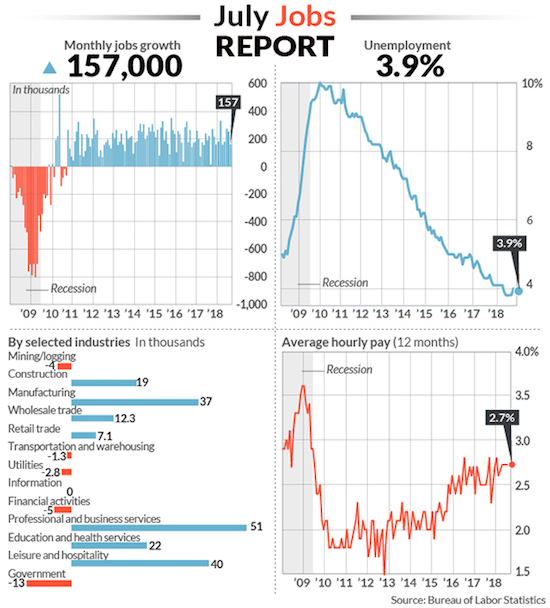
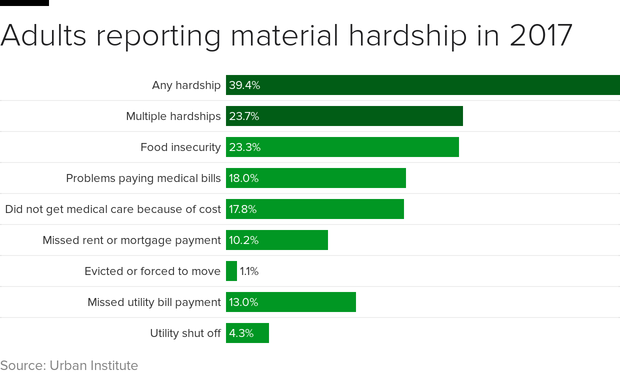
Four in 10 Americans are struggling to pay for their basic needs such as groceries or housing, a problem even middle-class households confront, according to a new study from the Urban Institute. Despite the U.S. economy being near full employment, 39.4 percent of adults between 18 and 64 years old said they experienced at least one type of material hardship in 2017, according to the study, which surveyed more than 7,500 adults about whether they had trouble paying for housing, utilities, food or health care. The findings surprised researchers at the Urban Institute, who had expected to find high levels of hardship among poor Americans but hadn’t predicted so many middle-class families would also struggle to meet their basic needs.

That may illustrate that a middle-class income “is no guarantee” of protection from hardship, said Michael Karpman, research associate at the Urban Institute’s health Policy Center and a co-author of the report. Against the backdrop of President Donald Trump’s boasting about low unemployment and strong economic growth, the research adds nuance to the problems facing American families. Middle-class households tend to struggle with paying their health care bills rather than utilities, for instance. Health care costs have outpaced wages and inflation, pushing more Americans into high-deductible plans, which can backfire when serious health problems arise.

“A lot of people are looking at the fact that wages aren’t keeping up with household costs as one reason families are having difficulty making ends meet,” Karpman said. “Even for families with health insurance, they may be facing high deductibles that leave them facing high costs.”
Read more …

The bias is obvious. How to fight it is not.

• White House Probes Google After Trump Accuses It Of Bias (R.)

U.S. President Donald Trump on Tuesday accused Google’s search engine of promoting negative news articles and hiding “fair media” coverage of him, vowing to address the situation without providing evidence or giving details of action he might take. Trump’s attack against the Alphabet Inc unit follows a string of grievances against technology companies, including social media Twitter Inc and Facebook Inc, which he has accused of silencing conservative voices, and Amazon.com Inc, which he has said is hurting small businesses and benefiting from a favorable deal with the U.S. Postal Services. He frequently berates news outlets for what he perceives as unfair coverage.

Google denied any political bias, saying in a statement that its search engine is “not used to set a political agenda and we don’t bias our results toward any political ideology.” Trump said in several tweets on Tuesday that Google search results for “Trump News” were “rigged” against him because they showed only coverage from outlets like CNN and not conservative publications, suggesting the practice was illegal. “I think Google is really taking advantage of our people,” Trump said on Tuesday in the Oval Office. “Google, and Twitter and Facebook, they are really treading on very, very troubled territory, and they have to be careful. It’s not fair to large portions of the population.”

Read more …

A pattern emerges. Trump violates 1st amendment when blocking users, but Twitter “retains authority to revoke access”. That cannot stand.

• Trump Unblocks More Twitter Users After US Court Ruling (R.)

U.S. President Donald Trump on Tuesday unblocked some additional Twitter users after a federal judge in May said preventing people from following him violated individuals constitutional rights. U.S. District Judge Naomi Reice Buchwald in Manhattan ruled on May 23 that comments on the president’s account, and those of other government officials, were public forums and that blocking Twitter Inc users for their views violated their right to free speech under the First Amendment of the U.S. Constitution. The Knight First Amendment Institute at Columbia University on August 10 sent the Justice Department a list of 41 accounts that had remained blocked from Trump’s @RealDonaldTrump account. The seven users who filed suit had their accounts unblocked in June.

The 41 blocked users include a film producer, screenwriter, photographer and author who had criticized President Trump or his policies. At least 20 of those individuals said on Twitter that Trump had unblocked them on Tuesday. The 41 users were not a comprehensive list of those blocked by Trump. Rosie O’Donnell, a comedian, said on Twitter late Tuesday that she remained blocked. [..] The ruling has raised novel legal issues. The Internet Association, a trade group that represents Twitter, Facebook Inc, Amazon.com, and Alphabet Inc, filed a brief in the case earlier this month that did not back Trump or the blocked users but urged the court to “limit its decision to the unique facts of this case so that its decision does not reach further than necessary or unintentionally disrupt the modern, innovative Internet.”

[..] The Internet Association said the court “should make clear that this case does not implicate the overwhelming majority of social media accounts throughout the Internet.” “Despite any First Amendment status that this court might find in the ‘interactive spaces’ associated with President Trump’s account, Twitter retains authority to revoke access to both his account and the account of any user seeking to comment on President Trump’s account,” the group said.

Read more …

Facebook deletes posts from a former UK ambassador.

• Facebook Censorship, Mad Ben Nimmo and the Atlantic Council (Craig Murray)

Facebook has deleted all of my posts from July 2017 to last week because I am, apparently, a Russian Bot. For a while I could not add any new posts either, but we recently found a way around that, at least for now. To those of you tempted to say “So what?”, I would point out that over two thirds of visitors to my website arrive via my posting of the articles to Facebook and Twitter. Social media outlets like this blog, which offer an alternative to MSM propaganda, are hugely at the mercy of these corporate gatekeepers.

Facebook’s plunge into censorship is completely open and admitted, as is the fact it is operated for Facebook by the Atlantic Council – the extreme neo-con group part funded by NATO and whose board includes serial war criminal Henry Kissinger, Former CIA Heads Michael Hayden and Michael Morrell, and George Bush’s chief of Homeland Security Michael Chertoff, among a whole list of horrors.

The staff are worse than the Board. Their lead expert on Russian bot detection is an obsessed nutter named Ben Nimmo, whose fragile grip on reality has been completely broken by his elevation to be the internet’s Witchfinder-General. Nimmo, grandly titled “Senior Fellow for Information Defense at the Atlantic Council’s Digital Forensic Research Lab”, is the go-to man for Establishment rubbishing of citizen journalists, and as with Joseph McCarthy or Matthew Clarke, one day society will sufficiently recover its balance for it to be generally acknowledged that this kind of witch-hunt nonsense was not just an aberration, but a manifestation of the evil it claimed to fight.

Read more …

“..the generational fiscal catastrophe that looms in the 2020s as 80 million baby-boomers pile onto the social security/medicare wagon.”

• The Greatest Fake Bull Ever (Stockman)

the Wall Street stock indices have vastly out-run the meager gains in the main street economy since the pre-crisis peak; and that at this late stage of the business cycle—merely 10 months from the prior record—there is absolutely no plausible risk/reward equation left. That’s because earnings will plummet in the next recession—by 40% or more if history is any guide. And that’s likely to be conservative in view of the elephant in the casino that Wall Street stubbornly refuses to acknowledge. To wit, back in June 2007, the S&P 500 earnings peaked at $85 per share, but that reflected fully $55 per share of after-tax interest expense. Fast forward to the LTM period ending in December 2017 when earnings per share posted at $110 per share, but reflected only $19 per share of after-tax interest expense.

In other words, more than 100% of the gain over the past 11 years was due to the drastic financial repression of the central banks and its impact on corporate interest expense. Yet the central banks of the world—led belatedly by the Fed—have made an epochal pivot to QT (quantitative tightening) and interest rate normalization, even as the value of the interest expense deduction has been reduced to chump change owing to the new effective tax rate of about 15%. So interest expense is marching back up the hill, and it’s not remotely priced-in—not any more than the next recession or the generational fiscal catastrophe that looms in the 2020s as 80 million baby-boomers pile onto the social security/medicare wagon.

Read more …

Xi has let the shadows grow to fake the growth, and will have a hard time tackling them now.

• China’s Building-Boom Hits A Wall As Shadow-Banking System Collapses (ZH)

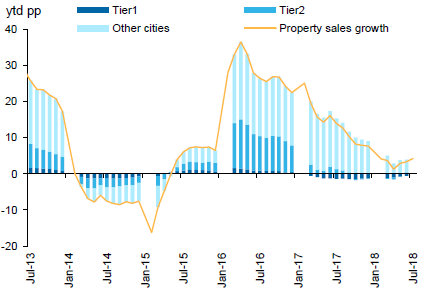
Beijing wants to shore up growth without inundating the economy with cheap credit. But, as WSJ’s Walter Russell Mead pointed out previously, it’s not easy… “Chinese leaders know that their country suffers from massive over-investment in construction and manufacturing, that its real-estate market is a bubble that makes the Dutch tulip frenzy look restrained, that both conventional debt and debt in the shadow-banking system are too large and growing too rapidly. But even as the Communist Party centralizes power and clamps down on dissent, it dithers when it comes to the costly and difficult work of shifting China’s economic development onto a sustainable track. Chinese authorities have tried to tackle some of these problems, but often retreat when reforms start to bite and powerful interests push back.”

To see how hard that will be, The Wall Street Journal’s Nathaniel Taplin takes a look at China’s roads and railways. “China is the 800-pound gorilla of global infrastructure. Its building prowess has permeated popular culture, as in the disaster movie “2012” where China constructs giant ships to help humankind escape rising seas. Recently, however, China’s infrastructure build has all but ground to a halt.” Here’s why… The central government last year started to crack down on unregulated, opaque – so-called ‘shadow-bank’ borrowing – alarmed at its vast scale, and potential for corruption.

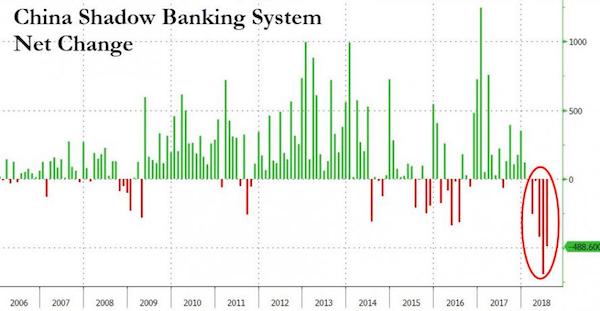
For five straight months, the shadow banking system has contracted under this pressure, sucking the malinvestment lifeblood out of economic growth and construction booms as Chinese local governments, which account for the bulk of such investment, set up as so-called local-government financing vehicles (off balance sheet), or LGFVs, and have seen an unprecedented net $19 billion outflow in recent months. As WSJ’s Talpin notes, these days Beijing prefers that local governments borrow on-the-books, through the now legal municipal bond market. The problem is that lower-rated and smaller cities are mostly shut out, even though they do most actual capital spending. As a result, investment has kept slowing even though China’s net muni bond issuance in July was three times higher than it was in March.
Read more …

“Other Americans just marched around ineffectually, waving banners and shouting antiwar slogans, but not McCain!”

• A Senator Masquerading as a Gas Station (Dmitry Orlov)

John McCain is dead, and many people are celebrating whereas they should be sad. He wasn’t a friend of mankind—he was its enemy, but a really bad one. But with such grossly incompetent enemies—who needs friends? McCain did a great deal to destroy America. He devoted his entire lifetime to American destruction. To start with, he was quite effective as a protester against America’s genocidal war on the people of Vietnam. Other Americans just marched around ineffectually, waving banners and shouting antiwar slogans, but not McCain! His own father had a lot to do with starting that war, but McCain made up for that by destroying 26 American war planes. That’s quite something! If every American flyer crashed as many planes, countless innocent lives would have been saved.

Of course, he could have done even better—and he did try. He almost managed to destroy the US aircraft carrier Forrestal by setting it ablaze. To top off his illustrious military career, he surrendered to the enemy and spent five years in a Vietnamese prison. This made him a hero—in Americans’ eyes only, while the rest of the world saw in him a murderer of Vietnamese children. His “martyrdom” as a POW helped pave his way to a political career, first in Congress, then in the Senate. During his obscenely long career in national politics, McCain did what he could to make American “democracy” look like a complete joke and to hasten America’s collapse. This, by the way, wasn’t a tall order: American “democracy” had long been a cesspool—a playground for lobbyists and political technologists based on a fully gerrymandered system of fake elections. But he did his thing, and is therefore twice the hero.

Read more …

Fast getting out of hand.

• Brazil Sends Army To Border As Venezuelans Flee Crisis At Home (R.)

Brazil said it was sending armed forces to keep order near the Venezuelan border area, while Peru declared a health emergency, as a regional crisis sparked by thousands of Venezuelans fleeing economic collapse escalated on Tuesday. In Brazil, where residents rioted and attacked Venezuelan immigrants in a border town earlier this month, President Michel Temer signed a decree to deploy the armed forces to the border state of Roraima. He said the move was aimed at keeping order and ensuring the safety of immigrants. Peru, meanwhile, declared a 60-day health emergency in two provinces on its northern border, citing “imminent danger” to health and sanitation.

The decree, published in the government’s official gazette, did not give more details on the risks, but health authorities have previously expressed concerns about the spread of diseases such as measles and malaria from migrants. The exodus of Venezuelans to other South American countries is building toward a “crisis moment” comparable to events involving refugees in the Mediterranean, the United Nations said this week. Temer blamed the socialist Venezuelan government of President Nicolas Maduro for the migration crisis. “The problem of Venezuela is no longer one of internal politics. It is a threat to the harmony of the whole continent,” Temer said in a televised address.

Read more …

If the US lets Syria rebuild.

• Syria Ready To Take One Million Returning Refugees – Moscow (AFP)

Russia’s defence minister said on Tuesday that war-torn Syria would be ready to accept one million returning refugees, following Moscow-backed reconstruction work. “Since 2015, when towns and villages gradually started to be freed, more than one million people have returned home,” Sergei Shoigu said in comments reported by Russian news agencies. “Now every opportunity has been created for the return of roughly one million (more) refugees,” he told journalists. “Huge infrastructure reconstruction work is ongoing, the rebuilding of transport routes and security points so that Syria can begin accepting refugees.”

Russia, a long-time ally of Syria, launched a military intervention in 2015 to support the embattled regime of President Bashar al-Assad, a move that changed the course of the war. Assad and his allies have since recovered swathes of territory and the government is turning its attention to post-conflict reconstruction, with the aid of Moscow. The war that erupted in 2011, one of the most devastating conflicts since World War II, has displaced more than half of Syria’s population, including more than five million beyond its borders. Most of them fled to neighbouring countries, particularly Turkey, Jordan and Lebanon.

Read more …

It’ll take a gargantuan effort to stop this.

• Just 10 Rivers Carry 95% Of All Plastic Into The Ocean (BT)

Cheap, durable and multifunctional, plastic is one of humanity’s most successful inventions. From the 1950s to 2015, we’ve produced 8.3 billion metric tons of the stuff. By now, it’s everywhere. It’s also non-biodegradable. And that’s devastating the environment. Only 9% of all plastic waste has been recycled, and another 12% has been incinerated. That means that almost 80%—nearly 6.3 billion tons—has turned into waste with no half-life to speak of: condemned to an eternity as landfill, litter or ocean-clogging junk. Every year, plastic kills around 1 million seabirds, 100,000 sea mammals and inestimable numbers of fish. The volume of plastic trash in the world’s oceans is currently estimated to be around 150 million tons. No less than eight million tons are added to that every year—that’s one truckload every minute.

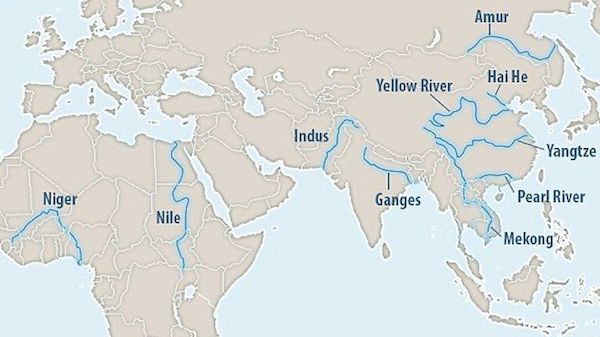
Between 0.5 and 2.75 million tons come from rivers alone. Large rivers are particularly efficient conveyors of plastic waste to the oceans, especially in countries lacking a well-developed waste management infrastructure. Up to 95% of river-borne plastic comes from just 10 rivers, scientists at the Helmholtz Center for Environmental Research in Leipzig, Germany have found. The scientists analysed data on both microplastic debris (<5mm) such as beads and fibres, as well as microplastic objects (plastic bottles, bags, etc.) from 79 sampling sites on 57 of the world’s largest rivers, singling out the 10 mapped out here as the biggest culprits, due to “mismanagement of plastic waste in their watersheds”.
Read more …

Nicotine addiction.

• Bees Develop Preference For Pesticides (PA)

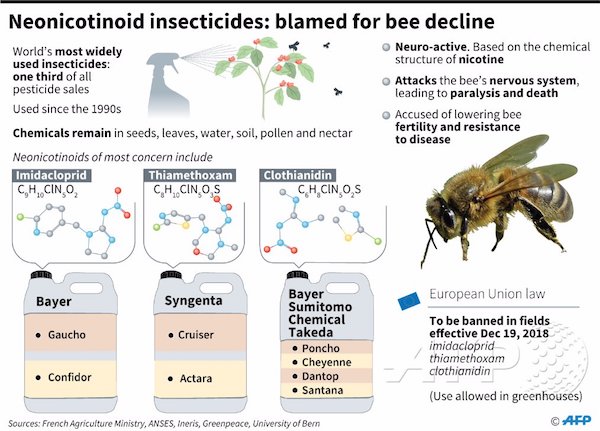
Bumblebees acquire a taste for pesticide-laced food that can be compared to nicotine addiction in smokers, say scientists. The more of the nicotine-like chemicals they consume, the more they appear to want, a study has shown. The findings suggest that the risk of potentially harmful pesticide-contaminated nectar entering bee colonies is higher than was previously thought. In a series of studies, a team of British researchers offered bumblebees a choice of two sugar solutions, one of which was laced with neonicotinoid pesticides. They found that over time the bees increasingly preferred feeders containing the pesticide-flavoured sugar.

Dr Richard Gill, from the Department of Life Sciences at Imperial College London, said: “Given a choice, naive bees appear to avoid neonicotinoid-treated food. However, as individual bees increasingly experience the treated food they develop a preference for it. “Interestingly, neonicotinoids target nerve receptors in insects that are similar to receptors targeted by nicotine in mammals. “Our findings that bumblebees acquire a taste for neonicotinoids ticks certain symptoms of addictive behaviour, which is intriguing given the addictive properties of nicotine on humans, although more research is needed to determine this in bees.” Controversial neonicotinoid pesticides are chemically similar to nicotine, the addictive compound in tobacco.

Read more …

Aug 212018
 
 August 21, 2018  Posted by at 8:38 am Finance Tagged with: , , , , , , , , , , , ,  10 Responses »


Henri Matisse The painter and his model 1916-17


• China’s Biggest Risk May Be Its Property Market – Not The Trade War (CNBC)
• Why Do American CEOs Get Paid So Much? (Galbraith)
• Trump Says It Is ‘Dangerous’ For Twitter, Facebook To Ban Accounts (R.)
• Trump Worries That Mueller Interview Could Be A ‘Perjury Trap’ (R.)
• Trump Demands Fed Help On Economy, Complains About Interest Rate Rises (R.)
• UK’s Hunt To Call On Trump To Impose Fresh Sanctions On Russia (G.)
• ‘Secret Directive’ Bans UN Agencies From Helping Rebuild Syria – Lavrov (RT)
• UK Household Debt Balloons To £19bn As Bailiff Problems Multiply (Ind.)
• NHS Leak Warns Of Brexit Drug Shortages And Disease Risk (G.)
• Jacinda Ardern Freezes New Zealand MPs’ Pay To Tackle Rich-Poor Divide (G.)
• Salvini Refuses To Let In Refugees After Coastguard Ship Docks (G.)
• What Being Back in the Markets Actually Means for Greece (TPP)
• The Winners Will Lose and the Losers Will Win (Kunstler)
• The Inescapable Weight Of My $100,000 Student Debt (G.)


“Real estate investment accounts for about two-thirds of Chinese household assets..”

• China’s Biggest Risk May Be Its Property Market – Not The Trade War (CNBC)

China’s hot real estate market remains a challenge for authorities trying to maintain stable economic growth in the face of trade tensions with the U.S. In fact, property is the country’s biggest risk in the next 12 months, much greater than the trade war, according to Larry Hu, head of greater China economics at Macquarie. He said he is especially watching whether the real estate market in lower-tier, or smaller, cities will see a downturn in prices or housing starts after recent sharp increases. Real estate investment accounts for about two-thirds of Chinese household assets, according to wealth manager Noah Holdings. The property market also plays a significant role in local government revenues, bank loans and corporate investment.

As a result, a sharp slowdown in the real estate market’s growth and drop in prices would have a negative affect on overall economic growth. So far, the market has been hot: The average selling price for newly built non-governmental housing in 60 tier-three and tier-four cities tracked by Tospur Real Estate Consulting rose 28.1 percent from January 2016 to May 2018. [..] Last week, Nanjing, a tier-two city, announced a ban on corporate purchases of residential properties, following similar moves to limit speculation by Shanghai and some other cities. That’s a good move for controlling risk, according to Joe Zhou, real estate and investment management firm JLL’s regional director for China capital markets. He said the government is not likely to loosen its policy soon and that prices could decline on average.

Read more …

“The reliance of tech firms on venture capital and bubble psychology, rather than cash flow..”

• Why Do American CEOs Get Paid So Much? (Galbraith)

A new report from the Economic Policy Institute calls attention to the hardy perennial of how much America’s corporate titans make: bosses of the top 350 firms made an average of $18.9m in 2017. That’s a ratio of 312-1 over the median worker in their industries. Big bucks to be sure. And a big change since 1965, when the ratio was just 20-1. But what does it mean? And if there’s a problem, what is it, exactly? What it means, as the EPI economists carefully document, is that the top US corporate chiefs are paid overwhelmingly with stock options, and their income fluctuates with the market. About 80% of the pay packet is in stocks, and the rise of 17% in 2017 after two flat years surely suggests that the top CEOs (not unreasonably) sensed the market peaked last year.

So they cashed in. On the other 20% of the pay packets, no gains occurred. The US numbers have shock value. But bear in mind that they reflect not only the way companies are run, but also changes over decades in the structure of the US economy and tax law, specifically the rise of market valuations in technology and finance at the expense of the major industrial corporations, and a corresponding decline in unions, which held down the ratios in the sectors the industrial firms dominated a half century back. Plus, there is the radical decline in top marginal tax rates on income and capital gains, beginning in 1978, which gave executives strong reasons to restructure their pay away from inside-the-corporation perks (the penthouses and country clubs of yore) and toward cash and capital assets.

The reliance of tech firms on venture capital and bubble psychology, rather than cash flow, deepened this trend. Note also that there is something a bit artificial about the resulting “wealth.” Jeff Bezos may have a net worth of over $150bn, mostly in Amazon stock, but he couldn’t convert it into cash if he wanted to, neither by selling nor by borrowing. Any effort to sell would demolish Amazon’s valuation and hence his own fortune. The rich aren’t like us – they have more money, true, but some of it isn’t really money and it can disappear, by the billions, pretty fast.

Read more …

As I wrote yesterday, this will have to change.

• Trump Says It Is ‘Dangerous’ For Twitter, Facebook To Ban Accounts (R.)

U.S. President Donald Trump said on Monday that it is “very dangerous” for social media companies like Twitter and Facebook to silence voices on their services. Trump’s comments in an interview with Reuters come as the social media industry faces mounting scrutiny from Congress to police foreign propaganda. Trump has made his Twitter account – with more than 53 million followers – an integral and controversial part of his presidency, using it to promote his agenda, announce policy and attack critics. Trump previously criticized the social media industry on Aug. 18, claiming without evidence in a series of tweets that unnamed companies were “totally discriminating against Republican/Conservative voices.”

In the same post, Trump said “too many voices are being destroyed, some good & some bad.” Those tweets followed actions taken by Apple, Alphabet, YouTube and Facebook to remove some content posted by Infowars, a website run by conspiracy theorist Alex Jones. Jones’ own Twitter account was temporarily suspended on Aug. 15. “I won’t mention names but when they take certain people off of Twitter or Facebook and they’re making that decision, that is really a dangerous thing because that could be you tomorrow,” said Trump.

Read more …

Also mentioned yesterday. Chances of a sitdown in the next 10 days don’t look good.

• Trump Worries That Mueller Interview Could Be A ‘Perjury Trap’ (R.)

U.S. President Donald Trump said on Monday he was worried that any statements under oath he provides to Special Counsel Robert Mueller could be used to bring perjury charges against him as part of the probe into Russia’s electoral interference. In an interview with Reuters, Trump echoed the concerns of his top lawyer in the probe, Rudy Giuliani, who has warned that any sit-down with Mueller could be a “perjury trap.” The president expressed fears that investigators could compare his statements with that of others who have testified in the probe, such as former FBI Director James Comey, and that any discrepancies could be used against him.

“So if I say something and he (Comey) says something, and it’s my word against his, and he’s best friends with Mueller, so Mueller might say: ‘Well, I believe Comey,’ and even if I’m telling the truth, that makes me a liar. That’s no good.” Despite his concerns, Trump did not comment on whether he would ultimately agree to an interview with Mueller, who is, among other things, investigating whether Trump’s campaign team colluded with Russians during the 2016 election and whether Trump has obstructed justice in the probe. Trump also declined to say whether he might strip Mueller of his security clearance, as he did last week to former CIA Director John Brennan, who had repeatedly criticized Trump’s handling of foreign policy and national security issues.

“I haven’t given it a lot of thought,” he said. [..] Trump asserted that he retained the power to intervene in the probe, but that he had chosen not to do so for the moment. His administration, Trump said, was “a smooth-running machine, except in that world. And I’ve decided to stay out. Now I don’t have to stay out. “I can go in, and I could do whatever — I could run it if I want. But I decided to stay out,” he said. “I’m totally allowed to be involved if I wanted to be. So far, I haven’t chosen to be involved. I’ll stay out.”

Read more …

Whatever the predictable comments on this, what he really does is confirm the Fed’s independence.

• Trump Demands Fed Help On Economy, Complains About Interest Rate Rises (R.)

U.S. President Donald Trump said on Monday he was “not thrilled” with the Federal Reserve under his own appointee, Chairman Jerome Powell, for raising interest rates and said the U.S. central bank should do more to help him to boost the economy. In the middle of international trade disputes, Trump in an interview with Reuters also accused China and Europe of manipulating their respective currencies. American presidents have rarely criticized the Fed in recent decades because its independence has been seen as important for economic stability.

Trump has departed from this past practice and said he would not shy from future criticism should the Fed keep lifting rates. The president spooked investors in July when he criticized the U.S. central bank’s over tightening monetary policy. On Monday he said the Fed should be more accommodating on interest rates. “I’m not thrilled with his raising of interest rates, no. I’m not thrilled,” Trump said, referring to Powell.

Read more …

Nobody Hunt goes to Washington with veiled criticism of Trump. Good luck with that.

• UK’s Hunt To Call On Trump To Impose Fresh Sanctions On Russia (G.)

The British foreign secretary, Jeremy Hunt, is to urge Donald Trump to face down Moscow’s threat to western values by imposing wider economic sanctions against Russia and agreeing new rules to protect the legitimacy of democratic elections. In a speech in Washington on Tuesday during his first visit since taking over from Boris Johnson as the UK’s most senior diplomat, Hunt will specifically call for tighter regulation of online political advertising and new measures to prevent cyber attacks on electoral machinery. Hunt will also throw out a challenge to Trump’s protectionist policies by warning a weakening of free trade will only damage western economies, and ultimately western political power.

He will say the emergence of an international order based on the application of law rather than might had led to an exponential growth in trade, leading to extraordinary advances in economic and social prosperity across the globe. He will also call for Nato to set clearer red lines about Russia’s use of chemical weapons and incursions into foreign territory such as the annexation of Crimea in 2014. Without directly challenging the legitimacy of Trump’s election as president in 2016, he will point to the drawbacks in many recent democratic outcomes, saying: “The heart of any democracy is freedom of expression, which allows citizens to access independent information to help decide who to vote for. But the ubiquity of fake news, social media targeting and foreign attempts to manipulate elections have undermined confidence that this can actually happen.”

Any tarnishing of Trump’s electoral mandate is highly perilous territory for a foreign politician, and Hunt will temper his criticism by saying western leaders should not deceive themselves that populism is merely a byproduct of social media spreading fake news.

Read more …

Rebuilding Syria can solve a large part of Europe’s refugee problem, and US and UN are holding it back?

• ‘Secret Directive’ Bans UN Agencies From Helping Rebuild Syria – Lavrov (RT)

Washington’s “absolutely deconstructive” stance is hampering the rebuilding of Syria and constricts the UN in aiding the country until a so called ‘political transition’ takes place, Sergey Lavrov, Russia’s Foreign Minister, said.
“We addressed UNESCO on how they plan to implement the longtime talks, the longtime understanding on attracting the potential of this organization to rebuilding Palmyra,” an ancient city, regarded by the agency as a World Heritage Site, Lavrov said. “From the explanations of why UNESCO has still been unable to get involved in this process actively, we took that there was some kind of a directive from the United Nations headquarters in New York.”

He said that the UN Secretariat, which is the organizations’ executive arms, has “actually issued and distributed a secret directive throughout the UN system in October last year that prohibited the agencies included in this system from participating in any kind of projects aimed at restoring the Syrian economy.” Only humanitarian aid and nothing more” was allowed, the minister told the journalists after talks with Lebanese counterpart, Gebran Bassil, in Moscow. “A term was put forward that restoration of Syria would only be on the agenda after a certain progress is made in the so-called political transition” in the country, he added. The Russian Foreign Ministry also said that due to the “absolutely deconstructive” stance of the US one also shouldn’t expect any positive decisions on rebuilding Syria and return of refugees to the country from the UN Security Council.

Read more …

“People can face having their essential services cut off, be kicked out of their home due to rent arrears or even face prison if they get behind on their council tax..”

A country moving backwards.

• UK Household Debt Balloons To £19bn As Bailiff Problems Multiply (Ind.)

UK households have fallen behind on essential bills such as council tax and electricity by as much as £18.9bn, according to Citizens Advice, which says it helps someone with bailiff-related problems every three minutes. The total outstanding debt includes almost £7.5bn in tax credit overpayments, £2.84bn owed in council tax and £2.2bn owed to water companies. Household debt has now overtaken consumer credit as the main money problem people contact Citizens Advice about, and the charity said that falling behind on household bills “has more severe consequences than missing consumer credit repayments”, such as overdrafts and personal loans.

“People can face having their essential services cut off, be kicked out of their home due to rent arrears or even face prison if they get behind on their council tax,” Citizens Advice warned. The charity said it had seen a 24 per cent increase in bailiff problems since the government introduced reforms in 2014 that were meant to protect people from unfair bailiff practices. Under the reforms, bailiffs are no longer allowed to make late-night visits to collect debts, and are prevented from using force against people who owe money, amongst other rules.

Read more …

Since there is no progress on many essential Brexit elements, this is not some doom fantasy.

• NHS Leak Warns Of Brexit Drug Shortages And Disease Risk (G.)

Hospitals face running out of drugs in a chaotic no-deal Brexit, the group that represents NHS hospital and ambulance service has privately warned. Poor co-ordination by ministers and health service bosses means there has been a failure to prepare for the UK to be left without a Brexit deal, a leaked letter from NHS Providers said. “Public health and disease control co-ordination could suffer,” said NHS Providers chief executive Chris Hopson, setting out how a hard Brexit or no deal could negatively effect “the entire supply chain of pharmaceuticals” and “jeopardise” the EU citizens making up the “workforce on which the NHS relies”. Hopson’s letter, sent to NHS England chief executive Simon Stevens and NHS Improvement chief Ian Dalton on Friday, was leaked to the Times.

Hopson said the possibility of a no-deal or hard Brexit “with minimal regulatory alignment appears to be growing … For as long as that risk remains it is important that detailed operation planning is undertaken across the NHS. “Yet trusts tell us that their work in this area is being hampered by the lack of visible and appropriate communication. “Our members have begun planning … but they have hit a problem, in that some activities are clearly best done at a national level and, in the view of trusts, are best co-ordinated by NHS England and NHS Improvement. “However there has been no formal communication to trusts from either of your organisations on this issue.”

Read more …

Always risky to cut your immediate colleagues, but makes a ton of sense.

• Jacinda Ardern Freezes New Zealand MPs’ Pay To Tackle Rich-Poor Divide (G.)

Jacinda Ardern has frozen the salaries of New Zealand’s MPs, saying the pay rises were out of step with the wider workforce and were adding to the rich-poor divide. The radical move has cross-party support from Ardern’s coalition partners, as well as the opposition National party. MPs’ salaries and allowances would be frozen till July 2019, Ardern said, while “a fairer formula for future pay increases” is developed for those in politics, who earn between NZ$163,000 ($108,000) to more than NZ$450,000 ($300,000). Ardern said the freeze was “the right thing to do” and was not about cost-cutting, but making New Zealand a more equitable nation.

The PM was prompted to take action after the Remuneration Authority recommended MPs receive a 3% pay rise, in a year that is seeing widespread strike action by teachers, nurses and other workers across New Zealand. Ardern earns more than NZ$450,000 a year, making her the fifth-highest paid leader in the OECD, and better paid than Canada’s Justin Trudeau and the UK’s Theresa May. According to a survey by Stuff, 62% of New Zealanders think the country’s prime ministers are paid too much. Australian prime minister Malcolm Turnbull earns the largest salary of any leader in the OECD. “It’s about whether or not it’s right that we receive a 3% pay increase that continues to extend that gap between those on the highest incomes and those on lower and more modest incomes,” Ardern told Radio NZ today.

Read more …

The EU MUST come up with a plan.

• Salvini Refuses To Let In Refugees After Coastguard Ship Docks (G.)

An Italian coastguard ship with 177 people on board has docked in the Sicilian seaport of Catania, but Italy’s far-right interior minister Matteo Salvini has not given authorisation for the refugees and migrants to disembark. The passengers, who have been stuck on the coastguard boat Ubaldo Diciotti for five days will not be allowed on land until “Europe steps in to help’’, Salvini said. The Diciotti picked up 190 refugees and migrants last Wednesday from an overcrowded boat about 17 sea miles from the island of Lampedusa. Thirteen of them were evacuated for emergency medical treatment. Since then, Rome has insisted that Malta should take the group because their boat first passed through its search-and-rescue area.

But Malta has refused, claiming that the migrants wanted to reach Italy. Questioned by the Italian authorities, the 13 evacuated migrants claimed that the Maltese had escorted them outside its search-and-rescue zone. On Monday afternoon, after three days of negotiations, Italy’s transport minister Danilo Toninelli announced finally on Twitter that “The Diciotti ship will dock in Catania.” But shortly afterwards, sources close to Salvini said he had not given the authorisation to disembark, suggesting the boat was granted permission to dock but the migrants will have to remain on board. Salvini said on Italian TV: “The ship may land in Italy, as long as the 177 migrants are distributed, in a spirit of solidarity by the EU.”

Read more …

What does it mean? More debt.

• What Being Back in the Markets Actually Means for Greece (TPP)

The devil, as they say in English, lies in the details. Being ‘back in the markets’, ‘turning a page,’ even declaring ‘the end of the Greek Crisis’ have all become commonplace expressions over the past few weeks. But what does this substantively mean? It means that an economy that has shrunk by around 25% saw, due to that shrinkage, its debts go up by about the same amount, despite near 100 billion Euro in debt being wiped off in 2012. Current outstanding Greek debt stands at 343 billion Euro. It now needs to pay a large chunk of that back to get back to where it was in 2008, with 109% debt to GDP.

The years of the Greek crisis (2010-2018) were the years that former finance minister Yanis Varoufakis famously described as the years of ‘extend and pretend.’ The EU would extend more credit (debt) to Greece that Greece would pretend to pay back. While most of the bailout cash prior to 2013 went through Greece back to Northern Banks, after 2013 most of the Debt was held by an opaqueprivate financial institution housed in Luxemburg called the European Stability Mechanism (ESM). It’s the debts held by the ESM, and the loans disbursed by the ESM, that have been the focus of the new game of extend and pretend that is called variously ‘debt-relief’ and Greece ‘being back in the markets.’

Consider the following. The ESM lent 86 Billion Euro to Greece between August 2015 and July 2018. The final tranche of these loans will not be paid back until 2060, with payments beginning in 2034. This ten year deferral of payments along with an interest rate reduction to an average of 1.62% across issues is the much heralded debt relief agreement of June 21st 2018. All things considered, and given real ‘go to the market’ alternatives if you have Greece’s bond rating, this is not a bad deal – on paper. These measures, plus the final bailout cash being added to cash reserves, means that Greece will actually not have to return to the markets for funding for almost two years. Given this, the ‘return to the markets’ comes with some pretty large airbags, all of which makes buying Greek debt more attractive, hence recent bond rating upgrades. So, we are extending, but what are we still pretending?

Read more …

“..Pabst Blue Ribbon by the case!”

• The Winners Will Lose and the Losers Will Win (Kunstler)

What a revoltin’ development, as Chester A. Riley used to say on “The Life of Riley” TV show back in 1955, when America was great (at least that’s the theory). Riley was an original deplorable before the concept even emerged from the murk of early pop culture. He worked in an aircraft factory somewhere in southern California, which only a few decades prior was the mecca of an earlier generations of losers: the Oakies and other Dust Bowl refugees who went west to pick fruit or get into the movies. Chester A. Riley supported a family on that job as a wing-riveter. All the male characters in the series had been through the Second World War, but were so far removed from the horror that the audience never heard about it.

That was the point: to forget all that gore and get down with the new crazes for backyard barbeque, seeing the USA in your Chevrolet, enjoying that healthful pack of Lucky Strikes in the valley of the Jolly Green Giant… double your pleasure, double your fun… and away go troubles down the drain…. As Tom Wolfe pointed out eons ago, the most overlooked feature of post-war American life was the way that the old US peasantry found themselves living higher on the hog than Louis the XVI and his court at Versailles. Hot and cold running water, all the deliciously engineered Betty Crocker cake you could eat, painless dentistry, and Yankees away games on Channel 11, with Pabst Blue Ribbon by the case! By 1960 or so, along came color TV and air-conditioning, and in places like Atlanta, St. Louis, and Little Rock, you barely had to go outside anymore, thank God! No more heat stroke, hookworm, or chiggers.

It was a helluva lot better than earlier peasant classes had it, for sure, but let’s face it: it was kind of a low-grade nirvana. And a couple of generations beyond “The Life of Riley” the whole thing has fallen apart. There are few hands-on jobs that allow a man to support a family. And what would we even mean by that? Stick the women back in kitchen and the laundry room? What a waste of human capital (even for socialists who oppose capital). The odd thing is that there is increasingly little for this class of people to do besides stand near the door of the WalMart, and if the vaunted tech entrepreneurs of this land have their way with robotics, you can be sure there would be less than nothing for them to do… except crawl off and die quietly, without leaving an odoriferous mess.

Read more …

Long read. Steve Keen comments: This will doom the USA to stagnation: a generation with too much debt and no prospect of using credit like the previous generation.

• The Inescapable Weight Of My $100,000 Student Debt (G.)

On Halloween in 2008, about six weeks after Lehman Brothers collapsed, my mother called me from Michigan to tell me that my father had lost his job in the sales department of Visteon, an auto parts supplier for Ford. Two months later, my mother lost her job working for the city of Troy, a suburb about half an hour from Detroit. From there our lives seemed to accelerate, the terrible events compounding fast enough to elude immediate understanding. By June, my parents, unable to find any work in the state where they spent their entire lives, moved to New York, where my sister and I were both in school. A month later, the mortgage on my childhood home went into default.

After several months of unemployment, my mother got a job in New York City, fundraising for a children’s choir. In the summer of 2010, I completed my studies at New York University, where I received a BA and an MA in English literature, with more than $100,000 of debt, for which my father was a guarantor. My father was still unemployed and my mother had been diagnosed with an aggressive form of breast cancer. She continued working, though her employer was clearly perturbed that she would have to take off every Friday for chemotherapy. To compensate for the lost time, on Mondays she rode early buses into the city from the Bronx, where, after months of harrowing uncertainty, my parents had settled. She wanted to be in the office first thing.

In January 2011, Chase Bank took full possession of the house in Michigan. Our last ties were severed by an email my father received from the realtor, who had tried and failed to sell the property, telling him he could now cancel the utilities. In May, I got a freelance contract with a newspaper that within a year would hire me full-time – paying me, after taxes, roughly $900 every two weeks. In September 2011, my parents were approved for bankruptcy, and in October, due to a paperwork error, their car was repossessed in the middle of the night by creditors. Meanwhile, the payments for my debt – which had been borrowed from a variety of federal and private lenders, most prominently Citibank – totalled about $1,100 a month.

Read more …

Aug 192018
 
 August 19, 2018  Posted by at 8:36 am Finance Tagged with: , , , , , , , , , , , ,  3 Responses »


Pablo Picasso Portrait of Ambroise Vollard 1910


• Anatomy of a Crisis: A Strong Dollar and Disappearing Liquidity (Palisade)
• Speculators Will Make Hay From Great Australian Economic Crash (Steve Keen)
• Judge Rules FBI Must Address Measures Taken To Verify Steele Dossier (ZH)
• White House Counsel “Cooperating Extensively” With Obstruction Probe (ZH)
• Erdogan Says US Has Launched ‘Attempted Economic Coup’ (Ind.)
• No-Deal Brexit May Force Rethink Of Vote – Ex-Civil Service Head (PA)
• Putin Urges Europe To Help Rebuild Syria So Refugees Can Return (AFP)
• Ecuador Slams Door On Venezuelans (BBC)
• The Un-Celebrity President (WaPo)
• Britain Has One Last Chance To Save Endangered Species (G.)


When liquidity vanishes the dollar rises.

• Anatomy of a Crisis: A Strong Dollar and Disappearing Liquidity (Palisade)

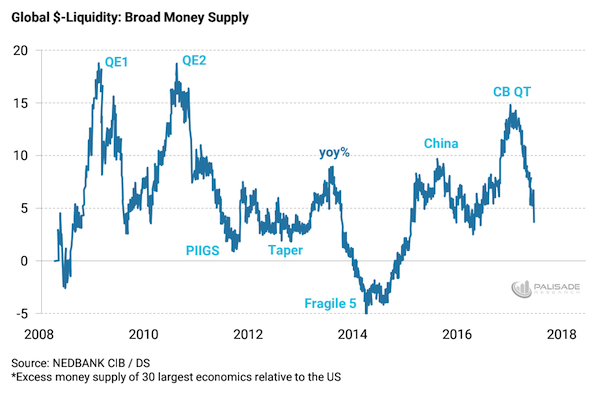
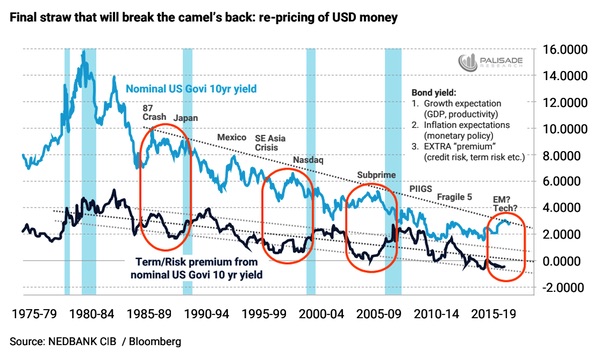
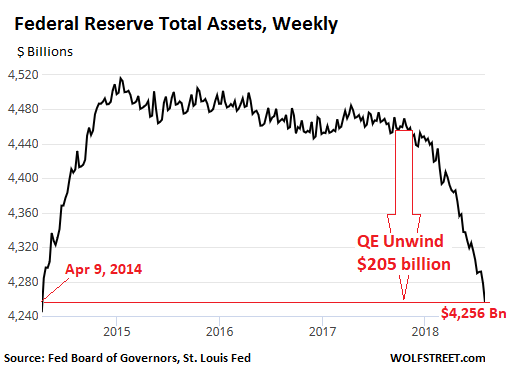
Since March – the dollar’s rallied over 7%. And it’s caused the Emerging Markets to implode. But the bigger problem is what lies ahead. And that’s a global dollar shortage – which the mainstream continues to ignore. . . I’ve touched on this a couple months back. Wondering when the mainstream would start to realize that the stronger the dollar gets – the more pressure global economies will feel. I wrote. . . “This is going to cause an evaporation of dollar liquidity – making the markets extremely fragile. Putting it simply – the soaring U.S. deficit requires an even greater amount dollars from foreigners to fund the U.S. Treasury. But if the Fed is shrinking their balance sheet, that means the bonds they’re selling to banks are sucking dollars out of the economy (the reverse of Quantitative Easing which was injecting dollars into the economy). This is creating a shortage of U.S. dollars – the world’s reserve currency – therefore affecting every global economy.”

Since then, things have only gotten worse. . . First: Jerome Powell – the Fed Chairman – issued a statement at the end of June that they would actually increase the amount of rate hikes over the next two years. This means they’re tightening even faster. Second: the U.S. Treasury increased their debt-borrowing needs to the highest since the financial crisis – which was over a decade ago. Therefore, they will need even more dollars to fund their spending. “The department expects to issue $329 billion in net marketable debt from July through September, the fourth-largest total for that quarter on record and higher than the $273 billion estimated in April [a 17% increase], the Treasury said in a report Monday. The department’s forecast for the October-December quarter is $440 billion, bringing the second-half borrowing estimate to $769 billion, the highest since $1.1 trillion in July-December 2008…”

And third: China’s growth is slowing down. Meanwhile the Emerging Markets are draining their U.S. dollar reserves even faster because of the strengthening dollar. So, in summary: as global dollar liquidity continues drying up, there will be a wave of ‘risky’ positions being dumped and ‘dollar disease’ (selling assets to raise dollars to pay back debts) worldwide. . . What we know is true from Economics-101 is that the lower the supply and the greater the demand equals a higher price. And as the pool of USD keeps drying up – then the price of the dollars must rise. This translates into higher offshore dollar funding (higher interest rates). Which is killing dollar indebted countries and corporations – like Turkey today.

[..] I think future financial historians will scratch their heads wondering why markets today continued discounting this serious dollar-shortage problem. The easy money years post-2008 fueled a massive debt bubble – causing asset prices all over to rise. But the market isn’t expecting the tight money years today to cause asset prices to fall. It’s like they think that drinking alcohol today will make them feel good – but don’t believe they’ll be hungover tomorrow. So, what’s next? I believe the U.S. dollar will continue rallying because of all that I mentioned above. As Hedge Funds, institutions, and investors continue unloading their Emerging Market positions – things will only get worse.

Read more …

Housing bubble vs stock market bubble. Pick your fave toxin.

• Speculators Will Make Hay From Great Australian Economic Crash (Steve Keen)

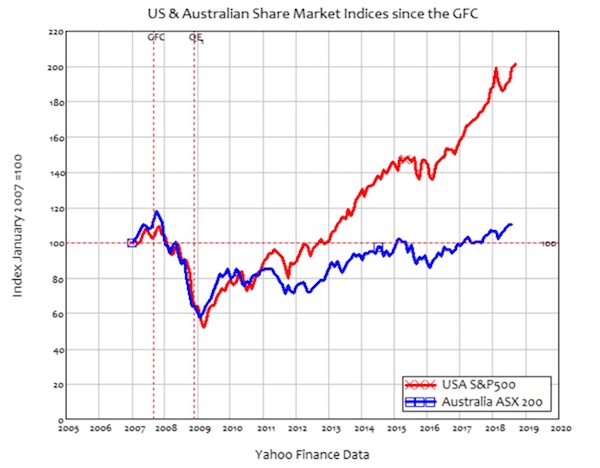
For years, Australia has been seen as the goose which laid the golden egg for workers, migrants and investors. Ironically, as America’s casino closes, it will eventually end up as a speculator’s paradise.\ The performance of the Australian stock market relative to its American equivalent since the Global Financial Crisis (GFC) shows the difference between a country where Quantitative Easing (QE) – the buying of bonds by the central bank to drive bond prices up and interest rates down, and thus encourage firms to invest and financial institutions to buy shares – was practiced and one where it was not. It’s both a warning about what could happen when the Fed starts to unwind QE, and a perverse opportunity to profit when Australia’s central bank, the RBA (Reserve Bank of Australia) inevitably starts its own QE program.

Since Australia avoided the GFC, and its rate of economic growth has been twice as fast as America’s post-crisis (an average 2.7 percent per year, versus 1.3 percent for the US), you might expect Australia’s stock market to have done better than America’s. In fact, it’s performed much worse: the main Australian index, the ASX, still hasn’t returned to its mid-2000s peak, while the US S&P500 has more than doubled its pre-crash level, and it’s almost four times as high as it was in the deepest depths of 2009. The timing of the US stock market recovery is instructive: it began in February 2009, just three months after the Federal Reserve began “QE1” (the first of three episodes of Quantitative Easing), when it promised to net buy bonds from the financial sector to the tune of $1 trillion per year ($80 billion per month).

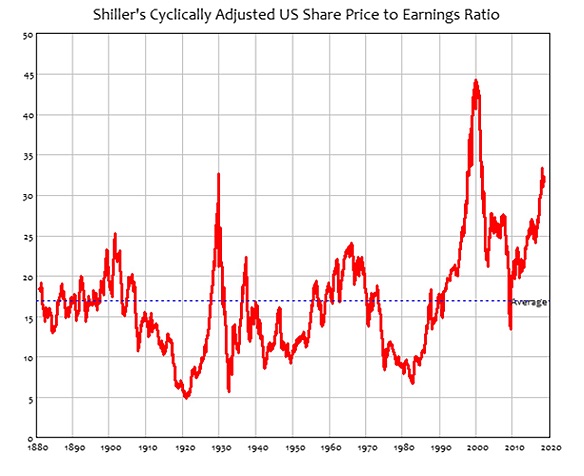
With the Fed buying a trillion bucks worth of bonds every year, thus giving the financial sector one trillion in cash per year in place of its interest-earning bonds, the only place the financial sector could stash that dough in search of a return was the stock market. This was the intention of the policy of course: to drive share prices higher in order to stimulate the economy. Aside from the fact it’s made the wealthier even wealthier as a direct effect of government policy, and cost far more than a direct boost to the poor would have done, it’s worked a treat: according to Robert Shiller’s “Cyclically Adjusted Price to Earnings Ratio,” it’s driven America’s stock market to its second-highest peak in history, higher than the 1929 bubble, second only to the DotCom maximum in 2000, and more than twice its long-term average.

Read more …

Can’t hide behind declassified docs.

• Judge Rules FBI Must Address Measures Taken To Verify Steele Dossier (ZH)

The FBI has been dealt a major blow after a Washington DC judge ruled that the agency must respond to a FOIA request for documents concerning the bureau’s efforts to verify the controversial Steele Dossier, before it was used as the foundation of a FISA surveillance warrant application and subsequent renewals. US District Court Judge Amit Mehta – who in January sided with the FBI’s decision to ignore the FOIA request, said that President Trump’s release of two House Intelligence Committee documents (the “Nunes” and “Schiff” memos) changed everything.

Considering that the FBI offered Steele $50,000 to verify the Dossier’s claims yet never paid him, BuzzFeed has unsuccessfully tried to do the same to defend themselves in a dossier-related lawsuit, and a $50 million Soros-funded investigation to continue the hunt have turned up nothing that we know of – whatever documents the FBI may be forced to cough up regarding their attempts to verify the Dossier could prove highly embarrassing for the agency. “[I]f Mr. Steele could get solid corroboration of his reports, the F.B.I. would pay him $50,000 for his efforts, according to two people familiar with the offer. Ultimately, he was not paid.” -NYT

What’s more, forcing the FBI to prove they had an empty hand will likely embolden calls to disband the special counsel investigation – as the agency’s mercenary and politicized approach to “investigations” will be laid all the more bare for the world to see. Then again, who knows – maybe the FBI verified everything in the dossier and it simply hasn’t leaked. That said, while the FBI will likely be forced to acknowledge the documents thanks to the Thursday ruling, the agency will still be able to try and convince the judge that there are other grounds to withhold the records.

In January, Mehta blessed the FBI’s decision not to disclose the existence of any records containing the agency’s efforts to verify the dossier – ruling that Trump’s tweets about the dossier didn’t require the FBI and other intelligence agencies to act on records requests. “But then the ground shifted,” writes Mehta of Trump declassifying the House memos. “As a result of the Nunes and Schiff Memos, there is now in the public domain meaningful information about how the FBI acquired the Dossier and how the agency used it to investigate Russian meddling.” [..] “It remains no longer logical nor plausible for the FBI to maintain that it cannot confirm nor deny the existence of documents,” Mehta wrote.

Read more …

Doesn’t feel like McGahn has tons of dirt.

• White House Counsel “Cooperating Extensively” With Obstruction Probe (ZH)

Update: Trump has commented on the story, saying he allowed McGahn “and all other requested members of the White House Staff” to fully cooperate with the Special Counsel. He also notes that the White House has given over one million pages of documents adding “No Collusion, No Obstruction. Witch Hunt!”

White House counsel Donald McGahn II, has been quietly cooperating “extensively” with special counsel Robert Mueller in his probe of possible collusion between the Trump campaign and Russia, according to an explosive New York Times report published Saturday afternoon. Sources told the Times that McGahn has had at least three voluntary interviews with Mueller’s team totaling 30 hours, in which he discussed accounts of multiple episodes at the center of Mueller’s probe into whether President Trump obstructed justice, as well as the president’s furor toward the Russia investigation and the ways in which he urged McGahn to respond to it. For a lawyer to share so much with investigators scrutinizing his client is unusual.

Lawyers are rarely so open with investigators, not only because they are advocating on behalf of their clients but also because their conversations with clients are potentially shielded by attorney-client privilege, and in the case of presidents, executive privilege. Among the episodes McGahn reprotedly discussed with investigators is Trump’s firing last year of former FBI Director James Comey and the president’s repeated urging of Attorney General Jeff Sessions to claim oversight of the special counsel despite his recusal from Russia probes. McGahn was also centrally involved in Trump’s attempts to fire the special counsel, Robert Mueller, himself which investigators might not have discovered without him.

Read more …

Downgrades add to the downfall.

• Erdogan Says US Has Launched ‘Attempted Economic Coup’ (Ind.)

Turkey’s president has accused America of launching an “attempted economic coup” as the country’s currency continues to reel following US economic sanctions. Recep Tayyip Erdogan told thousands of supporters in Ankara: “Today some people are trying to threaten us through the economy, through interest rates, foreign exchange, investment and inflation. “We are telling them: we’ve seen your games, and we are challenging you.” And, in a clear swipe at US president Donald Trump he added: “We did not and will not surrender to those who act like a strategic partner but make us a strategic target.”

[..] As the two countries have clashed, the lira’s value has plummeted: it has now dropped 38 per cent against the dollar since the beginning of the year. On Friday, ratings agencies Standard & Poor and Moody’s downgraded Turkey’s credit rating closer to “junk” status, pointing to currency fluctuations and concerns over central bank independence. A spokesman for Standard & Poor said: “The downgrade reflects our expectation that the extreme volatility of the Turkish lira and the resulting projected sharp balance of payments adjustment will undermine Turkey’s economy. We forecast a recession next year.” He added the agency was predicting that the country’s inflation will hit a potential 22 per cent over the next four months.

Read more …

When temperatures start dropping, reality will loom.

• No-Deal Brexit May Force Rethink Of Vote – Ex-Civil Service Head (PA)

Britain may have to rethink the decision to leave the EU if the government is unable to strike a Brexit deal with Brussels, a former head of the civil service has said. Bob Kerslake said the consequences of a no-deal exit would be so serious that the UK parliament would have to consider whether it could allow it to go ahead. Lord Kerslake, who has been advising Labour on preparing for government, said that at the very least the article 50 process – under which the UK is set to leave the bloc on 29 March next year – would have to be paused. In those circumstances, the European commission would almost certainly insist on some “re-examination” of the original decision to leave, he said.

His comments came as the government prepares to publish a series of technical notes on preparations for a no-deal Brexit across dozens of areas of British life, from farming to financial services. Kerslake said the measures were “too little, too late” and that the government had not allowed itself enough time to prepare for such an outcome. He told the the BBC Radio 4’s Today programme: “The consequences of a no deal would be so serious as I think parliament would have to seriously consider whether it could contemplate this. “The question people need to ask themselves is, is this a risk that they think we should be taking?

“If the government can negotiate a good deal, then so be it. But if they can’t and we end up in this position, then we have to reopen the question of whether we go forward with Brexit at all. It is not too late to do that. “A pause to reflect would certainly be necessary. I think that is a pretty high probability now. “But I think that pause would need to include – and I suspect this would be insisted on by the commission – some re-examination of the decision itself.”

Read more …

The only thing that makes sense.

• Putin Urges Europe To Help Rebuild Syria So Refugees Can Return (AFP)

Russian president Vladimir Putin has called on Europe to contribute to the reconstruction of Syria to allow millions of refugees to return home. “We need to strengthen the humanitarian effort in the Syrian conflict,” he said on Saturday, ahead of a meeting with his German counterpart Angela Merkel at the government retreat of Meseberg Palace, north of Berlin. “By that, I mean above all humanitarian aid to the Syrian people, and help the regions where refugees living abroad can return to.” There were 1 million refugees in Jordan, the same number in Lebanon, and 3 million in Turkey, Putin said.

Germany has accepted hundreds of thousands of migrants since 2015 – the height of the migration crisis – which has weakened Angela Merkel politically and split the European Union. “This is potentially a huge burden for Europe,” Putin said. “That’s why we have to do everything to get these people back home,” he added, emphasising the need to restore basic services such as water supplies and healthcare.

Read more …

More refugees. Great.

• Ecuador Slams Door On Venezuelans (BBC)

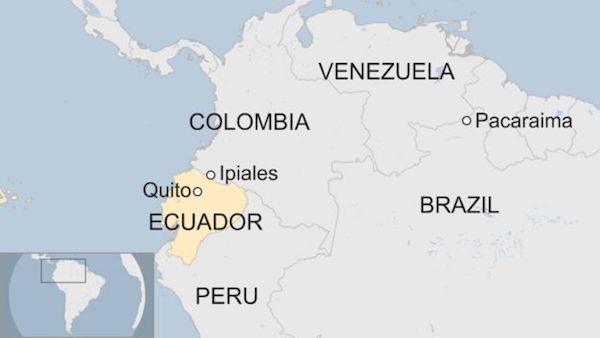
Ecuador has brought in new rules to stop Venezuelan migrants entering the country without a passport, leaving many stranded in neighbouring Colombia. Thousands of Venezuelans fleeing their country’s economic and political crisis have been crossing into Ecuador from Colombia using only identity cards. Most are heading south to join family members in Peru and Chile. Colombia has protested against the move, saying vulnerable people will be trapped on its side of the border. In a separate incident, residents of a Brazilian town attacked a Venezuelan migrant camp on Saturday and drove the occupants back across the border. Venezuela has suffered for years from high inflation and the chronic shortage of food and medicines.

More than a million Venezuelan migrants have entered Colombia in the past 15 months, according to official estimates, and more than 4,000 have been arriving at Ecuador’s border every day. Many have been walking or hitching rides for weeks and are exhausted by the time they reach the frontier. [..] With the flow of Venezuelan migrants causing tensions across the region, Peru’s government announced immigration measures similar to Ecuador’s on Friday. Passport requirements for Venezuelans will begin on 25 August. In February, Colombian President Juan Manuel Santos announced a tightening of border controls, resulting in thousands of Venezuelans rushing to crossing points. Brazil, which neighbours Venezuela, has also expressed concerns and temporarily closed the border earlier this month. Violence has flared in the border state of Roraima where thousands of Venezuelans live in precarious accommodation.

Read more …

“Carter has been an ex-president for 37 years, longer than anyone else in history.”He used those years to redeem himself.

• The Un-Celebrity President (WaPo)

Jimmy Carter finishes his Saturday night dinner, salmon and broccoli casserole on a paper plate, flashes his famous toothy grin and calls playfully to his wife of 72 years, Rosalynn: “C’mon, kid.” She laughs and takes his hand, and they walk carefully through a neighbor’s kitchen filled with 1976 campaign buttons, photos of world leaders and a couple of unopened cans of Billy Beer, then out the back door, where three Secret Service agents wait. They do this just about every weekend in this tiny town where they were born — he almost 94 years ago, she almost 91. Dinner at their friend Jill Stuckey’s house, with plastic Solo cups of ice water and one glass each of bargain-brand chardonnay, then the half-mile walk home to the ranch house they built in 1961.

On this south Georgia summer evening, still close to 90 degrees, they dab their faces with a little plastic bottle of No Natz to repel the swirling clouds of tiny bugs. Then they catch each other’s hands again and start walking, the former president in jeans and clunky black shoes, the former first lady using a walking stick for the first time. The 39th president of the United States lives modestly, a sharp contrast to his successors, who have left the White House to embrace power of another kind: wealth. Even those who didn’t start out rich, including Bill Clinton and Barack Obama, have made tens of millions of dollars on the private-sector opportunities that flow so easily to ex-presidents.

When Carter left the White House after one tumultuous term, trounced by Ronald Reagan in the 1980 election, he returned to Plains, a speck of peanut and cotton farmland that to this day has a nearly 40 percent poverty rate. The Democratic former president decided not to join corporate boards or give speeches for big money because, he says, he didn’t want to “capitalize financially on being in the White House.” Presidential historian Michael Beschloss said that Gerald Ford, Carter’s predecessor and close friend, was the first to fully take advantage of those high-paid post-presidential opportunities, but that “Carter did the opposite.” Since Ford, other former presidents, and sometimes their spouses, routinely earn hundreds of thousands of dollars per speech. “I don’t see anything wrong with it; I don’t blame other people for doing it,” Carter says over dinner. “It just never had been my ambition to be rich.”

Read more …

One field where EU regulation is very harmful.

• Britain Has One Last Chance To Save Endangered Species (G.)

Ministers may have only 12 months to rescue Britain’s degraded environment and to save its endangered birds and animals. That is the stark conclusion of Michael Clarke, chief executive of the RSPB, who has warned that parliamentary bills – to be published over the next year – will have to make crucial changes to the way our farms and fisheries are run if the wildlife and landscape of the nation are to be rescued from their dangerously depleted condition. “We are on a cusp, and if we fail to act decisively we will pay the price in coming years,” Clarke told the Observer last week. The three forthcoming bills – on agriculture, on fisheries and on the environment – will replace the EU legislation that currently controls our farming, fishing industry and the quality of our air, water and wildlife.

The government has yet to announce what these bills will contain. However, conservationists such as Clarke now fear there is a real risk that one or all of these new pieces of legislation will fail to provide the necessary powers to restore our crisis-hit environment. “Since 1980, across Europe 420 million individual birds have disappeared from the countryside thanks to the practices of modern agriculture,” said Clarke. And that staggering drop is matched by an even more catastrophic decline in insect life over the same period of time, he added. “For years, we could see the lack of insects on our windscreens on summer evenings. It was a smoking gun but there was no hard data – until recent research in Germany showed there had been a 75% decline in its flying insects, figures since matched by Dutch and some UK data. The insects have gone – and so have 420 million birds.”

[..] As to the causes of these declines, the intensification and spread of agriculture and changes in land use take most of the blame – with the EU common agricultural policy (CAP) being considered a particularly destructive agent in this process. The CAP stresses the importance of agricultural output above all else and has helped destroy the homes and food sources of countless birds, animals and insects, said Clarke. Crucially, as Britain prepares to withdraw from the CAP and the EU, the nation has a once-in-a-generation opportunity to put right this damage, said Clarke. About £3bn a year is spent on British farming through CAP, he pointed out.

Read more …

Aug 162018
 
 August 16, 2018  Posted by at 8:51 am Finance Tagged with: , , , , , , , , , , , , ,  16 Responses »


Vasily Polenov Moscow courtyard 1878


• Turkish Lira Rallies As Qatar Makes $15bn Loan Pledge (G.)
• Turkey Slashes Capacity Of Banks To Bet Against Struggling Lira (CNBC)
• Turkey Joins Russia In Liquidating US Treasuries (ZH)
• Turkey Wants Its Share Of Syria’s Reconstruction (AlM)
• Italy, Not Turkey, Is The Biggest Threat To European Banks (CNBC)
• RBS Bankers Joked About Destroying The US Housing Market (G.)
• Elizabeth Warren Unveils Bold New Plan To Reshape American Capitalism (G.)
• Our “Prosperity” Is Now Dependent on Predatory Globalization (CHS)
• EU Rebuffs Idea Of Escalating Brexit Talks To Leaders’ Summit (G.)
• Trump Strikes Back at ‘Ringleader’ Brennan (Ray McGovern)
• Trump Is Right: America Was ‘Built On Tariffs’ (MW)
• Rand Paul Thinks Julian Assange Should Be Granted Immunity for Testimony (GP)
• Australia’s Record Household Debt Is A Ticking Time Bomb (ZH)
• SEC Serves Tesla With Subpoena (CNBC)
• Monsanto’s Roundup Found In Wide Range Of Cereals Aimed At Children (G.)


$15 billion is chump change.

• Turkish Lira Rallies As Qatar Makes $15bn Loan Pledge (G.)

Turkey’s beleagured currency has bounced back from record lows after Qatar pledged to shore up the banking sector’s shaky finances with loans worth $15bn. A week after a diplomatic spat with the US sent the lira into a tailspin, the agreement with Qatar was calculated to help Turkey avoid having to ask the IMF for emergency funding. Officials in Ankara said the Qatari money would be “channeled into Turkey’s financial markets and banks”, with the implication that the investment would be enough to head off a banking collapse. However, while the investment gave the Turkish lira much-needed respite, the US president Donald Trump’s announcement of further trade sanctions against Ankara, along with concerns about the rising value of the dollar and weak profits in Chinese tech firms, sent global financial markets into reverse.

[..] Mohamed A El-Erian, the chief economic adviser at the German insurer Allianz, tweeted that Erdogan’s policies, including the Qatari investment, would act like sticking plaster, leaving the possibility open for an IMF rescue. He said: “This is part of the Turkish government’s strategy to avoid the IMF by finding alternative external support. To be a sustainable stabilizer, funding needs to be larger and reach the central bank.” However, the lira rallied by 6% after the Qatari pledge and a separate move by Turkey’s central bank to boost the finances of the country’s banks. In an effort to defend the lira, Turkey’s central bank tightened its rules on currency swaps and other foreign exchange transactions, limiting the ability of banks to supply lira to foreign financial companies.

Read more …

It’s hardly ever a good sign when short sellers are curtailed. Question is why are they shorting?

• Turkey Slashes Capacity Of Banks To Bet Against Struggling Lira (CNBC)

Action by Turkey’s banking regulator has stymied investor ability to buy and short the lira, helping the currency to gain value in overnight trade. The Banking Regulation and Supervision Agency (BRSA) has reduced the amount of swap market contracts that offshore banks can undertake, reducing their access to the beleaguered currency. A swap is where on flow of cash income, usually a fixed or steady rate, is swapped for a typically riskier flow of income. The derivative contract is set for a fixed period. The BRSA has stipulated that banks now cannot run swap contracts for no more than 25% of the equity that they hold. The figure was previously 50%.

BlueBay Asset Management strategist Timothy Ash said in a note Wednesday that Turkey’s central bankers had finally taken action to restrict international access to lira. “They are killing offshore TRY (lira) liquidity to stop foreigners shorting the lira,” he said before adding “why did they not do all this much earlier?” [..] This year the dollar has gained more than 60% in value versus the lira, and the Turkish currency has become the world’s worst performer this year.

Read more …

Maybe Turkey simply needs the money?!

• Turkey Joins Russia In Liquidating US Treasuries (ZH)

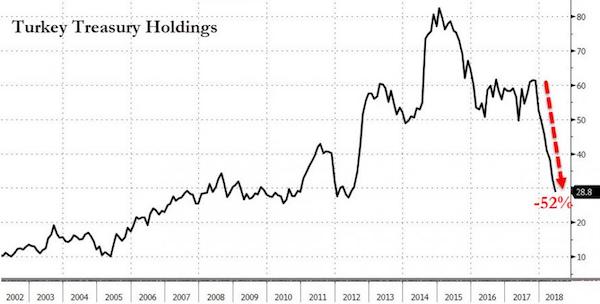
Last month, when we reported that Russia had liquidated the bulk of its US Treasury holdings in just two months, we said that “we can’t help but wonder – as the Yuan-denominated oil futures were launched, trade wars were threatened, and as more sanctions were unleashed on Russia – if this wasn’t a dress-rehearsal, carefully coordinated with Beijing to field test what would happen if/when China also starts to liquidate its own Treasury holdings.” As it turns out, Russia did lead the way, but not for China. Instead, another recent US foreign nemesis, Turkey, was set to follow in Putin’s footsteps of “diversifying away from the dollar”, and in the June Treasury International Capital, Turkey completely dropped off the list of major holders of US Treasurys, which has a $30 billion floor to be classified as a “major holder.”

According to the US Treasury, Turkey’s holdings of bonds, bills and notes tumbled by 52% since the end of 2017, dropping to $28.8 billion in June from $32.6 billion in May and $61.2 billion at the recent high of November of 2016. [..] The selloffs took place well before a diplomatic fallout between the US and both Turkey and Russia resulted in new sets of sanctions and tariffs imposed on both nations. The Trump administration last week imposed new sanctions against Russia in response to the nerve agent poisoning in the U.K. of a former Russian spy and his daughter. Meanwhile, the Turkish selloff certainly continued into July and August as U.S. relations with Turkey deteriorated this week

Read more …

It‘s in Putin’s hands.

• Turkey Wants Its Share Of Syria’s Reconstruction (AlM)

Although Turkey publicly appears to sustain its anti-Bashar al-Assad stance on Syria, it is actually getting ready for a new Syria that will allow Assad to stay on as the country’s president. While a termination of the de facto Kurdish autonomy in northern Syria seems to be the first precondition for a possible normalization between Ankara and Damascus, there is another unspoken condition as well: the allotment of a share in Syria’s reconstruction. Naturally, the Assad administration does not have the intention to allot any share to Turkey, which is accused of supporting anti-regime military groups that have destroyed the country and looted Aleppo’s industrial zones. However, Turkey’s control of a sizable territory in northern Syria and its cooperation with Russia make it difficult for Damascus to exclude Turkey from these calculations.

Turkey’s influence over opposition groups that could have a bearing on the Geneva process can not be dismissed. Turkey has been able to preserve its most important trading partner position with Syria despite the seven-year-old conflict. Its geographical proximity to Syria, logistical superiority and advanced capacity of its construction sector encourages Turkey to obtain a substantial part in the reconstruction process. Moreover, Turkey is currently organizing local entities in al-Bab, Jarablus, Azaz, Cobanbey and Afrin that are de facto under its control. It is also setting up systems for security, education, religion and even issuing ID cards to residents. In addition it has started building a road network.

Read more …

“The issues in Italy… in the next three months are going to dictate the whole European banking narrative for the next three to five years,”

• Italy, Not Turkey, Is The Biggest Threat To European Banks (CNBC)

The European Central Bank (ECB) was reported Friday to be concerned that the ongoing currency crisis in Turkey could result in problems for the continent’s banks. However, the real problem for Europe’s banking industry is Italy and what happens in that country in the coming months, an analyst said Tuesday. “The issues in Italy… in the next three months are going to dictate the whole European banking narrative for the next three to five years,” Tom Kinmonth, fixed income strategist at ABN Amro, told CNBC’s “Squawk Box Europe.” Italy’s economy is the third largest in the European Union and the country’s new coalition government is currently working on next year’s budget.

Its financial plan will be closely scrutinized by European authorities and, more importantly, by market players, following promises to increase public spending. Investors are wary of rises in pensions and state benefits, given that Italy already has a significantly high public debt pile — the second largest in the euro zone, at about 130% of GDP. If market players do not approve of the next budget, due around October, then borrowing costs for Italy are likely to go up, which in turn could affect neighboring European countries. It could also create problems for certain European banks that hold Italian debt.

Read more …

And they’re still in business.

• RBS Bankers Joked About Destroying The US Housing Market (G.)

RBS bankers joked about destroying the US housing market after making millions by trading loans that staff described as “total fucking garbage”, according to transcripts released as part of a $4.9bn (£3.8bn) settlement with US prosecutors. Details of internal conversations at the bank emerged just weeks before the 10-year anniversary of the financial crisis, which saw RBS rescued with a £45bn bailout from the UK government. The US Department of Justice (DoJ) criticised RBS over its trade in residential mortgage backed securities (RMBS) – financial instruments underwritten by risky home loans that are cited as pivotal in the global banking crash. It said the bank made “false and misleading representations” to investors in order to sell more of the RMBS, which are forecast to result in losses of $55bn to investors.

Transcripts published alongside the settlement reveal the attitude among senior bankers at RBS towards some of the products they sold. The bank’s chief credit officer in the US referred to selling investors products backed by “total fucking garbage” loans with “fraud [that] was so rampant … [and] all random”. He added that “the loans are all disguised to, you know, look okay kind of … in a data file.” The DoJ said senior RBS executives “showed little regard for their misconduct and, internally, made light of it”. In one exchange, as the extent of the contagion in the banking industry was becoming clear, RBS’ head trader received a call from a friend who said: “[I’m] sure your parents never imagine[d] they’d raise a son who [would] destroy the housing market in the richest nation on the planet.” He responded: “I take exception to the word ‘destroy.’ I am more comfortable with ‘severely damage.’”

Read more …

No chance until the whole thing collapses.

• Elizabeth Warren Unveils Bold New Plan To Reshape American Capitalism (G.)

Elizabeth Warren, the Massachusetts senator tipped as a Democratic presidential candidate in 2020, has unveiled new plans for legislation aimed at reining in big corporations, redistributing wealth, and giving workers and local communities a bigger say. Warren will introduce the bill dubbed the Accountable Capitalism Act on Wednesday. The proposal aims to alter a model she says has caused corporations to chase profits for shareholders to the detriment of workers. Under the legislation, corporations with more than $1bn in annual revenue would be required to obtain a corporate charter from the federal government – and the document would mandate that companies not just consider the financial interests of shareholders.

Instead, businesses would have to consider all major corporate stakeholders – which could include workers, customers, and the cities and towns where those corporations operate. Anyone who owns shares in the company could sue if they believed corporate directors were not meeting their obligations. Employees at large corporations would be able to elect at least 40% of the board of directors. An estimated 3,500 public US companies and hundreds of other private companies would be covered by the mandates. [..] Large companies dedicated 93% of their earnings to shareholders between 2007 and 2016 – a shift from the early 1980s, when they sent less than half their revenue to shareholders and spent the rest on employees and other priorities, Warren said.

Read more …

Here’s what Warren wants to change.

• Our “Prosperity” Is Now Dependent on Predatory Globalization (CHS)

So here’s the story explaining why “free” trade and globalization create so much wonderful prosperity for all of us: I find a nation with cheap labor and no environmental laws anxious to give me cheap land and tax credits, so I move my factory from my high-cost, highly regulated nation to the low-cost nation, and keep all the profits I reap from the move for myself. Yea for free trade, I’m now far wealthier than I was before. That’s the story. Feel better about “free” trade and globalization now? Oh wait a minute, there’s something missing–the part about “prosperity for all of us.” Here’s labor’s share of U.S. GDP, which includes imports and exports, i.e. trade:

Notice how labor’s share of the economy tanked once globalization / offshoring kicked into high gear? Now let’s see what happened to corporate profits at that same point in time:

Imagine that–corporate profits skyrocketed once globalization / offshoring kicked into high gear. Explain that part about “makes us all prosperous” again, because there’s no data to support that narrative. What’s interesting about all this is the way that politicians are openly threatening voters with recession if they vote against globalization. In other words, whatever “prosperity” is still being distributed to the bottom 80% is now dependent on a predatory version of globalization.

Read more …

Britain simply refuses to understand what the EU is. May can only get what she wants if the EU bends itself out of shape. Not going to happen.

• EU Rebuffs Idea Of Escalating Brexit Talks To Leaders’ Summit (G.)

European officials have poured cold water on hopes that Theresa May could negotiate Brexit with other EU leaders in September to break the deadlock over Britain’s departure. Diplomatic sources have rejected suggestions that May could hold direct talks on Brexit with the 27 other EU heads of state and government at a summit in Salzburg next month. “That is completely ridiculous, that is complete overspin of Salzburg,” one senior source told the Guardian. “It would mean that we would ditch our negotiating approach of the last two years and discuss at 28 instead of 27 to one, and I don’t see why this would happen.” Brexit talks are due to resume in Brussels on Thursday and Friday, the start of a new intense phase of negotiations, with the aim of reaching a deal in the autumn.

Since the referendum, the EU has insisted that all formal talks are led by the chief negotiator, Michel Barnier. May is allowed to update EU leaders on her plans at quarterly EU summits but is not in the room for discussions. Officials expect this approach to be continued at Salzburg, an informal summit on 20 September officially dedicated to migration. The meeting has been organised by Austria, which currently holds the EU rotating presidency, but it will be for the European council president, Donald Tusk, to decide whether to add Brexit to the agenda. The Salzburg gathering comes four weeks before an EU summit in Brussels, pencilled in by Barnier as the moment to strike a deal. Many in Brussels expect the deadline to slip to November or even December, squeezing the time available to ratify the text ahead of the UK’s departure on 29 March 2019.

Read more …

The view of a CIA veteran.

• Trump Strikes Back at ‘Ringleader’ Brennan (Ray McGovern)

There’s more than meets the eye to President Donald Trump’s decision to revoke the security clearances that ex-CIA Director John Brennan enjoyed as a courtesy customarily afforded former directors. The President’s move is the second major sign that Brennan is about to be hoist on his own petard. It is one embroidered with rhetoric charging Trump with treason and, far more important, with documents now in the hands of congressional investigators showing Brennan’s ringleader role in the so-far unsuccessful attempts to derail Trump both before and after the 2016 election.

Brennan will fight hard to avoid being put on trial but will need united support from from his Deep State co-conspirators — a dubious proposition. One of Brennan’s major concerns at this point has to be whether the “honor-among-thieves” ethos will prevail, or whether some or all of his former partners in crime will latch onto the opportunity to “confess” to investigators: “Brennan made me do it.” Well before Monday night, when Trump lawyer Rudy Giuliani let a small bomb drop on Brennan, there was strong evidence that Brennan had been quarterbacking illegal operations against Trump. Giuliani added fuel to the fire when he told Sean Hannity of Fox news:

“I’m going to tell you who orchestrated, who was the quarterback for all this … The guy running it is Brennan, and he should be in front of a grand jury. Brennan took … a dossier that, unless he’s the biggest idiot intelligence agent that ever lived … it’s false; you can look at it and laugh at it. And he peddled it to [then Senate Majority Leader] Harry Reid, and that led to the request for the investigation. So you take a false dossier, get Senators involved, and you get a couple of Republican Senators, and they demand an investigation — a totally phony investigation.”

Read more …

History lessons always good.

• Trump Is Right: America Was ‘Built On Tariffs’ (MW)

President Trump defended his use of tariffs to force other countries to renegotiate “unfair” trade deals by claiming that “our country was built on tariffs.” He’s right. America was a staunchly protectionist country for most of its history before World War II. One of the very first bills new President George Washington signed, for instance, was the Tariff Act of 1789. He inked the bill on July 4 of that year. The tariff of 1789 was designed to raise money for the new federal government, slash Revolutionary War debt and protect early-stage American industries from foreign competition. Then, as now, some industries sought protection in Congress from a flood of imports. Most goods entering the U.S. were subjected to a 5% tariff, though in a few cases the rates ranged as high as 50%.

It was the first of many tariffs that Congress passed over a century and a half. They generated the vast majority of the federal government’s revenue until the U.S. adopted an income tax in 1913. Tariffs have always been a source of controversy, however, starting with that very first one. Early on, the North preferred higher tariffs to protect infant American industries such as textiles from established English manufacturers. Alexander Hamilton, the nation’s first Treasury secretary, feared the U.S. would remain a weakling unless it built its own industries and became economically independent of the mother country. Over time the arguments on behalf of protectionism became closely tied to the emerging Republican party.

“Give us a protective tariff and we will have the greatest nation on earth,” a young politician named Abraham Lincoln said in 1847. Later, as the country’s 16th president, Lincoln rejected free trade and jacked up tariffs during the Civil War to pay for the North’s military campaigns.

Read more …

Paul has already topped the Iran regime change cabal. Let’s hope he gets his way again. Assange can be a very important Russiagate witness.

• Rand Paul Thinks Julian Assange Should Be Granted Immunity for Testimony (GP)

Senator Rand Paul believes that WikiLeaks founder Julian Assange should be given immunity in exchange for him testifying before the Senate Intelligence Committee. Speaking to the Gateway Pundit, Senator Paul asserted that Assange likely has important information about the hack and that it’s unlikely he would agree to testify without immunity. “I think that he should be given immunity from prosecution in exchange for coming to the United States and testifying,” Senator Paul told the Gateway Pundit. “I think he’s been someone who has released a lot of information, and you can debate whether or not any of that has caused harm, but I think really he has information that is probably pertinent to the hacking of the Democratic emails that would be nice to hear.” “It’s probably unlikely to happen unless he is given some type of immunity from prosecution,” Senator Paul added.

[..] Christine Assange, Julian’s mother, has a list of things that she would like to see happen before her son agrees to testify. She told the Gateway Pundit that her wishes include an end to the WikiLeaks grand jury, a dismissal of charges against all WikiLeaks staff, safe passage for him to a nation where he can receive medical care and an agreement that there will be no future US extradition requests. She would also like to see the testimony conducted publicly through Skype.

Read more …

Household debt. Mortal enemy no. 1. Check it where you live.

• Australia’s Record Household Debt Is A Ticking Time Bomb (ZH)

The Australian household debt to income ratio has ballooned to shocking levels over the past three decades as Sydney is ranked as one of the most overvalued cities in the world. According to the Daily Mail Australia, credit card bills, home mortgages, and personal loans now account for 189% of an average Australian household income, compared with just 60% in 1988, as Callus Thomas, Head of Research of Topdown Charts, demonstrates that record high household debt is a ticking time bomb. The average Australian credit card bill is roughly $3,272.70 as average income earners spend at least $2,000 a month on mortgage repayments, which has contributed to the affordability crisis, said the Daily Mail Australia.

The average Australian holds about a $400,000 mortgage after they put down 20% deposit for a $500,000 property. The paper notes that the loan would barely buy a one-bedroom unit in most outer suburbs, as full-time workers take in about $82,000 salary per annum and spend an alarming 40% on mortgage repayments. With household debt at crisis levels, CoreLogic said Australian home prices experienced their sharpest monthly drops in July since late 2011 as declines gathered momentum in Sydney and Melbourne (Sydney and Melbourne cover about 60% of Australia’s housing market by value and 40% by number). Nationally, the index of home prices dropped .60% in July from June, leading to an annual fall of 1.6%.

Read more …

The board may have to get rid of Musk. But what is Tesla without him?

• SEC Serves Tesla With Subpoena (CNBC)

The Securities and Exchange Commisison has served Tesla with a subpoena after CEO Elon Musk tweeted that he was considering taking the company private and that he had the necessary funding lined up, according to reports from The New York Times and other outlets published Wednesday. Earlier reports said the SEC had intensified scrutiny of the automaker after the controversial tweet. A subpoena would be one of the first steps in a formal inquiry. Shares of Tesla were down 3% in afternoon trading, though they moved only a fraction of 1% following the Times article.

Musk publicly floated the possibility of taking the company private in a tweet that sent shares seesawing and company leadership scrambling. His statement that he had the “funding secured” came under particular scrutiny, as it may have violated an SEC rule that essentially stipulates public statements made by company executives must be true. Musk explained earlier this week that the Saudi Arabia sovereign wealth fund had expressed interest in taking Tesla private.

Read more …

Will this get the EU to move?

• Monsanto’s Roundup Found In Wide Range Of Cereals Aimed At Children (G.)

Significant levels of the weedkilling chemical glyphosate have been found in an array of popular breakfast cereals, oats and snack bars marketed to US children, a new study has found. Tests revealed glyphosate, the active ingredient in the popular weedkiller brand Roundup, present in all but two of the 45 oat-derived products that were sampled by the Environmental Working Group, a public health organization. Nearly three in four of the products exceeded what the EWG classes safe for children to consume. Products with some of the highest levels of glyphosate include granola, oats and snack bars made by leading industry names Quaker, Kellogg’s and General Mills, which makes Cheerios.

One sample of Quaker Old Fashioned Oats measured at more than 1,000 parts per billion of glyphosate. The Environmental Protection Agency has a range of safe levels for glyphosate on crops such as corn, soybeans, grains and some fruits, spanning 0.1 to 310 parts per million. “I grew up eating Cheerios and Quaker Oats long before they were tainted with glyphosate,” said EWG’s president, Ken Cook. “No one wants to eat a weedkiller for breakfast, and no one should have to do so.” Cook said EWG will urge the EPA to limit the use of glyphosate on food crops but said companies should “step up” because of the “lawless” nature of the regulator under the Trump administration.

Read more …

Aug 042018


John French Sloan Spring rain 1912


• The Everything Bubble Has Found Its Pin. The Pin’s Name is Jerome Powell. (PC)
• The Fed Accelerates its QE Unwind (WS)
• US Gains Only 157,000 Jobs In July As Unemployment Falls To 3.9% (MW)
• US Government Has No Idea How Many Gig Workers There Are (MW)
• Mark Carney Says Risk Of A No-Deal Brexit Is ‘Uncomfortably High’ (G.)
• The Conservatives Are In Crisis Over Austerity, Not Just Brexit (NS)
• US Secret Service And The Guardian Face Off Over ‘Russian Spy’ (RT)
• Russia Seeks US Help To Rebuild Syria (R.)
• Judge Calls US Efforts To Reunite Deported Parents ‘Unacceptable’ (R.)
• US Court Orders Trump Administration To Fully Reinstate DACA Program (R.)
• Trump Administration Lifts GMO Crop Ban For US Wildlife Refuges (R.)


Error? Powell obviously wants a strong dollar. And yes, that has consequences.

• The Everything Bubble Has Found Its Pin. The Pin’s Name is Jerome Powell. (PC)

The Powell Fed is playing with matches next to over $60 trillion in $USD-denominated debt. The $USD is the reserve currency of the world. As such it is the currency of choice if you are going to issue debt. As a result of this, entities around the globe, whether they be corporations or countries, will often choose to issue debt denominated in the $USD, even if the $USD is not a currency used in their economy. When you borrow money in the $USD… you are effectively SHORTING the $USD. You are betting/hopingthat the $USD will weaken, making your debt servicing/ future debt repayment, cheaper on a relative basis. In this environment, when the $USD strengthens, it becomes MORE DIFFICULT to service your debt.

This is true even for the US itself. The $20 trillion we owe in public debt is effectively one gigantic $20 trillion $USD short. Enter Jerome Powell. For whatever reason, the Powell Fed has decided to embark on the most aggressively hawkish monetary policy in Fed history. And the currency markets have taken note. The $USD is breaking out of downtrends in Every. Single. Currency. Pair. The day Jerome Powell became Fed chair is annotated buy the vertical blue line. Assuming Jerome Powell DOESN’T want to blow up the $60 trillion $USD-denominated debt bubble… the above chart SCREAMS “policy error.”

I’m not being dramatic here… the last time the $USD rallied like this against every major currency was in 2014. At that time the entire commodity complex imploded by over 60% and the Emerging Market came within a hair’s breadth of systemic collapse. Again, I’m not being dramatic here… within six months of the $USD’s rally in 2014, Brazil’s stock market was down nearly 70%. China’s was down nearly 50%. Emerging Markets across the board dropped over 30%. Oil fell from $105 to $30 and change. Etc. I don’t see any indication Powell is aware of this… which means… BUCKLE UP. THE EVERYTHING BUBBLE HAS FOUND ITS PIN. AND THE PIN’S NAME IS JEROME POWELL.

Read more …

And Powell is very clear on “balance sheet normalization” too.

• The Fed Accelerates its QE Unwind (WS)

The Fed’s QE Unwind – “balance sheet normalization,” as it calls this – is accelerating toward cruising speed. The first 12 months of the QE unwind, which started in October 2017, are the ramp-up period – just like there was the “Taper” during the final 12 months of QE. The plan calls for shedding up to $420 billion in securities in 2018 and up to $600 billion a year in each of the following years until the balance sheet is sufficiently “normalized” – or until something big breaks. In July, the QE Unwind accelerated sharply. According to the plan, the Fed was supposed to shed up to $24 billion in Treasury Securities in July, up from $18 billion a month in the prior three months. And? The Fed released its weekly balance sheet Thursday afternoon. Over the four weeks ending August 1, the balance of Treasury securities fell by $23.5 billion to $2,337 billion, the lowest since April 16, 2014.

Since the beginning of the QE-Unwind, the Fed has shed $129 billion in Treasuries. The step-pattern in the chart is a result of how the Fed sheds Treasury securities. It doesn’t sell them outright but allows them to “roll off” when they mature. Treasuries only mature mid-month or at the end of the month. Hence the stair-steps. In mid-July, no Treasuries matured. But on July 31, $28.4 billion matured. The Fed replaced about $4 billion of them with new Treasury securities directly via its arrangement with the Treasury Department that cuts out Walls Street (its “primary dealers”) with which the Fed normally does business. Those $4 billion in securities, to use the jargon, were “rolled over.” But it did not replace about $24 billion of maturing Treasuries. They “rolled off.”

Total assets on the Fed’s balance sheet for the four weeks ending August 1 dropped by $34.1 billion. This brought the drop since October, when the QE unwind began, to $205 billion. At $4,256 billion, total assets are now at the lowest level since April 9, 2014, during the middle of the “taper.” It took the Fed about six years to pile on these securities, and now it’s going to take years to shed them:

Read more …

Trend is towards lower paid jobs.

• US Gains Only 157,000 Jobs In July As Unemployment Falls To 3.9% (MW)

The U.S. posted another solid spurt in hiring in July, showing that companies are still able to find enough workers to meet the growing needs of a rapidly expanding U.S. economy. Some 157,000 new jobs were created last month despite widespread complaints among businesses about a shortage of skilled labor, the Labor Department said Friday. The increase in hiring fell below the 195,000 MarketWatch forecast, but job gains in May and June was stronger than previously reported. The smaller gain in employment was also a result of governments cutting jobs in education during the summer break and the closure of Toys R Us. Otherwise hiring may have topped 200,000.

Unemployment, meanwhile, slipped below 4% again, to 3.9%, as more people found work.The jobless rate is at a nearly two-decade low. Far-flung complaints about how hard it is to find good workers still aren’t inducing companies to jack up salaries and wages, however. Hourly pay rose 7 cents in July to $25.07, but the 12-month rate of wage gains was unchanged at 2.7%. And even those increases have been largely eaten up by rising inflation. Wages usually rise 3% to 4% a year when the labor market is as tight as it is now.

Read more …

Much more interesting than the jobs report. 75 million gig workers? And they’re all counted as ’employed’?

• US Government Has No Idea How Many Gig Workers There Are (MW)

The BLS does not have an explicit definition for a gig worker, or a formal way of tracking them. It comes closest in a survey called the Contingent Worker Supplement, which studies “contingent workers” in temporary working arrangements that they don’t expect to last more than a year. But prior to last month, the BLS had not released the Contingent Worker Supplement since 2005 due in large part to a lack of funding. The most recent report found that 5.9 million people or 3.8% of all workers are contingent workers. “It’s not that the BLS doesn’t care about secondary work, they do,” said Demetra Nightingale at the Urban Institute, a think tank. But without adequate funding it is difficult for the BLS to study those workers, she said.

These workers come in many forms. They include side hustlers with regular jobs and freelancers who take on extra clients on their off-hours, according to Freelancing in America, a 2017 survey conducted in part by Freelancers Union. That survey estimated that 57.3 million Americans are freelancing, or 36% of the workforce. Other estimates say the gig economy is even larger than that. The Federal Reserve has a very broad definition of people working in the gig economy. The Fed says gig workers could be anyone from a babysitter to an Uber driver. According to that definition, there are as many as 75 million gig workers.

Read more …

My first thought when reading this: he’s trying to get himself fired. Brexit Britain doesn’t need some Canadian opinion.

• Mark Carney Says Risk Of A No-Deal Brexit Is ‘Uncomfortably High’ (G.)

Mark Carney has warned that the possibility of a no-deal Brexit is “uncomfortably high” and will lead to higher prices, as Theresa May prepares to meet the French president, Emmanuel Macron, for talks. The Bank of England governor said both the UK and EU should “do all things to avoid” a no-deal scenario. He added that the banks had done the “stockpiling” and the country’s financial system was in a position to be able to withstand a shock that could result from the UK leaving the EU without an agreement. His remarks led to sterling falling sharply to just under $1.30. Carney told BBC Radio 4’s Today programme: “I think the possibility of a no-deal is uncomfortably high at this point.” Asked if no deal would be a disaster, he said: “It is highly undesirable. Parties should do all things to avoid it.”

Pushed on what no deal would mean, he said “disruption to trade as we know it”, before adding: “As a consequence of that, a disruption to the level of economic activity, higher prices for a period of time. “Our job at the Bank of England is to make sure those issues don’t happen in the financial system, so that people will have things to worry about in a no-deal Brexit, which is still a relatively unlikely possibility but it is a possibility, but what we don’t want to have is people worrying about their money in the bank, whether or not they can get a loan from the bank – whether for a mortgage or for a business idea – and we have put the banks through the wringer well in advance of this to make sure they have the capital.”

Read more …

An already completely gutted society. More to come. Local councils are being cut to the bone.

• The Conservatives Are In Crisis Over Austerity, Not Just Brexit (NS)

The Conservative party is engaged in the bloodiest incarnation yet of its 30-year Europe war. After Theresa May’s Chequers deal succeeded in alienating almost everyone, Remainers are backing a “people’s vote”, while Leavers are embracing no deal. There is no obvious means by which the parliamentary deadlock can be broken. But the Brexit crisis is masking another one: over austerity. The Leave vote in 2016 and the loss of the Tories’ majority in 2017 were symptoms of voter discontent over spending cuts (a new study published this week suggested that austerity may have directly caused Brexit). As the New Statesman’s Crumbling Britain series has charted, eight years of austerity have enfeebled the public realm.

Rough sleeping, which fell by three-quarters under the last Labour government, has risen by 169 per cent since 2010. The NHS has been forced to cancel operations and even urgent surgery as it struggles to meet ever greater demand. Relative child poverty has increased for three consecutive years and now stands at 4.1 million, or 30 per cent of children. Nearly 1,000 Sure Start children’s centres and 478 libraries are estimated to have closed since 2010. Potholed roads and uncollected bins are evidence of the scale of austerity borne by councils (real-terms funding for local authorities has been cut by 49 per cent since David Cameron took office as prime minister). Northamptonshire Council, a Conservative flagship, has declared itself effectively bankrupt – and others may follow.

Read more …

The Guardian is up to some strange things.

• US Secret Service And The Guardian Face Off Over ‘Russian Spy’ (RT)

US Secret Service has scolded the Guardian for “irresponsible and inaccurate” reporting on an alleged Russian spy at the US embassy in Moscow. Unfazed, the newspaper continued to spin the story calling it the ‘tip of the iceberg.’ The British newspaper, never one to pass up a good Russia scare story, published a fresh one on Friday, citing multiple intelligence analysts to reinforce the idea that its own anonymously-sourced revelations of a suspected spy with high-level security clearance having been embedded for a decade in the US embassy in Moscow,”could be just the tip of the iceberg.” The Secret Service, meanwhile, has been issuing repeated rebuttals to the Guardian’s reporting.

The security officials were quite emphatic in bashing the article as “wrought with irresponsible and inaccurate reporting based on the claims of “anonymous sources’.” In its press release on Thursday, the Secret Service specifically points out that before the publication came out, it had provided the Guardian with background to the story “clearly refuting unfounded information” in its statement to the editor. The Guardian did mention the agency’s response, bundling it in the middle of its article, while citing its unnamed “intelligence source” profusely, claiming that the Russian woman, the suspected mole, “had access to the most damaging database, which is the US Secret Service official mail system.”

This allegedly included “schedules of the president – current and past, vice-president and their spouses, including Hillary Clinton.” According to the Secret Service, the allegations that a mysterious foreign ‘femme fatale’ could have access to such sensitive information, are unfounded. “FSNs [Foreign Service Nationals] working under the direction of the U.S. Secret Service have never been provided or placed in a position to obtain, secret or classified information as erroneously reported.”

Read more …

You break it, you bought it.

• Russia Seeks US Help To Rebuild Syria (R.)

Russia has used a closely guarded communications channel with America’s top general to propose the two former Cold War foes cooperate to rebuild Syria and repatriate refugees to the war-torn country, according to a U.S. government memo. The proposal was sent in a July 19 letter by Valery Gerasimov, the chief of the Russian military’s General Staff, to U.S. Marine General Joseph Dunford, chairman of the Joint Chiefs of Staff, according to the memo which was seen by Reuters. The Russian plan, which has not been previously reported, has received an icy reception in Washington. The memo said the U.S. policy was only to support such efforts if there were a political solution to end Syria’s seven-year-old civil war, including steps like U.N.-supervised elections.

The proposal illustrates how Russia, having helped turn the tide of the war in favor of President Bashar al-Assad, is now pressing Washington and others to aid the reconstruction of areas under his control. Such an effort would likely further cement Assad’s hold on power. “The proposal argues that the Syrian regime lacks the equipment, fuel, other material, and funding needed to rebuild the country in order to accept refugee returns,” according to the memo, which specified that the proposal related to Syrian government-held areas of the country. The United States in 2011 adopted a policy that Assad must leave power but then watched as his forces, backed by Iran and then Russia, clawed back territory and secure Assad’s position. The United States has drawn a line on reconstruction assistance, saying it should be tied to a process that includes U.N.-supervised elections and a political transition in Syria. It blames Assad for Syria’s devastation.

Read more …

But what can Sabraw do?

• Judge Calls US Efforts To Reunite Deported Parents ‘Unacceptable’ (R.)

A federal judge on Friday described as “unacceptable” the U.S. government’s progress in reuniting immigrant children in the United States with deported parents and ordered the government to appoint a person to take charge of its efforts. “This is going to be a significant undertaking and it’s clear there has to be one person in charge,” said U.S. District Judge Dana Sabraw at a hearing in San Diego. Sabraw in June ordered the government to begin reuniting some 2,500 children that officials separated from their parents after they crossed the U.S.-Mexican border. The families were separated as part of a “zero tolerance” U.S. government policy toward illegal immigration that began in early May.

Many of them had crossed the border illegally, while others had sought asylum. About 1,900 children have since been reconnected with their parents or a sponsor. On Thursday, the government proposed that non-profit groups should take the lead in locating as many as 500 parents deported or removed from the United States without their children. At Friday’s hearing, Sabraw said it was it was “100 percent the responsibility of the administration” to reunite those families. Sabraw also noted that as few as 12 of the 500 parents in question have been located. “That is just unacceptable at this point,” he said. “The reality is that for every parent who is not located there will be a permanently orphaned child.”

The government’s lawyer, Scott Stewart, said that the agencies involved would consider appointing a point person or persons. Stewart said the government had proposed a plan with non-profit groups in a prominent role because it believed that was the quickest way to locate parents.

Read more …

Different judge. Legal opinions are sorely need in the US.

• US Court Orders Trump Administration To Fully Reinstate DACA Program (R.)

A federal judge on Friday ruled that the Trump administration must fully restore a program that protects from deportation some young immigrants who were brought to the United States illegally as children, including accepting new applications for the program. U.S. District Judge John Bates in Washington, D.C., said he would stay Friday’s order, however, until August 23 to give the administration time to decide whether to appeal. Bates first issued a ruling in April ordering the federal government to continue the Deferred Action for Childhood Arrivals, or DACA, program, including taking applications. He stayed that ruling for 90 days to give the government time to better explain why the program should be ended.

On Friday Bates, who was appointed by former President George W. Bush, a Republican, said he would not revise his previous ruling because the arguments of President Donald Trump’s administration did not override his concerns. Under DACA, roughly 700,000 young adults, often referred to as “Dreamers”, were protected from deportation and given work permits for two-year periods, after which they must re-apply to the program.

Read more …

Better put this before a judge as well. But no surprise that Monsanto is powerful stateside.

• Trump Administration Lifts GMO Crop Ban For US Wildlife Refuges (R.)

The Trump administration has rescinded an Obama-era ban on the use of pesticides linked to declining bee populations and the cultivation of genetically modified crops in dozens of national wildlife refuges where farming is permitted. Environmentalists, who had sued to bring about the 2-year-old ban, said on Friday that lifting the restriction poses a grave threat to pollinating insects and other sensitive creatures relying on toxic-free habitats afforded by wildlife refuges. “Industrial agriculture has no place on refuges dedicated to wildlife conservation and protection of some of the most vital and vulnerable species,” said Jenny Keating, federal lands policy analyst for the group Defenders of Wildlife.

Limited agricultural activity is authorized on some refuges by law, including cooperative agreements in which farmers are permitted to grow certain crops to produce more food or improve habitat for the wildlife there. The rollback, spelled out in a U.S. Fish and Wildlife Service memo, ends a policy that had prohibited farmers on refuges from planting biotech crops – such as soybeans and corn – engineered to resist insect pests and weed-controlling herbicides. That policy also had barred the use on wildlife refuges of neonicotinoid pesticides, or neonics, in conjunction with GMO crops. Neonics are a class of insecticides tied by research to declining populations of wild bees and other pollinating insects around the world.

Rather than continuing to impose a blanket ban on GMO crops and neonics on refuges, Fish and Wildlife Service Deputy Director Greg Sheehan said in Thursday’s memo that decisions about their use would be made on a case-by-case basis.

Read more …

Jun 292018
 
 June 29, 2018  Posted by at 1:19 pm Finance Tagged with: , , , , , , , , , , ,  5 Responses »


René Magritte Mysteries of the horizon (a.k.a. The Masterpiece) 1955


Don’t know if you noticed, but the Trump-Putin summit in Helsinki on July 16 takes place one day after the soccer World Cup final, Sunday July 15. Now it seems clear that Trump doesn’t care about soccer, though he apparently knows Christiano Ronaldo, but that factoid is significant because the World Cup takes place in Russia.

It’s amusing to contemplate that Putin told Trump’s people he would love to meet with his counterpart, but not until after the Cup Final. So they settled on the very next day.

The same people who now express worries about the summit, also had worries about the nasty things that could happen to players and supporters in Moscow and other cities. There has not been one single incident. No police violence, no hooliganism, the stadiums are beautiful, the organization is pitch perfect. There’s been only sunshine, too.

The only problem reported in the media was that some cities ran out of beer, because the Russians hadn’t expected the Aussies and British to drink as much of the stuff as Russians themselves do. They probably didn’t expect them to show up in such large numbers either. But those Russians don’t see a real problem: “we always have enough vodka”.


Patrick Lang called the fact that Trump sent uber-neocon John Bolton to Moscow to organize the summit a stroke of genius. The man who wants WWIII more than anyone must now make sure a summit that may serve to prevent it, successful. But what does Trump really want? And what do the neo-cons want?

First off, US and Russian presidents should meet all the time. It’s beyond reason that Trump has been in the saddle almost a year and a half without such a summit. Trumped up allegations of election meddling in about half the nations on the planet, about poisonings in Britain and about chemical weapons in Syria, have prevented a summit so far.

It looks like Trump got tired of all that. But of course all we’ll see the next two+ weeks is more ‘Trump is Putin’s lapdog’ memes. While there are very serious issues to be discussed. A major one, undoubtedly, is Syria. There has been a lot of movement politically on that.

The US has indicated it will no longer support the Syrian rebels. It has acknowledged that regime change, and removal of Assad, is not going to happen. Because Russia will not leave Assad to fend for himself.


There are signs that another false flag chemical attack in the country is being prepared, but if that happens before July 16, Trump himself will jump in to condemn the nonsense. He wants the meeting, and he wants it bad. As he should, and not for some nefarious reason.

Regime change in Syria is off the calendar because of Putin. Regime change in Iran, apparently still on that calendar, will also fail because while Putin may -but just may- be willing to give in, China will not. And not even a Saudi-US-UAE-Israel cabal can withstand both China AND Russia. Those days are over.

The neocons are way behind the action. They think in terms of something that has long since passed its best before date. Yeah, wonder how John Bolton sees these things these days. Maybe he had a crash course upon entering the White House.

But let’s not kid ourselves: the US warmonger faction may be outdated, they are still very powerful and very present. They can still attempt to force Trump’s hand with a false flag here or there. Their plans to conquer Russia, though, will have to be shelved for now. Or do they?

Tyler Durden has a lengthy report on the proposed spending in Europe by the US military. I won’t get into the details (tons of infrastructure spending close to Russian borders), but here’s the money shot:


The request for additional funding would more than double the military’s infrastructure projects under the European Deterrence Initiative (EDI), from the 2018 request, when just a few years ago, the Pentagon was scaling back its Cold War-era footprint in Europe. According to Defense News, the EDI request increased to $6.5 billion from $4.8 billion in 2018, military construction projects in the EDI request jumped from $338 million in 2018, while pre-positioning funds soared from $2.2 billion to $3.2 billion.

The Air Force would spend roughly $368.6 million to pre-position equipment and $363.8 million for military construction projects. While the spending is almost equal to what was expensed in fiscal 2018, it is a huge jump from 2017, when the Air Force was only allotted $31.2 million in pre-positioning funds and $85.4 million for military construction.


And I know what you’re thinking: didn’t Trump say not so long ago that he wanted Europe to pay more for its own defense? Well, yes, he did, but Europe is other wise engaged, it’s now planning its own ‘army’, which can’t NOT take away from its contributions to NATO.

So Trump meets Putin on July 16, who knows all of this and a boatload more, and what’s he going to tell him? When Putin asks him about these new US ‘investments’ in Europe, what’s he going to say?

Putin will state that Russia’s military expenditures have only fallen over the past decade+, and that he doesn’t understand why the US spends that much more, because Russia’s new weapons are decades ahead of America’s. (I don’t think he’s kidding).

Of course Putin knows better then anyone that his military spending takes place for a whole different purpose than that in the US: he builds a strong defense, while America feeds its private contractors arms industry as much taxpayers’ money as it can get away with. What did the Pentagon lose track of again, was that $21 trillion?

And of course Putin knows that to an extent Trump is trapped inside the military-industrial complex Ike warned about. And that John Bolton is such a docile and eager servant of.

One thing we can be sure of is that just like the World Cup, the summit won’t be a boring event, the media will be all over it, each with their own favorite, and over half the world will follow the ‘games’. And the outcome of Helsinki is as unpredictable as that of the final in Moscow. One more thing that’s for sure: the US won’t be in that final. Not even John Bolton.


Jun 252018


Edward Hopper Cape Cod morning 1950


• China’s Central Bank Frees Up $100 Billion In Funding As Trade War Looms (SCMP)
• US Plans Limits On Chinese Investment In US Technology Firms (R.)
• Tit-for-Tat Tariff Battle Could Spark Downturn In Global Economy – BIS (G.)
• Why The Debt Deal With The EU Is Bad For Greece (AlJ)
• UK Minister Urges Gov’t to Ignore BMW, Airbus Brexit Warnings (Sp.)
• Some Of The Pictures Of Border Kids That Haunt Me Most Are From 2014 (PI)
• Migration Is Threat To EU Free Travel Area – Italian Prime Minister (G.)
• Italy Tells Rescue Ships Not To Help Refugees In Peril At Sea (Ind.)
• The US, Under Obama, Created Europe’s Refugee Crisis (Zuesse)
• Merkel’s Troubles Began in Syria and End in Italy (Luongo)
• Erdogan To Gain Sweeping New Powers After Declaring Election Victory (Ind.)
• Erdogan Says Turkey Will Continue Advancing In Syria (R.)
• ‘Tourists Go Home, Refugees Welcome’ – Barcelona (G.)


Bankruptcies. Nothing to do with a trade war.

• China’s Central Bank Frees Up $100 Billion In Funding As Trade War Looms (SCMP)

China’s central bank said on Sunday it would unlock at least US$100 billion for the country’s lenders to bail out troubled state firms and to help small businesses, as Beijing tries to shore up growth under the shadow of a trade war with the United States. The People’s Bank of China (PBOC) said in a statement it would cut the reserve requirement ratio, the share of deposits lenders must put aside with the central lender, for commercial banks by half a percentage point from July 5. The cut would free up 500 billion yuan (US$76.86 billion) in funds for the big banks, including Industrial and Commercial Bank of China and China Construction Bank, to finance debt-to-equity swaps, a measure often used for troubled state enterprises.

It would also free up 200 billion yuan for smaller banks to boost lending to small businesses across the country, the central bank said. The move is a “targeted operation” aimed at supporting the weak links in the economy and not a change to the country’s “neutral and prudent” monetary policy stance, the PBOC said. Although the statement did not mention China’s trade row with the United States, or its recently released weaker economic indicators, the reduction in the reserve ratio will come into effect a day before the first of US President Donald Trump’s additional tariffs on Chinese products are due to be implemented.

Deng Haiqing, a visiting scholar at Renmin University of China, wrote in a note that the PBOC’s move represented a significant shift in China’s policy, and was not just fine-tuning. “The authorities have started to see the pain inflicted on the real economy from deleveraging, and they are trying to reduce it,” he said.

Read more …

Makes sense.

• US Plans Limits On Chinese Investment In US Technology Firms (R.)

The U.S. Treasury Department is drafting curbs that would block firms with at least 25 percent Chinese ownership from buying U.S. companies with “industrially significant technology,” a government official briefed on the matter said on Sunday. The official, whose comments matched a report by the Wall Street Journal, emphasized that the Chinese ownership threshold may change before the restrictions are announced on Friday. The move marks another escalation of President Donald Trump’s trade conflict with China, which threatens to roil financial markets and dent global growth.

Tariffs on $34 billion worth of Chinese goods, the first of a potential total of $450 billion, are due to take effect on July 6 over U.S. complaints that China is misappropriating U.S. technology through joint venture rules and other policies. The Treasury investment restrictions are expected to target key sectors, including several China is trying to develop as part of its “Made in China 2025” industrial plan, the U.S. official said. Among its objectives, the plan aims to upgrade China’s capabilities in advanced information technology, aerospace, marine engineering, pharmaceuticals, advanced energy vehicles, robotics and other high-technology industries. The Wall Street Journal also said the U.S. Commerce Department and National Security Council were proposing “enhanced” export controls to keep such technologies from being shipped to China.

Read more …

Give me a break: “Ten years after the start of the global crisis, central bankers should feel satisfied with the state of the global economy..”

• Tit-for-Tat Tariff Battle Could Spark Downturn In Global Economy – BIS (G.)

An escalation of protectionist measures could spark a fresh downturn just as the global economy is picking itself up after the last one, the international body that represents the world’s central banks has warned. The Bank for International Settlements (BIS) said there were already signs that “the ratcheting up of rhetoric” was weighing on investment. It comes as Donald Trump steps up hostility with some of the US’s key trading partners and allies, raising fears of a full-blown trade war. What began with tariffs imposed on steel and aluminium imported into the US has turned into a broader trade battle with trading partners including China and the EU, as they respond with retaliatory measures.

The US president is threatening Beijing with tariffs on $200bn of goods imported from China and on Friday Trump threatened to impose tariffs on European cars after Brussels introduced levies on American goods such as Levi’s jeans, bourbon whiskey and Harley-Davidson motorbikes. Agustín Carstens, the general manager of BIS, said an increase in protectionist measures was a key vulnerability in the global economy that threatened to undermine growth and could spread to financial markets. “One possible trigger of an economic slowdown or downturn could be an escalation of protectionist measures. Its impact could be very significant, if such escalation was seen as threatening the open multilateral trading system.

“Indeed, there are signs that the rise in uncertainty associated with the first protectionist steps and the ratcheting up of rhetoric have already been inhibiting investment.” In its annual report on the challenges facing the global economy, BIS said that the ultra-low interest rates implemented by central banks as an emergency response to the financial crisis had served the global economy well but said loose monetary policy was posing a threat to stability. “Ten years after the start of the global crisis, central bankers should feel satisfied with the state of the global economy, after expansionary and unconventional monetary policies were left to bear the burden of recovery,” Carstens said. “But this has left a legacy of higher debts on public and private balance sheets. Still reliant on central bank support and with less room for manoeuvre. Central banks cannot continue be the only game in town.”

Read more …

This is where the EU started collapsing. Immigration issues will do the rest.

• Why The Debt Deal With The EU Is Bad For Greece (AlJ)

[..] there is more to this deal than the arithmetic of long-term debt sustainability. At the heart of Greece’s protracted fiscal crisis was always a highly contentious social and political question about the real meaning of European solidarity: Who should be made to pay for the presumed “profligacy” of successive Greek governments, or the “excessive risk-taking” of profit-hungry private creditors in the lead-up to the crisis? The course of action that European leaders ended up settling on turned out to be very one-sided in this respect: Greece alone was to blame for its predicament, and therefore, Greece alone would be made to pay for it.

The real motivation behind the bailouts was always to safeguard the survival of a dangerously over-exposed European banking system – but this fact was quickly obscured. Instead, right-wing politicians and the tabloid media whipped up a frenzy of anti-Greek sentiment. The Greeks were widely portrayed as splurging the money on lavish pensions and long beach holidays – or on “booze and women,” as former Dutch finance minister Jeroen Dijsselbloem infamously put it last year. But as research by the European School of Management and Technology in Berlin has since shown, 95 percent of the bailout funds that were supposedly “given” to Greece actually went straight back to private creditors.

Meanwhile, the bailout loans themselves were added to Greece’s overall debt, and the country continued to pay interest on them over subsequent years. In other words, the Greek people never received any handouts from their European creditors. Meanwhile, the Greek government reduced the size of its public sector by 26 percent, cutting pensions and welfare spending by 70 percent and slashing the public health budget in half. As a result, incomes fell by one-third and unemployment skyrocketed to a peak of over 28 percent, unleashing a veritable humanitarian catastrophe.

Read more …

But Jeremy, they have shareholders.

• UK Minister Urges Gov’t to Ignore BMW, Airbus Brexit Warnings (Sp.)

Speaking to the BBC, Health Secretary Jeremy Hunt said that businesses sounding the alarm about post-Brexit job losses actually affect the UK’s negotiations with the European Union. According to him, the best way for companies to achieve the “clarity and certainty” they need is to support the PM in her talks with Europe. Hunt suggested that a “Brexit fudge” would be likely if Theresa May’s attempts to “deliver the best possible Brexit, a clean Brexit” were undermined. The statement comes several days after BMW, a German-based car giant which employs around 8,000 people in Britain, threatened to start preparing “contingency plans” if it doesn’t get details on the UK’s post-Brexit trading arrangements by the end of summer.

BMW echoed the warning of the French aviation giant Airbus, which announced on June 21 that a no-deal scenario would have a “catastrophic” outcome and would force it to reconsider its long-term position in the UK, putting some 14,000 UK-based jobs at risk. With the UK government failing to provide clarity on Brexit for the time being, a recent survey has found that nearly half of business leaders from the rest of Europe have cut investment in the country. The poll also shows that three quarters of big companies want the bloc to make concessions to Britain to enable a better trading relationship after London’s divorce with Brussels.

Read more …

I think it’s important that we see the big picture here. You won’t find a solution if you can’t define the problem. This has been going on for years.

• Some Of The Pictures Of Border Kids That Haunt Me Most Are From 2014 (PI)

The other day, a veteran immigration lawyer named R. Andrew Free shared an anecdote that sheds some really critical light on what’s happening on America’s southern border — a tale that not surprisingly got buried amid a sandstorm of news about mothers not knowing where their kids are, audiotapes of anguished, crying children, and now the protests to end the human rights abuses that the current government is undertaking in our name. What Free described on Twitter was an opportunity that few people get: A chance to personally confront the president of the United States and question him about his immigration policies.

Free wrote that the answers he received from the so-called leader of the free world “shook me to my core.” The immigration lawyer had been to two large detention centers in Texas where U.S. officials were holding hundreds of migrant families from Central America, often for months at a time. Free said some of the conditions at these makeshift detention camps were appalling. “I remember hearing the constant, violent coughing and sickness of small children, and the worry of their mothers who stood in the sun outside the clinic all day only to be told their kids should ‘drink water,’” Free tweeted. “I remember nearly doubling over when I saw the line of strollers.”

When Free had a chance encounter with the president at a political event, he warned him that the detention centers would be “a stain on his legacy.” He said the president wanted to know if Free was an immigration lawyer — implying that everyday citizens weren’t worried about what goes on at the border — and then said, according to Free: “I’ll tell you what we can’t have, it’s these parents sending their kids here on a dangerous journey and putting their lives at risk.” The message that Free took away was that the president saw family detention as a deterrent to keep more refugees from coming. This happened in 2015. The president with the looming stain on his legacy was Barack Obama.

Read more …

There goes Merkel.

• Migration Is Threat To EU Free Travel Area – Italian Prime Minister (G.)

Italy has warned the future of the EU’s border-free travel zone is at stake as it sought to ease the pressure on Mediterranean countries arising from hosting refugees and migrants. Italy’s prime minister, Giuseppe Conte, was speaking at a mini-EU summit in Brussels, where he said a plan from his government presented at the summit represented a paradigm shift in dealing with migration. But his ambitious move to change what he called obsolete EU rules that govern who is responsible for asylum claimants is likely to encounter opposition from other countries.

The 10-point plan by his new populist government revives many ideas proposed by previous Italian governments, such as calling on all EU member states to share responsibility for migrants rescued at sea, and countries being docked EU funds if they refuse to take in refugees. Leaders from 16 EU countries put on a show of unity, as they left an emergency summit in Brussels on Sunday. The unorthodox meeting, boycotted by several EU countries, was called to shore up the conservative coalition government of the German chancellor, Angela Merkel, which is riven by a row over migration. Spain’s prime minister, Pedro Sánchez, said the talks had been “frank and open,” although they had not resulted in “any concrete consequences or conclusions”.

Sunday’s ad-hoc meeting sets the stage for a long-planned gathering of all EU leaders on Thursday, where it will be harder to mask Europe’s deep divisions on migration. Hungary’s prime minister, Viktor Orbán, can be expected to repeat his fierce opposition to migrant quotas, a policy opposed by other central European countries.

Read more …

Salvini is going to Libya this week.

• Italy Tells Rescue Ships Not To Help Refugees In Peril At Sea (Ind.)

Italy’s far-right government told aid ships in the Mediterranean Sea not to rescue thousands of refugees in peril on Sunday – despite receiving six separate distress calls from unseaworthy boats. Officials said the vessels – carrying people from North Africa to Europe – were all in Libyan waters and, therefore, Libyan responsibility. The Spanish aid group, Proactiva Open Arms, which had ships in the area, said it had been specifically told not to help. Matteo Salvini, Italy’s interior minister, said in a tweet: “It’s right that the Libyan authorities intervene, as they’ve been doing for days, without having the NGOs interrupt them and disturb them.”

The latest revelation follows a fortnight in which Italy has refused permission for aid ships carrying rescued refugees to dock in its ports. One, the Aquarius with 630 people on board, had to reroute to Spain. Another, Lifeline holding 240 people, remained at sea over the weekend. Mr Salvini has said such refugees would only see his country “on a postcard”. Italy has said it is seeing a constant stream of people coming illegally from Africa, and has threatened to withhold payments to the EU unless a more even way of dispersing refugees is agreed.

Read more …

Zuesse misses the role that Britain -remember Blair, Cameron?- and France have played.

• The US, Under Obama, Created Europe’s Refugee Crisis (Zuesse)

The current US President, Donald Trump, claimed on June 18th, that Germany’s leadership, and the leadership in other EU nations, caused the refugee-crisis that Europe is facing: “The people of Germany are turning against their leadership as migration is rocking the already tenuous Berlin coalition. Crime in Germany is way up. Big mistake made all over Europe in allowing millions of people in who have so strongly and violently changed their culture!” The US Government is clearly lying about this. The US Government itself caused this crisis that Europeans are struggling to deal with.

Would the crisis even exist, at all, if the US had not invaded and tried to overthrow (and in some instances actually overthrown) the governments in Libya, Syria, and elsewhere — the places from which these refugees are escaping? The US Government, and a few of its allies in Europe (the ones who actually therefore really do share in some of the authentic blame for this crisis) caused this war and government-overthrow, etc., but Germany’s Government wasn’t among them, nor were many of the others in Europe. If the US Government had not led these invasions, probably not even France would have participated in any of them. The US Government, alone, is responsible for having caused these refugees.

The US Government itself created this enormous burden to Europe, and yet refuses to accept these refugees that it itself had produced, by its having invaded and bombed to overthrow (among others) Libya’s Government, and then Syria’s Government, and by its aiding Al Qaeda in organizing and leading and arming, jihadists from all over the world to come to Syria to overthrow Syria’s Government and to replace it with one that would be selected by the US regime’s key Middle Eastern ally, the Saud family, who own Saudi Arabia, including its Government, and who are determined to take over Syria.

Trump blames Angela Merkel for — in essence — having been an ally of the US regime, a regime of aggression which goes back decades, and which Trump himself now is leading, instead of his ending, and of his restoring democracy to the United States, and, finally, thus, his restoring freedom (from America), and peace, to other nations, in Europe, and elsewhere (such as in Syria, Yemen, etc.).

Read more …

Chaos.

• Merkel’s Troubles Began in Syria and End in Italy (Luongo)

It looks like we are entering the end of Merkel-ism in Europe. German Chancellor Angela Merkel is approaching her final days in that position. Be it next week or the end of this year, we are looking at unprecedented change in European politics thanks to Merkel’s insistence on taking in millions of Syrian and North African refugees from chaos unleashed by aggressive and insane foreign policy actions by the U.S. and supported by the EU. From the destruction of Libya to the manufactured ‘civil war’ in Syria the displacement of millions of people was created from the desired to destabilize the entire region for the betterment of the U.S. and its allies in the region, Saudi Arabia and Israel. Jordan, Turkey and Qatar were originally involved but have since jumped ship in the wake of Russia’s intervention there.

Merkel’s current plight politically stems from her intractability in accepting the chain of events that led us to this point. All of the problems of Europe now stem from the collision of these foreign policy disasters and the economic degradation of the euro-zone from the flawed structure of the euro itself. And the insistence of the U.S./Saudi/Israeli alliance to continue trying to manufacture a win in Syria that is clearly beyond their control at this point only tightens the noose around Merkel’s neck.

Read more …

Predictable but still scary.

• Erdogan To Gain Sweeping New Powers After Declaring Election Victory (Ind.)

Recep Tayyip Erdogan has been declared triumphant in Turkey’s presidential vote by the country’s electoral board, amid accusations of manipulation by his opponents. Mr Erdogan had earlier claimed he had won after state run news outlets said he was victorious. An announcement from the broadcaster TRT came soon after the Anadolu Agency, who reported that he had won 52.51 per cent of the vote with 98.4 per cent of the total counted. Independent election monitors and the opposition both maintained that less than half the votes had been counted at that point. The president’s main rival, Muharrem Ince – who state media said had won 30.72 per cent of the vote – urged observers and his supporters to stay on at counting centres, warning that vote rigging was likely to place if they left under the impression that the result had been decided.

But speaking in the early hours of Monday, the head of the Supreme Election Council Sadi Guven confirmed the result. He said that Mr Erdogan “received the absolute majority of all valid votes” and the remaining ballots would not affect the outcome. In his speech Mr Erdogan had warned: “The Turkish public has mandated me as president according to unofficial results. I hope nobody will damage democracy by casting a shadow on this election and its results to hide their failure.”

Read more …

Doesn’t waste any time.

• Erdogan Says Turkey Will Continue Advancing In Syria (R.)

Turkey will continue to “liberate Syrian lands” so that refugees can return to Syria safely, President Tayyip Erdogan said in an election victory speech on Monday. Speaking to supporters from the balcony of his ruling AK Party’s headquarters in Ankara after Sunday’s presidential and parliamentary elections, Erdogan said Turkey would also act more decisively against terrorist organizations.

Read more …

“In 1990 the city received 1.7 million tourists; last year the figure was 32 million – roughly 20 times the resident population.”

• ‘Tourists Go Home, Refugees Welcome’ – Barcelona (G.)

Early last year, around 150,000 people in Barcelona marched to demand that the Spanish government allow more refugees into the country. Shortly afterwards, “Tourists go home, refugees welcome” started appearing on the city’s walls; soon the city was inundated with protestors marching behind the slogans “Barcelona is not for sale” and “We will not be driven out”. What the Spanish media dubbed turismofobia overtook several European cities last summer, with protests held and measures taken in Venice, Rome, Amsterdam, Florence, Berlin, Lisbon, Palma de Mallorca and elsewhere in Europe against the invasion of visitors. But in contrast to many, as fiercely as Barcelona has pushed back against tourists, it has campaigned to welcome more refugees.

When news broke two weeks ago that a rescue ship carrying 629 migrantswas adrift in the Mediterranean, mayor Ada Colau was among the first to offer those aboard safe haven. Is it really the case that Barcelona would prefer to receive thousands of penniless immigrants rather than the millions of tourists who last year spent around €30bn in the city? The short answer, it appears, is yes. Increasingly it is tourism, not immigration, that people see as a threat to the city’s very identity – though numbers of both have risen exponentially in recent decades. In 2000 foreigners accounted for less than 2% of the population; a mere five years later, the figure was 15% (266,000). In 2018, it is now officially 18% although, according to Lola López, the city’s integration and immigration commissioner, the true figure is closer to 30%.

The influx of new residents has radically changed the face of the city, but Barcelona has not seen a single anti-immigrant protest of any substance – nor is immigration an issue at local elections. According to research by Paolo Giaccaria, a social scientist at the University of Turin, the case of Barcelona “establishes a connection between two types of mobility that are at odds with each other: northern tourism and southern migration. It subverts the common feeling about which kind of mobility is desirable which is not.” Immigration has changed the city, but tourism is destabilising it – and even people in the industry agree that it can’t go on like this. In 1990 the city received 1.7 million tourists; last year the figure was 32 million – roughly 20 times the resident population. The sheer volume of visitors is driving up rents, pushing residents out of neighbourhoods, and overwhelming the public space.

Read more …

Jun 192018
 
 June 19, 2018  Posted by at 12:07 pm Finance Tagged with: , , , , , , , , , , ,  14 Responses »


Paul Gauguin Why are you angry? 1896


Yes, you have every right to be outraged at the disgraceful treatment of children on America’s borders. But that does not give you the right to NOT be outraged by what America has done and is today still doing to children in, just to name a few places, Syria, Libya and Yemen. Be outraged, but don’t make it an echo chamber issue. Because if you do, you, too, are in a cage.

So if you see the wives of former presidents speak out about the child separation policies, ask yourself where they get the moral authority to speak out on such issues, after their husbands have bombed the crap out of many countries, killing many many children in the process. And don’t let’s get started about Hillary Clinton when she was Secretary of State.

Presently in Yemen, 20 million people depend on humanitarian aid, and the US are helping Saudi Arabia et al bomb the only port left through which that aid can reach them, to smithereens. 8.5 million Yemenis are already starving, and some 3 million of them are children. Where is your outrage over that?

Where is the outrage over the American and international treatment of Julian Assange, who has been in the Ecuador embassy in London for six years today? Where is it?

Don’t get coaxed into selective outrage by your news media, who like nothing better than to tell you what to be outraged by, and what not. If you allow that to happen, you have lost your freedom and your independence. Ask why they tell you a certain story at the moment they tell it. Ask why they tell it the way they do.

Yes, it has come to this. Every single story you read or hear needs to be scrutinized. Because there’s an agenda behind all of them, left, right or middle. And because the media have figured out that constantly driving you from one selective outrage to another is very profitable for them. Critical thought is not.

Yes, there are sociopaths in the Trump administration. But that’s nothing new. There have been sociopaths in every administration. It’s how our political systems work. Sh*t floats to the top.

Yes, US border policies have intensified. But whatever you think of that, migrants and refugees are not a new issue. Nor are the reasons why people flee their homes and communities. Whether it’s Africa or Central America, people flee because of what western governments, military and intelligence services have done to their homelands.

And until we stop doing that, they will keep coming. So much of our prosperity and power is derived directly from other people’s poverty and despair. So much of our wealth has been stolen from other people’s resources. If you want to be outraged at something or someone, start with yourself. Start thinking.

What is happening today is awful. But so many awful things happened in the past that you never showed outrage about. And yet these things are all inextricably linked. One leads to another.

America shouldn’t be outraged about Trump without being outraged about its entire political system, and all of its actors. Without that, outrage about Trump has no meaning, and will lead to nothing at all. Or rather, it will lead to a more divided country, full of people played for profit and political games.

The US invasion of Vietnam ended to a large extent because of protests in the streets. Perhaps that is what is needed once again. But the underlying issues, the ones that had led to the invasion in the first place, were not solved then. And that is what it is all about.

Nor is it an American problem per se. Europe is just as culpable. Children drowning, children in cages, what’s the difference, in the end it all comes from the same mindset. Which needs a radical reset. But what are the odds of that happening?

Our cultures are based on exploiting other peoples and nations, and then telling ourselves we deserve what we have. How are you going to change that? The only way to resolve the global refugee problem is to make sure people have a future where they are born. And the only thing we actually do is to make that impossible.

Yes, be outraged.


Jun 192018


Vittorio Matteo Corcos Sogni 1896


• Threatened By The Truth – Julian Assange Anniversary (IE)
• 25,000 Flee As Fighting In Yemen Port City Hodeida Escalates (AP)
• It’s Time To Get Enraged At What Western Imperialists Have Done To Syria (CJ)
• Paul Tudor Jones Warns The Next Recession Will Be ‘Really Frightening’ (Y.)
• Trump Threatens New Tariffs On $200 Billion In Chinese Goods (CNBC)
• China Enters the Trade Trap (IICS)
• Chasing Yield during ZIRP & NIRP Evidently Starved Human Brains of Oxygen (WS)
• Why Germany Neither Can Nor Should Pay More To Save The Eurozone (Varoufakis)
• Macron’s Euro Zone Reforms: Grand Vision Reduced To Pale Imitation (R.)
• Hopeless European Millennials And The Populist Takeover (John Rubino)
• Spain’s New Government To Remove Franco’s Remains From Mausoleum (AFP)
• A Very British Disease (Coppola)
• Thousands Of Public Buildings And Spaces In England Sold Off A Year (G.)
• Coercion (Jim Kunstler)
• Sharp Fall In Number Of People Seeking Asylum In EU (G.)


If you’re not outraged by Assange’s situation, you have no right to be outraged by anything else.

• Threatened By The Truth – Julian Assange Anniversary (IE)

Today marks the sixth anniversary of Wikileaks founder Julian Assange’s effective house arrest in London. He cannot move around in public, because he fears he will be arrested and extradited to America — a daunting prospect, since a UN special rapporteur described Chelsea Manning’s treatment by that country’s justice system as torture. Assange is divisive. Hawks wish him nothing but misfortune and a stretch in jail. According to journalist John Pilger, a leaked official memo says: “Assange is going to make a nice bride in prison. Screw the terrorist. He’ll be eating cat food forever.” If you stand at the other end of the spectrum, Assange is a hero who revealed how our world really works.

Consequently, he has been relentlessly targeted. Hilary Clinton has contributed to this process, as Assange highlighted the Clintons’ links with Saudi Arabia and the multimillion donations that kingdom made to their foundation, after she, as secretary of state, sanctioned an $80bn Saudi arms deal. Assange remains, despite illegal efforts to revoke it, an Australian citizen, but he has not enjoyed the support a person who has not been charged with anything, much less convicted of anything, might expect from a democracy. These are indeed murky waters, but Assange’s ordeal reconfirms a truth: News is something someone, somewhere, does not want published. That’s why he is such a threat.

Read more …

Yes, the treatment of children on America’s borders is a disgrace. But don’t make it an echo chamber issue. Kids in Hodeida are much worse off. Where is the outrage?

• 25,000 Flee As Fighting In Yemen Port City Hodeida Escalates (AP)

The UN spokesman said on Monday that tens of thousands of residents have fled the fighting along Yemen’s western coastline, where Yemeni fighters backed by a Saudi-led coalition are engaged in fierce battles with Iranian-backed Houthi rebels. Stephane Dujarric, the spokesman for the UN secretary-general, told reporters on Monday that about 5,200 families, or around 26,000 people, have fled the fighting and sought safety within their own districts or in other areas in Hodeida governorate. ‘‘The number is expected to increase as hostilities continue,’’ he said. Emirati troops, along with irregular and loyalist forces in Yemen, have been fighting against Houthis for Hodeida since Wednesday.

Coalition warplanes rained missiles and bombs on Houthi positions near Hodeida airport, in the city’s south. The offensive for Hodeida has faced criticism from international aid groups, who fear a protracted fight could force a shutdown of the city’s port and potentially tip millions into starvation. About 70 percent of Yemen’s food enters via the port, as well as the bulk of humanitarian aid and fuel supplies. Around two-thirds of the country’s population of 27 million relies on aid, and 8.4 million are already at risk of starving.

Read more …

And there are more things you should be outraged by.

• It’s Time To Get Enraged At What Western Imperialists Have Done To Syria (CJ)

Rumors are again swirling of an impending false flag chemical weapons attack in Syria, just as they did shortly before the highly suspicious Douma case in April. Warnings from Syrian and Russian intelligence, as well as US war ship movements and an uptick in US funding for the Al Qaeda propaganda firm known as the White Helmets, give these warnings a fair bit of weight. Since the US war machine has both a known regime change agenda in Syria and an extensive history of using lies, propaganda and false flags to justify military interventionism, there’s no legitimate reason to give it the benefit of the doubt on this one. These warnings are worth taking seriously.

So some people are understandably nervous. The way things are set up now, it is technically possible for the jihadist factions inside Syria and their allied imperialist intelligence and defense agencies to keep targeting civilians with chemical weapons and blaming the Assad government for them until they pull one off that is so outrageous that it enables the mass media to manufacture public support for a full-scale assault on Damascus. This would benefit both the US-centralized empire which has been plotting regime change in Syria for decades and the violent Islamist extremists who seek control of the region. It also creates the very real probability of a direct military confrontation with Syria’s allies, including Russia.

But the appropriate response to the threat of a world war erupting in Syria is not really fear, if you think about it. The most appropriate response to this would be unmitigated, howling rage at the western sociopaths who created this situation in the first place.

Read more …

No stabilizers.

• Paul Tudor Jones Warns The Next Recession Will Be ‘Really Frightening’ (Y.)

Legendary global macro trader Paul Tudor Jones is warning that asset prices are too high. And furthermore, he’s concerned about what the next recession might look like. He shared his thoughts on Monday during a conversation with Goldman Sachs CEO Lloyd Blankfein as part of the firm’s “Talks at GS” series. The hedge fund billionaire, who rarely gives interviews or makes public comments on the markets, cautioned that across asset classes “you have to be thinking this is a highly dubious sustainable price.” Jones doesn’t think the low interest rates we have now due to easy monetary policy are sustainable over time. He said that interest rate policy is “crazy.” He further argued that the Trump administration’s stimulative fiscal policy isn’t sustainable either.

“You look at prices of stocks, real estate, anything,” he said. “We’re going to have to mean revert to a normal real rate of interest with a normal term premium that’s existed for 250 years. We’re going to have to get back to that. We’re going to have to get back to a sustainable fiscal policy and that probably means the price of assets goes down in the very long run.” In the short run, the market is “jacked up and ready to go,” he said. Blankfein added that it’s like “pouring lighter fluid on an already lit fire.” During the financial crisis, central banks had a lot of room to ease monetary policy and governments had more flexibility to push stimulative fiscal policy. Today, there’s less room and flexibility.

“The next recession is really frightening because we don’t have any stabilizers,” Jones said. “We’ll have monetary policy, which will exhaust really quickly, but we don’t have any fiscal stabilizers.”

Read more …

“Trump is going to have to find some way to back down and let China save face..”

• Trump Threatens New Tariffs On $200 Billion In Chinese Goods (CNBC)

President Donald Trump has requested the United States Trade Representative to identify $200 billion worth of Chinese goods for additional tariffs at a rate of 10 percent. The new duties will go into effect “if China refuses to change its practices, and also if it insists on going forward with the new tariffs that it has recently announced,” the president said in a statement provided by the White House late on Monday. Beijing has pledged to fight back if Trump goes ahead with the new tariffs. U.S. stock index futures fell following the news, while Asian equity markets were mixed. It’s the latest development in escalating trade tensions between the world’s two largest economies.

On Friday, the U.S. announced a 25 percent tariff on up to $50 billion of Chinese products, prompting Chinese President Xi Jinping’s administration to respond witha 25 percent tariff on $34 billion of U.S. goods. “It’s one thing to retaliate with $50 billion here and $50 billion there but when the [U.S.] president trots out another $200 billion, that’s quite concerning,” Max Baucus, former U.S. ambassador to China under President Barack Obama, told CNBC. “This reminds me little bit of an old western … If there’s a gunfight trade war, somebody’s going to get hurt,” he continued: “Trump is going to have to find some way to back down and let China save face so that both sides can back down gradually and respectfully.”

Read more …

Democracy?

• China Enters the Trade Trap (IICS)

Perhaps nobody knows what President Trump will do next, including President Trump, but right now it looks like he has successfully maneuvered China into a trade trap. The goal is to slow China’s economy such that military modernization slows and its economy cannot catch up with the United States. Meanwhile, implementation of this strategy is called “Beijing’s playbook” and the whole time President Trump speaks positively about Xi Jinping and China’s help in other areas. Bloomberg: Xi to Counter Trump Blow for Blow in Unwanted Trade War “The Chinese view this as an exercise in self-flagellation, meaning that the country that wins a trade war is the country that can endure most pain,” said Andrew Polk, co-founder of research firm Trivium China in Beijing. China “thinks it can outlast the U.S. They don’t have to worry about an election in November, let alone two years from now.”

This is the mistake autocrats always make about Western governments and the United States. They view the messy and inefficient political system (intentionally designed that way to protect liberty) as a weakness. They think politicians care more about elections than anything else. They see the difficulty in reaching consensus as a weakness. However, they miss the fact that democratic governments enjoy greater legitimacy. If the U.S. reaches a majority in favor of confronting China on trade, then President Trump has the far stronger political hand. Confronting China on trade raises President Trump’s popularity. His base and independent voters favor this policy. Democrats oppose him because he is Trump, but they would lose votes if the only issue in November was “Confront China on trade, yes or no?”

Read more …

“..new issuance of Treasuries “will absorb such a large share of dollar liquidity that a crisis in the rest of the dollar bond markets is inevitable.”

• Chasing Yield during ZIRP & NIRP Evidently Starved Human Brains of Oxygen (WS)

Let’s be clear: It’s not just Argentina. But Argentina is the most elegant example. The exodus of the hot money from emerging markets where cheap dollar-debts were used to fund pet projects and jack up leverage is – once again – in full swing. Cheap dollar-debt in emerging markets is an old sin that, like all old sins, is repeated endlessly. The outcome is always trouble. But during the act, it sure is a lot of fun for everyone. The exodus of the hot money is even gripping the non-basket-case emerging economies of Asia where it’s causing the worst indigestion since 2008.

Bloomberg: “Overseas funds are pulling out of six major Asian emerging equity markets at a pace unseen since the global financial crisis of 2008 – withdrawing $19 billion from India, Indonesia, the Philippines, South Korea, Taiwan, and Thailand so far this year.” While emerging markets shone in the first quarter, suggesting resilience to Federal Reserve tightening, that image has shattered over the past two months. With American money market funds now offering yields around 2% – where 10-year Treasuries were just last September – and prospects for more Fed hikes, the bar for heading into riskier assets has been raised.”

“It’s not a great set-up for emerging markets,” James Sullivan, head of Asia ex-Japan equities research at JPMorgan Chase, told Bloomberg. “We’ve still only priced in about two thirds of the US rate increases we expect to see over the next 12 months. So the Fed is continuing to get more hawkish, but the market still hasn’t caught up.” [..] “Dollar funding of emerging market economies has been in turmoil for months now,” Patel wrote – because yeah, the era of the cheap dollar is over, and investors should have figured that out two-and-a-half years ago when the Fed started hiking rates. But the market didn’t want to believe that the Fed would actually do it. And suddenly over the past two months, it downs on these geniuses that the Fed has actually been hiking rates and will continue to do so for some time.

Patel not only blamed the QE unwind but also the simultaneous and massive issuance of new Treasury debt by the US government to fund its ballooning deficits. This new issuance of Treasuries “will absorb such a large share of dollar liquidity that a crisis in the rest of the dollar bond markets is inevitable.”

Read more …

Excellent speech by Yanis. Read and learn. He may be the only one around with a real way to save the EU.

• Why Germany Neither Can Nor Should Pay More To Save The Eurozone (Varoufakis)

[..] I wanted a Germany that was hegemonic and efficient, not authoritarian and caught up in a European Ponzi scheme. That was in 2013. Two years later, in March 2015, I wrote an article, while Greece’s finance minister, referring to the first and second bailout loans, of 2010 and 2012. Allow me to quote from it: “The fact is that Greece had no right to borrow from German – or any other European – taxpayers at a time when its public debt was unsustainable. Before Greece took on any loans, it should have initiated debt restructuring and undergone a partial default on debt owed to its private-sector creditors. But this “radical” argument was largely ignored at the time.

Similarly, European citizens should have demanded that their governments refuse even to consider transferring private losses to them. But they failed to do so, and the transfer was effected soon after. The result was the largest taxpayer-backed loan in history, provided on the condition that Greece pursue such strict austerity that its citizens have lost one-quarter of their incomes, making it impossible to repay private or public debts. The ensueing – and ongoing – humanitarian crisis has been tragic… Animosity among Europeans is at an all-time high, with Greeks and Germans, in particular, having descended to the point of moral grandstanding, mutual finger-pointing, and open antagonism. This toxic blame game benefits only Europe’s enemies.”

Read more …

More Europe at this point in time will only lead to more tension.

• Macron’s Euro Zone Reforms: Grand Vision Reduced To Pale Imitation (R.)

When French President Emmanuel Macron laid out a sweeping vision for eurozone reform last September, he spoke of “rebuilding Europe”, with a common budget for the euro nations and a single minister to oversee it all. The proposals he will discuss when he sits down with German Chancellor Angela Merkel outside Berlin on Tuesday will be far less ambitious, with deep differences between the two European powerhouses. Many economists agree with Macron that fundamental reforms are needed to strengthen the eurozone and insulate the single currency — the most potent symbol of Europe’s integration — from future crises, like the 2010-13 sovereign debt contagion that nearly tore the euro apart.

But Merkel has limited room to act due to political pressure at home, and is always at pains to ensure France and Germany aren’t pushing ahead with plans that have no deep backing from the rest of the European Union. Macron and Merkel will discuss a separate budget for the 19 countries that share the single currency but much smaller than he wanted. Then there are gaps in opinion over a fund to calm bond markets in a crisis and a backstop for the banking system. “Things are going in the right direction, but the proposals we’re getting from the Germans aren’t sufficient,” said a French official who acknowledged there were deep differences between the two sides.

A German official said there were still big questions about what sort of agreement Tuesday’s meeting would produce on the budget for the euro zone. The official said Merkel’s recent political troubles over migration policy could mean she is less inclined to make concessions to the French leader. Besides the disagreement between France and Germany, it is also the nature of negotiations between the eurozone countries that grand ideas get chipped away at until a compromise is reached that satisfies all parties.

Read more …

“Where Germany has trading partners willing to borrow big to buy Mercedes and Beemers, the US has the world’s reserve currency, which acts as an unlimited credit card for our entitlement state and military/industrial empire.”

• Hopeless European Millennials And The Populist Takeover (John Rubino)

Europe is frequently held up as an example of how the rest of the world should behave on a variety of issues. But this comparison misses at least two things: First, “Europe” is actually a lot of different countries in a lot of different situations. Second, much of what seems to work over there only does so because it’s being financed with ever-increasing amounts of debt. For countries, as for individuals, borrowing money is fun at first but beyond a certain point becomes debilitating, as interest payments begin to crowd out everything else. That’s where a growing number of Europe’s failed states now find themselves, with overly-generous pensions and overly-restrictive labor laws making it virtually impossible to run a functioning market-based economy.

The result: Fewer good jobs and more frustrated voters – especially young ones who have seen only the downside of the current system – and the resulting rise of populist political parties that recognize the problems without offering coherent solutions, thus guaranteeing even more chaos in the future. As Today’s Wall Street Journal notes, in Italy and Greece, nearly a third of young adults not only aren’t working but aren’t enrolled in school or training. What are they doing? Apparently just sitting around and stewing about life’s injustice. As for where they’re sitting and stewing, in Greece, Italy and Spain it’s now normal for adults all the way into their 30s to live with their parents, largely because they can’t find work that pays enough to afford a house, car and other requirements of independent life.

As for Germany, which looks great by comparison, keep in mind that a big part of its economic outperformance is due to other EU countries borrowing huge amounts of money to buy German exports. When the latter run out of money – a point which is clearly coming – Germany suffers twice, once when it loses important customers and again when its banks, having lent trillions of euros to Italy, Spain, et al, have to eat those losses. But bad-mouthing Europe should not be seen as implicit praise of the US. We, like Germany, have an advantage that’s both unfair and temporary. Where Germany has trading partners willing to borrow big to buy Mercedes and Beemers, the US has the world’s reserve currency, which acts as an unlimited credit card for our entitlement state and military/industrial empire.

Read more …

Starting to like Sanchez.

• Spain’s New Government To Remove Franco’s Remains From Mausoleum (AFP)

Spain’s new Socialist government is determined to remove the remains of Francisco Franco from a vast mausoleum near Madrid and turn it into a place of “reconciliation” for a country still coming to terms with the dictator’s legacy. “We don’t have a date yet, but the government will do it,” Prime Minister Pedro Sanchez said late Monday during his first television interview since being sworn in on June 2 after toppling his conservative predecessor Mariano Rajoy in a confidence vote. He recalled that a non-binding motion approved last year in parliament called for Franco’s remains to be exhumed from the massive Valley of the Fallen mausoleum some 50 kilometres (30 miles) northwest of Madrid and the site turned into a “memorial of the victims of fascism”.

“Spain can’t allow symbols that divide Spaniards. Something that is unimaginable in Germany or Italy, countries that also suffered fascist dictatorships, should also not be imaginable in our country,” Sanchez added. Earlier on Monday Socialist party spokesman Oscar Puente said the mausoleum should be transformed into a “place of reconciliation, of memory, for all Spaniards, and not of apology for the dictatorship.” Franco ruled Spain with an iron fist from the end of the country’s 1936-39 civil war until his death in 1975, when he was buried inside a basilica drilled into the side of a mountain at the Valley of the Fallen, one of Europe’s largest mass graves.

Read more …

A history. “Simply provide everyone with a basic income so that they can afford to live, then let them get on with whatever they want to do.”

• A Very British Disease (Coppola)

The desire to judge people’s motives rather than addressing their needs is a “British disease”. We have been suffering from it for hundreds of years, cycling endlessly through repeated cycles of generosity and harshness. Each cycle ends in public outrage and an abrupt reversal: but the memory eventually fades, and the disease reappears in a new form. In this post, I outline the tragic history of Britain’s repeated attempts to “categorise the poor”.

[..] worst of all, using rules and sanctions to compel the genuinely work-shy to work diverts attention and resources away from those who really need help. And it unfairly stigmatises the vast majority of those who are not working, or who are not working as many hours as we think they should, whether through unemployment, sickness or disability. Study after study has shown that in general, people want to work. The problem is that suitable jobs aren’t always available. And yet there remains a prevalent view, even among people who should know better, that people must be compelled to work, or to work harder, with harsh treatment. But today’s sanctions for those who won’t or can’t work are mild compared to the punishments of old: why should they be any more successful?

We would do better to concentrate our attention on helping those who genuinely want to work to find fulfilling, productive and well-paid jobs. And we should also stop trying to decide whether someone “deserves” social support. We have been trying to distinguish between the “deserving” and “undeserving” poor for eight hundred years, and we are no better able to make that judgement now than we were in the fourteenth century, or the sixteenth, or the nineteenth. It is time to give up this fruitless attempt to judge people’s motives. Simply provide everyone with a basic income so that they can afford to live, then let them get on with whatever they want to do.

Read more …

Next up: sell Parliament.

• Thousands Of Public Buildings And Spaces In England Sold Off A Year (G.)

More than 4,000 public buildings and spaces in England are being sold off every year, with more than 7,000 others at risk over the next five years, a charity has said. Locality says the majority of the sites being offloaded by local authorities are sold to private developers for the highest price, forever lost to communities around them. The charity wants the government to create a £200m-a-year community ownership fund for the next five years to help preserve the buildings and spaces for the use of local people. Tony Armstrong, its chief executive, said: “This is a sell-off on a massive scale. We know that many of the buildings being lost have valuable community uses.

“Everyone of us can think of a local public building or outside space we love and use, from libraries to lidos and town halls to youth centres. They are owned by the public and they’re being sold off for short-term gain to fill holes in council budgets. “Many hundreds of local community groups are stepping up and fighting for community ownership. But they urgently need support and help with startup costs if they are to compete with the commercial developers.” The Great British Sell Off report is published on Tuesday and is based on freedom of information requests sent to all 353 local authorities in England. Locality received 55 responses on the number of buildings and spaces sold between the financial years 2012-13 and 2016-17, as well as 127 replies about sites identified as surplus over the next five years, extrapolating the results to obtain national totals.

Read more …

“..if human relations are solely about power, than exercising power over others is all that matters..”

• Coercion (Jim Kunstler)

Mr. Peterson laid it out nicely: identity politics assigns everyone to ethnic, racial, and sexual groups, and all the human relations among them amount to never-ending battles for political power. Nothing else matters. Individuals especially don’t matter, only the group. And no group has abused its power more than European white men. This animating idea comes out of the mid-20th century “post-structural critical theorists” Jacques Derrida and Michel Foucault, whose Marxian views emerged conveniently at a time when women and non-white people were vying for departmental chairs in the college humanities and social science programs, and thus have two generations been indoctrinated.

Well, if human relations are solely about power, than exercising power over others is all that matters. Hence, the key to identity politics: it’s all about coercion, making others do your will by threat of force and force itself. These days, the main threat is depriving heretics and apostates of their livelihood. That’s what happened to Brett Weinstein at Evergreen U in Washington State last year, and to Jordan Peterson himself at the U of Toronto, when he objected loudly and publicly to a new Canadian federal law that sought to punish citizens who refused to use the new menu of personal pronouns for the rapidly multiplying new gender categories (e.g. ze, zir, they, xem, nem, hir, nir….)

Both Weinstein and Peterson refused to be coerced and found themselves inadvertently leading a movement against the pervasive, creeping coercion of our time — which has now spread from the campuses into corporate life, with the HR departments working overtime to enforce thought among employees, because company profits are at stake (e.g. Starbucks day-off for “diversity and inclusion training”).

Read more …

Somewhat curious that the big political problems start just as the numbers fall.

• Sharp Fall In Number Of People Seeking Asylum In EU (G.)

Fewer people sought asylum in the European Union last year, although numbers remain higher than before the arrival of 1 million people in 2015 triggered a political crisis that continues to divide Europe. Showing a sharp drop in asylum claims, the latest report from the EU’s asylum office was published on Monday after emergency talks in the German government over asylum policy and a bitter standoff between EU nations over a migrant rescue ship that eventually docked in Spain after being banned from Italy and Malta. The EU’s asylum office counted 728,470 applications for international protection in 2017, a 44% reduction on the 1.3m applications the previous year.

More than 1 million people entered the EU in 2015, many fleeing the war in Syria. Syria, Iraq and Afghanistan remain the most frequent countries of origin for asylum seekers, accounting for 29% of all claims. The downward trend of asylum claims continued in the first four months of 2018, the EU asylum office said, although numbers have still not returned to pre-crisis levels. About 460,000 people applied for asylum in EU countries in 2013. The fall in asylum applications reflects a sharp drop in people making the hazardous journey over the eastern Mediterranean to Greece and the central Mediterranean to Italy, although there has been an increase in people travelling from west Africa to Spain, albeit from a lower base.

Germany continues to receive more applications for asylum than any other country in Europe, with 222,560 claims in 2017, folowed by Italy, France and Greece. The UK was in fifth place, with 33,780 applications, accounting for 4.6% of all EU asylum claims. But the backlog remains high: 954,100 claims are awaiting a decision, including 443,640 in Germany, according to the EU asylum office.

Read more …

May 102018


Paul Gauguin Road in Tahiti 1891


• Beware of the Coming Economic Debt Bomb (Tanous)
• Argentina Looks To Be Headed For Another Economic Storm (CNBC)
• At Last, A Reason To Celebrate: House Prices Are Falling (G.)
• RBS Reaches $4.9 Billion Deal To Settle US Mortgage Bond Probe (R.)
• The Deep State First (Stockman)
• Turkey Detains Dozens Of Air Force Personnel Over Gulen Links (R.)
• Did Putin Green-Light Tonight’s Massive Israeli Strikes On Syria? (ZH)
• Trump Welcomes Home Three Americans Released By North Korea (G.)
• Democrats’ Lead Is Slipping In Generic Ballot Poll (Hill)
• Is Capitalism a Threat to Democracy?
• Bullshit Jobs: Why They Exist And Why You Might Have One (Vox)


“..over half of all personal income taxes will be required just to service the national debt.”

• Beware of the Coming Economic Debt Bomb (Tanous)

In 2009, the year President Obama took office, the national debt held by the public was $7.27 trillion. At the end of fiscal 2016, that had soared to approximately $14 trillion. Given that our marketable debt doubled from 2009 to 2016, it’s remarkable that the annual cost of the interest on the debt rose far less, from $185 billion to $223 billion. The long march of rising rates that began recently is a dramatic reversal after nearly 40-years of declining interest rates. The new trend portends a return to more historic rates. You may be asking: what are the historic rates? We calculate that the average rate paid on the federal debt over the last 30 years was close to 5%. The Congressional Budget Office (CBO) has just raised its estimate that debt held by the public will rise to $17.8 trillion in 2020.

Some economists believe that the figure will be much higher. For our exercise though, let’s stick with the CBO estimate. We are postulating that the interest rate on our national debt may return to the long-term, 30-year average of 5%. Note, too, that Treasury debt rolls over every 3 to 4 years so the maturing bonds at low interest rates will be refinanced at the then current higher rates. Let’s do the math together. Take the CBO estimate of debt held by the public of $17.8 trillion in 2020, a 5% average interest on that amount comes to annual debt service of $891 billion, an unfathomable amount. (In 2017, interest on the debt held by the public was $458.5 billion, itself a scary number.)

In its current report, the CBO added: “It also reflects significant growth in interest costs, which are projected to grow more quickly than any other major component of the budget.” Here’s the danger: • According to CBO, individual income taxes produced $1.6 trillion in revenue in fiscal year 2017. • Under this 2020 scenario, over half of all personal income taxes will be required just to service the national debt. • Annual debt service in 2020 will exceed our newly increased defense budget of $700 billion in FY 2018. • Annual debt service would exceed our Social Security obligations.

Read more …

[The IMF] “..admitted shortly after the intervention that its support to keep the peso’s peg against the dollar prolonged the crisis in the country.”

• Argentina Looks To Be Headed For Another Economic Storm (CNBC)

Argentina has started talks with the IMF seeking financial rescue once again, as inflation soars and the currency sinks. Buenos Aires looks to be going through another economic nightmare, with prices rising rapidly while the Argentine peso drops. The central bank announced last week another increase in rates to 40% — as the 12-month inflation rate hit 25.4%, above its 15% target. At the same time, since the start of the year, the peso is down by more than 20% against the U.S. dollar. [..] Asking for help from the Fund is a contentious issue for the country. Back in 2001, Argentina defaulted on $132 billion of foreign debt. The Washington-based institution, which was helping the country at the time, admitted shortly after the intervention that its support to keep the peso’s peg against the dollar prolonged the crisis in the country.

Following Macri’s announcement Tuesday, several people protested against a new IMF intervention, still traumatized by the economic collapse at the start of the century, Reuters reported. “The IMF has a terrible reputation among Argentinians, and so this is a big political gamble for the government,” Fiona Mackie, regional director for Latin America at the Economist Intelligence Unit, told CNBC via email. “At present, though, (the government) clearly sees the need to regain the confidence of markets as more pressing, and is hoping that its program of adjustment gets back on track in time for the presidential election late next year,” she added.

Read more …

“The Germans are right. Ever-rising house prices are a curse. They are bad for social mobility. They are bad for young people. And they are bad for the economy. ”

• At Last, A Reason To Celebrate: House Prices Are Falling (G.)

The housing market is dead. Britain’s biggest mortgage lender, the Halifax, says that prices fell in April by 3.1%, the biggest monthly drop in almost eight years. Newspapers bury this disastrous news way back in their editions for fear that it will spread gloom and despondency. We need to wean ourselves off this way of thinking. Falling house prices are not disastrous, and only in a country with such a perverted relationship with bricks and mortar could they be seen as such. In Germany, they scratch their heads in bemusement when they hear Britons boast of how the value of their house has soared. The Germans are right. Ever-rising house prices are a curse. They are bad for social mobility. They are bad for young people. And they are bad for the economy.

The billions that are spent pushing up property prices could be more productively invested elsewhere. Imagine for a second that the next time you went to the train station the rail operating company had unexpectedly cut fares by 5%. Or that when doing your weekly shop you discovered that the supermarket had slashed your normal bill by £10. Would you think this was an unwelcome development? Daft question. Of course you would be happy, because your money would go further. Conversely, you would be less than chuffed to find more of your pay being spent on getting to work or putting food on the table. That’s why there are no headlines in the papers screaming “Boom-boom Britain: joy for commuters as rail fares rise by 10% for third year in a row”, or “Good news for families as supermarkets add £10 a week to the average shop”.

The papers stand up for their readers when they think they are being gouged by train companies and supermarkets. They stick up for buyers rather than sellers. But different rules apply to property. If the average house price had risen rather than fallen by £7,000 in April, that would have been front-page news and hailed as a sign that all was well with the economy. The papers tend to side with owner-occupiers rather than the buyers of property getting the rough end of the deal. This fetishisation of rising house prices is relatively recent. For the first 25 years after the second world war, a combination of mass housebuilding and strict controls on credit meant that the cost of property rose only modestly.

But since 1970, financial deregulation, much lower levels of housebuilding and a tax system heavily weighted in favour of owner-occupation have meant demand for housing in parts of the country has tended to outstrip supply. There have been four big house-price booms – the early 1970s, the late 80s, the mid 00s and the mid 10s. None of them have ended well.

Read more …

No criminal charges.

• RBS Reaches $4.9 Billion Deal To Settle US Mortgage Bond Probe (R.)

The British state-backed bank said that $3.46 billion of the proposed civil settlement will be covered by existing provisions and the bank will take a $1.44 billion incremental charge in 2018’s second quarter to cover the rest. The accord would resolve a major issue that has weighed on the company’s share price and complicated the UK government’s plan to sell down its more than 70 percent stake in the bank. RBS Chief Executive Ross McEwan called the deal a “milestone.” “Removing the uncertainty over the scale of this settlement means that the investment case for this bank is much clearer,” he said in a statement.

The U.S. Attorney’s Office in Massachusetts, which led the probe, confirmed it had reached an agreement in principle with RBS that would resolve potential civil claims related to mortgage-backed securities that were issued from 2005 to 2008. “Further details remain to be negotiated, however, before a formal agreement can be reached,” the office said. The implosion of markets for risky residential mortgage-backed securities and related derivatives contributed to the 2008 global financial crisis and prompted a series of investigations by authorities including the Justice Department. The U.S. Attorney’s Office in Massachusetts had also been conducting a criminal investigation into RBS and former employees who were involved in structuring and selling the securities.

But the settlement that RBS and the office disclosed on Thursday was only civil in nature, signaling no criminal charges were likely to result. RBS previously agreed in July 2017 to pay $5.5 billion to resolve a lawsuit by the Federal Housing Finance Agency, the conservator for Fannie Mae and Freddie Mac, claiming it misled the U.S. mortgage giants into buying mortgage-backed securities. It resolved similar claims by the National Credit Union Administration related to mortgage-backed securities RBS sold to credit unions that later failed for $1.1 billion in 2016.

Read more …

“The mere threat of a military attack from the White House is madness because it arises from blatant lies that have absolutely nothing to do with US national security..”

• The Deep State First (Stockman)

At his so-called Cabinet meeting this morning, the Donald basically threatened Iran with annihilation if it does what 15 other signatories to the nuclear non-proliferation treaty (NPT) do every day: Namely, increase production of industrial grade nuclear fuel (3.5%-5.0% purity) at its enrichment plant at Natanz—which, in any event, is crawling with IAEA inspectors. Moreover, it really doesn’t matter whether Trump was play-acting in the style of Art of the Deal or that the JPAOC could be improved. The mere threat of a military attack from the White House is madness because it arises from blatant lies that have absolutely nothing to do with US national security. Nor, for that matter, the security of any other country in the region, including Saudi Arabia and Israel.

The real purpose of the Donald’s missile-rattling is nothing more than helping Bibi Netanyahu keep his coalition of right wing religious and settler parties (Likud, United Torah Judaism, Shas, Kulanu and the Jewish Home) together, thereby maintaining his slim 61-vote majority in the 120-seat Knesset. Netanyahu’s malefic political glue is the utterly false claim that Iran is an “existential threat” to Israel because it is hell-bent on getting the bomb. But that’s where the whopper comes in. It amounts to the ridiculous postulate that Iran is so fiendishly evil that if it is involved in the nuclear fuel cycle in any way, shape or form – presumably even just operating a uranium mine – it is only a matter of months before it will have a bomb.

As a matter of record, of course, Netanyahu has been saying this since the early 1990s and he has always been wrong because there were never any facts or logic to support his blatant fear-mongering.

Read more …

Madman,

• Turkey Detains Dozens Of Air Force Personnel Over Gulen Links (R.)

Turkish police detained 65 suspects on Thursday in an operation targeting air force personnel accused of links to the U.S.-based preacher whom Ankara says orchestrated an attempted coup in 2016, state-run Anadolu news agency said. Prosecutors issued arrest warrants for a total 96 people, of which 91 were from the air force, and police were still seeking the remaining suspects in an operation focused on the western city of Izmir and spread across 15 provinces, it said. The suspects were said to have ties to the cleric Fethullah Gulen, whose network is accused of being behind the failed putsch in July 2016, during which 250 people were killed. Gulen has denied involvement.

In a separate operation, an Ankara prosecutor on Thursday issued detention warrants for 93 employees of a private tutoring center that was previously closed down on suspicion of links to Gulen’s network, Anadolu said. Turkish authorities have detained 160,000 people and dismissed nearly the same number of civil servants since the failed military intervention, the U.N. human rights office said in March. Among those detained, more than 50,000 have been formally charged and kept in jail during their trials.

Read more …

Hmmm…

• Did Putin Green-Light Tonight’s Massive Israeli Strikes On Syria? (ZH)

Just off a 10-hour visit with Russian President Vladimir Putin in Moscow, and less than a day after Trump pulled out of the Iran nuclear deal, Israeli Prime Minister Benjamin Netanyahu said on Wednesday he doesn’t expect Russia to act against Israeli forces as they continue exchanging fire with Syria. It appears the meeting wrapped up at the very moments a major escalation began along the Golan Heights, with both Syria and Israel trading blame for an initial attack which quickly escalated into Israeli cruise missile launches and shelling on targets in southern Syria and notably, on Damascus itself. The question remains, did Putin give Netanyahu the green light for tonight’s events?

If it wasn’t clear over the past weeks and months of unprovoked Israeli strikes on Syria—ostensibly to roll back Iranian troop presence—then it should be very clear by now that Syria, Israel, and Iran are now in a state of war and all signs point to a continued intensification of the conflict. And crucially, there’s currently no sign that Russia came to the aid of its close ally as rockets rained down on Damascus overnight. Russia has routinely looked the other way while Israel has conducted, by its own admission, over one hundred major strikes on Syria—most of which have come after Russian intervention on behalf of Assad in 2015. As Reuters reported late in the day Wednesday, Netanyahu told reporters just before departing Moscow: “Given what is happening in Syria at this very moment, there is a need to ensure the continuation of military coordination between the Russian military and the Israel Defence Forces.”

The Russians and Israelis coordinate their actions through a direct military hotline intended to avoid accidental clashes which could lead to escalation between the two countries. A reportedly “upbeat” Netanyahu further said, “”In previous meetings, given statements that were putatively attributed to – or were made by – the Russian side, it was meant to have limited our freedom of action or harm other interests and that didn’t happen, and I have no basis to think that this time will be different.” Thus it appears Israel may have been given a green light by Putin to engage targets in Syria, however, at this point it is unclear what limitations or restrictions Putin may have issued, if any at all.

Read more …

Victory.

• Trump Welcomes Home Three Americans Released By North Korea (G.)

Three Americans released by North Korea have landed in the US under cover of darkness, with Donald Trump waiting on the tarmac to greet their plane. The three men emerged from a US government plane, flashing peace signs high above their heads. A huge US flag hung between two fire trucks served as a backdrop against the night sky. “I want to thank Kim Jong-un,” Trump said. “I think he wants to do something and bring that country into the real world.” “We didn’t think this was going to happen, and it did. It was very important to all of us,” he said, referring to the prisoner release. “The true honour will be if we have a victory in getting rid of nuclear weapons.” The US secretary of state, Mike Pompeo, flew to Pyongyang for a surprise one-day visit on Wednesday, when he met the North Korean leader and secured the release of the three men.

Read more …

What do Democrats stand for?

• Democrats’ Lead Is Slipping In Generic Ballot Poll (Hill)

The lead held by Democrats over Republicans on generic ballot polls ahead of the 2018 midterm elections is beginning to slip, a new CNN poll suggests. Overall, 31% of respondents in a poll released Wednesday told CNN that they believe the country would be better off with Democrats in control of Congress, while 30% said Republicans should hold the reins. However, the largest proportion of respondents, at 34%, said it makes no difference to them who is in charge. Among registered voters asked whether they would vote Democratic or Republican in their congressional district if the elections were held today, Democrats had a three-point advantage, at 44% to 41%, which is within the poll’s margin of error.

Democrats have seen a steady decline in their advantage over Republicans in recent months, according to CNN polling, falling from a 16-point advantage in February to a 6-point one in March, to just a 3-point lead this week, roughly six months away from the midterm elections. An ABC News/Washington Post poll similarly found last month that Democrats’ lead over Republicans among registered voters was only 4 points, at 47% to 43%, down from a 12-point lead the poll found Democrats held in January. Democrats still have an edge in enthusiasm, according to CNN. Among respondents who said they are excited to vote in November, more plan to vote Democratic than Republican, at 53% to 41%.

But enthusiasm does seem to be growing among GOP voters. According to the CNN poll, 44% of Republican and Republican-leaning registered voters said they were “very enthusiastic” about voting, which is a jump from 36% in March. [..] President Trump’s own job approval has increased recently, with his approval rating at 41% in the CNN poll and his approval over his handling of the economy at 52%.

Read more …

On Polanyi.

• Is Capitalism a Threat to Democracy?

In a sweeping, angry new book, “Can Democracy Survive Global Capitalism?” (Norton), the journalist, editor, and Brandeis professor Robert Kuttner champions Polanyi as a neglected prophet. Like Polanyi, he believes that free markets can be crueller than citizens will tolerate, inflicting a distress that he thinks is making us newly vulnerable to the fascist solution. In Kuttner’s description, however, today’s political impasse is different from that of the nineteen-thirties. It is being caused not by a stalemate between leftist governments and a reactionary business sector but by leftists in government who have reneged on their principles.

Since the demise of the Soviet Union, Kuttner contends, America’s Democrats, Britain’s Labour Party, and many of Europe’s social democrats have consistently tacked rightward, relinquishing concern for ordinary workers and embracing the power of markets; they have sided with corporations and investors so many times that, by now, workers no longer feel represented by them. When strongmen arrived promising jobs and a shared sense of purpose, working-class voters were ready for the message.

[..] Polanyi starts “The Great Transformation” by giving capitalism its due. For all but eighteen months of the century prior to the First World War, he writes, a web of international trade and investment kept peace among Europe’s great powers. Money crossed borders easily, thanks to the gold standard, a promise by each nation’s central bank to sell gold at a fixed price in its own currency. This both harmonized trade between countries and stabilized relative currency values. If a nation started to sell more goods than it bought, gold streamed in, expanding the money supply, heating up the economy, and raising prices high enough to discourage foreign buyers—at which point, in a correction so smooth it almost seemed natural, exports sank back down to pre-boom levels.

The trouble was that the system could be gratuitously cruel. If a country went into a recession or its currency weakened, the only remedy was to attract foreign money by forcing prices down, cutting government spending, or raising interest rates—which, in effect, meant throwing people out of work. “No private suffering, no restriction of sovereignty, was deemed too great a sacrifice for the recovery of monetary integrity,” Polanyi wrote. The system was sustainable politically only as long as those whose lives it ruined didn’t have a say. But, in the late nineteenth and early twentieth centuries, the right to vote spread. In the twenties and thirties, governments began trying to protect citizens’ jobs from shifts in international prices by raising tariffs, so that, in the system’s final years, it hardened national borders instead of opening them, and engendered what Polanyi called a “new crustacean type of nation,” which turned away from international trade, making first one world war, and then another, inevitable.

Read more …

More Graeber. Most jobs are bullshit.

• Bullshit Jobs: Why They Exist And Why You Might Have One (Vox)

Corporate lawyers. Most corporate lawyers secretly believe that if there were no longer any corporate lawyers, the world would probably be a better place. The same is true of public relations consultants, telemarketers, brand managers, and countless administrative specialists who are paid to sit around, answer phones, and pretend to be useful. A lot of bullshit jobs are just manufactured middle-management positions with no real utility in the world, but they exist anyway in order to justify the careers of the people performing them. But if they went away tomorrow, it would make no difference at all. And that’s how you know a job is bullshit: If we suddenly eliminated teachers or garbage collectors or construction workers or law enforcement or whatever, it would really matter. We’d notice the absence.

But if bullshit jobs go away, we’re no worse off. [..] We’re all taught that people want something for nothing, which makes it easy to shame poor people and denigrate the welfare system, because everyone is lazy at heart and just wants to mooch off other people. But the truth is that a lot of people are being handed a lot of money to do nothing. This is true for most of these middle-management positions I’m talking about, and the people doing these jobs are completely unhappy because they know their work is bullshit. I think most people really do want to believe that they’re contributing to the world in some way, and if you deny that to them, they go crazy or become quietly miserable.

[..] You expect this outcome with a Soviet-style system, where you have to have full employment so you make up jobs whether a need exists or not. But this shouldn’t happen in a free market system. I think one of the reasons is there’s huge political pressure to create jobs coming from all directions. We accept the idea that rich people are job creators, and the more jobs we have, the better. It doesn’t matter if those jobs do something useful; we just assume that more jobs is better no matter what. We’ve created a whole class of flunkies that essentially exist to improve the lives of actual rich people. Rich people throw money at people who are paid to sit around, add to their glory, and learn to see the world from the perspective of the executive class.

Read more …