
Apr 142019


Edward Hopper The Sheridan Theatre 1937

 

Draghi Worries About Fate Of Fed’s Independence (MW)
The Most Splendid Housing Bubbles in Canada Deflate (WS)
UK Tories Face European Elections Drubbing (Ind.)
Corbyn Told To Promise Final Say Referendum (Ind.)
It’s The UK Political System, Not Just MPs, That Is Failing (G.)
UK Media, MPs Unveil Latest Assange Deception (Cook)
American Values: Embassies Are For Chopping Up Journalists (McDonald)
Assange Is In The Dock, But Investigative Journalism Is On Trial (Crikey)
The Obvious Dirty Dealings Behind Julian Assange’s Arrest (OG)
Anonymous Attacks Continue Against Ecuadorian Government Websites (Cassandra)


Independence from what? Reality?

Draghi Worries About Fate Of Fed’s Independence (MW)

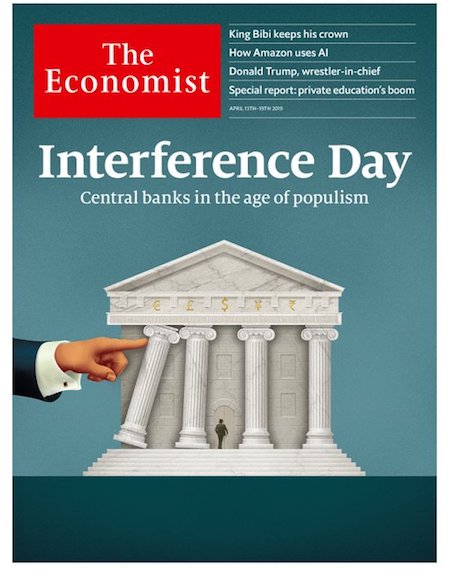
Concerns about central-bank independence are on the rise.Take, for example, the cover of this week’s edition of the Economist. And while not solely a U.S. concern, a steady stream of complaints by President Donald Trump about the Federal Reserve’s earlier string of interest-rate hikes and his announcement he would nominate Stephen Moore and Herman Cain — both widely criticized as unqualified and likely to act at the behest of the White house on policy decisions — to the central bank’s governing board have sparked fears the central bank’s policy independence could be at risk. (Four Republican senators have said they would vote against Cain if he were formally put forward, likely sinking his chances.)
On Saturday, European Central Bank President Mario Draghi appeared to take notice: ‘I’m certainly worried about central bank independence in other countries, especially…in the most important jurisdiction in the world.’ Draghi’s remarks, as reported by Reuters, came at a news conference at the spring meetings of the IMF and World Bank in Washington. They also marked a rare instance of a central banker opining about the operations of a foreign central bank. “If the central bank is not independent, then people may well think that monetary policy decisions follow political advice rather than objective assessment of the economic outlook,” said Draghi.

Read more …

Amid all the loud news, both Canada and Australia are slipping fast.

The Most Splendid Housing Bubbles in Canada Deflate (WS)

Canada’s housing markets barely dipped during the Financial Crisis when US housing markets ran into deep trouble, causing the Mortgage Crisis that begat all kinds of other crises. Canadian homeowners and banks watched the mess from across the border and shook their heads. But now, after an 18-year housing boom, the downturn has arrived in Vancouver and Toronto, among the formerly hottest housing bubbles in the world.


The Teranet-National Bank House Price Index tracks single-family house prices, based on “sales pairs,” similar to the S&P CoreLogic Case Shiller index for US housing markets. It compares the sales price of a house in the current month to the prior sale of the same house years earlier. Using “sales pairs” eliminates the issues that affect median-price indices. But the median-price data for Vancouver is a lot more disconcerting than the Teranet data. So let’s compare how Vancouver’s housing bubble stacks up against the legendary but now also deflating housing bubble in San Francisco.

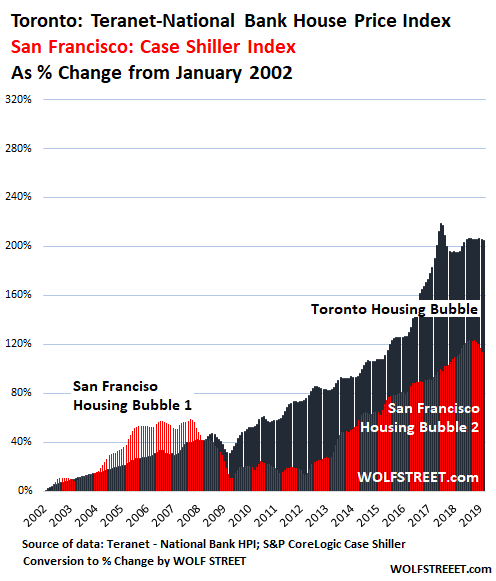
House prices in the Greater Toronto Area fell 0.3% in March from February and are down 4.3% from the peak in July 2017, the steepest 20-month decline since May 2009. From January 2002 through the peak in July 2017, the index soared 218% — meaning that house prices more than tripled. But that pales compared to Vancouver, where house prices more than quadrupled. I converted this Teranet index for Toronto house prices to “percent-change since January 2002” and overlaid the insane mind-boggling housing bubble in the San Francisco Bay Area, and it shows just how majestic the 18-year Toronto housing bubble has been:
Read more …

European elections in Britain do seem surreal.

UK Tories Face European Elections Drubbing (Ind.)

The Conservatives are facing a humiliating defeat at the European elections next month after support for the party slumped to its lowest level since 2013, according to a new poll. The survey shows the Tories on just 28 per cent when it comes to general election voting intention – a four-point fall which leaves them trailing Labour on 32. When voters were asked which party they will vote for at the European elections, Theresa May’s party languished on 16 per cent, eight points behind Labour on 24. In a clear sign support for the Conservatives is crumbling over the failure to deliver Brexit, 56 per cent of people who voted to leave at the 2016 referendum said they would back Ukip or Nigel Farage’s newly formed Brexit Party during next month’s vote.


The Brexit Party is on 15 per cent, while Ukip stands at 14 per cent when it comes to European voting intention, the YouGov poll for The Times indicated. By comparison, the Lib Dems and the Greens are both on 8 per cent, while Change UK has 7 per cent support. No 10 is still hoping to get a deal through parliament in time to avoid participation in the European elections on 23 May. But the UK is formally on track to hold the poll, having informed the EU authorities ahead of Friday’s deadline that it would be taking part. Boris Johnson’s backers have suggested he may not even campaign on behalf of his party next month in an effort to show his displeasure at the UK’s involvement. “Boris won’t campaign in European elections. He believes the prospect of the UK fielding candidates is utterly preposterous,” a source told The Times.

Read more …

Something only a small group wants. But then, that’s true of all Brexit issues and ‘solutions’.

Corbyn Told To Promise Final Say Referendum (Ind.)

Jeremy Corbyn is under intense pressure from within his shadow cabinet to give a strong commitment to a new Brexit referendum as part of Labour’s European election campaign offer. A string of senior shadow ministers are advocating a new public vote, alongside MPs from the left and right of the party, buoyed by a groundswell of support from the membership. The Independent understands Labour is now beginning the process of drawing up its manifesto with those wanting to give the public a final say on Brexit pushing the leader to make a strong bid for the Remain vote on polling day. Mr Corbyn’s team is currently engaged in talks with the Conservatives in an effort to find a Brexit compromise deal that can enjoy majority support in the House of Commons, with a referendum having been discussed during the negotiations.


The leader’s office emphasised that decisions on the manifesto were yet to be discussed, with the party simultaneously defending its majorities against the pro-Remain Change UK party run by Labour defectors and Nigel Farage’s new Brexit Party. One shadow cabinet source told The Independent: “We can’t credibly agree to any deal unless there is a confirmatory referendum attached to it. “We should be telling people about that, the support is there to be had.” The European elections are set to become a rerun of the 2016 referendum campaign with parties positioning themselves along the Brexit spectrum from Leave to Remain.

Read more …

Party before country.

It’s The UK Political System, Not Just MPs, That Is Failing (G.)

Brexit has prompted a recurring nightmare among an increasingly incredulous population: our very own Groundhog Day. Two weeks after the EU granted us an 11th-hour extension to prevent us crashing out without a deal, we are back in exactly the same position. The only thing standing between us and next Friday’s cliff edge is the hope the EU gifts us another extension. Meanwhile, the political turmoil engulfing the country worsens, the two main parties increasingly consumed by division and disarray and the political leadership we so desperately need to avert crisis as elusive as ever. It’s hard to believe that the Westminster model of democracy was one prized by constitutional theorists for the stability it purportedly delivers. As the stakes get higher, our political system has proved less and less capable of delivering a resolution to the gridlock that has infected Westminster.

Brexit has been a story of the favouring of party management over the national interest. From the very beginning, Theresa May’s approach to Brexit – from her premature decision to trigger article 50 to her red lines on freedom of movement and the customs union – has been driven not by a strategy to unite the country in the wake of a divisive referendum but to keep her Brexit ultras on side. Only now it has become clear that there are MPs in her party so fanatically dogmatic that they would rather hold out for no deal than vote for her deal has she opened compromise talks with Labour. But Labour emerged from the talks on Friday complaining that no changes to the political declaration were on offer, suggesting that this move may have been more about trying to lay blame for any further delay on the opposition.

Labour’s strategy has been no less determined by party interest. Jeremy Corbyn has kept a position of barely credible ambiguity for as long as possible to avoid alienating any of its voters. Labour has maintained the charade that it could deliver a Brexit deal that delivers all the benefits of EU membership with none of costs. And Labour has failed to provide any leadership support for a confirmatory referendum on any Brexit deal, with the shadow cabinet split on the issue. Time is running out for Labour to decide once and for all whether it will properly swing its weight behind a referendum. Thanks to the mess the Tories are in, Corbyn is in a position of power, if he only chooses to use it.

Read more …

Another excellent essay from Jonathan Cook.

UK Media, MPs Unveil Latest Assange Deception (Cook)

[..] the public conversation in the UK, sympathetically reported by the Guardian, supposedly Britain’s only major liberal news outlet, is going to be about who has first dibs on Assange. Here’s the first paragraph of the Guardian front-page article: “Political pressure is mounting on [Home Secretary] Sajid Javid to prioritise action that would allow Julian Assange to be extradited to Sweden, amid concerns that US charges relating to Wikileaks’ activities risked overshadowing longstanding allegations of rape.” So the concern is not that Assange is facing rendition to the US, it is that the US claim might “overshadow” an outstanding legal case in Sweden. The 70 MPs who signed the letter to Javid hope to kill two birds with one stone.

First, they are legitimising the discourse of the Trump administration. This is no longer about an illegitimate US extradition request on Assange we should all be loudly protesting. It is a competition between two legal claims, and a debate about which one should find legal remedy first. It weighs a woman’s sexual assault allegation against Assange and Wikileaks’ exposure of war crimes committed by the US military in Iraq and Afghanistan. It suggests that both are in the same category, that they are similar potential crimes. But there should only be one response to the US extradition claim on Assange. That it is entirely illegitimate. No debate. Anything less, any equivocation is to collude in the Trump administration’s narrative. The Swedish claim, if it is revived, is an entirely separate matter.

[..] In another article on Assange on Friday, the Guardian – echoing a common media refrain – reported as fact a demonstrably false claim: “Assange initially took refuge in the Ecuadorian embassy to avoid extradition to Sweden.” There could be no possible reason for its reporters to make this elementary mistake other than that the Guardian is still waging its long-running campaign against Assange, the information revolution he represents and the challenge he poses to the corporate media of which the Guardian is a key part.

[..] Assange was previously wanted for questioning, and has never been charged with anything. If the Swedish extradition request is revived, it will be so that he can be questioned about those allegations. I should also point out, as almost no one else is, that Assange did not “flee” questioning. He offered Swedish prosecutors to question him at the embassy. Even though questioning overseas in extradition cases is common – Sweden has done it dozens of times – Sweden repeatedly refused in Assange’s case, leading the Swedish appeal court to criticise the prosecutors. When he was finally questioned after four years of delays, Swedish prosecutors violated his rights by refusing access to his Swedish lawyer.

Read more …

First amendment anyone?

American Values: Embassies Are For Chopping Up Journalists (McDonald)

202310Fair-minded people across the world have rightly condemned the US-ordered arrest of Julian Assange. However, few have noted how it fits part of a pattern of American hypocrisy when it comes to the treatment of journalists. Only six months ago, Jamal Khashoggi was murdered and hacked to pieces by Saudi agents at the kingdom’s consulate in Istanbul. He was a columnist at the Washington Post and editor-in-chief of the Al-Arab News Channel, known for his sharp criticism of the illegal US-backed Saudi war on Yemen. Despite a CIA conclusion that Crown Prince Mohammed bin Salman ordered the gruesome assassination, President Donald Trump stood by his ally and no meaningful sanctions or penalties were directed towards Riyadh.


Turkey itself remains a NATO member, and close US partner, despite holding more journalists behind bars than any other nation on earth. This figure stood at 68, at the end of last year, around one-quarter of the global total of 251. Now we have the indictment of Assange, which seeks to criminalize basic functions of journalism. For instance, keeping sources anonymous or deleting records of conversations. Indeed, it also appears to be a breach of America’s own First Amendment. He has been targeted by Washington for exposing evidence of appalling atrocities, carried out by the US military, in Iraq and Afghanistan. And, as a result, Assange sought sanctuary in the small London embassy of Ecuador. What followed was relentless pressure on Quito to reverse the asylum it granted the Wikileaks founder and it culminated in his arrest.

Read more …

“That would forestall extradition for long enough for Jeremy Corbyn to become PM, at which point extradition would be refused. But it may be just all screaming chaos.”

Assange Is In The Dock, But Investigative Journalism Is On Trial (Crikey)

Team Assange had a defence on the jumping bail thing: “Your honour, my client had a reasonable fear that from remand he would be extradited to the US.” That was received reasonably. “Also that the previous presiding judge Lady Arbuthnot, did not recuse herself …” That was not. “You had ample time to raise this issue, and now you are traducing the reputation of a fine judge…” Snow went on. I thought of Peter Cook’s great monologue of the summing-up of the Jeremy Thorpe trial: “You have ruined the reputation of one of the most pretty defendants.” Once Assange had been found guilty of skipping bail, it got even weirder. “Your situation is a product of your narcissism,” said the magistrate clearly riled. He did not want the situation of Justice Lady Arbuthnot further explored. I am happy to do so.


Lady Arbuthnot, who ruled on the lawfulness of Assange’s continued criminalisation in the UK in 2015, is the wife of Lord Arbuthnot, a Conservative who has held multiple defence industry posts over the last two decades. This sally got short shrift, but it seemed to me intended to do so. Although when I asked a member of the legal team how it had all gone, they said “well, you saw that shit show in there”. So perhaps not. Assange is now on remand awaiting sentencing for the fleeing bail charge — the Magistrates Court having transferred it to the Crown Court, so a larger maximum sentence of 12 months instead of six, can be awarded. Is that a plan too? That would forestall extradition for long enough for Jeremy Corbyn to become PM, at which point extradition would be refused. But it may be just all screaming chaos.
Read more …

“Of course, the idea that Moreno is handling the economy brilliantly, but somehow also needs over $10 billion dollars in loans is never addressed.”

The Obvious Dirty Dealings Behind Julian Assange’s Arrest (OG)

The US has been planning to have Julian Assange handed over for a longtime, that much is obvious. Mike Pence, the Vice President, was visiting Ecuador last year, notionally to discuss the Venezuela situation, and trade. But it was fairly obvious at the time, and even more so now, that they were discussing the details of Assange being handed over to UK authorities, and eventually extradited to the US. “Trade”, indeed. In terms of quid pro quo, the situation is clear-cut – In February, Ecuador got a $4.2 BILLION loan approved by the International Monetary Fund (amongst other pay-outs). Reuters reported on February 19th of this year:

“Ecuador has reached a $4.2 billion staff-level financing deal with the IMF, President Lenin Moreno said on Wednesday, as the Andean country grapples with a large fiscal deficit and heavy external debt. The country will also receive $6 billion in loans from multilateral institutions including the World Bank, the Inter-American Development Bank, and the CAF Andean development bank…” So, less than 2 months ago, it was announced Ecuador was going to receive over 10 billion dollars of loans. Where all that money will eventually end up is anyone’s guess, it certainly isn’t being spent on infrastructure or state enterprise: “Moreno has begun to implement an austerity plan that includes layoffs of workers at state-owned companies and cuts to gasoline subsidies, also plans to find a private operator for state-run telecoms company CNT and other state-owned firms.”

President Moreno has already been the subject of numerous corruption accusations. So these “loans”, nominally for “[creating] work opportunities for those who have not yet found something stable”, could more realistically be described as “a pay-off”. More than just money, Lenin Moreno has been gifted something all insecure third-world leaders crave: Western approval. The Economist ran a story on April 12th, the day after Assange was arrested, praising Lenin Moreno’s economic policies, and blaming the previous administration for the “mess” that Moreno has to clear up. (Of course, the idea that Moreno is handling the economy brilliantly, but somehow also needs over $10 billion dollars in loans is never addressed. A tiny logical contradiction compared with the nonsense the MSM dish-up on a daily basis).

Read more …

Expect it to be used against Assange.

Anonymous Attacks Continue Against Ecuadorian Government Websites (Cassandra)

Over 30 websites belonging to the Ecuadorian government are now offline — some of them defaced — in protest of the arrest of WikiLeaks founder Julian Assange. The hackers are calling their efforts #OpEcuador, and are also promoting #OpUS and #OpUK. The United States and United Kingdom have not yet been hit with any cyber attacks, that we know of. It is important to note that none of this was directed by WikiLeaks or Assange himself. Supporters are acting on their own with the attacks. A data dump from the hackers warns that “Ecuador Government websites has been taken #Offline with 1 Direct attack. There are few most important websites that’s still down at this time. If some of their servers comes up again, we will fire again to take them down!”

Websites that have been hit include the Central bank of Ecuador, their Ministry of Interior, the Ecuadorian Assembly in UK and the main website for the Government of Ecuador — mot of which had been down for over twelve hours by Saturday evening. The hackers primarily appear to be speaking and coordinating in Spanish — though one of the data dumps was in Indonesia. A Twitter account belonging to the hackers stated that if the websites come back online they will “burn their servers.” The hacking group also called for other supporters to join them.


An InfoSec expert and Assange supporter who has been monitoring the situation told the Gateway Pundit that he is concerned that the attacks will be used against Assange by the media. “My opinion is that it’s deserved karma, but it could enable the anti-Assange media to divert attention away from Julian’s value to journalism by wrongly associating him with reckless hacktivism culture.” He also expressed concern about there being collateral damage within the large data dumps that are being posted online. Other supporters expressed similar concerns, though many still agreed that the attacks are warranted.

Read more …

Apr 062019


Dante Gabriel Rossetti Monna Vanna 1866


Cross-Party Talks Fail As Labour Says May Unable To Compromise (G.)
France, Spain and Belgium ‘Ready For No-Deal Brexit Next Week’ (G.)
Sucker Punch (Jim Kunstler)
The Russian Collusion Hoax Meets An Unbelievable End (Nunes)
Boeing Slashes 737 Production By 20% (ZH)
Trump Says Economy Would Take Off Like ‘A Rocket Ship’ If Fed Cut Rates (CNBC)
Ray Dalio Says Capitalism Needs Urgent Reform (MW)
Kondratiev – Riding the Economic Wave (Kerevan)
EU Charges BMW, Daimler and VW With Collusion Over Emissions (G.)
Australian Housing Downturn Becomes Widespread |(ZH)
Saudi Arabia Threatens To Ditch Petrodollar (R.)


6 days to April 12. May can’t offer Labour anything the Brexiteers don’t want. And vice versa. Thing is, that was obvious 3 years ago.

The problem is not the idea of Brexit, it’s purely the execution.

Cross-Party Talks Fail As Labour Says May Unable To Compromise (G.)

Theresa May’s prospects of cobbling together a cross-party majority to convince EU leaders to grant a short Brexit delay next week appear to be slipping away after Labour claimed she had failed to offer “real change or compromise” in talks. The prime minister made a dramatic pledge to open the door to talks with Labour on Tuesday after a marathon cabinet meeting. But after two days of negotiations and an exchange of letters on Friday, Labour issued a statement criticising the prime minister for failing to offer “real change or compromise”.= “We urge the prime minister to come forward with genuine changes to her deal in an effort to find an alternative that can win support in parliament and bring the country together,” a spokesperson said.


The pessimistic note came after May wrote to the European council president, Donald Tusk, on Friday morning, asking for Brexit to be delayed until 30 June, while cross-party talks continue. Even before Labour’s statement, EU politicians responded with bemusement to her failure to offer a concrete plan for assembling a coalition behind a workable deal – increasing the risk that they will take a tough line at next Wednesday’s summit. May’s letter suggested that the UK was preparing to field candidates in European parliamentary elections on 23 May if no deal could be reached.

Read more …

Don’t be surprised if one country just says NO. Or more than one. For a new extension, May will need a new plan. She has none.

France, Spain and Belgium ‘Ready For No-Deal Brexit Next Week’ (G.)

France has won the support of Spain and Belgium after signalling its readiness for a no-deal Brexit on 12 April if there are no significant new British proposals, according to a note of an EU27 meeting seen by the Guardian. The diplomatic cable reveals that the French ambassador secured the support of Spanish and Belgian colleagues in arguing that there should only be, at most, a short article 50 extension to avoid an instant financial crisis, saying: “We could probably extend for a couple of weeks to prepare ourselves in the markets.” The chances of Theresa May’s proposal of an extension to 30 June succeeding appeared slim as France’s position in the private diplomatic meeting was echoed by an official statement reiterating its opposition to any further Brexit delay without a clear British plan.


May wrote to the president of the European council, Donald Tusk, on Friday to ask for the delay until 30 June while she battles to win cross-party agreement on a way forward. EU states are extremely sceptical that an extension to 30 June will resolve anything in Westminster. Tusk is pushing the EU to offer at a summit next Wednesday what he has described as a “flextension” in which the UK would be given a year-long extension with an option to come out early if the deal is ratified.

Read more …

“Mr. Mueller produced a brief of arguments pro-and-con about obstruction for others to decide upon. In doing that, he was out of order, and maliciously so.”

Sucker Punch (Jim Kunstler)

Having disgraced themselves with full immersion in the barren RussiaGate “narrative,” the Resistance is now tripling down on RussiaGate’s successor gambit: obstruction of justice where there was no crime in the first place. What exactly was that bit of mischief Robert Mueller inserted in his final report, saying that “…while this report does not conclude that the President committed a crime, it also does not exonerate him?” It’s this simple: prosecutors are charged with finding crimes. If there is insufficient evidence to bring a case, then that is the end of the matter. Prosecutors, special or otherwise, are not authorized to offer hypothetical accounts where they can’t bring a criminal case. But Mr. Mueller produced a brief of arguments pro-and-con about obstruction for others to decide upon.

In doing that, he was out of order, and maliciously so. Of course, Attorney General Barr took up the offer and declared the case closed, as he properly should where the prosecutor could not conclude that a crime was committed. One hopes that the AG also instructed Mr. Mueller and his staff to shut the fuck up vis-à-vis further ex post facto “anonymous source” speculation in the news media. But, of course, the Mueller staff — which inexplicably included lawyers who worked for the Clinton Foundation and the Democratic National Committee — at once started insinuating to New York Times reporters that the full report would contain an arsenal of bombshells reigniting enough suspicion to fuel several congressional committee investigations.

The objective apparently is to keep Mr. Trump burdened, hobbled, and disabled for the remainder of his term, and especially in preparation for the 2020 election against whoever emerges from the crowd of lightweights and geriatric cases now roistering through the primary states. It also leaves the door open for the Resistance to prosecute an impeachment case, since that is a political matter, not a law enforcement action. This blog is not associated with any court other than public opinion, and I am free to hypothesize on the meaning of Mr. Mueller’s curious gambit, so here goes: Mr. Barr, long before being considered for his current job, published his opinion that there was no case for obstruction of justice in the RussiaGate affair. By punting the decision to Mr. Barr, Mr. Mueller sets up the AG for being accused of prejudice in the matter — and, more to the point, has managed to generate a new brushfire in the press.

Read more …

Investigate the road the Steele dossier traveled. Might be all you need.

The Russian Collusion Hoax Meets An Unbelievable End (Nunes)

It is astonishing that intelligence leaders did not immediately recognize they were being manipulated in an information operation or understand the danger that the dossier could contain deliberate disinformation from Steele’s Russian sources. In fact, it is impossible to believe in light of everything we now know about the FBI’s conduct of this investigation, including the astounding level of anti-Trump animus shown by high-level FBI figures like Peter Strzok and Lisa Page, as well as the inspector general’s discovery of a shocking number of leaks by FBI officials.

It’s now clear that top intelligence officials were perfectly well aware of the dubiousness of the dossier, but they embraced it anyway because it justified actions they wanted to take – turning the full force of our intelligence agencies first against a political candidate and then against a sitting president. The hoax itself was a gift to our nation’s adversaries, most notably Russia. The abuse of intelligence for political purposes is insidious in any democracy. It undermines trust in democratic institutions, and it damages the reputation of the brave men and women who are working to keep us safe. This unethical conduct has had major repercussions on America’s body politic, creating a yearslong political crisis whose full effects remain to be seen.

Having extensively investigated this abuse, House Intelligence Committee Republicans will soon be submitting criminal referrals on numerous individuals involved in these matters. These people must be held to account to prevent similar abuses from occurring in the future. The men and women of our intelligence community perform an essential service defending American national security, and their ability to carry out their mission cannot be compromised by biased actors who seek to transform the intelligence agencies into weapons of political warfare.

Read more …

The only thing they talk about is software. But if anything goes wrong, these people will be guillotined.

Boeing Slashes 737 Production By 20% (ZH)

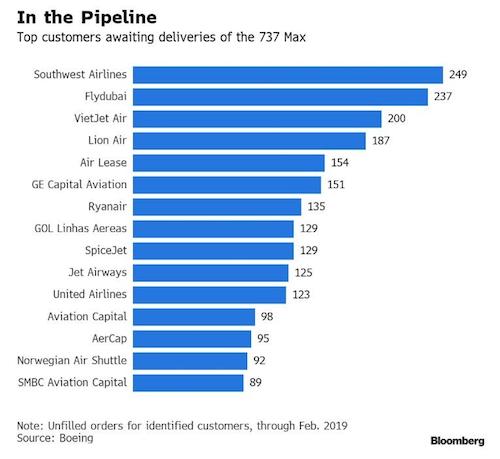
Just a few hours after Ethiopian Airlines warned of a “stigma” associated with the 737 Max that may make them choose not to take delivery of the planes they ordered, Boeing has released a statement after-hours that the company will slash production of the 737 plane from 52 to 42 airplanes per month. Bloomberg reports that Boeing plans to coordinate with customers and suppliers to blunt the financial impact of the slowdown, and for now it doesn’t plan to lay off workers from the 737 program. “When the Max returns to the skies, we’ve promised our airline customers and their passengers and crews that it will be as safe as any airplane ever to fly,” Boeing Chief Executive Officer Dennis Muilenburg said in a statement Friday after the market close.


Boeing had planned to hike output of the 737, a workhorse for budget carriers, about 10 percent by midyear, to meet the backlogs. [..] if the issues are not resolved in a timely manner and production of the 737 MAX needs to be halted for an extended period of time, it would take about 0.15% off the level of GDP, or about 0.6%-point off the quarterly annualized growth rate of GDP in the quarter in which production is stopped. [..] the value of total shipments of aircraft by domestic producers in the US totaled $129 billion in 2016. Extrapolating that figure using monthly shipments data by the aircraft and parts industry implies a similar figure for 2018, around $130 billion.

Read more …

End the Fed.

Trump Says Economy Would Take Off Like ‘A Rocket Ship’ If Fed Cut Rates (CNBC)

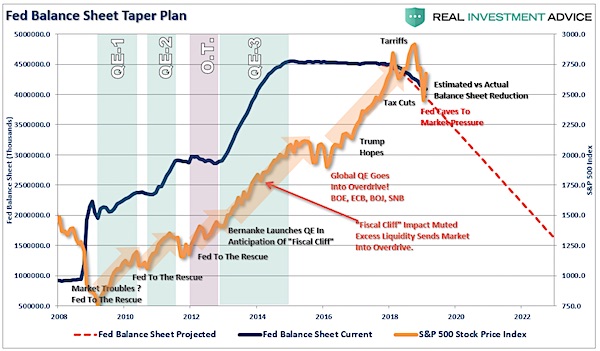
President Donald Trump said Friday the U.S. economy would climb like “a rocket ship” if the Federal Reserve cut interest rates. Commenting after a strong jobs report for March, Trump said the Fed “really slowed us down” in terms of economic growth, and that “there’s no inflation.” “I think they should drop rates and get rid of quantitative tightening,” Trump told reporters, referring to the Fed’s policy of selling securities to unwind its balance sheet, a stimulus put in place during the financial crisis. “You would see a rocket ship. Despite that we’re doing very well.” White House aides have called for the Fed to cut interests rates by as much as 50 basis points. Following the Fed’s most recent meeting in March, the central bank decided to maintain interest rates and hold off on any further increases this year.

As Trump’s chief economic adviser Larry Kudlow did on Friday, Federal Reserve Chairman Jerome Powell highlighted the slowing global economy. “We’re facing a worldwide slowdown [as] Europe is not doing well,” Kudlow said on Bloomberg TV. But unlike the White House, the Fed did not conclude in March that slowing global growth means the bank should begin cutting rates. Trump has been heavily critical of Powell’s decisions at the Fed, going as far as to say that “the Fed has gone crazy” with raising rates. Trump has blamed Powell’s decision-making for drops in the stock market, calling him “loco” for steadily raising rates in 2018 and saying choosing Powell for Fed chairman was the worst mistake of his presidency,

Read more …

Capitalism needs capitalism first of all. For that to happen, the Fed will have to be dismantled. You can’t have capitalism without functioning markets. Ergo: America doesn’t appear to like capitalism, or it would make sure it exists.

Ray Dalio Says Capitalism Needs Urgent Reform (MW)

Ray Dalio, founder of Bridgewater Associates LP, the world’s biggest hedge fund, says capitalism has developed into a system that is promoting an ever-wider wealth gap that puts the very existence of the United States at risk. In a two-part series published on LinkedIn, the noted investor argues that capitalism is now in need of reform — and offered ways to accomplish it: ‘I have also seen capitalism evolve in a way that it is not working well for the majority of Americans because it’s producing self-reinforcing spirals up for the haves and down for the have-nots. This is creating widening income/wealth/opportunity gaps that pose existential threats to the United States because these gaps are bringing about damaging domestic and international conflicts and weakening America’s condition.’

[..] Today, however, the system has produced little or no real income growth for most people for decades, according to the Dalio essay on LinkedIn. Prime-age workers in the bottom 60% have had no real (inflation-adjusted) income growth since 1980, and the percentage of children who grow up to earn more than their parents has fallen to 50% from 90% in 1970. The wealth gap is at its widest point since the late 1930s, with the top 1% owning more than the bottom 90% combined, “which,” Dalio notes, “is the same sort of wealth gap that existed during the 1935-40 period (a period that brought in an era of great internal and external conflicts for most countries).”

Most people in the bottom 60% “are poor,” he writes. About 40% of all Americans would struggle to raise $400 in the event of an emergency, he says, citing a recent Federal Reserve study. The childhood poverty rate stands at 17.5% and has not shown meaningful improvement in decades. That, in turn, leads to poor academic achievement, low productivity and low incomes.

Read more …

It’s good when people who are not familar with it learn about Kondratieff (though I’ve seen better write-ups), but again: the Fed has become the economy, so what is real anymore?

Kondratiev – Riding the Economic Wave (Kerevan)

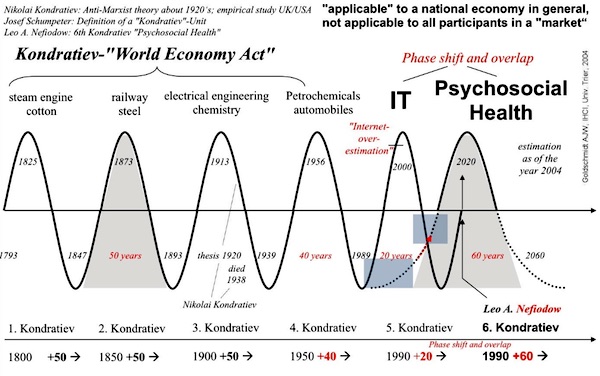
There is a rich literature trying to identify the cause, in particular the work of the Belgian economist, the late, great Ernest Mandel. Crudely, it works like this. Social and economic conditions mature to spark a runaway investment boom in the latest cluster of new technologies. After a period, excess investment and increased competition lower rates of profitability, curbing the boom. At the same time – because this is as much a sociological as an economic process – growth expands the global workforce, both in numbers and geographically. The new, militant workforce launches social struggles to capture some of the wealth created in the boom.


This, in turn, adds to the squeeze on profits. The peak and early down wave are characterised by violent social conflicts, whose outcome determines the length of the contraction. To date each K-wave has seen a crushing of social protest and a halt to wage growth, if not a fall in real incomes for the working class. Thus conditions accumulate for a fresh investment boom, as profitability recovers. The ultimate trigger for the new upcycle is investment in the next bunch of new technologies, which simultaneously provide monopoly profits and a new set of markets.

Where precisely are we in the Kondratiev cycle? There is a dispute about this. Economists convinced by the Kondratiev theory largely agree there was a strong up-phase following the Second World War, lasting till the early 1970s. This was driven by the collapse in European wages imposed earlier by the Nazis and by the universal adoption of Fordist, mass production techniques. This expansion turned into a downswing in the 1970s and early 1980s, as profitability declined and the revived European economies (linked through the early Common Market) eroded American competitiveness.


The dispute concerns what happened next – the era of Reagan, Thatcher, neoliberalism and globalisation, running up to the present. In 1998, the American economic historian Robert Brenner published a hugely influential account of global capitalism which claimed to identify a super downswing running from circa 1970 to the turn of the millennium. Brenner rejected the notion global capitalism had (or was likely) to regain profitability, citing excess capacity rather than working class resistance as the primary driver. He pointed to the sudden stagnation in the Japanese economy, in the 1990s, as a precursor for the West’s future.

Read more …

Youi’re going to have to go after individuals, not allow them to hide behind corporations.

EU Charges BMW, Daimler and VW With Collusion Over Emissions (G.)

The European commission has charged BMW, Daimler and Volkswagen with colluding to limit the introduction of clean emissions technology, in the preliminary findings of an antitrust investigation. The car manufacturers have 10 weeks to respond and could face fines of billions of euros – up to 10% of their global annual turnover – if their explanations are rejected. A similar cartel case the commission took out in 2014 against MAN, Volvo/Renault, Daimler, Iveco and DAF ended with €2.93bn (£2.53bn) of penalties being levied. The EU’s competition commissioner, Margrethe Vestager, said: “Companies can cooperate in many ways to improve the quality of their products. However, EU competition rules do not allow them to collude on exactly the opposite: not to improve their products, not to compete on quality.”


She added: “Daimler, VW and BMW may have broken EU competition rules. As a result, European consumers may have been denied the opportunity to buy cars with the best available technology.” The EU announcement follows raids on the auto manufacturers in July 2017 after allegations in Der Spiegel that they had met in secret working groups in the 1990s to coordinate a response to diesel emissions limits. Between 2006 and 2014, the commission suspects that the “circle of five” carmakers – including VW’s Audi and Porsche divisions – colluded to limit, delay or avoid the introduction of selective catalytic reduction systems (SCRs) and “Otto” particle filters.

Read more …

The drought comes one drop at a time.

Australian Housing Downturn Becomes Widespread |(ZH)

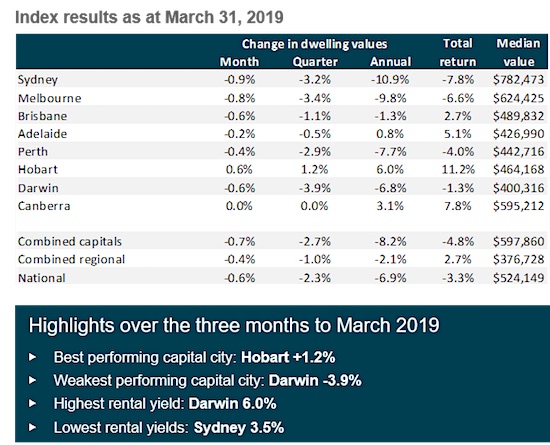
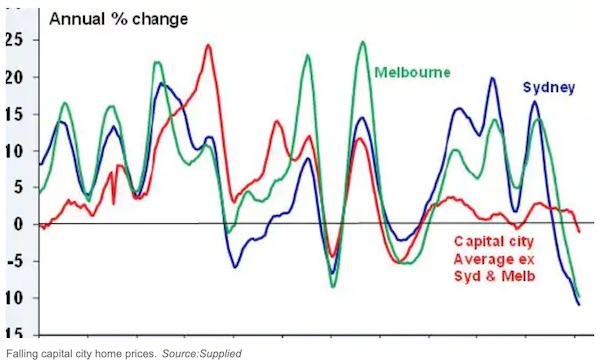
After a three-decade boom, the Australian economy is finally facing a recession. The outlook for the economy is exceptionally bleak this year, as the decline in housing prices is more widespread than thought, according to a new report from CoreLogic. National home prices recorded a month-on-month decline of 0.60% in March, which CoreLogic noted was the smallest rate of monthly decline since October. “While the pace of falls has slowed in March, the scope of the downturn has become more geographically widespread,” CoreLogic head of research Tim Lawless said. All eight capital cities in Australia posted declines, with Sydney recording the most significant price drop of .90% month-on-month.

Quarterly, the value of single-family homes and condos declined 3.9%, followed by Melbourne (3.4%), Sydney (3.2%), Perth (2.9%), and Brisbane (1.1%). Prices in Canberra were unchanged. Sydney recorded the most significant annual decline of 10.9%. Melbourne followed with 9.8%. Australia’s regional housing markets have also deteriorated. Regional areas outside Sydney declined by 3.6% over the past year while regional Queensland saw a 1.6% decline. Regional Western Australia experienced a 9.5% decline over the past year, and for the past five years, values in the region have collapsed by 25.8%

Read more …

It’s not entirely Fake News, but it’s certainly No News. There’s one competitor for the USD, and that’s the renminbi, which nobody wants because it’s not traded freely. End of story.

Saudi Arabia Threatens To Ditch Petrodollar (R.)

Saudi Arabia is threatening to sell its oil in currencies other than the dollar if Washington passes a bill exposing OPEC members to U.S. antitrust lawsuits, three sources familiar with Saudi energy policy said. They said the option had been discussed internally by senior Saudi energy officials in recent months. Two of the sources said the plan had been discussed with OPEC members and one source briefed on Saudi oil policy said Riyadh had also communicated the threat to senior U.S. energy officials.


The chances of the U.S. bill known as NOPEC coming into force are slim and Saudi Arabia would be unlikely to follow through, but the fact Riyadh is considering such a drastic step is a sign of the kingdom’s annoyance about potential U.S. legal challenges to OPEC. In the unlikely event Riyadh were to ditch the dollar, it would undermine the its status as the world’s main reserve currency, reduce Washington’s clout in global trade and weaken its ability to enforce sanctions on nation states. “The Saudis know they have the dollar as the nuclear option,” one of the sources familiar with the matter said. “The Saudis say: let the Americans pass NOPEC and it would be the U.S. economy that would fall apart,” another source said.

Read more …

Mar 212019


Pablo Picasso Bathers with ball 3 1928


Why The Fed Keeps Propping Up The Market (Colombo)
Fed’s New Balance Sheet Plan: Get Rid of MBS (WS)
EU Will Only Back Short Brexit Delay If May’s Deal Passes First (G.)
Remain Would Win Second Brexit Referendum Clearly, Poll Indicates (Ind.)
Theresa May: Don’t Blame Me For Brexit Crisis, Blame MPs (G.)
MPs Furious After May Blames Them For Crisis (Ind.)
New Zealand Bans All Assault Weapons Immediately (AP)
Stagnant Capitalism (Varoufakis)
Exposing the Myth of MMT (Rickards)
Australia Construction Slowdown A Major Threat To The Economy (ABC.au)
As Russia Collusion Fades, Ukrainian Plot To Help Clinton Emerges (Solomon)
Sucking Liberals into a New Cold War (William Blum)
Loneliness Estimated To Shorten A Person’s Life By 15 Years (SciAm)
Kale Is Now One Of The Most Pesticide-Contaminated Vegetables (CNBC)


Yeah, no, more Fed crap and comments about markets and I’ve had enough. A market should be recognized as an action, a process, not as a thing or an object. And the action is price discovery. If that is not taking place you don’t have a market. Anything the Fed props up is not a market. One necessary aspect of price discovery is honesty, people must believe they’re not being tricked. With the way people talk about this now, the language they use risks losing all meaning. Enough already, and that goes for Jesse Colombo too. Who also posted this one on Twitter, which is a lot more relevant than his article. But that’s just me.


Why The Fed Keeps Propping Up The Market (Colombo)

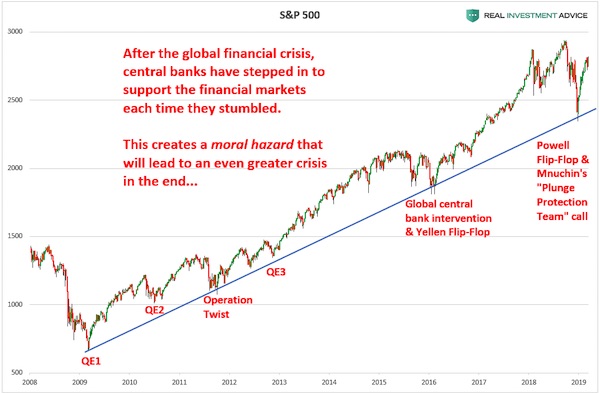
The bull market of the past decade since the Great Recession has been an unusual one: despite all of the economic damage that occurred during the global financial crisis and rising risks (including global debt rising by $75 trillion), it has been the longest bull market in history. The explanation for this paradox is simple: it’s not an organic bull market because the Fed and other central banks keep stepping in to prop up the market every time it stumbles. Though the Fed has two official mandates (maintaining stable consumer prices and maximizing employment), it has taken on the unofficial third mandate of supporting and boosting the stock market since the Great Recession.

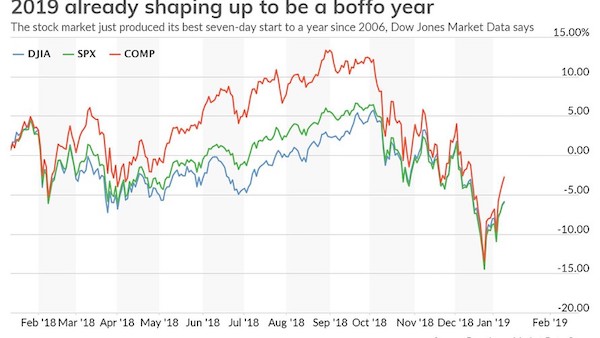
The chart below, which was inspired by market strategist Sven Henrich, shows how the Fed or other central banks have stepped in with more monetary stimulus (quantitative easing, promises to keep interest rates low, etc.) every time the S&P 500 has stumbled over the past decade:

An economy that is growing at 2%, inflation near zero, and Central banks globally required to continue dumping trillions of dollars into the financial system just to keep it afloat is not an economy we should be aspiring to. But despite commentary the financial system has been ‘put back together again,’ then why are Central Banks acting?

Read more …

Get rid of them or they’ll blow up America.

Fed’s New Balance Sheet Plan: Get Rid of MBS (WS)

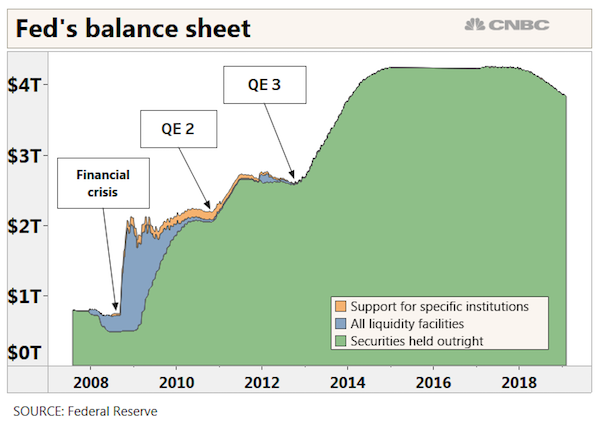
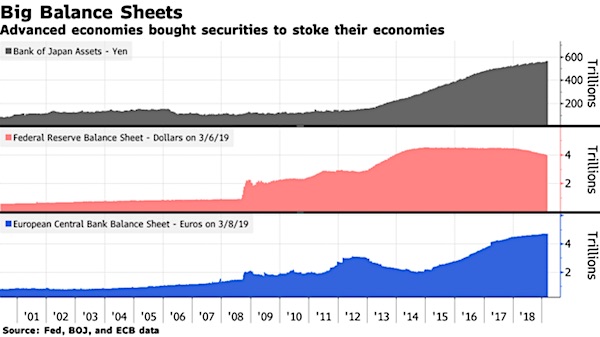
The Fed has a new plan for what to do with its balance sheet and today announced several major components of it:

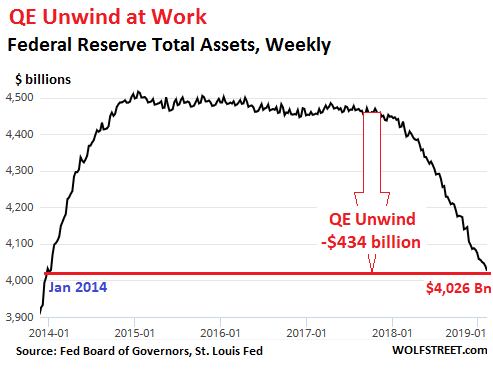
• Begin tapering the “runoff” of Treasury securities in May. • End the runoff of Treasury securities on September 30. • Continue shedding mortgage-backed securities (MBS) at the current maximum of $20 billion a month, essentially until their gone. • After September, reinvest MBS principal payments into Treasury securities. • Chair Jerome Powell said during the press conference that the balance sheet will by then be “a bit above $3.5 trillion.” • The balance sheet will remain at this level even as the economy grows, thus slowly shrinking in relationship to GDP. • The Fed may sell MBS outright to speed up the process of getting rid of them. • No decision has been made on the delicate issue of the maturity composition of the balance sheet – which would require buying short-term bills for the first time in years to replace longer-term notes and bonds.

The stated balance-sheet doctrine now is that the Fed wants to have sufficient reserves (money that banks deposit at the Fed) to conduct monetary policy efficiently. The interest it pays the banks on those reserves is one of its major tools to manage short-term interest rates.

Read more …

It’s not even the main trump card the EU has.

EU Will Only Back Short Brexit Delay If May’s Deal Passes First (G.)

Donald Tusk has put a no-deal Brexit back on the table by saying EU leaders will only agree to a short delay if MPs back Theresa May’s deal next week, on a day of high drama in Brussels and London. After belatedly receiving the prime minister’s formal letter requesting a three-month extension of article 50, and taking a late afternoon phone call with her, the European council president admitted that success appeared “frail, even illusory” on the eve of Thursday’s summit. The German foreign minister, Heiko Maas, tweeted: “The letter from Theresa May has not solved any problem yet. If the European council [summit of leaders] is to decide on an extension of the deadline for Britain, we would like to know what is the concrete purpose.”

But Tusk said the EU would seek until the very last moment to avoid the UK crashing out without a deal and show “patience and goodwill” despite the “Brexit fatigue” in the capitals. The EU27’s heads of state or government would be likely to agree in principle at the summit on Thursday to an extension up to 23 May or 30 June, and sign it off without needing to meet next week should May be able to find a majority in the Commons at the third time of asking, he said. The European commission is insisting that an extension beyond the date of the European elections on 23 May would require British MEPs to be elected, although others believe there is little risk as long as the UK has left by 1 July when the parliament formally convenes.

“In the light of the consultations that I have conducted over the past days I believe that a short extension will be possible but to be conditional on a positive vote on the withdrawal agreement in the House of Commons,” Tusk said. “A question remains open as to the duration of such an extension. Prime Minister May’s proposal of the 30 June, which has its merits, creates a series of questions of a legal and political nature. Leaders will discuss this tomorrow.”

The frustration and “tension”, as one senior EU diplomat described it, was made clear by the French foreign minister, Jean-Yves Le Drian, who told the French parliament on Wednesday afternoon that Paris was willing to block an extension. He said there were only two ways to leave the EU: ratify the withdrawal agreement or a no-deal exit. If parliament did not ratify the withdrawal agreement “the central scenario is a no-deal exit”, he said, adding: “We’re ready.” He stated that if May could not present “sufficient guarantees of the credibility of her strategy” that would lead to the extension being refused and a no-deal exit.

Read more …

But it would be undemocratic?!

Remain Would Win Second Brexit Referendum Clearly, Poll Indicates (Ind.)

Nearly two-thirds of people would vote to remain in the EU rather than for Theresa May’s deal if a referendum offering those options were called, a snap poll by YouGov has found. Sixty-one per cent of the population would vote to remain while 39 per cent would opt for the existing deal, However, if people were asked in a public vote whether they would prefer to remain in the EU or leave with no deal in place, Remain would still win, though by the smaller margin of 57-43 per cent. It shows a 22-point lead for Remain over Ms May’s deal, or a 14-point lead for Remain over no deal at all.

The poll, carried out on behalf of the Put it to the People campaign, comes as second referendum expectations have risen. [..] A march in support of a Final Say second referendum takes place on in central London on Saturday and is expected to attract hundreds of thousands of protesters. Meanwhile a “Leave means Leave” protest, also known as the “Brexit betrayal march”, is underway with Brexit supporters walking for two weeks from Sunderland to London demanding the UK leaves the EU on 29 March.

Read more …

Carefully crafted utter panic.

Theresa May: Don’t Blame Me For Brexit Crisis, Blame MPs (G.)

Theresa May is facing a furious backlash from her own backbenchers and calls for her resignation after she blamed squabbling MPs for delaying Brexit. In a defiant statement on Wednesday night she told the British public: “I am on your side,” and now hopes to force her deal through parliament next week at the third time of asking. Less than an hour earlier, she had been warned in a private meeting with Conservative MPs that her bid to delay leaving could end up losing her even more votes from her own party.

“She is going into an ever narrower cul-de-sac,” said one former minister. Speaking in Downing Street in a televised address, May said the three-month Brexit delay she had earlier in the day formally requested from EU27 leaders was “a matter of great personal regret for me” – and she would not countenance a longer extension of article 50. With just nine days to go before Britain is due to leave the EU, she laid the blame for the crisis squarely at the door of parliament.

Read more …

“Of this I am absolutely sure: you the public have had enough.”

What she missed is that it’s her they’re tired of.

MPs Furious After May Blames Them For Crisis (Ind.)

MPs have called Theresa May “irresponsible”, “disgraceful” and “toxic” after she blamed them for for the UK’s impending failure to leave the EU on 29 March. Labour’s Wes Streeting accused the prime minister of putting MPs’ lives in danger with an “incendiary” address. Ms May used a Downing Street speech to criticise the very people she needs to get her Brexit deal through the Commons at the third time of asking, telling voters that she was “sure” that “you, the public, have had enough” of political games. She said: “You’re tired of the infighting, you’re tired of the political games and the arcane procedural rows, tired of MPs talking about nothing else but Brexit when you have real concerns about our children’s schools, our National Health Service, knife crime. “You want this stage of the Brexit process to be over and done with. I agree. I am on your side.”

Read more …

It can be done. Just not in the US, too many guns there already.

New Zealand Bans All Assault Weapons Immediately (AP)

Prime Minister Jacinda Ardern says New Zealand is immediately banning sales of military style semi-automatic rifles and high-capacity magazines like the weapons used in last Friday’s attacks on two Christchurch mosques. Ardern announced the ban Thursday and said it would be followed by legislation to be introduced next month. She said the man arrested in the attacks had purchased his weapons legally and enhanced their capacity by using 30-round magazines “done easily through a simple online purchase.” [..] The New Zealand government is asking all owners of assault weapons or now-banned attachments to report them to the government in the next two days before turning them in.

Read more …

I think manipulation by central banks is a much bigger problem than stagnation.

Stagnant Capitalism (Varoufakis)

When the Great Depression followed the 1929 stock-market crash, almost everyone acknowledged that capitalism was unstable, unreliable, and prone to stagnation. In the decades that followed, however, that perception changed. Capitalism’s postwar revival, and especially the post-Cold War rush to financialized globalization, resurrected faith in markets’ self-regulating abilities. Today, a long decade after the 2008 global financial crisis, this touching faith once again lies in tatters as capitalism’s natural tendency toward stagnation reasserts itself. The rise of the racist right, the fragmentation of the political center, and mounting geopolitical tensions are mere symptoms of capitalism’s miasma.

A balanced capitalist economy requires a magic number, in the form of the prevailing real (inflation-adjusted) interest rate. It is magic because it must kill two very different birds, flying in two very different skies, with a single stone. First, it must balance employers’ demand for waged labor with the available labor supply. Second, it must equalize savings and investment. If the prevailing real interest rate fails to balance the labor market, we end up with unemployment, precariousness, wasted human potential, and poverty. If it fails to bring investment up to the level of savings, deflation sets in and feeds back into even lower investment.

It takes a heroic disposition to assume that this magic number exists or that, even if it does, our collective endeavors will result in an actual real interest rate close to it. How do free marketeers convince themselves that there exists a single real interest rate (say, 2%) that would inspire investors to funnel all existing savings into productive investments and spur employers to hire everyone who wishes to work at the prevailing wage?

Read more …

I’ve kept my distance from the discussion, but this is nice.

Exposing the Myth of MMT (Rickards)

When critics hear that a Green New Deal could potentially cost something like $97 trillion, or proposals for Medicare for all, free tuition, free child care or guaranteed basic income, they say, “That all sounds nice, but we just can’t afford it.” That’s their main argument — that no matter how desirable these programs might be in theory, we just can’t afford them. Most criticism of MMT falls along those lines. Even the Keynesians like those I mentioned earlier, who generally favor large amounts of government spending to stimulate the economy, have come out against MMT. Besides that claim that we can’t afford it, even the Keynesians say MMT would be highly inflationary. If you printed that much money and start handing it out to people, demand would outstrip the output capacity of the economy and you’d get high inflation.

But the MMT advocates have an answer to these objections. They’re not the least bit intimidated by critics who say we can’t afford it. They say, “Yes, we can, and Modern Monetary Theory proves it. Just print the money and monetize the debt. Japanese debt is 2.5 times the United States’ debt, and China’s is higher than ours.” They haven’t collapsed, so we can take on far more debt than we have today. Furthermore, QE did not create much inflation. In fact, the Fed would like to see more inflation than it has. It still can’t produce a sustained 2% inflation rate after all these years. You might think the argument is ridiculous. After all, do we really want to become Japan? But in important ways, the MMT crowd has the upper hand in the debate.

Read more …

After 27 years, Australia is finally hitting a recession.

Australia Construction Slowdown A Major Threat To The Economy (ABC.au)

The property market upheaval brings billionaire investor Warren Buffett’s oft-quoted piece of wisdom to mind: “Only when the tide goes out do you discover who’s been swimming naked.” We are witnessing more naked developers as half-finished projects dot the landscape of our major cities. As the year progresses, many more operators who’ve pushed the boundaries will join them. “Areas of oversupply will see a bit more chaos in the next six to twelve months,” Scott Gray-Spencer, local head of capital markets at the global real estate firm CBRE, told ABC’s The Business. Mr Gray-Spencer sees areas more than 10 kilometres from the city centres of Sydney and Melbourne, and parts of Queensland, as the most vulnerable.

Property investors, who were major targets of the crackdown, accounted for almost 50 per cent of mortgages two to three years ago. They have largely left the market and political uncertainty may keep them on the sidelines for longer as they await the outcome of the looming federal election. Should Labor win, it’s likely investors will wait to see how its plans to curb the negative gearing and capital gains tax concessions pan out. Even though Labor’s proposed negative gearing changes will not affect new housing, investors may still be worried about price growth because the next buyer is unable to negatively gear. So it could be some time before developers see an important group of buyers return in force. If the banks don’t stop them, the less generous tax laws might.


A half-finished apartment block in Cronulla sits idle while it waits for a buyer. (ABC News: John Gunn)

Read more …

At first sight it looked like a parody.

As Russia Collusion Fades, Ukrainian Plot To Help Clinton Emerges (Solomon)

After nearly three years and millions of tax dollars, the Trump-Russia collusion probe is about to be resolved. Emerging in its place is newly unearthed evidence suggesting another foreign effort to influence the 2016 election — this time, in favor of the Democrats. Ukraine’s top prosecutor divulged in an interview aired Wednesday on Hill.TV that he has opened an investigation into whether his country’s law enforcement apparatus intentionally leaked financial records during the 2016 U.S. presidential campaign about then-Trump campaign chairman Paul Manafort in an effort to sway the election in favor of Hillary Clinton.

The leak of the so-called “black ledger” files to U.S. media prompted Manafort’s resignation from the Trump campaign and gave rise to one of the key allegations in the Russia collusion probe that has dogged Trump for the last two and a half years. Ukraine Prosecutor General Yurii Lutsenko’s probe was prompted by a Ukrainian parliamentarian’s release of a tape recording purporting to quote a top law enforcement official as saying his agency leaked the Manafort financial records to help Clinton’s campaign. The parliamentarian also secured a court ruling that the leak amounted to “an illegal intrusion into the American election campaign,” Lutsenko told me.

Lutsenko said the tape recording is a serious enough allegation to warrant opening a probe, and one of his concerns is that the Ukrainian law enforcement agency involved had frequent contact with the Obama administration’s U.S. embassy in Kiev at the time. “Today we will launch a criminal investigation about this and we will give legal assessment of this information,” Lutsenko told me.

Read more …

A memorial service was held on Sunday in Washington for William Blum, a former State Department official whose disillusionment with the Vietnam War turned him into a fierce critic of U.S. foreign policy. Blum educated a generation of Americans about the rapacious aims of the U.S. abroad, debunking the myth of Washington’s good intentions for the peoples of the world. Blum died on December 9, 2018.

Sucking Liberals into a New Cold War (William Blum)

Cold War Number One: 70 years of daily national stupidity. Cold War Number Two: Still in its youth, but just as stupid. “He said he absolutely did not meddle in our election. He did not do what they are saying he did.” – President Trump re Russian President Vladimir Putin after their meeting in Vietnam. [Washington Post, Nov.e 12, 2017] Putin later added that he knew “absolutely nothing” about Russian contacts with Trump campaign officials. “They can do what they want, looking for some sensation. But there are no sensations.” Numerous U.S. intelligence agencies have said otherwise. Former Director of National Intelligence, James Clapper, responded to Trump’s remarks by declaring: “The president was given clear and indisputable evidence that Russia interfered in the election.”

As we’ll see below, there isn’t too much of the “clear and indisputable” stuff. And this of course is the same James Clapper who made an admittedly false statement to Congress in March 2013, when he responded, “No, sir” and “not wittingly” to a question about whether the National Security Agency was collecting “any type of data at all” on millions of Americans. Lies don’t usually come in any size larger than that. Virtually every member of Congress who has publicly stated a position on the issue has criticized Russia for interfering in the 2016 American presidential election. And it would be very difficult to find a member of the mainstream media who has questioned this thesis. What is the poor consumer of news to make of these gross contradictions?

Read more …

Time to rephrase ‘social media’. Man evolved living in groups, it’s simple.

Loneliness Estimated To Shorten A Person’s Life By 15 Years (SciAm)

Thanks to remarkable new technologies and the widespread use of social media, we are more “connected” than ever before. Yet as a nation, we are also more lonely. In fact, a recent study found that a staggering 47 percent of Americans often feel alone, left out and lacking meaningful connection with others. This is true for all ages, from teenagers to older adults. The number of people who perceive themselves to be alone, isolated or distant from others has reached epidemic levels both in the United States and in other parts of the world. Indeed, almost two decades ago, the book Bowling Alone pointed to the increasing isolation of Americans and our consequent loss of “social capital.” In Japan, for example, an estimated half million (known as hikikomori) shut themselves away for months on end.

In the United Kingdom, four in 10 citizens report feelings of chronic, profound loneliness, prompting the creation of a new cabinet-level position (the Minister for Loneliness) to combat the problem. While this “epidemic” of loneliness is increasingly recognized as a social issue, what’s less well recognized is the role loneliness plays as a critical determinant of health. Loneliness can be deadly: this according to former Surgeon General Vivek Murthy, among others, who has stressed the significant health threat. Loneliness has been estimated to shorten a person’s life by 15 years, equivalent in impact to being obese or smoking 15 cigarettes per day. A recent study revealed a surprising association between loneliness and cancer mortality risk, pointing to the role loneliness plays in cancer’s course, including responsiveness to treatments.

Read more …

Wasn’t kale supposed to not need any?

Kale Is Now One Of The Most Pesticide-Contaminated Vegetables (CNBC)

Often touted for being highly nutritious, kale has joined the list of 11 other fruits and vegetables known to be “dirty,” according to an analysis by the Environmental Working Group. The watchdog group publishes its “Dirty Dozen” list annually, in which it ranks the 12 produce items that contain the highest amount of pesticide residues. The group analyzes data from the Department of Agriculture’s regular produce testing to determine the list. Ranked alongside kale on the list are strawberries, spinach, nectarines, apples, grapes, peaches, cherries, pears, tomatoes, celery and potatoes.

The last time kale was included in the USDA’s produce tests was 2009 and it ranked eighth on the Dirty Dozen list. “We were surprised kale had so many pesticides on it, but the test results were unequivocal,” said EWG Toxicologist Alexis Temkin in a release. More than 92 percent of kale had residue from at least two pesticides after washing and peeling the appropriate vegetables, according to the report. Some had up to 18. Almost 60 percent of the kale samples showed residual Dacthal, a pesticide that is known as a possible human carcinogen. The group releases its “Clean Fifteen” list as well, highlighting the 15 produce items with the least amount of pesticide residue detected. It includes avocados, sweet corn, pineapples, frozen sweet peas, onions, papayas, eggplants, asparagus, kiwis, cabbages, cauliflower, cantaloupes, broccoli, mushrooms and honeydew melons.

Read more …

Mar 112019
 
 March 11, 2019  Posted by at 10:06 am Finance Tagged with: , , , , , , , , , , , , ,  3 Responses »


Jean Metzinger Soldier playing chess 1915


Brexit Talks ‘Deadlocked’, Says Downing Street (G.)
Brexit Fallout On UK Finance Intensifies (R.)
How Central Bankers Blew Up The Global Economy (ABC.au)
What Fed Chair Powell Said On 60 Minutes (ZH)
China’s GDP Growth Could Be Half Of Reported Number – Pettis (SCMP)
Brookings Says China Overstated Size Of Its Economy By 12% (ZH)
Deutsche Bank Begins Talks Over Merger With Rival Commerzbank (G.)
Leaked Documents Reveal DOJ Protected Steele After FBI Shunning (KK)
How US Government and Media Spread Pro-War Propaganda (Greenwald)
US “Gets Its Ass Handed To It” In World War III Simulations (ZH)
Why The Shale Boom Left California Behind (Rapier)
Elderly Americans Are Dying Without Getting To Read Mueller’s Report (NW)


Crunch time starts tomorrow. The backstop is the big issue. EU cannot ‘budge’, because it would mean leaving Ireland out in the cold. It’s called the Irish backstop for a reason.

Brexit Talks ‘Deadlocked’, Says Downing Street (G.)

Downing Street has described the Brexit talks in Brussels as “deadlocked” after negotiations over the weekend failed to find a breakthrough on the Irish backstop. Theresa May and Jean-Claude Juncker, the European commission president, spoke on the telephone on Sunday evening, but plans for the prime minister to visit the Belgian capital to sign off on any compromise are on hold. The EU refuses to budge on the British proposal for what it believes is an attempt to build a unilateral exit mechanism into the Irish backstop, the arrangement that would keep the UK in a customs union to avoid a hard border on the island of Ireland.

The attorney general, Geoffrey Cox, is unlikely without such a concession to revise his legal opinion, given before the last vote on May’s deal, that the backstop could be in force “indefinitely”. The prime minister pledged in parliament to put her deal to the Commons on Tuesday but she is being urged by senior Conservative MPs to pull the vote if she fails to secure significant concessions from Brussels. Leading Tories have warned Downing Street it could face a second huge defeat similar to the historic 230-vote loss in January if the government goes ahead. They have advised May instead to replace the vote with a motion setting out the sort of Brexit deal that would be acceptable to Tory MPs, in the hope that this would trigger concessions from the EU.

Read more …

All they have left is finance. Austerity ate the rest.

Brexit Fallout On UK Finance Intensifies (R.)

More than 275 financial firms are moving a combined $1.2 trillion in assets and funds and thousands of staff from Britain to the European Union in readiness for Brexit at a cost of up to $4 billion, a report from a think tank said on Monday. UK lawmakers are due to vote on Tuesday on an EU divorce settlement. But with less than three weeks to go before Brexit day on March 29, it is still unclear whether the deal will be approved, whether departure from the EU will be delayed, or whether it will happen without agreement. The report by the New Financial think tank, one of the most detailed yet on the impact of Brexit on financial services, said Dublin alone accounted for 100 relocations, ahead of Luxembourg with 60, Paris 41, Frankfurt 40, and Amsterdam 32.

The independent think tank said half of the affected asset management firms, such as Goldman Sachs Investment Management, Morgan Stanley Investment Management and Vanguard, had chosen Dublin, with Luxembourg the next port of call, attracting firms like Schroders, JP Morgan Wealth Management and Aviva Investors. Nearly 90 percent of all firms moving to Frankfurt are banks, while two-thirds of those going to Amsterdam are trading platforms or brokers. Paris is carving out a niche for markets and trading operations of banks and attracting a broad spread of firms.

Read more …

This still needs to be explained, apparently.

How Central Bankers Blew Up The Global Economy (ABC.au)

We humans are a social lot. We just love being part of a pack, a member of a team. We crave acceptance, to the point where isolation or banishment ranks among the worst forms of punishment. Even when it comes to the dodgy art of forecasting, everyone seems to cluster around a central position, which kind of defeats the point of forecasting. And so, in July two years ago, when the groundswell of opinion began to shift — that the Reserve Bank would be raising interest rates — arguing otherwise was a fairly lonely position. As time went on, almost everyone shifted position as we dug in here, here and here.

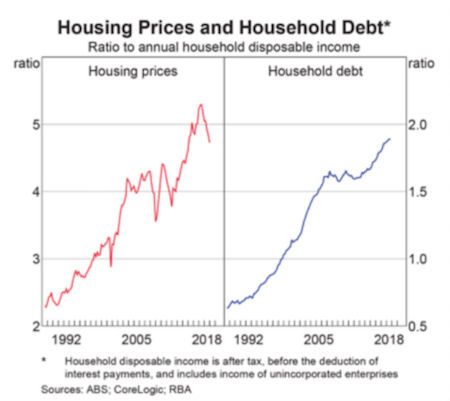
To be fair, most of the highly paid, well-heeled professional market economists were being egged on by the authorities, and particularly the Reserve Bank, which was spinning the line that the next rate move was up. In the past fortnight, however, the pack suddenly has turned on its tail as fears about the global economy and a sudden slowdown in our own growth forced a rethink. The switch to a rate cut has turned into a stampede. Put aside all the complex formula. Forget the high-level macro-economic analysis. There’s a very simple reason the Reserve Bank couldn’t and can’t raise interest rates. There’s too much debt. Australian households are among the world’s most indebted when compared with their income.

And we’ve spent most of it on real estate. What these two graphs show is how the Reserve Bank, effectively, snookered itself. Back in 2012, when debt and housing prices already were elevated, it fired up the east coast housing market, and construction, to take up the employment slack as the mining boom unwound. But it created a monster. As housing went on a tear, the short-term sugar hit turned toxic. Employment took off. But housing became unaffordable to almost everyone under 35. And our household debt levels reached for the stars. The end result? It couldn’t cut rates if it needed. That would add heat to a dangerously inflated housing bubble. And it could never raise rates, because that would kill household spending.

Read more …

3 Stooges.

Nomi Prins: “Number of times the word “bubble” appeared in the 60 Minutes interview with Fed. Chair Jerome Powell. Zero.”

A central bank can have benefits, but not when it only serves the rich. If we don’t get rid of Fed and ECB, there’ll be very steep prices to pay.

Note: there’s a video at the link, but it started itself so I threw it out.

What Fed Chair Powell Said On 60 Minutes (ZH)

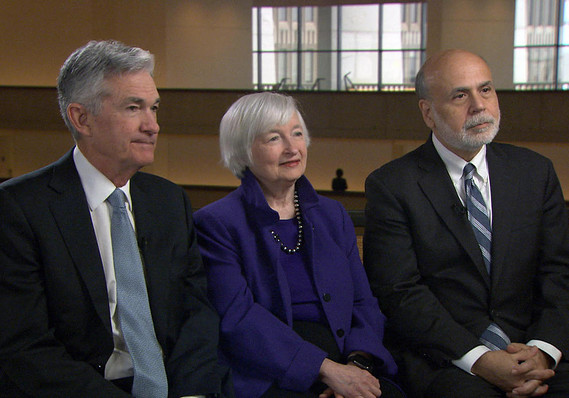
A decade after Ben Bernanke appeared on “60 Minutes”, vowing that the Fed could easily crush inflation, as it could “raise interest rates in 15 minutes”, of course with the occasional “pause” along the way should the S&P dip by 20% or so, current Fed Chairman Jerome Powell will follow in his footsteps on Sunday night, when surrounded by former Fed Chairs Bernanke and Yellen, he will try to reach beyond the Fed’s traditional audience of markets, journalists and lawmakers to counter the attacks from President Trump, even after the Fed’s paused on raising interest rates, said Sarah Binder, a professor of political science at George Washington University, quoted by MarketWatch.

“He wants to counter the president’s message that policy is all wrong,” Binder said. Binder said she was struck by the still photo of the “60 Minutes” interview that shows Powell alongside his two predecessors Janet Yellen and Ben Bernanke. “This puts a human face on the central bank. It says, ‘we’re the Fed and we’re here to help,’” Binder said. Bernanke also faced criticism when he went on “60 Minutes” in March 2009. The Fed was facing concerted attacks by lawmakers and populist “End the Fed” groups, who considering the record wealth divide in the US created by the central bank, were spot on.

Read more …

I’m going with Xiang Songzuo: “..China’s GDP growth for 2018 could be 1.67 per cent or even negative..”

China’s GDP Growth Could Be Half Of Reported Number – Pettis (SCMP)

If China’s bad debts were written down, its economic growth rate would be half the recorded number, a US economist at a prominent Chinese university has warned. In a speech in Shanghai this week, Michael Pettis, professor of finance at Peking University, warned that China’s debt is closely linked to the government’s perceived overstatement of its GDP. The government is accused of perpetuating the existence of “zombie companies”, by granting loss-making companies loans. Banks in turn treat these companies as creditworthy, whereas in reality they should be written off as bad debt, Pettis said. “If you believe there is bad debt that has not been sufficiently written down, you must believe that China’s GDP is overstated, relative to what it would be in any other country. That must be true,” Pettis said.

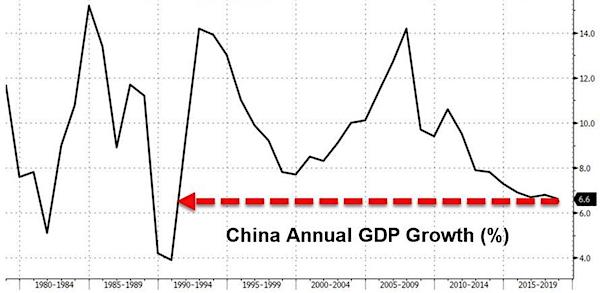
“If we are able to calculate GDP correctly, it would probably be half of the recorded number.” Pettis is not alone seeing troubles with China’s official growth number. In December, Xiang Songzuo, an outspoken professor from the Renmin University of China, who previously served as chief economist for Agricultural Bank of China, cited unidentified internal reports as saying that said China’s GDP growth for 2018 could be 1.67 per cent or even negative, a far cry from the official figures. Furthermore, a group of four economists published a paper this week arguing that China might have overstated its annual growth rate by 2 percentage points on average from 2008 to 2016. China’s official statistics agency said the country’s economic growth rate was 6.6 per cent in 2018.

The Chinese government said it would try to achieve an economic growth rate between 6.0 to 6.5 per cent in 2019, a moderate slowdown from previous years, but nevertheless a much faster rate compared with other major economies. Pettis is a renowned expert on China’s economy. For decades, he has been commenting on financial affairs in China and was among the early observers of the imbalances in the Chinese economy. He said in his speech on Wednesday that China’s growth will significantly decelerate as the country’s debt level rises.

Read more …

Brookings is many years late.

Brookings Says China Overstated Size Of Its Economy By 12% (ZH)

Since China managed to weather the fallout from the financial crisis without registering much of a slowdown in its “official” GDP figures, playing “guess the real growth rate” has become one of the most popular parlor games among the professional economist set. Whereas the stakes are much higher for academics on the mainland (one of whom was censored and threatened by government thugs after speculating that GDP growth on the mainland might be closer to 2%), researchers at American think tanks have freely offered estimates ranging from 2% to 4% (which, admittedly, would still put China well ahead of the US).

But as investors and economists once again cast a wary eye toward China as signs of flagging growth are once again threatening to sink the whole world into a recession, a team of researchers from the Brookings Institute has published a carefully researched paper detailing the exact mechanism by which authorities in Beijing inflate the country’s GDP figures, while estimating that China’s economy is roughly 12% smaller than the official figures would suggest. Brookings published the paper on Thursday, just two days after Party leaders at the annual National Party Congress lowered their economic growth forecast to between 6% and 6.5% of GDP.

Though the paper focused on the period between 2008 and 2016, it’s the latest evidence that China’s economic slowdown has been more severe than believed, and that the growth rate from last year – China’s worst since the early 1990s – might, in reality, be just under 6% (compared with 6.6%). According to Brookings, much of the manipulation in Chinese official government statistics takes place at the local level. In what the FT described as “a legacy of Maoist state planning”, authorities in Beijing hand down growth targets to local officials, who use it to goalseek the official statistics they hand back. “China’s national accounts are based on data collected by local governments. However, since local governments are rewarded for meeting growth and investment targets, they have an incentive to skew local statistics. China’s National Bureau of Statistics (NBS) adjusts the data provided by local governments to calculate GDP at the national level,” the study’s authors said.

Read more …

Two staggering drunks lean on each other so they can make it to the bar and continue drinking.

Deutsche Bank Begins Talks Over Merger With Rival Commerzbank (G.)

Deutsche Bank has begun tentative merger talks with rival Commerzbank, which would create Europe’s second biggest bank behind HSBC and fend off unwanted potential bidders such as French giant BNP Paribas. Reports in Germany’s Welt am Sonntag suggest that the banks have come under political pressure to consider a merger and avert a foreign takeover of Commerzbank, much the smaller partner in any deal. Deutsche is regarded as a bank of global importance, but has been plagued by three years of losses, boardroom battles, money laundering issues and its role as the biggest lender to the Trump business empire.

Despite Germany’s industrial dominance in Europe, it has only one bank in the continent’s top 20, and Berlin is understood to be keen to create a larger national champion. The combination of the two banks mean that Deutsche, currently fifth biggest, and Commerzbank, currently 23rd, will become Europe’s second biggest bank and only marginally behind HSBC. Deutsche Bank’s chief executive Christian Sewing was seen to be the main opponent of a merger, but investor pressure – Deutsche’ shares are trading at around €7.68 compared with €32 five years ago – is understood to have forced his hand. The talks are believed to be at a very early stage – “unofficial contacts in a very small group” according to Welt am Sonntag – but are likely to be welcomed by major shareholders.

Read more …

This is getting too stupid. But who’s going to investigate the DOJ and FBI?

Leaked Documents Reveal DOJ Protected Steele After FBI Shunning (KK)

Steele was cut off by the FBI for revealing his relationship with the Bureau to the media – but Ohr continued to pass information from Steele to his colleagues, regularly spoke to him via email and phone, and met up with him face-to-face on several occasions. Information watchdog Judicial Watch has released 339-pages of US Department of Justice records, revealing former Associate Deputy Attorney General Bruce Ohr remained in regular contact with ex-MI6 operative Christopher Steele after Steele’s status as a paid confidential informant was terminated by the FBI in November 2016.

“These smoking gun documents show Christopher Steele, a Hillary Clinton operative and anti-Trump foreign national, secretly worked hand-in-glove with the Justice Department on its illicit targeting of President Trump. These documents leave no doubt that for more than a year after the FBI fired Christopher Steele for leaking, and for some 10 months after Donald Trump was sworn in as president, Bruce Ohr continued to act as a go-between for Steele with the FBI and Justice Department. The anti-Trump Russia investigation, now run by Robert Mueller, has been thoroughly compromised by this insider corruption,” said Judicial Watch President Tom Fitton.

Whether an accurate appraisal or not, it’s clear from the assorted communications Ohr was determined to ensure Steele retained access to the Bureau, and this contact remained hidden from public view – for instance, when acting Attorney General Sally Yates was fired by Trump January 2017, Steele feared Ohr would be fired too, and texted him to express his “sympathy and support”. “If you end up out, I really need another contact point/number who is briefed. We can’t allow our guy to be forced to go back home. It would be disastrous all round, though his position right now looks stable. A million thanks,” Steele wrote. In response, Ohr assured the Orbis chief he could “certainly” give him an FBI contact “if it becomes necessary”.

On 6 March that year, Senator Chuck Grassley wrote to then-FBI Director James Comey, seeking clarity on the nature of Steele’s relationship with the FBI. The next day, Steele texted Ohr to say he was “very concerned” by the letter, and its “possible implications for our operations and sources…We need some reassurance…Really fundamental issues at stake here”. Days later, with Comey scheduled to testify before Congress, Steele told Ohr he was “a bit apprehensive” and hoped “important firewalls will hold”. On 24 March, Ohr and Steele discussed their “response” to the testimony, as he understood “an approach from the Senate Intelligence Committee” to Orbis was imminent.

On 26 October, Steele said he’s “very concerned” about documents the FBI intended to turn over to Congress about his work and “relationship with them”. “Can we have a word tomorrow please? Just seen a story in the media about the Bureau handing over docs to Congress…Peoples live may be engangered [sic],” he despaired.

Read more …

Same as it ever was.

How US Government and Media Spread Pro-War Propaganda (Greenwald)

[..] on February 23, when the narrative shifted radically in favor of those U.S. officials who want regime change operations in Venezuela. That’s because images were broadcast all over the world of trucks carrying humanitarian aid burning in Colombia on the Venezuela border. U.S. officials who have been agitating for a regime change war in Venezuela – Marco Rubio, John Bolton, Mike Pompeo, the head of USAid Mark Green – used Twitter to spread classic Fake News: they vehemently stated that the trucks were set on fire, on purpose, by President Nicolas Maduro’s forces. [..] on Saturday night, the New York Times published a detailed video and accompanying article proving that this entire story was a lie.

The humanitarian trucks were not set on fire by Maduro’s forces. They were set on fire by anti-Maduro protesters who threw a molotov cocktail that hit one of the trucks. And the NYT’s video traces how the lie spread: from U.S. officials who baselessly announced that Maduro burned them to media outlets that mindlessly repeated the lie. [..] While the NYT’s article and video are perfectly good and necessary journalism, the credit they are implicitly claiming for themselves for exposing this lie is totally undeserved. That’s because independent journalists – the kind who question rather than mindlessly repeat government claims and are therefore mocked and marginalized and kept off mainstream television – used exactly this same evidence on the day of the incident to debunk the lies being told by Rubio, Pompeo, Bolton and CNN.

On February 24, the day the lie spread, Max Blumenthal wrote from Venezuela, on the independent reporting Grayzone site, that “the claim was absurd on its face,” noting that he “personally witnessed tear gas canisters hit every kind of vehicle imaginable in the occupied Palestinian West Bank, and I have never seen a fire like the one that erupted on the Santander bridge.” He compiled substantial evidence strongly suggesting that the trucks were set ablaze by anti-Maduro protesters, including Bloomberg video showing them using Molotov cocktails, to express serious doubts about the mainstream narrative. On Twitter, in response to Marco Rubio’s lie, he wrote: “I did not see any Venezuelan government forces set fire to US aid trucks on the Colombian side of the border. And neither did you. Actually, the evidence so far is pointing in the other direction.”

Read more …

Is this going to have the neocons clamor for war today, before everyone understands it?

US “Gets Its Ass Handed To It” In World War III Simulations (ZH)

In simulated World War III scenarios, the U.S. continues to lose against Russia and China, two top war planners warned last week. “In our games, when we fight Russia and China, blue gets its ass handed to it” RAND analyst David Ochmanek said Thursday. RAND’s wargames show how US Armed Forces – colored blue on wargame maps – experience the most substantial losses in one scenario after another and still can’t thwart Russia or China – which predictably is red – from accomplishing their objectives: annihilating Western forces. “We lose a lot of people. We lose a lot of equipment. We usually fail to achieve our objective of preventing aggression by the adversary,” he warned.

In the next military conflict, which some believe may come as soon as the mid-2020s, all five battlefield domains: land, sea, air, space, and cyberspace, will be heavily contested, suggesting the U.S. could have a difficult time in achieving superiority as it has in prior conflicts. The simulated war games showed, the “red” aggressor force often destroys U.S. F-35 Lightning II stealth fighters on the runway, sends several Naval fleets to the depths, destroys US military bases, and through electronic warfare, takes control of critical military communication systems. In short, a gruesome, if simulated, annihilation of some of the most modern of US forces. “In every case I know of,” said Robert Work, a former deputy secretary of defense with years of wargaming experience, “the F-35 rules the sky when it’s in the sky, but it gets killed on the ground in large numbers.”

So, as Russia and China develop fifth-generation fighters and hypersonic missiles, “things that rely on sophisticated base infrastructures like runways and fuel tanks are going to have a hard time,” Ochmanek said. “Things that sail on the surface of the sea are going to have a hard time.” “That’s why the 2020 budget coming out next week retires the carrier USS Truman decades early and cuts two amphibious landing ships, as we’ve reported. It’s also why the Marine Corps is buying the jump-jet version of the F-35, which can take off and land from tiny, ad hoc airstrips, but how well they can maintain a high-tech aircraft in low-tech surroundings is an open question,” said Breaking Defense.

Read more …

Love Robert, but talking about shale is interesting only when you include industry debt.

Why The Shale Boom Left California Behind (Rapier)

Many people are unaware about California’s importance in the U.S. oil industry. In fact, 100 years ago California was the top oil producer in the U.S., responsible at one point for nearly 40% of U.S. oil production. California oil production rose throughout most of the 20th century, briefly eclipsing one million barrels per day in the early 1980s. Oil production began to decline there after peaking in 1985. The same pattern took place in many other states, and in fact was the case for the entire U.S., where oil production peaked in 1970, and then declined over the next 35 years. But the shale boom changed the trajectory of U.S. oil production.

Oil production that had fallen for decades reversed direction and began to surge about a decade ago. Almost every state with shale oil resources saw a similar surge in production. Since 2010, U.S. oil production has increased by 131%, with huge gains in oil production in the following states (among others): • North Dakota – up 634% • Colorado – up 508% • New Mexico – up 377% •Texas – up 330% • Oklahoma – up 238%. In fact, only three major oil-producing states have seen a decline in oil production since 2010: California, Louisiana, and Alaska. One of the graphics I created for my presentation shows the stark contrast between oil production in Texas and California as the shale boom unfolded.

During the 1980s and 1990s, oil production in Texas was declining faster than it was in California. Had that trajectory been maintained, Texas oil production may have fallen below California’s in about 2010. Instead, the shale boom has added nearly four million BPD of oil production in Texas. Millions of barrels were added in other states as well, and California began to slide down the ranks of leading oil producers. Just a few years ago California was still in 2nd place, but now it has slipped to 6th, behind Texas, North Dakota, New Mexico, Oklahoma, and Alaska.

Read more …

“.. And They’re Hot Happy About It”. Not the Onion, but Newsweek.

Elderly Americans Are Dying Without Getting To Read Mueller’s Report (NW)

As special counsel Robert Mueller’s investigation is reportedly coming to an end, elderly and sick Americans are trying to hold on to their lives so they can read the highly-anticipated report that has been nearly two years in the making. World War II veteran Mitchell Tendler—a man who survived numerous historic milestones, including the Korean War, Vietnam, Watergate and President BIll Clinton’s impeachment—fell sick on Dec. 29, at 93 years old, reported NPR. “I got a call at 11 o’clock. My mom said, ‘Well, Dad’s not feeling well—he really can’t stand,'” Tendler’s son, Walter, recalled. “Within a couple of hours they called 911 and got him into the ER because it wasn’t getting any better.”

Tendler survived two implantable defibrillators throughout his life. But while on his third, he started to fade. After he was provided painkillers by doctors, Tendler voiced his final thoughts. “It just was quiet for a little while,” Walter Tendler told the news outlet, “and then he just sits up in bed halfway and looks at me and he goes, ‘S***, I’m not going to see the Mueller report, am I?’ And that was really the last coherent thing that he said.” Richard Armstrong, a 94-year-old currently in hospice care in New Jersey, related to Tendler’s sentiments. “I know exactly how he feels. I feel the same way. I’ve been diagnosed with pancreatic cancer,” Armstrong told NPR.

“I was hoping to live to see the outcome of what I think it should be—justice. I’ll be surprised and disappointed if it isn’t.” After seeing Tendler’s words—shared on Twitter by Benjamin Wittes, a senior fellow at the Brookings Institution—Kristina Makansi, who lives in Arizona, thought about her mother who passed away at the age of 94 in January. “When I saw that tweet about the Mueller report and the old man on his deathbed, I thought, Oh my gosh, that’s the kind of thing that my mother would say,” she said. “I think she really wanted to see that justice was done… and that the investigation was allowed to proceed without any shenanigans and obstruction.”

Read more …

Feb 232019


Henri Rousseau The sleeping gypsy 1897


A Fed Pivot, Born Of Volatility, Missteps, And New Economic Reality (R.)
Get Out Of The Bond And Stock Market, Put Your Money In Cash – Stockman (MW)
Global Sovereign Debt Will Top $50 Trillion This Year (ZH)
Mueller Won’t Deliver Report To DOJ Next Week (Hill)
Schiffting to Phase 2 of Collusion (Strassel)
‘Even Nixon Wasn’t Like Him’: Trump’s Bid To Upend Russia Inquiry (G.)
Great Investigations (Kunstler)
Theresa May Must Go In Three Months, Cabinet Ministers Say (G.)
UK Food Imports From EU Face ‘£9bn Tariff Bill’ Under No-Deal Brexit (G.)
Dianne Feinstein Snaps At Group Of Environmental Activist Children (ZH)
The Cold War in Tech (Barron’s)
Silicon Valley Wants In On It Pair Of Gene-Edited Chinese Twins (ZH)
China Blocks 17.5 Million Plane Tickets Due to Lack of ‘Social Credit’ (Ind.)


The folly of our times. The Fed has completely destroyed America’s market system, and thus its economy, and they are treated as wise men. There are no markets left, there are no pensions left, there’s only the Fed.

A Fed Pivot, Born Of Volatility, Missteps, And New Economic Reality (R.)

The Federal Reserve’s promise in January to be “patient” about further interest rate hikes, putting a three-year-old process of policy tightening on hold, calmed markets after weeks of turmoil that wiped out trillions of dollars of household wealth. But interviews with more than half a dozen policymakers and others close to the process suggest it also marked a more fundamental shift that could define Chairman Jerome Powell’s tenure as the point where the Fed first fully embraced a world of stubbornly weak inflation, perennially slower growth and permanently lower interest rates. Along with Powell’s public comments, Fed minutes, and other documents, the picture emerges of a central bank edging towards a period of potentially difficult change as it reviews how to do business in light of that new reality.

[..] Concern that years of solid economic growth and falling unemployment would inevitably rekindle inflation or threaten financial stability have been a staple of Fed debates, but had largely disappeared by the Fed’s Dec. 18-19 meeting, according to a review of Fed meeting minutes and officials’ public statements. It was a conclusion hiding in plain sight. After a year when the Trump administration pumped around $1.5 trillion of tax cuts and public spending into a full employment economy, the Fed in 2018 would miss its 2 percent inflation target yet again.

“I hate to say we were right,” Dallas Federal Reserve president Robert Kaplan told reporters on Jan. 15 in Dallas. “But we have been warning for quite some time that…the structure of the economy has changed dramatically.” Technological innovation, globalization, and the Fed’s commitment to its inflation target all held down prices, and “those forces are powerful and they are accelerating,” he said.

Read more …

Dave Stockman, too, keeps referring to markets. Stop it. A market has a definition, a function, based one-on-one on price discovery. And that simply ceased to exist.

Get Out Of The Bond And Stock Market, Put Your Money In Cash – Stockman (MW)

[..] thus far the market has bounded higher after shaking off a withering decline toward the end of 2018 that culminated in the worst Christmas Eve drop on record. The Dow Jones Industrial Average is up 19.4% since that time, breaking above a psychologically significant at 26,000 level on Friday, while the S&P 500 has advanced 19.5%, the Nasdaq Composite has risen 22.4% and the small-capitalization focused Russell 2000 index has returned more than 25%, according to FactSet data. Much of that gain has been underpinned by a Fed that has signaled that it is likely to slow a reduction of its $4 trillion balance sheet as soon as this year and a willingness to wait before increasing borrowing costs further. Both of those plans had been cited as a source of friction for markets.

However, Stockman has said a yawning deficit and an economic expansion in the U.S. that is making history for its length are signs that a reckoning my be at hand. He says easy-money days cannot last and has ramifications for all, arguing that the Fed must normalize its policy, at some point: “My point is, it’s finally catching up with us. We’ve gotten by with this for 30 years ‘cause the Fed has been monetizing the debt — buying bonds hand over fist. When Greenspan arrived, the balance sheet of the Fed was $200 billion; at the peak it was $4.5 trillion,” he told Cavuto, referring to former Fed boss Alan Greenspan. “We need to wake up and smell the roses here. We’re in year 10 of the longest business expansion in history.

We’re increasing the deficit at the very wrong time. They say it’s $900 billion this year it’ll be $1.2 trillion of borrowing at the same time that the Fed is beginning to shrink its balance sheet, which means they’ll be dumping bonds into the market,” he said.

Read more …

All that new debt and still pension systems are being fully gutted.

Global Sovereign Debt Will Top $50 Trillion This Year (ZH)

It has been one week since the US Treasury revealed that the national debt had topped $22 trillion (only 11 months after it had topped the $21 trillion threshold). And as the US budget deficit shows no signs of shrinking thanks to the Trump tax cuts and the death of the Obama-era budget sequester that has allowed for an expansion of federal spending (with more presumably on the way once the Trump infrastructure plan comes into focus), S&P warned on Thursday that worldwide sovereign debt could reach $50 trillion this year. According to Reuters, S&P predicted that governments will borrow some $7.78 trillion this year, up 3.2% since 2018 (the US will constitute more than $1 trillion of that all by itself). That’s a 6% increase in the total debt pile from the year before.

Most of this borrowing will be rolling over long-term debt. “Some 70 percent, or $5.5 trillion, of sovereigns’ gross borrowing will be to refinance maturing long-term debt, resulting in an estimated net borrowing requirement of about $2.3 trillion, or 2.6 percent of the GDP of rated sovereigns,” said S&P Global Ratings credit analyst Karen Vartapetov. Governments, like corporations and individuals, took advantage of low interest rates around the world to step up borrowing in the wake of the financial crisis. Now, with borrowing costs expected to rise, these long-term burdens will become more burdensome to service. And with central banks slowly beginning to allow their inflated balance sheets to run off…

Read more …

No collusion.

Mueller Won’t Deliver Report To DOJ Next Week (Hill)

Special counsel Robert Mueller will not deliver his report to the Justice Department on Friday or next week, a Justice Department official told The Hill. The news comes amid broad speculation that Mueller’s probe into Russia’s electoral interference is wrapping up, with several news outlets reporting Wednesday that newly confirmed Attorney General William Barr was preparing to receive Mueller’s final report as soon as next week. The highly anticipated report is expected to cap off a sprawling, nearly two-year investigation into Russia’s attempts to meddle in the 2016 presidential election, a probe that has ensnared multiple former Trump campaign officials and associates.

Next week is already slated to be a busy week in Washington, with former longtime Trump lawyer Michael Cohen appearing for testimony on Capitol Hill and several other major hearings and votes set to take place. President Trump is also slated to travel to Vietnam next week for his second summit with North Korean leader Kim Jong Un, which is scheduled for Wednesday and Thursday. It remains unclear when Mueller will ultimately wrap up and submit his final documentation, though Friday’s news indicates the end of the investigation is at least a week away.

Mueller has been investigating Russian interference and potential coordination between the Trump campaign and Moscow since May 2017, weathering constant attacks from Trump, who views the investigation as a “witch hunt” and has long denied allegations of collusion between his campaign and the Kremlin. In the course of his investigation, Mueller has unveiled charges against more than two dozen Russians for hacking Democratic emails and committing fraud in an elaborate plot to use social media to meddle in the election. The special counsel has also charged six Trump associates with making false statements, illegal foreign lobbying, financial violations and other crimes. However, none of the charges have alleged a conspiracy between the campaign and the Russians to interfere in the election.

Read more …

“No acknowledgment that Mr. Schiff & Co. for years have pushed fake stories that accused innocent men and women of being Russian agents. No relieved hope that the country might finally put this behind us. Just a smooth transition—using Russia as a hook—into Mr. Trump’s finances. Mueller who?”

Schiffting to Phase 2 of Collusion (Strassel)

There’s been no more reliable regurgitator of fantastical Trump-Russia collusion theories than Democratic Rep. Adam Schiff. So when the House Intelligence Committee chairman sits down to describe a “new phase” of the Trump investigation, pay attention. These are the fever swamps into which we will descend after Robert Mueller’s probe. The collusionists need a “new phase” as signs grow that the special counsel won’t help realize their reveries of a Donald Trump takedown. They had said Mr. Mueller would provide all the answers. Now that it seems they won’t like his answers, Democrats and media insist that any report will likely prove “anticlimactic” and “inconclusive.” “This is merely the end of Chapter 1,” said Renato Mariotti, a CNN legal “analyst.”

Mr. Schiff turned this week to a dependable scribe—the Washington Post’s David Ignatius—to lay out the next chapter of the penny dreadful. Mr. Ignatius was the original conduit for the leak about former national security adviser Mike Flynn’s conversations with a Russian ambassador, and the far-fetched claims that Mr. Flynn had violated the Logan Act of 1799. Mr. Schiff has now dictated to Mr. Ignatius a whole new collusion theory. Forget Carter Page, Paul Manafort, George Papadopoulos—whoever. The real Trump-Russia canoodling rests in “Trump’s finances.” The future president was “doing business with Russia” and “seeking Kremlin help.”

So, no apologies. No acknowledgment that Mr. Schiff & Co. for years have pushed fake stories that accused innocent men and women of being Russian agents. No relieved hope that the country might finally put this behind us. Just a smooth transition—using Russia as a hook—into Mr. Trump’s finances. Mueller who? What’s mind-boggling is that reporters would continue to take Mr. Schiff seriously, given his extraordinary record of incorrect and misleading pronouncements. This is the man who, on March 22, 2017, helped launch full-blown hysteria when he said on “Meet the Press” that his committee already had the goods on Trump-Russia collusion. “I can’t go into the particulars, but there is more than circumstantial evidence now,” Mr. Schiff declared then. Almost two years later, he’s provided no such evidence and stopped making the claim..

Read more …

Perhaps even more than politicians, it’s the media that will keep the collusion tale alive. They wouldn’t know how to make money anymore if they didn’t.

‘Even Nixon Wasn’t Like Him’: Trump’s Bid To Upend Russia Inquiry (G.)

It was yet another bombshell report for a president already ensnared in multiple investigations against his campaign, administration and family members. This time it had to do with hush money paid to women to silence them from speaking about alleged affairs they had with Donald Trump. According to a New York Times report published this week, Trump asked Matthew Whitaker, his controversial acting attorney general, if he could install a loyalist at the helm of the investigation into the hush money.

Although Whitaker declined Trump’s request, the story has raised fresh questions over whether the president was seeking to obstruct justice and how the reported move fits into a broad pattern of Trump attempting to interfere with an investigation concerning himself. Since taking office, Trump’s fixation on the federal inquiry into Russian interference in the 2016 election – and potential collusion between his campaign and Moscow – has spurred a series of actions that could now imperil his presidency and prospects of a second term.

From high-level firings to public misstatements, Trump’s repeated steps to undermine the investigations that have clouded his two years in office paint a picture of a president who is his own worst enemy, legal experts say. “It is quite clear from all the evidence that the president has had the intent to obstruct this investigation,” said Andy Wright, a former associate counsel to Barack Obama and the founding editor of the legal blog Just Security. “It’s been in plain sight.” “It’s a fundamental abuse of power for the president to be trying to shut down an investigation in which he has a personal stake – both as a potential target himself and his political allies and family members,” he added.

Read more …

Jim stays on message. I changed the headline from Great Expectations to Great Investigations.

Great Investigations (Kunstler)

Meanwhile, their antics may be eclipsed by the now inevitable inquiry around the misdeeds carried out by public officials in Act I of the show: the Russia Collusion Ruse. Based just on the current Andy McCabe book tour, there will be an awful lot to get to, and it is liable to be far more compelling than the nonsense conjured up by the Three Stooges. Mr. McCabe, in his quest to hand off the hot potato of culpability to his former colleagues, and to sell enough books to pay his lawyers’ retainers, has neatly laid out the case for his orchestrating a coup d’etat within the FBI. It’s an ugly story, and it’s all out there now, like so much spaghetti hurled against the wall, and it won’t be ignored.

There are many other spaghetti wads already plastered on that wall ranging from Hillary Clinton’s Fusion GPS hijinks, to Loretta Lynch’s written assurances to the Clinton campaign that the email server matter would be dropped, to the rather complete failure of the FISA process, and much much more that needs to be ventilated in a court of law. I suspect that Barack Obama and his White House confidents will enter the picture, too, sooner later, and to the great dismay of his partisans who do not want to see his legacy tarnished. Whatever your view of all these dark events, it would be pretty awful for the country to have to see him in a witness chair, but it may be unavoidable. Ditto Hillary, who is liable to go all Captain Queeg-y when she finally has to answer for her campaign’s turpitudes.

Read more …

Can both major parties in Britain dissolve in just 4 weeks time?

Theresa May Must Go In Three Months, Cabinet Ministers Say (G.)

Cabinet ministers will make it clear they believe Theresa May should step down after the local elections in May and allow a new leader to deliver the next phase of the Brexit negotiations, the Guardian understands.Senior figures in government have suggested they want the prime minister to leave shortly after the first phase of the Brexit negotiations finishes – or risk being defeated in a vote of no confidence at the end of the year. May wants to stay in place for long enough after Brexit to secure a political legacy beyond the fraught negotiations. But some ministers believe she should announce the timeline for her departure “on a high” after the local election results, paving the way for a Conservative leadership contest over the summer.

Brexiters in the cabinet are keen to see a new leader take over for the next stage of the negotiations with the EU, which May has already pledged will involve more active involvement for politicians rather than advisers. The hardening mood among cabinet ministers on the timeline for her departure will place further pressure on May before a critical week of Brexit talks and votes amid a febrile climate in Westminster. On Thursday the Guardian revealed that remainer ministers emboldened by the departure of three MPs to the Independent Group (TIG) were threatening to rebel against her leadership to prevent a no-deal outcome – daring her to sack them.

And in a fresh blow to May, three cabinet ministers publicly say they would back moves to delay Brexit if she fails to get her deal through parliament. In a joint newspaper article, Amber Rudd, the work and pensions secretary, David Gauke, the justice minister, and the business secretary, Greg Clark, say they want to ensure the UK does not crash out of the EU without a deal on 29 March. And they insist they are prepared to defy the prime minister and join those MPs pushing for an extension to article 50 if there is no significant progress next week.

Writing for the Daily Mail on Saturday, they argue that a no-deal Brexit would wreck the country’s economy and put its security at risk. “If there is no breakthrough in the coming week, the balance of opinion in parliament is clear – that it would be better to seek to extend article 50 and delay our date of departure rather than crash out of the European Union on 29 March,” they write. “It is time that many of our Conservative parliamentary colleagues in the ERG recognised that parliament will stop a disastrous no-deal Brexit on 29 March. If that happens, they will have no one to blame but themselves for delaying Brexit.”

Read more …

Both May and Brussels appear to think they stand to gain from a no-deal Brexit. Maybe that makes it more likely than we think.

UK Food Imports From EU Face ‘£9bn Tariff Bill’ Under No-Deal Brexit (G.)

The government is expected next week to spell out its plan to mitigate a potential £9bn food-price shock from a no-deal Brexit, as analysts predict the cost of staples such as beef, cheddar cheese and tomatoes could soar. With just over a month until the Brexit deadline, the Department for International Trade is expected on Monday to publish a list of new import taxes, or tariffs, that will apply to 5200 products, including food and clothing, should the UK crash out of the EU without a deal. The relationship with the EU is key to the price of food because nearly one third of the food eaten in the UK comes from the bloc. At this time of year the situation is more acute because, with UK produce out of season, 90% of lettuces, 80% of tomatoes and 70% of soft fruit is sourced from, or via, the EU.

“Food and drink tariff rates will be higher than those in any other supply chain,” says Richard Lim, chief executive of consultancy firm Retail Economics. “All stages within the food supply chain will experience increased costs, with retailers hit disproportionately as processed goods attract higher duties than raw materials and semi-processed goods.” In 2017 the UK bought about £34bn of groceries from the EU, which arrived on supermarket shelves and at factory gates without being hit by customs duties or other trade costs. But if the UK leaves the EU without a deal, both will fall back on the World Trade Organisation’s “most favoured nation” tariffs, which means they must pay import duties on each other’s trade. On that basis the UK’s 2017 EU food imports would come with a hefty £9.3bn tariff bill on top, according to Retail Economics’s analysis.

Read more …

Having been there for 30 years is not exactly a positive thing, given how much things have deteriorated in that time. Hand it over to the kids, they couldn’t possibly do worse.

Dianne Feinstein Snaps At Group Of Environmental Activist Children (ZH)

Armed with an impassioned letter and memorized talking points, the children belonging to three Bay Area environmentalist groups (Sunrise Bay Area, Youth Versus the Apocalypse, and Earth Guardians San Francisco) implored Feinstein to support the Green New Deal. The Senator responded: “Ok, I’ll tell you what. We have our own Green New Deal.” The video skips forward to the children warning Feinstein that “some scientists have said that we have 12 years to turn this around” – referring to a conclusion by a recent UN-backed report that man-made climate change will become irreversible if carbon emissions are not significantly reduced over the next 12 years (which Ocasio-Cortez turned into “the world is gonna end in 12 years if we don’t address climate change”).

“It’s not gonna get turned around in 10 years,” responded Feinstein – drawing a harsh rebuke from an angry chaperone. “Senator if this doesn’t get turned around in 10 years you’re looking at the faces of the people who are going to be living with these consequences,” said the adult – as one of the children chimed in “the government is supposed to be for the people and by the people and for all the people!” Feinstein was not amused. I’ve been doing this for 30 years. I know what I’m doing. You come in here and you say “it has to be my way or the highway.” “I don’t respond to that,” shot back Feinstein. “I’ve gotten elected. I just ran. I was elected by almost a million vote plurality. And, I know what I’m doing. So, you know, maybe people should listen a little bit. -Dianne Feinstein

One kid shot back “I hear what you’re saying but we’re the people who voted you. You’re supposed to listen to us, that’s your job.” “How old are you?” challenged Feinstein. “I’m 16. I can’t vote,” said the girl. “Well you didn’t vote for me,” replied the Senator.

https://twitter.com/sunrisemvmt/status/1099075460649107458

Read more …

The new fight for control of the world. Orwell International Inc.

The Cold War in Tech (Barron’s)

Cisco Systems, an early Silicon Valley success story, has become one of the nation’s top tech exporters. Today, roughly half of the networking giant’s sales come from outside the U.S. As foreign countries sought to catch up with U.S. connectivity, Cisco helped plug them in. But a wave of nationalist thinking has put Cisco—and most of its peers—in an uncomfortable position. Earlier this month, Cisco CEO Chuck Robbins described the current climate as “one of the more complex macro, geopolitical environments that I think we’ve seen in quite a while with all the different moving parts.” It’s likely to get worse.

While investors are cheering indications of progress being made toward a resolution of trade issues between China and the U.S., the battle for tech supremacy between the two global superpowers shows few signs of abating. Even as the White House was negotiating on trade with Beijing, it was also contemplating a U.S. ban of telecommunications equipment from Chinese companies like Huawei Technologies, essentially China’s version of Cisco. As President Donald Trump was tweeting about the importance of 5G on Thursday, Secretary of State Mike Pompeo was pushing U.S. allies to ditch Huawei. This is a fight that is not going to end anytime soon. For years, U.S. officials have worried about Chinese equipment being used to infiltrate U.S. networks and businesses for possible espionage and theft of intellectual property.

Even a resolution of the trade war won’t quell those fears. “The perception is that too much of the information- and communication-technology supply chain is centered on China,” says Paul Triolo, who focuses on global technology policy issues for risk consulting firm Eurasia Group. “If we are in a conflict and using infrastructure built by China, they could theoretically hit a button and shut off everything.” “After 30 years of saying companies should optimize supply chains and move some abroad, now we are saying it’s a security concern,” he says. “Adjusting to that is jarring.”

Read more …

The sort of thing you know someone will always try, no matter what laws are invented. And it’s not about Silicon Valley, it’s about the CIA through big Tech.
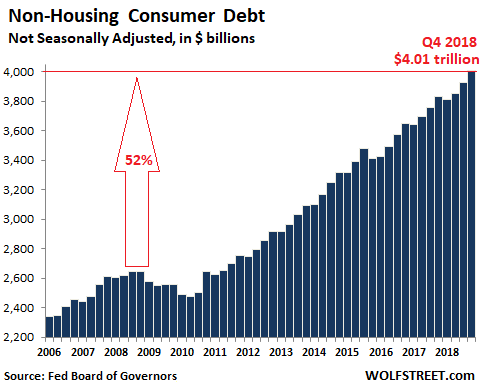
Silicon Valley Wants In On It Pair Of Gene-Edited Chinese Twins (ZH)

A pair of Chinese twins who were gene-edited for resistance to HIV may also have ‘supercharged’ brains, along with possible resistance to age-related cognitive diseases such as Alzheimer’s. In a controversial experiment led by Chinese scientist He Jiankui, the embroys of seven couples had their genes “edited” using a tool known as CRISPR. By removing a gene called CCR5, Jiankui sought to create a natural immunity to HIV – which requires CCR5 to enter blood cells. Based on new research, however, Jiankui may have also left the twins, Lulu and Nana, with improved memory and enhanced cognition, according to MIT Technology Review. They may also enjoy some degree of protection from Alzheimer’s Disease and other maladies which are rapidly being linked to chronic inflammation, as some groups of mice without CCR5 – or who have been given CCR5 inhibitors, experience less severe dementia or Alzheimer’s symptoms.

“The answer is likely yes, it did affect their brains,” says UCLA neurobiologist Alcino J. Silva, whose lap discovered a link between CCR5 and the brain’s ability to form new connections. “The simplest interpretation is that those mutations will probably have an impact on cognitive function in the twins,” says Silva, adding that the exact effect on the girls’ cognition cannot be predicted, which is “why it should not be done.” Jiankui’s human experiments drew harsh rebuke after news of Lulu and Nana’s birth in late October or early November, and has reportedly been fired from his position at the Southern University of Science and Technology (SUSTech) in Shenzhen, China. Jiankui says there are more gene-edited babies on the way.

Silva tells the MIT Technology Review that “because of his research, he sometimes interacts with figures in Silicon Valley and elsewhere who have, in his opinion, an unhealthy interest in designer babies with better brains.” When word of Jiankui’s experiment went public, Silva says he immediately questioned whether enhanced cognition was the real goal of the experiment. “I suddenly realized—Oh, holy shit, they are really serious about this bullshit,” said Silva. “My reaction was visceral repulsion and sadness.” He Jiankui acknowledged that he knew about the potential cognitive benefits of removing the CCR5 gene discovered by the UCLA team during a Q&A session, though he said “I am against using genome editing for enhancement.”

Read more …

Brave new world: gene-edited superhumans controlled through embedded technology. That Orwell guy appears smarter by the day.

China Blocks 17.5 Million Plane Tickets Due to Lack of ‘Social Credit’ (Ind.)

The Chinese government blocked 17.5 million would-be plane passengers from buying tickets last year as a punishment for offences including the failure to pay fines, it emerged. Some 5.5 million people were also barred from travelling by train under a controversial “social credit” system which the ruling Communist Party claims will improve public behaviour. The penalties are part of efforts by president Xi Jinping‘s government to use data-processing and other technology to tighten control on society. Human rights activists warn the system is too rigid and may lead to people being unfairly blacklisted without their knowledge, while US vice-president Mike Pence last year denounced it as “an Orwellian system premised on controlling virtually every facet of human life”.

Authorities have experimented with social credit in parts of China since 2014. Points are deducted for breaking the law, but also, in some areas, for offences as minor as walking a dog without a lead. Offences punished last year also included false advertising and violating drug safety rules, said China’s National Public Credit Information Centre. It gave no details of how many people live in areas with social credit systems. [..] The ruling party is spending heavily to roll out facial recognition systems, and human rights activists say people in Muslim and other areas with high ethnic minority populations have been compelled to give blood samples for a genetic database. Those systems rely heavily on foreign technology, which has prompted criticism of US and European suppliers for enabling human rights abuses.

Read more …

Feb 122019
 
 February 12, 2019  Posted by at 11:20 am Finance Tagged with: , , , , , , , , , , , ,  5 Responses »


Vincent van Gogh On the outskirts of Paris 1887


Global Insect Decline May See ‘Plague Of Pests’ (BBC)
Complex, Dynamic Environmental Destabilisation (BBC)
Politicians Are Complicit In The Killing Of Our Insects (G.)
Should We Really Not Worry About The Fed’s Balance Sheet? (Roberts)
Party Leaders Reach Deal To Avoid Fresh US Government Shutdown (AP)
Warren’s Foreign Policy Shows She’s Missing Why Trump Was Elected (G.)
Mistaken Futures (Kunstler)
May To Ask MPs For Further Fortnight’s Grace In Brexit Talks (G.)
Europeans Must Get Rid Of The Failing EU One Way Or Another (MW)
“Insane” Deutsche Bank Drowning Under Soaring Funding Costs (ZH)
Nearly A Fifth Of The EU’s Budget Goes On Livestock Farming (G.)
China Has No Use For Democracy. It Needs A Strong Leader Like Xi (SCMP)
History’s 10 Most Culturally Significant Dick Pic Scandals (Taibbi)


Roaches in a nuclear winter.

Global Insect Decline May See ‘Plague Of Pests’ (BBC)

A scientific review of insect numbers suggests that 40% of species are undergoing “dramatic rates of decline” around the world. The study says that bees, ants and beetles are disappearing eight times faster than mammals, birds or reptiles. But researchers say that some species, such as houseflies and cockroaches, are likely to boom. The general insect decline is being caused by intensive agriculture, pesticides and climate change. Insects make up the majority of creatures that live on land, and provide key benefits to many other species, including humans. They provide food for birds, bats and small mammals; they pollinate around 75% of the crops in the world; they replenish soils and keep pest numbers in check.

Many other studies in recent years have shown that individual species of insects, such as bees, have suffered huge declines, particularly in developed economies. But this new paper takes a broader look. Published in the journal Biological Conservation, it reviews 73 existing studies from around the world published over the past 13 years. The researchers found that declines in almost all regions may lead to the extinction of 40% of insects over the next few decades. One-third of insect species are classed as Endangered. “The main factor is the loss of habitat, due to agricultural practices, urbanisation and deforestation,” lead author Dr Francisco Sánchez-Bayo, from the University of Sydney, told BBC News.

“Second is the increasing use of fertilisers and pesticides in agriculture worldwide and contamination with chemical pollutants of all kinds. Thirdly, we have biological factors, such as invasive species and pathogens; and fourthly, we have climate change, particularly in tropical areas where it is known to have a big impact.” [..] “Fast-breeding pest insects will probably thrive because of the warmer conditions, because many of their natural enemies, which breed more slowly, will disappear,” said Prof Dave Goulson from the University of Sussex who was not involved in the review. “It’s quite plausible that we might end up with plagues of small numbers of pest insects, but we will lose all the wonderful ones that we want, like bees and hoverflies and butterflies and dung beetles that do a great job of disposing of animal waste.” Prof Goulson said that some tough, adaptable, generalist species – like houseflies and cockroaches – seem to be able to live comfortably in a human-made environment and have evolved resistance to pesticides.

Read more …

Nobody listened so far; why would they now?

Complex, Dynamic Environmental Destabilisation (BBC)

• Topsoil is being lost 10 to 40 times faster than it is being replenished by natural processes • Since the mid-20th Century, 30% of the world’s arable land has become unproductive due to erosion • 95% of the Earth’s land areas could become degraded by 2050 • Since 2005, the number of floods has increased by a factor of 15, extreme temperature events by a factor of 20, and wildfires sevenfold • Vertebrate populations have fallen by an average of 60% since the 1970s, and insect numbers – vital for pollination – have declined even faster in some countries.

Scientists warn of a potentially deadly combination of factors. These include climate change, mass loss of species, topsoil erosion, forest felling and acidifying oceans. The report from the centre-left Institute for Public Policy Research says these factors are “driving a complex, dynamic process of environmental destabilisation that has reached critical levels. “This destabilisation is occurring at speeds unprecedented in human history and, in some cases, over billions of years.” The UK is described as one of the most nature-depleted countries in the world. Some 2.2 million tonnes of UK topsoil is eroded annually, and over 17% of arable land shows signs of erosion. Nearly 85% of fertile peat topsoil in East Anglia has been lost since 1850, with the remainder at risk of being lost over next 30–60 years. The IIPR says many scientists believe we have entered a new era of rapid environmental change.

The report warns: “We define this as the ‘age of environmental breakdown’ to better highlight the severity of the scale, pace and implications of environmental destabilisation resulting from aggregate human activity.” Simon Lewis, Professor of Global Change Science at University College London, told BBC News: “IPPR are right to say that environmental change is happening ever-faster and threatens to destabilise society. “Future problems with food supplies could cause price spikes that drive civil unrest, while increases in levels of migration can strain societies. “Both together could overload political institutions and global networks of trade. “This century will be marked by rapid social and environmental change – that is certain. What is less clear is if societies can make wise political choices to avoid disaster in the future.”

Read more …

Written of course by a politician. Who thinks politicians can turn this around. Because they can do anything.

Politicians Are Complicit In The Killing Of Our Insects (G.)

Most of us spend more time swatting away or avoiding wasps and moths than we do contemplating their importance to the web of life. But it is no exaggeration to say that the horrifying decline in the number of these creatures – the most widespread on Earth – is a barometer for the whole planet. The new global scientific review into the perilous condition of our insects reports that more than 40% of insect species are threatened with extinction while the mass of insects is declining by 2.5% a year. This catastrophic decline is a direct cause of the existential threat to other animals, insects being at the bottom of the chain and the primary food source. Since 1970, 60% of mammals, birds, fish and reptiles have been wiped out.

The review identifies a key driver towards this mass extinction: habitat loss and conversion to intensive agriculture with its associated use of pesticides. Given this is a manmade disaster, surely we are capable of tackling and reversing it? As a member of the European parliament’s agriculture committee, I regularly debate the use of pesticides in farming with my colleagues. I have lost count of the number of times I have begun meetings with what feels like a sermon on the Armageddon taking place in our countryside. I am always greeted with patient, patronising smiles from many of my fellow MEPs, before they go on to ignore the warnings and refuse to limit the use of pesticides in our fields.

Some of the members of this committee are themselves farmers who have grown increasingly dependent on powerful and toxic pesticides. But others have taken the agribusiness shilling and believe that their role in policymaking is simply to support the corporations that sell these poisons. And this is the nub of the issue. What might accurately be dubbed insectageddon is being driven by the agrichemicals industry. This situation is compounded by compliant politicians and policymakers who fall prey to lobbying pressure and then refuse to implement science-driven policy to protect wildlife.

Read more …

What we should do is end the Fed. And replace it with markets.

Should We Really Not Worry About The Fed’s Balance Sheet? (Roberts)

Bill Dudley, who is now a senior research scholar at Princeton University’s Center for Economic Policy Studies and previously served as president of the New York Fed and was vice-chairman of the Federal Open Market Committee, recently penned an interesting piece from Bloomberg stating: “Financial types have long had a preoccupation: What will the Federal Reserve do with all the fixed income securities it purchased to help the U.S. economy recover from the last recession? The Fed’s efforts to shrink its holdings have been blamed for various ills, including December’s stock-market swoon. And any new nuance of policy — such as last week’s statement on “balance sheet normalization” — is seen as a really big deal. I’m amazed and baffled by this. It gets much more attention than it deserves.”

[..] In his opening paragraph, Bill attempts to dismiss the linkage between the balance sheet and the financial markets. “Yes, it’s true that stock prices declined at a time when the Fed was allowing its holdings of Treasury and mortgage-backed securities to run off at a rate of up to $50 billion a month. But the balance sheet contraction had been underway for more than a year, without any modifications or mid-course corrections. Thus, this should have been fully discounted.” While this is a true statement, what Bill forgot to mention was that Global Central banks had stepped in to flood the system with liquidity. As you can see in the chart below, while the Fed had stopped expanding their balance sheet, everyone else went into over-drive.

The chart below shows the ECB’s balance sheet and trajectory. Yes, they are slowing “QE” but it is still growing currently.

Read more …

Far from over.

Party Leaders Reach Deal To Avoid Fresh US Government Shutdown (AP)

Democratic and Republican leaders announced late Monday that they had reached a deal to avoid a government shutdown when funding under a stopgap agreement expires at midnight on Friday. The proposal would require the signature of Donald Trump to avert a new shutdown. The agreement would allocate far less money for Trump’s border wall than the White House’s $5.7bn wish list, settling for a figure of nearly $1.4bn, according to congressional aides. The funding measure is through the fiscal year, which ends 30 September. The agreement means 55 miles of new fencing — constructed through existing designs such as metal slats instead of a concrete wall — but far less than the 215 miles the White House demanded in December. The fencing would be built in the Rio Grande Valley in Texas.

At a rally in El Paso, Texas, on Monday Trump said he had been informed about the committee’s progress. “Just so you know, we’re building the wall anyway”, he added. Negotiators have been trying to reach a deal to fund nine government departments that partially closed for 35 days in December and January. Trump and congressional Democrats agreed on 25 January to temporarily fund the departments and negotiate a funding solution by 8 February. Talks most recently broke down on Sunday, reportedly over a disagreement about the maximum number of undocumented immigrants who might be detained at any one time.

Read more …

Warren is irrelevant.

Warren’s Foreign Policy Shows She’s Missing Why Trump Was Elected (G.)

The United States, Warren says, has embarked on “a series of seemingly endless wars, engaging in conflicts with mistaken or uncertain objectives and no obvious path to completion”. It’s fine rhetoric but the obvious path to completion is merely to end the wars. And yet the Bush White House couldn’t or didn’t want to. And Obama vacillated and expanded to the point where bombing and killing was being pursued in almost a dozen countries when he left office. And as for Trump? He’s done little and he’s been publicly admonished by his own secretary of defense when he decided he wanted to end just one of those conflicts.

But “the United States”? Really? Other than Afghanistan after 9/11 – and that’s all – “the United States” didn’t embark on these wars. The national security community did. The government. Overtly, covertly, with high hopes or unwarranted self-confidence, they got their way. Who is the real culprit then? It isn’t Warren’s “elites”, the corporation, or Trump. It is Washington and its ability, indeed even its self-appointed duty, to stand in the way of anything that it sees as not in its interest.

She may not think it, but Warren is merely genuflecting before this deep state, declaring her allegiance to a “muscular military” and calling for “strong yet pragmatic security policies”. She of course offers a laundry list of things that must be preserved or strengthened that’s non-military – from technological superiority to diplomacy to strong alliances. And she decries the military and civilian policymakers who “seem [in]capable of defining success”. But in her innocence as to why we are stuck in seemingly endless wars she also seems oblivious to the fact that she is already capitulating to the very forces that ensure that we can’t change anything.

Read more …

Will the Green New Deal Make America Great Again?

Mistaken Futures (Kunstler)

The self-proclaimed socialists are actually seeing the world through a rear-view mirror. What they are really talking about is divvying up the previously-accumulated wealth, soon to be bygone. Entropy is having its wicked way with that wealth, first by transmogrifying it into ever more abstract forms, and then by dissipating it as waste all over the planet. In short, the next time socialism is enlisted as a tool for redistributing wealth, we will make the unhappy discovery that most of that wealth is gone. The process will be uncomfortably sharp and disorientating. The West especially will not know what hit it as it emergently self-reorganizes back into something that resembles the old-time feudalism.

We have a new kind of mass squalor in America: a great many people who have nothing to do, no means of support, and the flimsiest notions of purpose in life. The socialists have no answers for them. They will not be “retrained” in some imagined federal crusade to turn meth freaks into code-writers for Google. Something the analysts are calling “recession” is ploughing across the landscape like one of those darkly majestic dust-storms of the 1930s, only this time we won’t be able to re-fight anything like World War Two to get all the machines running again in the aftermath. Nor, of course, will the Make America Great Again fantasy work out for those waiting in the squalid ruins of the post-industrial rust-belt or the strip-mall wastelands of the Sunbelt.

Most of the beliefs and attitudes of the present day will be overturned with the demise of the industrial orgy, like the idea that humanity follows an unerring arc of progress, that men and women are interchangeable and can do exactly the same work, that society should not be hierarchical, that technology will rescue us, and that we can organize some political work-arounds to avoid the pain of universal contraction. There are no coherent ideas in the political arena just now. Our prospects are really too alarming. So, jump on-board the socialism ship and see if it makes you feel better to sail to the end of the earth. But mind the gap at the very edge. It’s a doozie.

Read more …

And 2 more weeks after that etc. till the clock runs out.

May To Ask MPs For Further Fortnight’s Grace In Brexit Talks (G.)

Theresa May hopes to convince the House of Commons on Tuesday to give her another fortnight’s grace to keep pushing for changes to the Irish backstop – despite the insistence of Michel Barnier that it is Britain that must compromise. With 45 days to go until Britain is due by law to leave the EU, with or without a deal, the prime minister will address MPs about progress in the Brexit talks, No 10 announced on Monday. She is unlikely to signal any shift towards a closer future relationship with the EU, after writing to Jeremy Corbyn to underline her continued objections to a customs union, and instead she will focus on the backstop.

“We are absolutely clear on this: we’re not considering Jeremy Corbyn’s customs proposals, we’re not considering any proposals to remain in the customs union. We must have our own, independent trade policy,” May’s spokesman said on Monday. May will stress her continued focus on the backstop, but the EU’s chief negotiator insisted on Monday there was no question of Brussels giving in to Downing Street’s demands. “We’re waiting for clarity and movement from the United Kingdom,” Barnier told reporters after talks in Luxembourg with the country’s prime minister, Xavier Bettel.

Read more …

The EU has the exact same flaws as its member states, but in the latter the losers can get voted out.

Europeans Must Get Rid Of The Failing EU One Way Or Another (MW)

Populism is sweeping Europe, because the European Union and its constituent governments have become as unresponsive as the 18th century aristocracies those replaced.The EU antecedent, the European Economic Community (1957) was created to prevent another World War by integrating the continent’s iron and steel industries and then its broader continental markets for goods, services, capital and labor. The process created a politically unaccountable bureaucracy, whose broad policy directions are set by consensus among the national heads of government and cabinet ministers. However, Brussels enjoys wide administrative discretion in supervising the customs union, agricultural and fisheries management, and national subsidies, anticompetitive practices, and other behavior that could undermine the “single market.”

Through a succession of treaties and agreements, national leaders “pooled sovereignty” to empower the European Commission to issue edicts that member states must directly obey or conform national laws and regulations in areas such as social policy and human rights, consumer protection and product standards, transportation, and immigration. European Court rulings have direct application in national courts, and 19 of the 28 states have ceded monetary policy to the European Central Bank by adopting the euro. To win votes, mainstream national politicians have endemically statist impulses, and hue to globalist views regarding the virtues of freer trade and more open immigration, regulatory responses to environmental challenges like climate change rather than mitigation, and impelling cultural diversity as opposed to preserving local cultures.

In Europe, national leaders have empowered the commission to impose the pain and constraints on private freedoms that such globalist policies require. Then they can point to Brussels to alibi they are just advancing a stronger European Union.

Read more …

Deutsche is a wager gone horribly wrong.

“Insane” Deutsche Bank Drowning Under Soaring Funding Costs (ZH)

Following years of dismal performance, uncovered attempts at market manipulation and fraudulent activities, and painful corporate reorganizations which its latest earnings report showed have “cut deeply into the muscle”, Deutsche Bank is a shadow of its former self, with its stock price trading just shy of all time lows. But an even bigger problem for Germany’s biggest lender is that it is now forced to pay the highest financing rates on the euro debt market for a leading international bank this year according to the FT, and also the highest rates among large banks to raise debt this year according to Bloomberg, in a further sign of the German lender’s uphill struggle to turn its operations around and reduce its funding costs.

As the FT first reported, followed promptly by Bloomberg, the bank raised eyebrows last week when it sold a total of €3.6BN in euro-denominated debt, paying 180 bps over the benchmarks for a two-year bond, a steep rate for short-term funding. Deutsche Bank also paid 230 bps over benchmarks for a senior seven-year bond that can absorb losses in a crisis. By comparison, French banking giant BNP Paribas SA last month offered 50 bps less for equally-ranked notes that mature one year later. More embarrassing, Deutsche Bank paid a higher rate than Spanish lender CaixaBank, which recently raised five-year bonds at 225bp.

In a latest note to clients, Corinna Dröse, a Frankfurt-based bond analyst at DZ Bank, said: “The high spreads reflect [Deutsche’s] high idiosyncratic risk, which is rooted in the lender’s chronic weakness in earnings.” “Deutsche has to pay significantly higher risk premiums than almost all other large European banks . . . [the] high spreads express severe doubts, mainly triggered by its poor revenue,” said Michael Hünseler, head of credit portfolio management at Assenagon. Intimately linked with the bank’s deteriorating fortunes – and stock price – investors are increasingly demanding that Deutsche Bank pay higher rates of return than even some of Europe’s “most troubled banks” as the firm grapples with a prolonged decline in revenue.

Finance chief James von Moltke said last year that the bank was caught in a “vicious circle” of declining revenue, sticky expenses, a lowered credit rating and rising funding costs. While the firm cut expenses, revenue and the price of funding remain a concern. “A key priority for us now is lowering our funding costs and improving our credit ratings,” von Moltke said during a call with fixed-income investors last week. “We must not compromise on the strength of our capital, funding, or liquidity, but we have to prove that we can generate long-term, sustainable profitability.”

Read more …

It’s not about eating meat, it’s about industrial farming. All these scientists telling people what to eat are useless.

Nearly A Fifth Of The EU’s Budget Goes On Livestock Farming (G.)

Nearly a fifth of the EU’s total budget – more than £24bn of taxpayer money – goes to support livestock farming across Europe, according to new research by Greenpeace. At a time when scientists are calling for significant reductions in meat consumption, the report’s authors say taxpayers’ money should be redirected away from grain-fed, industrial animal farming. Last month, the Eat-Lancet Commission of scientists called for a new plant-focused diet to help avoid dangerous levels of climate change and the destruction of wildlife. Such a diet would require cutting red meat consumption in Europe by 77%.

Public Health England’s dietary guidelines recommend that meat and dairy, including non-animal-based protein alternatives such as beans and pulses, should make up no more than our 20% of dietary intake. Yet, Europeans eat more than twice as much meat as national dietary authorities recommend, as well as twice the global average. “Adopting diets lower in meat and dairy would not only tackle health problems but would also reduce the pressure on land, freeing up more space for nature,” said the Greenpeace EU agriculture policy director Marco Contiero. [..] Researchers calculated that 125 million hectares (308 million acres) of land in Europe is used to graze livestock or produce feed – this includes more than 60% of arable land that could otherwise be used to grow food directly for human consumption.

Read more …

China has no idea what democracy is. But it has a ruling class just like our countries.

China Has No Use For Democracy. It Needs A Strong Leader Like Xi (SCMP)

Throughout my life, I have had the opportunity to meet nearly every Chinese leader since the 1930s (with the exception of Mao Zedong), including Chiang Kai-shek, Wang Jingwei and more contemporary figures such as Hu Jintao, Jiang Zemin and Xi. As individuals, they frequently came off as kind, caring and intelligent. From afar, as I watched them govern, I would view them in a different light, as dictators. This is the reality of leadership in China. Previously, emperors in China were said to rule because of their “Mandate of Heaven”. When Mao seized power, it was clear that he had won his position through revolution. Yet the selection of Xi, like the selection of his predecessors since Mao’s death in 1976, is cloaked in secrecy.

Even those in the US who question whether, and to what degree, Russian interference influenced the 2016 election will concede that, based on US law, Trump is a legally elected president. These results are publicly available, and have been analysed repeatedly by the media, politicians and the American public. But China lacks such luxuries. Its citizens have no official records to turn to for an explanation of why and how Xi was chosen. [..] Under Xi’s leadership, China has adopted a more aggressive stance internationally, imprisoned thousands of party members on corruption charges and removed constitutional limitations on presidential term limits. Amid these developments, the question of how Xi was chosen again comes to mind. The short answer is, we can only guess.

Read more …

Why, why and why?

History’s 10 Most Culturally Significant Dick Pic Scandals (Taibbi)

The AMI-Jeff Bezos scandal is set up to dominate headlines for a while. Who knows where it will lead? In the third world, an oligarch-president proxy war playing out in public like this usually presages a coup. If this were Thailand or Uruguay, bookies would already have odds on a Bezos-Mark-Zuckerberg-Sundar-Pichai junta being in power by May. This scandal will at least drag us through unprecedented legal and ethical conundrums. Can the president use the surveillance powers of the state to go after political enemies? Can a billionaire intelligence contractor and administrator of one of earth’s largest private data collections — including the so-called “Secret Region” cloud — fight back using his own surveillance trove through a newspaper he owns?

This story could blur the lines between public and private power to the point of meaninglessness. America could very well find its fate decided by a series of pre-dawn phone calls, after which we’d wake up to find Trump flying to Switzerland, Amazon lieutenants in the Joint Chiefs office and the presidency replaced by an executive board. At the center of all of this: a dick pic. Nothing could be more American than the fate of our democracy now hanging (!) on what Enquirer editor Dylan Howard euphemistically describes as a “below-the-belt selfie.”

Read more …

Feb 092019
 
 February 9, 2019  Posted by at 11:03 am Finance Tagged with: , , , , , , , , , , , , , ,  5 Responses »


Pablo Picasso Le pigeon aux petits pois (Pigeon with Peas) – stolen May 20 2010 1911


German Industrial Production Falls Most Since 2009. New Orders Plummet (WS)
Fed’s QE Unwind Reaches $434 Billion, Remains on “Autopilot” (WS)
UK Forcing Poor Nations Into Risky Post-Brexit Trade Deals (Ind.)
Acting AG Whitaker Says He Has Not Meddled In Russia Inquiry (AP)
US Faces A Catastrophic Food Supply Crisis, As Farmers Struggle (SHTF)
The State of the American Debt Slaves, Q4 2018 (WS)
Bezos, Amazon And Privacy (Greenwald)
Leaked Wikileaks Doc Reveals US Military Use of IMF, World Bank (MPN)
Venezuela: The US’s 68th Regime Change Disaster (AntiWar)
US In Direct Contact With Venezuelan Military, Urging Defections (R.)
Venezuela’s Maduro Spurns US Aid, Rival Warns Military Not To Block It (R.)
Dreams Die Hard (Kunstler)
Wiped Out Before Our Eyes’ Hawaii Proposes Ban On Shark Killings (G.)


Almost off the news radar, Germany’s problems get serious, and drag Europe down with it.

German Industrial Production Falls Most Since 2009. New Orders Plummet (WS)

“Unexpectedly,” German industrial production fell 3.9% in December 2018 compared to December 2017, after having fallen by a revised 4.0% in November, according to German statistics agency Destatis Thursday morning. These two drops were steepest year-over-year drops since 2009. Even during the European Debt Crisis in 2011 and 2012 – it hit Germany’s industry hard as many European countries weaved in and out of a recession, with some countries sinking into a depression — German industrial production never fell as fast on a year-over-year basis as in November and December:

The declines on a year-over-year basis were broad: Without construction, industrial production fell 3.9% year-over-year in December, after having fallen 4.5% in November. And just manufacturing production, which includes mining and quarrying, fell 4.0% year-over-year in December, after having fallen 4.6% in November. On a longer-term scale, the industrial production index peaked in May 2018 and has since fallen 4.6%. It is now back where it had first been in February 2017:

And industrial production is not getting a whole lot better any time soon as new orders for the manufacturing sector have plunged – according to data released by Destatis on Wednesday. New orders dropped 7.0% year-over-year in December (adjusted for calendar differences), after having fallen 3.4% in November and 3.0% in October. In fact, orders have fallen seven months in a row on a year-over year basis in ever larger drops. The chart below shows the decline in each month compared to the same month a year earlier — with a sharp deterioration at the end of the year:

Read more …

As I’ve said before, tweaking rates is sort of an instant measure, but re-purchasing $434 billion in assets takes much longer. If only because the Fed will cause a panic if they try.

Fed’s QE Unwind Reaches $434 Billion, Remains on “Autopilot” (WS)

The Fed shed $32 billion in assets in January, according to the Fed’s balance sheet for the week ended February 6, released this afternoon. This reduced the assets on its balance sheet to $4,026 billion, the lowest since January 2014. Since the beginning of this “balance sheet normalization,” the Fed has now shed $434 billion.

[..] the questions going forward are these: One, will the Fed continue to trim its balance sheet on “autopilot,” or will it deviate from plan and slow or stop the balance sheet reductions; Or two, will the Fed reverse course and restart QE all over again at any moment now, as the biggest Wall Street hype-mongers have prophesied; Or three, will the Fed tweak the roll-off – as a slew of Fed governors have suggested – to where it would get rid of its MBS more quickly by outright selling them; and by replacing some of them with short-term Treasury bills to lower the balance sheet’s average maturity, which currently is over eight years.

Over the next few months, the Fed will likely announce some tantalizing tidbits about how it might tweak the balance-sheet reduction. One of those tidbits will likely relate to how it will shed MBS faster and replace those additional reductions of MBS with short-term Treasury bills. The effects of this may not be what the markets had hoped for in their wildest dreams. And the Fed will likely dole out more clues about how much further it wants to cut its balance sheet. But all this will take months, and until those tweaks are nailed down and announced, the balance sheet normalization will proceed on autopilot at its by now customary glacial pace.

Read more …

Dreams of empire. France does the exact same thing.

UK Forcing Poor Nations Into Risky Post-Brexit Trade Deals (Ind.)

Some of the world’s poorest countries are being forced to agree potentially damaging trade deals with the UK by government “threats” in the rush to Brexit, campaigners say. Liam Fox, the international trade secretary, is accused of piling pressure on developing nations to “sign up blind” – without knowing the value of the deals – with a warning they will otherwise be lost. Just three of the 40 agreements the UK enjoys through EU membership, covering 71 countries, have been successfully “rolled over” – as the government promised – with Brexit day just seven weeks away. Now the Department for International Trade is under fire for telling the countries concerned they risk punishing tariffs on crucial exports to the UK, unless they re-sign the deals in time.

Among them are Ghana, which relies on banana sales, Mauritius (tuna), Kenya (flowers), Cote d’Ivoire (cocoa), Namibia (grapes and beef), Swaziland (sugar), and scores of other developing countries in Africa, the Caribbean and Central America. And, says the fair trade charity Traidcraft Exchange, they risk a legal challenge at the World Trade Organisation (WTO) under an extraordinary plan to treat EU parts as originating from the UK. “The continuity agreements are being rushed because of the threat of no deal. Countries are being asked to sign up blind,” said Liz May, the charity’s head of policy.

“Without the full picture of how the EU and UK will trade in the future, it is impossible for countries to judge what these deals are really worth, how they will work in practice or even how some elements will be enforced. “Instead of acknowledging this difficulty, the government is relying on developing countries being compelled to sign up at the last minute, rather than risk high tariffs being slapped on their key exports. “This type of bad-faith negotiating – using implicit threats to get countries ‘over the line’ – is not a great way to start the UK’s independent trade policy.”

Read more …

“I’m thinking about maybe we just set up a popcorn machine in the back because that’s what this is becoming. It’s becoming a show..”

The Senate will vote on Barr next week anyway, so why the showboating carnival?

Acting AG Whitaker Says He Has Not Meddled In Russia Inquiry (AP)

The acting attorney general, Matthew Whitaker, said on Friday that he has “not interfered in any way” in the special counsel’s Russia investigation as he faced a contentious congressional hearing in his waning days on the job. The hearing before the House Judiciary Committee was the first, and likely only, chance for newly empowered Democrats in the majority to grill an attorney general they perceive as a Donald Trump loyalist, and whose appointment they suspect was aimed at suppressing investigations of the Republican president. Democrats confronted Whitaker on his past criticism of the special counsel Robert Mueller’s work and his refusal to recuse himself from overseeing it, attacked him over his prior business dealings, and sneeringly challenged his credentials as the country’s chief law enforcement officer.

“We’re all trying to figure out: who are you, where did you come from and how the heck did you become the head of the Department of Justice,” said congressman Hakeem Jeffries. When Whitaker tried to respond, the New York Democrat interrupted: “Mr Whitaker, that was a statement, not a question. I assume you know the difference.” Yet Democrats yielded no new information about the status of the Mueller invesetigation as Whitaker repeatedly refused to discuss conversations with the president or answer questions that he thought might reveal details. Though clearly exasperated – he drew gasps and chuckles when he told the committee chairman that his five-minute time limit for questions was up – Whitaker nonetheless sought to assuage Democratic concerns by insisting he had never discussed the Mueller probe with Trump or other White House officials, and that there’d been no change in its “overall management”.

“We have followed the special counsel’s regulations to a T,” Whitaker said. “There has been no event, no decision, that has required me to take any action, and I have not interfered in any way with the special counsel’s investigation.” Republicans made clear they viewed the hearing as pointless political grandstanding, especially since Whitaker may have less than a week left in the job, and some respected his wishes by asking questions about topics other than Mueller’s inquiry into potential coordination between Russia and the Trump campaign. The Senate is expected to vote as soon as next week on confirming William Barr, Trump’s pick for attorney general. “I’m thinking about maybe we just set up a popcorn machine in the back because that’s what this is becoming. It’s becoming a show,” said the Republican congressman Doug Collins ,of Georgia, who accused his Democratic colleagues of “character assassination”.

Read more …

The US food crisis is exclusively caused by Big Ag and Monsanto. Farmers depending on China is not in their interest.

US Faces A Catastrophic Food Supply Crisis, As Farmers Struggle (SHTF)

American farmers are battling several issues when it comes to producing our food. Regulated low prices, tariffs, and the inability to export have all cut into the salaries of farmers. They are officially in crisis mode, just like the United States’ food supply. “The farm economy’s in pretty tough shape,” said John Newton, chief economist at the American Farm Bureau Federation. “When you look out on the horizon of things to come, you start to see some cracks.” Average farm income has fallen to near 15-year lows under president Donald Trump’s policies, and in some areas of the country, farm bankruptcies are soaring. And with slightly higher interest rates, many don’t see borrowing more money as an option.

“A lot of farmers are going to give the president the benefit of the doubt, and have to date. But the longer the trade war goes on, the more that dynamic changes,” said Brian Kuehl, executive director of Farmers for Free Trade, according to Politico. With no end to the disastrous trade war in sight, many farmers have traveled to Washington to share their plights with the president himself hoping that he’ll end the trade war that’s exacerbating an already precarious food crisis. Farmers make up a fairly large chunk of president Trump’s base, and an unwillingness to put food production in the United States first could be detrimental for Trump reelection chances in 2020. It could also be the beginning of a catastrophic food shortage.

Read more …

“It’s a tough job, but someone’s got to do it: Propping up the massive US economy.”

The State of the American Debt Slaves, Q4 2018 (WS)

It’s a tough job, but someone’s got to do it: Propping up the massive US economy. And consumers are doing it, but in a somewhat lackadaisical manner when it comes to spending money they don’t have. Consumer debt – more enticingly, “consumer credit” similar to “extra credit” – rose 4.7% in the fourth quarter 2018 compared to the fourth quarter last year. In the year 2018, Americans added $179 billion to their balances on their credit cards, auto loans, and student loans. Every dime was spent and added to GDP. It amounted to nearly 1% of GDP. If GDP grew 3.1% in 2018, just under one third of the growth was generated by that additional consumer debt.

Without this additional consumer borrowing, if consumers had just maintained their debt levels, GDP growth might only have been 2.2% in 2018, instead of 3.1%. So, a huge round of applause is due our debt slaves that now owe over $4 trillion for the first time ever, according to the Federal Reserve Thursday afternoon. Consumer debt includes auto loans, student loans, credit-card debt, and personal loans, but it excludes housing related debt, such as mortgages and HELOCs. The $4.01 trillion in consumer debt is up 52% from the peak early in the Financial Crisis in Q3 2008. This is not adjusted for inflation. Over the same period, the Consumer Price Index rose 16% and nominal GDP rose 39%. Thus, Americans are sticking to their time-honored plan of out-borrowing both inflation (by a big margin) and economic growth.

Read more …

Summary: Trump accused of using the same FBI that spies on him, to spy on Bezos, who’s in bed with the FBI.

I may have temporarily lost the thread, and the logic.

Bezos, Amazon And Privacy (Greenwald)

On Thursday, Bezos published emails in which the Enquirer’s parent company explicitly threatened to publish intimate photographs of Bezos and his mistress, which were apparently exchanged between the two through their iPhones, unless Bezos agreed to a series of demands involving silence about the company’s conduct. [..] Despite a lack of evidence, MSNBC is already doing what it exists to do – implying with no evidence that Trump is to blame (in this case, by abusing the powers of the NSA or FBI to spy on Bezos). But, under the circumstances, those are legitimate questions to be probing (though responsible news agencies would wait for evidence before airing innuendo of that sort).

If Bezos were the political victim of surveillance state abuses, it would be scandalous and dangerous. It would also be deeply ironic. That’s because Amazon, the company that has made Bezos the planet’s richest human being, is a critical partner for the U.S. Government in building an ever-more invasive, militarized and sprawling surveillance state. Indeed, one of the largest components of Amazon’s business, and thus one of the most important sources of Bezos’ vast wealth and power, is working with the Pentagon and the NSA to empower the U.S. Government with more potent and more sophisticated weapons, including surveillance weapons.

In December, 2017, Amazon boasted that it had perfected new face-recognition software for crowds, which it called Rekognition. It explained that the product is intended, in large part, for use by governments and police forces around the world. The ACLU quickly warned that the product is “dangerous” and that Amazon “is actively helping governments deploy it.” “Powered by artificial intelligence,” wrote the ACLU, “Rekognition can identify, track, and analyze people in real time and recognize up to 100 people in a single image. It can quickly scan information it collects against databases featuring tens of millions of faces.” “Amazon’s Rekognition raises profound civil liberties and civil rights concerns.”

Read more …

The core of the Venezuela crisis: “Hugo Chávez, broke ties with the IMF and World Bank, which he noted were “dominated by US imperialism.” Instead Venezuela and other left-wing governments in Latin America worked together to co-found the Bank of the South..”

Leaked Wikileaks Doc Reveals US Military Use of IMF, World Bank (MPN)

In a leaked military manual on “unconventional warfare” recently highlighted by WikiLeaks, the U.S. Army states that major global financial institutions — such as the World Bank, IMF, and the OECD — are used as unconventional, financial “weapons in times of conflict up to and including large-scale general war,” as well as in leveraging “the policies and cooperation of state governments.” The document, officially titled “Field Manual (FM) 3-05.130, Army Special Operations Forces Unconventional Warfare” and originally written in September 2008, was recently highlighted by WikiLeaks on Twitter in light of recent events in Venezuela as well as the years-long, U.S.-led economic siege of that country through sanctions and other means of economic warfare. Though the document has generated new interest in recent days, it had originally been released by WikiLeaks in December 2008 and has been described as the military’s “regime change handbook.”

WikiLeaks’ recent tweets on the subject drew attention to a single section of the 248-page-long document, titled “Financial Instrument of U.S. National Power and Unconventional Warfare.” This section in particular notes that the U.S. government applies “unilateral and indirect financial power through persuasive influence to international and domestic financial institutions regarding availability and terms of loans, grants, or other financial assistance to foreign state and nonstate actors,” and specifically names the World Bank, IMF and the OECD, as well as the Bank for International Settlements (BIS), as “U.S. diplomatic-financial venues to accomplish” such goals.

[..] Given the close relationship between the U.S. government and these international financial institutions, it should come as little surprise that – in Venezuela – the U.S.-backed “interim president” Juan Guaidó – has already requested IMF funds, and thus IMF-controlled debt, to fund his parallel government. This is highly significant because it shows that top among Guaidó’s objectives, in addition to privatizing Venezuela’s massive oil reserves, is to again shackle the country to the U.S.-controlled debt machine. As the Grayzone Project recently noted: Venezuela’s previous elected socialist president, Hugo Chávez, broke ties with the IMF and World Bank, which he noted were “dominated by US imperialism.” Instead Venezuela and other left-wing governments in Latin America worked together to co-found the Bank of the South, as a counterbalance to the IMF and World Bank.”

Read more …

So many millions of victims nobody tries to count anymore.

Venezuela: The US’s 68th Regime Change Disaster (AntiWar)

In his masterpiece, Killing Hope: U.S. Military and C.I.A. Interventions Since World War II, William Blum, who died in December 2018, wrote chapter-length accounts of 55 US regime change operations against countries around the world, from China (1945-1960s) to Haiti (1986-1994). Noam Chomsky’s blurb on the back of the latest edition says simply, “Far and away the best book on the topic.” We agree. If you have not read it, please do. It will give you a clearer context for what is happening in Venezuela today, and a better understanding of the world you are living in. Since Killing Hope was published in 1995, the US has conducted at least 13 more regime change operations, several of which are still active: Yugoslavia; Afghanistan; Iraq; the 3rd US invasion of Haiti since WWII; Somalia; Honduras; Libya; Syria; Ukraine; Yemen; Iran; Nicaragua; and now Venezuela.

William Blum noted that the US generally prefers what its planners call “low intensity conflict” over full-scale wars. Only in periods of supreme overconfidence has it launched its most devastating and disastrous wars, from Korea and Vietnam to Afghanistan and Iraq. After its war of mass destruction in Iraq, the US reverted to “low intensity conflict” under Obama’s doctrine of covert and proxy war. Obama conducted even heavier bombing than Bush II, and deployed US special operations forces to 150 countries all over the world, but he made sure that nearly all the bleeding and dying was done by Afghans, Syrians, Iraqis, Somalis, Libyans, Ukrainians, Yemenis and others, not by Americans. What US planners mean by “low intensity conflict” is that it is less intense for Americans.

[..] While Venezuelans face poverty, preventable diseases, malnutrition and open threats of war by US officials, those same US officials and their corporate sponsors are looking at an almost irresistible gold mine if they can bring Venezuela to its knees: a fire sale of its oil industry to foreign oil companies and the privatization of many other sectors of its economy, from hydroelectric power plants to iron, aluminum and, yes, actual gold mines. This is not speculation. It is what the US’s new puppet, Juan Guaido, has reportedly promised his American backers if they can overthrow Venezuela’s elected government and install him in the presidential palace.

Read more …

“..a source in Washington close to the opposition expressed doubts whether the Trump administration has laid enough groundwork to spur a wider mutiny in the ranks..”

US In Direct Contact With Venezuelan Military, Urging Defections (R.)

The US is holding direct communications with members of Venezuela’s military urging them to abandon President Nicolas Maduro and is also preparing new sanctions aimed at increasing pressure on him, a senior White House official said. The Trump administration expects further military defections from Maduro’s side, the official told Reuters, despite only a few senior officers having done so since opposition leader Juan Guaido declared himself interim president last month, earning the recognition of the United States and dozens of other countries. “We believe these to be those first couple pebbles before we start really seeing bigger rocks rolling down the hill,” the official said this week, speaking on condition of anonymity. “We’re still having conversations with members of the former Maduro regime, with military members, although those conversations are very, very limited.”

With the Venezuelan military still apparently loyal to Maduro, a source in Washington close to the opposition expressed doubts whether the Trump administration has laid enough groundwork to spur a wider mutiny in the ranks where many officers are suspected of benefiting from corruption and drug trafficking. Members of the South American country’s security forces fear they or their families could be targeted by Maduro if they defect, so the U.S. would need to offer them something that could outweigh those concerns, said Eric Farnsworth, vice president of the Council of the Americas think tank in Washington. “It depends on what they’re offering,” Farnsworth said. “Are there incentives built into these contacts that will at least cause people to question their loyalty to the regime?”

Read more …

A horse felled Troy.

Venezuela’s Maduro Spurns US Aid, Rival Warns Military Not To Block It (R.)

Venezuela’s government on Friday said the United States should distribute humanitarian aid in Colombia where it is being stockpiled, while the opposition warned that blocking much-needed food and medicine could constitute crimes against humanity. A day after the aid convoy arrived in the border city of Cucuta, President Nicolas Maduro ridiculed the United States for offering small amounts of assistance while maintaining sanctions that block some $10 billion of offshore assets and revenue. Rival Juan Guaido, who is recognized by dozens of countries as Venezuela’s legitimate leader, warned military officers against blocking the arrival of aid amid spiraling disease and malnutrition brought on by a hyperinflationary collapse.

“Take all that humanitarian aid and give it to the people of Cucuta, where there is a lot of need,” Maduro said in a news conference. “This is a macabre game, you see? They squeeze us by the neck and then make us beg for crumbs.” “They offer us toilet paper, like (U.S. President) Donald Trump threw at the people of Puerto Rico,” he said at the conference, which experienced technical difficulties including a blackout and a microphone failure. He was referring to Trump’s improvised 2018 aid distribution in the U.S. territory following a hurricane, during which he threw rolls of paper towels.

Read more …

“Societies and economies are fundamentally emergent, non-linear, and self-organizing as they respond to the mandates of reality — which are not necessarily consistent with human wishes.”

Dreams Die Hard (Kunstler)

America has been blowing green smoke up its own ass for years, promoting oxymorons such as “green skyscrapers” and “clean energy,” but the truth is we’re not going to run WalMart, Suburbia, DisneyWorld, and the interstate highway system on any combination of wind, solar, geothermal, recycled Fry-Max, and dark matter. We’re just running too much stuff at too great a scale for too many people. We’ve blown through the capital already and replaced it with IOUs that will never be honored, and we’re caught in an entropy trap of diminishing returns from all the work-arounds we’re desperately trying. For all that, there are actually some sound proposals in the mostly delusional matrix of the Green New Deal promoted by foxy front-person AOC.

• Revoke corporate personhood by amending our Constitution to make clear that corporations are not persons and money is not speech. Right on, I say, though they have not quite articulated the argument which is that corporations, unlike persons, have no vested allegiance to the public interest, but rather a legal obligation solely to shareholders and their boards-of-directors.
• Replace partisan oversight of elections with non-partisan election commissions. A no-brainer.
• Replace big money control of election campaigns with full public financing and free and equal access to the airwaves. Quite cheap and worth every penny.
• Break up the oversized banks that are “too big to fail.” And while you’re at it, resume enforcement of the anti-trust laws.
• Restore the Glass-Steagall separation of depository commercial banks from speculative investment banks. Duh….

There are two kinds of deadly narcissism at work in American culture these days: techno-narcissism — the belief that magical rescue remedies can save the status quo of comforts and conveniences — and organizational narcissism — the belief that any number of committees can lead a march of humanity into a future of rainbows and unicorns. Both of these ideas are artifacts of a fossil fuel turbo-charged economy that is coming to an end. Societies and economies are fundamentally emergent, non-linear, and self-organizing as they respond to the mandates of reality — which are not necessarily consistent with human wishes. Circumstances in the world change and sometimes, when the changes are profound enough, they provoke episodes of flux and disorder. A better index for our journey into the unknown frontier beyond modernity will not be what is “green” and “smart” but perhaps what is “sane” and “insane.”

Read more …

100 million sharks are killed globally each year.

We need to protect, and love, life in all its glory and beauty, because we are life. But we don’t see what connects us to all that we kill, we think we’re some separate entity.

There is no more flagrant failure in our education systems than this: they don’t teach us who we are.

Wiped Out Before Our Eyes’ Hawaii Proposes Ban On Shark Killings (G.)

Sharks could soon become more numerous in Hawaii waters – and advocates say that’s a good thing. Lawmakers in Honolulu advanced a proposed ban on killing sharks in state waters on Wednesday, after receiving hundreds of calls and letters of support from around the country. The law, which would provide sweeping protection for any shark, rather than select species, could be the first of its kind in the United States. “These amazing animals are getting wiped out before our eyes, and people don’t even realize what they’re missing out on,” said Ocean Ramsey, a Hawaii-based shark conservationist, researcher and tour operator who has been instrumental in lobbying for the bill. Last month, a photo of Ramsey swimming with a 6-metre (20ft) great white shark off the coast of Oahu went viral.


Photograph: OneOceanDiving

Along with killing the animals, capturing or harming them would also incur fines and count as a misdemeanor offense. Sharks, Ramsey said, are deeply misunderstood. Their presence in the ocean is unlike any other animal’s, she noted. “Everything else in the ocean swims away from you, but you can have these incredible interactions with sharks because they’re apex predators and they’re not afraid of you.” The threats to Hawaii’s sharks are numerous, proponents of the bill argue. [..] shark fins can sometimes sell for as much as $500 a pound. Shark fin soup, a delicacy once favored by Chinese emperors, has become widely popular as a status symbol in modern China. As a result, nearly 100 million sharks are killed globally each year, and species are disappearing.

[..] Sharks are crucial to Hawaii’s marine ecosystem, and oceans worldwide. “They’re the ocean’s immune system,” Ramsey said. Multiple studies have linked shark populations to overall ocean health. They serve a critical purpose by picking off sick and injured marine animals and keeping smaller fish populations under control. When the shark population declines, large predatory fish can overproduce and decimate the populations of small plant-eating fish, which are crucial to keeping algae down and supporting reef systems.


Photograph: OneOceanDiving

Read more …

Feb 072019


René Magritte The Pleasure Principle (Portrait of Edward James) 1937


Led By Donkeys (G.)
Tusk: Special Place In Hell For Brexiteers Without Even Sketch Of A Plan (Ind.)
Corbyn Lays Out Labour’s Terms For Backing May On Brexit (G.)
Not Opposing Brexit Could Lose Labour 45 Seats (G.)
Yellen: Next Fed Move May Be A Rate Cut (CNBC)
Fed’s Quarles Sees 2019 As An ‘Interim’ Year For Bank Stress Tests (R.)
Press Needs More Than Super Bowl Ad To Fix Its Plunging Credibility (ZH)
Homo Credulus (Bowman)
French, German Farmers Must Destroy Crops After GMOs Found In Monsanto Seeds (RT)
The Killing Of Large Species Is Pushing Them Towards Extinction (G.)
Global Warming Could Exceed 1.5ºC Within Five Years (G.)


50 days to Brexit. Don’t be surprised if that whole country dissolves before our eyes.

Perfect name, good actions.

Led By Donkeys (G.)

At 5.55am, Talgarth Road, one of the major arteries into west London, is just beginning to clog up with early rush-hour traffic. A man named Dave, his white van pulled over into a loading bay, is putting up a billboard poster by the side of the carriageway. The previous one was an advert for Calvin Klein featuring the model Lara Stone. Over the course of 20 minutes, Dave covers Stone up, expertly pasting rectangles of paper over her, using a ladder for the high ones, then sweeping over with his brush. The first rectangle, in the top left corner, contains a headshot of Jacob Rees-Mogg and the beginning of his Twitter handle. As Dave lines up edges, pastes and brushes, and Stone disappears, a quote emerges from Rees-Mogg.

This one wasn’t a tweet; he said it in parliament. “We could have two referendums. As it happens, it might make more sense to have a second referendum after the renegotiation is completed.” There are three other men here, dressed in hoodies, lumberjack shirts and beanies, lurking around and admiring the work. Their work – because Richard, Adam and Chris are three of the four key people behind Led By Donkeys, the remainer guerrilla activists highlighting the hypocrisy and lies of politicians by posting their damning quotes on billboards around the country. Less guerrilla now, actually: they’ve gone legit, this hoarding is paid for. Before, they just took them over.

[..] It all began, as most good ideas do, in the pub. They were talking about the infamous David Cameron tweet – “Britain faces a simple and inescapable choice – stability and strong government with me or chaos with Ed Miliband” – which was doing the rounds again after Theresa May cancelled the vote on her deal in December. And someone said: why don’t they slap it on a billboard, make it the tweet you can’t delete? The next day, on the WhatsApp group, one of them said they had found someone who would print it out for them. They all agreed: “Let’s just fucking do it.” It was cheaper to do five, so they cobbled together four more tweets – from Michael Gove, David Davies, John Redwood and Liam Fox – not really thinking they’d ever put them up. Initial outlay was about 200 quid, plus £90 on a ladder from B&Q.

Read more …

Tusk is an idiot, but he was right when he said thet as both May and Corbyn want to Leave, there is no political leadership for Remain. But the majority of Britons by now want to Remain. Don’t underestimate the danger of this.

Tusk: Special Place In Hell For Brexiteers Without Even Sketch Of A Plan (Ind.)

A war of words has further undermined Theresa May’s mission to Brussels to rescue her Brexit deal, after the EU warned of a “special place in hell” for politicians who botched the project. Downing Street and Tory politicians hit back angrily after the extraordinary attack by Donald Tusk on those who triumphed in the referendum “without even a sketch of a plan how to carry it safely”. The prime minister’s spokesman urged people to ask whether such language was “helpful” – before noting, sarcastically, that was impossible “because he didn’t take any questions”. Andrea Leadsom, the Commons leader, condemned the comments by Mr Tusk, the European Council president, as “disgraceful” and “spiteful”, saying such behaviour “demeans him”.

Sammy Wilson, Brexit spokesman of the Democratic Unionist Party (DUP), which props up the Tories in power, went further – branding him a “devilish, trident-wielding, Euro maniac”. But pro-EU Tory Anna Soubry backed him and named Boris Johnson, David Davis and Nigel Farage as among his likely targets, for having “abdicated all responsibility”. The fury overshadowed the tough message for Ms May before she lands in Brussels on Thursday morning – that the EU will never agree to reopening the divorce deal, as she has vowed to do. The prime minister will again demand either an end date for the Irish backstop or an exit mechanism from it for there to be any hope of the Commons passing the deal. Ms May appeared to drop her third option – replacing the backstop with ill-defined “alternative arrangements”, based on unproven technology – to the anger of some Brexiteer Tories.

Read more …

Vote Corbyn, get May.

Corbyn Lays Out Labour’s Terms For Backing May On Brexit (G.)

Jeremy Corbyn has written to the prime minister, offering to throw Labour’s support behind her Brexit deal if she makes five legally binding commitments – including joining a customs union. The Labour leader held private talks with Theresa May last week for the first time since her deal was rejected by a historic margin of 230 votes in January. In a follow-up letter sent on Wednesday, he laid out in the clearest terms yet what commitments he is seeking in exchange for offering Labour support. His intervention will dismay backbench Labour MPs and grassroots activists still hoping he will switch the party’s policy towards demanding a second Brexit referendum – which is not mentioned in the letter.

And it comes as No 10 prepares to publish legislation underpinning workers’ rights, perhaps as early as next week, in an attempt to win support from Labour backbenchers. In his letter, Corbyn calls for the government to rework the political declaration setting the framework for Britain’s future relationship with the EU – and then enshrine these new negotiating objectives in UK law, so that a future Tory leader could not sweep them away after Brexit. He says the changes to the political declaration must include:

• A “permanent and comprehensive UK-wide customs union”, including a say in future trade deals.
• Close alignment with the single market, underpinned by “shared institutions”.
• “Dynamic alignment on rights and protections”, so that UK standards do not fall behind those of the EU.
• Clear commitments on future UK participation in EU agencies and funding programmes.
• Unambiguous agreements on future security arrangements, such as use of the European arrest warrant.

Read more …

Britain can no longer manage with two parties. Same as so many countries.

Not Opposing Brexit Could Lose Labour 45 Seats (G.)

A trade union affiliated with the Labour party has claimed that Jeremy Corbyn’s party could lose an additional 45 seats in a snap election if it fails to take an anti-Brexit position, in a leaked report. The report, drawn up by the transport union TSSA and including extensive polling, was sent to the leftwing pressure group Momentum. It appears to be an attempt to pile pressure on the Labour leader over Brexit. It claims that “Brexit energises Labour remain voters” disproportionately, and warns: “There is no middle way policy which gets support from both sides of the debate.” The Guardian understands that while the report was sent to Momentum, it was not commissioned or requested by the group.

Sources inside the party stressed that there were risks from turning either way on Brexit – and other polls showed a different picture. The document – marked strictly confidential – says: “There can be no disguising the sense of disappointment and disillusionment with Labour if it fails to oppose Brexit and there is every indication that it will be far more damaging to the party’s electoral fortunes than the Iraq war. “Labour would especially lose the support of people below the age of 35, which could make this issue comparable to the impact the tuition fees and involvement in the coalition had on Lib Dem support.” The document starts by pointing out that the TSSA has “supported Jeremy Corbyn’s leadership from the very beginning”.

It says that the party’s supporters view Brexit as a “Tory project”. It adds that four-fifths of them believe the current deal will hurt the British economy and 91.4% of Labour voters do not trust the government to deliver a good Brexit for people such as them.

Read more …

Only in hindsight will Americans see the damage done by these people.

Yellen: Next Fed Move May Be A Rate Cut (CNBC)

The Federal Reserve’s next move may well be an interest rate cut if weakening growth around the world starts infecting the U.S. economy, former central bank Chair Janet Yellen said Wednesday. Weakening economies in China and Europe are posing danger to an otherwise strong U.S. economy, Yellen told CNBC’s Steve Liesman during a “Power Lunch” interview. “Of course it’s possible. If global growth really weakens and that spills over to the United States where financial conditions tighten more and we do see a weakening in the U.S. economy, it’s certainly possible that the next move is a cut,” she said. “But both outcomes are possible.” The former central bank head cited “slowing global growth” as the biggest threat to the economy she once watched over. “The data from China has been recently weak, the European data has also come in weaker than expected,” she said.

Read more …

The very last people who should conduct such tests.

Fed’s Quarles Sees 2019 As An ‘Interim’ Year For Bank Stress Tests (R.)

U.S. bank stress tests conducted during an “interim” period this year will help the Federal Reserve decide what permanent changes to make to the closely followed examinations, the Fed’s point person on financial supervision Randal Quarles said on Wednesday. On Tuesday the Fed said it would make its stress testing of large banks more transparent in 2019, providing financial firms significantly more information about how their portfolios would perform under potential economic shocks. The changes respond to long-running bank complaints that the current stress-testing process is cumbersome and opaque. Less complex banks with assets between $100 billion and $250 billion, such as SunTrust Banks and Fifth Third Bancorp, do not have to face 2019 stress tests, as the Fed is moving to a two-year cycle for testing those firms.

“Our challenge now is to preserve the strength of the test, while improving its efficiency, transparency, and integration into the post-crisis regulatory framework,” Federal Reserve Vice Chairman of Supervision Randal Quarles said in remarks prepared for delivery at a Council for Economic Education event in New York. “Our experience with this ‘interim’ year will inform the move to a permanently longer testing cycle – a change that would, of course, be subject to a full notice and comment process.” The 2019 tests also include factoring in a jump to 10 percent unemployment from the current 4 percent rate, as well as elevated stress in corporate loan and commercial real estate markets in the most severe scenario.

Read more …

The press, including WaPo, have changed tactics. They no longer try for a larger audience, they make their existing readers more faithful. More subscribers, much ‘better’ targeted ads.

Press Needs More Than Super Bowl Ad To Fix Its Plunging Credibility (ZH)

Media Bias: While journalists are getting pink slips across the country, the Washington Post decided to dump a boatload of cash for a Super Bowl image ad that tried to portray the news media as national heroes. Here’s a better, and much cheaper, idea to restore the industry’s shattered reputation: Be less blatantly partisan. In the 60-second ad, Tom Hanks intones about the importance of journalists against the backdrop of historic events. Thankfully, during these times, the ad says, “There’s someone to gather the facts. To bring you the story. No matter the cost. Because knowing empowers us. Knowing helps us decide. Knowing keeps us free.” The problem with journalists today, however, is that they aren’t interested in gathering facts or empowering the public with knowledge.

Instead, they are interested mainly in pushing their agenda — a basic failing of the profession brought into high relief over the past two years. The latest IBD/TIPP Poll makes this abundantly clear. The poll asked several questions to gauge the public’s perception of the mainstream news media. What did it find? First, that fully half the country says its trust in the media decreased over the past two years. A tiny 8% say it’s increased. That includes a plurality of independents (49%). Even among Republicans, who’ve long grown accustomed to media bias, 81% say their trust in the press has dropped over the past two years. Geographically, those in the Midwest and the South are mostly likely to say their trust in the press has declined (52% and 57%, respectively) since Trump took office.

Men are far more likely than women (54% vs. 47%). And those with incomes over $75,000 (51% of home distrust the media more) more than lower-income households. These findings alone should be alarming. After all, as any corporate executive knows, you can’t run a successful business when a vast and increasing share of your customer base doesn’t trust the product you are selling. It gets worse. The poll found that more than two-thirds of the public (69%) think the news media “is more concerned with advancing its points of view rather than reporting all the facts.” Only 29% of the public disagrees with that statement. In other words, nearly seven out of 10 adults in the country think the Post ad’s blather about “gathering the facts” is bull. That includes 72% of independents, 95% of Republicans, and — surprisingly enough — 43% of Democrats.

Read more …

And how can the press pull off its tricks? Easy as pie. Edward Bernays and Goebbels.

Homo Credulus (Bowman)

Given the right circumstances… a little programing… and enough time for it all to marinate in his soft, mammalian brain… there is almost nothing Homo Credulus will not learn to embrace. Don’t believe us? Take a look at the historical record; you’ll soon wonder how we ever got this far. Sure, you’ll discover gizmos and flying contraptions… art and agriculture… music and mathematics. You’ll witness spectacular scientific breakthroughs, the number “0” and a man’s footprint on the moon. You’ll also find automobiles with so many cup holders, you won’t know where to holster your oversized 7/11 Big Gulp. But you’ll also scratch you head. Perhaps you’ll even weep. And if you think hard enough, you’ll put a few things to serious question…

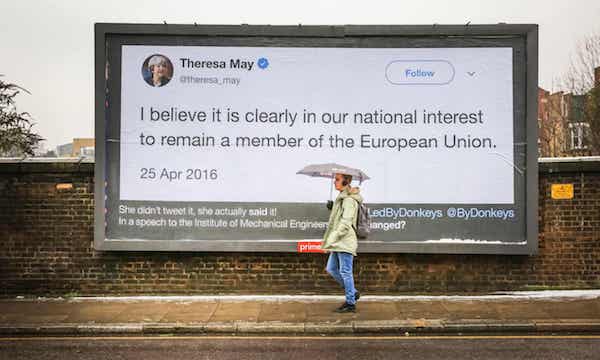
“Central banks?” “Modern democracy?” “The Rosie O’Donnell Show?” How has mankind survived such atrocities? Self inflicted, no less! And why, moreover, does he rush so earnestly to repeat and replay his worst mistakes? Don’t be too hard on yourself, Dear Reader. After all, repetition is nothing new… You’ll recall that it was the Greeks who first gave the world democracy – from the Greek, demokratia, literally “Rule by ‘People’”. (And yes, it was those very same Greeks who put their own beloved Socrates to death… by a majority vote of 140-361.) Today, democracy is a cherished tenet of “the West.” It is woven into the civic religion, sewn into the social fabric. Men march off eagerly to fight for it, to proselytize it … and to die in forgotten ditches defending it. At least, that’s what they believe they’re doing. As usual, the poor saps have been duped.

The phrase “Making the world safe for democracy” was actually a marketing slogan, coined back in the 1910s, as a way to sell “The Great War” to America. Weary from their own disastrous Civil War just a few decades earlier, in which hundreds of thousands gave up the ghost, Americans were mostly inward looking at the time. That is to say, they wanted little to do with what they largely saw as a “European affair.” Polls might have indicated no appetite for battle… but the nation’s politicians were nonetheless starved for military misadventure. They sensed big profits abroad, both in manufacturing armaments and making onerous bank loans to foreign lands. Sure, “the nation” would have to fill tank and trench with warm young bodies… but very few soldiers would carry senatorial surnames along with their rifles.

Read more …

Too late already. A deliberate Monsanto policy.

French, German Farmers Must Destroy Crops After GMOs Found In Monsanto Seeds (RT)

French and German farmers have been forced to dig up thousands of hectares of rapeseed fields after authorities found an illegal GMO strain mixed in with the natural seeds they’d bought from Bayer-Monsanto. Authorities discovered the illicit seeds in three separate batches of rapeseed seeds last fall, but the public has only just been notified. While Bayer issued a recall, by the time the farmers learned of it some of the seeds had already been planted, covering 8,000 ha in France and 3,000 ha in Germany. Bayer-Monsanto estimated the number of rogue seeds at just about .005 percent of the total volume of rapeseed seeds sold to both nations under the brand name Dekalb, but each country has a ban on GMO cultivation, with strict penalties for “accidental” contamination of standard crops.

The agrochemical giant refused to estimate the total cost of the GMO contamination, which knocks out not only this season’s crop but also the next season’s, as farmers will be barred from growing rapeseed next year “to avoid re-emergence of the GMO strain,” according to Bayer-Monsanto’s French COO Catherine Lamboley. They offered to compensate farmers €2,000 per hectare, which would work out to about €20 million between both countries. The cause of the contamination is unknown, Lamboley said, claiming the seeds were produced in Argentina “in a GMO-free area” and declaring that the company “has decided to immediately stop all rapeseed production in Argentina.” The rogue GMO seeds were of a variety grown in Canada that is banned in Europe, although imported food made with the modified rapeseed is permitted for human and animal consumption as long as it is adequately labeled.

Read more …

Except those farmed.

The Killing Of Large Species Is Pushing Them Towards Extinction (G.)

The vast majority of the world’s largest species are being pushed towards extinction, with the killing of the heftiest animals for meat and body parts the leading cause of decline, according to a new study. While habitat loss, pollution and other threats pose a significant menace to large species, also known as megafauna, intentional and unintentional trapping, poaching and slaughter is the single biggest factor in their decline, researchers found. An analysis of 362 megafauna species found that 70% of them are in decline, with 59% classed as threatened by the International Union for Conservation of Nature. Direct killing by humans is the leading cause across all classes of animals, the study states.

A range of maladies including intensive agriculture, toxins and invasive competitors are also helping to trigger these declines. This situation adds to the “mounting evidence that humans are poised to cause a sixth mass extinction event”, according to the research, published in Conservation Letters. It adds that “minimizing the direct killing of the world’s largest vertebrates is a priority conservation strategy that might save many of these iconic species and the functions and services they provide.” Humans cause the deaths of large creatures in a variety of ways, from snares that entangle mountain gorillas and the poaching of elephants for ivory to the killing of the Chinese giant salamander, which can grow up to 6ft long and is considered a delicacy in Asia.

Read more …

So what are you going to do about it? Appeal to your politicians?

Global Warming Could Exceed 1.5ºC Within Five Years (G.)

Global warming could temporarily hit 1.5C above pre-industrial levels for the first time between now and 2023, according to a long-term forecast by the Met Office. Meteorologists said there was a 10% chance of a year in which the average temperature rise exceeds 1.5C, which is the lowest of the two Paris agreement targets set for the end of the century. Until now, the hottest year on record was 2016, when the planet warmed 1.11C above pre-industrial levels, but the long-term trend is upward. Man-made greenhouse gases in the atmosphere are adding 0.2C of warming each decade but the incline of temperature charts is jagged due to natural variation: hotter El Niño years zig above the average, while cooler La Ninã years zag below.

In the five-year forecast released on Wednesday, the Met Office highlights the first possibility of a natural El Niño combining with global warming to exceed the 1.5C mark. Dr Doug Smith, Met Office research fellow, said: “A run of temperatures of 1C or above would increase the risk of a temporary excursion above the threshold of 1.5C above pre-industrial levels. Predictions now suggest around a 10% chance of at least one year between 2019 and 2023 temporarily exceeding 1.5C.” Climatologists stressed this did not mean the world had broken the Paris agreement 80 years ahead of schedule because international temperature targets are based on 30-year averages.

“Exceeding 1.5C in one given year does not mean that the 1.5C goal has been breached and can be redirected towards the bin,” said Joeri Rogelj, a lecturer at the Grantham Institute. “The noise in the annual temperatures should not distract from the long-term trend.”

Read more …

Jan 312019


René Magritte The key to the fields 1936


Dovish Fed Sparks Stock-Market Rally And Tanks The US Dollar (MW)
Will The EU To Cave On May’s Brexit At The Very Last Minute? (ZH)
China Manufacturing Contracted For The Second-Straight Month In January (CNBC)
Macron Has Declared War On The French People – Yellow Vest Activist (RT)
UK Consumer Borrowing Slowed Sharply In December, Says Bank of England (Ind.)
British Car Production Slumps To Five-Year Low (G.)
US Refiner CITGO Caught In Venezuela Political Upheaval (R.)
Russia Vows To Defend Its Venezuelan Oil Assets (RT)
US Regime Change Laboratory Created Venezuela’s Coup Leader
Facebook Reports Record Profit, Stock Surges 12% After Earnings (MW)
Mueller: Evidence Against Russian Firm Used In Disinformation Campaign (CNBC)
Mueller Claims Evidence Shared Leaked To ‘Discredit Investigation’ (RT)
Mueller Says Russians Are Altering Evidence From Investigation (Ind.)
Acropolis Museum Director: British Museum Not Owner Of Parthenon Marbles (K.)


Powel’s Fed started off promising, but now concedes that it doesn’t want functioning markets. Too risky for the rich.

Dovish Fed Sparks Stock-Market Rally And Tanks The US Dollar (MW)

The Federal Reserve and its chairman, Jerome Powell, changed their tune Wednesday, striking a surprisingly dovish tone that sparked a stock-market rally, tanked the U.S. dollar and roiled other financial markets. The Fed hinted that it may be at the end of its rate-hike cycle and further surprised investors by issuing a separate statement regarding its balance sheet, indicating that its efforts to reduce the $4 trillion asset portfolio could end sooner than expected. The tone was seen as an about-face from the Fed’s hawkishly received December meeting when it delivered its fourth rate increase of 2018. “This is one of the most dovish turnarounds by a Fed chair that I have ever seen in my 30-year career,” said Tom di Galoma, managing director at Seaport Global Holdings.

And the initial reaction across markets appeared in keeping with the perceived shift. The message delivered by the Fed “just couldn’t be much better for both bonds and equities and for the credit markets that track Treasurys,” said Mark Grant, chief global strategist at B. Riley FBR, in a note. [..] Not everyone was popping the champagne. Some economists feared the Fed had eroded its credibility, caving in to market pressure. “Talk about a Fed put,” said Ian Shepherdson, chief economist at Pantheon Macroeconomics, in a note, referring to the idea that central bank policy makers have grown increasingly sensitive over the years to stock-market declines and stand ready to intervene in an effort to provide calm.

Read more …

Someone in Britain appears to be spreading rumors about Brussels willing to give in. Is that just so May will still be PM at the end of March? Are the Brits going to risk that based on rumors alone?

Will The EU To Cave On May’s Brexit At The Very Last Minute? (ZH)

After a series of embarrassing Parliamentary defeats (and still more embarrassing triumphs over a series of no-confidence votes), Theresa May is we imagine reveling in what was a rare win for on Tuesday: MPs backed an amendment that calls for removing the backstop from her Withdrawal agreement and replacing it with a commitment to find something better after the prime minister vowed to ask the EU to reopen negotiations (something she has reportedly been trying to persuade the block to do behind the scenes for weeks now with little apparent success).

Now that she’s won what her cabinet believes is enough support for a modified version of the deal, having finally corralled a majority for something resembling her current deal, the hard work truly begins: Convincing the EU to reopen negotiations on the withdrawal agreement, something officials have publicly insisted will not happen (though there have been whispers that they have been slowly coming around to the idea). In a speech on Wednesday, European Commission President Jean Claude Juncker blasted the vote as irresponsible and once again insisted that removing the backstop from the agreement is out of the question. “This is not a game,” he said, according to Bloomberg.

If there’s anything new to take away from the developments of the past two days, it can be found in a Bloomberg report published Wednesday afternoon that effectively confirmed what many have long suspected: That there won’t be any movement on the deal – either from the EU or, likely, the UK, until the last possible minute. According to BBG, EU diplomats have pointed to a last-minute summit set for March 21 and March 22 – just a week before Brexit Day – as the likely time when a deal may finally be struck.

“The European Union is prepared to take Brexit down to a last-minute, high-stakes summit rather than cave into U.K. Prime Minister Theresa May’s demands over the next few weeks, diplomats said. Although May is getting ready to head back to Brussels to reopen the Brexit deal that she negotiated over the past 18 months, the EU isn’t planning to give her any concessions before she returns for a vote in the British Parliament on Feb. 14, according to the diplomats. Behind closed doors, European officials are sticking to their well-coordinated public line that they won’t rework the deal.”

Read more …

And that’s official numbers.

China Manufacturing Contracted For The Second-Straight Month In January (CNBC)

China said on Thursday its manufacturing activity contracted for the second-straight month in January — another sign that the world’s second-largest economy is slowing down amid domestic headwinds and the ongoing trade dispute with the U.S. The official manufacturing Purchasing Managers’ Index (PMI) for January was 49.5, according to the Chinese National Bureau of Statistics. That’s higher than the 49.3 expected by analysts in a Reuters poll, and the 49.4 reported in the previous month when China’s manufacturing PMI fell into contraction territory for the first time since July 2016. The PMI — a widely-watched indicator — is a survey of businesses in a specific industry about the operating environment.

A reading above 50 signals expansion in the sector from the previous month, while one below 50 represents contraction. Meanwhile, China’s services PMI for January came in at 54.7 — better than the 53.8 reported in the previous month, according to official data. The services sector accounts for more than half of the Chinese economy and has helped cushion the impact of a slowing manufacturing industry. Despite the better-than-expected PMI numbers, some economists said the statistics — particularly the manufacturing data — still point to a weakening Chinese economy.

Read more …

See my article last night: Flash-Balls, Pitchforks And A Backstop

Macron Has Declared War On The French People – Yellow Vest Activist (RT)

The French government won’t stop the Yellow Vests by force, but only by doing what the people demand, according to prominent protester Jerome Rodrigues, who may remain blind in one eye after being injured by the police. “The president [Emmanuel Macron] declared war on us and our injuries are battle wounds. The traumatic weapons are equipped with collimators [optical sights] – such equipment is used on the battlefield, at war,” Rodrigues told RT. “I never thought that such a thing could happen in France,” he added, describing what the country has been going through in recent months as “dark times.” The activist, who calls himself “a hyper pacifist,” was broadcasting live on Facebook from a rally in Paris last weekend when a police officer fired at him from an LBD 40 non-lethal gun.

A projectile hit him in the eye, leading to hospitalization and a medically induced coma. The man said “there are no guarantees that the injured eye will be able to see again.” Now we understand that by going to a rally we put ourselves at risk of becoming victims of the government. It happened to me, but could’ve well happened to anyone,” Rodrigues said. The French authorities are employing violence to scare the people off the streets, but “we won’t retreat,” he said. Rodrigues promised to resume protesting after he gets better, saying that his family fully supported him in this decision.

Read more …

The hurt is only starting.

UK Consumer Borrowing Slowed Sharply In December, Says Bank of England (Ind.)

UK consumer borrowing slowed sharply in December, adding to the impression of weakening confidence among households ahead of Brexit. The Bank of England reported that the annual growth of unsecured lending in the month fell to 6.6 per cent, down from 7.2 per cent in November. This was the weakest figure since December 2014. Credit card lending growth slowed to 7.1 per cent, down from 7.9 per cent the previous month. Surveys have shown consumer confidence to be at a 5 year low due, in part, to concerns over Brexit.

The Bank of England’s credit conditions survey showed last week showed that demand over the next three months for such unsecured lending is expected by lenders to be the weakest since the survey began in 2007. Household spending accounts for around 60 per cent of the UK economy, and any weakening of the appetite for consumers to spend will be negative for overall GDP growth. The UK economy grew by 0.6 per cent in the third quarter of 2018 but GDP growth is likely to have fallen sharply in the final three months of the year as business investment and household spending fell.

Read more …

Good! Fewer cars!

British Car Production Slumps To Five-Year Low (G.)

British car production dropped to a five-year low in 2018, as manufacturers warned that fears of a no-deal Brexit have prompted a slump in new investment. UK car factories produced 1.52m vehicles last year, 9.1% fewer than 2017, according to figures published on Thursday by the Society of Motor Manufacturers and Traders (SMMT), the UK auto industry lobby group. Production for the British market fell by 16.3%. Investment into British car manufacturing almost halved during the year to £588.6m, a fall which the SMMT blamed on Brexit uncertainty.

Publicly announced investments were lower than in any year since 2012, the first year comparable data was collected. “Investment is effectively stalled,” said Mike Hawes, the SMMT’s chief executive. “Industry is waiting to see what happens. Business is sitting on its hands in terms of investment.” The global automotive industry is already struggling with multiple challenges. Car sales in China fell in 2018 for the first time since the 1990s, while demand for diesel vehicles in Europe has been rocked by the regulatory backlash to Volkswagen’s emissions-cheating scandal.

Read more …

CITGO is a Venezuelan refiner.

US Refiner CITGO Caught In Venezuela Political Upheaval (R.)

Citgo Petroleum Corp, the eighth largest U.S. refiner and Venezuela’s top foreign asset, is in the middle of a tug-of-war as the Trump administration tries to use the company as leverage to topple Venezuelan President Nicolas Maduro. Following the U.S. decision to impose sanctions on Venezuela’s oil industry this week, both sides have engaged in aggressive moves for control of Citgo, which has roots in the United States dating back 100 years, but has been owned by Venezuela’s state-owned Petroleos de Venezuela, or PVDSA, for three decades.

[..] As Guaido this week worked with Washington to wrest control of the company, Venezuela responded by ordering dozens of Citgo’s expatriate staff in the United States to return to Caracas by the end of February, people familiar with the matter said. Earlier in the week, Citgo sent a team of executives to Washington amid efforts by Guaido and the U.S. government to appoint a new board of directors for Citgo, the people said. PDVSA also has said it would pursue legal efforts to block a Citgo takeover. White House national security adviser John Bolton on Wednesday tweeted photos confirming the meeting with Citgo executives. “The United States is continuing to work to make sure that the economic benefits of Venezuela’s resources are not pilfered by Maduro and his cronies,” he wrote.

[..] The Houston-based company has accumulated cash and credit lines in recent months as dividends payments to Caracas have been blocked by U.S. sanctions imposed in 2017. [..] Citgo has been struggling to refinance a revolving line of credit, a task that must be completed by July

Read more …

Putin: So far, so soft.

Russia Vows To Defend Its Venezuelan Oil Assets (RT)

Russia will defend its interests in Venezuela within the international law using “all mechanisms available to us,” Dmitry Peskov, spokesman for Russia’s President Vladimir Putin, told Russian media on Tuesday. Russia has kept close ties with Venezuelan President Nicolas Maduro and has extended loans to Venezuela, including oil firm Rosneft lending money to Venezuela’s state-held firm PDVSA. Rosneft has extended $6 billion of loans to PDVSA, which needs to be fully redeemed in crude oil supplies by the end of this year. According to S&P Global Platts, as of November 2018, Venezuela had $3.1 billion outstanding loan to repay to Rosneft. The Russian company also has five joint upstream projects with PDVSA in Venezuela.

However, the US Treasury slapped another round of sweeping sanctions against PDVSA on Monday, in order to “help prevent further diverting of Venezuela’s assets by Maduro and preserve these assets for the people of Venezuela.” The US backed last week Juan Guaido, the chairman of the National Assembly, as the legitimate president of Venezuela, after Guaido declared himself interim president. “The path to sanctions relief for PdVSA is through the expeditious transfer of control to the Interim President or a subsequent, democratically elected government,” Secretary of the Treasury Steven T. Mnuchin said. The Kremlin considers the sanctions against PDVSA as “illegal”, a sign of “unfair competition” and an attempt to interfere with Venezuela’s internal affairs, Peskov said on Tuesday. Russia is assessing the potential consequences of the sanctions on PDVSA for Moscow, Peskov added.

Read more …

Dan Cohen and Max Blumenthal paint the picture.

US Regime Change Laboratory Created Venezuela’s Coup Leader

Before the fateful day of January 22, fewer than one in five Venezuelans had heard of Juan Guaidó. Only a few months ago, the 35-year-old was an obscure character in a politically marginal far-right group closely associated with gruesome acts of street violence. Even in his own party, Guaidó had been a mid-level figure in the opposition-dominated National Assembly, which is now held under contempt according to Venezuela’s constitution. But after a single phone call from from US Vice President Mike Pence, Guaidó proclaimed himself president of Venezuela. Anointed as the leader of his country by Washington, a previously unknown political bottom-dweller was vaulted onto the international stage as the US-selected leader of the nation with the world’s largest oil reserves.

Echoing the Washington consensus, the New York Times editorial board hailed Guaidó as a “credible rival” to Maduro with a “refreshing style and vision of taking the country forward.” The Bloomberg News editorial board applauded him for seeking “restoration of democracy” and the Wall Street Journal declared him “a new democratic leader.” Meanwhile, Canada, numerous European nations, Israel, and the bloc of right-wing Latin American governments known as the Lima Group recognized Guaidó as the legitimate leader of Venezuela. While Guaidó seemed to have materialized out of nowhere, he was, in fact, the product of more than a decade of assiduous grooming by the US government’s elite regime change factories.

Alongside a cadre of right-wing student activists, Guaidó was cultivated to undermine Venezuela’s socialist-oriented government, destabilize the country, and one day seize power. Though he has been a minor figure in Venezuelan politics, he had spent years quietly demonstrating his worthiness in Washington’s halls of power.

Read more …

Amid reports that at least 50% of its accounts are fake.

Facebook Reports Record Profit, Stock Surges 12% After Earnings (MW)

After weeks of controversy, Facebook Inc. reported record profits — about $1 billion more than any previous quarter — as the company beat Wall Street expectations for fourth-quarter earnings and revenue late Wednesday, sending shares soaring. Record profits, a growing user base and healthy top line suggest that Facebook’s base of advertisers is continuing to pour dollars into the social networking giant’s swath of apps and services that now attract 2.7 billion people a month around the world. The strong results cap weeks of negative news cycles that has evidently left Facebook relatively unscathed.“Facebook has had so much bad news — even this week,” Forrester analyst Brigitte Majewski said over the phone, referring to another scandal that surfaced this week.

“But you can’t deny the numbers. They’ve had an increase in daily active users, and growth in all regions.” The company reported $6.88 billion in net income for the fourth quarter, which amounts to $2.38 a share, up from $1.44 a share in the year-ago period. Analysts’ average estimates for fourth-quarter profits called for $2.18 a share, according to FactSet. Overall, Facebook logged sales of $16.91 billion, up from $12.97 billion in the year-ago period, beating Wall Street expectations for sales of $16.39 billion, according to FactSet. Facebook’s main source of revenue is ads, which brought in 93% of revenue, up from 89% in the year-earlier period.

Read more …

A few versions of the same thing, first CNBC and RT, different for obvious reasons, then Independent, who report what most others completely missed (NY Post is an exception), which is that Mueller claims the evidence was altered.

Mueller: Evidence Against Russian Firm Used In Disinformation Campaign (CNBC)

Special counsel Robert Mueller claimed Wednesday that evidence in one of his criminal cases related to Russian interference in the 2016 presidential campaign was recently used in an online disinformation campaign, apparently to discredit Mueller’s investigations. Mueller made that allegation in a court filing in his criminal case pending against Concord Management and Consulting, a Russian company owned by Yevgeny Prigozhin, the oligarch who is known as “Putin’s chef.” The special counsel charged Concord Management last year with funding a multimillion-dollar social media disinformation campaign to bolster the presidential campaign of Donald Trump.

Mueller’s filing Wednesday objects to Concord’s request that the special counsel be compelled to disclose documents he has deemed “sensitive” to the defendant and its employees as it prepares for trial.Concord wants to be able to send that information to Russia for review by company officers and employees. But Mueller said in his filing that doing so “unreasonably risks the national security interests of the United States.” The special counsel said that Concord should not be given such sensitive material because of alleged misuse in October by an unknown party of “non-sensitive” materials already in Concord’s possession as a result of the normal discovery process that litigants use to share information during a court case.

Mueller said that “sensitive” materials identifies individuals and entities that have not been criminally charged, but whom “the government believes are continuing to engage in operations that interfere with lawful U.S. government functions like those activities charged in the indictment.” [..] The special counsel said that, “On October 22, 2018, the newly created Twitter account @HackingRedstone published the following tweet: ‘We’ve got access to the Special Counsel Mueller’s probe database as we hacked Russian server with info from the Russian troll case Concord LLC v. Mueller. You can view all the files Mueller had about the IRA and Russian collusion. Enjoy the reading!'”

Read more …

What Mueller really wants is to stop Concord from fighting his probe. He never expected them to come to court. He thought they were just more anonymous Russians he could accuse of anything he wanted without being called on it.

Mueller Claims Evidence Shared Leaked To ‘Discredit Investigation’ (RT)

In an apparent bid to shield his case against alleged Russian trolls from legal challenge, special counsel Robert Mueller claimed some evidence previously provided was hacked and published to discredit his probe. On Wednesday, Mueller filed a motion to oppose discovery in case against Concord Management and Consulting LLC, which he indicted last February on charges of running the Internet Research Agency, also known as the “St. Petersburg troll factory.” “Sensitive” evidence in the case cannot be turned over to Concord’s lawyers, because that would make it accessible to their clients in Russia – and back in October, Mueller claimed, someone claimed to have hacked Concord’s computers and posted evidence previously handed over online “as part of a disinformation campaign aimed (apparently) at discrediting ongoing investigations into Russian interference in the US political system.”

It was that claim that got the attention of the media and the ‘Russiagate’ crowd. What Mueller actually alleges is less headline-worthy and far more tenuous. Namely, on October 22 last year, a Twitter account @HackingRedstone claimed to have gained “access to the Special Counsel Mueller’s probe database as we hacked Russian server with info from the Russian troll case Concord LLC v. Mueller,” offering “all the files Mueller had about the IRA and Russian collusion.” According to a footnote in the filing, Mueller’s team was informed of this by an unnamed reporter. However, the Twitter account referenced comes up as suspended, and aside from that notice there are no entries for it in the Internet Archive, making Mueller’s claim impossible to independently verify.

The webpage allegedly linked in the tweet is said to have contained “file folders with names and folder structures that are unique to the names and structures of materials… produced by the government in discovery.” Of the 300,000 files on the site, “over 1,000” matched the hashtag values of documents provided by Mueller to Concord, the filing said. Mueller argued these must have been obtained from Concord, because the FBI “found no evidence” that US government servers fell victim to any hack involving the files. Somewhat confusingly, the filing argued that many other file names used a reference to the Relativity database, which the US government “has not used” to store materials related to this case. Concord’s lawyers have informed the court that the company’s computers have not been hacked, but Mueller’s filing accused them of lying, saying that the webpage contained “actual discovery materials from this case.”

[..] To wit, Mueller is making an assertion based on a tweet and a webpage – that currently do not exist – to argue that it should not disclose further “sensitive” evidence to defendants in a Russiagate case.

Read more …

How did the majority of news outlets miss that Mueller claims the info was altered? They didn’t read it?

Mueller Says Russians Are Altering Evidence From Investigation (Ind.)

Russians have obtained evidence from special counsel Robert Mueller’s inquiry into Moscow’s interference in US politics and altered it in a bid to discredit the probe, federal prosecutors have claimed. The files were shared with attorneys working for Concord Management and Consulting, a Russian company that allegedly funded hacking operations by Russia’s Internet Research Agency (IRA), they said in a court filing. The sharing evidence and documents between prosecutors and defence lawyer as part of routine discovery is common legal practice. But the files shared by Mr Mueller’s investigation were later uploaded and disseminated on Twitter in October.

However, the files shared online, “appear to have been altered and disseminated as part of a disinformation campaign aimed (apparently) at discrediting ongoing investigations into Russian interference in the US political system,” the court filing states. A team had reviewed files to determine that roughly 1,000 files linked to by that account out of 300,000 available matched non-public evidence provided. “The fact that the file folder names and folder structure on the webpage significantly match the non-public names and file structure of the materials produced in discovery, and the fact that over 1,000 files on the webpage match those produced in discovery, establish that the person(s) who created the webpage had access to at least some of the non-sensitive discovery produced by the government in this case,“ the filing states.

Concord Management was among 13 Russian entities or people to be charged in connection with Mr Mueller’s investigation last February. Mr Mueller’s team has charged dozens of Russian individuals or entities for attempting to influence the 2016 presidential election, primarily through hacking Democratic Party email systems. The most recent filing argued that attorneys for Concord should not be given access to “sensitive” evidence gathered for the case. It said: “The person who created the webpage used their knowledge of the non-sensitive discovery to make it appear as though the irrelevant files contained on the webpage were the sum total evidence of ‘IRA and Russian collusion’ gathered by law enforcement in this matter in an apparent effort to discredit the investigation.”

Read more …

Amal Clooney told Greece in 2015 to take Britain to an international court. They didn’t.

The marbles stem from 2,500 years ago. Their splendor is unmatched, at least until the Romans, and the Middle Ages. They were stolen by Britain when the Ottomans had invaded Greece.

Acropolis Museum Director: British Museum Not Owner Of Parthenon Marbles (K.)

The British Museum is not the legal owner of the Parthenon Marbles and therefore the long-running dispute with Greece over their fate could only be resolved with their unconditional repatriation and not with a lending plan, the director of the Acropolis Museum, Dimitrios Pandermalis, reportedly told German public radio on Wednesday. “The full return of the Parthenon Marbles is the only solution. Everything that is inextricably linked to the monument must be reunited,” he was quoted as telling Deutschlandfunk, adding that the sculptures exhibited in London form an integral part of the monument. He also said his museum would gladly offer something to the British Museum in exchange for the marbles’ return, without going into details.

Pantermalis was responding to Hartwig Fischer, the director of the British Museum, who dismissed the possibility of returning them to Greece, arguing that their exhibition in London is in “a context of world cultures.” “The Trustees of the British Museum feel the obligation to preserve the collection in its entirety, so that things that are part of this collection remain part of this collection,” he was quoted as telling Greek daily Ta Nea in an interview published on January 26. Asked if that is the reason why the Museum will not permanently return the Sculptures, he replied: “Yes”. In another part of the same interview he said they are “in the fiduciary ownership of the Trustees of the Museum.”

Fischer also said that the removal of the marbles from Greece in the 19th century could be seen as “a creative act.” The sculptures are the work of great Athenian sculptor Phidias who added them to the Parthenon in the fifth century BC. In the early 19th century, men working for the 7th Earl of Elgin dismantled a large part of the frieze and shipped the sculptures back to London.

Read more …

Jan 112019
 
 January 11, 2019  Posted by at 10:16 am Finance Tagged with: , , , , , , , , , , , , ,  7 Responses »


Hieronymous Bosch The Haywain Triptych c.1516 (click to enlarge)


The Stock Market Just Got Off To Its Best Start In 13 Years (MW)
78% of US Workers Live Paycheck To Paycheck (CNBC)
Fed’s Powell Says He Is ‘Very Worried’ About Growing Amount Of US Debt (CNBC)
Trump Digs In As Shutdown Continues (BBC)
Michael Cohen To Testify Publicly Before Congress In February (G.)
China Set To Lower GDP Growth Target In 2019 (R.)
Can The Chinese Consumer Be Resurrected? (Jim O’Neill)
Why I Asked May If She Is On The Side Of Putin Or The People (Moran)
May’s Brexit Deal ‘Threat To National Security’ – Former MI6 Chief (Ind.)
May Begs Unions To Help Salvage Her Brexit Deal (Ind.)
US Defenses No Match For Russian Hypersonic Missiles – Retired US General (RT)
Bases, Bases, Everywhere… Except in the Pentagon’s Report (Turse)
Oceans Warming Faster Than Expected, Set Heat Record In 2018 (R.)
Julian Assange’s Living Conditions Deteriorate (Cassandra Fairbanks)


And there’s still people who claim the stock market reflects the economy.

The Stock Market Just Got Off To Its Best Start In 13 Years (MW)

Things are coming up roses in the stock market, lately. The Dow Jones Industrial Average, S&P 500 index and Nasdaq Composite Index are off to their best starts to a year since 2006 after a powerful series of gains. The Dow closed up 0.5% on Thursday, pushing its year-to-date gain to 2.89%, which would mark the best first seven days to a year since 2006, when stocks burst 3.04% higher over the same period. The S&P 500 rose 0.5% on the day and has returned 3.58% thus far this year, its best start since a 3.68% gain 13 years ago, while the Nasdaq Composite booked a 0.4% gain, enough for a 5.3% year-to-date advance, representing its best seven-session to kick off a year since its 5.72% rise also in 2006.

A late-session rally helped to solidify Thursday’s gains, coming after investors digested comments from Federal Reserve Chairman Jerome Powell, who pronounced at the Economic Club in Washington on Thursday afternoon that the economy is in good health, while adding that the central bank would be cognizant of stresses to financial markets amid rate hikes. The comments were a reiteration of Powell’s remarks last week during a broad panel discussion of current and former Fed bosses that helped to placate anxious investors and reverse what was shaping up to be another dismal year.

Read more …

Why is everybody quoting a 2017 report?

78% of US Workers Live Paycheck To Paycheck (CNBC)

The partial government shutdown, which began Dec. 22, has now stretched well into the new year. President Donald Trump said Friday that it would continue for “months or even years” until he receives the requested $5 billion in funding for a border wall. The shutdown has left approximately 800,000 federal workers in financial limbo. Around 420,000 “essential” employees are working without pay, while another 380,000 have been ordered to stay home, according to calculations provided to CNBC by Paul Light, a professor of public service at New York University. In some cases, the furloughs have forced government employees to tap into their savings, rely on credit cards or crowdsource funds to make ends meet.

Government workers are far from alone in feeling stressed about not getting paid. Nearly 80% of American workers (78%) say they’re living paycheck to paycheck, according to a 2017 report by employment website CareerBuilder. Women are particularly vulnerable: 81% of them report living paycheck to paycheck, compared with 75% of men. Tony Reardon, president of the National Treasury Employees Union, tells CNBC that the group has heard from hundreds of frantic federal employees. “They’re scared,” he says. “They don’t know how they’re going to put food on the table.” Various #ShutdownStories making that point have gone viral on Twitter.

It’s not merely those earning low wages who are struggling. CareerBuilder reports that nearly 10% of Americans with salaries of $100,000 or more live paycheck to paycheck as well. That means that many workers aren’t able to put anything significant into savings. More than 50% of respondents say that they save less than $100 per month. And a comparable 2017 survey from GOBankingRates found that 61% of Americans don’t have enough money in an emergency fund to cover six months’ worth of expenses. [..] more than 70% of all respondents say that they’re in debt, and a quarter of workers say they weren’t able to make ends meet at the end of every month of the past year.

Read more …

Which his own Fed has encouraged like nobody else could.

Fed’s Powell Says He Is ‘Very Worried’ About Growing Amount Of US Debt (CNBC)

Federal Reserve Chairman Jerome Powell is concerned about the ballooning amount of United States debt. “I’m very worried about it,” Powell said at The Economic Club of Washington, D.C. “From the Fed’s standpoint, we’re really looking at a business cycle length: that’s our frame of reference. The long-run fiscal, nonsustainability of the U.S. federal government isn’t really something that plays into the medium term that is relevant for our policy decisions.” However, “it’s a long-run issue that we definitely need to face, and ultimately, will have no choice but to face,” he added. The Fed chief’s comments came as the annual U.S. deficit reaches new sustained highs above $1 trillion, a fact many economists worry could spell trouble for future generations.

Annual deficits have topped $1 trillion before, but never during a time of sustained economic growth like now, raising concern about what would happen if a recession hits. Total U.S. debt is about $21.9 trillion, of which $16 trillion is owed by the public. In part because of continued rate increases under Powell, the interest cost on that debt could start to become a bigger and bigger burden. Wall Street’s “bond king” and respected financial prognosticator Jeffrey Gundlach said in December that the Fed seems to be on a “suicide mission,” raising rates while the government deficit increases as a share of GDP. Normally when the deficit is expanding, the Fed would be lowering interest rates.

Read more …

View from the MSM: Trump digs in, not the Dems.

Trump Digs In As Shutdown Continues (BBC)

US President Donald Trump has threatened again to declare a national emergency to fund a border wall without Congress’s approval. “I have the absolute right to declare a national emergency,” he told reporters. The White House has denied reports it is looking at diverting funds set aside for reconstruction projects. A political row over funding the wall has left the US government partially shutdown for 20 days, leaving about 800,000 federal employees without pay. President Trump has refused to sign legislation to fund and reopen the government if it does not include $5.7bn for a physical barrier along the US-Mexico border.

But budget talks have come to a standstill as Democrats – who control the House of Representatives – refuse to give him the money. Republican leaders insist the party stands behind the president, although some Republican lawmakers have spoken out in favour of ending the shutdown. On Thursday, Mr Trump visited a border patrol station in McAllen, in the Rio Grande Valley of Texas. He said that if Congress did not approve funding for the wall, he would “probably… I would almost say definitely” declare a national emergency to bypass lawmakers. But such a move is likely to face legal challenges. The money would also have to come from funds allocated by Congress for other purposes – which some Republicans would also oppose.

Read more …

Planning a huge media spectacle. Imagine all the readers and viewers… Trump keeps on giving. Bread and circuses it is.

Michael Cohen To Testify Publicly Before Congress In February (G.)

Donald Trump’s longtime lawyer and aide Michael Cohen says he has accepted an invitation from a top House Democrat to testify publicly before Congress next month. His testimony before the House oversight and reform committee on 7 February will be the first major public oversight hearing for Democrats, who have promised greater scrutiny of Trump after winning control of the House in the 2018 midterm elections. Cohen said in a statement: “I look forward to having the privilege of being afforded a platform with which to give a full and credible account of the events which have transpired.”

The New Yorker, who is to begin a three-year prison sentence in March, is a pivotal figure in investigations by the special counsel Robert Mueller into potential collusion between Russia and the Trump campaign, and by federal prosecutors in New York into campaign finance violations related to hush-money payments to two women who say they had sex with Trump. Elijah Cummings, the committee’s chair, said the panel would avoid interfering with Mueller’s investigation. “We have no interest in inappropriately interfering with any ongoing criminal investigations, and to that end, we are in the process of consulting with Special Counsel Mueller’s office,” Cummings said in a statement.

Read more …

But not to the 1.67% predicted by professor Xiang Songzuo, I’m sure.

China Set To Lower GDP Growth Target In 2019 (R.)

China plans to set a lower economic growth target of 6% to 6.5% in 2019 compared with last year’s target of “around” 6.5%, policy sources told Reuters, as Beijing gears up to cope with higher U.S. tariffs and weakening domestic demand. The proposed target, to be unveiled at the annual parliamentary session in March, was endorsed by top leaders at the annual closed-door Central Economic Work Conference in mid-December, according to four sources with knowledge of the meeting’s outcome. Data later this month is expected to show the Chinese economy grew around 6.6% in 2018 — the weakest since 1990. Analysts are forecasting a further loss of momentum this year before policy support steps begin to kick in.

“It’s very difficult for growth to exceed 6.5% (this year), and there could be trouble if growth dips below 6%,” said one source who requested anonymity due to the sensitivity of the matter. As the world’s second-largest economy loses steam, China’s top leaders are closely watching employment levels as factories could be forced to shed workers amid a trade war with the United States, despite a more resilient services sector, policy insiders said. Growth of about 6.2% is needed in the next two years to meet the ruling Communist Party’s longstanding goal of doubling gross domestic product and incomes in the decade to 2020, and to turn China into a “modestly prosperous” nation. [..] Local governments could be allowed to issue up to 2 trillion yuan worth of special bonds in 2019, up from 1.35 trillion yuan last year, they said.

Read more …

Goldman Sachs to the -image- rescue.

Can The Chinese Consumer Be Resurrected? (Jim O’Neill)

Last week, Apple published a letter to shareholders revising down its expected revenues for the first quarter of 2019, citing an economic slowdown in China, which has become an increasingly important market for iPhone, Mac, and iPad sales. Though tech industry analysts are debating whether internal dynamics at Apple might also explain the change, the company’s new guidance nonetheless adds to the evidence that Chinese consumption is slowing. A sustained decline in Chinese consumption would be even more worrying than the current US-China trade dispute.

Given that US trade policies and other external influences should not have much effect on domestic Chinese spending, the problem may be more deeply rooted in China’s economic model. To understand what is at stake, consider all that has changed just within the past decade. At the end of 2010, domestic consumption accounted for around 35.6% of Chinese GDP, according to official Chinese data. That was remarkably low compared to most other economies, not least the US, where consumption accounted for almost 70% of GDP. In nominal dollar terms, China’s domestic consumption thus was around $2.2tn, or almost five times lower than that of the US ($10.5tn).

Yet China’s high overall growth rate meant that Chinese consumers could potentially play a much larger role, with far-reaching benefits for global brands such as Apple, BMW, Burberry, Ford, and many others. As of 2017, Chinese consumption as a share of GDP had risen to 39.1%, representing just over $5tn in nominal dollar terms. That is an increase of almost $3tn in just seven years. And though Chinese consumer spending still lagged far behind that of the US ($13.5tn in 2017), the gap has narrowed. If China were to continue on the same trajectory in terms of nominal GDP growth and domestic consumption, its consumer spending could increase by another $2tn by 2020, putting it at around half that of the US. Chinese consumers would be more relevant to the global economy than anyone except Americans.

Read more …

From time to time you wonder what’s more hysterical, the Brexit mayhem or the UK’s fabricated Russophobia. This is pretty unbelievable, but it’s become normal.

Layla Moran is a Liberal Democrat MP for Oxford West and Abingdon.

Why I Asked May If She Is On The Side Of Putin Or The People (Moran)

For all the farcical invoking of Blitz spirit, Brexit isn’t merely an absurdist experiment in English nationalist nostalgia – it is the most audacious example yet of a futuristic Russian nationalism that seeks to divide and rule Europe. If we can be judged by our friends then Brexit has no stauncher ally than Vladimir Putin. After all, Donald Trump has proved unreliable. But Putin? It is hard to think of anyone who has done more for the cause (and that is not to take anything away from the years of Brexit monologues by Tory MP Bill Cash). Russian bot farms have been exposed as having supported the Leave campaign. This comes on top of allegations of iffy Russian money funding Brexit campaigns, and Arron Banks’ almost comical inability to explain his donations to Leave.

Comical, that is, if his scarcely thought through Brexit wasn’t driving Britain to what Hilary Clinton has called the single biggest act of deliberate self-harm a nation has ever committed. As if Russian interference in the original referendum was not shocking enough, it is still going on. The Channel 4 drama Brexit: The Uncivil War might have relegated Russian involvement to the briefest postscript, but in reality Putin is still in the trenches fighting for a hard Brexit. At a recent press conference Putin attacked the idea of a referendum on the deal, claiming the original result should be respected. Oh, the irony! Putin, the arch kleptocrat, giving advice on democracy. “Don’t steal Brexit,” he seemed to demand, while probably stealing (sorry, being gifted) another superyacht.

It should have been sufficiently chilling to make even Boris Johnson pause for thought. And all while using the Brexiteer message script of delivering the will of the people. As any student of Russian history could tell you, “the people” are often invoked by the Kremlin, including when justifying the mass murder of innocent people. But rarely does the Kremlin actually ask “the people” for anything so radical as an opinion. For Putin, “the people” are to be manipulated and even killed for his own ends. And Putin’s ends are clear. He wants a weak and divided EU. Ultimately, he seeks to break it up, with the Eastern bloc – brought into the European fold by Margaret Thatcher’s single market – dragged back into the lair of the Russian bear.

Read more …

And why not? If all else fails, scare them.

May’s Brexit Deal ‘Threat To National Security’ – Former MI6 Chief (Ind.)

The former head of MI6 has warned Theresa May’s Brexit deal will “threaten the national security of the country”, in a call for Tory MPs to reject it. The agreement would “place control of aspects of our national security in foreign hands”, claims Sir Richard Dearlove, in an extraordinary letter to Conservative associations. It has also been signed by Lord Guthrie, a former chief of the defence staff, in a bid to stiffen grassroots resistance, ahead of next Tuesday’s vote.= Sir Richard and Lord Guthrie, who are both prominent Leave supporters, write: “Please ensure that your MP votes against this bad agreement.” The prime minister, a former home secretary, has insisted her agreement would protect national security by retaining existing cooperation arrangements during the 21-month transition.

However, she was forced to acknowledge the UK was likely to lose direct access to vital EU security databases after 2012, under the proposed long-term arrangements. In their letter, the ex-security chiefs argue the deal is dangerous because it would weaken membership of Nato and existing “close” defence and intelligence ties with the US. “This withdrawal agreement, if not defeated, will threaten the national security of the country in fundamental ways,” it says. Downing Street hit back immediately, insisting the letter was “completely wrong” and that the Brexit deal offered the broadest security agreement the EU has with any of its partners. But both sides of the Brexit divide seized on the intervention, arch-Brexiteer Owen Paterson calling it a “devastating warning”.

Read more …

After Tuesday all bets are off.

May Begs Unions To Help Salvage Her Brexit Deal (Ind.)

Theresa May has called the leaders of Britain’s biggest unions for the first time since becoming prime minister in a desperate bid to find backing for her Brexit deal. The calls to Unite leader Len McCluskey and the GMB’s Tim Roache – whose unions are Jeremy Corbyn’s biggest financial backers – mark just how far she is being forced to go in the hope of finding support for the deal expected to be rejected by MPs next week. She was scorned by second referendum-backing Mr Roache, who joked after his call that he was “glad the prime minister finally picked up the phone”. The unprecedented move came as she also sought to convince Labour MPs to back her by promising new commitments to maintain workers’ rights in line with EU standards after Brexit.

But expectations that she is heading for a heavy defeat on Tuesday simply grew further, with some estimates suggesting that opposition has actually grown since she delayed the vote on her deal in December. Capitalising on the deep Tory divisions, Mr Corbyn instead invited Conservative MPs to back a motion of no confidence in the government which he is promising to table if Ms May’s plans are defeated. Downing Street confirmed the calls to Mr Roache, whose union has 620,000 members, and Mr McCluskey, representing more than 1.4 million, and admitted it was the first time she had spoken to either of them since her arrival at No 10. The Independent understands the prime minister also attempted to call Dave Prentis, leader of Unison which also has some 1.4 million members, but could not get through because Mr Prentis was travelling.

Read more …

Click here for the original Hill article.

US Defenses No Match For Russian Hypersonic Missiles – Retired US General (RT)

A retired general and chief of staff has warned that the US’ missile defense systems are “simply incapable” of stopping the latest generation of Russian hypersonic missiles – some of which fly at 27 times the speed of sound. Now retired, Maj. Gen. Howard ‘Dallas’ Thompson was once Chief of Staff at US Northern Command in Ohio. In a column published by The Hill on Thursday, Thompson argues that military leaders have neglected to develop proper defenses against the hypersonic threat. There have been some calls for the US to pursue hypersonic weapons in defense policy circles, but America has lagged behind China – which conducted more tests in the last year than the US has is a decade – and Russia, which successfully tested such a missile in December. The ‘Avangard’ missile flew at Mach 27, and will be deployed in 2019.

At present, the US Missile Defense Agency’s sensors and radars are designed for one purpose: to counter an intercontinental ballistic missile (ICBM) fired by an adversary like Iran or North Korea. ICBMs have a predictable flight path, and the US’ Patriot and Terminal High-Altitude Area Defense (THAAD) batteries stand a reasonable chance of intercepting and destroying any incoming missiles. Not so with hypersonics. Missiles like ‘Avangard’ fly low and fast, evading radar detection. They can also engage in evasive maneuvers to dodge surface-to-air rockets or missiles, further lowering the chances of a successful interception.

“The stark reality is that our current missile defense systems, as well as our operational mindset, are simply incapable versus this threat,” Thompson wrote. The retired General’s words are backed up by a recent report from the Government Accountability Office, which concluded that there are “no existing countermeasures” against the threat. Thompson claims that a massive collaborative program between the Department of Defense and arms companies is needed to counter Russian and Chinese advances. “Countering this threat will require U.S. investment in an extensive defensive architecture,” he wrote. “…a highly robust ‘family of systems’ that nonetheless must be envisioned, designed, developed and deployed in a completely holistic manner.”

Read more …

800 bases, of which 300 are unreported?!

Bases, Bases, Everywhere… Except in the Pentagon’s Report (Turse)

Within hours of President Trump’s announcement of a withdrawal of U.S. forces from Syria, equipment at that base was already being inventoried for removal. And just like that, arguably the most important American garrison in Syria was (maybe) being struck from the Pentagon’s books — except, as it happens, al-Tanf was never actually on the Pentagon’s books. Opened in 2015 and, until recently, home to hundreds of U.S. troops, it was one of the many military bases that exist somewhere between light and shadow, an acknowledged foreign outpost that somehow never actually made it onto the Pentagon’s official inventory of bases. Officially, the Department of Defense (DoD) maintains 4,775 “sites,” spread across all 50 states, eight U.S. territories, and 45 foreign countries.

A total of 514 of these outposts are located overseas, according to the Pentagon’s worldwide property portfolio. Just to start down a long list, these include bases on the Indian Ocean island of Diego Garcia, in Djibouti on the Horn of Africa, as well as in Peru and Portugal, the United Arab Emirates, and the United Kingdom. But the most recent version of that portfolio, issued in early 2018 and known as the Base Structure Report (BSR), doesn’t include any mention of al-Tanf. Or, for that matter, any other base in Syria. Or Iraq. Or Afghanistan. Or Niger. Or Tunisia. Or Cameroon. Or Somalia. Or any number of locales where such military outposts are known to exist and even, unlike in Syria, to be expanding.

[..] According to David Vine, author of Base Nation: How U.S. Military Bases Abroad Harm America and the World, there could be hundreds of similar off-the-books bases around the world. “The missing sites are a reflection of the lack of transparency involved in the system of what I still estimate to be around 800 U.S. bases outside the 50 states and Washington, D.C., that have been encircling the globe since World War II,” says Vine

Read more …

The reporting on the issue seems broken.

Oceans Warming Faster Than Expected, Set Heat Record In 2018 (R.)

The oceans are warming faster than previously estimated, setting a new temperature record in 2018 in a trend that is damaging marine life, scientists said on Thursday. New measurements, aided by an international network of 3,900 floats deployed in the oceans since 2000, showed more warming since 1971 than calculated by the latest U.N. assessment of climate change in 2013, they said. And “observational records of ocean heat content show that ocean warming is accelerating,” the authors in China and the United States wrote in the journal Science of ocean waters down to 2,000 metres (6,600 ft). Man-made greenhouse gas emissions are warming the atmosphere, according to the overwhelming majority of climate scientists, and a large part of the heat gets absorbed by the oceans.

That in turn is forcing fish to flee to cooler waters. “Global warming is here, and has major consequences already. There is no doubt, none!” the authors wrote in a statement. Almost 200 nations plan to phase out fossil fuels this century under the 2015 Paris climate agreement to limit warming. [..] Data due for publication next week will show “2018 was the warmest year on record for the global ocean, surpassing 2017,” said lead author Lijing Cheng, of the Institute of Atmospheric Physics at the Chinese Academy of Sciences. He told Reuters that records for ocean warming had been broken almost yearly since 2000. Overall, temperatures in the ocean down to 2,000 metres rose about 0.1 degree Celsius (0.18F) from 1971-2010, he said.

Read more …

Another issue on which reporting seems broken. We’re not getting anywhere.

Julian Assange’s Living Conditions Deteriorate (Cassandra Fairbanks)

I last visited Assange in March, days before the Ecuadorians placed the award-winning journalist in isolation for allegedly violating a draconian ban on all public political comments. [..] In order to visit the publisher last year, I simply organized it with him and his lawyer and went. This time I was required to provide details about my social media, my employer, and my reason for visiting in advance of my arrival and hope to be approved. If I wanted to bring my cell phone, I would have had to provide the brand, model, serial number, IMEI number and telephone number. Providing these details to a foreign nation with extreme surveillance seemed unwise, so I left it behind.

[..] Currently, Assange cannot even have a simple visit with a friend without it being monitored by some shadowy state actor. It’s like a scene from the Stasi spy drama The Lives of Others. While Ecuador presents this surveillance operation as a mission to “protect and support” Assange, this is contradicted by the fact that he isn’t even allowed to confidentially speak with a reporter and friend without being recorded. In May, the Guardian reported that there are “extraordinary reports” from these spies that include daily logs of Assange’s activities inside the embassy, even noting his “general mood.”

As John Pilger pointed out after his visit with Assange on New Year’s Eve, it could be any newspaper publisher or editor stuck in that embassy. For the crime of publishing journalism, Assange has not only had to give up his freedom, but also any semblance of privacy. It’s impossible to overstate how unsettling it feels to have multiple lenses pointed at you wherever you stand. Unable to speak privately, even with a noise machine attempting to muffle the microphones from picking up conversations, we resorted to passing notes. Assange is not only barred from sharing his views online under the new regulations — thanks to the constant surveillance, he can’t even do so among his friends in the embassy where he is arbitrarily detained.

If we value the principle of the freedom of speech — we must do something to stop this madness. While we do not know what Assange has been charged with by the U.S. as it remains under seal, we do know that it is related to his work as a publisher, the only publisher with a record of 100% accuracy. His dedication to truth is so profound that he has never once had to issue a correction or retraction.

Read more …