
Nov 122018


Vincent van Gogh Burning weeds 1883

 

Macron: Nationalism Is A “Betrayal Of Patriotism” (Ind.)
Putin Says Had Good Conversation With Trump In Paris (AFP)
Eastern Ukraine Elects Separatist Leaders As West Rejects Polls (AFP)
May Says Britain Open To ‘Different Relationship’ With Russia (R.)
Boris Johnson Says Britain On Verge Of ‘Total Surrender’ In Brexit Talks (R.)
May Shelves Crunch Brexit Talks With Cabinet (Ind.)
Alibaba Has Record $30.8 Billion In Sales In 24 Hours On Singles Day (CNBC)
Foreign Capital Has Propped Up China’s Currency. What If It Leaves? (CFR)
What Plunging Oil Prices Tell Us About The Stock Market And Global Economy (MW)
A Worldwide Debt Default Is A Real Possibility (Mauldin)


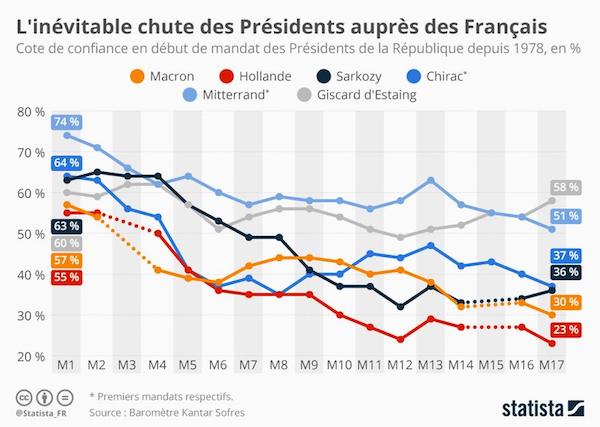
As Macron nears record low approval rating for a French president, he lectures the world through a game of semantics. The ‘brilliance’ is that while not many could have told you the difference between nationalism and patriotism, Macron claims to have it down. Even if it has to be translated into dozens of languages, each of which may have slightly different interpretations of the -local- meaning of the words. Macron has good speech writers, but they don’t write in all the languages involved. So it’s merely semantics. The terms mean to everyone what they want them to mean.

The take-away: according to Macron, patriotism can exist along globalism, nationalism cannot. A jibe against Trump. Which also means that because Xi Jinping touts globalism all the time, we must accept, if we follow Macron, that he is not a nationalist, but a patriot.

Macron: Nationalism Is A “Betrayal Of Patriotism” (Ind.)

Emmanuel Macron has issued a hard-hitting warning about the dangers of nationalism and of countries that put their interests before the collective good – in front of Donald Trump and Vladimir Putin. The French president denounced those who evoke nationalist sentiment to disadvantage others, calling it a “betrayal of patriotism” and moral values. The US and Russian leaders listened in silence as Mr Macron took a swipe at the rising tide of populism in the US and Europe, warning: “The old demons are rising again, ready to complete their task of chaos and of death.” During a gathering of dozens of world leaders to mark 100 years since the end of the First World War, the French president went on: “Patriotism is the exact opposite of nationalism. Nationalism is a betrayal of patriotism.

“In saying, ‘Our interests first, whatever happens to the others’, you erase the most precious thing a nation can have, that which makes it live, that which causes it to be great and that which is most important: its moral values.” [..] In a speech lasting nearly 20 minutes, Mr Macron also called on fellow leaders to fight for peace. “Ruining this hope with a fascination for withdrawal, violence or domination would be a mistake for which future generations would rightly find us responsible,” he said. The French leader also defended the European Union and the United Nations, which he said guaranteed peace and enshrined “a spirit of cooperation to defend the common property of a world whose destiny is inextricably linked”.
Read more …

Okay, is Putin a nationalist or a patriot? He seems to like globalism, but he likes Russia better. And he’s been pushed out of globalism through sanctions and tall tales.

Putin Says Had Good Conversation With Trump In Paris (AFP)

Russian President Vladimir Putin said he had a brief but good conversation with US leader Donald Trump at World War I centenary events in Paris, Russian media reported. When journalists asked Putin whether he managed to speak to Trump on Sunday, he said: “Yes,” Russian state news agency RIA Novosti reported. Asked how it went, Putin said: “Well.” He did not provide further details, but the French presidency said the pair had a wide-ranging discussion during lunch after the commemoration. Host and French President Emmanuel Macron was there and German Chancellor Angela Merkel took part in some of the exchanges, the presidency said.

Subjects discussed included the situation in the Middle East, notably Syria, Iran and Saudi Arabia, and North Korea. White House spokeswoman Sarah Sanders said Trump had sat with world leaders including Putin, Macron and Merkel at lunch and the group had held “very good and productive discussions”. “The leaders discussed a variety of issues, including the INF (nuclear treaty), Syria, trade, the situation in Saudi Arabia, sanctions, Afghanistan, China, and North Korea,” she said. Expectations have been growing for a new Trump-Putin meeting as tensions pile up over the Cold War-era Intermediate-Range Nuclear Forces Treaty (INF) and US sanctions against Moscow.

Read more …

Macron and Merkel: “These so-called elections undermine the territorial integrity and sovereignty of Ukraine..”

Wasn’t it John McCain and Vcitoria Nuland who undermined it back in 2014 on Maidan Square?

Eastern Ukraine Elects Separatist Leaders As West Rejects Polls (AFP)

People in Russian-backed areas of eastern Ukraine re-elected separatist leaders at the weekend, according to results released Monday of polls condemned as illegal by Kiev and Western countries. Elections in the Donetsk and Lugansk “People’s Republics”, controlled by separatists since breaking away from Ukraine’s pro-Western government in 2014, took place after the killing of the rebel Donetsk “president” in a bomb attack in August. Security was tight for Sunday’s vote with gun-toting, camouflage-clad guards deployed to ensure order. Denis Pushilin, the 37-year-old acting Donetsk leader, was elected with 61 percent of the vote with almost all ballots counted, the local electoral commission said. Leonid Pasechnik, the acting Lugansk leader, took 68 percent of the vote.

French President Emmanuel Macron and German Chancellor Angela Merkel branded the vote “illegal and illegitimate” following a meeting with Ukraine President Petro Poroshenko on the sidelines of World War I commemorations also attended by Russian leader Vladimir Putin on Sunday. “These so-called elections undermine the territorial integrity and sovereignty of Ukraine,” the pair said in a joint statement. Washington and Brussels had asked Russia not to allow the polls to go ahead, arguing they would further hamper efforts to end a conflict that has killed more than 10,000 people since 2014. “The people in eastern Ukraine will be better off within a unified Ukraine at peace rather than in a second-rate police state run by crooks and thugs, all subsidized by Russian taxpayers,” tweeted Kurt Volker, the US special envoy to Ukraine, on the day of the polls.

Read more …

if only they confess to the narratives Britain has spouted without evidence.

May Says Britain Open To ‘Different Relationship’ With Russia (R.)

Prime Minister Theresa May will say on Monday Britain is “open to a different relationship” with Russia if Moscow takes a new path and stops “attacks” that undermine international treaties and security. Just a year ago, May used her annual speech at the Lord Mayor’s Banquet to accuse Moscow of military aggression and of meddling in elections, some of her strongest criticism even before the poisoning of a former Russian spy in Salisbury. This year, she will tell London’s financial center that the action taken since – including the largest ever coordinated expulsion of Russian intelligence officers – has deepened her belief in a “collective response” to such threats.

“We will continue to show our willingness to act, as a community of nations, to stand up for the rules around the world,” May will say, according to excerpts of her speech. Describing evolving threats, May will say the past year, including Salisbury, has “shown that while the challenge is real, so is the collective resolve of likeminded partners to defend our values, our democracies, and our people.” “But, as I also said a year ago, this is not the relationship with Russia that we want … We remain open to a different relationship – one where Russia desists from these attacks that undermine international treaties and international security,” she will say.

Read more …

Boris still wants to be King.

Boris Johnson Says Britain On Verge Of ‘Total Surrender’ In Brexit Talks (R.)

Former British foreign minister Boris Johnson accused Prime Minister Theresa May on Sunday of forcing through a deal that would keep the country locked in the European Union’s customs union after Brexit in what he described as a “total surrender”. “I really can’t believe it but this government seems to be on the verge of total surrender,” he wrote in his weekly column in the Telegraph newspaper. “I want you to savour the full horror of this capitulation … we are on the verge of signing up for something even worse than the current constitutional position. These are the terms that might be enforced on a colony.”

Read more …

Unsolved issues.

May Shelves Crunch Brexit Talks With Cabinet (Ind.)

Theresa May has been forced to abandon plans for an emergency cabinet meeting to approve a Brexit deal, after fresh opposition at home and abroad plunged her timetable into turmoil. The prime minister shelved the meeting, pencilled in for Monday, slamming on the brakes after fierce resistance in her cabinet and in Brussels threatened to derail the path to an agreement. A government source conceded that an outline deal might not be ready by Tuesday – making it increasingly unlikely that a special EU summit to sign it off can be held in November, as hoped.

That would leave the UK having to ramp up hugely expensive no-deal preparations and in danger of being unable to pass all necessary legislation before the Brexit deadline next March. At home, Ms May faced an open challenge to her plans from Andrea Leadsom, the Commons leader, who vowed the UK “cannot be held against its will” by the backstop plan for the Irish border. Ms Leadsom became the second cabinet minister to insist on a unilateral power to escape being bound in the EU customs union – something explicitly ruled out by Brussels.

Read more …

1.35 billion packages delivered.

Alibaba Has Record $30.8 Billion In Sales In 24 Hours On Singles Day (CNBC)

Alibaba on Sunday tore through last year’s Singles Day sales record, racking up more than $30.8 billion in the 24-hour shopping event. Gross merchandise value (GMV), a figure that shows sales across the Chinese e-commerce giant’s various shopping platforms, surpassed last year’s $25.3 billion record at around 5:34 p.m. SIN/HK (4:34 a.m. ET) on Sunday, and kept marching higher through the rest of the day. In Chinese currency terms, GMV totaled 213.5 billion yuan, easily beating last year’s figure of 168.2 billion yuan and representing a nearly 27 percent year-on-year rise. That was, however, smaller than the 39 percent year-on-year growth recorded in 2017.

Alibaba’s Singles Day GMV beat last year’s figure in yuan terms earlier than it toppled the dollar record. The Chinese currency is weaker against the greenback from a year ago, which means more sales in yuan are required to get the same dollar amount. It was the 10th edition of the annual Singles Day event, which is also called the Double 11 shopping festival because it falls on Nov. 11. During the 24-hour period, Alibaba offered huge discounts across its e-commerce sites such as Tmall. Alibaba’s Singles Day sales haul easily exceeded the spending by consumers during any single U.S. shopping holiday.

Read more …

Wait! Shadows?

Foreign Capital Has Propped Up China’s Currency. What If It Leaves? (CFR)

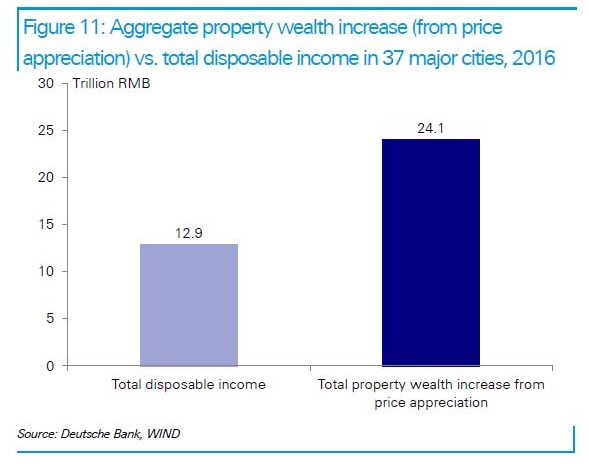
“I think China’s manipulating their currency, absolutely,” President Trump said back in August. Yet the People’s Bank of China (PBoC) was, and has been, intervening to keep the RMB up, and not to push it down, as Trump was alleging. And we believe such interventions are about to get much larger. Here is why. Over the past two years, as our left-hand figure below shows, foreign portfolio investors have piled prodigiously into Chinese assets, helping to support the RMB. But history suggests this trend is about to reverse. While inflows have been rising, Chinese stocks have been tumbling—they are down over 20 percent from their January peak. Dreadful performance like this typically drives funds out of emerging markets. We may be seeing the beginning of such outflows in China.
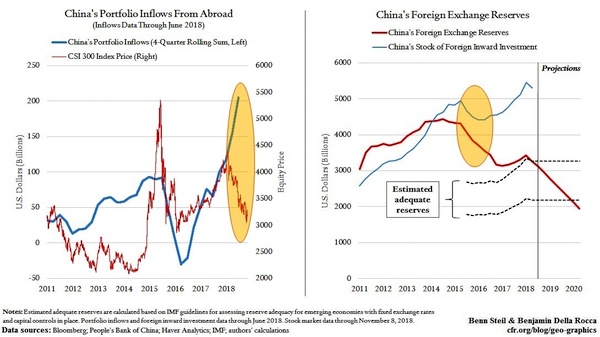
Repatriation of liquid foreign capital will make it far more challenging for China to keep its currency up. Of course, China could change course and let it fall, but that risks exacerbating the foreign-debt burden of its highly leveraged corporates. It could raise interest rates, but that would further slow a slowing economy. It could, to keep capital at home, demand higher returns on its foreign lending, but that would mean sacrificing its efforts to subsidize its companies operating abroad, as well those aimed at putting dollars to the service of geostrategic objectives—like Belt and Road. n short, then, there is every reason to expect that the PBoC will boost its support for the RMB by selling dollar reserves.

This is what it did back in 2015, when a plunging stock market scared away foreign capital. So in spite of President’s Trump’s repeated charges that China is manipulating its currency for competitive advantage in trade, all evidence suggests that it will continue to do the opposite. But if China were to sell reserves at the same pace as in 2015, its reserve levels would, by mid-2020, actually fall below the safety threshold implied by the IMF’s framework for reserve adequacy—as shown in the right-hand figure above.

Read more …

Not much for now. Oil rising this morning on Saudi cuts promised.

What Plunging Oil Prices Tell Us About The Stock Market And Global Economy (MW)

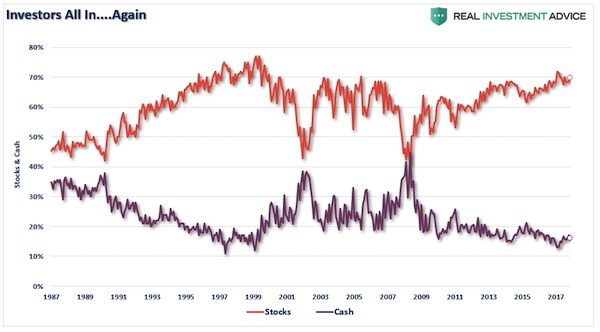
What the heck happened to oil prices? But more significantly, what does it mean for the broader stock market and the global economy? That is what has some Wall Street investors scratching their noggins, as crude futures and U.S. stocks staged a tandem tumble this week, just when investors thought the worst was over following a bruising October for risk assets. Now, oil futures are unraveling, down at least 20% after putting in a 52-week high early last month. And it isn’t so much the descent into bear-market territory—as the recent slump for crude can be characterized—as it is the celerity of the selloff that has market participants unsettled.

About five weeks: That’s all it took for bulls to pivot from cavalierly pondering if $100-a-barrel oil was a genuine possibility before the end of 2018 on the back of Iranian oil export sanctions imposed by the U.S. on Nov. 4, to wondering how ugly the current implosion in black gold could get before finding a bottom. On Friday, West Texas Intermediate crude for December delivery lost 48 cents, or 0.8%, to settle at $60.19 a barrel on the New York Mercantile Exchange, for the lowest front-month contract settlement since March 8, according to FactSet data. Prices lost 4.7% for the week, tallying their fifth straight weekly drop. The 10th session decline in a row matched the longest skid since 1984.

But beyond that, the most important question is this: What does oil’s decline really mean? That is the query that Yves Lamoureux, president of macroeconomic research firm Lamoureux & Co., posed to MarketWatch via email last week as the decline in oil was gaining steam. “Very large monthly down moves in crude oil has often heralded something more ominous,” he wrote on Nov. 1. “Most market observers think there is enough damage to see a bottom in stocks. Consensus therefore looks for new record highs or a solid bounce back. We strongly disagree with this perspective.”

Read more …

No doubt there. But it’ll start somewhere.

A Worldwide Debt Default Is A Real Possibility (Mauldin)

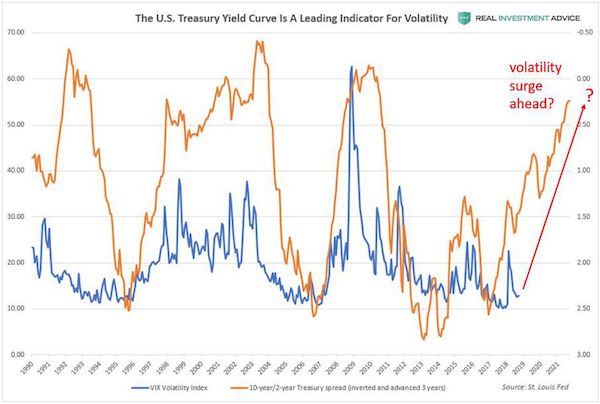
Is debt good or bad? The answer is “Yes.” Debt is future spending pulled forward in time. It lets you buy something now for which you otherwise don’t have cash yet. Whether it’s wise or not depends on what you buy. Debt to educate yourself so you can get a better job may be a good idea. Borrowing money to finance your vacation? Probably not. The problem is that many people, businesses, and governments borrow because they can. It’s been possible in the last decade only because central banks made it so cheap. It was rational in that respect. But it is growing less so as the central banks start to tighten. Earlier this year, I wrote a series of articles predicting a debt “train wreck” and eventual liquidation. I dubbed it “The Great Reset.”

I estimated we have another year or two before the crisis becomes evident. Now I’m having second thoughts. Recent events tell me the reckoning could be closer than I thought just a few months ago. Central banks enable debt because they think it will generate economic growth. Sometimes it does. The problem is they create debt with little regard for how it will be used. That’s how we get artificial booms and subsequent busts. We are told not to worry about absolute debt levels so long as the economy is growing in line with them. That makes sense. A country with a larger GDP can carry more debt. But that is increasingly not what is happening. Let me give you two data points.

Lacy Hunt tracks data that shows debt is losing its ability to stimulate growth. In 2017, one dollar of non-financial debt generated only 40 cents of GDP in the US. It’s even less elsewhere. This is down from more than four dollars of growth for each dollar of debt 50 years ago. This has seriously worsened over the last decade. China’s debt productivity dropped 42.9% between 2007 and 2017. That was the worst among major economies, but others lost ground, too. All the developed world is pushing on the same string and hoping for results. Now, if you are used to using debt to stimulate growth, and debt loses its capacity to do so, what happens next? You guessed it: The brilliant powers-that-be add even more debt.

Read more …

Nov 022018
 
 November 2, 2018  Posted by at 9:19 am Finance Tagged with: , , , , , , , , , , ,  17 Responses »


Pablo Picasso Bathers 1918


Trump Plans ‘Meeting Plus Dinner’ With Xi Jinping After G20 Summit (SCMP)
Shares Soar As Trump Hints At Possible US-China Trade Deal (G.)
The Fed’s QE Unwind Hits $321 Billion (WS)
Debt Is Back But This Time It’s Corporate (GolemXIV)
The ‘True State’ Of Americans’ Financial Lives (MW)
The American Dream Feels Further Off Than Ever For Millennials (G.)
The Lesson of 2018 (Strassel)
1 in 5 Germans Is ‘At Risk Of Poverty’ Despite Record Employment (RT)
Brexit Campaigner Arron Banks Faces Criminal Inquiry (G.)
EU Fisheries Row Threatens May’s Customs Union Plan (G.)
Groundskeeper In Monsanto US Weed-Killer Case Accepts Reduced Award (R.)
Thousands Of Europe-Bound Migrants Have Simply Vanished (ZH)


This would only happen if there’s progress in talks….

Trump Plans ‘Meeting Plus Dinner’ With Xi Jinping After G20 Summit (SCMP)

US President Donald Trump has offered to host a dinner for Chinese President Xi Jinping on December 1 in Buenos Aires after the G20 leaders summit, an invitation Beijing has tentatively accepted, people familiar with the arrangement have told the South China Morning Post. The Post reported two weeks ago that Trump and Xi had agreed to meet on November 29, the day before the official opening of the summit, but the meeting was rescheduled and upgraded into a “meeting plus dinner” at Trump’s request, the people said, who declined to be identified as the information is still classified.

A “Western-style” sit-down dinner after the G20 summit could offer the two leaders more time to talk than a chat on the sidelines of the summit and could offer a more conducive atmosphere for negotiations. “Trump originally planned to leave Buenos Aires as soon as the G20 agenda finished, but he has decided to postpone his departure to make this dinner happen,” a source said. It is not yet known what specific issues will be on the agenda. The two leaders had a call on Thursday, officially agreeing to meet in Argentina and laying the ground for further discussions on trade and North Korea.

Trump said in a tweet that he had a “long and good [phone] conversation” with Xi, adding: “We talked about many subjects, with a heavy emphasis on Trade. Those discussions are moving along nicely with meetings being scheduled at the G20 in Argentina. Also had good discussion on North Korea!” The Chinese side issued a much longer statement about the phone call. According to the official Xinhua news agency, Xi told Trump that “both of us have good intentions for the healthy and steady development of Sino-US relations and for growth in Sino-US trade cooperation, and we shall make efforts to turn these intentions into reality.”

Read more …

….but this may still be wishful thinking.

Shares Soar As Trump Hints At Possible US-China Trade Deal (G.)

Asian shares have surged on reports that Donald Trump wants to reach an agreement with Chinese president Xi Jinping about the trade dispute that has dogged markets for months. The US president spoke to Xi on Thursday and later tweeted that trade talks with China were “moving along nicely” ahead of face-to-face talks between the pair at the G20 summit in Argentina later this month. But Bloomberg later reported that the phone call – in which Trump and Xi both expressed optimism about resolving their bitter trade disputes – prompted Trump to ask officials to begin drafting potential terms. The report lit a fire under stock markets that have beset by fears of a full-blown trade war between the world’s two biggest economies.

The Nikkei was up 2.3% in Tokyo, the Hang Seng climbed 3.35% in Hong Kong and the Shanghai Composite was up 3%. There was a also a strong gain of 3% for the export-oriented Kospi index in South Korea. US stock futures rose 0.7% and the FTSE100 is set for a jump of almost 1% when it opens in London on Friday morning. The US and China’s tit-for-tat tariffs on each other’s goods have rumbled on for months as Trump pledges to help create more US manufacturing jobs. The tariffs have been blamed for a weakening of China’s mighty manufacturing sector which this week showed a marked slowdown in activity.

Read more …

Shedding $50 billion a month. Mayhem in dollar markets.

The Fed’s QE Unwind Hits $321 Billion (WS)

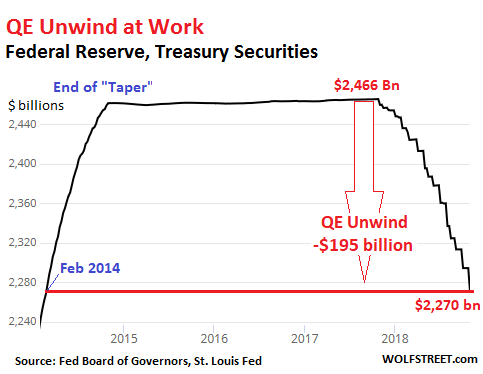
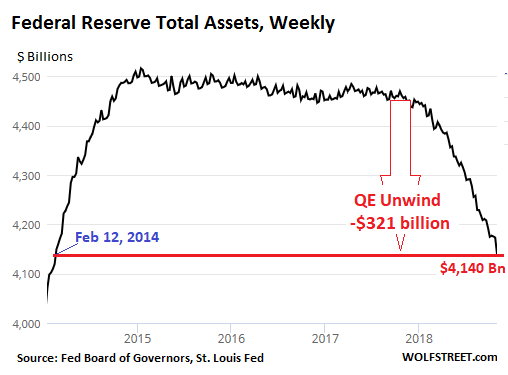
Over the four-week period from October 3 through October 31, the Federal Reserve shed $35 billion in assets, according to the Fed’s weekly balance sheet released Thursday afternoon. This brought the balance sheet to $4,140 billion, the lowest since February 12, 2014. Since October 2017, when the Fed began its QE unwind, or “balance sheet normalization,” it has now shed $321 billion. The Fed acquired Treasury securities and mortgage-backed securities (MBS) as part of QE, which ended in 2014. Between the end of QE and the beginning of the QE Unwind in October 2017, the Fed replaced maturing securities with new securities to keep their levels roughly the same.

In October last year, the Fed kicked off the QE unwind and began shedding those securities. But the balance sheet also reflects the Fed’s other activities, and the amount of its total assets is always higher than the sum of Treasury securities and MBS it holds. October was a new milestone: the QE unwind left the ramp-up phase and entered the cruising-speed phase, according to the Fed’s plan. In the cruising-speed phase, the Fed is scheduled to shed “up to” $30 billion in Treasuries and “up to” $20 billion in MBS a month, for a total of “up to” $50 billion a month. From October 3 through October 31, the Fed’s holdings of Treasury Securities fell by $23.8 billion to $2,270 billion, the lowest since February 19, 2014. Since the beginning of the QE-Unwind, the Fed has shed $195 billion in Treasuries:

Read more …

The amount of high risk debt owned by pension funds is something else. As I always say, remember the days of AAA?

Debt Is Back But This Time It’s Corporate (GolemXIV)

On Wednesday Feb 7th 2007 HSBC issued a profit warning. It was the first in its 142 year history. The bank told its share holders it would have to take an unprecedented charge of $10.5 billion because one of its units, its sub prime lender, was in deep trouble. And so began the sub prime crisis. Today GE issued a profit warning and cut its dividend to share holders from 12 cents to 1 cent. It is only the third time since the Great Depression that GE has reduced its dividend in this way. It told its share holders it would be taking a $22 Billion charge because one of its units, its power unit, is in deep trouble. GE has about $116 billion in debt. In 2007 the banks had flooded the global market with sub-prime loans.

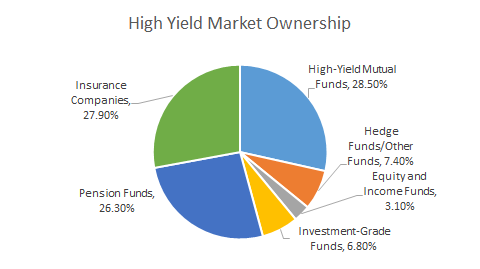
The banks were also holding many of those same loans themselves or had transferred them to Special Purpose Vehicles (SPVs) they had set up, staffed and lent money to. Today it is not the banking world which stands at the centre of the storm but the corporate world. In the last years they have flooded the market with junk rated bonds. At the same time they are also burdened with high yielding, leveraged and covenant- lite loans. Taken together they are about $2.4 Trillion of debt. 2007 sub prime loans. 2018 corporate junk bonds and leveraged loans. 2007 banks and SPVs funded by the banks. 2018? Where is this sub-prime corporate debt sitting today? Nearly half sits in Insurance Companies and Pension funds. Given the close ties between insurance and pensions this is not a happy picture.

Read more …

“Some 44% of people said their expenses exceeded their income in the past year and they used credit to make ends meet.”

The ‘True State’ Of Americans’ Financial Lives (MW)

The finances of Americans may not be as good as they look from the outside. Despite optimistic metrics like a nine-year-long bullish, if volatile, stock market, low unemployment levels, and consumer confidence levels nearing record highs, millions of Americans continue to struggle, a study released Thursday from financial consultancy nonprofit the Center for Financial Services Innovation (CFSI) found. Only 28% of Americans are considered “financially healthy,” according to a CFSI survey of more than 5,000 Americans. “Financial health enables family stability, education, and upward mobility, not just for individuals today but across future generations,” the CFSI says.

“Many are dealing with an unhealthy amount of debt, irregular income, and sporadic savings habits.” Some 44% of people said their expenses exceeded their income in the past year and they used credit to make ends meet. Another 42% said they have no retirement savings at all. Meanwhile, 17% of Americans are “financially vulnerable,” meaning they struggle with nearly all financial aspects of their lives, and 55% are “financially coping,” meaning they struggle with some but not all aspects of their financial lives. The recent volatility in the Dow Jones Industrial and S&P 500 has not helped Americans feel secure, experts say.

Read more …

Can’t afford to start a family.

The American Dream Feels Further Off Than Ever For Millennials (G.)

From adolescence to our mid-30s, my wife and I have followed every common precept of responsible young adulthood – what conservatives venerate as “the success sequence”. We finished high school (then college, then grad school). We charged into the labor market and have stayed there. We had kids in a stable marriage. Neither of us quit our jobs or took a year off to “find ourselves”. We cut coupons and buy food in bulk. We did this, in part, because we trusted what we believed was America’s basic bargain: work hard, play by the proverbial rules, and you’ll enjoy a healthy middle-class life. You’ll have a decent job, stable housing, affordable education and healthcare, and a clear route to retirement.

But that old, potholed path doesn’t deliver like it used to, even for responsible rule-followers like us. Here in our mid-30s, my wife and I are still chasing homeownership, that final, elusive piece of middle-class life. Today’s young families started to hit the labor market during the great recession. We’re buried in educational debt, and college costs for our kids are predicted to be even higher than ours. Housing near good-paying jobs is wildly expensive. Healthcare costs are uncertain. We’re less likely to have a guaranteed retirement pension through work, and current signals suggest that government-funded retirement supports will be significantly smaller, if they’re there at all. These are bread-and-butter issues.

While national political leaders are gridlocked on how to address the crises of widening inequality and limited upward mobility, we’re struggling to simply provide our children with the same opportunities that came relatively easily to earlier generations. Most young families aren’t cynical because the rich have private helicopter fleets and offshore bank accounts, per se. We’re frustrated because the American bargain we believed in is broken.

Read more …

I don’t often disagree with Kimberley Strassel, but I do disagree with “the ascendant progressive movement blew an easy victory for Democrats.” It’s the old guard that blew it, Clinton, Pelosi, Waters, Feinstein.

The Lesson of 2018 (Strassel)

In a few days the U.S. will have its midterm results, and the Beltway press corps will lecture us on the lessons. Don’t expect to hear much about the one takeaway that is already obvious: that today’s preferred progressive politics—of character assassination, mob rule, intimidation and wacky policies—is an electoral bust. It is not what is winning Democrats anything. It is what is losing the party the bigger prize. Six weeks ago, Democrats were expecting a blue wave to rival the Republican victory of 2010, when the GOP picked up 63 House seats. Everything was in their favor. History—the party in power almost always loses seats. Money—Democrats continue to outraise Republicans by staggering amounts.

The opposition—some 41 GOP House members retired, most from vulnerable districts where Donald Trump’s favorability is low. Democrats were even positioned to take over the Senate, despite defending 10 Trump-state seats. Democrats obliterated their own breaker in the space of two weeks with the ambush of Supreme Court nominee Brett Kavanaugh. The left, its protesters and its media allies demonstrated some of the vilest political tactics ever seen in Washington, with no regard for who or what they damaged or destroyed along the way—Christine Blasey Ford, committee rules, civility, Justice Kavanaugh himself, the Constitution. An uncharacteristically disgusted Sen. Lindsey Graham railed: “Boy, y’all want power. God, I hope you never get it!”

A lot of voters suddenly agreed with that sentiment. The enormous enthusiasm gap closed almost overnight as conservative voters rallied to #JobsNotMobs. Even liberal prognosticators today forecast that Republicans will keep the Senate and Democrats will manage only a narrow majority in the House, if that. It’s always possible the polls are off, or that there is a last-minute bombshell. But it remains the case that the ascendant progressive movement blew an easy victory for Democrats.

Read more …

Thanks, Mutti. Or in other words: now you know why Merkel lost so much support.

1 in 5 Germans Is ‘At Risk Of Poverty’ Despite Record Employment (RT)

Germany may be Europe’s biggest and strongest economy and is enjoying record employment, but one fifth of its citizens are struggling to make ends meet, a new study reveals. Some 15.5 million people or 19 percent of the population in Germany were “at risk of poverty” or “social exclusion” in 2017, the Federal Statistics Office said. Even though the unemployment rate in Germany has fallen to record lows, many people still do not earn enough to pay their bills and keep themselves above the poverty line. Some 13.1 million Germans, roughly 16.1 percent of the population, are threatened by poverty precisely because of their low monthly income, the federal statistics bureau says.

According to the criteria introduced in the EU, people are considered to be at risk of poverty if their total income amounts to less than 60 percent of an average income in their country. In the case of Germany, it amounts to €1,096 ($1,243) for a single person per month and €2,302 ($2,611) for a family of two adults and two children under 14. 3.4 percent of the population were considered as threatened by poverty as they struggled to pay their rent on time, heat their homes adequately, travel on vacation or even to regularly get a substantial meal due to a lack of financial resources.

Read more …

This has been known for a long time, why investigate only now? And the Guardian blows its coverage of the topic by bringing Russia into the discussion. But then that’s Britain’s new favorite pastime. Another piece today on this, also in the Guardian, is by Luke Harding, career Assange and Putin basher.

Brexit Campaigner Arron Banks Faces Criminal Inquiry (G.)

The National Crime Agency is to investigate allegations of multiple criminal offences by Arron Banks and his unofficial leave campaign in the Brexit referendum, prompting calls from some MPs for the process of departing the European Union to be suspended. The NCA would look into suspicions that a “number of criminal offences may have been committed”, the Electoral Commission said in a statement, saying there were reasonable grounds to suspect Banks was “not the true source” of £8m in funding to the Leave.EU campaign. The commission said the cases involve Banks, the insurance millionaire who heavily backed leave; Elizabeth Bilney, one of his key associates; Leave.EU itself; the company used to finance it; and “other associated companies and individuals”.

News of the investigation prompted anti-Brexit campaigners to call for a delay to the process of leaving the EU. The Labour MP David Lammy said Brexit “must be put on hold until we know the extent of these crimes against our democracy”. A series of other Labour MPs echoed the call, while the Lib Dems said Brexit could not go ahead based on “a leave campaign littered with lies, deceit and allegations of much worse”. Downing Street said it could not comment on a live investigation, but dismissed the idea of a pause: “The referendum was the largest democratic exercise in this country’s history and the PM is getting on with delivering its result.” Banks and Bilney, who chaired the Leave.EU campaign, said they rejected any allegations of wrongdoing, and argued the investigation was motivated by political considerations.

Read more …

Spending time talking fisheries is entirely useless as long as the Irish border issue is still out there.

EU Fisheries Row Threatens May’s Customs Union Plan (G.)

Theresa May is facing fresh opposition from EU countries that have large fishing communities to her demands for an agreement before Brexit day on a temporary customs union to solve the Irish border problem. [..] The prime minister has said she wants the “backstop” solution in the withdrawal agreement, under which Northern Ireland would in effect stay in the single market and customs union alone, to be scrapped in favour of the whole of the UK staying in a customs arrangement temporarily. In the latest development, the European commission has floated a plan in which the full terms of a “bare bones” customs union for Great Britain would be laid out in the withdrawal agreement, so there would be no need for negotiations on it after Brexit. Northern Ireland would stay under the full EU customs code.

The backstop would come into force at the end of the transition period should a comprehensive trade deal to ensure there is no need for a hard border on the island of Ireland not be agreed in time. A senior EU official conceded that the proposal would not remove the need for a Northern Ireland-specific backstop that would keep the province in the single market as the UK gave up its membership. The issue of what to do about fisheries would also remain with member states likely to reject to any deal that undermines the “trade-off” envisioned in the bloc’s negotiating position papers in which British exporters were only given access to the single market in exchange for European fishing boats keeping access to the seas around the UK.

Read more …

Monsanto saved itself $200 million. But they’ll apeal again.

Groundskeeper In Monsanto US Weed-Killer Case Accepts Reduced Award (R.)

The school groundskeeper who won a jury trial against Bayer’s Monsanto unit over allegations that the company’s glyphosate-containing weed-killers caused his cancer, accepted a court-mandated reduced punitive damages award on Wednesday. The decision by Dewayne Johnson, who sued Monsanto in 2016, brings the total award to $78 million, down from the jury’s verdict on Aug. 10 of $289 million – $39 million in compensatory and $250 million in punitive damages. Johnson’s law firm said in a statement that he accepted the reduction “to hopefully achieve a final resolution within his lifetime.”

Judge Suzanne Bolanos of San Francisco’s Superior Court of California, who oversaw the trial, earlier this month affirmed the liability portion of the verdict, but ordered punitive damages to be slashed to concur with California and federal law. Bayer denies allegations that glyphosate can cause cancer and said it will appeal the decision as the verdict was not supported by the evidence presented at trial. The verdict, which marked the first such decision against Monsanto, wiped 10 percent off the value of the company and shares have since dropped nearly 30 percent from their pre-verdict value.

Read more …

Thanks Mutti. And Europeans will just focus on the US-Mexico border of course. Is that double morals or no morals at all?

Thousands Of Europe-Bound Migrants Have Simply Vanished (ZH)

Tens of thousands of migrants undertaking dangerous journeys in search of greener pastures throughout the world are dead or missing, according to an AP tally – nearly doubling estimates from the N’s International Organization for Migration (IOM). At least 56,800 migrants worldwide have simply vanished since 2014 by AP’s count – eclipsing the IOM’s October 1 estimate of around 28,500. This year alone, the IOM has documented over 1,900 deaths in and around the Mediterranean. “A growing number of migrants have drowned, died in deserts or fallen prey to traffickers, leaving their families to wonder what on earth happened to them,” reports Fox News. “At the same time, anonymous bodies are filling cemeteries around the world.”

Focusing on Europe alone, AP found almost 4,900 migrants whose families can’t account for their lived ones – nearly half of which are children who have been reported missing to the Red Cross. “… many of those who go missing are uncounted, including boatfuls [sic] of young Tunisians or Algerians and children whose parents lost track of them in the chaos of land border crossings. In all, The Associated Press found nearly 4,900 people whose families say they simply disappeared without a trace in Europe or en route, including more than 2,700 children whose families reported them missing to the Red Cross.” -Fox News

Meanwhile, efforts to identify those who have died in shipwrecks trying to make it to Europe have fallen flat. Of the 400 or so remains interred in a Tunisian cemetery for unidentified migrants, for example, only one has ever been identified since its opening in 2005. “Their families may think that the person is still alive, or that he’ll return one day to visit,” said one unemployed sailor, Chamseddin Marzouk. “They don’t know that those they await are buried here, in Zarzis, Tunisia.”

Read more …

Oct 312018
 
 October 31, 2018  Posted by at 9:59 am Finance Tagged with: , , , , , , , , , , ,  9 Responses »


Francisco Goya Witches’ Sabbath 1798


US Calls For Yemen Ceasefire, Peace Talks ‘In The Next 30 Days’ (AFP)
Erdogan Urges Saudi Prosecutor To Find Out Who Ordered Khashoggi Hit (AFP)
Housing Market Now ‘Reminds Me Of 2006′ – Robert Shiller (MW)
China Debt Bomb Ready to Explode (Rickards)
China Factory Growth Weakest In Over 2 Years, Export Orders Slump Deepens (R.)
Ray Dalio Hails Paul Volcker As ‘The Greatest Man’ He Knows (MW)
The Monster Mash (Kunstler)
No-Deal Brexit Would Trigger Lengthy UK Recession – S&P (G.)
Welcome to the Jungle (Escobar)
After Germany’s Merkel Comes Chaos (John Rubino)
Ocean Shock (Reuters)


Both Mattis and Pompeo, a coordinated effort. 30 days seems ambitious, but MbS doesn‘t have much leverage left.

US Calls For Yemen Ceasefire, Peace Talks ‘In The Next 30 Days’ (AFP)

The United States called Tuesday for a ceasefire and peace talks in Yemen, as the Saudi-led military coalition sent more than 10,000 new troops toward a vital rebel-held port city ahead of a new assault. Pentagon chief Jim Mattis said the US had been watching the conflict “for long enough,” adding that Saudi Arabia and the United Arab Emirates, which are in a US-backed coalition fighting Shiite Huthi rebels, are ready for talks. “We have got to move toward a peace effort here, and we can’t say we are going to do it some time in the future,” Mattis said at the US Institute of Peace in Washington. “We need to be doing this in the next 30 days.”

He said the US is calling for all warring parties to meet with United Nations special envoy Martin Griffiths in Sweden in November and “come to a solution.” US-Saudi ties have cooled in recent weeks after the murder of journalist Jamal Khashoggi, a prominent critic of the conservative kingdom, that has also tarnished the image of Crown Prince Mohammed bin Salman. Saudi Arabia and its allies intervened in the conflict between embattled Yemeni President Abedrabbo Mansour Hadi, whose government is recognized by the United Nations, and the Huthis in 2015. Nearly 10,000 people have since been killed and the country now stands at the brink of famine, with more than 22 million Yemenis — three quarters of the population — in need of humanitarian assistance.

[..] US Secretary of State Mike Pompeo called for an end to all coalition air strikes in Yemen’s populated areas. “The time is now for the cessation of hostilities, including missile and UAV (drone) strikes from Huthi-controlled areas into the Kingdom of Saudi Arabia and the United Arab Emirates,” Pompeo said in a statement. “Subsequently, coalition air strikes must cease in all populated areas in Yemen.”

Read more …

Body still not found.

Erdogan Urges Saudi Prosecutor To Find Out Who Ordered Khashoggi Hit (AFP)

Turkish President Recep Tayyip Erdogan on Tuesday called on Saudi Arabia’s chief prosecutor to find out who ordered the murder of journalist Jamal Khashoggi, and not spare “certain people” in his investigation. “Who sent these 15 people? As Saudi public prosecutor, you have to ask that question, so you can reveal it,” Erdogan said, referring to the 15-man team suspected of being behind the hit. “Now we have to solve this case. No need to prevaricate, it makes no sense to try to save certain people,” he told reporters in Ankara. Khashoggi was killed after entering the Saudi consulate in Istanbul on October 2 to obtain paperwork ahead of his upcoming wedding. His body has not yet been found.

[..] Erdogan said that during the talks Fidan requested the 18 suspects be sent to Turkey for trial, as the killing took place in Istanbul. The Istanbul prosecutor’s office last week prepared a written request for the extradition of the 18 suspects “involved in the premeditated murder”, the justice ministry said, but Riyadh rejected Ankara’s request. Erdogan also urged Saudi Foreign Minister Adel al-Jubeir to explain who the “local co-conspirators” were that were reportedly given Khashoggi’s body after his death. “Again either the Saudi foreign minister or the 18 suspects must explain who the local co-conspirators are. Let’s know who this co-conspirator is, we can shed further light. We cannot let this subject end mid-way.”

Read more …

Only this time it’s global.

Housing Market Now ‘Reminds Me Of 2006′ – Robert Shiller (MW)

Famed housing-watcher Robert Shiller said Tuesday that the weakening housing market reminded him of the last market top, just before the subprime housing bubble burst, slashing prices by nearly a third and costing millions of Americans their homes. Home price gains moderated again in the most recent version of the closely-watched housing index that bears his name, which was released Tuesday, and Shiller, a Nobel Prize-winning economist, told Yahoo Finance that such data shows “a sign of weakness.” Housing pivots take more time than those in the stock market, Shiller said. Still, “the housing market does have a momentum component and we’re seeing a clipping of momentum at this time.”

When a startled reporter reminded Shiller that 2006 predated the greatest financial crisis in a lifetime, the Yale economist acknowledged that any correction would likely be far less severe. “The drop in home prices in the financial crisis was the most severe drop in the U.S. market since my data begin in 1890,” Shiller said. “It could be that we’re primed to repeat it because it’s in our memory and we’re thinking about it but still I wouldn’t expect something as severe as the Great Financial Crisis coming on right now. There could be a significant correction or bear market, but I’m waiting and seeing now.”

Read more …

Foreign reserves runnning out.

China Debt Bomb Ready to Explode (Rickards)

The great Chinese growth slowdown has been proceeding in stages for the past two years. The reason is simple. Much of China’s “growth” (about 25% of the total) has consisted of wasted infrastructure investment in ghost cities and white elephant transportation infrastructure. That investment was financed with debt that now cannot be repaid. This was fine for creating short-term jobs and providing business to cement, glass and steel vendors, but it was not a sustainable model since the infrastructure either was not used at all or did not generate sufficient revenue. China’s future success depends on high-value-added technology and increased consumption. But shifting to intellectual property and the consumer means slowing down on infrastructure, which will slow the economy.

In turn, that means exposing the bad debt for what it is, which risks a financial and liquidity crisis. China started to do this last year but quickly turned tail when the economy slowed. Now the economy has slowed so much that markets are collapsing. But doesn’t China have over $1 trillion of reserves to prop up its financial system? On paper, that’s true. But in reality, China is “short” U.S. dollars. The Chinese may have $1.4 trillion of U.S. Treasury securities in its reserve position, but they need those assets possibly to bail out their banking system or defend the yuan. Meanwhile, the Chinese banking sector, which in many ways is an extension of the state, owes $318 billion in U.S. dollar-denominated deposits of commercial paper.

From a bank’s perspective, borrowing in dollars is going short dollars because you need dollar assets to back up those liabilities if the original lenders want their money back. For the most part, the banks don’t have those assets because they converted the dollar to yuan to prop up local real estate Ponzis and local corporations. There’s not much left over to bail out the corporate, individual and real estate sectors. This is all part of a global “dollar shortage” attributable to Fed tightening, both in the forms of higher rates but also a reduction in base money. A dollar shortage seems implausible in a world where the Fed printed $4.4 trillion. But while the Fed was printing, the world borrowed over $70 trillion (on top of prior loans), so the dollar shortage is real. The math is inescapable.

Read more …

Everyone’s going to call on Beijing to come to the rescue.

China Factory Growth Weakest In Over 2 Years, Export Orders Slump Deepens (R.)

China’s manufacturing sector in October expanded at its weakest pace in over two years, hurt by slowing domestic and external demand, in a sign of deepening cracks in the economy from an intensifying trade war with the United States. Anxiety about China’s cooling growth and its likely drag on the global economy have vexed financial markets recently, and Wednesday’s official Purchasing Managers’ Index (PMI) indicates more stress for investors through coming months. The official PMI – which gives global investors their first look at business conditions in China at the start of the last quarter of the year – fell to 50.2 in October, the lowest since July 2016 and down from 50.8 in September.

It was a touch above the 50-point mark that separates growth from contraction for a 27th straight month, but undershot the 50.6 forecast in a Reuters poll. The latest reading suggests a further loss of momentum in the world’s second-biggest economy, and the deteriorating environment for businesses could prompt more policy support from Beijing on top of a raft of recent initiatives. “All the numbers from China’s PMI release today confirm a broad-based decline in economic activity,” said Raymond Yeung, chief economist for China at ANZ in a client note, adding that conditions for the private sector is “much worse” than headline data suggested. “Besides an expected reserve requirement ratio (RRR) cut next January, we expect future supportive policy actions to be measured. The government’s priority is to avoid a financial blow-up.”

Read more …

Not hard to be better than The Oracle, Bernanke and Yellen. But where was Volcker when these three went off the rails?

Ray Dalio Hails Paul Volcker As ‘The Greatest Man’ He Knows (MW)

Those weighty words of praise were tweeted out Tuesday by Ray Dalio, founder of hedge-fund behemoth Bridgewater Associates. Dalio’s social-media nod to the former Fed chair coincides with the release of Volcker’s memoir, “Keeping at It: The Quest for Sound Money and Good Government.”

In his new book, Volcker says he’s worried about the impact of money in politics and argues that the U.S. is devolving into a plutocracy. “We face a huge challenge in this country to restore a sense of public purpose and of trust in government,” he wrote in the book. “It will require critically needed reforms in our political processes and leaders who can restore and preserve a consensus upon which our great democracy can depend.” Volcker, 91, served as Fed chair from 1979 until 1987, and he’s widely credited for stopping runaway inflation during that time. He was also chairman of the Economic Recovery Advisory Board under Obama from 2009 to 2011.

Dalio wasn’t the only one to give Volcker some love in light of his memoir. Martin Wolf of the Financial Times is also a big fan, saying that he’s “the greatest man I have known,” because “he is endowed to the highest degree with what the Romans called virtus (virtue): moral courage, integrity, sagacity, prudence and devotion to the service of country.” Wolf said “the pinnacle of Volcker’s career” was when he achieved something many thought impossible: he slew inflation. “Great credit is due to Jimmy Carter, who appointed him, and Ronald Reagan, who supported him. But Volcker did it, despite great criticism,” Wolf explained. “The costs were huge. But he was right: it had to be done.”

Read more …

“And if it happens that the Dems don’t prevail, and don’t manage to get their hands on the machinery of congress — then what?”

The Monster Mash (Kunstler)

The Democratic Party war on white people and their dastardly privilege has been the theme all year long, with its flanking movement against white men especially and super-especially the hetero-normative white male villains who rape and oppress everybody else. Anyway, that’s the strategy du jour. I’m not persuaded that it’s going to work so well in the coming election. The party could not have issued a clearer message than “white men not welcome here.” Very well, then, they’ll vote somewhere else for somebody else. And if it happens that the Dems don’t prevail, and don’t manage to get their hands on the machinery of congress — then what?

For one thing, a lot of people get indicted, especially former top officers from various glades of the Intel swamp. It shouldn’t be a surprise, given the numbers of them already called before grand juries and fingered by inspectors general. But it may be shocking how high up the indictments go, and how serious the charges may be: sedition… treason…? These midterm election may bring the moment when the Democratic Party finally blows up, at least enough to sweep away the current coterie of desperate idiots running it. It’s time to shove the crybabies offstage and allow a few clear-eyed adults to take the room, including men, yes even white men. And let all the shrieking, clamoring, marginal freaks return to the margins, where they belong.

Read more …

That recession is now certain, deal or not. Even in case of a deal, 1000s of documents must be signed. A deal will not mean a return to BAU.

No-Deal Brexit Would Trigger Lengthy UK Recession – S&P (G.)

Britain’s economy will suffer rising unemployment and falling household incomes that would trigger a recession should Theresa May fail to secure a deal to prevent the UK crashing out of the European Union next year, according to analysis by the global rating agency Standard & Poor’s. Property prices would slump and inflation would spike to more than 5% in a scenario that S&P said had become more likely in recent months following deadlock with Brussels over a post-Brexit deal. In a warning that included a possible downgrade to the UK’s credit rating, which would bring with it an increase in the Treasury’s borrowing costs, S&P said it still expected both sides in the Brexit talks to come to an agreement before next March, when the UK is scheduled to leave the European Union.

But it warned that the chance of a “no-deal” Brexit had risen in recent months to such an extent that it needed to warn international investors about the potential challenges ahead. [..] S&P Global Ratings credit analyst Paul Watters, said: “Our base-case scenario is that the UK and the EU will agree and ratify a Brexit deal, leading to a transition phase lasting through 2020, followed by a free trade agreement. “But we believe the risk of no deal has increased sufficiently to become a relevant rating consideration. This reflects the inability thus far of the UK and EU to reach agreement on the Northern Irish border issue, the critical outstanding component of the proposed withdrawal treaty.”

Coming only a day after the chancellor said the failure to secure a deal would force him to hold an emergency budget, S&P’s analysis joins a welter of independent reports that forecast that a split from the EU without a deal will deal a serious blow to the prospects of the UK economy. Last month rival agency Moody’s said the risks to the British economy had “risen materially” in recent months.

Read more …

If you think Trump’s scary, this guy’s in a league of his own.

Welcome to the Jungle (Escobar)

It’s darkness at the break of (tropical) high noon. Jean Baudrillard once defined Brazil as “the chlorophyll of our planet”. And yet a land vastly associated worldwide with the soft power of creative joie de vivre has elected a fascist for president. Brazil is a land torn apart. Former paratrooper Jair Bolsonaro was elected with 55.63 percent of votes. Yet a record 31 million votes were ruled absent or null and void. No less than 46 million Brazilians voted for the Workers’ Party’s candidate, Fernando Haddad; a professor and former mayor of Sao Paulo, one of the crucial megalopolises of the Global South. The key startling fact is that over 76 million Brazilians did not vote for Bolsonaro. His first speech as president exuded the feeling of a trashy jihad by a fundamentalist sect laced with omnipresent vulgarity and the exhortation of a God-given dictatorship as the path towards a new Brazilian Golden Age.

French-Brazilian sociologist Michael Lowy has described the Bolsonaro phenomenon as “pathological politics on a large scale”. His ascension was facilitated by an unprecedented conjunction of toxic factors such as the massive social impact of crime in Brazil, leading to a widespread belief in violent repression as the only solution; the concerted rejection of the Workers’ Party, catalyzed by financial capital, rentiers, agribusiness and oligarchic interests; an evangelical tsunami; a “justice” system historically favoring the upper classes and embedded in State Department-funded “training” of judges and prosecutors, including the notorious Sergio Moro, whose single-minded goal during the alleged anti-corruption Car Wash investigation was to send Lula to prison; and the absolute aversion to democracy by vast sectors of the Brazilian ruling classes.

That is about to coalesce into a radically anti-popular, God-given, rolling neoliberal shock; paraphrasing Lenin, a case of fascism as the highest stage of neoliberalism. After all, when a fascist sells a “free market” agenda, all his sins are forgiven.

Read more …

My old buddy John Rubino is right, but the story’s bigger than this. Merkel’s been given far too much power.

After Germany’s Merkel Comes Chaos (John Rubino)

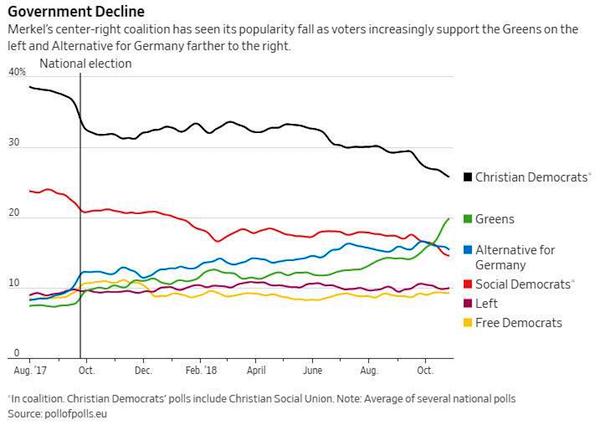
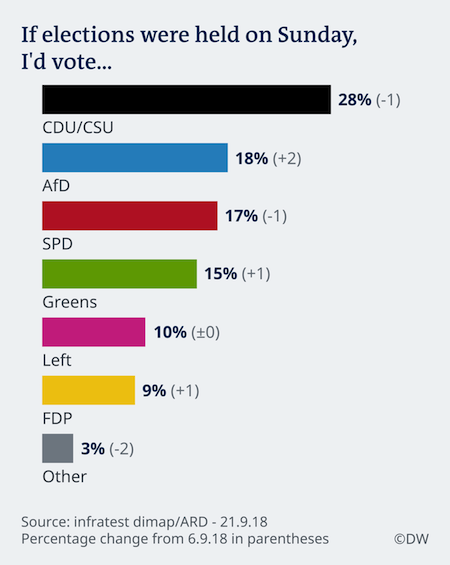
After a long, initially-successful run promoting European integration and mass immigration, German Chancellor Angela Merkel saw the bottom fall out of her political fortunes this year. This week she stepped down as leader of the formerly-dominant Christian Democrat party and promised not run again when her term as Chancellor ends in 2021. What happens next is almost certain to be chaotic, as the following chart (courtesy of this morning’s Wall Street Journal) makes clear. Note that in August of 2017 the two least popular parties were the far right Alternative for Germany (blue line) and the far left Greens (green line). In the ensuing 14 or so months AfG’s support rose from single digits to around 17% while the Greens rocketed from the bottom of the pack to 20%.

If you didn’t know what these two parties stood for you might think, “Fine, they’re new and interesting, so let them form a coalition and govern for a while.” Unfortunately they’re more likely to kill each other in street fights than work together, since the former want closed borders and free markets while the latter want increased regulation and unlimited immigration. The alternative to an AfG/Green coalition then becomes some combination of the remaining, more centrist (by European standards at least) parties. But the biggest of those parties – Merkel’s Christian Democrats and their coalition partner Social Democrats – are in freefall, precisely because of what they’ve done while in power. So there appears to be no way to put these puzzle pieces together to produce a stable government.

And – here’s where things get truly scary – a stable Germany under Merkel’s bland but firm hand has been the only thing holding the European Union and eurozone together. If Germany descends into internal turmoil without a coherent government to push the Italys and Hungarys around, European populists/nationalists will fill the resulting vacuum. Borders will be re-imposed within and without the EU, national government budgets – already above EU deficit limits in many cases – will explode. Already-debilitating debts will keep rising, and the ECB will be forced to bail out Italy for sure and probably several other member states after that.

Read more …

Intro to an elaborate series of reports by Reuters, kudos for the effort. Fish have moved north and deeper, leaving entire communities without their proteins.

Ocean Shock (Reuters)

To stand at the edge of an ocean is to face an eternity of waves and water, a shroud covering seven-tenths of the Earth. Hidden below are mountain ranges and canyons that rival anything on land. There you will find the Earth’s largest habitat, home to billions of plants and animals – the vast majority of the living things on the planet. In this little-seen world, swirling super-highway currents move warm water thousands of miles north and south from the tropics to cooler latitudes, while cold water pumps from the poles to warmer climes. It is a system that we take for granted as much as we do the circulation of our own blood. It substantially regulates the Earth’s temperature, and it has been mitigating the recent spike in atmospheric temperatures, soaking up much of human-generated heat and carbon dioxide.

Without these ocean gyres to moderate temperatures, the Earth would be uninhabitable. In the last few decades, however, the oceans have undergone unprecedented warming. Currents have shifted. These changes are for the most part invisible from land, but this hidden climate change has had a disturbing impact on marine life – in effect, creating an epic underwater refugee crisis. Reuters has discovered that from the waters off the East Coast of the United States to the coasts of West Africa, marine creatures are fleeing for their lives, and the communities that depend on them are facing disruption as a result. As waters warm, fish and other sea life are migrating poleward, seeking to maintain the even temperatures they need to thrive and breed.

The number of creatures involved in this massive diaspora may well dwarf any climate impacts yet seen on land. In the U.S. North Atlantic, for example, fisheries data show that in recent years, at least 85 percent of the nearly 70 federally tracked species have shifted north or deeper, or both, when compared to the norm over the past half-century. And the most dramatic of species shifts have occurred in the last 10 or 15 years. Fish have always followed changing conditions, sometimes with devastating effects for people, as the starvation that beset Norwegian fishing villages in past centuries when the herring failed to appear one season will attest. But what is happening today is different: The accelerating rise in sea temperatures, which scientists primarily attribute to the burning of fossil fuels, is causing a lasting shift in fisheries.

Read more …

Oct 282018


Salvador Dali City of drawers – The Anthropomorphic Cabinet 1936


OECD Countries’ Retirement Assets Surpass $43 Trillion In 2017 (PiO)
As The Housing Market Stagnates, American Homeowners Are Staying Put (MW)
Economist Slams ‘China Model’ That ‘Inevitably Leads To Confrontation’ (SCMP)
Rand Paul Seeks To Punish Saudi Arabia For Khashoggi Killing (Pol.)
Saudi Arabia Says It Is A Beacon Of Light Fighting ‘Dark’ Iran (G.)
EU To Make Contingency Plans For A Second Brexit Referendum (Ind.)
Germany’s Fragile Coalition Braced For More Upsets (G.)
Russia-Turkey-Germany-France Talks On Syria Kick Off (RT)
“My” Suspended Twitter Account (Paul Craig Roberts)
Mexico Honors Migrants At Day Of The Dead As Caravan Treks North (R.)


2/3(?!) of it is in the US.

OECD Countries’ Retirement Assets Surpass $43 Trillion In 2017 (PiO)

Retirement assets in OECD countries hit a record $43.4 trillion at the end of 2017, well above the pre-crisis level. The OECD said in its annual Pension Markets in Focus report that assets invested in all funded and private pension systems across 87 jurisdictions grew 12.1% over the year, and increased 53.9% compared with figures at the end of 2007. The report said assets are unevenly distributed worldwide, with less than $200 billion across 78% of the reporting countries, while 8% held more than $1 trillion each: the U.S. with about $28.2 trillion; the U.K. with $2.9 trillion; Canada at $2.6 trillion; Australia with $1.8 trillion; the Netherlands with $1.6 trillion; Japan at $1.4 trillion; and Switzerland with $1 trillion. The remaining 9% of assets, or about $3.9 trillion, are split among the other 29 OECD countries.

The largest amounts of assets are located in some of the biggest economies in the world and with a long history of retirement savings. High investment returns from equity markets partially explain the growth of these assets, said the report, with the real net investment rate of return on retirement assets exceeding 4% on average in 2017. U.S. retirement plans achieved a 7.5% real net investment rate of return in 2017, added the OECD. Funding levels for DB funds improved in the U.S., to 59.6% at end-2017 from 56% a year earlier; but worsened from 2007 figures of 68.6%. The funding ratio was calculated as the ratio of total investment and net technical provisions for occupational defined benefit plans using values reported by national authorities in the OECD template.

U.K. funding levels improved to 90.5% as of the end of 2017, up from 85.8% a year earlier, but down from 108.8% as of the end of 2007. Denmark had the highest funding level of OECD countries in the report, at 135.1%. However, that level was down from 146.1% a year earlier, but improved over the 127.4% funding level as of the end of 2007.

Read more …

Bad time to become a real estate agent.

As The Housing Market Stagnates, American Homeowners Are Staying Put (MW)

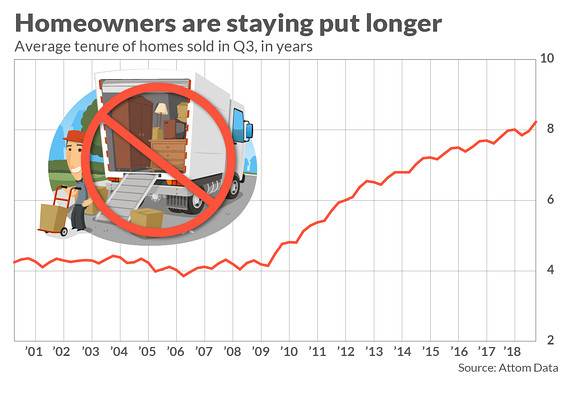
Housing-market headwinds are keeping American homeowners in their properties for the longest stretches on record, in a sharp distortion of the mobility Americans have for decades prized. Across the country, homes that sold in the third quarter of this year had been owned an average of 8.23 years, according to an analysis from Attom Data Solutions. That’s almost double the length of time a home sold in 2000, when Attom’s data begin, had been owned. It’s partly the long tail of the housing crisis that’s created stagnant conditions and a less dynamic housing market, Attom spokesman Daren Blomquist told MarketWatch.

As of the second quarter, 2.2 million homeowners were still underwater on their mortgages, meaning they owe more to their lending institution than the home is worth, according to data from CoreLogic. Another 550,000 have 5% equity or less, meaning that if that property were to be sold the transaction costs, such as a real-estate agent’s commission, would likely leave the homeowner with nothing. The hypercompetitive market that’s emerged from the wreckage of the crisis is also keeping people in place. Many homeowners have ample equity in their homes, but hesitate to list those homes because they’re worried about finding a property to buy if they do sell. A few others may be trapped by “rate lock” — enjoying the benefits of their ultralow mortgage rates, and unwilling to spend more on financing costs.

Read more …

Interesting that he gets to say it.

Economist Slams ‘China Model’ That ‘Inevitably Leads To Confrontation’ (SCMP)

Using the “China model” to explain the country’s economic success over the past four decades is wrong and dangerous, according to an influential Chinese economist, who says this misconception has inevitably led to antagonism between China and the West. Zhang Weiying, one of the most prominent liberal economists in the country and a professor at prestigious Peking University, made the comments in a lecture on October 14. An edited version of his speech was published on the university’s website on Wednesday. The speech is a wholesale negation of the “China model” theory that has gained traction in recent years, as the country becomes more confident in promoting its own development path under President Xi Jinping.

Zhang lashes out at those who attribute China’s economic growth to an exceptional “China model”, which includes a powerful one-party state, a colossal state sector and “wise” industrial policy, saying it is not only factually wrong, but also detrimental to the country’s future. “The theory of the ‘China model’ sets China as a frightening anomaly from the Western perspective, and inevitably leads to confrontation between China and the West,” he said. “The hostile international environment we face today is not irrelevant to the wrong interpretation of China’s achievement in the past 40 years by some economists.”

The economist’s rejection of the “China model” comes as debates about the country’s economic future are heating up. The world’s second largest economy is losing steam – growth is at its slowest pace since 2009 – as it marks 40 years since its market reforms. At home, it is grappling with a mountain of debt, plunging stocks and an ailing private sector. Abroad, tensions over the prolonged trade war with the United States appear to be spilling over into defence, diplomacy and politics. Zhang said the trade war not only reflected conflict between China and the US, but between China and the larger Western world. It also went beyond trade to reflect the clash over value systems, he said.

Read more …

Like his dad, strongly anti-war.

Rand Paul Seeks To Punish Saudi Arabia For Khashoggi Killing (Pol.)

Sen. Rand Paul says he’s not going to let Saudi Arabia off the hook after journalist Jamal Khashoggi was killed in Turkey by agents linked to the Saudi government. The Kentucky Republican said Saturday he’s intent on forcing another vote to block billions in arm sales to the autocratic Middle Eastern kingdom and won’t settle for targeted sanctions, seeking to capitalize on negative public sentiment surrounding the Oct. 2 killing. “Are we going to do fake sanctions? Are we going to pretend to do something by putting sanctions on 15 thugs. Or are we going to do something that hurts them?” Paul said in an interview here, explaining that he thinks Saudi Arabia is trying to wait him out until Khashoggi fades from the headlines before announcing the arms sale, which would allow him to try and stop it.

“They know if they have the vote they might lose. So they’re probably not going to make any announcement until this dies down,” Paul said. Rather than focusing simply on Khashoggi, Paul has made a broader critique of Saudi Arabia as supporting “violent Jihad” and a brutal civil war in Yemen. But he’s noticed a substantive shift in the way his colleagues are now talking about the country. [..] Paul, a longtime Saudi critic, has previously forced votes to block the arms sales, but they have failed given a strong hawkish wing in the Senate that wants to keep a key ally against Iranian influence in the Middle East. Paul says that has changed. “We would win the vote right now. It would be a very bad vote if 60, 65, or even 70 people voted to cut the arms sales for now and the president were to veto that, that would be bad,” he said.

President Donald Trump has been more circumspect when discussing arms sales, questioning the wisdom of canceling sales that he believes creates hundreds of thousands of jobs. Paul said he’s tried to convince the president to come to his position, but he’s not there yet. “He says he doesn’t want to disrupt the arm sales. And it’s something we have an honest disagreement on. I don’t think arms are jobs programs,” Paul said. He said their “discussions aren’t really that much that back and forth.” [..] Paul also broke further with the president on foreign policy. He called it a “terrible idea” for the United States to back away from nuclear and weapons agreements with Russia and said he’s asked Trump to appoint nuclear negotiators in a bid to preserve the NEW START treaty and the INF agreement.

Read more …

Not sure how this would help their case at this point.

Saudi Arabia Says It Is A Beacon Of Light Fighting ‘Dark’ Iran (G.)

Saudi Arabia’s foreign minister has described the kingdom as a “vision of light” in the region as it tries to control the fallout from Jamal Khashoggi’s killing – its biggest diplomatic crisis since the 9/11 attacks. After more than two weeks of international outrage over the journalist and dissident’s death, Adel al-Jubeir sought to portray the country as the moral beacon of the Middle East, in stark opposition to Iran, Saudi Arabia’s arch-rival. “We are now dealing with two visions in the Middle East,” Jubeir told a security summit in Bahrain on Saturday. “One is a [Saudi] vision of light … One is [an Iranian] vision of darkness which seeks to spread sectarianism throughout the region. History tells us that light always wins out against the dark.”

Condemning the media coverage of Khashoggi’s killing as “hysterical”, Jubeir rejected a call from Recep Tayyip Erdogan, the Turkish president, to try the 18 suspects in Turkey, stressing that they would be “held accountable” on Saudi soil. [..] Erdogan reiterated during an address to parliament on Friday that Riyadh must disclose the location of Khashoggi’s body and identify who ordered his killing – a sign that Ankara is willing to keep up the pressure on the beleaguered kingdom and its de facto ruler, the crown prince Mohammed bin Salman. [..] Jim Mattis, the US defence secretary, who also spoke at the summit in Manama, said that Khashoggi’s killing had “undermined regional stability”. Washington was considering additional punitive measures against those responsible after issuing visa bans for the suspects in the case, Mattis added.

Read more …

5 months left. Nothing decided on.

EU To Make Contingency Plans For A Second Brexit Referendum (Ind.)

The EU’s chief negotiator has been warned to make contingency plans for a second Brexit referendum, as pressure builds to give the public a final say on leaving. Prominent Remain politicians met with Michel Barnier in Brussels this week and said it was time to start “serious contingency planning”, as The Independent’s petition neared one million signatures and the future of Brexit looks increasingly uncertain. In a visit on Friday, Sadiq Khan, the mayor of London, told Mr Barnier that the negotiating period should be extended so Britain could have “time to have a referendum”. The warning comes after 700,000 people took to the streets of London last weekend to make the case for a vote on the final deal.

For there to be time to hold a referendum, the EU would likely have to extend the Article 50 negotiating period, which will automatically expire on 29 March 2019, leaving Britain to slide out with a no-deal Brexit. The calls for an extension came from across a number of parties. Liberal Democrat leader Vince Cable said following a meeting with Mr Barnier on Thursday: “My message to Michel Barnier was clear: it’s time to start serious contingency planning for a People’s Vote. We know the UK government has started making such plans as a result of the growing demand for such a vote, demonstrated by last weekend’s march. “The EU should do the same, because MPs who back the People’s Vote are fast forming the biggest and most cohesive bloc in Westminster.”

Read more …

This will have an increasing effect on Europe as a whole. Who’s going to listen to Merkel as she’s fading at home?

Germany’s Fragile Coalition Braced For More Upsets (G.)

[..] voters in the central state of Hesse have the power to deliver a second electoral upset within a fortnight to Germany’s embattled ruling parties, potentially plunging both into fresh crises. The regional election is seen as decisive for the future of Merkel’s rickety coalition government. Last-minute polling showed support plummeting for both her Christian Democrat Union (CDU) and coalition partner the Social Democrats (SPD) in a swing state traditionally seen as a bellwether for national politics. Both parties were predicted to drop 10 points each since the state’s last regional election in 2013. Such a trouncing would come on the heels of a disastrous result in Bavaria that was widely seen as a protest against the failings of the Berlin government.

“None of the parties are there for us,” said Müller, who has voted for both CDU and SPD in the past, but was still undecided. “What should I do? I have to vote, it’s my duty to stop the far right getting into power. But I also know I won’t be heard. I can vote for whoever I like; the politicians will still do whatever they want.” Hesse, home to Germany’s financial centre, Frankfurt, has been governed by CDU-led coalitions for the past two decades. But polls have the party nosediving to 28%, a result that would end the state’s CDU-Green coalition and leave a question mark over the future of CDU state premier and close Merkel ally Volker Bouffier.

With tensions running high in the CDU, mutinous members have implied that if Bouffier falls, it may cost the chancellor vital votes when she stands for re-election as party leader at its conference in early December. But Merkel, who joined Bouffier on the campaign trail last week, was at pains to play down the significance of the regional vote for her party, government and chancellorship. “Hesse, and what happens here, is being watched and considered from far beyond Germany’s borders,” Merkel told supporters on Thursday in Fulda. “I want to point out once again that on Sunday the vote is about Hesse. Afterwards we’ll talk again about Berlin.”

Read more …

The fighting in Idlib must cease. It’s the only outcome.

Russia-Turkey-Germany-France Talks On Syria Kick Off (RT)

Leaders of Russia, Turkey, Germany and France have gathered in Istanbul to discuss the Syrian peace process. While the outcome of such tricky talks is hard to predict, the new format appears to be, at least, quite refreshing. Russia’s President Vladimir Putin, his French counterpart Emmanuel Macron and German Chancellor Angela Merkel arrived in Istanbul on Saturday to talk Syrian reconciliation. The host, Turkey’s leader Recep Tayyip Erdogan, has put high expectations on the gathering. “The whole world is watching this meeting. I hope, that the hopes will be met,” Erdogan said, while opening the summit. The four leaders are also expected to be joined by UN Special Envoy to Syria Staffan de Mistura.

The four-way summit is an entirely new format of talks on the war-torn country, which has endured years-long conflict. The meeting is all about testing the waters and trying to bring about different formats of talks on Syria, as if the leaders were to “synchronize watches” rather than reach a breakthrough, Kremlin spokesman Dmitry Peskov said. Similar opinion was expressed by Germany, with Foreign Minister Heiko Maas stating that the summit effectively brings different sides together for the very first time. “There are Russians and Turks, who have been at the same format of talks with Iran. And on the other side, there are French and us, who partake in the so-called ‘Friends of Syria’ group,” Maas said ahead of the event, adding that having a “joint conversation” was a viable idea.

Read more …

Turns out, the story was a bit different than many reported.

“My” Suspended Twitter Account (Paul Craig Roberts)

Dear Readers:

It is all over the internet and international media that Twitter has suspended my account. This is not the case. I do not use social media. I discovered that a Twitter account was operating in my name. I requested that the account be taken down. I have no recollection of giving anyone permission to operate a Twitter account in my name. I am still extremely busy trying to help family relatives impacted by Hurricane Michael and could only quickly look at the Twitter postings. It seemed to be mainly innocuous, consisting of links or quotes from my posted columns.

However, there were other things, such as appeals that money be sent to Alex Jones InfoWars and other things. I have no objection to Alex Jones. However, my webmaster and I were concerned that things could be posted that would be dangerous for me, such as libel, death threats to others, and so forth. To repeat, the account was closed at my request. To repeat, I do not use social media.

Paul Craig Roberts

Read more …

There’s something cynical about this, but also beautiful.

Mexico Honors Migrants At Day Of The Dead As Caravan Treks North (R.)

Mexico City dedicated its Day of the Dead parade on Saturday to migrants, just as thousands of Central Americans were trekking from the country’s southern border toward the United States under pressure from U.S. President Donald Trump to disband. In an a twist on the traditional dancing skeletons and marigold-adorned altars making their way down the capital’s main thoroughfare, the parade also referenced Mexicans who emigrated as well as foreigners who settled in the capital. “The parade… is dedicated to migrants, who in their transit to other countries have lost their lives, and who in their passing through the country have contributed to a true ‘Refuge City,’” the Mexico City government said on Twitter.

In one segment, gray metallic panels representing the Mexico side of the U.S. border wall were stenciled with the phrase, “There are also dreams on this side.” Other presentations honored exiled Spaniards, Argentineans and Jews, Mexico City’s culture ministry said. The event ahead of Nov. 1 and 2, when Mexicans observe Day of the Dead in town squares, homes and cemeteries, coincided by chance with the journey of a migrant caravan traveling into Mexico, many fleeing violence and poverty in Honduras and Guatemala.

Read more …

Oct 222018
 
 October 22, 2018  Posted by at 8:56 am Finance Tagged with: , , , , , , , , , , ,  9 Responses »


Vincent van Gogh Autumn landscape with four trees 1885


5 Companies That Spent Big On Stock Buybacks As Pension Funding Lagged (MW)
How Everything Has Changed Since Trump Became President (CNBC)
Trump Right To Blame Fed for Next Market Crash – Dave Janda (USAW)
Democrats Slide In Battle For Senate (Hill)
Erdogan Says Will Reveal Details Of Khashoggi Case Tuesday (DS)
No Arms For Riyadh While Khashoggi Questions Remain – Merkel (R.)
Germany Urges Other EU States To Also Stop Arms Exports To Saudi Arabia
Merkel to Resign: ‘Wants To Replace Juncker As European Commission Chief’ (VoE)
Italian Bank Fears Expected To Grow After Debt Downgrade (G.)
Brexit Deal Is 95% Settled, Theresa May To Tell Commons (G.)
Sydney Property Slowdown Bites As Auction Clearance Rates Tumble (G.)


Madness. Should never be allowed. Why do you have a pension fund when you are free not to contribute to it?

5 Companies That Spent Big On Stock Buybacks As Pension Funding Lagged (MW)

Even as corporate executives engage in a spree of share buybacks to spur stock prices higher, many have eschewed adding to their employee’s pension pots. That’s according to Danielle DiMartino Booth of Quill Intelligence who picked out a few of the more standout firms whose “enthusiasm for funding pensions was subpar compared to buybacks.” She lined up five of the worst offenders to illustrate that in the pursuit of higher stock prices and shareholder value corporations often left other pressing needs to languish. They include the likes of Boeing, General Electric and Lockheed Martin. In the chart below, the amount of buybacks and pension contributions between 2009 and 2017 for the five companies is compared alongside their respective pension funding ratio, which represents how much the company can deliver on its future pension obligations as a percentage of the plan’s total assets.

One case Booth highlights in the chart is American Airlines. Though, the airline carried around $18.3 billion of pension obligations, its pension system was only 62% funded even after a nine-year bull market. Market participants have cited the prevalence of share repurchases to the stock market’s searing rise in the past few years, even as equities retreated from their record highs in October. A report by Goldman Sachs said share buybacks could hit a record $1 trillion this year, nearly doubling last year’s haul.

Read more …

For now.

How Everything Has Changed Since Trump Became President (CNBC)

Since Donald Trump won the presidency, he has presided over both one the most tumultuous political times in recent memory, as well as the best economy the country has seen since well before the financial crisis. Consumer and small business confidence is up — but so are both the national debt and budget deficit. The chart below, using mostly data compiled by Goldman Sachs, quantifies just how much things changed from the days just before the election in November 2016 through September 2018. Of course, the stock market has weakened in October, which has been its historically most volatile month. The chart doesn’t include GDP, which has averaged 2.72 percent since Trump took over, compared to the 1.6 percent gain in 2016. But the numbers provide a solid overview of how conditions have evolved during the 45th president’s time in office.

Read more …

No, it’s the low interest rates that will cause a market crash. It’s the manipulation.

Trump Right To Blame Fed for Next Market Crash – Dave Janda (USAW)

Radio host Dr. Dave Janda says everybody in Washington knows the next big crash is right around the corner. It’s been 10 years since the Fed reflated the last meltdown, and Dr. Janda says President Trump is already blaming the Federal Reserve for killing the economy that his policies revived. Dr. Janda explains, “President Trump has been pointing the finger at the Fed. He’s been pointing the finger at the Fed, and that is exactly where he should be pointing. The globalist syndicate’s tentacle is the central banking system, and, in particular, in the United States, the Federal Reserve. The Federal Reserve is one of the entities that is directly responsible for this financial mess our country is currently in.

You would never see Obama or the Bushes, or Bill Clinton, point at the Fed and say what Trump has said. Trump said, ‘I think the Fed has gone crazy. I think the Fed is making a mistake. They’re so tight with interest rates. I think the Fed has gone crazy.’ Just the other day, Trump said, ‘My biggest threat is the Fed. . . . The Fed is raising rates too fast, and it’s too independent.’ Now, wait a minute, listen to that. It’s too independent. When was the last time a president of the United States said the Fed was too independent? . . . . Banking groups, that is their priority. So, when the President says the Fed is raising rates too fast, and it’s my biggest enemy, and too independent, what he is saying is they are looking out for their own interests.

They are not looking out for the interests of our country or for you or for me or for any American, and he’s right. I don’t know of any other president that has had the guts to say this.” So, what happens next? Dr. Janda says, “Trump knew this thing was rigged to blow, the economy, the financial system, and when the right time came, he would start pointing the finger at the globalists, the Fed. I believe that’s where we are right now.”

Read more …

As predicted.

Democrats Slide In Battle For Senate (Hill)

The battle for control of the Senate is looking worse and worse for Democrats, who just a month ago saw a path to the majority but now increasingly look like they could lose more seats and have a smaller minority next year. Republicans have seen a bump in the polls in several key races since Labor Day. They believe momentum has flipped to their party since the fight over Supreme Court Justice Brett Kavanaugh polarized the electorate, hurting Democrats running for reelection in states where President Trump is popular. Two states where Democrats had hopes of pulling major upsets — Texas and Tennessee — have moved in favor of Republicans.

Races in Nevada and Arizona, two other states where Democrats had hoped to make gains, remain tight, but Republicans feel more confident about their candidates. Meanwhile, the tide has moved against Democratic candidates in a couple of states that Trump won by double digits in 2016. In North Dakota, Democratic Sen. Heidi Heitkamp has fallen behind by double digits. And in Montana, Sen. Jon Tester (D), who seemed poised for victory a month ago, has seen his race tighten amid attacks by the president. There is some good news for Democrats in the polls. Sen. Joe Manchin (D-W.Va.), the only Democrat to back Kavanaugh’s confirmation, has maintained a healthy average lead of 9 points in the polls, despite running in a state that Trump won by a whopping 42 points in 2016.

Read more …

Do the US and Riyadh know what he knows?

Erdogan Says Will Reveal Details Of Khashoggi Case Tuesday (DS)

President Recep Tayyip Erdogan said Sunday that he will make important statements on Tuesday at the ruling Justice and Development Party’s (AK Party) parliamentary group meeting regarding the investigation on journalist Jamal Khashoggi’s fate, who was admittedly killed by Saudi authorities. “We seek justice and this will be revealed in all its naked truth, not through some ordinary steps but in all its naked truth. This is not an ordinary case. I will make statements on Tuesday at the AK Party parliamentary group meeting. The incident will be revealed entirely,” said Erdogan at a ceremony in Istanbul.

His comments are likely to heighten speculation that Turkey may be about to reveal some of the results of its investigations into the killing of the dissident journalist [..] Turkish newspapers have released information detailing a 15-member team that purportedly arrived in Istanbul to confront Khashoggi at the consulate. “Why did these 15 people come here (to Istanbul), why were 18 people arrested (in Saudi Arabia)? These need to be explained in detail,” Erdogan said. Saudi Arabia’s public prosecutor on Saturday said 18 people were arrested in connection with the incident. Turkish sources say the authorities have an audio recording purportedly documenting Khashoggi’s murder inside the consulate.

“If the incident transpired as it has been told across the world, there is no way Saudi officials can cover this up by saying a team from Saudi Arabia came and two or three men among them murdered him,” Numan Kurtulmus, deputy chairman of the AK Party, told broadcaster CNN Türk in an interview. “A crime committed in a consulate cannot be carried out without the knowledge of the senior state officials of that country. If this crime was really carried out as has been said, if the evidence really leads to that conclusion, the situation will be dire and this must have very serious legal consequences.”

Read more …

Not that Germany sells all that much.

No Arms For Riyadh While Khashoggi Questions Remain – Merkel (R.)

Germany will not export arms to Saudi Arabia while the current uncertainty over the fate of journalist Jamal Khashoggi persists, Chancellor Angela Merkel said on Sunday. Campaigning for her party in a regional election, Merkel repeated to a news conference her earlier condemnation of Khashoggi’s killing, which Saudi Arabia admitted had taken place inside its consulate in Istanbul. “First, we condemn this act in the strongest terms,” she said. “Second, there is an urgent need to clarify what happened – we are far from this having been cleared up and those responsible held to account … As far as arms exports are concerned, those can’t take place in the current circumstances.”

Read more …

But look at the UK. Will they stop arms exports?

Germany Urges Other EU States To Also Stop Arms Exports To Saudi Arabia

Germany wants other European Union member states to follow its example in stopping arms exports to Saudi Arabia as long as uncertainty remains over the killing of journalist Jamal Khashoggi, Economy Minister Peter Altmaier said on Monday. Riyadh has given multiple and conflicting accounts on what led to Khashoggi’s death on Oct. 2 at its consulate in Istanbul. On Sunday, Foreign Minister Adel al-Jubeir called the killing a “huge and grave mistake” but sought to shield Saudi Arabia’s powerful crown prince. Chancellor Angela Merkel said on Sunday that Germany would stop arms exports to Saudi Arabia as long as the uncertainty around Khashoggi’s death persisted.

Altmaier, a close ally of Merkel, said Riyadh’s explanations on the case so far had not been satisfactory. “The government is in agreement that we will not approve further arms exports for the moment because we want to know what happened,” Altmaier told ZDF broadcaster. So far this year the German government had approved weapons exports worth more than 400 million euros ($462 million) to Saudi Arabia, making it the second-biggest recipient of German arms after Algeria. [..] Altmaier said other EU states should stop arms exports to Saudi Arabia in order to increase pressure on Riyadh over the Khashoggi case. “For me it would be important that we come to a joint European stance,” Altmaier said.

Read more …

A popular job.

Merkel to Resign: ‘Wants To Replace Juncker As European Commission Chief’ (VoE)

Bavaria’s state election last weekend proved painful for German Chancellor Angela Merkel. In yet another election next week, Ms. Merkel is expected to see further discomfiture. The German leader could resign from her post at the December CDU party conference in December in order to take another senior European position. “Rumours are swirling in Brussels that Merkel could run for the European Commission next year”, Die Welt’s Stefanie Bolzen tells the BBC. As Jean-Claude Juncker gets ready to retire as European Commission President next year, there have been suggestions that French President Emanuel Macron is considering a run, Italy’s fierce and most popular politician in Italy’s history Deputy Prime Minister Matteo Salvini has also been asked to run, and now Germany’s Chancellor Angela Merkel could potentially be throwing her hat into the ring.

May the best Italian win!

Read more …

What happens when the vigilantes decide it’s time?

Italian Bank Fears Expected To Grow After Debt Downgrade (G.)

Fears that Italy’s banks face a black hole in their finances are expected to grow this week following a debt downgrade that could send the value of bank reserves plummeting. Despite efforts to shore up Italian banks’ reserves, a downgrade by the ratings agency Moody’s on Friday following a row between Rome and Brussels over the government’s budget could send them into freefall again. A senior government official added to the tension on Sunday by issuing a warning that Italy should not ignore the deteriorating financial situation and its effect on the country’s banks, including possible capital needs. Giancarlo Giorgetti said in a newspaper interview that a fire sale of Italian government bonds over the last five months had put huge pressure on bank reserves and could trigger a second crisis in two years.

The budget plans of Italy‘s populist government, which breach EU borrowing rules, have prompted investors to shed €67bn ($77bn) of Italian government bonds since May. The effect has been to push values down and the interest rate on government bonds, referred to as the yield, to more than three percentage points higher than safer German bonds. “The increase in the [bond yield] spread, the amount of public debt banks hold and new European Union banking rules put the industry under pressure and may generate the need to recapitalise the most fragile lenders,” said Giorgetti, who is an influential member of the far-right League, one of the two parties in Italy’s ruling coalition.

Read more …

But the remaining 5% were always the hardest, so nothing really changed.

Brexit Deal Is 95% Settled, Theresa May To Tell Commons (G.)

Theresa May will tell the Commons on Monday that 95% of the Brexit withdrawal agreement and its protocols are settled as she seeks to demonstrate to anxious MPs in her own party that she is making headway in the increasingly fraught divorce talks. The prime minister is expected to confirm she has resolved with the EU the future status of Gibraltar, developed a protocol around the UK’s military base in Cyprus and agreed a mechanism for resolving any future disputes with the EU.

Taking the unusual step of briefing planned remarks to the Commons in advance, May will conclude that “taking all of this together, 95% of the withdrawal agreement and its protocols are now settled” in talks that she has until now largely insisted on keeping secret. The prime minister is scheduled to make a statement on Monday afternoon, after intense criticism from the Tory right for appearing to have made no progress other than indicating at last week’s European summit that she was open to extending the post-Brexit transition period, prompting renewed speculation about a leadership challenge.

A clearly rattled Downing Street held two conference calls with cabinet ministers over the weekend to update them on the European summit before a cabinet discussion on Brexit on Tuesday. Concerns were raised about the transition period and time-limiting the Irish backstop. “No one is in the mood to be bounced,” said one cabinet source. May intends to show the progress made by highlighting all the specific areas of agreement already reached, including settling the divorce bill at £39bn, having an implementation period until at least the end of 2020 and recognising the rights of EU citizens living in the UK and vice versa.

Read more …

Down under goes further down.

Sydney Property Slowdown Bites As Auction Clearance Rates Tumble (G.)

Sydney’s housing market is facing the toughest conditions since the global financial crisis after auction rates slumped again at the weekend, with analysts predicting that the slowdown could get much worse in the months ahead. Australia’s biggest city saw only 44% of 567 listed properties sold at the weekend, according to Domain, the lowest preliminary clearance rate for a decade. The figure is likely to be revised down below 40%, a level of downturn not seen for a decade. The last time rates were in the 30% range was November 2008, at the peak of the global financial crisis. The two instances before that were May 2004, when New South Wales introduced vendor stamp duty, and July 1989, when interest rates were 17%.

Equally striking is the collapse in the total amount changing hands at auctions across the city, which sank to $160m at the weekend compared with $484m on the same weekend a year ago – a drop of about two-thirds. The decline in the property market, which AMP’s chief economist, Shane Oliver, thinks could fall 20% before bottoming out in 2020, has been most marked in Sydney where prices are down around 6.3% from the peak in 2017 as buyers drop out owing to tougher credit standards and falling confidence. The clearance rate in Melbourne at the weekend was below 50% on a much greater number of properties (nearly 1,000). But the dollar volume of auction sales shows a similar decline across the country, where buyers spent $453m at the weekend compared with $1.3bn the same weekend last year.

Read more …

Oct 152018
 
 October 15, 2018  Posted by at 9:17 am Finance Tagged with: , , , , , , , , , , , ,  3 Responses »


Paul Gauguin Haymaking in Brittany 1889


What’s The Point Of Growth If It Creates So Much Misery? (G.)
Don’t Rule Out $400 Oil If The US Sanctions Saudi Arabia (MW)
How Much Damage Can Saudi Arabia Do To The Global Economy? (G.)
Ecuador Partly Restores Assange’s Internet (AAP)
Pages Purged By Facebook Were On Blacklist Promoted By Washington Post (Wsws)
Sears Files For Bankruptcy (CNBC)
The Housing Crisis Will Not Be Solved By Building More Homes (FT)
Violence, Public Anger Erupts In China As Home Prices Slide (ZH)
‘Intense Effort’ Fails To Seal UK-EU Brexit Deal After Sunday Talks (AP)
The EU Wants Fiscal Austerity In A Sinking Economy (CNBC)
Merkel’s Conservative Allies Humiliated in Bavaria Election (G.)
Stephen Hawking Predicted Race Of ‘Superhumans’ (G.)


The essential discussion of our times.

What’s The Point Of Growth If It Creates So Much Misery? (G.)

The late Prof Mick Moran, who taught politics and government at Manchester University for most of his professional life, had, according to his colleagues, once had “a certain residual respect for our governing elites”. That all changed during the 2008 financial crisis, after which he experienced an epiphany “because it convinced him that the officer class in business and in politics did not know what it was doing”. After his epiphany, Moran formed a collective of academics dedicated to exposing the complacency of finance-worship and to replacing it with an idea of running modern economies focused on maximising social good. They called themselves the Foundational Economy Collective, based on the idea that it’s in the everyday economy where there is most potential for true social regeneration: not top-down cash-splashing, but renewal and replenishment from the ground upwards.

Foundational activities are the materials and services without which we cannot live a civilised life: clean, unrationed water; affordable electricity and gas without cuts to supply; collective transport on smooth roads and rails; quality health and social care provided free at the point of use; and reliable, sustainable food supply. Then there’s the “overlooked economy” – everyday services such as hairdressing, veterinary care, catering and hospitality and small-scale manufacturing – which employ far more people, across a wider geographical range, than the “high-skill, hi-tech” economy with which recent governments have been obsessed.

For the Foundational Economy authors, focusing on the fundamental value of invisible and unglamorous jobs “restores the importance of unappreciated and unacknowledged tacit skills of many citizens”. It’s a way of looking at economics from the point of view of people rather than figures, and doing something revolutionary (yet so blindingly obvious) in the process. What is the point of “growth” if the basic elements of a decent life are denied to a large and growing number?

Read more …

A license to kill, then?!

Don’t Rule Out $400 Oil If The US Sanctions Saudi Arabia (MW)

“The Kingdom affirms its total rejection of any threats and attempts to undermine it, whether by threatening to impose economic sanctions, using political pressures, or repeating false accusation,” a government source reportedly told the official Saudi Press Agency. “The Kingdom also affirms that if it receives any action, it will respond with greater action.” Hence, Saudi-owned Al Arabiya channel’s general manager Turki Aldakhil, in our call of the day, warned we could see an explosive move in oil prices. “If U.S. sanctions are imposed on Saudi Arabia, we will be facing an economic disaster that would rock the entire world,” he wrote in an op-ed.

“If the price of oil reaching $80 angered President Trump, no one should rule out the price jumping to $100, or $200, or even double that figure.” This mess could ultimately throw the entire Muslim world “into the arms of Iran, which will become closer to Riyadh than Washington,” Aldakhil said. “The truth is that if Washington imposes sanctions on Riyadh, it will stab its own economy to death, even though it thinks that it is stabbing only Riyadh.”

Read more …

Or the end of OPEC?

How Much Damage Can Saudi Arabia Do To The Global Economy? (G.)

Saudi Arabia enjoys a privileged position both in geopolitical and economic terms. It will have a powerful hand to play if tensions with the US and the west escalate and it follows through with Sunday’s warning of retaliation. Its vast oil reserves – it claims to have about 260bn barrels still to extract – afford the most obvious advantage. The kingdom is the world’s largest oil exporter, pumping or shipping about 7m barrels a day, and giving Riyadh huge clout in the global economy because it wields power to push up prices. An editorial in Arab News by Turki Aldhakhil, the general manager of the official Saudi news channel, Al Arabiya, offers a hint of what could be in the offing.

He said Riyadh was weighing up 30 measures designed to put pressure on the US if it were to impose sanctions over the disappearance and presumed murder of Jamal Khashoggi inside the country’s Istanbul consulate. These would include an oil production cut that could drive prices from around $80 (£60) a barrel to more than $400, more than double the all-time high of $147.27 reached in 2008. This would have profound consequences globally, not just because motorists would pay more at the petrol pump, but because it would force up the cost of all goods that travel by road.

Read more …

Wonder why the UN has acted now. And did it do so after consulting with the US?

Ecuador Partly Restores Assange’s Internet (AAP)

The Ecuadorian government has decided to partly restore communications for WikiLeaks founder Julian Assange. They were cut in March, denying the Australian access to the internet or phones and limiting visitors to members of his legal team. He has been living inside Ecuador’s embassy in London for more than six years. The Ecuadorian government said in March it had acted because Assange had breached “a written commitment made to the government at the end of 2017 not to issue messages that might interfere with other states”.

WikiLeaks said in a statement: “Ecuador has told WikiLeaks publisher Julian Assange that it will remove the isolation regime imposed on him following meetings between two senior UN officials and Ecuador’s President Lenin Moreno on Friday.” Kristinn Hrafnsson, WikiLeaks’ editor-in-chief, added: “It is positive that through UN intervention Ecuador has partly ended the isolation of Mr Assange although it is of grave concern that his freedom to express his opinions is still limited. “The UN has already declared Mr Assange a victim of arbitrary detention. This unacceptable situation must end. “The UK government must abide by the UN’s ruling and guarantee that he can leave the Ecuadorian embassy without the threat of extradition to the United States.”

Read more …

Thought PropOrNot was done, but the Atlantic Council did not.

Pages Purged By Facebook Were On Blacklist Promoted By Washington Post (Wsws)

Media outlets removed by Facebook on Thursday, in a massive purge of 800 accounts and pages, had previously been targeted in a blacklist of oppositional sites promoted by the Washington Post in November 2016. The organizations censored by Facebook include The Anti-Media, with 2.1 million followers, The Free Thought Project, with 3.1 million followers, and Counter Current News, with 500,000 followers. All three of these groups had been on the blacklist. In November 2016, the Washington Post published a puff-piece on a shadowy and up to then largely unknown organization called PropOrNot, which had compiled a list of organizations it claimed were part of a “sophisticated Russian propaganda campaign.”

The Post said the report “identifies more than 200 websites as routine peddlers of Russian propaganda during the election season, with combined audiences of at least 15 million Americans.” The publication of the blacklist drew widespread media condemnation, including from journalists Matt Taibbi and Glenn Greenwald, forcing the Post to publish a partial retraction. The newspaper declared that it “does not itself vouch for the validity of PropOrNot’s findings regarding any individual media outlet.” While the individuals behind PropOrNot have not identified themselves, the Washington Post said the group was a “collection of researchers with foreign policy, military and technology backgrounds.”

Read more …

Long expected.

Sears Files For Bankruptcy (CNBC)

After years of Sears Holdings staying afloat through financial maneuvering and relying on billions of CEO Eddie Lampert’s own money, the 125-year-old retailer filed for bankruptcy. The filing comes more than a decade after Lampert merged Sears and Kmart, hoping that forging together the two struggling discounters would create a more formidable competitor. It comes after Lampert shed assets and spun out real estate, all to pay down the debt the retailer accumulated when that plan went askew. The company still has roughly 700 stores, which have at times been barren, unstocked by vendors who have lost their trust.

Many of the stores have never been visited by a generation of shoppers that can barely recall it was once the the country’s biggest retailer. Lampert, who has a controlling ownership stake in Sears, personally holds some 31 percent of the retailer’s shares outstanding, according to FactSet. His hedge fund ESL Investments owns about 19 percent. Ultimately, it was a $134 million payment that did the company in. The company had a payment due Monday it had not the money to pay.

Read more …

Why does this still need to be explained?

The Housing Crisis Will Not Be Solved By Building More Homes (FT)

With great flourish, Theresa May last week announced that she was lifting the borrowing cap which constrains local councils’ ability to finance new housebuilding. “We will only fix this broken market by building more homes,” the prime minister said. “Solving the housing crisis is the biggest domestic policy challenge of our generation. It doesn’t make sense to stop councils from playing their part in solving it. So today I can announce that we are scrapping that cap.” Nope. In reality, councils – or anyone else for that matter – building more homes will do very little to address the fundamental problem in the housing market, and if you want to understand why, there’s a new book which explains it.

‘Why Can’t You Afford To Buy A Home?’ by Josh Ryan-Collins – a researcher at University College London’s Institute for Innovation and Public Purpose – is about the phenomenon which he dubs ‘residential capitalism’. It follows on from his less snappily-titled volume ‘Rethinking The Economics of Land and Housing’, which was written jointly with fellow economist Laurie Macfarlane and policy wonk Toby Lloyd and published last year. Both books address the question of why a growing number of people are being priced out of the property market, with rising house prices accelerating away from household incomes. The answer is financialisation – and it is not an aberration, according to Ryan-Collins.

The ‘housing crisis’ needs to be understood primarily as a product of the banking system. For starters it’s not just a British problem; this is a trend which has gripped developed economies across the world over the past three decades. “Two of the key ingredients of contemporary capitalist societies, private home ownership and a lightly regulated commercial banking system, are not mutually compatible,” he writes. Instead they “create a self-reinforcing feedback cycle”. [..] In the early 1980s, business lending equated to around 40 per cent of GDP on average in advanced economies, while mortgage lending was around 25 per cent. By the time of the financial crisis, mortgage lending had grown to 75 per cent of GDP while business lending had only grown slightly, to 45 per cent.

Read more …

The Chinese will hold Beijing responsible when their housing bubble bursts.

Violence, Public Anger Erupts In China As Home Prices Slide (ZH)

Last March, we discussed why few things are as important for China’s wealth effect and economy, as its housing bubble market. Specifically, as Deutsche Bank calculated at the time, “in 2016 the rise of property prices boosted household wealth in 37 tier 1 and tier 2 cities by RMB24 trillion, almost twice their total disposable income of RMB12.9 trillion.” The German lender added that this (rather fleeting) wealth effect “may be helping to sustain consumption in China despite slowing income growth” warning that “a decline of property price would obviously have a large negative impact.” Naturally, as long as the housing bubble keeps inflating and prices keep rising, there is nothing to worry about as the population will keep spending money buoyed by illusory wealth appreciation.

It is when housing starts to drop that Beijing begins to panic. Fast forward to today, when Beijing may be starting to sweat because whereas Chinese property developers usually count on September and October to be their “gold and silver” months for sales, this year has turned out to be different. As the SCMP reports, not only were sales figures grim for September, but the seven-day national holiday last week also brought at least two “fangnao” incidents – when angry, and often violent, homeowners protest against price cuts offered by developers to new buyers.

These protests are often directed at sales offices, with varying levels of intensity – from throwing rocks to holding banners and putting up funeral wreaths. The risk, of course, is that as what has gone up (wealth effect) will come down, and as home ownership has remained the most important channel of investment for urban households in China in the past decade, price cuts have become increasingly unacceptable and a cause for social unrest. Just last week, angry homeowners who paid full price for units at the Xinzhou Mansion residential project in Shangrao attacked the Country Garden sales office in eastern Jiangxi province last week, after finding out it had offered discounts to new buyers of up to 30%.

Read more …

There is no solution that everyone can accept.

‘Intense Effort’ Fails To Seal UK-EU Brexit Deal After Sunday Talks (AP)

The European Union’s top Brexit negotiator says urgent talks with Britain’s point person did not result in their reaching agreement on outstanding issues. EU negotiator Michel Barnier said: “Despite intense efforts, some key issues are still open” in the divorce talks between the European Union and Britain. Barnier and his British counterpart, Dominic Raab, met in Brussels for surprise talks on Sunday. The discussion prompted rumors that a full agreement might be imminent, but Barnier says the future of the border on the island of Ireland remain a serious obstacle. He says the need “to avoid a hard border” between Ireland and the U.K’s Northern Ireland is among the unsettled issues. An EU official says no further negotiations are planned before an EU leaders summit on Wednesday.

The “Irish backstop” is the main hurdle to a deal that spells out the terms of Britain’s departure from the EU and future relationship with the bloc. After Brexit, the currently invisible frontier between Northern Ireland and Ireland will be the U.K.’s only land border with an EU nation. Britain and the EU agree there must be no customs checks or other infrastructure on the border, but do not agree on how that can be accomplished. The EU’s “backstop” solution — to keep Northern Ireland in a customs union with the bloc — has been rejected by Britain because it would require checks between Northern Ireland and the rest of the U.K.

Read more …

Budget was accepted by almost two thirds in Senate and Parliament.

The EU Wants Fiscal Austerity In A Sinking Economy (CNBC)

Over the last three years, net exports shaved 0.5 percent off Italy’s quasi stagnant 1.1 percent GDP growth. And while exports in the first seven months of this year increased 4 percent from the year earlier, that did absolutely nothing to revive the country’s manufacturing output. The industrial production during the January-to-July period dropped at an annual rate of 0.5 percent. That, of course, bodes ill for business investments because the weakness in the manufacturing sector indicates plenty of spare production capacity. In other words, Italian businesses need no new machines and bigger factory floors; they already have what they need to meet the current and expected sales demand.

So, what’s left to support Italy’s jobs and incomes? Nothing — emphatically nothing — keeps screaming the German-run EU: Italy has no independent monetary policy, and, according to the EU Commission, the fiscal stance should remain frozen in a restrictive mode of indefinite duration. Italy knows what that means. Before the onset of the last decade’s financial crisis, and the German-imposed fiscal austerity, Italy’s budget deficit in 2007 was whittled down to 1.5 percent of GDP (compared to nearly 3 percent of GDP in France), the primary budget surplus (budget before interest charges on public debt) was driven up to 1.7 percent of GDP, helping to bring down the public debt to 112 percent of GDP from an annual average of 117 percent in the previous six years.

But then all hell broke loose once the Germans — defiantly rejecting Washington’s call to reason — set out to teach a lesson to “fiscal miscreants” by imposing austerity policies on the euro area’s sinking economies. Italy should never allow that to happen again. What, then, should Italy do? The answer is simple: Exactly what it says it wants to do in the 2019 budget passed last Thursday by an overwhelming majority in the Senate (61 percent of the votes) and in the Parliament’s Lower House (63.4 percent of the votes).

Read more …

Not just conservatives, the SPD is going going gone as well.

Merkel’s Conservative Allies Humiliated in Bavaria Election (G.)

Angela Merkel’s conservative partners in Bavaria have had their worst election performance for more than six decades, in a humiliating state poll result that is likely to further weaken Germany’s embattled coalition government. The Christian Social Union secured 37.3% of the vote, preliminary results showed, losing the absolute majority in the prosperous southern state it had had almost consistently since the second world war. The party’s support fell below 40% for the first time since 1954. Markus Söder, the prime minister of Bavaria, called it a “difficult day” for the CSU, but said his party had a clear mandate to form a government.

Among the main victors was the environmental, pro-immigration Green party, which as predicted almost doubled its voter share to 17.8% at the expense of the Social Democratic party (SPD), which lost its position as the second-biggest party, with support halving to 9.5%. Annalena Baerbock, the co-leader of the Greens, said: “Today Bavaria voted to uphold human rights and humanity.” Andrea Nahles, the leader of the SPD, delivered the briefest of reactions at her party’s headquarters in Berlin, calling the results “bitter” and blaming them on the poor performance of the grand coalition in Berlin.

Read more …

But this suggests that gene editing would be very expensive.

Stephen Hawking Predicted Race Of ‘Superhumans’ (G.)

The late physicist and author Prof Stephen Hawking has caused controversy by suggesting a new race of superhumans could develop from wealthy people choosing to edit their and their children’s DNA. Hawking, the author of A Brief History of Time, who died in March, made the predictions in a collection of articles and essays. The scientist presented the possibility that genetic engineering could create a new species of superhuman that could destroy the rest of humanity. The essays, published in the Sunday Times, were written in preparation for a book that will be published on Tuesday. “I am sure that during this century, people will discover how to modify both intelligence and instincts such as aggression,” he wrote.

“Laws will probably be passed against genetic engineering with humans. But some people won’t be able to resist the temptation to improve human characteristics, such as memory, resistance to disease and length of life.” In Brief Answers to the Big Questions, Hawking’s final thoughts on the universe, the physicist suggested wealthy people would soon be able to choose to edit genetic makeup to create superhumans with enhanced memory, disease resistance, intelligence and longevity. Hawking raised the prospect that breakthroughs in genetics will make it attractive for people to try to improve themselves, with implications for “unimproved humans”. “Once such superhumans appear, there will be significant political problems with unimproved humans, who won’t be able to compete,” he wrote. “Presumably, they will die out, or become unimportant. Instead, there will be a race of self-designing beings who are improving at an ever-increasing rate.”

Read more …

Oct 132018
 
 October 13, 2018  Posted by at 9:24 am Finance Tagged with: , , , , , , , , , ,  6 Responses »


Pablo Picasso Two naked figures 1908


40% Of The American Middle Class Face Poverty In Retirement (CNBC)
One-Third Of Young Americans Too Overweight To Join The Military (AFP)
We Are All In….Again! (Roberts)
American Pastor Freed In Turkey Will Visit White House Saturday (AP/R.)
Saudi Isolation Grows Over Khashoggi Disappearance (G.)
UK ‘Gears Up’ To Target Saudis With Sanctions After Journalist Vanishes (Ind.)
‘Pressure Will Be On Turkey’ If Saudis Found Guilty Of Journalist’s Murder (RT)
Theresa May Faces Her Party As A Desperate Gambler In Hope Of A Break (G.)
UK Consumers Face ‘Catastrophic’ Consequences From No-Deal Brexit (Ind.)
Merkel Faces Poll Disaster As Coalition Support Collapses (Ind.)
The New Face of the Eurozone Bailout Fund (Spiegel)


There doesn’t seem to be any initiative to do something about this. Big mistake.

40% Of The American Middle Class Face Poverty In Retirement (CNBC)

Nearly half of middle-class Americans face a slide into poverty as they enter their retirement, a recent study by the Schwartz Center for Economic Policy Analysis at the New School has concluded. That risk has been driven by depressed earnings, depressed asset values and increased health-care costs — causing 74 percent of Americans planning to work past traditional retirement age. Additionally, both private and public pension plans have been allowed to become seriously underfunded. So what can be done? Fundamental changes in the structure of the U.S. economy, combined with increased health-care costs and lack of saving, have created a financial trap for millions of American workers heading into retirement.

Roughly 40 percent of Americans who are considered middle class (based on their income levels) will fall into poverty or near poverty by the time they reach age 65, according to the study. The study also concluded that if workers age 50 to 60 decide to retire at age 62, 8.5 million of them are projected to fall below twice the Federal Poverty Level, with retirement incomes below $23,340 for singles and $31,260 for couples. Further, 2.6 million of those 8.5 million downwardly mobile workers and their spouses will have incomes below the poverty level — $11,670 for an individual and $15,730 for a two-person household.

Read more …

In total, “71 percent of Americans aged 17-24 do not meet the military’s sign-up requirements..”

One-Third Of Young Americans Too Overweight To Join The Military (AFP)

Forget about the high-tech military challenges from China and Russia, the Pentagon is facing a fast-growing national security threat that could be even trickier to tackle: America’s obesity crisis. A study released this week has found that nearly one-third of young Americans are now too overweight to join up, a worrying statistic for military officials already facing recruitment challenges. “Obesity has long threatened our nation’s health. As the epidemic grows, obesity is posing a threat to our nation’s security as well,” the Council for a Strong America states in its new report. The Army last month announced it would miss its goal of attracting 76,500 new recruits in 2018. The shortfall is of about 6,500 soldiers — the first time since 2005 the service had missed its hiring targets.

A strong US economy and tight jobs market played a role, but the numbers highlight the dwindling pool of applicants the Pentagon has to draw from. According to the Defense Department, obesity is one of the top reasons why a stunning 71 percent of Americans aged 17-24 do not meet the military’s sign-up requirements. “Given the high percentage of American youth who are too overweight to serve, recruiting challenges will continue unless measures are taken to encourage a healthy lifestyle beginning at a young age,” states the study, entitled “Unhealthy and Unprepared.”

Read more …

Double or nothing.

We Are All In….Again! (Roberts)

Despite the recent angst in the market over increasing interest rates, there has been little evidence of concern by investors overall. A recent report showed that investors have the LEAST amount of cash in their investment accounts…EVER. “Individual investors drew down cash balances at brokerage accounts to record lows as the S&P 500 surged 7.2 percent in the three months ended Friday. Cash as a percentage of assets among Charles Schwab Corp. clients in August fell to 10.4 percent, matching the level in January that marked the lowest since at least 2004.” Of course, eight months ago the markets suffered a 10.4% decline just as investors scrambled to “get in.”

The monthly survey from the American Association of Individual Investors shows the same. Individuals are carrying some of the highest levels in history of equities, are reducing their exposure to bonds, and carrying very low levels of cash. As Dana Lyons recently noted: ” From the Federal Reserve’s Z.1 release, we find that U.S. Households had a reported 34.3% of their financial assets invested in the equity market as of the 2nd quarter. Outside of a slightly higher reading in the 4th quarter of 2017, that is the highest level of stock investment in the 70-plus year history of the series, other than the 1999-2000 bubble top.”

Read more …

What did Erdogan get?

American Pastor Freed In Turkey Will Visit White House Saturday (AP/R.)

The pastor who was at the center of a diplomatic spat between Turkey and the United States will land at a military base near Washington on Saturday and will likely visit the White House the same day, President Donald Trump said on Friday. “We’re very honored to have him back with us,” Trump told reporters, referring to the release of pastor Andrew Brunson by a Turkish court. “He suffered greatly but we’re very appreciative to a lot of people,” Trump added, saying no deal had been made with Turkey on lifting U.S. sanctions in exchange for Brunson’s release.

Earlier Friday, a Turkish court convicted Brunson of terror links but released him from house arrest and allowed him to leave the country, removing a major irritant in fraught ties between two NATO allies that still disagree on a host of other issues. The court near the western city of Izmir sentenced North Carolina native Brunson to just over three years in prison for allegedly helping terror groups, but let him go because the 50-year-old evangelical pastor had already spent nearly two years in detention. An earlier charge of espionage was dropped.

Read more …

“Khashoggi was wearing an Apple watch when he entered the consulate..”

Saudi Isolation Grows Over Khashoggi Disappearance (G.)

Saudi Arabia has found itself further isolated over the disappearance of Jamal Khashoggi after the business world turned its back on a high-profile investment conference in the kingdom and US officials claimed audio and video recordings had captured the moment the journalist was murdered in Istanbul. The Future Investment Initiative conference, to be held in Riyadh later this month, was rapidly turning into a fiasco on Friday after most media partners and several top business allies pulled out. More were expected to follow. All said they had been disturbed by the circumstances of Khashoggi’s disappearance from the Saudi consulate in Turkey and the lack of credible responses.

Saudi Arabia has been under pressure to explain what happened to Khashoggi after he entered the consulate building at 1.14pm on 2 October. Turkey has claimed the exiled journalist and critic of Crown Prince Mohammed bin Salman was murdered by a hit squad sent from Riyadh. Authorities in Istanbul have hinted they hold undisclosed evidence that proves what took place. On Friday, US officials revealed to Khashoggi’s employer, the Washington Post, that Turkish investigators had claimed audio and video tapes existed of conversations between the missing 59-year-old and his alleged killers. “You can hear his voice and the voices of men speaking Arabic,” an official said. “You can hear how he was interrogated, tortured and then murdered.”

The references to recordings could suggest that Turkish intelligence officers had bugged the consulate or some of the accused killers. Hatice Cengiz, Khashoggi’s Turkish fiancee, told the Associated Press on Friday that Khashoggi was wearing an Apple watch when he entered the consulate and investigators were examining his cellphones, which he had left with her. In written responses to questions by the AP, Cengiz said Turkish authorities had not told her about any recordings and that Khashoggi was officially “still missing”. Cengiz said Khashoggi was not nervous when he entered the Saudi consulate in Istanbul and did not suspect anything bad would happen to him. “He said ‘See you later my darling’ and went in,” Cengiz said, and they were his last words to her.

Read more …

As long as the arms sales can go on…

UK ‘Gears Up’ To Target Saudis With Sanctions After Journalist Vanishes (Ind.)

UK officials have begun drawing up a list of Saudi security and government officials who could potentially come under sanctions pending the outcome of investigations into the disappearance of dissident journalist Jamal Khashoggi, a source close to both Riyadh and London told The Independent. The list being drawn up by the Foreign and Commonwealth Office could be used in case the UK decides to invoke the “Magnitsky amendment,” passed this year, which allows Britain to impose sanctions on foreign officials accused of human rights violations, or to apply restrictions on Saudi trade and travel in coordination with the European Union.

Asked to confirm or deny the drawing up of the list, the Foreign Office said it “had nothing to add” to the Khashoggi matter other than comments the foreign secretary, Jeremy Hunt, made on Thursday. “Across the world, people who long thought themselves as Saudi’s friends are saying this is a very, very serious matter,” said Mr Hunt. “If these allegations are true there would be serious consequences.” The source, a former government advisor, told The Independent they were briefed by a UK intelligence official and others. “Initially this was a position-paper scenario,” the source said. “Now it is definitely being looked at as a real possibility.”

Read more …

“..the sudden attention “seems very strange” considering the “bloody murder that the Saudis have gotten away with for decades.”

‘Pressure Will Be On Turkey’ If Saudis Found Guilty Of Journalist’s Murder (RT)

Former US diplomat Jim Jatras and investigative journalist Rick Sterling tell RT what could happen if allegations that the Gulf monarchy, headed by Saudi crown prince Mohammed bin Salman, is behind the plot prove to be true. If Saudi Arabia is found to be complicit in Khashoggi’s disappearance, Sterling believes “the pressure will be on [Turkish president] Erdogan and Turkey to escalate.” “Saudi Arabia effectively abducted Lebanese Prime Minister [Saad] Hariri and he appeared in Riyadh, resigned – supposedly – and then it turned out he was coerced in some form or manner,” Sterling added. “The Saudi government is extreme, it’s bizarre and we’ll have to see how the facts develop in this case but it points towards the instability of that government that beheads hundreds of citizens a year.”

However, he adds, the Saudi regime has been “an extremely close ally of the US and Israel. This would be a huge earthquake in international relations if the calls for a serious reduction in relations continues.” Despite the years of brutality against their own people, Khashoggi’s disappearance seems to have ushered the Saudi regime’s reckless violence into the global spotlight, Jatras told RT. “Saudi Arabia is usually immune from criticism from the American establishment, They can destroy Yemen, they can cut people’s heads off… and suddenly over one journalist everyone is outraged; We discover that Saudi Arabia is an oppressive regime that kills people,” Jatras said, adding that the sudden attention “seems very strange” considering the “bloody murder that the Saudis have gotten away with for decades.”

Read more …

Can’t please everyone.

Theresa May Faces Her Party As A Desperate Gambler In Hope Of A Break (G.)

Brexit is unusual as a game of poker, in that one side folded long ago but has still not revealed its losing hand. For months, the EU has insisted that Theresa May’s only options for a deal would lead to either a soft Brexit for the whole UK, or a sea border between Great Britain and Northern Ireland. For months, critics have challenged the government to spell out which of these two ostensibly intolerable concessions it intends to make. Now it seems we know. The prime minister will concede both. Capitulating to Brussels will be the easy part. After that, May will have to lie to the hard Brexiters, bully the Tory remainers, and call the bluff of the Democratic Unionist party. As the Brexit circus enters its final month, here is its tightrope.

First, Brussels. The EU’s offer springs from its immutable and non-negotiable red lines: to preserve the single market, the Good Friday agreement, and Ireland’s invisible border. Only two outcomes can satisfy all those requirements: the whole UK remains in the whole single market and customs union, or Northern Ireland stays in the customs union and single market in goods while Great Britain diverges. May has decided to mix and match those outcomes. It appears the whole UK will remain in the customs union, so there are no tariff divergences or checks either on the island of Ireland or within the United Kingdom. And Great Britain will leave the single market, thus necessitating “de-dramatised” regulatory checks on goods crossing the Irish Sea.

May’s surrender is not in doubt. Neither is the resistance to this deal from all opposition parties. Consequently, the prime minister’s only task is to fool or blackmail her MPs into supporting it. Her most pressing duty will be to hoodwink the parliamentary hardliners in thrall to Boris Johnson and Jacob Rees-Mogg. May will attempt this ambitious deception principally by insisting that the permanent customs union will in fact be temporary. It will not.

Read more …

“..many people were shocked and questioned why they had not been made aware of the implications sooner.”

UK Consumers Face ‘Catastrophic’ Consequences From No-Deal Brexit (Ind.)

Millions of consumers could face “immediate” and “catastrophic” consequences in the event of a no-deal Brexit, the watchdog Which? has said. The consumer group said the government’s preparations for a no-deal exit suggested a reduction in consumer rights and choice as well as price hikes that would have a “direct and hard” impact in areas ranging from travel to food and energy. The watchdog, which based its conclusions on its assessment of the government’s technical notices in preparation for the event of a no-deal Brexit, online forums and surveys, said two in five people did not understand the potential implications of a no-deal scenario.

In its report – Brexit no deal: a consumer catastrophe? – Which? says: “Our latest consumer research shows that most people are unprepared for what ‘no deal’ would mean in practice – and many do not understand how it would have multiple impacts across so many aspects of their daily lives. “When the everyday repercussions and government’s plans on issues such as food and medical supplies were explained to people in our research, many people were shocked and questioned why they had not been made aware of the implications sooner.”

Read more …

Good to see support for the Greens.

Merkel Faces Poll Disaster As Coalition Support Collapses (Ind.)

Angela Merkel’s conservative allies in the German state of Bavaria are facing losses in regional elections as liberal-minded voters defect to the Greens. The Christian Social Union, which has enjoyed six decades of dominance in the state, is predicted to suffer heavy losses in the vote on 14 October. The party is part of Germany’s grand coalition with its sister party, Ms Merkel’s Christian Democrats (CD) and the centre-left Social Democrats (SDP). A Forschungsgruppe Wahlen poll predicted the CSU could lose up to 14 percentage points in the upcoming elections as voters flock to the pro-immigration Greens.

Support for the CSU stood at 34 per cent, compared to the 48 per cent it won in the last regional election in 2013. The Greens appear poised to overtake the Social Democrats (SPD) to become Bavaria’s second-largest party, with up to 19 per cent of the vote, an increase of 10 percentage points since the last elections. If the polls are correct, the Greens could become a potential coalition partner for the CSU in Bavaria. The polls also showed the anti-immigration Alternative for Germany (AfD) party on 11 per cent, which would be enough to enter the Bavarian state parliament for the first time.

Read more …

Europe’s IMF. Too much power.

The New Face of the Eurozone Bailout Fund (Spiegel)

The first step is that of transforming the ESM into a kind of European replacement for the IMF. The IMF played a central role in Greece during the crisis, but there were often clashes over the best way to help the country. In the future, the IMF does not intend to participate in state bankruptcies in Europe. For the ESM to function as a European IMF, the organization is to be granted oversight rights to look over the individual finances of eurozone member states. Should a new crisis crop up, the ESM would be armed with additional control and enforcement rights.

[..] One of the ESM’s new tasks is ringing the alarm bells early when there are signs of an approaching crisis. The ESM possess a deep knowledge of the financial situations of former crisis countries, in part because analysts tag along when donor state representatives visit those countries’ capitals. The organization also knows a lot about larger member states like Germany and France, Regling says. “But if, purely hypothetically, something were to happen in, say, Austria or Malta, we would currently be at a loss.” To fulfill its role as an early-warning system, the ESM must recruit experts on all member countries. A larger staff is also needed for the ESM’s second area of operation. In the future, the plan is for the ESM to provide financial backing for the European mechanism for the resolution of failing credit institutions. For this, Regling needs banking experts.

The ESM will also receive a set of new financial instruments geared toward helping ailing countries quickly. A precautionary line of credit is in discussion that could be extended to countries not yet in acute need but which require help to calm wary investors. In a paper for the Eurogroup, as the board of eurozone finance ministers is known, the ESM also proposes another instrument. It would provide short-term liquidity assistance to countries that have temporarily run out of money because they have unfairly landed in speculators’ crosshairs. “These funds would be paid out without a big fuss, and the country wouldn’t have to subject itself to a complete adjustment program,” the paper reads.

Read more …

Oct 032018
 
 October 3, 2018  Posted by at 9:30 am Finance Tagged with: , , , , , , , , , , , ,  8 Responses »


Paul Gauguin The ford 1901


Fed’s Powell Says US Outlook ‘Remarkably Positive’ (R.)
Another Market Volatility Surge Is Likely Ahead (Colombo)
White House Responds To “Misleading” NYTimes’ Trump Tax Fraud Story (ZH)
Italy Folds To Europe On Budget Deficit; Euro Surges (ZH)
Merkel’s End Could Spark EU Breakdown (Luongo)
Vancouver Home Sales Crash 44% As “For Sale” Inventory Soars (ZH)
Australia Banking Royal Commission Could Trigger House Price Collapse (ABC.au)
DMZ Demining Operations Lay Groundwork For Korean Peninsula Peace (YH)
Russia May Veto Greece-FYROM Name Deal at the UN (GR)
The Case For Paying Every American A Dividend On The Nation’s Wealth (MW)
Restaurants In Austin Banned From Throwing Away Food (Hill)
‘We Have Found Hell’: Trauma Runs Deep For Children At Dire Lesbos Camp (G.)


First, here’s Ted Koppel agreeing with me that Trump Sells Better Than Sex, and Stelter really doesn’t understand:


And then he closed the spigots…

Fed’s Powell Says US Outlook ‘Remarkably Positive’ (R.)

U.S. Federal Reserve Chairman Jerome Powell on Tuesday hailed a “remarkably positive outlook” for the U.S. economy that he feels is on the verge of a “historically rare” era of ultra-low unemployment and tame prices for the foreseeable future. It is a view, he said, based on how a changed economy is operating today, with businesses and households immunized by strong central bank policy from the inflationary psychology that caused unemployment, inflation and interest rates to swing wildly in the 1960s and 1970s. It is an outlook that includes an economic performance “unique in modern U.S. data,” with unemployment of below 4 percent expected for at least two more years and inflation remaining modest even as wages rise.

And it is an outlook he feels will even survive the Trump administration’s efforts to rewrite the global trading system, a policy shift Powell said may lead to one-time price hikes, but not to persistent changes in the annual rate of inflation going forward. “This forecast is not too good to be true,” Powell told the National Associate for Business Economics, but instead “is testament to the fact that we remain in extraordinary times.” “These developments amount to a better world for households and businesses which no longer experience or even fear the scourge of high and volatile inflation.”

Read more …

There can be no doubt.

Another Market Volatility Surge Is Likely Ahead (Colombo)

The U.S. stock market is climbing to record highs once again and volatility has calmed down dramatically from its panic-induced levels reached earlier this year. Traders have become complacent as they passively ride the stock market higher and bet on lower volatility again. While it may seem like all is well, several reliable indicators are warning that another powerful volatility surge is likely ahead.

The first indicator is the 10-year/2-year Treasury spread that is calculated by subtracting the 2-year Treasury note yield from the 10-year Treasury note yield. The 10-year/2-year Treasury spread is helpful for estimating when the next recession is likely to occur, as I explained in a recent Forbes piece. The chart below (which I recreated from a chart made by BofA’s Savita Subramanian) shows that the inverted 10-year/2-year Treasury spread leads the CBOE Volatility Index or VIX by approximately three years. If this historic relationship holds true, we are about to experience a whole lot more volatility over the next few years.

The next chart shows the positioning of the “smart money” and “dumb money” in the Volatility Index or VIX futures. The “smart money”, or commercial futures hedgers (who tend to be right at major market turning points), are building up another bullish position in VIX futures, just like they did one year ago ahead of the stock market correction and volatility spike. In addition, the “dumb money”, or large traders (who tend to be wrong at major turning points), have built up a large short position, like they did before the early-2018 volatility spike. The positioning of these groups of traders indicates that another volatility spike is likely ahead in the not-too-distant future.

Read more …

Decades old, started when Trump was a toddler, good luck. Of course they pay as little as they can, but once the IRS signs off on it…

White House Responds To “Misleading” NYTimes’ Trump Tax Fraud Story (ZH)

Update 2: The White House has finally responded to the NYTimes story…(via Sarah Sanders) “Fred Trump has been gone for nearly twenty years and it’s sad to witness this misleading attack against the Trump family by the failing New York Times. Many decades ago the IRS reviewed and signed off on these transactions. The New York Times’ and other media outlets’ credibility with the American people is at an all time low because they are consumed with attacking the president and his family 24/7 instead of reporting the news.

The truth is the market is at an all-time high, unemployment is at a fifty year low, taxes for families and businesses have been cut, wages are up, farmers and workers are empowered from better trade deals, and America’s military is stronger than ever, yet the New York Times can rarely find anything positive about the President and has tremendous record of success to report. Perhaps another apology from the New York Times, like the one they had to issue after they got the 2016 election so embarrassingly wrong, is in order.”

The NYT reported that Trump and his siblings set up a “sham” corporation to help disguise otherwise taxable income that came from gifts from their parents. The president also allegedly helped his father take improper tax deductions that amounted to millions of dollars and helped formulate strategy to undervalue his parents’ real estate holdings, with the Internal Revenue Service reportedly providing little pushback against the Trumps’ reported tactics. According to the leaked confidential filings, Trump’s parents left more than $1 billion to their children, which would have resulted in a roughly $550 million tax bill at the time.

However, the Trumps paid a total of $52.2 million on that source of income, according to the NYT report. To achieve this, the newspaper cited records that showed Trump helped undervalue his father’s real estate holdings, which led to a lower tax bill when he and his siblings inherited the properties. In total, Trump received the equivalent today of at least $413 million from his father’s real estate empire, based on questionable tax dealings starting when he was a toddler and continuing to this day. And, in what will attract the most attention, the newspaper wrote that Trump’s behavior amounted to fraud in some cases.

Read more …

I don’t think this one’s over yet.

Italy Folds To Europe On Budget Deficit; Euro Surges (ZH)

After two days of brutal punishment by the markets which sent Italian bond yields to 4 years highs and slammed the euro, the Italian government appears to have folded to pressure from Brussels (and the one place in the world where the bond vigilantes still operate, just ask Sylvio Berlusconi), and according to Corriere della Sera, Italy’s draft budget plan will pledge to cut the deficit to 2% in 2021, after Rome reversed a proposal to maintain a 2.4% shortfall in the face of pressure from the EU. As a result, while the 2019 deficit will still rise to 2.4% of GDP in 2019, it will decline by 0.2% to 2.2% in 2020, and another 0.2% the year after. In kneejerk reaction, futures lept to fresh session highs, Treasury yields jumped by 2bps to 3.07% and the EURUSD spiked 50 pips higher to 1.1590.

Italy is not out of the woods yet though: according to Mizuho, the sustainability of the euro’s rebound will depend on whether the EU sees Italy’s latest budget plan as appropriate. It could be that Italy has already made compromise with the EU, but hard to predict whether the euro’s rebound has more legs until we see a reaction from the EU: “It all boils down to the EU’s response”, and if the ongoing war of words is any indication, merely promising to trim the deficit in the next three years will hardly be smiled upon. Others were even more skeptical. According to bond fund manager Daintree Capital, “The euro’s definitely reacting to the headlines on Italian budget plans, and it will continue to do so for future headlines.” However, “anyone who believes a populist government is all of a sudden going to be particularly responsible in a fiscal sense, has a misguided view.”

Read more …

Merkel’s losing it.

Merkel’s End Could Spark EU Breakdown (Luongo)

I saw a recent poll from Die Welt which has Alternative for Germany (AfD) creep past Merkel’s Grand Coalition partner, the Social Democrats (SPD), and challenge the CDU itself. Because when you back out the Christian Social Union’s (CSU) total which runs between 8% and 9% AfD is now in a position to become the party with the highest backing in Germany. And this is happening on the eve of Bavarian State elections this month. [..] I’ve talked about AfD’s chances to achieve this result in the past in terms of them crossing the 16% Chasm. And it appears, that slowly, they are doing so. German politics, from what I understand, is not used to this kind of upheaval and certainly not these kinds of leadership challenges. Earlier this year Merkel barely survived a challenge by former CSU Leader Horst Seehofer over immigration.

So, where to things go from here? As Mercouris points out, Merkel has very skillfully gutted the landscape of the CDU to keep potential leaders from emerging within the party. The SPD is falling off a cliff having lost more than half of its support since the 2014 elections. And the CSU is primarily a Bavarian party so they don’t have the support of the entirety of Germany. This landscape is why we’ve seen the Greens rise to 15% as well as AfD’s rise. And that cannot be ignored. The hard left of German politics is now split and ineffectual. But, no party has emerged in this chaos to take the reins of power.

This is reminding me of Italy’s situation at the end of 2017 with no less than five parties polling in double digits. It’s a messy situation and it makes more sense in Germany that big shifts in voter preference would occur at a slower rate given the stability of German coalition governments since the modern state was founded after World War II. In other words Germans are loathe to make these kinds of changes. So, you know the situation must be bad if these numbers are changing this quickly. So, it shouldn’t be much of a surprise really to see this type of breakdown and the slow rise of AfD past the 16% chasm. It may be the riots in Chemnitz that finally begin pushing their poll numbers into the 20’s nationally.

Read more …

Glass half full: “”There’s more selection for home buyers to choose from today.”

Vancouver Home Sales Crash 44% As “For Sale” Inventory Soars (ZH)

What happens when prices rise so high that a chasm forms between bids and asks? The market grinds to a halt. That’s what happened in Vancouver housing in September, when according to the Real Estate Board of Vancouver (REBGV), residential property sales tumbled by 17.3% from August 2018, and a whopping 43.5% from one year ago. In fact, a total of only 1,595 transactions took place as both buyers and sellers continue to sit on their hands amid confusion whether the recent torrid price gains will continue or whether the housing bubble has burst. Sales of detached properties in July was just 508, a decrease of 40.4% from the 852 recorded in September 2017, and the 812 apartments sold was a 44% drop compared to the 1,451 sales in September 2017.

And no, it’s not seasonal: last month’s sales were a whopping 36.1% below the 10-year September sales average. The reason for the collapse in transactions: the formerly all too willing buyers, mostly Chinese oligarchs who would use Vancouver real estate as their offshore Swiss bank account, have disappeared. Meanwhile sellers are dumping properties in the market in hopes of a quick flip. “Fewer home sales are allowing listings to accumulate and prices to ease across the Metro Vancouver housing market,” Ashley Smith, REBGV president-elect said. “There’s more selection for home buyers to choose from today. Since spring, home listing totals have risen to levels we haven’t seen in our market in four years.”

Read more …

What would we do without our housing bubble?

Australia Banking Royal Commission Could Trigger House Price Collapse (ABC.au)

There is a lot riding on the policy recommendations from the banking royal commission, not least of which is the stability of the Australian property market, according to some respected analysts. Independent economist Saul Eslake said there was potential for the royal commission’s recommendations to have what economists refer to as “unintended consequences”. The unintended consequences Mr Eslake is referring to include a steep fall in house prices spurred on by a royal commission-inspired clampdown on bank lending. Capital Economics chief economist Paul Dales said while house price falls to date have been small, Australia could be in for a record housing decline, at least in its recent history.

“At the moment the trajectory is a bit worrying cause the house prices seem to be declining at a faster rate and, in our view at Capital Economics, this will eventually prove to be the largest downturn in Australia’s modern history,” he said. Mr Dales is forecasting a protracted slowdown in the housing market as a result of a crackdown in bank lending standards, the banking royal commission itself and rising interest rates. “There’s significant time delays with these things,” he said. “I would have thought over the next six to 12 months is where we would, if there was going to be a big pullback in lending, that’s when we would see it and then, thereafter as and when the royal commission makes any recommendations and the Government implements them, the next six to 12 months after that.

Read more …

Korea’s move on.

DMZ Demining Operations Lay Groundwork For Korean Peninsula Peace (YH)

After a 15-minute bumpy ride along a dusty, hilly path inside the Demilitarized Zone (DMZ), dozens of South Korean troops in full gear disembarked near a grisly site of intense battles during the 1950-53 Korean War. Accompanying them in the buffer zone separating the two Koreas was a phalanx of security guards, medical specialists and other personnel specializing in disposing of unidentified explosives and excavating war remains. They are part of the 120-member team tasked with removing landmines in the Arrowhead Ridge, or Hill 281 in Cheorwon, some 90 kilometers northeast of Seoul — a site that the two Koreas have designated for a joint project to retrieve war remains from April to October next year.

There were three key battles against communist forces on the notorious ridge from 1952-53. The remains of more than 200 South Korean soldiers and dozens of U.N. Command (UNC) forces, such as U.S. and French troops, are thought to be buried in it. “We have made preparations (for the landmine removal) for a long period and are well prepared now,” the commander in charge of the frontline areas told reporters on condition of anonymity on Tuesday, the second day of the demining work set to continue until Nov. 30. “We will not rush and will carry out our mission with the first and foremost priority placed on the safety of our troops,” he added.

Read more …

EU and NATO want to keep pushing, but how about democracy?

Russia May Veto Greece-FYROM Name Deal at the UN (GR)

Russia is implicitly threatening that it may block the Prespa agreement at the UN Security Council. In a statement on Monday, following the referendum in FYROM, the Russian foreign ministry says that the low turnout “means that the referendum cannot be recognised as valid.” It clearly indicates that the voters “chose to boycott the solutions imposed on Skopje and Athens.” The statement also blasts leading politicians from NATO and EU member states who participated in “large-scale propaganda campaign directly, freely interfering in the internal affairs of this Balkan state.” Despite the low turnout, Prime Minister Zoran Zaev vowed to push ahead with the name change on Monday.

The Russian foreign ministry condemned the move: “There is a clear drive to ensure Skopje’s entanglement in NATO despite the will of the Macedonian people.” Russia is traditionally wary of NATO’s enlargement in eastern Europe. The alliance’s 1999 bombings of its ally Serbia caused a major rift in Russia’s relations with the West at the time. Moscow says that a long-term solution can only be agreed upon by the two parties on their own, without any external interference, and only within the framework of the law and with broad public support.

Read more …

Inequality in Europe rises fast, too. Where are the breaking points?

The Case For Paying Every American A Dividend On The Nation’s Wealth (MW)

The newest research shows that unconditional cash transfers boost work productivity and quality of life, including better mental and physical health, and reduce crime. A study by the Roosevelt Institute in New York, a left-leaning think tank, concludes that giving $500 a month to every adult American could meaningfully grow the U.S. economy and address its widening wealth gap. (The top 1% of Americans now receive 20% of the national income, while those in the bottom 50% receive 13%; in 1980, the numbers were essentially reversed, at 11% and 20%, respectively, according to the 2018 World Inequality Report.)

Yet basic income in the U.S., characterized as a utopian solution by its true believers but as welfare, socialism or worse by its detractors, has gone nowhere. Basic income did enjoy a bit of a heyday in the U.S. in the 1960s and 1970s and was even embraced in conservative circles; free-market economist Milton Friedman went so far in 1962 as to propose a negative federal income tax that would guarantee a basic income to the poorest Americans while also incentivizing work. Other ideals of the era — the four-day workweek, the 30-hour workweek, the all but limitless vacation allotment — have fallen by the wayside, even as U.S. labor conditions have worsened.

Read more …

In France, this is a nation-wide law.

Restaurants In Austin Banned From Throwing Away Food (Hill)

Restaurants in Austin, Texas, will no longer be allowed to throw out food waste, the city announced this week. Under a new policy that began Monday, all food-permitted businesses in the city are required to keep organic material, such as food scraps and soiled paper products, from landfills. Businesses can dispose of their food waste by donating extra food, giving scraps to local farms for animals, or composting, the city government said in a press release announcing the policy.

The city’s Universal Recycling Ordinance also requires businesses to provide employees with training on organic waste diversion, and to post information about the plan. Official city data shows that 37 percent of material sent to landfills is organic and could have otherwise been donated or composted, the city said. Austin’s ordinance is the latest move by a major city to introduce eco-friendly policies. Dozens of cities and businesses nationwide have banned plastic straws and other single-use plastic items in an effort to cut down on waste.

Read more …

Welcome to Europe.

‘We Have Found Hell’: Trauma Runs Deep For Children At Dire Lesbos Camp (G.)

The drawings tell of trauma. Stormy seas dotted with terrified faces. Lifeless bodies of children floating among the waves. And planes dropping bombs, down on to homes and on to people. Eyes that weep blood. The pencil scrawls were made by children who are part of a growing phenomenon in the Moria refugee camp in Lesbos, Greece. All have attempted suicide or serious self-harm since they came to this place. Approximately 3,000 minors live in the Moria camp, which Médecins Sans Frontières (MSF) calls a giant open-air “mental asylum” owing to the overcrowding and dire sanitary conditions. Last Tuesday an adolescent attempted to hang himself from a pole. In August, a 10-year-old boy only just failed to take his own life.

The camp, among hills dotted with olive trees a few kilometres from the island’s capital town of Mytilene, is home to 9,000 asylum seekers living in a centre designed to hold one third of that number. Migrants live in groups of up to 30 people, crammed into tents or metal containers situated just centimetres apart. Rubbish, scattered everywhere, makes the air almost unbreathable. Most come from war-torn countries like Syria, Iraq and Afghanistan. They arrive in dinghies from the Turkish towns of Ayvalik or Canakkale. According to aid agencies, the controversial deal brokered between Brussels and Ankara aimed at stopping the flow of migrants to Europe via Turkey, combined with the refusal on the part of European countries to take in asylum seekers arriving in Greece, have transformed Lesbos into an Alcatraz, leaving people imprisoned on the island with no way out.

“Although the vast majority of migrants who arrive in Moria are traumatised, after having fled from violent conflicts in their home countries, conditions in the camp have exacerbated their trauma,” says Luca Fontana, field coordinator of MSF on the island. “After two years, some are still awaiting transferral, even if they know they could be deported to Turkey at a moment’s notice. I’ve worked in camps infested with Ebola in Sierra Leone and Guinea, but I guarantee you that this is the worst situation I’ve ever seen.”

Read more …

Jul 302018
 
 July 30, 2018  Posted by at 1:48 pm Finance Tagged with: , , , , , , , , , ,  10 Responses »


Pablo Picasso Family of Saltimbanques 1905


Why did Britain vote Yes in the Brexit vote Cameron called? To a large degree to protest policies he himself imposed. For many it’s still a mystery ‘mechanism’, but not for all. People like Steve Bannon understand it very well. That is, austerity and mass migration make voters turn to the political right. Even if they are initiated by the right. When Britain’s Tories under David Cameron and George Osborne began ripping apart much of the country’s institutions and infrastructure, they knew that their austerity measures would only make their party stronger.

The incompetence of Theresa May and her ministers on Brexit will lead to an almighty backlash, and soon, but then Boris Johnson or Jacob Rees-Mogg, far to the right of May, will take over. Labour under Corbyn doesn’t stand a chance. The same pattern repeats itself everywhere, and nobody knows how to stop it. How could they if and when they don’t understand it?

For the right, this is a ‘can’t lose’, and they’re not done. That’s why Steve Bannon is touring Europe. It’s easy pickings: a rightwing government that imposes austerity measures will be rewarded for it with more voters. If it also lets in large numbers of migrants, even more votes. Can’t lose. The migration streams in Europe are supported by the right, because they know that subsequently opposing them will keep them in power.

Under political systems as we once knew them, you’d expect people to turn left instead of right, but there is no left left to vote for. What’s left of what was once left, has become an indistinguishable part of a big shapeless blob in the center -or even center-right- of our political systems. Or perhaps we should say: the systems as we once knew them. And it’s indeed just what’s left of the left, which in most cases is very little. In many countries, the UK, Netherlands, Germany, France, Italy, formerly left parties have been all but extinguished, former ‘glory’ brought to its knees.

Spain is an exception, but leftwing PM Pablo Sanchez seems to have landed his job primarily by playing a better game of chess -or poker- than his opponents when he forced then-PM Mariano Rajoy out. But just wait till you see what happens when refugees and migrants begin flooding into Spain, instead of Greece and Italy, for real. That development has already started. Italy closed its borders, Spain opened them. It will lead to a rightwing government in Madrid, too.

This is not about opinion. it’s simply what happens. When there is no left to turn to to halt austerity, let alone temper migration numbers, people will turn to the only alternative available to them. Right. The same right that is more than ready to magnify the problems, whether it’s migration or increasing levels of poverty. They win either way.


In Germany, the leftwing SDP hardly exists anymore. Center-right Angela Merkel, Queen of Europe, opened the doors of the nation and whaddaya know, parties to her right started growing. If I can insert one bit of opinion here, I’d say letting one million migrants into your country in one year is asking for trouble. Migration must always take place in moderation, especially when the difference in wealth between an existing population and new arrivals is very large. It’s different in Turkey or Lebanon, where wealth disparities are much smaller.

And those countries are already largely Muslim, whereas allowing many people into your country who have completely different religions and worldviews is a whole different game. Canada does this -relatively- well: new arrivals are Canadian first, and Muslim or Syrian after. European countries have never mastered that model; that’s why they have ghetto’s and assorted other problems. Migration and assimilation must be two sides of the same coin, or you have not immigration but an invasion.

The right can do what it wants and still win and get bigger, while privatizing everything in sight and robbing the public of all they once owed. And then that same public will vote for them again. It’s neoliberal and neocon and there’s nobody left to explain, let alone fight it. And if there were, there’s a formidable propaganda machine waiting in the wings, and they’ve been at it for a while now. The -formerly- left has no such machine. The best they can do is blame Russia. But they themselves are to blame, not Moscow.


So the people vote against their own best interests, and it’s not even very hard to get them to do that anymore. All you need to do is deprive them of all other options. Once the left wing becomes part of the center, whether it’s in the US or any of many European countries, rien ne va plus. The die has been cast.

The left must turn against neoliberalism, but it has no economists to explain the reason why, and no leaders who understand economics. So they have become neoliberalists themselves. They’re all stuck in the austerity model, and nobody gets how damaging it is to take a meat cleaver to an already suffering economy. The people of Greece can explain that one.

Economies function -or not- because of money flowing through them. You can cut away some of the fat in lean times, but you can’t cut away the arteries. Austerity is deadly to an economy, but the irony is that it makes people vote for those who first, initiate it, and second, promote more austerity.

I don’t want to insert any political opinions, but I do think that for a society, and an economy, to properly function there needs to be a balance, between left and right, between rich and poor, between owners and workers. We’re far away from any such balance wherever I look. And as I’ve said before, that’s why we have Trump.

To reveal what has so far remained hidden: everything done under the guise of ‘left’ that was merely more neoliberalism. To allow people who don’t agree with him to form an opinion and an identity, something they thought was not necessary under neoliberals like Obama or Tony Blair or Merkel. I don’t see any of that happening though, and that means many more years of Trump and other rightwing dominance.

If the answer to austerity is to vote for more austerity, what will be the answer to collapsing stock- and housing markets? I have an idea. And it doesn’t include Jeremy Corbyn. Or Bernie Sanders.


Jul 302018
 
 July 30, 2018  Posted by at 9:13 am Finance Tagged with: , , , , , , , , , , , ,  1 Response »


Salvador Dali Meditative rose 1958


Julian Assange’s Fate Is Being Decided At The Moment (ZH)
The Dollar Will Continue To Surge, Crush Emerging Markets Stocks (F.)
China’s Yuan Hits 13-Month Low On Weaker Fixing And Depreciation Bets (R.)
The Chinese Economy Is Held Together By Capital Controls (Peters)
Beijing To Shut 1,000 Manufacturing Firms By 2020 (R.)
Hedge Fund Manager Steve Eisman Bets Against Tesla (MW)
This Is What A No-Deal Brexit Actually Looks Like (Dunt)
As US Pushes For Mideast Peace, Saudi King Reassures Allies (R.)
Support For Macron & Merkel’s Coalitions Plunges To Record New Lows (RT)
IMF Reiterates Call For Greece To Meet Pledges (K.)
Number Of Migrants Prevented By Turkey To Reach Europe Increases 60% (An.)
Worms Frozen In Permafrost For Up To 42,000 Years Come Back To Life (ST)
Greece Fire Death Toll At 91, 25 Remain Missing (K.)


Ecuador refusing to meet Assange’s lawyers is not a good sign.

Julian Assange’s Fate Is Being Decided At The Moment (ZH)

Ecuador is holding high level discussions with Britain over the fate of Julian Assange, who has been living in the Ecuadorian embassy in London since 2012 after being granted political asylum, according to comments made by President Lenin Moreno to Spain’s El Pais daily newspaper. “The issue of Mr. Assange is being treated with the British government and I understand that we have already established contact with Mr. Assange’s lawyers so we can find a way out.” Not true, says Assange’s Attorney Carlos Poveda in a Sunday LaJournada article retweeted by the official WikiLeaks Twitter account. “The defense of Julian Assange is concerned about the contradictions of the government of Ecuador, which claims to be seeking a solution to the asylum of the founder of Wikileaks through dialogue, with all parties, but refuses to meet with their lawyers, said Carlos Poveda, one of the activist’s lawyers.” -LaJournada (translated)

“We have followed very closely the statements of President Lenin Moreno both in the United Kingdom and Spain,” said Poveda. “And I must warn that even the legal team that presides (the former judge of the Spanish Supreme Court) Baltasar Garzón requested a hearing to meet in London or Madrid, but they told him that Moreno’s schedule was full during the whole tour.” In other words – Moreno is talking out of both sides of his mouth while feigning a new found concern for Assange’s fate (after referring to the WikiLeaks founder as a “hacker”, “an inherited problem” and a “stone in the shoe”). “We know how (Moreno) addresses the issue , said Poveda, who said that the president’s statements leave us confused. In relation to the recent declarations of the Ecuadorian agent chief executive, of which his government is in “permanent” communication with London and with the legal team of Assange, Poveda maintained that that does not happen.” -LaJournada (translated)

Read more …

It’s much worse for Brazil and Turkey than it is for China.

The Dollar Will Continue To Surge, Crush Emerging Markets Stocks (F.)

A robust greenback is excellent for the U.S. economy because it attracts capital into the economy. More capital will result in yet more growth. But at the same time, the strong dollar is a nightmare for emerging markets because investors take their capital away and send it to the U.S. Emerging markets include lesser developed economies such as China, Russia, Brazil, and India. The result of this change in the value of the dollar has been falling values for stocks in emerging markets. The Vanguard FTSE Emerging Markets ETF (VWO), which tracks a basket of emerging markets stocks, has lost more than 6% this year while the S&P 500 gained more than 5%, according to data from Yahoo Finance. The figures do not include dividends.

Unfortunately, for those invested in emerging markets the rally of the greenback is probably not over yet. Friday morning we learned that U.S. growth in the second quarter hit 4.1%, according to the government’s first estimate. Meanwhile, growth in the single currency area of Europe, the so-called eurozone, has limped along at less than 1% for the last decade. The latest reading was a paltry 0.4%, according to data from Tradingeconomics.com that you can see here. Japan’s economy, the third largest in the world, is contracting, according to the latest reading. That differential in growth, between the U.S. and other developed economies, should be enough to keep cash flowing into the U.S. and away from other economies.

Read more …

Mixed blessings. A weaker yuan has benefits, too.

China’s Yuan Hits 13-Month Low On Weaker Fixing And Depreciation Bets (R.)

China’s yuan fell to a fresh 13-month low against the dollar on Monday, weighed by a much weaker central bank fixing and expectations the Chinese currency has further to fall as U.S. trade tensions worsen. In addition to developments in the global trade environment, investors are focusing on the amount of liquidity policy makers have injected into the financial system. “Together with announcements by the People’s Bank of China (PBOC) that will ease credit conditions, and a more gradual shift in the monetary stance over the last two months, this represents a significant change towards more accommodative policy,” analysts at Moody’s said in a note.

Prior to market opening, the PBOC lowered the midpoint rate to 6.8131 per dollar, largely matching market forecasts, 189 pips or 0.28 percent weaker than the previous fix of 6.7942 last Friday. In the spot market, the onshore yuan opened at 6.8159 per dollar and eased to a low of 6.8401 before changing hands at 6.8353 at midday, 213 pips weaker than the previous late session close and 0.33 percent softer than the midpoint. The onshore spot yuan hit its lowest intraday level since June 27, 2017. The offshore yuan was trading 0.10 percent weaker than its onshore counterpart at 6.8422 per dollar as of midday.

Read more …

“The Chinese are dying to get their money out.”

The Chinese Economy Is Held Together By Capital Controls (Peters)

“Russia at its very worst is a moderate threat to the US,” said the investor. “They have modest regional ambitions. They’re mischievous. But plenty of countries don’t do what we want.” If they wanted to nuke us, they would’ve during the Cold War. “China is the real strategic threat. They’ve coopted much of the US political and financial system,” he said. “Wall Street makes a ton of money from China.” No one that matters makes money from Russia. “It’s so telling that everyone is in hysterics over Russia. It’s a distraction that makes you wonder if the Chinese aren’t enabling or pushing the narrative.”

“The best way to bring Beijing to its knees is by running a tight monetary policy in the US,” continued the same investor. “China has the world’s most overleveraged, fragile financial system.” In 2008, China’s total debt-to-GDP was 140%. It is now roughly 300%, while GDP is slowing. “The economy is held together by capital controls. If those fail, the whole system fails.” The capital flight in 2015/16 cost the government $1trln in reserves, and that was with ultra-dove Yellen in charge. Imagine what would have happened with Volcker at the helm. “The Chinese are dying to get their money out.”

“Engineering a decade of rolling Chinese financial crises would be the most effective foreign policy the US could run,” continued the same investor. Forget about the South China Sea, don’t bother with more aircraft carriers, just let Beijing try to cope with their financial system. “And we’re 80% of the way there – we instigated a trade war, implemented a massive fiscal stimulus, which created the room to raise interest rates,” he said. “The combined policy mix makes capital want to leave at the same time it makes the dollar more attractive and effectively shuts down new investment inflows to China.”

Read more …

That’s just the city itself.

Beijing To Shut 1,000 Manufacturing Firms By 2020 (R.)

China’s capital Beijing will shut around 1,000 manufacturing firms by 2020 as part of a program aimed at curbing smog and boosting income in neighboring regions, state media said on Monday. Beijing will focus on dynamic, high-tech industries and withdraw from “ordinary” manufacturing, the Communist Party paper People’s Daily reported, citing a recent policy document published by the Beijing municipal government. The city has already rejected registration applications from 19,500 firms, and shut down or relocated 2,465 “ordinary” manufacturers, the paper said.

China launched a plan to improve coordination in the smog-prone Beijing-Tianjin-Hebei region in 2014 amid concerns that competition between the three jurisdictions was wasting resources and creating overcapacity and pollution. It plans to strip Beijing of manufacturing and heavy industry, as well as relocating universities and some government departments into Hebei’s new economic zone of Xiongan. The government also wants to create an integrated transport network and unify standards in areas such as welfare and education to make Hebei, known for its heavy industry, more attractive for investors. An official with Hebei province earlier this year said the plan has helped drive average incomes in Hebei up 41 percent since 2013, although they are still only half the level in Beijing.

Read more …

‘..being smart’s not enough you gotta execute and he’s got execution problems.’

Hedge Fund Manager Steve Eisman Bets Against Tesla (MW)

‘Look, Elon Musk is a very, very smart man but there are a lot of smart people in this world, and being smart’s not enough you gotta execute and he’s got execution problems.’ That is the view of Steve Eisman, the hedge-fund manager and investor who garnered prominence on Wall Street for his bets against dicey mortgage products engineered by some of the world’s biggest banks. Now Eisman is betting against Elon Musk’s Tesla Inc. because, as he put it during a Friday interview on Bloomberg TV, he doesn’t see value in the company and doesn’t believe Tesla is doing enough in autonomous driving. “I don’t see the value in Tesla,” Eisman said. “We’re short Tesla,” meaning he is betting that the price of the company’s shares will fall over time.

Eisman said Tesla’s quarterly results could be pivotal for the electric-car manufacturer whose polarizing founder has been ensnared in a series of controversies in recent weeks and has been described by critics as a distraction for Tesla. [..] For his part, Eisman finds more appeal in betting on General Motors, which he says would benefit if autonomous driving takes off and has emerged as a well-run institution after the 2007-09 financial crisis. “The one stock in my portfolio which I say hasn’t worked yet but has the potential for a big home run is General Motors.” Eisman garnered fame after his story of subprime mortgage glory was told in Michael Lewis’s “The Big Short,” where he wagered correctly that arcane mortgage securities would eventually rock the financial system to its very core.

Read more …

Sometimes one thinks they do it on purpose.

This Is What A No-Deal Brexit Actually Looks Like (Dunt)

March 30th 2019 becomes Year Zero. Overnight, British meat products cannot be imported into the EU. To bring these types of goods in, they have to come from a country with an approved national body whose facilities have been certified by the EU. But there has been no deal, so there’s no approval. This sounds insane. After all, British food was OK to enter Europe with minimal checks on March 29th, so why not on March 30? Nothing has changed. The reason is that food is potentially very dangerous, so we have strict systems in place for it. Imagine that right now someone is eating a burger made from the meat of a cow with a neurodegenerative disease, like BSE. This is what happened in Britain in the late-80s and led to the deaths of 177 people.

Tomorrow’s tabloid front pages will ask certain very important questions. Where did the meat come from? Was it produced domestically or imported? Who was responsible for its production, transport and storage? The people responsible will be hauled in front of cameras and Commons select committees. Ministers will have to give statements to parliament. The press will demand that heads roll. The BSE outbreak almost brought down the government. That’s how severe these threats are. And there are plenty more around, including foot and mouth, avian flu, and African swine fever, plus those that do not exist yet. This is why the certification system for food coming into Europe is so stringent and detailed.

After Brexit, we will fall out of the eco-system of EU rules, agencies and courts and become an external country. That means certification requirements will apply to us too. Certificates are approval stamps, designed per product and country, documenting the fact that it meets the various standards for human health and animal welfare. Say a container full of pork loins is sent from Leeds to Amsterdam after Brexit day. It will need to be signed off by a vet to say that the meat was slaughtered, stored, quality assured, sealed and despatched in a certain manner, with appropriate documentation proving compliance. This will be a cold splash of water to the face for Britain.

Read more …

A preposterous headline of course. But interesting that the king whistles MBS back.

As US Pushes For Mideast Peace, Saudi King Reassures Allies (R.)

Saudi Arabia has reassured Arab allies it will not endorse any Middle East peace plan that fails to address Jerusalem’s status or refugees’ right of return, easing their concerns that the kingdom might back a nascent U.S. deal which aligns with Israel on key issues. King Salman’s private guarantees to Palestinian President Mahmoud Abbas and his public defense of long-standing Arab positions in recent months have helped reverse perceptions that Saudi Arabia’s stance was changing under his powerful young son, Crown Prince Mohammed bin Salman, diplomats and analysts said. This in turn has called into question whether Saudi Arabia, birthplace of Islam and site of its holiest shrines, can rally Arab support for a new push to end the Israeli-Palestinian dispute, with an eye to closing ranks against mutual enemy Iran.

“In Saudi Arabia, the king is the one who decides on this issue now, not the crown prince,” said a senior Arab diplomat in Riyadh. “The U.S. mistake was they thought one country could pressure the rest to give in, but it’s not about pressure. No Arab leader can concede on Jerusalem or Palestine.” Palestinian officials told Reuters in December that Prince Mohammed, known as MbS, had pressed Abbas to support the U.S. plan despite concerns it offered the Palestinians limited self-government inside disconnected patches of the occupied West Bank, with no right of return for refugees displaced by the Arab-Israeli wars of 1948 and 1967. Such a plan would diverge from the Arab Peace Initiative drawn up by Saudi Arabia in 2002 in which Arab nations offered Israel normal ties in return for a statehood deal with the Palestinians and full Israeli withdrawal from territory captured in 1967.

Read more …

Shaky grounds.

Support For Macron & Merkel’s Coalitions Plunges To Record New Lows (RT)

The people’s dissatisfaction with the leading EU governments appears to be rising, as fresh polls show a record decline in the ratings of French President Emmanuel Macron and of German Chancellor Angela Merkel’s ruling coalitions. Support for Merkel’s conservative Christian Democratic Union (CDU) and its sister party, Bavaria’s Christian Social Union (CSU), has gone down to its lowest level since 2006, an Emnid poll, published by Bild am Sonntag, has revealed. The CDU/CSU are currently polling at 29 percent, their lowest result in 12 years. Merkel’s party came out tops in the country’s federal election in September 2017 with 33 percent of the vote. Such a situation is worrying for CSU, which seems to be at risk of losing its absolute majority in Germanys’ largest state of Bavaria after the regional election in October.

The survey provided no explanation for the results, but Merkel’s coalition nearly fell apart in June over a rift caused by the migrant crisis. [..] Meanwhile, in France, Macron also “has beaten his own anti-record,” the Journal du Dimanche wrote, commenting on the results of the survey, carried out for the outlet by Ifop. Support for the French President has fallen from 41 to 37 percent in the period between July 18 and 27, the research revealed. It’s the worst ratings the 40-year-old has had since he became French president in May 2017, claiming 66.1% percent of the vote in a run-off against Marine Le Pen. Macron’s previous worst result was recoded in August 2016, when he was backed by 40 percent of the French population.

Read more …

This devolves into Beckett and Ionesco. Meaningless.

IMF Reiterates Call For Greece To Meet Pledges (K.)

The IMF is due to publish its Article IV Report on the course of the Greek economy on Tuesday. This will include the much anticipated Debt Sustainability Analysis, which was carefully examined at a meeting last Friday, with the board confirming the medium-term sustainability of the Greek debt as well as the need for the government to remain committed to reforms. The IMF’s executive board spent about an hour pouring over the contents of the report and the reform course that Greece needs to pursue in the post-program period. Fund sources told the Athens-Macedonian News Agency on Friday that the Article IV Report’s timing is important – even if it is a routine process – as it comes a few days before the completion of the European Stability Mechanism’s program next month.

ANA-MPA added that the board acknowledged the achievement of significant results by Greece, but also stressed there should be no complacency and that it is necessary for the country to implement its pledges so that the sacrifices already made do not go to waste. Another issue addressed at the meeting was that of bad loans in Greece, with several IMF board members expressing doubts over the high targets set for the reduction of nonperforming exposures.

Read more …

But arrivals are also up vs last year.

Number Of Migrants Prevented By Turkey To Reach Europe Increases 60% (An.)

The number of migrants held trying to reach Europe from Turkey using illegal routes has increased by 60 percent this year, according to data from the Coast Guard Command. A total of 14,470 migrants were held in the first seven months of this year, especially in the Aegean Sea, as well as in Turkey’s southern Mediterranean Sea and the northern Black Sea, the data revealed. This figure was 9,152 during the same period in 2017. According to the data, most migrants prefer to use the illegal routes in Aegean Sea to cross into Europe as a number of Greek islands are located close to Turkish coasts. A total of 13,336 irregular migrants used the Aegean Sea to cross into Greece this year, the data revealed.

Among the irregular migrants intercepted by Turkey so far this year, 1,640 were held in January, 1,363 in February, 1,849 in March, 2,534 in April, 3,398 in May, 1,925 in June, and 1761 in first 29 days of July. Coast Guard data shows 54 irregular migrants lost their lives this year while the figure was 20 during the same period in 2017. In March 2016, the EU and Turkey reached an agreement to stop irregular migration through the Aegean Sea, and improve the conditions of more than 3 million Syrian refugees in Turkey. Turkey hosts some 3.5 million Syrians – more than any other country in the world.

Read more …

Hope?!

Worms Frozen In Permafrost For Up To 42,000 Years Come Back To Life (ST)

Nematodes moving and eating again for the first time since the Pleistocene age in major scientific breakthrough, say experts. The roundworms from two areas of Siberia came back to life in Petri dishes, says a new scientific study. ‘We have obtained the first data demonstrating the capability of multicellular organisms for longterm cryobiosis in permafrost deposits of the Arctic,’ states a report from Russian scientists from four institutions in collaboration with Princetown University. Some 300 prehistoric worms were analysed – and two ‘were shown to contain viable nematodes’. ‘After being defrosted, the nematodes showed signs of life,’ said a report today from Yakutia, the area where the worms were found.

‘They started moving and eating.’ One worm came from an ancient squirrel burrow in a permafrost wall of the Duvanny Yar outcrop in the lower reaches of the Kolyma River – close to the site of Pleistocene Park which is seeking to recreate the Arctic habitat of the extinct woolly mammoth, according to the scientific article published in Doklady Biological Sciences this week. This is around 32,000 years old. Another was found in permafrost near Alazeya River in 2015, and is around 41,700 years old. Currently the nematodes are the oldest living animals on the planet. They are both believed to be female.

Read more …

It has taken PM Tsipras a full week to visit the area today, only some 25km from his office.

Greece Fire Death Toll At 91, 25 Remain Missing (K.)

Fire officials in Greece have raised the death toll from a wildfire that raged through a coastal area east of Athens to 91 and reported that 25 people are missing six days after blaze. Before the national fire service updated the official number of fatalities Sunday night, it had stood at 86. Greek officials previously had not provided a tally of the people reported missing. The fire sped flames through the village without warning on July 23. A database maintained by the Center for the Research on the Epidemiology of Disasters in Brussels shows it as the deadliest wildfire in Europe since 1900. The vast majority of victims died in the fire itself, though a number drowned in the sea while fleeing the flames. Dozens of volunteer divers, some of them retired Navy Seals, kept searching the sea on Sunday looking for the bodies of more possible victims.

Read more …